Article

Learning to See Around Corners: A Deep Unfolding Framework for Terahertz Radar Non-Line-of-Sight 3D Imaging


1
School of Information and Communication Engineering, University of Electronic Science and Technology of China, Chengdu 611731, China
2
Precision Measurement Radar System Technology Key Laboratory of Sichuan Province, Chengdu 611731, China
3
The National Key Laboratory of Scattering and Radiation, Shanghai 200438, China
4
Discipline and Technology Center of Microwave Vision Intelligent Sensing, Fudan University, Shanghai 200433, China
*
Authors to whom correspondence should be addressed.
Photonics 2026, 13(5), 440; https://doi.org/10.3390/photonics13050440
Submission received: 6 March 2026 / Revised: 13 April 2026 / Accepted: 28 April 2026 / Published: 30 April 2026
(This article belongs to the Special Issue Recent Progress in Terahertz Radar Imaging)

Abstract

Non-Line-Of-Sight (NLOS) Terahertz (THz) radar 3D imaging leverages electromagnetic wave propagation characteristics such as reflection, diffraction, scattering, and penetration to detect, locate, and image hidden targets in occluded environments. It holds significant potential for applications in autonomous driving, disaster rescue, and urban warfare. However, uncertainties introduced by reflecting surfaces and occluding objects in practical NLOS scenarios, such as phase errors, aperture shadowing, and multipath effects, lead to issues like blurred imaging and increased artifacts in radar imaging. To address these challenges, this study proposes a 3D learning imaging method for NLOS THz radar based on a holographic imaging operator, leveraging the adaptive optimization properties of deep unfolding networks and prior environmental perception. First, a 3D imaging model for NLOS THz radar in the Looking Around Corner (LAC) scenario is established. A holographic imaging operator is introduced to enhance imaging efficiency and reduce computational complexity. Second, a high-precision NLOS 3D imaging network is constructed based on the Fast Iterative Shrinkage/Thresholding Algorithm (FISTA) framework. Utilizing features specific to NLOS scenes and designing algorithm parameters as functions of network weights, the method achieves high-precision and high-efficiency in the 3D reconstruction of NLOS targets. Finally, a near-field NLOS radar imaging platform operating at 121 GHz (within the sub-THz regime) is developed. Experimental validations in the LAC scenario are performed on targets, including metal letters “E”, a metal resolution chart, and a pair of scissors. The results demonstrate that the proposed method significantly improves 3D imaging precision, achieving a two-orders-of-magnitude increase in computational speed over traditional imaging algorithms.

1. Introduction

Non-Line-of-Sight (NLOS) THz radar 3D imaging technology (specifically in the 121 GHz sub-THz regime) is an emerging radar imaging technique that has garnered increasing attention in the field of radar applications. In traditional Line-of-Sight (LOS) scenarios, electromagnetic waves transmitted by the radar are backscattered by the target to form echo signals. These signals carry target information and return to the receiver via the Line-of-Sight path, enabling target detection, localization, and imaging through signal processing [1,2,3]. However, in fields such as urban environment sensing, intelligent driving, and anti-terrorism, traditional radar imaging and detection methods struggle to acquire target information in Non-Line-of-Sight environments where targets are occluded by building structures. Therefore, novel methods for imaging and detecting hidden targets are needed. The effects of reflection and diffraction during electromagnetic wave propagation are collectively referred to as multipath effects. NLOS radar imaging technology primarily leverages multipath signals, which are considered interference in traditional radar imaging, to detect and image concealed targets in areas not directly visible to the radar, thereby significantly expanding radar’s application scenarios [4,5]. Nevertheless, when processing the NLOS echoes received by the radar, issues such as false targets, energy attenuation, and clutter interference caused by multipath propagation can lead to consequences like target localization bias and signal-to-noise ratio degradation. Furthermore, aperture shadowing introduced by occluding surfaces and phase distortion caused by non-ideal reflective surfaces in NLOS imaging scenarios can blur the imaging of hidden targets. Additionally, the spatiotemporal dynamic characteristics of hidden targets in urban NLOS environments impose demands for rapid response in imaging and sensing. Consequently, it is necessary to explore novel high-precision, high-efficiency NLOS imaging algorithms by combining NLOS environmental information and multipath scattering mechanisms.
NLOS imaging technology was initially applied in the optical field, with the concept first proposed by Raskar and Davis [6] in 2008. This research broke through the field-of-view limitations of traditional optical imaging and attracted academic attention. In 2009, Kirmani [7] first achieved the image reconstruction of NLOS targets using a femtosecond laser and an ultra-fast, high-precision photon detection array. After decades of development, NLOS imaging technology in optics has yielded certain research achievements [8,9,10,11]. However, the emission and reception of photons rely on precise optical instruments, leading to high hardware costs and demanding requirements for calibration accuracy and stability, making it difficult to apply in large-scale scenarios. Simultaneously, the characteristics of optical imaging make these methods susceptible to environmental influences and heavily dependent on weather conditions, limiting their application in all-weather, all-day complex urban environment sensing. Compared to the aforementioned optical, acoustic, and infrared imaging technologies, radar imaging technology not only offers advantages of all-weather, all-day, large-scale imaging but also features simpler hardware system implementation and lower cost, holding significant application potential for target detection and imaging in NLOS environments [12,13].
NLOS radar detection and imaging technology can be categorized into two types based on different electromagnetic wave properties. The first is Through-Wall Radar (TWR) imaging, which utilizes the penetration characteristics of electromagnetic waves, processing radar echoes that have passed through occluding objects to acquire target information. The second is the Looking Around Corner (LAC) radar imaging scenario studied in this paper, which primarily utilizes the reflection phenomenon during electromagnetic wave propagation to achieve detection and imaging of hidden targets in corner scenarios. Guo et al. [14] obtained target position information by combining the prior information of reflective surfaces and range pulse compression technology under known building structure conditions, achieving the detection of NLOS targets. Chen et al. [15] established a parameterized NLOS multipath propagation model, combined with a particle swarm optimization algorithm, to estimate building layouts and target positions in unknown environments. In LAC scenario radar imaging research, Wei et al. [16] studied NLOS 3D imaging technology based on MIMO millimeter-wave radar, proposing a Mirror-Symmetry Back-Projection (MSBP) algorithm to address the ghost image problem of traditional BP algorithms in NLOS scenarios, achieving a high-precision 3D reconstruction of NLOS targets. Lin et al. [17] achieved a precise 3D reconstruction of NLOS targets in urban canyons by integrating spherical wave propagation models, MLESAC-based surface identification, and mirror repositioning for UAV-borne interferometric Synthetic Aperture Radar (SAR). For imaging methods of NLOS moving targets, Ref. [18] proposed an NLOS Inverse Synthetic Aperture Radar (ISAR) imaging method based on millimeter-wave automotive radar, utilizing the Range Migration Algorithm (RMA) to achieve the high-precision imaging of hidden moving targets. In summary, leveraging the multipath effects of radar echoes for NLOS imaging is feasible. However, existing methods such as Range Doppler (RD) [19] and Back-Projection algorithms [20] rely on the Match Filter (MF) theoretical framework, and their performance is limited by the classical Rayleigh resolution. The resulting NLOS imaging results often exhibit high sidelobes, making them difficult to apply to high-precision NLOS target imaging under conditions of limited aperture and sparse array antennas.
In recent years, imaging theories and methods such as Compressed Sensing (CS) sparse reconstruction have achieved significant breakthroughs [21]. SAR sparse reconstruction imaging methods based on CS theory can image radar echoes sampled below the Nyquist rate, demonstrating great advantages in SAR sparse sampling, resolution enhancement, and sidelobe suppression [22,23,24], providing new ideas for simplifying THz radar 3D imaging systems and improving imaging quality. In 2007, Baraniuk et al. [24] first applied CS algorithms to radar imaging. Under unified imaging quality metrics, applying CS algorithms can reduce system bandwidth requirements and costs while ensuring target imaging accuracy. Wei et al. [25] proposed Sparse Bayesian Learning (SBL)-based autofocus algorithms, which utilize maximum likelihood estimation to jointly optimize phase error compensation and sparse reconstruction, thereby effectively mitigating image blurring in SAR sparse imaging. For NLOS 3D reconstruction problems, Liu et al. [26] proposed the Mirror-Symmetry Sparse Total Variation (MSSTV) algorithm, integrating TV regularization and mirror projection into a CS framework to achieve effective reconstruction from undersampled data. Cai et al. [27,28] addressed the hidden target detection and imaging problem in LAC scenarios by combining multipath scattering models and introducing a joint optimization framework, validating the effectiveness of high-precision hidden target reconstruction through actual experiments. For the millimeter-wave radar imaging of moving targets in NLOS scenarios, Wen et al. [29,30,31] proposed a series of algorithms combining clutter suppression, sparse signal reconstruction, and Mirror-Symmetry correction, addressing challenges in NLOS imaging such as target occlusion, echo energy attenuation, and ghost image generation. Although CS theory-based SAR imaging methods can improve imaging quality, reduce data Sampling Rate (SR), and simplify imaging systems compared to traditional MF theory, these sparse imaging algorithms generally suffer from issues like slow convergence, high computational complexity, and difficulty in parameter selection, hindering practical application.
The rise of Deep Learning (DL) has promoted the application of neural networks in compressed sensing imaging. The algorithm unfolding concept derived from Ref. [32] not only effectively addresses the inherent lack of interpretability in traditional end-to-end deep network architectures, but also, more importantly, provides a new direction for breaking through the computational efficiency bottlenecks of traditional sparse reconstruction algorithms. Ref. [33] points out that model-driven self-learning deep unfolding networks can adaptively learn optimal parameters while significantly improving compressed sensing magnetic resonance imaging efficiency through GPU parallel computing. Inspired by this, some scholars have begun researching SAR imaging methods based on deep unfolding networks. Wang et al. [34,35,36,37] proposed a series of SAR imaging networks based on convex optimization relaxation algorithm unfolding, improving the computational efficiency of SAR sparse imaging while ensuring target imaging quality. To address the issue of SAR interference suppression, Zhang et al. [38] introduced an unsupervised sparse learning and reconstruction network named RDLR-Net for Frequency-Modulated Continuous Wave (FMCW) radar that unfolds the iterative process of the Alternating Direction Method of Multipliers (ADMM) into deep network layers and incorporates a target capture operator to enhance the perception of weak scattering targets while suppressing interference. Wei et al. [39] designed a Combined-Attention Restoration Network (CARNet) for SAR image interference. By integrating spatial and channel attention mechanisms, an encoder–decoder structure, and an image attention module, this network effectively removes interference while preserving detailed image features. However, the aforementioned imaging networks target SAR imaging problems in LOS scenarios. In NLOS scenarios, due to multiple echo paths and phase errors introduced by multiple reflective surfaces, directly applying them to NLOS scenarios can lead to model mismatch and low imaging accuracy. Therefore, it is necessary to explore high-precision, high-efficiency NLOS 3D learning imaging algorithms by combining NLOS millimeter-wave radar 3D imaging models and multipath propagation characteristics.
To address the aforementioned issues, this paper proposes an NLOS THz radar 3D imaging method based on deep unfolding theory, focusing on near-field in LAC scenarios. This method aims to suppress interference factors such as noise and clutter inherent in NLOS scenes by integrating a multipath echo model with compressed sensing theory. Simultaneously, a fast frequency-domain imaging operator is introduced to avoid the problems of calculation and storage, associated with large-scale measurement matrices, further enhancing the efficiency of the sparse reconstruction algorithm. Moreover, adopting the concept of combining model-driven and data-driven approaches, the proposed NLOS sparse reconstruction algorithm is mapped into a deep unfolding network, overcoming the limitations in applying deep learning methods originally developed for LOS scenarios.
Furthermore, while this study demonstrates NLOS imaging using a 121 GHz radar system, the proposed methodology is theoretically extensible to other emerging coherent THz platforms. For instance, Laser Feedback Interferometry (LFI) [40], known for its high sensitivity in analyzing granular materials, could provide the precise phase measurements needed to resolve complex NLOS multipath. Similarly, high-power Quantum Cascade Laser (QCL) systems [41] could extend these NLOS concepts to higher frequency bands, offering superior resolution. The model-driven nature of the FISTA-Net ensures that, as long as coherent acquisition is achieved, the framework can be adapted to various THz hardware architectures by adjusting the physical parameters within the imaging operator.

2. Model and Methodology

2.1. NLOS THz Radar Imaging Model

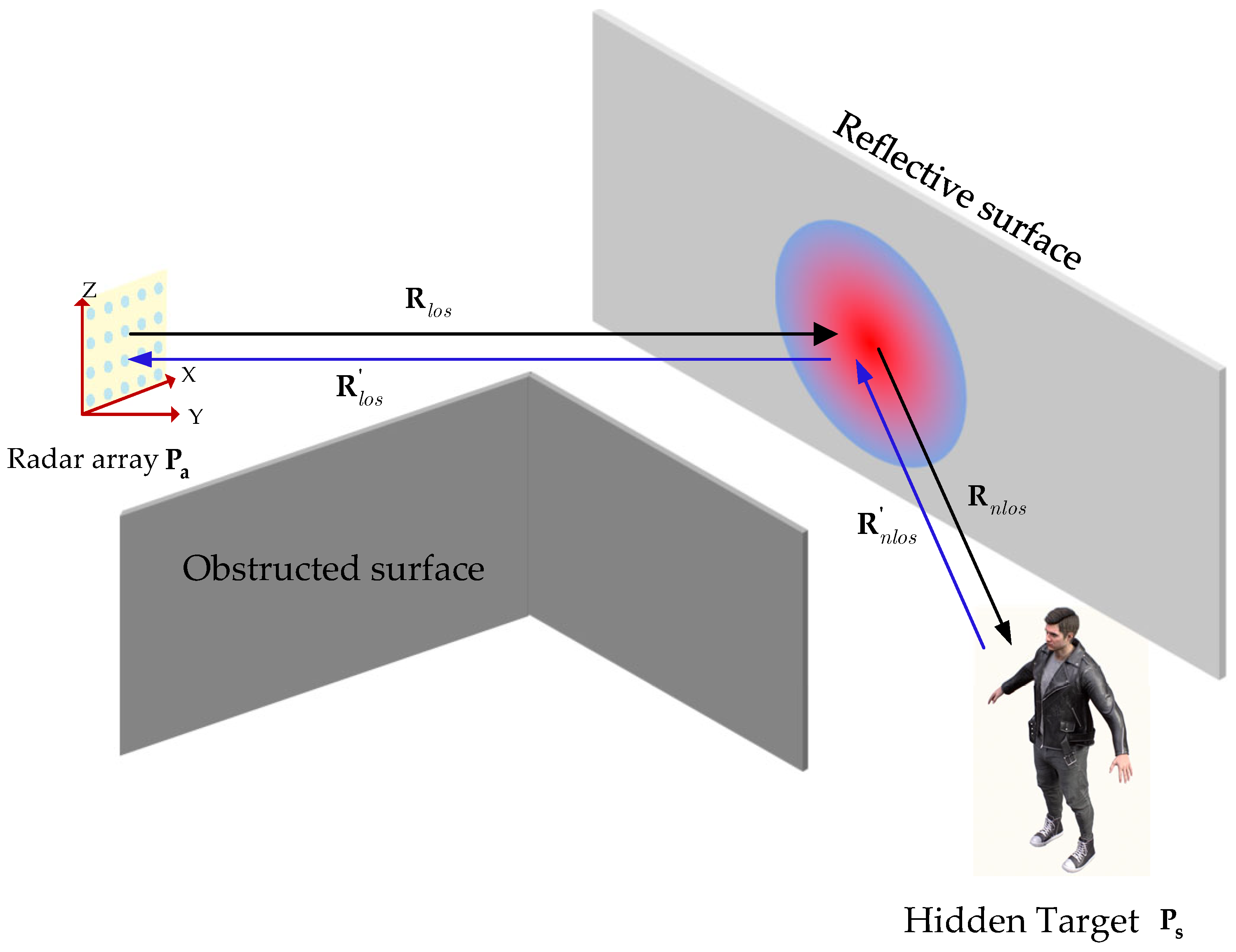
NLOS radar 3D imaging technology aims to reconstruct the 3D scattering characteristics of targets from their radar echo signals. Similar to LOS radar, NLOS radar achieves range resolution through pulse compression in the range direction and obtains spatial 2D resolution in the azimuth and elevation directions by synthesizing a 2D antenna virtual aperture. This paper primarily investigates the NLOS radar imaging problem in LAC scenarios. Figure 1 shows the geometric model for NLOS imaging in a practical LAC scenario.
A THz radar is placed in the LOS region Ω L O S and scans at the xz vertical plane using a moving platform to synthesize a 2D virtual antenna array, while a hidden target is located in the NLOS region Ω N L O S behind an obstruction. P a = ( x , 0 , z ) and P s = ( x , y , z ) indicate the coordinates of the array element and scatterer of hidden target, respectively. We assume the THz radar transmitting antenna emits electromagnetic waves along the y-axis. After being reflected by the reflective surface, the waves illuminate the hidden target. The echo signals carrying the target information then undergo another reflection before being received. R l o s and R n l o s denote the path distances for the transmitted wave in the LOS and NLOS regions, respectively, while R l o s and R n l o s denote those for the received wave. Unlike traditional LOS THz radar imaging, NLOS THz radar echoes consist of two components: LOS echo signals consisting of clutter from the LOS region and NLOS echo signals that contain hidden target information and interference from the NLOS environment, as shown below:
S a l l = S l o s + S n l o s S l o s = p Ω L O S σ p S t τ 2 R l ( p ) c S n l o s = q Ω N L O S σ q γ q S t τ 2 R n ( q ) c
where S l o s and S n l o s denote LOS and NLOS receiving signals, respectively. S t represents the FMCW transmitted by the THz radar. R l and R n represent the distances from the LOS scattering points p and the NLOS scattering point q to the radar, respectively. τ is the fast time of radar signal and c is the speed of light. σ p and σ q are the scattering coefficients of LOS and NLOS scatterers, respectively. γ q represents the Bidirectional Reflectance Distribution Function (BRDF) of NLOS reflective surfaces, which is used to describe how the reflection path of electromagnetic waves is affected by factors such as wavelength, reflective surface material, and roughness. For an ideal reflective surface, γ = 1 , while, for non-ideal reflective walls, the reflection of electromagnetic waves on rough surfaces introduces amplitude attenuation and phase errors. The BRDF γ can be expressed as [42]
γ = ζ q × exp j θ q
where amplitude ζ q follows a Rayleigh distribution with variance δ and phase θ q follows a uniform distribution on ( 0 , 2 π ) . Their probability density functions are
f ( ζ q ; δ ) = ζ q δ 2 × exp ζ q 2 2 δ 2 f ( θ q ) = 1 2 π , θ q π
here, the variance δ is related to the roughness of the reflective surface. For the simplicity of analysis, we suppose that the echo signal from the hidden target has been separated and extracted, and its mathematical representation is given as follows:
S ( P a , τ ) = P s Ω N L O S σ ( P s ) γ ( P s ) ϕ ( τ , R ) exp j 4 π f c R d P s
where R represents the distance information between the array element P a and scattering point P s . f is carrier frequency. Due to the influence of multipath effects, the echo signals from scatterer σ ( P s ) may experience several different paths, resulting in different fast time and time delay. The term ϕ ( τ , R ) carries the range information, which can be expressed as
ϕ ( τ , R ) = l = 1 N l exp j π K τ l 2 R l c 2
where N l denotes the number of multipath routes experienced by the scatterer σ ( P s ) and K represents the chirp constant. After range compression and Range Cell Migration Correction (RCMC), (4) becomes
S ( P a , r ) = P s Ω N L O S σ ( P s ) sinc ( r ) exp j 4 π f c R d P s
where r stands for the index of range cells and sinc ( r ) represents the range envelope. Due to the influence of NLOS multipath effects, ghost targets may appear in the 2D images at the same or different range gates. In practical imaging implementation, the focus is on the 2D echo slice at a specific range gate r. Expanding the coordinates of array elements and scatterers, we have
Y ( x , z ) = P s Ω r X ( x , z ) exp j 2 k ( x x ) 2 + y 2 + ( z z ) 2 d x d z
where Y ( x , z ) = S ( : , : , r ) represents the echo slice associated with range cell r, X ( x , z ) is the matrix representing scattering coefficients in the Ω r space, y corresponds to the distance of the rth range cell, and k = 2 π f / c represents the wavenumber. Based on the plane wave decomposition of spherical waves, the exponential term in Equation (7) can be decomposed as
exp j 2 k ( x x ) 2 + y 2 + ( z z ) 2 exp j k x ( x x ) j k y y + j k z ( z z ) d k x d k z
where k x , k y , k z are the components of the spatial wavenumber along the x-, y-, z-axes, respectively, and k y = 4 k 2 k x 2 k z 2 . Substituting Equation (8) into Equation (7) and adjusting the order of integration yields, it can be simplified as
Y IFT 2 D ( FT 2 D ( X ) Φ )
where FT and IFT denote 2D discrete Fourier transform and inverse discrete Fourier transform, respectively. ∘ represents the hadamard product, i.e., elementwise multiplication. Φ = exp { j k y y } . Therefore, the scattering coefficients X can be estimated by the inverse function of Equation (9):
X IFT 2 D ( FT 2 D ( Y ) Φ ˜ )
where Φ ˜ is the conjugate matrix of Φ . The above expression in (10) is the RMA. Benefiting from the FFT algorithm, RMA is computationally efficient. However, the limitation stems from the requirement of uniform sampling. In addition, under the constraint of the Nyquist criterion, a large number of sampling points are always required to ensure imaging accuracy, leading to high system complexity and long sensing time.
To reduce system complexity and SR, CS techniques can be employed. By vectorization, the commonly applied observation model converts (7) into a compact matrix–vector form, i.e., y = A x + n , where A is the measurement matrix. Despite being simple and intuitive, the matrix–vector model is memory-consuming and computationally inefficient, especially in cases of large-scale imaging. In addition, vectorization loses the 2D coupling prior information of the scene. To address the issues, the functional holographic imaging operators are designed based on the formulas in (9) and (10), which avoids inputting sensing matrices and consequently improves the computational efficiency [36]. Mathematically, the operators for THz radar imaging are expressed as
X IFT 2 D ( FT 2 D ( Y ) Φ ˜ ) = H ( Y ) Y IFT 2 D ( FT 2 D ( X ) Φ ) = H ( X )
Compared with the traditional linear observation model, the nonlinear THz radar holographic imaging operators achieve efficient computational performance through element-wise matrix multiplication and FFT. The observation model in this paper is defined as follows:
Y = H ( X ) + N
where N models the complex-valued Additive White Gaussian Noise (CAWGN). The NLOS imaging problem in Equation (11) can be modeled as an L 1 regularization problem based on the holographic imaging operator:
X ^ = arg min X 1 2 Y H ( X ) F 2 + η X L 1
where the data-fidelity term Y H ( X ) F 2 ensures that the final image is consistent with measured data, · F represents the matrix Frobenius norm, and · L 1 denotes L 1 norm, i.e., X L 1 = i , j | x i j | . η is the regularization parameter balancing the two penalty terms.

2.2. Assumptions

Before presenting the specific NLOS THz radar imaging methodology, we establish the following foundational assumptions and constraints to clarify the scope and underlying logic of our work:
  • When THz waves illuminate a rough surface (roughness on the order of the wavelength), the scattering process typically includes both specular and diffuse components. To simplify the modeling of NLOS propagation paths and the subsequent multipath analysis, this study focuses on the dominant specular reflection component. We therefore assume that all reflections from surfaces are effectively specular, providing a tractable basis for signal path reconstruction.
  • The properties of the reflective surface (e.g., material, geometry, roughness) introduce inherent signal attenuation and multipath effects, which influence final image quality. Under the constraints of THz radar transmitting power, our experimental setup for NLOS imaging is configured with a single reflective surface. In this configuration, the most significant multipath effects stem from multiple reflections and beam broadening due to the radar’s wide beamwidth. Furthermore, we assume that the targets of interest are situated within the NLOS-visible region and are sufficiently illuminated by the reflected beam from this single surface.
  • Since this paper focuses exclusively on the development of the NLOS THz radar 3D imaging algorithm, we assume that the distance between the target and the radar array is known a priori, which is used to preprocess the raw echo data and extract only the signal components corresponding to the true hidden targets, eliminating environmental clutter and target ghosts. The detailed echo extraction process is not discussed in this work.

2.3. Iterative Shrinkage/Thresholding Frameworks

2.3.1. ISTA

The Iterative Shrinkage/Thresholding Algorithm (ISTA) is a popular first-order proximal method, which is well suited for solving many large-scale linear inverse problems like (13). Its core idea is to decompose the problem into a combination of a smooth differentiable term and a non-differentiable term, and iteratively updates by alternately optimizing these two parts, ultimately converging to the optimal solution. Each iteration of ISTA involves gradient descent update followed by a proximal mapping step (e.g., shrinkage/soft-threshold operator) [43]:
R ( t ) = X ( t 1 ) ρ H H X ( t 1 ) Y
X ^ = arg min X 1 2 X R ( t ) F 2 + η X L 1
here, t denotes the ISTA iteration index, and ρ is the appropriate step size. Equation (15) is a classical Least Absolute Shrinkage and Selection Operator (LASSO) problem, which can be efficiently solved by a closed-form formula, so-called proximal mapping:
X ^ = s o f t R ( t ) , η
Its element is of the following form:
s o f t R ( t ) , η i j = r i j | r i j | m a x ( | r i j | η , 0 )
where r i j is the element at the position ( i , j ) of the matrix R ( t ) , and the initialization is X ( 0 ) = H ( Y ) . Since only one update is performed per iteration, the convergence speed of ISTA is relatively slow, especially when applied to NLOS imaging scenarios, where the scales of the echo signal matrix and target scattering coefficient matrix are large, resulting in low imaging efficiency.

2.3.2. FISTA

Two faster versions of ISTA are the two-step IST (TwIST) algorithm [44] and fast IST algorithm (FISTA) [45]. FISTA introduces the Nesterov acceleration method into ISTA, so that each iteration step depends not only on the current gradient information but also refers to the information from the previous iteration. FISTA solves (13) by iterating the following update steps:
R ( t ) = Z ( t ) ρ H H Z ( t ) Y
X ^ = s o f t R ( t ) , η
c ( t + 1 ) = 1 + 1 + 4 c ( t ) 2 2
Z ( t + 1 ) = X ( t ) + c ( t ) 1 c ( t + 1 ) X ( t ) X ( t 1 )
where the initialization is Z ( 1 ) = X ( 0 ) = H ( Y ) , and the momentum correction coefficient c ( 1 ) = 1 . Compared with ISTA, the main improvement of FISTA is that the iterative shrinkage operator s o f t ( · ) is not applied on the previous estimation X ( t ) , but rather at Z ( t ) , which adopts a well-designed linear combination of the previous two estimates X ( t ) and X ( t 1 ) . Additionally, by introducing a momentum correction term, FISTA overcomes the drawback of reduced convergence speed in the later stages of ISTA iterations. It can achieve the same accuracy of sparse solutions with far fewer iterations than ISTA, greatly improving the overall convergence efficiency of the algorithm, and is particularly suitable for NLOS scenarios with high demands on computational timeliness.

2.4. Network Mapping of FISTA

Due to the nested iterations, ISTA and FISTA suffer from low computational efficiency. Further, the overparameterized algorithmic framework further brings difficulties in tuning parameters optimally. Thereby, following the clue of deep unfolding, our main purpose in this section is to design an interpretable network to automate NLOS THz radar 3D imaging, which is capable of shortening the computational time and improving the reconstruction accuracy. Similar to the classic FISTA-Net framework proposed by Xiang et al. [46], our NLOS FISTA-Net to solve (13) is formulated as
R ( t ) = Z ( t ) ρ ( t ) H H Z ( t ) Y
X ^ = s o f t R ( t ) , η ( t )
Z ( t + 1 ) = X ( t ) + μ ( t ) X ( t ) X ( t 1 )
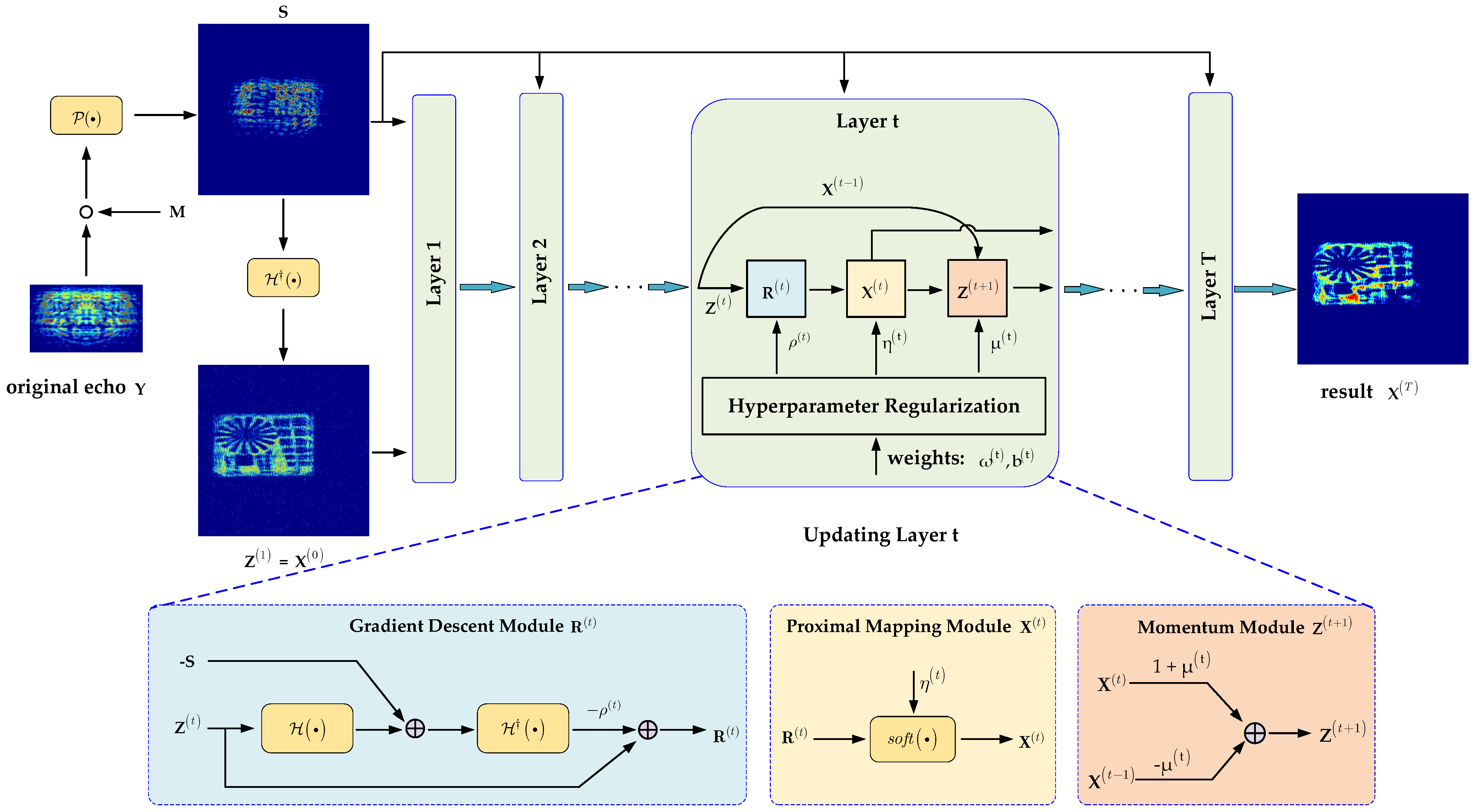
where the constant update weights c ( t ) of Equation (21) is absorbed into a single learnable parameter μ ( t ) to reduce computational complexity. To deal with the changing noise/artifacts level at each iteration of NLOS imaging, we allow the iteration step size ρ ( t ) and the shrinkage thresholding value η ( t ) to change at each cascaded stage. The advantage of such a setting is that we could maintain the flexibility to adapt the noise variance at each iteration while avoiding training various networks. Figure 2 illustrates the overall architecture of FISTA-Net, and more details are provided hereafter.

2.4.1. Initialization

This stage provides sparsely filled echoes for the training of FISTA-Net and calculates the initial imaging result X ( 0 ) and momentum correction term Z ( 1 ) . Consider the NLOS 2D echo slice matrix Y C N x × N z , corresponding to the range cell r after pulse compression, and the 2D NLOS hidden target image X C N × N , where N x and N z denotes the quantity of array elements in directions x and z, respectively. Typically, the echo matrix dimensions are smaller than the hidden target image, i.e., N x N , N z N . Therefore, it is necessary to pad the echo dimensions to match the image dimensions with zero elements. Define the zero-padding operator P ( · ) : C N x × N z C N × N , where P ( Y ) denotes padding the 2D echo Y with zeros around its boundaries to the same dimensions as the 2D image X . Thereby the padded echo after downsampling is S = P ( Y ) M C N × N , where M is the sparse sampling matrix, with elements 0 or 1, representing unsampled and sampled echo elements, respectively. It is imperative to mention that the SR is defined as S R = i = 1 N j = 1 N m i j / N 2 . Thus, the count of element 1 in M corresponds to the downsampling rate of the received echo signal. Then, the output of the initialization stage is
Z ( 1 ) = X ( 0 ) = IFT 2 D ( FT 2 D ( S ) Φ ˜ )
Each layer of FISTA-Net is composed of three cascaded sublayers, including the Gradient Descent Module, Proximal Mapping Module, and Momentum Module. In the following, we introduce each sublayer in detail.

2.4.2. Gradient Descent Module R ( t )

This layer updates the reconstructed image based on the gradient descent operation in Equation (22), which is the closed-form numerical solution of the data consistency subproblem, given Z ( t ) as the output of the previous layer. Inputting the NLOS echo S , the step size ρ ( t ) , and the momentum correction term Z ( t ) from the previous layer, the gradient descent is updated as
R ( t ) = Z ( t ) ρ ( t ) H H Z ( t ) S

2.4.3. Proximal Mapping Module X ( t )

After obtaining the coarse estimate R ( t ) from the Gradient Descent Module, the estimation problem for the 2D reconstructed image X ( t ) of the current iteration layer becomes
X ^ = arg min X 1 2 X R ( t ) F 2 + η ( t ) X L 1
Its solution is the same as Equations (16) and (17). The standard Gradient Descent Method has limited ability to suppress additive noise, whereas the soft threshold shrinkage operator effectively suppresses additive noise by threshold truncation. The output of the Proximal Mapping Module is
X ^ = s o f t R ( t ) , η ( t ) = ( x i j ) N × N
x i j = r i j | r i j | m a x ( | r i j | η ( t ) , 0 )

2.4.4. Momentum Module Z ( t + 1 )

The momentum correction module calculates the momentum correction value from the linear combination of historical iteration estimates, guaranteeing the quadratic convergence characteristic of the algorithm. The momentum correction process is simplified to
Z ( t + 1 ) = X ( t ) + μ ( t ) X ( t ) X ( t 1 ) = 1 + μ ( t ) X ( t ) μ ( t ) X ( t 1 )

2.4.5. Hyperparameter Regularization

Although { ρ ( t ) , η ( t ) , μ ( t ) } t = 1 T are learnable and no manual parameter tweaking is required in FISTA-Net, we introduce extra constraints to ensure they converge properly. Inspired by [47], the gradient step ρ ( t ) should decay smoothly with iterations. Thresholding value η ( t ) should also iteratively decrease because the noise variances are suppressed progressively with iterations. The two-step update weight μ ( t ) should increase monotonously, corresponding to the two-step update weight in the FISTA. Thus, by using the soft-plus function, we regularize the hyperparameters as
ρ ( t ) = s p ( w 1 t + b 1 ) , w 1 < 0
η ( t ) = s p ( w 2 t + b 2 ) , w 2 < 0
μ ( t ) = s p ( w 3 t + b 3 ) s p ( w 3 + b 3 ) s p ( w 3 ( t + 1 ) + b 3 ) , w 3 > 0
where the softplus function s p ( x ) = l n ( 1 + e x ) ; ρ ( t ) ( 0 , 1 ) ; the iteration step t = 1 , 2 , , T ; and { w 1 , w 2 , w 3 , b 1 , b 2 , b 3 } are network weights and bias, which are decoupled from iteration. One benefit of the softplus function is its simple derivative function.

2.4.6. Loss Function

Two suboptimization terms are taken into consideration here. First, in order to pursue high data fidelity, the Mean Square Error (MSE) is adopted to be an optimization term. We consider a training set Υ that contains N t r a i n pairs of ground-truth radar image and under-sampled echo. In this article, the imaging results from fully sampled echoes are defined as “label,” i.e., ground-truth X g t C N × N , and the sparsely sampled measurement echoes S can be considered as so-called “input.” Given samples ( X g t , S ) i N t r a i n Υ , the fidelity loss can be expressed as
L f ( Θ ) = 1 N t r a i n ( X g t , S ) Υ X ( S , Θ ) X g t F 2
where Θ = { w 1 , w 2 , w 3 , b 1 , b 2 , b 3 } denotes the undetermined parameters, and X ( S , Θ ) represents the output of FISTA-Net based on network parameters Θ and sparsely sampled echo S . In addition, a sparse loss function is defined to constrain the sparsity of the reconstructed results:
L s ( Θ ) = 1 N t r a i n ( X g t , S ) Υ X ( S , Θ ) L 1
Then, the global loss function of the network is defined as the weighted sum of the above two loss functions:
L ( Θ ) = L f ( Θ ) + α L s ( Θ )
where α is tunable parameter that balance the two constraints. By default, we set α = 0.01 .

2.4.7. Training Strategy and Dataset

Commonly, the conventional Deep Neural Networks (DNNs) always need to be trained by a large number of samples to get a satisfactory performance. However, in the research field of NLOS THz radar 3D imaging, there are very few publicly available datasets for network training. Thus, this paper constructs a simulated training dataset based on the NLOS THz radar imaging model parameters. Drawing on the method from [48], handwritten digit images are randomly selected from the MNIST dataset as original targets. Then, the ground-truth and sparsely sampled echoes in the training set can be generated:
X g t = P e x p ( 2 π P )
S = H ( X g t ) M + N
where P is the normalized pixel matrix of the MNIST handwritten digit image, and N denotes the additive Gaussian white noise. Therefore, based on Equations (37) and (38), an arbitrary number of training sample pairs ( X g t , S ) can be generated to train FISTA-Net. In this work, our training set comprises 1500 sample pairs, with signal-to-noise ratios randomly sampled uniformly from 0 to 20 dB. Notably, instead of fixing the sampling pattern, S R varies dynamically from 0.1 to 0.9 during training set generation, which means the positions of sampling points change continually. This trick improves the universality of the training set; it also enhances the diversity of data samples.

2.4.8. NLOS 3D Imaging Implementation

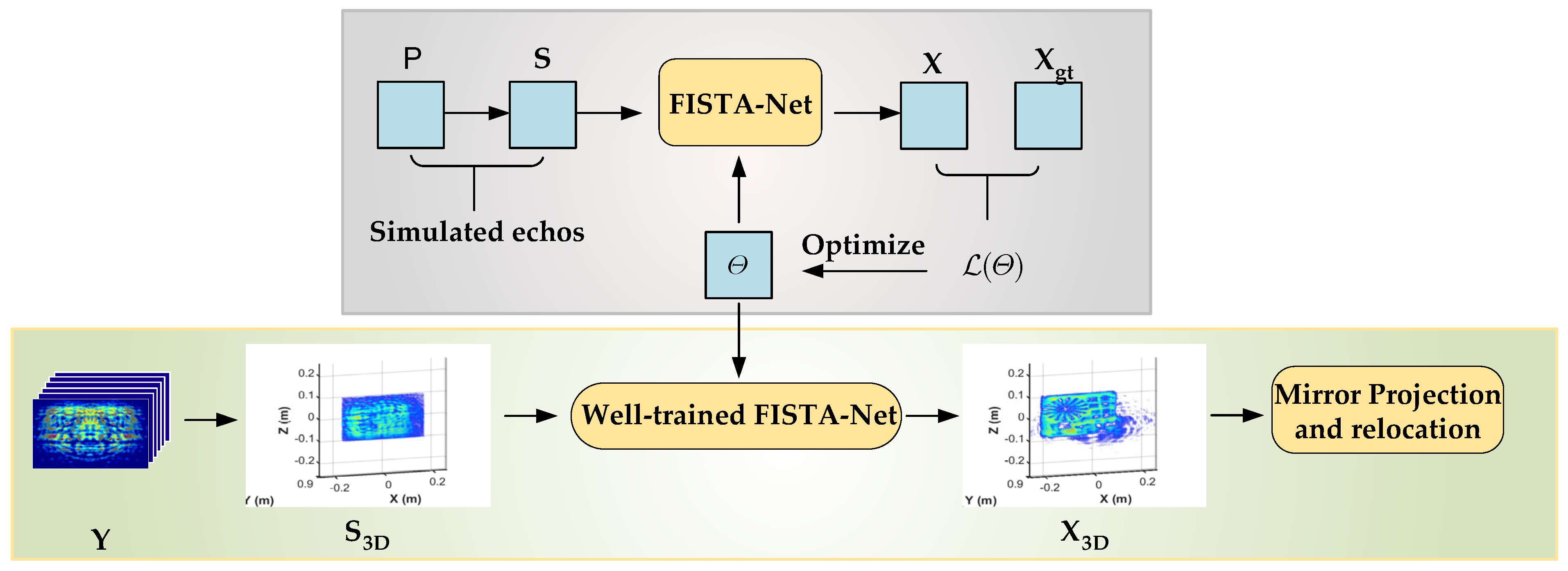
The framework of the proposed 3D learning imaging method for obscured targets in NLOS scenarios is shown in Figure 3. This method can be mainly divided into three parts: FISTA-Net training, FISTA-Net 3D imaging, and the mirror projection relocation of NLOS targets. For the 3D reconstruction of NLOS target scattering coefficients, the proposed sparse imaging network, benefiting from its highly parallel feedforward structure, can directly process the 3D tensor data of pulse-compressed echoes. Unlike traditional 3D sparse reconstruction algorithms, this network can process all 2D NLOS echo slices in parallel without the need for slice-by-slice image reconstruction, significantly improving imaging efficiency. Furthermore, due to the characteristic that the target is located in the NLOS scene, the obtained 3D reconstructed image of the target is actually the mirror projection of the real target with respect to the reflective surface. Therefore, using the prior knowledge of the reflective surface position in the imaging scene, the 3D image of the real target can be obtained through mirror projection relocation. The reconstruction steps of NLOS FISTA-Net are provided in Algorithm 1 in detail.
Algorithm 1 NLOS FISTA-Net for 3D THz radar imaging
Require: 
Raw echo 3D cube Y , iteration number T;
Ensure: 
NLOS 3D imaging result cube X t r u e .
  1:
Range focusing, RCMC, and divide the echo cube into slices, obtain S 3 D ;
  2:
Load well-trained network parameters Θ = { w 1 , w 2 , w 3 , b 1 , b 2 , b 3 } ;
  3:
Set t = 1 , Z 3 D ( 1 ) = X 3 D ( 1 ) = H ( S 3 D ) ;
  4:
while  t T  do
  5:
        R 3 D ( t ) = Z 3 D ( t ) ρ ( t ) H H Z 3 D ( t ) S 3 D ;
  6:
        X 3 D ( t ) = s o f t R 3 D ( t ) , η ( t ) ;
  7:
        Z 3 D ( t + 1 ) = 1 + μ ( t ) X 3 D ( t ) μ ( t ) X 3 D ( t 1 ) ;
  8:
        t t + 1
  9:
end while
10:
Make a mirror projection to X 3 D , obtain X t r u e

3. Experiments and Results

3.1. Experiment Setup

In this section, the real-measured experiments are performed to validate the effectiveness and efficiency of the proposed method. Comparison methods include RMA based on matched filtering theory, as well as the sparse imaging method FISTA. The proposed NLOS sparse imaging network method is trained and tested within the PyTorch deep learning framework (version 1.9.1) on a Windows 10 operating system. The learning rate is set to 0.01, the batch size is set to 8, the Adam optimizer is adopted, and the number of iteration layers is fixed at 9. All experiments are performed on the same workstation equipped with an Intel core i7-8700 CPU (64 GB RAM equipped) and an NVIDIA RTX 4060 Ti GPU (16 GB memory). Since ground-truth images of the imaging results are generally unavailable as references in practical measurement experiments, this paper selects two non-reference image quality assessment metrics, namely, Image Entropy (ENT) and Image Contrast (IC), to evaluate imaging quality.
E N T ( X ) = m , n | x m , n | 2 e l n | x m , n | 2 e
I C ( X ) = N 2 e 2 m , n | x m , n | 4 1
where e = m , n | x m , n | 2 represents the total energy of the reconstructed image. Generally, a lower ENT value indicates better image focusing, while a higher IC value signifies greater distinction between the reconstructed target and the background.
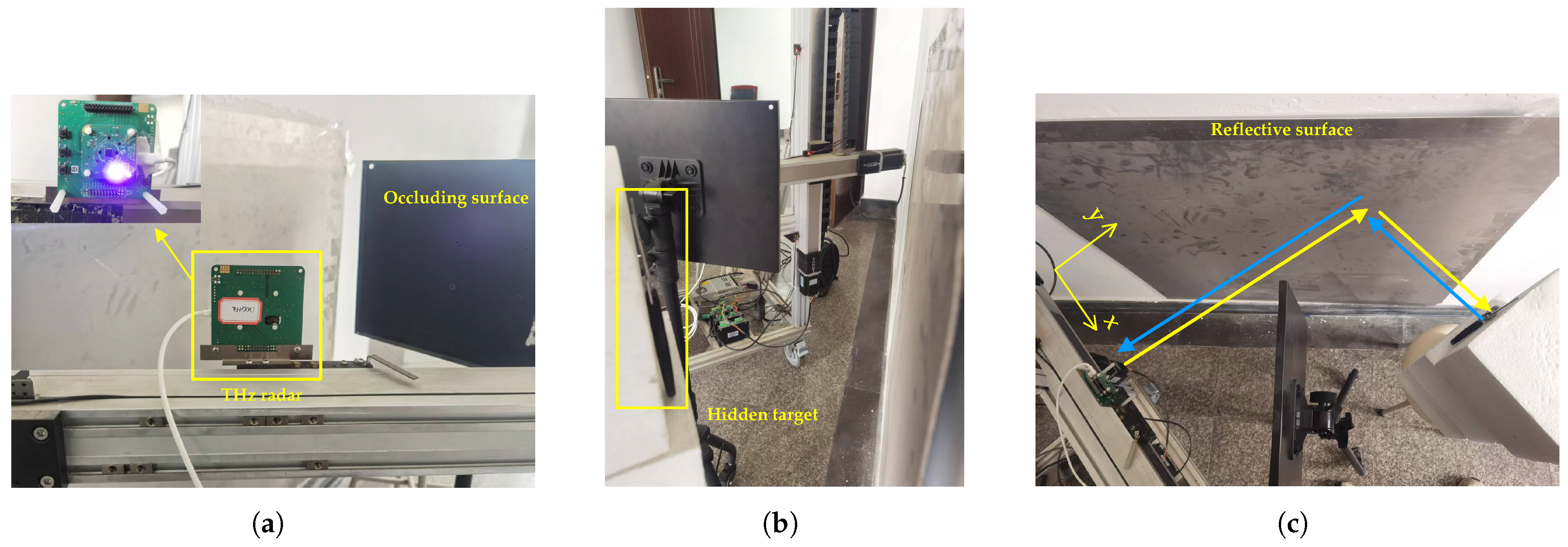
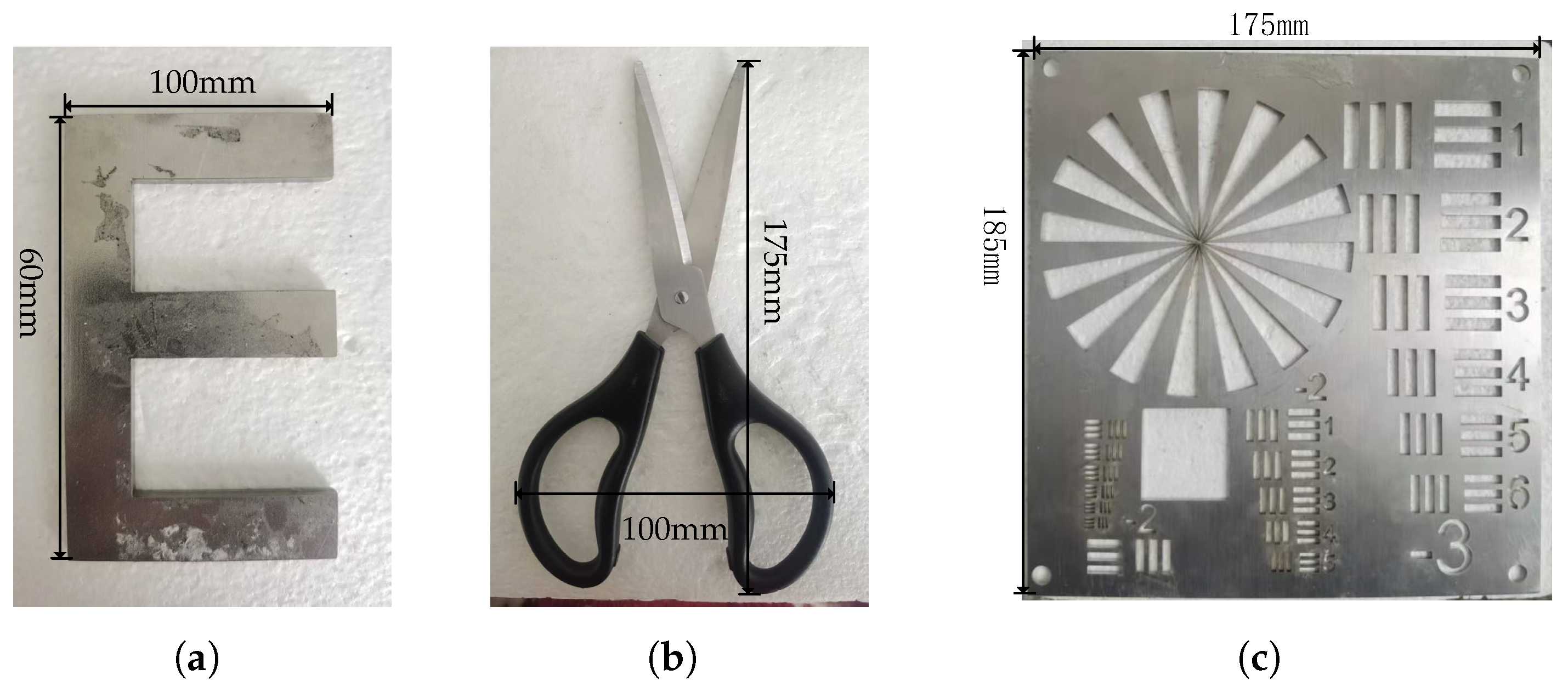
As shown in Figure 4, a NLOS THz radar 3D imaging platform is constructed to collect the echo from three different NLOS targets: a metal letter “E”, a metal resolution chart, and a pair of scissors (as shown in Figure 5). The THz radar imaging system consists of a THz radar sensor and a high-precision rail. The radar performs xz plane scanning along the high-precision rail to achieve a large virtual aperture, thereby improving azimuthal imaging resolution. Additionally, the angle between the array plane and the reflective surface is approximately 45 degrees. The experimental platform parameters are listed in Table 1. Due to the rail movement, the received echoes were sampled across 334, 200, and 512 points in the x, z, and y(range) dimensions, respectively, resulting in an original echo cube with dimensions of 334 × 200 × 512 . Specifically, along the x-axis, the rail synthesizes an azimuth aperture length of 200 mm with an antenna element spacing of 0.598 mm; along the z-axis, the rail synthesizes an elevation aperture length of 200 mm with an antenna element spacing of 1 mm. All targets were located at a distance of approximately 0.9 m from the center of the radar’s synthetic array and at the same height as the array center. Considering the low transmission power of our THz radar and to ensure good reflection characteristics, the reflective surface is made of sheet metal. It is hereby stated that the radar cannot directly detect the target through the LOS path, and the synthetic aperture array relies on reflective surfaces for target detection. Additionally, all subsequent imaging in this paper is based on echo data from the range cells at approximately 0.9 m.

3.2. Experiment Results and Discussion

This subsection compares and verifies the performance of the proposed method using measured data acquired from the NLOS THz radar experimental platform. It analyzes the influence of different SR values on the imaging results for both simple and complex targets. The compared methods include RMA and FISTA. For all imaging methods, the 3D imaging grid dimensions are set to x y z : 512 × 7 × 512 ; for FISTA, the termination condition is either exceeding a maximum of 30 iterations or the variation of historical estimations under the tolerance 1 × 10 6 . The iteration step size and soft threshold are both adjusted to achieve accurate imaging results.
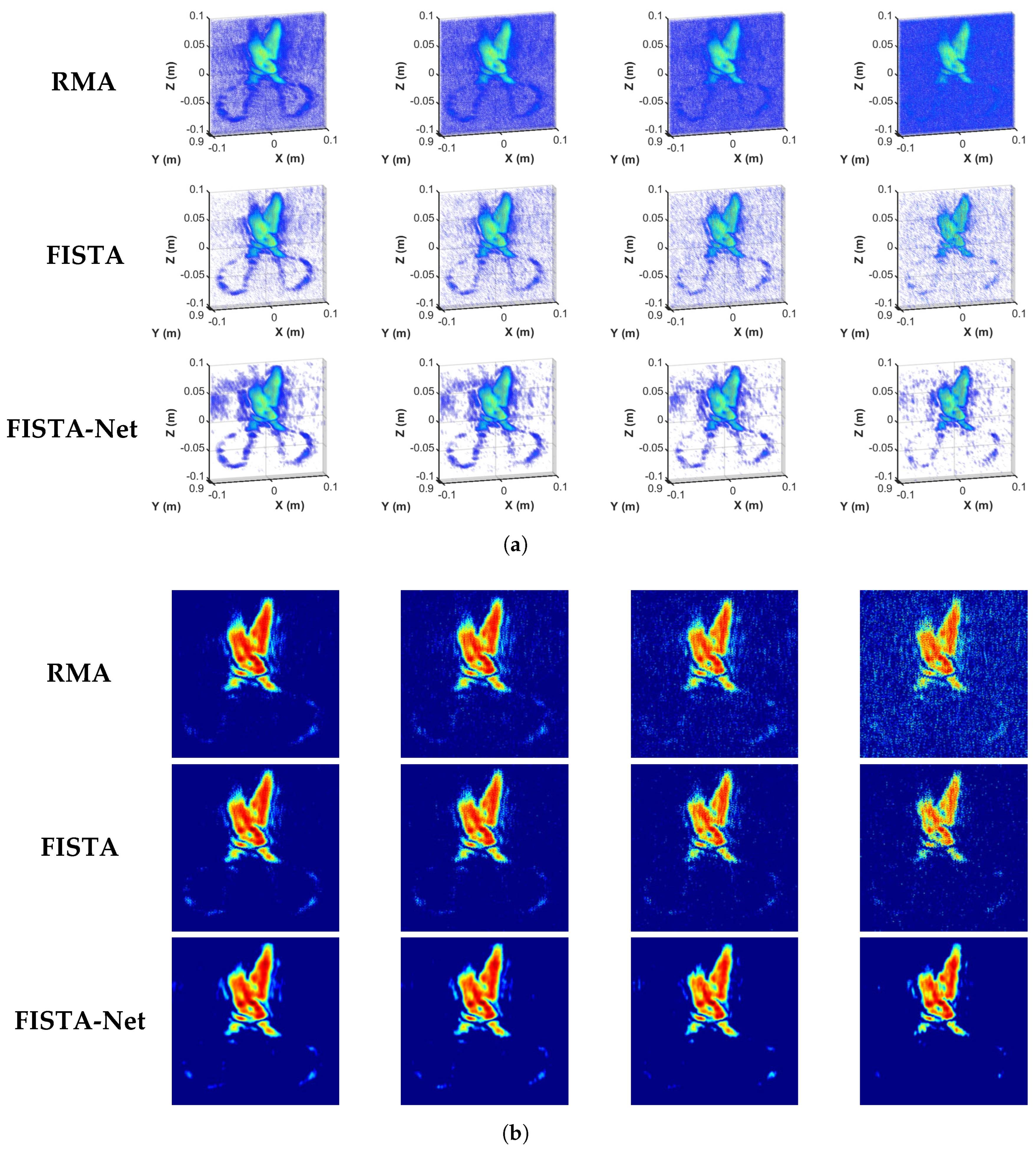
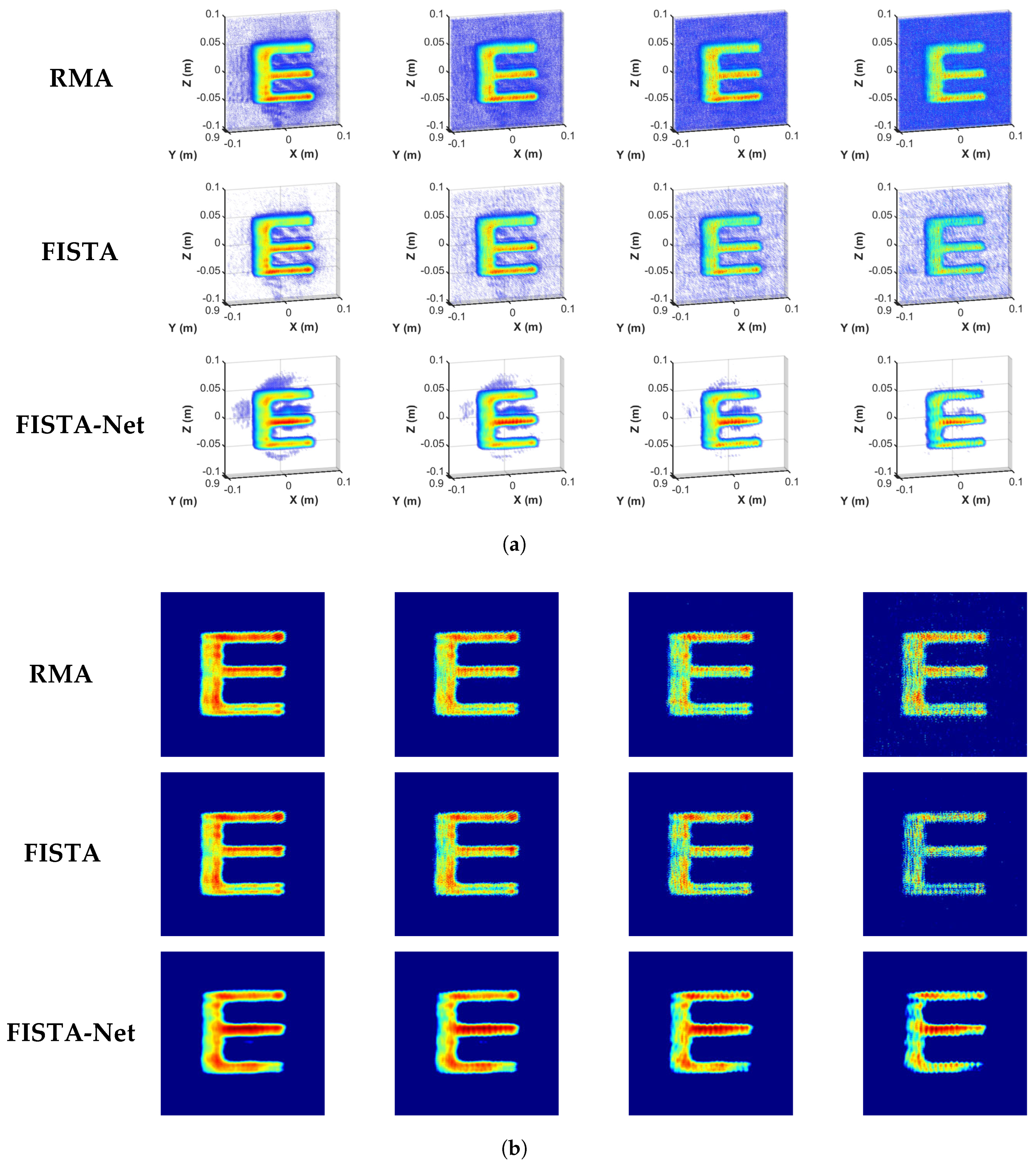
The reconstruction performance of each algorithm is investigated in two targets characterized by inherent sparsity firstly. Target one is the metal letter “E”, as depicted in Figure 5a. Following the steps in Algorithm 1, we applied pulse compression to the acquired raw echo tensor, and the corresponding NLOS target region was extracted and divided into seven slices. Figure 6 presents the imaging results of each algorithm with SRs of 100%, 70%, 50% and 30%. The figure shows that, as the SR gradually decreases, the NLOS target images obtained by the RMA method based on matched filtering are gradually overwhelmed by strong background noise, resulting in a significant decline in imaging quality. In contrast, the CS-based sparse imaging methods, FISTA and FISTA-Net, produce well-focused reconstructions with clean backgrounds. Even at an SR as low as 30%, they effectively suppress noise and successfully reconstruct the target image. Furthermore, compared with FISTA, the proposed FISTA-Net, which achieves optimal hyperparameters through self-learning, consistently yields better reconstruction quality for the target “E” at all SRs. It obtains imaging results with the clearest backgrounds, the least noise interference, and the best focusing, which intuitively validates the effectiveness of the proposed method.
As shown in Figure 5b, target two is a pair of scissors commonly used in daily life, with its imaging results shown in Figure 7. Compared to the metal letter “E”, the scissors have more complex shape and material composition: the blade part is metallic, while the handle part is plastic. The results indicate that, for fully sampled echo data, sparse imaging algorithms can suppress scattering point sidelobes and improve imaging quality compared to matched filtering algorithms. Through end-to-end training, the proposed FISTA-Net adaptively optimizes hyperparameters, further reducing background noise power relative to FISTA and yielding clearer and more distinct image contours. Additionally, benefiting from the parallel optimization of 3D tensors by the deep unfolding network, FISTA-Net avoids the artifacts generated when FISTA performs slice-by-slice imaging followed by stitching into a 3D image result, thereby further enhancing imaging quality. Consequently, FISTA-Net achieves the highest image reconstruction accuracy, the best noise suppression performance, and the cleanest background, further substantiating the effectiveness of the proposed learning-based imaging method grounded in compressed sensing theory in environments closely resembling practical conditions.
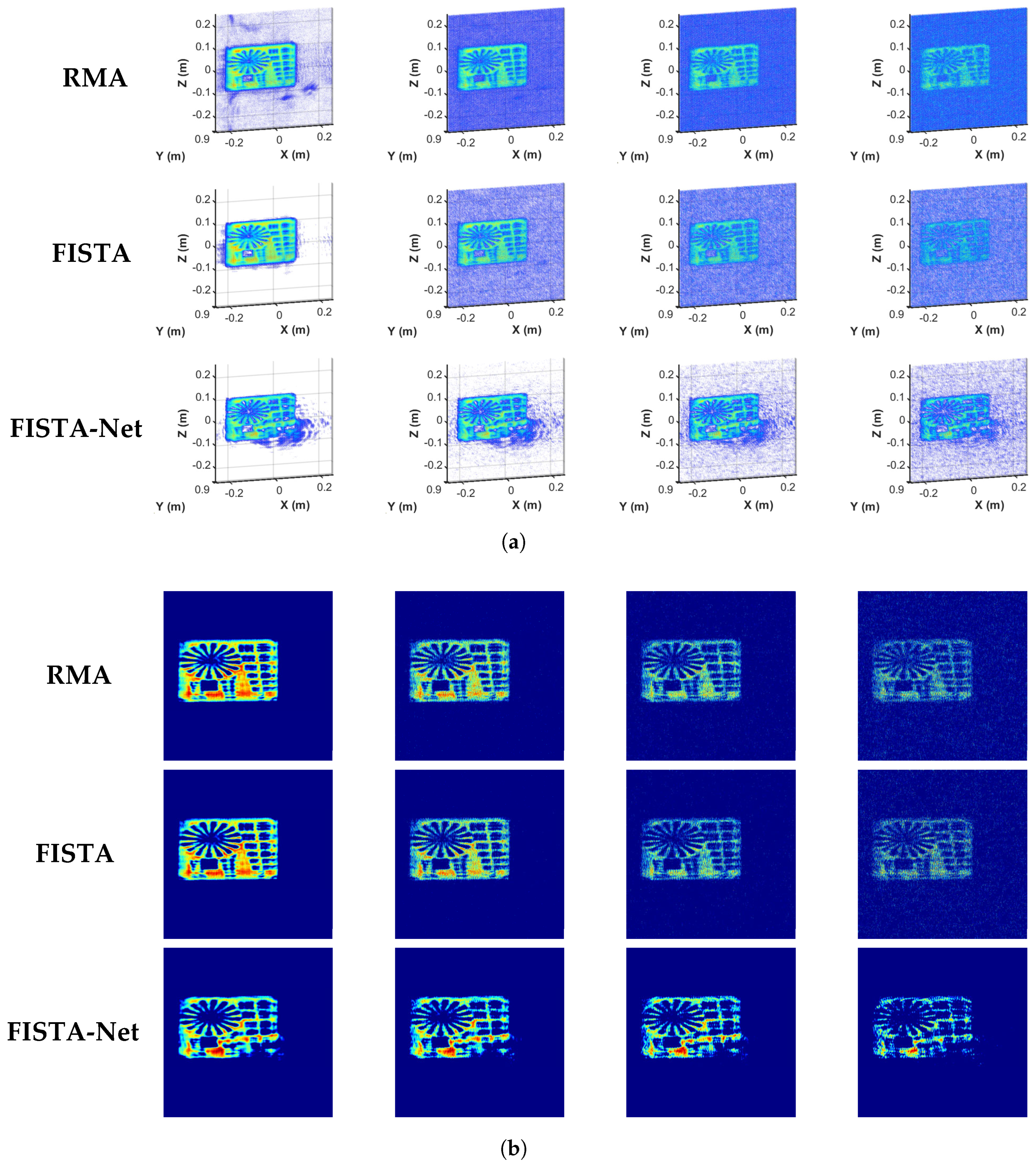
Sparse imaging algorithms can accurately recover target signals from measured echoes with SR below the Nyquist criterion, provided that the signal is inherently sparse or compressible. Therefore, this experiment aims to verify the imaging performance of FISTA-Net when the scene exhibits weak sparsity, with the NLOS imaging target shown in Figure 5c. Figure 8 shows the imaging results obtained by each algorithm under different SRs. It is evident that, under 100% SR, all algorithms achieve a relatively high reconstruction accuracy of the target. Although RMA exhibits some blurring effects caused by matched filtering sidelobes, it still captures the complete geometric structural characteristics of the target. Compared to traditional methods, FISTA and FISTA-Net demonstrate significant improvements in both clarity and detail reconstruction. However, as the SR gradually decreases, although the proposed algorithm can obtain imaging results with relatively clean backgrounds, it suffers from issues such as amplitude attenuation and a loss of scattering points. This is because the resolution chart is a typical area target with weak sparsity. According to CS theory, stable and accurate reconstruction requires the scene to be sparse or compressible (sparse in some transform domain). When the SR is reduced to 30%, the number of measurements decreases, leading to reduced reconstruction stability. Consequently, the aforementioned degradation phenomena appear in the images. Therefore, in weakly sparse scenes without an effective sparse representation, reconstruction performance deteriorates as the SR decreases.
Table 2 presents the numerical evaluation results of ENT and IC for the imaging results obtained by each algorithm. The optimal numerical evaluation values are highlighted in bold. The results demonstrate that, compared to the RMA and FISTA algorithms, the imaging results obtained by the proposed FISTA-Net exhibit lower ENT values, indicating superior imaging focusing accuracy. Simultaneously, its IC values surpass those of the other methods, signifying that FISTA-Net is more effective in suppressing noise, sidelobes, and clutter, thereby achieving images with cleaner backgrounds. It is noteworthy that, as the SR decreases, for targets with inherent sparsity (the letter “E” and the scissors), the IC values of the CS-based FISTA and FISTA-Net increase, whereas those of the matched filtering-based RMA decrease. This is because, at lower SR, traditional imaging methods introduce more background noise, leading to a decrease in IC. Conversely, CS methods maintain a relatively clear background; the reduction in SR primarily results in amplitude estimation distortion and the loss of target scattering points, which paradoxically expands the dynamic range of amplitudes, causing the IC to rise. When the target is the resolution plate, this phenomenon does not occur in the imaging results of FISTA and FISTA-Net, precisely because the resolution chart, being a weakly sparse area target, experiences a degradation in imaging quality as the SR decreases.
Table 2 also presents the imaging processing time for each algorithm. It can be observed that FISTA-Net achieves the fastest running speed, with its computational efficiency improved by at least two orders of magnitude compared to traditional imaging algorithms. This significant speedup is attributable to the following reasons: FISTA-Net is designed as a highly parallel feedforward network structure suitable for GPU acceleration; simultaneously, provided that memory is sufficient, FISTA-Net directly processes the three-dimensional echo tensor in parallel, further enhancing computational efficiency. Additionally, RMA exhibits relatively short imaging time due to its simple computational steps, requiring only two 2D Fourier transforms and one matrix dot-product operation. Due to its inherent iterative nature, the FISTA algorithm requires a relatively long imaging processing time.

4. Conclusions

This paper addresses issues such as artifacts and image blurring in the THz radar 3D imaging of hidden objects in LAC scenes. A novel NLOS THz radar 3D imaging method, named FISTA-Net, is constructed based on deep unfolding theory, which effectively improves imaging accuracy and efficiency. Firstly, the geometric model and signal model for NLOS THz radar are established. Secondly, the NLOS imaging problem is formulated as an L 1 regularization problem and solved using the FISTA framework. To overcome the drawback of measurement matrix dimension explosion inherent in traditional matrix–vector linear modeling for sparse imaging in NLOS scenarios, a fast frequency-domain imaging operator is introduced, significantly reducing memory consumption and enhancing imaging efficiency. Subsequently, to address challenges such as complex parameter tuning and poor algorithm stability in iterative optimal solving methods for sparse reconstruction, an imaging network with a fixed number of iterations is constructed based on deep unfolding theory. Hyperparameters are automatically optimized through end-to-end training, further improving imaging efficiency. Finally, the effectiveness of the proposed algorithm for 3D imaging in NLOS scenarios is validated through multiple sets of experimental measurements.
This paper preliminarily verifies the feasibility of deep unfolding networks in the field of NLOS THz radar 3D imaging. However, the imaging model studied in this paper is based on relatively ideal assumptions for NLOS scenarios, primarily that the radar echo signal consists solely of a single reflection component, neglecting multiple reflection and diffraction components. Under this simplified model, the proposed NLOS learning imaging algorithm can essentially be regarded as an extension and expansion of existing LOS imaging networks. Future research urgently needs to further explore key NLOS imaging issues such as multipath signal modeling and phase error compensation for non-ideal reflective surfaces. Furthermore, the method proposed in this paper is limited by the inherent grid-regularity requirement of the FFT-based holographic operator, which necessitates uniform sampling patterns to maintain its computational efficiency. This constraint renders the current framework sensitive to non-ideal acquisition scenarios involving highly irregular illumination or detection points. In addition to these geometric restrictions, the algorithm remains dependent on a strong sparsity assumption, leading to omnipresent distortions in imaging results when recovering weakly sparse area targets from undersampled echoes. Therefore, further investigation is required to exploit the compressible characteristics of complex scenes and develop advanced reconstruction methods—such as non-uniform processing or virtual signal completion—to accurately recover hidden targets in both weakly sparse and irregular scenarios. Additionally, constrained by the 121 GHz signal frequency band and the limited transmission power of the radar module, the imaging experiments in this study were conducted at a distance of approximately 0.9 m to ensure a sufficient signal-to-noise ratio for reliable reconstruction. Due to these hardware boundaries and the resulting link budget constraints, this paper did not utilize rough wall surfaces as reflectors, opting instead for a metal plate to maintain signal integrity. Future work necessitates upgrading the radar system hardware with higher-power sources and enhanced receiver sensitivity to investigate long-range imaging methods that more closely resemble complex, practical scenarios.

Author Contributions

Conceptualization, K.C. and S.W.; methodology, K.C. and M.W.; software, K.C. and B.H.; validation, K.C. and J.C.; formal analysis, K.C.; investigation, K.C. and J.C.; resources, K.C. and S.W.; data curation, K.C.; writing—original draft preparation, K.C.; writing—review and editing, K.C. and S.W.; visualization, K.C.; supervision, S.W., J.L., X.Z. and P.G.; project administration, K.C., S.W. and X.M.; funding acquisition, S.W., J.L., Z.L., X.Z. and Y.L. All authors have read and agreed to the published version of the manuscript.

Funding

This research was funded in part by the National Natural Science Foundation of China under Grant 62271108 and Grant 62401119, in part by the Natural Science Foundation of Sichuan Province under Grant 2025ZNSFSC0526, in part by Hainan Province Natural Science Foundation under Grant 624LALH011, and in part by Open Foundation of National Key Laboratory of Scattering and Radiation under Grant 802NKL2024KF-002.

Data Availability Statement

Data underlying the results presented in this paper are not publicly available at this time but may be obtained from the authors upon reasonable request.

Conflicts of Interest

The authors declare no conflicts of interest.

Abbreviations

The following abbreviations are used in this manuscript:
NLOSNon-Line-of-Sight
LOSLine-of-Sight
TWRThrough-Wall Radar
LACLooking Around Corner
SARSynthetic Aperture Radar
RMARange Migration Algorithm
CSCompressed sensing
THzTerahertz
DLDeep learning
FMCWFrequency-Modulated Continuous Wave
BRDFBidirectional Reflectance Distribution Function
RCMCRange Cell Migration Correction
FFTFast Fourier transform
CAWGNComplex-valued additive white Gaussian noise
ISTAIterative Shrinkage/Thresholding Algorithm
LASSOLeast Absolute Shrinkage and Selection Operator
FISTAFast Iterative Shrinkage/Thresholding Algorithm
MSEMean Square Error
DNNDeep Neural Network
ENTEntropy
ICImage Contrast

References

  1. Yang, J.Y. Development laws and macro trends analysis of radar technology. J. Radars 2012, 1, 19–27. [Google Scholar] [CrossRef]
  2. Ding, C.B.; Qiu, X.L.; Wu, Y.R. Concept, system, and method of holographic synthetic aperture radar. J. Radars 2020, 9, 399–408. [Google Scholar] [CrossRef]
  3. Ding, C.B.; Qiu, X.L.; Xu, F.; Liang, X.D.; Jiao, Z.K.; Zhang, F.B. Synthetic aperture radar three-dimensional imaging—From TomoSAR and array InSAR to microwave vision. J. Radars 2019, 8, 693–709. [Google Scholar] [CrossRef]
  4. Kong, L.J.; Guo, S.S.; Chen, J.H.; Wu, P.L.; Cui, G.L. Overview and prospects of multipath exploitation radar target detection technology. J. Radars 2024, 13, 23–45. [Google Scholar] [CrossRef]
  5. Smith, G.E.; Mobasseri, B.G. Multipath exploitation for radar target classification. In Proceedings of the 2012 IEEE Radar Conference, Atlanta, GA, USA, 7–11 May 2012; pp. 623–628. [Google Scholar]
  6. Raskar, R.; Davis, J. 5d Time-Light Transport Matrix: What Can We Reason About Scene Properties? 2008. Available online: https://dspace.mit.edu/handle/1721.1/67888 (accessed on 23 January 2026).
  7. Kirmani, A.; Hutchison, T.; Davis, J.; Raskar, R. Looking around the corner using transient imaging. In Proceedings of the 2009 IEEE 12th International Conference on Computer Vision, Kyoto, Japan, 29 September–2 October 2009; pp. 159–166. [Google Scholar]
  8. Velten, A.; Willwacher, T.; Gupta, O.; Veeraraghavan, A.; Bawendi, G.M.; Raskar, R. Recovering three-dimensional shape around a corner using ultrafast time-of-flight imaging. Nat. Commun. 2012, 3, 745. [Google Scholar] [CrossRef]
  9. Katz, O.; Heidmann, P.; Fink, M.; Gigan, S. Non-invasive single-shot imaging through scattering layers and around corners via speckle correlations. Nat. Photonics 2014, 8, 784–790. [Google Scholar] [CrossRef]
  10. Yedidia, A.B.; Baradad, M.; Thrmpoulidis, C.; Freeman, T.W.; Wornell, W.G. Using unknown occluders to recover hidden scenes. In Proceedings of the 2019 IEEE/CVF Conference on Computer Vision and Pattern Recognition, Long Beach, CA, USA, 15–20 June 2019; pp. 12223–12231. [Google Scholar]
  11. Liu, X.T.; Wang, J.Y.; Li, Z.P.; Shi, Z.Q.; Fu, X.; Qiu, L.Y. Non-line-of-sight reconstruction with signal-object collaborative regularization. Light Sci. Appl. 2021, 10, 198. [Google Scholar] [CrossRef]
  12. Pauli, M.; Göttel, B.; Scherr, S.; Bhutani, A.; Ayhan, S.; Winkler, W. Miniaturized millimeter-wave radar sensor for high-accuracy applications. IEEE Trans. Microw. Theory Tech. 2017, 65, 1707–1715. [Google Scholar] [CrossRef]
  13. Wang, X.; Xu, L.H.; Sun, H.B.; Xin, J.M.; Zheng, N.N. On-road vehicle detection and tracking using MMW radar and monovision fusion. IEEE Trans. Intell. Transp. Syst. 2016, 17, 2075–2084. [Google Scholar] [CrossRef]
  14. Guo, S.S.; Zhao, Q.S.; Cui, G.L.; Li, S.L.; Kong, L.J.; Yang, X.B. Behind corner targets location using small aperture millimeter wave radar in nlos urban environment. IEEE J. Sel. Top. Appl. Earth Obs. Remote Sens. 2020, 13, 460–470. [Google Scholar] [CrossRef]
  15. Chen, J.H.; Zhang, Y.; Guo, S.S.; Cui, G.L.; Wu, P.L.; Jia, C. Joint estimation of nlos building layout and targets via sparsity driven approach. IEEE Trans. Geosci. Remote Sens. 2022, 60, 5114513. [Google Scholar] [CrossRef]
  16. Wei, S.J.; Wei, J.S.; Liu, X.Y.; Wang, M.; Liu, S.; Fan, F. Nonlineof-sight 3-D imaging using millimeter-wave radar. IEEE Trans. Geosci. Remote Sens. 2022, 60, 5106518. [Google Scholar] [CrossRef]
  17. Lin, Y.Q.; Qiu, X.L.; Peng, L.X.; Li, H.; Ding, C.B. Non-line-of-sight target relocation by multipath model in SAR 3D urban area imaging. J. Radars 2024, 13, 777–790. [Google Scholar] [CrossRef]
  18. Wen, Y.B.; Wei, S.J.; Wei, J.S.; Liang, J.D.; Zhang, X.L. Non-line-of-sight imaging of hidden moving target using millimeter-wave inverse synthetic aperture radar. In Proceedings of the IGARSS 2022—2022 IEEE International Geoscience and Remote Sensing Symposium, Kuala Lumpur, Malaysia, 17–22 July 2022; pp. 555–558. [Google Scholar]
  19. Tan, X.H.; Yang, Z.J.; Li, D.; Liu, H.Q.; Liao, G.S.; Wu, Y. An efficient range-Doppler domain ISAR imaging approach for rapidly spinning targets. IEEE Trans. Geosci. Remote Sens. 2020, 58, 2670–2681. [Google Scholar] [CrossRef]
  20. Xing, M.D.; Ma, P.H.; Lou, Y.S.; Sun, G.C.; Lin, H. Review of fast back projection algorithms in synthetic aperture radar. J. Radars 2024, 13, 1–22. [Google Scholar] [CrossRef]
  21. Donoho, D.L. Compressed sensing. IEEE Trans. Inf. Theory 2006, 52, 1289–1306. [Google Scholar] [CrossRef]
  22. Cetin, M.; Karl, W.C. Feature-enhanced synthetic aperture radar image formation based on nonquadratic regularization. IEEE Trans. Image Process. 2001, 10, 623–631. [Google Scholar] [CrossRef] [PubMed]
  23. Álvarez, Y.; Rodriguez-vaqueiro, Y.; Gonzalezvaldes, B.; Rappaport, C.M.; Las-Heras, F.; Martínez-Lorenzo, J.Á. Three-dimensional compressed sensing-based millimeter-wave imaging. IEEE Trans. Antennas Propag. 2015, 63, 5868–5873. [Google Scholar] [CrossRef]
  24. Baraniuk, R.; Steeghs, P. Compressive radar imaging. In Proceedings of the 2007 IEEE Radar Conference, Waltham, MA, USA, 17–20 April 2007; pp. 128–133. [Google Scholar]
  25. Wei, S.J.; Zhang, X.L.; Shi, J.; Gao, X. Sparse reconstruction for SAR imaging based on compressed sensing. Prog. Electromagn. Res. 2010, 109, 63–81. [Google Scholar] [CrossRef]
  26. Liu, X.Y.; Wei, S.J.; Wei, J.S.; Shi, J.; Zhang, X.L.; Li, Y.J. Non-line-of-sight millimeter-wave radar 3-D sparse reconstruct via MSSTV method. In Proceedings of the 2022 IEEE 9th International Symposium on Microwave, Antenna, Propagation and EMC Technologies for Wireless Communications (MAPE), Chengdu, China, 26–29 August 2022; pp. 424–427. [Google Scholar]
  27. Cai, X.; Wei, S.J.; Wen, Y.B.; Hu, J.B.; Wang, M.; Shi, J.; Cui, G.L. Precise reconstruction method for hidden targets based on non-line-of-sight radar 3D imaging. J. Radars 2024, 13, 791–806. [Google Scholar] [CrossRef]
  28. Cai, X.; Wei, S.J.; Wen, Y.B.; Wang, M.; Shi, J.; Zhang, X.L. Bayesian-based 3-D MMW radar imaging of non-line-of-sight environments. In Proceedings of the 2023 Cross Strait Radio Science and Wireless Technology Conference (CSRSWTC), Guilin, China, 10–13 November 2023; pp. 1–3. [Google Scholar]
  29. Wen, Y.B.; Wei, S.J.; Cai, X.; Wang, M.; Shi, J.; Zhang, X.L. NMTCS: Non-line-of-sight sparse reconstruct for hidden motion targets. In Proceedings of the 2023 Cross Strait Radio Science and Wireless Technology Conference (CSRSWTC), Guilin, China, 10–13 November 2023; pp. 1–3. [Google Scholar]
  30. Wen, Y.B.; Wei, S.J.; Cai, X.; Shen, R.; Wang, M.; Shi, J. CMTI: Non-line- of-sight radar imaging for non-cooperative corner motion target. IEEE Trans. Veh. Technol. 2025, 74, 179–190. [Google Scholar] [CrossRef]
  31. Wen, Y.B.; Wei, S.J.; Cai, X.; Hu, Y.F.; Wang, M.; Cui, G.L. Non-line-of-sight sparse aperture ISAR imaging via a novel detail-aware regularization. IEEE Trans. Geosci. Remote Sens. 2024, 62, 5220218. [Google Scholar] [CrossRef]
  32. Gregor, K.; Yann, L.C. Learning fast approximations of sparse coding. In Proceedings of the 27th International Conference on International Conference on Machine Learning, Haifa, Israel, 21–24 June 2010; pp. 399–406. [Google Scholar]
  33. Liu, R.S.; Zhang, Y.X.; Cheng, S.C.; Luo, Z.X.; Fan, X. A deep framework assembling principled modules for CS-MRI: Unrolling perspective, convergence behaviors, and practical modelin. IEEE Trans. Med. Imaging 2020, 39, 4150–4163. [Google Scholar] [CrossRef]
  34. Wang, M.; Wei, S.J.; Shen, R.; Zhou, Z.C.; Shi, J.; Zhang, X.L. 3D SAR imaging method based on learned sparse prior. J. Radars 2023, 12, 36–52. [Google Scholar] [CrossRef]
  35. Wang, M.; Wei, S.J.; Liang, J.D.; Zeng, X.L.; Wang, C.; Shi, J. RMIST-Net: Joint range migration and sparse reconstruction network for 3-D mmW imaging. IEEE Trans. Geosci. Remote Sens. 2022, 60, 5205117. [Google Scholar] [CrossRef]
  36. Wang, M.; Wei, S.J.; Zhou, Z.C.; Shi, J.; Zhang, X.L.; Guo, Y.X. CTV-Net: Complex-valued TV-driven network with nested topology for 3-D SAR imaging. IEEE Trans. Neural Netw. Learn. Syst. 2024, 35, 5588–5602. [Google Scholar] [CrossRef] [PubMed]
  37. Wang, M.; Wei, S.J.; Shi, J.; Wu, Y.; Qu, Q.Z.; Zhou, Y.Y. CSR-Net: A novel complex-valued network for fast and precise 3-D microwave sparse reconstruction. IEEE J. Sel. Top. Appl. Earth Obs. Remote Sens. 2020, 13, 4476–4492. [Google Scholar] [CrossRef]
  38. Zhang, H.; Wei, S.J.; Min, R.; Cai, X.; Li, S.Q.; Li, J. Adaptive FMCW Radar Interference Suppression via Coupled Range-Doppler Unsupervised Sparse Learning and Reconstruction. IEEE Trans. Microw. Theory Tech. 2025, 73, 9442–9458. [Google Scholar] [CrossRef]
  39. Wei, S.J.; Zhang, H.; Zeng, X.F.; Zhou, Z.C.; Shi, J.; Zhang, X.L. CARNet: An effective method for SAR image interference suppression. Int. J. Appl. Earth Obs. Geoinf. 2022, 114, 103019. [Google Scholar] [CrossRef]
  40. Han, S.; Bertling, K.; Dean, P.; Keeley, J.; Burnett, A.D.; Lim, Y.L.; Khanna, S.P.; Valavanis, A.; Linfield, E.H.; Davies, A.G.; et al. Laser Feedback Interferometry as a Tool for Analysis of Granular Materials at Terahertz Frequencies: Towards Imaging and Identification of Plastic Explosives. Sensors 2016, 16, 352. [Google Scholar] [CrossRef]
  41. Silvestri, C.; Rakić, A.D.; Indjin, D.; Khalatpour, A.; Jirauschek, C.; Demic, A.; Ikonic, Z.; Dean, P.; Vuković, N.; Radovanović, J.; et al. Quantum cascade laser roadmap. arXiv 2026, arXiv:2602.17042. [Google Scholar] [CrossRef]
  42. Wang, Y.Z.; Li, L.J.; Gong, K. Narrowband experimental study on millimeter-wave indoor propagation. In Proceedings of the 1998 International Conference on Communication Technology, Beijing, China, 22–24 October 1998. [Google Scholar]
  43. Elad, M. Why simple shrinkage is still relevant for redundant representations? IEEE Trans. Inf. Theory 2006, 52, 5559–5569. [Google Scholar] [CrossRef]
  44. Bioucas-Dias, J.M.; Figueiredo, M.A.T. A New TwIST: Two-Step Iterative Shrinkage/Thresholding Algorithms for Image Restoration. IEEE Trans. Image Process. 2007, 16, 2992–3004. [Google Scholar] [CrossRef] [PubMed]
  45. Beck, A.; Teboulle, M. A fast iterative shrinkage thresholding algorithm for linear inverse problems. SIAM J. Imaging Sci. 2009, 2, 183–202. [Google Scholar] [CrossRef]
  46. Xiang, J.X.; Dong, Y.G.; Yang, Y.J. FISTA-Net: Learning a fast iterative shrinkage thresholding network for inverse problems in imaging. IEEE Trans. Med. Imaging 2021, 40, 1329–1339. [Google Scholar] [CrossRef]
  47. Wang, M.; Wei, S.J.; Liang, J.D.; Liu, S.; Shi, J.; Zhang, X.L. Lightweight FISTA-inspired sparse reconstruction network for mmW 3-D holography. IEEE Trans. Geosci. Remote Sens. 2021, 60, 5211620. [Google Scholar] [CrossRef]
  48. Zhou, Y.L.; Zhong, Y.; Wei, Z.; Yin, T.T.; Chen, X.D. An improved deep learning scheme for solving 2-D and 3-D inverse scattering problem. IEEE Trans. Antennas Propag. 2021, 69, 2853–2863. [Google Scholar] [CrossRef]
Figure 1. LAC geometric model for NLOS imaging.
Photonics 13 00440 g001
Figure 2. Detailed architecture of FISTA-Net. Each layer t consists of a Gradient Descent Module R ( t ) for data fidelity, a Proximal Mapping Module X ( t ) for sparsity enforcement, and a Momentum Module Z ( t + 1 ) . The variable Z ( t + 1 ) integrates information from the current and previous layers to accelerate convergence before entering layer t + 1 . Specifically, the outputs X ( t ) and Z ( t + 1 ) of layer t are respectively fed into the Momentum Module Z ( t + 2 ) and the Gradient Descent Module R ( t + 1 ) of layer t + 1 as inputs for the subsequent iteration.
Photonics 13 00440 g002
Figure 3. 3D imaging framework.
Photonics 13 00440 g003
Figure 4. NLOS THz radar imaging platform and scene. The yellow and blue lines represent the paths of the radar electromagnetic waves for detecting the hidden targets. (a) Front view of scene. (b) Side view of scene. (c) Top view of scene.
Photonics 13 00440 g004
Figure 5. NLOS targets. The size of each target is indicated in each diagram. (a) The metal letter “E”. (b) A pair of scissors. (c) The resolution chart.
Photonics 13 00440 g005
Figure 6. Reconstruction results of the metal letter “E”. Columns 1, 2, 3 and 4 provide results when SR = 100%, 70%, 50% and 30%, respectively. (a) 3D images. (b) The 4th slice of 3D images.
Photonics 13 00440 g006
Figure 7. Reconstruction results of the scissors. Columns 1, 2, 3 and 4 provide results when SR = 100%, 70%, 50% and 30%, respectively. (a) 3D images. (b) The 4th slice of 3D images.
Photonics 13 00440 g007
Figure 8. Reconstruction results of the resolution chart. Columns 1, 2, 3 and 4 provide results when SR = 100%, 70%, 50% and 30%, respectively. (a) 3D images. (b) The 4th slice of 3D images.
Photonics 13 00440 g008
Table 1. Main parameters in the experimental NLOS THz radar imaging system.
ParametersValues
Center Frequency (GHz)121
Chirp Constant (MHz/ μ s)31.746
Bandwidth (GHz)10
Pulse Width ( μ s)315
Pulse Repeat Frequency (Hz)33.3
x-axis Synthetic Aperture Length (mm)200
x-axis Antenna Element Spacing (mm)0.598
z-axis Synthetic Aperture Length (mm)200
z-axis Antenna Element Spacing (mm)1
Table 2. Numerical evaluation of algorithms at different SRs.
TargetsSRRMAFISTAFISTA-Net
ENTICTimes (s)ENTICTimes (s)ENTICTimes (s)
Letter “E”111.8485.8600.25210.8077.4563.53910.4778.0960.010
0.712.6574.3610.25311.3236.6983.57310.3918.4260.011
0.513.1493.2400.24211.6915.9423.55110.2848.8930.011
0.313.5432.1910.23111.9635.2313.41410.05010.1480.011
Scissors112.8704.4980.26411.0958.3453.87510.8829.0020.010
0.713.3243.2540.26911.3447.7973.98610.9199.1250.011
0.513.5792.4520.25611.3897.6733.86410.8899.4400.011
0.313.7921.7190.23211.2458.0393.86310.8919.9120.011
Resolution chart112.7982.4860.41612.5962.6665.51612.5462.8410.015
0.713.3861.9630.37913.0672.3125.28612.6392.8310.011
0.513.6391.6260.34513.3112.0315.36512.7352.8250.013
0.313.8111.3470.35113.4371.8225.36312.8572.8210.011
The optimal numerical evaluation values are highlighted in bold.
Disclaimer/Publisher’s Note: The statements, opinions and data contained in all publications are solely those of the individual author(s) and contributor(s) and not of MDPI and/or the editor(s). MDPI and/or the editor(s) disclaim responsibility for any injury to people or property resulting from any ideas, methods, instructions or products referred to in the content.