Article

Competing Built-In Electric Fields in Au/MoS2/WSe2 Dual Junction Photodetectors for Broadband VIS-IR Detection

by
Haoxuan Li
1,2,†,
Xuhao Fan
1,2,†,
Qirui Sun
1,2,
Shian Mi
1,2,
Changyi Pan
1,2,*,
Huiyong Deng
3,
Ning Dai
1,4,5 and
Yufeng Shan
1,5,*
1
School of Physics and Optoelectronic Engineering, Hangzhou Institute for Advanced Study, University of Chinese Academy of Sciences, Hangzhou 310024, China
2
University of Chinese Academy of Sciences, Beijing 100049, China
3
State Key Laboratory of Precision Spectroscopy, East China Normal University, Shanghai 200241, China
4
State Key Laboratory of Infrared Physics, Shanghai Institute of Technical Physics, Chinese Academy of Sciences, Shanghai 200083, China
5
Jiangsu Collaborative Innovation Center of Photovoltaic Science and Engineering, Changzhou 213164, China
*
Authors to whom correspondence should be addressed.
These authors contributed equally to this work.
Photonics 2026, 13(5), 418; https://doi.org/10.3390/photonics13050418
Submission received: 12 March 2026 / Revised: 10 April 2026 / Accepted: 20 April 2026 / Published: 24 April 2026
(This article belongs to the Section Optoelectronics and Optical Materials)

Abstract

Van der Waals (vdW) heterostructures are attractive for optoelectronic devices due to their lattice-mismatch tolerance and tunable band structures. Here, we report a gate-tunable Au/MoS2/WSe2 dual junction photodetector featuring competing asymmetric built-in electric fields. Spatially resolved photocurrent measurements reveal that selective utilization of these built-in electric fields decouples the transport dynamics of dark and photogenerated carriers. Such decoupling allows for independent modulation of the dark current and photocurrent, enabling the concurrent realization of the ultralow dark current and high photocurrent. Moreover, gate-voltage modulation enhances the photoresponse by ~245%, yielding a detectivity of 1.98 × 10¹² Jones over the 532–940 nm range. Imaging and optical communication further verify the device’s practical potential. These results provide a viable route toward high-sensitivity and electrically reconfigurable broadband photodetectors.

1. Introduction

Visible (VIS) and infrared (IR) sensing provide complementary spectral information for target recognition in complex environments [1,2,3,4]. Two-dimensional (2D) materials are promising candidates for high-performance VIS-IR photodetectors, owing to their atomic thickness, high carrier mobility, and strong light–matter interactions. Among these materials, semiconducting transition-metal dichalcogenides (TMDs), such as MoS2 and WSe2, have been extensively explored for photodetection [5,6,7,8]. MoS2 typically exhibits n-type transport behavior with a sizable bandgap (~1.8 eV in monolayer form) and relatively high carrier mobility (~200 cm2 V−1 s−1), enabling efficient photoresponse in the visible spectral range [9,10]. For instance, Singh reported a monolayer MoS2 MSM photodetector with a peak responsivity of 13.15 mA/W at 480 nm [11], while Zhou demonstrated a double-terminal MoS2 photodetector exhibiting a fast response time of 224 μs and a maximum responsivity of 280 mA/W [12]. WSe2, in contrast, often exhibits p-type transport behavior and possesses a bandgap of ~1.6 eV in its monolayer form, together with strong optical absorption and pronounced excitonic effects, making it attractive for high-sensitivity photodetection [13]. Li et al. reported a self-driven WSe2 photodetector with bottom Schottky contacts, achieving a responsivity of 360 mA/W and a detectivity of 1.07 × 10¹² Jones [14], whereas Yang et al. demonstrated a WSe2 homojunction photodetector with a responsivity of 0.35 A/W and a detectivity of 2.37 × 10¹¹ Jone [15].
Van der Waals (vdW) heterojunctions constructed from different 2D materials provide an effective strategy for enhancing photodetection performance by facilitating efficient carrier separation and tunable band alignment. Sun et al. reported a MoS2/WSe2 heterotransistor exhibiting a photoresponsivity of 17.8 A/W and a response speed of <80 ms under 660 nm illumination, and the device also showed a gate-dependent near-infrared photoresponse at 850 nm [16]. Shin et al. and Xiao et al. subsequently reported WSe2/MoS2 heterojunction photodetectors with broadband response and markedly improved sensitivity, confirming the considerable potential of MoS2/WSe2-based vdW heterostructures for high-performance photodetection [17,18]. However, in most reported heterojunction photodetectors, different interfaces are usually treated as a whole, and the roles of the metal/semiconductor contact and semiconductor/semiconductor heterojunction are rarely distinguished. As a result, the transport of dark carriers and photogenerated carriers remains strongly coupled, which limits the independent regulation of the dark current, photocurrent, and overall device performance. Therefore, developing more versatile photodetectors requires the precise regulation of each junction and effective manipulation of the carrier transport.
In this study, we report a gate-tunable Au/MoS2/WSe2 dual junction photodetector operating in the VIS–IR spectral range. Distinct from conventional single-junction devices, the present structure contains two junction regions with asymmetric built-in electric fields, enabling selective control of carrier transport at different interfaces. Owing to this competing built-in electric field configuration, the device enables the simultaneous suppression of the dark current and enhancement of the photocurrent under appropriate bias conditions. Furthermore, gate-voltage modulation provides an additional degree of freedom to engineer the interfacial band alignment and optimize the photoresponse. As a result, the device achieves a 2.45-fold enhancement in responsivity and a specific detectivity of 1.98 × 10¹² Jones at 532 nm. Proof-of-concept imaging and optical information encoding demonstrations highlight its potential for multiband optoelectronic applications.

2. Materials and Methods

2.1. Fabrication of the Au/MoS2/WSe2 Heterojunction

The fabrication procedure of the Au/MoS2/WSe2 dual junction photodetector is schematically illustrated in Figure 1. First, Cr/Au electrodes (10/60 nm) were pre-deposited on a SiO2/p-type Si substrate to define the source and drain contacts. The WSe2 and MoS2 flakes were mechanically exfoliated from bulk crystals and subsequently assembled into the device via a dry transfer method. Specifically, a WSe2 flake was first transferred onto the pre-patterned electrode region using a PDMS (Gel Pak, USA) stamp, forming the bottom semiconducting layer and establishing electrical contact with the metal electrode. Subsequently, a MoS2 flake was aligned and stacked onto the WSe2 flake using the same PDMS-assisted dry transfer process, forming a vertical MoS2/WSe2 Van der Waals heterojunction in the overlapping region, which, together with the metal/semiconductor contact, defines a dual junction device architecture. The heavily doped p-type Si substrate served as a global back-gate electrode, while the SiO2 layer acted as the gate dielectric, enabling effective electrostatic tuning of the band alignment and carrier transport properties of the heterojunction photodetector.

2.2. Characterization and Measurements

The thicknesses of the exfoliated WSe2 and MoS2 flakes were measured by atomic force microscopy (AFM, Jupiter XR, Oxford Instruments, Abingdon, UK). The Raman spectra of WSe2 and MoS2 were characterized by Raman spectrometer with a 532 nm laser (WITec alpha300RA confocal microscopy Raman system, WITec GmbH, Ulm, Germany). The electrical and optoelectronic properties of the Au/MoS2/WSe2 heterojunction photodetector were measured using a source meter (Keithley 2602B, Keithley Instruments, Inc., Solon, OH, USA). The drain–source voltage (Vds) and gate voltage (Vg) were applied to evaluate the transport characteristics of the device. For the photoresponse measurements, a 532 nm laser (CFS2-532-FC, Thorlabs, Inc., Newton, NJ, USA) was employed as the excitation source. The laser beam was focused to the micrometer scale through a confocal optical system to ensure localized illumination on the device. Photocurrent mapping was performed by scanning the focused laser spot across the device area while recording the corresponding photocurrent signal. Time-resolved photoresponse measurements were conducted by periodically modulating the laser illumination.

3. Results and Discussion

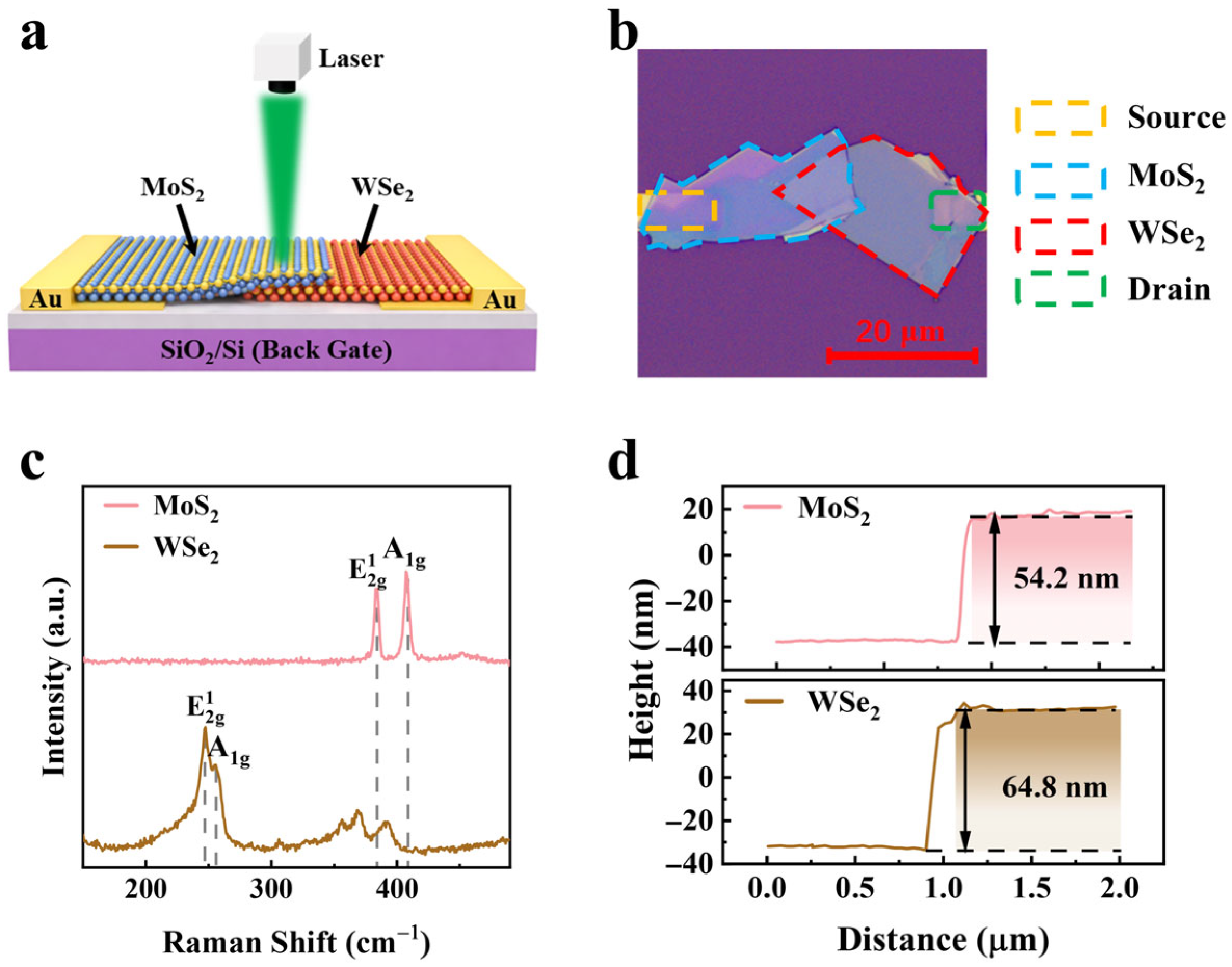
Figure 2a shows a 3D schematic of the device structure, with MoS2 vertically stacked on top of WSe2. The MoS2 and WSe2 layers are electrically connected to the source and drain electrodes, respectively. Figure 2b shows an optical image of the device, with the MoS2, WSe2, source, and drain regions outlined by dashed lines in different colors (scale bar: 20 μm). Raman spectroscopy was employed to characterize the heterostructure, as shown in Figure 2c. WSe2 exhibits characteristic Raman peaks at approximately 246.7 cm−1 and 254.9 cm−1, corresponding to the in-plane E 2 g 1 mode and the out-of-plane A 1 g mode, respectively [19]. Two additional weak peaks located at ~368.9 cm−1 and ~390.3 cm−1 are attributed to second-order phonon scattering processes in multilayer WSe2 [20,21]. Similarly, MoS2 exhibits two prominent Raman peaks at 383.6 cm−1 and 407.1 cm−1, corresponding to the in-plane E 2 g 1 and out-of-plane A 1 g modes, respectively [22,23,24]. Steady-state photoluminescence (PL) spectra (Figure S1, Supporting Information) further reveal distinct excitonic emissions from MoS2 and WSe2, while the heterojunction region exhibits combined and modulated features, indicating interlayer coupling and charge transfer. The thicknesses of the MoS2 and WSe2 flakes were characterized by atomic force microscopy (AFM), yielding values of approximately 54 nm and 65 nm, respectively (Figure 2d and Figure S2 in the Supporting Information). Overall, a high-quality Au/MoS2/WSe2 dual junction was successfully fabricated.
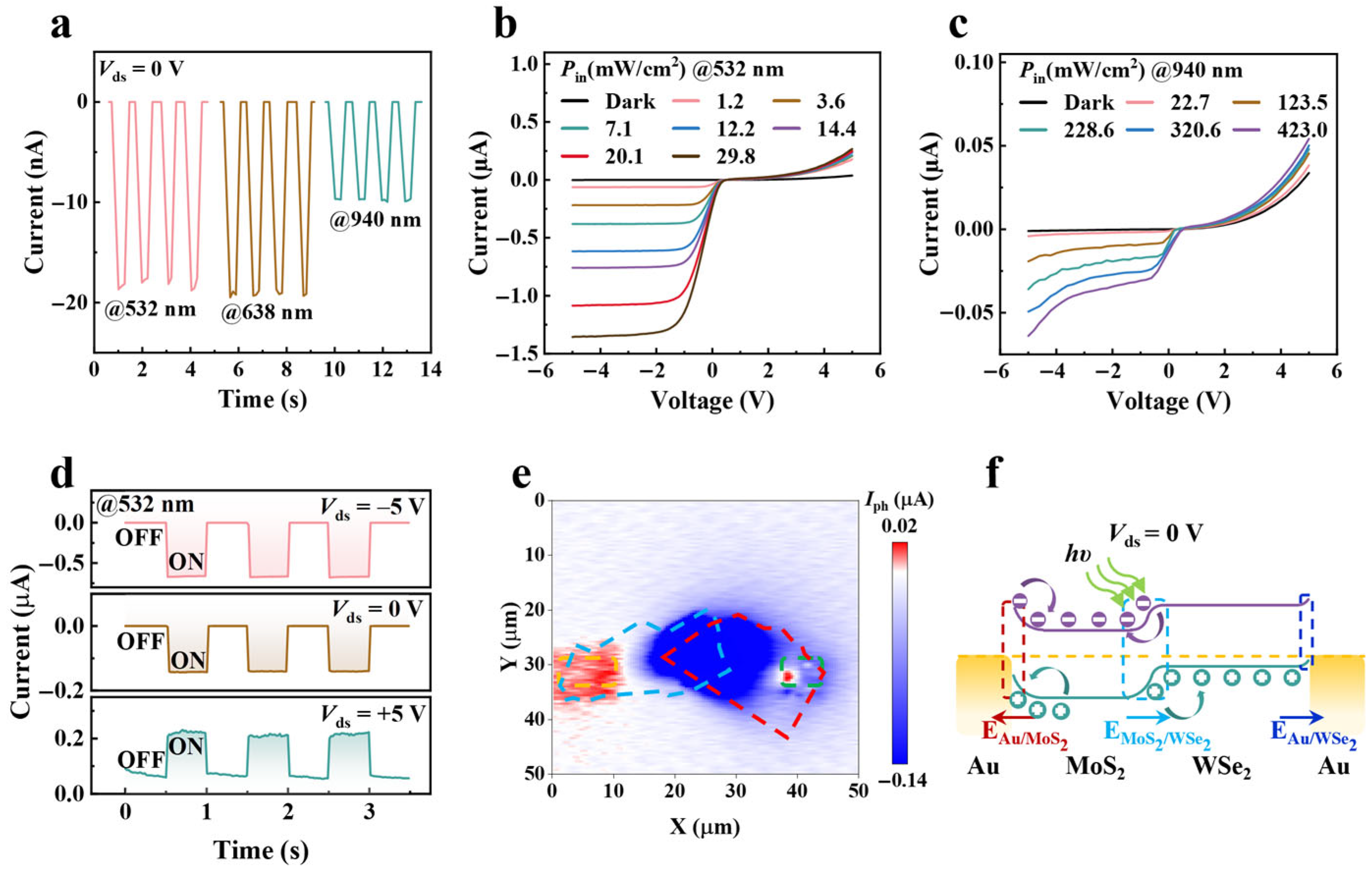
The Au/MoS2/WSe2 dual junction was systematically evaluated across the visible to near-infrared range. As shown in Figure 3a, zero-bias time-resolved photocurrent measurements under periodic 532, 638, and 940 nm illumination exhibit distinct and reproducible current switching, demonstrating effective self-powered photodetection. The extracted on/off ratios are 10,444, 10,822, and 5377 for 532, 638, and 940 nm, respectively. Figure 3b,c present the output characteristics of the device under 532 and 940 nm spatially selective illumination, respectively, at different light intensities. The photocurrent increases monotonically with incident power over the entire bias range, indicating a pronounced power-dependent photoresponse. Notably, the dark current is larger under positive bias than under negative bias, whereas the photocurrent exhibits the opposite behavior, showing higher values under negative bias. The opposite rectification characteristics of the photocurrent and dark current suggest distinct carrier transport mechanisms under illuminated and dark conditions. The time-resolved photocurrent under different light powers is shown in Figure S3 in the Supporting Information. Figure 3d shows the time-resolved photocurrent under 532 nm light illumination at different bias voltages. The on/off ratios at −5 V, 0 V, and 5 V are 838, 77,619, and 3.8, respectively. Under negative bias, the suppressed dark current, together with the enhanced photocurrent, leads to a higher on/off ratio. To gain deeper insight into the microscopic photoresponse mechanism, scanning photocurrent spectroscopy was performed (Figure 3e). A pronounced negative photocurrent (blue region) is observed at the MoS2/WSe2 interface, whereas the positive signal (red region) is localized at the Au/MoS2 interface. The spatial polarity reversal originates from oppositely oriented built-in electric fields at these junctions, which drive photogenerated carriers in opposite directions. The scanning photocurrent maps under other bias conditions are shown in Figure S4 in the Supporting Information. Figure 3f schematically depicts the energy band alignment of the Au/MoS2/WSe2 dual junction. The Au/MoS2 contact establishes a built-in electric field directed from MoS2 toward Au, while the MoS2/WSe2 interface forms an oppositely oriented internal field pointing from MoS2 to WSe2 [25,26,27]. The transport of dark carriers is jointly governed by the two built-in electric fields, whereas the transport of photogenerated carriers is primarily dominated by the electric field in the illuminated region. Therefore, by employing spatially selective illumination, the dark current and photocurrent can be effectively decoupled. KPFM measurements across the Au/MoS2, Au/WSe2, and MoS2/WSe2 regions further reveal interface-dependent surface-potential variations (Figure S5, Supporting Information). The evolution of the energy-band structure under different drain biases is further illustrated in Figure S6 in the Supporting Information. The carrier transport under different drain biases is determined by the competition between the oppositely oriented built-in electric fields at the Au/MoS2 and MoS2/WSe2 junctions. Positive drain bias mainly facilitates transport through the Au/MoS2 Schottky junction and leads to a relatively larger dark current, whereas negative drain bias more effectively cooperates with the built-in field at the MoS2/WSe2 heterojunction, enhancing photocarrier separation while maintaining a low dark current.
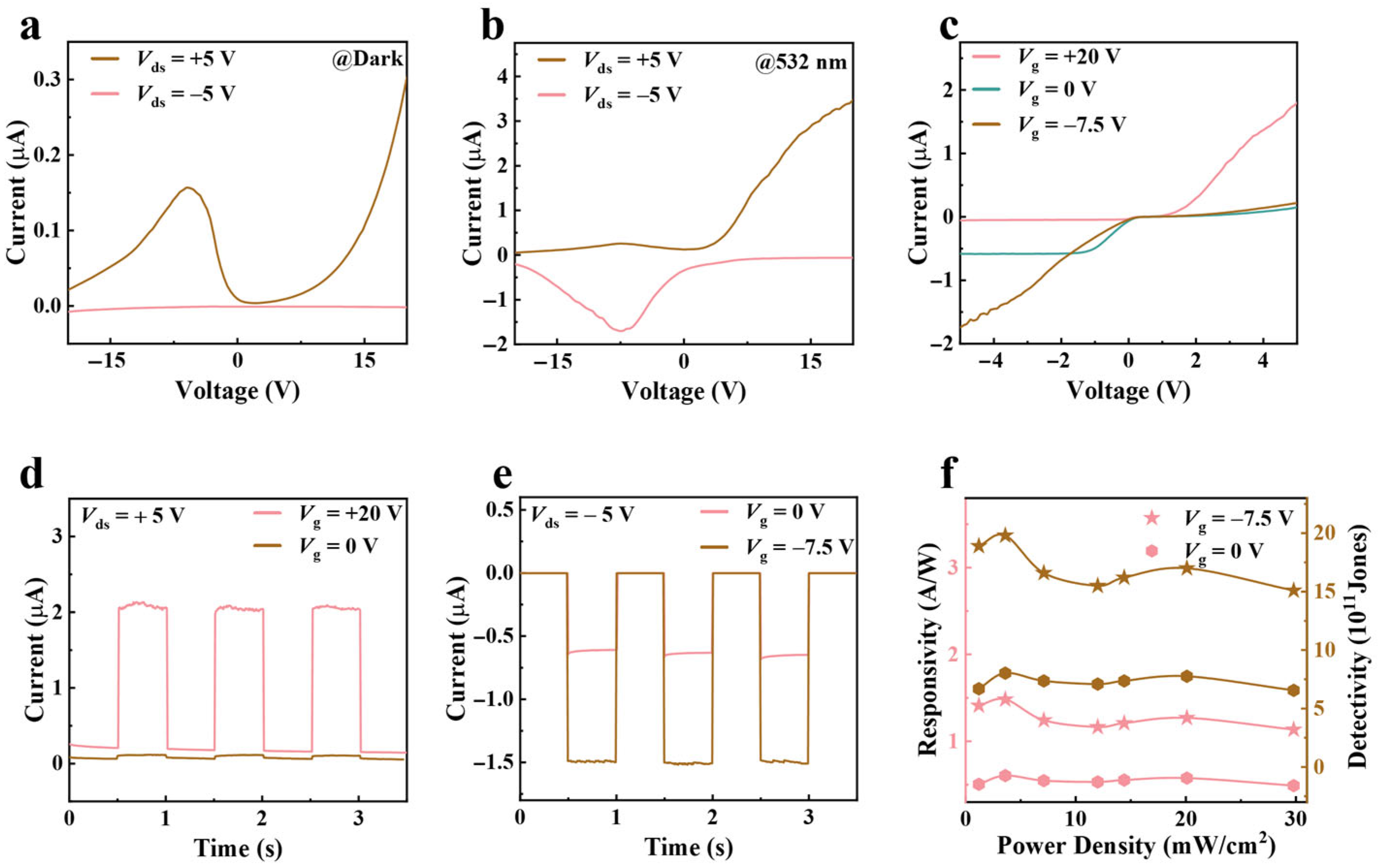
Considering the gate-tunable properties of MoS2 and WSe2, we further employed gate-voltage modulation to optimize the device performance. Figure 4a shows the transfer characteristics of the device measured under dark conditions at Vds = ±5 V. Under positive drain bias, the dark current initially increases with the gate voltage, reaching a local maximum at approximately Vg = −7.5 V, followed by a sharp decrease near Vg = 0 V, and it subsequently rises rapidly under positive gate bias. In contrast, under negative drain bias, the dark current remains negligible over the entire gate voltage range, exhibiting very weak gate modulation. Figure 4b presents the transfer characteristics of the device under 532 nm illumination. The photocurrent exhibits gate-dependent behavior that is markedly different from that observed under dark conditions, owing to the distinct transport mechanisms of dark carriers and photogenerated carriers. Under positive drain bias, the local peak at Vg = −7.5 V becomes less pronounced, whereas the current enhancement at positive gate voltages is significantly strengthened. In contrast, under negative drain bias, the photocurrent increases as the gate voltage decreases, reaches a maximum at Vg = −7.5 V, and then gradually declines with further gate sweeping. The gate-voltage-dependent output characteristics under 532 nm illumination are presented in Figure 4c. Evidently, positive gate bias predominantly enhances the photocurrent under positive drain bias, whereas negative gate bias mainly strengthens the photocurrent under negative drain bias.
Time-resolved photoresponse measurements further elucidate the gate-tunable transport behavior of the device. Figure 4d compares the time-resolved photoresponse of the device at Vds = 5 V with and without gate-voltage modulation. At Vg = 0 V, the dark current remains around 0.05 μA, and the photocurrent reaches only about 0.11 μA. Upon applying positive gate bias (Vg = 20 V), the dark current increases slightly to approximately 0.22 μA, whereas the photocurrent rises sharply to approximately 2.1 μA. Figure 4e compares the time-resolved photoresponse of the device at Vds = −5 V with and without gate-voltage modulation. Under negative drain bias, the dark current remains nearly unchanged (from 1 to 2 nA) after gate modulation, whereas the photocurrent increases by approximately 238% (from 0.63 μA to 1.50 μA). The gate voltage modulates the interfacial band alignment and built-in electric field at the MoS2/WSe2 heterointerface, thereby tuning the carrier separation efficiency. As a result, the photoresponse under different drain-bias conditions can be effectively tuned through the electrostatic control of the local heterojunction band structure. The evolution of the energy-band structure under different gate voltages is further illustrated in Figure S7 in the Supporting Information.
The performance of the Au/MoS2/WSe2 dual junction device for VIS–IR photodetection was further evaluated in terms of responsivity (R) and detectivity (D*). Responsivity represents the ratio of the photocurrent to the incident optical power and evaluates the photocurrent conversion capability of the device. It is defined as R = I p h P i n × S , where I p h is the photocurrent, P i n is the incident power density, and S is the effective illuminated area. Detectivity is another important parameter that reflects the capability of a photodetector to detect weak optical signals. It can be expressed as D = R × S 1 / 2 i n , where R is the responsivity, S is the effective photosensitive area of the device and in is the current noise spectral density, extracted from the dark-noise spectrum measured under the corresponding bias conditions (Figure S8, Supporting Information) [28,29]. The calculated responsivity and detectivity at Vds = −5 V as a function of incident optical power, with and without gate-voltage modulation, are shown in Figure 4f. For all incident optical power densities, gate-voltage modulation leads to a multiple-fold enhancement in the photoresponse. A negative gate bias (Vg = −7.5 V) significantly enhances the responsivity, reaching a maximum value of approximately ~1.48 A/W. In contrast, at Vg = 0 V, the responsivity remains below 0.6 A/W. Under an illumination intensity of 3.6 mW cm−2, the device achieves a maximum detectivity of 1.98 × 10¹² Jones. The calculated results at Vds = 5 V exhibit a similar gate-voltage enhancement effect (Figure S9, Supporting Information). A comparison of the performance of our Au/MoS2/WSe2 photodetector with several state-of-the-art heterojunction photodetectors reported in the recent literature is summarized in Table 1. The response time, external quantum efficiency (EQE) and linear dynamic range (LDR) of the Au/MoS2/WSe2 photodetector under 532 nm illumination are presented in Figure S10 in the Supporting Information.
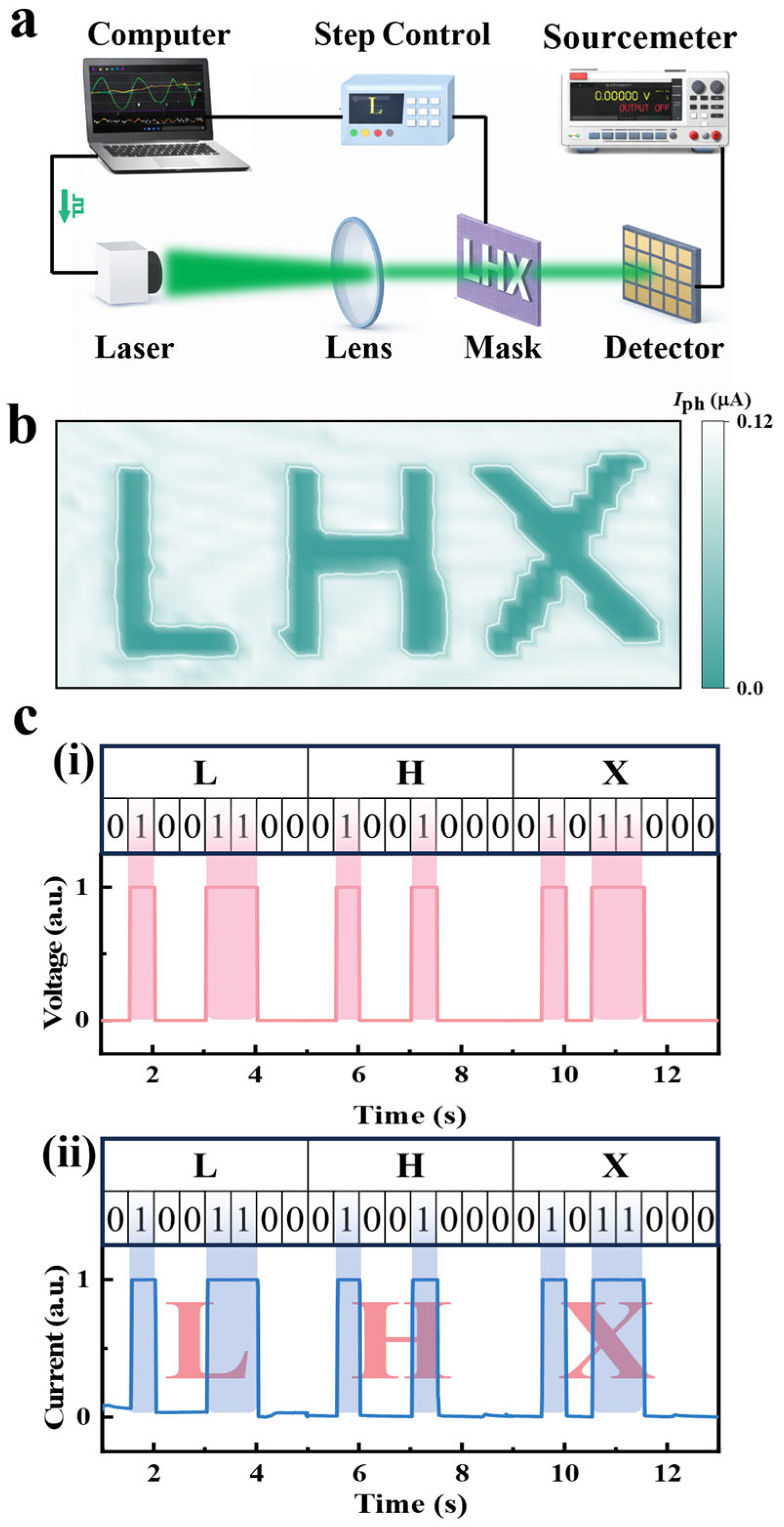
The Au/MoS2/WSe2 dual junction exhibits outstanding photoresponse performance, highlighting its strong potential for imaging and encoded optical communication applications. To experimentally validate this capability, a sophisticated single-pixel optoelectronic signal conversion system was constructed, as illustrated in Figure 5a. A laser beam passes through a patterned mask and irradiates the Au/MoS2/WSe2 dual junction photodetector. The mask, mounted on a computer-controlled motorized translation stage, scans along the X and Y directions. Meanwhile, the computer records the photocurrent together with the corresponding spatial position. Figure 5b presents the reconstructed image of the letters “LHX” under 532 nm illumination, showing clearly distinguishable contours with a spatial resolution of approximately 0.5 mm. The preserved structural features demonstrate effective pixel-by-pixel signal acquisition and reconstruction. The optical image captured by a commercial camera is provided in Figure S11 (Supporting Information). Image reconstruction under 638 nm illumination was also demonstrated (Figure S12, Supporting Information), further supporting the feasibility of multiband image sensing. Figure 5c presents the optical encoding communication results of the letters “LHX.” The letters L, H, and X are represented by their corresponding 8-bit ASCII codes: 01001100, 01001000, and 01011000, respectively. Information is encoded through the illumination state, where “0” and “1” represent the light-off and light-on states, respectively. Benefiting from the fast and stable photoresponse of the device, the received signals accurately reflect the illumination states. Based on the empirical relationship between the response time ( t r ) and the 3 dB bandwidth ( f 3 d B ), f 3 d B 0.35 / t r , the bandwidth is estimated to be ~548 Hz for a rise time of 639 μs. In addition, proof-of-concept optical encoding communication under 638 nm illumination was also demonstrated (Figure S13, Supporting Information), further supporting the multiband communication capability of the device. These results mainly serve as a proof-of-concept demonstration of the optical encoding capability of the device. The successful demonstrations of imaging and optical communication confirm the applicability of the Au/MoS2/WSe2 dual junction across multiple spectral bands.

4. Conclusions

In summary, we have demonstrated a gate-enhanced Au/MoS2/WSe2 dual junction broadband photodetector. The spatially resolved photocurrent measurements reveal that the selective utilization of asymmetric built-in electric fields decouples the transport of dark and photogenerated carriers, simultaneously enabling a low dark current and high photocurrent. Furthermore, gate-voltage modulation of different electric-field regions enables distinct modulation of the dark current and photocurrent. Within the 532–940 nm spectral range, the device achieves a high detectivity of 1.98 × 10¹² Jones. High-resolution imaging and optical communication demonstrations further highlight the potential of Au/MoS2/WSe2 dual junction photodetectors for broadband and high-speed optoelectronic applications. These results provide a viable strategy for realizing high-performance, customizable Van der Waals heterostructure photodetectors via multijunction band engineering.

Supplementary Materials

The following supporting information can be downloaded at https://www.mdpi.com/article/10.3390/photonics13050418/s1, Figure S1: Steady-state photoluminescence spectra of the isolated MoS2, isolated WSe2, and overlapped MoS2/WSe2 heterojunction regions. Figure S2: AFM characterization of the exfoliated WSe2 and MoS2 flakes. Figure S3: Time-resolved photocurrent responses of the Au/MoS2/WSe2 dual junction photodetector under different incident optical power densities. Figure S4: Spatially resolved photocurrent mapping of the Au/MoS2/WSe2 dual junction device measured under different bias and gate voltages. Figure S5: KPFM line-scan profiles of the surface-potential difference across the Au/MoS2, MoS2/WSe2, and Au/WSe2 junction regions. Figure S6: Evolution of the energy-band structure of the Au/MoS2/WSe2 dual junction under different drain-bias conditions. Figure S7: Evolution of the energy-band structure of the MoS2/WSe2 heterojunction under different gate voltages. Figure S8: Current–noise spectral density spectra of the Au/MoS2/WSe2 photodetector under different gate-bias conditions. Figure S9: The power-dependent responsivity/detectivity of the Au/MoS2/WSe2 dual junction photodetector. Figure S10: The response time, external quantum efficiency (EQE) and linear dynamic range (LDR) of the Au/MoS2/WSe2 photodetector. Figure S11: Optical image of the patterned mask used for the imaging experiment. Figure S12: Reconstructed image under 638 nm illumination. Figure S13: Optical encoding communication results of the letters “HIAS” under 638 nm illumination.

Author Contributions

H.L.: conceptualization, sample preparation, device fabrication, formal analysis, and writing—original draft preparation. X.F.: device characterization and measurements. Q.S.: conceptualization, methodology, validation. S.M.: conceptualization, and formal analysis. C.P.: funding acquisition, supervision, and writing—review. H.D.: funding acquisition and supervision., N.D.: funding acquisition and supervision. Y.S.: funding acquisition and supervision. All authors have read and agreed to the published version of the manuscript.

Funding

This work was supported by the National Natural Science Foundation of China (Nos. 62304061, 62275161, 62504060, U2141240, 62274168, and 11933006), National Key Research and Development Program of China (No. 2023YFA1608701), Zhejiang Provincial Natural Science Foundation of China (Nos. LHZSZ26F050004, LMS26F040011), Hangzhou Natural Science Foundation of China (Nos. 2024SZD1A39, 2025SZRJJ2230), and Hangzhou Science and Technology Bureau of Zhejiang Province (No. 2024SZD1A39).

Data Availability Statement

The data presented in this study are available upon request from the corresponding author.

Conflicts of Interest

The authors declare that they have no known competing financial interests or personal relationships that could have appeared to influence the work reported in this paper.

References

  1. Jiang, C.; Wei, P.; Yuan, L.; Qing, X.; Ma, X.; Weng, X. An Intelligent Multi-Band Camouflage Textile Inspired by Natural Leaves. Adv. Funct. Mater. 2025, 35, 2424325. [Google Scholar] [CrossRef]
  2. Liu, D.; Wang, D.; Zhang, B.; Zhao, C.; Liu, S.; He, W.; Liu, G.; Jiao, S.; Chen, X.; Fang, X.; et al. WSe2 Interdigitated p-n Homojunction for Broadband High-Performance Imaging Detection through Localization Effect Synergizes. Adv. Funct. Mater. 2026, e31930. [Google Scholar] [CrossRef]
  3. Zhang, M.; Wu, X.; Wang, Z.; Sun, L.; Ren, Y.; Liu, Y.; Li, R.; Ding, R.; Wei, Y.; Yang, F.; et al. Organic semiconductor-based polarized photodetectors for next-generation optoelectronics. Adv. Funct. Mater. 2025, 35, 2423932. [Google Scholar] [CrossRef]
  4. Parveen, A.; Irshad, A.; Kalsoom, U.E.; Shah, M.N.U.; Rahman, A.U.; Tyagi, D.; Alam, M.; Tao, K.; Ouyang, Z. A review on advancing electromagnetic wave absorption in metamaterials: Progress, challenges, theoretical background, and advanced technological applications. Adv. Mater. Technol. 2025, 10, e00710. [Google Scholar] [CrossRef]
  5. Han, J.; Fu, Z.; Wei, J.; Han, S.; Deng, W.; Hu, F.; Wang, Z.; Zhou, H.; Yu, H.; Gou, J.; et al. 2D materials-based next-generation multidimensional photodetectors. Light Sci. Appl. 2025, 14, 362. [Google Scholar] [CrossRef] [PubMed]
  6. Liu, L.; Ni, S.; Zhu, F.; Zhu, Y.; Liu, C.; Zhang, X.; Zhu, H.; Zhang, J.; Zhang, D.; Pan, C.; et al. Highly sensitive multicolor uncooled photoresponse and imaging based on symmetry breaking heterojunction. InfoMat 2025, 7, e12641. [Google Scholar] [CrossRef]
  7. Luo, H.; Zhao, Y.; Chen, Z.; Zhou, Y.; Li, J.; Liu, Z.; Zhao, J.; Zheng, T.; Gao, W.; Liu, X. Quasi-Two-Dimensional CsPbBr3 Quantum Dot Superlattice/WS2 Hybrid Photodetector: Self-Assembly Fabrication and Performance Optimization. ACS Photonics 2025, 12, 1095–1106. [Google Scholar] [CrossRef]
  8. Zhang, P.; Sun, Y.; Sun, J.; Wang, S.; Wang, R.; Zhang, J. Progress in 2D Material-Based Infrared Photodetectors for Intelligent Vision Applications. Adv. Funct. Mater. 2025, 35, 2502072. [Google Scholar] [CrossRef]
  9. Radisavljevic, B.; Radenovic, A.; Brivio, J.; Giacometti, V.; Kis, A. Single-layer MoS2 transistors. Nat. Nanotechnol. 2011, 6, 147–150. [Google Scholar] [CrossRef]
  10. Mak, K.F.; Lee, C.; Hone, J.; Shan, J.; Heinz, T.F. Atomically thin MoS2: A new direct-gap semiconductor. Phys. Rev. Lett. 2010, 105, 136805. [Google Scholar] [CrossRef]
  11. Singh, R.; Patel, C.; Kumar, P.; Dubey, M.; Sriram, S.; Mukherjee, S. High detectivity and fast MoS2 monolayer MSM photodetector. ACS Appl. Electron. Mater. 2022, 4, 5739–5746. [Google Scholar] [CrossRef]
  12. Zhou, C.; Liu, Q.; Fu, X.; Niu, W.; Wang, J.; Liu, X.; Zou, X.; Miao, J.; Shan, F.; Yang, Z. Self-powered and reconfigurable double-terminal MoS2 photodetector for image recognition. Nano Lett. 2025, 25, 3515–3523. [Google Scholar] [CrossRef]
  13. Zhao, W.; Ghorannevis, Z.; Chu, L.; Toh, M.; Kloc, C.; Tan, P.-H.; Eda, G. Evolution of electronic structure in atomically thin sheets of WS2 and WSe2. ACS Nano 2013, 7, 791–797. [Google Scholar] [CrossRef] [PubMed]
  14. Li, J.; Wang, Z.; Jian, J.; Weng, Z.; Wu, Q.; Zhou, X.; Lin, L.; Gu, X.; Xiao, P.; Nan, H.; et al. Ultrafast Self-Driven WSe2 Photodetectors with Bottom Schottky Contacts. Adv. Sci. 2025, 12, e10373. [Google Scholar] [CrossRef]
  15. Yang, J.; Li, X.; Gu, J.; Yu, F.; Chen, J.; Lu, W.; Chen, X. High-Stability WSe2 Homojunction Photodetectors via Asymmetric Schottky and PIN Architectures. Coatings 2025, 15, 301. [Google Scholar] [CrossRef]
  16. Sun, M.; Fang, Q.; Xie, D.; Sun, Y.; Xu, J.; Teng, C.; Dai, R.; Yang, P.; Li, Z.; Li, W.; et al. Novel transfer behaviors in 2D MoS2/WSe2 heterotransistor and its applications in visible-near infrared photodetection. Adv. Electron. Mater. 2017, 3, 1600502. [Google Scholar] [CrossRef]
  17. Shin, G.H.; Park, C.; Lee, K.J.; Jin, H.J.; Choi, S.Y. Ultrasensitive phototransistor based on WSe2-MoS2 van der Waals heterojunction. Nano Lett. 2020, 20, 5741–5748. [Google Scholar] [CrossRef]
  18. Xiao, H.; Lin, L.; Zhu, J.; Guo, J.; Ke, Y.; Mao, L.; Gong, T.; Cheng, H.; Huang, W.; Zhang, X. Highly sensitive and broadband photodetectors based on WSe2/MoS2 heterostructures with van der Waals contact electrodes. Appl. Phys. Lett. 2022, 121, 023504. [Google Scholar] [CrossRef]
  19. Kim, D.H.; Yoo, J.; Suh, H.C.; Won, Y.S.; Kim, S.H.; Yi, D.-J.; Jeong, B.G.; Lee, C.; Lee, D.; Kim, K.K.; et al. Anomalous phonon softening with inherent strain in wrinkled monolayer WSe2. Adv. Mater. 2025, 37, 2419414. [Google Scholar] [CrossRef] [PubMed]
  20. Zinkiewicz, M.; Grzeszczyk, M.; Kazimierczuk, T.; Bartos, M.; Nogajewski, K.; Pacuski, W.; Watanabe, K.; Taniguchi, T.; Wysmołek, A.; Kossacki, P.; et al. Raman scattering excitation in monolayers of semiconducting transition metal dichalcogenides. npj 2D Mater. Appl. 2024, 8, 2. [Google Scholar] [CrossRef]
  21. Blaga, C.; Álvarez, Á.L.; Balgarkashi, A.; Banerjee, M.; i Morral, A.F.; Dimitrievska, M. Unveiling the complex phonon nature and phonon cascades in 1L to 5L WSe2 using multiwavelength excitation Raman scattering. Nanoscale Adv. 2024, 6, 4591–4603. [Google Scholar] [CrossRef] [PubMed]
  22. Jalali, M.; Del Real Mata, C.; Montermini, L.; Jeanne, O.; Hosseini, I.I.; Gu, Z.; Spinelli, C.; Lu, Y.; Tawil, N.; Guiot, M.C.; et al. MoS2-plasmonic nanocavities for Raman spectra of single extracellular vesicles reveal molecular progression in glioblastoma. ACS Nano 2023, 17, 12052–12071. [Google Scholar] [CrossRef] [PubMed]
  23. Sun, Y.; Yin, S.; Peng, R.; Liang, J.; Cong, X.; Li, Y.; Li, C.; Wang, B.; Lin, M.-L.; Tan, P.-H.; et al. Abnormal out-of-plane vibrational Raman mode in electrochemically intercalated multilayer MoS2. Nano Lett. 2023, 23, 5342–5349. [Google Scholar] [CrossRef]
  24. Li, H.; Zhang, Q.; Yap, C.C.R.; Tay, B.K.; Edwin, T.H.T.; Olivier, A.; Baillargeat, D. From bulk to monolayer MoS2: Evolution of Raman scattering. Adv. Funct. Mater. 2012, 22, 1385–1390. [Google Scholar] [CrossRef]
  25. Wu, Q.; Li, L.; Wang, C.; Wang, Z.; Weng, Z.; Jiang, Y.; Lin, L.; Gu, X.; Angel, E.C.; El Sachat, A.; et al. 2D WSe2/MoS2 p-i-n Vertical Heterojunction Photodetectors by Selective Plasma Doping. Adv. Opt. Mater. 2025, 13, 2402378. [Google Scholar] [CrossRef]
  26. Tan, C.; Yang, Z.; Wu, H.; Yang, Y.; Yang, L.; Wang, Z. Electrically tunable interlayer recombination and tunneling behavior in WSe2/MoS2 heterostructure for broadband photodetector. Nanoscale 2024, 16, 6241–6248. [Google Scholar] [CrossRef]
  27. Kim, J.H.; Sarkar, S.; Wang, Y.; Taniguchi, T.; Watanabe, K.; Chhowalla, M. Room temperature negative differential resistance with high peak current in MoS2/WSe2 heterostructures. Nano Lett. 2024, 24, 2561–2566. [Google Scholar] [CrossRef]
  28. Pan, C.; Ni, S.; Zhang, J.; Zhang, D.; Li, H.; Liu, X.; Zhu, F.; Ling, J.; Liu, C.; Chen, T.; et al. Spatially resolved light-induced multiband response of controllable 2H-MoTe2/graphene vertical heterojunction. ACS Photonics 2025, 12, 1802–1811. [Google Scholar] [CrossRef]
  29. Liu, X.; Pan, C.; Ni, S.; Mi, S.; Fan, X.; Liu, C.; Zhang, T.; Shan, Y.; Zhu, J.; Xu, S.; et al. Controllable polarity photoresponse and imaging based on MoS2/MLG/MoTe2 heterostructure. Nano Res. 2025, 18, 94907489. [Google Scholar] [CrossRef]
  30. Su, C.; Li, M.; Yan, H.; Zhang, Y.; Li, H.; Fan, W.; Bai, W.; Liu, X.; Wang, Q.; Yin, S. PdSe2/NbSe2 heterojunction photodetector with broadband detection and polarization sensitivity. ACS Appl. Mater. Interfaces 2025, 17, 5213–5222. [Google Scholar] [CrossRef]
  31. Liu, S.; Ding, Y.; Shi, Y.; Feng, Y.; He, R.; Yu, T.; Zheng, Y.; Li, S.; Zhang, Z.; Luo, Y.; et al. Broadband polarimetric photodetector based on semimetallic 1T’-MoTe2/MoSe2 heterojunction for self-powered imaging and coded communication. J. Mater. Sci. Technol. 2025, 263, 220–229. [Google Scholar] [CrossRef]
  32. Wu, C.; Lv, P.; Zhu, Z.; Huang, Y.; Tu, C.; Chen, C.; Lakshminarayana, G.; Wang, Y. A bipolar response deep ultraviolet photodetector for encryption and anti-interference communication based on an a-Sb2O5/a-Ga2O3 heterojunction. Mater. Horiz. 2026, 13, 454–463. [Google Scholar] [CrossRef]
  33. Jiang, Y.; Wang, R.; Li, X.; Ma, Z.; Li, L.; Su, J.; Yan, Y.; Song, X.; Xia, C. Photovoltaic field-effect photodiodes based on double van der Waals heterojunctions. ACS Nano 2021, 15, 14295–14304. [Google Scholar] [CrossRef]
  34. Xin, Y.; Wang, X.; Chen, Z.; Weller, D.; Wang, Y.; Shi, L.-J.; Ma, X.; Ding, C.; Li, W.; Guo, S.; et al. Polarization-sensitive self-powered type-II GeSe/MoS2 van der Waals heterojunction photodetector. ACS Appl. Mater. Interfaces 2020, 12, 15406–15413. [Google Scholar] [CrossRef]
  35. Liu, H.; Zhu, X.; Sun, X.; Zhu, C.; Huang, W.; Zhang, X.; Zheng, B.; Zou, Z.; Luo, Z.; Wang, X.; et al. Self-powered broad-band photodetectors based on vertically stacked WSe2/Bi2Te3 p-n heterojunctions. ACS Nano 2019, 13, 13573–13580. [Google Scholar] [CrossRef]
  36. He, X.; Zhang, L.; Hong, W.; Wang, B.; Sun, F.; Hong, Z.; Cai, Q.; Sun, Z.; Liu, W. Self-Powered Te/Wse2 Van Der Waals Heterojunction Photodetectors with High Light on/off Ratio and Fast Response. Adv. Opt. Mater. 2023, 11, 2300319. [Google Scholar] [CrossRef]
Figure 1. Schematic illustration of the fabrication process of the Au/MoS2/WSe2 heterojunction photodetector.
Photonics 13 00418 g001
Figure 2. (a) Schematic diagram of the gate-tunable Au/MoS2/WSe2 dual junction photodetector. (b) Optical microscope image of the Au/MoS2/WSe2 heterostructure. (c) Raman spectra of the pristine MoS2 and WSe2. (d) The thicknesses of MoS2 and WSe2 flakes measured by AFM.
Photonics 13 00418 g002
Figure 3. (a) Time-resolved photoresponse under 532–940 nm illumination at zero bias. (b) Current–voltage characteristics under 532 nm spatially selective illumination at different incident powers. (c) Current–voltage characteristics under 940 nm spatially selective illumination at different incident powers. (d) Time-resolved photoresponse at different bias voltages. (e) Photocurrent mapping at zero bias. (f) Band alignment of the Au/MoS2/WSe2 dual junction, the yellow, blue, red, and green dashed lines denote the source electrode, MoS2, WSe2, and drain electrode, respectively.
Photonics 13 00418 g003
Figure 4. (a) Transfer characteristics under dark conditions (b) Transfer characteristics under 532 nm illumination (c) Output characteristics under different gate voltages. (d) Gate-enhanced transient photoresponse at a bias voltage of 5 V. (e) Gate-enhanced transient photoresponse at a bias voltage of −5 V. (f) Responsivity and detectivity versus power density at different gate voltages.
Photonics 13 00418 g004
Figure 5. (a) Schematic illustration of the imaging and communication system, employing an Au/MoS2/WSe2 dual junction photodetector as the signal receiver. (b) High-resolution optical image of the patterned letters “LHX” under 532 nm illumination. (c) Optical communication results based on encoded letters “LHX”, (i) Encoded optical communication input signal and (ii) corresponding photocurrent response of the detector.
Photonics 13 00418 g005
Table 1. Comparison of the performance of the Au/MoS2/WSe2 photodetector with state-of-the-art heterojunction photodetectors.
MaterialsSpectral RangeResponsivity (A/W)Detectivity (Jones)Response TimeReference
PdSe2/NbSe2405–980 nm0.0279.8 × 1071.6/1.9 μs[30]
MoTe2/MoSe2210–1690 nm0.7293.69 × 1086.13/8.56 ms[31]
Sb2O5/Ga2O3303 nm1.05 × 10−3-190/190 ms[32]
WSe2/MoS2/WSe2 double vdWHs532 nm0.7151.59 × 101345 μs[33]
GeSe/MoS2380–1064 nm0.1051.46 × 1010-[34]
WSe2/Bi2Te3375–1550 nm20.5-210 μs[35]
Te/Wse2405–1550 nm0.1967.5 × 101118 μs[36]
Au/MoS2/WSe2532–940 nm1.481.98 × 1012639/371 μsThis Work
Disclaimer/Publisher’s Note: The statements, opinions and data contained in all publications are solely those of the individual author(s) and contributor(s) and not of MDPI and/or the editor(s). MDPI and/or the editor(s) disclaim responsibility for any injury to people or property resulting from any ideas, methods, instructions or products referred to in the content.