

Research Progress in Flocculation Treatment of Aggregate Washing Wastewater: Mechanisms, Innovations, and Challenges

Abstract
1. Introduction
2. Characteristics and Treatment Challenges of Aggregate Washing Wastewater
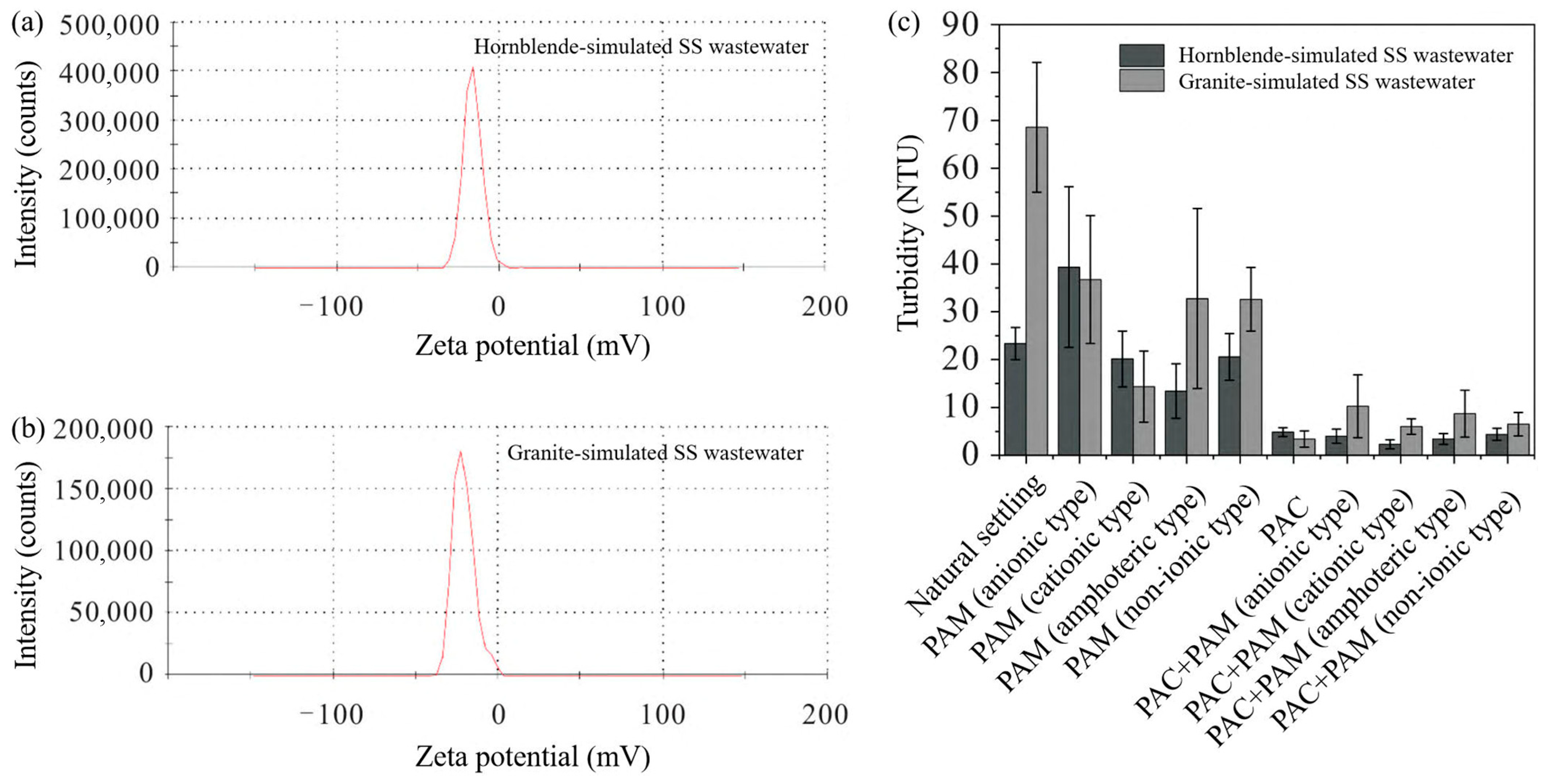
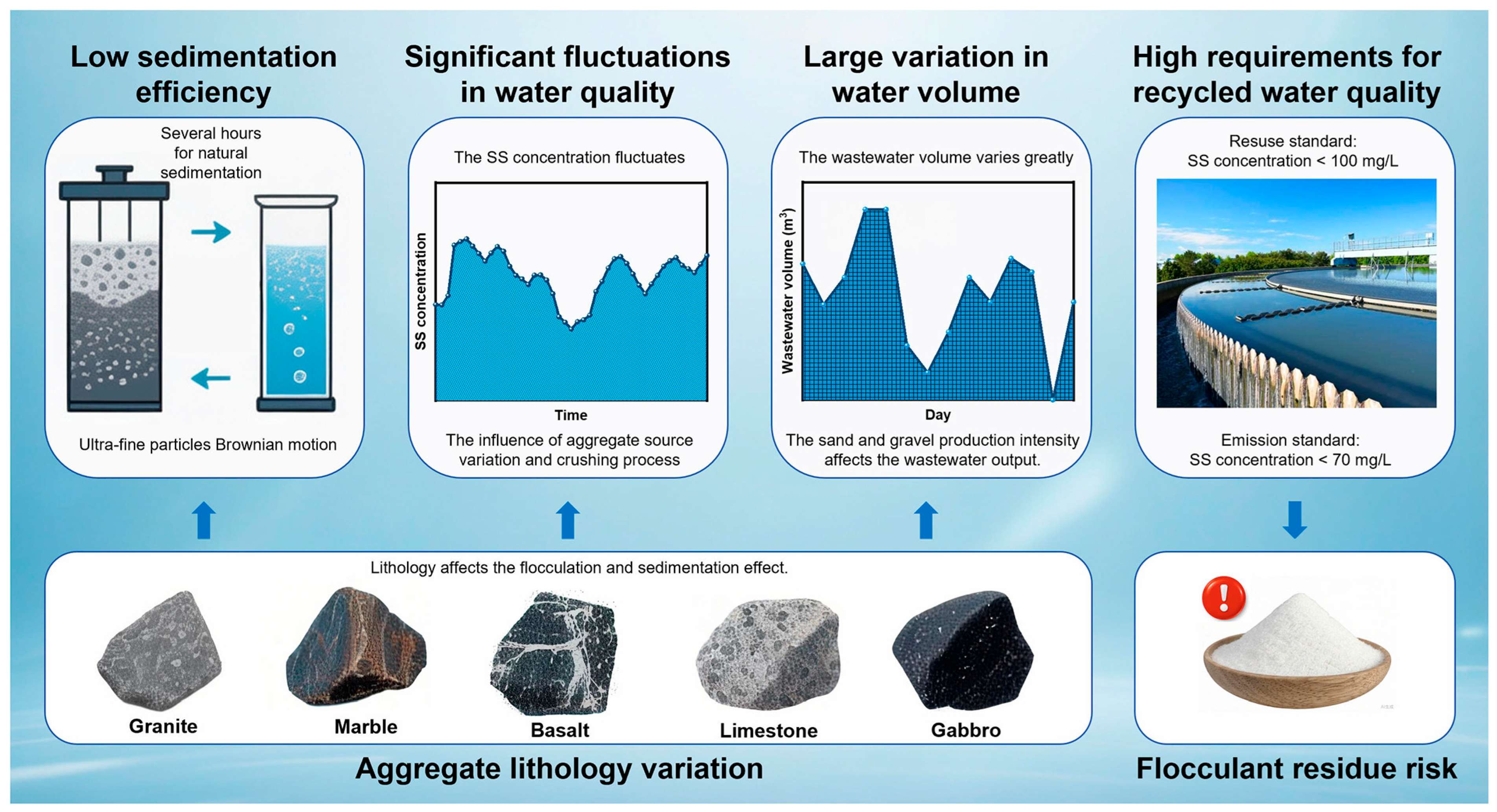
- Low sedimentation efficiency: Ultrafine particles exhibit pronounced Brownian motion, resulting in prolonged natural sedimentation times spanning several hours to days—far exceeding the demands of continuous production systems. Furthermore, sedimentation rates of wastewater vary substantially across different lithologies, necessitating the addition of flocculants to enhance settling efficiency [22].
- Significant water quality fluctuations: Variations in water consumption patterns and aggregate source compositions during production induce marked fluctuations in wastewater quality [23]. Such instability challenges the operational reliability of treatment systems.
- Substantial variations in wastewater volume: The volume of wastewater fluctuates considerably throughout the construction phase. To accommodate these load variations, stringent requirements are imposed on the design of chemical dosing methods and dosages. Notably, excessive flocculant dosing may trigger floc redispersion or elevate the moisture content of the resulting filter cake [24,25].
- Pronounced lithological diversity: Wastewater characteristics derived from distinct lithologies (e.g., granite, amphibolite, basalt) differ markedly. Consequently, flocculants with tailored sedimentation kinetics must be selected to optimize performance.
- Stringent requirements for reuse water quality: Treated effluent is recycled for production purposes, yet residual flocculants pose risks to downstream processes, demanding rigorous quality control.
3. Types and Action Mechanism of Flocculant
4. Advances in Optimization and Control Strategies for Flocculants
5. Effects of Flocculant Residues on Downstream Processes
6. Key Challenges in Flocculation Treatment of Aggregate Washing Wastewater
6.1. Flocculant Residue Challenge
6.2. Challenges in Intelligent Control Technology
- (1)
- High Initial Investment Burden
- (2)
- Limited Technological Adaptability
- (3)
- Scarcity of Interdisciplinary Professionals
- (4)
- Data Security Concerns
- (5)
- Reliability Under Extreme Environmental Conditions
7. Conclusions and Prospect
- (1)
- Aggregate washing wastewater exhibits the typical characteristics of “three highs and one negative”: a high concentration of SS, a high proportion of ultrafine particles, significant fluctuations in water quality and quantity, and a generally negative Zeta potential of the SS. These characteristics result in an extremely low natural sedimentation efficiency of the wastewater, necessitating the use of flocculants to achieve enhanced solid–liquid separation through charge neutralization, adsorption bridging, or sweep flocculation. Furthermore, lithological differences (e.g., calcite, granite, hornblende) further require targeted adaptability experiments for the selection of flocculants for different types of aggregate washing wastewater, thus forming a technical adaptation principle of “one wastewater, one solution”.
- (2)
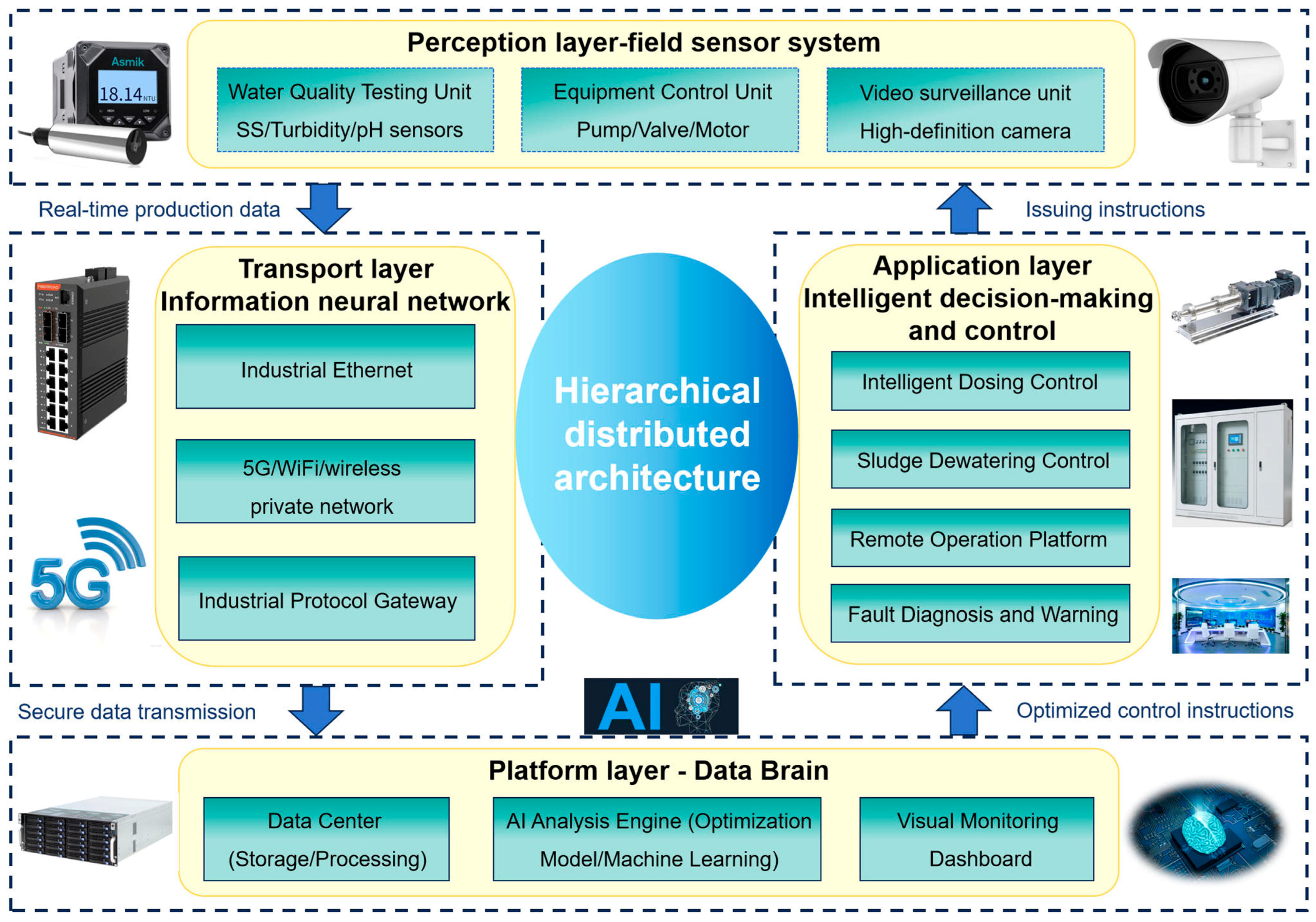
- The flocculant system currently adopted for aggregate washing wastewater has formed a synergistic application pattern comprising three categories: inorganic, organic, and composite flocculants. Inorganic flocculants (e.g., PAC) serve as basic chemicals by virtue of their cost advantages and charge neutralization capacity. Organic polymer flocculants (e.g., PAM) enhance adsorption and bridging through their long-chain structures (anionic types are suitable for calcite-containing wastewater, while cationic types are adapted for wastewater with highly negatively charged particles). Bio-based flocculants (e.g., chitosan, modified starch) are environmentally friendly and biodegradable; however, they suffer from poor stability and weak floc sedimentation performance. In addition, due to cost constraints, there are currently a lack of practical engineering application cases for them. Traditional empirical dosing methods have the problems of chemical waste (excessive dosing leads to floc redispersion) and unstable treatment effects (insufficient dosing results in substandard SS removal). In contrast, an intelligent control system based on a four-layer architecture of “Perception-Transmission-Platform-Application” has achieved a breakthrough: it collects real-time parameters through devices such as high-range online SS detectors and dynamically adjusts the dosing amount by combining machine learning algorithms, reducing flocculant consumption by 50% to 67%. This is crucial for achieving “zero discharge” in ecologically fragile areas such as plateaus and canyons.
- (3)
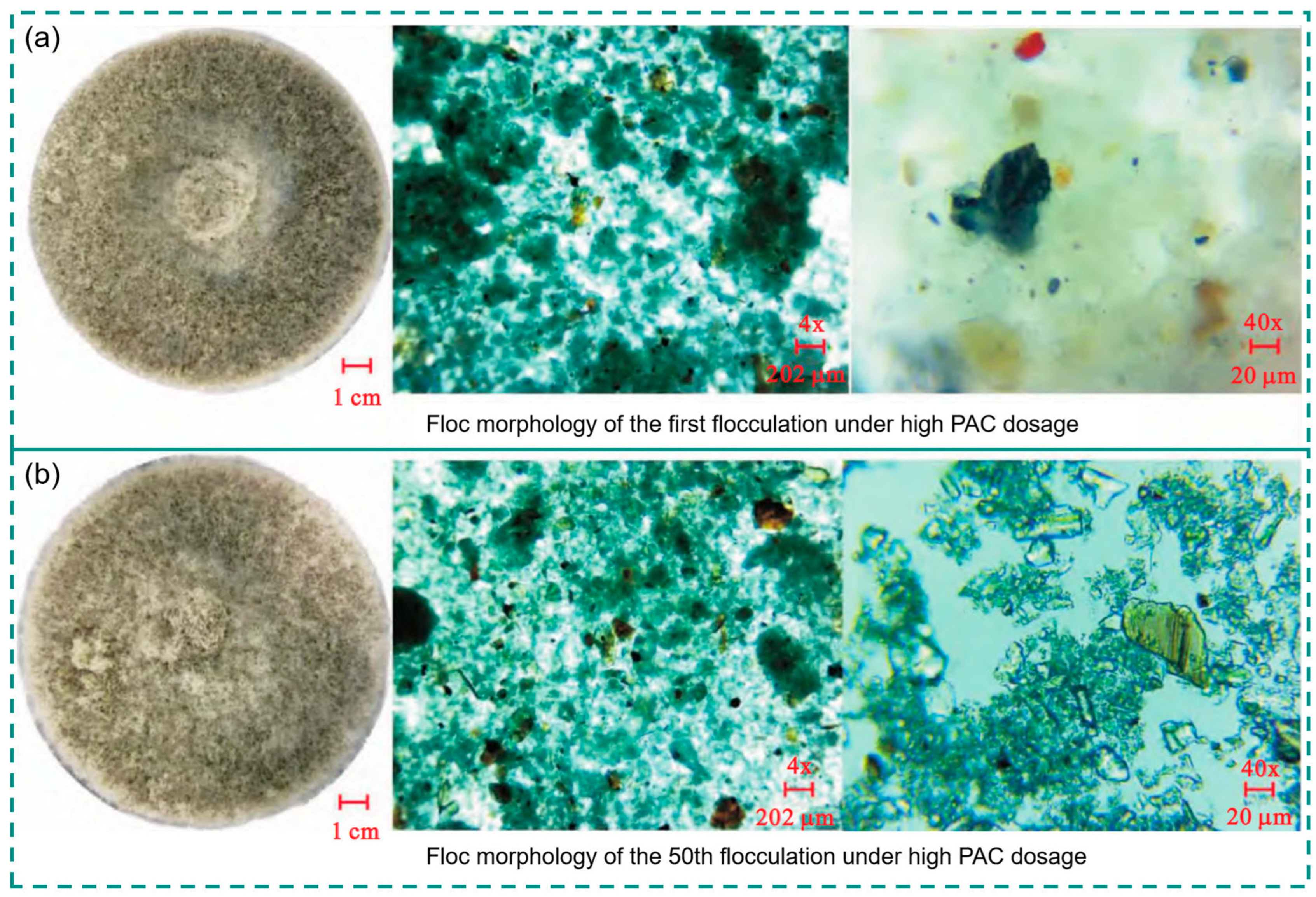
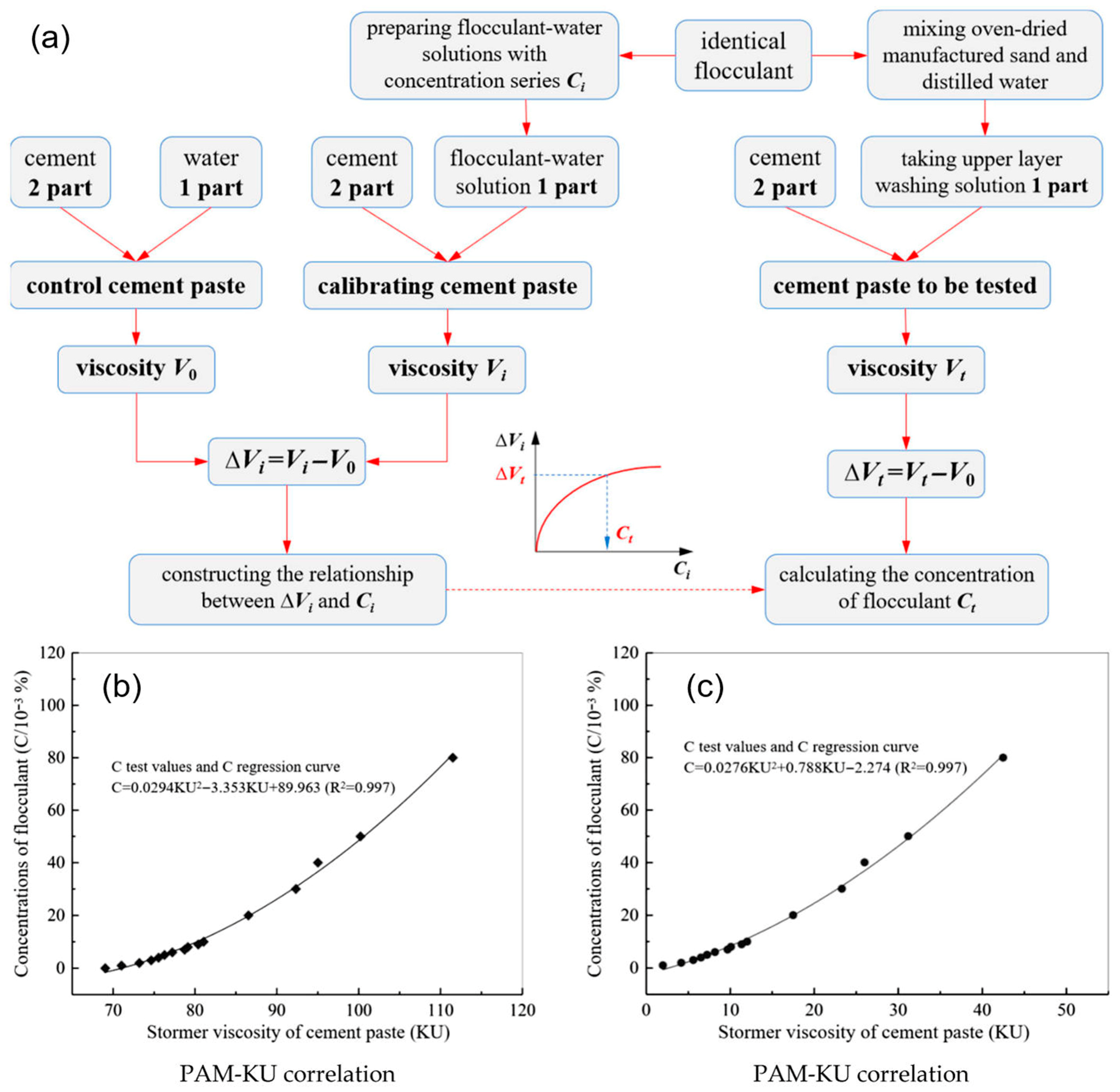
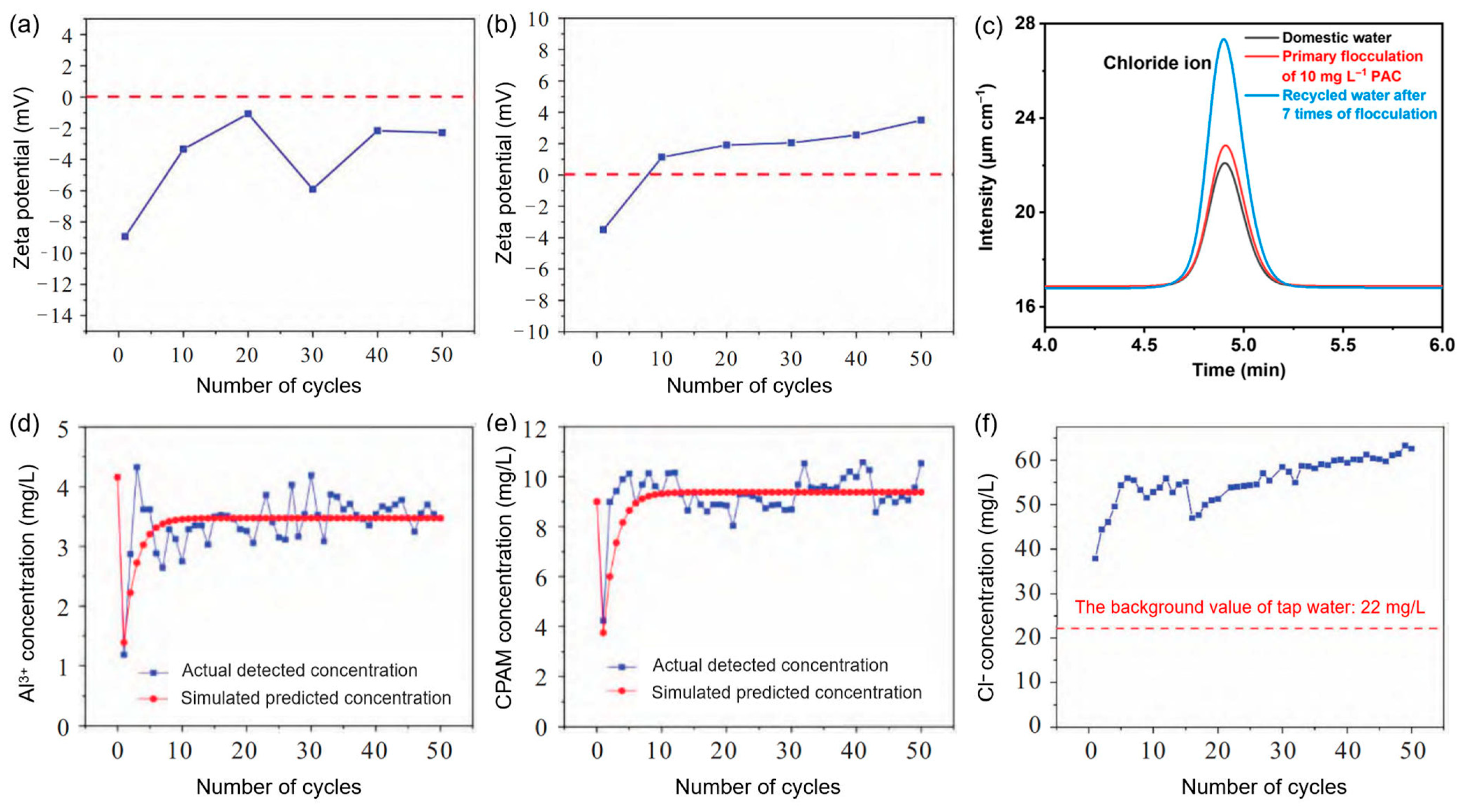
- In the circulation and reuse of wastewater, flocculant residue exhibits the characteristic of “rapid accumulation in the early stage and a slowdown in the later stage”. The concentrations of Al3+, Cl− and PAM increase with the number of reuse cycles, while the particle size of solid flocs decreases from 400 μm to 200 μm; the positive shift in the Zeta potential (from −9 mV towards 0 mV) results in the attenuation of floc sedimentation performance. Residual PAM (at a dosage of 0.01‰) can reduce the 3-day compressive strength of concrete by 20.7% and the 28-day compressive strength by 17.4%, and also prolong the induction period of cement hydration. It should be noted that although the combination of low PAC and high CPAM can mitigate the attenuation of floc particle size, it carries the risk of effluent water quality fluctuation. In practical engineering, however, performance compensation can be achieved by adjusting the dosage of water reducers for PAM residual levels ranging from 0.0002% to 0.0020%, which reflects the complexity and flexibility of risk control.
- (1)
- Deepen the Mechanistic Study of Flocculation for Aggregate Washing Wastewater
- (2)
- Intelligent Computing and Precise Flocculation Technology
- (3)
- Research Prospects on Flocculant Residue Impacts
- (4)
- Comprehensive Evaluation System of Flocculation Technology for Aggregate Washing Wastewater
- (5)
- Resource Utilization of Aggregate Washing Wastewater
Author Contributions
Funding
Data Availability Statement
Acknowledgments
Conflicts of Interest
Abbreviations
| SS | Suspended solids |
| MB | Methylene blue |
| PAM | Polyacrylamide |
| PAC | Polyaluminum chloride |
| APAM | Anionic PAM |
| CPAM | Cationic PAM |
| AI | Artificial intelligence |
| PCE | Polycarboxylate superplasticizers |
| RSM | Response surface methodology |
| DLS | Dynamic light scattering |
| AFM | Atomic force microscopy |
| LCA | Life Cycle Assessment |
References
- Bendixen, M.; Iversen, L.L.; Best, J.; Franks, D.M.; Hackney, C.R.; Latrubesse, E.M.; Tusting, L.S. Sand, gravel, and UN Sustainable Development Goals: Conflicts, synergies, and pathways forward. One Earth 2021, 4, 1095–1111. [Google Scholar] [CrossRef]
- Přikryl, R. Geomaterials as construction aggregates: A state-of-the-art. Bull. Eng. Geol. Environ. 2021, 80, 8831–8845. [Google Scholar] [CrossRef]
- Fernandes, I. Role of granitic aggregates in the deterioration of a concrete dam. Bull. Eng. Geol. Environ. 2015, 74, 195–206. [Google Scholar] [CrossRef]
- Petit, A.; Cordoba, G.; Paulo, C.I.; Irassar, E.F. Novel air classification process to sustainable production of manufactured sands for aggregate industry. J. Clean. Prod. 2018, 198, 112–120. [Google Scholar] [CrossRef]
- Lu, Q.; Fan, Z.; Zhou, X.; Peng, Z.; Gao, Z.F.; Deng, S.; Han, W.; Jin, Z.; Chen, X. Water-saving optimization design of aggregate processing plant and recycled water utilization for producing concrete. Constr. Build. Mater. 2023, 396, 132381. [Google Scholar] [CrossRef]
- Varshney, H.; Khan, R.A.; Khan, I.K. Sustainable use of different wastewater in concrete construction: A review. J. Build. Eng. 2021, 41, 102411. [Google Scholar] [CrossRef]
- Bofill, M.Á.; Sánchez-Romero, F.-J.; Zapata-Raboso, F.; Ramos, H.M.; Pérez-Sánchez, M. Integrating Pumped Hydro Storage into Zero Discharge Strategy for Wastewater: The Alicante Case Study. Appl. Sci. 2025, 15, 10953. [Google Scholar] [CrossRef]
- de Paula, H.M.; de Oliveira Ilha, M.S.; Andrade, L.S. Concrete plant wastewater treatment process by coagulation combining aluminum sulfate and Moringa oleifera powder. J. Clean. Prod. 2014, 76, 125–130. [Google Scholar] [CrossRef]
- Fan, Z.; Zhou, X.; Lu, Q.; Gao, Z.F.; Deng, S.; Peng, Z.; Han, W.; Chen, X. Synthesis of sewage sludge biochar in molten salt environment for advanced wastewater treatment: Performance enhancement, carbon footprint and environmental impact reduction. Water Res. 2024, 250, 121072. [Google Scholar] [CrossRef]
- González-Corrochano, B.; Alonso-Azcárate, J.; Rodríguez, L.; Lorenzo, A.P.; Torío, M.F.; Ramos, J.J.T.; Corvinos, M.D.; Muro, C. Valorization of washing aggregate sludge and sewage sludge for lightweight aggregates production. Constr. Build. Mater. 2016, 116, 252–262. [Google Scholar] [CrossRef]
- GB8978-1996; Integrated Wastewater Discharge Standard. China Environmental Science Press: Beijing, China, 1996.
- Wang, L.K.; Wang, M.-H.S.; Shammas, N.K.; Hahn, H.H. Physicochemical Treatment Consisting of Chemical Coagulation, Precipitation, Sedimentation, and Flotation. In Integrated Natural Resources Research; Wang, L.K., Wang, M.-H.S., Hung, Y.-T., Eds.; Springer International Publishing: Cham, Switzerland, 2021; pp. 265–397. [Google Scholar]
- Tsamoutsoglou, K.; Kechagias, A.; Katzourakis, V.E.; Chrysikopoulos, C.V.; Gikas, P. Investigation and efficiency estimation of a hydrocyclone for the treatment of primary municipal wastewater. J. Environ. Manag. 2025, 380, 125134. [Google Scholar] [CrossRef]
- Bhagavatula, A.; Rajagopalan, V.; Duncan, B.; Vimalchand, P. Innovative recovered water process implementation: Flocculation-sedimentation-filtration process for addressing water and energy nexus challenges at Kemper IGCC Power Plant. Energy Nexus 2021, 1, 100007. [Google Scholar] [CrossRef]
- Teh, C.Y.; Budiman, P.M.; Shak, K.P.Y.; Wu, T.Y. Recent Advancement of Coagulation–Flocculation and Its Application in Wastewater Treatment. Ind. Eng. Chem. Res. 2016, 55, 4363–4389. [Google Scholar] [CrossRef]
- Kato, S.; Kansha, Y. Comprehensive review of industrial wastewater treatment techniques. Environ. Sci. Pollut. Res. 2024, 31, 51064–51097. [Google Scholar] [CrossRef]
- Badawi, A.K.; Salama, R.S.; Mostafa, M.M.M. Natural-based coagulants/flocculants as sustainable market-valued products for industrial wastewater treatment: A review of recent developments. RSC Adv. 2023, 13, 19335–19355. [Google Scholar] [CrossRef]
- Lucas, M.S.; Teixeira, A.R.; Jorge, N.; Peres, J.A. Industrial Wastewater Treatment by Coagulation–Flocculation and Advanced Oxidation Processes: A Review. Water 2025, 17, 1934. [Google Scholar] [CrossRef]
- Moreira, V.R.; Guimarães, R.N.; Moser, P.B.; Santos, L.V.S.; de Paula, E.C.; Lebron, Y.A.R.; Silva, A.F.R.; Casella, G.S.; Amaral, M.C.S. Restrictions in water treatment by conventional processes (coagulation, flocculation, and sand-filtration) following scenarios of dam failure. J. Water Process Eng. 2023, 51, 103450. [Google Scholar] [CrossRef]
- Zhang, K.; Zhou, H.; Li, J.; Li, Z.; He, Z. Study on Flocculation and Sedimentation Characteristics of Sand Aggregate Washing Wastewater in a Large Mine in Anhui. Mod. Min. 2024, 40, 207–212. [Google Scholar]
- Li, F.; Wang, H.; Wang, M.; Zhai, H.; Peng, C.; Yang, Y.; Cul, Y. Flocculants Selection and Application Conditions for Concrete Aggregate Washing Wastewater of Xulong Hydropower Station. Saf. Environ. Eng. 2023, 30, 241–250. [Google Scholar]
- Guo, H.; Yu, S.-h.; Chen, W.; Huang, M.-h.; Chen, D. Effect of Rock Type on Dynamie Radial-flow Sedimentation Characteristics of High Concentration Wastewater from Processing Aggregate System of Hydropower Project. J. Chang. River Sci. Res. Inst. 2023, 40, 75–80. [Google Scholar]
- Chau, K.W. Investigation on effects of aggregate structure in water and wastewater treatment. Water Sci. Technol. 2004, 50, 119–124. [Google Scholar] [CrossRef]
- Jiao, R.; Fabris, R.; Chow, C.W.K.; Drikas, M.; van Leeuwen, J.; Wang, D.; Xu, Z. Influence of coagulation mechanisms and floc formation on filterability. J. Environ. Sci. 2017, 57, 338–345. [Google Scholar] [CrossRef]
- Khazaie, A.; Mazarji, M.; Samali, B.; Osborne, D.; Minkina, T.; Sushkova, S.; Mandzhieva, S.; Soldatov, A. A Review on Coagulation/Flocculation in Dewatering of Coal Slurry. Water 2022, 14, 918. [Google Scholar] [CrossRef]
- Wang, D.; Di, S.; Wu, L.; Tan, Y.; Tang, Y. Sedimentation Behavior of Organic, Inorganic, and Composite Flocculant-Treated Waste Slurry from Construction Works. J. Mater. Civ. Eng. 2021, 33, 04021134. [Google Scholar] [CrossRef]
- Gregory, J.; Barany, S. Adsorption and flocculation by polymers and polymer mixtures. Adv. Colloid Interface Sci. 2011, 169, 1–12. [Google Scholar] [CrossRef]
- López-Maldonado, E.A.; Oropeza-Guzman, M.T.; Jurado-Baizaval, J.L.; Ochoa-Terán, A. Coagulation–flocculation mechanisms in wastewater treatment plants through zeta potential measurements. J. Hazard. Mater. 2014, 279, 1–10. [Google Scholar] [CrossRef] [PubMed]
- Mittal, H.; Jindal, R.; Kaith, B.S.; Maity, A.; Ray, S.S. Flocculation and adsorption properties of biodegradable gum-ghatti-grafted poly(acrylamide-co-methacrylic acid) hydrogels. Carbohydr. Polym. 2015, 115, 617–628. [Google Scholar] [CrossRef] [PubMed]
- Yang, X.; Zeng, M.; Hao, L.; Wang, C. Synergistic function of bentonite, poly-aluminum chloride, and cationic polyacrylamide to realize highly efficient coagulation–flocculation process for leachate treatment. Desalination Water Treat. 2021, 244, 120–130. [Google Scholar] [CrossRef]
- Yao, B.; Zhao, D.; Guo, J.; Yan, C.; Zheng, C. Preparation and performance evaluation of hybrid polymer flocculants (PAC-PAM), and comparison experiments with other flocculants. Environ. Prog. Sustain. Energy 2022, 41, e13829. [Google Scholar] [CrossRef]
- Liu, C.; Gao, B.; Wang, S.; Guo, K.; Shen, X.; Yue, Q.; Xu, X. Synthesis, characterization and flocculation performance of a novel sodium alginate-based flocculant. Carbohydr. Polym. 2020, 248, 116790. [Google Scholar] [CrossRef]
- Mohamed Noor, M.H.; Othman, Q.A.; Ngadi, N.; Anas, M.A.A. Bibliometric survey of starch-based flocculant research for wastewater treatment. Int. J. Biol. Macromol. 2025, 322, 146746. [Google Scholar] [CrossRef]
- Saiyad, M.; Shah, N.; Joshipura, M.; Dwivedi, A.; Pillai, S. Chitosan and its derivatives in wastewater treatment application. Mater. Today Proc. 2024, 99, 190–194. [Google Scholar] [CrossRef]
- Zhai, H.; Li, F.; He, S.; Wang, M.; Wu, N.; Wang, X. Study on Sedimentation Performance of Wastewater from Sand and Gravel Processing in Hydropower Project. Technol. Water Treat. 2021, 47, 116–119. [Google Scholar]
- Rossini, M.; Garrido, J.G.; Galluzzo, M. Optimization of the coagulation–flocculation treatment: Influence of rapid mix parameters. Water Res. 1999, 33, 1817–1826. [Google Scholar] [CrossRef]
- Pérez, K.; Toro, N.; Jeldres, M.; Gálvez, E.; Robles, P.; Alvarado, O.; Toledo, P.G.; Jeldres, R.I. Estimating the Shear Resistance of Flocculated Kaolin Aggregates: Effect of Flocculation Time, Flocculant Dose, and Water Quality. Polymers 2022, 14, 1381. [Google Scholar] [CrossRef] [PubMed]
- Ding, C.; Shen, L.; Liang, Q.; Li, L. Machine Learning in Flocculant Research and Application: Toward Smart and Sustainable Water Treatment. Separations 2025, 12, 203. [Google Scholar] [CrossRef]
- Sumalatha, B.; Babu, D.S.; Sudarsini, B.; Indira, M. Innovative Techniques for Enhancing Water Treatment Efficiency. In Machine Learning in Water Treatment; Wiley: New York, NY, USA, 2025; pp. 265–291. [Google Scholar]
- Wang, Q. The Medium-scale Study on the Treatment Process of Horizontal Flow Sedimentation and Flocculation Sedimentation for Wastewater of Hydropower Station Aggregate Processing System. Master’s Thesis, Chongqing University, Chongqing, China, 2011. [Google Scholar]
- Jin, J.; Liu, M.; Chen, B.; Wu, X.; Yao, L.; Wang, Y.; Xiong, X.; Wei, L.; Li, J.; Tan, Q.; et al. Artificial Intelligence in Chemical Dosing for Wastewater Purification and Treatment: Current Trends and Future Perspectives. Separations 2025, 12, 237. [Google Scholar] [CrossRef]
- Wang, Y.; Cheng, Y.; Liu, H.; Guo, Q.; Dai, C.; Zhao, M.; Liu, D. A Review on Applications of Artificial Intelligence in Wastewater Treatment. Sustainability 2023, 15, 13557. [Google Scholar] [CrossRef]
- Capodaglio, A.G.; Callegari, A. Use, Potential, Needs, and Limits of AI in Wastewater Treatment Applications. Water 2025, 17, 170. [Google Scholar] [CrossRef]
- Fang, X.; Zhai, Z.; Zang, J.; Zhu, Y. An Intelligent Dosing Algorithm Model for Wastewater Treatment Plant. J. Phys. Conf. Ser. 2022, 2224, 012027. [Google Scholar] [CrossRef]
- Xu, Y.; Zeng, X.; Bernard, S.; He, Z. Data-driven prediction of neutralizer pH and valve position towards precise control of chemical dosage in a wastewater treatment plant. J. Clean. Prod. 2022, 348, 131360. [Google Scholar] [CrossRef]
- Sharma, S.; Sharma, K.; Grover, S. Real-Time Data Analysis with Smart Sensors. In Application of Artificial Intelligence in Wastewater Treatment; Gulati, S., Ed.; Springer Nature: Cham, Switzerland, 2024; pp. 127–153. [Google Scholar]
- Jan, F.; Min-Allah, N.; Düştegör, D. IoT Based Smart Water Quality Monitoring: Recent Techniques, Trends and Challenges for Domestic Applications. Water 2021, 13, 1729. [Google Scholar] [CrossRef]
- Fan, X.; Li, J.; Wang, W.; Li, F.; Chen, X.; Zhao, K.; Wang, J.; Zhao, H.; Zhou, X.; Fan, Z.; et al. An Online Rapid Detection Device for SS Concentration in High-Concentration Hydropower Aggregate Washing Wastewater. CN Patent CN215917197U 7, 1 March 2022. [Google Scholar]
- Yokoyama, H.; Yamashita, T.; Kojima, Y.; Nakamura, K. Deep learning-based flocculation sensor for automatic control of flocculant dose in sludge dewatering processes during wastewater treatment. Water Res. 2024, 260, 121890. [Google Scholar] [CrossRef]
- You, R.; Qiu, Y.; Zhang, P.; Pan, Z. Research on the Influence of Different Flocculants on Concrete Performance. IOP Conf. Ser. Earth Environ. Sci. 2020, 571, 012144. [Google Scholar] [CrossRef]
- Wu, S.; Wang, H.; Wang, M.; Zhai, H.; Yang, Y.; He, S.; Cui, Y. Flocculant accumulative effect in SS wastewater recyclingof hydropower station sand processing system. Saf. Environ. Eng. 2024, 31, 251–258, 279. [Google Scholar]
- SL 303-2017; Specifications for Construction Planning of Water Resources and Hydropower Projects. Water & Power Press: Beijing, China, 2017.
- DL/T 5144-2015; Specifications for Hydraulic Concrete Construction. China Water and Power Press: Beijing, China, 2015.
- Yao, H.; Fan, M.; Huang, T.; Yuan, Q.; Xie, Z.; Chen, Z.; Li, Y.; Wang, J. Retardation and bridging effect of anionic polyacrylamide in cement paste and its relationship with early properties. Constr. Build. Mater. 2021, 306, 124822. [Google Scholar] [CrossRef]
- Yang, C.H.; Pan, Q.; Zhu, J. Adsorption of Naphthalene-Based Water Reducer on Alkali-Activated Slag Cement. Appl. Mech. Mater. 2012, 226–228, 1747–1750. [Google Scholar] [CrossRef]
- Yin, J.; Qian, X.; Hu, C.; Wang, F. Insight into the interaction mechanism of polycarboxylate superplasticizer and polyacrylamide in cementitious materials. Constr. Build. Mater. 2024, 428, 136330. [Google Scholar] [CrossRef]
- Li, H.; Yan, N.; Sun, G.; Zheng, H.; Yang, X. Synthesis and Flocculation of Polyacrylamide with Low Water Absorption for Non-dispersible Underwater Concrete. J. Wuhan Univ. Technol.-Mater. Sci. Ed. 2023, 38, 1404–1413. [Google Scholar] [CrossRef]
- Chen, Z.; Zhao, G.; Chen, B.; Chen, S.; Li, J.; Nong, Y. Influence of flocculation structure on time-dependent fluidity and rheological property of cement paste: Analytical models based on fractal theory. Constr. Build. Mater. 2024, 455, 139137. [Google Scholar] [CrossRef]
- Wang, B.; Sun, W.; Sun, M.; Wang, W.; Fu, G. Residual Characteristics of Flocculants and Their Effects on Concrete Properties. China New Technol. New Prod. 2025, 7, 125–129. [Google Scholar]
- Meng, Q.; Mao, Y.; Zhang, J.; Zhou, D.; Yang, Y.; Wang, T. Effect of flocculant in circulating washing crushed sand on concrete performance. New Build. Mater. 2022, 49, 65–68. [Google Scholar]
- Jiang, C.; Chen, Z.; Gan, X. A Rapid Detecting Method for Residual Flocculants in Water-Washed Manufactured Sand and Their Influences on Concrete Properties. Constr. Mater. 2025, 5, 71. [Google Scholar] [CrossRef]
- Bessaies-Bey, H.; Baumann, R.; Schmitz, M.; Radler, M.; Roussel, N. Effect of polyacrylamide on rheology of fresh cement pastes. Cem. Concr. Res. 2015, 76, 98–106. [Google Scholar] [CrossRef]
- Lv, X.; Gao, Z.; Yang, L.; Wang, F. Retardation mechanisms and microstructure evolution of triclinic tricalcium silicate induced by three different organic phosphonic acids. Cem. Concr. Res. 2026, 199, 108041. [Google Scholar] [CrossRef]
- Fan, Z.; Lu, Q.; Zhou, X.; Han, W.; Wang, Y.; Gao, Z.F.; Peng, Z.; Chen, X. Pyrolysis of sewage sludge in molten salt environment: Effects on heavy metals distribution and environmental risks in biochar. J. Clean. Prod. 2026, 538, 147303. [Google Scholar] [CrossRef]
- Ahmed, S.; Alhoubi, Y.; Elmesalami, N.; Yehia, S.; Abed, F. Effect of recycled aggregates and treated wastewater on concrete subjected to different exposure conditions. Constr. Build. Mater. 2021, 266, 120930. [Google Scholar] [CrossRef]




| Flocculant Type | Mechanism | Advantages | Limitations | References |
|---|---|---|---|---|
| PAC | Charge neutralization, sweep flocculation | Low cost, wide application range | Residual ions may affect subsequent processes | [23] |
| Anionic PAM (APAM) | Adsorption bridging, charge patch | Good effect on carbonate rock wastewater, dense flocs | Poor effect on highly negatively charged particles | [31] |
| Cationic PAM (CPAM) | Charge neutralization, adsorption bridging | Strong ability to neutralize negatively charged particles | High cost, excessive dosage may cause toxicity | [31] |
| Non-ionic PAM | Hydrogen bond adsorption, bridging | Less affected by pH, wide adaptation range | Slow flocculation speed | [31] |
| Modified sodium alginate | Bridging, gel adsorption | Environmentally friendly, improves concrete performance | Complex preparation process | [32] |
| Starch-based flocculants | Adsorption bridging | Environmentally friendly, biodegradable | Poor stability, weak floc sedimentation performance | [33] |
| Chitosan | Charge neutralization, adsorption bridging | Environmentally friendly, Biodegradable | Poor stability, weak floc sedimentation performance | [34] |
| Wastewater Source (Lithology) | Key Flocculant | Operating Conditions | Core Performance Indicators | Limitations |
|---|---|---|---|---|
| Yebatan Hydropower Station (Granite) [5] | PAC; PAM; PAC + PAM | PAC dosage: 10/50 mg/L; PAM dosage: 10 mg/L; Sedimentation time: 60/120 min | SS removal: Natural sedimentation (limited); 50 mg/L PAC reduced SS to 250 mg/L (60 min); Cl− accumulation: 50 mg/L PAC → 31.84 mg/L (1 cycle), >100 mg/L (7 cycles) | PAC + PAM combination showed no significant SS removal enhancement vs. single PAC |
| Large mine in Anhui (Calcite-dominated) [20] | APAM (MW: 16 million Da); Non-ionic PAM; Cationic PAM | Floculant molecular weight 16 million, floculant consumption 60 g/t | The flocculation and sedimentation effect of using APAM is better than that of Non-ionic PAM and Cationic PAM: Enhanced sedimentation via Ca2+-bridging | No analysis of flocculant residue impacts on recycling |
| Xulong Hydropower Station (Granite; Amphibolite) [21] | High PAC; Low PAC + High CPAM | Optimal dosages (amphibolite): CPAM 6.03 mg/L, PAC 27.15 mg/L; Optimal dosages (granite): CPAM 3.75 mg/L, PAC 154.33 mg/L; Stirring speed: 90 r/min; Stirring time: 60 s (amphibolite)/95 s (granite) | High PAC: Floc diameter 400 → 200 μm (50 cycles); Zeta potential −9 → 0 mV; Low PAC + CPAM: Zeta potential −3.5 → 1 mV (10 cycles); Tighter floc aggregation | High PAC causes floc shrinkage; Low PAC + CPAM induces excessive positive charge; No ecotoxicological assessment of sludge |
| Hydropower station sand-gravel processing (Granite) [35] | PAC; PAM; Natural sedimentation | Sedimentation time: 30 min (natural); 5 min (PAM); 30 min (PAC) | SS removal: Natural sedimentation (95%, 30 min); PAM (fastest, but supernatant SS > 100 mg/L); PAC (slow, but SS 10 mg/L) | PAM alone fails to meet effluent SS standards; No consideration of lithology variability |
| Guandi Hydropower Station (Basalt) [40] | PAC (5%, 500 mg/L) + Industrial caustic soda (1%, 25 mg/L) | Hydraulic retention time: 60 min; Sludge discharge cycle: 2.5 h | Effluent quality: Meets GB 8978-1996 [11] (first-class standard, SS ≤ 70 mg/L); System stability: Continuous stable operation | High PAC dosage may increase residue risks; No analysis of flocculant-concrete interactions |
Disclaimer/Publisher’s Note: The statements, opinions and data contained in all publications are solely those of the individual author(s) and contributor(s) and not of MDPI and/or the editor(s). MDPI and/or the editor(s) disclaim responsibility for any injury to people or property resulting from any ideas, methods, instructions or products referred to in the content. |
© 2026 by the authors. Licensee MDPI, Basel, Switzerland. This article is an open access article distributed under the terms and conditions of the Creative Commons Attribution (CC BY) license.
Share and Cite
Ge, L.; Guo, F.; Wang, J.; Zhang, J.; Lu, Q.; Wang, Y.; Lv, X.; Peng, Z.; Zhou, X.; Chen, X.; et al. Research Progress in Flocculation Treatment of Aggregate Washing Wastewater: Mechanisms, Innovations, and Challenges. Separations 2026, 13, 62. https://doi.org/10.3390/separations13020062
Ge L, Guo F, Wang J, Zhang J, Lu Q, Wang Y, Lv X, Peng Z, Zhou X, Chen X, et al. Research Progress in Flocculation Treatment of Aggregate Washing Wastewater: Mechanisms, Innovations, and Challenges. Separations. 2026; 13(2):62. https://doi.org/10.3390/separations13020062
Chicago/Turabian StyleGe, Luogeng, Fengsheng Guo, Jiawei Wang, Jing Zhang, Qi Lu, Yuanyi Wang, Xingdong Lv, Ziling Peng, Xian Zhou, Xia Chen, and et al. 2026. "Research Progress in Flocculation Treatment of Aggregate Washing Wastewater: Mechanisms, Innovations, and Challenges" Separations 13, no. 2: 62. https://doi.org/10.3390/separations13020062
APA StyleGe, L., Guo, F., Wang, J., Zhang, J., Lu, Q., Wang, Y., Lv, X., Peng, Z., Zhou, X., Chen, X., Han, W., & Fan, Z. (2026). Research Progress in Flocculation Treatment of Aggregate Washing Wastewater: Mechanisms, Innovations, and Challenges. Separations, 13(2), 62. https://doi.org/10.3390/separations13020062