Article

Electrocatalytic Nitrate Reduction to Ammonia on Conductive Metal-Organic Frameworks with Varied Metal Centers

by
Yanpeng Chen
1,2,
Ran Mao
3,
Rohit Kumar
1,2,
Jianbo Shi
1 and
Li Yan
1,*
1
State Key Laboratory of Environmental Chemistry and Ecotoxicology, Research Center for Eco-Environmental Sciences, Chinese Academy of Sciences, Beijing 100085, China
2
University of Chinese Academy of Sciences, Beijing 100049, China
3
Key Laboratory of Drinking Water Science and Technology, Research Center for Eco-Environmental Sciences, Chinese Academy of Sciences, Beijing 100085, China
*
Author to whom correspondence should be addressed.
Separations 2026, 13(2), 43; https://doi.org/10.3390/separations13020043
Submission received: 9 December 2025 / Revised: 8 January 2026 / Accepted: 22 January 2026 / Published: 25 January 2026
(This article belongs to the Special Issue Removal of Organic Pollutants from Aqueous Systems)

Abstract

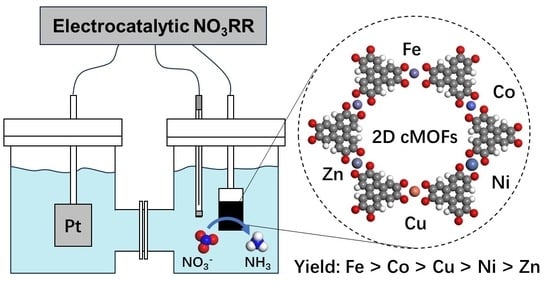
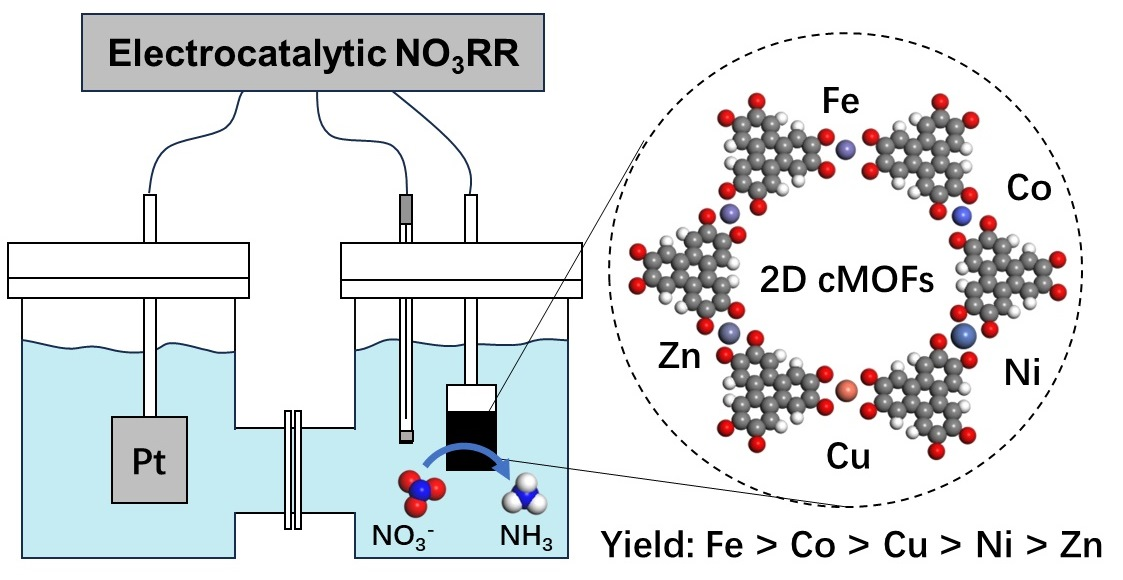
Nitrate pollution in groundwater poses severe threats to ecosystems and human health, making the electrochemical nitrate reduction reaction (NO3RR) a promising remediation technology. Conductive metal–organic frameworks (cMOFs) with π-d conjugation, dispersed active sites, and tunable structures are ideal candidates for electrocatalysis. Herein, we synthesized a series of cMOFs (M3(HHTP)2, M = Fe, Zn, Cu, Co, Ni) via conjugated coordination between hexahydroxytriphenylene (HHTP) ligands and metal ions and systematically investigated their NO3RR performance. Electrochemical tests revealed that Fe3(HHTP)2 exhibits superior catalytic performance for nitrate reduction, achieving a high NH3 selectivity of 99.5% and a yield rate of 676.4 mg·gcat−1·h−1 at −1.0 V vs. RHE (reversible hydrogen electrode), along with excellent cyclic and structural stability. In situ attenuated total reflection Fourier transform infrared (ATR-FTIR) spectroscopy identified key intermediates (*NO2, *NH2OH) and proposed the reaction pathway: NO3 → *NO3 → *NO2 → *NO → *NOH → *NH2OH → *NH2 → *NH3. DFT calculations revealed that Fe center exhibited a lower energy barrier for NO3RR compared to other metal ions (Zn, Cu, Co, Ni). This study demonstrates the significant potential of Fe3(HHTP)2 for efficient NO3RR and provides new insights into the structure-function relationship of cMOF-based electrocatalysts.

Graphical Abstract

1. Introduction

Nitrate is one of the most prevalent water pollutants worldwide, posing a significant threat to human health and the ecological environment [1]. Excessive discharge of nitrate (NO3) from agricultural runoff, urban sewage, industrial emissions, and other sources disrupts the nitrogen cycle, creating risks to ecosystems and human health [2,3,4]. The electrochemical nitrate reduction reaction (NO3RR) powered by renewable energy offers greater kinetic advantages, thus having attracted considerable attention in recent years [5,6,7,8]. Electrochemical nitrate reduction can produce valuable ammonia (NH3), but nitrogen dioxide, as the main byproduct, causes serious health issues such as birth defects and methemoglobinemia. It also lacks recovery value and therefore requires further reduction [9,10]. Consequently, it is necessary to design electrocatalysts with high selectivity for ammonia (NH3) in low-concentration nitrate environments.
The elaborate design and regulation of catalysts are crucial for efficient and highly selective electrocatalytic nitrate-to-ammonia reduction reactions. Over the past few years, metal nanoparticles, alloys, metal oxides, and single-atom catalysts (SACs) have been extensively studied for nitrate reduction reactions [9,10,11,12,13,14,15]. Recently, metal–organic frameworks (MOFs) assembled from metal ions and organic ligands have shown great potential as electrocatalysts [16,17,18,19]. Their high chemical stability, accessible metal sites, and well-ordered coordination structures enable the formation of active centers with uniform distribution, high density, and tunable electronic properties [20]. Specifically, two-dimensional conductive metal–organic frameworks (2D cMOFs) constitute a unique subclass with their structures typically constructed via two-dimensional coordination between π-conjugated linkers and metal nodes [11,16]. This structural feature endows cMOFs with continuous electron transport pathways that guarantee efficient charge transfer and well-defined catalytic active sites.
The metal centers in MOFs as active sites plays an essential role in electrocatalytic process. Previous study demonstrated that ultrathin Ni-based MOFs (Ni-BDC) exhibit low activation energy (0.507 eV) for the NO3RR. At −1.4 V vs. RHE (reversible hydrogen electrode), the nitrate reduction rate, rate constant, NH3 selectivity, and NH3 yield reached 96.4%, 0.448 h−1, 80%, and 110.13 μg·h−1·cm−2, respectively [21]. Other study reported that Cu-BTC indicated a higher NH3 yield of 13.06 mg·h−1·cm−2 at optimized −0.7 V vs. RHE [22]. Moreover, Co-based ZIF-67 and Co-HHTP catalysts can achieve an NH3 yields of 87.41 mg·h−1·cm−2 and 79.11 mg·h−1·cm−2, respectively, at −1.0 V vs. RHE [23]. Despite extensive research on different metal centers, systematic comparison of MOFs with different metal centers in the same framework structure remains insufficient [21,22,23]. Considering the complex reaction pathways and intermediates of NO3RR—which involves a multi-step reaction mechanism with nine protons and eight electrons—it has become imperative to understand the structure-performance relationship based on catalysts with well-defined metal centers [24,25].
Therefore, we constructed cMOFs through conjugated coordination between the organic ligand HHTP and metal ions (named as M3(HHTP)2, where M = Fe, Zn, Cu, Co, or Ni) to investigate their nitrate reduction performance and mechanisms. In situ attenuated total reflection Fourier transform infrared (ATR-FTIR) was performed to determine the intermediates and reaction pathways. Furthermore, density functional theory (DFT) calculations were employed to confirm the reaction pathway and energy. This work may provide valuable insights for the design of efficient metallized MOFs for NO3RR and other reactions.

2. Materials and Methods

2.1. Materials and Reagents

2,3,6,7,10,11-hexahydroxytriphenylene (HHTP), iron (II) acetate, cobalt acetate, nickel acetate, copper acetate monohydrate, zinc acetate, aqueous ammonia, N,N-dimethylformamide (DMF), potassium sulfate, Nafion (5 wt.%), ethanol, acetone, K2SO4, and KNO3 were all purchased from Sinopharm Chemical Reagent Co., Ltd., Shanghai, China. All chemicals were used without further purification.

2.2. Synthesis of M3(HHTP)2 Material

The synthesis of M3(HHTP)2 was performed with modifications to a previously reported procedure [26]. Briefly, copper acetate monohydrate (1 mmol) was dissolved in 25 mL of ultrapure water, while HHTP (1 mmol) and 0.6 mL of aqueous ammonia were dissolved in 25 mL of N,N-dimethylformamide (DMF). The two freshly prepared solutions were mixed in a 50 mL beaker under ultrasonication for 20 min. The mixture was then heated in a constant temperature oven at 85 °C for 3 h, followed by natural cooling to room temperature. The resulting solid was washed with deionized water and acetone six times, respectively, and dried overnight in a vacuum oven at 60 °C. The synthesis of other M3(HHTP)2 (M = Fe, Zn, Co, Ni) followed the same procedure, except that copper acetate monohydrate was replaced with the corresponding metal acetates.

2.3. Material Characterization

The morphology of the catalyst was characterized by scanning electron microscopy (SEM, Thermo Fisher Quattro, Waltham, MA, USA) and transmission electron microscopy (TEM, JEOL JEM-2100F, Tokyo, Japan) combined with energy-dispersive X-ray spectroscopy (EDS) elemental mapping. Fourier transform infrared (FTIR) spectra were recorded on a Thermo Scientific Nicolet iS50R spectrometer (Thermo Fisher Scientific Inc., Waltham, MA, USA) in the range of 400–4000 cm−1. The crystal structure was analyzed by X-ray diffraction (XRD) using a Bruker D8 ADVANCE diffractometer (Bruker AXS GmbH, Karlsruhe, Germany) with a scattering angle (2θ) range of 3–50°. X-ray photoelectron spectroscopy (XPS, Shimadzu AXIS Supra, Shimadzu Corporation, Kyoto, Japan) was employed to determine the elemental valence states on the sample surface. Absorbance measurements were performed using an ultraviolet-visible (UV-Vis) spectrophotometer (Shimadzu Corporation, Kyoto, Japan).

2.4. Electrochemical Testing

2.4.1. Nitrate Reduction

Electrochemical measurements were conducted using a three-electrode cell configuration on a CHI 660E electrochemical workstation (Shanghai Chenhua Instrument Co., Ltd., Shanghai, China), where carbon cloth (CC), a silver/silver chloride electrode (SSCE), and a platinum electrode served as the working, reference, and counter electrodes, respectively. First, 5 mg of the as-prepared M3(HHTP)2 was dispersed in a mixture of 400 μL anhydrous ethanol and 85 μL acetone, followed by the addition of 15 μL 5 wt.% Nafion solution to form a catalyst ink. The ink was ultrasonically dispersed for 0.5 h to ensure homogeneity. A 100 μL aliquot of the ink was then uniformly drop-cast onto a 1 cm × 1 cm carbon cloth substrate and air-dried to fabricate the working electrode.
The electrochemical measurements were performed in an H-type cell separated by a proton exchange membrane. The electrolyte for nitrate reduction experiments consisted of 0.1 mol·L−1 K2SO4 and 100 mg·L−1 NO3. A silver/silver chloride (Ag/AgCl) electrode was used as the reference electrode. All potentials measured in the experiments were converted to the reversible hydrogen electrode (RHE) scale using the equation:
E RHE = E Ag / AgCl + 0.059 × pH + 0.197 V
Linear sweep voltammetry (LSV) tests were performed in the aforementioned Ar-saturated electrolyte at a scan rate of 5 mV·s−1. Subsequently, potentiostatic electrolysis was conducted for 30 min at each potential interval of 0.1 V within the range of −0.7 V to −1.1 V (vs. RHE) to quantify the NH3 yield, the yield of ammonia (NH3) was calculated using the following equation:
Yield   ( NH 3 ) = C N H 3 × V m × t
where C is the concentration of aqueous NH3 in the electrolyte, V is the volume of the electrolyte, m is the mass of the loaded catalyst, and t is the reaction time. The mass-normalized yield of nitrite (NO2) was determined using the same formula, with   C N H 3 replaced by the concentration of aqueous C NO 2 .
The Faradaic efficiency (FE) for NH3 or NO2 production was determined by the equation:
Faradaic   Efficiency = C × V × F × n Q × 100 %
where C denotes the concentration of target product (NH3 or NO2) in the electrolyte, V is the volume of the electrolyte, n is the number of electrons transferred (n = 8 for NO3 reduction to NH3; n = 2 for NO3 reduction to NO2), F is the Faraday constant (96,485 C·mol−1), and Q is the total charge passed through the electrode during electrolysis. To further evaluate the catalytic performance, the partial current density for NH3 production ( S NH 3 ) and selectivity toward NH3 ( S NH 3 ) were calculated. The partial current density, which reflects the current contribution of NH3 production, was determined using the equation:
j NH 3 = C NH 3 × V × F × n S × t
where C NH 3 is the concentration of NH3 in the electrolyte, V is the electrolyte volume, n = 8 for NO3 reduction to NH3, F is the Faraday constant (96,485 C·mol−1), S is the geometric area of the working electrode, and t is the reaction time.
The selectivity toward NH3, representing the fraction of NO3 reduced to NH3 relative to total reduction products (NH3 + NO2), was calculated as:
S NH 3 = n NH 3 × 8 n NH 3 × 8 + n NO 2 × 2 × 100 %
Here, n NH 3 and n NO 2 are the molar amounts of produced NH3 and NO2, respectively; the factors 8 and 2 correspond to the electron transfer numbers for NO3 reduction to NH3 and NO2, ensuring normalization by electron consumption.
To determine the double-layer capacitance (Cdl), cyclic voltammetry (CV) measurements were conducted at scan rates of 10, 20, 30, 40, and 50 mV·s−1 within the non-Faradaic potential window near the open-circuit potential (OCP). Capacitive currents were extracted from this non-Faradaic region, and a linear plot of capacitive current density versus scan rate was constructed. The Cdl value was then derived from the slope of the fitted linear curve. The electrochemical active surface area (ECSA) represents the total area of surface-active sites on the catalyst that can participate in electrochemical reactions. It was derived by normalizing the measured double-layer capacitance Cdl against a literature-accepted specific capacitance (Cs) standard of 40 μF·cm−2 for neutral aqueous electrolytes, as expressed by the equation:
ECSA   = C dl   C s ×   S
where S denotes the geometric area of the working electrode [27,28].

2.4.2. Detection of N-Containing Species

Prior to determining the concentration, the solution was diluted to an appropriate concentration.
  • Determination of Nitrate
1 mL of 1 M HCl solution and 0.01 mL of 0.8 wt% sulfamic acid solution were added to the diluted mixture. Nitrate ions exhibit a characteristic strong absorption at 220 nm, which is the basis for the quantitative determination of nitrate concentration. However, dissolved organic compounds in the electrolyte also produce non-negligible background absorption at this wavelength. Notably, nitrate ions show negligible absorption at 275 nm, while the background absorption from organic compounds persists at this wavelength. Thus, the absorbance measurement at 275 nm serves to correct the background interference, ensuring the calculated absorbance accurately reflects the actual nitrate concentration. After 15 min, the color development was completed, and the absorbance was measured via UV-Vis spectrophotometry at wavelengths of 220 nm and 275 nm.
The final absorbance of NO3-N was calculated using the following equation:
A = A 220 n m 2 × A 275 n m
A standard calibration curve was established based on the absorbance values of NO3-N standard solutions with known concentrations.
2.
Determination of Nitrite
To prepare the chromogenic reagent, 0.4 g of sulfanilamide and 0.02 g of N-(1-naphthyl)ethylenediamine dihydrochloride were dissolved in a mixed solution containing 5 mL of ultrapure water and 1 mL of phosphoric acid (density, ρ = 1.70 g/mL). Subsequently, 0.1 mL of the chromogenic reagent was added to 5 mL of the diluted electrolyte. The solution was allowed to stand for 20 min, and then the absorbance was measured via UV-vis spectrophotometry at a wavelength of 540 nm. A standard calibration curve was established using a series of NO2-N standard solutions with known concentrations.
3.
Determination of Ammonium
Potassium sodium tartrate solution and Nessler’s reagent were sequentially added to 5 mL of the diluted sample solution. The mixture was allowed to stand for 15–30 min, and then the absorbance was measured via UV-Vis spectrophotometry at a fixed wavelength of 420 nm. The standard calibration curve was established using a series of NH4+ standard solutions with known concentrations.

2.4.3. In Situ Fourier Transform Infrared (FTIR) Measurement

The electrolyte employed in this study was a mixed aqueous solution consisting of 0.1 M K2SO4 and 100 mg·L−1 NO3 (as the target reactant, sourced from KNO3 with analytical purity). Prior to electrochemical measurements, high-purity argon (Ar, 99.999%) was purged through the electrolyte at a flow rate of 30 mL·min−1 for 30 min to completely eliminate dissolved oxygen, thus avoiding interference from oxygen reduction reactions. Electrochemical tests were conducted in a standard three-electrode system using a CHI 660E electrochemical workstation, operated in potentiostatic mode. The applied potentials were set to range from the open-circuit potential (OCP) to −1.0 V vs. RHE. For in situ Fourier transform infrared (FTIR) spectral collection, each set potential was maintained for 10 min to ensure a stable electrochemical state (Figure S1).
In situ FTIR spectra were acquired using a Thermo Nicolet iS50R (Thermo Fisher Scientific Inc., Waltham, MA, USA) spectrometer equipped with an MCT (Mercury Cadmium Telluride) detector. The spectral resolution was set to 4 cm−1 with 128 scans for each spectrum to improve signal-to-noise ratio.

2.5. DFT Calculations

DFT calculations were performed in VASP 5.4 using the Perdew-Burke-Ernzerhof (PBE) generalized gradient approximation (GGA). Projected augmented wave (PAW) potentials and a 500 eV plane-wave cutoff were employed to describe ionic cores and valence electrons, respectively. Gaussian smearing (0.05 eV) was used for partial occupation of Kohn-Sham orbitals. Self-consistency was achieved when the energy change was <10−5 eV. Structural optimizations (full atomic relaxation) converged at a force tolerance of 0.01 eV/Å, with 1 × 1 × 1 Monkhorst-Pack k-point sampling for Brillouin zone integration. Grimme’s DFT-D3 method accounted for dispersive interactions, and a 15 Å vacuum thickness minimized interlayer effects. The free energy was calculated by the equation:
Δ G = Δ E + Z P E T × Δ S
where E is the total energy, ZPE is the zero-point energy, S is the entropy, and T is set as 298.15 K.

3. Results

3.1. Material Properties

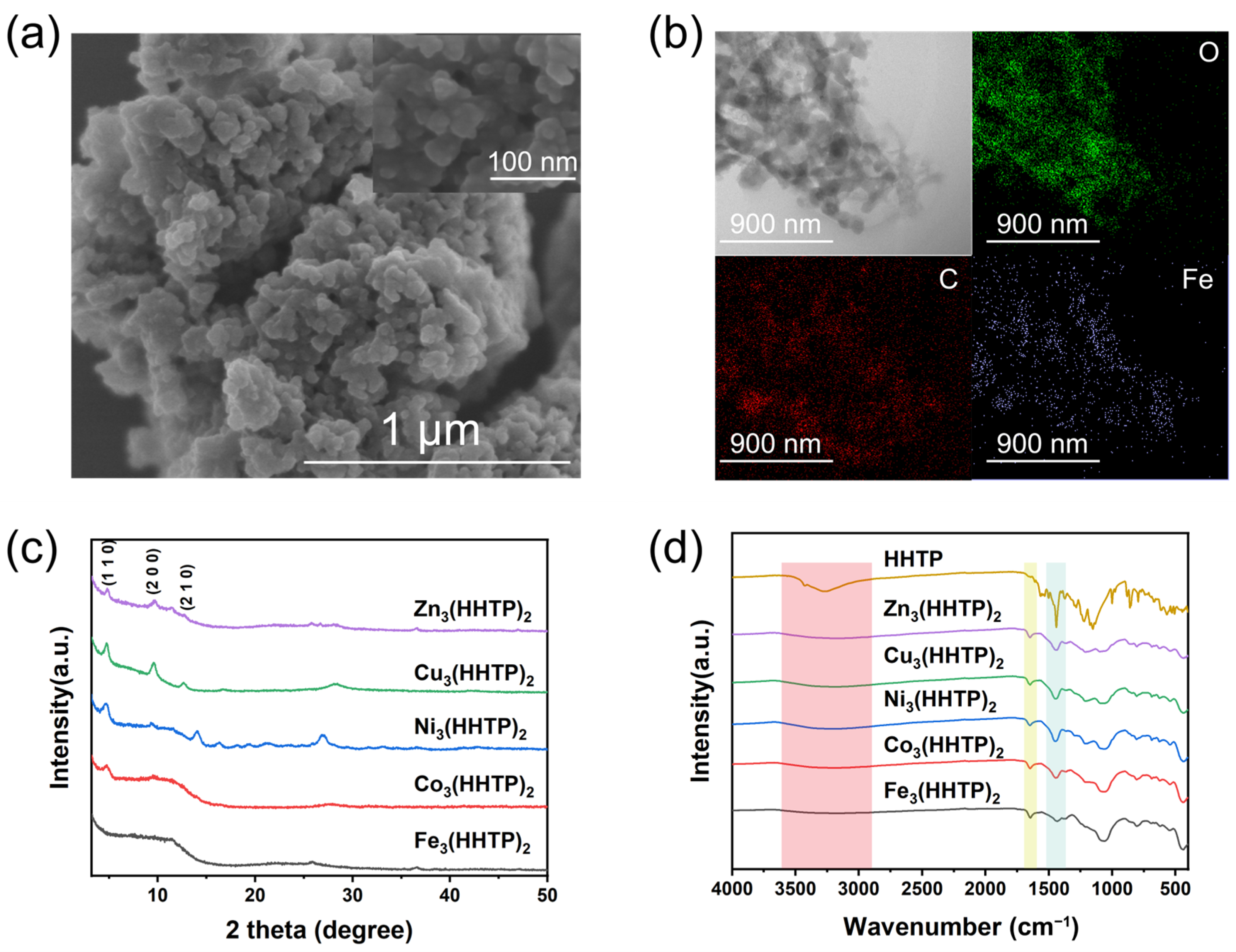
As observed from the SEM and TEM images, the M3(HHTP)2 materials presented as irregular nanoparticles with an average particle size of approximately 50 nm (Figure 1a,b and Figure S2). The elemental mapping demonstrates the uniform distribution of metal elements, carbon, and oxygen throughout the materials (Figure 1b and Figure S2). X-ray diffraction (XRD) patterns show that Zn3(HHTP)2 exhibits characteristic diffraction peaks at 2θ values of approximately 4.8°, 9.7°, 12.8° and 28.1°(Figure 1c), corresponding to the (110), (200), (210), and (001) crystal planes of AA-stacked Zn3(HHTP)2 [29]. Slight shifts in peak positions were observed for MOFs containing different central metals (Figure 1c), indicating variations in local symmetry arising from differences in metal–ligand bonding.
As shown in the Fourier transform infrared (FTIR) spectrum (Figure 1d), HHTP exhibits typical ν(C=O) and ν(C-O) stretching peaks at 1621 cm−1 and 1214 cm−1, and the peaks below 1000 cm–1 corresponded to M-O stretching modes, respectively [30]. With introduction of metal ions for M3(HHTP)2, the ν(C-O) intensity of HHTP decreases while the ν(C=O) intensity increases. This is because phenolic hydroxyl groups in HHTP are partially oxidized to quinones during MOF synthesis [29]. These results confirm the successful synthesis of M3(HHTP)2. In summary, via a facile hydrothermal method, M3(HHTP)2 coordination polymers were synthesized using metal acetates and 2,3,6,7,10,11-hexahydroxytriphenylene (HHTP) as raw materials.
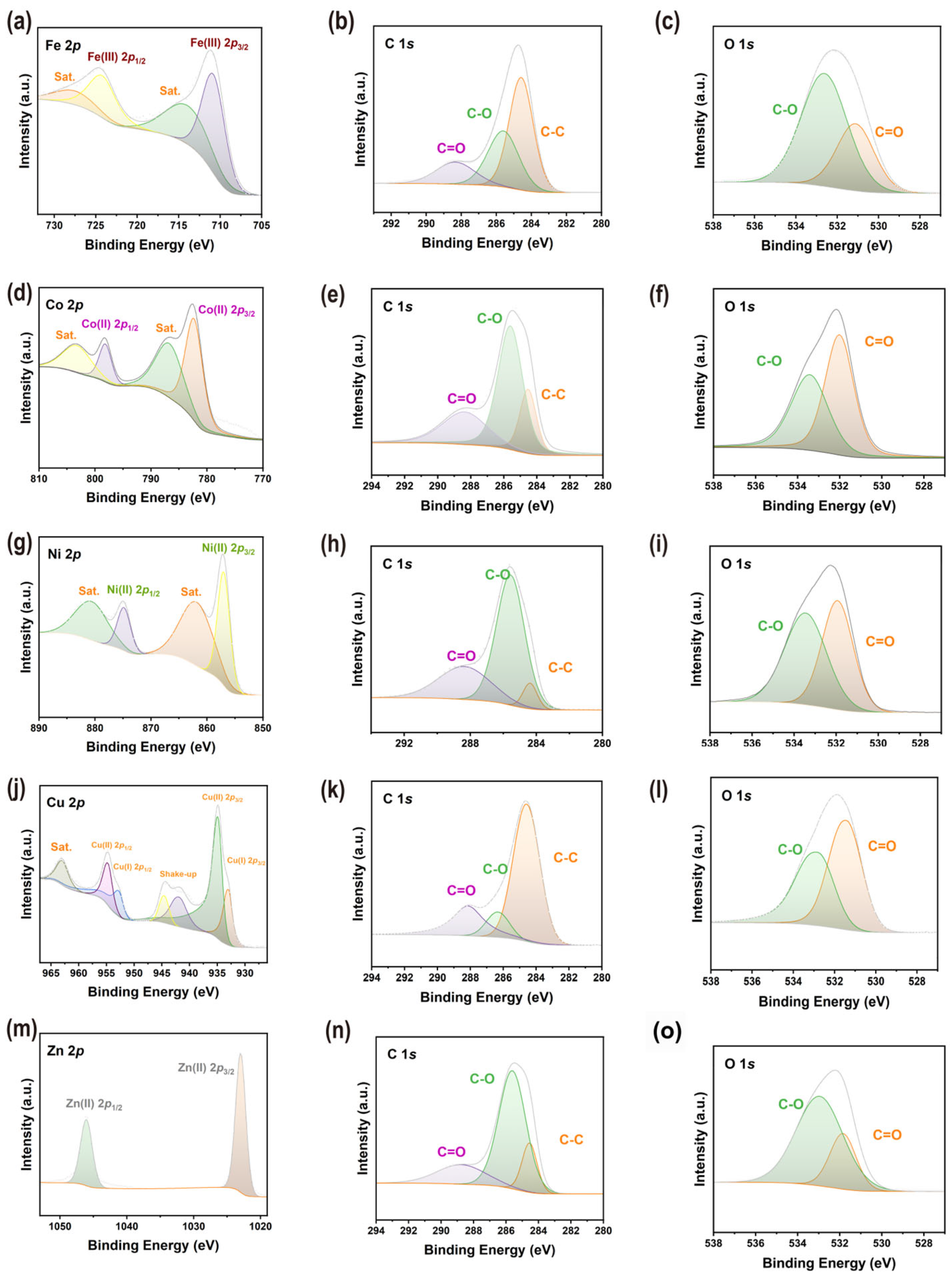
In addition, X-ray photoelectron spectroscopy (XPS) confirms the valence states of metal, C, and O elements (Figure 2). For Fe3(HHTP)2, the Fe 2p XPS identified peaks at 710.98 and 724.38 eV, assigned to the +3 valence state (Figure 2a). The asymmetric C 1 s peak can be deconvoluted into three peaks located at 284.58 eV, 285.60 eV, and 288.33 eV (Figure 2b), which are assigned to C-C, C-O, and C=O groups, respectively [31]. The O 1 s peak can be deconvoluted into two peaks at 531.12 eV and 532.62 eV, correspond to C=O and C-O bonds (Figure 2c).
Similar chemical binding state characteristics are observed for MOFs with other metal centers. For Co3(HHTP)2, the Co 2p XPS spectrum shows peaks at 782.13 and 797.93 eV, which are ascribed to the +2 valence state (Figure 2d) [32]. For Ni3(HHTP)2, the Ni 2p XPS spectrum exhibits peaks at 856.13 and 874.63 eV, corresponding to the +2 valence state (Figure 2g). For Cu3(HHTP)2, the Cu 2p XPS spectrum displays peaks at 792.80, 952.65, 934.65, and 954.60 eV, indicating mixed +1 and +2 valence states (Figure 2j). For Zn3(HHTP)2, the Zn 2p XPS spectrum has peaks at 1022.67 and 1045.75 eV, assigned to the +2 valence state (Figure 2m). The asymmetric C 1 s spectra of the other metal-centered MOFs can all be deconvoluted into three peaks in the range of 284.48–288.76 eV, which are assigned to C-C, C-O, and C=O groups, respectively (Figure 2e,h,k,n). Similarly, the O 1 s peak of each MOF can be split into two peaks between 531.12 and 532.95 eV, corresponding to C=O and C-O bonds (Figure 2f,i,l,o).

3.2. Electrochemical Characteristics

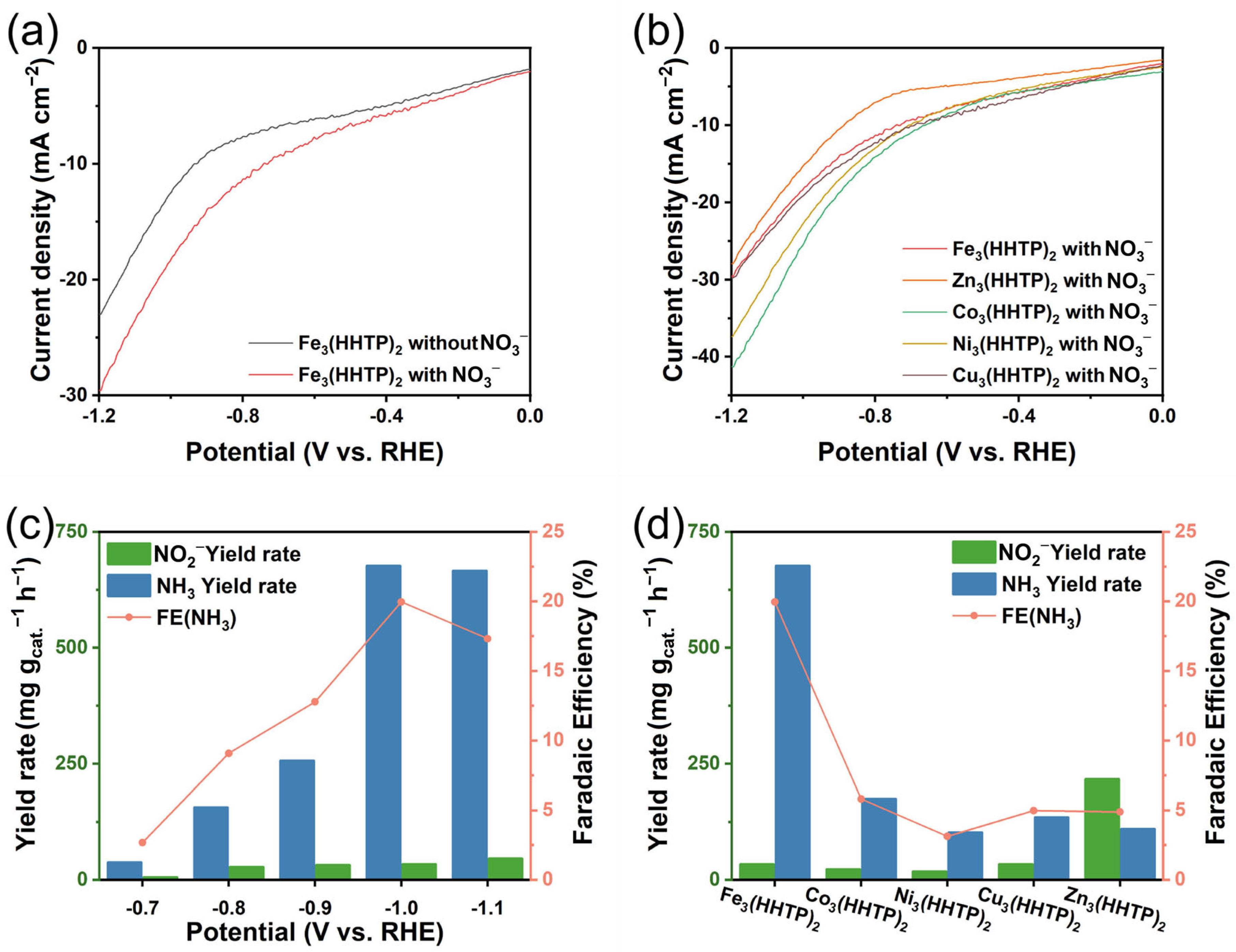
To evaluate the electrocatalytic activity of M3(HHTP)2, linear sweep voltammetry (LSV) measurements were conducted in 0.1 M K2SO4 solution with and without 100 mg L−1 NO3 (Figure 3a and Figure S3). Compared to the LSV curve in the absence of NO3, a pronounced increase in catalytic current was observed when NO3 was present, indicating that M3(HHTP)2 exhibits distinct activity toward nitrate electroreduction. Specifically, Co3(HHTP)2 displayed the highest reductive activity in the presence of NO3 (Figure 3b).
To evaluate the efficiency of nitrate electroreduction, potentiostatic electrolysis experiments were performed on various M3(HHTP)2 catalysts (Figure 3c and Figure S4). As summarized in Table 1, Fe3(HHTP)2 demonstrates the most superior NO3RR performance among all tested catalysts. In terms of ammonia yield rate—a critical indicator of catalytic activity—it reaches 676.4 mg·gcat−1·h−1, which is significantly higher than that of Co3(HHTP)2 (174.2 mg·gcat−1·h−1), Cu3(HHTP)2 (134.7 mg·gcat−1·h−1), Zn3(HHTP)2 (109.3 mg·gcat−1·h−1), and Ni3(HHTP)2 (101.8 mg·gcat−1·h−1). In terms of ammonia Faradaic efficiency (FE), which reflects the selectivity of the catalyst for ammonia production over competing reactions, Fe3(HHTP)2 also exhibits the highest value of 20.0%. This is substantially higher than the FE of Co3(HHTP)2 (5.8%), Cu3(HHTP)2 (5.0%), Zn3(HHTP)2 (4.9%), and Ni3(HHTP)2 (3.1%). Notably, Zn3(HHTP)2 shows a high nitrite yield rate of 216.8 mg·gcat−1·h−1, but a low ammonia FE, suggesting that Zn center tends to cause incomplete nitrate reduction rather than further conversion to ammonia. These results confirm that the metal center in M3(HHTP)2 plays a decisive role in regulating NO3RR activity and selectivity, with the Fe center being the most favorable for efficient and selective nitrate reduction to ammonia. Compared with previously reported literature (Table S1), Fe3(HHTP)2 shows advantages in NH3 selectivity and yield. The nitrate reduction performance of Fe3(HHTP)2 was further evaluated at various applied potentials (Figure 3d). A volcano-type relationship was observed, where both the ammonia yield rate and Faradaic efficiency reached their maximum at –1.0 V vs. RHE.
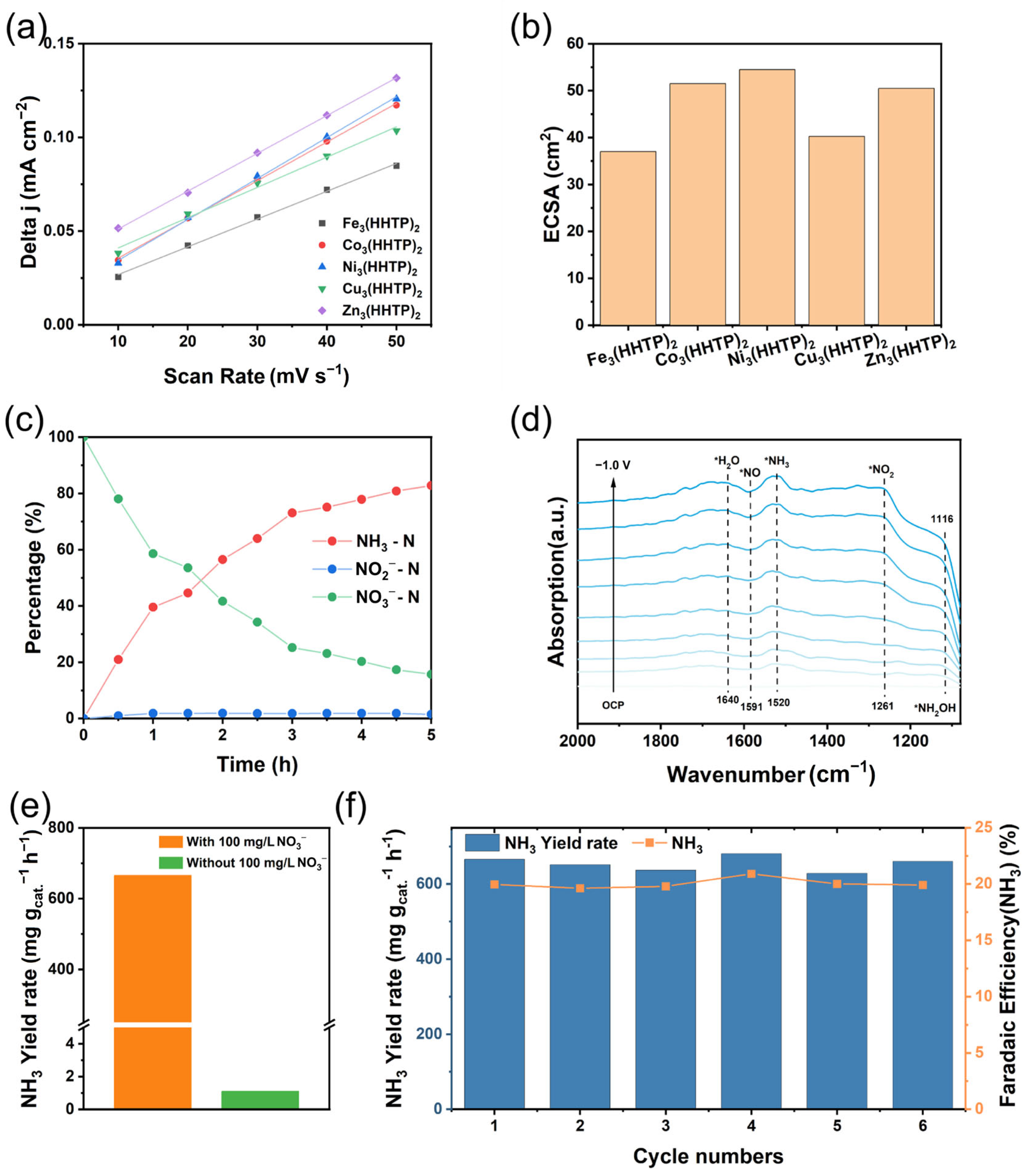
To gain insight into the intrinsic properties of the catalysts, CV measurements were performed in the non-Faradaic region. The electrochemical active surface area (ECSA) can indirectly reflect the activity of materials. The ECSA values were determined via CV measurements within the non-Faradaic potential range, and the calculated ECSA values are presented in Figure 4b. The ECSA followed the order of Fe3(HHTP)2 (37.0 cm2) < Cu3(HHTP)2 (40.3 cm2) < Zn3(HHTP)2 (50.5 cm2) < Co3(HHTP)2 (51.5 cm2) < Ni3(HHTP)2 (54.5 cm2), suggesting that although Fe3(HHTP)2 exhibited the highest Faradaic efficiency, its ECSA was relatively low. The ammonia yield normalized by ECSA was calculated for M3(HHTP)2 catalysts at −1.0 V vs. RHE. The obtained values were 18.3 mg·gcat−1·h−1·cm−2 (Fe), 3.4 mg·gcat−1·h−1·cm−2 (Co), 1.9 mg·gcat−1·h−1·cm−2 (Ni), 3.4 mg·gcat−1·h−1·cm−2 (Cu), and 2.2 mg·gcat−1·h−1·cm−2 (Zn). This ECSA-normalized yield reflects the ammonia production efficiency per unit active surface area, eliminating the influence of differences in active site accessibility among different catalysts. Evidently, Fe3(HHTP)2 exhibits the most prominent intrinsic catalytic activity across the series.
This phenomenon may be attributed to the fact that all surface species capable of forming a double-layer structure contribute to the ECSA. Nevertheless, surface sites involved in non-Faradaic charging/discharging do not necessarily participate in Faradaic processes [33].
To verify the nitrate removal efficiency of Fe3(HHTP)2 in aqueous solution, a 5 h long-term electrolysis was carried out at −1.0 V. With an initial nitrate concentration of 100 mg/L, the nitrate concentration decreased by 84.3% after 5 h, with only 1.5% of NO3 converted to NO2 (Figure 4c). This demonstrates that Fe3(HHTP)2 exhibits excellent nitrate removal capability, ammonia conversion efficiency, and high ammonia selectivity for nitrate reduction.
To better understand the nitrate reduction reaction pathway and identify catalytic intermediates, we performed in situ attenuated total reflection Fourier transform infrared (ATR-FTIR) spectroscopic measurements. Since Fe3(HHTP)2 exhibits the highest ammonia yield rate, we addressed NO3RR pathways on this catalyst. Figure 4d presents the in situ ATR-FTIR spectra on Fe3(HHTP)2 as the potential was gradually decreased from the open circuit potential (OCP) to −1.0 V in a 0.1 mol·L−1 K2SO4 solution containing 100 mg/L NO3. The positive absorption peak at 1116 cm−1 corresponds to the –N–O– stretching vibration of *NH2OH, indicating that *NH2OH is an intermediate of the reaction. The positive absorption peak at 1261 cm−1 is attributed to the N–O asymmetric stretching vibration of NO2 [34], demonstrating that NO3 is converted to NO2 as the nitrate reduction reaction proceeds. The negative absorption peak at 1591 cm−1 corresponds to adsorbed *NO [35], and its intensity gradually decreases with the negative shift in potential, indicating the consumption of NO. The positive absorption peak at 1520 cm−1 corresponds to *NH3 [36], and its intensity continuously increases with the negative shift in potential, confirming the formation of NH3. Notably, the absorption peak at 1640 cm−1 is assigned to the O─H stretching vibration of H2O [37], suggesting that water dissociation occurs during NO3RR to provide H for the hydrogenation of NOX intermediates. For comparison, we also performed an in situ FTIR experiment without nitrate addition (Figure S5). The resulting spectrum displays only the characteristic 1640 cm−1 peak of H2O, this confirms that the peaks assigned to *NO (1591 cm−1) and *NH3 (1520 cm−1) in the nitrate-containing system are indeed derived from reaction intermediates, rather than from the cMOF framework or solvent background vibrations. Therefore, we propose the reaction pathway of Fe3(HHTP)2 in nitrate reduction as NO3 → *NO3 → *NO2 → *NO → *NOH → *NH2OH → *NH2 → *NH3, where * is denoted as the adsorption site on the M3(HHTP)2 catalyst surface.
To verify the source of N in ammonia, electrocatalytic nitrate reduction experiments of Fe3(HHTP)2 were conducted in the presence and absence of 100 mg/L nitrate, respectively. As shown in Figure 4e, Fe3(HHTP)2 produces almost no ammonia only when nitrate is absent, demonstrating that the N in ammonia during nitrate reduction originated from nitrate.
Catalytic stability of electrocatalysts is another crucial factor for practical applications. To evaluate the cyclic stability of Fe3(HHTP)2, six consecutive NO3RR tests were performed at −1.0 V vs. RHE (Figure 4f). The results show that after six successive electrolysis cycles, the ammonia yield rate and Faradaic efficiency of Fe3(HHTP)2 exhibited negligible change, indicating that Fe3(HHTP)2 possesses excellent electrocatalytic stability. In addition, to confirm the structural stability of the material, LSV tests were conducted on Fe3(HHTP)2 before and after the 5 h electrolysis. As shown in Figure S6, the LSV curves of Fe3(HHTP)2 barely changed after the long-term electrolysis, indicating that the material itself possesses excellent structural stability.

3.3. Theoretical Calculations

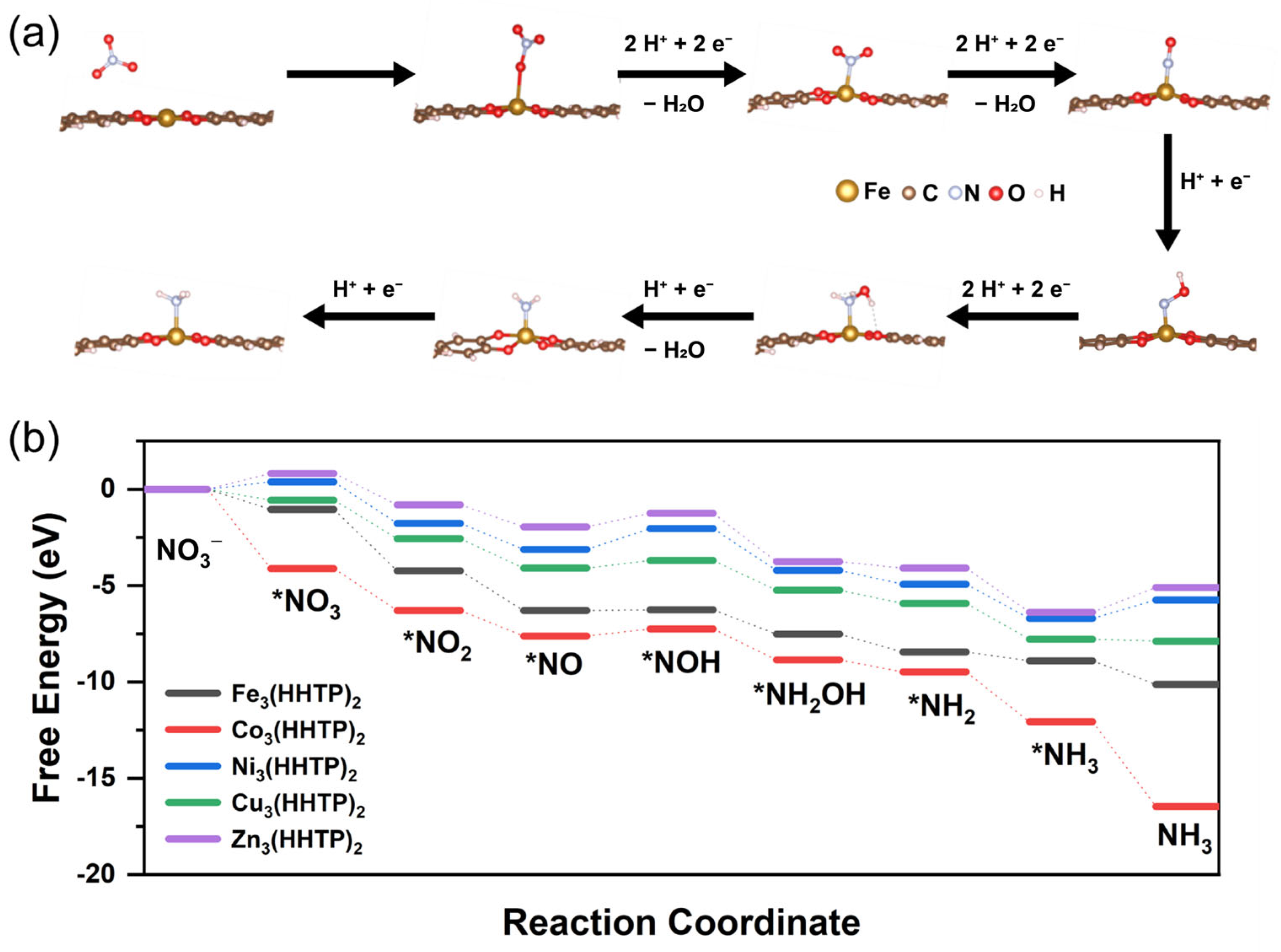
To gain mechanistic insights into the effect of metal centers on the nitrate electroreduction reaction (NO3RR), theoretical calculations were further performed to evaluate the reaction energies. Based on in situ ATR-FTIR spectroscopy studies (Figure 4d), the overall NO3RR pathway on M3(HHTP)2 conductive metal–organic frameworks (cMOFs, M = Fe, Zn, Cu, Co, Ni) follows a sequential reduction trend (Figure 5): NO3 → *NO3 → *NO2 → *NO → *NOH → *H2NOH → *NH2 → *NH3 → NH3.
The first step corresponds to the adsorption of NO3 to form *NO3 (NO3 → *NO3). For Fe3(HHTP)2, Co3(HHTP)2, and Cu3(HHTP)2, the free energy change for *NO3 adsorption are −1.04 eV, −4.11 eV, and −0.57 eV, respectively, indicating spontaneous nitrate adsorption. In contrast, Ni3(HHTP)2 and Zn3(HHTP)2 exhibit positive free energy change for *NO3 adsorption (0.38 eV and 0.83 eV), suggesting that nitrate adsorption on these catalysts requires overcoming a thermodynamic barrier.
The second step involves the reduction of *NO3 to *NO2 (*NO3 → *NO2). All M3(HHTP)2 catalysts exhibit significant negative free energy changes in this step: −3.19 eV for Fe3(HHTP)2, −2.18 eV for Co3(HHTP)2, −2.15 eV for Ni3(HHTP)2, −2.00 eV for Cu3(HHTP)2, and −1.64 eV for Zn3(HHTP)2. These negative values confirm the spontaneity of this reaction on all catalysts. Among them, Fe3(HHTP)2 shows the largest free energy decrease, indicating the strongest thermodynamic driving force for this step.
Similarly to the second step, the third step (*NO2 → *NO) also proceeds with significant negative free energy changes for all catalysts: −2.06 eV for Fe3(HHTP)2, −1.32 eV for Co3(HHTP)2, −1.35 eV for Ni3(HHTP)2, −1.52 eV for Cu3(HHTP)2, and −1.14 eV for Zn3(HHTP)2. Notably, Fe3(HHTP)2 still exhibits the largest free energy drop, which further supports its superior catalytic activity by virtue of the strongest driving force for this reduction step.
Distinct differences among the catalysts are observed in the next step (*NO → *NOH), all M3(HHTP)2 materials show positive free energy changes, indicating an endothermic process. The energy barriers are 0.53 eV for Fe3(HHTP)2, 0.93 eV for Co3(HHTP)2, 1.59 eV for Ni3(HHTP)2, 0.94 eV for Cu3(HHTP)2, and 1.23 eV for Zn3(HHTP)2. Notably, the Fe-based cMOF has the lowest energy barrier, which further confirms its optimal catalytic activity.
For the subsequent *NOH → *H2NOH step, all catalysts exhibit negative free energy changes: −1.75 eV (Fe3(HHTP)2), −2.16 eV (Co3(HHTP)2), −2.68 eV (Ni3(HHTP)2), −2.09 eV (Cu3(HHTP)2), and −3.04 eV (Zn3(HHTP)2), indicating spontaneous hydrogenation. The *H2NOH → *NH2 step also proceeds spontaneously for all metal centers, with free energy changes of −0.93 eV (Fe3(HHTP)2), −0.63 eV (Co3(HHTP)2), −0.72 eV (Ni3(HHTP)2), −0.68 eV (Cu3(HHTP)2), and −0.34 eV (Zn3(HHTP)2).
The conversion of *NH2 to *NH3 is thermodynamically favorable for all catalysts, as reflected by their negative free energy changes: −0.45 eV (Fe3(HHTP)2), −2.59 eV (Co3(HHTP)2), −1.78 eV (Ni3(HHTP)2), −1.85 eV (Cu3(HHTP)2), and −2.29 eV (Zn3(HHTP)2). Finally, the last step (*NH3 → NH3) shows divergent trends: Fe3(HHTP)2, Co3(HHTP)2, and Cu3(HHTP)2 exhibit negative free energy changes (−1.23 eV, −4.40 eV, and −0.11 eV), enabling spontaneous NH3 desorption. In contrast, Ni- and Zn-based cMOFs face specific thermodynamic limitations: their *NH3 → NH3 steps show positive free energy changes (0.96 eV for Ni3(HHTP)2 and 1.29 eV for Zn3(HHTP)2), which may lead to *NH3 accumulation on the catalyst surface and thus hinder the final formation of free NH3.

4. Conclusions

This work focuses on developing efficient cMOF-based electrocatalysts for nitrate reduction to address the critical need for highly selective NH3 production from nitrate-contaminated water. Five M3(HHTP)2 cMOFs (M = Fe, Zn, Cu, Co, Ni) were successfully synthesized via a facile hydrothermal method. These materials exhibit uniform nanostructured morphologies and homogeneous distributions of metal, carbon, and oxygen elements, which together enhance electrolyte contact and active-site accessibility. Among them, Fe3(HHTP)2 demonstrated the most outstanding performance, achieving an NH3 yield rate of 676.4 mg·gcat−1·h−1 and a selectivity of 99.5%, along with excellent stability over six cyclic tests and 5 h continuous electrolysis (84.3% nitrate removal efficiency). In situ ATR-FTIR analysis identifie
d key intermediates and supported a stepwise nitrate reduction pathway (NO3 → *NO3 → *NO2 → *NO → *NOH→ *NH2OH → *NH2 → *NH3). DFT calculations further revealed a lower energy barrier for NO3RR on Fe3(HHTP)2 compared to other cMOFs. Overall, this study expands the application scope of cMOFs in electrochemical nitrate reduction, establishes a design strategy for high-performance electrocatalysts through central metal tuning, and highlights the potential of Fe3(HHTP)2 for practical water remediation. These findings also provide guidance for future optimization of cMOFs by tailoring HHTP ligands or metal centers to minimize charge-transfer resistance and enhance catalytic performance in complex real-water systems.

Supplementary Materials

The following supporting information can be downloaded at: https://www.mdpi.com/article/10.3390/separations13020043/s1, Figure S1: Photograph of the in-situ FTIR characterization setup; Figure S2: SEM and element mapping images of M3(HHTP)2; Figure S3: Linear sweep voltammetry (LSV) curves of M3(HHTP)2; Figure S4: Nitrate/nitrite yields and Faradaic efficiencies of M3(HHTP)2 at different potentials; Figure S5: In-situ ATR-FTIR spectra on Fe3(HHTP)2 without NO3−; Figure S6: LSV curves of Fe3(HHTP)2 before and after 5 h long-term electrolysis; Table S1: Comparisons of electrocatalytic denitrification performance between this work and other reported electrocatalysts [38,39,40,41,42].

Author Contributions

Conceptualization, Y.C., L.Y. and J.S.; methodology, Y.C. and R.M.; validation, Y.C., R.K. and L.Y.; formal analysis, Y.C., R.K. and R.M.; investigation, Y.C. and R.K.; resources, L.Y. and J.S.; data curation, Y.C., R.M. and L.Y.; writing—original draft preparation, Y.C.; writing—review and editing, L.Y.; visualization, Y.C.; supervision, L.Y.; project administration, L.Y. and J.S.; funding acquisition, L.Y. and J.S. All authors have read and agreed to the published version of the manuscript.

Funding

This work was supported by the financial support of the National Key Research and Development Program of China (2022YFC3703700) and the National Natural Science Foundation of China (22376214).

Data Availability Statement

Dataset available on request from the authors.

Conflicts of Interest

The authors declare no conflicts of interest.

References

  1. Wang, Y.; Yu, Y.; Jia, R.; Zhang, C.; Zhang, B. Electrochemical synthesis of nitric acid from air and ammonia through waste utilization. Natl. Sci. Rev. 2019, 6, 730–738. [Google Scholar] [CrossRef]
  2. Jiang, Q.; Gu, M.; Pei, S.; Wang, T.; Liu, F.; Yang, X.; Zhang, D.; Wu, Z.; Wang, Y.; Wei, L.; et al. The Key Steps and Distinct Performance Trends of Pyrrolic vs Pyridinic M-N-C Catalysts in Electrocatalytic Nitrate Reduction. J. Am. Chem. Soc. 2025, 147, 26029–26039. [Google Scholar] [CrossRef] [PubMed]
  3. Chatterjee, S.; Parsapur, R.K.; Huang, K.-W. Limitations of Ammonia as a Hydrogen Energy Carrier for the Transportation Sector. ACS Energy Lett. 2021, 6, 4390–4394. [Google Scholar] [CrossRef]
  4. Canfield, D.E.; Glazer, A.N.; Falkowski, P.G. The Evolution and Future of Earth’s Nitrogen Cycle. Science 2010, 330, 192–196. [Google Scholar] [CrossRef]
  5. Chen, J.; He, X.; Li, J.; Li, X.; Cai, Z.; Luo, Y.; Zheng, D.; Li, T.; Wang, Y.; Liu, Q.; et al. Three-dimensional porous Co foam with nanosheets subunits for high-performance electrocatalytic nitrate-to-ammonia conversion. Inorg. Chem. Front. 2023, 10, 4450–4455. [Google Scholar] [CrossRef]
  6. Liang, J.; Li, Z.; Zhang, L.; He, X.; Luo, Y.; Zheng, D.; Wang, Y.; Li, T.; Yan, H.; Ying, B.; et al. Advances in ammonia electrosynthesis from ambient nitrate/nitrite reduction. Chem 2023, 9, 1768–1827. [Google Scholar] [CrossRef]
  7. Wang, G.; Shen, P.; Chen, K.; Guo, Y.; Zhao, X.; Chu, K. Rare-earth La-doped VS2−xfor electrochemical nitrate reduction to ammonia. Inorg. Chem. Front. 2023, 10, 2014–2021. [Google Scholar] [CrossRef]
  8. Yu, J.; Xi, Z.; Su, J.; Li, L.; Jing, P.; Xu, X.; Liu, B.; Zhang, J. A Cu–Co3O4 Tandem Catalyst for Efficient Electrocatalytic Nitrate Reduction at Low Concentration. ACS Mater. Lett. 2024, 6, 2591–2598. [Google Scholar] [CrossRef]
  9. Chen, F.Y.; Wu, Z.Y.; Gupta, S.; Rivera, D.J.; Lambeets, S.V.; Pecaut, S.; Kim, J.Y.T.; Zhu, P.; Finfrock, Y.Z.; Meira, D.M.; et al. Efficient conversion of low-concentration nitrate sources into ammonia on a Ru-dispersed Cu nanowire electrocatalyst. Nat. Nanotechnol. 2022, 17, 759–767. [Google Scholar] [CrossRef] [PubMed]
  10. Wan, Y.; Wang, Z.; Li, J.; Lv, R. Mo2C-MoO2 Heterostructure Quantum Dots for Enhanced Electrocatalytic Nitrogen Reduction to Ammonia. ACS Nano 2022, 16, 643–654. [Google Scholar] [CrossRef]
  11. Jiao, L.; Wang, J.; Jiang, H.-L. Microenvironment Modulation in Metal–Organic Framework-Based Catalysis. Acc. Mater. Res. 2021, 2, 327–339. [Google Scholar] [CrossRef]
  12. Li, S.; Gao, Y.; Li, N.; Ge, L.; Bu, X.; Feng, P. Transition metal-based bimetallic MOFs and MOF-derived catalysts for electrochemical oxygen evolution reaction. Energy Environ. Sci. 2021, 14, 1897–1927. [Google Scholar] [CrossRef]
  13. Liang, Z.; Wang, H.Y.; Zheng, H.; Zhang, W.; Cao, R. Porphyrin-based frameworks for oxygen electrocatalysis and catalytic reduction of carbon dioxide. Chem. Soc. Rev. 2021, 50, 2540–2581. [Google Scholar] [CrossRef]
  14. Shah, S.S.A.; Najam, T.; Wen, M.; Zang, S.-Q.; Waseem, A.; Jiang, H.-L. Metal–Organic Framework-Based Electrocatalysts for CO2 Reduction. Small Struct. 2021, 3, 2100090. [Google Scholar] [CrossRef]
  15. Zhang, Y.; Jiao, L.; Yang, W.; Xie, C.; Jiang, H.L. Rational Fabrication of Low-Coordinate Single-Atom Ni Electrocatalysts by MOFs for Highly Selective CO2 Reduction. Angew. Chem. Int. Ed. Engl. 2021, 60, 7607–7611. [Google Scholar] [CrossRef] [PubMed]
  16. Chan, Y.-P.; Huang, C.-S.; Lai, C.-Y.; Chen, Y.-C.; Chang, D.; Chuang, Y.-W.; Tu, K.-F.; Yeh, C.-N. A bimetallic 2D NiFe MOF/N-doped reduced graphene oxide as a bifunctional oxygen catalyst for rechargeable zinc-air batteries. Appl. Surf. Sci. 2025, 692, 162720. [Google Scholar] [CrossRef]
  17. Cheng, J.; Yang, X.; Yang, X.; Xia, R.; Xu, Y.; Sun, W.; Zhou, J. Hierarchical Ni3S2@2D Co MOF nanosheets as efficient hetero-electrocatalyst for hydrogen evolution reaction in alkaline solution. Fuel Process. Technol. 2022, 229, 107174. [Google Scholar] [CrossRef]
  18. Fu, Z.; Zhuo, H.; Liu, X.; Li, W.; Song, H.; Shi, Z.; Feng, L.; Jin, T.; Chen, W.; Chen, Y. Fe/Co Bimetal-Containing Carbon Prepared from a 2D Metalloporphyrin-Based MOF for the Optimal ORR/OER Bifunction and Its Application in Zn–Air Batteries. ACS Appl. Energy Mater. 2025, 8, 1051–1059. [Google Scholar] [CrossRef]
  19. Li, W.; Fang, W.; Wu, C.; Dinh, K.N.; Ren, H.; Zhao, L.; Liu, C.; Yan, Q. Bimetal–MOF nanosheets as efficient bifunctional electrocatalysts for oxygen evolution and nitrogen reduction reaction. J. Mater. Chem. A 2020, 8, 3658–3666. [Google Scholar] [CrossRef]
  20. Li, R.; Yan, X.; Chen, L. 2D Conductive Metal–Organic Frameworks for Electrochemical Energy Application. Org. Mater. 2024, 6, 45–65. [Google Scholar] [CrossRef]
  21. Pan, F.; Zhou, J.; Wang, T.; Zhu, Y.; Ma, H.; Niu, J.; Wang, C. Revealing the activity origin of ultrathin nickel metal–organic framework nanosheet catalysts for selective electrochemical nitrate reduction to ammonia: Experimental and density functional theory investigations. J. Colloid Interface Sci. 2023, 638, 26–38. [Google Scholar] [CrossRef] [PubMed]
  22. Xu, J.; Wan, S.; Yao, P.; Yang, J.; Ma, J.; Zhang, H. Defect engineering of Cu metal-organic framework for boosting nitrate efficient electroreduction to ammonia. Appl. Mater. Today 2026, 48, 103015. [Google Scholar] [CrossRef]
  23. Wang, Z.; Han, Y.; Wang, D.; Zhao, D.; Zhong, H.; Zhang, X. Unraveling Structural Evolution of Cobalt-Based Metal-Organic Frameworks for Boosting Nitrate Electroreduction to Ammonia. Chem. A Eur. J. 2025, 31, e202501809. [Google Scholar] [CrossRef]
  24. Wang, Y.; Wang, C.; Li, M.; Yu, Y.; Zhang, B. Nitrate electroreduction: Mechanism insight, in situ characterization, performance evaluation, and challenges. Chem. Soc. Rev. 2021, 50, 6720–6733. [Google Scholar] [CrossRef] [PubMed]
  25. Yin, S.; Cao, R.; Han, Y.; Shang, J.; Zhang, J.; Jiang, W.; Liu, G. Electrocatalysts with atomic-level site for nitrate reduction to ammonia. J. Energy Chem. 2024, 96, 642–668. [Google Scholar] [CrossRef]
  26. Liu, P.; Yan, J.; Huang, H.; Song, W. Cu/Co bimetallic conductive MOFs: Electronic modulation for enhanced nitrate reduction to ammonia. Chem. Eng. J. 2023, 466, 143134. [Google Scholar] [CrossRef]
  27. Ren, K.-C.; Xu, Y.-T.; Cao, Y. Iron-Based Inorganic Materials for New Energy-Based Electrocatalytic Nitrate-to-Ammonia Reduction Reaction. Adv. New Renew. Energy 2022, 10, 209–217. [Google Scholar] [CrossRef]
  28. Chang, Y.; Meng, J.; Hu, Y.; Qi, S.; Hu, Z.; Wu, G.; Zhou, J.; Zhan, X. Unacclimated activated sludge improved nitrate reduction and N2 selectivity in iron filling/biochar systems. Sci. Total Environ. 2024, 947, 174581. [Google Scholar] [CrossRef]
  29. Zhang, X.; Tian, X.L.; Qin, Y.; Qiao, J.; Pan, F.; Wu, N.; Wang, C.; Zhao, S.; Liu, W.; Cui, J.; et al. Conductive Metal-Organic Frameworks with Tunable Dielectric Properties for Boosting Electromagnetic Wave Absorption. ACS Nano 2023, 17, 12510–12518. [Google Scholar] [CrossRef] [PubMed]
  30. Stolz, R.M.; Mahdavi-Shakib, A.; Frederick, B.G.; Mirica, K.A. Host–Guest Interactions and Redox Activity in Layered Conductive Metal–Organic Frameworks. Chem. Mater. 2020, 32, 7639–7652. [Google Scholar] [CrossRef]
  31. Li, J.; Huang, Y.; Zhou, Y.; Dong, H.; Wang, H.; Shan, H.; Li, Y.; Xu, M.; Wang, X. Controllable Construction of Two-Dimensional Conductive M3(HHTP)2 Nanorods for Electrochemical Sensing of Malachite Green in Fish. ACS Appl. Nano Mater. 2023, 6, 22916–22926. [Google Scholar] [CrossRef]
  32. Yang, J.; Feng, Z.; Wang, Y.; Huang, J.; Xu, C.; Li, H. Two-Dimensional π–d-Conjugated Cobalt-Based Metal–Organic Framework for Efficient Oxygen Evolution. ACS Appl. Nano Mater. 2024, 7, 18881–18888. [Google Scholar] [CrossRef]
  33. Zheng, W.; Liu, M.; Lee, L.Y.S. Best Practices in Using Foam-Type Electrodes for Electrocatalytic Performance Benchmark. ACS Energy Lett. 2020, 5, 3260–3264. [Google Scholar] [CrossRef]
  34. Zhang, N.; Shang, J.; Deng, X.; Cai, L.; Long, R.; Xiong, Y.; Chai, Y. Governing Interlayer Strain in Bismuth Nanocrystals for Efficient Ammonia Electrosynthesis from Nitrate Reduction. ACS Nano 2022, 16, 4795–4804. [Google Scholar] [CrossRef] [PubMed]
  35. Figueiredo, M.C.; Solla-Gullón, J.; Vidal-Iglesias, F.J.; Climent, V.; Feliu, J.M. Nitrate reduction at Pt(100) single crystals and preferentially oriented nanoparticles in neutral media. Catal. Today 2013, 202, 2–11. [Google Scholar] [CrossRef]
  36. Zuo, M.; Kong, Y.; Zhou, H.; Chen, Y.; Sun, Y.; Li, S.; Han, L. In Situ Exsolution to Form Cu Nanoparticles on Cu–Doped LaFeO3 Perovskite Oxides for Efficient Electrocatalytic Reduction of Nitrate to Ammonia. Adv. Funct. Mater. 2025, 36, e13364. [Google Scholar] [CrossRef]
  37. Wang, Z.; Liu, S.; Wang, M.; Zhang, L.; Jiang, Y.; Qian, T.; Xiong, J.; Yang, C.; Yan, C. In Situ Construction of Metal–Organic Frameworks as Smart Channels for the Effective Electrocatalytic Reduction of Nitrate at Ultralow Concentrations to Ammonia. ACS Catal. 2023, 13, 9125–9135. [Google Scholar] [CrossRef]
  38. Zhao, J.; Liu, L.; Yang, Y.; Liu, D.; Peng, X.; Liang, S.; Jiang, L. Insights into Electrocatalytic Nitrate Reduction to Ammonia via Cu-Based Bimetallic Catalysts. ACS Sustain. Chem. Eng. 2023, 11, 2468–2475. [Google Scholar] [CrossRef]
  39. Baek, K.; Li, T.; Lee, C.; Li, W.; Kim, K. MOF-derived CoSx as a bifunctional electrocatalyst for efficient sulfide oxidation and coupled ammonia synthesis. Green Chem. 2025, 27, 8637–8648. [Google Scholar] [CrossRef]
  40. Zhu, X.; Huang, H.; Zhang, H.; Zhang, Y.; Shi, P.; Qu, K.; Cheng, S.-B.; Wang, A.-L.; Lu, Q. Filling Mesopores of Conductive Metal–Organic Frameworks with Cu Clusters for Selective Nitrate Reduction to Ammonia. ACS Appl. Mater. Interfaces 2022, 14, 32176–32182. [Google Scholar] [CrossRef]
  41. Du, J.; Shi, F.; Xu, H.; Xu, S.; Wang, K.; Wang, J. Copper-based bimetallic synergistic catalysis: Structural regulation to enhance nitrate reduction activity. J. Electroanal. Chem. 2025, 997, 119475. [Google Scholar] [CrossRef]
  42. Zhu, Y.; Dong, G.; Pan, F.; Wang, T.; Zhang, L.; Wang, H.; Ge, L.; Zhang, P. Ir NCs Embedded Co-MOF Nanosheets for Boosting Electrochemical Nitrate Reduction to Ammonia Performance. ACS Appl. Mater. Interfaces 2025, 17, 28084–28093. [Google Scholar] [CrossRef] [PubMed]
Figure 1. (a) SEM and (b) TEM image and elemental mapping of Fe3(HHTP)2. (c) X-ray diffraction (XRD) patterns and (d) Fourier transform infrared (FTIR) spectra of M3(HHTP)2 samples.
Separations 13 00043 g001
Figure 2. X-ray photoelectron spectroscopy (XPS) spectra of M3(HHTP)2: (a) Fe 2p, (b) C 1 s, and (c) O 1 s of Fe3(HHTP)2; (d) Co 2p, (e) C 1 s, and (f) O 1 s of Co3(HHTP)2; (g) Ni 2p, (h) C 1 s, and (i) O 1 s of Ni3(HHTP)2; (j) Cu 2p, (k) C 1 s, and (l) O 1 s of Cu3(HHTP)2; (m) Zn 2p, (n) C 1 s, and (o) O 1 s of Zn3(HHTP)2.
Separations 13 00043 g002
Figure 3. (a) Linear sweep voltammetry (LSV) curves of Fe3(HHTP)2 in the presence and absence of 100 mg/L nitrate ions; (b) LSV curves of different M3(HHTP)2 samples in the presence of 100 mg/L nitrate ions; (c) Nitrate/nitrite yields and Faradaic efficiencies of different M3(HHTP)2 samples at a potential of −1.0 V vs. RHE; (d) Nitrate/nitrite yields and Faradaic efficiencies of Fe3(HHTP)2 at different potentials.
Separations 13 00043 g003
Figure 4. (a) Calculated Cdl and (b) ECSA of various M3(HHTP)2 catalysts; (c) Concentration changes in nitrate, ammonium, and nitrite ions during electrolysis; (d) In situ ATR-FTIR spectra on Fe3(HHTP)2; (e) Ammonia yield of Fe3(HHTP)2 at −1.0 V vs. RHE in the presence and absence of nitrate ions; (f) NH3 yield and Faradaic efficiency for NH3 of Fe3(HHTP)2 in consecutive recycling tests at −1.0 V vs. RHE.
Separations 13 00043 g004
Figure 5. DFT calculations for the electronic structures and reaction mechanism. (a) The reaction mechanism of M3(HHTP)2 catalyst for nitrate reduction to NH3. (b) Free-energy diagrams for nitrate reduction to NH3 on the surfaces of M3(HHTP)2.
Separations 13 00043 g005
Table 1. NH3 and NO2 yield rate as well as Faradaic efficiency (NH3) of different M3(HHTP)2 at −1.0 V vs. RHE.
Yield Rate (NH3)
/mg·gcat−1·h−1
Yield Rate (NO2)
/mg·gcat−1·h−1
Faradaic Efficiency (NH3)/%
Fe3(HHTP)2676.433.520.0
Co3(HHTP)2174.222.65.8
Ni3(HHTP)2101.818.13.1
Cu3(HHTP)2134.733.45.0
Zn3(HHTP)2109.3216.84.9
Disclaimer/Publisher’s Note: The statements, opinions and data contained in all publications are solely those of the individual author(s) and contributor(s) and not of MDPI and/or the editor(s). MDPI and/or the editor(s) disclaim responsibility for any injury to people or property resulting from any ideas, methods, instructions or products referred to in the content.