Next Article in Journal
Prise en soins de la schizophrénie chez la personne âgée
Previous Article in Journal
Acute stroke: which intervention for which patient?
 
 
Swiss Archives of Neurology, Psychiatry and Psychotherapy is published by MDPI from Volume 176 Issue 1 (2026). Previous articles were published by another publisher in Open Access under a CC-BY (or CC-BY-NC-ND) licence, and they are hosted by MDPI on mdpi.com as a courtesy and upon agreement with EMH Editores Medicorum Helveticorum.
Review

Endovascular stroke treatment †

Neuroradiology, Swiss Neuro Institute, Hirslanden Clinic Zürich, Witellikerstrasse 40, CH-8032 Zürich, Switzerland
Lecture at the symposium for the official inauguration of the Neurocenter of Southern Switzerland, May 6, 2010.
Swiss Arch. Neurol. Psychiatry Psychother. 2011, 162(5), 213-214; https://doi.org/10.4414/sanp.2011.02280
Published: 1 January 2011

What is the rational for intraarterial thrombolysis?

Recent results from the ECASS III study showed that patients with a stroke had a better outcome if treated 3 to 4.5 hours after the onset of symptoms with intravenously administered alteplase (rt-PA) compared to placebo [1]. This extension of the “critical window of opportunity” from the classical 3-hour window, as established about 15 years ago in the NINDS trial [2], is a progress. However, the time window remains relatively short. Moreover, large intracranial thrombi can be resistant to intravenous thrombolytic therapy. In a recent study, this insight from laboratory studies was confirmed in a real world setting. In a comparison of patients with a middle cerebral artery occlusion, intravenous (i.v.) thrombolysis was significantly less effective compared to the intraarterial approach (i.a. urokinase) in obtaining a good outcome for the patients (mRS score 0–2: 23% for the i.v. group versus 53% for the i.a. group). This difference was observed despite the fact that the mean time from onset to treatment was longer in the i.a. group (244 minutes) compared to the i.v. group (156 minutes) [3]. The efficiency of i.a. thrombolysis for stroke treatment in an extended time window (up to 6 hours after stroke onset) had already been shown in 1998 in the PROACT II trial [4]. Here, patients with an angiographically-confirmed middle cerebral artery occlusion had a significantly better outcome when treated with i.a. prourokinase versus a heparin control.

What is mechanical thrombectomy and what are its results?

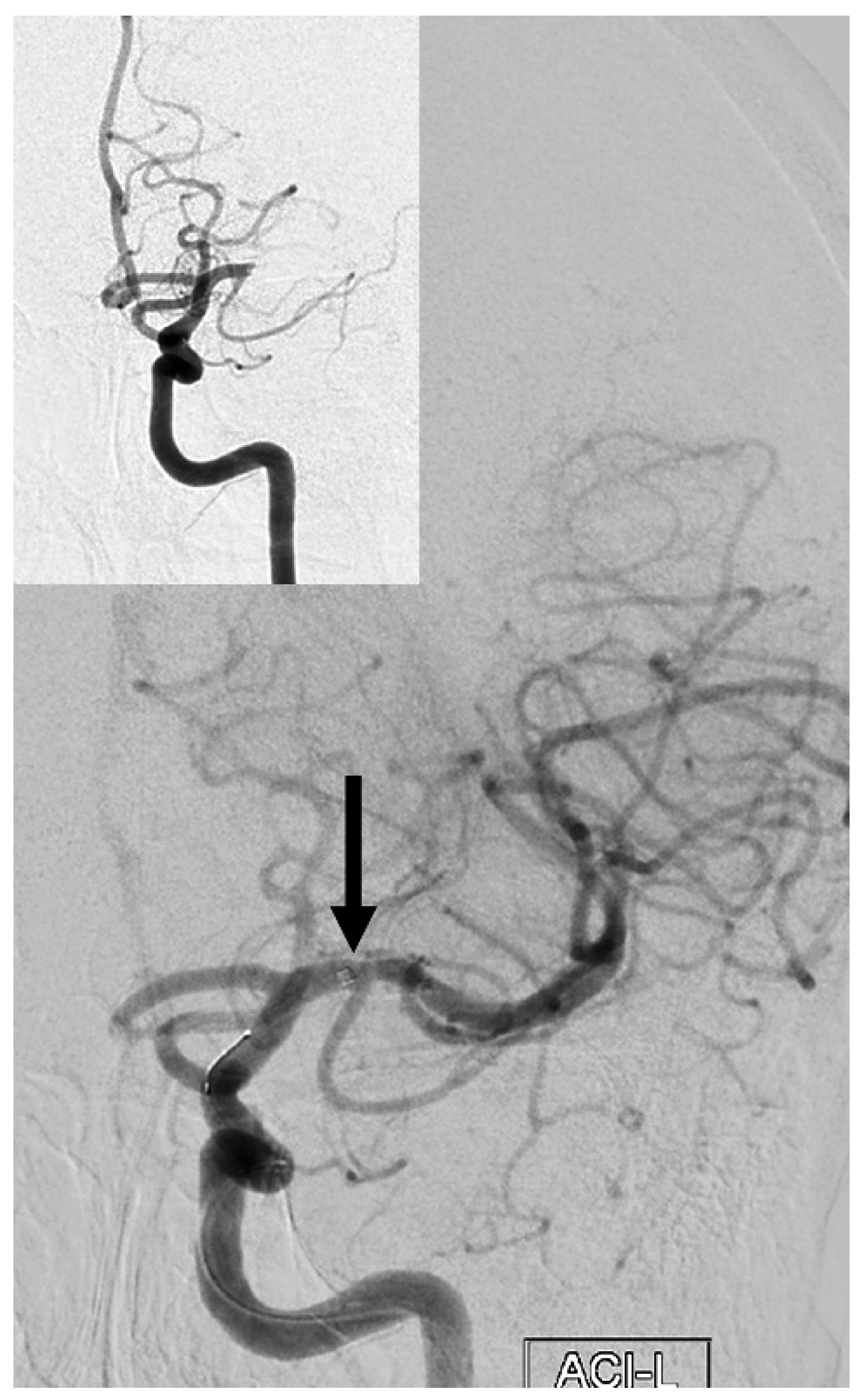
The local infusion of a thrombolytic drug into the thrombus via a microcatheter today represents only one of the tools in acute endovascular stroke therapy. Over the last years, mechanical thrombectomy devices have been technically improved considerably. Nowadays, they are increasingly been used with the goal to improve the recanalisation rates of major intracranial artery occlusions. Different types of devices can be distinguished. With a “proximal device”, a large yet extremely flexible catheter is positioned just proximal to the site of vessel occlusion (fig. 1). A suction-force is applied on the catheter and a kind of “stiletto-wire” is advanced through the catheter into the thrombus. The thrombus will thus be stepwise debulked. When using a “distal device” the thrombus has to be passed first. Next a “basket” is deployed with the aim to catch the thrombus and to withdraw it. Finally, devices have been developed that are used directly within the clot. For example, a retrievable stent is deployed within the thrombus that should capture the stent within its filaments. Despite the advantage of removing the clot, mechanical thrombectomy has several other potential advantages compared to i.v. thrombolysis. First of all, in some cases the method may work extremely fast, reducing the time of ischaemia. Secondly, in patients with contraindications for a thrombolytic drug (e.g., in the presence of an intracranial haemorrhage), mechanical embolectomy can still be used. Likewise, used in combination with intraarterial thrombolysis, the amount of the drug might be reduced. Finally, an extended time window for recanalisation might become possible.
Preliminary results with regard to vessel recanalisation with mechanical thrombectomy devices have been promising. For example, Kulcsar [5] et al., using the “proximal device” Penumbra™, obtained an extremely high vessel recanalisation rate of 92% in a series of 27 patients with occlusions of either the middle cerebral or basilar artery. Yet, the clinical outcome in this and in few other studies was less impressive, and was dependent largely on the baseline NIHSS (National Institute of Health Stroke Scale). That is, patients with few symptoms at admission had a better outcome. This simple observation underlines the importance of the critical factor in large vessel occlusion: the collateral flow. If sufficient collateral flow is not present to maintain brain perfusion during a large vessel occlusion, flow recanalisation is less effective.

What is the place of endovascular stroke treatment in clinical practice?

Endovascular stroke treatment is a promising treatment option in occlusion of the large intracranial arteries, if treatment is conducted early and collateral flow is good.
In the setting of acute stroke, CT allows for a fast exclusion of a haemorrhage. CT angiography (CTA), that can be performed and analysed in a few minutes, shows large artery occlusions and stenosis with great detail. It can effectively guide the further treatment, in particular if the CTA examination not only covers the intracranial arteries but also the cervical arteries to demonstrate or exclude proximal vessel stenosis, vessel occlusions, or anatomical variants that might have an influence on vessel catheterisation. If a large artery occlusion is seen within the time window of 4.5 hours, in many centres an intravenous thrombolysis with a reduced i.v. dose of rt-PA is initiated (“bridging concept”), while the neurovascular intervention is being prepared (team, room, etc.). If the patient is not improving, the endovascular approach is conducted using the different techniques as mentioned above depending on the anatomy, the site of occlusion, and the experience of the investigator with the different tools. Venker et al. recently reported on such a multimodal treatment regimen combining i.v., i.a.lysis, and mechanical thrombectomy (using a stent device) in 10 patients with a proximal occlusion of an artery in the anterior circulation [6]. In all patients, vessel recanalisation and a good improvement in outcome was achieved. Obviously, this and similar technical approaches for acute endovascular stroke treatment have to be evaluated in larger studies. Currently, as a first important step, a large phase III trial (IMS III, Interventional Management of Stroke Trial III, www.ims.org) is under way. Here, it will be examined (900 patients) whether a combined intravenous and intraarterial approach is superior to standard i.v. thrombolysis alone, when initiated within three hours of acute ischaemic stroke onset.

Funding/potential competing interests

No financial support and no other potential conflict of interest relevant to this article was reported.

References

  1. Hacke, W; Kaste, M; Bluhmki, E; et al. Thrombolysis with alteplase 3 to 4.5 hours after acute ischemic stroke. N Engl J Med. 2008, 359, 1317–29. [Google Scholar] [CrossRef] [PubMed]
  2. NINDS rt-PA Stroke Study Group. Tissue plasminogen activator for acute ischemic stroke. N Engl J Med. 1995, 333, 1581–7. [Google Scholar] [CrossRef] [PubMed]
  3. Mattle, HP; Arnold, M; Georgiadis, D; et al. Comparison of intraarterial and intravenous thrombolysis for ischemic stroke with hyperdense middle cerebral artery sign. Stroke 2008, 39, 379–83. [Google Scholar] [CrossRef] [PubMed]
  4. Del Zoppo, GJ; Higashida, RT; Furlan, AJ; et al. PROACT: a phase II randomized trial of recombinant pro-urokinase by direct arterial delivery in acute middle cerebral artery strok–PROACT Investigators. Prolyse in Acute Cerebral Thromboembolism. Stroke 1998, 29, 4–11. [Google Scholar] [CrossRef] [PubMed]
  5. Kulcsár, Z; Bonvin, C; Pereira, VM; et al. Penumbra system: a novel mechanical thrombectomy device for large-vessel occlusions in acute stroke. AJNR Am J Neuroradiol. 2010, 31(4), 628–33. [Google Scholar] [CrossRef] [PubMed]
  6. Venker, C; Stracke, P; Berlit, P; et al. New options in the therapeutic management of acute ischaemic stroke. Good results with combined i. v. and i. a. lysis and mechanical thrombectomy. Fortschr Neurol Psychiatr. 2010, 78(11), 652–7. [Google Scholar] [CrossRef] [PubMed]
Figure 1. A 42-year-old female patient with occlusion of the left proximal middle cerebral artery (see insert). After unsuccessful i.v. thrombolysis, revascularisation of the occlusion was achieved mechanically with the Penumbra™ system. The catheter on which a suction force was applied can still be seen in place (arrow).
Sanpp 162 00213 g001