Article

Direct Comparison of Tributyl Phosphate Against Monoamide Extractants in Uranium and Nitric Acid Systems for Solvent Extraction


1
Idaho National Laboratory, Idaho Falls, ID 83415, USA
2
Department of Chemical and Biological Engineering, University of Idaho, Idaho Falls, ID 83402, USA
3
Department of Chemical Engineering, University of Utah, Salt Lake City, UT 84112, USA
*
Author to whom correspondence should be addressed.
Processes 2026, 14(9), 1474; https://doi.org/10.3390/pr14091474
Submission received: 25 February 2026 / Revised: 28 April 2026 / Accepted: 28 April 2026 / Published: 1 May 2026
(This article belongs to the Section Chemical Processes and Systems)

Abstract

Interest in improved disposal pathways and proliferation-resistant systems for used nuclear fuel recycling has driven research on monoamide extractants. Existing comparisons against the industry standard, tributyl phosphate (TBP), emphasize a fundamental approach and span a wide range of test conditions. This work narrows that range and addresses process-scale considerations by presenting hydrodynamic performance results alongside extraction capacity at optimized conditions. The monoamide solvents, 1.0 M DEHiBA (N,N-di(2-ethylhexyl)isobutanamide), 1.5 M DEHBA (N,N-di(2-ethylhexyl)butanamide), and 1.5 M DEHDMPA (N,N-di(2-ethylhexyl)-2,2-dimethylpropanamide), are compared to 1.1 M TBP in bench-scale extraction tests with nitric acid (2–6 M) and uranium (∼0.8 M). Performance is assessed with distribution ratios and dispersion number ratings and supported by specific gravity and viscosity measurements. DEHBA and DEHDMPA exhibited inadequate coalescence behavior with failed or poor dispersion ratings despite uranium distribution ratios of 2.06 ± 0.03 and 0.86 ± 0.01 at O/A = 1.9, limiting suitability for process application. TBP and DEHiBA maintained adequate dispersion ratings across all conditions tested, with maximum distribution ratios of 4.37 ± 0.08 at O/A = 2.6 and 0.67 ± 0.01 at O/A = 2.9, respectively. Higher viscosity values for DEHBA (5.21 cP ± 0.3%) and DEHDMPA (6.53 cP ± 0.4%) relative to TBP (2.04 cP ± 0.4%) and DEHiBA (3.18 cP ± 0.4%) correlate with observed coalescence deficiencies. The methods presented in this work demonstrate the significance of evaluation beyond extraction capacity.

1. Introduction

The primary organic extractant used in the Plutonium Uranium Reduction Extraction (PUREX) process is tributyl phosphate (TBP), which has been extensively researched and applied for the extraction of metals, including uranium, since the late 1940s [1]. Given the strong knowledge base in the literature and associated workforce, TBP is expected to remain central to these processes [2,3]. However, there are concerns associated with TBP/PUREX processes. These include the potential for increased proliferation risk through the creation of a pure plutonium stream and the challenges associated with disposal of phosphorus-bearing solvents. Proliferation-resistant flowsheet designs utilizing TBP (e.g., Uranium Extraction [UREX] and Co-decontamination) have been studied extensively in the United States. Other proliferation-resistant technologies are also being investigated, including the use of monoamide-based extractants. Some of these alternative extractants have selective affinity for uranium, thus affording a heightened level of proliferation resistance [4]. These extractants also follow the CHON principle, being composed solely of carbon, hydrogen, oxygen, and nitrogen, and are therefore viable for disposal via incineration without causing any release of hazardous phosphate gases [5,6].
One flowsheet of interest that uses monoamide-based extractants is the Group ActiNide Extraction process (GANEX) [5,6]. Here, DEHiBA (N,N-di(2-ethylhexyl)isobutanamide) is used for the initial extraction of uranium from dissolved nuclear fuel; then, subsequent extractions are employed to recover transuranic actinides [6]. Another advanced flowsheet design uses DEHBA (N,N-di(2-ethylhexyl)butanamide) and DEHDMPA (N,N-di(2-ethylhexyl)-2,2-dimethylpropanamide) in series to first extract uranium only and then to coextract a mix of uranium and plutonium. In both cases, the primary application of the monoamide extractant(s) is to supplant the initial co-decontamination cycle in traditional PUREX flowsheets, in which uranium and plutonium are coextracted [2]. Regarding the chemical structure of each monoamide extractant, all three share the same branched alkyl groups on the nitrogen, with structural variation occurring in the alkyl substituent on the carbonyl carbon. This variation is what drives the selectivity for the target metals and can lead to steric hindrance effects as discussed by Suzuki (2004) [7].
The purpose of this study is to provide a direct comparison of TBP to the monoamide extractants proposed for uranium extraction applications in the listed flowsheets. The methods utilized aim to bridge fundamental and applied research. The extractants of interest, DEHiBA, DEHBA, and DEHDMPA, have been extensively studied using a broad range of reported parameters as demonstrated in Table 1. Comparisons to TBP often rely on published data obtained under different diluents, concentrations, test conditions, and experimental methods [8,9,10]. Assessments of solvent system performance, including both extraction capacity and hydrodynamic performance, are strongly influenced by these parameters. Thus, it is desirable to align testing efforts across solvent systems by comparing the optimum working conditions for each extractant. To support such a comparison, the present work covers a bench-scale exploration of the extraction performance with uranium and nitric acid, the hydrodynamic performance with assessments on coalescence behavior, and the measurement of physical properties (density and viscosity). The data are analyzed with these elements presented in parallel, providing considerations for scale-up applications.
To maintain relevance with actual process conditions, the evaluation of each extractant utilizes frequently applied concentrations. Based on values in Table 1, DEHiBA will be evaluated at a concentration of 1.0 M while DEHBA and DEHDMPA will be at 1.5 M. The TBP will be maintained at 1.1 M, which is commonly proposed for PUREX-based systems. While the extractant concentration affects a solvent’s overall performance, the presented metrics evaluate conditions optimized in other reports. The aqueous feed concentrations of both nitric acid and uranium are target variables for manipulation. Other parameters characterized for the extractants in this work are the density and viscosity, which may aid in understanding performance variations.
The inclusion of extractant evaluation in a nitric acid system absent any metal provides a baseline for nitric acid extraction capacity, acid concentration compatibility, and simple extractant characterization. Propensity for acid extraction affects free extractant concentration when applied in metal separation systems and can impact the extent to which target constituents are extracted [2]. Characterization of acid extraction also informs solvent stripping where increased acid extraction may lead to increased acidity in the strip aqueous effluent. For TBP specifically, this can contribute to the possibility of red oil formation and even consequent explosion during solution concentration scenarios [12]. Secondary evaluation of each extractant in a uranyl nitrate system supports the target application of uranium extraction.
It is noted that while this information is useful in solvent extraction flowsheet design, additional factors must be included for complete assessment. Rydberg (2004) provides a description of the breadth of information required when planning for solvent extraction at an industrial scale [13]. To highlight equipment selection and sizing alone, the liquid system characterization must include solubility curves; acid, temperature, and salt content dependency tests; phase ratio determination; measurement of separation time to evaluate coalescence; measurement of physical properties; and mass transfer intensity for single droplets [13]. This work addresses several of these requirements in a direct comparison between TBP and the selected monoamide extractants.

2. Materials and Methods

The three monoamide extractants were procured from Marshallton Research Laboratories, Inc. (King, NC, USA). Proton NMR analysis on each extractant as-received indicated purities of >99%. The TBP was procured from Parchem (Rochelle, NY, USA). Each extractant was diluted using Isopar L (Univar Solutions, LLC, Downers Grove, IL, USA). For all relevant testing, nitric acid was diluted from a 70% by weight concentrated stock obtained from Sigma-Aldrich Inc., St. Louis, MO, USA.

2.1. Hydrodynamic Assessment by Dispersion Number

Hydrodynamic assessments were completed with the dispersion number rating test proposed by Leonard (1995) and quantified by the dimensionless dispersion number, N D i [14]. This value describes a solvent extraction system by its ability for the two-phase dispersion to coalesce; the calculated N D i corresponds to the ratings assigned by Leonard: unacceptable for N D i < 2 × 10 4 , poor at N D i < 4 × 10 4 , fair at N D i < 8 × 10 4 , good at N D i < 16 × 10 4 , or excellent for all N D i > 16 × 10 4 . This work employs a failed condition, which is reached when the time required for full coalescence exceeds that which would allow for a rating of anything other than “unacceptable.” The test procedure consisted of mixing the aqueous and organic phases, followed immediately by measuring the time required for complete coalescence. This process is inherently subjective; so, the error was mitigated by standardizing the experimental methods, limiting the number of researchers involved, and increasing the quantity of tests. Additional considerations for error in the dispersion study are addressed by application of the rating system. If the standard deviation falls within the same dispersion rating range, it is reasonable to assign the tested system with the calculated rating. Likewise, the quantified dispersion number used in the rating scheme allows for a qualitative assessment of the solvent’s anticipated performance in solvent extraction equipment. This method provides a simple assessment that contributes to a solvent’s technology readiness level.
The matrix of parameters for tests with non-metal-containing feeds includes phase volume ratios (organic to aqueous [O/A]) of 0.5, 1, 3, and 5 at nitric acid concentrations of approximately 2, 3, 4, 5, and 6 M, with a total test volume of 10 mL. Additional tests with O/A = 1 were completed at volumes increased by a factor of eight. The same procedure was repeated for an aqueous feed containing depleted uranium prepared previously by dissolving uranium oxide pellets in nitric acid. Three dilutions of this stock provided slight variation in the nitric acid concentration. Dispersion tests were completed with the stock feed and dilutions across varied phase ratios. The phase ratios were selected based on the concept of theoretical uranium loading in the solvent. This value is a function of the extractant concentration, uranium concentration in the aqueous feed solution, and stoichiometry of the extractant and uranium adduct, which is assumed to be a ratio of 2:1. Manipulation of the phase ratio changes the theoretical loading (i.e., a higher O/A causes lower theoretical loading). This concept can be further understood as a method for normalizing the amount of free extractant available in each test if the theoretical loading is achieved. The actual amount of free extractant present in the loaded organic will drive discussion on the results, as opposed to the theoretical target, which was used for phase ratio selection.

2.2. Extraction Assessment for Nitric Acid and Uranium

Each condition applied in the nitric acid and uranium dispersion tests was also used in determining the distribution ratios. After collecting data on the coalescence time, the same sample was further manipulated to emulate equilibrium extraction conditions. This method included vigorous mixing of the two solutions on a vortex mixer (Fisherbrand, Thermo Fisher Scientific Inc., Waltham, MA, USA) for a standardized duration of 3 min, followed by phase separation via centrifugation. Immediately afterward, samples were collected for analysis. For metal-free systems, the acid concentration was determined by potentiometric titration using a T70 Titrator from Mettler-Toledo, LLC (Columbus, OH, USA). For aqueous samples with uranium, metal concentration analysis via inductively coupled plasma mass spectrometry (ICP-MS) was completed using a Thermo Fisher iCAP (Thermo Fisher Scientific Inc., Waltham, MA, USA).

2.3. Physical Property Measurements

Initial characterization of both the undiluted extractants and the organic solutions (with no metal or acid loading) included density and viscosity measurements at ambient temperature. Density was measured based on the mass for a measured volume, while viscosity was measured in a microVISC unit from RheoSense, Inc. (San Ramon, CA, USA).

3. Results

3.1. Extraction Performance

Understanding each solvent’s capacity for extracting nitric acid (HNO3) contributes to the comparison and assessment of its application in solvent extraction flowsheets. The extent of acid extraction may impact metal selectivity, scrubbing and stripping conditions, and overall flowsheet design. Results for the nitric acid extraction from non-metal-containing feeds are presented in Figure 1a–d. The range of conditions tested spans those observed in extraction- and scrubbing-based solvent extraction operations [2,5,8]. Of the extractants tested, DEHBA had the highest average distribution ratio for O/A ≥ 1, indicating the highest capacity for acid extraction. Conversely, DEHiBA generally exhibited the smallest distribution ratios and therefore the lowest extraction of nitric acid. The extraction capacity correlated with each extractant’s concentration: DEHiBA had the lowest extractant concentration at 1.0 M and the lowest extraction of nitric acid overall, followed by 1.1 M TBP with the second lowest distribution ratios and then 1.5 M DEHDMPA and 1.5 M DEHBA. While expected, this highlights the significance of testing extractant systems at actual operating conditions. Variation in the extent of acid extraction between the monoamide systems can be attributed to chemical structures with different levels of substitution at the carbon nearest the carbonyl group. Decreased acid extraction was reported for increased substitution [15]. This trend follows for DEHBA and DEHDMPA, as they have identical extractant concentrations. Though DEHiBA has the lowest acid extraction overall, this explanation would likely hold across tests with identical extractant concentrations, where DEHiBA acid extraction would fall between values for DEHBA and DEHDMPA.
No definitive trend was observed in the distribution ratios with respect to acid concentration across the parameters tested. The spike in extraction for the TBP systems at an acid concentration of 3 M was observed in other works as well. Increased extraction near 3 M was recorded for promethium extraction by TBP at 50 vol% extractant concentration [16] and for uranium extraction at <5 M HNO3 with 4.8 vol% TBP [2]. Benedict (1981) attributes this to the competing effects of salting from the nitrate ion at concentrations below 5 M and a lack of available free TBP, due to increased extraction, at concentrations above 5 M [2]. Regarding the TBP nitric acid extraction in Figure 1, there is not a competing species; so, the impact of TBP availability should not be significant. The extraction of nitric acid by 30 vol% TBP is reported by Ochkin (2010), and the same spike in distribution ratio is observed around 3 M HNO3 [17]. The solubility of 30 vol% TBP with nitric acid across 0–14 M concentrations is reported by Mishra (2013) to decrease from 0–8 M acid [18]. These reported characteristics demonstrate contributing factors in the multi-faceted cause of the distribution ratio spike for 3 M acid, which is most apparent for O/A = 0.5 and 1, where the aqueous is present in excess. This spike is not observed across all monoamide extractant tests, indicating the mechanisms driving the trend for TBP are less influential or absent in the other extractants.
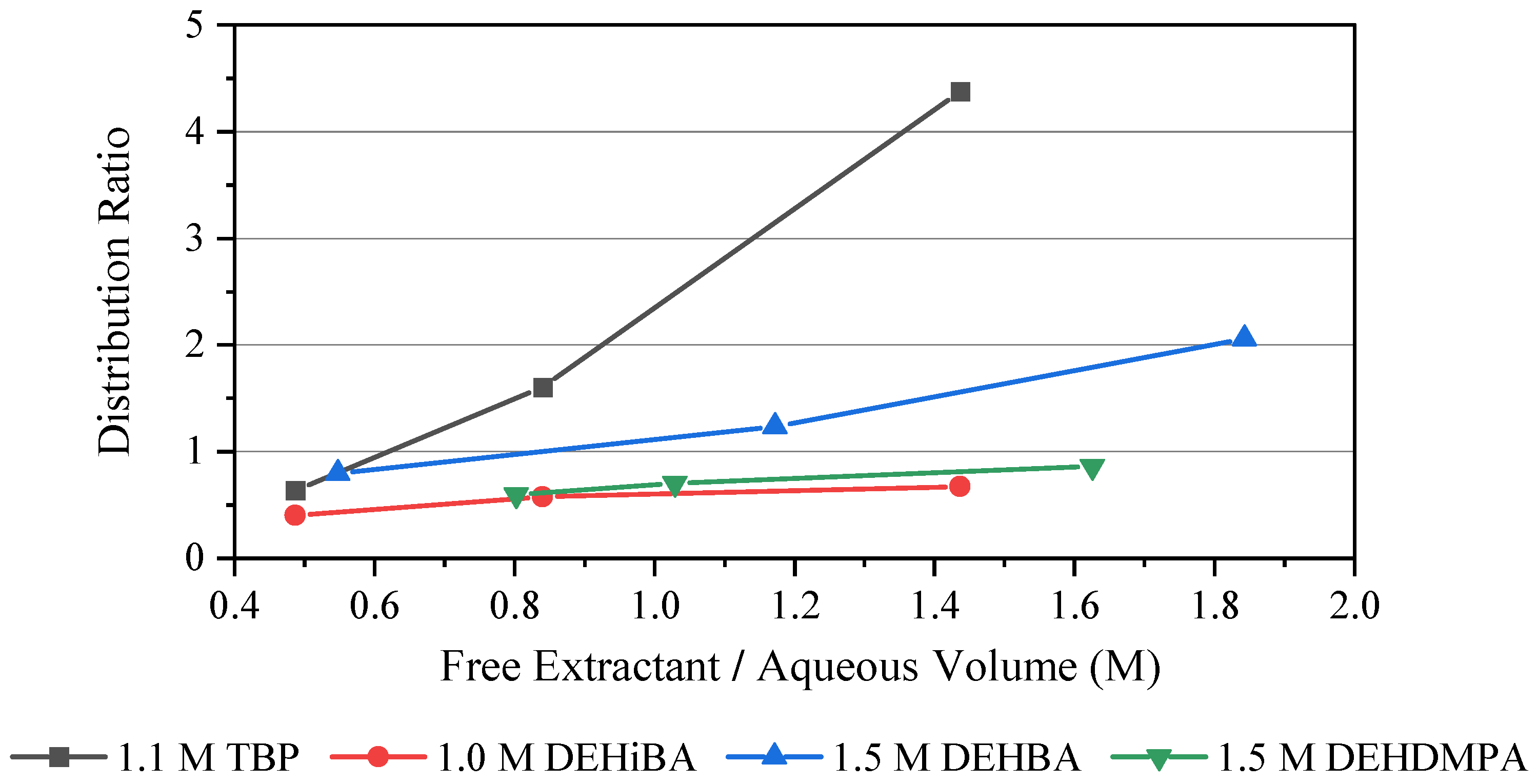
In Figure 2, the extraction of uranium by 1.1 M TBP, 1.0 M DEHiBA, 1.5 M DEHBA, and 1.5 M DEHDMPA is presented as a function of free extractant. The amount of free extractant in each test is normalized to the aqueous phase volumes to account for different phase ratios. Each test condition was achieved by applying the concept of theoretical uranium loading as described in Section 2.1, where the phase ratio is selected so that 80% or 55% of the total extractant present matches the amount of uranium in the aqueous feed. A 2:1 ratio of extractant:uranium is also applied to account for adduct stoichiometry. Exact phase ratios are included in Section 3.2 along with an O/A = 1. Due to the varying concentrations, phase ratios to achieve theoretical loading conditions differ for each extractant. In all cases, the phase ratio increases from O/A = 1 to those required for 80% and then 55% theoretical loading. For a single batch contact, the target theoretical loading cannot be achieved. However, the amount of free extractant present in the loaded organic after a single batch contact provides insight into how the free extractant availability influences the extent of extraction. Figure 2 demonstrates this. The amount of free extractant increases across the x-axis as a consequence of increasing phase ratios and is normalized to the aqueous volume. Uranium extraction by TBP exhibits the most dramatic change with an increase of 583% between the lowest and highest distribution ratios. This characteristic is appealing in flowsheet design with implications for the overall efficiency, solvent utilization, and scrubbing requirements. For the monoamide extractants, extraction also increases with more free extractant present but not as dramatically as for TBP (161% increase from the lowest to highest distribution ratio for DEHBA, 68% for DEHiBA, and 43% for DEHDMPA). The same explanation for the variation in nitric acid extraction among the monoamide systems also applies to uranium, where increased substitution at the carbon nearest the carbonyl group dictates lower extraction as observed for DEHBA and DEHDMPA [15].
Table 2 compares the measured distribution ratios against the literature values at matching nitric acid and extractant concentrations. For the monoamide extractants, the phase ratio is also constant at O/A = 1, and the measured values fall within the range of those reported. This consistency does not extend to TBP, where the reported distribution ratios are based on conditions with optimized phase ratios and uranium feed concentrations, yielding higher distribution ratios than those measured here at O/A = 1. In all cases, the reported uranium concentrations in the feed varied significantly from millimolar to molar values. The breadth of this range supports the value found in having a direct comparison of the ideal conditions for each extractant.

3.2. Hydrodynamic Performance

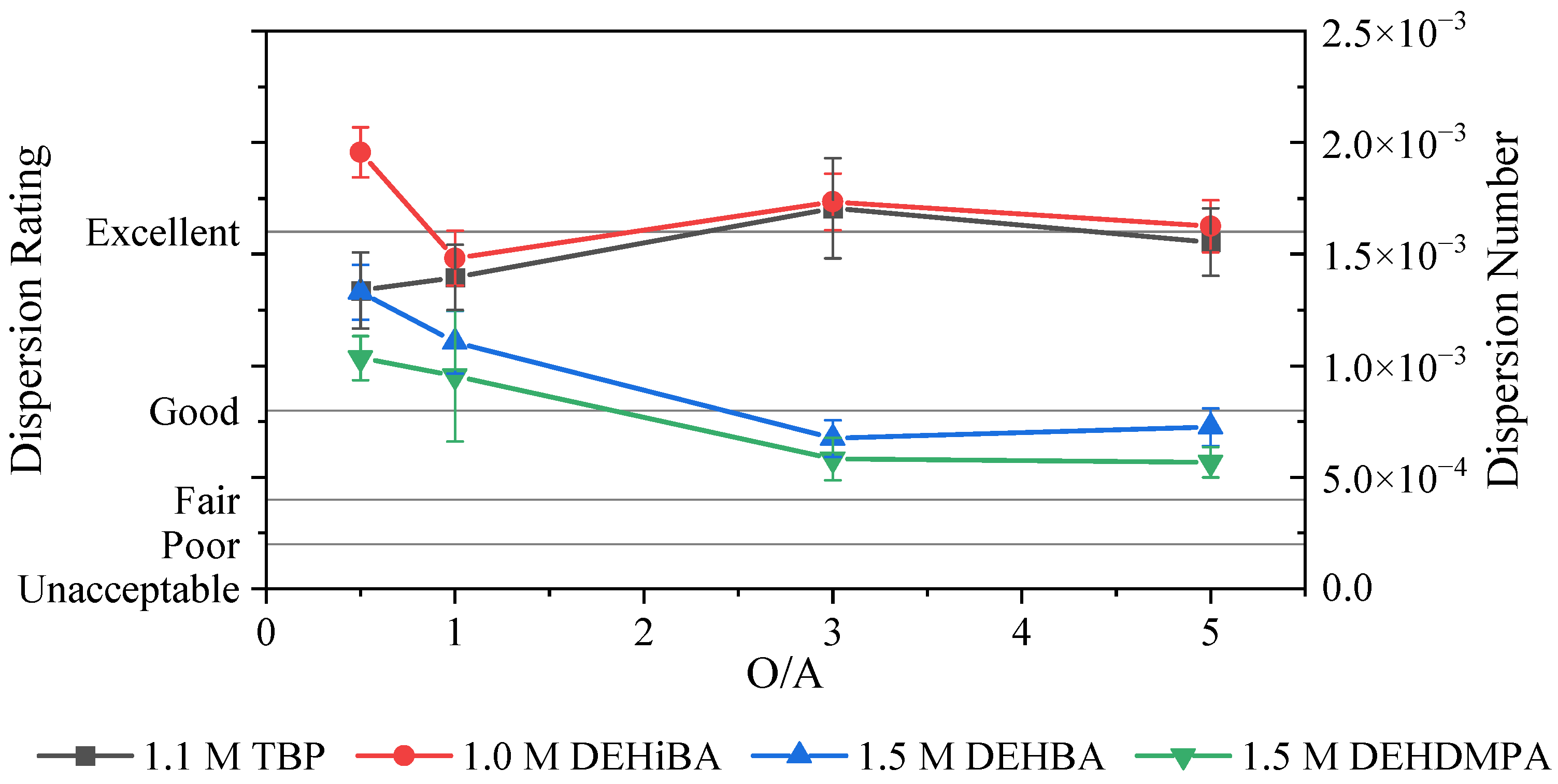
An investigation into the hydrodynamic performance of each system tested in Section 3.1 allows for a more rigorous comparison of the overall solvent extraction performance. The dispersion number ratings measured for non-metal-containing feeds are briefly described and included as a verification of the methodology and each extractant’s compatibility with the range of nitric acid concentrations. It is anticipated that all four extractants will provide dispersion numbers correlating to adequate coalescence times, as each has been reported for solvent extraction research requiring a nitric acid medium. Figure 3 displays the dispersion numbers as averages across each acid concentration (2–6 M HNO3) for each phase ratio. No extractants exhibited inadequate time for the dispersion to coalesce. Relative errors across the variable acid concentrations were less than 15% in all but one case (DEHDMPA at O/A = 1, with a relative error of 30%). This magnitude of error is expected, as the measurements were taken with different acid feed concentrations. The dispersion number rating rather than the calculated number is the significant takeaway. In no case did the error margin drop below the designation for a “fair” rating, implying adequate compatibility with solvent extraction equipment. Larger-scale tests with an eightfold volume increase were conducted for additional verification of coalescence behavior, and no failing conditions were observed.
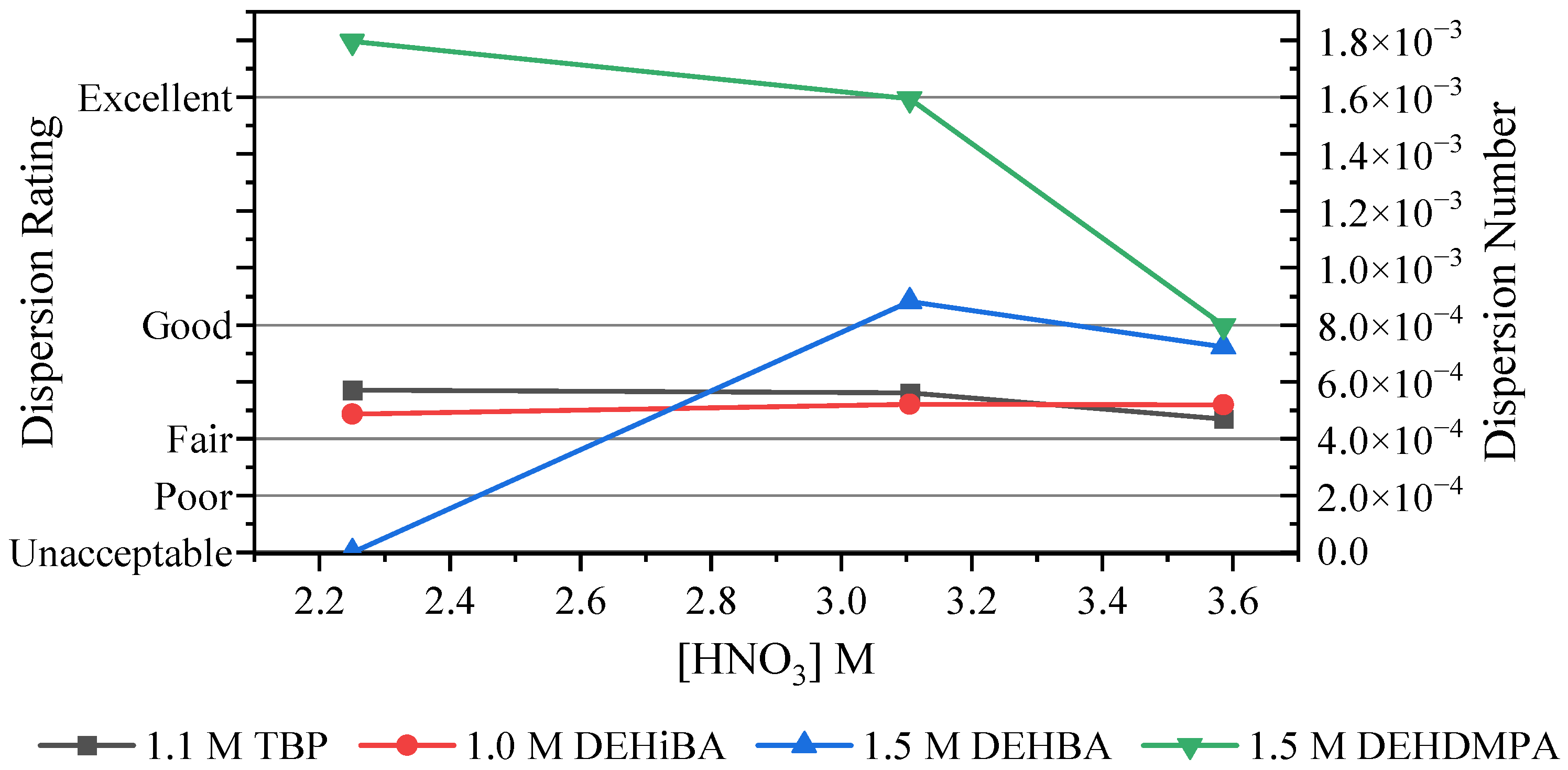
For uranium dispersion number measurements, two primary variables were manipulated: acid concentration and phase ratio. Figure 4 shows the dispersion number ratings for uranium feeds at a concentration of 0.74 ± 0.03 M over increasing nitric acid concentrations. One test provided a failing condition: DEHBA at 2.25 M HNO3. The performance of TBP and DEHiBA remained mostly unchanged. All extractants adequately dispersed at this uranium concentration for HNO3 concentrations above 3.1 M. This observation becomes significant when a comparison is made with Table 3, where a higher uranium concentration is used, and failed dispersion tests are achieved.
Table 3 includes the uranium dispersion number ratings for each extractant with increasing phase ratios. The phase ratios were selected to achieve a theoretical maximum loading of 80% and 55%, as described in Section 2.1 and Section 3.1. TBP and DEHiBA exhibited adequate times for coalescence at all conditions with slightly improved results at higher phase ratios. Notably, DEHBA failed at all phase ratios tested, and DEHDMPA failed in two out of three conditions, with a rating of “poor” for the highest O/A.
Observations during these tests included a noticeable increase in viscosity for highly loaded solvents, especially for DEHBA and DEHDMPA. The phenomenon is supported with values reported by Pleines (2020) for various monoamide extractants, where the viscosity increases with the uranium concentration in the organic phase [21]. Higher viscosity contributes to dispersions that are slower to coalesce or form stable emulsions [13]. With this observation and failed conditions achieved for the dispersion tests, the results indicate DEHBA and DEHDMPA will cause detrimental effects in solvent extraction equipment under high loading conditions, despite showing reasonable uranium extraction in Figure 2.

3.3. Physical Properties

The measured specific gravity and viscosity for each extractant are shown in Table 4. Inclusion of these measurements helps explain the coalescence trends, though many factors contribute to a full understanding. Results from the diluent, Isopar-L, demonstrate the impact of the viscosity change from the undiluted extractants to the diluted solutions, which are largely composed of the diluent itself. For the diluted solutions, the specific gravity of each extractant fell within a 10% margin. However, the pre-dilution viscosity values showed significant variation among the monoamide-based extractants relative to TBP (DEHDMPA accounting for the largest difference at 14-fold higher). Post-dilution, the monoamide-based extractants still demonstrated this trend, but to a lesser extent.
The structure of the monoamide extractants as compared to TBP contributes to increased viscosity. Blundell (2024) highlights the bulkier less planar structures with additional branched alkyl groups as contributing factors [22]. The higher viscosities of DEHBA and DEHDMPA relative to TBP and DEHiBA are also attributed to higher extractant concentrations. Viscosity, alongside many other parameters such as density, interfacial surface tension, and temperature, is cited as having a direct influence on the dispersion characteristics [2,13]. It is expected that the elevated viscosities are a contributing factor to the extended coalescence times observed for DEHBA and DEHDMPA systems in Section 3.2. This is especially relevant in the case of uranium loading. Further investigation into this relationship is proposed for future work.

4. Conclusions

The literature contains extensive research on TBP, as well as DEHiBA, DEHBA, and DEHDMPA for uranium extraction applications. However, this extensiveness introduces ambiguity when selecting the highest-performing option. The present study mitigates bias and presents a direct comparison under process-relevant extraction conditions. Furthermore, compilation of the extraction and hydrodynamic performance gives insight into solvent extraction compatibility. This combination of data contributes to a higher technology readiness level.
Among the conditions tested, extended coalescence times can outweigh the benefits of a high extraction capacity. In the case of DEHBA, the uranium distribution ratios were highest out of the monoamide extractants. However, failed dispersion tests indicate poor compatibility in solvent extraction equipment. The higher viscosity measurements presented in Table 4 alongside repeated failed or poor dispersion tests for DEHBA and DEHDMPA suggest a relationship between the two parameters, but further studies and additional solution characterization are required to investigate the full extent.
The uranium distribution ratios measured for DEHiBA were lowest in all cases, but coalescence of the dispersion remained adequate across all conditions tested. The uranium distribution ratios for TBP ranked highest for tests with dispersion ratings of “fair” or higher. DEHiBA generally exhibits lower nitric acid extraction than TBP, which preserves the available free extractant and may enable more effective scrubbing at higher acid concentrations. At the highest phase ratios tested with the largest quantity of free extractant (targeting 55% theoretical uranium loading), TBP’s uranium distribution ratio is 6.5-fold higher than DEHiBA’s (Figure 2, Table 3). This is a significant margin and must be weighed carefully in any consideration of replacing TBP as the state-of-the-art extractant. The pronounced effect of the increased phase ratio (corresponding to increased free extractant) on TBP extraction capacity supports efficient utilization of the solvent, minimizing larger solvent inventory requirements and reducing costs.
Future work will expand the comparison between TBP and the monoamide extractants with viscosity measurements for loaded organics, actinide extraction quantification, solvent degradation considerations, capital cost comparisons, solvent life cycle considerations, and flowsheet testing.

Author Contributions

Conceptualization, A.B.; funding acquisition, K.L.; investigation, A.B. and H.W.; formal analysis, A.B.; supervision, K.L. and H.Z.; writing—original draft preparation, A.B.; writing—review and editing, K.L. and H.Z. All authors have read and agreed to the published version of the manuscript.

Funding

This research was funded by the Nonproliferation Stewardship Program, U.S. Office of Defense Nuclear Nonproliferation R&D under Battelle Energy Alliance, LLC contract no. DE-AC07-05ID14517.

Data Availability Statement

The original contributions presented in this study are included in the article. Further inquiries can be directed to the corresponding author.

Acknowledgments

Acknowledgementsare given to Adelaide Fanner and Justin Cooper from Idaho National Laboratory (INL) for uranium analysis. The Idaho National Laboratory, Applied Uranium Technologies department aided in completing the large number of experiments and advising on research practices. That team includes Trevor Coleman, Meghan Fujimoto, Mitchell Greenhalgh, Emma MacLaughlin, Rachel Umpleby, and Ramedy Flores. Additional acknowledgements are given to Pacific Northwest National Laboratory’s Gregg Lumetta and Gabriel Hall for their advisement.

Conflicts of Interest

The authors declare no conflict of interest. The authors declare that this study received funding from Nonproliferation Stewardship Program, U.S. Office of Defense Nuclear Nonproliferation R&D under Battelle Energy Alliance, LLC. The funder was not involved in the study design, collection, analysis, interpretation of data, the writing of this article or the decision to submit it for publication.

Abbreviations

The following abbreviations are used in this manuscript:
DEHBAN,N-di(2-ethylhexyl)butanamide
DEHDMPAN,N-di(2-ethylhexyl)-2,2-dimethylpropanamide
DEHiBAN,N-di(2-ethylhexyl)isobutyramide
GANEXGroup Actinide Extraction
ICP-MSInductively Coupled Plasma Mass Spectrometry
PUREXPlutonium Uranium Reduction Extraction
TBPTributyl Phosphate
UREXUranium Extraction

References

  1. Warf, J.C. Extraction of Cerium(IV) Nitrate by Butyl Phosphate. J. Am. Chem. Soc. 1949, 71, 3257–3258. [Google Scholar] [CrossRef]
  2. Benedict, M.; Pigford, T.H.; Levi, H.W. Nuclear Chemical Engineering, 2nd ed.; McGraw-Hill Education: Columbus, OH, USA, 1981. [Google Scholar]
  3. Law, J.D. Aqueous Reprocessing of Used Nuclear Fuel; Idaho National Laboratory: Idaho Falls, ID, USA, 2018. [CrossRef]
  4. Paviet-Hartmann, P.; Cerefice, G.; Stacey, M.; Bakhtiar, S. Analysis of Nuclear Proliferation Resistance Reprocessing and Recycling Technologies. Available online: https://digital.library.unt.edu/ark:/67531/metadc841924/ (accessed on 4 December 2022).
  5. Miguirditchian, M.; Chareyre, L.; Sorel, C.; Bisel, I.; Baron, P.; Masson, M. Development of the GANEX Process for the Reprocessing of Gen IV Spent Nuclear Fuels; CEA Marcoule: Bagnols-sur-Ceze, France, 2008.
  6. Authen, T.L.; Adnet, J.-M.; Bourg, S.; Carrott, M.; Ekberg, C.; Galán, H.; Geist, A.; Guilbaud, P.; Miguirditchian, M.; Modolo, G.; et al. An Overview of Solvent Extraction Processes Developed in Europe for Advanced Nuclear Fuel Recycling, Part 2—Homogeneous Recycling. Sep. Sci. Technol. 2022, 57, 1724–1744. [Google Scholar] [CrossRef]
  7. Suzuki, S.; Sasaki, Y.; Yaita, T.; Kimura, T. Study on Selective Separation of Uranium by N,N-Dialkyl-Amide in ARTIST Process; Japan Atomic Energy Research Institute: Tokai, Japan, 2004.
  8. Ban, Y.; Hotoku, S.; Tsubata, Y.; Morita, Y. Uranium and Plutonium Extraction from Nitric Acid by N,N-Di(2-Ethylhexyl)-2,2-Dimethylpropanamide (DEHDMPA) and N,N-Di(2-Ethylhexyl)Butanamide (DEHBA) Using Mixer-Settler Extractors. Solvent Extr. Ion Exch. 2014, 32, 348–364. [Google Scholar] [CrossRef]
  9. Hall, G.B.; Campbell, E.L.; Bessen, N.P.; Graham, T.R.; Cho, H.; RisenHuber, M.; Heller, F.D.; Lumetta, G.J. Extraction of Nitric Acid and Uranium with DEHiBA under High Loading Conditions. Inorg. Chem. 2023, 62, 6711–6721. [Google Scholar] [CrossRef] [PubMed]
  10. Barros, C.C.; Pilgrim, C.D.; Cook, A.R.; Mezyk, S.P.; Grimes, T.S.; Horne, G.P. Influence of Uranyl Complexation on the Reaction Kinetics of the Dodecane Radical Cation with Used Nuclear Fuel Extraction Ligands (TBP, DEHBA, and DEHiBA). Phys. Chem. Chem. Phys. 2021, 23, 24589–24597. [Google Scholar] [CrossRef] [PubMed]
  11. Prabhu, D.R.; Mahajan, G.R.; Nair, G.M. Di(2-Ethyl Hexyl) Butyramide and Di(2-Ethyl Hexyl)Isobutyramide as Extractants for Uranium(VI) and Plutonium(IV). J. Radioanal. Nucl. Chem. 1997, 224, 113–117. [Google Scholar] [CrossRef]
  12. Robinson, R.N.; Gutowski, D.M.; Yeniscavich, W. Control of Red Oil Explosions in Defense Nuclear Facilities 2003; DNFSB/TECH-33; Defense Nuclear Facilities Safety Board: Washington, DC, USA, 2003.
  13. Rydberg, J.; Cox, M.; Musikas, C.; Choppin, G.R. (Eds.) Solvent Extraction Principles and Practice, 2nd ed.; Marcel Dekker: New York, NY, USA, 2004. [Google Scholar]
  14. Leonard, R.A. Solvent Characterization Using the Dispersion Number. Sep. Sci. Technol. 1995, 30, 1103–1122. [Google Scholar] [CrossRef]
  15. McCann, K.; Drader, J.A.; Braley, J.C. Comparing Branched versus Straight-chained Monoamide Extractants for Actinide Recovery. Sep. Purif. Rev. 2018, 47, 49–65. [Google Scholar] [CrossRef]
  16. Peppard, D.F.; Faris, J.P.; Gray, P.R.; Mason, G.W. Studies of the Solvent Extraction Behavior of Transition Elements. I. J. Phys. Chem. 1953, 57, 294–301. [Google Scholar] [CrossRef]
  17. Ochkin, A.V. Extraction of Nitric Acid by a Tributyl Phosphate Solution in n-Dodecane. Russ. J. Phys. Chem. A 2010, 84, 1579–1581. [Google Scholar] [CrossRef]
  18. Mishra, S.; Ganesh, S.; Velavendan, P.; Pandey, N.K.; Mallika, C.; Mudali, U.K.; Natarajan, R. Thermodynamics of Solubility of Tri-n-butyl Phosphate in Nitric Acid Solutions. Adv. Chem. Eng. Res. 2013, 2, 55–60. [Google Scholar]
  19. Tachimori, S.; Nakashima, T.; Kolarik, Z.; Schuler, R. Distribution of U(IV), U(VI), Pu(III) and Nitric Acid Between 30 Vol.% Tributyl Phosphate in Dodecane and Aqueous Nitrate Solutions; Report KfK 3637; Kernforschungszentrum Karlsruhe: Karlsruhe, Germany, 1983. [Google Scholar] [CrossRef]
  20. Puzikov, E.A.; Zilberman, B.Y.; Goletskii, N.D.; Blazheva, I.V.; Kudinov, A.S. Use of a Unified Model with TBP Dilution for Describing the Extraction of Nitric Acid and Hexavalent Actinide Nitrates in Multicomponent Nitrate Systems. Radiochemistry 2019, 61, 554–561. [Google Scholar] [CrossRef]
  21. Pleines, M.; Hahn, M.; Duhamet, J.; Zemb, T. A Minimal Predictive Model for Better Formulations of Solvent Phases with Low Viscosity. EPJ Nucl. Sci. Technol. 2020, 6, 3. [Google Scholar] [CrossRef]
  22. Blundell, R.J.; Lambert, H.; Holdsworth, A.F.; George, K.; Winterburn, J.; Livens, F.R.; Sarsfield, M.J.; Taylor, R.J.; Ogden, M.D.; Sharrad, C.A. Physicochemical Properties of Extraction Solvents for the Advanced Recycling of Spent Nuclear Fuel. Prog. Nucl. Energy 2024, 174, 105284. [Google Scholar] [CrossRef]
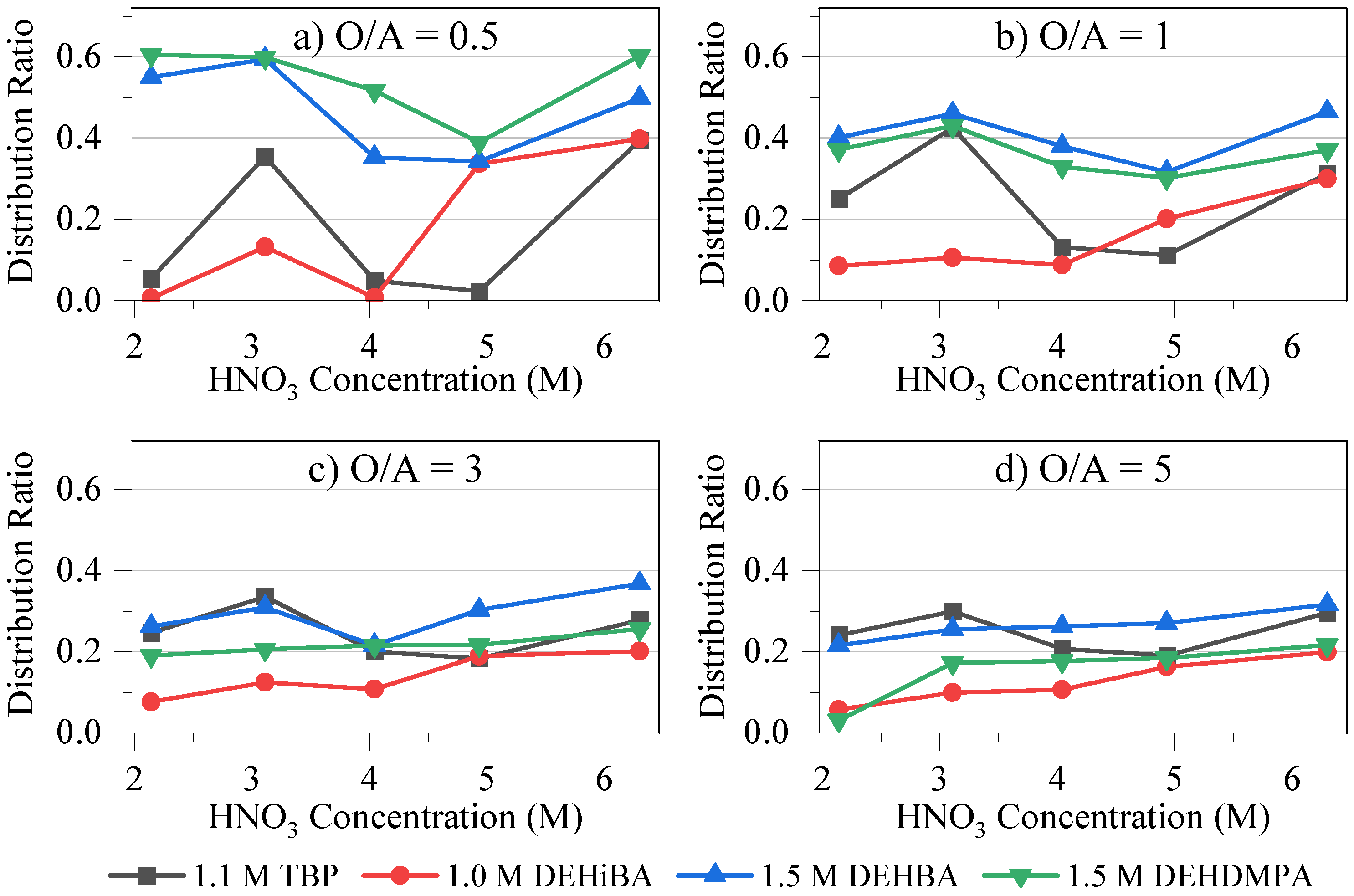
Figure 1. Distribution ratios for nitric acid (HNO3) extraction from non-metal aqueous feeds ranging in concentration from 2 M to 6 M HNO3. Figures are presented at each phase ratio (O/A): (a) O/A = 0.5, (b) O/A = 1, (c) O/A = 3, and (d) O/A = 5. Error in concentration measurements is 4 ± 3%.
Processes 14 01474 g001
Figure 2. Distribution ratios for a uranium feed of 0.8 ± 0.01 M in 2.4 M nitric acid. The amount of free extractant (mol) in the loaded organic is normalized to the aqueous volume (L) in each test, providing a relative molar concentration (M). Phase ratios for each test increase across the x-axis, starting at O/A = 1 and reaching those required to achieve theoretical uranium loadings of 80% and 55%. Exact phase ratios are provided in Section 3.2.
Processes 14 01474 g002
Figure 3. Dispersion numbers and ratings for each extractant in a system with nitric acid. The average value was calculated across five acid concentrations ranging from 2 to 6 M for each phase ratio.
Processes 14 01474 g003
Figure 4. Dispersion numbers and ratings for each extractant system with uranium as a function of increasing nitric acid concentration in the aqueous feed. In all cases, the phase ratios are O/A = 1, and the uranium feed concentration is 0.74 ± 0.03 M.
Processes 14 01474 g004
Table 1. Collection of reported conditions for the extractants of interest in this work.
ExtractantExtractant
Concentration (M)
U (g/L)HNO3 (M)Reference
TBP1.13003[2]
DEHiBA12002–4[5]
1175.96[8]
1.523.8–297.50.1–6[9]
1tracer–5000.5–10[11]
DEHBA1.5202.83[8]
1.9199.93[8]
1.5192.84[8]
1.5< 2.4 × 10 3 4[8]
0.5tracer–5003[11]
DEHDMPA1.5202.32.9[8]
1.50.5950.5–5[8]
1.5211.823.5[8]
Table 2. Reported distribution ratios for uranium compared to values measured in this work. The nitric acid concentration for all reported values was approximately 3 M, extractant concentrations were identical to those found in this work, and phase ratios for the monoamide extractants were assumed as O/A = 1 but variable for TBP. The uranium concentrations in feed solutions from reported values varied significantly. Measured values used a 0.7 ± 0.01 M uranium feed in 3.1 M nitric acid with O/A = 1 [2,7,8,19,20].
ExtractantReported U Distribution RatiosMeasured U Distribution Ratios
1.1 M TBP1.30–4.00 * 0.72 ± 0.01
1.0 M DEHiBA0.24–2.73 0.41 ± 0.01
1.5 M DEHBA0.40–1.78 0.86 ± 0.01
1.5 M DEHDMPA0.15–3.00 0.72 ± 0.01
* The reported distribution ratios for TBP are based on process conditions where uranium loading in the organic is optimized with increased phase ratios or decreased uranium feed concentrations.
Table 3. Summary of dispersion tests with a uranium feed of 0.8 ± 0.01 M in 2.4 M nitric acid. Phase ratios were selected to control the theoretical uranium loading. Dispersion ratings are described in Section 2.1. Distribution ratios are included from Section 3.1.
ExtractantTheoretical LoadingPhase Ratio (O/A)Dispersion NumberDispersion RatingDistribution Ratio
1.1 M TBP145%1.0 5.02 × 10 4 Fair 0.64 ± 0.01
80%1.8 1.58 × 10 3 Good 1.60 ± 0.02
55%2.6 1.50 × 10 3 Good 4.37 ± 0.08
1.0 M DEHiBA160%1.0 4.51 × 10 4 Fair 0.40 ± 0.01
80%2.0 6.19 × 10 4 Fair 0.58 ± 0.01
55%2.9 6.25 × 10 4 Fair 0.67 ± 0.01
1.5 M DEHBA107%1.00FAIL 0.79 ± 0.01
80%1.30FAIL 1.24 ± 0.02
55%1.90FAIL 2.06 ± 0.03
1.5 M DEHDMPA107%1.00FAIL 0.60 ± 0.01
80%1.30FAIL 0.70 ± 0.01
55%1.9 2.12 × 10 4 Poor 0.86 ± 0.01
Table 4. Specific gravity and dynamic viscosity values measured at an ambient temperature of 23 °C.
SolventSpecific GravityViscosity (cP)
TBP 0.97 ± 2 % 3.35 ± 0.6 %
DEHiBA 0.90 ± 9 % 28.54 ± 0.5 %
DEHBA 0.83 ± 3 % 25.33 ± 0.2 %
DEHDMPA 0.80 ± 3 % 47.49 ± 0.4 %
1.1 M TBP in Isopar-L 0.85 ± 2 % 2.04 ± 0.4 %
1.0 M DEHiBA in Isopar-L 0.79 ± 2 % 3.18 ± 0.4 %
1.5 M DEHBA in Isopar-L 0.81 ± 1 % 5.21 ± 0.3 %
1.5 M DEHDMPA in Isopar-L 0.80 ± 2 % 6.53 ± 0.4 %
Isopar-L 0.77 ± 2 % 1.54 ± 0.3 %
Disclaimer/Publisher’s Note: The statements, opinions and data contained in all publications are solely those of the individual author(s) and contributor(s) and not of MDPI and/or the editor(s). MDPI and/or the editor(s) disclaim responsibility for any injury to people or property resulting from any ideas, methods, instructions or products referred to in the content.