Article

Leakage and Diffusion Law and Risk Assessment of Buried Natural Gas Pipelines Considering Soil Stratification and Permeability Difference

1
National & Local Joint Engineering Research Center of Harbor Oil & Gas Storage and Transportation Technology, Zhejiang Key Laboratory of Pollution Control for Port-Petrochemical Industry, Zhejiang Key Laboratory of Petrochemical Environmental Pollution Control, School of Petrochemical Engineering & Environment, Zhejiang Ocean University, Zhoushan 316022, China
2
China Petroleum Pipeline Research Institute Co., Ltd., Langfang 065000, China
3
China Petroleum Pipeline Engineering Co., Ltd., Langfang 065000, China
4
Industrial Technology Research Institute, Chongqing University, Chongqing 401300, China
5
College of Safety and Ocean Enginnering, China University of Petroleum-Beijing, Beijing 102249, China
*
Author to whom correspondence should be addressed.
Processes 2026, 14(9), 1467; https://doi.org/10.3390/pr14091467
Submission received: 7 April 2026 / Revised: 26 April 2026 / Accepted: 28 April 2026 / Published: 30 April 2026
(This article belongs to the Section Energy Systems)

Abstract

This study investigates methane leakage and diffusion from a buried high-pressure natural gas pipeline (8 MPa, 1000 mm diameter) using CFD simulations with the DES turbulence model. Based on homogeneous and layered soil models, the influences of soil porosity (0.46 to 0.54), particle size (10 μm to 100 μm), and soil stratification on the spatial and temporal characteristics of methane diffusion are systematically explored. The simulation results show that (1) methane diffuses from the leak hole to the surrounding soil in an ellipsoidal pattern, with the fastest diffusion speed along the pipeline’s axial direction. (2) In homogeneous soil, within the range of soil parameter values considered in this study, the absolute changes in risk assessment indices (FDR, GDR) caused by soil particle size were more significant; whereas the relative percentage changes in risk assessment indicators caused by soil porosity were more pronounced. (3) In layered soil, the permeability contrast between adjacent layers creates the permeability discontinuity interface effect. When a fine-grained or low-porosity layer overlies a coarse-grained layer, the upper layer acts as a hydraulic barrier, prolonging FDT from 130 s to 354 s while promoting significant horizontal spread at the interface. Conversely, a coarse-grained or high-porosity upper layer accelerates vertical breakthrough. These findings provide a scientific basis for risk assessment, monitoring site optimization, and emergency response planning, particularly in regions with heterogeneous stratified soils.

1. Introduction

Natural gas leakage from buried pipelines may result from factors including material fatigue, corrosion, ageing, geological shifts, third-party construction damage, or extreme weather events. Such leakage poses severe risks to social security, economic development, and the ecological ecosystem [1,2,3]. As the primary method for long-distance natural gas transmission, the safe and stable operation of high-pressure buried pipelines is fundamental to ensuring energy supply [4]. A comprehensive understanding of the migration and diffusion laws of natural gas in soil holds critical theoretical and practical importance for optimizing risk assessment systems, formulating emergency response plans, delineating safety buffer zones, and strengthening ecological and environmental protection.
Numerous scholars have conducted experimental and simulation studies to explore the diffusion laws of leaked natural gas. Research on the diffusion mechanisms indicates that gas diffusion behavior is influenced by multiple factors, including gas composition [5], leakage parameters [6], soil properties [7], and leakage scenarios [8].
Experimentally, Zhu et al. experimentally demonstrated that both mass flow rate and leakage pressure decrease with increasing hydrogen blending ratio, whereas pipeline pressure and leakage orientation exert negligible effects on flow velocity [9,10]. Bonnaud et al. discovered that gases accumulate underground to form cavities, with their shapes varying depending on the type of soil (vertical in sandy soil, flat in clay soil), and the continuous leakage of gases will dry out the surrounding soil and reduce cohesion [11]. Houssin-Agbomson et al. found through experiments that in sandy soil, a crater forms with a free jet when the release pressure reaches ≥40 bar, while only soil uplift occurs below this threshold [12]. In clay soil, only uplift is observed, even at pressures up to 78 bar. Chamindu et al. observed through experiments that in layered soil systems, methane mixes and migrates more rapidly within the high-permeability coarse-textured layer [13]. Yan’s experimental findings indicate that at the initial stage of leakage, gas migration is dominated by pressure-driven convection, which gradually transitions to concentration gradient-driven diffusion thereafter [14]. These studies indicate that soil porosity and particle size are key factors influencing gas diffusion. However, existing experimental research have primarily focused on low-to-medium pressure scenarios, with limited research addressing pinhole leakage in buried large-diameter high-pressure pipelines.
With advances in computational capabilities, researchers have employed numerical simulation methods to investigate natural gas diffusion in soil. Wang et al., and Wang et al. demonstrated through simulation studies that the leakage risk in sandy soils is significantly higher than that in clay soils [15,16]. Sandy soils exhibit low resistance and rapid diffusion characteristics, resulting in the largest risk radius; clay soils, on the other hand, possess high resistance and slow diffusion characteristics. Sandy soil has low resistance and fast diffusion, leading to the largest risk radius, whereas clay soil has high resistance and slow diffusion. Bu et al. found that under hardened ground surface conditions, the gas exhibits a “bowl-shaped” pressure distribution, whereas under unhardened surface conditions it shows an elliptical distribution [17]. Additionally, both the viscous resistance coefficient and the inertial resistance coefficient significantly affect the leakage rate, which means an increase in either coefficient markedly reduces the leakage rate. Bagheri et al. found that finer particles (e.g., silty soil) offer greater resistance to gas flow, resulting in lower leakage rates and flow velocities [18]. In silty soils, the leakage rate is more sensitive to pressure variations, and reduced porosity (soil compaction) significantly decreases both leakage rate and gas flow velocity.
The aforementioned studies have provided valuable insights into gas diffusion behavior; however, most of them treat soil as an idealized homogeneous or single-layer medium. In natural environments, layered soil structures (i.e., double- or multi-layer soil) are far more common. Significant differences or abrupt changes in physical properties (such as porosity and particle composition) exist between distinct soil layers, and this heterogeneity profoundly alters preferred diffusion pathways, accumulation zones, and the regularity of surface gas outgassing. If a micropore leaks, the slow accumulation and diffusion of natural gas at the soil–atmosphere interface may trigger major public safety incidents, including explosions. Understanding how permeability contrasts across layer interfaces govern gas migration is therefore of critical importance.
In recent years, increasing research attention has been directed toward understanding fluid transport and species diffusion in heterogeneous and fractured media, where medium discontinuities fundamentally alter flow and dispersion characteristics. Bezaatpour et al. found that wet soil imposes greater resistance to gas diffusion, as moisture occupies the pore spaces and reduces the channels available for gas flow [19]. Wang et al. established a three-dimensional numerical framework for coupled Darcy flow and Fickian diffusion in fractured geological media with multiple intersected fractures, demonstrating that fracture patterns and matrix heterogeneity exert significant control on concentration distributions and flow paths [20]. Monga et al. proposed a flux-conservative particle-based framework for transport in fractured porous media, revealing that mass exchange behavior at fracture-matrix interfaces is strongly governed by permeability contrast [21]. For gas-phase transport specifically, Yin et al. investigated methane diffusion in a dual-continuum coal system comprising matrix and nano-fractures, finding that fracture width dominates over pressure in controlling diffusive transport and that significant time lags exist in methane equilibration between matrix and fracture domains [22]. On the numerical methodology side, Hamidi et al. developed a monotone finite volume scheme for anisotropic dispersion in heterogeneous porous media, addressing the challenges posed by strong heterogeneity and anisotropic diffusion tensors in numerical simulations [23]. Su et al. further examined diffusive transport in heterogeneous porous media with dipping anisotropy, showing that neglecting anisotropy in layered systems can lead to substantial underestimation of transport distances and plume volumes over long time scales [24]. In addition, Phukan and Barua derived an analytical solution for one-dimensional steady-state advection-dispersion of a compressible fluid in heterogeneous soil, illustrating that assuming soil homogeneity introduces significant modeling errors when predicting transport behavior across layered formations [25]. Nevertheless, these studies have predominantly focused on groundwater solute transport, geothermal flow, or coalbed gas recovery; the specific problem of high-pressure natural gas leakage and subsequent methane diffusion across abrupt permeability interfaces in layered soil media remains insufficiently addressed.
To address this research gap, based on CFD simulations with Ansys Fluent, this study investigates how soil porosity and particle size influence leakage diffusion from buried natural gas pipelines, as well as the specific effects of soil stratification. In particular, the present work introduces the concept of the permeability discontinuity interface effect to characterize the permeability–contrast-induced stagnation and lateral diversion of gas at layer interfaces. This phenomenon is fundamentally distinct from classical capillary barriers, which rely on differences in capillary entry pressure in unsaturated porous media, and from simple permeability-threshold effects that describe gradual changes in flow impedance. The permeability–contrast interface effect arises from a discontinuous drop or rise in Darcy-scale permeability across a discrete layer boundary, forcing intense flow redistribution even in fully saturated flow. This investigation aims to examine how different combinations of interlayers within a dual-layer soil structure (e.g., coarse sand overlying clay, or a loose upper layer overlying a dense lower layer) govern gas migration, diffusion behavior, and accumulation laws. This research aims to provide a more scientific and precise numerical basis for pipeline safety design and risk prevention under heterogeneous soil conditions.

2. Mathematical and Physical Models

2.1. Mathematical Model

2.1.1. The Mass Conservation Equation

In the numerical simulations of pinhole leakage in high-pressure pipelines, the mathematical model provides a foundation for describing fluid flow and diffusion behavior. This study employs the Detached Eddy Simulation (DES) turbulence model to accurately capture the turbulent characteristics of the gas diffusion process [26]. Herein, the flow of natural gas in soil is described by the mass conservation equation, momentum conservation equation, and energy conservation equation, which are derived based on the continuum hypothesis and the ideal gas equation of state.
The mass conservation equation (continuity equation) describes the spatial and temporal variation in fluid density, with its general form being [27]:
ρ t + ( ρ u i ) x i = 0
Here, ρ is the fluid density; u i is the velocity component, and x i is the spatial coordinate.

2.1.2. The Momentum Conservation Equation

The momentum conservation equation (Navier–Stokes equation) describes the change in fluid momentum, expressed in its general form as [25]:
( ρ u i ) t + ( ρ u i u j ) x j = p x i + τ i j x j + ρ f i
Here, p denotes pressure, τ i j represents the stress tensor, and f i signifies a volumetric force (such as gravity). For an ideal gas, the stress tensor τ i j is expressed via the Newtonian fluid assumption as:
τ i j = μ ( u i x j + u j x i 2 3 δ i j u k x k )
Here, μ denotes dynamic viscosity; δ i j represents the Kronecker delta.
Therefore, the momentum conservation equation can be written as:
( ρ u i ) t + ( ρ u i u j ) x j = p x i + x j [ μ ( u i x j + u j x i 2 3 δ i j u k x k ) ] + ρ f i

2.1.3. The Energy Conservation Equation

The energy conservation equation describes changes in fluid energy, and its general form is [21]:
E t + ( E u i ) x i = ( p u i ) x i + x i ( λ T x i ) + x i ( μ u j x i u j ) + ρ q  
Here: E is the total energy per unit volume, comprising internal energy and kinetic energy, i.e., E = ρ e + 1 2 ρ u i u i ; e is the internal energy per unit mass; T is the temperature; λ is the thermal conductivity; q is the heat source term.
For an ideal gas, the internal energy e can be expressed by the equation of state as:
e = p ρ ( γ 1 )
Here γ is the specific heat ratio.
Therefore, the energy conservation equation can be written as:
t ( ρ e + 1 2 ρ u i u i ) + x i [ ( ρ e + 1 2 ρ u i u i + p ) u i ] = x i ( λ T x i ) + x i ( μ u j x i u j ) + ρ q  

2.1.4. Soil Property Equations

The complex diffusion behavior of gases in porous soil media is governed by the source term of the momentum equation describing soil properties and the component transport equation characterizing multi-component diffusion. Soil property equations define the viscous resistance coefficient (1/α) and the inertial resistance coefficient ( C 2 ) [28]:
1 α = 150 D p 2 ( 1 ϕ ) 2 ϕ 3
C 2 = 3.5 D p 1 ϕ ϕ 3
Here, α is usually the permeability, ϕ is porosity, i.e., the ratio of pore volume to total volume in porous media. C2 represents a resistance coefficient, used to describe flow resistance or mass/heat transfer relationships in porous media. D p is particle diameter, i.e., the average diameter of solid particles that make up the porous medium.

2.1.5. Species Transport Equation

The mass transport equation (or component transport equation) is a convection–diffusion equation whose core function is to describe and predict the spatiotemporal distribution patterns of specific gas components within soil regions. Species transport equation [27]:
t ( ϕ ρ Y m ) + x j ( ρ u j Y m ) = x j ( ρ D Y m x j )
Here, ϕ is porosity, ρ is density, Y m is mass fraction of species m, x j is spatial coordinate, u j is Velocity component, and D is diffusion coefficient.

2.1.6. DES Separation Vortex Model

Focusing on the transient diffusion process of high-pressure leakage (8 MPa) from buried natural gas pipelines in porous soil media, the numerical model settings must account for the strongly transient separation characteristics of the high-pressure free jet, porous-media seepage-buoyancy coupled transport, and pressure–velocity. Therefore, the DES model is selected to be used herein, which adopts a hybrid RANS/LES strategy. In the near-wall region, the RANS mode (i.e., SST k-ω) is automatically invoked to ensure computational efficiency within the boundary layer; in the far-field separated region, the solver switches to LES mode to directly resolve the large-scale separated vortex structures in the jet shear layer. This model strikes a balance between accuracy and computational cost, making it suitable for strongly transient, highly separated, and large-eddy-dominated complex flows such as high-pressure gas leaks.
The DES formulation switches between RANS and LES by modifying the turbulent length scale:
l D E S = ( l R A N S , C D E S Δ )
Here l R A N S = k β ω is the RANS length scale, Δ is the local maximum grid spacing, and C D E S 0.61 .
The underlying SST k-ω model is governed by the following transport equations:
Turbulent kinetic energy k equation:
( ρ k ) t + ( ρ u i k ) x i = P k ρ β k ω + x i [ ( μ + σ k μ t ) k x i ]
Specific dissipation rate ω equation:
( ρ ω ) t + ( ρ u i ω ) x i = P ω ρ β ω 2 + x i [ ( μ + σ ω μ t ) ω x i ] + D ω
where ρ is fluid density, k is Turbulent Kinetic Energy, t is time, s, u i is components of the average velocity vector, m/s, x i is spatial coordinate components, m, μ is Molecular Dynamic Viscosity, Pa∙s, μ t is Eddy Viscosity, σ ω is Turbulent Prandtl Number.

2.2. Physical Model

During the modeling process, considering that this paper focuses on investigating the effects of vertical soil heterogeneity and the coupled interaction between porosity and particle size, other parameters were appropriately simplified. The following assumptions were adopted:
(1) The soil is treated as a homogeneous medium [27].
(2) Each layer in the layered soil model is also treated as a homogeneous medium.
(3) The soil is considered dry, with zero moisture content.
(4) No chemical reactions occur between the gas and the soil.
(5) The pipeline pressure remains constant throughout the simulation [16].
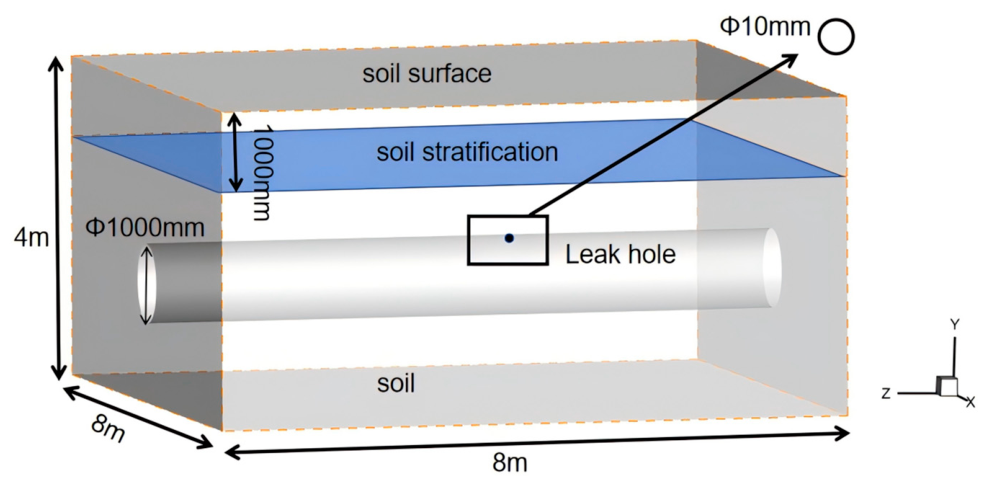
This study selects model parameters based on the section of the West–East Gas Pipeline in Jiangsu, China. The leak hole is simplified as a circular aperture located on the pipeline wall surface. The center of the leak hole is positioned directly above the pipeline’s axial direction. The soil domain is modeled as a rectangular prism with dimensions 8×8×4 m. The pipeline is buried at a depth of 2 m below the surface. The pipeline inner diameter is 1000 mm (with an outer diameter of 1016 mm). The geometric parameters of the single-layer model and the double-layer model are both shown in Figure 1.
In this paper, pipeline transmission pressure is set at 8 MPa, with pure methane serving as the proxy for natural gas. Soil parameters (porosity 0.46–0.54, soil particle size 6–200 μm) for Jiangsu Province of China were acquired from the “Basic soil property dataset of high-resolution China Soil Information Grids (2010–2018)” to design simulation parameters. The case configuration in this study is shown in Table 1.
The Reynolds number based on particle diameter, Re   =   ρ v D p μ , ranges from 0.02 (Dp = 6 μm) to 4.2 (Dp = 200 μm) at the leakhole plane, where the local Darcy velocity is highest. Because Re < 10 for all cases, the flow remains well within the Darcy–Forchheimer regime, validating the applicability of the Ergun-equation parameters (Equations (8) and (9)) without transition to fully turbulent porous flow.
By employing Ansys Fluent, CFD simulations were conducted to investigate gas diffusion in soil following leakage from buried natural gas long-distance pipelines. The boundary conditions for the computational domain are set as shown in Table 2. Initially, it is assumed that the gas volume fraction of methane in the soil is 0, that the volume fraction of air is 1, and that the initial pressure within the soil is standard atmospheric pressure. The equation discrete methods used in the simiulation are set as shown in Table 3.
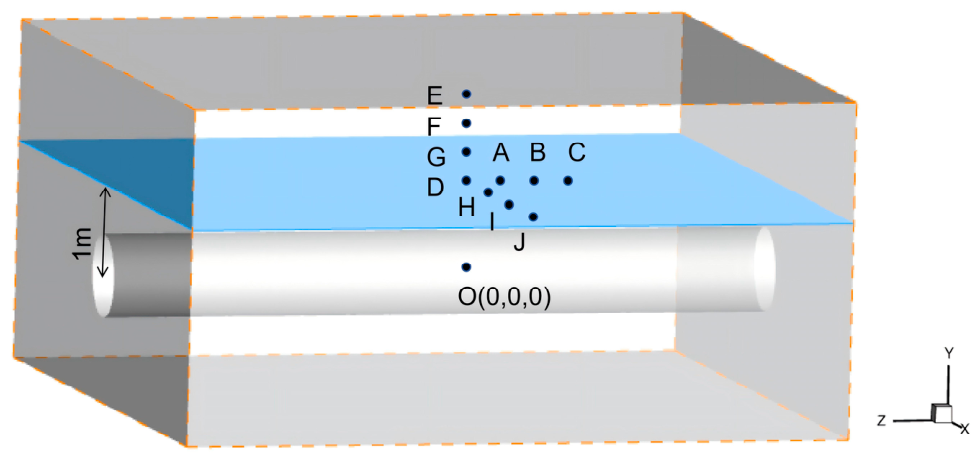
By establishing concentration monitoring points within the soil area, changes in methane concentration at different locations during leakage diffusion are monitored to quantitatively assess the risk of leakage spread. The coordinates of the monitoring points are shown in Table 4, and their spatial distributions are shown in Figure 2.

2.3. Verification of Mesh-Independent Solutions

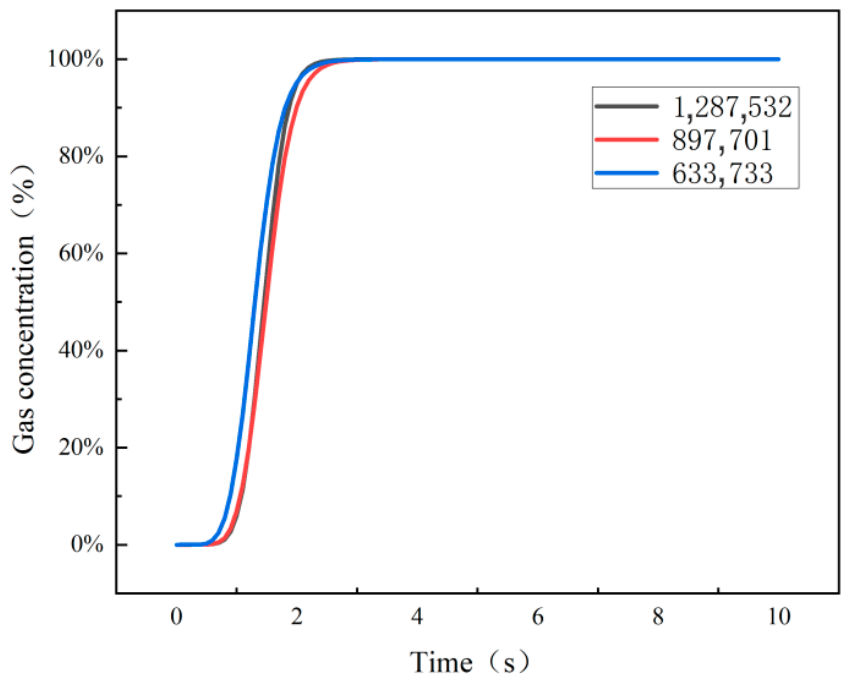
During the mesh refinement process, the mesh was densified around the leakage point, and boundary layers were added around the pipeline. To ensure computational accuracy, three meshes with varying densities (1,287,532, 897,701, and 633,733 cells) were selected for analysis. Taking Case 5 as an example, comparing the methane volume fraction at monitoring point D (0, 1, 0) during a 10 s leak under the three mesh configurations (Figure 3) reveals that: the methane volume fraction at monitoring point D was nearly identical between the 897,701-cell mesh and the 1,287,532-cell mesh. At this point, the mesh size can be considered negligible for computational results. Therefore, to balance computational speed and accuracy, the 897,701-cell mesh was selected for subsequent calculations.

2.4. Experimental Comparison and Verification

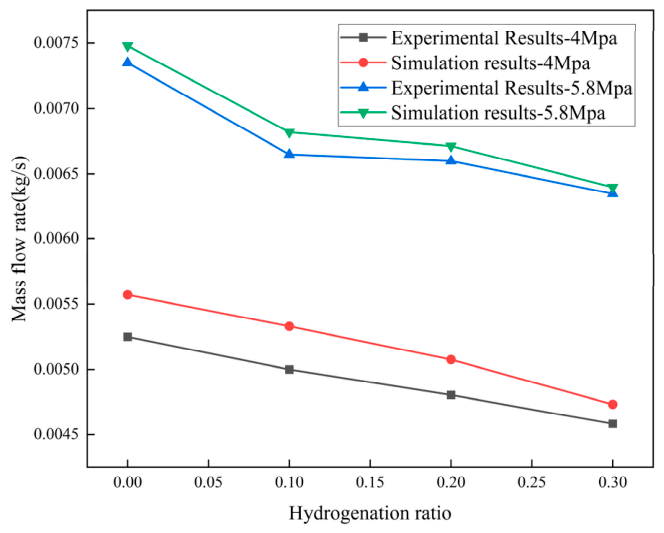
To verify the validity of the high-pressure buried pipeline leakage and diffusion model established in this study, the simulation results were compared with the experimental data from Zhu et al.’s buried high-pressure pipeline leakage experiments [10]. The experimental parameters were set as follows: soil porosity of 0.1, soil particle diameter of 3.17 × 10 5 m, temperature of 298.15 K, soil depth of 1.4 m, and a circular leak hole with a radius of 1 mm. The simulated pipeline pressure is 4 MPa and 5.8 MPa, with the upward leakage direction. Using identical experimental parameters for simulation, the mass flow rate of methane leakage through the pinhole was compared with the experimentally obtained methane leakage mass flow rate under the same conditions, as shown in Figure 4. The average relative error between the experimental and simulated values at 4 MPa was 5.04%, with a root-mean-square error of 2.77 ×   10 4 kg/s, the average relative error at 5.8 MPa was 3.36%, with a root-mean-square error of 2.96 × 10 4 kg/s. Considering that the soil was not isotropic during the experiment and factors such as soil moisture content were not accounted for, the accuracy of the model used in this study has been validated.
It is acknowledged that the validation pressure (4–5.8 MPa) and depth (1.4 m) are lower than the main application case (8 MPa, 2 m). At higher pressures, compressibility effects strengthen and non-Darcy effects may locally occur near the leak, potentially increasing error. We therefore treat the 8 MPa results as demonstrative of parametric trends rather than as precise predictions and recommend that field-scale design decisions be supported by additional validation at comparable pressures.

3. Results and Analysis

3.1. Leakage and Diffusion of Methane in Soil

The leakage and diffusion behavior of methane in soil is explored first. Case 5 (pipeline pressure of 8 MPa, soil temperature of 293.15 K, soil porosity of 0.46, and soil particle size of 100 μm) was selected as the base case to investigate methane diffusion at different coordinate directions.
In terms of result characterization and risk assessment, based on the definition of the Lower Explosive Limit (LEL) of methane, a methane volume fraction of 5% (i.e., 0.05) was adopted as the hazardous concentration threshold. Accordingly, the following three key evaluation metrics were defined: (1) First Danger Time (FDT): representing the time until surface gas concentration reaches the lower explosive limit; (2) Farthest Danger Range (FDR): the maximum radial spreading distance of the underground combustible gas plume where the methane volume fraction within the soil exceeds 0.05 at a given time, used to quantify the overall influence range of the leaked gas in the underground porous medium; (3) Ground Danger Range (GDR): the radial spreading range of the combustible gas plume on the ground surface where the methane volume fraction exceeds 0.05 at a given time, used to assess the lateral spread extent and surface hazardous zone after the leaked gas breaks through the surface.
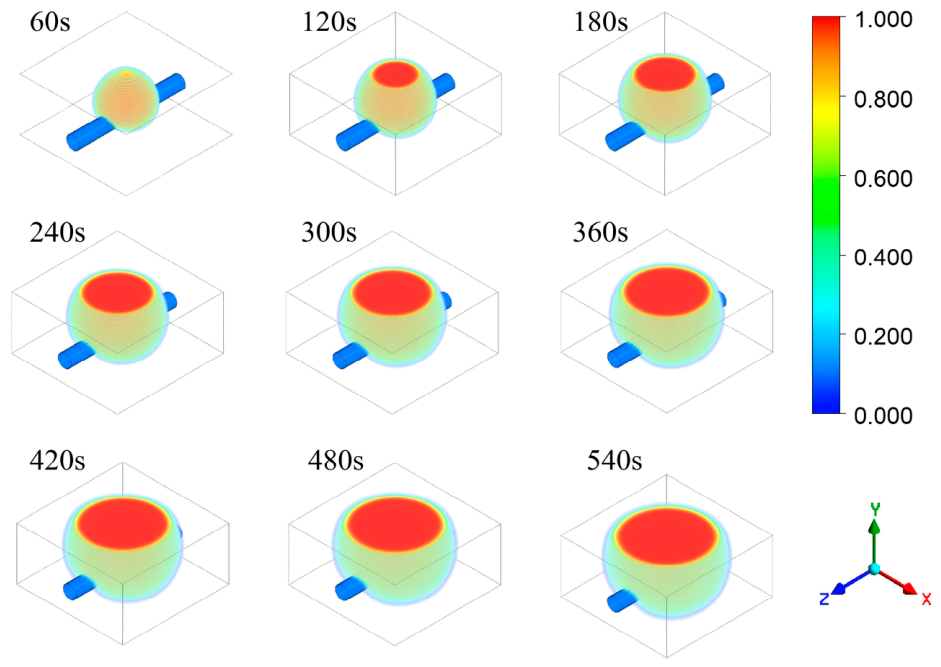
The distribution of methane concentration in soil is simulated based on Case 5, as illustrated in Figure 5, with time ranging from 60 s to 540 s. After leaking from the leakhole at the top of the pipeline, the gas is driven by the combined action of the pressure gradient and buoyancy (density difference), forming an ellipsoidal distribution structure. During the results analysis, equidistant sampling points were taken in three directions: vertical, along the pipeline’s axis, and radial around the pipeline. The initial point of the leak was recorded as 0 s. The time at which the methane concentration at specific monitoring points first reaches the lower explosive limit (LEL) is listed in Table 5.
Under high pressure of 8 MPa, the gas ejected from the leak spreads in an ellipsoidal pattern. The results indicate that methane concentrations at monitoring points along the pipeline axis (Z-axis) are the first to reach hazardous levels, indicating the fastest gas diffusion speed. Diffusion in the radial direction of the pipeline (X-axis) follows next, while the slowest diffusion occurs in the vertical direction (Y-axis).
The significant delay in the vertical direction (Y-axis) arises from the cumulative vertical seepage resistance in dense porous media. In Case 5 (Dp = 100 μm, ϕ = 0.46), although the leakhole is oriented directly upward and the 8 MPa high-pressure gas source generates a strong initial vertical pressure gradient, the initial moment of leakage, the dense soil matrix still presents considerable resistance to upward gas migration. The tortuous flow paths and narrow pore throats in the dense medium dissipate the jet momentum rapidly, and the vertical advancement of the concentration front is further hindered by the limited vertical permeability relative to the preferential lateral spreading directions.
While radial diffusion (X-axis) is also primarily driven by lateral pressure expansion from the jet body, the gas is not constrained by the pipe and disperses into the ground. Consequently, the radial velocity is found to be lagging behind the axial velocity yet exceeding the vertical velocity. This phenomenon can be attributed to the fact that during the initial high-pressure phase, convective diffusion driven by pressure differentials significantly outweighs buoyancy effects.

3.2. Soil Porosity and Soil Particle Size

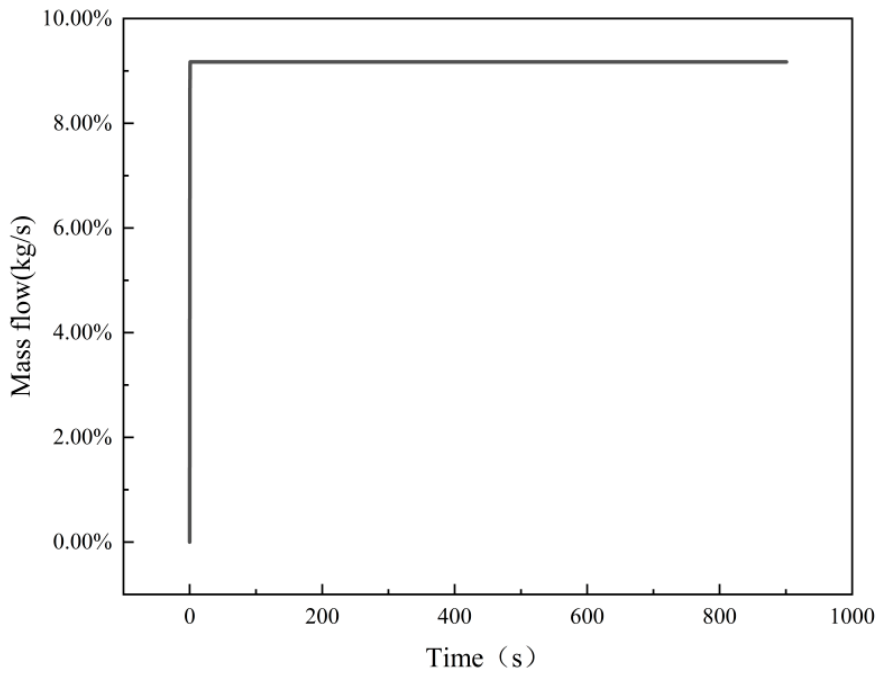
Subsequent analyses were conducted separately on factors such as soil porosity and particle size. It is important to note that the gas mass flow rate at the leak rapidly reaches its peak within the initial, extremely brief period after leakage onset and remains stable thereafter. Consequently, subsequent analyses treat this peak mass flow rate as the steady-state leakage mass flow rate, as illustrated in Figure 6.
The present study investigates the combined effects of soil porosity and particle size on methane leakage diffusion behavior. To this end, two sets of representative particle sizes (10 μm to 100 μm) and porosity (0.46 to 0.54) were selected for comparative analysis.
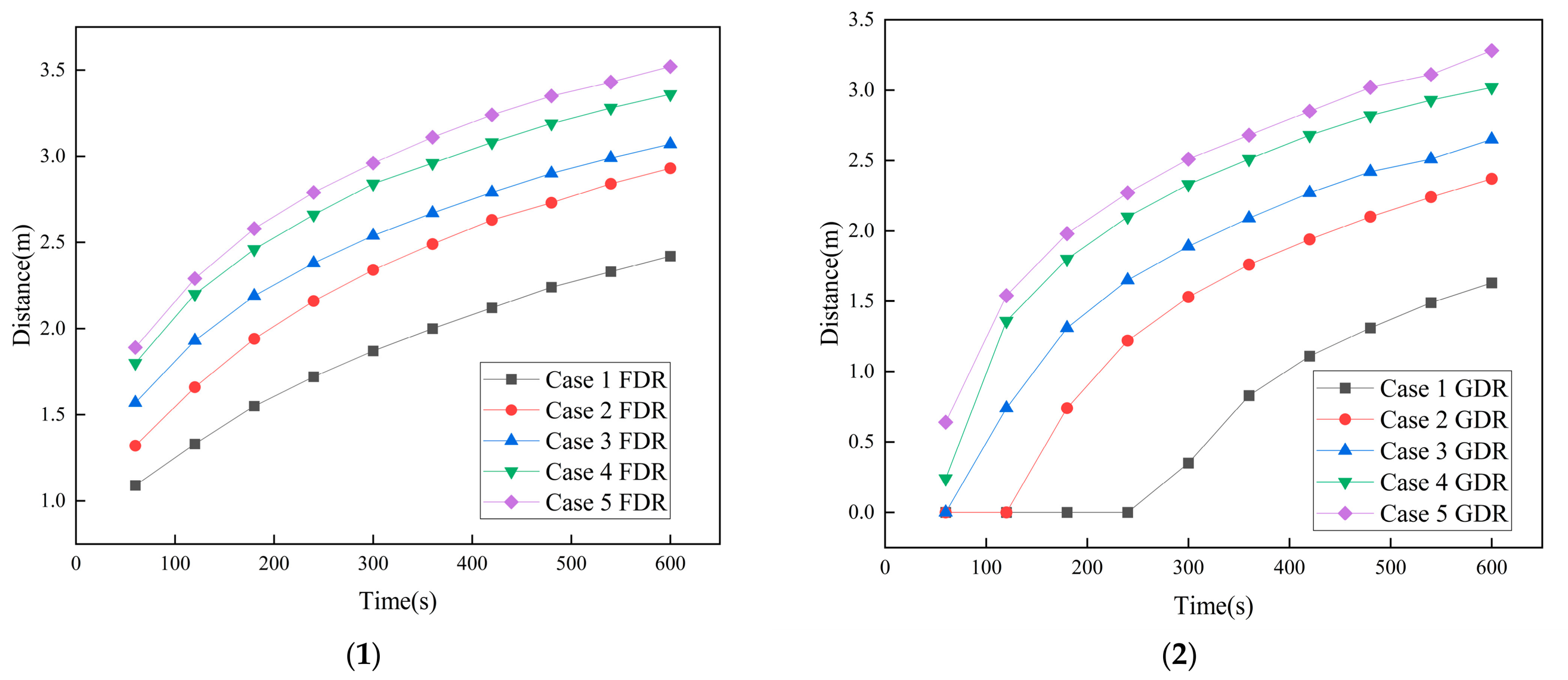
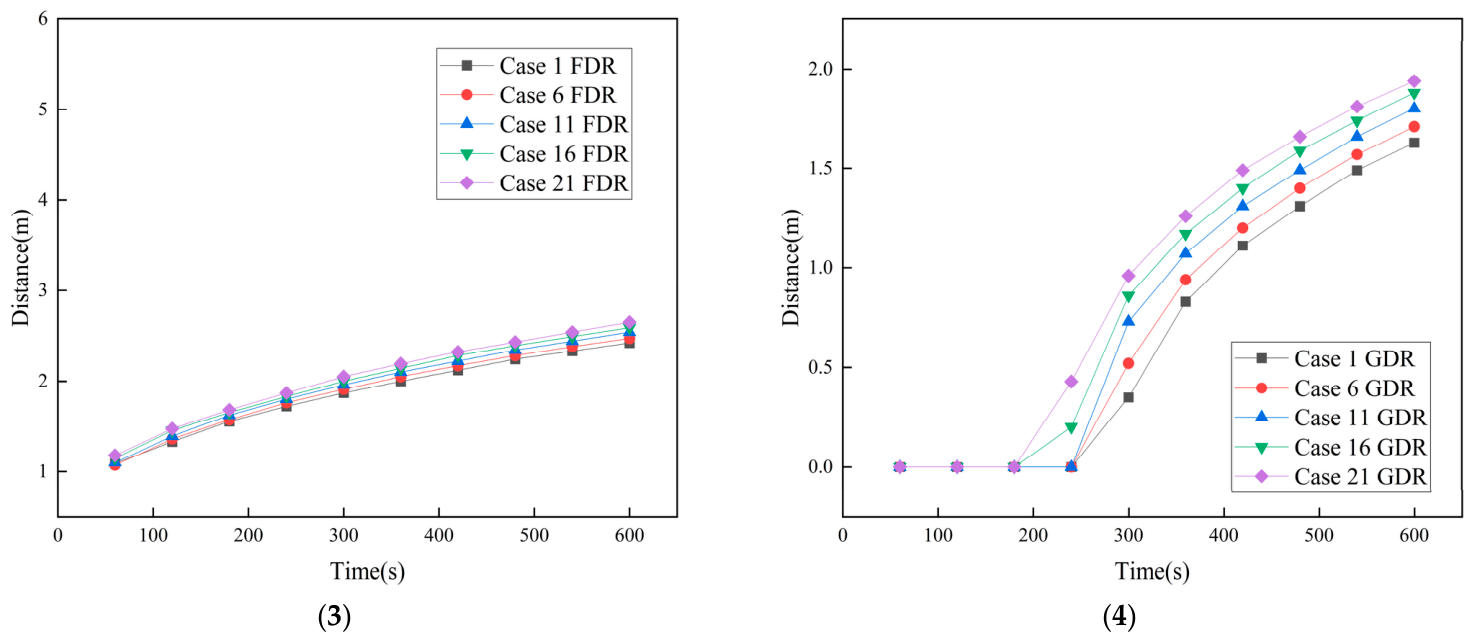
As illustrated in Figure 7(1), with a constant porosity of 0.46, FDR exhibits a significant monotonic increase as particle size increases from 10 μm to 100 μm, and the spacing between curves gradually expands over time. At 600 s after the leakage, the FDR of Case 5 (Dp = 100 μm) is 3.52 m, while that of Case 1 (Dp = 10 μm) is 2.42 m, representing an increase exceeding 45%. The gradually widening spacing between curves indicates that increasing particle size not only enhances the instantaneous advancement rate of the concentration front, but also expands the cumulative influence range of the high-concentration zone through continuously enhanced seepage capacity. As shown in Figure 7(3), under the condition of constant particle size of 10 μm, FDR also shows a monotonic increasing trend as porosity increases from 0.46 to 0.54, but the curves are closely distributed with limited differences. At 600 s after the leakage, the FDR of Case 21 ( ϕ = 0.54) is 2.65 m, while that of Case 1 ( ϕ = 0.46) is 2.42 m, representing a relative increase of approximately 12.5%.
In this study, the particle size ranges from 10 to 100 μm (spanning one order of magnitude), while the porosity ranges from 0.46 to 0.54 (absolute change of only 0.08). Due to the unequal variation amplitudes of the two parameters, a direct comparison of their relative influence on diffusion lacks strict physical comparability. The greater difference in FDR caused by particle size variation compared to porosity variation is related to the local response of the Kozeny–Carman relationship ( k D p 2 ϕ 3 ( 1 ϕ ) 2 ), where k is the permeability coefficient characterizing the capacity of the porous medium to transmit fluid, Dp is particle diameter, and ϕ is porosity. Within the parameter range of this study, Dp affects permeability through a squared term (Dp2), while ϕ acts through a cubic term ( ϕ 3). Because ϕ changes by only 0.08 whereas Dp changes by one order of magnitude, the amplification effect of particle size variation on permeability is far stronger than that of porosity. Consequently, the greater difference in FDR caused by particle size variation compared to porosity variation directly reflects this asymmetry in the Kozeny–Carman response.
As shown in Figure 7(2), with particle size decreasing from 100 μm to 10 μm, the response delay for combustible gas appearing at the ground surface is significantly prolonged, and the final ground danger range is reduced by approximately 50%. In the dense medium with a fixed particle size of 10 μm, the promoting effect of porosity increase on GDR is mainly reflected in shortening the ground response delay. As illustrated in Figure 7(4), for Case 21 ( ϕ = 0.54), ground areas exceeding 0.05 appear at 240 s, and at 600 s the GDR is 1.94 m; for Case 1 ( ϕ = 0.46), the ground response only appears after 350 s, and at 600 s the GDR is 1.63 m. As porosity increases from 0.46 to 0.54, the ground response time is advanced by approximately 50 s, and the final GDR increases by approximately 18%.
High-permeability soil (large particle size) presents an immediate ground-surface risk, with rapid ground response and fast expansion of the danger range. Low-permeability soil (small particle size) presents a delayed cumulative risk, with significantly lagged ground response, but gas remains in the subsurface for extended periods; once breakthrough or disturbance occurs, it similarly constitutes a serious hazard.
Within the parameter range of this study (10 μm to 100 μm), the Kozeny–Carman relationship dictates that permeability scales with Dp2; therefore, a one-order-of-magnitude increase in particle diameter produces an approximately two-order-of-magnitude increase in permeability. As a result, hydraulic resistance drops sharply, Darcy seepage velocity increases significantly, and the concentration front advances much faster. Quantitatively, when Dp increases from 10 μm to 100 μm (Figure 7(1)), FDR rises from 2.42 m to 3.52 m, an absolute increase of 1.10 m (about 45%). By contrast, porosity affects permeability through a cubic term, ϕ 3, but because the porosity range in this study is narrow (0.46 to 0.54, i.e., only 0.08), the resulting permeability modulation is relatively moderate. As shown in Figure 7(3), increasing ϕ from 0.46 to 0.54 raises FDR from 2.42 m to 2.65 m, a relative increase of only about 12.5%. On a normalized basis—i.e., relative change in FDR per unit relative change in the parameter—soil porosity exerts a stronger influence: each 1% relative increase in porosity produces a larger fractional gain in FDR than each 1 μm relative increase in particle size. Consequently, particle size dominates the absolute variation in risk indicators (FDR, GDR), whereas porosity shows a higher relative sensitivity per unit parameter change.
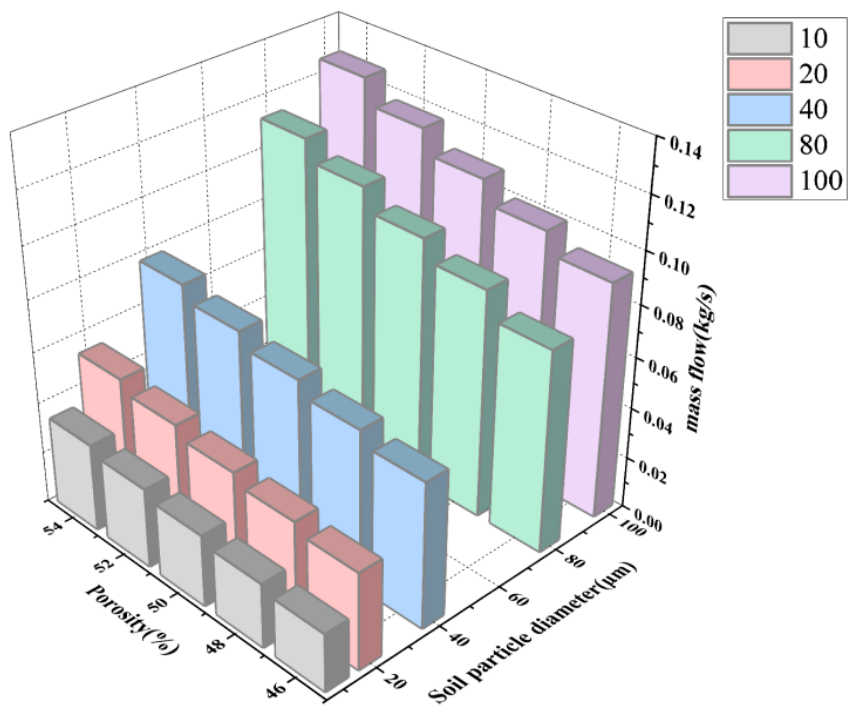
Figure 8 provides a visual demonstration that in the context of buried pipeline leakage scenarios, soil porosity and soil particle diameter exert a direct influence on the mass flow rate of the leakage pore. However, these parameters remain independent of each other without exhibiting synergistic effects. The mass flow rate of leakage pores has been shown to increase significantly with either an increase in soil porosity or an increase in soil particle diameter. Within the range of parameters that were the focus of this study, the mass flow rate exhibited an increase from a minimum of 0.0226 kg/s (porosity 0.46, particle size 10 μm) to a maximum of 0.1266 kg/s (porosity 0.54, particle size 100 μm). This represented an increase exceeding 460%. The combination of high porosity and large particle diameter has been demonstrated to result in a maximum risk of leakage. Consequently, pipelines traversing high-porosity, coarse-grained soil zones must be recognized as carrying inherently higher leakage risks. Special attention is required in design, monitoring, and emergency preparedness, such as the implementation of denser monitoring points or shorter inspection cycles.

3.3. Soil Stratification

Given that soils in natural geological environments often exhibit pronounced stratification characteristics, and significant differences exist between different layers, with abrupt permeability changes, the dual-layer cases employ assumed soil-property parameters (prescribed combinations of porosity and particle size) to systematically examine how the permeability discontinuity interface effect responds to variations in permeability contrast magnitude and layer sequence (e.g., fine-over-coarse versus coarse-over-fine).
As clearly shown in Table 6, the left column represents a single-layer homogeneous soil layer beneath the double-layer soil model on the right. In detail, the soil in the left case and the lower soil layer in the right case within the same row exhibit identical soil porosity and particle size. Despite variations in the upper-layer soil parameters among the two-layer cases, the mass flow rate at the leak hole depends almost entirely on the porosity and particle size of the layer containing the leak source (i.e., the lower layer). Exchanging the upper-layer porosity or particle size exerts a negligible influence on the leak flow rate, with deviations remaining below 3%. This is attributable to the fact that the leak hole is situated directly above the pipeline (at a burial depth of approximately 2.0 m, within the lower soil layer); under the constant-pressure boundary condition (8 MPa), the leak rate is governed primarily by the local permeability characteristics at the leak hole location, while variations in the flow resistance of the upper-layer soil hardly modify the source-term intensity.
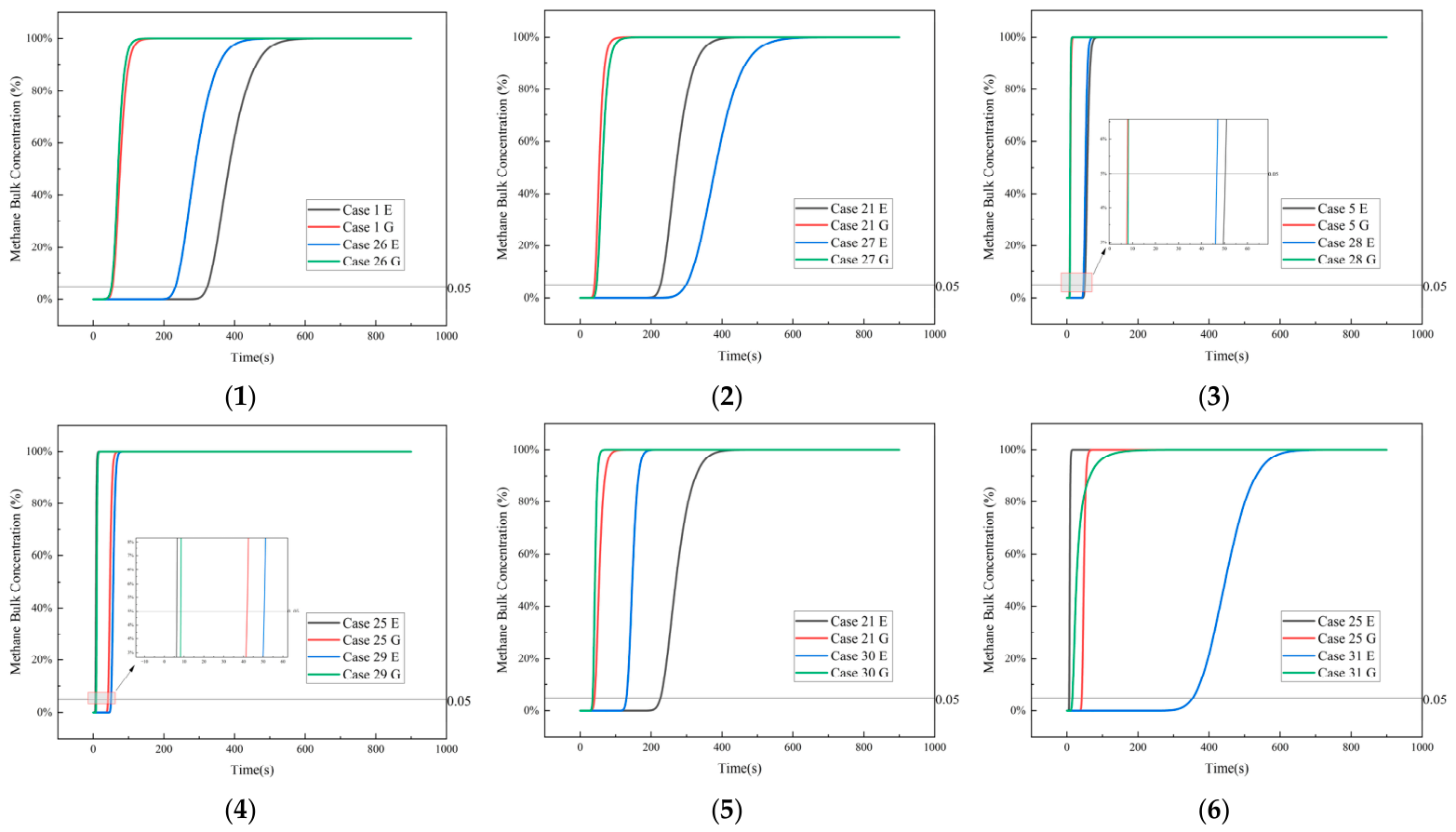
By contrast, the FDT exhibits a markedly different response. With the mass flow rate remaining essentially unchanged, the FDT shows significant variation solely due to alterations in the upper-layer parameters. This demonstrates that no unique correlation exists between the FDT and the leak mass flow rate; instead, the FDT is independently controlled by the permeability of the upper-layer soil. When the upper layer comprises a high-permeability medium, the FDT is noticeably shortened relative to the homogeneous counterpart.
Figure 9 shows difference of the methane bulk concentrations at surface monitoring points E and stratum monitoring points G between homogeneous and two-layer soils models. Compared with Case 1, the results from Case 26 (results in Figure 9(1)) show that the low permeability of the lower layer restricts the gas-supply capacity, whereas the higher porosity of the upper layer reduces the vertical seepage resistance, forming a weak preferential pathway (when the upper-layer permeability exceeds that of the lower layer, the seepage resistance at the interface drops sharply, providing a low-hydraulic-resistance vertical pathway for fluid extension). Once the concentration front (i.e., the leading edge of the leaking gas plume that propagates over time to the stratification interface, at which point the upper-layer properties begin to exert a boundary-modulation effect on the overall concentration field) reaches the interface, the resistance to vertical breakthrough is relatively small, and the surface-response time (FDT) is shorter than that of the homogeneous low-porosity counterpart (Case 1). However, because the overall permeability level is low (Dp = 10 μm), the inter-layer permeability contrast is insufficient to trigger significant flow redistribution; consequently, the differences between the two-layer case and the homogeneous reference in the concentration-field contours are rather modest.
Compared with Case 21, the results from Case 27 (results in Figure 9(2)) show that the low porosity of the upper layer constitutes a weak hydraulic barrier when the lower-layer permeability is markedly higher than that of the upper layer. The low-permeability upper layer imposes additional resistance on vertical seepage, redirecting the pressure gradient at the interface and driving lateral diversion of the fluid), generating a certain degree of vertical resistance at the interface. Nevertheless, because the lower-layer permeability itself is not high, the gas mass flux migrating upward is limited, and the scale of concentration buildup at the interface remains small. Although the delay effect of the hydraulic barrier on the surface response (FDT delayed by approximately 73 s) is discernible, the concentration-field morphology does not exhibit severe distortion.
Compared with Case 5, the results from Case 28 (results in Figure 9(3)) show that the high absolute permeability of the lower layer provides a strong gas source, while the high porosity of the upper layer further reduces vertical flow resistance; the preferential-pathway effect thereby promotes rapid gas migration toward the ground surface. However, because the inter-layer permeability contrast is limited, the increase in FDR/GDR relative to the homogeneous reference (Case 5) remains insignificant.
Compared with Case 25, the results from Case 29 (results in Figure 9(4)) exhibit a distinct hydraulic-barrier effect. The strong gas supply and high permeability of the lower layer generate a very large gas-phase mass flux, yet the low porosity of the upper layer cannot accommodate an equivalent vertical seepage flux at the interface. According to the principle of mass conservation, the excess gas undergoes intense flow redistribution near the interface, producing significant lateral diversion and concentration buildup. Consequently, the FDR exceeds that of the homogeneous high-porosity reference (Case 25), and the concentration contours exhibit a morphology in which the high-concentration region spreads laterally while contracting vertically at the interface.
Compared with Case 21, the results from Case 30 (results in Figure 9(5)) show that the extremely low permeability of the lower layer restricts the gas-source intensity, delaying the arrival of the concentration front at the interface. Once the front reaches the interface, the coarse-grained upper-layer medium provides a strong preferential pathway, causing the vertical resistance to drop sharply; the gas then undergoes rapid vertical and lateral expansion within the upper layer. The concentration contours exhibit a double-lobed morphology characterized by lower-layer contraction and upper-layer expansion, which is essentially a hydraulic release, the flow transitions from the low-permeability zone to the high-permeability zone at the interface.
Compared with Case 25, the results from Case 31 (results in Figure 9(6)) show that the most pronounced hydraulic-barrier effect is observed. The high permeability of the lower layer generates a large gas-phase mass flux, yet the extremely low permeability of the upper layer cannot sustain an equivalent vertical Darcy seepage flux at the interface. According to the continuity equation, the vertical velocity component is forced to attenuate at the interface; the gas-phase momentum is converted into a horizontal pressure gradient, driving intense lateral diversion. Simultaneously, prolonged concentration buildup occurs near the interface until the local pressure gradient becomes sufficient to overcome the threshold gradient of the upper layer, at which point vertical breakthrough is achieved. This results in an extreme FDT delay (354 s, representing a delay of 312 s relative to the homogeneous counterpart) and FDR expansion exceeding the homogeneous reference (the subsurface lateral extent surpasses that of Case 25). The concentration contours display a flattened disc-shaped distribution in which the high-concentration core region lies immediately adjacent to the interface with minimal vertical thickness, a typical concentration-field morphology induced by flow redistribution under a strong hydraulic barrier.
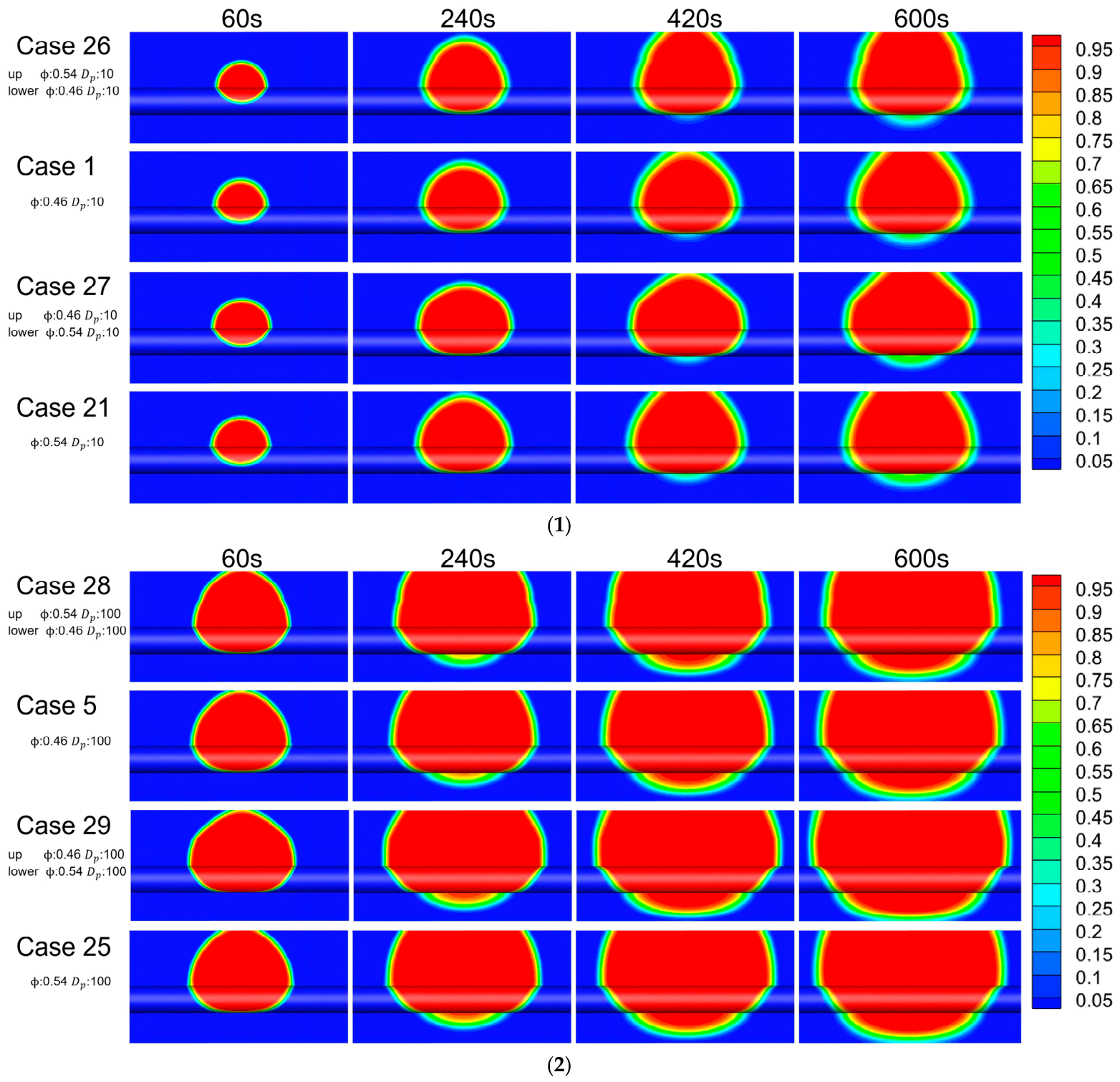
As illustrated in Figure 10, the spatial distributions of methane volume fraction at 60 s, 240 s, 420 s, and 600 s are presented for the dual-layer soil cases ( ϕ : porosity; Dp: particle diameter).
In Figure 10(1), for the low-particle-size porosity-variation group (Dp = 10 μm), the overall spreading rate is relatively slow. At 60 s, the gas is entirely concentrated in the lower-layer soil near the leakhole; the dual-layer cases and their homogeneous counterparts are nearly indistinguishable, indicating that the upper-layer influence has not yet been triggered. At 240 s, the high-concentration region continues to expand upward, and the concentration front reaches the soil stratification interface. In Case 26, the higher upper-layer porosity (0.54) enables slightly greater expansion of the high-concentration zone above the interface compared with Case 1. Conversely, in Case 27, the lower upper-layer porosity (0.46) causes a slight contraction of the high-concentration region above the interface relative to Case 21, although the discrepancy remains modest. By 600 s, the interfacial permeability–contrast effect (defined herein as the hydraulic discontinuity and nonlinear flow redistribution occurring at the stratification interface where order-of-magnitude permeability variations arise from abrupt changes in particle size or porosity) becomes discernible. The high-concentration core (red region) in Case 26 is slightly larger than that in Case 1, indicating a weak facilitating effect of the higher upper-layer porosity on upward migration. Whereas the top of the high-concentration core in Case 27 is marginally lower than that in Case 21, demonstrating a certain retardation induced by the lower upper-layer porosity. Overall, because the intrinsic spreading rate is low at Dp = 10 μm, the cumulative gas mass arriving at the interface within 600 s is limited, and the upper-layer modulation remains weak.
As shown, both Case 30 and its homogeneous counterpart (Case 21) have propagated to the soil stratification interface by 60 s; however, the dual-layer configuration exhibits pronounced gas-migration retardation at the boundary. At 240 s, Case 30 displays a distinctive double-lobed morphology: the low permeability of the lower layer (Dp = 10 μm) impedes upward migration, yet once the gas penetrates the interface and enters the upper layer (Dp = 10 μm), it undergoes rapid lateral spreading, producing a pronounced waist constriction at the interface flanked by wider upper and lower lobes. By contrast, Case 31 exhibits an extreme flattened disc-shaped distribution; the high permeability of the lower layer (Dp = 10 μm) enables the gas to reach the interface rapidly, whereas the upper layer (Dp = 10 μm) severely restricts vertical extension. The gas is therefore compelled to undergo significant concentration buildup along the stratification interface and spread laterally, forming a broad, flattened ellipse.
With respect to the porosity-variation cases, Case 26 exhibits slightly wider lateral spreading in the upper layer attributable to its higher porosity, whereas Case 27 shows minor contraction of the high-concentration zone above the interface due to its lower upper-layer porosity. Nevertheless, because the overall spreading rate is low at Dp = 10 μm, the total gas mass arriving at the interface is limited, and the upper-layer modulation remains visually modest.
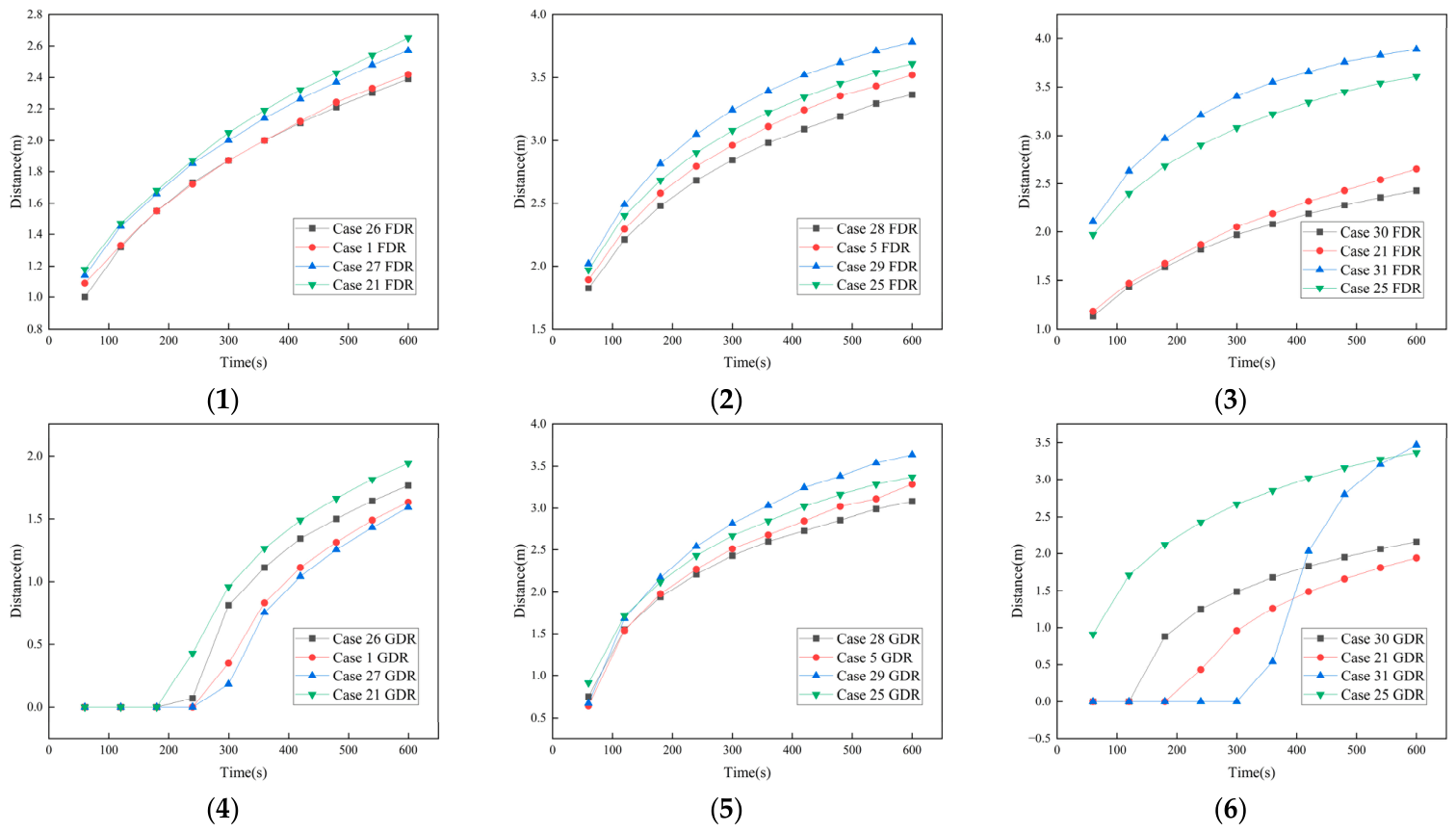
As can be observed from Figure 11, the FDR begins to increase immediately from the onset of leakage because the leakhole is located within the soil, and the gas begins to fill the soil pore space instantaneously upon release. The GDR generally exhibits a startup delay (remaining at or near zero in the early stage) because the gas requires a certain period to migrate upward from the leakhole to the ground surface. The duration of this delay is directly governed by the permeability of the upper-layer soil. In Figure 11(1), for Case 27 (lower layer ϕ   = 0.54, upper layer ϕ = 0.46), the curve nearly coincides with that of Case 21 (homogeneous ϕ = 0.54) (approximately 2.58 m versus 2.65 m at 600 s); Case 26 (lower layer ϕ = 0.46, upper layer ϕ = 0.54) almost overlaps with Case 1 (homogeneous ϕ = 0.46) (approximately 2.40 m versus 2.42 m at 600 s). This is because, under the small-particle-size condition (Dp = 10 μm), the soil pore channels are narrow and the permeability is extremely low; gas transport is dominated by molecular diffusion, while the contribution of pressure-gradient-driven advective mass transfer is weak. Because the leakhole is located within the lower-layer soil, the expansion rate of the FDR is controlled almost entirely by the lower-layer porosity.
A higher lower-layer porosity (Case 27/21, ϕ = 0.54) provides a larger pore volume available for gas filling and a relatively higher effective diffusion coefficient, resulting in faster FDR growth; conversely (Case 26/1, ϕ = 0.46), the growth is slower. For Case 27 (lower layer ϕ = 0.54, upper layer ϕ = 0.46), although the higher lower-layer porosity provides an adequate gas source, the low-porosity upper-layer medium creates an interfacial permeability–contrast effect (i.e., a hydraulic barrier). Because the overall migration rate is slow and the pressure gradient is small at Dp = 10 μm, the gas cannot establish a sufficient driving pressure at the stratification interface to overcome the barrier resistance. A large amount of methane undergoes concentration buildup near the interface, and vertical breakthrough is impeded. The result is that the radius of the area on the ground surface where the methane volume fraction exceeds 0.044 is not only smaller than that of the homogeneous high-porosity case (Case 21), but even smaller than that of the homogeneous low-porosity case (Case 1). For Case 26 (lower layer ϕ = 0.46, upper layer ϕ = 0.54): the lower-layer gas-supply capacity is weak, but the high upper-layer porosity reduces the resistance to vertical migration. Once the gas reaches the upper layer, it can diffuse toward the ground surface relatively rapidly, and the GDR falls between those of Case 1 and Case 21.
In Figure 11(2), for Case 29 (lower layer ϕ = 0.54, upper layer ϕ = 0.46), the high porosity of the lower layer provides high seepage capacity, enabling rapid upward migration of the gas to the stratification interface. The low-porosity upper-layer medium creates a hydraulic barrier at the interface, causing the vertical seepage velocity to drop sharply. In accordance with mass conservation, the excess gas that cannot be accommodated in the vertical direction undergoes flow redistribution, driving intense lateral diversion along the interface. This concentration buildup and lateral spreading near the interface significantly enlarge the horizontal extent. At 600 s, the FDR (3.78 m) exceeds that of the homogeneous high-porosity reference (Case 25, 3.61 m), exhibiting supra-homogeneous expansion. For Case 28 (lower layer ϕ = 0.46, upper layer ϕ 0.54), the low lower-layer porosity limits the gas-supply capacity; even though the upper layer is unobstructed, the overall migration scale is restricted, and the FDR remains below that of the homogeneous low-porosity case. The GDR of Case 29 likewise exhibits a supra-homogeneous characteristic (3.64 m at 600 s versus 3.37 m for Case 25). The mechanism lies in the fact that prolonged lateral diversion at the interface forms a broad subsurface high-concentration accumulation layer; when this accumulated gas ultimately overcomes the upper-layer resistance and breaks through to the ground surface, its lateral spreading range naturally exceeds that of the approximately hemispherical diffusion observed in homogeneous soil. It is noteworthy that at Dp = 100 μm, the gas possesses sufficient pressure-driving force; the gas arrival time at the ground surface for Case 29 is not markedly delayed (close to that of Case 25). This indicates that under conditions of high-permeability lower-layer gas supply, the resistance of the low-porosity upper-layer medium can be overcome relatively rapidly, though the diffusion morphology is substantially altered.
In Figure 11(3), in Case 31 (lower layer Dp= 100 μm, upper layer Dp = 10 μm), the coarse-grained lower layer provides a high-permeability pathway, and the gas migrates upward at a relatively high apparent velocity (Darcy velocity). The fine-grained upper layer exhibits a sharp permeability drop, creating a strong hydraulic barrier at the stratification interface. The gas cannot smoothly enter the upper layer and is forced to undergo intense lateral diversion and concentration buildup near the interface, forming the flattened high-concentration zone shown in the concentration contours. This intense flow redistribution causes the FDR to reach 3.89 m at 600 s, which is the maximum among all cases, significantly exceeding that of the homogeneous coarse-grained Case 25 (3.61 m). In Case 30 (lower layer Dp = 10 μm, upper layer Dp = 100 μm): constrained by the low permeability of the lower layer, the upward gas flux itself is low; even though the upper layer is unobstructed, the gas mass reaching the upper layer is limited. The FDR is therefore governed by the lower-layer properties, remaining close to but slightly below that of the homogeneous fine-grained Case 21.
In Figure 11(6), the extremely low permeability of the upper-layer Dp = 10 μm medium substantially prolongs the time required for gas to break through to the ground surface. The GDR remains nearly zero until approximately 360 s, whereas the homogeneous coarse-grained Case 25 reaches the lower explosive limit at approximately 60 s, with an FDT delay of roughly 300 s. This is because the gas must undergo continuous concentration buildup at the interface until the local pressure and concentration become sufficiently high to slowly overcome the capillary resistance and seepage resistance of the upper layer and achieve vertical breakthrough. However, during this 300 s period, the gas undergoes sufficient lateral diversion in the subsurface, forming an extremely broad subsurface affected zone. Once the breakthrough occurs, this pre-spread wide range is directly mapped onto the ground surface, enabling Case 31 to achieve a GDR of 3.47 m at 600 s, still exceeding that of the homogeneous coarse-grained Case 25 (3.37 m). In Case 30, the coarse-grained upper layer reduces the surface resistance, yielding a GDR (2.16 m) higher than that of the homogeneous fine-grained Case 21 (1.94 m). This indicates that high upper-layer permeability promotes surface diffusion, yet it remains far below the homogeneous coarse-grained case, due to the constraint from the low gas-supply capacity of the lower layer.
When a low-permeability cap layer exists above the pipeline (e.g., a fine-grained or low-porosity upper layer), the time for methane detection at the ground surface may be substantially delayed (e.g., approximately 300 s in Case 31), but the final diffusion range may become even larger due to lateral diversion at the interface. The total leakage amount and early-stage subsurface diffusion are controlled by the lower layer; the timing and spatial distribution of the surface response are significantly modulated by the upper-layer permeability through the hydraulic-barrier and lateral-diversion mechanisms.
The differences in simulation results caused by dual-layer soils can be attributed to interfacial hydraulic-barrier/preferential-pathway effects and the accompanying flow redistribution triggered by strong inter-layer permeability contrast. Specifically, recognizable vertical resistance or preferential-pathway effects emerge at the interface, when the permeability contrast is weak (varied porosity with constant particle size of 10 μm). However, due to the low absolute permeability level, the intensity of flow redistribution is limited, and the concentration-field differences remain modest.
Strong permeability contrast (particle-size-variation group, order-of-magnitude difference) would contribute Significant hydraulic barriers or preferential pathways develop at the interface, triggering intense flow redistribution (lateral diversion, concentration buildup, hydraulic release). This leads to nonlinear deviations in FDT, FDR, GDR, and concentration-field morphology, producing supra-homogeneous expansion and extreme breakthrough delay.
In engineering applications, if a stratification structure exists in which a fine-grained, low-permeability cap layer overlies a coarse-grained, high-permeability layer (as in Case 31), even strong gas supply from the lower layer will cause severe surface-response lag due to the strong hydraulic barrier, while the subsurface danger range will expand abnormally because of lateral diversion, constituting a concealed delayed-risk scenario.


4. Conclusions and Outlook

4.1. Conclusions

This study investigates methane leakage and diffusion from a buried high-pressure natural gas pipeline through CFD simulations, with particular emphasis on the effects of soil porosity, particle size, and dual-layer soil stratification. The following conclusions are drawn:
(1) Methane diffuses from the leak hole to the surrounding soil in an ellipsoidal pattern, with the fastest diffusion speed along the pipeline’s axial direction, followed by the radial direction and then the vertical direction. (2) In homogeneous soil, both porosity and particle size significantly influence methane diffusion. Increasing porosity from 0.46 to 0.54 reduces FDT by 29.8%, while increasing particle size from 10 μm to 100 μm reduces FDT by 84%. On a normalized basis, porosity exerts a stronger influence per unit change (approximately 3.7% FDT reduction per 1% porosity increase) compared to particle size (approximately 0.09% FDT reduction per 1% particle size increase), whereas particle size induces larger absolute variations in hazard metrics. (3) In layered soil, the permeability contrast between adjacent layers creates the permeability discontinuity interface effect, which is defined as the flow discontinuity induced at layer interfaces by abrupt order-of-magnitude changes in permeability due to variations in particle size or porosity. When a fine-grained or low-porosity layer overlies a coarse-grained layer, the upper layer acts as a hydraulic barrier, prolonging the first danger time (FDT) from 130 s to 354 s while promoting significant horizontal spread at the interface. The lower layer primarily controls the lateral diffusion range (FDR/GDR), with high-porosity or large-particle lower layers facilitating expansion of the hazard area. Conversely, a high-porosity upper layer accelerates vertical breakthrough but reduces lateral spread.
These findings have significant practical implications for pipeline safety management. Risk assessment and mitigation strategies must account for local soil stratigraphy. In regions where a fine-grained surface layer overlies a permeable subsurface layer, monitoring systems should prioritize detecting lateral gas migration at the interface rather than relying solely on surface sensors. Pipeline burial design should consider the potential for delayed but extensive lateral spreading when low-permeability caps are present.

4.2. Shortcomings and Outlook

Several limitations of this study should be acknowledged. First, the soil in each layer is treated as a homogeneous medium, whereas natural soils exhibit intra-layer spatial heterogeneity. where localized permeability variations could create preferential flow channels or localized barriers, causing the actual gas migration pathway to deviate significantly from the idealized uniform diffusion predicted by the homogeneous model and resulting in an uneven concentration distribution that is difficult to capture with a single effective permeability value.
Second, the simulations assume dry soil conditions with zero moisture content; the presence of moisture would reduce effective porosity and increase capillary entry pressure, and introduce additional interfacial viscous resistance at the gas–liquid meniscus; consequently, gas diffusion becomes substantially more difficult in wet soil than in dry soil under otherwise identical porosity and particle-size conditions, and the permeability discontinuity interface effect would be amplified as the contrast in moisture retention between layers creates additional hydraulic resistance.
Third, the pipeline pressure is assumed constant throughout the simulation, which is a simplification for a pinhole leak scenario, because transient pressure decay would continuously reduce the driving pressure gradient at the leak orifice over time, causing the leakage mass flow rate to decrease gradually rather than remaining constant; as a result, the concentration front would advance more slowly than predicted under the constant-pressure assumption, particularly during the initial high-pressure stage when the pressure drop is most pronounced.
Fourth, the computational domain (8 m × 8 m × 4 m) may constrain lateral spreading in high-permeability cases where the hazardous plume approaches the domain boundaries. Fifth, isothermal conditions are assumed, neglecting the Joule–Thomson cooling effect associated with high-pressure gas expansion, which could influence local gas density and viscosity.
Finally, this study does not consider geochemical reactions between methane and soil minerals or biological degradation processes. Future research should address these limitations by incorporating intra-layer heterogeneity, moisture effects, transient pressure boundary conditions, and non-isothermal gas flow. Additionally, experimental validation under high-pressure conditions representative of large-diameter transmission pipelines would strengthen confidence in the model predictions. Extension to three-layer and multi-layer soil systems, as well as investigation of the permeability discontinuity interface effect under varying layer thickness ratios, would further enhance the practical applicability of these findings.

Author Contributions

Conceptualization, B.H., T.P., F.W., X.W., and Z.Y. (Zhipeng Yu); methodology, B.H., T.P., X.W., and Z.Y. (Zhipeng Yu); software, B.H., T.P., X.W., and Z.Y. (Zhipeng Yu); validation, T.P., Z.L., and Z.Y. (Zhipeng Yu); formal analysis, B.H., T.P., Z.L., F.W., and Z.Y. (Zhipeng Yu); investigation, B.H., T.P., Z.L., X.W., S.H., and Z.Y. (Zhipeng Yu); resources, Z.Y. (Zhanghua Yin); data curation, Z.L., S.H., F.W., and Z.Y. (Zhanghua Yin); writing—original draft preparation, B.H., T.P., and Z.Y. (Zhipeng Yu); writing—review and editing, B.H., T.P., Z.L., X.W., S.H., Z.Y. (Zhanghua Yin), F.W., and Z.Y. (Zhipeng Yu); visualization, B.H., T.P., X.W., Z.Y. (Zhanghua Yin), and Z.Y. (Zhipeng Yu); project administration, B.H.; funding acquisition, B.H. All authors have read and agreed to the published version of the manuscript.

Funding

This study is supported by the financial support of Research Project of China Petroleum Pipeline Bureau Engineering Co., Ltd. (2024-19), China Postdoctoral Science Foundation under Grant Number (2024M763653), “Pioneer” and “Leading Goose” R&D Program of Zhejiang (No. 2025C01152), the Zhejiang Provincial Natural Science Foundation of China (No. LQ23E040004), Natural Science Foundation of Chongqing, China (CSTB2023NSCQ-MSX0050).

Data Availability Statement

The original contributions presented in this study are included in the article. Further inquiries can be directed to the corresponding authors.

Conflicts of Interest

Author Ting Pan, Zhenglong Li, Zhanghua Yin and Bingyuan Hong were employed by the China Petroleum Pipeline Research Institute Co., Ltd. and author Fubin Wang was employed by the China Petroleum Pipeline Engineering Co., Ltd. The remaining authors declare that the research was conducted in the absence of any commercial or financial relationships that could be construed as a potential conflict of interest. The China Petroleum Pipeline Research Institute Co., Ltd. and China Petroleum Pipeline Engineering Co., Ltd. had no role in the design of the study; in the collection, analyses, or interpretation of data; in the writing of the manuscript, or in the decision to publish the results.

References

  1. Das, P.; Mohtasim, M.d.S.; Rowe, A.; Shuvo, K.A.; Mishuk, N.J. A Review of Natural Gas Transportation Pipeline Optimization and Progress towards Hydrogen Injection: Challenges and Advances. Int. J. Hydrogen Energy 2025, 124, 102–122. [Google Scholar] [CrossRef]
  2. Tiong, M.; Peng, W.; Liu, Q.; Wu, S.; Ye, H.; Liu, S.; Xue, M.; Xian, C. Natural Gas Hydrate Exploitation: A Comprehensive Review of Structural Properties, Technical Progress and Environmental Challenges. Gas Sci. Eng. 2025, 144, 205769. [Google Scholar] [CrossRef]
  3. Liu, S.; Wang, J.; Long, Y. Research into the Spatiotemporal Characteristics and Influencing Factors of Technological Innovation in China’s Natural Gas Industry from the Perspective of Energy Transition. Sustainability 2023, 15, 7143. [Google Scholar] [CrossRef]
  4. Hong, B.; Gao, W.; Yang, M.; Zhou, B.; Lu, Y.; Gong, J.; Wen, K. Balancing Economy, User Guarantee, and Carbon Emissions towards Sustainable Natural Gas Pipeline Network Planning. Comput. Ind. Eng. 2025, 200, 110858. [Google Scholar] [CrossRef]
  5. Zhang, Y.; Yang, Y.; Wu, F.; Li, Q.; Wang, J.; Liu, H.; Che, D.; Huang, Z. Numerical Investigation on Pinhole Leakage and Diffusion Characteristics of Medium-Pressure Buried Hydrogen Pipeline. Int. J. Hydrogen Energy 2024, 51, 807–817. [Google Scholar] [CrossRef]
  6. Garg, K.; Singh, S.; Rokade, M.; Singh, S. Experimental and Computational Fluid Dynamic (CFD) Simulation of Leak Shapes and Sizes for Gas Pipeline. J. Loss Prev. Process Ind. 2023, 84, 105112. [Google Scholar] [CrossRef]
  7. Xia, Z.; Xu, Z.-D.; Lu, H.; Peng, H.; Zang, X.; Liu, X.; Wang, X. Modeling and Assessment of Hydrogen-Blended Natural Gas Releases from Buried Pipeline. Int. J. Hydrogen Energy 2024, 90, 230–245. [Google Scholar] [CrossRef]
  8. Wang, X.; Hou, T.; Gao, W.; Yu, K.; Zhang, T.; Tan, Y. Experimental Study on the Diffusion Process of Natural Gas from Buried Pipelines to Underground Confined Spaces. Nat. Gas Ind. B 2024, 11, 603–615. [Google Scholar] [CrossRef]
  9. Zhu, J.; Wang, S.; Pan, J.; Lv, H.; Zhang, Y.; Han, H.; Liu, C.; Duo, Z.; Li, Y. Experimental Study on Leakage Temperature Field of Hydrogen Blending into Natural Gas Buried Pipeline. Appl. Energy 2024, 359, 122656. [Google Scholar] [CrossRef]
  10. Zhu, J.; Pan, J.; Zhang, Y.; Li, Y.; Li, H.; Feng, H.; Chen, D.; Kou, Y.; Yang, R. Leakage and Diffusion Behavior of a Buried Pipeline of Hydrogen-Blended Natural Gas. Int. J. Hydrogen Energy 2023, 48, 11592–11610. [Google Scholar] [CrossRef]
  11. Bonnaud, C.; Cluzel, V.; Corcoles, P.; Dubois, J.-P.; Louvet, V.; Maury, M.; Narbonne, A.; Orefice, H.; Perez, A.; Ranty, J.; et al. Experimental Study and Modelling of the Consequences of Small Leaks on Buried Transmission Gas Pipeline. J. Loss Prev. Process Ind. 2018, 55, 303–312. [Google Scholar] [CrossRef]
  12. Houssin-Agbomson, D.; Blanchetière, G.; McCollum, D.; Saint-Macary, C.; Mendes, R.F.; Jamois, D.; Barbalat, M.; Foissac, A.; Lubet, T. Consequences of a 12-Mm Diameter High Pressure Gas Release on a Buried Pipeline. Experimental Setup and Results. J. Loss Prev. Process Ind. 2018, 54, 183–189. [Google Scholar] [CrossRef]
  13. Chamindu Deepagoda, T.K.K.; Smits, K.M.; Oldenburg, C.M. Effect of Subsurface Soil Moisture Variability and Atmospheric Conditions on Methane Gas Migration in Shallow Subsurface. Int. J. Greenh. Gas Control 2016, 55, 105–117. [Google Scholar] [CrossRef]
  14. Yan, Y.; Dong, X.; Li, J. Experimental Study of Methane Diffusion in Soil for an Underground Gas Pipe Leak. J. Nat. Gas Sci. Eng. 2015, 27, 82–89. [Google Scholar] [CrossRef]
  15. Wang, X.; Tan, Y.; Zhang, T.; Xiao, R.; Yu, K.; Zhang, J. Numerical Study on the Diffusion Process of Pinhole Leakage of Natural Gas from Underground Pipelines to the Soil. J. Nat. Gas Sci. Eng. 2021, 87, 103792. [Google Scholar] [CrossRef]
  16. Wang, L.; Tian, X. Numerical Investigation of the Leakage and Diffusion Characteristics of Hydrogen-Blended Natural Gas in Long-Distance Pipelines. Int. J. Hydrogen Energy 2024, 90, 950–960. [Google Scholar] [CrossRef]
  17. Bu, F.; Chen, S.; Liu, Y.; Guan, B.; Wang, X.; Shi, Z.; Hao, G. CFD Analysis and Calculation Models Establishment of Leakage of Natural Gas Pipeline Considering Real Buried Environment. Energy Rep. 2022, 8, 3789–3808. [Google Scholar] [CrossRef]
  18. Bagheri, M.; Sari, A. Study of Natural Gas Emission from a Hole on Underground Pipelines Using Optimal Design-Based CFD Simulations: Developing Comprehensive Soil Classified Leakage Models. J. Nat. Gas Sci. Eng. 2022, 102, 104583. [Google Scholar] [CrossRef]
  19. Bezaatpour, J.; Fatehifar, E.; Rasoulzadeh, A. CFD Investigation of Natural Gas Leakage and Propagation from Buried Pipeline for Anisotropic and Partially Saturated Multilayer Soil. J. Clean. Prod. 2020, 277, 123940. [Google Scholar] [CrossRef]
  20. Wang, L.; Chen, W.; Vuik, C. A 3D Framework for Geological Media with Multiple Intersected Fractures: Coupled Darcy Flow and Fickian Diffusion. J. Rock Mech. Geotech. Eng. 2025, 17, 6293–6307. [Google Scholar] [CrossRef]
  21. Monga, R.; Deb, R.; Meyer, D.W.; Jenny, P. A Probabilistic, Flux-Conservative Particle-Based Framework for Transport in Fractured Porous Media. Adv. Water Resour. 2023, 172, 104368. [Google Scholar] [CrossRef]
  22. Yin, T.; Liu, D.; Cai, Y.; Gutierrez, M. Gas Transport and Diffusion Coefficients in a Coupling Coal System of Matrix and Nano-Fracture: A Molecular Simulation Study. J. Nat. Gas Sci. Eng. 2022, 99, 104407. [Google Scholar] [CrossRef]
  23. Hamidi, S.; El Ossmani, M.; Taakili, A. A Monotone Finite Volume Scheme for Single Phase Flow with Reactive Transport in Anisotropic Porous Media. J. Comput. Appl. Math. 2024, 440, 115626. [Google Scholar] [CrossRef]
  24. Su, D.; Xie, M.; Mayer, K.U.; MacQuarrie, K.T.B. Simulation of Diffusive Solute Transport in Heterogeneous Porous Media with Dipping Anisotropy. Front. Water 2022, 4, 974145. [Google Scholar] [CrossRef]
  25. Phukan, B.; Barua, G. An Analytical Solution of the One-Dimensional Steady-State Advection-Dispersion Equation of a Compressible Fluid for a Heterogeneous Soil. Sādhanā 2025, 50, 5. [Google Scholar] [CrossRef]
  26. Zilberter, I.A.; Edwards, J.R. Large-Eddy Simulation/Reynolds-Averaged Navier–Stokes Simulations of High-Speed Mixing Processes. AIAA J. 2014, 52, 1486–1501. [Google Scholar] [CrossRef]
  27. Wheatcraft, S.W.; Meerschaert, M.M. Fractional Conservation of Mass. Adv. Water Resour. 2008, 31, 1377–1381. [Google Scholar] [CrossRef]
  28. Zandi, E.; Alemrajabi, A.A.; Emami, M.D.; Hassanpour, M. Numerical Study of Gas Leakage from a Pipeline and Its Concentration Evaluation Based on Modern and Practical Leak Detection Methods. J. Loss Prev. Process Ind. 2022, 80, 104890. [Google Scholar] [CrossRef]
Figure 1. Geometric parameters of the model.
Processes 14 01467 g001
Figure 2. Distribution of monitoring point locations. All the letters represent the location of the monitoring point shown in Table 4.
Processes 14 01467 g002
Figure 3. Mesh-independent analysis.
Processes 14 01467 g003
Figure 4. Simulation results verification through experiments.
Processes 14 01467 g004
Figure 5. Distribution of methane concentration in soil.
Processes 14 01467 g005
Figure 6. Gas mass flow rate of the leak hole changes with time in Case 5.
Processes 14 01467 g006
Figure 7. Plots of FDR and GDR over time for various operating conditions. (1) FDR versus time for cases with varied particle size and a constant porosity of 0.46; (2) GDR versus time for cases with varied particle size and a constant porosity of 0.46; (3) FDR versus time for cases with varied porosity and a constant particle size of 10 μm; (4) GDR versus time for cases with varied porosity and a constant particle size of 10 μm.
Processes 14 01467 g007aProcesses 14 01467 g007b
Figure 8. Leaked gas mass flow rate changes with porosity and soil particle size.
Processes 14 01467 g008
Figure 9. Time-series graphs of methane concentrations at surface monitoring points and stratum monitoring points in monolithic and stratified models. (1) Methane bulk concentration versus time at different monitoring points for homogeneous low-porosity and two-layer soils at Dp = 10 μm (Case 1: homogeneous ϕ = 0.46; Case 26: lower ϕ = 0.46, upper ϕ = 0.54); (2) Methane bulk concentration versus time at different monitoring points for homogeneous high-porosity and two-layer soils at Dp = 10 μm (Case 21: homogeneous ϕ = 0.54; Case 27: lower ϕ = 0.54, upper ϕ = 0.46); (3) Methane bulk concentration versus time at different monitoring points for homogeneous low-porosity and two-layer soils at Dp = 100 μm (Case 5: homogeneous ϕ = 0.46; Case 28: lower ϕ = 0.46, upper ϕ = 0.54); (4) Methane bulk concentration versus time at different monitoring points for homogeneous high-porosity and two-layer soils at Dp = 100 μm (Case 25: homogeneous ϕ = 0.54; Case 29: lower ϕ = 0.54, upper ϕ = 0.46) (5) Methane bulk concentration versus time at different monitoring points for homogeneous fine-grained and two-layer soils with contrasting interlayer particle sizes at ϕ = 0.54 (Case 21: homogeneous Dp = 10 μm; Case 30: lower Dp = 10 μm, upper Dp = 100 μm) (6) Methane bulk concentration versus time at different monitoring points for homogeneous coarse-grained and two-layer soils with contrasting interlayer particle sizes at ϕ = 0.54 (Case 25: homogeneous Dp = 100 μm; Case 31: lower Dp = 100 μm, upper Dp = 10 μm).
Processes 14 01467 g009
Figure 10. Spatial distribution of methane fraction in dual-layer soil cases. ϕ : porosity, Dp: particle size. (1) Double-layer model for small-particle-size with porosity variation; (2) Double-layer model for large-particle-size with porosity variation; (3) Double-layer model for high-porosity with particle size variation.
Processes 14 01467 g010aProcesses 14 01467 g010b
Figure 11. Comparison of FDR and GDR over time between the homogeneous model and the two-layer model. (1) FDR comparison between homogeneous and two-layer models with a constant particle size of 10 μm (Cases 1, 21 vs. Cases 26, 27); (2) FDR comparison between homogeneous and two-layer models with a constant particle size of 100 μm (Cases 5, 25 vs. Cases 28, 29); (3) FDR comparison for two-layer models with contrasting interlayer particle sizes and a constant porosity of 54% (Cases 21, 25 vs. Cases 30, 31); (4) GDR comparison between homogeneous and two-layer models with a constant particle size of 10 μm (Cases 1, 21 vs. Cases 26, 27); (5) GDR comparison between homogeneous and two-layer models with a constant particle size of 10 μm (Cases 1, 21 vs. Cases 26, 27); (6) GDR comparison for two-layer soils with contrasting interlayer particle sizes and a constant porosity of 54% (Cases 21, 25 vs. Cases 30, 31).
Processes 14 01467 g011
Table 1. Soil parameters of different cases.
CasePorosity
(%)
Particle Diameter
(μm)
CasePorosity
(%)
Particle Diameter
(μm)
Case 14610Case 175220
Case 24620Case 185240
Case 34640Case 195280
Case 44680Case 2052100
Case 546100Case 215410
Case 64810Case 225420
Case 74820Case 235440
Case 84840Case 245480
Case 94880Case 2554100
Case 1048100Case 26up 54 below 4610
Case 115010Case 27up 46 below 5410
Case 125020Case 28up 54 below 46100
Case 135040Case 29up 46 below 54100
Case 145080Case 3054up 100 below 10
Case 1550100Case 3154up 10 below 100
Case 165210
Table 2. Boundary Conditions.
BoundaryBoundary TypeParameter Settings
Leak holePressure inletPressure, Components, Turbulence
Lateral soil boundarySymmetric plane-
Subsurface boundaryWall surfaceNo-Slip Boundary, Wall Roughness
Surface boundaryPressure outletPressure
Pipe wallWall surfaceNo-Slip Boundary, Wall Roughness
Table 3. Equation Discrete Settings.
ProjectSettings
Turbulence ModelDES Separation Vortex Model
Full Buoyancy Effect
Near-Wall TreatmentStandard Wall Functions
Pressure–Velocity CouplingPISO
Pressure Term DiscretizationSecond-Order Central Differencing
Convection Term Discretization in the Momentum EquationSecond-Order Upwind Scheme
Table 4. Monitoring Point Coordinates.
Monitoring PointCoordinate PositionMonitoring PointCoordinate Position
Point A(0, 1, −0.5)Point F(0, 2, 0)
Point B(0, 1, −1)Point G(0, 1.5, 0)
Point C(0, 1, −1.5)Point H(0.5, 1, 0)
Point D(0, 1, 0)Point I(1, 1, 0)
Point E(0, 2.5, 0)Point J(1.5, 1, 0)
Table 5. Time of reaching LEL at each monitoring point in Case 5.
X-Axis DirectionTime (s)Y-Axis DirectionTime (s)Z-Axis DirectionTime (s)
D (0, 1, 0)0.94D (0, 1, 0)0.94D (0, 1, 0)0.94
H (0.5, 1, 0)2.8G (0, 1.5, 0)7.73C (0, 1, −0.5)2.04
I (1, 1, 0)12.66F (0, 2, 0)23.56B (0, 1, −1)8.12
J (1.5, 1, 0)38.3E (0, 2.5, 0)50.25A (0, 1, −1.5)26.62
Table 6. Mass flow parameters for homogeneous and two-phase models.
CaseMass Flow Rate
(kg/s)
FDT
(s)
CaseMass Flow Rate
(kg/s)
FDT
(s)
Case 10.02259323.69Case 260.02297234
Case 210.03435226.6Case 270.03502299.5
Case 50.0917250.49Case 280.0938946.7
Case 250.1265941.78Case 290.1296450.54
Case 210.03435226.6Case 300.03503130
Case 250.1265941.78Case 310.12962354
Disclaimer/Publisher’s Note: The statements, opinions and data contained in all publications are solely those of the individual author(s) and contributor(s) and not of MDPI and/or the editor(s). MDPI and/or the editor(s) disclaim responsibility for any injury to people or property resulting from any ideas, methods, instructions or products referred to in the content.