A Data-Driven Evaluation Framework for Quantifying the Impact of Artificial Intelligence on Industrial Process Performance


Abstract
1. Introduction
- A unified data-driven evaluation framework is developed to quantify the impact of artificial intelligence on industrial process performance by integrating value-based financial modeling with a multi-level evaluation system using AHP-Entropy weighting and fuzzy comprehensive evaluation.
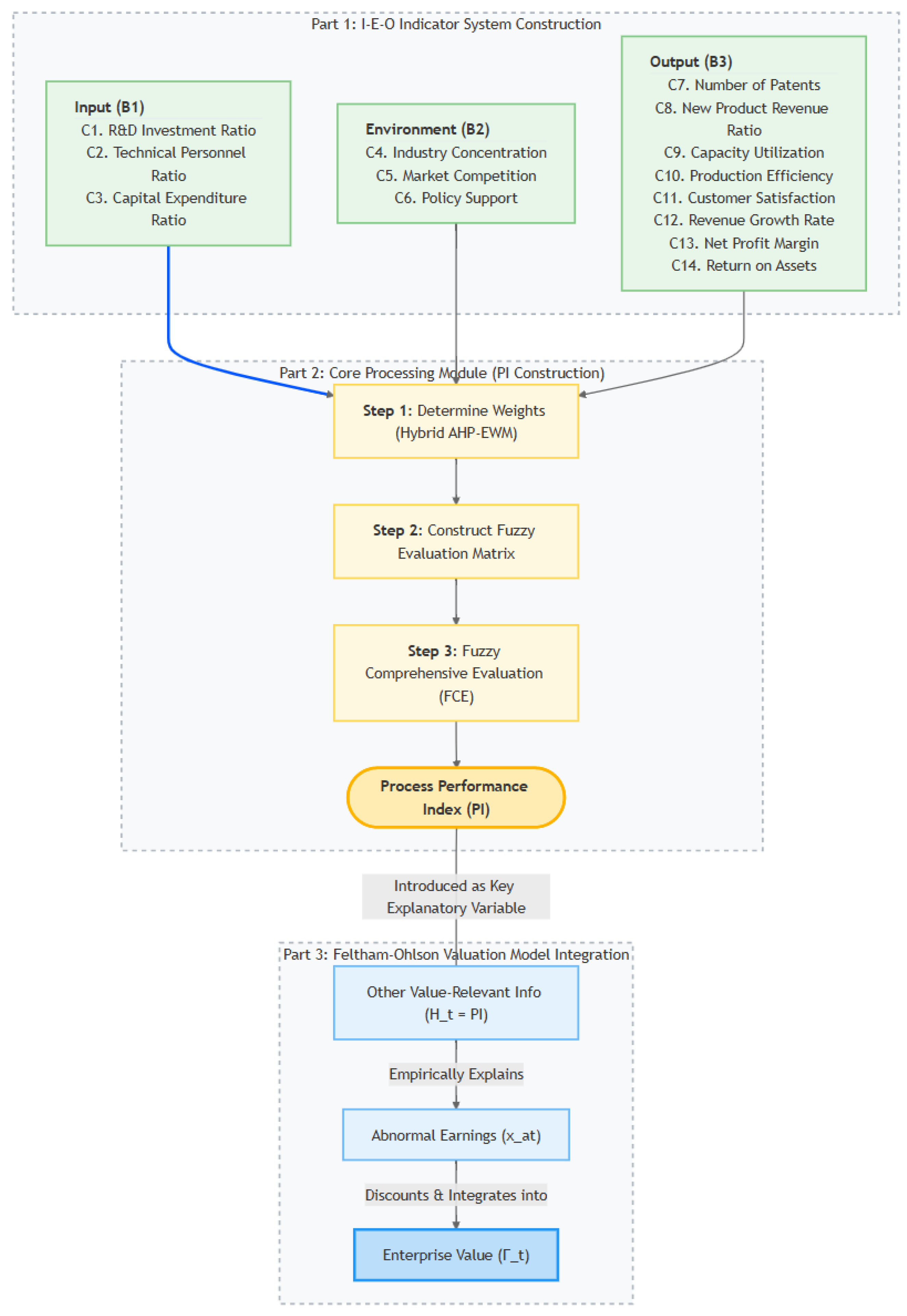
- A multidimensional indicator system is constructed based on Input–Environment–Output logic to describe interactions among intelligent investment, governance conditions, and operational output performance.
- The study establishes an explicit analytical linkage between AI-enabled operational capability and abnormal earnings within the Feltham–Ohlson valuation structure, providing theoretical support for evaluating intangible AI-driven assets.
- An empirical study based on longitudinal enterprise data validates the statistical reliability and practical effectiveness of the proposed framework.
- The resulting evaluation methodology provides interpretable decision support for intelligent resource allocation, operational optimization, and policy design in AI-enabled industrial systems.
2. Related Work
2.1. Indicator-Based Evaluation Frameworks
2.2. Data-Driven and Machine Learning-Based Assessment Models
2.3. Hybrid Evaluation Approaches
3. Construction of the Assessment Model
3.1. Theoretical Foundation: Linking AI-Driven Operational Capabilities to Enterprise Value via the Feltham–Ohlson Model
3.2. Construction and Weighting of Multi-Level Indicator System Based on Input–Environment–Output Logic
3.2.1. Construction of the Evaluation Indicator System
- Three first-level dimensions describing the major mechanisms through which AI influences industrial performance;
- Fourteen second-level indicators capturing key operational characteristics of AI-enabled industrial systems;
- Measurable firm-level proxy variables derived from financial statements, patent databases, and corporate governance disclosures.
3.2.2. Determination of Indicator Weights: Hybrid AHP–Entropy Method
3.2.3. Subjective Weights Based on AHP
- Five senior executives from manufacturing enterprises with practical experience in AI-enabled digital transformation;
- Five academic researchers specializing in artificial intelligence, digital economy, and industrial engineering;
- Five data scientists with experience in enterprise AI deployment and intelligent decision-support systems.
Objective Weights Based on the Entropy Weight Method
Comprehensive Weight Integration
- denotes subjective weight derived from expert evaluation;
- denotes objective entropy weight derived from data dispersion;
- represents the balance coefficient.
3.2.4. Performance Scoring via Automated Fuzzy Comprehensive Evaluation
- 25th percentile defines the boundary between Poor and Medium;
- 50th percentile defines the boundary between Medium and Good;
- 75th percentile defines the boundary between Good and Excellent.
- represents membership degree to the Excellent level;
- represents membership degree to the Good level;
- represents membership degree to the Medium level;
- represents membership degree to the Poor level;
3.3. Linking Process Performance to Enterprise Value
4. Empirical Analysis and Results
4.1. Research Design
4.1.1. Data and Sample Selection
- Firms belonging to the financial industry are excluded due to their distinct accounting standards and regulatory structure;
- Firms designated as ST or *ST are removed because their abnormal financial conditions may distort performance measurement;
- Observations with missing values for key variables are excluded to ensure econometric validity.
4.1.2. Variable Definitions and Model Specification
- Intelligent investment input;
- Operational governance and digital environment;
- Process output performance.
- Firm Size (Size), measured as the natural logarithm of total assets;
- Financial leverage (Lev);
- Operating cash flow (Cashflow);
- CEO-Chairman duality indicator (Dual);
- Fixed asset intensity (FIXED), measured as the ratio of fixed assets to total assets;
- Firm age (FirmAge), measured as the natural logarithm of years since establishment.
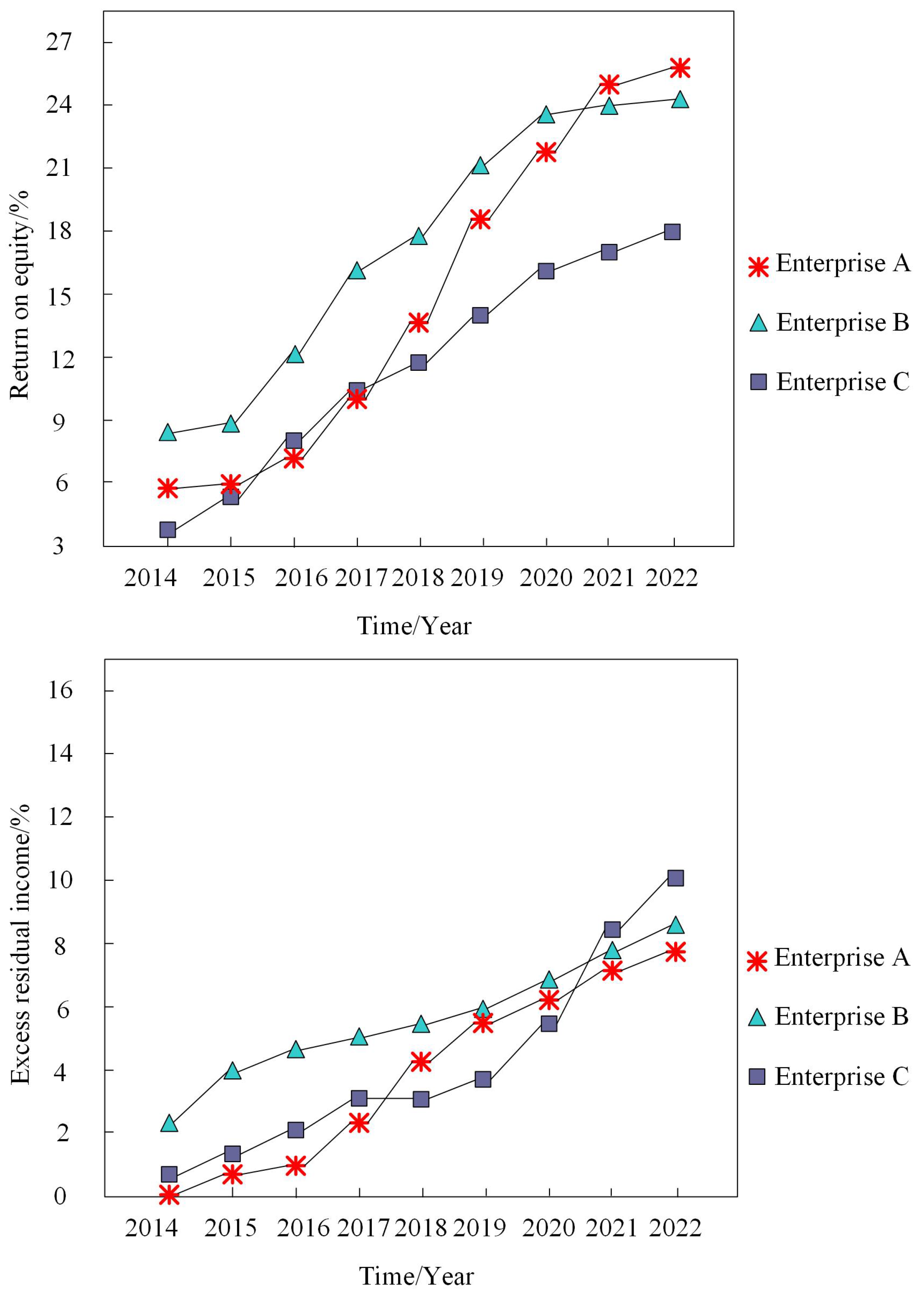
4.2. Enterprise Value Illustration Based on the Feltham–Ohlson Model
4.3. Descriptive Statistics and Preliminary Analysis
4.4. Baseline Regression Results
4.5. Further Robustness Tests
4.6. Addressing Endogeneity: Instrumental Variable Approach
4.7. Empirical Channel Tests
4.8. Heterogeneity Analysis
4.9. Discussion
4.10. Limitations and Future Research
5. Conclusions
Author Contributions
Funding
Data Availability Statement
Conflicts of Interest
References
- Zhai, J.; Yang, Y.; Wang, Z.; Zhang, J. Intelligent and Adaptive Task Migration in Vehicular Edge-Cloud Computing Environments. Int. J. Artif. Intell. Green Manuf. 2025, 1, 174–183. Available online: https://hopeembark.org/index.php/IJGMAI/article/view/70/39 (accessed on 20 April 2026).
- Ma, L.; Wang, T. Impact of digital economy on high-quality development of agricultural enterprises. SAGE Open 2024, 14. [Google Scholar] [CrossRef]
- Guo, X.W.; Guo, F.; Qi, L.; Wang, J.; Liu, S.X.; Qin, S.; Wang, W.T. Modeling and Optimization of Multiproduct Human–Robot Collaborative Hybrid Disassembly Line Balancing with Resource Sharing. IEEE Trans. Comput. Soc. Syst. 2025, 12, 2848–2863. [Google Scholar] [CrossRef]
- Yanytska, L. The rise of human-centric manufacturing in the Industry 5.0 era. Int. J. Adv. Manuf. Technol. 2025, 139, 5067–5077. [Google Scholar] [CrossRef]
- Ghobakhloo, M.; Iranmanesh, M.; Fathi, M.; Rejeb, A.; Foroughi, B.; Nikbin, D. Beyond Industry 4.0: A systematic review of Industry 5.0 technologies and implications for social, environmental and economic sustainability. Asia-Pac. J. Bus. Adm. 2024, 17, 889–914. [Google Scholar] [CrossRef]
- Dai, S.; Feng, Y.; Zhang, Z.; Guo, X.; Qin, S.; Kang, Q.; Liu, Y. Solving Disassembly and Assembly Line Balancing Problem with Robot Direction Switching. In Proceedings of the 37th Chinese Control and Decision Conference (CCDC), Xiamen, China, 16–19 May 2025; pp. 896–901. [Google Scholar]
- Qin, S.; Dai, S.; Wang, J.; Liu, S.; Guo, X.; Qi, L.; Hu, B.; Ji, Y. Improved Carnivorous Plant Algorithm for Human–Robot Collaborative U-Shaped Disassembly Line Balancing with Mobile Workers. IEEE Trans. Comput. Soc. Syst. 2025, 12, 4166–4178. [Google Scholar] [CrossRef]
- Guo, X.W.; Chen, L.; Qi, L.; Wang, J.; Qin, S.; Chatterjee, M. Multifactory Disassembly Process Optimization Considering Worker Posture. IEEE Trans. Comput. Soc. Syst. 2025, 12, 3049–3061. [Google Scholar] [CrossRef]
- Zhou, L.; Guo, X.W.; Liu, Q.; Wang, J.; Qin, S.; Qi, L. Multifactory Remanufacturing Process Optimization Considering Worker Scheduling. IEEE Trans. Comput. Soc. Syst. 2025, 12, 3525–3536. [Google Scholar] [CrossRef]
- Lee, C.C.; Fang, Y.; Li, Q.X. Leveraging the power of artificial intelligence toward the energy transition: The key role of the digital economy. Energy Econ. 2024, 135, 107654. [Google Scholar] [CrossRef]
- Wei, T.T.; Guo, X.W.; Zhou, M.; Wang, J.; Liu, S.X.; Qin, S. A Multiobjective Discrete Harmony Search Optimizer for Disassembly Line Balancing Problems Considering Human Factors. IEEE Trans.-Hum.-Mach. Syst. 2025, 55, 124–133. [Google Scholar] [CrossRef]
- ISO/IEC 42001; Information Technology—Artificial Intelligence—Management System. International Organization for Standardization (ISO); International Electrotechnical Commission (IEC): Geneva, Switzerland, 2023.
- National Institute of Standards and Technology. Artificial Intelligence Risk Management Framework (AI RMF 1.0); Technical Report; NIST: Gaithersburg, MD, USA, 2023.
- ISO 22400-2; Automation Systems and Integration—Key Performance Indicators for Manufacturing Operations Management. International Organization for Standardization (ISO): Geneva, Switzerland, 2014.
- Pandey, V.; Kumar, A.; Gupta, S. Assessing the need for the adoption of digitalization in Indian small and medium enterprises. Open. Eng. 2024, 14, 297–313. [Google Scholar] [CrossRef]
- Yu, M. The development of Southeast Asia’s digital economy: Current status, development motivation and challenges. Econ. Reg. Stud. 2024, 17, 314–330. [Google Scholar] [CrossRef]
- Ali, Z.A.; Zain, M.; Pathan, M.S.; Mooney, P.; Hens, L. Contributions of artificial intelligence for circular economy transition leading toward sustainability. Environ. Dev. Sustain. 2024, 26, 19131–19175. [Google Scholar] [CrossRef]
- Rudin, C. Stop explaining black box machine learning models for high stakes decisions and use interpretable models instead. Nat. Mach. Intell. 2019, 1, 206–215. [Google Scholar] [CrossRef]
- Dong, X.; Zhang, H. Analyzing regional economic development using hybridized algorithm. J. Comput. Methods Sci. Eng. 2024, 24, 2375–2390. [Google Scholar]
- Feltham, G.A.; Ohlson, J.A. Valuation and clean surplus accounting for operating and financial activities. Contemp. Account. Res. 1995, 11, 689–731. [Google Scholar] [CrossRef]
- Ohlson, J.A. Earnings, book values, and dividends in equity valuation. Contemp. Account. Res. 1995, 11, 661–687. [Google Scholar] [CrossRef]
- Lev, B.; Zarowin, P. The boundaries of financial reporting and How to Extend Them. J. Account. Res. 1999, 37, 353–385. [Google Scholar] [CrossRef]
- Vaidya, O.S.; Kumar, S. Analytic hierarchy process: An overview of applications. Eur. J. Oper. Res. 2006, 169, 1–29. [Google Scholar] [CrossRef]
- Kulyasov, N.; Dorogov, N.; Babynina, L.; Bronskaya, J.; Selyavskiy, Y.; Puzymyy, N. A comprehensive model for evaluating ecological and economic effectiveness of decarbonization measures for Russian oil and gas enterprises. Int. J. Environ. Impacts Manag. Mitig. Recovery 2024, 7, 245–258. [Google Scholar] [CrossRef]
- Kraus, S.; Durst, S.; Ferreira, J.J.; Veiga, P.; Kailer, N.; Weinmann, A. Digital transformation: A review, synthesis and opportunities for future research. Int. J. Manag. Rev. 2021, 23, 328–345. [Google Scholar]
- Luthra, S.; Govindan, K.; Kannan, D.; Mangla, S.K.; Garg, C.P. An integrated framework for sustainable supplier selection. J. Clean. Prod. 2017, 140, 1686–1698. [Google Scholar] [CrossRef]
- Shen, C.; Lin, R.; Wang, Q. What hinders the usage of smartphone payments in Russia? Perception of technological and security barriers. Technol. Forecast. Soc. Change 2020, 161, 120312. [Google Scholar] [CrossRef]
- Brynjolfsson, E.; Rock, D.; Syverson, C. Artificial intelligence and the modern productivity paradox: A clash of expectations and statistics. In The Economics of Artificial Intelligence: An Agenda; Agrawal, A., Gans, J., Goldfarb, A., Eds.; University of Chicago Press: Chicago, IL, USA, 2018; pp. 23–57. [Google Scholar]
- Mikalef, P.; Gupta, M. Artificial intelligence capability: Conceptualization, measurement, and impact on firm performance. Inf. Syst. Front. 2021, 23, 317–336. [Google Scholar] [CrossRef]
- Mikalef, P.; Gupta, M. Artificial intelligence capability: Conceptualization, measurement calibration, and empirical study on its impact on organizational creativity and firm performance. Inf. Manag. 2021, 58, 103434. [Google Scholar] [CrossRef]
- Ahmed, S.; Alshater, M.M.; El Ammari, A.; Hammami, H. Artificial intelligence and machine learning in finance: A bibliometric review. Res. Int. Bus. Financ. 2022, 61, 101646. [Google Scholar] [CrossRef]
- Christensen, H.B.; Hail, L.; Leuz, C. Mandatory CSR and sustainability reporting: Economic analysis and literature review. J. Account. Econ. 2021, 72, 101389. [Google Scholar] [CrossRef]
- Saaty, T.L. The Analytic Hierarchy Process; McGraw-Hill: Columbus, OH, USA, 1980. [Google Scholar]
- Shannon, C.E. A Mathematical Theory of Communication. Bell Syst. Tech. J. 1948, 27, 379–423. [Google Scholar] [CrossRef]
- Hwang, C.L.; Yoon, K. Multiple Attribute Decision Making: Methods and Applications; Springer: Berlin/Heidelberg, Germany, 1981. [Google Scholar] [CrossRef]
- Aslam, F.; Aziz, S.; Nguyen, D.K.; Mughal, K.S.; Khan, M. On the efficiency of foreign exchange markets in times of the COVID-19 pandemic. Technol. Forecast. Soc. Change 2020, 161, 120261. [Google Scholar] [CrossRef]
- Fernández-Rodríguez, E.; García-Fernández, R.; Martínez-Arias, A. Business and institutional determinants of Effective Tax Rate in emerging economies. Econ. Model. 2021, 94, 692–702. [Google Scholar] [CrossRef]
- Lee, J.; Bagheri, B.; Kao, H.A. A Cyber-Physical Systems Architecture for Industry 4.0-Based Manufacturing Systems. Manuf. Lett. 2015, 3, 18–23. [Google Scholar] [CrossRef]
- Porter, M.E.; Heppelmann, J.E. How Smart, Connected Products Are Transforming Competition. Harv. Bus. Rev. 2014, 92, 64–88. [Google Scholar]
- North, D.C. Institutions, Institutional Change and Economic Performance; Cambridge University Press: Cambridge, UK, 1990. [Google Scholar] [CrossRef]
- Teece, D.J. Explicating Dynamic Capabilities: The Nature and Microfoundations of (Sustainable) Enterprise Performance. Strateg. Manag. J. 2007, 28, 1319–1350. [Google Scholar] [CrossRef]
- Acemoglu, D.; Restrepo, P. Artificial Intelligence, Automation, and Work. Econ. Artif. Intell. 2019, 197–236. [Google Scholar] [CrossRef]
- Brynjolfsson, E.; Rock, D.; Syverson, C. The Productivity J-Curve: How Intangibles Complement General Purpose Technologies. Am. Econ. J. Macroecon. 2021, 13, 333–372. [Google Scholar] [CrossRef]
- Teece, D.J.; Pisano, G.; Shuen, A. Dynamic Capabilities and Strategic Management. Strateg. Manag. J. 1997, 18, 509–533. [Google Scholar] [CrossRef]
- Eisenhardt, K.M.; Martin, J.A. Dynamic Capabilities: What Are They? Strateg. Manag. J. 2000, 21, 1105–1121. [Google Scholar] [CrossRef]
- Nahavandi, S. Industry 5.0—A Human-Centric Solution. Sustainability 2019, 11, 4371. [Google Scholar] [CrossRef]
- Xu, X.; Lu, Y.; Vogel-Heuser, B.; Wang, L. Industry 4.0 and Industry 5.0—Inception, Conception and Perception. J. Manuf. Syst. 2021, 61, 530–535. [Google Scholar] [CrossRef]



| Primary Dimension | Secondary Indicator | Code | Proxy Variable (Definition) |
|---|---|---|---|
| Intelligent Investment | R&D Intensity | C1 | R&D expenditure/total revenue |
| Human Capital | C2 | proportion of R&D personnel | |
| Digital Intangible Assets | C3 | digital intangible assets/total intangible assets | |
| Government Support | C4 | government subsidies/total assets | |
| Operational & Institutional Environment | Operating Cost Control | C5 | operating expense ratio |
| Asset Management Efficiency | C6 | total asset turnover | |
| Inventory Management Level | C7 | inventory/total assets | |
| Customer Concentration | C8 | HHI customer index | |
| Supplier Concentration | C9 | HHI supplier index | |
| Governance Supervision Quality | C10 | proportion of independent directors | |
| Ownership Concentration | C11 | largest shareholder ownership ratio | |
| Process Output | Technological Innovation Output | C12 | number of invention patent applications |
| Profitability | C13 | gross profit margin | |
| Enterprise Growth | C14 | revenue growth rate |
| Variable | Obs | Mean | Std. Dev | Min | Max |
|---|---|---|---|---|---|
| ROE | 20,050 | 0.067 | 0.137 | −0.962 | 0.414 |
| PI | 20,076 | 0.115 | 0.021 | 0.029 | 0.363 |
| Size | 20,076 | 22.053 | 1.179 | 19.630 | 26.452 |
| Lev | 20,076 | 0.383 | 0.191 | 0.051 | 0.927 |
| Cashflow | 20,076 | 0.052 | 0.067 | −0.172 | 0.266 |
| Dual | 20,076 | 0.342 | 0.474 | 0.000 | 1.000 |
| FIXED | 20,076 | 0.214 | 0.131 | 0.002 | 0.721 |
| FirmAge | 20,076 | 2.947 | 0.296 | 1.946 | 3.611 |
| Variable | VIF | 1/VIF |
|---|---|---|
| PI | 1.06 | 0.94 |
| Size | 1.37 | 0.73 |
| Lev | 1.42 | 0.70 |
| Cashflow | 1.12 | 0.89 |
| Dual | 1.05 | 0.95 |
| FIXED | 1.11 | 0.90 |
| FirmAge | 1.06 | 0.94 |
| (1) ROE | (2) ROE | |
|---|---|---|
| PI | 1.913 *** | 1.624 *** |
| (0.065) | (0.060) | |
| Size | 0.066 *** | |
| (0.003) | ||
| Lev | −0.401 *** | |
| (0.009) | ||
| Cashflow | 0.370 *** | |
| (0.015) | ||
| Dual | 0.000 | |
| (0.003) | ||
| FIXED | −0.216 *** | |
| (0.013) | ||
| FirmAge | −0.084 *** | |
| (0.022) | ||
| _cons | −0.154 *** | −1.155 *** |
| (0.007) | (0.083) |
| (1) TobinQ | (2) ROE | (3) ROE | (4) F.ROE | |
|---|---|---|---|---|
| PI | 3.373 *** | 1.515 *** | 1.627 *** | 1.011 *** |
| (0.527) | (0.084) | (0.060) | (0.078) | |
| Size | −0.428 *** | 0.062 *** | 0.066 *** | −0.031 *** |
| Lev | 0.086 | −0.402 *** | −0.400 *** | −0.028 ** |
| Cashflow | 1.253 *** | 0.297 *** | 0.369 *** | 0.201 *** |
| Dual | −0.121 *** | −0.000 | 0.000 | 0.004 |
| FIXED | 0.502 *** | −0.230 *** | −0.218 *** | −0.105 *** |
| FirmAge | 1.826 *** | −0.076 ** | −0.082 *** | −0.089 *** |
| _cons | 5.674 *** | −1.065 *** | −1.159 *** | 0.914 *** |
| (1) First Stage | (2) Second Stage | |
|---|---|---|
| IV | 0.796 *** | |
| (0.089) | ||
| PI | 1.751 ** | |
| (0.869) | ||
| Size | 0.004 *** | 0.066 *** |
| Lev | 0.002 | −0.401 *** |
| Cashflow | 0.022 *** | 0.367 *** |
| Dual | 0.001 * | 0.000 |
| FIXED | −0.016 *** | −0.214 *** |
| FirmAge | −0.011 *** | −0.082 *** |
| ROE | TFP_LP | ROE | Analyst | ROE | |
|---|---|---|---|---|---|
| PI | 1.624 *** | 6.168 *** | 1.060 *** | 5.359 *** | 1.524 *** |
| (0.060) | (0.138) | (0.062) | (0.494) | (0.059) | |
| Size | 0.066 *** | 0.540 *** | 0.015 *** | 0.810 *** | 0.051 *** |
| Lev | −0.401 *** | 0.003 | −0.402 *** | −0.899 *** | −0.384 *** |
| Cashflow | 0.370 *** | 0.889 *** | 0.285 *** | 0.759 *** | 0.356 *** |
| Dual | 0.000 | −0.007 | 0.001 | −0.019 | 0.000 |
| FIXED | −0.216 *** | −1.052 *** | −0.117 *** | −0.765 *** | −0.202 *** |
| FirmAge | −0.084 *** | 0.206 *** | −0.103 *** | −0.547 *** | −0.073 *** |
| TFP_LP | 0.095 *** | ||||
| Analyst | 0.019 *** | ||||
| _cons | −1.155 *** | −4.519 *** | −0.735 *** | −14.812 *** | −0.876 *** |
Disclaimer/Publisher’s Note: The statements, opinions and data contained in all publications are solely those of the individual author(s) and contributor(s) and not of MDPI and/or the editor(s). MDPI and/or the editor(s) disclaim responsibility for any injury to people or property resulting from any ideas, methods, instructions or products referred to in the content. |
© 2026 by the authors. Licensee MDPI, Basel, Switzerland. This article is an open access article distributed under the terms and conditions of the Creative Commons Attribution (CC BY) license.
Share and Cite
Lu, Q.; Yang, F.; Wang, S.; Hu, B. A Data-Driven Evaluation Framework for Quantifying the Impact of Artificial Intelligence on Industrial Process Performance. Processes 2026, 14, 1400. https://doi.org/10.3390/pr14091400
Lu Q, Yang F, Wang S, Hu B. A Data-Driven Evaluation Framework for Quantifying the Impact of Artificial Intelligence on Industrial Process Performance. Processes. 2026; 14(9):1400. https://doi.org/10.3390/pr14091400
Chicago/Turabian StyleLu, Qun, Fengning Yang, Suhang Wang, and Bin Hu. 2026. "A Data-Driven Evaluation Framework for Quantifying the Impact of Artificial Intelligence on Industrial Process Performance" Processes 14, no. 9: 1400. https://doi.org/10.3390/pr14091400
APA StyleLu, Q., Yang, F., Wang, S., & Hu, B. (2026). A Data-Driven Evaluation Framework for Quantifying the Impact of Artificial Intelligence on Industrial Process Performance. Processes, 14(9), 1400. https://doi.org/10.3390/pr14091400