Article

Use of Demerara and VHP Sugars Combined with Various Nitrogen Sources for Enhanced Fructosyltransferase Production in Aspergillus oryzae IPT-301


by
Amanda P. S. Cavini
1,2,
Mariana F. M. Cardoso
2,3,
Ana Carolina Vieira
1,
Marta Filipa Simões
4,5,
Alex Fernando de Almeida
6,
Maria L. A. N. Teixeira
1,
Sergio A. V. Morales
1,6,
Alfredo E. Maiorano
1,7,
Rafael F. Perna
1,6,* and
Cristiane A. Ottoni
1,2,8,*
1
Graduate Program in Chemical Engineering, Institute of Science and Technology, Federal University of Alfenas (UNIFAL-MG), Poços de Caldas 37715-400, MG, Brazil
2
Biosciences Institute, São Paulo State University (UNESP), São Vicente 11330-900, SP, Brazil
3
Institute of Advanced Sea Studies (IEAMAR), São Paulo State University (UNESP), São Vicente 11350-011, SP, Brazil
4
State Key Laboratory of Lunar and Planetary Sciences (SKLPlanets), Macau University of Science and Technology (MUST), Avenida Wai Long, Taipa, Macau SAR, China
5
Macau Center for Space Exploration and Science, China National Space Administration (CNSA), Macau SAR, China
6
Graduate Program in Food Science and Technology, Federal University of Tocantins (UFT), Palmas 77020-210, TO, Brazil
7
Bionanomanufacturing Center, Institute for Technological Research (IPT-SP), São Paulo 05508-901, SP, Brazil
8
LEAF-Linking Landscape, Environment, Agriculture and Food Research Center, Instituto Superior de Agronomia, Universidade de Lisboa, 1349-017 Lisboa, Portugal
*
Authors to whom correspondence should be addressed.
Processes 2026, 14(5), 840; https://doi.org/10.3390/pr14050840
Submission received: 16 January 2026 / Revised: 27 February 2026 / Accepted: 3 March 2026 / Published: 5 March 2026

Abstract

This study investigated the effect of low-cost carbon and nitrogen sources on fructosyltransferase (FTase) production by Aspergillus oryzae IPT-301, aiming to optimize the enzymatic synthesis of fructooligosaccharides (FOS), prebiotic compounds valued for their bifidogenic effects. FTase is a key enzyme in transfructosylation, the central step in FOS production. To reduce production costs, Very High Polarization (VHP) and Demerara (DM) sugars were evaluated as carbon sources, while sodium nitrate (NaNO3), ammonium sulfate (NH4)2SO4, and urea were tested as nitrogen sources. FTase production, both extracellular and intracellular, was conducted under submerged fermentation at 30 °C and 200 rpm for 72 h. DM sugar outperformed VHP, increasing extracellular and intracellular transfructosylation activity (AT) by 2.3-fold and 2.1-fold, respectively. Among nitrogen sources, NaNO3 was most effective in DM-containing media, yielding 1.6–2.0 times higher extracellular AT and up to 4.7 times greater intracellular activity compared to other nitrogen sources. These findings suggest that the combination of DM sugar and NaNO3 significantly enhances FTase yield, providing a cost-effective strategy for industrial-scale FOS production.

1. Introduction

The food industry increasingly focuses on the development of functional foods aimed at consumers seeking products that combine nutritional value with scientifically supported health benefits. Such products have been consistently associated with immune system modulation, maintenance of intestinal homeostasis, and anti-inflammatory and antioxidant effects [1]. The intestinal microbiota, comprising trillions of microorganisms, plays a central role in digestion and host metabolism, and its composition and metabolic activity are strongly shaped by diet [2]. In this context, dietary fibers and polyphenols can beneficially modulate gut microbiota profiles, promoting the proliferation of health-associated taxa [3].
Among dietary fibers, prebiotics are notable for resisting digestion by human enzymes and undergoing selective fermentation by colonic microbiota. Fructooligosaccharides (FOS) are among the most extensively studied prebiotics due to their well-established physiological and technological properties [4]. FOS exhibit high thermal stability (up to ~140 °C), moderate sweetness (approximately 0.3–0.6 times that of sucrose), and favorable rheology (e.g., increased viscosity and moisture retention at low water activity), contributing to improved texture, extended shelf life, and reduced microbial spoilage in food products [4,5,6]. From a health perspective, FOS intake has been associated with reductions in serum cholesterol and lipid levels, enhanced absorption of essential minerals, inhibition of pathogenic microorganisms, and beneficial immune modulation [7].
The growing interest in FOS has translated into a rapidly expanding global market, projected to reach 5.22 billion USD by 2028 [8]. To meet this demand, industrial production predominantly relies on microbial enzymes, offering higher substrate specificity, selectivity, and process efficiency relative to chemical synthesis routes [9,10]. Among the microorganisms investigated, filamentous fungi are particularly attractive for biocatalyst production due to their high enzyme productivity and adaptability to diverse substrates [11]. Species belonging to the genera Aureobasidium, Aspergillus, Fusarium, and Penicillium are frequently reported as efficient producers of FOS-related enzymes [12,13].
FOS synthesis is mainly catalyzed by fructosyltransferase (FTase, EC 2.4.1.9) and β-fructofuranosidase (FFase, EC 3.2.1.26), which preferentially utilize sucrose as a substrate [11,14]. These enzymes are produced via submerged fermentation (SmF) or solid-state fermentation (SSF). Owing to their high transfructosylation activity and lower sensitivity to variations in reaction conditions (particularly substrate concentration), FTases are generally regarded as the most efficient biocatalysts for industrial FOS production [15,16]. While FFases can exhibit both hydrolytic and transfructosylation activities, excessive hydrolysis can reduce FOS yield, further motivating the use of FTase-centric processes where feasible [17].
Fermentation medium composition critically influences FTase production, with the carbon source being a key factor. Although glucose and fructose can support enzyme synthesis, sucrose has consistently been reported as the most effective carbon source, yielding higher FTase activities [18]. Recent efforts have focused on replacing refined sugars with low-cost, renewable agro-industrial substrates. For example, sugarcane molasses support robust fungal growth and significantly enhance FTase production by Aureobasidium pullulans FRR 5284 [19]. Similarly, wheat bran and sugarcane bagasse have been identified as promising substrates for FTase synthesis by Aspergillus flavus NFCCI 2364 [20]. These studies demonstrate the technical feasibility and economic attractiveness of agricultural residues as minimally processed substrates for FTase production.
Nitrogen availability plays an equally pivotal role in fungal growth, metabolism, and enzyme productivity, with distinct nitrogen sources can inducing substantial changes in fungal physiology and enzymatic output [21]. Filamentous fungi primarily assimilate nitrogen in the form of ammonium or nitrate, with ammonium generally preferred for cellular growth. Aspergillus oryzae exhibits considerable metabolic versatility, using a wide range of inorganic nitrogen sources (ammonium, nitrate, nitrite). The global regulatory mechanisms of nitrogen metabolism in this species involve global transcription factors that strongly influence secondary metabolite biosynthesis and enzyme production [22].
Previous studies show that organic nitrogen sources can enhance fungal growth rates and biomass yields, whereas inorganic sources such as ammonium and nitrate may redirect metabolic fluxes, resulting in variations in secondary metabolite and enzyme production [23,24]. However, excessive nitrogen availability can negatively affect fungal growth and productivity, emphasizing the need for tailored nitrogen selection and optimization for each process [25]. Importantly, culture medium components, particularly carbon and nitrogen sources, account for approximately 30–40% of the total cost of industrial enzyme production, reinforcing the economic value of medium optimization strategies [26].
Sucrose remains the most widely used substrate for commercial FOS production, as high initial concentrations (>40%) favor FOS synthesis while limiting glucose formation [27]. In this context, sugarcane-derived products such as molasses, Very High Polarization (VHP) sugar, and Demerara (DM) sugar are abundant and cost-effective alternatives. Molasses, which contain 30–60% sucrose along with glucose and fructose, can modulate enzymatic activity differently from purified sugars [28]. Moreover, agro-industrial residues such as sugarcane bagasse have also demonstrated strong potential for FOS production under optimized fermentation conditions [14,29].
Brazil is the world’s largest producer of sugarcane, accounting for approximately 20% of global sugar production and generating substantial quantities of sugars and by-products for the food, pharmaceutical, animal feed, and biofertilizer industries [30]. Less refined sugars, including DM and VHP, retain higher levels of minerals and bioactive compounds due to reduced processing [31,32]. DM sugar has been reported to contain higher concentrations of phytochemicals when compared to sucrose [30], as well as essential minerals that may act as enzyme cofactors [31,33]. Consistent with this, Han et al. [34] demonstrated enhanced FTase activity from A. oryzae S719 in the presence of Mg2+ and Na+ ions, suggesting that mineral-rich substrates may positively influence enzymatic performance.
Nitrogen metabolism is also central to enzyme synthesis, as nitrogen is required for the biosynthesis of proteins, nucleic acids, and carbohydrates and plays a regulatory role in fungal secondary metabolism. Nitrogen assimilation leads to the formation of glutamate and glutamine, which serve as key metabolic hubs for cellular growth and biosynthetic processes [21]. Studies on fungal model organisms have demonstrated that both nitrogen quality and availability strongly influence growth, differentiation, and secondary metabolite production [35].
Despite substantial progress in FOS production using refined substrates, comparative studies evaluating low-cost sugarcane-derived carbon sources in combination with alternative nitrogen sources for FTase production by Aspergillus oryzae remain limited. To the best of our knowledge, this is the first study to systematically compare DM and VHP sugars as low-cost carbon sources, in combination with inorganic and organic nitrogen sources, for both extracellular and intracellular FTase production by A. oryzae IPT-301.
Here we investigate the use of DM and VHP sugars as alternative carbon sources for the production of the extracellular and intracellular fractions of FTase by A. oryzae IPT-301. Both sugars are derived from sugarcane produced in Brazil. While VHP is a raw sugar with a high degree of polarization, DM undergoes a milder refinement process. Due to this minimal processing, both substrates retain higher levels of essential minerals and bioactive compounds compared to conventional refined sugar.
In parallel, the performance of (NH4)2SO4 and urea was evaluated in comparison with NaNO3 to elucidate how the chemical nature of the nitrogen source influences enzymatic biosynthesis. The valorization of these substrates not only reduces operational costs but also aligns with the principles of the circular bioeconomy, expanding the industrial applications of FOS. Although the carbon–nitrogen (C/N) ratio is a critical determinant of fungal metabolism, this study prioritized the qualitative assessment of nitrogen sources. To isolate the specific effects of each compound, the nitrogen source concentration was maintained at 5.0 g·L−1 in all experimental conditions. This approach enabled a precise analysis of how the chemical composition of the nitrogen source modulates enzymatic performance and provided essential mechanistic insights for medium formulation and industrial process optimization.

2. Materials and Methods

2.1. Fungi and Cultivation Conditions

Aspergillus oryzae IPT-301 was obtained from the culture collection of the Industrial Biotechnology Laboratory at the Institute for Technological Research of the State of São Paulo (LBI/IPT-SP). Under sterile conditions, the lyophilized microorganism was rehydrated in 10 mL of sterile distilled water. Subsequently, a 70 μL aliquot of the spore suspension was inoculated onto Petri dishes containing Potato Dextrose Agar (PDA, Kasvi®). The cultures were incubated at 30 °C in a refrigerated incubator Tecnal®, model TE-371 (Tecnal Equipamentos Científicos Ltda., Piracicaba, SP, Brazil) for 7 days. Following the incubation period, spores were harvested by suspension in 10 mL of a 0.1% (v/v) Tween-80 Dinâmica® (Dinâmica Química Contemporânea Ltda., Indaiatuba, SP, Brazil) solution prepared in 0.95% (w/v) NaCl (Dinâmica®). The suspension was then homogenized with a 20.0% (w/v) glycerin solution Isofar® (Isofar Indústria e Comércio de Produtos Químicos Ltda., Duque de Caxias, RJ, Brazil), and the spore concentration was adjusted to 1 × 10⁷ spores·mL−1 using a Neubauer chamber New Optics® (New Optics Comércio de Equipamentos Ópticos Ltda., São Paulo, SP, Brazil). Finally, 1.5 mL aliquots were distributed into 2 mL microtubes and stored at −80 °C.
Bioassays were performed in 250 mL sterile Erlenmeyer flasks containing 50 mL of culture medium with the following composition (g/L): carbon sources (DM and VHP) 150, nitrogen sources (NaNO3, (NH4)2SO4 or urea 5.0, yeast extract 5, KH2PO4 2.0, MgSO4·7H2O 0.5, MnCl2·4H2O 0.3 and FeSO4·7H2O 0.01. The pH was adjusted to 5.5 prior to sterilization. Each flask was inoculated with 0.5 mL of a spore suspension (1 × 10⁷ spores·mL−1) and incubated in a rotary shaker Tecnal®, model TE-4200 (Tecnal Equipamentos Científicos Ltda., Piracicaba, SP, Brazil) at 30 °C and 200 rpm for 72 h. After incubation, the samples were filtered through Whatman No. 1 paper. The cell pellet was used to determine biomass concentration and mycelial FTase activity while filtrate was analyzed for residual sugar concentration, pH, and extracellular FTase activity according to previously described methodologies [36,37,38]. All experiments were performed in triplicate.

2.2. Analytical Methods

2.2.1. Biomass Concentration and pH Monitoring

Biomass concentration was determined by dry cell weight (g·L−1). The filtered cell pellet was washed with distilled water and dried at 105 °C for 4 h to ensure complete dehydration. The pH values of the fermentation broth were obtained using a digital pH meter DigiLab®, Model 82588 (DigiLab Inc., Holliston, MA, USA).

2.2.2. Enzymatic Activities

Extracellular and intracellular enzymatic activities were determined by mixing 1.2 mL of 0.2 mol·L−1 tris-acetate buffer (Synth®, Synth Indústria e Comércio Ltda., Diadema, SP, Brazil, pH 5.5) with 3.7 mL of 63.6% (w/v) sucrose solution (Synth®) in 15 mL Falcon tubes. The reaction was initiated by adding 0.1 mL of filtered fermentation broth (extracellular FTase) or 0.05 g of dry mycelium (intracellular FTase). Incubation was conducted in a Dubnoff water bath Bunker®, model NI 1232 (Bunker Indústria e Comércio Ltda., São Paulo, SP, Brazil) at 50 °C and 190 rpm for 60 min. The process was terminated by immersion in boiling water for 10 min, followed by an ice bath for 5 min to stabilize the products [37,39]. Transfructosylation activity (AT) was defined as the amount of enzyme required to produce 1 µmol of transfructosylated fructose per minute under the described conditions [36]. All assays were performed in triplicate.

2.2.3. Sugar and Transfructosylation Assays

The concentrations of glucose (G) and reducing sugars (RS) were quantified using colorimetric methods, specifically the GOD/PAP® enzymatic glucose oxidase kit and the DNS (3,5-dinitrosalicylic acid) method [40], respectively. The concentrations of sugars obtained during the enzymatic reaction assays are described by the equations:
[F] = [RST] − [G]
[FT] = 2[G] − [RST]
where [RST] represents total reducing sugars, [F] is released fructose, [G] is glucose, and [FT] is transfructosylated fructose, expressed in μmol·L−1. The extracellular transfructosylation activity (ATextra) was calculated using Equation (3), where (FT) represents the concentration of transfructosylated fructose (μmol·L−1), VR is the volume of the reaction medium (L), tR is the reaction time (min), and V enzymatic is the volume of the fermentation broth (enzymatic solution) (mL):
A T e x t r a = F T · V R t R · V e n z i m á t i c
The intracellular transfructosylation activity (ATintra) was calculated using the equation, and Mcell is the mass of wet mycelium (g):
A T i n t r a = F T · V R t R · M c e l l

2.2.4. Scanning Electron Microscopy (SEM)

Sample morphology was analyzed by Field Emission Scanning Electron Microscopy (FEG-SEM) using a JEOL microscope (model JSM-IT700HR) (JEOL Ltd., Akishima, Tokyo, Japan). The samples were individually dispersed onto a glass slide and fixed under gentle pressure onto a stub previously coated with conductive carbon tape. The analyses were performed at the Multiuser Analysis Center of the Nuclear and Energy Research Institute (IPEN, Brazil).

2.2.5. Statistical Analysis

Experiments were performed in triplicate and analyzed using Statistica® software (TIBCO, Palo Alto, CA, USA). Data were evaluated via Analysis of Variance (ANOVA), followed by Tukey’s test for mean comparisons where appropriate. A significance level of p < 0.05 was adopted for all analyses.

3. Results

3.1. Impact of Carbon Sources on the Trade-Off Between Extra- and Intracellular Biomass and FTase Activity

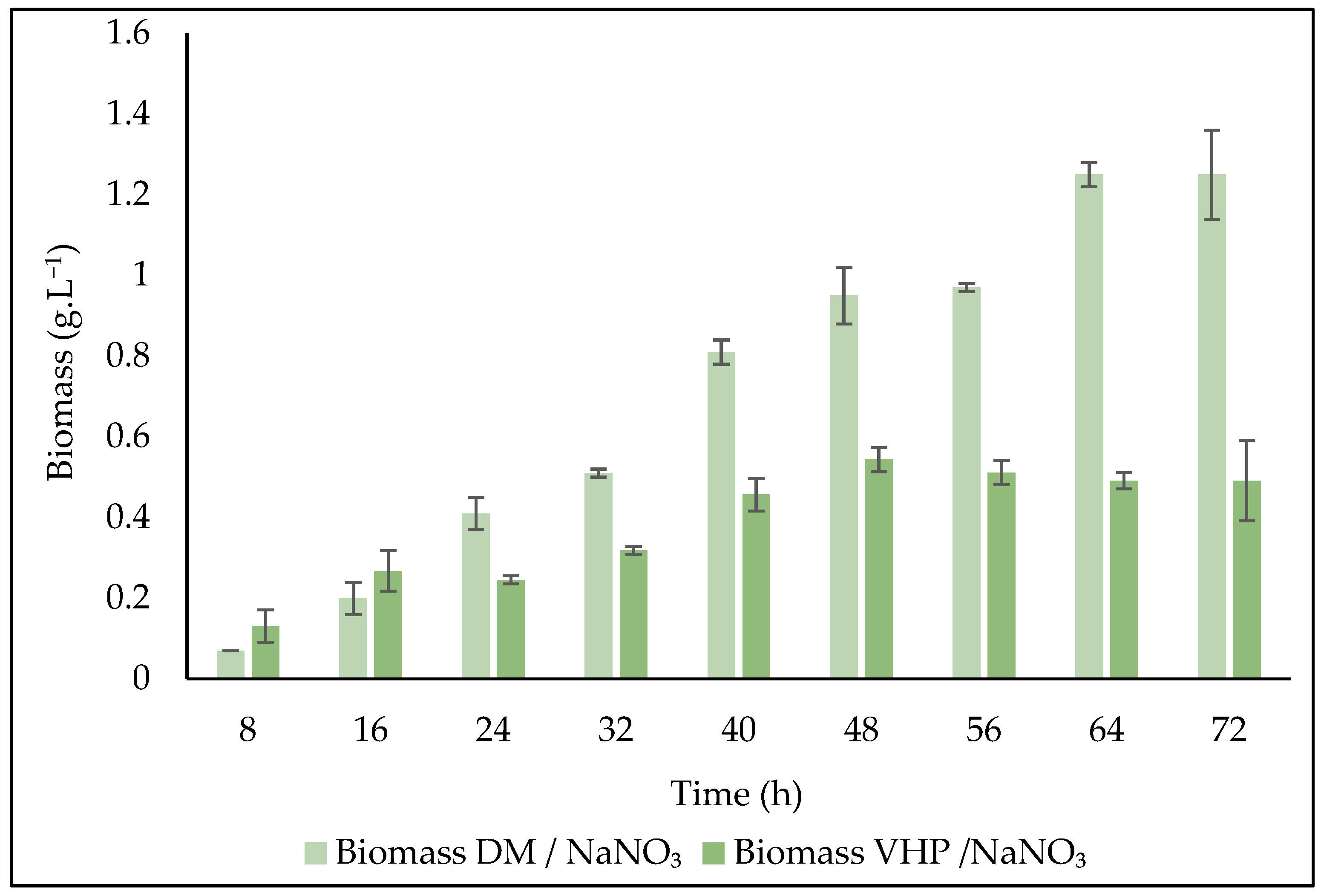
The influence of carbon sources on fungal growth and extracellular enzyme production is shown in Figure 1. DM promoted significantly higher biomass formation compared to Very High Polarization (VHP) sugar, with maximum yields 2.24-fold greater than those obtained with VHP.
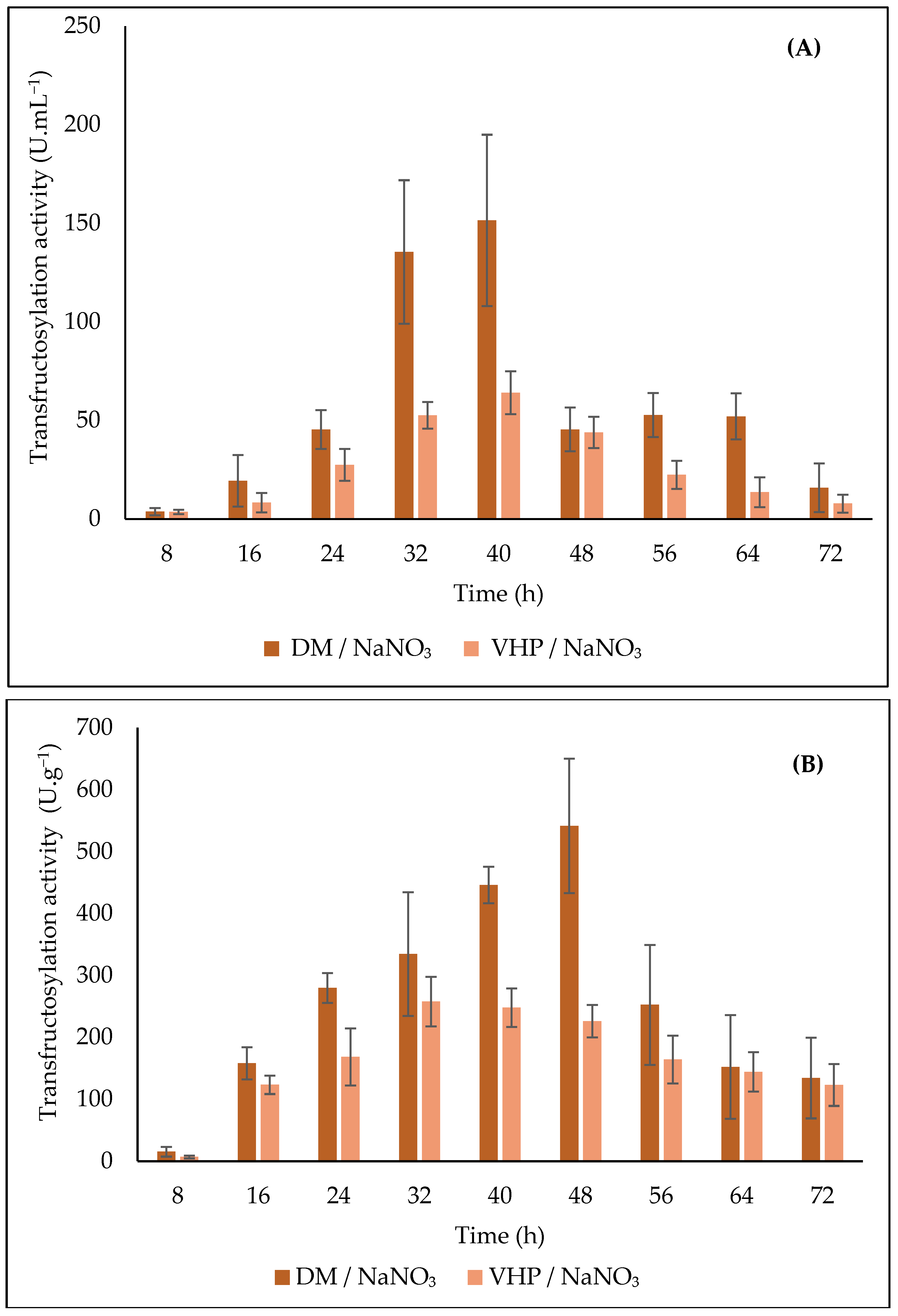
Regarding extracellular FTase synthesis, both substrates induced peak activities at 40 h; however, DM achieved a markedly higher value (151.45 U·mL−1) compared to VHP (64.06 U·mL−1) (Figure 2A). The pH profiles also differed between media: in DM-supplemented cultures, pH increased from 5.9 to 7.8, reaching 7.2 at the AT peak (40 h), whereas in VHP cultures, pH varied more narrowly (5.7–6.4), with 6.3 recorded at the time of maximum activity.
The effect of DM and VHP sugars on intracellular AT was assessed in relation to biomass formation. Biomass concentrations reached 1.1 g·L−1 in the DM medium and 0.43 g·L−1 in the VHP medium. Maximum intracellular AT activity was observed at 541.6 U·g−1 in DM after 48 h of cultivation, while VHP reached 257.9 U·g−1 at 32 h, highlighting the superior efficiency of DM in inducing intracellular activity (Figure 2B). pH variation in the DM medium ranged from 5.9 to 7.8, with 7.2 recorded at 48 h during the AT peak. In contrast, the VHP medium varied from 5.7 to 6.4, with 6.3 observed at 32 h during maximum activity.
Statistical analyses confirmed these trends. For extracellular AT, DM showed no significant differences between 32 and 40 h (p = 0.5048; F = 0.4787), and VHP also showed no significant differences (p = 0.05287; F = 4.819), as validated by Tukey’s test. For intracellular AT, DM presented no significant differences between 40 and 48 h (p = 0.06425; F = 4.325), whereas VHP exhibited a statistically significant increase between 24 and 32 h (p = 0.005; F = 12.81), confirmed by Tukey’s test.
The results obtained with DM sugar demonstrated its high efficiency in inducing both extracellular and intracellular enzyme production. In addition to promoting cellular growth, DM appeared to favor metabolic channeling toward enzymatic biosynthesis, possibly by modulating the gradual release of monosaccharides following sucrose hydrolysis. This controlled availability may have helped minimize catabolic repression effects, which are commonly associated with high glucose concentrations, thereby enabling greater expression of carbohydrate-metabolizing enzymes, including FTase. Thus, the findings suggest that DM acted not only as an energy source but also as a regulatory element of fungal metabolism, enhancing enzymatic expression under the evaluated conditions.

3.2. Impact of Nitrogen Sources on the Trade-Off Between Extracellular and Intracellular Biomass and FTase Activity

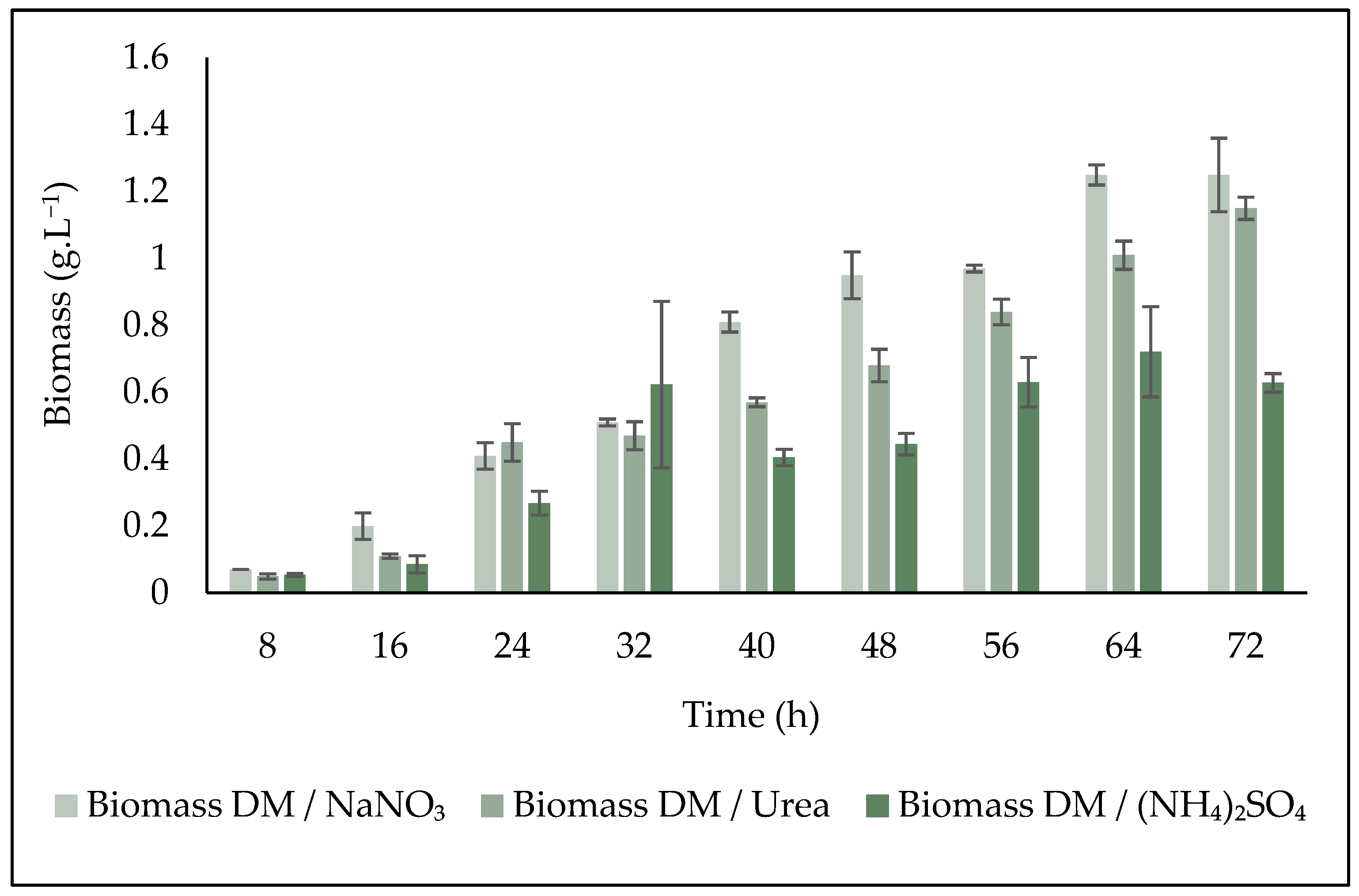
The interaction between DM sugar and the evaluated nitrogen sources (NaNO3, (NH4)2SO4, and urea) showed a significant influence on biomass formation. Among all conditions tested, NaNO3 supported the highest level of cell production, reaching a maximum biomass concentration of 1.25 g·L−1 (Figure 3). This result highlights nitrate as the most favorable nitrogen source for the growth of A. oryzae IPT-301 and for overall enzymatic performance under the experimental conditions assessed.
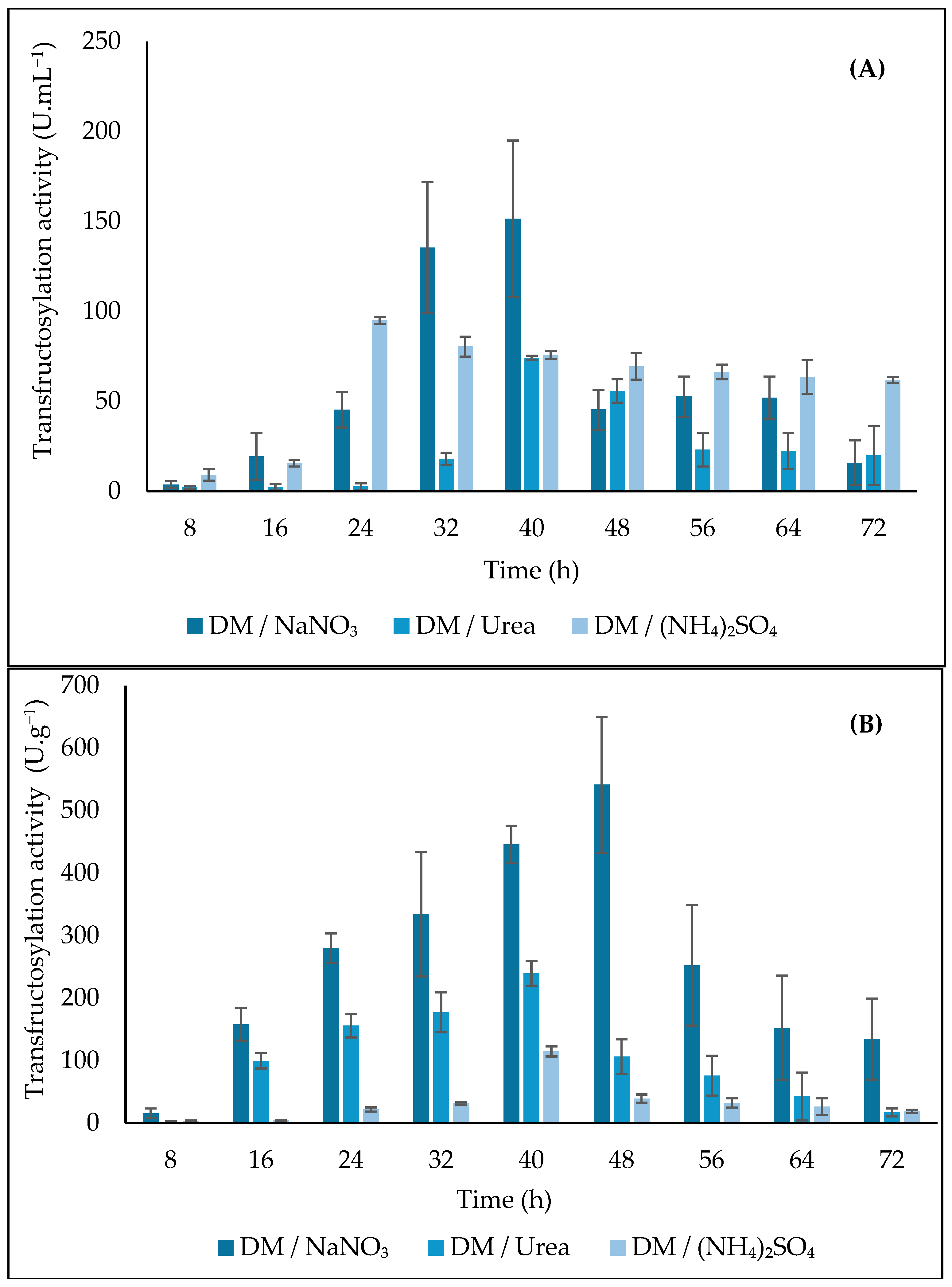
Regarding enzymatic production, NaNO3 also yielded the superior extracellular AT, peaking at 151.45 U·mL−1 after 40 h. This value was 1.59 and 2.0 times higher than those obtained with (NH4)2SO4 and urea, respectively, at the same fermentation interval. The pH profile during fermentation was intrinsically associated with the nitrogen source. At the point of maximum extracellular AT, the measured pH values were 7.2 for NaNO3, 5.5 for (NH4)2SO4, and 4.8 for urea (Figure 4A,B).
Similarly, the evaluation of intracellular AT over 72 h confirmed NaNO3 as the most effective nitrogen source. The peak intracellular activity for NaNO3 occurred at 48 h (541.6 U·g−1), while urea (239.8 U·g−1) and (NH4)2SO4, (114.8 U·g−1) reached their maxima earlier, at 40 h. The pH dynamics also varied significantly: in the NaNO3 medium, the pH increased from an initial 5.9 to a final 7.8, stabilized at 7.2 during the intracellular AT peak. Conversely, the (NH4)2SO4 medium showed a drop to 4.6 at the 40 h peak, while the urea-supplemented medium exhibited a wider range, shifting from 7.3 to 3.9, with a pH of 4.8 recorded at the period of maximum activity.
The variation in pH observed during fermentation was directly associated with the metabolic pathway involved in nitrogen source assimilation. Cultures supplemented with NaNO3 showed a progressive alkalinization of the medium (final pH ≈ 7.8), a behavior typically attributed to nitrate reduction to ammonium, a process that involves proton (H+) consumption and/or hydroxyl ion (OH) release. The shift toward near-neutral pH values coincides with the reported stability range of FTase for this strain, reducing protein denaturation during cultivation and favoring catalytic activity.
In contrast, the use of (NH4)2SO4 and urea resulted in marked acidification of the medium (final pH 4.6–4.8). This decrease in pH can be attributed to proton release during NH4+ assimilation and to urea hydrolysis, which contributes to acid–base imbalance in the culture medium. Such acidic conditions may negatively affect the structural integrity of the enzyme, explaining the significant reduction in AT observed under these conditions.
Furthermore, pH values closer to neutrality (~7.2) not only reflect improved enzymatic stability but also suggest a more favorable metabolic state for cellular synthesis and secretion of FTase, reinforcing the influence of nitrogen source metabolism on enzyme production.
Statistical analyses revealed distinct effects of nitrogen sources associated with DM sugar on AT. For extracellular AT, (NH4)2SO4 showed no significant difference between 32 and 40 h (p = 0.4931; F = 0.5636), whereas urea exhibited a significant difference between 40 and 48 h (p = 0.008359; F = 23.49). Regarding intracellular AT, a statistically significant effect of (NH4)2SO4 was observed between 40 and 48 h (p = 0.0003632; F = 125.2), as well as of urea between 32 and 40 h (p = 0.04255; F = 8.621), according to ANOVA followed by Tukey’s post hoc test.

3.3. Morphological Characteristics of Aspergillus oryzae IPT-301 Growth Under Different Carbon Sources

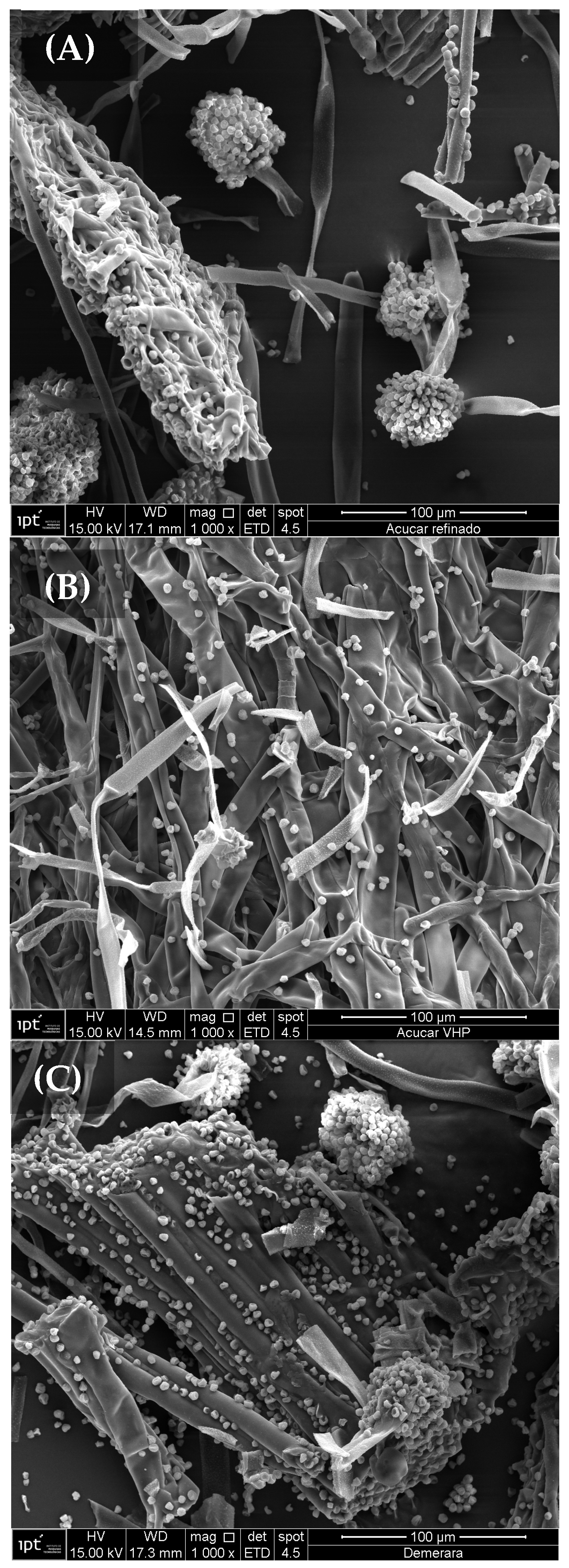
The morphological and ultrastructural attributes of A. oryzae IPT-301 were rigorously characterized via Scanning Electron Microscopy (SEM) to delineate the differential impacts of distinct carbon sources (refined—RF, DM, and VHP) on fungal biomass development and hyphal morphogenesis. RF sugar, conventionally established as the canonical substrate for FTase biosynthesis, was employed as the experimental control to enable a systematic interrogation of the morphophysiological responses elicited by DM and VHP supplementation. SEM micrographs (Figure 5) revealed that fungal growth on R (Figure 5A) and VHP (Figure 5B) was morphologically comparable, both exhibiting standard hyphal elongation and branching patterns. In contrast, the use of Demerara (DM) sugar (Figure 5C) resulted in the formation of a markedly thicker and more compact mycelial matrix, evidencing its superior structural robustness and compositional adequacy in sustaining fungal propagation. The SEM images revealed that DM sugar induces a thicker and more branched mycelial structure. This morphological change is directly correlated with higher enzymatic yields, as the complex nutrients in DM may support a more robust secretory pathway in A. oryzae.

4. Discussion

4.1. Comparative Analysis of FTase Production and Carbon Source Efficiency

In this study, RF sugar was exclusively employed as an experimental control for Scanning Electron Microscopy (SEM) analysis, serving as a high-purity baseline substrate commonly used in FTase production studies. For the enzymatic production assays, sucrose and NaNO3 were adopted as reference substrates, following established protocols for Aspergillus oryzae IPT-301 [18,36,37]. The performance of DM and VHP sugars was evaluated through direct comparison with sucrose-based systems extensively documented in the literature, in which sucrose remains the standard carbon source for FTase biosynthesis.
Notably, Cunha et al. [36] employed the same substrate concentration (150 g·L−1 of sucrose) under comparable fermentation conditions, varying only the nature of the carbon source. This methodological consistency provides a reliable framework for comparison with the present study, which likewise utilized 150 g·L−1 of DM or VHP sugars. Although refined sucrose was not included as an internal control in the fermentation assays, the operational parameters closely reproduce those described by Cunha et al. [36], thereby enabling a robust comparative assessment of these alternative substrates.
The central hypothesis of this work was that sugarcane-derived substrates with lower degrees of refining may outperform highly purified sugar due to their greater nutritional complexity. These substrates retain residual minerals and minor bioactive constituents that can positively modulate fungal metabolism and potentially enhance FTase synthesis. This assumption is supported by comparative analysis with previously reported data. Cunha et al. [36] observed a maximum biomass concentration of 9.35 ± 1.26 g·L−1 at 48 h and a peak extracellular FTase activity (AT) of 19.76 ± 1.82 U·mL−1 at 64 h using sucrose as the carbon source. In contrast, other studies employing sucrose as the sole carbon source for Aspergillus and Penicillium species reported extracellular AT values ranging from 31 to 35 U·mL−1 [20], while P. aurantiogriseum reached 72 U·mL−1 only after a substantially longer incubation period of 144 h [41].
Physical and nutritional parameters are widely recognized as critical determinants of FTase production. For example, Belorkar et al. [42] achieved 36.05 U·mL−1 of FTase activity after four days using a medium supplemented with sucrose and beef extract, highlighting the influence of additional nitrogen sources and growth factors. Similarly, Fernandez et al. [38] reported biomass and extracellular AT values of 7.39 g·L−1 and 5.2 U·mL−1, respectively, at 72 h using A. oryzae IPT-301. A broader comparison of extracellular FTase activities reported in recent studies is presented in Table 1, which includes different carbon sources and fungal strains. As shown, enzyme production varies substantially depending on the microorganism and substrate employed. Notably, the extracellular activity obtained with DM sugar in the present study exceeds most values reported for sucrose-based systems, reinforcing the biotechnological potential of partially refined sugarcane substrates.
Recently, Wu et al. [43] evaluated different carbon and nitrogen sources to optimize the production of fructosyltransferase (FTase) by A. niger FS054. Among the tested substrates, sucrose was the most efficient carbon source, promoting higher enzymatic activity. Regarding nitrogen sources, yeast extract showed the best performance among organic sources, while NH4Cl was the most suitable inorganic source. Under conditions optimized by response surface methodology, fermentation conducted for approximately 48 h resulted in a total FTase activity close to 3422 U·L−1, with a predominance of the extracellular fraction over the intracellular one.
Table 1. Comparison of extracellular FTase activity reported in the literature under different carbon sources and cultivation times.
Carbon SourceMicroorganismFermentation Time (h)Extracellular FTase Activity (U·mL−1)Reference
SucroseAspergillus oryzae IPT-3016412.22[36]
SucroseAspergillus oryzae IPT-3014012.34[44]
SucroseTalaromyces islandicus9631–35[20]
SucrosePenicillium aurantiogriseum14472.00[41]
Very High Polarization sugar (VHP)Aspergillus oryzae IPT-3014864.06This study
Demerara sugar (DM)Aspergillus oryzae IPT-30148151.45This study
Regarding intracellular activity, optimization of sucrose, urea, and yeast extract concentrations yielded FTase activities ranging from 183.38 to 819.52 U·g−1 [37]. Cunha et al. [36] recorded a maximum intracellular AT of 524.55 ± 177.10 U·g−1 at 72 h, whereas Ganaie et al. [20] reported an intracellular AT of 197.10 U·g−1 using sugarcane bagasse. A comparative overview of intracellular FTase activities reported under different carbon sources is presented in Table 2, which highlights the influence of substrate composition on enzyme biosynthesis across distinct fungal species and cultivation strategies.
In comparison, the present study achieved intracellular FTase activity levels 2.75- and 1.31-fold higher than those obtained with sugarcane bagasse [20] when DM and VHP sugars were used, respectively. The advantage of these substrates is further evidenced when compared with other agro-industrial residues. Lateef et al. [45] reported a peak intracellular AT of only 27.77 U·g−1 after 144 h using a sucrose medium supplemented with banana peel. As shown in Table 3, the intracellular activity obtained with DM sugar (541.60 U·g−1) not only exceeds values reported for sugarcane bagasse [20] and A. niger cultivated on sucrose [43], but also approaches the higher levels observed with wheat bran as substrate [46]. In contrast, the optimal intracellular FTase activity in the present study was achieved at 48 h using DM sugar (Figure 2B), indicating both enhanced productivity and a substantially shorter fermentation time.
Table 2. Comparison of intracellular FTase activity reported under different carbon sources.
Carbon SourceMicroorganismFermentation Time (h)Intracellular FTase Activity (U·g−1)Reference
DMA. oryzae IPT-30148541.60This study
SucroseA. oryzae IPT-30172524.55[36]
SucroseA. carbonarius72111.70[47]
SugarcaneAspergillus flavus96197.10[20]
VHPA. oryzae IPT-30148257.92This study
Wheat branA. tamarii72662.75[46]
The superior performance observed with DM sugar is likely associated with its residual mineral fraction and minor bioactive components, whose concentrations are presented in Table 3 (adapted from Sampaio [32]). DM sugar contains higher levels of macro- and micronutrients (Ca, Fe, K, and Mg), as well as phenolic compounds, flavonoids, and carotenoids compared to RF. These constituents may function as metabolic modulators, enhancing cofactor availability, improving cellular redox balance, and promoting more efficient carbon flux toward FTase biosynthetic pathways. Such compositional complexity, largely absent in high RF, may partially explain both the increased intracellular activity and the reduced time required to reach peak production. Collectively, the strong agreement between the present findings and the literature consolidates DM sugar as a highly efficient and economically attractive carbon source for FTase production, offering advantages over standard sucrose-based systems traditionally employed.
Table 3. Macro- and micronutrient concentrations and bioactive compound contents in refined (RF) and Demerara (DM) sugars. Adapted from Sampaio et al. [32].
CategoryCompoundRF SugarDM SugarUnit
Macronutrients
Micronutrients
Calcium (Ca)39.9067.80mg·kg−1
Iron (Fe)1.492.99mg·kg−1
Potassium (K)42.10182.55mg·kg−1
Magnesium (Mg)7.6037.50mg·kg−1
Bioactive CompoundsPhenolic compounds3.9111.92mg·100 g−1
Total flavonoid content0.631.78mg·100 g−1
Total carotenoids0.590.91mg·100 g−1

4.2. Comparative Analysis of FTase Production and Nitrogen Source Efficiency

The findings of this study demonstrate that replacing sucrose with DM sugar as the primary carbon source significantly enhanced extracellular AT. Among the nitrogen sources evaluated in combination with DM sugar, NaNO3 was identified as the most effective for promoting extracellular AT, followed by (NH4)2SO4 and urea. The effectiveness of NaNO3 as a nitrogen source is consistent with the findings of Farid et al. [41], that reported that the combination of sucrose and NaNO3 optimized the production of FTase in P. aurantiogriseum. Nascimento et al. [47] used the fungus A. carbonarius PC-4, which exhibits predominantly extracellular production of FTase activity, facilitating its direct industrial application from the culture supernatant. During the screening of nitrogen sources over a 72 h period, NaNO3 stood out with the highest AT (24.36 U·mL−1), while NH4Cl and yeast extract reached 19.26 U·mL−1 and 21.11 U·mL−1, respectively. Although A. carbonarius PC-4 also presents intracellular activity, the authors focused on the secreted fraction due to its high AT/Ah ratio, which minimizes unwanted sucrose hydrolysis and optimizes the synthesis of fructooligosaccharides (FOS).
Similarly, Sun et al. [48] observed that NaNO3 provided more robust results for protease synthesis in Trichoderma reesei compared to (NH4)2SO4. The biochemical basis for this preference may lie in the metabolic pathways of nitrate assimilation. As highlighted by Pastore et al. [49], while ammonia is typically the most readily assimilated nitrogen form, fungi possessing nitrate and nitrite reductase enzymes exhibit high metabolic flexibility. These enzymes allow the efficient conversion of nitrate into nitrite and subsequently into ammonia, supporting essential metabolic processes and adaptation to diverse substrates. Furthermore, nitrogen availability is a key regulator of secondary metabolism in filamentous fungi. Tudzynski [35] highlighted that, in response to variability in nitrogen availability, fungi can modulate the expression of specific genes, thereby activating or repressing metabolic pathways associated with the production of bioactive compounds such as toxins, pigments, and enzymes. In filamentous fungi, nitrogen availability plays a pivotal role in the regulation of secondary metabolism. While (NH4)2SO4 provides nitrogen rapidly in the form of NH4+, urea requires prior metabolization to release nitrogen for fungal utilization. These differences in nitrogen form and availability can exert a significant impact on the regulation of genes involved in secondary metabolism, directly influencing enzyme production. These findings are further contextualized in Table 4, which compiles and compares studies evaluating the influence of different nitrogen sources on FTase activity across a range of microorganisms.
Table 4. Comparison of FTase activity reported under different nitrogen sources.
Nitrogen SourceMicroorganismsFermentation Time (h)Extracellular FTase Activity (U·mL−1)Reference
Yeast extract (0.5%)
+
NH4Cl (0.5%)
Aspergillus niger4824.49[45]
Soybean protein (0.2%)
NH4NO3 (0.2%)
NH4Cl (0.2%)
Yeast extract (0.5%)
Aspergillus carbonarius168
120
120
120
44.40
24.00
21.40
17.80
[47]
Yeast extract (0.2%)
+
NaNO3 (2%)
+
NH4Cl (0.5%)
Fusarium verticillioides9618.92[50]
Recent evidence, including the findings of the present study, reinforces that nitrogen sources exert a direct and decisive influence on intracellular activity and FTase production. Wu et al. [43] reported that the use of NaNO3 in A. niger cultures resulted in a high intracellular activity of 2300.00 U·g−1, surpassing urea (2000.00 U·g−1) and ammonium sulfate (1500.00 U·g−1). In a similar manner, the data obtained here for A. oryzae IPT-301 showed that (NH4)2SO4 also promoted the highest intracellular activity (541.00 U·g−1), with a positive impact on AT. Our results align with those of Ottoni et al. [37], who identified urea and NaNO3 as effective nitrogen sources for AT when sucrose was used as the carbon source, although a notable discrepancy was observed regarding (NH4)2SO4. While Ottoni et al. [37] reported a reduction in AT with ammonium sulfate, the present study found that (NH4)2SO4 promoted higher extracellular activity than urea. This divergence is supported by the findings of Alegre et al. [51], who demonstrated that in A. caespitosus, (NH4)2SO4 can reduce intracellular enzyme activity by 60% while simultaneously increasing extracellular production by 20%. Together, these observations suggest that enzymatic response is highly sensitive to the synergy between carbon and nitrogen sources and to the cellular localization of the enzyme. As noted by Aita et al. [52], Merino et al. [53], and Marraiki et al. [54], precise nutrient balance and an appropriate C/N ratio are critical, as excess nitrogen or chemical imbalances can alter medium pH, compromising microbial activity and the overall stability of enzymatic yield.

4.3. Morphophysiological Plasticity of Aspergillus oryzae IPT-301: Impact of Carbon Sources on Mycelial Architecture

SEM analyses demonstrated that A. oryzae IPT-301 exhibits pronounced morphophysiological plasticity in response to the carbon source. While RF and VHP sugars supported typical filamentous growth with elongated hyphae and random branching, DM sugar induced a denser and more organized mycelial architecture. This compact morphology is associated with improved biomass distribution and an increased number of hyphal apices, enhancing the effective secretory surface area and, consequently, extracellular enzymatic activity. Additionally, the nutritional complexity of DM sugar, likely containing trace minerals and organic nitrogen, may support secondary metabolism and enzyme biosynthesis. Together, these effects highlight DM sugar as an effective substrate and morphogenetic inducer, optimizing fungal architecture for enhanced bioprocess performance and FOS production [55,56].

5. Conclusions

The present study demonstrates that formulating the culture medium with DM sugar and NaNO3 constitutes a highly effective strategy for enhancing FTase production by A. oryzae IPT-301. The superior or comparable transfructosylation activities achieved with DM, relative to sucrose, reinforce its suitability as an alternative carbon source. Likewise, the remarkable performance of NaNO3 highlights its strategic role in promoting enzyme biosynthesis. Beyond their metabolic relevance, the combined use of DM and NaNO3 represents a rational and economically advantageous approach that can substantially improve the feasibility of large-scale FTase production and FOS manufacturing. By integrating technical performance with cost-effectiveness, this formulation addresses key industrial demands for sustainable and competitive bioprocesses. These findings strengthen the premise that unconventional and low-cost substrates can be successfully incorporated into high-value enzyme production systems, contributing to the advancement of industrial biotechnology and process sustainability. It is important to emphasize, however, that the superior performance of NaNO3 was observed at the nitrogen concentration of 5.0 g·L−1 used in this experimental design. Therefore, further optimization studies exploring different nitrogen levels and cultivation parameters are essential to validate and expand the scalability and robustness of this strategy.

Author Contributions

Conceptualization, R.F.P. and C.A.O.; methodology, A.P.S.C., M.F.M.C., A.C.V. and M.L.A.N.T.; validation, S.A.V.M., A.E.M. and R.F.P.; formal analysis, R.F.P., C.A.O., M.F.S., S.A.V.M. and A.E.M.; investigation, A.P.S.C., M.F.M.C., A.C.V. and M.L.A.N.T.; data curation, A.P.S.C., M.F.M.C., M.F.S., A.C.V., A.F.d.A. and M.L.A.N.T.; writing—original draft preparation, A.P.S.C., M.F.M.C., S.A.V.M., A.E.M., M.F.S., R.F.P. and C.A.O.; writing—review and editing, A.P.S.C., M.F.M.C., R.F.P., M.F.S. and C.A.O.; visualization, S.A.V.M., A.F.d.A., A.E.M., R.F.P. and C.A.O.; supervision, R.F.P. and C.A.O.; project administration, R.F.P. and C.A.O.; funding acquisition, R.F.P. and C.A.O. All authors have read and agreed to the published version of the manuscript.

Funding

This research was supported by the São Paulo Research Foundation (FAPESP; grants #2020/12867-2), the Conselho Nacional de Desenvolvimento Científico e Tecnológico (CNPq; grants #421122/2023-4; #404912/2021-4; and #408782/2024-2), and the Science and Technology Development Fund (FDCT), Macau SAR (Projects No. 0033/2024/ITP1 and No. 0013/2025/ASJ).

Data Availability Statement

All the data are enclosed in the manuscript.

Acknowledgments

C.A.O. acknowledges support from the National Council for Scientific and Technological Development (CNPq; grant #313031/2025-8). R.F.P. thanks Minas Gerais Research Foundation (FAPEMIG; grants #APQ-00085-21; #APQ-00793-24; and #BPD-00030-22) and CNPq (grants #403007/2025-9 and #305029/2024-0). A.P.S.C. and M.F.M.C. acknowledge financial support from the Coordination for the Improvement of Higher Education Personnel (CAPES, grants #88887.176508/2025-00 and #88887.176508/2025-00).

Conflicts of Interest

The authors declare no conflicts of interest.

Abbreviations

The following abbreviations are used in this manuscript:
ATTransfructosylation activity
DMDemerara
FFaseβ-fructofuranosidase
FOSFructooligosaccharides
FTaseFructosyltransferase
SmFSubmerged fermentation
SSFSolid-state fermentation
VHPVery High Polarization

References

  1. Jena, R.; Choudhury, P.K. Unveiling Probiotic and Prebiotic Functional Dairy Foods: A Health Beneficial Outlook. 3 Biotech 2025, 15, 175. [Google Scholar] [CrossRef] [PubMed]
  2. Saedi, S.; Derakhshan, S.; Hasani, A.; Khoshbaten, M.; Poortahmasebi, V.; Milani, P.G.; Sadeghi, J. Recent Advances in Gut Microbiome Modulation: Effect of Probiotics, Prebiotics, Synbiotics, and Postbiotics in Inflammatory Bowel Disease Prevention and Treatment. Curr. Microbiol. 2025, 82, 12. [Google Scholar] [CrossRef] [PubMed]
  3. Cunningham, M.; Azcarate-Peril, M.A.; Barnard, A.; Benoit, V.; Grimaldi, R.; Guyonnet, D.; Hannah, D.H.; Hunter, K.; Manurung, S.; Obis, D.; et al. Shaping the Future of Probiotics and Prebiotics. Trends Microbiol. 2021, 29, 667–685. [Google Scholar] [CrossRef] [PubMed]
  4. Singh, P.; Gupta, S.K.; Kundu, A.; Grover, M.; Saha, S. Role of Fructooligosaccharides in Promoting Beneficial Gut Bacteria: A Prebiotic Perspective. Food Biosci. 2025, 63, 105726. [Google Scholar] [CrossRef]
  5. Echegaray, N.; Yegin, S.; Kumar, M.; Hassoun, A.; Campagnol, P.C.B.; Lorenzo, J.M. Application of Oligosaccharides in Meat Processing and Preservation. Crit. Rev. Food Sci. Nutr. 2023, 63, 10947–10958. [Google Scholar] [CrossRef]
  6. Sudha, M.L.; Soumya, C.; Saravanan, M.; Madhushree, P.; Singh, J.; Roy, S.; Prabhasankar, P. Influence of Short Chain Fructo-oligosaccharide (SC-FOS) on the Dough Rheological, Microstructural Properties and Bread Quality During Storage. LWT Food Sci. Technol. 2022, 158, 113102. [Google Scholar] [CrossRef]
  7. de la Rosa, O.; Pérez, A.M.; Paz, J.E.W.; Muñiz-Márquez, D.B.; Flores-Gallegos, A.C.; Aguilar, C.N. Microbial Production of Fructooligosaccharides. In Microbial Production of Food Bioactive Compounds; Jafari, S.M., Darvishi Harzevili, F., Karaca, A.C., Eds.; Springer: Cham, Switzerland, 2025; pp. 541–567. [Google Scholar] [CrossRef]
  8. Bhadra, S.; Chettri, D.; Verma, A.K. Microbes in Fructooligosaccharides Production. Bioresour. Technol. Rep. 2022, 20, 101159. [Google Scholar] [CrossRef]
  9. Dias, G.S.; Vieira, A.C.; Baioni e Silva, G.; Simões, N.F.; Milessi, T.S.; Saraiva, L.S.; Xavier, M.D.C.A.; Longati, A.A.; Rodrigues, M.F.A.; Fernandes, S.; et al. Fructooligosaccharides: A Comprehensive Review on Their Microbial Source, Functional Benefits, Production Technology, and Market Prospects. Processes 2025, 13, 1252. [Google Scholar] [CrossRef]
  10. Nargotra, P.; Ortizo, R.G.G.; Wang, J.X.; Tsai, M.L.; Sun, P.P.; Dong, C.; Bajaj, B.K.; Kuo, C.H.; Sharma, V. Enzymes in the Bioconversion of Food Waste into Valuable Bioproducts: A Circular Economy Perspective. Syst. Microbiol. Biomanuf. 2024, 4, 850–868. [Google Scholar] [CrossRef]
  11. Guerra, L.; Ureta, M.; Romanini, D.; Woitovich, N.; Gómez-Zavaglia, A.; Clementz, A. Enzymatic Synthesis of Fructooligosaccharides: From Carrot Discards to Prebiotic Juice. Food Res. Int. 2023, 170, 112991. [Google Scholar] [CrossRef]
  12. Rawat, H.K.; Nath, S.; Sharma, I.; Kango, N. Recent Developments in the Production of Prebiotic Fructooligosaccharides using Fungal Fructosyltransferases. Mycology 2024, 15, 564–584. [Google Scholar] [CrossRef]
  13. Antosova, M.; Polakovic, M.; Stefuca, V. Fructosyltransferases: The enzymes catalyzing production of fructooligosaccharides. Chem. Pap. 2009, 63, 547–563. [Google Scholar]
  14. Rosa, O.; Muñiz-Márquez, D.B.; Contreras-Esquivel, J.C.; Wong-Paz, J.E.; Rodríguez-Herrera, R.; Aguilar, C.N. Improving the Fructooligosaccharides Production by Solid-State Fermentation. Biocatal. Agric. Biotechnol. 2020, 27, 101704. [Google Scholar] [CrossRef]
  15. Gonçalves, D.A.; González, A.; Roupar, D.; Teixeira, J.A.; Nobre, C. How Prebiotics Have Been Produced From Agro-Industrial Waste: An Overview of the Enzymatic Technologies Applied and the Models Used to Validate Their Health Claims. Trends Food Sci. Technol. 2023, 135, 74–92. [Google Scholar] [CrossRef]
  16. Veljković, M.; Stepanović, R.; Banjanac, K.; Ćorović, M.; Milivojević, A.; Simović, M.; Milivojević, M.; Bezbradica, D. Continuous Production of Fructo-Oligosaccharides Using Selectively Immobilized Fructosyltransferase from Aspergillus aculeatus A109. J. Ind. Eng. Chem. 2023, 117, 149–156. [Google Scholar] [CrossRef]
  17. Belmonte-Izquierdo, Y.; Salomé-Abarca, L.F.; González-Hernández, J.C.; López, M.G. Fructooligosaccharides (FOS) production by microorganisms with fructosyltransferase activity. Fermentation 2023, 9, 968. [Google Scholar] [CrossRef]
  18. Maiorano, A.E.; Silva, E.S.; Perna, R.F.; Ottoni, C.A.; Piccoli, R.A.M.; Fernandez, R.C.; Maresma, B.G.; Rodrigues, A.M.F. Effect of Agitation Speed and Aeration Rate on Fructosyltransferase Production of Aspergillus oryzae IPT-301 in Stirred Tank Bioreactor. Biotechnol. Lett. 2020, 42, 2619–2629. [Google Scholar] [CrossRef]
  19. Khatun, M.S.; Harrison, M.D.; Speight, R.E.; O’Hara, I.M.; Zhang, Z. Efficient Production of Fructo-Oligosaccharides From Sucrose and Molasses by a Novel Aureobasidium pullulan Strain. Biochem. Eng. J. 2020, 163, 107747. [Google Scholar] [CrossRef]
  20. Ganaie, M.A.; Soni, H.; Naikoo, G.A.; Oliveira, L.T.S.; Rawat, H.K.; Mehta, P.K.; Narain, N. Screening of Low Cost Agricultural Wastes to Maximize the Fructosyltransferase Production and its Applicability in Generation of Fructooligosaccharides by Solid State Fermentation. Int. Biodeter. Biodegr. 2017, 118, 19–26. [Google Scholar] [CrossRef]
  21. Chutrakul, C.; Panchanawaporn, S.; Vorapreeda, T.; Jeennor, S.; Anantayanon, J.; Laoteng, K. The Exploring Functional Role of Ammonium Transporters of Aspergillus oryzae in Nitrogen Metabolism: Challenges Towards Cell Biomass Production. Int. J. Mol. Sci. 2022, 23, 7567. [Google Scholar] [CrossRef]
  22. Jia, X.; Song, J.; Wu, Y.; Feng, S.; Sun, Z.; Hu, Y.; Yu, M.; Han, R.; Zeng, B. Strategies for the Enhancement of Secondary Metabolite Production Via Biosynthesis Gene Cluster Regulation in Aspergillus oryzae. J. Fungi 2024, 10, 312. [Google Scholar] [CrossRef]
  23. Lima, V.O.; Matugawa, U.M.E.; Mascarina, G.M.; Fernandes, É.E.E. Complex Nitrogen Sources From Agro-Industral by Products: Impact on Production, Multi-Stress Tolerance, Virulence, and Quality of Beauveria bassiana blastospores. Microbiol. Spectr. 2024, 12, 23. [Google Scholar] [CrossRef]
  24. Feng, Y.; Xu, T.; Wang, W.; Sun, S.; Zhang, M.; Song, F. Nitrogen Addition Changed Soil Fungal Community Structure and Increased the Biomass of Functional Fungi in Korean Pine Plantations in Temperate Northeast China. Sci. Total Environ. 2024, 927, 172349. [Google Scholar] [CrossRef] [PubMed]
  25. Hòa, N.P.K.; Tiên, L.T.T.; Hoa, P.T.C. Effect of Nitrogen Sources and Illumination Conditions on Ganoderma lucidum Submerged Culture. JST Eng. Technol. Sustain. Dev. 2023, 23, 16–21. [Google Scholar]
  26. Rosa, O.; Flores-Gallegos, A.C.; Muñíz-Márquez, D.; Contreras-Esquivel, J.C.; Teixeira, J.A.; Nobre, C.; Aguilar, C.N. Successive Fermentation of Aguamiel and Molasses by Aspergillus oryzae and Saccharomyces cerevisiae to Obtain High Purity Fructooligosaccharides. Foods 2022, 11, 1786. [Google Scholar] [CrossRef]
  27. Romano, N.; Santos, M.; Mobili, P.; Vega, R.; Gómez-Zavaglia, A. Effect of Sucrose Concentration on the Composition of Enzymatically Synthesized Short-Chain Fructo-oligosaccharides as Determined by FTIR and Multivariate Analysis. Food Chem. 2016, 202, 467–475. [Google Scholar] [CrossRef] [PubMed]
  28. Khatun, M.S.; Hassanpour, M.; Mussatto, S.I.; Harrison, M.D.; Speight, R.E.; O’Hara, I.M.; Zhang, Z. Transformation of sugarcane molasses into fructooligosaccharides with enhanced prebiotic activity using whole-cell biocatalysts from Aureobasidium pullulans FRR 5284 and an invertase-deficient Saccharomyces cerevisiae 1403-7A. Bioresour. Bioprocess. 2021, 8, 85. [Google Scholar] [CrossRef] [PubMed]
  29. Muñiz-Márquez, D.B.; Teixeira, J.A.; Mussatto, S.I.; Contreras-Esquivel, J.C.; Rodríguez-Herrera, R.; Aguilar, C.N. Fructo-oligosaccharides (FOS) Production by Fungal Submerged Culture Using Aguamiel as a Low-Cost by Product. LWT Food Sci. Technol. 2019, 102, 75–79. [Google Scholar] [CrossRef]
  30. Cabral, M.M.S.; Almeida, Y.M.B.; Andrade, S.A.C.; Caldas, C.S.; Freitas, J.D.; Costa, C.A.C.B.; Solotti, J.I. Influence of Phenolic Compounds on Color Formation at Different Stages of the VHP Sugar Manufacturing Process. Sci. Rep. 2022, 12, 19922. [Google Scholar] [CrossRef]
  31. Curi, P.N.; Carvalho, C.S.; Salgado, D.L.; Pio, R.; Pasqual, M.; Souza, F.B.M.; Souza, V. Influence of Different Types of Sugars in Physalis Jellies. Food Sci. Technol. 2017, 3, 349–355. [Google Scholar] [CrossRef]
  32. Sampaio, M.R.F.; Lisboa, M.T.; Timm, J.C.; Ribeiro, A.S.; Otero, D.M.; Zambiazi, R.C.; Vieira, M.A. Multielemental Determination in Sugarcane Products from the Southern Region of Brazil by Microwave Induced Plasma Optical Emission Spectrometry After Acid Decomposition with Reflux System. Anal. Methods 2020, 12, 1360–1367. [Google Scholar] [CrossRef]
  33. Larosa, C.P.; Balthazar, C.F.; Guimarães, J.T.; Margalho, L.P.; Lemos, F.S.; Oliveira, F.L.; Abud, Y.K.D.; Sant’Anna, C.; Duarte, M.C.K.H.; Granato, D.; et al. Can Sucrose-Substitutes Increase the Antagonistic Activity Against Food borne Pathogens, and Improve the Technological and Functional Properties of Sheep Milk Kefir? Food Chem. 2021, 351, 129290. [Google Scholar] [CrossRef] [PubMed]
  34. Han, S.; Ye, T.; Leng, S.; Pan, L.; Zeng, W.; Chen, G.; Liang, Z. Purification and Biochemical Characteristics of a Novel Fructosyltransferase With a High FOS Transfructosylation Activity from Aspergillus oryzae S719. Protein Expr. Purif. 2020, 167, 105549. [Google Scholar] [CrossRef] [PubMed]
  35. Tudzynski, B. Nitrogen Regulation of Fungal Secondary Metabolism in Fungi. Front. Microbiol. 2014, 5, 656. [Google Scholar] [CrossRef]
  36. Cunha, J.S.; Ottoni, C.A.; Morales, S.A.V.; Silva, E.S.; Maiorano, A.E.; Perna, R.F. Synthesis and Characterization of Fructosyltransferase from Aspergillus oryzae IPT-301 for High Fructooligosaccharides Production. Braz. J. Chem. Eng. 2019, 36, 657–658. [Google Scholar] [CrossRef]
  37. Ottoni, C.A.; Cuervo-Fernández, R.; Piccoli, R.M.; Moreira, R.; Guilarte-Maresma, B.; Silva, E.S.; Rodrigues, M.F.A.; Maiorano, A.E. Media Optimization for β-Fructofuranosidase Production by Aspergillus oryzae. Braz. J. Chem. Eng. 2012, 29, 49–59. [Google Scholar] [CrossRef]
  38. Fernandez, R.C.; Ottoni, C.A.; Silva, E.S.; Matsubara, R.M.; Carter, J.M.; Magossi, L.R.; Wada, M.A.; Rodrigues, M.F.A.; Maresma, B.G.; Maiorano, A.E. Screening of β-Fructofuranosidase-Producing Microorganisms and Effect of pH and Temperature on Enzymatic Rate. Appl. Microbiol. Biotechnol. 2007, 75, 87–93. [Google Scholar] [CrossRef]
  39. Gonçalves, M.C.P.; Morales, S.A.V.; Silva, E.S.; Maiorano, A.E.; Perna, R.F.; Kieckbusch, T.G. Entrapment of glutaraldehyde-crosslinked cells from Aspergillus oryzae IPT-301 in calcium alginate for high transfructosylation activity. J. Chem. Technol. Biotechnol. 2020, 95, 2473–2788. [Google Scholar] [CrossRef]
  40. Miller, G.L. Use of dinitrosalicylic acid reagent for determination of reducing sugar. Anal. Chem. 1959, 31, 426–428. [Google Scholar] [CrossRef]
  41. Farid, M.; Zinat, K.; Elsayed, E.; Azza, E. Optimization of medium composition and cultivation parameters for fructosyltransferase production by Penicillium aurantiogriseum AUMC 5605. J. Appl. Biol. Chem. 2015, 58, 209–218. [Google Scholar] [CrossRef]
  42. Belorkar, S.A.; Gupta, A.; Rai, V. Enhancement of extracellular fructosyltransferase production by Aspergillus stallus through batch fermentation. J. Pure Appl. Microbiol. 2016, 10, 649–655. [Google Scholar] [CrossRef]
  43. Wu, Y.; Zhang, Y.; Zhong, X.; Xia, H.; Zhou, M.; He, W.; Zheng, Y. Optimization of the Fermentation Process for Fructosyltransferase Production by Aspergillus niger FS054. Microb. Cell Fact. 2025, 24, 173. [Google Scholar] [CrossRef]
  44. Perna, R.; Cunha, J.; Gonçalves, M.; Basso, R.; Silva, E.; Maiorano, A. Microbial Fructosyltransferase: Production by Submerged Fermentation and Evaluation of pH and Temperature Effects on Transfructosylation and Hydrolytic Enzymatic Activities. Int. J. Eng. Res. Sci. 2018, 4, 43–50. [Google Scholar]
  45. Lateef, A.; Oloke, J.; Gueguim-Kana, E.B.; Raimi, O.R. Production of fructosyltransferase by a local isolate of Aspergillus niger in both submerged and solid substrate media. Acta Aliment. 2012, 40, 100–117. [Google Scholar] [CrossRef]
  46. Batista, J.M.S.; Brandão, C.R.M.P.; Cunha, M.N.C.; Rodrigues, H.O.S.; Porto, A.L.F. Purification and Biochemical Characterization of an Extracellular Fructosyltransferase-Rich Extract Produced by Aspergillus tamarii Kita UCP1279. Biocatal. Agric. Biotechnol. 2020, 26, 101647. [Google Scholar] [CrossRef]
  47. Nascimento, G.C.; Batista, R.D.; Santos, C.C.A.A.; Silva, E.M.; Paula, F.C.; Mendes, D.B.; Oliveira, D.P.; Almeida, A.F. β Fructofuranosidase and β-D-Fructosyltransferase from New Aspergillus carbonarius PC-4 Strain Isolated from Canned Peach Syrup: Effect of Carbon and Nitrogen Sources on Enzyme Production. Sci. World J. 2019, 2019, 6956202. [Google Scholar] [CrossRef]
  48. Sun, Y.; Qian, Y.; Zhang, J.; Wang, Y.; Li, X.; Zhang, W.; Wang, L.; Liu, H.; Zhong, Y. Extracellular protease production regulated by nitrogen and carbon sources in Trichoderma reesei. J. Basic. Microbiol. 2021, 61, 122–132. [Google Scholar] [CrossRef] [PubMed]
  49. Pastore, N.; Hasan, S.; Zempulski, D. Produção de ácido cítrico por Aspergillus niger: Avaliação de diferentes fontes de nitrogênio e de concentração de sacarose. Engevista 2011, 13, 149–159. [Google Scholar] [CrossRef][Green Version]
  50. Chavan, A.R.; Khardenavis, A.A. Annotating Multiple Prebiotic Synthesizing Capabilities Through Whole Genome Sequencing of Fusarium Strain HFK-74. Appl. Biochem. Biotechnol. 2024, 196, 4993–5012. [Google Scholar] [CrossRef] [PubMed]
  51. Alegre, A.C.P.; Polizeli, M.L.T.; Terenzi, H.F.; Jorge, J.A.; Guimarães, L.H.S. Production of thermostable invertases by Aspergillus caespitosus under submerged or solid state fermentation using agroindustrial residues as carbon source. Braz. J. Microbiol. 2009, 40, 612–622. [Google Scholar] [CrossRef]
  52. Aita, B.C.; Spannemberg, S.S.; Schmaltz, S.; Zabot, G.L.; Tres, M.V.; Kuhn, R.C.; Mazutti, M.A. Production of cell-wall degrading enzymes by solid-state fermentation using agroindustrial residues as substrates. J. Environ. Chem. Eng. 2019, 7, 103–193. [Google Scholar] [CrossRef]
  53. Merino, A.; Eibes, G.; Hormaza, A. Effect of copper and different carbon and nitrogen sources on the decolorization of an industrial dye mixture under solid-state fermentation. J. Clean. Prod. 2019, 237, 117–123. [Google Scholar] [CrossRef]
  54. Marraiki, N.; Vijayaraghavan, P.; Elgorban, A.M.; Dhas, D.S.D.; Alrashed, S.; Yassin, M.T. Low cost feedstock for the production of endoglucanase in solid state fermentation by Trichoderma hamatum NGL1 using response surface methodology and saccharification efficacy. J. King Saud. Univ. Sci. 2020, 12, 1718–1724. [Google Scholar] [CrossRef]
  55. Bhargava, S.; Wenger, K.S.; Marten, M.R. Pulsed addition of limiting-carbon during Aspergillus oryzae fermentation leads to improved productivity of a recombinant enzyme. Biotechnol. Bioeng. 2003, 5, 82. [Google Scholar] [CrossRef]
  56. Tavares, P.P.L.G.; Mamona, C.T.P.; Nascimento, R.Q.; dos Anjos, E.A.; de Souza, C.O.; Almeida, R.C.C.; Mamede, M.E.O.; Magalhães-Guedes, K.T. Non-Conventional Sucrose-Based Substrates: Development of Non-Dairy Kefir Beverages with Probiotic Potential. Fermentation 2023, 9, 384. [Google Scholar] [CrossRef]
Figure 1. Effect of the carbon sources Demerara (DM) and Very High Polarization (VHP) sugars on cell growth of Aspergillus oryzae IPT-301 during 72 h of cultivation. Data are expressed as mean ± standard deviation of triplicate experiments.
Processes 14 00840 g001
Figure 2. Kinetic profile of transfructosylation activity (AT) partitioning extracellular (A) and intracellular (B) in Aspergillus oryzae IPT-301 using Demerara (DM) and Very High Polarization (VHP) sugars as carbon sources. Results are shown as mean ± standard deviation (n = 3) for a 72 h incubation period.
Processes 14 00840 g002
Figure 3. Effect of the nitrogen sources NaNO3, (NH4)2SO4, and urea on cell growth of Aspergillus oryzae IPT-301 during 72 h of cultivation. Data are expressed as mean ± standard deviation of triplicate experiments.
Processes 14 00840 g003
Figure 4. Kinetic profile of transfructosylation activity (AT) partitioning extracellular (A) and intracellular (B) in Aspergillus oryzae IPT-301 using NaNO3, (NH4)2SO4 or urea nitrogen sources. Results are shown as mean ± standard deviation (n = 3) for a 72 h incubation period.
Processes 14 00840 g004
Figure 5. Scanning Electron Microscopy (SEM) micrographs of Aspergillus oryzae IPT-301 cultivated on distinct carbon sources: (A) refined sugar (RF), showing a relatively sparse hyphal network; (B) Very High Polarization (VHP) sugar, exhibiting intermediate hyphal density and organization; and (C) Demerara (DM) sugar, displaying a thicker and more compact mycelial matrix. Scale bar = 100 µm.
Processes 14 00840 g005
Disclaimer/Publisher’s Note: The statements, opinions and data contained in all publications are solely those of the individual author(s) and contributor(s) and not of MDPI and/or the editor(s). MDPI and/or the editor(s) disclaim responsibility for any injury to people or property resulting from any ideas, methods, instructions or products referred to in the content.