A Hybrid Physics-Informed Neural Network (PINN) for the Electro-Oxidation of 2-Chlorophenol on BDD Electrodes in a Flow-By Reactor Under Batch Recirculation

 ,
,  , ,
, ,
Abstract
1. Introduction
2. Mathematical and Physics-Informed Neural Network (PINN) Dynamic Modeling of 2-Chlorophenol Electro-Oxidation
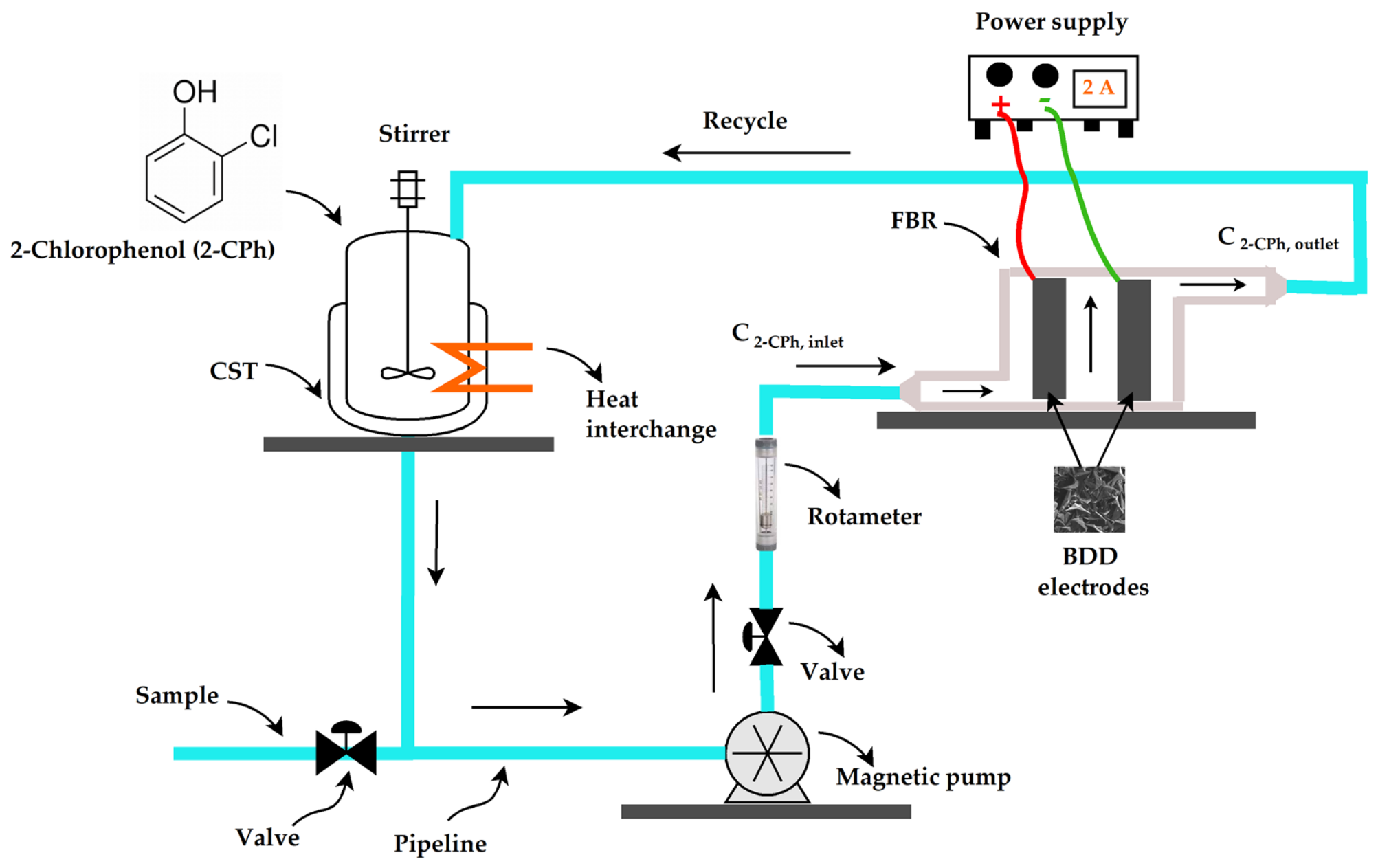
2.1. Problem Statement and Governing Equations
2.1.1. Mathematical Model for the Flow-By Reactor (FBR)
2.1.2. Mathematical Model for the Continuous Stirred Tank (CST)
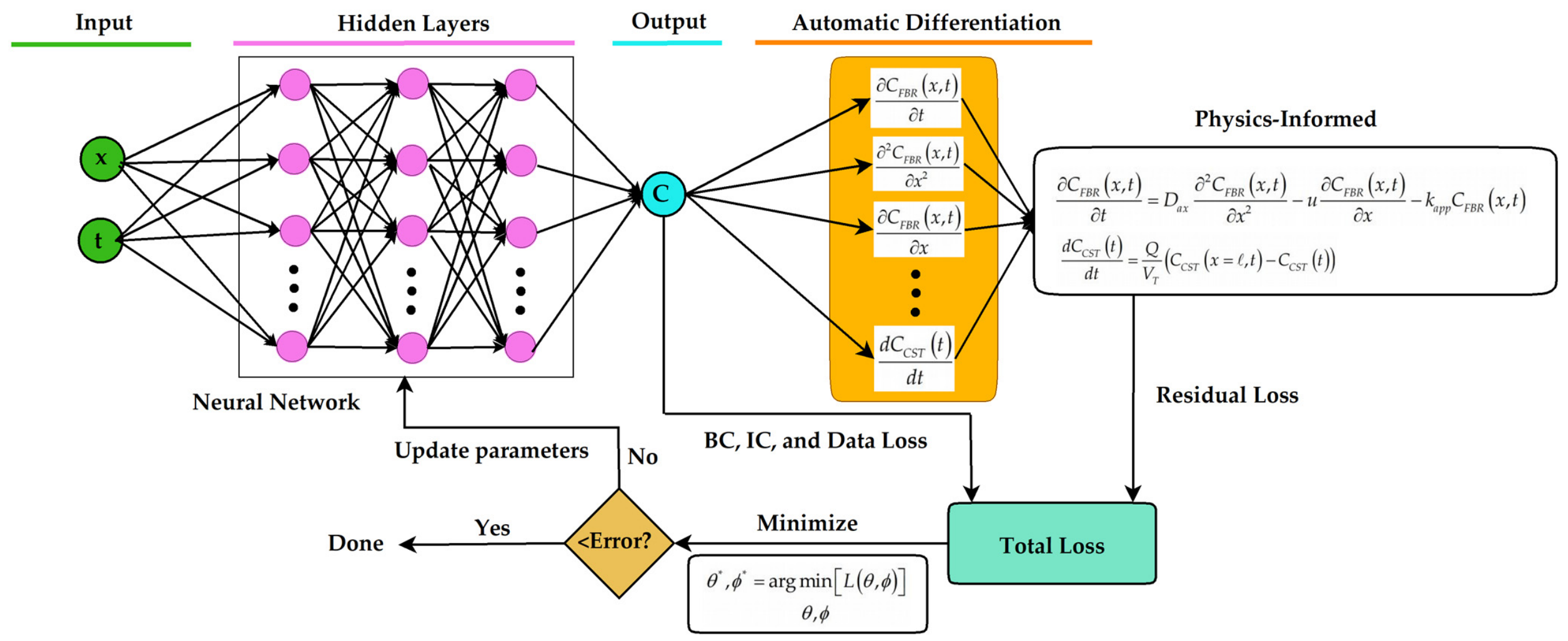
2.2. Hybrid PINN-Based Dynamic Process Modeling
2.3. Accurate Performance Modeling
2.4. Sensibility Analysis
3. Simulation Results and Analysis
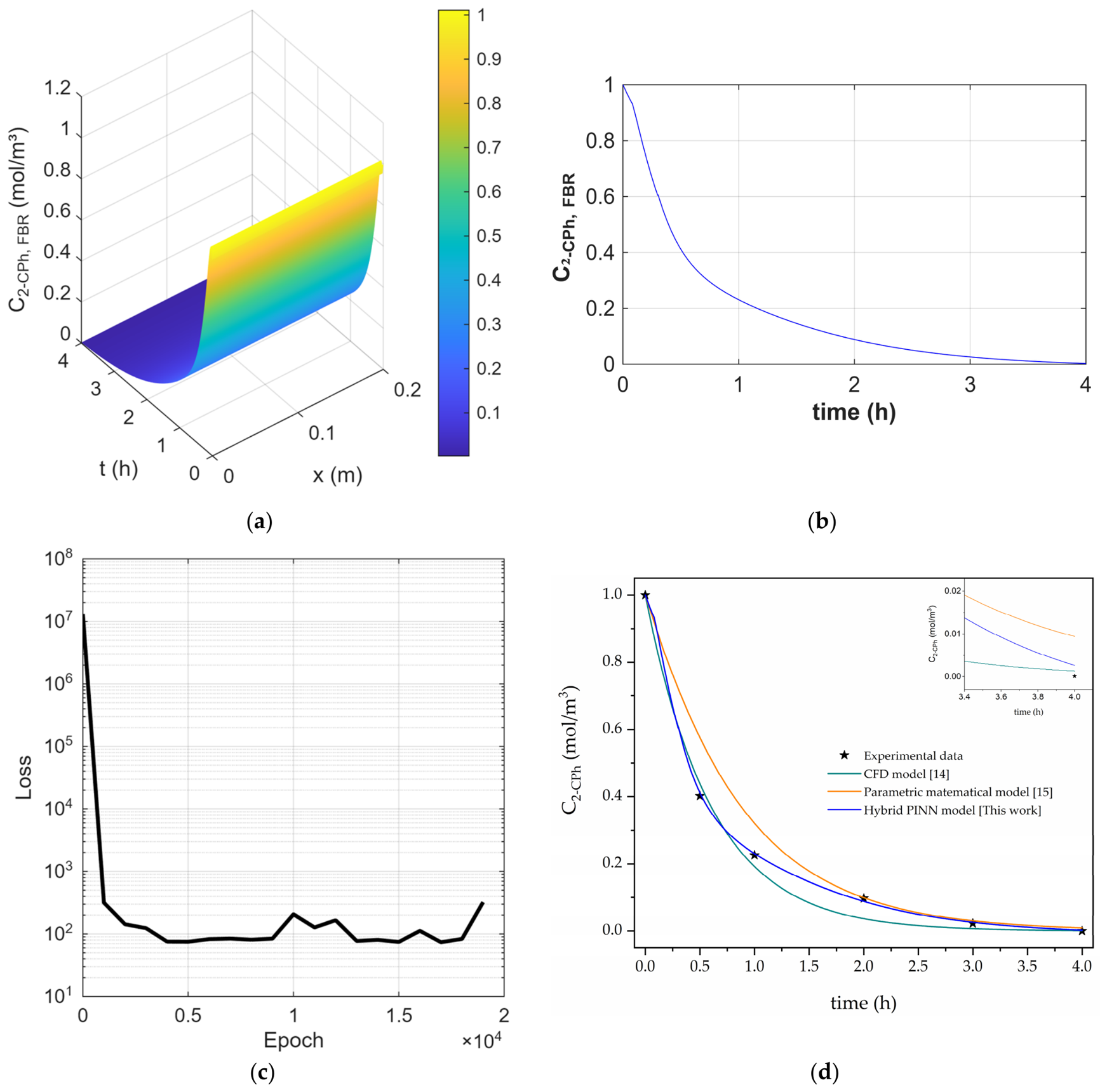
3.1. Results of the Hybrid PINN Modeling
3.2. Accuracy Index Performance
3.3. Sensitivity Analysis
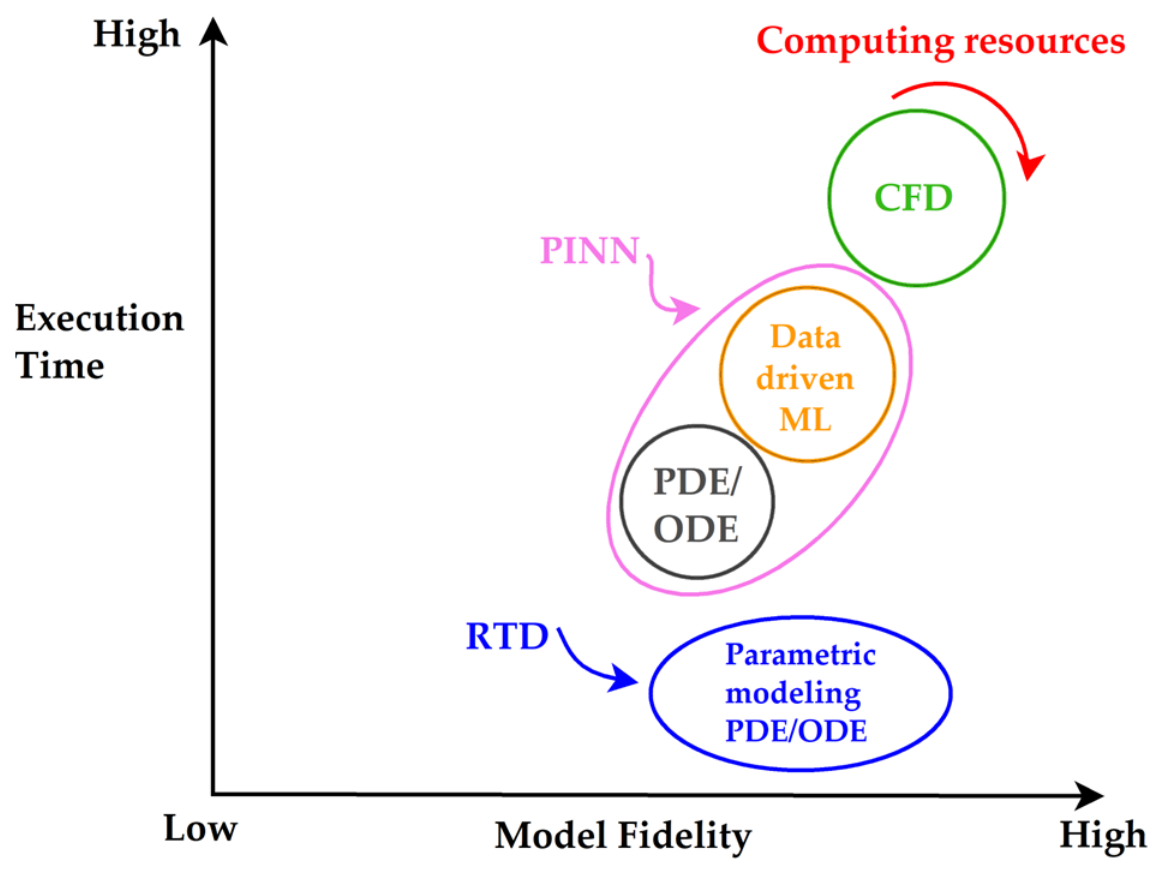
3.4. Results Analysis
4. Limitations and Future Works
- Limited adjustability range of implemented control valves, pumps, and motors.
- The need for sensors with short response times to match the process’s short time delay.
- The possibility of forming complex by-products due to excess reactants in the effluent.
- Sluggish response or overshoot after controller implementation.
- A high likelihood of human error in manual-based control.
- Challenges in optimal sensor placement.
5. Conclusions
Supplementary Materials
Author Contributions
Funding
Data Availability Statement
Acknowledgments
Conflicts of Interest
Abbreviations
| AOP | Advanced oxidation process |
| BDD | Boron-doped diamond |
| COMSOL | Computational solutions |
| CFD | Computational fluid dynamics |
| CNTs | Carbon nanotubes |
| CST | Continuous stirred-tank |
| DAE | Differential-algebraic equation |
| FBR | Flow-by reactor |
| L | Loss function |
| MATLAB | Matrix laboratory |
| MSE | Mean square error |
| ODEs | Ordinary differential equations |
| PDEs | Partial differential equations |
| PINN | Physics-informed neural network |
| Pt | Platinum |
| RMSE | Root means square error |
| RTD | Residence time distribution |
| ROS | Reactive oxidant species |
| t | Time, h |
| Ti | Titanium |
| x | Flow direction in the FBR, m |
| Greek symbols | |
| Balances the relative contribution of the physics-based constraint during training | |
| Weights of the neural networks approximating | |
| Reactor length, 0.2 m | |
| Biases of the neural networks approximating | |
| Change | |
| Nomenclature | |
| 2-CPh | 2-Chlorophenol |
| C | Concentration, 1 mol/m3 |
| Baseline output value of 2-CPh concentration, 0.0026 mol/m3 | |
| Dax | Axial dispersion coefficient, 0.0005 m2/s |
| e− | Electron |
| I | Current intensity, A |
| H+ | Hydrogen ion or proton |
| H2O | Water |
| k | Kinetic constant, 1.224 1/h |
| NiTSPc | Nickel(II) tetrasulfonated phthalocyanine |
| Neural network functions for the FBR | |
| Neural network functions for the CST | |
| •OH | Hydroxyl radicals |
| PbO2 | Lead oxide |
| poly-NiTSPc | Polymerized film of NiTSPc |
| Volumetric flow rate, 1 L/min | |
| R2 | Coefficient of determination |
| Normalize sensitivity | |
| SnO2 | Tin oxide |
| Linear velocity, 0.0947 m/s | |
| Treated volume, 2.5 L | |
| Absolute change in output 2-CPh concentration | |
| Baseline value of the input parameter i | |
| Absolute change in the input parameter i | |
| Subscripts | |
| 0 | Initial |
| App | Apparent |
| BC | Boundary conditions |
| IC | Initial condition |
| i | Factor |
References
- Ureta-Zañartu, M.S.; Berríos, C.; Pavez, J.; Zagal, J.; Gutiérrez, C.; Marco, J.F. Electrooxidation of 2-Chlorophenol on PolyNiTSPc-Modified Glassy Carbon Electrodes. J. Electroanal. Chem. 2003, 553, 147–156. [Google Scholar] [CrossRef]
- Keith, L.H.; Telliard, W.A. ES&T Special Report: Priority Pollutants: I-a Perspective View. Environ. Sci. Technol. 1979, 13, 416–423. [Google Scholar] [CrossRef]
- Yoon, J.-H.; Shim, Y.-B.; Lee, B.-S.; Choi, S.-Y.; Won, M.-S. Electrochemical Degradation of Phenol and 2-Chlorophenol Using Pt/Ti and Boron-Doped Diamond Electrodes. Bull. Korean Chem. Soc. 2012, 33, 2274–2278. [Google Scholar] [CrossRef]
- Peralta-Reyes, E.; Natividad, R.; Castellanos, M.; Mentado-Morales, J.; Cordero, M.E.; Amado-Piña, D.; Regalado-Méndez, A. Electro-Oxidation of 2-Chlorophenol with BDD Electrodes in a Continuous Flow Electrochemical Reactor. J. Flow Chem. 2020, 10, 437–447. [Google Scholar] [CrossRef]
- Yoon, J.H.; Jeong, E.D.; Shim, Y.B.; Won, M.S. Anodic Degradation of Toxic Aromatic Compound in the Flow Through Cell with Carbon Fiber Electrode. Key Eng. Mater. 2005, 277–279, 445–449. [Google Scholar] [CrossRef]
- Polcaro, A.M.; Palmas, S.; Renoldi, F.; Mascia, M. On the Performance of Ti/SnO2 and Ti/PbO2 Anodes in Electrochemical Degradation of 2-Chlorophenol for Wastewater Treatment. J. Appl. Electrochem. 1999, 29, 147–151. [Google Scholar] [CrossRef]
- Liu, H.; Zhang, Z.; Ren, M.; Guan, J.; Lu, N.; Qu, J.; Yuan, X.; Zhang, Y.N. Preparation of the CNTs/AG/ITO Electrode with High Electro-Catalytic Activity for 2-Chlorophenol Degradation and the Potential Risks from Intermediates. J. Hazard. Mater. 2018, 359, 148–156. [Google Scholar] [CrossRef]
- Cornejo, O.M.; Murrieta, M.F.; Castañeda, L.F.; Nava, J.L. Electrochemical Reactors Equipped with BDD Electrodes: Geometrical Aspects and Applications in Water Treatment. Curr. Opin. Solid State Mater. Sci. 2021, 25, 100935. [Google Scholar] [CrossRef]
- Cornejo, O.M.; Murrieta, M.F.; Castañeda, L.F.; Nava, J.L. Characterization of the Reaction Environment in Flow Reactors Fitted with BDD Electrodes for Use in Electrochemical Advanced Oxidation Processes: A Critical Review. Electrochim. Acta 2020, 331, 135373. [Google Scholar] [CrossRef]
- Cornejo, O.M.; Murrieta, M.F.; Aguilar, Z.G.; Rodríguez, J.F.; Márquez, A.A.; León, M.I.; Nava, J.L. Recent Advances in Electrochemical Flow Reactors Used in Advanced Oxidation Processes: A Critical Review. Chem. Eng. J. 2024, 496, 153935. [Google Scholar] [CrossRef]
- Cruz-Díaz, M.R.; Rivero, E.P.; Almazán-Ruiz, F.J.; Torres-Mendoza, Á.; González, I. Design of a New FM01-LC Reactor in Parallel Plate Configuration Using Numerical Simulation and Experimental Validation with Residence Time Distribution (RTD). Chem. Eng. Process. Process Intensif. 2014, 85, 145–154. [Google Scholar] [CrossRef]
- Regalado-Méndez, A.; Cruz-López, A.; Mentado-Morales, J.; Cordero, M.E.; Zárate, L.G.; Cruz-Díaz, M.R.; Fontana, G.; Peralta-Reyes, E. Mathematical Modeling of the Electrochemical Degradation of 2-Chlorophenol Using an Electrochemical Flow Reactor Equipped with BDD Electrodes. J. Flow Chem. 2019, 9, 59–71. [Google Scholar] [CrossRef]
- Regalado-Méndez, A.; Ramos-Hernández, G.; Natividad, R.; Cordero, M.E.; Zárate, L.; Robles-Gómez, E.E.; Pérez-Pastenes, H.; Peralta-Reyes, E. Parametric Mathematical Model of the Electrochemical Degradation of 2-Chlorophenol in a Flow-by Reactor under Batch Recirculation Mode. Water 2023, 15, 4276. [Google Scholar] [CrossRef]
- Wang, W.; Wu, Z.; Peters, D.; Citmaci, B.; Morales-Guio, C.G.; Christofides, P.D. Machine Learning in Modeling, Analysis and Control of Electrochemical Reactors: A Tutorial Review. Digit. Chem. Eng. 2025, 15, 100237. [Google Scholar] [CrossRef]
- Alhajeri, M.S.; Abdullah, F.; Wu, Z.; Christofides, P.D. Physics-Informed Neural Networks for Dynamic Process Operations with Limited Physical Knowledge and Data. Comput. Chem. Eng. 2025, 192, 108899. [Google Scholar] [CrossRef]
- Zavaleta-Avendaño, J.; Cervantes-Hernández, P.; Natividad, R.; Peralta-Reyes, E.; Espinoza-Montero, P.J.; Pérez-Pastenes, H.; Regalado-Méndez, A. Artificial Neural Network Prediction Model of Electrochemical Degradation of Chloroquine in a Plane-Parallel Plate Flow Reactor Using Two BDD Electrodes. Lect. Notes Netw. Syst. 2025, 1561, 189–201. [Google Scholar] [CrossRef]
- Viana, D.F.; Salazar-Banda, G.R.; Leite, M.S. Electrochemical Degradation of Reactive Black 5 with Surface Response and Artificial Neural Networks Optimization Models. Sep. Sci. Technol. 2018, 53, 2647–2661. [Google Scholar] [CrossRef]
- Ganthavee, V.; Fernando, M.M.R.; Trzcinski, A.P. Monte Carlo Simulation, Artificial Intelligence and Machine Learning-Based Modelling and Optimization of Three-Dimensional Electrochemical Treatment of Xenobiotic Dye Wastewater. Environ. Process. 2024, 11, 41. [Google Scholar] [CrossRef]
- Nghia, N.T.; Tuyen, B.T.K.; Quynh, N.T.; Thuy, N.T.T.; Nguyen, T.N.; Nguyen, V.D.; Tran, T.K.N. Response Methodology Optimization and Artificial Neural Network Modeling for the Removal of Sulfamethoxazole Using an Ozone–Electrocoagulation Hybrid Process. Molecules 2023, 28, 5119. [Google Scholar] [CrossRef]
- Zavaleta-Avendaño, J.; Peralta-Reyes, E.; Natividad, R.; Martínez-Villa, G.; Escudero, C.J.; Hernández-Servín, J.A.; Alanis, C.; Regalado-Méndez, A. Predicting and Optimizing Electrochemical Degradation of Mezcal Vinasse with Statistical and Neural Network Models. Results Eng. 2026, 30, 110199. [Google Scholar] [CrossRef]
- Karniadakis, G.E.; Kevrekidis, I.G.; Lu, L.; Perdikaris, P.; Wang, S.; Yang, L. Physics-Informed Machine Learning. Nat. Rev. Phys. 2021, 3, 422–440. [Google Scholar] [CrossRef]
- Mukherjee, A.; Zavala, V.M. Physics-Constrained Machine Learning for Chemical Engineering. Curr. Opin. Chem. Eng. 2026, 51, 101228. [Google Scholar] [CrossRef]
- Nasruddin, N.A.; Islam, N.; Vernuccio, S.; Oyekan, J. Hybridised Mechanistic and Machine Learning Digital Twins for Modelling and Optimising Chemical Processes in Flow: A Comparative Analysis of Parallel and Series-Based Hybridisation. Chem. Eng. J. Adv. 2025, 23, 100775. [Google Scholar] [CrossRef]
- Farooqi, M.; Bösing, I.; Feugmo, C.G.T. A Physics-Informed Neural Network Approach to the Point Defect Model for Electrochemical Oxide Film Growth. arXiv 2025, arXiv:2510.02872. [Google Scholar] [CrossRef]
- Vairo, T.; Cademartori, D.; Clematis, D.; Asensio, A.M.; Barbucci, A.; Carpanese, M.P. A Physics-Informed Neural Network (PINN) Predicting the Performance of Air Electrodes for Solid Oxide Cells: A Pilot-Scale Demonstration on Four Microstructures. Int. J. Hydrogen Energy 2025, 176, 151322. [Google Scholar] [CrossRef]
- Abdelwahab, S.I.; Taha, M.M.E.; Moni, S.S.; Alsayegh, A.A. Physics-Informed Neural Networks in the Energy Sector: Progress, Trends, and Future Directions. Energy Rep. 2026, 15, 109013. [Google Scholar] [CrossRef]
- Chen, H.; Kätelhön, E.; Compton, R.G. Predicting Voltammetry Using Physics-Informed Neural Networks. J. Phys. Chem. Lett. 2022, 13, 536–543. [Google Scholar] [CrossRef] [PubMed]
- Bany Abdelnabi, A.A.; Al Theeb, N.; Almomani, M.A.; Ghanem, H.; Rosiwal, S.M. Effect of Electrode Parameters in the Electro-Production of Reactive Oxidizing Species via Boron-Doped Diamond under Batch Mode. Water Environ. Res. 2022, 94, e10830. [Google Scholar] [CrossRef]
- Regalado-Méndez, A.; Mentado-Morales, J.; Vázquez, C.E.; Martínez-Villa, G.; Cordero, M.E.; Zárate, L.G.; Skogestad, S.; Peralta-Reyes, E. Modeling and Hydraulic Characterization of a Filter-Press-Type Electrochemical Reactor by Using Residence Time Distribution Analysis and Hydraulic Indices. Int. J. Chem. React. Eng. 2018, 16, 20170210. [Google Scholar] [CrossRef]
- Raissi, M.; Perdikaris, P.; Karniadakis, G.E. Physics-Informed Neural Networks: A Deep Learning Framework for Solving Forward and Inverse Problems Involving Nonlinear Partial Differential Equations. J. Comput. Phys. 2019, 378, 686–707. [Google Scholar] [CrossRef]
- Rehman, A.; Iqbal, M.A.; Haider, M.T.; Majeed, A. Artificial Intelligence-Guided Supervised Learning Models for Photocatalysis in Wastewater Treatment. AI 2025, 6, 258. [Google Scholar] [CrossRef]
- Quina, M.M.J.; Quinta Ferreira, R.M. Model Comparison and Sensitivity Analysis for a Fixed Bed Reactor with Two Catalytic Zones. Chem. Eng. J. 1999, 75, 149–159. [Google Scholar] [CrossRef]
- Li, D.; Ju, Q.; Jiang, P.; Huang, P.; Xu, X.; Wang, Q.; Hao, Z.; Zhang, Y. Sensitivity Analysis of Hydrological Model Parameters Based on Improved Morris Method with the Double-Latin Hypercube Sampling. Hydrol. Res. 2023, 54, 220–232. [Google Scholar] [CrossRef]
- Fogler, H.S. Elements of Chemical Reaction Engineering, 6th ed.; Pearson Education Limited: London, UK, 2022; ISBN 1-292-41666-1. [Google Scholar]
- Levenspiel, O. Chemical Reaction Engineering, 3rd ed.; Wiley: New York, NY, USA, 1999; ISBN 9780471254249. [Google Scholar]
- Regalado-Méndez, A.; Zavaleta-Avendaño, J.; Peralta-Reyes, E.; Natividad, R. Convex Optimization for Maximizing the Degradation Efficiency of Chloroquine in a Flow-by Electrochemical Reactor. J. Solid State Electrochem. 2023, 27, 3163–3176. [Google Scholar] [CrossRef]
- Scali, C.; Bacci, R.; Capaci, D.; Pannocchia, G. Robustness Evaluation of Different Controllers in the Presence of Flow Rate Variations. Chem. Eng. Trans. 2021, 86, 907–912. [Google Scholar] [CrossRef]
- Wang, S.; Teng, Y.; Perdikaris, P. Understanding and Mitigating Gradient Flow Pathologies in Physics-Informed Neural Networks. SIAM J. Sci. Comput. 2021, 43, A3055–A3081. [Google Scholar] [CrossRef]
- Naser, M.Z. Fundamental Flaws of Physics-Informed Neural Networks and Explainability Methods in Engineering Systems. Comput. Ind. Eng. 2026, 212, 111704. [Google Scholar] [CrossRef]
- Luo, R. Principles of Lipschitz Continuity in Neural Networks. Doctoral Thesis, University of Galway, Galway, Ireland, 2025. [Google Scholar]


| Step | Description |
|---|---|
| 1: | Initiation and parameters C0 ←, u ←, Q ←, L ← kapp ←, Dax ← VT ←, t_Total ←, Experimental data (t, C2-CPh) |
| 2: | Neural Network architecture FBR Network: Predicts CFBR (x, t): Input: 2 (x, t), Hidden layers: # layers with # neurons each, Tanh activation function, and Output: 1 (CFBR) Create network net for FBR CST Network: Predicts C_CST (t) Input: 1 (t), Hidden layers: # layers with # neurons each, Tanh activation function, Output: 1 (C_CST) Create network net_CST with structure Initialize networks with random seed 42 |
| 3: | Training points generation: Nx ← #, Nt ← #, x ← linspace (0, L, Nx), t ← linspace (0, t_total, Nt), Collocation points [X, T] ← meshgrid (x, t), x_colloc ← flatten(X), t_colloc ← flatten (T) FBR initial condition points (t = 0, all x), CST initial condition points, Boundary condition points, CST training points, and Convert all points to dlarray format for deep learning |
| 4: | Loss weights: lambda_pde ←, lambda_bc ←, lambda_ic ←, lambda_cst ←, lambda_cst0 ←, lambda_exp ← |
| 5: | Training Loop numEpochs ← #, learnRate ← Initialize Adam optimizer states for both networks Initialize loss_history array For epoch = 1 to numEpochs Call [loss_total, gradients_FBR, gradients_CST, monitoring_vals] ← Update networks using Adam optimizer loss_history [epoch, 1] ← loss_total loss_history [epoch, 2:9] ← monitoring_vals Display progress every 1000 epochs End |
| 6: | Data saving: Generate high-resolution time vector t_save ← linspace (0, t_total, 1000), t_save ← C_CST_save, C_FBR_out_save For i = 0 to length (t_save) Predict C_CST at t_save [i] Predict C_FBR at x = L and t_save [i] Store results Update progress bar every 100 points End Save data to CSV file |
| 7: | Visualization: Create Plot Concentration vs time Create Plot FBR spatial profiles Create Plot loss_total vs epoch |
| 8: | Loss function subroutine (net_FBR, net_CST, x_colloc, t_colloc, x_ic, t_ic, x0, t0, xL, tL, t_cst, t0_cst, t_exp, C_exp, u, D, k, C0, Q, V_cst, L, lambda_pde, lambda_bc, lambda_ic, lambda_cstr, lambda_cstr0, lambda_exp) Forward predictions Compute derivatives using automatic differentiation Compute residuals Compute individual losses (mean squared error) Total weighted loss Compute gradients for both networks Monitoring values |
| Factor | kapp (1/h) | Dax (m2/s) | u (m/s) | Q (L/min) | |||||
|---|---|---|---|---|---|---|---|---|---|
| Values | |||||||||
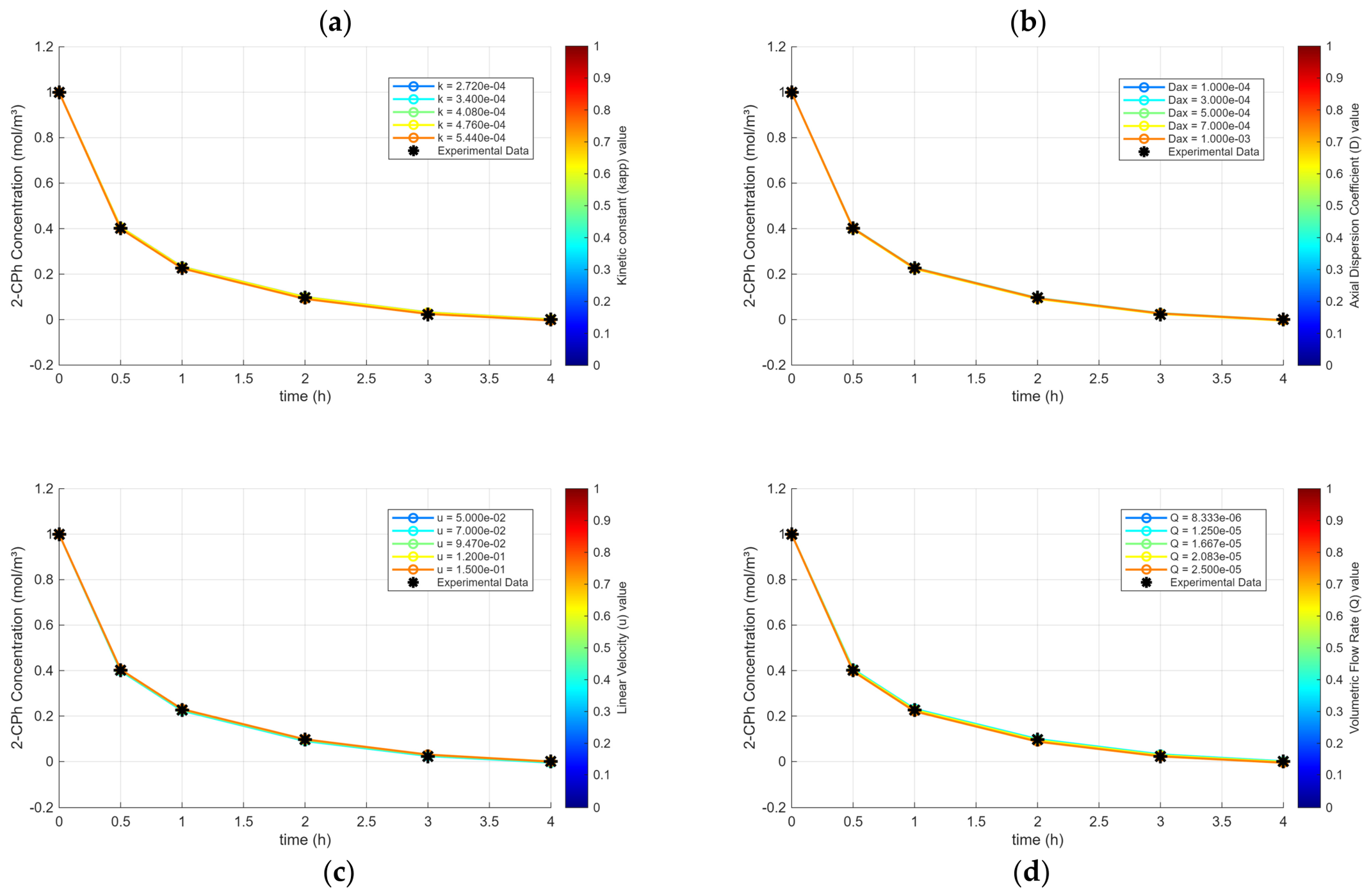
| 1 | 0.979 | (−20%) | 1 × 10⁻⁴ | (−80%) | 0.0500 | (−47%) | 0.50 | (−50%) | |
| 2 | 1.224 | Baseline | 3 × 10⁻⁴ | (−40%) | 0.0700 | (−26%) | 0.75 | (−25%) | |
| 3 | 1.469 | (+20%) | 5 × 10⁻⁴ | Baseline | 0.0947 | Baseline | 1.00 | Baseline | |
| 4 | 1.714 | (+40%) | 7 × 10⁻⁴ | (+40%) | 0.1200 | (+27%) | 1.25 | (+25%) | |
| 5 | 1.958 | (+60%) | 1 × 10⁻³ | (100%) | 0.1500 | (+58%) | 1.50 | (+50%) | |
| Parameters | PDE (C2-CPh, FBR) | ODE (C2-CPh, CST) | |||
|---|---|---|---|---|---|
| Inputs | 2 (x, t) | 1 (t) | |||
| Output | 1 (C2-CPh, FBR) | 1 (C2-CPh, CST) | |||
| Hidden Layer | 4 | 4 | |||
| Neurons per Layer | 60 | 50 | |||
| Activation function | tanh | tanh | |||
| Final Smooth Function | Linear | Linear | |||
| Global hypermeters | |||||
| Initial Learning Rate | 1 × 10⁻³ | ||||
| Learning Rate | 5 × 10⁻⁵ | ||||
| Epochs Training | 20,000 | ||||
| Optimizer | Adam | ||||
| PDE collocation points | 200,000 | ODE collocation points | 400 | ||
| BCs collocation points | 400 | ICs collocation points | 2000 | ||
| ICs collocation points | 50,000 | ||||
| Loss weights | |||||
| 1 | 1 × 10⁴ | ||||
| 1 × 10⁴ | 1 × 10⁷ | ||||
| 1 × 10⁶ | 1 × 10⁷ | ||||
| Model Type | Ref. | R2 | MSE | RMSE | Remark |
|---|---|---|---|---|---|
| PINN | [This work] | 0.9927 | 0.0009 | 0.0294 | Excellent model fit |
| CFD | [12] | 0.9917 | 0.1633 | 0.4041 | Very good model fit |
| Parametric | [13] | 0.9831 | 0.0307 | 0.1754 | Very good model fit |
| Factor | Range | (%) | Max (S) |
|---|---|---|---|
| kapp | 0.9790 to 1.958 1/h | −556.34 | 14.20 |
| Dax | 1 × 10⁻⁴ to 1 × 10⁻³ m2/s | −85.67 | 3.32 |
| u | 0.05 to 0.15 m/s | −290.13 | 6.20 |
| Q | 0.5 to1.5 L/min | −32.92 | 6.55 |
Disclaimer/Publisher’s Note: The statements, opinions and data contained in all publications are solely those of the individual author(s) and contributor(s) and not of MDPI and/or the editor(s). MDPI and/or the editor(s) disclaim responsibility for any injury to people or property resulting from any ideas, methods, instructions or products referred to in the content. |
© 2026 by the authors. Licensee MDPI, Basel, Switzerland. This article is an open access article distributed under the terms and conditions of the Creative Commons Attribution (CC BY) license.
Share and Cite
Regalado-Méndez, A.; Salinas-Camacho, D.M.; Natividad, R.; Cordero, M.E.; Zárate, L.G.; Pérez-Pastenes, H.; Pérez-Alonso, C.; Peralta-Reyes, E. A Hybrid Physics-Informed Neural Network (PINN) for the Electro-Oxidation of 2-Chlorophenol on BDD Electrodes in a Flow-By Reactor Under Batch Recirculation. Processes 2026, 14, 1862. https://doi.org/10.3390/pr14121862
Regalado-Méndez A, Salinas-Camacho DM, Natividad R, Cordero ME, Zárate LG, Pérez-Pastenes H, Pérez-Alonso C, Peralta-Reyes E. A Hybrid Physics-Informed Neural Network (PINN) for the Electro-Oxidation of 2-Chlorophenol on BDD Electrodes in a Flow-By Reactor Under Batch Recirculation. Processes. 2026; 14(12):1862. https://doi.org/10.3390/pr14121862
Chicago/Turabian StyleRegalado-Méndez, Alejandro, Damayrí M. Salinas-Camacho, Reyna Natividad, Mario E. Cordero, Luis G. Zárate, Hugo Pérez-Pastenes, César Pérez-Alonso, and Ever Peralta-Reyes. 2026. "A Hybrid Physics-Informed Neural Network (PINN) for the Electro-Oxidation of 2-Chlorophenol on BDD Electrodes in a Flow-By Reactor Under Batch Recirculation" Processes 14, no. 12: 1862. https://doi.org/10.3390/pr14121862
APA StyleRegalado-Méndez, A., Salinas-Camacho, D. M., Natividad, R., Cordero, M. E., Zárate, L. G., Pérez-Pastenes, H., Pérez-Alonso, C., & Peralta-Reyes, E. (2026). A Hybrid Physics-Informed Neural Network (PINN) for the Electro-Oxidation of 2-Chlorophenol on BDD Electrodes in a Flow-By Reactor Under Batch Recirculation. Processes, 14(12), 1862. https://doi.org/10.3390/pr14121862