Article

Enhancing Selective Catalytic Reduction Performance in a Coal-Fired Unit over a Wide Load Range via Static Mixer-Assisted Reactive Mixing: A Full-Process Furnace-to-SCR CFD Analysis

1
Zhejiang Zheneng Technology Research Institute Co., Ltd., Hangzhou 311121, China
2
Zhejiang Provincial Key Laboratory for Research on Industrial Carbon Metrology Technology, Hangzhou 310018, China
3
The Institute for Energy Engineering, China Jiliang University, Hangzhou 310018, China
*
Author to whom correspondence should be addressed.
Processes 2026, 14(12), 1843; https://doi.org/10.3390/pr14121843
Submission received: 18 May 2026 / Revised: 2 June 2026 / Accepted: 4 June 2026 / Published: 6 June 2026
(This article belongs to the Special Issue Advances in Combustion Processes: Fundamentals and Applications)

Abstract

A 660 MW coal-fired unit was investigated to clarify the combustion behavior over a wide load range and the effects of static mixers on selective catalytic reduction (SCR) performance. A full-process CFD model covering the furnace, rear pass duct, and SCR system was established, and the combustion characteristics, NOx formation, and SCR performance were analyzed over a boiler load range of 25–100%. The results showed that, as the boiler load decreased, the furnace heat release weakened, the high-temperature zone contracted, and the flame center shifted downward, with more pronounced flame maldistribution at 25% load. The average NOx concentration at the SCR inlet first decreased and then increased with decreasing boiler load, reaching a minimum at 75% load. Without a static mixer, the NOx concentration at the SCR inlet increased from 238 mg/Nm3 at 100% load to 312 mg/Nm3 at 25% load. After a static mixer was installed, the distance required for NH3 homogenization downstream of the ammonia injection grid was markedly shortened, and the uniformity of the velocity, NH3 concentration, and temperature fields at the SCR catalyst inlet was improved. In particular, the coefficient of variation in NH3 concentration decreased from about 4–5% to about 2–3%, while the denitrification efficiency increased by about 1–5 percentage points compared with the case without a static mixer. The variation in denitrification efficiency among different boiler loads was also significantly reduced, indicating improved adaptability of the SCR system to wide-load operation. Among the tested configurations, the static mixer with small blades and a larger blade angle relative to the vertical plane showed the best overall performance. These results provide useful guidance for SCR system improvement in coal-fired units operating over a wide load range.

1. Introduction

In recent years, the installed capacity of renewable energy sources such as wind and solar power has continued to grow, making the power system increasingly variable and intermittent. Consequently, conventional coal-fired units are shifting from long-term stable baseload operation to more flexible operation with greater emphasis on rapid response and deep load regulation [1,2]. Under these circumstances, large coal-fired boilers must not only provide base power supply, but also maintain safe, stable, and economical operation over a wide load range, including low-load and ultra-low-load conditions [3]. Therefore, flexible operation has become a practical requirement for coal-fired units, and their capability to operate at low and ultra-low loads has become an important indicator of adaptability to the evolving power system [4].
However, large variations in boiler load not only change the in-furnace combustion organization, air-staging performance, temperature field, and pollutant formation and transport, but also strongly affect the operating conditions of the downstream selective catalytic reduction (SCR) system [5]. As the boiler load decreases, the fuel input, flue-gas flow rate, flow momentum, and turbulent mixing intensity in the furnace all decline markedly. The high-temperature zone contracts, the flame center moves downward, and local flow bias and non-uniformity become more pronounced [6]. These changes alter the temperature, velocity distribution, and NOx concentration at the furnace exit, and the resulting non-uniformity is further transmitted to the SCR inlet. This directly affects post-injection NH3-NOx mixing, catalyst-inlet flow-field uniformity, and catalytic reaction performance [7]. In engineering practice, the ammonia injection grid, guide vanes, and other flow-control devices in the SCR system are usually designed and optimized mainly for medium- and high-load conditions [8,9,10]. Whether these designs can still maintain satisfactory flow organization and mixing under ultra-low-load conditions remains insufficiently understood. Therefore, investigating the flow, mixing, and denitrification performance of the SCR system over a wide load range, especially under ultra-low-load conditions, is of clear engineering significance.
SCR is one of the most widely used technologies for controlling NOx emissions from coal-fired power plants because of its high denitrification efficiency and good applicability to large-scale flue-gas treatment systems. In an SCR reactor, injected NH3 reacts selectively with NOx over the catalyst surface to form N2 and H2O. The performance of the SCR system is strongly affected by the flue-gas temperature, velocity distribution, NOx concentration, NH3 distribution, and the local NH3/NOx molar ratio at the catalyst inlet. Non-uniform inlet conditions may lead to local NH3 deficiency or excess, resulting in reduced NOx removal efficiency or increased NH3 slip. Therefore, improving NH3-NOx mixing and catalyst-inlet field uniformity is essential for maintaining stable SCR performance, especially under wide-load and low-load operation.
Numerical simulation provides an effective means of addressing these issues. Compared with field measurements, CFD modeling can provide full-field information on the flow, temperature, species distribution, and particle behavior inside the boiler. This makes it possible to clarify how combustion characteristics vary with boiler load and how these changes propagate through the rear pass duct to the SCR system. In recent years, CFD has been widely applied to the analysis of combustion processes, pollutant formation, and denitrification optimization in large coal-fired boilers [11,12,13].
Askarova et al. [14] developed a multi-dimensional model that coupled heat transfer with reaction kinetics to support furnace design. Chang et al. [15] examined trade-offs between flame stability and emissions in tangentially fired boilers at low load, emphasizing the influence of burner arrangement. Furthermore, Laubscher et al. [16] analyzed thermal and flow maldistribution in the rear pass duct from 99% to 60% load. Wang et al. [17] utilized a 1:1 scale 3D CFD model to optimize the flow guides and ammonia mixing devices of a 660 MW SCR system, successfully reducing the ammonia concentration’s relative standard deviation at the catalyst inlet to 5.3%. Świeboda et al. [18] reviewed modeling best practices for optimizing the SNCR process in pulverized coal boilers, focusing on geometry simplification, mesh refinement, and validation methods. Yin et al. [19] developed an integrated NOx emission model to optimize ammonia injection control during load-cycling processes, effectively reducing NH3 slip and NOx fluctuations by accounting for NH3 storage inertia and flue gas dynamics. Chen et al. [20] compared monolith and packing structures with various particle shapes to optimize SCR performance, proposing a structure-selection strategy based on reaction-diffusion behaviors tailored for different industrial temperature ranges.
However, several limitations remain in the existing literature. First, most previous studies have focused on rated-load or medium- to high-load conditions, with limited attention paid to deep load regulation near 25% BMCR. As a result, combustion stability, temperature distribution, and NOx evolution under low-load operation are still not well understood. Second, although some studies have considered variable-load operation, the load range investigated is often incomplete, and continuous analyses from high load to ultra-low load are still lacking. This makes it difficult to fully capture the variations in combustion, flow, and emission characteristics over the entire load range. Third, in most existing simulations, furnace combustion, rear pass duct flow, and the SCR process are treated separately, while full-process coupled simulations from the furnace to the SCR region remain scarce. In addition, studies on internal flow regulation in the SCR system have mainly focused on the flow-straightening effect of guide vanes, whereas the role of static mixers in enhancing post-injection mixing and improving the uniformity of catalyst-inlet velocity and concentration fields has received much less attention. This is especially true under wide-load and ultra-low-load conditions, where the underlying mechanisms are still not well understood.
To address these issues, a 660 MW coal-fired unit was selected in this study, and a full-process CFD model covering the furnace, rear-pass duct, and SCR system was established. The model was used to systematically investigate combustion characteristics, NOx formation, SCR inlet conditions, and denitrification performance over a boiler load range of 25% to 100%. On this basis, three representative static mixer configurations were further examined to evaluate their effects on NH3-NOx mixing, normalized stoichiometric ratio (NSR) distribution, catalyst-inlet field uniformity, and overall NOx removal performance under wide-load operation.
Compared with previous numerical studies on SCR systems, including our previous full-process furnace-to-SCR CFD study [21], the present work has several distinguishing features. In the previous study, the analysis mainly focused on furnace combustion characteristics and SCR-inlet flow-field optimization, and the investigated component was the guide-vane arrangement. The evaluation was mainly based on velocity uniformity, ash deposition, and erosion risk, while NH3 injection, SCR reaction kinetics, and NOx conversion were not included. In contrast, the present study further extends the full-process CFD framework to SCR reactive mixing and denitrification performance by considering NH3 injection, NH3-NOx matching, NSR distribution, SCR catalytic reaction, catalyst-inlet field uniformity, and NOx removal efficiency. In addition, the investigated component is changed from guide vanes to static mixers installed downstream of the ammonia injection grid. Therefore, this work is not a repetition of the previous flow-field optimization study, but a complementary and extended investigation from SCR-inlet flow redistribution to static mixer-assisted reactive-mixing enhancement and SCR performance improvement under flexible operation of coal-fired units.
The novelty of this study lies in extending the furnace-to-SCR CFD framework to static mixer-assisted NH3-NOx reactive mixing under wide-load operation. Unlike studies using idealized uniform SCR inlet boundaries, the present work uses non-uniform inlet profiles derived from upstream hot-state furnace simulations and evaluates NH3-NOx matching, catalyst-inlet uniformity, NOx removal efficiency, and pressure-loss penalty together for representative static mixer configurations.

2. Boiler Description and Numerical Methodology

2.1. Boiler Description

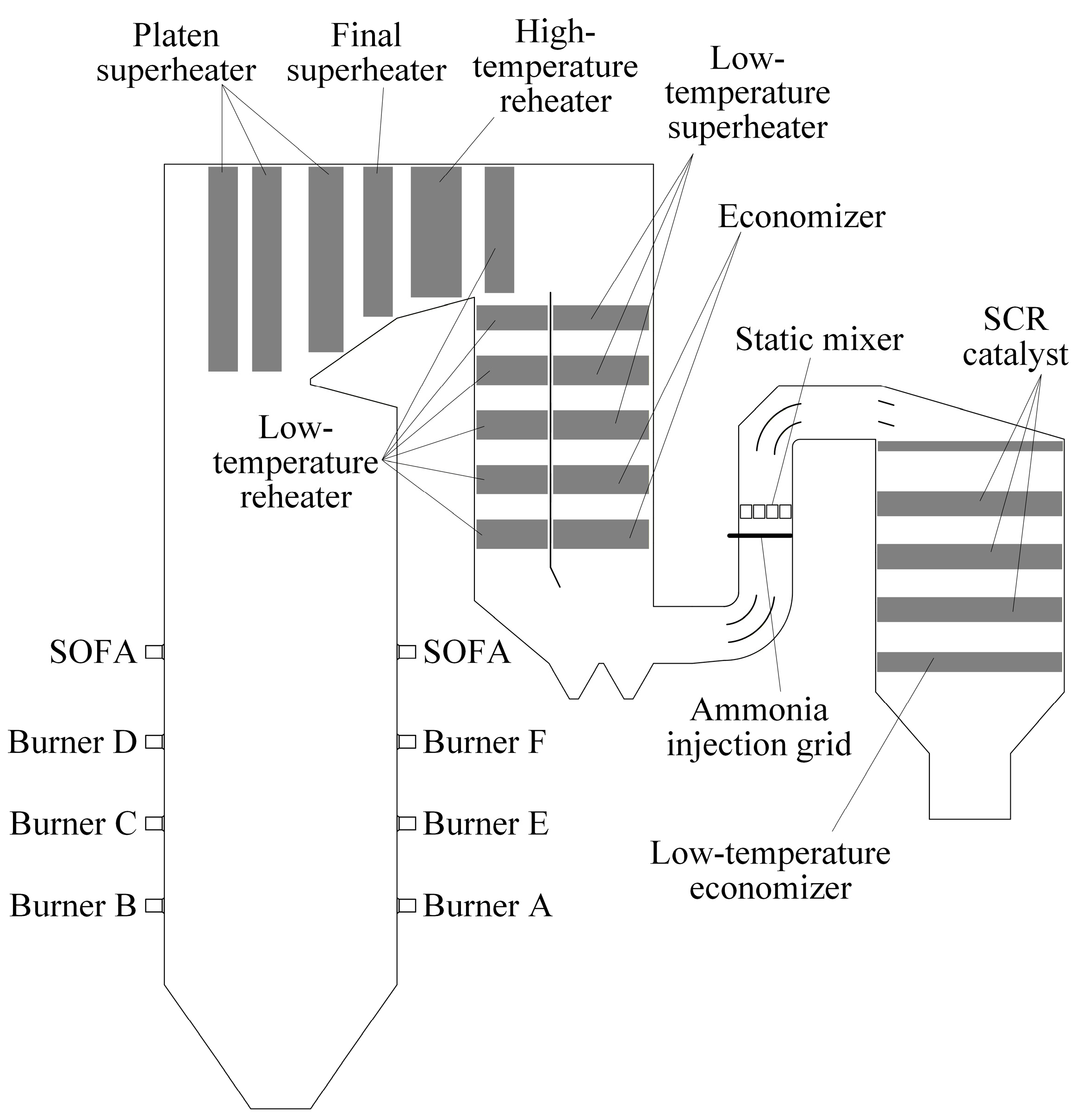
A 660 MW ultra-supercritical coal-fired boiler was selected for this study. The boiler features a spiral-wound furnace, single reheating, solid slag discharge, and divided rear pass ducts. The reheat steam temperature is controlled by flue-gas temperature control dampers. The rated main steam flow rate, pressure, and temperature are 1994 t/h, 29.3 MPa, and 605 °C, respectively, while the corresponding values for reheat steam are 1671 t/h, 5.66 MPa, and 623 °C. The furnace has a depth of 15.567 m, a width of 23.193 m, and a height of 64.5 m. To control NOx emissions, an SCR system is installed in the rear pass. The flow organization in the rear pass duct upstream of the SCR inlet and the parameter distributions at the catalyst inlet are critical to ammonia mixing and SCR catalyst performance. The overall boiler layout is shown in Figure 1, and the main specifications are listed in Table 1.
The unit is equipped with a positive-pressure, cold primary-air, direct-firing pulverizing system with six medium-speed coal mills, each supplying one burner layer. The burner layers are designated A to F from bottom to top. A total of 36 burners are arranged on the front and rear walls, including six DRB-4Z burners in layer A and 30 Airejet burners in layers B to F. Both burner types are low-NOx burners. The Airejet burner features a central air core, a primary-air passage, and an outer swirling secondary-air passage, which enhances gas–solid mixing and suppresses NOx formation. The DRB-4Z burner employs staged regulation of the inner and outer secondary-air streams to create a locally reducing atmosphere in the main combustion zone, thereby reducing NOx formation. To further reduce NOx emissions, SOFA nozzles are installed above the main combustion zone, with eight on the front wall and eight on the rear wall.
The pulverized-coal fineness at the mill outlet was controlled at about R90 = 20% to ensure stable ignition and satisfactory burnout. The boiler was designed for Jinbei bituminous coal. The proximate analysis, ultimate analysis, and as-received lower heating value of the design coal and the as-fired coal are listed in Table 2. Overall, the two coals have similar combustible fractions and heating values, whereas the as-fired coal contains higher moisture and volatile matter but lower ash content. To better represent in-furnace combustion under actual operating conditions, the as-fired coal was used as the input fuel in the present calculations.

2.2. Computational Domain and Mesh

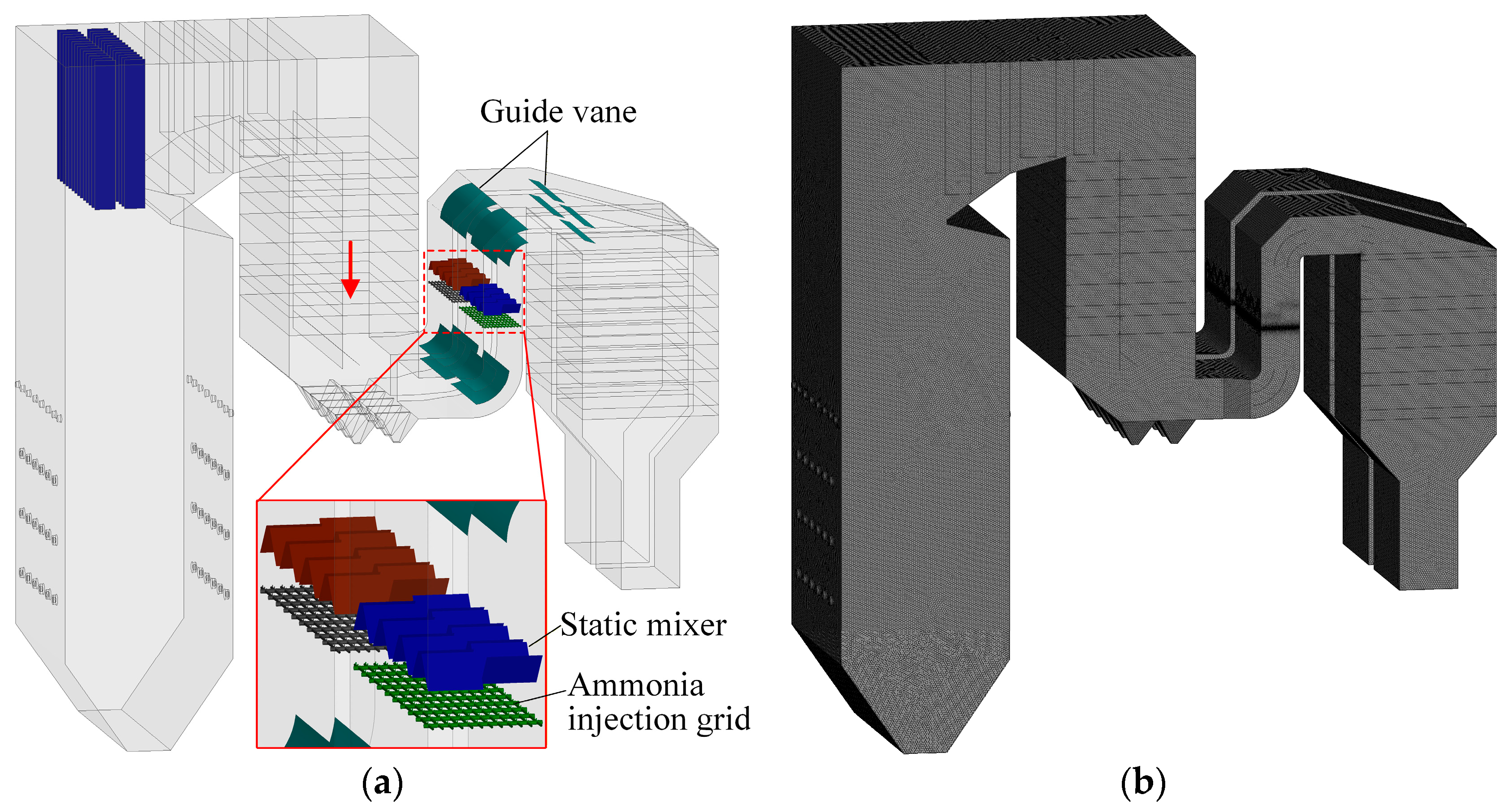
To investigate in-furnace combustion, rear-pass duct flow, and SCR performance under wide-load operation, a two-step one-way coupled furnace-to-SCR CFD framework was adopted in this study. First, a full-process hot-state combustion model covering the burner zone, main furnace, rear-pass duct, horizontal duct, and SCR inlet section was established to obtain the non-uniform flow, temperature, pressure, and species distributions under different boiler loads. As shown in Figure 2, this model provides the upstream furnace-derived boundary information for the downstream SCR-region simulation. The calculated profiles at the SCR inlet section, including the three velocity components, turbulence quantities, static pressure, temperature, and chemical-species mass fractions, were extracted and mapped onto the inlet boundary of the detailed SCR-region model.
Second, the SCR-region model was used to simulate the ammonia injection region, downstream duct, static mixer, guide structures, and catalyst layers. In this stage, NH3 injection, NH3-NOx mixing, catalyst-inlet field uniformity, SCR reaction, NOx removal efficiency, and pressure loss were evaluated. Therefore, the SCR inlet conditions were not prescribed as idealized uniform boundaries, but were obtained from the upstream hot-state combustion simulation. The coupling was one-way, and feedback from the SCR section to the upstream furnace and rear-pass flow was neglected. This assumption is reasonable because the SCR reaction occurs far downstream of the furnace and mainly affects local species conversion and pressure loss in the SCR system. Nevertheless, this treatment cannot describe the possible feedback of SCR pressure-loss variations on the upstream draft system or boiler-side flow redistribution, which is a limitation of the present modeling framework.
As shown in Figure 2, the computational domain was discretized using polyhedral meshes. Compared with conventional structured hexahedral meshes, polyhedral meshes offer greater flexibility for complex geometries and are more suitable for regions with complicated shapes, such as the furnace, rear pass duct bends, and the SCR inlet. They also generally provide good mesh quality and improve the computational efficiency of complex flow, heat transfer, and species transport while maintaining numerical stability and accuracy. Therefore, they are well suited to the coupled simulation of turbulence, combustion, particle transport, and heat transfer in the present study. To balance accuracy and computational cost, local mesh refinement was applied in regions with strong gradients in the flow and species fields, including the burner zone, furnace exit, rear pass duct bends, and the SCR inlet. The mesh density was further assessed through a mesh independence study, and a grid containing approximately 7.059 million cells was finally adopted for the simulations.

2.3. Numerical Models

2.3.1. Governing Equations and Turbulence Models

The governing equations include the continuity, momentum, and energy equations. The gas-phase continuity equation is given as follows [22]:
ρ t + · ρ u = S m
Here, ρ is the fluid density, t is time, v is the velocity vector, and Sm is the gas-phase mass source term contributed by the particle phase.
The momentum equation is given as follows [22]:
t ρ v + · ρ v v = p + · τ ̿ + ρ g + F
Here, p is the pressure, τ is the stress tensor, g is the gravitational acceleration, and F is the body force.
The energy equation is given as follows [22]:
t ρ E + · v ρ E + p = j h j J j + S h
Here, E is the internal energy of the fluid, and hj and Jj are the sensible enthalpy and diffusive flux of species j, respectively. Sh is the energy source term.
For the first-stage full-process hot-state combustion simulation, the standard k–ε turbulence model was adopted. This model was selected because of its robustness, numerical stability, and computational efficiency for large-scale industrial boiler simulations involving coupled turbulence, pulverized-coal combustion, radiation, particle transport, and NOx formation. Although more advanced turbulence models may provide more detailed predictions of local anisotropic vortices and small-scale secondary flows, the standard k–ε model provides a practical compromise between accuracy and computational cost for the furnace-scale combustion calculation. In addition, the predicted furnace-exit gas temperature, O2 concentration, NOx concentration, and carbon-in-ash were validated against field-measured data, supporting its applicability for obtaining the upstream non-uniform boundary profiles used in this study. The standard k-ε two-equation model is adopted, and the equations are given as follows [22]:
t ρ k + x i ρ k u i = x j μ + μ t σ k k x j + G k + G b ρ ε Y m
t ρ ε + x i ρ ε u i = x j μ + μ t σ ε ε x j + C 1 ε ε k G k + C 3 ε G b C 2 ε ρ ε 2 k
Here, k and ε are the turbulent kinetic energy and its dissipation rate, respectively. μt is the turbulent viscosity. Gk and Gb denote the production of turbulent kinetic energy due to velocity gradients and buoyancy, respectively. YM represents the contribution of dilatation to the dissipation rate. C, C, and C are model constants, and σk and σε are the turbulent Prandtl numbers for k and ε, respectively.
For the second-stage detailed SCR-region simulations, the shear stress transport (SST) k–ω model was adopted. Compared with the standard k–ε model, the SST k–ω model combines the advantages of the k–ω formulation near walls and the k–ε formulation in the outer flow region, and is more suitable for flows with adverse pressure gradients, separation, reattachment, duct bends, guide vanes, and static-mixer-induced secondary flows. Therefore, it was used in the SCR-region model to improve the prediction of flow redistribution, NH3-NOx mixing, pressure loss, and catalyst-inlet field uniformity. In this two-step modeling framework, the standard k–ε model was used to obtain the furnace-derived inlet profiles, while the SST k–ω model was used for the detailed SCR performance evaluation. The detailed formulation of the SST k–ω model can be found in the literature [23].

2.3.2. Lagrangian Coal-Particle Tracking Model

Since the volume fraction of pulverized-coal and fly-ash particles in the flue gas was well below 10%, particle volume effects and inter-particle interactions were neglected. Particle motion was therefore simulated using the discrete phase model. In this model, the particle force balance was solved in a Lagrangian framework to obtain particle trajectories, as given below [24]:
d u p d t = u u p τ r + g ρ p ρ ρ p + F m p
Here, up is the particle velocity, mp is the particle mass, ρp is the particle density, τr is the particle relaxation time, and F represents external forces other than gravity and drag.
Two-way coupling between the particle and gas phases was considered. Particle motion was driven by drag, buoyancy, and turbulence-induced dispersion from the gas phase. Particle temperature was determined by convective heat transfer with the surrounding gas and radiative heat exchange with the gas phase. This thermal history affected volatile release, ignition, and char burnout. Meanwhile, devolatilization and combustion of the particles released volatiles and oxidation products into the gas phase and transferred sensible and reaction heat to the gas. These processes modified the local temperature, density, and thermophysical properties [25].

2.3.3. Combustion and Radiation Models

Pulverized-coal combustion in the furnace involves moisture evaporation, devolatilization, volatile combustion, char combustion, and fuel-N conversion. The pulverized-coal particle size was described using a Rosin–Rammler distribution, with a particle diameter range of 5–100 μm and a mean diameter of 50 μm. Devolatilization was described using a two-competing-rate kinetic model, in which two parallel Arrhenius-type reactions are used to represent the low-temperature and high-temperature volatile-release processes of coal particles. Char combustion was modeled as a surface reaction jointly controlled by oxygen diffusion and intrinsic chemical kinetics.
Gas-phase volatile combustion was modeled using a non-premixed combustion model. In this model, the gas-phase thermochemical state is described by the mixture fraction and its variance, rather than by directly solving finite-rate gas-phase reaction equations. The local species concentrations, density, and temperature were obtained from the mixture-fraction/PDF formulation. The volatile matter released from coal particles was represented as an equivalent volatile pseudo-species derived from the proximate and ultimate analyses of the as-fired coal through elemental balance. In the present calculation, the volatile molecular weight was set to 30 kg kmol−1, and the corresponding equivalent volatile formula was C1.19H4.15O0.58N0.1492.
For fuel-N conversion, fuel-bound nitrogen was partitioned between volatile nitrogen and char nitrogen in the Fuel NOx model. The fraction of fuel-bound nitrogen retained in char on a dry ash-free basis was set to 0.7, while the remaining nitrogen was released with the volatile matter. The subsequent conversion of volatile-N and char-N to NO was calculated by the Fuel NOx model according to the local temperature, oxygen concentration, and combustion environment, rather than by prescribing a fixed overall fuel-N-to-NO conversion ratio.
All species were assumed to have the same diffusivity, so the species transport equations could be reduced to a mixture-fraction equation. Because elemental mass is conserved during chemical reactions, the source terms in the species transport equations cancel, and the mixture fraction becomes a conserved scalar. The governing equation for the mixture fraction is given as follows [26]:
t ρ f ¯ + ρ v f ¯ = k C p + μ t σ t f ¯ + S m
Here, f is the mixture fraction, k is the thermal conductivity, Cp is the specific heat capacity, and Sm is the source term. The transport equation for the mean mixture-fraction variance, f 2 ¯ , is given as follows [26]:
t ρ f 2 ¯ + ρ v f 2 ¯ = k C p + μ t σ t f 2 ¯ + C g μ t f ¯ 2 C d ρ ε k f 2 ¯
Here, σt, Cg, and Cd are constants.
Because the furnace temperature can reach 1400–1500 °C, radiative heat transfer plays a dominant role in the furnace and around platen-type heating surfaces. Therefore, radiation was included in the simulations. In the present study, the discrete ordinates radiation model was adopted. For brevity, the detailed governing equations are not repeated here and can be found in the literature [27,28]. In the radiation calculation, the wall emissivity of the main furnace walls and heating-surface walls was set to 0.8. This value was adopted as an engineering approximation for the overall radiative behavior of boiler heating surfaces in the present furnace-scale simulation.

2.3.4. SCR Catalyst Porous-Medium and Reaction Model

The SCR catalyst region was modeled as an equivalent porous medium. The catalyst used in the present coal-fired unit is a honeycomb-type catalyst with long, narrow, and nearly parallel channels. Based on the channel hydraulic diameter, catalyst porosity, superficial flue-gas velocity, and flue-gas properties, the Reynolds number inside the catalyst channels was estimated to be approximately 160–630 over the boiler load range of 25–100%. This indicates that the flow inside the honeycomb catalyst channels remained in the laminar-flow range. Therefore, the pressure drop across the catalyst was assumed to be dominated by viscous resistance.
In the present porous-medium model, the general Darcy–Forchheimer momentum source term was written as [29]:
S = μ α v + 1 2 C 2 ρ v v
where S is the momentum source term, μ is the dynamic viscosity of the flue gas, α is the permeability of the porous catalyst region, C2 is the inertial resistance coefficient, ρ is the flue-gas density, and v is the superficial velocity vector. According to the above Reynolds-number estimation and the laminar-flow assumption for the honeycomb catalyst channels, the inertial resistance coefficient C2 was set to zero in this study. Thus, only the Darcy-type viscous resistance term was retained in the actual calculation.
For the SCR denitrification reaction, the standard SCR reaction was considered as the dominant NO reduction pathway because NO is generally the major component of NOx in coal-fired flue gas [30]:
4NH3 + 4NO + O2 → 4N2 + 6H2O
In the present engineering-scale CFD model, the SCR reaction rate was implemented using the finite-rate Arrhenius form:
k = A T n e x p E a R T
where k is the reaction rate constant, A is the pre-exponential factor, n is the temperature exponent, Ea is the activation energy, R is the universal gas constant, and T is the gas temperature. The literature-based apparent kinetic parameters for the standard SCR reaction were adopted from Ma et al. [31]. Specifically, A = 3.18 × 10⁸ s−1, n = 0, and Ea = 8.80 × 10⁴ J mol−1 were used. Although the temperature exponent n is zero, the temperature dependence of the reaction rate is still retained through the Arrhenius exponential term containing Ea.
This treatment was adopted because the present study focuses on the engineering-scale effects of static mixer-assisted NH3-NOx mixing and catalyst-inlet field uniformity, rather than detailed catalyst microkinetics. The apparent global reaction model is sufficient to evaluate the relative effects of different mixer configurations on NH3-NOx matching, catalyst-inlet uniformity, and overall NOx removal performance. More detailed SCR kinetic models may include NH3 adsorption/desorption, NH3 oxidation, NO2-related fast SCR reactions, slow SCR reactions, NO oxidation, and other side reactions. These mechanisms may affect the absolute local reaction rate, NH3 slip, and by-product formation. However, because the same reaction model, kinetic parameters, and operating conditions were used for all compared cases, the relative trends among the tested static mixer configurations are expected to remain reliable. Therefore, the simplified apparent global kinetic model is considered appropriate for the comparative purpose of this engineering-scale CFD study, while its limitations in describing detailed catalyst microkinetics and side reactions are acknowledged.

2.4. Boundary Conditions and Operating Conditions

Four typical boiler loads of 100%, 75%, 50%, and 25% were selected for the numerical simulations, and the corresponding operating parameters are listed in Table 3. The corresponding coal feed rates were 255.0, 197.2, 130.5, and 74.1 t/h, respectively. As the boiler load decreased, the primary air temperature dropped from 77 °C to 58 °C, while the secondary air temperature decreased from 332 °C to 298 °C. To reflect the actual air-supply characteristics at low load, the excess air ratio was gradually increased from 1.15 to 1.25. The burner arrangement was also adjusted with boiler load. At 100% load, layer A burners, layer B burners, layer C burners, layer E burners, and layer F burners were in service. At 75% load, layer A burners, layer B burners, layer C burners, and layer E burners were in service. At 50% load, layer A burners, layer B burners, and layer E burners were in service. At 25% load, only layer A burners and layer B burners were in service. These conditions reasonably represent actual boiler operation over a wide load range, especially under deep load regulation conditions.
In the SCR system calculations, NH3 with a volume fraction of around 3% was used as the reductant. The NH3 injection rate was determined from the flue-gas flow rate, the NOx concentration at the SCR inlet, and the prescribed normalized stoichiometric ratio. The normalized stoichiometric ratio, abbreviated as NSR, was defined as the molar flow rate of injected NH3 divided by the molar flow rate of NOx at the inlet. It represents the NH3 supply per mole of NOx and characterizes the matching between NH3 injection and NOx concentration.
To ensure comparability among different boiler loads and static mixer configurations, the NSR was fixed at 1.0 in all cases. This setting was used to isolate the effects of flow organization and NH3-NOx mixing from the influence of total ammonia supply, so that the role of static mixer-assisted mixing could be evaluated more clearly. Changing NSR would affect the absolute SCR performance. A higher NSR may increase NOx removal efficiency, but it also increases the risk of local NH3 excess and NH3 slip. In contrast, a lower NSR may reduce NH3 slip, but it can lead to insufficient NH3 supply and lower denitrification efficiency. Therefore, the present conclusions mainly reflect the relative effects of flow and mixing improvement under the same ammonia-supply condition.
The wall boundary conditions were specified according to the physical characteristics of different wall regions. All solid walls were treated as no-slip walls, and wall roughness was not considered. For heat-transfer surfaces, including the furnace water walls and enclosure-wall heating surfaces, prescribed wall-temperature boundary conditions were applied. The wall-temperature values under different boiler loads were determined from boiler design data and operating data. For wall regions without heat-transfer surfaces and with external insulation, adiabatic boundary conditions were used.
The modeling framework used in this study is applicable not only to the present boiler, but also to similar coal-fired units in which upstream combustion conditions strongly affect SCR inlet fields and denitrification performance. By coupling furnace combustion, rear-pass duct transport, NH3 injection, NH3-NOx mixing, and SCR reaction, this method can be used to diagnose SCR performance deterioration caused by non-uniform temperature, velocity, and NOx distributions, and to evaluate retrofit measures such as ammonia injection adjustment, guide-vane modification, and static mixer installation. However, when applied to other units, the boiler geometry, operating parameters, catalyst properties, and field validation data should be updated accordingly.
The numerical simulations were performed using ANSYS Fluent 2019 R3 (ANSYS Inc., Canonsburg, PA, USA). A pressure-based steady-state solver was employed. Pressure-velocity coupling was handled using the SIMPLE algorithm, and the convective terms were discretized with a second-order upwind scheme. The standard k–ε model was used in the first-stage full-process hot-state combustion simulations, whereas the SST k–ω model was used in the second-stage detailed SCR-region simulations. Appropriate under-relaxation factors were applied to facilitate convergence. For both simulation stages, the iterations were continued until the residuals of the energy and radiation equations were below 10−6, while those of the remaining equations were below 10−3.


3. Results and Discussion
3.1. Mesh Independence and Model Validation
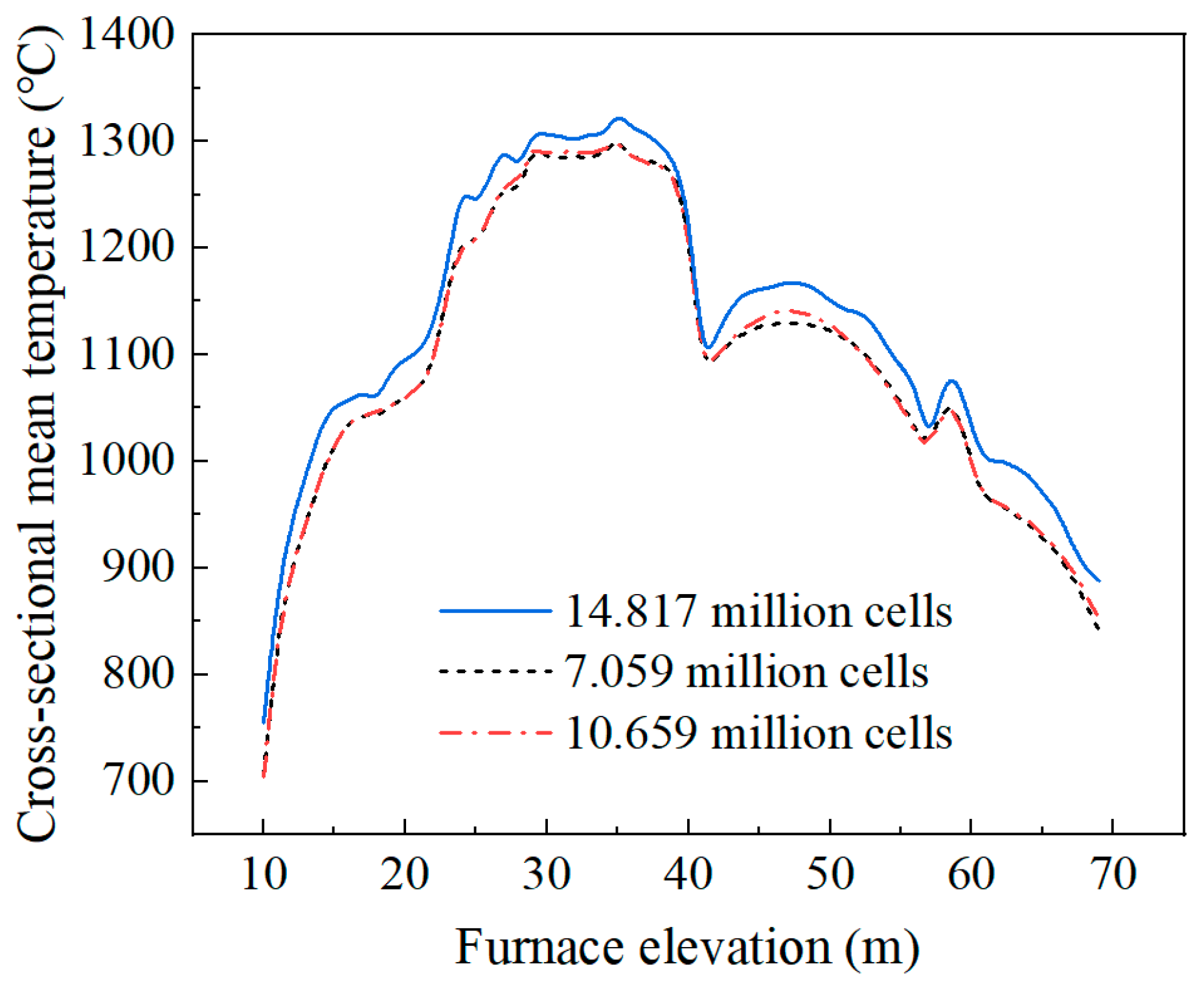
To evaluate the effect of mesh density on the simulation results, a mesh independence study was conducted for the 100% boiler load case. Under the same computational domain, physical models, and boundary conditions, a series of polyhedral meshes with different cell counts was generated through progressive refinement. The cell count of each successive mesh was increased by approximately 1.5 times. The average temperature distribution along the furnace height was selected as the evaluation criterion, as shown in Figure 3. The results show that the temperature profiles obtained with different meshes exhibit the same overall trend, characterized by a rapid temperature rise in the lower furnace, relatively high temperatures in the main combustion zone, and a gradual temperature decrease in the upper furnace. As the mesh density increased, the average temperature distribution gradually converged. Further refinement caused only minor changes in the temperature profile, indicating that the effect of additional cells on the results was limited. Considering both computational accuracy and cost, a mesh containing approximately 7.059 million cells was finally adopted for the subsequent simulations.
Figure 3 presents the mesh independence study and is used only to evaluate the sensitivity of the numerical results to mesh resolution, whereas the model validation was performed by comparing the predicted results with field-measured data at 100% and 75% boiler loads, as listed in Table 4. At 100% load, the predicted furnace-exit gas temperature, furnace-exit O2 concentration, NOx concentration, and carbon-in-ash agree well with the measured values. At 75% load, the predicted furnace-exit gas temperature, furnace-exit O2 concentration, and NOx concentration also show good agreement with the corresponding field data, with relative deviations within 6.3%. These results indicate that the present numerical model can reasonably reproduce the combustion, heat transfer, and pollutant formation processes under both rated-load and part-load conditions, thereby providing a reliable basis for the subsequent analysis of combustion characteristics and SCR performance over a wide load range.

3.2. Combustion and NOx Emission Characteristics over a Wide Load Range

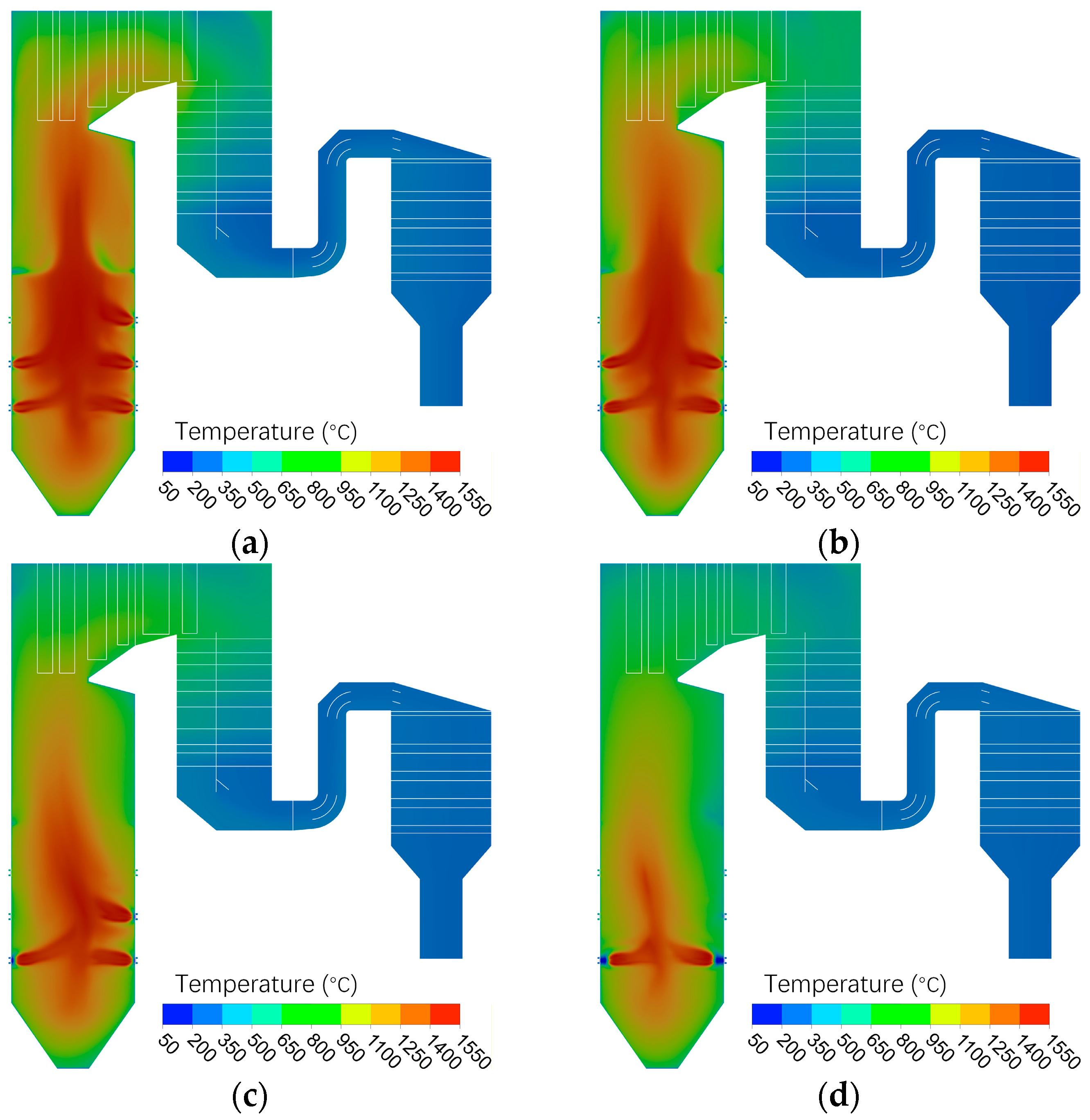
Figure 4 shows the temperature distributions on the vertical cross-section of the furnace at different boiler loads. As the boiler load decreases, the heat release intensity in the furnace gradually weakens, the high-temperature zone contracts markedly, and its coverage in the main combustion and burnout zones continuously decreases. At 100% load, the high-temperature zone is extensive and the flame extends clearly upward. This is mainly because combustion is stronger under this condition and SOFA remains in service, producing a secondary combustion process above the main combustion zone and thereby maintaining the flame center and the main heat-release region at a relatively high position. As the boiler load decreases further, combustion intensity continues to decline, while SOFA is gradually taken out of service. As a result, the secondary burnout effect above the main combustion zone becomes much weaker, causing the high-temperature zone to move downward and the flame center to drop significantly. This may lead to a lower furnace-exit gas temperature and further affect the main steam temperature.
Meanwhile, the symmetry of the temperature field gradually deteriorates, and local flow bias becomes especially pronounced at 25% load, indicating evident flame maldistribution. This tendency is consistent with the quantitative changes in operating conditions. When the boiler load decreases from 100% to 25%, the coal feed rate decreases from 255.0 t/h to 74.1 t/h, corresponding to only about 29.1% of the full-load value. The number of active burner layers also decreases from five to two, and the active burners are concentrated in the lower furnace. These changes indicate a substantially weakened heat release intensity and a downward shift in the main combustion region. Under such conditions, the flame becomes more sensitive to local flow and air-distribution imbalance, leading to weakened jet penetration, reduced turbulent mixing, downward movement of the flame center, and more pronounced non-uniformity of the temperature field.
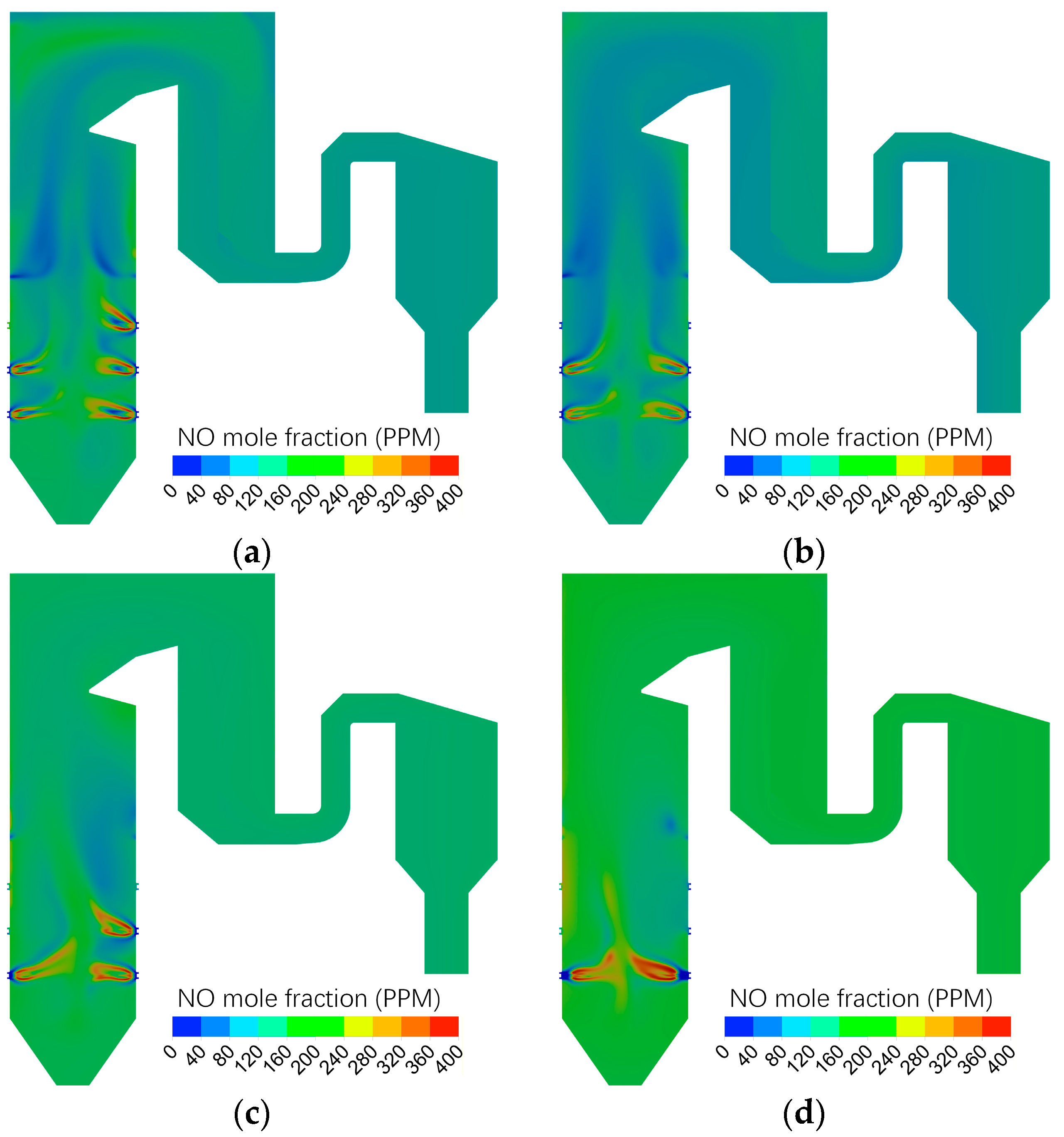
Figure 5 shows the NO concentration distributions on the vertical cross-section of the furnace at different boiler loads. As the boiler load decreases, the NO formation zone shifts downward, and its spatial distribution changes from relatively concentrated to increasingly non-uniform. At 100% load, the main combustion zone is characterized by a relatively high temperature and an extensive high-temperature region. Under this condition, NO is generated mainly in the main combustion zone and in the local high-temperature region above it, resulting in a relatively continuous distribution. This is closely related to the stronger combustion intensity at high load and the secondary combustion process formed after SOFA is brought into service. As the boiler load decreases further, the overall heat release level in the furnace declines, the high-temperature region contracts, and the NO formation zone moves downward accordingly. Meanwhile, the burner jet momentum decreases, and both turbulent mixing and local air-distribution organization in the furnace become weaker, leading to a deterioration in NO uniformity. This becomes especially evident at 25% load, where the NO field shows more pronounced bias and corresponds well to the maldistribution of the temperature field. These results indicate that NO formation is governed not only by the overall temperature level, but also by the local flame structure and oxygen distribution.
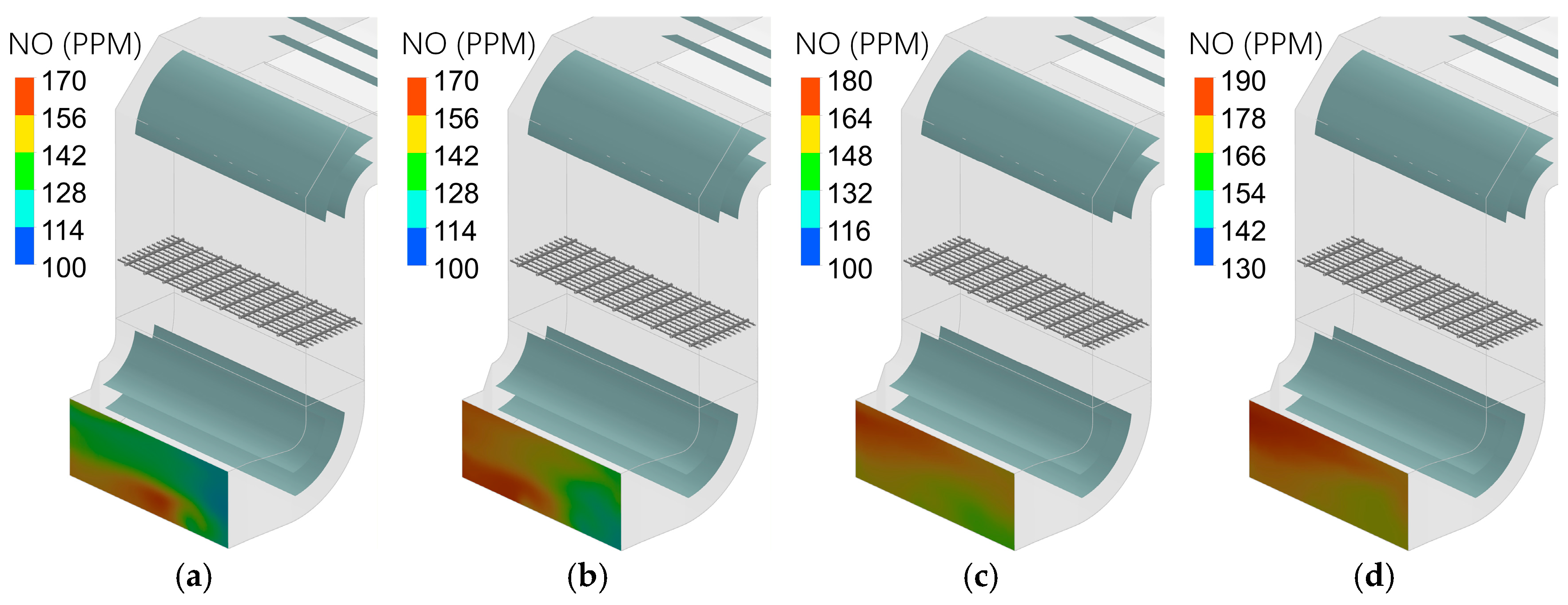
Figure 6 shows the NO concentration distributions at the SCR inlet under different boiler loads. The NO field at the SCR inlet is clearly non-uniform under all operating conditions and does not represent an ideal uniform inflow. Marked regional differences in NO concentration indicate that the combined effects of in-furnace combustion organization, flow evolution in the rear pass duct, and species transport have already produced strong spatial non-uniformity before the flue gas enters the SCR system. Therefore, using a uniform inlet boundary condition in the numerical simulation would not accurately represent the actual species distribution at the SCR inlet.
In addition, the NO distributions shown in Figure 6 were obtained under the current coal quality and burner operating conditions. In actual operation, changes in coal quality, as well as adjustments in mill operation and burner arrangement, can alter the in-furnace combustion organization, local air distribution, and reducing atmosphere, thereby further affecting the NO concentration distribution at the SCR inlet. This indicates that the NO field at the SCR inlet is highly sensitive to operating conditions. Therefore, under wide-load, especially low-load, operation, the NH3 injection and mixing strategy of the SCR system should not only match the distribution characteristics under the current condition, but also account for fluctuations in the inlet boundary conditions caused by changes in operating mode.
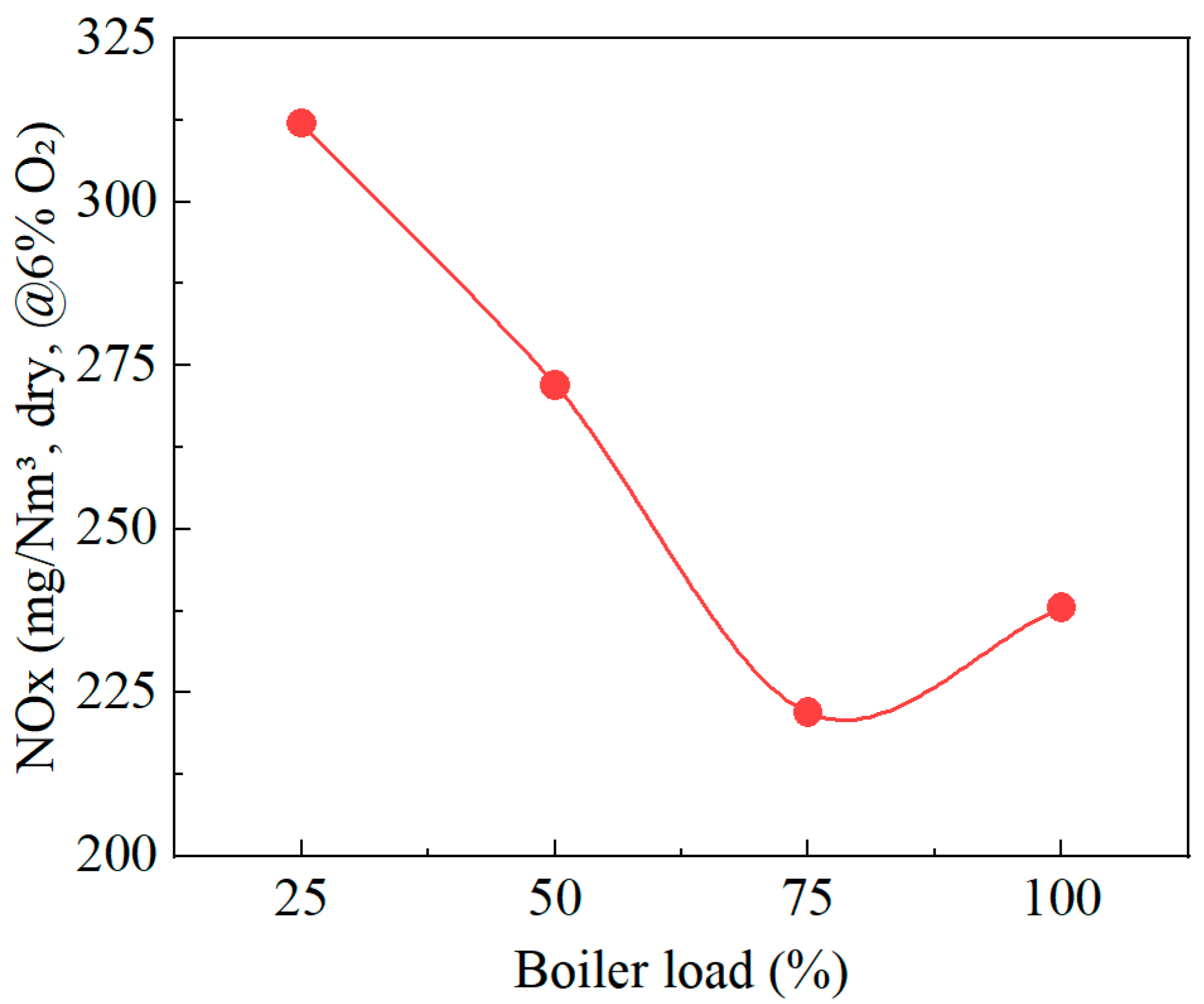
Figure 7 shows the variation in the average NOx concentration at the SCR inlet with boiler load. As the boiler load decreases, the average NOx concentration first decreases and then increases, reaching its minimum at 75% load. This trend is jointly governed by the furnace temperature level and the air distribution pattern. At 75% load, the furnace temperature is lower than that at full load, while SOFA remains in service, so air staging is still effective and NOx formation is suppressed. At 100% load, the furnace temperature is higher and local high-temperature regions are more pronounced, resulting in greater thermal NO formation. When the boiler load is further reduced to 50% and 25%, the furnace temperature continues to decline, but SOFA is taken out of service, the excess air ratio increases, and the local oxidizing atmosphere becomes stronger. As a result, the suppressing effects of staged combustion and the reducing atmosphere on NOx formation are weakened, causing the average NOx concentration at the SCR inlet to increase again.

3.3. SCR Performance and Static Mixer-Assisted Reactive Mixing

3.3.1. SCR Performance Without the Static Mixer

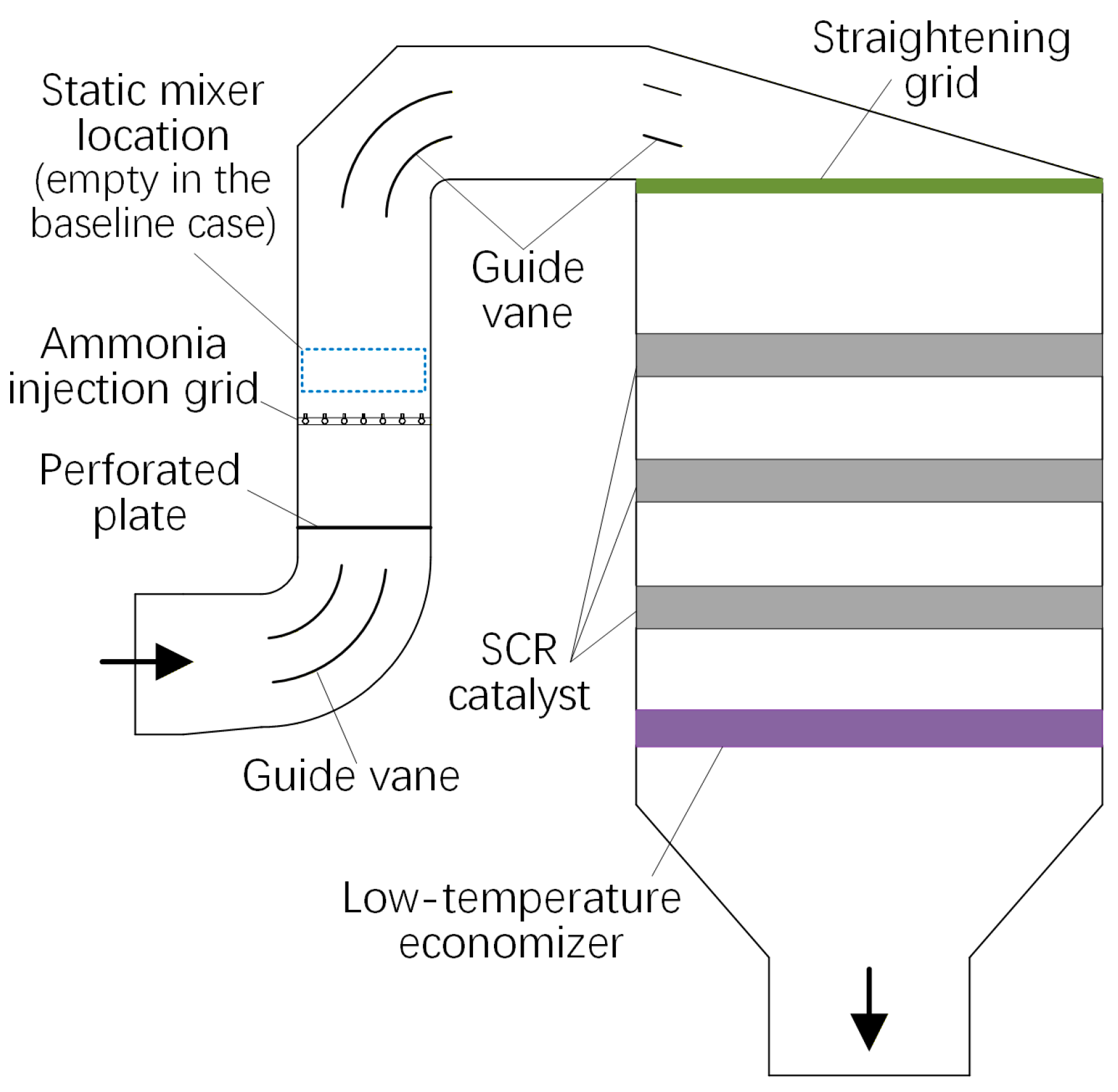
Figure 8 shows the schematic layout of the SCR system. After flowing out of the upstream rear pass duct, the flue gas enters the SCR inlet section and first passes through the ammonia injection grid region, where it is preliminarily mixed with the injected NH3 reductant. It then flows through the flow-straightening and mixing section before entering the SCR catalyst layers, where denitrification occurs. The ammonia injection grid is mainly used to distribute and inject NH3 over the cross-section, thereby promoting contact and mixing between NH3 and the incoming NOx. The downstream duct sections and internal flow-control devices are used primarily to improve the uniformity of the velocity and concentration fields, thus providing more uniform inlet conditions for the SCR catalyst. The SCR catalyst layers constitute the core region for NOx reduction, and the velocity, temperature, and NH3-to-NOx ratio at their inlet directly determine the final denitrification performance. It should be noted that the location of the static mixer is also indicated in Figure 8, but no static mixer was installed in the baseline case discussed in this section, and the corresponding position remained empty.
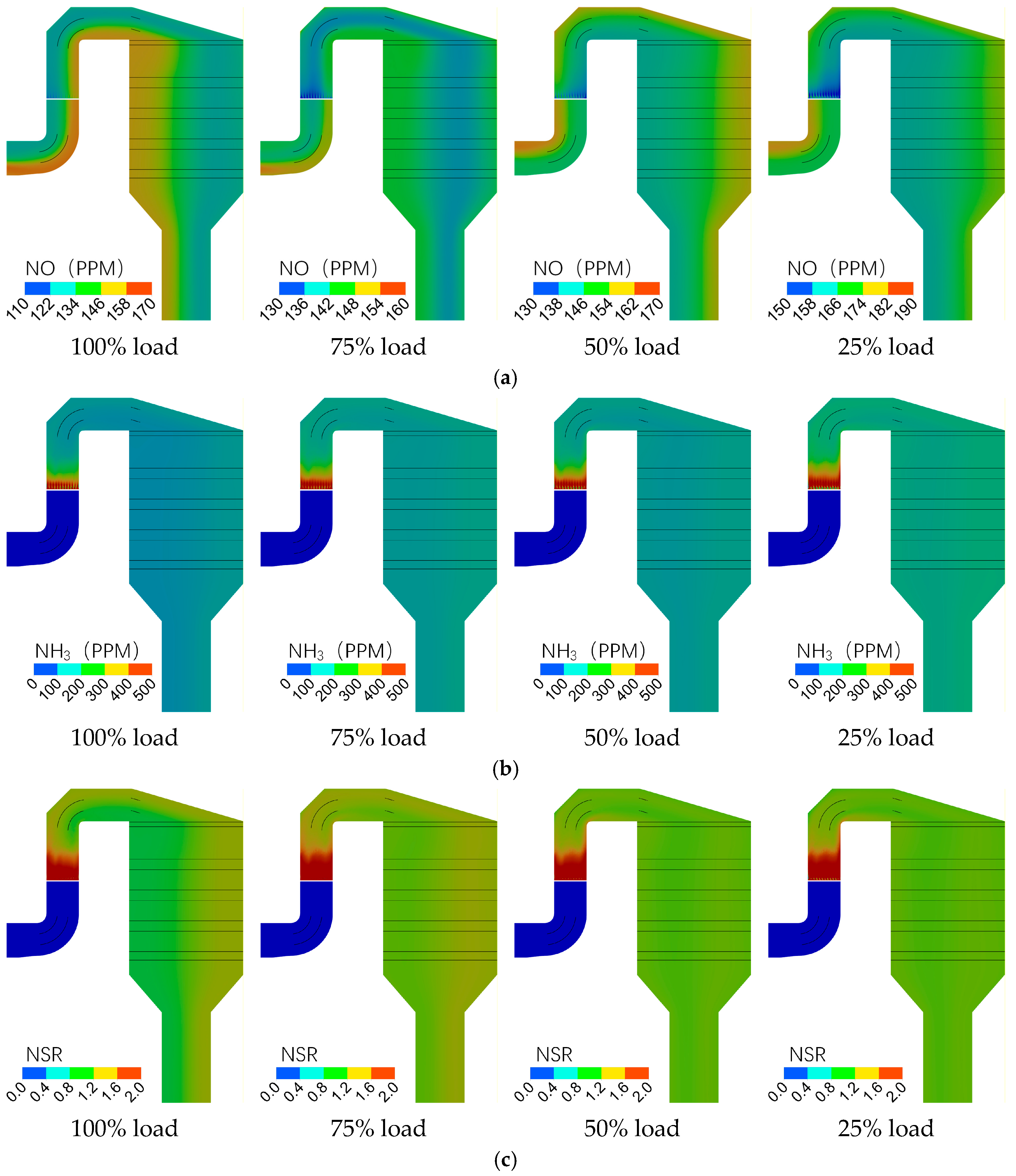
Figure 9 shows the distributions of NO concentration, NH3 concentration, and NSR in the SCR system at different boiler loads without a static mixer. NSR denotes the normalized stoichiometric ratio and is commonly used to characterize the matching between injected NH3 and incoming NOx. When NSR is close to 1.0, the local NH3 distribution is generally regarded as appropriate. A higher or lower NSR indicates local NH3 excess or deficiency, respectively, both of which may adversely affect the subsequent denitrification reaction. It should be noted that the SCR catalytic reaction was not considered in Figure 9. Therefore, this figure is used mainly to analyze the mixing behavior of NH3 and NO after ammonia injection.
A certain degree of NO maldistribution is observed in the SCR inlet duct under all boiler loads, and the non-uniformity is more pronounced at high load. This is mainly because the higher flue-gas velocity at high load shortens the residence time available for post-injection mixing. Although the turbulence intensity is also higher, the resulting mixing enhancement is insufficient to offset the adverse effect of the shortened residence time. Consequently, the NO field becomes more uneven. In contrast, the lower flue-gas velocity at low load provides a longer residence time and is more favorable for thorough mixing between NO and NH3. For the NH3 field, a relatively continuous concentration distribution is formed after ammonia injection under all boiler loads, indicating that the current ammonia injection system provides a certain degree of distribution and mixing capability. However, because the SCR system usually requires high denitrification efficiency, the NH3 distribution at the SCR catalyst inlet still needs to be as uniform as possible to avoid local NH3 deficiency or excess and the resulting reaction mismatch. The NSR distributions further show that NH3 and NO are already mixed relatively well in the bend region near the stage-2 guide vane, and the local NH3-to-NOx ratio becomes even more uniform as the flue gas approaches the SCR catalyst inlet, indicating that mixing continues to develop along the flow direction. Overall, the NSR distribution is slightly better at low load than at high load, consistent with the longer residence time and more favorable mixing conditions at low load.
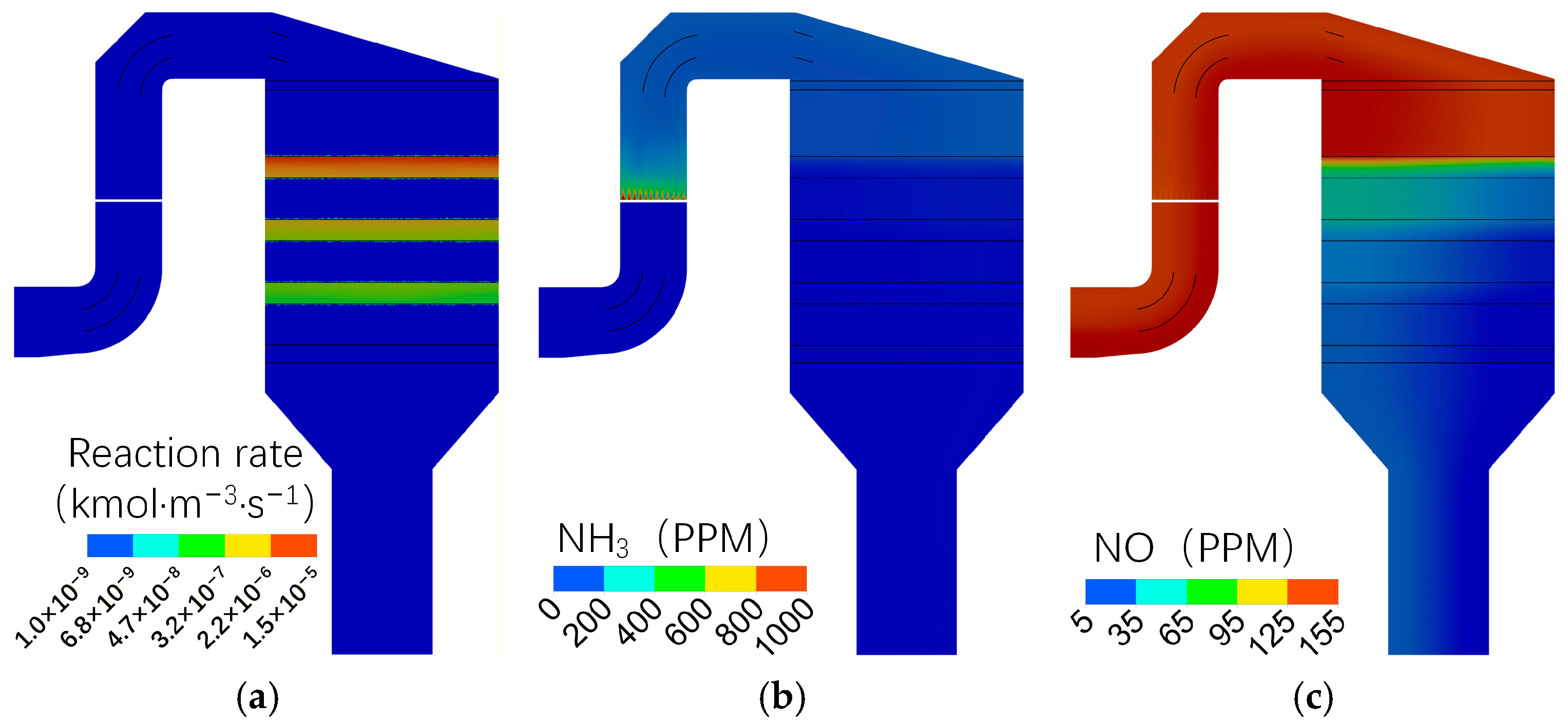
Figure 10 shows the reaction rate together with the NH3 and NO distributions in the SCR system at 100% boiler load without a static mixer. Unlike Figure 9, the SCR catalytic reaction is considered here. The reaction rate is plotted on a logarithmic scale to show the variation in reaction intensity within the reactor more clearly. The reaction is concentrated mainly near the SCR catalyst inlet, and the first catalyst layer removes most of the NO. After the flue gas enters the first catalyst layer, the NO concentration decreases rapidly, indicating that most of the high-concentration NO is removed in the front catalyst layer. The second and third catalyst layers mainly remove the remaining NO at lower concentrations and therefore contribute primarily to deep reduction.
The NO distributions indicate that pronounced lateral non-uniformity still exists inside the catalyst region. This suggests that, although the catalytic reaction proceeds continuously, lateral mixing inside the reactor remains limited. The main reason is that the flow velocity in the SCR reactor is relatively low, the turbulence intensity is weak, and lateral diffusion is insufficient. As a result, the NO maldistribution already present at the catalyst inlet cannot be effectively eliminated within the catalyst layers. This indicates that the uniformity of the flow and species fields upstream of the catalyst inlet has an important influence on the subsequent reaction process. Once the inlet distribution is non-uniform, the non-uniformity persists inside the catalyst layers and further affects the local reaction rate and the overall denitrification performance.
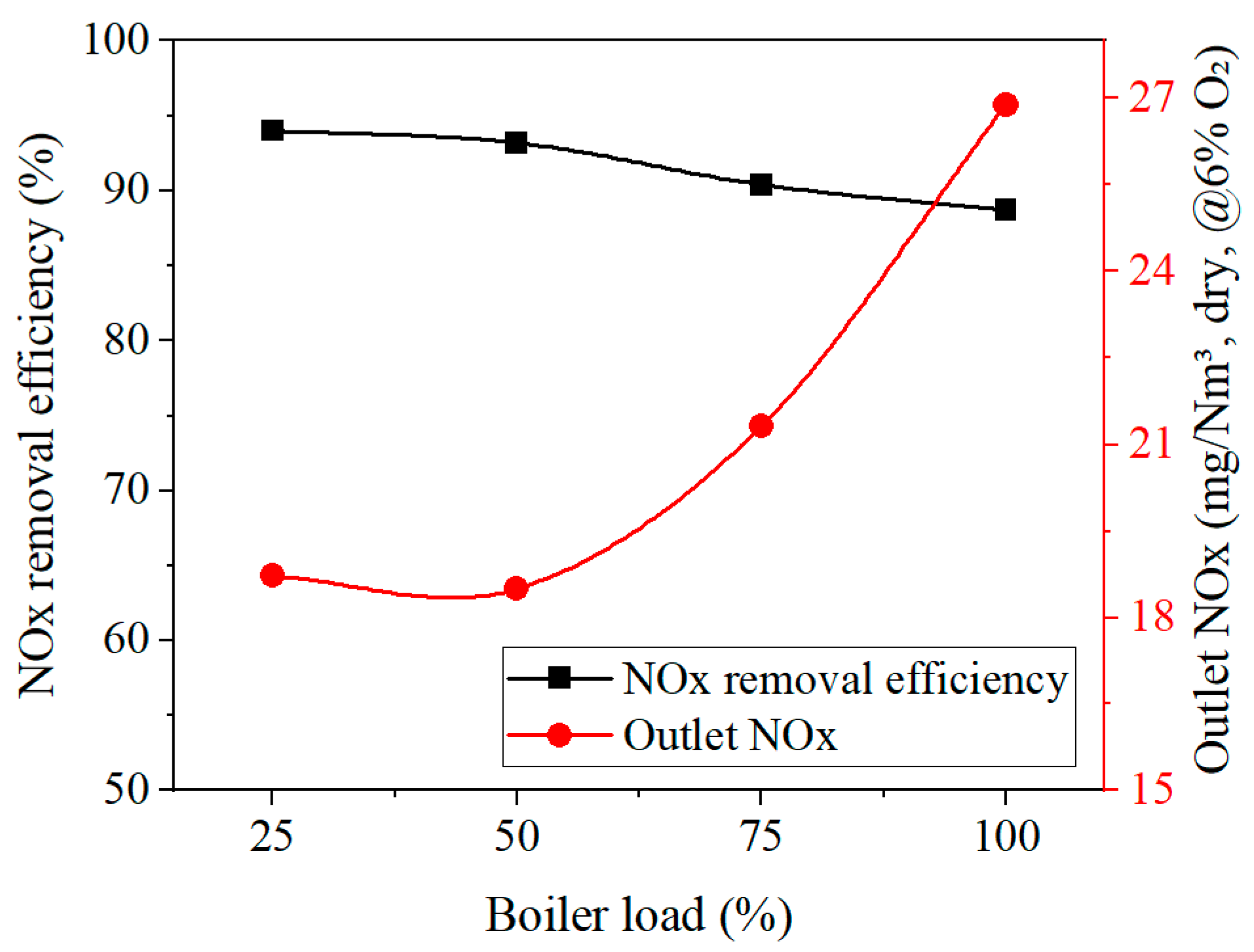
Figure 11 shows the denitrification efficiency and the SCR outlet NOx concentration at different boiler loads without a static mixer. As the boiler load decreases, the denitrification efficiency gradually increases from 88.7% at 100% load to 94.0% at 25% load. This indicates that, under low-load conditions, the SCR reaction process is more favorable for NOx removal, even though the NOx concentration at the SCR inlet is higher. The main reason is that the lower flue-gas velocity at low load extends the residence time in the SCR catalyst region and provides more time for catalytic reactions. In addition, mixing between NO and NH3 is more sufficient at low load, which also contributes to the higher denitrification efficiency.
In terms of outlet NOx, the SCR outlet concentration is about 21–27 mg/Nm3 at medium and high loads on a dry basis and corrected to 6% O2, whereas it is about 18 mg/Nm3 at low load, which is overall lower than that at high load. In other words, although the NOx concentration at the SCR inlet is higher at low load, reaching 312 mg/Nm3 at 25% load compared with 238 mg/Nm3 at 100% load, the outlet NOx becomes slightly lower because of the higher denitrification efficiency. This indicates that, under operation over a wide load range, there is no simple one-to-one relationship between the NOx level at the SCR inlet and that at the outlet, and changes in denitrification efficiency also play an important role.

3.3.2. Static Mixer-Assisted NH3-NOx Mixing and SCR Performance

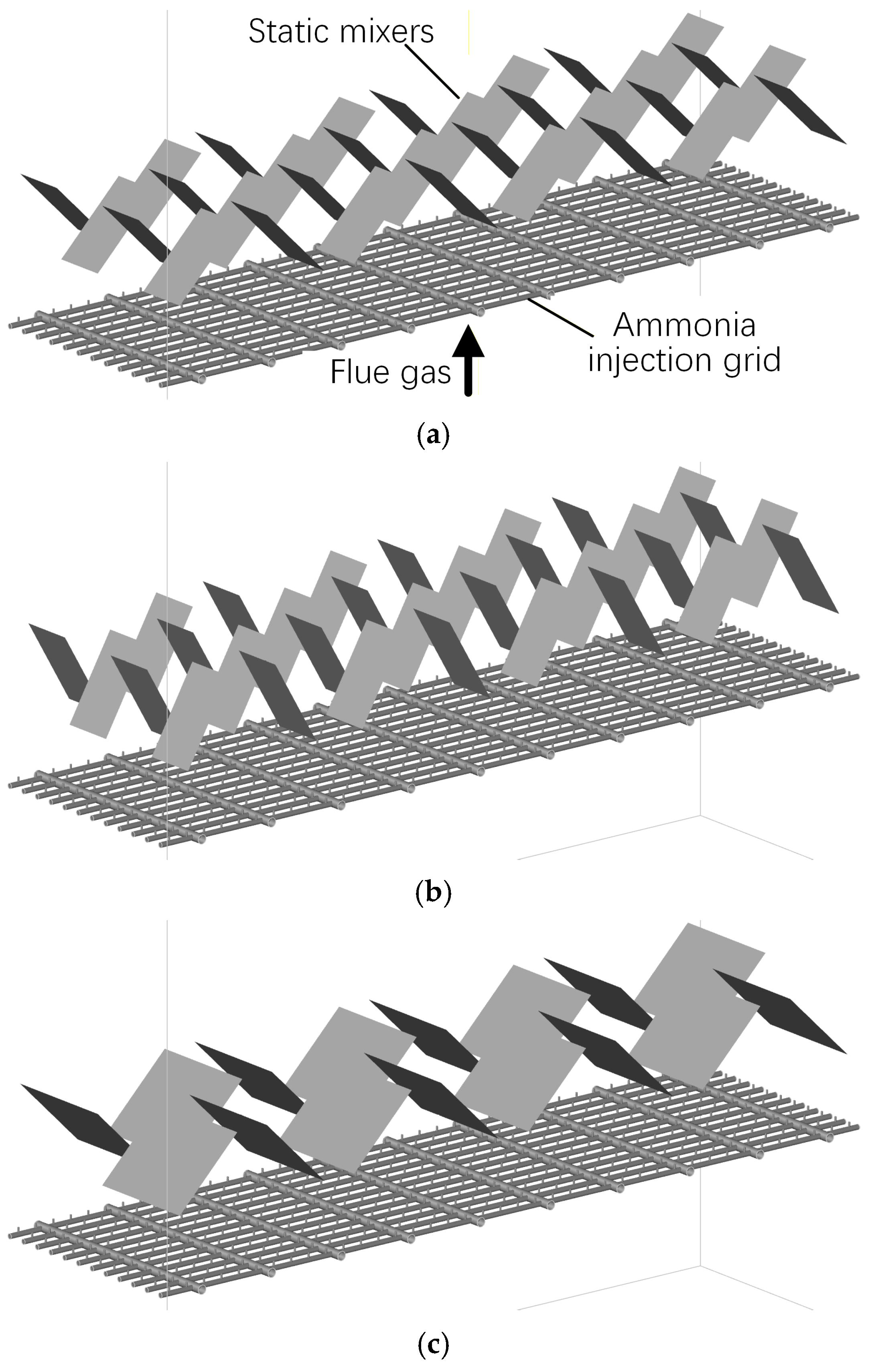
Figure 12 shows the schematic diagrams of the three static mixer configurations. All three designs use rectangular blades, and the labeled angle denotes the angle between the blade and the vertical plane. Type A and Type B both use small blades arranged in a 4 × 8 pattern across the duct cross-section, giving a total of 32 blades. The blade angle is 45° for Type A and 30° for Type B, so the main difference between the two lies in blade inclination. Type C uses larger blades arranged in a 2 × 4 pattern, with a total of 8 blades and a blade angle of 45°. The three configurations therefore represent different combinations of blade size, arrangement density, and inclination angle, and are compared in the following sections in terms of flow uniformity, species mixing, and denitrification performance.
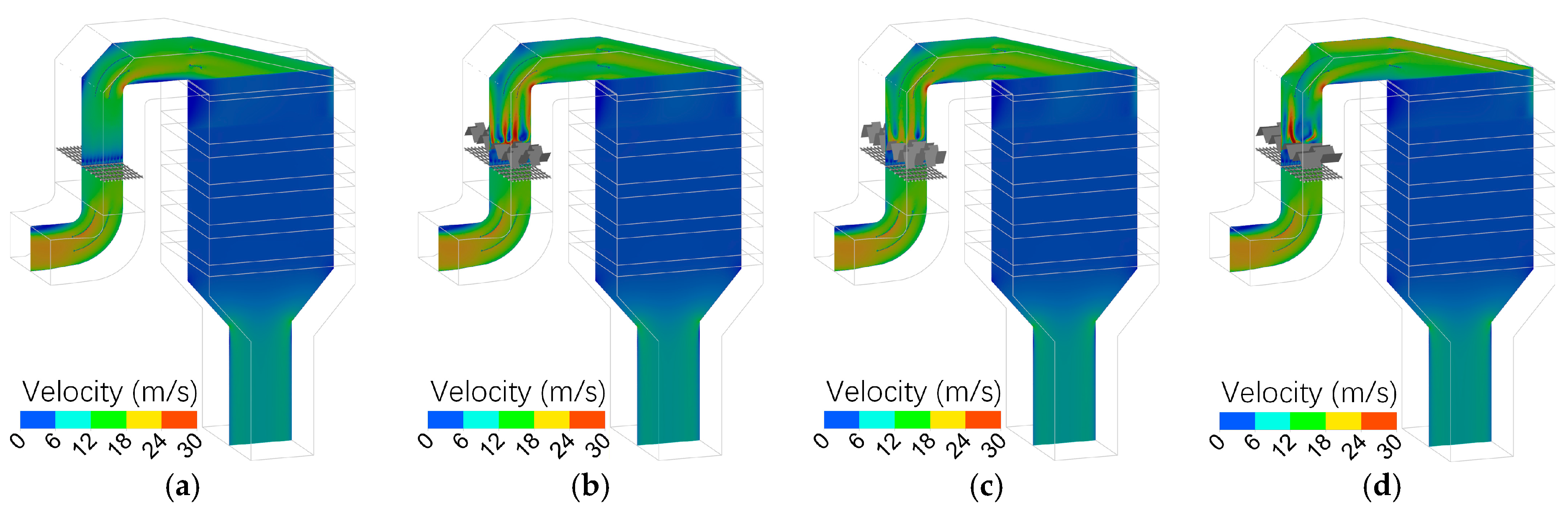
Figure 13 shows the velocity distributions at 100% boiler load for different static mixer configurations. Without a static mixer, the flue-gas velocity in this region is relatively smooth and the overall uniformity is good. However, the lateral disturbance is weak, which is unfavorable for transverse mixing after ammonia injection. After a static mixer is installed, the blades split and deflect the main flow, resulting in a much more complex local flow field and greater velocity non-uniformity. Although the local velocity field downstream of the mixer becomes more complex, transverse mixing is also enhanced, which promotes more effective contact between NH3 and NOx. It should be noted that the static mixer is not the only flow-control device upstream of the SCR inlet. Two stages of guide vanes and a flow-straightening structure are still located downstream of the mixer. Therefore, after passing through these downstream guide and straightening sections, the velocity distribution becomes uniform again when the flue gas reaches the SCR catalyst inlet. This indicates that the local disturbance introduced by the static mixer does not ultimately deteriorate the velocity field at the catalyst inlet, but instead helps improve upstream mixing conditions.
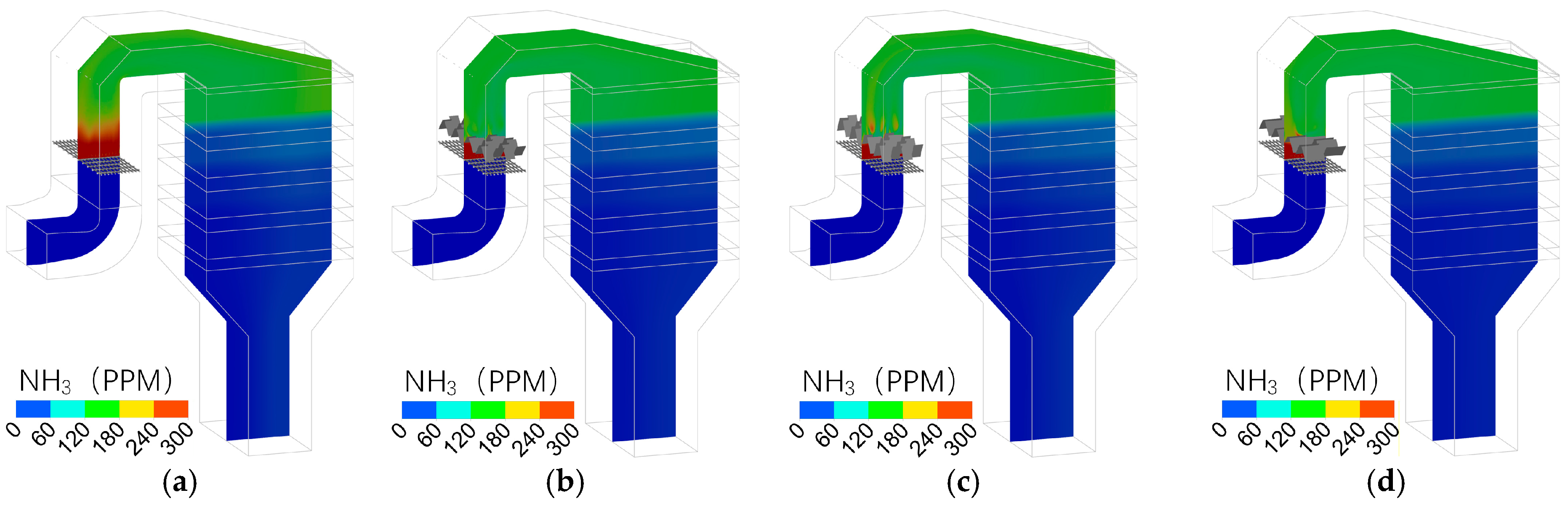
Figure 14 shows the NH3 concentration distributions at 100% boiler load for different static mixer configurations. Compared with the case without a static mixer, the NH3 field downstream of the ammonia injection grid changes markedly after a static mixer is installed. Local high- and low-concentration regions are stretched, split, and redistributed, indicating that the static mixer strongly disturbs the NH3 plume and effectively enhances transverse mixing. Without a static mixer, clear concentration differences persist over a relatively long downstream distance, and NH3 homogenization proceeds relatively slowly. This suggests that the original duct flow and the downstream guide vanes alone provide only limited capability for the cross-sectional dispersion and redistribution of NH3. After a static mixer is installed, the local flow field becomes more complex and transverse mixing is significantly enhanced. As a result, the distance required for NH3 homogenization is greatly shortened. In other words, the static mixer accelerates the cross-sectional dispersion and redistribution of NH3 within a shorter duct length after ammonia injection. Among the three configurations, Type A shows the most pronounced improvement, with a more uniform downstream NH3 distribution and smaller local concentration differences, indicating the best performance in enhancing mixing and promoting NH3 uniformity.
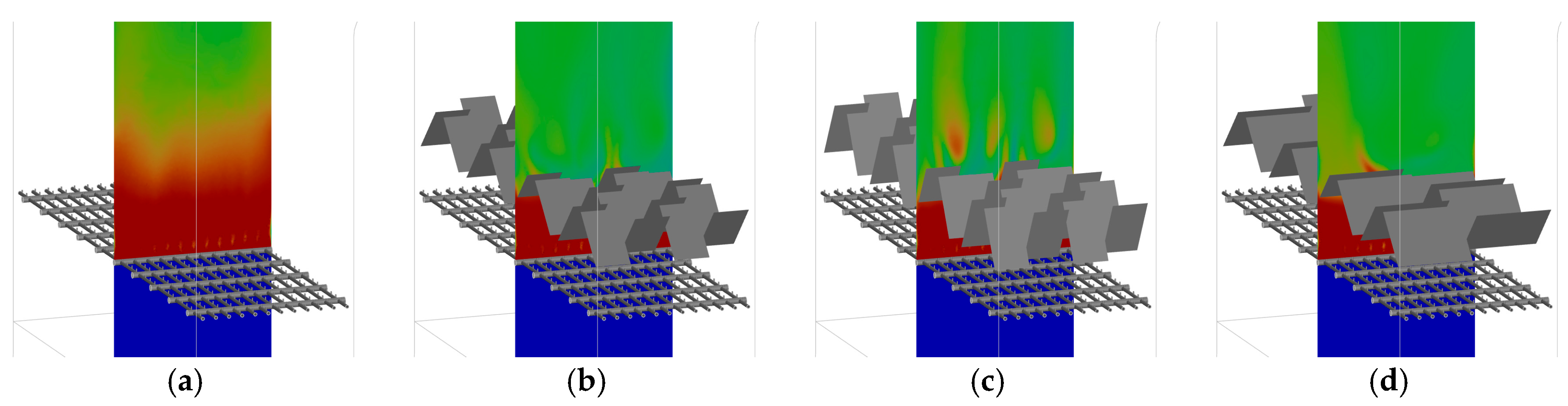
Figure 15 provides a further enlarged view of the local NH3 concentration details for the different configurations. Without a static mixer, distinct high-concentration streaks still remain locally, indicating insufficient transverse dispersion of the NH3 plume. After a static mixer is installed, these streak-like structures are markedly weakened and the local concentration gradients become smaller, showing that the static mixer effectively promotes the transverse dispersion and redistribution of the NH3 plume. Among the three configurations, Type A shows the most pronounced improvement. Its local high- and low-concentration regions are weakened more effectively, and the concentration field becomes smoother. This further confirms that Type A is superior to Type B and Type C in enhancing NH3 mixing.
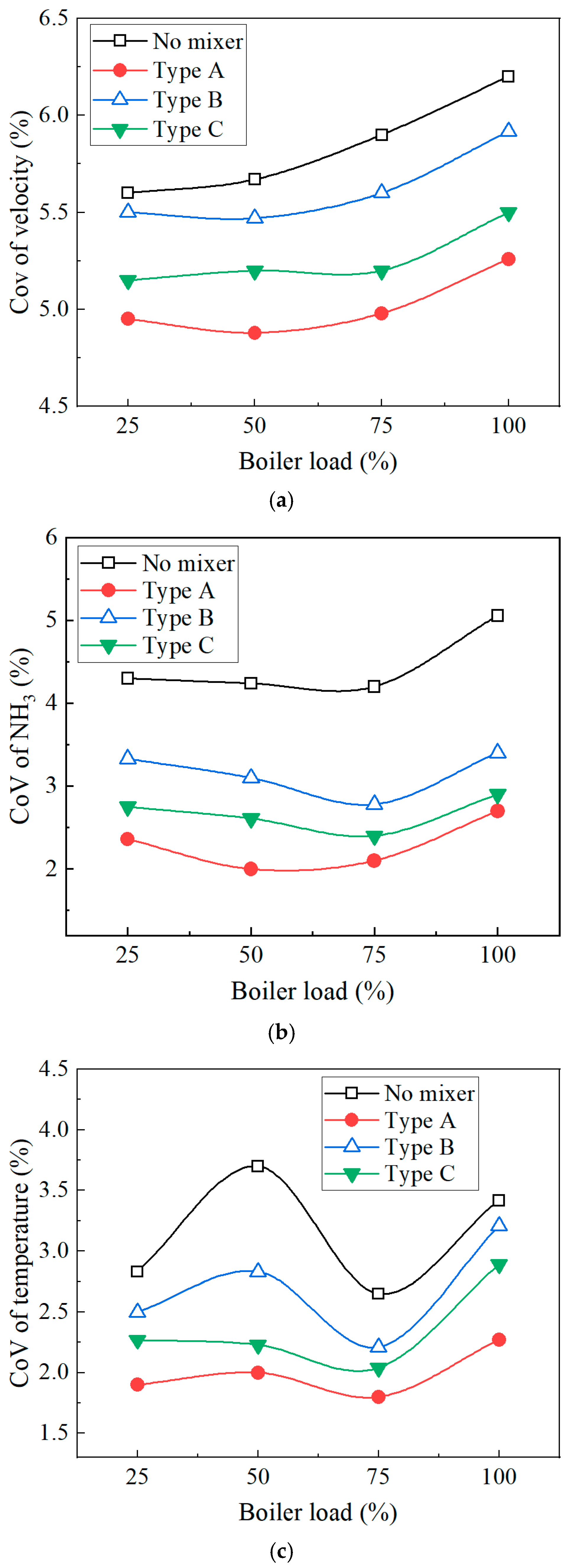
The coefficient of variation (CoV), defined as the ratio of the standard deviation to the mean, was used to quantify the uniformity of the velocity, NH3 concentration, and temperature fields at the SCR catalyst inlet. For a given variable φ, the CoV is defined as
CoV = σ φ φ ¯ × 100 %
where φ ¯ and σ φ are defined as follows:
φ ¯ = i = 1 N A i φ i i = 1 N A i
σ φ = i = 1 N A i ( φ i φ ¯ ) 2 i = 1 N A i
where φ ¯ is the area-weighted mean value of φ over the SCR catalyst-inlet cross-section, and σφ is the corresponding standard deviation. φi is the local value of φ at the i-th surface cell, Ai is the area of the i-th surface cell, and N is the total number of surface cells on the catalyst-inlet cross-section.
Physically, CoV represents the relative spatial fluctuation of a variable over the cross-section. A smaller CoV indicates a more uniform field. When CoV is 0%, the variable is ideally uniform over the cross-section.
Figure 16 shows the corresponding CoV values for different static mixer configurations under different boiler loads. Overall, compared with the case without a static mixer, all three CoVs decrease markedly at all boiler loads after a static mixer is installed. This indicates that the static mixer not only enhances post-injection mixing, but also improves the uniformity of the velocity and temperature fields at the SCR catalyst inlet. Among the three parameters, the reduction in the CoV of NH3 concentration is the most pronounced, decreasing from about 4–5% without a static mixer to about 2–3% with a static mixer. The CoVs of velocity and temperature also decrease to different extents, further confirming the positive effect of the static mixer on both species mixing and flow uniformity.
A comparison of the three configurations shows that Type A gives the lowest overall CoVs for all three parameters under all boiler loads and therefore provides the best overall improvement. Although Type B also improves field uniformity, its performance is weaker than that of Type A. This is mainly because its smaller blade angle weakens the splitting and deflection of the main flow, resulting in weaker transverse disturbance and mixing. Type C uses larger blades and can also redistribute the main flow, but the reduced number of blades increases the scale of local disturbances while weakening fine-scale mixing. As a result, its overall performance generally falls between that of Type A and Type B. Overall, all three static mixer configurations improve the uniformity of the velocity, NH3 concentration, and temperature fields, but Type A performs best and also shows better stability over different boiler loads.
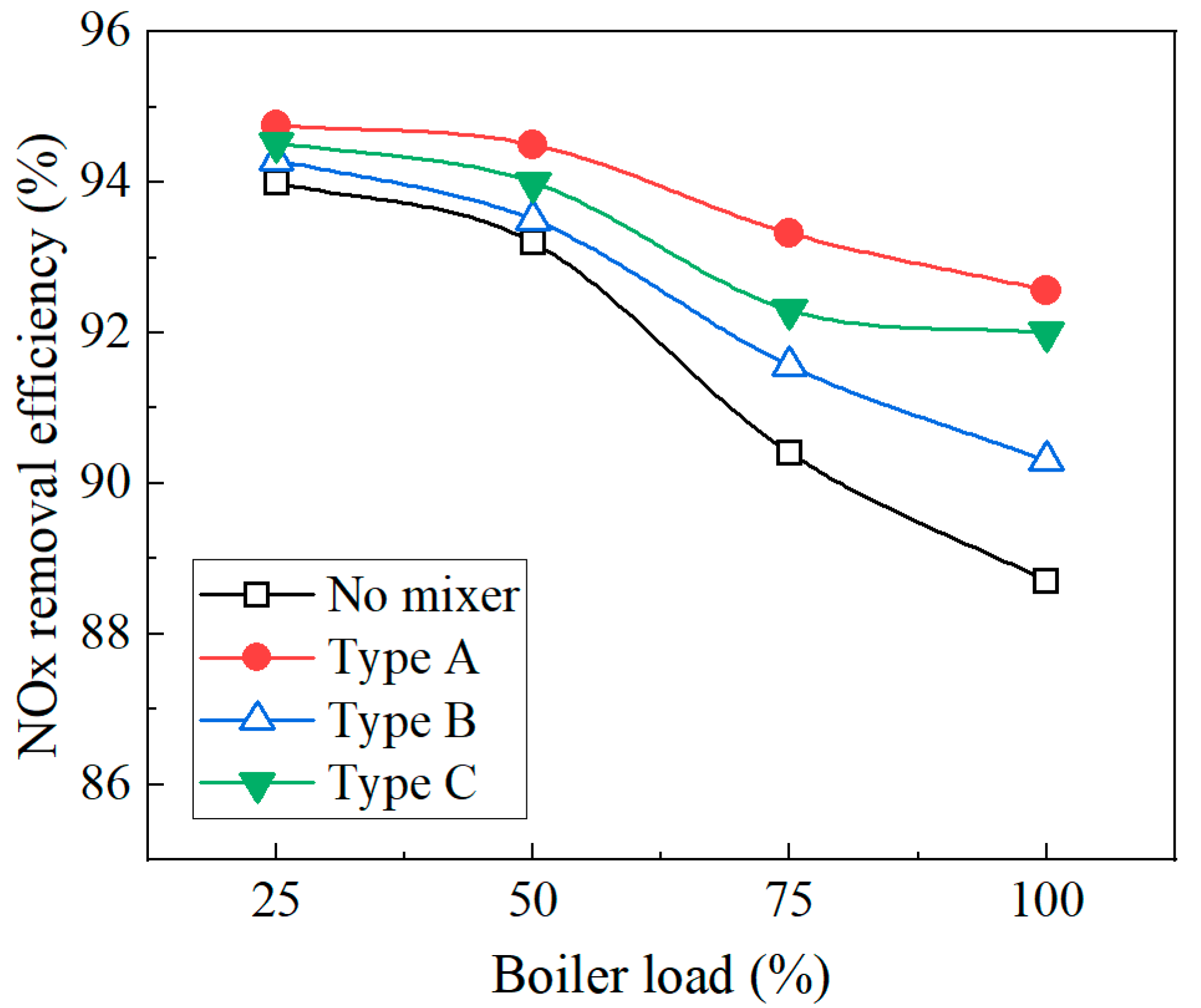
Figure 17 shows the denitrification efficiency for different static mixer configurations under different boiler loads. Overall, after a static mixer is installed, the denitrification efficiency increases at all boiler loads, while the differences among the loads are markedly reduced. Without a static mixer, the denitrification efficiency rises from 88.7% at 100% boiler load to 94.0% at 25% boiler load, with a maximum difference of about 5 percentage points among the loads. After a static mixer is installed, the denitrification efficiency is further improved under all conditions, and the overall spread becomes narrower. This indicates that the static mixer not only enhances denitrification performance, but also improves the adaptability of the SCR system to boiler load variations.
A comparison of the three configurations shows that Type A delivers the most pronounced improvement. It achieves the highest or nearly the highest denitrification efficiency at all boiler loads and exhibits the smallest variation among the loads, indicating the most effective improvement in NH3-NOx matching after ammonia injection. Type B and Type C also improve the denitrification efficiency, but their overall performance is weaker than that of Type A. For Type B, the smaller blade angle weakens the splitting and deflection of the main flow, resulting in insufficient mixing. Although Type C uses larger blades, the smaller number of blades still limits fine-scale local mixing. Consequently, its improvement generally falls between that of Type A and the case without a static mixer. Overall, the addition of a static mixer not only improves the denitrification efficiency of the SCR system, but also reduces the sensitivity of denitrification performance to boiler load variations, with Type A showing the best overall performance.
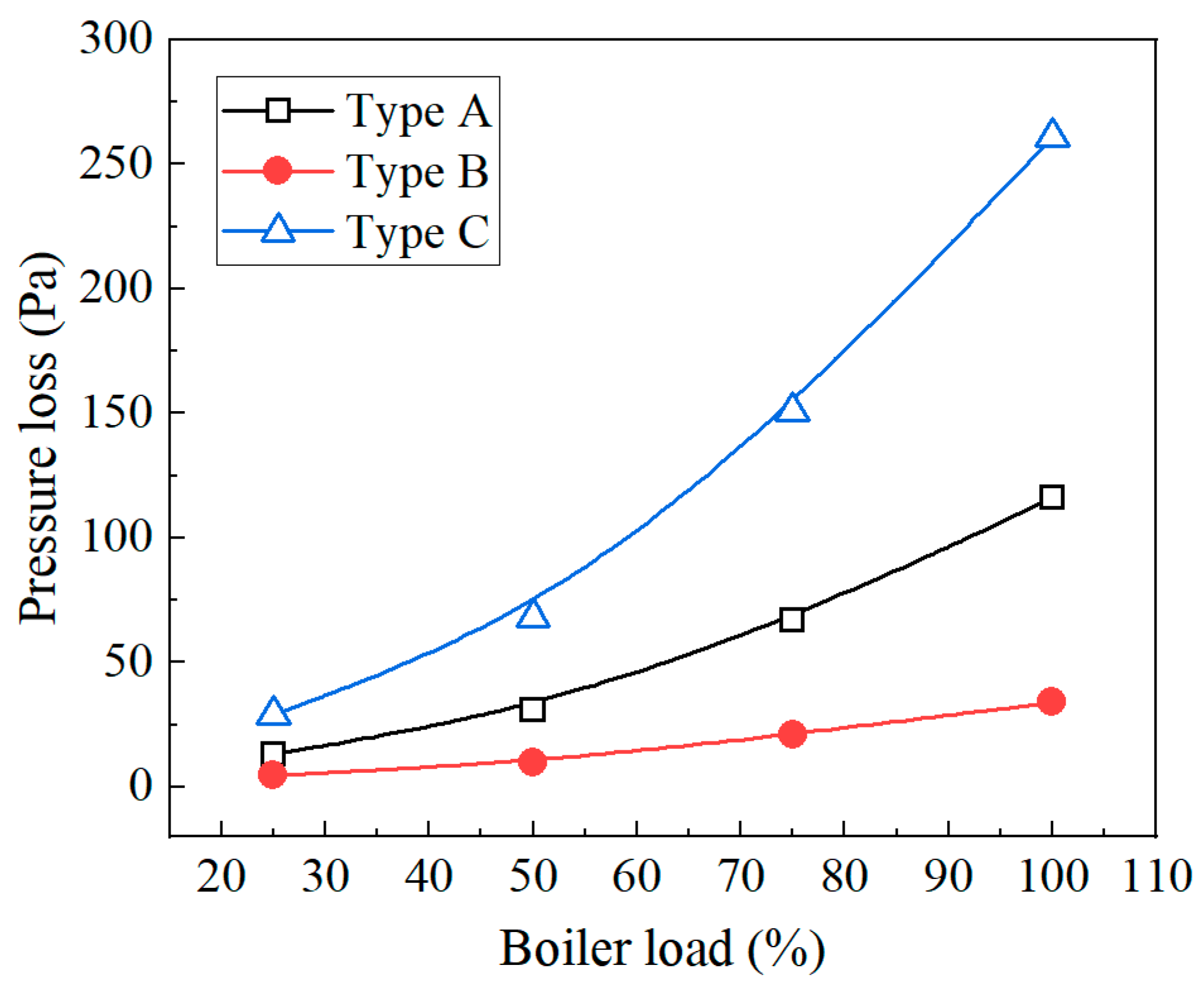
In addition to the improvement in mixing and denitrification performance, the pressure-loss penalty caused by static mixer installation should also be considered. Therefore, the total pressure loss of different static mixer configurations was evaluated under different boiler loads, as shown in Figure 18. For all configurations, the pressure loss increases with boiler load because of the higher flue-gas velocity and dynamic pressure at higher loads. For Type A, the pressure loss increases from approximately 12 Pa at 25% load to 115 Pa at 100% load. For Type B, it increases from about 5 Pa to 35 Pa over the same load range, showing the lowest pressure-loss penalty among the three configurations. In contrast, Type C produces the largest pressure loss, increasing from about 30 Pa at 25% load to approximately 260 Pa at 100% load. At full load, the pressure loss of Type C is about 2.3 times that of Type A and more than 7 times that of Type B, indicating a much stronger blockage effect.
Although Type B has the lowest pressure loss, its weaker blade inclination results in weaker flow deflection and less effective NH3-NOx mixing. Type C enhances flow disturbance but causes a much higher pressure-loss penalty, especially under high-load conditions. Type A shows an intermediate pressure-loss level while providing the best overall improvement in NH3-NOx mixing, catalyst-inlet field uniformity, and NOx removal efficiency. Therefore, among the three tested configurations, Type A provides a more favorable balance between reactive-mixing enhancement and additional pressure loss. These results indicate that static mixer design should not be evaluated only by mixing enhancement or denitrification efficiency, but should also consider the trade-off between SCR performance improvement and pressure-loss penalty.

4. Conclusions

A full-process CFD model covering the furnace, rear pass duct, and SCR system was established to systematically investigate the combustion characteristics, NOx formation, and the effects of static mixers on SCR performance over a boiler load range of 25–100%. The results show that operation over a wide load range not only changes the combustion characteristics and NOx formation process in the furnace, but also affects post-injection mixing and denitrification performance through variations in the velocity, temperature, and species distributions at the SCR inlet. The main conclusions are as follows:
  • As the boiler load decreases, the heat release intensity in the furnace gradually weakens, the high-temperature zone contracts markedly, and the flame center shifts downward. At 100% load, the high-temperature zone is extensive, and a secondary combustion process is formed in the upper furnace when SOFA remains in service. At low load, SOFA is gradually taken out of service, the high-temperature zone moves downward, and flame maldistribution becomes more pronounced, especially at 25% load. These changes make the inlet conditions of the SCR system more complex. Meanwhile, the average NOx concentration at the SCR inlet first decreases and then increases with decreasing boiler load, reaching its minimum at 75% load. Without a static mixer, the NOx concentration at the SCR inlet increases from 238 mg/Nm3 at 100% load to 312 mg/Nm3 at 25% load;
  • Without a static mixer, the NO distribution at the SCR inlet is already clearly non-uniform, and the non-uniformity becomes more pronounced at high load. At low load, the lower flue-gas velocity and longer residence time favor more sufficient mixing between NH3 and NO. The SCR reaction is concentrated mainly in the first catalyst layer, while the second and third catalyst layers mainly remove the remaining low-concentration NOx. Because the flow velocity inside the catalyst layers is relatively low and the turbulence intensity is weak, the NO maldistribution at the catalyst inlet cannot be effectively eliminated within the catalyst layers. Even so, the SCR system still achieves relatively high denitrification efficiency without a static mixer, and the efficiency is slightly higher at low load than at high load. As the boiler load decreases from 100% to 25%, the denitrification efficiency increases from 88.7% to 94.0%, while the outlet NOx concentration decreases from about 21–27 mg/Nm3 at medium and high loads to about 18 mg/Nm3 at low load;
  • After a static mixer is installed, the distance required for NH3 homogenization downstream of the ammonia injection grid is significantly shortened, and the uniformity of the velocity, NH3 concentration, and temperature fields at the SCR catalyst inlet is improved. In particular, the CoV of NH3 concentration decreases from about 4–5% to about 2–3%. At the same time, the difference in denitrification efficiency among different boiler loads is clearly reduced, indicating that the static mixer improves the adaptability of the SCR system to operation over a wide load range. Among the three configurations, Type A shows the best overall performance, while Type C performs better than Type B. The pressure-loss analysis further shows that Type A provides a more favorable balance between reactive-mixing enhancement and pressure-loss penalty among the three tested configurations.

Author Contributions

Conceptualization, Q.Z. and S.Z.; methodology, Q.Z.; software, Y.Y.; validation, Y.Y. and G.Z.; formal analysis, S.Z.; data curation, Y.C.; writing—original draft preparation, G.Z.; writing—review and editing, Y.Y. All authors have read and agreed to the published version of the manuscript.

Funding

This research was funded by the National Natural Science Foundation of China (Grant No. 52576146), Zhejiang Provincial Key Laboratory for Research on Industrial Carbon Metrology Technology (Grant No. 2025E10115), the Baima Lake Laboratory Joint Fund of Zhejiang Provincial Natural Science Foundation of China (Grant No. LBMHZ26E060002).

Data Availability Statement

The data presented in this study are available on request from the corresponding author.

Conflicts of Interest

Authors Qin Zhang, Yifan Yu, and Saiwei Zhu were employed by the company Zhejiang Zheneng Technology Research Institute Co., Ltd. The remaining authors declare that the research was conducted in the absence of any commercial or financial relationships that could be construed as a potential conflict of interest.

Abbreviations

The following abbreviations are used in this manuscript:
SNCRSelective Non-Catalytic Reduction
BMCRBoiler Maximum Continuous Rating
SOFASeparated Over Fire Air
SCRSelective Catalytic Reduction
NSRNormalized Stoichiometric Ratio
CoVCoefficient of Variation

References

  1. Yao, G.; Duan, X.; Tomanović, I.; Tang, H.; Sun, L.; Xie, Y. Research on the mechanism and energy efficiency of deep peak shaving in power station boilers. Energy 2026, 348, 140592. [Google Scholar] [CrossRef]
  2. Li, K.; Ke, X.; Cui, L.; Zhang, Y.; Zhang, H.; Lyu, J. Load regulation capability enhancement of a coal-fired power unit integrated with renewable energy and flexible energy storage. Fuel 2026, 422, 139159. [Google Scholar] [CrossRef]
  3. Zhou, J.; Xiang, J.; Duan, F. Multi-objective flexibility strategies of ultra-low load operations for 1000 MW coal-fired power plant integrated with gas turbine. Appl. Therm. Eng. 2025, 278, 126995. [Google Scholar] [CrossRef]
  4. Hou, Z.; Pang, L.; Zhang, B.; Wang, J.; Duan, L.; Wei, H.; Du, X. Enhancing the flexibility and safety of electric-resistance heating on thick-walled pressure parts of utility boilers in coal-fired power plants. Case Stud. Therm. Eng. 2025, 67, 105828. [Google Scholar] [CrossRef]
  5. Ma, D.; Zhang, S.; He, X.; Ding, X.; Li, W.; Liu, P. Combustion stability and NOx emission characteristics of three combustion modes of pulverized coal boilers under low or ultra-low loads. Appl. Energy 2024, 353, 121998. [Google Scholar] [CrossRef]
  6. Ti, S.; Liu, H.; Chang, W.; Deng, S.; Ke, G.; Hu, S.; Tang, S.; Jia, Z.; Wang, H. Evaluation of near-field aerodynamics and gas-particle two-phase characteristics of a lab-scale CFR swirl burner derived from a 600 MWe wall-fired utility boiler under different staged-air ratios. Case Stud. Therm. Eng. 2026, 81, 108030. [Google Scholar] [CrossRef]
  7. Ma, D.; Zhang, S.; He, X.; Zhang, J.; Ding, X. Combustion stability and NOx emission characteristics of a 300 MWe tangentially fired boiler under ultra-low loads with deep-air staging. Energy 2023, 269, 126795. [Google Scholar] [CrossRef]
  8. Li, D.; Cheng, Z.; Liu, C.; Wei, S.; Feng, Y.; Feng, H.; Zhao, G.; Nie, H.; Xiao, H.; Liu, Z. Investigation of combustion and NOx emission characteristics in 300 MW subcritical CFB boilers under low-load conditions. Chem. Eng. Sci. 2025, 318, 122175. [Google Scholar] [CrossRef]
  9. Gutti, L.K.; Rajput, R.S.; Pandey, M.K.; Kushwah, A.S.; Sunkara, S.R.; Cheepu, M.; Buddi, S.P. Enhancing ammonia mixing uniformity in selective catalytic reduction systems: A computational fluid dynamics study on direct nozzle-based injection using the discrete phase model in a gas turbine exhaust duct. Appl. Therm. Eng. 2026, 289, 129745. [Google Scholar] [CrossRef]
  10. Pang, Z.; Chen, R.; Cao, Y. Performance analysis and optimization for static mixer of SCR denitration system under different arrangements. Energies 2022, 15, 8977. [Google Scholar] [CrossRef]
  11. Wang, H.; Jin, H.; Yang, Z.; Deng, S.; Wu, X.; An, J.; Sheng, R.; Ti, S. CFD modeling of flow, combustion and NOx emission in a wall-fired boiler at different low-load operating conditions. Appl. Therm. Eng. 2024, 236, 121824. [Google Scholar] [CrossRef]
  12. Xu, S.; Yu, D.; Yao, F.; Wang, K. Numerical simulation and optimisation of CFB boiler furnace with air staged low NOx combustion. Prog. Comput. Fluid Dyn. Int. J. 2022, 22, 392–410. [Google Scholar] [CrossRef]
  13. Han, C.; Yin, Y.; Yang, L.; Tao, D.; Peng, X.; Cao, S.; Zhou, H.; Wang, Z. Dynamic modeling of exhaust emission from a 600 MW once-through reheat down-fired boiler. Case Stud. Therm. Eng. 2025, 76, 107413. [Google Scholar] [CrossRef]
  14. Askarova, A.; Bolegenova, S.; Maximov, V.; Beketayeva, M.; Safarik, P. Numerical modeling of pulverized coal combustion at thermal power plant boilers. J. Therm. Sci. 2015, 24, 275–282. [Google Scholar] [CrossRef]
  15. Chang, J.; Wang, X.; Zhou, Z.; Chen, H.; Niu, Y. CFD modeling of hydrodynamics, combustion and NOx emission in a tangentially fired pulverized-coal boiler at low load operating conditions. Adv. Powder Technol. 2021, 32, 290–303. [Google Scholar] [CrossRef]
  16. Laubscher, R.; Rousseau, P. CFD study of pulverized coal-fired boiler evaporator and radiant superheaters at varying loads. Appl. Therm. Eng. 2019, 160, 114057. [Google Scholar] [CrossRef]
  17. Wang, H.; Sun, J.; Li, Y.; Cao, Z. Numerical simulation and optimization of SCR-DeNOx systems for coal-fired power plants based on a CFD method. Processes 2022, 11, 41. [Google Scholar] [CrossRef]
  18. Świeboda, T.; Krzyżyńska, R.; Bryszewska-Mazurek, A.; Mazurek, W.; Czapliński, T.; Przygoda, A. Advanced approach to modeling of pulverized coal boilers for SNCR process optimization-review and recommendations. Int. J. Thermofluids 2020, 7, 100051. [Google Scholar] [CrossRef]
  19. Yin, J.; Liu, M.; Wu, Q.; Yan, J. Optimized fluegas denitrification control strategy to enhance SCR performance during load-cycling transient processes in coal-fired power plants. Fuel 2023, 344, 127837. [Google Scholar] [CrossRef]
  20. Chen, H.; Shi, Y.; Li, Z.; Yu, J.; Duan, X. Structure-resolved CFD simulations to guide catalyst packing of selective NO reduction. Chem. Eng. J. 2022, 446, 136888. [Google Scholar] [CrossRef]
  21. Feng, X.; Xiang, J.; Chen, Z.; Zhang, G. Integrated Furnace-to-SCR CFD Modeling of a Large Coal-Fired Boiler: Combustion Characteristics and Flow Optimization over a Wide Load Range. Processes 2026, 14, 485. [Google Scholar] [CrossRef]
  22. Li, M.-J.; Tang, S.-Z.; Wang, F.-l.; Zhao, Q.-X.; Tao, W.-Q. Gas-side fouling, erosion and corrosion of heat exchangers for middle/low temperature waste heat utilization: A review on simulation and experiment. Appl. Therm. Eng. 2017, 126, 737–761. [Google Scholar] [CrossRef]
  23. Menter, F.R. Two-equation eddy-viscosity turbulence models for engineering applications. AIAA J. 1994, 32, 1598–1605. [Google Scholar] [CrossRef]
  24. Zhou, H.; Hu, S. Numerical simulation of ash deposition behavior with a novel erosion model using dynamic mesh. Fuel 2021, 286, 119482. [Google Scholar] [CrossRef]
  25. Kim, J.; Lee, S.; Tahmasebi, A.; Jeon, C.-H.; Yu, J. A Review of the Numerical Modeling of Pulverized Coal Combustion for High-Efficiency, Low-Emissions (HELE) Power Generation. Energy Fuels 2021, 35, 7434–7466. [Google Scholar] [CrossRef]
  26. Zhou, H.; Meng, S. Numerical prediction of swirl burner geometry effects on NOx emission and combustion instability in heavy oil-fired boiler. Appl. Therm. Eng. 2019, 159, 113843. [Google Scholar] [CrossRef]
  27. Laubscher, R.; Rousseau, P. Numerical investigation on the impact of variable particle radiation properties on the heat transfer in high ash pulverized coal boiler through co-simulation. Energy 2020, 195, 117006. [Google Scholar] [CrossRef]
  28. Chen, T.; Zhang, Y.-J.; Liao, M.-R.; Wang, W.-Z. Coupled modeling of combustion and hydrodynamics for a coal-fired supercritical boiler. Fuel 2019, 240, 49–56. [Google Scholar] [CrossRef]
  29. Jung, W.; Han, J.; Park, H.J.; Hwang, W. Development of a mathematical model for the porous media approach in simulating flow through a selective catalytic reduction (SCR) facility. Chem. Eng. Res. Des. 2023, 197, 592–602. [Google Scholar] [CrossRef]
  30. Chang, J.; Ma, X.; Wang, X.; Li, X. Computational particle fluid dynamics modeling and design of in-situ catalytic de in an industrial CFB boiler. Chem. Eng. Sci. 2023, 270, 118502. [Google Scholar] [CrossRef]
  31. Ma, Q.; Zhang, D.; Gan, X. Simulation of the flow field and the chemical reaction coupling of selective catalytic reduction (SCR) system using an orthogonal experiment. PLoS ONE 2019, 14, e0216138. [Google Scholar] [CrossRef] [PubMed]
Figure 1. Schematic layout of the boiler.
Processes 14 01843 g001
Figure 2. Computational domain and mesh for the boiler: (a) Computational domain. (b) Mesh. The red arrow indicates the flue gas flow direction.
Processes 14 01843 g002
Figure 3. Mesh-sensitivity comparison of cross-section-averaged temperature profiles along the furnace elevation under different cell counts.
Processes 14 01843 g003
Figure 4. Temperature contours on the vertical cross-section of the boiler at different loads: (a) 100% load; (b) 75% load; (c) 50% load; (d) 25% load.
Processes 14 01843 g004
Figure 5. NO concentration contours on the vertical cross-section of the boiler: (a) 100% load; (b) 75% load; (c) 50% load; (d) 25% load.
Processes 14 01843 g005
Figure 6. NO concentration distributions at the SCR inlet under different boiler loads: (a) 100% load; (b) 75% load; (c) 50% load; (d) 25% load.
Processes 14 01843 g006
Figure 7. Average NOx concentration at the SCR inlet under different boiler loads.
Processes 14 01843 g007
Figure 8. Schematic layout of the SCR system. The black arrow indicates the flue gas flow direction.
Processes 14 01843 g008
Figure 9. Distributions of NO, NH3, and NSR at different boiler loads without the static mixer (SCR reactions not considered): (a) NO concentration; (b) NH3 concentration; (c) NSR. The curves represent the guide vanes, and the lines indicate the boundaries of the heating surfaces and SCR catalysts.
Processes 14 01843 g009
Figure 10. Distributions of reaction rate and species at 100% boiler load without the static mixer (SCR reactions considered): (a) SCR Reaction rate; (b) NH3; (c) NO. The curves represent the guide vanes, and the lines indicate the boundaries of the heating surfaces and SCR catalysts.
Processes 14 01843 g010
Figure 11. NOx removal efficiency and SCR outlet NOx at different boiler loads without the static mixer.
Processes 14 01843 g011
Figure 12. Schematic diagrams of the three static mixer configurations: (a) Type A (4 × 8 static mixers, 45°); (b) Type B (4 × 8 static mixers, 30°); (c) Type C (2 × 4 static mixers, 45°).
Processes 14 01843 g012
Figure 13. Velocity distributions at 100% boiler load for different static mixer configurations: (a) No static mixer; (b) Type A; (c) Type B; (d) Type C.
Processes 14 01843 g013
Figure 14. NH3 concentration distributions at 100% boiler load for different static mixer configurations: (a) No static mixer; (b) Type A; (c) Type B; (d) Type C.
Processes 14 01843 g014
Figure 15. Enlarged views of the NH3 concentration distributions at 100% boiler load for different static mixer configurations: (a) No static mixer; (b) Type A; (c) Type B; (d) Type C. The colors represent the NH3 concentration, using the same color scale as that in Figure 14.
Processes 14 01843 g015
Figure 16. CoV values at the SCR catalyst inlet for various static mixer configurations at different boiler loads: (a) CoV of velocity; (b) CoV of NH3 concentration; (c) CoV of temperature.
Processes 14 01843 g016
Figure 17. NOx removal efficiency at different boiler loads for different static mixer configurations.
Processes 14 01843 g017
Figure 18. Total pressure loss induced by different static mixer configurations under different boiler loads.
Processes 14 01843 g018
Table 1. Main specifications of the boiler.
ItemUnitValue
Main steam flow ratet/h1994
Main steam pressureMPa29.3
Main steam temperature°C605
Feedwater temperature°C304
Reheat steam flow ratet/h1671
Reheat steam pressureMPa5.66
Reheat steam temperature°C623
Table 2. Proximate and ultimate analyses of coal.
Coal TypeCar/%Har/%Oar/%Nar/%Sar/%Aar/%Var/%Mt/%Qnet,ar/(MJ/kg)
Design coal57.223.567.940.930.8519.4026.610.122.0
As-fired coal56.823.558.820.820.4813.3932.316.1021.4
Table 3. Operating conditions used for CFD simulations at different boiler loads.
Boiler Load (%)Coal Feed Rate (t/h)Primary Air Temperature (°C)Secondary Air Temperature (°C)Excess Air
Ratio
Burners in
Operation
100255.0773321.15A B C E F
75197.2703181.15A B C E
50130.5663101.20A B E
2574.1582981.25A B
Table 4. Comparison of predicted and measured values.
ItemUnitBoiler Load
(%)
Simulated ValueMeasured ValueRelative
Deviation
Furnace-exit gas temperature°C10010551093−3.48%
75915952−3.89%
Furnace-exit O2 concentrationvol%1003.012.855.61%
753.132.965.74%
NOx concentration *mg/Nm31002382293.93%
752222096.22%
Carbon-in-ashwt%1002.322.45−5.31%
75N.A.N.A.N.A.
* On a dry basis and corrected to 6% O2. N.A., not available.
Disclaimer/Publisher’s Note: The statements, opinions and data contained in all publications are solely those of the individual author(s) and contributor(s) and not of MDPI and/or the editor(s). MDPI and/or the editor(s) disclaim responsibility for any injury to people or property resulting from any ideas, methods, instructions or products referred to in the content.