Article

Roof Cutting and Pressure Relief Surrounding Rock Control Using Pre-Placed Backfill Strip to Replace Coal Pillars: Technology and Field Application

1
College of Mining Engineering, Taiyuan University of Technology, Taiyuan 030024, China
2
Key Laboratory of In-Situ Property-Improving for Mining of Ministry of Education, Taiyuan University of Technology, Taiyuan 030024, China
*
Author to whom correspondence should be addressed.
Processes 2026, 14(11), 1681; https://doi.org/10.3390/pr14111681
Submission received: 1 May 2026 / Revised: 16 May 2026 / Accepted: 19 May 2026 / Published: 22 May 2026

Abstract

Under green mine construction and efficient resource utilization, non-pillar mining has been increasingly applied. However, surrounding rock control remains difficult in traditional gob-side entry retaining under large mining height conditions. To address this problem, a cooperative control method combining roof cutting and pressure relief with a pre-placed backfill strip for coal pillar replacement is proposed. Taking the 15,108 and 15,110 working faces of Wangzhuang Coal Industry as the engineering background, a mechanical model and FLAC3D simulations were used to analyze the effects of roof cutting height and backfill strip width. The results show that roof cutting shortens the goaf-side suspended roof, weakens lateral abutment pressure, and improves the stress state of the strip. When the roof cutting height increases from 11 m to 13 m, the peak vertical stress of the strip decreases from 16.2 MPa to 13.9 MPa, with a reduction of 14.2%. When the strip width increases from 1.0 m to 1.5 m, the peak stress decreases by about 12.0%. Thus, the reasonable roof cutting height and strip width are determined to be 13 m and 1.5 m. Field monitoring shows maximum roof-to-floor and rib-to-rib convergences of 178.5 mm and 143.5 mm, respectively, with no obvious strip instability.

1. Introduction

Under the background of green mine construction and resource conservation, improving coal recovery and reducing mining-induced environmental disturbance have become important requirements for coal mining. For a long time, China’s coal mines have mostly adopted the method of retaining section coal pillars to maintain stability between working faces [1,2,3,4]. In order to solve this problem, gob-side entry retaining and gob-side entry driving technology came into being. Although gob-side entry retaining has been applied in thin and medium-thick coal seams, it is difficult to retain the roadway due to the large deformation of the surrounding rock, and it is easy to cause air leakage and spontaneous combustion of coal in the goaf [5,6,7]. The traditional roadside filling body is directly within the scope of mining influence, and it is subjected to roof breakage, rotation and dynamic pressure during the mining process. Especially under conditions of large mining height and thick and hard roof, the stress concentration and large deformation of the filling body are difficult to coordinate with the deformation of the surrounding rock, which leads to a decrease in the stability of the retaining roadway and difficulties in roadway maintenance [8]. Although the technology of gob-side entry driving with small coal pillars is widely used, under the influence of high mine pressure, small coal pillars are prone to plastic damage and even overall instability, which not only makes it difficult to ensure the safety of the roadway, but also increases the risk of spontaneous combustion of coal pillars [9,10]. Under conditions of large mining height and thick coal seam mining, the roadway section increases, roof activity is severe, and the difficulty of surrounding rock control increases significantly. The traditional coal pillar-free mining method has been difficult to adapt to such working conditions. Based on this, the non-pillar mining technology of pre-placed backfill strips is proposed, and roof cutting and pressure relief are used as auxiliary control means to improve the control effect of the surrounding rock and the level of resource recovery.
Compared with a traditional small coal pillar, the pre-placed backfill strip is a controllable artificial bearing structure constructed before strong mining disturbance [11,12,13]. Small coal pillars are easily weakened by excavation damage, mining-induced fractures, and stress concentration, and may become unstable once the plastic zone develops through the pillar [14,15]. In contrast, the width, strength, and material properties of the pre-placed backfill strip can be designed in advance, and good roof–floor contact can be formed during construction. In addition, roof cutting shortens the lateral main-roof cantilever and reduces the load transferred to the strip [16,17]. Therefore, the stability of the pre-placed backfill strip is achieved through the combined effect of controllable material properties, favorable construction timing, and roof cutting pressure relief.
Compared with traditional gob-side entry retaining, non-pillar mining using a pre-placed backfill strip avoids the construction interference between upper-section mining and lower-section roadway excavation, thereby improving production efficiency. The pre-placed backfill strip is placed in the crossheading, which is less affected by mining [18,19]. At this time, the surrounding rock of the roadway is in a lower initial stress environment, and the structural integrity of the roof and the sides is better, which fundamentally eliminates the risk of roof instability and collapse faced by traditional retaining technology when working at the edge of the goaf [20]. At the same time, the working area is far away from the goaf, and there are no uncertain risks such as gas accumulation and spontaneous combustion of residual coal [21,22].
Although the pre-placed backfill strip technology can reduce mining interference and provide favorable initial conditions for subsequent roadway excavation along the strip, the strip still needs to bear the mining-induced roof load during the extraction of the upper working face. With the rotation and subsidence of the lateral main-roof cantilever, the goaf-side load tends to concentrate near the roadway and the backfill strip, resulting in increased stress in the strip and greater difficulty in surrounding rock control [23,24]. Therefore, relying only on the bearing capacity of the backfill strip itself may be insufficient under large mining height and thick hard roof conditions. Passive reinforcement measures, such as stronger support, grouting, or modified backfill materials, can improve local bearing capacity, but they cannot fundamentally change the lateral main-roof cantilever and the corresponding load-transfer path. For this reason, roof cutting and pressure relief are introduced to actively regulate the roof structure, promote roof caving along the cutting line, shorten the goaf-side cantilever, weaken the transmission of lateral abutment pressure, and improve the stress state of the pre-placed backfill strip [25]. Based on this idea, the combined control of roof cutting and the pre-placed backfill strip is investigated in this study. The technical process of the pre-placed backfill strip is shown in Figure 1.
He Jie [26] pointed out that a hard roof that is difficult to collapse will cause “far field stress” concentration and transfer it to the “near field”, resulting in serious damage to the coal pillar roadway. The coordinated control scheme of “no coal pillar retaining wall driving + roof cutting and pressure relief + strong support” is put forward.
Zhang Taoxiang [27] et al. constructed a mechanical model based on the stability theory of sliding and rotary deformation of masonry beams and studied the influence of roof cutting height on the stress evolution and surrounding rock deformation of narrow coal pillars in gob-side roadways under the condition of a thick and hard roof. The results show that with an increase in roof cutting height, the pressure relief effect is enhanced, but there is a marginal effect. The optimal roof cutting height is determined. At this point, the filling space of the goaf tends to be saturated, which effectively blocks the lateral stress propagation and meets the needs of roadway control.
Liu [28] constructed the mechanical model of the lateral roof of the gob-side entry, analyzed the energy evolution law of the surrounding rock through numerical simulation, and proposed the capability basis for the dynamic instability of the support body. On this basis, the energy reduction control technology with pre-splitting roof cutting as the core was proposed.
Xu Jun [29] analyzed the stress evolution law and deformation characteristics of the surrounding rock of traditional gob-side entry retaining and roof cutting and pressure relief cooperative bearing of gob-side entry retaining and proposed a roof cutting and pressure relief gob-side entry retaining technology that uses a roadside filling body-gangue composite structure for cooperative bearing. The mechanical model of the filling body-gangue cooperative supporting roof was established, and the deflection equation of the roof was derived and applied in engineering.
However, previous studies on roof cutting and backfill support have mainly focused on gob-side entry retaining, gob-side entry driving with narrow coal pillars, or roadside backfill arranged close to the goaf. Limited attention has been paid to coal pillar replacement using a pre-placed backfill strip constructed in advance before strong mining disturbance. Under large mining height and thick hard roof conditions, the lateral main-roof cantilever may still transfer high loads to the backfill strip after mining, making it necessary to clarify the load-reduction mechanism of roof cutting for the pre-placed backfill strip. Therefore, this study proposes a coordinated control method combining roof cutting and pressure relief with a pre-placed backfill strip for coal pillar replacement. Roof cutting is used to regulate the lateral main-roof structure, shorten the goaf-side cantilever, and reduce the load transferred to the backfill strip, thereby providing a stable artificial boundary for subsequent lower-section roadway excavation. On this basis, a roof–backfill strip mechanical model, FLAC3D simulations, and a field application at Wangzhuang Coal Industry are combined to determine the key parameters and verify the engineering applicability of the proposed method.
The scientific contribution of this study lies in clarifying the load-transfer relationship between the lateral main-roof cantilever and the pre-placed backfill strip in a coal pillar replacement layout. The proposed analysis framework links roof structure regulation, backfill strip bearing behavior, and parameter design, providing a mechanical basis for non-pillar mining under large mining height and thick hard roof conditions.

2. Engineering Background

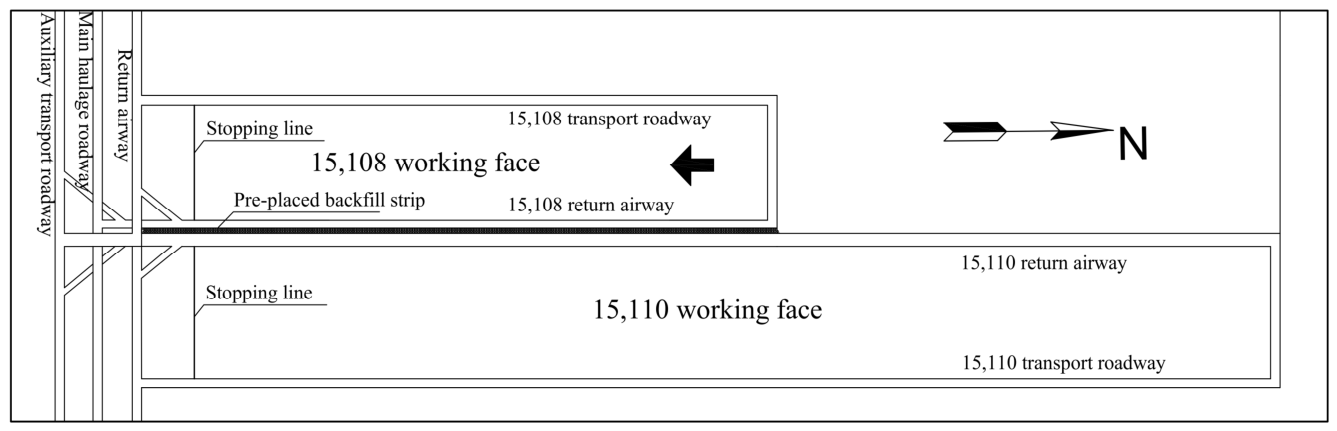
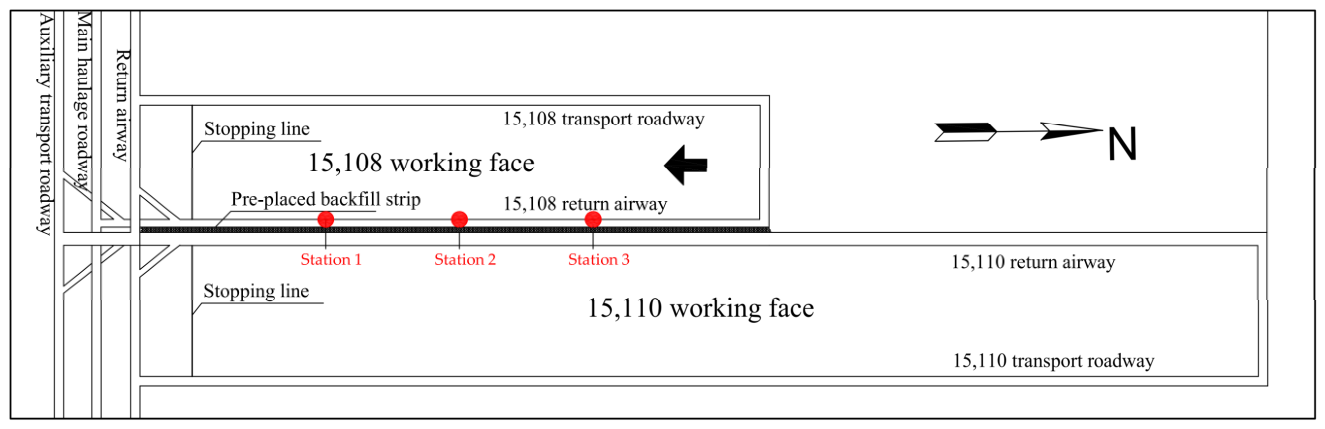
Shanxi Changzhi Wangzhuang Coal Industry Co., Ltd., Changzhi, China, approved the mining of the No. 3~15 coal seam. The average thickness of the No. 15 coal seam is 3.89 m, and the buried depth of this section is 260 m~370 m. The test working faces are 15,108 and 15,110 in the first mining area of the No. 15 coal seam. A high water pre-placed backfill strip is preset between the two working faces to realize coal pillarless mining. Among them, 15,108 has a tendency length of 285 m and a strike length of 1180 m. The test roadways in the first mining area of Wangzhuang Coal Industry are the 15,108 return airway and the 15,110 return airway. Both roadways are excavated along the coal seam floor, and the sections are rectangular. The width of the 15,108 transport roadway is 5.9 m, the height is 3.9 m, the cross-section area is 23.01 m2, and the total length is 1250 m. The section size of the 15,110 return airway is the same, and the length of the roadway is 2803 m. The spatial position relationship between the 15,108 working face and the 15,110 working face is shown in Figure 2. The pre-placed backfill strip is arranged on the outer side of the 15,108 return airway, close to the future excavation boundary of the 15,110 return airway. Before the mining of the 15,108 working face, the outer side of the 15,108 return airway is enlarged, and the backfill strip is constructed in the enlarged roadway section. During the mining of the 15,108 working face, the original 15,108 return airway is affected by mining disturbance and finally collapses into the goaf. The strip is designed to remain stable after the mining of the 15,108 working face and provide a stable artificial boundary for the subsequent excavation of the 15,110 return airway along the strip.
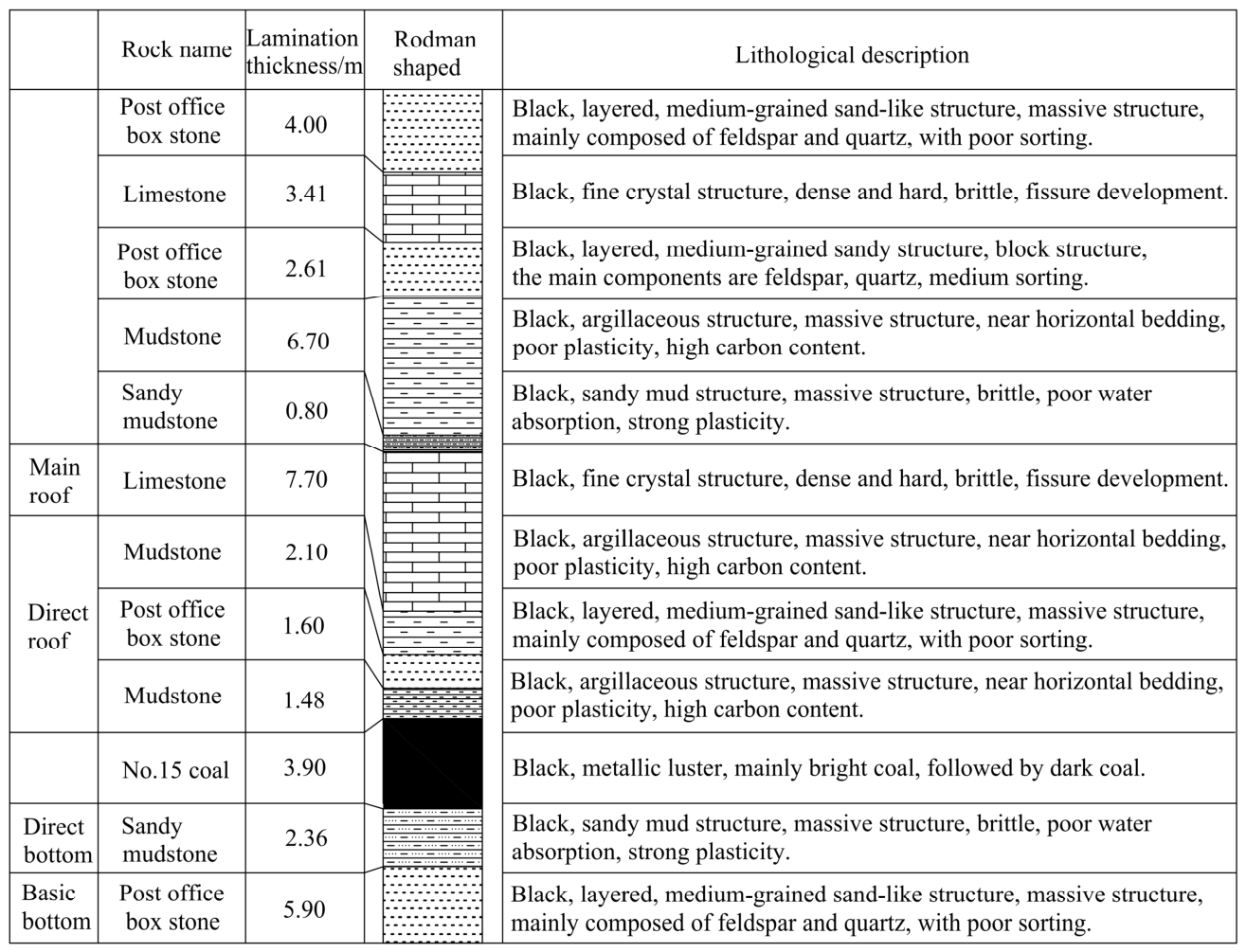
According to the 15,108 working face roof peep results and geological data, the working face roof histogram is shown in Figure 3.

3. Theoretical Analysis of the Influence of Roof Cutting on Pre-Placed Backfill Strip

3.1. Influence of Roof Cutting on Support Resistance of Pre-Placed Backfill Strip

The support resistance provided by the pre-placed backfill strip is mainly used to balance the load of the immediate roof and maintain the stability of the roof structure above the strip [30,31]. According to the engineering conditions of the 15,108 and 15,110 working faces, the No. 15 coal seam has a large mining height, and the roof contains a thick, hard limestone layer. After mining, the lateral main roof on the goaf side is prone to forming a cantilever structure, and the resulting roof load is transferred to the pre-placed backfill strip. Since the strip is arranged near the boundary between the upper and lower sections, its main load source is the lateral roof load from the goaf side. Therefore, the roof structure can be simplified as a lateral cantilever-bearing structure to describe the main load-transfer mechanism.
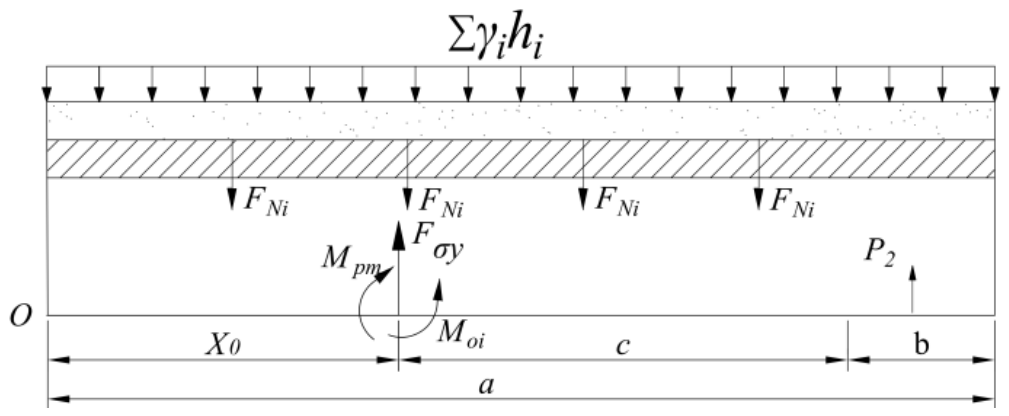
In this model, the roof strata above the roadway and the pre-placed backfill strip are simplified as an equivalent two-dimensional layered beam system in the roadway cross-section. The self-weight of each roof layer is treated as a uniformly distributed load and expressed as γihi. Before roof cutting, the goaf-side roof is regarded as a continuous suspended structure, and the lateral cantilever effect, including the load transfer and bending action caused by the suspended roof, is considered in the equilibrium equation. After roof cutting, the roof strata are weakened along the cutting line, and the structural continuity of the goaf-side suspended roof is reduced. Therefore, the additional load-transfer effect caused by the continuous lateral cantilever is weakened and simplified in the model, while the necessary bending moment terms of the roof structure are still retained in the equilibrium relationship. The supporting effect of the caved gangue is represented by the thrust N, and the support resistance required by the pre-placed backfill strip before and after roof cutting is represented by P1 and P2, respectively.
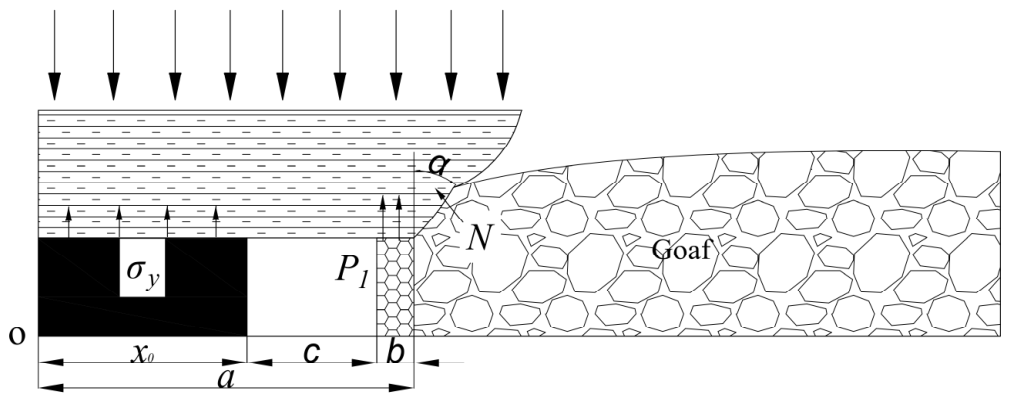
In addition, the roof cutting angle is taken as 0°, which is consistent with the field roof cutting design, and the periodic weighting distance and rock-layer thicknesses are determined according to the field geological data and borehole histogram. Based on these assumptions, the mechanical model of the roof–backfill strip bearing structure before roof cutting is established, as shown in Figure 4:
P 1 ( a b 2 ) = 1 2 i = 1 m γ i h i ( a + j = 0 i 1 h j tan α j ) + i = 1 m F N i ( a + j = 0 i 1 h j tan α j ) + M P m i = 1 m M o i M σ y + N cos α
In the formula, P1 is the support resistance of the pre-placed backfill strip; a is the sum of the widths of the limit equilibrium zone, the roadway and the pre-placed backfill strip; b is the width of the pre-placed backfill strip; i and j are the roofs of the i and j layers; m is the limit number of layers of the rock layer in the caving zone; γi is the bulk density of the i layer; hi is the thickness of the i layer; α is the breaking angle of the rock layer before; FNi is the downward shear force generated by the breaking of the i layer roof; MPm is the ultimate bending moment of the roof; moi is the bending moment of the i layer rock layer; and mσy is the moment of the coal support force to the O point. Before cutting the top, it is supported at both ends, so
M P m = 1 4 γ m h m l m 2
In the formula, lm is the length of the rock block after the roof rock layer is broken, and N is the thrust of the gangue on the immediate roof, which can be approximately used to calculate the static earth pressure under layered and overloaded conditions [32]:
N = k 0 0 d ( 9.8 × 1 0 3 γ z z + σ ) d z sin α
In the formula, k0 is the static earth pressure coefficient; d is the direct roof thickness; z is the depth of the calculation point; and σ is the uniform load on the gangue surface.
The limit equilibrium region [33,34] X0 is as follows:
X 0 = h 0 A 2 tan φ 0 ln | K γ H C 0 tan φ 0 + P z A |
In the formula, h0 is the mining height of the coal seam; a is the lateral pressure coefficient; φ is the internal friction angle of coal; K is the stress concentration factor; γ is the average bulk density of the overlying strata; H is the buried depth of the roadway; C0 is the cohesion of the coal body; and Pz is the support resistance of the coal side of the working face roadway, taking 0.2 MPa.
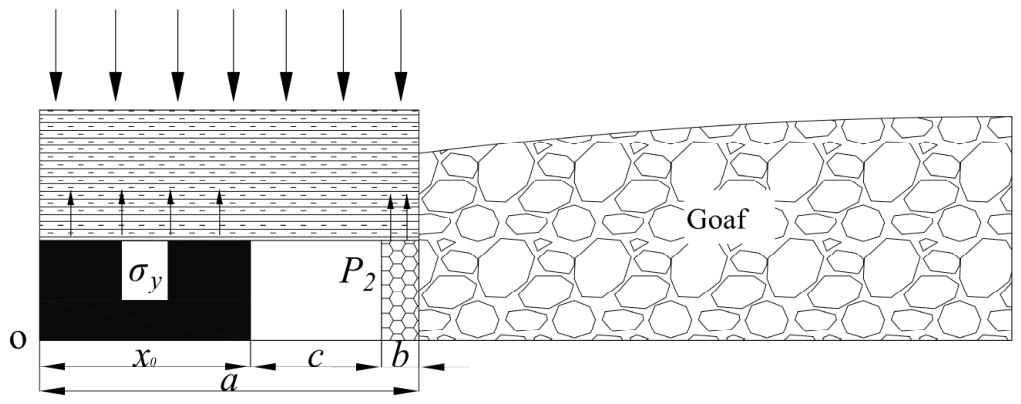
After roof cutting, the immediate roof is removed (Figure 5). At this time, the support resistance of the pre-placed backfill strip is:
Based on the bearing structure shown in Figure 5, the roof pre-placed backfill strip system is further simplified into the mechanical calculation model shown in Figure 6:
p 2 ( a b 2 ) = 1 2 i = 1 m γ i h i ( a + j = 0 i 1 h j tan β j ) + M P m i = 1 m M o i M σ y + N cos β
Compared with Equation (1), Equation (5) shows that the required support resistance of the pre-placed backfill strip decreases after roof cutting. This reduction can be described by ΔP = P1 − P2. When the geological parameters and roadway geometry remain unchanged, the main difference between P1 and P2 is that roof cutting shortens the lateral suspended-roof length and weakens the bending moment caused by the goaf-side cantilever structure. In addition, the roof strata are more likely to cave along the cutting line, which changes the roof fracture angle and reduces the load transferred to the pre-placed backfill strip. Therefore, the load components related to the lateral cantilever effect in P1 are reduced in P2, and P1 > P2 can be obtained. The comparison of these two theoretical expressions quantitatively demonstrates that roof cutting can reduce the support resistance required by the pre-placed backfill strip.

3.2. The Influence of Roof Cutting on the Shrinkage of Pre-Placed Backfill Strip

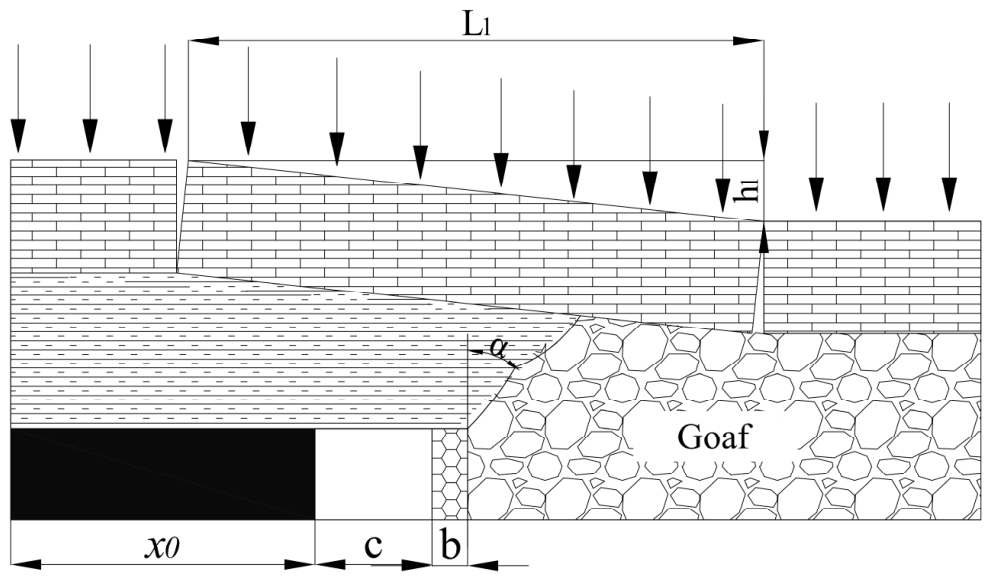
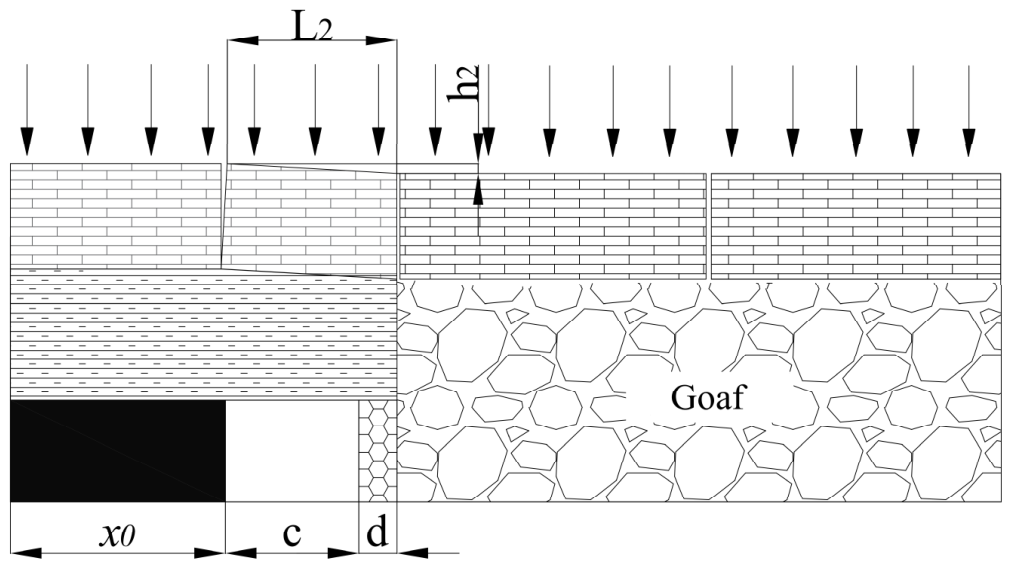
The schematic diagram of the roof structure before and after the roof cutting is shown in Figure 7 and Figure 8.
The support resistance of the pre-placed backfill strip is P, and the design width of the backfill strip should be calculated according to the formula. When the uniaxial compressive strength of the backfill strip is fixed, the width should meet
P = r b
In the formula, P is the support resistance of the pre-placed backfill strip; r is the uniaxial compressive strength of the backfill strip, taking 15 MPa; and b is the width of the pre-placed backfill strip. According to the field investigation, the cutting angle α is 0°; the periodic fracture distance of the basic roof is about 16 m. Combined with the histogram of the working face rock stratum, it is considered that the soft rock stratum controlled on it consists of 3 layers, that is, m = 3. When Moi (i = 1, 2) is 0, the maximum value of roadside support resistance can be obtained, so Moi = 0. The lateral pressure coefficient is 0.3, the internal friction angle of the coal seam is 29.5°, the stress concentration coefficient is 2, the average bulk density of the roof is 25 kN/m3, and the coal cohesion is 1.8 MPa. The reasonable width of the pre-placed backfill strip is calculated to be about 1.5 m by substituting the parameters.
The subsidence of the pre-placed backfill strip is [35]
s = ( c + b ) h m L i
tan θ = h m L i
In the formula, s is the subsidence of the pre-placed backfill strip, c is the width of the roadway, hm is the empty roof distance of the roof, and Li is the length of the main roof before and after the roof cutting.
After roof cutting, the rotation angle θ of the main roof rock layer becomes smaller, resulting in a decrease in tanθ, so that the ratio of hm to Li becomes smaller, and the subsidence of the backfill strip decreases.
In summary, the comparison between the mechanical models before and after roof cutting theoretically verifies that roof cutting can shorten the goaf-side suspended roof length, reduce the support resistance required by the pre-placed backfill strip, and actively regulate the lateral roof structure to achieve pressure relief.

4. Determination of Key Parameters of Roof Cutting and Numerical Simulation Analysis

4.1. Determination of Cutting Height and Cutting Angle

4.1.1. Determination of Cutting Height

The traditional calculation of roof cutting height often adopts the single expansion coefficient method, which ignores the influence of differences in rock lithology on the expansion characteristics. Aiming at the composite roof structure of “soft rock-hard rock” in this working face, a mechanical model of roof cutting height based on the integral bulking effect of heterogeneous rock strata is constructed. It is assumed that there are n layers of rock in the top-cut range, the thickness of the first layer of rock is hi, and the corresponding residual expansion coefficient is Kp,i. In order to realize the effective support of the caving gangue in the goaf to the overlying strata and block the stress transfer, the total volume increment after the broken expansion of the cutting rock mass must be sufficient to fill the space left by the mined coal seam and the roof subsidence space [36,37].
The integral equilibrium equation of the discontinuous medium is established as follows:
i = 1 n [ 0 h i ( K p , i ( z ) 1 ) d z ] M + ζ Δ S
The integral formula is discretized to obtain the criterion formula for roof cutting height:
H = M Δ S K ¯ w 1
Here, K ¯ w is the weighted average bulking coefficient of rock strata in the range of roof cutting, which is defined as:
K ¯ w = i = 1 m h i K p , i i = 1 m h i
M: coal seam mining height, 3.9 m;
ΔS: after cutting the roof, the allowable subsidence of the roof is 0;
hi: the thickness of the first i layer in the top cutting range;
Kp,i: The expansion coefficient of the i-th stratified rock.
The lithology and calculation parameters of each layer are selected as shown in Table 1:
According to the above model, we need to determine that the roof cutting range needs to be cut off to limestone in order to meet the volume balance conditions.
The roof cutting height at this time is H = 5.18 m + 7.7 m = 12.88 m.
Calculate the weighted average expansion coefficient:
K ¯ w 2 = ( 5.18 × 1.328 ) + ( 7.7 × 1.29 ) 12.88 = 1.305
Substituting K ¯ w 2 = 1.305 into the criterion formula, the theoretical roof cutting height is:
H 2 = M K ¯ w 2 1 = 12.79 m
Considering the effectiveness of drilling construction technology and roof cutting, the theoretical calculation value is extended to a reasonable height, and the design value of the roof cutting height is finally determined to be 13 m.

4.1.2. Cutting Angle

To determine the roof cutting angle, the sliding instability condition of the goaf-side lateral roof was analyzed [38]. The critical equilibrium condition along the cutting plane can be expressed as:
T sin ( φ β ) = R cos ( φ β )
In the formula, T is the horizontal pressure acting on the roof block, in kN; R is the shear force acting on the goaf-side roof during sliding along the cutting plane, in kN; φ is the friction angle between rock blocks, in °; and β is the roof cutting angle, in °.
According to the block equilibrium relationship, T and R can be simplified as:
T = q c l 2 2 ( h Δ S )
R = q c l
Therefore, the roof cutting angle corresponding to the sliding instability of the goaf-side lateral roof can be obtained as:
β φ arctan ( 2 ( h Δ S ) L )
In the formula, qc is the load intensity of the goaf-side roof, in kN/m; h is the main-roof thickness, in m; L is the periodic weighting distance, in m; and ΔS is the subsidence of the fractured roof block at the contact position with the caved gangue, in m. The value of ΔS can be calculated as:
Δ S = M η h ( K p 1 )
In the formula, M is the mining height, in m; η is the recovery ratio of the working face; Kp is the bulking coefficient of the immediate roof; and Σh is the thickness of the immediate roof, in m.
Based on the field parameters of the 15,108 working face, M = 3.9 m, Σh = 4.68 m, h = 7.7 m, L = 16 m, Kp = 1.3, η = 93%, and φ = 34–45°. The calculated critical range of the roof cutting angle is 0.94–11.94°. When the roof cutting angle is smaller than the upper limit of this range, the goaf-side lateral roof is more likely to slide along the cutting plane and cave into the goaf. Therefore, considering the field construction conditions and the requirement of directional roof caving, the roof cutting angle is set as 0° in this study, namely cutting along the vertical roof direction. This angle helps cut off the goaf-side suspended roof structure, promotes roof caving along the cutting line, and reduces the load transferred to the pre-placed backfill strip.

4.2. Establishment of Numerical Model

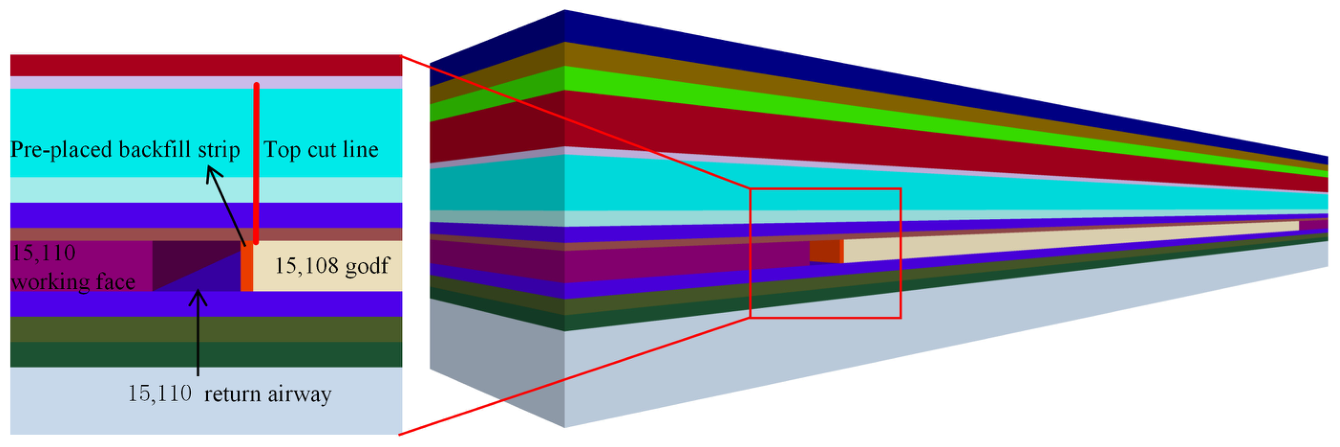
The numerical model was established according to the engineering layout of the 15,108 and 15,110 working faces. The model size was 350 m × 52 m × 50 m, which ensured that the roadway, pre-placed backfill strip, roof cutting area, and main disturbed surrounding rock were included, while the model boundaries were kept away from the key disturbed zone. The model was discretized using hexahedral zones. Local mesh refinement was adopted around the roadway, pre-placed backfill strip, coal seam, and roof cutting area, and the minimum mesh size in these key areas was set to 0.25 m to better capture the stress and deformation variation near the excavation boundary and the cutting line. A relatively coarser mesh was used in areas far from the roadway and the roof cutting zone to improve computational efficiency. A vertical stress of 6.2 MPa was applied to the top boundary, the side boundaries were constrained in the normal horizontal direction, and the bottom boundary was fixed. The coal and rock strata and the pre-placed backfill strip were simulated using the Mohr–Coulomb model, while the goaf was simulated using the double-yield model. The geometry and layout of the numerical model are shown in Figure 9.The mechanical parameters are listed in Table 2, and the simulation parameters are listed in Table 3.

4.3. Analysis of Numerical Simulation Results

4.3.1. Stress Distribution of Pre-Placed Backfill Strip with Different Roof Cutting Heights

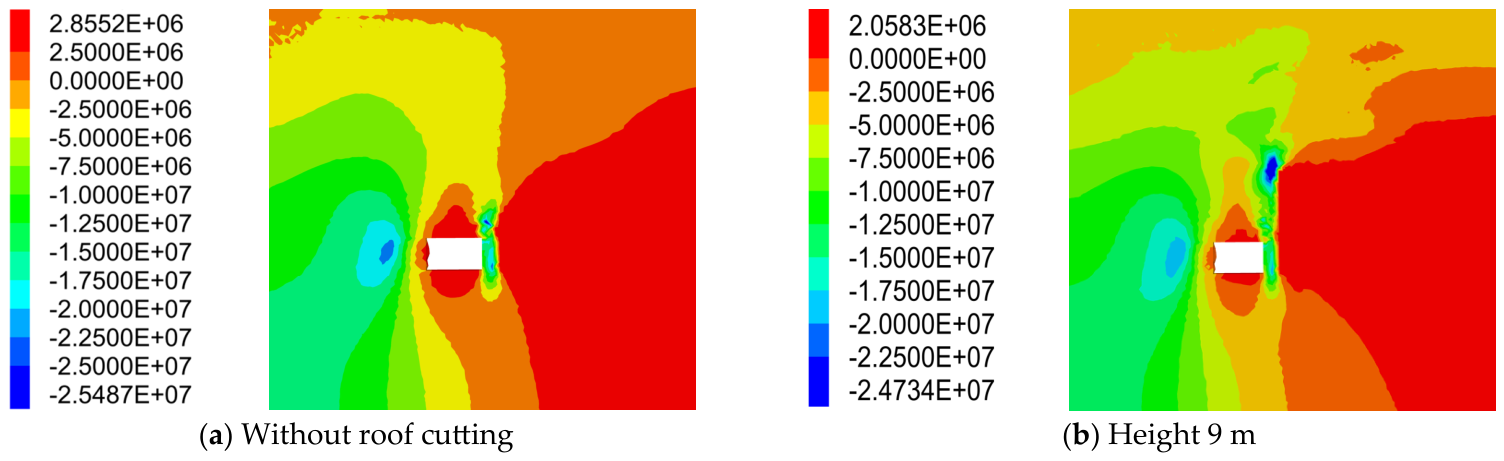
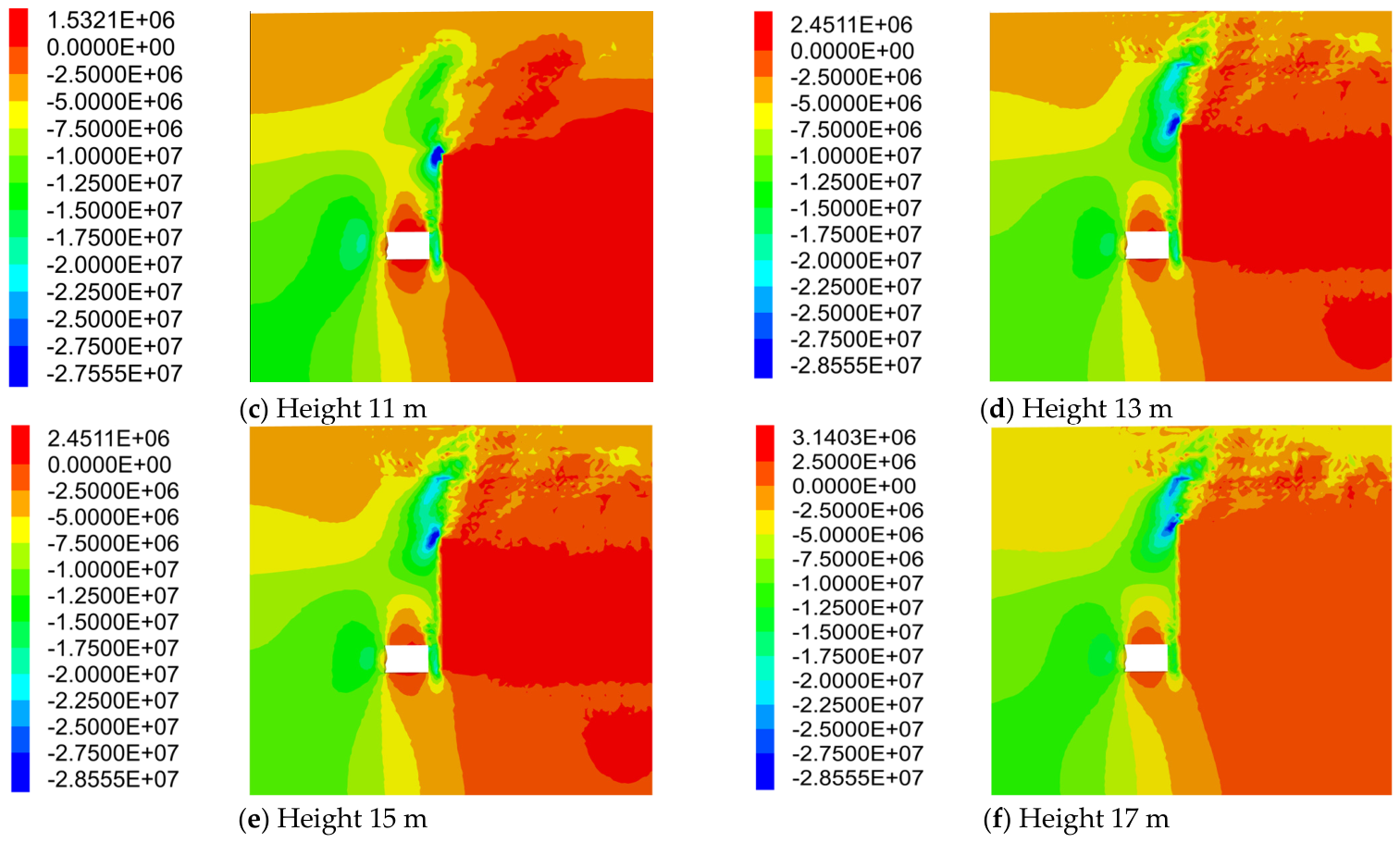
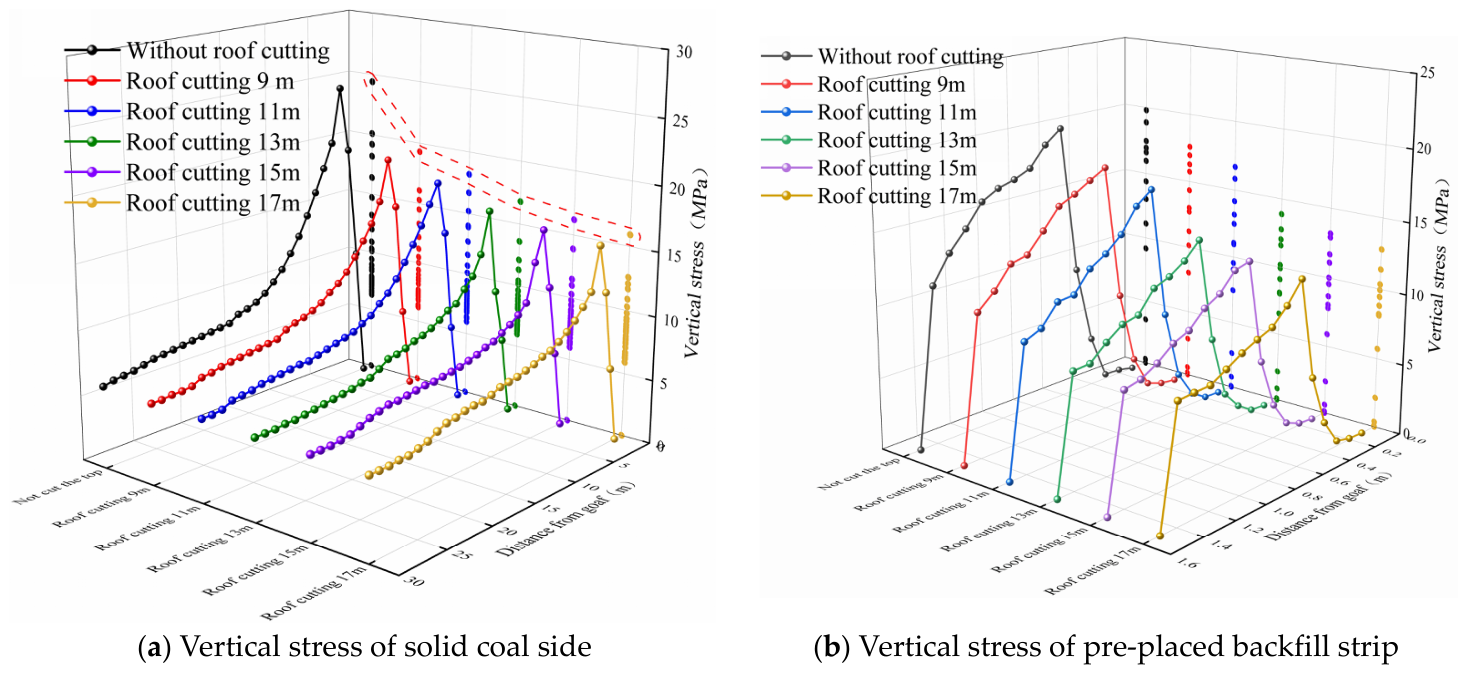
The vertical stress cloud diagram of the pre-placed backfill strip under the conditions of no roof cutting and roof cutting is shown in Figure 10. Figure 11 shows the vertical stress and variation characteristics of the pre-placed backfill strip and solid coal.
Combined with Figure 10 and Figure 11, when roof cutting is not implemented, the roof strata above the roadway are relatively complete, and the hard roof on the side of the goaf cannot collapse in time, forming a large-area suspended roof structure. This structure changes the transfer path of the roof load to the goaf, so that the load of the overlying strata is transmitted laterally and concentrated on the pre-placed backfill strip and the solid coal. At this time, the surrounding rock is in a strong lateral abutment pressure peak area, resulting in the vertical stress of the pre-placed backfill strip and the solid coal being as high as 19.8 MPa and 23.3 MPa, respectively, with the stress concentration factor at 2.95 and 3.75.
When the roof cutting height increases from 0 m to 9 m, the vertical stress peaks of the pre-placed backfill strip and the solid coal side decrease to 17.6 MPa and 19.3 MPa, respectively, and the stress concentration factors decrease from 2.95 and 3.75 to 2.83 and 3.27, respectively. This shows that the roof cutting reduces the surrounding rock load to a certain extent, but because the 9 m roof cutting height is only limited to the direct roof range, the hard basic roof cannot be cut off. Because the high-level rock stratum is not completely broken, a lateral cantilever is still formed on the side of the goaf, resulting in the lateral abutment pressure still being transmitted to the surrounding rock of the roadway. Therefore, the pressure relief effect at this stage is limited, and the surrounding rock is still in a high level of stress concentration.
When the cutting height increases to 11 m and 13 m, the vertical stress peaks of the pre-placed backfill strip decrease to 16.2 MPa and 13.9 MPa, respectively, and the stress concentration factors are 2.61 and 2.24. The peak stress of the solid coal side is reduced to 18.2 MPa and 16.8 MPa, and the stress concentration factors are reduced to 2.93 and 2.71. At this stage, the stress decreases significantly, indicating that the roof cutting height of 13 m has changed the main roof structure and the lateral stress transfer path in the roof, so that the side cantilever of the goaf collapses in time, thereby reducing the lateral abutment pressure generated by the cantilever and fundamentally improving the mechanical environment of the surrounding rock of the roadway.
When the roof cutting height increases to 15 m and 17 m, the vertical stress peak of the pre-placed backfill strip continues to decrease to 13.2 MPa and 12.8 MPa, and the vertical stress of the solid coal decreases to 16.2 MPa and 15.9 MPa, but the decrease is not obvious. This shows that when the roof cutting height reaches 13 m, the hard basic roof has been cut off, and the caving gangue in the goaf can connect the roof and play an effective supporting role in the overlying strata. At this time, if the height continues to increase, the cutting seam only extends to the upper weak sandy mudstone. Because this rock layer has low strength and weak bearing capacity, it has little effect on the transmission of lateral abutment pressure. Therefore, the effect of increasing the cutting height on improving the stress state of the surrounding rock is not significant.
Through the analysis of the evolution law of the vertical stress peak value of the pre-placed backfill strip and the solid coal side, the control effect of the cutting height on the stress field of the surrounding rock of the roadway is very significant. With an increase in roof cutting height (0~17 m), the vertical stress peaks of the pre-placed backfill strip and the solid coal side show a continuous downward trend, with a decrease of 11%~33% and 17%~29%, respectively. When the roof cutting height is less than 13 m, the peak stress of the surrounding rock decreases significantly with an increase in height. When the cutting height reaches 13 m, the hard basic roof has been effectively cut off, and the pressure relief effect is more significant. When the roof cutting height is greater than 13 m, the effect of increasing the roof cutting height on the peak stress is very limited because the overlying weak rock layer has little effect on the lateral stress transfer. Therefore, the numerical simulation and theoretical analysis are basically consistent. Considering the numerical simulation and theoretical analysis, 13 m is finally determined as a reasonable roof cutting height.

4.3.2. Evolution of the Surrounding-Rock Plastic Zone Under Different Roof Cutting Heights

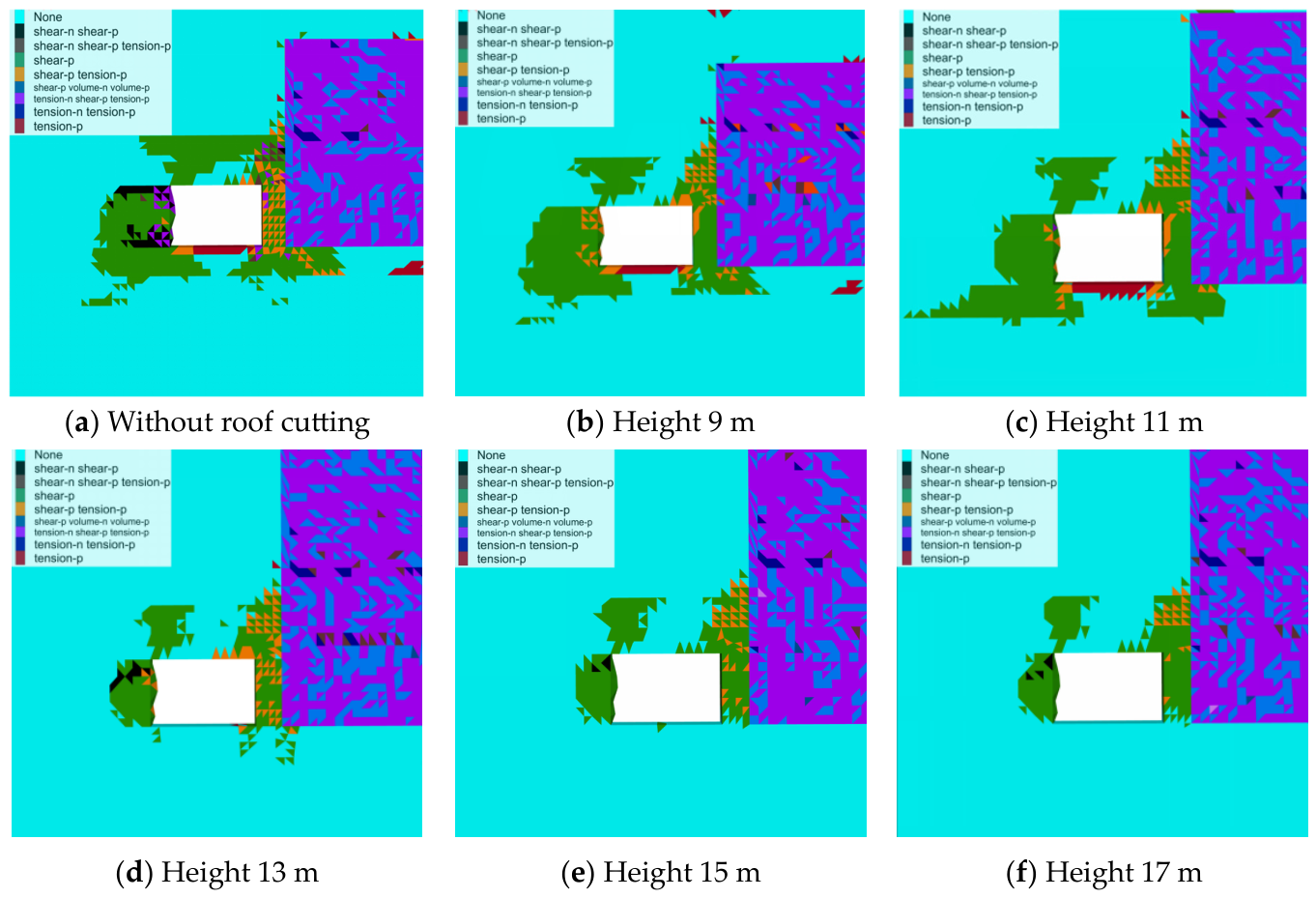
The plastic zone distribution of the surrounding rock under different roof cutting heights is shown in Figure 12.
As shown in Figure 12, due to the lack of roof cutting, the hard roof on the side of the goaf and the roof of the roadway are not cut off to form a large-scale suspended roof structure. The lateral abutment pressure generated by the overlying strata cannot be released and is transferred to the surrounding rock of the roadway. At this time, the surrounding rock of the roadway is at a very high stress level, the plastic zone is the largest, and deep shear failure occurs on the solid coal side of the left side of the roadway. The maximum depth of the lateral plastic zone of the roadway is 3.5 m; the roof strata above the roadway show complex shear failure and tensile failure, and the failure depth is large, reaching 3.1 m; the roof damage range on the side of the goaf is also the widest. This shows that when the roof is not cut, the surrounding rock damage is most severe, making roadway maintenance difficult.
When the cutting height is 9 m~11 m, as shown in Figure 12b,c, the low roof cutting height fails to effectively cut off the thick and hard basic roof strata above, despite the roof cutting being carried out directly above the roadway. Compared with the uncut state, the plastic failure range of the solid coal side and the top of the roof is reduced to a certain extent, but it is still in a serious failure state. There is still deep shear failure on the left side of the roadway. The maximum depth of the lateral plastic zone of the roadway is 2.1 m. The damage directly above the roof is still significant, and the effect of roof cutting and pressure relief is limited.
When the cutting height reaches 13 m, as shown in Figure 12d, the distribution of the plastic zone improves. The elastic area of the roof rock layer above the roadway increases, and the plastic failure depth decreases significantly. The plastic failure depth of the coal side is also significantly reduced, and the maximum depth of the lateral plastic zone of the roadway is reduced to 2.1 m. This shows that the 13 m roof cutting height has successfully changed the key thick and hard main roof structure and the transmission path of the lateral stress in the goaf, so that it can collapse in time along the roof cutting line. The overlying strata change from lateral hanging roof to sinking along the fracture, and the caving gangue in the goaf can be supported by the roof. This indicates that the 13 m roof cutting height provides a better pressure-relief effect under the present geological conditions.
When the roof cutting height continues to increase to 15 m and 17 m, as shown in Figure 12d–f, the range, shape and failure mechanism of the plastic zone of the solid coal side, roof and pre-placed backfill strip of the roadway do not change much compared with that at 13 m, showing no further improvement.
The selection of a 13 m roof cutting height is mainly based on the roof lithology, theoretical calculation, numerical comparison, and construction economy. The lithological column shows that the cumulative height to the upper part of the thick, hard limestone roof is about 12.88 m, so a 13 m cutting height can effectively cut the key hard roof. The simulation results also show that when the cutting height increases from 11 m to 13 m, the peak vertical stress of the pre-placed backfill strip decreases from 16.2 MPa to 13.9 MPa—a reduction of about 14.2%. However, when the cutting height further increases from 13 m to 15 m, the peak stress only decreases from 13.9 MPa to 13.2 MPa—a reduction of about 5.0%. Therefore, increasing the height beyond 13 m produces only a limited additional pressure-relief effect but increases drilling and blasting workload. Considering roof-control effectiveness and construction economy, 13 m is selected as a reasonable roof cutting height.

4.3.3. Analysis of Surrounding Rock Deformation Under Different Roof Cutting Heights

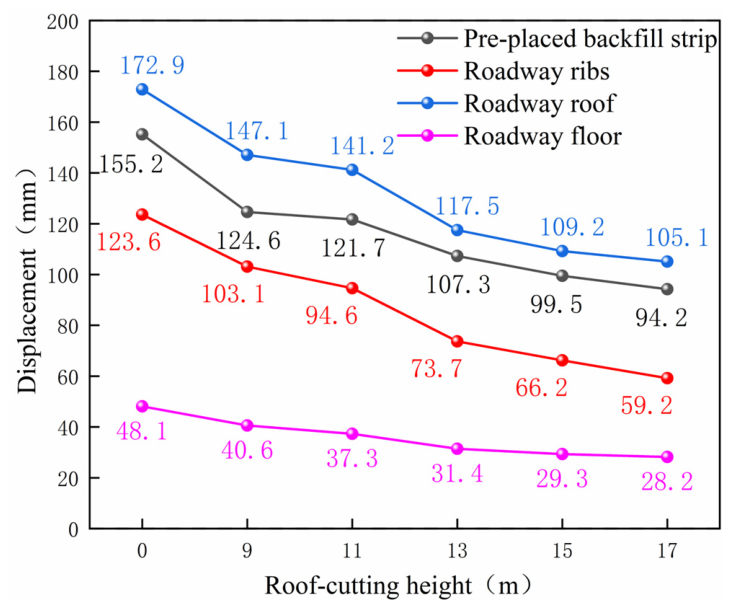
According to Figure 13, it can be seen that with an increase of roof cutting height, the displacements of the roof, pre-placed backfill strip, two sides and floor all show a downward trend, indicating that roof cutting and pressure relief can weaken the load transfer effect of the roof cantilever structure on the roadway and pre-placed backfill strip in the goaf side, thereby improving the stress state of the surrounding rock. The displacement patterns of each part are always maintained as follows: the roof shows the largest displacement, followed by the pre-placed backfill strip, the two sides, and the floor, whose displacement is the smallest. Under the condition of an uncut roof, the displacements of the roof, pre-placed backfill strip, two sides and floor are 172.9, 155.2, 123.6 and 48.1 mm, respectively. When the cutting height is increased to 17 m, the displacements decrease to 105.1, 94.2, 59.2 and 28.2 mm, respectively, which represents a reduction of 39.2%, 39.3%, 52.1% and 41.4%, respectively, compared with the uncut condition. Compared with the roof, backfill strip and floor, the displacement of the two sides decreases more significantly with the increase in roof cutting height, and the displacements of the roof and pre-placed backfill strip are also obviously controlled.
From different stages, when the height of roof cutting increases from 0 m to 9 m, the displacement decreases significantly, which indicates that the stress transfer path of the goaf side begins to adjust after roof cutting. When it increases from 9 m to 11 m, the displacement continues to decrease, but the decrease is relatively limited, indicating that the weakening of the lateral cantilever structure by roof cutting is still insufficient. When the roof cutting height is further increased to 13 m, the displacement of the roof, pre-placed backfill strip, two sides and floor is reduced to 117.5 mm, 107.3 mm, 73.7 mm and 31.4 mm respectively, which is 32.0%, 30.9%, 40.4% and 34.7% lower than that without roof cutting, and the decrease is significantly increased again. This shows that after the roof cutting height reaches 13 m, the lateral basic roof structure of the goaf is changed, and the control effect on the surrounding rock is significantly improved.
When the cutting height continues to increase from 13 m to 15 m and 17 m, the displacement of each part still decreases to a certain extent, but the overall decrease is slowing down. Among them, the displacement of the roof, pre-placed backfill strip, two sides and floor in the 13~17 m interval only further decreased by 10.6%, 12.2%, 19.7% and 10.2%. This shows that after the roof cutting height reaches 13 m, increasing the roof cutting height can still improve the deformation of the surrounding rock, but the control effect is limited. By comprehensively comparing the deformation control effects under different roof cutting heights, it can be seen that the 13 m roof cutting height can better weaken the influence of the roof structure on the roadway and the pre-placed backfill strip, and it is more reasonable in terms of the control effect and construction cost.
The above numerical results also provide verification of the theoretical analysis. The mechanical model indicates that roof cutting can reduce the load transferred from the lateral main-roof cantilever to the pre-placed backfill strip by shortening the suspended roof length on the goaf side. The numerical results show the same trend from three aspects: the peak vertical stress decreases with an increase of roof cutting height, the plastic failure range of the surrounding rock is reduced, and the displacement of the roadway and the pre-placed backfill strip is effectively controlled. These results indicate that the pressure-relief mechanism obtained from the theoretical analysis is consistent with the numerical response. In addition, the field monitoring results in Section 5.2 further verify that the pre-placed backfill strip remained generally stable after being affected by mining disturbance. Therefore, the proposed parameter selection is supported by theoretical analysis, numerical simulation, and field observation.

4.3.4. The Stress Distribution of Different Widths of Pre-Placed Backfill Strip

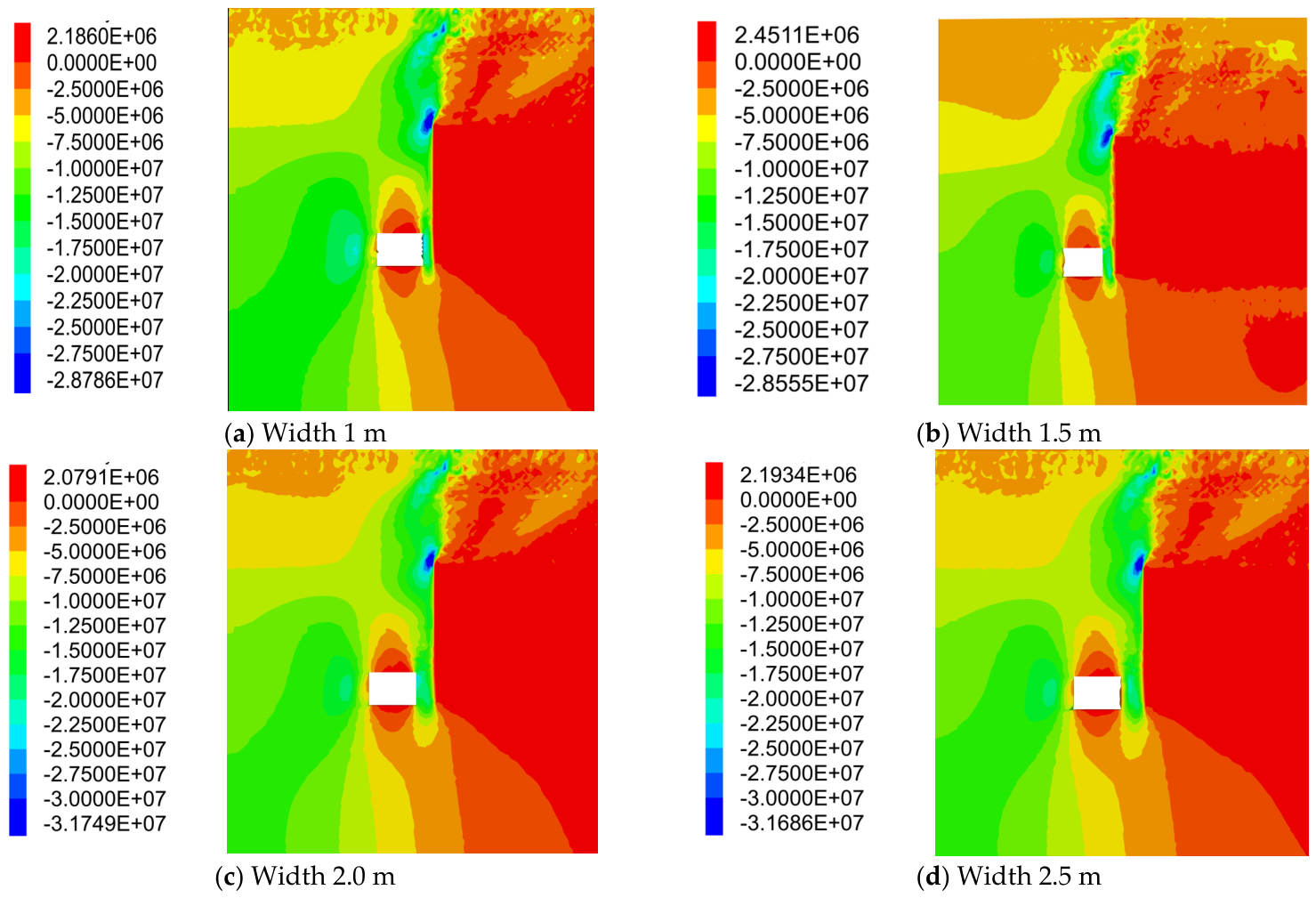
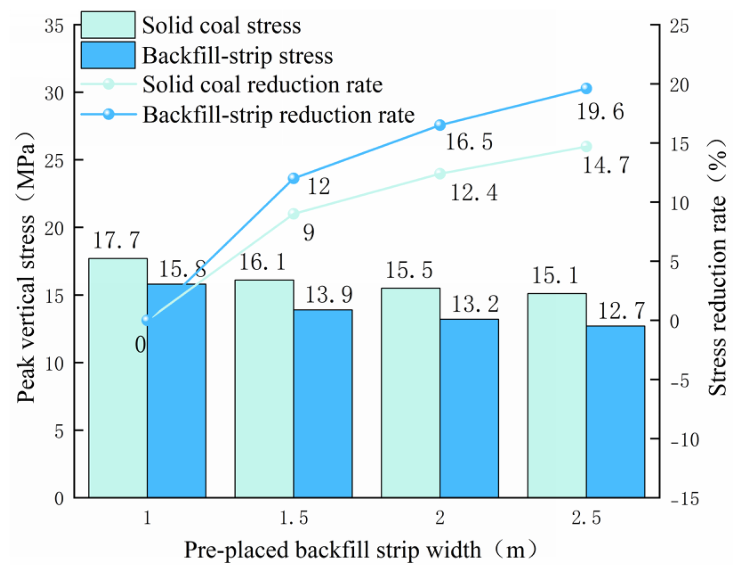
The vertical stress distribution of the surrounding rock under different widths of the pre-placed backfill strip is shown in Figure 14, and the variation characteristics of the vertical stress peak and stress reduction rate are shown in Figure 15. According to Figure 14 and Figure 15, with an increase in the width of the pre-placed backfill strip, the vertical stress of the backfill strip and the adjacent coal body shows a significant nonlinear decreasing trend.
The peak stress of the solid coal side decreases with an increase in the width of the pre-placed backfill strip, and the peak position is maintained at 2.0 m from the edge of the roadway. Specifically, when the width of the pre-placed backfill strip is 1.0 m, 1.5 m, 2.0 m and 2.5 m, the corresponding peak stress of the solid coal side is 17.7 MPa, 16.1 MPa, 15.5 MPa and 15.1 MPa, respectively. This shows that when the width exceeds 2.0 m, the effect of continuous widening on improving the stress state of the solid coal side has been significantly weakened.
With an increase in the design width of the pre-placed backfill strip from 1 m to 2.5 m, the vertical stress peak of the pre-placed backfill strip gradually decreases. The vertical stress peaks corresponding to widths of 1 m, 1.5 m, 2 m and 2.5 m are 15.8 MPa, 13.9 MPa, 13.2 MPa and 12.7 MPa, respectively. From the shape of the stress distribution curve, the smaller the width, the more prominent the peak value of the stress curve and the more significant the stress concentration.
When the width of the pre-placed backfill strip is 1.0 m, the maximum vertical stress reaches 15.8 MPa. At this width, the bearing pressure of the strip is relatively high, which may lead to shear failure or local instability and is unfavorable for the long-term stability of the surrounding rock. When the width increases to 1.5 m, the peak vertical stress decreases to 13.9 MPa, which is about 12.0% lower than that of the 1.0 m scheme.
When the width further increases to 2.0 m and 2.5 m, the peak vertical stress of the pre-placed backfill strip decreases to 13.2 MPa and 12.7 MPa, respectively. Although the stress concentration is further reduced, the additional improvement becomes limited. It should also be noted that the stress state of the solid coal side is used as an auxiliary evaluation index in this study. From the solid-coal-side stress data, the 2.0 m scheme shows a slightly better control effect than the 1.5 m scheme. However, the main function of the pre-placed backfill strip is to replace the section coal pillar and provide a stable artificial boundary for subsequent lower-section roadway excavation. Therefore, the width of the strip should be determined mainly according to the stability of the strip itself, the overall stress-control effect, and engineering economy, rather than only according to the stress reduction of the solid coal side.
In terms of material consumption and construction cost, the height of the pre-placed backfill strip is 3.9 m. For each meter of roadway length, the backfill volumes corresponding to widths of 1.5 m, 2.0 m, and 2.5 m are 5.85 m3, 7.80 m3, and 9.75 m3, respectively. Based on the field construction cost of the 1.5 m scheme, the unit cost is 18,566 CNY/m. If the cost is estimated in proportion to the backfill volume, the unit costs of the 2.0 m and 2.5 m schemes are approximately 24,755 CNY/m and 30,943 CNY/m, respectively. Compared with the 1.5 m scheme, the construction costs increase by about 33.3% and 66.7%, respectively. Therefore, although increasing the width beyond 1.5 m can further reduce the stress to some extent, the improvement is relatively limited compared with the increase in material consumption and construction cost. Considering the bearing stability of the pre-placed backfill strip, the stress-control effect, and engineering economy, 1.5 m is selected as the reasonable width under the conditions of this study.

4.4. Comparison with Previous Studies

Ma et al. proposed a non-pillar mining technique using a preset packing body in the roadway for thick coal seams. In their study, the packing body was constructed in advance in the upper-section roadway, and the lower-section roadway was then excavated along the preset packing body. This method verified the feasibility of replacing the section coal pillar with an artificial bearing structure. They also pointed out that the key issues of this technology are the selection of filling material and the reasonable design of the packing-body width. Under the premise of maintaining the stability of the packing body and the surrounding rock of the roadway, the width of the packing body should be minimized as far as possible. In their field application, the coal thickness was 4.5–6.2 m, and a preset packing body with a width of 1.6 m, a height of 4 m, and a design compressive strength of 18 MPa was adopted. The field results showed that the preset packing body could meet the requirements of non-pillar mining under thick coal seam conditions.
The present study is closely related to the above work because both studies use a pre-constructed artificial bearing structure to replace the section coal pillar and provide a boundary for subsequent lower-section roadway excavation. However, the focus of the two studies is different. The previous study mainly verified the feasibility of the preset packing body itself from the perspectives of material selection, mixture ratio, packing body width, and field application [39,40]. In contrast, the present study further considers the influence of the lateral main-roof cantilever under large mining height and thick, hard roof conditions. In this study, the mining height is 3.9 m, the pre-placed backfill strip width is 1.5 m, and the roof cutting height is determined to be 13 m. Roof cutting and pressure relief are introduced to actively regulate the goaf-side roof structure, shorten the lateral suspended-roof length, and reduce the load transferred to the pre-placed backfill strip.
Therefore, compared with the previous preset packing body technology, the present study extends the research focus from the material and width design of the pre-placed backfill strip to the cooperative control of roof structure and backfill strip stability. The comparison indicates that the pre-placed backfill strip has an engineering basis for coal pillar replacement, while roof cutting provides an additional pressure-relief mechanism for improving the loading condition of the strip. This further explains the necessity of combining roof cutting with a pre-placed backfill strip under large mining height and thick, hard roof conditions.

5. On-Site Implementation Plan and Effect

5.1. Implementation Plan

(1)
Expansion:
In order to meet the construction space requirements of the pre-placed backfill strip, it is necessary to expand the outer side of the 15,108 return airway before constructing the pre-placed backfill strip. The width of the expansion is 1600 mm and the height is 3900 mm.
(2)
Pre-placed backfill strip:
Combined with the bearing requirements of the pre-placed backfill strip, the roadway section conditions and the on-site construction technology, a fiber high-water material pre-placed backfill strip with a height of 3.9 m and a width of 1.5 m was constructed. Under the condition of water–cement ratio of 1.3:1, fiber support has a faster setting time, higher strength and better cementation performance than high-water material. The main components of the material are shown in Table 4:
(4)
Roof cutting:
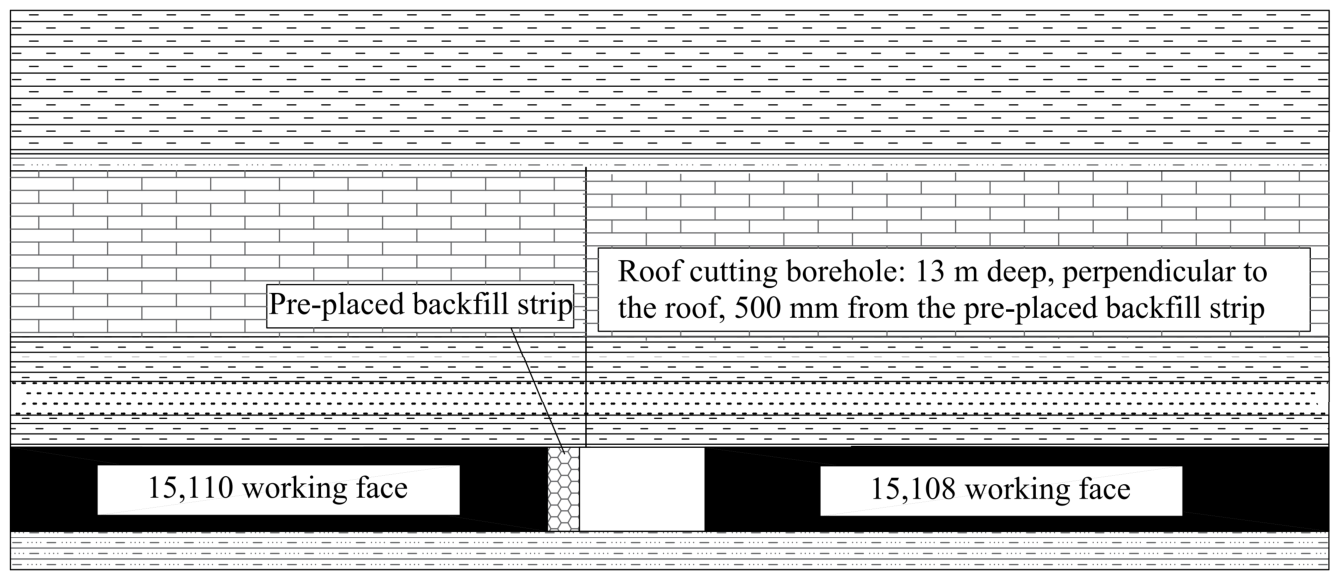
The blasting hole is set at a position 500 mm from the roof of the side of the pre-placed backfill strip, the depth of the roof cutting hole is 13 m, and the roof cutting hole is perpendicular to the roof. The hole diameter is Φ60 mm, and the hole spacing is 800 mm. The hole bottom uncoupled continuous charge is adopted, and the energy-gathering directional porous blasting is carried out once. The arrangement of boreholes in the directional kerf area is shown in Figure 16:

5.2. Implementation Effect

After the construction of the pre-placed backfill strip, displacement monitoring was first carried out in the 15,108 return airway during the mining of the 15,108 working face to evaluate the influence of mining disturbance on the surrounding rock near the strip. Three displacement monitoring stations were arranged in the 15,108 return airway. The first station was located 250 m away from the stopping line, and the other two stations were arranged at intervals of 250 m along the roadway. The measuring points were arranged in a cross-shaped layout to monitor the roof-to-floor convergence and rib-to-rib convergence. During monitoring, the relative distance between each station and the working face was recorded daily, and a laser rangefinder was used to measure the roadway deformation. The monitoring stations were numbered Station 1, Station 2, and Station 3 in sequence, and their layout is shown in Figure 17:
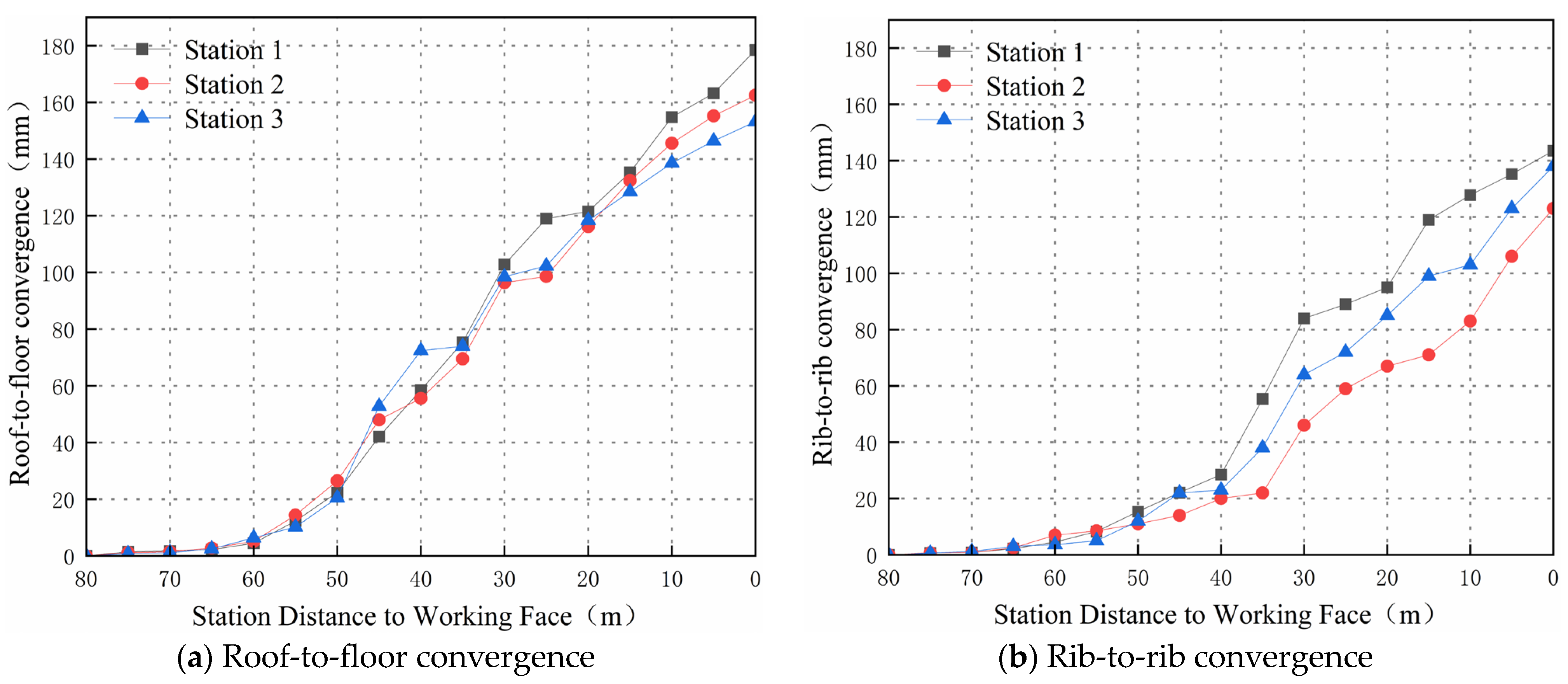
During the mining of the 15,108 working face, the observed displacement variations at the three monitoring stations are shown in Figure 18:
The monitoring results show that the surrounding rock deformation of the 15,108 return airway had obvious stage characteristics during mining. When the monitoring stations were 60–80 m away from the working face, the roof-to-floor convergence and rib-to-rib convergence showed no obvious increase, indicating that the mining influence was relatively weak in this range. As the distance decreased to 40–80 m, the roadway displacement continued to increase, but the growth rate became smaller. When the stations were less than 40 m away from the working face, the convergence increased significantly and reached a maximum near the end of the working face. The maximum roof-to-floor convergence was 178.5 mm, and the maximum rib-to-rib convergence was 143.5 mm.
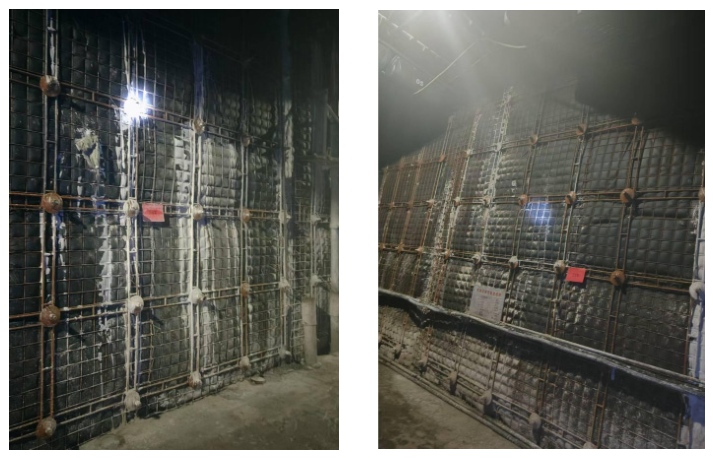
Based on the roadway deformation monitoring, the field condition of the pre-placed backfill strip was further observed. The main function of the strip is to provide a stable artificial boundary for the subsequent excavation of the 15,110 return airway along the strip. As shown in Figure 19, although the roadway deformation increased under mining disturbance, no obvious cracking, crushing, or large-scale instability of the pre-placed backfill strip was observed during the monitoring period. This indicates that the pre-placed backfill strip remained generally stable under the mining influence of the 15,108 working face and can provide a stable boundary condition for the subsequent excavation of the 15,110 return airway.
After the completion of the construction of the pre-placed backfill strip, its main role is to provide a stable boundary for the subsequent excavation of the 15,110 return airway along the pre-placed backfill strip. At present, the 15,108 working face is being mined. From the field effect, as shown in Figure 19, the pre-placed backfill strip has not been significantly damaged, and its stability is good.
It should be noted that the pre-placed backfill strip is intended to provide a stable boundary for the subsequent excavation of the 15,110 return airway. However, the 15,110 return airway has not yet been excavated along the strip because the 15,108 working face is still being mined. Therefore, direct monitoring of the 15,110 return airway is not available at this stage. The current monitoring mainly verifies whether the pre-placed backfill strip remains stable after being affected by the mining of the 15,108 working face. A similar application between the 15,106 and 15,108 working faces in the same mining area also showed good field performance, and follow-up monitoring will be conducted after the excavation of the 15,110 return airway.

6. Conclusions

(1)
A mechanical model of the roof–pre-placed backfill strip bearing structure before and after roof cutting was established to reveal the pressure-relief mechanism of roof cutting on the pre-placed backfill strip. The results show that roof cutting can shorten the goaf-side suspended roof length, change the lateral load-transfer path of the roof, and reduce the support resistance and deformation required by the pre-placed backfill strip. Therefore, roof cutting can improve the stress environment of the roadway surrounding rock and the pre-placed backfill strip.
(2)
The numerical simulation results show that increasing the roof-cutting height can reduce the vertical stress concentration, plastic zone range, and surrounding rock deformation. Without roof cutting, the peak vertical stress of the pre-placed backfill strip is 19.8 MPa. When the roof cutting height increases to 13 m, the peak vertical stress decreases to 13.9 MPa, with a reduction of about 29.8%. When the roof cutting height further increases from 13 m to 15 m, the peak stress only decreases from 13.9 MPa to 13.2 MPa, indicating that the additional pressure-relief effect becomes limited. Considering the roof lithology, theoretical calculation, numerical simulation, and construction economy, 13 m is determined to be the reasonable roof cutting height.
(3)
Under roof cutting conditions, increasing the width of the pre-placed backfill strip is beneficial for reducing stress concentration in the strip and the adjacent solid coal. When the strip width increases from 1.0 m to 1.5 m, the peak vertical stress decreases from 15.8 MPa to 13.9 MPa, with a reduction of about 12.0%. When the width further increases to 2.0 m and 2.5 m, the peak stress decreases to 13.2 MPa and 12.7 MPa, respectively, but the additional improvement becomes limited. Considering the bearing stability, stress-control effect, material consumption, and construction economy, 1.5 m is determined to be the reasonable width of the pre-placed backfill strip.
(4)
The field implementation results show that after adopting the scheme of 13 m roof cutting and pressure relief combined with a 1.5 m pre-placed backfill strip, the strip remained generally stable, and no obvious damage was observed. Field monitoring during the mining of the 15,108 working face shows that the maximum roof-to-floor convergence and rib-to-rib convergence of the 15,108 return airway were 178.5 mm and 143.5 mm, respectively. The field monitoring and observation results indicate that this scheme can provide a stable boundary condition for the subsequent excavation of the 15,110 return airway along the strip. Considering the site-specific nature of mining and geological conditions, the parameters obtained in this study are mainly applicable to the No. 15 coal seam of Wangzhuang Coal Industry. Therefore, the 13 m roof cutting height and 1.5 m backfill strip width should be recalculated before being applied to other mines. Nevertheless, the control mechanism of regulating the lateral main-roof structure through roof cutting and reducing the load transferred to the pre-placed backfill strip can provide a reference for similar large-mining-height working faces with thick hard roofs. For other engineering conditions, the key parameters should be re-determined according to roof lithology, mining height, buried depth, in situ stress, and roadway layout.
(5)
Overall, this study extends the application of roof cutting from conventional gob-side roadway control to the protection of a pre-placed backfill strip used for coal pillar replacement. The proposed analysis framework links roof-structure regulation, backfill strip bearing behavior, and engineering parameter design, which can enrich the theoretical understanding of surrounding rock control in non-pillar mining. Future work will focus on the long-term monitoring of the 15,110 return airway after its excavation along the pre-placed backfill strip, including roadway deformation, backfill strip stability, and the evolution of the surrounding rock response during subsequent mining stages.

Author Contributions

S.J.: Writing—original draft, data curation, formal analysis, investigation. B.Z.: Funding acquisition, methodology, supervision, project administration. D.D.: Funding acquisition, methodology, conceptualization, writing—review and editing. Z.L.: Writing—review and editing, data curation, validation. Y.K.: Writing—review and editing. L.D.: Methodology. All authors have read and agreed to the published version of the manuscript.

Funding

Key Research and Development Program of Shanxi Province (201903D121075) and characterization and directional control of the expansion process of long straight fractures in the hydraulic fracturing of hard roof in gob-side entry, National Natural Science Foundation of China (NSFC52274134).

Institutional Review Board Statement

Not applicable.

Informed Consent Statement

Not applicable.

Data Availability Statement

Data to support the findings of this study are available from the first author upon request.

Conflicts of Interest

The authors declare no conflicts of interest.

References

  1. Zhao, S.; Shen, F.; He, G.; Li, H.; Jiang, J.; Gao, H.; Zhao, Z.; Zhou, Z.; Tian, Y. Mechanism and control technology of roof cutting induced pressure relief in gob-side entry retaining with roadside backfill under thick coal seam conditions. Coal Sci. Technol. 2025, 53, 102–114. [Google Scholar] [CrossRef]
  2. Kang, H.; Wang, D.; Liu, Y. Development direction of surrounding rock control technology for non-pillar mining. J. Min. Strat. Control Eng. 2025, 7, 5–9. [Google Scholar] [CrossRef]
  3. Liu, P.; Wei, J. Study on width of small coal pillar and pressure relief control of roof cutting under gob-side entry driving in thick coal seam. Ind. Min. Autom. 2025, 51, 151–158. [Google Scholar] [CrossRef]
  4. Feng, P.; Qiao, W.; Huang, Y.; Wang, Q.; Cai, J.; Wu, H. Spatio-Temporal Evolution of Multiple Water Bodies and a Water Conservation Mining Strategy in the Xinjiang Coalfield: A Case Study of the Yushuquan and Yongxin Mines. Mine Water Environ. 2025, 44, 694–708. [Google Scholar] [CrossRef]
  5. Zhang, Z.; Bai, J.; Wang, X.; Xu, Y.; Yan, S.; Liu, H.; Wu, W.; Zhang, W. Research progress and prospect of surrounding rock control technology of gob-side entry retaining in China. Coal J. 2023, 48, 3979–4000. [Google Scholar] [CrossRef]
  6. Hua, X.; Li, C.; Liu, X.; Guo, Y.; Qi, Y.; Chen, D. Re-discussion on the development status and improvement suggestions of gob-side entry retaining technology in China. Coal Sci. Technol. 2023, 51, 128–145. [Google Scholar] [CrossRef]
  7. Guo, J.; Wang, L.; Du, W.; Liu, Y.; Chen, C.; Zhang, K.; Li, D. Study on the influence of ventilation mode on coal spontaneous combustion in goaf of gob-side entry retaining. Ind. Min. Autom. 2024, 50, 142–151. [Google Scholar] [CrossRef]
  8. Lai, X.; Xu, L.; Cao, J.; Shan, P.; Zhang, S.; Xu, H. Instability characteristics and control methods of small coal pillar in open roadway under the influence of mining. Coal Sci. Technol. 2025, 53, 39–53. [Google Scholar] [CrossRef]
  9. Gu, B.; Guo, D.; Chen, X. Practice of fire prevention and extinguishing in adjacent goaf of small coal pillar gob-side entry driving in thick coal seam. Shandong Coal Sci. Technol. 2024, 42, 64–68. [Google Scholar] [CrossRef]
  10. Bai, J.; Hou, C.; Huang, H. Numerical simulation study on stability of narrow coal pillar of roadway driving along goaf. J. Rock Mech. Eng. 2004, 20, 3475–3479. [Google Scholar]
  11. Zhang, J.; Liu, L.; Shao, J. A non-coal pillar mining method by concrete carrier replacing coal pillar: A case study. Arab. J. Geosci. 2022, 15, 990. [Google Scholar] [CrossRef]
  12. Sun, Q.; Zhang, J.; Zhou, N. Study and discussion of short- strip coal pillar recovery with cemented paste backfill. Int. J. Rock Mech. Min. Sci. 2018, 104, 147–155. [Google Scholar] [CrossRef]
  13. Che, C.; Cao, S.; Zhao, C.; Du, S.; Li, J.; Liu, Y. Research on cemented artificial pillars to replace protective inter-block coal pillars and stope failure laws. Front. Earth Sci. 2023, 10, 1039478. [Google Scholar] [CrossRef]
  14. Zhang, Y.; Wan, Z.; Li, F.; Zhou, C.; Zhang, B.; Guo, F.; Zhu, C. Stability of coal pillar in gob-side entry driving under unstable overlying strata and its coupling support control technique. Int. J. Min. Sci. Technol. 2013, 23, 193–199. [Google Scholar] [CrossRef]
  15. Zha, W.; Shi, H.; Liu, S.; Kang, C. Surrounding rock control of gob-side entry driving with narrow coal pillar and roadway side sealing technology in Yangliu Coal Mine. Int. J. Min. Sci. Technol. 2017, 27, 819–823. [Google Scholar] [CrossRef]
  16. Zhang, K.; Liu, C.; Zhang, H.; Yue, X.; Liu, H. Research on Roof Cutting Pressure Relief of the Gob-Side Entry Retaining with Roadside Backfilling. Front. Earth Sci. 2022, 10, 835497. [Google Scholar] [CrossRef]
  17. Shen, F.; Song, Y.; Zhao, W.; Zhao, S.; Yang, J.; Tian, Y.; Zheng, J.; Liu, C. Research on Novel Method of Gob-Side Entry Retaining Under the Synergistic Effect of Roof Cutting and Roadside Filling in Thick Coal Seams. Rock Mech. Rock Eng. 2023, 56, 7217–7236. [Google Scholar] [CrossRef]
  18. Ma, L.; Zhang, D.; Wang, H.; Li, Y. Mining technique with preset packing body in roadway for thick coal seam without coal pillars. J. Rock Mech. Eng. 2010, 29, 674–680. [Google Scholar]
  19. Guo, L.; Zhu, W.; Yue, S.; Kang, T.; Deng, J.; Wang, Z.; Wang, J. Research on the surrounding rock stability of caving excavation along goaf with pre-built concrete wall in fully mechanized caving face. China Min. Mag. 2025, 34, 174–184. [Google Scholar] [CrossRef]
  20. Wu, R.; Zhang, P.; Kulatilake, P.H.; Luo, H.; He, Q. Stress and deformation analysis of gob-side pre-backfill driving procedure of longwall mining: A case study. Int. J. Coal Sci. Technol. 2021, 8, 1351–1370. [Google Scholar] [CrossRef]
  21. Huang, X.; Zhang, C.; Ren, Z. Parameter determination and effect evaluation of gob-side entry retaining by directional roof cutting and pressure releasing. Eng. Fail. Anal. 2024, 156, 107847. [Google Scholar] [CrossRef]
  22. Liu, X.; Zhao, Z.; Fan, D.; Li, X.; Song, S.; Yang, S. Failure mechanism and control method of floor for gob-side entry retaining of inclined coal seam by impact load. Coal Sci. Technol. 2025, 53, 213–227. [Google Scholar] [CrossRef]
  23. Ding, C.; Guo, X.; Xiao, C.; Sui, Z.; Yang, Y. Experimental Study on the Influence of Blast Hole Bottom Cushion Medium on Blasting Damage Characteristics and Strain Evolution of Rock Mass. Rock Mech. Rock Eng. 2024, 58, 1895–1909. [Google Scholar] [CrossRef]
  24. Liu, S.; Li, X.; Zhu, W.; Fu, M.; Zhang, D.; Peng, B. Roof cutting mechanism of dense drilling in gob-side entry retaining and determination method of key parameters. Coal Sci. Technol. 2024, 52, 23–33. [Google Scholar] [CrossRef]
  25. Zhang, Z.; Chen, X.; Yu, Z.; Sun, H.; Huang, D.; Wu, J.; Zhang, H. Mitigating Coal Spontaneous Combustion Risk within Goaf of Gob-Side Entry Retaining by Roof Cutting: Investigation of Air Leakage Characteristics and Effective Plugging Techniques. Fire 2024, 7, 98. [Google Scholar] [CrossRef]
  26. He, J.; Cheng, P.; Wu, L.; Fan, J. Evolution laws and control technology of near and far stress field in hard roof mining roadway. Coal Sci. Technol. 2024, 52, 1–11. [Google Scholar] [CrossRef]
  27. Zhang, T.; Tu, M.; Zhao, Q.; Dang, J. Pressure Relief Height of Roof Cutting and Relieving along the Lateral Structure of Empty Roadway. Sci. Technol. Eng. 2025, 25, 4938–4946. [Google Scholar] [CrossRef]
  28. Liu, X.; Li, X.; Tan, Y.; Fan, D.; Ni, P.; Xie, C.; Song, H. Instability mechanism and energy reduction control method of roadside support in deep gob-side roadway. Coal J. 2023, 48, 485–500. [Google Scholar] [CrossRef]
  29. Xu, J.; Meng, N.; Bai, J. Research on synergistic bearing mechanism and control technology of backfill-gangue in gob-side entry retaining with roof cutting. Min. Saf. Environ. Prot. 2024, 51, 140–146. [Google Scholar] [CrossRef]
  30. Kan, J.; Zhang, N.; Li, B.; Si, G. Analysis of Supporting Resistance of Roadside Filling Body under Typical Roof Conditions of Gob-Side Entry Retaining. Rock Soil Mech. 2011, 32, 2778–2784. [Google Scholar] [CrossRef]
  31. Nan, C.; Wang, L.; Lv, J.; Yu, Y. Roof pressure calculation of longwall fully mechanized caving mining face in open-pit side coal mine. Coal J. 2019, 44, 1753–1763. [Google Scholar] [CrossRef]
  32. Gao, L.; Deng, G.; Suo, Y.; Qiu, H. Study on the optimization of reasonable width of section coal pillar in fully mechanized caving face of thick coal seam. Min. Res. Dev. 2022, 42, 1–6. [Google Scholar] [CrossRef]
  33. Feng, C.; Liu, S.; Zhang, X.; Zhang, Y.; Jiang, Y.; Li, Y. Study on bearing characteristics and reasonable width of filling body in gob-side entry retaining under roof cutting condition. J. Min. Saf. Eng. 2023, 40, 232–242. [Google Scholar] [CrossRef]
  34. Zhou, L.; Chen, L.; Cheng, Z.; Ai, G.; Kong, D.; Wang, L.; Wang, H.; Guo, K. Study on optimization of coal pillar width for gob-side entry driving in outburst thick coal seam. Coal Sci. Technol. 2022, 50, 92–101. [Google Scholar] [CrossRef]
  35. Zhang, B.; Wang, M.; Cui, S.; Fan, M.; Qiu, Y. Roof Cutting and Pressure Relief Surrounding Rock Control Technology for Gob-Side Entry Driving with Small Coal Pillars under Large Mining Height. J. China Coal Soc. 2021, 46, 2254–2267. [Google Scholar] [CrossRef]
  36. Shi, W.; Li, Z.; Liu, C.; Lyu, Y.; Zhang, H.; Yang, T. Study on optimization of key parameters of thick hard roof cutting and retaining roadway in inclined coal seam. Coal Sci. Technol. 2024, 52, 11–24. [Google Scholar] [CrossRef]
  37. He, M.; Gao, Y.; Yang, J.; Guo, Z.; Wang, E.; Wang, Y. Study on energy-gathering cutting technology of self-forming roadway without coal pillar and its influence on stress evolution of surrounding rock. J. Rock Mech. Eng. 2017, 36, 1314–1325. [Google Scholar] [CrossRef]
  38. Hu, J.; He, M.; Wang, J.; Ma, Z.; Wang, Y.; Zhang, X. Key Parameters of Roof Cutting of Gob-Side Entry Retaining in a Deep Inclined Thick Coal Seam with Hard Roof. Energies 2019, 12, 934. [Google Scholar] [CrossRef]
  39. Chang, Q.; Tang, W.; Xu, Y.; Zhou, H. Research on the width of filling body in gob-side entry retaining with high-water materials. Int. J. Min. Sci. Technol. 2018, 28, 519–524. [Google Scholar] [CrossRef]
  40. Xie, S.; Wang, E.; Chen, D.; Li, H.; Jiang, Z.; Yang, H. Stability analysis and control technology of gob-side entry retaining with double roadways by filling with high-water material in gently inclined coal seam. Int. J. Coal Sci. Technol. 2022, 9, 52. [Google Scholar] [CrossRef]
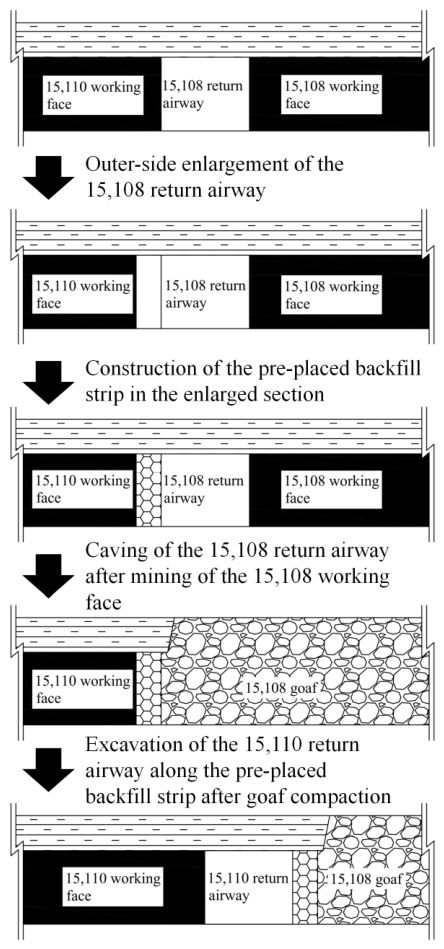
Figure 1. Schematic diagram of the pre-placed backfill strip technology.
Processes 14 01681 g001
Figure 2. 15,108 working face and 15,110 working face.
Processes 14 01681 g002
Figure 3. Borehole histogram.
Processes 14 01681 g003
Figure 4. Schematic diagram of pre-placed backfill strip–overburden bearing structure before roof cutting. The downward arrows indicate the overburden load, and the upward arrows indicate the support reaction of the coal, roadway surrounding rock, and pre-placed backfill strip to the roof.
Processes 14 01681 g004
Figure 5. Schematic diagram of the pre-placed backfill strip–overburden bearing structure after roof cutting.
Processes 14 01681 g005
Figure 6. Simplified mechanical model.
Processes 14 01681 g006
Figure 7. Schematic diagram of the fractured structure of the overlying strata before roof cutting.
Processes 14 01681 g007
Figure 8. Schematic diagram of the fractured structure of the overlying strata after roof cutting.
Processes 14 01681 g008
Figure 9. Numerical simulation mechanical model of 15,110 return airway tunneling under conditions of no roof cutting and roof cutting. The arrows indicate the locations of the pre-placed backfill strip, roof-cutting line, and 15,110 return airway.
Processes 14 01681 g009
Figure 10. Vertical stress distribution of the pre-placed backfill strip under different roof cutting heights.
Processes 14 01681 g010aProcesses 14 01681 g010b
Figure 11. Vertical stress variation of the pre-placed backfill strip and solid coal under different roof cutting heights.
Processes 14 01681 g011
Figure 12. Plastic zone distribution of surrounding rock under different roof cutting heights.
Processes 14 01681 g012
Figure 13. Effect of roof cutting height on surrounding rock and backfill strip displacement.
Processes 14 01681 g013
Figure 14. Vertical stress distribution diagram of a pre-placed backfill strip with different widths.
Processes 14 01681 g014
Figure 15. Variation characteristics of vertical stress and stress reduction rate under different pre-placed backfill strip widths.
Processes 14 01681 g015
Figure 16. Layout of roof cutting and pressure relief.
Processes 14 01681 g016
Figure 17. Layout of monitoring stations.
Processes 14 01681 g017
Figure 18. Surrounding rock deformation of the 15,108 return airway during working face mining.
Processes 14 01681 g018
Figure 19. On-site photograph of the pre-placed backfill strip.
Processes 14 01681 g019
Table 1. Rock mechanics and fragmentation expansion parameters for each layer of the roof of coal seam 15.
Lithologic CharacteristicsThicknessAggregate HeightBulking Coefficient
Mudstone1.481.481.35
Fine-grained sandstone 1.603.081.28
Mudstone2.105.181.35
Limestone7.7012.881.29
Sandy mudstone0.8013.681.32
Table 2. Physical and mechanical parameters of coal seams.
Lithologic CharacteristicsDensity
ρ (kg·m−3)
Bulk Modulus
(GPa)
Shear Modulus
(GPa)
Cohesion
C (MPa)
Friction
φ (°)
Tensile Strength
/MPa
Sandy mudstone25133.782.163.8931.02.34
Limestone270024.3314.8013.7235.05.44
Mudstone 223803.461.602.6834.62.08
Fine-grained sandstone26475.573.674.3331.25.87
Mudstone 123243.251.412.4133.91.93
No. 15 coal15050.710.421.8029.50.49
Pre-placed backfill strip16003.602.164.3031.01.50
Sandy mudstone25003.641.983.6030.22.10
Table 3. Main geological and roadway parameters.
Mining HeightRoadway SectionImmediate Roof ThicknessMain Roof ThicknessOverburden LoadPre-Placed Backfill Strip WidthRoof Cutting HeightRoof Cutting Angle
3.9 m5.9 × 3.9 m4.68 m7.7 m6.2 MPa1.5 m13 m
Table 4. Main components of fiber support materials.
A MaterialB MaterialC Material
Special cement clinker burningGypsumSpecial cement firing clinker (+ fiber)
MineralizerLimeMineralizer
Composite super retarderComposite mineralization early strength agentComposite super retarder
Composite suspension agentComposite suspension agentComposite suspension agent
Disclaimer/Publisher’s Note: The statements, opinions and data contained in all publications are solely those of the individual author(s) and contributor(s) and not of MDPI and/or the editor(s). MDPI and/or the editor(s) disclaim responsibility for any injury to people or property resulting from any ideas, methods, instructions or products referred to in the content.