Review

Unconventional Technologies for Starch Modification: A Critical Review of Recent Advances and Applications in Paste Property Improvement

by
Flaviana Coelho Pacheco
1,
Ana Flávia Coelho Pacheco
2,
Irene Andressa
1,
Jeferson Silva Cunha
1,*,
Fabio Ribeiro dos Santos
1,
Handray Fernandes de Souza
3,
Hiasmyne Silva de Medeiros
1,
Kátia Silva Maciel
2,
Paulo Henrique Costa Paiva
2 and
Bruno Ricardo de Castro Leite Júnior
1,*
1
Department of Food Technology (DTA), Federal University of Viçosa (UFV), University Campus, Viçosa 36570-000, Brazil
2
Cândido Tostes Dairy Institute, Agricultural Company of Minas Gerais (EPAMIG), Lieutenant Luiz de Freitas, 116, Juiz de Fora 36045-560, Brazil
3
Department of Food Engineering, School of Animal Science and Food Engineering, University of São Paulo, Pirassununga 13635-900, Brazil
*
Authors to whom correspondence should be addressed.
Processes 2026, 14(10), 1666; https://doi.org/10.3390/pr14101666
Submission received: 12 February 2026 / Revised: 17 May 2026 / Accepted: 20 May 2026 / Published: 21 May 2026
(This article belongs to the Special Issue Advanced Technology in Food Processing)

Abstract

Starches from various botanical sources are extensively utilized across food applications due to their functional and technological properties. However, native starches exhibit limitations under processing conditions involving heat, pH shifts, or mechanical stress, which restrict their application. In response, the demand for “clean-label” products has driven interest in sustainable and non-chemical modification strategies. This review aims to provide a critical overview of the effects of unconventional technologies—including ozone, ultrasound, high-pressure processing, high-pressure homogenization, pulsed electric fields, and cold plasma—on starch granule structure and the resulting pasting properties. A bibliometric analysis based on 1679 documents from Scopus and Web of Science® highlighted a lack of previous studies integrating quantitative trends with in-depth technical discussion. The selected technologies demonstrate potential to enhance starch functionality through distinct modification mechanisms, although their effects are highly dependent on starch source, structure, and processing parameters. Despite promising advances, most applications remain restricted to laboratory scale, and further research is required to optimize conditions and promote industrial feasibility.

1. Introduction

Polysaccharide reserves are abundantly distributed in plants, with starch representing the primary dietary carbohydrate consumed by humans. The most important sources for consumption are found in various cereals, rhizomes, roots, and tubers [1]. Chemically, starch granules are composed of amylose units (an essentially linear polymer) and amylopectin units (a highly branched polymer) [2]. Amylopectin is known to be primarily responsible for swelling and the semicrystalline structure within the granule [3], while amylose inhibits starch swelling, thus providing greater rigidity to the granules, as it acts as a diluent and imposes physical constraints on amylopectin chain mobility [4]. Consequently, the relative proportion and molecular organization of these polymers strongly influence the physicochemical organization of starch granules, thereby affecting their functional properties [5].
Under thermal conditions, the intrinsic structural characteristics of starch play a decisive role in its transition from an ordered granular state to a disordered system, directly influencing its pasting and gelatinization behavior. These transformations are fundamental for determining starch performance in food applications. Due to these properties, starch is extensively applied in the food industry as a thickening, gelling, and encapsulation material. Its functionality in such systems is closely associated with the loss of granular organization and the increased molecular mobility of amylose and amylopectin chains during heating [6,7].
In the food industry, starch can be applied in both its native and modified forms [8]. However, the use of native starch presents several limitations, including high paste opacity, significant syneresis during gel storage, limited tolerance to shear and heat processing, and a marked susceptibility to retrogradation [9]. To overcome these limitations, researchers have developed several approaches for starch modification, including chemical, biological, and enzymatic methods, with the aim of improving its physicochemical properties for specific applications. Among the available approaches, chemical treatments are commonly employed due to their ability to incorporate functional groups into the starch matrix, which significantly impacts the internal molecular structure and physicochemical behavior. However, the use of chemical reagents may raise environmental and safety concerns, especially in light of the growing demand for clean-label food products [8]. Therefore, increasing attention has been given to non-chemical alternatives [7,10,11,12].
Conventional starch modification methods, such as heat–moisture treatment, solvent application, and enzymatic hydrolysis, are well established in the literature [13,14]. However, unconventional technologies, including ultrasound, high hydrostatic pressure, high-pressure homogenization, ozone, and pulsed electric field, have gained increasing attention in recent years due to their potential to induce structural modifications while minimizing thermal damage and reducing the use of chemical reagents. Unlike chemical modifications, these physical approaches mainly induce granular reorganization, including partial disruption of crystallinity and rearrangement of amylopectin chains [8]. Furthermore, these methods are attractive due to their simplicity, environmental friendliness, and the fact that they are generally more economical and safer [15].
However, despite these advantages, the application of most technologies associated with such methods remains limited to the laboratory scale. In some cases, more rigorous temperature control is also required to avoid unwanted thermal effects. Therefore, further studies focusing on the optimization of process parameters are encouraged, particularly to enable scale-up and improve process efficiency [16].
The rapid expansion of studies on starch modification has resulted in a highly heterogeneous body of literature, with substantial variability in experimental conditions, raw materials, and evaluated properties, which limits direct comparison among studies [17,18]. Under these conditions, traditional narrative reviews may be insufficient to capture the structure and evolution of the field. Therefore, a systematic understanding of the research landscape is essential to identify knowledge gaps and emerging research directions. In recent years, bibliometric analysis has emerged as a valuable tool for mapping scientific production, allowing for a more consistent overview of literature, including key contributors such as researchers, institutions, countries, journals, and recurring keywords [19,20]. This approach has been increasingly applied across various disciplines to guide future research and identify scientific trends [20,21,22,23].
To date, no study has employed bibliometric analysis to evaluate the body of knowledge concerning starch and the enhancement of pasting properties through unconventional technologies. While some recent reviews [24,25] have provided a comprehensive overview of starch modification using different physical techniques, they have focused on specific purposes rather than offering a systematic bibliometric perspective. In particular, the scientific evolution and research trends related to the improvement of starch pasting properties through unconventional physical technologies remain insufficiently explored from a bibliometric standpoint. Thus, summarizing the advances in the application of physical technologies to improve the pasting properties of starch and their potential uses in the food industry is of significant value to both academia and industry. Accordingly, the objective of this review is to examine and synthesize the main developments in starch modification through physical technologies, with a focus on their impact on pasting behavior, potential applications, and future prospects.

2. Methodology

2.1. Data Collection

The literature search was specifically focused on key unconventional technologies, including ultrasound, high hydrostatic pressure, high-pressure homogenization, ozone treatment, microwave processing, cold plasma, and pulsed electric fields, applied to the modification of starch structural characteristics. Particular attention was given to approaches that avoid the use of chemical reagents. Consequently, a bibliometric analysis was performed to systematically map the scientific landscape, highlighting current research trends and identifying existing knowledge gaps within this domain. The annual growth rate was automatically calculated using the Bibliometrix (version 5.0) package based on the retrieved dataset, according to its standard algorithm, with no manual normalization or projection applied for 2025.
Data collection was carried out using the Scopus and Web of Science Core Collection databases on 30 March 2026. In Scopus, searches were conducted using the field tag TITLE-ABS-KEY, while in Web of Science Core Collection, the TS = (Topic Search) field was used. The following search string was applied in both databases: (“starch paste” OR “pasting properties” OR “starch viscosity” OR “gelatinization” OR “retrogradation”) AND (“ultrasound” OR “high hydrostatic pressure” OR “high pressure homogenization” OR “ozone” OR “pulsed electric field” OR “cold plasma” OR “microwave”).
The time frame was unlimited, and the documents were filtered to include only those classified as “Article” or “Review” within the field of Food Science and Technology. The inclusion criterion for article selection was the discussion of starch modifications through the application of unconventional technologies. Studies not addressing starch modifications were excluded from the search.

2.2. Bibliometric Analysis

The selected articles were exported in BibTeX format with all corresponding metadata. Subsequently, the files from both databases were compiled using RStudio software (Desktop version 2022.12.0+353, RStudio, Inc., Boston, MA, USA) with the Bibliometrix package for R (version 4.1.3, R Foundation for Statistical Computing, Vienna, Austria) to identify and remove duplicate records. The curated set of articles was then merged into a single file and exported in both CSV and Excel formats.

3. Results of the Bibliometric Analysis

The bibliographic search, conducted based on predefined inclusion and exclusion criteria, resulted in the identification of 2564 documents—1235 from the Scopus database and 1329 from the Web of Science. After removing 885 duplicate records, 1679 unique publications were retained for bibliometric analysis. According to data processed using Bibliometrix software, the average annual growth rate of publications was 3.89%.
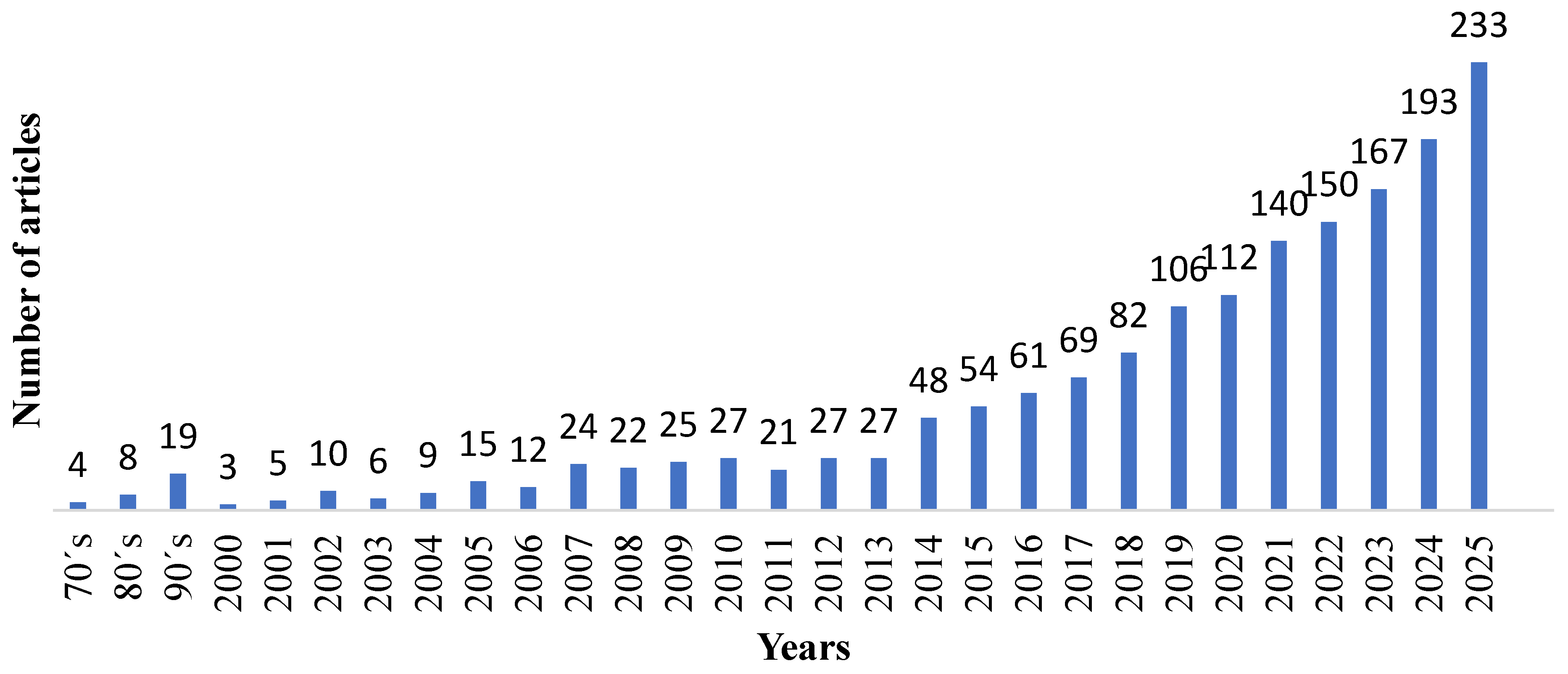
The search revealed that the earliest publication related to the application of non-conventional technologies for starch modification dates back to 1977. Since then, a consistent upward trend in the number of publications has been observed, as illustrated in Figure 1.
As shown in Figure 1, there has been a marked increase in the number of publications since 2019. Prior to 2018, only 578 studies were identified, representing approximately 34.43% of the total publications included in the analysis. However, between 2019 and 2025, this number rose substantially, accounting for 65.57% of the analyzed publications. This significant growth highlights not only the increasing scientific interest in the topic within the field of Food Science and Technology but also underscores a growing industrial demand for modified starches capable of meeting technological needs in a more efficient and sustainable manner.
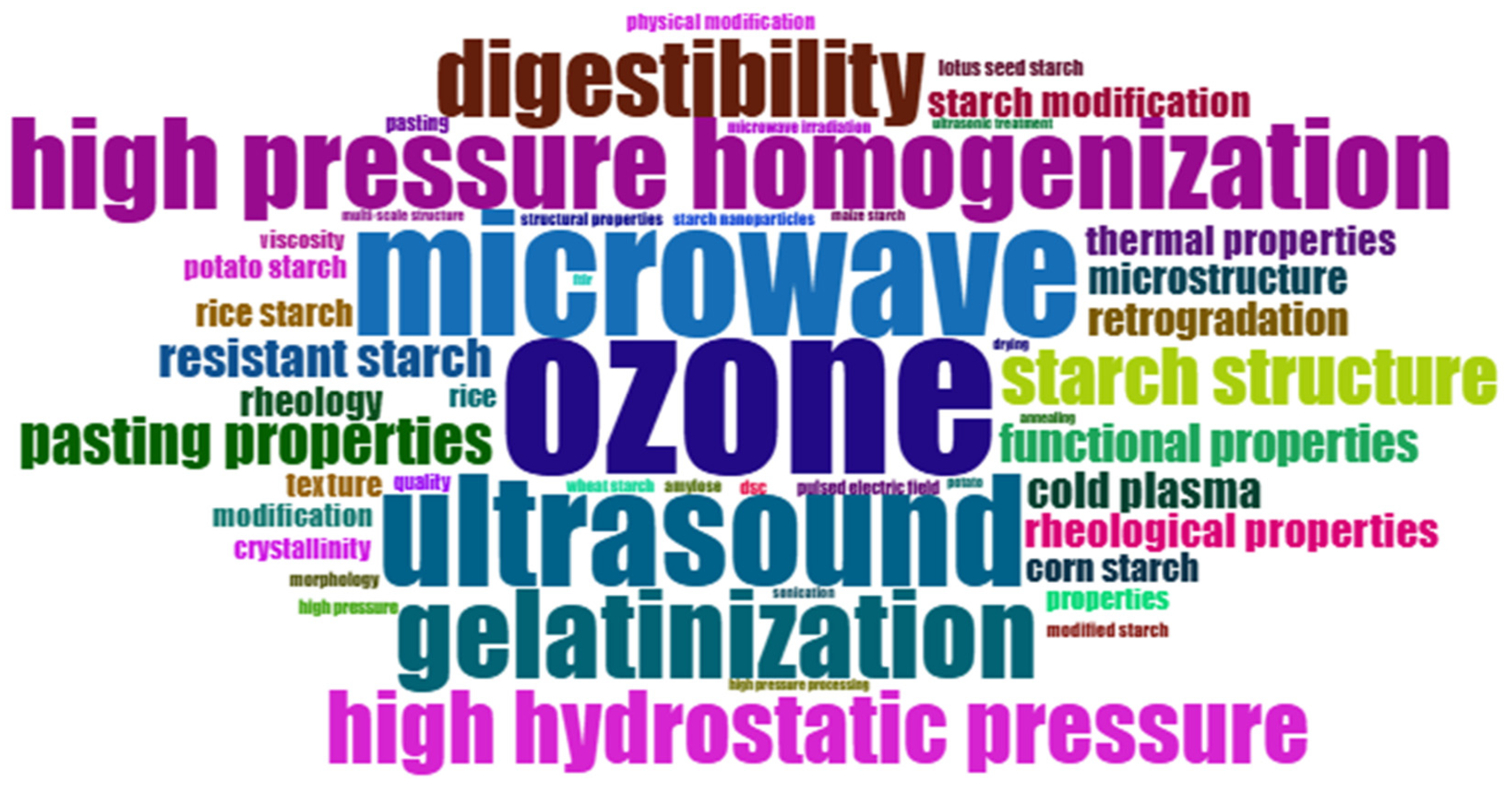
Figure 2 presents the most frequent keywords identified in the dataset. The magnitude of each term reflects its occurrence frequency as well as the extent of its citation connections within the dataset, indicating the prominence and scientific relevance of the main themes associated with this research field. There is a clear predominance of terms related to starch properties, such as digestibility, rheological behavior, and pasting characteristics, as well as keywords associated with unconventional technologies used to modify these features, including ultrasound, high hydrostatic pressure, high-pressure homogenization, ozone, cold plasma, microwave and pulsed electric field. These results reinforce the prominence and current relevance of the main themes addressed in this field, supporting the importance and timeliness of the present review.
Beyond demonstrating the quantitative expansion of the field, the bibliometric findings also reflect an important shift in the scientific focus of starch modification research. The predominance of keywords associated with physical and unconventional technologies indicates a transition from conventional chemical modification approaches toward cleaner and more sustainable processing strategies. This trend is strongly connected to the increasing demand for clean-label food products and to the need for starches with tailored pasting behavior under industrial processing conditions.
In this context, the growing scientific interest observed after 2019 is consistent with the rapid expansion of studies investigating how unconventional technologies modify starch granular structure, crystallinity, and molecular organization, ultimately affecting viscosity development, gelatinization behavior, retrogradation, and paste stability. Therefore, the bibliometric trends identified in this study are directly reflected in the technological and mechanistic discussions presented in the following sections.

4. Pasting Properties of Starch

The behavior of starch granules under thermal and shear conditions plays a critical role in defining the texture and stability of starch-based food systems [26]. When heated in excess water, starch undergoes gelatinization, a process involving increased molecular mobility and disruption of internal organization, which leads to viscosity development [27].
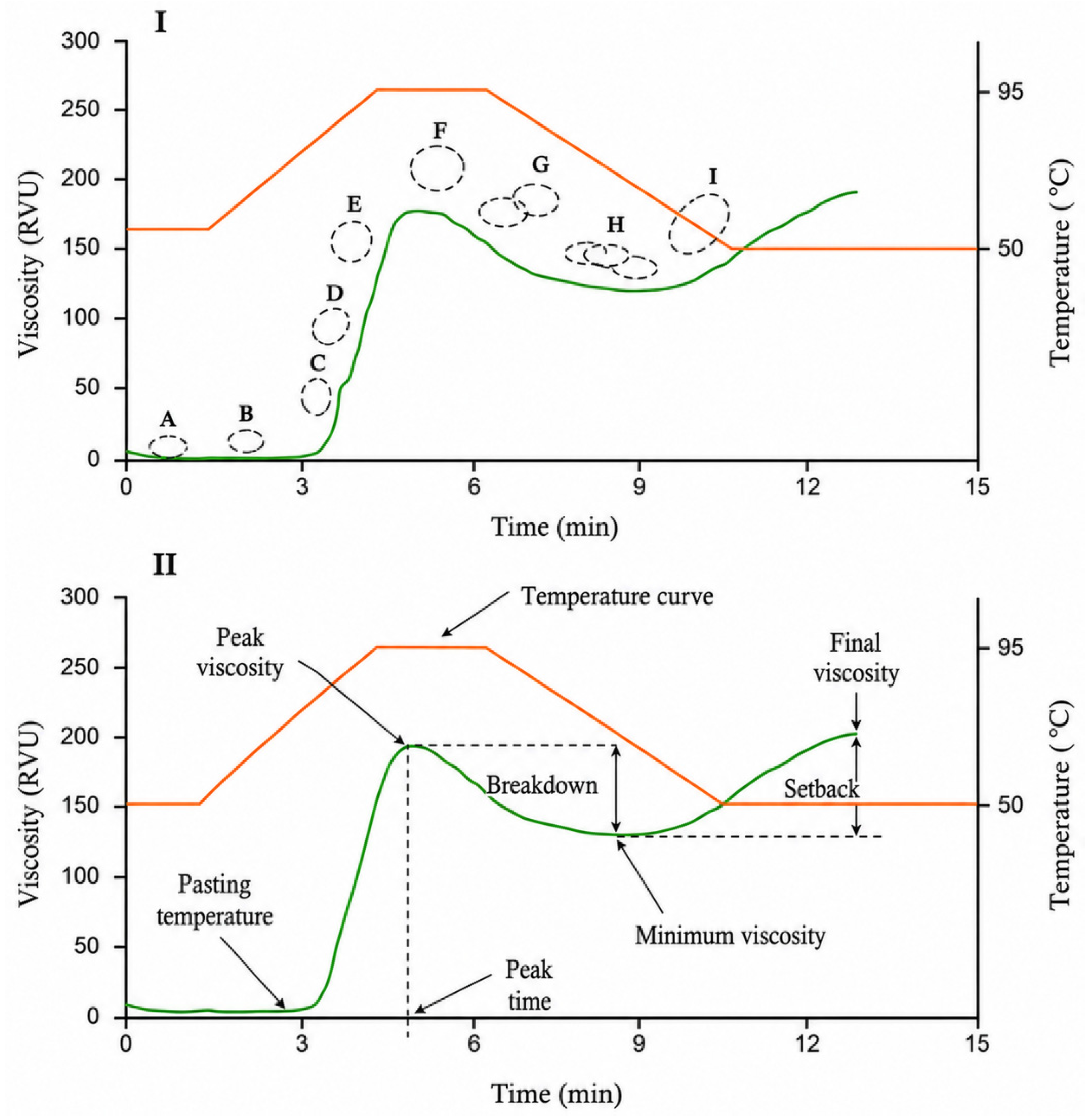
The determination of pasting properties provides important information about gel viscosity, shear resistance, and retrogradation behavior. For this purpose, the Rapid Visco Analyzer (RVA) is widely used, as it allows monitoring of viscosity changes under controlled heating, shear, and cooling conditions [3]. Figure 3 shows the typical behavior of starch granules throughout the analysis of viscosity in the RVA equipment, as well as the response variables (parameters) evaluated.
As heating progresses, starch granules absorb water, swell, and progressively lose their crystalline organization, leading to a rapid increase in viscosity until the peak viscosity region is reached (Figure 3II). This stage corresponds mainly to regions B–E in Figure 3I, where granules undergo intense hydration and swelling. As starch granules swell and approach peak viscosity (Figure 3II), amylose leaches from swollen granules and may interact with endogenous or added lipids to form inclusion complexes. This transition is consistent with the evolution observed in Figure 3I (regions D–F), where granules undergo swelling and partial disruption, facilitating amylose release. These structures consist of single left-handed helices stabilized by hydrophobic interactions and hydrogen bonding, forming partially ordered V-type crystalline arrangements [28,29]. Their formation during this stage affects the pasting profile by limiting water penetration and reducing amylose leaching, which contributes to lower peak viscosity and reduced breakdown [30,31].
During the retention phase (Figure 3II), a progressive decrease in viscosity is observed as continued heating intensifies disruption within starch granules. At approximately 95 °C and under constant agitation, granule integrity is compromised, the solubilization of the polymers continues, and molecular disorganization under shear occurs, resulting in a decrease in viscosity. As illustrated in Figure 3I (regions F–H), this stage corresponds to progressive granule disintegration and loss of structural integrity. In this context, amylose does not prevent granule rupture per se; rather, it limits the extent of granule swelling during earlier stages, thereby indirectly contributing to lower breakdown values by reducing the susceptibility of swollen granules to shear-induced disintegration [32].
Upon cooling (Figure 3II), the viscosity increases again, corresponding to the setback region, as starch polymers undergo reassociation (Figure 3I, region I). Amylose and amylopectin chains reorganize from a disordered state into more ordered, semi-crystalline structures, leading to increased opacity and the formation of a viscoelastic gel or insoluble aggregates. This process, known as retrogradation, reflects the thermodynamic instability of gelatinized starch and involves the formation and aggregation of double helices, initially driven by amylose and later by amylopectin over extended storage [33,34].
In the context of unconventional processing technologies, the main interest lies in how these techniques first modify granule integrity, crystallinity, and molecular interactions, thereby reshaping the RVA pasting profile upon gelatinization. For example, controlled ultrasound treatments have been shown to modify RVA parameters (e.g., peak viscosity, breakdown viscosity, peak time, and pasting temperature), consistent with ultrasound-induced changes in starch morphology and physical properties [35]. From a technological perspective, these modifications may be advantageous in products such as sauces, soups, and gravies, where rapid thickening and appropriate water-binding capacity are required to provide desirable mouthfeel and consistency [36]. For example, Shang et al. [37] investigated the effects of ultrasound treatment on the physicochemical properties of cassava starch, as well as its application in wheat pasta. The authors reported that ultrasound processing at 20 kHz and 300 W for 20 min was optimal for enhancing the swelling power and peak viscosity of the starch. Therefore, the incorporation of the ultrasound-treated starch into wheat pasta significantly reduced cooking time and cooking loss while preserving acceptable textural properties.
For oxidative unconventional approaches, ozonation has been demonstrated to modify cassava starch by increasing carbonyl/carboxyl contents and significantly reducing peak viscosity, breakdown, setback, and final viscosity under specific pH conditions, indicating that oxidation intensity and processing environment critically determine the resulting pasting behavior [38]. In this context, the lower breakdown of viscosity is particularly important in thermally processed foods such as canned products and ready-to-eat meals. Starches with low breakdown values exhibit greater resistance to mechanical and thermal stress, making them more suitable for industrial processes involving intense agitation and prolonged heating [39]. Similarly, reduced setback viscosity may decrease retrogradation and syneresis during storage, which is desirable in frozen or refrigerated products where excessive retrogradation negatively affects texture stability [36]. In practical terms, this reduction in retrogradation contributes to improved freeze–thaw stability and minimizes water release during storage, preserving the creamy texture and structural uniformity of refrigerated or frozen food systems. In contrast, other ozone conditions may increase viscosities due to concurrent depolymerization and secondary interactions (e.g., cross-linking effects), as discussed for ozone-oxidized tapioca starch with RVA profiles varying with oxidation time and pH [40]. Under these conditions, the higher viscosity and possible cross-linking effects may be advantageous for products requiring enhanced thickening ability and greater structural stability during heating.
Pulsed electric field processing has also been reported to change starch pasting behavior. For instance, pulsed electric field treatment (50 kV·cm−1) altered the physicochemical properties of potato starch, promoting intragranular structural rearrangements and partial loss of crystallinity, which led to reductions in gelatinization temperature and enthalpy. These structural modifications were reflected in the RVA profile, with decreased peak and breakdown viscosities, indicating reduced swelling capacity and lower stability of swollen granules under shear and thermal conditions [41]. Such characteristics may be advantageous in noodle and pasta products, which often require moderate peak viscosity and greater paste stability to maintain structural integrity during cooking and processing [42]. More specifically, lower swelling and reduced granule disintegration may decrease starch solubilization into cooking water, thereby reducing cooking loss and contributing to firmer noodle texture and improved product integrity after cooking. Accordingly, pulsed electric field has been further explored to modify starch structure and functionality in application-oriented contexts (e.g., improving processability/functional performance), including reported effects on starch properties relevant to processing and end-use [16].
High-pressure/high-temperature processing conditions can likewise reshape pasting behavior, with RVA-based analysis linking multiscale starch structure (amylose content and amylopectin chain-length distribution) to changes in peak temperature/time and viscosity parameters under high-pressure/high-temperature regimes [43]. These pressure-induced changes are particularly relevant for gel-based and starch-rich processed foods, since partial gelatinization and modified viscosity development may improve gel strength, water retention, and textural stability during storage and reheating operations. In addition, pressure-modified starch systems may exhibit more uniform gel formation, which is desirable in products such as desserts, fillings, and processed starch gels.
Cold plasma technology has also emerged as a promising unconventional approach for starch modification due to its ability to induce oxidation, depolymerization, and structural rearrangements without excessive heat or chemical reagents. Plasma-generated reactive species can alter starch granule morphology, crystallinity, and intermolecular interactions, thereby modifying RVA pasting behavior. For instance, dielectric barrier discharge cold plasma treatment reduced the peak viscosity, breakdown, and final viscosity of potato starch due to partial molecular degradation and disruption of granule integrity [44]. These modifications may be advantageous for starch noodles because lower breakdown viscosity is associated with greater resistance of starch granules to disintegration during cooking, which can reduce cooking loss and improve noodle texture stability [45].
Therefore, understanding the pasting profile of starch is essential not only for predicting its physicochemical behavior during processing but also for selecting appropriate starch sources or modification strategies tailored to specific food applications.

5. Modified Starch: Chemical, Physical and Enzymatic Modifications of Starch

Starch is a major dietary carbohydrate derived from sources such as corn, potato, wheat, cassava, and rice. However, in its native form, it presents several technological limitations, including low water solubility, pH sensitivity, and inadequate functional performance in food systems [46,47]. To overcome these issues and meet food industry requirements, starch is often modified for use in roles such as viscosity enhancement, structural stabilization, gel formation, fat replacement, and dispersion improvement. Additionally, it contributes to texture modulation and moisture retention, thereby enhancing product stability during storage [48]. Starch modification can be achieved through different approaches, including physical, chemical, and enzymatic treatments, as well as their combined application [49]. These modification strategies alter the structure of starch polymers and consequently modify their physicochemical and functional properties, expanding their applicability in the food industry [39]. For clarity, Table 1 summarizes the main processing conditions, mechanisms, and resulting changes in gelatinization properties.

5.1. Chemical Modification

Chemical modification is currently one of the most widely used approaches in the starch industry due to its efficiency and ease of modification. This method involves the use of reagents such as acids, acetates, hypochlorites, phosphates and other chemical agents capable of altering the structure of starch polymers and improving their technological functionality. Chemical treatments can enhance important properties such as viscosity stability, resistance to shear and thermal processing, and freeze–thaw stability [16,55]. However, the use of chemical reagents may generate large volumes of effluents that can be harmful to the environment and require treatment or recycling processes. In addition, traces of these compounds may limit the application of chemically modified starches, particularly in food products, due to safety concerns and increasing consumer demand for cleaner and more sustainable ingredients [16].

5.2. Enzymatic Modification

Enzymatic modification involves the use of specific enzymes capable of hydrolyzing or restructuring starch molecules. This approach allows selective modification of glycosidic bonds under relatively mild reaction conditions, producing starches with tailored functional properties [47].
In recent years, enzymatic treatments have increasingly been explored as an alternative to chemical and physical methods for starch modification. Enzymes are considered safer for both the environment and consumers because they do not generate toxic by-products during processing, making this approach particularly attractive for food applications [56].

5.3. Physical Modification

Physical modification methods have gained considerable attention in recent years because they can modify starch properties without the use of chemical reagents. These treatments promote structural rearrangements within starch granules through the application of heat, pressure, or mechanical energy, which directly modifies their physicochemical properties and consequently alters their pasting behavior upon gelatinization [33]. Compared to chemical modification, physical treatments are generally simpler and do not produce effluents containing salts, reagents or reaction by-products. Additionally, several physical processes have been reported to increase the formation of resistant starch and slowly digestible starch fractions, which may contribute to improved nutritional properties and potential health benefits such as increased satiety and better weight control [16]. This growing scientific interest is reflected in the bibliometric data obtained in the present study, which showed that 65.57% of the publications in this field were produced between 2019 and 2025. Such expansion also aligns with the research trends identified in the word cloud analysis (Figure 2), particularly the increasing emphasis on terms such as “gelatinization” and “pasting properties”.
In addition to the technological and functional aspects discussed, this trend is also supported by the bibliometric findings of the present study, particularly the continuous growth in publications and the prominence of keywords associated with physical and unconventional starch modification technologies. The prominence of “ultrasound”, “high hydrostatic pressure”, “ozone”, and “cold plasma” in the bibliometric mapping indicates that these specific technologies are at the forefront of the search for “clean-label” alternatives. These findings align with market trends driven by demand for clean-label ingredients and alternatives to conventional chemical modification, which have stimulated growing scientific and applied interest in physical starch modification. Recent primary studies have similarly highlighted sustainability, minimal processing, and consumer-driven innovation as important factors supporting this expansion [16,57,58].
Importantly, the bibliometric trends identified in the present review help explain the increasing emphasis on physical starch modification technologies discussed throughout Section 6. The overlap between the most frequently cited keywords and the main technical challenges related to starch indicates that current research is increasingly focused on how different technologies can precisely control properties such as “viscosity” and “retrogradation,” which emerged as key parameters in the bibliometric dataset. The rapid growth in publications involving ultrasound, high-pressure processing, ozone, pulsed electric field, and cold plasma reflects the broader scientific effort to develop modification strategies capable of controlling starch pasting behavior without the use of chemical reagents. This evolution is not merely quantitative; rather, it demonstrates a progressive shift toward understanding the mechanistic relationship between structural changes induced by these technologies and their effects on viscosity, gelatinization, breakdown, and retrogradation properties. In particular, the strong recurrence of terms related to rheology, gelatinization, and starch functionality in the bibliometric analysis indicates that current research is increasingly directed toward tailoring starch performance for specific industrial applications, especially within the clean-label framework.

6. “Clean Label” Technologies for Starch Granule Modification and Pasting Property Enhancement

The term “clean label” refers to food products formulated with minimal processing and without synthetic additives, using ingredients that are familiar, natural, and easily recognized by consumers. This concept is strongly associated with transparency, sustainability, and the reduction in chemical modification processes. In the context of starch modification, clean label technologies aim to improve functional properties such as gelatinization and pasting behavior without introducing chemical reagents or generating harmful residues [59,60].
The studies presented in Table 2 do not represent the total number of articles identified in the bibliometric analysis, but rather a selection of representative experimental studies that investigated the effects of the unconventional technologies addressed in this study on starch pasting properties. The selection criteria were based on relevance to the topic, the description of processing conditions, and the availability of results related to pasting properties. Table 2 summarizes these studies, while the subsequent sections discuss in greater detail the effects of each technology on starch structure and pasting behavior.
Overall, the results presented in Table 2 demonstrate that the effects of unconventional technologies on starch pasting properties are not uniform. Similar processing techniques may lead to opposite outcomes depending on process intensity and starch source. In general, more severe conditions (e.g., higher pressure, longer treatment time, or higher energy input) tend to promote structural disruption and reduce viscosity, whereas moderate conditions may favor molecular rearrangement and improved paste stability. These differences highlight the importance of optimizing processing parameters according to the specific starch system.
It is important to emphasize that the differences observed in the effects of unconventional technologies on starch pasting properties are strongly related to the botanical origin and structural composition of the starches used in the different studies presented in Table 2. Recent studies have shown that the functional properties of starch are influenced by the amylose-to-amylopectin ratio, granule morphology and size, molecular structure, and crystalline type, all of which directly affect starch gelatinization, viscosity, and retrogradation behavior [8,88,89]. In general, starches with higher amylose content tend to form firmer gels and exhibit a greater tendency toward retrogradation, whereas starches rich in amylopectin show higher swelling power and higher peak viscosity [90]. Furthermore, cereal and tuber starches often exhibit different behaviors under the same processing conditions, which helps explain the variability in results reported in the literature regarding viscosity, gelatinization temperature, and paste stability. Therefore, variations in pasting properties should not be attributed solely to processing conditions, but also to the intrinsic structural characteristics of each starch, which ultimately determine its response to modification technologies.

6.1. Ozone

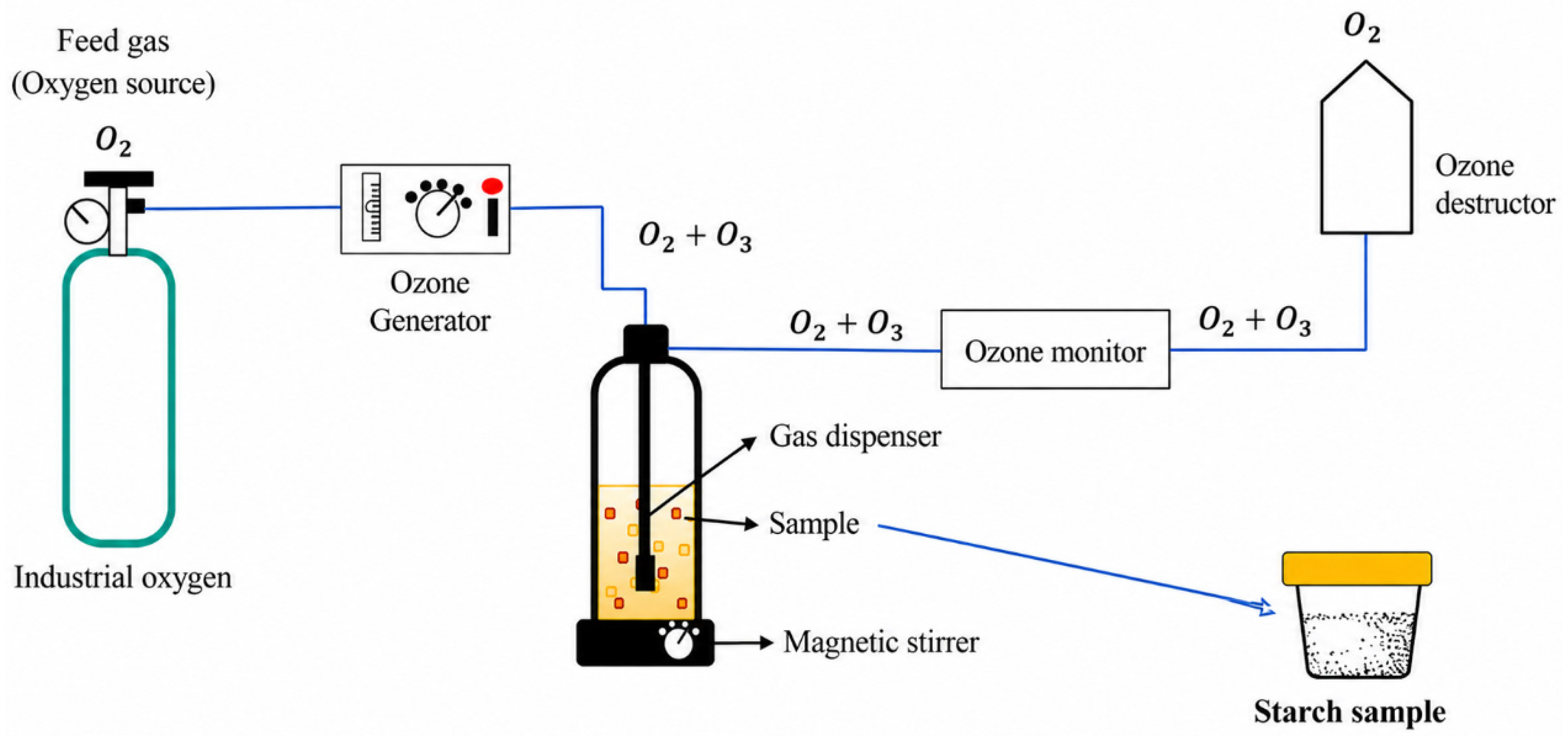
Ozone (O3), a triatomic form of oxygen, is characterized by its strong oxidative capacity and high reactivity, although it is inherently unstable and readily decomposes into molecular oxygen (O2), leaving no residual compounds in the system [91]. Due to these properties, ozone has been extensively applied as an antimicrobial agent, contributing to the extension of shelf life in a wide range of food products. More recently, its applications have expanded to include drinking water disinfection, degradation of pesticide residues, enhancement of seed germination, and starch modification [92], with starch modification being the focus of this review. Figure 4 presents a schematic illustration of the ozone-based processing system used for treating starch granules.
Ozone is commonly produced using corona discharge technology and subsequently introduced into starch suspensions under carefully regulated flow rates and treatment durations. In this system, industrial oxygen passes through a narrow discharge gap, where the application of high voltage via a transformer promotes the conversion of oxygen into ozone within the generation chamber. The generated ozone is then directed to a cylindrical reactor, where a diffuser disperses the gas into fine bubbles to enhance contact with the suspension. After the treatment step, the gas stream is conveyed to an ozone destruction unit, where residual ozone is thermally decomposed back into oxygen. Finally, the treated starch is collected from the reactor, followed by drying in an oven and sieving prior to further characterization [62].
After the ozonation process, several studies observed that the starch granule surface changed from smooth and without pores or fissures to a rough and fibrous structure. Furthermore, an increase in swelling in starch granules after ozonation was observed due to the introduction of hydrophilic carboxylic groups [9,93].
The mechanism of action is composed of the interaction of ozone with functional groups present in starch, which results in structural changes. This can significantly impact the properties of the starch paste [69]. Several recent studies have shown that ozone resulted in different effects on the parameters of starch peak, breakage, recoil, final viscosity, and pasting temperature [61,69]. These effects are associated with greater water absorption and faster granule rupture during heating. In some cases, the increase in carboxylic groups can favor greater hydration and raise peak viscosity. Despite similar processing conditions and close amylose contents, starches from different origins, corn [61] and potato [60] exhibit distinct responses to ozone, which is attributed to structural differences in the granules, especially in the organization of amorphous and crystalline regions and in the interactions between amylose and amylopectin.
For example, for corn starch (~28% amylose), the increase in maximum viscosity (MV) and breakdown (Q) indicates greater water absorption and granule swelling, along with lower structural stability under thermal and shear conditions. This is corroborated by concomitant reductions in total viscosity (VT), peak time (TP), final viscosity (VF), and elastic recovery (RE), suggesting partial depolymerization and weakening of intermolecular interactions [64]. In contrast, potato starch (28.4% amylose) exhibited a sharp decrease in VT, MV, and VF, along with increases in TP, RE, and Q, highlighting a distinct response to ozone exposure. The substantial reduction in MV (to 98.8%) indicates severe disruption of granular integrity, while the increase in RE suggests greater reassociation of starch chains during cooling, likely driven by structural rearrangements after oxidation. Notably, the reduction in SB at longer treatment times (>45 min) points to excessive degradation, limiting the ability of starch molecules to realign [60].
Literature reports indicate that ozone can be applied either in aqueous media or in the gaseous phase, with enhanced effectiveness typically observed in the presence of water [16]. The outcome of ozone treatment on different starch sources is influenced by multiple parameters, including ozone concentration, exposure duration, processing temperature, moisture levels, and the botanical origin of the starch. Although certain conditions may limit treatment efficiency, the findings across studies are generally consistent, particularly in relation to structural modifications. Commonly observed effects include an increase in carbonyl and carboxyl functional groups, cleavage of amylose and amylopectin chains leading to depolymerization, and a reduction in the apparent viscosity of starch pastes [61,93].
However, the effects of ozone on starch pasting properties reported in the literature are sometimes contradictory, particularly regarding apparent viscosity. While some studies report a decrease in viscosity after ozonation [61,93], others have observed an increase under different conditions [62]. These differences can be explained by the balance between oxidative depolymerization and the formation of new functional groups. Under mild conditions, ozone promotes chain scission of amylose and amylopectin, reducing molecular weight and consequently decreasing viscosity. In contrast, under more intense conditions, the formation of carbonyl and carboxyl groups may enhance intermolecular interactions, leading to increased viscosity and gel strength.
In addition, the botanical origin of starch plays an important role, since structural characteristics such as crystalline and amylose content influence the susceptibility of starch to oxidation.

6.2. Ultrasound

Ultrasound (US) refers to the use of acoustic waves with frequencies exceeding 20 kHz, which is beyond the range detectable by human hearing, and that propagate mechanically through gaseous, liquid, or solid media [94]. US can be categorized based on the level of intensity applied: (i) low intensity (<10.000 W/m2), or (ii) high intensity (>10.000 W/m2). Low intensity is generally used for analytical or less invasive purposes; however, depending on treatment time and medium conditions, structural changes may still occur. In contrast, high-intensity ultrasound is typically applied to modify products and improve processes. In this case, the electrical energy supplied to the transducers is converted into mechanical energy [95].
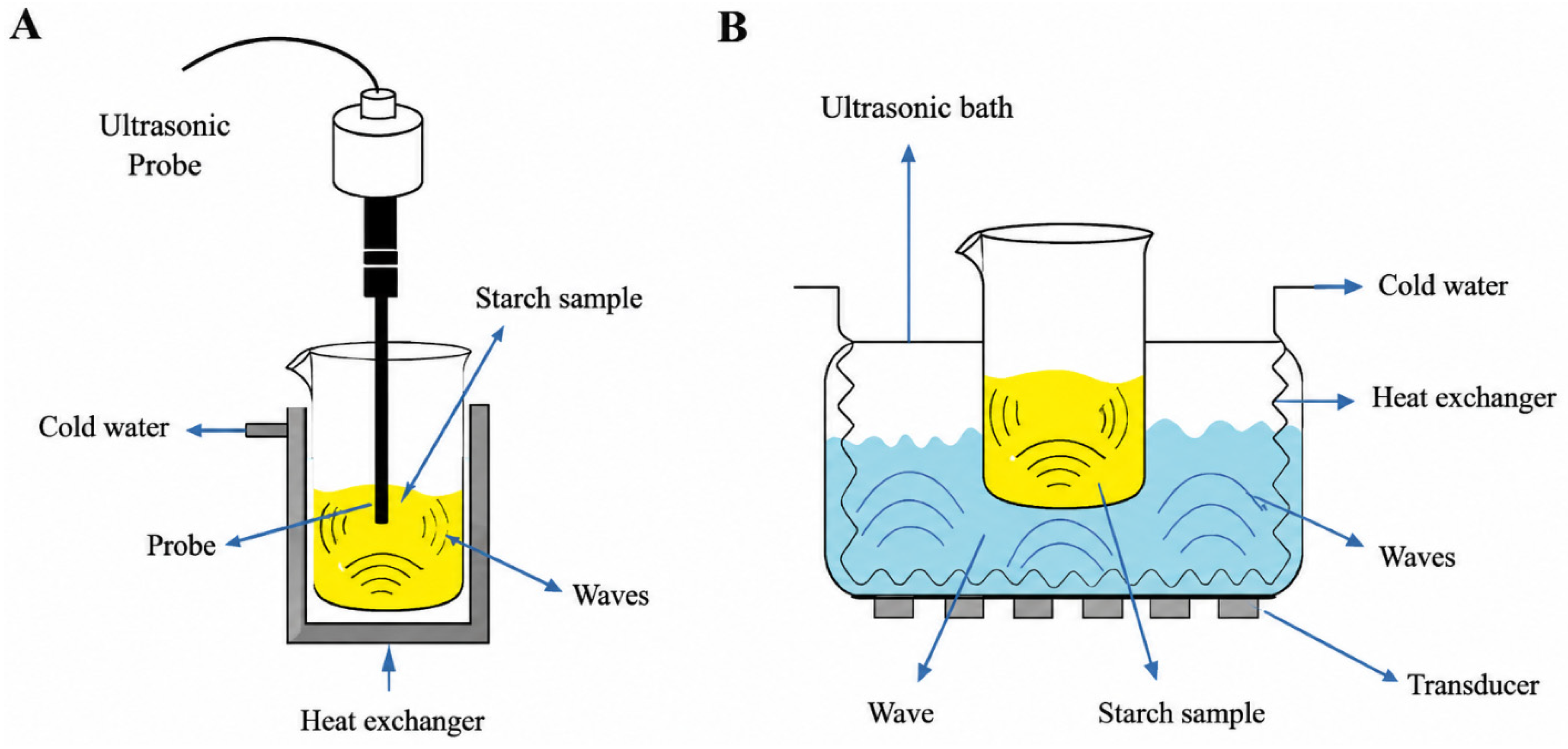
The most used ultrasonic reactors in the food industry are the ultrasonic probe (direct sonication) and the ultrasonic bath (indirect sonication) (Figure 5). Basically, probe US is characterized by having a tip and achieving greater power, due to the direct contact of the probe with the liquid medium by immersion. The ultrasonic bath typically has a tank-type configuration and, depending on its capacity, it may be necessary to select an adequate number of transducers to achieve the desired power density [96].
The effectiveness of ultrasonic processing is governed by multiple variables, including acoustic power and frequency, processing duration and temperature, in addition to starch concentration, botanical source, and the total energy delivered to the system. During sonication, acoustic waves propagate through the medium and induce cavitation phenomena, characterized by the formation, growth, and violent collapse of microbubbles in the liquid medium. The structural modifications observed in starch are primarily attributed to the energy released during the implosion of these cavitation bubbles, which generates localized high temperature and pressure, leading to the disruption of the polymeric starch network and affecting its physicochemical properties [97]. According to Karwasra et al. [65], treatment with low-intensity ultrasound for 15 and 30 min led to cracks and holes on the surface of wheat starch granules. This caused an increase in starch granule size, due to higher solubility and swelling power [65]. In another study, Yang et al. [97] reported that ultrasound-treated rice starch exhibited higher peak viscosity and breakdown values compared to the native counterpart, with increases of 18.1% and 21.5%, respectively. These effects were mainly attributed to the degradation and depolymerization of solubilized amylose and long-chain amylopectin fractions. Additionally, the sonicated samples showed lower peak time and pasting temperature, likely due to amylopectin fragmentation, which promotes greater water absorption and enhances granule swelling.
Using this technology offers numerous advantages: it is considered a safe approach, requires relatively low energy input, and is aligned with environmentally friendly processing principles. In addition, it can provide improvements in product purity and yield while reducing operational costs and enhancing production efficiency. Nevertheless, some limitations remain, particularly the lack of methodological standardization and reproducibility across studies. In many cases, key processing parameters and experimental conditions are insufficiently described in the literature, which contributes to inconsistent and sometimes conflicting findings [98].
In a study by Castanha et al. [61], ultrasound treatment did not produce measurable effects on the molecular and granular structure of corn starch, nor on its properties. However, when combined with ozone, the effect was satisfactory. In general, at higher intensities (>480.000 W/m2), results show the presence of pores and fissures on the surface of processed samples, as well as a reduction in granular size, increased paste clarity, and improved bonding properties.
Another study by Karwasra et al. [65] showed that probe ultrasound treatment for 15 and 30 min at a frequency of 30 kHz increased relative crystallinity, caused fragments and deformities on granule surfaces, increased amylose content, and enhanced oil absorption capacity, improving paste properties. Many studies with different starch types showed that ultrasonication reduced viscosity during pasting; however, another study observed an increase in peak viscosity of gelatinized starch from ultrasound-treated granules [64,65,99].
The effects of ultrasound on the gelatinization properties of starch are often inconsistent in the literature. In many cases, a reduction in peak viscosity is observed due to granule rupture and molecular degradation [64,65]. However, increases in viscosity have also been reported [65], which may be related to increased water absorption, swelling capacity, or partial reorganization of the starch structure. These variations are strongly influenced by processing parameters such as power, frequency, and treatment time. Higher power generally intensifies the effects of cavitation, leading to greater structural damage, while milder conditions may favor structural rearrangements. Furthermore, the botanical origin of the starch also affects its susceptibility to ultrasonic treatment.

6.3. High-Pressure Processing

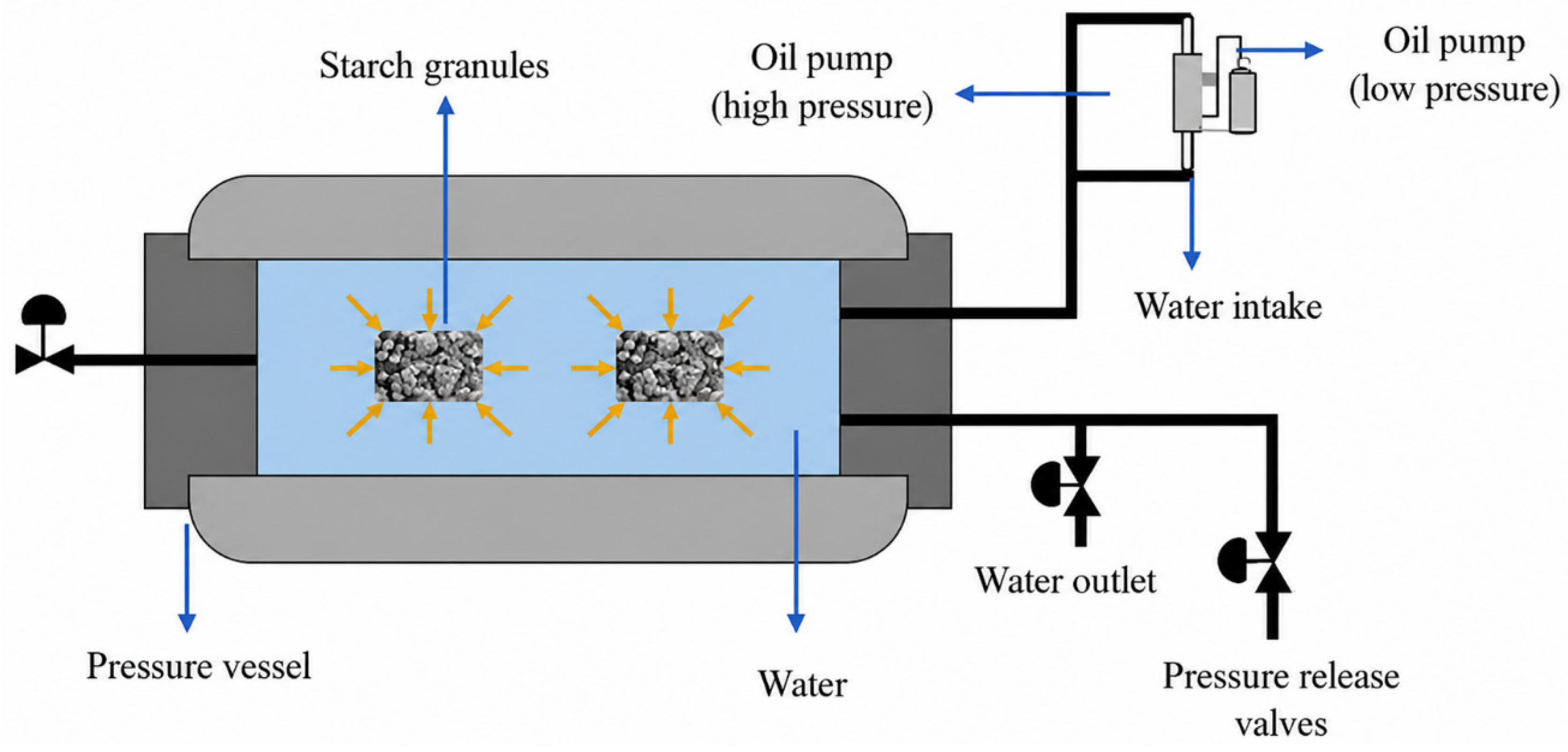
High-Pressure Processing (HPP), also known as High Hydrostatic Pressure (HHP) or High Isostatic Pressure (HIP), is a non-thermal technology based on two principles: the isostatic principle and the Le Chatelier principle, applied to process liquid and solid materials. According to the isostatic principle, pressure is transmitted almost instantaneously in all directions of the food, regardless of its volume, composition, and shape. The increase in pressure (Le Chatelier’s principle) promotes volume reduction, enhancing any phenomenon or reaction occurring under these system conditions (Figure 6) [100].
In general, starch modification under high-pressure conditions is governed by key processing variables, including pressure magnitude (typically between 5 × 10⁷ and 9 × 10⁸ Pa), treatment time, starch concentration in the system, characteristics of the dispersion medium, and temperature. Depending on the combination of these factors, high-pressure treatment can promote water absorption and granule swelling, induce structural rearrangements, alter particle size and distribution, and lead to partial gelatinization. Pressure-induced gelatinization begins predominantly in the amorphous regions of starch granules, where molecular packing is less ordered and more accessible to water. Under high hydrostatic pressure, water penetration into these domains is intensified, which favors greater molecular mobility and facilitates the rupture of inter- and intramolecular hydrogen bonds in amylose and amylopectin. This results in the destabilization of double helices and a progressive loss of short-range molecular order, without the need for high temperatures. These granular modifications subsequently lead to altered pasting behavior, including changes in paste viscosity [68].
Kaur et al. [67] evaluated the impact of high-pressure processing on the rheological, thermal and morphological characteristics of mango kernel starch and observed that the graphs of shear stress versus shear rate for the starch pastes exhibited shear thinning behavior. In a more recent study, Gonzalez and Wang [70] investigated the effects of medium suspension during high-pressure processing of starches with different crystalline structures. The results demonstrated that starches treated at high pressure in the presence of sodium sulfate showed lower paste temperatures and higher peak viscosities. A similar result was observed by Pino-Hernández et al. [69], where high-pressure-treated chestnut kernel starch exhibited modified paste properties and the highest peak viscosity values.
Despite some results being considered inconclusive by the authors, high-pressure treatment improved the mechanical rigidity of starch pastes isolated from lychee seeds [69]. Meanwhile, another study showed that final and minimum viscosity, paste temperature, and peak time increased, whereas peak and breakdown viscosity decreased with increasing pressure level up to 6 × 10⁸ Pa [67].
This technology’s main advantages are food processing at lower temperatures, pressure transmitted instantly through the system, microbial inactivation without heat, and the development of ingredients with different functional properties [101]. The last advantage is related to the modification of starch, allowing the obtaining of various technological and functional properties [69]. One of the notable impacts of HPP on starch is the modification in the morphology and size of starch granules. The pressure exerted during the process can lead to the breakage or rearrangement of the granules, resulting in smaller starch particles. This reduction in granule size can affect the starch’s ability to absorb water and form gels and, consequently, influence paste properties such as viscosity and texture. For example, Gonzalez and Wang [70] observed that most HPP-treated corn, potato, and pea starches showed decreased sizing viscosities compared to their native counterparts. Still, the differences varied significantly depending on the type of starch.
In another study, Rahman et al. [102] pretreated corn, potato, and sweet potato starches at 100, 300, and 5 × 10⁸ Pa for 15 and 30 min at room temperature and reported the effects of these HPP treatments on their physicochemical, thermal, and structural properties. The results showed that the solubility and swelling power of all three starch types significantly decreased with increasing pressure, which, according to the authors, was attributed to starch disintegration and reduced amylose solubilization. Furthermore, the findings related to thermal properties are noteworthy. Corn starch treated at 500 MPa was found to be fully gelatinized and exhibited larger particle sizes; however, it demonstrated inferior pasting properties compared to potato and sweet potato starches, possibly due to its botanical origin. Therefore, this compilation of studies demonstrates that the use of HPP for starch modification may be a viable alternative, but adjustments in processing parameters may affect starch from different botanical sources differently, likely due to variations in granule composition and structure.
Furthermore, understanding the behavior of modified starches in food systems is essential. Following their investigation into the effects of HPP on starch properties, Rahman et al. [103] extended their research by evaluating the impact of this physical modification on the thermomechanical, rheological, and microstructural characteristics of gluten-free doughs [104]. The authors observed that all formulations showed increased water absorption and significantly longer dough development and stability times with increasing pressure levels. Rheological analyses indicated that HPP induced structural disruption of starch molecules, resulting in improved viscoelastic properties in the gluten-free model doughs. The variability in reported results for HPP can be attributed to differences in pressure level, treatment time, and starch source. Starches with different crystalline structures and amylose contents respond differently to pressure-induced gelatinization and structural rearrangement, which explains the contrasting effects observed in pasting properties.

6.4. High-Pressure Homogenization

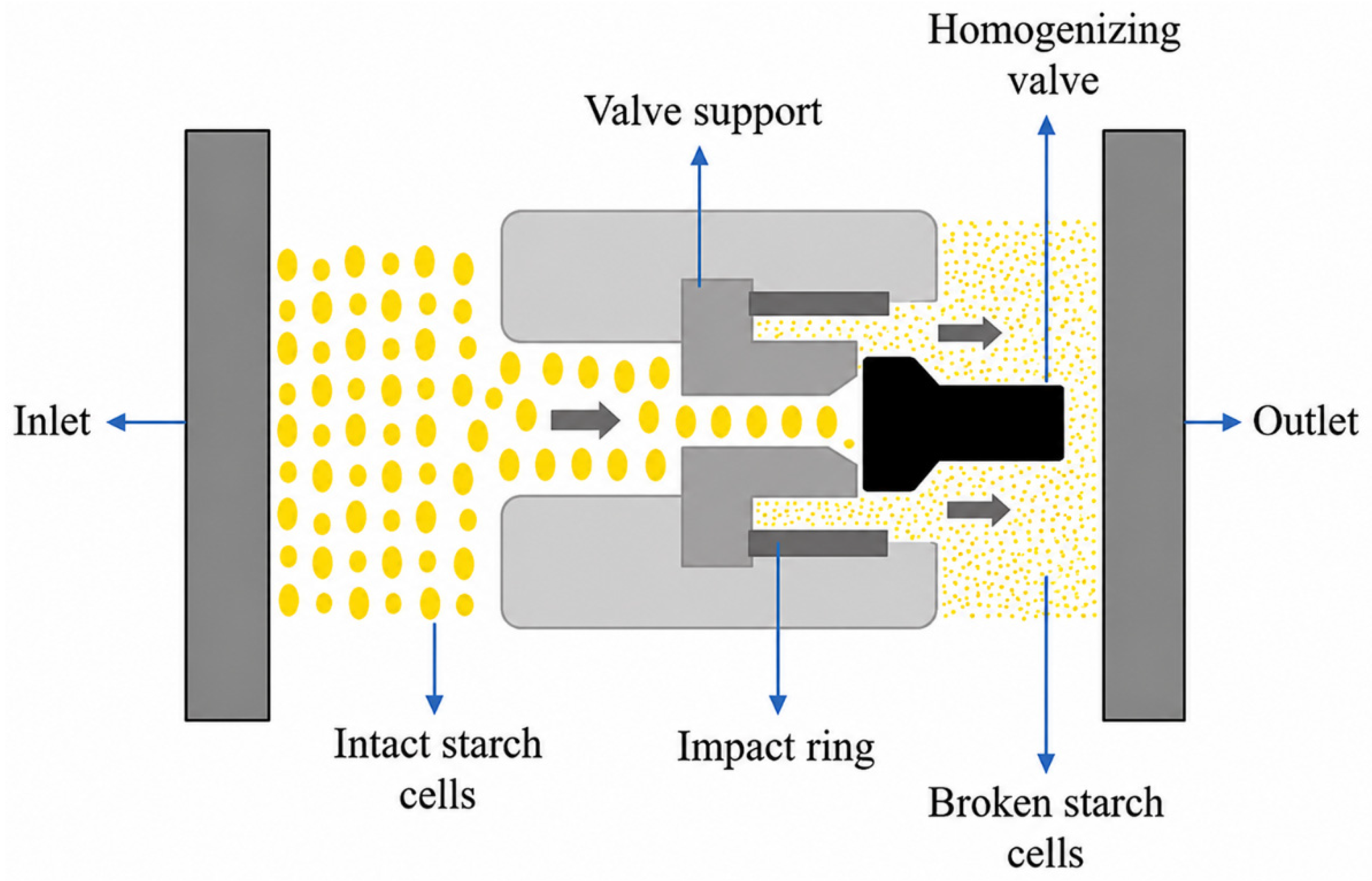
High-Pressure Homogenization (HPH) is a technology widely used in industry to emulsify, disperse, mix, and process chemical, pharmaceutical, food, and biotechnology products. It consists of passing a pressurized fluid rapidly through a restriction system, followed by depressurization (Figure 7) [18,105]. The high-pressure homogenization treatment can alter the physicochemical properties of starch due to simultaneous pressure-induced phenomena such as cavitation, shear, turbulence, and temperature increase [106].
The mechanism responsible for the effects during HPH processing results from a combination of high mechanical stress and various physical phenomena, including high shear forces, turbulence, cavitation, impact against side walls, velocity gradients, and pressure drops. This technology is based on the same principle as conventional homogenization but operates at significantly higher pressures, reaching between 10- and 15-times greater pressure (up to 200 MPa) compared to conventional homogenizers [105].
Among the main studies involving HPH, the predominant results concern treatments at pressures above 100 MPa, where partial starch gelatinization occurs. This leads to an increase in particle size due to swelling or aggregation of starch granules. Additionally, a decrease in gelatinization temperature is reported, without significant changes in paste formation. However, in studies with resistant starches—those with high amylose content—swelling and partial gelatinization were not observed [73]. Studies on previously gelatinized starch suspensions reported that HPH treatment not only increased starch paste uniformity and transparency but also decreased apparent viscosity [73].
HPH treatment may inhibit starch paste retrogradation; however, this effect has been mainly reported in complex starch–hydrocolloid systems rather than starch alone. Xie et al. [74] demonstrated that tamarind seed polysaccharides (TSP) treated by HPH undergo structural modifications, particularly a reduction in the Gal/Glc ratio, which in turn influences starch paste formation. In a related study, HPH-treated TSP increased the elasticity of corn starch paste [75], indicating that the observed changes are primarily driven by modifications in the hydrocolloid structure and its interaction with starch, rather than a direct effect of HPH on starch alone.
When analyzing the effects of HPH on the rheological properties of rice starch, Li et al. [72] found improvements in flow properties, including shear stress versus shear rate, apparent viscosity versus shear rate, thixotropy, and starch paste formation. HPH treatment caused a marked decrease in starch paste thixotropy. The authors concluded that HPH effectively enhances the rheological properties of rice starch paste and can help produce modified starches meeting specific food industry requirements. Li et al. [73] further studied starch paste diluted by HPH and its application in improving the stickiness of cooked non-glutinous rice. Their results indicated that treatment with 60 MPa pressure and 3% starch concentration was most effective in improving the viscosity of cooked non-glutinous rice.
HPH is a technique that is still little explored to modify the pasting properties of starch. Most studies demonstrate that, in most cases, higher pressures cause significant changes in starch paste properties. Therefore, it is crucial to remember that the application of HPH can vary in terms of specific parameters, such as pressure and time, which can result in significant changes in the starch’s pasting properties. Therefore, more studies are needed to understand how this method can be applied to different types of starch and specific applications in the food industry. Thus, despite still being a field to be explored, HPH is a potentially promising area for innovation in starch modification.

6.5. Pulsed Electric Field

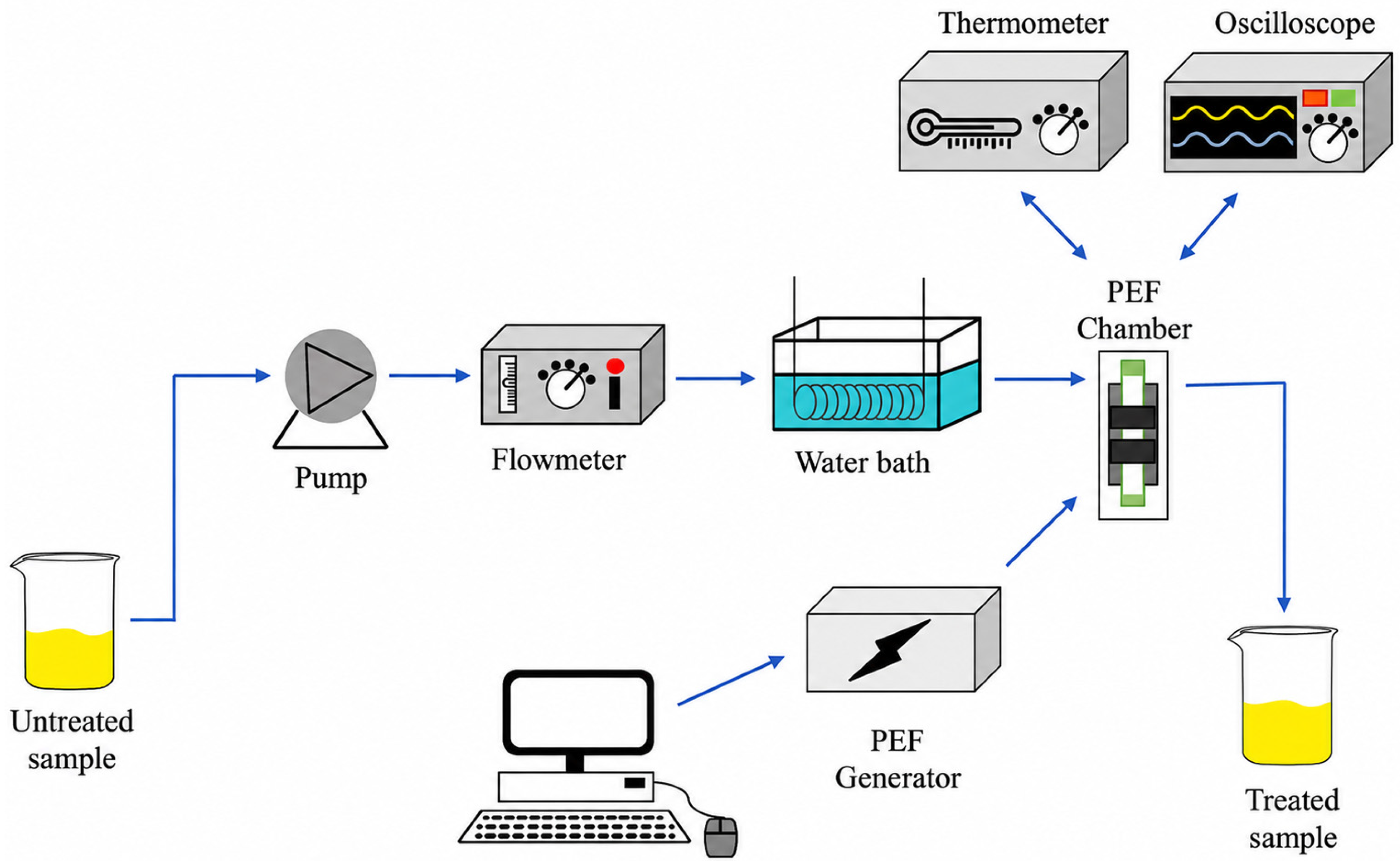
Pulsed electric field (PEF) technology consists of applying high voltage pulses of short duration (μs to ms) to a sample placed between two electrodes and subjected to electric fields (Figure 8). This technology is considered a physical, non-thermal method that can be used for different applications in the food industry, for example, it can be used to decontaminate food products, as well as to modify the structure of plant tissues. In general, during processing the sample is subjected to the PEF for a short period to avoid heating and formation of unwanted compounds, and field intensity ranges from 1 to 80 KV/cm [48].
As with high-pressure homogenization, the use of PEF for starch modification is still little explored by the scientific community and industry. However, recent studies indicate that PEF treatments can induce distinct effects on the physicochemical properties of starch [16]. For starch modification using this technology, temperature control is essential, and studies report maintaining the starch suspension below 40–45 °C using a water bath to avoid concurrent thermal effects [77].
When investigating the impact of PEF on the structural, morphological, functional, textural, and rheological properties of red rice starch (Oryza sativa), Almeida et al. [78] observed that the treatment primarily affected starch granules, causing surface damage such as cavities and cracks. With increasing treatment intensity, more pronounced disruption of larger granules was noted. These effects are commonly associated with electroporation phenomena, in which the application of pulsed electric fields induces the formation of pores in biological and semi-crystalline structures, such as starch granules.
Such structural modifications at the granular level directly influence the behavior of starch during subsequent gelatinization and paste formation. For instance, Han et al. [77] reported that porous corn starch subjected to PEF exhibited an increase in gelatinization temperature and enthalpy compared to native starch; however, after further treatment, these values decreased significantly, suggesting progressive disruption of molecular organization within the granules. Similarly, Wu et al. [107] observed a reduction in gelatinization enthalpy (ΔH) and a slight decrease in retrogradation tendency after PEF treatment of japonica rice starch, indicating weakened internal structure.
Hong et al. [76] evaluated acetylation assisted by PEF in potato starch and reported that, although the treatment acts at the granular level, its effects are reflected in paste properties, with increased pasting temperature and reduced breakdown and setback values compared to non-treated samples. These findings reinforce that modifications induced by PEF, particularly those related to electroporation and structural disorganization of granules, play a key role in defining the functional properties of the resulting starch paste.
The reduction in breakdown can be attributed to the structural weakening of starch granules induced by electroporation, which leads to a more gradual and controlled disintegration during heating, as previously observed in physically modified starch systems [108]. In parallel, the reduction in setback is associated with the disruption of long-range molecular ordering and reduced ability of amylose chains to reassociate during cooling, due to decreased molecular mobility and limited recrystallization processes.
In summary, although pulsed electric field technology shows potential for modifying starch pasting properties, challenges remain regarding process optimization, mechanistic understanding, and food safety evaluation. Further studies are needed to expand its applications and advance this technology in food science and industry.

6.6. Cold Plasma

Cold plasma (CP) technology emerges as an innovative method for starch modification, offering unique advantages over traditional approaches. During the starch modification process, cold plasma promotes several changes in the starch structure, both physical and chemical, capable of improving functional properties, especially in the area of gelatinization [80]. In general, treatment with cold plasma can influence the gelatinization temperature and viscosity of starch, providing improvements in these properties, which is valuable for achieving the desired textural characteristics in food products, such as greater thickness and stability in sauces and seasonings [109].
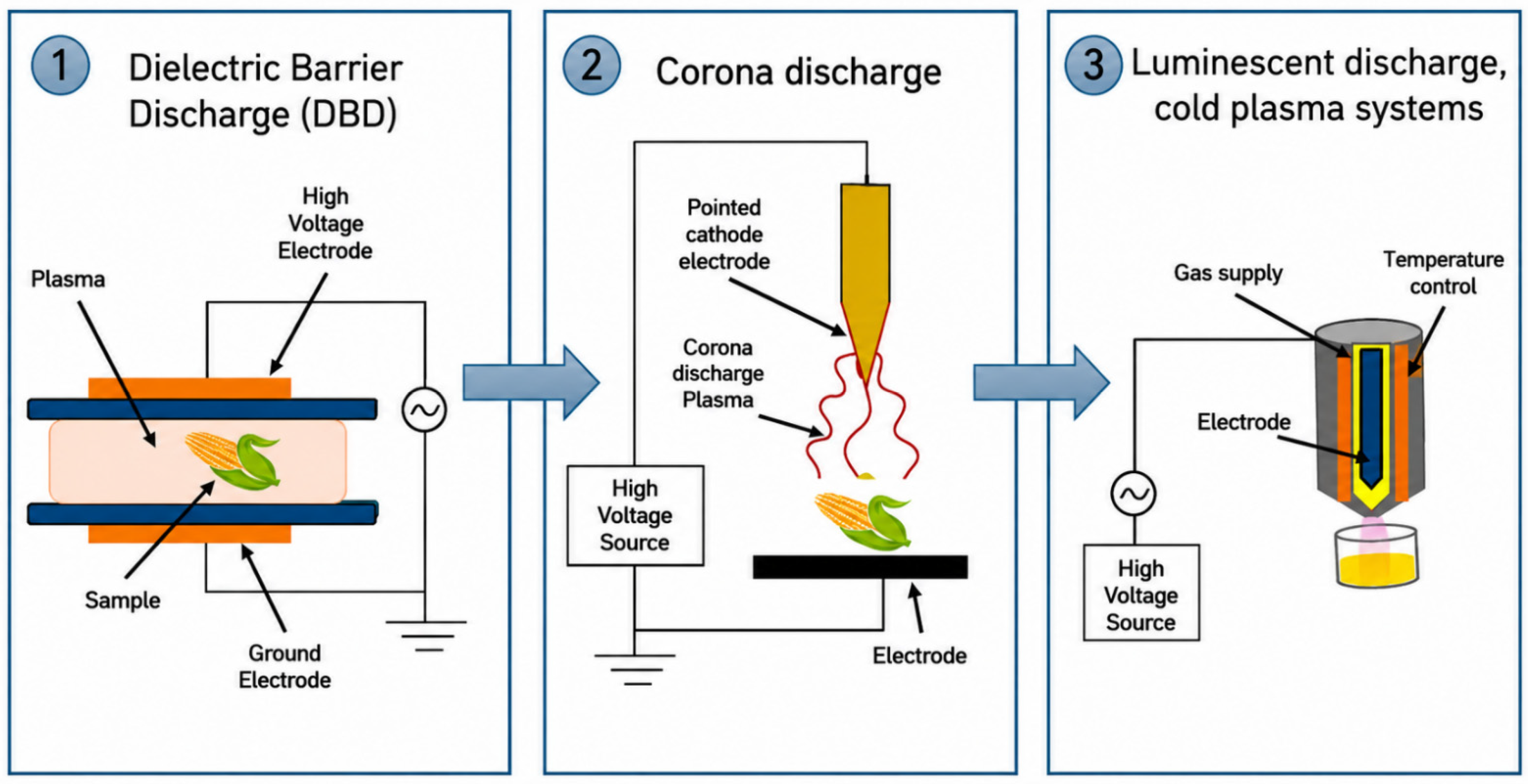
Figure 9 shows different cold plasma technologies that can be used for starch modification.
Although there are different types of cold plasma, its physical principle involves understanding the behavior of charged particles in an electromagnetic field [80]. Among the different plasma sources, plasma jet and DBD are widely used in food research, being more readily available commercially due to their simple construction, easy adaptation, and the availability of several configurations. The interaction of the discharges promoted by CP with starch can promote starch modification through three different mechanisms: crosslinking, depolymerization, and plasma attack [110]. Furthermore, the introduction of functional groups can also lead to starch modification.
Treatment with CP promotes changes in the branching of amylose and amylopectin side chains at the molecular level of starch, due to non-thermal modification, creating fissures, holes or pores that mainly affect the physicochemical characteristics of the starch. Recent studies have shown that plasma-modified starch exhibits improved physicochemical, digestibility, functional, structural, and thermal properties [79,111].
These reported mechanisms promoted by cold plasma significantly influence the gelatinization temperature of starches. For example, starches with a high degree of cross-linking may exhibit higher gelatinization temperatures than those with low cross-linking [111]. In a study by Zhang et al. [81], the authors reported that the gelatinization temperature was lower in the treated starch, and with increasing treatment time, the temperature decreased. These results may be related to the reduction in crystallinity of plasma-treated starches, as well as the increase in surface energy and hydrophilicity due to plasma corrosion caused by active species.
In another recent study involving the dual modification of potato starch by cold plasma (CP, 40 kV) followed by ozonation, significant changes in the starch paste properties were observed, attributed to profound structural modifications [80]. Cold plasma treatment reduced the viscosity and cohesion of starch paste due to amylose depolymerization, changes in amylopectin branching, and the introduction of carbonyl and carboxyl groups. These structural changes resulted in pastes that were more stable under shear, with less retrogradation and greater water and oil retention capacity, indicating functional improvement for industrial applications requiring viscosity control and gel behavior.
Although it is an innovative technology in starch modification, cold plasma presents some challenges, including industrial scalability, precise control of structural and functional properties, elucidation of molecular mechanisms, assessment of food safety and environmental impacts, and establishment of regulatory standards [111].

6.7. Microwave

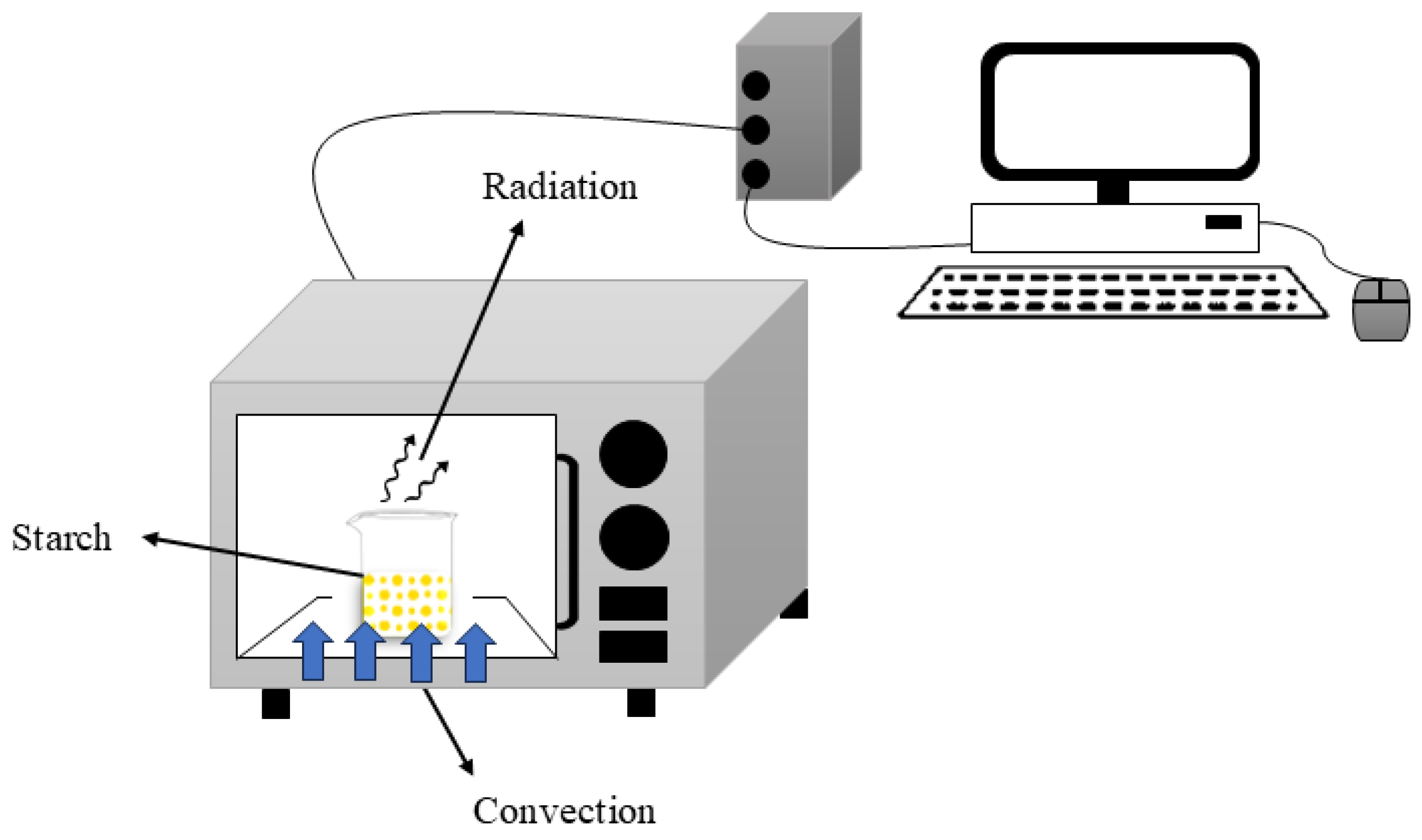
The use of microwaves (Figure 10) to modify the structure of starch has become increasingly relevant in various industrial applications in the food field [86]. This is due to its fast, selective heating process, its ability to heat volumetrically, and, above all, the preservation of nutritional quality and its environmentally friendly approach compared to conventional heating methods [85].
Generally speaking, the influence of microwave radiation on matter can be divided into two distinct types: microwave photon irradiation and microwave dielectric heating. The first, with its energy of 2.45 GHz, cannot break the hydrogen or covalent bonds in the molecules. The main focus in food processing is dielectric heating (0.915 GHz). Secondly, the dielectric heating mechanism involves dipole polarization, which has a mild thermal effect, and ionic conduction, which has greater intensity [86].
Kaul et al. [86] demonstrate that microwave treatment (at 300 W for 3 min) resulted in an increase in PV, SB, PT and FV for potato starch in relation to native starch (increase of 6.1%, 14%, 3.7% and 33.7%, respectively). While BD was lower, with a decrease of 51.5%. These changes are highly dependent on the process time, as shown in other studies. High recoil viscosity (SB) is related to the deterioration and aging properties of starches, while high ultimate viscosity (FV) refers to the slower tendency of starches to retrograde due to structural disruption in the amylose–amylopectin network [86].
As Kumar et al. [85] noted, microwave treatment (300 W) reduced the PV of potato starch by 7.4% when treated for 1 min. Still, it increased significantly after 3 min and 5 min (17.9% and 11.7%, respectively), attributed to the release of components of starch granules. The PT of starch increased with microwave treatment about the control (from 62.43 °C to 75.16 °C, an increase of 20.4%), regardless of time, indicating greater crystallinity and stability. FV and SB also increased with treatment time (28.5% and 96.1%, respectively), suggesting enhanced reassociation of starch polymers during cooling and a greater tendency toward retrogradation and gel strengthening. In particular, the marked increase in setback indicates reduced paste stability and accelerated molecular reorganization after gelatinization, which are characteristic of starch aging phenomena. BD decreased after 1 min, indicating improved resistance of swollen granules to shear and heat under mild treatment conditions, but increased after 3 and 5 min of treatment, suggesting progressive weakening of granule integrity under prolonged microwave exposure [85].
Several factors, in addition to the processing time, such as the type of starch, the amount of water, and the microwave settings (power and temperature), affect the structural modification of starch through microwave technology. These parameters directly influence the balance between starch granule disruption, molecular reassociation, and retrogradation behavior, thereby affecting RVA parameters and paste stability. It is extremely important to understand the mechanisms behind these changes to ensure control and predictability. Improving process parameters, such as power and time, is essential to achieve them more satisfactorily without compromising the quality of the starch. Therefore, despite the promising prospects, it is imperative to analyze them to ensure a safe and effective application of microwave technology in the food industry.

6.8. Others

Recently, the use of a new class of “green” compounds, namely deep eutectic solvents (DESs) and phenolic crosslinking strategies, has been considered for the treatment of starch [112,113].
Deep eutectic solvents (DESs) are a relatively new class of green solvents, involving a mixture of hydrogen bond acceptors (HBAs) and hydrogen bond donors (HBDs). DESs exhibit low viscosity at processing temperatures, low volatility, high thermal stability, and ease of preparation. Furthermore, most are considered biodegradable, non-toxic, easy to prepare, and relatively inexpensive [114,115]. Among the main DESs used are quaternary ammonium salts, such as choline chloride, and hydrogen bond donors, such as urea or glycerol [116].
DESs offer an innovative solution for starch modification through acetylation; studies demonstrate that the use of DES not only promotes complete starch dissolution but also provides ideal conditions for the acetylation reaction. These modifications impact improvements in hydrophobicity, thermal stability, and starch processing properties [117]. The modification of starch using deep eutectic solvents has shown impacts on the paste properties of pea starch, signifying structural changes that are reflected in the rheological behavior during gelatinization and cooling. In the study by He et al. [118], treatment with carboxylic acid-based DES significantly reduced paste viscosity and increased gel clarity, indicating less polymer aggregate formation and lower peak viscosity during heating. This modification also improved retrogradation resistance, decreasing the rearrangement of amylose/amylopectin chains during cooling, which is evidenced by a lower tendency for recrystallization and superior stability of the formed gel. The observed changes were attributed to the decrease in molecular ordering and crystallinity of the treated starch, as well as the reduction in amylose content, which together facilitate a paste behavior with lower viscosity and less difficulty in retrogradation compared to native starch. These results demonstrate that physicochemical modifications of the granular structure can directly modulate pasting parameters and the stability of the gelled network, with relevant implications for food applications that require control of texture and durability of the final product [118].
Phenolic acids are dietary antioxidants with biological activities and are widely distributed in plant-based foods. On the other hand, recent research has been addressing interactions between phenolic acids and starch [119]. Recent studies demonstrate that phenolic acids can improve gelatinization properties, long-term or short-term retrogradation, and viscoelasticity, as well as reduce digestibility due to the formation of complexes with starch [113,120]. The interaction between starch and phenolic acids can form complexes that alter the properties of both and is considered an environmentally friendly modification method [119].
The modification of starch by phenolic acids acts primarily through two mechanisms: alteration of the crystalline structure via complexation of hydrogen bonds and competition for water molecules, limiting granular swelling and delaying gelatinization. These interactions reduce the gelatinization temperature and can be potentiated by physical treatments, such as ultrasound. Furthermore, phenolic acids inhibit starch retrogradation, decreasing both short-term regression and long-term structural reorganization of amylose and amylopectin chains, demonstrating that this modification allows precise control of pasting properties, influencing texture, stability, and functionality of foods [119].

7. Conclusions and Prospects

The 65.57% increase in publications since 2019 highlights the growing scientific and industrial interest in clean-label starch modification strategies capable of replacing conventional chemical treatments. This trend is closely associated with the increasing market demand for more sustainable food ingredients. Bibliometric analysis further indicates different levels of technological maturity among the evaluated processes. Ultrasound and high-pressure processing already demonstrate broader experimental validation and greater potential for industrial implementation, whereas technologies such as cold plasma and pulsed electric fields are still predominantly limited to laboratory-scale investigations. Overall, these unconventional approaches modify RVA pasting behavior by altering starch granule organization, crystallinity, and molecular interactions, frequently resulting in changes in peak viscosity, breakdown, and setback values. However, the strong variability in botanical origin, treatment intensity, and processing conditions across studies makes direct comparison difficult. In this context, the establishment of standardized RVA methodologies is essential to ensure reproducibility and enable reliable comparisons between starch sources, modification strategies, and processing scales.
Despite their considerable potential, the industrial application of these technologies still depends on overcoming important economic, energetic, and regulatory limitations. Physical modification methods are often considered more sustainable because they reduce the use of chemical reagents and decrease water consumption during processing. Nevertheless, technologies such as pulsed electric fields, cold plasma, and high-pressure processing may require high electrical energy input, which can compromise large-scale economic feasibility if process efficiency is not adequately optimized. Regulatory challenges also remain a major barrier, particularly for emerging technologies such as cold plasma, whose modified ingredients may be classified as Novel Foods due to the limited understanding of long-term safety and the effects of reactive species on molecular structure. Therefore, future research should move beyond the isolated evaluation of physicochemical properties and focus on mechanistic understanding, techno-economic assessment, process scalability, and regulatory harmonization. Advancing these aspects will be fundamental for consolidating unconventional starch modification technologies as viable industrial alternatives for the development of sustainable and functional food systems.

Author Contributions

Conceptualization, F.C.P., A.F.C.P., I.A., J.S.C., H.F.d.S., H.S.d.M., K.S.M. and F.R.d.S.; methodology, F.C.P., I.A. and J.S.C.; software, F.C.P.; validation, F.C.P., A.F.C.P., I.A., H.F.d.S., J.S.C. and F.R.d.S.; formal analysis, F.C.P., I.A. and J.S.C.; investigation, F.C.P., I.A., H.S.d.M., K.S.M. and J.S.C.; resources, A.F.C.P. and B.R.d.C.L.J.; data curation, F.C.P. and J.S.C.; writing—original draft preparation, F.C.P.; writing—review and editing, A.F.C.P., B.R.d.C.L.J. and P.H.C.P.; visualization, F.C.P.; supervision, A.F.C.P. and B.R.d.C.L.J.; project administration, B.R.d.C.L.J.; funding acquisition, B.R.d.C.L.J. All authors have read and agreed to the published version of the manuscript.

Funding

The authors are grateful to the Coordination of Improvement of Higher Education Personnel—Brazil (CAPES)—Financing Code 001, Cândido Tostes Dairy Institute, Minas Gerais Agricultural Company (EPAMIG), and the Minas Gerais Research Foundation (FAPEMIG, Brazil) for funding the project APQ-00388-21/APQ-00785-23/RED-00157-23/PPE-00090-23/PPE-00079-24/PPE-00045-24 and FAPEMIG-CNPq for the productivity grant awarded to B.R.C. Leite Júnior (APQ-06600-24).

Data Availability Statement

No new data were created or analyzed in this study.

Conflicts of Interest

The authors declare no conflicts of interest.

References

  1. Bertoft, E. Understanding Starch Structure: Recent Progress. Agronomy 2017, 7, 56. [Google Scholar] [CrossRef]
  2. Hizukuri, S.; Takeda, Y.; Maruta, N.; Juliano, B.O. Molecular Structures of Rice Starch. Carbohydr. Res. 1989, 189, 227–235. [Google Scholar] [CrossRef]
  3. Ai, Y.; Jane, J.L. Gelatinization and Rheological Properties of Starch. Starch-Stärke 2015, 67, 213–224. [Google Scholar] [CrossRef]
  4. Tester, R.; Morrison, W.R. Swelling and Gelatinization of Cereal Starches. I. Effects of Amylopectin, Amylose, and Lipids. Cereal Chem. J. 1990, 67, 551–557. [Google Scholar]
  5. Singh, A.; Geveke, D.J.; Yadav, M.P. Improvement of Rheological, Thermal and Functional Properties of Tapioca Starch by Using Gum Arabic. LWT 2017, 80, 155–162. [Google Scholar] [CrossRef]
  6. Zhong, Y.; Xu, J.; Liu, X.; Ding, L.; Svensson, B.; Herburger, K.; Guo, K.; Pang, C.; Blennow, A. Recent Advances in Enzyme Biotechnology on Modifying Gelatinized and Granular Starch. Trends Food Sci. Technol. 2022, 123, 343–354. [Google Scholar] [CrossRef]
  7. Rostamabadi, H.; Bajer, D.; Demirkesen, I.; Kumar, Y.; Su, C.; Wang, Y.; Nowacka, M.; Singha, P.; Falsafi, S.R. Starch Modification through Its Combination with Other Molecules: Gums, Mucilages, Polyphenols and Salts. Carbohydr. Polym. 2023, 314, 120905. [Google Scholar] [CrossRef] [PubMed]
  8. Chakraborty, I.; N, P.; Mal, S.S.; Paul, U.C.; Rahman, M.H.; Mazumder, N. An Insight into the Gelatinization Properties Influencing the Modified Starches Used in Food Industry: A Review. Food Bioprocess Technol. 2022, 15, 1195–1223. [Google Scholar] [CrossRef]
  9. Obadi, M.; Zhu, K.X.; Peng, W.; Sulieman, A.A.; Mohammed, K.; Zhou, H.M. Effects of Ozone Treatment on the Physicochemical and Functional Properties of Whole Grain Flour. J. Cereal Sci. 2018, 81, 127–132. [Google Scholar] [CrossRef]
  10. Gonçalves, D.J.R.; Costa, N.d.A.; Amaral e Paiva, M.J.d.; Oliveira, V.C.d.; Maia, N.M.A.; Magalhães, I.S.; Borges, L.L.R.; Stringheta, P.C.; Martins, E.M.F.; Vieira, É.N.R.; et al. Ultrasonic Pre-Treatment to Enhance Drying of Potentially Probiotic Guava (Psidium guajava): Impact on Drying Kinetics, Lacticaseibacillus Rhamnosus GG Viability, and Functional Quality. Food Res. Int. 2023, 173, 113374. [Google Scholar] [CrossRef]
  11. Pacheco, F.C.; Teixeira, E.d.F.; Pacheco, A.F.C.; Paiva, P.H.C.; Tribst, A.A.L.; Leite Júnior, B.R.d.C. Impact of Ultrasound-Assisted Fermentation on Buffalo Yogurt Production: Effect on Fermentation Kinetic and on Physicochemical, Rheological, and Structural Characteristics. Appl. Food Res. 2023, 3, 100338. [Google Scholar] [CrossRef]
  12. Martins, A.F.L.; Vieira, É.N.R.; Leite Júnior, B.R.C.d.; Ramos, A.M. Use of Ultrasound and Ethanol to Improve the Drying of Yacon Potato (Smallanthus sonchifolius): Effect of Chemical and Thermal Bleaching. LWT 2022, 162, 113448. [Google Scholar] [CrossRef]
  13. Schafranski, K.; Ito, V.C.; Lacerda, L.G. Impacts and Potential Applications: A Review of the Modification of Starches by Heat-Moisture Treatment (HMT). Food Hydrocoll. 2021, 117, 106690. [Google Scholar] [CrossRef]
  14. Núñez-Bretón, L.C.; Cooper-Bribiesca, B.L.; Medina-Torres, L.; Rosas-Flores, W.; González-Jiménez, F.E.; Cruz-Orea, A.; Manero, O. Recent Developments of Multiple Functionalization of Starches: A Review of Physical, Chemical, and Enzymatic Modifications and Their Industrial Applications. J. Food Meas. Charact. 2026, 1–29. [Google Scholar] [CrossRef]
  15. Allai, F.M.; Nissar, J.; Shafi, A.; Bashir, M.; Mehreen; Zahoor, I.; Ganaie, T.A.; Gul, K.; Ahad, T. Horse Chestnut Starch: Structure, Properties, Modification and Its Applications-A Review. Carbohydr. Polym. Technol. Appl. 2025, 10, 100755. [Google Scholar] [CrossRef]
  16. Maniglia, B.C.; Castanha, N.; Le-Bail, P.; Le-Bail, A.; Augusto, P.E.D. Starch Modification through Environmentally Friendly Alternatives: A Review. Crit. Rev. Food Sci. Nutr. 2021, 61, 2482–2505. [Google Scholar] [CrossRef]
  17. Zhu, F. Impact of Ultrasound on Structure, Physicochemical Properties, Modifications, and Applications of Starch. Trends Food Sci. Technol. 2015, 43, 1–17. [Google Scholar] [CrossRef]
  18. Bemiller, J.N.; Huber, K.C. Physical Modification of Food Starch Functionalities. Annu. Rev. Food Sci. Technol. 2015, 6, 19–69. [Google Scholar] [CrossRef]
  19. Melo, A.M.d.; Almeida, F.L.C.; Cavalcante, A.M.d.M.; Ikeda, M.; Barbi, R.C.T.; Costa, B.P.; Ribani, R.H. Garcinia Brasiliensis Fruits and Its By-Products: Antioxidant Activity, Health Effects and Future Food Industry Trends—A Bibliometric Review. Trends Food Sci. Technol. 2021, 112, 325–335. [Google Scholar] [CrossRef]
  20. Silva, R.; Rocha, R.S.; Ramos, G.L.P.A.; Xavier-Santos, D.; Pimentel, T.C.; Lorenzo, J.M.; Henrique Campelo, P.; Cristina Silva, M.; Esmerino, E.A.; Freitas, M.Q.; et al. What Are the Challenges for Ohmic Heating in the Food Industry? Insights of a Bibliometric Analysis. Food Res. Int. 2022, 157, 111272. [Google Scholar] [CrossRef]
  21. Flórez-Martínez, D.H.; Contreras-Pedraza, C.A.; Rodríguez, J. A Systematic Analysis of Non-Centrifugal Sugar Cane Processing: Research and New Trends. Trends Food Sci. Technol. 2021, 107, 415–428. [Google Scholar] [CrossRef]
  22. Xavier-Santos, D.; Padilha, M.; Fabiano, G.A.; Vinderola, G.; Gomes Cruz, A.; Sivieri, K.; Costa Antunes, A.E. Evidences and Perspectives of the Use of Probiotics, Prebiotics, Synbiotics, and Postbiotics as Adjuvants for Prevention and Treatment of COVID-19: A Bibliometric Analysis and Systematic Review. Trends Food Sci. Technol. 2022, 120, 174–192. [Google Scholar] [CrossRef]
  23. Teixeira, G.L.; Ferreira, B.L. The Impact of Brazilian Food Science over the Past Two Decades. A Critical Review and Meta-Analysis. Food Sci. Today 2023, 1, 1–29. [Google Scholar] [CrossRef]
  24. Wu, Z.; Qiao, D.; Zhao, S.; Lin, Q.; Zhang, B.; Xie, F. Nonthermal Physical Modification of Starch: An Overview of Recent Research into Structure and Property Alterations. Int. J. Biol. Macromol. 2022, 203, 153–175. [Google Scholar] [CrossRef] [PubMed]
  25. Kumari, B.; Sit, N. Comprehensive Review on Single and Dual Modification of Starch: Methods, Properties and Applications. Int. J. Biol. Macromol. 2023, 253, 126952. [Google Scholar] [CrossRef]
  26. Pérez, S.; Bertoft, E. The Molecular Structures of Starch Components and Their Contribution to the Architecture of Starch Granules: A Comprehensive Review. Starch-Stärke 2010, 62, 389–420. [Google Scholar] [CrossRef]
  27. Zhang, Y.; Li, M.; You, X.; Fang, F.; Li, B. Impacts of Guar and Xanthan Gums on Pasting and Gel Properties of High-Amylose Corn Starches. Int. J. Biol. Macromol. 2020, 146, 1060–1068. [Google Scholar] [CrossRef]
  28. Wang, S.; Chao, C.; Cai, J.; Niu, B.; Copeland, L.; Wang, S. Starch–Lipid and Starch–Lipid–Protein Complexes: A Comprehensive Review. Compr. Rev. Food Sci. Food Saf. 2020, 19, 1056–1079. [Google Scholar] [CrossRef]
  29. Chumsri, P.; Panpipat, W.; Cheong, L.Z.; Chaijan, M. Formation of Intermediate Amylose Rice Starch–Lipid Complex Assisted by Ultrasonication. Foods 2022, 11, 2430. [Google Scholar] [CrossRef]
  30. Becker, A.; Hill, S.E.; Mitchell, J.R. Relevance of Amylose-Lipid Complexes to the Behaviour of Thermally Processed Starches. Starch-Stärke 2001, 53, 121–130. [Google Scholar] [CrossRef]
  31. Dorantes-Campuzano, M.F.; Cabrera-Ramírez, A.H.; Rodríguez-García, M.E.; Palacios-Rojas, N.; Preciado-Ortíz, R.E.; Luzardo-Ocampo, I.; Gaytán Martínez, M. Effect of Maize Processing on Amylose-Lipid Complex in Pozole, a Traditional Mexican Dish. Appl. Food Res. 2022, 2, 100078. [Google Scholar] [CrossRef]
  32. Blazek, J.; Copeland, L. Pasting and Swelling Properties of Wheat Flour and Starch in Relation to Amylose Content. Carbohydr. Polym. 2008, 71, 380–387. [Google Scholar] [CrossRef]
  33. Liu, S.; Reimer, M.; Ai, Y. In Vitro Digestibility of Different Types of Resistant Starches under High-Temperature Cooking Conditions. Food Hydrocoll. 2020, 107, 105927. [Google Scholar] [CrossRef]
  34. Ren, Y.; Setia, R.; Warkentin, T.D.; Ai, Y. Functionality and Starch Digestibility of Wrinkled and Round Pea Flours of Two Different Particle Sizes. Food Chem. 2021, 336, 127711. [Google Scholar] [CrossRef] [PubMed]
  35. Yang, W.; Kong, X.; Zheng, Y.; Sun, W.; Chen, S.; Liu, D.; Zhang, H.; Fang, H.; Tian, J.; Ye, X. Controlled Ultrasound Treatments Modify the Morphology and Physical Properties of Rice Starch Rather than the Fine Structure. Ultrason. Sonochem. 2019, 59, 104709. [Google Scholar] [CrossRef]
  36. Copeland, L.; Blazek, J.; Salman, H.; Tang, M.C. Form and Functionality of Starch. Food Hydrocoll. 2009, 23, 1527–1534. [Google Scholar] [CrossRef]
  37. Shang, J.; Chen, J.; Xuan, H.; Zhu, Y.; Liu, C.; Li, L.; Liu, Z.; Zhao, B.; Zheng, X. Impact of Ultrasound on the Structure and Physicochemical Properties of Cassava Starch and Cooking Performance of Wheat Noodles. Food Chem. 2026, 513, 148861. [Google Scholar] [CrossRef]
  38. Klein, B.; Vanier, N.L.; Moomand, K.; Pinto, V.Z.; Colussi, R.; Da Rosa Zavareze, E.; Dias, A.R.G. Ozone Oxidation of Cassava Starch in Aqueous Solution at Different PH. Food Chem. 2014, 155, 167–173. [Google Scholar] [CrossRef]
  39. Li, C.; Liu, G.; Liu, Q.; Godwin, I.D.; Gilbert, R.G. Characterization of the Time Evolution of Starch Structure from Rice Callus. Carbohydr. Polym. 2015, 127, 116–123. [Google Scholar] [CrossRef]
  40. Pranoto, Y.; Paramita, B.L.; Cahyanto, M.N.; Benjakul, S. Properties of Ozone-Oxidized Tapioca Starch and Its Use in Coating of Fried Peanuts. Molecules 2021, 26, 6281. [Google Scholar] [CrossRef] [PubMed]
  41. Han, Z.; Zeng, X.A.; Yu, S.J.; Zhang, B.S.; Chen, X.D. Effects of Pulsed Electric Fields (PEF) Treatment on Physicochemical Properties of Potato Starch. Innov. Food Sci. Emerg. Technol. 2009, 10, 481–485. [Google Scholar] [CrossRef]
  42. Beta, T.; Corke, H. Noodle Quality as Related to Sorghum Starch Properties. Cereal Chem. 2001, 78, 417–420. [Google Scholar] [CrossRef]
  43. Tian, Y.; Qu, J.; Zhou, Q.; Ding, L.; Cui, Y.; Blennow, A.; Zhong, Y.; Liu, X. High Pressure/Temperature Pasting and Gelling of Starch Related to Multilevel Structure-Analyzed with RVA 4800. Carbohydr. Polym. 2022, 295, 119858. [Google Scholar] [CrossRef]
  44. Ma, S.; Ma, T.; Tsuchikawa, S.; Inagaki, T.; Wang, H.; Jiang, H. Effect of Dielectric Barrier Discharge (DBD) Plasma Treatment on Physicochemical and 3D Printing Properties of Wheat Starch. Int. J. Biol. Macromol. 2024, 269, 132159. [Google Scholar] [CrossRef]
  45. Singh, N.; Singh, J.; Kaur, L.; Sodhi, N.S.; Gill, B.S. Morphological, Thermal and Rheological Properties of Starches from Different Botanical Sources. Food Chem. 2003, 81, 219–231. [Google Scholar] [CrossRef]
  46. Gope, S.; Samyor, D.; Paul, A.K.; Das, A.B. Effect of Alcohol-Acid Modification on Physicochemical, Rheological and Morphological Properties of Glutinous Rice Starch. Int. J. Biol. Macromol. 2016, 93, 860–867. [Google Scholar] [CrossRef]
  47. Xu, K.; Zhang, M.; Bhandari, B. Effect of Novel Ultrasonic- Microwave Combined Pretreatment on the Quality of 3D Printed Wheat Starch-Papaya System. Food Biophys. 2020, 15, 249–260. [Google Scholar] [CrossRef]
  48. Zhu, F. Modifications of Starch by Electric Field Based Techniques. Trends Food Sci. Technol. 2018, 75, 158–169. [Google Scholar] [CrossRef]
  49. Ito, V.C.; Lacerda, L.G. Black Rice (Oryza sativa L.): A Review of Its Historical Aspects, Chemical Composition, Nutritional and Functional Properties, and Applications and Processing Technologies. Food Chem. 2019, 301, 125304. [Google Scholar] [CrossRef]
  50. Compart, J.; Singh, A.; Fettke, J.; Apriyanto, A. Customizing Starch Properties: A Review of Starch Modifications and Their Applications. Polymers 2023, 15, 3491. [Google Scholar] [CrossRef]
  51. Subroto, E.; Cahyana, Y.; Indiarto, R.; Rahmah, T.A. Modification of Starches and Flours by Acetylation and Its Dual Modifications: A Review of Impact on Physicochemical Properties and Their Applications. Polymers 2023, 15, 2990. [Google Scholar] [CrossRef] [PubMed]
  52. Kumar, Y.; Singh, S.; Saxena, D.C. A Comprehensive Review on Methods, Mechanisms, Properties, and Emerging Applications of Crosslinked Starches. Int. J. Biol. Macromol. 2025, 306, 141526. [Google Scholar] [CrossRef]
  53. Salcedo-Mendoza, J.; Paternina-Urzola, S.; Lujan-Rhenals, D.; Figueroa-Flórez, J. Enzymatic Modification of Cassava Starch (Corpoica M-Tai) around the Pasting Temperature. Dyna 2018, 85, 223–230. [Google Scholar] [CrossRef]
  54. Bensaad, D.E.; Saleh, M.; Al-Ismail, K.; Lee, Y. Recent Advances in Physical, Enzymatic, and Genetic Modifications of Starche 2022. Jordan J. Agric. Sci. 2022, 18, 245–258. [Google Scholar] [CrossRef]
  55. Onyango, C. Starch and Modified Starch in Bread Making: A Review. Afr. J. Food Sci. 2016, 10, 344–351. [Google Scholar] [CrossRef]
  56. Park, S.H.; Na, Y.; Kim, J.; Kang, S.D.; Park, K.H. Properties and Applications of Starch Modifying Enzymes for Use in the Baking Industry. Food Sci. Biotechnol. 2018, 27, 299–312. [Google Scholar] [CrossRef]
  57. Park, S.; Kim, Y.R. Clean Label Starch: Production, Physicochemical Characteristics, and Industrial Applications. Food Sci. Biotechnol. 2020, 30, 1–17. [Google Scholar] [CrossRef]
  58. Farooq, M.A.; Yu, J. Recent Advances in Physical Processing Techniques to Enhance the Resistant Starch Content in Foods: A Review. Foods 2024, 13, 2770. [Google Scholar] [CrossRef]
  59. Andressa, I.; Kelly Silva do Nascimento, G.; Monteiro dos Santos, T.; Rodrigues, R.d.S.; de Oliveira Teotônio, D.; Paucar-Menacho, L.M.; Machado Benassi, V.; Schmiele, M. Technological and Health Properties and Main Challenges in the Production of Vegetable Beverages and Dairy Analogs. Food Funct. 2024, 15, 460–480. [Google Scholar] [CrossRef]
  60. Castanha, N.; Matta Junior, M.D.d.; Augusto, P.E.D. Potato Starch Modification Using the Ozone Technology. Food Hydrocoll. 2017, 66, 343–356. [Google Scholar] [CrossRef]
  61. Castanha, N.; Lima, D.C.; Matta Junior, M.D.; Campanella, O.H.; Augusto, P.E.D. Combining Ozone and Ultrasound Technologies to Modify Maize Starch. Int. J. Biol. Macromol. 2019, 139, 63–74. [Google Scholar] [CrossRef]
  62. Lima, D.C.; Castanha, N.; Maniglia, B.C.; Matta Junior, M.D.; La Fuente, C.I.A.; Augusto, P.E.D. Ozone Processing of Cassava Starch. Ozone Sci. Eng. 2021, 43, 60–77. [Google Scholar] [CrossRef]
  63. Herceg, I.L.; Jambrak, A.R.; Šubarić, D.; Brnčić, M.; Brnčić, S.R.; Badanjak, M.; Tripalo, B.; Ježek, D.; Novotni, D.; Herceg, Z. Texture and Pasting Properties of Ultrasonically Treated Corn Starch. Czech J. Food Sci. 2010, 28, 83–93. [Google Scholar] [CrossRef]
  64. Zheng, J.; Li, Q.; Hu, A.; Yang, L.; Lu, J.; Zhang, X.; Lin, Q. Dual-Frequency Ultrasound Effect on Structure and Properties of Sweet Potato Starch. Starch-Stärke 2013, 65, 621–627. [Google Scholar] [CrossRef]
  65. Karwasra, B.L.; Kaur, M.; Gill, B.S. Impact of Ultrasonication on Functional and Structural Properties of Indian Wheat (Triticum aestivum L.) Cultivar Starches. Int. J. Biol. Macromol. 2020, 164, 1858–1866. [Google Scholar] [CrossRef]
  66. Li, W.; Gao, J.; Saleh, A.S.M.; Tian, X.; Wang, P.; Jiang, H.; Zhang, G. The Modifications in Physicochemical and Functional Properties of Proso Millet Starch after Ultra-High Pressure (UHP) Process. Starch-Stärke 2018, 70, 1700235. [Google Scholar] [CrossRef]
  67. Kaur, M.; Punia, S.; Sandhu, K.S.; Ahmed, J. Impact of High Pressure Processing on the Rheological, Thermal and Morphological Characteristics of Mango Kernel Starch. Int. J. Biol. Macromol. 2019, 140, 149–155. [Google Scholar] [CrossRef]
  68. Sandhu, K.S.; Kaur, M.; Punia, S.; Ahmed, J. Rheological, Thermal, and Structural Properties of High-Pressure Treated Litchi (Litchi chinensis) Kernel Starch. Int. J. Biol. Macromol. 2021, 175, 229–234. [Google Scholar] [CrossRef] [PubMed]
  69. Pino-Hernández, E.; Fasolin, L.H.; Ballesteros, L.F.; Pinto, C.A.; Saraiva, J.A.; Abrunhosa, L.; Teixeira, J.A. Structural and Physicochemical Properties of Starch from Rejected Chestnut: Hydrothermal and High-Pressure Processing Dependence. Molecules 2023, 28, 700. [Google Scholar] [CrossRef]
  70. Gonzalez, A.; Wang, Y.J. Effects of Suspension Media on High Pressure Processing of Starches with Different Crystalline Structures. Food Chem. 2023, 429, 136933. [Google Scholar] [CrossRef]
  71. Wang, B.; Li, D.; Wang, L.J.; Liu, Y.H.; Adhikari, B. Effect of High-Pressure Homogenization on Microstructure and Rheological Properties of Alkali-Treated High-Amylose Maize Starch. J. Food Eng. 2012, 113, 61–68. [Google Scholar] [CrossRef]
  72. Li, M.; Dai, M.; Huang, Y.; Jin, R.; Shang, D. Effects of High Pressure Homogenization on Rheological Properties of Rice Starch. CyTA J. Food 2019, 17, 716–723. [Google Scholar] [CrossRef]
  73. Li, H.; Yan, S.; Yang, L.; Xu, M.; Ji, J.; Liu, Y.; Wang, J.; Sun, B. High-Pressure Homogenization Thinned Starch Paste and Its Application in Improving the Stickiness of Cooked Non-Glutinous Rice. LWT 2020, 131, 109750. [Google Scholar] [CrossRef]
  74. Xie, F.; Zhang, H.; Wu, Y.; Xia, Y.; Ai, L. Effects of Tamarind Seed Polysaccharide on Physicochemical Properties of Corn Starch Treated by High Pressure Homogenization. LWT 2021, 150, 112010. [Google Scholar] [CrossRef]
  75. Xie, F.; Zhang, H.; Nie, C.; Zhao, T.; Xia, Y.; Ai, L. Structural Characteristics of Tamarind Seed Polysaccharides Treated by High-Pressure Homogenization and Their Effects on Physicochemical Properties of Corn Starch. Carbohydr. Polym. 2021, 262, 117661. [Google Scholar] [CrossRef]
  76. Hong, J.; Chen, R.; Zeng, X.A.; Han, Z. Effect of Pulsed Electric Fields Assisted Acetylation on Morphological, Structural and Functional Characteristics of Potato Starch. Food Chem. 2016, 192, 15–24. [Google Scholar] [CrossRef] [PubMed]
  77. Han, Z.; Han, Y.; Wang, J.; Liu, Z.; Buckow, R.; Cheng, J. Effects of Pulsed Electric Field Treatment on the Preparation and Physicochemical Properties of Porous Corn Starch Derived from Enzymolysis. J. Food Process. Preserv. 2020, 44, e14353. [Google Scholar] [CrossRef]
  78. Almeida, R.L.J.; Santos, N.C.; Feitoza, J.V.F.; de Alcântara Ribeiro, V.H.; de Alcântara Silva, V.M.; de Figueiredo, M.J.; Ribeiro, C.A.C.; Galdino, P.O.; Queiroga, A.H.F.; de Sousa Muniz, C.E. The Impact of the Pulsed Electric Field on the Structural, Morphological, Functional, Textural, and Rheological Properties of Red Rice Starch (Oryza sativa). J. Food Process Eng. 2022, 45, e14145. [Google Scholar] [CrossRef]
  79. Gupta, R.K.; Guha, P.; Srivastav, P.P. Effect of High Voltage Dielectric Barrier Discharge (DBD) Atmospheric Cold Plasma Treatment on Physicochemical and Functional Properties of Taro (Colocasia esculenta) Starch. Int. J. Biol. Macromol. 2023, 253, 126772. [Google Scholar] [CrossRef] [PubMed]
  80. Gupta, R.K.; Guha, P.; Srivastav, P.P. Physical Action of Nonthermal Cold Plasma Technology for Starch Modification. Food Phys. 2024, 1, 100011. [Google Scholar] [CrossRef]
  81. Zhang, B.; Chen, L.; Li, X.; Li, L.; Zhang, H. Understanding the Multi-Scale Structure and Functional Properties of Starch Modulated by Glow-Plasma: A Structure-Functionality Relationship. Food Hydrocoll. 2015, 50, 228–236. [Google Scholar] [CrossRef]
  82. Almeida, R.L.J.; Santos, N.C.; Leite, A.C.N.; de Oliveira, B.F.; da Silva, P.B.; Morais, J.R.F.; do Bonfim, K.S.; da Silva, Y.T.F.; de Melo, G.M.P.C.; Nóbrega, M.M.G.; et al. Dual Modification of Potato Starch: Insights Into Functional, Rheological and Structural Changes Induced by Cold Plasma and Ozonation. Food Bioprocess Technol. 2025, 19, 57. [Google Scholar] [CrossRef]
  83. Xia, T.; Gou, M.; Zhang, G.; Li, W.; Jiang, H. Physical and Structural Properties of Potato Starch Modified by Dielectric Treatment with Different Moisture Content. Int. J. Biol. Macromol. 2018, 118, 1455–1462. [Google Scholar] [CrossRef] [PubMed]
  84. Zheng, M.Z.; Xiao, Y.; Yang, S.; Liu, H.M.; Liu, H.; Yaqoob, S.; Xu, X.; Liu, J. Effects of Heat–Moisture, Autoclaving, and Microwave Treatments on Physicochemical Properties of Proso Millet Starch. Food Sci. Nutr. 2020, 8, 735–743. [Google Scholar] [CrossRef]
  85. Kumar, Y.; Singh, L.; Sharanagat, V.S.; Patel, A.; Kumar, K. Effect of Microwave Treatment (Low Power and Varying Time) on Potato Starch: Microstructure, Thermo-Functional, Pasting and Rheological Properties. Int. J. Biol. Macromol. 2020, 155, 27–35. [Google Scholar] [CrossRef]
  86. Kaul, S.; Kaur, K.; Kaur, J.; Mehta, N.; Kennedy, J.F. Properties of Potato Starch as Influenced by Microwave, Ultrasonication, Alcoholic-Alkali and Pre-Gelatinization Treatments. Int. J. Biol. Macromol. 2023, 226, 1341–1351. [Google Scholar] [CrossRef]
  87. Balakumaran, M.; Gokul Nath, K.; Giridharan, B.; Dhinesh, K.; Dharunbalaji, A.K.; Malini, B.; Sunil, C.K. White Finger Millet Starch: Hydrothermal and Microwave Modification and Its Characterisation. Int. J. Biol. Macromol. 2023, 242, 124619. [Google Scholar] [CrossRef]
  88. Li, C. Recent Progress in Understanding Starch Gelatinization-An Important Property Determining Food Quality. Carbohydr. Polym. 2022, 293, 119735. [Google Scholar] [CrossRef] [PubMed]
  89. Wang, Y.; Ral, J.P.; Saulnier, L.; Kansou, K. How Does Starch Structure Impact Amylolysis? Review of Current Strategies for Starch Digestibility Study. Foods 2022, 11, 1223. [Google Scholar] [CrossRef]
  90. Zhong, Y.; Tai, L.; Blennow, A.; Ding, L.; Herburger, K.; Qu, J.; Xin, A.; Guo, D.; Hebelstrup, K.H.; Liu, X. High-Amylose Starch: Structure, Functionality and Applications. Crit. Rev. Food Sci. Nutr. 2023, 63, 8568–8590. [Google Scholar] [CrossRef]
  91. Pandiselvam, R.; Kaavya, R.; Jayanath, Y.; Veenuttranon, K.; Lueprasitsakul, P.; Divya, V.; Kothakota, A.; Ramesh, S.V. Ozone as a Novel Emerging Technology for the Dissipation of Pesticide Residues in Foods—A Review. Trends Food Sci. Technol. 2020, 97, 38–54. [Google Scholar] [CrossRef]
  92. Cárcel, J.A.; García-Pérez, J.V.; Benedito, J.; Mulet, A. Food Process Innovation through New Technologies: Use of Ultrasound. J. Food Eng. 2012, 110, 200–207. [Google Scholar] [CrossRef]
  93. La Fuente, C.I.A.; Castanha, N.; Maniglia, B.C.; Tadini, C.C.; Augusto, P.E.D. Biodegradable Films Produced from Ozone-Modified Potato Starch. J. Packag. Technol. Res. 2020, 4, 3–11. [Google Scholar] [CrossRef]
  94. Kentish, S.; Feng, H. Applications of Power Ultrasound in Food Processing. Annu. Rev. Food Sci. Technol. 2014, 5, 263–284. [Google Scholar] [CrossRef]
  95. Astráin-Redín, L.; Ciudad-Hidalgo, S.; Raso, J.; Condón, S.; Cebrián, G.; Álvarez, I.; Astráin-Redín, L.; Ciudad-Hidalgo, S.; Raso, J.; Condón, S.; et al. Application of High-Power Ultrasound in the Food Industry. In Sonochemical Reactions; IntechOpen: London, UK, 2019. [Google Scholar]
  96. Grgić, I.; Ačkar, Đ.; Barišić, V.; Vlainić, M.; Knežević, N.; Medverec Knežević, Z. Nonthermal Methods for Starch Modification—A Review. J. Food Process. Preserv. 2019, 43, e14242. [Google Scholar] [CrossRef]
  97. Chatel, G. How Sonochemistry Contributes to Green Chemistry? Ultrason. Sonochem. 2018, 40, 117–122. [Google Scholar] [CrossRef] [PubMed]
  98. Martínez-Monteagudo, S.I.; Balasubramaniam, V.M. Fundamentals and Applications of High-Pressure Processing Technology. In High Pressure Processing of Food: Principles, Technology and Applications; Food Engineering Series; Springer New York: New York, NY, USA, 2016; pp. 3–17. [Google Scholar] [CrossRef]
  99. Huang, J.; Wei, M.; Ren, R.; Li, H.; Liu, S.; Yang, D. Morphological Changes of Blocklets during the Gelatinization Process of Tapioca Starch. Carbohydr. Polym. 2017, 163, 324–329. [Google Scholar] [CrossRef]
  100. Rastogi, N.K.; Raghavarao, K.S.M.S.; Balasubramaniam, V.M.; Niranjan, K.; Knorr, D. Opportunities and Challenges in High Pressure Processing of Foods. Crit. Rev. Food Sci. Nutr. 2007, 47, 69–112. [Google Scholar] [CrossRef]
  101. Leite Júnior, B.R.d.C.; Tribst, A.A.L.; Ribeiro, L.R.; Cristianini, M. High Pressure Processing Impacts on the Hydrolytic Profile of Milk Coagulants. Food Biosci. 2019, 31, 100449. [Google Scholar] [CrossRef]
  102. Rahman, M.H.; Mu, T.H.; Zhang, M.; Ma, M.M.; Sun, H.N. Comparative Study of the Effects of High Hydrostatic Pressure on Physicochemical, Thermal, and Structural Properties of Maize, Potato, and Sweet Potato Starches. J. Food Process. Preserv. 2020, 44, e14852. [Google Scholar] [CrossRef]
  103. Rahman, M.H.; Zhang, M.; Sun, H.N.; Mu, T.H. Comparative Study of Thermo-Mechanical, Rheological, and Structural Properties of Gluten-Free Model Doughs from High Hydrostatic Pressure Treated Maize, Potato, and Sweet Potato Starches. Int. J. Biol. Macromol. 2022, 204, 725–733. [Google Scholar] [CrossRef]
  104. Kubo, M.T.K.; Augusto, P.E.D.; Cristianini, M. Effect of High Pressure Homogenization (HPH) on the Physical Stability of Tomato Juice. Food Res. Int. 2013, 51, 170–179. [Google Scholar] [CrossRef]
  105. Floury, J.; Legrand, J.; Desrumaux, A. Analysis of a New Type of High Pressure Homogeniser. Part B. Study of Droplet Break-up and Recoalescence Phenomena. Chem. Eng. Sci. 2004, 59, 1285–1294. [Google Scholar] [CrossRef]
  106. Qiu, S.; Li, Y.; Chen, H.; Liu, Y.; Yin, L. Effects of High-Pressure Homogenization on Thermal and Electrical Properties of Wheat Starch. J. Food Eng. 2014, 128, 53–59. [Google Scholar] [CrossRef]
  107. Wu, H.; Lei, Y.; Lu, J.; Zhu, R.; Xiao, D.; Jiao, C.; Xia, R.; Zhang, Z.; Shen, G.; Liu, Y.; et al. Effect of Citric Acid Induced Crosslinking on the Structure and Properties of Potato Starch/Chitosan Composite Films. Food Hydrocoll. 2019, 97, 105208. [Google Scholar] [CrossRef]
  108. Silva-Ferrer, D.; Larrea-Wachtendorff, D.; Tabilo-Munizaga, G.; Herrera-Lavados, C.; Pérez-Won, M. Pulsed Electric Fields for Starch Recovery from Avocado Seed: Structural Changes, Hydrogel Formation and in Vitro Digestibility. Innov. Food Sci. Emerg. Technol. 2026, 111, 104546. [Google Scholar] [CrossRef]
  109. Kaavya, R.; Pandiselvam, R.; Gavahian, M.; Tamanna, R.; Jain, S.; Dakshayani, R.; Khanashyam, A.C.; Shrestha, P.; Kothakota, A.; Arun Prasath, V.; et al. Cold Plasma: A Promising Technology for Improving the Rheological Characteristics of Food. Crit. Rev. Food Sci. Nutr. 2023, 63, 11370–11384. [Google Scholar] [CrossRef] [PubMed]
  110. Thirumdas, R.; Kadam, D.; Annapure, U.S. Cold Plasma: An Alternative Technology for the Starch Modification. Food Biophys. 2017, 12, 129–139. [Google Scholar] [CrossRef]
  111. Gupta, R.K.; Guha, P.; Srivastav, P.P. Effect of Cold Plasma Treatment and Plasma-Activated Water on Physicochemical and Structural Properties of Starch: A Green and Novel Approach for Environmental Sustainability. Plasma Process. Polym. 2024, 21, 2300204. [Google Scholar] [CrossRef]
  112. Wilpiszewska, K.; Skowrońska, D. Evaluation of Starch Plasticization Efficiency by Deep Eutectic Solvents Based on Choline Chloride. J. Mol. Liq. 2023, 384, 122210. [Google Scholar] [CrossRef]
  113. Mao, S.; Ren, Y.; Ye, X.; Kong, X.; Tian, J. Regulating the Physicochemical, Structural Characteristics and Digestibility of Potato Starch by Complexing with Different Phenolic Acids. Int. J. Biol. Macromol. 2023, 253, 127474. [Google Scholar] [CrossRef]
  114. Gautam, R.; Kumar, N.; Lynam, J.G. Theoretical and Experimental Study of Choline Chloride-Carboxylic Acid Deep Eutectic Solvents and Their Hydrogen Bonds. J. Mol. Struct. 2020, 1222, 128849. [Google Scholar] [CrossRef]
  115. Hansen, B.B.; Spittle, S.; Chen, B.; Poe, D.; Zhang, Y.; Klein, J.M.; Horton, A.; Adhikari, L.; Zelovich, T.; Doherty, B.W.; et al. Deep Eutectic Solvents: A Review of Fundamentals and Applications. Chem. Rev. 2020, 121, 1232–1285. [Google Scholar] [CrossRef] [PubMed]
  116. Portillo-Perez, G.A.; Skov, K.B.; Martinez, M.M. Starch Esterification Using Deep Eutectic Solvents as Chaotropic Agents and Reaction Promoters. Green. Chem. 2024, 26, 2225–2240. [Google Scholar] [CrossRef]
  117. He, X.; Zhang, Z.; Yan, T.; He, Y.; Zeng, C.; Guo, S.; Li, Q.; Xia, H. Rapid Preparation of Anti-Retrogradation Starch by Choline Chloride Based Deep Eutectic Solvents: A Comparative Study. Int. J. Biol. Macromol. 2024, 281, 136527. [Google Scholar] [CrossRef]
  118. Zheng, F.; Ren, F.; Zhu, X.; Han, Z.; Jia, Y.; Liu, X.; Chen, B.; Liu, H. The Interaction between Starch and Phenolic Acids: Effects on Starch Physicochemical Properties, Digestibility and Phenolic Acids Stability. Food Funct. 2025, 16, 4202–4225. [Google Scholar] [CrossRef]
  119. Tonsic, B.R.; Correa, V.G.; Garcia-Manieri, J.A.A.; Bracht, A.; Peralta, R.M. An in Vivo Approach to the Reported Effects of Phenolic Acids and Flavonoids on the Pancreatic α-Amylase Activity. Food Biosci. 2023, 51, 102357. [Google Scholar] [CrossRef]
  120. Deng, N.; Bian, X.; Luo, S.; Liu, C.; Hu, X. The Starch-Polyphenol Inclusion Complex: Preparation, Characterization and Digestion. Food Biosci. 2023, 53, 102655. [Google Scholar] [CrossRef]
Figure 1. Number of publications per year (1977–2025).
Processes 14 01666 g001
Figure 2. Word cloud (authors keywords).
Processes 14 01666 g002
Figure 3. Typical behavior of starch granules throughout the analysis in RVA equipment. Where (I)—(A) starch granule still normal, not hydrated; (B) starch granule beginning to swell and gelatinize due to hydration and heating; (C,D) starch granule swelling and gelatinizing due to increased hydration and warming; (E) starch granule at maximum swelling no rupture; (F) rupture of the starch granule; (G) dispersion of amylose and amylopectin molecules; (H) reorganization of amylose and amylopectin molecules; (I) starch retrogradation. (II)—Response variables obtained using rapid viscosity analyzer (RVA) equipment.
Processes 14 01666 g003
Figure 4. Ozonation system used for the treatment of starch samples.
Processes 14 01666 g004
Figure 5. Ultrasound-assisted treatment systems for starch samples. (A) Ultrasound probe system. (B) Ultrasound bath system.
Processes 14 01666 g005
Figure 6. High-Pressure Processing used for starch treatment.
Processes 14 01666 g006
Figure 7. High-pressure homogenization process used for starch treatment.
Processes 14 01666 g007
Figure 8. Pulsed electric field system used for starch sample treatment.
Processes 14 01666 g008
Figure 9. Different cold plasma technologies. (1) Dielectric barrier discharge, (2) microwave discharge and (3) luminescent discharge.
Processes 14 01666 g009
Figure 10. Flowchart of the microwave system in starch.
Processes 14 01666 g010
Table 1. Modification methods and their main characteristics.
Type of ModificationTypical Processing ConditionsModification MechanismMain Effects on Paste PropertiesReferences
Chemical modification (e.g., acetylation, crosslinking, phosphorylation)Reaction with reagents such as acetic anhydride, sodium trimetaphosphate, hypochlorite, or organic acids under controlled pH and temperature.Substitution of hydroxyl groups or formation of cross-links between starch chains, altering molecular interactions and stability.Improved paste stability, increased shear and heat processing resistance, modified gelation temperature and viscosity profile.[50,51]
Treatment with diluted acids under controlled temperature and reaction time.Preferential hydrolysis of amorphous regions, leading to a reduction in molecular weight and rearrangement of crystalline regions.Lower paste viscosity, altered gelation behavior, and greater gel firmness.[52]
Enzymatic modification (α-amylase, glucoamylase)Enzymatic hydrolysis under mild temperature and pH conditions using specific amylolytic enzymes.Cleavage of α-1,4 glycosidic linkages reduces chain length and molecular weight.Reduced maximum viscosity, modified gelling properties, and increased solubility.[53]
Physical modificationApplication of pressure, ultrasound, pulsed electric field, or other mechanical forces.Disruption or reorganization of the starch granule structure through mechanical effects.Changes in granule integrity, altered viscosity profile, and modified gelation behavior.[54]
Table 2. Current and unconventional applications for improving starch pasting properties.
Starch SourceProcess ConditionEffect of TreatmentReferences
Ozone
Maize starchFlow 0.5 L/minDecrease in the apparent viscosity of starch pastes.Castanha et al. [61]
Wheat starchTime 15, 30, 45 and 60 minIncreased water and oil absorption, solubility and swelling power.Obadi et al. [9]
Potato starchFlow rate 5 L/minHigher apparent viscosity and higher gel strength.Castanha et al. [60]
Cassava starchTime 15 and 30 minGranule surface modification improved the texture of hydrogels and decreased the apparent viscosity of starch pastes upon gelatinization.Lima et al. [62]
Ultrasound
Maize starchProbe US, power of 100 W, 300 W and 400 W for 15 and 30 minUS caused the starch granules to break down reducing the paste viscosity.Herceg et al. [63]
Maize starchBath US, frequency of 24 kHz for 15 and 30 minUS caused the starch granules to break down reducing the paste viscosity.Herceg et al. [63]
Sweet potato starchProbe US, 720 W power, for 10, 20, 30, 45 and 60 minIncreased solubility, decreased crystalline index of granules, resulting in reduced paste viscosity upon gelatinization.Zheng et al. [64]
Maize starchBath US, 25 kHz frequency for 8 hUS, when combined with ozone, increased paste clarity and bonding properties.Castanha et al. [61]
Wheat starchProbe US, frequency of 30 kHz for 15 and 30 minIncreased relative crystallinity, amylose content, oil absorption capacity and solubility of granules, which contributed to improved pasting properties upon gelatinization.Karwasra et al. [65]
High Pressure Processing
Starch of Proso MilletPressure of 150, 300, 450 and 600 MPa for 15 minIncreased final and minimum viscosity, paste temperature and peak time.Li et al. [66]
Mango Almond StarchPressure of 300, 450 and 600 MPa for 10 minMaximum viscosity increased with increasing pressure and all starch pastes showed shear thinning behavior.Kaur et al. [67]
Isolated lychee seed starchPressure of 300, 450 and 600 MPa for 10 min.Improvement in the mechanical stiffness of starch pastes with pressure treatment.Sandhu et al. [68]
Rejected Chestnut StarchPressure of 40, 50 and 60 MPa for 5 min.Treated starch showed modified paste properties and exhibited the highest peak viscosity values.Pino-Hernández et al. [69]
Corn, potato and pea starchesPressure of 690 MPa for 5 minDecreased paste temperature, increased peak viscosity and higher breakages.Gonzalez and Wang [70]
High Pressure Homogenizer
Maize starchPressure of 25, 50, 75, 100 and 125 MPa for 3 minIncreased starch paste uniformity and transparency, as well as decreased apparent viscosity.Wang et al. [71]
Rice starch20, 60, 90 and 120 MPa for 3 hThe high-pressure homogenization treatment drastically decreased the thixotropy of the starch paste.Li et al. [72]
Rice starch pastePressure of 0, 30, 60 and 90 MPa for 3 minThe paste treatment proved to be the most effective to improve the viscosity of cooked non-glutinous rice.Li et al. [73]
Maize starchPressure of 30, and 90 MPa for 5 minIncreased elasticity of starch paste after treatment.Xie et al. [74]
Maize starchPressure of 30, 60 and 90 MPa for 5 minThe treatment caused inhibitory effects on the retrogradation of the starch paste.Xie et al. [75]
Pulsed Electric Field
Potato starchElectric field from 0 to 50 kV the pulse time of 40 μs for 1 hTreated sample had higher paste temperature, with lower breakage and recoil value than samples not assisted by PEF.Hong et al. [76]
Porous corn starchElectric field of 11.5 kV and pulse time of 18 μs for 4 hIncrease in paste temperature and enthalpy of gelatinization of porous starch.Han et al. [77]
Red rice starchElectric field of 30 kV and pulse time of 6 μs for 3 hThe treatment caused damage to the surface of the starch granules (cavities, cracks and increased granule size), which subsequently affected the pasting behavior.Almeida et al. [78]
Cold Plasma
Taro starchDBD cold plasma in atmospheric air at 30–34 kV for 2–8 min, at 27 °C, 63% RH and 101 kPaTreatment with DBD increases its clarity, solubility, and freeze–thaw stability.Gupta et al. [79]
StarchDBD: 30–34 kV, 50 Hz, 27 °C, for 2–8 minCold plasma and plasma-activated water modify starch, improving its functional and structural propertiesGupta et al. [80]
Potato starch245 V/1.1 A luminescent plasma, 10 mm discharge distance, for 30–60 minLuminescence-modified starch exhibited a paste with lower maximum viscosity, greater thermal stability, and less retrogradation.Zhang et al. [81]
Potato starchCold plasma DBD at 40 kV, 0.8 A, 10 min, electrode-sample distance of 12 mm, in atmospheric air at ~25 °C and 1 atm,The modified potato starch resulted in a paste with lower viscosity and cohesion, less syneresis, and a greater capacity for absorbing water and oil.Almeida et al. [82]
Microwave
Potato starchIrradiated at 800 W in 2450 MHz, Time 5 min, Heating temperature MW-30, MW-50, MW-70Increased peak viscosity, trough viscosity, and starch paste rupture, while lower temperatures promoted an increase in final viscosity and paste retrogradation.Xia et al. [83]
Proso millet starchIrradiated at 500 W in 2450 MHz
Time 10 min
Increases were observed in maximum viscosity, minimum viscosity, rupture point, final viscosity, retrogradation, and gelation temperature.Zheng et al. [84]
Potato starchIrradiated at 300 W in 2450 MHz
Time 1, 3 and 5 min
Reductions were observed in maximum viscosity, minimum viscosity, rupture point, final viscosity, retrogradation, and gelation temperature.Kumar et al. [85]
Potato starchIrradiated at 300 W
Time 3 min
It affected the paste properties, such as increasing peak viscosity, trough viscosity, final viscosity, retrogradation, and gelation temperature.Kaul et al. [86]
White finger millet starchIrradiated at 510 W
Time 10 min
Peak viscosity, trough viscosity, final viscosity, retrogradation, and gelation temperature increased.Balakumaran et al. [87]
Disclaimer/Publisher’s Note: The statements, opinions and data contained in all publications are solely those of the individual author(s) and contributor(s) and not of MDPI and/or the editor(s). MDPI and/or the editor(s) disclaim responsibility for any injury to people or property resulting from any ideas, methods, instructions or products referred to in the content.