Article

Flexible DC Control Strategy Based on Inertia-Enhanced Dual Droop VSG Control

1
Guangdong Guangzhou Power Supply Bureau, China Southern Power Grid Company Limited, Guangzhou 510525, China
2
XJ Electric Co., Ltd., Xuchang 461000, China
3
College of Electrical Engineering and New Energy, Three Gorges University, Yichang 443002, China
4
School of Electrical Engineering and Automation, Wuhan University, Wuhan 430072, China
*
Authors to whom correspondence should be addressed.
Processes 2026, 14(10), 1627; https://doi.org/10.3390/pr14101627
Submission received: 21 April 2026 / Revised: 12 May 2026 / Accepted: 14 May 2026 / Published: 18 May 2026
(This article belongs to the Special Issue Process Analysis and Optimal Control of the Power Conversion Systems)

Abstract

To address the insufficient frequency-support capability, the difficulty of multi-terminal power coordination, and the constraints on DC-voltage fluctuations in flexible DC transmission systems under weak-grid interconnection, this paper conducts a simulation-based control strategy study. First, based on the coupling relationship between AC frequency and DC voltage, an inertia-enhanced grid-forming/VSG control method is proposed, enabling converter stations to use DC-link capacitor energy to provide transient frequency support during the initial stage of a disturbance. Second, for multi-terminal flexible DC systems, an adaptive U-P-f dual-droop distributed control strategy is designed to coordinate unbalanced power sharing among multiple converter stations and to limit the DC-voltage deviation generated during frequency support. In this paper, a hybrid half-bridge/full-bridge MMC is adopted as a fixed-converter simulation platform, rather than being treated as an object of systematic topology optimization. Finally, a four-terminal MMC-HVDC simulation model is established in MATLAB/Simulink, and the proposed control strategy is evaluated under weak-grid step-load disturbances, different short-circuit-ratio conditions, and continuous pseudo-random load disturbance scenarios. Simulation results show that, under the tested operating conditions, the proposed method can reduce the maximum frequency deviation, suppress DC-voltage fluctuations, and improve the power-sharing process among multi-terminal converter stations compared with conventional VSG control and fixed-droop control.

1. Introduction

As new energy bases expand into remote onshore areas, the demand for cross-regional grid interconnection is rising. Flexible DC transmission technology, leveraging its flexible regulation advantages, has become the core support for integrating and absorbing high proportions of new energy [1,2,3]. However, significant challenges persist with this technology. On the one hand, conventional grid-following control lacks frequency support capability in weak grid scenarios, making system stability vulnerable. On the other hand, coordinating voltage control across multi-terminal systems is highly complex, while traditional modular multilevel converter topologies suffer from high costs and poor adaptability to operating conditions [4,5,6]. Therefore, there is a need to develop coordinated control strategies for flexible DC transmission systems based on practical converter configurations.
Addressing the core bottlenecks of flexible DC transmission technology, scholars worldwide have conducted extensive targeted research in areas such as topology optimization, control strategy improvement, fault ride-through capability, and multi-terminal coordination. Reference [7] proposes a “half-bridge MMC + DC circuit breaker (DCCB)” fault-handling scheme to achieve rapid fault isolation and continuous power delivery from the healthy system. Reference [8] focuses on MMC topology improvements to balance performance and economics, while Reference [9] introduces a half-bridge-full-bridge hybrid MMC topology. By flexibly configuring the proportion of full-bridge modules, it enables DC fault self-clearance and step-down operation capabilities. Reference [10] indicates that early flexible DC transmission projects employed cascaded two-level converter (CTL) topologies. By connecting multiple devices in series, this approach reduced the number of submodules, optimizing equipment size and cost. However, it presented challenges related to the complexity of voltage-balancing control. Reference [11] explores multi-level power modules with series-parallel device configurations to further increase transmission capacity. This approach delivers excellent current sharing and low voltage spikes in high-power converter applications. However, it imposes stringent symmetry requirements on DC busbars and is prone to issues such as circulating currents between devices and coupling between power circuits and gate circuits.
In the operation of flexible DC transmission systems, Virtual Synchronous Generator (VSG) control has emerged as a key technology for frequency support [12,13,14]. Reference [15] designed an improved VSG algorithm enabling receiving-end converters to participate in grid frequency regulation. However, traditional VSGs face a design trade-off between inertia and damping parameters, making it challenging to balance dynamic response and disturbance rejection performance. Droop control is widely applied in multi-terminal systems. Reference [16] proposes distributed DC voltage droop control, while Reference [17] investigates adaptive droop coefficient adjustment methods. However, fixed-coefficient designs struggle to address voltage-frequency coordination issues under high-power disturbances. Reference [18] designed a coordinated control strategy between energy dissipation devices and wind farm voltage reduction to effectively suppress DC overvoltage during faults. Regarding stability analysis, Reference [19] employed impedance modeling and the Nyquist criterion to reveal the stability boundary of wind-flexible DC interconnection systems, providing theoretical support for parameter design. However, existing research exhibits significant shortcomings: First, the approach remains technically limited, failing to integrate control strategy and topology characteristics in a coordinated design. Second, the design of VSG inertia and damping parameters struggles to balance system disturbance rejection capability with dynamic response speed, and the coordinated control mechanism among converter stations in multi-terminal scenarios remains inadequate. Third, insufficient consideration of DC voltage overlimit risks during frequency support, with traditional fixed coefficient drop control failing to achieve balanced control of AC frequency and DC voltage.
Although the above studies provide important foundations for frequency support in VSC-HVDC systems and voltage regulation in MTDC systems, the coordination between local inertia emulation and multi-terminal power sharing remains insufficiently clarified. Existing studies mainly focus either on inertia-based frequency support or on adaptive-droop-based power allocation, while the interaction between DC-link-energy-based inertia support and adaptive multi-terminal droop coordination under weak-grid conditions has not been fully investigated within an integrated control framework. Motivated by this gap, a simulation-based coordinated control strategy is proposed for a four-terminal MMC-HVDC system. The main contribution of this study is not the independent invention of virtual inertia control or adaptive droop control, but the coordinated integration of an inertia-enhanced grid-forming/VSG control loop with an adaptive dual-droop distributed control layer. Compared with existing inertia-emulation methods, the proposed strategy explicitly links the AC frequency response with the DC-voltage constraint through a frequency–DC-voltage coupling mechanism. Compared with conventional adaptive droop methods, it further considers how multi-terminal power allocation should be adjusted when local inertia support changes the DC-voltage operating state. Therefore, the proposed method aims to improve the coordinated frequency-support and DC-voltage-regulation performance of MMC-HVDC systems under weak-grid disturbances. The specific contributions of this study are summarized as follows:
(1)
An inertia-enhanced grid-forming/VSG control strategy based on AC frequency-DC voltage coupling is developed. This strategy enables the DC-link capacitor energy of the converter station to participate in transient frequency support, while the allowable DC-voltage deviation is considered in the design of the virtual inertia response.
(2)
An adaptive U-P-f dual-droop distributed control strategy is introduced for the multi-terminal MMC-HVDC system. By dynamically adjusting the voltage- and frequency-droop coefficients according to the DC-voltage and AC-frequency operating states, the proposed control layer coordinates unbalanced power sharing among converter stations and limits DC-voltage deviation during frequency support.
(3)
A four-terminal MMC-HVDC simulation model is established in MATLAB R2024b/Simulink to evaluate the coordinated control strategy. The proposed method is tested under a weak-grid step-load disturbance, two representative SCR conditions, and a bounded pseudo-random load disturbance scenario. The simulation results are used to verify the dynamic performance of the proposed strategy within the tested operating conditions.

2. Topological Characteristics of Flexible DC Converter Valves

The system topology for offshore wind power transmission via voltage source converter-based High-Voltage Direct Current Transmission (VSC-HVDC) is shown in Figure 1. The system mainly consists of the AC collection section at the renewable-energy site and the flexible DC grid-connection section. The flexible DC grid-connection section includes the Sending Converter Station (SCS) and the Receiving Converter Station (RCS). The SCS aggregates renewable power and converts it into DC power, whereas the RCS converts the transmitted DC power back into AC power for grid injection.

2.1. Flexible DC Transmission System Architecture

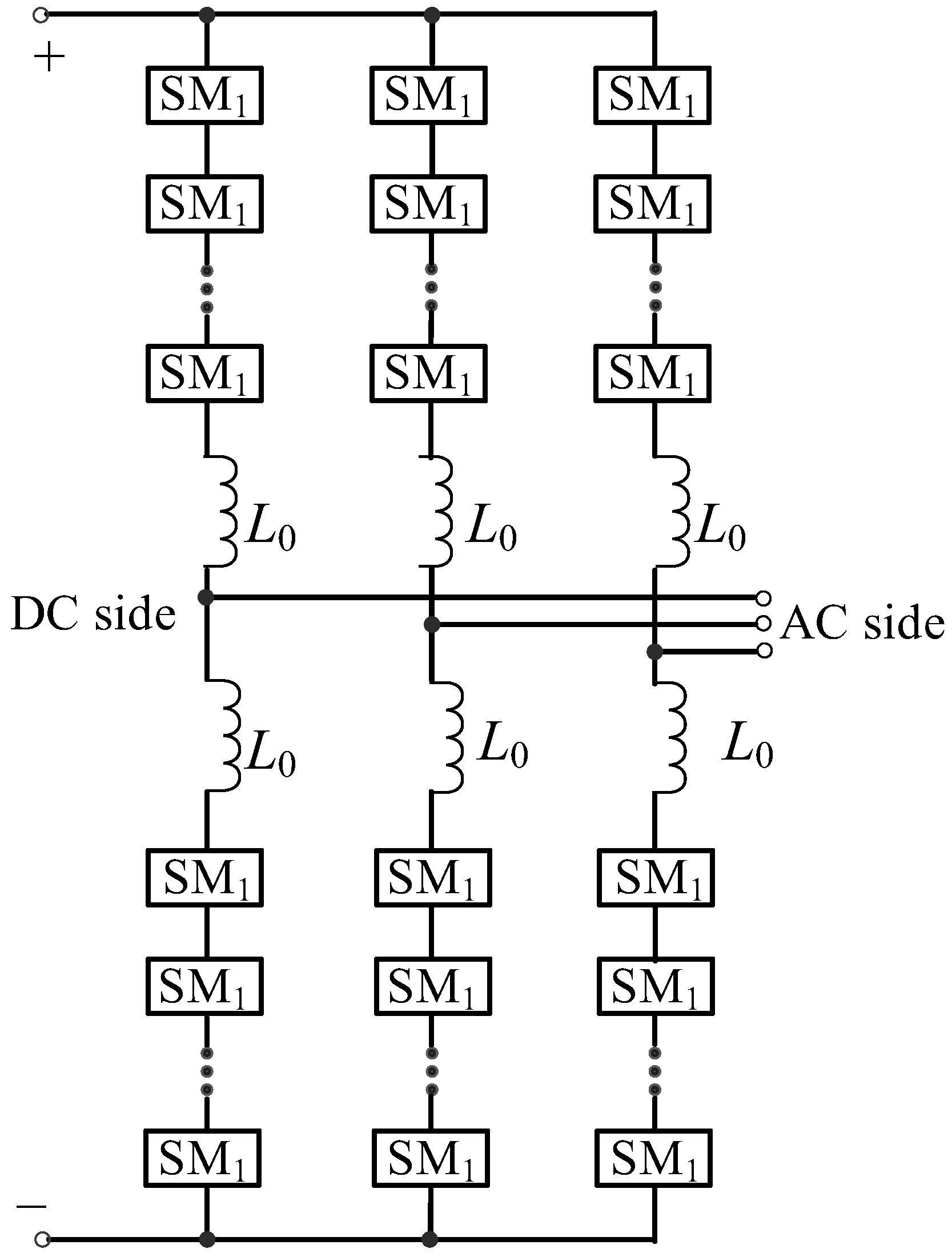
The flexible DC transmission system adopts a Modular Multilevel Converter-Based High-Voltage Direct Current Transmission (MMC-HVDC) structure. As the core equipment of flexible DC transmission, the MMC adopts a cascaded submodule structure and has the advantages such as low output-voltage harmonic content, high voltage withstand capability, and strong fault tolerance. Its basic topology consists of three-phase bridge arms. Each arm is composed of multiple half-bridge or full-bridge submodules connected in series with an arm inductor, as illustrated in Figure 2.
As the core equipment of flexible DC transmission, MMC employs a cascaded submodule structure, offering advantages such as low output-voltage harmonic content, high-voltage withstand capability, and strong fault tolerance. Its fundamental topology consists of three-phase arms. Each arm unit is formed by several half-bridge or full-bridge submodules connected in series with arm inductors, as illustrated in Figure 2.

2.2. Hybrid Half-Bridge/Full-Bridge MMC Topology

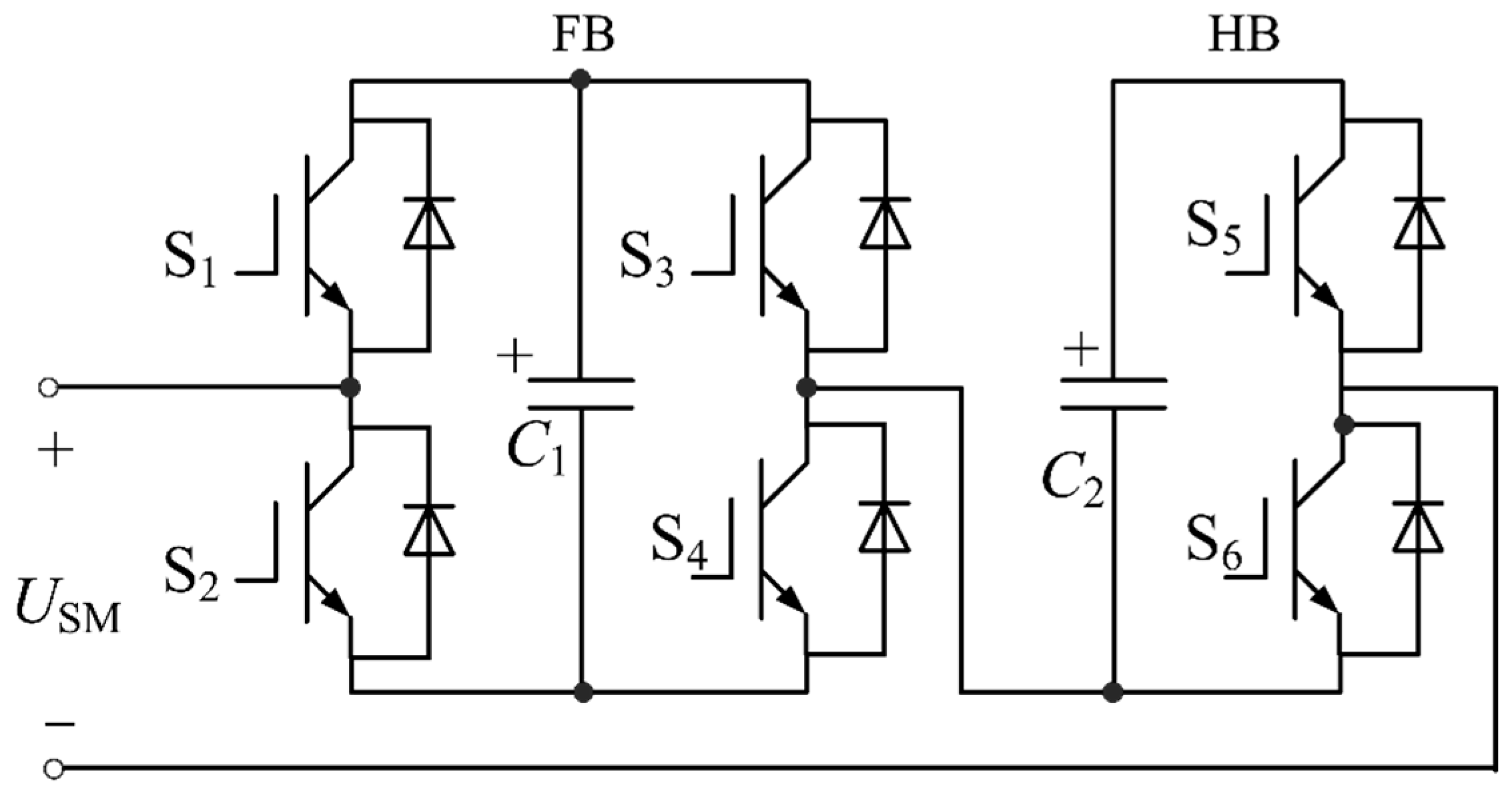
Traditional MMC systems achieve voltage output through sine-wave full-wave modulation, featuring numerous submodules with low utilization rates. This results in bulky equipment and high costs, limiting their application in large-scale projects. Multi-level power module topologies effectively reduce module count and equipment size by integrating multiple power modules. For high-voltage, high-capacity transmission demands in power grids, the hybrid half-bridge/full-bridge MMC topology emerges as the preferred solution. Its DC output voltage offers continuous, smooth adjustment within the range [−Udmin, UN], enabling cost control while meeting long-distance overhead line fault self-clearance requirements. It also supports functions like step-down operation and online switching of valve groups. Here, Udmin represents the minimum DC output voltage, while UN denotes the rated DC output voltage. The half-bridge/full-bridge hybrid MMC topology is as illustrated in Figure 3.
In this study, the hybrid HB/FB MMC topology is adopted as the fixed converter configuration for evaluating the proposed coordinated control strategy. The selected HB/FB ratio of 3:1 is not treated as the result of a topology optimization process, but as a practical engineering compromise between economy and controllability. A higher proportion of half-bridge submodules helps reduce the number of switching devices, converter losses, and equipment cost, whereas retaining a certain proportion of full-bridge submodules improves negative-voltage output capability, DC fault-blocking margin, and flexible DC-voltage regulation. Compared with a lower HB/FB ratio, the 3:1 configuration reduces the amount of full-bridge hardware required; compared with a higher HB/FB ratio, it preserves a basic level of DC fault handling and voltage control capability. Therefore, the topology is used in this paper as a representative hybrid MMC platform, while systematic optimization of the HB/FB ratio is left for future work.

2.3. Numerical Justification of the Adopted Hybrid HB/FB MMC Configuration

To further justify the adopted hybrid HB/FB MMC configuration, a normalized numerical comparison of several representative HB/FB ratios is provided. Let N be the total number of submodules in one arm, and let α = N F B / N denote the proportion of full-bridge submodules, where NFB is the number of full-bridge submodules. For a half-bridge submodule, two power semiconductor switches are required, whereas a full-bridge submodule requires four switches. Therefore, the normalized number of power semiconductor switches with respect to the all-half-bridge MMC can be expressed as:
n s w = 2 N H B + 4 N F B 2 N = 1 + α
Similarly, the normalized switch count with respect to the all-full-bridge MMC is:
n s w , F B = 2 N H B + 4 N F B 4 N = 1 + α 2
The negative-voltage generation capability of the hybrid MMC is mainly determined by the proportion of full-bridge submodules. Under the same submodule voltage assumption, the normalized negative-voltage capability can be approximately expressed as:
k n v = N F B N = α
Equations (1)–(3) indicate that increasing the proportion of full-bridge submodules improves the negative-voltage output capability and DC fault blocking margin, but also increases the number of semiconductor devices, conduction paths, switching losses, and equipment cost. Therefore, the selection of the HB/FB ratio should balance economy and controllability. To intuitively compare the characteristics of different HB/FB configurations, the normalized numerical results of several typical schemes are shown in Table 1.
As shown in Table 1, the adopted HB/FB ratio of 3:1 corresponds to α = 0.25 . Compared with the all-half-bridge MMC, this configuration increases the semiconductor switch count by approximately 25%, but it provides a certain negative-voltage output capability that is not available in the all-half-bridge configuration. Compared with the all-full-bridge MMC, the 3:1 hybrid configuration reduces the semiconductor switch count by approximately 37.5%, thereby reducing the hardware burden and potential converter losses. Compared with the HB/FB = 7:1 configuration, the adopted 3:1 ratio provides a higher negative-voltage margin and stronger DC-voltage regulation capability. Compared with the HB/FB = 1:1 configuration, it requires fewer full-bridge submodules and is therefore more economical. Therefore, the 3:1 hybrid HB/FB MMC configuration is adopted in this paper as a representative engineering compromise between economy, DC-voltage controllability, and fault-blocking capability. It should be emphasized that this comparison is intended to provide a numerical justification for the selected simulation platform, rather than a complete multi-objective topology optimization. In the subsequent simulations, the HB/FB ratio is kept unchanged for all control strategies, so that the performance differences can be attributed to the proposed control strategy rather than to topology variation.

3. Coordinated Control Design for Flexible DC Transmission Systems

3.1. Inertia-Enhanced Grid-Forming/VSG Control Strategy

(1)
Frequency–Voltage Coupling Characteristics Analysis
To overcome the decoupling effect of VSC-HVDC systems on the frequency between offshore grids and the main grid, it is necessary to transmit main grid frequency information to offshore wind farms during sudden frequency changes in the receiving grid.
The rotor motion equation of the synchronous machine is:
2 H ω 0 d ω d t = P m P e D s ( ω ω 0 )
where H is the inertia coefficient of the synchronous generator; ω is the angular frequency of the AC system; ω0 is the rated angular frequency of the AC system; Pm and Pe are the mechanical power and electromagnetic power of the synchronous generator, respectively; Ds is the damping coefficient of the synchronous generator.
On the DC side, DC capacitors can utilize their own energy to provide inertial support for the system. Their power balance equation is:
i = 1 N C i U dc , i d U dc , i d t = P in P out Δ P loss
where Ci represents the DC equivalent capacitance value; Udc,i indicates the DC voltage across the i-th capacitor; Pin signifies the converter station input power; Pout denotes the converter station output power; ΔPloss represents the converter station power loss.
By comparing Equations (4) and (5), we establish the relationship between AC frequency and DC voltage to simulate the dynamic characteristics of synchronous machines in converter stations. Let Hvsc denote the equivalent virtual inertia coefficient of the converter station. Considering the power transmission characteristics, its equivalent virtual inertia association equation is:
2 H vsc ω 0 d ω d t = P in P out k s S vsc
where ks denotes the capacity normalization coefficient of the converter station; Svsc denotes the rated capacity of the converter station.
Performing indefinite integration on both ends of Equation (6) yields the virtual inertia integral relation:
2 H vsc ω 0 d ω = P in P out S vsc d t
Further deriving the integral relationship between DC voltage and angular frequency yields:
U dc U dc 0 = k int ( ω ω 0 ) d t
where Udc represents the DC voltage at the converter station; Udc0 denotes the rated DC voltage; kint is the integral coefficient for the voltage-frequency relationship.
Performing a Taylor expansion on Equation (8), and since the amplitude variation at the alternating frequency is very small, higher-order terms can be neglected, yielding
Δ U dc k int H vsc Δ f
where Δf denotes the AC frequency deviation; f0 is the rated frequency of the AC system.
As shown in Equation (9), changes in grid frequency can be transmitted to offshore wind farms through variations in DC bus voltage, enabling offshore wind farms to actively participate in frequency support.
(2)
Design of Inertia-Enhanced VSG Control Method
Considering the lack of grid-connected inertia and damping in multi-terminal direct current (MTDC) transmission systems via converters, virtual synchronous control is employed to synchronize the charging and discharging power of supercapacitors with grid frequency variations. This dynamically supplements the inertia response capability of VSG, thereby achieving inertia enhancement in MTDC systems [20,21,22].
As shown in Equation (5), variations in the DC voltage alter the capacitor power output. Based on the frequency-voltage coupling characteristic depicted in Equation (9), changes in grid frequency induce shifts in DC voltage. The required capacitor power increment ΔPC for grid frequency deviation is thus obtained as:
Δ P C = k p Δ f + k d d Δ f d t
where ΔPC represents the incremental capacitive power required for grid frequency deviation; kp denotes the proportional coefficient of power increment; kd denotes the differential coefficient of power increment.
To simulate the DC inertia support process based on virtual synchronous control, based on the second-order model of the synchronous generator, the VSG control structure for the converter is devised. The mechanical rotation equation of the VSG is given in Equation (11).
2 H vsc ω 0 d ω vsc d t = P ref P e D vsc ( ω vsc ω 0 )
where ωvsc is the virtual angular frequency output by the VSG; Dvsc is the virtual damping coefficient of the VSG.
From Equation (10), the power of capacitor charging and discharging varies with the grid frequency. By embedding the frequency differential element into the virtual synchronous control, Equation (12) can be obtained.
P ref = P ref + Δ P C k c P out
where P ref is the corrected virtual synchronous reference power; kc is the output power correction factor.
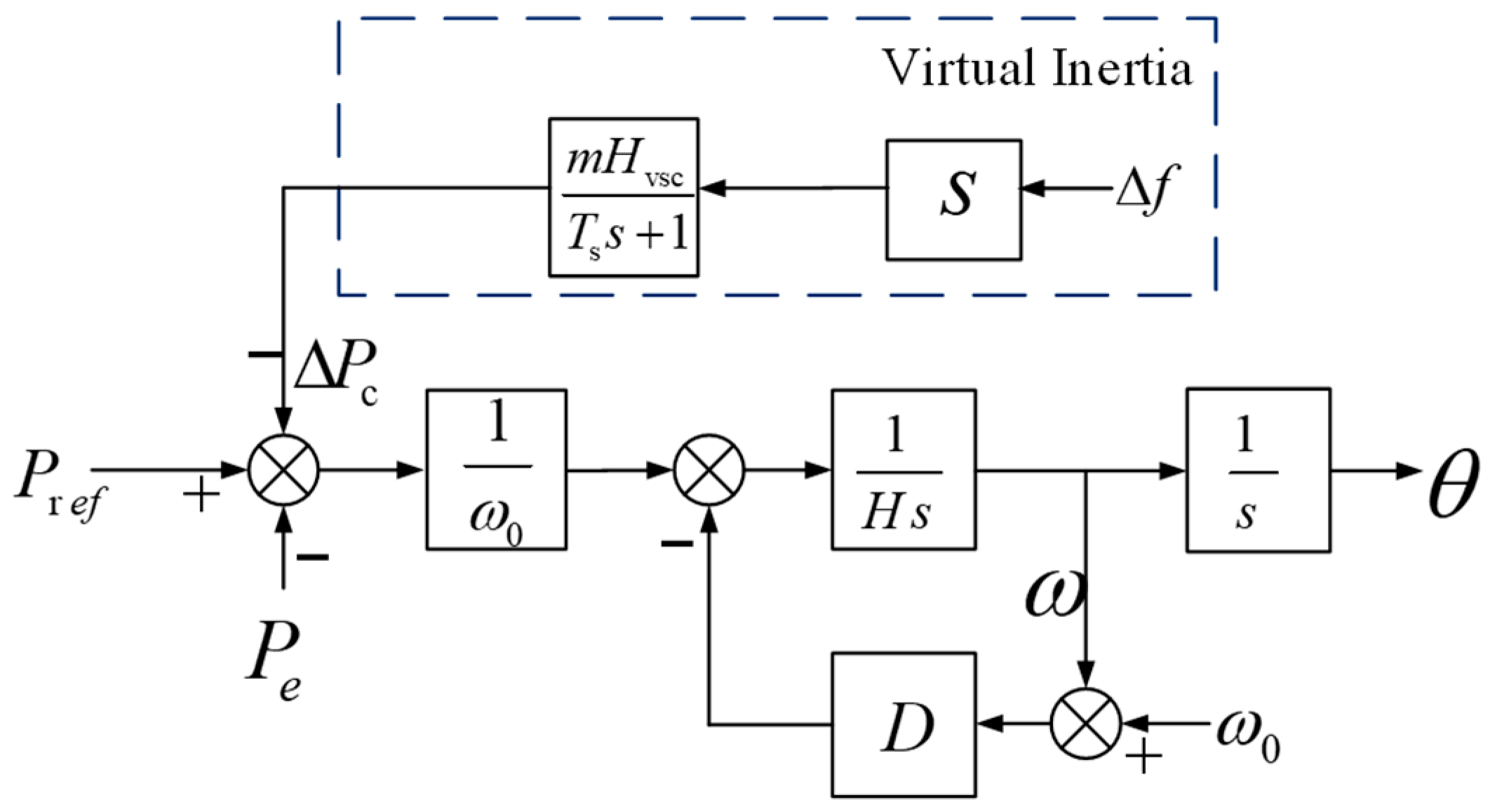
By using Equations (10)–(12), the control structure diagram shown in Figure 4 can be constructed.
In the figure, Ts denotes the time constant, m represents the steady-state constant, and θ indicates the VSG output power angle. Combining the relationship described by Equation (9) shows the coupling relationship between the ΔUdc and the Δf. Under the same frequency deviation Δf, a larger virtual inertia time constant Hvsc results in stronger inertia support extracted from the DC capacitor by the converter station, leading to a more pronounced suppression of the system frequency change rate df/dt. However, the DC voltage deviation ΔUdc also increases synchronously. Therefore, the frequency support process must strictly balance voltage fluctuation constraints.
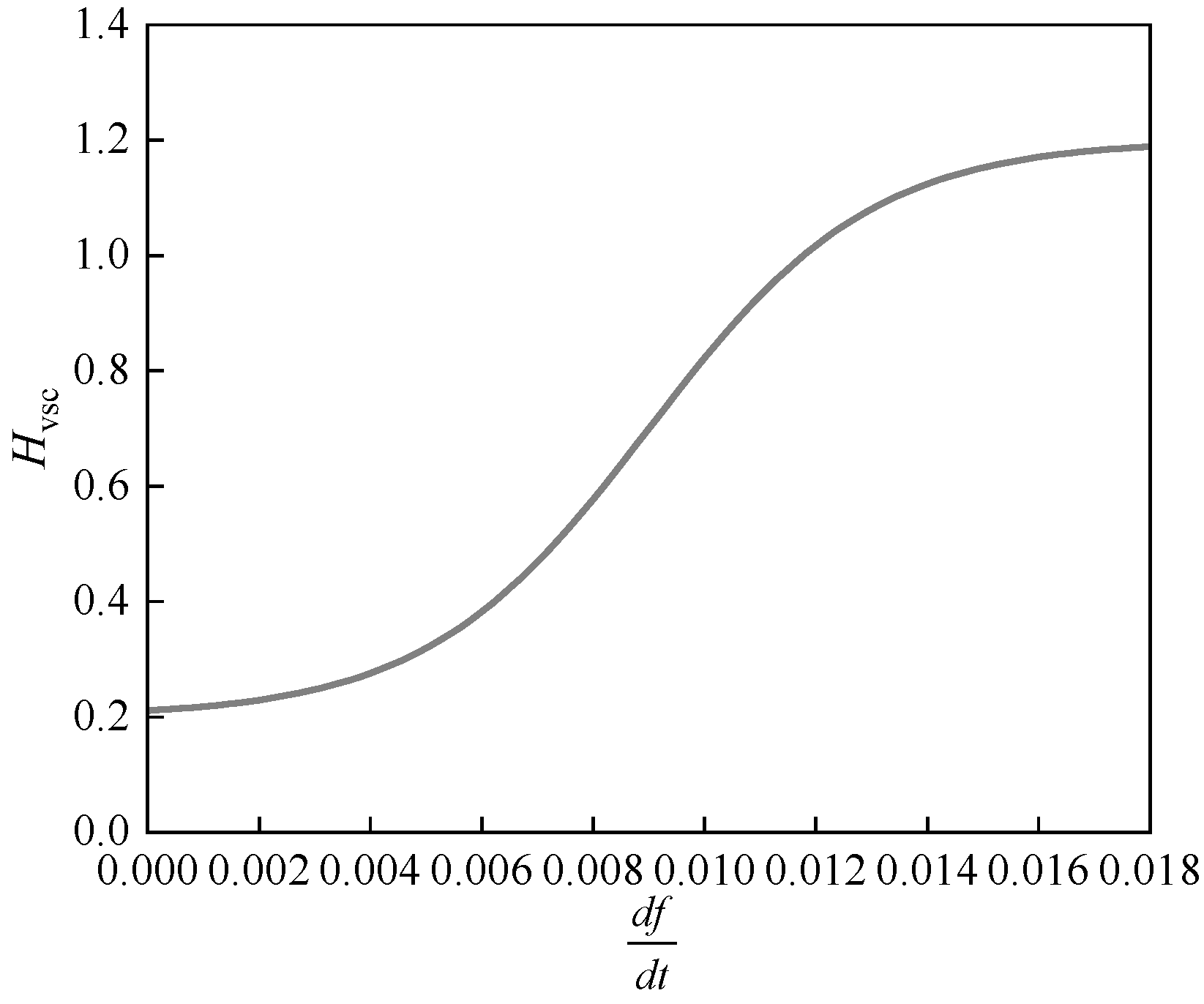
Based on the inertia-enhanced VSG control structure design concept illustrated in Figure 4, dynamic tuning of the virtual inertia time constant Hvsc enables balanced control between inertia support strength and DC voltage stability. During the initial phase of frequency fluctuations, Δf is small, but the rate of change of df/dt is large. To rapidly suppress the frequency change rate, a larger Hvsc must be configured to provide strong inertia support. During the middle and late stages of frequency fluctuations, the rate of change df/dt gradually diminishes. To prevent excessive extraction of capacitive inertia, causing DC voltage deviation to exceed limits, Hvsc must be reduced to weaken the inertia support effect. The trend is illustrated in Figure 5 below.
Considering the constraint imposed by DC capacitance on virtual inertia, let the maximum system frequency deviation be denoted as Δfmax. The maximum constraint equation for virtual inertia is then derived as follows:
H vsc , max = U dc , max 2 U dc 0 2 2 k int Δ f max
where Hvsc,max denotes the maximum virtual inertia value; Udc,max denotes the maximum DC voltage value.
Referring to Figure 5, a trend in relationship between frequency deviation and inertial time constant can be observed. By performing an arctangent function fit on the relationship between frequency deviation and inertial coefficient, the following can be obtained:
H vsc = H vsc , max arctan 2 | Δ f | Δ f max
where |Δf| represents the absolute value of the AC frequency deviation.
Enhanced control of VSG inertia can improve voltage suppression capability during frequency support processes. However, traditional VSG designs are typically tailored for specific converter stations, requiring additional control mechanisms to achieve coordination among multiple terminals in multi-terminal systems.

3.2. Adaptive U-P-f Dual-Droop Distributed Control for Multi-Terminal Systems

To address the coordination of DC-voltage regulation, frequency support, and power allocation in multi-terminal flexible DC systems, an adaptive U-P-f dual-droop distributed control strategy is introduced. By adjusting the voltage- and frequency-droop coefficients according to the operating states of the DC voltage and AC frequency, multiple converter stations can jointly share unbalanced power while limiting excessive DC-voltage deviation during the frequency-support process.
(1)
Cascade Structure of the Adaptive U-P-f Dual-Droop VSG Control
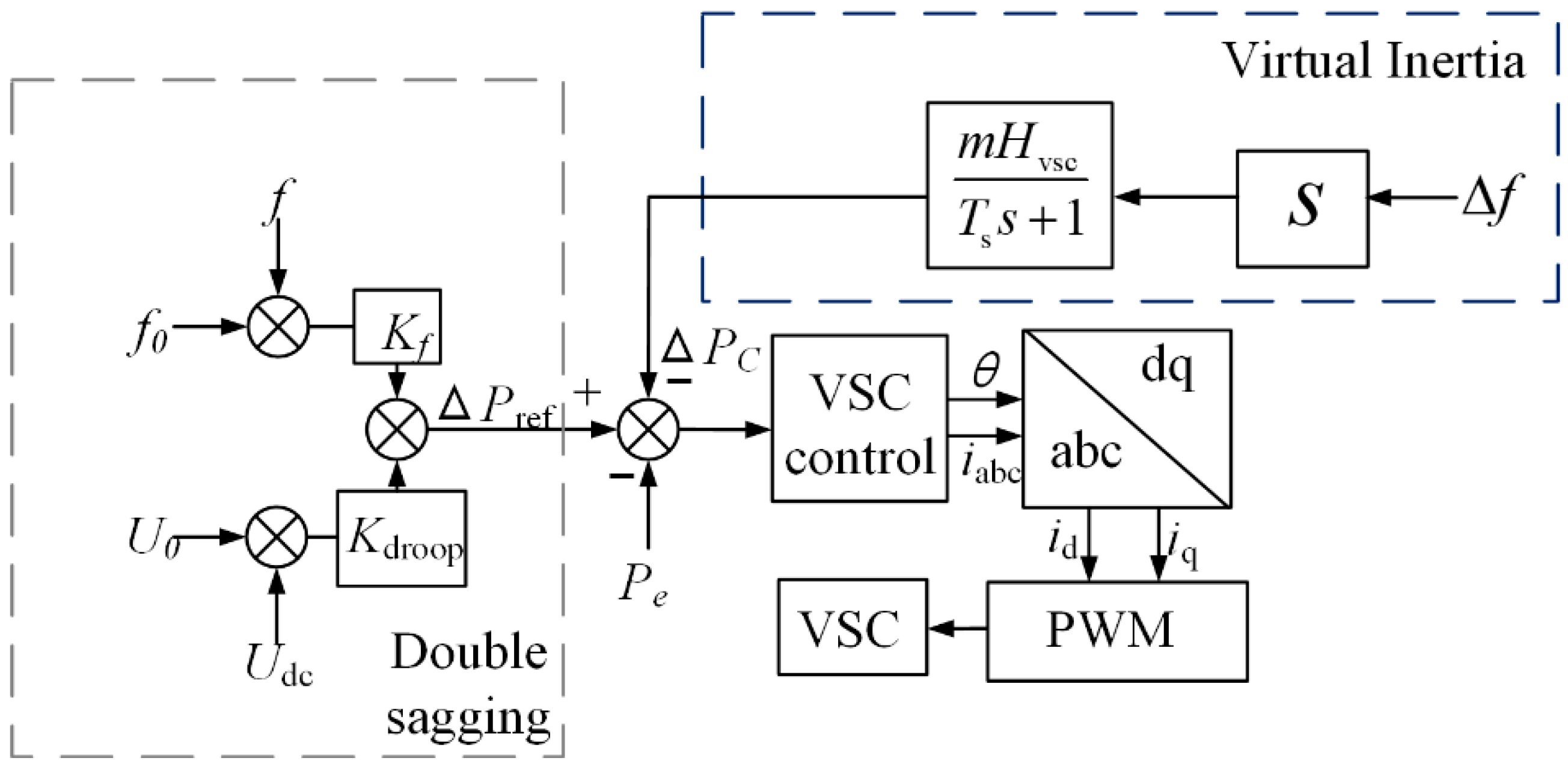
When load disturbances occur in the load-side system, the flexible DC transmission system participates in the frequency-regulation power-allocation process under droop control, inevitably causing variations in the DC bus voltage. Dynamically adjusting the droop coefficient in the additional dual-droop control enhances the coordinated capability of voltage regulation and frequency support across multiple converter stations [23,24,25]. By cascading the additional frequency droop control stage at the front end of the VSG, the control structure depicted in Figure 6 is established.
As shown in Figure 6, the reference power increment ΔPref generated by the adaptive U-P-f dual-droop outer loop and the capacitive power increment ΔPC generated by the inertia-enhancement loop are jointly processed by the VSG control block. The resulting current references are then tracked by the inner current-control loop and converted into PWM drive signals. Therefore, the proposed control structure combines fast inertia response with flexible multi-terminal power-regulation capability.
(2)
Adaptive Dual-Droop Control
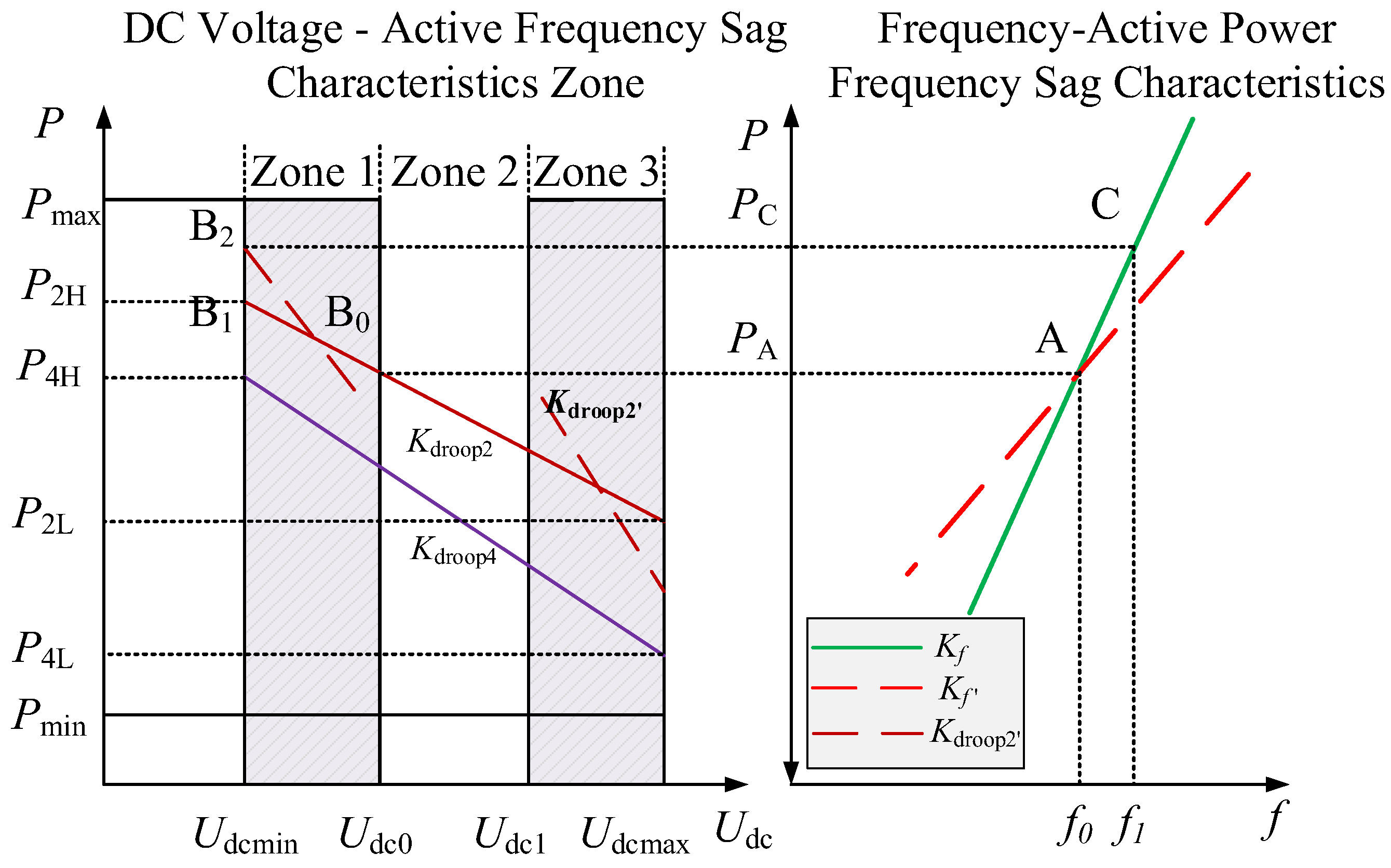
In the adaptive dual-droop control, the reference power increment ΔPref affects both the frequency-support performance and the DC-voltage deviation. When a large load disturbance occurs in one AC area, the frequency deviation increases the power-support demand of the corresponding converter station. This power adjustment may further cause DC-voltage deviation on the DC side. If fixed droop coefficients are used, the converter station may be unable to balance frequency support and DC-voltage limitation effectively under large disturbances. Therefore, the voltage- and frequency-droop coefficients are adaptively adjusted according to the operating states of the DC voltage and AC frequency. Figure 7 illustrates the power-voltage and power–frequency characteristics of the converter stations.
In Figure 7, Zone 1 represents the lower operational limit zone, Zone 2 denotes the normal operational zone, and Zone 3 indicates the upper operational limit zone. P3H and P4H, along with P3L and P4L, respectively, represent the maximum and minimum values of the original droop curves for converter stations 3 and 4. Udcmax and Udcmin denote the DC voltage limits of the converter station. kdroop3 and kdroop4 denote the P-U droop coefficients for VSC3 and VSC4, respectively; kdroop3′ are the P-U droop voltage coefficients for VSC3; kf and kf′ denote the P-f droop coefficients; Udc0 and Udc1 are the critical values for the adaptive voltage regulation lower and upper limits, respectively.
The outer loop employs a U-P-f dual droop control. Reference power is jointly corrected by voltage deviation and frequency deviation. The voltage droop coefficient is dynamically adjusted via a piecewise function. When the DC voltage is within the normal operating range (Udc0UUdc1), the droop coefficient remains stable. When the voltage approaches the limits (UdcminU < Udc0 or Udc1 < UUdcmax), the voltage droop coefficient is adaptively increased to restrict power output and prevent voltage overshoot.
The P-U droop curve kdroop for the converter station is expressed as a piecewise function with DC voltage as the variable, defined as:
k d r o o p ( U ) = P max P u U d c m i n U , U d c m i n U < U d c 0 P H P L U d c m i n U d c m a x , U d c 0 U U d c 1 P min P u U d c m a x U , U d c 1 < U U d c m a x
The droop coefficient of the P-f droop curve for converter stations, with AC frequency as the variable, is:
k f = k f + Δ k f
The inner layer implements a power allocation mechanism based on the principle of power conservation, distributing unbalanced power proportionally according to the droop coefficients of each converter station. The primary regulating power borne by the disturbance end is:
Δ P ref j = k f j Δ f j 1 k droop j i = 1 n k droop i +   k droop j Δ P 2 i = 1 n k droop i
where ΔPrefj denotes the reference power increment at the jth disturbance-end converter station; kfj denotes the frequency droop coefficient at the jth disturbance-end converter station; Δfj denotes the AC frequency deviation in the region where the jth disturbance-end converter station is located; ΔP2 denotes the total unbalanced power of the system.
Undisturbed-end auxiliary regulation ensures coordinated stability in multi-terminal systems. The converter station bears unbalanced power as follows:
Δ P ref i = k f j Δ f j k droop j i = 1 n k droop i + k droop i Δ P 2 i = 1 n k droop i
where ΔPrefi denotes the reference power increment for the i-th undisturbed converter station.
By adjusting kdroop and kf, the unbalanced power can be allocated among different converter stations. When a disturbance occurs in Zone 2, the converter stations operate within the normal droop-control range, and the droop coefficients remain close to their initial values. Under large disturbances, however, the operating point may move toward Zone 1 or Zone 3, which increases the risk of a DC-voltage-limit violation. In this case, kdroop is adaptively adjusted according to Equation (15) to strengthen the DC-voltage constraint, while kf is coordinated according to Equation (16) to determine the frequency-support contribution. The updated droop coefficients are then substituted into Equations (17) and (18) for multi-terminal power allocation.
To improve the clarity of the controller-design rationale, the parameter-tuning principles are further described in this study. The virtual inertia coefficient H vsc mainly affects the suppression of the frequency change rate during the initial stage of a disturbance. However, stronger inertia support requires more DC-link capacitor energy and may cause a larger DC-voltage deviation. Therefore, its maximum value should be constrained by the allowable DC-voltage deviation. The frequency droop coefficient is selected according to the allowable frequency deviation and the converter-station capacity constraint, so that the frequency-support power can be limited within the rated range. The voltage droop coefficient is selected according to the allowable DC-voltage fluctuation range, so that DC-voltage violations can be avoided during frequency support. In the adaptive dual-droop control, a relatively moderate droop coefficient is maintained when the voltage remains within the normal operating range, so that frequency support can be prioritized. When the DC voltage approaches the operating boundary, the voltage feedback strength is increased to enhance the voltage constraint. In the control implementation, the measured frequency and DC-voltage signals are filtered, and the frequency-derivative term, droop coefficients, and power reference are limited to avoid high-frequency noise amplification and abrupt changes in the power command. From a mechanistic perspective, positive virtual inertia and positive damping contribute to improved frequency dynamics, while the positive and bounded feedback of the adaptive droop control helps maintain the stability of DC voltage–power regulation.

4. Simulation Verification and Results Analysis

4.1. Simulation Model Construction

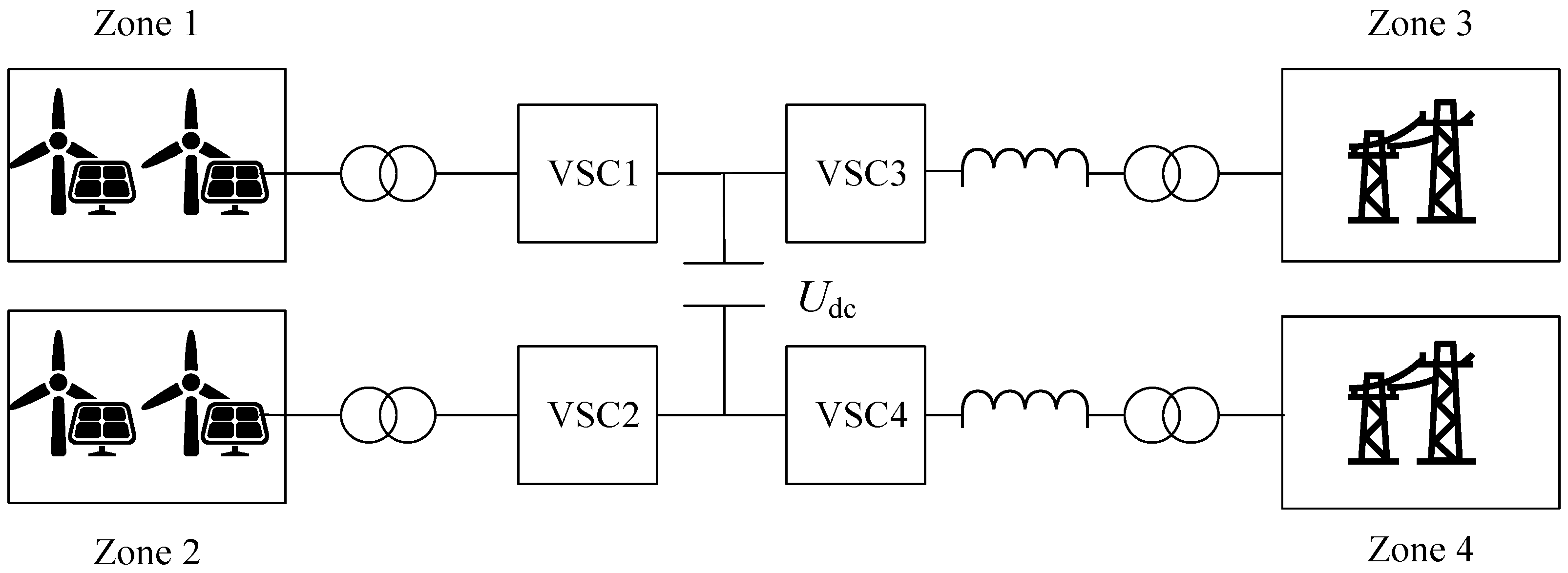
Based on the flexible DC transmission grid connection structure diagram in Figure 1, a four-terminal flexible DC transmission system simulation model incorporating onshore renewable energy units, hybrid MMC converter stations, and AC/DC grids was established on the MATLAB/SIMULINK simulation platform, as shown in Figure 8. The simulation time step of the main circuit is 5.0 × 10⁻⁵ s. The step load disturbance is applied at t = 4 s with an amplitude of 0.2 pu. The continuous random disturbance lasts for 120 s and is generated using a fixed pseudo-random sequence. All comparison strategies adopt the same simulation time step, disturbance inputs, and control constraints. The system comprises two new energy transmission converter stations and two receiving-end converter stations. All converter stations employ a hybrid MMC topology combining half-bridge and full-bridge submodules, with the number of half-bridges being three times that of full-bridges. This HB/FB ratio is kept unchanged in all simulation cases, so that the comparative results focus on the effects of different control strategies rather than topology variation. To improve the reproducibility of the control strategy, the key control parameters and implementation settings are summarized in Table 2. The initial value of the virtual inertia coefficient is set to 0.10 s and is constrained within the range of 0.05–0.20 s, so that the frequency-support capability during the initial disturbance stage and the DC-voltage constraint can be balanced. The initial voltage droop coefficients of VSC3 and VSC4 are set to 0.12 and 0.08, respectively, and the initial frequency droop coefficients are set to 0.76 and 0.60, respectively. During the adaptive process, the droop coefficients are limited to 50–200% of their initial values to avoid excessive power commands or control oscillations caused by abrupt coefficient changes. The safe operating range of the DC voltage is set to 0.95–1.05 pu. When the DC voltage is within the normal operating range of 0.98–1.02 pu, the droop coefficients are kept at their initial values. When the DC voltage is lower than 0.98 pu or higher than 1.02 pu, the adaptive control law gradually strengthens the voltage droop effect to limit further DC-voltage deviation. The safe range of frequency deviation is set to ±0.20 Hz, and a frequency deadband of ±0.005 Hz is introduced to avoid frequent controller actions caused by small steady-state disturbances. In the control implementation, both the AC frequency deviation and DC-voltage deviation signals are processed by a first-order low-pass filter before being fed into the controller, with the filtering time constant set to Tf = 0.02 s. The control sampling time is set to Ts = 1.0 × 10⁻⁴ s, and the adaptive droop coefficients are updated every Tu = 1.0 × 10⁻³ s. The frequency derivative term is limited to 1.0 Hz/s, and the power reference increment of each converter station is limited to 0.10 pu. These settings are used to avoid abrupt changes in power commands caused by measurement noise, high-frequency transients, and sudden disturbances.
It should be noted that the four-terminal flexible DC system established in this study is mainly used to verify the frequency-support, DC-voltage-regulation, and multi-terminal power-coordination performance of the proposed control strategy in a representative multi-terminal MMC-HVDC scenario. The model consists of two sending-end converter stations and two receiving-end converter stations, and can reflect the basic characteristics of unbalanced power allocation and coordinated DC-bus voltage control in a multi-terminal system. However, this structure is still a simplified multi-terminal DC interconnection system rather than a complex meshed or ring-type MTDC network. Therefore, the simulations in this study focus on the dynamic performance verification of the control strategy, rather than on a comprehensive evaluation of all MTDC topology configurations.

4.2. Simulation Results and Analysis

Design two scenarios: heavy load disturbance and continuous random load disturbance, to comprehensively validate the proposed optimization scheme’s frequency support capability, DC voltage over-limit control, and multi-terminal coordination performance.
(1)
Verification of Adaptability to Weak Grid Conditions
Interconnect the 4-terminal flexible DC system with a weak grid, with renewable energy units operating at rated output. At t = 4 s, apply a 0.2 pu large load disturbance targeting the receiving end region 3. To highlight the superiority of the proposed scheme, three control strategies are set for comparison:
Strategy 1 is the proposed coordinated control strategy, which combines inertia-enhanced grid-forming/VSG control with adaptive U-P-f dual-droop distributed control. Strategy 2 adopts conventional VSG control, in which the inertia-enhancement mechanism and adaptive dual-droop coordination are not included. Strategy 3 adopts fixed-droop control without VSG-based inertia support.
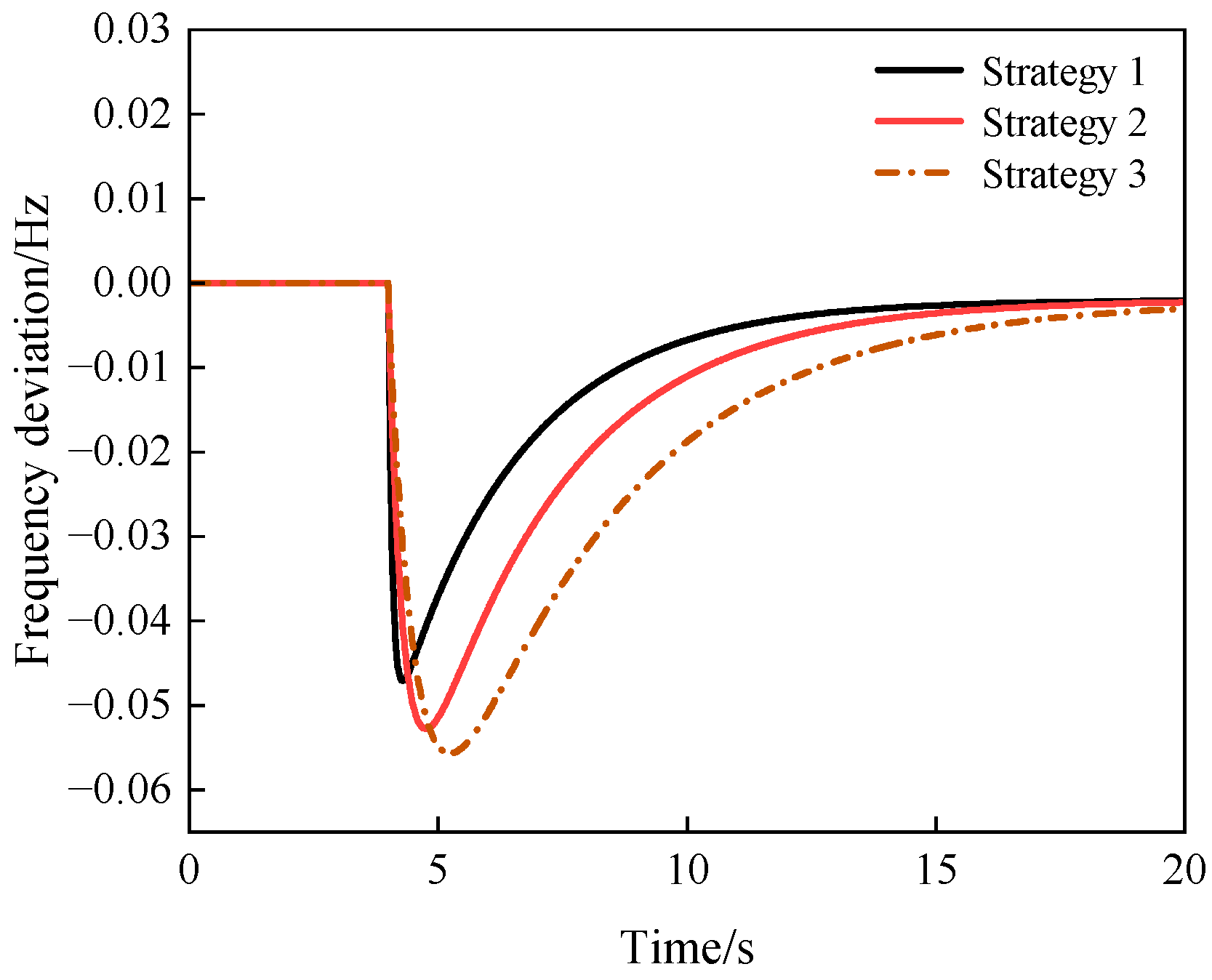
The frequency deviation Δf curves for region 3 under the heavy-load disturbance are shown in Figure 9 and Figure 10, respectively:
As shown in Figure 9, under large disturbances, Strategy 1 exhibits a maximum frequency deviation of only −0.047 Hz. This represents reductions of 9.6% and 16.1% compared to Strategy 2 (Δf = −0.052 Hz) and Strategy 3 (Δf = −0.056 Hz), respectively. The frequency recovery time is merely 7s. This rapid response is achieved through the inertia-enhancement mechanism of frequency differential feedforward, which efficiently extracts DC capacitor inertia support.
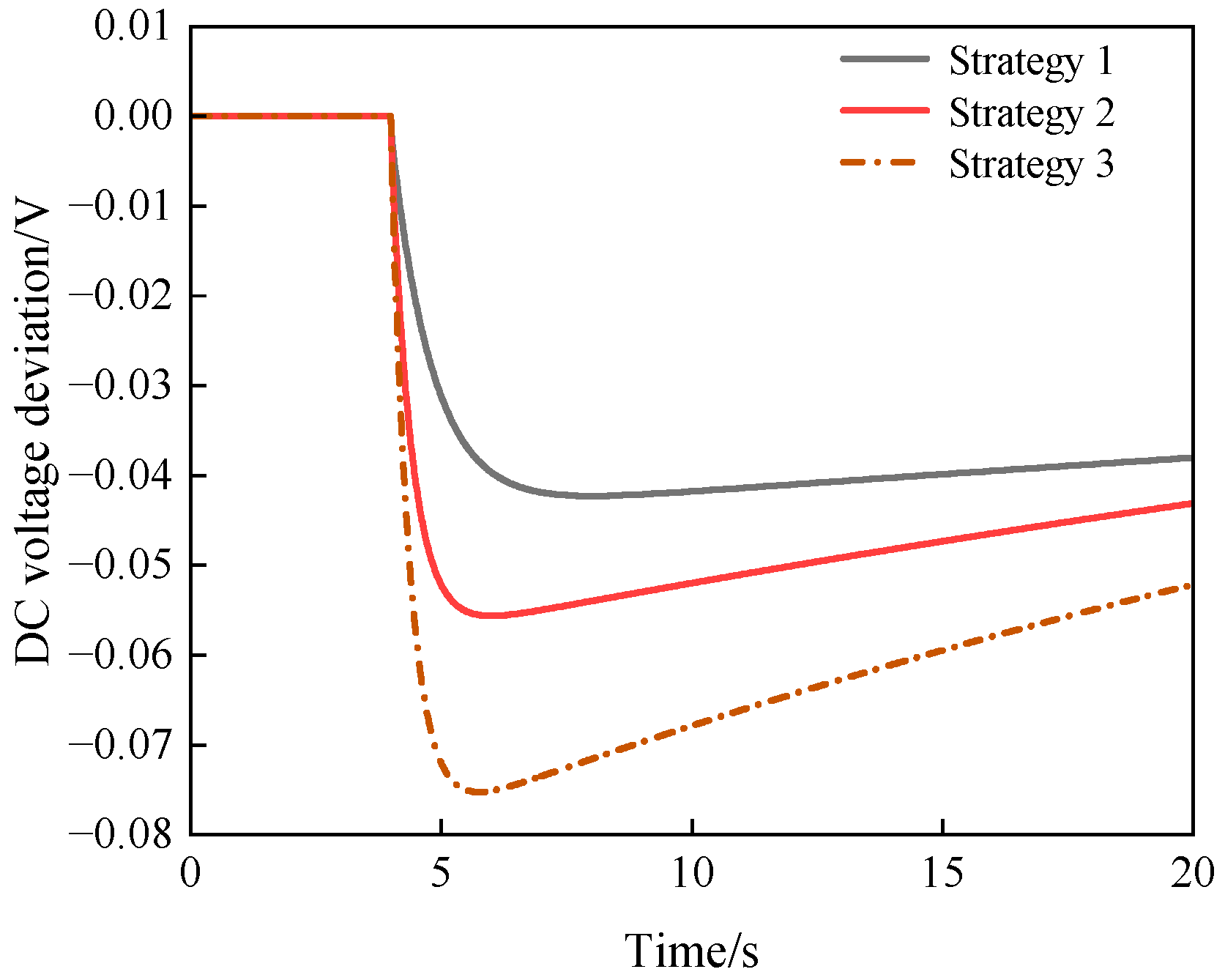
The DC voltage deviation ΔUdc curve is shown in Figure 10:
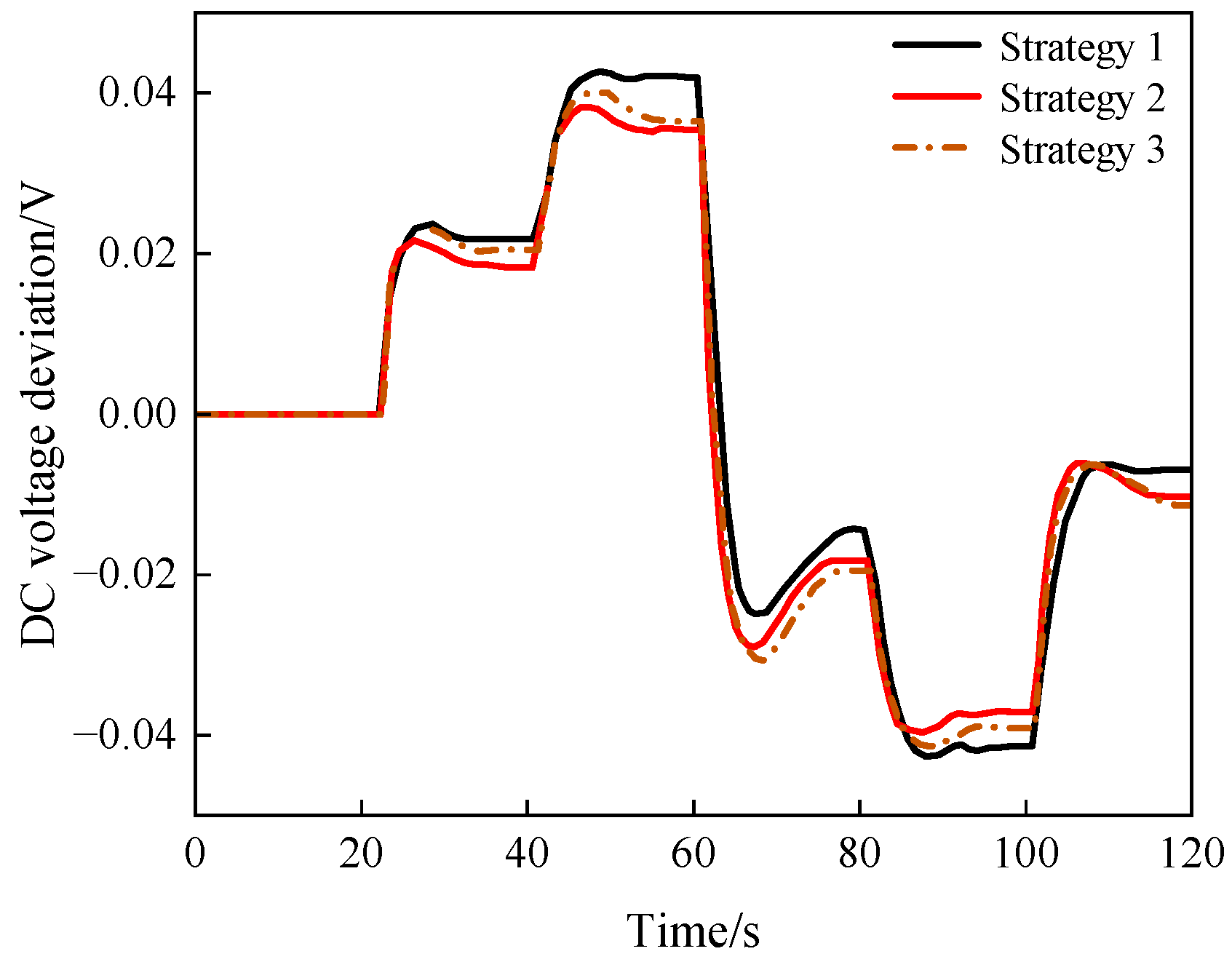
As shown in Figure 10, under large disturbances, the DC voltage deviations for Strategies 2 and 3 reached −0.054 pu and −0.075 pu, respectively, exceeding the safety range. In contrast, Strategy 1 achieved balanced control of frequency support and voltage stability by adaptively adjusting the voltage droop coefficient, limiting the voltage deviation to −0.041 pu.
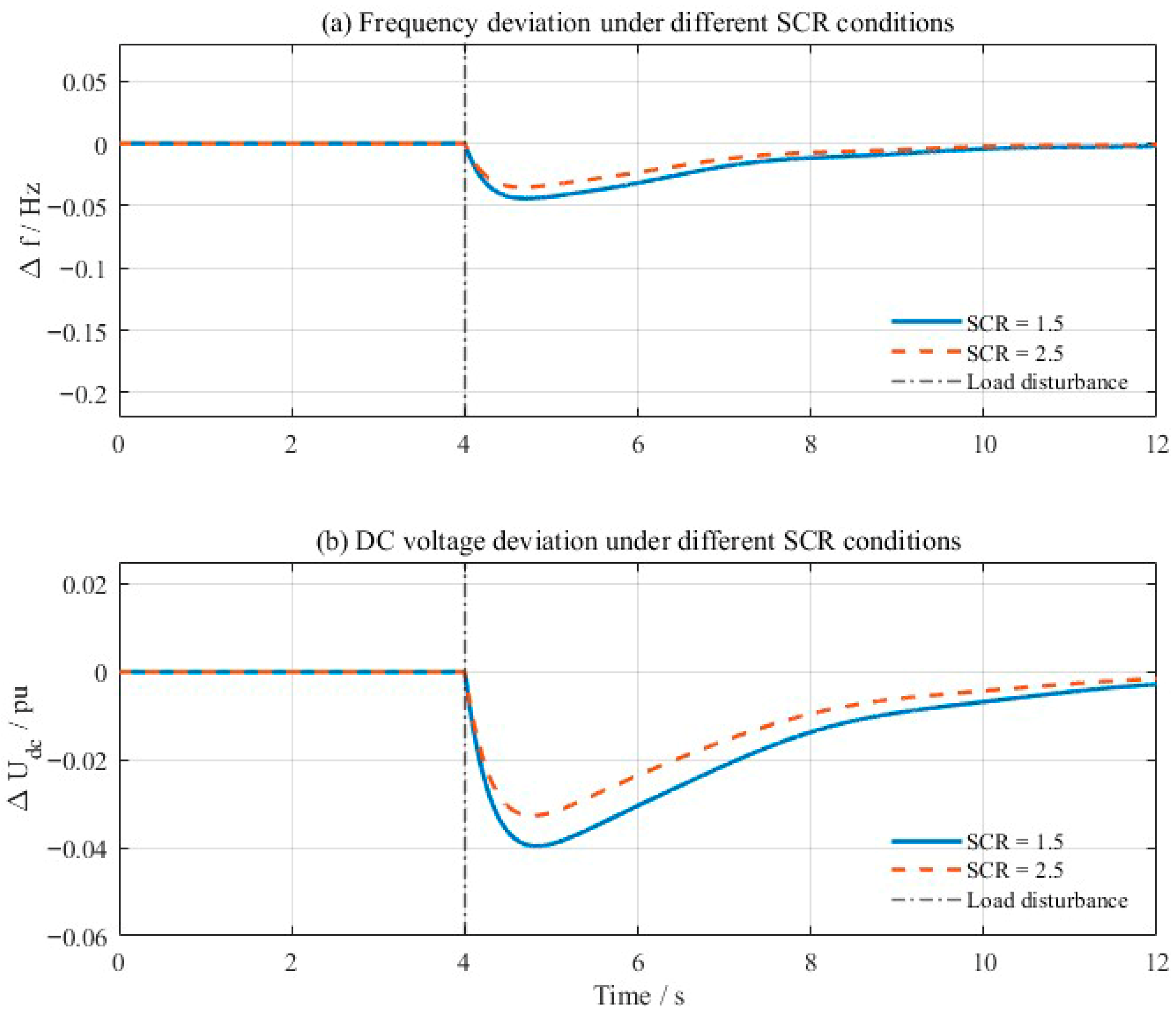
To further verify the adaptability of the proposed control strategy under different grid-strength conditions, an additional simulation with SCR = 2.5 is conducted based on the original SCR = 1.5 case. SCR = 1.5 represents a relatively severe weak-grid operating condition, whereas SCR = 2.5 represents a moderately weak-grid condition. In both cases, the same four-terminal flexible DC system structure, converter parameters, and control parameters are used, and the virtual inertia coefficient, frequency droop coefficient, and voltage droop coefficient are not retuned. In the simulation, the renewable energy units are maintained at rated output, and a 0.2 pu step load disturbance is applied to receiving-end Region 3 at t = 4 s. By comparing the frequency deviation and DC-voltage deviation under different SCR conditions, the dynamic adaptability of the proposed inertia-enhanced grid-forming control and adaptive dual-droop distributed control strategy under different grid strengths can be evaluated. The simulation results are shown in Figure 11.
As shown in Figure 11a, after the 0.2 pu load disturbance is applied at t = 4 s, a transient frequency drop is observed under both SCR conditions, followed by gradual recovery toward the rated frequency. Under the severe weak-grid condition with SCR = 1.5, the maximum frequency deviation is approximately −0.047 Hz. When the SCR is increased to 2.5, the maximum frequency deviation is reduced to approximately −0.038 Hz, and a smoother recovery process is observed. This indicates that as the AC system strength increases, the damping capability of the system against disturbances improves, leading to better frequency dynamic performance. Meanwhile, under both SCR conditions, the frequency deviation is maintained within the allowable range of ±0.2 Hz, indicating that effective frequency support can be provided by the proposed inertia-enhanced control under different grid-strength conditions. As shown in Figure 11b, after the load disturbance occurs, a transient decrease in the DC-bus voltage is caused by converter-station power regulation and the release of DC-side energy. When SCR = 1.5, the maximum DC-voltage deviation is approximately −0.041 pu. When SCR = 2.5, the maximum deviation is reduced to approximately −0.033 pu. Under both operating conditions, the DC-voltage deviation does not exceed the operating limit of ±5%, indicating that the adaptive dual-droop control can continue to constrain DC-voltage fluctuations when the grid strength changes. Therefore, voltage-limit violations caused by excessive use of DC-side energy during frequency support can be avoided. The results show that the proposed control strategy maintains stable frequency support and DC-voltage regulation capabilities under different SCR conditions. Compared with the SCR = 1.5 case, both the frequency deviation and DC-voltage deviation are reduced under SCR = 2.5, which is consistent with the physical expectation that a stronger AC system provides better disturbance-support capability. Without retuning the control parameters, stable recovery is still achieved under both SCR conditions, indicating that the proposed inertia-enhanced grid-forming control and the adaptive dual-droop control have a certain degree of adaptability to grid-strength variations.
(2)
Multi-Endpoint System Collaborative Dynamic Response Verification
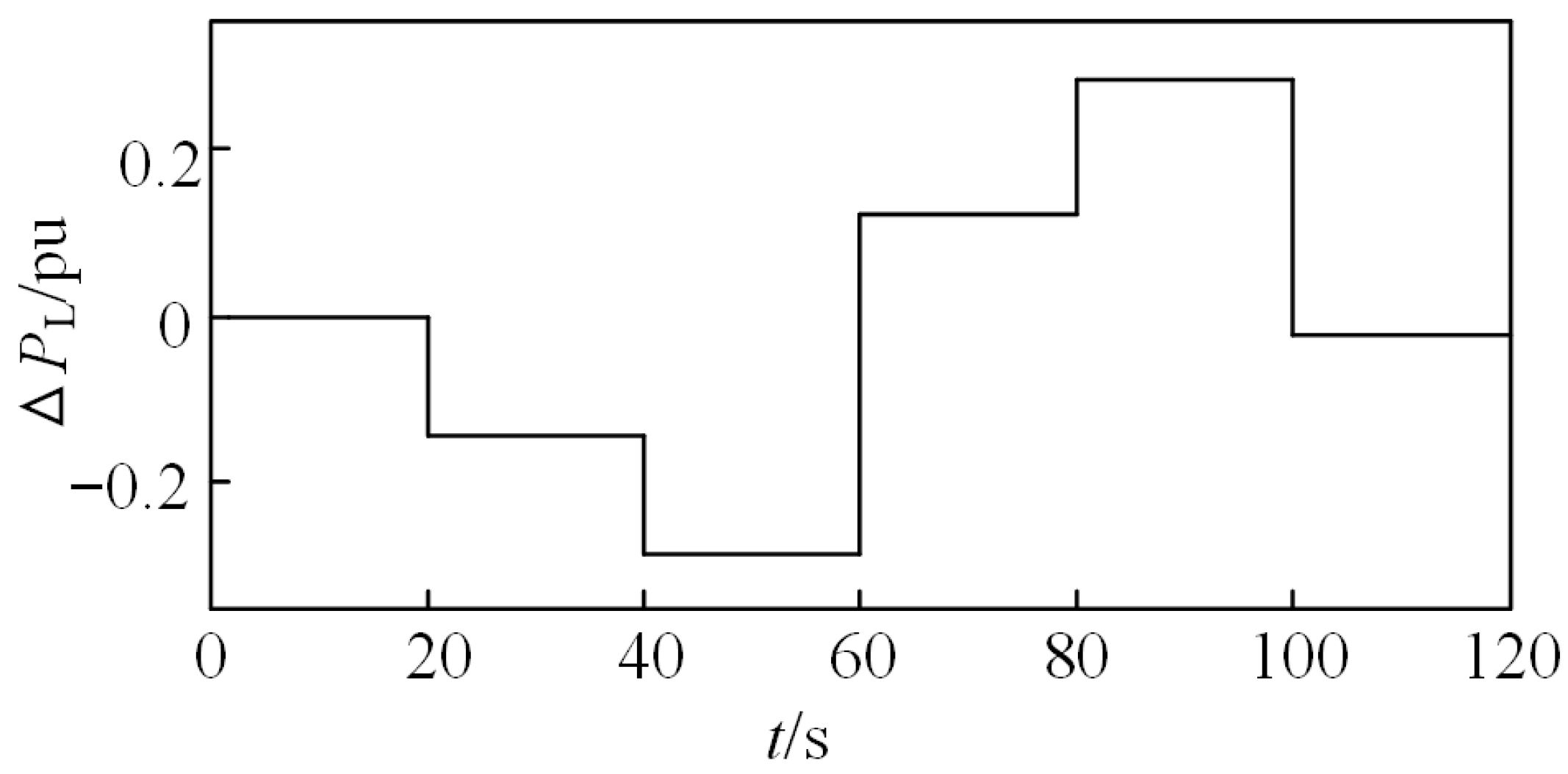
To verify the dynamic coordination capability of the proposed control strategy under continuous fluctuation conditions, a continuous random load disturbance scenario is further applied to the receiving-end Region 3. This disturbance is used to simulate continuous fluctuations in load demand or equivalent power imbalance within a certain range during practical operation. It should be noted that the random disturbance referred to in this study is not an unconstrained white-noise input, but a bounded pseudo-random load disturbance profile. In the simulation, a random disturbance is applied to the receiving-end Region 3 for a duration of 120 s. The disturbance signal is generated from a pseudo-random sequence and limited within a preset amplitude range to avoid excessively large or excessively rapid power changes that would be inconsistent with practical engineering scenarios. To ensure the repeatability of the simulation results, a fixed random sequence is used to generate the disturbance profile. Figure 12 shows the continuous random load disturbance profile applied to the receiving-end Region 3. Subsequently, the dynamic responses of the three control strategies under this disturbance are compared in terms of frequency deviation, converter-station power-increment allocation, and DC-bus voltage fluctuation.
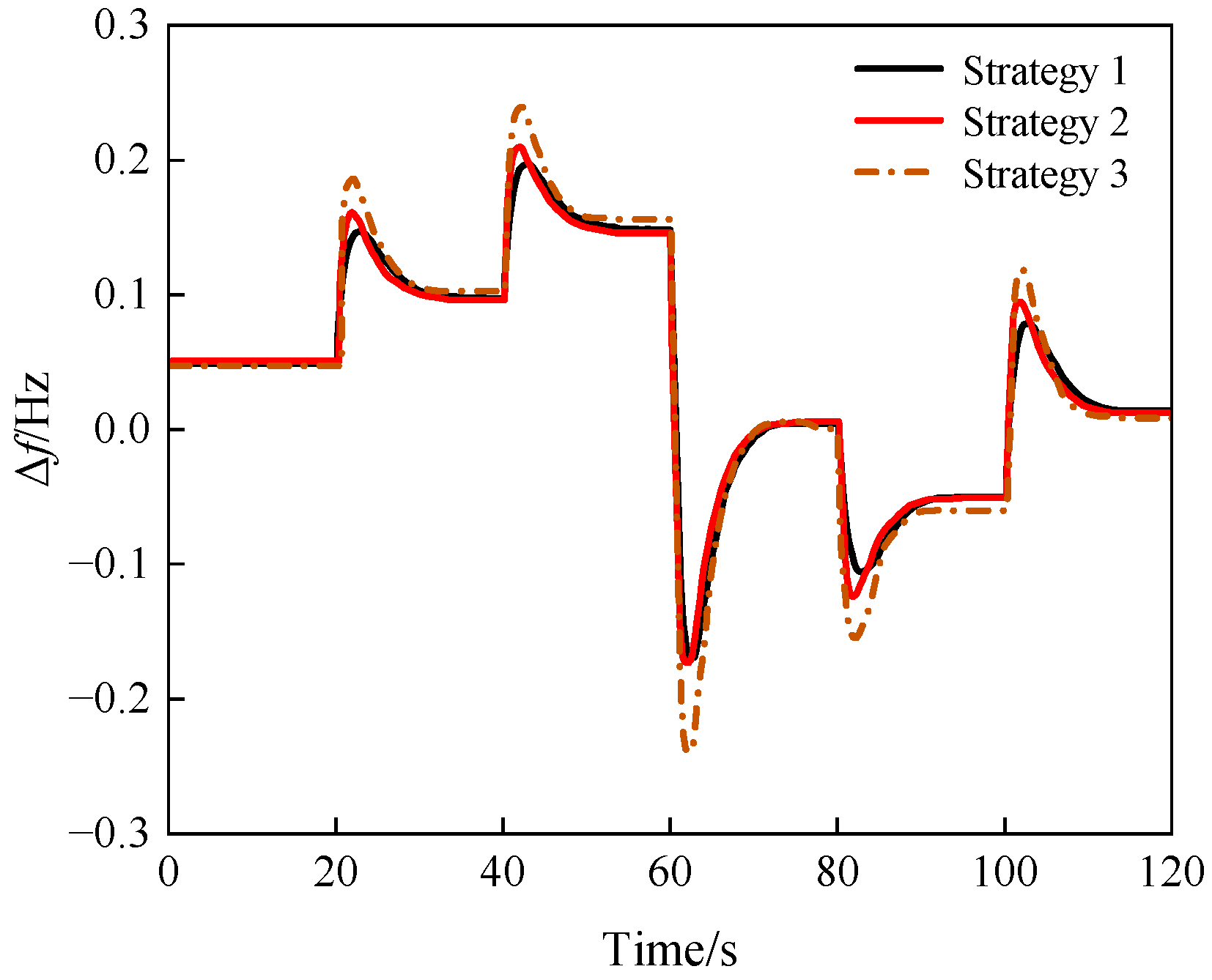
Under continuous random load disturbance conditions, the frequency deviation curve is shown in Figure 13.
As shown in Figure 13, Strategy 1 consistently maintains frequency deviation within ±0.2 Hz, with smooth curves free of oscillations and a recovery time of only 7–9 s. This highlights the synergistic advantages of inertia-enhanced grid-forming control and adaptive dual-droop control. Strategy 3 employs fixed deadband control without virtual inertia support, resulting in a frequency deviation amplitude as high as −0.24 Hz. This exceeds the system safety threshold, with prolonged fluctuations that fail to meet the dynamic stability requirements for multi-terminal systems.
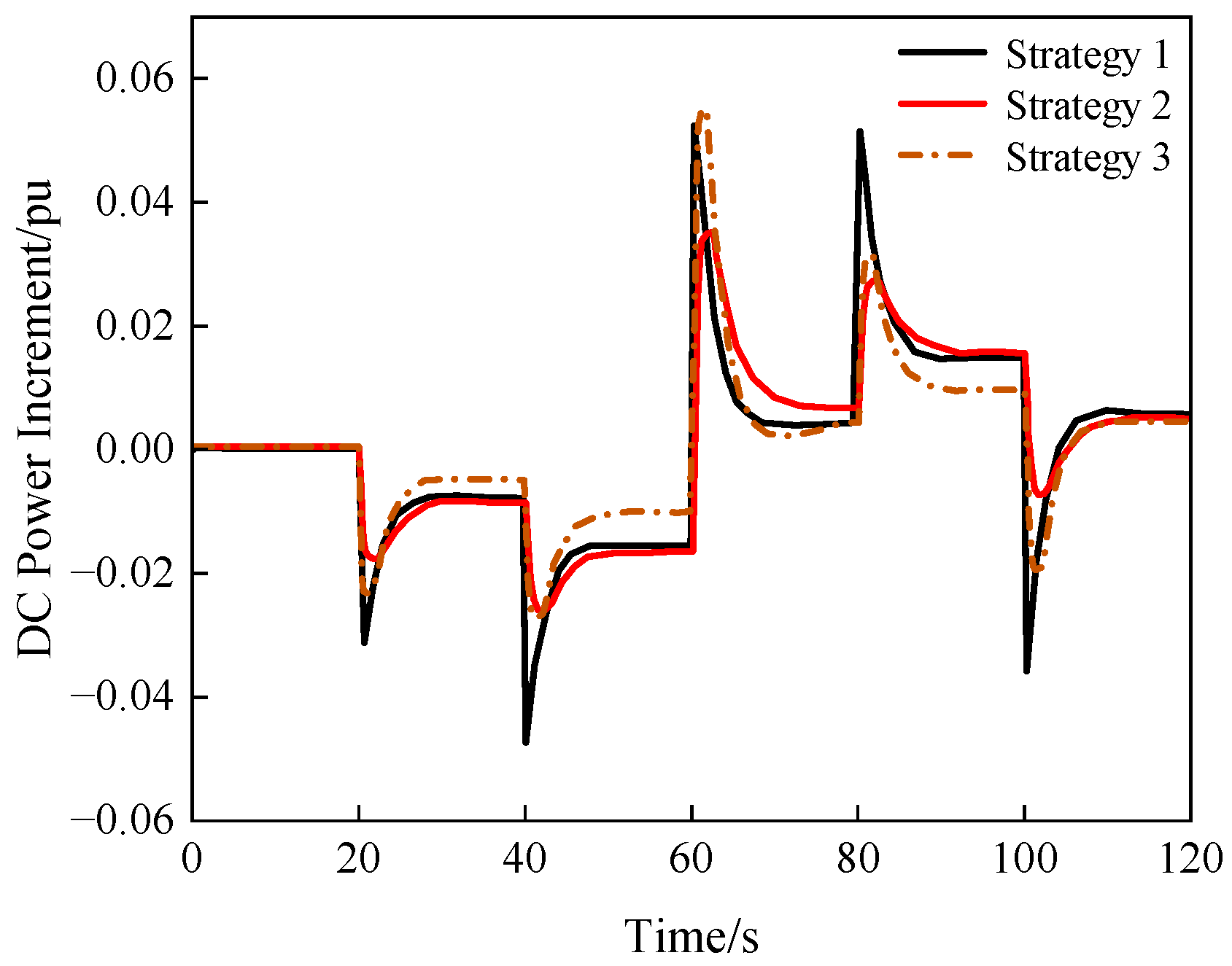
The distribution curves of power increments ΔP across converter stations are shown in Figure 14.
As shown in Figure 14, Strategy 1 employs U-P-f dual-droop adaptive regulation, rationally distributing unbalanced power based on the droop coefficient ratios of each converter station. During continuous random load disturbances, particularly when subjected to a large −0.26 pu load disturbance at t = 40 s, Strategy 1 dynamically adjusts the droop coefficient. This enables a timelier response to DC power increment, which did not exceed 10% of its rated capacity, demonstrating more significant support effectiveness.
The DC bus voltage fluctuation curve is shown in Figure 15.
As shown in Figure 15, Strategy 1 strictly controls the amplitude of DC voltage fluctuations within ±5% throughout the entire process of continuous random disturbances, effectively preventing voltage overshoot. This is achieved through adaptive droop control, which dynamically adjusts kdroop and kf via piecewise functions. During minor disturbances, it prioritizes frequency support, while during major disturbances, it reinforces voltage constraints, thereby realizing coordinated stability in multi-terminal systems.
(3)
Analysis of the Contributions of Different Control Components to Performance Improvement
To further improve the interpretability of the simulation results and clarify the different contributions of inertia enhancement and adaptive dual-droop control to the improvement of system dynamic performance, the dominant roles of the two control components are analyzed based on the above simulation results.
First, the improvement in frequency-dynamic performance is mainly attributed to the inertia-enhanced grid-forming/VSG control. As indicated by Equations (6)–(9), the proposed method establishes a coupling relationship between AC frequency deviation and DC-voltage deviation, and introduces a frequency-derivative feedforward term into the VSG control. In this way, the DC-side capacitor energy can be rapidly involved in AC-side frequency support during the initial stage of a disturbance. When a 0.2 pu load disturbance occurs at t = 4 s, the system frequency initially decreases rapidly, and the rate of change in frequency is relatively large. At this stage, the inertia-enhancement component can quickly provide transient power support, thereby suppressing both the frequency drop and the frequency change rate. As shown in Figure 9, the maximum frequency deviation under the proposed strategy is approximately −0.047 Hz, which is smaller than −0.052 Hz under conventional VSG control and −0.056 Hz under fixed-droop control. This indicates that the improvement in frequency nadir and recovery speed is mainly associated with the inertia-enhancement mechanism.
Second, the suppression of DC-voltage deviation and the coordination of multi-terminal power sharing are mainly attributed to the adaptive dual-droop distributed control. Although inertia enhancement improves the frequency response, it also causes DC-voltage deviation by drawing energy from the DC-side capacitors. Without effective voltage constraint and multi-terminal power coordination mechanisms, the frequency-support process may lead to DC-bus voltage violations. In the adaptive U-P-f dual-droop control adopted in this study, the droop coefficients are dynamically adjusted according to DC-voltage deviation and frequency deviation, so that multiple converter stations can jointly share unbalanced power and the voltage constraint can be strengthened when the voltage approaches its operating limits. As shown in Figure 10, the proposed strategy limits the maximum DC-voltage deviation to approximately −0.041 pu, whereas the DC-voltage deviations under conventional VSG control and fixed-droop control reach approximately −0.054 pu and −0.075 pu, respectively. This indicates that the suppression of DC-voltage violations is mainly achieved through the dynamic regulation of the adaptive droop control.
Furthermore, under continuous random load disturbances, inertia enhancement and adaptive dual-droop control operate on different time scales. The inertia-enhancement component mainly acts during the initial disturbance stage and during periods of rapid load variation, improving the speed and smoothness of the frequency response. In contrast, the adaptive dual-droop control mainly acts during the sustained disturbance and recovery stages, coordinating power allocation among different converter stations and limiting DC-voltage fluctuations. As shown in Figure 13, the proposed strategy keeps the frequency deviation within ±0.2 Hz, and the response curve remains relatively smooth. Figure 14 shows that the power increments of the converter stations can be dynamically shared according to the droop coefficients, with the maximum power increment remaining below 10% of the rated capacity. Figure 15 shows that the DC-voltage fluctuation is consistently maintained within ±5%. These results indicate that the improvement in frequency response mainly reflects the effect of the inertia-enhancement component, whereas power-allocation optimization and voltage-violation suppression mainly reflect the effect of the adaptive dual-droop component.
Overall, the performance improvement of the proposed control strategy is not produced by a single control component independently, but by the coordinated action of inertia enhancement and adaptive dual-droop control. The inertia-enhancement component is responsible for fast frequency support during the initial disturbance stage, whereas the adaptive dual-droop control is responsible for DC-voltage constraint and multi-terminal power coordination during the middle and later stages of the disturbance. If inertia enhancement is adopted without adaptive droop coordination, the frequency-support capability may be improved at the cost of increased DC-voltage deviation. Conversely, if fixed-droop control is adopted without inertia support, it may be difficult to effectively suppress the frequency drop during the initial stage of the disturbance.

5. Conclusions

This paper presents a simulation-based coordinated control strategy for improving frequency support, DC-voltage regulation, and multi-terminal power coordination in MMC-HVDC systems under weak-grid conditions. The proposed strategy integrates an inertia-enhanced grid-forming/VSG control loop with an adaptive U-P-f dual-droop distributed control layer. A four-terminal MMC-HVDC simulation model is established in MATLAB/Simulink, and the dynamic performance of the proposed strategy is evaluated under step-load disturbance, different SCR conditions, and bounded pseudo-random load disturbance scenarios. It should be emphasized that the hybrid HB/FB MMC configuration adopted in this study is used as a fixed converter platform for control-strategy evaluation, rather than as the result of systematic topology optimization. The main conclusions are summarized as follows:
(1)
Under the tested weak-grid step load disturbance condition, the inertia-enhanced grid-forming/VSG control based on AC frequency-DC voltage coupling improves the initial frequency dynamic response. For the SCR = 1.5 case with a 0.2 pu load disturbance, the maximum frequency deviation is limited to approximately −0.047 Hz by the proposed strategy. Compared with conventional VSG control and fixed-droop control, the frequency deviation is reduced by approximately 9.6% and 16.1%, respectively, and the frequency recovery time is approximately 7 s. These results indicate that, within the tested simulation condition, the inertia-enhancement mechanism can improve the initial frequency-support performance.
(2)
The adaptive U-P-f dual-droop distributed control contributes mainly to DC-voltage limitation and multi-terminal power coordination. Under the step load disturbance, the maximum DC-voltage deviation is limited to approximately −0.041 pu by the proposed strategy. Under the bounded pseudo-random load disturbance scenario, the DC-voltage fluctuation remains within ±5%, and the converter-station power increments are kept within a controllable range. These results indicate that the adaptive dual-droop control can improve power-sharing coordination among multiple converter stations while constraining DC-voltage deviation during frequency support.
(3)
The additional SCR case shows that the proposed control strategy maintains stable dynamic responses under two representative weak-grid strength conditions. When the SCR is increased from 1.5 to 2.5, both the maximum frequency deviation and the maximum DC-voltage deviation are reduced without retuning the control parameters. This result suggests that the proposed strategy has a certain degree of adaptability to grid-strength variation. However, this result should be interpreted as supplementary simulation validation under limited SCR conditions, rather than as a comprehensive robustness assessment over a wide SCR range.
(4)
From the perspective of control-component functionality, the inertia-enhanced grid-forming/VSG control mainly improves the frequency nadir and frequency recovery speed during the initial stage of the disturbance, whereas the adaptive U-P-f dual-droop distributed control mainly contributes to DC-voltage constraint and multi-terminal power allocation during the middle and later stages of the disturbance. Therefore, the performance improvement of the proposed strategy is achieved through the coordinated action of the two control components.
Several limitations should also be noted. First, the verification is based on a representative four-terminal MMC-HVDC simulation model, and complex meshed or ring-type MTDC networks are not considered. Second, the validation scenarios are limited to two representative SCR conditions: a 0.2 pu step load disturbance and a bounded pseudo-random load disturbance. Wide-range parameter scanning and statistically meaningful random robustness verification have not yet been carried out. Third, formal stability analysis, such as small-signal modeling, impedance-based analysis, or Lyapunov-based stability proof, is not included in the present study. Therefore, the conclusions of this paper should be understood as being valid within the established simulation model and the tested operating conditions. Future work will further investigate complex MTDC topologies, wider SCR ranges, parameter-sensitivity analysis, formal stability analysis, hardware-in-the-loop experiments, and engineering validation.

Author Contributions

Conceptualization, Z.F., H.Y. and J.H.; methodology, Z.F., H.Y. and J.H.; formal analysis, Z.F., H.Y. and J.H.; investigation, Z.X., S.H., S.W. and J.Z.; resources, Z.X., S.H., S.W. and J.Z.; data curation, Z.X., S.H., S.W. and J.Z.; writing—original draft preparation, Z.F., H.Y., J.H., Z.X., S.H., S.W. and J.Z. All authors have read and agreed to the published version of the manuscript.

Funding

This research received no external funding.

Data Availability Statement

The original contributions presented in this study are included in the article. Further inquiries can be directed to the corresponding authors.

Conflicts of Interest

Authors Zhichao Fu, Jingjing Huang, Zihan Xie, and Shihua He were employed by the company Guangdong Guangzhou Power Supply Bureau, China Southern Power Grid Company Limited. Author Huilei Yang was employed by the company XJ Electric Co., Ltd. The remaining authors declare that the research was conducted in the absence of any commercial or financial relationships that could be construed as a potential conflict of interest.

References

  1. Xiang, W.; Wang, R.; Tu, R.; Han, M.; Wen, J. Hybrid AC/DC collection and HVDC transmission topology for large-scale offshore wind farms. CSEE J. Power Energy Syst. 2025, 11, 949–959. [Google Scholar] [CrossRef]
  2. Xiang, W.; Wang, M.; Yang, M.; Wen, J. DDR-MMC hub-based hybrid AC/DC collection and HVDC transmission system for large-scale offshore wind farms. J. Mod. Power Syst. Clean Energy 2024, 12, 356–367. [Google Scholar] [CrossRef]
  3. Lee, G.S.; Kwon, D.H.; Moon, S.I. DC Current and Voltage Droop Control Method of Hybrid HVDC Systems for an Offshore Wind Farm Connection to Enhance AC Voltage Stability. IEEE Trans. Energy Convers. 2020, 36, 468–479. [Google Scholar] [CrossRef]
  4. Haryadi, E. Review of HVDC technologies for weak grid interconnectors. Electr. Eng. 2024, 107, 4483–4501. [Google Scholar] [CrossRef]
  5. Zeng, Z.; Zhao, J.; Zhang, S.; Mao, L.; Qu, K. Sensitivity Analysis of Different Controller Parameters on the Stability of the Weak-grid-tied Interlinking VSC. Prot. Control Mod. Power Syst. 2025, 10, 40–51. [Google Scholar] [CrossRef]
  6. Farkhani, J.S. A Comprehensive Review of Potential Protection Methods for VSC Multi-Terminal HVDC Systems. Renew. Sustain. Energy Rev. 2024, 192, 114280. [Google Scholar] [CrossRef]
  7. Liu, Y.; Jin, Y.; Li, Z.; Liu, Y.; Li, B.; Duan, Z. Mechanical DC breakers and hybrid MMC-based coordinated strategy for MMC-HVDC DC fault ride-through. IEEE J. Emerg. Sel. Top. Power Electron. 2021, 11, 3705–3714. [Google Scholar] [CrossRef]
  8. Liu, Y.; Yin, L. A Low-Cost MMC Submodule Topology with Fast DC Fault Handling Capability. IET Power Electron. 2025, 18, e12846. [Google Scholar] [CrossRef]
  9. Xu, Y.; Zhang, Z.; Xu, Z. Design and DC fault clearance of modified hybrid MMC with low proportion of full-bridge submodules. IET Gener. Transm. Distrib. 2021, 15, 2203–2214. [Google Scholar] [CrossRef]
  10. Usman, M.; Kwon, I.; Lee, B.-W. Valve-side single-phase-to-ground fault clearance in bipolar hybrid-MMC HVDC systems utilizing thyristor commutation branches and mechanical interrupter. IEEE Access 2025, 13, 166630–166648. [Google Scholar] [CrossRef]
  11. Zhu, Y. Fault Current Analysis and Active Current Limiting Strategy for Hybrid Cascaded LCC/MMC HVDC System. Int. J. Electr. Power Energy Syst. 2023, 151, 109125. [Google Scholar] [CrossRef]
  12. Liu, N. Hybrid frequency-domain modeling and stability analysis for power systems with grid-following and grid-forming converters. J. Mod. Power Syst. Clean Energy 2024, 12, 45–58. [Google Scholar] [CrossRef]
  13. Li, C.; Yang, Y.; Mao, X.; Xiong, X.; Dragicevic, T. Modeling, Control and Stabilization of Virtual Synchronous Generator in Future Power Electronics-Dominated Power Systems: A Survey of Challenges, Advances, and Future Trends. Int. J. Electr. Power Energy Syst. 2025, 171, 111001. [Google Scholar] [CrossRef]
  14. Fang, H.; Yu, Z. Control of virtual synchronous generator for frequency regulation using a coordinated self-adaptive method. CSEE J. Power Energy Syst. 2020, 10, 175–184. [Google Scholar] [CrossRef]
  15. Guo, X.; Ren, Y.; Zhu, R.; He, B.; Fang, C.; Xu, R. Frequency regulation optimization strategy of improved virtual synchronous generator under ultra-weak grid conditions. AIP Adv. 2025, 15, 125001. [Google Scholar] [CrossRef]
  16. Smahi, A.; Makhloufi, S. Artificial neural network-based virtual synchronous generator for frequency stability improving of grid integration of distributed generators. Comput. Electr. Eng. 2024, 120, 109877. [Google Scholar] [CrossRef]
  17. Rajak, M.K.; Pudur, R. Multiobjective Adaptive Predictive Virtual Synchronous Generator Control Strategy for Grid Stability and Renewable Integration. Sci. Rep. 2025, 15, 9241. [Google Scholar] [CrossRef]
  18. Zhao, X.; Zhang, H.; Ndonji, J.; Jiang, W.; Li, K. Overvoltage ride-through control strategy for improving voltage support capability of virtual synchronous generator. IET Gener. Transm. Distrib. 2024, 18, 3995–4007. [Google Scholar] [CrossRef]
  19. Wang, H.; Xie, Z.; Chen, Y.; Wu, W.; Wang, Z.; Lin, G.; Guo, J. Admittance-based stability analysis of current-controlled virtual synchronous generator considering the frequency coupling characteristics. IEEE J. Emerg. Sel. Top. Power Electron. 2022, 11, 1191–1202. [Google Scholar] [CrossRef]
  20. Shen, Z.; Zhu, J.; Zheng, W. Bilateral inertia and damping emulation control scheme of VSC-HVDC transmission systems for asynchronous grid interconnections. In Proceedings of the 10th Renewable Power Generation Conf. (RPG), Online, 14–15 October 2021; pp. 9–15. [Google Scholar] [CrossRef]
  21. Zhu, J.; Wang, X.; Zhao, J.; Yu, L.; Li, S.; Li, Y.; Guerrero, J.M.; Wang, C. Inertia emulation and fast frequency droop control strategy of a point-to-point VSC-HVDC transmission system for asynchronous grid interconnection. IEEE Trans. Power Electron. 2022, 37, 6530–6543. [Google Scholar] [CrossRef]
  22. Liu, Z.; Lv, X.; Wu, F.; Li, Z. Multi-mode active inertia support strategy for MMC-HVDC systems considering the constraint of DC voltage fluctuations. IEEE Trans. Power Deliv. 2023, 38, 2767–2781. [Google Scholar] [CrossRef]
  23. Wang, Y.; Qiu, F.; Liu, G.; Lei, M.; Yang, C.; Wang, C. Adaptive Reference Power-Based Voltage Droop Control for VSC-MTDC Systems. J. Mod. Power Syst. Clean Energy 2021, 11, 381–388. [Google Scholar] [CrossRef]
  24. Yao, W.; Zhou, H.; Xiong, Y.; Wen, J. Adaptive Dual Droop Control of MTDC Integrated Offshore Wind Farms for Fast Frequency Support. In Active Control of Large-Scale Offshore Wind Farms Connected Via VSC-HVDC; Springer Nature: Singapore, 2025; pp. 201–225. [Google Scholar] [CrossRef]
  25. Li, C.; Zhang, X.; He, P.; Zhen, Z.; Zhao, K. Adaptive Droop Control of VSC-MTDC System Based on Virtual Inertia. Electronics 2023, 12, 2324. [Google Scholar] [CrossRef]

Figure 1. Offshore wind power transmission system topology via VSC-HVDC. The “New Energy” icon represents offshore wind turbines and photovoltaic (PV) generation units; Circles indicate AC collection nodes; Arrows show the direction of power flow; Symbols inside the boxes represent power electronic converters, where: “IGBT” stands for Insulated Gate Bipolar Transistor; “VD” stands for Diode; “A” and “B” denote the two converter arms; “C” represents the neutral point or common node; The box on the right represents the converter interfacing with the large power grid.
Processes 14 01627 g001
Figure 2. Basic topology of MMC three-phase bridge arms.
Processes 14 01627 g002
Figure 3. Half-bridge/full-bridge hybrid MMC topology. S1–S6 denote switching devices, C1 and C2 are submodule capacitors.
Processes 14 01627 g003
Figure 4. Inertia-enhanced grid-forming/VSG control structure.
Processes 14 01627 g004
Figure 5. Relationship curve between converter virtual inertia coefficient and frequency change rate.
Processes 14 01627 g005
Figure 6. Cascade control structure of the adaptive U-P-f dual-droop VSG control.
Processes 14 01627 g006
Figure 7. Converter station power-voltage and power-frequency characteristics curves.
Processes 14 01627 g007
Figure 8. Four-terminal flexible DC transmission system architecture.
Processes 14 01627 g008
Figure 9. Frequency deviation curve for region 3 under heavy load disturbances in a weak grid.
Processes 14 01627 g009
Figure 10. DC-voltage deviation curve under heavy-load disturbances in weak grids.
Processes 14 01627 g010
Figure 11. Dynamic response comparison under different SCR conditions: (a) frequency deviation; (b) DC voltage deviation.
Processes 14 01627 g011
Figure 12. Bounded pseudo-random load disturbance profile applied to the receiving-end Region 3.
Processes 14 01627 g012
Figure 13. Dynamic frequency deviation response curve under continuous random load disturbances.
Processes 14 01627 g013
Figure 14. Distribution curves of power increments at each converter station under continuous random load perturbations.
Processes 14 01627 g014
Figure 15. Comparison curve of DC bus voltage fluctuations under continuous random load disturbances.
Processes 14 01627 g015
Table 1. Normalized comparison of representative HB/FB MMC configurations.
Topology ConfigurationProportion of Full-Bridge SubmodulesNormalized Switch Count Relative to the All-Half-Bridge MMCSwitch Count Reduction Relative to the All-Full-Bridge MMCNormalized Negative-Voltage Output Capability
All-half-bridge MMC01.00050.0%0
HB/FB = 7:10.1251.12543.75%0.125
HB/FB = 3:10.2501.25037.5%0.250
HB/FB = 1:10.5001.50025.0%0.500
All-full-bridge MMC1.0002.00001.000
Table 2. Key parameter values in AC systems.
ParametersValueParametersValue
AC System Rated Frequency/Hz50Initial value of virtual inertia coefficient/s0.1
Rated voltage on the AC side/kV220Initial voltage droop coefficient Value0.12, 0.08
System Short-Circuit Ratio/SCR1.5Initial value of frequency droop coefficient0.76, 0.6
MMC Bridge Arm Inductance/mH5Transmitter-End Converter Station VSC 1,2 Rated Capacity/MVA600
DC Equivalent Capacitance/μF150Receiving-End Converter Station VSC3,4 Rated Capacity/MVA600
Disclaimer/Publisher’s Note: The statements, opinions and data contained in all publications are solely those of the individual author(s) and contributor(s) and not of MDPI and/or the editor(s). MDPI and/or the editor(s) disclaim responsibility for any injury to people or property resulting from any ideas, methods, instructions or products referred to in the content.