1. Introduction
Coal-based methanol-to-olefins (MTO) is a critical technological route for the non-petroleum production of olefins. The process typically involves coal gasification to syngas, syngas-to-methanol synthesis, methanol-to-light olefins conversion, and subsequent separation and polymerization. As a key step in this pathway, MTO provides an essential means of producing basic chemical feedstocks such as ethylene and propylene from non-petroleum resources. By establishing the “coal/natural gas–methanol–olefins” route, this technology reduces the industry’s reliance on naphtha cracking, which is of great significance for alleviating petroleum resource constraints and promoting the clean and efficient utilization of coal [
1,
2,
3].
The development of the MTO process originated from intensive research into the methanol-to-gasoline (MTG) reaction. In 1977, Mobil first demonstrated that methanol could be converted into hydrocarbons over ZSM-5 catalysts [
4]. Mechanistic studies revealed that light olefins are intermediate products in the MTG process, which directly inspired the development of MTO technologies aimed at high-selectivity olefin production. Representative MTO technologies in China include the DMTO process (Dalian Institute of Chemical Physics) [
5], the SMTO technology (SINOPEC) [
6], the FMTP process (Tsinghua University), and the SHMTO process (Shenhua Group) [
7]. Internationally recognized technologies include the Honeywell UOP/Hydro MTO, ExxonMobil MTO, and Lurgi MTP processes. Among these, Lurgi’s MTP process utilizes ZSM-5 catalysts, while the others primarily employ SAPO-34 catalysts.
Compared with other mainstream technologies [
8], the MTO process investigated in this study introduces a dual fast-fluidized bed system for the reactor and regenerator. In the separation section, it adopts pre-deethanization technology at high pressure (3.0 MPa). By separating C
2 components and other lighter components first, the material load on the subsequent cryogenic separation system is reduced, thereby lowering energy consumption. Furthermore, this process integrates an Olefins Catalytic Cracking (OCC) unit, which efficiently cracks and recycles C
4/C
5 olefins to produce additional ethylene and propylene. The process utilizes an independently developed catalyst [
9] (modified based on SAPO-34), which exhibits superior attrition resistance tailored to the specific hydraulics of its fluidized bed. Industrial data indicate excellent performance: the single-pass methanol conversion reaches 99.8%, and the total yield of ethylene and propylene exceeds 80%.
In a study on the engineering design parameters of MTO pilot units, Maghsoudy et al. [
10] developed a coupled dual-fluidized bed system based on SAPO-34 catalysts. Their simulations showed high light olefin yields (45.51% ethylene, 37.79% propylene) at a reaction temperature of 450 °C and 98.87% methanol conversion. Zhang et al. [
11] proposed and validated a Two-Fluid Model (TFM) coupled with an EMMS drag model. They found that introducing draft tubes to create parallel reaction zones optimized the flow field and significantly enhanced process efficiency. Liang et al. [
12] employed the MP-PIC method for full-process reaction simulations of a pilot-scale MTO fluidized bed, confirming the model’s accuracy in predicting product distribution and the spatiotemporal evolution of gas components. For industrial-scale reactors, Lu et al. [
13] developed a CRE-CFD coupled model based on commercial plant data, which accurately reproduced the axial particle concentration distribution and the selectivity of key products (ethylene and propylene). Sun et al. [
14] used Aspen Plus to construct steady-state models for DMTO and SMTO full-process system, focusing on the detailed simulation of the depropanizer, deethanizer, and ethylene fractionator.
However, existing MTO simulation studies often focus on the isolated modeling of the reactor/regenerator or the separation of reaction products, with limited consideration given to the integrated process from olefin production to recovery. This study focuses on an industrial MTO unit from a Chinese coal chemical enterprise. Based on its plant operating data, a comprehensive model of the reactor-regenerator-separation system was developed and optimized. This study validated the mathematical model for this industrial plant’s reactor-regenerator system, developed by our research group, against actual measured plant data. Subsequently, keeping the remaining measured plant operating parameters constant, a multi-factor optimization was performed using temperature, pressure, feed flow rate, and the ratios of catalyst- and water-to-methanol as variables to optimize the ethylene and propylene yields. Furthermore, based on the measured plant data, a separation flowsheet model that closely matches the industrial unit was established in Aspen Plus. Using the optimized outputs from the reactor-regenerator as the feed stream for this separation model, the simulation and optimization of the reaction products’ separation process were achieved through sensitivity analysis.
2. MTO Process Description
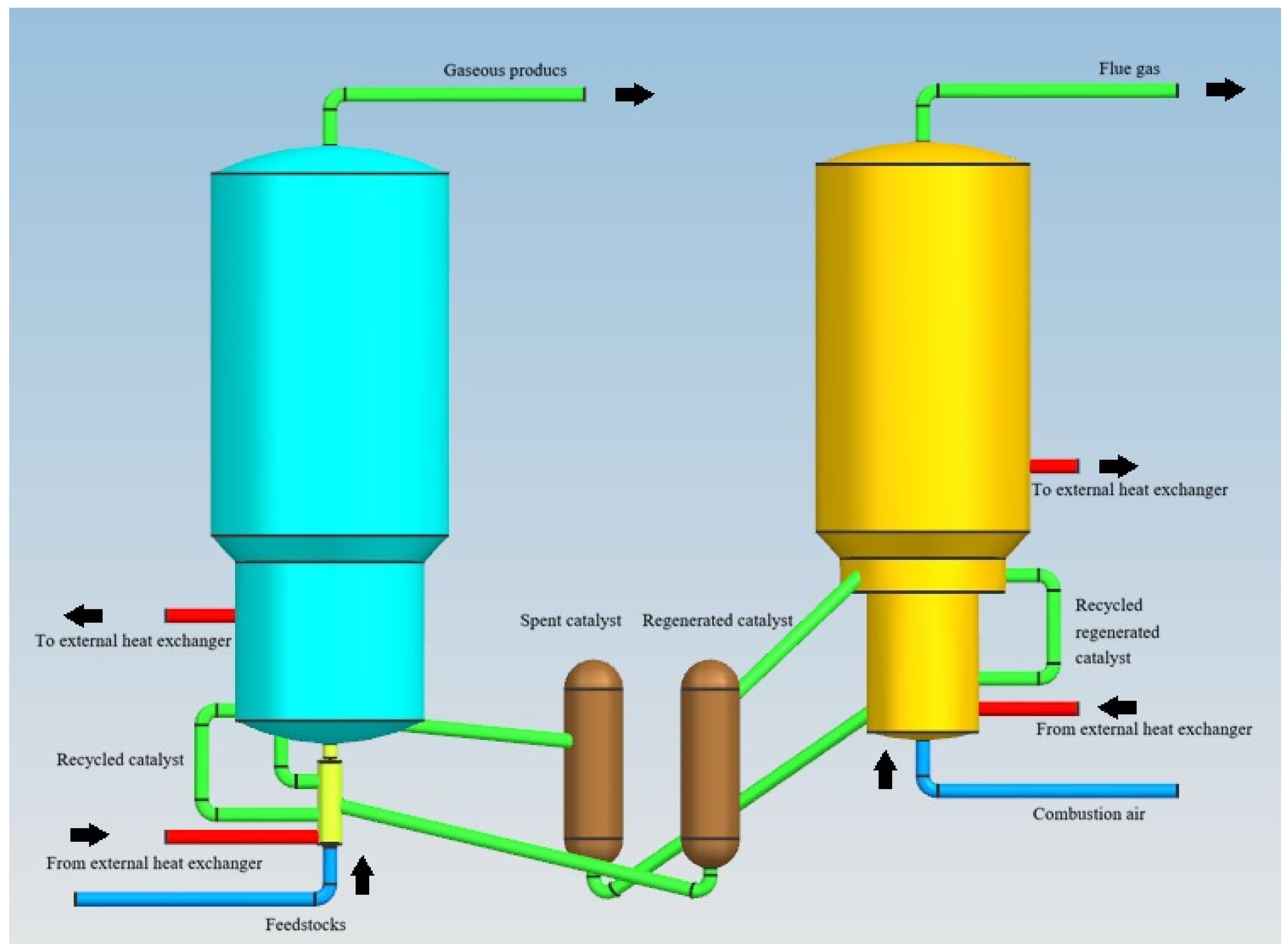
The MTO reactor comprises an upper separation zone equipped with cyclone separators and a lower reaction zone utilizing a fast-fluidized bed. Gaseous feedstocks are thoroughly mixed with the catalyst at the inlet in the lower section of the reactor, and subsequently enter the reaction zone for conversion. The product gas mixture (comprising light olefins and secondary by-products) along with the entrained catalyst enters the upper cyclones for gas-solid separation. The separated catalyst particles fall into a dense-phase fluidized bed (located in the upper reactor). A small portion of this spent catalyst is sent to the regenerator for reactivation to maintain overall catalytic activity, while the remainder returns to the reactor bottom. The regenerator’s structure mirrors that of the reactor, with coke combustion mainly occurring in its lower section. Regenerated catalyst is either fed into the reactor or recycled to the regenerator bottom. A schematic of the MTO reactor-regenerator system is shown in
Figure 1.
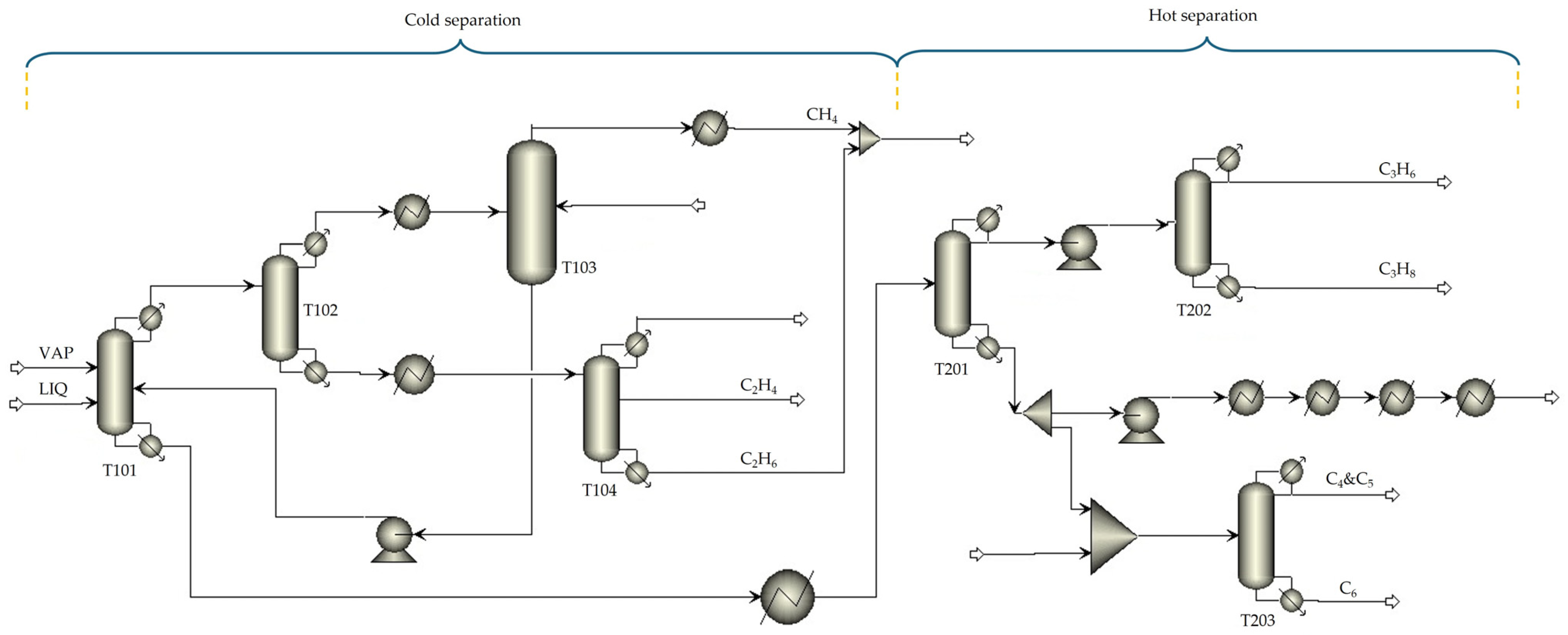
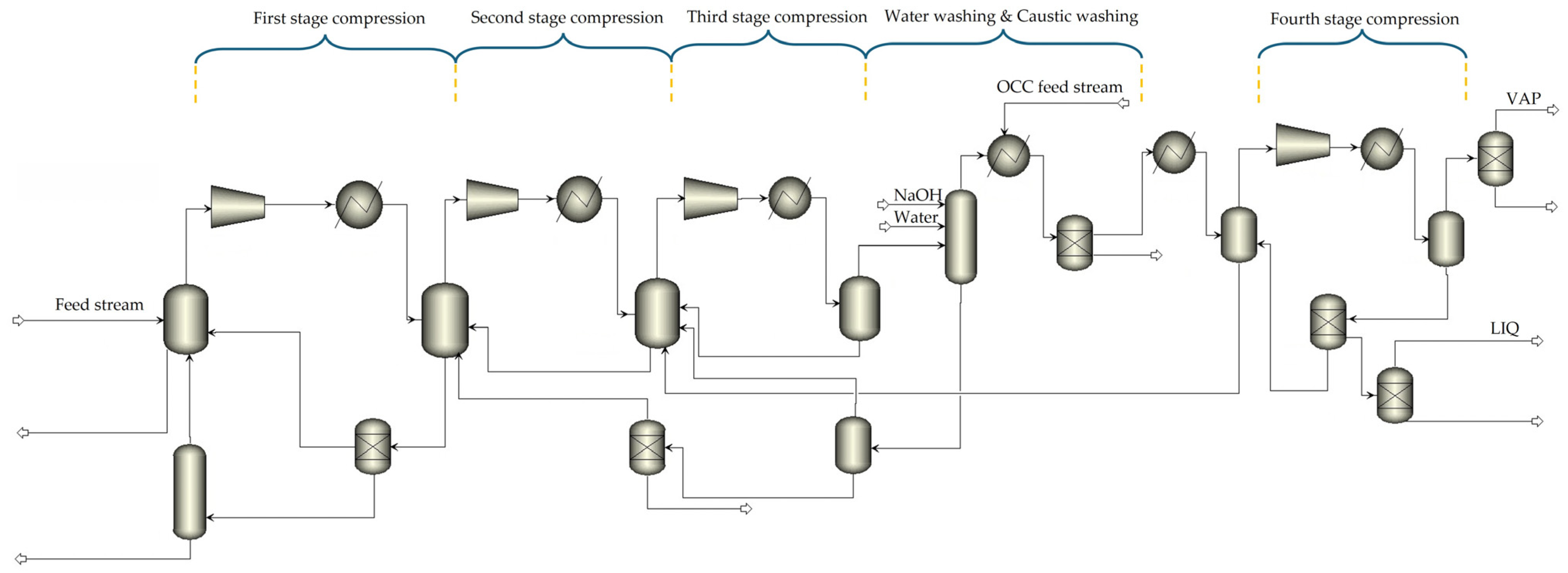
Schematics of the MTO separation system are illustrated in
Figure 2 and
Figure 3. The effluent gas from the MTO reactor undergoes three-stage compression, followed by water washing and caustic washing. It is then combined with the feed from the OCC unit, compressed in a fourth compression stage, and introduced into a separator for phase separation. The separated gas and liquid phases are dried and fed separately into the deethanizer (T101). The deethanizer overhead gas is directed to the demethanizer (T102) and the recovery tower (T103). Fuel gas is discharged from the top of the recovery tower, while the demethanizer bottoms are sent to the ethylene fractionator (T104) to yield the ethylene product. The deethanizer bottoms are directed to the depropanizer (T201), the overhead of which is fed into the propylene tower (T202) to produce propylene at the top and propane at the bottom. The depropanizer bottoms flow to the depentanizer (T203), where C
4/C
5 products are drawn from the top and heavy hydrocarbons from the bottom.
3. Reactor-Regenerator Model
Methanol conversion is characterized by rapid reaction rates and significant heat release. To prevent secondary reactions of ethylene and propylene and to mitigate further catalyst coking, rapid separation of gaseous products from the catalyst is essential. The fast-fluidized bed reactor is an ideal industrial solution, distinguished by the disappearance of the distinct dilute-dense phase interface, an axial density profile featuring a denser bottom and a dilute top, excellent gas-solid contact, high mass transfer rates, minimal gas-solid backmixing, and high equipment utilization.
3.1. Fluidized Bed Flow Regimes
Gas-solid fluidization operates under various hydrodynamic regimes, including fixed bed, bubbling bed, slugging bed, turbulent bed, fast fluidized bed, and dilute-phase pneumatic transport. The mixing mechanisms, heat and mass transfer laws, and overall reactor performance exhibit distinct characteristics across different flow regimes; therefore, accurate identification of the flow regime is a prerequisite for modeling [
15]. This MTO process utilizes a fast-fluidized bed reactor. According to the criteria proposed by Chen [
16], a fluidized bed can be classified as a fast-fluidized bed when the following conditions are met: the minimum solid circulation rate (
Gsm) is less than the actual solid circulation rate (
Gs), and the superficial gas velocity (
ug) lies between the turbulent transition velocity (
uc) and the transport velocity (
upt), i.e.,
uc <
ug <
upt.
3.2. Fast Fluidized Bed Model
The hydrodynamic model is a critical component of the integrated reactor-regenerator mathematical model. The coupled application of reaction kinetics and hydrodynamics enables the simulation and prediction of gas-solid phase distributions, product yields, and the effects of various operating conditions. Given the relatively small radial dimensions of the reactor and the low degree of radial non-uniformity, a one-dimensional axial particle entrainment model was adopted for the turbulent/fast-fluidized state. This model divides the fluidized bed axially into two regions: a dense-phase zone with uniform voidage and a dilute-phase zone where the voidage increases exponentially with height. For the regenerator model, the model proposed by Li et al. [
17] is adopted for the coke burner operating in a fast-fluidized regime. This model characterizes the axial voidage distribution in the fast-fluidized bed as an S-shaped profile (dense at the bottom and dilute at the top), with a transition zone between the two regions.
3.3. Reaction Kinetics Model
Regarding the mechanism of initial C–C bond formation from C
1 species, the hydrocarbon pool (HCP) mechanism suggests that methanol interacts with the SAPO-34 catalyst to form hydrocarbon pool species. These species are subsequently converted into light olefins, accompanied by the formation of coke. Following the methodology of Jiang et al. [
18], the MTO reaction system was categorized into 3 reactant lumps and 11 product lumps, based on data collected from the industrial unit. The reactant lumps consist of methanol, DME and higher alcohols (representing the impurities in the feedstock). The product lumps comprise methane, ethane, ethylene, propylene, propane, C
4, C
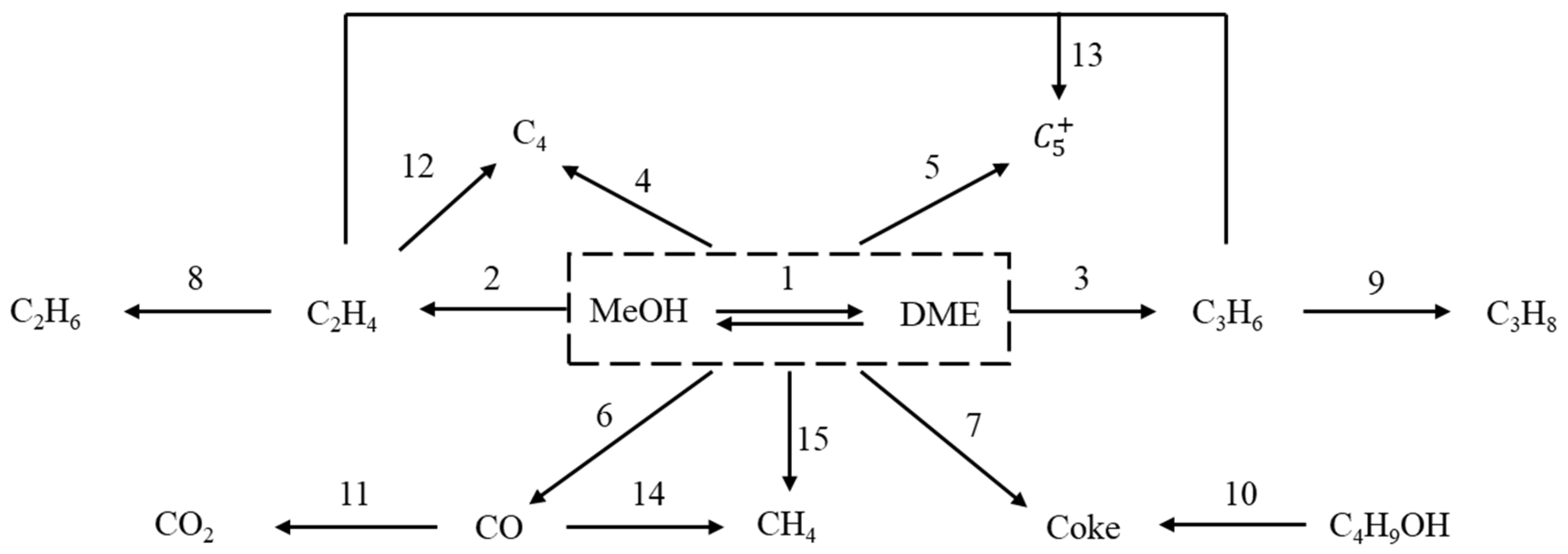
5+, carbon monoxide, carbon dioxide, hydrogen, and coke. The specific reaction network is illustrated in
Figure 4. To simplify the model, the following assumptions were made:
- (1)
Methanol and dimethyl ether (DME) undergo rapid reaction and reach chemical equilibrium under the influence of the catalyst [
19,
20,
21]. In the calculation of the methanol conversion rate, DME is treated as equivalent to methanol, and their partial pressures are considered collectively.
- (2)
Due to the structural complexity of coke, it is represented as a pseudo-species with the formula CH0.7, based on a fixed molar hydrogen-to-carbon (H/C) ratio of 0.7 to streamline the calculations.
- (3)
Minor impurities in the feed, primarily higher alcohols, are represented by butanol as a model compound. It is assumed that these impurities are completely converted into coke during the reaction process.
- (4)
This model assumes that the reactor operates under adiabatic conditions and reaches local thermal equilibrium between the gas and solid phases.
The reaction network comprises a total of 15 chemical reactions, including four reversible ones. The detailed chemical equations and kinetic rate expressions are listed in
Table 1.
The dependence of the reaction rate on temperature is described by the Arrhenius equation.
Water in the reaction system, originating from both the reaction process and the initial feed, undergoes competitive adsorption with methanol on the active sites of the catalyst. Consequently, a water adsorption resistance term (
G) is incorporated into the reaction rate equations to quantitatively characterize the inhibitory effect of water on the reaction.
Based on the principles of conservation of mass, energy, and momentum, the material balance equations for the catalytic reactions within the MTO reactor were derived, as expressed in Equation (3).
The mass balance for the non-catalytic reaction components is formulated as shown in Equation (4).
The energy balance equations are expressed in Equation (5).
The momentum balance equations are expressed in Equation (6).
where
ki0 is the pre-exponential factor for reaction, kmol·m
−3·h
−1·MPa
−n (
n is the reaction order, dimensionless);
Ea is the activation energy of reaction, kJ·kmol
−1;
R is the molar gas constant, 8.314 J·mol
−1·K
−1; T is the temperature, K;
is the adsorption equilibrium constant of water, dimensionless;
is the mass fraction of water in the reaction system;
Fj is the molar flow rate of lump
j, kmol·h
−1;
l is the distance from the reactor inlet at a given position, m;
Ω is the cross-sectional area of the reactor, m
2;
νi is the stoichiometric coefficient, dimensionless;
ε is the voidage (void fraction) of the fast-fluidized bed, dimensionless;
T is the temperature at position
l in the reactor, K;
is the enthalpy of reaction for lump
j, kJ·mol
−1;
Cpcat is the specific heat capacity of the catalyst, kJ·kg
−1;
Fcat is the catalyst flow rate, kg·h
−1;
Cpj is the specific heat capacity of lump
j, kJ·kmol
−1;
ρg is the density of the gas phase in the reactor, kg·m
−3;
g is the gravitational acceleration, 9.8 m·s
−2.
During the formulation of the conservation equations for the regenerator, the gas-solid flow in the coke burner is assumed to follow plug flow (PFR), while the upper second-stage dense-phase bed is modeled as a perfectly back-mixed flow (CSTR). The combustion of coke on the spent catalyst and regenerated catalyst within the regenerator is considered as separate processes. Given that hydrogen possesses a high combustion rate and constitutes a minor fraction of the coke, it is assumed that hydrogen combustion occurs exclusively on the spent catalyst and is fully completed within the coke burner. Furthermore, all streams at the inlets of both units are assumed to undergo instantaneous mixing and achieve thermal equilibrium. Based on these governing assumptions, the balance equations for the system can be formulated.
Catalyst regeneration is dominated by the oxidation of carbon and hydrogen within the deposited coke. Since a combustion promoter is employed to ensure the rapid conversion of CO, the reaction equations are simplified into the following steps:
The reaction kinetic equations are given as follows:
where
rC is the combustion rate of carbon,
;
kC is the reaction rate constant for carbon combustion,
;
PO2 is the partial pressure of oxygen, Pa;
wC is the mass fraction of carbon on the catalyst,
;
rH is the combustion rate of hydrogen,
;
kH is the reaction rate constant for hydrogen combustion,
;
wH is the mass fraction of hydrogen on the catalyst,
.
3.4. Solution of the Reactor-Regenerator Mathematical Model
The proposed model achieves balance calculations through solid catalyst circulation and carbon mass balance. On the reactor side, the volumetric reaction rate of coke formation is integrated over the cross-sectional area and solid holdup to yield the total mass of carbon generated. This value is subsequently divided by the total catalyst circulation rate, thereby converting the data into the carbon mass fraction of the spent catalyst. This mass fraction serves as the initial boundary condition for the integration of the regenerator model. On the regenerator side, the carbon content of the regenerated catalyst, obtained after the combustion process, is fed back to the reactor.
The mathematical modeling of the MTO reactor-regenerator section was implemented using the C++ programming language (C++17 standard [
22]) within the Visual Studio integrated development environment on a Windows 11 operating system. The Runge-Kutta method is employed for the numerical integration of the differential equations governing the MTO reactor. Given that a substantial fraction of the exiting catalyst is recycled back to the reactor inlet (either directly or following heat removal) to mix with the regenerated catalyst and the feedstock, an iterative solution of the reactor model is required. This iterative process accurately determines the catalyst carbon content and the corresponding gas-phase composition at the reactor outlet.
- (1)
On the reactor side:
The carbon content of the spent catalyst exiting the reactor is determined by the carbon content of the regenerated catalyst entering the reactor plus the additional coke generated during the reaction process:
where
wspent is the carbon content of the spent catalyst, wt%;
wregen is the carbon content of the regenerated catalyst, wt%;
L is the effective bed height of the reactor, m;
Mcoke,i is the molar mass of coke (treated as the pseudo-species CH
0.7), with a value of 12.7 kg·kmol
−1;
vcoke,i is the stoichiometric coefficient of coke in the
i-th coking reaction, dimensionless;
ri is the reaction rate of the
i-th coking reaction, kmol·m
−3·h
−1;
Ω is the effective cross-sectional area of the reactor, m
2;
ε is the local voidage, dimensionless; and
Fcat is the catalyst circulation rate, kg·h
−1.
- (2)
On the regenerator side:
The carbon content of the catalyst exiting the regenerator is determined by the coke combustion reaction:
where
H is the effective bed height of the coke burner, m;
rC is the carbon combustion reaction rate, kg
C·kg
cat−1·h
−1;
Ωre is the effective cross-sectional area of the coke burner, m
2;
ρs is the particle density of the solid catalyst, kg·m
−3; and
εre is the local voidage of the coke burner, dimensionless.
- (3)
Activity correction
is the deactivation factor for the i-th reaction [
23], and its expression is given by:
is the temperature decay coefficient for the
i-th reaction, obtained through a polynomial fitting of temperature T [
24]:
where
rreactor,actual is the corrected actual reaction rate in the reactor, kmol·m
−3·h
−1;
rintrinsic is the intrinsic reaction rate determined by temperature and partial pressure, kmol·m
−3·h
−1; and
w is the coke mass fraction of the catalyst, wt%.
ai is the basic deactivation constant for a specific reaction. Its physical essence reflects the differences in steric hindrance effects within the SAPO-34 molecular sieve catalyst during the coking process. Reactions generating large-molecule hydrocarbons are restricted by the narrowing of micropores, thus the ai value is typically larger; conversely, the reaction channels for generating small-molecule hydrocarbons are less susceptible to blockage, resulting in a smaller ai value.
- (4)
Thermodynamic parameters
The SMTO process is a highly exothermic process, and the reaction network incorporates four key reversible reactions (e.g., the equilibrium between methanol and DME, and the interconversion equilibrium of olefins). The calculation constants for isobaric molar heat capacity, standard molar enthalpy of formation, standard molar entropy, and other relevant thermodynamic properties of species in the MTO system were sourced from the works of Poling et al. [
25] and Dean [
26].
3.5. Kinetic Parameters
Within the aforementioned reactor-regenerator mathematical model, a multitude of mass, energy, and momentum balance equations are formulated based on reaction kinetic parameters and fundamental thermodynamic data. For the lumped reactions in the SMTO system, the reaction rate constants are temperature-dependent and strictly follow the Arrhenius equation.
During the long-term operation of the chemical plant, the kinetic behavior of the reaction system tends to deviate from the model under initial design conditions, primarily due to factors such as catalyst activity decay and the accumulation of impurities. To ensure the predictive accuracy of the model, it is essential to tune the kinetic parameters of the primary reactions. Consequently, four datasets from
Table 2 and
Table 3 were utilized to calibrate the kinetic parameters of the integrated reactor-regenerator model.
Simulated annealing (SA) [
27,
28] is a heuristic global optimization algorithm that mimics the physical annealing process of metals, utilizing a control parameter, “temperature,” to balance global and local search. The parameter tuning strategy in this study was to keep the activation energies from the original model constant while multiplying the pre-exponential factors by specific correction factors. These factors were optimized via the SA algorithm to achieve a high-fidelity alignment between the model predictions and industrial plant data. The parameters to be tuned are the correction factors for the pre-exponential factors of four primary reactions: methanol to ethylene, propylene, C
4, and C
5+. Each correction factor was initialized at 1, with a constrained interval of [0.95, 1.05].
The objective function is defined as follows:
where
biasi is the difference between the calculated and experimental mass fractions of product i, and
weighti is the weighting factor for product
i.
The optimization variables are the four continuous correction factors mentioned above. First, the algorithm’s control parameters were initialized, including the initial temperature
T0, the terminal temperature
Tmin, the cooling rate, and the number of iterations at each temperature level. Starting from the current combination of correction factors, a new candidate solution is generated via random perturbation and multiplied by the corresponding pre-exponential factors. The reactor model was then executed to compute the predicted mass fractions for each product. Subsequently, the new objective function value
fnew is calculated. If
fnew was lower than the current objective function value
fcurrent, the new solution was unconditionally accepted as the current solution. If the new solution was inferior, it might still be accepted with a specific probability. The acceptance probability
P was determined by the following formula:
Upon completion of the iterations at the current temperature, the temperature T was reduced at the predefined cooling rate, guiding the search process from global exploration to local convergence. The algorithm terminated when the objective function value satisfied the precision requirements or the temperature drops to Tmin. The resulting correction factors were then identified as the optimal solution. Finally, these factors were multiplied by the initial pre-exponential factors to yield the updated kinetic parameters, ensuring the refined model more accurately reflects the actual production status.
Following the parameter tuning, the pre-exponential factors
A and activation energies
Ea for each reaction in the model are summarized in
Table 4. The activation energies of the reaction system range from 50 to 150 kJ·mol
−1. Specifically, the activation energies of hydrocarbons with carbon numbers from 2 to 5 exhibit a progressively decreasing trend. In terms of magnitude, the activation energies of primary reactions are lower than those of secondary reactions.
3.6. Validation of the Reactor-Regenerator Model Predictions
To verify the accuracy of the proposed model, 4 sets of industrial measured data were selected for validation calculations. The ranges of the condition data are summarized in
Table 5. The corresponding product composition measured in the plant is shown in
Table 6. The comparison primarily focuses on the mass fractions of CH
4, C
2H
6, C
2H
4, C
3H
6, C
3H
8, C
4 and C
5+ in the product. The amounts of CO, CO
2, and H
2 in the product are very small and are expressed as volume fractions. Reactants such as MeOH, DME, and higher alcohols were almost completely converted.
After the measured operating conditions from
Table 5 were applied to the model, the mean absolute errors (MAE) between the simulated results and industrial data are summarized in
Table 7. Ethylene and propylene yields are the primary performance indicators for the MTO process. Specifically, the mean absolute relative errors for ethylene and propylene are 0.125% and 0.742%, respectively, demonstrating high predictive accuracy. For byproducts such as C
4, C
5, and propane, the absolute errors are slightly higher than those for ethylene and propylene, yet they remain within a reasonable engineering tolerance of 1 wt%. This disparity is primarily attributed to the lumping treatment of complex high-carbon hydrocarbons. In the intricate MTO reaction network, C
4 and C
5 components originate from direct methanol conversion, light olefin polymerization, and complex hydrogen transfer reactions. The errors regarding the carbon content of the spent catalyst and the H
2 yield primarily stem from the simplifying assumption that complex coke is equivalent to the pseudo-species CH
0.7. In actual industrial production, the coke composition on the catalyst surface fluctuates dynamically with operational conditions. Overall, the simulated and actual values exhibit excellent agreement, and the error levels satisfy the precision requirements for engineering simulation.
4. Multi-Factor Optimization of Reaction System
In this study, the Nelder-Mead simplex method with boundary constraints was employed to optimize the adjustable variables of the reaction system, aiming to identify the optimal combination that maximizes the total yield of ethylene and propylene.
The objective function is defined in Equation (18).
The feasible constraints are defined in Equation (19).
where
sum_yixi and
sum_bingxi are the mass percentages of ethylene and propylene, wt%;
x1 is the methanol feed rate,
;
x2 is the water-to-methanol ratio, dimensionless;
x3 is the catalyst-to-methanol ratio, dimensionless;
x4 is the feed temperature, K;
x5 is the feed pressure, MPa.
During the initialization phase, the mean values of historical operational data were used as the initial guess. A 10% perturbation was applied to each dimension to construct the initial simplex. The iterative solver employed dual convergence criteria: the search terminated when the difference in objective function values between the worst and best points in the simplex fell below the threshold Tol = 10−6, or when the maximum number of iterations (MaxIter = 200) was reached. Finally, the module outputted the parameter vector that minimized the objective function and the corresponding hydrocarbon yields.
Under the operating conditions presented in
Table 3, the reactor feed flow rate, water-to-methanol ratio, catalyst-to-methanol ratio, reactor inlet pressure, and feed temperature were selected as the variables for multi-factor optimization. The corresponding value ranges are summarized in
Table 8.
(1) Optimized parameter values
Utilizing the simplex method, the optimal operating conditions for each case were identified by using the maximization of the total ethylene and propylene yield as the objective function. The operational parameters adopted following the optimization search are presented in
Table 9.
(2) Analysis of optimization results
A comparison between the optimized simulated values and the actual plant data under the four operating conditions is presented in
Table 10. The total yield of light olefins (ethylene + propylene) increased by 1.00%, 2.22%, 2.05%, and 0.81%, respectively, compared to the actual values. The average increase in light olefin yield was 1.52%, representing an improvement over the industrial operational data. This indicates that the proposed optimization algorithm is effective for enhancing the yield of the target reaction products.
The optimized light olefin yields for the four datasets were 84.72%, 85.26%, 84.55%, and 84.66%, respectively, demonstrating favorable optimization performance. The second dataset achieved the highest yield of 85.26%. Notably, the ethylene content in the first and fourth optimized results was identical at 44.36%, with propylene contents of 40.36% and 40.30%, respectively. Despite the significant difference in their reactor inlet feed rates, their corresponding feed temperatures, pressures, and water-to-methanol ratios were similar. Furthermore, the fourth dataset featured a higher catalyst circulation rate and lower catalyst coke content, resulting in similar target product yields. While the feed rate of the second group was similar to that of the first, its target product yield was higher due to its greater external heat removal and lower coke content, which facilitated the maintenance of catalyst activity. In the third group, the lower temperature and pressure in the regenerator led to reduced regeneration efficiency. This, combined with low external heat removal in the reactor, caused the catalyst to deactivate more easily, leading to a slightly higher content of high-carbon olefins.
A comparison between the optimization results and the actual data reveals that, concurrent with the enhancement in light olefin yield, the methane content at the reactor outlet exhibits a slight increase, whereas the ethane and propane contents decrease. Given that the sole objective function of this optimization was the combined yield of light olefins, the algorithm identified the operating parameter boundaries that suppress hydrogen transfer reactions, thereby mitigating the formation of ethane and propane while preserving more olefins. Furthermore, the absence of a penalty term for alkane byproducts drove certain side reactions toward the formation of thermodynamically highly stable methane. This phenomenon is consistent with the kinetic characteristics of the hydrocarbon pool mechanism in the MTO reaction, providing insights for future in-depth research on strategies to simultaneously enhance light olefin yields and suppress reaction byproducts.
5. Separation System Simulation
The MTO process adopts a front-end deethanization technology. The simulation flowsheeting was constructed in Aspen Plus based on the actual process configuration and operational data of the industrial MTO separation section. The resulting process flow diagrams for the separation unit are illustrated in
Figure 2 and
Figure 3. The process simulation model for the separation section was developed and validated in Aspen Plus V14, utilizing Process Flow Diagrams (PFDs), Piping and Instrumentation Diagrams (P&IDs), on-site Distributed Control System (DCS) screenshots, and Laboratory Information Management System (LIMS) data collected from the MTO plant.
5.1. Property Method and Module Selection
The gas mixture in the product separation process primarily consists of olefins and alkanes, along with minor amounts of hydrogen, nitrogen, and carbon monoxide. As this is a non-polar system operating under cryogenic and high-pressure conditions typical of olefin fractionation, the RK-SOAVE property method was selected. For the caustic wash tower, which involves CO2 absorption into an alkaline solution (an electrolyte system), the ENRTL-RK thermodynamic model was employed to account for the electrolyte chemistry.
The separation equipment in the unit includes columns, dryers, and flash tanks. All distillation, absorption, caustic wash, and water wash columns were modeled using the RadFrac block. The process gas and condensate dryers, which remove moisture from hydrocarbons, were simulated using the Sep block for forced separation. Flash tanks for vapor-liquid or vapor-liquid-liquid separation were modeled using the Flash 2 block. For mixing and splitting operations, the Mixer and FSplit models were utilized, respectively. Regarding fluid transport, Compr and Pump2 modules were used to model the compressors for gas pressurization and pumps for liquid pressurization.
5.2. Validation of the Separation Model
The measured product distribution in
Table 3 was used as the feed composition for the process gas compressor. The corresponding feed flow rate of the first-stage compressor was 104.346 t·h
−1, with an inlet temperature of 42 °C and a pressure of 0.1 MPa(g). This dataset represents the actual operational status of the plant under typical load conditions, serving as the baseline for subsequent simulation calculations of the compression and separation units.
For the OCC unit under Case 2, the feed flow rate was 4.738 t·h
−1, and the specific feed composition is summarized in
Table 11.
After conducting the process simulation, a comparison between the calculated results for the main streams and the industrial operational data is presented in
Table 12. The developed model can reflect the actual operation of the industrial unit, demonstrating its capability for further process parameter optimization.
While the model predicts light components well, there is a certain deviation in the C5 mass fraction within the C4 & C5 product stream (simulated 17.96% vs. measured 24.04%). This is mainly because the Aspen Plus simulation employed a combined recovery constraint for C4 and C5 without specifying individual component constraints, causing the simulated split ratio to deviate from field data. Additionally, the upstream kinetic model prediction contributes to the underestimation of “C5+” pseudo-component. To avoid over-constraining the model, tolerating this deviation in heavy byproducts is a practical engineering trade-off that helps maintain the predictive reliability for the primary targets (ethylene and propylene).
5.3. Operating Parameters Optimization of Separation System
The Sensitivity Analysis module in Aspen Plus is a robust tool for examining how key operating and design variables influence the simulation results. By varying one or more process variables, users can investigate their impacts on other performance indicators [
29], facilitating systematic process optimization.
In this study, the cold separation section’s feed distribution was obtained by running and debugging the model using the optimized yield distribution from Case 2 (
Table 10) combined with the OCC feed distribution (
Table 11) as the inlet for the process gas compression section. Given the extensive recycle streams within the process gas compression section, including this module in the sensitivity analysis would significantly reduce computational speed. Furthermore, since this section is primarily responsible for removing water and acid gases (to 1 ppm) without achieving significant separation of other hydrocarbons, it was excluded from the sensitivity analysis scope.
Polymer-grade ethylene and propylene are the primary products of the MTO unit. Aiming to maximize olefin yields while achieving energy savings and consumption reduction, the operating parameters of the T104 ethylene tower and T202 propylene tower were analyzed using sensitivity analysis, provided that product quality remained within specifications. Specifically, the side-draw rate of the ethylene tower and the reflux ratio of the propylene tower were investigated in detail to determine the optimal operating parameters and obtain the final optimized simulation results.
5.3.1. Ethylene Tower Side-Draw Rate
The current mass fraction of the ethylene product is 99.98%, with a side-draw rate of 45.08 t·h
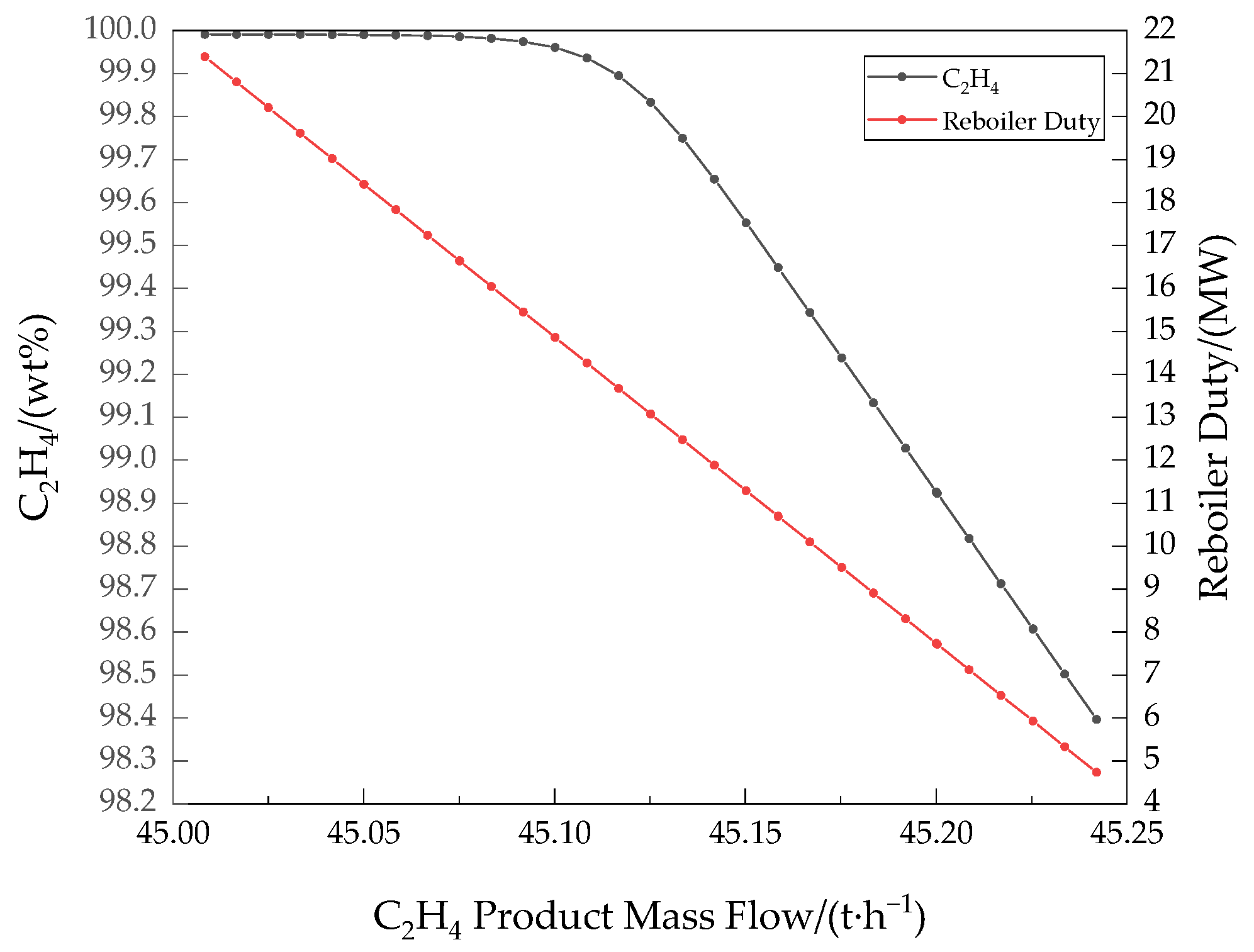
−1. Since the plant’s specification for ethylene purity is 99.95%, relaxing the product purity to the 99.95% limit facilitates an increase in ethylene output. Keeping the feed flow rate, composition, and overhead vapor draw rate of the ethylene tower constant, the effects of varying the side-draw rate on the product purity and reboiler duty were investigated. The simulation results are illustrated in
Figure 5.
As the side-draw rate increases, the reboiler duty decreases. The mass fraction of ethylene remains relatively stable initially and then drops sharply. When the side-draw rate is adjusted to 45.1 t·h−1, the ethylene purity reaches the target of 99.95%, while the reboiler duty is reduced to 14.86 MW.
It is worth noting that the remaining ~0.05% trace impurities in the optimized ethylene stream primarily consist of ethane and trace methane. These alkanes do not adversely affect the catalyst activity or final polymer quality.
5.3.2. Propylene Tower Reflux Ratio
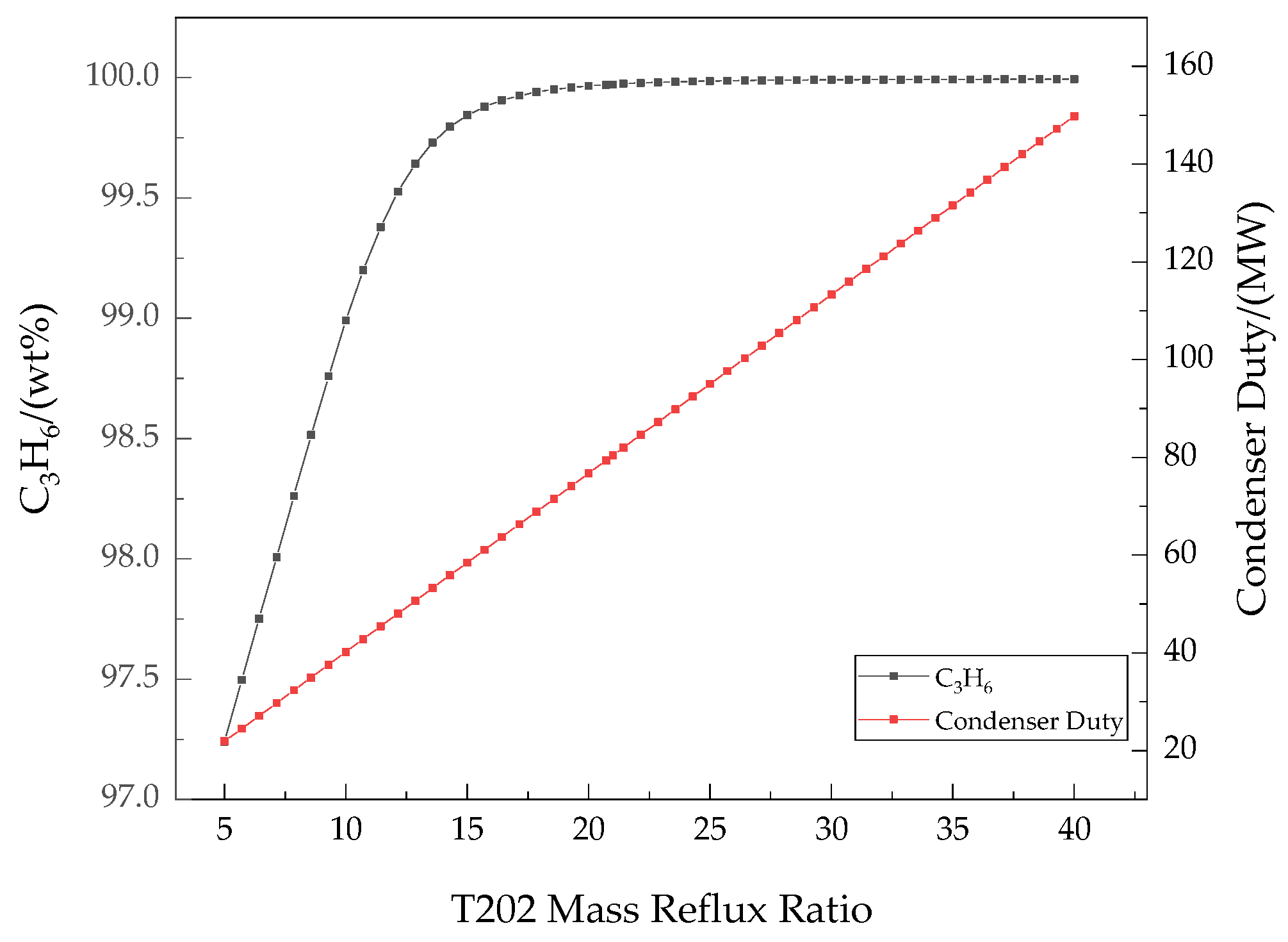
The current propylene product purity is 99.90%, which exceeds the plant’s required specification of 99.60%. Thus, the product purity can be maintained at 99.60% to enhance propylene output. Keeping the feed rate, composition, and bottoms discharge rate of the propylene tower constant, the effects of varying the reflux ratio on the product purity and condenser duty were investigated. The simulation results are shown in
Figure 6.
As the reflux ratio increases, the condenser duty rises accordingly. The mass fraction of propylene initially increases and then remains relatively stable. When the reflux ratio is set to 12.86, the propylene mass fraction reaches 99.64%, and the condenser duty is recorded at 50.63 MW.
5.4. Optimized Simulation Results
Based on the analysis above, the side-draw rate of the ethylene tower was increased from 45.08 t·h
−1 to 45.10 t·h
−1, and the reflux ratio of the propylene tower was adjusted to 12.86. The simulation results before and after optimization are presented in
Table 13. Assuming an annual operating time of 8400 h, the unit can save 1.196 × 10
8 kW·h of heat load annually, while simultaneously increasing annual ethylene production by 168 t.
Fundamentally, adjusting the purity to the exact specification limits is a process of eliminating quality over-specification. The primary benefit of this optimization is the reduction in separation energy consumption and enhanced product recovery. However, the inherent drawback is a narrowed operational buffer, requiring more precise and stable process control to handle sudden upstream fluctuations without producing off-spec products.
6. Conclusions
(1) A mathematical model for the MTO reactor-regenerator system using SAPO-34 catalyst was established based on measured plant data. The reaction kinetic parameters were optimized based on industrial measured data, and the reliability of the model’s predictions was validated. The simplex method was employed to conduct multi-factor optimization across four sets of measured operating conditions, and the maximum simulated yields of light olefins and their corresponding simulated operating parameters for each scenario were obtained. The results demonstrate that the optimized yields across all conditions were enhanced, promising higher economic benefits for industrial production.
(2) A comprehensive separation flowsheet was developed in Aspen Plus based on measured plant data, exhibiting good agreement with plant data. The simulation achieved reliable accuracy, with relative errors of 0.12% and 0.05% for the mass fractions of ethylene and propylene, respectively. Through sensitivity analysis, the operating parameters for the ethylene and propylene towers were optimized. The results indicate that the optimization can lead to an annual reduction of in heat load and an increase in ethylene production by 168 t per year.
(3) A steady-state whole-process simulation of the MTO technology has been successfully implemented, which covers all streams from the reactor inlet to the final separation stages. This integrated model provides a reference for the optimization of operating conditions and process intensification of industrial MTO units.
(4) Validated with industrial DCS and LIMS data, the model can capture the unit’s behaviors. It translates optimized parameters into actionable control setpoints, providing a practical digital framework for optimizing commercial MTO facilities.
(5) This study focuses on the steady-state simulation and optimization of the full industrial MTO process. Key limitations include the inability to capture transient dynamics during startup or shutdown, simplified micro-mechanisms due to kinetic lumping, and a single-objective focus on light olefin yield. Future work will integrate dynamic simulations and multi-objective optimizations considering global economic costs.