Article

Research on Comprehensive Evaluation Model of Virtual Power Plant Operational Benefits Based on DEMATEL-CRITIC-EDAS

1
Economic & Technology Research Institute, State Grid Shandong Electric Power Company, Jinan 370100, China
2
School of Electrical and Electronic Engineering, Shandong University of Technology, Zibo 255000, China
*
Author to whom correspondence should be addressed.
Processes 2026, 14(10), 1545; https://doi.org/10.3390/pr14101545
Submission received: 19 March 2026 / Revised: 24 April 2026 / Accepted: 5 May 2026 / Published: 11 May 2026

Abstract

Different types of Virtual Power Plants (VPPs) play distinct roles within power systems. To scientifically evaluate the operational benefits of VPPs, this paper constructs a comprehensive evaluation framework based on combined weighting and the Evaluation based on Distance from Average Solution (EDAS) method. First, an evaluation index system is established encompassing four dimensions: economic, environmental, social, and technical. Subsequently, a hybrid model integrating DEMATEL, CRITIC, Game Theory, and EDAS is proposed. Specifically, the DEMATEL method is employed to analyze the causal relationships among indicators and determine subjective weights, while the CRITIC method is used to calculate objective weights. Game Theory is then applied to optimize the combination of weights, and the EDAS method is utilized to rank the alternatives. Empirical analysis of five VPP scenarios indicates that the renewable energy accommodation rate and hardware investment costs are the core driving factors affecting operational benefits. Specifically, the renewable-energy accommodation rate exhibits the highest combined weight of 0.08, and the hardware investment cost reaches 0.07. Among the scenarios, a wind-solar-storage hybrid VPP demonstrates the optimal comprehensive performance. The results are consistent with comparative methods such as TOPSIS, verifying the reliability of the proposed framework and providing a scientific reference for VPP investment decision-making.

1. Introduction

1.1. Background and Motivation

Against the backdrop of the global green and low-carbon energy transition, the penetration rate of wind power and photovoltaics (PV) has increased significantly. However, the inherent instability and intermittency of wind and solar energy have increasingly challenged the safe, stable, and economic operation of power grid systems [1]. Consequently, Virtual Power Plants (VPPs) have emerged as a vital solution. By utilizing distributed energy management systems, VPPs aggregate and coordinate geographically dispersed renewable energy sources, controllable loads, and energy storage systems. Acting as a special type of power plant, they participate in power system operations, playing a crucial role in reducing generation losses and peak loads, improving power supply reliability, and promoting the optimal allocation of resources [2].
With the acceleration of electricity market reforms, VPPs can participate in electricity energy markets and ancillary service markets. To comprehensively evaluate the operational benefits of VPPs in a multi-market environment, numerous scholars domestically and abroad have conducted research focusing on two aspects: the construction of evaluation index systems and the application of evaluation models [3,4,5].

1.2. Literature Review and Research Gap

The construction of VPPs requires significant capital investment in installing intelligent equipment and developing operational platforms; therefore, a comprehensive assessment of VPP benefits is of great significance for practical engineering construction and investment operations. Regarding economic benefits, VPP construction can save investments in generation capacity and transmission/distribution infrastructure, while generating revenue through participation in electricity markets and grid operations [6]. Regarding social benefits, VPPs enhance power supply reliability and guide users to participate in demand response, facilitating coordination between source, grid, and load, thereby improving the operational efficiency of the power system [7,8,9]. Regarding environmental benefits, VPPs contribute to energy conservation, emission reduction, and land resource savings, providing valuable references for enterprises to achieve emission targets and for governments to conduct land-use planning [10,11].
Recent studies have advanced VPP research through metaheuristic scheduling for cost reduction [12] and stochastic frameworks for capacity evaluation under uncertainty [13]. However, these works primarily focus on operational scheduling or capacity credit, while lacking a holistic evaluation framework that simultaneously integrates economic, environmental, social, and technical dimensions.
Regarding the selection of index evaluation methods, subjective weighting methods rely on expert scoring based on experience and possess a high degree of professionalism. They are widely used in the evaluation of new power systems [14]. However, subjective weighting methods are inherently prone to subjective bias. Consequently, scholars have introduced objective weighting methods, which are data-driven and utilize mathematical algorithms to determine weights, thereby reducing subjective influence [15,16]. For instance, Huang proposed a dynamic weighting method that enhanced model accuracy and stability [17].
In summary, existing literature exhibits three main limitations: (1) simple linear averaging of subjective and objective weights fails to reconcile conflicts between expert knowledge and empirical data; (2) current indicator systems lack a unified framework that comprehensively integrates economic, environmental, social, and technical dimensions; and (3) single-ideal-point ranking methods are vulnerable to extreme values, compromising the robustness of results. To bridge these gaps, this paper proposes a hybrid DEMATEL–CRITIC–Game Theory–EDAS framework.

1.3. Contribution

The main contributions of this paper are as follows:
(1)
A comprehensive evaluation index system for VPPs is constructed, integrating 18 indicators across economic, environmental, social, and technical dimensions to support multi-stakeholder decision-making.
(2)
A hybrid weighting model is proposed. It employs Game Theory to optimally balance subjective expert knowledge and objective data-driven information, overcoming the limitations of simple linear averaging.
(3)
A robust ranking approach using the EDAS method is adopted to mitigate biases from extreme-value indicators. The proposed framework’s effectiveness and robustness are validated across five real-world VPP scenarios through comparison with established MCDM methods.

1.4. Paper Organization

The remainder of this paper is organized as follows: Section 2 constructs the evaluation index system for the comprehensive benefits of VPPs; Section 3 establishes the combined evaluation model for VPP comprehensive benefits; Section 4 presents a case study and comparative analysis; and Section 5 concludes with key findings and recommendations.

2. Evaluation Index System for the Comprehensive Benefits of Virtual Power Plants

2.1. Virtual Power Plant Architecture

The 18 indicators across the four dimensions were jointly determined through a combination of expert interviews and a systematic literature review. Specifically, a panel of five senior experts in power-system planning and VPP operation was consulted to elicit practically relevant criteria, and the candidate set was further screened against more than 30 papers on VPP/DER benefit assessment published in the last five years, retaining only those indicators that are (i) quantifiable, (ii) non-redundant, and (iii) consistently reported in both academic and industrial practice. The architecture is showed in Figure 1.

2.2. Economic Benefits

At the economic level, the operational benefits of a Virtual Power Plant (VPP) primarily consist of two dimensions: investment cost structure and operational revenue models [18].
(1)
Operating Costs (B11):
VPP operation requires daily operation and maintenance (O&M), mainly including platform maintenance and intelligent equipment upkeep. Associated costs include wages for maintenance personnel and equipment replacement fees. Labor and O&M costs collectively constitute the VPP operating cost, which, like investment costs, is classified as a fixed cost.
(2)
Hardware and Software Investment Costs (B12):
Putting a VPP into actual operation requires equipment upgrades as a foundational requirement, involving core projects such as energy storage facilities and the intelligent reconstruction of communication equipment. These form the main components of hardware investment. Additionally, VPP operation requires the development of corresponding platforms, including control center construction, thereby incurring software investment costs.
(3)
Spot Market Revenue (B13):
The operational revenue of a VPP includes returns from participating in the electricity market. As a “market-oriented generation unit,” a VPP aggregates distributed power sources and energy storage resources to participate in day-ahead market bidding. It utilizes energy storage to charge during low-price periods and discharge during high-price periods, while using distributed photovoltaic generation to smooth spot market prices [19].
(4)
Ancillary Service Revenue (B14):
Peak-shaving revenue is derived from the economic returns of peak-shaving and valley-filling services. Frequency regulation revenue consists of mileage compensation based on response speed assessment provided for reserve capacity.
(5)
Capacity Compensation Revenue (B15):
The capacity compensation mechanism involves a unified capacity price set in advance by regulators, providing compensation to power generation enterprises during the capacity delivery year to help recover fixed costs. VPPs, by aggregating resources like distributed power and storage, play a crucial role in enhancing power supply assurance, promoting renewable energy accommodation, and improving the electricity market system, thus qualifying for certain capacity compensation.

2.3. Environmental Benefits

(1)
CO2 Emission Reduction (B21):
Traditional power generation relies on continuous fossil fuel consumption, leading to significant greenhouse gas emissions. As an aggregation management platform for distributed energy, a VPP reduces carbon emissions by optimizing unit output strategies and effectively integrating renewable energy [20]. In environmental benefit assessments, CO2 emissions are typically used as a core evaluation indicator.
(2)
SO2 Emission Reduction (B22):
Traditional coal-fired power plants release pollutants such as sulfur oxides during generation, with emission intensity positively correlated with coal consumption. This paper constructs the “Sulfur Dioxide Emission Reduction” as a core evaluation indicator, defined as the percentage ratio of the reduction in sulfur oxide emissions under the VPP collaborative scheduling mode compared to the baseline emissions of the traditional independent generation mode.
(3)
NOx Emission Reduction (B23):
In traditional fossil fuel generation, fuel combustion produces atmospheric pollutants such as nitrogen oxides. This paper proposes the “Nitrogen Oxide Emission Reduction” as a core evaluation parameter, characterizing the pollutant reduction effect achieved through VPP resource optimization.
(4)
Renewable Energy Accommodation Rate (B24):
The renewable energy accommodation rate indicates the VPP’s ability to accept wind and photovoltaic (PV) power, defined as the proportion of wind and PV generation to the total VPP generation. To avoid double counting, this study uses the actual generation of internal VPP units as the calculation basis, excluding factors such as energy storage systems, electric vehicle discharging, and external grid power purchases.

2.4. Social Benefits

(1)
Job Creation (B31):
VPP construction and operation can bring significant employment promotion effects to regional economic development. To quantify the labor market driving effect of the project, this paper adopts the number of jobs created as a core evaluation parameter [21].
(2)
End-User Satisfaction (B32):
End-user satisfaction is a core indicator for measuring the quality of VPP power supply services. Its value directly reflects the users’ perception level of power supply quality.
(3)
Land Resource Savings (B33):
Compared to traditional coal-fired power plants, VPPs have significant advantages in land resource utilization efficiency. This paper proposes “Site Area Saving Rate” as an evaluation indicator, defined as the ratio of the physical space required by the VPP system to the plant area of a traditional power plant under the same generation capacity. This indicator quantifies the improvement effect of the new power system in the intensive use of land resources [22].
(4)
Contribution to Regional Economic Development (B34):
The large-scale operation of VPPs has a significant pulling effect on the regional economy. To quantify its economic contribution level, this study selects the ratio of the VPP’s total revenue during the operation period to the regional Gross Domestic Product (GDP) as a core evaluation indicator. This objectively reflects the VPP’s promoting role in regional economic development.
(5)
Output Reliability (B35):
Affected by the inherent intermittency of wind and PV power, deviations occur between the actual VPP output and the planned output during intraday operations. Excessive output deviations not only threaten the stable operation of the grid system but also lead to high economic penalties. To eliminate the impact of double counting, this study uses the average output deviation of generation data to represent the output reliability of the VPP during operation [23].

2.5. Technical Aspects

(1)
Demand Response Volume (B41):
Demand response volume is a key basis for assessing the VPP’s ability to participate in grid peak-shaving services. By integrating data labels such as user electricity consumption characteristics and consumption behavior patterns, this indicator effectively reflects the dispatchable characteristics of the load side. Specifically, the demand response potential assessment system mainly includes four dimensions: load adjustability identification, maximum regulation capacity calculation, sustainable response time assessment, and dynamic response rate analysis. These parameters jointly constitute the core capability indicators for VPP participation in the ancillary service market [24].
(2)
Demand Response Load Share (B42):
The demand response load share is a critical parameter for measuring the resource aggregation capability of a VPP. By quantifying the utilization efficiency of dispatchable load resources, this indicator objectively reflects the collaborative operation level of the VPP. With the deepening application of VPP collaborative control technologies, the aggregated adjustable load capacity shows a significant growth trend, making the demand response load share an important basis for evaluating the degree of energy resource allocation optimization [25].
(3)
Response Time (B43):
Response time refers to the time period from the moment a regulation instruction is received to the moment the instruction is fully executed, reflecting the system response capability of the VPP. This indicator directly reflects the auxiliary operation efficiency of the VPP. In typical application scenarios such as load peak-shaving and valley-filling, grid safety support, and system frequency regulation, a shorter response time indicates more significant comprehensive operational efficiency. Shorter response times imply that the system can balance power supply and demand more efficiently, possessing significant performance advantages in enhancing grid operation stability and renewable energy accommodation capabilities.
(4)
Regulation Compliance Rate (B44):
This refers to the ratio of grid dispatch instructions successfully completed by the VPP within a specified time period. It comprehensively reflects the VPP’s coordination control precision over aggregated resources, dynamic response speed, and system dispatchability. It is a core indicator for measuring its response capability and ancillary service efficiency [26,27]. Table 1 shows the evaluation index system for comprehensive benefits of virtual power plants.

3. Methodology

3.1. DEMATEL

The DEMATEL method serves as a multi-criteria decision analysis tool. Its core lies in revealing key influencing factors within complex systems through system modeling. Developed by the Battelle Memorial Institute’s Geneva Research Center in the early 1970s based on graph theory and matrix theory, this method provides a structured analysis framework for decision-makers by quantifying the interactions among system elements. In the proposed hybrid model, DEMATEL is used to uncover the deep causal mapping relationships among indicators, thereby providing a scientifically grounded source of subjective weights for the subsequent Game-Theory-based weight combination. In the research of VPP business model operational benefit evaluation, this method can effectively identify key elements affecting system performance and their action paths. Its basic operational process includes the following five steps:
Step 1: Determine the evaluation element system based on research objectives, and then establish the initial direct causal relationship matrix through expert discussion or qualitative assessment.
Step 2: Perform normalization operations on the original direct influence matrix to eliminate dimensional differences and obtain the “Normalized Direct Influence Matrix,” ensuring all elements are on the same scale:
C ( i , j ) = A ( i , j ) Min   Value Max   Value Min   Value
Step 3: Calculate the “Total Relation Matrix” based on the aforementioned “Normalized Direct Influence Matrix.” The “Total Relation Matrix” is a matrix used to comprehensively consider the degree of mutual influence between various factors. It combines information from the “Normalized Direct Influence Matrix” to provide a more comprehensive understanding of the comprehensive impact of various factors on the evaluation object. This matrix contains both direct and indirect influence relationships between elements:
T ( i , j ) = C ( i , j ) × [ I C ( i , j ) ] 1
where I denotes the identity matrix of the same dimension as the normalized Direct Influence Matrix.
Step 4: Calculate four indicators for each element using the Total Relation Matrix: Influence Degree, Influenced Degree, Centrality, and Causality. Among them, Centrality reflects the comprehensive importance of the element in the system, while Causality characterizes the driving attribute of the element. These metrics help understand the relative importance of various factors. The specific calculation formulas are as follows:
(1)
Influence Degree:
f i = j = 1 i T ( i , j ) , ( i = 1 , 2 , 20 )
(2)
Influenced Degree:
e i = j = 1 i T ( j , i ) , ( i = 1 , 2 , 20 )
(3)
Centrality:
M i = f i + e i , ( i = 1 , 2 , 20 )
(4)
Causality:
N i = f i e i , ( i = 1 , 2 , 20 )
Step 5: Based on the weighting results, analyze which factors have the greatest impact on the entire system, and identify core driving elements and key result elements based on the analysis results.

3.2. CRITIC Model

When conducting a comprehensive evaluation of a Virtual Power Plant (or energy storage, power system, etc.), it is necessary to construct an evaluation system containing multiple sub-indicators. To determine the proportion of each indicator in the total evaluation, a scientific weighting method must be adopted.
Weighting methods are mainly divided into subjective weighting methods and objective weighting methods. Subjective weighting methods rely on expert scoring and are susceptible to personal experience and preferences; objective weighting methods rely entirely on the original data of the evaluation indicators, determining weights through mathematical calculations, thereby eliminating human interference and producing more objective results.
This paper selects the CRITIC model (CRiteria Importance Through Intercriteria Correlation) to determine the weights of evaluation indicators. This method is a more comprehensive objective weighting method than the traditional entropy weight method. Its basic operational process includes the following five steps:
Step 1: Data Dimensionless Processing: Since the units and dimensions of various indicators are different, they cannot be compared directly. First, the original data needs to be standardized to map all data to the [0–1] interval. The specific calculation formulas are as follows:
(1)
For Benefit (Positive) indicators:
x i j = x i j x min , j x max , j x min , j
(2)
For Cost (Negative) indicators:
x i j = x max , j x i j x max , j x min , j
where x i j is the standardized data; xmax,j and xmin,j are the maximum and minimum values of the j-th indicator in all samples, respectively.
Step 2: Calculate Indicator Contrast Intensity: Contrast intensity is used to measure the difference in values of the same indicator across different evaluation samples, reflecting the indicator’s ability to “distinguish.” To automatically identify and reward indicators that distinguish well while penalizing those that cannot distinguish pros and cons based on objective data, the contrast intensity is represented by the standard deviation σj of the standardized data:
σ j = 1 m j = 1 m ( x i j x ¯ j ) 2
where x ¯ j is the average value of the j-th indicator after standardization.
Step 3: Calculate Indicator Conflict: Conflict is used to measure the correlation between one indicator and other indicators, i.e., the degree of information overlap. If an indicator is highly positively correlated with other indicators, it implies that the information it reflects is redundant, its “uniqueness” is weak, and it should be assigned a lower weight. The conflict Rj of an indicator is represented by its correlation with all other indicators. First, calculate the n × n Pearson correlation coefficient matrix, where elements represent the correlation coefficient between indicator j and indicator k. The specific calculation formula is as follows:
R j = k = 1 n ( 1 r j k )
Step 4: Calculate Information Quantity: The objective importance of an indicator should depend on both its “discriminating power” and “information uniqueness.” The CRITIC model multiplies the contrast intensity obtained in the second step by the conflict obtained in the third step to obtain the comprehensive information quantity of the indicator. The specific calculation formula is as follows:
C j = σ j × R j = σ j k = 1 n ( 1 r j k )
Step 5: The comprehensive information quantity calculated in the fourth step only represents the absolute information content of each indicator and is not the final weight coefficient. To obtain a weight vector satisfying the conditions, the comprehensive information quantity needs to be normalized. The specific calculation formula is as follows:
W j = C j j = 1 n C j
Through the above steps, the objective weights of n evaluation indicators W = (W1, W2, …, Wn) can be obtained.

3.3. Game Theory Combined Weighting

Game theory, also known as Strategy Theory in Operations Research, mainly studies the strategic interaction mechanisms of decision-making subjects with competitive relationships under established rule frameworks. As an important branch of mathematics and an emerging field in modern operations research, its theoretical system has been widely applied in economics, computer science, management science, and political science.
The core goal of this theory is to explore ways for game subjects to maximize benefits in strategic interactions and to seek optimal solutions for multi-party interest equilibrium. Specifically, game behavior refers to a strategic interaction process with competitive attributes. To maximize their own interests under established rules, participants must comprehensively consider the potential strategic choices of other participants and formulate optimal decision plans accordingly. The specific calculation method is as follows:
From the perspective of game theory, the optimal solution is obtained when the sum of deviations between W1, W2 and the combined weight is minimized. Therefore, let the combined subjective and objective weight W be:
W * = ω 1 * ω 2 * ω j * = λ 1 * ω 1 + λ 2 * ω 1 λ 1 * ω 2 + λ 2 * ω 2 λ 1 * ω j + λ 2 * ω j
where λ1 is the subjective weight coefficient for the combined weighting method; λ2 is the objective weight coefficient.
Step 1: Establish the objective function and constraints:
min ( | | W W 1 | | 2 + | | W W 2 | | 2 ) = min ( | | λ 1 W 1 + λ 2 W 2 W 1 | | 2 + | | λ 1 W 1 + λ 2 W 2 W 2 | | 2 )
s . t .       λ 1 + λ 2 = 1 , ( λ 1 , λ 2 0 )
Step 2: Solve for constraints.
The system of equations is derived as:
λ 1 W 1 T W 1 + λ 2 W 1 T W 2 = W 1 T W 1 λ 1 W 2 T W 1 + λ 2 W 2 T W 2 = W 2 T W 2
Step 3: Normalization. After normalizing λ1, λ2, the combined weight W* is obtained.

3.4. EDAS Model

EDAS (Evaluation based on Distance from Average Solution) is an efficient Multi-Criteria Decision Making (MCDM) method. The core idea is to rank alternatives by calculating the distance of each alternative from the average solution of all alternatives. Unlike other MCDM methods, the EDAS model uses the average solution as a benchmark, which in some cases better reflects the central tendency of the dataset. The model’s calculation process is relatively simple and stable, making it especially suitable for scenarios requiring comprehensive evaluation and ranking of a set of alternatives. Its specific steps are as follows:
Step 1: Construct Initial Decision Matrix X: First, construct an m × n dimensional decision matrix X, where element xij represents the evaluation value of alternative i under criterion Cj. The decision matrix is:
X = x 11 x 12 x 1 n x 21 x 22 x 2 n x m 1 x m 2 x m n
Step 2: Calculate the Average Solution (AV): Calculate the average value AVj of all alternatives under each criterion Cj and construct the average solution vector AV. The specific calculation formula is as follows:
A V = [ A V 1 , A V 2 , , A V n ]
A V j = i = 1 m x i j m
Step 3: Calculate Positive Distance from Average (PDA) and Negative Distance from Average (NDA): Based on the type of criterion (Benefit type or Cost type), calculate the Positive Distance PDAij and Negative Distance NDAij of each alternative i from the average solution AV under criterion j.
For Benefit-type criteria, the specific formulas are:
P D A i j = max ( 0 , ( x i j A V j ) ) A V j
N D A i j = max ( 0 , ( A V j x i j ) ) A V j
For Cost-type criteria, the specific formulas are:
P D A i j = max ( 0 , ( A V j x i j ) ) A V j
N D A i j = max ( 0 , ( x i j A V j ) ) A V j
Through this step, the Positive Distance Matrix (PDA) and Negative Distance Matrix (NDA) can be obtained.
Step 4: Using the PDA and NDA matrices obtained in Step 3, combined with the criterion weights W*, calculate the Weighted Sum of Positive Distances SP and Weighted Sum of Negative Distances (SN) for each alternative i. The specific calculation formulas are:
S P i = j = 1 n w P D A i j ( i = 1 , 2 , , m )
S N i = j = 1 n w N D A i j ( i = 1 , 2 , , m )
SP reflects the comprehensive degree to which alternative i is superior to the average level, while SN reflects the comprehensive degree to which it is inferior to the average level.
Step 5: Normalize SP and SN: To eliminate dimensional influence and make different alternatives comparable, normalize SP and SN to obtain Normalized Positive Distance (NSP)and Normalized Negative Distance (NSN). The specific calculation formulas are:
N S P i = S P i max i ( S P i )
N S N i = 1 S N i max i ( S N i )
Step 6: Calculate Appraisal Score (AS) and Rank: Finally, calculate the Appraisal Score (ASi) for each alternative i. AS is the average value of NSP and NSN, synthesizing information on how the alternative is both superior and inferior to the average solution. The specific calculation formula is:
A S i = 1 2 ( N S P i + N S N i )
The range of AS is [0,1]. A larger AS value indicates a better alternative Ai. The final decision result is obtained by ranking all alternatives in descending order based on their AS values.
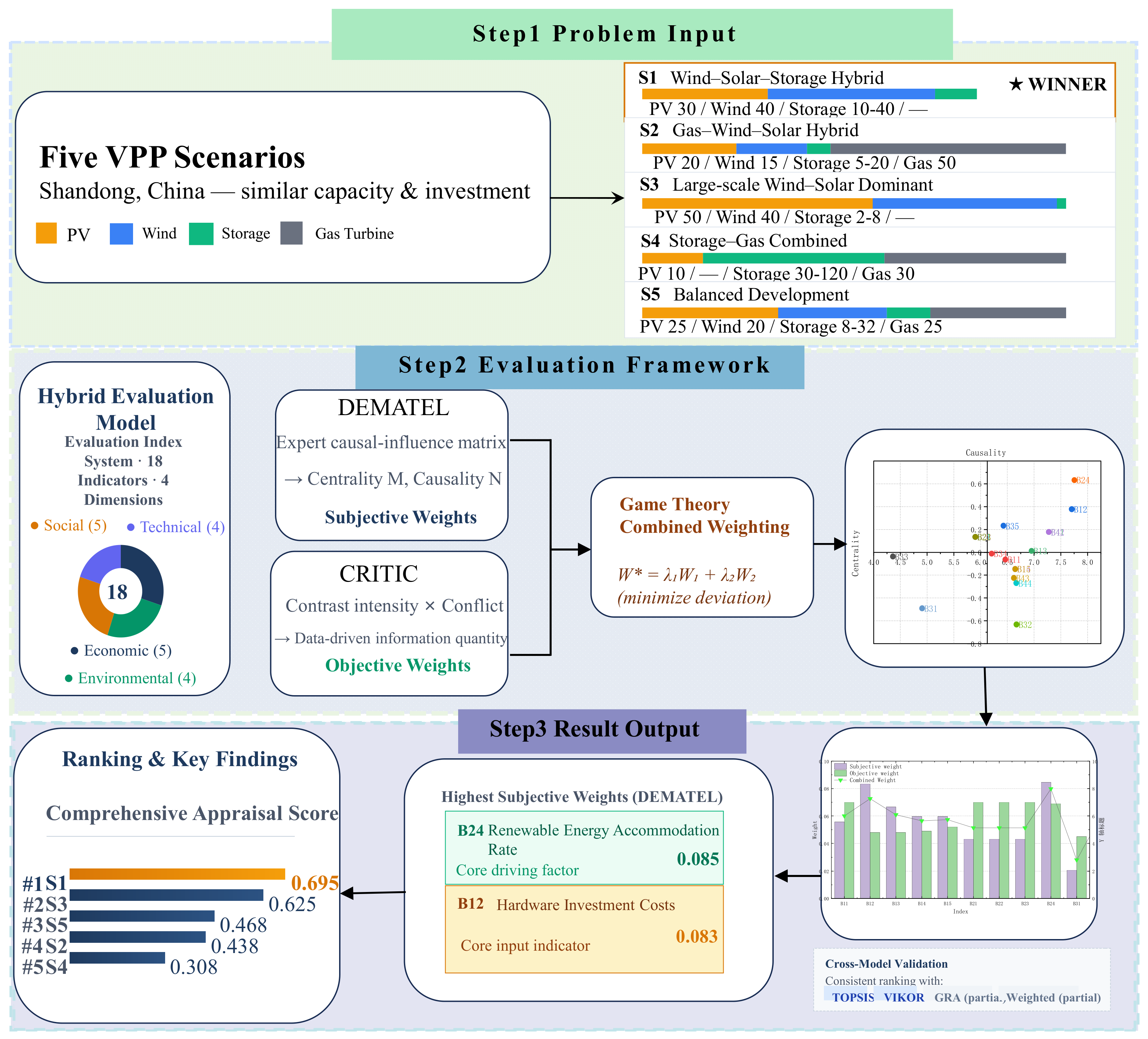
The overall research framework of the article is shown in Figure 2.

4. Case Study Analysis

4.1. Problem Statement

Currently, the installed capacity of new energy sources such as wind and solar power in China is increasing rapidly, and Virtual Power Plants (VPPs), as key supporting entities in the new power system, are in a stage of rapid development. Five VPPs with similar investment amounts and total installed capacities have been constructed in a certain region of Shandong Province. To select the VPP with the optimal comprehensive benefits, this paper applies the proposed operational benefit evaluation framework to this case. As shown in Table 2, the five VPP scenarios (S1–S5) differ substantially in their source-side composition and storage/gas-turbine configuration. S1 is a pure wind–solar–storage hybrid; S2 adds a modest share of gas turbines; S3 is a renewable-dominant plant with minimal storage; S4 is a storage–gas combined plant; and S5 represents a balanced configuration. The energy storage system (ESS) adopted in all scenarios has a 4 h duration. The notation “10/40” thus denotes a 10 MW/40 MWh ESS unit; other entries follow the same power/energy convention. These design differences provide a realistic testbed for the proposed evaluation framework.
To determine the subjective weights and resolve the quantification of qualitative indicators, an expert committee was established with five members. Each expert is required to have over two years of experience related to VPP project operations and be capable of making accurate judgments on different projects, thereby ensuring the rationality of subjective indicator weight settings and qualitative indicator quantification. The decision-making process is as follows.

4.2. Subjective Weights

The 5 members of the expert committee were invited to systematically evaluate the correlations within the VPP business model operational benefit evaluation index system. The DEMATEL method was used to quantify the intensity of interactions between indicators and determine the weight coefficients of indicators at each level. The questionnaire used a 5-point scale (0, 1, 2, 3, 4) to reflect the degree of influence between indicators, as shown in Table 3. Based on statistical analysis results, this paper uses the arithmetic mean of the mutual influence relationships between indicators as the basis for constructing the direct influence matrix.
Among them, the statistics of linguistic variables by Expert 1 are shown in Table 4.
Based on Table 3, the linguistic evaluation variables from the experts were converted into corresponding numerical values. The subjective weights (wj) were calculated in three steps:
(1)
converting expert linguistic ratings into a direct-influence matrix (Equation (1));
(2)
computing the Influence Degree (D), Influenced Degree (C), Centrality (M = D + C), and Causality (N = DC) for all 18 indicators (Equations (3)–(6));
(3)
normalizing the Centrality values to obtain the final weights. The complete results are summarized in Table 5.
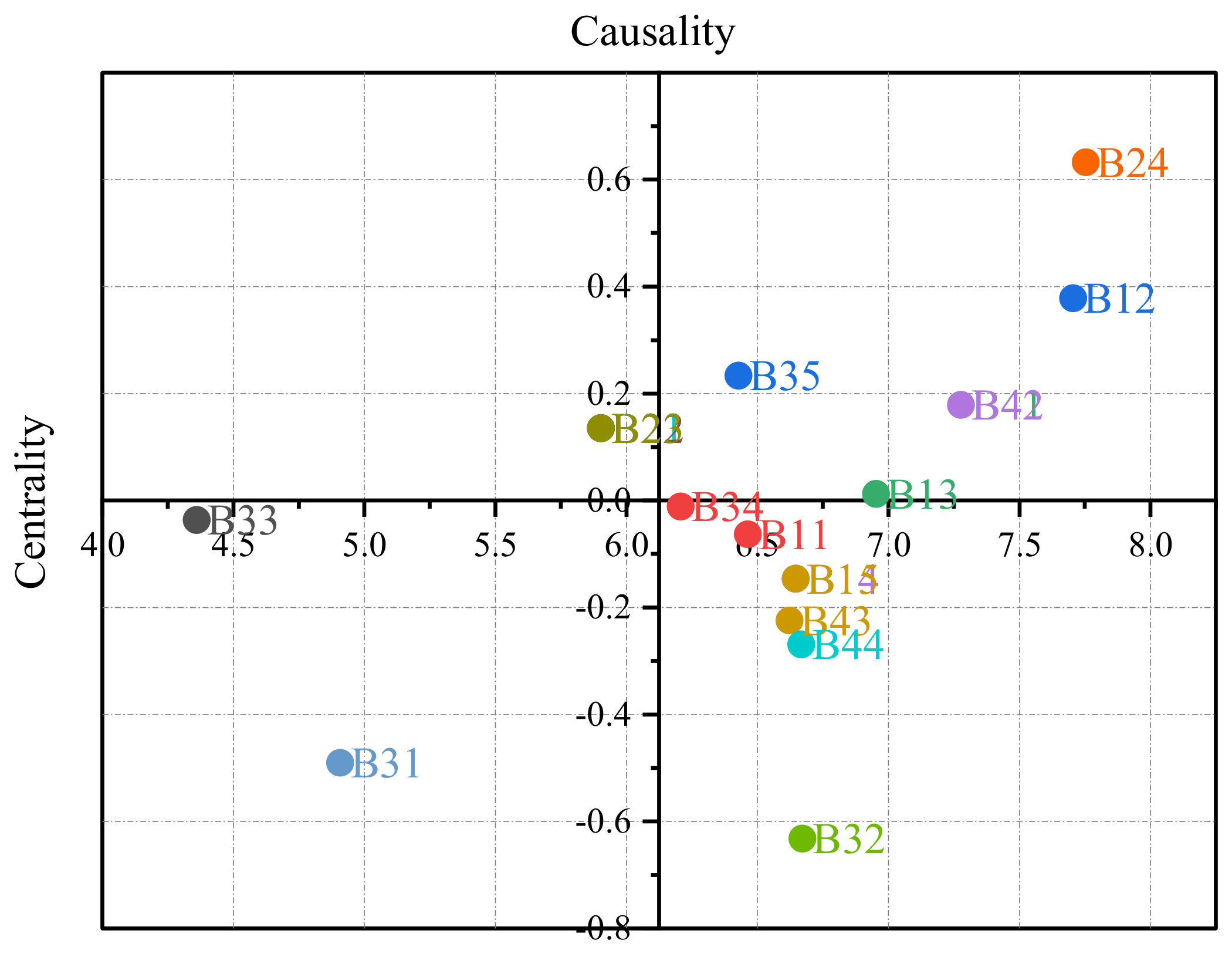
Quadrant I (High Centrality, High Causality): These are the core driving factors of the entire VPP benefit evaluation system. These indicators (B12, B13, B24, B35, B42) are not only critical themselves but their changes strongly influence and determine the performance of multiple other indicators in the system.
Quadrant II (Low Centrality, High Causality): These are causal factors (e.g., B23) that influence other indicators but are not the core hubs of the system due to lower centrality.
Quadrant III (Low Centrality, Low Causality): These are result factors with low importance. They are terminal manifestations influenced by other indicators and have limited impact on the comprehensive benefit of the entire system.
Quadrant IV (High Centrality, Low Causality): These are key result factors (B11, B15, B32, B34, B43, B44). They represent the ultimate performance of VPP benefits but cannot be directly changed; instead, they rely highly on improvements in Quadrant I and II indicators.
It can be seen that indicators in Quadrants I and IV determine the direct benefits of the VPP and are assigned higher weights.
The Centrality-Causality plot classifies indicators into four managerially significant quadrants:
Quadrant I (High centrality, positive causality): Driving factors—the system’s root drivers, warranting priority in VPP planning and policy design.
Quadrant II (Low centrality, positive causality): Independent drivers—autonomous inputs that can be independently controlled.
Quadrant III (Low centrality, negative causality): Independent outcomes—peripheral indicators with weak systemic feedback.
Quadrant IV (High centrality, negative causality): Driven outcomes—indicators reflecting the overall VPP state, serving as key monitoring targets.
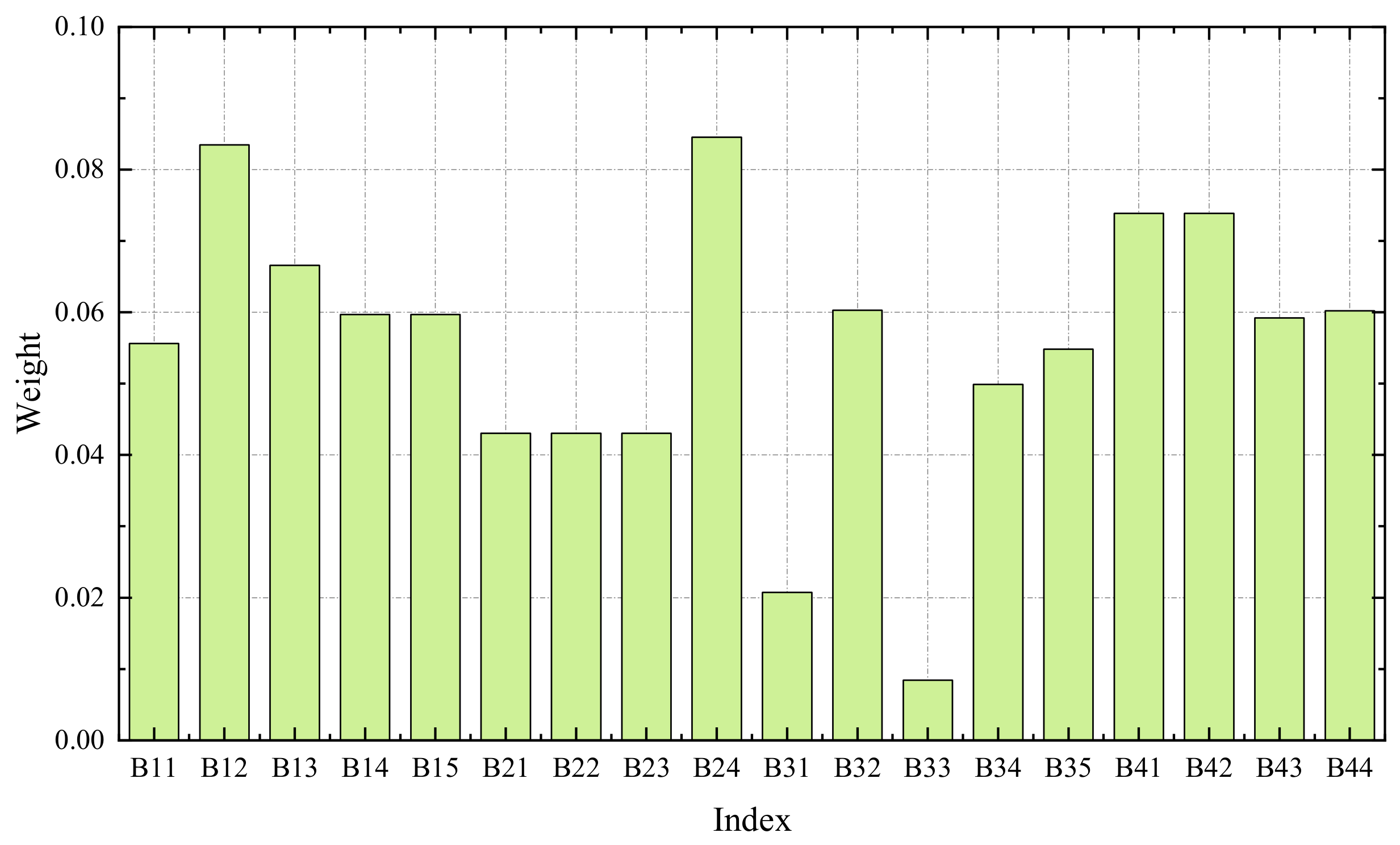
From the calculated subjective weights (Figure 3), it is evident that the two most important indicators are B24 (Renewable Energy Accommodation Rate) and B12 (Hardware Investment Costs), which possess the highest centrality. In the experts’ assessment, the VPP’s ability to accommodate renewable energy and the upfront investment are the core hubs of the entire benefit system, exerting the widest and strongest influence on other economic, technical, and environmental indicators. Secondary important indicators are B41 (Demand Response Volume) and B42 (Demand Response Load Share), which also have very high centrality, indicating that technical benefits—especially core demand response capabilities—are considered key links determining comprehensive benefits. The indicators with lower importance are B31 (Job Creation) and B33 (Land Resource Savings), which show the lowest centrality. As shown in Figure 4, the subjective weights of indicators are presented intuitively.

4.3. Combined Weights

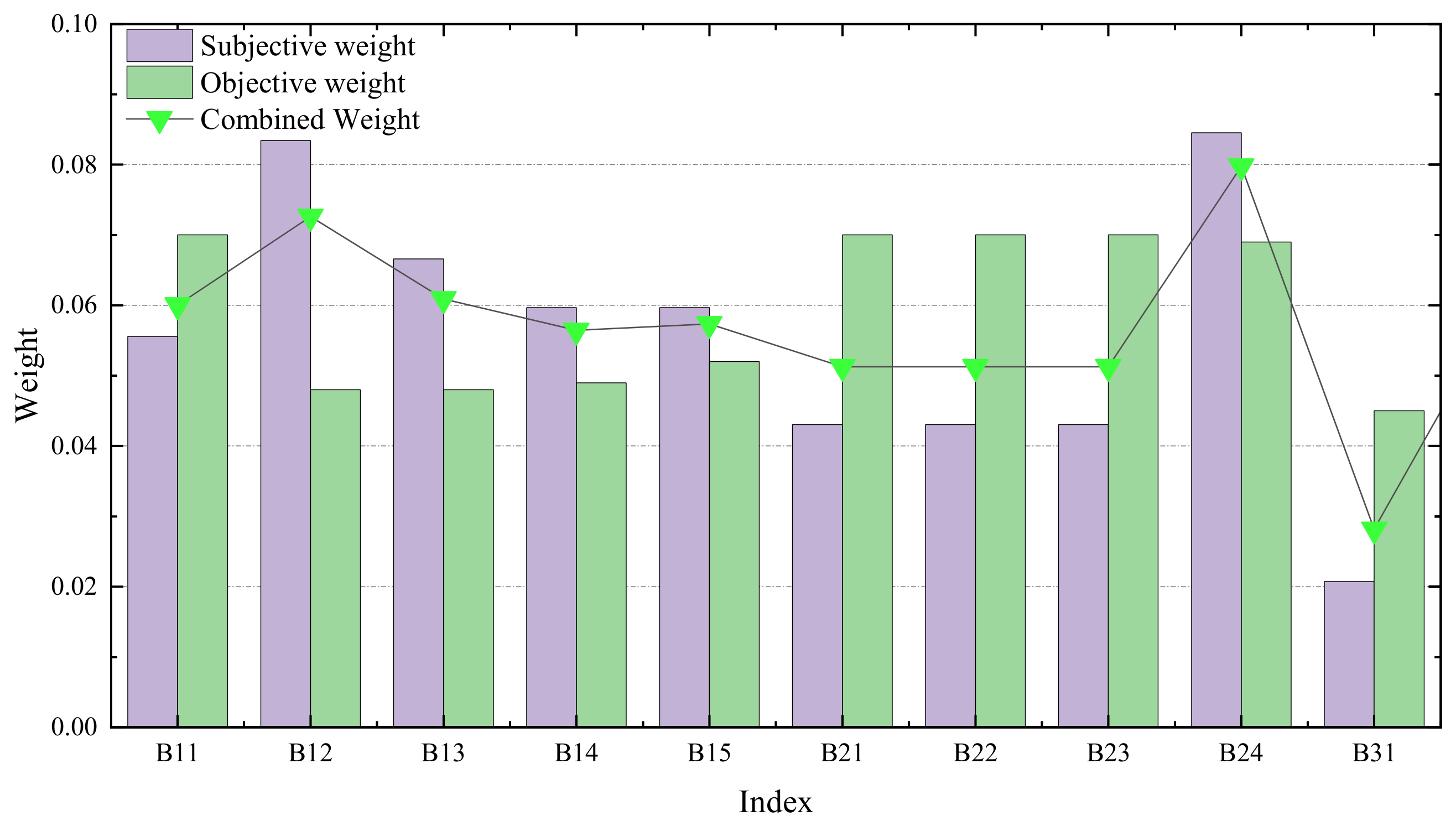
This section calculates the objective weights of each indicator based on the CRITIC method and combines subjective and objective weights based on Game Theory to obtain the final comprehensive weighting results. The subjective, objective, and combined weights are shown in Figure 5. It can be observed that the combined weighting results based on Game Theory mostly lie between the subjective and objective weights, rather than being a simple weighted average.
From the indicator combined weight chart, distinct differences exist between subjective and objective weighting results. B12 (Hardware Investment Costs) and B24 (Renewable Energy Accommodation Rate) were considered extremely important in expert evaluations, with weights significantly higher than other indicators. However, in the objective data, indicators such as B11 (Operating Costs) and B21–B23 (Environmental Benefit Indicators) showed higher weights, indicating they possess better discrimination and information uniqueness in the actual data.
Game Theory played a balancing role. The combined weights calculated using the Game Theory method are not a simple weighted average of subjective and objective weights but rather seek an “optimal solution” that minimizes the deviation between the two weighting schemes. This method respects the prior knowledge of experts while fully considering the objective distribution characteristics of the original data, avoiding the one-sidedness of a single weighting method and making the final weight allocation more scientific and robust.

4.4. Evaluation Results

This section combines indicator weights and project data to evaluate all VPP projects using the EDAS model. The standardized data for each VPP is shown in Appendix A Table A1, and the EDAS model evaluation results are shown in Table 6.
It can be seen that the comprehensive benefit evaluation ranking of the scenarios from high to low is S1 > S3 > S5 > S2 > S4. Looking at the data for each VPP, Scenario S1 belongs to the wind-solar-storage hybrid type. It possesses high environmental benefits and can obtain certain ancillary service revenue and technical benefits through an appropriate proportion of energy storage, thus achieving the highest comprehensive score. Conversely, Scenario S4 (a storage-gas VPP) yields the lowest comprehensive score of 0.308. This underperformance is driven by two main factors: its heavy reliance on gas turbines and storage leads to the highest hardware investment cost (B12), while its carbon emissions significantly degrade its environmental benefits (B21–B24) compared to purely renewable scenarios. Ultimately, S4’s low ranking demonstrates the proposed framework’s ability to effectively capture complex economic-environmental trade-offs rather than being skewed by a single indicator.

4.5. Comparative Analysis

To demonstrate the reliability of the application of the proposed framework in the comprehensive evaluation of VPP operational benefits, this section compares the evaluation results with TOPSIS, GRA (Gray Relational Analysis), Weighted Sum Model (WSM), and VIKOR models. The evaluation results of each model are shown in Table 7.
A closer analysis of Table 7 reveals two key patterns. First, the EDAS, TOPSIS, and VIKOR rankings are completely aligned (S1 > S3 > S5 > S2 > S4). This consistency occurs because all three methods evaluate distances to both positive and negative reference points, thereby preventing extreme-value distortion. Second, GRA and the Weighted Method deviate from this consensus due to their methodological limitations. GRA relies on a single reference sequence, making it highly sensitive to small perturbations, while the Weighted Method’s linear aggregation is easily skewed by large-magnitude indicators. In contrast, the proposed EDAS-based framework utilizes PDA and NDA symmetrically, ensuring robustness against such extreme values. Its alignment with established methods (TOPSIS, VIKOR) and its mitigation of the distortions seen in GRA and the Weighted Method confirm its reliability and superiority.

5. Conclusions

Against the backdrop of the global energy transition, Virtual Power Plants (VPPs) serve as a key technology for aggregating distributed resources, enhancing system flexibility, and promoting renewable energy accommodation. A comprehensive evaluation of their operational benefits is crucial for investment decision-making and policy formulation. This paper constructs a comprehensive evaluation framework for VPP operational benefits, proposes a comprehensive evaluation model based on DEMATEL-CRITIC-EDAS, and ranks the comprehensive benefits of five VPP scenarios with different configurations. The main conclusions are as follows:
(1)
Weighting results indicate that renewable-energy accommodation rate (B24, combined weight = 0.079) and hardware investment cost (B12, combined weight = 0.072) are the most critical input and output indicators for assessing VPP comprehensive benefits.
(2)
Wind-solar-storage hybrid VPPs (S1) achieve the highest comprehensive score of 0.695, approximately 126% higher than that of the storage-gas combined VPP (S4, score = 0.308), confirming that pure-renewable configurations outperform gas-dominated ones in overall benefits.
(3)
The DEMATEL-CRITIC-EDAS comprehensive evaluation model proposed in this paper exhibits high accuracy and stability.
Furthermore, the proposed framework offers practical decision-support for three key stakeholders:
(1)
Grid companies: The evaluation system can be integrated into VPP access-approval workflows, enabling evidence-based dispatch by flagging projects with extreme economic or environmental metrics.
(2)
VPP developers: The EDAS-based PDA/NDA decomposition serves as a quantifiable gap analysis, helping developers identify performance weaknesses to optimize capacity planning and bidding strategies.
(3)
Policy makers: By quantifying trade-offs between policy goals and operational data, the model supports the design of targeted subsidies and market mechanisms to promote optimal VPP configurations.
In summary, the VPP operational benefit evaluation framework proposed in this paper demonstrates good applicability and reliability, capable of accurately evaluating different types of VPPs. However, this study also has certain limitations. For instance, it does not account for revenues under multiple VPP business models; furthermore, the evaluation model does not effectively differentiate expert weights. Future research can further expand the VPP evaluation index system and construct more rational comprehensive evaluation models.

Author Contributions

R.L.: writing—original draft, H.Y.: writing—review and editing; J.Z.: writing—original draft preparation; Q.L.: investigation; J.L.: writing—review and editing; W.L.: Data Curation; Z.J.: Formal analysis. All authors have read and agreed to the published version of the manuscript.

Funding

This research is supported by the Science and Technology Project of the State Grid Shandong Electric Power Company (Research on the Optimization of Electricity Price System Based on the Economic Calculation of Electricity Market Entities).

Data Availability Statement

Data is contained within the article.

Conflicts of Interest

Authors Ranran Li, Hecheng Yuan, Jianing Zhang and Qiushuang Li were employed by State Grid Shandong Electric Power Company. The remaining authors declare that the research was conducted in the absence of any commercial or financial relationships that could be construed as a potential conflict of interest. The State Grid Shandong Electric Power Company had no role in the design of the study; in the collection, analyses, or interpretation of data; in the writing of the manuscript, or in the decision to publish the results.

Nomenclature

VPPVirtual Power Plant
EDASEvaluation based on Distance from Average Solution
DEMATELDecision-Making Trial and Evaluation Laboratory
CRITICCriteria Importance Through Intercriteria Correlation
GRAGray Relational Analysis
WSMWeighted Sum Model
PDAPositive Distance from Average
NDANegative Distance from Average
TOPSISTechnique for Order Preference by Similarity to Ideal Solution
VIKORVIseKriterijumska Optimizacija I Kompromisno Resenje
MCDMMulti-Criteria Decision-Making
DRDemand Response

Appendix A

Table A1. Standardized Values of Different Virtual Power Plants.
Indicator/ItemS1S2S3S4S5
B110.8960.0000.9460.5220.597
B120.3330.6000.0000.4670.667
B130.4320.8110.0001.0000.622
B140.2381.0000.0000.7880.375
B150.2941.0000.0000.9620.544
B210.0001.0000.0440.6840.490
B220.8740.2611.0000.0000.474
B230.8740.2611.0000.0000.474
B240.8740.2611.0000.0000.474
B310.8770.2951.0000.0000.520
B320.5001.0000.0000.7140.286
B330.6670.3331.0000.3330.556
B340.8180.2271.0000.0000.545
B350.3251.0000.0000.5750.400
B410.4411.0000.0000.6910.624
B420.2860.7140.0001.0000.500
B430.2810.4560.0001.0000.450
B440.4500.8670.0001.0000.633

References

  1. Li, Q.; Dong, F.X.; Zhou, G.W.; Mu, C.; Wang, Z.; Liu, J.; Yan, P.; Yu, D. Co-optimization of virtual power plants and distribution grids: Emphasizing flexible resource aggregation and battery capacity degradation. Appl. Energy 2025, 377, 124519. [Google Scholar] [CrossRef]
  2. Li, Y.R.; Chang, W.G.; Yang, Q. Deep reinforcement learning based hierarchical energy management for virtual power plant with aggregated multiple heterogeneous microgrids. Appl. Energy 2025, 382, 125333. [Google Scholar] [CrossRef]
  3. Pilotti, L.; Colombari, M.; Castelli, A.F.; Binotti, M.; Giaconia, A.; Martelli, E. Simultaneous design and operational optimization of hybrid CSP-PV plants. Appl. Energy 2023, 331, 120369. [Google Scholar] [CrossRef]
  4. Wang, Q.; Wu, W.C.; Wang, B.; Wang, G.; Xi, Y.; Liu, H.; Wang, S.; Zhang, J. Asynchronous decomposition method for the coordinated operation of virtual power plants. IEEE Trans. Power Syst. 2023, 38, 767–782. [Google Scholar] [CrossRef]
  5. Wu, S.; Zheng, W.F.; Wang, Z.; Chen, G.; Yang, P.; Yue, S.; Li, D.; Wu, Y. AlphaDataCenterCooling: A virtual testbed for evaluating operational strategies in data center cooling plants. Appl. Energy 2025, 380, 125100. [Google Scholar] [CrossRef]
  6. Zhang, M.Y.; Xu, Y.L.; Sun, H.B. Optimal coordinated operation for a distribution network with virtual power plants considering load shaping. IEEE Trans. Sustain. Energy 2023, 14, 550–562. [Google Scholar] [CrossRef]
  7. Baker, T.E.; Epiney, A.S.; Rabiti, C.; Shittu, E. Optimal sizing of flexible nuclear hybrid energy system components considering wind volatility. Appl. Energy 2018, 212, 498–508. [Google Scholar] [CrossRef]
  8. Chen, Y.; Niu, Y.G.; Du, M.; Wang, J. A two-stage robust optimization model for a virtual power plant considering responsiveness-based electric vehicle aggregation. J. Clean. Prod. 2023, 405, 136690. [Google Scholar] [CrossRef]
  9. Dai, Z.C.; Tan, M.; Yang, Y.; Liu, X.; Wang, R.; Su, Y. Massive coordination of distributed energy resources in VPP: A mean field RL-based bi-level optimization approach. IEEE Trans. Cybern. 2025, 55, 1332–1346. [Google Scholar] [CrossRef] [PubMed]
  10. Elgamal, A.H.; Kocher-Oberlehner, G.; Robu, V.; Andoni, M. Optimization of a multiple-scale renewable energy-based virtual power plant in the UK. Appl. Energy 2019, 256, 113973. [Google Scholar] [CrossRef]
  11. Gao, H.C.; Jin, T.; Feng, C.; Li, C.; Chen, Q.; Kang, C. Review of virtual power plant operations: Resource coordination and multidimensional interaction. Appl. Energy 2024, 357, 122284. [Google Scholar] [CrossRef]
  12. Pandey, A.K.; Mansour, C.; Nandini, K.K.; Jadoun, V.K.; Jayalakshmi, N.S. A Golden Jackal based optimal operation and optimization of a virtual power plant involving renewable resources. Sci. Rep. 2025, 15, 24275. [Google Scholar] [CrossRef] [PubMed]
  13. Hua, D.; Zeng, J.; Lin, Q.; Cui, S.; Liu, Y.; Liang, Y. An expectile-based framework for risk-calibrated credible capacity evaluation of virtual power plants under wind and PV forecast uncertainties. Sci. Rep. 2026. [Google Scholar] [CrossRef]
  14. Alvi, A.A.; Caballero, L.M.; Cadaval, E.R.; González-Romera, E.; Malinowski, M. Iterative genetic algorithm to improve optimization of a residential virtual power plant. Energies 2025, 18, 5377. [Google Scholar] [CrossRef]
  15. Du, H.; Hu, J.; Fang, Y.; Xie, D. Optimal bidding strategy for virtual power plant participating in joint energy and reserve market considering physical-economic feasible operation region. Energy 2025, 336, 138410. [Google Scholar] [CrossRef]
  16. Heydaritafreshi, O.; Moghimi, M.H.; Hajipour, E. Utilization of cryptocurrency mining load as high flexible load in virtual power plant. Electr. Power Syst. Res. 2026, 250, 112074. [Google Scholar] [CrossRef]
  17. Huang, W.; Chang, X.; Xue, Y.; Fan, X.; Yi, Z.; Liu, J.; Sun, H. Multiple-time-scale energy management strategy for virtual power plants considering dynamic weights and a data-model driven prediction model. Int. J. Electr. Power Energy Syst. 2025, 172, 111229. [Google Scholar] [CrossRef]
  18. Sun, L.L.; Li, H.B.; Jia, Q.Q.; Zhang, G. Optimization method of dynamic reconfiguration in virtual power plants. Renew. Energy 2024, 228, 120667. [Google Scholar] [CrossRef]
  19. Wang, H.; Jia, Y.W.; Lai, C.S.; Li, K. Optimal virtual power plant operational regime under reserve uncertainty. IEEE Trans. Smart Grid 2022, 13, 2973–2985. [Google Scholar] [CrossRef]
  20. Liu, X.; Lin, X.S.; Qiu, H.F.; Li, Y.; Huang, T. Optimal aggregation and disaggregation for coordinated operation of virtual power plant with distribution network operator. Appl. Energy 2024, 376, 124142. [Google Scholar] [CrossRef]
  21. Li, X.Y.; Luo, F.J.; Li, C.J. Multi-agent deep reinforcement learning-based autonomous decision-making framework for community virtual power plants. Appl. Energy 2024, 360, 139–148. [Google Scholar] [CrossRef]
  22. Esfahani, M.; Alizadeh, A.; Cao, B.; Kamwa, I.; Xu, M. Virtual power plant formation strategy based on Stackelberg game: A three-step data-driven voltage regulation coordination scheme. Appl. Energy 2025, 377, 124355. [Google Scholar] [CrossRef]
  23. Siqin, Z.; Diao, R.; Zhao, M. Two-stage distributionally robust bidding strategies for multi-energy virtual power plants in energy, reserve and carbon markets. Energy 2025, 334, 137455. [Google Scholar] [CrossRef]
  24. Wen, J.; Chen, X.; Jia, R.; Jiao, Y.; Cao, G.; Guo, Y.; Cheng, S.; Zhang, S. Distributed scheduling model of multi-network coupled energy system considering dynamic charging price mechanism and multiple utilization of hydrogen energy. Energy 2025, 335, 138006. [Google Scholar] [CrossRef]
  25. Pan, T.; Zhao, Q.; Zhao, J.Y.; Wang, L. Research on the low-carbon economic operation optimization of virtual power plant clusters considering the interaction between electricity and carbon. Processes 2025, 13, 1943. [Google Scholar] [CrossRef]
  26. Zhang, L.; Qu, C.; Zeng, Q.; Filho, M.G.; Gong, S. Optimizing privacy-preserving collaborative energy management for port cluster virtual power plants in the electricity market environment. Energy 2025, 338, 138865. [Google Scholar] [CrossRef]
  27. Zheng, J.H.; Su, Y.Y.; Guo, Y.W.; Li, Y.; Wu, Q. Preference-based interactive multi-attribute decision-making support for stochastic scheduling of virtual power plants. Energy Econ. 2025, 152, 108992. [Google Scholar] [CrossRef]
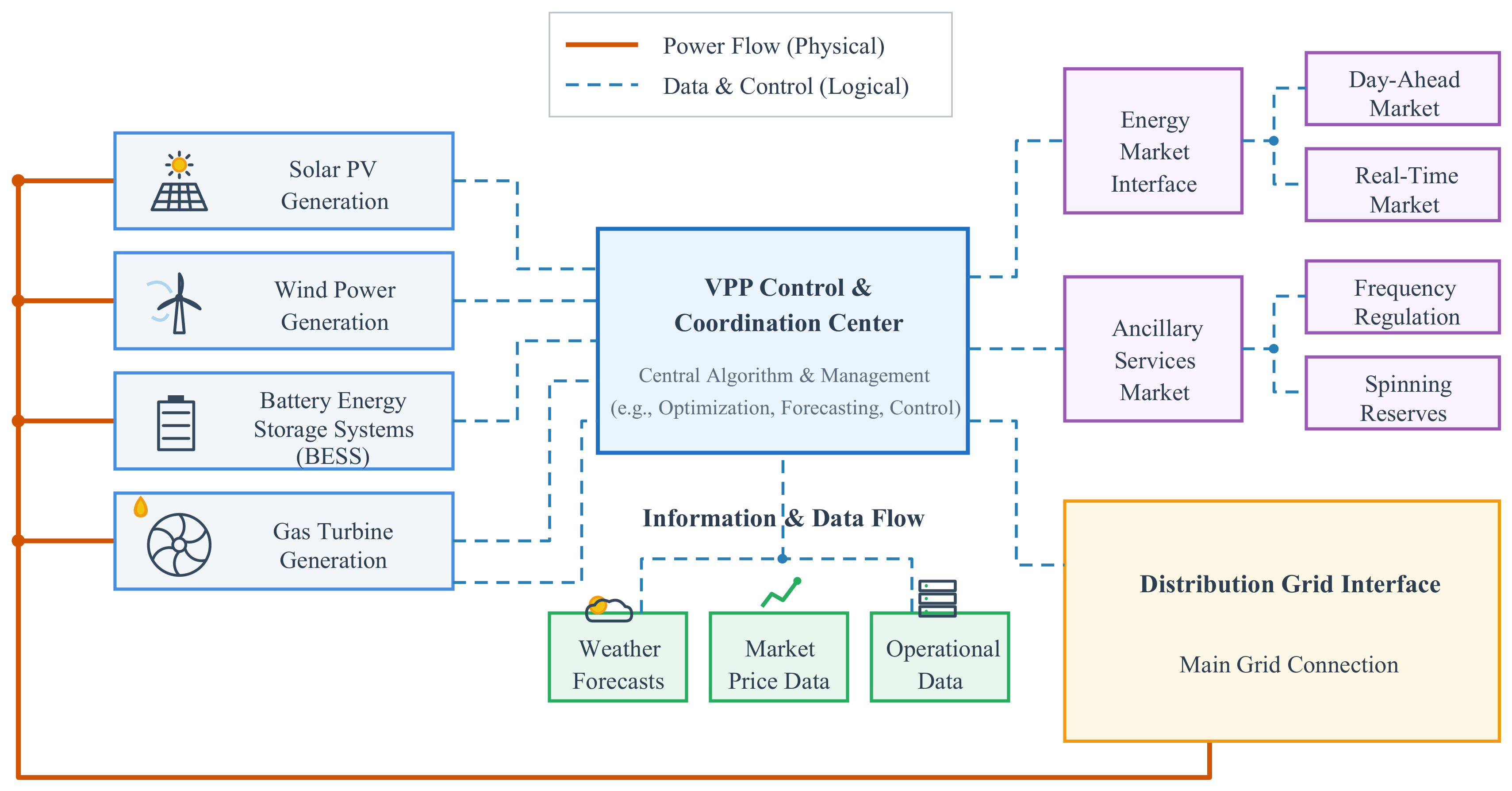
Figure 1. Architecture of the proposed VPP.
Processes 14 01545 g001
Figure 2. Research Framework.
Processes 14 01545 g002
Figure 3. Indicator Centrality-Causality Degree.
Processes 14 01545 g003
Figure 4. Subjective Weights of Indicators.
Processes 14 01545 g004
Figure 5. Combined Weights of Indicators.
Processes 14 01545 g005
Table 1. Evaluation Index System for Comprehensive Benefits of Virtual Power Plants.
Target LayerCriterion LayerIndex Layer (Indicators)AttributeUnit
VPP Business Model Operational Benefit Evaluation IndexEconomic Benefits (B1)Operating Costs (B11)Cost10 k CNY/Year
Hardware Investment Costs (B12)Cost10 k CNY
Spot Market Revenue (B13)Benefit10 k CNY/Year
Ancillary Service Revenue (B14)Benefit10 k CNY/Year
Capacity Compensation Revenue (B15)Benefit10 k CNY/Year
Environmental Benefits (B2)CO2 Emission Reduction (B21)BenefitTons/Year
SO2 Emission Reduction (B22)BenefitTons/Year
NOx Emission Reduction (B23)BenefitTons/Year
Renewable Energy Accommodation Rate (B24)Benefit%
Social Benefits (B3)Number of Jobs Created (B31)BenefitJobs
End-User Satisfaction (B32)BenefitScore
Land Resource Savings (B33)Benefit%
Contribution to Regional Economic Development (B34)Benefit%
Output Reliability (B35)Benefit%
Technical Benefits (B4)Demand Response Volume (B41)BenefitkW
Demand Response Load Share (B42)Benefit%
Response Time (B43)CostMinutes
Regulation Compliance Rate (B44)Benefit%
Table 2. Virtual Power Plant Construction Scenarios.
ScenarioPVWindStorageGas TurbineDescription
S1304010/400Wind-solar-storage hybrid VPP
S220155/2050Gas-wind-solar hybrid VPP
S350402/80Large-scale wind-solar dominated VPP
S410030/12030Storage-gas combined VPP
S525208/3225Balanced development VPP
Table 3. Description of Influence Levels in the DEMATEL Model.
ValueSymbolDefinition
0NNo influence
1VLVery low influence
2LLow influence
3HHigh influence
4VHVery high influence
Table 4. Evaluation of Index Correlation by Expert 1.
IndicatorB11B12B13B14B15B21B22B23B24B31B32B33B34B35B41B42B43B44
B11NLHHHLLLLLLVLLLLLLL
B12HNHHHHHHVHLLLLHHHHH
B13LLNHHLLLLLLVLLLLLLL
B14LLHNHLLLLLLVLLLLLLL
B15LLHHNLLLLLLVLLLLLLL
B21LHLLLNHHVHLLVLLVLLLLL
B22LHLLLHNHVHLLVLLVLLLLL
B23LHLLLHHNVHLLVLLVLLLLL
B24HHHHHVHVHVHNLLLLLHHHH
B31LLVLVLVLVLVLVLLNLLVHLVLVLVLVL
B32LLLLLLLLLLNVLLLLLLL
B33LLVLVLVLVLVLVLLLLNLVLVLVLVLVL
B34LLLLLLLLLVHLLNLLLLL
B35LHHHHVLVLVLLLVHVLLNLLLH
B41HHHHHLLLHLLVLLLNVHHH
B42HHHHHLLLHLLVLLLVHNHH
B43LHLLLVLVLVLLVLHVLLHHHNVH
B44LHLLLVLVLVLLVLHVLLHHHVHN
Table 5. DEMATEL Calculation Results.
IndicatorInfluence Degree (D)Influenced Degree (C)Centrality (M)Causality (N)Weight (w)
B113.2003.2646.464−0.0630.056
B124.0423.6647.7050.3780.083
B133.4833.4716.9530.0120.067
B143.2503.3966.646−0.1460.060
B153.2503.3966.646−0.1460.060
B213.0192.8845.9030.1350.043
B223.0192.8845.9030.1350.043
B233.0192.8845.9030.1350.043
B244.1933.5617.7540.6320.085
B312.2092.6994.908−0.4910.021
B323.0203.6526.672−0.6320.060
B332.1622.1984.360−0.0360.008
B343.0983.1096.208−0.0110.050
B353.3313.0986.4280.2330.055
B413.7283.5497.2770.1790.074
B423.7283.5497.2770.1790.074
B433.1993.4246.623−0.2240.059
B443.1993.4686.668−0.2690.060
Table 6. Comprehensive Benefit Evaluation Results of Virtual Power Plants.
ItemWeighted Positive DistanceWeighted Negative DistanceNormalized SPNormalized SNAppraisal Score
S10.1440.0680.7260.6640.695
S20.1000.1270.5020.3750.439
S30.1980.1521.0000.2510.626
S40.1220.2030.6160.0000.308
S50.0100.0230.0490.8870.468
Table 7. VPP Comprehensive Benefit Evaluation Results Under Different Models.
ProjectEDASTOPSISGRAWSMVIKOR
S10.6950.6300.1160.5510.436
S20.4380.4300.1260.5890.446
S30.6250.6000.1250.4420.553
S40.3080.3900.120.5110.492
S50.4680.4900.1060.5200.473
Disclaimer/Publisher’s Note: The statements, opinions and data contained in all publications are solely those of the individual author(s) and contributor(s) and not of MDPI and/or the editor(s). MDPI and/or the editor(s) disclaim responsibility for any injury to people or property resulting from any ideas, methods, instructions or products referred to in the content.