Article

Model Surrogate-Assisted Multi-Objective Optimization of Distribution Structure for a Single-Piston Two-Dimensional Electro-Hydraulic Pump


College of Mechanical Engineering, Zhejiang University of Technology, Hangzhou 310023, China
*
Author to whom correspondence should be addressed.
Processes 2026, 14(10), 1514; https://doi.org/10.3390/pr14101514
Submission received: 2 April 2026 / Revised: 24 April 2026 / Accepted: 5 May 2026 / Published: 7 May 2026
(This article belongs to the Section Process Control, Modeling and Optimization)

Abstract

Under high-frequency commutation conditions, the Single-Piston Two-Dimensional Electro-Hydraulic Pump suffers from severe reverse flow and pressure pulsation, which limit its volumetric efficiency and operational stability. To address this issue, this study proposes a surrogate-assisted multi-objective optimization framework for the pump distribution structure. First, a dynamic model is established to analyze the influence of triangular damping groove geometry on flow and pressure characteristics, and four key parameters are selected as design variables. Then, sample data generated from AMESim simulations are used to train a Genetic Algorithm-optimized Backpropagation neural network surrogate model. Finally, the surrogate model is integrated with NSGA-II to minimize the peak reverse flow and pressure pulsation amplitude simultaneously. The results show that the GA-BP model predicts reverse flow and pressure pulsation with mean relative errors of 2.72% and 2.99%, respectively. Compared with the initial design, the optimized structure reduces the peak reverse flow by 27.6% and decreases the pressure pulsation amplitude from 0.78 MPa to 0.41 MPa. These results indicate that, within the parameter ranges and operating conditions considered in this study, the proposed framework provides an effective tool for the coordinated optimization of damping groove parameters for the Single-Piston Two-Dimensional Electro-Hydraulic Pump.

1. Introduction

The Single-Piston Two-Dimensional Electro-Hydraulic Pump (SP2DEHP) achieves the direct conversion of the motor’s rotational motion into the plunger’s reciprocating motion via a two-dimensional motion conversion mechanism, characterized by a compact structure, high power density, and high mechanical efficiency. Compared with traditional axial piston pumps, this architecture eliminates high-friction pairs such as slipper pads and swash plates, demonstrating promising application prospects in high-speed and high-power-density hydraulic systems. Consequently, it has gradually become a significant research focus in the fields of Electro-Hydrostatic Actuator (EHA) systems and high-performance hydraulic drives [1,2].
Under high-speed and high-pressure operating conditions, the flow distribution process of the SP2DEHP faces significant challenges. Due to the absence of the phase superposition effect characteristic of multi-plunger structures, flow discontinuity is inevitable during the switching transition between the suction and discharge windows. Specifically, when the distribution windows open or close too rapidly, the pump chamber is prone to reverse flow and pressure pulsation. These phenomena result in a decline in volumetric efficiency and may induce system vibration and noise, thereby constraining the pump’s engineering applications [3,4,5,6].
To suppress the aforementioned adverse characteristics, optimizing the structural parameters of the valving pair has been recognized as one of the most effective approaches. Existing studies have mainly focused on mitigating pressure shock by improving the geometry of damping grooves. For instance, research by Pettersson et al. [7] demonstrated that in axial piston pumps, adding damping grooves can significantly reduce flow ripple and vibration at the outlet of the valve plate transition region. Johansson et al. [8] proposed introducing a damping orifice in the pre-compression region to effectively reduce cavitation phenomena at the beginning of the suction kidney groove. Guo et al. [9] verified via simulations in the AMESim environment that the time-delay method can reduce flow ripples. Ye et al. [10] analyzed the noise characteristics of the valve plate in axial piston pumps in detail and significantly reduced the sound source intensity by optimizing the relief groove structure; Hong et al. [11,12] proposed optimized design schemes using U-shaped and triangular damping grooves for axial pumps, effectively improving outlet flow pulsation; Pan et al. [13] further introduced a bubble evolution model to investigate the influence of cavitation effects on fluid dynamic characteristics. Although these studies have achieved significant results, their methodologies are often limited to local analysis of specific structures or single-objective optimization. Xu et al. [14,15] employed a collaborative optimization design of cross angle grooves and relief grooves, achieving superior vibration damping effects compared to traditional distribution structures and significantly enhancing the robustness of the pump’s output characteristics under different operating conditions. Zhang et al. [16] applied an optimization strategy of adding triangular damping grooves to roller piston pumps for pulse suppression.
Existing literature widely employs Computational Fluid Dynamics (CFD) [17,18,19] or dynamic simulation based on lumped parameter methods to analyze the flow field characteristics. Although these physical models offer high prediction accuracy, the computational time for a single simulation run is often substantial. This issue becomes particularly prominent for systems such as the SP2DEHP, which exhibit strong nonlinear coupling among multiple parameters. Under such conditions, the use of global optimization strategies such as genetic algorithms typically requires thousands or even tens of thousands of objective-function evaluations. In such scenarios, directly coupling complex dynamic models with evolutionary algorithms results in a prohibitive computational burden [20]. In recent years, while multi-objective hydraulic optimization methods have been applied to structures such as the blades of axial piston pumps [21], surrogate model-assisted optimization specifically targeting the distribution structure of 2D pumps remains relatively scarce.
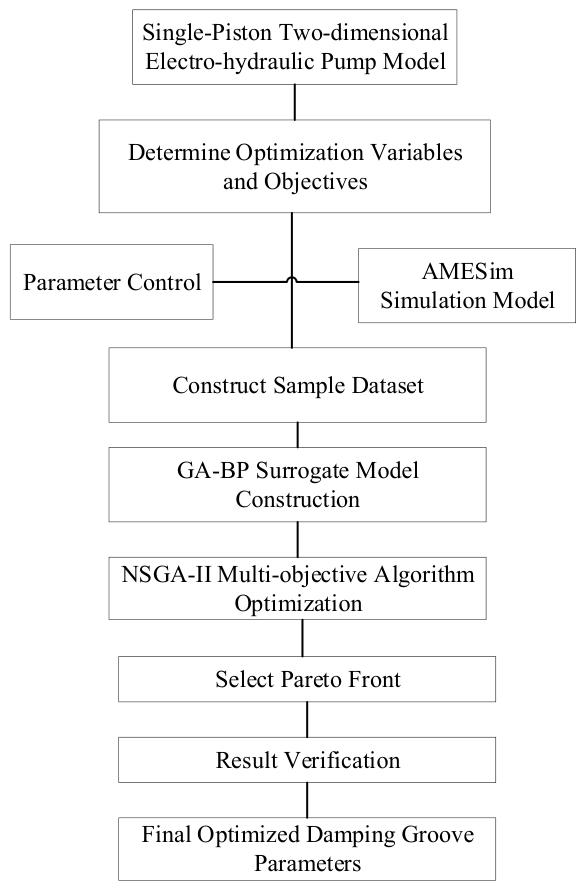
To address this challenge, surrogate modeling techniques provide an efficient solution. By constructing computationally inexpensive mathematical approximation models—such as response surface methodology [22] neural network surrogates [23], and radial basis functions [24] to replace costly physical simulations—the iterative optimization process can be significantly accelerated. This paper proposes a multi-objective optimization framework integrating a GA-BP neural network with the NSGA-II algorithm, as illustrated in Figure 1. The framework consists of three main stages: First, based on geometric constraints of the damping groove, Latin Hypercube Sampling (LHS) is employed to generate representative sample points. High-fidelity datasets capturing peak backflow and pressure pulsation amplitudes are obtained through batch simulations using the AMESim dynamic model, followed by normalization. Second, a Genetic Algorithm-optimized Backpropagation (GA-BP) neural network is trained on the sample data to construct a high-accuracy surrogate model, effectively replacing time-consuming simulations and substantially reducing computational costs. Finally, the surrogate model is incorporated into the NSGA-II algorithm for multi-objective global optimization. Through fast non-dominated sorting and evolutionary operations, the Pareto frontier is explored to identify the optimal combination of damping groove geometric parameters that balances backflow suppression and pressure pulsation mitigation.

2. Mathematical Modeling and Numerical Simulation Strategy

2.1. Working Principle of the Pump

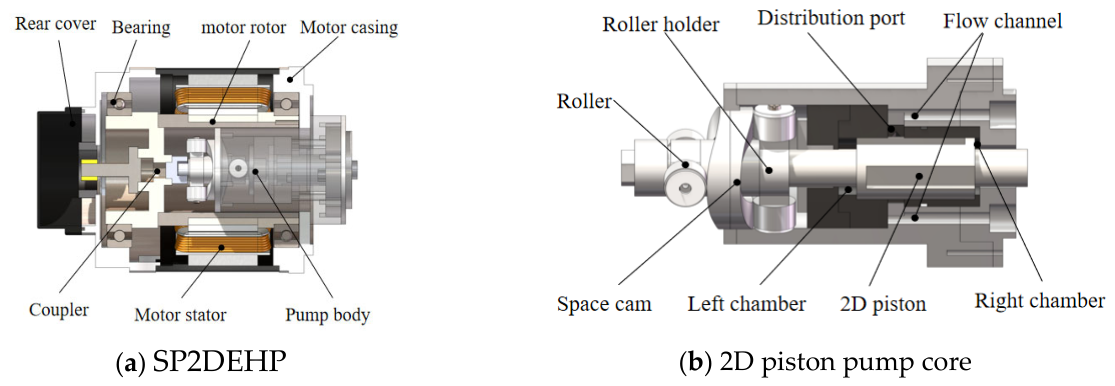
SP2DEHP primarily consists of core components such as a Permanent Magnet Synchronous Motor and a 2D piston pump core. Its core operating mechanism is based on the two-dimensional piston principle, wherein the 2D piston pump core assembly is positioned directly inside the motor rotor. When the motor is energized to drive the high-speed rotation of the rotor and guide rail assembly, the roller mechanism fixed to the piston is constrained by the curved surface of the guide rail. This constraint forces the piston assembly to generate periodic axial reciprocating motion while simultaneously rotating with the rotor. This unique compound motion mode, which combines rotational and translational motion, eliminates several high-friction components found in traditional axial piston pumps, such as slipper pads, return plates, and swash plates, thereby significantly improving the mechanical efficiency and power-to-weight ratio of the pump (Figure 2).
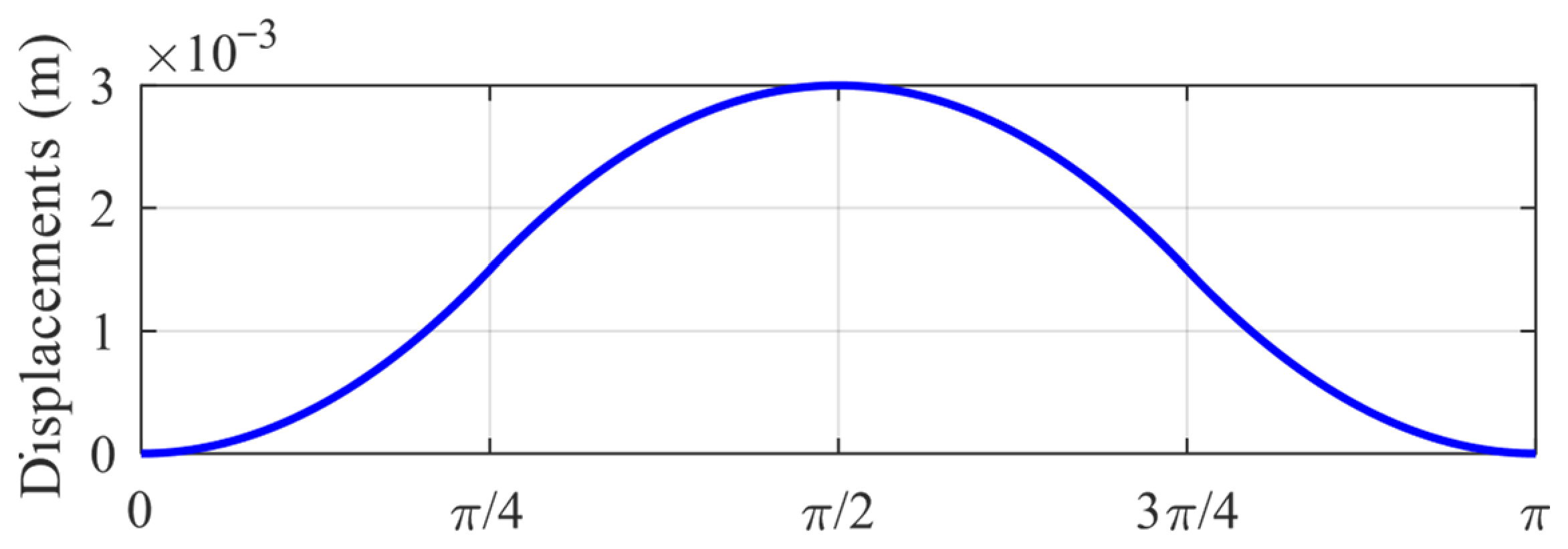
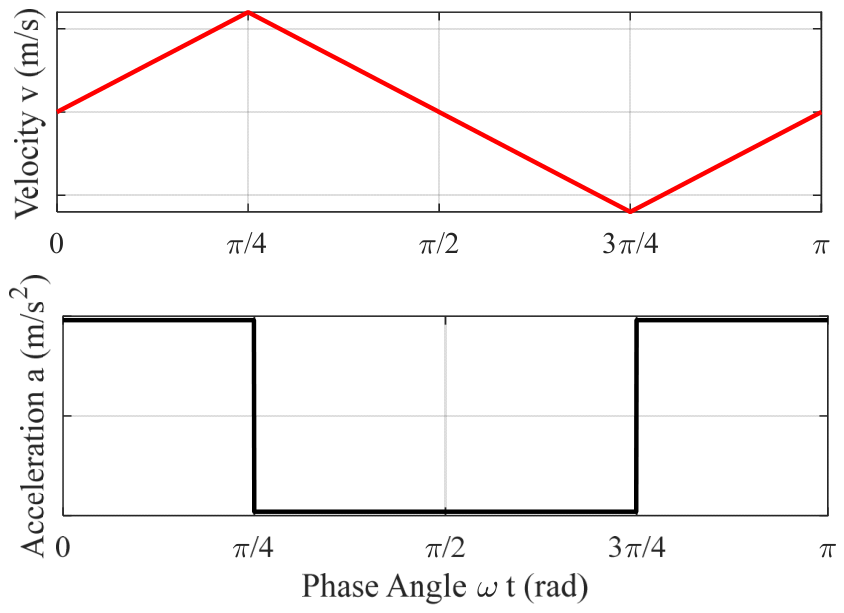
The axial motion law of the piston is directly determined by the design of the guide rail cam profile. Under ideal conditions, the axial displacement of the piston follows a specific kinematic relationship with the rotor rotation angle, and this motion law dictates the instantaneous flow characteristics of the pump. The axial displacement, velocity, and acceleration of the piston can be expressed by Equations (1)–(3), respectively, where h is the characteristic axial displacement parameter determined by the cam profile, ω is the angular velocity of the rotor, and θ is the instantaneous rotation angle. As shown in Figure 3, with the periodic variation in the rotation angle, the piston alternates between the suction stroke and the discharge stroke.
s θ = 8 h π 2 θ 2 0 θ < π / 4 8 h π 2 θ 2 + 8 h π θ h π / 4 θ < 3 π / 4 8 h π 2 θ 2 16 h π θ + 8 h 3 π / 4 θ π
v θ = 16 h ω π 2 θ 0 θ < π / 4 16 h ω π 2 θ + 8 h ω π π / 4 θ < 3 π / 4 16 h ω π 2 θ 16 h ω π 3 π / 4 θ π
a θ = 16 h ω π 2 0 θ < π / 4 16 h ω π 2 π / 4 θ < 3 π / 4 16 h ω π 2 3 π / 4 θ π
As shown in Figure 3, the axial displacement of the piston varies periodically with the rotation angle. During the suction stroke, the piston moves backward to increase the volume of the pump chamber; during the discharge stroke, it moves forward to compress the fluid. The axial velocity of the piston directly determines the magnitude of the instantaneous flow rate, whereas the variation in acceleration reflects the influence of inertial forces.
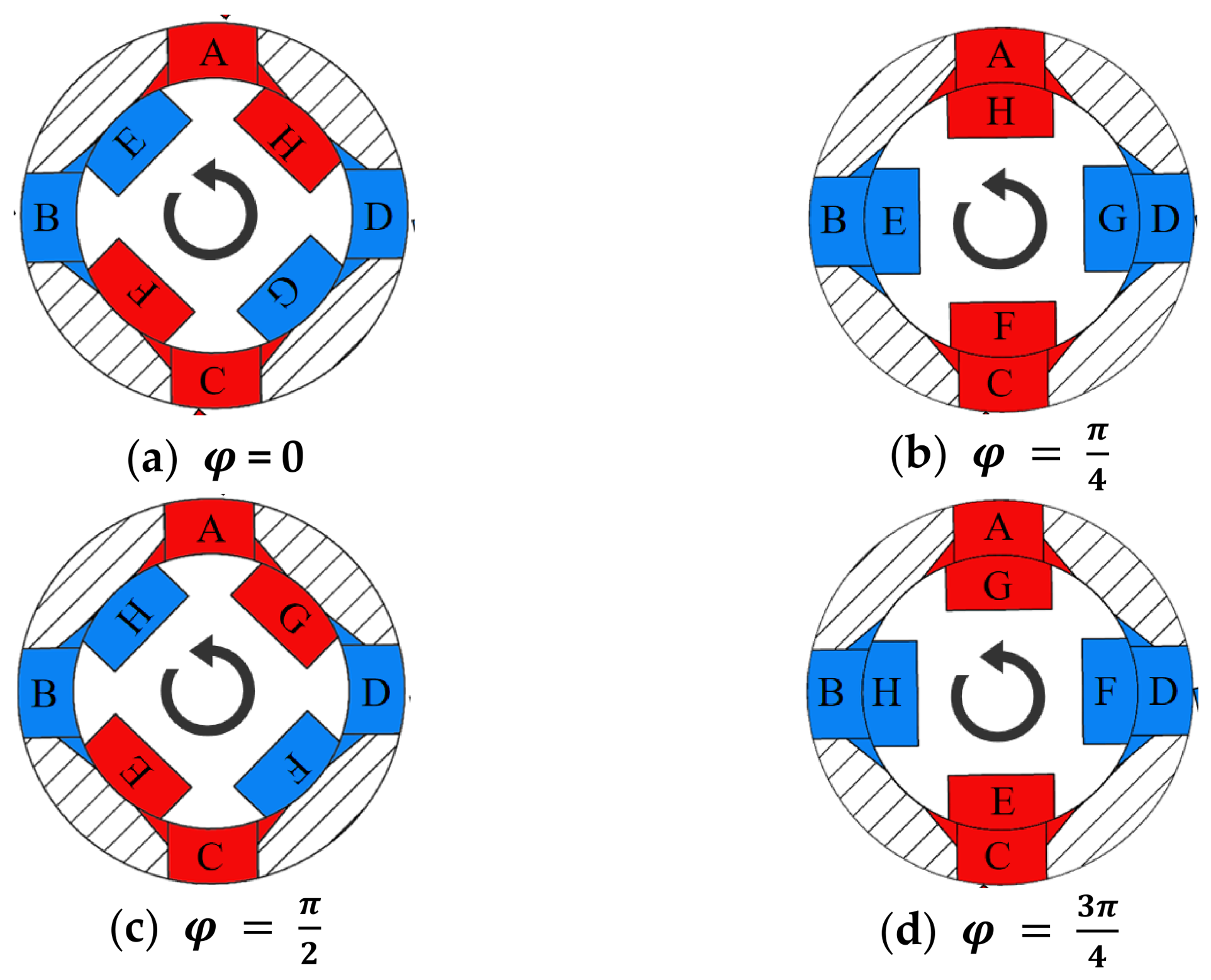
Another critical aspect of pump operation is the flow distribution process, specifically the precise alternating communication between the suction and discharge ports. This process is achieved through the rotational motion of the piston in coordination with the windows on the surface of the distribution shaft. The spatial relationship between the distribution slots on the piston end face and the distribution windows on the cylinder block is illustrated in Figure 4, where blue denotes the low-pressure region, while red denotes the high-pressure region.
As the piston rotates, the distribution slots sequentially sweep across the suction and discharge windows. The diagram illustrates the most critical transition region during the flow distribution process, specifically the overlap between the distribution window and the triangular damping groove. Distinct from the mechanism in multi-piston pumps where flow is smoothed through phase compensation, this single-piston structure exhibits inherent discontinuity during this suction–discharge transition. Particularly under high-pressure conditions, if improper damping groove design causes the distribution window to open too rapidly or too slowly, the resulting large pressure gradient will induce significant reverse flow and pressure pulsation. Therefore, the precise design of the damping groove geometry shown in the figure is essential to suppressing hydraulic shock.

2.2. Geometric Model of Damping Groove and Flow Area Calculation
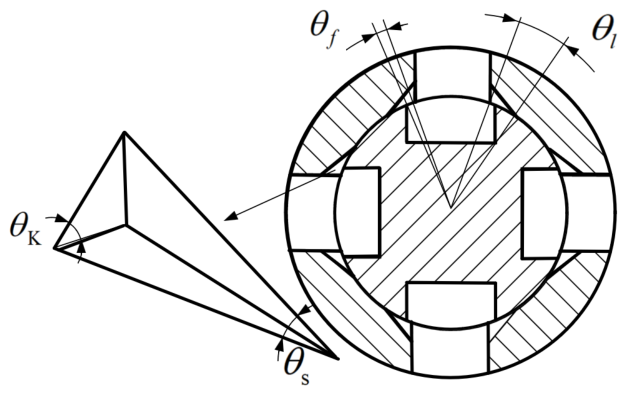
To mitigate pressure shocks during the flow distribution process, triangular damping grooves are designed on the edges of both the high-pressure and low-pressure windows of the distribution shaft. The geometric structure of these grooves is typically formed via milling operations, and their spatial configuration is primarily determined by four key geometric parameters [25]: the groove length angle   θ l , width angle θ K , depth angle θ s , and cross angle θ f . These four parameters collectively determine the flow cross-sectional shape and volume of the damping grooves, the specific definitions of which are illustrated in Figure 5.
Specifically, the cross angle θ f is defined as the angular offset of the damping groove tip relative to the port dead center position. It determines the phase of port opening, i.e., the initiation timing of the pre-pressurization or pre-depressurization process. The damping groove length angle θ l determines the angular duration of the throttling effect—the larger this value, the smoother the pressure transition process. The width angle θ K describes the opening angle of the damping groove on the port plate surface, while the depth angle θ s refers to the cutting depth angle of the groove bottom relative to the shaft surface.
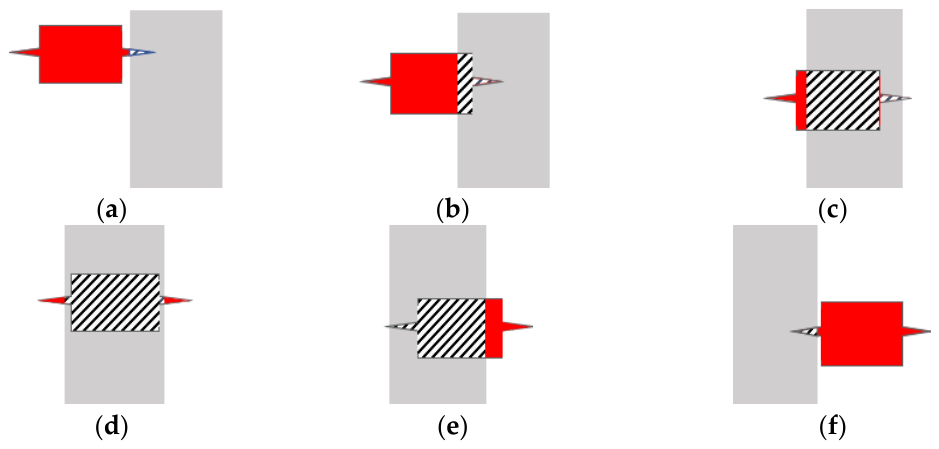
In the flow distribution process of the pump, the overlap between the distribution window and the damping groove determines the instantaneous flow capacity as the piston rotation angle varies. Based on the relative geometric positions of the distribution shaft and the bushing windows, the complete opening process is physically divided into six key stages. These stages encompass the complex morphological evolution from the initial entry of the damping groove tip and transitional engagement to the full opening of the window, as illustrated in Figure 6. Red denotes the distribution window, while the grey piston denotes the chamber.
Figure 6. Six stages of flow area variation with respect to rotation angle. (a) Stage 1 360° − θ l   +   θ f θ f ; (b) Stage 2 θ f ∼ 45° − θ l + θ f ; (c) Stage 3 45 ° − θ l   +   θ f ∼ 45° − θ f ; (d) Stage 4 45 ° θ f 45 ° + θ f ; (e) Stage 5 45 ° + θ f 90 ° θ f ; (f) Stage 6 90 ° θ f 90 ° θ f + θ l .
Processes 14 01514 g006
S = 1 4 ( φ 2 π + θ l θ f ) 2 C s                                                                                                                         2 π θ l + θ f     φ   0 1 4 ( φ + θ l θ f ) 2 C s                                                                                                                                               0   φ   θ f 1 4 θ l 2 C s + W ( φ θ f ) D 2                                                                                                                           θ f   φ   π 4 θ l + θ f 1 4 ( θ l 2 ( φ ( π 4 θ l + θ f ) ) 2 ) C s + W ( φ θ f ) D 2                                 π 4 θ l + θ f   φ   π 4 θ f 1 4 ( θ l ( π 2 + θ l 2 φ + 2 θ f ) 2 θ f 2 ) C s + W ( π 4 2 θ f ) D 2                 π 4 θ f   φ   π 4 + θ f 1 4 θ l 2 C s + W ( π 2 φ θ f ) D 2                                                                                                             π 4 + θ f   φ   π 2 θ f 1 4 ( θ l 2 ( φ π 2 + θ f θ l ) 2 ) C s                                                                                                                                             π 2 θ f   φ   π 2 θ f + θ l
where φ   is the rotation angle, W is the width of the port window, and C s is a geometric constant determined by the structural parameters of the triangular damping groove, given by:
C s =   D 2 sin θ s tan θ s tan θ K 2
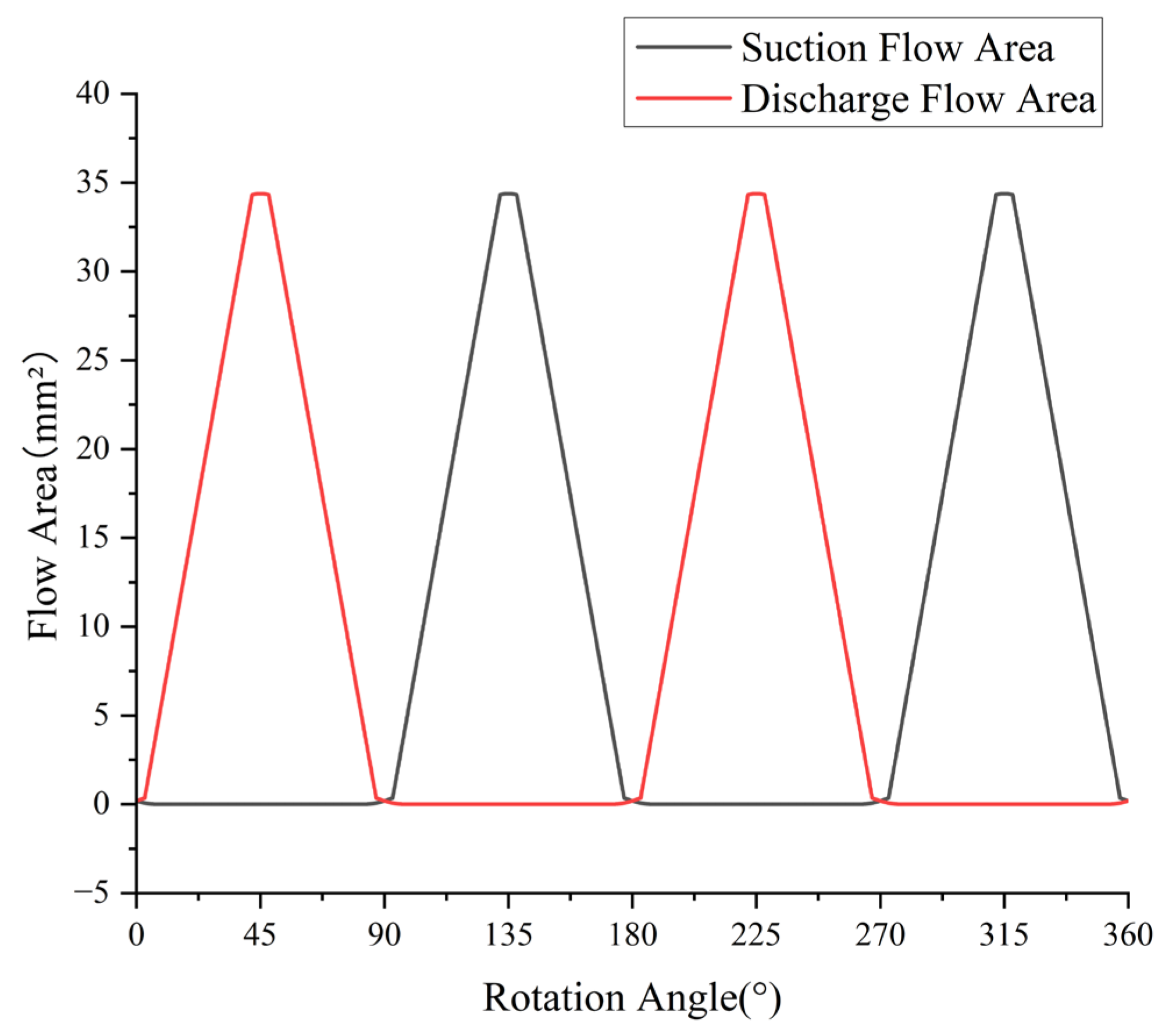
To intuitively illustrate the influence of the damping groove structure on flow distribution characteristics, Figure 7 compares the flow area variation curves of the structure without damping grooves and the structure with optimized damping grooves.
As shown in Figure 7, the curves intuitively illustrate the periodic alternation between the suction and discharge flow areas with respect to the rotation angle. The characteristics of the rising and falling edges are directly governed by the geometric parameters of the damping grooves, which determine the rate of opening and closing of the suction and discharge windows. These area variation characteristics are directly input into the subsequent fluid dynamics model to serve as critical boundary conditions for calculating flow pulsation and pressure shock.

2.3. Fluid Dynamics Model of the Piston Chamber

2.3.1. Flow Continuity Equation and Pressure Establishment

In this study, the transient port flow during commutation is modeled under the assumption that the flow through the distribution window can be represented by an equivalent thin-walled orifice relation. The flow coefficient is treated as constant, and the model is intended to capture the dominant pressure–flow relationship during commutation rather than to resolve detailed three-dimensional turbulent structures.
The fluid dynamic characteristics within the working chamber of the SP2DEHP are governed by the law of conservation of mass. Due to the compressibility of hydraulic oil, particularly under high-pressure operating conditions, this property plays a decisive role in the pressure transient response [26]. The piston chamber is treated as a control volume, where the rate of dynamic pressure change is determined by the effective bulk modulus of the oil, the instantaneous working volume, and the difference between the net flow entering or exiting the control volume and the rate of volume change. Based on the principle of fluid continuity, the pressure differential equation within the piston chamber is formulated as follows:
d p d t = β e V φ q i q l d V d t
where p represents the instantaneous pressure within the piston chamber; β e is the effective bulk modulus of the oil; V φ denotes the instantaneous working volume varying with the rotation angle; d V / d t is the rate of geometric volume change induced by the axial motion of the piston; and q l represents the total leakage flow rate, the specific components of which will be detailed in the next subsection.
In the equation, the term q i represents the instantaneous net flow rate exchanged with the external high- and low-pressure circuits through the distribution windows. This flow is calculated based on the principle of thin-walled orifice throttling and is directly governed by the instantaneous flow area S φ derived in Section 2.2. To unify the description of the suction and discharge processes, a sign function is introduced to construct a general flow calculation formula:
q i   =   sgn Δ p · C d · S φ · 2 Δ p ρ
where C d   is the orifice flow coefficient, and ρ is the density of the oil. Δ p represents the pressure difference across the distribution window, defined as the difference between the external pressure and the pressure inside the pump chamber. The sign function s g n ( Δ p ) is introduced to distinguish the flow direction in a unified manner. When Δ p > 0 , the external pressure is higher than the chamber pressure, and the fluid flows into the piston chamber. When Δ p < 0 , the chamber pressure is higher than the external pressure, and the fluid flows out of the piston chamber. Therefore, the same equation can be used to describe both suction and discharge processes with the correct physical flow direction. S ( φ )   denotes the corresponding instantaneous flow area for suction or discharge, which is determined by the geometric parameters of the damping grooves.

2.3.2. Leakage Analysis of Two-Dimensional Piston Pump

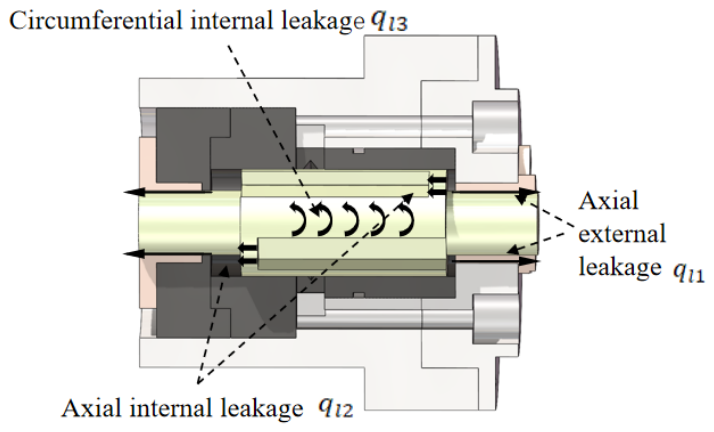
Due to the clearance sealing fit employed between the distribution shaft and the cylinder bore of the 2D piston pump, hydraulic oil within the working chamber inevitably leaks through minute clearances to low-pressure regions or the exterior of the casing under high-pressure conditions. For leakage modeling, the oil is assumed to be a Newtonian fluid, and the leakage flow through the sealing clearances is treated as pressure-driven flow in narrow gaps. The clearance geometry is assumed to remain stable during operation, while the influence of local surface deformation and thermal variation on the leakage path is neglected. Under these assumptions, the total leakage flow consists primarily of three components: axial external leakage, axial internal leakage, and circumferential internal leakage [6], as illustrated in Figure 8. Thus:
q l   =   q l 1 + q l 2 + q l 3
1.
Axial external leakage  q l 1
The axial external leakage consists of two components: the pressure-driven flow resulting from the pressure difference between the high-pressure chamber and the ambient pressure, and the shear flow induced by the relative motion of the piston shaft. Specifically, the pressure-driven flow is directed from the high-pressure chamber towards the external environment. Since the direction of the piston shaft’s motion aligns with that of the pressure-driven flow under this operating condition, the shear flow dragged by the sliding surface is superimposed onto the pressure-driven flow, effectively increasing the total leakage. Therefore, based on the theory of flow in clearances, the calculation formula for axial external leakage is expressed as follows:
q l 1   =   π d δ 3 12 μ L 1 p p 0 + π d δ v 2
In the formula, d is the piston diameter, δ is the radial clearance of the port pair, μ is the dynamic viscosity of the oil, L 1 is the external leakage seal length, p 0 is the pressure in the constant-pressure chamber outside the housing, and v is the tangential velocity of the piston surface.
2.
Axial internal leakage  q l 2
For axial internal leakage, the pressure-driven flow is directed from the high-pressure chamber to the low-pressure chamber. Since the piston shaft moves in a direction that reduces the volume of the high-pressure chamber, the shear flow dragged by the sliding surface opposes the direction of the pressure-driven flow, thereby reducing the leakage. Consequently, the calculation formula for axial internal leakage is expressed as follows:
q l 2   =   B δ 3 12 μ L 2 p p s B δ v 2
In the formula, B is the circumferential developed width of the leakage interface, L 2 is the axial sealing length between the high and low-pressure windows, and p s is the pressure in the low-pressure chamber.
3.
Circumferential internal leakage  q l 3
This leakage refers to the circumferential gap leakage between the high and low-pressure transition zones of the port windows. Since this area directly connects the high-pressure chamber of the pump with the low-pressure suction zone, and the sealing band length varies periodically with the rotation angle φ of the port plate, the flow behavior is relatively complex. To improve model accuracy, this study simplifies it as a laminar flow model for narrow gaps, calculated as follows:
q l 3   =   H δ 3 12 μ L 3 φ p p s
In the formula, H is the axial height of the port window, and L 3 φ is the instantaneous circumferential sealing length varying with the rotation angle.

2.4. Simulation Model Development

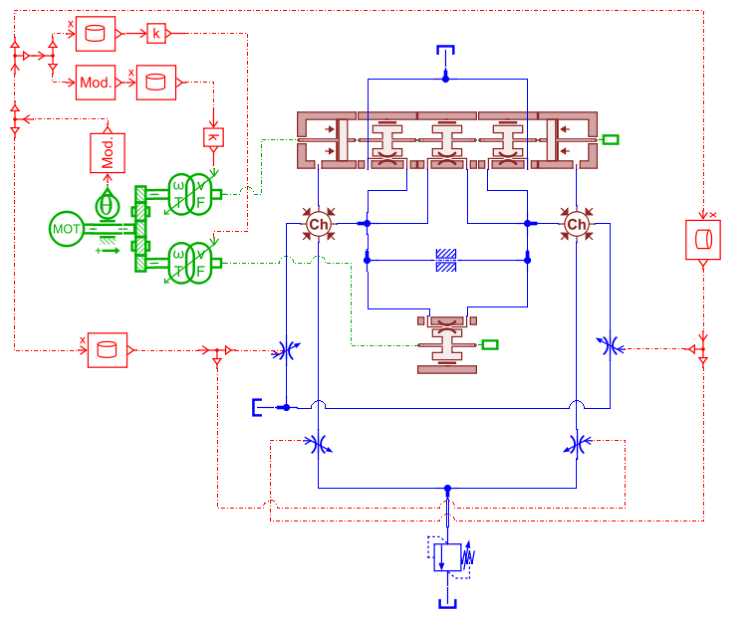
Based on the aforementioned mathematical model, this paper establishes a full-system dynamic model of a two-dimensional plunger pump in the AMESim simulation environment, as shown in Figure 9. To achieve high-fidelity replication of the complex fluid dynamics under high-frequency porting conditions, the model specifically integrates multiple nonlinear physical mechanisms: in terms of fluid properties, a mixed fluid submodel considering air content is adopted to accurately describe the nonlinear variation in the effective bulk modulus of the oil with pressure and potential cavitation phenomena; in terms of mechanical dynamics, a comprehensive friction model incorporating Coulomb friction and viscous friction is introduced to effectively characterize the energy dissipation of the plunger assembly during high-speed reciprocating motion; in terms of the porting structure, the variable-section throttle orifice component from the hydraulic component design library is utilized to accurately simulate the transient variation in the flow area during the damping groove opening process.
To accurately simulate the dynamic characteristics of the two-dimensional pump under high-speed conditions, a nonlinear simulation model was developed in the AMESim environment. The model incorporates fluid compressibility, pressure-dependent variations in oil viscosity, and cavitation effects. Unless otherwise specified, the simulations were carried out under the nominal operating condition considered in this study. The values of oil density, dynamic viscosity, and effective bulk modulus were selected as representative hydraulic oil properties for the studied operating condition, while the inlet pressure, outlet pressure, and motor speed were specified according to the target operating condition of the SP2DEHP. The main parameters used in the simulation are listed in Table 1.
In the simulation, the inlet pressure and outlet pressure were imposed as the hydraulic boundary conditions, and the motor speed was prescribed as the operating input. Unless otherwise stated, the baseline operating condition was set to an inlet pressure of 0.1 MPa, an outlet pressure of 12 MPa, and a motor speed of 6000 r/min. During the sensitivity analysis, only the parameter under investigation was varied, while the remaining structural parameters and operating conditions were kept unchanged. The same baseline operating condition was also adopted for surrogate-model dataset generation and the subsequent optimization process. In the present study, the peak reverse flow was defined as the maximum reverse-flow value obtained from the simulation results, while the chamber pressure pulsation amplitude was calculated from the fluctuation range of the chamber pressure response under the same operating condition.
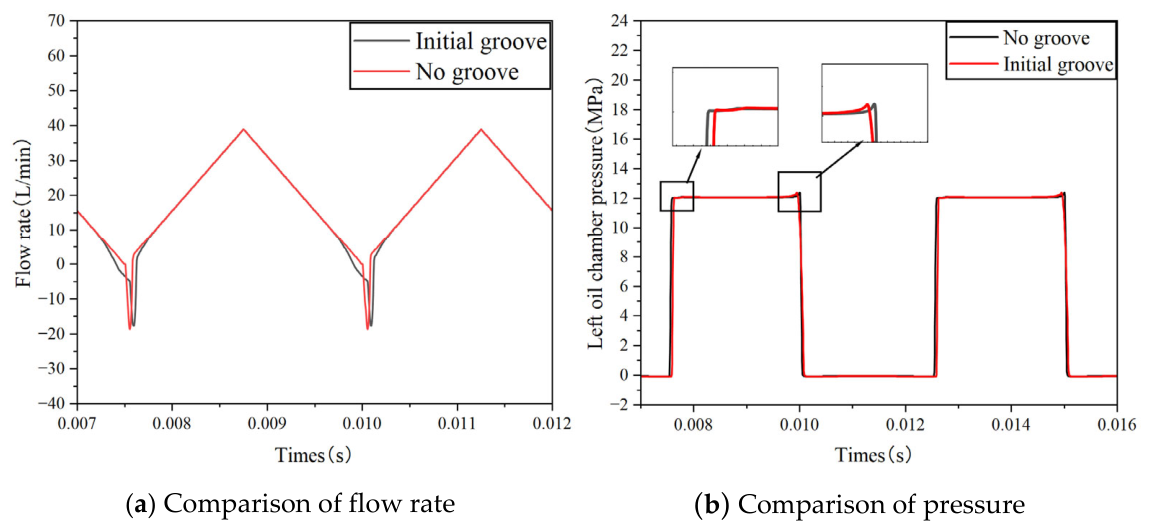
To investigate the impact of the porting structure on pump performance, this study compares simulation results under two conditions: without damping grooves and with initial damping grooves, as shown in Figure 10. In the absence of damping grooves, the instantaneous opening of the porting window creates a large flow area, leading to severe reverse flow with a peak value of 18.58 L/min. After introducing initial damping grooves, due to unoptimized parameters, the reverse flow peak only slightly decreases to 17.72 L/min. Meanwhile, the increased resistance during discharge causes pressure overshoot to worsen from 0.4 MPa to 0.78 MPa. This phenomenon—minimal improvement in reverse flow accompanied by significantly deteriorated pressure characteristics—further confirms the urgency of conducting multi-objective collaborative optimization.
The aforementioned simulation results demonstrate a high degree of consistency with the dynamic characteristics of the Single-Piston Two-Dimensional Electro-Hydraulic Pump described in the existing literature [27]. The model accurately reproduces key curve features, including pulsation amplitude, peak backflow, and abrupt changes at the switching instant. This indicates that the established dynamic model possesses sufficient accuracy and high fidelity, enabling it to reliably capture the strong nonlinear coupling relationship between the damping groove geometric parameters and the pump output characteristics. Furthermore, the study by Zhao [28] on the multi-objective optimization of low-pulsation distribution structures confirms the reliability of the numerical model in capturing pulsation characteristics. Consequently, this validates the model as a solid numerical simulation foundation for subsequent parameter sensitivity analysis, construction of the GA-BP neural network surrogate model, and implementation of multi-objective optimization.

3. Optimization Methodology

3.1. Selection of Optimization Variables and Objectives

To address the issues of reverse flow and pressure pulsation in the SP2DEHP under high-speed conditions, this paper develops a mathematical model with the geometric parameters of the damping grooves as design variables and the minimization of both reverse flow and pressure pulsation amplitude as optimization objectives.
According to the geometric configuration and commutation mechanism of the triangular damping groove, the length angle θ l , width angle θ K , depth angle θ s , and cross angle θ s   are the key parameters that directly determine the transient flow area, opening timing, and throttling characteristics during the distribution process. Therefore, these four parameters are selected as the optimization design variables and defined as the design variable set. Their individual effects on reverse flow and pressure pulsation are further examined in the sensitivity analysis presented in Section 4.1.
X = θ f , θ l , θ s , θ K T
The range of values is jointly constrained by the structural dimension limitations of the porting shaft and the engineering machining feasibility. In order to simultaneously improve the volumetric efficiency and operational stability of the pump, the optimization objectives are set as minimizing the peak reverse flow f 1 X and minimizing the pressure pulsation amplitude in the plunger chamber f 2 X . This multi-objective optimization problem can be described by the following mathematical model:
m i n F ( X )   =   [ f 1 ( X ) , f 2 ( X ) ] T f 1 X   =   f 1 θ f , θ l , θ s , θ K f 2 X   =   f 2 θ f , θ l , θ s , θ K X m i n X X m a x
The specific value ranges for each variable are listed in Table 2.

3.2. Construction of GA-BP Surrogate Model and Multi-Objective Optimization Using NSGA-II

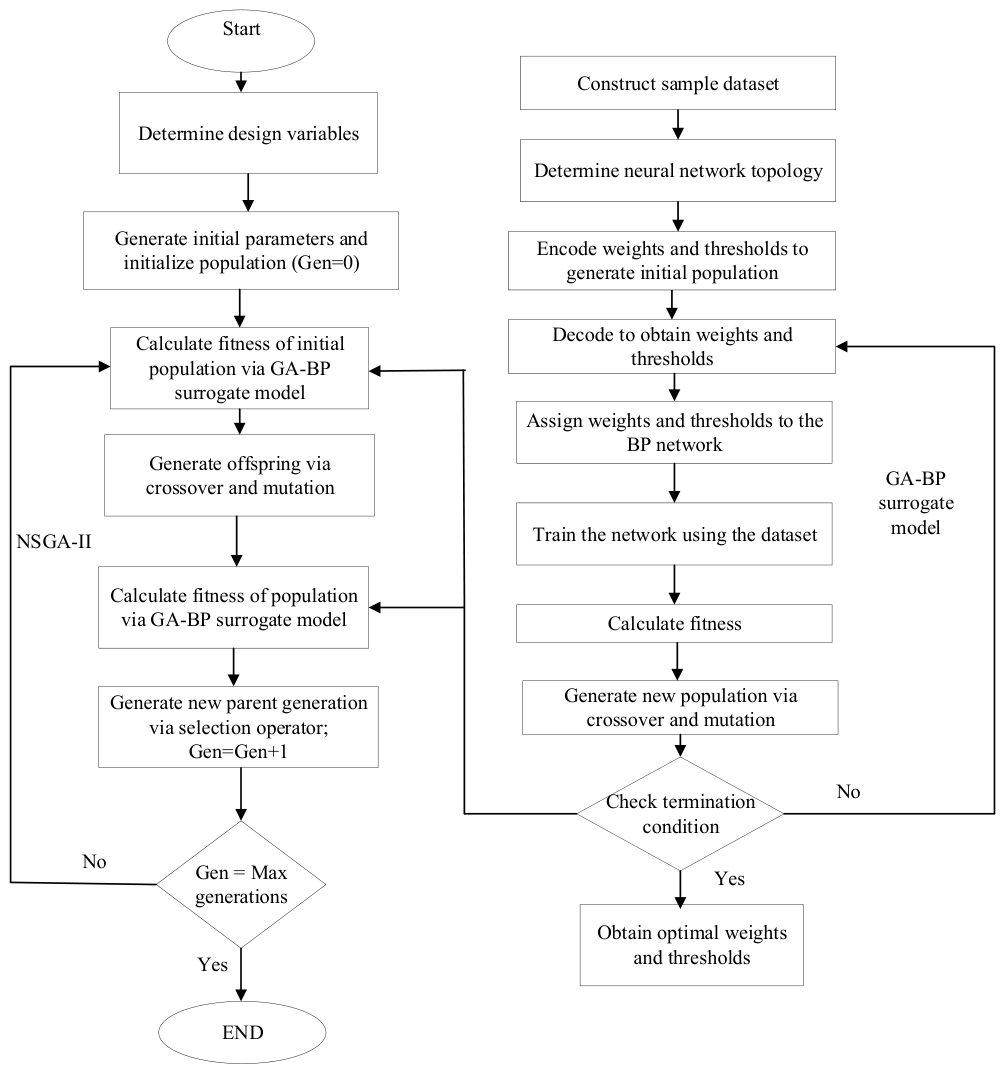
Although the AMESim dynamic model is computationally efficient for a single simulation, the cumulative time cost becomes extremely high and susceptible to numerical noise [29] when thousands of iterative evaluations are required for NSGA-II multi-objective optimization. To address this, this section constructs a neural network based on error backpropagation (BP) as a rapid surrogate model, leveraging its strong nonlinear mapping capability to replace time-consuming high-fidelity simulations. To overcome the limitations of the traditional BP algorithm, which is sensitive to initial weights and prone to falling into local minima, a genetic algorithm (GA) is introduced to globally optimize the network’s initial parameters [30]. This GA-BP hybrid surrogate model combines the global search strength of GA with the local approximation advantages of BP, enabling fast and high-precision predictions and effectively resolving the efficiency bottleneck in optimizing complex design spaces (Figure 11).
To ensure uniform distribution of samples within the design space, the Latin Hypercube Sampling method was employed to generate 100 sample points for the four key geometric parameters of the damping grooves—cross angle θf, length angle θl, depth angle θs, and width angle θK —as input variables. The output responses were the reverse flow y1 and the chamber pressure pulsation amplitude y2, obtained from AMESim simulations, with all samples constrained within the parameter bounds. After performing batch computations using the dynamic model with these samples, the data was randomly divided into a training set of 70 samples and a test set of 30 samples to validate the prediction accuracy of the surrogate model. During neural network training, the external training set was further internally divided into training, validation, and internal test subsets for model fitting and monitoring. Considering that the cross angle mainly affects the commutation phase, whereas the other three variables primarily influence the transient flow area and throttling characteristics, the adopted sample size was considered adequate for the current optimization-oriented study.
Before training, both the input and output data were normalized using min-max scaling to the range of [−1,1] in order to improve the numerical stability of neural network training. The normalization parameters were determined from the training set and then applied to the test set using the same mapping. Specifically, the normalized value x was calculated as:
x   =   2 x x m i n x m a x x m i n 1
where xmin and xmax denote the minimum and maximum values of the corresponding variable in the training set, respectively.
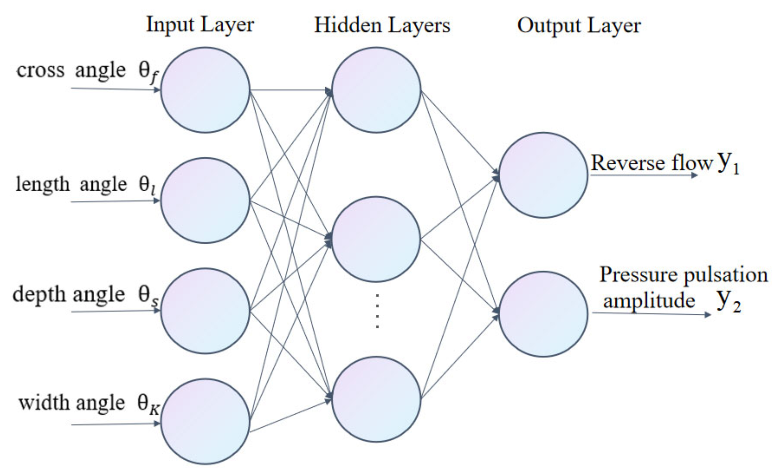
Based on the dimensionality of the input and output parameters as well as empirical formulas, the topology of the BP neural network was determined to be a 4-9-2 structure, as illustrated in Figure 12. Specifically, this configuration consists of 4 nodes in the input layer, 9 nodes in the hidden layer, and 2 nodes in the output layer. The tansig transfer function was selected for the hidden layer, while the purelin linear function was employed for the output layer. After determining the network structure, real-number encoding was used to concatenate all connection weights and thresholds of the BP network into a single chromosome. Through evolutionary operations such as selection, crossover, and mutation, the optimal individual was iteratively searched. The obtained optimal individual was then decoded and assigned to the BP network as the initial weights and thresholds, followed by further training using the Levenberg–Marquardt algorithm. The maximum number of training epochs was set to 1000, the learning rate was set to 0.01, and the training target error was set to 1 × 10⁻⁵. In addition, the momentum factor was set to 0.01, the minimum gradient was set to 1 × 10⁻⁶, and the maximum number of validation failures was set to 6. The mean squared error was used as the training loss function.
Based on the established high-precision GA-BP surrogate model, this study employs the Non-dominated Sorting Genetic Algorithm II (NSGA-II) with an elite strategy to perform global optimization of the damping groove structural parameters. The NSGA-II algorithm incorporates a fast non-dominated sorting mechanism and a crowding distance calculation strategy, which reduces computational complexity while effectively maintaining population diversity, thereby enabling rapid convergence to the Pareto optimal front. In the genetic algorithm, the parameters were set as follows: crossover probability of 0.9, mutation probability of 0.1, number of generations set to 100, and initial population size of 50.

4. Optimization of Damping Groove Structural Parameters Based on GA-BP Surrogate Model

4.1. Sensitivity Analysis of Damping Groove Parameters

Based on the aforementioned AMESim simulation model, this section further examines the physical influence of the selected design variables on the dynamic characteristics of the SP2DEHP during the distribution process. Specifically, the effects of the cross angle, depth angle, width angle, and length angle on reverse flow and chamber pressure pulsation are investigated. The aim is to identify the key parameters that have the most significant impact on performance.

4.1.1. Influence of Cross Angle

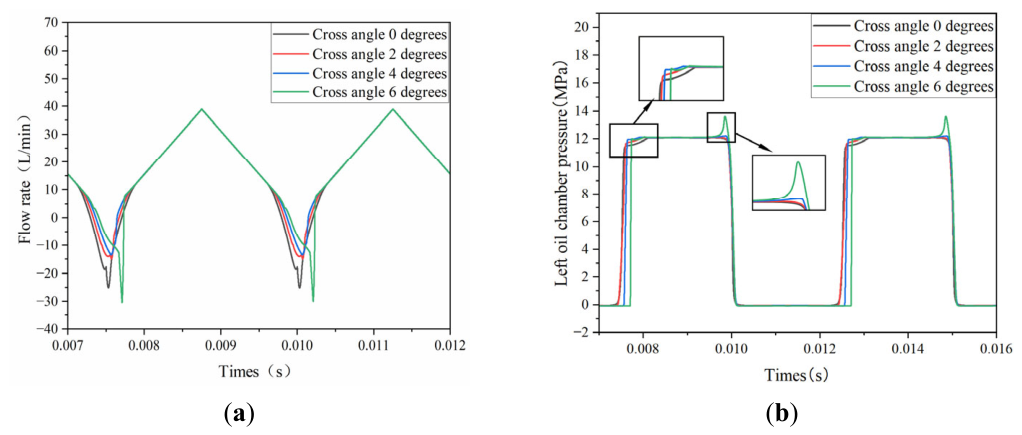
Under the conditions of a depth angle of 17°, a width angle of 110°, and a length angle of 15°, a comparative analysis was performed for different cross angles, as illustrated in Figure 13. The simulation results indicate that the cross angle has a significant influence on both reverse flow and pressure pulsation, exhibiting a distinct non-monotonic trend.
When the cross angle is 0°, the damping grooves form an approximately continuous flow channel in the flow distribution transition zone. This allows direct communication between the high-pressure and low-pressure chambers over a wide angular range, making it difficult to establish an effective pressure gradient. As a result, the reverse flow increases significantly, and the chamber pressure exhibits an under-pressure phenomenon during the initial rising phase.
As the cross angle increases to 2–4°, the tip of the damping groove is appropriately offset relative to the flow distribution dead point, which delays the effective opening of the port relative to the chamber pressure build-up process. As a result, the high-pressure chamber is allowed to undergo a more gradual pre-depressurization or pre-pressurization process before full communication with the low-pressure side occurs. This reduces the instantaneous pressure difference across the port at the switching moment, weakens the sudden backflow path from the high-pressure chamber to the low-pressure chamber, and thereby suppresses both reverse flow and pressure pulsation amplitude. In essence, an appropriate cross angle improves the temporal matching between port opening and chamber pressure evolution, which is the key reason why reverse flow can be reduced.
When the cross angle increases further to 6°, the excessive phase offset in the flow distribution causes partial obstruction of the suction port within certain angular ranges. This results in insufficient oil replenishment in the low-pressure chamber and tends to induce an oil-trapping phenomenon during the high-pressure phase, leading to chamber pressure overshoot and aggravated reverse flow. These results indicate that the cross angle must be properly balanced to avoid both direct leakage and oil trapping.

4.1.2. Influence of Depth Angle

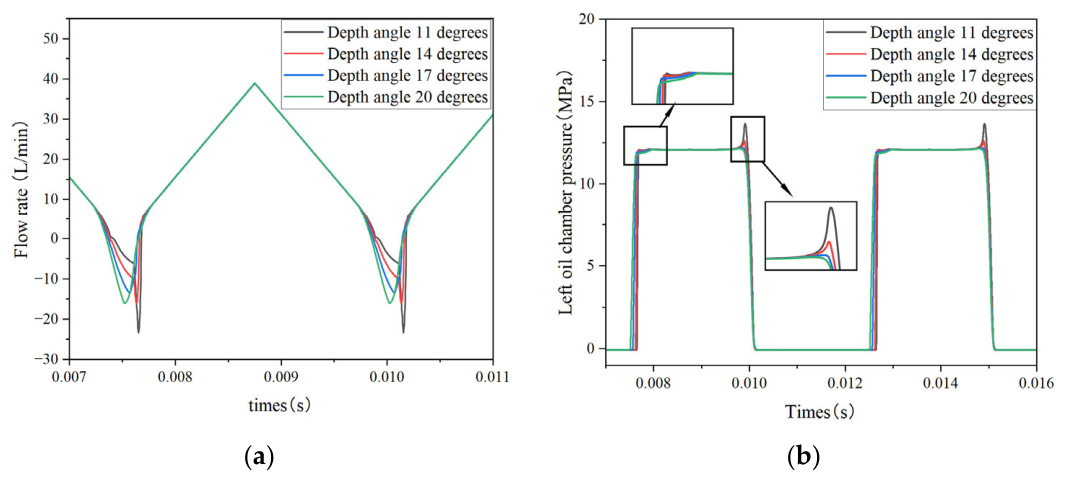
Under the conditions of a cross angle of 4°, a width angle of 110°, and a length angle of 15°, simulation analysis was conducted for different depth angles, as illustrated in Figure 14. The depth angle determines the effective flow depth and equivalent throttling capability of the damping groove, and its variation significantly affects the dynamic characteristics of the system.
When the depth angle is small, the damping groove’s throttling capacity is insufficient, making it difficult to achieve effective pre-depressurization during the flow distribution switching phase. This results in significant pressure fluctuations and a high peak reverse flow. As the depth angle increases to 14–17°, the throttling effect of the damping groove strengthens, and the change in flow area becomes more gradual. The chamber pressure buildup process is effectively cushioned, leading to a significant reduction in both reverse flow and pressure pulsation. However, when the depth angle is further increased to 20°, the damping groove becomes excessively deep, creating a positive opening state within certain angular ranges. This weakens the throttling effect and, conversely, causes the peak reverse flow to rebound.

4.1.3. Influence of Width Angle

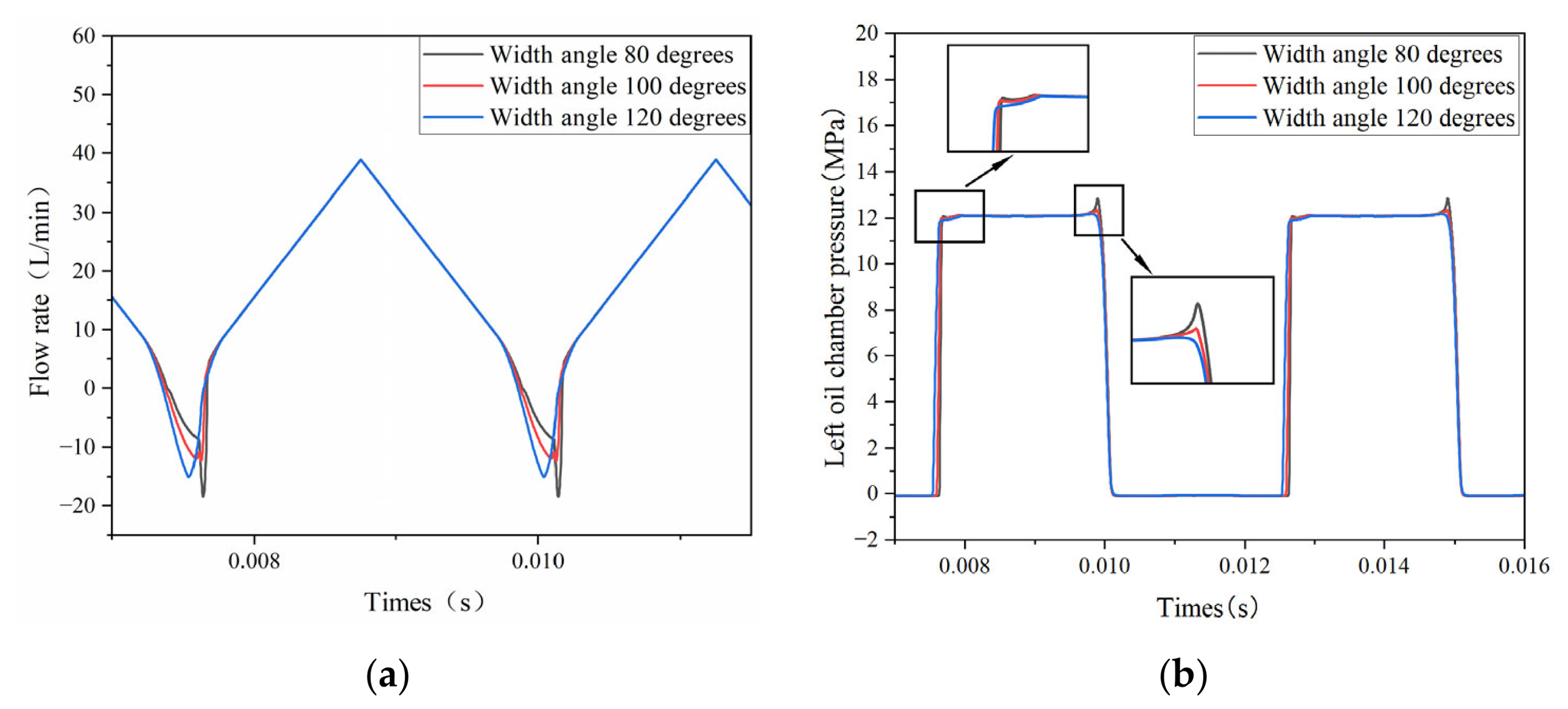
Under the conditions of a cross angle of 4°, a depth angle of 17°, and a length angle of 15°, the influence of the width angle variation on system characteristics was analyzed, as shown in Figure 15. The results indicate that the width angle has a relatively limited impact on the peak reverse flow but exhibits a significant modulating effect on the slope of pressure change. A smaller width angle restricts the flow capacity, easily leading to abrupt pressure changes; whereas an excessively large width angle weakens the throttling effect and increases the risk of leakage. Therefore, the width angle must be designed in coordination with other parameters to achieve a balance between smooth pressure transition and volumetric efficiency.

4.1.4. Influence of Damping Groove Length Angle

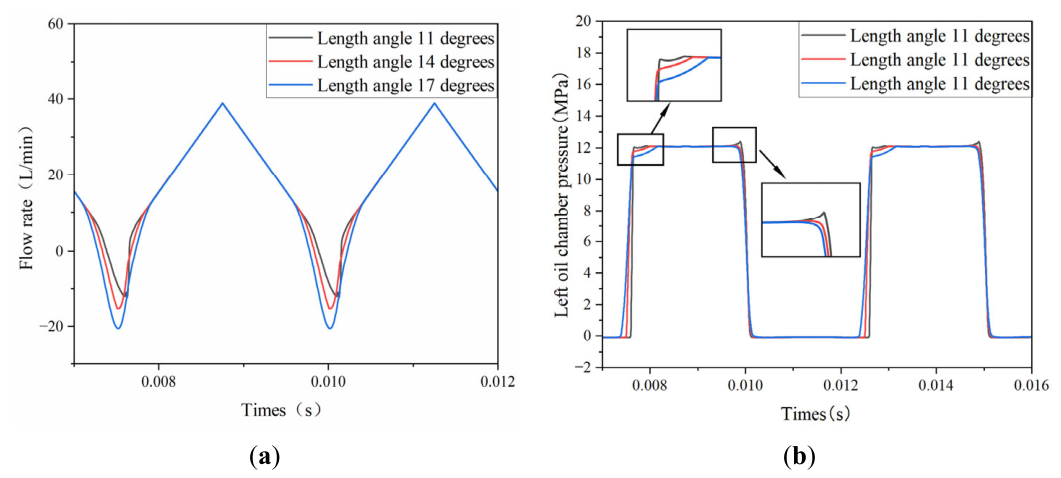
The length angle of the damping groove determines the duration of the pre-depressurization and pre-pressurization processes within the angular domain, with the results of its influence shown in Figure 16. When the length angle is small, the flow distribution switching process is concentrated, resulting in steep pressure changes and pronounced reverse flow and pressure pulsation. As the length angle increases, the pressure transition becomes more gradual, effectively suppressing both reverse flow and pressure pulsation. However, an excessively large length angle prolongs the connection time between the high- and low-pressure chambers, increasing leakage losses and adversely affecting the system’s volumetric efficiency.
In summary, the length angle, width angle, depth angle, and cross angle of the damping groove all significantly influence the reverse flow and pressure pulsation characteristics of the SP2DEHP. However, these effects exhibit distinct nonlinear characteristics and strong coupling relationships. The cross angle mainly affects the commutation phase and opening timing, whereas the length angle, width angle, and depth angle jointly determine the transient flow area and throttling characteristics. Therefore, the effect of any single parameter depends on the combination of the others, and the trend obtained from single-factor analysis reflects only a local influence law rather than the global optimum. Consequently, it is necessary to introduce a surrogate model combined with a multi-objective optimization algorithm to perform systematic global optimization of the damping groove geometric parameters.

4.2. Surrogate Model Accuracy Verification

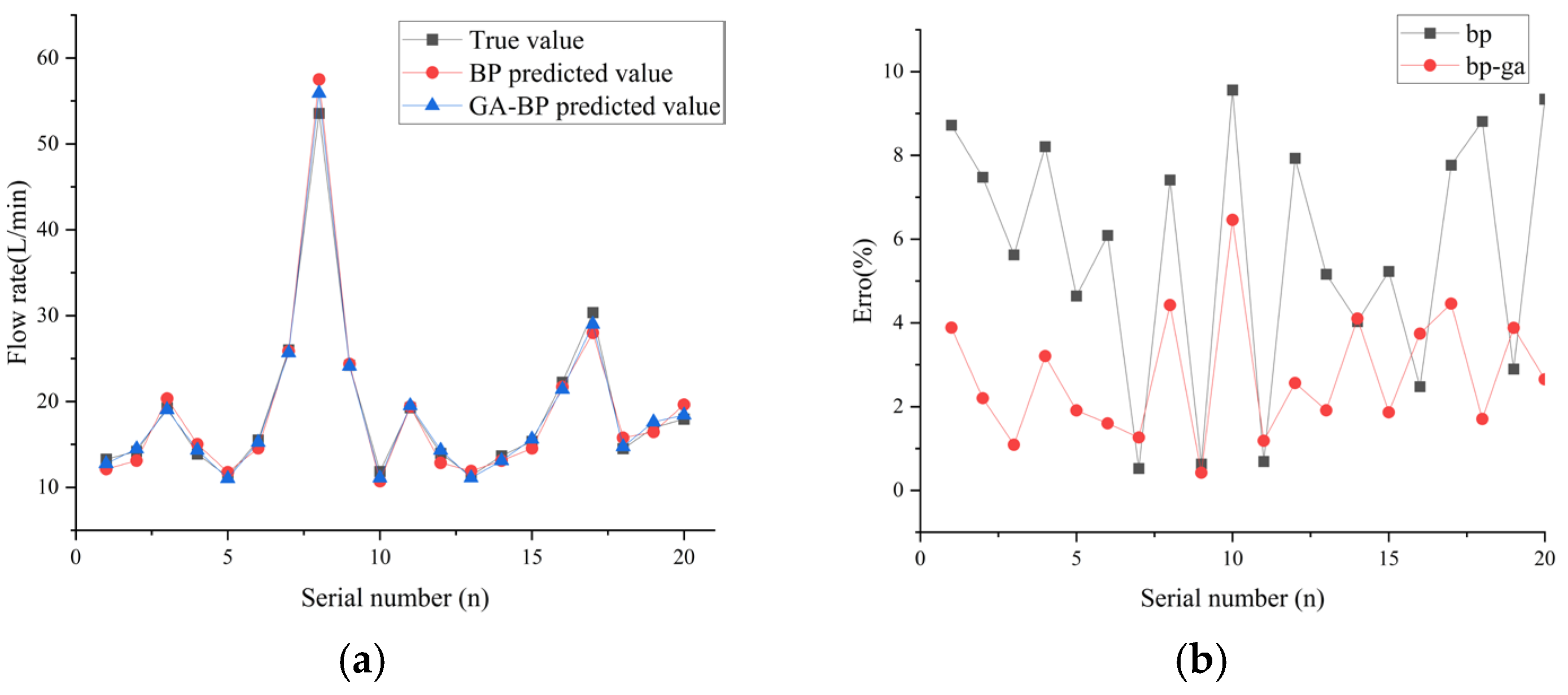
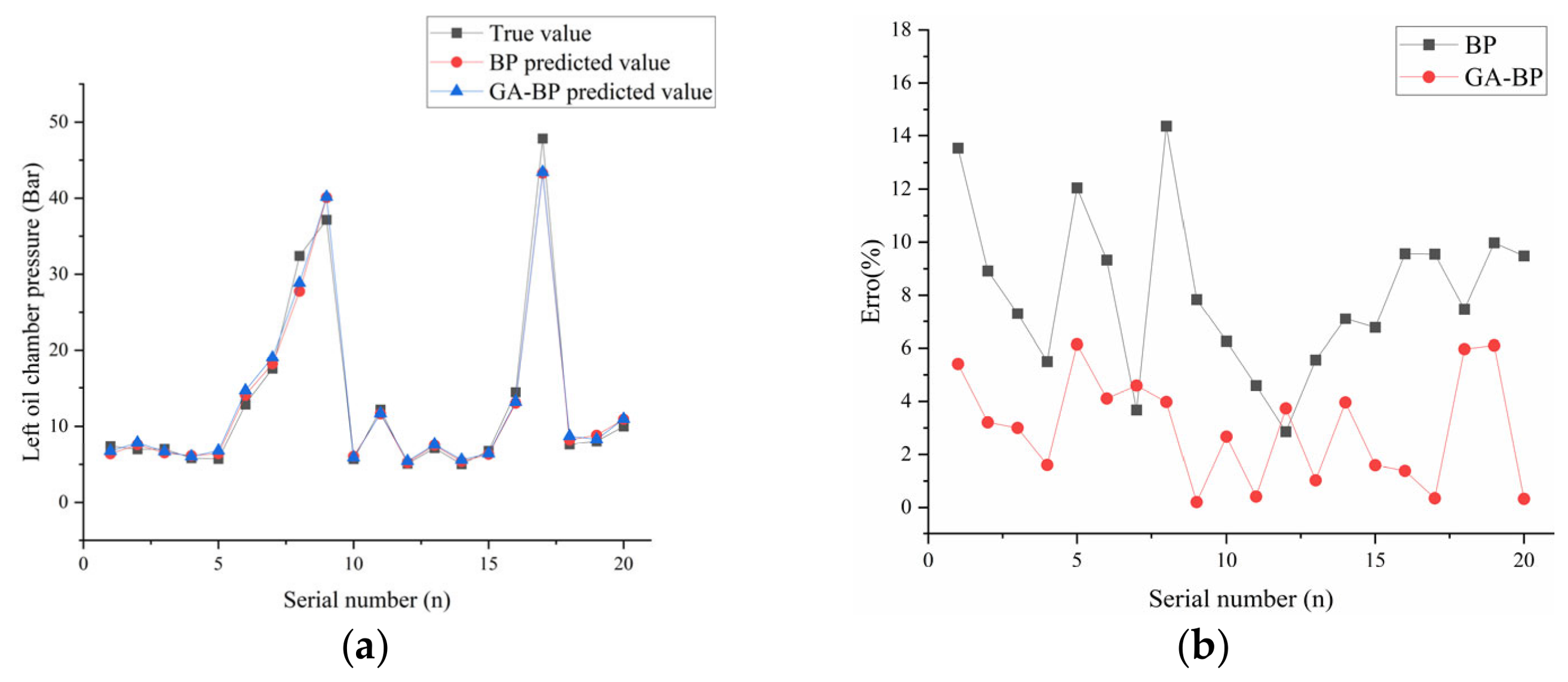
The genetic algorithm was configured with a population size of 50 and a maximum of 100 generations. During the algorithm’s execution, the population was continuously updated through roulette wheel selection, arithmetic crossover with a probability of 0.9, and non-uniform mutation with a probability of 0.1 until the termination criteria were met. Finally, the genes of the optimally evolved individual were decoded and assigned to the BP neural network, which was then fine-tuned using the Levenberg–Marquardt algorithm for error backpropagation training to achieve a high-precision surrogate model. After model training, predictions for the peak reverse flow and chamber pressure pulsation amplitude were generated and compared with AMESim simulation results, as shown in Figure 17 and Figure 18.
Test results indicate that the traditional BP model achieved mean relative errors of 8.08% and 5.66% in predicting reverse flow and chamber pressure pulsation, respectively. In contrast, the GA-BP model demonstrated significantly reduced mean relative errors of 2.72% and 2.99% for the corresponding predictions. These results indicate that the genetic algorithm effectively improves the initialization of weights and thresholds and enhances the predictive accuracy of the surrogate model within the sampled design space.
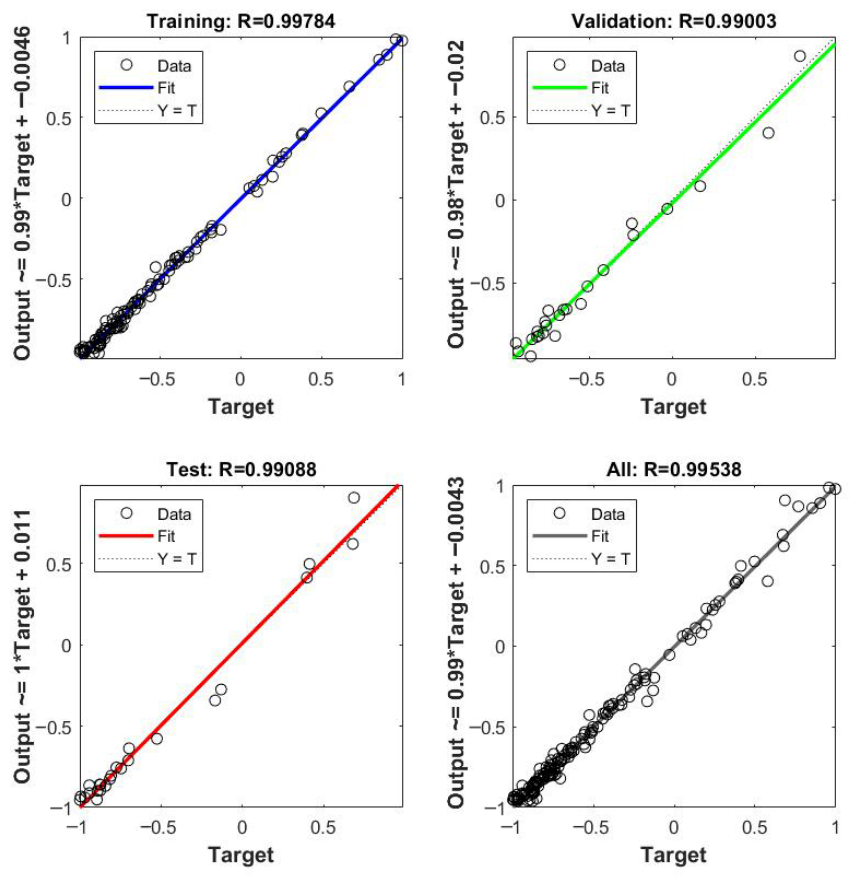
In addition to the error-based evaluation, the predictive performance of the GA-BP surrogate model was further examined through regression analysis. As shown in Figure 19, the correlation coefficients R   for the training set, validation set, test set, and all samples were 0.99784, 0.99003, 0.99088, and 0.99538, respectively, indicating a strong consistency between the predicted values and the target values.
It should be noted, however, that the present GA-BP model is intended for interpolation within the parameter ranges listed in Table 2 under the studied operating conditions. If the damping groove geometry or operating state goes beyond the sampled domain, especially under more severe turbulence or cavitation conditions, the prediction accuracy may decrease. Further validation under expanded parameter ranges and operating conditions will be considered in future work. In addition, the present surrogate-model validation was conducted based on a single random train–test split. Although the obtained errors are low and the regression results show strong consistency between predictions and targets, additional validation strategies such as repeated runs or cross-validation may further improve confidence in the surrogate model and will also be considered in future work.

4.3. Multi-Objective Optimization Results

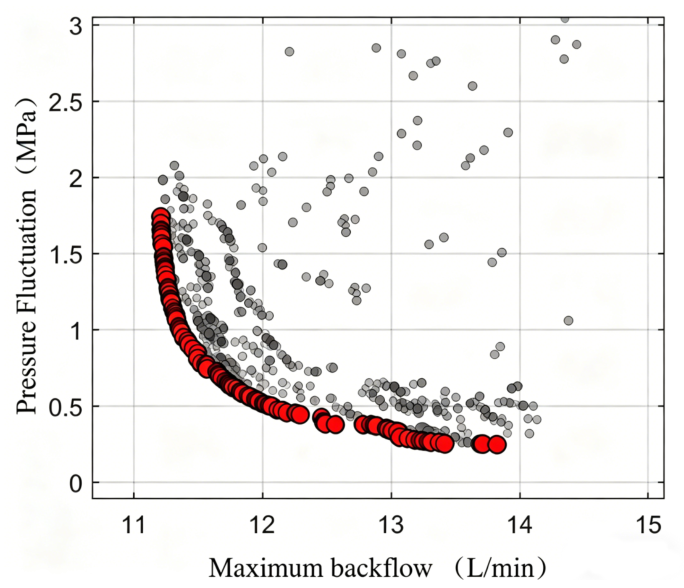
This study employs the NSGA-II algorithm with a crossover probability of 0.9, a mutation probability of 0.1, an initial population size of 50, and a maximum of 100 generations. Upon convergence after 100 generations, the Pareto-optimal frontier—depicted in Figure 20—is successfully identified. A clear monotonic increase in reverse flow is observed with rising chamber pressure fluctuation along this frontier, revealing an inherent trade-off between the two competing objectives: minimizing reverse flow and suppressing pressure pulsation. All solutions on the frontier are non-dominated (i.e., Pareto-optimal), implying that no solution strictly dominates another in the objective space; consequently, none simultaneously optimizes both objectives. In the decision space, the corresponding parameter sets form a dense, continuous, and smoothly convex distribution—visualized by the red points in Figure 20—indicating that the NSGA-II algorithm effectively explores, approximates, and captures high-quality Pareto-optimal solutions across the feasible design domain.
From a fluid dynamics perspective, this contradiction primarily stems from the throttling characteristics of the damping structure. In the upper-left region of the Pareto front, where the design prioritizes the suppression of reverse flow, it is typically necessary to reduce the effective flow area of the damping groove or delay its opening phase to block the backflow path of high-pressure fluid into the low-pressure zone. However, such a reduction in flow area hinders the smooth establishment of pressure within the piston chamber during the distribution process, resulting in an increased internal pressure gradient and thereby inducing severe pressure shocks. Conversely, increasing the dimensions of the damping structure to pursue minimal pressure pulsation—a condition corresponding to the lower-right region of the front—can extend the pre-compression process and smooth the pressure transition. Yet, this inevitably prolongs the communication time between the high- and low-pressure ports, leading to increased reverse flow and significantly compromising the volumetric efficiency of the pump. Therefore, single-objective optimization is clearly insufficient to meet the comprehensive performance requirements of the system.
To verify the effectiveness of the optimization based on the GA-BP neural network surrogate model combined with the NSGA-II multi-objective genetic algorithm, a compromise solution was selected from the Pareto-optimal solution set. Rather than choosing an extreme point favoring only one objective, a solution with relatively balanced objective values was adopted for further verification. This solution maintained both a relatively low reverse-flow peak and a relatively small chamber pressure pulsation amplitude, and was therefore considered suitable as a representative trade-off design. The specific parameters are listed in Table 3, and the solution was substituted into the AMESim simulation model for verification. The effectiveness of the optimization was further evaluated by comparing the structural parameters, chamber pressure fluctuations, and reverse-flow characteristics before and after optimization.
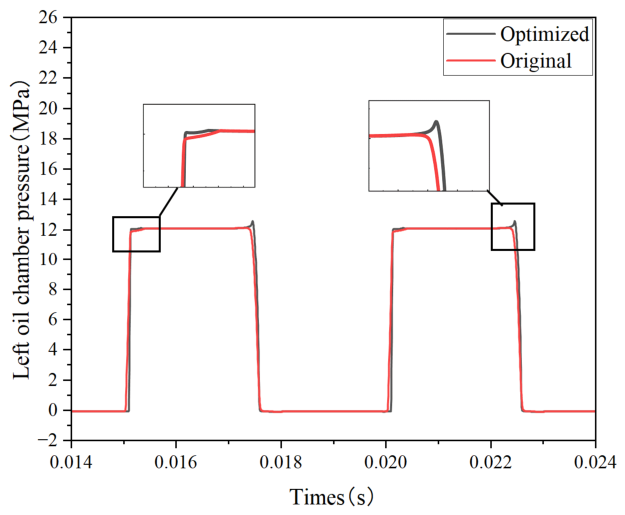
Figure 21 presents the dynamic pressure response curves within the piston chamber before and after optimization. Simulation results indicate that the pressure overshoot was significantly reduced from 0.78 MPa to 0.41 MPa after optimization. In terms of waveform characteristics, the pre-optimization pressure peak predominantly occurred at the end of the discharge stage, manifesting as noticeable pressure overshoot. After optimization, this pressure accumulation phenomenon was eliminated, with pressure fluctuations now appearing as slightly under-pressure during the initial commutation phase.
The multi-objective optimization strategy helps balance the inherent trade-off between reverse flow and pressure pulsation. Through algorithm-driven coordinated adjustment of geometric parameters, this approach achieves an optimal equilibrium between pressure fluctuation suppression and reverse flow control. Specific modifications include optimizing the damping groove angular length to 17.52° with phase correction of the interlace angle. This enhanced design prolongs the pre-pressurization process to minimize opening pressure differentials and water hammer effects, while simultaneously eliminating trapped fluid compression spikes caused by design-induced dead zones. The synergistic parameter tuning successfully transforms abrupt step-like pressure transitions into smooth continuous profiles, thereby significantly improving the system’s operational smoothness.
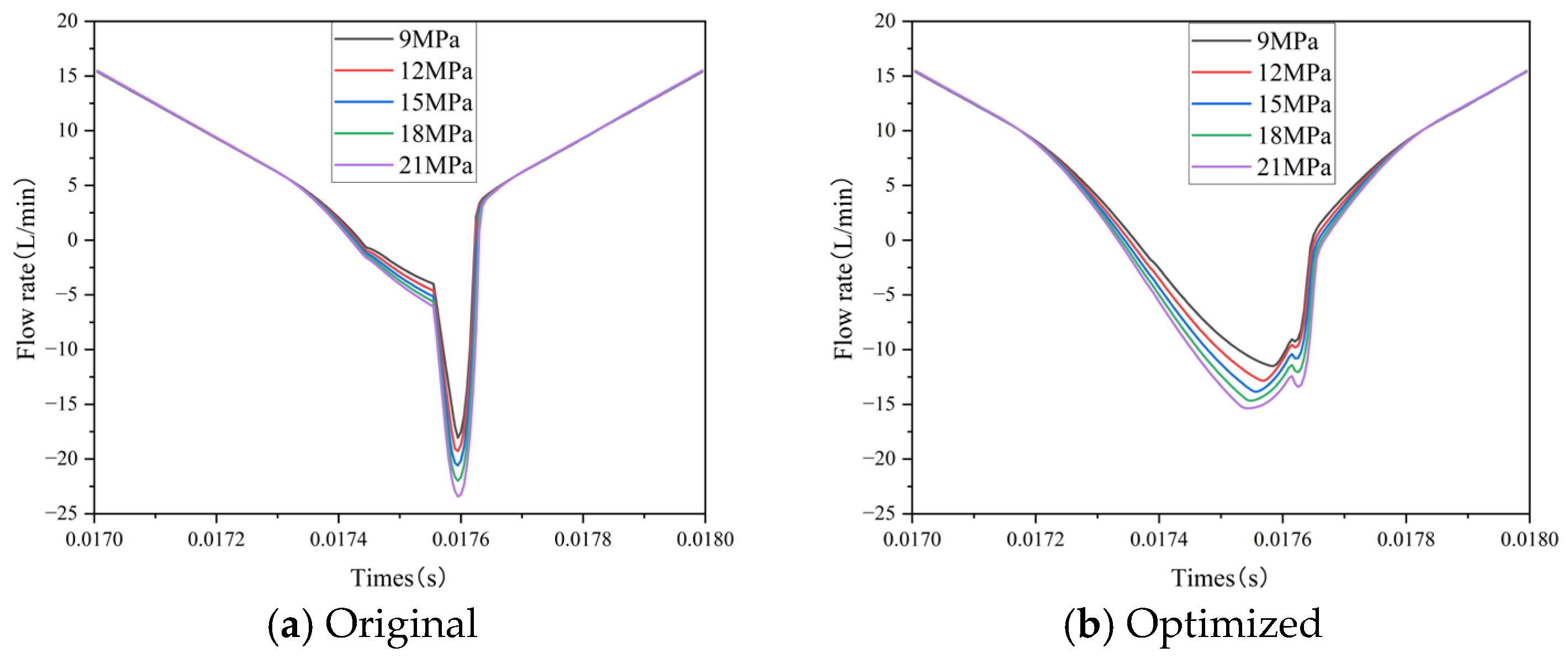
To achieve an optimal balance between the conflicting constraints of low-pressure–flow efficiency and high-pressure sealing performance, the multi-objective optimization algorithm enables precise matching of structural parameters. The optimized porting structure shows improved reverse-flow performance over the tested outlet pressure range from 9 MPa to 21 MPa (Figure 22). Simulation results indicate that as the load pressure increases, the reverse flow peak in the original design surges from 17.74 L/min to 23.4 L/min, exhibiting strong pressure sensitivity. In contrast, the optimized solution not only maintains lower reverse flow levels across all operating conditions but also effectively controls the increase within 4.1 L/min.
The fundamental reason for this performance improvement lies in the optimized groove configuration that establishes more rational variable flow resistance characteristics. Under high-pressure differential conditions, the optimized throttling cross-section effectively enhances fluid damping effects, significantly suppressing the pressure gradient-driven clearance leakage flow. Benefiting from this algorithm-driven “hydraulic resistance matching,” the system successfully mitigates the nonlinear reverse flow tendency under heavy loads, thereby indicating improved performance under the tested operating conditions.

5. Conclusions

This study investigates the issues of reverse flow and pressure pulsation during the commutation process, in which the pump chamber cyclically switches between high- and low-pressure states, in a SP2DEHP. Through mechanistic analysis and multi-objective optimization of the structural parameters of the port pair, the following main conclusions are drawn:
  • A comprehensive dynamic model of the SP2DEHP system incorporating leakage mechanisms was established. This model provides an in-depth analysis of the strong nonlinear coupling relationship between the key geometric characteristics of triangular damping grooves and the pump’s output performance. The results confirm that an appropriately designed damping groove structure effectively utilizes throttling effects to alleviate pressure shocks during fluid commutation, playing a pivotal role in suppressing reverse flow and pressure pulsation.
  • To address the limitations of traditional physical simulation models, which involve heavy computational loads and are inadequate for global searches in multi-dimensional parameter spaces, a Genetic Algorithm-optimized Backpropagation (GA-BP) neural network was introduced to construct a high-fidelity surrogate model. This model effectively replaces time-consuming fluid dynamics calculations while maintaining prediction accuracy, resolving the persistent challenge of balancing computational efficiency and optimization precision in complex engineering problems.
  • The NSGA-II algorithm was employed to conduct global cooperative optimization of the damping groove structural parameters, successfully obtaining the Pareto optimal solution set that balances the two conflicting objectives of reverse flow and pressure pulsation. The results demonstrate that compared to the initial design, the optimized SP2DEHP achieves a 27.6% reduction in peak reverse flow. Furthermore, pressure overshoot is effectively suppressed, with the pressure pulsation amplitude decreasing from 0.78 MPa to 0.41 MPa, which is expected to be beneficial for improving the operational stability and volumetric performance of the pump.
Although the proposed framework achieved good optimization performance under the studied conditions, several limitations should be noted. First, the dynamic model and optimization results rely on the AMESim simulation environment and the fidelity of the underlying lumped-parameter representation. Second, the GA-BP surrogate model is accurate within the sampled parameter ranges, but its predictive capability may decrease outside the sampled design space. Third, the present study has not yet been validated through dedicated experiments on a physical prototype. These limitations will be addressed in future work through experimental validation, broader operating-range analysis, and further improvement of the modeling and optimization framework.

Author Contributions

Conceptualization, X.Q. and H.L.; methodology, X.Q. and H.L.; software, validation, formal analysis, investigation, data curation, writing—original draft preparation, and visualization, H.L.; writing—review and editing, X.Q. and J.W.; resources, supervision, project administration, and funding acquisition, X.Q. All authors have read and agreed to the published version of the manuscript.

Funding

This research was funded by the Zhejiang Provincial Natural Science Foundation, China, grant number LGG22E050032.

Data Availability Statement

The data presented in this study are available from the corresponding author upon reasonable request.

Acknowledgments

The authors would like to acknowledge the technical support received during the preparation of this manuscript. We hereby state that OpenAI ChatGPT was solely used for language polishing, grammar correction, and academic English expression optimization of the completed manuscript text. The AI tool was not involved in any part of the research work, including but not limited to research design, data collection and processing, experimental result analysis, core argument construction, chart production, and data interpretation. All AI-assisted language content has been thoroughly reviewed, revised, and confirmed by all authors. The authors take full and exclusive responsibility for the originality, accuracy, and integrity of the entire manuscript, as well as all final decisions related to the publication.

Conflicts of Interest

The authors declare no conflicts of interest. The funders had no role in the design of the study; in the collection, analyses, or interpretation of data; in the writing of the manuscript; or in the decision to publish the results.

Abbreviations

The following abbreviations are used in this manuscript:
SP2DEHPSingle-Piston Two-Dimensional Electro-Hydraulic Pump
EHAElectro-Hydrostatic Actuator
GA-BPGenetic Algorithm-Optimized Backpropagation
NSGA-IINon-dominated Sorting Genetic Algorithm II
LHSLatin Hypercube Sampling
CFDComputational Fluid Dynamics

References

  1. Xing, T.; Xu, Y.; Ruan, J. Two-dimensional piston pump: Principle, design, and testing for aviation fuel pumps. Chin. J. Aeronaut. 2020, 33, 1349–1360. [Google Scholar] [CrossRef]
  2. Qiu, X.-G.; Chen, K.-G.; Wu, P.; Zheng, Y.; Wang, C.; Ji, X.-J. Research on the distribution structure of 2D piston electro-hydraulic pump based on fluid-structure interaction. Adv. Mech. Eng. 2024, 16, 16878132241264985. [Google Scholar] [CrossRef]
  3. Shentu, S.; Ruan, J.; Qian, J.; Meng, B.; Wang, L.; Guo, S. Study of flow ripple characteristics in an innovative two-dimensional fuel piston pump. J. Braz. Soc. Mech. Sci. Eng. 2019, 41, 464. [Google Scholar] [CrossRef]
  4. Zhang, C.; Ruan, J.; Xing, T.; Li, S.; Meng, B.; Ding, C. Research on the volumetric efficiency of a novel stacked roller 2D piston pump. Machines 2021, 9, 128. [Google Scholar] [CrossRef]
  5. Jin, D.-C.; Ruan, J.; Li, S.; Meng, B.; Wang, L.-F. Modelling and validation of a roller-cam rail mechanism used in a 2D piston pump. J. Zhejiang Univ. -Sci. A 2019, 20, 201–217. [Google Scholar] [CrossRef]
  6. Huang, Y.; Ruan, J.; Ding, C.; Li, S. Effect of clearance on volumetric efficiency in 2D piston pumps. Adv. Mech. Eng. 2021, 13, 16878140211047727. [Google Scholar] [CrossRef]
  7. Pettersson, M.E.; Weddfelt, K.G.; Palmberg, J.O.S. Methods of reducing flow ripple from fluid power piston pumps—A theoretical approach. SAE Trans. 1991, 100, 158–167. [Google Scholar]
  8. Johansson, A.; Palmberg, J.-O. The importance of suction port timing in axial piston pumps. In Proceedings of the 9th Scandinavian International Conference on Fluid Power (SICFP’05), Linköping, Sweden, 1–3 July 2005; p. 32. [Google Scholar]
  9. Guo, T.; Zhao, S.; Liu, C. Study on flow characteristics and flow ripple reduction schemes of spool valves distributed radial piston pump. Proc. Inst. Mech. Eng. Part. C J. Mech. Eng. Sci. 2017, 231, 2291–2301. [Google Scholar] [CrossRef]
  10. Ye, S.G.; Zhang, J.H.; Xu, B. Noise reduction of an axial piston pump by valve plate optimization. Chin. J. Mech. Eng. 2018, 31, 57. [Google Scholar] [CrossRef]
  11. Hong, H.; Zhao, C.; Zhang, B.; Bai, D.; Yang, H. Flow ripple reduction of axial-piston pump by structure optimizing of outlet triangular damping groove. Processes 2020, 8, 1664. [Google Scholar] [CrossRef]
  12. Hong, H.-C.; Zhang, B.; Yu, M.; Zhong, Q.; Yang, H.-Y. Analysis and optimization on U-shaped damping groove for flow ripple reduction of fixed displacement axial-piston pump. Int. J. Fluid Mach. Syst. 2020, 13, 126–135. [Google Scholar] [CrossRef]
  13. Pan, Y.; Chen, A.H.; Wang, Z.N. Fluid dynamic characteristics and flow distribution structure optimization of axial piston pump considering cavitation bubble evolution. J. Appl. Fluid Mech. 2021, 14, 1603–1616. [Google Scholar] [CrossRef]
  14. Xu, Y.; Wang, R.; Deng, M.; Gu, Z.; Xie, Y.; Jiao, Z. Flow ripple reduction of axial piston pump for multiple working statuses with fast structural optimization method. Chin. J. Mech. Eng. 2025, 38, 118. [Google Scholar] [CrossRef]
  15. Xu, B.; Ye, S.; Zhang, J.; Zhang, C. Flow ripple reduction of an axial piston pump by a combination of cross-angle and pressure relief grooves: Analysis and optimization. J. Mech. Sci. Technol. 2016, 30, 2531–2545. [Google Scholar] [CrossRef]
  16. Zhang, C.; Zhang, D.; Lu, Y.; Li, S.; Ruan, J. Research on flow and pressure pulsation optimization of roller piston pump with triangular damping groove. Flow Meas. Instrum. 2025, 106, 103000. [Google Scholar] [CrossRef]
  17. Zhang, H.; Li, K.; Liu, T.; Liu, Y.; Hu, J.; Zuo, Q.; Jiang, L. Analysis the composition of hydraulic radial force on centrifugal pump impeller: A data-centric approach based on CFD datasets. Appl. Sci. 2025, 15, 7597. [Google Scholar] [CrossRef]
  18. Mitov, A.; Nikolov, N.; Nedelchev, K.; Kralov, I. CFD modeling and experimental validation of the flow processes of an external gear pump. Processes 2024, 12, 261. [Google Scholar] [CrossRef]
  19. Wang, C.-N.; Yang, F.-C.; Nguyen, V.T.T.; Vo, N.T.M. CFD analysis and optimum design for a centrifugal pump using an effectively artificial intelligent algorithm. Micromachines 2022, 13, 1208. [Google Scholar] [CrossRef] [PubMed]
  20. Hu, Q.; Zhai, X.; Li, Z. Multi-objective optimization of deep-sea mining pump based on CFD, GABP neural network and NSGA-III algorithm. J. Mar. Sci. Eng. 2022, 10, 1063. [Google Scholar] [CrossRef]
  21. Nguyen, D.-A.; Lee, H.-J.; Kim, S.; Choi, B.-L.; Choi, D.-H.; Kim, G.S.; Sun, S.; Kim, J.-H. Multiobjective hydraulic optimization of the diffuser vane in an axial flow pump. Phys. Fluids 2024, 36, 075125. [Google Scholar] [CrossRef]
  22. Rashki, M.; Azarkish, H.; Rostamian, M.; Bahrpeyma, A. Classification correction of polynomial response surface methods for accurate reliability estimation. Struct. Saf. 2019, 81, 101869. [Google Scholar] [CrossRef]
  23. Xu, K.; Wang, G.; Zhang, L.; Wang, L.; Yun, F.; Sun, W.; Wang, X.; Chen, X. Multi-objective optimization of jet pump based on RBF neural network model. J. Mar. Sci. Eng. 2021, 9, 236. [Google Scholar] [CrossRef]
  24. Ren, C.; Aoues, Y.; Lemosse, D.; De Cursi, E.S. Ensemble of surrogates combining kriging and artificial neural networks for reliability analysis with local goodness measurement. Struct. Saf. 2022, 96, 102186. [Google Scholar] [CrossRef]
  25. Xia, Y.; Li, Z.; Liu, W.; Tan, S.; Xu, S.; Liu, S.; Xia, S. Effects of the cross angle on output characteristics and tilting behaviour for 750 mL/r axial piston pumps. Alex. Eng. J. 2024, 99, 347–362. [Google Scholar] [CrossRef]
  26. Huang, X.; Xu, B.; Huang, W.; Xu, H.; Lyu, F.; Su, Q. Active pressure ripple reduction of a self-supplied variable displacement pump with notch least mean square filter. Micromachines 2021, 12, 932. [Google Scholar] [CrossRef]
  27. Chen, Y.; Hua, C.; Tong, C.; Zang, Y.; Ruan, J. Volumetric efficiency in motor-driven two-dimensional piston pumps with leakage and reverse flow under high pressure. Sci. Rep. 2024, 14, 28963. [Google Scholar] [CrossRef]
  28. Zhao, X.; Li, F.; Zhu, Y.; Yang, L.; Ma, M.; Qu, S. An improved genetic algorithm with wavelet packet and low-pass filters for reducing pressure and flow pulsations in axial piston motors. Proc. Inst. Mech. Eng. Part C J. Mech. Eng. Sci. 2025, 239, 4051–4069. [Google Scholar] [CrossRef]
  29. Burkotová, J.; Pour, P.A.; Krátký, T.; Miettinen, K. Interactive multiobjective optimization of an extremely computationally expensive pump design problem. Eng. Optim. 2024, 56, 1318–1333. [Google Scholar] [CrossRef]
  30. Yu, D.; Zhang, J.; Yuan, S.; Ma, W.; Bai, X.; Chen, Y.; Wang, C. Prediction of shut-off head for centrifugal pumps based on grey theory and GA-BP neural network. AIP Adv. 2024, 14, 125214. [Google Scholar] [CrossRef]
Figure 1. Optimization process.
Processes 14 01514 g001
Figure 2. Structure of the SP2DEHP.
Processes 14 01514 g002
Figure 3. Diagram of cam motion law.
Processes 14 01514 g003aProcesses 14 01514 g003b
Figure 4. Connection relationship between distribution slots and distribution windows.
Processes 14 01514 g004
Figure 5. Geometry and parameters of the triangular damping groove.
Processes 14 01514 g005
Figure 7. Variation in suction and discharge flow areas with rotation angle.
Processes 14 01514 g007
Figure 8. Leakage model of the SP2DEHP.
Processes 14 01514 g008
Figure 9. Simulation model of the SP2DEHP.
Processes 14 01514 g009
Figure 10. Comparison of flow and pressure characteristics with and without damping grooves.
Processes 14 01514 g010
Figure 11. Flowchart of GA-BP surrogate model development and NSGA-II multi-objective optimization application.
Processes 14 01514 g011
Figure 12. The topology of the BP neural network.
Processes 14 01514 g012
Figure 13. Influence of different cross angles on reverse flow and pressure pulsation. (a) Influence of different cross angles on reverse flow; (b) Influence of different cross angles on pressure pulsation.
Processes 14 01514 g013
Figure 14. Influence of different depth angles on reverse flow and pressure pulsation. (a) Influence of different depth angles on reverse flow; (b) Influence of different depth angles on pressure pulsation.
Processes 14 01514 g014
Figure 15. Influence of different width angles on reverse flow and pressure pulsation. (a) Influence of different width angles on reverse flow; (b) Influence of different width angles on pressure pulsation.
Processes 14 01514 g015
Figure 16. Influence of different damping groove lengths on reverse flow and pressure pulsation. (a) Influence of different damping groove lengths on reverse flow; (b) Influence of different damping groove lengths on pressure pulsation.
Processes 14 01514 g016
Figure 17. Comparison between simulated and predicted values of reverse flow. (a) Predicted values of reverse flow; (b) Error rate.
Processes 14 01514 g017
Figure 18. Comparison between predicted and simulated values of pressure pulsation amplitude. (a) Predicted values of chamber pulsation amplitude; (b) Error rate.
Processes 14 01514 g018
Figure 19. Regression analysis of the GA-BP surrogate model for the training, validation, test, and all samples.
Processes 14 01514 g019
Figure 20. Pareto front obtained by NSGA-II for peak reverse flow and chamber pressure pulsation amplitude.
Processes 14 01514 g020
Figure 21. Comparison of piston chamber pressure fluctuations before and after optimization.
Processes 14 01514 g021
Figure 22. Comparison of reverse flow before and after optimization under outlet pressures ranging from 9 MPa to 21 MPa.
Processes 14 01514 g022
Table 1. Main structural parameters of the SP2DEHP.
SymbolParameterValueSymbolParameterValue
d Small piston diameter (mm)12 P i n Inlet pressure (MPa)0.1
D Large piston diameter (mm)20 P o u t Outlet pressure (MPa)12
h Piston stroke (mm)3 ρ Oil density (kg/m3)850
n Motor speed (r/min)6000 μ Dynamic viscosity (Pa·s)0.04
K Oil bulk modulus (MPa)1700 V g Displacement (mL/r)2.41
Table 2. Upper and lower limits of the parameters.
Cross   Angle   θ f Length   Angle   θ l Depth   Angle   θ s Width   Angle   θ K
Upper limit (◦)72020130
Lower limit (◦)014980
Table 3. Comparison and verification of parameters and performance before and after optimization.
Cross   Angle   θ f (°) Length   Angle   θ l (°) Width   Angle ,   θ K (°) Depth   Angle   θ s Reverse Flow Peak (L/min)Pulsation Amplitude (MPa)
Initial2121201017.720.78
Optimized3.6717.52105.4412.7512.830.41
Disclaimer/Publisher’s Note: The statements, opinions and data contained in all publications are solely those of the individual author(s) and contributor(s) and not of MDPI and/or the editor(s). MDPI and/or the editor(s) disclaim responsibility for any injury to people or property resulting from any ideas, methods, instructions or products referred to in the content.