Article

Pressure Prediction and Application Considering Shale Weak Surface Effects and Anisotropic Characteristics

1
Oil & Gas Technology Research Institute, PetroChina Changqing Oilfield Company, Xi′an 710018, China
2
Low Permeability Oil and Gas Field Exploration and Development of the National Engineering Laboratory, Xi′an 710018, China
3
School of Petroleum Engineering, China University of Petroleum (Beijing), Changping, Beijing 102249, China
*
Author to whom correspondence should be addressed.
Processes 2025, 13(12), 3889; https://doi.org/10.3390/pr13123889
Submission received: 20 October 2025 / Revised: 17 November 2025 / Accepted: 24 November 2025 / Published: 2 December 2025
(This article belongs to the Section Energy Systems)

Abstract

The existing wellbore stability models do not account for the effects of fracture seepage and pressure transmission on wellbore stability, leading to inaccurate predictions of collapse pressure. In this paper, we investigate factors such as wellbore physical parameters, anisotropy, seepage, and pressure transmission for horizontal drilling in shale reservoirs and propose a new collapse pressure prediction model that incorporates weak plane effects and mechanical anisotropy. This model revises the safe mud weight window for drilling shale gas horizontal wells. Taking a shale gas horizontal well in southern Sichuan as an example, the application of the model in the field and its improved prediction accuracy are verified. The research results show that the drilling fluid seepage action and pressure transfer under the condition of positive differential pressure in the wellbore reduce the effective radial stress around the well; with the increase in the number of shale fracture groups, the degree of well wall fragmentation increases accordingly, which reduces the effective support effect of drilling fluids on the well wall; compared with the traditional Moore–Cullen model and the weak face model, the new model of slump pressure prediction by introducing the indicator function has an average error rate of only 7.4%, with a high degree of agreement; the prediction value of the established formation fracture pressure calculation model has an error of less than 5% with the experimental results. The comparison of the field measurement data verifies the applicability and reliability of the pressure prediction model.

1. Introduction

Wellbore instability is a common and complex issue in drilling engineering, typically manifested as borehole collapse, hole shrinkage, and formation fracturing [1]. Such instability usually arises from an insufficient understanding of downhole formation characteristics and a lack of coordination among drilling fluid density, the drilling fluid system, and drilling technology. It may lead to drilling incidents, prolonged drilling periods, and increased costs and in severe cases can even result in borehole abandonment [2,3].
At present, research on wellbore stability is mainly divided into two categories: one focuses on establishing instability evaluation models to analyze the impact of various factors on wellbore stability, while the other explores the mechanisms of wellbore instability, studying the effects of formation and drilling processes on wellbore stability. In terms of instability evaluation models, Atkinson and Bradford [4] developed a semi-analytical mechanical model for predicting near-wellbore collapse in laminated formations without restrictions on in situ stress, transversely isotropic layers, and the borehole axis orientation. Ouadfeul et al. [5] took horizontal wells in the Barnett Shale (Texas, USA) as an example and established a wellbore stability model by integrating in situ stress, pore pressure predicted by the Eaton model, and rock strength and then proposed a pre-drill mud weight window. Han et al. [6] used shales in the Gulf of Mexico as a study case and performed pore pressure prediction based on rock physics/elastic models and well log data, emphasizing that pore pressure in shales cannot be measured directly and must be inferred indirectly through compaction/velocity-based models. Lu Yunhu et al. [7], based on the rock mechanics characteristics of laminated formations, compared and analyzed the wellbore stress distribution characteristics in transversely isotropic formations and established a new wellbore stability analysis model. Meng Yingfeng et al. [8] conducted experimental studies on the hydro-chemical and mechanical properties of shale and established a theoretical model for open-hole completion, evaluating the wellbore stability of open-hole completion in horizontal shale sections. Han Zhengbo et al. [9] considered drilling engineering parameters and formation impact factors, establishing a theoretical model for wellbore stability in deep brittle shale horizontal wells. Li Shibin et al. [10], based on poroelastic mechanics, developed an anisotropic wellbore stability model for laminated shale formations.
Regarding instability phenomena and mechanisms in shale wells, Ong and Roegiers [11] found that formation anisotropy exerts a significant influence on whether fracturing occurs. Yue et al. [12] applied machine learning methods to predict pore pressure and the mud weight window and compared the results with geomechanical engineers’ manual calculations as well as actual drilling data, thereby demonstrating a digital/intelligent workflow for predicting pore pressure and safe mud weight windows. Sone et al. [13] investigated shale from the perspective of strength and brittle–ductile behavior and conducted systematic tests of static/dynamic elastic parameters and anisotropy on samples from North American shale gas reservoirs. Using finite element numerical analysis, Deng Jingen et al. [14] argued that addressing wellbore instability in some anisotropic formations should focus on controlling the wellbore deviation angle and drilling azimuth. Liu Houbin et al. [15] investigated the distinctive mechanical properties of shale and the mechanisms by which they influence wellbore collapse, with the aim of elucidating the triggering causes and dominant controlling factors of collapse instability in shale reservoirs. Ye Cheng et al. [16] employed seismic interpretation data in conjunction with a compressive strength degradation model to analyze the mechanisms of wellbore instability and drilling fluid-mediated stabilization in the fractured formations along the southern margin.
Existing domestic and international studies on shale wellbore stability mostly focus on instability evaluation models, while understanding of instability phenomena and mechanisms remains insufficient. Existing models typically only consider the impact of formation mechanical anisotropy on stress distribution, neglecting fracture seepage and pressure transmission around the wellbore, which limits the accuracy of collapse pressure prediction. There is a lack of quantitative wellbore stability models that simultaneously characterize the coupled effects of “anisotropy–fracture seepage–pressure transmission.” Therefore, this paper establishes a collapse pressure prediction model that accounts for both shale weak surface effects and mechanical anisotropy, Using a horizontal shale gas well in southern Sichuan as an example, the application and validation of the new model and its safety density window prediction model are conducted in the field.

2. Prediction and Spatial Distribution of Seepage-Induced Stresses Around Wellbores in Shale Formations

2.1. Predictive Model for the Seepage-Induced Stress Field Around Wellbores in Shale Formations

For high-inclination and horizontal wells, borehole instability typically occurs in the θZ plane, and the stress distribution on the wall of a deviated well is shown in Figure 1. Because the radial stress acts as one of the principal stresses, the wall of a deviated wellbore can be regarded as a principal stress plane. Therefore, to assess the stability of the wellbore wall in high-inclination and horizontal wells, the distributions of the other two principal stresses must be derived.
Figure 1. Stress components on the wall of a deviated well in local cylindrical coordinates r ,   θ ,   z aligned with the well axis. Shown are the radial stress σ r , hoop stress σ θ , axial stress σ z , and the axial–hoop shear τ θ z = τ θ z . On an inclined plane at the wall, the total stress is resolved into a normal component σ and a shear component τ ; γ is the angle between the plane normal and the radial direction.
To clearly define the bounds of the model, the following assumptions are explicitly adopted when establishing the shale wellbore stability prediction model:
Linear elasticity: The rock mass obeys a linear elastic constitutive law prior to failure, allowing for transversely isotropic or orthotropic behavior. The effective stress satisfies the Biot effective stress relation σ = σ + α p I , in which the Biot coefficient is denoted by α .
Small deformation: The magnitude of displacement is much smaller than the wellbore diameter: m a x | u | / a 1, and the strain is | ε i j | 1 . The borehole geometry is approximated as circular, and geometric nonlinearity due to large deformation is neglected.
Single-phase, isothermal Darcy flow: Fluid flow in the pores is governed by Darcy’s law, and Forchheimer-type non-Darcy terms and inertial effects are neglected. Permeability and viscosity are treated as constants within the solution domain.
Quasi-static conditions: Momentum inertia terms and wave effects are neglected; variations in external loading are slow compared with the characteristic poroelastic seepage relaxation time.
Far-field and boundary conditions: The three far-field principal stresses are taken as constants over the analysis period. The wellbore pressure p i and pore pressure p p are coupled to the wellbore boundary through near-wellbore Darcy flow. Well inclination and azimuth are incorporated into the harmonic coefficients of the solution via coordinate transformation.
Weak planes: Weak planes affect the failure criterion only through their strength parameters and orientation; in the elastic stage, constitutive nonlinearities such as interfacial slip and opening–closure cycles are not introduced.
On this basis, the problem is solved by coupling Biot effective stress with a weak plane anisotropic strength criterion.
On an oblique plane making an angle γ with the z-axis, the normal stress σ and the shear stress τ can be expressed as follows:
σ = σ θ c o s 2 γ + 2 σ θ z c o s 2 γ s i n γ + σ z s i n 2 γ   τ = 1 2 σ Z σ θ s i n 2 γ + σ θ Z c o s 2 γ
Equation (1) contains second-order harmonic terms c o s 2 γ and s i n 2 γ , which are an inherent feature of the elastic solution for a circular hole under uniform far-field loading. To obtain the remaining two principal stresses, impose the following conditions:
d τ d γ = 0
The analytical expressions for the principal directions γ are obtained (the two principal directions γ are mutually orthogonal):
γ 1 = 1 2 arctan 2 σ θ Z σ θ σ Z γ 2 = 1 2 arctan 2 σ θ Z σ θ σ Z + π 2
Substituting Equation (3) into Equation (1) yields the remaining two principal stresses, thereby obtaining the principal stresses at the wall of a deviated wellbore.
σ i = σ r = p i δ p i p p σ j = 1 2 X 2 K 1 p p + 1 2 Y p i 2 + Z σ k = 1 2 X 2 K 1 p p + 1 2 Y p i 2 + Z
  • p i : wellbore pressure;
  • p p : pore pressure;
  • ϕ : the degree of pore pressure transmission at the wellbore wall, ϕ 0, 1 ;
  • ϕ = 0 : no seepage (completely impermeable); ϕ = 1 : full penetration (completely permeable);
  • δ = ± 1 : characterizes the choice of direction for injection/suction;
  • K 1 : the seepage effect coefficient; K 1 = δ α 1 2 ν 1 ν ϕ ;
  • α : the Biot coefficient; ν : Poisson’s ratio.
Seepage alters the peak hoop stress through volumetric coupling between Biot effective stress and plane strain deformation. K 1 summarizes the combined influence of poroelasticity and the near-wellbore permeable boundary. By solving the pore pressure diffusion equation near the wellbore and coupling it with the elastic field, the effect of seepage can be condensed into this dimensionless coefficient.
  • σ H ,   σ h ,   σ v : the principal in situ stress coordinate system (the borehole axis is not necessarily aligned with this coordinate system);
  • θ : the well inclination angle;
  • Ω : the well azimuth angle; (relative to the σ H )
    ψ : the circumferential angle along the wellbore wall.
By rotating the far-field principal stress tensor σ = d i a g σ H ,   σ h ,   σ v into the borehole cylindrical coordinate system r ,   θ ,   z , then projecting it onto the circumferential harmonics according to the elastic solution for a circular hole, Equation (5) is obtained:
X = A + D σ h + B + E σ H + C + F σ V Y = A D σ h + B E σ H + C F σ V Z = 4 G σ h + H σ H + J σ V 2   A = cos ψ cos ψ 1 2 cos 2 θ sin 2 Ω + 2 sin 2 Ω sin 2 θ + 1 2 cos 2 θ cos 2 Ω B = cos ψ cos ψ 1 2 cos 2 θ cos 2 Ω 2 sin 2 Ω sin 2 θ + 1 2 cos 2 θ cos 2 Ω C = 1 2 cos 2 θ sin 2 ψ D = sin 2 Ω sin 2 ψ + 2 υ sin 2 Ω cos ψ sin 2 θ + 2 υ cos 2 θ cos 2 Ω sin 2 Ω cos 2 ψ E = cos 2 Ω sin 2 ψ 2 υ sin 2 Ω cos ψ sin 2 θ + 2 υ cos 2 θ sin 2 Ω cos 2 Ω cos 2 ψ F = cos 2 ψ 2 υ sin 2 ψ cos 2 θ G = sin 2 Ω sin ψ cos θ + sin 2 Ω sin 2 ψ sin θ H = sin 2 Ω sin ψ cos θ cos 2 Ω sin 2 ψ sin θ J = sin 2 ψ sin θ K 1 = δ α 1 2 υ 1 υ ϕ
A ,   B ,   C : the weight of the 0th-ord harmonic; it represents the proportion of each principal stress projected onto the uniform circumferential stress component at the wellbore (independent of ψ ).
D ,   E ,   F : the weight of the 2nd-ord harmonic; it controls the amplitude of the c o s 2 ψ and s i n 2 ψ terms and reflects the contribution of each far-field principal stress to the nonuniform circumferential distribution along the wellbore wall.
G ,   H ,   J : The shear coupling coefficient, which arises from the “non-coaxiality” between the borehole axis and the principal stress axes, leading to axial–circumferential coupling. It appears only when the borehole is not aligned with the principal stress axes ( θ 0 or Ω 0 ). When the borehole axis coincides with the principal stress axis ( θ = 0 , Ω = 0 ), these coefficients vanish and the axial–circumferential shear stress term disappears.
Finally, once the principal stresses at the wall of the deviated wellbore have been obtained, substituting them into different strength criteria yields the corresponding wellbore stability prediction models.

2.2. Distribution Characteristics of the Seepage-Induced Stress Field Around Wellbores in Shale Formations

Shale formations commonly exhibit well-developed bedding and structural fractures. Under overbalanced conditions at the bit (positive bottomhole pressure differential), drilling fluid readily invades the formation along borehole wall fractures. Fluid–rock interactions induce hydration stresses that act to open the fractures. Meanwhile, capillary forces give rise to stress concentrations at crack tips, driving further propagation into the deeper formation. The extension and coalescence of fractures reduce the rock’s strength, which manifests macroscopically as caving and fragmentation. Therefore, it is essential to delineate the distribution of the near-wellbore seepage field and the associated stress field in shale formations to provide guidance for subsequent safe drilling.
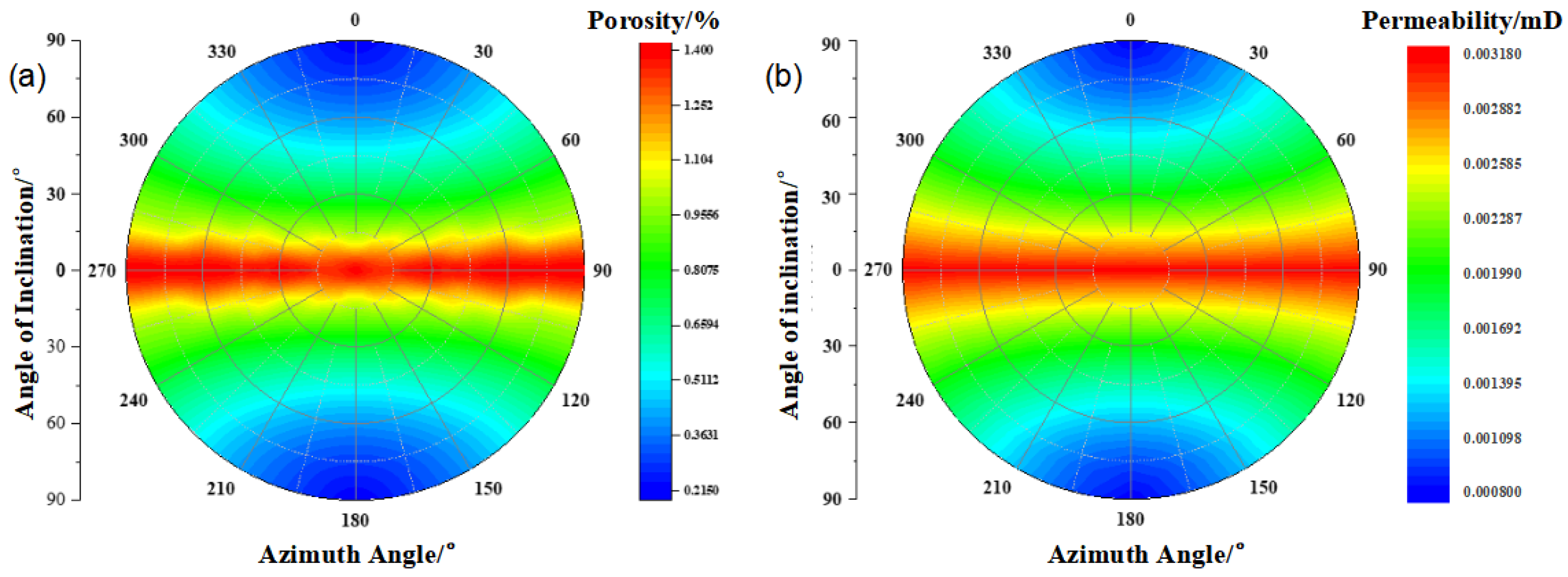
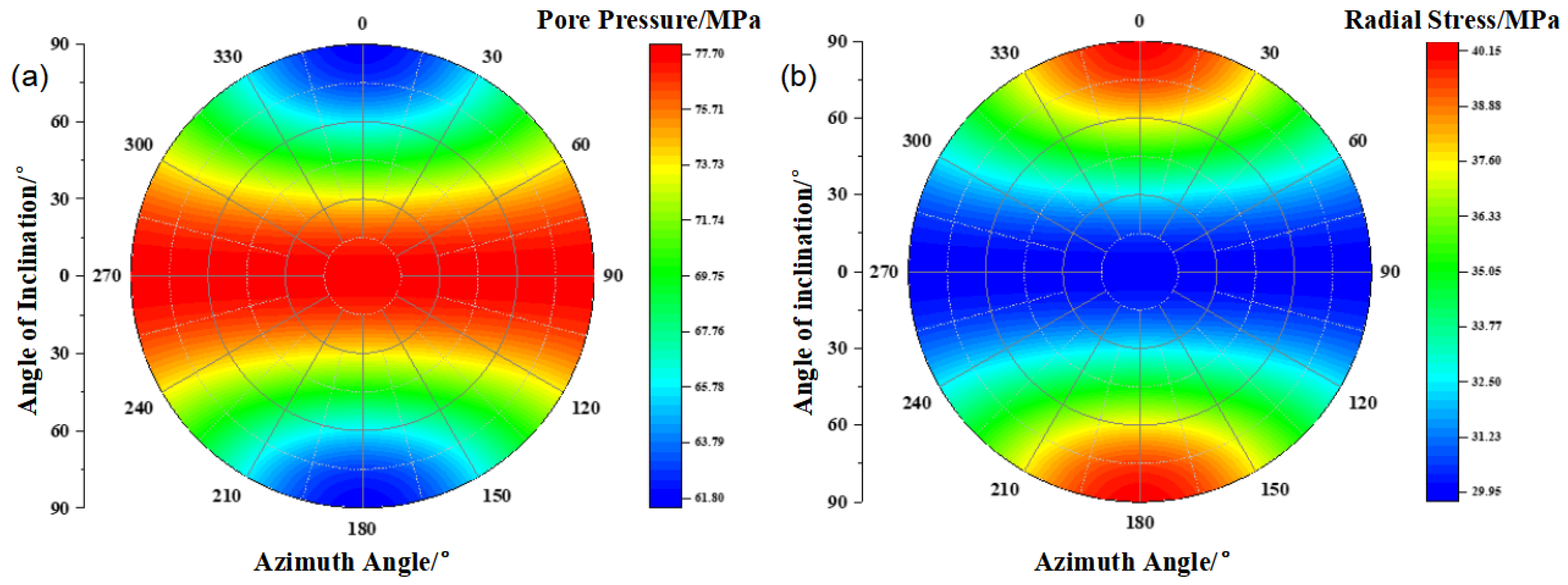
Based on field well logging data and the foregoing predictive model for the near-wellbore seepage-induced stress field, we perform a comparative analysis of (i) the influence of borehole trajectory on porosity and permeability at the shale wellbore wall and (ii) the evolution of pore pressure and effective stress in shale formations that develop either a single fracture set or two fracture sets (one horizontal and one vertical). The resulting pie cloud diagrams are shown in Figure 2, Figure 3 and Figure 4.
To quantitatively characterize the relative contribution of the “matrix-fracture” system in fluid flow, this study adopts a parallel equivalence representation: K e f f = k m I + i b i 3 12 S i n i n i . Based on this, the matrix contribution ratio is defined as η m = k m / k m + k f , | | [17].
  • k m : the matrix permeability;
  • b i : the aperture of the ith group of fractures;
  • S i : the fracture spacing;
  • n i : the unit vector of the fracture orientation.
As shown in Figure 2, it can be seen that the equivalent porosity (a) and equivalent permeability (b) in the vicinity of the shale wellbore exhibit pronounced anisotropy. As the borehole trajectory changes, the angle between the bedding/fracture planes and the radial direction of the wellbore shifts from parallel to perpendicular, and the equivalent porosity and permeability show an overall decreasing trend. When the bedding/fractures are parallel to the radial direction of the wellbore (observed along the dominant fracture orientation), the equivalent porosity and equivalent permeability reach their maximum values.
High pore pressure zones are established rapidly along the dominant fracture orientation, whereas diffusion toward the matrix side evolves much more slowly. This mechanism can be explained by the effective stress relationship σ = σ α p p I : when the mud density is constant, the increase in p p will reduce p and increase σ θ θ , which is unfavorable for stability. For the timescale, hydraulic diffusion is approximated as t c = L / D 2 , D = k / μ c t , taking a characteristic length near the wellbore of L = 5–10 cm, μ = 2–4 mPa · s, c t = 10−10–10−9 Pa−1 [18,19].
Along the dominant fracture orientation: k = 10−15–10−14m2 (≈0.01–0.1 mD), t c : tens of seconds to several minutes.
In the matrix direction: k = 10−20–10−19 m2 (≈10−6–10−5 mD), t c : several hours to several days.
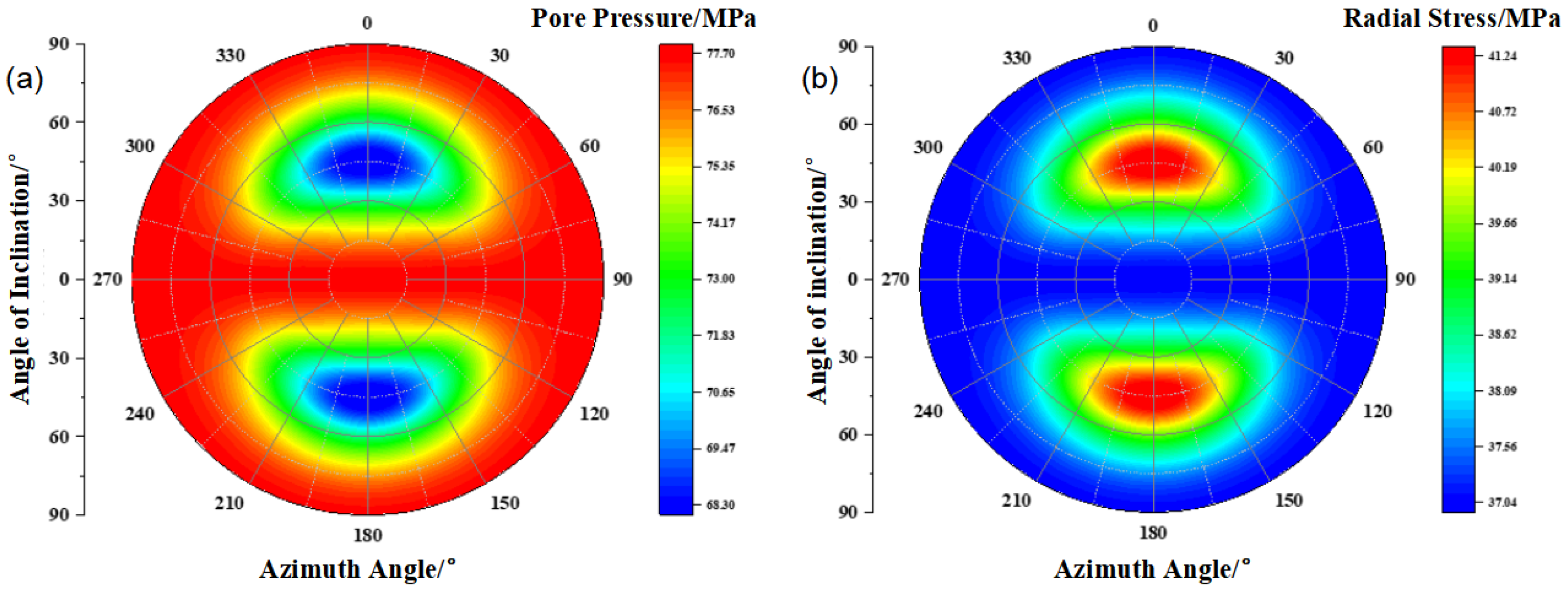
Figure 3 shows that when the bedding fractures are parallel to the radial direction of the wellbore, drilling fluid driven by a positive pressure differential infiltrates most significantly along the fractures. The pore pressure (a) in the vicinity of the wellbore increases markedly (up to 77.70 MPa), and the corresponding equivalent radical stress (b) decreases ( p = p m p p , p m : wellbore pressure; p p : pore pressure); the circumferential effective stress σ θ θ increases, making the wellbore more prone to instability. When the bedding fractures turn perpendicular to the radial direction of the wellbore, the seepage is suppressed, the pore pressure drops to approximately 61.80 MPa, p correspondingly increases, and the wellbore stability improves.
Figure 4 shows that in both the vertical and horizontal sections, when fractures are parallel to the radial direction of the wellbore, the equivalent porosity and permeability are relatively high. Under a positive pressure differential, seepage is intensified, pore pressure (a) increases, the effective radial support p decreases, and the hoop effective radical stress (b) increases. In the deviated section, due to the misalignment between borehole trajectory and fracture strike, the equivalent permeability is reduced, seepage is restricted, pore pressure remains lower, and the wellbore is more stable.
When two fracture sets coexist, the     K e f f exhibits pronounced tensorial characteristics: along the dominant fracture set, a “high-permeability-fast-response” high pore pressure zone develops, whereas along the subordinate fracture set and in the matrix direction, the behavior is “low-permeability-slow-response.” This also implies that the drilling mud density and inhibition strategies should be optimized according to orientation and wellbore section.
In summary, under an overbalanced borehole condition, drilling fluid seepage and pressure penetration govern the evolution of formation pore pressure and the radial stress at the wellbore wall, thereby affecting wellbore stability. The degree of fracture development and their orientations control pressure transmission at the wall and the variation in near-wall pore pressure. Fluid flow and pressure transfer across the borehole–formation interface reduce the effective radial stress and weaken the effective mechanical support provided by the drilling fluid. As the number of fracture sets increases, the deviated section exhibits lower near-wall porosity and permeability, stronger mud support performance, and consequently lower formation pore pressure.

3. Prediction and Evaluation of Collapse Pressure for Horizontal Wells in Shale Formations

3.1. Predictive Model for Collapse Pressure in Horizontal Wells in Shale Formations

Wellbore collapse is a frequently encountered form of wellbore instability in brittle formations. It is generally governed by shear failure and can be predicted by analyzing the near-wellbore stress state in conjunction with an appropriate shear failure criterion; the choice of failure criterion is therefore pivotal to wellbore stability prediction. Numerous criteria have been proposed in the literature, both domestically and internationally, yet most exhibit notable limitations, making it difficult for drilling engineers to select among them [20,21,22].
As established above, shale is characterized by well-developed microfractures and bedding, with pronounced anisotropy in its mechanical properties. Consequently, it is necessary to jointly account for weak surface effects and anisotropy when evaluating the wellbore stability of shale gas horizontal wells.
Jaeger weak surface theory treats bedding fractures as a single mechanical weak plane embedded in an otherwise isotropic rock mass, but it cannot capture the intrinsic anisotropy of the rock material [23,24]. Therefore, we introduce the indicator function framework into the weak surface theory to construct a rock strength failure criterion that can simultaneously represent the bedding weak plane and the material anisotropy, expressed as follows:
σ 1 = 2 C β + σ 3 s i n 2 β × 1 + t a n C β × t a n β s i n 2 β 1 t a n ϕ β × c o t β C β = C 0 C w c o s β α 0   t a n ϕ β = t a n ϕ 0 t a n ϕ w c o s β α 0         α 0 = π 4 + ϕ 0 2
  • C0: the intact rock cohesion, MPa;
  • Cw: the bedding plane cohesion, MPa;
  • ϕ : the internal friction angle of the intact rock, °;
  • ϕ w : the internal friction angle of the bedding plane, °;
  • β : the angle between the fracture plane normal and the principal stress, °;
  • C β : the cohesion indicator function primarily governed by the intact rock cohesion and the bedding plane cohesion;
  • ϕ β : the friction coefficient indicator function governed by the internal friction angle of the intact rock and the internal friction angle of the bedding plane.
For a vertical well, the circumferential (hoop) stress attains its maximum at θ = 90° (270°), where the wellbore is most susceptible to shear failure. At this location, the relationships among the three principal stresses acting on the wellbore wall are given by
σ 1 = σ θ σ 2 = σ z σ 3 = Δ P
  • σ 1 : the maximum principal stress, MPa;
  • σ 2 : the intermediate principal stress, MPa;
  • σ 3 : the minimum principal stress, MPa.
Substituting Equation (7) into (6) yields the collapse pressure prediction model for the vertical well section based on the indicator function weak surface theory.
P i = 3 σ H σ h M K + δ ϕ P p 1 + M K δ ϕ   M = 2 C β s i n 2 β 1 t a n ϕ β c o t β   N = 1 + t a n C β t a n β 1 t a n ϕ β c o t β
For the collapse and breakdown of deviated wellbores [25,26,27], the weak surface strength criterion based on the indicator function is given by
f = σ 1 σ 3 P 2 t a n ϕ β σ 3 α P p 2 C β   P = 1 t a n ϕ β c o t β s i n 2 β
From Equation (9), it follows that three distinct expressions for the formation collapse pressure can arise, depending on the ordering of the principal stresses σ r . When the radial stress σ r corresponds, in turn, to the minimum, intermediate, and maximum principal stresses, the principal stresses σ 1 and σ 3 are given by Equation (10), respectively:
σ 1 = 1 2 X 4 f P p + 4 f 1 P i + 1 2 Y p i 2 + Z σ 3 = P i δ ϕ P i P p   σ r   i s   t h e   m i n i m u m   p r i n c i p a l   s t r e s s   σ 1 = 1 2 X 4 f P p + 4 f 1 P i + 1 2 Y p i 2 + Z σ 3 = 1 2 X 4 f P p + 4 f 1 P i 1 2 Y p i 2 + Z   σ r   i s   t h e   i n t e r m e d i a t e   p r i n c i p a l   s t r e s s   σ 1 = P i δ ϕ P i P p σ 3 = 1 2 X 4 f P p + 4 f 1 P i 1 2 Y p i 2 + Z   σ r   i s   t h e   m a x i m u m   p r i n c i p a l   s t r e s s
Substituting σ 1 and σ 3 from Equation (10) into (9) in turn yields the collapse pressure prediction models for the deviated and horizontal well sections under the cases where the radial stress corresponds to the minimum, intermediate, and maximum principal stresses, respectively:
f = 1 2 X 4 f P p + 4 f 3 P i + 1 2 Y p i 2 + Z + δ ϕ P i P p P 2 t a n ϕ β P i δ ϕ P i P p α P p 2 C β   f = Y p i 2 + Z P 2 t a n ϕ β 1 2 X 4 f P p + 4 f 1 P i 1 2 Y p i 2 + Z α P p 2 C β   f = δ ϕ P i P p 1 2 X 4 f P p + 4 f 3 P i + 1 2 Y p i 2 + Z P 2 t a n ϕ β 1 2 X 4 f P p + 4 f 1 P i 1 2 Y p i 2 + Z α P p 2 C β
For convenient engineering application, the three principal stresses of the wellbore in Equation (4) are obtained as follows:
A 0 = 1 2 X 4 K 1 P p + 2 K 1 1 P i   = Y p i 2 + Z               0
Then it always holds that σ j = A 0 + 1 2 A 0 1 2 . Accordingly, there are three possible cases, depending on the relative magnitudes of the radial principal stress σ i , σ j , σ k :
① When the radial stress is the minimum principal stress σ j σ k σ i , this case generally corresponds to low mud weight/near-balanced or underbalanced conditions, under which the most common risk scenario is compressive failure such as breakout and wellbore spalling.
σ i A 0 1 2 ,   when   σ 1 ,   σ 2 ,   σ 3 = σ j ,   σ k ,   σ i
② When the radial stress is the intermediate principal stress σ j σ i σ k , this case generally corresponds to moderately overbalanced drilling conditions.
A 0 1 2 < σ i < A 0 + 1 2 ,   when   σ 1 ,   σ 2 ,   σ 3 = σ j ,   σ i ,   σ k
③ When the radial stress is the maximum principal stress   σ i σ j σ k , this case generally corresponds to high mud weight/weak pressure relief effect of seepage, and tensile failure of the wellbore becomes the primary concern.
σ i A 0 + 1 2 ,   when   σ 1 ,   σ 2 ,   σ 3 = σ i ,   σ j ,   σ k
The seepage effect, through K 1 , changes the relative positions of A 0 and σ i . As the ϕ increases, the pressure equilibration between the wellbore and the formation becomes more apparent, and σ i tends toward p p , making scenarios ① and ② more likely to persist. In contrast, small ϕ or relatively large α will increase the effective radial compressive stress, making scenarios ② and ③ more likely to occur.
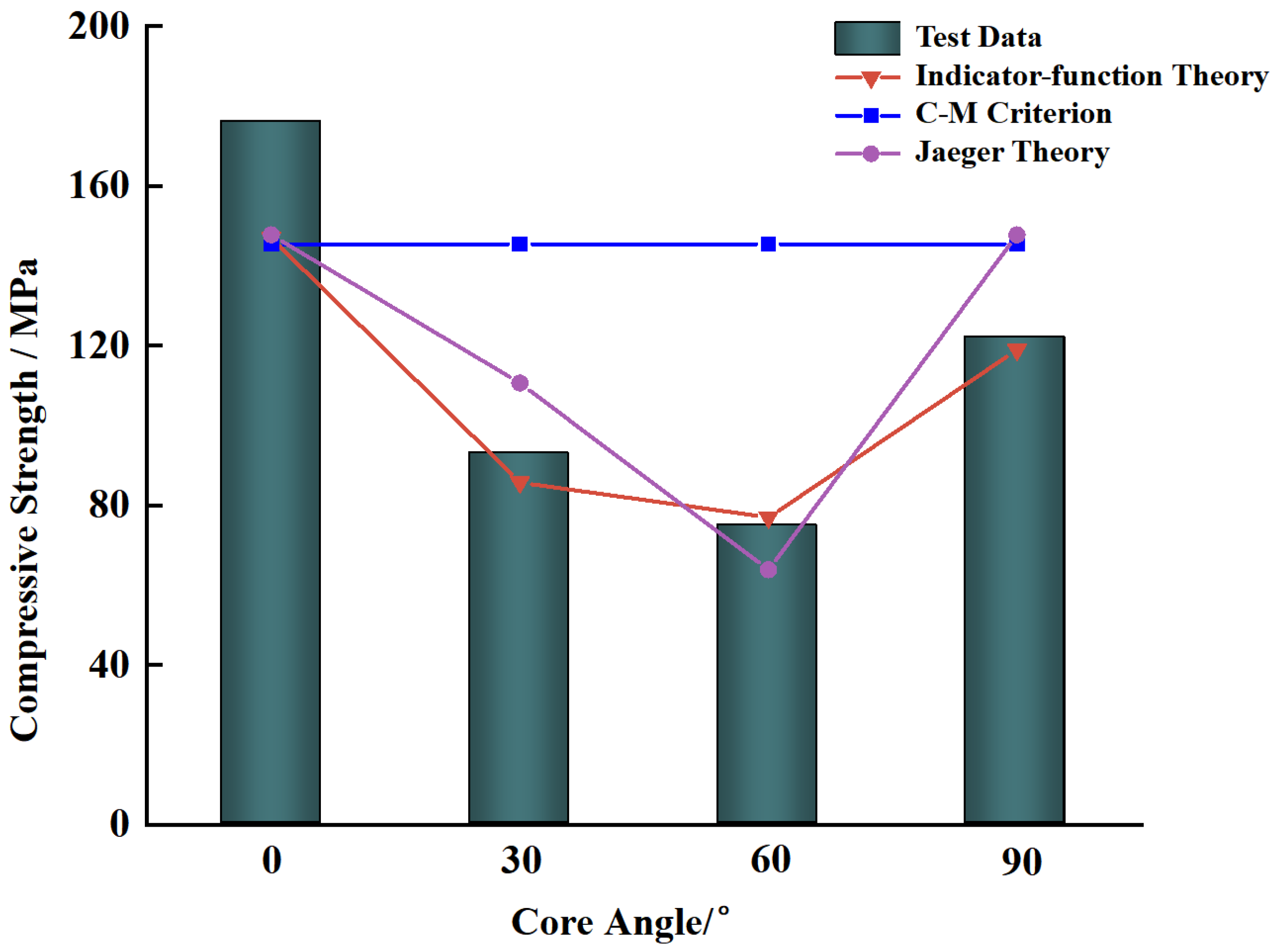
To verify the applicability of the wellbore instability assessment criterion, we conducted a comparison based on the experimental data from the indoor uniaxial compressive strength test (UCS), among the indicator function weak surface theory, the M-C criterion, and Jaeger weak surface theory, as shown in Figure 5.
Figure 5 shows that the M-C criterion fails to capture the variation in compressive strength with coring angle and is therefore not suitable for strongly anisotropic shale formations. The Jaeger theoretical model predicts identical compressive strengths at coring angles of 0° and 90°, whereas the experimental results (the average value obtained from three repeated experiments at each angle) indicate that specimens at 90° predominantly fail by splitting along fractures and exhibit significantly lower strength than those at 0°. The Jaeger criterion yields an average error of 17.7%, while the indicator function weak plane model gives a much lower average error of only 7.4%, with the maximum error not exceeding 14.8%, indicating that the model can robustly reproduce the variation trend of compressive strength.
It should be noted that the experimental angles in this study are 0°, 30°, 60°, and 90°. Model-based extrapolation shows that at untested angles such as 15° and 75°, the predicted curve still maintains an asymmetric V-shaped distribution, which is consistent with the physical mechanism associated with changes in shale bedding orientation. Future work will include tests at denser angular intervals to further verify the generality of this trend.
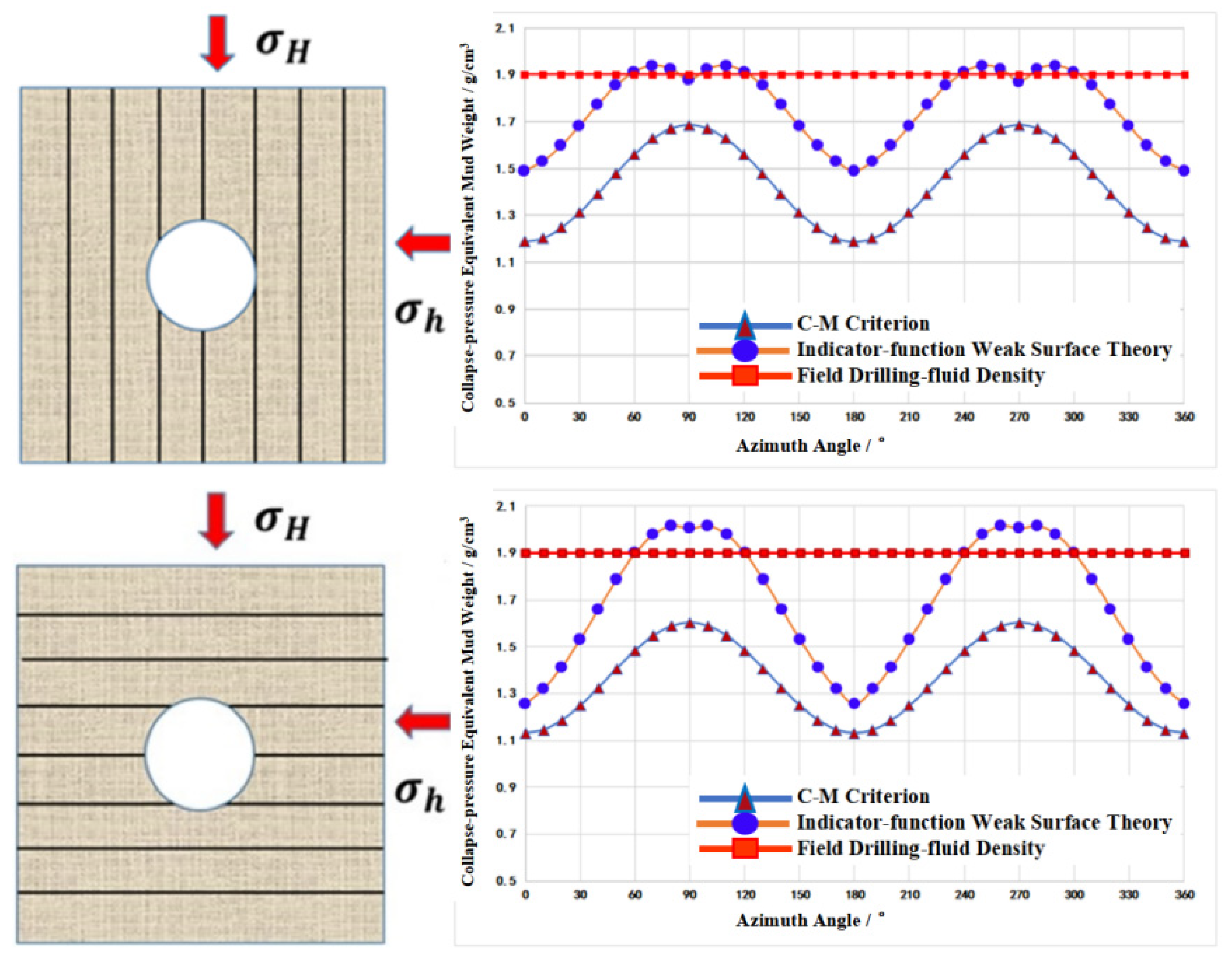
To further verify the reliability of the collapse pressure prediction model, collapse pressure equivalent density distributions were calculated under conditions where shale bedding planes are parallel and perpendicular to the maximum horizontal principal stress, respectively, using both the indicator function weak plane model and the Mohr–Coulomb (M-C) criterion, based on field logging and actual drilling data, as shown in Figure 6.
Figure 6 shows that the collapse pressure equivalent densities predicted by the C–M criterion deviate significantly from the actual drilling mud weights, whereas the predictions from the indicator function weak plane model agree much better with the mud weights used in the field. A further comparison with the actual drilling operations indicates that, for boreholes drilled within the model-predicted mud weight window, no obvious collapse or instability events occurred; however, if drilling was conducted according to the lower densities predicted by the M-C criterion, local hole enlargement and borehole wall spalling would be observed. This demonstrates that the indicator function-based weak plane model, which accounts for weak plane effects, not only predicts collapse pressure more accurately but also provides a sound basis for field wellbore stability control in drilling.

3.2. Evaluation of Wellbore Stability for Horizontal Wells in Shale Formations

Before performing pore pressure inversion and borehole stability analysis, the field logging data were first subjected to conventional quality control and normalization. Then, the Eaton and Bowers methods were applied for pore pressure inversion: the anomaly indicators were converted into effective stress and pore pressure, and the Bowers model was used to back-calculate pore pressure in overpressured intervals. The pore pressure profiles obtained from both methods were calibrated and compared against DST/while-drilling pressure measurements to ensure reliability. The final pore pressure curve was then used for collapse pressure prediction and safe mud weight window calculation.
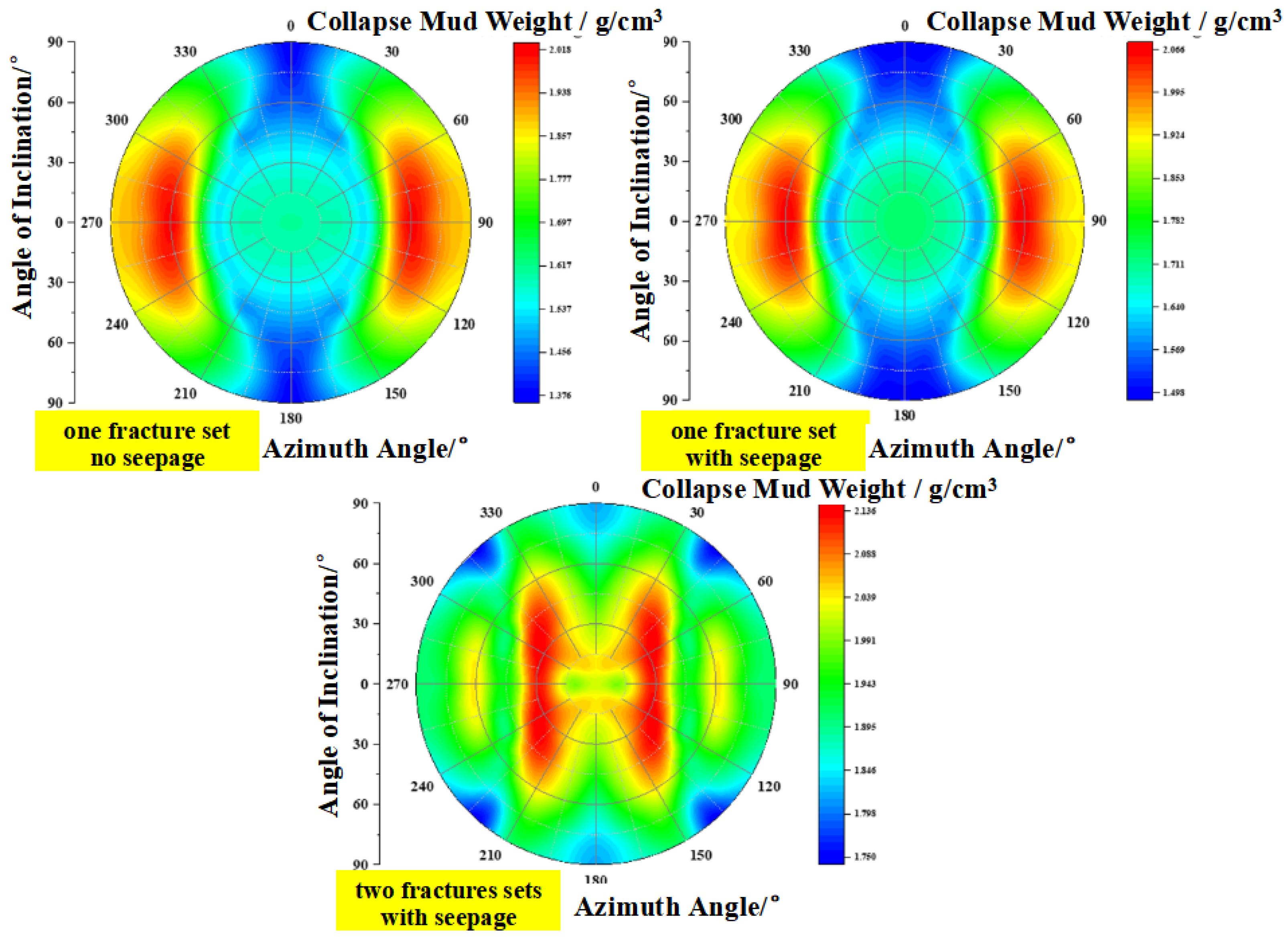
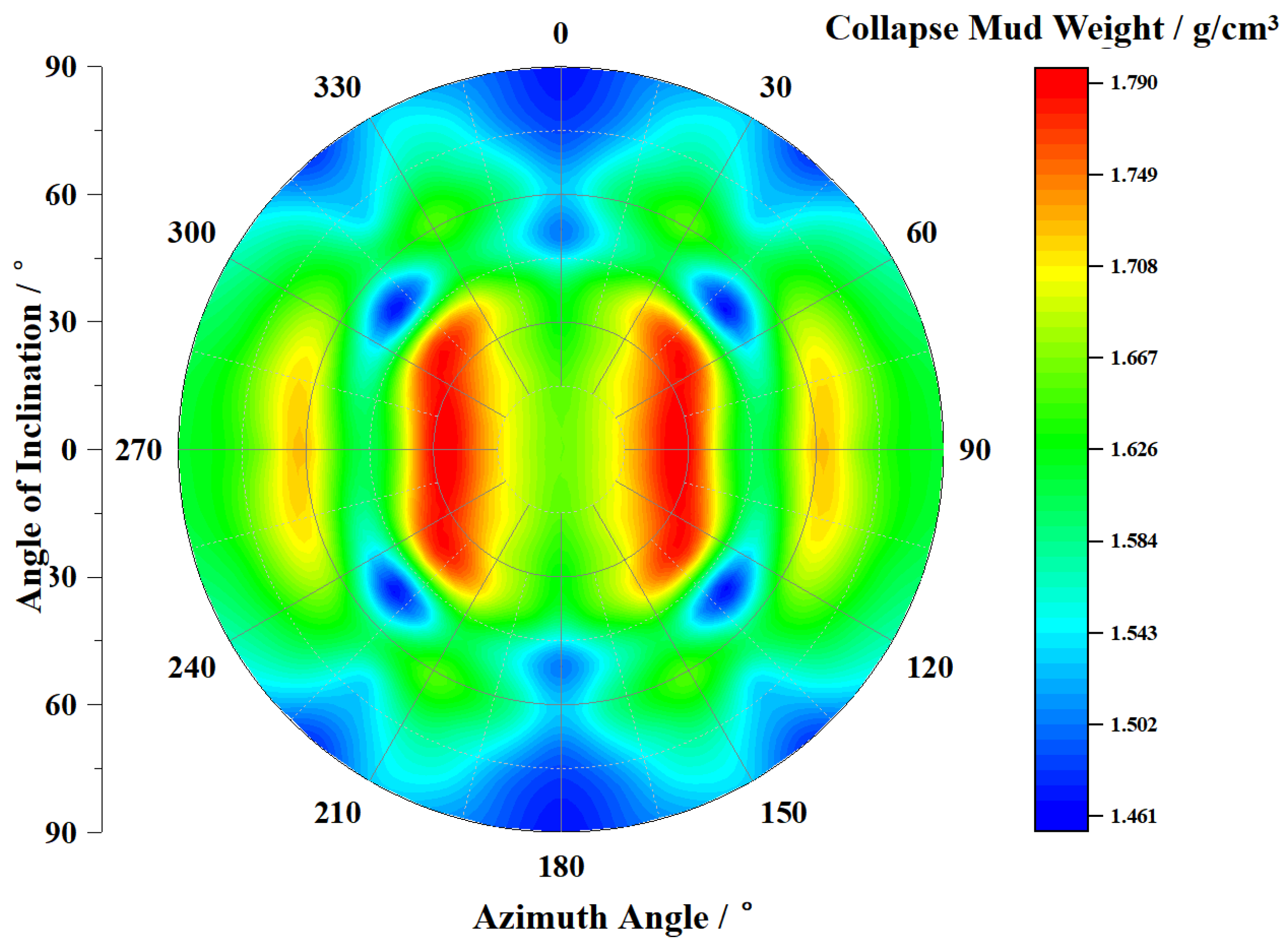
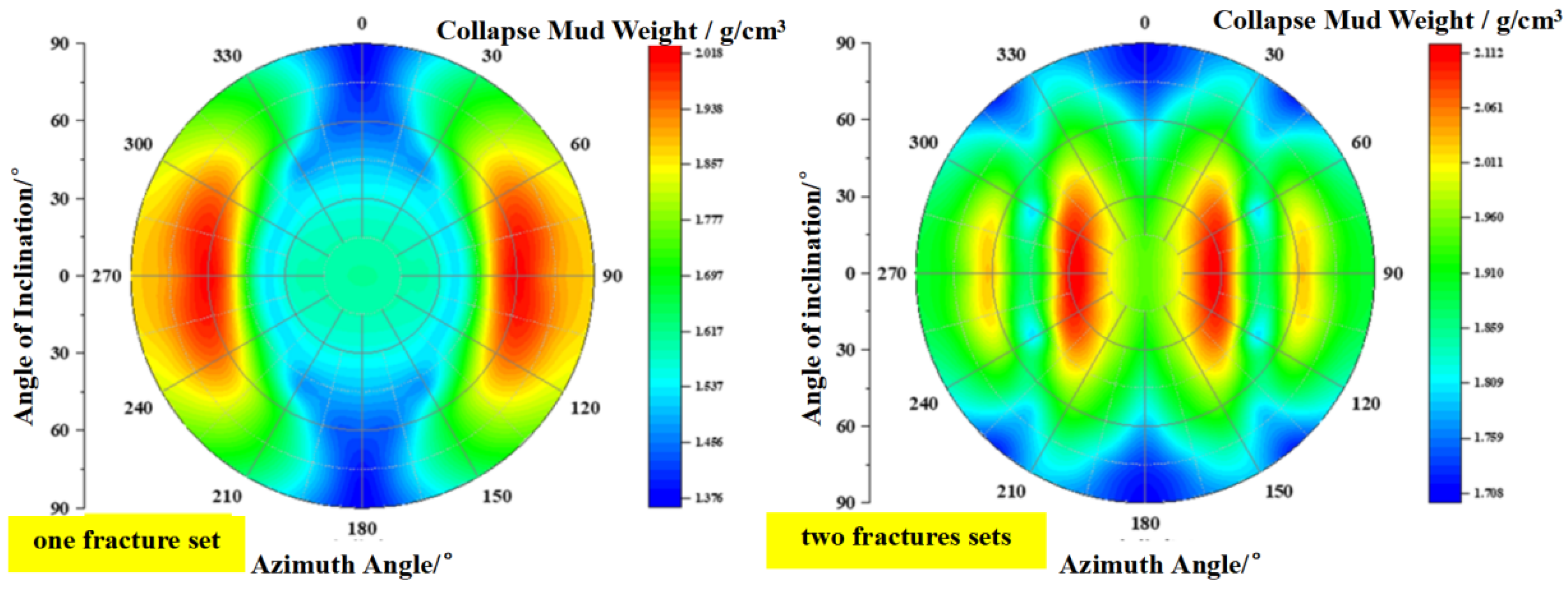
Using the newly established collapse pressure prediction model, we evaluate the wellbore stability of horizontal wells in shale reservoirs containing one fracture set and two fracture sets. Based on the number and orientations of fracture sets in bedded shale, and accounting for mechanical anisotropy of both the intact rock and the fracture weak surfaces as well as variations in borehole trajectory, we analyze the distribution of the collapse pressure equivalent density using field log-derived pore pressure and drilling fluid density. The cases considered include formations with (i) a single fracture set (subparallel, near-horizontal fractures) and (ii) two fracture sets (one subparallel set and one vertical set). The results are shown in Figure 7.
From Figure 7, it is evident that borehole trajectory, fracture orientation and number, as well as the magnitude and azimuth of in situ stresses jointly govern the variation in the collapse pressure equivalent mud weight in shale formations. For formations with a single set of bedding-parallel fractures, the collapse pressure is higher when drilling along the minimum horizontal principal stress; it peaks at inclinations of approximately 45~60°, decreases slightly in the horizontal section, and exhibits better stability when the horizontal well is drilled along the maximum horizontal principal stress. For formations with two mutually orthogonal fracture sets, the collapse pressure generally increases, and the instability risk domain expands; drilling along the maximum horizontal principal stress is preferable to drilling along the minimum horizontal principal stress.
Considering variations in borehole trajectory and the orientation and number of bedding-related fractures, we analyzed the effects of drilling fluid plugging and pressure penetration on the collapse pressure of fragmented formations, as shown in Figure 8.
In summary, borehole trajectory variations, the weak surface effect of bedding fractures, the degree of fracture development, drilling fluid seepage, and pressure penetration collectively influence the collapse pressure equivalent mud weight and thus the wellbore stability of shale formations. Among these, the bedding weak surface effect exerts a particularly strong impact; in field operations, adjusting the well azimuth to avoid zones with well-developed fracturing can improve wellbore stability.

4. Prediction of the Safe Mud Weight Window for Horizontal Wells in Shale Formations

4.1. Predictive Model for Pore Pressure in Shale Formations

Currently, a variety of methods are commonly used for formation pore pressure prediction, including the equivalent depth method, shale density method, Eaton method, effective stress method, and multi-factor integrated models. Among these, the Eaton and Bowers methods are widely applied in shale formations. The Eaton method can account for the stress dependence of rocks in the calculation process and therefore has good applicability and reliability in pressure prediction. On the other hand, the Bowers method can better capture the high compressibility and compaction characteristics of shale, making it particularly suitable for estimating pore pressure in deep or high-pressure shale intervals and providing more accurate prediction results.
(1)
Eaton Method
Eaton et al. [28,29] developed the Eaton method on the basis of well logging data. The Eaton equations admit several commonly used forms, including expressions based on sonic slowness, electrical resistivity, and the DC index.
P p = σ V σ V P pn × Δ t c   reference   value Δ t c   observed   value 3 P p = σ V σ V P pn × R c   reference   value R c   observed   value 1.2 P p = σ V σ V P pn × d c   reference   value d c   observed   value 1.2
  • Pp: the formation pore pressure, g/cm3;
  • Δ t c : the sonic slowness, μ s / f t ;
  • Rt: the electrical resistivity, Ω · m ;
    Ppn: the pore fluid pressure, MPa;
  • σ v : the overburden stress, MPa.
(2)
Bowers Method
Bowers et al. [30], based on extensive experiments, identified a characteristic functional relationship between the acoustic velocity of mud shale and the effective stress. This relationship can be represented by an empirical computational model, expressed as follows:
V p = 5000 + A σ e
  • Vp: the acoustic velocity, ft / s;
  • σ e : the vertical effective stress, MPa;
  • A: the empirical coefficient.
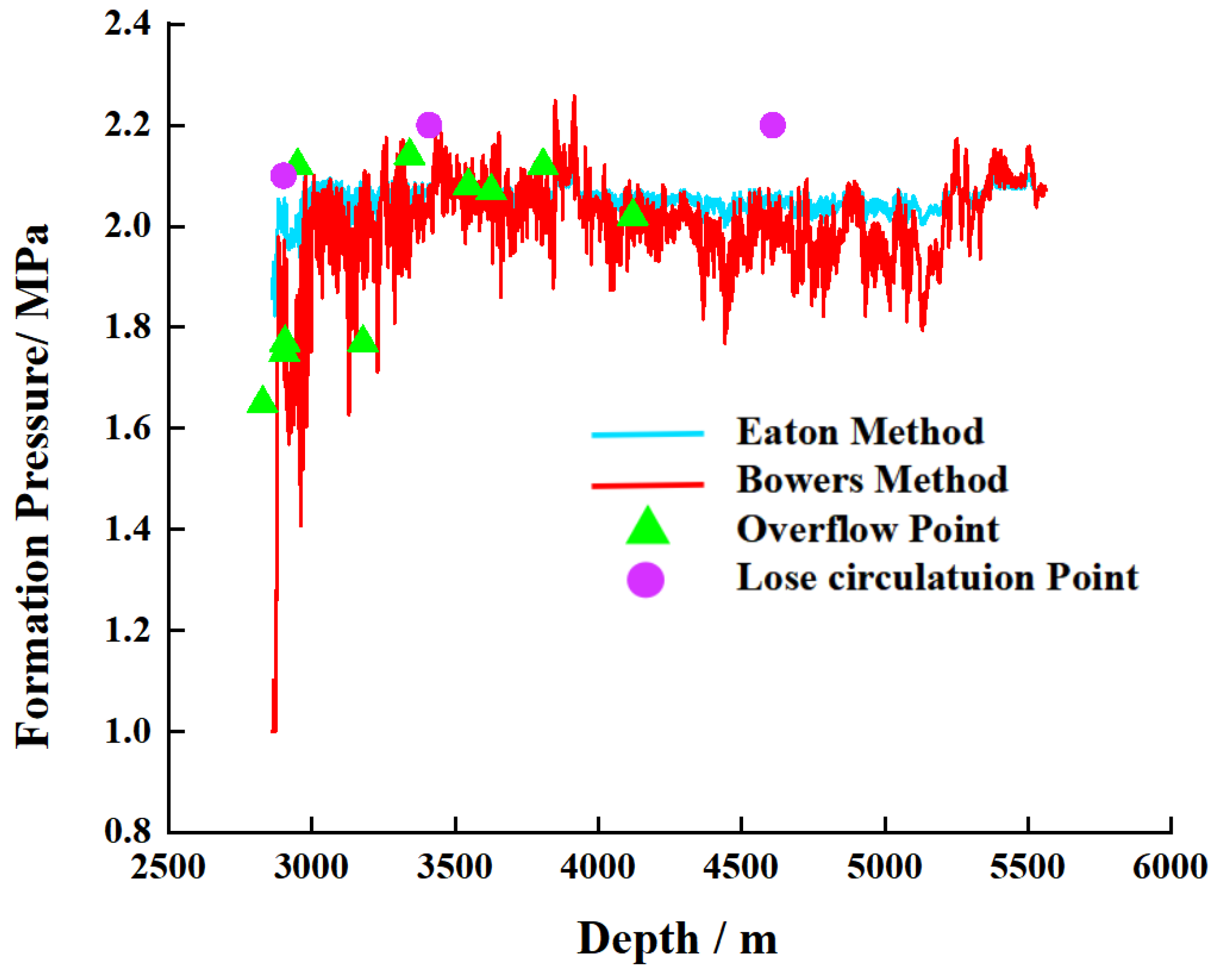
Using the shale interval of Well H1 in southern Sichuan as an example, pore pressure was predicted with the Eaton methods and Bowers methods and compared against field mud densities as well as records of lost circulation and gas invasion and influx events. The results are shown in Figure 9.
As indicated by Figure 9, the pore pressures predicted using the Bowers method exhibit the best agreement with field measurements. Accordingly, for shale formations in southern Sichuan, the Bowers method is recommended for pore pressure prediction.

4.2. Predictive Model for Fracture Pressure in Shale Formations

This model is built on an idealized assumption of one or two dominant fracture sets and is therefore more suitable for shale reservoirs where fracture orientations are relatively concentrated, the dominant directions are clearly defined, and structural complexity is low to moderate. It is not directly applicable to formations that are highly structurally damaged or characterized by very complex natural fracture networks.
When the effects of in situ stresses and pore pressure are taken into account, the effective circumferential stress σ θ is given by
σ θ = σ θ 1 + σ θ 2 α P i
Pi: the hydrostatic column pressure in the wellbore, MPa.
Fracture typically occurs where the effective circumferential stress is minimized at θ = 0° or 180°. At that location, the σ θ can be written as
σ θ 1 = 3 σ h 2 σ h 1 P i
Meanwhile, the seepage pressure can be expressed as
σ θ 2 = α 1 2 μ 1 μ f P i P p
Substituting Equations (16) and (17) into (15) yields
σ θ = 3 σ h 2 σ h 1 P i + α 1 2 μ 1 μ f P i P p α P p
By inserting Equation (18) into the breakdown criterion, one obtains the formation fracture pressure equation:
P f = 3 σ h 2 σ h 1 α 2 3 μ 1 μ f P p + S t 1 α 1 2 μ 1 μ f
  • Pf: the formation fracture pressure, MPa;
  • St: the tensile strength of the rock, MPa;
  • μ : Poisson’s ratio.
If the formation seepage effect is neglected, the simplified fracture pressure can be expressed as
P f = 3 σ h 2 σ h 1 α P p + S t
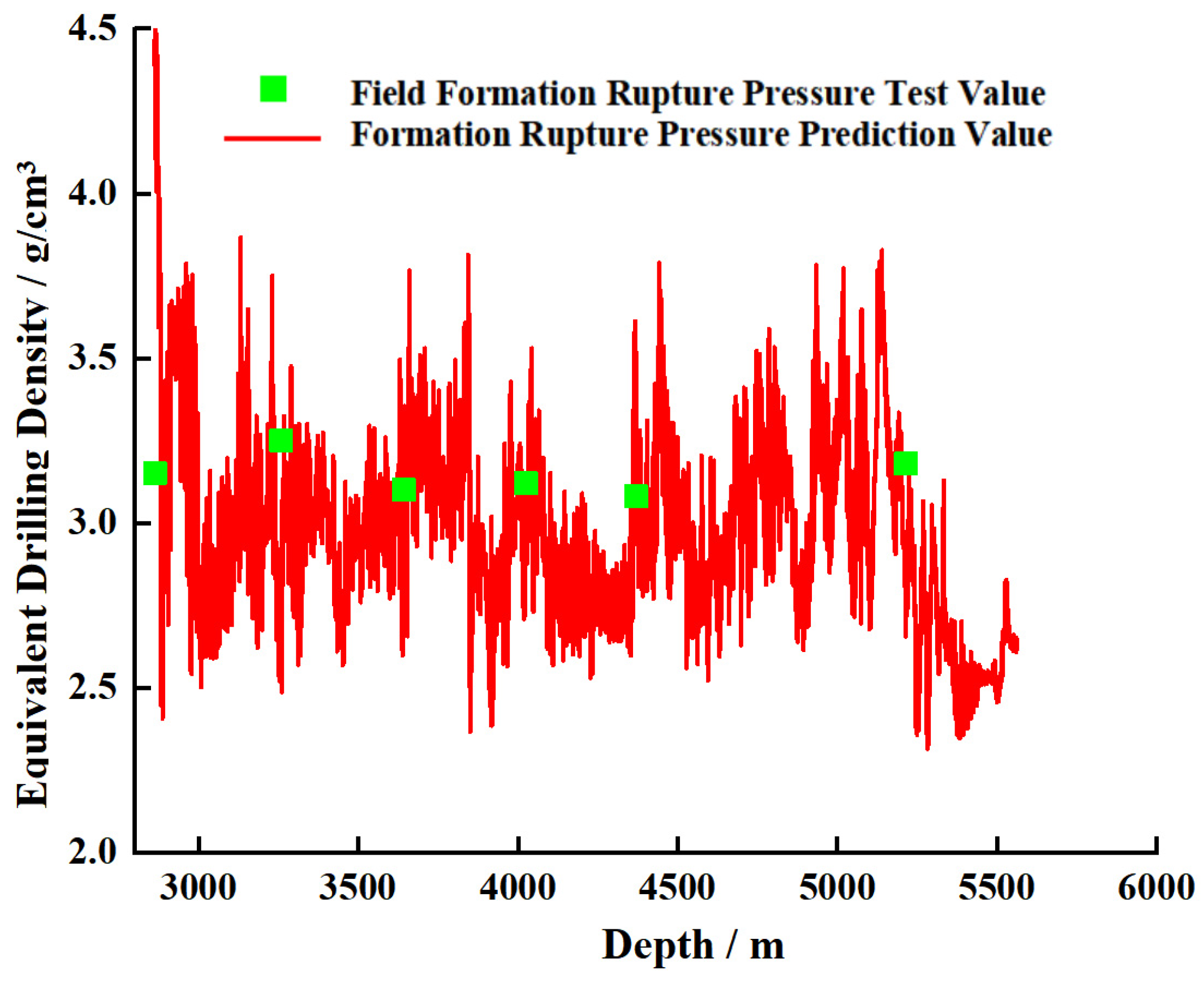
As shown in Figure 10, the predictions of the proposed formation fracture pressure model agree well with the experimental results, with an error of less than 5%, which falls within the allowable engineering tolerance and indicates satisfactory accuracy.

5. Field Application

5.1. Wellbore Stability Prediction

Taking Well H2 as an example, we investigate the wellbore stability of the Longmaxi Formation shales in southern Sichuan. In the lower and horizontal sections of the Longmaxi interval in H2, the actual drilling fluid density was 1.70~1.85 g/cm3, and the pore pressure was 1.59~1.72 g/cm3. Drilling these intervals with the oil-based mud of 1.73~1.74 g/cm3 resulted in severe wellbore collapse. Based on the newly developed collapse pressure prediction model that incorporates the indicator function approach to account for shale weak plane effects and mechanical anisotropy, and integrating field well logging data, we performed a stability assessment for the lower Longmaxi section of H2. The results are shown in Figure 11.
Analysis of Figure 11 shows that the field mud density was 1.73~1.74 g/cm3, whereas the collapse density predicted by the indicator function-based model is 1.79 g/cm3. During drilling of the complex Well H2, the mud density used was therefore lower than the predicted critical collapse density, making wellbore instability more likely. Consequently, to ensure safe drilling in Well H2 and reduce the risk of wall collapse, the mud density should be optimized to approach the predicted critical collapse density.
Based on typical error levels of the input parameters under field conditions, we performed an error propagation analysis. The results indicate that the P10–P90 range of the critical collapse density for Well H2 is 1.76–1.86 g/cm3, with an approximate confidence range of 1.74–1.88 g/cm3. Accordingly, we recommend that the drilling fluid density in the field be maintained within 1.83–1.88 g/cm3 and be dynamically compared and optimized in conjunction with while-drilling updates and observed borehole stability.

5.2. Prediction of the Safe Mud Weight Window

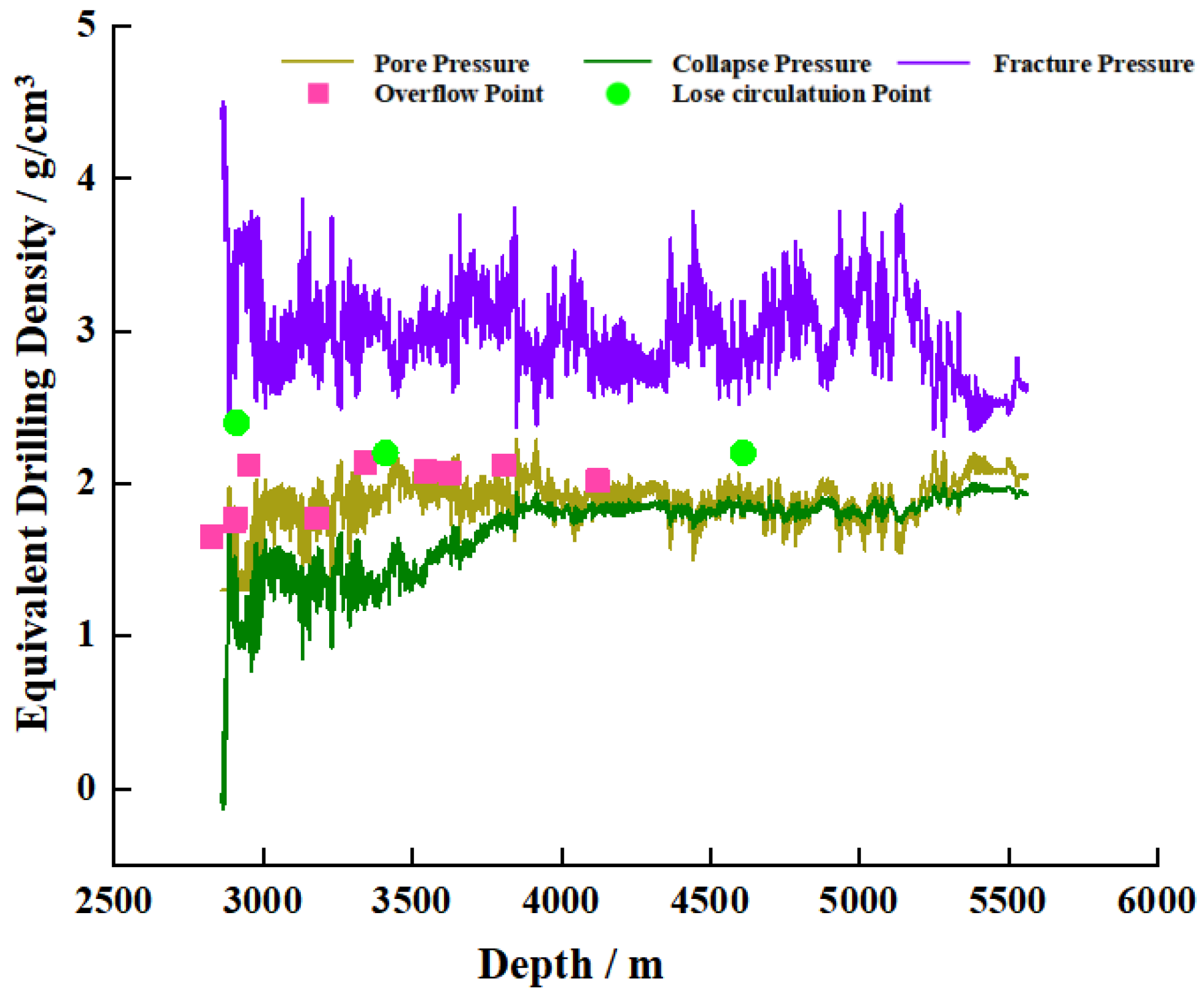
Using the three pressure prediction methods developed in this study, the safe mud weight window for Well H1 in southern Sichuan was predicted and then refined by comparison with field complication records, such as overflow, differential sticking, lost circulation, and others. The distributions of the three formation pressures (pore, collapse, and fracture) for the deviated and horizontal sections of H1 are shown in Figure 12.
Figure 12. Illustration of formation pressure curves and the safe mud weight window: the light green curve represents pore pressure, the dark green curve represents collapse pressure, and the purple curve represents fracture pressure. The interval where the equivalent circulating density of the drilling fluid is higher than both the pore and collapse pressures but lower than the fracture pressure defines the safe density window.
As shown in Figure 12, the pore pressure gradient in Well H1 ranges from 1.95 to 2.15 MPa/100 m; the collapse pressure gradient ranges from 1.80 to 2.05 MPa/100 m; and the fracture pressure gradient ranges from 2.45 to 3.00 MPa/100 m. Based on the three pressure predictions for H1, the minimum safe mud weight window for the deviated and horizontal sections is determined to be 2.15~2.45 g/cm3. It is also observed that the model predictions agree well with the field records of lost circulation and overflow points, which further corroborates the reliability of the predicted safe window.

6. Conclusions and Insights

Based on the wellbore stability theory for shale reservoirs, we analyzed the near-wellbore seepage field and formation pressure distribution, the coupled stress field at the wellbore wall, and the criterion for collapse failure. A new collapse pressure prediction model was established, and a methodology for determining the safe mud weight window in shale gas horizontal wells was formulated. The main findings are as follows:
(1)
Under positive pressure differential across the wellbore, drilling fluid seepage, and pressure penetration alter the formation pore pressure and the radial stress at the wellbore wall, thereby affecting wellbore stability. Variations in borehole trajectory, the weak surface effect of bedding fractures, the degree of fracture development, drilling fluid seepage, and pressure penetration effects all influence the formation collapse pressure.
(2)
The collapse pressure for shale reservoirs with bedding-related fractures was predicted using the H–B criterion, the M-C criterion, and a weak surface theory augmented with an indicator function. Comparative analysis against laboratory data shows that the indicator function weak surface approach yields more accurate collapse pressure predictions, providing practical guidance for addressing wellbore stability issues in shale reservoirs.
(3)
Formation pore pressure and fracture pressure prediction models suitable for southern Sichuan shales were selected, leading to a method for determining the safe mud weight window for shale gas horizontal wells in this area. Comparison of the three pressure prediction results with field measurements verifies the applicability and reliability of the models.
It should be noted that the model and parameters presented in this paper are mainly based on the rock mechanical properties and field data from the target block in southern Sichuan, and thus their applicability is somewhat region-specific. When applied to other blocks, the key parameters should be recalibrated and revalidated using local rock mechanical tests, logging-derived properties, and field monitoring data. The same technical workflow may be followed, but the numerical parameters given in this study should not be directly adopted.
Future research can be extended in the following directions. First, cross-regional validation and parameter calibration should be carried out to analyze wellbore stability under different depositional facies and stress regimes (such as the Ordos Basin) and thereby test the transferability of the model. Second, multi-physics coupling should be considered to quantitatively evaluate the time-dependent effects of circulating temperature variations, geothermal gradients, and salinity on pore pressure strength and the safe mud density window. Finally, by integrating LWD and downhole while-drilling data for uncertainty quantification and data assimilation, a dynamic window range can be obtained to enhance the accuracy, robustness, and engineering applicability of the model, thereby supporting shale gas exploration and development.

Author Contributions

Writing—original draft, C.G. and L.Y.; Formal analysis, Y.O. and Q.X.; data curation, Z.L. and Y.T.; funding acquisition, P.Z.; methodology, X.X. and P.Z.; validation, X.Z. All authors have read and agreed to the published version of the manuscript.

Funding

This work is supported by the major science and technology project of China National Petroleum Corporation (CNPC) “Research on Key Technologies for Accelerating Drilling and Improving Quality in Continental Shale Oil” (No. 2023ZZ15YJ05), and by the National Major Science and Technology Project “Green and Efficient Development and Management Model for Continental Shale Oil” (No. 2025ZD1404806).

Data Availability Statement

The original contributions presented in this study are included in the article. Further inquiries can be directed to the corresponding author.

Conflicts of Interest

Authors Chenxing Gong, Le Yang, Yong Ouyang, Qingqing Xin, Zhijun Li, Yuxiang Teng, Pengxin Zhang and Xiaoyue Xu were employed by the company PetroChina Changqing Oilfield Company. The remaining authors declare that the research was conducted in the absence of any commercial or financial relationships that could be construed as a potential conflict of interest.

References

  1. Nekwaya, T.T. Wellbore Stability Analysis Using Logging Data: A Case Study For Z-Block, Jiyang Depression. Master’s Thesis, China University of Petroleum (East China), Qingdao, China, 2017. [Google Scholar]
  2. Chen, M.; Jin, Y. Research progress and development trend of deep well wall stabilization technology. Oil Drill. Technol. 2005, 5, 31–37. [Google Scholar]
  3. Liu, X.; Zhu, H.; Liang, L. Research on fabric characteristics and borehole instability mechanisms of fractured igneous rocks. Pet. Sci. 2013, 10, 212–218. [Google Scholar] [CrossRef][Green Version]
  4. Atkinson, C.; Bradford, I. Effect of Inhomogeneous Rock Properties on the Stability of Wellbores. In Proceedings of the IUTAM Symposium on Analytical and Computational Fracture Mechanics of Non-Homogeneous Materials, Cardiff, UK, 18–22 June 2002; Springer: Dodrecht, The Netherlands; Volume 97, pp. 95–104. [Google Scholar][Green Version]
  5. Ouadfeul, S.-a.; Aliouane, L. Wellbore Stability in ShaleGas Reservoirs, A Case Study fromThe Barnett Shale. In Proceedings of the SPE International Conference and Exhibition on Formation Damage Control, Lafayette, LA, USA, 24–26 February 2015. [Google Scholar][Green Version]
  6. Han, T.; Pervukhina, M.; Ben Clennell, M.; Neil Dewhurst, D. Model-based pore-pressure prediction in shales: An example from the Gulf of Mexico, North America. Geophysics 2017, 82, M37–M42. [Google Scholar] [CrossRef]
  7. Lu, Y.H.; Chen, M.; Yuan, J.B.; Jin, Y.; Teng, X.Q. Mechanism of well wall destabilization in inclined wells in anisotropic formations. J. Pet. 2013, 3, 563–568. [Google Scholar]
  8. Meng, Y.F.; Liu, H.B.; Yu, A.R.; Chen, S.H.; Wang, X.H.; Chen, H.J. Study on wall stability of barehole completion in deep brittle shale horizontal wells. J. Southwest Pet. Univ. (Nat. Sci. Ed.) 2019, 41, 51–59. [Google Scholar]
  9. Han, Z.B.; Liu, H.B.; Zhang, J.T.; Shi, J.; Wang, Z.H. Mechanical properties of deep brittle shale and well wall stability. Spec. Reserv. 2020, 27, 167–174. [Google Scholar]
  10. Li, S.B.; Liang, K.; Wang, C.H.; Li, J.J.; Chen, X.P. Mechanism of well wall destabilization in anisotropic layered rational shale. Contemp. Chem. Ind. 2022, 51, 550–554. [Google Scholar]
  11. See, H.; Jean, C. Fracture Initiation from Inclined Wellbores in Anisotropic Formations. J. Pet. Technol. 1996, 48, 612, 614–619. [Google Scholar]
  12. Yue, W.H.; Liu, P.; Wen, R.; Gou, Q.Y.; Li, Q.S.; Xu, E.S.; Ling, W.T.; Huang, Y.J.; Ren, X.X.; Yu, T.; et al. Digital Pore Pressure Prediction for Well Drilling Using Machine Learning in a Deep Shale Gas Field. In Proceedings of the SPE/IADC Asia Pacific Drilling Technology Conference and Exhibition, Bangkok, Thailand, 7–8 August 2024. [Google Scholar]
  13. Sone, H.; Zoback, M.D. Mechanical properties of shale-gas reservoir rocks-Part 1: Static and dynamic elastic properties and anisotropy. Geophysics 2013, 78, D381–D392. [Google Scholar]
  14. Tan, Q.; Deng, J.G.; Zhang, Y.; Tang, M.W.; Wang, Y.K. Calculation method of wall collapse pressure in directional wells in anisotropic formations. Broken Block Oil Gas Field 2010, 17, 608–610. [Google Scholar]
  15. Liu, H.B.; Zhang, F.; Meng, Y.F.; Chen, S.H.; He, H.; Wu, N. Experimental study on wall stability of horizontally drilled shale gas wells in Jiao Shi Ba area. J. Undergr. Space Eng. 2017, 13, 1531–1536. [Google Scholar]
  16. Ye, C.; Ren, T.; Yin, Z.B.; Lu, Z.Y.; Wang, Q. Mechanism of well wall stability in fractured formations of the Junggar South Margin Alluvial Zone. J. Southwest Pet. Univ. (Nat. Sci. Ed.) 2023, 45, 95–103. [Google Scholar]
  17. Li, H.; Wang, Q.; Zhang, K.; Zhang, Q.H.; Song, T.; Zhang, C.; Zhuo, L.B.; Hao, C.; Feng, F.P.; Wang, H.Y.; et al. The invasion law of drilling fluid along bedding fractures of shale. Front. Earth Sci. 2023, 11, 1112441. [Google Scholar] [CrossRef]
  18. Ma, Y.; Hu, H.; Pan, Z.; Li, S.; Wang, X.; Zhou, W. Matrix permeability anisotropy of organic-rich marine shales and its geological implications: Experimental measurements and microscopic analyses. Int. J. Coal Geol. 2024, 281, 104443. [Google Scholar] [CrossRef]
  19. Wu, J.; Wu, Q.; Xu, L.; Wang, X.; Liu, X.; Luo, Y. Pore Structure and Migration Ability of Deep Shale Reservoirs in the Southern Sichuan Basin. Minerals 2024, 14, 100. [Google Scholar] [CrossRef]
  20. Halakatevakis, N.; Sofianos, A.I. Correlation of the Hoek–Brown failure criterion for a sparsely jointed rock mass with an extended plane of weakness theory. Int. J. Rock Mech. Min. Sci. 2010, 47, 1166–1179. [Google Scholar] [CrossRef]
  21. Mark, D.; Zuo, B.K. Reservoir Geomechanics; Shi, L.; Chen, Z.W.; Liu, Y.S.; Wang, J.S.; Xu, M.S.; Jian, Z., Translators; Petroleum Industry Press: Beijing, China, 2012; pp. 69–71. [Google Scholar]
  22. Tong, H.M.; Zhang, H.X.; Hou, Q.L.; Zhao, B.; Hu, D.Y.; Huang, Y.Z. Generalized rupture activity criterion. J. Geomech. 2024, 30, 3–14. [Google Scholar]
  23. Saroglou, H.; Tsiambaos, G. A modified Hoek–Brown failure criterion for anisotropic intact rock. Int. J. Rock Mech. Min. Sci. 2008, 45, 223–234. [Google Scholar] [CrossRef]
  24. Shi, C.; Jiang, X.X.; Zhu, Z.D.; Shi, F.J.; Ge, Z.L. Investigation of rock damage constitutive model based on Hoek-Brown criterion and its parameterization. J. Rock Mech. Eng. 2011, 30, 2647–2652. [Google Scholar]
  25. Lee, Y.K.; Pietruszczak, S. Application of critical plane approach to the prediction of strength anisotropy in transversely isotropic rock masses. Int. J. Rock Mech. Min. Sci. 2008, 45, 513–523. [Google Scholar] [CrossRef]
  26. Yaqun, L.; Haibo, L.; Junru, L. Study on strength characteristics of slates based on Hoek-Brown criterion. Chin. J. Rock Mech. Eng. 2009, 28, 3452–3457. [Google Scholar]
  27. Li, L.Q.; Zhang, C.S.; Wang, W. An improved anisotropic Hoek-Brown strength criterion. J. Rock Mech. Eng. 2018, 37, 3239–3246. [Google Scholar]
  28. Eaton, B.A. The effect of overburden stress on geopressure prediction from well logs. J. Pet. Technol. 1972, 24, 929–934. [Google Scholar] [CrossRef]
  29. Xia, H.Q.; Wang, H.W.; Zhao, H. Logging study on geophysical modeling of shale gas horizontal well precursors. J. Southwest Pet. Univ. (Nat. Sci. Ed.) 2017, 39, 1–9. [Google Scholar]
  30. Bowers, G.L. Pore pressure estimation from velocity data: Accounting for overpressure mechanisms besides undercompaction. SPE Drill. Complet. 1995, 10, 89–95. [Google Scholar] [CrossRef]
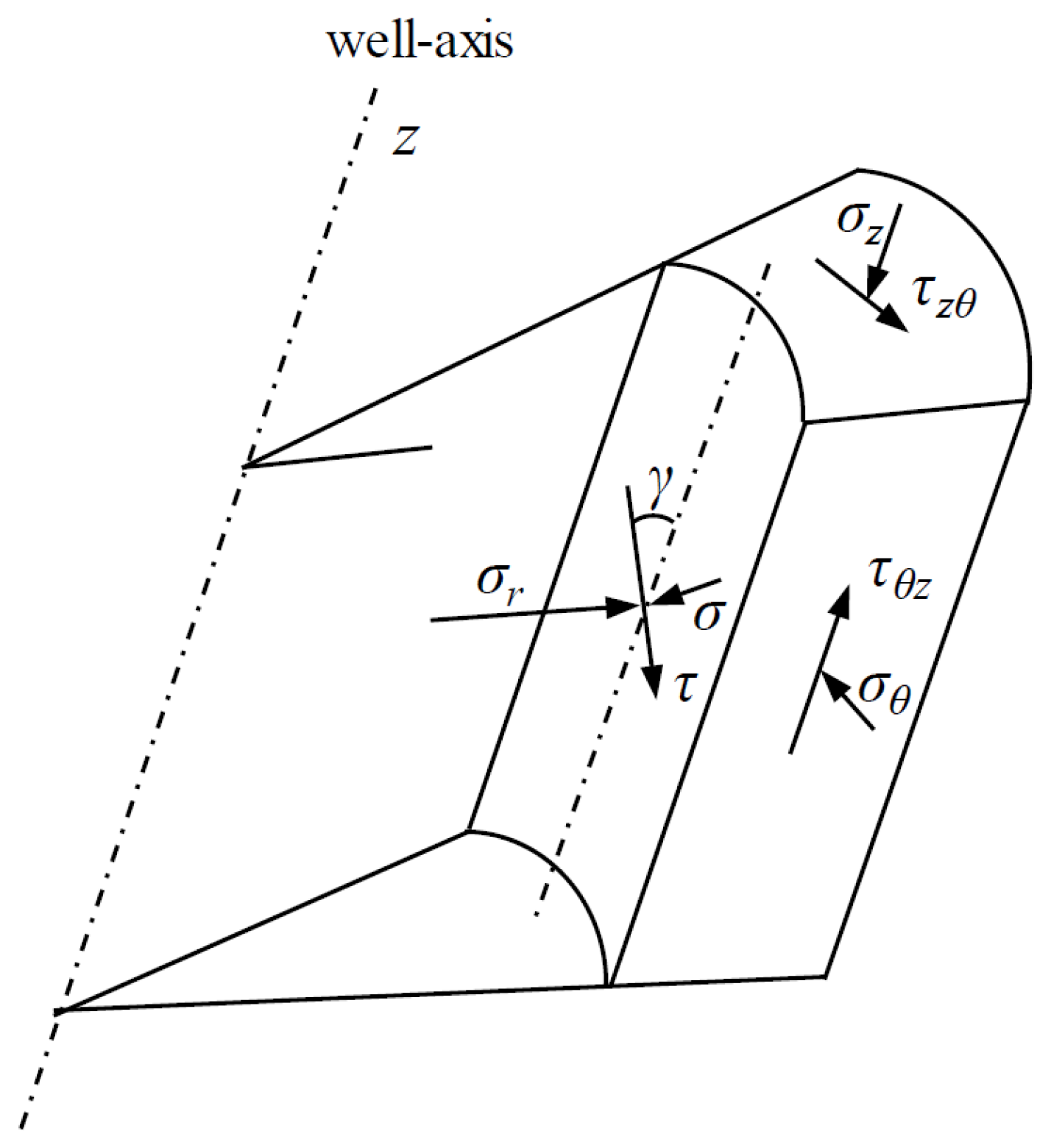
Figure 1. Stress distribution of inclined well wall.
Processes 13 03889 g001
Figure 2. Influence of borehole trajectory on wellbore porosity (a) and permeability (b) of shale.
Processes 13 03889 g002
Figure 3. Variation in shale pore pressure (a) and radical stress (b) with one group of fractures.
Processes 13 03889 g003
Figure 4. Variation in shale pore pressure (a) and radical stress (b) with two groups of fractures.
Processes 13 03889 g004
Figure 5. Weak surface theoretical V-shaped distribution of index functions.
Processes 13 03889 g005
Figure 6. Distribution of equivalent density of collapse pressure in stratified fractured strata.
Processes 13 03889 g006
Figure 7. Distribution of critical collapse density of different fractured formations.
Processes 13 03889 g007
Figure 8. Influence of drilling fluid seepage on equivalent density profile of collapse pressure.
Processes 13 03889 g008
Figure 9. Comparison between the predicted formation pressure of H1 well and the measured value in the field.
Processes 13 03889 g009
Figure 10. Comparison between predicted and field measured values of formation fracture in a well in Chuannan area.
Processes 13 03889 g010
Figure 11. Stability analysis of H2 borehole.
Processes 13 03889 g011
Figure 12. Three pressure distribution profiles of the inclined/horizontal section of H1 well.
Processes 13 03889 g012
Disclaimer/Publisher’s Note: The statements, opinions and data contained in all publications are solely those of the individual author(s) and contributor(s) and not of MDPI and/or the editor(s). MDPI and/or the editor(s) disclaim responsibility for any injury to people or property resulting from any ideas, methods, instructions or products referred to in the content.