
Article

Energy Dependence, Environmental Quality and Banking Sector Capital: New Evidence from OECD Countries


1
Dipartimento di Management, Finanza e Tecnologia, LUM University Giuseppe Degennaro, Strada Statale 100 km 18, 70010 Casamassima, Italy
2
Dipartimento di Scienze Economiche, Psicologiche, della Comunicazione, della Formazione e Motorie, Niccolò Cusano University, Via Don Carlo Gnocchi, 3, 00166 Rome, Italy
3
Department of Political and Social Sciences, University of Catania, Palazzo Pedagaggi Via Vittorio Emanuele II, 49, 95131 Catania, Italy
*
Author to whom correspondence should be addressed.
Risks 2026, 14(6), 121; https://doi.org/10.3390/risks14060121
Submission received: 17 March 2026 / Revised: 11 May 2026 / Accepted: 18 May 2026 / Published: 22 May 2026
(This article belongs to the Special Issue Climate Risk in Financial Markets and Institutions)

Abstract

The current study investigates the relationships among environmental variables, energy sector characteristics, and the resilience of the financial sector using a panel dataset of OECD countries covering 2004–2021. For that purpose, information from the World Bank Global Financial Development Database and Sovereign ESG Data was used, along with the indicator of financial stability—bank capitalization, represented by the capital-to-asset ratio. This work uses an integrated empirical framework that includes panel regressions, clustering techniques, and machine learning models. The findings from fixed-effects panel regression indicate that methane emissions, PM2.5 air pollution, and energy dependence are negatively correlated with bank capitalization, whereas renewable energy consumption is positively correlated. Contrariwise, fossil fuel consumption is positively correlated with the dependent variable, perhaps indicating the financial conditions prevailing at the moment, but not accounting for the long-run sustainable perspective. Robustness checks, such as excluding major economies, using lagged specifications, and adding control variables, confirm the robustness of the main empirical relationships, yet the results need to be interpreted conditionally. Through clustering analysis, various regimes are observed across the sample, each characterized by different combinations of environmental, energy, and financial features. On the other hand, the machine learning results obtained using K-Nearest Neighbors and Random Forest algorithms are consistent with the regression analysis, revealing non-linearities in the data.

1. Introduction

Recently, increasing emphasis has been placed on the interactions among environmental sustainability, energy transition, and financial stability (Cucinelli et al. 2024; Calice and Liriano 2022; Raman et al. 2024). Given the relevance of climate change, environmental pressures, and energy geopolitics, these issues are typically seen as factors associated with the macro-financial landscape and with the dynamics of growth, investment, and financial stability (Arnone et al. 2024). This context has increased the role of banks in financing the energy transition. As major providers of credit to the real economy, banks are exposed to environmental and energy-related risks while also financing the transition toward more sustainable energy systems (Abd Hishamuddin et al. 2023; Drago et al. 2025a). This makes the relationship between environmental conditions, energy structure, and banking-sector stability a relevant research issue.
Climate risks in the literature are usually classified into two families: physical risks and transition risks (Ranger et al. 2022; Calice and Liriano 2022). The former refers to risks posed by climate change, such as air pollution, climate disasters, and weather extremes, that may be associated with lower economic activity, weaker firms’ and individuals’ finances, and changes in asset valuation. These conditions may be linked to borrowers’ credit quality and, in turn, to banks’ financial position (Ranger et al. 2022; Magazzino and Leogrande 2024). Transition risks refer to risks associated with the transition to a carbon-neutral economy (Bandyopadhyay and Kashyap 2024). This transition may involve regulatory changes, technological innovation, and shifts in market expectations. Methane emissions can partly capture these pressures, as high-emission sectors are often more exposed to environmental regulation and structural adjustment (Costantiello et al. 2025; Magazzino et al. 2024).
Several channels could explain the potential linkage between environmental conditions and bank capitalization. Firms in emission-intensive sectors may experience changes in asset values and profitability, which can affect their ability to service loans (Bandyopadhyay and Kashyap 2024; Khennifi and Nouaili 2025). Climate risks may also lead to new regulations and supervisory guidelines, affecting capital requirements and risk assessment (Calice and Liriano 2022). Environmental and energy variables may also be linked to macro-financial factors, such as energy price volatility and foreign-market uncertainty (Arnone et al. 2024). Consistent with this framework, the empirical analysis reports a negative association between methane emissions and bank capitalization, together with evidence of cross-country heterogeneity.
The climate–energy–finance nexus has attracted growing scholarly interest in recent years. For example, several studies highlight the role of financial innovations and green finance in fostering sustainable development (Abd Hishamuddin et al. 2023; Raman et al. 2024). Other contributions explore the interaction between climate risks and macroeconomic outcomes, firm performance, or financial risk-taking (Bandyopadhyay and Kashyap 2024). Other studies examine climate risks in relation to governance frameworks, institutional settings, and social issues (Cucinelli et al. 2024; Drago et al. 2025b). Finally, some authors discuss the application of new digital tools to climate-related financial risk management (Drago et al. 2025a, 2026; Gattone et al. 2025).
Despite these contributions, important gaps remain in the literature. First, although some studies examine the interaction between climate risks and bank performance or risk-taking, few focus specifically on bank capitalization (Magazzino et al. 2025). Second, most of the existing literature focuses on specific channels or financial instruments without considering environmental variables, energy structure, and financial performance together (Drago et al. 2026; Gattone et al. 2025). Third, although cross-country differences are well documented, little is known about structural regimes shaped by specific combinations of environmental conditions, energy mix, and financial resilience (Magazzino et al. 2024; Laureti et al. 2023a).
Building on these gaps, this paper investigates how environmental conditions and energy structure relate to banking-sector resilience, measured by bank capitalization. Specifically, we examine whether environmental pressures, transition indicators, energy structure, and energy dependence are systematically associated with bank capitalization and whether these relationships differ across OECD countries (Magazzino et al. 2025; Drago et al. 2026). For that purpose, we use an integrated empirical approach combining panel data econometrics, clustering analysis, and machine learning models (Drago et al. 2026; Gattone et al. 2025). The first approach is based on panel methods, estimating average relationships using time-series data for each country while controlling for unobserved heterogeneity with fixed effects. Next, we perform a clustering analysis to understand the presence of groups of countries sharing similar traits. Finally, machine learning methods, including Random Forests and K-Nearest Neighbors, are applied to identify non-linearities and the most relevant explanatory variables (Drago et al. 2026; Gattone et al. 2025).
Based on this framework, the analysis is guided by the following hypotheses:
H1. 
Environmental degradation is expected to be negatively associated with banking sector resilience. Higher levels of methane emissions (CH4P) and air pollution (PM2.5) may be linked to lower bank capitalization (Magazzino and Leogrande 2024; Costantiello et al. 2025).
H2. 
Energy dependence is expected to be negatively associated with financial stability. Higher reliance on net energy imports (ENIM) may be related to greater macroeconomic vulnerability and lower bank capitalization).
H3. 
The energy transition is expected to be positively associated with financial resilience. Higher levels of renewable energy consumption (RENC) may be linked to higher bank capitalization (Laureti et al. 2023a, 2023b).
H4. 
Fossil fuel dependence may be associated with short-term financial conditions while potentially reflecting longer-term transition-related risks (Raman et al. 2024). Fossil fuel consumption (FOSS) is therefore expected to show a positive association with bank capitalization in the short term, although this relationship should be interpreted with caution.
The remainder of the article is organized as follows. Section 2 reviews the relevant literature on environmental risk, energy transition, and financial stability. Section 3 describes the data sources, variable selection, and methodological framework adopted in the analysis. Section 4 presents the empirical model specification and discusses the panel regression results. Section 5 compares clustering methods and introduces the K-Means-based regime identification. Section 6 evaluates machine learning model performance and reports the Random Forest variable importance analysis. Section 7 integrates the econometric, clustering, and machine learning findings into a unified empirical interpretation. Section 8 provides integrated empirical evidence on environmental risk, energy transition, and banking sector resilience. Section 9 discusses the policy implications of integrating climate, energy, and financial stability policies. Finally, Section 10 and Section 11 present the limitations of the study and the conclusions, respectively.

2. Literature Review

The current literature shows an increase in interlinking environmental sustainability, energy transition, and finance, especially with regard to the contributions of banks and markets. The first set of studies focuses on the facilitating role of finance and technology in environmental transitions. Khan and Shahid (2026) prove that FinTech and Green Finance have a positive joint effect on sustainable performance across countries. Dhar et al. (2026) emphasize that FinTech and GreenTech have strategic complementarity in South Asia. Bakhsh et al. (2024) use non-linear analysis and prove that digital financial inclusion stimulates renewable energy consumption. Stöckel (2025) shows that digital monetary innovation, like central bank digital currencies, may cause unintended rebound effects in green policy. The above studies show that financial innovation is an important and ambiguous driver of environmental transition. The second set of studies focuses on integrating environmental change into broader processes of macroeconomic and social change. Labonté et al. (2026) discuss globalization and health in the framework of systemic change. Kumar (2025) offers empirical evidence of the effects of climate change on inflation and output in India. Algieri et al. (2025) prove that, in recent years, food inflation in developing countries is driven by climate change, speculation, and geopolitical tensions. The above studies show that environmental stress may affect financial stability indirectly by influencing economic growth, inflation, and distribution of income. Another set of research works focuses on the direct impact of climate risks on financial behavior. Tang and Fang (2025) show that extreme climate risks affect banks’ risk-taking in 107 countries worldwide, which can be considered a strong relationship between environmental risks and financial behavior. Ramlall (2025) proposes the term ‘financial footprint’ and demonstrates its importance in the context of carbon emissions worldwide, which are related to financial behavior and banking activities. Moreover, Anwer et al. (2025) indicate the impact of climate policy uncertainty on the major financiers of the energy sector, which further confirms the close relationship between financial risks and policy risks. The second set of research works concerns the impact of sustainable finance instruments on financial behavior and risks. Azad and Tulasi Devi (2026) provide a comprehensive bibliometric and meta-analysis of green bonds worldwide, showing their rapid development and market evolution. Wan Zahari (2025) discusses the importance of green sukuk in the context of the World Bank’s environmental and social policy, while Lyons and White (2025) examine the importance of green banks in generating multiple value streams in the context of the energy transition process worldwide. Tekin (2025) examines the importance of green banking strategies in the context of firms in Turkey, while Scherrer (2025) offers a theoretical perspective on the impact of sustainability on the mission drift of public sector banking, showing the negative impact of sustainability on banking behavior in general. Cianforlini (2025) examines European participation in the Asian Infrastructure Investment Bank’s energy strategy, showing the importance of geopolitics in the context of sustainable finance worldwide. Fraccalvieri et al. (2025) offer a research work concerning the impact of governance and the importance of renewable energy in global banking. The importance of energy transition and energy dependence is another issue that is given significant emphasis in current studies. Tachy et al. (2026) conducted global research on the potential of banks in facilitating the energy transition in developed and emerging countries of the world, while Gigauri et al. (2026) focused their research on the OECD countries and its implications for economic prosperity and financial development. Onar et al. (2025) conducted their research in the MENA region and explored the interlinkages between energy transition, green growth, financial inclusion, and environmental degradation, revealing significant differences across countries of the region. Waidelich et al. (2025) scrutinized public credit provision and de-risking mechanisms in clean energy and emphasized the importance of learning spillovers in mobilizing finance. Current studies have also focused on exploring the interlinkages between technology, sectoral transformations, and environmental outcomes. Wang et al. (2026) revealed that smart 5G technology has significant associations with carbon emissions in various sectors and thus impacts environmental outcomes, while Kpadonou et al. (2026) conducted their research in West and Central Africa and explored climate-smart agriculture initiatives and their interlinkages with environmental outcomes. Coldrey et al. (2026) added another dimension to these studies by presenting an investigation of financial needs to support a gender-responsive clean cooking transition, with some interesting links between social and environmental outcomes. Shanta and Adedokun (2025) and As-sya’bani et al. (2025) provide additional insights into the argument made above with their investigation of social sustainability drivers in coal-dependent economies and the fairness of energy transition between developed and developing countries, respectively. Some authors focus more explicitly on the links between finance, climate, and risk measurement. For example, Niedziółka (2026) examines bank performance with regard to AI, climate, and geopolitical risks, indicating that traditional bank performance has to take into account new dimensions of risk. For example, Zhao et al. (2026) discuss financial meteorology with regard to the Chinese context, indicating the relevance of weather and climate information for financial decisions. Another interesting contribution is made by Ahmad et al. (2026) with regard to an integrated green finance policy framework for a net-zero transition in Qatar, emphasizing the need for coordination between investment strategies. The common message is that, finally, climate and environmental risks are not peripheral anymore but form an integral part of financial policy and analysis. Despite the large body of literature, gaps remain, especially regarding the link between the natural environment, energy, and the key determinants of the banking sector’s resilience, including capitalization. Although Tang and Fang (2025), Ramlall (2025), and Anwer et al. (2025) attempt to fill this gap, the emphasis in the majority of the literature is on risk-taking, emissions, and policy uncertainty. The large body of literature on sustainable finance instruments (Azad and Tulasi Devi 2026; Wan Zahari 2025; Lyons and White 2025; Tekin 2025) and sustainable finance governance (Cianforlini 2025; Fraccalvieri et al. 2025; Scherrer 2025) lacks empirical data on financial resilience, and the large body of literature on the macro and social impact of climate change (Labonté et al. 2026; Kumar 2025; Algieri et al. 2025; Shanta and Adedokun 2025; As-sya’bani et al. 2025) rarely attempts to create an empirical framework for the link between climate change and energy factors, and lastly, although the literature on digitalization and innovations (Khan and Shahid 2026; Dhar et al. 2026; Bakhsh et al. 2024; Stöckel 2025; Wang et al. 2026) is gaining momentum, the link between digitalization and innovations and banking sector resilience is not explored sufficiently. See Table 1.

3. Data Sources, Variable Selection, and Methodological Framework

The choice of these variables demonstrates an integrated, scientifically sound approach that relies on two reliable data sources—the Global Financial Development Database and the Sovereign ESG Database (Bătae et al. 2020; Tóth et al. 2021). The use of two sources of information contributes to the effectiveness of the research because it allows combining the assessment of both financial and environmental aspects of economic development and conducting a thorough study of the association between the considered variables and the resilience of the financial sector (Yuen et al. 2022; Abdelsalam et al. 2023). CAP is one of the variables that can be used to analyze the association because it indicates the extent to which the banking sector is capitalized and, hence, its ability to absorb any losses (Chiaramonte et al. 2022). In the existing body of literature, this variable is widely applied as a proxy for financial soundness and prudent management in the financial sector, contributing to the creation of benchmarks to assess the relationship between the resilience of the financial sector and exogenous and endogenous factors (Tóth et al. 2021; Chiaramonte et al. 2022). Other variables are also taken from the Sovereign ESG Database and provide alternative measures of environmental pressures and energy composition. These variables have been chosen because they represent significant risks for financial and economic activities in the current period (Bătae et al. 2020; Yuen et al. 2022). For example, CH4P and PM25 provide alternative measures of environmental pressures, with CH4P showing methane emissions per capita and, thus, illustrating the extent of financial risks caused by changes in economic activities and PM25 indicating exposure to PM2.5 and, therefore, physical environmental pressures (Abdelsalam et al. 2023). The combination of selected sets of variables provides an extensive view of the relationships among environmental pressures, economic activity, and the financial sector’s stability (Tóth et al. 2021; Chiaramonte et al. 2022). The variables FOSS and RENC reflect the shares of fossil fuels and renewable energies in the energy mix, influencing exposure to transition costs (Bătae et al. 2020; Yuen et al. 2022). Variable ENIM adds a new dimension to the problem by illustrating the extent of dependence on imported energy, enabling consideration of exposure to the costs of environmental degradation and energy dependence simultaneously (Abdelsalam et al. 2023). Therefore, only countries belonging to the OECD become the focus of the study, and the period 2004–2021 should be highlighted because it covers a wide range of events, including the global financial crisis and the evolution of the climate change strategy (Chiaramonte et al. 2022). The selected variables are reliable and relevant for analyzing the interrelationships among environmental sustainability, the energy sector, and the banking system stability (Tóth et al. 2021; Yuen et al. 2022). See Table 2.
Descriptive statistics are used to describe the distributional characteristics of the variables CAP, ENIM, FOSS, CH4P, PM25, and RENC. The dataset has a large number of observations. For FOSS and RENC, there are no missing values, but there are missing values in CAP and CH4P, as is common with panel datasets, especially with cross-sectional data for countries. As far as the central tendency is concerned, the mean of bank capitalization, CAP, is 7.827, and its median is 7.153. The distribution is slightly positively skewed, as supported by the positive skewness of 1.239. The high value of standard deviation, i.e., 2.905, indicates high variability in capitalization of the banking sector across countries. The distributional characteristics of ENIM are quite different from those of other variables. The mean of ENIM is 21.485, and its median is much higher at 55.443. The variable is left-skewed, as supported by its skewness of −3.949. The high value of kurtosis is another important distributional characteristic of ENIM. The high value of kurtosis indicates the presence of extreme negative values. The minimum value of ENIM is −726.181, indicating the possibility of extreme negative values of net import positions of some countries. The high value of standard deviation and high coefficient of variation of ENIM indicate high variability of ENIM, making it the most variable variable. Furthermore, the high mean and median values, which are above 70, suggest a high dependence on fossil fuels, which is consistent with prior literature highlighting the dominant role of fossil energy in shaping environmental and economic outcomes (Balsalobre-Lorente et al. 2018; Danish et al. 2020). The negative skewness suggests that there are a few observations at much lower levels. In the case of CH4P, though the mean and median values are relatively low, high positive skewness and kurtosis suggest that there are a few observations at much higher levels of methane emissions. This type of asymmetry in environmental indicators is widely documented in empirical studies on environmental degradation (Adebayo et al. 2021). PM25 has a fairly symmetric distribution with high dispersion and mild positive skewness, indicating a relatively homogeneous level of exposure in the included countries. RENC exhibits high dispersion with positive skewness, indicating that some countries have much higher levels of renewable energy consumption, reflecting the heterogeneous transition toward cleaner energy sources (Pata 2021; Danish et al. 2020). Normality tests based on Shapiro–Wilk statistics clearly reject normality for all variables, which is in line with the above results and consistent with the non-normal behavior of environmental and energy-related variables in panel datasets (Adebayo et al. 2021). Overall, it suggests significant heterogeneity, asymmetry, and heavy-tailedness, particularly in energy dependence and environment-related variables, reflecting the heterogeneity of economic structures and energy consumption patterns in OECD countries over the period under consideration. See Table 3.
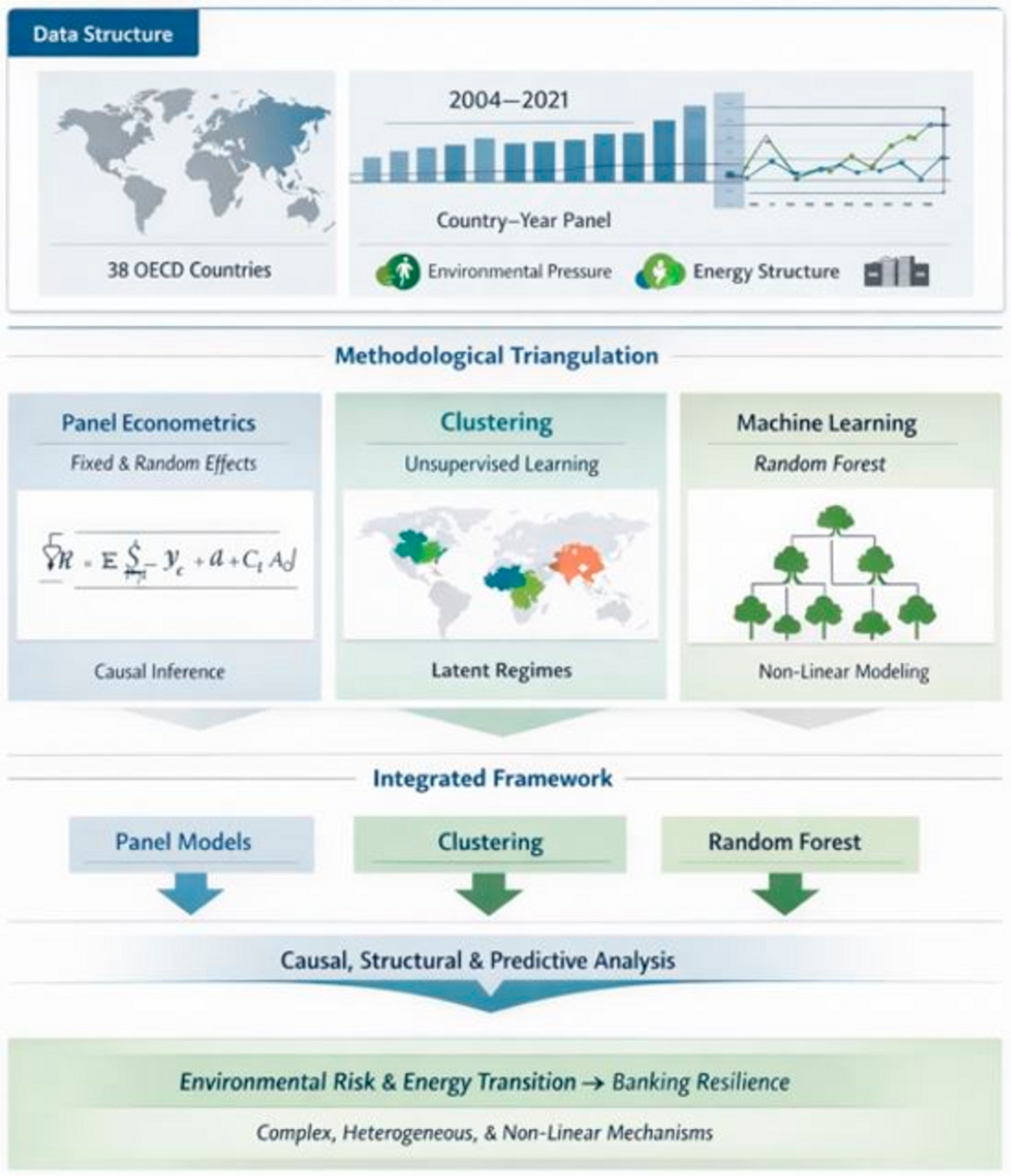
From the methodological point of view, it combines panel data econometrics, clustering methods, and machine learning models in order to take into account the multiple and non-linear interrelations between environmental conditions, energy structure, and the resilience of the banking sector. Panel data methods are particularly suitable for tackling the research objectives in the current paper, given their ability to exploit both cross-sectional and time-series variations for 38 OECD countries over the 2004–2021 period (Çoban and Topcu 2013; Majeed et al. 2022). This structure increases sample size and efficiency of the estimator and allows for controlling unobserved country-specific effects, which might affect the results in a non-trivial fashion. However, linear panel data methods might not be sufficient for analyzing the non-linear interactions between the variables involved in the climate–energy–finance nexus. To overcome these concerns, clustering methods are used, which rely on unsupervised learning for identifying clusters of countries based on their financial sector resilience, environmental pressures, and energy structure configurations, without imposing any functional forms and threshold values for the variables involved. This is particularly relevant for the current research, given the non-linear relationship between sustainability and financial sector stability in any straightforward sense. In addition, the use of machine learning methods, and the random forest regression method in particular, is employed to further relax the assumptions related to the parameters and to account for the potential non-linear relationships between the variables (Wang et al. 2021). The use of machine learning methods, and the random forest regression method in particular, is deemed appropriate for the present problem for several reasons: the method is robust against the problems of multicollinearity, outliers, and non-normality, as evidenced by the descriptive statistics presented above. Moreover, the use of machine learning methods would allow for an assessment of the relative importance of the environmental and energy-related variables, providing an additional layer beyond the emphasis placed by the panel data modeling approach on the assessment of causality and the emphasis placed by the clustering approach on the structural effects. This integration of econometric and data-driven approaches is consistent with the growing literature on the use of big data and machine learning techniques in economic analysis (Einav and Levin 2014). The present approach, therefore, would be deemed a triangulation approach, where the panel data modeling approach would provide the statistical inference, the clustering approach would provide the structural effects, and the machine learning approach would provide the non-linear effects, allowing for a comprehensive understanding of the relationships between environmental risk, energy transition, and the resilience of the banking system. See Figure 1.
This study adopts an integrated empirical strategy combining panel econometrics, clustering analysis, and machine learning techniques, each addressing a complementary dimension of the climate–energy–finance nexus. Panel regressions provide inference on the direction and statistical significance of relationships between environmental, energy, and financial variables, controlling for unobserved heterogeneity. Clustering analysis identifies heterogeneous country regimes, revealing non-linear patterns and structural groupings that cannot be captured by linear models. Machine learning models, in turn, focus on predictive performance and variable importance, allowing us to assess the relative contribution of each factor and to capture potential non-linearities. Taken together, these approaches define a coherent framework in which econometric results establish baseline relationships, clustering uncovers structural heterogeneity, and machine learning validates and extends the findings through predictive analysis.

4. Empirical Model Specification and Panel Regression Results

The empirical analysis is structured to test the hypotheses outlined in Section 1, linking environmental pressures, energy structure, and banking sector resilience.
The following model has been estimated:
C A P i t = α + β 1 C H 4 P i t + β 2 P M 25 i t + β 3 F O S S i t + β 5 R E N C i t + β 6 E N I M i t i = 38   t = [ 2004 ; 2021 ]
In this research, the relationship between environmental and energy-related indicators and the financial resilience of banks will be examined. For empirical analysis, a panel dataset of 38 OECD countries during the period 2004–2021 (578 observations) will be used. The dependent variable is the CAP (capital-to-total-assets) ratio, one of the most commonly used proxies for bank capitalization. In addition to the dependent variable, the following explanatory variables related to the energy mix and environmental pressure will be included: methane emissions (CH4P), exposure to pollution (ambient air pollution exposure) (PM2.5), consumption of fossil fuel energy (FOSS), consumption of renewable energy (RENC), and net energy imports (ENIM). Both fixed-effect (FE) and random-effect (RE) models were estimated. The preferred specification, according to the Hausman test, was the FE. However, the inclusion of fixed effects in this model controls only for unobserved country-specific heterogeneity, not for endogeneity problems such as reverse causality or omitted variables (Hao et al. 2020). Specifically, bank capitalization can influence energy finance, making the findings associations rather than causal effects. To address this problem, two strategies will be used. On the one hand, lagged models will be estimated to address simultaneity bias. On the other hand, other macroeconomic and institutional variables will be included as controls. However, although these measures cannot provide causal identification, they make the findings more robust as conditional associations. In fact, this is an important issue to consider in relation to renewable energy consumption, as countries using renewables at higher levels may differ systematically in their economic structures, institutions, and financial development (Pata 2021). From a conceptual point of view, CH4P is an indicator of transition-related environmental pressure, PM2.5 is a measure of physical environmental risk, FOSS and RENC are indicators of the structure of the energy mix, and ENIM shows external energy dependence. In this sense, all these indicators are mostly related to the structure of each country’s economy and, therefore, are unlikely to depend on bank capitalization levels in the short term (Shahzad 2020). The empirical results are mostly similar across the FE and RE models. In both models, CH4P is negatively associated with CAP, indicating that higher methane emissions are associated with lower capitalization. This association can be interpreted as consistent with the literature on climate-related financial risks, given greater exposure to industries undergoing structural adjustment (Battiston et al. 2021; Delis et al. 2024). Likewise, PM2.5 is negatively related to bank capitalization, as expected, because environmental indicators are correlated with macroeconomic conditions and, in turn, with borrower characteristics (Shahzad 2020). FOSS is positively related to CAP; however, this result should be interpreted with caution, as it reflects only the role of fossil fuels in generating economic growth. In fact, over the long term, there may be additional risks associated with the use of fossil energy resources (Delis et al. 2024; Kennard 2020). RENC is positively and significantly related to CAP; however, this result should be interpreted with caution, as it may partially reflect other country-level factors beyond the role of renewables (Pata 2021). Finally, ENIM is negatively related to CAP, meaning that energy dependence tends to imply greater macroeconomic vulnerability (Hao et al. 2020). As regards the model specification, the FE regression explains part of the within-country variance in CAP (within R2 = 0.299; LSDV R2 = 0.823) and has statistically significant regressors (F-test). However, heteroscedasticity, cross-sectional dependency, and serial correlation have been detected, which are common in macro-panel data. Nevertheless, the main coefficients remain unchanged when robust standard errors are applied. All in all, the results show associations between environmental pressure, energy composition, and banks’ financial resilience: environmental pressures and energy dependence are negatively correlated with CAP, while renewable energy consumption is positively associated with it. Regarding FOSS, the positive relationship reflects only short-term patterns and should be interpreted cautiously, especially given long-term transition dynamics (Battiston et al. 2021; Delis et al. 2024). See Table 4.
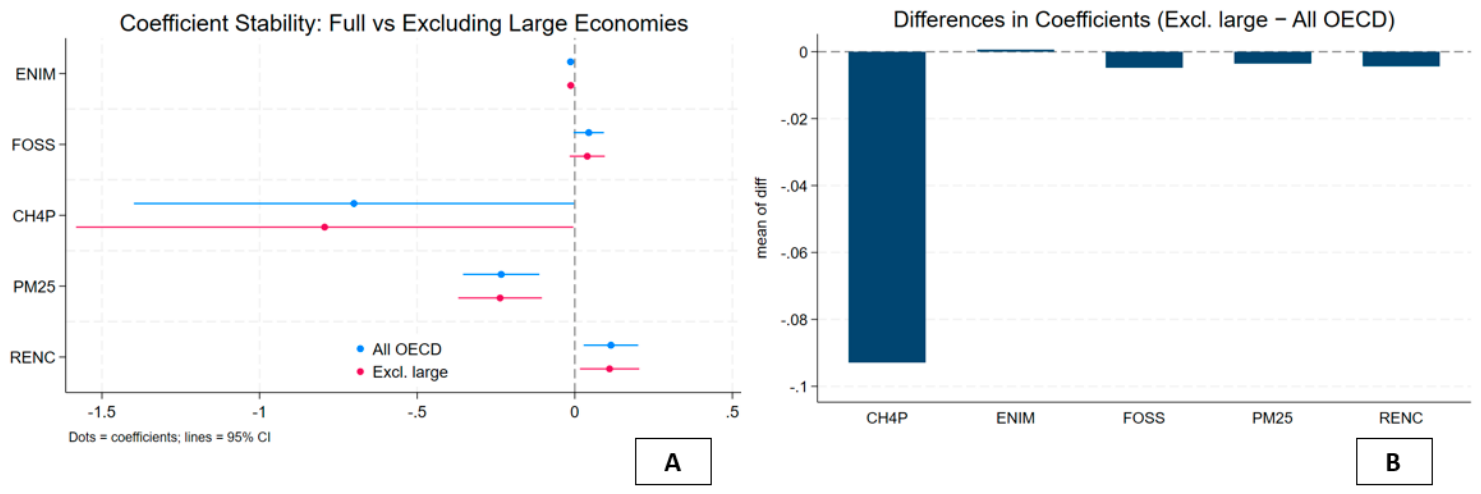
Table 5 reports a robustness check designed to assess whether the baseline results are driven by the largest OECD economies. Specifically, the model is re-estimated after excluding the United States, Germany, Japan, the United Kingdom, and France—countries that account for a substantial share of total OECD economic activity and could potentially exert a disproportionate influence on the estimated relationships. The purpose of this exercise is to verify the stability and generalizability of the findings across countries of different sizes. See Table 5.

4.1. Robustness Analysis Excluding Large Economies: Evidence of Coefficient Stability

This robustness check examines whether the baseline results are driven by the largest OECD economies, a relevant concern in panel settings characterized by heterogeneity and cross-sectional dependence (Eberhardt and Presbitero 2015). After excluding the United States, Germany, Japan, the United Kingdom, and France, the main coefficient signs remain unchanged, suggesting that the core relationships are not dependent on a few dominant countries. ENIM remains negatively and significantly associated with bank capitalization, while CH4P and PM2.5 also retain negative coefficients. The PM2.5 and ENIM estimates are particularly stable, moving only slightly from −0.234 to −0.237 and from −0.0134 to −0.0128, respectively. RENC remains positive and statistically significant. The only relevant change concerns FOSS, which retains a positive sign but loses statistical significance once large economies are excluded, suggesting some sensitivity to sample composition and structural heterogeneity (Eberhardt and Presbitero 2015). Overall, these findings indicate that the baseline results are broadly robust to the exclusion of large economies, although some cross-country heterogeneity remains (Levin et al. 2002). See Figure 2.

4.2. Testing for Omitted Variable Bias: The Role of Macroeconomic Controls

Table 6 presents a robustness check aimed at addressing potential concerns related to omitted variable bias, particularly the possibility that the observed relationship between renewable energy consumption and bank capitalization is driven by broader macroeconomic conditions.
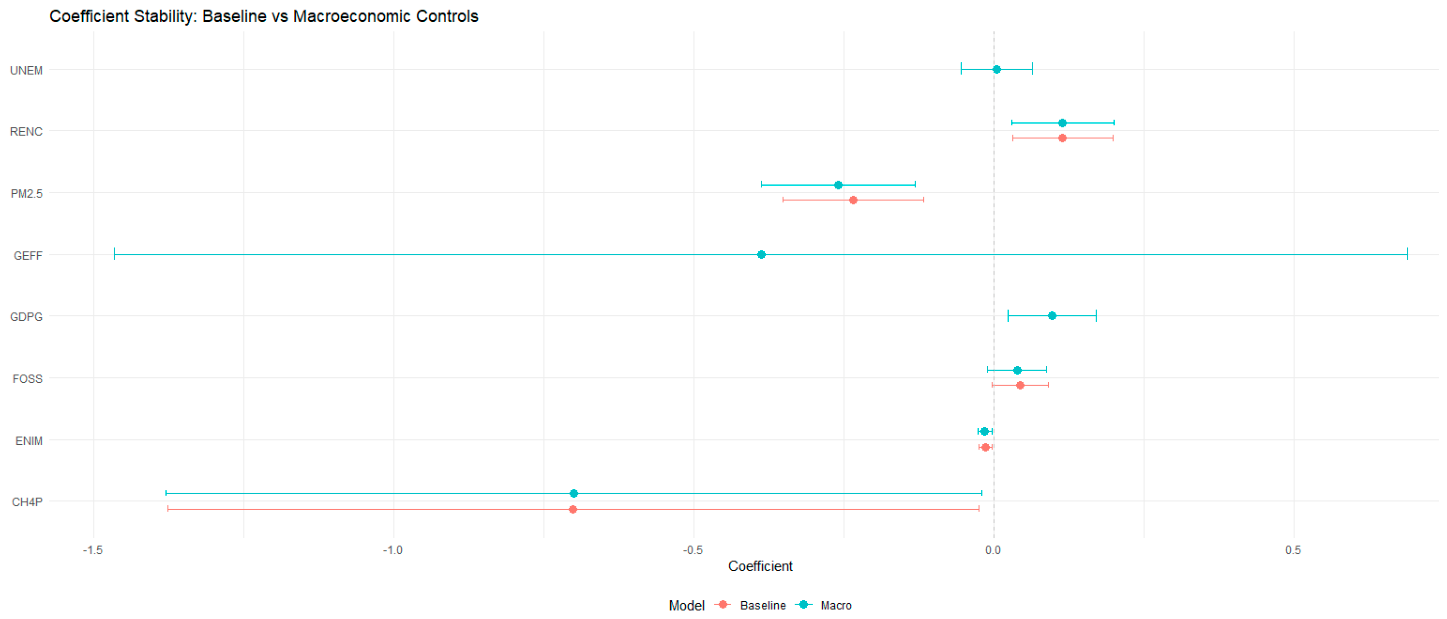
The extended specification includes GDP growth (GDPG), government effectiveness (GEFF), and unemployment (UNEM) to assess whether the baseline associations are robust to macroeconomic and institutional controls (Nguyen et al. 2020; Majeed et al. 2022). The results remain broadly stable. RENC keeps the same coefficient magnitude and statistical significance, suggesting that its positive association with bank capitalization is not absorbed by the added controls (Majeed et al. 2022; Maket 2026). ENIM also remains negative and significant, while PM2.5 retains a negative coefficient that becomes slightly larger in absolute value. CH4P remains negative, although its statistical strength is reduced, and FOSS loses significance while keeping a positive sign, suggesting that part of its association may reflect broader macroeconomic conditions (Nguyen et al. 2020; Shahbaz et al. 2019). Among the added controls, GDPG is positively and significantly associated with CAP, whereas GEFF and UNEM are not statistically significant. Overall, the main results are not substantially altered by the inclusion of macroeconomic controls, although the findings should still be interpreted as conditional associations rather than causal effects (Majeed et al. 2022; Nguyen et al. 2020). See Figure 3.

4.3. Lagged Specification Analysis: Addressing Endogeneity and Temporal Dynamics

A robustness test using lagged regressions is provided in Table 7. The main challenge in panel data models is endogeneity, or reverse causality. As shown in the base regression model, some economic and environmental variables appear contemporaneously with bank capitalization and may reflect only correlations rather than causal effects. Using lagged variables, it can be tested whether these variables lead and affect banking resilience.
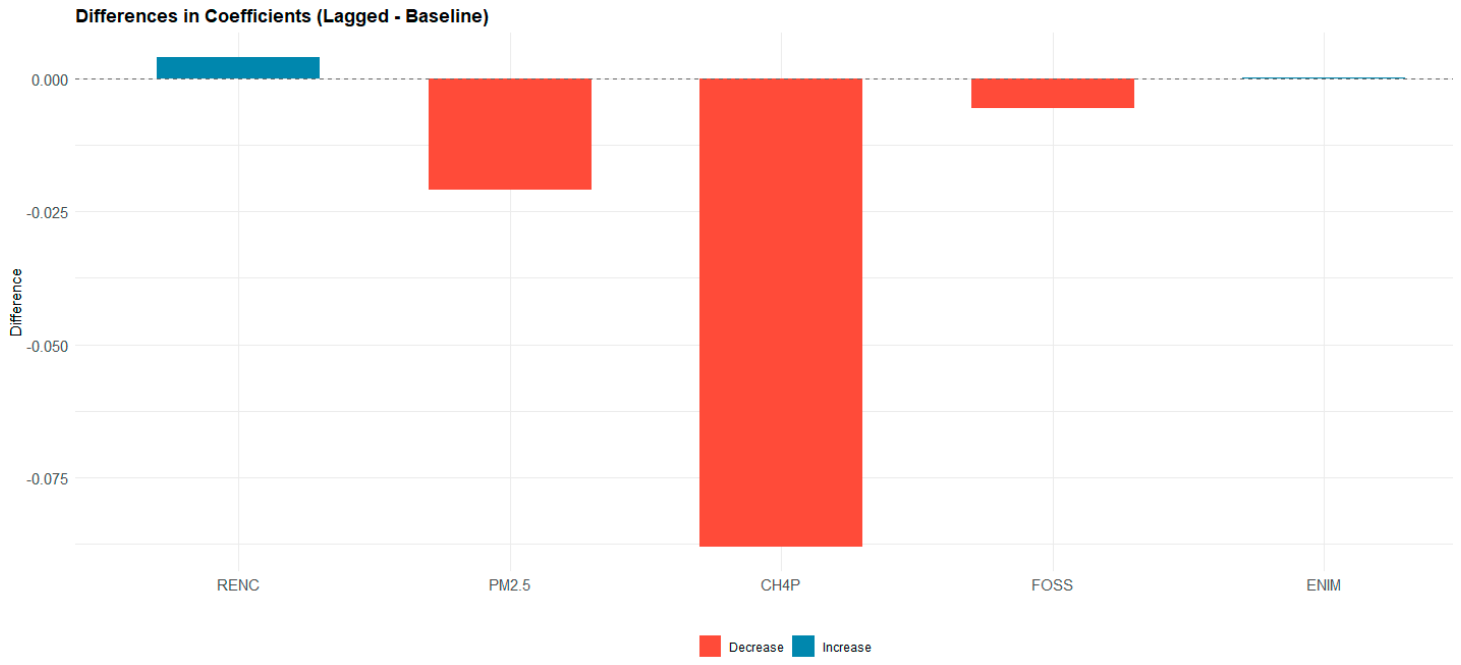
The lagged specification provides an additional robustness check by assessing whether the baseline relationships persist when explanatory variables are introduced with a one-period delay (Aslan et al. 2021; Pata 2021). The results remain broadly consistent with the baseline model. ENIM remains negative and statistically significant, while PM2.5 also retains a negative and significant association with bank capitalization. RENC remains positive and significant, confirming the stability of its relationship with CAP across specifications (Pata 2021; Zuo et al. 2026). FOSS also remains positive and significant, although this result should still be interpreted cautiously because it may reflect short-term energy-related economic structures rather than long-term transition effects (Shahbaz et al. 2019). The main change concerns CH4P, which remains negative but loses statistical significance in the lagged model. Overall, the lagged specification supports the robustness of the main associations, while confirming that the results should be interpreted as conditional relationships rather than causal effects (Aslan et al. 2021; Zuo et al. 2026). See Figure 4.
Table 8 summarizes the main robustness checks, focusing on sample composition, omitted variable bias, and potential endogeneity. See Table 8.
Overall, the robustness checks support the stability of the main findings across alternative specifications. Excluding the largest OECD economies does not substantially alter the signs of the key coefficients, suggesting that the results are not driven only by dominant countries, although some cross-country heterogeneity remains (Santiago et al. 2022). The inclusion of macroeconomic controls confirms the relevance of RENC, ENIM, and PM2.5, while also indicating that some relationships may partly reflect broader macroeconomic conditions (Umar et al. 2020; Antonakakis et al. 2017). Finally, the lagged specification shows that the main associations persist when explanatory variables are introduced with a delay, reducing concerns about purely contemporaneous correlations. However, these tests do not establish causality and should be interpreted as evidence of robust conditional associations (Singh and Dhariwal 2025). Taken together, the robustness checks indicate that the baseline results are not mainly driven by sample composition, omitted macroeconomic factors, or timing assumptions.
The following clustering and machine learning analyses build directly on these econometric findings. While the panel regressions identify the average associations between environmental, energy, and banking variables, clustering is used to examine whether these relationships differ across groups of countries. Machine learning models then provide an additional check by assessing whether the same variables that are significant in the econometric analysis also contribute to predictive performance. In this way, the subsequent sections do not represent separate exercises but extend the core econometric evidence by exploring heterogeneity and non-linear patterns.

5. Clustering Method Comparison and K-Means-Based Regime Identification

Building on the panel regression results, the clustering analysis examines whether the econometric relationships between bank capitalization, environmental pressure, and energy structure vary across different country profiles. Table 9 reports the normalized performance of six clustering algorithms—Density-Based, Fuzzy C-Means, Hierarchical, Model-Based, K-Means, and Random Forest—across six internal validation metrics: Maximum Diameter, Minimum Separation, Pearson’s γ, Dunn Index, Entropy, and the Calinski–Harabasz Index. All metrics are scaled to the [0, 1] range to facilitate comparison across methods.
However, these measures differ in terms of the characteristics they measure. While Minimum Separation and Dunn’s Index estimate compactness and separation, Pearson’s γ reflects the degree of compliance between distances and classification, and the Calinski–Harabasz Index describes the overall between- and within-cluster scatterings (Arbelaitz et al. 2013; Hämäläinen et al. 2017). Lower values of Maximum Diameter and Entropy mean better performance. As shown in Table 9, the density-based algorithm demonstrates excellent results in separation-related metrics and high scores for Minimum Separation, Pearson’s γ, and the Dunn Index. Nonetheless, lower performance in terms of Entropy and the Calinski–Harabasz Index might indicate a certain lack of flexibility in assessing overall cluster structure, which aligns with existing findings on clustering validation metrics (Arbelaitz et al. 2013). On the other hand, the Fuzzy C-Means method performs worse on separation-related metrics but achieves a higher Entropy score, which aligns with its nature and possible limitations in determining clusters. The Hierarchical and Model-Based algorithms show rather average results on these metrics. Specifically, the performance of hierarchical clustering and Entropy for the Model-Based clustering seems to be rather balanced and in line with typical clustering behavior (Hämäläinen et al. 2017; Seidpisheh and Mohammadpour 2018). The K-Means algorithm shows the highest Calinski–Harabasz Index and Entropy values compared to other algorithms. However, it demonstrates rather mediocre performance concerning other measures. Random Forest performs poorly on some metrics (see Table 9) but shows good results relative to others. Generally speaking, each of these algorithms seems to show certain advantages. Nevertheless, the K-Means algorithm provides relatively balanced performance across the key clustering validation metrics and will thus be used in further computations. Table 10 provides insight into key clustering validation metrics used to assess K-Means results for different k values. See Table 10.
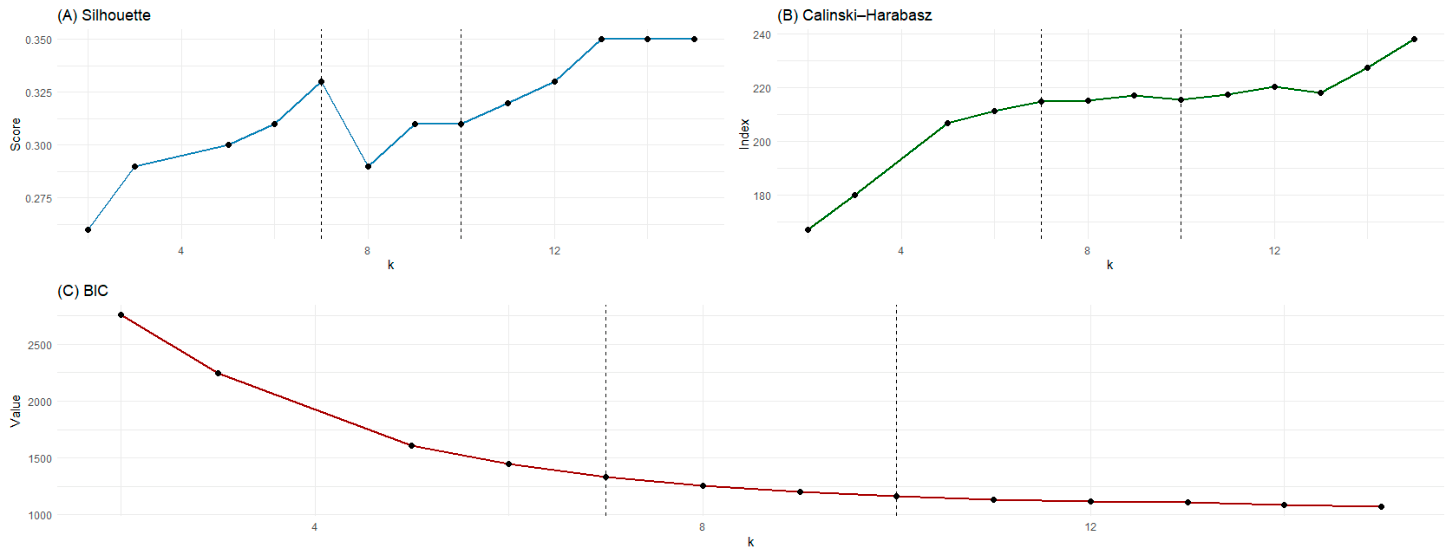
These three criteria can be applied to identify the optimal number of clusters. First, the silhouette score, which measures intra-cluster compactness and inter-cluster distances, increases from 0.26 (k = 2) up to 0.35 when k equals 13–15. Second, the Calinski–Harabasz index also shows a tendency to increase, since it depends on the number of clusters. In turn, k = 15 is the maximum value for this index because the metric prefers to separate data into smaller clusters, as shown in other comparative analyses of clustering validity indices (Arbelaitz et al. 2013). Third, the Bayesian Information Criterion (BIC) decreases as k grows. It implies better fitting at the cost of increased model complexity. Thus, using several validity measures allows us to find a trade-off between goodness-of-fit and complexity of interpretation, which is considered a key challenge in clustering (Xu and Tian 2015; Charrad et al. 2014). Large k improves quantitative characteristics but leads to many small clusters. Small values of k might be too simplistic, as they fail to distinguish among countries. Thus, there is a need for intermediate numbers, i.e., 6–8 clusters. With this number of clusters, the silhouette score becomes stable. However, it might still be possible to achieve better partitioning with 9–12 clusters. Taking all criteria above into account, we decide to use k = 10. Our choice of k allows us to obtain differentiated clusters without creating too many, thereby meeting typical requirements for cluster selection procedures (Charrad et al. 2014; Hämäläinen et al. 2017). See Figure 5.
According to the K-means algorithm, the dataset has 10 distinct groups, indicating a heterogeneous dataset in terms of size and other features (Yang and Sinaga 2019; Zhou et al. 2024). The smallest clusters consist of 6 objects (cluster 1), while the largest ones include 131 (cluster 8) and 120 (cluster 9) observations. Therefore, some configurations appear more often than others. The silhouette value is an index that reflects the quality of the clusters. High values in clusters 1 and 10 denote well-defined groups, whereas clusters 2, 4, and 5 have medium values. Finally, low values for clusters 3, 6, and 7 may indicate fewer clear borders and smoother transitions. This finding confirms the existence of discrete and continuous patterns, as reported in previous studies (Liu et al. 2013). Centers of clusters differ across economic, environmental, and energy factors. Thus, cluster 10 can be described by relatively high bank capitalization (CAP), higher consumption of renewables, and lower energy import dependence. Clusters 6 and 7 demonstrate relatively high CAP scores, but with other features. On the contrary, cluster 5 is characterized by lower CAP scores and high methane emissions. Larger clusters (e.g., cluster 9) have relatively high CAPs and higher levels of air pollution and fossil fuel dependence, suggesting a mixed character. In turn, smaller clusters (e.g., cluster 1) are characterized by higher renewable use and lower pollution, yet have lower CAP scores. Finally, all the patterns are consistent with those observed across countries, where environmental, energy-related, and banking factors may be correlated differently (Zhou et al. 2024). Such a conclusion should be drawn with caution, since clustering is only a method for describing objects in clusters without making causal assumptions, as is true of any unsupervised analysis (Kodinariya and Makwana 2013). See Table 11.
The K-means clustering algorithm highlights ten different clusters whose number of observations and features differ. As a result, heterogeneous patterns can be identified in the data (Sinaga and Yang 2020; Ezugwu et al. 2021). The number of observations within clusters ranges from 6 (Cluster 1) to 131 (Cluster 8) and 120 (Cluster 9), which means that some patterns occur more often. The share of different clusters in the data sample varies significantly. The largest clusters (9, 8, 6, and 3) account for a significant portion of all observations, while the smallest clusters (1, 5, and 10) contain fewer observations. Therefore, the existence of both standard and special configurations of variables is observed, which is characteristic of clustering analysis for heterogeneous data (Ezugwu et al. 2021). Silhouette values describe how well-defined are the clusters’ boundaries. Clusters 1 and 10 have relatively large silhouette values, implying that their boundaries are clearer. The clusters 2, 4, and 5 have an average level of silhouette value, while the clusters 3, 6, and 7 have lower silhouette values. Cluster centroids allow describing how different economic, environmental, and energy-related factors are involved in clusters. Thus, Cluster 10 involves relatively high bank capitalization (CAP), high use of renewable energy, and low dependence on energy imports. Clusters 6 and 7 include relatively high CAP values but with other variable profiles. On the contrary, Cluster 5 implies low CAP and relatively high levels of methane emissions. Larger clusters (Cluster 9) involve moderate CAP and higher levels of air pollution and fossil fuels. Smaller clusters (Cluster 1) include relatively high levels of renewable energy and lower levels of pollution but not high CAP values. In general, obtained patterns match heterogeneous trends of different countries. It is possible to say that economic, environmental, and energy-related variables are interconnected in different ways. Such results should be carefully interpreted, taking into consideration that clustering provides only descriptive groupings of variables. See Table 12.
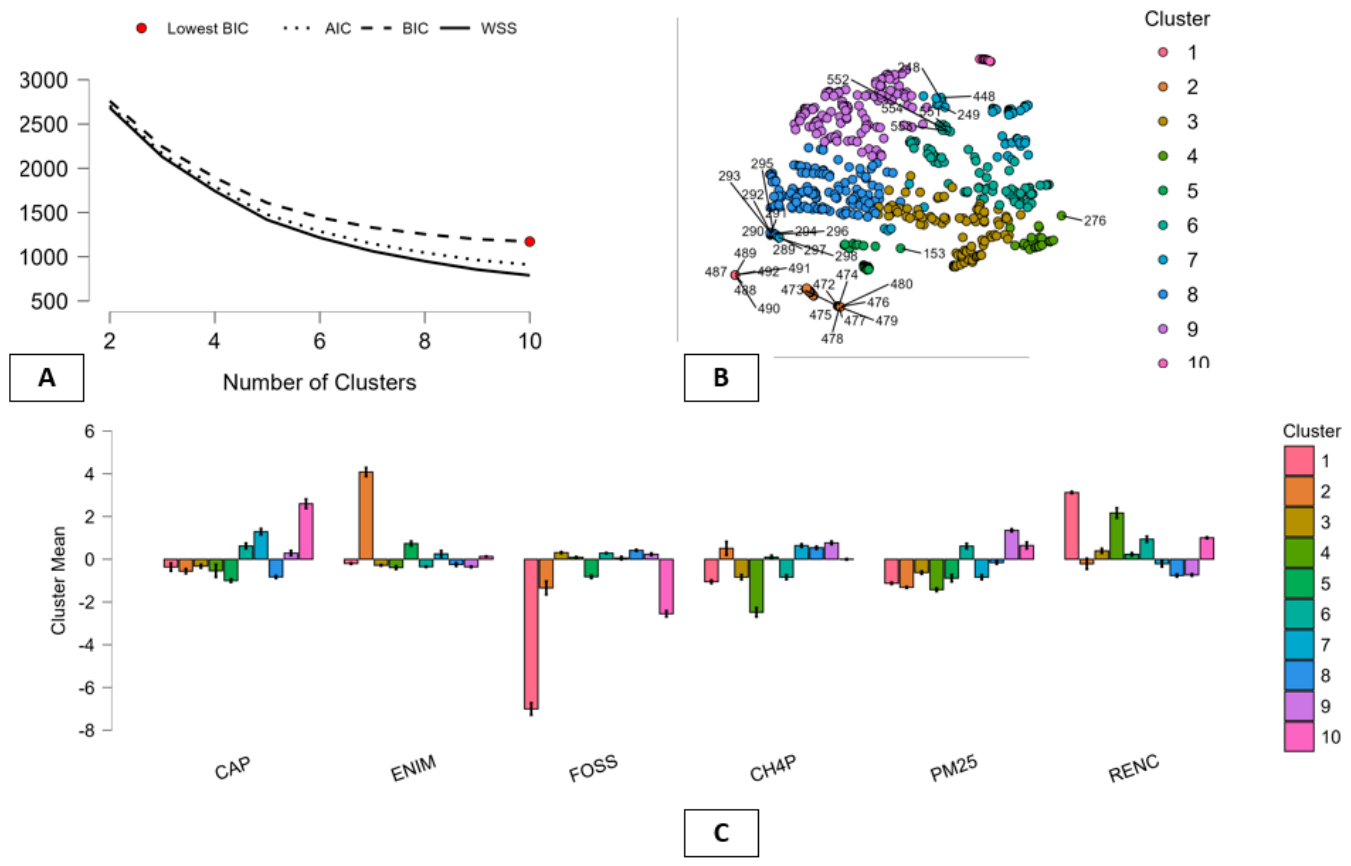
Figure 6 summarizes the results of the K-means clustering applied to CAP, ENIM, FOSS, CH4P, PM2.5, and RENC, providing information on both the choice of the number of clusters and their internal structure.
The trajectory graph in Figure 6A presents the development trends of selection criteria, namely AIC, BIC, and within-cluster sum of squares, depending on the number of clusters (k). It is clear that all criteria decrease as k increases. Therefore, one can claim that including more clusters improves data fit, which is why k = 10 was chosen. This number ensures good coverage of variation without creating too many clusters, a practice recommended during the clustering model selection process (Fränti and Sieranoja 2018; Wang et al. 2025). In Figure 6B, a scatter plot of the dataset, with observations clustered by similarity, is presented. While some form well-separated clusters, others show overlap. Thus, it can be concluded that the observations are both grouped and continuous, an idea consistent with the clustering analysis literature (Wang et al. 2025). Finally, Figure 6C shows a table with the standardized cluster means for some variables (CAP, FOSS, PM2.5, RENC). Some clusters have high bank capitalization rates, high consumption of renewable energy, and low levels of fossil-fuel-related pollution. Others present a reverse situation. The differences in ENIM variable values indicate varying levels of energy dependency across clusters. All in all, one can conclude that there is diversity among the studied countries in terms of financial stability and energy consumption. However, as with any clustering process, it does not prove causation and merely shows groupings of observations (Fränti and Sieranoja 2018). Thus, the hypothesis that the connection between financial sustainability and resilience may vary across country clusters can be tested. In particular, this refers to groups that exhibit high consumption of renewable energy and low pollution rates, which correspond to the variables that turn out to be statistically significant in the regression (Zhan et al. 2023).
These clustering results extend the econometric evidence by showing that the relationships identified in the panel regressions are not uniform across countries. The negative association of environmental pressure and energy dependence with bank capitalization appears to be embedded in different country profiles, while the role of renewable energy is more visible in clusters characterized by cleaner energy structures. Therefore, the clustering analysis complements the regression results by highlighting cross-country heterogeneity in the climate–energy–finance relationship.

6. Machine Learning Performance Comparison and Random Forest Variable Importance Analysis

Following the clustering analysis, the machine learning section further assesses whether the variables emphasized by the panel regressions also have predictive relevance for bank capitalization. Table 13 reports both original (non-normalized) and normalized performance metrics for the predictive algorithms, allowing for a clear and comprehensive comparison across models.
While normalized values facilitate comparability, the original metrics—such as RMSE, MAE, MSE, and R2—provide a more direct assessment of model performance (Segovia et al. 2023; Rakshit and Sengupta 2025). Lower values of RMSE, MAE, MSE, and MAPE indicate better predictive accuracy, whereas higher R2 values indicate better model fit (Akyüz et al. 2024). The results show that the KNN algorithm achieves the lowest prediction errors across all error-based metrics, with RMSE (1.031), MAE (0.696), MSE (1.062), and MAPE (9.91%), indicating superior predictive accuracy. This is also reflected in the normalized metrics, where KNN attains values close to zero, confirming strong out-of-sample performance (Akyüz et al. 2024; Rakshit and Sengupta 2025). The Random Forest model also performs well, with relatively low error values (RMSE = 1.353, MAE = 0.940, MSE = 1.830, MAPE = 12.05%), although higher than those of KNN. However, it achieves the highest R2 (0.815), indicating the strongest explanatory power, consistent with evidence that ensemble methods often better capture variance in complex datasets (Manaf et al. 2026; Segovia et al. 2023). This suggests that while its predictions are slightly less accurate, it better captures overall variance in the dependent variable. The Decision Tree model shows moderate performance, with intermediate error values and a relatively high R2 (0.589), indicating a balance between predictive accuracy and explanatory capability. In contrast, Boosting, Neural Networks, Linear Regression, LASSO, and SVM exhibit weaker performance, with higher errors and lower R2 values, a pattern consistent with comparative studies highlighting variability in model effectiveness across datasets (Rakshit and Sengupta 2025; Segovia et al. 2023). Overall, the results highlight a trade-off between KNN and Random Forest. KNN provides the highest predictive accuracy, while Random Forest offers greater explanatory power alongside relatively low prediction errors (Akyüz et al. 2024; Manaf et al. 2026). These findings suggest that KNN is more suitable for prediction, whereas Random Forest is useful for understanding underlying patterns. Variable importance measures from the Random Forest model—including mean decrease in accuracy, increase in node purity, and mean dropout loss—consistently identify ENIM and RENC as the most influential predictors, in line with the literature emphasizing the ability of Random Forest to identify key drivers through feature importance metrics (Manaf et al. 2026). The strong contribution of ENIM suggests that energy dependence plays a key role in explaining variation in bank capitalization, likely through its macroeconomic implications. RENC also shows high importance, highlighting the relevance of the energy transition dimension. PM2.5 is similarly important across all measures, indicating that air pollution is not only an environmental but also an economic predictor. FOSS and CH4P also contribute, although to a lesser extent, suggesting that fossil fuel dependence and methane emissions remain relevant but partly overlap with other variables. Overall, the importance measures confirm that energy-related variables and environmental pressures are key determinants of bank capitalization within the Random Forest framework, supporting the relevance of transition and physical risk channels (see Table 14).
Together, these three metrics provide a solid evaluation of feature importance that aligns with current research, which shows that machine learning methods can identify the major driving factors of financial and ESG risks (Galletta and Mazzù 2023; Choi et al. 2024). Among all predictors used, ENIM and RENC appear to be highly important. As shown in the analysis, ENIM shows a substantial decrease in accuracy when removed, indicating its high importance in explaining variation in the bank capital ratio. Indeed, the factor can be considered as one of the most important for bank capitalization due to its effects on macroeconomic performance (Almulla et al. 2025). RENC is highly important for all measures, reflecting the significance of the energy transition factor in assessing banks’ resilience (Choi et al. 2024). PM2.5 also retains the same high importance for all the criteria mentioned above, which suggests that air pollution not only affects the environment but also has implications for the financial system because it becomes an element of financial risk as environmental risks start playing a critical role in affecting financial stability both directly and indirectly (Galletta and Mazzù 2023; Almulla et al. 2025). Thus, physical environmental risks and health-related externalities might be related to macroeconomic performance and bank capital adequacy. FOSS and CH4P also play essential roles in the model, though somewhat less important. While fossil fuel consumption enables better predictions by providing more information at lower cost, methane emissions are of moderate importance, possibly due to partial overlap among variables. Indeed, the presence of fossil fuel consumption and related methane emissions can explain higher bank risks and ESG scores, as supported by previous studies (Bernardelli et al. 2022). Consequently, all these factors are considered relevant to bank capitalization within the Random Forest approach. These results support the importance of transition and physical risks as drivers of financial stability (Almulla et al. 2025; Choi et al. 2024), suggesting that models of bank resilience should include energy and environmental variables. See Table 15.
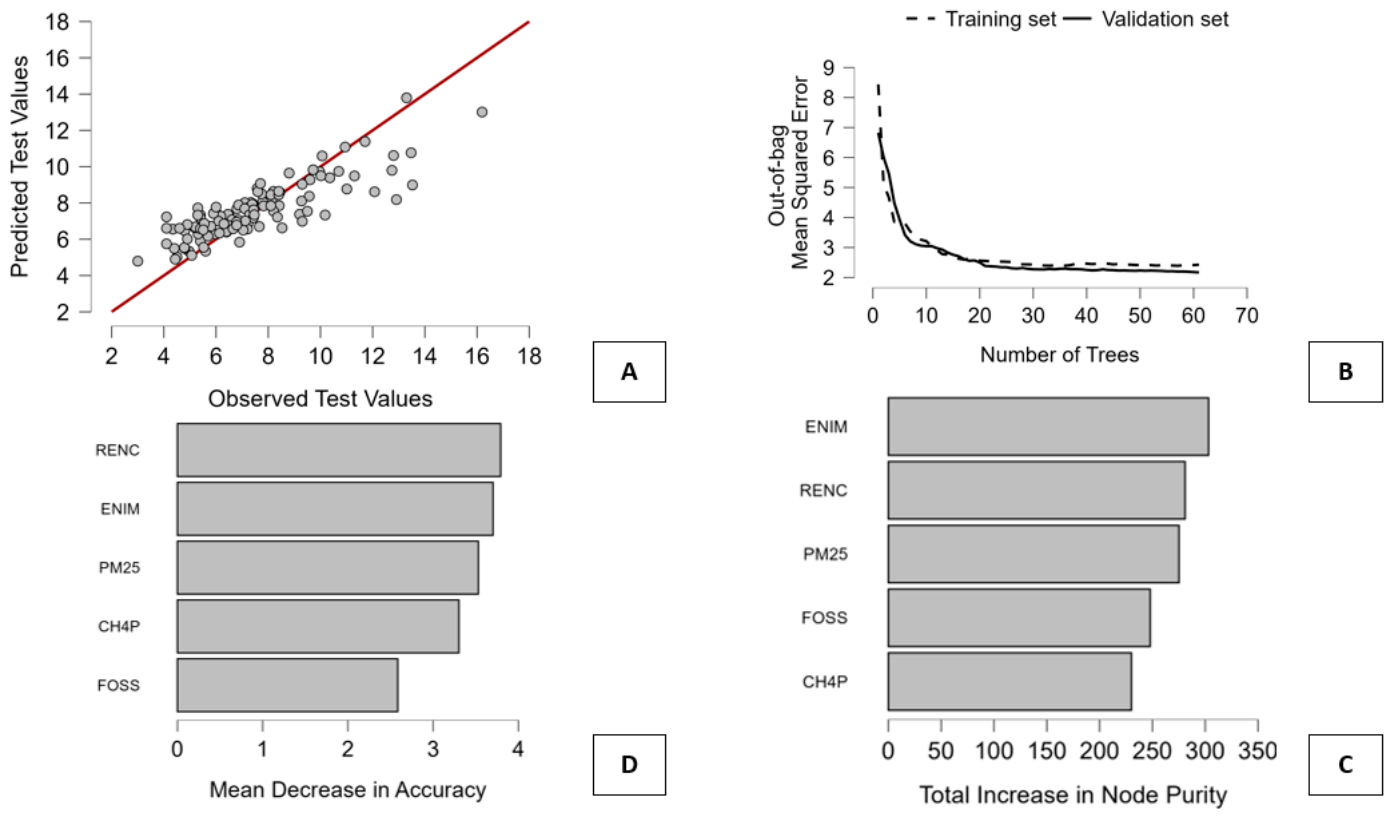
Figure 7 provides an overview of the performance and internal workings of the Random Forest model used to interpret bank capitalization in relation to environmental and energy variables. Figure 7A compares actual and predicted test values, showing a close alignment along the 45-degree line, which suggests good predictive accuracy with limited dispersion.
Figure 7B shows the connection between the out-of-bag mean square error and the number of trees in the ensemble. The plot shows that error declines sharply at the initial stage but remains constant in the subsequent period, indicating that the algorithm converges as the number of estimators increases. The proximity of training and validation errors suggests no significant trade-off between the two metrics, and the model exhibits strong generalization. Variable importance for the Random Forest is illustrated by Figure 7C,D, which show the effect on node purity. Energy imports and renewable energy consumption, ENIM and RENC, respectively, turn out to be the most important variables; they are followed by pollution (PM2.5), fossil fuel consumption (FOSS), and methane power (CH4P). It can be concluded from this order of importance that the structure of energy use, particularly its renewable component, plays a significantly greater role in explaining the variability in bank capitalization, while pollution and fossil fuels are somewhat less influential. The same result is achieved if the variable importance is estimated based on mean decrease in accuracy.
Overall, the machine learning results reinforce the econometric findings by showing that the variables highlighted in the panel regressions also contribute to the prediction of bank capitalization. At the same time, their predictive relevance suggests that the climate–energy–finance relationship may include non-linear components that are not fully captured by the panel models. Therefore, machine learning complements the econometric analysis by validating the importance of the same set of environmental and energy variables from a predictive perspective.

7. Integrated Evidence: Econometric, Clustering and Machine Learning Results

This section brings together the econometric, clustering, and machine learning results to show how the three approaches jointly support the main findings on the climate–energy–finance relationship. Each approach has produced unique insights. However, applying all three allows for a more careful consideration of the complex interactions among the environment, energy, and the banking sector’s resilience. In this regard, the presented results are consistent with the recently emerged literature suggesting the multidimensional nature of the financial climate risk (Berger et al. 2025; Conlon et al. 2024). The econometric results provide the core evidence, showing statistically significant associations between environmental conditions, energy structure, and bank capitalization. Thus, CH4P, PM2.5, and ENIM have a statistically significant negative impact on bank capitalization, whereas RENC shows a positive association with it. The econometric model enables the establishment of such relationships and the drawing of statistical inferences about the connections among the studied factors. However, the relationships identified in the model are to be understood only conditionally, not as causal, given the well-established evidence on the financial impacts of climate change (Yang et al. 2023; Conlon et al. 2024). Next, the results of machine learning models can also be viewed as supportive evidence. More precisely, the better performance of the KNN and Random Forest models suggests that the relationships revealed by the econometric model have high predictive value. Moreover, the Random Forest model’s predictor importance results indicate that energy imports and renewable energy consumption are among the most important factors in determining bank capitalization. Environmental factors, particularly PM2.5, are the next most important. The order of importance obtained with the machine learning technique is completely consistent with the findings of the econometric model. In other words, while some econometric results may not be interpreted as causal, they remain critical for predicting changes in banking sector resilience (Bruno and Lombini 2023; Alessi et al. 2024). Finally, the clustering approach has added yet another perspective to the interpretation of results. The fact that 10 clusters have been identified implies that countries differ in environmental conditions, energy structures, and banking resilience. Furthermore, according to the clustering results, the relationships revealed in the econometric model are not constant but depend on the specific structural regime. Clusters characterized by more advanced renewable energy adoption and less energy dependence are also those demonstrating higher levels of bank capitalization, whereas the opposite holds for polluted, fossil-fuelled countries. The results are fully consistent with both econometric and machine learning approaches. They shed light on the structural nature of the analyzed relationships, reflecting heterogeneous transmission of climate risks (Berger et al. 2025; Yang et al. 2023). In summary, the use of three methodological approaches provides consistent and reinforcing evidence. First of all, the econometric approach helps establish relationships among variables and draw statistical conclusions about their significance. Secondly, the predictive capacity of machine learning models has been used to confirm and interpret the significance of the factors. Finally, the clustering approach highlights non-linear aspects of the discussed relationships and explains their diversity. Overall, the results indicate that environmental conditions and energy structure are critical in determining the level of banking sector resilience (Alessi et al. 2024; Conlon et al. 2024).

8. Integrated Empirical Evidence on Environmental Risk, Energy Transition, and Banking Sector Resilience

First, the results confirm a strong correlation among the environment, energy structure, and banking resilience, consistent with the existing literature on climate-related financial risks and their macro-financial impact (Giglio et al. 2021; Bolton and Kacperczyk 2021). For the panel regression model, two alternative specifications were estimated: the FE and RE models. According to the Hausman test, the former provides better estimates because unobservable characteristics affect the regressor variables. Still, it is worth noting that the FE specification fails to account for endogenous biases, as it allows for differences in unobservable characteristics but cannot entirely rule out reverse causality. Therefore, more capitalized banking systems might have a better chance of fostering specific energy-financing models, including both fossil fuels and renewables. In other words, the findings must be considered conditional relationships rather than conclusive causality, as is common in studies on the environment and finance (Acharya et al. 2023; Giglio et al. 2021).
In this context, the negative and significant influence of CH4P and PM25 can be explained as the manifestation of physical and transition risks, leading to reduced capitalization rates. Such effects operate through the credit and macroeconomic channels, in which environmental risks deteriorate financial indicators and increase the probability of default, consistent with studies on the financial consequences of climate risks and environmental shocks (Addoum et al. 2020; Ilhan et al. 2021). Similarly, higher ENIM negatively affects bank capitalization, an indicator of macro-financial instability inherent to such economic systems. On the contrary, the positive and highly significant influence of RENC suggests that greater progress in the energy transition is associated with greater financial resilience. Finally, FOSS positively affects capitalization, which may seem surprising at first. However, it can be justified by trade-offs between the short- to medium-term benefits of exposure to fossil fuels and the long-term risks posed by tightening regulations, new technologies, and potentially stranded assets (Delis et al. 2024; Bolton and Kacperczyk 2021).
Clustering analysis allows for drawing an additional conclusion about the heterogeneous and non-linear nature of the studied relationships. The K-Means algorithm identifies ten clusters with different patterns. While some clusters feature high capitalization rates, high RENC, and low ENIM, others exhibit low bank capitalization alongside high levels of pollution and FOSS consumption. Moreover, many intermediate clusters exhibit divergent paths to financial resilience, in which financial strength and environmental problems coexist. These clusters are mainly characterized by relatively high rates of PM25 and FOSS. These findings suggest that environmental and financial dynamics may not necessarily follow a gradual transition from brown to green and resilient configurations, and that specific structural regimes are associated with different outcomes, in line with the literature on heterogeneous climate risks across financial systems (Battiston et al. 2017; Acharya et al. 2023).
Finally, the machine learning analysis confirms the findings discussed above. The best predictive performance was observed with the KNN and Random Forest models, with the lowest prediction error and the highest explanatory power. At the same time, the latter shows that ENIM and RENC are the main predictors of banks’ capitalization rates, followed by PM25 as a predictor of physical risks. The significant influence of FOSS and CH4P must also be noted, although their relative importance decreases when the broader context of energy structures and pollution dynamics is considered.
Overall, these results suggest a clear pattern: environmental risks and energy vulnerability are associated with lower bank capitalization, whereas progress towards the energy transition is associated with greater resilience. The presence of heterogeneous clusters highlights that the relationships under discussion depend on the underlying structural regimes rather than following uniform dynamics. Thus, the policy implication derived from these results is that environmental and climate policies are important not only for achieving sustainability goals but also for strengthening macroprudential frameworks and financial stability (Giglio et al. 2021; Acharya et al. 2023). See Table 16.
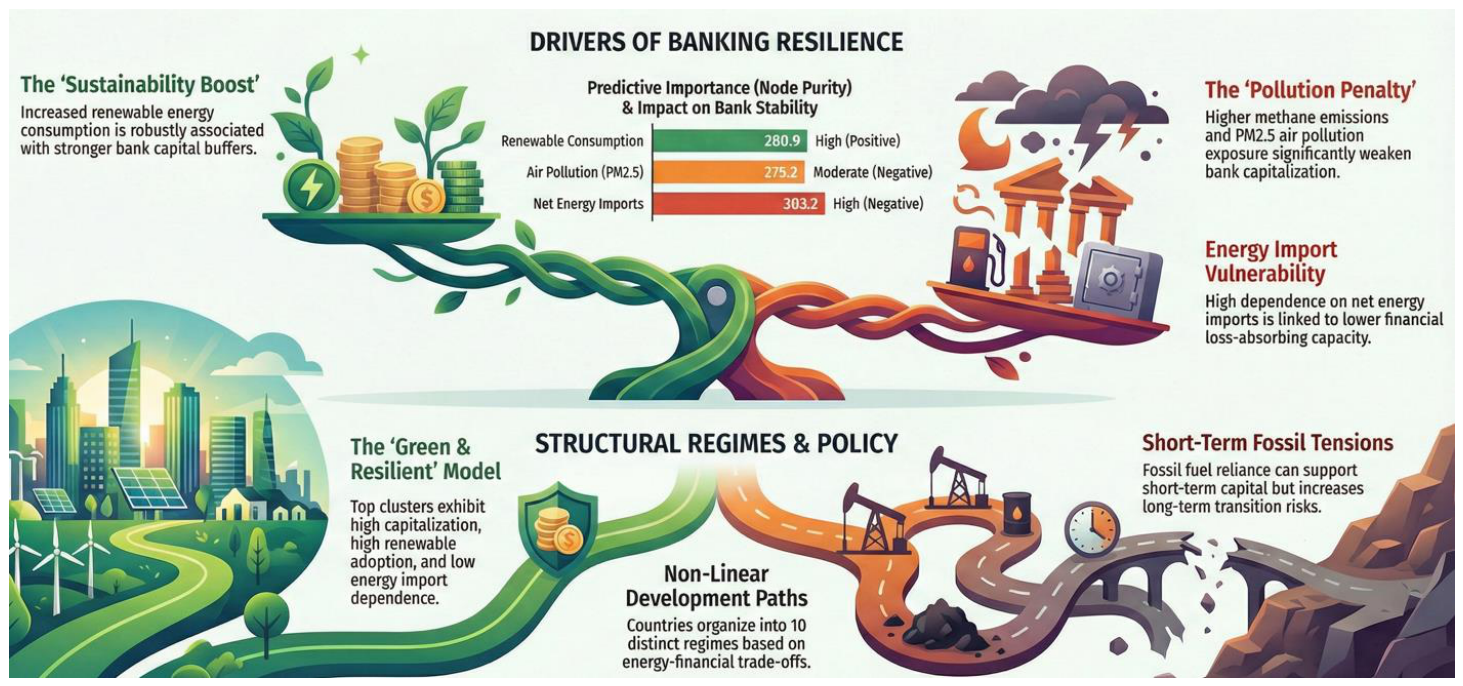
Figure 8 represents a clear and coherent summary of the main results related to the relationship between environmental conditions, energy structure, and banking sector resilience, translating the results obtained through econometric models and machine learning techniques into a unified visual narrative, in line with the literature emphasizing the interconnected nature of climate, energy, and financial systems (Monasterolo 2020; Dafermos et al. 2018).
Starting with the main elements of the framework, the idea of “driving factors of banking resilience” implies three fundamental forces operating in opposite directions. The first one—“sustainability boost”—is placed in the left part of the diagram and refers to the positive effect of increasing renewable energy consumption on bank capitalization as an indicator of sustainable and financially stable development (Monasterolo 2020; Dafermos et al. 2018; Nguyen et al. 2021; Apergis and Payne 2010). The “pollution penalty” label on the right side refers to the adverse effects of methane emissions and increased exposure to PM2.5 on bank capitalization, given that these variables may be treated as sources of economic losses from environmental degradation. In the middle of the diagram, the “energy import vulnerability” marker symbolizes the idea that the country’s growing energy imports act as a driver of losses linked to geopolitical challenges in the global energy market. The bottom of the diagram emphasizes the relationship’s non-linear nature. As mentioned above, the “green and resilient model” label highlights countries with high bank capitalization, high renewable energy use, and low energy import levels. Therefore, it reflects the interaction between financial stability and energy sustainability, which forms the basis of the theoretical model used in the research. Different development trajectories show the nonlinearity of the effects of using fossil fuels, which can positively impact capitalization but also increase transition risk. Finally, the non-linearity is depicted by the number of trajectories and the intersection point corresponding to the non-linear clustering outcome. Overall, the bottom part of the diagram conveys that bank resilience is a non-linear function of the environment and energy decisions, and the strategies of promoting the transition process improve the country’s position in terms of sustainability and bank resilience (Monasterolo 2020; Dafermos et al. 2018; Nguyen et al. 2021; Apergis and Payne 2010).

Operational Policy Implications for Macroprudential Regulation

From a policy perspective, these empirical results suggest that the design of more efficient and targeted macroprudential policies, which specifically include climate- and energy-related risks within their purview, can be beneficial to financial regulators. It is evident that the literature regarding climate risks in financial regulation continues to evolve and expand (D’Orazio and Popoyan 2019; Dikau and Volz 2021); however, prevailing supervisory standards, including Basel III and Basel IV, tend to focus on conventional types of risk, such as credit, market, and liquidity risks. In view of this, the findings of the present study imply that environmental pressures and energy structure may become other important sources of systemic risk that require incorporation into prudential supervision (Brinkman 2024; Campiglio et al. 2018). First, climate-related stress testing should become a key element of Basel III and Basel IV stress testing practices. As mentioned above, the analysis results indicate that both transition risks (methane emissions, carbon pricing) and physical risks (environmental damage, exposure to PM2.5 particles) can significantly affect the capitalization of banking systems. Hence, climate scenarios can become a core element of macroprudential stress testing. In addition to the above, a negative correlation between energy import levels and bank capitalization suggests that shocks from energy price fluctuations and geopolitical risks should also be incorporated into stress scenarios. Incorporation of these new elements into Basel-aligned stress tests could help prudential regulators identify and measure vulnerabilities more effectively (Brinkman 2024). Second, climate-related adjustments to countercyclical capital buffers within the Basel III and Basel IV frameworks may appear necessary. From one perspective, a higher level of energy dependency and reliance on fossil fuels makes countries’ economies more vulnerable and exposes their banking sectors to a range of risks (Brinkman 2024). Therefore, macroprudential regulators in such economies could consider introducing country-specific climate-based countercyclical buffers, depending on their respective energy profile. For instance, if a country has relatively high values of indicators such as fossil fuel consumption (FOSS) and energy imports (ENIM), the banking sector therein should be required to hold a relatively larger amount of buffers, whereas a country with a higher level of renewable energy consumption (RENC) could be exempted from holding additional buffers. Overall, a climate-adjusted countercyclical capital requirement would improve the effectiveness of macroprudential regulation. Third, regulators may consider introducing climate-sensitive risk weights in the Basel III framework. Indeed, a negative correlation between environmental damage and bank capital suggests that lending to carbon-intensive sectors of the economy can pose greater credit risk to the banking sector amid the ongoing energy transition. Thus, risk weighting of banks’ exposures can be made more sensitive to climate risks by increasing risk weights for exposures to high-risk sectors of the economy. At the same time, risk weights associated with environmentally friendly activities can be lowered to facilitate the transition. Climate sensitivity of risk weights could be achieved by making appropriate changes to standardized and internal rating-based risk-weight calculation methods. In conclusion, the findings of the current study demonstrate that the development of a more climate-aware macroprudential framework, in which climate and energy risks are accounted for as core determinants of financial stability, is highly needed. Integration of climate stress testing into Basel III and Basel IV practices, adjustment of countercyclical capital requirements based on a country’s energy profile, and climate-sensitive risk weighting are expected to make prudential policies more proactive, risk-sensitive, and practical.

9. Integrating Climate, Energy, and Financial Stability Policies: Implications for Banking Sector Resilience

From a practical standpoint, the empirical results of the present paper have important implications for the relevant policy areas of financial regulators, energy policymakers, and environmental authorities. In light of the latest research highlighting the systemic nature of climate change risks (Chenet et al. 2021; Roncoroni et al. 2021), stakeholders must adopt an integrated approach to financial stability and sustainability. First, financial supervisors need to incorporate environmental and energy factors into their supervisory practices. Based on the identified negative linkage between bank capitalization and pollution indicators, it can be assumed that climate change risks, physical and transition risks alike, will affect bank balance sheets. Hence, financial regulators must consider these risks in their stress-testing scenarios, capital adequacy assessments, and supervisory reviews (Chenet et al. 2021; Cullen 2023). By integrating environmental risks into financial supervision, supervisors would be better able to assess banks’ resilience to climate-related events. Financial regulators will thus gain a stronger ability to identify financial institutions and jurisdictions with the highest climate change risk exposure. Secondly, given the strong energy dependence, as reflected in net energy imports, the relevance of financial stability through energy security becomes clear. Countries that rely heavily on foreign energy supplies are more exposed to geopolitical risks and energy price instability, the impacts of which could extend to financial stability and the performance of the banking sector. Accordingly, financial stability could be achieved through policies that diversify energy sources, boost energy efficiency, and increase local energy production. Within this framework, energy security and financial stability are increasingly interconnected, as discussed in several studies on systemic financial risks, including network exposure and macroeconomic risks (Roncoroni et al. 2021). Thirdly, based on the positive correlation between renewable energy consumption and bank capitalization, promoting the energy transition will lead to greater financial stability, as investments in renewable energy are associated with stable, predictable macroeconomic conditions. In turn, a stable macroeconomic environment will result in higher bank capitalization, which can be explained by evidence of green finance and the lower cost of capital for sustainable assets (Flammer 2021; Schumacher 2024). In this case, policymakers can be encouraged to provide a stable regulatory framework for renewable energy adoption. Fourthly, the results from the cluster analysis show that countries follow diverse development paths and face different challenges in balancing sustainability and financial stability. Hence, a differentiated approach to solving financial stability issues, rather than a “one-size-fits-all” strategy, can be employed. For example, a more aggressive policy on environmental and energy reforms is needed for countries in clusters characterized by pollution and low bank capitalization. On the other hand, it is important to consolidate existing achievements and take steps to manage transition risks in those clusters where countries have relatively high bank capitalization and renewable energy use. Finally, based on the results of machine learning models such as random forests and k-nearest neighbors, it was found that energy structure and environmental factors are among the best predictors of bank capitalization. This outcome shows how valuable and promising the development of data-driven policy tools could be. As such, financial regulators might invest in better data collection and incorporate environmental, social, and governance (ESG) data into their databases.

10. Limitations

The present study faces several limitations that need to be addressed. To begin with, the empirical analysis is based on panel data from countries, which implies that causality cannot be established. Even though the fixed-effects approach, lagged specifications, and control variables are applied to address endogeneity, the above techniques do not rule out potential threats to identification arising from reverse causality, omitted confounding factors, or measurement errors. Hence, it would be incorrect to view the observed associations between variables as causal, as the bulk of climate finance studies do (Giglio et al. 2021; Zhou et al. 2023). Another limitation concerns the reliance on aggregated measures of the banking sector’s performance. The differences in banks’ business models, asset and liability structures, regulatory exposure, and risk management systems may be ignored when dealing with national statistics, limiting the ability to identify more specific mechanisms through which environmental and energy factors shape the financial stability of banking systems. This problem is also reported in other literature on the topic (Zhou et al. 2023; Chiang et al. 2026). Yet another drawback of this research is its focus on OECD member states. The inclusion of such countries improves the quality and consistency of the data used, but may decrease the external validity of the results due to the relative homogeneity of institutional settings and financial systems across the selected economies. In other words, the implications of this study cannot be generalized beyond the selected OECD member countries, as many other financial markets exhibit considerable heterogeneity in climate change risk exposure (Chiang et al. 2026). It might also be worth mentioning that some of the included explanatory variables capture not only environmental and energy pressures but also general structural and macroeconomic characteristics. As a result, it might be difficult to separate causal channels in this case, given the complex nature of the analyzed financial variables (Kölbel et al. 2020). Another limitation concerns the reduced-form specification used in the empirical analysis. While this method helps identify relationships between dependent and independent variables, it does not enable exploration of the dynamics of transmission channels linking environmental and energy factors to the financial stability of OECD banking systems. The roles of credit risk, asset pricing, regulation, and feedback from the macroeconomic environment are not considered here, as in other climate–finance studies (Giglio et al. 2021). Finally, it seems reasonable to note that combining econometric, clustering, and machine learning approaches brings together three different analytical tools with distinct purposes—descriptive, inferential, and predictive ones, respectively. Despite their complementarities, these techniques do not overcome the underlying problems associated with causal identification.

11. Conclusions

In this paper, the relationship among environmental factors, energy structures, and banking sector resilience within OECD economies is analyzed. The capital-to-assets ratio is used as a proxy for financial resilience. Based on the established theoretical framework, several hypotheses about the association among environmental degradation, energy dependence, the energy transition process, and the level of banks’ capitalization have been formulated and tested. By combining a variety of methodologies, including panel data econometrics, clustering, and machine learning algorithms, the study proposes an integrative empirical framework for analyzing the climate–energy–finance nexus for the period between 2004 and 2021. All empirical estimates show high consistency among methodologies. Environmental degradation, proxied by methane emissions and PM2.5, has been found to be negatively associated with financial resilience. Similarly, energy dependence—the net energy imports—has shown a negative correlation with financial resilience, which confirms the effect of exogenous shocks and macroeconomic vulnerabilities. On the other hand, the share of renewable energy has been found to have a positive effect on financial resilience, suggesting the presence of more stable economic structures and less exposure to transition risks. Finally, in the short run, fossil fuel consumption has been associated with positive correlations with bank capitalization, indicating some kind of trade-off between current conditions and transitional risks in the long run. A major contribution of the present analysis lies in the combination of several different approaches. Panel econometrics allow identifying average relationships, while cluster analysis reveals significant heterogeneity across countries due to differences in environmental factors, energy structures, and banking sector resilience. Finally, machine learning approaches verify the predictive relevance of the studied variables and discover some nonlinearities in the data. For instance, the most accurate prediction results are obtained by using the K-Nearest Neighbors model, while the most explainable estimates can be provided by a Random Forest. Thus, by combining several methodologies, it is possible to obtain a more detailed and internally consistent view of the studied problem. The robustness of empirical estimates has been tested via additional specifications, which are important for addressing key methodological issues. In particular, by excluding large OECD economies, controlling for macroeconomic and institutional factors, and introducing lagged regressors, it is possible to make sure that empirical results are not driven by certain countries, omitted variable bias, or reverse causality. Thus, the estimated relationships seem to persist when considering various specifications and do not show signs of being driven by specific countries, macroeconomic determinants, or merely correlational associations. Therefore, these estimates can be considered as robust to various methodological challenges and can be interpreted conditionally. However, there is a trade-off between short-term financial benefits associated with fossil fuels and transitional risks in the long term. The identified patterns suggest that measures of financial resilience may be inconsistent with risk assessment in the case of rapid structural change in the economy. These results provide interesting implications for the evaluation of financial resilience amid the process of structural transformation. As for the policy implications of the results obtained in the paper, it can be stated that environmental and energy determinants are highly relevant for financial outcomes. Therefore, the inclusion of climate-related risk into macroprudential supervision may require further research. Despite obtaining robust estimates for the studied relationships, several limitations remain. First, the analysis is based on the country-level dataset and thus does not reflect heterogeneities at the microlevel. Second, a reduced-form empirical strategy is used in the paper; however, modeling the underlying mechanism requires the use of different approaches. Finally, even though lagged specifications and robustness checks have been applied in order to address potential endogeneity issues, causal interpretation remains limited. These aspects can be explored in future studies.

Author Contributions

Conceptualization, A.L., F.A., A.C., C.D. and M.A.; Methodology, A.L., F.A., A.C., C.D. and M.A.; Software, A.L., F.A., A.C., C.D. and M.A.; Validation, A.L., F.A., A.C., C.D. and M.A.; Formal analysis, A.L., F.A., A.C., C.D. and M.A.; Investigation, A.L., F.A., A.C., C.D. and M.A.; Resources, A.L., F.A., A.C., C.D. and M.A.; Data curation, A.L., F.A., A.C., C.D. and M.A.; Writing—original draft, A.L., F.A., A.C., C.D. and M.A.; Writing—review & editing, A.L., F.A., A.C., C.D. and M.A.; Visualization, A.L., F.A., A.C., C.D. and M.A.; Supervision, A.L., F.A., A.C., C.D. and M.A.; Project administration, A.L., F.A., A.C., C.D. and M.A.; Funding acquisition, A.L., F.A., A.C., C.D. and M.A. All authors have read and agreed to the published version of the manuscript.

Funding

This research received no external funding.

Data Availability Statement

The data presented in this study are openly available in Global Financial Development Data at https://www.worldbank.org/en/publication/gfdr/data/global-financial-development-database (accessed on 10 October 2025).

Conflicts of Interest

The authors declare no conflict of interest.

References

  1. Abdelsalam, Omneya, Wajahat Azmi, Mustafa Disli, and V. Kowsalya. 2023. Bank Lending Cyclicality and ESG Activities: Global Evidence. Finance Research Letters 58: 104541. [Google Scholar] [CrossRef]
  2. Abd Hishamuddin, Mohd Razuan, Imbarine Bujang, Filicia Rimin, Jamaliah Said, and Dwi Astuti Rosmianingrum Nainggolan. 2023. The Impact of Climate Change and Green Financing on Bank Stability in Malaysia. Journal of Emerging Economies & Islamic Research 11: 109–22. [Google Scholar]
  3. Acharya, Viral V., Richard Berner, Robert Engle, Hyeyoon Jung, Johannes Stroebel, Xuran Zeng, and Yihao Zhao. 2023. Climate Stress Testing. Annual Review of Financial Economics 15: 291–326. [Google Scholar] [CrossRef]
  4. Addoum, Jawad M., David T. Ng, and Ariel Ortiz-Bobea. 2020. Temperature Shocks and Establishment Sales. The Review of Financial Studies 33: 1331–66. [Google Scholar] [CrossRef]
  5. Adebayo, Tomiwa Sunday, Ganiyu David Akinsola, Jacob Ademola Odugbesan, and Victoria O. Olanrewaju. 2021. Determinants of Environmental Degradation in Thailand: Empirical Evidence from ARDL and Wavelet Coherence Approaches. Pollution 7: 181–96. [Google Scholar] [CrossRef]
  6. Ahmad, Furkan, Ameni Boumaiza, Antonio Sanfilippo, and Luluwah Al-Fagih. 2026. Towards Net-Zero Energy Transition: A Detailed Climate Change Integrated Green Finance Policy Investment Framework for Qatar. Sustainable Development. [Google Scholar] [CrossRef]
  7. Akyüz, İlker, Kinyas Polat, Selahattin Bardak, and Nadir Ersen. 2024. Prediction of Values of Borsa Istanbul Forest, Paper, and Printing Index Using Machine Learning Methods. BioResources 19: 5141–57. [Google Scholar] [CrossRef]
  8. Alessi, Lucia, Erica Francesca Di Girolamo, Andrea Pagano, and Marco Petracco Giudici. 2024. Accounting for Climate Transition Risk in Banks’ Capital Requirements. Journal of Financial Stability 73: 101269. [Google Scholar] [CrossRef]
  9. Algieri, Bernardina, Lukas Kornher, and Joachim von Braun. 2025. The Changing Drivers of Inflation—The Case of Food: Macroeconomics, Speculation, Climate Change and War. Structural Change and Economic Dynamics 75: 782–800. [Google Scholar] [CrossRef]
  10. Almulla, Saeed, Mohamed Albaity, and Hussein A. Hassan Al-Tamimi. 2025. The Effects of ESG and Institutional Quality on Financial Stability: Evidence from GCC Banks. International Journal of Economics and Financial Issues 15: 309–26. [Google Scholar] [CrossRef]
  11. Antonakakis, Nikolaos, Ioannis Chatziantoniou, and George Filis. 2017. Energy Consumption, CO2 Emissions, and Economic Growth: An Ethical Dilemma. Renewable and Sustainable Energy Reviews 68: 808–24. [Google Scholar] [CrossRef]
  12. Anwer, Zaheer, Zakaria Boulanouar, Saqib Farid, and Milena Migliavacca. 2025. Does Climate Policy Uncertainty Affect the Top Financiers of the Energy Sector? International Review of Economics & Finance 102: 104276. [Google Scholar] [CrossRef]
  13. Apergis, Nicholas, and James E. Payne. 2010. Renewable Energy Consumption and Economic Growth: Evidence from a Panel of OECD Countries. Energy Policy 38: 656–60. [Google Scholar] [CrossRef]
  14. Arbelaitz, Olatz, Ibai Gurrutxaga, Javier Muguerza, Jesús M. Pérez, and Iñigo Perona. 2013. An Extensive Comparative Study of Cluster Validity Indices. Pattern Recognition 46: 243–56. [Google Scholar] [CrossRef]
  15. Arnone, Massimo, Alberto Costantiello, Angelo Leogrande, Syed Kafait Hussain Naqvi, and Cosimo Magazzino. 2024. Financial Stability and Innovation: The Role of Non-Performing Loans. FinTech 3: 496–536. [Google Scholar] [CrossRef]
  16. Aslan, Alper, Baki Ozsolak, and Nihat Doğanlar. 2021. Environmental Quality and Renewable Energy Consumption with Different Quality Indicators: Evidence from Robust Result with Panel Quantile Approach. Environmental Science and Pollution Research 28: 62398–406. [Google Scholar] [CrossRef]
  17. As-sya’bani, Jihan Ahmad, Muhammad Zubair Abbas, Arzobaer Alshaeki, and Herena Torio. 2025. Assessing Global Responsibility: Comparative Analysis of Fairness in Energy Transition Between Developing and Developed Countries. Sustainability 17: 7470. [Google Scholar] [CrossRef]
  18. Azad, Shivam, and S. L. Tulasi Devi. 2026. Green Bonds in Sustainable Finance: A Bibliometric and Meta-Analysis of Research Trends, Challenges, and Emerging Market Dynamics (2014–2023). Business Strategy and the Environment 35: 2143–66. [Google Scholar] [CrossRef]
  19. Bakhsh, Satar, Wei Zhang, and Muhammad Anas. 2024. Can Digital Financial Inclusion Facilitate Renewable Energy Consumption? Evidence from Nonlinear Analysis. Energy & Environment 36: 2049–79. [Google Scholar] [CrossRef]
  20. Balsalobre-Lorente, Daniel, Muhammad Shahbaz, David Roubaud, and Sahbi Farhani. 2018. How Economic Growth, Renewable Electricity and Natural Resources Contribute to CO2 Emissions. Energy Policy 113: 356–67. [Google Scholar] [CrossRef]
  21. Bandyopadhyay, Arindam, and Ashutosh Kashyap. 2024. Understanding the Effect of Climate Risk on Banking Business—A Panel Data Analysis of Indian Firms. The Indian Economic Journal 73: 657–69. [Google Scholar] [CrossRef]
  22. Battiston, Stefano, Antoine Mandel, Irene Monasterolo, Franziska Schütze, and Gabriele Visentin. 2017. A Climate Stress-Test of the Financial System. Nature Climate Change 7: 283–88. [Google Scholar] [CrossRef]
  23. Battiston, Stefano, Irene Monasterolo, Keywan Riahi, and Bas J. van Ruijven. 2021. Accounting for Finance Is Key for Climate Mitigation Pathways. Science 372: 918–20. [Google Scholar] [CrossRef]
  24. Bătae, Oana-Marina, Voicu D. Dragomir, and Liliana Feleaga. 2020. Environmental, Social, Governance (ESG), and Financial Performance of European Banks. Accounting and Management Information Systems 19: 480–501. [Google Scholar] [CrossRef]
  25. Berger, Allen N., Stephen A. Karolyi, and Hugh Hoikwang Kim. 2025. Banks and Climate Risks. Asia-Pacific Journal of Financial Studies 54: 537–69. [Google Scholar] [CrossRef]
  26. Bernadelli, Michał, Zbigniew Korzeb, and Paweł Niedziółka. 2022. Does Fossil Fuel Financing Affect Banks’ ESG Ratings? Energies 15: 1495. [Google Scholar] [CrossRef]
  27. Bolton, Patrick, and Marcin Kacperczyk. 2021. Do Investors Care about Carbon Risk? Journal of Financial Economics 142: 517–49. [Google Scholar] [CrossRef]
  28. Brinkman, David M. 2024. Climate-Related Risks and Banking Supervision: From Climate Change Risk Mitigation to Double Materiality. Maastricht Journal of European and Comparative Law 30: 396–413. [Google Scholar] [CrossRef]
  29. Bruno, Brunella, and Sara Lombini. 2023. Climate Transition Risk and Bank Lending. The Journal of Financial Research 46: S59–S106. [Google Scholar] [CrossRef]
  30. Calice, Pietro, and Faruk Miguel Liriano. 2022. Climate-Related and Environmental Risks for the Banking Sector in Latin America and the Caribbean: A Preliminary Assessment. Policy Research Working Paper No. 9694. Washington: World Bank Group. [Google Scholar]
  31. Campiglio, Emanuele, Yannis Dafermos, Pierre Monnin, Josh Ryan-Collins, Guido Schotten, and Misa Tanaka. 2018. Climate Change Challenges for Central Banks and Financial Regulators. Nature Climate Change 8: 462–68. [Google Scholar] [CrossRef]
  32. Charrad, Malika, Nadia Ghazzali, Véronique Boiteau, and Azam Niknafs. 2014. NbClust: An R Package for Determining the Relevant Number of Clusters in a Data Set. Journal of Statistical Software 61: 1–36. [Google Scholar] [CrossRef]
  33. Chenet, Hugues, Josh Ryan-Collins, and Frank van Lerven. 2021. Finance, Climate-Change and Radical Uncertainty: Towards a Precautionary Approach to Financial Policy. Ecological Economics 183: 106957. [Google Scholar] [CrossRef]
  34. Chiang, Thomas C., Chu-Shiu Li, Run-Chuan Qin, and Min-Teh Yu. 2026. Climate Risk and Stock Performance: Evidence from UK Climate-Sensitive Sectors. Asia-Pacific Journal of Accounting & Economics. [Google Scholar] [CrossRef]
  35. Chiaramonte, Laura, Alberto Dreassi, Claudia Girardone, and Stefano Piserà. 2022. Do ESG Strategies Enhance Bank Stability during Financial Turmoil? Evidence from Europe. The European Journal of Finance 28: 1173–211. [Google Scholar] [CrossRef]
  36. Choi, Seo Yun, Doojin Ryu, and Wonhee You. 2024. ESG Activities and Financial Stability: The Case of Korean Financial Firms. Borsa Istanbul Review 24: 945–51. [Google Scholar] [CrossRef]
  37. Cianforlini, Matteo. 2025. Shaping Sustainable Finance? European Engagement With the Asian Infrastructure Investment Bank’s Energy Strategy. Global Policy 16: 852–61. [Google Scholar] [CrossRef]
  38. Coldrey, Olivia, Philip LaRocco, Paul Lant, and David Allan. 2026. What Women Want: Financing a Gender-Responsive Clean Cooking Transition. Energy Research & Social Science 132: 104538. [Google Scholar] [CrossRef]
  39. Conlon, Thomas, Rong Ding, Xing Huan, and Zhifang Zhang. 2024. Climate Risk and Financial Stability: Evidence from Syndicated Lending. The European Journal of Finance 30: 2001–31. [Google Scholar] [CrossRef]
  40. Costantiello, Alberto, Lucio Laureti, Angelo Quarto, and Angelo Leogrande. 2025. Methane Emissions in the ESG Framework at the World Level. Methane 4: 3. [Google Scholar] [CrossRef]
  41. Cucinelli, Doriana, Laura Nieri, and Stefano Piserà. 2024. Climate and Environment Risks and Opportunities in the Banking Industry: The Role of Risk Management. International Journal of Finance & Economics 31: 1169–85. [Google Scholar] [CrossRef]
  42. Cullen, Jay. 2023. Central Banks and Climate Change: Mission Impossible? Journal of Financial Regulation 9: 174–209. [Google Scholar] [CrossRef]
  43. Çoban, Serap, and Mert Topcu. 2013. The Nexus between Financial Development and Energy Consumption in the EU: A Dynamic Panel Data Analysis. Energy Economics 39: 81–88. [Google Scholar] [CrossRef]
  44. Dafermos, Yannis, Maria Nikolaidi, and Giorgos Galanis. 2018. Climate Change, Financial Stability and Monetary Policy. Ecological Economics 152: 219–34. [Google Scholar] [CrossRef]
  45. Danish, Recep Ulucak, and Salah Ud-Din Khan. 2020. Determinants of the Ecological Footprint: Role of Renewable Energy, Natural Resources, and Urbanization. Sustainable Cities and Society 54: 101996. [Google Scholar] [CrossRef]
  46. Delis, Manthos D., Kathrin de Greiff, Maria Iosifidi, and Steven Ongena. 2024. Being Stranded with Fossil Fuel Reserves? Climate Policy Risk and the Pricing of Bank Loans. Financial Markets, Institutions & Instruments 33: 239–65. [Google Scholar] [CrossRef]
  47. Dhar, Bablu Kumar, Md. Mustaqim Roshid, Sulochana Dissanayake, Udit Chawla, and Muhammad Faheem. 2026. Leveraging FinTech and GreenTech for Long-Term Sustainability in South Asia: Strategic Pathways toward Agenda 2050. Green Technologies and Sustainability 4: 100263. [Google Scholar] [CrossRef]
  48. Dikau, Simon, and Ulrich Volz. 2021. Central Bank Mandates, Sustainability Objectives and the Promotion of Green Finance. Ecological Economics 184: 107022. [Google Scholar] [CrossRef]
  49. D’Orazio, Paola, and Lilit Popoyan. 2019. Fostering Green Investments and Tackling Climate-Related Financial Risks: Which Role for Macroprudential Policies? Ecological Economics 160: 25–37. [Google Scholar] [CrossRef]
  50. Drago, Carlo, Alberto Costantillo, Massimo Arnone, and Angelo Leogrande. 2025a. Bridging Sustainability and Inclusion: Financial Access in the Environmental, Social, and Governance Landscape. Journal of Risk and Financial Management 18: 375. [Google Scholar] [CrossRef]
  51. Drago, Carlo, Alberto Costantillo, Massimo Arnone, Fabio Anobile, and Angelo Leogrande. 2026. Mapping the Association Between Energy Use and ESG Dimensions: Evidence from Panel Econometrics, Clustering, and Machine Learning. Energies 19: 828. [Google Scholar] [CrossRef]
  52. Drago, Carlo, Massimo Arnone, and Angelo Leogrande. 2025b. A Machine Learning and Panel Data Analysis of N2O Emissions in an ESG Framework. Sustainability 17: 4433. [Google Scholar] [CrossRef]
  53. Eberhardt, Markus, and Andrea F. Presbitero. 2015. Public Debt and Growth: Heterogeneity and Non-Linearity. Journal of International Economics 97: 45–58. [Google Scholar] [CrossRef]
  54. Einav, Liran, and Jonathan Levin. 2014. Economics in the Age of Big Data. Science 346: 1243089. [Google Scholar] [CrossRef]
  55. Ezugwu, Absalom E., Amit K. Shukla, Moyinoluwa B. Agbaje, Olaide N. Oyelade, Adán José-García, and Jeffery O. Agushaka. 2021. Automatic Clustering Algorithms: A Systematic Review and Bibliometric Analysis of Relevant Literature. Neural Computing and Applications 33: 6247–306. [Google Scholar] [CrossRef]
  56. Flammer, Caroline. 2021. Corporate Green Bonds. Journal of Financial Economics 142: 499–516. [Google Scholar] [CrossRef]
  57. Fraccalvieri, Ilenia, Nicola Raimo, Filippo Vitolla, and Candida Busoli. 2025. Steering the Energy Transition: Governance and Renewable Energy in Global Banking. Research in International Business and Finance 80: 103107. [Google Scholar] [CrossRef]
  58. Fränti, Pasi, and Sami Sieranoja. 2018. K-means Properties on Six Clustering Benchmark Datasets. Applied Intelligence 49: 4743–59. [Google Scholar] [CrossRef]
  59. Galletta, Simona, and Sebastiano Mazzù. 2023. ESG Controversies and Bank Risk Taking. Business Strategy and the Environment 32: 274–88. [Google Scholar] [CrossRef]
  60. Gattone, Tulia, Alberto Costantielio, Angelo Leogrande, and Angelo Quarto. 2025. Modelling CO2 Emissions Through Econometric and Machine Learning Approaches: The Role of Renewable Energy and Resource Use in Climate Action. Geological Journal 60: 2867–89. [Google Scholar] [CrossRef]
  61. Gigauri, Iza, Mirela Panait, Laeeq Razzak Janjua, and Simona Andreea Apostu. 2026. Achieving Energy Transition Through Economic Prosperity and Financial Development: An OECD Countries Perspective. In Aligning ESG Goals with the UNs Sustainable Development Goals Planning. Cham: Springer Nature, pp. 399–416. [Google Scholar]
  62. Giglio, Stefano, Bryan Kelly, and Johannes Stroebel. 2021. Climate Finance. Annual Review of Financial Economics 13: 15–36. [Google Scholar] [CrossRef]
  63. Hao, Yu, Ling-Ou Wang, and Chien-Chiang Lee. 2020. Financial Development, Energy Consumption and China’s Economic Growth: New Evidence from Provincial Panel Data. International Review of Economics & Finance 69: 1132–51. [Google Scholar] [CrossRef]
  64. Hämäläinen, Joonas, Susanne Jauhiainen, and Tommi Kärkkäinen. 2017. Comparison of Internal Clustering Validation Indices for Prototype-Based Clustering. Algorithms 10: 105. [Google Scholar] [CrossRef]
  65. Ilhan, Emirhan, Zacharias Sautner, and Grigory Vilkov. 2021. Carbon Tail Risk. The Review of Financial Studies 34: 1540–71. [Google Scholar] [CrossRef]
  66. Kennard, Amanda. 2020. The Enemy of My Enemy: When Firms Support Climate Change Regulation. International Organization 74: 187–221. [Google Scholar] [CrossRef]
  67. Khan, Imran, and Muhammad Sadiq Shahid. 2026. The Nexus between Fintech and Green Finance in Advancing Sustainable Performance across Countries. Discover Sustainability 7: 49. [Google Scholar] [CrossRef]
  68. Khennifi, Ali Mohamed, and Makram Nouaïli. 2025. Non-performing Loans in the MENA Region: How Green Growth Mitigates the Impact of Climate Risk. Asian Economic and Financial Review 15: 1928–43. [Google Scholar] [CrossRef]
  69. Kodinariya, Trupti M., and Prashant R. Makwana. 2013. Review on Determining Number of Cluster in K-Means Clustering. International Journal of Advance Research in Computer Science and Management Studies 1: 90–95. [Google Scholar]
  70. Kölbel, Julian F., Florian Heeb, and Timo Busch. 2020. Can Sustainable Investing Save the World? Reviewing the Mechanisms of Investor Impact. Organization & Environment 33: 554–74. [Google Scholar] [CrossRef]
  71. Kpadonou, Gbedehoue Esaïe, Komla K. Ganyo, Marsanne Gloriose B. Alakonon, Amadou Ngaido, Yacouba Diallo, Niéyidouba Lamin, and Pierre B. Irenikatché Akponikpe. 2026. An Overview and Lessons Learned from the Implementation of Climate-Smart Agriculture (CSA) Initiatives in West and Central Africa. Sustainability 18: 1351. [Google Scholar] [CrossRef]
  72. Kumar, Sanjiv. 2025. Impact of Climate Change on Inflation and Output in an Emerging Economy: Empirical Evidence from India. Journal of Asian Economics 101: 102080. [Google Scholar] [CrossRef]
  73. Labonté, Ronald, Deborah Gleeson, Taufique Joarder, Lauren Paremoer, Katerini Storeng, and Remco van de Pas. 2026. Globalization and Health in an Emerging New World Order. Globalization and Health 22: 4. [Google Scholar] [CrossRef]
  74. Laureti, Lucio, Alberto Costantiello, Alessandro Massaro, and Angelo Leogrande. 2023a. The role of renewable energy consumption in promoting sustainability and circular economy: A data-driven analysis. In Data Driven Intelligent Business Sustainability. Hershey: IGI Global, pp. 360–86. [Google Scholar]
  75. Laureti, Lucio, Alessandro Massaro, Alberto Costantiello, and Angelo Leogrande. 2023b. The impact of renewable electricity output on sustainability in the context of circular economy: A global perspective. Sustainability 15: 2160. [Google Scholar] [CrossRef]
  76. Levin, Andrew, Chien-Fu Lin, and Chia-Shang James Chu. 2002. Unit root tests in panel data: Asymptotic and finite-sample properties. Journal of Econometrics 108: 1–24. [Google Scholar] [CrossRef]
  77. Liu, Yanchi, Zhongmou Li, Hui Xiong, Xuedong Gao, Junjie Wu, and Sen Wu. 2013. Understanding and Enhancement of Internal Clustering Validation Measures. IEEE Transactions on Cybernetics 43: 982–94. [Google Scholar] [CrossRef]
  78. Lu, Hengzhen, and Xinran Wang. 2025. Stranded Asset Risk and Corporate Capital Structure: Evidence from China’s Low-Carbon Transition. Research in International Business and Finance 80: 103144. [Google Scholar] [CrossRef]
  79. Lyons, Michelle, and Lee Victoria White. 2025. How Green Banks Can Create Multiple Types of Value in the Transition to Net Zero Emissions. Australian Journal of Public Administration 84: 320–38. [Google Scholar] [CrossRef]
  80. Magazzino, Cosimo, and Angelo Leogrande. 2024. The role of air pollution in the ESG model at the world level. In Intersecting Environmental Social Governance and AI for Business Sustainability. Hershey: IGI Global, pp. 93–122. [Google Scholar]
  81. Magazzino, Cosimo, Mara Madaleno, Muhammad Waqas, and Angelo Leogrande. 2024. Exploring the Determinants of Methane Emissions from a Worldwide Perspective Using Panel Data and Machine Learning Analyses. Environmental Pollution 348: 123807. [Google Scholar] [CrossRef]
  82. Magazzino, Cosimo, Massimo Arnone, Angelo Leogrande, and TuliaGattone. 2025. Determinants of capital adequacy in global banking: Key environmental, social, and governance indicators across countries. Eurasian Economic Review. Advance online publication. [Google Scholar] [CrossRef]
  83. Majeed, Abdul, Mahmood Ahmad, Muhammad Faisal Rasheed, Muhammad Kaleem Khan, József Popp, and Judit Oláh. 2022. The Dynamic Impact of Financial Globalization, Environmental Innovations and Energy Productivity on Renewable Energy Consumption: Evidence From Advanced Panel Techniques. Frontiers in Environmental Science 10: 894857. [Google Scholar] [CrossRef]
  84. Maket, Isaiah. 2026. The Road Towards the Net-Zero Emissions Agenda Through Synergistic Roles of Financial Inclusion and Renewable Energy Consumption in Africa. International Economics and Economic Policy 23: 37. [Google Scholar] [CrossRef]
  85. Manaf, Marwa, Zulfiqar Ali, and Miklas Scholz. 2026. Integrating Random Forest-Based Regression Kriging for Analyzing Spatial Variability of Rainfall in Arid and Semi-Arid Regions. Scientific Reports 16: 5298. [Google Scholar] [CrossRef]
  86. Monasterolo, Irene. 2020. Climate Change and the Financial System. Annual Review of Resource Economics 12: 299–320. [Google Scholar] [CrossRef]
  87. Nguyen, Duc Khuong, Toan Luu Duc Huynh, and Muhammad Ali Nasir. 2021. Carbon Emissions Determinants and Forecasting: Evidence from G6 Countries. Journal of Environmental Management 285: 111988. [Google Scholar] [CrossRef]
  88. Nguyen, Thong Trung, Thu Anh Thi Pham, and Huong Thi Xuan Tram. 2020. Role of Information and Communication Technologies and Innovation in Driving Carbon Emissions and Economic Growth in Selected G-20 Countries. Journal of Environmental Management 261: 110162. [Google Scholar] [CrossRef]
  89. Niedziółka, Pawel. 2026. Bank Performance Measures: Navigating AI, Climate and Geopolitical Risks. Abingdon: Routledge. [Google Scholar]
  90. Omar, Sami Mustafa, Wagdi M. S. Khalifa, and Tolga Oz. 2025. From Fossil Dependence on Sustainability: The Effects of Energy Transition, Green Growth, and Financial Inclusion on Environmental Degradation in the MENA Region. Energies 18: 3668. [Google Scholar] [CrossRef]
  91. Pata, Ugur Korkut. 2021. Renewable and Non-renewable Energy Consumption, Economic Complexity, CO2 Emissions, and Ecological Footprint in the USA: Testing the EKC Hypothesis with a Structural Break. Environmental Science and Pollution Research 28: 846–61. [Google Scholar] [CrossRef]
  92. Rakshit, Saswati, and Anal Ranjan Sengupta. 2025. Comparison of Machine Learning and Deep Learning Models Performance in Predicting Wind Energy. EAI Endorsed Transactions on Energy Web 12: 1–9. [Google Scholar] [CrossRef]
  93. Raman, Raghu, Suparna Ray, Dayana Das, and Prema Nedungadi. 2024. Innovations and Barriers in Sustainable and Green Finance for Advancing Sustainable Development Goals. Frontiers in Environmental Science 12: 1513204. [Google Scholar] [CrossRef]
  94. Ramlall, Indranarain. 2025. The Financial Footprint: How Banking Activities in the World Shape Carbon Emissions? Measuring Business Excellence 29: 761–76. [Google Scholar] [CrossRef]
  95. Ranger, Nicola Ann, Olivier Mahul, and Irene Monasterolo. 2022. Assessing Financial Risks from Physical Climate Shocks. Washington: World Bank, p. 2. [Google Scholar]
  96. Roncoroni, Alan, Stefano Battiston, Luis O. L. Escobar-Farfán, and Serafin Martinez-Jaramillo. 2021. Climate Risk and Financial Stability in the Network of Banks and Investment Funds. Journal of Financial Stability 54: 100870. [Google Scholar] [CrossRef]
  97. Santiago, Renato, José Alberto Fuinhas, António CardosoMarques, and MatheusKoengkan. 2022. What effect does public and private capital have on income inequality? The case of the Latin America and Caribbean region. Latin American Economic Review 31: 1–30. [Google Scholar] [CrossRef]
  98. Scherrer, Christoph. 2025. Theoretical perspectives on mission drift of public sector banks: The German case. Competition & Change 29: 615–31. [Google Scholar]
  99. Schumacher, Jesse. 2024. The Relationship Between Cost of Capital and Sustainability: Evidence on Equity, Debt, and Green Asset Performance. July 1. Available online: https://ssrn.com/abstract=5546179 (accessed on 15 January 2026).
  100. Segovia, Jenny Aracely, Jonathan Fernando Toaquiza, Jaqueline Rosario Llanos, and David Raimundo Rivas. 2023. Meteorological Variables Forecasting System Using Machine Learning and Open-Source Software. Electronics 12: 1007. [Google Scholar] [CrossRef]
  101. Seidpisheh, Mohammad, and Adel Mohammadpour. 2018. Hierarchical Clustering of Heavy-Tailed Data Using a New Similarity Measure. Intelligent Data Analysis 22: 569–79. [Google Scholar] [CrossRef]
  102. Shahbaz, Muhammad, Daniel Balsalobre-Lorente, and Avik Sinha. 2019. Foreign Direct Investment–CO2 Emissions Nexus in Middle East and North African Countries: Importance of Biomass Energy Consumption. Journal of Cleaner Production 217: 603–14. [Google Scholar] [CrossRef]
  103. Shahzad, Umer. 2020. Environmental taxes, energy consumption, and environmental quality: Theoretical survey with policy implications. Environmental Science and Pollution Research 27: 24848–62. [Google Scholar] [CrossRef] [PubMed]
  104. Shanta, Nabil Abdalla Alhadi, and Muri Wole Adedokun. 2025. Assessing the influence of economic and environmental transformation drivers on social sustainability in ten major coal-consuming economies. Sustainability 17: 7849. [Google Scholar] [CrossRef]
  105. Sinaga, Kristina P., and Miin-Shen Yang. 2020. Unsupervised K-means clustering algorithm. IEEE Access 8: 80716–27. [Google Scholar] [CrossRef]
  106. Singh, Khujanand, and Khushbu Dhariwal. 2025. Impact of Distinct Uncertainty Types on the Returns of G20 Stock Indices Across Different Market Conditions: Evidence from Two-step Panel QARDL Approach. Journal of International Commerce, Economics and Policy, 2550032. [Google Scholar] [CrossRef]
  107. Stöckl, Michael. 2025. Digital but Not Crypto: Possible Design Pitfalls and Rebound Effects for Green Monetary Policy Using Central Bank Digital Currency. Eurasian Economic Review 15: 503–16. [Google Scholar] [CrossRef]
  108. Tachny, Marcelo Martins, Gláucia Fernandes Vasconcelos, and Layla dos Santos Mendes. 2026. A Global Assessment of Banks’ Capacity to Support the Energy Transition: Evidence from Developed and Emerging Markets. Journal of International Money and Finance 160: 103468. [Google Scholar] [CrossRef]
  109. Tang, Qirui, and Yi Fang. 2025. How Do Extreme Climate Risks Affect Banking Active Risk-Taking? Empirical Evidence from 107 Countries. Research in International Business and Finance 82: 103247. [Google Scholar] [CrossRef]
  110. Tekin, Zeliha. 2025. Green Banking Strategies: Evidence from Turkish Banks. Borsa Istanbul Review 25: 930–38. [Google Scholar] [CrossRef]
  111. Tóth, Balázs, Edit Ippai-Makra, Dániel Szládek, and Gábor Dávid Kiss. 2021. The Contribution of ESG Information to the Financial Stability of European Banks. Public Finance Quarterly 2021: 337–52. [Google Scholar] [CrossRef]
  112. Umar, Muhammad, Xiangfeng Ji, Dervis Kirikkaleli, and Qinghui Xu. 2020. COP21 Roadmap: Do Innovation, Financial Development, and Transportation Infrastructure Matter for Environmental Sustainability in China? Journal of Environmental Management 271: 111026. [Google Scholar] [CrossRef] [PubMed]
  113. Waidelich, Paul, Joscha Krug, and Bjarne Steffen. 2025. Mobilizing Credit for Clean Energy: De-risking and Public Loan Provision under Learning Spillovers. Journal of Environmental Economics and Management 133: 103222. [Google Scholar] [CrossRef]
  114. Wang, Kaixuan, Shuo Sun, Youbang Guan, Chong Huang, Pei Xiao, Ming Xu, and Lirong Liu. 2026. Beyond Connectivity: How Smart 5G Technologies Affect Carbon Emissions across Industries. Resources, Conservation and Recycling 227: 108700. [Google Scholar] [CrossRef]
  115. Wang, Peng, Bing Xue, Jing Liang, and Mengjie Zhang. 2025. A Survey on Evolutionary Multimodal Optimization-Driven Machine Learning. IEEE Transactions on Evolutionary Computation. (Early Access). [Google Scholar] [CrossRef]
  116. Wang, Zhaohan, Zijie Zhao, and Chengxin Wang. 2021. Random Forest Analysis of Factors Affecting Urban Carbon Emissions in Cities within the Yangtze River Economic Belt. PLoS ONE 16: e0252337. [Google Scholar] [CrossRef]
  117. Wan Zahari, Wan Mohd Zulhafiz. 2025. Operationalising Green Sukuk within the World Bank Environmental and Social Framework. Discover Environment 3: 288. [Google Scholar] [CrossRef]
  118. Xu, Dongkuan, and Yingjie Tian. 2015. A Comprehensive Survey of Clustering Algorithms. Annals of Data Science 2: 165–93. [Google Scholar] [CrossRef]
  119. Yang, Min-Shen, and Kristina P. Sinaga. 2019. A Feature-Reduction Multi-View k-Means Clustering Algorithm. IEEE Access 7: 114472–86. [Google Scholar] [CrossRef]
  120. Yang, Sitong, Shouwei Li, and Zhilei Pan. 2023. Climate Transition Risk of Financial Institutions: Measurement and Response. Applied Economics Letters 30: 2439–49. [Google Scholar] [CrossRef]
  121. Yuen, Mui Kuen, Thanh Ngo, Tu D. Q. Le, and Tin H. Ho. 2022. The Environment, Social and Governance (ESG) Activities and Profitability under COVID-19: Evidence from the Global Banking Sector. Journal of Economics and Development 24: 345–64. [Google Scholar] [CrossRef]
  122. Zhan, Jianming, Jiajia Wang, Weiping Ding, and Yiyu Yao. 2023. Three-Way Behavioral Decision Making With Hesitant Fuzzy Information Systems: Survey and Challenges. IEEE/CAA Journal of Automatica Sinica 10: 330–50. [Google Scholar] [CrossRef]
  123. Zhao, Yanxia, Qing Sun, Yi Zhang, Sining Chen, Li Liu, Muyuan Li, and Yifang Ren. 2026. Weather and Climate Services for Finance—The Development of Financial Meteorology in China. Advances in Atmospheric Sciences 43: 1300–9. [Google Scholar] [CrossRef]
  124. Zhou, Fujin, Thijs Endendijk, and W. J. Wouter Botzen. 2023. A Review of the Financial Sector Impacts of Risks Associated with Climate Change. Annual Review of Resource Economics 15: 235–56. [Google Scholar] [CrossRef]
  125. Zhou, Sheng, Hongjia Xu, Zhuonan Zheng, Jiawei Chen, Zhao Li, Jiajun Bu, Jia Wu, Xin Wang, Wenwu Zhu, and Martin Ester. 2024. A Comprehensive Survey on Deep Clustering: Taxonomy, Challenges, and Future Directions. ACM Computing Surveys 57: 1–38. [Google Scholar] [CrossRef]
  126. Zuo, Qiang, Jie He, Atif Iqbal, AnPing Wan, Khalil Al-Bukhaiti, Xiaomin Cheng, Xiaosheng Ji, and Muhammad Rafiq. 2026. Renewable Energy and the Path to Carbon Neutrality: A Data-Driven Study on Sustainability Impact. International Journal of Energy Sector Management 20: 578–94. [Google Scholar] [CrossRef]
Figure 1. Integrated Analytical Framework: Panel Data, Clustering, and Machine Learning for Banking Resilience. The figure summarizes a methodological triangulation on 38 OECD countries (2004–2021), combining panel econometrics, clustering, and Random Forest to integrate causal, structural, and predictive analyses, showing how environmental risk and energy transition jointly shape banking sector resilience.
Risks 14 00121 g001
Figure 2. Coefficient Stability: Full Sample vs. Excluding Large Economies. Note. Panel (A) reports the estimated coefficients and corresponding 95% confidence intervals for the baseline OECD sample (“All OECD”) and for the specification excluding the five largest OECD economies (“Excl. large”: United States, Germany, Japan, United Kingdom, and France). The figure allows a direct comparison of coefficient magnitude, sign, and statistical stability across the two model specifications. Most coefficients retain similar signs and magnitudes, indicating that the baseline relationships are not primarily driven by dominant economies. Panel (B) reports the differences between the coefficients estimated in the restricted sample and those estimated in the full OECD sample (“Excl. large—All OECD”). Negative values indicate that the coefficient becomes smaller after excluding large economies, whereas positive values indicate an increase. The relatively small differences observed for most variables suggest substantial coefficient stability and support the robustness of the baseline findings, although some sensitivity remains for fossil fuel consumption (FOSS).
Risks 14 00121 g002
Figure 3. Coefficient Stability: Baseline Model vs. Extended Specification with Macroeconomic Controls. Note. This figure compares baseline and extended specifications including macroeconomic controls. Key coefficients remain broadly stable in sign and magnitude, suggesting that main associations are not solely driven by omitted macroeconomic factors, although causal interpretation remains limited.
Risks 14 00121 g003
Figure 4. Differences in Coefficients: Lagged vs. Baseline Specification. Note. This figure reports differences between lagged and baseline coefficients. Most variables retain consistent signs, indicating temporal stability. Some magnitude changes occur, suggesting timing effects, while overall patterns support interpreting results as persistent conditional associations rather than contemporaneous correlations.
Risks 14 00121 g004
Figure 5. Selection of the Optimal Number of Clusters: Validation Metrics Across k. Note. This figure reports silhouette, Calinski–Harabasz, and BIC metrics across cluster solutions. Results indicate improving fit with higher k but highlight trade-offs between cohesion, separation, and complexity, supporting a balanced choice of cluster number.
Risks 14 00121 g005
Figure 6. K-Means Clustering of Banking Capitalization, Energy Structure, and Environmental Indicators. Panel (A) shows information criteria and WSS supporting a ten-cluster solution. Panel (B) displays cluster assignments in reduced space. Panel (C) reports standardized cluster means, highlighting heterogeneous regimes and non-linear trade-offs between financial resilience, energy dependence, and environmental pressure.
Risks 14 00121 g006
Figure 7. Random Forest Performance and Variable Importance in Explaining Bank Capitalization. Note. Panel (A) compares observed and predicted test values generated by the Random Forest model. The concentration of observations around the 45-degree reference line indicates relatively strong predictive performance, suggesting that the model reproduces the observed variation in bank capitalization with limited prediction error and only moderate dispersion at extreme values. Panel (B) reports the evolution of the out-of-bag mean squared error (OOB-MSE) as the number of trees included in the Random Forest increases. Both the training and validation errors decline rapidly during the initial iterations and subsequently stabilize, indicating algorithm convergence and suggesting that adding further trees produces only marginal improvements in predictive accuracy. The close proximity between training and validation errors also suggests limited overfitting and relatively strong model generalization. Panel (C) presents variable importance measured through the total increase in node purity. This metric captures the extent to which each explanatory variable contributes to reducing impurity across the decision trees. ENIM and RENC emerge as the most influential predictors, followed by PM2.5, FOSS, and CH4P. These results suggest that energy dependence and the transition to renewable energy play a central role in explaining cross-country variation in bank capitalization. Panel (D) reports variable importance based on the mean decrease in accuracy. This measure evaluates the reduction in model predictive performance when each variable is excluded or randomly permuted. The ranking of predictors is broadly consistent with Panel (C), confirming the dominant explanatory role of renewable energy consumption (RENC) and energy imports (ENIM), while environmental pollution indicators and fossil fuel dependence remain relevant but comparatively less influential determinants of banking sector resilience.
Risks 14 00121 g007
Figure 8. Random Forest Predictive Performance and Variable Importance for Bank Capitalization. Note. The figure integrates accuracy, error convergence, and variable importance from a Random Forest model, showing alignment between observed and predicted values, stabilization of out-of-bag error, and dominance of energy dependence and renewables in explaining capitalization. Authors’ elaboration using Google Notebook ML.
Risks 14 00121 g008
Table 1. Main Strands of the Literature on Sustainable Finance, Energy Transition, and Financial Stability.
Macro-ThemeKey ReferencesMain FocusMain FindingsMethods
Sustainable Finance, Green Instruments and Banking StrategiesKhan and Shahid (2026); Azad and Tulasi Devi (2026); Wan Zahari (2025); Tekin (2025); Lyons and White (2025); Scherrer (2025); Cianforlini (2025); Fraccalvieri et al. (2025); Ahmad et al. (2026); Gigauri et al. (2026)Role of finance, green instruments, governance and banking strategies in the energy transitionFinance and fintech can support sustainability; green bonds, sukuk and green banks are expanding; governance and institutional settings shape banks’ involvement; tensions may arise between sustainability goals and traditional banking objectivesBibliometric analysis, qualitative institutional analysis, policy frameworks, cross-country comparative analysis, case studies, descriptive and conceptual approaches
Climate Risk, Energy Transition and Financial/Banking RiskTang and Fang (2025); Tachy et al. (2026); Ramlall (2025); Anwer et al. (2025); Lu and Wang (2025); Waidelich et al. (2025); Onar et al. (2025)Associations between climate risks, energy transition, policy uncertainty, and banks, firms, and financial systemsClimate risks are associated with banks’ risk-taking; banks differ in their capacity to finance the transition; financial activities are linked to emissions; policy uncertainty and stranded assets are associated with financial risk; public de-risking is relevant for clean energy financePanel data econometrics, cross-country regressions, firm-level empirical analysis, policy evaluation models, applied micro- and macro-finance methods
Macroeconomic, Environmental and Social Dimensions of the TransitionLabonté et al. (2026); Kumar (2025); Algieri et al. (2025); Shanta and Adedokun (2025); As-sya’bani et al. (2025); Coldrey et al. (2026); Kpadonou et al. (2026); Wang et al. (2026)Broader macroeconomic, social, technological and sectoral impacts of climate change and sustainability policiesClimate change affects inflation, output and food prices; sustainability transitions have strong social and distributional effects; technological change and sectoral policies shape emissions; large cross-country heterogeneity emergesMacroeconometric analysis, sectoral and policy evaluation, comparative analysis, case studies, interdisciplinary empirical and qualitative approaches
Digitalization, Innovation and New Risk Measurement in Sustainable FinanceDhar et al. (2026); Bakhsh et al. (2024); Stöckel (2025); Niedziółka (2026); Zhao et al. (2026)Role of digital finance, fintech, AI and climate data in sustainability and financial risk managementFinTech and digital inclusion can support renewable energy; digital tools may also create new policy risks; bank performance must account for climate and geopolitical risks; climate data increasingly enters financial decision-makingNon-linear econometrics, conceptual and framework-based analysis, risk measurement approaches, applied financial analytics, policy-oriented empirical studies
Note. The table synthesizes the main research streams linking sustainable finance, climate risk, energy transition, and digital innovation. While existing studies provide valuable insights, they rarely integrate these dimensions into a unified macro-financial empirical framework focused on banking sector resilience.
Table 2. Variables Used in the Empirical Analysis: Financial, Energy, and Environmental Indicators.
AcronymVariable NameDescription
CAPBank capital to total assets (%)Measures the capitalization of the banking sector and its ability to absorb losses. Higher values indicate stronger buffers, greater resilience to shocks, and improved financial stability, making it a key indicator of banking system soundness.
CH4PMethane emissions (per capita)Captures per capita methane emissions, a major greenhouse gas linked to agriculture and energy activities. It proxies environmental pressure and climate-related transition risk that can affect macroeconomic conditions and the stability of the financial and banking system.
PM25PM2.5 air pollution exposureMeasures population exposure to fine particulate matter, reflecting air quality and physical environmental risk. Higher exposure is associated with health costs, productivity losses, and economic stress, which may indirectly weaken banking sector performance and capital buffers.
FOSSFossil fuel energy consumptionIndicates the share or intensity of energy consumption based on fossil fuels. It reflects the structure of the energy mix and potential transition risk, as economies more dependent on fossil fuels may face higher adjustment costs in decarbonization processes.
RENCRenewable energy consumptionMeasures the use of renewable energy sources in total energy consumption. It proxies progress in the energy transition toward cleaner production, often associated with lower environmental risk, improved sustainability, and potentially stronger long-term financial and banking sector resilience.
ENIMEnergy imports, netCaptures a country’s dependence on external energy supplies. Higher values indicate greater exposure to energy price and supply shocks, which can increase macroeconomic volatility and uncertainty, potentially affecting financial stability and banks’ capitalization decisions.
Note. This table summarizes the dependent and explanatory variables employed in the empirical analysis, combining financial soundness indicators with measures of environmental pressure and energy structure to capture physical and transition climate risks and their links to banking sector resilience.
Table 3. Descriptive Statistics of Financial, Energy, and Environmental Variables for OECD Countries.
StatisticCAPENIMFOSSCH4PPM25RENC
Valid590667684646646684
Missing9417038380
Mode4.800 *−726.181 *61.410 *0.232 *4.895 *7.300 *
Median7.15355.44375.6400.96613.51716.300
Mean7.82721.48572.4591.40614.40220.692
Std. Error of Mean0.1204.9460.6970.0570.2310.616
95% CI Mean Upper8.06231.19773.8271.51914.85621.901
95% CI Mean Lower7.59311.77371.0921.29313.94819.483
Std. Deviation2.905127.74018.2181.4585.87316.105
95% CI Std. Dev. Upper3.080134.99019.2381.5426.21217.007
95% CI Std. Dev. Lower2.748121.23317.3011.3835.56915.294
Coefficient of variation0.3715.9460.2511.0370.4080.778
MAD1.67024.50711.6900.2084.6548.950
MAD robust2.47536.33417.3320.3086.90013.269
IQR3.87648.85423.9520.4379.49920.175
Variance8.43616,317.485331.8852.12634.487259.370
95% CI Variance Upper9.48918,222.326370.1022.37938.583289.237
95% CI Variance Lower7.55014,697.513299.3171.91231.012233.918
Skewness1.239−3.949−1.1253.2180.3431.448
Std. Error of Skewness0.1010.0950.0930.0960.0960.093
Kurtosis1.99516.9321.37010.200−0.9542.318
Std. Error of Kurtosis0.2010.1890.1870.1920.1920.187
Shapiro–Wilk0.9150.5030.9200.5450.9560.873
p-value of Shapiro–Wilk<0.001<0.001<0.001<0.001<0.001<0.001
Range18.357836.36989.7508.07623.48182.100
Minimum2.700−726.18110.2500.2044.8950.800
Maximum21.057110.188100.0008.28028.37682.900
25th percentile5.62428.70862.4470.7899.4098.900
50th percentile7.15355.44375.6400.96613.51716.300
75th percentile9.50077.56186.4001.22518.90729.075
Sum4618.20314,330.44849,562.150908.2939303.65514,153.300
Note. * Mode is computed assuming that variables are discrete. This table reports detailed descriptive statistics for banking, energy, and environmental indicators, highlighting substantial heterogeneity, skewness, and non-normality across variables, which reflects the diverse economic structures and energy profiles of OECD countries over the period considered.
Table 4. Environmental and Energy Determinants of Bank Capitalization.
Dependent variable: CAP
Sample: 38 countries, 578 observations
VariableFixed Effects (FE)Random Effects (RE)
Constant7.105 *** (1.885)7.201 *** (1.878)
CH4P (Methane emissions per capita)−0.701 ** (0.323)−0.795 *** (0.253)
PM25 (Air pollution exposure)−0.234 *** (0.033)−0.218 *** (0.031)
FOSS (Fossil fuel energy consumption)0.044 ** (0.020)0.040 ** (0.019)
RENC (Renewable energy consumption)0.115 *** (0.024)0.105 *** (0.022)
ENIM (Net energy imports)−0.013 *** (0.004)−0.007 ** (0.003)
Model statistics
FERE
Observations578578
Countries3838
Mean CAP7.6867.686
Within R20.299
LSDV R20.823
Log-likelihood−885.36−1477.99
Durbin–Watson0.5470.547
Tests and diagnostics
Joint significance of regressors (FE)F(5,535) = 45.72, p < 0.0001
Joint significance of regressors (RE) χ2(5) = 218.31, p < 0.0001
Test for individual effects (FE)F(37,535) = 53.61, p < 0.0001
Breusch–Pagan test (RE) χ2(1) = 1868.13, p = 0
Hausman testχ2(5) = 19.09, p = 0.00185 → FE preferredχ2(5) = 19.09, p = 0.00185
Heteroskedasticity (FE)Chi-square(37) = 6205.8, p = 0
Normality of residuals (FE)Chi-square(2) = 111.677, p = 5.62 × 10⁻²⁵
Normality of residuals (RE) Chi-square(2) = 8.64021, p = 0.0133
Cross-sectional dependence (Pesaran CD, FE)z = 13.3695, p = 9.11 × 10−41
Cross-sectional dependence (Pesaran CD, RE) z = 13.9259, p = 4.41 × 10−44
Autocorrelation (Wooldridge)F(1,35) = 75.8792, p = 2.76 × 10⁻¹⁰F(1,35) = 75.8792, p = 2.76 × 10⁻¹⁰
Note. Standard errors are reported in parentheses. Asterisks indicate statistical significance levels, highlighting the robustness of estimated relationships: *** p < 0.01, ** p < 0.05. The presence of stars signals economically meaningful and statistically reliable effects across model specifications.
Table 5. Robustness Check: Excluding Large OECD Economies.
VariableAll OECDExcluding Large Economies
ENIM−0.0134 ** (0.00556)−0.0128 ** (0.00577)
FOSS0.0443 * (0.0237)0.0395 (0.0273)
CH4P−0.701 ** (0.345)−0.793 ** (0.387)
PM2.5−0.234 *** (0.0597)−0.237 *** (0.0651)
RENC0.115 ** (0.0428)0.110 ** (0.0463)
Observations578497
Note: Standard errors in parentheses. *, **, and *** denote statistical significance at the 10%, 5%, and 1% levels, respectively. The second specification excludes the United States, Germany, Japan, the United Kingdom, and France.
Table 6. Robustness Check: Macroeconomic Controls.
VariableBaselineWith Macroeconomic Controls
ENIM−0.0134 **
(0.00556)
−0.0147 **
(0.00588)
FOSS0.0443 *
(0.0237)
0.0389
(0.0249)
CH4P−0.701 **
(0.345)
−0.700 *
(0.347)
PM2.5−0.234 ***
(0.0597)
−0.259 ***
(0.0655)
RENC0.115 **
(0.0428)
0.115 **
(0.0432)
GDPG0.0968 **
(0.0374)
GEFF−0.388
(0.550)
UNEM0.00439
(0.0302)
Observations578578
Note: Standard errors in parentheses. *, **, and *** denote statistical significance at the 10%, 5%, and 1% levels, respectively.
Table 7. Robustness Check: Lagged Specification.
VariableBaselineLagged Regressors
ENIM−0.0134 ** (0.00556)
FOSS0.0443 * (0.0237)
CH4P−0.701 ** (0.345)
PM2.5−0.234 *** (0.0597)
RENC0.115 ** (0.0428)
L.ENIM −0.0132 ** (0.00513)
L.FOSS 0.0388 ** (0.0191)
L.CH4P −0.789 (0.517)
L.PM2.5 −0.255 *** (0.0656)
L.RENC 0.119 *** (0.0401)
Observations578541
Standard errors in parentheses. *, **, and *** denote statistical significance at the 10%, 5%, and 1% levels, respectively.
Table 8. Summary of Robustness Checks and Main Findings.
Robustness CheckPurposeMain Result
Excluding large OECD economiesTests whether results are driven by dominant countriesMain signs remain stable
Macroeconomic controlsAddresses omitted variable biasRENC, ENIM, PM2.5 remain robust
Lagged regressorsMitigates reverse causalityMain relationships persist over time
Note: This table summarizes key robustness checks addressing sample composition, omitted variable bias, and reverse causality. Results remain broadly stable across specifications, suggesting that the main relationships are not driven by specific countries, model choices, or timing assumptions.
Table 9. Normalized Clustering Performance Metrics across Alternative Algorithms.
MetricDensity BasedFuzzy C-MeansHierarchicalModel BasedK-Means ClusteringRandom Forest
Maximum diameter0.5380.9630.0000.7870.1961.000
Minimum separation1.0000.0000.1240.0460.0310.062
Pearson’s γ1.0000.0000.5440.1730.4710.292
Dunn index1.0000.0000.2160.0410.0570.048
Entropy0.0001.0000.7640.9150.9700.880
Calinski–Harabasz index0.0510.0000.7040.2771.0000.165
Note. All metrics are normalized between zero and one to ensure comparability across methods. Although density-based approaches perform best on separation-specific criteria, K-Means provides the most balanced solution, combining strong global variance explanation and high information content, as indicated by the highest Calinski–Harabasz index and near-maximum Entropy.
Table 10. Clustering Validation Metrics for Alternative Numbers of Clusters.
kSilhouetteCalinski–HarabaszBICkSilhouetteCalinski–HarabaszBIC
20.26167.0592759.97100.31215.4771165.85
30.29180.0512243.28110.32217.5381135.52
50.3206.7271607.83120.33220.2881113.42
60.31211.4711444.31130.35217.9921110.98
70.33214.7441330.21140.35227.3961088.89
80.29215.2891255.34150.35238.0431072.7
90.31217.2671197.24
Note. This table reports silhouette scores, Calinski–Harabasz indices, and BIC values for different cluster solutions. The metrics highlight trade-offs between cohesion, separation, and model fit, supporting the selection of k as a balance between performance and interpretability.
Table 11. K-Means Cluster Characteristics: Financial Resilience, Energy Structure, and Environmental Profiles.
Cluster12345678910
Size626982326795213112017
Explained proportion within-cluster heterogeneity0.0020.0960.1670.0480.0180.1750.1030.1830.1950.012
Within sum of squares1.35675.423130.84337.83014.145137.09480.853143.415152.1959.160
Silhouette score0.8910.4670.2210.4720.5590.1890.3270.3440.3180.740
Center CAP−0.364−0.558−0.322−0.541−1.0010.6251.293−0.8320.2912.599
Center ENIM−7.009−1.3410.3120.094−0.8210.2900.0570.4190.234−2.553
Center FOSS−1.0510.511−0.841−2.4820.101−0.8410.6420.5410.767−0.002
Center CH4P−0.1994.085−0.283−0.3910.735−0.3520.255−0.247−0.3560.134
Center PM25−1.127−1.315−0.625−1.428−0.8870.619−0.841−0.1581.3560.646
Center RENC3.124−0.2130.3942.1670.2320.943−0.211−0.764−0.7341.004
Note: This table reports cluster size, internal heterogeneity, and standardized variable centers. Results suggest heterogeneous country groupings with differing combinations of financial, energy, and environmental characteristics, which should be interpreted as descriptive patterns rather than causal relationships.
Table 12. Standardized Cluster Centers from K-Means: Financial, Energy, and Environmental Profiles.
Cluster CAPENIMFOSSCH4PPM25RENC
1−0.364−0.199−7.009−1.051−1.1273.124
2−0.5584.085−1.3410.511−1.315−0.213
3−0.322−0.2830.312−0.841−0.6250.394
4−0.541−0.3910.094−2.482−1.4282.167
5−1.0010.735−0.8210.101−0.8870.232
60.625−0.3520.290−0.8410.6190.943
71.2930.2550.0570.642−0.841−0.211
8−0.832−0.2470.4190.541−0.158−0.764
90.291−0.3560.2340.7671.356−0.734
102.5990.134−2.553−0.0020.6461.004
Note. Clusters reveal heterogeneous regimes combining banking resilience, energy structure, and environmental pressure. Some groups show high emissions and weak capitalization, others strong renewable adoption with moderate financial strength, while large intermediate clusters reflect fossil-based development paths and non-linear trade-offs between sustainability and robustness.
Table 13. Prediction Performance of Machine Learning and Econometric Models: Original and Normalized Metrics.
MetricBoostingDecision TreeKNNLinear Reg.Neural NetRandom ForestLASSOSVM
MSE5.952 (0.744)3.715 (0.403)1.062 (0.000)7.281 (0.946)5.502 (0.675)1.830 (0.117)5.543 (0.681)7.638 (1.000)
MSE (scaled)0.912 (0.560)0.461 (0.209)0.198 (0.004)0.925 (0.570)— (—)0.193 (0.000)1.478 (1.000)1.429 (0.962)
RMSE2.440 (0.813)1.927 (0.517)1.031 (0.000)2.698 (0.962)2.346 (0.759)1.353 (0.186)2.354 (0.763)2.764 (1.000)
MAE/MAD1.915 (0.847)1.250 (0.385)0.696 (0.000)2.136 (1.000)1.954 (0.874)0.940 (0.169)1.837 (0.792)2.114 (0.985)
MAPE27.41% (0.877)16.09% (0.310)9.91% (0.000)28.73% (0.943)29.86% (1.000)12.05% (0.107)25.33% (0.773)26.95% (0.854)
R20.292 (0.303)0.589 (0.699)0.810 (0.993)0.285 (0.293)— (—)0.815 (1.000)0.065 (0.000)0.078 (0.017)
Note: Original metrics are reported outside parentheses, while normalized values are shown in parentheses for comparability. Lower MSE, RMSE, MAE, and MAPE indicate better accuracy, whereas higher R2 indicates stronger explanatory power across models.
Table 14. Random Forest Variable Importance for Bank Capitalization (CAP).
Mean Decrease in AccuracyTotal Increase in Node PurityMean Dropout Loss
ENIM3.703303.2191.858
RENC3.791280.9481.888
PM253.530275.1801.840
FOSS2.584247.9271.642
CH4P3.302230.1371.703
Note. The table reports variable importance measures from the Random Forest model using mean decrease in accuracy, total increase in node purity, and mean dropout loss. Higher values indicate greater predictive relevance. Results highlight the central role of energy dependence, energy transition, and pollution exposure in explaining bank capitalization.
Table 15. Local Contribution Decomposition of Random Forest Predictions for Bank Capitalization.
CasePredictedBaseENIMFOSSCH4PPM25RENC
15.8397.7660.582−0.599−0.347−0.672−0.892
25.8987.766−0.274−0.4820.321−0.543−0.890
36.2947.7660.790−0.684−0.331−0.396−0.852
47.3377.7661.184−0.387−0.660−0.6550.089
57.3337.7661.419−0.278−0.783−0.764−0.028
Note. The table reports case-level decompositions of Random Forest predictions for CAP into baseline and variable-specific contributions. Positive and negative values indicate how energy dependence, energy mix, and environmental pressures increase or reduce predicted bank capitalization relative to the model baseline.
Table 16. Synthesis of Empirical Evidence from Panel Regression, Clustering, and Machine Learning Approaches.
MethodFocusKey Variables/PatternsMain FindingsInterpretation
Panel Regression (FE preferred)Associations with CAPCH4P, PM25, ENIM, FOSS, RENCCH4P, PM25, and ENIM are negatively and significantly associated with CAP; RENC is positively and significantly associated with CAP; FOSS shows a positive short-run association; Hausman test favors FEEnvironmental pressure and energy dependence are associated with lower bank capitalization, while renewable energy is associated with greater financial resilience; fossil fuels show a positive short-run association but may also reflect transition risks
Clustering (K-Means, k = 10)Identification of structural regimesCAP, ENIM, FOSS, CH4P, PM25, RENCCountries group into distinct clusters with heterogeneous profiles; some clusters combine high CAP and high RENC, others show low CAP with high pollution and fossil reliance; large intermediate clusters reflect mixed regimesThe relationship between sustainability and financial resilience is non-linear; countries follow different development paths with specific trade-offs between environmental quality, energy structure, and banking stability
Machine Learning (KNN, Random Forest)Prediction and non-linear relationshipsENIM, RENC, PM25, FOSS, CH4PKNN minimizes prediction errors; Random Forest achieves highest R2; Variable importance ranks ENIM and RENC as most influential, followed by PM25Energy dependence and energy transition variables are the strongest predictors of bank capitalization; environmental and energy factors play a central role beyond traditional linear effects
Note. The table summarizes and compares results from econometric, clustering, and machine learning methods, highlighting consistent roles of environmental pressure, energy dependence, and renewable energy in shaping bank capitalization, and emphasizing complementary insights on causality, heterogeneity, and predictive performance.
Disclaimer/Publisher’s Note: The statements, opinions and data contained in all publications are solely those of the individual author(s) and contributor(s) and not of MDPI and/or the editor(s). MDPI and/or the editor(s) disclaim responsibility for any injury to people or property resulting from any ideas, methods, instructions or products referred to in the content.