ORAKULUM: An Information-Impact Asset Pricing Model Introducing a Jump-Diffusion Framework for Information-Driven Markets


Abstract
1. Introduction
2. Methodology
2.1. Literature Review
2.1.1. Jump-Diffusion Models
2.1.2. Information and Price Discovery
2.1.3. Transient Price Effects and Market Microstructure
2.1.4. Sentiment and Information Quantification
2.1.5. Forex and Gold Market Microstructure
2.2. The ORAKULUM Framework
2.2.1. The Information Ledger Concept
2.2.2. The SDE Representation
- is the deterministic drift, capturing the unconditional expected return;
- is the continuous diffusion component driven by a standard Brownian motion ;
- is the jump component, where , is a Poisson process with time-varying intensity ;
- Y is the log-normally distributed jump multiplier representing the magnitude of an information shock.
2.2.3. The Log-Price Ledger Identity
2.2.4. Event Catalogue Parameterisation
2.2.5. Total Information Impact
2.3. Calibration Methodology
2.3.1. Drift and Volatility
2.3.2. Transient Decay Rate
2.3.3. Permanent Amplitudes from Event Studies
3. Results
3.1. Python3 Implementation and Simulation Results
3.1.1. Architecture
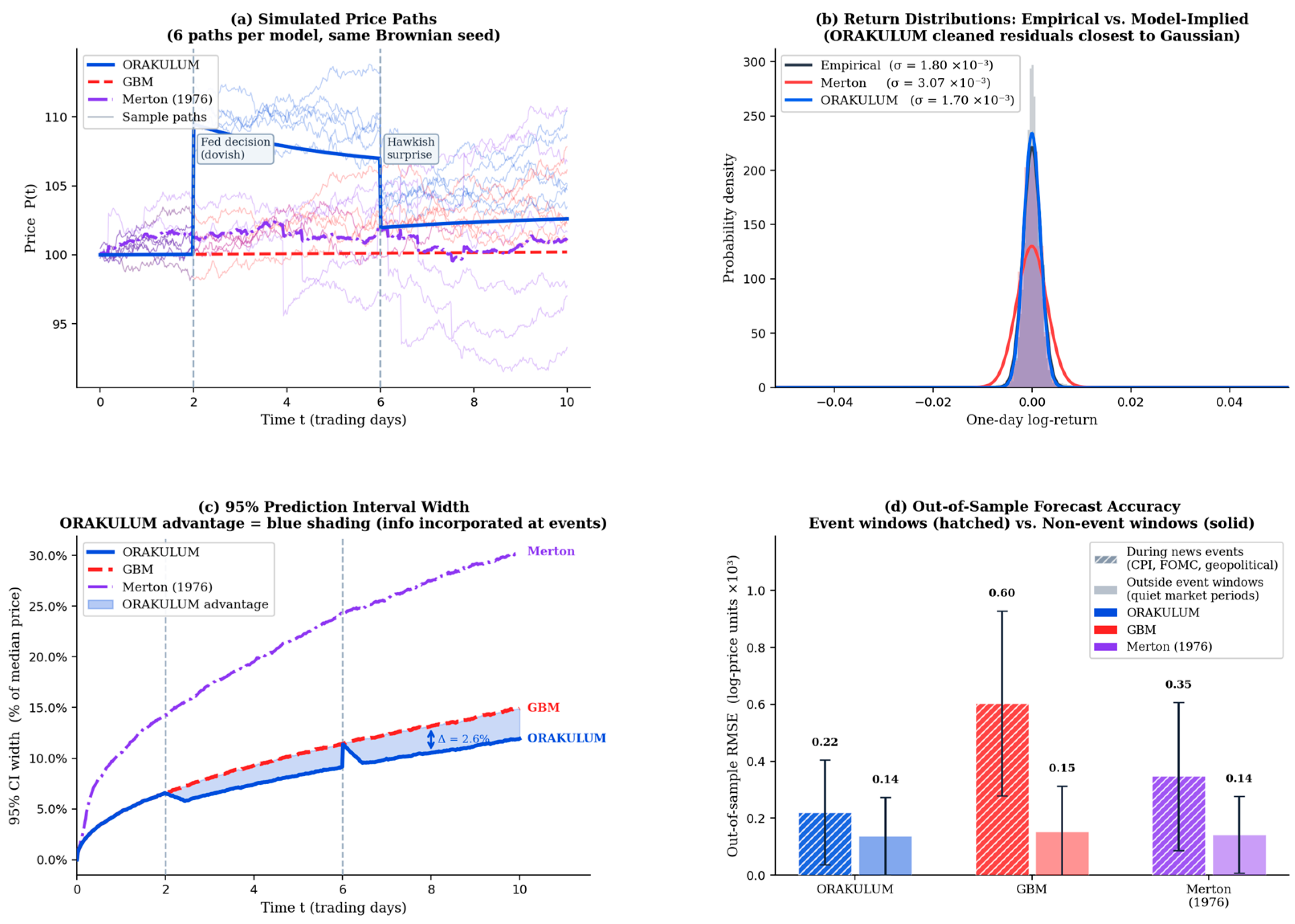
3.1.2. Illustrative Simulation
3.2. Empirical Illustration: XAU/USD and EUR/USD
3.2.1. Data and Setup
3.2.2. Event Catalogues
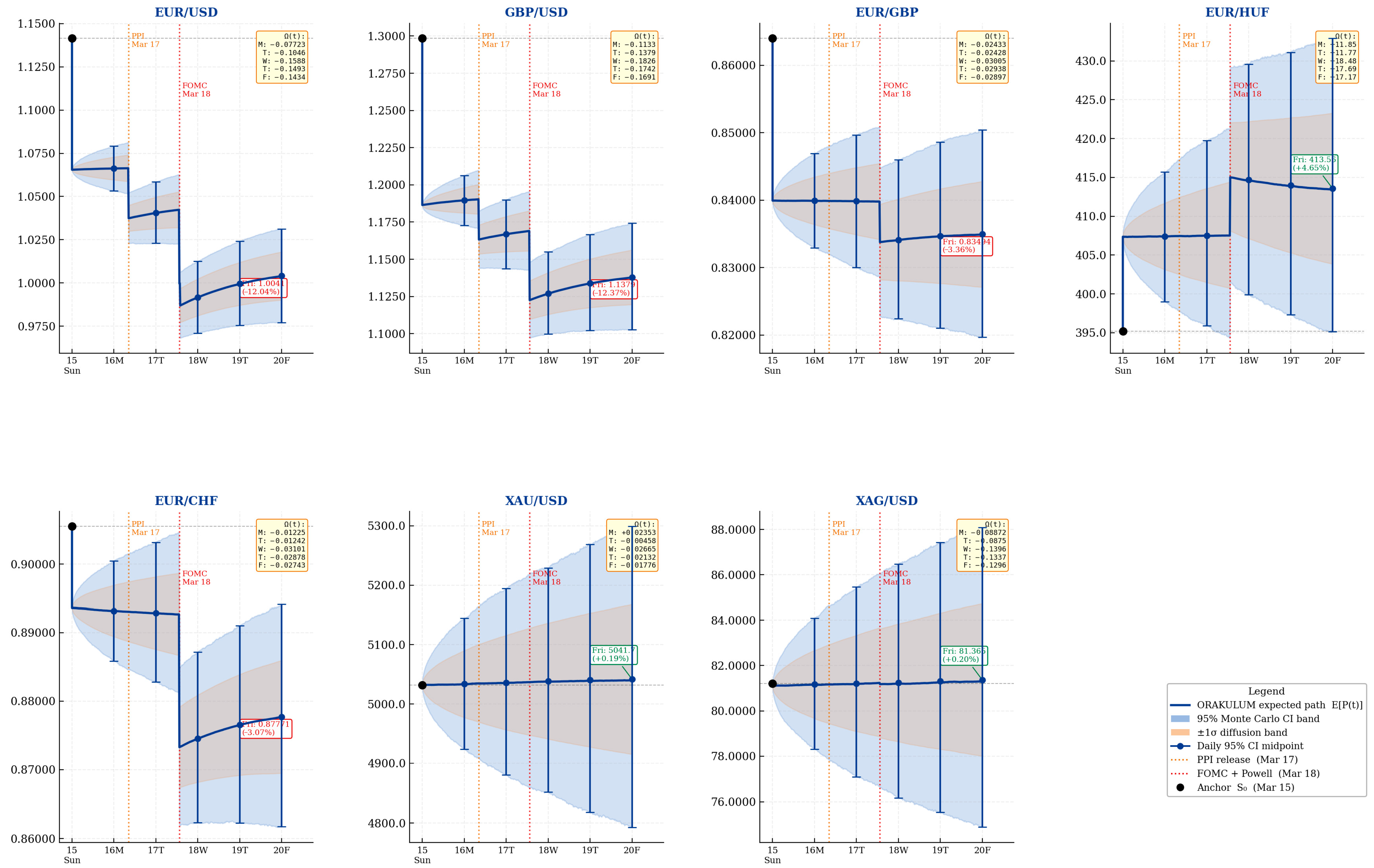
3.2.3. Results and Interpretation
3.3. Scenario Analysis
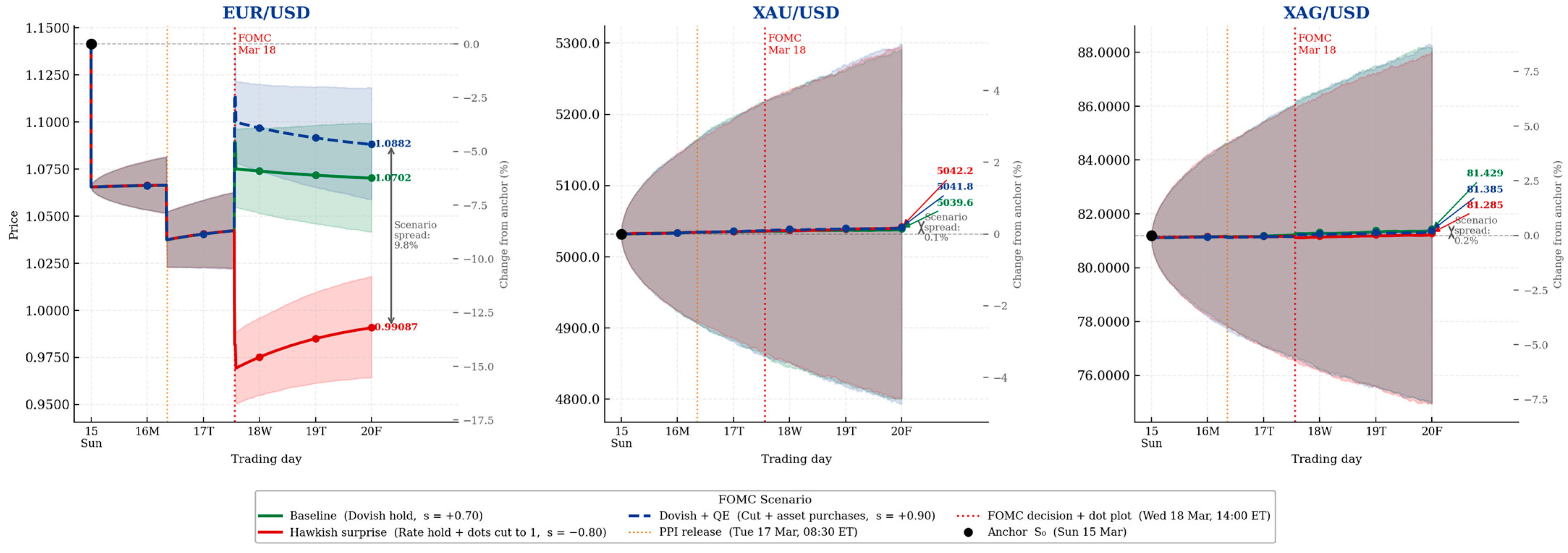
3.3.1. Design
- Baseline: the Fed event proceeds as characterised in Table 2 (dovish, sentiment = +0.70).
- Hawkish surprise: the Fed delivers an unexpected rate hike; sentiment revised to −0.80, A = −0.064, B = −0.040.
- Dovish with quantitative easing: the Fed cuts rates and announces asset purchases; sentiment = +0.90, A = +0.072, B = +0.046.
3.3.2. Results
4. Discussion
4.1. Economic Interpretation
4.2. Relation to Existing Models
- Comparison with Merton and Kou Jump-Diffusion Models
- Comparison with Dummy-Variable Event-Study OLS
- Comparison with Bayesian Jump-Timing Inference
- Comparison with Regime-Switching Models
4.3. Limitations and Extensions
5. Conclusions
Author Contributions
Funding
Data Availability Statement
Conflicts of Interest
References
- Amihud, Yakov, and Haim Mendelson. 1987. Trading mechanisms and stock returns: An empirical investigation. Journal of Finance 42: 533–53. [Google Scholar] [CrossRef]
- Anderson, Torben G., Tim Bollerslev, Francis X. Diebold, and Clara Vega. 2003. Micro effects of macro announcements: Real-time price discovery in foreign exchange. American Economic Review 93: 38–62. [Google Scholar] [CrossRef]
- Araci, Dogu. 2019. FinBERT: Financial sentiment analysis with pre-trained language models. arXiv arXiv:1908.10063. [Google Scholar] [CrossRef]
- Baker, Malcolm, and Jeffrey Wurgler. 2007. Investor sentiment in the stock market. Journal of Economic Perspectives 21: 129–51. [Google Scholar] [CrossRef]
- Barndorff-Nielsen, Ole E., and Neil Shephard. 2002. Econometric analysis of realised volatility and its use in estimating stochastic volatility models. Journal of the Royal Statistical Society: Series B 64: 253–80. [Google Scholar] [CrossRef]
- Bates, David S. 1996. Jumps and stochastic volatility: Exchange rate processes implicit in Deutsche Mark options. Review of Financial Studies 9: 69–107. [Google Scholar] [CrossRef]
- Baur, Dirk G., and Brian M. Lucey. 2010. Is gold a hedge or a safe haven? An analysis of stocks, bonds and gold. Financial Review 45: 217–29. [Google Scholar] [CrossRef]
- Bernard, Victor L., and Jacob K. Thomas. 1989. Post-earnings-announcement drift: Delayed price response or risk premium? Journal of Accounting Research 27: 1–36. [Google Scholar] [CrossRef]
- Brogaard, Jonathan, Terrence Hendershott, and Ryan Riordan. 2014. High-frequency trading and price discovery. Review of Financial Studies 27: 2267–306. [Google Scholar] [CrossRef]
- Capie, Forrest, Terence C. Mills, and Geoffrey Wood. 2005. Gold as a hedge against the dollar. Journal of International Financial Markets, Institutions and Money 15: 343–52. [Google Scholar] [CrossRef]
- Cont, Rama, and Peter Tankov. 2004. Financial Modelling with Jump Processes. Boca Raton: CRC Press. [Google Scholar]
- Duffie, Darrell, Jun Pan, and Kenneth Singleton. 2000. Transform analysis and asset pricing for affine jump-diffusions. Econometrica 68: 1343–76. [Google Scholar] [CrossRef]
- Eraker, Bjørn, Michael Johannes, and Nicholas Polson. 2003. The impact of jumps in volatility and returns. Journal of Finance 58: 1269–300. [Google Scholar] [CrossRef]
- Evans, Martin D., and Richard K. Lyons. 2002. Order flow and exchange rate dynamics. Journal of Political Economy 110: 170–80. [Google Scholar] [CrossRef]
- Fama, Eugene F., Lawrence Fisher, Michael C. Jensen, and Richard Roll. 1969. The adjustment of stock prices to new information. International Economic Review 10: 1–21. [Google Scholar] [CrossRef]
- Fatum, Rasmus, and Michael Hutchison. 2006. Effectiveness of official daily foreign exchange market intervention operations in Japan. Journal of International Money and Finance 25: 199–219. [Google Scholar] [CrossRef]
- Garcia, Diego. 2013. Sentiment during recessions. Journal of Finance 68: 1267–300. [Google Scholar] [CrossRef]
- Glosten, Lawrence R., and Paul R. Milgrom. 1985. Bid, ask and transaction prices in a specialist market with heterogeneously informed traders. Journal of Financial Economics 14: 71–100. [Google Scholar] [CrossRef]
- Grossman, Sanford J., and Joseph E. Stiglitz. 1980. On the impossibility of informationally efficient markets. American Economic Review 70: 393–408. [Google Scholar]
- Grossman, Sanford J., and Merton H. Miller. 1988. Liquidity and market structure. Journal of Finance 43: 617–33. [Google Scholar] [CrossRef]
- Hamilton, James D. 1989. A new approach to the economic analysis of nonstationary time series and the business cycle. Econometrica 57: 357–84. [Google Scholar] [CrossRef]
- Hasbrouck, Joel. 1991. Measuring the information content of stock trades. Journal of Finance 46: 179–207. [Google Scholar] [CrossRef]
- Kou, Steven G. 2002. A jump-diffusion model for option pricing. Management Science 48: 1086–101. [Google Scholar] [CrossRef]
- Kyle, Albert S. 1985. Continuous auctions and insider trading. Econometrica 53: 1315–35. [Google Scholar] [CrossRef]
- Lucas, Robert E. 1972. Expectations and the neutrality of money. Journal of Economic Theory 4: 103–24. [Google Scholar] [CrossRef]
- MacKinlay, A. Craig. 1997. Event studies in economics and finance. Journal of Economic Literature 35: 13–39. [Google Scholar]
- Merton, Robert C. 1976. Option pricing when underlying stock returns are discontinuous. Journal of Financial Economics 3: 125–44. [Google Scholar] [CrossRef]
- Smales, Lee A. 2021. Geopolitical risk and volatility spillovers in oil and stock markets. Quarterly Review of Economics and Finance 80: 358–66. [Google Scholar] [CrossRef]
- Tetlock, Paul C. 2007. Giving content to investor sentiment: The role of media in the stock market. Journal of Finance 62: 1139–68. [Google Scholar] [CrossRef]





| Category | Description (Examples) | ||
|---|---|---|---|
| High | Central bank rate decision, war outbreak, systemic crisis | 0.80 | 1.00 |
| Medium | GDP release, unemployment report, CPI print, PMI data | 0.30 | 0.50 |
| Low | Technical correction, minor corporate news, analyst revision | 0.05 | 0.10 |
| Event | Time (days) | Category | Sentiment | A | B |
|---|---|---|---|---|---|
| Geopolitical escalation | t = −5 | High | −0.60 | −0.048 | −0.024 |
| Positive GDP surprise | t = −1 | Medium | +0.40 | +0.020 | +0.010 |
| Scheduled Fed decision | t = +2 | High | +0.70 | +0.056 | +0.034 |
| Horizon (days) | E[P(t)] | 2.5th Pct. | 97.5th Pct. |
|---|---|---|---|
| 0 | 98.01 | 98.01 | 98.01 |
| 1 | 97.99 | 95.71 | 100.24 |
| 2.5 | 105.21 | 101.45 | 109.12 |
| 5 | 103.87 | 98.63 | 109.43 |
| 10 | 103.05 | 95.63 | 111.04 |
| Asset | Event | Time (min) | Category | Sentiment | A | B |
|---|---|---|---|---|---|---|
| XAU/USD | Fed minutes: dovish tone | −120 | High | +0.65 | +0.00096 | +0.00048 |
| XAU/USD | US CPI above expectations | −45 | Medium | −0.40 | −0.00080 | −0.00040 |
| XAU/USD | Geopolitical risk escalation (sched.) | +30 | High | +0.80 | +0.00150 | +0.00080 |
| XAU/USD | Gold ETF inflow data (expected) | +90 | Low | +0.20 | +0.00016 | +0.00008 |
| EUR/USD | ECB hawkish statement | −90 | High | −0.70 | −0.00035 | −0.00021 |
| EUR/USD | Eurozone PMI beat | −20 | Medium | +0.50 | +0.00015 | +0.00010 |
| EUR/USD | Fed Chair dovish speech (scheduled) | +60 | High | +0.75 | +0.00045 | +0.00023 |
| Scenario | E[P(10)] | 2.5th Pct. | 97.5th Pct. |
|---|---|---|---|
| Baseline (dovish, s = +0.70) | 98.05 | 90.94 | 105.83 |
| Hawkish surprise (s = −0.80) | 92.24 | 85.55 | 99.56 |
| Dovish + QE (s = +0.90) | 104.36 | 96.79 | 112.64 |
Disclaimer/Publisher’s Note: The statements, opinions and data contained in all publications are solely those of the individual author(s) and contributor(s) and not of MDPI and/or the editor(s). MDPI and/or the editor(s) disclaim responsibility for any injury to people or property resulting from any ideas, methods, instructions or products referred to in the content. |
© 2026 by the authors. Licensee MDPI, Basel, Switzerland. This article is an open access article distributed under the terms and conditions of the Creative Commons Attribution (CC BY) license.
Share and Cite
Köntös, Z.; Rahimkulov, R.M. ORAKULUM: An Information-Impact Asset Pricing Model Introducing a Jump-Diffusion Framework for Information-Driven Markets. Risks 2026, 14, 108. https://doi.org/10.3390/risks14050108
Köntös Z, Rahimkulov RM. ORAKULUM: An Information-Impact Asset Pricing Model Introducing a Jump-Diffusion Framework for Information-Driven Markets. Risks. 2026; 14(5):108. https://doi.org/10.3390/risks14050108
Chicago/Turabian StyleKöntös, Zoltán, and Ruszlan Megdetovics Rahimkulov. 2026. "ORAKULUM: An Information-Impact Asset Pricing Model Introducing a Jump-Diffusion Framework for Information-Driven Markets" Risks 14, no. 5: 108. https://doi.org/10.3390/risks14050108
APA StyleKöntös, Z., & Rahimkulov, R. M. (2026). ORAKULUM: An Information-Impact Asset Pricing Model Introducing a Jump-Diffusion Framework for Information-Driven Markets. Risks, 14(5), 108. https://doi.org/10.3390/risks14050108