Effectiveness of Sucrose Versus Breast Milk as Non-Pharmacological Measures in the Management of Neonatal Pain: A Systematic Review
 ,
,  and
and
Highlights
- Both sucrose and breast milk significantly reduce neonatal pain during common clinical procedures.
- Multimodal approaches combining these interventions with techniques such as kangaroo care or non-nutritive sucking enhance analgesic effects.
- These interventions provide safe, low-cost, and effective alternatives to pharmacological analgesia in neonatal care.
- Their integration into standardized clinical protocols can improve pain management and promote humanized, family-centered care.
Abstract
1. Introduction
2. Materials and Methods
2.1. Search Methodology
2.2. Selection Criteria
2.3. Sources of Information
2.4. Search Strategy
2.5. Selection Process
2.6. Data Extraction Process
2.7. Study Variables
2.8. Assessment of Methodological Quality
2.9. Assessment of the Risk of Bias
2.10. Data Synthesis
3. Results
3.1. Study Selection
3.2. Characteristics of the Included Studies
3.3. Utility of Sucrose and Breast Milk in Neonatal Pain Management
4. Discussion
4.1. Limitations
4.2. Implications for Clinical Practice
5. Conclusions
Author Contributions
Funding
Institutional Review Board Statement
Informed Consent Statement
Data Availability Statement
Conflicts of Interest
Abbreviations
| WHO | World Health Organization |
| NICU | Neonatal Intensive Care Unit |
| CRIES | Crying, Requires O2, Increased vitals, Expression, Sleeplessness |
| PIPP | Premature Infant Pain Profile |
| PIPP-R | Premature Infant Pain Profile–Revised |
| NIPS | Neonatal Infant Pain Scale |
| ALS-Neo | Assessment of Pain in Neonates Scale |
| BPSN | Bernese Pain Scale for Neonates |
| NIAPAS | Neonatal Infant Acute Pain Assessment Scale |
| N-PASS | Neonatal Pain, Agitation and Sedation Scale |
| RCT | Randomized controlled trial |
| PRISMA | Preferred Reporting Items for Systematic Reviews and Meta-Analyses |
| PICO | Population, Intervention, Comparator, Outcome |
| WOS | Web of Science |
| JBI | Joanna Briggs Institute |
References
- World Health Organization. Executive summary. In WHO Recommendations on Maternal and Newborn Care for a Positive Postnatal Experience; World Health Organization: Geneva, Switzerland, 2022. Available online: https://www.ncbi.nlm.nih.gov/books/NBK579653/ (accessed on 9 April 2026).
- Sokou, R.; Lianou, A.; Lampridou, M.; Panagiotounakou, P.; Kafalidis, G.; Paliatsiou, S.; Volaki, P.; Tsantes, A.G.; Boutsikou, T.; Iliodromiti, Z.; et al. Neonates at Risk: Understanding the Impact of High-Risk Pregnancies on Neonatal Health. Medicina 2025, 61, 1077. [Google Scholar] [CrossRef] [PubMed] [PubMed Central]
- Lago, P.; Garetti, E.; Pirelli, A.; Merazzi, D.; Bellieni, C.V.; Savant Levet, P.; Pieragostini, L.; Ancora, G.; On behalf of the Pain Study Group of the Italian Society of Neonatology. Sucrose for procedural pain control in infants: Should we change our practice? Acta Paediatr. 2014, 103, e88–e90. [Google Scholar] [CrossRef] [PubMed]
- Perry, M.; Tan, Z.; Chen, J.; Weidig, T.; Xu, W.; Cong, X.S. Neonatal Pain: Perceptions and Current Practice. Crit. Care Nurs. Clin. N. Am. 2018, 30, 549–561. [Google Scholar] [CrossRef] [PubMed] [PubMed Central]
- Williams, M.D.; Lascelles, B.D.X. Early Neonatal Pain—A Review of Clinical and Experimental Implications on Painful Conditions Later in Life. Front. Pediatr. 2020, 8, 30. [Google Scholar] [CrossRef] [PubMed] [PubMed Central]
- Bresesti, I.; Vanzù, G.; Redaelli, F.; Daniele, I.; Zuccotti, G.V.; Cerritelli, F.; Lista, G.; Fabiano, V. New perspective for pain control in neonates: A comparative effectiveness research. J. Perinatol. 2021, 41, 2298–2303. [Google Scholar] [CrossRef] [PubMed]
- Olsson, E.; Ahl, H.; Bengtsson, K.; Vejayaram, D.N.; Norman, E.; Bruschettini, M.; Eriksson, M. The use and reporting of neonatal pain scales: A systematic review of randomized trials. Pain 2021, 162, 353–360. [Google Scholar] [CrossRef] [PubMed] [PubMed Central]
- Pillai Riddell, R.R.; Bucsea, O.; Shiff, I.; Chow, C.; Gennis, H.G.; Badovinac, S.; DiLorenzo-Klas, M.; Racine, N.M.; Ahola Kohut, S.; Lisi, D.; et al. Non-pharmacological management of infant and young child procedural pain. Cochrane Database Syst. Rev. 2023, 6, CD006275. [Google Scholar] [CrossRef] [PubMed] [PubMed Central]
- Shahid, S.; Acosta-Reyes, J.; Florez, I.D. Sucrose or glucose compared to breast milk for pain control in preterm infants: A systematic review and meta-analysis. J. Perinatol. 2025, 45, 1664–1674. [Google Scholar] [CrossRef]
- Talebi, M.; Amiri, S.R.J.; Roshan, P.A.; Zabihi, A.; Zahedpasha, Y.; Chehrazi, M. The effect of concurrent use of swaddle and sucrose on the intensity of pain during venous blood sampling in neonate: A clinical trial study. BMC Pediatr. 2022, 22, 263. [Google Scholar] [CrossRef] [PubMed] [PubMed Central]
- Costas, M.; Santos, S.; Godoy, C.; Martell, M. Patrones de succión en el recién nacido de término y pretérmino. Rev. Chil. Pediatr. 2006, 77, 198–212. [Google Scholar] [CrossRef]
- Hoq, F.S.; Newby, C.; Tremblay, S.; Ranger, M. Sweet relief or lasting impacts? Review of neonatal pain and sucrose in developing rodents. Pain Rep. 2025, 10, e1345. [Google Scholar] [CrossRef]
- Lan, H.Y.; Yang, L.; Lin, C.H.; Hsieh, K.H.; Chang, Y.C.; Yin, T. Breastmilk as a Multisensory Intervention for Relieving Pain during Newborn Screening Procedures: A Randomized Control Trial. Int. J. Environ. Res. Public Health 2021, 18, 13023. [Google Scholar] [CrossRef] [PubMed] [PubMed Central]
- Witt, N.; Coynor, S.; Edwards, C.; Bradshaw, H. A Guide to Pain Assessment and Management in the Neonate. Curr. Emerg. Hosp. Med. Rep. 2016, 4, 1–10. [Google Scholar] [CrossRef] [PubMed] [PubMed Central]
- García-Valdivieso, I.; Yáñez-Araque, B.; Moncunill-Martínez, E.; Bocos-Reglero, M.J.; Gómez-Cantarino, S. Effect of Non-Pharmacological Methods in the Reduction of Neonatal Pain: Systematic Review and Meta-Analysis. Int. J. Environ. Res. Public Health 2023, 20, 3226. [Google Scholar] [CrossRef] [PubMed] [PubMed Central]
- Shah, P.S.; Torgalkar, R.; Shah, V.S. Breastfeeding or breast milk for procedural pain in neonates. Cochrane Database Syst. Rev. 2023, 8, CD004950. [Google Scholar] [CrossRef] [PubMed] [PubMed Central]
- Vinall, J.; Grunau, R.E. Impact of repeated procedural pain-related stress in infants born very preterm. Pediatr. Res. 2014, 75, 584–587. [Google Scholar] [CrossRef]
- Collados-Gómez, L.; Camacho-Vicente, V.; González-Villalba, M.; Sanz-Prades, G.; Bellón-Vaquerizo, B. Percepción del personal de enfermería sobre el manejo del dolor en neonatos. Enfermería Intensiv. 2018, 29, 41–47. [Google Scholar] [CrossRef]
- Gómez-Cantarino, S.; García-Valdivieso, I.; Dios-Aguado, M.; Yáñez-Araque, B.; Gallego, B.M.; Moncunill-Martínez, E. Nursing Perspective of the Humanized Care of the Neonate and Family: A Systematic Review. Children 2021, 8, 35. [Google Scholar] [CrossRef] [PubMed] [PubMed Central]
- Page, M.J.; McKenzie, J.E.; Bossuyt, P.M.; Boutron, I.; Hoffmann, T.C.; Mulrow, C.D.; Shamseer, L.; Tetzlaff, J.M.; Akl, E.A.; Brennan, S.E.; et al. The PRISMA 2020 statement: An updated guideline for reporting systematic reviews. Int. J. Surg. 2021, 88, 105906. [Google Scholar] [CrossRef] [PubMed]
- Barker, T.H.; Stone, J.C.; Sears, K.; Klugar, M.; Tufanaru, C.; Leonardi-Bee, J.; Aromataris, E.; Munn, Z. The revised JBI critical appraisal tool for the assessment of risk of bias for randomized controlled trials. JBI Evid. Synth. 2023, 21, 494–506. [Google Scholar] [CrossRef] [PubMed]
- Bulut, O.; Topaloglu, S.C.; Bulut, N.; Hocaoglu, M.; Arslanoglu, S. Impact of breast milk on cortical pain response in newborns during the heel prick procedure: A randomized controlled trial. J. Perinatol. 2024, 44, 1675–1681. [Google Scholar] [CrossRef] [PubMed] [PubMed Central]
- Cakirli, M.; Acikgoz, A. A Randomized Controlled Trial: The Effect of Own Mother’s Breast Milk Odor and Another Mother’s Breast Milk Odor on Pain Level of Newborn Infants. Breastfeed. Med. 2021, 16, 75–81. [Google Scholar] [CrossRef] [PubMed]
- Chang, J.; Filoteo, L.; Nasr, A.S. Comparing the Analgesic Effects of 4 Nonpharmacologic Interventions on Term Newborns Undergoing Heel Lance: A Randomized Controlled Trial. J. Perinat. Neonatal Nurs. 2020, 34, 38–45. [Google Scholar] [CrossRef] [PubMed]
- Apaydin Cirik, V.; Efe, E. The effect of expressed breast milk, swaddling and facilitated tucking methods in reducing the pain caused by orogastric tube insertion in preterm infants: A randomized controlled trial. Int. J. Nurs. Stud. 2020, 104, 103532. [Google Scholar] [CrossRef] [PubMed]
- Ghaemmaghami, P.; Nasri, N.; Razavinejad, S.M.; Edraki, M.; Shirazi, Z.H. Comparing the effects of oral sucrose and kangaroo mother care on selected physiological variables and pain resulting from venipuncture in premature newborns admitted to neonatal intensive care units. Eur. J. Med. Res. 2024, 29, 519. [Google Scholar] [CrossRef] [PubMed] [PubMed Central]
- Modaresi, A.; Zahedpasha, Y.; Jafarianamiri, S.R.; Haji Ahmadi, M.; Farhadi, R. Effect of Smell and Taste of Breast Milk and Sucrose on the Relief of Venipuncture Pain in Neonates: A Randomized Clinical Trail. Iran. J. Neonatol. 2024, 15, 35–42. [Google Scholar] [CrossRef]
- Nimbalkar, S.; Shukla, V.V.; Chauhan, V.; Phatak, A.; Patel, D.; Chapla, A.; Nimbalkar, A. Blinded randomized crossover trial: Skin-to-skin care vs. sucrose for preterm neonatal pain. J. Perinatol. 2020, 40, 896–901. [Google Scholar] [CrossRef] [PubMed]
- Sen, E.; Manav, G. Effect of Kangaroo Care and Oral Sucrose on Pain in Premature Infants: A Randomized Controlled Trial. Pain Manag. Nurs. 2020, 21, 556–564. [Google Scholar] [CrossRef] [PubMed]
- Tanyeri-Bayraktar, B.; Bayraktar, S.; Hepokur, M.; Güzel Kıran, G. Comparison of two different doses of sucrose in pain relief. Pediatr. Int. 2019, 61, 797–801. [Google Scholar] [CrossRef] [PubMed]
- Tavlar, M.; Karakoc, A. The effect of breastfeeding, breast milk odour and mother’s heartbeat sound on pain level in newborns: A randomized trial. Int. J. Nurs. Pract. 2022, 28, e13067. [Google Scholar] [CrossRef] [PubMed]
- Yaprak, D.; Karagöl, B.S.; Bozat, A.D.; Kar, İ. The role of time interval elimination on pain control of preterm infants by sucrose administration. Eur. J. Clin. Pharmacol. 2023, 79, 841–848. [Google Scholar] [CrossRef] [PubMed]
- Sterne, J.A.C.; Savović, J.; Page, M.J.; Elbers, R.G.; Blencowe, N.S.; Boutron, I.; Cates, C.J.; Cheng, H.Y.; Corbett, M.S.; Eldridge, S.M.; et al. RoB 2: A revised tool for assessing risk of bias in randomised trials. BMJ 2019, 366, l4898. [Google Scholar] [CrossRef] [PubMed]
- Stevens, B.; Yamada, J.; Ohlsson, A.; Haliburton, S.; Shorkey, A. Sucrose for analgesia in newborn infants undergoing painful procedures. Cochrane Database Syst. Rev. 2016, 2016, CD001069. [Google Scholar] [CrossRef] [PubMed] [PubMed Central]
- Lin, C.H.; Liaw, J.J.; Chen, Y.T.; Yin, T.; Yang, L.; Lan, H.Y. Efficacy of Breast Milk Olfactory and Gustatory Interventions on Neonates’ Biobehavioral Responses to Pain during Heel Prick Procedures. Int. J. Environ. Res. Public Health 2022, 19, 1240. [Google Scholar] [CrossRef] [PubMed] [PubMed Central]
- Liu, Y.; Huang, X.; Luo, B.; Peng, W. Effects of combined oral sucrose and nonnutritive sucking (NNS) on procedural pain of NICU newborns, 2001 to 2016. Medicine 2017, 96, e6108. [Google Scholar] [CrossRef] [PubMed] [PubMed Central]
- Mencía, S.; Alonso, C.; Pallás-Alonso, C.; López-Herce, J. Evaluation and Treatment of Pain in Fetuses, Neonates and Children. Children 2022, 9, 1688. [Google Scholar] [CrossRef] [PubMed] [PubMed Central]
- Cristóbal Cañadas, D.; Parrón Carreño, T.; Sánchez Borja, C.; Bonillo Perales, A. Benefits of Kangaroo Mother Care on the Physiological Stress Parameters of Preterm Infants and Mothers in Neonatal Intensive Care. Int. J. Environ. Res. Public Health 2022, 19, 7183. [Google Scholar] [CrossRef] [PubMed] [PubMed Central]
- Rodríguez González, L.; Alemany García-Carpintero, G.; Alabat Pascual Mdel, M.; Martínez Jiménez, M.E.; Moreno Aguilera, T.; Pozo Gaitero, M.J. Leche materna versus sacarosa ante punción venosa y heel prick. Evidentia 2021, 18, e13257. [Google Scholar]
- Graf, T.; Duffey, E.; Spatz, D. Development of an Interprofessional Policy on the Use of Human Milk and Breastfeeding for Pain Relief. Adv. Neonatal Care 2021, 21, 267–273. [Google Scholar] [CrossRef] [PubMed]
- Stevens, B.; Yamada, J.; Campbell-Yeo, M.; Gibbins, S.; Harrison, D.; Dionne, K.; Taddio, A.; McNair, C.; Willan, A.; Ballantyne, M.; et al. The minimally effective dose of sucrose for procedural pain relief in neonates: A randomized controlled trial. BMC Pediatr. 2018, 18, 85. [Google Scholar] [CrossRef]
- McLean, M.A.; Ranger, M.; Bone, J.N.; Selvanathan, T.; Au-Young, S.H.; Chau, C.M.Y.; Chau, V.; Ly, L.; Kelly, E.; Synnes, A.; et al. Neonatal Sucrose and Internalizing Behaviors at 18 Months in Children Born Very Preterm. JAMA Netw. Open 2025, 8, e254477. [Google Scholar] [CrossRef]
- Karga Yilmaz, T.; Yavuz, B. Comparison of different methods for reducing pain during a heel lance in newborns: A randomized trial. Ital. J. Pediatr. 2025, 51, 73. [Google Scholar] [CrossRef] [PubMed] [PubMed Central]
- Glenzel, L.; do Nascimento Oliveira, P.; Marchi, B.S.; Ceccon, R.F.; Moran, C.A. Validity and Reliability of Pain and Behavioral Scales for Preterm Infants: A Systematic Review. Pain Manag. Nurs. 2023, 24, e84–96. [Google Scholar] [CrossRef] [PubMed]
- Llerena, A.; Tran, K.; Choudhary, D.; Hausmann, J.; Goldgof, D.; Sun, Y.; Prescott, S.M. Neonatal pain assessment: Do we have the right tools? Front. Pediatr. 2023, 10, 1022751. [Google Scholar] [CrossRef] [PubMed] [PubMed Central]
- Hasanul Huda, M.; Hasan, F.; Kondwani Banda, J.; Rustina, Y.; Eka Putra, H.; Selviany, M.; Islamia, I.; Santi, N.F.; Ramdhanie, G.G. A systematic review and network meta-analysis of non-pharmacological interventions involving parents on pain during invasive procedures among newborns. J. Neonatal Nurs. 2025, 31, 178–185. [Google Scholar] [CrossRef]



| Database | Search Strategy | Filter | Results |
|---|---|---|---|
| PubMed | (sucrose OR breastfeeding OR breastfed OR “breast milk”) AND (pain* OR “physical suffering” OR ache*) AND (neonate* OR newborn* OR “newborn infant”) | Date: 2019–2026 | 857 |
| Scopus | (sucrose OR breastfeeding OR breastfed OR “breast milk”) AND (pain* OR “physical suffering” OR ache*) AND (neonate* OR newborn* OR “newborn infant”) | Date: 2019–2026 | 1111 |
| CINAHL | (sucrose OR breastfeeding OR breastfed OR “breast milk”) AND (pain* OR “physical suffering” OR ache*) AND (neonate* OR newborn* OR “newborn infant”) | Date: 2019–2026 | 498 |
| Web of Science | (sucrose OR breastfeeding OR breastfed OR “breast milk”) AND (pain* OR “physical suffering” OR ache*) AND (neonate* OR newborn* OR “newborn infant”) | Date: 2019–2026 | 1246 |
| Article | Q1 | Q2 | Q3 | Q4 | Q5 | Q6 | Q7 | Q8 | Q9 | Q10 | Q11 | Q12 | Q13 | TOTAL |
|---|---|---|---|---|---|---|---|---|---|---|---|---|---|---|
| Bresesti et al., 2021 [6] | No | Unclear | Yes | No | No | No | No | Yes | Yes | Yes | Yes | Yes | No | 6/13 |
| Bulut et al., 2024 [22] | Yes | Yes | Yes | No | No | Yes | No | Yes | Yes | Yes | Yes | Yes | Yes | 10/13 |
| Cakirli & Acikgoz, 2021 [23] | Yes | Unclear | Yes | Unclear | No | No | No | Yes | Yes | Yes | Yes | Yes | Yes | 9/13 |
| Chang et al., 2020 [24] | No | Unclear | Yes | No | No | No | No | Yes | Yes | Yes | Yes | Yes | No | 6/13 |
| Cirik & Efe, 2020 [25] | Yes | Yes | Yes | No | No | Yes | Yes | Yes | Yes | Yes | Yes | Yes | Yes | 12/13 |
| Ghaemmaghami et al., 2024 [26] | Yes | Unclear | Yes | No | No | Yes | Yes | Yes | Yes | Yes | Yes | Yes | Yes | 11/13 |
| Modaresi et al., 2024 [27] | No | No | Yes | No | No | Unclear | Yes | Yes | Yes | Yes | Yes | Yes | No | 7/13 |
| Nimbalkar et al., 2020 [28] | Yes | Yes | Yes | No | No | Yes | Yes | Yes | Yes | Yes | Yes | Yes | Yes | 12/13 |
| Sen & Manav, 2020 [29] | Yes | Yes | Yes | No | No | Unclear | Yes | Yes | Yes | Yes | Yes | Yes | Yes | 11/13 |
| Talebi et al., 2022 [10] | Yes | Yes | Yes | No | No | Yes | Yes | Yes | Yes | Yes | Yes | Yes | Yes | 12/13 |
| Tanyeri-Bayraktar et al., 2019 [30] | Yes | Unclear | No | No | Yes | Yes | Yes | Yes | Yes | Yes | Yes | Yes | Yes | 10/13 |
| Tavlar & Karakoc, 2022 [31] | Yes | Unclear | Yes | No | No | No | Yes | Yes | Yes | Yes | Yes | Yes | Yes | 9/13 |
| Yaprak et al., 2023 [32] | Yes | Yes | Yes | No | Yes | Yes | Yes | Yes | Yes | Yes | Yes | Yes | Yes | 12/13 |
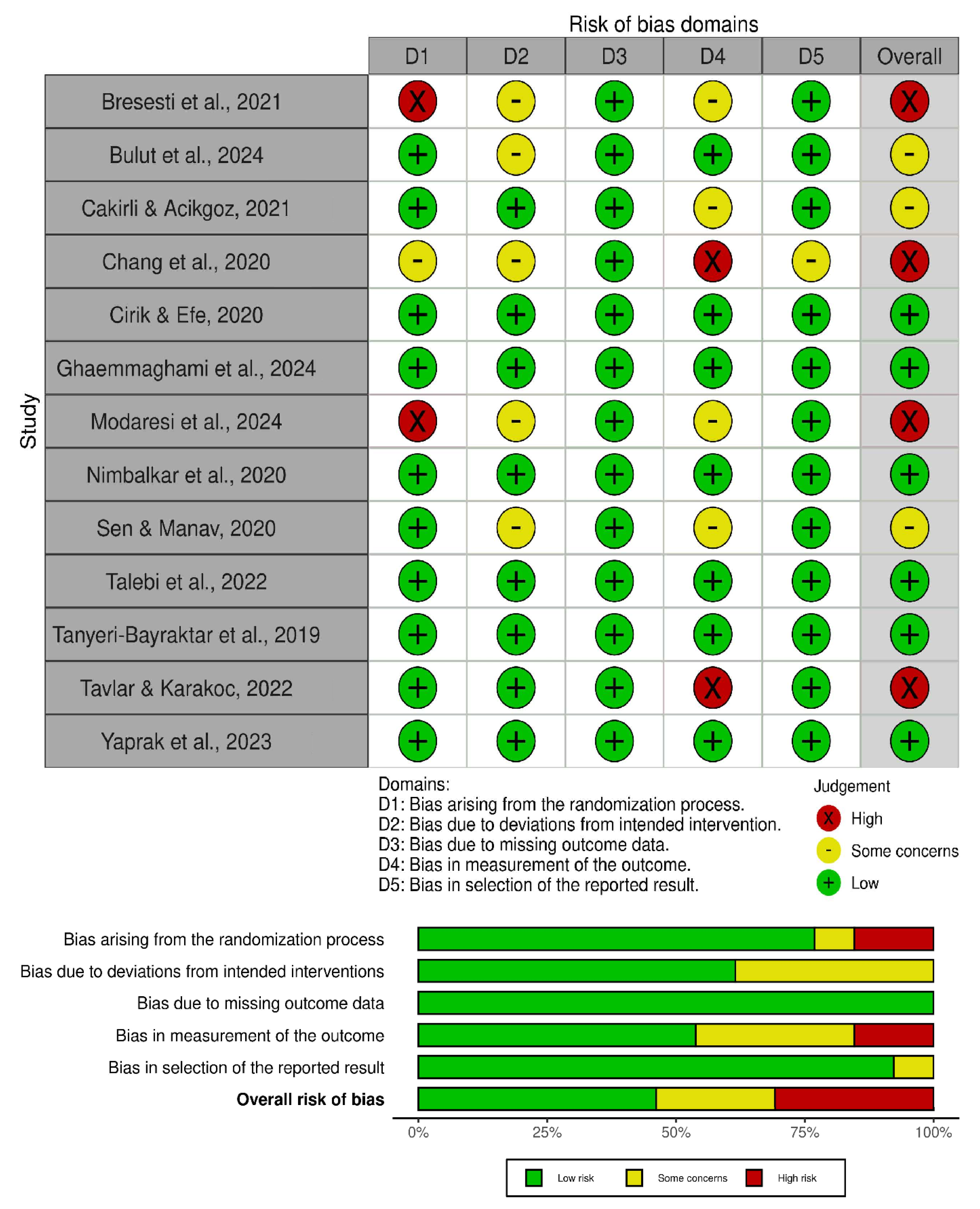
| Study (Author, Year) | D1. Bias from Randomization | D2. Bias from Deviations | D3. Bias from Missing Data | D4. Bias in Measurement | D5. Bias in Reporting | Overall Risk of Bias |
|---|---|---|---|---|---|---|
| Bresesti et al., 2021 [6] | High risk | Some concerns | Low risk | Some concerns | Low risk | High risk |
| Bulut et al., 2024 [22] | Low risk | Some concerns | Low risk | Low risk | Low risk | Some concerns |
| Cakirli & Acikgoz, 2021 [23] | Low risk | Low risk | Low risk | Some concerns | Low risk | Some concerns |
| Chang et al., 2020 [24] | Some concerns | Some concerns | Low risk | High risk | Some concerns | High risk |
| Cirik & Efe, 2020 [25] | Low risk | Low risk | Low risk | Low risk | Low risk | Low risk |
| Ghaemmaghami et al., 2024 [26] | Low risk | Low risk | Low risk | Low risk | Low risk | Low risk |
| Modaresi et al., 2024 [27] | High risk | Some concerns | Low risk | Some concerns | Low risk | High risk |
| Nimbalkar et al., 2020 [28] | Low risk | Low risk | Low risk | Low risk | Low risk | Low risk |
| Sen & Manav, 2020 [29] | Low risk | Some concerns | Low risk | Some concerns | Low risk | Some concerns |
| Talebi et al., 2022 [10] | Low risk | Low risk | Low risk | Low risk | Low risk | Low risk |
| Tanyeri-Bayraktar et al., 2019 [30] | Low risk | Low risk | Low risk | Low risk | Low risk | Low risk |
| Tavlar & Karakoc, 2022 [31] | Low risk | Low risk | Low risk | High risk | Low risk | High risk |
| Yaprak et al., 2023 [32] | Low risk | Low risk | Low risk | Low risk | Low risk | Low risk |
| Author, Year, Country | Methodology, Measuring Instrument | Objective |
|---|---|---|
| (Sen & Manav, 2020) Istanbul, Turkey [29] | Prospective randomized controlled trial included 64 preterm infants hospitalized in the intensive care unit. 32 patients received kangaroo care. 32 patients received oral sucrose. Heart rate, oxygen saturation, and pain score were measured. Measuring instrument: Premature Infant Pain Profile (PIPP) | To compare the effects of kangaroo and oral sucrose in pain relief in preterm infants during heel puncture. |
| (Tavlar & Karakoc, 2022) Istanbul, Turkey [31] | Randomized, experimental, controlled trial with a sample of 90 newborns. The distribution of the sample was as follows: 30 patients assigned to breastfeed; 30 patients assigned to the smell of breast milk; 30 patients assigned to the mother’s heartbeat group. Measuring instrument: Astrid Lindgren Children’s Hospital Pain Scale (ALPS-Neo) | To assess the effect of breastfeeding, the smell of breast milk, and the sound of the mother’s heartbeat on the level of pain in newborns. |
| (Bresesti et al., 2021) Milan, Italy [6] | This was a prospective, randomized, controlled trial. The study was conducted as a comparative effectiveness investigation including 195 neonates who were randomly assigned into 3 groups: Breastfeeding (n = 65); Administered 2 mL of 24% liquid sucrose with non-nutritive suction (silicone pacifier) through a syringe (n = 65); Administered 24% sucrose gel with a 2 mL syringe with non-nutritive suction (silicone pacifier) (n = 65). Measurement instrument: Neonatal Infants Pain Scale (NIPS) | To compare the efficacy of non-pharmacological measures for pain control in neonates: 24% liquid sucrose vs. 24% gel sucrose vs. breastfeeding. |
| (Nimbalkar et al., 2020) Anand, Gujarat, India [28] | A total of 100 infants were included in this trial between 28 and 36 weeks of gestation. The chosen participants were randomly assigned into two groups: Skin-to-skin contact was administered 15 min before heel puncture and sucrose 2 min before the second puncture (n = 50); Administered 24% sucrose 2 min before the first puncture and 15 min prior to the second puncture skin-to-skin contact (n = 50). Measuring instrument: Premature Infant Pain Profile (PIPP) | To compare skin-to-skin care and oral sucrose for the control of premature neonatal pain. |
| (Talebi et al., 2022) Babol, Iran [10] | A total of 60 neonates from the hospital were included in this prospective control study, who randomly divided into 4 groups of 15 patients each. Patients were swaddled prior to the procedure. Patients were given sucrose. Patients were swaddled and sucrose was administered simultaneously. In the control group, no measures were applied to perform the procedure. Measuring instrument: Premature Infant Pain Profile (PIPP) | To investigate the effect of concurrent use of swaddling and sucrose on pain intensity before a procedure in neonatal patients. |
| (Ghaemmaghami et al., 2024) Shiraz, Iran [26] | This was a randomized prospective control trial study. The sample consisted of 66 neonates who were assigned into 3 groups by random assignment, with a total of 22 newborns in each. The patients received kangaroo methods during the procedure. Patients were given 24% sucrose during the procedure. The control group received routine care without any intervention. Measuring instrument: Neonatal Infants Pain Scale (NIPS) | To compare the effects of oral sucrose and kangaroo care on selected physiological variables and pain scores resulting from venipuncture. |
| (Tanyeri-Bayraktar et al., 2019) Istanbul, Turkey [30] | This was a prospective, randomized, double-blind study. A total of 129 infants were included and randomly divided into 2 groups: 65 patients received 0.2 mL/kg of 24% sucrose before venipuncture; 64 patients received 0.5 mL/kg of 24% sucrose before venipuncture. Measuring instrument: Bernese Pain Scales for Neonates (BPSN) | To compare the efficacy of two different doses of sucrose during venipuncture in neonates. |
| (Yaprak et al., 2023) Ankara, Turkey [32] | A prospective, randomized, controlled study was conducted. There were 54 participating newborns, who were randomly assigned into 2 groups. 24% sucrose was administered orally 2 min before heel puncture. 24% sucrose was administered with no interval before heel puncture. Measuring instrument: Premature Infant Pain Profile-Revised (PIPP-R) | To assess the availability of sucrose analgesia in states of emergency due to minor procedural pain by eliminating the 2 min interval before heel puncture in preterm infants. |
| (Chang et al., 2020) Los Angeles, USA [24] | A total of 226 neonatal patients were randomly assigned to one of the 5 intervention groups, the last of which was a control group: 45 patients in the breastfeeding group; 42 patients in the 24% oral sucrose group; 51 patients in the non-nutritive sucking (pacifier) group; 38 patients in the skin-to-skin contact group; 50 patients in the control group. The newborns were placed in a crib in a supine position and covered with blankets. Measurement instrument: Neonatal Pain, Agitation and Sedation Scale (NPASS) | To compare the analgesic effect of 4 non-pharmacological interventions (breastfeeding, 24% sucrose, non-nutritive suction, and skin-to-skin contact) in term infants who underwent heel pricks. |
| (Cakirli & Acikgoz, 2021) Eskisehir, Turkey [23] | This experimental, randomized, controlled study divided a total of 90 patients into 3 groups: 30 patients exposed to the smell of breast milk from their own mother; 30 patients exposed to the smell of breast milk from another mother; 30 patients in the control group. Measuring instrument: Neonatal Pain, Agitation and Sedation Scale (NPASS) | To compare the effect of the smell of breast milk from the baby’s own mother versus that of another mother’s milk for pain reduction in newborns. |
| (Cirik & Efe, 2020) Istanbul, Turkey [25] | Prospective, controlled and randomized study that included 187 infants who were divided into 6 groups: Routine care (n = 33); Lullaby method (n = 30); Facilitated involvement (n = 32); Expressed breast milk (n = 31); Lullaby and expressed breast milk (n = 30); Facilitated wrapping and expressed breast milk (n = 31). Measuring instrument: Premature Infant Pain Profile (PIPP) | To compare the effects of breast milk, swaddling the baby, facilitated swaddling, expressed breast milk and swaddling, breast milk and facilitated swaddling, and routine care. |
| (Bulut et al., 2024) Istanbul, Turkey [22] | Prospective, controlled and randomized study that included 90 infants who were divided into 2 groups: 45 patients received 2 mL of oral breast milk; 45 patients in the control group did not receive any intervention. Measuring instrument: Neonatal Pain, Agitation and Sedation Scale (NPASS) | To investigate the effects of breast milk on cortical pain response and behavioral response in neonates during the heel puncture procedure. |
| (Modaresi et al., 2024) Sari, Iran [27] | Prospective randomized controlled trial that included 99 term infants who were randomly divided into 3 groups: Administration of 24% sucrose (n = 34); Exposed to smell of breast milk (n = 31); Exposed to breast milk flavor (n = 34). Measurement instrument: Neonatal Infant Acute Pain Assessment Scale (NIAPAS) | To compare the effect of 24% sucrose with smelling and tasting breast milk on pain intensity during venipuncture in neonates. |
| Author, Year, Country | Results |
|---|---|
| (Sen & Manav, 2020) Istanbul, Turkey [29] | Both kangaroo care and oral sucrose administration were found to significantly decrease the level of pain in neonates during procedures. The PIPP values were lower in the kangaroo group compared to the sucrose group, resulting in the conclusion that in addition to reducing pain more than when sucrose is used, the combination favors well-being, offering additional benefits such as stabilization of heart rate and oxygen saturation, and the strengthening of the bond between mother and child. |
| (Tavlar & Karakoc, 2022) Istanbul, Turkey [31] | Newborns whose intervention was the smell of breast milk had a higher level of pain and stress compared to those patients who belonged to the heartbeat sound group who had milder pain. Although the mother’s heartbeat method is effective, breastfeeding is the most effective method in painful processes in the neonatal patient; it reduces pain and stress almost completely. |
| (Bresesti et al., 2021) Milan, Italy [6] | All the interventions analyzed were shown to be effective in reducing neonatal pain. The administration of 24% liquid sucrose was shown to be less effective than breastfeeding. The 24% sucrose gel with non-nutritive suction had a lower probability of pain compared to liquid sucrose. In short, although all interventions are effective, the combination of 24% sucrose gel with non-nutritive suction could be a valid alternative when breastfeeding is not possible. |
| (Nimbalkar et al., 2020) Anand, Gujarat, India [28] | Both interventions proved to be effective in reducing pain in neonates, as shown by the PIPP scores, which showed significant decreases in both groups. The PIPP score at minute 0 (just before heel puncture) and at 5 min after the intervention was lower in the sucrose group compared to the skin-to-skin group. Sucrose was well tolerated by all patients in the group with no immediate side effects observed. The heart rate component in the PIPP score was the only one that was lower in the skin-to-skin group, but it was not statistically significant. |
| (Talebi et al., 2022) Babol, Iran [10] | Non-pharmacological pain management with wrap and sucrose has been shown to be the most effective method and is the most convenient, practical and cheapest for painful procedures in neonates. Therefore, for better pain management, it is recommended to use the combined sucrose and wrapping method instead of routine methods like using sucrose alone. |
| (Ghaemmaghami et al., 2024) Shiraz, Iran [26] | Follow-up tests revealed that, during blood draw, mean respiration rate, heart rate, oxygen saturation, and pain score in the oral sucrose group decreased significantly compared to the kangaroo group, with sucrose administration being more effective than kangaroo methods. It is important to highlight the similarity of the effects of sucrose and breastfeeding. |
| (Tanyeri-Bayraktar et al., 2019) Istanbul, Turkey [30] | Six patients were excluded from the study for different reasons. After this, no statistically significant difference was found in BPSN scores between the groups (p > 0.05). There was also no statistically significant difference with respect to blood glucose levels (p > 0.05). The results therefore showed that 0.2 mL/kg of 24% sucrose could be the minimally sufficient dose to relieve pain during painful procedures in neonates. |
| (Yaprak et al., 2023) Ankara, Turkey [32] | No significant differences in PIPP-R scores were observed between the groups that received 24% sucrose orally with and without a time interval before the procedure. It is therefore concluded that, after the administration of sucrose, a waiting period of 2 min is not necessary even in emergency situations as it is a safe and effective method for these patients. It should be noted, however, that sucrose has its maximum analgesic efficacy in neonates between 2 and 3 min after its administration. |
| (Chang et al., 2020) Los Angeles, USA [24] | The 5 interventions were performed and analyzed using the NPASS. The results showed that the analgesic effect of oral sucrose is statistically superior to skin-to-skin contact. No differences were observed between the other intervention groups. The 24% oral sucrose treatment was the most effective intervention in reducing crying time compared to the other non-pharmacological measures. It was therefore concluded that oral sucrose has an immediate analgesic effect, which is effective in reducing agitation and crying in neonatal patients. |
| (Cakirli & Acikgoz, 2021) Eskisehir, Turkey [23] | The most effective method for reducing pain was shown to be the smell of the baby’s own mother’s breast milk, which showed a lower score on the N-PASS compared to the other groups. Regarding the total crying time, similar results were found between the two groups that used breast milk, which differed from the results of the control group, which had a significantly higher value. |
| (Cirik & Efe, 2020) Istanbul, Turkey [25] | According to the results obtained, the lullaby method, the expressed breast milk method and the facilitated restraint method have good analgesic effects, reducing pain during invasive procedures such as the insertion of an orogastric tube. The combination of the lullaby and expressed breast milk methods was the most effective method as it produced a significantly lower score in the pain profile compared to the other groups. |
| (Bulut et al., 2024) Istanbul, Turkey [22] | An infrared device was used to monitor regional cerebral oxygen saturation, and the N-PASS was used to assess pain. It was concluded that the score from the scale and the duration of infant crying were lower in the group that received breast milk compared to the control group. There was no significant difference between the two groups with respect to oxygen saturation and heart rate during and after the procedure; none of the measures improved these parameters. |
| (Modaresi et al., 2024) Sari, Iran [27] | The use of the smell and taste of milk is a highly efficient method, which was almost comparable to the 24% sucrose solution. It is important to mention that the smell of breast milk was more effective compared to its taste, as the babies were able to detect the smell of their own mothers and respond to it, reducing the effects of painful procedures on the newborn. |
Disclaimer/Publisher’s Note: The statements, opinions and data contained in all publications are solely those of the individual author(s) and contributor(s) and not of MDPI and/or the editor(s). MDPI and/or the editor(s) disclaim responsibility for any injury to people or property resulting from any ideas, methods, instructions or products referred to in the content. |
© 2026 by the authors. Licensee MDPI, Basel, Switzerland. This article is an open access article distributed under the terms and conditions of the Creative Commons Attribution (CC BY) license.
Share and Cite
Camacho-Pernil, M.; Tirado-Hernández, P.; Rodríguez-García, M.; Andrade-Gómez, E.; Fagundo-Rivera, J.; Fernández-León, P. Effectiveness of Sucrose Versus Breast Milk as Non-Pharmacological Measures in the Management of Neonatal Pain: A Systematic Review. Children 2026, 13, 676. https://doi.org/10.3390/children13050676
Camacho-Pernil M, Tirado-Hernández P, Rodríguez-García M, Andrade-Gómez E, Fagundo-Rivera J, Fernández-León P. Effectiveness of Sucrose Versus Breast Milk as Non-Pharmacological Measures in the Management of Neonatal Pain: A Systematic Review. Children. 2026; 13(5):676. https://doi.org/10.3390/children13050676
Chicago/Turabian StyleCamacho-Pernil, Marina, Pastora Tirado-Hernández, María Rodríguez-García, Elena Andrade-Gómez, Javier Fagundo-Rivera, and Pablo Fernández-León. 2026. "Effectiveness of Sucrose Versus Breast Milk as Non-Pharmacological Measures in the Management of Neonatal Pain: A Systematic Review" Children 13, no. 5: 676. https://doi.org/10.3390/children13050676
APA StyleCamacho-Pernil, M., Tirado-Hernández, P., Rodríguez-García, M., Andrade-Gómez, E., Fagundo-Rivera, J., & Fernández-León, P. (2026). Effectiveness of Sucrose Versus Breast Milk as Non-Pharmacological Measures in the Management of Neonatal Pain: A Systematic Review. Children, 13(5), 676. https://doi.org/10.3390/children13050676