Perceived Social Support and Depressive Symptoms in AYA Cancer Patients: A Mediation Analysis of Hope Agency and Pathways


Highlights
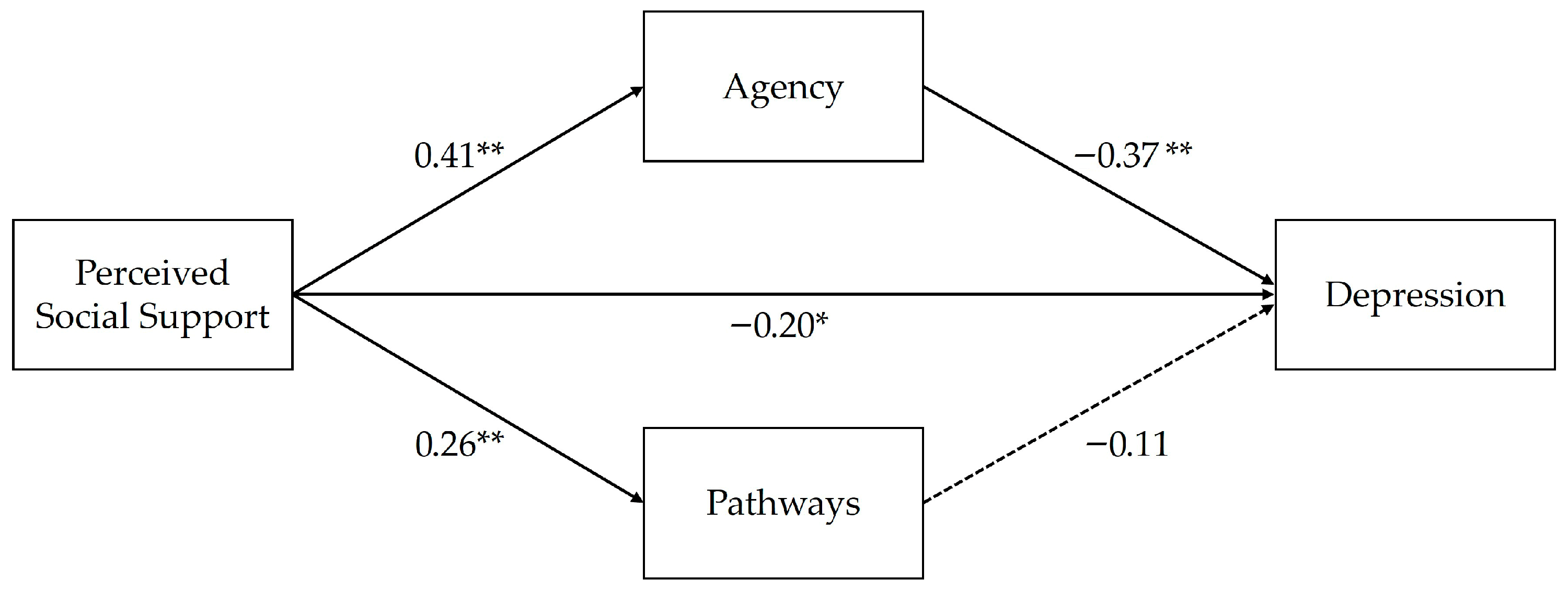
- The agency component of hope mediates the relationship between perceived social support (PSS) and depressive symptoms (D) in adolescent/young adult (AYA) women with cancer.
- The pathways component of hope did not mediate the relationship between PSS and D in AYAs with cancer.
- Given the significantly higher prevalence of depression in AYA women with cancer as compared to men, interventions to enhance agency are an important adjunct to interventions to promote PSS and, in turn, reduce D in AYA women with cancer.
- Future studies, including qualitative studies, should strive to elucidate the nature of social support’s influence on hope (both agency and pathways), such as whether specific types of social support (emotional, esteem, informational, network, and tangible) are particularly related to hope or agency, or whether AYA women’s unique social connections or specific factors of social support are most influential on agency.
Abstract
1. Introduction
1.1. Social Support
1.2. Hope
1.3. The Present Study
2. Materials and Methods
2.1. Setting
2.2. Participants
2.3. Procedure
2.4. Measures
2.5. Data Analysis
3. Results
3.1. Summary of Hypothesis Tests
3.2. Unhypothesized Direct Effects
3.3. H1a: Mediation via Agency
3.4. H1b: Mediation via Pathways
3.5. Post Hoc Exploratory Analyses: Does Gender Matter?
4. Discussion
4.1. Agency as a Mediator of Perceived Social Support and Depressive Symptoms in AYA Women with Cancer
4.2. Clinical Implications
4.3. Limitations and Future Directions
5. Conclusions
Author Contributions
Funding
Institutional Review Board Statement
Informed Consent Statement
Data Availability Statement
Acknowledgments
Conflicts of Interest
Abbreviations
| AYAs | Adolescents/Young Adults |
| D | Depressive symptoms |
| SS | Social Support |
| PSS | Perceived Social Support |
| MSPSS | Multidimensional Scale of Perceived Social Support |
| AHS | Adult Hope Scale |
| CES-D | Center for Epidemiological Studies Depression Scale |
| SPSS | Statistical Package for the Social Sciences |
References
- Keegan, T.H.; Ries, L.A.; Barr, R.D.; Geiger, A.M.; Dahlke, D.V.; Pollock, B.H.; Bleyer, W.A. Comparison of cancer survival trends in the United States of adolescents and young adults with those in children and older adults. Cancer 2016, 122, 1009–1016. [Google Scholar] [CrossRef]
- National Academies of Sciences, Engineering, and Medicine; Health and Medicine Division; Board on Health Care Services; Committee on Childhood Cancers and Disability. The Transition from Adolescence to Young Adulthood. In Childhood Cancer and Functional Impacts Across the Care Continuum; Aiuppa, L., Cartaxo, T., Spicer, C.M., Volberding, P.A., Eds.; National Academies Press (US): Washington, DC, USA, 2020. [Google Scholar]
- Steinberg, L.; Morris, A.S. Adolescent development. Annu. Rev. Psychol. 2001, 52, 83–110. [Google Scholar] [CrossRef]
- Osmani, V.; Hörner, L.; Klug, S.J.; Tanaka, L.F. Prevalence and risk of psychological distress, anxiety and depression in adolescent and young adult (AYA) cancer survivors: A systematic review and meta-analysis. Cancer Med. 2023, 12, 18354–18367. [Google Scholar] [CrossRef]
- Geue, K.; Brähler, E.; Faller, H.; Härter, M.; Schulz, H.; Weis, J.; Koch, U.; Wittchen, H.U.; Mehnert, A. Prevalence of mental disorders and psychosocial distress in German adolescent and young adult cancer patients (AYA). Psychooncology 2018, 27, 1802–1809. [Google Scholar] [CrossRef] [PubMed]
- Muffly, L.S.; Hlubocky, F.J.; Khan, N.; Wroblewski, K.; Breitenbach, K.; Gomez, J.; McNeer, J.L.; Stock, W.; Daugherty, C.K. Psychological morbidities in adolescent and young adult blood cancer patients during curative-intent therapy and early survivorship. Cancer 2016, 122, 954–961. [Google Scholar] [CrossRef]
- Akechi, T.; Mishiro, I.; Fujimoto, S. Risk of major depressive disorder in adolescent and young adult cancer patients in Japan. Psychooncology 2022, 31, 929–937. [Google Scholar] [CrossRef]
- National Cancer Institute. Definition of Social Support—NCI Dictionary of Cancer Terms. Available online: https://www.cancer.gov/publications/dictionaries/cancer-terms/def/social-support (accessed on 27 January 2026).
- Eom, C.S.; Shin, D.W.; Kim, S.Y.; Yang, H.K.; Jo, H.S.; Kweon, S.S.; Kang, Y.S.; Kim, J.H.; Cho, B.L.; Park, J.H. Impact of perceived social support on the mental health and health-related quality of life in cancer patients: Results from a nationwide, multicenter survey in South Korea. Psychooncology 2013, 22, 1283–1290. [Google Scholar] [CrossRef] [PubMed]
- Li, G.; Li, Y.; Lam, A.I.F.; Tang, W.; Seedat, S.; Barbui, C.; Papola, D.; Panter-Brick, C.; Waerden, J.V.; Bryant, R.; et al. Understanding the protective effect of social support on depression symptomatology from a longitudinal network perspective. BMJ Ment. Health 2023, 26, e300802. [Google Scholar] [CrossRef] [PubMed]
- Scardera, S.; Perret, L.C.; Ouellet-Morin, I.; Gariépy, G.; Juster, R.P.; Boivin, M.; Turecki, G.; Tremblay, R.E.; Côté, S.; Geoffroy, M.C. Association of Social Support During Adolescence with Depression, Anxiety, and Suicidal Ideation in Young Adults. JAMA Netw. Open 2020, 3, e2027491. [Google Scholar] [CrossRef] [PubMed]
- Thoits, P.A. Mechanisms linking social ties and support to physical and mental health. J. Health Soc. Behav. 2011, 52, 145–161. [Google Scholar] [CrossRef]
- Gariépy, G.; Honkaniemi, H.; Quesnel-Vallée, A. Social support and protection from depression: Systematic review of current findings in Western countries. Br. J. Psychiatry 2016, 209, 284–293. [Google Scholar] [CrossRef]
- Korenblum, C.; Taylor, R.M.; Fern, L.A.; Hough, R.; Wickramasinghe, B. Factors Affecting Psychosocial Distress in Adolescents and Young Adults with Cancer: BRIGHTLIGHT Cross-Sectional and Longitudinal Cohort Study Results. Cancers 2025, 17, 1196. [Google Scholar] [CrossRef]
- Kyngäs, H.; Mikkonen, R.; Nousiainen, E.M.; Rytilahti, M.; Seppänen, P.; Vaattovaara, R.; Jämsä, T. Coping with the onset of cancer: Coping strategies and resources of young people with cancer. Eur. J. Cancer Care 2001, 10, 6–11. [Google Scholar] [CrossRef]
- Pennant, S.; Lee, S.C.; Holm, S.; Triplett, K.N.; Howe-Martin, L.; Campbell, R.; Germann, J. The Role of Social Support in Adolescent/Young Adults Coping with Cancer Treatment. Children 2019, 7, 2. [Google Scholar] [CrossRef] [PubMed]
- D’Agostino, N.M.; Penney, A.; Zebrack, B. Providing developmentally appropriate psychosocial care to adolescent and young adult cancer survivors. Cancer 2011, 117, 2329–2334. [Google Scholar] [CrossRef] [PubMed]
- Zebrack, B.J. Psychological, social, and behavioral issues for young adults with cancer. Cancer 2011, 117, 2289–2294. [Google Scholar] [CrossRef]
- Hauken, M.A.; Larsen, T.M.B. Young adult cancer patients’ experiences of private social network support during cancer treatment. J. Clin. Nurs. 2019, 28, 2953–2965. [Google Scholar] [CrossRef] [PubMed]
- Ray, C.D. Nonsupport Experiences of Young Adult Cancer Patients: Prevalence, Acceptability, and Outcomes of Not Receiving Support. Health Commun. 2024, 39, 1127–1139. [Google Scholar] [CrossRef]
- Snyder, C.R.; Hoza, B.; Pelham, W.E.; Rapoff, M.; Ware, L.; Danovsky, M.; Highberger, L.; Rubinstein, H.; Stahl, K.J. The development and validation of the Children’s Hope Scale. J. Pediatr. Psychol. 1997, 22, 399–421. [Google Scholar] [CrossRef]
- Snyder, C.R. The Psychology of Hope: You Can Get There from Here; Simon and Schuster: New York, NY, USA, 1994. [Google Scholar]
- Butt, C.M. Hope in adults with cancer: State of the science. Oncol. Nurs. Forum 2011, 38, E341–E350. [Google Scholar] [CrossRef]
- Germann, J.N.; Leonard, D.; Stuenzi, T.J.; Pop, R.B.; Stewart, S.M.; Leavey, P.J. Hoping Is Coping: A Guiding Theoretical Framework for Promoting Coping and Adjustment Following Pediatric Cancer Diagnosis. J. Pediatr. Psychol. 2015, 40, 846–855. [Google Scholar] [CrossRef]
- Lopez, S.J.; Floyd, R.K.; Ulven, J.C.; Snyder, C.R. (Eds.) Hope therapy: Helping clients build a house of hope. In Handbook of Hope: Theory, Measures, and Applications; Academic Press: San Diego, CA, USA, 2000. [Google Scholar]
- McLouth, L.E.; Shelton, B.J.; Bursac, V.; Burris, J.L.; Cheavens, J.S.; Weyman, K.; Peterman, A.H.; Corum, L.; Studts, J.L.; Arnold, S.M. “Pathways”: A hope-enhancing intervention for patients undergoing treatment for advanced lung cancer. Psychooncology 2024, 33, e6316. [Google Scholar] [CrossRef]
- Rosenberg, A.R.; Bradford, M.C.; Barton, K.S.; Etsekson, N.; McCauley, E.; Curtis, J.R.; Wolfe, J.; Baker, K.S.; Yi-Frazier, J.P. Hope and benefit finding: Results from the PRISM randomized controlled trial. Pediatr. Blood Cancer 2019, 66, e27485. [Google Scholar] [CrossRef]
- Chang, E.C. A critical appraisal and extension of hope theory in middle-aged men and women: Is it important to distinguish agency and pathways components? J. Soc. Clin. Psychol. 2003, 22, 121–143. [Google Scholar] [CrossRef]
- Arnau, R.C.; Rosen, D.H.; Finch, J.F.; Rhudy, J.L.; Fortunato, V.J. Longitudinal effects of hope on depression and anxiety: A latent variable analysis. J. Pers. 2007, 75, 43–64. [Google Scholar] [CrossRef] [PubMed]
- Lucas, A.G.; Chang, E.C.; Li, M.; Chang, O.D.; Yu, E.A.; Hirsch, J.K. Trauma and Suicide Risk in College Students: Does Lack of Agency, Lack of Pathways, or Both Add to Further Risk? Soc. Work 2020, 65, 105–113. [Google Scholar] [CrossRef] [PubMed]
- Li, Q.; Xiang, G.; Song, S.; Xiao, M.; Huang, X.; Chen, H. The Association of Sense of Power with Well-Being Outcomes: The Mediating Role of Hope-Agency. J. Psychol. 2021, 155, 624–640. [Google Scholar] [CrossRef] [PubMed]
- Germann, J.N.; Leonard, D.; Heath, C.L.; Stewart, S.M.; Leavey, P.J. Hope as a Predictor of Anxiety and Depressive Symptoms Following Pediatric Cancer Diagnosis. J. Pediatr. Psychol. 2018, 43, 152–161. [Google Scholar] [CrossRef]
- Ray, C.D. The relationships between loneliness and mental and physical health are moderated by the tendency for interpersonal victimhood: A study of young adult cancer patients. J. Psychosoc. Oncol. 2024, 42, 80–89. [Google Scholar] [CrossRef]
- Ray, C.D.; Iannarino, N.T.; Wang, N.O.; Matias, B.M.; Westerman, A.W.; Germann, J.N. Exploring the Barriers to Social Support Interactions: A Qualitative Study of Young Adult Cancer Patients and Young Adult Supporters. Health Commun. 2024, 39, 2707–2717. [Google Scholar] [CrossRef]
- Zimet, G.D.; Dahlem, N.W.; Zimet, S.G.; Farley, G.K. The Multidimensional Scale of Perceived Social Support. J. Pers. Assess. 1988, 52, 30–41. [Google Scholar] [CrossRef]
- Snyder, C.R.; Harris, C.; Anderson, J.R.; Holleran, S.A.; Irving, L.M.; Sigmon, S.T.; Yoshinobu, L.; Gibb, J.; Langelle, C.; Harney, P. The will and the ways: Development and validation of an individual-differences measure of hope. J. Pers. Soc. Psychol. 1991, 60, 570–585. [Google Scholar] [CrossRef] [PubMed]
- Kohout, F.J.; Berkman, L.F.; Evans, D.A.; Cornoni-Huntley, J. Two shorter forms of the CES-D (Center for Epidemiological Studies Depression) depression symptoms index. J. Aging Health 1993, 5, 179–193. [Google Scholar] [CrossRef] [PubMed]
- Kuehner, C. Gender differences in unipolar depression: An update of epidemiological findings and possible explanations. Acta Psychiatr. Scand. 2003, 108, 163–174. [Google Scholar] [CrossRef]
- Matud, M.P. Gender differences in stress and coping styles. Pers. Individ. Differ. 2004, 37, 1401–1415. [Google Scholar] [CrossRef]
- Avramut, R.; Talpos, S.; Szuhanek, C.; Pricop, M.; Talpos, R.; Hajaj, T.; Nikolajevic-Stoican, N.; Maracineanu, R.; Ghircau-Radu, R.; Popa, M. Male and Female Discrepancies in Anxiety, Depressive Symptoms, and Coping Strategies among Orthognathic Patients: A Cross-Sectional Analysis. J. Clin. Med. 2023, 12, 7161. [Google Scholar] [CrossRef] [PubMed]
- Eaton, R.J.; Bradley, G. The role of gender and negative affectivity in stressor appraisal and coping selection. Int. J. Stress. Manag. 2008, 15, 94–115. [Google Scholar] [CrossRef]
- Graves, B.S.; Hall, M.E.; Dias-Karch, C.; Haischer, M.H.; Apter, C. Gender differences in perceived stress and coping among college students. PLoS ONE 2021, 16, e0255634. [Google Scholar] [CrossRef]
- Scales, P.C.; Benson, P.L.; Oesterle, S.; Hill, K.G.; Hawkins, J.D.; Pashak, T.J. The dimensions of successful young adult development: A conceptual and measurement framework. Appl. Dev. Sci. 2016, 20, 150–174. [Google Scholar] [CrossRef]
- Brumley, K.M.; George, M.E.S. Behind the scenes: Gendered household labor schemas of managers and helpers. Community Work Fam. 2025, 28, 499–518. [Google Scholar] [CrossRef]
- Ciciolla, L.; Luthar, S.S. Invisible Household Labor and Ramifications for Adjustment: Mothers as Captains of Households. Sex Roles 2019, 81, 467–486. [Google Scholar] [CrossRef] [PubMed]
- Christiansen, H.L.; Bingen, K.; Hoag, J.A.; Karst, J.S.; Velázquez-Martin, B.; Barakat, L.P. Providing Children and Adolescents Opportunities for Social Interaction as a Standard of Care in Pediatric Oncology. Pediatr. Blood Cancer 2015, 62, S724–S749. [Google Scholar] [CrossRef] [PubMed]
- Bernardo, A.B.I. Extending hope theory: Internal and external locus of trait hope. Pers. Individ. Differ. 2010, 49, 944–949. [Google Scholar] [CrossRef]
- Tate, C.U. On the Overuse and Misuse of Mediation Analysis: It May Be a Matter of Timing. Basic Appl. Soc. Psychol. 2015, 37, 235–246. [Google Scholar] [CrossRef]


| n (%) | |
|---|---|
| Race/Ethnicity | |
| White | 159 (77.9%) |
| Black/African American | 25 (12.3%) |
| Asian | 13 (6.4%) |
| Latinx/Hispanic | 14 (5.4%) |
| Native American/Alaskan Native | 2 (1.0%) |
| Native Hawaiian or Pacific Islander | 2 (1.0%) |
| Prefer Not to Answer | 1 (0.5%) |
| Gender | |
| Woman | 122 (59.5%) |
| Man | 77 (37.6%) |
| Nonbinary/3rd Gender | 4 (2.0%) |
| Trans Man | 1 (0.5%) |
| No Response | 1 (0.5%) |
| Sexual Orientation | |
| Straight | 155 (75.6%) |
| Bisexual | 33 (16.1%) |
| Gay/Lesbian | 10 (4.9%) |
| Pansexual | 3 (1.5%) |
| Asexual | 2 (1.0%) |
| Queer | 1 (0.5%) |
| No response | 1 (0.5%) |
| Education 1 | |
| Did not complete high school | 3 (1.5%) |
| High school or equivalent | 21 (10.2%) |
| Technical, trade, or vocational school | 5 (2.4%) |
| Some college but no degree | 31 (15.1%) |
| Associate’s degree | 8 (3.9%) |
| Bachelor’s degree | 85 (41.7%) |
| Master’s degree | 40 (19.5%) |
| Doctoral degree (PhD) | 4 (2.0%) |
| Professional degree (e.g., JD, MD, DDS) | 7 (3.4%) |
| Prefer Not to Answer | 1 (0.5%) |
| Geographic Location 2 | |
| Europe | 117 (57.1%) |
| North America | 66 (32.2%) |
| Africa | 17 (8.3%) |
| Oceania | 5 (2.4%) |
| Household Income 3 | |
| $0 | 3 (1.5%) |
| $1–$9999 | 19 (9.3%) |
| $10,000–$24,999 | 39 (19.0%) |
| $25,000–$49,999 | 56 (27.3%) |
| $50,000–$74,999 | 33 (16.1%) |
| $75,000–$99,999 | 26 (12.7%) |
| $100,000–$149,999 | 14 (6.8%) |
| $150,000 or more | 7 (3.4%) |
| Prefer Not to Answer/No Answer/Unsure | 8 (3.9%) |
| Romantic Relationship Status 4 | |
| Married | 47 (22.9%) |
| Single/Not in a Committed Relationship | 72 (35.1%) |
| Committed Dating Relationship | 71 (34.6%) |
| Engaged | 13 (6.3%) |
| Prefer Not to Answer/No Answer | 2 (1.0%) |
| Cancer Type | |
| Lymphoma | 39 (19.0%) |
| Breast | 26 (12.7%) |
| Thyroid | 20 (9.8%) |
| Testicular | 19 (9.3%) |
| Leukemia | 18 (8.8%) |
| Ovarian | 9 (4.4%) |
| Lung | 7 (3.4%) |
| Bone | 6 (2.9%) |
| Other 5 | 34 (16.6%) |
| Cancer Stage or Risk | |
| Stage 0 | 3 (1.5%) |
| Stage 1 | 40 (19.6%) |
| Stage 2 | 61 (29.9%) |
| Stage 3 | 36 (17.2%) |
| Stage 4/Metastatic | 26 (12.7%) |
| Low Risk/Chronic Phase | 12 (5.9%) |
| Medium Risk | 2 (1.0%) |
| High Risk | 10 (4.9%) |
| Not Staged or Not Recalled | 9 (4.5%) |
| No Response | 6 (2.9%) |
| Treatment(s) | |
| Chemotherapy | 114 (55.6%) |
| Radiation Therapy | 52 (25.5%) |
| Surgery | 122 (59.8%) |
| Immunotherapy | 5 (2.5%) |
| Stem Cell Transplant | 4 (2.0%) |
| Hormone Therapy | 4 (2.0%) |
| Bone Marrow Transplant | 2 (1.0%) |
| Tyrosine Kinase Inhibitor Target Therapy | 2 (1.0%) |
| No Treatment Prescribed Yet | 1 (0.5%) |
| Primary Treatment Completed? | |
| Yes | 178 (86.8%) |
| No | 27 (13.2%) |
| Variable | 1. | 2. | 3. | 4. | 5. | M | SD | ω | Observed Range |
|---|---|---|---|---|---|---|---|---|---|
| 1. Perceived Social Support | — | 0.41 ** | 0.26 ** | −0.41 ** | 0.21 * | 5.28 | 1.15 | 0.87 | 1.67–7.00 |
| 2. Hope (Agency) | — | 0.64 ** | −0.53 ** | 0.05 | 11.01 | 2.41 | 0.77 | 4.00–16.00 | |
| 3. Hope (Pathways) | — | −0.41 ** | 0.06 | 11.74 | 2.14 | 0.78 | 5.00–16.00 | ||
| 4. Depression | — | −0.19 * | 8.60 | 5.18 | 0.88 | 0.00–22.00 | |||
| 5. AYA Patient Age | — | 28.52 | 5.35 | — | 18.00–39.00 |
| Path | β | SE | 95% CI |
|---|---|---|---|
| Outcome: Hope (Agency) | |||
| Perceived Social Support → Agency | 0.45 | 0.07 | [0.32, 0.59] |
| Age → Agency | −0.01 | 0.01 | [−0.03, 0.02] |
| Outcome: Hope (Pathways) | |||
| Perceived Social Support → Pathways | 0.29 | 0.07 | [0.15, 0.44] |
| Age → Pathways | −0.00 | 0.01 | [−0.03, 0.02] |
| Outcome: Depression | |||
| Perceived Social Support → Depression (direct effect) | −0.21 | 0.07 | [−0.34, −0.07] |
| Hope (Agency) → Depression | −0.37 | 0.08 | [−0.52, −0.21] |
| Hope (Pathways) → Depression | −0.10 | 0.08 | [−0.25, 0.05] |
| Age → Depression | −0.02 | 0.01 | [−0.05, −0.00] |
| Total Effect | |||
| Perceived Social Support → Depression | −0.34 | 0.07 | [−0.48, −0.21] |
| Indirect Effects (Bootstrapped) | |||
| Via Hope (Agency) | −0.28 | 0.06 | [−0.40, −0.16] |
| Via Hope (Pathways) | 0.01 | 0.04 | [−0.08, 0.09] |
| Total Indirect Effect | −0.27 | 0.07 | [−0.41, −0.15] |
Disclaimer/Publisher’s Note: The statements, opinions and data contained in all publications are solely those of the individual author(s) and contributor(s) and not of MDPI and/or the editor(s). MDPI and/or the editor(s) disclaim responsibility for any injury to people or property resulting from any ideas, methods, instructions or products referred to in the content. |
© 2026 by the authors. Licensee MDPI, Basel, Switzerland. This article is an open access article distributed under the terms and conditions of the Creative Commons Attribution (CC BY) license.
Share and Cite
Germann, J.N.; Ray, C.D.; Rushing, H.; Rittenberg, M. Perceived Social Support and Depressive Symptoms in AYA Cancer Patients: A Mediation Analysis of Hope Agency and Pathways. Children 2026, 13, 429. https://doi.org/10.3390/children13030429
Germann JN, Ray CD, Rushing H, Rittenberg M. Perceived Social Support and Depressive Symptoms in AYA Cancer Patients: A Mediation Analysis of Hope Agency and Pathways. Children. 2026; 13(3):429. https://doi.org/10.3390/children13030429
Chicago/Turabian StyleGermann, Julie N., Colter D. Ray, Holly Rushing, and Megan Rittenberg. 2026. "Perceived Social Support and Depressive Symptoms in AYA Cancer Patients: A Mediation Analysis of Hope Agency and Pathways" Children 13, no. 3: 429. https://doi.org/10.3390/children13030429
APA StyleGermann, J. N., Ray, C. D., Rushing, H., & Rittenberg, M. (2026). Perceived Social Support and Depressive Symptoms in AYA Cancer Patients: A Mediation Analysis of Hope Agency and Pathways. Children, 13(3), 429. https://doi.org/10.3390/children13030429