
The Synthetic Extracellular Matrix as a Maestro of the In Vitro Stem Cell Niche: Orchestrating Fate and Function


Abstract
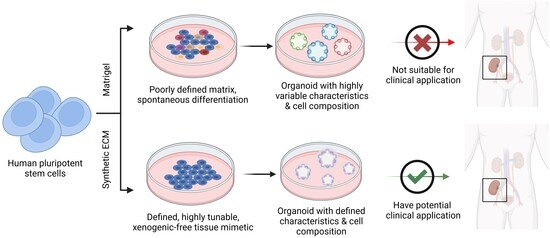
1. Introduction
2. Limitations of Matrigel as an Organoid Scaffold
3. Comparison of Matrigel, Natural ECMs, and Synthetic ECMs
4. Synthetic ECM Scaffolds
5. Synthetic ECM as a Superior Choice of Matrix for Human Pluripotent Stem Cell (hPSC) Culture
6. Synthetic ECM as a Platform for Stem Cell Differentiation
6.1. Synthetic ECMs for Differentiation into Ectodermal Lineage
6.1.1. Neuronal Lineage
6.1.2. Retinal Pigment Epithelial Cell Lineage
6.2. Synthetic ECMs for Differentiation into Endodermal Lineage
6.2.1. Hepatic Lineages
6.2.2. Intestinal Lineages
6.2.3. Pancreatic Lineage
6.2.4. Pulmonary Lineage
6.3. Synthetic ECMs for Differentiation into Mesodermal Lineage
6.3.1. Cardiac Lineages
6.3.2. Renal Lineages
6.3.3. Vascular Smooth Muscle Cell (vSMC) Lineage
6.3.4. Osteoprogenitor Lineage
7. Synthetic ECM Properties Regulating Stem Cell Fate Specification
8. Recent Advances and Emerging Trends in Synthetic ECM Development
9. Conclusions and Future Perspectives
Author Contributions
Funding
Data Availability Statement
Acknowledgments
Conflicts of Interest
References
- Frantz, C.; Stewart, K.M.; Weaver, V.M. The extracellular matrix at a glance. J. Cell Sci. 2010, 123, 4195–4200. [Google Scholar] [CrossRef]
- Gattazzo, F.; Urciuolo, A.; Bonaldo, P. Extracellular matrix: A dynamic microenvironment for stem cell niche. Biochim. Biophys. Acta 2014, 1840, 2506–2519. [Google Scholar] [CrossRef]
- Watt, F.M.; Huck, W.T. Role of the extracellular matrix in regulating stem cell fate. Nat. Rev. Mol. Cell Biol. 2013, 14, 467–473. [Google Scholar] [CrossRef]
- Wang, H.; Luo, X.; Leighton, J. Extracellular Matrix and Integrins in Embryonic Stem Cell Differentiation. Biochem. Insights 2015, 8, 15–21. [Google Scholar] [CrossRef]
- Wang, L.; Zheng, F.; Song, R.; Zhuang, L.; Yang, M.; Suo, J.; Li, L. Integrins in the Regulation of Mesenchymal Stem Cell Differentiation by Mechanical Signals. Stem Cell Rev. Rep. 2022, 18, 126–141. [Google Scholar] [CrossRef]
- Engler, A.J.; Sen, S.; Sweeney, H.L.; Discher, D.E. Matrix elasticity directs stem cell lineage specification. Cell 2006, 126, 677–689. [Google Scholar] [CrossRef] [PubMed]
- Brielle, S.; Bavli, D.; Motzik, A.; Kan-Tor, Y.; Sun, X.; Kozulin, C.; Avni, B.; Ram, O.; Buxboim, A. Delineating the heterogeneity of matrix-directed differentiation toward soft and stiff tissue lineages via single-cell profiling. Proc. Natl. Acad. Sci. USA 2021, 118, e2016322118. [Google Scholar] [CrossRef]
- Xie, Y.-H.; Tang, C.-Q.; Huang, Z.-Z.; Zhou, S.-C.; Yang, Y.-W.; Yin, Z.; Heng, B.C.; Chen, W.-S.; Chen, X.; Shen, W.-L. Extracellular Matrix Remodeling in Stem Cell Culture: A Potential Target for Regulating Stem Cell Function. Tissue Eng. Part B Rev. 2022, 28, 542–554. [Google Scholar] [CrossRef] [PubMed]
- Lu, P.; Takai, K.; Weaver, V.M.; Werb, Z. Extracellular matrix degradation and remodeling in development and disease. Cold Spring Harb. Perspect. Biol. 2011, 3, a005058. [Google Scholar] [CrossRef]
- Caliari, S.R.; Burdick, J.A. A practical guide to hydrogels for cell culture. Nat. Methods 2016, 13, 405–414. [Google Scholar] [CrossRef] [PubMed]
- Lutolf, M.P.; Hubbell, J.A. Synthetic biomaterials as instructive extracellular microenvironments for morphogenesis in tissue engineering. Nat. Biotechnol. 2005, 23, 47–55. [Google Scholar] [CrossRef]
- Kleinman, H.K.; Martin, G.R. Matrigel: Basement membrane matrix with biological activity. Semin. Cancer Biol. 2005, 15, 378–386. [Google Scholar] [CrossRef]
- Kleinman, H.K.; McGarvey, M.L.; Hassell, J.R.; Star, V.L.; Cannon, F.B.; Laurie, G.W.; Martin, G.R. Basement membrane complexes with biological activity. Biochemistry 1986, 25, 312–318. [Google Scholar] [CrossRef]
- Hughes, C.S.; Postovit, L.M.; Lajoie, G.A. Matrigel: A complex protein mixture required for optimal growth of cell culture. Proteomics 2010, 10, 1886–1890. [Google Scholar] [CrossRef]
- Talbot, N.C.; Caperna, T.J. Proteome array identification of bioactive soluble proteins/peptides in Matrigel: Relevance to stem cell responses. Cytotechnology 2015, 67, 873–883. [Google Scholar] [CrossRef]
- Timpl, R.; Rohde, H.; Robey, P.; Rennard, S.; Foidart, J.; Martin, G. Laminin–a glycoprotein from basement membranes. J. Biol. Chem. 1979, 254, 9933–9937. [Google Scholar] [CrossRef]
- Dirami, G.; Papadopoulos, V.; Kleinman, H.K.; Defreese, D.C.; Musto, N.A.; Dym, M. Identification of transferrin and inhibin-like proteins in matrigel. Vitr. Cell. Dev. Biol. Anim. 1995, 31, 404–411. [Google Scholar] [CrossRef]
- Hansen, K.C.; Kiemele, L.; Maller, O.; O’BRien, J.; Shankar, A.; Fornetti, J.; Schedin, P. An in-solution ultrasonication-assisted digestion method for improved extracellular matrix proteome coverage. Mol. Cell. Proteom. 2009, 8, 1648–1657. [Google Scholar] [CrossRef]
- Vukicevic, S.; Kleinman, H.K.; Luyten, F.P.; Roberts, A.B.; Roche, N.S.; Reddi, A.H. Identification of multiple active growth factors in basement membrane matrigel suggests caution in interpretation of cellular activity related to extracellular matrix components. Exp. Cell Res. 1992, 202, 1–8. [Google Scholar] [CrossRef]
- Elosegui-Artola, A.; Gupta, A.; Najibi, A.J.; Seo, B.R.; Garry, R.; Tringides, C.M.; de Lázaro, I.; Darnell, M.; Gu, W.; Zhou, Q.; et al. Matrix viscoelasticity controls spatiotemporal tissue organization. Nat. Mater. 2023, 22, 117–127. [Google Scholar] [CrossRef]
- Kane, K.I.W.; Moreno, E.L.; Lehr, C.M.; Hachi, S.; Dannert, R.; Sanctuary, R.; Wagner, C.; Fleming, R.M.T.; Baller, J. Determination of the rheological properties of Matrigel for optimum seeding conditions in microfluidic cell cultures. AIP Adv. 2018, 8, 125332. [Google Scholar] [CrossRef]
- Alcaraz, J.; Xu, R.; Mori, H.; Nelson, C.M.; Mroue, R.; Spencer, V.A.; Brownfield, D.; Radisky, D.C.; Bustamante, C.; Bissell, M.J. Laminin and biomimetic extracellular elasticity enhance functional differentiation in mammary epithelia. EMBO J. 2008, 27, 2829–2838. [Google Scholar] [CrossRef]
- Reed, J.; Walczak, W.J.; Petzold, O.N.; Gimzewski, J.K. In situ mechanical interferometry of matrigel films. Langmuir 2009, 25, 36–39. [Google Scholar] [CrossRef] [PubMed]
- Soofi, S.S.; Last, J.A.; Liliensiek, S.J.; Nealey, P.F.; Murphy, C.J. The elastic modulus of Matrigel™ as determined by atomic force microscopy. J. Struct. Biol. 2009, 167, 216–219. [Google Scholar] [CrossRef]
- Kohen, N.T.; Little, L.E.; Healy, K.E. Characterization of Matrigel interfaces during defined human embryonic stem cell culture. Biointerphases 2009, 4, 69–79. [Google Scholar] [CrossRef]
- Borries, M.; Barooji, Y.F.; Yennek, S.; Grapin-Botton, A.; Berg-Sørensen, K.; Oddershede, L.B. Quantification of Visco-Elastic Properties of a Matrigel for Organoid Development as a Function of Polymer Concentration. Front. Phys. 2020, 8, 579168. [Google Scholar] [CrossRef]
- Peterson, N.C. From bench to cageside: Risk assessment for rodent pathogen contamination of cells and biologics. ILAR J. 2008, 49, 310–315. [Google Scholar] [CrossRef]
- Liu, H.; Bockhorn, J.; Dalton, R.; Chang, Y.-F.; Qian, D.; Zitzow, L.A.; Clarke, M.F.; Greene, G.L. Removal of lactate dehydrogenase-elevating virus from human-in-mouse breast tumor xenografts by cell-sorting. J. Virol. Methods 2011, 173, 266–270. [Google Scholar] [CrossRef]
- Riley, V.; Spackman, D.H.; Santisteban, G.A.; Dalldorf, G.; Hellstrom, I.; Hellstrom, K.-E.; Lance, E.M.; Rowson, K.E.K.; Mahy, B.W.J.; Alexander, P.; et al. The LDH virus: An interfering biological contaminant. Science 1978, 200, 124–126. [Google Scholar] [CrossRef][Green Version]
- Ammann, C.G.; Messer, R.J.; Peterson, K.E.; Hasenkrug, K.J. Lactate dehydrogenase-elevating virus induces systemic lymphocyte activation via TLR7-dependent IFNalpha responses by plasmacytoid dendritic cells. PLoS ONE 2009, 4, e6105. [Google Scholar] [CrossRef]
- Pineiro-Llanes, J.; da Silva, L.; Huang, J.; Cristofoletti, R. Comparative Study of Basement-membrane Matrices for Human Stem Cell Maintenance and Intestinal Organoid Generation. J. Vis. Exp. 2024, 205, e66277. [Google Scholar] [CrossRef] [PubMed]
- Mayhew, C.N.; Singhania, R. A review of protocols for brain organoids and applications for disease modeling. STAR Protoc. 2023, 4, 101860. [Google Scholar] [CrossRef]
- Fan, X.; Hou, K.; Liu, G.; Shi, R.; Wang, W.; Liang, G. Strategies to overcome the limitations of current organoid technology—Engineered organoids. J. Tissue Eng. 2025, 16, 20417314251319475. [Google Scholar] [CrossRef]
- Lumibao, J.C.; Okhovat, S.R.; Peck, K.L.; Lin, X.; Lande, K.; Yomtoubian, S.; Ng, I.; Tiriac, H.; Lowy, A.M.; Zou, J.; et al. The effect of extracellular matrix on the precision medicine utility of pancreatic cancer patient-derived organoids. JCI Insight 2024, 9, e172419. [Google Scholar] [CrossRef] [PubMed]
- Gjorevski, N.; Sachs, N.; Manfrin, A.; Giger, S.; Bragina, M.E.; Ordóñez-Morán, P.; Clevers, H.; Lutolf, M.P. Designer matrices for intestinal stem cell and organoid culture. Nature 2016, 539, 560–564. [Google Scholar] [CrossRef]
- Aisenbrey, E.A.; Murphy, W.L. Synthetic alternatives to Matrigel. Nat. Rev. Mater. 2020, 5, 539–551. [Google Scholar] [CrossRef]
- Smirnova, L.; Pantoja, I.E.M.; Hartung, T. Organoid intelligence (OI)—The ultimate functionality of a brain microphysiological system. Altex 2023, 40, 191–203. [Google Scholar] [CrossRef]
- Kim, S.; Min, S.; Choi, Y.S.; Jo, S.-H.; Jung, J.H.; Han, K.; Kim, J.; An, S.; Ji, Y.W.; Kim, Y.-G.; et al. Tissue extracellular matrix hydrogels as alternatives to Matrigel for culturing gastrointestinal organoids. Nat. Commun. 2022, 13, 1692. [Google Scholar] [CrossRef]
- Giobbe, G.G.; Crowley, C.; Luni, C.; Campinoti, S.; Khedr, M.; Kretzschmar, K.; De Santis, M.M.; Zambaiti, E.; Michielin, F.; Meran, L.; et al. Extracellular matrix hydrogel derived from decellularized tissues enables endodermal organoid culture. Nat. Commun. 2019, 10, 5658. [Google Scholar] [CrossRef] [PubMed]
- Trappmann, B.; Gautrot, J.E.; Connelly, J.T.; Strange, D.G.; Li, Y.; Oyen, M.L.; Cohen Stuart, M.A.; Boehm, H.; Li, B.; Vogel, V.; et al. Extracellular-matrix tethering regulates stem-cell fate. Nat. Mater. 2012, 11, 642–649. [Google Scholar] [CrossRef]
- Cruz-Acuña, R.; Quirós, M.; Farkas, E.A.; Dedhia, P.H.; Huang, S.; Siuda, D.; García-Hernández, V.; Miller, A.J.; Spence, J.R.; Nusrat, A.; et al. Synthetic hydrogels for human intestinal organoid generation and colonic wound repair. Nat. Cell Biol. 2017, 19, 1326–1335. [Google Scholar] [CrossRef]
- Cruz-Acuña, R.; Quirós, M.; Huang, S.; Siuda, D.; Spence, J.R.; Nusrat, A.; García, A.J. PEG-4MAL hydrogels for human organoid generation, culture, and in vivo delivery. Nat. Protoc. 2018, 13, 2102–2119. [Google Scholar] [CrossRef]
- Li, X.; Sun, Q.; Li, Q.; Kawazoe, N.; Chen, G. Functional Hydrogels With Tunable Structures and Properties for Tissue Engineering Applications. Front. Chem. 2018, 6, 499. [Google Scholar] [CrossRef]
- Baker, B.M.; Chen, C.S. Deconstructing the third dimension—How 3D culture microenvironments alter cellular cues. J. Cell Sci. 2012, 125, 3015–3024. [Google Scholar]
- Tibbitt, M.W.; Anseth, K.S. Hydrogels as extracellular matrix mimics for 3D cell culture. Biotechnol. Bioeng. 2009, 103, 655–663. [Google Scholar] [CrossRef]
- Unal, A.Z.; West, J.L. Synthetic ECM: Bioactive Synthetic Hydrogels for 3D Tissue Engineering. Bioconjugate Chem. 2020, 31, 2253–2271. [Google Scholar] [CrossRef] [PubMed]
- Madduma-Bandarage, U.S.K.; Madihally, S.V. Synthetic hydrogels: Synthesis, novel trends, and applications. J. Appl. Polym. Sci. 2021, 138, 50376. [Google Scholar] [CrossRef]
- Nguyen, K.T.; West, J.L. Photopolymerizable hydrogels for tissue engineering applications. Biomaterials 2002, 23, 4307–4314. [Google Scholar] [CrossRef] [PubMed]
- Schense, J.C.; Hubbell, J.A. Cross-linking exogenous bifunctional peptides into fibrin gels with factor XIIIa. Bioconjugate Chem. 1999, 10, 75–81. [Google Scholar] [CrossRef] [PubMed]
- Jivan, F.; Fabela, N.; Davis, Z.; Alge, D.L. Orthogonal click reactions enable the synthesis of ECM-mimetic PEG hydrogels without multi-arm precursors. J. Mater. Chem. B 2018, 6, 4929–4936. [Google Scholar] [CrossRef]
- Zhang, Z.; Loebus, A.; de Vicente, G.; Ren, F.; Arafeh, M.; Ouyang, Z.; Lensen, M.C. Synthesis of Poly(ethylene glycol)-based Hydrogels via Amine-Michael Type Addition with Tunable Stiffness and Postgelation Chemical Functionality. Chem. Mater. 2014, 26, 3624–3630. [Google Scholar] [CrossRef]
- Zhang, J.; Yun, S.; Du, Y.; Zannettino, A.; Zhang, H. Hydrogel-based preparation of cell aggregates for biomedical applications. Appl. Mater. Today 2020, 20, 100747. [Google Scholar] [CrossRef]
- Ritzau-Reid, K.I.; Callens, S.J.P.; Xie, R.; Cihova, M.; Reumann, D.; Grigsby, C.L.; Prados-Martin, L.; Wang, R.; Moore, A.C.; Armstrong, J.P.K.; et al. Microfibrous Scaffolds Guide Stem Cell Lumenogenesis and Brain Organoid Engineering. Adv. Mater. 2023, 35, e2300305. [Google Scholar] [CrossRef]
- Jun, I.; Han, H.-S.; Edwards, J.R.; Jeon, H. Electrospun Fibrous Scaffolds for Tissue Engineering: Viewpoints on Architecture and Fabrication. Int. J. Mol. Sci. 2018, 19, 745. [Google Scholar] [CrossRef]
- Rogan, H.; Ilagan, F.; Tong, X.; Chu, C.R.; Yang, F. Microribbon-hydrogel composite scaffold accelerates cartilage regeneration in vivo with enhanced mechanical properties using mixed stem cells and chondrocytes. Biomaterials 2020, 228, 119579. [Google Scholar] [CrossRef] [PubMed]
- Gegg, C.; Yang, F. Spatially patterned microribbon-based hydrogels induce zonally-organized cartilage regeneration by stem cells in 3D. Acta Biomater. 2020, 101, 196–205. [Google Scholar] [CrossRef] [PubMed]
- Huang, Y.; Zhang, X.; Zhang, W.; Tang, J.; Liu, J. Rational design matrix materials for organoid development and application in biomedicine. Regen. Biomater. 2025, 12, rbaf038. [Google Scholar] [CrossRef]
- Youngblood, R.L.; Sampson, J.P.; Lebioda, K.R.; Shea, L.D. Microporous scaffolds support assembly and differentiation of pancreatic progenitors into β-cell clusters. Acta Biomater. 2019, 96, 111–122. [Google Scholar] [CrossRef]
- Smith, I.O.; Liu, X.H.; Smith, L.A.; Ma, P.X. Nanostructured polymer scaffolds for tissue engineering and regenerative medicine. Wiley Interdiscip. Nanomed. Nanobiotechnol. 2009, 1, 226–236. [Google Scholar] [CrossRef] [PubMed]
- Han, F.; Meng, Q.; Xie, E.; Li, K.; Hu, J.; Chen, Q.; Li, J.; Han, F. Engineered biomimetic micro/nano-materials for tissue regeneration. Front. Bioeng. Biotechnol. 2023, 11, 1205792. [Google Scholar] [CrossRef] [PubMed]
- Pisani, S.; Marconi, S.; Mauri, V.; Rossetti, B.; Evangelista, A.; Bruni, G.; Benazzo, M.; Auricchio, F.; Conti, B. Hybrid 3D-printed/electrospun scaffolds drive myogenic differentiation of mesenchymal stem cells (MSCs). Sci. Rep. 2025, 16, 1867. [Google Scholar] [CrossRef]
- Mukasheva, F.; Adilova, L.; Dyussenbinov, A.; Yernaimanova, B.; Abilev, M.; Akilbekova, D. Optimizing scaffold pore size for tissue engineering: Insights across various tissue types. Front. Bioeng. Biotechnol. 2024, 12, 1444986. [Google Scholar] [CrossRef]
- Guvendiren, M.; Fung, S.; Kohn, J.; De Maria, C.; Montemurro, F.; Vozzi, G. The control of stem cell morphology and differentiation using three-dimensional printed scaffold architecture. MRS Commun. 2017, 7, 383–390. [Google Scholar] [CrossRef]
- Ding, M.; Andersson, H.; Martinsson, S.; Sabirsh, A.; Jonebring, A.; Wang, Q.-D.; Plowright, A.T.; Drowley, L. Aligned nanofiber scaffolds improve functionality of cardiomyocytes differentiated from human induced pluripotent stem cell-derived cardiac progenitor cells. Sci. Rep. 2020, 10, 13575. [Google Scholar] [CrossRef]
- Dalby, M.J.; Gadegaard, N.; Oreffo, R.O.C. Harnessing nanotopography and integrin–matrix interactions to influence stem cell fate. Nat. Mater. 2014, 13, 558–569. [Google Scholar] [CrossRef]
- Passos, B.A.B.R.; Battaglini, M.; Ciofani, G. Nanostructured Biomaterial-Based Approaches to Support Induced Pluripotent Stem Cell Differentiation. Adv. NanoBiomed Res. 2025, 5, 2500072. [Google Scholar] [CrossRef]
- Arrieta-Viana, L.F.; Mendez-Vega, J.; Torres-Lugo, M. Synthetic thermoresponsive scaffolds for the expansion and differentiation of human pluripotent stem cells into cardiomyocytes. RSC Adv. 2025, 15, 31296–31312. [Google Scholar] [CrossRef]
- Shi, Y.; Inoue, H.; Wu, J.C.; Yamanaka, S. Induced pluripotent stem cell technology: A decade of progress. Nat. Rev. Drug Discov. 2017, 16, 115–130. [Google Scholar] [CrossRef] [PubMed]
- Hoang, D.M.; Pham, P.T.; Bach, T.Q.; Ngo, A.T.L.; Nguyen, Q.T.; Phan, T.T.K.; Nguyen, G.H.; Le, P.T.T.; Hoang, V.T.; Forsyth, N.R.; et al. Stem cell-based therapy for human diseases. Signal Transduct. Target. Ther. 2022, 7, 272. [Google Scholar] [CrossRef] [PubMed]
- Avior, Y.; Sagi, I.; Benvenisty, N. Pluripotent stem cells in disease modelling and drug discovery. Nat. Rev. Mol. Cell Biol. 2016, 17, 170–182. [Google Scholar] [CrossRef]
- Singh, V.K.; Kalsan, M.; Kumar, N.; Saini, A.; Chandra, R. Induced pluripotent stem cells: Applications in regenerative medicine, disease modeling, and drug discovery. Front. Cell Dev. Biol. 2015, 3, 2. [Google Scholar] [CrossRef] [PubMed]
- Xu, C.; Inokuma, M.S.; Denham, J.; Golds, K.; Kundu, P.; Gold, J.D.; Carpenter, M.K. Feeder-free growth of undifferentiated human embryonic stem cells. Nat. Biotechnol. 2001, 19, 971–974. [Google Scholar] [CrossRef]
- Villa-Diaz, L.G.; Nandivada, H.; Ding, J.; Nogueira-de-Souza, N.C.; Krebsbach, P.H.; O’SHea, K.S.; Lahann, J.; Smith, G.D. Synthetic polymer coatings for long-term growth of human embryonic stem cells. Nat. Biotechnol. 2010, 28, 581–583. [Google Scholar] [CrossRef]
- Nandivada, H.; Villa-Diaz, L.G.; O’Shea, K.S.; Smith, G.D.; Krebsbach, P.H.; Lahann, J. Fabrication of synthetic polymer coatings and their use in feeder-free culture of human embryonic stem cells. Nat. Protoc. 2011, 6, 1037–1043. [Google Scholar] [CrossRef] [PubMed]
- Brafman, D.A.; Chang, C.W.; Fernandez, A.; Willert, K.; Varghese, S.; Chien, S. Long-term human pluripotent stem cell self-renewal on synthetic polymer surfaces. Biomaterials 2010, 31, 9135–9144. [Google Scholar] [CrossRef] [PubMed]
- Meng, Y.; Eshghi, S.; Li, Y.J.; Schmidt, R.; Schaffer, D.V.; Healy, K.E. Characterization of integrin engagement during defined human embryonic stem cell culture. FASEB J. 2010, 24, 1056–1065. [Google Scholar] [CrossRef] [PubMed]
- Rowland, T.J.; Miller, L.M.; Blaschke, A.J.; Doss, E.L.; Bonham, A.J.; Hikita, S.T.; Johnson, L.V.; Clegg, D.O. Roles of Integrins in Human Induced Pluripotent Stem Cell Growth on Matrigel and Vitronectin. Stem Cells Dev. 2010, 19, 1231–1240. [Google Scholar] [CrossRef] [PubMed]
- Mondal, G.; Barui, S.; Chaudhuri, A. The relationship between the cyclic-RGDfK ligand and αvβ3 integrin receptor. Biomaterials 2013, 34, 6249–6260. [Google Scholar] [CrossRef]
- Lambshead, J.W.; Meagher, L.; Goodwin, J.; Labonne, T.; Ng, E.; Elefanty, A.; Stanley, E.; O’bRien, C.M.; Laslett, A.L. Long-Term Maintenance of Human Pluripotent Stem Cells on cRGDfK-Presenting Synthetic Surfaces. Sci. Rep. 2018, 8, 701. [Google Scholar] [CrossRef]
- Nguyen, E.H.; Daly, W.T.; Le, N.N.T.; Farnoodian, M.; Belair, D.G.; Schwartz, M.P.; Lebakken, C.S.; Ananiev, G.E.; Saghiri, M.A.; Knudsen, T.B.; et al. Versatile synthetic alternatives to Matrigel for vascular toxicity screening and stem cell expansion. Nat. Biomed. Eng. 2017, 1, 0096. [Google Scholar] [CrossRef]
- Furue, M.K.; Na, J.; Jackson, J.P.; Okamoto, T.; Jones, M.; Baker, D.; Hata, R.-I.; Moore, H.D.; Sato, J.D.; Andrews, P.W. Heparin promotes the growth of human embryonic stem cells in a defined serum-free medium. Proc. Natl. Acad. Sci. USA 2008, 105, 13409–13414. [Google Scholar] [CrossRef] [PubMed]
- Spivak-Kroizman, T.; Lemmon, M.A.; Dikic, I.; Ladbury, J.E.; Pinchasi, D.; Huang, J.; Jaye, M.; Crumley, G.; Schlessinger, J.; Lax, I. Heparin-induced oligomerization of FGF molecules is responsible for FGF receptor dimerization, activation, and cell proliferation. Cell 1994, 79, 1015–1024. [Google Scholar] [CrossRef]
- Vlodavsky, I.; Miao, H.-Q.; Medalion, B.; Danagher, P.; Ron, D. Involvement of heparan sulfate and related molecules in sequestration and growth promoting activity of fibroblast growth factor. Cancer Metastasis Rev. 1996, 15, 177–186. [Google Scholar] [CrossRef]
- Chang, C.-W.; Hwang, Y.; Brafman, D.; Hagan, T.; Phung, C.; Varghese, S. Engineering cell–material interfaces for long-term expansion of human pluripotent stem cells. Biomaterials 2013, 34, 912–921. [Google Scholar] [CrossRef]
- Klim, J.R.; Li, L.; Wrighton, P.J.; Piekarczyk, M.S.; Kiessling, L.L. A defined glycosaminoglycan-binding substratum for human pluripotent stem cells. Nat. Methods 2010, 7, 989–994. [Google Scholar] [CrossRef]
- Musah, S.; Morin, S.A.; Wrighton, P.J.; Zwick, D.B.; Jin, S.; Kiessling, L.L. Glycosaminoglycan-Binding Hydrogels Enable Mechanical Control of Human Pluripotent Stem Cell Self-Renewal. ACS Nano 2012, 6, 10168–10177. [Google Scholar] [CrossRef] [PubMed]
- Melkoumian, Z.; Weber, J.L.; Weber, D.M.; Fadeev, A.G.; Zhou, Y.; Dolley-Sonneville, P.; Yang, J.; Qiu, L.; Priest, C.A.; Shogbon, C.; et al. Synthetic peptide-acrylate surfaces for long-term self-renewal and cardiomyocyte differentiation of human embryonic stem cells. Nat. Biotechnol. 2010, 28, 606–610. [Google Scholar] [CrossRef] [PubMed]
- Deng, Y.; Zhang, X.; Zhao, X.; Li, Q.; Ye, Z.; Li, Z.; Liu, Y.; Zhou, Y.; Ma, H.; Pan, G.; et al. Long-term self-renewal of human pluripotent stem cells on peptide-decorated poly(OEGMA-co-HEMA) brushes under fully defined conditions. Acta Biomater. 2013, 9, 8840–8850. [Google Scholar] [CrossRef]
- Higuchi, A.; Kao, S.-H.; Ling, Q.-D.; Chen, Y.-M.; Li, H.-F.; Alarfaj, A.A.; Munusamy, M.A.; Murugan, K.; Chang, S.-C.; Lee, H.-C.; et al. Long-term xeno-free culture of human pluripotent stem cells on hydrogels with optimal elasticity. Sci. Rep. 2015, 5, 18136. [Google Scholar] [CrossRef] [PubMed]
- Sohi, A.N.; Naderi-Manesh, H.; Soleimani, M.; Yasaghi, E.R.; Manjili, H.K.; Tavaddod, S.; Nojehdehi, S. Synergistic effect of co-immobilized FGF-2 and vitronectin-derived peptide on feeder-free expansion of induced pluripotent stem cells. Mater. Sci. Eng. C 2018, 93, 157–169. [Google Scholar] [CrossRef] [PubMed]
- Chen, G.; Gulbranson, D.R.; Hou, Z.; Bolin, J.M.; Ruotti, V.; Probasco, M.D.; Smuga-Otto, K.; Howden, S.E.; Diol, N.R.; Propson, N.E.; et al. Chemically defined conditions for human iPSC derivation and culture. Nat. Methods 2011, 8, 424–429. [Google Scholar] [CrossRef] [PubMed]
- Zhou, P.; Wu, F.; Zhou, T.; Cai, X.; Zhang, S.; Zhang, X.; Li, Q.; Li, Y.; Zheng, Y.; Wang, M.; et al. Simple and versatile synthetic polydopamine-based surface supports reprogramming of human somatic cells and long-term self-renewal of human pluripotent stem cells under defined conditions. Biomaterials 2016, 87, 1–17. [Google Scholar] [CrossRef]
- Gerecht, S.; Burdick, J.A.; Ferreira, L.S.; Townsend, S.A.; Langer, R.; Vunjak-Novakovic, G. Hyaluronic acid hydrogel for controlled self-renewal and differentiation of human embryonic stem cells. Proc. Natl. Acad. Sci. USA 2007, 104, 11298–11303. [Google Scholar] [CrossRef] [PubMed]
- Ovadia, E.M.; Colby, D.W.; Kloxin, A.M. Designing well-defined photopolymerized synthetic matrices for three-dimensional culture and differentiation of induced pluripotent stem cells. Biomater. Sci. 2018, 6, 1358–1370. [Google Scholar] [CrossRef]
- Murphy, W.L.; McDevitt, T.C.; Engler, A.J. Materials as stem cell regulators. Nat. Mater. 2014, 13, 547–557. [Google Scholar] [CrossRef]
- Lei, Y.; Schaffer, D.V. A fully defined and scalable 3D culture system for human pluripotent stem cell expansion and differentiation. Proc. Natl. Acad. Sci. USA 2013, 110, E5039–E5048. [Google Scholar] [CrossRef]
- Caiazzo, M.; Okawa, Y.; Ranga, A.; Piersigilli, A.; Tabata, Y.; Lutolf, M.P. Defined three-dimensional microenvironments boost induction of pluripotency. Nat. Mater. 2016, 15, 344–352. [Google Scholar] [CrossRef]
- Liu, L.; Yoshioka, M.; Nakajima, M.; Ogasawara, A.; Liu, J.; Hasegawa, K.; Li, S.; Zou, J.; Nakatsuji, N.; Kamei, K.-I.; et al. Nanofibrous gelatin substrates for long-term expansion of human pluripotent stem cells. Biomaterials 2014, 35, 6259–6267. [Google Scholar] [CrossRef]
- Liu, L.; Kamei, K.-I.; Yoshioka, M.; Nakajima, M.; Li, J.; Fujimoto, N.; Terada, S.; Tokunaga, Y.; Koyama, Y.; Sato, H.; et al. Nano-on-micro fibrous extracellular matrices for scalable expansion of human ES/iPS cells. Biomaterials 2017, 124, 47–54. [Google Scholar] [CrossRef] [PubMed]
- Alamein, M.A.; Wolvetang, E.J.; Ovchinnikov, D.A.; Stephens, S.; Sanders, K.; Warnke, P.H. Polymeric nanofibrous substrates stimulate pluripotent stem cells to form three-dimensional multilayered patty-like spheroids in feeder-free culture and maintain their pluripotency. J. Tissue Eng. Regen. Med. 2015, 9, 1078–1083. [Google Scholar] [CrossRef]
- Leong, M.F.; Lu, H.F.; Lim, T.C.; Du, C.; Ma, N.K.; Wan, A.C. Electrospun polystyrene scaffolds as a synthetic substrate for xeno-free expansion and differentiation of human induced pluripotent stem cells. Acta Biomater. 2016, 46, 266–277. [Google Scholar] [CrossRef]
- Kimbrel, E.A.; Lanza, R. Next-generation stem cells—Ushering in a new era of cell-based therapies. Nat. Rev. Drug Discov. 2020, 19, 463–479. [Google Scholar] [CrossRef] [PubMed]
- Apostolou, E.; Blau, H.; Chien, K.; Lancaster, M.A.; Tata, P.R.; Trompouki, E.; Watt, F.M.; Zeng, Y.A.; Zernicka-Goetz, M. Progress and challenges in stem cell biology. Nat. Cell Biol. 2023, 25, 203–206. [Google Scholar] [CrossRef]
- Lutolf, M.P.; Gilbert, P.M.; Blau, H.M. Designing materials to direct stem-cell fate. Nature 2009, 462, 433–441. [Google Scholar] [CrossRef] [PubMed]
- Zhang, X.; Zhang, S.; Wang, T. How the mechanical microenvironment of stem cell growth affects their differentiation: A review. Stem Cell Res. Ther. 2022, 13, 415. [Google Scholar] [CrossRef] [PubMed]
- Long, K.R.; Huttner, W.B. How the extracellular matrix shapes neural development. Open Biol. 2019, 9, 180216. [Google Scholar] [CrossRef]
- Barros, C.S.; Franco, S.J.; Müller, U. Extracellular matrix: Functions in the nervous system. Cold Spring Harb. Perspect. Biol. 2011, 3, a005108. [Google Scholar] [CrossRef]
- Zimmermann, D.R.; Dours-Zimmermann, M.T. Extracellular matrix of the central nervous system: From neglect to challenge. Histochem. Cell Biol. 2008, 130, 635–653. [Google Scholar] [CrossRef]
- Rutka, J.T.; Apodaca, G.; Stern, R.; Rosenblum, M. The extracellular matrix of the central and peripheral nervous systems: Structure and function. J. Neurosurg. 1988, 69, 155–170. [Google Scholar] [CrossRef]
- Saha, K.; Keung, A.J.; Irwin, E.F.; Li, Y.; Little, L.; Schaffer, D.V.; Healy, K.E. Substrate Modulus Directs Neural Stem Cell Behavior. Biophys. J. 2008, 95, 4426–4438. [Google Scholar] [CrossRef]
- Keung, A.J.; Asuri, P.; Kumar, S.; Schaffer, D.V. Soft microenvironments promote the early neurogenic differentiation but not self-renewal of human pluripotent stem cells. Integr. Biol. 2012, 4, 1049–1058. [Google Scholar] [CrossRef]
- Long, K.R.; Huttner, W.B. The Role of the Extracellular Matrix in Neural Progenitor Cell Proliferation and Cortical Folding During Human Neocortex Development. Front. Cell. Neurosci. 2022, 15, 804649. [Google Scholar] [CrossRef]
- Seidlits, S.K.; Khaing, Z.Z.; Petersen, R.R.; Nickels, J.D.; Vanscoy, J.E.; Shear, J.B.; Schmidt, C.E. The effects of hyaluronic acid hydrogels with tunable mechanical properties on neural progenitor cell differentiation. Biomaterials 2010, 31, 3930–3940. [Google Scholar] [CrossRef]
- Ylä-Outinen, L.; Joki, T.; Varjola, M.; Skottman, H.; Narkilahti, S. Three-dimensional growth matrix for human embryonic stem cell-derived neuronal cells. J. Tissue Eng. Regen. Med. 2014, 8, 186–194. [Google Scholar] [CrossRef] [PubMed]
- Liedmann, A.; Frech, S.; Morgan, P.J.; Rolfs, A.; Frech, M.J. Differentiation of Human Neural Progenitor Cells in Functionalized Hydrogel Matrices. BioRes. Open Access 2012, 1, 16–24. [Google Scholar] [CrossRef]
- Knight, G.T.; Lundin, B.F.; Iyer, N.; Ashton, L.M.; Sethares, W.A.; Willett, R.M.; Ashton, R.S. Engineering induction of singular neural rosette emergence within hPSC-derived tissues. eLife 2018, 7, e37549. [Google Scholar] [CrossRef] [PubMed]
- Galarza, S.; Crosby, A.J.; Pak, C.; Peyton, S.R. Control of Astrocyte Quiescence and Activation in a Synthetic Brain Hydrogel. Adv. Healthc. Mater. 2020, 9, 1901419. [Google Scholar] [CrossRef]
- Lim, H.J.; Khan, Z.; Wilems, T.S.; Lu, X.; Perera, T.H.; Kurosu, Y.E.; Ravivarapu, K.T.; Mosley, M.C.; Callahan, L.A.S. Human Induced Pluripotent Stem Cell Derived Neural Stem Cell Survival and Neural Differentiation on Polyethylene Glycol Dimethacrylate Hydrogels Containing a Continuous Concentration Gradient of N-Cadherin Derived Peptide His-Ala-Val-Asp-Ile. ACS Biomater. Sci. Eng. 2017, 3, 776–781. [Google Scholar] [CrossRef]
- Lancaster, M.A.; Corsini, N.S.; Wolfinger, S.; Gustafson, E.H.; Phillips, A.W.; Burkard, T.R.; Otani, T.; Livesey, F.J.; Knoblich, J.A. Guided self-organization and cortical plate formation in human brain organoids. Nat. Biotechnol. 2017, 35, 659–666. [Google Scholar] [CrossRef]
- Musah, S.; Wrighton, P.J.; Zaltsman, Y.; Zhong, X.; Zorn, S.; Parlato, M.B.; Hsiao, C.; Palecek, S.P.; Chang, Q.; Murphy, W.L.; et al. Substratum-induced differentiation of human pluripotent stem cells reveals the coactivator YAP is a potent regulator of neuronal specification. Proc. Natl. Acad. Sci. USA 2014, 111, 13805–13810. [Google Scholar] [CrossRef] [PubMed]
- Agbay, A.; De La Vega, L.; Nixon, G.; Willerth, S.M. Guggulsterone-releasing microspheres direct the differentiation of human induced pluripotent stem cells into neural phenotypes. Biomed. Mater. 2018, 13, 034104. [Google Scholar] [CrossRef]
- Pires, F.; Ferreira, Q.; Rodrigues, C.A.; Morgado, J.; Ferreira, F.C. Neural stem cell differentiation by electrical stimulation using a cross-linked PEDOT substrate: Expanding the use of biocompatible conjugated conductive polymers for neural tissue engineering. Biochim. Biophys. Acta (BBA)-Gen. Subj. 2015, 1850, 1158–1168. [Google Scholar] [CrossRef]
- Feig, V.R.; Santhanam, S.; McConnell, K.W.; Liu, K.; Azadian, M.; Brunel, L.G.; Huang, Z.; Tran, H.; George, P.M.; Bao, Z. Conducting Polymer-Based Granular Hydrogels for Injectable 3D Cell Scaffolds. Adv. Mater. Technol. 2021, 6, 2100162. [Google Scholar] [CrossRef] [PubMed]
- Stewart, E.; Kobayashi, N.R.; Higgins, M.J.; Quigley, A.F.; Jamali, S.; Moulton, S.E.; Kapsa, R.M.; Wallace, G.G.; Crook, J.M. Electrical Stimulation Using Conductive Polymer Polypyrrole Promotes Differentiation of Human Neural Stem Cells: A Biocompatible Platform for Translational Neural Tissue Engineering. Tissue Eng. Part C Methods 2015, 21, 385–393. [Google Scholar] [CrossRef] [PubMed]
- Song, S.; Amores, D.; Chen, C.; McConnell, K.; Oh, B.; Poon, A.; George, P.M. Controlling properties of human neural progenitor cells using 2D and 3D conductive polymer scaffolds. Sci. Rep. 2019, 9, 19565. [Google Scholar] [CrossRef] [PubMed]
- Landers, J.; Turner, J.T.; Heden, G.; Carlson, A.L.; Bennett, N.K.; Moghe, P.V.; Neimark, A.V. Carbon nanotube composites as multifunctional substrates for in situ actuation of differentiation of human neural stem cells. Adv. Healthc. Mater. 2014, 3, 1745–1752. [Google Scholar] [CrossRef] [PubMed]
- Hunt, N.C.; Hallam, D.; Karimi, A.; Mellough, C.B.; Chen, J.; Steel, D.H.; Lako, M. 3D culture of human pluripotent stem cells in RGD-alginate hydrogel improves retinal tissue development. Acta Biomater. 2017, 49, 329–343. [Google Scholar] [CrossRef]
- Tian, Y.; Zonca, M.R.; Imbrogno, J.; Unser, A.M.; Sfakis, L.; Temple, S.; Belfort, G.; Xie, Y. Polarized, Cobblestone, Human Retinal Pigment Epithelial Cell Maturation on a Synthetic PEG Matrix. ACS Biomater. Sci. Eng. 2017, 3, 890–902. [Google Scholar] [CrossRef]
- Kim, H.S.; Kim, D.; Jeong, Y.W.; Choi, M.J.; Lee, G.W.; Thangavelu, M.; Song, J.E.; Khang, G. Engineering retinal pigment epithelial cells regeneration for transplantation in regenerative medicine using PEG/Gellan gum hydrogels. Int. J. Biol. Macromol. 2019, 130, 220–228. [Google Scholar] [CrossRef]
- Liu, J.; Liu, Q.; Guo, M.; Jiang, C.; Chen, J.; Wang, T.; Sung, T.-C.; Chou, S.-J.; Chiou, S.-H.; Fan, G.; et al. Differentiation of human induced pluripotent stem cells into retinal pigment epithelium cells during culture on peptide-grafted hydrogels. Regen. Biomater. 2025, 12, rbaf035. [Google Scholar] [CrossRef] [PubMed]
- Gupta, S.; Lytvynchuk, L.; Ardan, T.; Studenovska, H.; Faura, G.; Eide, L.; Znaor, L.; Erceg, S.; Stieger, K.; Motlik, J.; et al. Retinal Pigment Epithelium Cell Development: Extrapolating Basic Biology to Stem Cell Research. Biomedicines 2023, 11, 310. [Google Scholar] [CrossRef]
- Lidgerwood, G.E.; Lim, S.Y.; Crombie, D.E.; Ali, R.; Gill, K.P.; Hernández, D.; Kie, J.; Conquest, A.; Waugh, H.S.; Wong, R.C.; et al. Defined Medium Conditions for the Induction and Expansion of Human Pluripotent Stem Cell-Derived Retinal Pigment Epithelium. Stem Cell Rev. Rep. 2016, 12, 179–188. [Google Scholar] [CrossRef] [PubMed]
- Osakada, F.; Jin, Z.-B.; Hirami, Y.; Ikeda, H.; Danjyo, T.; Watanabe, K.; Sasai, Y.; Takahashi, M. In vitro differentiation of retinal cells from human pluripotent stem cells by small-molecule induction. J. Cell Sci. 2009, 122, 3169–3179. [Google Scholar] [CrossRef] [PubMed]
- Idelson, M.; Alper, R.; Obolensky, A.; Ben-Shushan, E.; Hemo, I.; Yachimovich-Cohen, N.; Khaner, H.; Smith, Y.; Wiser, O.; Gropp, M.; et al. Directed Differentiation of Human Embryonic Stem Cells into Functional Retinal Pigment Epithelium Cells. Cell Stem Cell 2009, 5, 396–408. [Google Scholar] [CrossRef] [PubMed]
- Zahabi, A.; Shahbazi, E.; Ahmadieh, H.; Hassani, S.-N.; Totonchi, M.; Taei, A.; Masoudi, N.; Ebrahimi, M.; Aghdami, N.; Seifinejad, A.; et al. A New Efficient Protocol for Directed Differentiation of Retinal Pigmented Epithelial Cells from Normal and Retinal Disease Induced Pluripotent Stem Cells. Stem Cells Dev. 2012, 21, 2262–2272. [Google Scholar] [CrossRef]
- Liu, H.; Huang, S.S.; Lingam, G.; Kai, D.; Su, X.; Liu, Z. Advances in retinal pigment epithelial cell transplantation for retinal degenerative diseases. Stem Cell Res. Ther. 2024, 15, 390. [Google Scholar] [CrossRef]
- Rizzolo, L.J.; Nasonkin, I.O.; Adelman, R.A. Retinal Cell Transplantation, Biomaterials, and In Vitro Models for Developing Next-generation Therapies of Age-related Macular Degeneration. Stem Cells Transl. Med. 2022, 11, 269–281. [Google Scholar] [CrossRef]
- Li, Z.; Hu, Z.; Gao, Z. Advances in the Study of Age-Related Macular Degeneration Based on Cell or Cell-Biomaterial Scaffolds. Bioengineering 2025, 12, 278. [Google Scholar] [CrossRef] [PubMed]
- Gandhi, J.K.; Manzar, Z.; Bachman, L.A.; Andrews-Pfannkoch, C.; Knudsen, T.; Hill, M.; Schmidt, H.; Iezzi, R.; Pulido, J.S.; Marmorstein, A.D. Fibrin hydrogels as a xenofree and rapidly degradable support for transplantation of retinal pigment epithelium monolayers. Acta Biomater. 2018, 67, 134–146. [Google Scholar] [CrossRef] [PubMed]
- Gandhi, J.K.; Knudsen, T.; Hill, M.; Roy, B.; Bachman, L.; Pfannkoch-Andrews, C.; Schmidt, K.N.; Metko, M.M.; Ackerman, M.J.; Resch, Z.; et al. Human Fibrinogen for Maintenance and Differentiation of Induced Pluripotent Stem Cells in Two Dimensions and Three Dimensions. Stem Cells Transl. Med. 2019, 8, 512–521. [Google Scholar] [CrossRef]
- Wei, Y.; Alexandre, U.; Ma, X. Hydrogels to Support Transplantation of Human Embryonic Stem Cell-Derived Retinal Pigment Epithelial Cells. Brain Sci. 2022, 12, 1620. [Google Scholar] [CrossRef] [PubMed]
- Chen, Y.M.; Liu, Z.Q.; Feng, Z.H.; Xu, F.; Liu, J.K. Adhesive protein-free synthetic hydrogels for retinal pigment epithelium cell culture with low ROS level. J. Biomed. Mater. Res. Part A 2014, 102, 2258–2267. [Google Scholar] [CrossRef]
- Li, J.; Tao, R.; Wu, W.; Cao, H.; Xin, J.; Li, J.; Guo, J.; Jiang, L.; Gao, C.; Demetriou, A.A.; et al. 3D PLGA scaffolds improve differentiation and function of bone marrow mesenchymal stem cell–derived hepatocytes. Stem Cells Dev. 2010, 19, 1427–1436. [Google Scholar] [CrossRef] [PubMed]
- Wang, Y.; Lee, J.-H.; Shirahama, H.; Seo, J.; Glenn, J.S.; Cho, N.-J. Extracellular Matrix Functionalization and Huh-7.5 Cell Coculture Promote the Hepatic Differentiation of Human Adipose-Derived Mesenchymal Stem Cells in a 3D ICC Hydrogel Scaffold. ACS Biomater. Sci. Eng. 2016, 2, 2255–2265. [Google Scholar] [CrossRef]
- Hwang, Y.; Goh, M.; Kim, M.; Tae, G. Injectable and detachable heparin-based hydrogel micropatches for hepatic differentiation of hADSCs and their liver targeted delivery. Biomaterials 2018, 165, 94–104. [Google Scholar] [CrossRef]
- Cozzolino, A.M.; Noce, V.; Battistelli, C.; Marchetti, A.; Grassi, G.; Cicchini, C.; Tripodi, M.; Amicone, L. Modulating the Substrate Stiffness to Manipulate Differentiation of Resident Liver Stem Cells and to Improve the Differentiation State of Hepatocytes. Stem Cells Int. 2016, 2016, 5481493. [Google Scholar] [CrossRef]
- Mittal, N.; Tasnim, F.; Yue, C.; Qu, Y.; Phan, D.; Choudhury, Y.; Tan, M.-H.; Yu, H. Substrate Stiffness Modulates the Maturation of Human Pluripotent Stem-Cell-Derived Hepatocytes. ACS Biomater. Sci. Eng. 2016, 2, 1649–1657. [Google Scholar] [CrossRef]
- Lee, H.-J.; Son, M.J.; Ahn, J.; Oh, S.J.; Lee, M.; Kim, A.; Jeung, Y.-J.; Kim, H.-G.; Won, M.; Lim, J.H.; et al. Elasticity-based development of functionally enhanced multicellular 3D liver encapsulated in hybrid hydrogel. Acta Biomater. 2017, 64, 67–79. [Google Scholar] [CrossRef] [PubMed]
- Bishi, D.K.; Mathapati, S.; Venugopal, J.R.; Guhathakurta, S.; Cherian, K.M.; Ramakrishna, S.; Verma, R.S. Trans-differentiation of human mesenchymal stem cells generates functional hepatospheres on poly(l-lactic acid)-co-poly(ε-caprolactone)/collagen nanofibrous scaffolds. J. Mater. Chem. B 2013, 1, 3972. [Google Scholar] [CrossRef]
- Weber, J.; Linti, C.; Lörch, C.; Weber, M.; Andt, M.; Schlensak, C.; Wendel, H.P.; Doser, M.; Avci-Adali, M. Combination of melt-electrospun poly-ε-caprolactone scaffolds and hepatocyte-like cells from footprint-free hiPSCs to create 3D biohybrid constructs for liver tissue engineering. Sci. Rep. 2023, 13, 22174. [Google Scholar] [CrossRef] [PubMed]
- Ghaedi, M.; Soleimani, M.; Shabani, I.; Duan, Y.; Lotfi, A.S. Hepatic differentiation from human mesenchymal stem cells on a novel nanofiber scaffold. Cell. Mol. Biol. Lett. 2012, 17, 89–106. [Google Scholar] [CrossRef]
- Kazemnejad, S.; Allameh, A.; Soleimani, M.; Gharehbaghian, A.; Mohammadi, Y.; Amirizadeh, N.; Jazayery, M. Biochemical and molecular characterization of hepatocyte-like cells derived from human bone marrow mesenchymal stem cells on a novel three-dimensional biocompatible nanofibrous scaffold. J. Gastroenterol. Hepatol. 2009, 24, 278–287. [Google Scholar] [CrossRef] [PubMed]
- Wang, B.; Jakus, A.E.; Baptista, P.M.; Soker, S.; Soto-Gutierrez, A.; Abecassis, M.M.; Shah, R.N.; Wertheim, J.A. Functional Maturation of Induced Pluripotent Stem Cell Hepatocytes in Extracellular Matrix—A Comparative Analysis of Bioartificial Liver Microenvironments. Stem Cells Transl. Med. 2016, 5, 1257–1267. [Google Scholar] [CrossRef] [PubMed]
- Wang, L.; Riediger, L.; Rao, Q.; Xu, X.; Nie, Y.; Zhou, Y.; Zhang, J.; Tang, P.; Wang, W.; Tacke, F.; et al. Tunable Synthetic Hydrogel Modulates Hepatic Lineage Specification of Human Liver Organoid. Adv. Funct. Mater. 2025, 36, e08430. [Google Scholar] [CrossRef]
- Roudaut, M.; Caillaud, A.; Souguir, Z.; Bray, L.; Girardeau, A.; Rimbert, A.; Croyal, M.; Lambert, G.; Patitucci, M.; Delpouve, G.; et al. Human induced pluripotent stem cells-derived liver organoids grown on a Biomimesys® hyaluronic acid-based hydroscaffold as a new model for studying human lipoprotein metabolism. Bioeng. Transl. Med. 2024, 9, e10659. [Google Scholar] [CrossRef]
- Hernandez-Gordillo, V.; Kassis, T.; Lampejo, A.; Choi, G.; Gamboa, M.E.; Gnecco, J.S.; Brown, A.; Breault, D.T.; Carrier, R.; Griffith, L.G. Fully synthetic matrices for in vitro culture of primary human intestinal enteroids and endometrial organoids. Biomaterials 2020, 254, 120125. [Google Scholar] [CrossRef]
- Rezakhani, S.; Gjorevski, N.; Lutolf, M.P. Low-Defect Thiol-Michael Addition Hydrogels as Matrigel Substitutes for Epithelial Organoid Derivation. Adv. Funct. Mater. 2020, 30, 2000761. [Google Scholar] [CrossRef]
- Chrisnandy, A.; Blondel, D.; Rezakhani, S.; Broguiere, N.; Lutolf, M.P. Synthetic dynamic hydrogels promote degradation-independent in vitro organogenesis. Nat. Mater. 2022, 21, 479–487. [Google Scholar] [CrossRef]
- Hunt, D.R.; Klett, K.C.; Mascharak, S.; Wang, H.Y.; Gong, D.; Lou, J.; Li, X.; Cai, P.C.; Suhar, R.A.; Co, J.Y.; et al. Engineered Matrices Enable the Culture of Human Patient-Derived Intestinal Organoids. Adv. Sci. 2021, 8, 2004705. [Google Scholar] [CrossRef]
- Amer, L.D.; Holtzinger, A.; Keller, G.; Mahoney, M.J.; Bryant, S.J. Enzymatically degradable poly(ethylene glycol) hydrogels for the 3D culture and release of human embryonic stem cell derived pancreatic precursor cell aggregates. Acta Biomater. 2015, 22, 103–110. [Google Scholar] [CrossRef]
- Kuo, Y.-C.; Liu, Y.-C.; Rajesh, R. Pancreatic differentiation of induced pluripotent stem cells in activin A-grafted gelatin-poly(lactide-co-glycolide) nanoparticle scaffolds with induction of LY294002 and retinoic acid. Mater. Sci. Eng. C Mater. Biol. Appl. 2017, 77, 384–393. [Google Scholar] [CrossRef] [PubMed]
- Enderami, S.E.; Kehtari, M.; Abazari, M.F.; Ghoraeian, P.; Aleagha, M.N.; Soleimanifar, F.; Soleimani, M.; Mortazavi, Y.; Nadri, S.; Mostafavi, H.; et al. Generation of insulin-producing cells from human induced pluripotent stem cells on PLLA/PVA nanofiber scaffold. Artif. Cells Nanomed. Biotechnol. 2018, 46, 1062–1069. [Google Scholar] [CrossRef]
- Abazari, M.F.; Soleimanifar, F.; Aleagha, M.N.; Torabinejad, S.; Nasiri, N.; Khamisipour, G.; Mahabadi, J.A.; Mahboudi, H.; Enderami, S.E.; Saburi, E.; et al. PCL/PVA nanofibrous scaffold improve insulin-producing cells generation from human induced pluripotent stem cells. Gene 2018, 671, 50–57. [Google Scholar] [CrossRef]
- Kuo, Y.-C.; Lee, I.-H.; Rajesh, R. Self-assembled ternary poly(vinyl alcohol)-alginate-gelatin hydrogel with controlled-release nanoparticles for pancreatic differentiation of iPS cells. J. Taiwan Inst. Chem. Eng. 2019, 104, 27–39. [Google Scholar] [CrossRef]
- Liu, H.; Wang, Y.; Wang, H.; Zhao, M.; Tao, T.; Zhang, X.; Qin, J. A Droplet Microfluidic System to Fabricate Hybrid Capsules Enabling Stem Cell Organoid Engineering. Adv. Sci. 2020, 7, 1903739. [Google Scholar] [CrossRef]
- Wang, H.; Liu, H.; Zhang, X.; Wang, Y.; Zhao, M.; Chen, W.; Qin, J. One-Step Generation of Aqueous-Droplet-Filled Hydrogel Fibers as Organoid Carriers Using an All-in-Water Microfluidic System. ACS Appl. Mater. Interfaces 2021, 13, 3199–3208. [Google Scholar] [CrossRef]
- Candiello, J.; Grandhi, T.S.P.; Goh, S.K.; Vaidya, V.; Lemmon-Kishi, M.; Eliato, K.R.; Ros, R.; Kumta, P.N.; Rege, K.; Banerjee, I. 3D heterogeneous islet organoid generation from human embryonic stem cells using a novel engineered hydrogel platform. Biomaterials 2018, 177, 27–39. [Google Scholar] [CrossRef]
- Tanneberger, A.E.; Blomberg, R.; Bilousova, G.; Ryan, A.L.; Magin, C.M. Engineered hydrogel biomaterials facilitate lung progenitor cell differentiation from induced pluripotent stem cells. Am. J. Physiol. Cell. Mol. Physiol. 2025, 328, L379–L388. [Google Scholar] [CrossRef]
- Capeling, M.M.; Czerwinski, M.; Huang, S.; Tsai, Y.-H.; Wu, A.; Nagy, M.S.; Juliar, B.; Sundaram, N.; Song, Y.; Han, W.M.; et al. Nonadhesive Alginate Hydrogels Support Growth of Pluripotent Stem Cell-Derived Intestinal Organoids. Stem Cell Rep. 2019, 12, 381–394. [Google Scholar] [CrossRef] [PubMed]
- Taelman, J.; Diaz, M.; Guiu, J. Human Intestinal Organoids: Promise and Challenge. Front. Cell Dev. Biol. 2022, 10, 854740. [Google Scholar] [CrossRef] [PubMed]
- Lee, J.; Sugiyama, T.; Liu, Y.; Wang, J.; Gu, X.; Lei, J.; Markmann, J.F.; Miyazaki, S.; Miyazaki, J.-I.; Szot, G.L.; et al. Expansion and conversion of human pancreatic ductal cells into insulin-secreting endocrine cells. eLife 2013, 2, e00940. [Google Scholar] [CrossRef] [PubMed][Green Version]
- Greggio, C.; De Franceschi, F.; Figueiredo-Larsen, M.; Gobaa, S.; Ranga, A.; Semb, H.; Lutolf, M.; Grapin-Botton, A. Artificial three-dimensional niches deconstruct pancreas development in vitro. Development 2013, 140, 4452–4462. [Google Scholar] [CrossRef]
- Huang, L.; Holtzinger, A.; Jagan, I.; BeGora, M.; Lohse, I.; Ngai, N.; Nostro, C.; Wang, R.; Muthuswamy, L.B.; Crawford, H.C.; et al. Ductal pancreatic cancer modeling and drug screening using human pluripotent stem cell– and patient-derived tumor organoids. Nat. Med. 2015, 21, 1364–1371. [Google Scholar] [CrossRef]
- Vigier, S.; Gagnon, H.; Bourgade, K.; Klarskov, K.; Fülöp, T.; Vermette, P. Composition and organization of the pancreatic extracellular matrix by combined methods of immunohistochemistry, proteomics and scanning electron microscopy. Curr. Res. Transl. Med. 2017, 65, 31–39. [Google Scholar] [CrossRef] [PubMed]
- Stendahl, J.C.; Kaufman, D.B.; Stupp, S.I. Extracellular matrix in pancreatic islets: Relevance to scaffold design and transplantation. Cell Transplant. 2009, 18, 1–12. [Google Scholar] [CrossRef]
- Fukuda, S.; Yabe, S.G.; Nishida, J.; Takeda, F.; Nashiro, K.; Okochi, H. The intraperitoneal space is more favorable than the subcutaneous one for transplanting alginate fiber containing iPS-derived islet-like cells. Regen. Ther. 2019, 11, 65–72. [Google Scholar] [CrossRef]
- Legøy, T.A.; Vethe, H.; Abadpour, S.; Strand, B.L.; Scholz, H.; Paulo, J.A.; Ræder, H.; Ghila, L.; Chera, S. Encapsulation boosts islet-cell signature in differentiating human induced pluripotent stem cells via integrin signalling. Sci. Rep. 2020, 10, 414. [Google Scholar] [CrossRef]
- Joo, H.; Min, S.; Cho, S.-W. Advanced lung organoids for respiratory system and pulmonary disease modeling. J. Tissue Eng. 2024, 15, 20417314241232504. [Google Scholar] [CrossRef]
- Vazquez-Armendariz, A.I.; Tata, P.R. Recent advances in lung organoid development and applications in disease modeling. J. Clin. Investig. 2023, 133, e170500. [Google Scholar] [CrossRef]
- Dye, B.R.; Youngblood, R.L.; Oakes, R.S.; Kasputis, T.; Clough, D.W.; Spence, J.R.; Shea, L.D. Human lung organoids develop into adult airway-like structures directed by physico-chemical biomaterial properties. Biomaterials 2020, 234, 119757. [Google Scholar] [CrossRef] [PubMed]
- Eiken, M.K.; Childs, C.J.; Brastrom, L.K.; Frum, T.; Plaster, E.M.; Ahmed, D.W.; Spencer, R.C.; Shachaf, O.; Pfeiffer, S.; Levine, J.E.; et al. Nascent matrix deposition supports alveolar organoid formation from aggregates in synthetic hydrogels. Stem Cell Rep. 2024, 20, 102376. [Google Scholar] [CrossRef] [PubMed]
- Young, J.L.; Engler, A.J. Hydrogels with time-dependent material properties enhance cardiomyocyte differentiation in vitro. Biomaterials 2011, 32, 1002–1009. [Google Scholar] [CrossRef]
- Kerscher, P.; Kaczmarek, J.A.; Head, S.E.; Ellis, M.E.; Seeto, W.J.; Kim, J.; Bhattacharya, S.; Suppiramaniam, V.; Lipke, E.A. Direct Production of Human Cardiac Tissues by Pluripotent Stem Cell Encapsulation in Gelatin Methacryloyl. ACS Biomater. Sci. Eng. 2016, 3, 1499–1509. [Google Scholar] [CrossRef] [PubMed]
- Alvarez-Paino, M.; Amer, M.H.; Nasir, A.; Crucitti, V.C.; Thorpe, J.; Burroughs, L.; Needham, D.; Denning, C.; Alexander, M.R.; Alexander, C.; et al. Polymer Microparticles with Defined Surface Chemistry and Topography Mediate the Formation of Stem Cell Aggregates and Cardiomyocyte Function. ACS Appl. Mater. Interfaces 2019, 11, 34560–34574. [Google Scholar] [CrossRef]
- Wang, B.; Tu, X.; Wei, J.; Wang, L.; Chen, Y. Substrate elasticity dependent colony formation and cardiac differentiation of human induced pluripotent stem cells. Biofabrication 2018, 11, 015005. [Google Scholar] [CrossRef]
- Ellis, M.E.; Harris, B.N.; Hashemi, M.; Harvell, B.J.; Bush, M.Z.; Hicks, E.E.; Finklea, F.B.; Wang, E.M.; Nataraj, R.; Young, N.P.; et al. Human Induced Pluripotent Stem Cell Encapsulation Geometry Impacts Three-Dimensional Developing Human Engineered Cardiac Tissue Functionality. Tissue Eng. Part A 2022, 28, 990–1000. [Google Scholar] [CrossRef] [PubMed]
- Carson, D.; Hnilova, M.; Yang, X.; Nemeth, C.L.; Tsui, J.H.; Smith, A.S.; Jiao, A.; Regnier, M.; Murry, C.E.; Tamerler, C.; et al. Nanotopography-Induced Structural Anisotropy and Sarcomere Development in Human Cardiomyocytes Derived from Induced Pluripotent Stem Cells. ACS Appl. Mater. Interfaces 2016, 8, 21923–21932. [Google Scholar] [CrossRef]
- Abadi, P.P.S.S.; Garbern, J.C.; Behzadi, S.; Hill, M.J.; Tresback, J.S.; Heydari, T.; Ejtehadi, M.R.; Ahmed, N.; Copley, E.; Aghaverdi, H.; et al. Engineering of Mature Human Induced Pluripotent Stem Cell-Derived Cardiomyocytes Using Substrates with Multiscale Topography. Adv. Funct. Mater. 2018, 28, 1707378. [Google Scholar] [CrossRef]
- Nakane, T.; Masumoto, H.; Tinney, J.P.; Yuan, F.; Kowalski, W.J.; Ye, F.; LeBlanc, A.J.; Sakata, R.; Yamashita, J.K.; Keller, B.B. Impact of Cell Composition and Geometry on Human Induced Pluripotent Stem Cells-Derived Engineered Cardiac Tissue. Sci. Rep. 2017, 7, 45641. [Google Scholar] [CrossRef]
- Gupta, A.K.; Coburn, J.M.; Davis-Knowlton, J.; Kimmerling, E.; Kaplan, D.L.; Oxburgh, L. Scaffolding kidney organoids on silk. J. Tissue Eng. Regen. Med. 2019, 13, 812–822. [Google Scholar] [CrossRef]
- Geuens, T.; Ruiter, F.A.; Schumacher, A.; Morgan, F.L.; Rademakers, T.; Wiersma, L.E.; Berg, C.W.v.D.; Rabelink, T.J.; Baker, M.B.; LaPointe, V.L. Thiol-ene cross-linked alginate hydrogel encapsulation modulates the extracellular matrix of kidney organoids by reducing abnormal type 1a1 collagen deposition. Biomaterials 2021, 275, 120976. [Google Scholar] [CrossRef]
- Ruiter, F.A.A.; Morgan, F.L.C.; Roumans, N.; Schumacher, A.; Slaats, G.G.; Moroni, L.; LaPointe, V.L.S.; Baker, M.B. Soft, Dynamic Hydrogel Confinement Improves Kidney Organoid Lumen Morphology and Reduces Epithelial–Mesenchymal Transition in Culture. Adv. Sci. 2022, 9, e2200543. [Google Scholar] [CrossRef] [PubMed]
- Garreta, E.; Prado, P.; Tarantino, C.; Oria, R.; Fanlo, L.; Martí, E.; Zalvidea, D.; Trepat, X.; Roca-Cusachs, P.; Gavaldà-Navarro, A.; et al. Fine tuning the extracellular environment accelerates the derivation of kidney organoids from human pluripotent stem cells. Nat. Mater. 2019, 18, 397–405. [Google Scholar] [CrossRef]
- Meijer, E.M.; Giles, R.; van Dijk, C.G.M.; Maringanti, R.; Wissing, T.B.; Appels, Y.; Chrifi, I.; Crielaard, H.; Verhaar, M.C.; Smits, A.I.; et al. Effect of Mechanical Stimuli on the Phenotypic Plasticity of Induced Pluripotent Stem-Cell-Derived Vascular Smooth Muscle Cells in a 3D Hydrogel. ACS Appl. Bio Mater. 2023, 6, 5716–5729. [Google Scholar] [CrossRef]
- Liu, Q.; Liu, Z.; Gu, H.; Ge, Y.; Wu, X.; Zuo, F.; Du, Q.; Lei, Y.; Wang, Z.; Lin, H. Comparative study of differentiating human pluripotent stem cells into vascular smooth muscle cells in hydrogel-based culture methods. Regen. Ther. 2023, 22, 39–49. [Google Scholar] [CrossRef]
- Xie, C.; Hu, J.; Ma, H.; Zhang, J.; Chang, L.-J.; Chen, Y.E.; Ma, P.X. Three-dimensional growth of iPS cell-derived smooth muscle cells on nanofibrous scaffolds. Biomaterials 2011, 32, 4369–4375. [Google Scholar] [CrossRef] [PubMed]
- Wang, Y.; Hu, J.; Jiao, J.; Liu, Z.; Zhou, Z.; Zhao, C.; Chang, L.-J.; Chen, Y.E.; Ma, P.X.; Yang, B. Engineering vascular tissue with functional smooth muscle cells derived from human iPS cells and nanofibrous scaffolds. Biomaterials 2014, 35, 8960–8969. [Google Scholar] [CrossRef]
- Hayashi, K.; Ochiai-Shino, H.; Shiga, T.; Onodera, S.; Saito, A.; Shibahara, T.; Azuma, T. Transplantation of human-induced pluripotent stem cells carried by self-assembling peptide nanofiber hydrogel improves bone regeneration in rat calvarial bone defects. BDJ Open 2016, 2, 15007. [Google Scholar] [CrossRef]
- Nakahara, H.; Misawa, H.; Yoshida, A.; Hayashi, T.; Tanaka, M.; Furumatsu, T.; Tanaka, N.; Kobayashi, N.; Ozaki, T. Bone repair using a hybrid scaffold of self-assembling peptide PuraMatrix and polyetheretherketone cage in rats. Cell Transplant. 2010, 19, 791–797. [Google Scholar] [CrossRef] [PubMed]
- Kishimoto, N.; Momota, Y.; Mori, R.; Hashimoto, Y.; Imai, K.; Omasa, T.; Kotani, J. Bone Regeneration Using Dedifferentiated Fat Cells with PuraMatrixTM. J. Oral Tissue Eng. 2008, 6, 127–134. [Google Scholar]
- Wang, L.; Zhang, C.; Li, C.; Weir, M.D.; Wang, P.; Reynolds, M.A.; Zhao, L.; Xu, H.H. Injectable calcium phosphate with hydrogel fibers encapsulating induced pluripotent, dental pulp and bone marrow stem cells for bone repair. Mater. Sci. Eng. C Mater. Biol. Appl. 2016, 69, 1125–1136. [Google Scholar] [CrossRef] [PubMed]
- Hwang, N.S.; Varghese, S.; Zhang, Z.; Elisseeff, J. Chondrogenic Differentiation of Human Embryonic Stem Cell–Derived Cells in Arginine-Glycine-Aspartate–Modified Hydrogels. Tissue Eng. 2006, 12, 2695–2706. [Google Scholar] [CrossRef] [PubMed]
- Yu, L.; Yang, Y.; Zhang, B.; Bai, X.; Fei, Q.; Zhang, L. Rapid human-derived iPSC osteogenesis combined with three-dimensionally printed Ti6Al4V scaffolds for the repair of bone defects. J. Cell. Physiol. 2020, 235, 9763–9772. [Google Scholar] [CrossRef]
- Song, Y.; Seitz, M.; Kowalczewski, A.; Mai, N.Y.; Jain, E.; Yang, H.; Ma, Z. Mechanically and Chemically Defined PEG Hydrogels Improve Reproducibility in Human Cardioid Development. Adv. Healthc. Mater. 2025, 14, e2403997. [Google Scholar] [CrossRef]
- Bhakuni, S.; Sharma, H.; Kim, W.; Kim, D.; Lee, S.; Park, C.; Oh, J.; Jeong, H.E.; Kim, J. Micro and Nanoengineered Cardiac Spheroids and Organoids: Toward Translational Applications. Adv. Funct. Mater. 2026, e31032. [Google Scholar] [CrossRef]
- Lacueva-Aparicio, A.; Lindoso, R.S.; Mihăilă, S.M.; Giménez, I. Role of extracellular matrix components and structure in new renal models in vitro. Front. Physiol. 2022, 13, 1048738. [Google Scholar] [CrossRef]
- van Sprang, J.F.; de Jong, S.M.J.; Dankers, P.Y.W. Biomaterial-driven kidney organoid maturation. Curr. Opin. Biomed. Eng. 2022, 21, 100355. [Google Scholar] [CrossRef]
- Tabibzadeh, N.; Morizane, R. Advancements in therapeutic development: Kidney organoids and organs on a chip. Kidney Int. 2024, 105, 702–708. [Google Scholar] [CrossRef]
- Treacy, N.J.; Clerkin, S.; Davis, J.L.; Kennedy, C.; Miller, A.F.; Saiani, A.; Wychowaniec, J.K.; Brougham, D.F.; Crean, J. Growth and differentiation of human induced pluripotent stem cell (hiPSC)-derived kidney organoids using fully synthetic peptide hydrogels. Bioact. Mater. 2023, 21, 142–156. [Google Scholar] [CrossRef] [PubMed]
- Wang, R.; Sui, Y.; Liu, Q.; Xiong, Y.; Li, S.; Guo, W.; Xu, Y.; Zhang, S. Recent advances in extracellular matrix manipulation for kidney organoid research. Front. Pharmacol. 2024, 15, 1472361. [Google Scholar] [CrossRef]
- Freedman, B.S.; Dekel, B. Engraftment of Kidney Organoids In Vivo. Curr. Transplant. Rep. 2023, 10, 29–39. [Google Scholar] [CrossRef]
- Nakanoh, H.; Tsuji, K.; Fukushima, K.; Uchida, N.; Haraguchi, S.; Kitamura, S.; Wada, J. Kidney Organoids: Current Advances and Applications. Life 2025, 15, 1680. [Google Scholar] [CrossRef]
- Kalejaiye, T.D.; Barreto, A.D.; Musah, S. Translating Organoids into Artificial Kidneys. Curr. Transplant. Rep. 2022, 9, 276–286. [Google Scholar] [CrossRef]
- Jansen, K.; Schuurmans, C.C.; Jansen, J.; Masereeuw, R.; Vermonden, T. Hydrogel-Based Cell Therapies for Kidney Regeneration: Current Trends in Biofabrication and In Vivo Repair. Curr. Pharm. Des. 2017, 23, 3845–3857. [Google Scholar] [CrossRef]
- Cha, S.-G.; Rhim, W.-K.; Kim, J.Y.; Lee, E.H.; Lee, S.Y.; Park, J.M.; Lee, J.E.; Yoon, H.; Park, C.G.; Kim, B.S.; et al. Kidney tissue regeneration using bioactive scaffolds incorporated with differentiating extracellular vesicles and intermediate mesoderm cells. Biomater. Res. 2023, 27, 126. [Google Scholar] [CrossRef]
- Frismantiene, A.; Philippova, M.; Erne, P.; Resink, T.J. Smooth muscle cell-driven vascular diseases and molecular mechanisms of VSMC plasticity. Cell. Signal. 2018, 52, 48–64. [Google Scholar] [CrossRef] [PubMed]
- Majesky, M.W. Developmental basis of vascular smooth muscle diversity. Arter. Thromb. Vasc. Biol. 2007, 27, 1248–1258. [Google Scholar] [CrossRef]
- Cao, G.; Xuan, X.; Hu, J.; Zhang, R.; Jin, H.; Dong, H. How vascular smooth muscle cell phenotype switching contributes to vascular disease. Cell Commun. Signal. 2022, 20, 180. [Google Scholar] [CrossRef] [PubMed]
- Dieffenbach, P.B.; Haeger, C.M.; Coronata, A.M.F.; Choi, K.M.; Varelas, X.; Tschumperlin, D.J.; Fredenburgh, L.E. Arterial stiffness induces remodeling phenotypes in pulmonary artery smooth muscle cells via YAP/TAZ-mediated repression of cyclooxygenase-2. Am. J. Physiol. Cell. Mol. Physiol. 2017, 313, L628–L647. [Google Scholar] [CrossRef]
- Cai, X.; Wang, K.-C.; Meng, Z. Mechanoregulation of YAP and TAZ in Cellular Homeostasis and Disease Progression. Front. Cell Dev. Biol. 2021, 9, 673599. [Google Scholar] [CrossRef] [PubMed]
- Wang, W.; Lollis, E.M.; Bordeleau, F.; Reinhart-King, C.A. Matrix stiffness regulates vascular integrity through focal adhesion kinase activity. FASEB J. 2019, 33, 1199–1208. [Google Scholar] [CrossRef]
- Swiatlowska, P.; Sit, B.; Feng, Z.; Marhuenda, E.; Xanthis, I.; Zingaro, S.; Ward, M.; Zhou, X.; Xiao, Q.; Shanahan, C.; et al. Pressure and stiffness sensing together regulate vascular smooth muscle cell phenotype switching. Sci. Adv. 2022, 8, eabm3471. [Google Scholar] [CrossRef]
- Shao, Y.; Li, G.; Huang, S.; Li, Z.; Qiao, B.; Chen, D.; Li, Y.; Liu, H.; Du, J.; Li, P. Effects of Extracellular Matrix Softening on Vascular Smooth Muscle Cell Dysfunction. Cardiovasc. Toxicol. 2020, 20, 548–556. [Google Scholar] [CrossRef] [PubMed]
- Chaterji, S.; Kim, P.; Choe, S.H.; Tsui, J.H.; Lam, C.H.; Ho, D.S.; Baker, A.B.; Kim, D.-H. Synergistic effects of matrix nanotopography and stiffness on vascular smooth muscle cell function. Tissue Eng. Part A 2014, 20, 2115–2126. [Google Scholar] [CrossRef]
- Sazonova, O.V.; Isenberg, B.C.; Herrmann, J.; Lee, K.L.; Purwada, A.; Valentine, A.D.; Buczek-Thomas, J.A.; Wong, J.Y.; Nugent, M.A. Extracellular matrix presentation modulates vascular smooth muscle cell mechanotransduction. Matrix Biol. 2015, 41, 36–43. [Google Scholar] [CrossRef] [PubMed]
- Klein, D. iPSCs-based generation of vascular cells: Reprogramming approaches and applications. Cell. Mol. Life Sci. 2018, 75, 1411–1433. [Google Scholar] [CrossRef] [PubMed]
- Li, C.; Zhang, Y.; Du, Y.; Hou, Z.; Zhang, Y.; Cui, W.; Chen, W. A Review of Advanced Biomaterials and Cells for the Production of Bone Organoid. Small Sci. 2023, 3, 2300027. [Google Scholar] [CrossRef]
- Bai, X.; Gao, M.; Syed, S.; Zhuang, J.; Xu, X.; Zhang, X.-Q. Bioactive hydrogels for bone regeneration. Bioact. Mater. 2018, 3, 401–417. [Google Scholar] [CrossRef]
- Yue, S.; He, H.; Li, B.; Hou, T. Hydrogel as a Biomaterial for Bone Tissue Engineering: A Review. Nanomaterials 2020, 10, 1511. [Google Scholar] [CrossRef]
- Kim, H.D.; Amirthalingam, S.; Kim, S.L.; Lee, S.S.; Rangasamy, J.; Hwang, N.S. Biomimetic Materials and Fabrication Approaches for Bone Tissue Engineering. Adv. Healthc. Mater. 2017, 6, 1700612. [Google Scholar] [CrossRef]
- Han, Y.; Liu, J.; Hu, C.; Wang, Y.; He, C. Advances in hydrogel systems for bone regeneration: Trends, innovations, and prospects. J. Mater. Chem. B 2025, 13, 14869–14908. [Google Scholar] [CrossRef]
- Hong, Y.; Li, R.; Sheng, S.; Zhou, F.; Bai, L.; Su, J. Bone organoid construction and evolution. J. Orthop. Transl. 2025, 53, 260–273. [Google Scholar] [CrossRef]
- Liu, L.; Li, X.; Shi, X.; Wang, Y. Injectable alendronate-functionalized GelMA hydrogels for mineralization and osteogenesis. RSC Adv. 2018, 8, 22764–22776. [Google Scholar] [CrossRef] [PubMed]
- Zhou, B.; Jiang, X.; Zhou, X.; Tan, W.; Luo, H.; Lei, S.; Yang, Y. GelMA-based bioactive hydrogel scaffolds with multiple bone defect repair functions: Therapeutic strategies and recent advances. Biomater. Res. 2023, 27, 86. [Google Scholar] [CrossRef] [PubMed]
- Re, F.; Sartore, L.; Borsani, E.; Ferroni, M.; Baratto, C.; Mahajneh, A.; Smith, A.; Dey, K.; Almici, C.; Guizzi, P.; et al. Mineralization of 3D Osteogenic Model Based on Gelatin-Dextran Hybrid Hydrogel Scaffold Bioengineered with Mesenchymal Stromal Cells: A Multiparametric Evaluation. Materials 2021, 14, 3852. [Google Scholar] [CrossRef]
- Gai, T.; Zhang, H.; Hu, Y.; Li, R.; Wang, J.; Chen, X.; Wang, J.; Chen, Z.; Jing, Y.; Wang, C.; et al. Sequential construction of vascularized and mineralized bone organoids using engineered ECM-DNA-CPO-based bionic matrix for efficient bone regeneration. Bioact. Mater. 2025, 49, 362–377. [Google Scholar] [CrossRef] [PubMed]
- Wu, X.; Hu, Y.; Sheng, S.; Yang, H.; Li, Z.; Han, Q.; Zhang, Q.; Su, J. DNA-based hydrogels for bone regeneration: A promising tool for bone organoids. Mater. Today Bio 2025, 31, 101502. [Google Scholar] [CrossRef]
- Chatterjee, K.; Lin-Gibson, S.; Wallace, W.E.; Parekh, S.H.; Lee, Y.J.; Cicerone, M.T.; Young, M.F.; Simon, C.G., Jr. The effect of 3D hydrogel scaffold modulus on osteoblast differentiation and mineralization revealed by combinatorial screening. Biomaterials 2010, 31, 5051–5062. [Google Scholar] [CrossRef]
- Si, J.; Ishikawa, S.; Nepal, S.; Okada, H.; Chung, U.-I.; Sakai, T.; Hojo, H. Osteogenic differentiation capabilities of multiarm PEG hydrogels: Involvement of gel–gel-phase separation in cell differentiation. Polym. J. 2025, 57, 407–417. [Google Scholar] [CrossRef]
- Bahmaee, H.; Owen, R.; Boyle, L.; Perrault, C.M.; Garcia-Granada, A.A.; Reilly, G.C.; Claeyssens, F. Design and Evaluation of an Osteogenesis-on-a-Chip Microfluidic Device Incorporating 3D Cell Culture. Front. Bioeng. Biotechnol. 2020, 8, 557111. [Google Scholar] [CrossRef]
- Lai, W.; Geliang, H.; Bin, X.; Wang, W. Effects of hydrogel stiffness and viscoelasticity on organoid culture: A comprehensive review. Mol. Med. 2025, 31, 83. [Google Scholar] [CrossRef]
- Discher, D.E.; Mooney, D.J.; Zandstra, P.W. Growth factors, matrices, and forces combine and control stem cells. Science 2009, 324, 1673–1677. [Google Scholar] [CrossRef]
- Sun, Z.; Guo, S.S.; Fässler, R. Integrin-mediated mechanotransduction. J. Cell Biol. 2016, 215, 445–456. [Google Scholar] [CrossRef] [PubMed]
- Swift, J.; Ivanovska, I.L.; Buxboim, A.; Harada, T.; Dingal, P.C.D.P.; Pinter, J.; Pajerowski, J.D.; Spinler, K.R.; Shin, J.-W.; Tewari, M.; et al. Nuclear lamin-a scales with tissue stiffness and enhances matrix-directed differentiation. Science 2013, 341, 1240104. [Google Scholar] [CrossRef]
- Abdel Fattah, A.R.; Daza, B.; Rustandi, G.; Berrocal-Rubio, M.Á.; Gorissen, B.; Poovathingal, S.; Davie, K.; Barrasa-Fano, J.; Cóndor, M.; Cao, X.; et al. Actuation enhances patterning in human neural tube organoids. Nat. Commun. 2021, 12, 3192. [Google Scholar] [CrossRef]
- Hushka, E.A.; Yavitt, F.M.; Brown, T.E.; Dempsey, P.J.; Anseth, K.S. Relaxation of Extracellular Matrix Forces Directs Crypt Formation and Architecture in Intestinal Organoids. Adv. Healthc. Mater. 2020, 9, e1901214. [Google Scholar] [CrossRef] [PubMed]
- Pérez-González, C.; Ceada, G.; Greco, F.; Matejčić, M.; Gómez-González, M.; Castro, N.; Menendez, A.; Kale, S.; Krndija, D.; Clark, A.G.; et al. Mechanical compartmentalization of the intestinal organoid enables crypt folding and collective cell migration. Nat. Cell Biol. 2021, 23, 745–757. [Google Scholar] [CrossRef]
- He, S.; Lei, P.; Kang, W.; Cheung, P.; Xu, T.; Mana, M.; Park, C.Y.; Wang, H.; Imada, S.; Russell, J.O.; et al. Stiffness Restricts the Stemness of the Intestinal Stem Cells and Skews Their Differentiation Toward Goblet Cells. Gastroenterology 2023, 164, 1137–1151.e15. [Google Scholar] [CrossRef] [PubMed]
- Sorrentino, G.; Rezakhani, S.; Yildiz, E.; Nuciforo, S.; Heim, M.H.; Lutolf, M.P.; Schoonjans, K. Mechano-modulatory synthetic niches for liver organoid derivation. Nat. Commun. 2020, 11, 3416. [Google Scholar] [CrossRef]
- Na, J.; Yang, Z.; Shi, Q.; Li, C.; Liu, Y.; Song, Y.; Li, X.; Zheng, L.; Fan, Y. Extracellular matrix stiffness as an energy metabolism regulator drives osteogenic differentiation in mesenchymal stem cells. Bioact. Mater. 2024, 35, 549–563. [Google Scholar] [CrossRef]
- Na, J.; Tai, C.; Wang, Z.; Yang, Z.; Chen, X.; Zhang, J.; Zheng, L.; Fan, Y. Stiff extracellular matrix drives the differentiation of mesenchymal stem cells toward osteogenesis by the multiscale 3D genome reorganization. Biomaterials 2025, 312, 122715. [Google Scholar] [CrossRef]
- Zhang, C.; Shen, Y.; Huang, M.; Wang, G.; Miao, Q.; Shi, H.; Gao, R.; Wang, K.; Luo, M. Dynamic hydrogel mechanics in organoid engineering: From matrix design to translational paradigms. Bioact. Mater. 2026, 55, 144–170. [Google Scholar] [CrossRef] [PubMed]
- Gan, Z.; Qin, X.; Liu, H.; Liu, J.; Qin, J. Recent advances in defined hydrogels in organoid research. Bioact. Mater. 2023, 28, 386–401. [Google Scholar] [CrossRef] [PubMed]
- Chaudhuri, O.; Cooper-White, J.; Janmey, P.A.; Mooney, D.J.; Shenoy, V.B. Effects of extracellular matrix viscoelasticity on cellular behaviour. Nature 2020, 584, 535–546. [Google Scholar] [CrossRef] [PubMed]
- Sampayo, R.G.; Sakamoto, M.; Wang, M.; Kumar, S.; Schaffer, D.V. Mechanosensitive stem cell fate choice is instructed by dynamic fluctuations in activation of Rho GTPases. Proc. Natl. Acad. Sci. USA 2023, 120, e2219854120. [Google Scholar] [CrossRef]
- Wu, Y.; Song, Y.; Soto, J.; Hoffman, T.; Lin, X.; Zhang, A.; Chen, S.; Massad, R.N.; Han, X.; Qi, D.; et al. Viscoelastic extracellular matrix enhances epigenetic remodeling and cellular plasticity. Nat. Commun. 2025, 16, 4054. [Google Scholar] [CrossRef]
- Nerger, B.A.; Kashyap, K.; Deveney, B.T.; Lou, J.; Hanan, B.F.; Liu, Q.; Khalil, A.; Lungjangwa, T.; Cheriyan, M.; Gupta, A.; et al. Tuning porosity of macroporous hydrogels enables rapid rates of stress relaxation and promotes cell expansion and migration. Proc. Natl. Acad. Sci. USA 2024, 121, e2410806121. [Google Scholar] [CrossRef]
- Crandell, P.; Stowers, R. Spatial and Temporal Control of 3D Hydrogel Viscoelasticity through Phototuning. ACS Biomater. Sci. Eng. 2023, 9, 6860–6869. [Google Scholar] [CrossRef]
- Courbot, O.; Elosegui-Artola, A. The role of extracellular matrix viscoelasticity in development and disease. npj Biol. Phys. Mech. 2025, 2, 10. [Google Scholar] [CrossRef]
- Yavitt, F.M.; Kirkpatrick, B.E.; Blatchley, M.R.; Speckl, K.F.; Mohagheghian, E.; Moldovan, R.; Wang, N.; Dempsey, P.J.; Anseth, K.S. In situ modulation of intestinal organoid epithelial curvature through photoinduced viscoelasticity directs crypt morphogenesis. Sci. Adv. 2023, 9, eadd5668. [Google Scholar] [CrossRef]
- Peng, Y.H.; Hsiao, S.K.; Gupta, K.; Ruland, A.; Auernhammer, G.K.; Maitz, M.F.; Boye, S.; Lattner, J.; Gerri, C.; Honigmann, A.; et al. Dynamic matrices with DNA-encoded viscoelasticity for cell and organoid culture. Nat. Nanotechnol. 2023, 18, 1463–1473. [Google Scholar] [CrossRef]
- Chaudhuri, O.; Gu, L.; Klumpers, D.; Darnell, M.; Bencherif, S.A.; Weaver, J.C.; Huebsch, N.; Lee, H.-P.; Lippens, E.; Duda, G.N.; et al. Hydrogels with tunable stress relaxation regulate stem cell fate and activity. Nat. Mater. 2016, 15, 326–334. [Google Scholar] [CrossRef]
- O’conor, C.J.; Leddy, H.A.; Benefield, H.C.; Liedtke, W.B.; Guilak, F. TRPV4-mediated mechanotransduction regulates the metabolic response of chondrocytes to dynamic loading. Proc. Natl. Acad. Sci. USA 2014, 111, 1316–1321. [Google Scholar] [CrossRef]
- Nam, S.; Gupta, V.K.; Lee, H.-P.; Lee, J.Y.; Wisdom, K.M.; Varma, S.; Flaum, E.M.; Davis, C.; West, R.B.; Chaudhuri, O. Cell cycle progression in confining microenvironments is regulated by a growth-responsive TRPV4-PI3K/Akt-p27Kip1 signaling axis. Sci. Adv. 2019, 5, eaaw6171. [Google Scholar] [CrossRef] [PubMed]
- Lee, H.-P.; Stowers, R.; Chaudhuri, O. Volume expansion and TRPV4 activation regulate stem cell fate in three-dimensional microenvironments. Nat. Commun. 2019, 10, 529. [Google Scholar] [CrossRef] [PubMed]
- Cavalcanti-Adam, E.A.; Volberg, T.; Micoulet, A.; Kessler, H.; Geiger, B.; Spatz, J.P. Cell spreading and focal adhesion dynamics are regulated by spacing of integrin ligands. Biophys. J. 2007, 92, 2964–2974. [Google Scholar] [CrossRef] [PubMed]
- Wang, X.; Yan, C.; Ye, K.; He, Y.; Li, Z.; Ding, J. Effect of RGD nanospacing on differentiation of stem cells. Biomaterials 2013, 34, 2865–2874. [Google Scholar] [CrossRef]
- Kapp, T.G.; Rechenmacher, F.; Neubauer, S.; Maltsev, O.V.; Cavalcanti-Adam, E.A.; Zarka, R.; Reuning, U.; Notni, J.; Wester, H.-J.; Mas-Moruno, C.; et al. A Comprehensive Evaluation of the Activity and Selectivity Profile of Ligands for RGD-binding Integrins. Sci. Rep. 2017, 7, 39805. [Google Scholar] [CrossRef]
- Lee, S.; Yoo, J.; Bae, G.; Thangam, R.; Heo, J.; Park, J.Y.; Choi, H.; Kim, C.; An, J.; Kim, J.; et al. Photonic control of ligand nanospacing in self-assembly regulates stem cell fate. Bioact. Mater. 2024, 34, 164–180. [Google Scholar] [CrossRef]
- Zhang, X.; Karagöz, Z.; Swapnasrita, S.; Habibovic, P.; Carlier, A.; van Rijt, S. Development of Mesoporous Silica Nanoparticle-Based Films with Tunable Arginine–Glycine–Aspartate Peptide Global Density and Clustering Levels to Study Stem Cell Adhesion and Differentiation. ACS Appl. Mater. Interfaces 2023, 15, 38171–38184. [Google Scholar] [CrossRef]
- Zhang, X.; van Veen, S.; Hadavi, D.; Zhao, Y.; Mohren, R.; Habibović, P.; Honing, M.; Albertazzi, L.; van Rijt, S. DNA Nanoparticle Based 2D Biointerface to Study the Effect of Dynamic RGD Presentation on Stem Cell Adhesion and Migration. Small 2024, 20, e2311402. [Google Scholar] [CrossRef]
- Page-McCaw, A.; Ewald, A.J.; Werb, Z. Matrix metalloproteinases and the regulation of tissue remodelling. Nat. Rev. Mol. Cell Biol. 2007, 8, 221–233. [Google Scholar] [CrossRef]
- Narasimhan, B.N.; Fraley, S.I. Matrix degradation enhances stress relaxation, regulating cell adhesion and spreading. Proc. Natl. Acad. Sci. USA 2025, 122, e2416771122. [Google Scholar] [CrossRef] [PubMed]
- Lutolf, M.P.; Lauer-Fields, J.L.; Schmoekel, H.G.; Metters, A.T.; Weber, F.E.; Fields, G.B.; Hubbell, J.A. Synthetic matrix metalloproteinase-sensitive hydrogels for the conduction of tissue regeneration: Engineering cell-invasion characteristics. Proc. Natl. Acad. Sci. USA 2003, 100, 5413–5418. [Google Scholar] [CrossRef]
- Jhala, D.; Vasita, R. A Review on Extracellular Matrix Mimicking Strategies for an Artificial Stem Cell Niche. Polym. Rev. 2015, 55, 561–595. [Google Scholar] [CrossRef]
- Brusatin, G.; Panciera, T.; Gandin, A.; Citron, A.; Piccolo, S. Biomaterials and engineered microenvironments to control YAP/TAZ-dependent cell behaviour. Nat. Mater. 2018, 17, 1063–1075. [Google Scholar] [CrossRef] [PubMed]
- Rammensee, S.; Kang, M.S.; Georgiou, K.; Kumar, S.; Schaffer, D.V. Dynamics of Mechanosensitive Neural Stem Cell Differentiation. Stem Cells 2017, 35, 497–506. [Google Scholar] [CrossRef]
- Madl, C.M.; Wang, Y.X.; Holbrook, C.A.; Su, S.; Shi, X.; Byfield, F.J.; Wicki, G.; Flaig, I.A.; Blau, H.M. Hydrogel biomaterials that stiffen and soften on demand reveal that skeletal muscle stem cells harbor a mechanical memory. Proc. Natl. Acad. Sci. USA 2024, 121, e2406787121. [Google Scholar] [CrossRef]
- Yang, B.; Wei, K.; Loebel, C.; Zhang, K.; Feng, Q.; Li, R.; Wong, S.H.D.; Xu, X.; Lau, C.; Chen, X.; et al. Enhanced mechanosensing of cells in synthetic 3D matrix with controlled biophysical dynamics. Nat. Commun. 2021, 12, 3514. [Google Scholar] [CrossRef] [PubMed]
- Azagarsamy, M.A.; Anseth, K.S. Bioorthogonal Click Chemistry: An Indispensable Tool to Create Multifaceted Cell Culture Scaffolds. ACS Macro Lett. 2013, 2, 5–9. [Google Scholar] [CrossRef]
- Hui, E.; Sumey, J.L.; Caliari, S.R. Click-functionalized hydrogel design for mechanobiology investigations. Mol. Syst. Des. Eng. 2021, 6, 670–707. [Google Scholar] [CrossRef] [PubMed]
- Álvarez, Z.; Ortega, J.A.; Sato, K.; Sasselli, I.R.; Kolberg-Edelbrock, A.N.; Qiu, R.; Marshall, K.A.; Nguyen, T.P.; Smith, C.S.; Quinlan, K.A.; et al. Artificial extracellular matrix scaffolds of mobile molecules enhance maturation of human stem cell-derived neurons. Cell Stem Cell 2023, 30, 219–238.e14. [Google Scholar] [CrossRef]
- Majumder, J.; Torr, E.E.; Aisenbrey, E.A.; Lebakken, C.S.; Favreau, P.F.; Richards, W.D.; Yin, Y.; Chang, Q.; Murphy, W.L. Human induced pluripotent stem cell-derived planar neural organoids assembled on synthetic hydrogels. J. Tissue Eng. 2024, 15, 20417314241230630. [Google Scholar] [CrossRef] [PubMed]
- Li, Z.; Li, K.; Zhang, C.; Zhao, Y.; Guo, Y.; He, J.; Chang, S.; Fang, X.; Liu, K.; Zhu, P.; et al. Bioprinted Organoids: An Innovative Engine in Biomedicine. Adv. Sci. 2025, 12, e07317. [Google Scholar] [CrossRef]
- Li, Z.; Chen, L.; Wu, J.; Chen, Y.; Zhu, Y.; Li, G.; Xie, G.; Tang, G.; Xie, M. A review of 3D bioprinting for organoids. Med Rev. 2025, 5, 318–338. [Google Scholar] [CrossRef]
- Skylar-Scott, M.A.; Uzel, S.G.M.; Nam, L.L.; Ahrens, J.H.; Truby, R.L.; Damaraju, S.; Lewis, J.A. Biomanufacturing of organ-specific tissues with high cellular density and embedded vascular channels. Sci. Adv. 2019, 5, eaaw2459. [Google Scholar] [CrossRef]
- Stankey, P.P.; Kroll, K.T.; Ainscough, A.J.; Reynolds, D.S.; Elamine, A.; Fichtenkort, B.T.; Uzel, S.G.; Lewis, J.A. Embedding Biomimetic Vascular Networks via Coaxial Sacrificial Writing into Functional Tissue. Adv. Mater. 2024, 36, e2401528. [Google Scholar] [CrossRef]
- Bai, L.; Wu, Y.; Li, G.; Zhang, W.; Zhang, H.; Su, J. AI-enabled organoids: Construction, analysis, and application. Bioact. Mater. 2024, 31, 525–548. [Google Scholar] [CrossRef]
- Cadamuro, F.; Piazzoni, M.; Gamba, E.; Sonzogni, B.; Previdi, F.; Nicotra, F.; Ferramosca, A.; Russo, L. Artificial Intelligence tool for prediction of ECM mimics hydrogel formulations via click chemistry. Biomater. Adv. 2025, 175, 214323. [Google Scholar] [CrossRef] [PubMed]
- Li, Z.; Song, P.; Li, G.; Han, Y.; Ren, X.; Bai, L.; Su, J. AI energized hydrogel design, optimization and application in biomedicine. Mater. Today Bio 2024, 25, 101014. [Google Scholar] [CrossRef]
- Zhang, Z.; Zhou, X.; Fang, Y.; Xiong, Z.; Zhang, T. AI-driven 3D bioprinting for regenerative medicine: From bench to bedside. Bioact. Mater. 2025, 45, 201–230. [Google Scholar] [CrossRef]
- Zhang, Z.; Wang, Y.; Wang, W. Machine Learning in Gel-Based Additive Manufacturing: From Material Design to Process Optimization. Gels 2025, 11, 582. [Google Scholar] [CrossRef] [PubMed]
- Shi, H.; Kowalczewski, A.; Vu, D.; Liu, X.; Salekin, A.; Yang, H.; Ma, Z. Organoid intelligence: Integration of organoid technology and artificial intelligence in the new era of in vitro models. Med. Nov. Technol. Devices 2024, 21, 100276. [Google Scholar] [CrossRef]
- Zeevaert, K.; Mabrouk, M.H.E.; Wagner, W.; Goetzke, R. Cell Mechanics in Embryoid Bodies. Cells 2020, 9, 2270. [Google Scholar] [CrossRef]
- Pettinato, G.; Wen, X.; Zhang, N. Engineering Strategies for the Formation of Embryoid Bodies from Human Pluripotent Stem Cells. Stem Cells Dev. 2015, 24, 1595–1609. [Google Scholar] [CrossRef]
- Seitz, M.P.; Song, Y.; Lian, X.L.; Ma, Z.; Jain, E. Soft Polyethylene Glycol Hydrogels Support Human PSC Pluripotency and Morphogenesis. ACS Biomater. Sci. Eng. 2024, 10, 4525–4540. [Google Scholar] [CrossRef]
- Kim, J.W.; Nam, S.A.; Yi, J.; Kim, J.Y.; Lee, J.Y.; Park, S.Y.; Sen, T.; Choi, Y.M.; Lee, J.Y.; Kim, H.L.; et al. Kidney Decellularized Extracellular Matrix Enhanced the Vascularization and Maturation of Human Kidney Organoids. Adv. Sci. 2022, 9, e2103526. [Google Scholar] [CrossRef]
- Guo, X.; Liu, B.; Zhang, Y.; Cheong, S.; Xu, T.; Lu, F.; He, Y. Decellularized extracellular matrix for organoid and engineered organ culture. J. Tissue Eng. 2024, 15, 20417314241300384. [Google Scholar] [CrossRef] [PubMed]
- Chrisnandy, A.; Lutolf, M.P. An extracellular matrix niche secreted by epithelial cells drives intestinal organoid formation. Dev. Cell 2025, 60, 3116–3130.e8. [Google Scholar] [CrossRef]
- Chen, F.; Zhang, H.-Y.; Wan, Y.-L.; Jia, J.-N.; Wang, R.-Z.; Gao, C.; Chao, Z.-Y.; Ru, Y.-H.; Wang, Z.; Cheng, K.; et al. Artificial intelligence-assisted organoid construction in congenital heart disease: Current applications and future prospects. Front. Bioeng. Biotechnol. 2025, 13, 1691972. [Google Scholar] [CrossRef] [PubMed]
- Moss, S.P.; Bakirci, E.; Feinberg, A.W. Engineering the 3D structure of organoids. Stem Cell Rep. 2025, 20, 102379. [Google Scholar] [CrossRef] [PubMed]
- Zushin, P.-J.H.; Mukherjee, S.; Wu, J.C. FDA Modernization Act 2.0: Transitioning beyond animal models with human cells, organoids, and AI/ML-based approaches. J. Clin. Investig. 2023, 133, e175824. [Google Scholar] [CrossRef] [PubMed]



| Criterion | Matrigel | Natural ECMs | Synthetic ECMs |
|---|---|---|---|
| Reproducibility | Moderate: Widely used ‘gold standard’ but has substantial lot-to-lot variability due to murine tumor origin and undefined composition. | Low–moderate: Composition depends on source tissue and decellularization protocol, leading to variability in protein content and mechanics. | High: Fully defined polymer networks with controlled chemistry and mechanics; minimal batch variability and highly consistent organoid formation. |
| Tunability (mechanics & ligands) | Limited: Stiffness and ligand content are difficult to tune independently; biochemical milieu cannot be precisely controlled. | Moderate: Some control via concentration, crosslinkers, or blending (e.g., collagen–gelatin), but mechanics and composition are coupled and harder to decouple. | High: Stiffness, viscoelasticity, degradability, and ligand density (RGD, laminin fragments, growth factor-binding domains) can be independently and dynamically tuned. |
| Biological complexity/bioactivity | Very high: Rich in laminin, collagen IV, entactin, and growth factors, supporting robust self-organization and differentiation across many organoid types. | High: Tissue-specific ECM composition preserves native cues (e.g., lung, liver, intestine), enhancing maturation and disease fidelity. | Variable: Intrinsically low bioactivity but can be engineered to present defined motifs; often needs supplementation to match Matrigel-level signaling. |
| Clinical translatability | Poor: Xenogeneic, tumor-derived, undefined; regulatory and safety concerns severely limit direct therapeutic use. | Moderate: Biologically relevant but still animal or donor derived, heterogeneous, and hard to standardize for GMP; immunogenicity is a concern. | High potential: Chemically defined, xeno-free, GMP-adaptable; better suited for regulatory approval and scalable manufacturing of transplantable organoids. |
| Scalability & automation | Moderate: Supports many protocols but temperature-sensitive, viscous, and difficult to handle in robotics and large-scale bioprocessing. | Low–moderate: Sourcing and batch processing of dECM are labor-intensive; variability complicates high-throughput and industrial workflows. | High: Liquid handling-friendly; compatible with microfluidics, droplet systems, and automated organoid production. |
| Cost | Moderate: Per unit but can be high at scale; waste due to handling constraints and batch testing adds hidden cost. | Variable: Collagen and fibrin relatively inexpensive; tissue-specific dECM can be costly in labor and QA/QC. | Variable: Some polymers are cheap at scale, but advanced functionalized or protein-engineered systems can be expensive to develop and synthesize. |
| Synthetic ECM Material | Cell Types & Application | Outcomes | Reference |
|---|---|---|---|
| PMEDSAH | hPSC culture, plate coating substrate | Supports long-term (>20 passages) culture with intact pluripotency | [73,74] |
| PMVE-alt-MA | hPSC culture, plate coating substrate | Supports long-term culture with normal pluripotency, karyotype, and reduced spontaneous differentiation | [75] |
| PAPA brushes attached with cRGDfk | hPSC culture, plate coating substrate | Supports long-term culture with normal pluripotency | [79] |
| PEG-thiol norbornene modified cRGDfk | hPSC culture, plate coating substrate | Better culture and pluripotency maintenance | [80] |
| PAM6-co-PSS2 | hPSC culture, plate coating substrate | Supports long-term (>20 passages) culture with intact pluripotency | [84] |
| PAM functionalized with VN-derived peptide GKKQRFRHRNRKG | hPSC culture, plate coating substrate | Supports long-term hPSC culture with intact pluripotency and self-renewal capability | [86] |
| PA conjugated with VA peptide Ac-KGGPQVTRGDVFTMP or Ac-KGGNGEPRGDTYRAY | hPSC culture, plate coating substrate | Supports long-term hPSC culture with intact pluripotency and self-renewal capability | [87] |
| Poly (OEGMA-co-HEMA) brushes modified with VA peptides | hPSC culture, plate coating substrate | Supports long-term (>10 passages) hPSC culture in chemically defined media | [88] |
| PVA grafted with VA peptides | hPSC culture, plate coating substrate | Supports long term (>20 passages) hPSC culture in E8 media | [89] |
| VA peptides & bFGF immobilized on chitosan film | hPSC culture, plate coating substrate | Supports long-term hPSC culture in FBS/bFGF-containing media | [90] |
| Recombinant N-terminal truncated human vitronectin | hPSC culture, plate coating substrate | Supports long-term culture with normal pluripotency, karyotype, and reduced spontaneous differentiation | [91] |
| Immobilized VA peptides on CMC/polydopamine coating | hPSC culture, plate coating substrate | Supports long-term culture (>20 passages) with normal pluripotency, and reprogramming somatic cells to hiPSCs | [92] |
| RGD functionalized PEG hydrogels | hPSC culture in 3D format, scaffold | Induction of 2.5-fold pluripotency and homogeneous culture, higher reprogramming efficiency | [97] |
| Gelatin nanofiber | hPSC culture in 3D format, scaffold | Supports long-term culture (>20 passages) with normal pluripotency | [98] |
| Gelatin nanofiber crosslinked with cellulose & polyglycolic acid | hPSC culture in 3D format, scaffold | Supports long-term culture (>2 months) with mTeSR1 media supplemented with methylcellulose | [99] |
| PLGA/PMEDSAH nanofiber scaffold | hPSC culture in 3D format, scaffold | Supports long-term culture (>2 months), adherence, and colony formation | [100] |
| Polystyrene electrospun fiber | hPSC culture in 3D format, scaffold | Supports long-term culture (~10 passages) | [101] |
| Synthetic ECM Material | Cell Types & Application | Outcomes | Reference |
|---|---|---|---|
| PuraMatrix | hESCs, neuronal differentiation | Efficient differentiation of hESCs to neurons and astrocytes | [114] |
| PuraMatrix functionalized with laminin peptide and bone marrow homing factor peptide | hESCs, neuronal differentiation | Increased neuronal cell proliferation, adhesion, and elevated survival | [115] |
| PEG micropatterned scaffold | hPSCs, neuronal differentiation | Induction of single neural rosette formation, increased radial outgrowth with peripheral neuronal differentiation | [116] |
| Maleimide functionalized PEG, PEG-dithiol tethered with MMP-degradable peptides | hPSCs, astrocyte | hPSC-derived human astrocyte culture and maintenance | [117] |
| PEG conjugated with NCAM-derived peptide HAVDI | hiPSCs, neuronal differentiation | Elevated survival, neurite extension, and neural differentiation from hiPSC-derived NSCs | [118] |
| PLGA fiber mesh | hiPSC, EB to brain organoid | Self-organization of the cortical plate in the brain organoid | [119] |
| PAM functionalized with GAG-binding peptide (CGKKQRFRHRNRKG) | hESCs, neuronal differentiation | Enhanced neuronal differentiation from hESCs | [120] |
| Poly-ε-caprolactone encapsulated guggulsterone | hiPSCs, neuronal differentiation | Elevated TUJ1+/Olig2+ neuronal aggregates with proper neurite length and branching | [121] |
| PEDOT: PSS conductive polymer | hiPSCs, neuronal differentiation | Higher neuronal progenitor cells’ viability, enhanced adhesion, efficient neuronal differentiation, longer neural dendrites | [122] |
| Polypyrrole: DBS conductive polymer | hiPSCs, neuronal differentiation | Efficient neuronal differentiation, longer neurites, more branching, and high expression of NGF | [124] |
| PLGA membrane fabricated with single-walled carbon nanotube | hiPSCs, neuronal differentiation | Upon electrical stimulation, efficient hiPSC differentiation to neuronal progenitor cells | [126] |
| RGD-alginate hydrogel | hiPSCs, retinal organoid development | Elevated retinal pigment epithelial cell differentiation from hiPSCs | [127] |
| PEG-grafted nanofibers | RPE cell maturation | Efficient maturation and proliferation of RPE cells | [128,129] |
| PEG/Gellan Gum hydrogel | RPE cell development | Efficient attachment, survival, and proliferation of RPE cells | [129] |
| Vitronectin-derived KVN2CK peptide grafted PAI hydrogel | hiPSCs, RPE differentiation | Efficient differentiation and proliferation of xeno-free RPE cells from hiPSCs | [130] |
| Synthetic ECM Material | Cell Types & Application | Outcomes | Reference |
|---|---|---|---|
| Collagen-coated PLGA scaffold | hMSCs, hepatic differentiation in 3D | Elevated hepatic marker expression and mature metabolic functions compared to the 2D format | [143] |
| Fibronectin & collagen conjugated PEG 3D scaffold | hMSCs, hepatic differentiation in 3D | Efficient hepatocyte differentiation | [144] |
| Collagen-coated PA hydrogel | hESCs, hepatic differentiation | Increased albumin secretion and metabolic activities | [147] |
| GRGDS peptide conjugated PEG-diacrylate (PEGdA)-hyaluronic acid hydrogel | Primary hepatocyte progenitor cells, hepatic differentiation | Efficient differentiation and maturation of HepRG-derived hepatocytes | [148] |
| (PLACL)/collagen nanofibrous 3D scaffold | hMSCs, hepatic differentiation | Efficient differentiation to hepatocytes | [149] |
| 3D melt–electrospun poly-ε-caprolactone (PCL) | hiPSCs, hepatic differentiation | Efficient maturation of the hiPSC-derived HLCs to hepatocytes elevated albumin synthesis, cytochrome P450 activity, and glycogen storage | [150] |
| Electrospun (PLLA)/collagen nanofiber scaffold | hBMSCs, hepatic differentiation | Elevated hepatic marker gene expression and functional attributes | [151] |
| Electrospun poly-ε -caprolactone/collagen/polyethersulfone fabricated nanofiber scaffold | hBMSCs, hepatic differentiation | Efficient differentiation to hepatocytes in the 2D format | [152] |
| Bioplotted PLLA scaffold | hiPSCs, hepatic differentiation | Efficient differentiation of hiPSCs to hepatocytes with increased viability, polarization and structural complexity | [153] |
| (dPG-BCN)- (pNIPAAm-co-PEG-N3) hydrogel | hiPSCs, hepatic organoid differentiation | Efficient HLO differentiation | [154] |
| Biomimesys® | hiPSCs, hepatic organoid differentiation | Efficient HLO differentiation with elevated marker gene expression, cellular diversity, enhanced P450 activity, and apolipoprotein (a) production | [155] |
| PEG-4MAL functionalized with RGD peptide | hiPSCs, intestinal organoid differentiation | Support differentiation, maintain proliferation, apicobasal polarity, structural complexity, successful in vivo engraftment, and wound healing | [41,42] |
| PEG-8VS functionalized with GFOGER peptide crosslinked MMP-degradable peptide | hiPSCs, intestinal enteroid differentiation | Enteroids retained proliferative capacity, apicobasal polarity, express crypt and Paneth cell markers, responsive to basolateral stimulus | [156] |
| PEG-8VS functionalized with RGD peptide crosslinked MMP-degradable peptide | ISCs, patient-derived intestinal organoid | Efficient generation of HIO | [157] |
| Hybrid50 (8PEG-cytosine-vinyl sulfone) | ISCs, patient-derived intestinal organoid | Efficient generation of HIOs with elevated crypt budding and Paneth cell formation | [158] |
| Hyaluronan elastin-like protein (HELP) | ISCs, patient-derived intestinal organoid | Supports late stage HIO development | [159] |
| PEG-Collagen I | hESCs, PP to islet organoid differentiation | Supports long-term islet organoid culture with appropriate morphology and size | [160] |
| Activin A grafted gelatin-PLGA nanofiber scaffold | hiPSCs, pancreatic cell differentiation | Efficient differentiation of hiPSCs to insulin-producing pancreatic cells | [161] |
| PLLA/PVA & PCL/PVA nanofibrous scaffolds | hiPSCs, pancreatic cell differentiation | Efficient differentiation of hiPSCs to insulin-producing pancreatic cells | [162,163] |
| PVAMA-AlgMA-GelMA modified with activin A & BMP4 | hiPSCs, pancreatic cell differentiation | Efficient differentiation of hiPSCs to insulin-producing pancreatic cells | [164] |
| Na-Alginate-Chitosan hybrid capsule hydrogel | hiPSCs, pancreatic cell differentiation | Mature and functional pancreatic organoid with α- and β-cells, exhibit glucose-stimulated insulin secretion | [165] |
| Aqueous droplet-filled alginate calcium hydrogel fibers (ADHFs) | PPs, pancreatic organoid differentiation | Pancreatic organoids exhibited high viability and functional maturation to secret insulin | [166] |
| Amikagel | hESC, pancreatic β-cell differentiation | Mature pancreatic β-cell with INS1 and c-peptide gene expression | [167] |
| PEG-NB hydrogel | hiPSC, NKX2.1+ lung progenitor (LP) differentiation | Soft hydrogels yield highest LP differentiation (54%), outperforming Matrigel | [168] |
| PEG-4MAL functional hydrogels | hPSC, lung organoid differentiation | Supports cyst formation, polarity, epithelial marker expression | [42] |
| Alginate hydrogel (2%) | hPSC, lung organoid differentiation | Produces greater epithelial diversity than Matrigel, including multiciliated and goblet cells | [169] |
| Synthetic ECM Material | Cell Types & Application | Outcomes | Reference |
|---|---|---|---|
| GelMA scaffold | hiPSCs, cardiomyocyte (CM) differentiation | Contractile CMs with well-defined and aligned sarcomeres and temporal maturation | [183] |
| PLA microparticles functionalized with poly(PEG-MA) and poly[N-(3-aminopropyl)methacrylamide] brushes | hiPSCs, CM differentiation | Enhanced hiPSC derived CM adhesion and contractility | [184] |
| Honeycomb-patterned PDMS-based elastomer stencil | hiPSCs, CM differentiation | Efficient functional CM differentiation and maturation | [185] |
| Rectangular PEG-fibrinogen scaffold | hiPSCs, CM differentiation | More tissue homogeneity, advanced maturation features like myofibrillar alignment and Z-line formation, and enhanced anisotropic contractile properties | [186] |
| Nanogrids of PUA coated with RDG peptides | hiPSCs, CM differentiation | Efficient differentiation of mature CMs | [187] |
| PDMS sub µm 3D topography and cylindrical geometric patterns | hiPSCs, CM maturation | Accelerated differentiation and enhanced maturation of hiPSC-differentiated CMs | [188] |
| 1% Pluronic F127-coated PDMS matrix | hiPSCs, CM maturation | High cell viability, greater 3D cell alignment, and enhanced maturation | [189] |
| Silk matrix w/wo VEGF | hiPSCs, kidney organoid differentiation | Efficient renal epithelial cell differentiation, supported renal organoid engraftment to adult kidney and angiogenesis | [190] |
| Thiol-ene crosslinked alginate | hiPSCs, kidney organoid differentiation | Efficient differentiation to mature kidney organoid with renal COL1A1 expression | [191] |
| Soft (<0.1 kPa) Na-Alginate | hiPSCs, kidney organoid differentiation | Development of major renal segments, proximal tubule polarization, primary cilia formation, and functional maturation of the kidney organoid | [192] |
| Functionalized soft (~1 kPa) PA hydrogel | hiPSCs, kidney organoid differentiation | Enhanced proliferation and maturation of kidney organoids | [193] |
| 3D-GelMA scaffold of higher stiffness | hiPSCs, vSMC & mural cell differentiation | Mature vSMCs and mural cells with contractile phenotype, and expression of developmental markers | [194] |
| (PNIPAAm)-PEG and alginate hydrogel scaffold | hiPSCs, vSMC differentiation | Differentiated vSMCs with better contractile phenotype, vascular developmental gene expression, and angiogenesis in 3D format compared to 2D differentiation | [195] |
| Nanofibrous PLLA scaffold | hiPSCs, vSMC differentiation | Efficient vSMC differentiation with SMC phenotype and marker gene expression | [196,197] |
| PuraMatrix | hiPSCs, osteoprogenitor cell (OPC) maturation | Enhance vascularization and bone tissue regeneration of OPCs into the grafts | [198,199,200] |
| Calcium phosphate–alginate–fibrin hydrogel | hiPSC-MSCs/hDPSCs/hBMSCs, osteogenic differentiation | Superior osteogenic differentiation of hDPSCs compared to other stem cells | [201] |
| HA/Collagen I conjugated PEGdA, RGD-modified PEGdA hydrogel | hESCs, chondrogenic MSC differentiation | The MSCs efficiently differentiated to neocartilage with basophilic ECM deposition in the RGD-PEGdA scaffold | [202] |
| 3D-bioprinted Ti6Al4V (3DTi) scaffold | hiPSCs, osteocyte differentiation | Enhanced differentiation to osteocytes with RA induction | [203] |
Disclaimer/Publisher’s Note: The statements, opinions and data contained in all publications are solely those of the individual author(s) and contributor(s) and not of MDPI and/or the editor(s). MDPI and/or the editor(s) disclaim responsibility for any injury to people or property resulting from any ideas, methods, instructions or products referred to in the content. |
© 2026 by the authors. Licensee MDPI, Basel, Switzerland. This article is an open access article distributed under the terms and conditions of the Creative Commons Attribution (CC BY) license.
Share and Cite
Giri, S.; Rajesh, P. The Synthetic Extracellular Matrix as a Maestro of the In Vitro Stem Cell Niche: Orchestrating Fate and Function. Biomedicines 2026, 14, 485. https://doi.org/10.3390/biomedicines14020485
Giri S, Rajesh P. The Synthetic Extracellular Matrix as a Maestro of the In Vitro Stem Cell Niche: Orchestrating Fate and Function. Biomedicines. 2026; 14(2):485. https://doi.org/10.3390/biomedicines14020485
Chicago/Turabian StyleGiri, Subhajit, and Pratyush Rajesh. 2026. "The Synthetic Extracellular Matrix as a Maestro of the In Vitro Stem Cell Niche: Orchestrating Fate and Function" Biomedicines 14, no. 2: 485. https://doi.org/10.3390/biomedicines14020485
APA StyleGiri, S., & Rajesh, P. (2026). The Synthetic Extracellular Matrix as a Maestro of the In Vitro Stem Cell Niche: Orchestrating Fate and Function. Biomedicines, 14(2), 485. https://doi.org/10.3390/biomedicines14020485