Article

A Real-Time Centrifugal Microfluidic Chip with Dual-Valving Strategy for Multiplexed PCR Detection at Point-of-Care Testing


Institute of Microfluidic Chip Development in Biomedical Engineering, College of Information Science and Technology, Beijing University of Chemical Technology, Beijing 100029, China
*
Author to whom correspondence should be addressed.
Chemosensors 2026, 14(5), 118; https://doi.org/10.3390/chemosensors14050118
Submission received: 17 April 2026 / Revised: 9 May 2026 / Accepted: 13 May 2026 / Published: 15 May 2026

Abstract

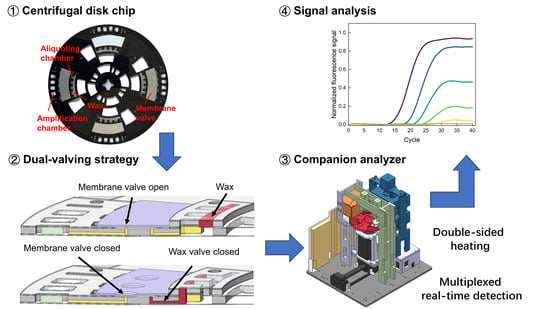
Different from isothermal amplification, for polymerase chain reaction (PCR), highly reliable valving for PCR chamber, significantly shortened thermal cycling time, and concise multiplexed detection are always challenges for microfluidic-based devices. Here, we present a real-time, centrifugal, plastic microfluidic chip for multiplexed PCR detection specifically based on the mechanism of cooperating valving. To achieve consistent amplification, a concise dual-valving strategy was developed. Instantly melted wax is centrifuged and completely filled into the narrow channel and hole to act as the compact wax valve. Meanwhile, an elastic and sticky membrane is depressed to seal the hole to act as the membrane valve. The wax valve is protected by the membrane valve from being damaged by both mechanical deformation and thermal corroding caused by the hot vapor with high pressure from the PCR chamber. A double-sided heating strategy is adopted to reduce the thermal cycling time; meanwhile, a balanced mechanism is used to achieve real-time amplification by rotating the centrifugal chip between the heating and detection positions in turn. As a proof-of-concept, the performance of the centrifugal chip with four parallel units is demonstrated by successfully detecting purified DNA templates or the extracted DNA templates from cells as well within 20 min.

Graphical Abstract

1. Introduction

PCR plays a critical role in life science due to its high sensitivity and specificity in nucleic acid detection. As a gold standard, PCR is able to successfully detect various targets for efficient diagnosis of infectious diseases, which has been significantly proven in the COVID-19 pandemic [1,2]. In addition to clinical detection in centralized labs, PCR is also utilized for detection and monitoring of pathogens in different environments, for example, from wastewater [3]. Motivated by multiple application areas, PCR has been constantly improving in order to shorten turn-around time, extend multiplexed parallel detection, promote higher automation and integration, and even reduce the detection cost [4,5].
With the assistance of microfluidics, the nucleic acid test is able to move from centralized labs to different environments, for example, resource-poor settings in point-of-care testing (POCT). The microfluidics-based nucleic acid test is able to automate the entire process to achieve ‘sample-in, answer-out’ bioanalysis [6,7,8]. Different integrated microfluidic PCR chips have been successfully developed [9]. To shorten the thermal cycling time without sacrifice of the reactor size, different heating strategies have been studied, for example, high-power heating, double-sided heating, and even convection PCR, among others [10,11,12]. On the other hand, with microfluidic chip, for a test sample, multiple targets can be simultaneously detected in parallel in a single test, which, in principle, could identify the potential disease-related target more efficiently than multiple separate tests [13,14]. Microfluidics-based multiplexed detection benefits from both scalable parallel reaction chambers and multiple selectable fluorescence channels to establish a high cost-effective diagnosis platform [15,16].
As one of the major directions of microfluidics, the unique feature of centrifugal microfluidic chip (Lab-on-a-Disc) is the centralized fluid pumping mechanism, which is provided by a servo motor, which significantly alleviates the burden of integrating micro-pumps into chips [17,18]. Different centrifugal microfluidic chips with multiple reaction chambers have been developed for multiplexed PCR detection, in which complicated fluid driving can be properly achieved with primarily centrifugal, Coriolis, or Euler force [19,20]. In a non-centrifugal microfluidic platform, for reagent mixing methods, mechanical actuation can be adopted to perform active reagent mixing based on motor shaking with high frequency [21]. Meanwhile, channel geometry-modulation can be adopted to perform passive reagent mixing by filling multiple reagents into the mixing channel simultaneously [22]. Similarly, passive mixing can also be achieved when different reagents enter into a hybrid structure with an upstream narrow channel, a large-size chamber and a downstream narrow channel due to the significant size modulation [23]. However, these methods typically require additional equipment or have low mixing efficiency. In centrifugal microfluidic chips, the Euler force generated by rapid switching of rotation speed can achieve highly efficient reagent mixing without any additional equipment. On the other hand, valving technology remains a critical bottleneck for centrifugal PCR platform [24]. In principle, for PCR chamber, the required performance of the sealing valve is significantly higher than other normal one due to its special environment with high pressure and high temperature. Typically, mechanically actuated valves are integrated to seal the PCR chamber with the help of a complicated and bulky companion module [25]. Phase-change material (PCM) valves, for example, paraffin wax-based valve, represent a promising solution due to their cost-effectiveness and compatibility with centrifugal actuation [26]. It is found that the dual-valve strategy is seldom reported in published papers which focus more on a single valving strategy. However, especially for PCR, considering the potential risk of valve leakage due to the conditions of high temperature and pressure, one valve strategy may require quite high performance tolerance to ensure consistent detection. However, single PCM valves often struggle to withstand the high temperature and intense vapor pressure generated during PCR thermal cycling, leading to vapor leakage or valve failure. Therefore, a dual-valve strategy is adopted to ensure the sealing consistence of PCR with two cooperative valves. Compared to most of the existing single-valve strategies, this innovative dual-valve strategy is helpful to push forward the reliability of PCR valving in the field of centrifugal microfluidic PCR. It should be noted that, for centrifugal microfluidic chip, the complexity and cost are more decided by the implementation of the integrated valve, and moreover, the successful commercialization with quite low operation failure rate is also more dependent on the valve’s reliability and consistence. For existing centrifugal microfluidic chips, normally single-sided heating is adopted, which is not helpful to achieve reasonably high ramping rate especially with a relatively large PCR chamber [27].
To address the limitations of centrifugal microfluidic PCR, this study proposes a novel centrifugal microfluidic chip for multiplexed PCR detection especially based on the mechanism of cooperating valving. A concise dual-valving strategy was systematically studied to enable two types of valves to work together to significantly improve the entire valving reliability and consistence, which is critical to ensure successful and repeatable PCR amplification with quite low failure rate. A wax-based compact one-time valve is constructed by centrifuging the instantly melted wax into the narrow channel and hole. Meanwhile, membrane-based one-time valve is actuated by depressing the elastic and sticky membrane to seal the connection hole tightly. With the dual-valving strategy, the wax valve can be protected by the membrane valve from being damaged by both mechanical deformation and thermal corroding caused by the hot vapor with high pressure from the PCR chamber. To reduce the thermal cycling time, a double-sided heating strategy is adopted to heat the reaction chamber from both top and bottom sides. Meanwhile, to solve the natural conflict between static PCR heating and chip rotation on the centrifugal platform, a balanced mechanism is developed by switching the chip between the heating and detection positions in turn, respectively, for thermal cycling with two releasable heaters and real-time fluorescence collection with a top optical module. Different experiments have been performed on the developed centrifugal microfluidic platform for systematical evaluation, and satisfactory performance has been achieved as a proof-of-concept.

2. Materials and Methods

2.1. Microfluidic Chip

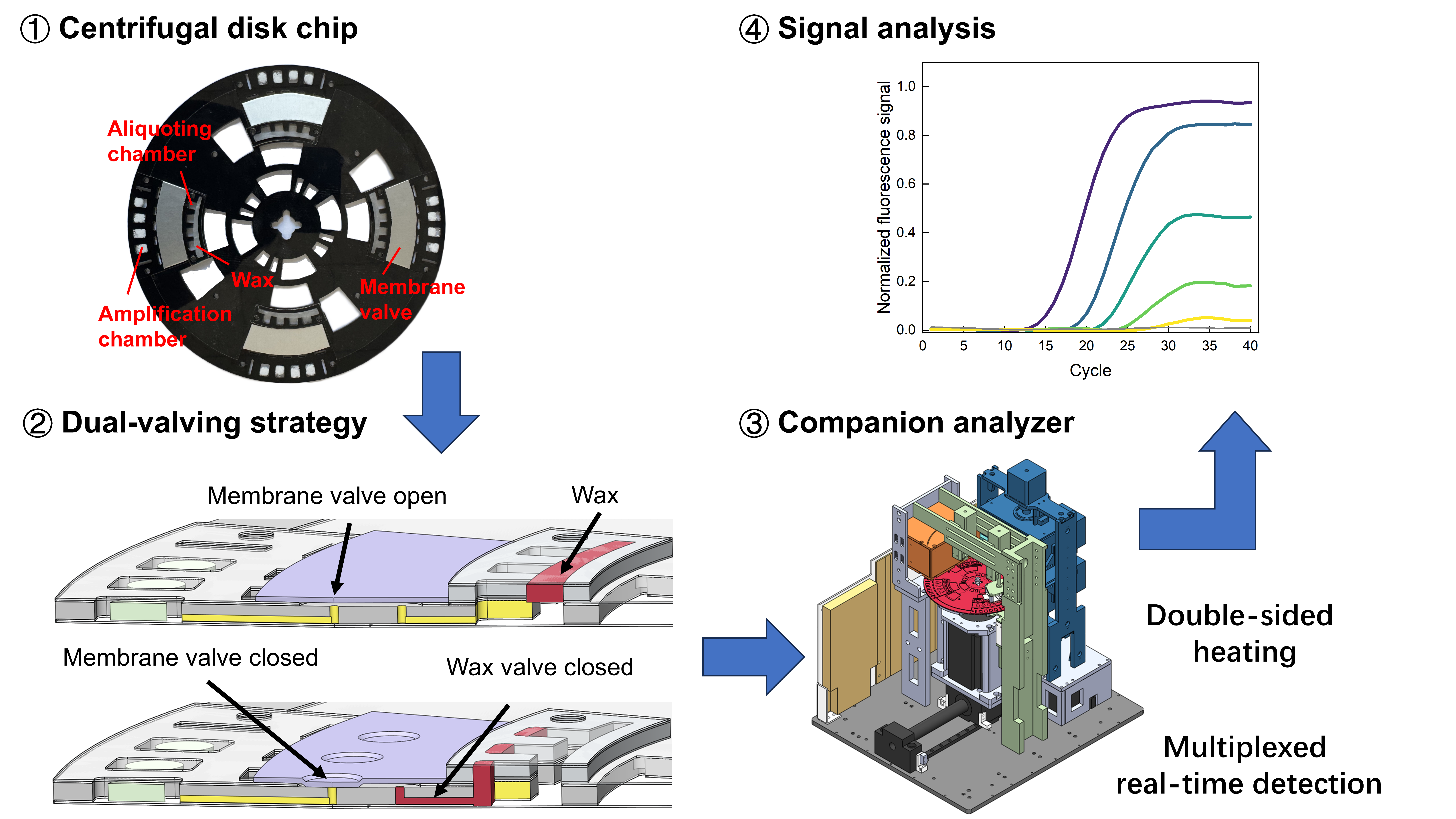
The centrifugal microfluidic chip with a diameter of 130 mm consists of multiple structural layers (Figure 1A–D). As shown in Figure 1A,B, on a single disk, in total, four identical units have been fabricated, and in each unit, in total, four independent PCR chambers have been included. As shown in Figure 1C, the middle functional layer is fabricated from a 1 mm thick black polycarbonate (PC) sheet using CNC machining. The black PC material was specifically chosen not only for its high thermal stability required for PCR [28] but also for its optical isolation which is critical to avoid fluorescence signal crosstalk between each set of two adjacent amplification chambers. The majority of the middle functional layer is sealed by two 0.1 mm transparent PC layers, respectively, from the bottom and top sides with double-sided adhesive tape (300LSE, 3M Company, Saint Paul, MN, USA) [29]. In contrast, in the rest area holding amplification chambers, the middle functional layer is sealed by another two 0.1 mm transparent PC layers, respectively, from the bottom and top sides with double-sided acrylate tape to significantly improve the bonding strength to withstand PCR thermal cycling [30]. To avoid both chemical inhibition and optical interference, the acrylate tape on both the top and bottom windows of the reaction chamber has been intentionally removed.
As shown in Figure 1D, close to the centrifugation center, there are three reagent loading chambers to pre-store different reagents, which are connected to the downstream mixing chamber. Below the mixing chamber, next is the amplification unit which includes aliquoting chambers, valves, PCR chambers and connection channels. Lyophilized PCR beads are pre-stored inside the PCR chambers. A siphoning channel is incorporated to build the connection between the mixing chamber and aliquoting chambers. Meanwhile, there is a waste chamber connected to the aliquoting chambers to hold the excessive reagent. To ensure ultra-safety sealing of the PCR chamber during thermal cycling, a dual-valving strategy is adopted by incorporating two types of valves into the amplification unit. As shown in Figure 1D, on the top of each aliquoting chamber, solid wax with a melting point of 68 °C is pre-stored, and it can be instantly melted by an outside heater and at the same time driven into the downstream channel and hole with centrifugation, which could act as the wax valve. As shown in Figure 1D, at the area between the aliquoting chambers and the amplification chambers, an elastic and sticky membrane is incorporated to pre-cover two holes (0.5 mm diameter) encircled by a pear-shaped profile from the top, and it can be depressed from the top to seal the two holes tightly, which could act as the membrane valve. Specifically, the architectural parameters of the chip are defined by valve connection channels measuring 0.3 mm in width and 0.4 mm in depth, complemented by a membrane valve depth of 0.1 mm and a paraffin wax thickness of 1 mm. Each PCR chamber maintains a working volume of 20 µL. Furthermore, the three reagent loading chambers are dimensioned at 30 µL (#1), 20 µL (#2), and 130 µL (#3), respectively, while the downstream mixing chamber is configured with a total capacity of 170 µL. The elastic and sticky membrane is fabricated by coating a layer of acrylate adhesive onto a thin cold-formed aluminum substrate with a thickness of 0.24 mm.
The detailed procedure for valving control is depicted in Figure 1E. Initially, both wax and membrane valves are in the open state before the template reagent is centrifuged into the reaction chambers. After that, at the heating position, the membrane valve is closed by mechanical deformation generated by the spring-loaded pillar which is driven by the top heater. Next, the pre-stored wax is melted by an outside heater and simultaneously centrifuged into the connection channel and hole for compact valve sealing. The membrane valve is located between the PCR chamber and the wax valve as it is estimated that both mechanical deformation and thermal corroding caused by the hot vapor with high pressure from the PCR chamber will be significantly alleviated by the membrane valve. Otherwise, the consistent adhesion of wax on the thin PC cover layer can be deteriorated by unexpected mechanical deformation caused by pressurized hot vapor. Meanwhile, the compact wax inside the hole and channel can even be melted by the hot vapor from the PCR chamber. Therefore, to significantly improve the valving reliability and consistence, instead of using just a single wax valve, a dual-valving strategy is adopted by combining wax and membrane valves together.

2.2. Fluidic Control Protocol

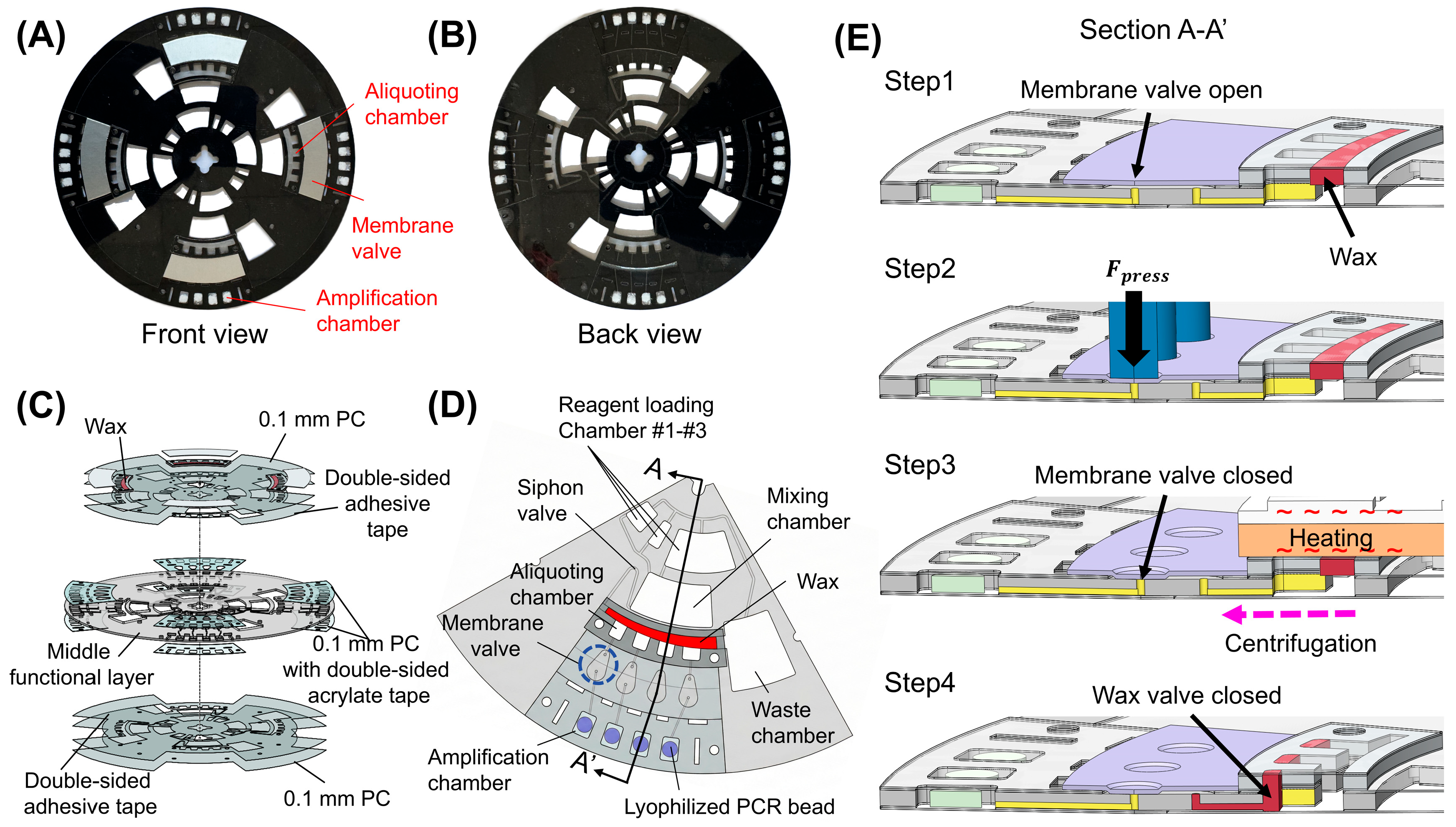
The fluidic manipulation on the disk is fully automated according to a pre-programmed rotational speed profile, as illustrated in Figure 2A.
Figure 2B shows the legends for different reagents, materials and valve states. The procedure involves a sequence of centrifugal actuation steps synchronized with specific valve operations to ensure precise and smooth fluid distribution. The detailed protocol proceeds as follows (Figure 2C (#1–#8)): reagent loading (#1): templates, BSA buffer, and elution buffer are loaded into three separate chambers, respectively; mixing (#2): the disk performs oscillatory rotation (shaking-mode) to thoroughly mix different reagents inside the mixing chamber; siphoning priming (#3): the rotation is paused to allow the mixed reagent to spontaneously fill the hydrophilic siphoning channel via capillary action; transfer (#4): the rotational speed is increased, transferring the reagent through the siphoning valve from the mixing chamber to the aliquoting chambers; metering (#5): with continuous centrifugation, reagent metering is achieved within the aliquoting chambers while excessive reagent overflows into the waste chamber [31]; rehydration (#6): the rotational speed is further increased to overcome the hydrophobic barrier of the passive stop valve to drive each metered aliquot into a separate amplification chamber and rehydrate the pre-stored lyophilized PCR bead; membrane valve closure (#7): the rotation is stopped and the spring-loaded pillar is moved down by the top heater to depress the membrane valve; wax valve closure (#8): finally, the melted wax is centrifuged and seals the channel and hole. At this stage, the fluid operation on disk is completed, and the fully sealed chip is ready for thermal cycling.

2.3. Companion Instrument and Operation Principle

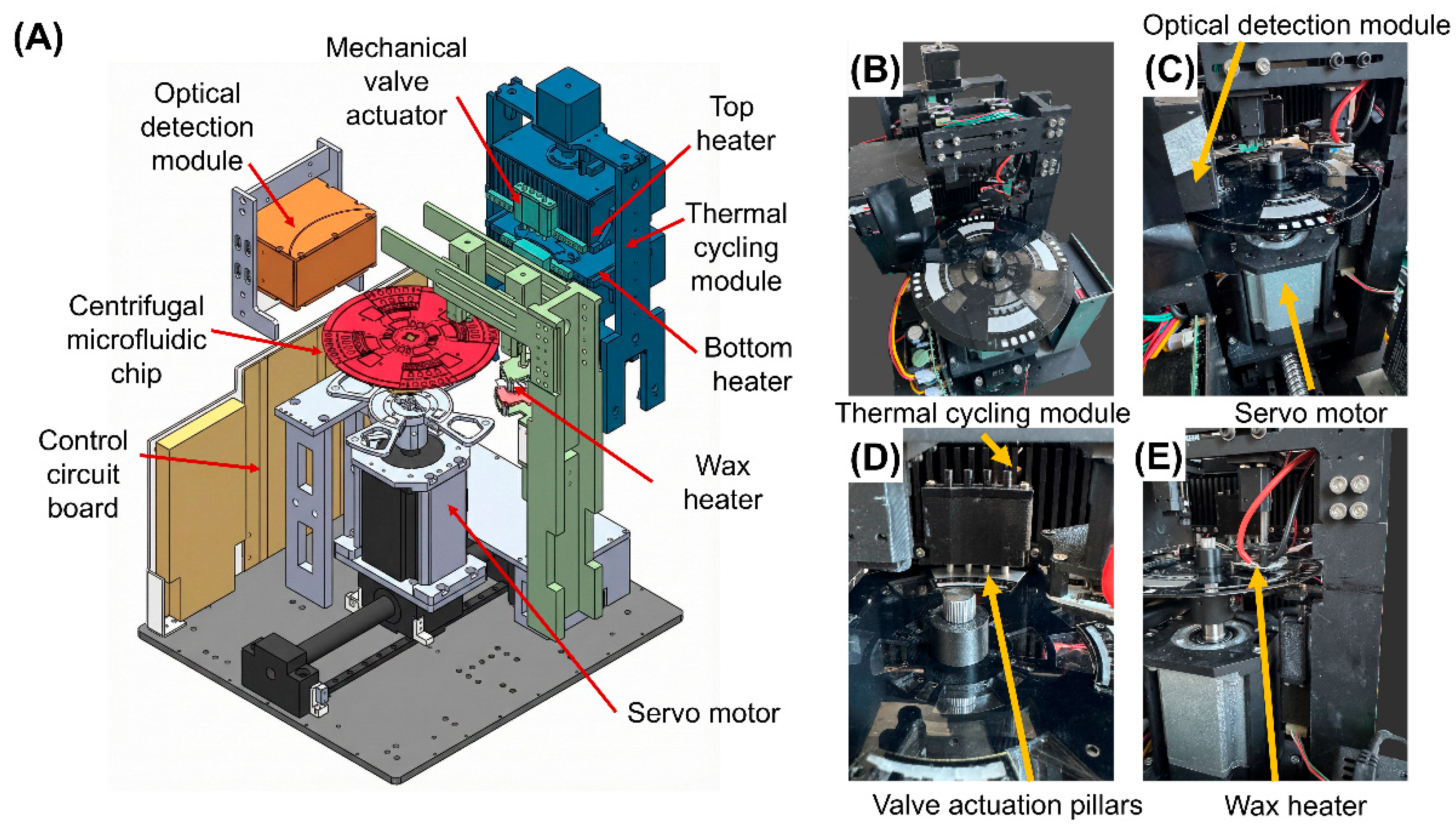
As shown in Figure 3, a custom companion analyzer (300 mm × 270 mm × 330 mm) was developed to perform multiplexed PCR detection on the centrifugal microfluidic chip. As shown in Figure 3A, a double-sided heating strategy is adopted to reduce the thermal cycling time by heating the chip from both the top and bottom sides simultaneously. It can be noted that with the double-sided heating, the optical detection window of the chip is blocked by two heaters. Therefore, to accommodate both heating and fluorescence detection and, meanwhile, to solve the natural conflict between static PCR heating and chip rotation on the centrifugal platform, a balanced mechanism is developed. Both the thermal cycling and optical detection modules are located at two different positions, respectively, and the chip is transferred between two different positions for different tasks with the bottom servo motor. Since the chip needs to be transferred to the fluorescence-detection position at the end of each annealing/extension step, two releasable heaters have been developed by mounting two thermoelectric (TE) modules with their own heat dissipators and fans on two linear moving stages, respectively. When the chip is transferred to the heating position, the two linear moving stages will drive down their own TE modules to tightly clamp the chip, respectively, from both the top and bottom sides for good thermal conduction. And at the end of each annealing/extension step, two TE modules will be released from the chip by their linear moving stages to allow the chip to be transferred to the detection position. Therefore, through periodic switching between two different positions, real-time PCR amplification can be successfully performed. Moreover, the flexible actuation mechanism based on two releasable heaters provides a reasonable solution to properly accommodate centrifugation-based fluid control, temperature control and fluorescence detection inside the instrument.
As shown in Figure 3A,C, an independent optical detection module is incorporated to collect the fluorescence signal from the top of the centrifugation chip. As shown in Figure 3A,D, to reduce the system’s mechanical complexity, multiple spring-loaded pillars mounted on the top linear moving stage at the front of the TE module are used to depress the membrane to close the membrane valve when the top TE module is moved down until it touches the chip surface. As shown in Figure 3A,E, a wax heater mounted on a linear moving stage can be moved down to heat the chip’s top surface and melt the pre-stored wax before it is centrifuged to seal the channel and hole.

3. Results and Discussion

3.1. Evaluation of Valve Performance

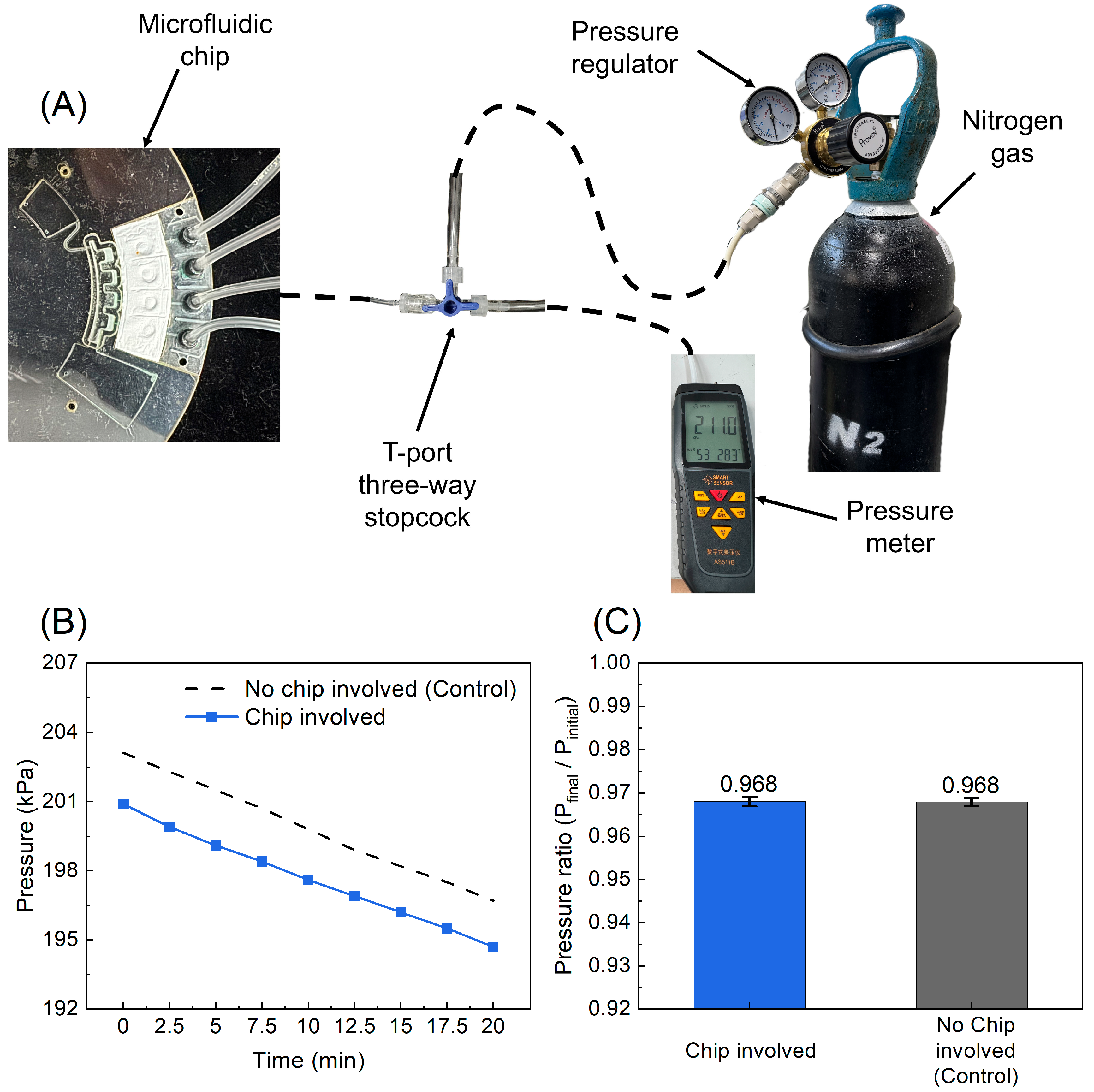
As shown in Figure 4A, an experimental setup is built to evaluate the physical sealing performance of the dual-valving strategy. Nitrogen gas with a regulated stable pressure (up to 200 kPa) is introduced into the microfluidic chip through a T-port three-way stopcock until it is stopped by both closed membrane and wax valves. It is well known that the typical pressure inside a PCR chamber is around 6.8 psi, which is equivalent to approximately 46.9 kPa [32].
As shown in Figure 4B, for two different cases (with and without microfluidic chip connected to the T-port three-way stopcock), although their initial pressure values of nitrogen gas are slightly different from each other, the fluctuation of gas pressure over 20 min due to the entire sealing performance, e.g., leakage occurring at the common connection between two different parts, is quite similar to each other. Furthermore, as shown in Figure 4C, for two different cases, their ratios of gas pressure between the ending and starting points over 20 min are the same (0.968), which confirms that there is no detectable leakage through both valves on the microfluidic chip. Furthermore, the sealing performance of the single wax valve had been evaluated on the same setup. It was found that over 20 min, with just a wax valve, around 60% of the initial pressure of nitrogen gas was lost due to the leakage, which could be caused by the damage to the integrity of wax adhesion on the thin PC cover layer due to the high-pressure nitrogen gas.
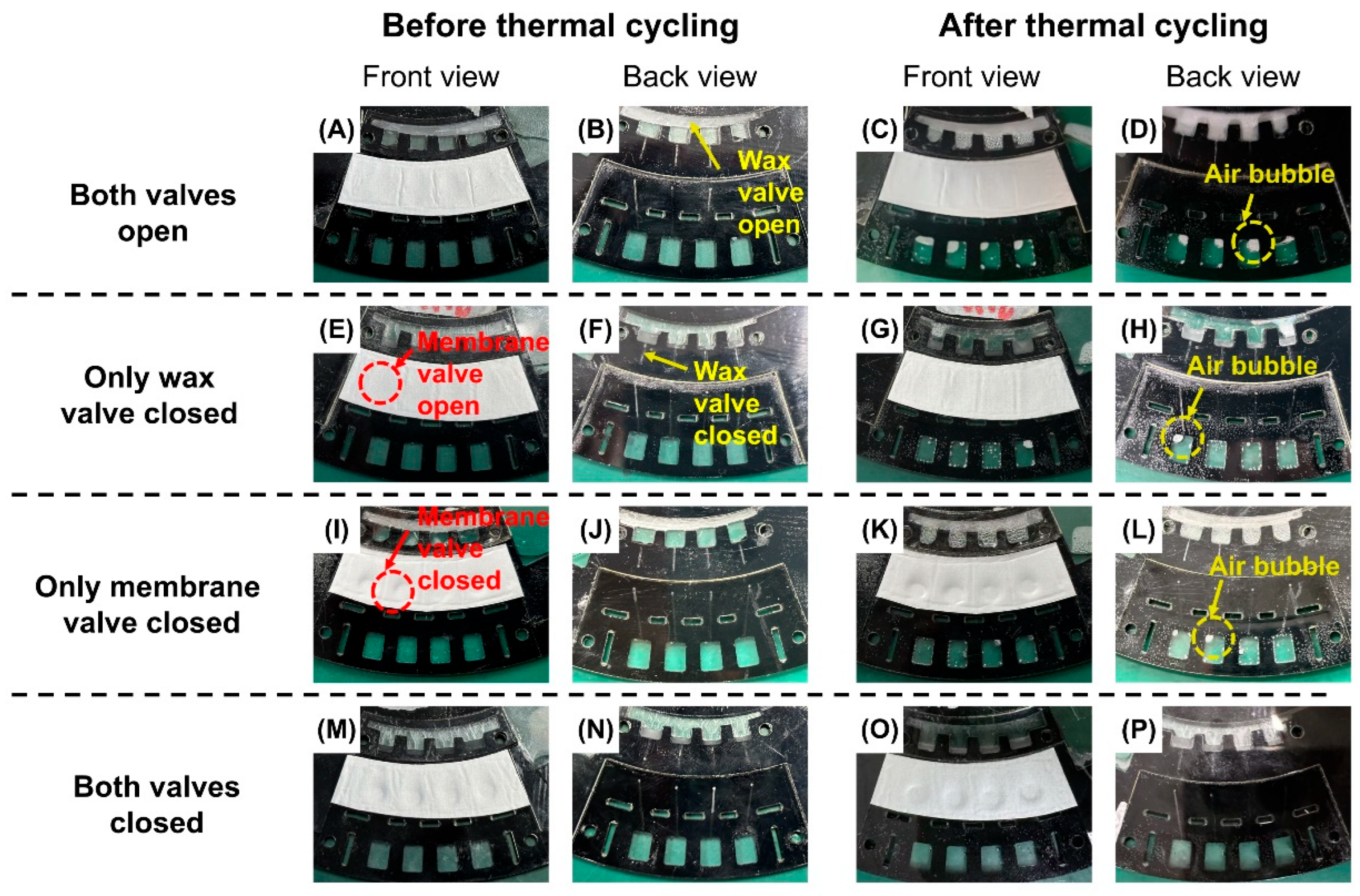
As shown in Figure 5, the performance of the dual-valving strategy is systematically evaluated by comparing different cases with or without membrane or wax valve closed on chips. Water was centrifuged into multiple reaction chambers before valves were closed, and then typical 40-cycle thermal cycling was implemented on the chip. It was found that, different from the case without any closed valve, when both the membrane and wax valves were closed, there were no significant air bubbles or liquid loss inside the reaction chamber although tiny air bubbles could be generated during thermal cycling due to other reasons [33,34]. In contrast, with either the wax or membrane valve closed, there were significant trapped air bubbles or liquid loss inside the reaction chamber.
In principle, the wax valve can be protected by the membrane valve from being damaged by both mechanical deformation and thermal corroding caused by the hot vapor with high pressure from the PCR chamber, which is quite critical to keep the desired integrity of wax adhesion on the thin PC cover layer during thermal cycling. Therefore, instead of using single wax valve, the dual-valving strategy with both membrane and wax valves was adopted to ensure the high reliability of the PCR chamber.

3.2. Thermal Cycling Characterization

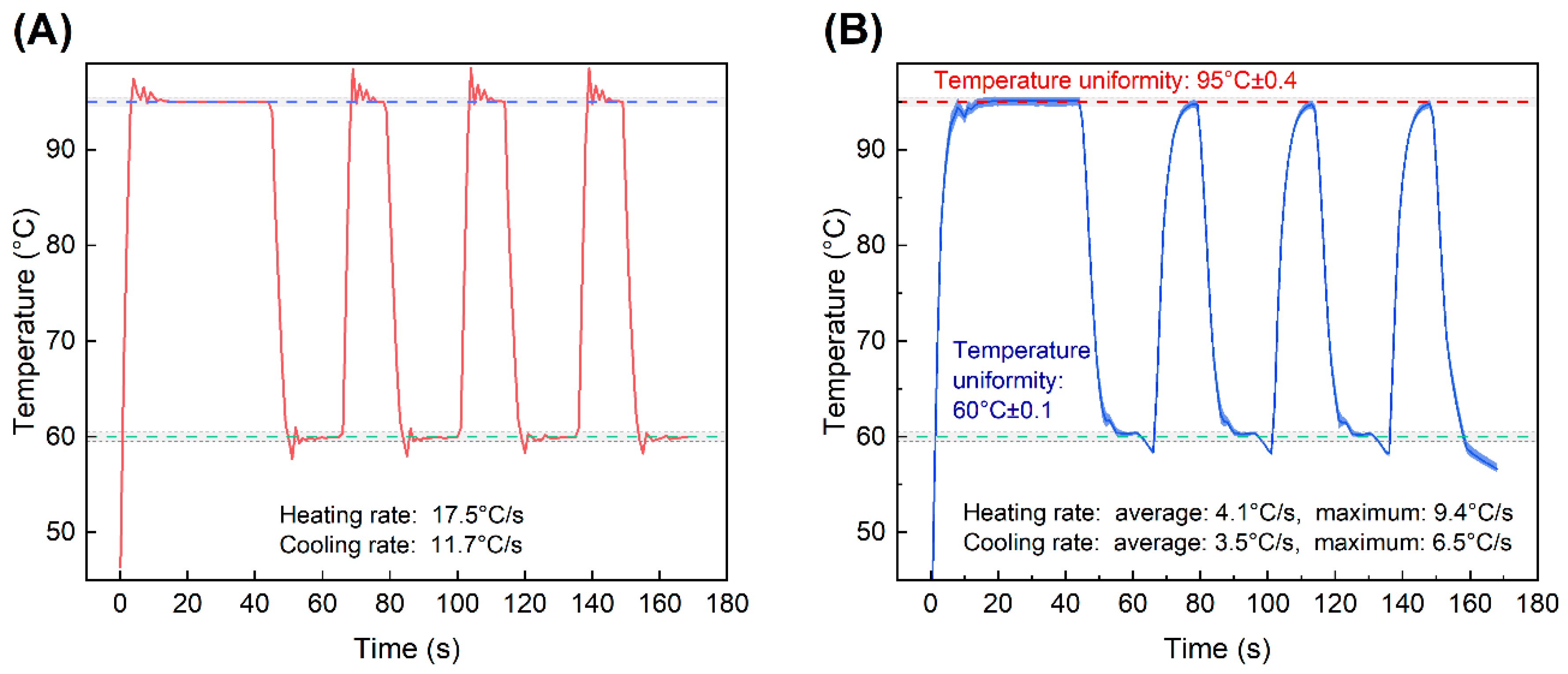
As shown in Figure 6, the system’s temperature control performance with double-sided heating is systematically evaluated. A temperature calibration chip was fabricated by inserting high-precision NTC thermistors into reaction chambers to monitor the in situ temperature. An optimized PID controller was adopted to achieve both intentional overshooting for heating and intentional undershooting for cooling, respectively. Figure 6A depicts the typical thermal cycling profiles with the temperature reading from a sensor inside one of heaters as an example. It was found that for heating and cooling, the ramping rates with overshooting and undershooting were 17.5 °C/s and 11.7 °C/s, respectively. Figure 6B depicts the typical thermal cycling profiles with the average temperature reading from four NTC thermistors inside the calibration chip. It was found that for heating, the maximum and average ramping rates reached 9.4 °C/s and 4.1 °C/s, respectively, and for cooling, they were 6.5 °C/s and 3.5 °C/s, respectively.
As shown in Figure 6A,B, the ramping rates of the heater are significantly higher than that of the calibration chip. The steady state temperature control errors inside the reaction chamber were around ±0.1 °C. Meanwhile, the temperature uniformity of the chip was confirmed with a maximum ±0.4 °C temperature difference among four reaction chambers. It should be noted that at the end of each annealing/extension step, the chamber temperature would slightly drop down, which was caused due to the chip being transferred to the detection position for fluorescence collection while detaching from the heaters temporarily. With double-sided heating, it took around 20 min to complete the 40-cycle thermal cycling (pre-denaturation step at 95 °C for 30 s, 95 °C for 1 s and 60 °C for 10 s) on the microfluidic chip with reaction chambers covered by 0.1 mm thin PC sheet, which is quite helpful to save the total nucleic acid test time at POC testing.

3.3. On-Chip PCR Amplification and Detection

The developed centrifugal microfluidic chip aims to run parallel detection to multiple targets based on real-time PCR amplification. Its major functions include PCR reagent mixing and aliquoting, valve-based sealing of PCR chamber, independent PCR and optical detection in separate chambers. Therefore, this developed platform is mainly optimized for purified nucleic acid templates, instead of directly processing original crude samples. By using purified templates, we are able to evaluate the performance of the PCR reactor itself, without the influence of potential PCR inhibitors and other issues related to sample preparation. To verify the performance of the centrifugal microfluidic PCR system, systematic experiments were conducted on purified DNA templates and DNA templates extracted from cells. The reaction system was designed for a final volume of 20 µL per chamber, consisting of 1 µL of target DNA, 0.5 µL of BSA (5%) for dynamic surface passivation [35,36], and 18.5 µL of Elution buffer. For four parallel reaction chambers, 6 µL of target DNA, 3 µL of BSA (5%), 111 µL of Elution buffer, and a total of 120 µL reagent were loaded into three reagent loading chambers, respectively, considering potential reagent loss due to dead volume. After fluid control based on centrifugation, one aliquot of the pre-mixed reagent would rehydrate the pre-stored lyophilized PCR bead in each PCR chamber. To ensure highly specific amplification, TaqMan probes with different fluorescence channels (FAM, VIC, ROX, and Cy5) were used. Following the reagent provider’s recommendations, the thermal cycling program starts with a 95 °C initial denaturation for 30 s, followed by 40 cycles (denaturation: 95 °C, 1 s; annealing/extension: 60 °C, 10 s). During thermal cycling, the reaction was monitored in real time with the optical module, and the fluorescence intensity was recorded during the annealing/extension step of each cycle.
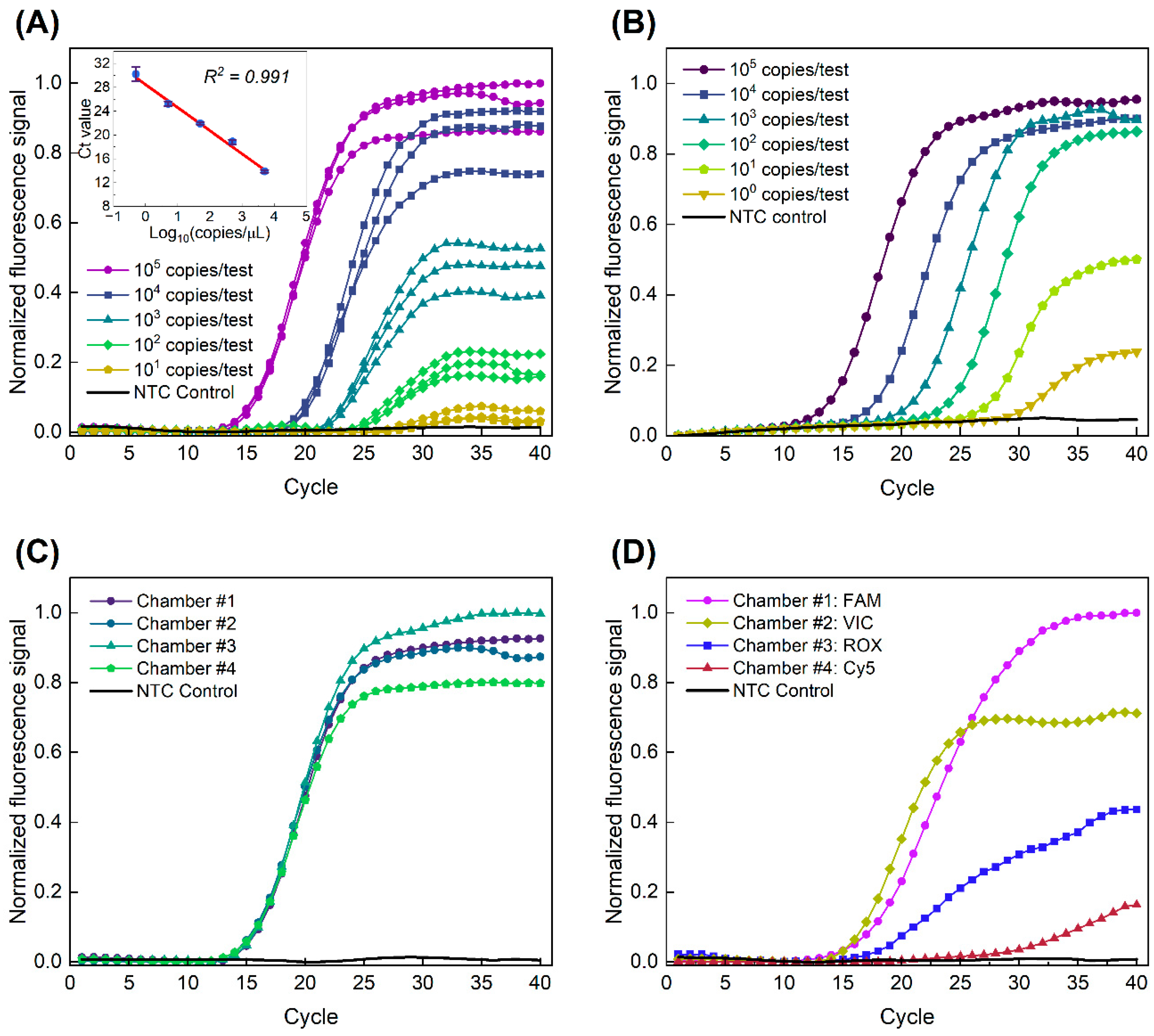
Figure 7A,B, depicts the fluorescence intensity of the signal (during the annealing/extension step) for different concentrations of purified DNA with the human β-globin (HBB) gene as the target gene and for the no-template control as a function of the cycle number on both chip and benchtop, respectively. As an example of different fluorescence channels, VIC channel was chosen in the experiments. A detection limit of 101 copies/test was achieved on chip through serial dilution tests ranging from 105 to 101 copies/test, and in contrast, a detection limit of 100 copies/test was achieved on benchtop. Each test with one sample concentration on chip was repeated at least three times. The standard curve of mean Ct with purified DNA concentrations is provided in the inset of Figure 7A. The high linearity (R2 = 0.991) of the standard curve (the inset in Figure 7A) confirms the preliminary quantification performance of the centrifugal microfluidic system. It can be noted that the detection limit of chip test is slightly lower than that of benchtop test at the early development stage partly due to the potential inhibition from different materials, for example, nonspecific binding within the reaction chamber.
Figure 7C, depicts the fluorescence intensity of the signal for a high concentration of purified DNA and for the no-template control as a function of the cycle number from four parallel reaction chambers, respectively. It was confirmed that comparable amplification efficiency can be achieved among four separate reaction chambers. Figure 7D depicts the four-channel fluorescence intensity of the signal for four different types of purified DNA templates with a high concentration and for the no-template control as a function of the cycle number from four parallel reaction chambers, respectively. In Figure 7D, a total of four different genes are successfully detected in four parallel reaction chambers with four different fluorescence channels, respectively. Purified DNA with the CAALFM_CR01090WA gene from Candida albicans as the target gene was detected with FAM channel in chamber #1. Purified DNA with the human β-globin (HBB) gene as the target gene was detected with VIC channel in chamber #2. Purified DNA with the TVAGG3_0033890 gene from Trichomonas vaginalis as the target gene was detected with ROX channel in chamber #3. Purified DNA with the elongation factor Tu gene from Gardnerella vaginalis as the target gene was detected with Cy5 channel in chamber #4. Based on the successful amplification of four different genes, as a proof-of-concept, the capability of multiplexed detection on the developed centrifugal microfluidic chip has been demonstrated.
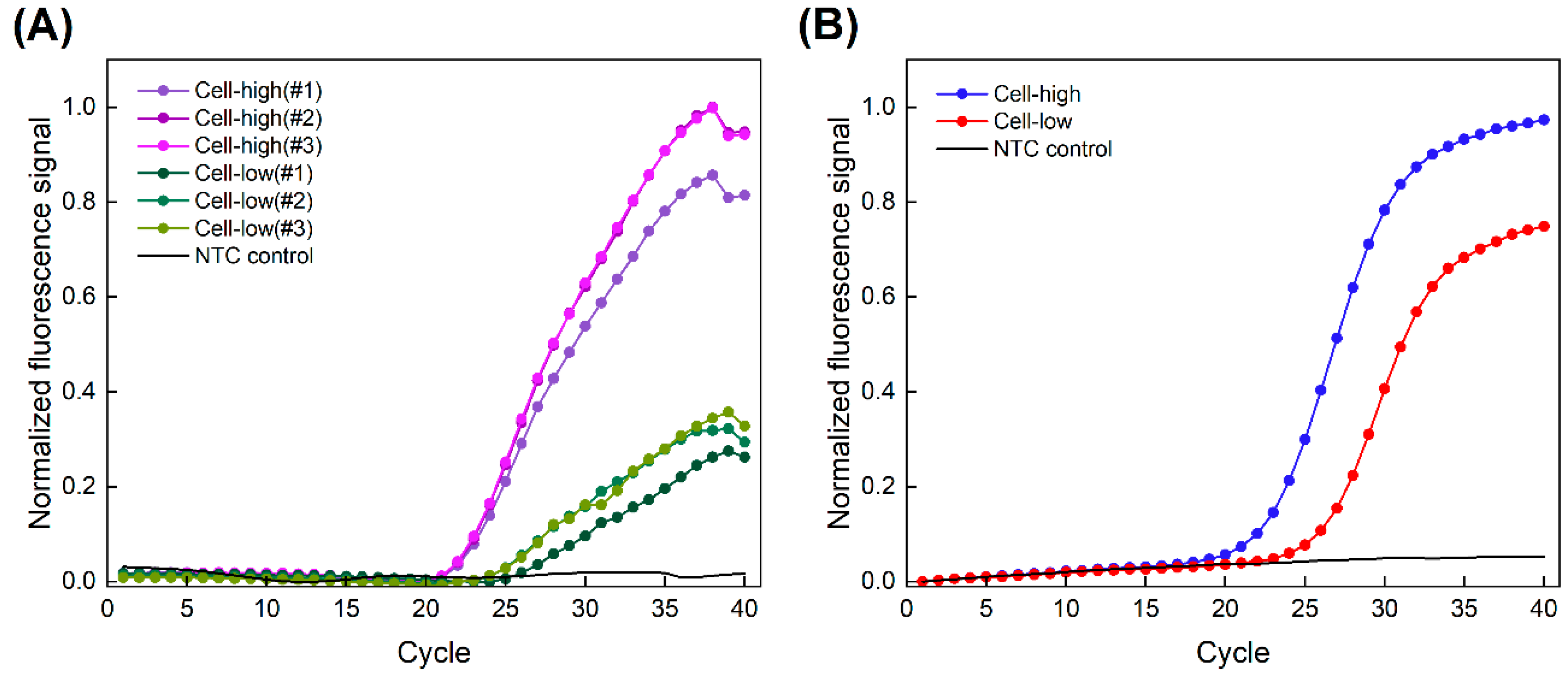
Furthermore, the utility of the centrifugal microfluidic PCR system was demonstrated by amplifying genomic DNA manually extracted from human cell lines. This test would partly confirm the feasibility of the integration of the centrifugal microfluidic PCR chip with components for sample concentration lysis and nucleic acid isolation in an autonomous, sample-to-report system in the future [4]. Figure 8A,B, depicts the fluorescence intensity of the signal (during the annealing/extension step) of VIC channel for extracted DNA template from human cells with the human β-globin (HBB) gene as the target gene and for the no-template control as a function of the cycle number on both chip and benchtop, respectively. Each test with one sample concentration on chip was repeated at least three times. As shown in Figure 8A, for both high and low concentration cell samples, the extracted DNA templates are all successfully detected, although their amplification efficiency is not as good as that of the benchtop test in Figure 8B.
It has been demonstrated that for both purified and extracted DNA templates, the centrifugal microfluidic chip achieves comparable performance to the benchtop test, although its amplification efficiency should be further optimized. In principle, the performance of the centrifugal microfluidic chip can be further improved by controlling its manufacturing quality with injection molding, reducing nonspecific bonding, optimizing reagents, and adopting fully PCR-compatible material in chip fabrication, which can upgrade its amplification efficiency to the benchtop level.

4. Conclusions and Outlook

In this study, we successfully developed a real-time centrifugal microfluidic chip by taking advantage of a novel dual-valving strategy to significantly improve the reliability of PCR reactor with reduced complexity. Based on the proper cooperation between the wax and the membrane valves, the PCR chamber can be sealed completely with remarkable consistence. With physical tests, it has been demonstrated that up to 200 kPa leakage pressure can be safely withstood by the dual-valving strategy. On the other hand, both valves can be conveniently implemented on the centrifugal platform, which significantly reduces the system complexity. For the wax valve, after the pre-stored solid wax is melted, it can be driven and filled into the narrow channel and hole just by chip configuration. For the membrane valve, after the membrane is depressed by a spring-loaded pillar, it will seal the hole with both mechanical force and single-sided sticky tape. Compared with single valve, the dual-valving strategy can achieve consistent PCR amplification with desirable reliability.
To reduce the thermal cycling time, a double-sided heating strategy was adopted by heating the PCR chamber from both top and bottom sides respectively with two thermoelectric modules. Meanwhile, the temperature uniformity across multiple PCR chambers can be significantly improved by the double-sided heating strategy as well. To solve the natural conflict between static PCR heating and chip rotation on the centrifugal platform, a balanced mechanism was adopted to achieve real-time amplification by transferring the centrifugal chip between the heating and detection positions in turn. In each cycle, at the heating position, the PCR chamber is clamped by two releasable heaters for rapid thermal cycling, and at the end of each annealing/extension step, the chip is transferred by the servo motor to the detection position for fluorescence detection.
Another advantage of the centrifugal microfluidic platform is the capability to perform multiplexed detection with multiple parallel reaction chambers. Here, an integrated centrifugal chip with multiple functions, including lyophilized bead pre-storage, liquid reagent loading, mixing, metering, siphoning, and automatic filling, was developed with four parallel PCR chambers. In principle, in total, up to sixteen different targets (e.g., each chamber with four different fluorescence channels) can be simultaneously detected on this centrifugal chip with four parallel amplification chambers.
Based on the experimental results, the performance of the centrifugal chip with four parallel units was demonstrated by successfully detecting the purified DNA templates and the extracted DNA templates from cells as well. Compared with the one-hour benchtop test on a convention PCR instrument, the PCR detection can be significantly shortened to around 20 min on the centrifugal chip with the benefit from the double-sided heating. Currently, the LOD of the centrifugal chip is not as low as the benchtop test due to the inhibition effect inside the PCR chamber which can be further optimized in the next step. In principle, the centrifugal chip can be integrated with the function of sample processing, for example, nucleic acid extraction to establish a fully integrated, ‘sample-in, answer-out’, multiplexed molecular diagnostic platform in the future at POC testing.

Author Contributions

Y.Z. (Yize Zhang): Chip design, Mechanical design and fabrication, Data analysis, Experimentation, Writing—original draft and editing. Y.Z. (Youhong Zeng): System electrical design, System firmware design. L.L.: System firmware design, Experimentation. L.W.: Experimental design, Investigation. H.C.: Experimental design, Investigation. Y.Y.: System interface software design. Y.D.: Experimentation. G.M.: Investigation. L.Z.: Investigation. X.Q.: Conceptualization and Methodology of the whole system, Project management, Manuscript review and editing. All authors have read and agreed to the published version of the manuscript.

Funding

The work was supported partly by National Key Research and Development Program of China (No. 2024YFC2419100, subproject No. 2024YFC2419104), and the National Natural Science Foundation of China (No. 81871505, 61971026).

Institutional Review Board Statement

Not applicable.

Informed Consent Statement

Not applicable.

Data Availability Statement

The original contributions presented in this study are included in the article. Further inquiries can be directed to the corresponding author.

Conflicts of Interest

The authors declare that they have no conflicts of interest.

References

  1. Ji, M.; Xia, Y.; Loo, J.; Li, L.; Ho, H.P.; He, J.; Gu, D. Automated multiplex nucleic acid tests for rapid detection of SARS-CoV-2, influenza A and B infection with direct reverse-transcription quantitative PCR (dirRT-qPCR) assay in a centrifugal microfluidic platform. RSC Adv. 2020, 10, 34088–34098. [Google Scholar] [CrossRef]
  2. Madadelahi, M.; Agarwal, R.; Martinez-Chapa, S.O.; Madou, M.J. A roadmap to high-speed polymerase chain reaction (PCR): COVID-19 as a technology accelerator. Biosens. Bioelectron. 2024, 246, 115830. [Google Scholar] [CrossRef]
  3. Katayama, Y.A.; Hayase, S.; Ando, Y.; Kuroita, T.; Okada, K.; Iwamoto, R.; Masago, Y. COPMAN: A novel high-throughput and highly sensitive method to detect viral nucleic acids including SARS-CoV-2 RNA in wastewater. Sci. Total Environ. 2023, 856, 158966. [Google Scholar] [CrossRef] [PubMed]
  4. Rombach, M.; Hin, S.; Specht, M.; Johannsen, B.; Lüddecke, J.; Paust, N.; Mitsakakis, K. RespiDisk: A point-of-care platform for fully automated detection of respiratory tract infection pathogens in clinical samples. Analyst 2020, 145, 7040–7047. [Google Scholar] [CrossRef] [PubMed]
  5. Kim, S.; Shrestha, K.; Cho, G. Towards practical point-of-care quick, ubiquitous, integrated, cost-efficient molecular diagnostic Kit (QUICK) PCR for future pandemic response. Microsyst. Nanoeng. 2025, 11, 204. [Google Scholar] [CrossRef]
  6. Roy, E.; Stewart, G.; Mounier, M.; Malic, L.; Peytavi, R.; Clime, L.; Veres, T. From cellular lysis to microarray detection, an integrated thermoplastic elastomer (TPE) point of care Lab on a Disc. Lab Chip 2015, 15, 406–416. [Google Scholar] [CrossRef] [PubMed]
  7. Geissler, M.; Brassard, D.; Clime, L.; Pilar, A.V.C.; Malic, L.; Daoud, J.; Veres, T. Centrifugal microfluidic lab-on-a-chip system with automated sample lysis, DNA amplification and microarray hybridization for identification of enterohemorrhagic Escherichia coli culture isolates. Analyst 2020, 145, 6831–6845. [Google Scholar] [CrossRef]
  8. Madadelahi, M.; Madou, M.J. Rational PCR reactor design in microfluidics. Micromachines 2023, 14, 1533. [Google Scholar] [CrossRef]
  9. Du, Z.; Lin, J.; Lin, B.; Yang, S. Research advances in centrifugal microfluidics and its applications. Microchem. J. 2025, 213, 113589. [Google Scholar] [CrossRef]
  10. Miao, G.; Jiang, X.; Yang, D.; Fu, Q.; Zhang, L.; Ge, S.; Ye, X.; Xia, N.; Qian, S.; Qiu, X. A Hand-Held, Real-Time, AI-Assisted Capillary Convection PCR System for Point-of-Care Diagnosis of African Swine Fever Virus. Sens. Actuators B Chem. 2022, 358, 131476. [Google Scholar] [CrossRef]
  11. Dong, X.; Liu, L.; Tu, Y.; Zhang, J.; Miao, G.; Zhang, L.; Ge, S.; Xia, N.; Yu, D.; Qiu, X. Rapid PCR Powered by Microfluidics: A Quick Review Under the Background of COVID-19 Pandemic. TrAC Trends Anal. Chem. 2021, 143, 116377. [Google Scholar] [CrossRef] [PubMed]
  12. Nouwairi, R.L.; Cunha, L.L.; Turiello, R.; Scott, O.; Hickey, J.; Thomson, S.; Landers, J.P. Ultra-rapid real-time microfluidic RT-PCR instrument for nucleic acid analysis. Lab Chip 2022, 22, 3424–3435. [Google Scholar] [CrossRef] [PubMed]
  13. Dong, X.; Tang, Z.; Jiang, X.; Fu, Q.; Xu, D.; Zhang, L.; Qiu, X. A highly sensitive, real-time centrifugal microfluidic chip for multiplexed detection based on isothermal amplification. Talanta 2024, 268, 125319. [Google Scholar] [CrossRef]
  14. Zai, Y.; Min, M.; Wang, Z.; Ding, Y.; Zhao, H.; Su, E.; He, N. A sample-to-answer, quantitative real-time PCR system with low-cost, gravity-driven microfluidic cartridge for rapid detection of SARS-CoV-2, influenza A/B, and human papillomavirus 16/18. Lab Chip 2022, 22, 3436–3452. [Google Scholar] [CrossRef]
  15. Sun, J.; Yin, W.; Shen, D.; Wang, B.; Fang, J.; Ding, X.; Mu, Y. Rotary cylinder based fully integrated microfluidic system for the multiplex molecular diagnosis of respiratory pathogens. Sens. Actuators B Chem. 2025, 447, 138820. [Google Scholar] [CrossRef]
  16. Zhang, J.; Dong, Z.; Xu, L.; Han, X.; Sheng, Z.; Chen, W.; Shen, F. An Injection Molded SlipChip with Self-Sampling for Integrated Point-of-Care Testing of Human Papilloma Virus. Adv. Sci. 2024, 11, 2406367. [Google Scholar] [CrossRef]
  17. Strohmeier, O.; Marquart, N.; Mark, D.; Roth, G.; Zengerle, R.; von Stetten, F. Real-time PCR based detection of a panel of food-borne pathogens on a centrifugal microfluidic “LabDisk” with on-disk quality controls and standards for quantification. Anal. Methods 2014, 6, 2038–2046. [Google Scholar] [CrossRef]
  18. Yuan, H.; Miao, M.; Wan, C.; Wang, J.; Liu, J.; Li, Y.; Liu, B.F. Recent advances in centrifugal microfluidics for point-of-care testing. Lab Chip 2025, 25, 1015–1046. [Google Scholar] [CrossRef]
  19. Zhang, Y.; Guo, G.; Liu, Y.; Zhou, S.; Su, R.; Ma, Q.; Wang, G. Portable all-in-one microfluidic system for CRISPR–Cas13a-based fully integrated multiplexed nucleic acid detection. Lab Chip 2024, 24, 3367–3376. [Google Scholar] [CrossRef]
  20. Shi, Y.; Ye, P.; Yang, K.; Meng, J.; Guo, J.; Pan, Z.; Guo, J. Application of centrifugal microfluidics in immunoassay, biochemical analysis and molecular diagnosis. Analyst 2021, 146, 5800–5821. [Google Scholar] [CrossRef] [PubMed]
  21. Seder, I.; Beliaev, L.; Téllez, R.C.; Anthon, C.; Grissa, D.; Zheng, T.; Gorodkin, J.; Xiao, S.; Sun, Y. Point-of-care solid-phase pcr in a vertical microfluidic chip integrated with all-dielectric nanostructured metasurface for highly sensitive, multiplexed pathogen detection. ACS Sens. 2025, 10, 8606–8615. [Google Scholar] [CrossRef]
  22. Yin, B.; Wang, J.; Zhu, H.; Yue, W.; Muhammad, R.; Liu, J. Glucose metabolism-inspired poker-pattern microfluidic chip for bacterial detection and identification. Sens. Actuators B Chem. 2025, 447, 138822. [Google Scholar] [CrossRef]
  23. Cheong, S.; Chae, J.; Lee, H.; Hong, S.H.; Lim, H.; Bae, H.; Lee, K.; Shin, S.; Kim, T.Y.; Hahn, S.K. Microfluidic tesla valve sweat patch integrated smartwatch for optical continuous monitoring of glucose, oxygen, and heart rate. Biosens. Bioelectron. 2025, 289, 117925. [Google Scholar] [CrossRef] [PubMed]
  24. Peshin, S.; Madou, M.; Kulinsky, L. Microvalves for applications in centrifugal microfluidics. Sensors 2022, 22, 8955. [Google Scholar] [CrossRef]
  25. Li, S.; Wan, C.; Xiao, Y.; Liu, C.; Zhao, X.; Zhang, Y.; Liu, B.F. Multiple on-line active valves based centrifugal microfluidics for dynamic solid-phase enrichment and purification of viral nucleic acid. Lab Chip 2024, 24, 3158–3168. [Google Scholar] [CrossRef] [PubMed]
  26. Liu, R.H.; Yang, J.; Lenigk, R.; Bonanno, J.; Grodzinski, P. Self-contained, fully integrated biochip for sample preparation, polymerase chain reaction amplification, and DNA microarray detection. Anal. Chem. 2004, 76, 1824–1831. [Google Scholar] [CrossRef]
  27. Schlanderer, J.; Hoffmann, H.; Lüddecke, J.; Golubov, A.; Grasse, W.; Kindler, E.V.; Paust, N. Two-stage tuberculosis diagnostics: Combining centrifugal microfluidics to detect TB infection and Inh and Rif resistance at the point of care with subsequent antibiotic resistance profiling by targeted NGS. Lab Chip 2024, 24, 74–84. [Google Scholar] [CrossRef]
  28. Giri, K.; Tsao, C.W. Recent advances in thermoplastic microfluidic bonding. Micromachines 2022, 13, 486. [Google Scholar] [CrossRef]
  29. Thompson, B.L.; Ouyang, Y.; Duarte, G.R.; Carrilho, E.; Krauss, S.T.; Landers, J.P. Inexpensive, rapid prototyping of microfluidic devices using overhead transparencies and a laser cutter. Nat. Protoc. 2015, 10, 875–886. [Google Scholar] [CrossRef]
  30. Ren, K.; Zhou, J.; Wu, H. Materials for microfluidic chip fabrication. Acc. Chem. Res. 2013, 46, 2396–2406. [Google Scholar] [CrossRef]
  31. Mark, D.; Haeberle, S.; Roth, G.; von Stetten, F.; Zengerle, R. Microfluidic lab-on-a-chip platforms: Requirements, characteristics and applications. In Microfluidics Based Microsystems; Springer: Dordrecht, The Netherlands, 2010; pp. 305–376. [Google Scholar] [CrossRef]
  32. Oh, K.W.; Park, C.; Namkoong, K.; Kim, J.; Ock, K.S.; Kim, S.; Ko, C. World-to-chip microfluidic interface with built-in valves for multichamber chip-based PCR assays. Lab Chip 2005, 5, 845–850. [Google Scholar] [CrossRef]
  33. Lee, S.H.; Song, J.; Cho, B.; Hong, S.; Hoxha, O.; Kang, T.; Lee, L.P. Bubble-free rapid microfluidic PCR. Biosens. Bioelectron. 2019, 126, 725–733. [Google Scholar] [CrossRef] [PubMed]
  34. Nguyen, V.T.; Anderson, C.; Anderson, K.S.; Christen, J.B. Design, fabrication, and decontamination of low-cost microfluidics for nucleic acid amplification. Sens. Actuators Rep. 2025, 10, 100354. [Google Scholar] [CrossRef]
  35. Zhao, Y.; Czilwik, G.; Klein, V.; Mitsakakis, K.; Zengerle, R.; Paust, N. C-reactive protein and interleukin 6 microfluidic immunoassays with on-chip pre-stored reagents and centrifugo-pneumatic liquid control. Lab Chip 2017, 17, 1666–1677. [Google Scholar] [CrossRef] [PubMed]
  36. Juelg, P.; Specht, M.; Kipf, E.; Lehnert, M.; Eckert, C.; Keller, M.; Hutzenlaub, T.; von Stetten, F.; Zengerle, R.; Paust, N. Automated serial dilutions for high-dynamic-range assays enabled by fill-level-coupled valving in centrifugal microfluidics. Lab Chip 2019, 19, 2205–2219. [Google Scholar] [CrossRef] [PubMed]
Figure 1. Schematic illustration of the centrifugal microfluidic chip with the dual-valving strategy: (A) and (B) are two images of the chip’s front and back views, respectively; (C) is an exploded view of the centrifugal microfluidic chip; (D) is an enlarged diagram of one unit of the chip; (E) is the detailed operation procedure of the wax valve with the membrane valve.
Chemosensors 14 00118 g001
Figure 2. Fluid control on centrifugal microfluidic chip: (A) optimized rotation protocol, (B) legends for different reagents, materials and valve states, (C) the schematic images of the corresponding on-chip fluid movement (#1–#8).
Chemosensors 14 00118 g002
Figure 3. Companion instrument: (A) image of the device’s mechanical drawing, (BE) different modules in images of the real device.
Chemosensors 14 00118 g003
Figure 4. Evaluation of valve performance: (A) experimental setup, (B) the fluctuation of gas pressure over 20 min for two different cases with and without chip involved, respectively, (C) the ratio of gas pressure between the ending and starting points over 20 min for two different cases with and without chip involved, respectively.
Chemosensors 14 00118 g004
Figure 5. Comparison among different cases with or without membrane or wax valve closed. (AD) Both valves open: Front (A) and back (B) views before thermal cycling, with a yellow arrow indicating the open wax valve. Front (C) and back (D) views after thermal cycling, showing an air bubble (yellow dashed circle). (EH) Only wax valve closed: Front (E) and back (F) views before thermal cycling, showing the open membrane valve (red dashed circle) and closed wax valve (yellow arrow). Front (G) and back (H) views after thermal cycling, showing an air bubble (yellow dashed circle). (IL) Only membrane valve closed: Front ((I), red dashed circle indicates closed membrane valve) and back (J) views before thermal cycling. Front (K) and back (L) views after thermal cycling, showing an air bubble (yellow dashed circle). (MP) Both valves closed: Front (M) and back (N) views before thermal cycling. Front (O) and back (P) views after thermal cycling, with no obvious air bubbles observed.
Chemosensors 14 00118 g005
Figure 6. Temperature control profiles: (A) and (B) are typical thermal cycling trajectories, respectively, with the heater’s and chip’s temperatures. In (A), the red line represents the heater’s temperature, while the blue and green lines represent 95 °C and 60 °C respectively; in (B), the blue line represents the chip’s temperature, while the red and green lines represent 95 °C and 60 °C respectively.
Chemosensors 14 00118 g006
Figure 7. Purified DNA detection: (A,B) show normalized fluorescence curves with serial dilution tests, as well as the negative control test (NTC), respectively, with the developed centrifugal microfluidic chip and benchtop, and the inset in (A) is the standard curve of mean Ct with purified DNA concentrations; (C) shows normalized fluorescence curves with a high concentration sample from four parallel reaction chambers on chip, as well as negative control test (NTC), respectively; (D) shows normalized four-channel fluorescence curves with four different types of purified DNA templates with a high concentration from four parallel reaction chambers on chip, as well as the negative control test (NTC), respectively.
Chemosensors 14 00118 g007
Figure 8. Cell-extracted DNA detection: (A,B) show normalized fluorescence curves with both high and low concentration samples, as well as the negative control test (NTC), respectively, with the developed centrifugal microfluidic chip and benchtop.
Chemosensors 14 00118 g008
Disclaimer/Publisher’s Note: The statements, opinions and data contained in all publications are solely those of the individual author(s) and contributor(s) and not of MDPI and/or the editor(s). MDPI and/or the editor(s) disclaim responsibility for any injury to people or property resulting from any ideas, methods, instructions or products referred to in the content.