Article

Design and Validation of a Chemometric-Assisted Methodology for the Simultaneous Measurement of Flunixin Meglumine and Florfenicol in Veterinary Formulations: Appraisal of Eco-Friendliness and Functionality


by
Mona A. Abdel Rahman
1,
Hazim Mohammed Ali
2,*,
Mohammed Gamal
3,*,
Lobna Mohammed Abd Elhalim
4,
Mai Mohamed Abd El-Aziz
5 and
Rehab Moussa Tony
6
1
Analytical Chemistry Department, Faculty of Pharmacy, October 6 University, Giza 12585, Egypt
2
Department of Chemistry, College of Science, Jouf University, Sakaka P.O. Box 2014, Aljouf, Saudi Arabia
3
Department of Pharmaceutical Analytical Chemistry, Faculty of Pharmacy, Beni-Suef University, Beni-Suef 62574, Egypt
4
Pharmaceutical Analytical Chemistry Department, Egyptian Drug Authority, Agouza 12651, Giza, Egypt
5
Pharmaceutical Analytical Chemistry Department, College of Pharmaceutical Sciences and Drug Manufacturing, Misr University for Science & Technology (MUST), Giza 12566, Egypt
6
Pharmaceutical Analytical Chemistry Department, Faculty of Pharmacy, Modern University, for Technology and Information, Cairo 11571, Egypt
*
Authors to whom correspondence should be addressed.
Chemosensors 2026, 14(5), 103; https://doi.org/10.3390/chemosensors14050103
Submission received: 17 March 2026 / Revised: 15 April 2026 / Accepted: 28 April 2026 / Published: 30 April 2026
(This article belongs to the Special Issue Advanced Chemometric Methods for Analytical Applications)

Abstract

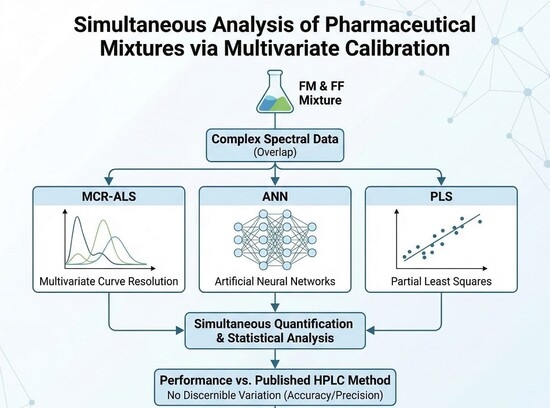
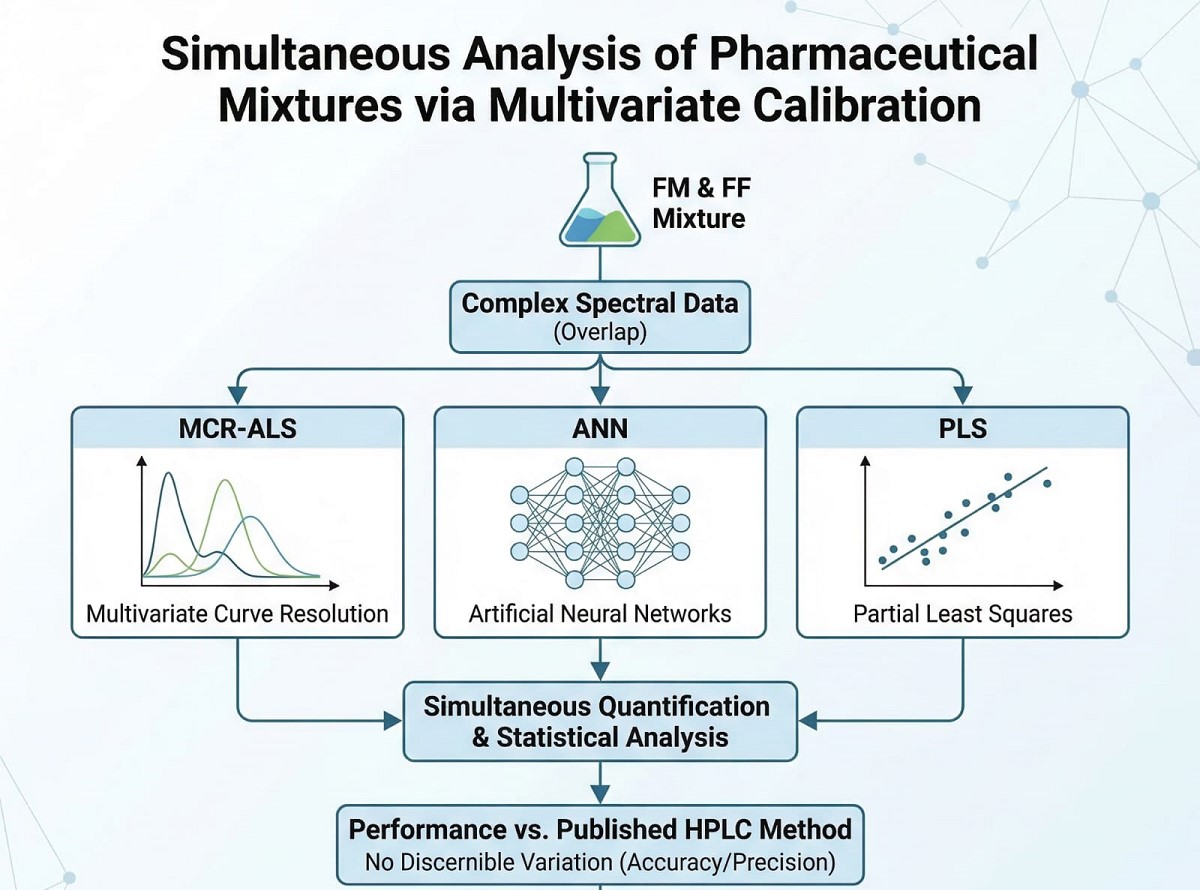
Multivariate calibration methods have proven to be helpful in interpreting complex spectral data, particularly in the simultaneous analysis of pharmaceutical mixtures. In this study, three chemometric-assisted spectrophotometric methods were developed and validated for the simultaneous assessment of flunixin meglumine (FM) and florfenicol (FF), namely, multivariate curve resolution–alternating least squares (MCR-ALS), artificial neural networks (ANNs), and partial least squares (PLS). These methods were successfully utilized to address the significant spectral overlap between FM and FF in their combined dose form, enabling simultaneous quantification without prior chromatographic separation. Statistical analysis was conducted to compare the performance of the proposed methods to that of a published HPLC method, and the results showed no significant variation in trueness or precision. The proposed methods were validated according to ICH guidelines, showing high sensitivity, low LOD and LOQ, and excellent precision (%RSD < 2.0%). Furthermore, they were evaluated for environmental sustainability using the analytical greenness (AGREE) metric and the complex modified green analytical procedure index (Complex MoGAPI), which provided a greenness score of 0.7 and a total sustainability score of 80. These results demonstrate the applicability of the proposed chemometric methods as straightforward, effective, and ecologically beneficial substitutes for regular quality control analysis.

Graphical Abstract

1. Introduction

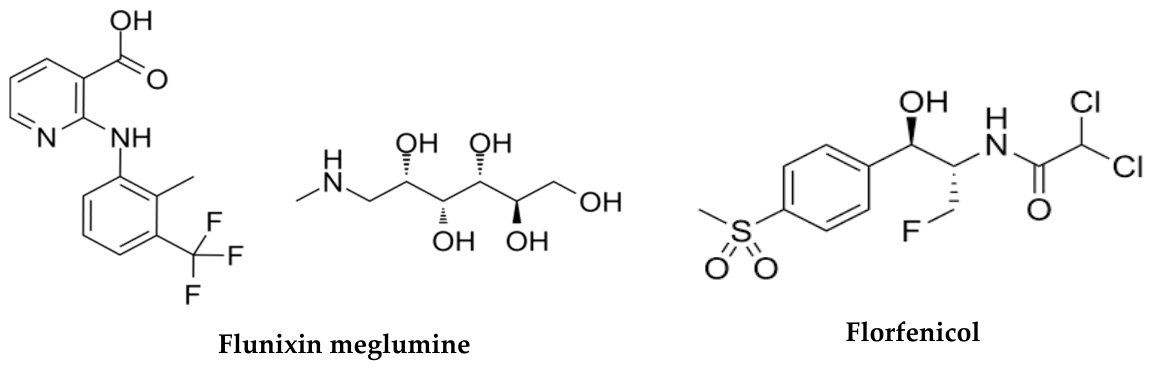
Veterinary pharmaceuticals are essential for preserving animal health and supporting contemporary livestock production methods. The quality and safety of animal food products depend on the effective management of infectious and inflammatory disorders, as well as the wellbeing of the animals themselves. As the world’s appetite for animal-derived food continues to increase, the use of veterinary treatments that are both safe and effective has become an essential element of animal production methods. Flunixin meglumine (FM) and florfenicol (FF) are two therapeutic agents commonly used in veterinary medicine, particularly for the treatment of bacterial infections and inflammatory conditions in food-producing animals (Figure 1).
Non-steroidal anti-inflammatory drugs (NSAIDs) such as flunixin meglumine have potent analgesic, antipyretic, and anti-inflammatory effects. The pharmacological activity of flunixin meglumine is primarily associated with the inhibition of the cyclooxygenase (COX) enzyme; this suppresses prostaglandin production, which is involved in inflammatory events. Through this process, FM successfully reduces pain, fever, and inflammation in animals experiencing a variety of clinical illnesses. Because of the rapid therapeutic effect and excellent clinical effectiveness of this medication, it is frequently used in veterinary practice to treat inflammatory diseases in pigs, horses, and cattle [1].
Florfenicol, in contrast, is a human-made broad-spectrum antimicrobial in the phenicol family of antibiotics. The antibacterial action of florfenicol is exerted through its capacity to block bacterial protein synthesis by binding to the 50S ribosomal subunit. Florfenicol has superior antibacterial activity and increased resistance to enzymatic breakdown compared to earlier phenicol antibiotics, such as chloramphenicol and thiamphenicol. Because of these qualities, it is a key antimicrobial agent in veterinary therapeutics; additionally, it is more effective against a variety of Gram-positive and Gram-negative bacteria [2].
Bacterial infections are frequently associated with inflammatory processes in veterinary clinical practice. Consequently, the simultaneous use of antibacterial and anti-inflammatory medicines is often necessary to obtain successful therapeutic results. As a result, the combination of florfenicol and flunixin meglumine has become a popular method for treating complex diseases in livestock. A notable instance is bovine respiratory illness (BRD), a multifactorial disease in which bacterial infection is often coupled with significant inflammation of the respiratory system. By regulating microbial infection while also relieving pain and inflammation, combination formulations containing both medications offer a dual therapeutic effect [3]. As a result, FM and FF are now commonly incorporated into injectable medicines used in clinical veterinary practice.
Due to the widespread use of these medicines in food-producing animals, accurate analytical methods are required for their quality control in pharmaceutical products and regulatory monitoring. Analytical approaches must exhibit sufficient sensitivity, accuracy, and reproducibility to precisely identify the number of active components. Over the last ten years, significant advancements have been made in the development of analytical techniques intended to meet these requirements. These advancements have facilitated a variety of applications, such as residue identification in edible animal tissues, therapeutic medication monitoring, and pharmaceutical quality control.
The quantification of florfenicol and flunixin meglumine in biological matrices and pharmaceutical formulations has been documented using a variety of analytical methods. Among them, the combination of reversed-phase high-performance liquid chromatography (RP-HPLC) and spectrophotometric detection in the ultraviolet range, often performed using diode-array detectors, remains one of the most commonly used methods. RP-HPLC approaches have been confirmed to indicate stability and differentiate target analytes from possible degradation products; thus, they provide superior separation efficiency and analytical reliability [4,5].
More sophisticated analytical methods have been developed for the identification and measurement of veterinary drug residues, in addition to traditional chromatographic methods. The determination of florfenicol and its metabolite florfenicol amine, as well as flunixin meglumine and its residue marker 5-hydroxyflunixin, has been extensively accomplished using ultra-high-performance liquid chromatography coupled with tandem mass spectrometry (UHPLC–MS/MS or LC–MS/MS), particularly in biological samples and edible tissues [6,7,8,9,10,11,12,13,14,15,16,17,18,19]. Because of their high sensitivity and selectivity, these methods are ideal for monitoring residual residues in accordance with regulations. However, complex equipment, considerable sample preparation, and high operating expenses are the main demerits for these chromatographic methods.
Alternative analytical techniques have also been investigated. Florfenicol [20,21,22,23,24,25] and flunixin meglumine [26,27,28] have been identified in a variety of matrices using conventional high-performance liquid chromatography (HPLC) and thin-layer chromatography (TLC) methods. For quality control analysis of these medications in pharmaceutical preparations, spectroscopic methods such as UV–visible spectrophotometry have also been used [29,30,31,32]. In addition, electroanalytical techniques such as differential pulse voltammetry (DPV) have been proposed as affordable and reliable methods for determining their quantity in dosage forms [33,34,35,36].
The development of simple and effective methods for the simultaneous determination of FM and FF remains of significant interest, notwithstanding the availability of several analytical methodologies. Despite their high degree of reliability, chromatographic techniques can require the use of significant amounts of organic solvents, lengthy analysis periods, and complex optimization of chromatographic conditions. Their applicability for rapid routine analysis, particularly in labs with few resources, may be restricted by these variables. Analytical approaches that reduce solvent usage and streamline analytical processes are becoming increasingly appealing from both economic and environmental standpoints.
UV–visible spectrophotometry is an attractive analytical option because it is readily accessible, comparatively affordable, and simple to use. The simultaneous spectrophotometric analysis of many components, however, can be difficult if their absorption spectra overlap considerably. Traditional univariate calibration techniques based on a single wavelength frequently fail to produce reliable quantitative results in such situations.
These shortcomings may be successfully addressed with the use of chemometric methods. The use of mathematical and statistical methods to extract meaningful chemical data from complex datasets is known as chemometrics [37]. Multivariate calibration methods can differentiate overlapping spectra and enable precise quantification of individual components in multicomponent mixtures by analyzing the full spectral profile rather than a single analytical signal. Because of their ability to enhance analytical performance while preserving methodological simplicity [38,39,40,41,42], chemometric techniques have attracted considerable attention in pharmaceutical analysis in recent years.
In this study, three chemometric-assisted spectrophotometric models were developed for the simultaneous determination of flunixin meglumine and florfenicol, namely, multivariate curve resolution–alternating least squares (MCR-ALS), artificial neural networks (ANNs), and partial least squares (PLS). Using UV spectrophotometric data, these methods were developed to address the significant spectral overlap between the two medications without prior chromatographic separation. The simultaneous spectrophotometric quantification of these two veterinary medications using chemometric approaches has not, to the best of our knowledge, been demonstrated before. As a result, the objective of this study was to develop straightforward, dependable, and affordable chemometric models that may be used to precisely quantify FM and FF in pharmaceutical preparations and to provide an efficient alternative for regular quality control analysis.

2. Materials and Methods

2.1. Chemicals and Materials

Flunixin meglumine (FM) was manufactured by Rakshit Pharmaceutical Pvt Ltd. (Ahmedabad, Gujarat, India) with a purity of 99. 85%, and florfenicol (FF) was manufactured by Sigma-Aldrich Chemicals Private Limited (Bangalore, Karnataka, India) with a purity of 99. 69%. Megluflor® injection was manufactured by Pharma Swede-Egypt (Cairo, Egypt), and it was labeled as containing 300 mg of florfenicol and 16.5 mg of flunixin (as flunixin meglumine) per milliliter. HPLC-grade methanol was purchased from Sigma-Aldrich (Steinheim, North Rhine-Westphalia, Germany). Membrane filters of 0.45 µm(Millipore, Burlington, MA, USA) were used.

2.2. Instrumentation

All spectrophotometric measurements were performed using a Shimadzu UV–visible dual-beam spectrophotometer, model UV-1800, with a 1 cm quartz cell and UV-Probe 2.32 software (Shimadzu Scientific Instruments Inc., Kyoto, Japan).
Chemometric models were developed using the PLS and ANN toolboxes in MATLAB® 8.1.0.604 (R2013a) and the MCR-ALS toolbox [43].

2.3. Standard Solutions

Accurately weighed amounts of FM and FF were transferred into separate 100 mL volumetric flasks and diluted to the mark with methanol in order to obtain stock solutions with a concentration of 100 μg·mL−1. Working solutions were prepared by appropriately diluting the stock solutions using methanol as a solvent, achieving a concentration range of 5 to 25 μg·mL−1 for both FM and FF.

2.4. Procedure

2.4.1. Spectral Characteristics

UV absorption spectra of FM and FF were recorded over the range of 200–400 nm using methanol as a blank. For subsequent chemometric analysis, spectral data between 220 and 380 nm were exported at 1 nm intervals to MATLAB® for processing.

2.4.2. Construction of Calibration and Validation Sets

The predictive accuracy of the calibration models was assessed using 17 samples for the calibration (training) set and 8 samples for the validation set. Table 1 lists the concentrations of FM and FF in both sets, which varied between 5.00 and 25.00 μg·mL−1. By diluting suitable amounts of the working solutions in 10 mL volumetric flasks with methanol, solutions were created. With 1 nm intervals, the multivariate calibration models, namely, PLS, ANN, and MCR-ALS, were used across the spectral range of 220–380 nm. Before using the models to simultaneously determine FM and FF in the validation set, their parameters were carefully optimized.

2.4.3. Wavelength Range Selection

Different wavelength ranges were evaluated, and regions with high noise or low informational content were excluded to select the optimal range for the proposed models, ensuring improved selectivity and sensitivity.

2.4.4. Optimization of Calibration Regressions

The ideal number of latent variables for the PLS calibration model was determined using leave-one-out cross-validation based on the root mean square error of cross-validation (RMSECV), with mean centering used as a preprocessing step. The feed-forward architecture was used to construct artificial neural networks (ANNs) that replicate the way the human brain processes information. The number of training epochs was also optimized, along with the number of neurons in the hidden layer, which was chosen to be eight using the Purelin-to-Purelin transfer function. Model optimization in the MCR-ALS calibration concentrated on practical restrictions. To obtain the best parameters with the least number of iterations, a non-negativity constraint utilizing non-negative least squares (NNLS) was applied to both the spectral and concentration profiles. To evaluate the sensitivity of each model, the linear range, limit of detection (LOD), and limit of quantification (LOQ) were determined. The slopes and intercepts were compared to their theoretical values in order to confirm the accuracy of the regressions, revealing no significant discrepancies (p > 0.05).

2.4.5. Application to Pharmaceutical Formulation

To match the confirmed calibration range, the 300 mg·mL−1 FF and 16.5 mg·mL−1 FM in the commercial Megluflor® injection were systematically diluted in a two-step process. The injection was accurately transferred into a 10 mL volumetric flask and diluted to the mark with methanol to create an intermediate stock solution with concentrations of 3000 µg·mL−1 FF and 165 µg·mL−1 FM. To ensure the complete solubility of both analytes, maintain reproducibility, and provide optimal spectral characteristics, methanol was selected.
Two working solutions with different concentration ratios were then prepared to ensure that both analytes fell within their linear dynamic ranges and to enhance the performance and selectivity of the chemometric models. The first solution, appropriate for FF measurement, was prepared by diluting 60.6 µL of the intermediate stock solution to a final volume of 10 mL with methanol, yielding final concentrations of 18.18 µg·mL−1 FF and 1.0 µg·mL−1 FM. Similarly, the second solution, suitable for FM measurement, was prepared by diluting 303 µL of the intermediate stock solution to a final volume of 10 mL, comprising 90.9 µg·mL−1 FF and 5 µg·mL−1 FM.”
The proposed chemometric approach enables the simultaneous analysis of both medicines using only two working solutions. This is accomplished by simultaneously obtaining and processing spectral data through chemometric models (PLS, ANN, and MCR-ALS), facilitating the accurate measurement of each component in the presence of others without prior separation.

2.4.6. Assessment of Environmental Impact of the Spectrophotometric Method

Using the AGREE [44] and GAPI [45] software tools, the environmental friendliness of the developed spectrophotometric method was assessed to identify any possible hazards to analysts and the environment. Pictograms unique to each method were produced, with green sections denoting complete adherence to safe analytical procedures. These tools have been extensively validated and used in several studies as reliable means for determining the greenness of analytical methods [46].

3. Results

The measurement of FM and FF in pharmaceutical preparations has only been described using a small number of methods. As a result, it is crucial to develop a reliable method to measure both of these active components at the same time. Chemometric breakthroughs, along with contemporary analytical instruments and computational capabilities, offer powerful methods for deciphering and understanding complex chemical data. Compared to single-wavelength methods, multivariate calibration models employ several spectral wavelengths at once, allowing for the resolution of highly overlapping spectra and providing improved accuracy. By analyzing spectra from unknown samples using a multifactorial approach, these models enable rapid prediction of analyte concentrations.

3.1. Spectral Characteristics and Wavelength Selection

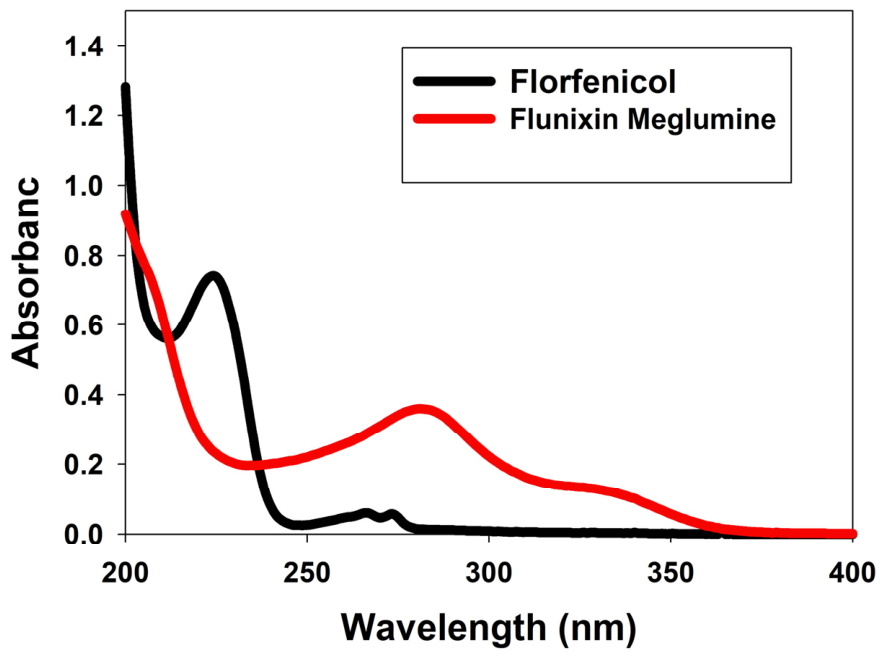
As shown in Figure 2 (zero-order absorption spectra recorded at 10 µg.mL−1 for each compound in methanol), florfenicol (FF) and flunixin meglumine (FM) exhibit severe spectral overlap across the entire UV range (approximately 220–280 nm). Under these conditions, no single wavelength allows for selective quantification of FF using univariate calibration, as FM shows significant absorbance wherever FF absorbs. However, a single wavelength near 280 nm does allow for selective determination of FM without interference from FF at the tested concentration. Therefore, for the simultaneous quantification of both analytes—particularly in the commercial formulation of the Megluflor® injection—mathematical resolution of the mixture is essential.
Three multivariate calibration methods were used to address these overlapping spectra. A well-designed experimental calibration set is necessary for achieving reliable multivariate calibration. In this study, a spectral range of 220–380 nm (digitized at 1 nm intervals) was carefully selected as the key information window. This range incorporates the most intense electronic transitions of the analyzed substance while also taking the informative lower-absorbance region beyond 300 nm to maximize data extraction. The region below 220 nm was omitted due to high instrumental noise. Extending the spectral window up to 380 nm ensured an amended signal-to-noise ratio while maintaining model parsimony. The outstanding statistical performance achieved (r > 0.999, with all p-values > 0.05, as shown in Table 2) confirms that this optimized spectral range is sufficient for the accurate and robust resolution of the binary mixture in both bulk form and pharmaceutical formulations.

3.2. Model Construction

A total of 25 laboratory-prepared mixtures of FM and FF, covering concentrations from 5 to 25 μg·mL−1, were designed using a two-factor, five-level experimental design [47]. Of these samples, 17 were used as the calibration set, while the remaining 8 comprised the validation set (Table 1).

3.2.1. Partial Least Squares (PLS)

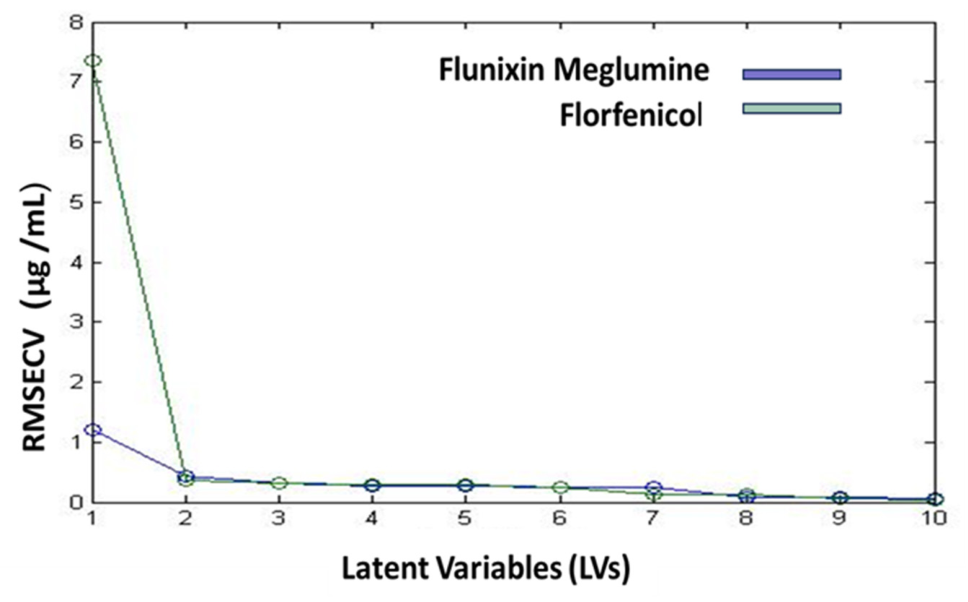
PLS models are commonly used in quantitative analysis to extract relevant information from complex or overlapping spectral data [48]. The PLS approach applies regression to the calibration spectral matrix, projecting it into new dimensions called latent variables (LVs). In this study, leave-one-out cross-validation was applied to determine the optimal number of LVs. RMSECV was calculated after sequentially adding LVs, following the criteria of Haaland and Thomas [49]. As illustrated in Figure 3, the optimal number of LVs was selected at the point where the RMSECV (µg/mL) reached its minimum value and began to stabilize (plateau), ensuring the best predictive performance while avoiding the inclusion of spectral noise. Before model construction, mean centering was applied as the essential preprocessing method to normalize the data. This approach was selected to ensure optimal model performance while avoiding the introduction of unnecessary computational noise, which is often associated with autoscaling in UV–Vis spectroscopy. As the results show, mean centering provided excellent accuracy regarding the recovery percentage and RMSE. For all components, the optimal number of LVs was determined to be 2 (Figure 3).

3.2.2. Artificial Neural Network (ANN) Modeling

Artificial neural networks (ANNs) are made up of a series of interconnected neurons arranged into input, hidden, and output layers. This study used feed-forward networks. The input data were assigned weights and processed through transfer functions to produce output values. The network was trained via backpropagation, where the predicted outputs are contrasted with target values, and errors are computed and sent backward until the network is sufficiently trained [50].
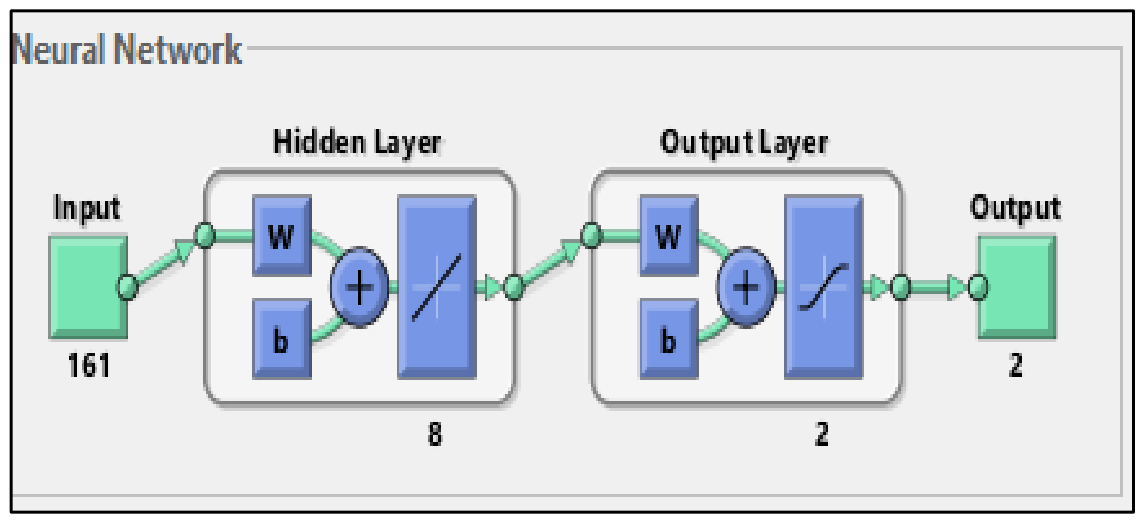
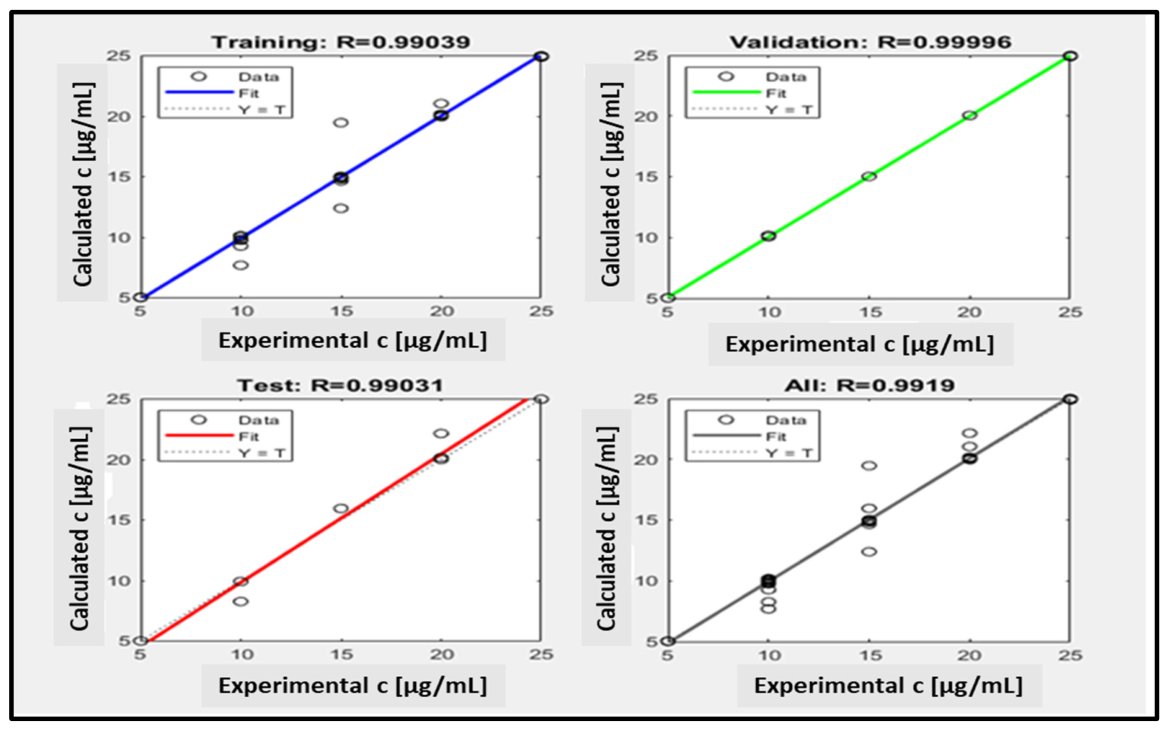
The network parameters, such as the number of hidden neurons, training methods, and transfer function combinations, were fine-tuned using a trial-and-error method to enhance predictive accuracy. Given the direct correlation between absorbance and analyte concentration, the Purelin–Purelin transfer function was chosen for all components. Multiple training methods were assessed; however, no notable differences in RMSEP were observed, leading to the selection of TRAINLM (Levenberg–Marquardt backpropagation) to minimize the computation time. The input layer was designed with 161 neurons to match the number of spectral data points within the optimized range of 220–380 nm, while the output layer featured 2 neurons to represent the concentrations (µg/mL) of the two analytes. After exploring various configurations and using mean centering as the sole preprocessing step, it was determined that 8 hidden neurons and 500 training epochs delivered the best predictive results. The resulting ANN architecture successfully provided calculated concentrations that were in excellent agreement with the experimental values (Figure 4), with correlation coefficients (R) close to 1 for the training, validation, and test sets (Figure 5).

3.2.3. Multivariate Curve Resolution–Alternating Least Squares (MCR-ALS)

Deriving pure response profiles for unresolved mixed components in the absence of prior information is the main goal of MCR. It operates by breaking down the data matrix using a bilinear model. It first provides an estimate of the compounds, which is subsequently improved by ALS optimizations that concentrate on constraints related to spectral profiles and component concentrations. In addition to the correlation constraints imposed on the concentration profiles, non-negativity constraints were also imposed on the spectral profiles [51].
The imposition of non-negativity constraints means that the concentration and spectral values must be equal to or exceed zero. The ALS optimization procedure was deemed complete upon the attainment of a specific convergence criterion set at 20%. Convergence is frequently concluded when the relative discrepancies in the standard deviation of residuals between ALS outcomes and empirical data fall below a predetermined threshold across two consecutive iterations, typically established at 0.1%. In this study, evolving factor analysis was employed to derive an initial evaluation with a logarithmic eigenvalue of −2, culminating in the formulation of a five-factor model. Iterative processes continue until an optimal solution is identified that fulfills both the established convergence parameters and the proposed constraints. The convergence was ultimately realized after six iterations. The calculated variance percentages (R2) and lack of fit (% LOF) were recorded at 1.384 and 99.94, respectively, which were adequate to substantiate the validity of the proposed MCR-ALS model.
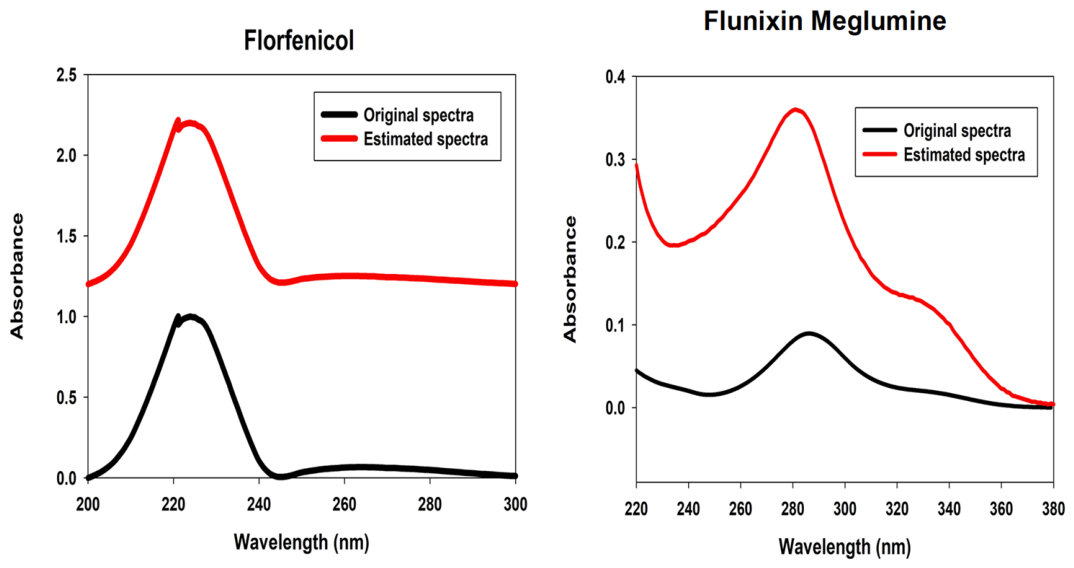
The MCR-ALS model was utilized to estimate the spectral profiles of FM and FF, as its algorithms hold qualitative importance, and the estimated spectrum closely resembles the original spectrum for each component (Figure 6). Spectral similarity was statistically assessed, where the chi-squared (χ2) test criteria were met with p-values > 0.05. This finding substantiates that there is no significant disparity between the experimental and reconstructed spectral patterns, further validating the model’s deconvolution accuracy.
In addition to its quantitative determination capability, the MCR-ALS model provides an additional feature of component detection. The three proposed models (PLS, ANN, and MCR-ALS) were constructed to predict the concentrations of each analyte. Predictive performance was evaluated using the correlation coefficient (r) and the root mean square error of calibration (RMSEC). Additionally, the accuracy of the regression lines was statistically assessed by comparing the slopes and intercepts against their theoretical values (1 and 0, respectively). The calculated p-values, reported in Table 2, were all >0.05, indicating that the slopes did not significantly differ from unity and that the intercepts did not significantly differ from zero. These results confirm that neither the slopes nor the intercepts differed significantly from the theoretical values.

3.3. Model Validation

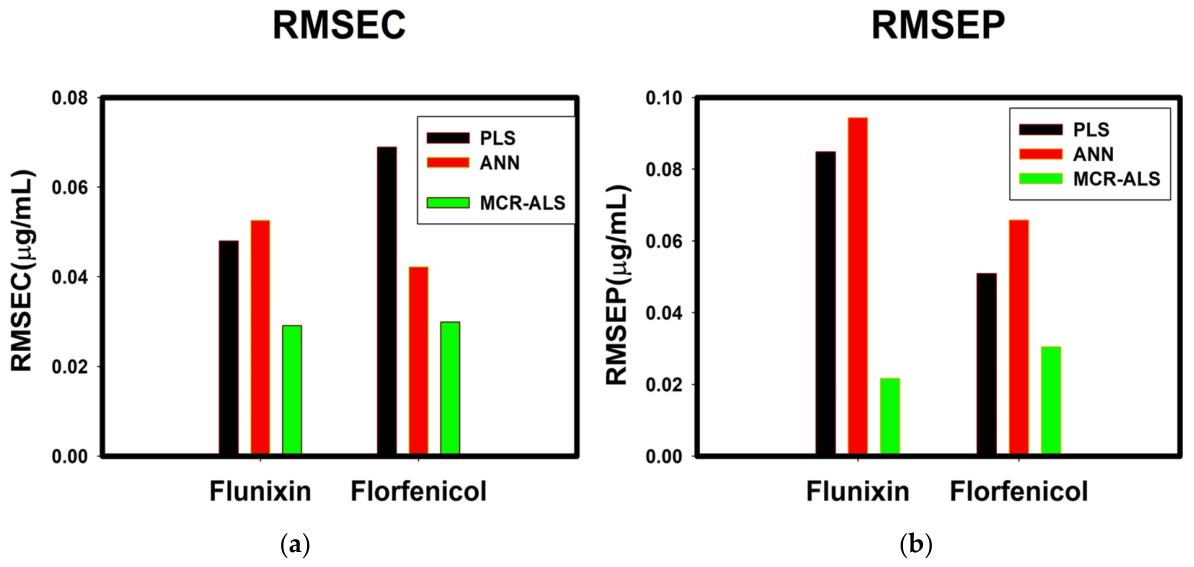
The recovery (%), relative standard deviation (RSD%), and root mean square error of prediction (RMSEP) were computed using the developed models to estimate the concentrations of FM and FF in the validation set. The outcomes were satisfactory (Table 3). Figure 7 illustrates the RMSEC and RMSEP values for the calibration and validation sets using column charts. The MCR-ALS models demonstrated the lowest RMSEC and RMSEP values, indicating that they are the optimal models for quantitative analysis.
Additional validation factors were evaluated to enhance the reliability of the methods. The sensitivity of the models was validated by calculating the limit of detection (LOD) and limit of quantification (LOQ). The findings are displayed in Table 2. Precision was examined at three different concentrations. The intra-day and inter-day %RSD values were all below 2.0% (Table 4), indicating the excellent reproducibility of the proposed methodologies. Selectivity was ultimately validated through the successful examination of the Megluflor® injection, which showed no interference from excipients, as indicated by the exceptional recovery results.

3.4. Application to Pharmaceutical Formulation

The concentrations of FM and FF measured in the Megluflor® injection were in good agreement with the labeled values, with high accuracy and low standard deviations (below 2%), demonstrating that excipients in the pharmaceutical formulation did not interfere with the measurement of the drugs (Table 5).

3.5. Statistical Analysis

The predictive power of the proposed PLS, ANN, and MCR-ALS models for estimating FM and FF was statistically analyzed based on the reported HPLC method [4]. As can be seen in Table 6, statistical analysis was conducted, with the level of significance (α) set to 0.05. Notably, there were no significant differences in reliability, as the Student’s t-test and F-test p-values were higher than the α value. This indicates that the proposed chemometric methods are as efficient and reliable as the reference analytical technique.

3.6. Evaluation of Environmental Impact

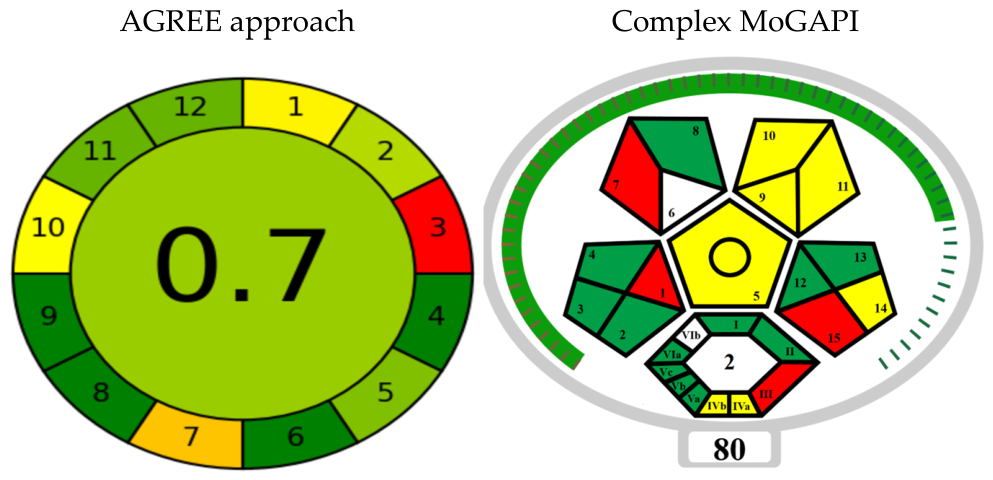
This study used a green analytical approach with the aim of reducing health and environmental hazards through the minimization of toxic solvents. The environmental performance of the proposed chemometric method was evaluated using AGREE [44] and a complex modified GAPI (Complex MoGAPI) [45]; the results are summarized in Figure 8. The overall AGREE score was 0.7, which is considered acceptable in terms of greenness. The most critical sectors were identified: sectors 1 and 3 (offline analysis), sector 7 (the amount of analytical waste), sector 10 (the use of non-bio-based reagents), and sector 8 (fully green, rapid 2 min analysis, and high-throughput sample processing). The AGREE pictogram shows a numerical score of 0.7, confirming the eco-friendliness of the method.
The environmental impact was also evaluated using the Complex MoGAPI approach, enabling assessment of the environmental impact of the method, including sample collection, preparation, reagents, instrumentation, and waste management. The predominance of green zones in the pictogram indicates favorable environmental compatibility for most analytical steps. The central yellow pentagon reflects a moderate impact associated with core instrumental steps or unavoidable reagent use. Peripheral yellow sectors indicate partial compliance with green principles in stages such as sample preparation and solvent use, yet these remain within acceptable green thresholds. Red zones were observed, indicating offline analysis, the use of methanol as a solvent, and waste generation. The overall greenness score was 80, which confirms that the developed method is highly eco-friendly and consistent with the principles of green analytical chemistry, making it suitable for routine veterinary drug analysis. Sectors 1 and 3 indicate offline analysis, sector 7 indicates the amount of analytical waste, and sector 10 indicates the use of non-bio-based reagents.

4. Conclusions

For the analysis of complex mixtures in particular, multivariate calibration strategies that make use all spectral data are a useful substitute for conventional univariate approaches that depend on a single spectral value. These techniques make it possible to extract useful information from overlapping datasets. In this study, samples with highly overlapping spectra and interfering components were analyzed using a straightforward, accurate, and economical UV spectrophotometric method. FM and FF in pharmaceutical dosage forms were reliably quantified without prior separation using chemometrically assisted models, namely, PLS, ANN, and MCR-ALS. The most accurate of these was MCR-ALS, which also demonstrated the unique ability to resolve the spectral profiles of each component, allowing for both quantitative and qualitative analyses. Future investigations should apply these chemometric techniques to measure the two drugs in more complex matrices (e.g., urine, serum, or wastewater).

Author Contributions

Conceptualization, M.A.A.R., R.M.T. and L.M.A.E.; methodology, M.A.A.R., L.M.A.E. and R.M.T.; software, M.A.A.R. and M.G.; validation, M.A.A.R., R.M.T., M.M.A.E.-A. and M.G.; formal analysis, L.M.A.E. and M.G.; investigation, R.M.T.; resources, L.M.A.E. and M.A.A.R.; data curation, M.A.A.R. and M.M.A.E.-A.; writing—original draft preparation, L.M.A.E., M.M.A.E.-A., M.A.A.R. and R.M.T.; writing—review and editing, M.A.A.R., H.M.A. and M.G.; visualization, M.G.; supervision, R.M.T. and H.M.A.; project administration, M.A.A.R.; funding acquisition, H.M.A. All authors have read and agreed to the published version of the manuscript.

Funding

This work was funded by the Deanship of Graduate Studies and Scientific Research at Jouf University under grant No. DGSSR-2025-FC-01019.

Institutional Review Board Statement

Not applicable.

Informed Consent Statement

Not applicable.

Data Availability Statement

The data presented in this study are available on request from the corresponding author.

Acknowledgments

This work was funded by the Deanship of Graduate Studies and Scientific Research at Jouf University under grant No. DGSSR-2025-FC-01019. The authors have reviewed and edited the output and take full responsibility for the content of this publication.

Conflicts of Interest

The authors declare no conflicts of interest related to this research project.

Abbreviations

The following abbreviations are used in this manuscript:
FMFlunixin Meglumine
FFFlorfenicol
PLSPartial Least Squares
ANNArtificial Neural Networks
MCR-ALSMultivariate Curve Resolution–Alternating Least Squares
RMSECRoot Mean Square Error of Calibration
RMSEPRoot Mean Square Error of Prediction
RSDRelative Standard Deviation
AGREEAnalytical Greenness metric
GAPIGreen Analytical Procedure Index
UVUltraviolet
RP-HPLCReverse Phase High-Performance Liquid Chromatography

References

  1. Woodward, K.N. Pharmacovigilance for Veterinary Medicinal Products; Wiley: Hoboken, NJ, USA, 2018. [Google Scholar] [CrossRef]
  2. Dowling, P.M.; Lardé, H. Chloramphenicol, thiamphenicol, and florfenicol. In Antimicrobial Therapy in Veterinary Medicine; Wiley: Hoboken, NJ, USA, 2024; pp. 291–303. [Google Scholar] [CrossRef]
  3. Gingrich, K.F. Merck advertisement Resflor Gold. Bov. Pract. 2025, 59, 2. [Google Scholar] [CrossRef]
  4. Batrawi, N.; Naseef, H.; Al-Rimawi, F. Development and validation of a stability-indicating HPLC method for the simultaneous determination of florfenicol and flunixin meglumine combination in an injectable solution. J. Anal. Methods Chem. 2017, 2017, 1529280. [Google Scholar] [CrossRef]
  5. Batrawi, N.; Al-Rimawi, F.; Qurt, M.; Naseef, H. Development and evaluation of parenteral solution containing florfenicol and flunixin meglumine for veterinary use. Int. J. Pharm. Sci. Rev. Res. 2018, 52, 39–43. [Google Scholar]
  6. Barreto, F.; Ribeiro, C.; Hoff, R.B.; Dalla Costa, T. Determination of chloramphenicol, thiamphenicol, florfenicol and florfenicol amine in poultry, swine, bovine and fish by liquid chromatography–tandem mass spectrometry. J. Chromatogr. A 2016, 1449, 48–53. [Google Scholar] [CrossRef] [PubMed]
  7. Aldeek, F.; Hsieh, K.C.; Ugochukwu, O.N.; Gerard, G.; Hammack, W. Accurate quantitation and analysis of nitrofuran metabolites, chloramphenicol, and florfenicol in seafood by ultrahigh-performance liquid chromatography–tandem mass spectrometry. J. Agric. Food Chem. 2017, 66, 5018–5030. [Google Scholar] [CrossRef] [PubMed]
  8. Orlando, E.A.; Roque, A.G.C.; Losekann, M.E.; Simionato, A.V.C. UPLC–MS/MS determination of florfenicol and florfenicol amine antimicrobial residues in tilapia muscle. J. Chromatogr. B 2016, 1035, 8–15. [Google Scholar] [CrossRef]
  9. Jung, H.N.; Park, D.H.; Choi, Y.J.; Kang, S.H.; Cho, H.J.; Choi, J.M.; Shim, J.H.; Zaky, A.A.; Abd El-Aty, A.; Shin, H.C. Simultaneous quantification of chloramphenicol, thiamphenicol, florfenicol and florfenicol amine in animal products using LC–MS/MS. Front. Nutr. 2022, 8, 812803. [Google Scholar] [CrossRef]
  10. Imran, M.; Habib, F.; Majeed, S.; Tawab, A.; Rauf, W.; Rahman, M.; Umer, M.; Iqbal, M. LC–MS/MS-based determination and cofirmation of chloramphenicol, thiamphenicol, florfenicol and florfenicol amine in poultry meat. Food Addit. Contam. Part A 2018, 35, 1530–1542. [Google Scholar] [CrossRef]
  11. Fedeniuk, R.W.; Mizuno, M.; Neiser, C.; O’Byrne, C. Development of LC–MS/MS methodology for detection/determination of chloramphenicol 3-O-β-d-glucuronide, florfenicol, florfenicol amine and thiamphenicol residues in povine, equine and porcine liver. J. Chromatogr. B 2015, 991, 68–78. [Google Scholar] [CrossRef]
  12. Imran, M.; Tawab, A.; Rauf, W.; Rahman, M.; Khan, Q.M.; Asi, M.R.; Iqbal, M. LC–MS/MS method development for analysis of florfenicol and its application to estimatr relative distribution various tissues of broiler chicken. J. Chromatogr. B 2017, 1063, 163–173. [Google Scholar] [CrossRef]
  13. Bardhi, A.; Romano, J.E.; Pagliuca, G.; Caneschi, A.; Barbarossa, A. Florfenicol and florfenicol amine quantification in bull serum and seminal plasma by UHPLC–MS/MS. Vet. Med. Int. 2023, 2023, 6692920. [Google Scholar] [CrossRef]
  14. Saito-Shida, S.; Shiono, K.; Narushima, J.; Nemoto, S.; Akiyama, H. Determination of total florfenicol residues as florfenicol amine in bovine tissues using LC–MS/MS. J. Chromatogr. B 2019, 1109, 37–44. [Google Scholar] [CrossRef]
  15. Wang, B.; Zhao, X.; Xie, X.; Xie, K.; Zhang, G.; Zhang, T.; Liu, X. Development of an Accelerated Solvent Extraction-Ultra-Performance Liquid Chromatography-Fluorescence Detection Method for Quantitative Analysis of Thiamphenicol, Florfenicol and Florfenicol Amine in Poultry Eggs. Molecules 2019, 12, 1705–1714. [Google Scholar] [CrossRef]
  16. Park, D.; Choi, Y.S.; Kim, J.Y.; Choi, J.D.; Moon, G.I. Determination of flunixin and 5-hydroxy flunixin residues in livestock and fishery products using LC–MS/MS. Food Sci. Anim. Resour. 2024, 44, 873. [Google Scholar] [CrossRef] [PubMed]
  17. Giles, C.B.; Ferdous, F.; Halleran, J.L.; Yeatts, J.L.; Baynes, R.E.; Mzyk, D.A. Flunixin meglumine tissue residues after intravenous administration in goats. Front. Vet. Sci. 2024, 10, 1341779. [Google Scholar] [CrossRef]
  18. Liu, Z.Y.; Yang, K.; Chen, F.H.; Long, X.M.; Deng, Y.B.; Kuang, G.W.; Sun, Z.L. Development of a Rapid Method for the Confirmatory Analysis of Flunixin Residue in Animal Tissues Using Liquid Chromatography–Tandem Mass Spectrometry. Food Anal. Methods 2015, 8, 352–362. [Google Scholar] [CrossRef]
  19. Yu, Z.; Luo, X.; Guo, F.; Zhang, Z.; Peng, L. Determination of Flunixin in Swine Plasma, Urine and Feces by UPLC-MS/MS and its Application in the Real Samples. Curr. Pharm. Anal. 2019, 15, 51–56. [Google Scholar] [CrossRef]
  20. Yang, J.; Sun, G.; Qian, M.; Huang, L.; Ke, X.; Yang, B. Development of a high-performance liquid chromatography method for the determination of florfenicol in animal feedstuffs. J. Chromatogr. B 2017, 1068, 9–14. [Google Scholar] [CrossRef] [PubMed]
  21. Patyra, E.; Kwiatek, K. HPLC-DAD analysis of florfenicol and thiamphenicol in medicated feedingstuffs. Food Addit. Contam. Part A 2019, 36, 1184–1190. [Google Scholar] [CrossRef]
  22. Zhou, D.; Li, Y.; Huang, L.; Qian, M.; Li, D.; Sun, G.; Yang, B. A reliable and cost-efficient TLC-HPLC method for determining total florfenicol residues in porcine edible tissues. Food Chem. 2020, 303, 125399. [Google Scholar] [CrossRef]
  23. Šandor, K.; Perak Junaković, E.; Terzić, S.; Žarković, I.; Vujnović, A.; Fajdić, D.; Pehnec, M.; Sinković, S.; Ćaleta, I.; Andrišić, M. A green HPLC approach to florfenicol analysis in pig urine. Pharmaceuticals 2024, 17, 495. [Google Scholar] [CrossRef]
  24. Šandor, K.; Perak Junaković, E.; Andrišić, M.; Žarković, I.; Benić, M.; Mihaljević, Ž.; Terzić, S. Analysis of florfenicol in pig plasma using a validated PPT-HPLC-DAD method. Vet. Stanica 2023, 54, 265–277. [Google Scholar] [CrossRef]
  25. Nasim, A.; Aslam, B.; Javed, I.; Ali, A.; Muhammad, F.; Raza, A.; Sindhu, Z.U.D. Determination of florfenicol residues in broiler meat and liver samples using RP-HPLC with UV–visible detection. J. Sci. Food Agric. 2016, 96, 1284–1288. [Google Scholar] [CrossRef] [PubMed]
  26. Alshahrani, S.M.; Christensen, J.M. High-performance liquid chromatography method development and validation for determination of flunixin in animal plasma. Main Group Chem. 2021, 20, 611–621. [Google Scholar] [CrossRef]
  27. Nazlawy, H.N.; Zaazaa, H.E.; Merey, H.A.; Atty, S.A. Green validated chromatographic methods for simultaneous determination of oxytetracycline HCl and flunixin meglumine in the presence of their impurities. J. Iran. Chem. Soc. 2023, 20, 885–896. [Google Scholar] [CrossRef]
  28. Belal, F.F.; Abd El-Razeq, S.A.; Fouad, M.M.; Fouad, F.A. Micellar high-performance liquid chromatographic determination of flunixin meglumine in bulk, pharmaceutical dosage forms, bovine, liver and kidney. Anal. Chem. Res. 2015, 3, 63–69. [Google Scholar] [CrossRef]
  29. Elimam, M.M.; Shantier, S.W.; Gadkariem, E.A.; Mohamed, M.A.; Osman, Z. Stability studies on florfenicol using developed derivative spectrophotometric methods. Ann. Pharm. Fr. 2017, 75, 232–240. [Google Scholar] [CrossRef]
  30. Castañeda, P.S.; Olvera, L.G.; Bernad, M.J.B.; López, H.S.; Escobar-Chávez, J.J. Development of a spectrophotometric method for the determination of florfenicol in nanocapsules. Pharm. Chem. J. 2021, 54, 1181–1185. [Google Scholar] [CrossRef]
  31. Merey, H.A.; Abd-Elmonem, M.S.; Nazlawy, H.N.; Zaazaa, H.E. Spectrophotometric methods for simultaneous determination of oxytetracycline HCl and flunixin meglumine in veterinary formulation. J. Anal. Methods Chem. 2017, 2017, 2321572. [Google Scholar] [CrossRef]
  32. Fahmy, N.M.; Abdullatif, H.A.; Michael, A.M.; Ayad, M.F.; Trabik, Y.A. Smart eco-friendly spectrophotometric methods resolving highly overlapping spectra: Application to veterinary antibiotic injections. J. AOAC Int. 2022, 105, 1234–1246. [Google Scholar] [CrossRef]
  33. Taşkın, İ.; Güngör, Ö.; Titretir Duran, S. Voltammetric determination of florfenicol using poly(3-methylthiophene) modified glassy carbon electrode. Polym. Bull. 2021, 78, 4721–4741. [Google Scholar] [CrossRef]
  34. Xia, Y.M.; Zhang, W.; Li, M.Y.; Xia, M.; Zou, L.J.; Gao, W.W. Effective Electrochemical determination of chloramphenicol and florfenicol based on graphene/copper phthalocyanine nanocomposite modified glassy carbon electrode. J. Electrochem. Soc. 2019, 166, B654–B663. [Google Scholar] [CrossRef]
  35. Liu, W.H.; Yang, X.; Liu, M.X.; Yu, W.L.; Wang, X.H. Development of an electrochemical immunosensor for rapid quantification of florfenicol in animal-derived foods. Food Sci. 2020, 41, 307–313. [Google Scholar] [CrossRef]
  36. Trabik, Y.A.; Ayad, M.F.; Mahmoud, A.M.; Abdullatif, H.A.; Michael, A.M. Eco-friendly electrochemical assay of oxytetracycline and flunixin in veterinary injections and milk samples. BMC Chem. 2024, 18, 179. [Google Scholar] [CrossRef]
  37. Brown, S.D.; Blank, T.B.; Sum, S.T.; Weyer, L.G. Chemometrics. Anal. Chem. 1994, 66, 315–359. [Google Scholar] [CrossRef] [PubMed]
  38. Mark, H.; Workman, J. Chemometrics in Spectroscopy; Elsevier: Amsterdam, The Netherlands, 2010. [Google Scholar]
  39. Soliman, S.S.; Rahman, M.A.A. Sustainable chemometric analysis of tension headache drugs in the presence of nephrotoxic impurities. Sustain. Chem. Pharm. 2024, 42, 101785. [Google Scholar] [CrossRef]
  40. Rahman, M.A.A.; Elghobashy, M.R.; Zaazaa, H.E.; El-Mosallamy, S.S. Novel analytical method based on chemometric models applied to UV–Vis spectrophotometric data for simultaneous determination of Etoricoxib and Paracetamol in presence of Paracetamol impurities. BMC Chem. 2023, 17, 176. [Google Scholar] [CrossRef]
  41. Soliman, S.S.; Talib, N.F.A.; Elghobashy, M.R.; Rahman, M.A.A. Sustainable analysis of COVID-19 Co-packaged paxlovid: Exploring advanced sampling techniques and multivariate processing tools. BMC Chem. 2025, 19, 206. [Google Scholar] [CrossRef]
  42. Rizk, M.S.; Sultan, M.; Habib, I.H.; Mohamed, D.; Tony, R.M. Simultaneous spectrophotometric determination of paracetamol and dantrolene sodium by chemometric methods. Br. J. Pharm. Res. 2016, 13, 1–8. [Google Scholar] [CrossRef]
  43. Mouhamed, A.A.; Nadim, A.H.; Mostafa, N.M.; Eltanany, B.M. Application of smart chemometric models for spectra resolution and determination of challenging multi-action quaternary mixture: Statistical comparison with greenness assessment. BMC Chem. 2024, 18, 44. [Google Scholar] [CrossRef]
  44. Pena-Pereira, F.; Wojnowski, W.; Tobiszewski, M. AGREE—Analytical GREEnness metric approach and software. Anal. Chem. 2020, 92, 10076–10082. [Google Scholar] [CrossRef]
  45. Gamal, M.; Naguib, I.A.; Panda, D.S.; Abdallah, F.F. Comparative study of four greenness assessment tools for selection of greenest analytical method for assay of hyoscine N-butyl bromide. Anal. Methods 2021, 13, 369–380. [Google Scholar] [CrossRef]
  46. Abdelrahman, M.M. Green analytical chemistry metrics and life-cycle assessment approach to analytical method development. In Green Chemical Analysis and Sample Preparations; Springer: Cham, Switzerland, 2022; pp. 29–99. [Google Scholar]
  47. Brereton, R.G. Multilevel multifactor designs for multivariate calibration. Analyst 1997, 122, 1521–1529. [Google Scholar] [CrossRef]
  48. Kramer, R. Chemometric Techniques for Quantitative Analysis; CRC Press: Boca Raton, FL, USA, 1998. [Google Scholar]
  49. Haaland, D.M.; Thomas, E.V. Partial least-squares methods for spectral analyses: Relation to other calibration methods. Anal. Chem. 1988, 60, 1193–1202. [Google Scholar] [CrossRef]
  50. Chen, S.M.; Wang, Y.M.; Tsou, I. Using artificial neural network approach for modelling rainfall–runoff due to typhoon. J. Earth Syst. Sci. 2013, 122, 399–405. [Google Scholar] [CrossRef]
  51. Ruckebusch, C.; Blanchet, L. Multivariate curve resolution: Review of advanced applications and challenges. Anal. Chim. Acta 2013, 765, 28–36. [Google Scholar] [CrossRef] [PubMed]
Figure 1. Chemical structures of flunixin meglumine and florfenicol.
Chemosensors 14 00103 g001
Figure 2. Zero-order absorption spectra of 10 µg/mL of the studied components using methanol as a blank.
Chemosensors 14 00103 g002
Figure 3. RMSECV values (µg/mL) against the number of latent variables for flunixin meglumine and florfenicol PLS models.
Chemosensors 14 00103 g003
Figure 4. ANN architecture using different layers for the prediction of the concentrations of the two components.
Chemosensors 14 00103 g004
Figure 5. Regression plots depict the relationship between the experimental and calculated concentrations (µg/mL) of analytes using the optimized ANN model.
Chemosensors 14 00103 g005
Figure 6. Original spectra (Chemosensors 14 00103 i001) and estimated spectra (Chemosensors 14 00103 i002) by MCR-ALS for flunixin meglumine and florfenicol.
Chemosensors 14 00103 g006
Figure 7. The calculated (a) RMSEC (μgmL−1) for each component achieved by the proposed calibration models and (b) RMSEP (μgmL−1) calculated by the corresponding validation model.
Chemosensors 14 00103 g007
Figure 8. AGREE approach and Complex MoGAPI of estimation of greenness of chemometric method proposed for measurement of FM and FF.
Chemosensors 14 00103 g008
Table 1. Concentrations of flunixin meglumine and florfenicol in the calibration and validation sets using different sampling techniques.
Mixture No.Concentrations (µg mL−1)
FM *FF *
11515
2155
355
4525
52510
61025
72515
81510
91010
101020
112025
122520
132015
141525
152525
16255
17520
18 *205
19 *515
20 *1520
21 *2020
22 *2010
23 *105
24 *510
25 *1015
* Shaded rows represent the validation set. FM *: flunixin meglumine; FF *: florfenicol.
Table 2. Calibration set performance metrics for each model.
ParameterModel
PLSANNMCR-ALS
Flunixin MeglumineConcentration range (μg/mL)5.00–25.00
Slope1.0011.0031.000
Intercept−0.02680−0.090805.787 × 10−16
p-value (slope = 1) a0.1190.5160.944
p-value (intercept = 0) b0.2610.6980.960
Correlation coefficient (r) c0.99960.99970.9993
RMSEC d0.0480.0520.029
FlorfenicolConcentration range (μg/mL)5.00–25.00
Slope1.00421.00541.000
Intercept−0.0886−0.03291.038 × 10−15
p-value (slope = 1) a0.0800.2850.721
p-value (intercept = 0) b0.2560.7590.729
Correlation coefficient (r) c0.99910.99930.9991
RMSEC d0.068900.042200.03990
a p-value for comparing slope against 1. b p-value for comparing intercept against 0. c Data of the straight line plotted between predicted concentrations of each component versus actual concentrations of the calibration set. d Root Mean Square Error of Calibration.
Table 3. Validation set analysis using established chemometric models.
Concentration
(μg/mL)
PLSANNMCR-ALS
Recovery%Recovery%Recovery%
FMFFFMFFFMFFFMFF
20598.79100.4100.797.9498.2799.16
515101.2100.397.62100.2100.6101.2
1520101.7102.499.99100.3100.998.08
2020101.7101.199.98100.9100.1101.3
2010100.699.9898.8599.21101.099.43
105100.998.18101.1101.598.3497.97
51098.10101.099.98102.599.69100.0
1015100.3100.8100.8102.0101.1100.7
Mean100.4100.599.88100.6100.099.73
RSD%1.3071.1881.1531.4991.1511.307
RMSEP a0.084000.050900.094300.058000.021700.03040
LOD (μg/mL) b0.160.230.170.140.090.13
LOQ (μg/mL) c0.480.690.520.420.290.39
FM: flunixin meglumine; FF: florfenicol. a Root mean square error of prediction. b Limit of detection calculated as 3.3 × RMSEP/S. c Limit of quantification calculated as 10 × RMSEP/S.
Table 4. Results of intra- and inter-day precision for determination of FM and FF (n = 3).

Model
PLSANNMCR-ALS
Flunixin MeglumineConcentration (μg/mL)Intra-day precision, Recovery, Mean ± SD c (n = 3) a
1099.25 ± 1.44101.16 ± 0.22100.36 ± 0.47
15100.86 ± 0.70100.52 ± 0.54101.24± 0.59
20100.79 ± 0.3699.31 ± 0.62100.68 ± 0.38
Concentration (μg/mL)Inter-day precision, Recovery, Mean ± SD c (n = 3) b
1099.08 ± 0.98100.58 ± 1.0899.60 ± 0.90
1599.86 ± 1.3799.89 ± 0.99100.86 ± 0.92
20100.60 ± 1.16100.31 ± 1.0999.16 ± 1.14
FlorfenicolConcentration (μg/mL)Intra-day precision, Recovery, Mean ± SD c (n = 3) a
1099.00 ± 0.94101.07 ± 0.8699.32 ± 1.14
15100.83 ± 0.75100.98 ±0.79100.89 ± 0.44
20100.50 ± 1.0499.55 ± 0.7099.15 ± 0.72
Concentration (μg/mL)Inter-day precision, Recovery, Mean ± SD c (n = 3) b
1099.64 ± 1.20100.25 ± 1.27100.02 ± 1.28
1599.89 ± 1.22101.04 ± 0.72100.21 ± 1.09
20100.76 ± 0.95100.12 ± 0.9599.46 ± 1.05
a Intra-day precision: average of three concentrations (n = 3) analyzed within the same day. b Inter-day precision: average of three concentrations (n = 3) analyzed on three consecutive days. c SD: Standard deviation.
Table 5. Quantitative determination of FM and FF in the dosage form using the proposed chemometric models.
Megluflor® Injection Recovery% ± SD a
DrugsPLSANNMCR-ALS
FM *99.68 ± 0.59100.13 ± 0.98100.22 ± 0.78
FF *100.22 ± 0.7299.73 ± 0.9299.66 ± 0.85
FM *: flunixin meglumine; FF *: florfenicol. a Average of five determinations.
Table 6. Statistical comparison between the results of the proposed chemometric models (PLS, ANN, and MCR-ALS) and the reported HPLC method for the determination of FM and FF in the Megluflor® injection.
ParametersPLSANNMCR-ALSReported Method b [4]
FMFFFMFFFMFFFMFF
Mean recovery% a99.0098.97100.1099.64100.50100.0099.8599.69
SD (%) a1.270.670.791.111.451.081.011.55
Variance (%2)1.6280.4490.6371.2262.1061.1641.0242.405
n6666666
p-value (t-test) c0.45360.34350.66740.07490.94320.6632
p-value (F-test) c0.31160.06450.30770.23860.22370.2224
a Average of six determinations. b A reversed-phase HPLC system was utilized, and a C18 column (250 mm × 4.6 mm, 5 μm particle size) maintained at 25 °C was used as the stationary phase. The mobile phase consisted of acetonitrile and water (60:40 v/v); pH was adjusted to 2.8 using diluted phosphoric acid at a flow rate of 1.0 mL min−1; and detection was performed at 268.0 nm. c Significance level (α = 0.05).
Disclaimer/Publisher’s Note: The statements, opinions and data contained in all publications are solely those of the individual author(s) and contributor(s) and not of MDPI and/or the editor(s). MDPI and/or the editor(s) disclaim responsibility for any injury to people or property resulting from any ideas, methods, instructions or products referred to in the content.