Review

Transient Potential Signals from Ion-Selective Electrodes Based on Plasticized Polymeric Membranes—Fundamentals and Applications


by
José Manuel Olmos
1,*,
José Antonio González-Franco
2 and
Joaquín Ángel Ortuño
1,*
1
Department of Analytical Chemistry, University of Murcia, 30100 Murcia, Spain
2
Department of Chemical Engineering, University of Murcia, 30100 Murcia, Spain
*
Authors to whom correspondence should be addressed.
Chemosensors 2026, 14(5), 102; https://doi.org/10.3390/chemosensors14050102
Submission received: 19 February 2026 / Revised: 14 April 2026 / Accepted: 21 April 2026 / Published: 24 April 2026
(This article belongs to the Section Electrochemical Devices and Sensors)

Abstract

This review examines the reported research on the potential responses of ion-selective electrodes over time when exposed to sudden changes in the concentration of the primary ion (ion initially present in the ion-selective electrode membrane) and/or foreign interfering ions. Particular attention is given to the responses of liquid- and plasticized polymeric membrane-based ion-selective electrodes to foreign ions. The review provides an in-depth discussion of the theoretical models proposed to describe transient potential signals obtained experimentally with these ion-selective electrodes. In chronological order, the different contributions are presented and commented on in terms of their assumptions and mathematical treatments. The final equations obtained in each case, as well as some stages of their derivations, are presented. Additionally, the various models are classified and critically commented upon. Lastly, the review discusses the analytical applications reported for identifying and quantifying ions using the transient potential signals.

1. Introduction

Potentiometry, at zero current or open circuit, has been a common analytical technique for determining ions in liquid samples using ion-selective electrodes (ISEs) [1,2,3,4,5,6,7,8,9]. ISEs are electrochemical sensors that use the potential difference measured against a reference electrode as the analytical signal. As the potential of the reference electrode is constant, variations in the cell potential are solely attributed to the potential of the ISE, which depends on the activity of the analyte ion in the sample. The membrane is the element that provides the selectivity of the ISE and can be made of glass, crystalline material (precipitate), liquid, or a plasticized polymer [10]. Nowadays, plasticized polymeric membrans ISEs are the most commonly used type of ISE. Although solid-contact ISEs have also been developed [11,12,13], the membrane usually separates an internal aqueous solution from the sample in which the ISE is immersed. A reference electrode is placed inside the internal solution of the ISE, in such a way that a potential difference is established between the inner reference electrode and the external reference electrode.
Conventional potentiometric measurements rely on the use of the ISE potential once it has reached a stable value (equilibrium potential). In contrast, dynamic potentiometry has been proposed as an innovative approach that studies and utilizes the transient response of the electrode from the initial contact with the sample analyte [10,14,15]. The potential-time signal contains kinetic information related to several processes involving the ion and the ISE membrane that cannot be obtained from the equilibrium potential value.
One of the pioneering groups to study the dynamics of ion-selective electrodes was Pungor’s group in Hungary. These authors used ISEs based on precipitate membranes to study the transient potential response to halide ions in the presence and absence of interfering ions. They designed special devices for measuring very fast responses and developed theoretical models to describe them. Most of their publications are gathered in an excellent monograph about the dynamic characteristics of ion-selective electrodes [14]. Another pioneering author in this field is Morf, who focused on ISEs with liquid membranes based on dissolved ion-exchangers [15,16]. Additionally, he considered the presence or absence of ionophores that are specifically coordinated with the analyte ion in the membrane.
Understanding the factors that govern the transient potential response (transient potential signal) of ISEs requires theoretical modeling of the potential–time curves. These signals are influenced by various processes, such as the mass transport of ions, ionic equilibrium partitioning at the membrane/sample interface, and the complexation of ions with ionophores in the membrane. Furthermore, characterizing the dynamics of the ISE response enables possible analytical applications to be proposed and optimized.
This paper presents a chronological review of the various theoretical approaches developed for quantitatively describing the transient potential response of ISEs based on plasticized polymeric membranes. These models fall into two categories, depending on whether the sample contains only the primary ion (i.e., the ion initially present in the membrane) or additional foreign or interfering ions. Additionally, applications of transient responses in quantitative and qualitative analysis are discussed.

2. Theoretical Models for the Transient Potential Response

The electrical potential measured in potentiometric cells with ion-selective electrodes (ISEs) is the result of the potential difference measured between the inner reference electrode of the ISE and an external reference electrode immersed in the sample solution. This potential difference ( E c e l l ) is the result of different potential contributions generated at each one of the interfaces in the system, namely: the potentials at the reference electrodes/solutions interfaces ( E r e f o u t and E r e f i n n , one in each reference electrode), the liquid junction potential at the sample/bridge electrolyte interface of the reference electrode ( E j ), and the membrane potential ( E M ) [3,4,17]. The values of E r e f o u t and E r e f i n n are constant and independent of the composition of the sample, and the potential E j can be maintained at a low and constant value under determined experimental conditions. Therefore, significant variations in the cell potential can be attributed solely to the E M value.
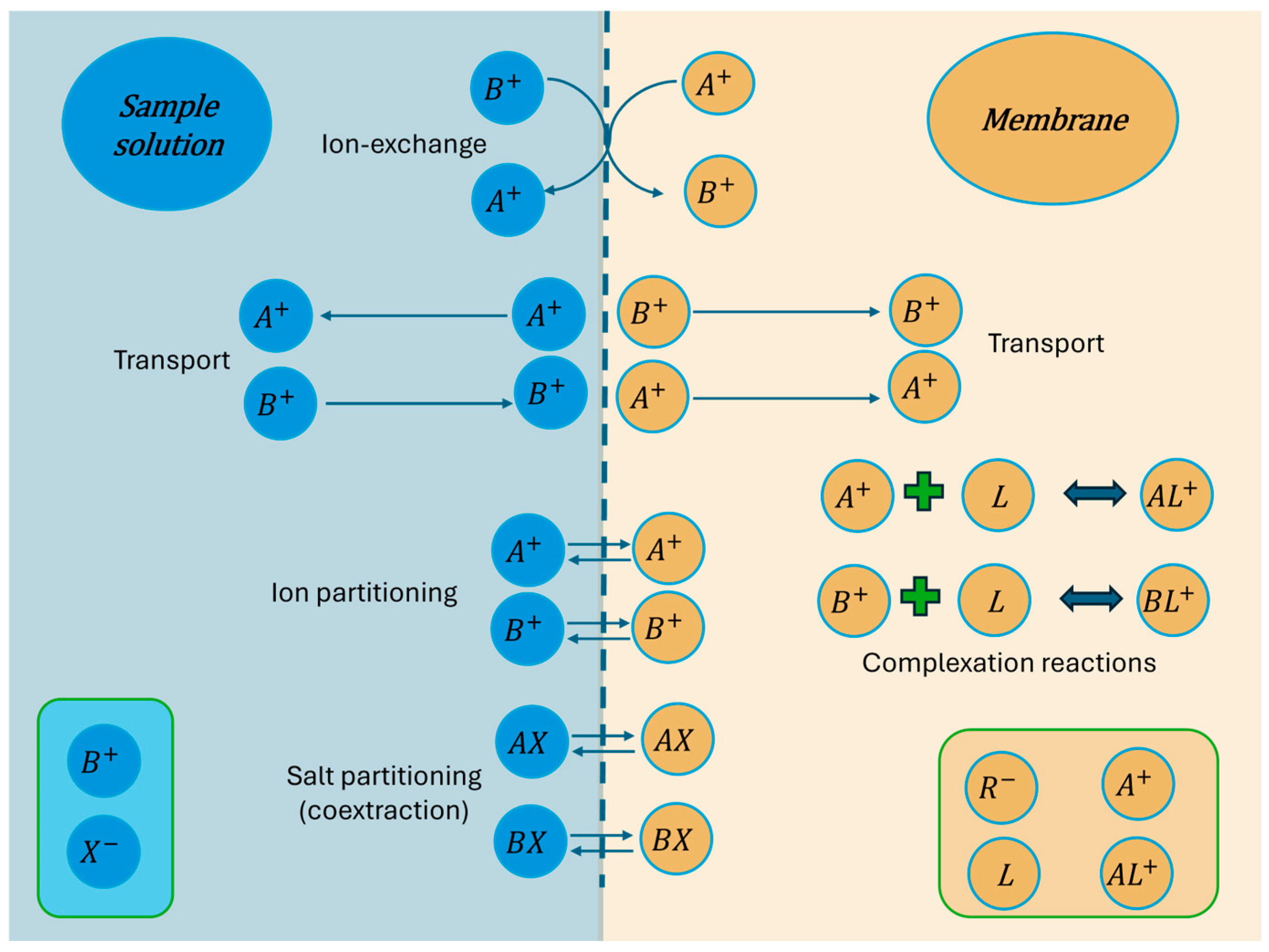
The temporal dependence of the E M value is a consequence of the occurrence of four different processes: partitioning of species between adjacent phases; mass transport of ions within each phase (diffusion, migration and convection); ion-exchange at the interfaces between water and the membrane; and complexation reactions between ions and ionophores within the membrane (see Figure 1). The influence of all these processes or some of them on the membrane potential is described using two main theoretical approaches: the “Phase-Boundary Potential Model” (PB model) and the “Nernst–Planck–Poisson Model” (NPP model).
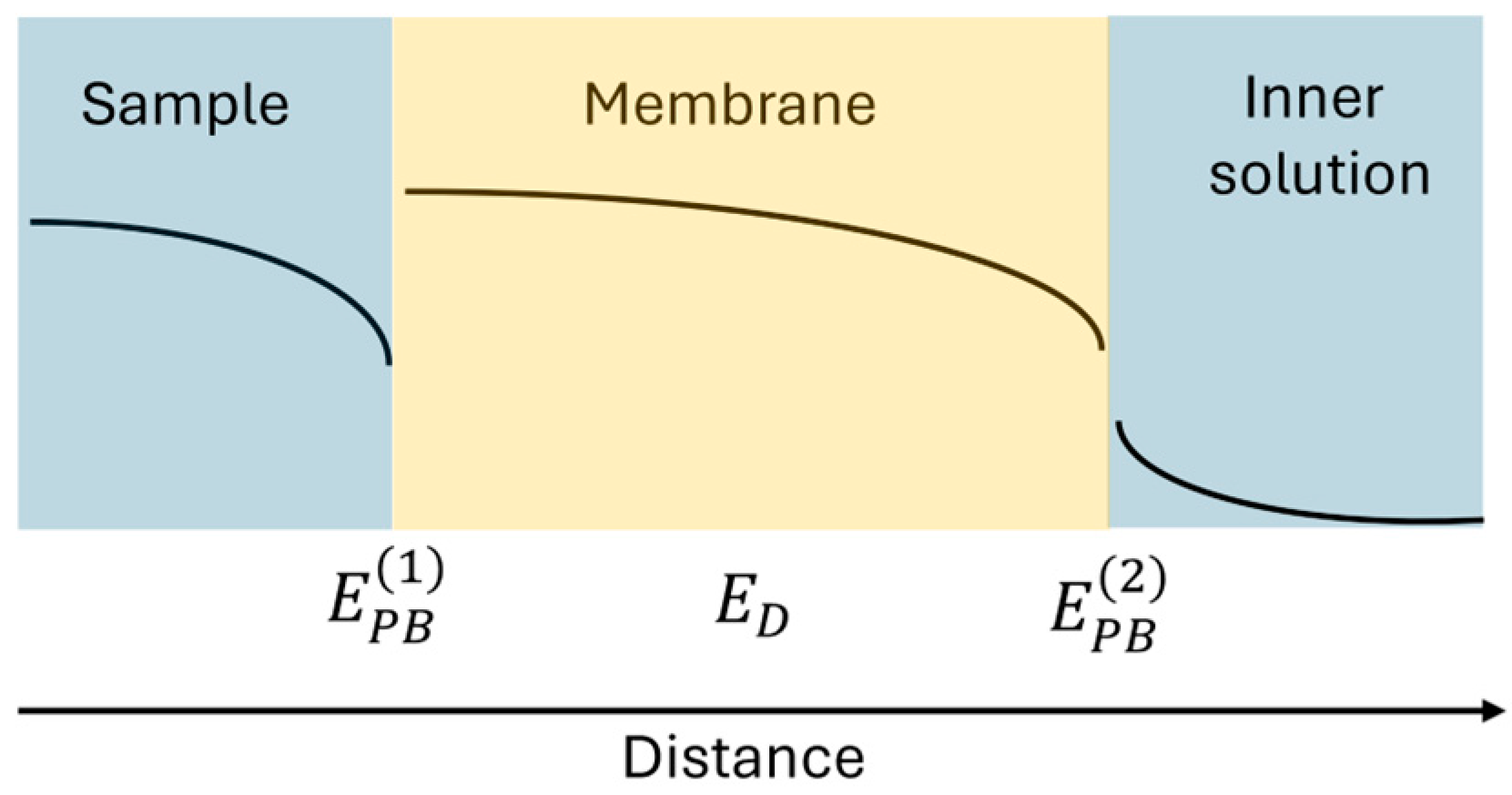
The PB model is based on the “segmented potential model” [17], in which the membrane potential is expressed as the sum of three different components (see Figure 2):
E M = E P B ( 1 ) + E P B ( 2 ) + E D
where E P B ( 1 ) is the potential at the sample/membrane interface, E P B ( 2 ) is the potential at the membrane/internal solution interface (usually considered as constant), and E D is the diffusion potential inside the membrane. The terms E P B and E D are originate from the equilibrium partitioning of ions at the sample/membrane interface and from the migration transport of the ions in the membrane, respectively. A common approach consists of neglecting the diffusion potential ( E D = 0), which constitutes the so-called “Phase-Boundary Potential Model” (PB model) proposed by Nikolskii in 1937 [4]. On the other hand, the consideration of the influence of the diffusion potential by Eisenmann in 1969 led to the appearanceof the “Total Membrane Potential approach” [4]. In 2004, Bakker et al. highlighted the dominance of the PB model over the “Total Membrane Potential approach” due to the minimal impact of migration effects on the membrane potential. Furthermore, the assumptions on which the PB model is based were identified [17]:
(a)
The potential at the water/membrane interface governs the response of the membrane. Within the membrane phase, the diffusion potential of the species involved is considered negligible.
(b)
The region of the membrane phase in contact with the sample is in chemical equilibrium with the aqueous solution of the sample.
In addition, the condition of electroneutrality is maintained within the membrane, and the potential at the sample/membrane interface arises from a separation of cation and anion charges, due to their different solvation free energies in both phases. The membrane potential is calculated from the following phase-boundary equation [17]:
E M = E P B ( 2 ) + R T z i F l n k i + R T z i F l n a i ( a q ) a i ( m )
where a i ( a q ) and a i ( m ) are the activities of the primary ion on the aqueous side and the membrane side of the sample/membrane interface, respectively, R is the molar gas constant, T is the absolute temperature (K), F is the Faraday constant, z i is the charge of the primary ion, and k i is given by:
k i = e x p μ i 0 a q μ i 0 m R T
where μ i 0 a q and μ i 0 m are the chemical standard potentials in the sample and the membrane phases. The term E P B ( 2 ) in Equation (2) is assumed to be constant. The simplicity and usefulness of the PB model are consequences of the fact that it is only necessary to know the relative values of ion distribution and their activities in both phases. These values can be determined by considering the diffusive mass transport in the aqueous boundary layer and the ion exchange process at the interface. If the membrane also contains an ionophore, its response characteristics can be predicted based on complexation equilibria.
A very different theoretical description of the membrane potential is used in the so-called Nernst–Planck–Poisson model (NPP model). This model is not based on the division of E M into different components (Equation (1)), but instead requires the explicit consideration of the space and time domains [3,4,17]. The electroneutrality condition is not fulfilled in the membrane, and the transport of ions due to diffusion and migration is considered both in the aqueous boundary layer and the membrane. The model requires the simultaneous resolution of the Nernst–Planck and Poisson equations, and the knowledge of parameters that are usually not accessible (such as ion mobilities and rate constants). As a result, the electrical potential profile along the system can be determined (Figure 2).
Both theoretical frameworks, the PB model and the NPP model, can be used to model the transient potential response measured with ISEs based on plasticized polymeric membranes. In this sense, the different theories reported in the bibliography can be divided into two general categories, depending on the presence or absence of interfering ions in the sample solution [14]. The models belonging to the first group describe the time response necessary to reach a stationary E M potential after a variation in the concentration of the analyte ion (concentration step). On the other hand, the models of the second group tackle the temporal variation of E M due to processes of ion-exchange between the primary ion (present initially in the membrane) and the interfering ions. Table 1 and Table 2 gather some characteristics of the different models reported in the literature to describe the transient responses in both situations.
In the following sections, a chronological and comprehensive discussion of the evolution of the PB and NPP models for the treatment of the transient potential curves of ISEs based on plasticized polymeric membranes is presented.

2.1. Theoretical Models in Absence of Interfering Ions

These models describe the dynamic nature of the membrane potential observed after a variation in the concentration of the analyte ion in the sample solution (concentration step). Thus, the potential measured for the initial concentration evolves to a new stationary value after a sufficiently long time. The most popular theories for the modeling of the temporal characteristics of these potential responses are based on the PB model (see Table 1), due to its simplicity compared to the NPP model.
Theoretical descriptions of the time dependence of the ISE potential under a concentration step were first initiated in 1965 by Rechnitz and Hameka for glass electrodes [34], and in the early 1970s by Tóth and Pungor for precipitate-based ISEs [35,36]. The first theoretical treatment for ISEs based on ion-exchangers was developed by Markovic and Osburn in 1973 [37]. The latter authors considered liquid ion exchange membranes, which are precursors of the plasticized polymeric membranes in which a liquid ion exchanger is contained within the pores of a solid support. The theory was constructed based on the idea that transport in the aqueous boundary layer created in the vicinity of the electrode is due solely to diffusion. Additionally, they assumed a linear concentration gradient in the boundary layer. Using the Laplace transform method to solve Fick’s second law, an analytical equation for the ion concentration at the membrane surface as a function of time was derived.
Shatkay thoroughly reviewed all the theories available up to 1976 for the transient potential response of ISEs [38]. This author discussed extensively the fundamentals of the different E-t equations and their agreement degree with experimental signals. He also suggested some improvements in the theoretical treatments and concluded that the transient potential signal is a complex phenomenon that requires different models depending on the case. However, the work of Shatkay did not include the transient potential responses of plasticized polymeric membrane ISEs, which were treated theoretically for the first time in 1975 by Morf et al. [18].
In their pioneering work [18], Morf et al. studied two different types of membranes: membranes containing dissolved ion-exchangers, and membranes containing neutral ionophores. Deviations from the Nernst equation were justified on the basis of time-dependent differences between the concentration in the aqueous bulk solution and the concentration in the boundary layer (i.e., in the unstirred solution), due to diffusion processes in the aqueous solution and the transfer of ions to the membrane through the interface. As can be concluded from the model, the response time depends mainly on the stirring rate and the direction of the concentration change (whether it increases or decreases). In the case of neutral ionophores, the response time also depends on the extraction capacity of the membrane.
For ion-exchange membranes, Morf et al. [18] assumed that the concentration of the primary ion in the membrane is constant (equal to the concentration of exchange positions) and that the ionic diffusion inside the membrane is negligible. Thus, by solving the diffusion equation (Fick’s law) approximately, the authors found the following equation for a variation in the activity of the ion in the bulk of the sample solution from an initial value a i 0 to a new value a i [18]:
a i a i = 1 1 a i 0 a i e t / τ
where a i is the activity of the ion on the aqueous side of the interface, t is the time of measurement, and the time constant τ is given by
τ = 4 δ 2 π 2 D
with δ and D being the thickness of the aqueous boundary layer (diffusion layer) and the mean diffusion coefficient (of cations and anions) in the aqueous sample, respectively. The E-t curve can be calculated from:
E ( t ) = E ( ) + D D i s log a i a i
where E ( t ) is the cell potential, D i is the aqueous diffusion coefficient of the analyte ion, E is the stationary cell potential reached at long times, and s is the slope of the linear response function E l o g ( a i ) .
The relationship between potential and time predicted by Morf et al. [18] is different for membranes containing only neutral ionophores. In this case, the authors considered only membranes sensitive to cations (Iz+) with concentrations of free ionophore (S) much higher than those of complexed ionophore ( I S n z + ). Under such conditions, the following expressions can be derived:
c i s 0 = K a i ;         c i s ( d ) = K a i
where c i s ( 0 ) and c i s ( d ) are the concentrations of cation complexes at the outer (x = 0) and inner (x = d) membrane surfaces, respectively; d is the membrane thickness; a i is the activity of the cation in the internal reference solution of the ISE; and K is a partition parameter defined as:
K = K e x c s n 1 / z + 1
where z is the charge of the cation; c s is the concentration of free ionophore in the membrane; n is the number of molecules of ionophore coordinated with each cation; and K e x is the equilibrium constant of the following extraction reaction:
I z + ( aq ) + z X ( aq ) + nS ( m ) I S n z + ( m )   +   z X ( m )
where X is the counterion of the analyte Iz+ and the acronyms aq and m refer to the aqueous solution and the membrane phase. Considering that there is no loss of electrolyte at the phase boundary, the authors found a relationship between the surface activity a i measured by the electrode and the time of measurement t
a i a i = 1 1 a i 0 a i 1 1 + t / τ
with the time constant τ being defined as
τ = D K 2 δ 2 π 2 D 2
where D represents the mean diffusion coefficient of the electrolyte (complexes I S n z + and anions X) in the membrane. Finally, the transient potential response can be obtained from:
E t = E + s log a i a i
The authors proposed different strategies to reduce the response time, including the use of nonpolar membranes with low diffusion coefficients, ionophores with moderate concentrations and low complexation constants, vigorous stirring of the sample solution, and the use of flow systems.
For both types of membranes (containing only ion exchangers or only neutral ionophores), Morf et al. [18] compared the results of the theoretical model with experimental data. Thus, the concordance of Equation (11) with potential–time curves recorded with potassium-selective electrodes containing the ionophore valinomycin was excellent. Regarding membranes containing only ion-exchange sites, the authors stated that the exponential relationship between the ISE potential and the time of measurement is consistent with previous results obtained by other authors [34,35,36,39].
In 1994, Senda published a very different PB theory for modeling the transient potential response of plasticized polymeric membrane ISEs obtained during a concentration step [19]. In this model, the water/membrane interface is treated as a polarizable interface between two immiscible liquids (an aqueous phase and an organic phase) and concepts of ion transfer and the structure of the double layer are considered.
In the model of Senda [19], the transient potential when the bulk concentration of the ion in the sample is changed from c W to c W is calculated using the following expression:
E ( t ) = E 1 1 C d l 0 t j ξ d ξ
where E ( t ) is the time-dependent cell potential, E 1 is the initial potential, C d l is the differential capacity of the interface (per unit of area), ξ is an integration variable, and j is the transient current density associated with the net amount of ion transferring across the interface. The values of E 1 and j are defined as:
E 1 = E 0 + R T z F ln c O c W
j ( t ) = z F c W 0 ( t ) k f E ( t ) c O 0 ( t ) k b E ( t )
where E 0 is the standard transfer potential of the ion; R is the molar gas constant (8.314 J K−1 mol−1); T is the absolute temperature; z is the ionic charge number; F is the Faraday constant (96,485 C mol−1); c O is the ion concentration in the bulk of the membrane; c W is the ion concentration in the bulk of the sample before the concentration step; c W 0 and c O 0 are the surface ion concentrations in the sample solution and the membrane; k f and k b are the potential-dependent rate constants for the transfer of the ion from the sample solution to the membrane and from the membrane to the sample solution, respectively. The constants k f and k b are described by the Butler–Volmer formalism:
k f ( E ) = k s exp α z F R T E E 0
k b ( E ) = k s exp 1 α z F R T E E 0
with k s and α being the rate constant at E = E 0 and the transfer coefficient, respectively. The dependence of the surface concentrations c W 0 and c O 0 on time is given by:
c W 0 ( t ) = c W 0 t j ( ξ ) / z F π D W ( t ξ ) 1 / 2 d ξ
c W 0 ( t ) = c O + 0 t j ( ξ ) / z F π D O ( t ξ ) 1 / 2 d ξ
where c W is the bulk concentration in the aqueous phase during the concentration step, and D W and D O are the diffusion coefficients of the ion in the aqueous and membrane phases, respectively. The transient current j continues to flow until E ( t ) reaches the value corresponding to the new bulk concentration ( E 2 ):
E 2 = E 0 + R T z F ln c O c W
Besides the general expression (12), Senda [19] also derived an analytical equation for the transient potential response when α = 1 / 2 (that is a typical value found in the literature). This analytical solution can be written separately for two cases:
E t = E 1 + R T z F ln 1 a 2 + 2 R T z F ln B e 2 a A t + 1 B e 2 a A t 1 ;   when   a > 1
E t = E 1 + R T z F ln 1 a 2 + 2 R T z F ln 1 B e 2 a A t 1 + B e 2 a A t ;   when   a < 1
with
a = c W c W
  A = z 2 F 2 2 R T k s c W c O 1 / 2 C d l
  B = a + 1 a 1
B = 1 a 1 + a
The model of Senda [19] predicts that the transient potential response after a concentration step of the analyte ion depends on the magnitude of the variation in the concentration, the kinetics of the ion transfer across the sample/membrane interface, and the electrical double-layer structure of the region originating between the phases. The shape and magnitude of the theoretical E-t curves obtained with Equations (20) and (21) are consistent with experimental results obtained by other authors [18,35,40,41,42]. Additionally, the response times calculated by the authors from the available data on the kinetics of ion transfer and the structure of the double layer are of the same order of magnitude as some experimental values [43,44,45,46,47].
The general Equation (12) of the model of Senda was numerically solved for different cases in a subsequent article in 1996 [48]. Moreover, the theory was extended to cover membranes with neutral ionophores. The response time was obtained and discussed in terms of ion concentrations, heterogeneous kinetic constants, double layer capacity, and the mechanism of the ion transfer assisted by the ionophore.

2.2. Theoretical Models in Presence of Interfering Ions

In the presence of primary and/or interfering ions, the ISE response can be time-dependent due to the ion-exchange process that takes place at the membrane/sample interface. This situation has been tackled theoretically both with the PB model and the NPP model, which have been demonstrated to be adequate to quantify the monotonic and non-monotonic signals obtained experimentally [4,17].

2.2.1. Diffusion Layer Models (DLMs)

The theories based on the PB model are englobed within the so-called “diffusion layer models” (DLM). These models are rooted in the initial work of Hulanicki and Lewenstam in 1977 [49], which was extended in subsequent articles [50,51,52,53]. The original DLM model was developed for solid membrane electrodes and assumes linear concentration gradients, stationary fluxes of ions, and constant diffusion layers. The time dependence is introduced to describe the achievement of total equilibrium through diffusion-controlled ion transport. The model predicts the selectivity coefficient changes during the measurement, and it is useful for interpreting monotonic and non-monotonic transient potential responses. These authors also observed variations in the selectivity coefficients and detection limits of liquid ion-exchange membranes in the presence of interfering ions, and proposed a DLM model to describe them [54].
One of the first DLMs applicable to the transient potential response of plasticized polymeric membrane ISEs was published by Morf et al. in 1999 [20]. In this work, a detailed theoretical analysis of the influence of ion transport on the potential response of electrodes with ionophore-based membranes is presented. The dynamic behavior of the electrochemical system before equilibrium was described, challenging traditional stationary interpretations of the Nernst model. Both steady-state and transient conditions were treated, considering any number of ionophores, differently charged cations and anions, and fixed or stationary ionic sites. In this model, the following analytical expression is used for calculating the cell potential (E):
E = E 0 + R T F ln ψ
where E 0 is a constant reference potential and ψ is a dimensionless electrical potential function. The value of ψ is obtained by implicit solution of the following system of equations:
i z i ψ z i c i ( m ) T K i a i ( a q ) ψ z i + q i γ i ( a q ) K i = 0 i z i c i ( m ) T = R T
where the summations apply to all the “n” exchangeable ions present in the system ( i = 1,2 , n ). In the above equations, z i is the charge number of each ion, c i ( m ) T is the concentration at the inner side of the membrane at the inner solution/membrane interface, K i is the overall distribution parameter, a i ( a q ) is the sample bulk activity, γ i ( a q ) is the aqueous activity coefficient, R T is the fixed-site concentration, and q i is the permeability ratio
q i = D m δ a q D i ( a q ) δ m = c i ( a q ) c i ( a q ) c i ( m ) T c i ( m ) T
where D ( m ) is the diffusion coefficient in the membrane (assumed to be equal for all the ions), D i ( a q ) is the aqueous diffusion coefficient of each ion, δ a q is the thickness of the aqueous diffusion layer, δ m is the thickness of the membrane, c i ( a q ) is the ion concentration on the aqueous side of the interface sample/membrane, c i ( m ) T is the ion concentration on the membrane side of the interface sample/membrane, and c i ( a q ) is the ion concentration in the bulk of the sample solution. The above equations consider the presence of ionophore flows, interfering ions, and concentration gradients on both sides of the sample/membrane interface.
The work of Morf et al. [20] represented a fundamental contribution to the theoretical understanding of ion-selective electrodes, especially in contexts where a rapid response or the use of non-steady-state conditions are relevant, such as in electronic tongues or flow sensors. The authors discussed the validity of their model based on previous experimental observations performed by other researchers. In particular, the model predicts biased selectivity coefficients and poor lower detection limits in unbuffered solutions, as a consequence of an increase in the activity of the primary ion in the boundary layer of the sample solution due to its transport from the inner solution [55,56,57,58,59]. Additionally, the potential response function of the model reduces to the Nikolski–Eisenmann equation or similar expressions when equilibrium and high activities of the ions are assumed.
Another DLM model for plasticized polymeric membranes containing neutral ionophores was published in 2004 by Radu et al. [23]. This model is based on an approximate numerical solution of the diffusion equation for the aqueous diffusion layer and the membrane, using the finite difference method in time (t) and the finite element method in space (x). Additionally, the existence of ion fluxes at the membrane/internal aqueous solution interface is considered.
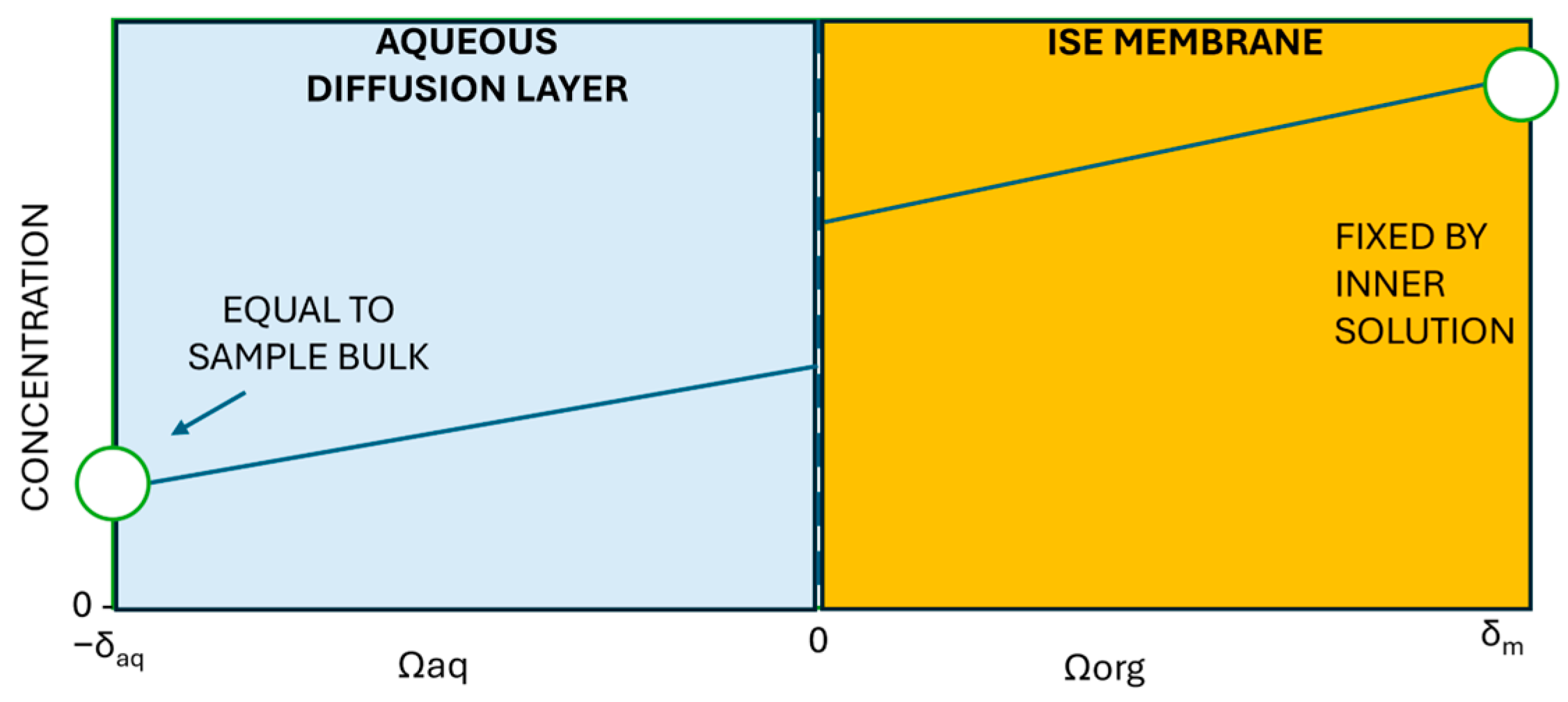
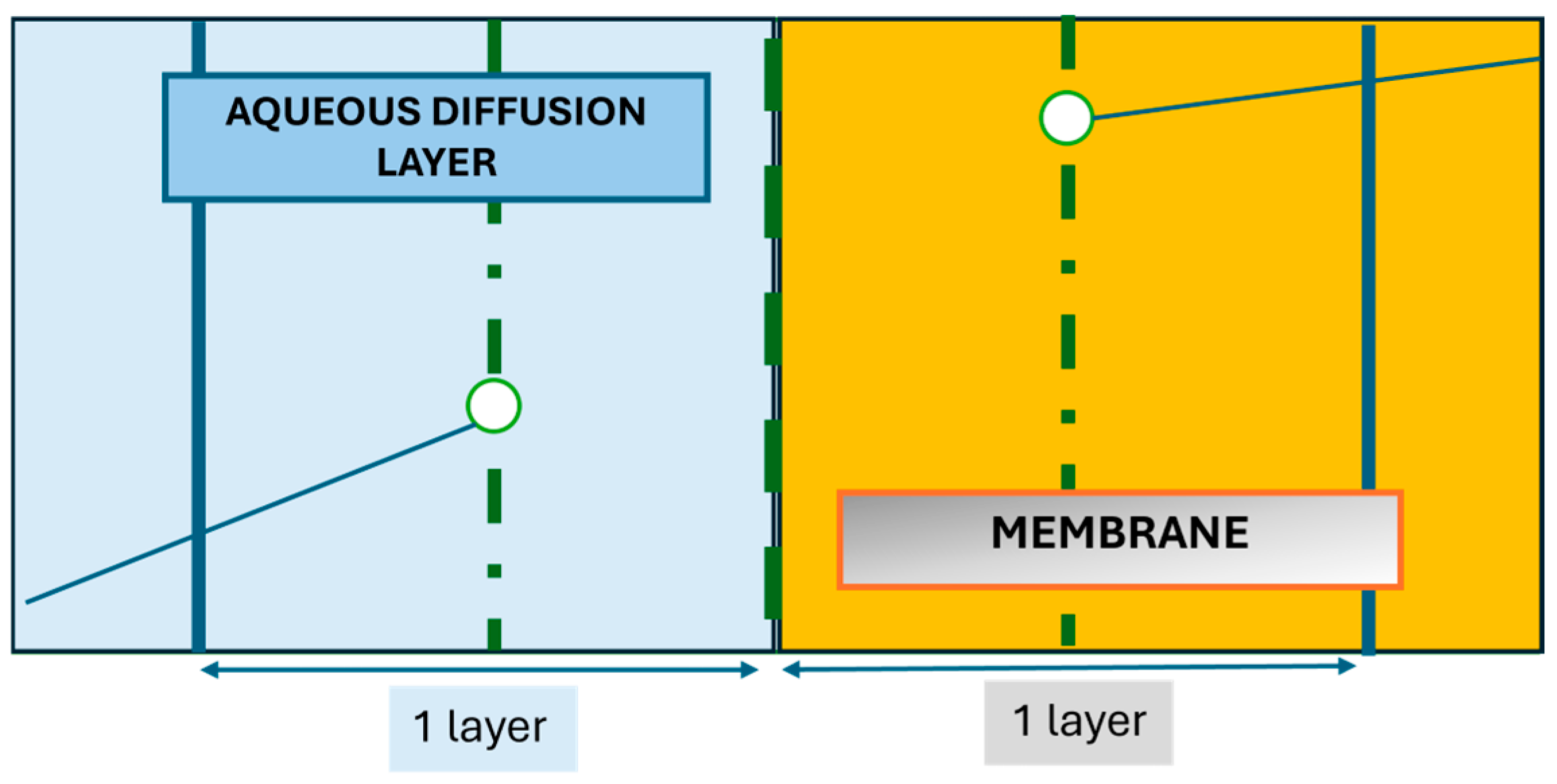
The theoretical treatment followed by Radu et al. [23] (see Figure 3) consists of dividing the system into two spatial domains ( Ω a q and Ω o r g ) and finding numerically a function c ( x , t ) for the concentration of primary ions that fulfills the following differential equation:
c t D 2 c x = 0       in   Ω   x   0 , t
where t and x are the time and the distance from the interface, Ω represents the union between the two spatial domains into which the system is divided and D is the diffusion coefficient given by a piecewise constant function:
D ( x ) = D o r g       f o r   x Ω a q D a q           f o r   x Ω o r g
The differential Equation (29) is subjected to the following boundary conditions in the bulk of the phases ( x = δ a q and x = δ m ) and the interface ( x = 0 ):
c ( δ a q , t ) = c a q , b ( t )
c δ m , t = c m , b t   for   t   in   ( 0 , t )
D a q c a q , x ( 0 , t ) D o r g c o r g , x ( 0 , t ) = 0   for   t   in   ( 0 , t )
K i , j p o t = c a q ( 0 , t ) c R , m c m ( 0 , t ) c m ( 0 , t ) c j , a q
where δ a q is the thickness of the diffusion layer in the aqueous phase, δ m is the membrane thickness, c a q , b is the concentration of the primary ion in the bulk of the sample solution, c m , b is its concentration in the bulk of the membrane, c a q , x is the gradient of concentration of primary ions in the aqueous diffusion layer, c o r g , x is the gradient of concentration of the primary ion-ionophore complex in the membrane, K i , j p o t is the experimentally accessible selectivity coefficient, c j , a q is the concentration of interfering ions in the aqueous phase, c R , m is the concentration of the ion-exchanger in the membrane, and c a q ( 0 , t ) and c m ( 0 , t ) are the time-dependent concentrations on the aqueous and membrane sides of the sample/membrane interface, respectively. Once c ( x , t ) is known, the membrane potential (E) is calculated from:
E = R T z i F ln c a q ( 0 , t ) c m ( 0 , t )
The model proposed by Radu et al. [23] has important implications for understanding the real-time response behavior of potentiometric sensors with low detection limits and super-Nernstian response slopes. It can explain short- and medium-term potential drifts, based on changes in concentration gradients in the aqueous sample and the membrane. Regarding short-term potential drifts, the authors compared the model’s theoretical predictions with experimental data obtained for a potassium-selective electrode subjected to a concentration step, revealing an excellent correlation. Conversely, the theoretical predictions of medium-term potential drifts were corroborated with potential–time curves recorded for a silver-selective electrode exposed to alternating or increasing concentrations of Ag+. The model also predicts the effects of memory, hysteresis, and drift after exposure to high concentrations of ions in the sample. Finally, the time required to reach a steady state with the potassium-selective electrode during conditioning was calculated, showing excellent concordance with experimental results. The necessity of conditioning was justified by the establishment of optimal transmembrane concentration gradients, which avoid unwanted response behavior at low concentrations in the sample. The derived equations allowed for proposing different strategies to reduce the detection limit to nanomolar levels or lower, such as maintaining the concentration of the primary ion in the internal solution at very low and constant values and using an ion exchange resin in the membrane.
One of the most used DLMs for plasticized polymeric membranes was presented in the article by Morf. et al. in 2007 [26]. In this work, a very simple and powerful numerical modelling of transient potential responses was performed by using finite-difference procedures in the spatial and temporal domains. Unlike Radu’s model [23], the derived equations can be easily processed with conventional software. Excellent results were obtained regarding the dynamic evolution of concentration profiles, potentials, and ion fluxes in the systems studied.
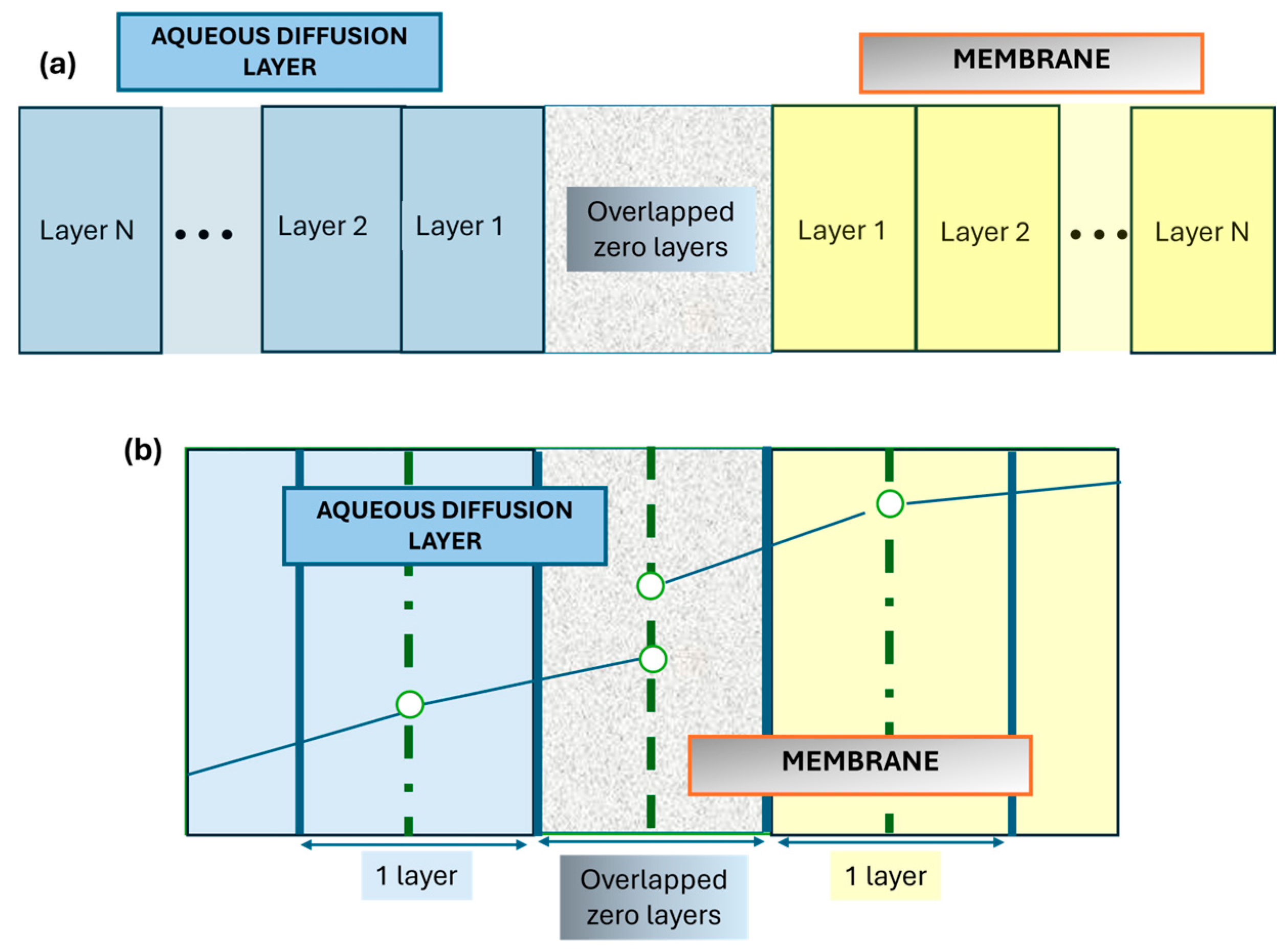
In the model of Morf et al. [26], the continuous membrane phase and the aqueous diffusion layer are replaced by N thin elementary layers of the same thickness, and the interface is defined as the region of overlapped zero layers (see Figure 4a). It is assumed that the elementary layers are thick enough for the concentration profiles between the midpoints of the layers to be linear (see Figure 4b). Thus, the diffusive fluxes of primary ( i ) and interfering ( j ) ions, and the continuity equation in each layer of the aqueous phase, can be written as:
J i , v / v + 1 ( t ) = J j , v / v + 1 ( t ) = D o C i , v C i , v + 1 δ
C i , v ( t + Δ t ) C i , v ( t ) Δ t = J i , v 1 / v ( t ) J i , v / v + 1 ( t ) δ
which combined led to the following expression:
C i , v ( τ + Δ τ ) = C i , v ( τ ) + C i , v 1 2 C i , v + C i , v + 1 Δ τ
In the above equations, J ξ , v / v + 1 ( t ) is the time-dependent flux of ion ξ ( ξ = i , j ) from the v-th to the (v+1)-th element ( v = 1,2 , N ); J ξ , v 1 / v ( t ) is the flux of ion ξ from the (v−1)-th to the v-th element; C i , v 1 , C i , v and C i , v + 1 are the concentrations of primary ions in the corresponding elements; Δ t is a small time interval, and τ is given by:
τ = D o δ 2 t
where D 0 is an arbitrary diffusion coefficient, and δ is the thickness of each element
δ = d N
with d and N being the thickness of the membrane and the number of elements, respectively. A similar treatment of the aqueous diffusion layer leads to the following expressions:
C i , v ( τ + Δ τ ) = C i , v ( τ ) + p q C i , v 1 2 C i , v + C i , v + 1 Δ τ
p = D o δ D o δ
q = δ δ
where the quantities marked with the symbol ′ refer to the aqueous diffusion layer. By considering the continuity law at the interface (overlapped zero layers) and the local equilibrium conditions for the ion exchange at the interface, the following relationships are derived for the interfacial concentrations ( ν = 0 ) of the primary ion in the aqueous phase ( C i , 0 ) and the membrane ( C i , 0 ):
C i , 0 ( τ + Δ τ ) = C i , 0 ( τ ) + p q C i , 1 C i , 0 Δ τ q C i , 0 C i , 1 Δ τ
C i , 0 ( τ + Δ τ ) = R t o t a i , 0 a i , 0 + K i j a j , 0 R t o t C i , 0 C i , 0 + K i j C j , 0
where a i , 0 and a j , 0 are the activities of the primary and interfering ions on the aqueous side of the interface, C j , 0 is the concentration of the interfering ion on the aqueous side of the interface, K i j is the selectivity coefficient, and R t o t is the total concentration of ion exchanger in the membrane. Finally, the membrane potential is calculated from:
E M = R T F ln a i , 0 + K i j a j , 0 a i + K i j a j
where a i and a j are the constant activities in the inner aqueous solution of the ISE. The activities a i , 0 and a j , 0 are obtained from Equations (44) and (45).
The predictions of Morf’s 2007 model were not compared with any experimental results in the original paper [26]. However, the authors stated that the model’s numerical simulations are in excellent agreement with previous experimental data [59,60]. The model successfully predicts non-ideal phenomena observed experimentally, such as super-Nernstian slopes at lower ion activities [15] and hysteresis at short contact times [61,62,63] (2006 Szigeti; 2003 Radu; 2003 Vigassy). Additionally, the model demonstrated that the range of linear response of the electrodes can be extended to lower activities by increasing the measurement time, as had been experimentally evidenced [61,62,63].
Morf et al. published another DLM model in 2008 [28], which offers an approximate description of the fluxes of primary and interfering ions in the membrane for quantifying the time variation in the ISE selectivity. Unlike the previous model [26], which was based on numerical simulations, this new theory provides an analytical, explicit equation for the membrane potential. The authors compared the theoretical predictions of both models, finding a good correlation.
In the new model of Morf et al. [28], the authors considered the presence of any number of interfering ions (j) together with the primary ion (i) in the sample solution. Additionally, the conditioned ISE membrane is assumed to contain initially a homogeneous concentration of each ion k ( C k , m 0 , with k = i, j). The starting points of the model are the following expressions corresponding to the mixed-potential approach, which are based on the phase-boundary potential model [15,20,64]:
E c e l l = E i 0 + R T z i F ln a i , a q x i , m
E c e l l = E i 0 + R T z i F ln K i j a j , a q x j , m z i / z j
x k , m = z k C k , m R t o t
k x k , m = 1
where E c e l l is the cell potential, E i 0 is the reference potential; a k , a q is the activity of the primary ion ( k = i ) or the interfering ions ( k = j ) in the aqueous boundary of the interface; z k is its ionic charge; K i j is the selectivity coefficient; R t o t is the total concentration of ionic sites; C k , m is the concentration of the ion k on the membrane surface at any time; x k , m is the local molar fraction of sites occupied by ions k ; and R, T and F have their usual meanings. After a change in the composition of the sample, the concentrations in the membrane side of the interface change from C k , m 0 to C k , m . As a result, ionic fluxes of species k appear in the membrane ( J k , m ) and the aqueous diffusion layer ( J k , a q ), which can be written as:
J k , m = D m δ m ( t ) C k , m C k , m 0 = D m δ m ( t ) x k , m x k , m 0 R t o t z k
J k , a q = D k , a q γ k , a q δ a q a k , a q a k , a q
where D m is the diffusion coefficient in the membrane (assumed to be equal for all species); D k , a q is the aqueous diffusion coefficient of the ion k ; a k , a q is the bulk activity of the ion k in the sample solution; x k , m 0 is the initial molar fraction of sites occupied by ions k ; γ k , a q is the activity coefficient of the ion k in the sample solution; δ a q is the constant thickness of the aqueous boundary layer; and δ m is the time-dependent thickness of the diffusion layer formed in the membrane:
δ m ( t ) = κ D m t
with κ being a numerical factor that varies between the limits π and 4/ π . Taking into account that J k , m = J k , a q , the following solution is found for x k , m :
x k , m = a k , a q + x k , m 0 Δ a k , e x ψ i K i k z k / z i + Δ a k , e x
where the selectivity coefficient K i k is defined for all species k (also for the primary ion, with K i i = 1), the term Δ a k , e x is given by
Δ a k , e x ( t ) = D m δ a q D k , a q δ m ( t ) γ k , a q R t o t z k
and ψ i is related to the cell potential as follows:
E c e l l = E i 0 + R T z i F ln ψ i
The value of ψ i can be obtained by solving implicitly the following equation:
k x k , m 0 ψ i K i k z k / z i a k , a q ψ i K i k z k / z i + Δ a k , e x = 0
where the summation applies to all the interfering species. Equation (57) simplifies when there is only one interfering species ( j ):
ψ i 1 + z j / z i ψ i z j / z i a i , a q P i j x j , m 0 Δ a j , e x ψ i K i j z j / z i a j , a q x i , m 0 Δ a j , e x K i j z j / z i Δ a j , e x a i , a q + P i j a j , a q = 0
with
P i j = z j D j , a q γ i , a q z i D i , a q γ j , a q
Moreover, an explicit solution for ψ i is obtained when z i = z j = 1 :
ψ i = 0.5 a i , a q + K i , j a j , a q K i , j x i , m 0 + P i j x , m 0 Δ a j , e x + 0.25 a i , a q + K i , j a j , a q K i , j x i , m 0 + P i j x j , m 0 Δ a j , e x 2 + K i , j Δ a j , e x a i , a q + P i j a j , a q
The theoretical predictions of Morf’s analytical model were compared with numerical simulations using his previous model. An excellent concordance was found for different selectivity and measurement time situations [28]. Furthermore, the impact of the measurement time on the calculated potential–ion activity curves aligns with experimental results reported by other researchers [24].
In 2010, Jasielec et al. published an article comparing different theoretical approaches for the quantification of the detection limit of ISEs, including the DLMs [25]. In this work, the authors classify the DLM models into four categories: the time-dependent diffusion model (TDM), the diffusion-exchange model (TDM-E), the diffusion-exchange-coextraction model (TDM-EC), and the time-independent model (SDM). The TDM and TDM-E correspond to two versions of the original Morf’s model of 2007 [26], depending on whether the diffusion coefficients of primary and interfering ions in each phase are equal or not. The TDM-EC is also developed from the original Morf’s model [26,30].
As can be seen, the article by Jasielec et al. [25] does not discuss some of the DLMs described above. In any case, Morf’s 2007 model was the most widely used at the time the paper was published [26]. However, it was criticized in later years due to serious errors in the calculations under certain conditions [25,27,65]. In particular, the problems are a consequence of the physical inconsistency of Equation (44), which results in a violation of the mass conservation at the interface. In this sense, Yuan and Bakker proposed in 2017 a modification of the Morf’s model [27] that overcomes its limitations. These authors treated the elements of the sample and the membrane on each side of the interface as a combined entity; in such a way their total concentration change is due to the diffusional fluxes entering and leaving the interface. Hence, Equation (44) can be replaced by the following expression:
C i , 0 ( τ + Δ τ ) C i , 0 ( τ ) + C i , 0 ( τ + Δ τ ) C i , 0 ( τ ) q = p q C i , 1 C i , 0 Δ τ q C i , 0 C i , 1 Δ τ
where the different terms are defined as in the 2007 Morf’s model. The combined use of Equations (45) and (61) was demonstrated to be more robust, avoiding the unreasonable and incorrect results predicted by the previous model of Morf et al. [26]. Furthermore, Yuan’s model was successfully used to reproduce some of the theoretical results reported using Radu’s model [23].
Another improvement of the Morf’s model [26] was achieved by the equilibria-triggered diffusion model (IET model) developed in 2018 by Egorov et al. [30]. In this model, applicable to monovalent primary and interfering ions, the membrane and the aqueous diffusion layer are also divided into several elementary layers with linear concentration gradients between the midpoints of adjacent layers, and the ISE potential is calculated numerically. However, the layers corresponding to the interface are entirely located in the corresponding phases, and the authors do not employ the concept of “zero layer” used by Morf (see Figure 5). Thus, the Egorov model remains operational for any realistic electrode operating situation.
In the IET model, each new calculation cycle begins with the correction of the concentrations of the primary ion (A) in the interfacial (first) layers of the sample and the membrane at the time t
C A , 1 ( t ) = C A , 1 ( t ) + Δ C A , 1
C - A , 1 ( t ) = C - A , 1 ( t ) Δ C A , 1 δ 1 δ - 1
where δ 1 and δ - 1 are the thicknesses of the interfacial layers of the sample solution and the membrane, respectively; C A , 1 and C - A , 1 are the corrected concentrations in the interfacial layers; C A , 1 and C - A , 1 are the initial concentrations or the concentrations established at time t due to diffusion; and Δ C A , 1 is calculated on the basis of the local ion-exchange equilibrium between primary (A) and interfering (B) ions:
K A B = C - B , 1 ( t ) + Δ C A , 1 δ 1 / δ - 1 C A , 1 ( t ) + Δ C A , 1 C - A , 1 ( t ) Δ C A , 1 δ 1 / δ - 1 C B , 1 ( t ) Δ C A , 1
where K A B is the concentration exchange constant and the terms C - B , 1 and C B , 1 have the same meanings as C A , 1 and C - A , 1 , but are applied to the interfering ion. The corrected concentrations C A , 1 and C - A , 1 are used for calculating the concentrations at the next time t + Δ t as a result of the diffusion processes. For example, for the sample solution the following equations are fulfilled:
C A , 1 ( t + Δ t ) = C A , 1 ( t ) + 2 C A , 2 ( t ) C A , 1 ( t ) D Δ t δ 1 + δ 2 δ 1
C A , n ( t + Δ t ) = C A , n ( t ) + 2 C A , n 1 ( t ) C A , n ( t ) D Δ t δ n 1 + δ n δ n + 2 C A , n + 1 ( t ) C A , n ( t ) D Δ t δ n + 1 + δ n δ n
where C A , 2 ( t ) , C A , n ( t ) , C A , n 1 ( t ) and C A , n + 1 ( t ) are the concentrations of the primary ion in the second, n-th, (n−1)-th and (n−1)-th elementary layers at the time t; Δ t is the time interval used in the calculations; D is the aqueous diffusion coefficient (assumed to be equal for both the primary and interfering ions); δ 2 , δ n 1 , δ n and δ n + 1 are the thicknesses of the corresponding elementary layers (they are not necessarily equal to each other). The concentrations in the elementary layers of the membrane are calculated using equations analogous to (65) and (66). Finally, the cell potential at each time t is calculated as follows:
E ( t ) = k + 2.303 R T z F log C A , 1 ( t ) γ A C - A , 1 ( t )
where k is a constant (determined experimentally), γ A is the activity coefficient of the primary ion in the sample solution, and z can take the value of 1 or −1. R, T and F have their usual meanings.
The predictions of the IET–Egorov model were compared with the results of experiments conducted on a picrate-selective electrode immersed in a solution containing nitrate as an interfering ion [30]. Various scenarios were tested for determining the selectivity coefficients, as proposed by the IUPAC, including the separate solution method (SSM), the fixed interference method (FIM), the fixed primary ion method (FPM), the two solutions method (TSM), and the matched potential method (MPM). The authors confirmed that the potential–time curves obtained from the simulations were in excellent agreement with the experimental data in the absence and presence of the primary ion. Additionally, the selectivity coefficients calculated with the model coincided withthose determined experimentally.
Although the original IET model was developed for membranes containing only ion exchangers, Egorov et al. have also applied their theoretical framework to membranes containing ionophores as well [31]. Moreover, they included the effects of coextraction and transmembrane transport, which were not considered in their previous work. In this case, the E-t curve is obtained from:
E ( t ) = k + 2.303 R T z F log C A , 1 ( t ) C - S , 1 ( t ) C - A S , n ( t ) C - A S , 1 ( t ) C A , 1 ( t ) C - S , n ( t )
where C A , 1 ( t ) and C A , 1 ( t ) are the concentrations of the primary ion in the first element of the sample and the inner reference solution; C - S , 1 ( t ) and C - S , n ( t ) are the concentrations of the ionophore in the surface elements of the membrane adjacent to the sample and the inner solution; C - A S , 1 ( t ) and C - A S , n ( t ) are the concentrations of the complexes of the primary ion with the ionophore in the surface elements of the membrane adjacent to the sample and the inner solution. These values are calculated using an algorithm similar to the one employed in the original IET model, although it is more complex mathematically. The remaining terms in Equation (68) have the same meanings as in Equation (67).
The validity of the new variant of the model [31] was confirmed by comparing theoretical predictions with experiments performed with valinomycin-based potassium-selective electrodes. The dependence of the theoretical calibration curves on the concentration of K+ in the inner solution, the measuring protocol (from low to high concentration or vice versa), the measurement time, the diffusion layer thickness, and the concentration of interfering ions in the inner and conditioning solutions was consistent with experimental results reported in the literature [58,61,66,67,68]. Thus, the authors demonstrated the dependence of the lower detection limit on different variables, including the diffusion coefficients, the concentration of ions in the membrane, the thickness of the aqueous diffusion layer, the duration of the measurement, and the composition of the internal reference solution. Additionally, the influence of the conditions of the electrode conditioning was totally analogous to that predicted by the more sophisticated and rigorous model based on the Nernst–Planck–Poisson approach [25]. Super-Nernstian slopes were obtained at long measurement times when the membrane was conditioned in a solution of the primary ion and the inner solution contained interfering ions. Conversely, the opposite behavior was observed when the membrane was conditioned in a solution of the interfering ion and the inner solution did not contain interfering ions.
The group of Egorov demonstrated in 2019 another pitfall of the well-accepted Morf’s model of 2007 [69]. In this case, the authors noted that the Morf’s model assumed that the concentration of interfering ions in the aqueous boundary layer remains constant during the potential measurement. This assumption is not adequate for solutions containing strongly interfering ions, which results in discrepancies between the theoretical and experimental E-t curves. Therefore, the following more rigorous equation was proposed for the calculation of the aqueous concentration of the primary ion in the zero layer ( C i , 0 ):
C i , 0 ( t + Δ t ) = 0.5 a b + c 2 K i j 1
where
a = 2 C i , 0 ( t ) C i , 0 ( t ) D aq Δ t δ 2 + C i , 1 ( t ) D aq Δ t δ 2 + C - i , 0 ( t ) C - i , 0 ( t ) D m Δ t δ 2 + C - i , 1 ( t ) D m Δ t δ 2 + C j , 0 ( t ) + C - R t o t + C i , 0 ( t ) + C j , 0 ( t ) K i j 1
b = 4 K i j 1 C - R t o t × D aq Δ t δ 2 1 C i , 0 ( t ) D aq Δ t δ 2 C i , 1 ( t ) + D m Δ t δ 2 1 C - i , 0 ( t ) D m Δ t δ 2 C - i , 1 ( t )
c = C - R t o t + 1 + D aq Δ t δ 2 K i j 1 C i , 0 ( t ) + D aq Δ t δ 2 K i j D aq Δ t δ 2 C i , 1 ( t ) + K i j 1 × D m Δ t δ 2 1 C - i , 0 ( t ) D m Δ t δ 2 C - i , 1 ( t ) + K i j C i , 0 ( t )
and the remaining terms have the same meanings as in the 2007 Morf’s model. Equation (69) was derived from the consideration that the coextraction processes are negligible and that the electroneutrality condition in the zero layer is fulfilled at all times. The simultaneous use of Equations (61) and (69) for the calculation of the potential provides a better agreement with the experimental results shown in the article [69].
In 2020, Hambly et al. reported a new DLM model that introduces the influence of the kinetics of interfacial ion-exchange processes on the transient potential response [32]. This approach differs greatly from previous DLMs, which only assume thermodynamic equilibrium at the membrane/sample interface. The model consists of an extension of Morf’s model [26], combining it with first-order kinetics for the ion exchange between primary and interfering ions. It was shown that the rate constant has a significant impact on the transient signals corresponding to instantaneous changes in ion concentrations in the sample solution. The kinetic description of the membrane/solution interface is relatively simple, and the model predicts certain experimental results better than the models described above.
In the model of Hambly [32], Fick’s second law of diffusion applies for the mass transport of primary ions ( i ) and interfering ions ( j ) in the bulk of each phase:
C k , α ( x , t ) t = D k , α 2 C k , α ( x , t ) x 2
where x is the distance to the interface, t is the measurement time, C k , α ( x , t ) is the concentration of species k ( k = i , j ) in phase α ( α = a q , m ), and D k , α is its diffusion coefficient in that phase. On the other hand, kinetic limitations are considered at the interface ( x = 0 ) due to ion exchange. Thus, the following expression is obtained for the primary ion on the membrane side of the interface:
C i , m ( 0 , t ) t = D i , m 2 C i , m ( 0 , t ) x 2 + d C i , m ( 0 , t ) d t R X N
with the second term on the right-hand side of the equation being given by:
d C i , m ( 0 , t ) d t R X N = k C i , a q ( 0 , t ) C j , m ( 0 , t ) k C i , m ( 0 , t ) C j , a q ( 0 , t )
where k and k are the forward and backward rate constants for the ion-exchange process, that are related to the selectivity coefficient K i , j p o t as follows:
K i , j p o t = k k
In the same manner as in 2007 Morf’s model [26], the aqueous and membrane phases are divided into several elementary layers. Thus, the discretization of Equation (74) provides the following expression for the interfacial concentration of primary ions in the membrane:
C i , m ( 0 , t + Δ t ) = C i , m ( 0 , t ) + D i , m Δ t Δ x 2 C i , m ( 1 , t ) C i , a q ( 0 , t ) + k C i , a q ( 0 , t ) C j , m ( 0 , t ) k K i , j p o t C i , m ( 0 , t ) C j , a q ( 0 , t )
where Δ t and Δ x are the temporal and spatial steps. Similar expressions can be written for each species at both sides of the interface. On the other hand, the discretization of Equation (73) for non-surface elementary layers yields the same expressions as in Morf’s 2007 model [26]. Therefore, the only novelty of the Hambly’s model [32] consists of how the concentrations in the elements next to the interface are calculated.
Hambly’s model was verified through comparison with several experimental results. For instance, it predicted the potential overshoot reported by other authors when the concentration of interfering ions in the sample solution is changed [70,71,72,73]. It showed better agreement with the transient response reported by Gratzl et al. [73] for an iodide-selective electrode exposed to changes in bromide concentration than other diffusion layer models did, demonstrating the necessity of incorporating the influence of the kinetic constants for ion exchange. Finally, the model also reproduces the super-Nernstian response predicted by Yuan’s model [27] and the experimental data reported by Egorov et al. [69], corresponding to the exposure of a picrate-selective electrode to nitrate anions.
Finally, we proposed the latest DLM model in 2025 [33]. Unlike the majority of DLMs, our theoretical treatment is based on the analytical resolution of the boundary value problem that describes the variations of the concentrations of primary and interfering ions in both phases (sample and membrane) with time (t) and distance (x). Thus, closed expressions were derived for the transient potential response of the ISE, which offer advantages in terms of simplicity, calculation times, and the identification of key parameters of the response. Fick’s second law for each phase (Equation (73)) is analytically resolved by considering the conservation of mass and charge at the interface ( x = 0 )
D W c A W ( x , t ) x x = 0 = D M c A M ( x , t ) x x = 0
D W c B W ( x , t ) x x = 0 = D M c B M ( x , t ) x x = 0
c A M ( x , t ) x x = 0 = c B M ( x , t ) x x = 0
and assuming fast (reversible) ion transfer of primary (A) and interfering (B) ions
c A W ( x = 0 , t ) c A M ( x = 0 , t ) = exp z F R T E E A 0
c B W ( x = 0 , t ) c B M ( x = 0 , t ) = exp z F R T E E B 0
In the above equations, c i α is the concentration of species i (i = A,B) in phase α (α = W,M), D α is the diffusion coefficient in phase α ; z is the ionic charge ( z A = z B = z ); E is the potential at the sample/membrane interface; and E i 0 is the formal transfer potential of the ion i ( i = A , B ), that is related to the Gibbs free energy of ion transfer [74]. F, R and T have their usual meanings.
Our model was developed within the scenario of a new experimental methodology for the simultaneous quantification of primary and interfering ions, based on the influence of the stirring of the sample solution on the potential value observed by other authors [75]. Thus, we propose the measurement of the ISE potential in two steps: a first step without stirring the sample solution, and a second step where the stirring is activated. Thus, the following analytical equations are derived for the membrane potentials during the first ( E 1 ) and second ( E 2 ) measurement steps [33]:
E 1 = E A 0 + R T z F ln μ A + μ B γ e Δ η 0 + μ A + ( μ B γ ) e Δ η 0 2 + 4 γ e Δ η 0 μ A + μ B 2
E 2 ( t ) = E A 0 + R T z F ln β t + β 2 ( t ) 4 λ ( t ) e Δ η 0 2 ϕ
with
μ A = c A W c A M   ;     μ B = c B W c A M ;     γ = D M D W   ;     Δ η 0 = z F R T E B 0 E A 0
ϕ = γ + μ A γ + e η 1 A + μ B γ + e η 1 B
β t = e Δ η 0 ξ γ + μ A γ + e η 1 A μ B e η 1 B + γ   e r f c s W l i m γ + e η 1 B + ξ μ B γ + e η 1 B + γ + μ A e η 1 A e r f c s W l i m 1 γ + e η 1 A μ A   e r f c s W l i m
λ ( t ) = ξ γ + μ A e η 1 A γ + e η 1 A + μ B e η 1 B γ + e η 1 B ( e r f c s W l i m 1 ) μ A + μ B   e r f c s W l i m
where c i W is the bulk concentration of ion i (i = A,B) in the sample solution, c A M is the bulk concentration of the primary ion in the membrane, e r f c is the complementary error function, and
s W l i m = δ W 2 D W t
ξ = γ δ W π D W ( t τ 1 )
η 1 A = z F R T E 1 E A 0 ;       η 1 B = z F R T E 1 E B 0
where τ 1 is the duration of the first step of the measurement (without stirring) and δ W is the time-independent thickness of the linear diffusion layer created during the second step, which decreases as the stirring rate increases. In addition, simpler expressions for E 1 can be derived from Equation (83) for very hydrophilic interfering ions
E 1 = E A 0 + R T z F ln μ A
and very lipophilic interfering ions:
E 1 = E B 0 + R T z F ln μ B γ   for   μ B > γ
E 1 = E A 0 + E B 0 2 + R T 2 z F ln γ μ A + μ B   for   μ B = γ
E 1 = E A 0 + R T z F ln γ μ A + μ B γ μ B   for   μ B < γ
The above equations show that the value of E 1 (absence of stirring) is independent of time, whereas the presence of convection during the second step introduces a time dependence to the value of E 2 .
The theoretical predictions of our model were corroborated by experiments performed with a nitrate-selective electrode in the presence of interfering ions of different lipophilicity (tetraphenylborate, perchlorate, and chloride), both in the absence and presence of the primary ion in the sample. Similar theoretical and experimental variations in the potential were observed after activating the stirring of the aqueous sample, which depends on the stirring rate and the nature and concentrations of the ions. Although the model could predict the total potential change, it was inadequate for describing the complete dynamics of the potential change. This was probably due to the assumption that stirring was activated instantaneously, such that the diffusion layer thickness in the aqueous solution reaches a constant value during entire second measurement step. It is important to note that, although the model has been developed for the “OFF-ON” stirring methodology, our theoretical approach can be applied to modeling other situations where transient potential responses are expected. In addition, more complex situations such as the presence of multiple interfering ions could be tackled. In such a case, Fick’s second law (Equation (73)) would include additional species, which would also be taken into account in the equations for the mass and charge conservation (Equations (78)–(80)) and for the equilibrium ion transfers (Equations (81) and (82)). Then, the resulting potential–time curve could be obtained by following the procedure indicated in [33]. In cases where all the interfering ions have the same charge as the primary ion, an analytical solution for the transient potential may be derived. On the other hand, the more complex situation where arbitrary charges are considered should be tackled by numerical methods.

2.2.2. Nernst-Planck-Poisson Model (NPP Model)

Unlike the DLMs, the Nernst–Planck–Poisson model (NPP model) requires the definition of an explicit spatial domain and the potential is not divided into different contributions (Equation (1)). In addition, it can be used for any number of ions and electrical charges. General assumptions such as electroneutrality in the membrane and local equilibrium conditions between the contacting phases are not applied. Although it is mathematically more complex, the NPP model is more rigorous and time-dependent profiles of the electrical potential and ion concentration in the entire system (sample–membrane–inner solution) can be obtained.
The NPP model is based on the simultaneous resolution of three equations: the Nernst–Planck equation, that describes the mass transport of ions due to diffusion and migration:
J i ( x , t ) = D i c i ( x , t ) x z i c i ( x , t ) F R T E ( x , t )
the continuity equation, which describes the conservation of mass:
c i ( x , t ) t = J i ( x , t ) x
and the Poisson equation, which describes the electrical changes caused by the interaction of the ions:
E ( x , t ) x = 4 π ε i z i c i ( x , t )
In the above expressions, J i ( x , t ) is the flux of the ion i , D i is its diffusion coefficient, z i is its charge number, c i is its concentration dependent on the distance (x) and time (t), E ( x , t ) is the electric field, ε is the dielectric permittivity, and F, R and T have their usual meanings. For convenience, the Poisson equation (Equation (98)) is replaced by the totally equivalent displacement current (I) equation:
I ( t ) = F i z i J i ( x , t ) + ε E ( x , t ) t
The first application of the NPP model to the electrochemistry of membranes was carried out by Brumleve and Buck in 1978 [76]. These authors numerically resolved the above set of coupled partial differential equations by employing a fully implicit finite difference scheme and the Newton–Raphson method. For that, the following boundary conditions were chosen at the two interfaces of the membrane:
J i 0 ( t ) = k i c i , b L k i c i 0 ( t )
J i d ( t ) = k i c i , b R + k i c i d ( t )
where J i 0 , J i d , c i 0 and c i d are the fluxes and concentrations at x = 0 (sample/membrane interface) and x = d (membrane/inner solution interface); k i and k are the forward and backward rate constants of ion transfer from water to the membrane; c i , b L and c i , b R are the constant concentrations in the bathing solutions on the left (L, sample) and right (R, inner solution) of the membrane. The total membrane potential ( ϕ ) at any time is calculated by integrating the electric field along the membrane:
ϕ ( t ) = 0 d E ( x , t ) d x
where d is the membrane thickness. The numerical solution obtained was used to simulate steady-state and transient responses after different electrical and chemical perturbations.
In 2001, Sokalski and Lewenstam reported the first implementation of the NPP model for the description of the dynamic behavior of ISE response [21]. The authors adopted Brumleve and Buck’s approach [76] to obtain the temporal variation in the profiles of concentration and electric potential along the ISE membrane. Thus, it was demonstrated that both the interfaces and the interior of the membrane contribute to the overall membrane potential. The theory is consistent with the classical equation of Nikolskii–Eisenman, which can be considered a special case of the general model. This implementation of the NPP model was further developed in a 2003 paper [22], where additional information about the dynamic behavior of ISEs and the mechanisms of the membrane potential was discussed.
The NPP–Sokalski model was used to calculate the calibration curve for a monovalent or divalent primary cation in the presence of a monovalent interfering cation [21]. In the first case, the constant potential obtained at low activities differed significantly from that predicted by previous work, which did not consider the diffusion potential within the membrane [77]. In the other situation, the potential–activity curve was found to lie between those predicted by the Nikolski–Eisemann equation for a monovalent species (59 mV/dec) and for a divalent species (29.5 mV/dec).
Lingenfelter et al. used the NPP model developed by Sokalski and Lewenstam to analyze the dependence of selectivity coefficients on the time of measurement and the ratio of the concentrations of primary and interfering ions [24]. While the model is strictly valid for ISEs based on membranes containing ion exchangers, this paper also tackles ISEs with neutral ionophores. To do so, the authors assume fully associated complexes, instantaneous reactions at the interfaces, and constant ionophore concentration. For both types of membranes, the conditions under which the measured selectivity coefficients are unbiased were obtained. Additionally, the results of the numerical simulations were contrasted with experimental data recorded for a calcium-selective electrode containing the neutral carrier ETH 199 [24]. There was almost perfect agreement between the theoretical and experimental calibration curves for calcium and potassium, regardless of whether the membrane was conditioned in the primary ion (calcium) or the interfering ion (potassium).
In 2009, Sokalski et al. employed the NPP model to quantify the variability of the limit of detection (LOD) under non-equilibrium conditions [78]. Numerical simulations were performed to determine the optimal conditions for decreasing the values of LOD. Thus, it was concluded that the detection limit can be improved by lowering the concentration of the primary ion in the inner solution and the coextraction constant. The LOD values were much lower than those obtained with simpler theoretical model. Additionally, the authors demonstrated that the NPP model agreed well with the experimental calibration curves obtained for calcium-selective electrodes containing the ionophore ETH 5234 in the membrane and variable concentrations of calcium in the inner solution [59].
All the above implementations of the NPP model considered mass transport only in the membrane (models of one layer). In 2010, Jasielec et al. further extended the NPP model to a system with an arbitrary number of layers [25]. These layers are assumed as flat and isotropic, each having its own thickness and dielectric permittivity. Temporal changes in the profiles of concentration and electric field of any number of components (ions and neutral species) occur within them (see Equations (96)–(99)). Now, the boundary conditions (100) and (101) apply at each one of the interfaces between adjacent layers (each interface with different rate constants). The membrane potential is obtained using the following expression:
ϕ ( t ) = 0 d 1 E 1 ( x , t ) d x j = 2 N d j 1 d j E j ( x , t ) d x
where d k and E k (k = 1, 2, …, N) are the thicknesses and electric fields in each one of the N layers of the system. Unlike the previous NPP model, which only considers mass transport in the membrane (one layer), this new NPP model makes it possible to simulate diffusion and migration processes in the aqueous diffusion layer as well as the membrane. Its validity was confirmed by comparing it with the experimental calcium calibration curves used in the Sokalski 2009 work [78]. Furthermore, by comparing the LOD values predicted by the new NPP model with those predicted by the simpler DLM model, the authors established the conditions under which simplifications in the theoretical treatment are suitable.
An alternative NPP model appeared in 2010 with the paper published by Ward et al. [79]. These authors studied, via numerical simulations, the dynamic evolution of systems in which a permselective membrane is placed between two solutions varying in composition or concentration. The NPP model is built by assumption of an infinitesimally thin membrane and neglects the effects of osmosis. Unlike the other NPP models described in this section, Ward et al. used the Poisson equation in its original form (Equation (98)). A fully implicit, centrally differenced finite discretization scheme was employed, with expanding space and time grids. The authors compared the dynamic evolution of the systems considered with predictions made with classical models, finding notable differences. Although this model is promising, it was not further employed for the description of transient potential responses of ISEs due to changes in the composition of the sample.
Jasielec et al. applied their NPP model to solid-contact ISEs in 2013 [80], resulting in the first comprehensive interpretation of the response of these ISEs. The authors considered a system of three layers, that is a particular case of the general model [25]. A continuous enrichment of the polymeric matrix with the primary ion was observed during the conditioning of the membrane. The simulations were compared with experiments recorded with a lead(II)-selective electrode based on a polymeric PVC membrane, with polybenzopyrene doped with Eriochrome Black T as solid contact. By fixing the measurement time, the concordance between the predicted and experimental potential was excellent. Additionally, the detection limits determined from experimental and simulated data were consistent with each other and depended on the membrane conditioning conditions.
Finally, in 2015, Jasielec et al. developed a multilayer NPP model for a rigorous description of the response of ISEs containing neutral ionophores [29]. Although these ion-selective electrodes had previously been considered in NPP models [24], this is the first time that the kinetic effects of the complexation reaction were considered. Thus, the equations for the variations in the concentrations (c) of the components (ions i+, neutral ionophore L, and complexes iL+) with time (t) and space (x) in each layer (j) include kinetic terms:
c i j ( x , t ) t = J i j ( x , t ) x + k i , d i s c i L j ( x , t ) k i , a s c i j ( x , t ) c L j ( x , t ) c i L j ( x , t ) t = J i L j ( x , t ) x k i , d i s c i L j ( x , t ) + k i , a s c i j ( x , t ) c L j ( x , t ) c L j ( x , t ) t = J L j ( x , t ) x + i k i , d i s c i L j ( x , t ) k i , a s c i j ( x , t ) c L j ( x , t )
where k i , a s and k i , d i s are the association and dissociation rate constants, respectively, and the fluxes J k j ( k = i , i L , L ) are given by Equation (96). The initial concentrations of components ( c k , i n i t ) were calculated based on the complexation equilibrium:
β i = c i L , i n i t c i , i n i t c L , i n i t
where β i is the stability constant of the complex iL+:
β i = k i , a s k i , d i s
The authors also reported simplified solutions for cases where the reactions at the interfaces between layers are infinitely fast, such that the ions are complexed at the interfaces. Under such conditions, the interfacial fluxes of the complexes are given by:
J i L j ( d j 1 , t ) = k i d j 1 k i , a s c L j ( d j 1 , t ) k i , d i s c i j 1 ( d j 1 , t ) k i d j 1 c i L j ( d j 1 , t )
J i L j ( d j , t ) = k i d j c i L j ( d j , t ) k i d j k i , a s c L j ( d j 1 , t ) k i , d i s c i j + 1 ( d j , t )
where d λ is the thickness of the λ-th layer (λ = j, j−1) and k i d λ and k i d λ are the forward and backward rate constants for the transfer of species at the corresponding interfaces. On the other hand, the interfacial fluxes of free ions are calculated as in previous NPP models (Equations (100) and (101)).
Jasielec et al. [29] analyzed the influence of the kinetics of the complexation reaction on the behavior of the system, which is highly dependent on the stability constants. The obtained selectivity coefficients were compared with those obtained with the simplified NPP model with infinite reactions rates (developed in the article), as well as with the phase-boundary (PB) model. It was concluded that all models are equivalent for large values of the stability constants. On the other hand, significant differences are observed for low stability constants, due to the assumption of constant ligand concentration made in the simplified models. The authors also demonstrated an improvement in the predictive power of the NPP model by including kinetic terms in the mathematical formalism, as evidenced by a comparison of simulation results with experimental calcium calibration curves from previous studies [25,59,78]. They observed that the new version of the NPP model describes more accurately the behavior of the electrode than the original NPP model, particularly with regard to the shape of the calibration curve and the potential value of the super-Nernstian plateau.

2.2.3. Comparison Between Different Models

It is not possible to conduct a detailed and exhaustive comparison of the validity of the various models proposed for describing and quantifying the transient potential response of plasticized polymeric ion-selective electrodes, since they have each been tested in different experimental situations. Nevertheless, it is widely accepted that the more rigorous NPP models offer the highest degree of accuracy (see Section 2.2.2). However, their use is limited by their high mathematical complexity and the necessity of knowing the values of the heterogeneous rate constants, which are not always available experimentally.
One of the most popular theoretical models is the equilibria-triggered diffusion model of Egorov [30,31], which is based on the phase-boundary approach. This relatively simple model shows good agreement with experimental results, overcoming the limitations of the also popular 2007 Morf’s model [26]. Although the introduction of the influence of ion-transfer kinetics by Hambly et al. [32] improved the predictive power, it presents the inconvenience of using values for the rate constants that are not readily available.
All of the aforementioned theoretical models are based on numerical simulation methods for calculating the membrane potential. In this sense, our recent model of the OFF–ON stirring methodology, which is based on analytical equations, has advantages in terms of calculation time, computational implementation, identification of key parameters, and the derivation of limiting and particular cases [33]. However, it has been shown to be inadequate for predicting the dynamics of the potential change after stirring due to the assumption of a constant aqueous diffusion layer thickness throughout the second measurement step. Including the kinetics for the formation of the diffusion layer thickness and extending the model to cover other situations where transient potential responses are expected would increase the model’s utility.

3. Application of Transient Potential Responses in Quantitative and Qualitative Analyses

Most of the theoretical approaches described above for the transient potential responses of ISEs have been compared with experimental results. Modeling, thus, provides a theoretical justification for the dynamics of the ion-selective electrodes. Additionally, modeling serves as a tool for studying the influence of different parameters on the E-t curves and selectivity coefficients. Thus, the ability of the models to replicate experimental results makes them a useful tool for optimizing the design of ion-selective electrodes, as this can be achieved more quickly and more cost-effectively than through purely experimental methods. The recording and modeling of transient signals from ion-selective electrodes can also serve to obtain physicochemical insights into the processes involved in the response of the electrodes. For example, the equilibria diffusion-triggered model of Egorov et al. has demonstrated how the distribution of molecular forms of organic acids and bases impacts the membrane potential [81]. In this section, however, we focus solely on the applications of transient potential responses in quantitative and qualitative analyses.

3.1. Determination of the Response Time

The transient potential responses recorded with ISEs in the absence of interfering ions can be used to determine the response time of an ion-selective electrode. This allows the determination of the minimum time necessary to achieve a constant or practically constant potential value (95–99% [82]) for quantitative analysis [1,2,3,4,40,83,84]. This information is essential for designing optimum membrane compositions and measurement protocols for the continuous monitoring of samples under rapidly changing conditions.
As shown in [85], the response time of an ion-selective electrode also depends on the nature of the analyzed ion. In that study, the authors evaluated the transient potential response of nine commercial ion-selective electrodes (six solid-state, one plastic and two glass membranes) to different concentrations of a single salt (NaCl, KCl, NH4Cl and CaCl2). The response times were characterized by defining a limiting value for the temporal derivative of the ISE potential ( Δ E / Δ t l i m ) and the time at which the absolute value of this derivative remained less than Δ E / Δ t l i m . They confirmed that the time required for potential stabilization differed significantly depending on whether the electrode was exposed to the primary ion for which it was designed or an interfering ion (in several cases, the time for interfering ions was more than twice as long).

3.2. Improvement in Detection Limits and Selectivity Coefficients

The steady-state equilibrium potential has long been used to optimize two of the main analytical parameters of ion-selective electrodes: the detection limit and selectivity coefficients. These works have all been reviewed previously and are outside the scope of this study [10,86,87]. However, modeling the transient signal can also provide information about the dependence of various experimental variables on these parameters, as well as help in designing sensors with superior performance characteristics (see Section 2.2.1 and Section 2.2.2).
In 2014, Egorov et al. proposed a fast and innovative method for accurately determining selectivity coefficients when primary and interfering ions have the same charge [88]. This method is based on a modification of the separate solution method (SSM) proposed by the IUPAC. This modification allows the selectivity coefficient bias, which is caused by the leaching of the primary ion from the membrane, to be eliminated. The ISE potential is measured in a stirred solution of the interfering ion at two fixed times (t1 and t2), and the unbiased selectivity coefficient ( ( K A , B P o t ) l i m ) is calculated as follows:
( K A , B P o t ) l i m = ( K A , B P o t ) 2   t 1 1 / 4 ( K A , B P o t ) 1   t 2 1 / 4   t 1 1 / 4   t 2 1 / 4
where ( K A , B P o t ) 1 and ( K A , B P o t ) 2 are the selectivity coefficients determined by the SSM at the times t1 and t2, respectively. Unlike other methods, such as Bakker’s MMSM method [89,90], this method can be used with membranes conditioned in the primary ion and it can be repeated several times. Additionally, it is faster than the SSM method since stabilization of the potential is not required. However, Egorov’s approach cannot be used if the slope of the response for the interfering ion is significantly lower than half of the Nernstian value. Also, Equation (109) only applies if plotting the selectivity coefficients determined by the SSM method against the inverse fourth root of time produces a linear result.
Egorov et al. verified their method of determining unbiased selectivity coefficients experimentally [88]. Two ion-selective electrodes based on ion exchangers were tested: one selective for the tetrabutylammonium cation ( N H 4 + ) and the other for the picrate anion ( P i c ). For the N H 4 + -selective electrode, interference from sodium, tetraethylammonium and triethylammonium was evaluated. Conversely, interference from bromide, nitrate and benzene sulphate were evaluated for the P i c -selective electrode. In all cases, the determined ( K A , B P o t ) l i m -values showed good concordance with those obtained using Bakker’s MMSM method [89,90]. Additionally, Bakker validated the Egorov’s method via numerical simulations, founding that the measurement times of the potential must be long enough to avoid meaningless (negative) selectivity coefficients [91]. Furthermore, the method was modified for cases where the fluxes of the primary ions towards the inner solution of the ISE were significant. In such conditions, Bakker proposed plotting the logarithm of the SSM-determined selectivity coefficients against the t−1/4 values. The unbiased selectivity coefficient is then obtained by extrapolating the linear fit of the data to t−1/4 = 0 (equivalent to t → ∞).
An important limitation of the original and modified Egorov method for determining unbiased selectivity coefficients is that equal charges are required for the primary and interfering ions. This limitation was overcome by Zdrachek and Bakker in a 2017 paper, in which they generalized the method to combinations of monovalent and divalent ions [92]. In these cases, the logarithm of the SSM-determined selectivity coefficients must be plotted against t−1/3 when the primary ion is divalent and the interfering ion is monovalent, and against t−1/6 in the opposite situation. In both cases, the unbiased selectivity coefficients can be extracted by extrapolating to t → ∞. The validity of the method was verified by exposing magnesium-, calcium- and sodium-selective electrode to potassium, tetraethylammonium and calcium, respectively. Additionally, the authors emphasized the importance of employing pure salts to ensure the method’s effectiveness.
Another relevant contribution to the understanding of the importance of recording the potential–time curves to improve the analytical performance of ISEs was made by Egorov and Novakovskii in 2019 [75]. In that study, the authors proposed various methods for minimizing the interference of highly lipophilic interfering ions using the equilibria-triggered diffusion model [30,31]. They demonstrated that measurement errors could be significantly reduced by increasing sample dilution, decreasing the stirring rate and using membranes with higher ion-exchanger concentrations and lower polymer amounts. These observations were corroborated by experiments performed using a potassium- and a nitrate-selective electrode with benzalkonium cations and picrate and decyl sulfate anions as interferents, respectively. In all cases, there was satisfactory agreement between the theoretical and experimental potential–time curves.

3.3. Analytical Applications of Interfering Ions

Despite their great potential, the analytical applications of the transient potential responses of ISEs for interfering ions are scarce in the bibliography. In this sense, our research group has been active and pioneering in this field. These analytical applications can be divided into two general categories. On the one hand, the E-t curves can be used to determine the nature and concentration of foreign ions, both in the absence and presence of the primary ion. On the other hand, the multiple potential–time data recorded with an array of several ISEs can be used for the construction of potentiometric electronic tongues for the classification and discrimination of complex samples.

3.3.1. Detection and Quantification of Foreign Ions

Our research group began working with the transient potential responses of ISEs in 1994. In that year, Ortuño et al. analyzed the dynamic response of a Sb(V)-selective electrode based on an ion pair between hexachloroantimonate (V) and the 1,2,4,6-tetraphenylpyridinium cation [93]. Using a flow-injection analysis (FIA) system, the transient signals generated by various anions ( C l O 4 , H g C l 4 2 , A u C l 4 , T l C l 4 , S b C l 6 and tetraphenylborate) were investigated. A new analytical selectivity parameter was introduced: the relative return speed, defined as the ratio of the maximum return speed of the potential signal to the base value and the peak height. This parameter proved to be characteristic for each ion and constant within a wide concentration range (three orders of magnitude).
In 1995, we introduced the concept of derived dynamic response (dE/dt) as a tool for evaluating the transient behavior of ion-selective electrodes [94]. The methodology was applied to an iodide-selective electrode, analyzing its behavior in the presence of interfering ions such as bromide and chloride, using a flow-injection analysis system. Analysis of the derivative signal allows sections of the transient process to be identified that are not evident in conventional transient–potential signals (E-t). The results were interpreted based on models of adsorption/desorption on the electrode surface and mixed-phase formation, which are processes that affect the dynamics of the response in the presence of the interfering ion. It was concluded that the derivative dynamic response provides useful additional information on the selectivity mechanisms and kinetic characteristics of the electrode. This tool can be particularly valuable in detecting interference and improving the design of potentiometric sensors.
In 2003, our research group investigated the dynamic response of a plasticized polymer membrane selective electrode, based on a membrane containing 18-crown-6 as an ionophore, for Li+, Na+, K+, and Ca2+ ions, in a flow-injection system [95]. Unlike typical transient signals, non-monotonic transient signals were observed. These were characterized by an initial overshoot of the potential, followed by slow relaxation until a stationary value was reached. The same signal form was obtained during the return stage to the baseline potential with the carrier solution. The signals were analyzed using specific parameters, such as the relative maximum velocity (maximum velocity/concentration) of the signal return. This proved to be a characteristic of each ion and remained constant within a certain concentration range. In addition to collecting the various theories proposed to explain the non-monotonic shape of the transient signals of ISEs, we raised the possibility that this shape may be due to a failure in Donnan exclusion. This is facilitated by the fact that the membrane used does not contain added ionic positions.
We made a significant contribution to this field with Cuartero et al.’s paper from 2017 [96]. This study demonstrated that different ions present in a sample could be determined from transient signals obtained using a single selective electrode. The study tested an electrode based on the 18-crown-6 ionophore in a flow-injection system. Processing the transient potential signals obtained served to identify and quantify alkali, alkaline-earth, and ammonium cations. On the other hand, it enabled the quantification of both ions in certain binary mixtures, which represented a complete novelty.
In 2022, González–Franco et al. recorded transient potential responses for various inorganic and organic cations, including H+, Li+, Na+, K+, Rb+, Mg2+, Ca2+, choline, acetylcholine, and procaine [97]. They employed an ion-selective electrode based on a polyvinyl chloride/2-nitrophenyl-octyl-ether (PVC/NPOE) membrane containing a cation exchanger (potassium tetrakis(4-chlorophenyl) borate). Different signal shapes were observed depending on the ion, which were correlated with the selectivity coefficients relative to the primary cation (potassium). The E-t curves obtained were analyzed using principal component analysis (PCA) to create PC maps, which enabled the qualitative identification of the corresponding ions. This methodology was applied to a sodium–choline mixture, demonstrating the ability to detect both species. Furthermore, applying PCA to the individual cation signals obtained at different concentrations allowed calibration graphs to be constructed for quantitative applications. PCA also enabled the reconstruction of the E-t signal from the PC components, which could be useful for reducing noise in experimental signals.
Our last study on the analytical application of transient potential responses in the presence of interfering ions was published in 2025, together with the DLM discussed above (see Section 2.2.1) [33]. In that paper, we presented a novel methodology for the identification and quantification of foreign ions, both the presence and absence of primary ions. The approach is based on the measurement of the ISE potential in two steps: a first step without stirring the sample, and a second step in which stirring is suddenly activated. The presence of convection during the second step gives rise to a temporal variation in the potential toward a new stationary value, which in some cases can be of a significant magnitude. Analytical equations were derived for the potential in the first step (without stirring) and the final stationary potential reached at long times during the second step (with stirring). From them, the concentration of foreign ions can be determined, even simultaneously with that of the primary ion. Moreover, this methodology is applicable independently of the stirring procedure (magnetic stirring, rotating disk electrode…).
Other authors have developed applications for sensing interfering ions using plasticized polymeric membranes ISEs. For example, potassium-selective electrodes have been used to determine the presence of the drugs heparin and protamine [98,99,100,101]. However, these studies only used the stationary potential reached after a sufficiently long time. As far as we know, there is only one other example in the bibliography of the detection of interfering ions from the transient potential signal [102]. In that study, the authors used an ISE with a high-capacity ion-exchange membrane (HCIE) in conjunction with a flow analysis system. The membrane was loaded with chloride ions and exposed to various anions (bicarbonate, bromide, and thiocyanate). For that, the authors stopped the flow after introducing a solution of the interfering ion into the ISE flow path and analyzed the dependence of the measured potential on the time. They observed variations in the measured potential, the direction and magnitude of which depended on the ion species and their concentration. Furthermore, this methodology was successfully applied to solutions containing multiple ions, demonstrating its capacity for detecting multiple interfering ions.

3.3.2. Development of Potentiometric Electronic Tongues Based on Transient Signals

In recent decades, the concept of the electronic tongue (ET) has grown in importance as a versatile analytical tool based on the principles of analytical chemistry, materials science, and signal processing [103,104,105,106,107]. This is due to the need to develop low-cost, portable analytical systems capable of analyzing complex samples in real-time. ETs are particularly widely used in the analysis of water of different origins (e.g., irrigation, mineral and wastewater). For instance, they can differentiate between hard and soft water, identify pollutants, and distinguish between the mineral profiles of samples from different geographical locations. Furthermore, ET analysis does not require sample pretreatment or the addition of specific reagents.
An ET is designed to mimic the human sense of taste by using an array of low-selectivity, high-cross-response sensors [103,104,105,106,107]. The signals obtained with the sensors are analyzed using chemometric techniques to classify and identify complex liquid samples, and even to quantify chemical species. Multivariate pattern recognition algorithms are employed, such as principal component analysis (PCA) and artificial neural networks (ANN) [108,109]. Different ETs have been developed depending on the transduction mechanism of the sensors (potentiometric, amperometric, voltametric, impedimetric, optical, piezoelectric, and hybrid modalities).
Potentiometric electronic tongues are the most employed type of ET in the literature. In this case, signals are typically obtained from stable potential differences measured between various ion-selective electrodes (whose membrane composition varies) and a common reference electrode [110,111]. However, complete E-t curves can also be used to improve the analytical performance without increasing the number of sensors employed. In this sense, Del Valle’s group at the Autonomous University of Barcelona (Spain) and our research group have developed the main applications.
The first example in the literature of using transient potential responses to build a potentiometric electronic tongue dates from 2006 [112]. That year, Cortina et al. developed a potentiometric ET for the simultaneous determination of anions (chloride, nitrate, and bicarbonate) in aqueous samples using a sequential-injection system (SIA). This system used a network of five ion-selective electrodes, comprising two for chloride, two for nitrate, and one for a generic response. Due to the temporal nature of the signal, a large amount of data was generated, so a fit using Legendre orthonormal polynomials was employed to reduce the dimensionality of the information before analysis with artificial neural networks (ANN). This calibration model demonstrated excellent predictive performance for the concentrations of the three anions in standard solutions, and was validated using real water samples (wells, springs, and tap water). In all cases, using transient dynamic information significantly improved the discrimination capacity of the sensory system, representing a significant advance in the application of potentiometric electronic tongues for multicomponent analysis.
In 2008, Calvo et al. developed an electronic tongue based on SIA that uses the transient response from a matrix of non-specific response potentiometric electrodes to quantify four cations (Ca2+, Mg2+, Na+, and K+) simultaneously in aqueous samples [113]. The system uses an array of eight solid-state potentiometric sensors. The complete transient response generated by a sample pulse is compressed using the Fast Fourier Transform (FFT) to extract three coefficients per sensor, which are then used as input for an ANN model that has been trained using Bayesian regularization. This model accurately predicted the concentration of the four ions. The performance of this electronic tongue was compared with that of a traditional one based on peak height, demonstrating that incorporating dynamic information substantially improves the ions resolution and discrimination. Integrating dynamic transient information and processing it with tools such as FFT and ANN offered a significant advantage over conventional methods. This approach represents a significant advance in the development of automated potentiometric electronic tongues, particularly for multicomponent applications.
Our research group developed in 2025 a potentiometric electronic tongue that uses transient potential responses measured in batch conditions [114]. In that study, González–Franco et al. employed a set of six potassium-selective electrodes based on PVC membranes, varying in terms of the type of plasticizer (2-nitrophenyl octyl ether or bis (2-ethylhexyl) sebacate), the presence or absence of a cation exchanger (potassium tetrakis(4-chlorophenyl) borate), and the presence or absence of an ionophore (dibenzo-18-crown-6). Potential–time curves were recorded for the six ISEs after exposure to solutions of different cations (K+, Na+, N H 4 + , Cu2+, Ca2+, Zn2+, Mg2+, La3+, or dopamine) at different concentrations. The full set of E-t data was analyzed using principal component analysis (PCA) and principal component regression (PCR), which demonstrated the electronic tongue’s capability to identify and quantify the ions present in the solution. The electronic tongue showed a significant improvement in quantitative analysis compared to the individual electrodes, as confirmed by paired t-tests.

4. Conclusions

The transient potential signals obtained from ion-selective electrodes when exposed to foreign interfering ions have been of interest to various research groups. Thus, the E-t curves have been used to obtain kinetic information about the response of ion-selective electrodes, which cannot be extracted from the stable equilibrium potential reached at long times.
The literature contains various theoretical models that describe how liquid and solvent polymeric membrane electrodes respond to changes in the concentration of primary and interfering foreign ions over time. These models are all successful to a certain extent in describing transient potential signals obtained experimentally. Depending on the assumptions about the physicochemical processes involved and the mathematical methods used to find solutions for the E-t signal, these models fall into different types. The most rigorous models use the Nernst–Planck and Poisson equations, but they require knowledge of several parameters that are difficult to obtain experimentally. Models that only consider the phase-boundary potential to explain the electrode potential provide a reasonable description of the dynamic response without the necessity of using a large number of parameters. Particularly, those based on analytical explicit equations for the time dependence of the potential offer important advantages in terms of simplicity, calculation times, and the identification of key parameters. In any case, all the developed models allow for a deeper understanding of the operating mechanisms of ion-selective electrodes and the determination of the working conditions for an optimal response.
Some published studies have demonstrated that transient potential signals from ion-selective electrodes can be used to improve the analytical performance of the sensors and identify and quantify foreign ions. To this end, researchers have employed either a single ion-selective electrode or a potentiometric tongue comprising several electrodes. However, more research is needed on the application of transient potential signals to the analysis of real samples to better determine their usefulness in chemical analysis.

Author Contributions

Conceptualization, J.Á.O. and J.M.O.; methodology, J.Á.O., J.M.O. and J.A.G.-F.; validation, J.Á.O., J.M.O. and J.A.G.-F.; formal analysis, J.M.O. and J.A.G.-F.; investigation, J.Á.O., J.M.O. and J.A.G.-F.; writing, J.Á.O., J.M.O. and J.A.G.-F. All authors have read and agreed to the published version of the manuscript.

Funding

This research was funded by the Ministerio de Ciencia, Innovación y Universidades, Spain, grant number PID2022-136568NB-I00.

Institutional Review Board Statement

Not applicable.

Informed Consent Statement

Not applicable.

Data Availability Statement

The original contributions presented in this study are included in the article. Further inquiries can be directed to the corresponding authors.

Conflicts of Interest

The authors declare no conflicts of interest.

References

  1. Zdrachek, E.; Bakker, E. Potentiometric Sensing. Anal. Chem. 2019, 91, 2–26. [Google Scholar] [CrossRef] [PubMed]
  2. Zdrachek, E.; Bakker, E. Potentiometric Sensing. Anal. Chem. 2021, 93, 72–102. [Google Scholar] [CrossRef]
  3. Bakker, E.; Bühlmann, P.; Pretsch, E. Carrier-Based Ion-Selective Electrodes and Bulk Optodes. 1. General Characteristics. Chem. Rev. 1997, 97, 3083–3132. [Google Scholar] [CrossRef]
  4. Bobacka, J.; Ivaska, A.; Lewenstam, A. Potentiometric Ion Sensors. Chem. Rev. 2008, 108, 329–351. [Google Scholar] [CrossRef]
  5. Liu, S.; Li, H.; Liang, R. Recent Advances in Polymeric Membrane-Based Potentiometric Ion-Selective Sensors for Disease Diagnosis. Ionics 2026, 32, 2695–2719. [Google Scholar] [CrossRef]
  6. Elhassan, M.M.; Mahmoud, A.M.; Hegazy, M.A.; Mowaka, S.; Bell, J.G. New Trends in Potentiometric Sensors: From Design to Clinical and Biomedical Applications. Talanta 2025, 287, 127623. [Google Scholar] [CrossRef]
  7. Nguyen, M.T.N.; Cho, S.; Lee, J.S. Ionophore-Based Electrochemical Sensors for Metal Ion Detection: Materials, Designs and Applications. Chemosensors 2025, 13, 422. [Google Scholar] [CrossRef]
  8. Zhai, J.; Li, A.; Dong, H.; Jin, X.; Luo, B.; Wang, X. Ion-Selective Electrodes: Innovations for Precision In Vivo Plant Ion Monitoring. Microchim. Acta 2025, 192, 776. [Google Scholar] [CrossRef]
  9. Wulan, J.; Bao, A.; Li, K.; Gu, C.; Cao, L.; Lin, Y. Electrochemical Sensors Revolutionize Plant Nitrogen Monitoring: Real-Time, in Situ Detection for Precision Agriculture. Talanta 2026, 298, 128949. [Google Scholar] [CrossRef]
  10. Mikhelson, K.N. Ion-Selective Electrodes, 1st ed.; Springer: Berlin/Heidelberg, Germany, 2013. [Google Scholar]
  11. Nikolskii, B.P.; Materova, E.A. Solid Contact in Membrane Ion-Selective Electrodes. In Ion-Selective Electrode Reviews; Elsevier: Amsterdam, The Netherlands, 1985; Volume 7, pp. 3–39. [Google Scholar]
  12. Shao, Y.; Ying, Y.; Ping, J. Recent Advances in Solid-Contact Ion-Selective Electrodes: Functional Materials, Transduction Mechanisms, and Development Trends. Chem. Soc. Rev. 2020, 49, 4405–4465. [Google Scholar] [CrossRef] [PubMed]
  13. Gao, L.; Tian, Y.; Gao, W.; Xu, G. Recent Developments and Challenges in Solid-Contact Ion-Selective Electrodes. Sensors 2024, 24, 4289. [Google Scholar] [CrossRef]
  14. Lindner, E.; Toth, K.; Pungor, E. Dynamic Characteristics of Ion Selective Electrodes, 1st ed.; CRC Press: Boca Raton, FL, USA, 2018. [Google Scholar]
  15. Morf, W.E. The Principles of Ion-Selective Electrodes and of Membrane Transport, 1st ed.; Elsevier: New York, NY, USA, 2012. [Google Scholar]
  16. Morf, W.E.; Simon, W. Cation-Response Mechanism of Neutral Carrier Based Ion-Selective Electrode Membranes. Helv. Chim. Acta 1986, 69, 1120–1131. [Google Scholar] [CrossRef]
  17. Bakker, E.; Bühlmann, P.; Pretsch, E. The Phase-Boundary Potential Model. Talanta 2004, 63, 3–20. [Google Scholar] [CrossRef]
  18. Morf, W.E.; Lindner, E.; Simon, W. Theoretical Treatment of the Dynamic Response of Ion-Selective Membrane Electrodes. Anal. Chem. 1975, 47, 1596–1601. [Google Scholar] [CrossRef]
  19. Senda, M. Theory of Transient Potential Response of Ion-Selective Electrodes Based on Polarizable Liquid⋯Liquid Interface. J. Electroanal. Chem. 1994, 378, 215–220. [Google Scholar] [CrossRef]
  20. Morf, W.E.; Badertscher, M.; Zwickl, T.; de Rooij, N.F.; Pretsch, E. Effects of Ion Transport on the Potential Response of Ionophore-Based Membrane Electrodes: A Theoretical Approach. J. Phys. Chem. B 1999, 103, 11346–11356. [Google Scholar] [CrossRef]
  21. Sokalski, T.; Lewenstam, A. Application of Nernst–Planck and Poisson Equations for Interpretation of Liquid-Junction and Membrane Potentials in Real-Time and Space Domains. Electrochem. Commun. 2001, 3, 107–112. [Google Scholar] [CrossRef]
  22. Sokalski, T.; Lingenfelter, P.; Lewenstam, A. Numerical Solution of the Coupled Nernst-Planck and Poisson Equations for Liquid Junction and Ion Selective Membrane Potentials. J. Phys. Chem. B 2003, 107, 2443–2452. [Google Scholar] [CrossRef]
  23. Radu, A.; Meir, A.J.; Bakker, E. Dynamic Diffusion Model for Tracing the Real-Time Potential Response of Polymeric Membrane Ion-Selective Electrodes. Anal. Chem. 2004, 76, 6402–6409. [Google Scholar] [CrossRef]
  24. Lingenfelter, P.; Bedlechowicz-Sliwakowska, I.; Sokalski, T.; Maj-Zurawska, M.; Lewenstam, A. Time-Dependent Phenomena in the Potential Response of Ion-Selective Electrodes Treated by the Nernst-Planck-Poisson Model. 1. Intramembrane Processes and Selectivity. Anal. Chem. 2006, 78, 6783–6791. [Google Scholar] [CrossRef]
  25. Jasielec, J.J.; Sokalski, T.; Filipek, R.; Lewenstam, A. Comparison of Different Approaches to the Description of the Detection Limit of Ion-Selective Electrodes. Electrochim. Acta 2010, 55, 6836–6848. [Google Scholar] [CrossRef]
  26. Morf, W.E.; Pretsch, E.; De Rooij, N.F. Computer Simulation of Ion-Selective Membrane Electrodes and Related Systems by Finite-Difference Procedures. J. Electroanal. Chem. 2007, 602, 43–54. [Google Scholar] [CrossRef] [PubMed][Green Version]
  27. Yuan, D.; Bakker, E. Overcoming Pitfalls in Boundary Elements Calculations with Computer Simulations of Ion Selective Membrane Electrodes. Anal. Chem. 2017, 89, 7828–7831. [Google Scholar] [CrossRef]
  28. Morf, W.E.; Pretsch, E.; De Rooij, N.F. Theory and Computer Simulation of the Time-Dependent Selectivity Behavior of Polymeric Membrane Ion-Selective Electrodes. J. Electroanal. Chem. 2008, 614, 15–23. [Google Scholar] [CrossRef] [PubMed][Green Version]
  29. Jasielec, J.J.; Sokalski, T.; Filipek, R.; Lewenstam, A. Neutral-Carrier Ion-Selective Electrodes Assessed by the Nernst–Planck–Poisson Model. Anal. Chem. 2015, 87, 8665–8672. [Google Scholar] [CrossRef] [PubMed]
  30. Egorov, V.V.; Novakovskii, A.D.; Zdrachek, E.A. An Interface Equilibria-Triggered Time-Dependent Diffusion Model of the Boundary Potential and Its Application for the Numerical Simulation of the Ion-Selective Electrode Response in Real Systems. Anal. Chem. 2018, 90, 1309–1316. [Google Scholar] [CrossRef]
  31. Egorov, V.V.; Novakovskii, A.D. Application of the Interface Equilibria-Triggered Dynamic Diffusion Model of the Boundary Potential for the Numerical Simulation of Neutral Carrier-Based Ion-Selective Electrodes Response. Anal. Chim. Acta 2018, 1043, 20–27. [Google Scholar] [CrossRef]
  32. Hambly, B.; Guzinski, M.; Pendley, B.; Lindner, E. Kinetic Description of the Membrane–Solution Interface for Ion-Selective Electrodes. ACS Sens. 2020, 5, 2146–2154. [Google Scholar] [CrossRef]
  33. Olmos, J.M.; González-Franco, J.A.; Molina, A.; Ortuño, J.Á.; Laborda, E. OFF–ON Stirring Potentiometry with Solvent Polymeric Membrane Ion-Selective Electrodes: A Theory-Guided Approach to Foreign Ions. J. Electroanal. Chem. 2025, 977, 118828. [Google Scholar] [CrossRef]
  34. Rechnitz, G.A.; Hameka, H.F. A Theory of Glass Electrode Response. Fresenius’ Z. Anal. Chem. 1965, 214, 252–257. [Google Scholar] [CrossRef]
  35. Tóth, K.; Gavallér, I.; Pungor, E. Transient Phenomena of Ion-Selective Membrane Electrodes. Anal. Chim. Acta 1971, 57, 131–135. [Google Scholar] [CrossRef]
  36. Toth, K.; Pungor, E. Recent Results on the Dynamic Response of Precipitate-Based Ion-Selective Electrodes. Anal. Chim. Acta 1973, 64, 417–421. [Google Scholar] [CrossRef]
  37. Markovic, P.L.; Osburn, J.O. Dynamic Response of Some Ion-Selective Electrodes. AIChE J. 1973, 19, 504–510. [Google Scholar] [CrossRef]
  38. Shatkay, A. Transient Potentials in Ion-Specific Electrodes. Anal. Chem. 1976, 48, 1039–1050. [Google Scholar] [CrossRef]
  39. Fleet, B.; Ryan, T.H.; Brand, M.J.D. Factors Affecting the Response Time of a Calcium Selective Liquid Membrane Electrode. Anal. Chem. 1974, 46, 12–15. [Google Scholar] [CrossRef]
  40. Lindner, E.; Toth, K.; Pungor, E.; Morf, W.E.; Simon, W. Response Time Studies on Neutral Carrier Ion-Selective Membrane Electrodes. Anal. Chem. 1978, 50, 1627–1631. [Google Scholar] [CrossRef]
  41. Lindner, E.; Toth, K.; Pungor, E.; Berube, T.R.; Buck, R.P. Switched Wall Jet for Dynamic Response Measurements. Anal. Chem. 1987, 59, 2213–2216. [Google Scholar] [CrossRef]
  42. Huser, M.; Gehrig, P.M.; Morf, W.E.; Simon, W.; Lindner, E.; Jeney, J.; Toth, K.; Pungor, E. Membrane Technology and Dynamic Response of Ion-Selective Liquid-Membrane Electrodes. Anal. Chem. 1991, 63, 1380–1386. [Google Scholar] [CrossRef]
  43. Osakai, T.; Kakutani, T.; Senda, M. Ac Polarographic Study of Ion Transfer at the Water/Nitrobenzene Interface. Bull. Chem. Soc. Jpn. 1984, 57, 370–376. [Google Scholar] [CrossRef]
  44. Osakai, T.; Kakutani, T.; Senda, M. Kinetics of the Transfer of Picrate Ion at the Water/Nitrobenzene Interface. Bull. Chem. Soc. Jpn. 1985, 58, 2626–2633. [Google Scholar] [CrossRef]
  45. Kakiuchi, T.; Noguchi, J.; Kotani, M.; Senda, M. Ac Polarographic Determination of the Rate of Ion Transfer for a Series of Alkylammonium Ions at the Nitrobenzene/Water Interface. J. Electroanal. Chem. Interfacial Electrochem. 1990, 296, 517–535. [Google Scholar] [CrossRef]
  46. Kakiuchi, T.; Noguchi, J.; Senda, M. Kinetics of the Transfer of Monovalent Anions across the Nitrobenzene-Water Interface. J. Electroanal. Chem. 1992, 327, 63–71. [Google Scholar] [CrossRef]
  47. Kakiuchi, T.; Senda, M. Structure of the Electrical Double Layer at the Interface between Nitrobenzene Solution of Tetrabutylammonium Tetraphenylborate and Aqueous Solution of Lithium Chloride. Bull. Chem. Soc. Jpn. 1983, 56, 1753–1760. [Google Scholar] [CrossRef]
  48. Katano, H.; Maeda, K.; Senda, M. Theory of the Transient Potential Response of Ion-Selective Electrodes Based on the Polarizable Oil/Water Interface. Anal. Sci. 1996, 12, 61–66. [Google Scholar] [CrossRef][Green Version]
  49. Hulanicki, A.; Lewenstam, A. Interpretation of Selectivity Coefficients of Solid-State Ion-Selective Electrodes by Means of the Diffusion-Layer Model. Talanta 1977, 24, 171–175. [Google Scholar] [CrossRef]
  50. Hulanicki, A.; Lewenstam, A. Model for Treatment of Selectivity Coefficients for Solid-State Ion-Selective Electrodes. Anal. Chem. 1981, 53, 1401–1405. [Google Scholar] [CrossRef]
  51. Hulanicki, A.; Lewenstam, A. Variability of Selectivity Coefficients of Solid-State Ion-Selective Electrodes. Talanta 1982, 29, 671–674. [Google Scholar] [CrossRef] [PubMed]
  52. Morf, W.E. Time-Dependent Selectivity Behavior and Dynamic Response of Silver Halide Membrane Electrodes to Interfering Ions. Anal. Chem. 1983, 55, 1165–1168. [Google Scholar] [CrossRef]
  53. Lewenstam, A.; Hulanicki, A.; Sokalski, T. Response Mechanism of Solid-State Ion-Selective Electrodes in the Presence of Interfering Ions. Anal. Chem. 1987, 59, 1539–1544. [Google Scholar] [CrossRef]
  54. Maj-Źurawska, M.; Sokalski, T.; Hulanicki, A. Interpretation of the Selectivity and Detection Limit of Liquid Ion-Exchanger Electrodes. Talanta 1988, 35, 281–286. [Google Scholar] [CrossRef]
  55. Morf, W.E.; Kahr, G.; Simon, W. Theoretical Treatment of the Selectivity and Detection Limit of Silver Compound Membrane Electrodes. Anal. Chem. 1974, 46, 1538–1543. [Google Scholar] [CrossRef]
  56. Erne, D.; Morf, W.E.; Arvanitis, S.; Cimerman, Z.; Ammann, D.; Simon, W. Durch Elektrisch Geladene Ionophore Induzierter Ionentransport in Modellmembranen Mit Selektivität Für Magnesium Und Calcium. Helv. Chim. Acta 1979, 62, 994–1006. [Google Scholar] [CrossRef]
  57. Maj-Zurawska, M.; Erne, D.; Ammann, D.; Simon, W. Lipophilic Synthetic Monoamides of Dicarboxylic Acids as Ionophores for Alkaline Earth Metal Cations. Helv. Chim. Acta 1982, 65, 55–62. [Google Scholar] [CrossRef]
  58. Mathison, S.; Bakker, E. Effect of Transmembrane Electrolyte Diffusion on the Detection Limit of Carrier-Based Potentiometric Ion Sensors. Anal. Chem. 1998, 70, 303–309. [Google Scholar] [CrossRef]
  59. Sokalski, T.; Ceresa, A.; Fibbioli, M.; Zwickl, T.; Bakker, E.; Pretsch, E. Lowering the Detection Limit of Solvent Polymeric Ion-Selective Membrane Electrodes. 2. Influence of Composition of Sample and Internal Electrolyte Solution. Anal. Chem. 1999, 71, 1210–1214. [Google Scholar] [CrossRef]
  60. Ceresa, A.; Radu, A.; Peper, S.; Bakker, E.; Pretsch, E. Rational Design of Potentiometric Trace Level Ion Sensors. A Ag+-Selective Electrode with a 100 ppt Detection Limit. Anal. Chem. 2002, 74, 4027–4036. [Google Scholar] [CrossRef]
  61. Szigeti, Z.; Vigassy, T.; Bakker, E.; Pretsch, E. Approaches to Improving the Lower Detection Limit of Polymeric Membrane Ion-selective Electrodes. Electroanalysis 2006, 18, 1254–1265. [Google Scholar] [CrossRef] [PubMed]
  62. Radu, A.; Telting-Diaz, M.; Bakker, E. Rotating Disk Potentiometry for Inner Solution Optimization of Low-Detection-Limit Ion-Selective Electrodes. Anal. Chem. 2003, 75, 6922–6931. [Google Scholar] [CrossRef] [PubMed]
  63. Vigassy, T.; Gyurcsányi, R.E.; Pretsch, E. Rotating Ion-Selective Membrane Electrodes for Trace-Level Measurements. Electroanalysis 2003, 15, 1270–1275. [Google Scholar] [CrossRef]
  64. Freiser, H. Ion-Selective Electrodes in Analytical Chemistry; Springer: New York, NY, USA, 2013. [Google Scholar]
  65. Egorov, V.V.; Novakovskii, A.D.; Zdrachek, E.A. Modeling of the Effect of Diffusion Processes on the Response of Ion-Selective Electrodes by the Finite Difference Technique: Comparison of Theory with Experiment and Critical Evaluation. J. Anal. Chem. 2017, 72, 793–802. [Google Scholar] [CrossRef]
  66. Radu, A.; Peper, S.; Bakker, E.; Diamond, D. Guidelines for Improving the Lower Detection Limit of Ion-Selective Electrodes: A Systematic Approach. Electroanalysis 2007, 19, 144–154. [Google Scholar] [CrossRef]
  67. Michalska, A.J.; Appaih-Kusi, C.; Heng, L.Y.; Walkiewicz, S.; Hall, E.A.H. An Experimental Study of Membrane Materials and Inner Contacting Layers for Ion-Selective K+ Electrodes with a Stable Response and Good Dynamic Range. Anal. Chem. 2004, 76, 2031–2039. [Google Scholar] [CrossRef] [PubMed]
  68. Qin, W.; Zwickl, T.; Pretsch, E. Improved Detection Limits and Unbiased Selectivity Coefficients Obtained by Using Ion-Exchange Resins in the Inner Reference Solution of Ion-Selective Polymeric Membrane Electrodes. Anal. Chem. 2000, 72, 3236–3240. [Google Scholar] [CrossRef]
  69. Egorov, V.V.; Novakovskii, A.D. Overcoming of One More Pitfall in Boundary Element Calculations with Computer Simulations of Ion-Selective Electrode Response. ACS Omega 2019, 4, 1617–1622. [Google Scholar] [CrossRef]
  70. Rechnitz, G.A.; Kugler, G.C. Transient Phenomena at Glass Electrodes. Anal. Chem. 1967, 39, 1682–1688. [Google Scholar] [CrossRef]
  71. Morf, W.E. The Origin of Transient Response Phenomena of Ion-Selective Electrodes. Anal. Lett. 1977, 10, 87–97. [Google Scholar] [CrossRef]
  72. Karlberg, B. The Transient Characteristics of the Two-Ion Response of Hydrogen Selective Glass Electrodes. J. Electroanal. Chem. Interfacial Electrochem. 1973, 42, 115–126. [Google Scholar] [CrossRef]
  73. Gratzl, M.; Lindner, E.; Pungor, E. Theoretical Interpretation of Transient Signals Obtained with Precipitate-Based Ion-Selective Electrodes in the Presence of Interfering Ions. Anal. Chem. 1985, 57, 1506–1511. [Google Scholar] [CrossRef]
  74. Samec, Z. Electrochemistry at the Interface between Two Immiscible Electrolyte Solutions (IUPAC Technical Report). Pure Appl. Chem. 2004, 76, 2147–2180. [Google Scholar] [CrossRef]
  75. Egorov, V.V.; Novakovskii, A.D. On the Possibilities of Potentiometric Analysis in Presence of Small Concentrations of Highly Interfering Foreign Ions: Ways for Reducing the Interference. J. Electroanal. Chem. 2019, 847, 113234. [Google Scholar] [CrossRef]
  76. Brumleve, T.R.; Buck, R.P. Numerical Solution of the Nernst-Planck and Poisson Equation System with Applications to Membrane Electrochemistry and Solid State Physics. J. Electroanal. Chem. Interfacial Electrochem. 1978, 90, 1–31. [Google Scholar] [CrossRef]
  77. Mikhelson, K.N.; Lewenstam, A. Modeling of Divalent/Monovalent Ion Selectivity of Ion-Exchanger-Based Solvent Polymeric Membranes Doped with Coexchanger. Anal. Chem. 2000, 72, 4965–4972. [Google Scholar] [CrossRef]
  78. Sokalski, T.; Kucza, W.; Danielewski, M.; Lewenstam, A. Time-Dependent Phenomena in the Potential Response of Ion-Selective Electrodes Treated by the Nernst−Planck−Poisson Model. Part 2: Transmembrane Processes and Detection Limit. Anal. Chem. 2009, 81, 5016–5022. [Google Scholar] [CrossRef]
  79. Ward, K.R.; Dickinson, E.J.; Compton, R.G. Dynamic Theory of Membrane Potentials. J. Phys. Chem. B 2010, 114, 10763–10773. [Google Scholar] [CrossRef]
  80. Jasielec, J.J.; Lisak, G.; Wagner, M.; Sokalski, T.; Lewenstam, A. Nernst-Planck-Poisson Model for the Description of Behaviour of Solid-contact Ion-selective Electrodes at Low Analyte Concentration. Electroanalysis 2013, 25, 133–140. [Google Scholar] [CrossRef]
  81. Egorov, V.V.; Novakovskii, A.D.; Salih, F.A.; Semenov, A.V.; Akayeu, Y.B. Description of the Effects of Non-Ion-Exchange Extraction and Intra-Membrane Interactions on the Ion-Selective Electrodes Response Within the Interface Equilibria-Triggered Model. Electroanalysis 2020, 32, 674–682. [Google Scholar] [CrossRef]
  82. Maccà, C. Response Time of Ion-Selective Electrodes: Current Usage Versus IUPAC Recommendations. Anal. Chim. Acta 2004, 512, 183–190. [Google Scholar] [CrossRef]
  83. Buck, R.P. Ion Selective Electrodes. Anal. Chem. 1976, 48, 23–39. [Google Scholar] [CrossRef]
  84. Lindner, E.; Tóth, K.; Pungor, E. Response Time Curves of Ion-Selective Electrodes. Anal. Chem. 1976, 48, 1071–1078. [Google Scholar] [CrossRef]
  85. Mueller, A.V.; Hemond, H.F. Towards an Automated, Standardized Protocol for Determination of Equilibrium Potential of Ion-Selective Electrodes. Anal. Chim. Acta 2011, 690, 71–78. [Google Scholar] [CrossRef] [PubMed]
  86. Bakker, E.; Pretsch, E. Peer Reviewed: The New Wave of Ion-Selective Electrodes. Anal. Chem. 2002, 74, 420-A. [Google Scholar] [CrossRef] [PubMed]
  87. Bakker, E.; Pretsch, E. Modern Potentiometry. Angew. Chem. Int. Ed. 2007, 46, 5660–5668. [Google Scholar] [CrossRef] [PubMed]
  88. Egorov, V.V.; Zdrachek, E.A.; Nazarov, V.A. Improved Separate Solution Method for Determination of Low Selectivity Coefficients. Anal. Chem. 2014, 86, 3693–3696. [Google Scholar] [CrossRef]
  89. Bakker, E. Determination of Unbiased Selectivity Coefficients of Neutral Carrier-Based Cation-Selective Electrodes. Anal. Chem. 1997, 69, 1061–1069. [Google Scholar] [CrossRef]
  90. Bakker, E.; Pretsch, E.; Bühlmann, P. Selectivity of Potentiometric Ion Sensors. Anal. Chem. 2000, 72, 1127–1133. [Google Scholar] [CrossRef]
  91. Bakker, E. Evaluation of Egorov’s Improved Separate Solution Method for Determination of Low Selectivity Coefficients by Numerical Simulation. Anal. Chem. 2014, 86, 8021–8024. [Google Scholar] [CrossRef]
  92. Zdrachek, E.; Bakker, E. Time-Dependent Determination of Unbiased Selectivity Coefficients of Ion-Selective Electrodes for Multivalent Ions. Anal. Chem. 2017, 89, 13441–13448. [Google Scholar] [CrossRef]
  93. Ortuño, J.Á.; Sánchez-Pedreño, C.; de Bobadilla, R.F. Transient Signals with an Antimony (V) Ion-Selective Electrode: The Relative Signal Return Rate as a Selectivity Parameter. Talanta 1994, 41, 627–630. [Google Scholar] [CrossRef]
  94. Sánchez-Pedreño, C.; Ortuño, J.Á.; del Carmen López, M. Derivative Dynamic Response of Ion-Selective Electrodes. Application to the Precipitate-Based Iodide-Selective Electrode in the Presence of Interfering Ions. Anal. Chim. Acta 1995, 315, 63–67. [Google Scholar] [CrossRef]
  95. Ortuño, J.Á.; Sánchez-Pedreño, C.; Martínez, D. Nonmonotonic Transient Potential Signals with an 18-Crown-6 Based Ion-Selective Electrode in a Flow-Injection System. Electroanalysis 2003, 15, 1536–1540. [Google Scholar] [CrossRef]
  96. Cuartero, M.; Ruiz, A.; Oliva, D.J.; Ortuño, J.Á. Multianalyte Detection Using Potentiometric Ionophore-Based Ion-Selective Electrodes. Sens. Actuators B Chem. 2017, 243, 144–151. [Google Scholar] [CrossRef]
  97. González-Franco, J.A.; Ruiz, A.; Ortuño, J.Á. Dynamic Potentiometry with an Ion-Selective Electrode: A Tool for Qualitative and Quantitative Analysis of Inorganic and Organic Cations. Chemosensors 2022, 10, 116. [Google Scholar] [CrossRef]
  98. Meyerhoff, M.E.; Fu, B.; Bakker, E.; Yun, J.-H.; Yang, V.C. Peer Reviewed: Polyion-Sensitive Membrane Electrodes for Biomedical Analysis. Anal. Chem. 1996, 68, 168A–175A. [Google Scholar] [CrossRef] [PubMed]
  99. Shvarev, A.; Bakker, E. Response Characteristics of a Reversible Electrochemical Sensor for the Polyion Protamine. Anal. Chem. 2005, 77, 5221–5228. [Google Scholar] [CrossRef]
  100. Yun, J.H.; Meyerhoff, M.E.; Yang, V.C. Protamine-Sensitive Polymer Membrane Electrode: Characterization and Bioanalytical Applications. Anal. Biochem. 1995, 224, 212–220. [Google Scholar] [CrossRef]
  101. Ma, S.C.; Yang, V.C.; Meyerhoff, M.E. Heparin-Responsive Electrochemical Sensor: A Preliminary Study. Anal. Chem. 1992, 64, 694–697. [Google Scholar] [CrossRef] [PubMed]
  102. Kishioka, A.; Matsushita, Y.; Miyake, M. Detection of Interfering Ions Using Ion Flux Phenomena in Flow-Through Cl-ISEs with Ion Exchange Membranes. Anal. Chem. 2023, 95, 7584–7593. [Google Scholar] [CrossRef]
  103. Tahara, Y.; Toko, K. Electronic Tongues—A Review. IEEE Sens. J. 2013, 13, 3001–3011. [Google Scholar] [CrossRef]
  104. Vlasov, Y.; Legin, A.; Rudnitskaya, A.; Di Natale, C.; D’amico, A. Nonspecific Sensor Arrays (“ Electronic Tongue”) for Chemical Analysis of Liquids (IUPAC Technical Report). Pure Appl. Chem. 2005, 77, 1965–1983. [Google Scholar] [CrossRef]
  105. Vlasov, Y.; Legin, A.; Rudnitskaya, A.; D’Amico, A.; Di Natale, C. Electronic Tongue”—New Analytical Tool for Liquid Analysis on the Basis of Non-Specific Sensors and Methods of Pattern Recognition. Sens. Actuators B Chem. 2000, 65, 235–236. [Google Scholar] [CrossRef]
  106. Tibaduiza, D.; Anaya, M.; Gómez, J.; Sarmiento, J.; Perez, M.; Lara, C.; Ruiz, J.; Osorio, N.; Rodriguez, K.; Hernandez, I. Electronic Tongues and Noses: A General Overview. Biosensors 2024, 14, 190. [Google Scholar] [CrossRef]
  107. Pereira, T.S.; Facure, M.H.M.; Mercante, L.A.; de Souza, M.H.G.; Braunger, M.L.; Riul, A., Jr.; Correa, D.S. Electronic Tongues: Basics, Materials, and Applications. In Nature-Inspired Sensors; Elsevier: Amsterdam, The Netherlands, 2025; pp. 451–465. [Google Scholar]
  108. Richards, E.; Bessant, C.; Saini, S. Multivariate Data Analysis in Electroanalytical Chemistry. Electroanalysis 2002, 14, 1533–1542. [Google Scholar] [CrossRef]
  109. Marco, S.; Gutierrez-Galvez, A. Signal and Data Processing for Machine Olfaction and Chemical Sensing: A Review. IEEE Sens. J. 2012, 12, 3189–3214. [Google Scholar] [CrossRef]
  110. Ciosek, P.; Wróblewski, W. Potentiometric Electronic Tongues for Foodstuff and Biosample Recognition—An Overview. Sensors 2011, 11, 4688–4701. [Google Scholar] [CrossRef] [PubMed]
  111. Vanaraj, R.; I.P, B.; Mayakrishnan, G.; Kim, I.S.; Kim, S.-C. A Systematic Review of the Applications of Electronic Nose and Electronic Tongue in Food Quality Assessment and Safety. Chemosensors 2025, 13, 161. [Google Scholar] [CrossRef]
  112. Cortina, M.; Durán, A.; Alegret, S.; Del Valle, M. A Sequential Injection Electronic Tongue Employing the Transient Response from Potentiometric Sensors for Anion Multidetermination. Anal. Bioanal. Chem. 2006, 385, 1186–1194. [Google Scholar] [CrossRef]
  113. Calvo, D.; Durán, A.; del Valle, M. Use of Pulse Transient Response as Input Information for an Automated SIA Electronic Tongue. Sens. Actuators B Chem. 2008, 131, 77–84. [Google Scholar] [CrossRef]
  114. González-Franco, J.A.; Olmos, J.M.; Ruiz, A.; Ortuño, J.Á. Principal Component Analysis of Transient Potential Signals from Ion-Selective Electrodes for the Identification and Quantification of Different Ions. Chemosensors 2025, 13, 305. [Google Scholar] [CrossRef]
Figure 1. Processes involved in the temporal variation of the membrane potential. For simplicity, the inner solution is not depicted and only monovalent ions are considered. The species present in each phase initially are indicated in the boxes. L is a neutral ionophore, while X and R are counterions. R is considered lipophilic enough that it does not exchange with X.
Chemosensors 14 00102 g001
Figure 2. Electrical potential profile along the sample/membrane/inner solution system. E P B ( 1 ) and E P B ( 2 ) are the potential differences at the two interfaces, and E D is the potential along the membrane.
Chemosensors 14 00102 g002
Figure 3. Scheme of the system employed to calculate the concentration profiles in the Radu’s model [23]. Ωaq and Ωorg are the aqueous and organic domains, δaq is the thicknesses of the aqueous diffusion layer, and δm is the membrane thickness. Figure reprinted (adapted) with permission from [23]. Copyright 2004 American Chemical Society.
Chemosensors 14 00102 g003
Figure 4. (a) Spatial discretization employed in the 2007 Morf’s model [26]. (b) Concentration profiles between the midpoints of the elementary layers of the 2007 Morf’s model [26]. The dots indicate the concentration values at the midpoints of the layers. Figure reprinted (adapted) with permission from [30]. Copyright 2018 American Chemical Society.
Chemosensors 14 00102 g004
Figure 5. Disposition of the elementary layers in the 2018 Egorov model [30]. The dots indicate the concentration values at the midpoints of the layers. Figure reprinted (adapted) with permission from [30]. Copyright 2018 American Chemical Society.
Chemosensors 14 00102 g005
Table 1. Details of the theoretical models developed for transient signals at plasticized polymeric membranes in absence of interfering ions.
First AuthorMathematical
Resolution
Calculation of EMTheoretical ConsiderationsKey Physicochemical ParametersYearReferences
MorfAnalytical solutionPhase-boundary equation-Equilibrium ion partitioning
-Complexation equilibrium of ions with
neutral ionophores
-Diffusion of ions
-Coextraction
-Linear concentration gradients in the
aqueous diffusion layer
-Extraction equilibrium constant
-Free ligand concentration
-Diffusion coefficients
-Diffusion layer thickness
-Membrane thickness
1975[18]
SendaNumerical methodsPhase-boundary equation-Potential response is caused by
interfacial ion transfers
-Heterogeneous kinetics of ion transfer
-Double layer model for the interface
-Diffusion of ions
-Standard rate constant of ion transfer
-Ion transfer coefficient
-Double layer capacitance
-Diffusion coefficients
1994[19]
Table 2. Details of the main theoretical models developed for transient signals at plasticized polymeric membranes in presence of interfering ions.
First AuthorMathematical
Resolution
Calculation of EMTheoretical ConsiderationsKey Physicochemical ParametersYearReferences
MorfAnalytical solutionPhase-boundary equation-Equilibrium ion partitioning
-Complexation equilibrium of ions with
neutral ionophores
-Diffusion of ions
-Transmembrane ion fluxes
-Coextraction
-Linear concentration gradients
-Any number of interfering ions
-Arbitrary charges for all ions
 
-Ion partition coefficients
-Stability constants of complexes
-Concentration of fixed ionic sites
-Diffusion coefficients
-Diffusion layer thicknesses
1999[20]
SokalskiNumerical methodsElectrical potential profile-Heterogeneous kinetics of ion transfer
-Diffusion and migrations of ions
-Transmembrane ion fluxes
-Coextraction
-Any number of interfering ions
-Arbitrary charges for all ions
 
-Rate constants of ion transfer
-Diffusion coefficients
-Membrane thickness
-Electrical permittivity
2001
2003
[21]
[22]
RaduNumerical methodsPhase-boundary equation-Ion exchange equilibrium
-Complexation equilibrium of ions with
neutral ionophores
-Diffusion of ions
-Transmembrane ion fluxes
-Coextraction only in the inner
solution/membrane interface
-A single interfering ion
-Equal charges for all ions
 
-Selectivity coefficients
-Diffusion coefficients
-Diffusion layer thicknesses
-Ion exchanger concentration
2004[23]
Lingenfelter
Jasielec
Numerical methodsElectrical potential profile-The same as in Sokalski’s model
-Complexation equilibrium of
ions with neutral ionophores
 
-The same as in Sokalski’s model2006
2010
[24]
[25]
Morf
Yuan
Numerical methodsPhase-boundary equation-Ion exchange equilibrium
-Complexation equilibrium of
ions with neutral ionophores
-Diffusion of ions
-Transmembrane ion fluxes
-A single monovalent interfering cation
-Equal charges for all ions
 
-Selectivity coefficients
-Ion exchange capacity
-Diffusion coefficients
-Diffusion layer thicknesses
2007
2017
[26]
[27]
MorfAnalytical solutionPhase-boundary equation-The same as in 2007 Morf’s model
-Linear concentration gradients
-The same as in 2007 Morf’ model
-Membrane thickness
-Initial molar fractions of the
ions in the membrane
 
2008[28]
JasielecNumerical methodsElectrical potential profile-The same as in Sokalski’s model
-Kinetics for complexation of ions with neutral ionophores
-Diffusion of ionophores
-The same as in Sokalski’s model
-Stability constants of complexes
-Association and dissociation
rate constants
 
2015[29]
EgorovNumerical methodsPhase-boundary equation-Ion exchange equilibrium
-Diffusion of ions
-A single monovalent interfering cation
-Equal charges for all ions
-Ion exchange constant
-Diffusion coefficients
-Diffusion layer thickness
-Membrane thickness
-Ion-exchanger concentration
 
2018[30]
EgorovNumerical methodsPhase-boundary equation-The same as in the above Egorov’s model
- Complexation equilibrium of
ions with neutral ionophores
-Transmembrane ion fluxes
-Coextraction
 
-The same as in the above
Egorov’s model
-Stability constants of complexes
-Coextractions constants
2018[31]
HamblyNumerical methodsPhase-boundary equation-First order kinetics of ion exchange
-Diffusion of ions
-A single monovalent interfering cation
-Equal charges for all ions
-Rate constants of ion exchange
-Diffusion coefficients
-Diffusion layer thickness
-Membrane thickness
-Concentration of anion sites
 
2020[32]
OlmosAnalytical solutionPhase-boundary equation-Equilibrium ion partitioning
-Diffusion of ions
-A single interfering ion
-Equal charges for all ions
-Linear concentration gradient
in the aqueous diffusion layer
-Formal ion transfer potentials
-Diffusion coefficients
-Aqueous diffusion layer
-Ion-exchanger concentration
2025[33]
Disclaimer/Publisher’s Note: The statements, opinions and data contained in all publications are solely those of the individual author(s) and contributor(s) and not of MDPI and/or the editor(s). MDPI and/or the editor(s) disclaim responsibility for any injury to people or property resulting from any ideas, methods, instructions or products referred to in the content.