1. Introduction
Electrocardiography (ECG) performed in the emergency department (ED) is an essential diagnostic tool for the early identification of acute cardiovascular diseases and can also provide important clues for systemic conditions such as electrolyte disturbances, drug toxicity, and respiratory disorders [
1]. In patients presenting with chest pain, palpitations, or dyspnea, rapid ECG-based evaluation plays a pivotal role in the early detection and management of acute coronary syndrome (ACS) [
2]. Current guidelines recommend obtaining and interpreting a 12-lead ECG within 10 min of ED presentation for patients with suspected ACS [
3], underscoring the clinical value of ECG as a frontline screening and decision-support test in time-sensitive cardiovascular emergencies [
4].
Beyond the ED, prehospital care increasingly emphasizes early assessment, enabling trained providers to acquire 12-lead ECGs in the field and share results with receiving hospitals to facilitate early identification of ST-elevation myocardial infarction (STEMI) and streamline preparation for reperfusion therapy within guideline-recommended time windows [
5,
6,
7]. Nevertheless, reliance on symptoms and clinical signs alone has notable limitations in accurately identifying acute cardiovascular conditions, particularly among patients with atypical presentations, reinforcing the need for rapid ECG acquisition and interpretation in emergency care since its introduction in the early 20th century [
8,
9,
10].
With the rapid development of artificial intelligence (AI), deep learning-based algorithms capable of learning complex patterns from large-scale datasets have been proposed as tools to reduce interpretation errors and support clinical decision-making [
11,
12,
13]. Recent advances in deep learning have enabled more sophisticated signal processing approaches, including multichannel feature fusion techniques for cardiovascular signal analysis, further improving classification performance and robustness [
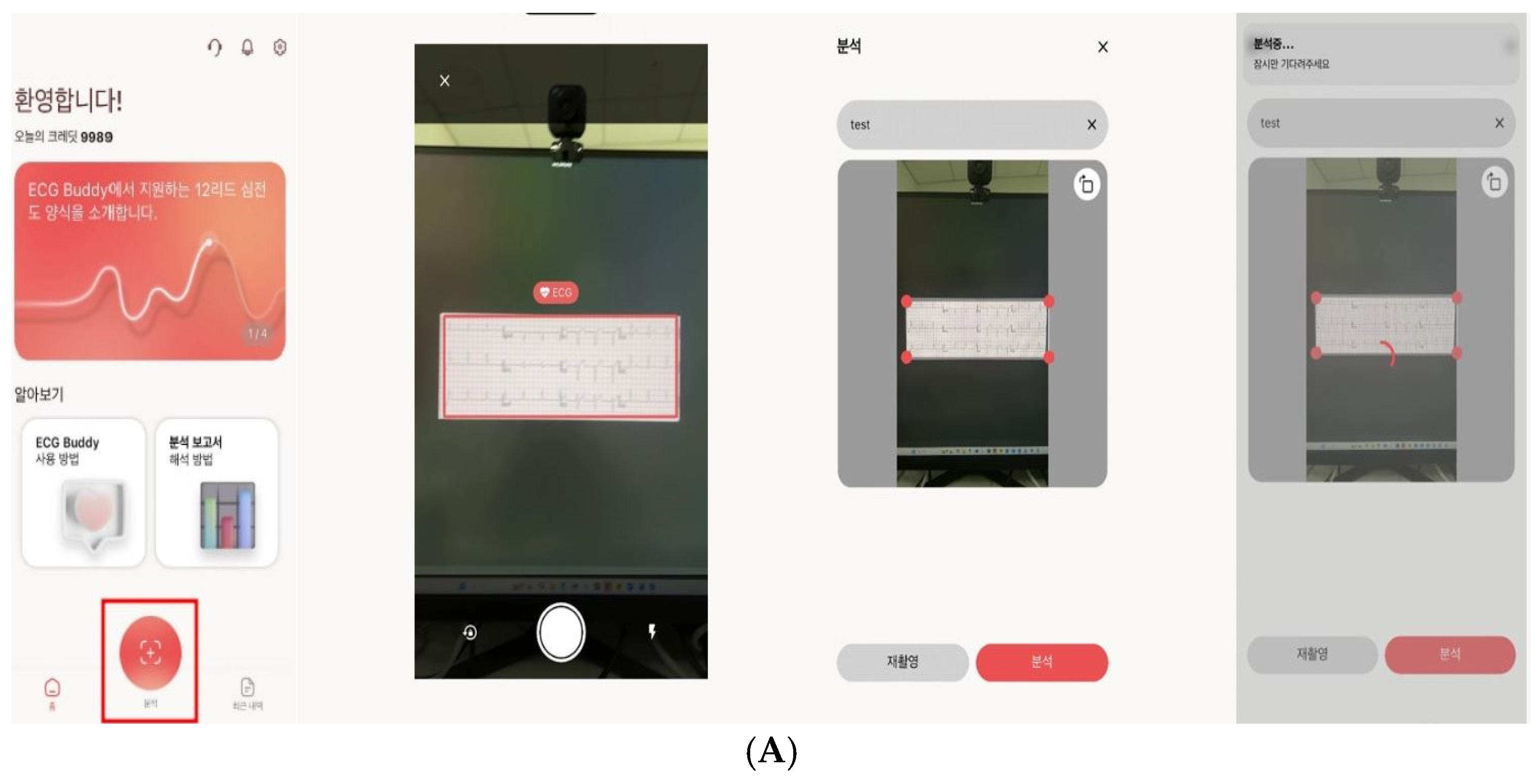
14]. In Korea, an AI-based ECG analysis program has been developed using deep learning technology that can analyze ECG images and provide an automated interpretation; importantly, in ED settings, the system can be implemented to generate outputs immediately after ECG acquisition and display them to clinicians in real time (
Figure 1).
Against this backdrop, the present study evaluates the diagnostic performance of an AI-based ECG interpretation system and examines its pragmatic impact when integrated into real-world ED workflows. Although prior work suggests that AI-assisted ECG analysis may improve detection of ischemia and other acute conditions, evidence remains limited regarding real-time workflow integration and downstream clinical processes—such as time to intervention, length of stay, and short-term outcomes—across broad ED populations [
15].
This study had three objectives: (1) to assess diagnostic concordance between emergency physicians and an AI-based ECG analysis system among adult ED patients presenting with cardiovascular symptoms; (2) to evaluate the association of early AI-assisted ECG interpretation with key clinical process metrics and short-term outcomes among patients diagnosed with myocardial infarction; and (3) to provide empirical evidence on the feasibility and potential clinical impact of integrating AI-driven ECG decision-support tools into emergency care.
2. Materials and Methods
This study was designed as a prospective, pragmatic observational investigation with a retrospective analytical component. The study period (1 January to 31 December 2024) refers to the timeframe during which ECG data were generated and stored in the hospital database as part of routine clinical practice, rather than the period of research conduct. The study evaluated the diagnostic performance and clinical impact of integrating a real-time artificial intelligence (AI) electrocardiogram (ECG) interpretation system (ECG Buddy Analyzer, South Korea) into routine ED care. The manuscript is reported in accordance with STROBE and the AI-specific reporting guidance (CONSORT-AI extension and DECIDE-AI).
2.1. Clinical Workflow and Exposure Protocol
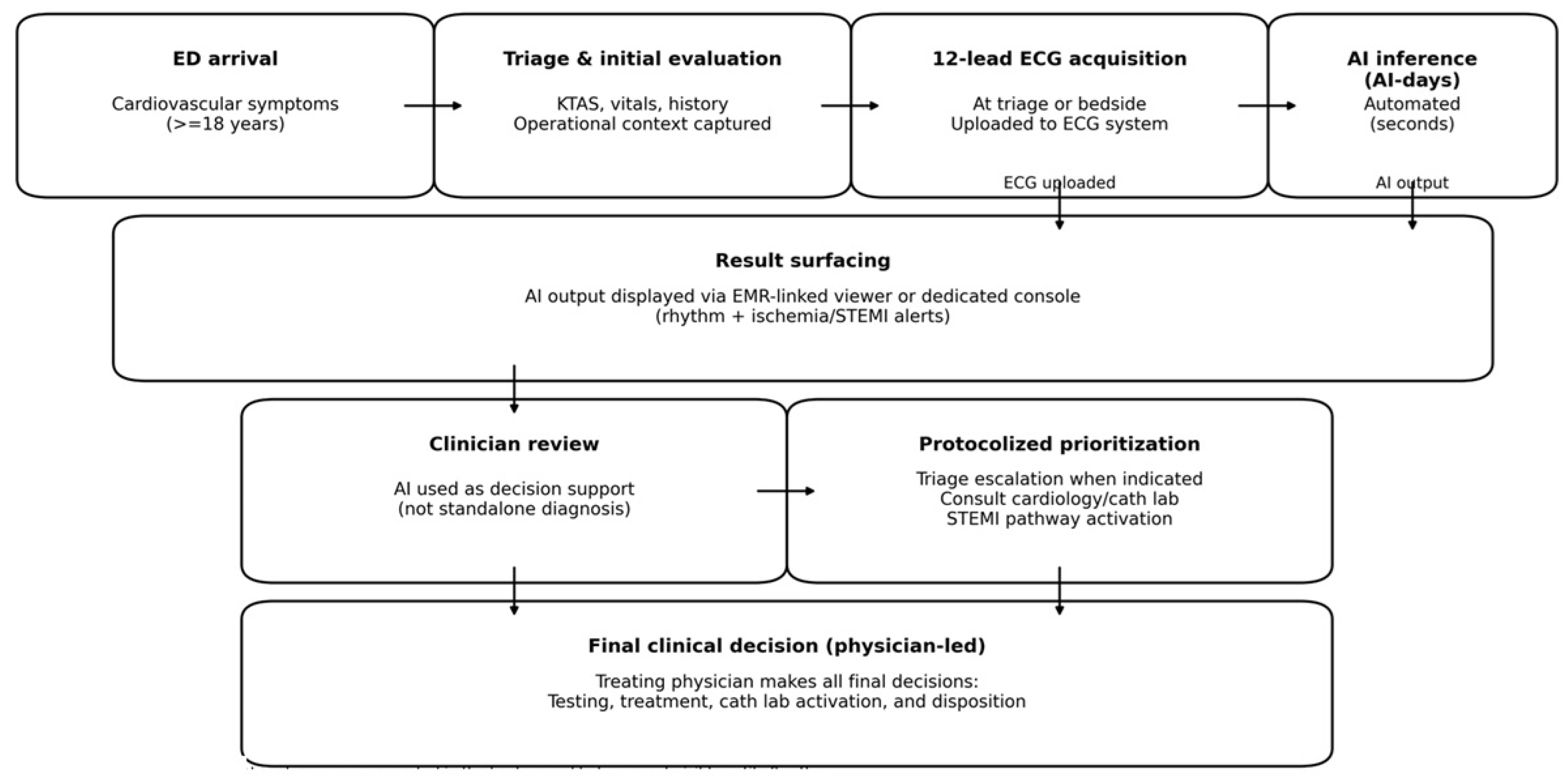
A predefined alternating-day exposure protocol was applied at the ED level. On physician-exposure days (“physician-days”), 12-lead ECGs were interpreted according to usual care by the treating emergency physicians, without real-time AI display. On AI-exposure days (“AI-days”), AI outputs were automatically generated immediately after ECG acquisition and displayed to the treating team in real time via the site’s designated viewing interface as a decision-support tool. In both conditions, the attending physician retained full responsibility for all clinical decisions, including triage escalation, diagnostic testing, activation of STEMI pathways, catheterization laboratory consultation, and disposition. The study did not mandate any specific actions in response to AI outputs. The end-to-end workflow for ECG acquisition, AI inference, and result surfacing is summarized in
Figure 2.
To minimize contamination, on physician-days the AI system performed background analyses for study purposes, but outputs were not visible to clinicians until after the initial physician interpretation had been documented in the medical record. Clinicians received standardized training on the interface and were instructed to use AI outputs as decision-support rather than as a standalone diagnosis. The emergency department was staffed by board-certified emergency physicians, with trainee support under attending supervision, consistent with routine practice. ECG interpretation and STEMI pathway activation followed standard institutional protocols, and clinicians received a standardized orientation to the AI interface prior to study initiation, emphasizing that AI output was used as an adjunct to clinical judgment. And given the pragmatic alternating-day allocation strategy, exposure was not randomized. Therefore, in addition to patient-level covariates, our models adjusted for prespecified temporal factors including shift category based on ED arrival time, weekday versus weekend, and calendar month, and we conducted sensitivity analyses stratified by shift and weekday versus weekend to assess the robustness of the findings (
Table A1,
Table A2 and
Table A3). The alternating-day design was selected to enable pragmatic real-world implementation while minimizing workflow disruption and contamination between exposure conditions. More complex designs, such as cluster randomization or stepped-wedge approaches, were considered but were not feasible within the operational constraints of the emergency department.
2.2. Study Setting and Participants
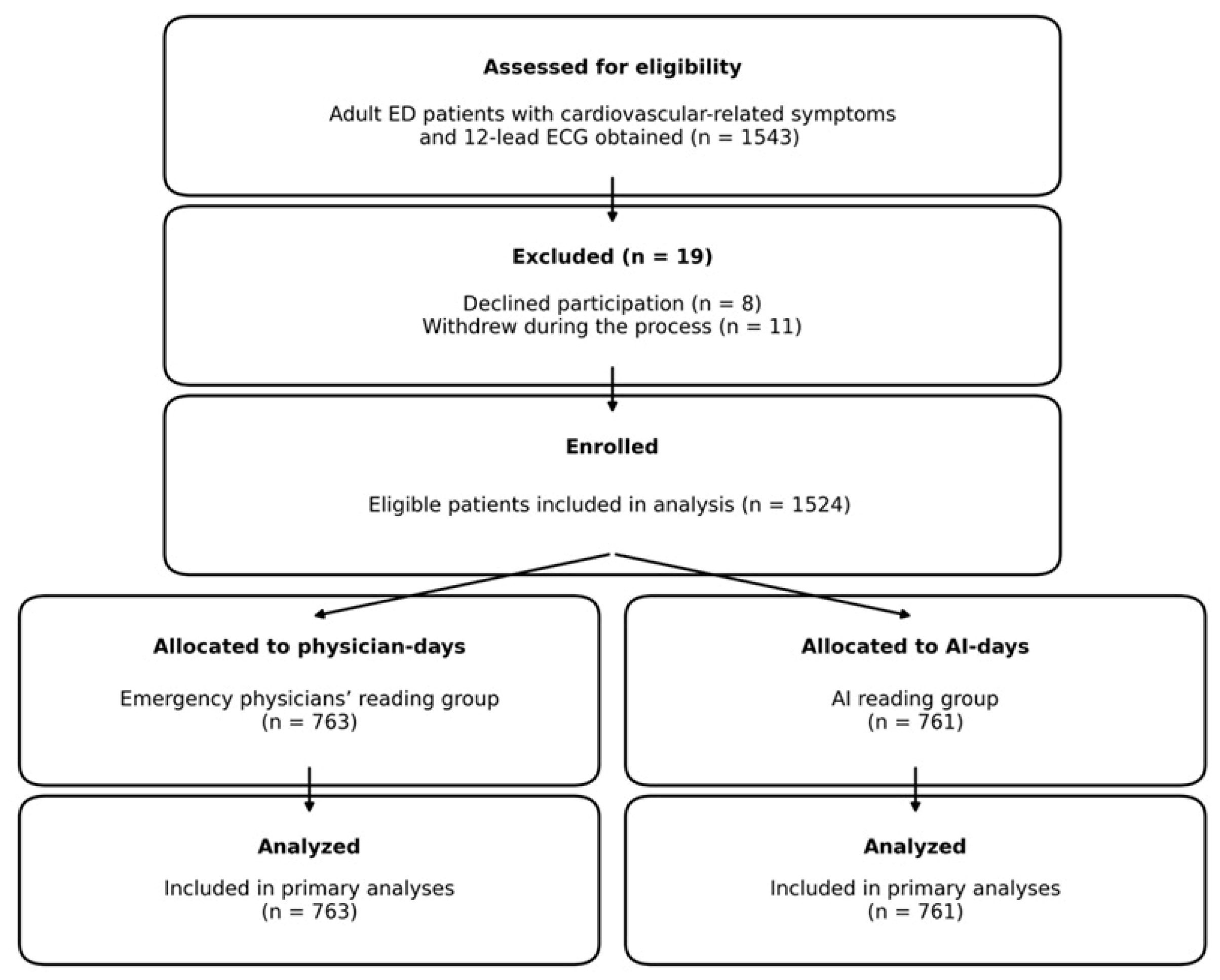
The study site provides 24/7 cardiology consultation and on-site catheterization laboratory capability and serves as a major regional referral destination for suspected acute coronary syndrome (ACS). Eligible participants were consecutive adult patients (≥18 years) presenting to the ED with cardiovascular-related symptoms for whom a 12-lead ECG was obtained as part of routine care. In total, 1543 patients were screened. Patients were excluded if they declined participation or withdrew after screening (N = 19). The final analytic cohort comprised 1524 patients (
Figure 3).
Symptom categories were defined a priori using the ED triage chief complaint and initial clinician documentation. Typical symptoms included chest pain/pressure and dyspnea, whereas atypical symptoms included epigastric discomfort, dizziness, syncope, and other presentations without chest pain, consistent with operational definitions used in ED chest pain pathways. Two independent physicians reviewed all index ECGs, blinded to allocation group and clinical outcomes, and assigned a reference diagnosis of STEMI versus non-STEMI. Disagreements were resolved through consensus discussion and, when necessary, adjudication by a third senior reviewer. Inter-expert agreement for the initial independent ratings was assessed using percent agreement and Cohen’s kappa with 95% confidence intervals. Reporting inter-expert agreement supports the validity and reproducibility of the expert-panel reference standard.
2.3. Ethics and Consent
Written informed consent was obtained whenever feasible. For critically ill patients unable to provide consent at presentation, consent was obtained from a legally authorized representative. When neither the patient nor a proxy was immediately available and time-sensitive care was required, enrollment proceeded under an institutional review board-approved emergency waiver/deferred consent process, and written consent was obtained as soon as practicable. Research staff supported enrollment procedures to avoid delaying emergency care. This study involved a retrospective analysis of existing clinical data. No data were collected for research purposes prior to IRB approval. The institutional review board approval was obtained on 5 December 2023, which permitted access to and analysis of previously recorded clinical data with a waiver or modification of informed consent where applicable (IRB No. 2023-11-051). The IRB approved both the pragmatic clinical implementation and the retrospective analysis of routinely collected clinical data.
All analyses involving identifiable patient data were conducted after IRB approval, in compliance with applicable ethical guidelines.
2.4. AI System and ECG Acquisition
Upon ED arrival, patients underwent standard triage and initial evaluation, and a 12-lead ECG was acquired per institutional protocol and uploaded to the hospital ECG management system. On AI-days, uploaded or photographed ECGs were analyzed by the AI engine within seconds, and interpretation outputs—including rhythm classification and ischemia/myocardial infarction alerts—were surfaced to the treating team through the designated clinical interface.
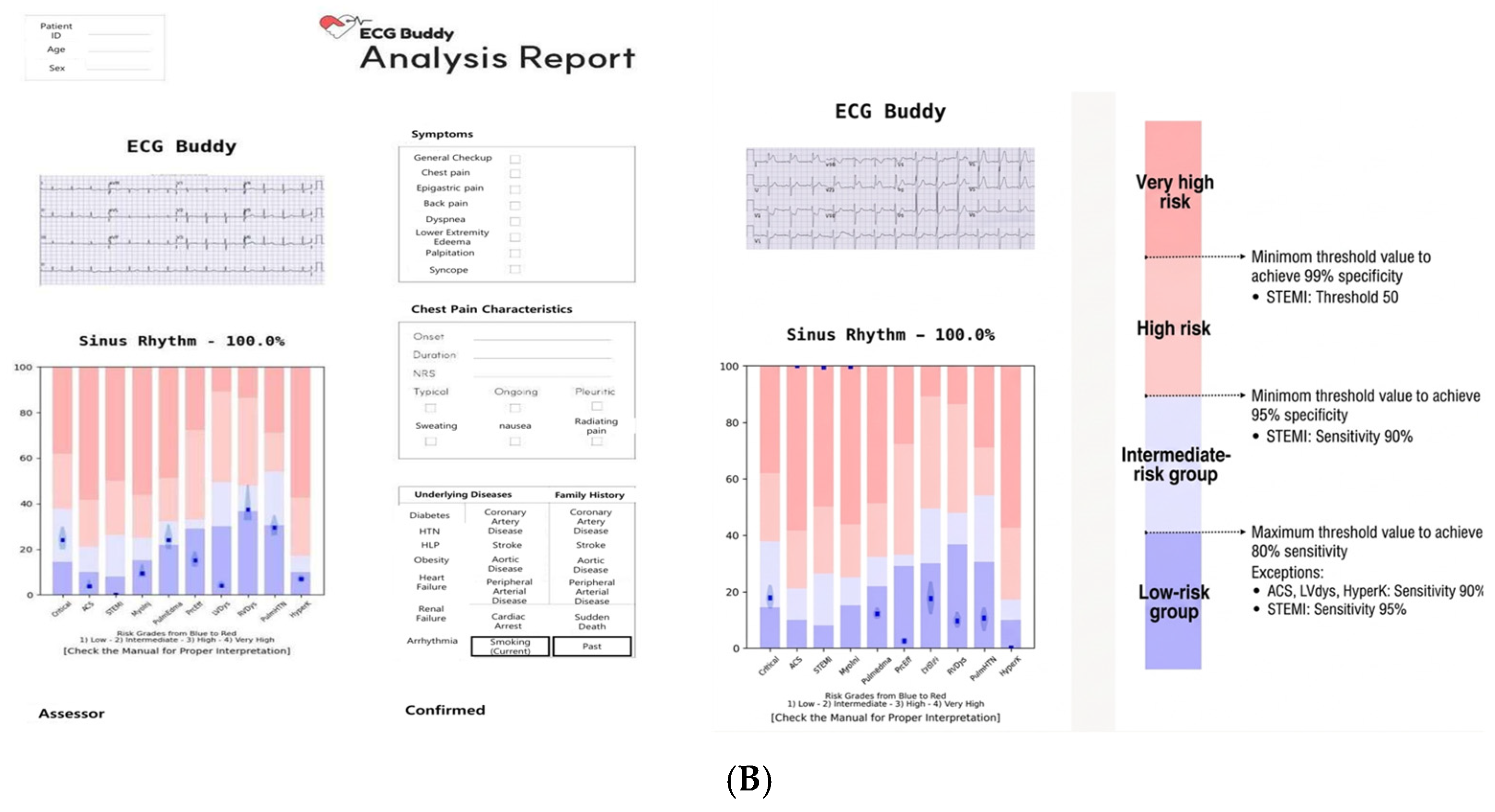
The AI-based electrocardiogram (ECG) interpretation system used in this study was ECG Buddy Analyzer (ARPI Inc., Seongnam, Republic of Korea), a deep learning-based decision-support software designed to assist real-time clinical decision-making by analyzing standard 12-lead ECGs, including ECG images captured at the point of care and/or digital ECG data. ECG Buddy is a software-as-a-medical-device intended to support clinicians in ECG interpretation (rather than replace clinician judgment) by providing automated rhythm interpretation and quantitative risk information relevant to emergency care and cardiac dysfunction. In routine use, the platform outputs automated rhythm-type classifications and quantitative ECG-derived digital biomarkers (risk scores) that summarize the likelihood of clinically important conditions. In the specific Analyzer configuration deployed in our emergency department workflow, the system was configured to support recognition of acute coronary syndrome and ST-segment elevation myocardial infarction (STEMI), to classify 35 rhythm categories, and to stratify cardiac dysfunction risk into four levels (very high, high, intermediate, and low), with results returned in real time for clinician review. Detailed information regarding the underlying training dataset, labeling procedures, and prior internal/external validation is not fully available in public-facing documentation; therefore, we report the system’s intended use, regulatory status, and output structure, and we emphasize that all diagnostic and treatment decisions remained the responsibility of the treating clinicians and that the system did not autonomously order tests or activate catheterization laboratory pathways.
The AI system used in this study is a commercially available, proprietary deep learning-based software. Detailed information on the training dataset, including sample size, demographic composition, labeling procedures, and external validation cohorts, is not publicly available due to proprietary restrictions.
However, the system is designed to analyze standard 12-lead ECG data and has been developed using supervised deep learning. We acknowledge that the lack of transparency in model development may limit the assessment of potential bias and its generalizability across different populations and clinical settings. Key deployment characteristics (automatic inference immediately following ECG acquisition, result surfacing via the designated viewer, and principles governing clinical exposure and use) are documented in
Figure 1. The structured ECG response form used for reference standard labeling is provided in the
Appendix A.
2.5. Reference Standard and Outcomes
2.5.1. Diagnostic Performance Evaluation (Paired ECG-Level Analysis)
Diagnostic accuracy was evaluated using an ECG-level paired-comparison framework. For each ECG, two index assessments were defined: the treating emergency physician’s initial clinical interpretation documented in the medical record and the AI system output generated for the same ECG. These assessments were compared against a common reference standard derived from a blinded expert-panel consensus.
To preserve a “physician-alone” evaluation, the primary paired diagnostic performance analysis used ECGs from physician-days, during which AI outputs were generated in the background for study purposes but were not visible to clinicians until after physician documentation was completed.
The primary diagnostic endpoint for accuracy analysis was STEMI presence/absence. ECG evidence consistent with NSTEMI was evaluated as a secondary endpoint, acknowledging that definitive NSTEMI diagnosis may require biomarker and clinical information; therefore, NSTEMI findings are interpreted as ECG-based detection performance and are complemented by visit-level clinical outcome analyses.
Performance metrics (sensitivity, specificity, positive predictive value [PPV], and negative predictive value [NPV]) were calculated with exact (Clopper–Pearson) 95% confidence intervals (CIs). Because physician and AI classifications were available for the same ECGs, discordant paired classifications were compared using McNemar’s test (two-sided).
2.5.2. Clinical Impact Evaluation (Pragmatic Day-Level Comparison)
Pragmatic clinical impact was evaluated at the visit level using the predefined alternating-day exposure protocol. On physician-days, ECG interpretation proceeded under usual care without real-time AI display, whereas on AI-days, AI outputs were generated immediately after ECG acquisition and displayed to the treating team as a decision-support tool; clinical decisions remained at the discretion of the attending physician. Prespecified visit-level outcomes included time to PCI, hospital length of stay, ICU admission, in-hospital mortality, and utilization outcomes (angiography/PCI) and disposition.
For clinical impact analyses, regression models compared AI-days versus physician-days with adjustment for baseline covariates (e.g., age, sex, comorbidity burden, KTAS, arrival mode, and initial vital signs) and operational covariates (hour-of-day, weekday/weekend, and calendar month), with additional adjustment for ED crowding surrogates when available. Because exposure assignment occurred by calendar day, cluster-robust standard errors at the day level were used to account for within-day correlation.
2.5.3. Expert-Panel Reference Standard
The reference standard was derived from offline review by an expert panel comprising five board-certified emergency medicine specialists with substantial ECG interpretation experience (≥10 years post-board certification). Expert reviewers interpreted ECGs offline using only the ECG tracing and were blinded to study arm assignment, AI outputs, symptoms, vital signs, laboratory/imaging results, treatments, and clinical outcomes. Interpretations were recorded using a structured ECG response form (
Appendix A) and included rhythm classification and the presence/absence of STEMI and ECG evidence consistent with NSTEMI. A consensus reference label was determined by majority vote (≥3 of 5 reviewers). A board-certified cardiologist (>10 years of clinical experience) adjudicated ECGs with discordant expert votes (no majority) and reviewed a random sample of majority-negative ECGs to assess internal consistency. Inter-rater reliability was summarized using Fleiss’ kappa, and the proportion of adjudicated changes was reported.
2.6. Data Collection and Variables
Data were collected via structured electronic-medical-record review using predefined variable definitions. Baseline variables included age, sex, arrival mode, triage acuity (Korean Triage and Acuity Scale, KTAS), initial vital signs, and comorbidity burden (Charlson Comorbidity Index, CCI). To capture operational confounding, visit timing (day/evening/night), day of week (weekday/weekend), and calendar month were extracted, along with contemporaneous ED crowding surrogates at ECG time when available (e.g., ED census and boarding count). Follow-up variables included final diagnoses, coronary angiography/PCI, admission, ICU admission, hospital length of stay, in-hospital mortality, and discharge status. Time to PCI was defined as the interval from ED arrival to initiation of PCI. Laboratory data (including CK-MB and troponin I) were extracted, and initial chest radiographs were reviewed for secondary signs of cardiac dysfunction when available.
2.7. Statistical Analysis
Statistical analyses were performed using IBM SPSS Statistics (version 27, IBM Corp., Armonk, NY, USA). Categorical variables are presented as counts (percentages) and continuous variables as mean (standard deviation) or median (interquartile range), as appropriate.
2.7.1. Diagnostic Performance (Paired Metrics)
Primary diagnostic performance metrics (sensitivity, specificity, positive predictive value, and negative predictive value) for STEMI and NSTEMI were calculated for (i) clinician interpretation and (ii) AI output, each against the expert-panel consensus reference standard. Ninety-five-percent confidence intervals were estimated using exact (Clopper–Pearson) methods. Between-method differences were summarized as absolute differences with 95% confidence intervals. Because clinician and AI assessments were available for the same ECGs, paired comparisons of discordant classifications were performed using McNemar’s test, and agreement between clinician and AI was additionally summarized.
Non-inferiority of AI performance versus clinician interpretation was assessed using a prespecified absolute margin of −0.05 for sensitivity and specificity. Non-inferiority was concluded when the lower bound of the 95% confidence interval for the AI-minus-clinician difference exceeded −0.05.
2.7.2. Clinical Impact (AI-Days vs Physician-Days)
For pragmatic outcomes (time to PCI, hospital length of stay, and in-hospital mortality), regression models comparing AI-days versus physician-days were fitted with adjustment for baseline covariates (age, sex, CCI, KTAS, arrival mode, and initial vital signs) and operational covariates (hour-of-day, weekday/weekend, and calendar month), with additional adjustment for ED operational context (crowding proxies) when available. Because exposure was assigned by calendar day, day-level cluster-robust standard errors were applied to account for within-day correlation. Prespecified sensitivity analyses included stratified models for on-hours versus off-hours and for daytime versus nighttime presentations. As an additional sensitivity analysis, propensity score matching (1:1 nearest-neighbor matching with a caliper of 0.2 standard deviations of the logit) was performed using the same covariates, and matched results were compared with the primary adjusted models.
To avoid post-treatment bias, time to PCI and hospital length of stay were not included as predictors in mortality models; mortality models included baseline and operational covariates only. All tests were two-sided, and p-values < 0.05 were considered statistically significant.
4. Discussion
This study is a prospective, single-center, pragmatic investigation with a retrospective analytical component evaluating the impact of integrating a real-time artificial intelligence-based 12-lead electrocardiogram interpretation system into routine emergency department care. The study used an alternating-day exposure scheme that distinguished physician-only interpretation days from AI output disclosure days. Across both conditions, all clinical decisions, including triage escalation, activation of ST-elevation myocardial infarction pathways, referral for and performance of coronary angiography and percutaneous coronary intervention, and decisions regarding transfer, admission, and discharge, remained under the responsibility of the treating physician. To reduce contamination in the comparison arm, AI analyses were performed in the background on physician-only days, but results were released only after the physician’s initial interpretation had been documented.
Within this real-world implementation context, the findings can be organized along three main axes. First, on AI output disclosure days, sensitivity for detecting ST-elevation myocardial infarction increased and false-negative cases decreased, indicating improved performance in reducing early missed diagnoses. Because missed ST-elevation myocardial infarction in the emergency department can be catastrophic, the reduction in false negatives has important clinical implications. Second, process metrics along the reperfusion pathway improved on AI output disclosure days, suggesting earlier progression through time-critical steps; notably, time to intervention decreased more substantially among patients with atypical presentations. This pattern suggests that in diagnostically uncertain situations, AI alerts may heighten risk recognition and facilitate team communication and preparedness, thereby accelerating clinical flow [
16]. Third, a reduction in hospital length of stay among admitted patients was observed, whereas no statistically significant difference in short-term mortality was identified.
The observed reduction in hospital length of stay is clinically notable, but it should be interpreted cautiously given potential confounding by differences in admission diagnosis mix and downstream care pathways. Length of stay may vary depending on whether patients were admitted primarily for acute coronary syndrome versus alternative diagnoses that require different diagnostic workups, consultation patterns, and discharge criteria. Notably, baseline differences in comorbidity burden and triage acuity between the groups may have influenced clinical process outcomes. Patients on AI-days had a lower comorbidity burden but higher acuity, which may partially explain the observed differences in time to PCI and length of stay despite statistical adjustment. In addition, post-percutaneous coronary intervention management protocols such as intensive care utilization, step-down unit availability, early mobilization, rehabilitation referral, and local discharge planning practices can influence length of stay independently of the initial ED diagnostic process. Although our pragmatic design reflects real-world practice, future studies should adjust for admission diagnosis categories and post-percutaneous coronary intervention pathway elements or use standardized post-percutaneous coronary intervention care protocols when feasible to better isolate the effect of real-time AI–ECG integration on length of stay.
Residual confounding related to unmeasured differences, these findings suggest that AI does not replace clinical diagnosis but may function as a decision-support tool that highlights high-risk signals earlier in the pathway, contributing to greater efficiency in care processes [
17]. Nevertheless, clinical value cannot be inferred from improved sensitivity alone; specificity, potential increases in false positives, and the associated operational costs must also be considered [
18]. In this study, a decrease in specificity or a possible increase in false-positive alerts was observed, implying a potential burden related to additional testing, increased consultations, more frequent catheterization laboratory discussions, and alert fatigue [
18]. Accordingly, AI-based ECG interpretation should be positioned not as an independent diagnostic tool but as an adjunct that supports clinicians by prompting earlier attention to high-risk signals [
17]. Net benefit is likely to be maximized when institutional operational guidance accompanies implementation, including standardized minimum verification steps in response to AI alerts, standardized pathway activation criteria, and clarified team communication workflows [
17]. Even when non-inferiority results are presented, it is more appropriate to interpret them conservatively as suggesting potential sensitivity gains within an acceptable performance range, rather than extending them to a claim that AI can substitute for physician interpretation [
17]. These findings should be interpreted with caution, as the relatively wide confidence intervals and limited number of STEMI cases introduce uncertainty. Therefore, the results suggest comparable performance within statistical limits rather than definitive equivalence.
Improvements in process metrics are driven not only by algorithmic performance but also by workflow design. When AI outputs are displayed in real time immediately after ECG acquisition, speed and standardization of initial interpretation may increase, and earlier triggering of risk recognition, consultation requests, and catheterization laboratory preparation may become more likely [
16,
18]. The observed shortening of reperfusion-related time metrics in this study is consistent with this mechanistic explanation, and the more pronounced effect among atypical presentations further suggests that AI utility may be greater in diagnostically challenging contexts [
16]. Conversely, time reductions do not necessarily translate directly into improvements in patient-centered final outcomes, and the realized effect is likely influenced by contextual factors such as consultation infrastructure, catheterization laboratory availability, emergency department crowding, team experience, and the distribution of patient severity [
19]. The observed reduction in length of stay among admitted patients suggests that earlier diagnostic and treatment pathways may advance in-hospital care planning and improve treatment efficiency, thereby improving downstream resource utilization. However, because length of stay is influenced by multiple factors, including disease severity, complications, comorbidity burden, discharge planning, and social determinants, it is prudent to interpret this finding as an indicator of potential resource utilization benefits rather than definitive evidence of improved prognosis.
We appropriately observed no significant mortality benefit, but the study may have been underpowered to detect mortality differences because death events were relatively infrequent and mortality is influenced by multiple factors beyond early ECG interpretation, including baseline risk, comorbidities, treatment delays outside the ED, procedural complexity, and post-procedure complications [
19]. The study was not specifically powered to detect differences in mortality, and the absence of a statistically significant mortality difference should not be interpreted as evidence of no effect [
19]. Larger multicenter studies with adequate event counts and longer follow-up, as well as analyses focused on intermediate outcomes such as time to reperfusion, hemodynamic deterioration, and complications, are needed to more definitively evaluate effects on mortality [
19]. In particular, although we adjusted for prespecified temporal variables because the alternating-day approach is pragmatic but not randomized, baseline imbalances and residual confounding may have influenced mortality comparisons. Consequently, conclusions regarding mortality should be limited to stating that no significant difference was detected, and future verification should rely on multicenter studies with designs such as cluster randomization or stepped-wedge implementation [
19].
In comparison with prior studies, multiple investigations have consistently reported that AI-based ECG interpretation improves diagnostic performance, particularly sensitivity for ST-elevation myocardial infarction, and supports early risk recognition [
16,
17,
18]. In real emergency department settings, AI-assisted ECG interpretation may accelerate decision-making such as catheterization laboratory activation and shorten time to reperfusion therapy [
16,
18]. However, prior work has also emphasized the possibility of reduced specificity or increased false positives, raising operational concerns that AI adoption may increase testing, consultations, and catheterization laboratory discussions [
18]. Moreover, mortality as a final clinical outcome is strongly influenced by multiple factors, and results across studies are often inconsistent or vary depending on event counts and study designs [
18,
19]. The present study aligns broadly with this literature by demonstrating improved sensitivity and improved reperfusion-related process metrics while showing no clear mortality difference; the pronounced time reduction among atypical presentations provides additional support for the hypothesis that AI utility may be greatest in diagnostically difficult contexts [
16]. At the same time, the need to consider false positives and resource implications reinforces the prevailing recommendation that AI should be interpreted as a clinical decision-support tool rather than a replacement for clinician judgment [
17].
From an operational standpoint, the increased proportion of cases proceeding to invasive evaluation on AI output disclosure days suggests that AI alerts may have prompted more proactive assessment and treatment. This could be beneficial in reducing missed diagnoses, but when coupled with higher false-positive rates, it may also raise concerns about unnecessary resource utilization or overtreatment of lower-risk patients [
18]. Therefore, evaluating the impact of AI implementation should extend beyond diagnostic accuracy to include changes in disposition patterns, consultation frequency, testing and procedure volumes, alert fatigue, and potential patient-centered harms [
17]. Future studies should confirm external validity through multicenter validation, reduce confounding through cluster-randomized or stepped-wedge designs, and quantify intermediate process measures capturing how AI alerts alter clinician behavior [
17,
19]. In addition, future evaluations should assess operational costs and safety associated with false positives, as well as performance and fairness across vulnerable subgroups such as patients with atypical symptoms, older adults, and women [
17]. Recent work has also extended artificial intelligence applications in STEMI beyond early detection toward prognostic prediction using multimodal data, such as deep learning models derived from cardiac magnetic resonance, highlighting opportunities to integrate decision-support across the entire STEMI care pathway from triage to post-reperfusion risk stratification [
20].
Finally, several limitations warrant consideration. This was a single-center study conducted within a specific emergency department workflow and resource environment, which may limit generalizability. Importantly, this study was conducted in a single regional emergency medical center with specific organizational structures, staffing models, and catheterization laboratory availability. Therefore, the observed effects may not be generalizable to other healthcare systems, community hospitals, or settings with different resource levels and workflow characteristics. External validation in diverse clinical environments is essential to assess the robustness and scalability of real-time AI-ECG integration. In addition, the alternating-day allocation was pragmatic but not randomized, so temporal variation and changes in staffing, supervision, or catheterization laboratory readiness may have influenced process metrics and outcomes despite adjustment and sensitivity analyses. Clinician-level factors such as experience at the time of ECG interpretation, ECG-focused training, and familiarity with artificial intelligence tools were also not fully captured and may have affected performance and impact over time. Multicenter studies that prospectively measure clinician and operational context and use cluster-randomized or stepped-wedge designs are needed to confirm these findings and more clearly isolate the effect of real-time artificial intelligence–ECG integration [
17,
19]. Lower specificity in non-STEMI cases may lead not only to meaningful clinical and operational consequences. False-positive alerts can increase unnecessary ST-elevation myocardial infarction evaluations and potentially trigger avoidable catheterization laboratory activation or cardiology mobilization, particularly during off-hours when resources are constrained. We were unable to quantify downstream effects, such as changes in consultation frequency, angiography rates, or additional diagnostic testing triggered by AI alerts. This represents an important area for future investigation. These downstream effects may lead to additional testing, monitoring, or antithrombotic treatment without clear benefit and contribute to workload and alert fatigue. Recent advances in artificial intelligence have expanded beyond ECG interpretation to include multimodal signal integration and prognostic modeling. Techniques such as multichannel feature fusion for physiological signal analysis and deep learning-based multimodal prediction models highlight the potential of AI to support decision-making across the entire spectrum of cardiovascular care [
21]. Accordingly, artificial intelligence output should support, not replace, clinical judgment and should be implemented with safeguards such as rapid clinician confirmation, repeat ECGs, integration with troponin testing and bedside imaging when appropriate, and locally calibrated alert thresholds to balance sensitivity and specificity.




 ,
,