Barriers to Adverse Drug Reaction Reporting Among Physicians, Nurses, and Pharmacists: A Scoping Review Comparing High-Income Versus Low-/Middle-Income Countries

 ,
,  , , , ,
Highlights
- Knowledge, awareness, and lack of formal training were the most consistently reported barriers to adverse drug reaction (ADR) reporting across all countries and professional groups.
- Fear of blame, legal consequences, and reputational risk was common in both income groups, while limited access to reporting tools/forms/IT was reported far more often in LMIC studies than in HIC studies.
- In low- and middle-income countries, strengthening access to reporting tools, forms, and information technology infrastructure is a prerequisite for improving ADR reporting.
- Across all settings, establishing a supportive, non-punitive reporting culture with clear feedback mechanisms is essential to sustain clinician engagement and enhance pharmacovigilance systems.
Abstract
1. Introduction
2. Materials and Methods
2.1. Study Design and Reporting Standards
2.2. Review Question and PCC Framework
2.3. Eligibility Criteria
2.4. Information Sources
2.5. Search Strategy and Limits
2.6. Record Management, Deduplication, and Study Selection
2.7. Income Group Classification
2.8. Data Charting and Extraction
2.9. Barrier Framework Development and Coding
2.10. Synthesis and Analysis
2.11. Risk-of-Bias Appraisal
3. Results
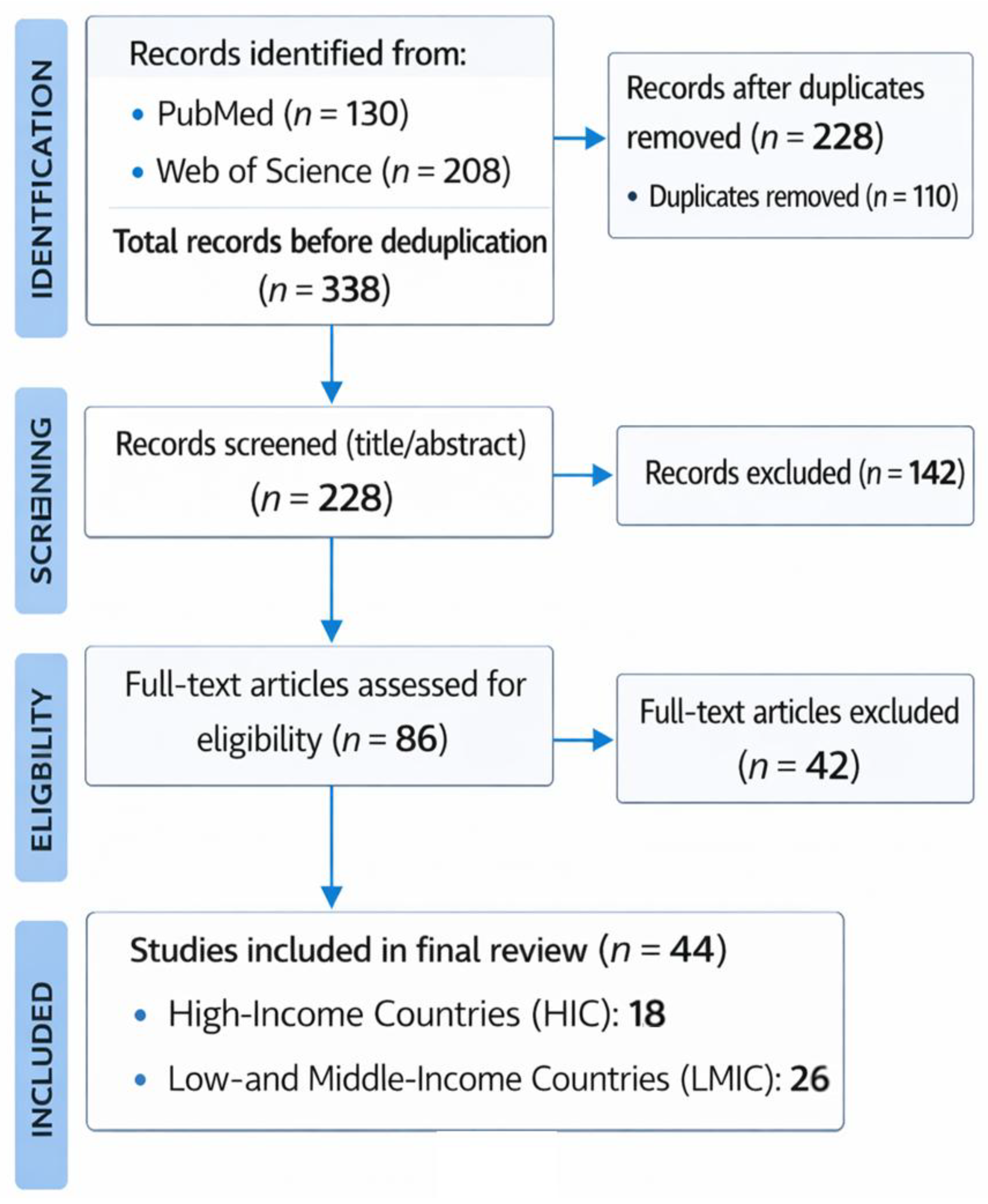
3.1. Study Selection and Screening Results
3.2. Reasons for Full Text Non-Inclusion
3.3. Characteristics of Included Studies
3.4. Barriers to ADR Reporting by Domain and Income Group
3.5. Quantitative Signal Ranges for Common Barriers
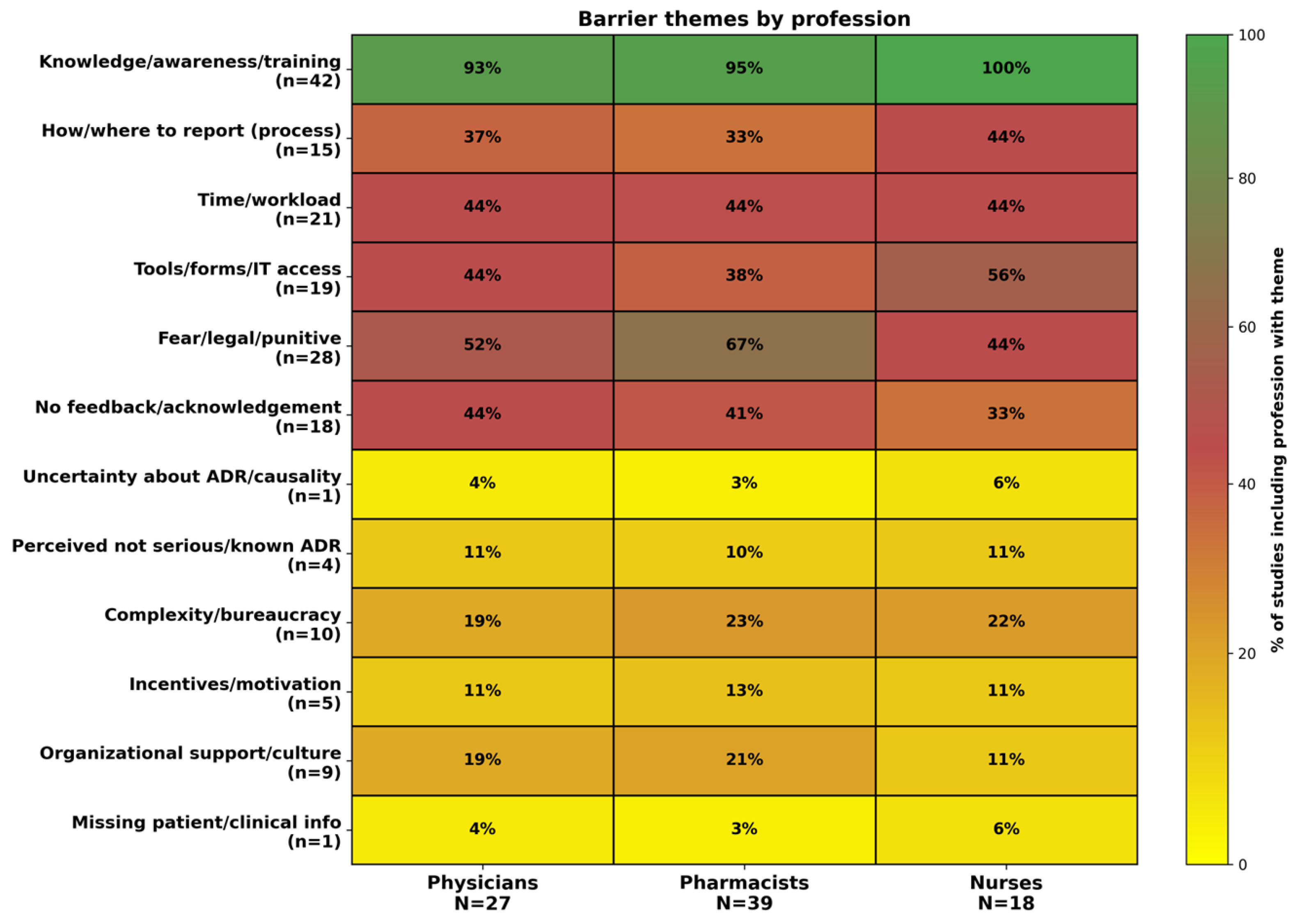
3.6. Barriers by Professional Group
3.7. Socio-Ecological Mapping of Barriers
4. Discussion
5. Conclusions
Supplementary Materials
Author Contributions
Funding
Institutional Review Board Statement
Informed Consent Statement
Data Availability Statement
Conflicts of Interest
Abbreviations
| ADRs | Adverse drug reactions |
| HICs | High-income countries |
| LMICs | Low- and middle-income countries |
| PRISMA-ScR | Preferred Reporting Items for Systematic Reviews and Meta-Analyses Extension for Scoping Reviews |
| PCC | Population–concept–context |
| DOI | Digital object identifier |
References
- Hakkarainen, K.M.; Hedna, K.; Petzold, M.; Hägg, S. Percentage of Patients with Preventable Adverse Drug Reactions and Preventability of Adverse Drug Reactions—A Meta-Analysis. PLoS ONE 2012, 7, e33236. [Google Scholar] [CrossRef] [PubMed]
- Kant, A.C. Appeal for Increasing the Impact of Pharmacovigilance. Drug Saf. 2024, 47, 113–116. [Google Scholar] [CrossRef] [PubMed]
- Trifirò, G.; Crisafulli, S. A New Era of Pharmacovigilance: Future Challenges and Opportunities. Front. Drug Saf. Regul. 2022, 2, 866898. [Google Scholar] [CrossRef]
- Al Meslamani, A.Z. Underreporting of Adverse Drug Events: A Look into the Extent, Causes, and Potential Solutions. Expert Opin. Drug Saf. 2023, 22, 351–354. [Google Scholar] [CrossRef]
- Putri, R.A.; Ikawati, Z.; Rahmawati, F.; Yasin, N.M. An Awareness of Pharmacovigilance Among Healthcare Professionals Dueto an Underreporting of Adverse Drug Reactions Issue: A Systematic Review of the Current State, Obstacles, and Strategy. CDS Curr. Drug Saf. 2024, 19, 317–331. [Google Scholar] [CrossRef]
- Salehi, T.; Seyedfatemi, N.; Mirzaee, M.S.; Maleki, M.; Mardani, A. Nurses’ Knowledge, Attitudes, and Practice in Relation to Pharmacovigilance and Adverse Drug Reaction Reporting: A Systematic Review. BioMed Res. Int. 2021, 2021, 6630404. [Google Scholar] [CrossRef]
- Moyo, E.; Moyo, P.; Mangoya, D.; Imran, M.; Dzinamarira, T. Adverse Drug Reaction Reporting by Healthcare Providers in Sub-Saharan Africa: A Scoping Review of the Challenges Faced and the Strategies to Address the Challenges. Int. J. Afr. Nurs. Sci. 2023, 19, 100639. [Google Scholar] [CrossRef]
- Menang, O.; Kuemmerle, A.; Maigetter, K.; Burri, C. Strategies and Interventions to Strengthen Pharmacovigilance Systems in Low-Income and Middle-Income Countries: A Scoping Review. BMJ Open 2023, 13, e071079. [Google Scholar] [CrossRef]
- PRISMA Extension for Scoping Reviews (PRISMA-ScR): Checklist and Explanation|EQUATOR Network. Available online: https://www.equator-network.org/reporting-guidelines/prisma-scr/?utm_source=chatgpt.com (accessed on 25 January 2026).
- WDI—The World by Income and Region. Available online: https://datatopics.worldbank.org/world-development-indicators/the-world-by-income-and-region.html?utm_source=chatgpt.com (accessed on 25 January 2026).
- Tricco, A.C.; Lillie, E.; Zarin, W.; O’Brien, K.K.; Colquhoun, H.; Levac, D.; Moher, D.; Peters, M.D.J.; Horsley, T.; Weeks, L.; et al. PRISMA Extension for Scoping Reviews (PRISMA-ScR): Checklist and Explanation. Ann. Intern. Med. 2018, 169, 467–473. [Google Scholar] [CrossRef]
- Aldossari, D.S.B.; Alshalaan, N.T.; Alshammari, K.S.; Lubbad, F.A.; Alanazi, M.R.; Lubbad, N.A.; Alessa, N.S.F.; Ali, S. Pharmacists’ Experiences on Adverse Drug Reactions in Saudi Arabia: A Cross-Sectional Study. Pharmacy 2025, 13, 87. [Google Scholar] [CrossRef]
- Alsulami, F.T. Hospital Pharmacists’ Attitudes and Intentions Toward Adverse Drug Reaction Reporting in Saudi Arabia: Insights from the Theory of Planned Behavior. Healthcare 2025, 13, 1111. [Google Scholar] [CrossRef]
- Shanableh, S.; Alomar, M.J.; Zainail, H. A Qualitative Study to Investigate Pharmacovigilance Systems in Dubai Hospitals. PLoS ONE 2025, 20, e0331929. [Google Scholar] [CrossRef] [PubMed]
- Sidjimova, D.; Benisheva, T.; Topalova, V.; Petkova, V. Attitude of Medical Doctors to Adverse Drug Reactions Reporting in Bulgaria. Pharmacia 2024, 71, 1–7. [Google Scholar] [CrossRef]
- Khardali, A. Exploring the Knowledge, Perception, and Practice of Community Pharmacists in Saudi Arabia toward Pharmacovigilance and Adverse Drug Reaction Reporting. A Nationwide Survey. Sci. Rep. 2024, 14, 4819. [Google Scholar] [CrossRef] [PubMed]
- Hayek, A.; Sridhar, S.B.; Rabbani, S.A.; Shareef, J.; Wadhwa, T. Exploring Pharmacovigilance Practices and Knowledge among Healthcare Professionals: A Cross-Sectional Multicenter Study. SAGE Open Med. 2024, 12, 20503121241249908. [Google Scholar] [CrossRef]
- Shanableh, S.; Zainal, H.; Alomar, M.; Palaian, S. Assessment of an Educational Module on Pharmacovigilance among Hospital Pharmacists in United Arab Emirates: A Pilot Study. Pharm. Educ. 2025, 24, 149–153. [Google Scholar] [CrossRef]
- Shareef, J.; Sridhar, S.B.; Bhupathyraaj, M.; Shariff, A.; Thomas, S. Exploring the Community Pharmacist’s Knowledge, Attitude, and Practices Regarding Adverse Drug Reactions and Its Reporting in the United Arab Emirates: A Survey-Based Cross-Sectional Study. Ther. Adv. Drug Saf. 2024, 15, 20420986241285930. [Google Scholar] [CrossRef]
- Shanableh, S.; Zainal, H.; Alomar, M.; Palaian, S. A National Survey of Knowledge, Attitude, Practice, and Barriers towards Pharmacovigilance and Adverse Drug Reaction Reporting among Hospital Pharmacy Practitioners in the United Arab Emirates. J. Pharm. Policy. Pract. 2023, 16, 92. [Google Scholar] [CrossRef]
- Fossouo Tagne, J.; Yakob, R.A.; Mcdonald, R.; Wickramasinghe, N. Barriers and Facilitators Influencing Real-Time and Digital-Based Reporting of Adverse Drug Reactions by Community Pharmacists: Qualitative Study Using the Task-Technology Fit Framework. Interact. J. Med. Res. 2022, 11, e40597. [Google Scholar] [CrossRef]
- Sandberg, A.; Salminen, V.; Heinonen, S.; Sivén, M. Under-Reporting of Adverse Drug Reactions in Finland and Healthcare Professionals’ Perspectives on How to Improve Reporting. Healthcare 2022, 10, 1015. [Google Scholar] [CrossRef]
- Sandberg, A.; Ehlers, P.; Torvinen, S.; Sandberg, H.; Sivén, M. Regulation Awareness and Experience of Additional Monitoring among Healthcare Professionals in Finland. Healthcare 2021, 9, 1540. [Google Scholar] [CrossRef] [PubMed]
- Valinciute-Jankauskiene, A.; Kubiliene, L. Qualitative Study of Community Pharmacists’ and General Practitioners’ Views toward Pharmacovigilance in Lithuania. Healthcare 2021, 9, 1072. [Google Scholar] [CrossRef] [PubMed]
- Ali, M.D.; Ahmad, A.; Hassan, Y.A.M.; Ghosn, S.A.; Banu, N.; Alzahrani, M.G. Community Pharmacist’s Knowledge, Practice and Barrier towards Reporting of Adverse Drug Reactions in Dammam, Saudi Arabia: A Cross-Sectional Survey Based Study. J. Young Pharm. 2020, 12, 81–85. [Google Scholar] [CrossRef]
- Li, R.; Curtain, C.; Bereznicki, L.; Zaidi, S.T.R. Community Pharmacists’ Knowledge and Perspectives of Reporting Adverse Drug Reactions in Australia: A Cross-Sectional Survey. Int. J. Clin. Pharm. 2018, 40, 878–889. [Google Scholar] [CrossRef]
- Alsaleh, F.M.; Alzaid, S.W.; Abahussain, E.A.; Bayoud, T.; Lemay, J. Knowledge, Attitude and Practices of Pharmacovigilance and Adverse Drug Reaction Reporting among Pharmacists Working in Secondary and Tertiary Governmental Hospitals in Kuwait. Saudi Pharm. J. 2017, 25, 830–837. [Google Scholar] [CrossRef] [PubMed]
- Cheema, E.; Haseeb, A.; Khan, T.M.; Sutcliffe, P.; Singer, D.R. Barriers to Reporting of Adverse Drugs Reactions: A Cross Sectional Study among Community Pharmacists in United Kingdom. Pharm. Pract. 2017, 15, 931. [Google Scholar] [CrossRef]
- Alharbi, F.; Bahnassi, A.; Alonazie, W. Attitude, Knowledge and Experience of Hospital Pharmacists with Pharmacovigilance in a Region in Saudi Arabia: A Cross-Sectional Study. Trop. J. Pharm Res. 2016, 15, 1773. [Google Scholar] [CrossRef]
- Bahlol, M.; Bushell, M.; Khojah, H.M.J.; Dewey, R.S. Spontaneous Adverse Drug Reaction Reporting: Potential Facilitators Perceived by Community Pharmacists in Egypt—A Cross-Sectional Study. Saudi Pharm. J. 2025, 33, 32. [Google Scholar] [CrossRef]
- Ian Osoro, N.; Suhaib, K.P.; Jamuna Rani, R.; Rajanandh, M.G. Barriers to and Facilitators of Healthcare Professionals in ADR Reporting in a Tertiary Care Hospital in India. BMC Health Serv. Res. 2025, 25, 166. [Google Scholar] [CrossRef]
- Saleem, A.H.; Al-Qazaz, H.K.; Allela, O.Q. Assessment of Knowledge, Attitudes, and Practices of Healthcare Providers on Pharmacovigilance: A Cross-Sectional Survey in General Hospitals in Iraq. Pharmacia 2025, 72, 1–8. [Google Scholar] [CrossRef]
- Suleiman, A.K. Improving ADR Reporting in Jordan: A Qualitative Exploration of Pharmacists’ Perspectives. Front. Med. 2025, 11, 1513611. [Google Scholar] [CrossRef] [PubMed]
- Lirasan, M.R.A.; Adamson, M.H.B.; Cruz, V.G.; Capuchino, J.A.T.; De Jesus, L.A.L.D.; Peñaloza, R.A.C.; Francisco, J.D.; Gulmatico, M.A.G.; Valiente, J.E.R.; Soriano, M.G.R.; et al. Understanding Underreporting of Adverse Drug Reactions in the Philippines: A Mixed Methods Study. Drugs—Real World Outcomes 2025, 12, 367–381. [Google Scholar] [CrossRef] [PubMed]
- Issak, M.A.; Mohamed, Z.F.A.; Mohammed, K.A.A. Knowledge, Attitudes, Practices towards Medication Errors and Adverse Drug Reactions Reporting among Healthcare Professionals in Dongola, Sudan: A Cross-Sectional Study. Sci. Rep. 2025, 15, 43336. [Google Scholar] [CrossRef] [PubMed]
- Da Costa, J.; Nosoongnoen, W.; Rungapiromnan, W.; Tragulpiankit, P. Knowledge, Attitude, Practice, and Barriers of Adverse Drug Reaction Reporting Among Healthcare Professionals in Timor-Leste: A Cross-Sectional Survey. Clin. Transl. Sci. 2025, 18, e70134. [Google Scholar] [CrossRef]
- Kabiri, N.; Hajebrahimi, S.; Rahmani, P.; Tavani, F.M.; Saghaleini, S.H.; Soofiyani, S.R.; Talebpour, A. Implementing Best Practices for Nurses in Detecting and Reporting Adverse Drug Reactions in a Tertiary Hospital in Tabriz, Iran: A Mixed-Method Study. Health Sci. Rep. 2024, 7, e70277. [Google Scholar] [CrossRef]
- Nduka, S.O.; Ibe, C.O.; Nwaodu, M.A.; Robert, C.C. Identifying Strategies to Improve Adverse Drug Reporting through Key Informant Interviews among Community Pharmacists in a Developing Country. Sci. Rep. 2024, 14, 16821. [Google Scholar] [CrossRef]
- Yawson, A.A.; Abekah-Nkrumah, G.; Okai, G.A.; Ofori, C.G. Awareness, Knowledge, and Attitude toward Adverse Drug Reaction (ADR) Reporting among Healthcare Professionals in Ghana. Ther. Adv. Drug Saf. 2022, 13, 20420986221116468. [Google Scholar] [CrossRef]
- Adu-Gyamfi, P.K.T.; Mensah, K.B.; Ocansey, J.; Moomin, A.; Danso, B.O.; Agyapong, F.; Jnr, R.A.-M. Assessment of Knowledge, Practices, and Barriers to Pharmacovigilance among Nurses at a Teaching Hospital, Ghana: A Cross-sectional Study. BMC Nurs. 2022, 21, 242. [Google Scholar] [CrossRef]
- Kitisopee, T.; Assanee, J.; Sorofman, B.A.; Watcharadmrongkun, S. Consumers’ Adverse Drug Event Reporting via Community Pharmacists: Three Stakeholder Perception. J. Pharm. Policy Pract. 2022, 15, 19. [Google Scholar] [CrossRef]
- Alshakka, M.; Badulla, W.; Ibrahim, M.I.M. Knowledge, Attitudes and Practices Survey of Medication Safety among Community Pharmacists in Aden-Yemen. J. Pharm. Res. Int. 2021, 33, 13–27. [Google Scholar] [CrossRef]
- Andrade, P.H.S.; De Almeida, A.C.B.; Dos Santos, A.K.S.; Lobo, I.M.F.; Da Silva, F.A.; Da Silva, W.B. Challenges to the Consolidation of Pharmacovigilance Practices in Brazil: Limitations of the Hospital Pharmacist. Ther. Adv. Drug Saf. 2020, 11, 2042098620933748. [Google Scholar] [CrossRef] [PubMed]
- Rabelo Melo, J.R.; Duarte, E.C.; Ferreira, K.D.A.; Gonçalves, Y.S.; Moraes, M.V.D.; Dourado Arrais, P.S. Assessment of Knowledge, Attitude, and Practice of Pharmacovigilance among Healthcare Professionals in Brazil. J. Young Pharm. 2020, 12, 255–260. [Google Scholar] [CrossRef]
- Nadew, S.S.; Beyene, K.G.; Beza, S.W. Adverse Drug Reaction Reporting Practice and Associated Factors among Medical Doctors in Government Hospitals in Addis Ababa, Ethiopia. PLoS ONE 2020, 15, e0227712. [Google Scholar] [CrossRef] [PubMed]
- Hussain, R.; Hassali, M.A.; Ur Rehman, A.; Muneswarao, J.; Atif, M.; Babar, Z.-U.-D. A Qualitative Evaluation of Adverse Drug Reaction Reporting System in Pakistan: Findings from the Nurses’ Perspective. Int. J. Environ. Res. Public Health 2020, 17, 3039. [Google Scholar] [CrossRef]
- Hussain, R.; Hassali, M.A.; ur Rehman, A.; Muneswarao, J.; Hashmi, F. Physicians’ Understanding and Practices of Pharmacovigilance: Qualitative Experience from a Lower Middle-Income Country. Int. J. Environ. Res. Public Health 2020, 17, 2209. [Google Scholar] [CrossRef]
- Nisa, Z.U.; Zafar, A.; Zafar, F.; Pezaro, S.; Sher, F. Adverse Drug Reaction Monitoring and Reporting Among Physicians and Pharmacists in Pakistan: A Cross-Sectional Study. Curr. Drug Saf. 2020, 15, 137–146. [Google Scholar] [CrossRef]
- Shanko, H.; Abdela, J. Knowledge, Attitudes, and Practices of Health Care Professionals Toward Adverse Drug Reaction Reporting in Hiwot Fana Specialized University Hospital, Harar, Eastern Ethiopia: A Cross-Sectional Study. Hosp. Pharm. 2018, 53, 177–187. [Google Scholar] [CrossRef]
- Udoye, J.A.; Ozolua, R.I.; Nwokike, J.; Nwokike, J. Assessment of the Knowledge, Attitude and Practice of Pharmacovigilance by Pharmacists in Two States in Southeastern Nigeria. Trop. J. Pharm Res. 2018, 17, 937. [Google Scholar] [CrossRef]
- Hussain, R.; Hassali, M.A.; Hashmi, F.; Farooqui, M. A Qualitative Exploration of Knowledge, Attitudes and Practices of Hospital Pharmacists towards Adverse Drug Reaction Reporting System in Lahore, Pakistan. J. Pharm. Policy Pract. 2018, 11, 16. [Google Scholar] [CrossRef]
- Nisa, Z.U.; Zafar, A.; Sher, F. Assessment of Knowledge, Attitude and Practice of Adverse Drug Reaction Reporting among Healthcare Professionals in Secondary and Tertiary Hospitals in the Capital of Pakistan. Saudi Pharm. J. 2018, 26, 453–461. [Google Scholar] [CrossRef]
- Syed, A.; Azhar, S.; Raza, M.; Saeed, H.; Jamshed, S. Assessment of Knowledge, Attitude and Barriers towards Pharmacovigilance among Physicians and Pharmacists of Abbottabad, Pakistan. Pharmacy 2018, 6, 29. [Google Scholar] [CrossRef]
- Shamim, S.; Sharib, S.M.; Malhi, S.M.; Muntaha, S.; Raza, H.; Ata, S.; Farooq, A.S.; Hussain, M. Adverse Drug Reactions (ADRS) Reporting: Awareness and Reasons of under-Reporting among Health Care Professionals, a Challenge for Pharmacists. SpringerPlus 2016, 5, 1778. [Google Scholar] [CrossRef]
- Joubert, M.C.; Naidoo, P. Knowledge, Perceptions and Practices of Pharmacovigilance amongst Community and Hospital Pharmacists in a Selected District of North West Province, South Africa. Health SA Gesondheid 2016, 21, 238–244. [Google Scholar] [CrossRef][Green Version]
- Fossouo Tagne, J.; Yakob, R.A.; Dang, T.H.; Mcdonald, R.; Wickramasinghe, N. Reporting, Monitoring, and Handling of Adverse Drug Reactions in Australia: Scoping Review. JMIR Public Health Surveill. 2023, 9, e40080. [Google Scholar] [CrossRef]
- Shalviri, G.; Mohebbi, N.; Mirbaha, F.; Majdzadeh, R.; Yazdizadeh, B.; Gholami, K.; Grobler, L.; Rose, C.J.; Chin, W.Y. Improving Adverse Drug Event Reporting by Healthcare Professionals. Cochrane Database Syst. Rev. 2024, 2024, CD012594. [Google Scholar] [CrossRef]
- Khalili, M.; Mesgarpour, B.; Sharifi, H.; Daneshvar Dehnavi, S.; Haghdoost, A.A. Interventions to Improve Adverse Drug Reaction Reporting: A Scoping Review. Pharmacoepidemiol. Drug 2020, 29, 965–992. [Google Scholar] [CrossRef]



| Study Symbol * | Study ID | Year | Country | Design | Main Study Population |
|---|---|---|---|---|---|
| High-income countries (HICs) N = 18 | |||||
| ☆ | Aldossari et al. (2025) [12] | 2025 | Saudi Arabia | Cross-sectional survey | Physicians, pharmacists |
| ✦ | Alsulami (2025) [13] | 2025 | Saudi Arabia | Cross-sectional survey | Pharmacists |
| ✭ | Shanableh et al. (2025) [14] | 2025 | United Arab Emirates | Mixed methods | Pharmacists |
| ● | Sidjimova et al. (2024) [15] | 2024 | Bulgaria | Survey | Physicians |
| ☉ | Khardali (2024) [16] | 2024 | Saudi Arabia | Mixed methods | Pharmacists |
| ✬ | Hayek et al. (2024) [17] | 2024 | United Arab Emirates | Mixed methods | Physicians, nurses, pharmacists |
| ✫ | Shanableh et al. (2025) [18] | 2025 | United Arab Emirates | Survey | Pharmacists |
| ✪ | Shareef et al. (2024) [19] | 2024 | United Arab Emirates | Mixed methods | Pharmacists |
| ✧ | Shanableh et al. (2023) [20] | 2023 | United Arab Emirates | Cross-sectional survey | Pharmacists |
| ✯ | Fossouo Tagne et al. (2022) [21] | 2022 | Australia | Qualitative | Pharmacists |
| ✈ | Sandberg et al. (2022) [22] | 2022 | Finland | Cross-sectional survey | Physicians, nurses, pharmacists |
| ♦ | Sandberg et al. (2021) [23] | 2021 | Finland | Cross-sectional survey | Physicians, nurses, pharmacists |
| ⊙ | Valinciute & Kubiliene (2021) [24] | 2021 | Lithuania | Mixed methods | Physicians, pharmacists |
| ☯ | Ali et al. (2020) [25] | 2020 | Saudi Arabia | Cross-sectional survey | Pharmacists |
| ★ | Li et al. (2018) [26] | 2018 | Australia | Survey | Physicians, pharmacists |
| ⊗ | Alsaleh et al. (2017) [27] | 2017 | Kuwait | Cross-sectional survey | Physicians, pharmacists |
| ✮ | Cheema et al. (2017) [28] | 2017 | United Kingdom | Cross-sectional survey | Pharmacists |
| ⊘ | Alharbi et al. (2016) [29] | 2016 | Saudi Arabia | Mixed methods | Pharmacists |
| Low- and middle-income countries (LMICs) N = 26 | |||||
| ■ | Bahlol et al. (2025) [30] | 2025 | Egypt | Cross-sectional survey | Pharmacists |
| △ | N et al. (2025) [31] | 2025 | India | Cross-sectional survey | Physicians, nurses, pharmacists |
| ▽ | Saleem et al. (2025) [32] | 2025 | Iraq | Cross-sectional survey | Physicians, nurses, pharmacists |
| ♥ | Suleiman (2025) [33] | 2025 | Jordan | Qualitative | Pharmacists |
| ✉ | Lirasan et al. (2025) [34] | 2025 | Philippines | Mixed methods | Physicians, nurses, pharmacists |
| ♪ | Issak et al. (2025) [35] | 2025 | Sudan | Mixed methods | Physicians, nurses, pharmacists |
| ☒ | Da Costa et al. (2025) [36] | 2025 | Turkey | Survey | Physicians, nurses |
| ▼ | Kabiri et al. (2024) [37] | 2024 | Iran | Mixed methods | Physicians, nurses |
| ♠ | Nduka et al. (2024) [38] | 2024 | Nigeria | Mixed methods | Pharmacists |
| ◇ | Yawson et al. (2022) [39] | 2022 | Ghana | Mixed methods | Physicians, nurses, pharmacists |
| ▲ | Adu-Gyamfi et al. (2022) [40] | 2022 | India | Mixed methods | Nurses |
| ☑ | Kitisopee et al. (2022) [41] | 2022 | Thailand | Qualitative | Physicians, nurses, pharmacists |
| ⊕ | Alshakka et al. (2021) [42] | 2021 | Yemen | Cross-sectional survey | Physicians, pharmacists |
| ○ | Andrade et al. (2020) [43] | 2020 | Brazil | Mixed methods | Pharmacists |
| ✰ | Rabelo Melo et al. (2020) [44] | 2020 | Brazil | Cross-sectional survey | Physicians, nurses, pharmacists |
| ◆ | Nadew et al. (2020) [45] | 2020 | Ethiopia | Mixed methods | Physicians, nurses, pharmacists |
| ☕ | Hussain et al. (2020) [46] | 2020 | Pakistan | Qualitative | Nurses |
| ☘ | Hussain et al. (2020) [47] | 2020 | Pakistan | Mixed methods | Physicians |
| ☎ | Nisa et al. (2020) [48] | 2020 | Pakistan | Cross-sectional survey | Physicians, pharmacists |
| □ | Shanko and Abdela (2018) [49] | 2018 | Ethiopia | Cross-sectional survey | Physicians, nurses, pharmacists |
| ♣ | Udoye et al. (2018) [50] | 2018 | Nigeria | Cross-sectional survey | Pharmacists |
| ☃ | Hussain et al. (2018) [51] | 2018 | Pakistan | Mixed methods | Pharmacists |
| ☁ | Nisa et al. (2018) [52] | 2018 | Pakistan | Mixed methods | Physicians, pharmacists |
| ☂ | Syed et al. (2018) [53] | 2018 | Pakistan | Cross-sectional survey | Physicians, pharmacists |
| ☀ | Shamim et al. (2016) [54] | 2016 | Pakistan | Cross-sectional survey | Physicians, nurses, pharmacists |
| ♫ | Joubert and Naidoo (2016) [55] | 2016 | South Africa | Cross-sectional survey | Physicians, pharmacists |
| High-Income Countries | ADR Reporting Barrier Domains | Low-/Middle-Income Countries | ||||
|---|---|---|---|---|---|---|
| HIC Studies n (%) | HIC Study Symbols * | Definition | Barrier Domain | (Median% Range) | LMIC Studies n (%) | LMIC Study Symbols |
| 18/18 (100.0%) | ★ ● ♦ ✈ ⊗ ⊙ ⊘ ☯ ☉ ☆ ✦ ✧ ✪ ✫ ✬ ✭ ✮ ✯ | Insufficient knowledge/awareness of pharmacovigilance and ADR reporting; lack of training or educational exposure. | Knowledge/awareness/training | Median, 40.5 (range, 0.0–100.0) | 26/26 (100.0%) | ✰ ○ ■ □ ◆ ◇ ▲ △ ▼ ▽ ♥ ♣ ♠ ☀ ☁ ☂ ☃ ☘ ☕ ☎ ✉ ♫ ♪ ☑ ☒ ⊕ |
| 7/18 (38.9%) | ♦ ✈ ⊗ ⊙ ✧ ✫ ✭ | Unclear reporting pathways (who/where/how to report); unfamiliarity with reporting procedures or reporting facilitator contacts. | How/where to report (process) | Median, 26.8 (range, 20.7–68.9) | 8/26 (30.8%) | ◆ ▲ ▼ ▽ ♠ ✉ ♫ ☑ |
| 10/18 (55.6%) | ★ ✈ ⊗ ⊙ ☉ ✧ ✪ ✬ ✭ ✮ | Competing workload and time constraints that reduce capacity to complete ADR reports. | Time/workload | Median, 55.1 (range, 15.2–94.7) | 11/26 (42.3%) | ▲ △ ▼ ♣ ☁ ☂ ☃ ☘ ☕ ☑ ☒ |
| 5/18 (27.8%) | ● ✈ ⊘ ☆ ✯ | Lack of access to reporting tools (forms, online portals), poor IT/internet access, or difficulty obtaining/using reporting materials. | Tools/forms/IT access | Median, 41.0 (range, 6.3–80.0) | 16/26 (61.5%) | ✰ ■ □ ▲ △ ♥ ♠ ☁ ☂ ☃ ☕ ☎ ✉ ♪ ☒ ⊕ |
| 13/18 (72.2%) | ★ ● ⊙ ⊘ ☯ ☉ ☆ ✧ ✪ ✫ ✬ ✭ ✮ | Fear of blame, legal consequences, punishment, or reputational harm; confidentiality concerns. | Fear/legal/punitive | Median, 27.3 (range, 2.2–97.0) | 17/26 (65.4%) | ○ ■ ◆ △ ▽ ♥ ♠ ☀ ☁ ☂ ☃ ☘ ☕ ☎ ✉ ♪ ⊕ |
| 8/18 (44.4%) | ★ ● ✈ ⊙ ☆ ✦ ✧ ✭ | Lack of feedback or acknowledgement after reporting; perception that reports are not acted upon. | No feedback/acknowledgement | Median, 16.2 (range, 1.0–100.0) | 10/26 (38.5%) | ■ □ ▼ ♥ ♠ ☘ ✉ ♫ ♪ ☑ |
| 0/18 (0.0%) | Uncertainty about whether the reaction is drug-related; difficulty confirming causality or diagnosis. | Uncertainty about ADR/causality | 1/26 (3.8%) | ☑ | ||
| 3/18 (16.7%) | ☆ ✬ ✮ | Perception that ADR is mild, expected, or already well known; belief reporting is unnecessary. | Perceived not serious/known ADR | Median, 39.7 (range, 7.2–98.6) | 1/26 (3.8%) | ◆ |
| 3/18 (16.7%) | ⊙ ✫ ✭ | Reporting is perceived as complex, cumbersome, lengthy, or bureaucratic paperwork. | Complexity/bureaucracy | Median, 26.0 (range, 10.4–48.3) | 7/26 (26.9%) | ✰ △ ♥ ☂ ☃ ☕ ✉ |
| 1/18 (5.6%) | ⊗ | Low motivation or perceived lack of benefit; lack of incentives or rewards for reporting. | Incentives/motivation | Median, 60.7 (range, 26.6–72.8) | 4/26 (15.4%) | △ ♣ ♠ ☑ |
| 4/18 (22.2%) | ⊙ ☆ ✧ ✭ | Insufficient institutional support, leadership, policies, or culture encouraging reporting. | Organisational support/culture | 5/26 (19.2%) | ○ ♥ ☘ ☑ ☒ | |
| 1/18 (5.6%) | ♦ | Incomplete patient/clinical information or records needed to complete ADR reports. | Missing patient/clinical info | 0/26 (0.0%) | ||
| Study | Symbol * | Individual Level | Interpersonal/Team Level | Organisational Level | Reporting System/Process Level | Policy/Regulatory Level |
|---|---|---|---|---|---|---|
| HIC Studies | ||||||
| Aldossari et al. (2025) [12] | ☆ | ✓ | ✓ | ✓ | ✓ | |
| Alsulami (2025) [13] | ✦ | ✓ | ✓ | ✓ | ✓ | |
| Shanableh et al. (2025) [14] | ✭ | ✓ | ✓ | ✓ | ✓ | ✓ |
| Hayek et al. (2024) [17] | ✬ | ✓ | ✓ | ✓ | ✓ | |
| Khardali (2024) [16] | ☉ | ✓ | ✓ | ✓ | ||
| Shanableh et al. (2025) [18] | ✫ | ✓ | ✓ | ✓ | ||
| Shareef et al. (2024) [19] | ✪ | ✓ | ✓ | ✓ | ✓ | ✓ |
| Sidjimova et al. (2024) [15] | ● | ✓ | ✓ | ✓ | ||
| Shanableh et al. (2023) [20] | ✧ | ✓ | ✓ | ✓ | ✓ | ✓ |
| Fossouo Tagne et al. (2022) [21] | ✯ | ✓ | ✓ | |||
| Sandberg et al. (2022) [22] | ✈ | ✓ | ✓ | ✓ | ||
| Sandberg et al. (2021) [23] | ♦ | ✓ | ✓ | ✓ | ||
| Valinciute & Kubiliene (2021) [24] | ⊙ | ✓ | ✓ | ✓ | ✓ | ✓ |
| Ali et al. (2020) [25] | ☯ | ✓ | ✓ | ✓ | ✓ | |
| Li et al. (2018) [26] | ★ | ✓ | ✓ | ✓ | ||
| Alsaleh et al. (2017) [27] | ⊗ | ✓ | ✓ | ✓ | ✓ | |
| Cheema et al. (2017) [28] | ✮ | ✓ | ✓ | ✓ | ||
| Alharbi et al. (2016) [29] | ⊘ | ✓ | ✓ | |||
| LMIC Studies | ||||||
| Bahlol et al. (2025) [30] | ■ | ✓ | ✓ | ✓ | ✓ | ✓ |
| Da Costa et al. (2025) [36] | ☒ | ✓ | ✓ | ✓ | ||
| Issak et al. (2025) [35] | ♪ | ✓ | ✓ | ✓ | ✓ | |
| Lirasan et al. (2025) [34] | ✉ | ✓ | ✓ | ✓ | ✓ | |
| N et al. (2025) [31] | △ | ✓ | ✓ | ✓ | ||
| Saleem et al. (2025) [32] | ▽ | ✓ | ✓ | ✓ | ||
| Suleiman (2025) [33] | ♥ | ✓ | ✓ | ✓ | ✓ | ✓ |
| Kabiri et al. (2024) [37] | ▼ | ✓ | ✓ | ✓ | ||
| Nduka et al. (2024) [38] | ♠ | ✓ | ✓ | ✓ | ✓ | |
| Adu-Gyamfi et al. (2022) [40] | ▲ | ✓ | ✓ | ✓ | ||
| Kitisopee et al. (2022) [41] | ☑ | ✓ | ✓ | ✓ | ✓ | |
| Yawson et al. (2022) [39] | ◇ | ✓ | ✓ | ✓ | ✓ | |
| Alshakka et al. (2021) [42] | ⊕ | ✓ | ✓ | ✓ | ||
| Andrade et al. (2020) [43] | ○ | ✓ | ✓ | ✓ | ✓ | |
| Hussain et al. (2020) [47] | ☘ | ✓ | ✓ | ✓ | ✓ | ✓ |
| Hussain et al. (2020) [46] | ☕ | ✓ | ✓ | ✓ | ||
| Nadew et al. (2020) [45] | ◆ | ✓ | ✓ | ✓ | ✓ | ✓ |
| Nisa et al. (2020) [48] | ☎ | ✓ | ✓ | ✓ | ||
| Rabelo Melo et al. (2020) [44] | ✰ | ✓ | ✓ | |||
| Hussain et al. (2018) [51] | ☃ | ✓ | ✓ | ✓ | ✓ | ✓ |
| Nisa et al. (2018) [52] | ☁ | ✓ | ✓ | ✓ | ||
| Shanko and Abdela (2018) [49] | □ | ✓ | ✓ | ✓ | ||
| Syed et al. (2018) [53] | ☂ | ✓ | ✓ | ✓ | ||
| Udoye et al. (2018) [50] | ♣ | ✓ | ✓ | ✓ | ||
| Joubert and Naidoo (2016) [55] | ♫ | ✓ | ✓ | |||
| Shamim et al. (2016) [54] | ☀ | ✓ | ✓ | |||
Disclaimer/Publisher’s Note: The statements, opinions and data contained in all publications are solely those of the individual author(s) and contributor(s) and not of MDPI and/or the editor(s). MDPI and/or the editor(s) disclaim responsibility for any injury to people or property resulting from any ideas, methods, instructions or products referred to in the content. |
© 2026 by the authors. Licensee MDPI, Basel, Switzerland. This article is an open access article distributed under the terms and conditions of the Creative Commons Attribution (CC BY) license.
Share and Cite
Ishaqui, A.A.; Tripathi, R.; Rajpoot, P.L.; Bakhsh, R.; Thanganadar, H.; Aldomini, M.A.; Ahmad, S.A.; Orayj, K.; Kumar, N.; Khalil, A.A.A.; et al. Barriers to Adverse Drug Reaction Reporting Among Physicians, Nurses, and Pharmacists: A Scoping Review Comparing High-Income Versus Low-/Middle-Income Countries. Healthcare 2026, 14, 930. https://doi.org/10.3390/healthcare14070930
Ishaqui AA, Tripathi R, Rajpoot PL, Bakhsh R, Thanganadar H, Aldomini MA, Ahmad SA, Orayj K, Kumar N, Khalil AAA, et al. Barriers to Adverse Drug Reaction Reporting Among Physicians, Nurses, and Pharmacists: A Scoping Review Comparing High-Income Versus Low-/Middle-Income Countries. Healthcare. 2026; 14(7):930. https://doi.org/10.3390/healthcare14070930
Chicago/Turabian StyleIshaqui, Azfar Athar, Rina Tripathi, Pushp Lata Rajpoot, Reham Bakhsh, Hemalatha Thanganadar, Muath Ahmed Aldomini, Salman Ashfaq Ahmad, Khalid Orayj, Narendar Kumar, Asaad Ahmed Asaad Khalil, and et al. 2026. "Barriers to Adverse Drug Reaction Reporting Among Physicians, Nurses, and Pharmacists: A Scoping Review Comparing High-Income Versus Low-/Middle-Income Countries" Healthcare 14, no. 7: 930. https://doi.org/10.3390/healthcare14070930
APA StyleIshaqui, A. A., Tripathi, R., Rajpoot, P. L., Bakhsh, R., Thanganadar, H., Aldomini, M. A., Ahmad, S. A., Orayj, K., Kumar, N., Khalil, A. A. A., Kaddoura, M. A., & Maqsood, M. B. (2026). Barriers to Adverse Drug Reaction Reporting Among Physicians, Nurses, and Pharmacists: A Scoping Review Comparing High-Income Versus Low-/Middle-Income Countries. Healthcare, 14(7), 930. https://doi.org/10.3390/healthcare14070930