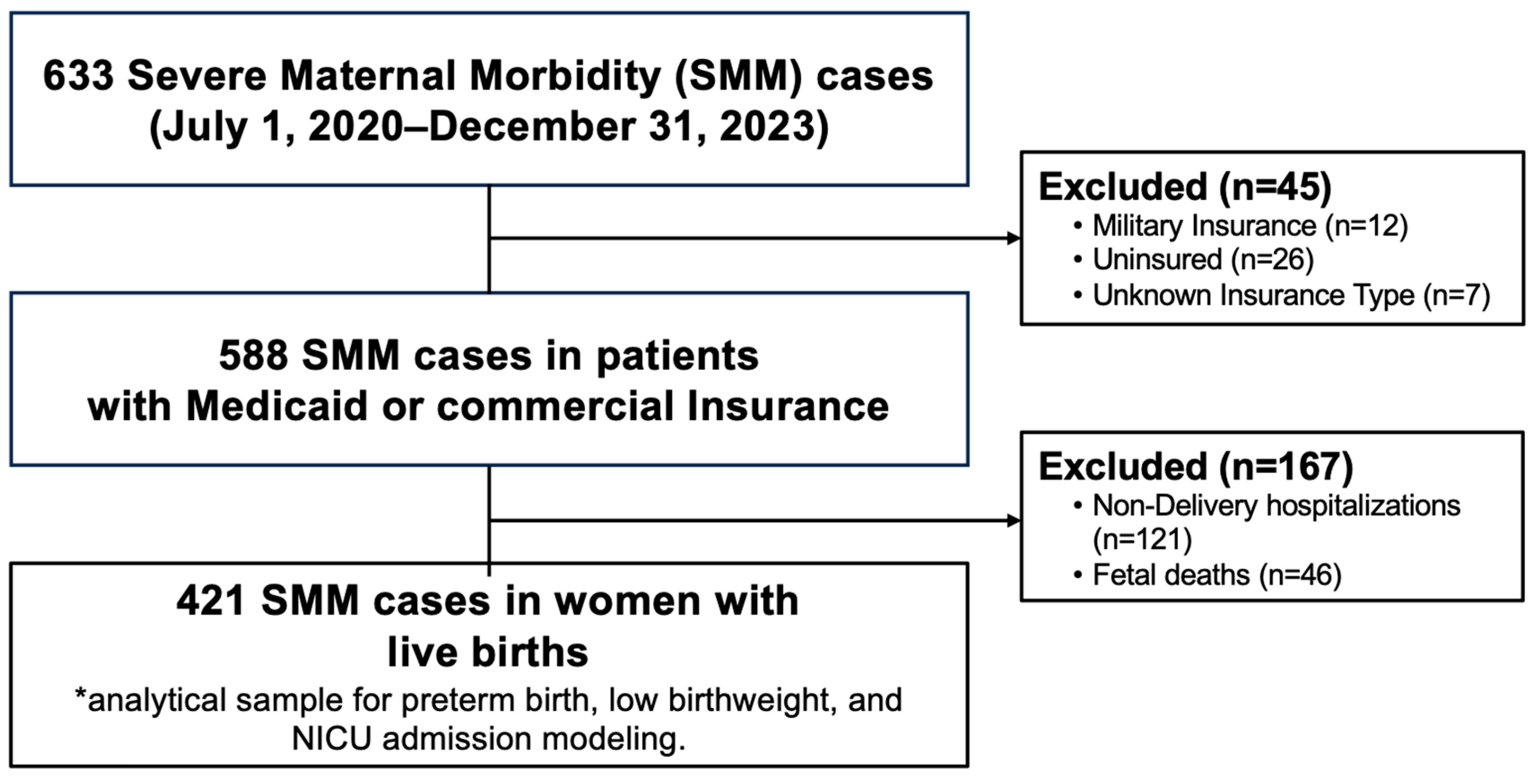
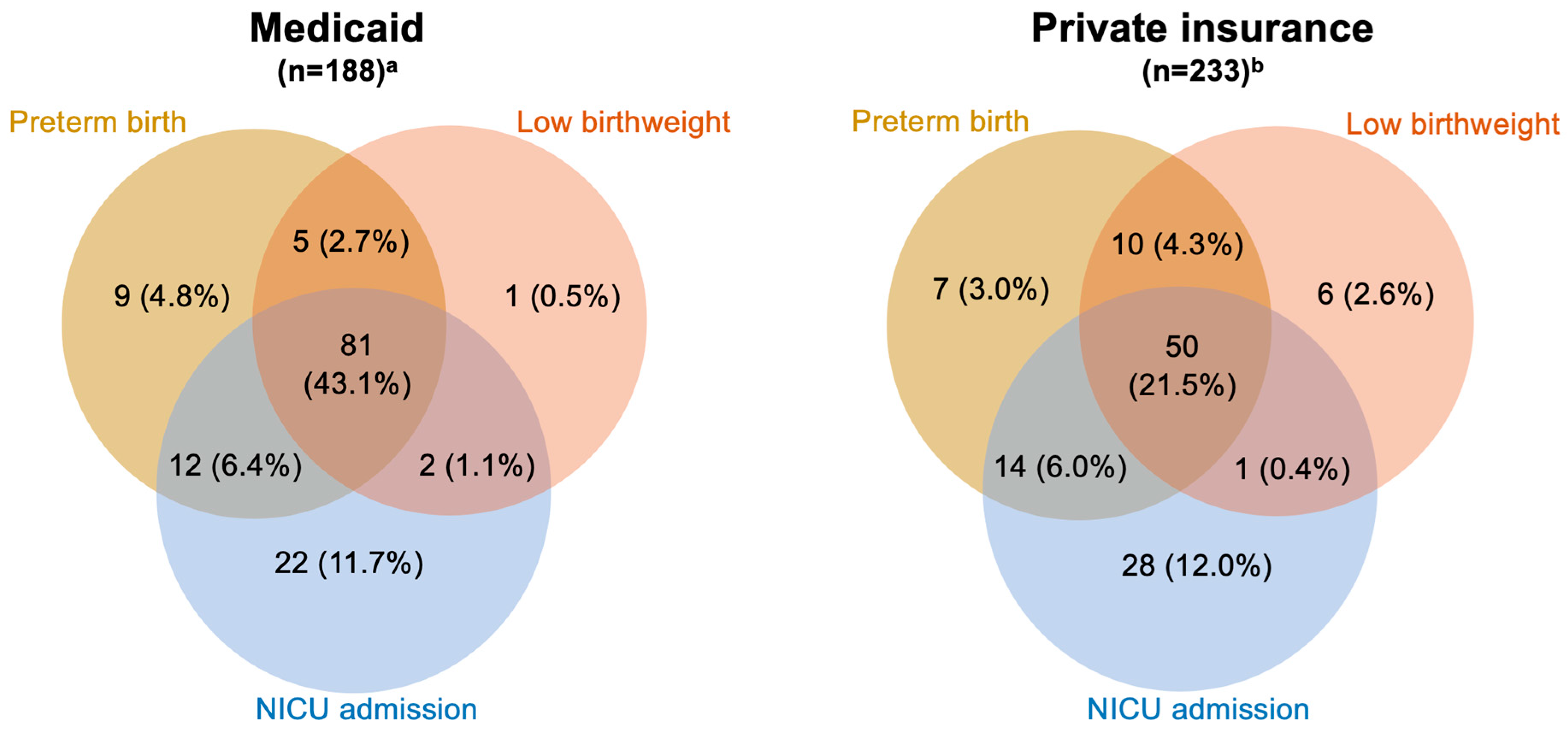
Adverse Newborn Outcomes by Insurance Status Among Patients with Severe Maternal Morbidity in Maryland: 2020–2023

 , ,
, ,  , add
Show full author list
, add
Show full author list
Abstract
1. Introduction
2. Methods
3. Results
4. Discussion
5. Strengths and Limitations
6. Conclusions
Supplementary Materials
Author Contributions
Funding
Institutional Review Board Statement
Informed Consent Statement
Data Availability Statement
Conflicts of Interest
References
- Reid, L.D. Trends in Severe Maternal Morbidity Complications by Patient Characteristics, 2016–2021. In Healthcare Cost and Utilization Project (HCUP) Statistical Brief #312; Agency for Healthcare Research and Quality: Rockville, MD, USA, 2024. [Google Scholar]
- Center for Control of Disease and Prevention. Severe Maternal Morbidity. Maternal Infant Health 2024. Available online: https://www.cdc.gov/maternal-infant-health/php/severe-maternal-morbidity/index.html (accessed on 11 February 2025).
- Brown, C.C.; Adams, C.E.; Moore, J.E. Race, Medicaid Coverage, and Equity in Maternal Morbidity. Womens Health Issues 2021, 31, 245–253. [Google Scholar] [CrossRef]
- Callaghan, W.M.; Creanga, A.A.; Kuklina, E.V. Severe Maternal Morbidity Among Delivery and Postpartum Hospitalizations in the United States. Obstet. Gynecol. 2012, 120, 1029–1036. [Google Scholar] [CrossRef]
- Mengistu, T.S.; Turner, J.M.; Flatley, C.; Fox, J.; Kumar, S. The Impact of Severe Maternal Morbidity on Perinatal Outcomes in High Income Countries: Systematic Review and Meta-Analysis. J. Clin. Med. 2020, 9, 2035. [Google Scholar] [CrossRef]
- Lawton, B.; Filoche, S.; MacDonald, E.J.; Stanley, J.; Meeks, M.; Stone, P.; Storey, F.; Geller, S.E. Examining adverse fetal/neonatal outcomes associated with severe maternal morbidity. Aust. N. Z. J. Obstet. Gynaecol. 2020, 60, 865–870. [Google Scholar] [CrossRef] [PubMed]
- Garland, C.E.; Geller, S.E.; Koch, A.R. Adverse Delivery and Neonatal Outcomes Among Women with Severe Maternal Morbidity in Illinois, 2018–2019. J. Women’s Health 2024, 33, 163–170. [Google Scholar] [CrossRef] [PubMed]
- Center for Medicaid and CHIP Services. 2024 Medicaid and CHIP Beneficiaries at a Glance: Maternal Health; Centers for Medicare & Medicaid Services: Baltimore, MD, USA, 2024.
- Fink, D.A.; Kilday, D.; Cao, Z.; Larson, K.; Smith, A.; Lipkin, C.; Perigard, R.; Marshall, R.; Deirmenjian, T.; Finke, A.; et al. Trends in Maternal Mortality and Severe Maternal Morbidity During Delivery-Related Hospitalizations in the United States, 2008 to 2021. JAMA Netw Open 2023, 6, e2317641. [Google Scholar] [CrossRef]
- Johnson, D.L.; Carlo, W.A.; Rahman, A.K.M.F.; Tindal, R.; Trulove, S.G.; Watt, M.J.; Travers, C.P. Health Insurance and Differences in Infant Mortality Rates in the US. JAMA Netw. Open 2023, 6, e2337690. [Google Scholar] [CrossRef]
- Kim, H.-J.; Min, K.-B.; Jung, Y.-J.; Min, J.-Y. Disparities in infant mortality by payment source for delivery in the United States. Prev. Med. 2021, 145, 106361. [Google Scholar] [CrossRef]
- Center for Medicare and Medicaid Services. Medicaid and CHIP Beneficiary Profile: Maternal and Infant Health; Centers for Medicare & Medicaid Services: Baltimore, MD, USA, 2020.
- Johnson, D.L.; Carlo, W.; Rahman, F.A.; Tindal, R.; Travers, C. 163 Private or Public Health Insurance and Infant Outcomes in the United States. J. Clin. Transl. Sci. 2022, 6, 18. [Google Scholar] [CrossRef]
- Markus, A.R.; Krohe, S.; Garro, N.; Gerstein, M.; Pellegrini, C. Examining the association between Medicaid coverage and preterm births using 2010–2013 National Vital Statistics Birth Data. J. Child. Poverty 2017, 23, 79–94. [Google Scholar] [CrossRef]
- Meltzer, R.; Markus, A.R. An Analysis of Payment Mix Patterns of Preterm Births in a Post-Affordable Care Act Insurance Market: Implications for the Medicaid Program. Womens Health Issues 2020, 30, 248–259. [Google Scholar] [CrossRef]
- Haidari, E.S.; Lee, H.C.; Illuzzi, J.L.; Phibbs, C.S.; Lin, H.; Xu, X. Hospital variation in admissions to neonatal intensive care units by diagnosis severity and category. J. Perinatol. 2021, 41, 468–477. [Google Scholar] [CrossRef]
- Qian, J.; Wolfson, C.; Neale, D.; Johnson, C.T.; Atlas, R.; Sheffield, J.S.; Zadzielski, E.; Jones, M.M.; Creanga, A.A. Evaluating a pilot, facility-based severe maternal morbidity surveillance and review program in Maryland—An American College of Obstetricians and Gynecologists and Society for Maternal-Fetal Medicine Rx at work. Am. J. Obstet. Gynecol. MFM 2023, 5, 100888. [Google Scholar] [CrossRef]
- Wolfson, C.; Qian, J.; Chin, P.; Downey, C.; Mattingly, K.J.; Jones-Beatty, K.; Olaku, J.; Qureshi, S.; Rhule, J.; Silldorff, D.; et al. Findings From Severe Maternal Morbidity Surveillance and Review in Maryland. JAMA Netw. Open 2022, 5, e2244077. [Google Scholar] [CrossRef]
- Leonard, S.A.; Main, E.K.; Lyell, D.J.; Carmichael, S.L.; Kennedy, C.J.; Johnson, C.; Mujahid, M.S. Obstetric comorbidity scores and disparities in severe maternal morbidity across marginalized groups. Am. J. Obstet. Gynecol. MFM 2022, 4, 100530. [Google Scholar] [CrossRef]
- Chen, J.; Cox, S.; Kuklina, E.V.; Ferre, C.; Barfield, W.; Li, R. Assessment of Incidence and Factors Associated With Severe Maternal Morbidity After Delivery Discharge Among Women in the US. JAMA Netw. Open 2021, 4, e2036148. [Google Scholar] [CrossRef] [PubMed]
- StataCorp. Stata Statistical Software: Release 15 2017; StataCorp: College Station, TX, USA, 2017. [Google Scholar]
- Bestman, P.L.; Kolleh, E.M.; Moeng, E.; Brhane, T.; Nget, M.; Luo, J. Association between multimorbidity of pregnancy and adverse birth outcomes: A systemic review and meta-analysis. Prev. Med. 2024, 180, 107872. [Google Scholar] [CrossRef]
- Admon, L.K.; Winkelman, T.N.A.; Heisler, M.; Dalton, V.K. Obstetric Outcomes and Delivery-Related Health Care Utilization and Costs Among Pregnant Women With Multiple Chronic Conditions. Prev. Chronic Dis. 2018, 15, E21. [Google Scholar] [CrossRef] [PubMed]
- Advising Congress on Medicaid and CHIP Policy. Medicaid Retroactive Eligibility Changes Under Section 1115 Waivers. 2019. Available online: https://www.macpac.gov/wp-content/uploads/2019/08/Medicaid-Retroactive-Eligibility-Changes-under-Section-1115-Waivers.pdf (accessed on 8 July 2025).
- Maryland Health Connection. What is Retroactive Medicaid? Maryland Health Connection 2024. Available online: https://www.marylandhealthconnection.gov/glossaryslug/retroactive-medicaid/ (accessed on 8 July 2025).
- Centers for Disease Control and Prevention, National Center for Health Statistics. National Vital Statistics System, Natality on CDC WONDER Online Database. Data are from the Natality Records 2016–2023, as Compiled from Data Provided by the 57 Vital Statistics Jurisdictions Through the Vital Statistics Cooperative Program. Available online: http://wonder.cdc.gov/natality-expanded-current.html (accessed on 9 March 2025).
- Daw, J.R.; Kolenic, G.E.M.; Dalton, V.K.; Zivin, K.; Winkelman, T.M.; Kozhimannil, K.B.P.; Admon, L.K.M. Racial and Ethnic Disparities in Perinatal Insurance Coverage. Obstet. Gynecol. 2020, 135, 917–924. [Google Scholar] [CrossRef]
- Akinyemi, O.; Ogundare, T.; Fasokun, M.; Nwokolo, V.; Weldeslase, T.; McDonald, V.; Colon-Santos, L.; Luo, G. Impact of Medicaid expansion on pregnancy outcomes among women with gestational diabetes. Int. J. Gynecol. Obstet. 2024, 165, 519–525. [Google Scholar] [CrossRef] [PubMed]
- Saygili, M.; Bayindir, E.E. Association of Medicaid expansion with birth outcomes: Evidence from a natural experiment in Texas. BMC Public Health 2024, 24, 1486. [Google Scholar] [CrossRef]
- Harvey, S.M.; Gibbs, S.; Oakley, L.; Luck, J.; Yoon, J. Medicaid expansion and neonatal outcomes in Oregon. J. Eval. Clin. Pract. 2020, 27, 1096–1103. [Google Scholar] [CrossRef]
- Jarlenski, M.P.; Paul, N.C.; Krans, E.E.M. Polysubstance Use Among Pregnant Women With Opioid Use Disorder in the United States, 2007–2016. Obstet. Gynecol. 2020, 136, 556–564. [Google Scholar] [CrossRef]
- Auty, S.G.; Frakt, A.B.; Shafer, P.R.; Stein, M.D.; Gordon, S.H. Severe Maternal Morbidity Among Pregnant People With Opioid Use Disorder Enrolled in Medicaid. JAMA Netw. Open 2025, 8, e2453303. [Google Scholar] [CrossRef]
- Sabr, Y.; Lisonkova, S.; Skoll, A.; Brant, R.; Velez, M.P.; Joseph, K. Severe Maternal Morbidity and Maternal Mortality Associated with Assisted Reproductive Technology. J. Obstet. Gynaecol. Can. 2022, 44, 978–986. [Google Scholar] [CrossRef]
- Stern, J.E.; Farland, L.V.; Hwang, S.S.; Dukhovny, D.; Coddington, C.C.; Cabral, H.J.; Missmer, S.A.; Declercq, E.; Diop, H. Assisted Reproductive Technology or Infertility: What underlies adverse outcomes? Lessons from the Massachusetts Outcome Study of Assisted Reproductive Technology. F S Rev. 2022, 3, 242–255. [Google Scholar] [CrossRef]
- Le Ray, C.; Pelage, L.; Seco, A.; Bouvier-Colle, M.; Chantry, A.; Deneux-Tharaux, C.; Epimoms Study Group; Langer, B.; Dupont, C.; Rudigoz, R.C.; et al. Risk of severe maternal morbidity associated with in vitro fertilisation: A population-based study. BJOG Int. J. Obstet. Gynaecol. 2019, 126, 1033–1041. [Google Scholar] [CrossRef] [PubMed]
- Belanoff, C.S.; Declercq, E.R.; Diop, H.; Gopal, D.; Kotelchuck, M.; Luke, B.S.; Nguyen, T.; Stern, J.E. Severe Maternal Morbidity and the Use of Assisted Reproductive Technology in Massachusetts. Obstet. Gynecol. 2016, 127, 527–534. [Google Scholar] [CrossRef] [PubMed]
- Helmerhorst, F.M.; Perquin, D.A.M.; Donker, D.; Keirse, M.J.N.C. Perinatal outcome of singletons and twins after assisted conception: A systematic review of controlled studies. BMJ 2004, 328, 261. [Google Scholar] [CrossRef]
- Sutcliffe, A.G.; Ludwig, M. Outcome of assisted reproduction. Lancet 2007, 370, 351–359. [Google Scholar] [CrossRef] [PubMed]
- Pinborg, A.; Wennerholm, U.B.; Romundstad, L.B.; Loft, A.; Aittomaki, K.; Soderstrom-Anttila, V.; Nygren, K.G.; Hazekamp, J.; Bergh, C. Why do singletons conceived after assisted reproduction technology have adverse perinatal outcome? Systematic review and meta-analysis. Hum. Reprod. Update 2013, 19, 87–104. [Google Scholar] [CrossRef] [PubMed]



| Insurance Type | p-Value a | |||
|---|---|---|---|---|
| Total N (%) | Medicaid N (%) | Commercial N (%) | ||
| Maternal Characteristics | N = 588 | N = 265 | N = 323 | |
| Age at admission (years) | <0.001 | |||
| <25 | 78 (13.3) | 54 (20.4) | 24 (7.4) | |
| 25–34 | 276 (46.9) | 134 (50.6) | 142 (44.0) | |
| 35+ | 234 (39.8) | 77 (29.1) | 157 (48.6) | |
| Race and ethnicity | <0.001 | |||
| Black, Non-Hispanic | 274 (46.6) | 160 (60.4) | 114 (35.3) | |
| White, Non-Hispanic | 202 (34.4) | 53 (20.0) | 149 (46.1) | |
| Hispanic | 56 (9.5) | 39 (14.7) | 17 (5.3) | |
| Asian | 33 (5.6) | 4 (1.5) | 29 (9.0) | |
| Multi-race/Other/Unknown | 23 (3.9) | 9 (3.4) | 14 (4.3) | |
| Parity, median (IQR) | 1 (0–2) | 2 (0–3) | 1 (0–2) | <0.001 |
| Timing of prenatal care initiation | <0.001 | |||
| 1st trimester | 384 (65.3) | 139 (52.5) | 245 (75.9) | |
| 2nd or 3rd trimester | 100 (17.0) | 63 (23.8) | 37 (11.5) | |
| No prenatal care | 28 (4.8) | 20 (7.5) | 8 (2.5) | |
| Timing of prenatal care unknown | 76 (12.9) | 43 (16.2) | 33 (10.2) | |
| Comorbidity index score, median (IQR) | 12.0 (4.0–21.5) | 14.5 (8.0–22.5) | 9.0 (3.0–19.5) | <0.001 |
| ART use during index pregnancy b | 66 (11.2) | 9 (3.4) | 57 (17.6) | <0.001 |
| Delivery and newborn/fetal characteristics | n = 467 | n = 213 | n = 254 | |
| Mode of delivery | 0.94 | |||
| Cesarean delivery | 343 (73.4) | 157 (73.7) | 186 (73.2) | |
| Spontaneous vaginal delivery | 99 (21.2) | 46 (21.6) | 53 (20.9) | |
| Assisted vaginal delivery | 7 (1.5) | 3 (1.4) | 4 (1.6) | |
| Surgical evacuation c | 18 (3.9) | 7 (3.3) | 11 (4.3) | |
| Delivery outcome | 0.21 | |||
| Live birth | 421 (90.1) | 188 (88.3) | 233 (91.7) | |
| Fetal death | 46 (9.9) | 25 (11.7) | 21 (8.3) | |
| Congenital anomaly | 14 (3.0) | 6 (2.8) | 8 (3.1) | 0.83 |
| Newborn/fetal sex d | 0.42 | |||
| Female | 234 (50.1) | 102 (47.9) | 132 (52.0) | |
| Male | 209 (44.8) | 103 (48.4) | 106 (41.7) | |
| Gestational age at birth median (IQR) e | 37 w0 d (33 w2 d–39 w0 d) | 35 w5 d (31 w5 d–38 w4 d) | 37 w4 d (34 w4 d–39 w2 d) | 0.002 |
| Birthweight (g), median (IQR) f | 2880.0 (1990.0–3430.0) | 2490.0 (1720.0–3235.0) | 3116.5 (2325.0–3570.0) | <0.001 |
| Newborn outcomes g | n = 421 | n = 188 | n = 233 | |
| Preterm birth (<37 weeks gestational age) h | 187 (44.7) | 107 (56.9) | 80 (34.8) | <0.001 |
| Low birthweight (<2500 g) i | 156 (37.6) | 89 (47.6) | 67 (29.4) | <0.001 |
| NICU admission j | 210 (50.7) | 117 (63.6) | 93 (40.4) | <0.001 |
| Characteristics | Insurance Type | p-Value a | ||
|---|---|---|---|---|
| Total N (%) | Medicaid N (%) | Commercial N (%) | ||
| N = 588 | N = 265 | N = 323 | ||
| SMM occurred during delivery hospitalization | 467 (79.4) | 213 (80.4) | 254 (78.6) | 0.60 |
| Length of stay (days) | ||||
| Mean (SD) | 6.9 (7.4) | 7.9 (9.4) | 6.1 (5.2) | 0.002 |
| Median (IQR) | 5 (4–8) | 5 (4–8) | 5 (3–7) | 0.002 |
| ICU/CCU admission | 376 (63.9) | 179 (67.5) | 197 (61.0) | 0.099 |
| ≥4 units blood products transfused | 357 (60.7) | 140 (52.8) | 217 (67.2) | <0.001 |
| Timing of SMM | 0.040 | |||
| Antepartum | 146 (24.8) | 79 (29.8) | 67 (20.7) | |
| Intrapartum | 79 (13.4) | 33 (12.5) | 46 (14.2) | |
| Postpartum | 363 (61.7) | 153 (57.7) | 210 (65.0) | |
| Primary cause of SMM | 0.001 | |||
| Obstetric hemorrhage | 329 (56.0) | 125 (47.2) | 204 (63.2) | |
| Infection/sepsis b | 64 (10.9) | 32 (12.1) | 32 (9.9) | |
| Hypertensive disorders of pregnancy | 63 (10.7) | 29 (10.9) | 34 (10.5) | |
| Cardiovascular condition | 30 (5.1) | 20 (7.5) | 10 (3.1) | |
| Hematologic condition c | 18 (3.1) | 10 (3.8) | 8 (2.5) | |
| Other condition d | 84 (14.3) | 49 (18.5) | 35 (10.8) | |
| SMM was preventable e | 199 (33.8) | 88 (33.2) | 111 (34.4) | 0.77 |
| With changes in provider-level factors | 139 (23.6) | 53 (20.0) | 86 (26.6) | 0.060 |
| With changes in system-level factors | 84 (14.3) | 42 (15.8) | 42 (13.0) | 0.33 |
| With changes in patient-level factors | 90 (15.3) | 52 (19.6) | 38 (11.8) | 0.008 |
| Characteristics | Preterm Birth (<37 w) ab | Low Birthweight (<2500 gm) cd | NICU Admission ef | |||||||||
|---|---|---|---|---|---|---|---|---|---|---|---|---|
| Unadjusted | Adjusted | Unadjusted | Adjusted | Unadjusted | Adjusted | |||||||
| OR | 95% CI | OR | 95% CI | OR | 95% CI | OR | 95% CI | OR | 95% CI | OR | 95% CI | |
| Medicaid (Commercial insurance = ref) | 2.45 | 1.65–3.63 | 1.62 | 0.94–2.80 | 2.18 | 1.46–3.27 | 1.33 | 0.78–2.28 | 2.57 | 1.73–3.84 | 1.83 | 1.09–3.07 |
| Race and ethnicity (White non-Hispanic = ref) | ||||||||||||
| Black, Non-Hispanic | 1.76 | 1.14–2.73 | 0.84 | 0.47–1.49 | 1.72 | 1.10–2.71 | 0.93 | 0.53–1.64 | 1.50 | 0.97–2.31 | 0.73 | 0.42–1.26 |
| Hispanic | 1.15 | 0.58–2.26 | 1.16 | 0.49–2.72 | 1.60 | 0.8–3.18 | 1.78 | 0.78–4.1 | 1.14 | 0.58–2.27 | 0.95 | 0.42–2.16 |
| Asian | 0.38 | 0.15–0.98 | 0.52 | 0.17–1.59 | 0.42 | 0.15–1.17 | 0.68 | 0.22–2.13 | 0.49 | 0.21–1.14 | 0.74 | 0.28–1.92 |
| Multi-race/Other/Unknown | 1.08 | 0.33–3.55 | 1.11 | 0.26–4.76 | 0.70 | 0.18–2.71 | 0.60 | 0.12–2.94 | 2.29 | 0.66–7.92 | 2.40 | 0.62–9.27 |
| Parity | 1.21 | 1.08–1.37 | 1.07 | 0.92–1.24 | 1.10 | 0.99–1.23 | 0.96 | 0.83–1.1 | 1.19 | 1.06–1.34 | 1.09 | 0.95–1.26 |
| Comorbidity Index | 1.08 | 1.06–1.10 | 1.09 | 1.07–1.11 | 1.06 | 1.04–1.08 | 1.08 | 1.05–1.10 | 1.05 | 1.03–1.07 | 1.05 | 1.03–1.07 |
| Use of ART (No = ref) | 0.73 | 0.41–1.3 | 0.93 | 0.44–1.95 | 0.47 | 0.24–0.91 | 0.49 | 0.22–1.07 | 0.56 | 0.31–0.99 | 0.73 | 0.37–1.44 |
| Newborn female sex (Male = ref) | 1.02 | 0.69–1.50 | 1.21 | 0.74–1.97 | 1.03 | 0.69–1.54 | 1.23 | 0.76–2.00 | 0.74 | 0.50–1.10 | 0.77 | 0.49–1.22 |
| Primary cause of SMM (Obstetric hemorrhage = ref) | ||||||||||||
| Hypertensive disorders of pregnancy | 4.71 | 2.41–9.18 | 4.75 | 2.19–10.29 | 6.00 | 3.09–11.66 | 6.00 | 2.82–12.76 | 6.52 | 3.03–14.01 | 6.06 | 2.65–13.83 |
| Infections g | 3.77 | 1.63–8.71 | 3.95 | 1.42–11.01 | 2.45 | 1.07–5.60 | 2.69 | 0.97–7.40 | 4.30 | 1.76–10.52 | 4.10 | 1.44–11.69 |
| Other h | 2.49 | 1.47–4.23 | 2.06 | 1.03–4.13 | 2.72 | 1.59–4.66 | 2.21 | 1.12–4.36 | 2.45 | 1.43–4.20 | 1.96 | 1.03–3.72 |
| Timing of SMM (Antepartum = ref) | ||||||||||||
| Intrapartum | 0.24 | 0.11–0.53 | 0.24 | 0.09–0.65 | 0.34 | 0.16–0.71 | 0.37 | 0.15–0.93 | 0.42 | 0.19–0.92 | 0.69 | 0.27–1.78 |
| Postpartum | 0.17 | 0.09–0.33 | 0.26 | 0.11–0.60 | 0.23 | 0.12–0.42 | 0.35 | 0.16–0.76 | 0.21 | 0.11–0.41 | 0.43 | 0.19–0.98 |
Disclaimer/Publisher’s Note: The statements, opinions and data contained in all publications are solely those of the individual author(s) and contributor(s) and not of MDPI and/or the editor(s). MDPI and/or the editor(s) disclaim responsibility for any injury to people or property resulting from any ideas, methods, instructions or products referred to in the content. |
© 2026 by the authors. Licensee MDPI, Basel, Switzerland. This article is an open access article distributed under the terms and conditions of the Creative Commons Attribution (CC BY) license.
Share and Cite
Manandhar, P.; Wolfson, C.; Sheffield, J.; Phillips, M.; Graham, E.; Atlas, R.; Chin, P.; Olaku, J.; Duafala, R.; Cline, B.L.; et al. Adverse Newborn Outcomes by Insurance Status Among Patients with Severe Maternal Morbidity in Maryland: 2020–2023. Healthcare 2026, 14, 804. https://doi.org/10.3390/healthcare14060804
Manandhar P, Wolfson C, Sheffield J, Phillips M, Graham E, Atlas R, Chin P, Olaku J, Duafala R, Cline BL, et al. Adverse Newborn Outcomes by Insurance Status Among Patients with Severe Maternal Morbidity in Maryland: 2020–2023. Healthcare. 2026; 14(6):804. https://doi.org/10.3390/healthcare14060804
Chicago/Turabian StyleManandhar, Porcia, Carrie Wolfson, Jeanne Sheffield, Michelle Phillips, Ernest Graham, Robert Atlas, Pamela Chin, Joanne Olaku, Robyn Duafala, Brittany L. Cline, and et al. 2026. "Adverse Newborn Outcomes by Insurance Status Among Patients with Severe Maternal Morbidity in Maryland: 2020–2023" Healthcare 14, no. 6: 804. https://doi.org/10.3390/healthcare14060804
APA StyleManandhar, P., Wolfson, C., Sheffield, J., Phillips, M., Graham, E., Atlas, R., Chin, P., Olaku, J., Duafala, R., Cline, B. L., Burd, I., Fahey, J., Jones-Beatty, K., Mehlhaff, K. M., Jones, M. B., Buchanan, K., Carey, M. E., Chiang, J., Argani, C., ... Aziz, K. B. (2026). Adverse Newborn Outcomes by Insurance Status Among Patients with Severe Maternal Morbidity in Maryland: 2020–2023. Healthcare, 14(6), 804. https://doi.org/10.3390/healthcare14060804