
How Do Spanish Hospitals Use Lean? Insights from a Multiple-Case Study

 , , , ,
  ,
,  and
and
Abstract
1. Introduction
2. Materials and Methods
2.1. Hospital Choice
- (1)
- Representation of Different Hospital Types—The sample includes a large public tertiary-care center, a specialized pediatric and obstetric hospital, and a leading academic research institution. This facilitates an examination of LHM adaptability across various patient populations, organizational sizes, and primary missions.
- (2)
- Evidence of Ongoing LHM Implementation: All three hospitals had completed organization-wide LHM implementations, offering mature, stable systems for analysis rather than early-stage pilot programs.
- (3)
- Presence of High-Volume, High-Pressure Settings: As major referral centers in a region with historically high ED utilization, these sites provide a rigorous context to evaluate LHM’s impact on operational efficiency under significant demand.
- (4)
- Differences in Lean Methodologies: Each hospital used a unique set of LHM tools and philosophies, enabling a comparative analysis of different implementation strategies and their outcomes.
- (5)
- Control for Macro-System Variables: By focusing on three hospitals within the same city and regional health system, the study accounted for overarching political, economic, and regulatory factors, allowing for a more explicit focus on organizational dynamics.
2.2. Study Methods
- (1)
- Revision of the LHM tools implemented in each hospital based on workshops with the hospital management and the documentation.
- (2)
- Hospital staff observation during work in situations in which the identified LHM tools were implemented.
- (3)
- Focus groups with nurses, physicians, and administrators of the hospital separately.
- (1)
- Physicians, working in a field in which the LHM intervention was implemented, who were employed before the LHM intervention’s implementation;
- (2)
- Nurses, working in a field in which the LHM intervention was implemented, who were employed before the LHM intervention’s implementation;
- (3)
- Physicians, working in a field in which the LHM intervention was implemented, who were employed after the LHM intervention’s implementation;
- (4)
- Nurses, working in a field in which the LHM intervention was implemented, who were employed after the LHM intervention’s implementation.
- (1)
- Participants who were employed before or after the LHM interventions, in equal numbers;
- (2)
- Working as a physician, nurse, or administrator in a field in which LHM intervention was implemented;
- (3)
- Willing to participate in focus groups.
3. Results
3.1. Overview of LHM Interventions and Adherence
3.2. Cross-Case Analysis of LHM Tools and Outcomes
3.3. Thematic Analysis of LHM Interventions and Outcomes
3.3.1. Vall d’Hebron University Hospital
LHM Approach and Outcomes
SWOT Analysis
- A.
- Strengths
- ○
- Enhanced Process Flow: Horizontal management and visual controls directly reduced delays and non-value-added steps, leading to fewer surgery cancelations and more efficient patient handling.
- ○
- Resource Efficiency: Digital documentation and reorganized medical supplies optimized staff time and reduced physical movement.
- ○
- Robust Emergency Integration: The buffer system for operating rooms effectively protected planned surgeries from emergency cases, directly improving ED-to-OR patient flow.
- B.
- Weaknesses
- ○
- Cultural Resistance: Focus groups indicated initial resistance from staff accustomed to traditional, department-centric hierarchies.
- ○
- Implementation Overhead: The shift to horizontal management required significant initial coordination and restructuring.
- ○
- Dependence on Coordination: The system’s efficiency relies heavily on seamless interdisciplinary collaboration, which can be a vulnerability.
- C.
- Opportunities
- ○
- Scalability of Low-Tech Tools: The success of visual management demonstrates the potential for wider application of low-cost, high-impact tools across other departments.
- ○
- Data-Driven Refinement: The data collected from the new digital systems can be leveraged for further process optimization and predictive analytics.
- ○
- Model for Large Centers: Its success as a large public tertiary-care center makes it a scalable model for similar hospitals.
- D.
- Threats
- ○
- Staff Burnout: The constant requirement for interdisciplinary coordination could contribute to fatigue if not managed carefully.
- ○
- Budgetary Pressures: Future budget constraints could threaten the sustainability of the digital infrastructure and dedicated coordination roles.
- ○
- Reliance on Key Personnel: The system’s stability may depend on the continued advocacy and effort of key change-makers.
3.3.2. Sant Joan de Déu Hospital
LHM Approach and Outcomes
SWOT Analysis
- A.
- Strengths
- ○
- Exceptional Patient Satisfaction: The patient-centric model yielded a verifiable, high Net Promoter Score and positive patient feedback.
- ○
- High Staff Engagement & Ownership: The bottom-up, project-based approach fostered strong buy-in and innovation among staff.
- ○
- Structured Improvement Methodology: The E = MC2 model provides a clear, repeatable framework for continuous improvement.
- B.
- Weaknesses
- ○
- Model-Specific Complexity: The custom E = MC2 model may be more difficult to replicate or scale than generic Lean tools.
- ○
- Potential for Project Silos: Continuous improvement through discrete projects could lead to a fragmented approach rather than a unified system-wide flow.
- ○
- Resource Intensity: Maintaining a high level of staff engagement and running numerous projects requires significant ongoing organizational energy.
- C.
- Opportunities
- ○
- Brand Enhancement: The high patient satisfaction can be leveraged to strengthen the hospital’s reputation and attract more patients and funding.
- ○
- Knowledge Export: The hospital can position itself as a center of excellence for patient-experience-focused Lean implementation.
- ○
- Refinement of Specialized Care: The model is ideal for further optimizing care for complex and specialized patient populations.
- D.
- Threats
- ○
- Initiative Fatigue: Staff may become overwhelmed by the continuous cycle of projects and brainstorming sessions.
- ○
- Dependence on Cultural Momentum: The success is deeply tied to a vibrant improvement culture, which can be fragile and susceptible to degradation with leadership or staff changes.
- ○
- Measurement of Hard Outcomes: While patient satisfaction is high, the direct impact on some hard operational metrics (e.g., ED length of stay) is less explicitly documented than in other sites.
3.3.3. Hospital Clínic de Barcelona
LHM Approach and Outcomes
- Improved pharmacy management and medication distribution (e.g., using systems for cytostatic or anti-infective therapy).
- Implementation of analytical applications, including SAP automation, to avoid duplicate procedures and conduct cost reviews of medical procedures.
- Optimization of demand for imaging studies and their interpretation.
- Redirecting hospitalized patients to outpatient care and maintaining continuous collaboration with emergency services.
- Ongoing price negotiations with suppliers of materials and medications (e.g., reducing prosthesis costs by 30% through group purchasing), as well as IT services and medical equipment.
- Optimization of consumables’ usage through implementing consumption monitoring and the allocation of specific supply batches to departments, reducing waste.
SWOT Analysis
- A.
- Strengths
- ○
- Maximized Operational Efficiency: The Kanban system and real-time bed tracking created a highly predictable and efficient patient flow, directly reducing variability and delays.
- ○
- Strong Technological Integration: IT systems are deeply embedded in the Lean processes, providing data for real-time management and decision-making.
- ○
- Significant Cost Control: A systematic approach to supply chain and process optimization yielded verifiable financial benefits.
- B.
- Weaknesses
- ○
- High Technological Dependency: The system’s performance is heavily reliant on a complex, functioning IT infrastructure.
- ○
- Rigidity: The highly standardized processes (e.g., 40-min cycles) may lack the flexibility to handle extreme or unpredictable patient surges effectively.
- ○
- Potential for Staff Alienation: The “factory-like” precision of the ED system could be perceived as dehumanizing by some staff or patients if not balanced with a caring culture.
- C.
- Opportunities
- ○
- Leadership in Healthcare IT: The hospital is well-positioned to pioneer the integration of AI and advanced analytics for predictive patient flow management.
- ○
- Benchmark for Throughput: It can serve as a benchmark for other institutions seeking to maximize efficiency and reduce costs in high-volume settings.
- ○
- Data-Driven Procurement: The success in supply chain optimization can be expanded to other areas of hospital spending.
- D.
- Threats
- ○
- IT System Failure: Any significant downtime in the bed-tracking or management systems would severely disrupt operations.
- ○
- High Initial Investment: The technological backbone required for this model presents a significant barrier to adoption for less-resourced hospitals.
- ○
- Workforce Skill Gaps: Requires staff who are both clinically proficient and comfortable working within a highly structured, technology-driven environment.
4. Discussion
4.1. Summary of Findings
- A.
- Strengths
- ○
- Enhanced Patient Flow and Throughput: The implementation of standardized workflows directly reduces ED variability, minimizes patient batching, and creates a more predictable, first-in-first-out process. This leads to reduced waiting times and decreased ED length of stay.
- ○
- System-Wide Efficiency Gains: LHM tools like Value Stream Mapping and horizontal process management successfully identify and eliminate non-value-added steps not just within the ED, but also at critical interfaces.
- ○
- Improved Resource Utilization: Initiatives such as digital documentation, pre-packed medical supplies, and optimized supply chains reduce waste and free up staff time, allowing ED personnel to focus more on direct patient care.
- ○
- High Staff Engagement and Patient Satisfaction: The bottom-up, project-based approach fosters a sense of ownership among staff. At the same time, the focus on patient-centric care directly translates into measurable patient satisfaction outcomes.
- B.
- Weaknesses
- ○
- Significant Implementation Overhead: Successful LHM requires a profound cultural shift away from traditional hierarchies and siloed departments. Gaining full staff buy-in is time-consuming and can face considerable resistance, making the initial implementation phase complex and challenging.
- ○
- Dependence on Enabling Factors: The most advanced efficiency gains are often reliant on technology (e.g., IT systems for bed tracking) and continuous coordination. In resource-constrained settings, this dependence can be a critical vulnerability.
- ○
- Sustainability Challenges: Maintaining the gains requires ongoing monitoring, training, and staff engagement. There is a persistent risk of reverting to old habits, especially without dedicated process improvement teams or in the face of staff turnover.
- ○
- Potential for Rigidity and Alienation: Highly standardized processes (e.g., strict time cycles) may struggle to adapt to extreme, unpredictable patient surges. Furthermore, an excessive focus on efficiency can be perceived by staff as dehumanizing if not balanced with a strong culture of care.
- C.
- Opportunities
- ○
- Scalability of Low-Tech Solutions: The demonstrated success of visual management and physical Kanban boards shows that significant ED improvements can be achieved without massive IT investments, making LHM adaptable to a wide range of hospital budgets.
- ○
- Technological Integration: The foundation laid by LHM creates a perfect platform for integrating advanced digital tools (e.g., AI-driven predictive analytics for patient flow, SAP automation) to enhance decision-making and efficiency further.
- ○
- Strengthening Care Pathways: LHM provides a framework to build robust collaborative models with primary care and other community services. This can help redirect non-urgent cases away from the ED, directly addressing a root cause of overcrowding.
- ○
- Policy and Competitive Advantage: Growing emphasis on healthcare efficiency can drive funding and policy support for LHM initiatives. Hospitals can also leverage improved performance and patient satisfaction as a key differentiator.
- D.
- Threats
- ○
- Resource Constraints: Tight budgets and staffing shortages—common in healthcare systems globally—pose the greatest threat. LHM relies on engaged personnel and some initial investment; without these, implementation can fail or deliver suboptimal results.
- ○
- Cultural and Hierarchical Resistance: Clinicians may perceive LHM as a top-down, cost-cutting measure rather than a quality improvement tool. Deep-seated hierarchical structures can stifle the bottom-up engagement essential for long-term success.
- ○
- External System Pressures: Seasonal demand surges (e.g., flu season) and pandemics can overwhelm even the most optimized, standardized ED processes, highlighting the need for built-in flexibility.
- ○
- Systemic Inertia: In publicly funded or highly bureaucratic systems, slow decision-making and regulatory hurdles can delay the adoption of new processes and technologies, causing LHM initiatives to lose momentum.
4.2. Comparison with Previous Reports
4.3. Implications for Policy and Practice
4.4. Future Research and Limitations
5. Conclusions
Supplementary Materials
Author Contributions
Funding
Institutional Review Board Statement
Informed Consent Statement
Data Availability Statement
Acknowledgments
Conflicts of Interest
Abbreviations
| CEE | Central and Eastern Europe |
| ED | Emergency Department |
| LHM | Lean Healthcare Management |
| OR | Operating Room |
| SWOT | Strengths, Weaknesses, Opportunities, Threats |
| VSM | Value Stream Mapping |
References
- Christ, M.; Grossmann, F.; Winter, D.; Bingisser, R.; Platz, E. Modern Triage in the Emergency Department. Dtsch. Arztebl. Int. 2010, 107, 892. [Google Scholar] [CrossRef] [PubMed]
- Hachimi-Idrissi, S.; Coffey, F.; Hautz, W.E.; Leach, R.; Sauter, T.C.; Sforzi, I.; Dobias, V. Approaching Acute Pain in Emergency Settings: European Society for Emergency Medicine (EUSEM) Guidelines—Part 1: Assessment. Intern. Emerg. Med. 2020, 15, 1125–1139. [Google Scholar] [CrossRef] [PubMed]
- Szkudlarek, D.; Gębarowski, T.; Hauzer, N.; Wiatrak, B. The Concept of Health Debt Incurred during the COVID-19 Pandemic on the Example of Basal Cell Skin Cancer Diagnosis in Lower Silesia. J. Clin. Med. 2024, 13, 4923. [Google Scholar] [CrossRef] [PubMed]
- Zaboli, A.; Turcato, G.; Brigiari, G.; Massar, M.; Ziller, M.; Sibilio, S.; Brigo, F. Emergency Departments in Contemporary Healthcare: Are They Still for Emergencies? An Analysis of over 1 Million Attendances. Healthcare 2024, 12, 2426. [Google Scholar] [CrossRef] [PubMed]
- Alanazy, A.R.M.; Alruwaili, A. The Global Prevalence and Associated Factors of Burnout among Emergency Department Healthcare Workers and the Impact of the COVID-19 Pandemic: A Systematic Review and Meta-Analysis. Healthcare 2023, 11, 2220. [Google Scholar] [CrossRef] [PubMed]
- Savioli, G.; Ceresa, I.F.; Novelli, V.; Ricevuti, G.; Bressan, M.A.; Oddone, E. How the Coronavirus Disease 2019 Pandemic Changed the Patterns of Healthcare Utilization by Geriatric Patients and the Crowding: A Call to Action for Effective Solutions to the Access Block. Intern. Emerg. Med. 2022, 17, 503–514. [Google Scholar] [CrossRef] [PubMed]
- Savioli, G.; Ceresa, I.F.; Gri, N.; Bavestrello Piccini, G.; Longhitano, Y.; Zanza, C.; Piccioni, A.; Esposito, C.; Ricevuti, G.; Bressan, M.A. Emergency Department Overcrowding: Understanding the Factors to Find Corresponding Solutions. J. Pers. Med. 2022, 12, 279. [Google Scholar] [CrossRef] [PubMed]
- Available online: https://www.sanidad.gob.es/en/estadEstudios/estadisticas/sisInfSanSNS/tablasEstadisticas/InfAnualSNS2019/Informe_SNS_2019.pdf (accessed on 1 June 2025).
- Available online: https://www.sanidad.gob.es/estadEstudios/estadisticas/sisInfSanSNS/tablasEstadisticas/InfAnualSNS2023/Resumen_Ejecutivo_2023_Ingles.pdf (accessed on 1 June 2025).
- Bharsakade, R.S.; Acharya, P.; Ganapathy, L.; Tiwari, M.K. A Lean Approach to Healthcare Management Using Multi Criteria Decision Making. OPSEARCH 2021, 58, 610–635. [Google Scholar] [CrossRef]
- Yang, L.; Zhen, C.; Yao, Y. Use of Lean Management Methodology to Reduce the Rate of Unfinished Nursing Care in the Emergency Observation Room: A Quality Improvement Project. Qual. Manag. Health Care 2025, 34, 72–82. [Google Scholar] [CrossRef] [PubMed]
- Le, D.X.; Do, H.T.; Bui, K.T.; Hoang, T.Q.; Nguyen, G.H.; Nguyen, A.V.; Nguyen, Q.T.; Gorgui-Naguib, H.; Naguib, R.N.G. Lean Management for Improving Hospital Waiting Times—Case Study of a Vietnamese Public/General Hospital Emergency Department. Int. J. Health Plan. Manag. 2022, 37, 156–170. [Google Scholar] [CrossRef] [PubMed]
- Zdęba-Mozoła, A.; Rybarczyk-Szwajkowska, A.; Czapla, T.; Marczak, M.; Kozłowski, R. Implementation of Lean Management in a Multi-Specialist Hospital in Poland and the Analysis of Waste. Int. J. Environ. Res. Public Health 2022, 19, 800. [Google Scholar] [CrossRef] [PubMed]
- Romaniuk, P.; Szromek, A.R. The Evolution of the Health System Outcomes in Central and Eastern Europe and Their Association with Social, Economic and Political Factors: An Analysis of 25 Years of Transition. BMC Health Serv. Res. 2016, 16, 95. [Google Scholar] [CrossRef] [PubMed]
- Kolossváry, E.; Björck, M.; Behrendt, C.-A. A Divide between the Western European and the Central and Eastern European Countries in the Peripheral Vascular Field: A Narrative Review of the Literature. J. Clin. Med. 2021, 10, 3553. [Google Scholar] [CrossRef] [PubMed]
- Weziak-Bialowolska, D. Health Conditions in Regions of Eastern and Western Europe. Int. J. Public Health 2014, 59, 529–539. [Google Scholar] [CrossRef] [PubMed]
- Popic, T.; Schneider, S.M. An East–West Comparison of Healthcare Evaluations in Europe: Do Institutions Matter? J. Eur. Soc. Policy 2018, 28, 517–534. [Google Scholar] [CrossRef]
- Schneider, S.M.; Popic, T. Cognitive Determinants of Healthcare Evaluations–A Comparison of Eastern and Western European Countries. Health Policy 2018, 122, 269–278. [Google Scholar] [CrossRef] [PubMed]
- Németh, B.; Goettsch, W.; Kristensen, F.B.; Piniazhko, O.; Huić, M.; Tesař, T.; Atanasijevic, D.; Lipska, I.; Kaló, Z. The Transferability of Health Technology Assessment: The European Perspective with Focus on Central and Eastern European Countries. Expert. Rev. Pharmacoecon Outcomes Res. 2020, 20, 321–330. [Google Scholar] [CrossRef] [PubMed]
- Stepovic, M.; Vekic, S.; Vojinovic, R.; Jovanovic, K.; Radovanovic, S.; Radevic, S.; Rancic, N. Analysis and Forecast of Indicators Related to Medical Workers and Medical Technology in Selected Countries of Eastern Europe and Balkan. Healthcare 2023, 11, 655. [Google Scholar] [CrossRef] [PubMed]
- Alexandrova-Karamanova, A.; Todorova, I.; Montgomery, A.; Panagopoulou, E.; Costa, P.; Baban, A.; Davas, A.; Milosevic, M.; Mijakoski, D. Burnout and Health Behaviors in Health Professionals from Seven European Countries. Int. Arch. Occup. Environ. Health 2016, 89, 1059–1075. [Google Scholar] [CrossRef] [PubMed]
- Chauhan, V.; Secor-Jones, S.; Paladino, L.; Sardesai, I.; Ratnayake, A.; Stawicki, S.P.; Papadimos, T.J.; O’Keefe, K.; Galwankar, S.C. Emergency Departments. J. Emerg. Trauma Shock 2022, 15, 157–161. [Google Scholar] [CrossRef] [PubMed]


| Hospital | Primary LHM Tools Implemented | Key Documented Outcomes (Pre- vs. Post-LHM) |
|---|---|---|
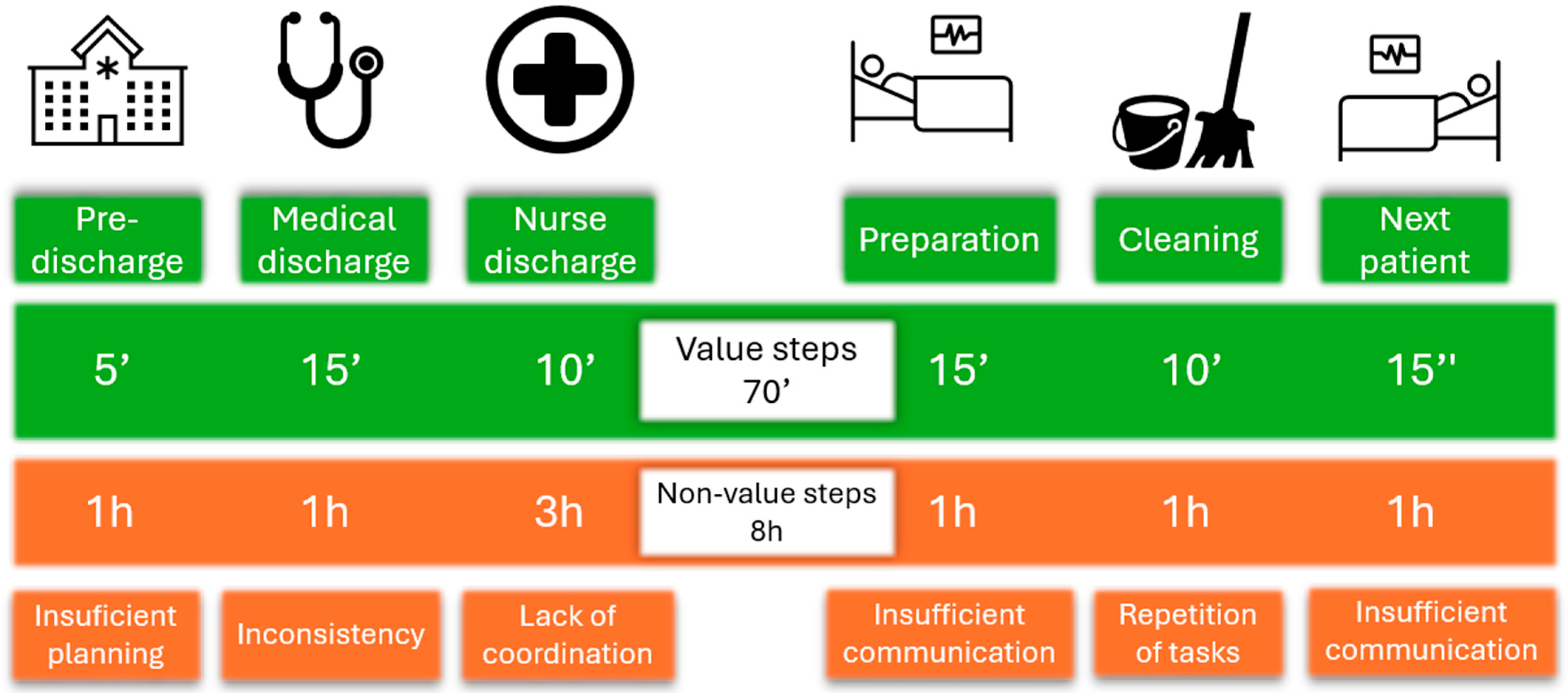
| Vall d’Hebron University Hospital | Buffer Time Slots (in OR schedules) Visual Management (Color-coded patient tracking) Horizontal Process Management (Interdisciplinary teams for specific patient pathways) | 20% fewer cancelations of scheduled surgical procedures. Decreased patient hospitalization times for targeted pathways (from 8 h to 70 min). Reduction in unnecessary staff movement and transportation of documentation. |
| Sant Joan de Déu Hospital | E = MC2 Model (Structured, project-based improvement) Process Standardization (e.g., blood sample collection, ED admission) Patient-Centric Redesign (e.g., protocols for patients with disabilities) | Net Promoter Score of 76.18 from patients and families (2024). Reduction in waiting times for blood sample collection and specialty appointments. High staff engagement was reported in focus groups. |
| Hospital Clínic de Barcelona | Kanban System for Patient Flow (Structured 40-min cycles for doctor/nurse work) 6S Workplace Organization Real-Time Bed Tracking (“Pool of available beds”) Buffer Scheduling for ED/OR interface | Reduced variability and patient batching in the ED. Significant decrease in hospital stays. 30% reduction in prosthesis costs through optimized supply chain. |
| Challenge in CEE EDs | Lean Adaptation Strategy | Implementation Approach | Expected Benefits |
|---|---|---|---|
| Budget constraints | Low-tech visual management | Color-coded patient tracking boards, physical Kanban systems | Improved workflow transparency without costly IT investments |
| Workforce shortages | Cross-training & staff engagement | Bottom-up improvement teams, multi-skilling programs | Increased operational flexibility, better resource utilization |
| Hierarchical culture | Pilot projects with leadership support | Start small in one unit, demonstrate quick wins to build buy-in | Gradual cultural shift, reduced resistance to change |
| Aging infrastructure | Process standardization | Value Stream Mapping for high-volume areas (triage, diagnostics) | Reduced variability, eliminated non-value-added steps |
| Seasonal demand surges | Flexible surge protocols | Adjustable staffing models, modular care spaces | Better capacity management during peak periods |
| Limited IT resources | Basic digital solutions | Leverage existing medical records for simple tracking, partner with local tech providers. | Affordable workflow improvements |
| Patient flow bottlenecks | Horizontal process management | Integrated care pathways, improved ED–primary care coordination | Reduced admission/discharge delays |
| Sustainability concerns | Dedicated process teams | Establish small improvement units, and regular training programs | Maintained momentum despite staff turnover |
| Financial constraints | Phased high-region of interest implementation | Prioritize interventions with the fastest returns (e.g., bed turnover) | Creates a self-funding improvement cycle |
| Overcrowding | Buffer concepts | Adapted surgical scheduling approaches for ED surge capacity | Reduced cancelations, better emergency case management |
Disclaimer/Publisher’s Note: The statements, opinions and data contained in all publications are solely those of the individual author(s) and contributor(s) and not of MDPI and/or the editor(s). MDPI and/or the editor(s) disclaim responsibility for any injury to people or property resulting from any ideas, methods, instructions or products referred to in the content. |
© 2025 by the authors. Licensee MDPI, Basel, Switzerland. This article is an open access article distributed under the terms and conditions of the Creative Commons Attribution (CC BY) license (https://creativecommons.org/licenses/by/4.0/).
Share and Cite
Pawłowska-Hulbój, A.; Grucza, B.; Kozieł, M.; Kaniuk, A.; Jakubowska, A.; Popiołek, W.; Pańkowski, I.; Ribera, J.; Batko, J.; Kowalewski, M.; et al. How Do Spanish Hospitals Use Lean? Insights from a Multiple-Case Study. Healthcare 2025, 13, 3169. https://doi.org/10.3390/healthcare13233169
Pawłowska-Hulbój A, Grucza B, Kozieł M, Kaniuk A, Jakubowska A, Popiołek W, Pańkowski I, Ribera J, Batko J, Kowalewski M, et al. How Do Spanish Hospitals Use Lean? Insights from a Multiple-Case Study. Healthcare. 2025; 13(23):3169. https://doi.org/10.3390/healthcare13233169
Chicago/Turabian StylePawłowska-Hulbój, Aneta, Bartosz Grucza, Michał Kozieł, Adam Kaniuk, Alicja Jakubowska, Wojciech Popiołek, Igor Pańkowski, Jaume Ribera, Jakub Batko, Mariusz Kowalewski, and et al. 2025. "How Do Spanish Hospitals Use Lean? Insights from a Multiple-Case Study" Healthcare 13, no. 23: 3169. https://doi.org/10.3390/healthcare13233169
APA StylePawłowska-Hulbój, A., Grucza, B., Kozieł, M., Kaniuk, A., Jakubowska, A., Popiołek, W., Pańkowski, I., Ribera, J., Batko, J., Kowalewski, M., & Orzeł, W. (2025). How Do Spanish Hospitals Use Lean? Insights from a Multiple-Case Study. Healthcare, 13(23), 3169. https://doi.org/10.3390/healthcare13233169