


Formal Integration of ISO/IEC Digital Twin Standards: A Layered Compliance Model with Uncertainty Quantification




Abstract
1. Introduction
1.1. Digital Twin Standardization in Electrical and Industrial Systems
1.2. Fragmentation of Compliance Indicators and Absence of Uncertainty-Aware Assessment
- Assessment gap: the absence of an uncertainty-aware compliance and maturity framework that normalizes heterogeneous indicators and supports bounded, monotone, and robustness-aware scoring.
1.3. Research Questions and Objectives
1.4. Contributions
2. Methods
2.1. Layered Digital Twin Architecture and Standards Mapping (L0–L4)
2.2. Compliance Framework: Criteria, Indicators, and Measurement Protocols
2.3. Normalization of Heterogeneous Indicators
2.4. Deterministic Compliance Score and Maturity Classification
Maturity Classification
2.5. Uncertainty-Aware Extension of the Compliance Model
2.5.1. Statistical Characterization
2.5.2. Probability of Advanced Maturity
2.5.3. Uncertainty Propagation
2.6. Theoretical Properties
3. Results
3.1. Validation Design and Uncertainty Model
- C represents traceability coverage between requirements, models, and validation artifacts;
- LI denotes the interoperability level defined in Section 2.3;
- RMSE measures the fidelity error between the physical system and its digital counterpart;
- LS denotes the security and governance audit level.
- M = 30,000 Monte Carlo samples per DT instance;
- traceability standard deviation = 5%;
- fidelity error standard deviation = 0.05.
3.2. Synthetic Portfolio: Deterministic Inputs (Lighting, Industrial, Automotive)
- lighting systems, representing laboratory validation environments and photometric modeling pipelines;
- industrial automation systems, where DTs are typically integrated with supervisory control and industrial communication infrastructures;
- automotive cyber–physical systems, where DT models interact with distributed electronic control architectures and simulation-based validation platforms.
3.3. Deterministic Compliance Scores and Maturity Labels
3.3.1. Traceability Normalization
3.3.2. Interoperability Normalization
3.3.3. Fidelity Normalization
- = 1 corresponds to perfect agreement;
- increasing deviations progressively reduce the compliance score;
- values exceeding the admissible tolerance are truncated to zero.
3.3.4. Security and Governance Normalization
3.3.5. Deterministic Aggregation of Compliance Scores
3.3.6. Deterministic Maturity Classification
3.3.7. Deterministic Evaluation Results
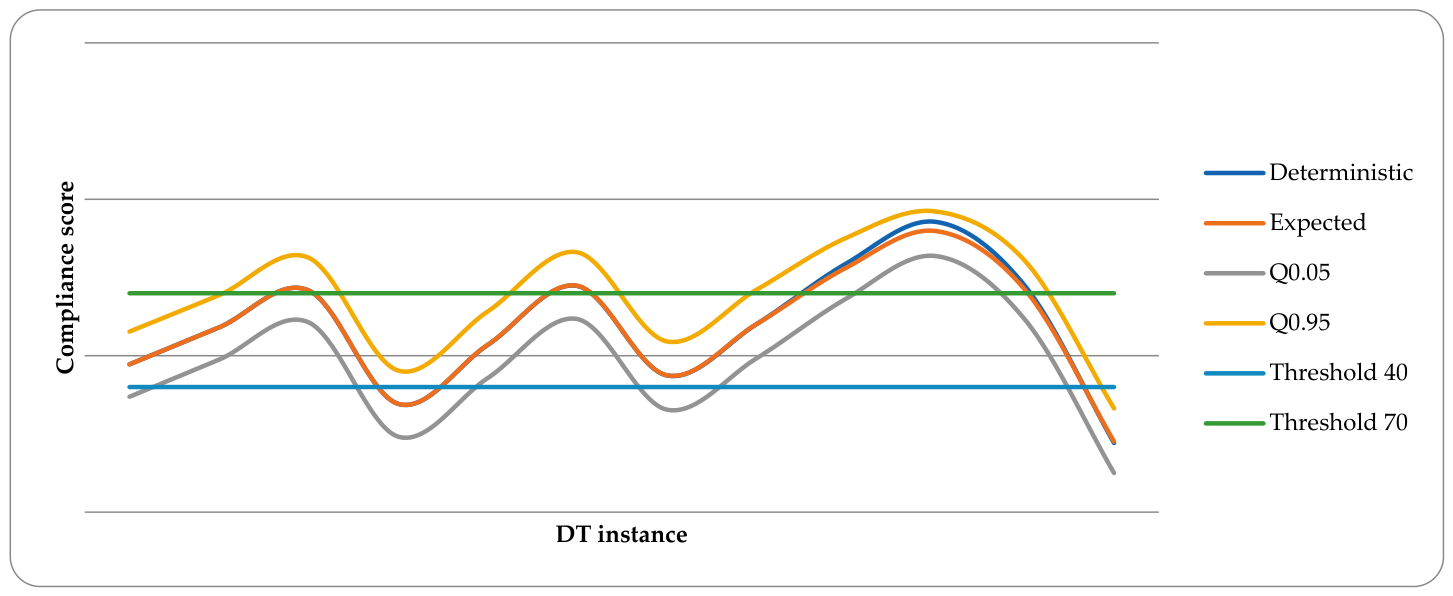
3.4. Uncertainty-Aware Results: Score Distributions and Maturity Probabilities
- expected score
- dispersion (standard deviation)
- score interval
3.4.1. Probabilistic Behavior of the Lighting Subset
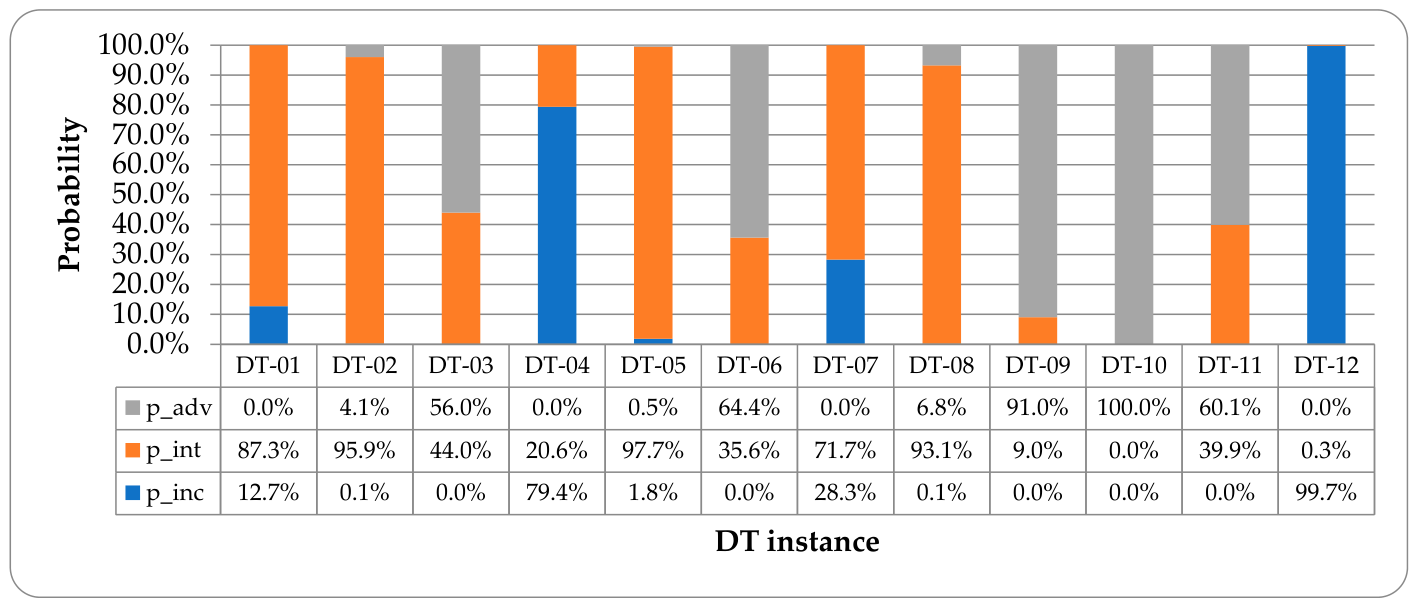
3.4.2. Uncertainty-Aware Evaluation Results
3.4.3. Interpretation of Uncertainty-Aware Maturity
3.5. Worked Example
3.5.1. Normalization of the Input Indicators
- traceability ;
- interoperability ;
- fidelity ;
- security and governance .
3.5.2. Deterministic Aggregation
3.5.3. Uncertainty-Aware Formulation
3.5.4. Statistical Interpretation of the Worked Example
- ;
- ;
- .
3.6. Sensitivity and Robustness Findings
3.6.1. Sensitivity to Fidelity Error
3.6.2. Influence of Traceability Coverage
3.6.3. Stepwise Effects of Interoperability and Security Levels
3.6.4. Robustness of the Compliance Functional
3.7. Illustrative Application to a Published IEC 61850-Based Substation DT
3.7.1. Extraction of Compliance Inputs
3.7.2. Deterministic Compliance Score
3.7.3. Uncertainty-Aware Assessment
4. Discussion
Author Contributions
Funding
Data Availability Statement
Conflicts of Interest
References
- Zhang, Z.; Lv, L. Application Status and Prospects of Digital Twin Technology in Distribution Grid. Energy Rep. 2022, 8, 14170–14182. [Google Scholar] [CrossRef]
- Rassõlkin, A.; Orosz, T.; Demidova, G.L.; Kuts, V.; Rjabtšikov, V.; Vaimann, T.; Kallaste, A. Implementation of Digital Twins for Electrical Energy Conversion Systems in Selected Case Studies. Proc. Est. Acad. Sci. 2021, 70, 19–39. [Google Scholar] [CrossRef]
- Bohačík, A.; Fujdiak, R. The Problem of Integrating Digital Twins into Electro-Energetic Control Systems. Smart Cities 2024, 7, 2702–2740. [Google Scholar] [CrossRef]
- Steindl, G.; Stagl, M.; Kasper, L.; Kastner, W.; Hofmann, R. Generic Digital Twin Architecture for Industrial Energy Systems. Appl. Sci. 2020, 10, 8903. [Google Scholar] [CrossRef]
- Lu, Y.; Liu, C.; Wang, K.I.-K.; Huang, H.; Xu, X. Digital Twin-Driven Smart Manufacturing: Connotation, Reference Model, Applications and Research Issues. Robot. Comput.-Integr. Manuf. 2020, 61, 101837. [Google Scholar] [CrossRef]
- Kovacs, E.; Mori, K. Digital Twin Architecture—An Introduction. In The Digital Twin; Crespi, N., Drobot, A.T., Minerva, R., Eds.; Springer International Publishing: Cham, Switzerland, 2023; pp. 125–151. [Google Scholar]
- ISO/IEC 30173:2023; Digital Twin—Concepts and Terminology. ISO/IEC: Geneva, Switzerland, 2023.
- ISO/TR 23247-100:2025; Automation Systems and Integration—Digital Twin Framework for Manufacturing—Part 100: Use Case on Management of Semiconductor Ingot Growth Process. ISO: Geneva, Switzerland, 2025.
- ISO/FDIS 23247-6; Automation Systems and Integration—Digital Twin Framework for Manufacturing—Part 6: Digital Twin Composition. ISO: Geneva, Switzerland, 2024.
- ISO/FDIS 23247-5; Automation Systems and Integration—Digital Twin Framework for Manufacturing—Part 5: Digital Thread for Digital Twin. ISO: Geneva, Switzerland, 2024.
- ISO 23247-4:2021; Automation Systems and Integration—Digital Twin Framework for Manufacturing—Part 4: Information Exchange. ISO: Geneva, Switzerland, 2021.
- ISO 23247-3:2021; Automation Systems and Integration—Digital Twin Framework for Manufacturing—Part 3: Digital Representation of Manufacturing Elements. ISO: Geneva, Switzerland, 2021.
- ISO 23247-2:2021; Automation Systems and Integration—Digital Twin Framework for Manufacturing—Part 2: Reference Architecture. ISO: Geneva, Switzerland, 2021.
- ISO 23247-1:2021; Automation Systems and Integration—Digital Twin Framework for Manufacturing—Part 1: Overview and General Principles. ISO: Geneva, Switzerland, 2021.
- ISO/IEC 30186:2025; Digital Twin—Maturity Model and Guidance for a Maturity Assessment. ISO/IEC: Geneva, Switzerland, 2025.
- IEC 62890:2020; Industrial-Process Measurement, Control and Automation—Life-Cycle-Management for Systems and Components. International Electrotechnical Commission: Geneva, Switzerland, 2020.
- ISO/IEC AWI 30141; Internet of Things (IoT)—Reference Architecture. ISO/IEC: Geneva, Switzerland, 2018.
- ISO/IEC 20924:2024; Internet of Things (IoT) and Digital Twin—Vocabulary. ISO/IEC: Geneva, Switzerland, 2024.
- IEC TR 61850-7-5:2021; Communication Networks and Systems for Power Utility Automation. IEC: Geneva, Switzerland, 2021.
- Stinskiy, A.; De Oliveira, E. Digital Substation with Process Bus—A Comparative Review of IEC61850-9-2 and IEC 61869-9 Standards. In Proceedings of the 2024 77th Annual Conference for Protective Relay Engineers (CFPR); IEEE: College Station, TX, USA, 2024; pp. 1–5. [Google Scholar]
- IEC 60255-1:2022; Measuring Relays and Protection Equipment—Part 1: Common Requirements. IEC: Geneva, Switzerland, 2022.
- IEC 62443-4-2:2019/COR1:2022; Security for Industrial Automation and Control Systems—Part 4-2: Technical Security Requirements for IACS Components. Corrigendum 1. IEC: Geneva, Switzerland, 2022.
- Jha, S.K.; Samantaray, S.R.; Kumar, D. Design and Demonstration of an IEC 61850-Based Distribution Substation Using Digital Twin Technology. In Proceedings of the 2025 IEEE 1st International Conference on Smart and Sustainable Developments in Electrical Engineering (SSDEE); IEEE: Dhanbad, India, 2025; pp. 1–6. [Google Scholar]
- Leitloff, V.; Bonetti, A.; Chen, H.; Xu, L.; Baumgartner, S.; Bennauer, C.; Byman, C. IEC TC95 WG2—Towards a Standardisation of an IEC 61850 Based Digital Interface for Protection Functions. IET Conf. Proc. 2022, 2022, 92–97. [Google Scholar] [CrossRef]
- Matanov, N.; Nankinsky, P. Digital substations—The backbone of smart grids. In Proceedings of the 2022 14th Electrical Engineering Faculty Conference (BulEF); IEEE: Varna, Bulgaria, 2022; pp. 1–6. [Google Scholar]
- Cao, J.; Pan, X.; Sun, P. Reliability Evaluation of Energy Storage SCADA System Considering Cyber Attacks. In Proceedings of the Eighth International Conference on Energy System, Electricity, and Power (ESEP 2023); Siano, P., Mokhlis, H., Eds.; SPIE: Wuhan, China, 2024; p. 72. [Google Scholar]
- Devnath, A.; Rahman, M.A.; Rana, M.S. Impact Analysis of Cyber-Attack on MMC–HVDC Control System with Countermeasures. Int. J. Dyn. Control 2024, 12, 1952–1962. [Google Scholar] [CrossRef]
- Zeng, G.; Yu, T.; Lin, D.; Wang, Z. Reliability Assessment of Cyber Physical Distribution System Based on Distributed Feeder Automation. Electr. Power Autom. Equip. (Dianli Zidonghua Shebei) 2020, 40, 57–68. [Google Scholar]
- Klar, R.; Angelakis, V. Standardized and Interoperable Digital Twins. In Proceedings of the 2023 IEEE Conference on Standards for Communications and Networking (CSCN); IEEE: Munich, Germany, 2023; p. 382. [Google Scholar]
- Ferko, E.; Bucaioni, A.; Pelliccione, P.; Behnam, M. Analysing Interoperability in Digital Twin Software Architectures for Manufacturing. In Software Architecture; Tekinerdogan, B., Trubiani, C., Tibermacine, C., Scandurra, P., Cuesta, C.E., Eds.; Lecture Notes in Computer Science; Springer Nature: Cham, Switzerland, 2023; Volume 14212, pp. 170–188. [Google Scholar]
- Ferko, E.; Bucaioni, A.; Pelliccione, P.; Behnam, M. Standardisation in Digital Twin Architectures in Manufacturing. In Proceedings of the 2023 IEEE 20th International Conference on Software Architecture (ICSA); IEEE: L’Aquila, Italy, 2023; pp. 70–81. [Google Scholar]
- Song, J.; Le Gall, F. Digital Twin Standards, Open Source, and Best Practices. In The Digital Twin; Crespi, N., Drobot, A.T., Minerva, R., Eds.; Springer International Publishing: Cham, Switzerland, 2023; pp. 497–530. [Google Scholar]
- Cui, Z.; Guo, M.; Ye, Y.; Liu, K.; Zhang, M.; Hao, Y. Development Trend, Evaluation System and Prospect Outlook of Digital Twin Operation and Maintenance Technology for Electric Power Equipment. High Volt. Eng. 2025, 51, 2285–2299. [Google Scholar] [CrossRef]
- D’Urso, D.; Chiacchio, F.; Cavalieri, S.; Gambadoro, S.; Khodayee, S.M. Predictive Maintenance of Standalone Steel Industrial Components Powered by a Dynamic Reliability Digital Twin Model with Artificial Intelligence. Reliab. Eng. Syst. Saf. 2024, 243, 109859. [Google Scholar] [CrossRef]
- Naanani, H.; Nachtane, M.; Faik, A. Advancing Hydrogen Safety and Reliability Through Digital Twins: Applications, Models, and Future Prospects. Int. J. Hydrogen Energy 2025, 115, 344–360. [Google Scholar] [CrossRef]
- Flesch, R.C.C.; Thaler, G.; Machado, J.P.Z.; Pacheco, A.L.S. Uncertainty Evaluation in Induction Motor Winding Temperature Estimates Based on Resistance Values. IEEE Trans. Instrum. Meas. 2025, 74, 1017508. [Google Scholar] [CrossRef]
- Thelen, A.; Zhang, X.; Fink, O.; Lu, Y.; Ghosh, S.; Youn, B.D.; Todd, M.D.; Mahadevan, S.; Hu, C.; Hu, Z. A Comprehensive Review of Digital Twin—Part 2: Roles of Uncertainty Quantification and Optimization, a Battery Digital Twin, and Perspectives. Struct. Multidiscip. Optim. 2023, 66, 1. [Google Scholar] [CrossRef]
- Cervenka, J.; Jendele, L.; Žalský, J.; Pukl, R.; Novák, D. Digital Twin Approach for Durability and Reliability Assessment of Bridges. In Proceedings of the Fib Symposium 2020: Concrete Structures for Resilient Society, Online, 22–24 November 2020. [Google Scholar]
- Dokukin, A.V.; Lomakin, M.I.; Niyazova, Y.M.; Syromyatnikov, A.E.; Perevezentsev, I.G. Model of Analysis of Digital Twin Application to Predict Incidents and Ensure Occupational Safety in Industry. Occup. Saf. Ind. 2025, 39–44. [Google Scholar] [CrossRef]
- Inamdar, A.; Van Driel, W.D.; Zhang, G. Digital Twin Technology—A Review and Its Application Model for Prognostics and Health Management of Microelectronics. Electronics 2024, 13, 3255. [Google Scholar] [CrossRef]
- Shi, J.; Zhou, Q.; Pan, C. A credibility Evaluation Method for Digital twin Based on Improved Evidence Theory. Simul. Model. Pract. Theory 2025, 143, 103152. [Google Scholar] [CrossRef]
- Lei, Z.; Zhou, H.; Hu, W.; Liu, G.-P. Chapter 4—Digital Twin Technology in the Electrical Power Industry. In Digital Twin Technology for the Energy Sector; Aghaei, M., Moazami, A., Lobaccaro, G., Cali, U., Eds.; Elsevier: Amsterdam, The Netherlands, 2025; pp. 95–110. [Google Scholar]
- Bell, C.J.; Celnik, M.; Devgun, J.; Hansen, O.; Osborn, W.; Faiz, G. Providing Assurance of Digital Twins. In Proceedings of the SPE Offshore Europe Conference & Exhibition; SPE: Aberdeen, UK, 2023; p. D021S006R001. [Google Scholar]
- Hansen, O.H.; Jaiswal, V. A Framework for Trustworthy Digital Twins Over their Lifecycle. In Proceedings of the Offshore Technology Conference Brasil; OTC: Rio de Janeiro, Brazil, 2023; p. D021S024R001. [Google Scholar]
- Fitzgerald, J.; Pierce, K.; Kristensen, K. Digital Twin Engineering Processes. In The Engineering of Digital Twins; Fitzgerald, J., Gomes, C., Larsen, P.G., Eds.; Springer International Publishing: Cham, Switzerland, 2024; pp. 65–86. [Google Scholar]
- Schulte, S.N.; Grunenwald, C.-P.; Schulze, P.; Breiten, T.; Stark, R. A Systematic Description of Twinning Levels of Measured Data and Models in Digital Twins. Proc. Des. Soc. 2025, 5, 289–298. [Google Scholar] [CrossRef]

| Approach | What It Provides | What the Present Study Adds | Remaining Limitation |
|---|---|---|---|
| ISO/IEC 30186 | DT maturity assessment guidance | Explicit standards-to-layer mapping and formal compliance operator | Still requires broader empirical validation |
| Credibility/evidence-theory approaches | Credibility aggregation under uncertainty | Standards-integrated maturity scoring with architectural anchoring | Current validation remains proof-of-concept |
| Descriptive DT evaluation frameworks | Qualitative or semi-structured DT assessment criteria | Unified normalization and deterministic/uncertainty-aware scoring | Application-specific calibration may still be needed |
| Present study | Formal standards-integrated compliance and maturity framework | Combines mapping, normalization, scoring, and uncertainty propagation | Not yet a fully deployable cross-domain instrument |
| Category | Description | Representative Standards |
|---|---|---|
| Fundamental (SF) | Define DT concepts, terminology, reference architectures | ISO/IEC 30173, ISO/IEC 30186, ISO 23247, ISO/IEC TR 30172, ISO/IEC TR 30138 |
| Complementary (SC) | Regulate interoperability, industrial communication, lifecycle integration | IEC 61850, IEC 62890, IEC 63278-1, IEC 63283-1, ISO/IEC 30152, ISO/IEC 30141 |
| Related (SR) | Address cybersecurity, governance, asset management, quality models | IEC 62443-4-2, ISO 55000, ISO/IEC 25010, ISO/IEC 38500 |
| Layer | Description | Principal Standard |
|---|---|---|
| L0-Physical | Electrical equipment, sensors, drives, panels, switchboards | IEC 61850, IEC 62890 |
| L1-Connectivity | Industrial protocols (CAN, Modbus, OPC UA, Ethernet) | ISO/IEC 30152, IEC 62443, ISO/IEC 30141 |
| L2-Digital Modeling | Behavioral and structural models, semantic data, Asset Administration Shell | ISO/IEC 30173, IEC 63278-1 |
| L3-Analysis and simulation | Data correlation, SiL/HiL validation, predictive analytics | ISO/IEC 30188, ISO/IEC 30138 |
| L4-Management | Traceability, maturity, audit, security/governance | IEC 62890, ISO/IEC 30186, ISO 55000 |
| DT | Domain | C0 (%) | LI0 | RMSE0 | RMSEref | LS0 |
|---|---|---|---|---|---|---|
| DT-01 | lighting | 42 | 2 | 0.85 | 1.6 | 2 |
| DT-02 | lighting | 55 | 3 | 0.70 | 1.6 | 2 |
| DT-03 | lighting | 68 | 3 | 0.55 | 1.6 | 3 |
| DT-04 | industrial | 35 | 2 | 1.00 | 1.4 | 1 |
| DT-05 | industrial | 60 | 2 | 0.65 | 1.4 | 2 |
| DT-06 | industrial | 75 | 3 | 0.50 | 1.4 | 3 |
| DT-07 | automotive | 50 | 2 | 0.90 | 1.2 | 2 |
| DT-08 | automotive | 65 | 3 | 0.60 | 1.2 | 2 |
| DT-09 | automotive | 80 | 4 | 0.45 | 1.2 | 3 |
| DT-10 | lighting | 90 | 4 | 0.30 | 1.6 | 4 |
| DT-11 | industrial | 72 | 4 | 0.80 | 1.4 | 3 |
| DT-12 | automotive | 30 | 1 | 1.10 | 1.2 | 1 |
| Score Interval | Maturity Level |
|---|---|
| SDT < 40 | incipient |
| 40 ≤ SDT < 70 | intermediate |
| SDT ≥ 70 | advanced |
| DT | SDT (Det.) | Deterministic Class |
|---|---|---|
| DT-01 | 47.22 | intermediate |
| DT-02 | 59.06 | intermediate |
| DT-03 | 70.91 | advanced |
| DT-04 | 34.64 | incipient |
| DT-05 | 53.39 | intermediate |
| DT-06 | 72.32 | advanced |
| DT-07 | 43.75 | intermediate |
| DT-08 | 60.00 | intermediate |
| DT-09 | 79.38 | advanced |
| DT-10 | 92.81 | advanced |
| DT-11 | 72.46 | advanced |
| DT-12 | 22.08 | incipient |
| DT | E_S_DT | SD | Most Probable Class | |||||
|---|---|---|---|---|---|---|---|---|
| DT-01 | 47.25 | 6.31 | 36.88 | 57.71 | 0.127 | 0.873 | 0.000 | intermediate |
| DT-02 | 59.06 | 6.29 | 48.73 | 69.35 | 0.001 | 0.959 | 0.041 | intermediate |
| DT-03 | 70.91 | 6.30 | 60.69 | 81.35 | 0.000 | 0.440 | 0.560 | advanced |
| DT-04 | 34.66 | 6.44 | 24.17 | 45.30 | 0.794 | 0.206 | 0.000 | incipient |
| DT-05 | 53.45 | 6.50 | 42.79 | 64.13 | 0.018 | 0.977 | 0.005 | intermediate |
| DT-06 | 72.37 | 6.46 | 61.77 | 83.07 | 0.000 | 0.356 | 0.644 | advanced |
| DT-07 | 43.78 | 6.61 | 32.78 | 54.61 | 0.283 | 0.717 | 0.000 | intermediate |
| DT-08 | 60.05 | 6.65 | 49.07 | 71.01 | 0.001 | 0.931 | 0.068 | intermediate |
| DT-09 | 78.06 | 5.88 | 68.12 | 87.59 | 0.000 | 0.090 | 0.910 | advanced |
| DT-10 | 89.90 | 4.42 | 81.90 | 96.16 | 0.000 | 0.000 | 1.000 | advanced |
| DT-11 | 71.25 | 5.64 | 61.70 | 80.45 | 0.000 | 0.399 | 0.601 | advanced |
| DT-12 | 22.58 | 6.33 | 12.49 | 33.17 | 0.997 | 0.003 | 0.000 | incipient |
Disclaimer/Publisher’s Note: The statements, opinions and data contained in all publications are solely those of the individual author(s) and contributor(s) and not of MDPI and/or the editor(s). MDPI and/or the editor(s) disclaim responsibility for any injury to people or property resulting from any ideas, methods, instructions or products referred to in the content. |
© 2026 by the authors. Licensee MDPI, Basel, Switzerland. This article is an open access article distributed under the terms and conditions of the Creative Commons Attribution (CC BY) license.
Share and Cite
Balan, G.; Serea, E.; Sălceanu, A.; Lucache, D.-D. Formal Integration of ISO/IEC Digital Twin Standards: A Layered Compliance Model with Uncertainty Quantification. Mathematics 2026, 14, 1425. https://doi.org/10.3390/math14091425
Balan G, Serea E, Sălceanu A, Lucache D-D. Formal Integration of ISO/IEC Digital Twin Standards: A Layered Compliance Model with Uncertainty Quantification. Mathematics. 2026; 14(9):1425. https://doi.org/10.3390/math14091425
Chicago/Turabian StyleBalan, George, Elena Serea, Alexandru Sălceanu, and Dorin-Dumitru Lucache. 2026. "Formal Integration of ISO/IEC Digital Twin Standards: A Layered Compliance Model with Uncertainty Quantification" Mathematics 14, no. 9: 1425. https://doi.org/10.3390/math14091425
APA StyleBalan, G., Serea, E., Sălceanu, A., & Lucache, D.-D. (2026). Formal Integration of ISO/IEC Digital Twin Standards: A Layered Compliance Model with Uncertainty Quantification. Mathematics, 14(9), 1425. https://doi.org/10.3390/math14091425

