Article

A Fractional-Order Memristive Neural Network with Infinitely Many Butterfly Attractors and Its Application in Industrial Image Security

1
School of Electronic Information, Central South University, Changsha 410083, China
2
School of Information Science and Technology, Southwest Jiaotong University, Chendu 611756, China
3
School of Physics and Electronic Science, Changsha University of Science and Technology, Changsha 410114, China
*
Author to whom correspondence should be addressed.
Mathematics 2026, 14(7), 1159; https://doi.org/10.3390/math14071159
Submission received: 27 February 2026 / Revised: 25 March 2026 / Accepted: 25 March 2026 / Published: 31 March 2026
(This article belongs to the Special Issue Chaotic Systems and Their Applications, 2nd Edition)

Abstract

Memristors, whose magnetic flux is inherently dependent on external excitation, have been widely employed to model electromagnetic induction effects in neural systems. However, when such induction mechanisms are incorporated into fractional-order neurons, the resulting nonlinear dynamics remain largely unexplored. This paper proposes a novel fractional-order memristive neural network (FO-MNN) by embedding two memristors into a single Hopfield-type neuron, both serving to characterize electromagnetic induction behavior. The complex nonlinear dynamics induced by the two memristive modules are systematically investigated. Numerical simulations reveal that, by tuning the parameters of the first memristive module, Lorenz-like double-wing butterfly attractors can be generated. When both memristive modules act simultaneously, the network exhibits highly complex multi-double-wing butterfly chaotic attractors, whose wing numbers can be flexibly adjusted via the control parameter of the second memristive module. Moreover, variations in the initial state of the second memristor lead to initial-condition-dependent coexistence of multiple double-wing butterfly attractors. These rich dynamical behaviors highlight the strong potential of the proposed FO-MNN for chaos-based engineering and security applications. Finally, a novel privacy-protection scheme for the Industrial Internet of Things (IIoT) is constructed based on the FO-MNN, and its effectiveness is validated through encryption experiments.

1. Introduction

The human brain operates as a highly integrated nonlinear system that can generate rich dynamical behaviors, which are fundamentally linked to its extraordinary abilities in cognition, learning, and information processing [1]. To elucidate the intrinsic mechanisms underlying neural systems, extensive efforts have been devoted to the development of artificial neural network models that emulate the structural and functional characteristics of biological neurons [2]. Among these models, the Hopfield neural network (HNN), as a prototypical nonlinear dynamical system, has been widely recognized as an effective mathematical framework for describing brain dynamics [3]. Over the past decades, various HNN-based models have been shown to exhibit a broad spectrum of nonlinear phenomena, including bursting oscillations [4], hyperchaos [5,6], coexisting attractors [7,8], and chimera states [9]. These dynamical properties not only provide valuable insights into biological information processing but also play a crucial role in a wide range of engineering applications.
Meanwhile, fractional calculus has emerged as a powerful mathematical framework for characterizing memory effects and nonlocal behaviors and has attracted growing interest in the modeling of physical, biological, and engineering systems in recent years [10,11]. Owing to their inherent ability to capture long-term memory and history-dependent dynamics, fractional derivatives provide a more realistic description of neuronal and synaptic processes than their integer-order counterparts [12,13]. Consequently, fractional-order neural network models exhibit significant advantages in reproducing complex dynamical behaviors, including enhanced multistability, richer bifurcation structures, and increased dynamical diversity [14,15]. These features offer a solid theoretical foundation for the development of neural models that more faithfully reflect the intrinsic dynamics of real neural systems.
In 2008, the memristor, a novel nonlinear electronic device, was experimentally realized for the first time [16]. Owing to their intrinsic nonlinearity and memory characteristics, memristors have since played a pivotal role in advancing nonlinear science and neuromorphic computing [17,18,19]. More importantly, memristors can retain their internal states through variations in magnetic flux or electric charge, rendering them functionally analogous to biological synapses [20] and well-suited for modeling electromagnetic induction effects in neural systems [21]. Consequently, memristors are widely regarded as ideal building blocks for artificial and neuromorphic neural networks, as their memory, nonlinearity, and multistability provide a solid physical basis for reproducing complex neural dynamics [22]. In particular, memristive Hopfield neural networks (HNNs) have demonstrated notable advantages in associative memory [23], image processing [24], and information security [25]. Furthermore, the incorporation of memristors to characterize electromagnetic induction effects enables memristive HNNs to exhibit dynamical behaviors that more closely resemble those observed in the human brain [26,27,28], thereby offering deeper insights into neural information processing mechanisms.
Motivated by the intrinsic multistability and strong nonlinearity of memristors, extensive efforts have recently been devoted to the design and analysis of both integer-order and fractional-order memristive Hopfield neural networks (HNNs) exhibiting complex dynamical behaviors. On the one hand, integer-order memristors have been widely employed either as synaptic elements in HNNs or as effective components for modeling electromagnetic induction effects. For instance, by introducing a memristor to emulate autaptic connections, Ref. [29] reported a memristive HNN capable of generating spatially multi-structured attractors. Subsequent studies revealed that such systems can exhibit abundant coexisting hidden attractors [30], as well as multi-scroll [31] and grid-type multi-scroll chaotic attractors [32]. In Ref. [33], a memristor-based model was further developed to characterize external electromagnetic radiation, resulting in a symmetric multi-scroll chaotic HNN. Moreover, Ref. [34] incorporated two memristors into a single neuron to simultaneously represent autapses and electromagnetic induction, giving rise to a memristive HNN with multiple butterfly attractors.
On the other hand, it has been demonstrated that the introduction of fractional derivatives in neural system models can substantially enhance memory effects and multistability, thereby yielding richer dynamical behaviors, including multi-scroll chaos [35], hidden attractors [36], and chaotic sequences suitable for encryption applications [37]. Nevertheless, in most existing studies, memristors are distributed across different neurons, and the corresponding models are predominantly confined to integer-order formulations. Consequently, when multiple memristors simultaneously act on the same neuron within a fractional-order framework, the resulting dynamical characteristics of memristive HNNs remain largely unexplored. More importantly, chaotic multi-butterfly attractors, which have a more complex chaotic behavior than the multi-scroll and multi-wing attractors, have never been reported in fractional-order neural networks.
Inspired by the above studies, this paper integrates fractional calculus and memristive mechanisms into a unified neural framework to develop a novel fractional-order memristive neural network (FO-MNN). Specifically, two distinct memristor models are constructed and simultaneously embedded into the same neuron to characterize electromagnetic induction effects, thereby forming a dual-memristor fractional-order Hopfield neural network (HNN). Based on this system, an Industrial Internet of Things (IIoT)-oriented privacy-protection scheme is developed, and its effectiveness is verified through comprehensive numerical simulations and encryption experiments. The main contributions and core conceptual novelties of this work are as follows: First, a synergistic complexity configuration via dual-memristor modulation is proposed, which simulates concurrent excitatory and inhibitory mechanisms within the neuron to generate multi-butterfly attractors with intricate topological structures, providing a robust entropy source for IIoT security. Second, by exploiting the non-local memory effects of fractional-order derivatives, the attractor complexity and the resistance to phase-space reconstruction attacks are significantly enhanced. Numerical analyses demonstrate that the proposed FO-MNN can generate a variety of butterfly-type chaotic attractors, including Lorenz-type double-wing attractors, multiple double-wing attractors, and butterfly attractors exhibiting initial-condition-dependent coexistence. To our knowledge, this work is the first to reveal the generation mechanisms of butterfly and multi-butterfly attractors within fractional-order HNNs. Unlike conventional chaotic attractors, the developed multi-butterfly attractors merge the dynamical features of both multi-wing [38] and multi-scroll [39] attractors, resulting in more intricate orbit structures, enhanced randomness, and an expanded parameter space for cryptographic key generation. Finally, the deep alignment between the high-dimensional dynamics of the FO-MNN and the encryption architecture is established, where the unique dynamical richness supports a 3D cross-channel permutation and global diffusion, ensuring strong coupling among R/G/B channels in a single encryption round.

2. Mathematical Modeling and Analysis

2.1. Memristor Model Design

The core advantage of the dual-memristor design over the single-memristor counterpart lies in its differential structure. For neural networks, it facilitates the seamless implementation of both positive and negative weights through the conductance difference between the two devices, effectively overcoming the limitation where a single device cannot directly represent negative weights. Moreover, it significantly enhances the linearity and symmetry of weight updates via a complementary compensation mechanism. In terms of chaos, the coupling of dual memristors substantially increases system complexity, reinforces multistability, and introduces higher-dimensional nonlinear dynamics. These attributes markedly enrich the dynamic behaviors of the system, enabling the generation of attractors with more intricate topological structures. Therefore, we employ a dual-memristor configuration in our design.
Following the memristor framework presented in Ref. [40], the generalized voltage-controlled memristor is formulated as
i = W ( φ ) v d φ d t = f ( φ , v )
where v, i, and φ denote the voltage, current, and internal state variable of the memristor, respectively, while W ( φ ) and f ( φ , v ) represent the memductance function and the corresponding state equation. It should be emphasized that the evolution of a memristor depends not only on the externally applied voltage but also on its internal state. As a result, the dynamical behavior of a generalized memristor becomes much richer and more complicated than that of an ideal memristor.
Therefore, based on the above equation, a new generalized voltage-controlled memristor model is constructed, which is expressed as follows:
i = W 1 v = α φ 1 2 + β φ 1 + γ v φ ˙ 1 = v 2 1 φ 1 b v
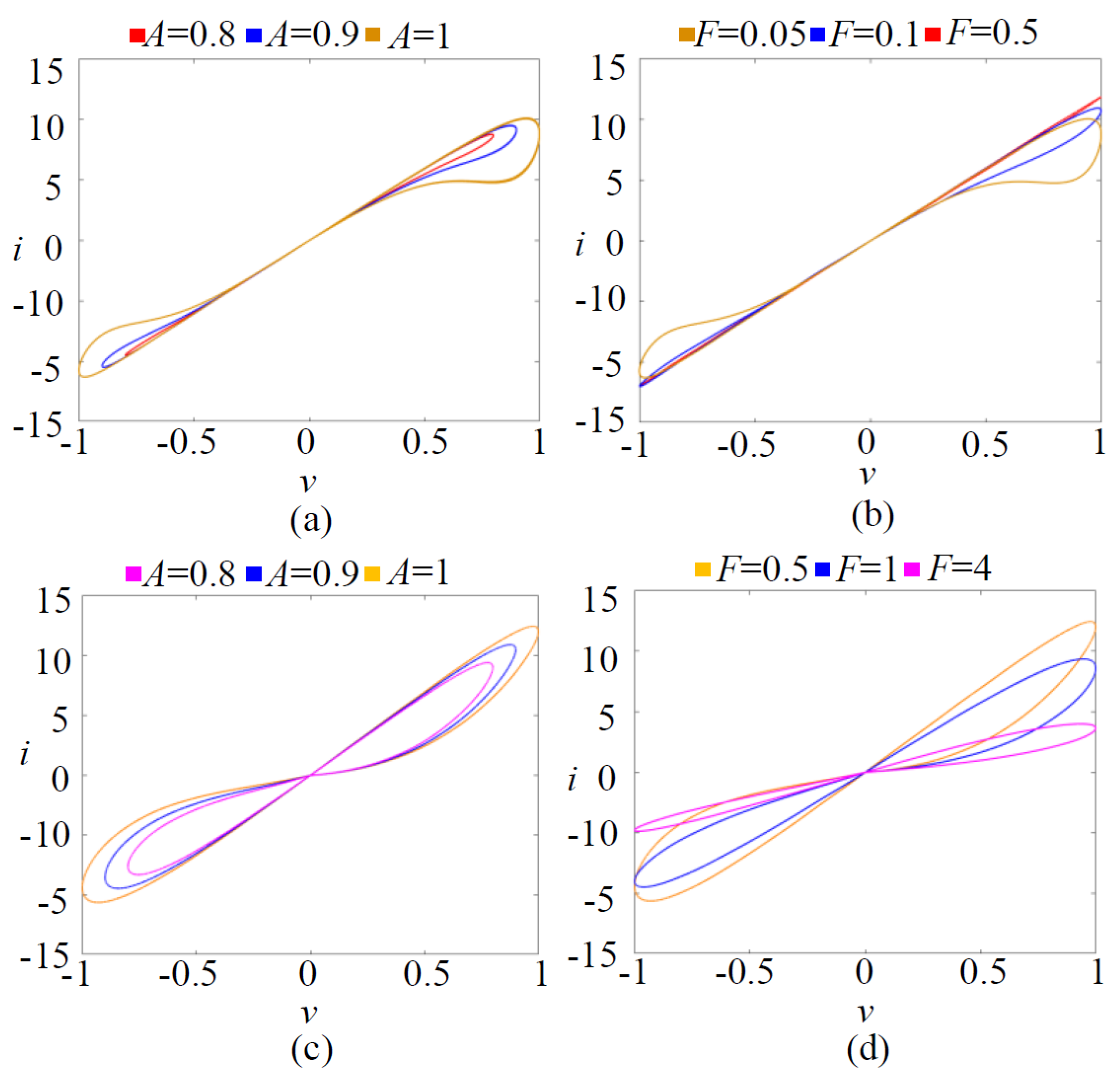
where W 1 ( φ 1 ) denotes the memductance function, and α , β , γ , and b are four memristive parameters. To investigate the voltage–current ( v i ) characteristics of the proposed memristor, a sinusoidal excitation v = A sin ( 2 π F t ) is applied to its input terminal. For illustration, α = 0.4 , β = 0.4 , γ = 12 , b = 1 , and φ 1 ( 0 ) = 0 are selected, while the amplitude A and frequency F are treated as adjustable variables.
First, when F = 0.2 , a set of v i curves corresponding to different amplitudes A = 0.8 , 0.9 , and 1 are obtained, as shown in Figure 1a. Then, with a fixed amplitude A = 1 , the frequency-dependent v i curves for F = 0.05 , 0.1 , and 0.5 are plotted, as displayed in Figure 1b. The v i trajectories shown in Figure 1 clearly reveal the three fundamental characteristics of a memristor. Therefore, this model is referred to as the M1 memristor model.
On the basis of the foregoing formulation, a generalized voltage-controlled memristor in an alternative form is further derived, which can be formulated as
i = W 2 v = α tanh ( φ 2 ) v φ ˙ 1 = c v f ( φ 2 )
Here, f ( φ 2 ) = φ 2 sign ( φ 2 ) N + i = 1 N sign ( φ 2 + 2 i ) , α = 1.5 , c = 2 . This model contains three fixed parameters, while N is selected as the control parameter. The corresponding memristive properties are then examined as follows: Taking α = 1.5 , c = 2.4 as an example, when the same excitation frequency F = 0.2 is applied with different amplitudes A = ( 0.8 , 0.9 , 1.0 ) , Figure 1c illustrates the amplitude-dependent v i characteristics. When the amplitude is fixed at A = 1 and the frequency is set to F = ( 0.5 , 1 , 4 ) , Figure 1d presents the frequency-dependent v i characteristics. Clearly, as the excitation frequency increases, the area enclosed by the pinched hysteresis loop of the memristor gradually decreases, indicating that the proposed equation represents a memristor model, which is named the M2 memristor model.

2.2. Memristive HNN Construction

The Hopfield neural network (HNN) bears resemblance to the biological nervous system and is capable of generating complex, brain-like chaotic dynamics. The classical HNN model is composed of nnn neurons, and its formulation is given in Equation (4) [3,4].
C i x ˙ i = x i R i + j = 1 n w i j tanh ( x j ) + I i , i , j N *
Here, C i , R i , and V i denote the membrane capacitance, membrane resistance, and the membrane potential of the i-th neuron, respectively. The parameter w i j represents the synaptic weight, which determines the coupling strength between neuron j and neuron i. In this model, the hyperbolic tangent tanh ( · ) serves as the activation function of each neuron, while I i represents the external current injected into the i-th neuron. On the basis of the above equations, by setting C i = 1 , R i = 1 , and I i = 0 ( i = 1 , 2 ) , and by appropriately choosing the synaptic weight coefficients, the following two-neuron HNN model is constructed:
x ˙ = x + 2.3 tanh ( x ) 1.5 tanh ( y ) y ˙ = y + 2.5 tanh ( x ) + 2.8 tanh ( y )
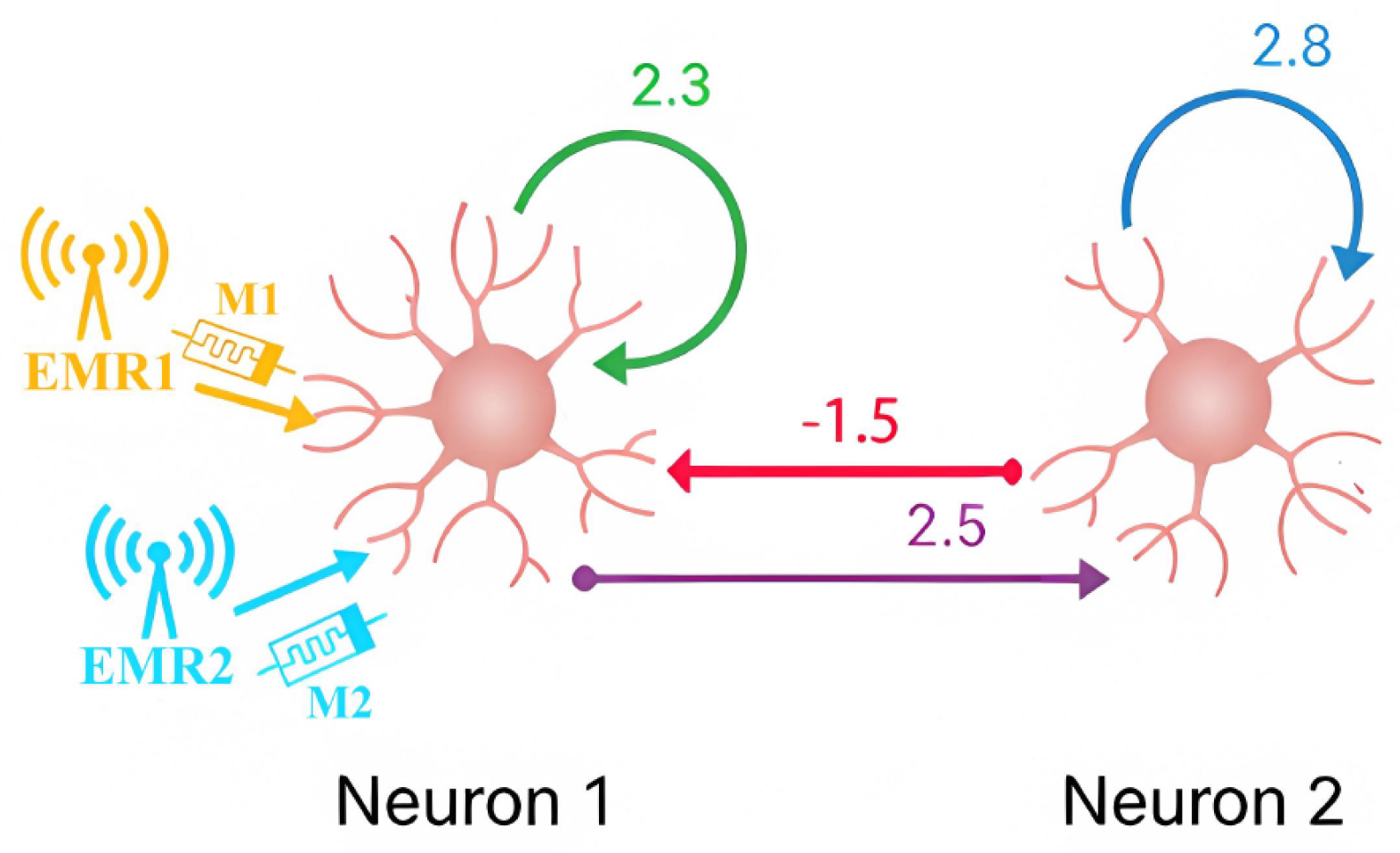
Memristors are frequently utilized to mimic biological synapses and to describe electromagnetic induction phenomena. As illustrated in Figure 2, the two designed memristor models are incorporated into the proposed two-neuron artificial neural network, thereby forming a memristive Hopfield neural network (HNN). Within this framework, it is assumed that the neurons are exposed to two distinct electromagnetic radiation stimuli, which are modeled by the memristors M1 and M2 through their corresponding electromagnetic induction currents. Accordingly, the mathematical formulation of the memristive Hopfield neural network is given by:
x ˙ = x + 2.3 tanh ( x ) 1.5 tanh ( y ) + I + k 1 W 1 x + k 2 W 2 x , y ˙ = y + 2.5 tanh ( x ) + 2.8 tanh ( y ) , φ ˙ 1 = ( x 2 1 ) φ 1 x , φ ˙ 2 = μ x ρ f ( φ 2 )
Here, W 1 x and W 2 x correspond to the induced currents arising from external electromagnetic radiation, while k 1 and k 2 characterize the feedback gains associated with these currents.

2.3. Fractional-Order Calculus

Fractional-order calculus provides a mathematical framework that generalizes the classical concepts of integration and differentiation to arbitrary non-integer orders. It has become an important theoretical tool in the analysis of fractional differential equations and fractal-related functions. Compared to integer-order systems, fractional-order calculus introduces non-local memory effects and historical dependency. Consequently, the evolution of the system state no longer depends solely on instantaneous values but is influenced by the weighted accumulation of historical trajectories. In dynamical analysis, adjusting the order q can shift the stability regions of equilibrium points, enabling the system to exhibit chaotic phenomena at lower dimensions where the total order q < 3 . This leads to the generation of attractors with broader parameter mapping ranges and more intricate topological winding, significantly enhancing the unpredictability of system evolution and the structural complexity of the attractors. Therefore, a fractional-order neural network is developed in this work on the basis of Equation (7). At present, a variety of definitions of fractional-order derivatives have been proposed. In this paper, the Caputo fractional derivative operator D q is adopted.
Definition 1 
([41]). Caputo fractional derivative is defined as follows:
D t 0 q x ( t ) = J t 0 m q D t 0 m x ( t ) = 1 Γ ( m q ) t 0 t ( t τ ) m q 1 x ( m ) ( τ ) d τ , q m , d m x ( t ) d t m , q = m ,
where Γ ( · ) denotes the Gamma function; it generalizes the factorial in integer-order derivatives to continuous orders, forming an integral part of fractional calculus. By normalizing the integral kernel, the fractional-order operator is designed to correctly degenerate into an integer-order derivative when the order is an integer.
As the stability behavior of fractional-order systems is not the same as that of integer-order systems, we introduce the following definition and lemma.
Definition 2 
([42]). For an n-dimensional fractional-order system described by D q ( X ) = f ( X ) , the points that satisfy f ( X ) = 0 are referred to as the equilibrium points of the fractional-order differential system, where
D q ( X ) = D q x 1 , D q x 2 , , D q x n T , X = x 1 , x 2 , , x n T R n .
Lemma 1 
([41]). When n = 3, if system (1) satisfies
arg λ i ( J ) > q π 2 , i = 1 , 2 , 3 ,
at the equilibrium point O, then system (1) is asymptotically stable at this equilibrium point. Here, J denotes the Jacobian matrix of f ( X ) , and λ i represents the eigenvalues of the matrix J.
Lemma 2 
([43]). If the fractional order α of the equilibrium point O of system (1) satisfies the following condition, then the equilibrium point is unstable:
q > 2 π arctan Im ( λ ) Re ( λ )
Lemma 3. 
When n = 4 , suppose the Jacobian matrix at the equilibrium point O has two real eigenvalues λ 1 , λ 2 and one pair of complex conjugate eigenvalues λ 3 , λ 4 . If the real part of one real eigenvalue is negative and the other is positive, while the complex conjugate eigenvalues satisfy
arg ( λ 3 ) = arg ( λ 4 ) < q π 2 ,
then the equilibrium point O is referred to as a saddle point with index 3. Conversely, if both real eigenvalues satisfy λ 1 < 0 and λ 2 < 0 , and the complex conjugate eigenvalues satisfy
arg ( λ 3 ) = arg ( λ 4 ) < q π 2 ,
then the equilibrium point O is referred to as a saddle point with index 2. Similarly, if both real eigenvalues satisfy λ 1 > 0 and λ 2 > 0 , and the complex conjugate eigenvalues satisfy
arg ( λ 3 ) = arg ( λ 4 ) > q π 2 ,
then the equilibrium point O is also referred to as a saddle point with index 2. Finally, if one real eigenvalue satisfies λ 1 > 0 , the other satisfies λ 2 < 0 , and the complex conjugate eigenvalues satisfy
arg ( λ 3 ) = arg ( λ 4 ) > q π 2 ,
then the equilibrium point O is referred to as a saddle point with index 1.
In summary, by setting the orders of the derivatives in the system equations to q, the mathematical model of the fractional-order memristive neural network can be obtained as
D q x = x + 2.3 tanh ( x ) 1.5 tanh ( y ) + I + k 1 W 1 x + k 2 W 2 x , D q y = y + 2.5 tanh ( x ) + 2.8 tanh ( y ) , D q φ 1 = ( x 2 1 ) φ 1 x , D q φ 2 = μ x ρ f ( φ 2 )
In summary, this study innovatively investigates a twin-memristive neural network within a fractional-order framework, integrating the synergistic complexity of dual memristors with the inherent memory characteristics of fractional-order calculus. Subsequent chapters demonstrate that this configuration yields more intensive chaotic phenomena; furthermore, it represents the first instance of multi-butterfly attractors being discovered in such fractional-order systems.

2.4. Stability Analysis

Since the generation of attractors requires non-convergent equilibrium points, we conduct a stability analysis to theoretically guarantee the occurrence of chaos. Therefore, in this section, the equilibrium properties of the FO-MNN described by Equation (15) are investigated through theoretical analysis and numerical computation. Let E = ( x * , y * , φ 1 * , φ 2 * ) denote an equilibrium point of the memristive HNN. When the left-hand sides of the above equations are set to zero, the equilibrium equations can be obtained as follows:
0 = x + 2.3 tanh ( x ) 1.5 tanh ( y ) + I + k 1 W 1 x + k 2 W 2 x , 0 = y + 2.5 tanh ( x ) + 2.8 tanh ( y ) , 0 = ( x 2 1 ) φ 1 x , 0 = μ x ρ f ( φ 2 )
The Jacobian matrix of the system at the equilibrium point can be written as
J = 1 + 2.3 sech 2 x + k 1 W 1 + k 2 W 2 1.5 sech 2 y k 1 ( 2 α φ 1 + β ) x k 2 η x sech 2 φ 2 2.5 sech 2 x 1 + 2.8 sech 2 y 0 0 2 x φ 1 b 0 x 2 1 0 μ 0 0 ρ .
Obviously, the stability of the non-zero equilibrium point cannot be directly determined due to the uncertainty in the system parameters. Hence, we focus on analyzing the stability of the zero equilibrium point. When the equilibrium point is E = ( 0 , 0 , 0 , 0 ) , the Jacobian matrix is given by:
J = k 1 γ + 1.3 1.5 0 0 2.5 1.8 0 0 b 0 1 0 μ 0 0 ρ .
Therefore, the eigenvalue polynomial can be expressed as
P ( λ ) = det ( λ I J ) = det λ 1.3 k 1 γ 1.5 0 0 2.5 λ 1.8 0 0 b 0 λ + 1 0 μ 0 0 λ + ρ = ( λ + 1 ) ( λ + ρ ) λ 2 ( 3.1 + k 1 γ ) λ + ( 6.09 + 1.8 k 1 γ ) .
Thus, the four non-zero roots of the Jacobian matrix are as follows:
λ 1 = 1 , λ 2 = ρ , λ 3 , 4 = k 1 γ + 3.1 ± ( k 1 γ ) 2 ( k 1 γ ) 14.75 2 .
According to Lemma 2, the necessary condition for keeping the fractional-order system (5) chaotic is to keep
λ 1 , 2 < 0 , η > 0 , γ 0 , q > 2 π arctan γ η ,
among η = Re ( λ 3 , 4 ) , γ = Im ( λ 3 , 4 ) .
To evaluate the stability of the zero equilibrium point, let s = k 1 y . Then,
λ 3 , 4 = s + 3.1 ± s 2 s 14.75 2 , Δ = s 2 s 14.75 .
From Δ = 0 , two real roots are obtained as
s 1 = 1 60 2 3.373 , s 2 = 1 + 60 2 4.373 .
From λ 3 = 0 , the critical value is obtained as
s c = 203 60 3.383 .
According to the aforementioned lemma, it is evident that to maintain the system in an unstable state for the generation of chaos, the selection of q is dependent on the values of λ 3 and λ 4 . Consequently, based on the specific distributions of these eigenvalues, we discuss the following six cases to ensure comprehensive analytical coverage of all parameter configurations.
Case 1: When s < s c = 203 60 , Δ > 0 , λ 3 > 0 , and λ 4 < 0 , the eigenvalue set contains a positive real eigenvalue ( arg ( λ 3 ) = 0 ) . Hence, the zero equilibrium point E is unstable, and the system is unstable for any 0 < α < 1 .
Case 2: When s c s s 1 = ( 1 60 ) 2 , Δ 0 , and λ 3 < 0 , λ 4 < 0 , all four eigenvalues lie on the negative real half-axis. In this case, | arg ( λ i ) | = π > α π / 2 , and the zero equilibrium point E is a stable node. For any 0 < α < 1 , the fractional-order system is asymptotically stable.
Case 3: When s 1 < s 3.1 , Δ < 0 , and λ 3 , 4 = A ± j ω are a pair of complex conjugate roots, where A = s 2 + s 2 < 0 , ω = 1 2 Δ > 0 . In this case, the complex eigenvalues lie in the left half-plane, and | arg ( λ 3 , 4 ) | ( π 2 , π ) , which naturally satisfies | arg ( λ 3 , 4 ) | > α π / 2 . Therefore, the equilibrium point E is a stable focus, and the fractional-order system is asymptotically stable within this parameter interval.
Case 4: When s = 3.1 , A = 0 , and λ 3 , 4 = ± j ω are a pair of purely imaginary eigenvalues. Their arguments satisfy | arg ( λ 3 , 4 ) | = π 2 > α π / 2 , and thus the equilibrium point can be regarded as a marginally stable focus in the sense of fractional-order systems.
Case 5: When 3.1 < s s 2 = ( 1 + 60 ) / 2 , Δ < 0 , and A = s 2 + s 2 > 0 , the eigenvalues λ 3 , 4 are a pair of complex conjugate roots with positive real parts. Their arguments satisfy
| arg ( λ 3 , 4 ) | = arctan s 2 + s + 14.75 s 2 + s .
In this case, the stability of the system depends on the fractional order α . The zero equilibrium point E remains stable if and only if
arctan s 2 + s + 14.75 s 2 + s > α π / 2 .
Otherwise, the system is unstable.
Case 6: When s s 2 = ( 1 + 60 ) / 2 , Δ 0 , λ 3 > 0 , and λ 4 > 0 , there exist two positive real eigenvalues ( arg λ 3 , 4 = 0 ) . Therefore, the zero equilibrium point E is unstable, and the system is unstable for any 0 < α < 1 .
The above results provide the stability and instability regions of the zero equilibrium point of the fractional-order system as the parameter k 1 y varies, which can be directly used as the theoretical basis for stability analysis.
In summary, through a detailed analysis of these six cases, we have investigated the instability conditions of the system, thereby mathematically ensuring that the proposed system satisfies the fundamental prerequisites for generating complex chaotic dynamics within the specified parameter ranges. The chaotic behavior observed in the subsequent chapters under specific parameters with q = 0.99 further validates the accuracy of our theoretical analysis.
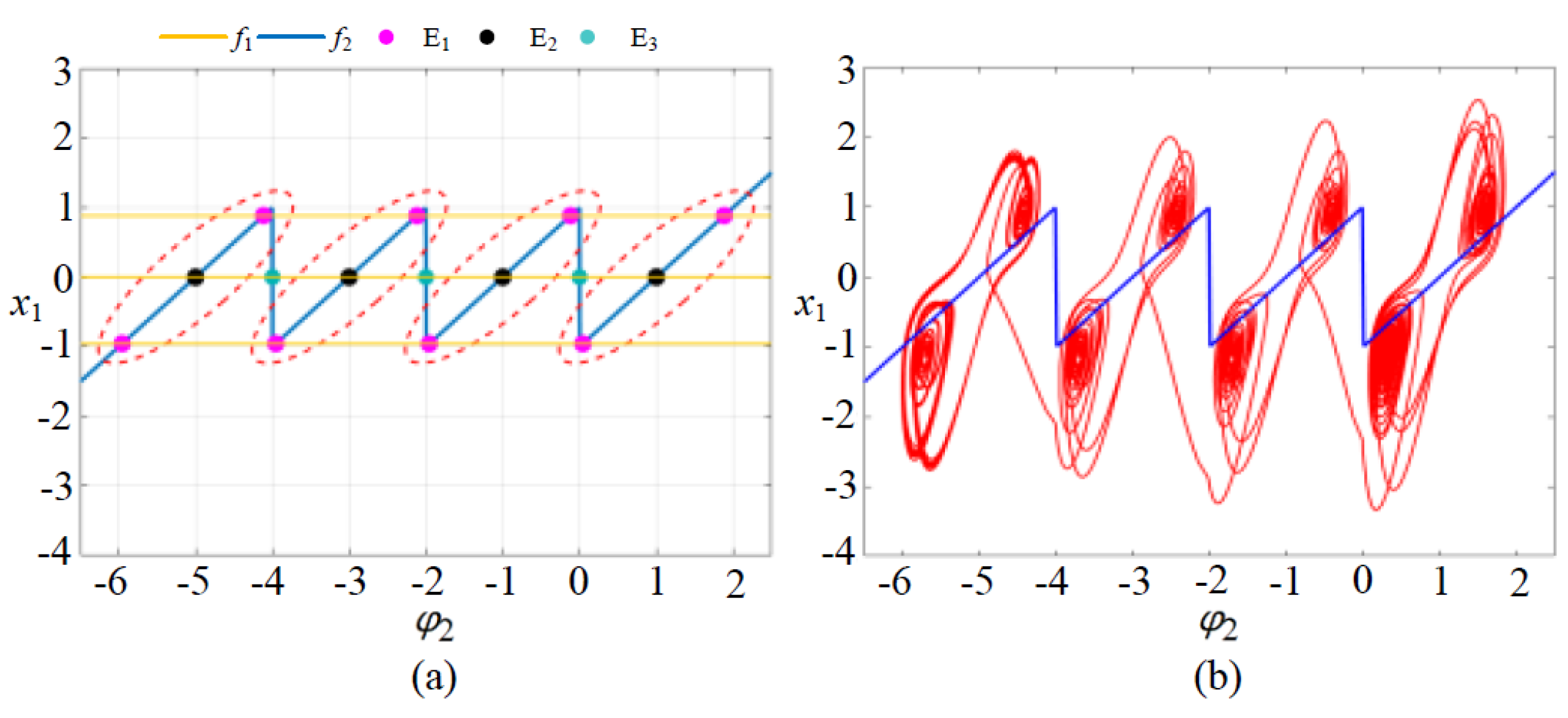
Next, MATLAB is employed to analyze the distribution of the equilibrium points. In the system equations, the solution function of x 2 is determined by h. In other words, both the quantity and spatial distribution of the equilibrium points are governed by the control parameter N. For instance, when N = 2 , when the fractional order is q = 0.99 , with parameters k 1 = 1 , k 2 = 1.5 , b = 1 , μ = 2.4 , ρ = 3.4 , and N = 0 , and the initial state ( x 10 , x 20 , φ 10 , φ 20 ) = ( 0.1 , 0.1 , 0.1 , 0.1 ) . The equilibrium structure in the φ 2 x 2 plane is characterized by the intersections of the curves f 1 and f 2 , which reveal the spatial distribution of the equilibrium points, as shown in Figure 3. Numerical analysis indicates that all equilibrium points can be classified into three types: E 1 , E 2 , and E 3 . Among them, E 1 is an unstable saddle point, which generates chaotic trajectories similar to butterfly wings; both E 2 and E 3 are unstable saddle points, where E 2 is responsible for connecting two butterfly attractors, while E 3 is responsible for connecting another pair of butterfly attractors. Figure 3 reveals that the equilibrium points exhibit a coordinated expansion in the φ 2 direction. Specifically, increasing the control parameter N gives rise to a growing number of equilibrium points distributed along the φ 2 axis.
The simulation results confirm that the memristive HNN is able to exhibit a self-excited two-wing butterfly attractor, as illustrated in Figure 3. An increase in the control parameter N enlarges the equilibrium set, thereby driving the reorganization of the associated chaotic attractors. A more detailed analysis indicates that the number of equilibrium points of types E 1 , E 2 , and E 3 are 2 ( N + 2 ) , N + 2 , and N + 1 , respectively. Consequently, the number of reconstructed butterfly attractors is N + 2 . Therefore, the total number of equilibrium points can be written as 4 ( m 1 ) , where m denotes the number of multi-wing butterfly attractors.

3. Numerical Simulation and Analysis

In this section, the chaotic dynamic behaviors induced by the memristors are comprehensively analyzed by means of several numerical tools, such as bifurcation diagrams, Lyapunov exponents (LEs), phase portraits, and basins of attraction. The corresponding differential equations are solved using the Adams-Bashforth-Moulton predictor–corrector algorithm, while the Lyapunov exponents are obtained through the Jacobian-matrix-based computation method.

3.1. Double-Wing Butterfly Attractors

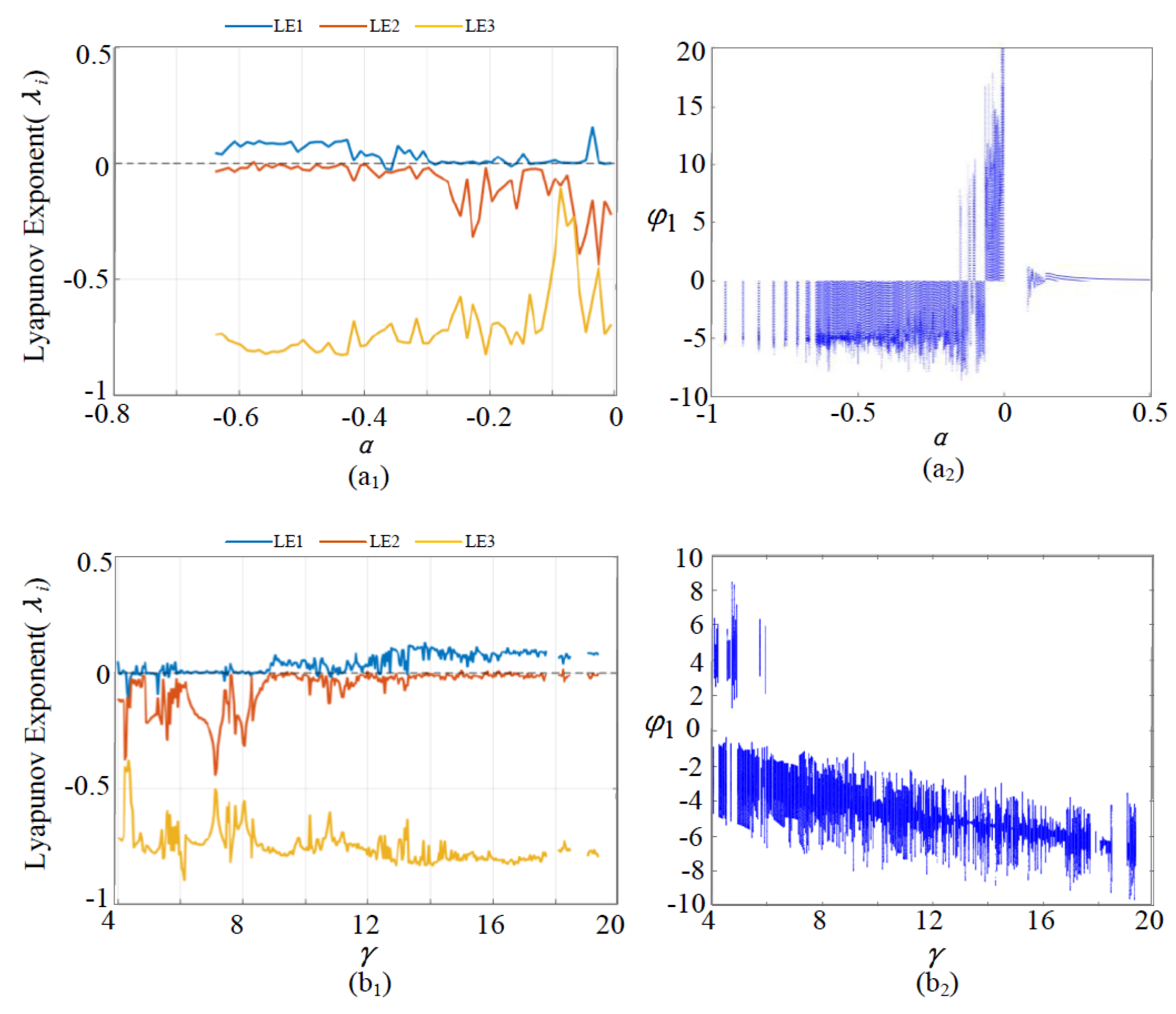
By taking α and γ of the memristor M1 as variable parameters, the chaotic dynamical characteristics induced by memristor M1 are investigated. Under the parameter settings k 1 = 1 , k 2 = 1.5 , b = 1 , μ = 2.2 , ρ = 3.4 , and N = 0 , with the initial conditions x 10 = x 20 = φ 10 = φ 20 = 0.1 , Figure 4(a1,a2,b1,b2) illustrate the Lyapunov exponent spectra and bifurcation diagram for α [ 0.8 , 0 ] and γ [ 4 , 20 ] , respectively.
Figure 4 reveals two important characteristics:
1.
With respect to the parameter α , the memristive HNN exhibits bounded chaotic behavior. The Lyapunov exponents are in excellent agreement with the bifurcation diagram.
2.
With respect to the parameter γ , the memristive HNN exhibits unbounded chaotic behavior.
To better illustrate these dynamical behaviors, γ is set to 12, and the one-dimensional bifurcation diagram with respect to the parameter α is shown in Figure 4(a2). As can be observed from Figure 4(a2), within the range α [ 1 , 1 ] , the dynamical behavior of the memristive HNN can be divided into two regions. In Region α [ 1 , 0 ] , the memristive HNN exhibits extensive chaotic behavior, except for several periodic windows. Subsequently, the memristive HNN enters a stable equilibrium region [ 0 , 1 ] , where no chaotic behavior is observed.
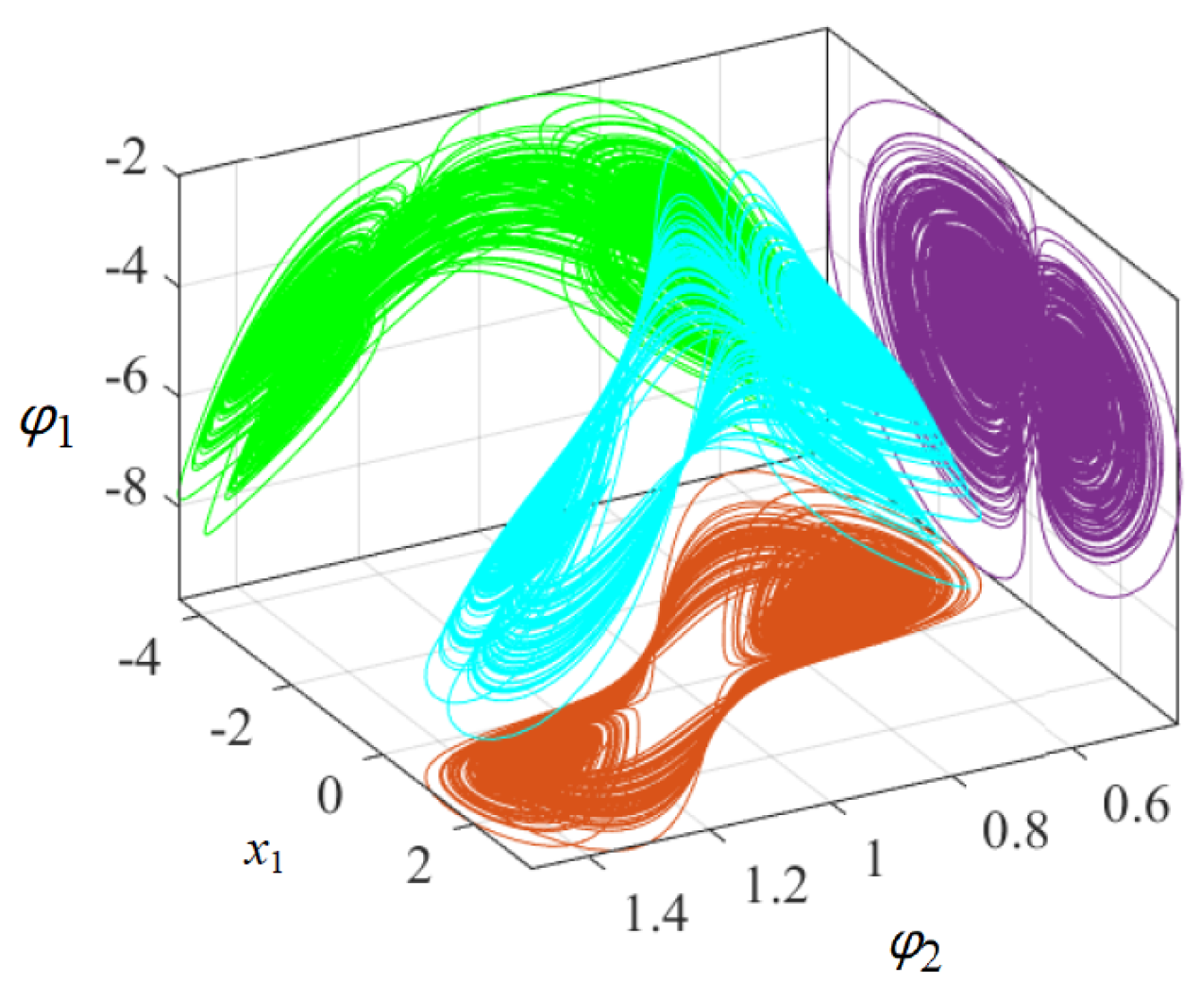
Interestingly, the chaotic behavior displays intricate trajectories resembling Lorenz-type butterfly attractors. As illustrated in Figure 5, when the parameter α = 0.4 , the memristive HNN produces a double-wing butterfly chaotic attractor. Hence, influenced by the first memristor subsystem, the proposed memristive HNN is capable of generating complex double-wing butterfly chaotic attractors.

3.2. Multi-Wing Butterfly Chaotic Attractor

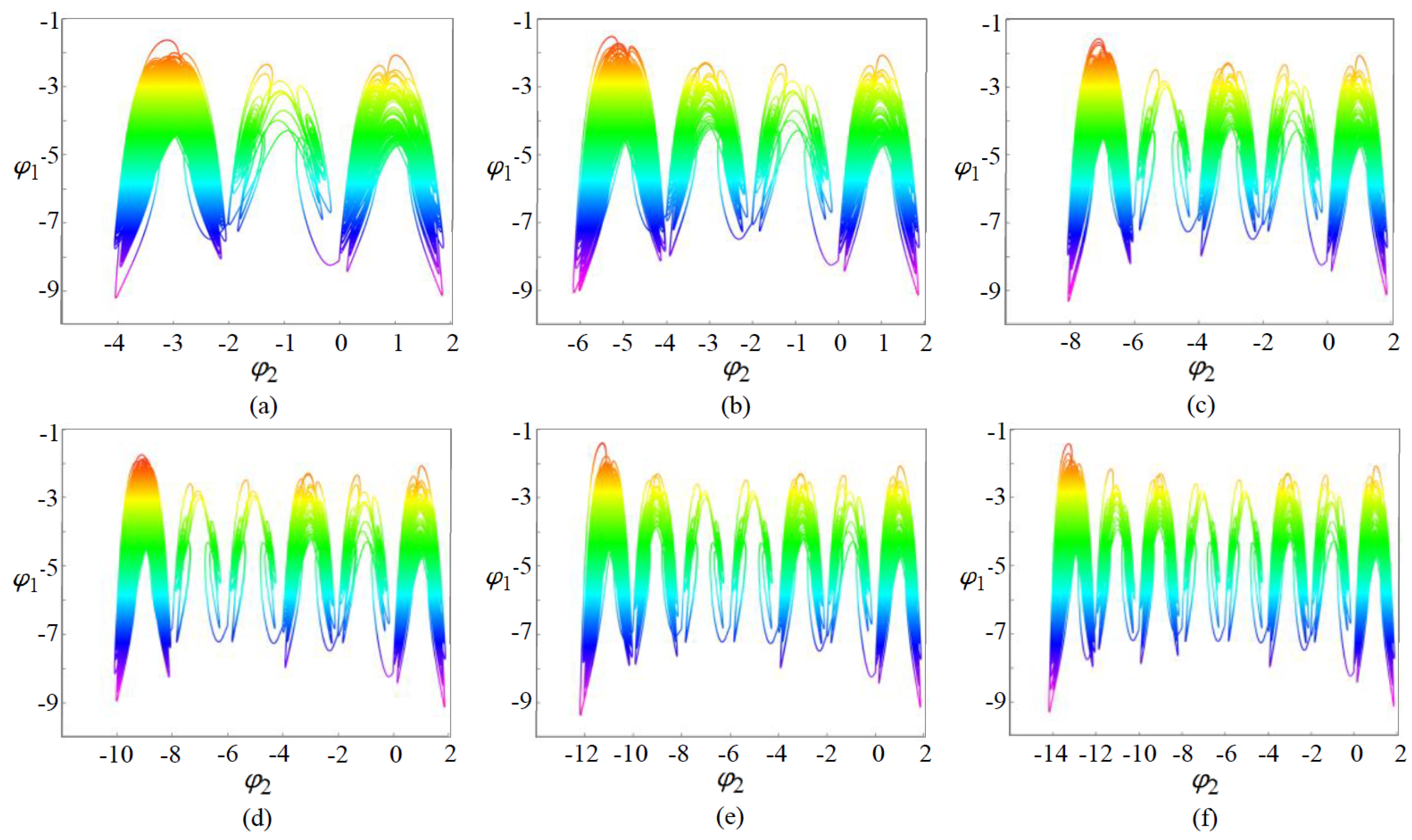
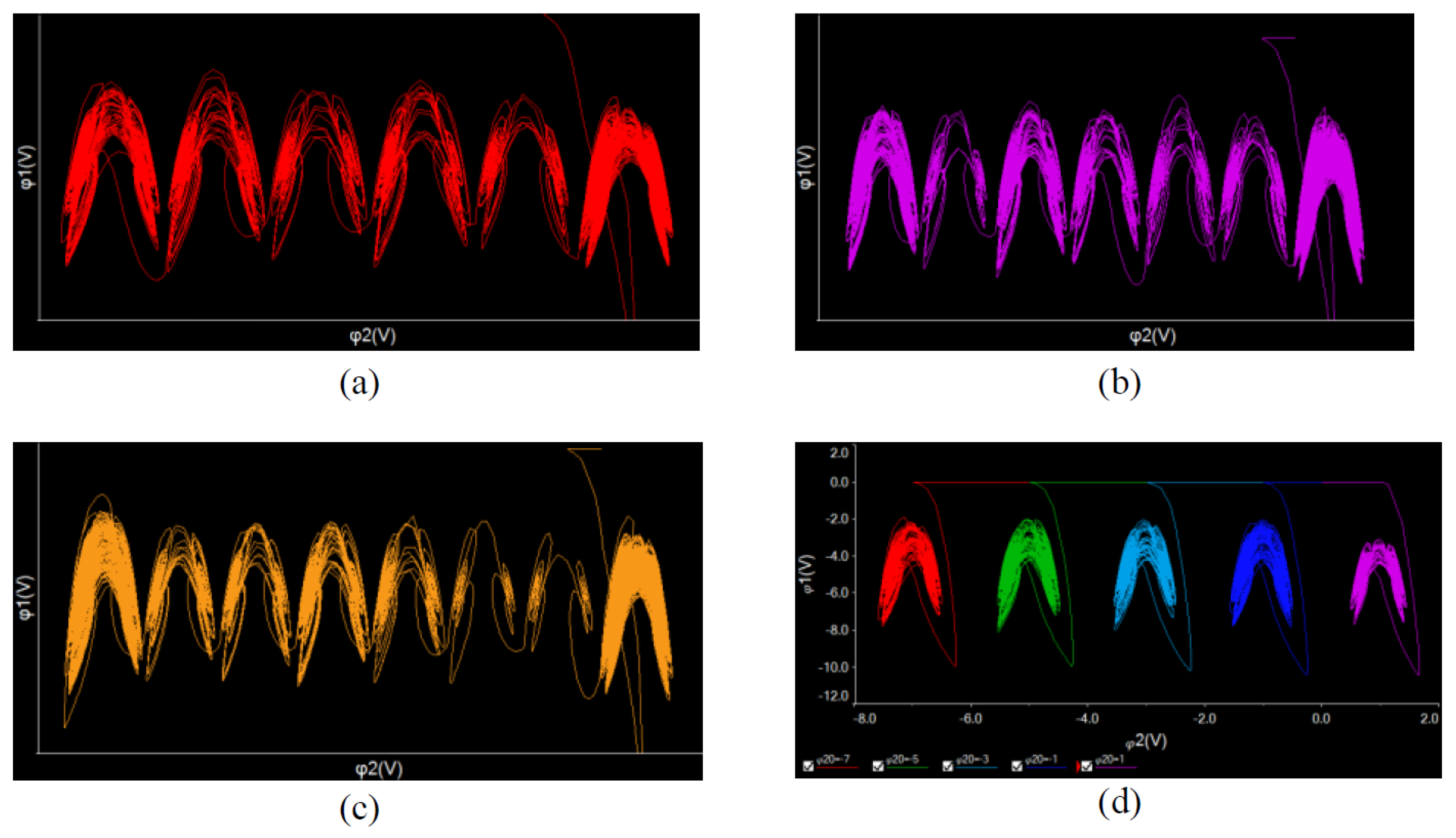
By taking the parameter N as a variable for investigation, the chaotic dynamical characteristics induced by memristor M2 are analyzed. Keeping the parameters of memristor M1 unchanged, and setting μ = 2.2 and ρ = 3.4 , the parameter N is gradually increased from 1 to 6. Figure 6 presents the corresponding phase portraits of the system.
This figure clearly demonstrates the following two important conclusions:
1.
An increase in the parameter N drives the transition from the double-wing butterfly attractor to a set of multi-wing butterfly chaotic attractors.
2.
A single control parameter N governs the multiplicity of the multi-wing butterfly chaotic attractors.
It should be emphasized that each butterfly attractor contains N + 2 wings, meaning that the system can generate 2 ( N + 2 ) chaotic attractors in total. This distinctive dynamical behavior shows that the proposed memristive HNN is able to produce not only double-wing butterfly chaotic attractors but also controllable multi-wing butterfly chaotic attractors. These results further confirm that the proposed memristive HNN can generate complex multi-wing butterfly chaotic attractors, which have evolved into a fractional-order multi-butterfly neural network (FO-MNN).

3.3. Coexisting Butterfly Chaotic Attractors

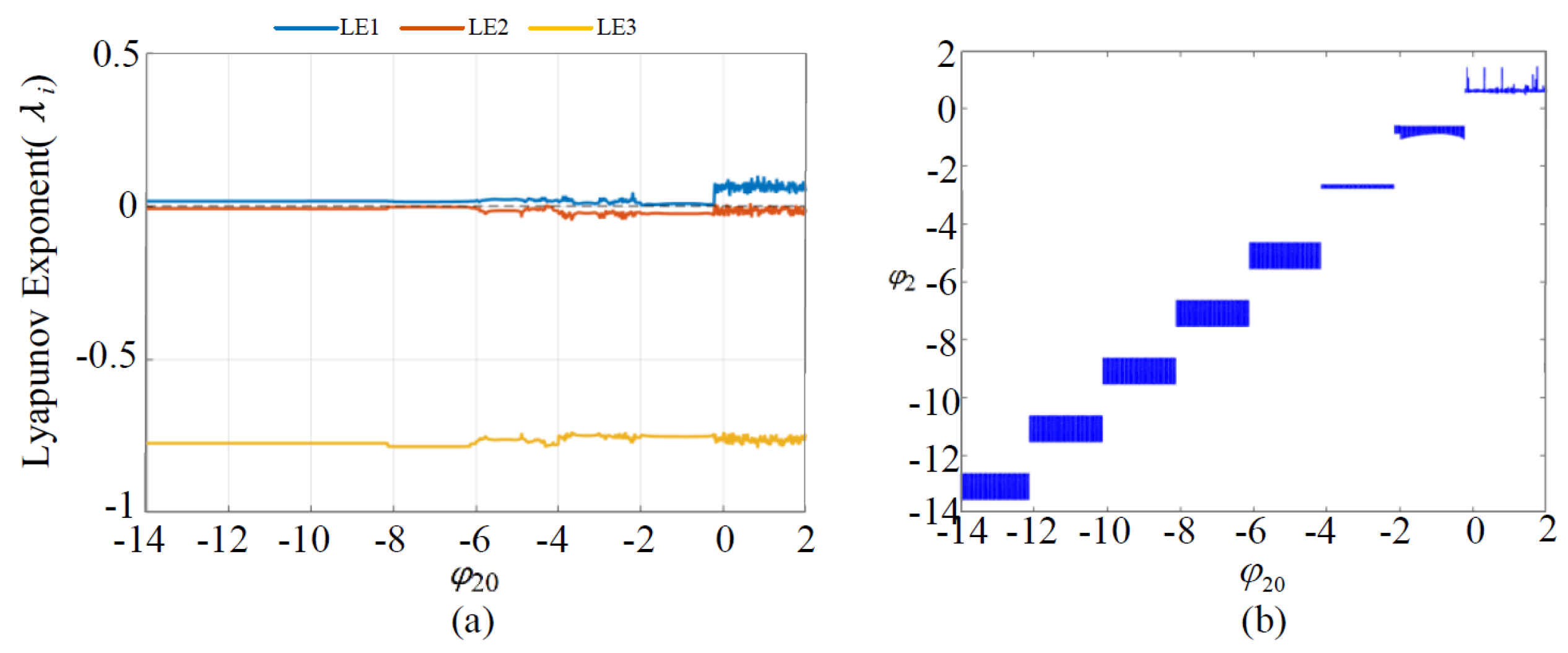
This work focuses on the chaotic dynamical behaviors triggered by the initial states of the memristor. The coexistence phenomenon enhanced by initial conditions is of great significance in dynamical systems and has wide application prospects [27]. Remarkably, the proposed FO-MNN system can generate double-wing butterfly chaotic attractors under initial-condition-boosted coexistence. For example, when the parameters are set as k 1 = 1 , k 2 = 1.5 , α = 0.4 , β = 0.4 , γ = 12 , b = 1 , μ = 1.2 , ρ = 3.4 , and N = 8 , with the initial values x 10 = x 20 = 0.1 and φ 10 = 0.1 , Figure 7 illustrates the Lyapunov exponent spectra related to the parameter φ 20 . Obviously, by varying the initial-state parameter values, the memristive FO-MNN system can generate infinitely many chaotic attractors with identical topological structures but different locations.
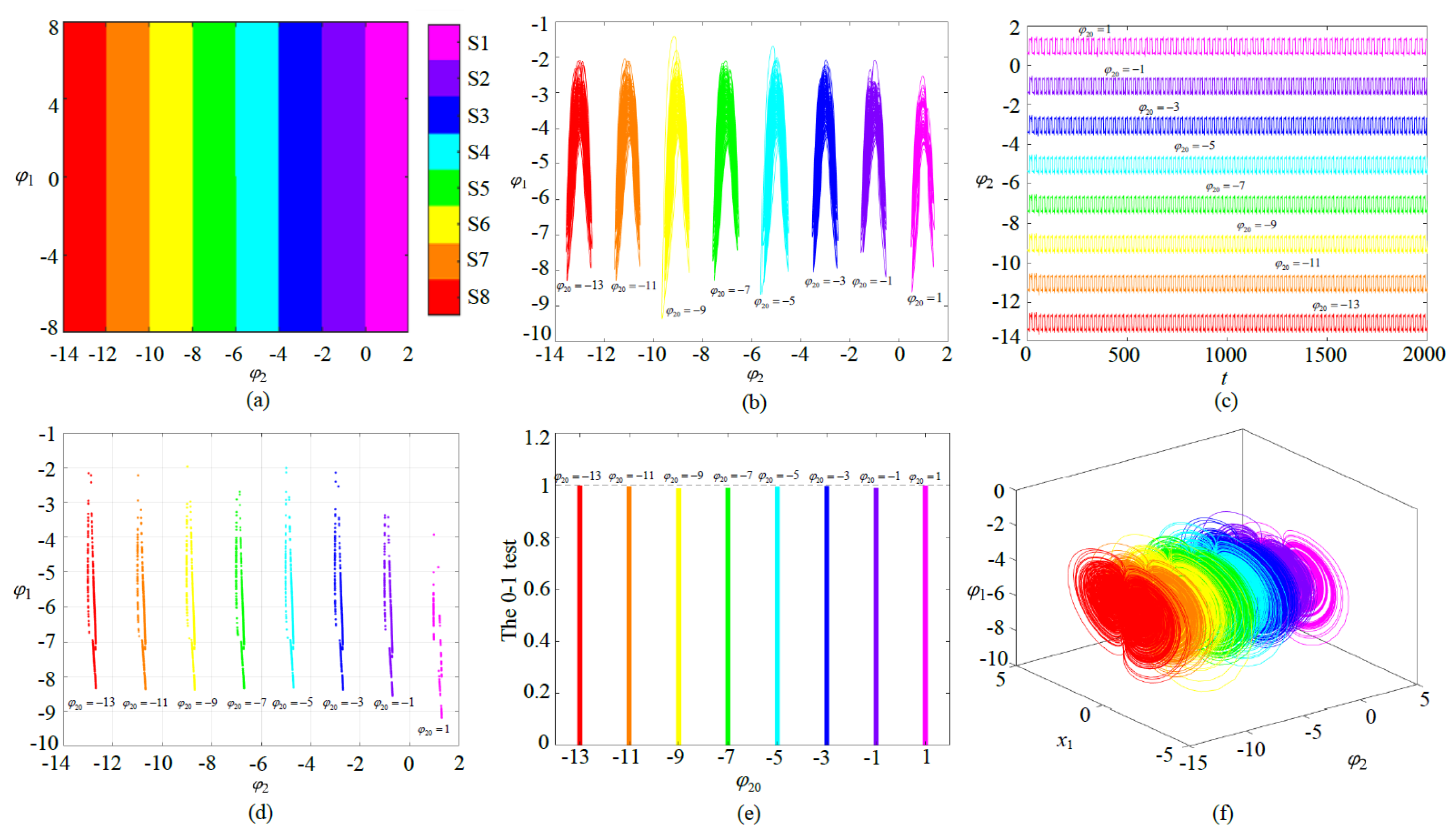
In Figure 8a, the local basin of attraction on the φ 20 x 10 plane is depicted. It can be observed that this basin exhibits a complex flow structure with clearly defined boundaries. The colored regions labeled by s 1 s 8 represent the basins of attraction corresponding to eight different dynamical behaviors. When φ 10 = 0.1 , by selecting different initial states of the memristor M2, systems with parameter values 1, 1 , 3 , 5 , 7 , 9 , 11 , and 13 , as shown in Figure 8b, a set of eight double-wing butterfly chaotic attractors emerges, sharing an identical topological form while occupying distinct spatial locations. Correspondingly, Figure 8c illustrates eight chaotic time sequences associated with these distinct attractors. Figure 8d shows the Poincaré sections on the plane x 1 = 0.8 projected onto the ( φ 4 , φ 3 ) plane of eight coexisting attractors. Figure 8e presents the 0–1 test result of the system, indicating that the system is in a chaotic state. This demonstrates that the memristive FO-MNN system possesses complex dynamical characteristics of initial-condition-boosted coexistence and exhibits excellent robustness. Additional numerical simulations indicate that, with the gradual increase of the parameter N, the number of four-wing butterfly chaotic attractors generated under initial-condition-boosted coexistence grows without bound. In other words, the memristive FO-MNN is able to produce continuous and stable chaotic sequences, whose oscillation amplitudes can be flexibly tuned, without loss, by altering the initial states of the memristor.

4. Analog Circuit Implementation

In this section, the fractional-order memristive neural network circuit with multiple butterfly attractors is implemented using an analog circuit design approach, and its attractor characteristics are experimentally verified through Multisim simulations. For simplicity, only the case of q = 0.99 is discussed here; circuit implementations for other fractional orders can be designed using the same procedure.
When q = 0.99 and the step size is 0.01 , the corresponding approximate fractional-order transfer function 1 / s m can be expressed as
H ( s ) = 1.3537 s + 1.123 × 10 8 ( s + 1.417 × 10 8 ) ( s + 0.01123 )
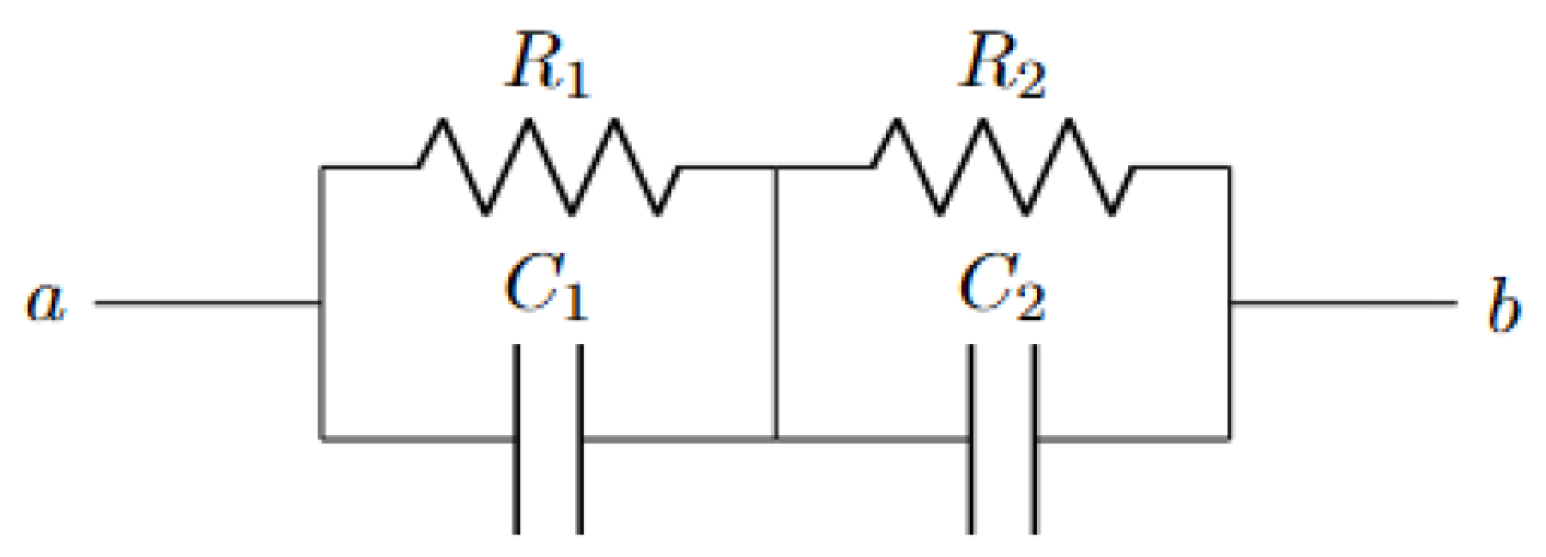
The circuit for implementing the 0.99-order fractional differentiation is shown in Figure 9. Therefore, the transfer function between nodes a and b, denoted as H(s), can be expressed as
1 C 1 s + 1 R 1 C 1 + 1 C 2 s + 1 R 2 C 2 = 1 C 1 + 1 C 2 s + 1 R 1 + 1 R 2 C 1 + C 2
Therefore, by comparing the coefficients of the two equations, the resistance and capacitance parameters of the ladder network unit in Figure 9 can be obtained as follows:
R 1 = 1.982 M Ω , C 1 = 3.56 μ F ; R 2 = 95.544 M Ω , C 2 = 932 nF .
According to the memristor equations, the circuit equations of the memristive MNN circuit can be expressed as
D q C x = x R 1 + tanh ( x ) R 2 tanh ( y ) R 3 φ 1 2 R 4 φ 1 R 5 1 R 6 x + tanh ( φ 2 ) x R 7 , D q C y = y R 8 + tanh ( x ) R 9 + tanh ( y ) R 10 , D q C φ 1 = x 2 φ 1 R 11 φ 1 R 12 x R 13 , D q C φ 2 = x R 14 f ( φ 2 ) R 15 .
where x and y denote the state variables corresponding to the capacitor voltages represented by x and y, respectively; φ 1 and φ 2 correspond to the memristor state variables φ 1 and φ 2 , respectively.
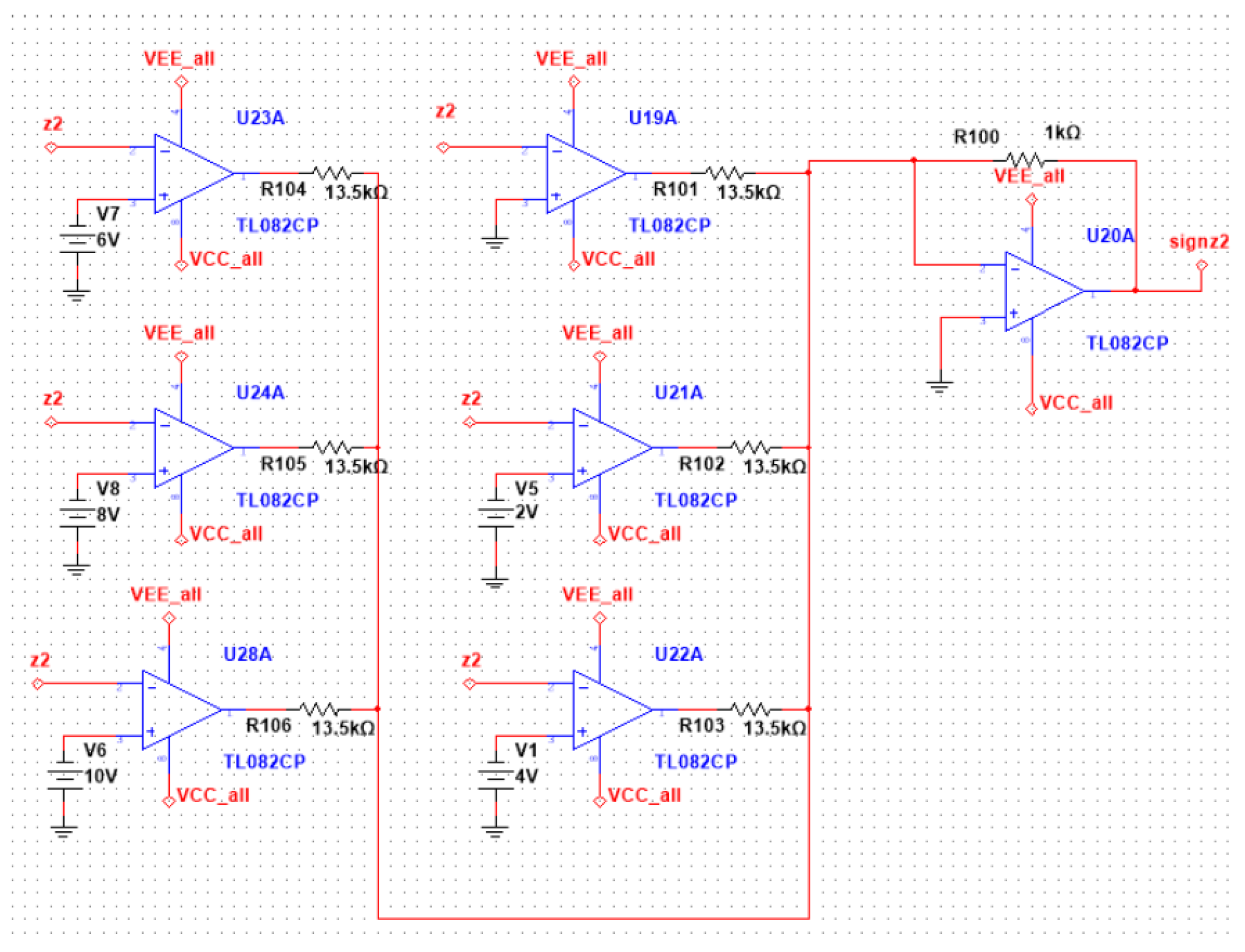
The staircase function f ( φ 2 ) = φ 2 sign ( φ 2 ) N + i = 1 N sign ( φ 2 + 2 i ) can be implemented using operational amplifiers. The operational amplifiers employed are AD712, LM324, and TL082, with a driving voltage of ± 15 V and a saturation output voltage of ± 13.5 V . Taking N = 5 as an example, the circuit unit for implementing the function f ( φ 2 ) is shown in Figure 10, R 101 = R 102 = R 103 = R 104 = R 105 = R 106 = 13.5 k Ω , and R 100 = 1 k Ω . By controlling the number N of operational amplifiers, an N-level staircase waveform can be generated, thus enabling the memristor to produce 2 ( N + 2 ) attractors.
The main circuit design is presented as follows.
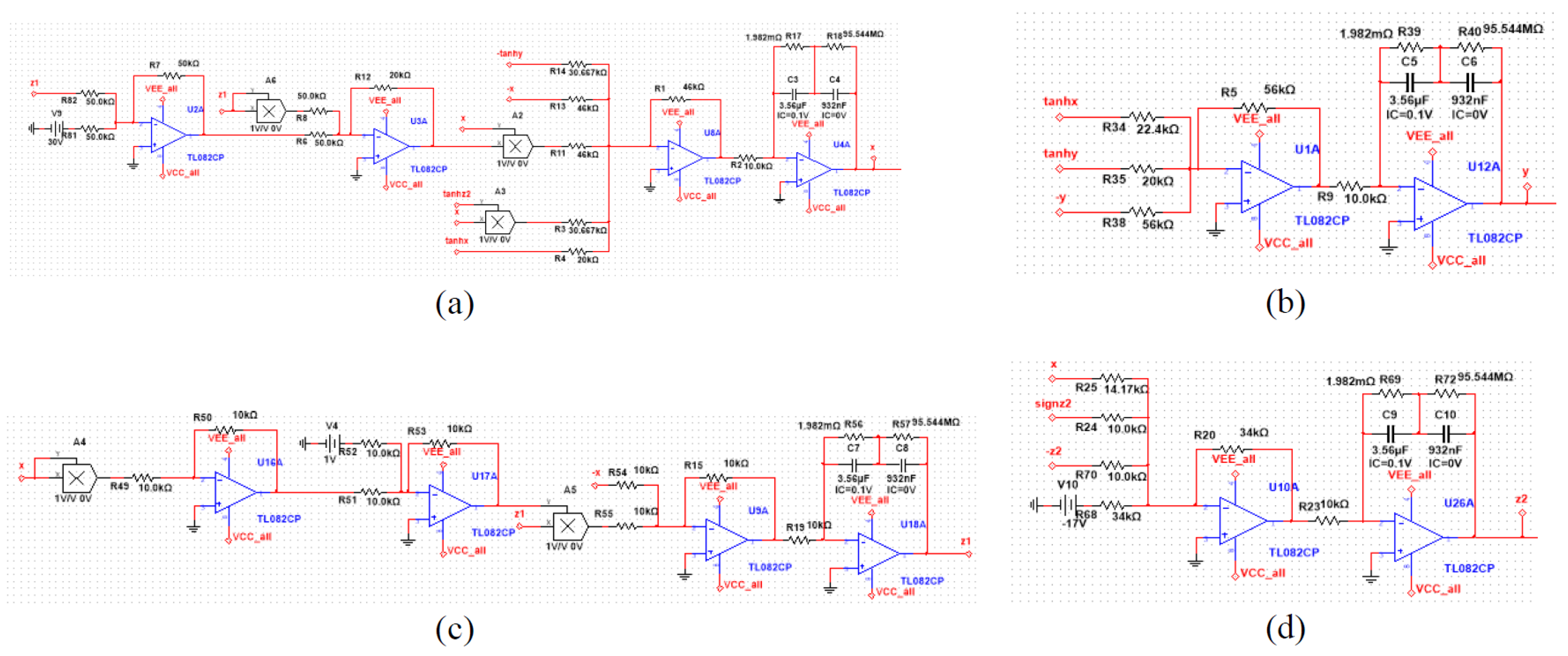
When the parameters of memristor model M1 are set to α = 0.4 , β = 0.4 , γ = 12 , and b = 1 , and the parameters of memristor model M2 are set to α = 1.5 and c = 2.4 , the first equation of the system is implemented by the circuit shown in Figure 11a, the second equation is implemented in Figure 11b, the third equation is implemented in Figure 11c, and the last equation is implemented in Figure 11d.
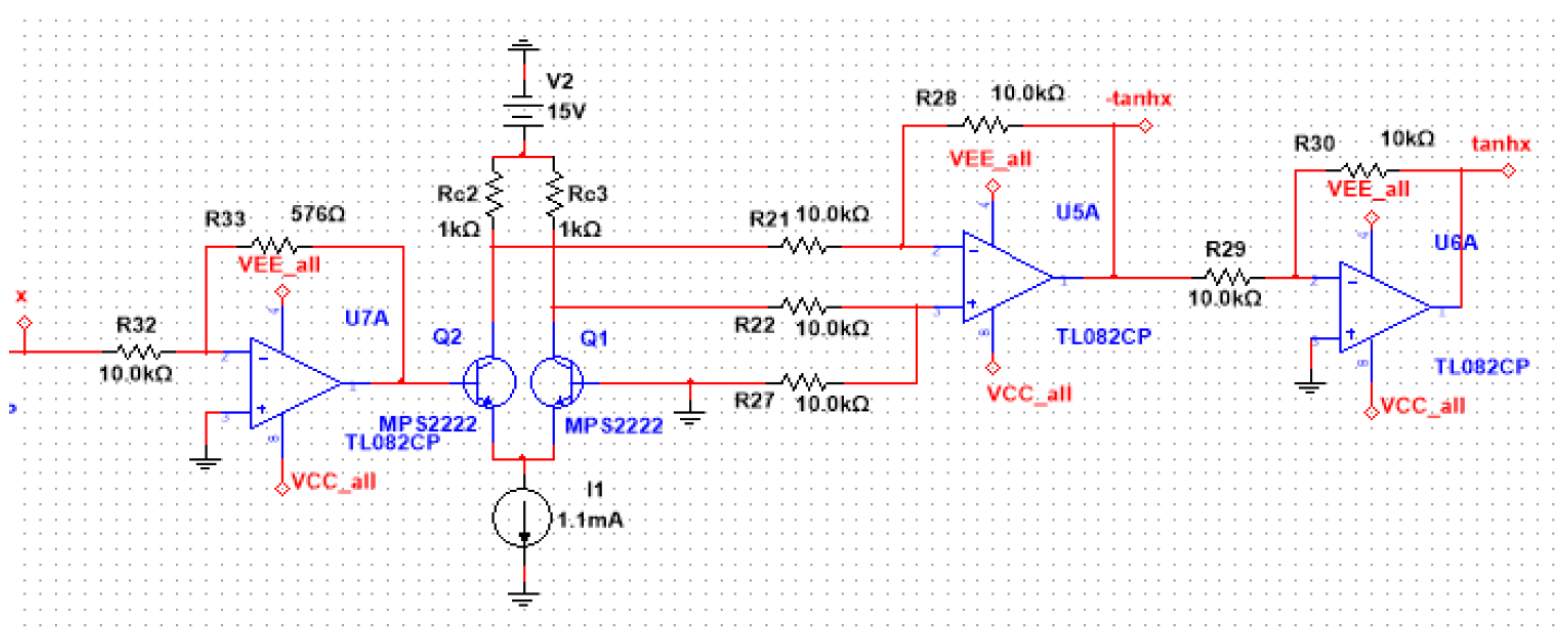
According to the above memristor parameters, the resistor values in the circuit shown in the figure can be calculated. The component values of the fractional-order integrator and differentiator circuit units adopted in the circuit are obtained from the previous calculations. Meanwhile, the neural network circuit is constructed using neuron modules, and the activation function of the neurons is implemented according to Ref. [29]. In this study, the resistance parameters of each module are further fine-tuned in order to enhance the computational accuracy of the circuit, as illustrated in Figure 12.
To verify the effectiveness of the designed memristive FO-MNN circuit, simulation experiments are carried out on the Multisim platform. With the above parameters as an example, by controlling the number N of operational amplifiers, the circuit can generate N + 2 butterfly attractors. Specifically, by setting N = 4 , 5, 6, the obtained butterfly attractors are shown in Figure 13a, b, c and d, respectively. When the other parameters remain unchanged, N is set to 8, R 25 is adjusted to 28.33 k Ω (corresponding to μ = 1.2 ), and appropriate DC biases ( 1 V , 1 V , 3 V , 5 V , and 7 V ) are superimposed at the output of the fractional-order integrator in the fourth circuit, which is equivalent to setting the initial value of φ 2 to 1, 1 , 3 , 5 , and 7 , respectively. As a result, five coexisting double-wing butterfly attractors can be obtained, as shown in Figure 13b. The experimental results demonstrate that the simulation results of the designed circuit agree well with the numerical simulation results, which verifies the effectiveness of the proposed memristive FO-MNN circuit.

5. Application in IIoT Security

With the advancement of the Industrial Internet of Things (IIoT) in intelligent manufacturing, increasing remote monitoring and data interaction result in the transmission of large volumes of sensitive industrial data, exposing them to significant security and privacy risks [44,45,46]. However, the massive scale, high dimensionality, and strong correlations of industrial big data pose significant challenges to traditional encryption schemes in meeting the real-time and high-efficiency requirements of IIoT. Leveraging the strong nonlinearity and complex dynamic evolutionary characteristics of Memristive Fractional-Order Multi-butterfly Neural Networks (FO-MNNs), this paper proposes a chaos-based key generation scheme for data encryption and transmission modules in privacy preservation, aimed at enhancing the security defense and privacy protection capabilities of industrial data.

5.1. Design of the Privacy Protection Scheme

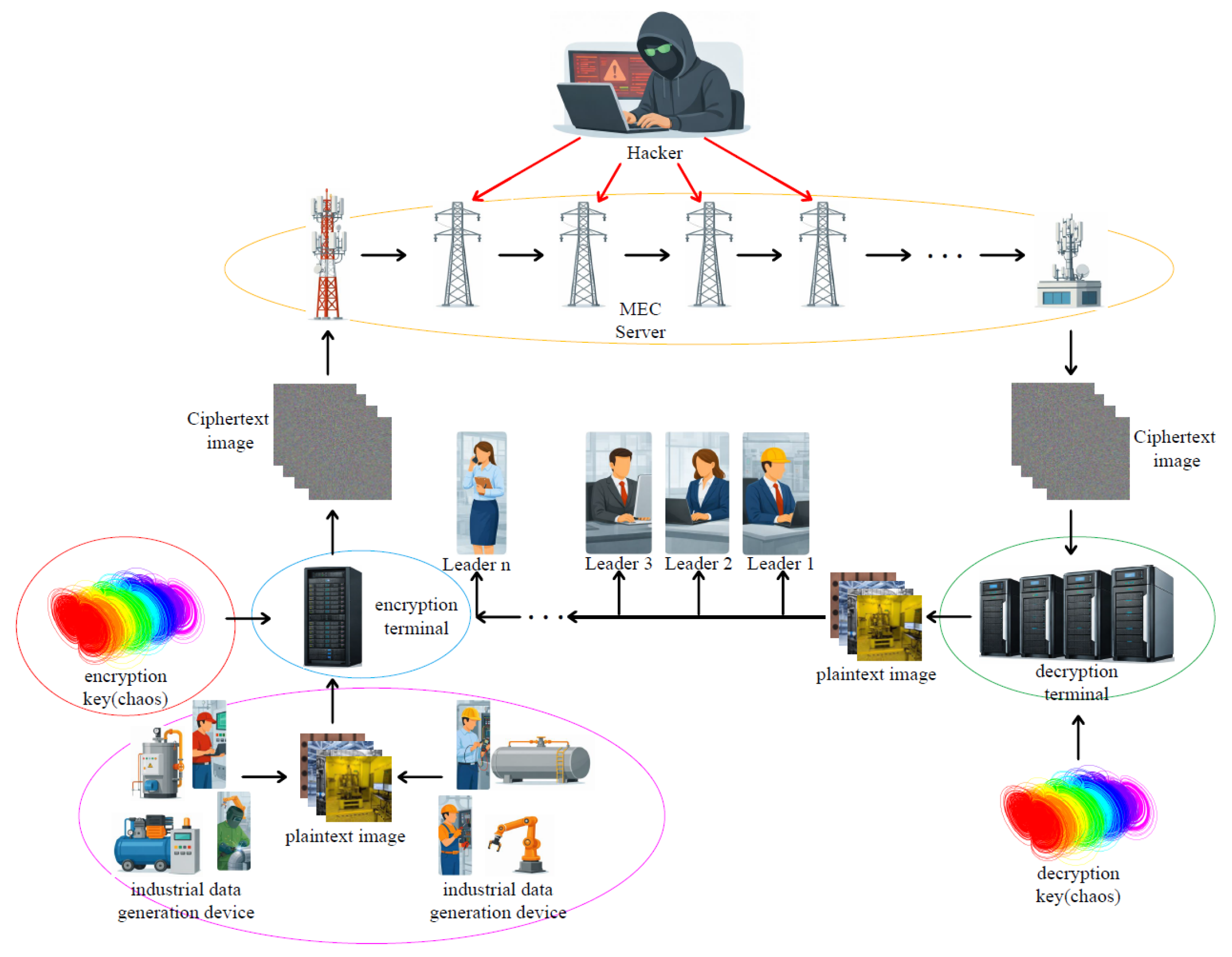
Based on the proposed FO-MNN, a privacy-protection framework for the Industrial Internet of Things (IIoT) is developed in this work, as illustrated in Figure 14. The framework is composed of five fundamental modules: an industrial data acquisition unit, an encryption node, a key generation module, a mobile edge computing (MEC) server, and a decryption node. When production line equipment, industrial sensors, or visual inspection systems in the factory collect raw industrial data (such as industrial images or key process parameters), the data are first locally encrypted at the intelligent terminal at the industrial device layer. Afterwards, the encrypted data are transmitted to the MEC server at the edge layer via the encryption terminal. Evidently, the proposed scheme achieves privacy isolation by ensuring that wireless networks and MEC servers process only encrypted data, thereby preventing unauthorized entities from inferring sensitive industrial attributes or performing privacy profiling based on the original images. Concurrently, authorized representatives can securely retrieve these privacy-protected data streams via smart IIoT devices. By restricting the execution of chaotic decryption to local terminals, the scheme ensures that sensitive visual information remains strictly under the control of authorized stakeholders, effectively addressing the privacy requirements inherent in IIoT applications.
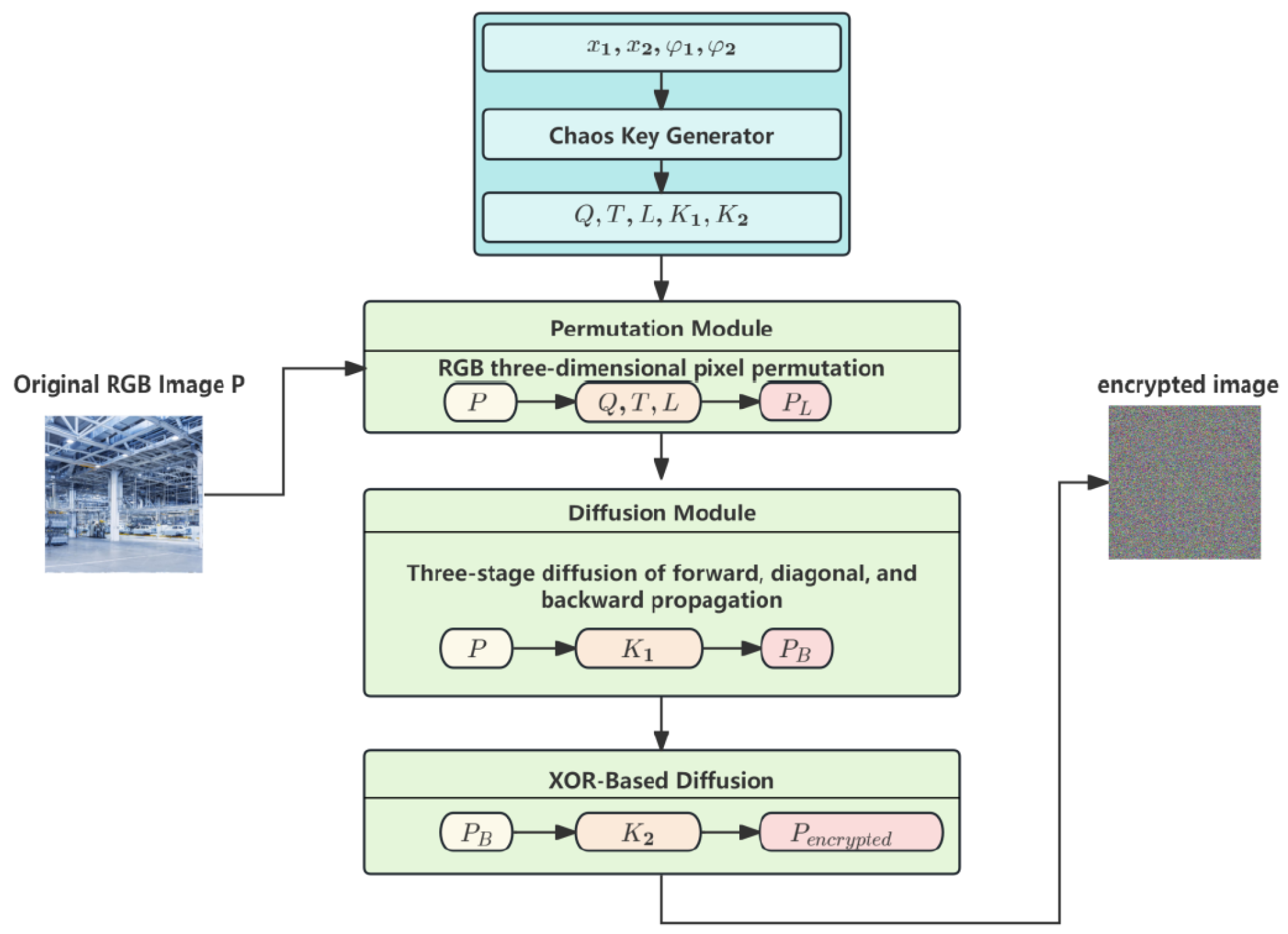
In the overall scheme, the key generation module serves as the core component for the execution of both encryption and decryption algorithms. The proposed FO-MNN presents a novel cryptographic construction termed “Fractional-order Cross-channel Permutation-Diffusion Network.” This construction is formally defined by two key innovations: (1) cross-channel chaotic permutation and (2) a three-stage global diffusion. The specific algorithm is detailed as follows:
Assume that the original industrial image or data matrix P has a size of M × N pixels. The system parameters and initial values ( α , β , b , c , d , N , k 1 , k 2 , x 10 , x 20 , φ 10 , φ 20 ) are taken as the secret keys, and the fractional-order multi-butterfly neural network (FO-MNN) is iterated using the fde12 function. The first 1000 iterations are discarded to eliminate the influence of transient states on the key quality. Subsequently, the system continues to iterate to generate four dynamic variables x 1 ( i , j ) , x 2 ( i , j ) , φ 1 ( i , j ) , and φ 2 ( i , j ) .
During the iteration process, these four variables are used to construct five pseudorandom sequence matrices Q ( i , j ) , T ( i , j ) , L ( i , j ) , K 1 ( i , j ) , and K 2 ( i , j ) . The specific calculation procedures are given as follows:
Q ( i , j ) = T ( i , j ) = L ( i , j ) = K 1 ( i , j ) = Abs S ( i , j ) , K 2 ( i , j ) = mod Abs S ( i , j ) × 10 15 , 256 , S ( i , j ) = x 1 ( i , j ) + x 2 ( i , j ) + φ 1 ( i , j ) + φ 2 ( i , j ) 4 .
(1) cross-channel chaotic permutation. The specific steps of the permutation process are described as follows. Assume that the original RGB image is denoted by P Z 256 M × N × 3 , where the total number of pixels is M × N . Two permutation sequences of length M N are defined: the pixel extraction sequence T = { T ( i ) } i = 1 M N , T ( i ) { 1 , , M N } , and the pixel placement sequence L = { L ( i ) } i = 1 M N , which control the “positions of pixels extracted from the original image’’ and the “positions where pixels are placed in the ciphertext image’’, respectively. To realize cross-channel three-dimensional permutation, the chaotic matrix Q R M × N is first expanded into a vector q = | vec ( Q ) | . Meanwhile, based on the same chaotic sequence, three phase-shifted chaotic subsequences are constructed as q 1 = mod ( 10 5 q , I ) , q 2 = mod ( 10 5 q + 0.333 , I ) , and q 3 = mod ( 10 5 q + 0.666 , I ) , and they are concatenated into q concat = [ q 1 ; q 2 ; q 3 ] R 3 M N .
The concatenated sequence is then sorted to obtain the chaotic permutation order, based on which a three-channel balanced channel-selection table is constructed. The final channel-modulation sequence with length 3 M N , denoted by ch_seq, is obtained, where ch_seq ( k ) { 1 , 2 , 3 } indicates the selected R/G/B channel at the k-th operation.
Next, T and L are extended as T 3 = [ T ; T ; T ] , L 3 = [ L ; L ; L ] , so that their lengths are both 3 M N . At the k-th permutation operation, the current channel is c = ch _ seq ( k ) , and the corresponding source and target linear pixel positions are s = T 3 ( k ) and d = L 3 ( k ) . By applying channel offsets, they are mapped to the three-dimensional global indices as s g = s + ( c 1 ) M N and d g = d + ( c 1 ) M N .
Finally, the permutation assignment is completed by C 0 ( d g ) = P ( s g ) .
This process realizes RGB three-dimensional pixel permutation based on chaotic channel scheduling: it not only performs spatial permutation within each individual channel but also employs chaotic sequences to introduce a strongly dependent nonlinear interleaving of the access order among the three channels, thereby significantly enhancing the overall randomness of pixel arrangement and the key sensitivity of the encryption scheme.
(2) a three-stage global diffusion. The specific steps of the diffusion process are described as follows. Let the input permuted sequence be P L = { P L ( i ) } i = 1 L , where L = M N , and the diffusion key sequence be K = { K ( i ) } i = 1 L . The diffusion layer consists of three stages: forward diffusion, diagonal diffusion, and backward diffusion.
First, forward diffusion is carried out by coupling the current pixel with the previous diffusion result and the corresponding key, yielding the sequence P F ( 1 ) = ( K ( 1 ) + P L ( 1 ) ) mod 256 , P F ( i ) = ( P F ( i 1 ) + K ( i ) + P L ( i ) ) mod 256 , i = 2 , , L . Then, P F is reshaped into a matrix P Z 256 M × N , and diagonal diffusion is performed to generate a two-dimensional diffusion matrix C. It is initialized as C ( 1 , 1 ) = ( P ( 1 , 1 ) + P ( 1 , N ) + P ( M , 1 ) ) mod 256 , followed by recursive diffusion propagation along the row, column, and two-dimensional directions.
C ( 1 , j ) = P ( 1 , j ) + C ( 1 , j 1 ) + P ( M , j ) mod 256 , j = 2 , , N , C ( i , 1 ) = P ( i , 1 ) + C ( i 1 , 1 ) + P ( i , N ) mod 256 , i = 2 , , M , C ( i , j ) = P ( i , j ) + C ( i 1 , j ) + C ( i , j 1 ) mod 256 .
The matrix C is then reshaped row-wise into a sequence of length L, denoted as P F * = vec ( C ) . Finally, backward diffusion is performed to ensure that the diffusion result simultaneously exhibits both “forward dependency” and “reverse dependency.” The recursive formulas are given by
P B ( L ) = ( K ( L ) + P F * ( L ) ) mod 256 , P B ( j ) = ( P B ( j + 1 ) + K ( j ) + P F * ( j ) ) mod 256 , j = L 1 , , 1 .
The final output diffusion sequence is obtained as P Backward = { P B ( i ) } i = 1 L .
This diffusion algorithm realizes bidirectional key-driven diffusion and global strong coupling for the input sequence, thereby effectively enhancing the sensitivity of the ciphertext to both the plaintext and the secret key.
Next, the matrix K 3 is used to perform an XOR operation on P B , given by C ( i , j ) = P B ( i , j ) K 2 ( i , j ) C ( i 1 , j ) .
The architecture diagram of the encryption algorithm is shown in Figure 15. By executing the above three-round encryption procedure, the chaotic sequences Q, T, and L in the first round are generated using the signals produced by the third, fourth, and fifth double-wing butterfly attractors in Figure 8b, respectively. The chaotic sequence K 1 in the second round is generated from the sixth double-wing butterfly attractor in Figure 8b, while the chaotic sequence K 2 in the third round is obtained from the seventh double-wing butterfly attractor in Figure 8b. All parameter settings are consistent with those described in Section 3. The final encrypted image C is obtained accordingly, and the corresponding decryption process is the inverse operation of the encryption procedure.
Compared with other chaotic encryption techniques, our approach offers significant advantages, as traditional systems often lack inter-channel permutation logic. Our scheme enforces permutation within a three-channel unified structure, which effectively resists “divide-and-conquer attacks” targeting individual channels. Furthermore, the three-stage global diffusion ensures a strong global coupling characteristic. Meanwhile, the incorporation of FO-MNN provides an additional sensitive parameter—the fractional order q—as a secret key. This extends the key space and system complexity to levels unattainable by traditional integer-order systems under the same set of variables.

5.2. Encryption Performance Analysis

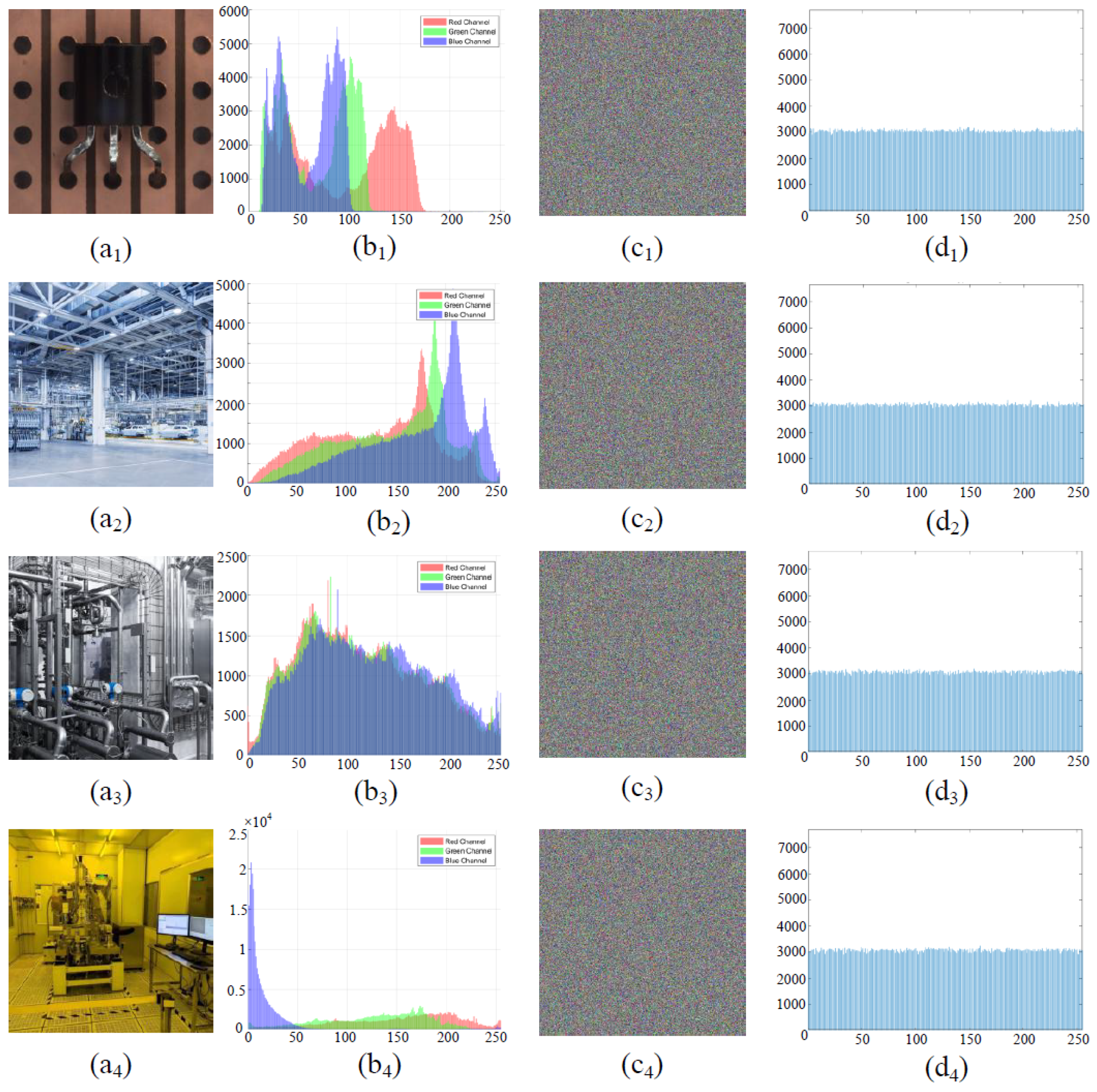
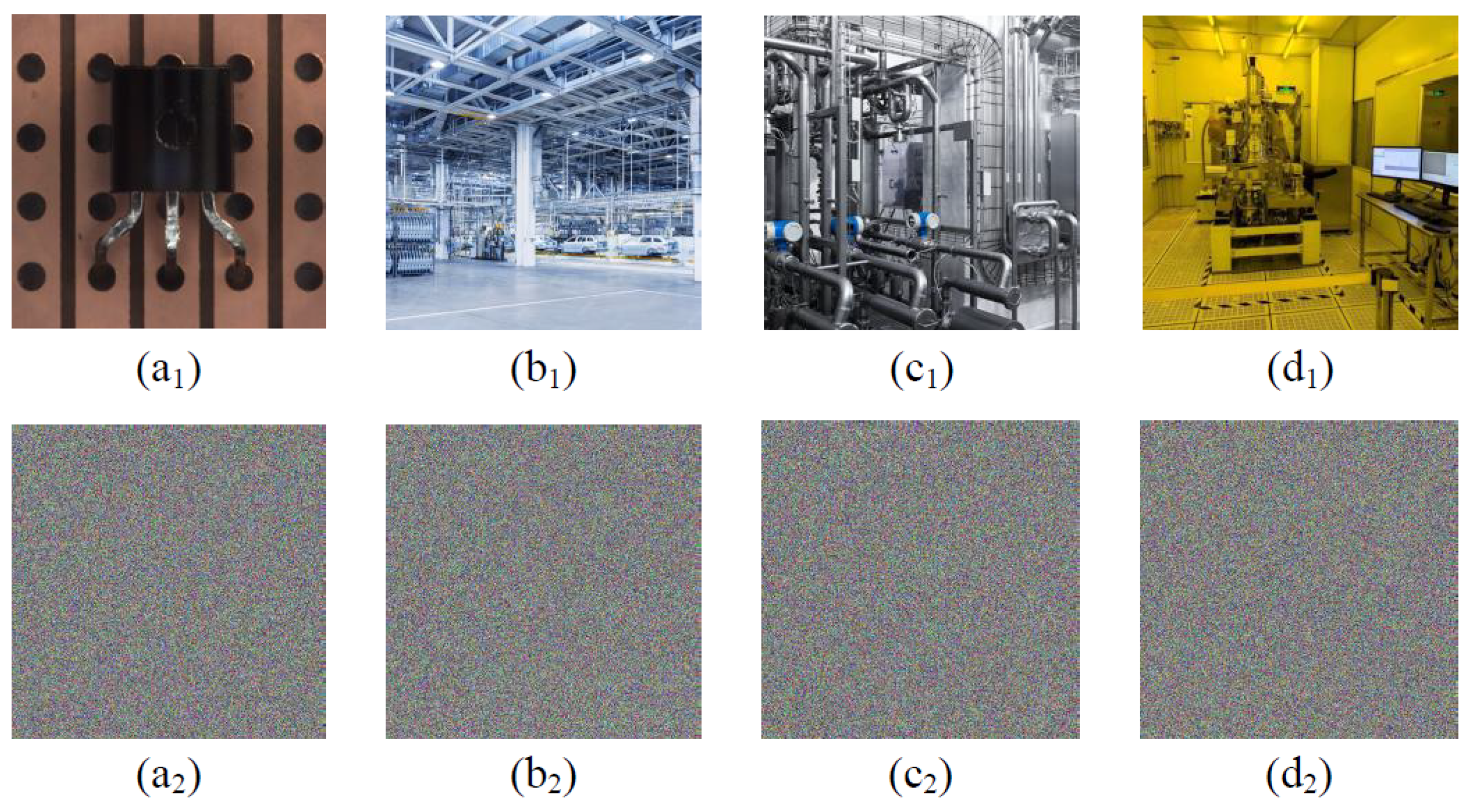
To evaluate the effectiveness of the proposed privacy-protection scheme, four color industrial images (P1–P4) with a resolution of 512 × 512, obtained from the public UCID image database, are selected for experiments in MATLAB R2023b. Prior to encryption, each color image is separated into its three RGB components. In order to comprehensively assess the encryption performance, a series of analyses is carried out, including histogram analysis, correlation analysis, information-entropy evaluation, differential-attack resistance, key sensitivity testing, and robustness tests against noise and data loss. The corresponding results are summarized as follows.
(1) Histogram Analysis:
Figure 16(b1–b4) display the histogram distributions of the original images, whereas the corresponding encrypted histograms are provided in Figure 16(d1–d4). It can be clearly seen that the histograms of the encrypted images are almost uniformly distributed and differ greatly from those of the original images. This result implies that the proposed privacy-protection scheme has strong resistance to statistical analysis. Hence, the multi-wing memristive HNN offers effective protection against statistical attacks in image encryption.
(2) Correlation Coefficient:
In general, the correlation coefficient ranges from 0 to 1. A smaller value indicates weaker correlation between adjacent pixel values, while a larger value implies stronger dependence. The correlation coefficient is calculated as follows,
ρ x y = i = 1 N x i E ( x ) y i E ( y ) i = 1 N x i E ( x ) 2 i = 1 N y i E ( y ) 2
The statistical results reported in Table 1 reveal a pronounced contrast between the plain and encrypted images. For all four test images, the correlation coefficients computed along the horizontal, vertical, and diagonal directions remain close to unity in the original domain, whereas they drop to values near zero after encryption. These coefficients are evaluated from 10,000 randomly sampled neighboring pixel pairs in each image. Here, x and y denote the gray levels of two adjacent pixels, N represents the total number of sampled pairs, and E ( x ) and E ( y ) are their corresponding mean values. The drastic reduction in correlation demonstrates that the proposed FO-MNN effectively destroys the inherent spatial dependency between neighboring pixels, thereby ensuring strong decorrelation in the encrypted images.
(3) Information Entropy:
Information entropy characterizes the statistical uncertainty of image data. Based on Shannon’s information theory, the entropy of an image can be computed using the following expression:
H ( P ) = i = 0 2 N 1 P ( x i ) log 2 1 P ( x i ) ,
Here, the parameter N corresponds to the bit depth of image P, while P ( x i ) characterizes the occurrence probability of the pixel value x i . The information entropy of four industrial images, together with that of their encrypted counterparts, is summarized in Table 1. It can be clearly observed that the information entropy of the images is significantly increased after encryption. All the values are very close to the ideal entropy value of 8. Therefore, the fractional-order multi-butterfly neural network (FO-MNN) serves as a key mechanism for increasing the information entropy of the original images.
(4) Differential Attack:
In differential attacks, an adversary attempts to infer the relationship between a plaintext image and its corresponding ciphertext by introducing slight perturbations to the original image and observing the resulting changes after encryption. To evaluate the resistance of an encryption scheme to such attacks, two standard metrics are commonly employed, namely the Number of Pixels Change Rate (NPCR) and the Unified Average Changing Intensity (UACI). Their mathematical definitions are given as follows:
NPCR ( C 1 , C 2 ) = i = 1 M j = 1 N D ( i , j ) M · N × 100 % UACI ( C 1 , C 2 ) = 1 M · N i = 1 M j = 1 N | C 1 ( i , j ) C 2 ( i , j ) | 255 × 100 %
where
D ( i , j ) = 0 , if C 1 ( i , j ) = C 2 ( i , j ) , 1 , if C 1 ( i , j ) C 2 ( i , j ) .
Here, C 1 and C 2 represent two ciphertext images whose corresponding plaintext images differ at only a single pixel. Based on the calculated results, Table 1 reports the average NPCR and UACI values for the R, G, and B channels of the four test images. It can be clearly seen that the obtained NPCR and UACI values are very close to the theoretical expectations of 99.6094% and 33.4635%, respectively. This implies that the proposed scheme is extremely sensitive to tiny variations in the original image. Therefore, the designed privacy-protection scheme demonstrates strong robustness against differential attacks.
(5) Key Sensitivity Analysis:
The reliability of an encryption scheme is closely tied to its response to minute variations in the secret key. An ideal system should exhibit a dramatic change in the decryption outcome even when the key is perturbed by an extremely small amount. In this study, four parameters, x 10 , x 20 , φ 10 , and φ 20 , are employed as secret keys to examine this property. For each parameter, a slight perturbation on the order of 10 16 is introduced, and the corresponding decrypted images are presented in Figure 17. The results reveal that such negligible modifications lead to entirely unrecognizable reconstructions, bearing no visual resemblance to the original images. This behavior confirms that the proposed privacy-preserving scheme exhibits a pronounced avalanche effect with respect to key variations, thereby providing a high level of key sensitivity and security.
(6) Data Loss and Noise Attack:
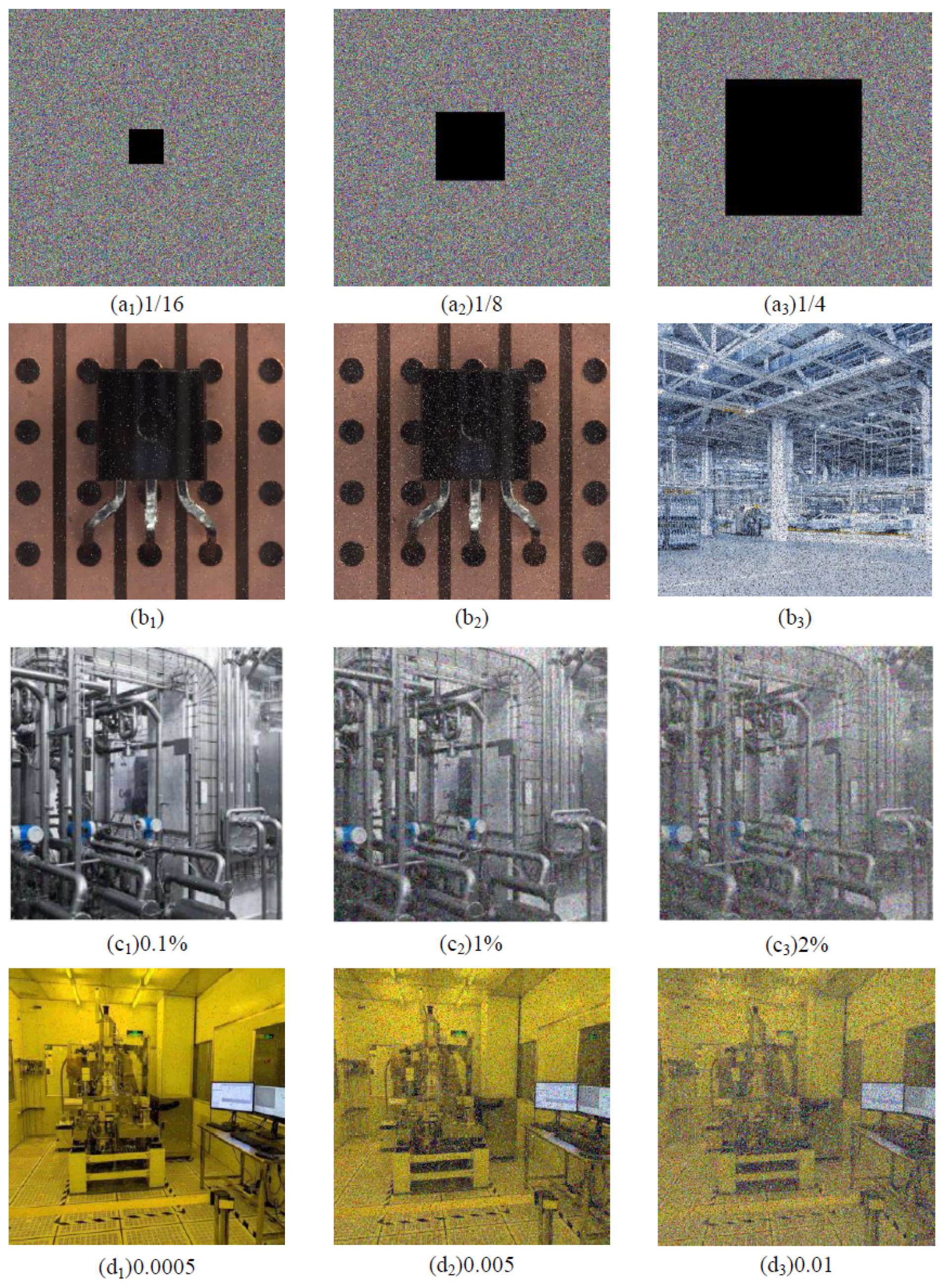
Data loss and noise attacks are commonly employed to assess the robustness of image-encryption algorithms. In practical communication scenarios, encrypted images are susceptible to partial data degradation or loss during transmission. To evaluate the resistance of the proposed scheme to such situations, several encrypted images with missing regions are intercepted and then decrypted. The decryption results corresponding to different loss areas are presented in Figure 18(a1–a3,b1–b3). It can be observed that the original images are still successfully reconstructed after decryption, and the noise points are uniformly distributed. In practical deployment, the encryption system is inevitably exposed to multiple forms of disturbance, including salt-and-pepper noise and Gaussian noise. To assess the robustness of the algorithm against noise-based attacks, the two noise models are injected into the encrypted images with varying intensities. The noise attack results are shown in Figure 18(c1–c3,d1–d3). The results indicate that, even with partial distortion in pixel values, the decrypted images preserve sufficient visual information to enable a clear recovery of the original content. This indicates that the decrypted images can still maintain good visual quality after noise attacks. Therefore, the proposed privacy-protection scheme shows strong robustness, as it is capable of effectively withstanding both data loss and noise attacks.
(7) Randomness Test:
To test the randomness of a pseudo-random sequence, the NIST suite test can be used. This test results in P v a l u e s , which should be higher than 0.01 for passing the test. The result of this test for the random sequence generated by our algorithm is presented in Table 2. It can be observed that the proposed random sequence has successfully passed all of the tests.
Finally, a performance comparison of encryption results between different image encryption schemes is given in Table 3.
In summary, the encryption algorithm proposed in this paper exhibits superior statistical characteristics, as demonstrated by its performance in histogram analysis, correlation coefficient analysis, and information entropy tests. It shows remarkable robustness and security in resisting differential attacks, and key sensitivity analysis, as well as data loss and noise attacks. Furthermore, the unpredictability of the encrypted sequences is further validated by passing the NIST randomness tests. Consequently, the algorithm can effectively ensure the confidential transmission of industrial images in complex network environments, thereby safeguarding privacy and security in such scenarios.

6. Conclusions

This paper investigated the nonlinear dynamics of a novel fractional-order memristive neural network (FO-MNN) incorporating electromagnetic induction effects. By embedding two distinct memristors into a single Hopfield-type neuron, a unified framework was established to capture both fractional-order memory and electromagnetic induction mechanisms. Numerical analyses demonstrated that the proposed FO-MNN can generate a wide variety of complex chaotic behaviors, including Lorenz-like double-wing butterfly attractors, parameter-tunable multi-double-wing butterfly attractors, and initial-condition-dependent coexistence of multiple attractors. These results reveal that the synergistic interaction between dual memristive modules and fractional-order dynamics significantly enhances the system’s multistability and dynamical complexity. Owing to the intricate orbit structures, strong randomness, and flexible controllability of the resulting chaos, the proposed FO-MNN shows considerable potential for chaos-based engineering applications. Furthermore, an IIoT-oriented privacy-protection scheme was developed based on the proposed model, and its effectiveness was validated through encryption experiments. Overall, this work not only deepens the understanding of electromagnetic-induction-induced dynamics in fractional-order neural networks but also provides a promising theoretical and practical foundation for secure information processing in future intelligent industrial systems.
Furthermore, the further construction of grid-based or spatially distributed multi-wing butterfly chaotic attractors in neural networks using the modeling and control strategies proposed in this paper remains an important and promising research direction.

Author Contributions

S.L.: Data curation, Software, Writing—Original draft preparation. H.L.: Conceptualization of this study, Methodology, Writing—Original draft preparation. L.J. and W.Y.: reviewing. All authors have read and agreed to the published version of the manuscript.

Funding

This work was supported in part by the National Natural Science Foundation of Hunan Province under Grant 2026JJ50518; and Hunan Provincial Natural Science Foundation of China under Grant no. 2026JJ80477.

Data Availability Statement

The original contributions presented in this study are included in the article. Further inquiries can be directed to the corresponding author.

Conflicts of Interest

The authors declare no conflicts of interest.

References

  1. Breakspear, M. Dynamic models of large-scale brain activity. Nat. Neurosci. 2017, 20, 340–352. [Google Scholar] [CrossRef]
  2. Mohanrasu, S.S.; Udhayakumar, K.; Priyanka, T.M.C.; Gowrisankar, A.; Banerjee, S.; Rakkiyappan, R. Event-triggered impulsive controller design for synchronization of delayed chaotic neural networks and its fractal reconstruction: An application to image encryption. Appl. Math. Model. 2023, 115, 490–512. [Google Scholar] [CrossRef]
  3. Bao, B.; Zhou, C.; Bao, H.; Chen, B.; Chen, M. Heterogeneous Hopfield neural network with analog implementation. Chaos Solitons Fractals 2025, 194, 116234. [Google Scholar] [CrossRef]
  4. Peng, X.; Li, C.; Zeng, Y.; Li, C.L. Adjusting dynamics of Hopfield neural network via time-variant stimulus. IEEE Trans. Circuits Syst. I Regul. Pap. 2024, 71, 3242–3255. [Google Scholar] [CrossRef]
  5. Tamba, V.K.; Ngoko, G.; Pham, V.T.; Grassi, G. Chaos, hyperchaos and transient chaos in a 4D Hopfield neural network: Numerical analyses and PSpice implementation. Mathematics 2025, 13, 1872. [Google Scholar] [CrossRef]
  6. Kong, X.; Yu, F.; Yao, W.; Cai, S.; Zhang, J.; Lin, H. Memristor-induced hyperchaos, multiscroll and extreme multistability in fractional-order HNN: Image encryption and FPGA implementation. Neural Netw. 2024, 171, 85–103. [Google Scholar] [CrossRef]
  7. Ji, J.; Min, F.; Kang, Y.; Li, J. Harmonic components dynamics of symmetric coexisting attractors and pitchfork bifurcation in memristive Hopfield neural networks. Chaos Solitons Fractals 2025, 200, 117080. [Google Scholar] [CrossRef]
  8. Vignesh, D.; Ma, J.; Banerjee, S. Multi-scroll and coexisting attractors in a Hopfield neural network under electromagnetic induction and external stimuli. Neurocomputing 2024, 564, 126961. [Google Scholar] [CrossRef]
  9. Simo, G.R.; Njougouo, T.; Aristides, R.P.; Louodop, P.; Tchitnga, R.; Cerdeira, H.A. Chimera states in a neuronal network under the action of an electric field. Phys. Rev. E 2021, 103, 062304. [Google Scholar] [CrossRef]
  10. Joshi, M.; Bhosale, S.; Vyawahare, V.A. A survey of fractional calculus applications in artificial neural networks. Artif. Intell. Rev. 2023, 56, 13897–13950. [Google Scholar] [CrossRef]
  11. Jackson, J.; Perumal, R. A robust image encryption technique based on an improved fractional order chaotic map. Nonlinear Dyn. 2025, 113, 7277–7296. [Google Scholar] [CrossRef]
  12. Xu, S.; Wang, X.; Ye, X. A new fractional-order chaos system of Hopfield neural network and its application in image encryption. Chaos Solitons Fractals 2022, 157, 111889. [Google Scholar] [CrossRef]
  13. Xu, C.; Mu, D.; Liu, Z.; Pang, Y.; Liao, M.; Aouiti, C. New insight into bifurcation of fractional-order 4D neural networks incorporating two different time delays. Commun. Nonlinear Sci. Numer. Simul. 2023, 118, 107043. [Google Scholar] [CrossRef]
  14. Sivalingam, S.M.; Govindaraj, V. A novel numerical approach for time-varying impulsive fractional differential equations using theory of functional connections and neural network. Expert Syst. Appl. 2024, 238, 121750. [Google Scholar]
  15. Yu, F.; Yu, Q.; Chen, H.; Kong, X.; Mokbel, A.A.M.; Cai, S.; Du, S. Dynamic analysis and audio encryption application in IoT of a multi-scroll fractional-order memristive Hopfield neural network. Fractal Fract. 2022, 6, 370. [Google Scholar] [CrossRef]
  16. Strukov, D.B.; Snider, G.S.; Stewart, D.R.; Williams, R.S. The missing memristor found. Nature 2008, 453, 80–83. [Google Scholar] [CrossRef]
  17. Wang, Y.; Su, P.; Wang, Z.; Sun, J. Design of double-coupled HR-FN neural network with memristors and its application in image encryption. Appl. Math. Model. 2025, 140, 115898. [Google Scholar] [CrossRef]
  18. Li, Y.; Li, C.; Zhong, Q.; Liu, S.; Lei, T. A memristive chaotic map with only one bifurcation parameter. Nonlinear Dyn. 2024, 112, 3869–3886. [Google Scholar] [CrossRef]
  19. Yang, F.; Xu, Y.; Ma, J. A memristive neuron and its adaptability to external electric field. Chaos Interdiscip. J. Nonlinear Sci. 2023, 33, 023110. [Google Scholar] [CrossRef]
  20. Zhang, S.; Li, Y.; Lu, D.; Li, C. A novel memristive synapse-coupled ring neural network with countless attractors and its application. Chaos Solitons Fractals 2024, 184, 115056. [Google Scholar] [CrossRef]
  21. Xu, Q.; Wang, K.; Shan, Y.; Wu, H.; Chen, M.; Wang, N. Dynamical effects of memristive electromagnetic induction on a 2D Wilson neuron model. Cogn. Neurodyn. 2024, 18, 645–657. [Google Scholar] [CrossRef]
  22. Shi, F.; Xu, X.; Liu, X.; Cao, Y.; Gao, S.; Mou, J. Complex neuronal dynamics under memristive electromagnetic radiation: Modeling and digital signal processing implementation. Nonlinear Sci. Control. Eng. 2025, 1, 025400013. [Google Scholar]
  23. Yao, W.; Gao, K.; Wang, Y.; Lin, H.; Wu, H.; Xu, C.; Zhang, X. Generalization and differentiation of affective associative memory circuit based on memristive neural network with emotion transfer. Neural Netw. 2025, 107502. [Google Scholar] [CrossRef]
  24. He, S.; Liu, J.; Wang, H.; Sun, K. A discrete memristive neural network and its application for character recognition. Neurocomputing 2023, 523, 1–8. [Google Scholar] [CrossRef]
  25. Lin, H.; Deng, X.; Zhang, S.; Chen, X.; Min, G.; Xue, K. Securing image privacy in internet-of-vehicles with a multiwing hyperchaotic memristive neural network. IEEE Internet Things J. 2025, 12, 55269–55282. [Google Scholar] [CrossRef]
  26. Zhang, S.; Li, C.; Zheng, J.; Wang, X.; Zeng, Z.; Chen, G. Memristive autapse-coupled neuron model with external electromagnetic radiation effects. IEEE Trans. Ind. Electron. 2022, 70, 11618–11627. [Google Scholar] [CrossRef]
  27. Deng, X.; Ding, S.; Lin, H.; Jiang, L.; Sun, H.; Jin, J. Privacy-preserving online medical image exchange via hyperchaotic memristive neural networks and DNA encoding. Neurocomputing 2025, 653, 131132. [Google Scholar] [CrossRef]
  28. Shi, F.; Cao, Y.; Xu, X.; Banerjee, S.; Mou, J. Boosting neural chaos via memcapacitive electromagnetic radiation in a unidirectional ring neural network. Chaos Solitons Fractals 2026, 202, 117435. [Google Scholar] [CrossRef]
  29. Lin, H.; Wang, C.; Xu, C.; Zhang, X.; Iu, H.H. A memristive synapse control method to generate diversified multistructure chaotic attractors. IEEE Trans. Comput. Aided Des. Integr. Circuits Syst. 2022, 42, 942–955. [Google Scholar] [CrossRef]
  30. Bao, H.; Hua, M.; Ma, J.; Chen, M.; Bao, B. Offset-control plane coexisting behaviors in two-memristor-based Hopfield neural network. IEEE Trans. Ind. Electron. 2022, 70, 10526–10535. [Google Scholar] [CrossRef]
  31. Lai, Q.; Chen, Y. Multi-scroll attractor and its broken coexisting attractors in cyclic memristive neural network. Chaos Interdiscip. J. Nonlinear Sci. 2023, 33, 083149. [Google Scholar] [CrossRef]
  32. Yuan, F.; Qi, Y.; Yu, X.; Deng, Y. Design and analysis of grid attractors in memristive Hopfield neural networks. Chaos Solitons Fractals 2024, 188, 115478. [Google Scholar] [CrossRef]
  33. Wan, Q.; Yang, Q.; Liu, T.; Chen, C.; Shen, K. Single direction, grid and spatial multi-scroll attractors in Hopfield neural network with the variable number memristive self-connected synapses. Chaos Solitons Fractals 2024, 189, 115584. [Google Scholar] [CrossRef]
  34. Ding, S.; Lin, H.; Deng, X.; Yao, W.; Jin, J. A hidden multiwing memristive neural network and its application in remote sensing data security. Expert Syst. Appl. 2025, 277, 127168. [Google Scholar] [CrossRef]
  35. Wang, C.; Li, Y.; Yang, G.; Deng, Q. A review of fractional-order chaotic systems of memristive neural networks. Mathematics 2025, 13, 1600. [Google Scholar] [CrossRef]
  36. He, S.; Yu, F.; Guo, R.; Zheng, M.; Tang, T.; Jin, J.; Wang, C. Dynamic analysis and FPGA implementation of a fractional-order memristive Hopfield neural network with hidden chaotic dual-wing attractors. Fractal Fract. 2025, 9, 561. [Google Scholar] [CrossRef]
  37. Al-Barakati, A.A.; Mesdoui, F.; Bekiros, S.; Kaçar, S.; Jahanshahi, H. A variable-order fractional memristor neural network: Secure image encryption and synchronization via a smooth and robust control approach. Chaos Solitons Fractals 2024, 186, 115135. [Google Scholar] [CrossRef]
  38. Yang, Y.; Huang, L.; Kuznetsov, N.V.; Chai, B.; Guo, Q. Generating multiwing hidden chaotic attractors with only stable node-foci: Analysis, implementation and application. IEEE Trans. Ind. Electron. 2024, 71, 3986–3995. [Google Scholar] [CrossRef]
  39. Zhang, L.; Li, Z.; Peng, Y. A hidden grid multi-scroll chaotic system coined with two multi-stable memristors. Chaos Solitons Fractals 2024, 185, 115109. [Google Scholar] [CrossRef]
  40. Yang, F.; Ma, J.; Wu, F. Review on memristor application in neural circuit and network. Chaos Solitons Fractals 2024, 187, 115361. [Google Scholar] [CrossRef]
  41. Podlubny, I. Fractional Differential Equations; Academic Press: New York, NY, USA, 1999. [Google Scholar]
  42. Deng, W.; Lu, J. Design of multidirectional multiscroll chaotic attractors based on fractional differential systems via switching control. Chaos 2006, 16, 043120. [Google Scholar] [CrossRef] [PubMed]
  43. Cafagna, D.; Grass, G. On the simplest fractional-order memristor-based chaotic system. Nonlinear Dyn. 2012, 70, 1185–1197. [Google Scholar] [CrossRef]
  44. Huang, H.; Cai, Z. Duple color image encryption system based on 3-D nonequilateral Arnold transform for IIoT. IEEE Trans. Ind. Inform. 2022, 19, 8285–8294. [Google Scholar] [CrossRef]
  45. Wang, H.; Lai, Q. Exploiting compressed sensing and DNA coding for multi-image encryption scheme with application to industrial Internet of Things. IEEE Trans. Ind. Electron. 2025, 72, 14543–14552. [Google Scholar] [CrossRef]
  46. Wu, X.; Yan, S. Adaptive sliding mode synchronization of a controllable grid-multi-wing chaotic system with parameter identification. Appl. Math. Model. 2025, 150, 116351. [Google Scholar] [CrossRef]
  47. Yan, M.; Liu, M.; Li, C. DNA color image encryption based on conservative chaotic system. Sci. Rep. 2025, 15, 9278. [Google Scholar] [CrossRef]
  48. Sun, J.; Li, C.; Wang, Z.; Wang, Y. A memristive fully connect neural network and application of medical image encryption based on central diffusion algorithm. IEEE Trans. Ind. Inform. 2023, 20, 3778–3788. [Google Scholar] [CrossRef]
  49. Wang, C.; Tang, D.; Lin, H.; Yu, F.; Sun, Y. High-dimensional memristive neural network and its application in commercial data encryption communication. Expert Syst. Appl. 2024, 242, 122513. [Google Scholar] [CrossRef]
  50. Yu, F.; Shen, H.; Yu, Q.; Kong, X.; Sharma, P.K.; Cai, S. Privacy protection of medical data based on multi-scroll memristive Hopfield neural network. IEEE Trans. Netw. Sci. Eng. 2022, 10, 845–858. [Google Scholar] [CrossRef]
Figure 1. Voltage-current characteristic curves of two memristors. (a) Amplitude-dependent v i curve of memristor M 1 at F = 0.05. (b) Frequency-dependent v i curve of memristor M 1 at A = 1. (c) Amplitude-dependent v i curve of memristor M 2 at F = 0.5. (d) Frequency-dependent v i curve of memristor M 2 at A = 1.
Mathematics 14 01159 g001
Figure 2. A memristive HNN structure with two memristive systems.
Mathematics 14 01159 g002
Figure 3. The distribution of the equilibrium points and the four butterfly attractors of the HNN with N = 2. (a) Equilibrium points in φ 2-x1 plane. (b) Phase plot in φ 2-x1 plane.
Mathematics 14 01159 g003
Figure 4. Lyapunov exponent and bifurcation diagram of the FO-MNN with memristors. (a1,a2) γ = 12, (b1,b2) α = −0.4.
Mathematics 14 01159 g004
Figure 5. Complex double butterfly chaotic attractor in φ 2 x 2 φ 1 space with α = 0.4 .
Mathematics 14 01159 g005
Figure 6. Composite multi-butterfly chaotic attractors with α = 0.4 . (a) Three butterfly attractors (N = 1); (b) Four butterfly attractors (N = 2); (c) Five butterfly attractors (N = 3); (d) Six butterfly attractors (N = 4); (e) Seven butterfly attractors (N = 5); (f) Eight butterfly attractors (N = 6).
Mathematics 14 01159 g006
Figure 7. (a) Lyapunov exponent of φ 2 initial state, with parameters set as k 1 = 1 , k 2 = 1.5 , α = −0.4, β = 0.4, γ = 12, b = 1, μ = 1.2, ρ = 3.4, N = 8, and x 10 = x 20 = φ 1 = 0.1 . (b) Corresponding bifurcation diagram.
Mathematics 14 01159 g007
Figure 8. Initial state-dependent chaotic dynamics with the following parameters: k 1 = 1 , k 2 = 1.5 , α = 0.4 , β = 0.4 , γ = 12 , b = 1 , μ = 1.2 , ρ = 3.4 , N = 8 , and x 10 = x 20 = φ 10 = 0.1 . (a) The attractor region in the φ 20 φ 10 plane. (b) Eight coexisting butterfly attractors with initial enhancement. (c) Chaotic sequences at eight distinct positions. (d) Poincaré Section on the Plane x 1 = 0.8 Projected onto the ( φ 4 , φ 3 ) Plane. (e) 0–1 test result of the system. (f) Eight 3D coexisting butterfly attractors.
Mathematics 14 01159 g008
Figure 9. Fractional-order circuit element with order q = 0.99 .
Mathematics 14 01159 g009
Figure 10. Circuit Implementation of a Step Function.
Mathematics 14 01159 g010
Figure 11. Main Circuit Structure.
Mathematics 14 01159 g011
Figure 12. Circuit Implementation of a Neuron Activation Function.
Mathematics 14 01159 g012
Figure 13. Experimental results: (a) Six double-wing-butterfly attractor. (b) Seven double-wing-butterfly attractor. (c) Eight double-wing-butterfly attractor. (d) Coexisting five double-wing-butterfly attractors.
Mathematics 14 01159 g013
Figure 14. Privacy Protection Solutions in Industrial Internet of Things (IIoT). Legend: Purple circles = industrial data acquisition units; blue = encryption nodes; red = key generation modules; yellow = MEC servers; green = decryption nodes.
Mathematics 14 01159 g014
Figure 15. The architecture diagram of the encryption algorithm.
Mathematics 14 01159 g015
Figure 16. Experimental outcomes of the proposed privacy-preserving scheme. (a1a4) Input images. (b1b4) Histogram distributions of the input images. (c1c4) Corresponding encrypted images. (d1d4) Histogram distributions of the encrypted results.
Mathematics 14 01159 g016
Figure 17. Decryption results with different keys. (a1,b1,c1,d1) Images decrypted with the correct key. (a2) Images decrypted with the incorrect key x 10 = 0.1 + 10 16 . (b2) Images decrypted with the incorrect key x 20 = 0.1 + 10 16 . (c2) Images decrypted with the incorrect key φ 10 = 0.1 + 10 16 . (d2) Images decrypted with the incorrect key φ 20 = 0.1 + 10 16 .
Mathematics 14 01159 g017
Figure 18. Test results of data loss and noise attacks. (a1a3) Encrypted images with partial data loss. (b1b3) Decrypted images. (c1c3) Decryption results of encrypted images with salt-and-pepper noise. (d1d3) Decryption results of encrypted images with Gaussian noise.
Mathematics 14 01159 g018
Table 1. Performance analysis in terms of correlation, information entropy, and differential attack.
IndexesIndustrial ImagesCorrelation CoefficientInformation EntropyDifferential Attack
Horizontal/Vertical/DiagonalRGB/Red/Green/BlueNPCR/UACI
P1Original0.98678/0.99384/0.98288-/7.1441/6.6682/6.387899.5970/33.4619
Encrypted0.00133/−0.00068/−0.003267.9994/-/-/- 
P2Original0.92062/0.87848/0.82219-/7.7262/7.6398/7.494899.4066/33.3923
Encrypted0.00455/−0.00354/0.001377.9993/-/-/- 
P3Original0.92694/0.93582/0.88582-/7.8543/7.8531/7.869999.4113/33.3918
Encrypted0.00312/0.00397/−0.001947.9993/-/-/- 
P4Original0.96559/0.95974/0.93649-/7.7848/7.6310/5.296099.4135/33.3875
Encrypted−0.00251/0.00065/0.005247.9992/-/-/- 
Table 2. Results of the nist sp 800-22 randomness test.
Test P values ResultTest P values Result
Frequency0.53PassNonOverlappingTemplate0.96Pass
BlockFrequency0.93PassOverlappingTemplate0.12Pass
CumulativeSums0.68PassApproximateEntropy0.13Pass
Runs0.36PassSerial10.35Pass
LongestRun0.56PassSerial20.272Pass
Rank0.47PassLinearComplexity0.54Pass
FFT0.22Pass
Table 3. Performance comparison of the different encryption schemes.
Refs.EntropyKey SensitivityCorrelation (V,H,D)NPCR UACINIST
[47]7.9993-0.0054
0.0176
0.0104
--
[48]7.9982-0.003
0.0052
0.002
99.59
33.43
Pass
[49]7.9976- 0.00054
0.00898
0.00397
99.5953
33.5107
-
[50]7.9977-0.0006
0.0024
0.0047
99.6078
33.4875
-
This work7.9993 10 16 0.00133
0.00068
0.00326
99.5970
33.3875
Pass
Disclaimer/Publisher’s Note: The statements, opinions and data contained in all publications are solely those of the individual author(s) and contributor(s) and not of MDPI and/or the editor(s). MDPI and/or the editor(s) disclaim responsibility for any injury to people or property resulting from any ideas, methods, instructions or products referred to in the content.