1. Introduction
Photovoltaic (PV) systems are renewable energy systems that convert solar energy directly into electrical energy [
1]. Their basic working principle is based on the fact that semiconductor materials (mostly silicon) produce an electric current when exposed to sunlight; this phenomenon is called the photovoltaic effect [
2]. In short, the main components of PV systems are [
3]:
PV panels (solar panels): Consist of cells that convert sunlight into direct current (DC). Cells are connected in series and parallel to form panels, and panels form arrays.
Inverter: Converts the DC electricity obtained from the panels into alternating current (AC) that can be used in homes and on the grid.
Charge controller (optional): Prevents overcharging or discharging of batteries, especially in battery-based systems.
Energy storage (batteries, optional): Enables the use of generated energy during times without sunlight.
Mounting and protection equipment: Auxiliary elements such as cables, fuses, meters, and support systems.
PV systems are generally divided into three groups according to their intended use; on-grid systems (Excess energy produced is fed into the grid), off-grid systems (operate with battery power in rural areas) and hybrid systems (can operate with both grid and battery power) [
4].
The most important advantages of PV systems are that they are clean and renewable, have low operating costs, and are scalable thanks to their modular structure [
5]. However, due to the nonlinear and multi-modal nature of PV models, using the correct model parameters is significantly important [
3]. Therefore, in recent years, metaheuristic algorithms have been used to estimate these parameters as they can be easily formulated and modeled thanks to their stochastic structures that mimic evolutionary processes, animal behaviors, or physical event:
In the literature, various metaheuristic approaches have been proposed to address the challenges of PV parameter estimation. While foundational methods like Particle Swarm Optimization (PSO) have been widely adopted due to their simplicity [
6,
7], they often struggle with a lack of population diversity, potentially leading to premature convergence in high-dimensional search spaces. To mitigate this, hybrid models combining PSO with Artificial Neural Networks (ANN) or Genetic Algorithms (GAs) [
8,
9] have been developed; however, these hybrids often increase computational complexity and the number of hyper-parameters to be tuned [
10,
11]. While GAs employ mechanisms such as mutation and selection to maintain population diversity, literature suggests that they can still encounter premature convergence issues in the highly non-linear and multi-modal landscapes characteristic of PV models [
12,
13].
Differential Evolution (DE) variants, such as DHRDE [
14] and hybrid DE-COA [
15], have demonstrated success in solar cell applications [
16]. Despite their effectiveness, the DE approaches are highly sensitive to boundary constraints, which can limit their robustness under varying environmental conditions [
17]. Similarly, next-generation algorithms like Snake Optimization (SO) [
18,
19], TERIME [
20], and Pelican Optimization (POA) [
21] offer effective search capabilities but may still suffer from an imbalance between exploration and exploitation phases in complex multi-modal landscapes [
22,
23].
The Grey Wolf Optimizer (GWO) has also been extensively applied to PV parameter estimation due to its leadership-based search mechanism [
24]. Although improved GWO variants aim to enhance robustness and solution stability [
4,
25], they often face challenges in maintaining population diversity when the search space contains numerous local optima [
26,
27].
Other notable methods, such as the teaching-learning-based optimization (RSWTLBO) [
28], Crow Search (DCSA) [
29], and enhanced Self-Organization Maps (SOM) [
30], have further expanded the field. However, there remains a critical need for an algorithm that can maintain global diversity without sacrificing convergence speed. This study introduces the BIRA algorithm to fill this gap, utilizing a unique bipolar selection mechanism to overcome the stagnation issues observed in these traditional and recent metaheuristics.
Table 1 summarizes the main characteristics and reported performance of SDM-based photovoltaic parameter estimation approaches in the literature, including problem dimensionality, application scenario, performance metrics, and validation type. It can be observed that most existing studies focus on low-dimensional optimization problems (typically five decision variables corresponding to SDM parameters) and primarily report RMSE-based accuracy under static or predefined irradiance conditions, often without providing a unified numerical benchmarking framework. In contrast, the BIRA-based SDM formulation is evaluated under dynamic irradiance variations while simultaneously considering multiple performance metrics, including explicit numerical error values, enabling a more comprehensive and robust quantitative assessment.
Despite the abundance of metaheuristic algorithms proposed in the literature, achieving a consistent balance between global exploration and local exploitation remains a well-recognized challenge in PV parameter estimation. Most existing methods are prone to premature convergence, particularly when navigating the highly non-linear and multi-modal error landscapes associated with the five-parameter single-diode model. The primary research gap lies in the frequent entrapment of traditional algorithms in local optima, which leads to inaccurate estimation of sensitive parameters such as the series resistance () and the ideality factor (n). This limitation necessitates the development of more robust optimization techniques that can maintain population diversity throughout the search process.
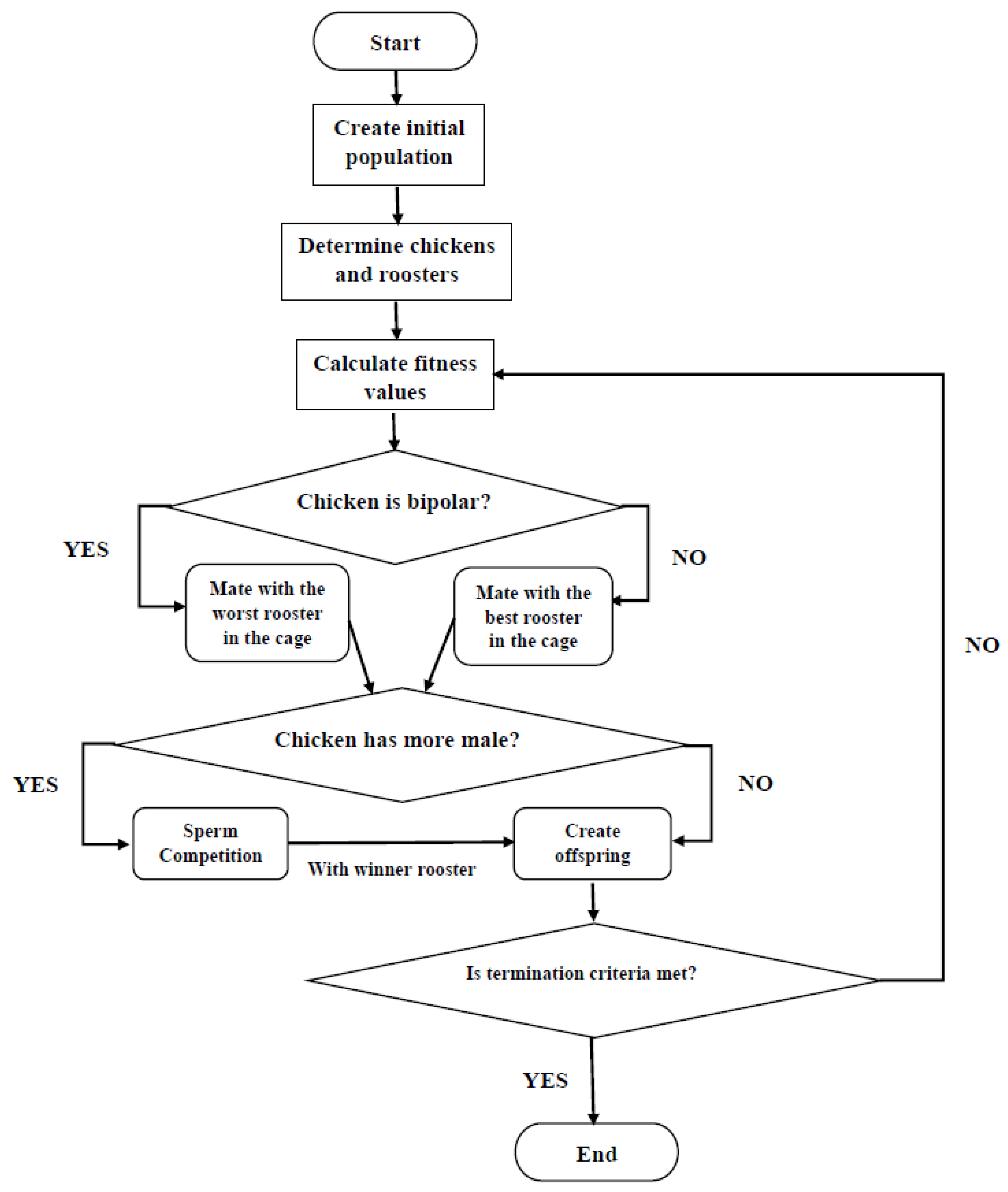
The decision to employ the Bipolar Improved Roosters Algorithm (BIRA) for this specific application is based on its proven performance in rigorous theoretical environments. BIRA has been extensively evaluated against standardized benchmarks, including the CEC’14, CEC’17, and CEC’20 test suites, where it demonstrated efficiency in optimizing non-linear functions with non-separable subcomponents [
31]. Therefore, in this paper, BIRA is used for PV parameter estimation and its performance is compared with the Simple Genetic Algorithm (SGA) [
32], PSO [
33] and GWO [
34], which are commonly used algorithms in the literature.
The contributions of this paper to the field of renewable energy and PV modeling are as follows:
This research presents the first practical implementation of the BIRA for the precise parameter estimation of single-diode PV models, bridging the gap between theoretical metaheuristics and real-world solar energy applications.
It demonstrates that BIRA’s unique bipolar selection mechanism provides a superior solution for the high-dimensional and non-linear search space of PV modules, effectively preventing the stagnation at local optima that frequently affects traditional optimizers.
The study provides an empirical validation of BIRA’s robustness across different solar cell technologies (Siemens SM55 mono-crystalline and Kyocera KC200GT multi-crystalline), achieving highly competitive RMSE values compared to established metaheuristics.
Through a rigorous multi-metric statistical framework, the paper quantifies the reliability of BIRA in terms of convergence stability and computational efficiency, establishing it as a high-precision tool for PV system monitoring and optimization.
The paper is organized as follows:
Section 2 describes the PV model. In
Section 3, the information of the previously proposed algorithm, BIRA, is given. In addition to presenting statistical tests,
Section 4 also shows the obtained results. Finally, the paper is concluded with
Section 5.
Table 1.
Reported numerical performance metrics of recent metaheuristic-based PV parameter estimation studies as stated in the original works.
Table 1.
Reported numerical performance metrics of recent metaheuristic-based PV parameter estimation studies as stated in the original works.
| Reference | Algorithm | PV Model | Dim. | Metric Reported | Numerical Value (As Reported) |
|---|
| Gong et al. (2013) [13] | Adaptive DE | SDM | 5 | RMSE | ≈ (best case) |
| Sharma et al. (2021) [24] | GWO | SDM | 5 | RMSE | ≈ |
| Yesilbudak (2021) [25] | Improved GWO | SDM | 5 | RMSE | ≈ |
| Rathod and Subramanian (2024) [21] | POA | SDM | 5 | RMSE | ≈ |
| Mai et al. (2024) [18] | Adaptive SO | SDM | 5 | RMSE | Best value reported (graphical) |
| Chen et al. (2025) [20] | TERIME | SDM | 5 | RMSE | ≈ |
| Murugaiyan et al. (2024) [35] | OBL–EDO | SDM | 5 | RMSE | ≈ |
| Elhosseny et al. (2025) [23] | Mutated DBA | SDM | 5 | RMSE | ≈ |
| Shi et al. (2024) [28] | RSWTLBO | SDM | 5 | RMSE | ≈ |
| Jabari et al. (2024) [29] | DCSA | SDM | 5 | RMSE | Numerical value not explicitly reported |
| Lo et al. (2024) [8] | PSO–ANN | SDM | 5 | RMSE | ≈ (experimental) |
| This work | BIRA | SDM | 5 | RMSE | 1.0504 , 4.8698 |
2. Photovoltaic Model
In the literature, various equivalent circuit models have been introduced to represent the electrical behavior of photovoltaic systems, including single-diode, dual-diode, and triple-diode formulations [
25].
While more complex models, such as the dual-diode model, can provide better physical representation under specific operating conditions, the additional parameters significantly complicate the process [
36,
37]. In contrast, the single-diode model captures the dominant electrical characteristics of photovoltaic modules while maintaining a relatively compact parameter set, making it particularly suitable for optimization-based characterization studies [
38].
Furthermore, the single-diode model (SDM) has been widely used as a benchmark in photovoltaic parameter estimation research, allowing for direct and fair comparison with numerous existing meta-heuristic and evolutionary optimization approaches. Its widespread acceptance in the renewable energy literature ensures both the methodological consistency and reproducibility of comparative analyses [
36,
38].
For these reasons, the SDM was chosen in this study to evaluate the performance of meta-heuristic optimization algorithms in photovoltaic parameter estimation problems.
2.1. Single Diode Photovoltaic Model
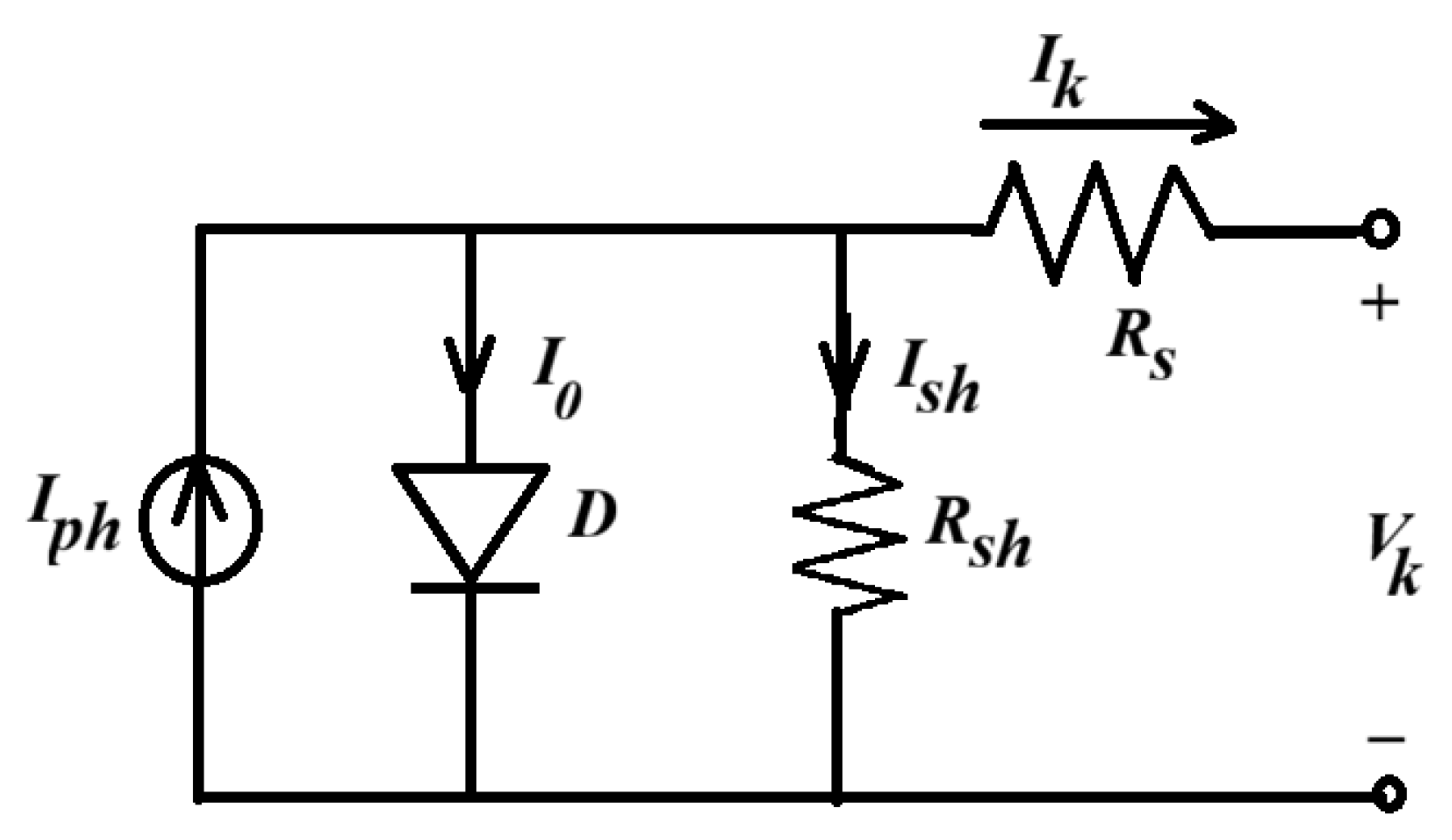
The electrical behavior of a photovoltaic module can be described by the single diode equivalent circuit (see
Figure 1), in which the output current is governed by a nonlinear implicit relationship. For a given terminal voltage
, the output current
is expressed as
where
denotes the photo-generated current,
is the diode reverse saturation current,
n is the diode ideality factor,
and
represent the series and shunt resistances, respectively. In Equation (
1),
denotes the exponential function defined as
and
e is Euler’s number. Moreover, in this equation, the presence of the current term inside the exponential function further increases the nonlinearity of the model, leading to a highly non-convex and multi-modal optimization landscape.
On the other hand, the thermal voltage
is defined as
with
being the number of series-connected cells,
T the cell temperature in Kelvin,
k the Boltzmann constant, and
q the elementary charge.
Due to the implicit and nonlinear nature of Equation (
1), it is not possible to determine the model parameters directly analytically; this transforms the parameter estimation task into a challenging nonlinear optimization problem.
2.2. Parameter Estimation as an Optimization Problem
Let
denote the experimentally measured current–voltage (I–V) data of the PV module under fixed environmental conditions. The objective is to determine the parameter vector
such that the discrepancy between measured currents and model-predicted currents is minimized.
This parameter estimation problem is formulated as the following constrained minimization task:
where
denotes an error-based objective function quantifying the mismatch between experimental data and the SDM response.
2.3. Metrics
To evaluate the estimation accuracy comprehensively, multiple error metrics are considered. Let
denote the residual at the
k-th data point, where
is obtained from the SDM. The utilized metrics are as follows:
2.3.1. Root Mean Square Error (RMSE)
where
N is the number of data points.
2.3.2. Mean Absolute Error (MAE)
2.3.3. Mean Absolute Percentage Error (MAPE)
where
is a small positive constant introduced to prevent numerical instability in low-current regions.
In this study, RMSE is employed as the main metric for the optimization process, while MAE and MAPE are utilized as supplementary metrics to evaluate the estimation accuracy.
4. Tests, Results and Discussion
To evaluate the performance of the metaheuristic algorithms, two widely recognized experimental datasets are employed. The first dataset is the Siemens SM55 mono-crystalline PV module (Siemens Solar, Camarillo, CA, USA), which consists of 33 pairs of measured current (I) and voltage (V) values at an irradiance of 1000 W/m2 and a cell temperature of 33 °C. The second dataset is the Kyocera KC200GT multi-crystalline PV module, featuring 31 pairs of I–V data points recorded at 1000 W/m2 and 25 °C. Both datasets represent non-linear optimization landscapes with five unknown parameters (), providing a robust benchmark for testing the precision and stability of the BIRA algorithm.
In this study, the entire experimental I–V dataset is utilized for the optimization process without data splitting into training and testing sets. This approach is consistent with the standard procedure in PV parameter estimation literature [
41,
42], as the objective is to perform a deterministic physical characterization (curve-fitting) of a specific PV cell rather than training a predictive model for unseen data. Since SDM consists of a fixed set of five physical parameters, it is not prone to over-parameterization risks typically associated with high-capacity models. This procedure ensures that the extracted values represent the most accurate physical characteristics of the module across its entire operational range, as supported by similar benchmark studies in the field, given in [
43].
4.1. I–V Data Generation and Parameter Bounds
Synthetic current-voltage (I–V) data were generated based on manufacturer-provided datasheet specifications, see
Table 2. For each photovoltaic module, the voltage domain was uniformly sampled over the interval
using a fixed number of voltage points. The resulting I–V curve was treated as measured data, and the optimization algorithms were employed to estimate the model parameters by fitting the SDM to this synthetic dataset.
The corresponding current values were obtained using the photovoltaic SDM under standard test conditions (STC), shown in
Table 2. The use of synthetic data derived from well-documented benchmark modules enables fair and repeatable comparison of optimization algorithms while avoiding measurement noise and external disturbances that could obscure algorithmic performance.
To maintain physical plausibility and improve numerical stability, search bounds for the SDM parameters were defined based on datasheet values and commonly adopted ranges reported in the photovoltaic parameter estimation literature, see
Table 3. In particular, the photocurrent was bounded around the short-circuit current, while broad but realistic intervals were specified for the diode saturation current, ideality factor, and resistive parameters. This bounded formulation ensures a balanced exploration of the search space while preventing nonphysical solutions.
The electrical characteristics reported in
Table 4 were used to define realistic operating conditions for each benchmark photovoltaic module, while the ground-truth SDM parameters listed in
Table 5 were employed to generate the synthetic I–V data under STC.
To ensure numerical stability during the optimization process, the argument of the exponential term in the SDM was bounded to a finite range, preventing overflow without affecting physically meaningful solutions.
4.2. Preliminary Information About Tests
SGA, PSO, and GWO were selected for comparison as they represent the most frequently utilized and cited paradigms in the field [
43], providing a robust baseline for evaluating BIRA’s performance.
Based on the parameter settings of SGA, PSO and GWO, respectively in [
32,
33,
44], the parameter settings in
Table 6 were chosen. For all simulations, the population size and the maximum number of iterations were both set to 100. This configuration results in 10,000 total function evaluations, which is considered robust for the five-parameter estimation problem. These values were selected based on empirical sensitivity analyses; it was observed that larger populations or higher iteration counts did not lead to a significant decrease in the objective function (RMSE) but increased the computational overhead. Given the rapid convergence properties of BIRA’s spiral-based search and bipolar selection, 100 iterations were sufficient to reach a stable global optimum for both the SM55 and KC200GT datasets, as shown in the convergence curves in
Section 4.4.
The code of BIRA, SGA and PSO were modelled by implementing MATLAB 2019a, on an 13th Gen Intel Core i7-13700H 2.40 GHz processor, while the code of GWO were taken from [
44].
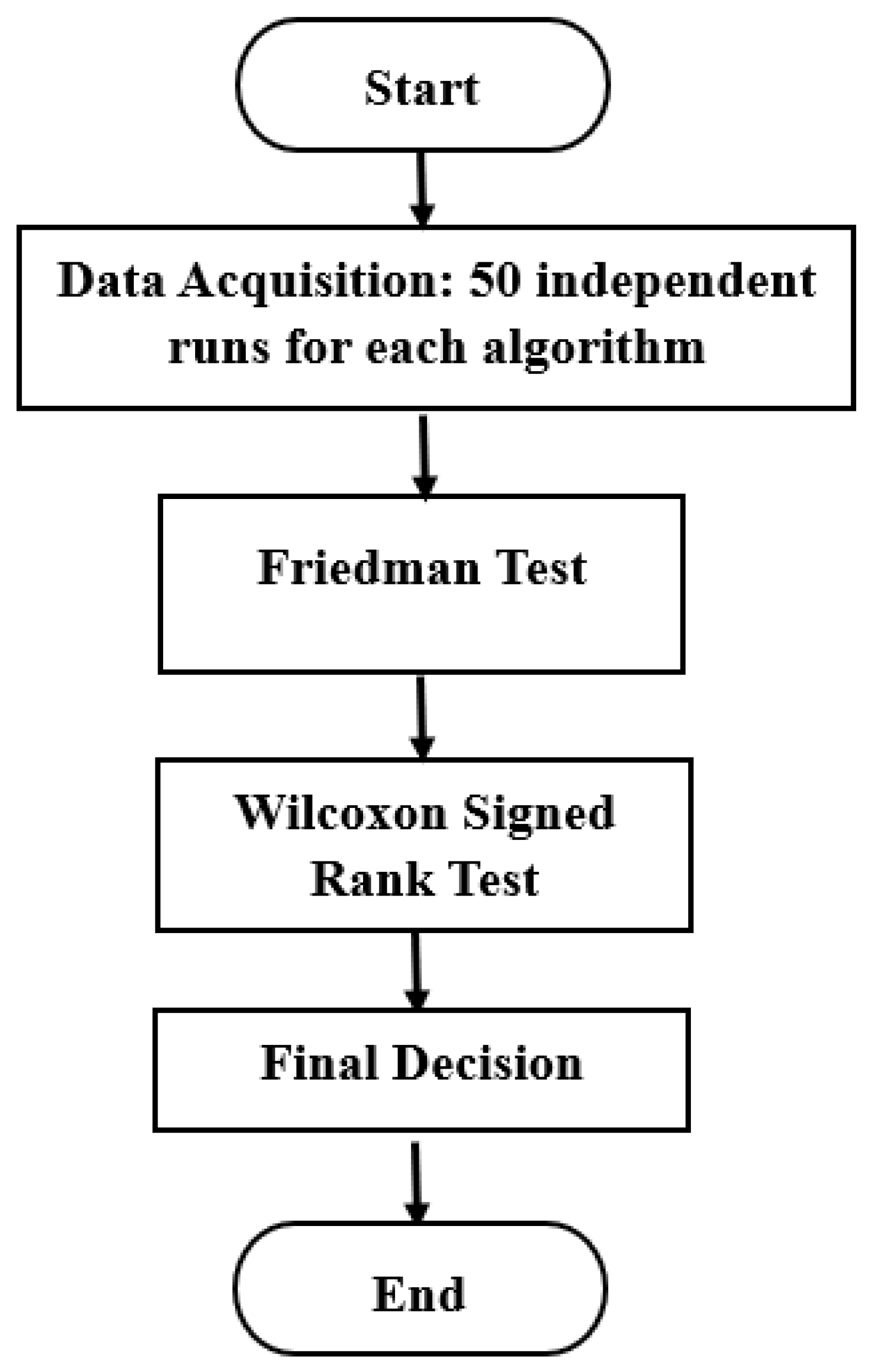
To ensure the statistical validity of the results, a systematic implementation flow was followed using MATLAB R2019a. First, each algorithm was executed for 50 independent runs to eliminate stochastic bias. The resulting RMSE values were then subjected to the Friedman test to determine the overall performance ranking. Finally, the
signrank function was employed to conduct the Wilcoxon Signed-Rank Test for pairwise comparisons between BIRA and its competitors. The implementation flow of this statistical validation is illustrated in
Figure 3.
4.3. Results of the Metaheuristic Algorithms
This section presents the comparative performance of the metaheuristic algorithms, SGA, PSO, GWO, and BIRA, for single-diode photovoltaic parameter estimation. The evaluation was conducted on two benchmark photovoltaic modules, Kyocera KC200GT and Siemens SM55, under STC.
The statistical performance of the algorithms is summarized separately for each error metric in order to provide a clear and unbiased assessment. This multi-metric evaluation allows the robustness and convergence reliability of the algorithms to be examined beyond single-point optimal solutions.
Although mean values are reported for completeness, the median is adopted as the primary performance indicator due to its robustness against extreme outliers caused by occasional infeasible solutions.
4.3.1. Evaluating According to MAE
Table 7 and
Table 8 report the MAE-based statistical results obtained for the Kyocera KC200GT and Siemens SM55 modules, respectively. As observed, the BIRA algorithm consistently achieves the lowest minimum MAE values for both modules. Moreover, BIRA exhibits smaller median and standard deviation values compared to the competing algorithms, indicating a more stable convergence behavior.
On the other hand, in
Table 8, although the mean of BIRA is slightly higher than that of PSO due to the sensitivity of the arithmetic average to occasional stochastic variations, BIRA achieves the lowest Median MAE (
) among all tested methods. This indicates that for the Siemens SM55 module, BIRA provides superior precision in the vast majority of experimental trials, confirming its high reliability for practical PV characterization.
4.3.2. Evaluating According to MAPE
The MAPE-based statistical results are presented in
Table 9 and
Table 10. Compared to absolute-error-based metrics, MAPE highlights the relative deviation between measured and modeled currents. The results demonstrate that BIRA maintains superior performance across both photovoltaic modules, achieving the lowest relative errors and improved robustness.
Notably, the large standard deviation values observed in MAPE results in
Table 10 are mainly caused by a small number of infeasible or near-divergent runs, which lead to extremely large penalty values. Such behavior is common in PV parameter estimation problems and highlights the sensitivity of MAPE to outliers rather than the overall optimization trend. Thus, the median value is considered a more robust performance indicator in this study, as it is less affected by extreme values and better reflects the typical behavior of each algorithm.
4.3.3. Evaluating According to RMSE
RMSE-based statistical results are reported in
Table 11 and
Table 12. The results indicate that BIRA consistently achieves lower RMSE values, confirming its enhanced optimization capability.
Regarding the RMSE results for the Siemens SM55 module presented in
Table 12, while BIRA achieves the most competitive median RMSE (
$0.012295267
$), its mean value is slightly affected by the stochastic nature of the search process. This specific case highlights the importance of reporting the median as a primary metric, as it more accurately represents the “typical” high-performance behavior of the BIRA algorithm by minimizing the skewing effect of occasional outliers. Despite this, BIRA maintains its overall superiority in solution quality and stability across the vast majority of experimental trials compared to PSO, GWO, and SGA.
The parameter sets in
Table 13 and
Table 14 were determined by considering the best results obtained from tests conducted with 50 different random seeds.
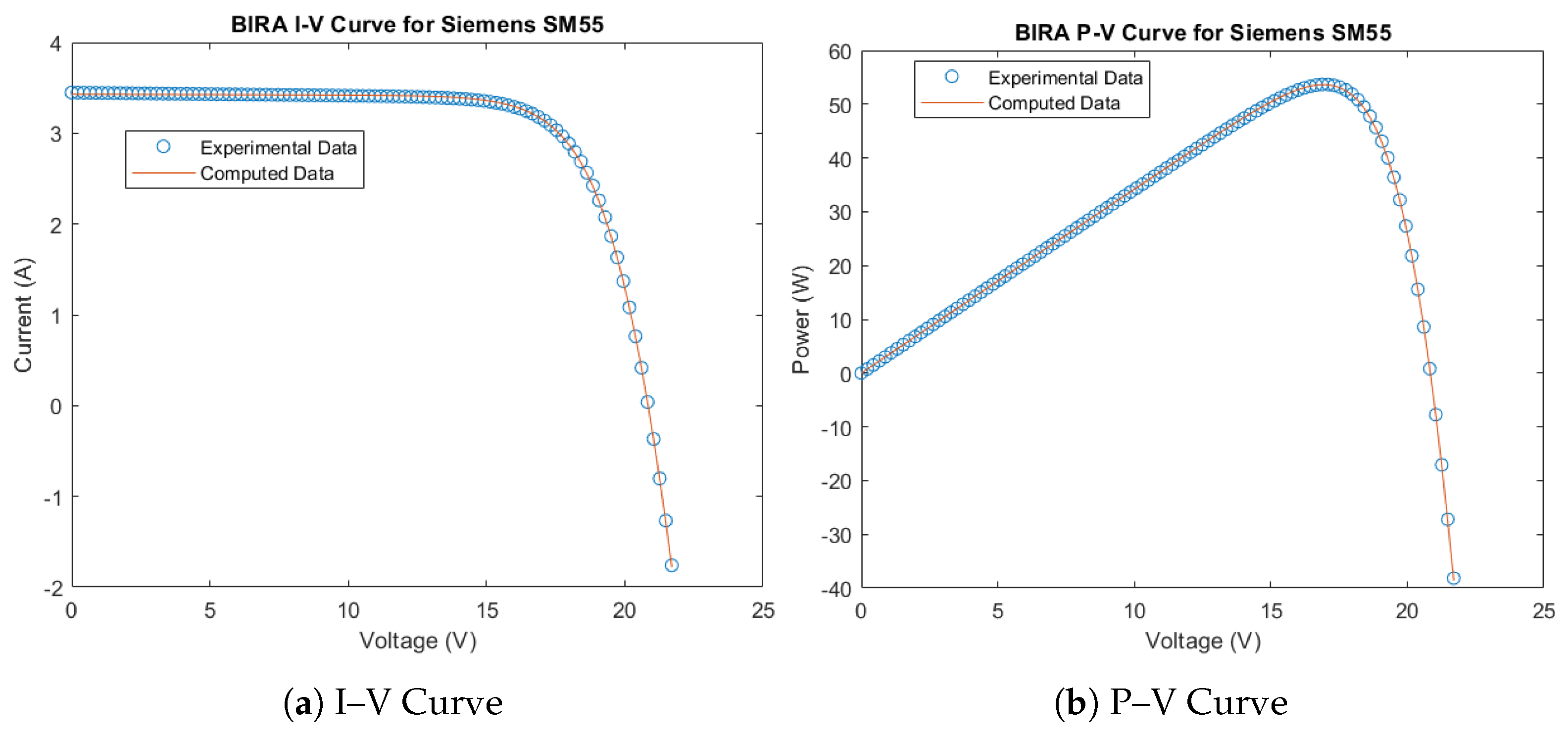
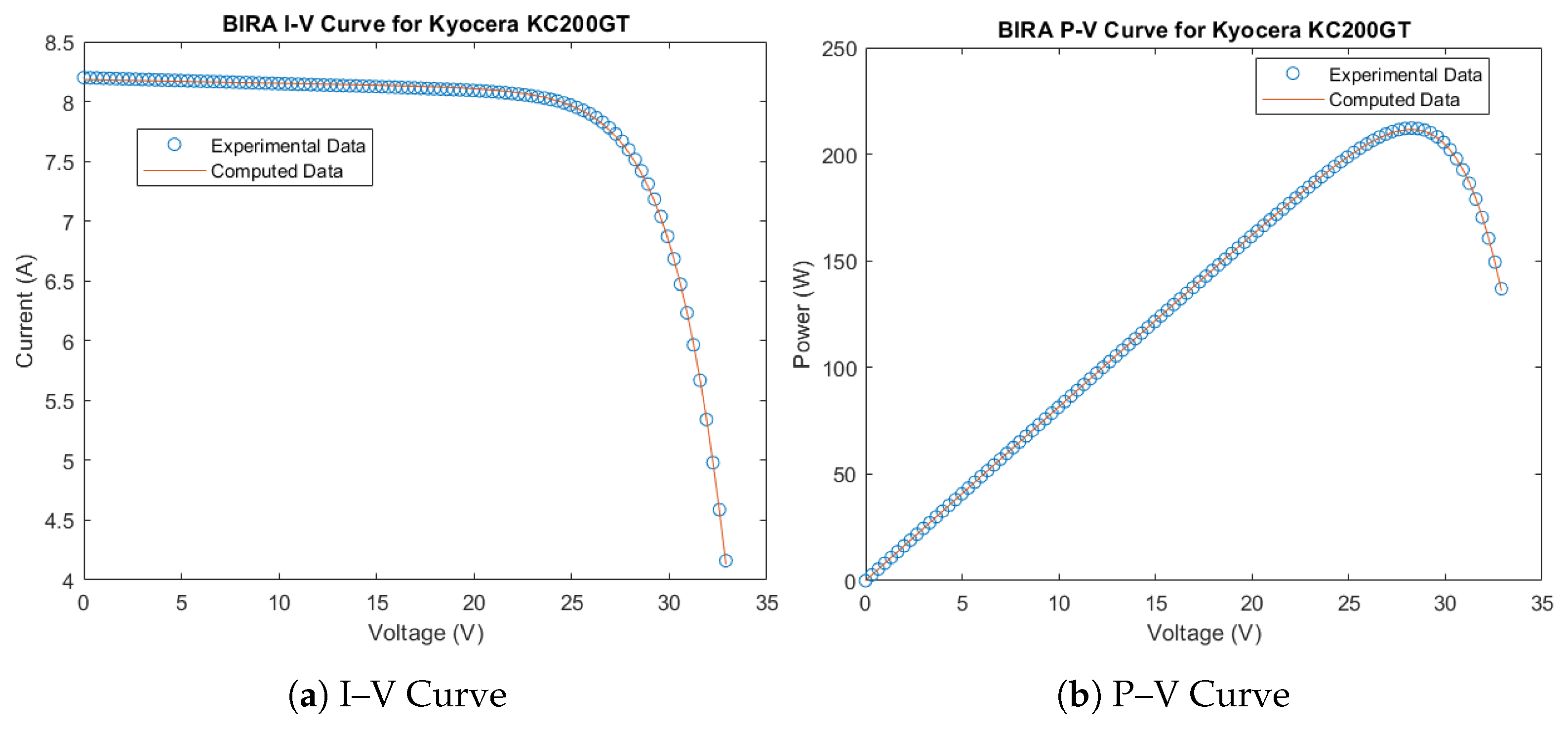
To visually evaluate the performance of the BIRA, the characteristics of the estimated I–V and P–V curves are compared with the experimental data.
Figure 4 and
Figure 5 illustrate these comparisons for both the Siemens SM55 and Kyocera KC200GT modules. As observed, the computed I–V curves (solid lines) perfectly overlap with the experimental data points (markers) across all regions, including the short-circuit, knee-point, and open-circuit areas. Furthermore, the P–V curves confirm that the maximum power point (MPP) is accurately identified. This high level of consistency demonstrates that BIRA can extract physically meaningful and highly precise parameters for different PV technologies.
4.4. Convergence Characteristics of the Algorithms
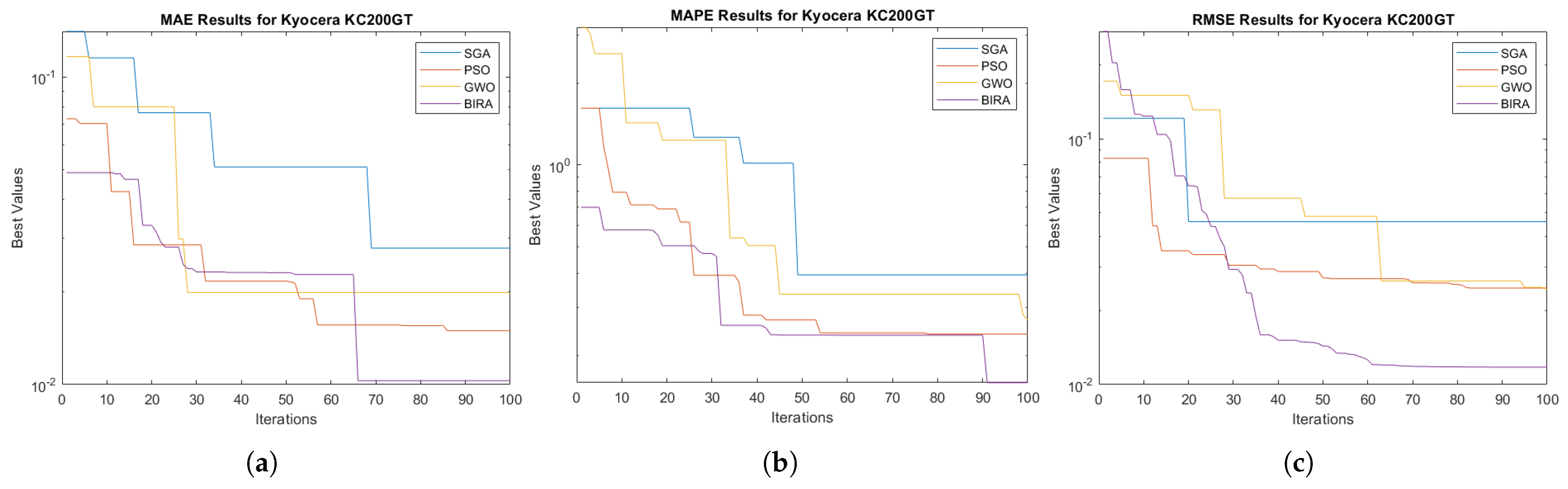
Figure 6 illustrates the convergence behavior of the algorithms for the Kyocera KC200GT module based on MAE, MAPE, and RMSE metrics. The results demonstrate that while PSO and GWO exhibit relatively fast initial convergence, their improvement stagnates at higher error levels.
In contrast, BIRA shows a more gradual but persistent reduction in error values throughout the optimization process, ultimately achieving the lowest final MAE, MAPE, and RMSE. The SGA exhibits the slowest convergence and converges to significantly higher error values, highlighting its limited exploitation capability in this problem setting.
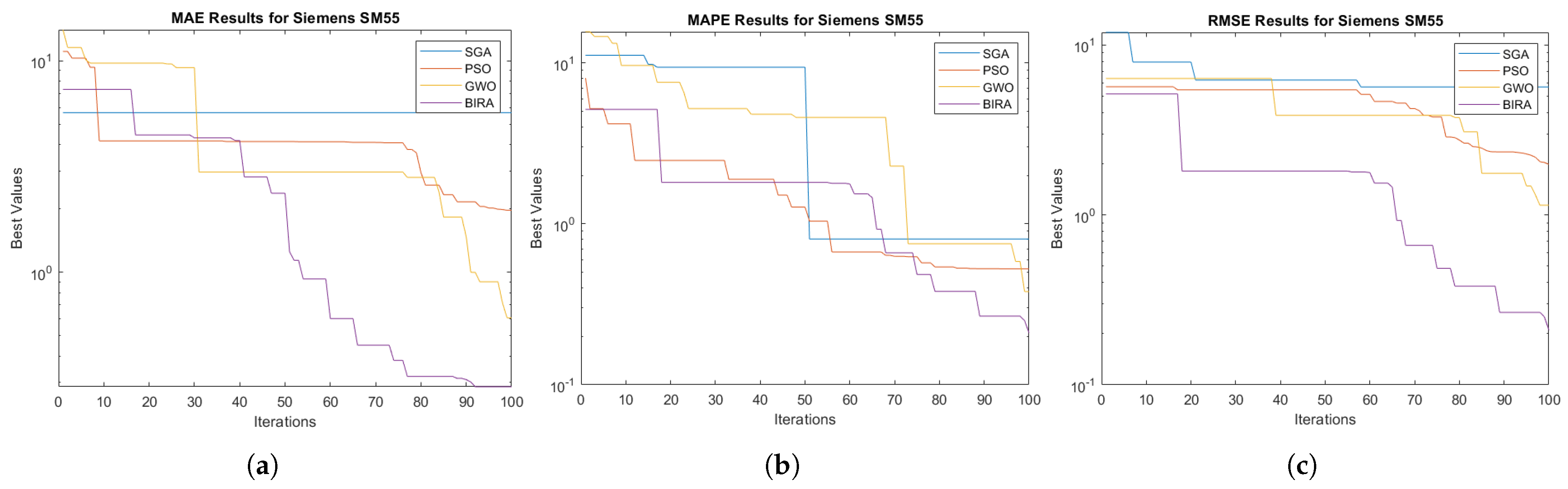
A similar trend is observed for the Siemens SM55 module, as shown in
Figure 7. BIRA outperforms the competing algorithms in all three error metrics, particularly in terms of final accuracy. Although PSO and GWO demonstrate competitive performance during early iterations, their convergence slows considerably after intermediate stages.
The superior performance of BIRA is especially evident in the RMSE metric, where it achieves substantially lower final values than the other algorithms. This indicates that BIRA is more effective in minimizing large residuals across the entire I–V curve, resulting in a more accurate overall model fit.
4.5. Statistical Results
Hypothesis testing is commonly employed to infer statistically meaningful differences among optimization algorithms [
45]. To this end, the null hypothesis (H
0) and the alternative hypothesis (H
1) are defined as follows:
H0: There is no statistically significant difference among the compared algorithms.
H1: There is a statistically significant difference among the compared algorithms.
The significance level is set to 0.05 for all statistical tests conducted in this study.
The Friedman test, originally proposed by Friedman, is a non-parametric statistical method widely used for comparing the performance of multiple algorithms across multiple test cases [
46]. In this test, the results obtained from each algorithm are ranked for every test case, and the average ranks are then computed to assess relative performance.
The Friedman test statistic follows a chi-square (
) distribution with
degrees of freedom, where
k denotes the number of compared algorithms. The critical chi-square value for
and
is 7.81 [
47].
As shown in
Table 15, the algorithm with the lowest mean rank demonstrates superior overall performance. The results clearly indicate that BIRA outperforms the competing algorithms. Moreover, the computed
value in
Table 16 significantly exceeds the critical threshold of 7.81, and the corresponding
p-value is well below the significance level. Therefore, the null hypothesis is rejected, confirming the presence of statistically significant differences among the compared algorithms.
However, the Friedman test does not reveal which specific algorithm pairs differ significantly. To address this limitation, the Wilcoxon signed-rank test [
48] is employed as a post-hoc analysis for pairwise comparisons.
The Wilcoxon signed-rank test results in
Table 17 indicate that most algorithm pairs exhibit statistically significant differences, as reflected by very small
p-values. In particular, the comparison between BIRA and PSO yields a relatively large
p-value, suggesting that their performances are closer to each other compared to other algorithm pairs, although BIRA still demonstrates superior overall ranking in the Friedman analysis.
5. Conclusions
This study evaluated the performance of the Bipolar Improved Roosters Algorithm (BIRA) in estimating the electrical parameters of single-diode PV models. The comparative analysis against SGA, PSO, and GWO demonstrated that BIRA provides superior accuracy, as evidenced by achieving the minimum RMSE values for both Siemens SM55 (1.0504 × ) and Kyocera KC200GT (4.8698 × ) datasets.
The reliability of the algorithm was confirmed through 50 independent runs and rigorous statistical assessments. The Friedman test ranked BIRA first across all scenarios, while the Wilcoxon signed-rank test validated the significance of its performance gap over traditional metaheuristics. This stability is primarily attributed to BIRA’s unique bipolar movement strategy, which prevents the algorithm from being trapped in local optima, a common limitation in complex PV modeling.
Regarding efficiency, convergence curves showed that BIRA reaches optimal solutions within a competitive number of iterations, demonstrating high computational speed. However, a limitation of this work is the focus on the single-diode model; future studies should evaluate BIRA’s performance on double-diode and multi-junction models to test its scalability.
In conclusion, the BIRA algorithm offers a robust, precise, and efficient alternative for PV parameter estimation. Its ability to balance exploration and exploitation makes it a promising tool for real-time energy management and PV system optimization.