


Abstract
With the development of wireless communication technologies, cooperation of automated vehicles (CAVs) becomes a key roadmap to promote the intelligent level and traffic efficiency. In this study, a distributed optimization framework is firstly designed to utilize more computation resources by introducing auxiliary variables and equality constraints to separate the coupling parts in the original centralized optimization problem. Bench test results show that more resources can be used by this framework compared with the centralized one, which is beneficial to the real time performance and scale of CAVs. But extra exchanges of the consensus variables between nodes lead to much more communication load, which easily causes packet loss. To ensure the cooperative performance, a robust interactive algorithm is further designed to ensure the convergence of the numerical optimization process in the presence of packet loss. Its global convergence is analyzed theoretically by the operator method under the assumption that the feasible domain is convex. The performances of CAVs controlled by the robust distributed optimization algorithm are validated and verified by several comparative tests under the intersection scenario. The test results show that compared with the centralized structure, the balance of computation load among different nodes is improved by 5 times at least, and the maximum computation period is smaller than 50 ms.
Keywords:
automated vehicle; cooperative driving; distributed optimization; communication packet loss MSC:
49M29
1. Introduction
With the rapid development of wireless communication technologies, such as dedicated short range communication and etc., cooperative control of automated vehicles (CAVs) has been attracting more and more attention in recent years [1]. Besides the benefits to driving comfort, traffic efficiency, and safety, it can even reform the transportation mode [2]. When designing the cooperative control system, such requirements as driving safety [3], traffic regulation [4], fuel economy [5], and robustness to model uncertainties [6,7] have already been considered widely from the perspective of driving.
1.1. Typical Cooperative Structures
Generally, according to the used information, cooperative structures can be divided into two types, i.e., distributed and centralized ones. With the former, each vehicle is controlled by the local information of neighboring vehicles [8,9]. Limited by the used information, the distributed structure can only realize some comparatively typical and simple driving tasks, e.g., car following [9], platooning [6,10], lane-keeping [11], etc. To enrich the applicable conditions, some manual designed rules have been integrated by some researchers to realize CAV in such scenarios as ramp-merging and intersection [8]. Since only local information is used, the distributed structure is efficient from the perspective of communication. But it is hard to achieve the global optimal performance, and the applicable scenarios are comparatively simple.
Another structure is called a centralized one, which can use the information from all traffic participants. Accordingly, it can deal with more complex driving scenarios and achieve better performances. Since all information of traffic participants is available, synthesis of the centralized controller is typically formulated as a global optimization problem, which is further solved numerically and interactively through such techniques as coalitional game theory [12], model predictive control [13,14], and learning-based approaches [15,16]. With the aforementioned strategy, the centralized approach has been adopted successfully in more complicated driving scenarios for better traffic performances, such as multi-lane merging [12,13], signal-free intersection [15,16] and etc.
Though the centralized structure is beneficial to automated driving functionalities and performances, the scale of CAVs and real-time performance are both limited. It is well known that the required computational resource for numerical optimization increases rapidly with the dimension of optimization variables [17]. Moreover, with the centralized structure, all computation should be completed by one specified node because of the fundamentals of general numerical optimization theory [18,19]. This poses substantial challenges to practical applications, especially when the number of vehicles becomes comparatively large. Though, some researches have tried to use the multi-threading and multi-core capabilities of the central node to accelerate the optimization process [20,21], the computation resources of other nodes in the cooperative environment still cannot be utilized.
1.2. Cooperation Under Communication Constraints
In addition, the effectiveness of current methods depends on stable and reliable wireless communication greatly, because the accuracy and convergence performance will be sacrificed by information loss due to communication packet dropouts [22]. Being different from the distributed structure, with the centralized one, the information of all traffic participants should be collected by the central node, and so the packet loss of wireless communication is more critical due to the higher communication load. To reduce the communication frequency, a filter is designed in [23] to avoid transmitting inefficient data, a stochastic event-triggered mechanism is presented for separable problems in [24], and both data rate and transmission power are jointly optimized for the wireless sensor network in [25]. For the multiagent system governed by a fixed directed graph, the convex optimization problem is solved by the distribution framework considering communication delay in [26,27]. Furthermore, both communication delays and inconsistent updates can be dealt with when there only exist local boundary and inequality constraints [28]. For the specific centralized optimization problems, e.g., energy optimization of ethylene production [29], some methods have been proposed to deal with the communication delay [30]. These distributed optimization methods can deal with packet loss and information delay, but they are only applicable to separable problems or those with simple additive constraints [29]. Especially for some simple driving scenarios of CAVs, e.g., platooning, such technologies as robust control [31] and compensation by state estimation [32,33] have been presented to mitigate the adverse effects caused by packet loss. But for such complex scenarios as intersection, the relative motion between vehicles with its influence on the performance becomes much more complicated. The current approaches for scenarios where all vehicles drive in the same direction with the pre-defined formation can hardly work finely again.
To overcome the above challenges, in this study a distributed optimization framework is designed firstly to use more computation resources in the cooperative environment by decomposing the global optimization problem into several sub-ones and assigning them to different computing nodes. Then, considering the problem of packet loss caused by the higher communication load, a robust algorithm is proposed and analyzed theoretically to ensure the convergence of the numerical interactive process. The improvement of performances is shown in Table 1 comparatively according to the test results in Section 2.3 and Section 4. In Table 1, load balance is measured by the absolute deviation between maximum and minimum Central Processing Unit (CPU) utilization among different nodes, real-time performance is measured by average calculation period when vehicle number is 5, and scalability is measured by the increasement of calculation period when vehicle number varies from 5 to 45.
Table 1.
Improvement of performances.
The main contributions of this study are:
- (1)
- The centralized optimization problem of CAVs with couplings in the constraints for collision avoidance is converted into the separated form by introducing the consensus variables and linear equality constraint;
- (2)
- The computation efficiency of the distributed computing structure is further enhanced by solving the consensus variables analytically and decoupling the sparse relation matrix;
- (3)
- A robust algorithm is proposed to ensure the convergence of numerical interactive process in the presence of packet loss, and its global convergence is analyzed theoretically;
- (4)
- The performance of the proposed strategy is analyzed and validated through several bench tests considering packet loss by the intersection scenario.
2. Distributed Optimization Framework Design
The objective of CAVs is to generate vehicle control input to realize global optimal driving performance, including ride comfort, fuel efficiency, safety, etc. In this study, such requirements as ride comfort and fuel efficiency are deal with by the planning module, which generates the referenced trajectory . In this study, the information from all traffic participants is available with the centralized structure, and the synthesis of CAVs is generally considered as the following global optimization problem [34,35]:
where is the set composed of vehicle index, is the predictive horizon, is the reference trajectory, and are the weighting matrices, , and are the state, output and control of vehicle , whose dynamics and constraints are described by Equation (2) [36]. Equation (3) is the constraint for safety [36], and is the set composed of index pairs for interactive vehicles.
Because of the coupling in the constraint described by Equation (3), the numerical optimization only can be executed by one specified node, when using such methods as game theory [37] and optimal method [38] to solve the problem described by Equations (1)–(3). To ensure real-time performance, the computation ability and resources are great challenges for on-board units, especially when the vehicle number is comparatively large. To use the computation resources in the cooperative environment as much as possible, a distributed computation framework is presented for CAVs in this section for better scale extensibility and computation efficiency.
2.1. Problem Decomposition
Alternating direction methods of multipliers (ADMMs) are widely used methods to realize parallel optimization, but they can only deal with the separable optimization problem with linear equality constraints [39]. To convert the optimization problem described by Equations (1)–(3) into the format that can be dealt with by ADMM, firstly, two indicator functions, i.e., and , are introduced to combine the constraints of Equations (2) and (3) with Equation (1) as follows:
In the optimization problem Equation (4), except for the indicator function for collision avoidance, all other parts can be separated into sub-problems as according to the vehicle node. Considering that ADMM can deal with linear equality constraints, the following auxiliary variables and equality constraint are introduced to decouple and the vehicle states:
where is the introduced consensus variable. Then by substituting in with , the optimization problem Equation (4) is converted into the following format, which can be dealt with by ADMM:
where , , and denotes the identity matrix. For better numerical stability, the relaxed ADMM is adopted to solve Equation (6) by the following interactive process [40]:
where is the penalty parameter, is relax parameter, is the intermediate variable and is the dual variable.
Since the first equation in Equation (7) is an unconstrained quadratic programming problem, its optimal solution can be solved analytically as
Then the following simplified interactive process is obtained by substituting (8) into (7):
It can be found from Equation (9) that the original optimization problem for CAVs described by Equations (1)–(3) becomes separable now. In the next section, a distributed optimization framework will be designed by assigning the decoupled parts into different nodes to utilize the computation resources in the cooperative environment as much as possible.
2.2. Distributed Optimization Without Considering Packet Loss
Considering the definition of , the sub-problems in Equation (9) can be divided into two types. One depends on vehicle nodes, and the other is to optimize the auxiliary variables and is independent of vehicle nodes. Considering this characteristic, the following interactive step is designed to solve Equation (9):
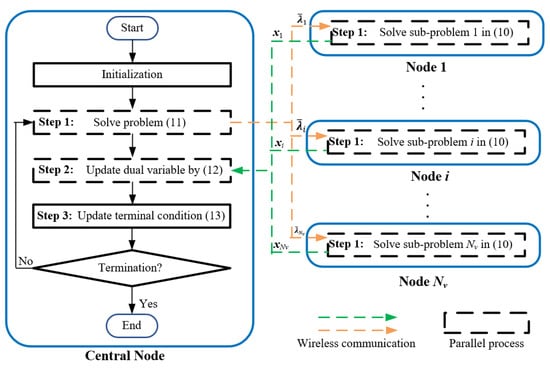
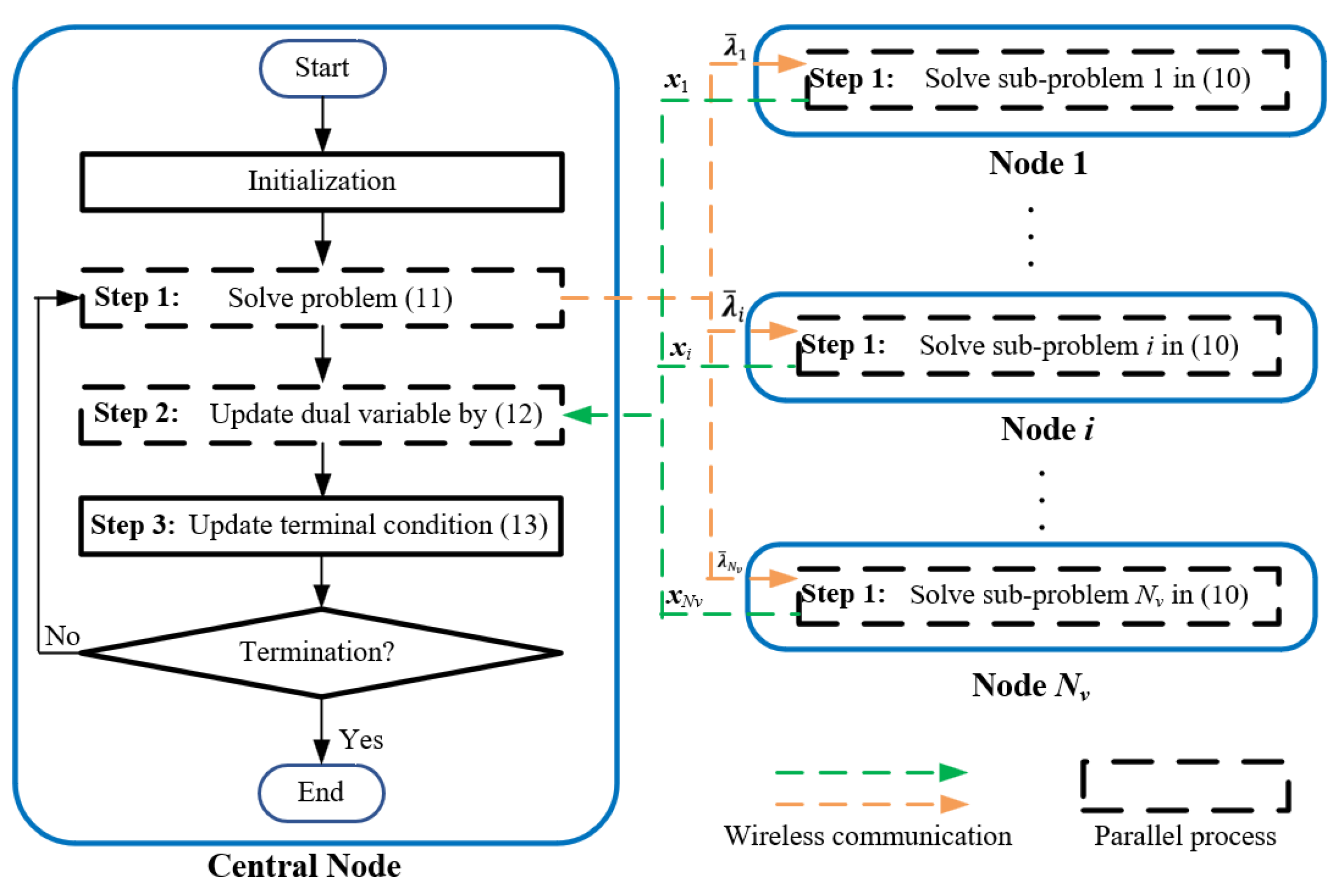
Step (1) Primal optimization: The update of , i.e., the first optimization problem in Equation (9), is divided into the following sub-problems:
Step (2) Update of dual variable:
Step (3): Convergence evaluation: If the following termination condition is satisfied or reaches the maximum number of iterations, automated vehicle is controlled by the optimized ; otherwise, return to Step (1):
where and are the primal and dual tolerances, respectively.
According to the above interactive process, the distributed optimization process is presented as Figure 1, where there are computation nodes, including a central node and vehicle nodes.
Figure 1.
Flowchart of distributed optimization process.
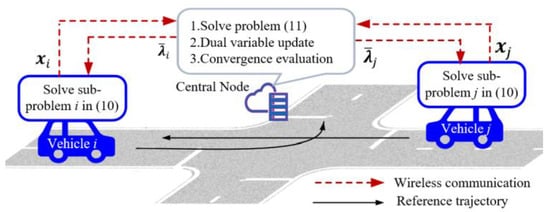
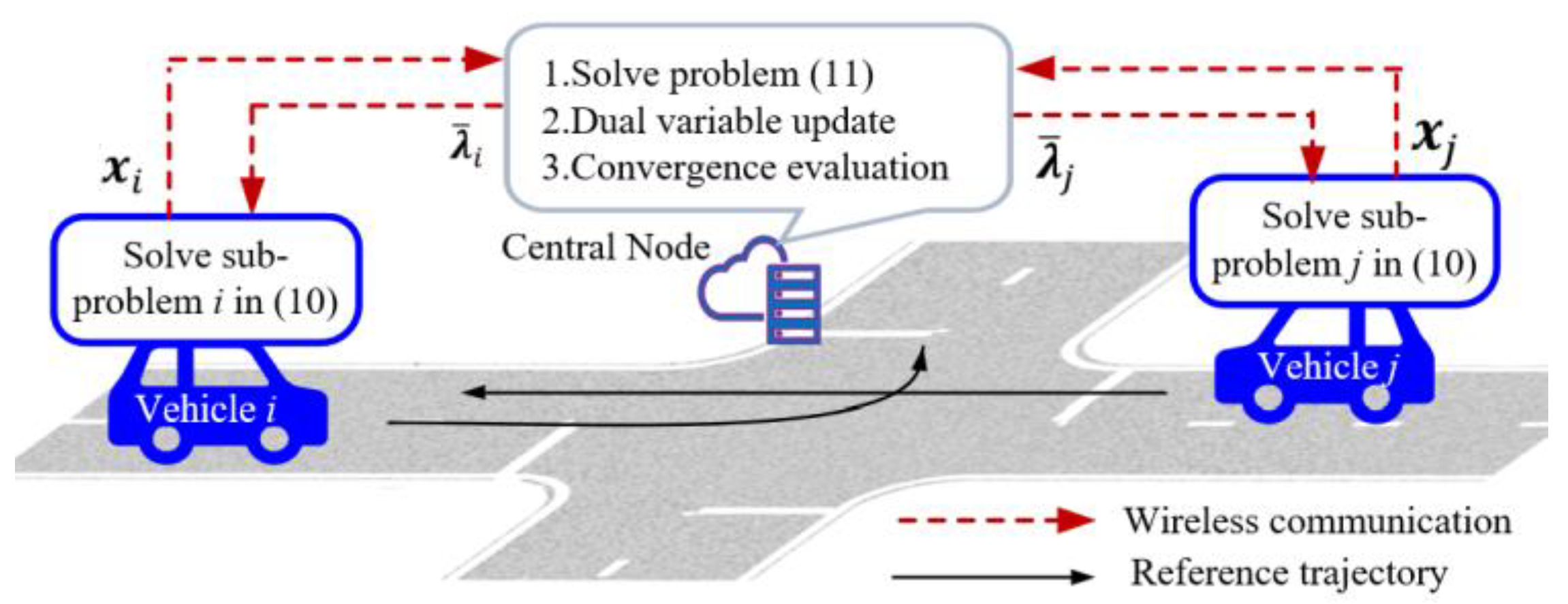
The distributed optimization process shown by Figure 1 can be deployed to the cooperative environment of CAVs as in Figure 2. Vehicle node is responsible for solving the sub-problem in Equation (10) and then transmitting to the central node. The central node is responsible for solving Equation (11), updating dual variables according to Equation (12), and evaluating the convergence condition described by Equation (13).
Figure 2.
Distributed optimization framework for CAVs.
For the presented distributed optimization framework shown by Figure 2, it should be noted that:
- (1)
- To avoid unnecessary communications, each subproblem in Equation (10) is assigned to the corresponding vehicle node, and compared with the original problem, Equation (4), the dimension of the optimization variable for each subproblem is significantly reduced.
- (2)
- The numerical complexity of Equations (11)–(13) is comparatively low compared with that in Equation (10), and so they all are deployed in the central node.
- (3)
- Both on-board units and roadside units can act as the central node, and some method has been presented in [41] to assign dynamic tasks for better efficiency.
- (4)
- Compared with the centralized structure, more information should be transmitted by wireless communication, and a high communication load easily leads to packet loss, which will be dealt with in Section 3.
2.3. Performance Evaluation by Bench Tests
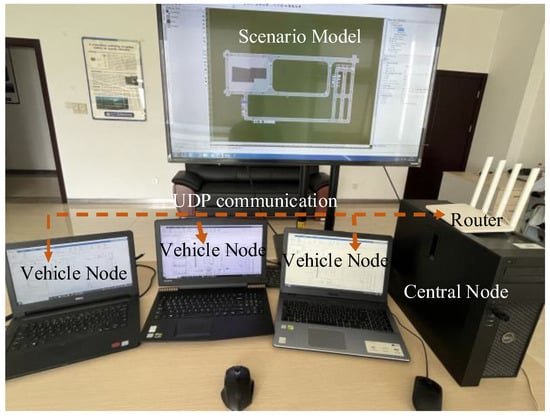
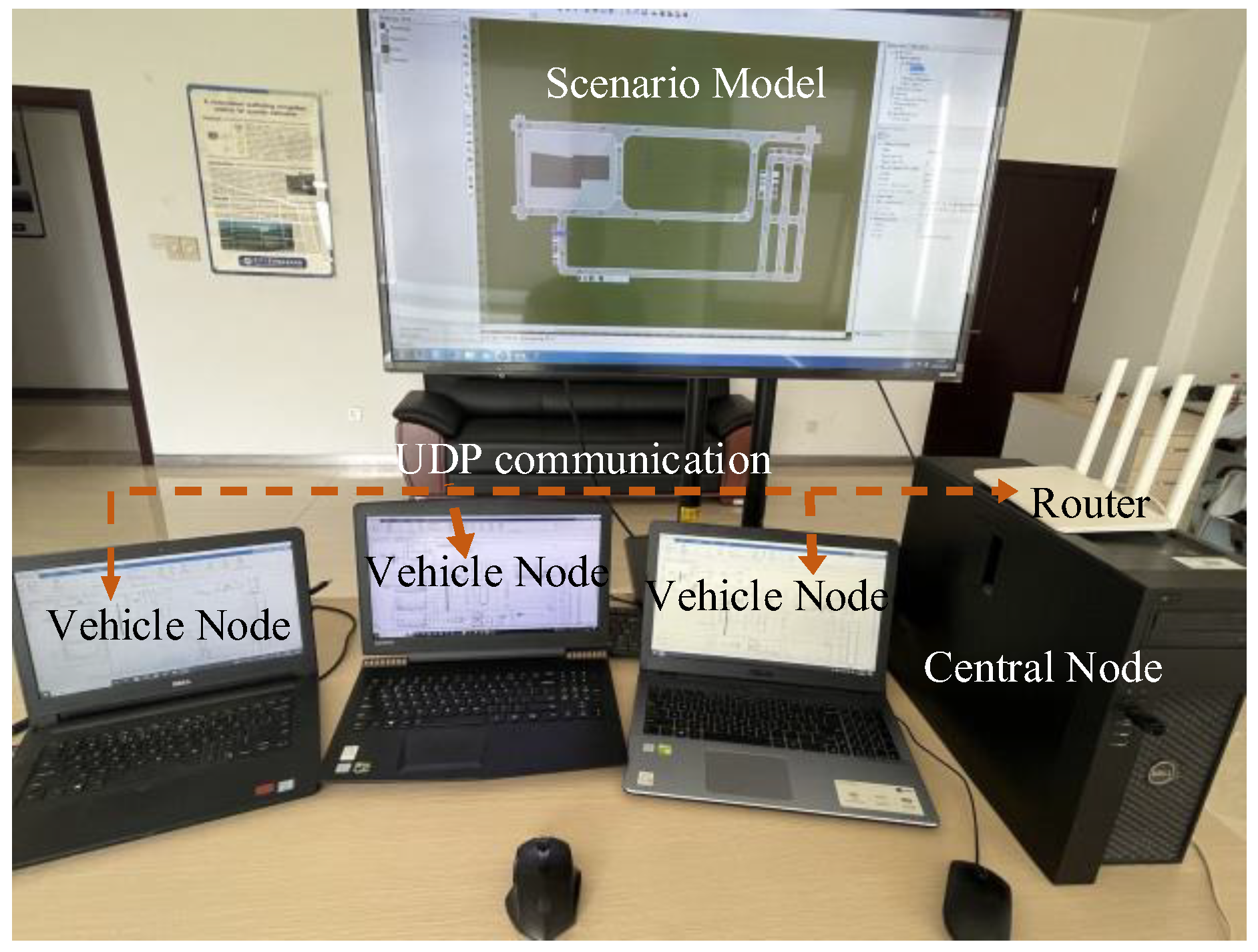
To evaluate the effectiveness of the distributed optimization framework presented in Section 2.2 in the improvement of resource utilization, a test bench shown by Figure 3 is set up, which includes four workstations and a Wi-Fi router. The desktop workstation (3.2 GHz i914900KS processor) acts as the central node and other three laptops (2.3 GHz i9-13900HX processor) act as the vehicle nodes. The numerical algorithms are developed by Matlab 2024b and integrated into Simulink by the interfaces provided by Prescan 2403, which is a real-time simulation platform for CAV [42]. The information is transmitted by the Wi-Fi router with UDP protocol.
Figure 3.
Test bench composed of four nodes.
In the simulation scenario, three vehicles navigate through an intersection like that in Figure 2, and the parameters are set as in Table 2.
Table 2.
Parameter values of distributed optimization algorithm.
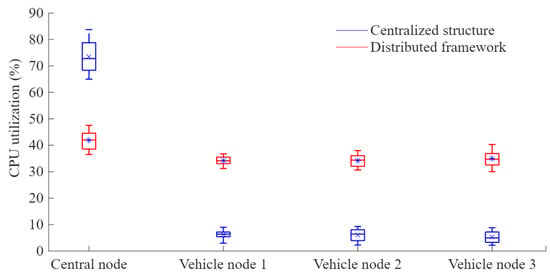
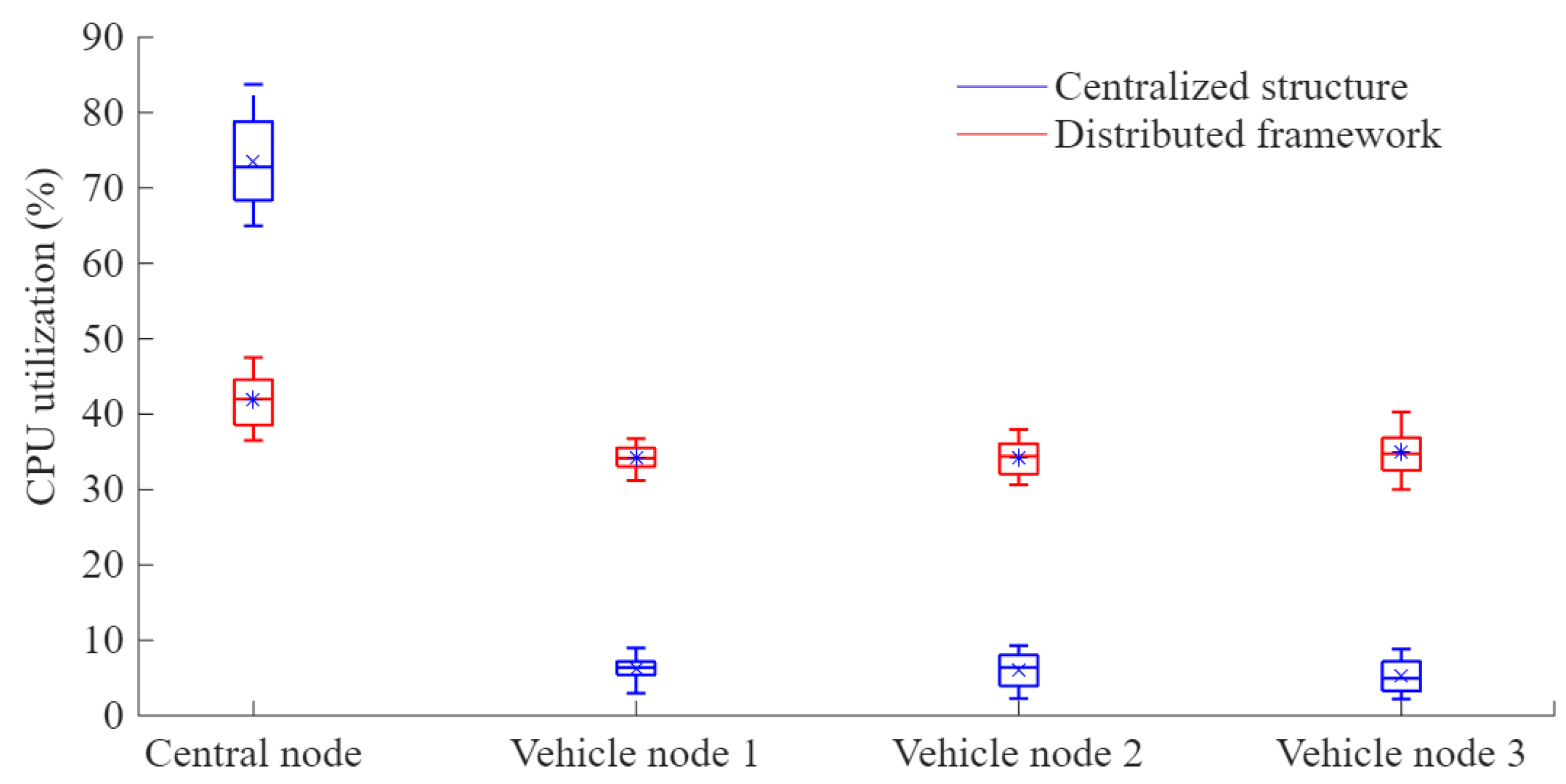
Since the consumption of computational resources from basic software is almost the same, CPU utilization is adopted to measure the computational efficiency [43], and the comparative results are shown in Figure 4 statistically.
Figure 4.
Comparative results of computation efficiency.
Figure 4 shows that compared with the centralized structure, the maximum CPU utilization of the central node is reduced by 36.2% by the presented distribution optimization framework. On the other hand, the utilization rates of other three vehicle nodes are increased by 21.5% at least. This implies that the proposed distributed framework can use more computation resources in the cooperative environment, which is beneficial to the real-time performance and scalability of CAVs. However, compared with the centralized structure, there are more data transmissions between vehicles and central node as shown by Figure 2. The reliability of wireless transmission easily degrades when the communication load becomes high. In the study conducted by Lei et al. [44], the average error of vehicle lateral position reaches 1.5 m when the packet loss rate is about 20%. This easily causes severe collisions with surrounding vehicles. Moreover, the packet loss also causes failure of receiving information from other nodes in time, which is also bad for the convergence of the interactive process [40].
3. Distributed Optimization in Presence of Packet Loss
To deal with the problem of packet loss caused by the extra communications in the distributed optimization framework presented in Section 2, a robust algorithm is further designed and analyzed in this section.
3.1. Distributed Optimization Considering Packet Loss
According to the distributed optimization framework shown in Figure 2, the optimization problem Equation (10) and the dual variable update Equation (12) are mainly influenced by packet loss. When packet loss happens, Equation (10) is optimized with the latest information, otherwise remains unchanged. Accordingly, the distribution optimization algorithm presented in Section 2.2 is redesigned as the following Algorithm 1.
| Algorithm 1: Distributed optimization considering packet loss. |
| and maximum interaction number While terminal condition (13) is false For all vehicle nodes and central node in parallel, do Vehicle node i solves sub-problem i in (10) with the latest and then transmits to Central node; Do in Central node Solve (11) and then transmits to vehicle i; Update terminal condition (13); do if there exits packet loss ; Else ; ; End if End for End do End for End while |
3.2. Robustness of Convergence Performance
According to Algorithm 1, when there exist communication constraints, the dual variable is updated randomly, asynchronously and partially. For such interaction process, it is hard to design an effective Lyapunov function to ensure required decremental property. On the contrary, the Peaceman-rachford operator approximates the optimal solution by alternately solving two subproblems [45,46], which is similar to the relaxed ADMM adopted in this study. Therefore, the operator theory is used to analyze the convergence of Algorithm 1. Firstly, the original update of the dual variable is replaced by a relaxed Peaceman-rachford operator. Then, each interaction is described as a random activation process of the operator by modeling packet loss as an independent random variable. Finally, the convergence of Algorithm 1 is ensured by analyzing the change characteristic of the average square error of the operator, which does not increase with the interactions.
Since the Bernoulli process can model the random characteristic of packet loss in wireless communication simply and effectively [31,45], the packet loss rate is modeled as
where is a random signal and 0 means a successful communication between vehicle and the central node. Then according to the robust distributed optimization algorithm described by Pseudocode, the update process of in the presence of packet loss becomes
According to Equation (15), there are forms of updates for based on the structure of and all these possibilities are indexed by . Without loss of generality, a random independent and identically distributed sequence is defined to represent the updated subcomponents of at the th iteration [46].
To simplify the theoretical analysis of convergence performance, it is assumed that the optimization problem in Equation (4) is convex and has a saddle point set (). Based on the operator theory, the operator and its average operator are defined. Then from the perspective of operator theory [40], the relaxed ADMM can be regarded as the relaxed Peaceman-Rachford operator, which uses the averaged form of to find the fixed point .
Let denote the probability space, where is the sample space, is the -algebra and is the probability measure. Then a weight matrix is defined as follows:
where denotes the probability of being selected for update at the th iteration. Then conditionally to the -algebra , the following conditional expectation chain is obtained:
On the other hand, according to Bayes theorem [47] and the definition of in Equation (16), we have
Then the following equation is obtained by substituting the definition of in Equations (16) and (18) into Equation (17):
Since is an averaged operator, it satisfies the following inequality [48]:
Then according to the pre-defined average operator, the following inequality can be obtained since :
Substituting Equation (21) to Equation (19) yields the following inequality:
It can be concluded from Equation (22) that is a nonnegative super-martingale with respect to the -algebra [46]. Then according to the martingale convergence theorem [47], converges to a non-negative random variable. This implies that is always smaller than the previous value; thus, it converges to a finite value [49].
From the convergence of and , it can be further known from the recursion process described by Equation (22) that
Since is always greater than zero, it can be concluded from Equation (23) that . According to the previous assumption that problem Equation (4) has a saddle point set (), it can be concluded that and , since the duality gap of Equation (4) is zero, and the variables, and , are governed by the vehicle dynamics. The above theoretical analysis shows that besides better computation efficiency, the proposed distributed optimization algorithm is also robust to packet loss of wireless communication.
4. Evaluation and Validation
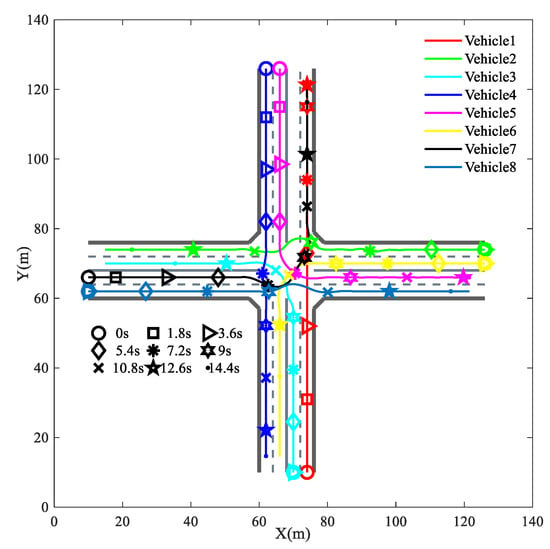
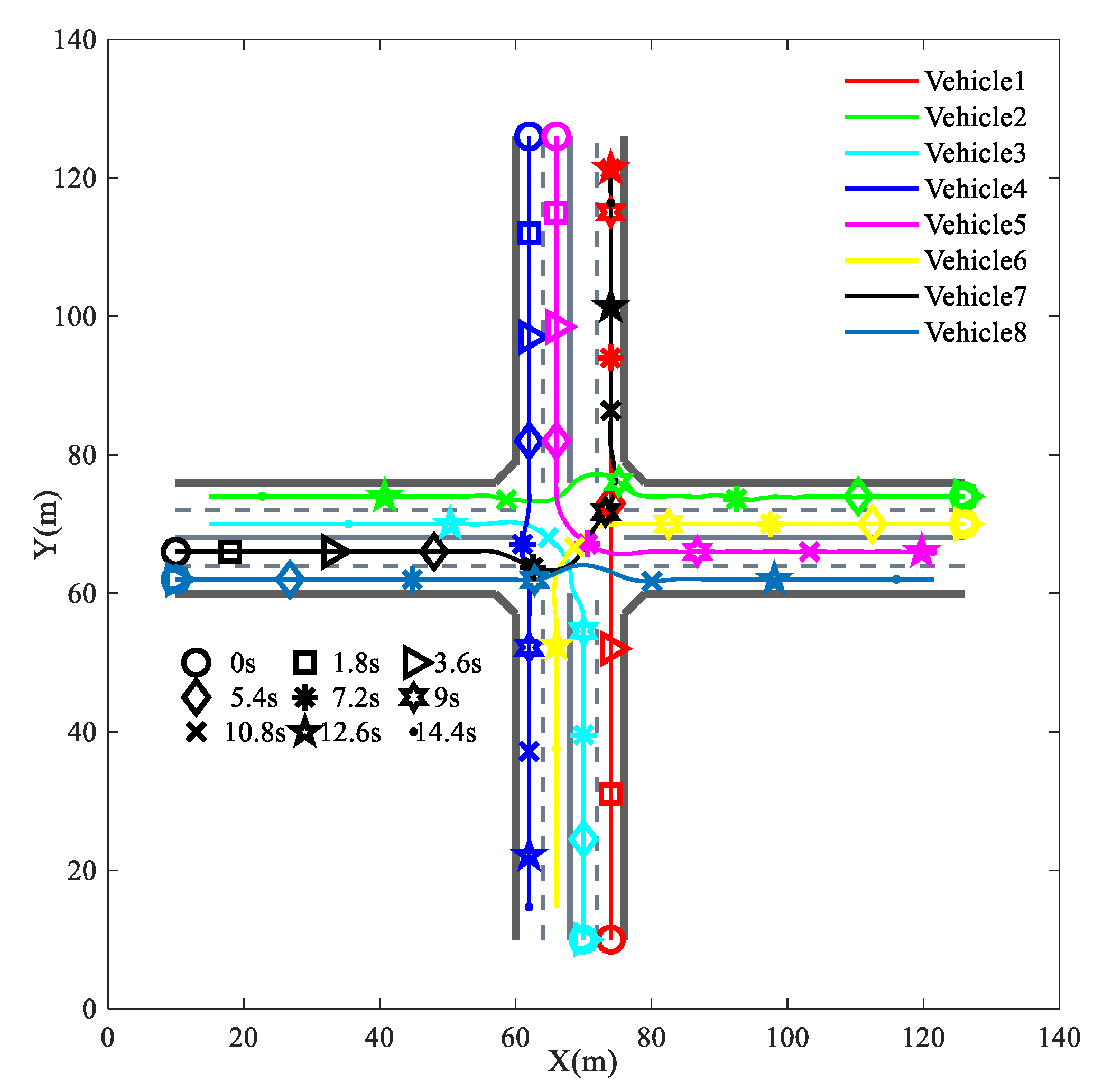
Since the performance of CAVs is affected by many factors, such as vehicle dynamics, traffic scenarios, road conditions, and etc., as far as we know, there’s no benchmark dataset to evaluate it. To comprehensively evaluate and validate the proposed distributed optimization algorithm for CAVs, the simulation platform in Section 2.3 is adopted to conduct the tests under complex conditions for convenience. The simulation is conducted in the unsignalized intersection scenario with eight automated vehicles under different rate of packet loss. When the packet loss rate is set to 0.2, the trajectory of CAVs is shown by Figure 5.
Figure 5.
Vehicle trajectories at intersection.
As shown in Figure 5, before entering the intersection, all vehicles can follow the reference trajectory accurately, since there is no risk of collision with adjacent vehicles. It should be noted that at 7.2 s, vehicle 2 has no risk of collision with other vehicles, but its trajectory deviates slightly from the reference due to the packet loss. Nevertheless, it returns to the reference trajectory quickly when the communication is restored. This shows the robustness of the proposed algorithm. Furthermore, when these vehicles navigate the intersection, the compact space at the intersection will lead to collisions between vehicles if they still drive along the reference trajectories. Consequently, each vehicle adjusts its trajectory to ensure a safe distance and goes back to the reference trajectory smoothly once the risk is eliminated. Ultimately, all vehicles pass through the intersection safely and drive to their destinations along the reference trajectories.
4.1. Comparative Analysis of Convergence
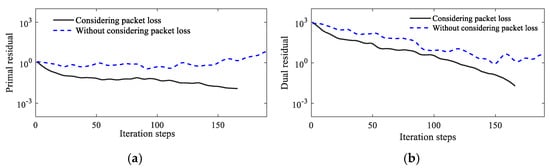
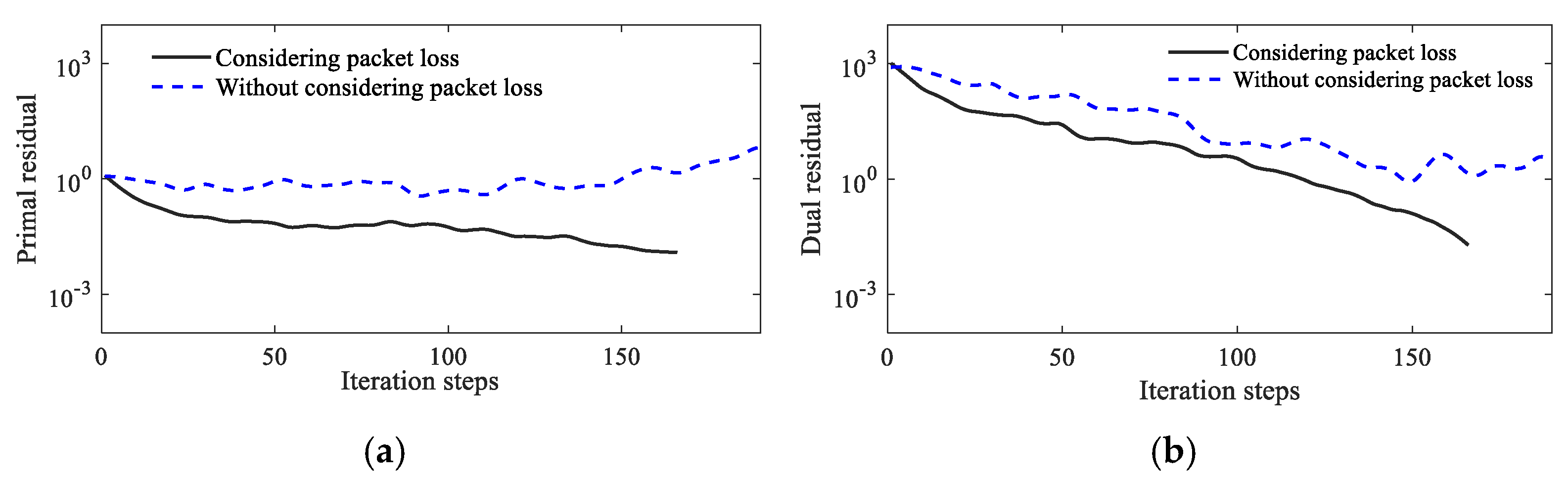
The convergence performance of the robust algorithm designed in Section 3 is compared with the original one without considering packet loss. When the packet loss rate is set to 0.2, the comparative results are shown in Figure 6.
Figure 6.
Comparison results of convergence performance: (a) Primal residual; (b) Dual residual.
As shown in Figure 6, although the updates of are affected by packet loss, the primal and dual residuals still steadily decrease and reach the convergence tolerance after about 165 iterations when considering the packet loss. In contrast, the original algorithm in Section 2.2 doesn’t consider the negative influence of packet loss, so the two residuals increase after 150 iterations due to packet loss. This shows the effectiveness of the algorithm designed in Section 3 in attenuating the negative impact of packet loss and ensuring the convergence of interactive process, which is also analyzed theoretically in Section 2.3.
4.2. Influence Analysis of Packet Loss Rates on Convergence
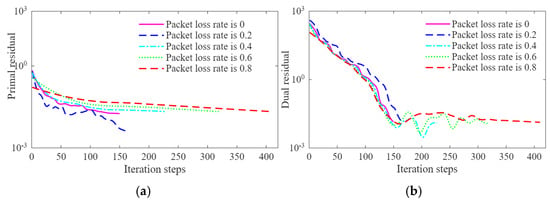
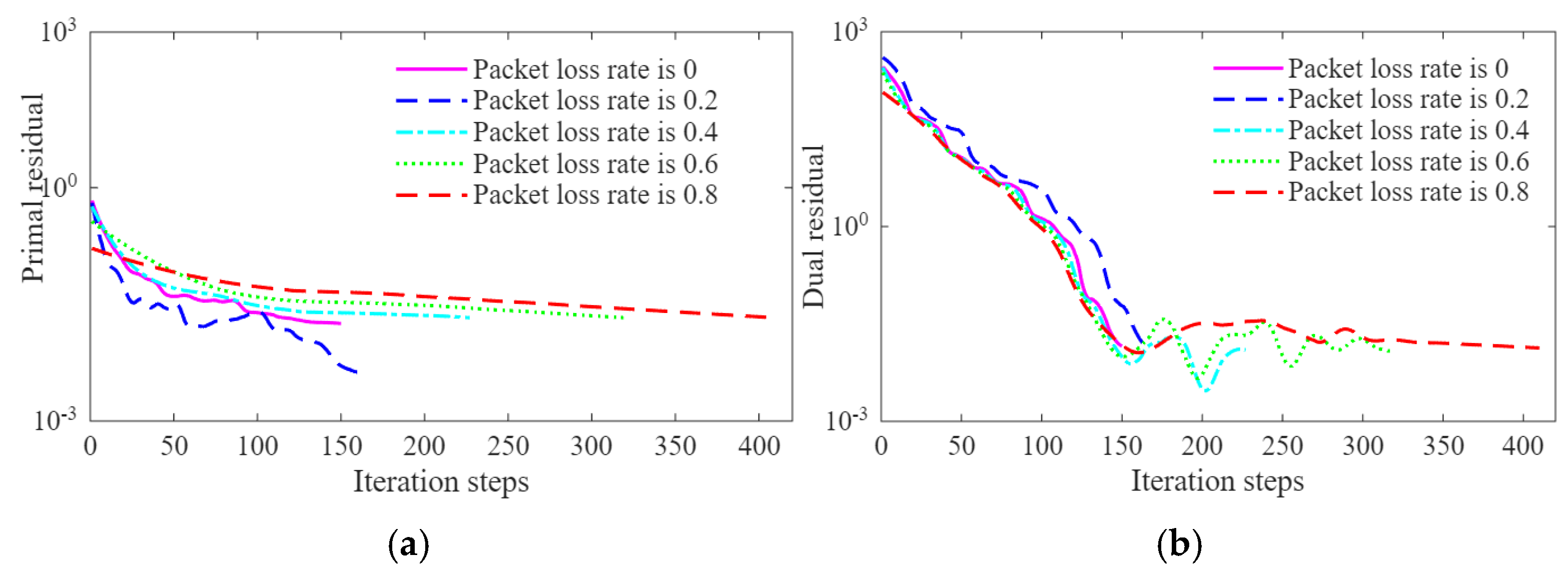
To validate the robustness, the convergence performance is evaluated under the communication conditions with different packet loss rates. The packet loss rate is set to 0, 0.2, 0.4, 0.6, and 0.8, respectively, and the results are shown in Figure 7.
Figure 7.
Influence of packet loss rate on convergence: (a) Primal residual; (b) Dual residual.
It can be found from Figure 7 that with the increase in the packet loss rate, to meet the convergence condition, the required number of iterations increases. The reason is that a higher rate of packet loss will reduce the effectiveness of the update of the dual variable. On the other hand, if “out-of-date” information of the dual variable is used, more interactions are required intuitively. Though, a larger rate of packet loss is bad for the convergence performance, the primal and dual residuals still can reach the predefined condition. This shows that the proposed distributed optimization algorithm is robust to packet loss.
4.3. Real-Time Performance Analysis
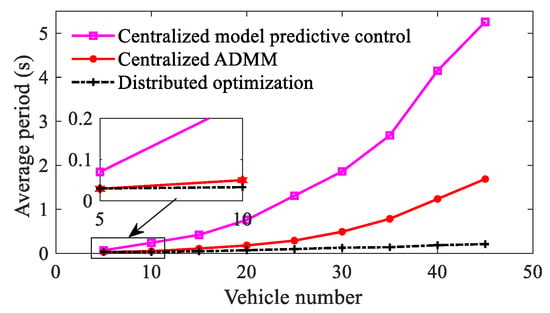
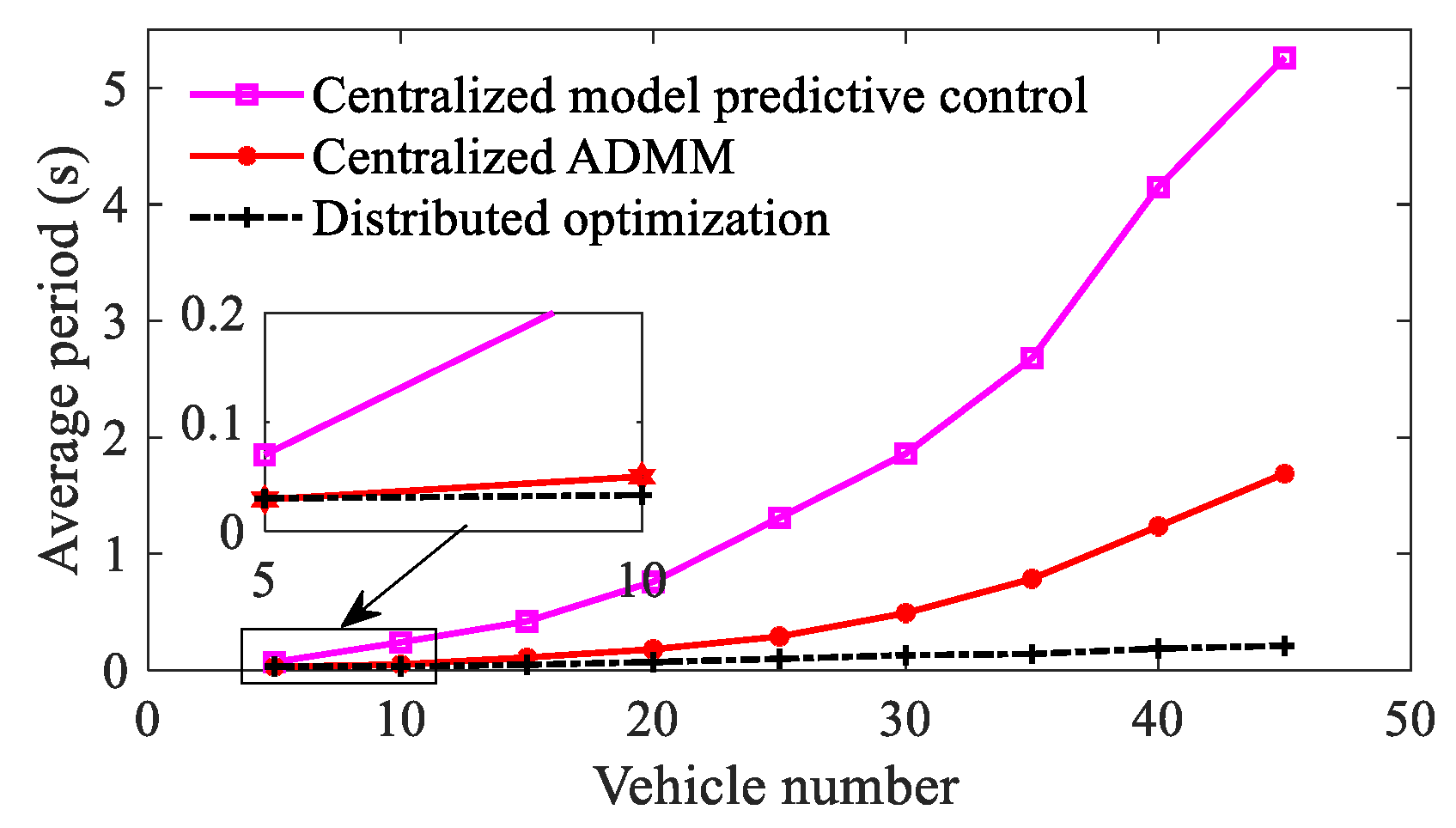
The motivation of this study is to present an efficient distributed optimization algorithm to utilize the computation resources in the cooperative environment as much as possible for better real-time and scalability performances of CAVs. Considering that the compared methods should: (a) be robust to packet loss of wireless communication; (b) deal with such complex driving scenarios as intersection; (c) and achieve the global optimal cooperative performance, the proposed method is compared with two typical methods, i.e., centralized model predictive control (MPC) [13] and centralized ADMM [12]. The platform shown by Figure 3 is adopted to conduct the comparative test and analysis. Centralized MPC and centralized ADMM are only deployed in the central node. Each calculation task of our method is deployed in one core of the CPU to simulate multi-nodes in the cooperative environment. The average calculation period is used to measure the real-time performance and the comparative results are shown in Figure 8.
Figure 8.
Comparative results of real-time performance.
As shown in Figure 8, the average period of centralized MPC is larges and increases with the vehicle number quickly, since only one core is used to solve the optimization problem. Comparatively, centralized ADMM can use multiple cores of the same processor. Accordingly, its average period is much less. But when the vehicle number is bigger, about 20, the average period increases much faster, since the required computation resource exceeds the computation power of the processor, and much more time is needed to ensure the convergence of the numerical interaction process. Compared with centralized MPC and ADMM, the proposed distributed optimization algorithm can use the computation resources of all vehicles, and its average period is the least. Moreover, the most complex optimization problem described by Equation (10) is totally separated and solved by the corresponding vehicle node in parallel. Theoretically, the single step solution time is independent with vehicle number, so there is only a small increase in average period when the vehicle number increases from 5 to 45.
5. Discussions
The distributed cooperation structure is efficient in both communication and computation, but it can only realize some simple cooperative functions, such as platooning, and cannot achieve the global optimal performance. Recently, centralized structure has been getting more attention, and most studies devote to accomplish more complicated driving tasks under complex traffic scenarios. But typical centralized methods can only use the computation resource of a specific node [12,13], which poses great challenges for practical applications.
The motivation of this study is to present an efficient distributed optimization algorithm to utilize the computation resources in the cooperative environment as much as possible for better real-time and scalability performances of CAVs. The proposed frame work can utilize the computation resources of all nodes and the balance of computation load among different nodes is improved by 10 times at least as shown in Figure 4.
For the problem of packet loss caused by the extra communications, the typical methods are only applicable to separable problems [24,28] or those with simple additive constraints [29]. For CAVs controlled by distributed structure and governed by fixed formation topology, some effective methods have been presented in [31,33]. But they can hardly be adopted directly, since the system dynamics of centralized CAVs is totally different. As shown by Figure 6 and Figure 7, the designed numerical algorithm can optimize the control of centralized CAVs and is robust to packet loss.
6. Conclusions
This study presents an efficient distributed optimization framework for CAVs to utilize the computation resources in the cooperative environment as much as possible. With this framework, a robust distributed optimization algorithm is further designed considering the packet loss. The theoretical and bench test results show that:
- (1)
- Compared with the centralized structure, the proposed distributed optimization framework can utilize the computing resources in the cooperative control environment more efficiently;
- (2)
- With the assumption that the optimization problem of CAVs is convex and has a saddle point set, the robust stability of the distributed optimization algorithm can be ensured theoretically in the presence of pack loss;
- (3)
- The simulation results show that the proposed algorithm is robust to packet loss of wireless communication, and the interactive process can still converge to the optimal solution, even when the rate of packet loss is high.
There are some open questions to be further studied:
- (1)
- In this study, such driving requirements as ride comfort and fuel efficiency are required to be deal with by the planning module and only collision avoidance is considered. The contradiction among different driving requirements may degrade the global performance of this separated strategy. Such influences on the cooperative performance need to be further analyzed.
- (2)
- The bench test results show that Algorithm 1 is robust to packet loss, but the converge characteristic is only analyzed theoretically under the convex assumption. Generally, both vehicle dynamics and collision avoidance constraint are nonlinear and non-convex. More theoretical analysis about Algorithm 1 considering more practical conditions is necessary.
Author Contributions
Conceptualization, supervision and writing—review and editing, F.G.; investigation and validation, F.L.; formal analysis, J.M.; Software and validation, J.L. and X.Z. All authors have read and agreed to the published version of the manuscript.
Funding
This research was funded by Joint Natural Science Fund of Chongqing, grant number CSTB2025NSCQ-LZX0167 and Science and Technology Innovation Program of Chongqing, grant number CSTB2023TIAD-STX0029 and CSTB2023TIAD-STX0028.
Data Availability Statement
The original contributions presented in this study are included in the article. Further inquiries can be directed to the corresponding author.
Conflicts of Interest
Author Jie Ma was employed by the China Automotive Engineering Research Institute Co., Ltd. The remaining author declares that the research was conducted in the absence of any commercial or financial relationships that could be construed as a potential conflict of interest.
References
- Li, M.; Ahn, S.; Zhou, Y.; Li, S. Virtual car following based cooperative control of connected automated vehicles in complex scenarios: A roundabout example. Transp. Res. Part C Emerg. Technol. 2025, 173, 105062. [Google Scholar] [CrossRef] [Scilit]
- Rashidi, T.H.; Najmi, A.; Haider, A.; Wang, C.; Hosseinzadeh, F. What we know and do not know about connected and autonomous vehicles. Transp. A Transp. Sci. 2020, 16, 987–1029. [Google Scholar] [CrossRef] [Scilit]
- Yi, Z.; Li, L.; Qu, X.; Hong, Y.; Mao, P.; Ran, B. Using artificial potential field theory for a cooperative control model in a connected and automated vehicles environment. Transp. Res. Rec. 2020, 2674, 1005–1018. [Google Scholar] [CrossRef] [Scilit]
- Sun, Z.; Huang, T.; Zhang, P. Cooperative decision-making for mixed traffic: A ramp merging example. Transp. Res. Part C Emerg. Technol. 2020, 120, 102764. [Google Scholar] [CrossRef] [Scilit]
- Mersky, A.C.; Samaras, C. Fuel economy testing of autonomous vehicles. Transp. Res. Part C Emerg. Technol. 2016, 65, 31–48. [Google Scholar] [CrossRef] [Scilit]
- Wang, J.; Tong, T.; Cao, J.; Li, S. Distributed sliding mode control approach with adaptive spacing policy for vehicle platoons in communication interruption. Sci. Rep. 2025, 15, 20409. [Google Scholar] [CrossRef] [Scilit]
- Prayitno, A.; Indrawati, V.; Yusuf, Y.G. Synchronizing vehicle platoons: A distributed model reference control approach with input saturation. Eng. J. 2025, 29, 79–90. [Google Scholar] [CrossRef] [Scilit]
- Katriniok, A.; Rosarius, B.; Mahonen, P. Fully distributed model predictive control of connected automated vehicles in intersections: Theory and vehicle experiments. IEEE Trans. Intell. Transp. Syst. 2022, 23, 18288–18300. [Google Scholar] [CrossRef] [Scilit]
- Zhou, Y.; Wang, M.; Ahn, S. Distributed model predictive control approach for cooperative car-following with guaranteed local and string stability. Transp. Res. Part B Methodol. 2019, 128, 69–86. [Google Scholar] [CrossRef] [Scilit]
- Wang, J.; Lian, Y.; Jiang, Y.; Xu, Q.; Li, K.; Jones, C.N. Distributed data-driven predictive control for cooperatively smoothing mixed traffic flow. Transp. Res. Part C 2023, 155, 104274. [Google Scholar] [CrossRef] [Scilit]
- Utriainen, R.; Pöllänen, M.; Liimatainen, H. The safety potential of lane keeping assistance and possible actions to improve the potential. IEEE Trans. Intell. Veh. 2020, 5, 556–564. [Google Scholar] [CrossRef] [Scilit]
- Zhang, X.; Cheng, Z.; Ma, J.; Huang, S.; Lewis, F.L.; Lee, T.H. Semi-definite relaxation-based ADMM for cooperative planning and control of connected autonomous vehicles. IEEE Trans. Intell. Transp. Syst. 2022, 23, 9240–9251. [Google Scholar] [CrossRef] [Scilit]
- Klingbeil, X.; Wegener, M.; Zhou, H.; Herrmann, F.; Andert, J. Centralized model-predictive cooperative and adaptive cruise control of automated vehicle platoons in urban traffic environments. IET Intell. Transp. Syst. 2023, 17, 2154–2170. [Google Scholar] [CrossRef] [Scilit]
- Dong, C.; Lyu, K.; Li, N.; Xiong, Z.; Ni, D.; Li, Y.; Chen, Y.; Wang, H. A hierarchical-centralized MPC strategy for connected automated vehicular platoon incorporating level interactions. Transp. Res. Part C 2025, 170, 104911. [Google Scholar] [CrossRef] [Scilit]
- Guan, Y.; Ren, Y.; Li, S.E.; Sun, Q.; Luo, L.; Li, K. Centralized cooperation for connected and automated vehicles at intersections by proximal policy optimization. IEEE Trans. Veh. Technol. 2020, 69, 12597–12608. [Google Scholar] [CrossRef] [Scilit]
- Shi, H.; Zhou, Y.; Wu, K.; Wang, X.; Lin, Y.; Ran, B. Connected automated vehicle cooperative control with a deep reinforcement learning approach in a mixed traffic environment. Transp. Res. Part C Emerg. Technol. 2021, 133, 103421. [Google Scholar] [CrossRef] [Scilit]
- Hu, Q.; Gao, F.; Ma, J.; Yang, Q. A real-time optimization path planner for parking in dynamic environments. Optim. Eng. 2026, 1–22. [Google Scholar] [CrossRef] [Scilit]
- Burger, C.; Lauer, M. Cooperative multiple vehicle trajectory planning using MIQP. In Proceedings of the International Conference on Intelligent Transportation Systems, Maui, HI, USA, 4–7 November 2018. [Google Scholar] [CrossRef] [Scilit]
- Savazzi, S.; Nicoli, M.; Bennis, M.; Kianoush, S.; Barbieri, L. Opportunities of federated learning in connected, cooperative, and automated industrial systems. IEEE Commun. Mag. 2021, 59, 16–21. [Google Scholar] [CrossRef] [Scilit]
- Huang, Z.; Shen, S.; Ma, J. Decentralized iLQR for cooperative trajectory planning of connected autonomous vehicles via dual consensus ADMM. IEEE Trans. Intell. Transp. Syst. 2025, 24, 12754–12766. [Google Scholar] [CrossRef] [Scilit]
- Saravanos, A.D.; Aoyama, Y.; Zhu, H.; Theodorou, E.A. Distributed differential dynamic programming architectures for large-scale multiagent control. IEEE Trans. Robot. 2023, 39, 4387–4407. [Google Scholar] [CrossRef] [Scilit]
- Chen, G.; Kang, Y.; Zhang, C.; Chen, S. Consensus of discrete-time multi-agent systems over packet dropouts channels. J. Frankl. Inst. 2021, 358, 6684–6704. [Google Scholar] [CrossRef] [Scilit]
- Ma, J.; Hu, Q.; Gao, F.; Zhan, G. A parallel distributed framework for cooperative control of CAVs with less communication load. Automot. Innov. 2025, 8, 648–661. [Google Scholar] [CrossRef] [Scilit]
- Xia, J.; Yue, H.; Zhang, J. Fully distributed optimization algorithm for nonlinear multiagent systems under stochastic event-triggered mechanism. IEEE Trans. Ind. Inform. 2025, 21, 8248–8257. [Google Scholar] [CrossRef] [Scilit]
- Li, P.; Chen, C.; Zhu, S. Distributed optimization for estimation and communication co-design under bandwidth constraints. IEEE Trans. Signal Inf. Process. Over Netw. 2025, 11, 1112–1126. [Google Scholar] [CrossRef] [Scilit]
- Huang, Q.; Fan, Y.; Cheng, S. Distributed constrained optimization over unbalanced graphs and delayed gradient. J. Frankl. Inst. 2025, 362, 107466. [Google Scholar] [CrossRef] [Scilit]
- Xian, C.; Liu, Y.; Zhao, Y. Distributed constrained optimal coordination of multiple heterogeneous systems over a directed communication network. IEEE Trans. Autom. Control 2025, 70, 6577–6592. [Google Scholar] [CrossRef] [Scilit]
- Wang, T.; Li, Z.; Nie, R. Asynchronous distributed algorithm for constrained optimization and its application. Sci. China-Technol. Sci. 2025, 68, 89–100. [Google Scholar] [CrossRef] [Scilit]
- Wang, T.; Liu, W.; Li, Z. Distributed asynchronous optimization with inseparable coupled constraints and its application. IEEE Trans. Autom. Sci. Eng. 2025, 22, 13458–13469. [Google Scholar] [CrossRef] [Scilit]
- Inoue, K.; Hayashi, N.; Taksi, S. Distributed online optimization with dynamic coupling constraints under time-varying communication delays. IEEE Access 2023, 11, 87256–87269. [Google Scholar] [CrossRef] [Scilit]
- Yan, Y.; Du, H.; Han, Q.L.; Li, W. Discrete multi-objective switching topology sliding mode control of connected autonomous vehicles with packet loss. IEEE Trans. Intell. Veh. 2022, 8, 2926–2938. [Google Scholar] [CrossRef] [Scilit]
- He, B.; Gao, F. Influence analysis of leader information with application to formation control of multi-agent systems. Int. J. Control Autom. Syst. 2020, 18, 3062–3072. [Google Scholar] [CrossRef] [Scilit]
- Ma, F.; Wang, J.; Zhu, S.; Gelbal, S.Y.; Yang, Y.; Guvenc, B.A.; Guvenc, L. Distributed control of cooperative vehicular platoon with nonideal communication condition. IEEE Trans. Veh. Technol. 2020, 69, 8207–8220. [Google Scholar] [CrossRef] [Scilit]
- Bian, Y.; Li, S.; Ren, W.; Wang, J.; Ki, K.; Liu, H.X. Cooperation of multiple connected vehicles at unsignalized intersections: Distributed observation, optimization, and control. IEEE Trans. Ind. Electron. 2020, 67, 10744–10754. [Google Scholar] [CrossRef] [Scilit]
- Shen, X.; Zhang, X.; Ouyang, T.; Li, Y.; Raksincharoensak, P. Cooperative comfortable-driving at signalized intersections for connected and automated vehicles. IEEE Robot. Autom. Lett. 2020, 5, 6247–6254. [Google Scholar] [CrossRef] [Scilit]
- Gao, F.; Han, Y.; Li, S.E.; Xu, S.; Dang, D. Accurate pseudospectral optimization of nonlinear model predictive control for high-performance motion planning. IEEE Trans. Intell. Veh. 2023, 8, 1034–1045. [Google Scholar] [CrossRef] [Scilit]
- Hang, P.; Lv, C.; Huang, C.; Xing, Y.; Hu, Z. Cooperative decision making of connected automated vehicles at multi-lane merging zone: A coalitional game approach. IEEE Trans. Intell. Transp. Syst. 2022, 23, 3829–3841. [Google Scholar] [CrossRef] [Scilit]
- Kamal, M.A.S.; Imura, J.; Hayakawa, T.; Ohata, A.; Aihara, K. A vehicle-intersection coordination scheme for smooth flows of traffic without using traffic lights. IEEE Trans. Intell. Transp. Syst. 2015, 16, 1136–1147. [Google Scholar] [CrossRef] [Scilit]
- Chen, J.; Cheng, L.; Yi, Y.; Zhu, Q. The parallel alternating direction method of multipliers: Optimal step-size or preconditioning matrix. Expert Syst. Appl. 2025, 283, 127826. [Google Scholar] [CrossRef] [Scilit]
- Bastianello, N.; Carli, R.; Schenato, L.; Todescato, M. Asynchronous distributed optimization over lossy networks via relaxed ADMM: Stability and linear convergence. IEEE Trans. Autom. Control 2021, 66, 2620–2635. [Google Scholar] [CrossRef] [Scilit]
- Qin, B.; Zhang, D.; Tang, S.; Wang, M. Distributed grouping cooperative dynamic task assignment method of UAV swarm. Appl. Sci. 2022, 12, 2865. [Google Scholar] [CrossRef] [Scilit]
- Duan, J.; Gao, F.; He, Y. Test scenario generation and optimization technology for intelligent driving systems. IEEE Intell. Transp. Syst. Mag. 2022, 14, 115–127. [Google Scholar] [CrossRef] [Scilit]
- Popa, B.; Popescu, D.; Roman, M.; Constantinescu, R.L. Optimizing algorithms for low CPU usage in different scenarios. In Proceedings of the International Carpathian Control Conference, Krakow-Wieliczka, Poland, 26–29 May 2019. [Google Scholar] [CrossRef] [Scilit]
- Lei, C.; Eenennaam, E.M.V.; Wolterink, W.K.; Karagiannis, G.; Heijenk, G.; Ploeg, J. Impact of packet loss on CACC string stability performance. In Proceedings of the International Conference on ITS Telecommunications, St. Petersburg, Russia, 23–25 August 2011. [Google Scholar] [CrossRef] [Scilit]
- Zhao, C.; Cai, L.; Cheng, P. Stability analysis of vehicle platooning with limited communication range and random packet losses. IEEE Internet Things J. 2021, 8, 262–277. [Google Scholar] [CrossRef] [Scilit]
- Bianchi, P.; Hachem, W.; Iutzeler, F. A coordinate descent primal-dual algorithm and application to distributed asynchronous optimization. IEEE Trans. Autom. Control 2016, 61, 2947–2957. [Google Scholar] [CrossRef] [Scilit]
- Jacod, J.; Protter, P. Probability Essentials; Springer: Berlin/Heidelberg, Germany, 2004. [Google Scholar]
- Bauschke, H.H.; Combettes, P.L. Convex Analysis and Monotone Operator Theory in Hilbert Spaces; Springer: Cham, Switzerland, 2017. [Google Scholar]
- Robbins, H.; Siegmund, D. A Convergence Theorem for Non-Negative Almost Super Martingales and Some Applications; Springer: New York, NY, USA, 1985; pp. 111–135. [Google Scholar]

Disclaimer/Publisher’s Note: The statements, opinions and data contained in all publications are solely those of the individual author(s) and contributor(s) and not of MDPI and/or the editor(s). MDPI and/or the editor(s) disclaim responsibility for any injury to people or property resulting from any ideas, methods, instructions or products referred to in the content. |
© 2026 by the authors. Licensee MDPI, Basel, Switzerland. This article is an open access article distributed under the terms and conditions of the Creative Commons Attribution (CC BY) license.