Occluded Person Re-Identification Method Based on Pedestrian Background Decoupling Transformer

Abstract
1. Introduction
- (1)
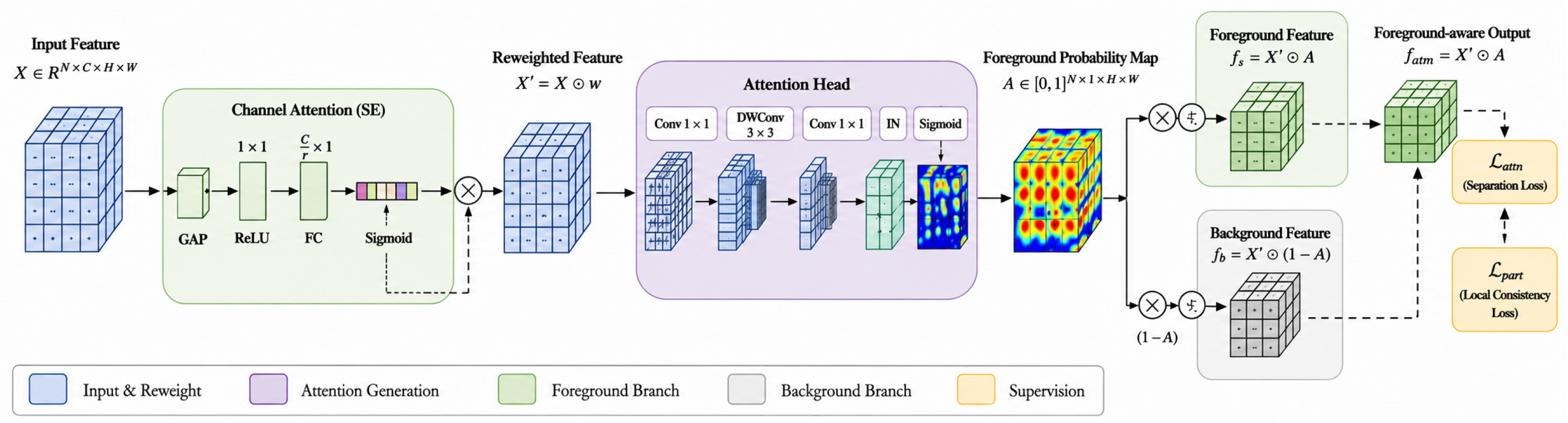
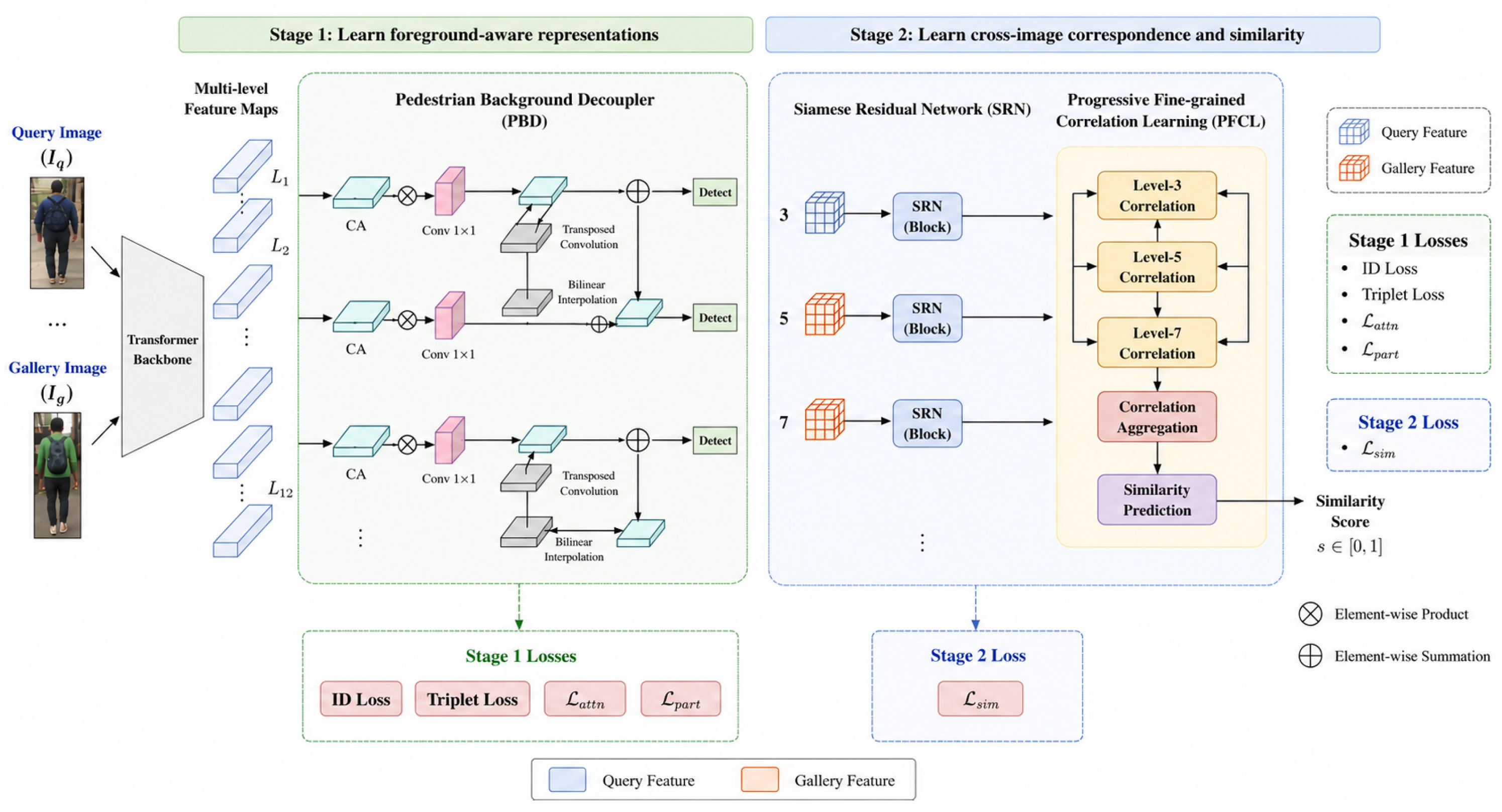
- We propose a pedestrian background decoupler that explicitly separates foreground-dominant pedestrian features from background clutter by attention-guided feature decomposition, thereby improving feature purity under occlusion.
- (2)
- We design a Siamese residual correlation module that projects paired features into a shared comparison space and performs adaptive correlation modeling for occluded-to-holistic matching.
- (3)
- We introduce a progressive fine-grained correlation learning module to aggregate multi-scale correspondence cues and refine similarity estimation under information asymmetry.
- (4)
- Extensive experiments on occluded, partial, and holistic person Re-ID benchmarks demonstrate the effectiveness of the proposed framework.
2. Related Work
2.1. Person Re-Identification Methods in Non-Occluded Scenes
2.2. Person Re-Identification Methods in Occluded Scenes
3. Framework and Method
3.1. Network Design
3.2. Pedestrian Background Decoupler
3.3. Siamese Residual Network Correlation Calculation
3.4. Progressive Fine-Grained Correlation Learning Network
3.5. Training and Inference
4. Experiments
4.1. Experimental Parameter Configuration
4.2. Experimental Results and Analysis
4.2.1. On Occluded Datasets
4.2.2. On Partial Datasets
4.2.3. On Holistic Datasets
4.3. Ablation Studies
4.3.1. Effectiveness Analysis of Each Module and Loss Function
4.3.2. Parameter Sensitivity Analysis
5. Conclusions
- 1.
- This paper investigates Transformer-based Re-Id, examining its unique strengths in global feature extraction and long-range dependency modeling. The approach compensates for the limitations of traditional convolutional neural networks in local feature representation under occluded scenarios, thereby offering a promising solution for occluded person Re-ID.
- 2.
- To reduce the dependency of traditional methods on external pose estimation models, this paper designs a Transformer-based algorithm with pedestrian foreground–background decoupling. By incorporating a Pedestrian Foreground–Background Decoupler, the model achieves autonomous separation of foreground pedestrian regions from background interference, thereby eliminating errors introduced by external modules and significantly improving adaptability in complex occluded scenarios.
Author Contributions
Funding
Institutional Review Board Statement
Informed Consent Statement
Data Availability Statement
Acknowledgments
Conflicts of Interest
References
- Zhang, H.; Guo, J.; Deng, C.; Fan, Y.; Gu, F. Can video surveillance systems promote the perception of safety? Evidence from surveys on residents in Beijing, China. Sustainability 2019, 11, 1595. [Google Scholar] [CrossRef]
- Rami, H.; Giraldo, J.H.; Winckler, N.; Lathuilière, S. Source-guided similarity preservation for online person re-identification. In Proceedings of the IEEE/CVF Winter Conference on Applications of Computer Vision, Waikoloa, HI, USA, 1–6 January 2024; pp. 1711–1720. [Google Scholar]
- Sun, Y.; Zheng, L.; Yang, Y.; Tian, Q.; Wang, S. Beyond Part Models: Person Retrieval with Refined Part Pooling (and a strong convolutional baseline). In Proceedings of the European Conference on Computer Vision (ECCV), Munich, Germany, 8–14 September 2018; pp. 480–496. [Google Scholar]
- Lin, G.; Bao, Z.; Huang, Z.; Li, Z.; Zheng, W.S.; Chen, Y. A Multi-Level Relation-Aware Transformer Model for Occluded Person Re-Identification. Neural Netw. 2024, 177, 106382. [Google Scholar] [CrossRef] [PubMed]
- Ren, T.; Lian, Q.; Chen, J. Boosting Occluded Person Re-Identification by Leveraging Occlusion Attributes. Inf. Sci. 2025, 701, 121866. [Google Scholar] [CrossRef]
- Li, Y.; Shuai, S.; Zhou, Y.; Deng, B.; Zhang, D. Joint Detection and Re-Identification for Occluded Person Search. Sci. Rep. 2025, 15, 22470. [Google Scholar] [CrossRef] [PubMed]
- Miao, J.; Wu, Y.; Liu, P.; Ding, Y.; Yang, Y. Pose-guided feature alignment for occluded person re-identification. In Proceedings of the IEEE/CVF International Conference on Computer Vision, Seoul, Republic of Korea, 27 October–2 November 2019; pp. 542–551. [Google Scholar]
- Gao, S.; Wang, J.; Lu, H.; Liu, Z. Pose-Guided Visible Part Matching for Occluded Person ReID. In Proceedings of the IEEE/CVF Conference on Computer Vision and Pattern Recognition, Seattle, WA, USA, 13–19 June 2020; pp. 11744–11752. [Google Scholar]
- Wang, G.; Yang, S.; Liu, H.; Wang, Z.; Yang, Y.; Wang, S.; Yu, G.; Zhou, E.; Sun, J. High-order information matters: Learning relation and topology for occluded person re-identification. In Proceedings of the IEEE/CVF Conference on Computer Vision and Pattern Recognition, Seattle, WA, USA, 13–19 June 2020; pp. 6449–6458. [Google Scholar]
- He, S.; Luo, H.; Wang, P.; Wang, F.; Li, H.; Jiang, W. TransReID: Transformer-based Object Re-Identification. In Proceedings of the 2021 IEEE/CVF International Conference on Computer Vision (ICCV), Virtual Conference, 11–17 October 2021; pp. 14993–15002. [Google Scholar]
- Li, Y.; He, J.; Zhang, T.; Liu, X.; Zhang, Y.; Wu, F. Diverse part discovery: Occluded person re-identification with part-aware transformer. In Proceedings of the IEEE/CVF Conference on Computer Vision and Pattern Recognition, Virtual Conference, 11–17 October 2021; pp. 2898–2907. [Google Scholar]
- Wang, T.; Liu, H.; Song, P.; Guo, T.; Shi, W. Pose-guided feature disentangling for occluded person re-identification based on transformer. Proc. AAAI Conf. Artif. Intell. 2022, 36, 2540–2549. [Google Scholar] [CrossRef]
- Tan, L.; Dai, P.; Ji, R.; Wu, Y. Dynamic prototype mask for occluded person re-identification. In Proceedings of the 30th ACM International Conference on Multimedia, Lisboa, Portugal, 10–14 October 2022; pp. 531–540. [Google Scholar]
- Suh, Y.; Wang, J.; Tang, S.; Mei, T.; Lee, K.M. Part-aligned bilinear representations for person re-identification. In Proceedings of the European Conference on Computer Vision (ECCV), Munich, Germany, 8–14 September 2018; pp. 402–419. [Google Scholar]
- Li, W.; Zhu, X.; Gong, S. Harmonious attention network for person re-identification. In Proceedings of the IEEE Conference on Computer Vision and Pattern Recognition, Salt Lake City, UT, USA, 18–22 June 2018; pp. 2285–2294. [Google Scholar]
- Huang, H.; Li, D.; Zhang, Z.; Chen, X.; Huang, K. Adversarially occluded samples for person re-identification. In Proceedings of the IEEE Conference on Computer Vision and Pattern Recognition, Salt Lake City, UT, USA, 18–22 June 2018; pp. 5098–5107. [Google Scholar]
- Ge, Y.; Li, Z.; Zhao, H.; Yin, G.; Yi, S.; Wang, X.; Li, H. FD-GAN: Pose-guided feature distilling GAN for robust person re-identification. Adv. Neural Inf. Process. Syst. 2018, 31. [Google Scholar]
- Zhu, K.; Guo, H.; Liu, Z.; Tang, M.; Wang, J. Identity-guided human semantic parsing for person re-identification. In Proceedings of the Computer Vision–ECCV 2020: 16th European Conference, Glasgow, UK, 23–28 August 2020; Proceedings, Part III 16; Springer International Publishing: Berlin/Heidelberg, Germany, 2020; pp. 346–363. [Google Scholar]
- Jia, M.; Cheng, X.; Zhai, Y.; Lu, S.; Ma, S.; Tian, Y.; Zhang, J. Matching on sets: Conquer occluded person re-identification without alignment. Proc. AAAI Conf. Artif. Intell. 2021, 35, 1673–1681. [Google Scholar] [CrossRef]
- Wang, P.; Ding, C.; Shao, Z.; Hong, Z.; Zhang, S.; Tao, D. Quality-aware part models for occluded person re-identification. IEEE Trans. Multimed. 2022, 25, 3154–3165. [Google Scholar] [CrossRef]
- Liu, Z.; Mu, X.; Lu, Y.; Zhang, T.; Tian, Y. Learning transformer-based attention region with multiple scales for occluded person re-identification. Comput. Vis. Image Underst. 2023, 229, 103652. [Google Scholar] [CrossRef]
- Jia, M.; Cheng, X.; Lu, S.; Zhang, J. Learning disentangled representation implicitly via transformer for occluded person re-identification. IEEE Trans. Multimed. 2022, 25, 1294–1305. [Google Scholar] [CrossRef]
- Wang, Z.; Zhu, F.; Tang, S.; Zhao, R.; He, L.; Song, J. Feature erasing and diffusion network for occluded person re-identification. In Proceedings of the IEEE/CVF Conference on Computer Vision and Pattern Recognition, New Orleans, LA, USA, 18–24 June 2022; pp. 4754–4763. [Google Scholar]
- Luo, H.; Jiang, W.; Gu, Y.; Liu, F.; Liao, X.; Lai, S.; Gu, J. A strong baseline and batch normalization neck for deep person re-identification. IEEE Trans. Multimed. 2019, 22, 2597–2609. [Google Scholar] [CrossRef]
- Zhou, K.; Yang, Y.; Cavallaro, A.; Xiang, T. Omni-scale feature learning for person re-identification. In Proceedings of the IEEE/CVF International Conference on Computer Vision, Seoul, Republic of Korea, 27–28 October 2019; pp. 3702–3712. [Google Scholar]
- Tan, L.; Xia, J.; Liu, W.; Dai, P.; Wu, Y.; Cao, L. Occluded person re-identification via saliency-guided patch transfer. Proc. AAAI Conf. Artif. Intell. 2024, 38, 5070–5078. [Google Scholar] [CrossRef]
- Sun, Y.; Xu, Q.; Li, Y.; Zhang, C.; Li, Y.; Wang, S.; Sun, J. Perceive where to focus: Learning visibility-aware part-level features for partial person re-identification. In Proceedings of the IEEE/CVF Conference on Computer Vision and Pattern Recognition, Long Beach, CA, USA, 16–20 June 2019; pp. 393–402. [Google Scholar]
- He, L.; Liang, J.; Li, H.; Sun, Z. Deep spatial feature reconstruction for partial person re-identification: Alignment-free approach. In Proceedings of the IEEE Conference on Computer Vision and Pattern Recognition, Salt Lake City, UT, USA, 18–22 June 2018; pp. 7073–7082. [Google Scholar]
- Luo, H.; Jiang, W.; Fan, X.; Zhang, C. STNReID: Deep convolutional networks with pairwise spatial transformer networks for partial person re-identification. IEEE Trans. Multimed. 2020, 22, 2905–2913. [Google Scholar] [CrossRef]
- He, L.; Wang, Y.; Liu, W.; Liao, X.; Zhao, H.; Sun, Z.; Feng, J. Foreground-aware pyramid reconstruction for alignment-free occluded person re-identification. In Proceedings of the IEEE/CVF International Conference on Computer Vision, Seoul, Republic of Korea, 27–28 October 2019; pp. 8450–8459. [Google Scholar]
- Zhao, Y.; Zhu, S.; Wang, D.; Liang, Z. Short range correlation transformer for occluded person re-identification. Neural Comput. Appl. 2022, 34, 17633–17645. [Google Scholar] [CrossRef]
- Song, C.; Huang, Y.; Ouyang, W.; Wang, L. Mask-guided contrastive attention model for person re-identification. In Proceedings of the IEEE Conference on Computer Vision and Pattern Recognition, Salt Lake City, UT, USA, 18–22 June 2018; pp. 1179–1188. [Google Scholar]
- Liu, J.; Ni, B.; Yan, Y.; Zhou, P.; Cheng, S.; Hu, J. Pose transferrable person re-identification. In Proceedings of the IEEE Conference on Computer Vision and Pattern Recognition, Salt Lake City, UT, USA, 18–22 June 2018; pp. 4099–4108. [Google Scholar]
- Chen, P.; Liu, W.; Dai, P.; Liu, J.; Ye, Q.; Xu, M.; Chen, Q.; Ji, R. Occlude them all: Occlusion-aware attention network for occluded person re-id. In Proceedings of the IEEE/CVF International Conference on Computer Vision, Virtual Conference, 11–17 October 2021; pp. 11833–11842. [Google Scholar]
- Xu, B.; He, L.; Liang, J.; Sun, Z. Learning feature recovery transformer for occluded person re-identification. IEEE Trans. Image Process. 2022, 31, 4651–4662. [Google Scholar] [CrossRef] [PubMed]



| Method | Rank-1 (%) | mAP (%) |
|---|---|---|
| Part aligned [13] | 28.8 | 20.2 |
| HACNN [14] | 34.4 | 26.0 |
| PCB [3] | 42.6 | 33.7 |
| AdverOcclusion [15] | 44.5 | 32.2 |
| FD-GAN [16] | 40.8 | – |
| PGFA [7] | 51.4 | 37.3 |
| HONet [9] | 55.1 | 43.8 |
| ISP [17] | 62.8 | 52.3 |
| MoS [18] | 61.0 | 49.2 |
| QPM [19] | 64.4 | 49.7 |
| OPR-DAAO [20] | 64.8 | 47.5 |
| PAT [11] | 64.5 | 53.6 |
| DRL-Net [21] | 65.8 | 53.9 |
| FRT [22] | 70.7 | 61.3 |
| TransReID [10] | 64.2 | 55.7 |
| PFD [12] | 67.7 | 60.1 |
| FED [21] | 68.1 | 56.1 |
| Proposed Method | 72.3 ± 0.4 | 65.5 ± 0.3 |
| Method | Occluded-Market1501 | Occluded-REID | |||
|---|---|---|---|---|---|
| Rank-1 (%) | mAP (%) | Rank-1 (%) | mAP (%) | ||
| PCB [3] | 66.0 | 49.4 | 41.3 | 38.9 | |
| BoT [23] | 70.6 | 51.5 | – | – | |
| OSNet [24] | 65.5 | 42.8 | – | – | |
| TransReID [10] | 78.2 | 64.7 | – | – | |
| PGFA [7] | 64.1 | 45.5 | – | – | |
| PVPM [8] | 66.8 | 49.4 | 70.4 | 61.2 | |
| HOReID [9] | 64.9 | 49.3 | 80.3 | 70.2 | |
| PFD [12] | – | – | 79.8 | 81.3 | |
| FRT [22] | – | – | 80.4 | 71.0 | |
| SPT [25] | 68.6 | 57.4 | 86.8 | 81.3 | |
| Proposed Method | 83.7 ± 0.4 | 69.1 ± 0.4 | 87.9 ± 3 | 84.1 ± 0.4 | |
| Method | Partial-REID | Partial-iLIDS | |||
|---|---|---|---|---|---|
| Rank-1 (%) | Rank-3 (%) | Rank-1 (%) | Rank-3 (%) | ||
| PCB [3] | 66.3 | – | 46.8 | – | |
| VPM [26] | 67.7 | 81.9 | 67.2 | 76.5 | |
| DSR [27] | 50.7 | 70.0 | 58.8 | 67.2 | |
| STNReID [28] | 66.7 | 80.3 | 54.6 | 76.3 | |
| PGFA [7] | 68.0 | 80.0 | 69.1 | 80.9 | |
| FPR [29] | 81.0 | – | 68.1 | – | |
| HOReID [9] | 85.3 | 91.0 | 72.6 | 86.4 | |
| PVPM [8] | 78.3 | 87.7 | – | – | |
| PFT [30] | 81.3 | – | 74.8 | 87.3 | |
| Proposed Method | 86.6 ± 0.4 | 94.3 ± 0.3 | 85.5 ± 0.4 | 90.7 ± 0.3 | |
| Method | Market-1501 | DukeMTMC | |||
|---|---|---|---|---|---|
| Rank-1 (%) | mAP (%) | Rank-1 (%) | mAP (%) | ||
| PCB [3] | 92.3 | 77.4 | 81.8 | 66.1 | |
| PGFA [7] | 91.2 | 76.8 | 82.6 | 65.5 | |
| VPM [26] | 93.0 | 80.8 | 83.6 | 72.6 | |
| MGCAN [31] | 83.8 | 74.3 | 46.7 | 46.0 | |
| PT [32] | 87.7 | 68.9 | 78.5 | 56.9 | |
| HOReID [9] | 94.2 | 84.9 | 86.9 | 75.6 | |
| OAMN [33] | 92.3 | 79.8 | 86.3 | 72.6 | |
| MGN [34] | 95.7 | 86.9 | 88.7 | 78.4 | |
| SPT [25] | 94.5 | 86.2 | 89.4 | 79.1 | |
| PAT [11] | 95.4 | 88.0 | 88.8 | 78.2 | |
| DRL-Net [21] | 94.7 | 86.9 | 88.1 | 76.6 | |
| FED [35] | 95.0 | 86.3 | 89.4 | 78.0 | |
| FRT [22] | 95.5 | 88.1 | 90.5 | 81.7 | |
| Proposed Method | 95.5 | 89.9 | 91.9 | 84.8 | |
| Index | PBD | SRN | CL | Rank-1 (%) | mAP (%) | |||
|---|---|---|---|---|---|---|---|---|
| 1 | 58.2 | 48.3 | ||||||
| 2 | ✓ | 66.3 | 57.1 | |||||
| 3 | ✓ | ✓ | 67.1 | 58.6 | ||||
| 4 | ✓ | ✓ | ✓ | 69.6 | 60.3 | |||
| 5 | ✓ | ✓ | ✓ | ✓ | 71.3 | 61.0 | ||
| 6 | ✓ | ✓ | 68.6 | 58.3 | ||||
| 7 | ✓ | ✓ | ✓ | 70.7 | 63.1 | |||
| 8 | ✓ | ✓ | ✓ | ✓ | ✓ | ✓ | 72.3 | 65.5 |
Disclaimer/Publisher’s Note: The statements, opinions and data contained in all publications are solely those of the individual author(s) and contributor(s) and not of MDPI and/or the editor(s). MDPI and/or the editor(s) disclaim responsibility for any injury to people or property resulting from any ideas, methods, instructions or products referred to in the content. |
© 2026 by the authors. Licensee MDPI, Basel, Switzerland. This article is an open access article distributed under the terms and conditions of the Creative Commons Attribution (CC BY) license.
Share and Cite
Li, X.; Chen, Y.; Wu, Y.; Liang, Y.; Cao, Y.; Liu, Q.; Yuan, C. Occluded Person Re-Identification Method Based on Pedestrian Background Decoupling Transformer. Mathematics 2026, 14, 1725. https://doi.org/10.3390/math14101725
Li X, Chen Y, Wu Y, Liang Y, Cao Y, Liu Q, Yuan C. Occluded Person Re-Identification Method Based on Pedestrian Background Decoupling Transformer. Mathematics. 2026; 14(10):1725. https://doi.org/10.3390/math14101725
Chicago/Turabian StyleLi, Xinting, Yuheng Chen, Yuchen Wu, Yuchong Liang, Yi Cao, Qingcheng Liu, and Chengsheng Yuan. 2026. "Occluded Person Re-Identification Method Based on Pedestrian Background Decoupling Transformer" Mathematics 14, no. 10: 1725. https://doi.org/10.3390/math14101725
APA StyleLi, X., Chen, Y., Wu, Y., Liang, Y., Cao, Y., Liu, Q., & Yuan, C. (2026). Occluded Person Re-Identification Method Based on Pedestrian Background Decoupling Transformer. Mathematics, 14(10), 1725. https://doi.org/10.3390/math14101725