Article

Cosine Generation for Second-Order Abstract Cauchy Problems with Dynamic Boundary Conditions: An Operator Matrix Approach

Departamento de Matematicas y Estadistica, Universidad del Norte, Barranquilla 081007, Colombia
Mathematics 2026, 14(10), 1703; https://doi.org/10.3390/math14101703
Submission received: 11 April 2026 / Revised: 6 May 2026 / Accepted: 12 May 2026 / Published: 15 May 2026

Abstract

We study the well-posedness of a second-order abstract Cauchy problem with dynamic boundary conditions by establishing an equivalence with a suitable operator matrix framework. Using operator matrix techniques and the theory of cosine operator functions on Banach spaces, we reduce the problem to a dynamic boundary value problem and derive generation results via multiplicative perturbation methods. More precisely, given a maximal operator A on a Banach space X, a boundary operator L, and a feedback operator Φ L ( Y , X ) , we prove that the operator A Φ , defined on D ( A Φ ) : = { f D ( A ) : L f = Φ f } , generates a cosine operator function with associated phase space Y × X if and only if a certain operator matrix A Φ generates a cosine operator function on X = X × X with associated phase space V × X . The abstract theory is illustrated with six concrete examples.

1. Introduction

The study of second-order abstract Cauchy problems of the form
u ( t ) = A u ( t ) , t R , u ( 0 ) = u 0 , u ( 0 ) = u 1 ,
on a Banach space X occupies a central place in the theory of evolution equations. Such problems provide the natural abstract framework for wave propagation, vibration phenomena, elasticity, acoustics, and a broad class of hyperbolic systems. Their analysis is closely tied to the theory of cosine operator functions: a closed and densely defined operator A generates a strongly continuous cosine family on X precisely when the problem (1) is well posed in a suitable phase space Y × X , where Y is an intermediate space between D ( A ) and X [1,2,3]. This principle, commonly referred to as the Sova–Da Prato–Giusti theorem and established independently in [4], is one of the basic structural results in the theory of second-order abstract equations and may be viewed as the Banach space analogue of the classical d’Alembert representation for the wave equation.
Historical roots of the abstract theory may also be traced back to the seminal papers of Fattorini on ordinary differential equations in linear topological spaces [5,6], as well as to related investigations on cosine functions in more general topological vector space settings by Konishi [7]. Beyond the foundational generation results, several structural aspects of cosine operator functions have been studied from different viewpoints. Early contributions on cosine functions and their relation to one-parameter groups go back to Kisyński [8], while interpolation questions were investigated by Hoppe [9]. In more recent developments, cosine families on special classes of Banach spaces, such as UMD spaces, were analyzed by Ciorănescu and Keyantuo [10] and by Haase [11]. We also refer to the recent work of Mesquita and Ponce [12] for related developments on cosine and sine families in generalized abstract settings.
In many situations of interest, however, the operator A does not act in isolation. Rather, it arises as a differential or elliptic operator whose domain is determined by boundary constraints. If the boundary conditions are static, then one is led to the familiar Dirichlet, Neumann, Robin, or mixed realizations of the underlying differential expression. A substantially richer framework emerges when the boundary itself carries inertia, memory, or its own internal dynamics. In such cases, the boundary variables are no longer passive constraints, but evolve according to their own equations and interact with the interior state. This leads to what are commonly called dynamic boundary conditions, often also referred to as Wentzell or generalized Wentzell boundary conditions depending on the precise structure of the model [13,14,15,16].
A prototypical example is furnished by wave equations in which the trace of the solution on the boundary satisfies a second-order differential equation in time. Typical models include strings with tip masses, membranes with vibrating boundaries, acoustic chambers with flexible walls, and networks or metric graphs where vertex or endpoint conditions possess inertial terms [15,17,18,19,20]. In all these cases, the interior dynamics and the boundary dynamics must be treated on an equal footing. From an analytical perspective, this naturally leads to an operator matrix formulation on a product space of the form
X = X × X ,
where X describes the interior state and X represents the boundary space. The key idea is that the original initial boundary value problem can be embedded into a larger abstract second-order system whose generator is a suitable 2 × 2 operator matrix.
Boundary perturbations and operator matrices. Let A m : D ( A m ) X X denote a maximal operator, let L : D ( A m ) X be a boundary trace operator, and let Φ be a bounded boundary feedback operator. Then the perturbed realization
A Φ : = A m | ker ( L Φ )
encodes the boundary condition L u = Φ u . This viewpoint is closely related to Greiner’s boundary perturbation method for generators of semigroups [21], where realizations of maximal operators with perturbed boundary conditions are studied through the boundary map and the associated Dirichlet operator. That method has become a fundamental tool in the treatment of evolution equations with nontrivial boundary behavior. In the analytic setting, related perturbation ideas were also developed by Greiner and Kuhn [22].
When the boundary value itself becomes dynamic, one is led to consider systems of the form
u ( t ) = A m u ( t ) , x ( t ) = B x ( t ) + Φ u ( t ) , x ( t ) = L u ( t ) ,
which can be rewritten on X by means of an operator matrix such as
A Φ = A m 0 Φ B ,
with a suitable coupled domain expressing the constraint x = L u . The central question then becomes the relation between the generation properties of the scalar realization A Φ on X and those of the matrix operator A Φ on X . From a broader operator-theoretic viewpoint, this is also related to the theory of coupled operator matrices and their generator properties; see, for instance, Engel [23]. General background on semigroup methods and perturbation techniques may be found in Engel and Nagel [24].
This question is not merely formal. On the one hand, the matrix formulation is particularly well adapted to dynamic boundary conditions, because it treats the boundary variable as part of the state and makes available the tools of operator matrix theory, Dirichlet operators, and perturbation methods. On the other hand, the scalar realization A Φ is often the more natural object from the viewpoint of PDE theory, since it acts only on the interior function space and carries the boundary condition in its domain. Understanding the precise equivalence between these two points of view is therefore of both conceptual and practical importance.
Previous work and motivation: Dynamic boundary conditions have been studied from several complementary perspectives. In the semigroup setting, Greiner’s perturbation method [21] provided a powerful abstract mechanism to pass from an unperturbed boundary condition to a perturbed one through the boundary operator and the Dirichlet map. From the viewpoint of boundary processes and semigroup theory, Bobrowski developed a systematic treatment of the relation between interior dynamics and boundary behavior [13], showing that the boundary should often be regarded as a genuine dynamical component of the system. Related differences between semigroup and cosine-family approaches were emphasized by Bobrowski and Chojnacki [25], while more recent developments involving transmission and boundary phenomena can be found in [26,27].
For wave equations with Wentzell- and Robin-type dynamic boundary conditions, important well-posedness and regularity results were obtained by Keyantuo and Warma in the multidimensional L p -setting [15,28]. In the one-dimensional and related L p frameworks, dynamic Robin and Wentzell boundary conditions were analyzed by Chill, Keyantuo, and Warma [14], as well as in related works on endpoint inertia and boundary damping [17,18,19]. Related operator-theoretic aspects of Wentzell-type boundary conditions were further developed by Xiao and Liang in [16], who studied second-order differential operators with Feller–Wentzell-type boundary conditions in an abstract functional-analytic setting.
More recently, boundary perturbations for generators of cosine operator functions were studied by Alvarez [29], who proved generation results for the perturbed realization A Φ under suitable assumptions on the Dirichlet map. On the perturbative and non-autonomous side, Ponce investigated time-dependent perturbations of second-order abstract Cauchy problems and their reformulation in product spaces [30]. These developments strongly motivate a unified treatment of scalar and matrix formulations for second-order problems with dynamic boundary conditions.
Analytical difficulties: Compared with the standard second-order Cauchy problem, the presence of dynamic boundary conditions raises several additional issues. First, one must identify the correct state space and phase space so that the coupled interior-boundary system becomes well posed. Second, the boundary operator L is typically unbounded with respect to the natural topology of X, so that the interplay between the maximal operator A m , its restriction to ker L , and the perturbed realization A Φ becomes delicate. Third, when passing from the scalar formulation to the matrix one, the boundary variable is constrained by the trace relation x = L u , which must be properly reflected in the operator domain. Finally, even when A Φ is known to generate a cosine function, the corresponding matrix operator does not do so immediately, and vice versa. Establishing this equivalence requires a careful use of Dirichlet operators, decomposition techniques, and perturbation arguments. Since boundary operators and traces are central to this analysis, our approach is also related to the classical theory of non-homogeneous boundary value problems and trace regularity, for which we refer to Lions and Magenes [31].
Aim of this paper: The purpose of the present work is to develop a systematic abstract framework for second-order problems with dynamic boundary conditions, emphasizing the equivalence between the scalar and the matrix formulations. More precisely, starting with a maximal operator A m , a boundary trace operator L, and a bounded feedback operator Φ , we study the perturbed realization A Φ and the associated matrix operator on the product space X . Our main goal is to prove that, under natural assumptions, generation of a cosine operator function by A Φ on X with phase space Y × X is equivalent to generation by the corresponding operator matrix on X with phase space V × X . In addition, we derive explicit bounds on solutions, clarify the role of bounded perturbations acting on the boundary component, and show how the Dirichlet map provides the correct bridge between the scalar and matrix descriptions.
Main ideas: A basic ingredient in our approach is the use of the Dirichlet operator associated with the pair ( A m , L ) , in the spirit of Greiner’s boundary perturbation method [21]. This operator allows us to decompose the product space and to separate the contribution of the interior dynamics from that of the boundary data. Combined with a multiplicative perturbation argument, this leads to a convenient representation of the perturbed realization A Φ and permits us to transfer generation properties between different formulations of the problem. The second ingredient is an operator matrix viewpoint, through which dynamic boundary conditions appear naturally as a bounded or relatively bounded perturbation of a simpler matrix operator. This makes it possible to treat additional boundary dynamics, represented, for instance, by a bounded operator B L ( X ) , by direct application of bounded perturbation results for cosine families.
Structure of the paper: The paper is organized as follows.
1.
In Section 2 we recall the background on cosine operator functions, second-order abstract Cauchy problems, phase spaces, and the basic properties of the Dirichlet operator associated with the boundary map L.
2.
In Section 3 we introduce the abstract framework, define the maximal operator A m , the boundary operator L, the perturbed realization A Φ , and the corresponding operator matrix on the product space X = X × X .
3.
In Section 4, we analyze bounded perturbations acting on the boundary component, showing how additional intrinsic boundary dynamics can be incorporated without destroying the cosine generation property.
4.
In Section 5, we establish the main generation results. In particular, we prove the equivalence between generation by A Φ and generation by the matrix operator associated with the dynamic boundary problem.
5.
In Section 6, we present several concrete examples illustrating the abstract theory, including wave equations with Robin- and Wentzell-type dynamic boundary conditions.
Notation. Throughout the paper, X, Y, and X denote Banach spaces, with Y X continuously and densely. For a linear operator T, D ( T ) , ρ ( T ) , and σ ( T ) denote its domain, resolvent set, and spectrum, respectively. The space of bounded linear operators from E to F is denoted by L ( E , F ) , and we write L ( E ) : = L ( E , E ) . The product space X × X is denoted by X . When convenient, we write elements of X as column vectors u x , and π 1 and π 2 denote the canonical projections onto the first and second components, respectively. Table 1 collects all of the main symbols used throughout the paper.

2. Preliminaries

2.1. Second Order Abstract Cauchy Problems

Let X be a Banach space and A : D ( A ) X X closed, densely defined.
u ( t ) = A u ( t ) , t R , u ( 0 ) = u 0 , u ( 0 ) = v 0 .
Definition 1.
u : R X is a classical solution of (4) if u C 2 ( R , X ) , u ( t ) D ( A ) for all t, u ( t ) = A u ( t ) for all t, u ( 0 ) = u 0 , u ( 0 ) = v 0 .
Definition 2.
Let X be a Banach space, A : D ( A ) X X closed and densely defined. Let Y be a Banach space satisfying:
(i)
(Completeness) Y is a Banach space equipped with its own norm · Y .
(ii)
(Continuous dense embeddings) D ( A ) Y X continuously and densely, i.e., there exist constants C 1 , C 2 > 0 such that
u X C 2 u Y C 2 C 1 u D ( A ) , u D ( A ) ,
with D ( A ) dense in Y and Y dense in X.
(iii)
(Topology of Y) The norm · Y is not merely the restriction of · X ; it is the norm of the interpolation or form-domain space associated with A (see Remark 1).
Problem (4) is well-posed in ( Y , X ) if for every u 0 D ( A ) , v 0 Y there is a unique classical solution, and the solution depends continuously on ( u 0 , v 0 ) in D ( A ) × Y , uniformly on compact time intervals. The product Y × X is the phase space.
Remark 1
(Nature of the norm on Y). The choice of · Y is determined by the generator A:
(i)
Banach case. Under framework hypotheses (F1)–(F8), Y is the unique Banach space (up to norm equivalence) for which S ( t , A ) : X Y is bounded uniformly on compact intervals (cf. Proposition 1 and [1] (Section 3.14)).
(ii)
Hilbert case. When X = H is a Hilbert space and A is self-adjoint, negative, with compact resolvent (Theorem 4), the phase space is Y = D ( ( A ) 1 / 2 ) , the form domain with norm
u Y 2 : = ( A ) u , u H + u H 2 = ( A ) 1 / 2 u H 2 + u H 2 .
This makes Y itself a Hilbert space (Proposition 1(v) and Theorem 5). In Examples 1 and 5–6 ( X = L 2 , A = x x with Robin boundary conditions), Y = H 1 with the standard H 1 -norm, which is norm-equivalent to D ( ( A ) 1 / 2 ) .
(iii)
L p case ( p 2 ). When X = L p ( Ω ) with p 2 (Examples 2–3), Y = W 1 , p ( Ω ) , which is Banach but not Hilbert. Density follows from the density of C c ( Ω ) in W 1 , p ( Ω ) .
In all cases completeness is guaranteed: in (ii) because D ( ( A ) 1 / 2 ) is the domain of a closed operator with graph norm; in (iii) because W 1 , p ( Ω ) is a standard Sobolev space.

2.2. Cosine Operator Functions

Definition 3.
( C ( t ) ) t R L ( X ) is a strongly continuous cosine operator function if C ( 0 ) = I , t C ( t ) x is continuous for all x X , and
2 C ( s ) C ( t ) = C ( s + t ) + C ( s t ) , s , t R .
The generator is A x : = lim t 0 2 t 2 [ C ( t ) I ] x on D ( A ) : = { x : l i m i t   e x i s t s } .
Definition 4.
The sine operator function: S ( t ) x : = 0 t C ( s ) x   d s . Then S ( 0 ) = 0 , S ( t ) = C ( t ) , and
C ( s ) S ( t ) = S ( s ) C ( t ) = 1 2 [ S ( s + t ) + S ( s t ) ] .
Definition 5.
( C ( t ) ) is of type ( M , ω ) if C ( t ) L ( X ) M e ω | t | for all t R .
Theorem 1
(Sova–Da Prato–Giusti [2,4]). Let A : D ( A ) X X be closed, densely defined, and let D ( A ) Y X . The following are equivalent:
(i)
A generates a cosine function ( C ( t , A ) ) t R on X with phase space Y × X .
(ii)
Problem (4) is well-posed in ( Y , X ) .
When either holds, the unique classical solution is
u ( t ) = C ( t , A ) u 0 + S ( t , A ) v 0 , t R .
Theorem 2
(Hille–Yosida for cosine functions [1] (Theorem 3.14.11)). A generates a cosine function of type ( M , ω ) if and only if ( ω 2 , + ) ρ ( A ) and
d k d λ k [ λ R ( λ 2 , A ) ] M · k ! ( λ ω ) k + 1 , λ > ω , k N 0 .
In particular, λ R ( λ 2 , A ) M / ( λ ω ) for λ > ω . Moreover, if A generates a cosine function with phase space Y × X , then D ( A ) is dense in Y.
Theorem 3
(Bounded perturbation [3] (Theorem 8.5)). If A generates a cosine function on X and B L ( X ) , then A + B generates a cosine function on X.

2.3. Classical Solutions and the Phase Space

Proposition 1
([2] (Chapter II), [1] (Section 3.14)). Suppose A generates a cosine function with phase space Y × X and type ( M , ω ) . Then:
  • For u 0 D ( A ) , v 0 Y : u C 2 ( R , X ) C 1 ( R , Y ) .
  • ( u 0 , v 0 ) u ( t , u 0 , v 0 ) is continuous from D ( A ) × Y to X, uniformly on compacts.
  • C ( t , A ) : Y Y and S ( t , A ) : X Y are bounded with
    C ( t , A ) L ( Y ) M e ω | t | , S ( t , A ) L ( X , Y ) M e ω | t | .
  • C ( t , A ) : X Y is bounded for each fixed t, with C ( t , A ) L ( X , Y ) C t .
  • When A is self-adjoint and negative on a Hilbert space: Y = D ( ( A ) 1 / 2 ) .

2.4. The Dirichlet Map and Its Relation to L

Definition 6
(Dirichlet map). For λ ρ ( A 0 ) , A 0 = A | ker ( L ) : D λ : X X maps φ v where ( λ A ) v = 0 in X, L v = φ on X .
Remark 2.
D λ L ( X , X ) ; L D λ = I X ; A D λ φ = λ D λ φ ; D λ D μ = ( λ μ ) R ( λ , A 0 ) D μ ; D λ : X D ( A ) Y .
Remark 3
(Standing assumptions for D λ ). The Dirichlet map D λ is well-defined and bounded under the following conditions, verified in all examples of Section 6:
(i)
(Ellipticity) A m is a second-order uniformly elliptic operator on Ω R n : i , j a i j ( x ) ξ i ξ j ν | ξ | 2 for some ν > 0 , all x Ω , ξ R n . For n = 1 , A m u = u is trivially elliptic with ν = 1 .
(ii)
(Domain regularity) Ω is bounded open with C 1 , 1 -boundary (or Lipschitz boundary), so that H 2 ( Ω ) W 1 , p ( Ω ) compactly (Rellich–Kondrachov).
(iii)
(Trace theorem) L L ( [ D ( A ) ] , X ) . In the H 1 ( Ω ) setting, the classical trace theorem gives γ 0 : H 1 ( Ω ) L 2 ( Ω ) bounded. In the W 1 , p ( 0 , 1 ) setting, the Sobolev embedding W 1 , p ( 0 , 1 ) C [ 0 , 1 ] gives | u ( 0 ) | + | u ( 0 ) | C tr u W 1 , p .
(iv)
(Unique solvability) For λ ρ ( A 0 ) and ϕ X , the problem ( λ A ) v = 0 in X, L v = ϕ on X , has a unique solution v = D λ ϕ D ( A ) Y .
(v)
(Decay estimate) D λ L ( X , X ) = O ( | λ | ε ) as | λ | in { Re λ > 0 } , with ε = 1 2 1 2 n (Proposition 4(i)), giving ε = 1 4 for n = 1 .
Proposition 2
(Decomposition via D λ ). For λ ρ ( A 0 ) , every f x X decomposes as
f x = f D λ x 0 interior + D λ x x boundary V ,
where V = { g y Y × X : L g = y } .
Proposition 3
([32] (Lemma 5.2)).  L λ : = I D λ 0 I : V V 0 × X is an isomorphism with inverse L λ 1 = I D λ 0 I . Moreover, for u D ( A ) : A 0 ( u D λ L u ) = A u λ D λ L u .
Proposition 4
(Decay of the Dirichlet map). As | λ | with Re   λ > 0 :
(i)
For second-order elliptic operators on bounded domains in R n : D λ = O ( | λ | ε ) with ε = 1 2 1 2 n .
(ii)
For n = 1 : ε = 1 4 .
(iii)
u = D λ L u R ( λ , A 0 ) ( λ A ) u for u D ( A ) .
Proof. 
Part (iii) is the standard decomposition in Greiner’s framework, whereas parts (i)–(ii) follow from elliptic resolvent estimates combined with Sobolev trace and interpolation arguments; see, e.g., [21,29]. □
Remark 4
(Three roles of D λ ). (1) Factorization: L λ factors A Φ λ . (2) Multiplicative perturbation: the decay of D λ ensures D λ Φ is small. (3) Converse construction: decomposition (10) extends the matrix cosine function.
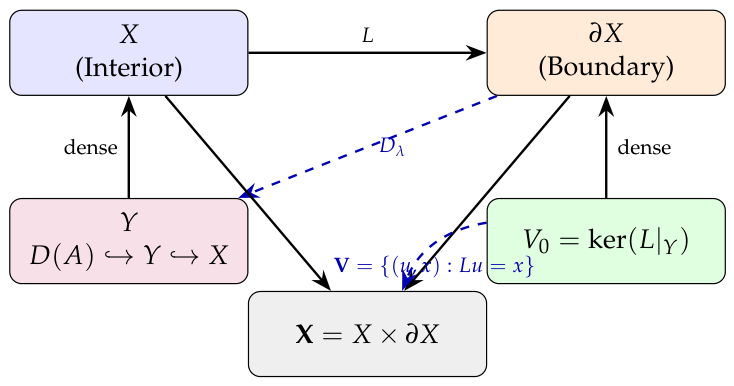
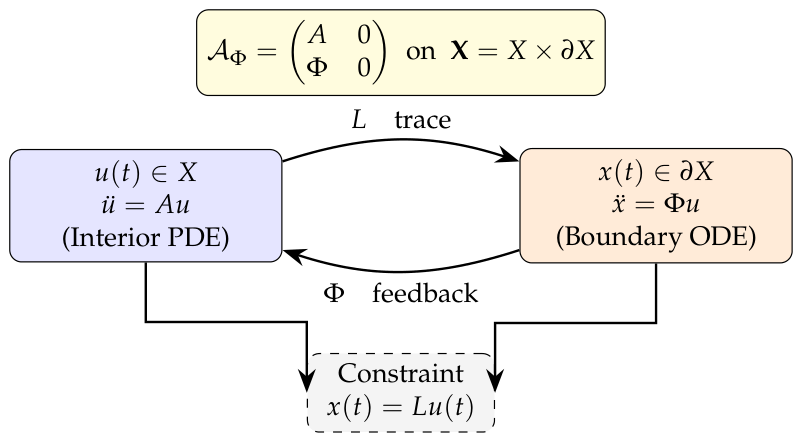
Figure 1 illustrates the hierarchy of spaces and the role of the Dirichlet map. Figure 2 gives a schematic of the interior–boundary coupling encoded by A Φ .

2.5. Self-Adjoint, Negative, Compact Resolvent Operators

Throughout this part, H is a separable infinite-dimensional Hilbert space.
Theorem 4
(Spectral Theorem). Let A be self-adjoint, negative, with compact resolvent. Then, σ ( A ) = { λ n : n N } with 0 < λ 1 λ 2 + , and { e n } D ( A ) is a complete ONB with A e n = λ n e n .
Definition 7.
( A ) α u : = n λ n α u , e n e n , with D ( ( A ) α ) = { u : n λ n 2 α | u , e n | 2 < } .
Theorem 5
(Cosine Generation). Under the hypotheses of Theorem 4:
C ( t , A ) u = n cos ( λ n t ) u , e n e n , S ( t , A ) u = n sin ( λ n t ) λ n u , e n e n ,
with phase space D ( ( A ) 1 / 2 ) × H and sup t C ( t , A ) 1 .

2.6. Piskarev-Shaw’s Multiplication Result

Theorem 6
([33] (Theorem 2.6)). Let B generate a cosine function with phase space V 0 × X and R L ( X ) . If there exists q [ 0 , 1 ) such that
0 1 ( R I ) B S ( s , B ) f X d s q f X , f D ( B ) ,
then R B generates a cosine function with phase space V 0 × X .

3. Abstract Framework and Main Results

Framework.
(F1)
X, Y, X are Banach spaces.
(F2)
A : D ( A ) X X is closed and densely defined.
(F3)
D ( A ) Y X , D ( A ) ¯ · Y = Y , Y ¯ · X = X .
(F4)
L : [ D ( A ) ] X is linear and surjective.
(F5)
V 0 is a Banach space with V 0 Y .
(F6)
L extends continuously to Y with ker ( L | Y ) = V 0 .
(F7)
A 0 : = A | ker ( L ) generates a cosine function on X with phase space V 0 × X .
(F8)
Φ L ( Y , X ) .

3.1. The Abstract Cauchy Problem with Dynamic Boundary Conditions

The scalar problem:
u ( t ) = A Φ u ( t ) , t R , u ( 0 ) = f 0 , u ( 0 ) = g 0 ,
where
D ( A Φ ) : = { u D ( A ) : L u = Φ u } , A Φ u : = A u .
Lemma 1
(Density and Closability of A Φ ). Under hypotheses (F1)–(F8):
(i)
D ( A Φ ) is dense in X.
(ii)
A Φ is closed.
Proof. 
(i). Since D ( A ) is dense in X, it suffices to approximate each u D ( A ) by elements of D ( A Φ ) .
Fix λ ρ ( A 0 ) with Re λ > 0 . By the decay estimate (F7) and Proposition 4 (i)–(ii),
D λ L ( X , X ) = O ( | λ | ε ) , | λ | ,
for some ε > 0 . In particular, D λ : X Y and Φ D λ : X X , so
Φ D λ L ( X , X ) Φ L ( Y , X ) D λ L ( X , Y ) 0 as | λ | .
Choose | λ | large enough so that Φ D λ L ( X , X ) < 1 . Then the Neumann series
( I Φ D λ ) 1 = k = 0 ( Φ D λ ) k
converges absolutely in L ( X ) , with
( I Φ D λ ) 1 L ( X ) 1 1 Φ D λ L ( X , X ) 2
for | λ | sufficiently large.
Fix u D ( A ) and set δ : = L u Φ u X .
For a sufficiently large | λ | , Φ D λ < 1 , so ( I Φ D λ ) 1 exists. Define
u ˜ λ : = u D λ ( I Φ D λ ) 1 δ .
Since L D λ = I X and ( I Φ D λ ) ( I Φ D λ ) 1 δ = δ , we have
L u ˜ λ Φ u ˜ λ = δ δ = 0 ,
so u ˜ λ D ( A Φ ) .
Moreover,
u u ˜ λ X 2 D λ · δ X 0
as | λ | by the decay estimate. Hence D ( A Φ ) is dense in D ( A ) , and thus in X.
(ii). A Φ is the restriction of the closed operator A (by (F2)) to the closed subspace D ( A Φ ) = ker ( L Φ ) of [ D ( A ) ] (in the graph norm).
Let ( u n ) D ( A Φ ) with u n u and A u n v in X. Since A is closed, u D ( A ) and A u = v . Now, L u n = Φ u n for all n and both L , Φ are continuous: L u = Φ u . Thus, u D ( A Φ ) and ( u , v ) Graph ( A Φ ) . Hence, A Φ is closed.
 □
The associated dynamic boundary value problem:
u ¨ ( t ) = A u ( t ) , t R , x ( t ) = L u ( t ) , t R , x ¨ ( t ) = Φ u ( t ) , t R , u ( 0 ) = f 0 , x ( 0 ) = L f 0 , u ˙ ( 0 ) = g 0 , x ˙ ( 0 ) = L g 0 .
The operator matrix on X : = X × X is given by
A Φ = A 0 Φ 0 , D ( A Φ ) : = u x D ( A ) × X : L u = x .
The phase space is V : = { u x Y × X : L u = x } .
Remark 5
(Applicability of matrix generator theory). The operator A Φ fits the abstract coupled operator matrix framework of [23,32] for the following reasons:
(i)
(Coupled domain) D ( A Φ ) is defined by the coupling x = L u ; it is not a product domain [23] (Definition 1.1).
(ii)
(Decomposition) By Proposition 2, every element of X decomposes into interior and boundary parts, which is the starting point for the Engel–Mugnolo matrix theory.
(iii)
(Entry structure) The ( 1 , 1 ) -entry is A L ( [ D ( A ) ] , X ) (closed); the ( 2 , 1 ) -entry is Φ L ( Y , X ) , bounded from the phase space. All other entries vanish. This matches the structure covered by [32] (Cor. B.9).
(iv)
(Applicability of [32](Cor. B.9)) That result transfers generation from a diagonal matrix to the full coupled matrix when off-diagonal entries are relatively bounded via the phase space. Here, Φ L ( Y , X ) and D λ L ( X , Y ) provide the required bounds.
(v)
(Extended matrix, B 0 ) A ˜ Φ = A Φ + 0 0 0 B with B L ( X ) is a bounded perturbation of A Φ ; Theorem 3 applies directly.
Remark 6
(Action of A Φ ). For u x D ( A Φ ) ( L u = x , u D ( A ) ):
A Φ u x = A u Φ u .
The ( 2 , 1 ) -entry is Φ L ( Y , X ) evaluated on u D ( A ) Y , not the composition Φ A . For Wentzell problems, Φ u encodes the complete boundary force (first-order and zeroth-order traces of u), and x ¨ ( t ) = Φ u ( t ) reproduces the physical boundary equation.
The matrix Cauchy problem is given by
U ¨ ( t ) = A Φ U ( t ) , t R , U ( 0 ) = f 0 L f 0 , U ˙ ( 0 ) = g 0 L g 0 .
Definition 8.
A classical solution of (18) is u ( · ) with u C 2 ( R , X ) C 1 ( R , Y ) , u ( t ) D ( A ) for all t, L u C 2 ( R , X ) , satisfying all equations in (18).
Definition 9.
The matrix Cauchy problem (20) is well posed if for every f 0 L f 0 V , g 0 L g 0 X , there exists a unique classical solution U C 2 ( R , X ) C 1 ( R , V ) , and the map ( f 0 L f 0 , g 0 L g 0 ) U is continuous with respect to the natural norms of V × X .

3.2. Key Results

Lemma 2
([32] (Lemma 5.2)). For λ ρ ( A 0 ) , L λ = I D λ 0 I : V V 0 × X is an isomorphism with inverse L λ 1 = I D λ 0 I .
Theorem 7.
Let λ ρ ( A 0 ) . A Φ generates a cosine function with phase space V × X if and only if ( I D λ Φ ) A 0 generates a cosine function with phase space V 0 × X .
Proof. 
Step 1 (Domain decomposition). Fix λ ρ ( A 0 ) and let u x D ( A Φ ) , so u D ( A ) and L u = x . Define f 0 : = u D λ x ker ( L ) = D ( A 0 ) , using L ( D λ x ) = x = L u (Remark 2). This decomposition (Proposition 2) separates interior from boundary contributions in the spirit of Greiner’s method [21].
Step 2 (Computing ( A Φ λ ) u x ).
( A Φ λ ) u x = A u λ u Φ u λ x .
Substituting u = f 0 + D λ x and using A ( D λ x ) = λ D λ x (Remark 2):
( A Φ λ ) u x = ( A 0 λ ) f 0 Φ f 0 + ( Φ D λ λ I ) x .
Note that the cancellation A D λ x λ D λ x = 0 is the key spectral property of the Dirichlet map.
Step 3 (Factorization A Φ λ = A λ L λ ). Equation (21) gives A Φ λ = A λ L λ with
A λ = A 0 λ 0 Φ Φ D λ λ I .
Since L λ is invertible (Lemma 2), A Φ λ is similar to L λ A λ via L λ .
Step 4 (Block-diagonal reduction). A direct computation gives:
L λ A λ = ( I D λ Φ ) A 0 0 0 0 λ I + R ,
where R L ( X ) collects the off-diagonal and lower-right terms ( Φ L ( Y , X ) and D λ L ( X , Y ) ensure all compositions are bounded).
Step 5 (Transfer of generation). By [32] (Cor. B.9) and [1] (Cor. 3.14.13), L λ A λ generates a cosine function on X with phase space ( V 0 × X ) × X if and only if ( I D λ Φ ) A 0 generates with phase space V 0 × X . Since A Φ is similar to L λ A λ (via the isomorphism L λ ), generation transfers. □
Remark 7
(Similarity implies generator equivalence). Since L λ : V V 0 × X is a topological isomorphism (Lemma 2), the similarity in Theorem 7 implies full generator equivalence:
(i)
ρ ( A Φ ) = ρ ( ( I D λ Φ ) A 0 ) and resolvents are intertwined by L λ .
(ii)
A Φ generates a cosine function if ( I D λ Φ ) A 0 does (same type constants up to L λ ).
(iii)
Domain equivalence: D ( A Φ ) = L λ 1 ( D ( ( I D λ Φ ) A 0 ) × X ) , with graph norms equivalent via L λ .
Concretely, f D ( A Φ ) f D λ Φ f D ( A 0 ) = P λ f D ( A 0 ) , so domain equivalence holds and no additional hypothesis is needed for generator equivalence.
Lemma 3.
If U ( · ) is a classical solution of (20) in ( V , X ) , then u ( · ) : = π 1 U ( · ) is a classical solution of (18).
Proof. 
Since U ( t ) D ( A Φ ) : u ( t ) D ( A ) and L u ( t ) = x ( t ) . Since U C 2 ( R , X ) C 1 ( R , V ) and π 1 is bounded: u C 2 ( R , X ) C 1 ( R , Y ) . The first component of U ¨ = A Φ U gives u t t = A u . The second gives x ¨ = Φ u . Since x ( t ) = L u ( t ) by the domain condition, all equations in (18) are satisfied. □

4. Multiplicative Perturbation

Lemma 4.
Let A 0 generate a cosine function if phase space V 0 × X and ϵ > 0 are small enough. Assume
D λ L ( X , X ) = O ( | λ | ε ) , | λ | , Re λ > 0 ,
and
0 1 Φ A 0 S ( s , A 0 ) f X d s M f X , f D ( A 0 ) .
Then P λ A 0 : = ( I D λ Φ ) A 0 generates a cosine function with phase space V 0 × X .
Proof. 
We apply Theorem 6 (Piskarev–Shaw) with B : = A 0 and R : = P λ = I D λ Φ L ( Y ) . Then R I = D λ Φ , and condition (11) require
0 1 D λ Φ A 0 S ( s , A 0 ) f X d s q f X
for some q [ 0 , 1 ) and all f D ( A 0 ) .
By Proposition 1(2)–(3), the sine operator S ( s , A 0 ) : X Y is bounded uniformly on [ 0 , 1 ] with constant M S > 0 :
S ( s , A 0 ) f Y M S f X , s [ 0 , 1 ] .
For f D ( A 0 ) , the commutativity A 0 S ( s , A 0 ) = S ( s , A 0 ) A 0 gives
A 0 S ( s , A 0 ) f = S ( s , A 0 ) A 0 f Y ,
so Φ ( A 0 S ( s , A 0 ) f ) X is well defined. By the boundedness of Φ L ( Y , X ) (hypothesis (F8)):
Φ A 0 S ( s , A 0 ) f X Φ L ( Y , X ) · A 0 S ( s , A 0 ) f Y Φ · M S · A 0 f X .
Here we use the graph norm estimate A 0 f X C f D ( A 0 ) for f D ( A 0 ) .
By submultiplicativity and condition (24):
0 1 D λ Φ A 0 S ( s , A 0 ) f X d s D λ L ( X , X ) · M f X
where M absorbs the constants from (24).
By the decay estimate (23),
D λ L ( X , X ) = O ( | λ | ε ) .
Choose a | λ | large enough that q : = C M | λ | ε < 1 , i.e., | λ | > ( C M ) 1 / ε .
The Piskarev–Shaw theorem then implies that P λ A 0 = ( I D λ Φ ) A 0 generates a cosine function with phase space V 0 × X .
Remark on the necessity of phase-space regularity. The entire argument depends on the uniform X Y smoothing by S ( s , A 0 ) . Without this, the composition Φ A 0 S ( s , A 0 ) f would be undefined, since Φ L ( X , X ) (pointwise evaluation is not bounded on X in general). This is the fundamental reason why hypothesis (F8) requires Φ L ( Y , X ) rather than Φ L ( X , X ) . □
Remark 8
(On (23)). For elliptic operators on bounded Ω R n : ε = 1 2 1 2 n . For n = 1 : ε = 1 4 (sharp).
Remark 9
(On (24)). Condition (24) holds automatically when Φ L ( Y , X ) and
S ( s , A 0 ) L ( X , Y ) C
uniformly for s [ 0 , 1 ] , since then Φ A 0 S ( s , A 0 ) f X Φ · A 0 S ( s , A 0 ) f Y Φ · C A 0 f X .
Theorem 8.
Under the framework of Section 3, if (23)–(24) hold, then ( A Φ , D ( A Φ ) ) generates a cosine function on X.
Proof. 
Fix λ ρ ( A 0 ) with a | λ | that is large enough. By Lemma 4, ( P λ A 0 , D ( A 0 ) ) generates a cosine function. By [21] (Lemma 1.4), D ( A Φ ) = { f X : P λ f D ( A 0 ) } .
Density. Since A 0 and P λ A 0 both generate cosine functions, D ( A Φ ) is dense in X by [20] (Theorem 4.4).
Decomposition. For f D ( A Φ ) , using A f = A 0 ( f D λ L f ) + λ D λ L f and L f = Φ f :
A Φ f = A 0 P λ f + λ D λ Φ f , P λ f = f D λ Φ f D ( A 0 ) .
Conclusion. By [33] (Proposition 2.1), A 0 P λ generates a cosine function. Since λ D λ Φ L ( Y , X ) extends to a bounded operator on X (via Y X and density of Y in X), Theorem 3 applied to (25) shows A Φ generates a cosine function. □

5. Well-Posedness Results

The next theorem is the main result of this paper.
Theorem 9.
The following statements are equivalent:
(i)
( A Φ , D ( A Φ ) ) generates a cosine function on X = X × X with phase space V × X .
(ii)
( A Φ , D ( A Φ ) ) generates a cosine function on X with phase space Y × X .
Moreover, the following statements hold:
(a)
M 1 , ω 0 : C ( t , A Φ ) L ( X ) M e ω | t | .
(b)
The unique classical solution of (12) satisfies
u ( t ) Y M e ω | t | ( f 0 Y + g 0 X ) , t R .
(c)
For every t 0 > 0 and ( f n , g n ) D ( A Φ ) × Y with f n Y + g n X 0 :
sup t [ 0 , t 0 ] u ( t , f n , g n ) Y 0 .
Proof. 
Proof of (i)⇒(ii)
Since A Φ generates a cosine function with phase space V × X , by Theorem 2, D ( A Φ ) is dense in V . Hence D ( A Φ ) = π 1 ( D ( A Φ ) ) is dense in π 1 ( V ) , and since L : Y X is surjective:
D ( A Φ ) ¯ · Y = Y .
Let f 0 D ( A Φ ) , g 0 Y . From L f 0 = Φ f 0 : f 0 : = f 0 L f 0 D ( A Φ ) . By (27), take ( g n ) D ( A Φ ) with g n g 0 Y 0 . Then L g n = Φ g n and
L g 0 Φ g 0 X L ( g 0 g n ) + Φ ( g n g 0 ) ( L L ( Y , X ) + Φ L ( Y , X ) ) g 0 g n Y 0 ,
so L g 0 = Φ g 0 and g 0 : = g 0 L g 0 V .
Using the Sova–Da Prato–Giusti theorem for A Φ , U ( t ) = C ( t , A Φ ) f 0 + S ( t , A Φ ) g 0 is the unique classical solution of (20). Write U ( t ) = u ( t ) x ( t ) . By Lemma 3, u = π 1 U solves (18).
u ( t ) D ( A Φ ) . Since U ( t ) D ( A Φ ) : x ( t ) = L u ( t ) for all t. Define w ( t ) : = L u ( t ) Φ u ( t ) . Then w ( 0 ) = L f 0 Φ f 0 = 0 and w ˙ ( 0 ) = L g 0 Φ g 0 = 0 .
Volterra argument (uniqueness that w 0 ): From x ¨ ( t ) = Φ u ( t ) and x ( t ) = L u ( t ) , differentiating w ( t ) = x ( t ) Φ u ( t ) :
w ¨ ( t ) = x ¨ ( t ) Φ u ¨ ( t ) = Φ u ( t ) Φ ( A u ( t ) ) .
Integrating twice with w ( 0 ) = w ˙ ( 0 ) = 0 :
w ( t ) = 0 t ( t s ) Φ u ( s ) A u ( s ) d s .
Since u C 2 ( R , X ) C 1 ( R , Y ) and Φ L ( Y , X ) , the right-hand side of (28) defines a Volterra integral equation for w in X . Taking norms and using the exponential bound on u:
w ( t ) X Φ L ( Y , X ) 0 t ( t s ) u ( s ) Y + A u ( s ) X d s .
Both integrands are bounded (since u C 2 ( R , X ) C 1 ( R , Y ) ) and the integral vanishes at t = 0 . If w 0 , the standard Gronwall lemma applied to (28) with w ( 0 ) = w ˙ ( 0 ) = 0 forces w 0 on [ 0 , T ] for all T > 0 . Iterating gives w 0 on R . Hence, L u ( t ) = Φ u ( t ) and u ( t ) D ( A Φ ) for all t.
Uniqueness. Any classical solution u ˜ of (12) lifts to U ˜ ( t ) = u ˜ ( t ) L u ˜ ( t ) solving (20). By the uniqueness of the matrix solution, u ˜ = u .
Continuous dependence: For ( f n , g n ) 0 in D ( A Φ ) × Y : f n D ( A Φ ) C f n D ( A Φ ) 0 and g n V ( 1 + L ) g n Y 0 . By well-posedness of (20) and continuity of π 1 : sup [ 0 , t 0 ] u ( t , f n , g n ) X 0 . By [1] (Proposition 3.14.5), A Φ generates a cosine function with phase space Y × X . □
Proof. 
Proof of (ii)⇒(i)
Assume that A Φ generates a cosine function with phase space Y × X and type ( M , ω ) . Fix λ ρ ( A 0 ) , Re λ > 0 .
Step 1. By Proposition 1(4), C ( t , A Φ ) : X Y is bounded for each t. Since L L ( Y , X ) and D ( A Φ ) is dense in X, for h X , define
K ( t ) h : = lim n L C ( t , A Φ ) h n
for any ( h n ) D ( A Φ ) with h n h in X. This is well-defined and for h Y : K ( t ) h = L C ( t , A Φ ) h .
Step 2. Using (10), define
C ( t ) f x : = C ( t , A Φ ) f K ( t ) ( f D λ x ) + Φ C ( t , A Φ ) ( D λ x ) .
Steps 3–6. Strong continuity, the d’Alembert equation, generator identification, and phase space confirmation follow the ε / 3 -argument, linearity of K , and Theorem 2 exactly as in the standard construction; see, e.g., [32]. □
Proof. 
Proof of parts (a)–(c)
(a) is the standard type bound.
For (b), use (7) and (9):
u ( t ) Y C ( t , A Φ ) L ( Y ) f 0 Y + S ( t , A Φ ) L ( X , Y ) g 0 X M e ω | t | ( f 0 Y + g 0 X ) .
For (c), apply (b) to ( f n , g n ) 0 : sup [ 0 , t 0 ] u ( t , f n , g n ) Y M e ω t 0 ( f n Y + g n X ) 0 . □
Remark 10.
The equivalence (i)⇔(ii) shows that the matrix formulation (20) is exactly equivalent to (12), not merely a sufficient condition.

6. Applications

Convention. In each example we: (i) state the PDE; (ii) identify every object in (F1)(F8); (iii) compute D ( A Φ ) from L u = Φ u ; (iv) verify (23)–(24); (v) show how the matrix reproduces the dynamic boundary condition; (vi) state the conclusion.
Theorem 10.
Let A be self-adjoint, negative, with compact resolvent on H, and Φ L ( D ( ( A ) 1 / 2 ) , H ) . If (23)–(24) hold, then ( A Φ , D ( A Φ ) ) generates a cosine function with phase space D ( ( A ) 1 / 2 ) × H .
Proof. 
A 0 generates with phase space D ( ( A 0 ) 1 / 2 ) × H by Theorem 5. Apply Theorems 8 and 9 with Y = D ( ( A ) 1 / 2 ) . □

6.1. Vibrating String with Tip Masses—Generalized Wentzell Conditions

Example 1.
Physical model. A string on [ 0 , 1 ] with point masses at both endpoints, subject to string tension ( u x ) and restoring springs ( u ).
Problem.
u t t = u x x , x ( 0 , 1 ) , t R , u t t ( 0 , t ) = α 0 u x ( 0 , t ) β 0 u ( 0 , t ) , u t t ( 1 , t ) = α 1 u x ( 1 , t ) β 1 u ( 1 , t ) ,
α i , β i > 0 ( i = 0 , 1 ) [19].
Identification.
SymbolDefinitionRole
X L 2 ( 0 , 1 ) Interior state space
X R 2 Boundary space
Y H 2 ( 0 , 1 ) Phase space
V 0 H 2 ( 0 , 1 ) H 0 1 ( 0 , 1 ) = ker ( L | Y )
A A u = u , D ( A ) = H 2 ( 0 , 1 ) Maximal operator
L L u = ( u ( 0 ) , u ( 1 ) ) T Dirichlet trace
Φ Φ u = ( α 0 u ( 0 ) β 0 u ( 0 ) , α 1 u ( 1 ) β 1 u ( 1 ) ) T Wentzell feedback
A 0 u on H 2 H 0 1 Dirichlet Laplacian
Boundedness of Φ . Since H 2 ( 0 , 1 ) C 1 [ 0 , 1 ] (Sobolev embedding in dimension one), both u ( j ) and u ( j ) are well-defined continuous functionals on H 2 ( 0 , 1 ) , with
| u ( j ) | + | u ( j ) | C tr u H 2 , j = 0 , 1 .
Hence Φ L ( H 2 ( 0 , 1 ) , R 2 ) , i.e., hypothesis (F8) is satisfied with Y = H 2 ( 0 , 1 ) .
Computation of D ( A Φ ) . L u = Φ u gives:
u ( 0 ) = α 0 u ( 0 ) β 0 u ( 0 ) u ( 0 ) = γ 0 u ( 0 ) , γ 0 : = 1 + β 0 α 0 , u ( 1 ) = α 1 u ( 1 ) β 1 u ( 1 ) u ( 1 ) = γ 1 u ( 1 ) , γ 1 : = 1 + β 1 α 1 .
Therefore
D ( A Φ ) = { u H 2 ( 0 , 1 ) : u ( 0 ) = γ 0 u ( 0 ) , u ( 1 ) = γ 1 u ( 1 ) } , A Φ u = u .
Verification. Integration by parts for u D ( A Φ ) gives
A Φ u , u L 2 = γ 1 | u ( 1 ) | 2 γ 0 | u ( 0 ) | 2 u 2 < 0 .
Since γ 0 , γ 1 > 0 , this expression is strictly negative for every u 0 : if it vanishes then u 0 and u ( 0 ) = 0 , hence u 0 . Thus A Φ is negative. The fact that A Φ is self-adjoint is a classical result; and the compact resolvent follows from the compact embedding H 2 ( 0 , 1 ) L 2 ( 0 , 1 ) (Rellich–Kondrachov theorem). Hence A Φ holds the hypotheses of Theorem 5 with D ( ( A Φ ) 1 / 2 ) = H 1 ( 0 , 1 ) .
Conclusion. By Theorems 8 and 9, the Robin Laplacian A Φ generates a cosine function on L 2 ( 0 , 1 ) with phase space H 1 ( 0 , 1 ) × L 2 ( 0 , 1 ) , and the Wentzell operator matrix A Φ generates a cosine function on L 2 ( 0 , 1 ) × R 2 with phase space V × X . Consequently, for every u 0 D ( A Φ ) and v 0 H 1 ( 0 , 1 ) , problem (31) has a unique classical solution u C 2 ( R , L 2 ( 0 , 1 ) ) C 1 ( R , H 1 ( 0 , 1 ) ) satisfying
u ( t ) H 1 M e ω | t | u 0 H 1 + v 0 L 2 , t R ,
and the matrix formulation reproduces the original dynamic boundary conditions (31).

6.2. Wave Equation on L p ( 0 , 1 ) with Dynamic Wentzell Condition at x = 0 and Static Robin Condition at x = 1

Example 2.
Physical model: A vibrating string on [ 0 , 1 ] : a point mass at x = 0 (dynamic Wentzell condition) and a massless spring at x = 1 (static Robin condition).
  • Problem.
u t t = u x x , x ( 0 , 1 ) , t R , u t t ( 0 , t ) = α u x ( 0 , t ) β u ( 0 , t ) , u x ( 1 , t ) + δ u ( 1 , t ) = 0 ,
α , β , δ > 0 , p [ 1 , ) [14,18].
Identification.
SymbolDefinitionRole
X L p ( 0 , 1 ) Interior state space
X R Boundary (one dynamic endpoint)
Y W 1 , p ( 0 , 1 ) Phase space
V 0 { u W 1 , p ( 0 , 1 ) : u ( 0 ) = 0 } ker ( L | Y )
A A u = u ;
D ( A ) = { u W 2 , p : u ( 1 ) + δ u ( 1 ) = 0 }
Maximal operator
L L u = u ( 0 ) Dirichlet trace at  x = 0
Φ Φ u = α u ( 0 ) β u ( 0 ) Wentzell feedback
A 0 u  on
{ u W 2 , p : u ( 0 ) = 0 , u ( 1 ) + δ u ( 1 ) = 0 }
Mixed Dirichlet–Robin Laplacian
Remark 11
(Static vs. dynamic boundary conditions). The static Robin condition u ( 1 ) + δ u ( 1 ) = 0 is built into D ( A ) and does not appear in the matrix. The dynamic Wentzell condition at x = 0 is encoded through Φ and produces x ¨ ( t ) = Φ u ( t ) .
Boundedness of Φ . W 1 , p ( 0 , 1 ) C [ 0 , 1 ] gives | u ( 0 ) | + | u ( 0 ) | C tr u W 1 , p , so Φ L ( W 1 , p , R ) with Φ ( α + β ) C tr .
Domain D ( A Φ ) . L u = Φ u gives u ( 0 ) = γ 0 u ( 0 ) with γ 0 : = ( 1 + β ) / α :
D ( A Φ ) = u W 2 , p ( 0 , 1 ) : u ( 0 ) = γ 0 u ( 0 ) , u ( 1 ) = δ u ( 1 ) ( R o b i n   L a p l a c i a n   o n   L p ) .
Remark 12
(Physical interpretation). The Robin conditions describe the stationary states of the boundary dynamics ( u t t ( 0 ) = 0 ). The dynamic Wentzell condition emerges through time evolution.
Conclusion. By Theorems 8 and 9: A Φ generates on L p ( 0 , 1 ) with phase space W 1 , p × L p for all p [ 1 , ) ; the solution satisfies u ( t ) W 1 , p M e ω | t | ( u 0 W 1 , p + v 0 L p ) . This extends [14,18].

6.3. Wave Equation on a Star-Shaped Metric Graph

Example 3.
N strings of lengths j and wave speeds c j , joined at a central vertex [20]:
t t u j = c j 2 x x u j , x ( 0 , j ) , u j ( 0 , t ) = u k ( 0 , t ) , j = 1 N c j 2 u j ( 0 , t ) = 0 , ( Kirchhoff ) , t t u j ( j , t ) = α j u j ( j , t ) β j u j ( j , t ) , ( dynamic tips ) .
The abstract objects are: X = j L 2 ( 0 , j ) , X = R N , Y = edgewise- H 1 continuous at the centre, ( L u ) j = u j ( j ) , ( Φ u ) j = α j u j ( j ) β j u j ( j ) .
D ( A Φ ) is the network Laplacian with Kirchhoff conditions at the centre and Robin conditions u j ( j ) = γ j u j ( j ) , γ j = ( 1 + β j ) / α j , at the tips. The problem is well-posed with u C 2 ( R , X ) C 1 ( R , Y ) .

6.4. Acoustic Wave Equation

Example 4.
Acoustic cavity Ω R 3 with vibrating walls [15]:
u t t = c 2 Δ u , x Ω , ν u + ρ 1 u = 0 , x Ω .
X = L 2 ( Ω ) , X = L 2 ( Ω ) , Y = H 1 ( Ω ) , L = Neumann trace, Φ u = ρ 1 u | Ω ; D ( A Φ ) = { u H 2 ( Ω ) : ν u + ρ 1 u = 0 } (Robin Laplacian, ε = 1 3 ). For u 0 D ( A Φ ) , v 0 H 1 ( Ω ) : unique u C 2 ( R , L 2 ( Ω ) ) C 1 ( R , H 1 ( Ω ) ) .
Remark 13
(Common structure). In all four examples, L u = Φ u yields a Robin-type condition defining D ( A Φ ) (static equilibrium), while the dynamic Wentzell condition emerges from x ¨ ( t ) = Φ u ( t ) in the operator matrix.

6.5. Generation by the Matrix

Example 5.
The same as Example 1 with intrinsic boundary dynamics B = diag ( μ , ν ) , μ , ν > 0 :
u t t = u x x , x ( 0 , 1 ) , η t t = B η + Φ u , η ( t ) = ( u ( 0 , t ) , u ( 1 , t ) ) T .
A ˜ Φ = A Φ + 0 0 0 B ; the second summand is in L ( X ) , so Theorem 3 applies. By (i)⇒(ii): A Φ generates with phase space H 1 × L 2 .

6.6. Generation by A Φ via Spectral Theory

Example 6.
u t t = u x x , x ( 0 , π ) , u t t ( 0 , t ) = α u x ( 0 , t ) β u ( 0 , t ) , u t t ( π , t ) = α u x ( π , t ) β u ( π , t ) ,
α , α , β , β > 0 . As in example 1, A Φ is the Robin Laplacian on L 2 ( 0 , π ) with D ( A Φ ) = { u H 2 : u ( 0 ) = γ 0 u ( 0 ) , u ( π ) = γ 1 u ( π ) } ; self-adjoint, negative, compact resolvent, C ( t , A Φ ) 1 . By (ii)⇒(i): A Φ generates on L 2 ( 0 , π ) × R 2 and u ( t ) H 1 u 0 H 1 + v 0 L 2 .

6.7. Euler–Bernoulli Beam with Tip Inertia

Example 7.
Physical model. A clamped–free Euler–Bernoulli beam on [ 0 , ] bearing a rigid tip mass with translational and rotational inertia at x = .
  • Problem:
u t t + E I u x x x x = 0 , x ( 0 , ) , t > 0 , u ( 0 , t ) = u x ( 0 , t ) = 0 , ( clamped   end ) , m u t t ( , t ) = E I u x x x ( , t ) , ( tip   mass ) , J ( u x ) t t ( , t ) = E I u x x ( , t ) , ( rotational   inertia ) ,
with E I > 0 , m > 0 , J > 0 .
Identification. X = L 2 ( 0 , ) , X = R 2 , Y = H ( 0 ) 2 ( 0 , ) : = { u H 2 : u ( 0 ) = u ( 0 ) = 0 } , A m u = E I u x x x x , L u = u ( ) , u ( ) T , Φ u = E I m u ( ) , E I J u ( ) T .
By H 3 ( 0 , ) C 2 [ 0 , ] , Φ L ( Y H 3 , R 2 ) .
Domain. L u = Φ u yields u ( ) = E I m u ( ) and u ( ) = E I J u ( ) :
D ( A Φ ) = u H 4 ( 0 , ) : u ( 0 ) = u ( 0 ) = 0 , m u ( ) = E I u ( ) , J u ( ) = E I u ( ) .
Generation. Integration by parts gives A Φ u , u = E I u L 2 2 E I 2 m | u ( ) | 2 E I 2 J | u ( ) | 2 < 0 , so A Φ is self-adjoint and negative. Theorems 5 and 9 give well-posedness for both the scalar and matrix formulations, modeling tip-mass systems that arise in robotics and structural engineering.

7. Discussion

The results of this paper show that the operator matrix approach provides a natural and robust framework for the analysis of second-order abstract Cauchy problems with dynamic boundary conditions. From a conceptual perspective, the main contribution is the precise equivalence established between the scalar realization A Φ on the state space X and the corresponding matrix operator A Φ on the product space X = X × X . This equivalence clarifies the relation between interior dynamics and boundary evolution and shows that the latter can be treated without leaving the classical setting of cosine operator functions. In particular, the use of the Dirichlet operator and the decomposition of the product space make it possible to transfer generation properties between the two formulations and to obtain quantitative exponential bounds on solutions. Compared with previous works based either on PDE-specific arguments or on semigroup formulations for first-order systems, the present approach offers a unified abstract perspective that applies to boundary perturbations, dynamic Wentzell-type conditions, and bounded intrinsic boundary dynamics. The examples illustrate that the theory covers both classical one-dimensional models and more structured systems such as metric graphs. At the same time, the abstract nature of the results suggests several directions for future work, including non-autonomous boundary perturbations, nonlinear dynamic boundary conditions, and fractional or nonlocal operators, where the interaction between interior and boundary dynamics is expected to be even richer.
Real-world relevance. Table 2 summarizes the principal connections between the abstract theory and concrete physical models. In each case the unified framework offers: (i) a generation criterion reducing well-posedness to spectral or perturbative properties of A Φ ; (ii) exponential bounds for energy estimates and control design; (iii) a matrix reformulation enabling operator-semigroup numerical methods after first-order reduction; and (iv) extension to L p -settings inaccessible from a pure Hilbert-space viewpoint.

Funding

This research received no external funding.

Data Availability Statement

No new data were created or analyzed in this study.

Conflicts of Interest

The author declares no conflicts of interest.

References

  1. Arendt, W.; Batty, C.; Hieber, M.; Neubrander, F. Vector-Valued Laplace Transforms and Cauchy Problems; Birkhäuser: Basel, Switzerland, 2001. [Google Scholar]
  2. Fattorini, H.O. Second Order Linear Differential Equations in Banach Spaces; North-Holland: Amsterdam, The Netherlands, 1985. [Google Scholar]
  3. Goldstein, J.A. Semigroups of Linear Operators and Applications; Oxford University Press: Oxford, UK, 1985. [Google Scholar]
  4. Da Prato, G.; Giusti, F. Una caratterizzazione dei generatori di funzioni coseno astratte. Boll. UMI 1967, 22, 357–362. [Google Scholar]
  5. Fattorini, H.O. Ordinary differential equations in linear topological spaces I. J. Differ. Equ. 1969, 5, 72–105. [Google Scholar]
  6. Fattorini, H.O. Ordinary differential equations in linear topological spaces II. J. Differ. Equ. 1969, 6, 50–70. [Google Scholar] [CrossRef]
  7. Konishi, Y. Cosine functions of operators in locally convex spaces. J. Fac. Sci. Univ. Tokyo 1971, 18, 443–463. [Google Scholar]
  8. Kisyński, J. On cosine operator functions and one-parameter groups. Stud. Math. 1972, 44, 93–105. [Google Scholar] [CrossRef]
  9. Hoppe, R. Interpolation of cosine operator functions. Ann. Mat. Pura Appl. 1982, 136, 183–212. [Google Scholar] [CrossRef]
  10. Ciorănescu, I.; Keyantuo, V. On operator cosine functions in UMD spaces. Semigroup Forum 2001, 63, 429–440. [Google Scholar] [CrossRef]
  11. Haase, M. The group reduction for bounded cosine functions on UMD spaces. Math. Z. 2009, 262, 281–299. [Google Scholar] [CrossRef]
  12. Mesquita, J.G.; Ponce, R. Cosine and sine families on time scales and abstract second order dynamic equations on time scales. Math. Methods Appl. Sci. 2023, 46, 3923–3936. [Google Scholar] [CrossRef]
  13. Bobrowski, A. Generators of Markov Chains: From a Walk in the Interior to a Dance on the Boundary (Vol. 190); Cambridge University Press: Cambridge, UK, 2021. [Google Scholar]
  14. Chill, R.; Keyantuo, V.; Warma, M. Generation of Cosine Families on Lp(0, 1) by Elliptic Operators with Robin Boundary Conditions; The Günter Lumer Volume; Birkhäuser: Basel, Switzerland, 2007; pp. 113–130. [Google Scholar]
  15. Keyantuo, V.; Warma, M. The wave equation with Wentzell–Robin boundary conditions on Lp spaces. J. Differ. Equ. 2006, 229, 680–697. [Google Scholar] [CrossRef]
  16. Xiao, T.J.; Liang, J. Second order differential operators with Feller–Wentzell type boundary conditions. J. Funct. Anal. 2008, 254, 1467–1486. [Google Scholar] [CrossRef]
  17. Alvarez, E.; Warma, M. The one-dimensional wave equation with general boundary conditions. Arch. Math. 2011, 96, 177–186. [Google Scholar] [CrossRef]
  18. Bátkai, A.; Engel, K.-J. Abstract wave equations with generalized Wentzell boundary conditions. J. Differ. Equ. 2004, 207, 1–20. [Google Scholar] [CrossRef][Green Version]
  19. Favini, A.; Ruiz Goldstein, G.; Goldstein, J.A.; Romanelli, S. The one dimensional wave equation with generalized Wentzell boundary conditions. In Differential Equations and Control Theory; Aicovici, S., Pavel, N., Eds.; Lecture Notes in Pure and Applied Mathematics; Marcel Dekker: New York, NY, USA, 2001; pp. 139–145. [Google Scholar]
  20. Mugnolo, D. Operator matrices as generators of cosine operator functions. Integral Equ. Oper. Theory 2006, 54, 441–464. [Google Scholar] [CrossRef][Green Version]
  21. Greiner, G. Perturbing the boundary conditions of a generator. Houst. J. Math. 1987, 13, 213–229. [Google Scholar]
  22. Greiner, G.; Kuhn, K.G. Linear and semilinear boundary conditions: The analytic case. In Semigroup Theory and Evolution Equations (Delft, 1989); Lecture Notes in Pure and Applied Mathematics; Dekker: New York, NY, USA, 1991; Volume 135, pp. 193–211. [Google Scholar]
  23. Engel, K.-J. Spectral theory and generator property for one-sided coupled operator matrices. Semigroup Forum 1999, 58, 267–295. [Google Scholar] [CrossRef]
  24. Engel, K.-J.; Nagel, R. One-Parameter Semigroups for Linear Evolution Equations; Springer: New York, NY, USA, 2000. [Google Scholar]
  25. Bobrowski, A.; Chojnacki, W. Cosine families and semigroups really differ. J. Evol. Equ. 2013, 13, 897–916. [Google Scholar] [CrossRef][Green Version]
  26. Bobrowski, A.; Ratajczyk, E. Pairs of complementary transmission conditions for Brownian motion. Math. Ann. 2024, 388, 4317–4342. [Google Scholar] [CrossRef]
  27. Bobrowski, A. New semigroups from old: An approach to Feller boundary conditions. Discret. Contin. Dyn. Syst.-S 2024, 17, 2108–2140. [Google Scholar] [CrossRef]
  28. Keyantuo, V.; Warma, M. The wave equation on Lp spaces. Semigroup Forum 2005, 71, 73–92. [Google Scholar] [CrossRef]
  29. Alvarez, E. Perturbing the boundary conditions of the generator of a cosine family. Semigroup Forum 2012, 85, 58–74. [Google Scholar] [CrossRef]
  30. Budde, C.; Seifert, C. Perturbations of non-autonomous second-order abstract Cauchy problems. Anal. Math. 2024, 50, 247–271. [Google Scholar] [CrossRef]
  31. Lions, J.L.; Magenes, E. Non-Homogeneous Boundary Value Problems and Applications, Vol. 1; Springer: Berlin/Heidelberg, Germany, 2012. [Google Scholar]
  32. Mugnolo, D. Second Order Abstract Initial-Boundary Value Problems. Ph.D. Thesis, University of Tübingen, Tübingen, Germany, 2004. [Google Scholar]
  33. Piskarev, S.; Shaw, S.-Y. On certain operator families related to cosine operator functions. Taiwan. J. Math. 1997, 1, 527–546. [Google Scholar] [CrossRef]
Figure 1. Hierarchy of spaces and the Dirichlet map D λ . Solid arrows: continuous dense embeddings or trace operator L. Dashed arrows: Dirichlet map D λ : X Y . The phase space V Y × X is the graph of L.
Mathematics 14 01703 g001
Figure 2. Schematic of the interior–boundary coupling. The interior PDE u ¨ = A u and the boundary ODE x ¨ = Φ u are linked by the constraint x ( t ) = L u ( t ) , forming the matrix Cauchy problem with generator A Φ .
Mathematics 14 01703 g002
Table 1. Master notation used throughout the paper.
SymbolDefinition/DescriptionRole/First Use
XBanach spaceInterior state space; Section 2
X Banach spaceBoundary state space; Section 2
X X × X Product (matrix) space; Section 3
Y D ( A ) Y X (Banach)Phase space component; Definition 2
V 0 ker ( L | Y ) Y Kernel phase space; (F5)–(F6)
V { ( u , x ) Y × X : L u = x } Matrix phase space; Section 3
A 0 A | ker L Unperturbed generator; (F7)
A Φ A | D ( A Φ ) , D ( A Φ ) = { u D ( A ) : L u = Φ u } Perturbed scalar op.; (13)
A Φ A 0 Φ 0 on X Matrix operator; (19)
L [ D ( A ) ] X , surjectiveBoundary trace; (F4)
Φ L ( Y , X ) Boundary feedback; (F8)
D λ Dirichlet map, λ ρ ( A 0 ) X D ( A ) Y ; Definition 6
L λ I D λ 0 I : V V 0 × X Isomorphism; Proposition 3, Lemma 2
P λ ( I D λ Φ ) L ( Y ) Multiplicative factor; Section 4
C ( t , A ) Strongly continuous cosine functionGenerator A; Definition 3
S ( t , A ) Associated sine function; S ( t ) = 0 t C ( s ) d s Definition 4
L ( E , F ) Bounded linear operators E F L ( E ) : = L ( E , E ) ; Notation
D ( T ) , ρ ( T ) , σ ( T ) Domain, resolvent set, spectrum of TStandard; Notation
π 1 , π 2 Canonical projections on X π 1 ( u , x ) = u ; Notation
( M , ω ) Type constants for cosine function C ( t ) M e ω | t | ; Definition 5
Table 2. Applications of the abstract framework to real-world models.
Physical SystemInterior PDEBoundary DynamicsAbstract Objects
String with tip masses u t t = u x x on ( 0 , 1 ) u t t ( j , t ) = ± α j u x ( j , t ) β j u ( j , t ) X = L 2 , X = R 2 , Φ =Wentzell
Euler–Bernoulli beam with tip inertia u t t + E I u x x x x = 0 Newton for tip mass and rotation X = L 2 , X = R 2 , A Φ self-adjoint
Acoustic cavity u t t = c 2 Δ u in Ω R 3 ν u + ρ 1 u = 0 on Ω X = L 2 ( Ω ) , X = L 2 ( Ω ) , ε = 1 3
Metric graph with inertial vertices u t t = u x x on each edge m v u t t ( v ) = e e u ( v ) X = L 2 ( Γ ) , X = R | V | , Kirchhoff
Damped wave ( L p ) u t t = u x x on ( 0 , 1 ) , p 2 Dynamic Wentzell at x = 0 , Robin at x = 1 X = L p , Y = W 1 , p , Piskarev–Shaw
Disclaimer/Publisher’s Note: The statements, opinions and data contained in all publications are solely those of the individual author(s) and contributor(s) and not of MDPI and/or the editor(s). MDPI and/or the editor(s) disclaim responsibility for any injury to people or property resulting from any ideas, methods, instructions or products referred to in the content.