Article

Parallel Transport on Spectral Subbundles of the Similarity Group

1
National Key Laboratory of Electromagnetic Energy, Wuhan 430030, China
2
East Lake Laboratory, Wuhan 430202, China
*
Author to whom correspondence should be addressed.
Mathematics 2026, 14(10), 1701; https://doi.org/10.3390/math14101701
Submission received: 21 April 2026 / Revised: 13 May 2026 / Accepted: 14 May 2026 / Published: 15 May 2026

Abstract

We construct a connection-theoretic framework for parallel transport of spectral components along parameter families of signals on the similarity group G ˜ = R × SO ( 2 ) . Let { f t } t I be a signal family that evolves under a C 1 group trajectory. The frequency support of the associated scale-rotation transforms produces three Hilbert subbundles over the parameter interval, and the trajectory velocity induces a covariant derivative on each subbundle. The standard spectral viewpoint treats transformation behavior at individual parameter values. Our formulation instead organizes the propagation of spectral components along the entire parameter path and provides closed-form transport operators together with error bounds on each subbundle. We derive three explicit parallel transport formulas. On the equivariant subbundle the transport is an exact isometric translation. On the coupled subbundle, the transport combines log-scale translation with a phase factor e i n 0 Δ θ . On the invariant subbundle, the transport is approximate, with the quantitative bound Π inv F F ε | Δ τ | F , where Π inv denotes the parallel transport operator on that subbundle. We introduce the notion of non-parallelism rate as a pointwise measure of deviation from parallel evolution, and we prove that cumulative deviation along the path is bounded by the path integral of this quantity. The bound separates into two parts. One part is controlled by trajectory estimation error and reflects geometric mismatch. The other part is controlled by intrinsic appearance variation and reflects non-geometric drift. We also show that regularity transfers from the signal family to the spectral sections, and we establish a discrete transport theorem whose finite-sum error bounds recover the continuous estimates in the small-step limit. The framework provides a quantitative geometric tool for multi-scale feature evolution under continuous scale-rotation transformations.

1. Introduction

Multi-scale signal analysis asks how features evolve when a signal undergoes continuous scale and rotation transformations. The standard tool is the scale-rotation transform, which sends a planar signal f L 2 ( R 2 ) to a function W Ψ f on the similarity group G ˜ = R × SO ( 2 ) . The group G ˜ is locally compact abelian, and Pontryagin duality identifies its dual as G ^ = R × Z . Left translation on L 2 ( G ˜ ) by an element g 0 = ( τ 0 , θ 0 ) G ˜ acts in the Fourier domain by the modulation rule L g 0 F ^ ( ω , n ) = e i ( ω τ 0 + n θ 0 ) F ^ ( ω , n ) , so the phase response under translation is determined entirely by the spectral support of F.
The modulation rule suggests a natural three-way classification of L 2 ( G ˜ ) according to whether F ^ is supported on low-scale frequencies with zero angular frequency, on high-scale frequencies with zero angular frequency, or on nonzero angular frequencies. We denote the corresponding subspaces by H ε , H ε , and H * , and we shall see in Section 2.2 (Equation (5)) that they give an orthogonal direct sum decomposition L 2 ( G ˜ ) = H ε H ε H * . The situation is straightforward when the signal is fixed. Each subspace is invariant under left translation, and each carries a distinct transformation rule. In particular, we show that every F H ε satisfies the quantitative invariance bound
L ( τ 0 , θ 0 ) F F L 2 ( G ˜ ) ε | τ 0 | F L 2 ( G ˜ ) ,
with an explicit linear dependence on both the bandwidth ε and the log-scale displacement. This bound is sharp and quantifies the sense in which low-frequency components are approximately invariant.
The situation is richer when the signal depends on a parameter. Let { f t } t I be a signal family, and suppose its geometric evolution is driven by a trajectory g ( t ) G ˜ . Spectral components at different values of t are no longer connected by a single group element. We need a rule that describes how each component propagates along the parameter and an estimate of the error that the rule incurs. This paper provides both.
We construct the propagation rule as a parallel transport on Hilbert subbundles over the parameter interval, with connections induced by the group trajectory. The construction applies the spectral decomposition fiberwise, so each subbundle inherits the transformation behavior of its fiber. The resulting transport operators are explicit. On two of the three subbundles, the transport is an isometry in closed form. On the third, the transport is controlled by a linear bound in the log-scale displacement. We also introduce a scalar invariant, the non-parallelism rate, that measures how far an actual signal section departs from parallel evolution at each parameter value.
Connections on Hilbert bundles appear in several places in the literature. Kobayashi and Nomizu [1] give the finite-dimensional theory, and Lang [2] develops the infinite-dimensional framework. Berry [3] and Simon [4] introduced geometric phases in the adiabatic quantum setting. On the harmonic analysis side, Folland [5] and Rudin [6] treat Pontryagin duality on locally compact abelian groups. Wavelet transforms on similarity and related groups are studied in Daubechies [7], Antoine et al. [8], and Ali et al. [9]. Orientation scores on SE ( 2 ) are developed by Duits et al. [10]. Group-equivariant representations appear in Cohen and Welling [11] and Weiler and Cesa [12]. Parallel transport of spectral components along group trajectories, with quantitative error bounds of the form we establish here, has not been treated in these works.
Our main contributions are as follows.
(i)
We introduce a spectral trichotomy of L 2 ( G ˜ ) based on the support of the Fourier transform in G ^ , and we prove a sharp quantitative invariance bound on the low-frequency subspace H ε . The bound L g 0 F F ε | τ 0 | F makes explicit how the bandwidth parameter ε controls approximate invariance.
(ii)
We construct three Hilbert subbundles over the parameter interval and define a covariant derivative on each from the velocity of a C 1 group trajectory. The spectral properties of the fibers determine which Lie algebra generators contribute to the connection.
(iii)
We derive explicit parallel transport formulas on all three subbundles: the invariant subbundle transports with the bound in contribution (i), the equivariant subbundle transports by exact log-scale translation, and the coupled subbundle transports by log-scale translation with an angular phase factor e i n 0 Δ θ .
(iv)
We show that all three connections are flat and that the induced holonomy is trivial. We introduce the notion of non-parallelism rate as a pointwise diagnostic of the deviation from parallel evolution, and we prove an integral bound on the transport deviation in terms of it. The bound further decomposes into contributions from trajectory estimation error and from intrinsic signal variation.
(v)
We transfer regularity from the signal family to the spectral sections, and we prove a discrete transport theorem whose finite-sum error bounds recover the continuous estimates as the step size tends to zero.
The rest of the paper is organized as follows. Section 2 records the spectral decomposition of L 2 ( G ˜ ) and the Hilbert bundle formalism, and proves the quantitative invariance bound. Section 3 builds the subbundles and defines the connections. Section 4 proves the transport formulas and the error bounds. Section 5 studies curvature and holonomy. Section 6 treats regularity and discretization. Section 7 illustrates the main bounds numerically. Section 8 discusses extensions.

2. Preliminaries

2.1. The Similarity Group and Its Dual

The similarity group G = R + × SO ( 2 ) consists of pairs ( s , θ ) acting on R 2 by scaling and rotation. Under the log-scale parameterization τ = log s , this group becomes G ˜ = R × SO ( 2 ) with additive law and Haar measure d μ = d τ d θ / ( 2 π ) . Both R and SO ( 2 ) are locally compact abelian, so G ˜ is too. Since Pontryagin duality identifies the dual of a product of locally compact abelian groups with the product of their duals, and since R ^ = R and SO ( 2 ) ^ = R / 2 π Z ^ = Z , the dual of G ˜ is
G ^ = R × Z , χ ( ω , n ) ( τ , θ ) = e i ω τ e i n θ .
Throughout the paper, F L 2 ( G ˜ ) denotes a generic square-integrable function on the similarity group, and F ^ : G ^ C denotes its Fourier transform, defined by
F ^ ( ω , n ) = G ˜ F ( τ , θ ) e i ( ω τ + n θ ) d τ d θ 2 π .
We refer to Folland [5] and Rudin [6] for the general theory of Fourier analysis on locally compact abelian groups. The only facts we need below are the Plancherel isometry F 2 = n | F ^ ( ω , n ) | 2 d ω and the modulation identity
L ( τ 0 , θ 0 ) F ^ ( ω , n ) = e i ( ω τ 0 + n θ 0 ) F ^ ( ω , n ) ,
where the left regular representation L ( τ 0 , θ 0 ) is the operator on L 2 ( G ˜ ) defined by ( L ( τ 0 , θ 0 ) F ) ( τ , θ ) = F ( τ τ 0 , θ θ 0 ) , so that (3) is the Fourier-domain image of this spatial-domain definition.
The group G ˜ acts on L 2 ( R 2 ) by ( T ( τ , θ ) f ) ( x ) = f ( e τ R θ x ) , where R θ SO ( 2 ) denotes the standard rotation matrix by angle θ about the origin in R 2 . For any admissible analyzing function Ψ L 2 ( R 2 ) , the scale-rotation transform
( W Ψ f ) ( τ , θ ) = f , T ( τ , θ ) Ψ L 2 ( R 2 )
intertwines T ( τ , θ ) with L ( τ , θ ) and maps L 2 ( R 2 ) into L 2 ( G ˜ ) . Such transforms have been studied in the context of two-dimensional continuous wavelets and coherent states [7,8,9].

2.2. Spectral Decomposition of L 2 ( G ˜ )

The modulation identity (3) shows that left translation preserves the support of F ^ in G ^ . Fix a bandwidth parameter ε > 0 . We partition G ^ into three pairwise disjoint regions and define the corresponding spectral subspaces.
Definition 1
(Spectral regions and subspaces). For ε > 0 ,
Ω ε = { ( ω , n ) G ^ : | ω | ε , n = 0 } , Ω ε = { ( ω , n ) G ^ : | ω | > ε , n = 0 } , Ω * = { ( ω , n ) G ^ : n 0 } ,
and
H s = { F L 2 ( G ˜ ) : supp F ^ Ω s } , s { ε , ε , } .
Since G ^ is the disjoint union of the three regions, the Plancherel theorem gives the orthogonal direct sum decomposition
L 2 ( G ˜ ) = H ε H ε H * ,
with mutually orthogonal projections P ε , P ε , P * acting in the Fourier domain by spectral restriction. Throughout the paper, for any spectral index s { ε , ε , * } , we write P s for the corresponding orthogonal projection of L 2 ( G ˜ ) onto H s and use this indexed notation whenever a statement is meant to apply uniformly to all three subspaces.
Each subspace is invariant under left translation, since (3) only multiplies F ^ by a phase of modulus one and does not change its support. The three subspaces carry three quantitatively distinct transformation rules, which read as follows.
Theorem 1
(Quantitative invariance). For any F H ε and ( τ 0 , θ 0 ) G ˜ ,
L ( τ 0 , θ 0 ) F F L 2 ( G ˜ ) ε | τ 0 | F L 2 ( G ˜ ) .
Proof. 
By Plancherel and (3),
L ( τ 0 , θ 0 ) F F 2 = ε ε | e i ω τ 0 1 | 2 | F ^ ( ω , 0 ) | 2 d ω ,
since F ^ ( ω , n ) = 0 outside Ω ε forces n = 0 and | ω | ε . The elementary inequality | e i x 1 | | x | gives | e i ω τ 0 1 | ε | τ 0 | on the region of integration. □
Remark 1
(Asymptotic tightness of the invariance bound). The constant ε in (6) is sharp in the sense of asymptotic tightness. Fix τ 0 0 and define a sequence F n H ε by
F ^ n ( ω , m ) = n 1 [ ε 1 / n , ε ] ( ω ) δ m , 0 , n 1 ,
which gives F n L 2 ( G ˜ ) = 1 . By Plancherel and (3),
L ( τ 0 , 0 ) F n F n L 2 ( G ˜ ) 2 = n ε 1 / n ε | e i ω τ 0 1 | 2 d ω n 4 sin 2 ( ε τ 0 / 2 ) .
Therefore
L ( τ 0 , 0 ) F n F n L 2 ( G ˜ ) ε | τ 0 | F n L 2 ( G ˜ ) n | sin ( ε τ 0 / 2 ) | ε τ 0 / 2 τ 0 0 1 .
The constant ε in (6) therefore cannot be replaced by any smaller constant uniformly in τ 0 0 and F H ε .
Theorem 2
(Scale covariance). For any F H ε and τ 0 R , left translation L ( τ 0 , 0 ) acts on H ε as an isometry, L ( τ 0 , 0 ) F = F .
Proof. 
Left translation is unitary on L 2 ( G ˜ ) , and the modulation identity preserves the spectral support Ω ε . □
Theorem 3
(Phase modulation). Fix n 0 Z { 0 } and let H n 0 = { F L 2 ( G ˜ ) : F ^ ( ω , n ) = 0 for n n 0 } H * . For F H n 0 and ( τ 0 , θ 0 ) G ˜ ,
L ( τ 0 , θ 0 ) F ^ ( ω , n 0 ) = e i ( ω τ 0 + n 0 θ 0 ) F ^ ( ω , n 0 ) ,
so the restriction of the regular representation to H n 0 picks up a uniform angular phase factor e i n 0 θ 0 .
Proof. 
A direct application of (3) at n = n 0 . □

2.3. Hilbert Bundles and Connections

The bundle-theoretic language we use in later sections is standard. We treat the parameter interval I R as a one-dimensional base manifold and consider trivial Hilbert bundles E = I × H for some separable Hilbert space H . A section is a map σ : I H , and a connection is a covariant derivative t acting on sections. On a trivial bundle, t differs from the ordinary derivative d / d t by a connection one-form A ( t ) End ( H ) , and the parallel transport Π t 0 t 1 is the propagator of d σ / d t = A ( t ) σ . The curvature of the connection is the two-form Ω = d A + A A , and the holonomy around a closed curve measures the failure of Π to be path-independent. For the general theory we refer to Kobayashi and Nomizu [1] in the finite-dimensional case and to Lang [2] in the infinite-dimensional case; see also Klingenberg [13] for the Riemannian aspects. In our setting the base is one-dimensional and simply connected. The curvature vanishes for dimensional reasons, and the holonomy of the bundle connection is the identity. These properties do not trivialize the transport theory. The interesting structure comes from the way the group trajectory induces different connection one-forms on each spectral subbundle, as we work out in Section 3.

3. Spectral Subbundles and Connections

3.1. Signal Families and Group Trajectories

Let I R be an open interval and { f t } t I a family of signals in L 2 ( R 2 ) . For a fixed admissible Ψ , the scale-rotation transform produces a family F t = W Ψ f t L 2 ( G ˜ ) , and the spectral decomposition (5) gives
F t = P ε F t + P ε F t + P * F t .
The scale-rotation transform intertwines the group action on L 2 ( R 2 ) with the left regular representation on L 2 ( G ˜ ) .
Lemma 1
(Intertwining). For any admissible Ψ, any f L 2 ( R 2 ) , and any g 0 G ˜ ,
W Ψ ( T g 0 f ) = L g 0 ( W Ψ f ) .
In particular, P s W Ψ ( T g 0 f ) = L g 0 ( P s W Ψ f ) for each spectral index s.
Proof. 
Unitarity of T g 0 gives T g 0 f , T ( τ , θ ) Ψ = f , T g 0 1 ( τ , θ ) Ψ . Since G ˜ is abelian, g 0 1 ( τ , θ ) = ( τ τ 0 , θ θ 0 ) , which proves (9). The second claim follows because each H s is invariant under left translation. □
We model the evolution of f t as driven by a group trajectory with a possible non-geometric residual.
Assumption 1
(Group-driven evolution). There exist a C 1 map g : I G ˜ with g ( t 0 ) = ( 0 , 0 ) at a reference time t 0 I and a family { r t } t I in L 2 ( R 2 ) , such that
f t = T g ( t ) f t 0 + r t , t I .
We call g ( t ) = ( τ ( t ) , θ ( t ) ) the group trajectory and r t the appearance residual.
The Lie algebra of G ˜ is g = R R with a trivial bracket. These two generators act on L 2 ( G ˜ ) as the partial derivatives τ and θ . Both are unbounded on L 2 ( G ˜ ) with common domain D = H 1 ( G ˜ ) [14], and they commute, [ τ , θ ] = 0 . The velocity of the trajectory is
g ˙ ( t ) = τ ˙ ( t ) e τ + θ ˙ ( t ) e θ g .

3.2. Subbundles

Since the spectral subspaces H ε , H ε , H * do not depend on t, they define three trivial Hilbert subbundles over I.
Definition 2
(Subbundles and sections). The total bundle is E = I × L 2 ( G ˜ ) . The spectral subbundles are
E inv = I × H ε , E eq = I × H ε , E * = I × H * ,
and the spectral sections associated with a signal family are
σ inv ( t ) = P ε F t , σ eq ( t ) = P ε F t , σ * ( t ) = P * F t .
The orthogonal decomposition E t = ( E inv ) t ( E eq ) t ( E * ) t holds in every fiber, and Lemma 1 shows that left translations preserve each subbundle. A group trajectory therefore induces well-defined transport rules on each subbundle separately.

3.3. Connections Induced by the Group Trajectory

The group trajectory g ( t ) determines a natural notion of parallel evolution on the total bundle, namely evolution driven purely by the group action. The corresponding connection one-form is the trajectory velocity acting through the Lie algebra generators.
Definition 3
(Connection on the total bundle). The connection one-form on E induced by the C 1 trajectory g ( t ) is
A ( t ) = τ ˙ ( t ) τ + θ ˙ ( t ) θ ,
and the covariant derivative is
t σ = d σ d t A ( t ) σ = d σ d t τ ˙ ( t ) τ σ θ ˙ ( t ) θ σ ,
defined on C 1 sections σ : I H 1 ( G ˜ ) .
The spectral properties of the three subspaces determine the structure of the restricted connections. We treat each case separately, because the transport formulas of Section 4 are derived subbundle by subbundle and rely on the exact form of the connection one-form in each case.
Proposition 1
(Connection on the invariant subbundle). For any C 1 section σ : I H ε H 1 ( G ˜ ) , the covariant derivative on E inv is
t inv σ = d σ d t τ ˙ ( t ) τ σ .
The angular generator θ does not appear.
Proof. 
Every F H ε satisfies F ^ ( ω , n ) = 0 for n 0 , so F is independent of θ . Hence θ F = 0 for all F H ε H 1 ( G ˜ ) , and the θ ˙ ( t ) θ term in (15) vanishes identically on E inv . □
Proposition 2
(Connection on the equivariant subbundle). For any C 1 section σ : I H ε H 1 ( G ˜ ) , the covariant derivative on E eq is
t eq σ = d σ d t τ ˙ ( t ) τ σ .
Proof. 
Functions in H ε also satisfy F ^ ( ω , n ) = 0 for n 0 , so θ F = 0 , and the angular term vanishes for the same reason as in Proposition 1. □
Proposition 3
(Connection on the coupled subbundle). For any C 1 section σ : I H * H 1 ( G ˜ ) , the covariant derivative on E * is
t * σ = d σ d t τ ˙ ( t ) τ σ θ ˙ ( t ) θ σ .
Both generators τ and θ contribute.
Proof. 
Functions in H * have spectral support in Ω * = { ( ω , n ) : n 0 } , and therefore depend nontrivially on θ . The operator θ does not vanish on H * H 1 ( G ˜ ) , so the full connection one-form (14) restricts to E * without simplification. □
Collecting three propositions, the connection one-forms on the three subbundles read as follows:
A inv ( t ) = τ ˙ ( t ) τ | H ε , A eq ( t ) = τ ˙ ( t ) τ | H ε , A * ( t ) = τ ˙ ( t ) τ | H * + θ ˙ ( t ) θ | H * .
The invariant and equivariant subbundles admit connections involving a single Lie algebra generator, while the coupled subbundle requires both. This structural difference is a direct reflection of the spectral support properties established in Section 2.2, and it produces the three distinct transport regimes that we derive in the next section.

4. Parallel Transport and Quantitative Estimates

The transport theorems below apply to spectral sections taking values in the common domain H s H 1 ( G ˜ ) of the connection one-forms introduced in Definition 3 and Propositions 1–3. We note that Corollary 7 in Section 6.1 establishes a stronger regularity property: when the analyzing function Ψ is of the Schwartz class, the spectral sections in fact belong to H m ( G ˜ ) for every m 0 , so the domain condition σ ( t ) H 1 ( G ˜ ) is automatically satisfied and the covariant derivatives of all orders appearing in this section are well-defined.

4.1. Explicit Parallel Transport Formulas

The parallel transport condition t ( s ) σ = 0 requires that the section evolve exactly as prescribed by the group trajectory. We solve this condition on each subbundle.
Theorem 4
(Parallel transport on the invariant subbundle). Let g ( t ) = ( τ ( t ) , θ ( t ) ) be a C 1 group trajectory with g ( t 0 ) = ( 0 , 0 ) . For any F H ε H 1 ( G ˜ ) , the parallel transport Π t 0 t 1 inv : H ε H ε is given by
Π t 0 t 1 inv F = L ( Δ τ , 0 ) F ,
where Δ τ = τ ( t 1 ) τ ( t 0 ) and L denotes left translation. The transport depends only on the net scale displacement Δ τ and is independent of the path g | [ t 0 , t 1 ] .
Proof. 
The parallel condition on E inv is t inv σ = 0 , which by Proposition 1 reads
d σ d t = τ ˙ ( t ) τ σ .
We verify that σ ( t ) = L ( τ ( t ) , 0 ) F solves this equation. In the Fourier domain, σ ^ ( ω , 0 ; t ) = e i ω τ ( t ) F ^ ( ω , 0 ) by the modulation identity (3). Differentiating in t gives
d d t σ ^ ( ω , 0 ; t ) = i ω τ ˙ ( t ) e i ω τ ( t ) F ^ ( ω , 0 ) = i ω τ ˙ ( t ) σ ^ ( ω , 0 ; t ) .
The Fourier transform of τ σ at ( ω , 0 ) is i ω σ ^ ( ω , 0 ; t ) , so the right-hand side equals τ ˙ ( t ) τ σ ^ ( ω , 0 ; t ) . This confirms that σ ( t ) = L ( τ ( t ) , 0 ) F satisfies (21). The initial condition at t = t 0 is σ ( t 0 ) = L ( 0 , 0 ) F = F . At t = t 1 the section evaluates to L ( τ ( t 1 ) , 0 ) F = L ( Δ τ , 0 ) F . Path-independence follows from the fact that the solution depends on τ ( t ) only through its endpoint values τ ( t 0 ) and τ ( t 1 ) . □
Theorem 5
(Parallel transport on the equivariant subbundle). Under the same hypotheses as Theorem 4, and for any F H ε H 1 ( G ˜ ) , the parallel transport Π t 0 t 1 eq : H ε H ε is
( Π t 0 t 1 eq F ) ( τ ) = F ( τ Δ τ ) .
Proof. 
The parallel condition on E eq is identical in form to (21), since the covariant derivative on the equivariant subbundle also involves only τ by Proposition 2. The same verification applies with F ^ ( ω , 0 ) supported on | ω | > ε . The transport is L ( Δ τ , 0 ) F , which acts on functions of τ alone as F ( τ ) F ( τ Δ τ ) . □
Theorem 6
(Parallel transport on the coupled subbundle). Under the same hypotheses, and for any F H * H 1 ( G ˜ ) , the parallel transport Π t 0 t 1 * : H * H * is
( Π t 0 t 1 * F ) ( τ , θ ) = F ( τ Δ τ , θ Δ θ ) ,
where Δ θ = θ ( t 1 ) θ ( t 0 ) . On the angular frequency n 0 component H n 0 H * , this takes the equivalent form
( Π t 0 t 1 * F ) ( τ , θ ) = e i n 0 Δ θ F ( τ Δ τ , θ ) .
Proof. 
The parallel condition on E * is t * σ = 0 , which by Proposition 3 reads
d σ d t = τ ˙ ( t ) τ σ + θ ˙ ( t ) θ σ .
We verify that σ ( t ) = L g ( t ) F is a solution. In the Fourier domain,
σ ^ ( ω , n ; t ) = e i ( ω τ ( t ) + n θ ( t ) ) F ^ ( ω , n )
by the modulation identity. Differentiating yields
d d t σ ^ ( ω , n ; t ) = i ( ω τ ˙ ( t ) + n θ ˙ ( t ) ) σ ^ ( ω , n ; t ) .
The Fourier transforms of τ σ and θ σ at ( ω , n ) are i ω σ ^ ( ω , n ; t ) and i n σ ^ ( ω , n ; t ) , so the right-hand side of (25) matches, which confirms the claim. At t = t 1 the section equals L g ( t 1 ) F , acting as F ( τ , θ ) F ( τ Δ τ , θ Δ θ ) .
For F H n 0 , the Fourier expansion F ( τ , θ ) = F ^ ( ω , n 0 ) e i ω τ e i n 0 θ d ω and the identity
F ( τ Δ τ , θ Δ θ ) = F ^ ( ω , n 0 ) e i ω ( τ Δ τ ) e i n 0 ( θ Δ θ ) d ω = e i n 0 Δ θ F ^ ( ω , n 0 ) e i ω ( τ Δ τ ) e i n 0 θ d ω
exhibit the phase factor. The two forms (23) and (24) describe the same operator. □
Corollary 1
(Unified parallel transport). For all three subbundles, the parallel transport Π t 0 t 1 ( s ) is the restriction of the left translation L g ( t 1 ) g ( t 0 ) to the fiber H s . It depends only on the endpoint values g ( t 0 ) and g ( t 1 ) and is independent of the path.
Proof. 
This follows from Theorems 4–6 and the additive group law of G ˜ . □
We illustrate the transport formulas with two examples.
Example 1
(Transport of a Gaussian section). Consider F ( τ ) = e τ 2 / ( 2 α 2 ) with α > 0 , which is independent of θ. Its Fourier transform is F ^ ( ω , 0 ) = α 2 π e α 2 ω 2 / 2 , so the spectral energy spreads across both Ω ε and Ω ε . The invariant component F inv = P ε F transports with the bound ε | Δ τ | F inv of Theorem 7. The equivariant component F eq = P ε F transports by exact translation F eq ( τ ) F eq ( τ Δ τ ) . When α is large, the spectral energy concentrates at low frequencies and most of the norm lies in H ε . When α is small, it shifts to high frequencies and the equivariant component dominates.
Example 2
(Transport with angular frequency). Consider F ( τ , θ ) = h ( τ ) e i n 0 θ H n 0 with h L 2 ( R ) . Parallel transport by ( Δ τ , Δ θ ) gives
( Π * F ) ( τ , θ ) = h ( τ Δ τ ) e i n 0 ( θ Δ θ ) = e i n 0 Δ θ h ( τ Δ τ ) e i n 0 θ .
The transported function remains in H n 0 , its radial profile shifts by Δ τ , and a global phase factor e i n 0 Δ θ appears. For n 0 = 1 and Δ θ = π / 2 , the phase factor is i . For n 0 = 4 and the same Δ θ , the phase factor is 1 and the function returns to its original value.

4.2. Transport Error Bounds

Theorem 7
(Invariant subbundle transport error). For any F H ε , and any Δ τ = τ ( t 1 ) τ ( t 0 ) ,
Π t 0 t 1 inv F F L 2 ( G ˜ ) ε | Δ τ | F L 2 ( G ˜ ) .
Proof. 
By Theorem 4, Π t 0 t 1 inv F = L ( Δ τ , 0 ) F . The claim follows from Theorem 1 applied with τ 0 = Δ τ and θ 0 = 0 . □
Corollary 2
(Equivariant subbundle exact transport). For any F H ε , the parallel transport Π t 0 t 1 eq is an isometry: Π t 0 t 1 eq F = F .
Proof. 
Immediately from Theorem 2, since Π t 0 t 1 eq F = L ( Δ τ , 0 ) F is a left translation and left translations are unitary. □
Remark 2.
The three subbundles exhibit qualitatively different transport behavior. On E inv , the transport error grows linearly in | Δ τ | with a coefficient controlled by the bandwidth parameter ε. Smaller ε yields better approximate invariance but restricts the bandwidth of the functions. On E eq , the transport is exact with no error at any displacement. On E * , the transport is also isometric, but the phase factor e i n 0 Δ θ produces a detectable signature whenever Δ θ 0 .

4.3. Transport Deviation and Integral Estimates

In practice, the actual section σ ( t ) does not satisfy the parallel condition exactly. The appearance residual r t of Assumption 1 and estimation errors in the group trajectory both contribute to deviations.
Definition 4
(Transport deviation). For a C 1 section σ : I H s H 1 ( G ˜ ) and a reference time t 0 I , the transport deviation on E s is
D s ( t ) = σ ( t ) Π t 0 t ( s ) σ ( t 0 ) , t I .
Theorem 8
(Deviation differential equation). The transport deviation satisfies
d D s d t ( t ) = A ( s ) ( t ) D s ( t ) + R s ( t ) ,
where A ( s ) ( t ) is the connection one-form on E s and the source term is
R s ( t ) = t ( s ) σ ( t ) .
Proof. 
Write σ ( t ) = Π t 0 t ( s ) σ ( t 0 ) + D s ( t ) and differentiate. For the parallel transport term, the parallel condition t ( s ) Π t 0 t ( s ) σ ( t 0 ) = 0 gives
d d t Π t 0 t ( s ) σ ( t 0 ) = A ( s ) ( t ) Π t 0 t ( s ) σ ( t 0 ) .
For the full section,
d σ d t = A ( s ) ( t ) σ ( t ) + t ( s ) σ ( t ) .
Subtracting yields (28) with D s ( t 0 ) = 0 . □
Corollary 3
(Deviation integral estimate). The transport deviation satisfies
D s ( t ) L 2 ( G ˜ ) t 0 t u ( s ) σ ( u ) L 2 ( G ˜ ) d u .
Proof. 
Equation (28) has the form X ˙ ( t ) = A ( t ) X ( t ) + R ( t ) with X ( t 0 ) = 0 . The variation of constants formula gives
D s ( t ) = t 0 t Π u t ( s ) R s ( u ) d u .
By Corollary 1, each Π u t ( s ) is a left translation and hence unitary on L 2 ( G ˜ ) . The triangle inequality for the Bochner integral yields (30). □
The integral estimate shows that the accumulated deviation is controlled by the total amount of non-parallel evolution. When the section is nearly parallel, R s ( t ) is small and the deviation grows slowly.

4.4. Decomposition of the Deviation

The source term R s ( t ) = t ( s ) σ ( t ) receives contributions from two distinct origins. The first is geometric and arises from errors in the estimated group trajectory. The second is intrinsic and arises from signal variation that cannot be represented by the group action.
Suppose the actual signal evolution follows a true trajectory g ( t ) with residual r t as in Assumption 1, but the connection is constructed from an estimated trajectory g ^ ( t ) = ( τ ^ ( t ) , θ ^ ( t ) ) . The trajectory error is
δ g ( t ) = g ( t ) g ^ ( t ) = ( δ τ ( t ) , δ θ ( t ) ) .
Theorem 9
(Deviation decomposition). Under Assumption 1, the covariant derivative of the spectral section σ s ( t ) = P s F t with respect to the connection induced by g ^ ( t ) admits the decomposition
t ( s ) σ s ( t ) = R s geom ( t ) + R s app ( t ) ,
where the geometric source is
R s geom ( t ) = δ τ ˙ ( t ) τ σ s ( t ) + δ θ ˙ ( t ) θ σ s ( t ) | H s ,
and the appearance source is
R s app ( t ) = P s d d t ( W Ψ r t ) .
Proof. 
The scale-rotation transform and linearity of P s give
σ s ( t ) = P s W Ψ f t = P s W Ψ ( T g ( t ) f t 0 ) + P s W Ψ r t .
By Lemma 1, P s W Ψ ( T g ( t ) f t 0 ) = L g ( t ) σ s ( t 0 ) . Differentiating in t yields
d d t L g ( t ) σ s ( t 0 ) = ( τ ˙ ( t ) τ + θ ˙ ( t ) θ ) L g ( t ) σ s ( t 0 ) .
The covariant derivative with respect to the estimated trajectory g ^ ( t ) is
t ( s ) σ s ( t ) = d σ s d t τ ^ ˙ ( t ) τ σ s θ ^ ˙ ( t ) θ σ s | H s .
Substituting the expression for d σ s / d t , and grouping by δ τ ˙ = τ ˙ τ ^ ˙ , and δ θ ˙ = θ ˙ θ ^ ˙ gives (32), which completes the proof. □
Corollary 4
(Geometric deviation bounds). The geometric sources satisfy the following bounds.
(a) 
On E inv ,
R inv geom ( t ) ε | δ τ ˙ ( t ) | σ inv ( t ) .
(b) 
On E eq ,
R eq geom ( t ) C eq | δ τ ˙ ( t ) | σ eq ( t ) ,
where C eq = sup { | ω | : ( ω , 0 ) supp σ ^ eq ( t ) } .
(c) 
On E * , restricted to H n 0 ,
R * geom ( t ) ( C τ | δ τ ˙ ( t ) | + | n 0 | | δ θ ˙ ( t ) | ) σ * ( t ) ,
where C τ = sup { | ω | : ( ω , n 0 ) supp σ ^ * ( t ) } .
Proof. 
We estimate each geometric source (33) in the Fourier domain.
(a) On E inv , R inv geom = δ τ ˙ τ σ inv since θ σ inv = 0 . By Plancherel,
τ σ inv 2 = ε ε ω 2 | σ ^ inv ( ω , 0 ) | 2 d ω ε 2 σ inv 2 .
(b) Similarly, R eq geom = δ τ ˙ τ σ eq , and
τ σ eq 2 = | ω | > ε ω 2 | σ ^ eq ( ω , 0 ) | 2 d ω C eq 2 σ eq 2 .
(c) On H n 0 , the triangle inequality together with τ σ * C τ σ * and θ σ * = | n 0 | σ * gives
R * geom | δ τ ˙ | C τ σ * + | δ θ ˙ | | n 0 | σ * .
The second identity is exact since σ ^ * ( ω , n ) = 0 for n n 0 . □
Remark 3.
The coefficient ε in (35) is by definition smaller than C eq in (36), since H ε is restricted to | ω | ε while H ε begins at | ω | > ε . The invariant subbundle is therefore the most robust to trajectory estimation errors in the scale variable. The coupled subbundle bound (37) involves an additional angular term | n 0 | | δ θ ˙ | with no counterpart in the other two subbundles, reflecting the sensitivity of H * to angular errors.
Theorem 10
(Total deviation bound). Under Assumption 1, the total transport deviation on E s satisfies
D s ( t ) t 0 t R s geom ( u ) d u + t 0 t R s app ( u ) d u .
On the invariant subbundle, this specializes to
D inv ( t ) ε t 0 t | δ τ ˙ ( u ) | σ inv ( u ) d u + t 0 t P ε d d u ( W Ψ r u ) d u .
Proof. 
Apply Corollary 3 together with Theorem 9 and the triangle inequality R s R s geom + R s app . The specialization uses (35) and (34). □

5. Curvature and Holonomy

5.1. Curvature of the Group-Trajectory Connections

We compute the curvature two-form of the connections ( s ) on the three subbundles. The base I is one-dimensional, so the curvature vanishes for dimensional reasons alone. Nonetheless, the calculation is informative, because the connection one-forms take values in the two-dimensional Lie algebra g = R R , and the structural content of the calculation applies to higher-dimensional base spaces discussed in Section 8.
Theorem 11
(Flatness of group-trajectory connections). The curvature of all three connections vanishes identically,
Ω inv = 0 , Ω eq = 0 , Ω * = 0 .
Proof. 
The curvature two-form on the total bundle is
Ω = d A + A A .
The connection one-form is A = τ ˙ d t τ + θ ˙ d t θ . The wedge product A A involves the Lie bracket of the Lie-algebra-valued components. Since g is abelian, [ τ , θ ] = 0 , so A A = 0 . The form A is a one-form on the one-dimensional base I, so d A = 0 for dimensional reasons. Hence Ω = 0 on the total bundle, and the curvature on each subbundle is the restriction of Ω to the corresponding fiber. □
The vanishing of the curvature has a concrete geometric consequence already exploited in Corollary 1, namely that parallel transport depends only on the endpoints of the group trajectory. This path-independence is a direct manifestation of the abelian law L g 1 L g 2 = L g 1 + g 2 . For non-abelian extensions (Section 8), the Lie bracket no longer vanishes, the wedge product term becomes nontrivial, and the curvature encodes genuine path-dependence.
The flatness here arises from two independent sources. One is the abelian structure of G ˜ , which eliminates A A . The other is the one-dimensionality of I, which eliminates d A . Either source alone would not suffice in general. A higher-dimensional base, even with an abelian structure group, would allow nonzero d A from cross-partial derivatives of the trajectory components.

5.2. Non-Parallelism Rate

Flatness means that any deviation of a section from parallel transport is attributable to the source term R s ( t ) = t ( s ) σ ( t ) rather than to intrinsic geometric obstruction. We introduce a scalar quantity that measures the instantaneous rate of this deviation.
Definition 5
(Non-parallelism rate). For a C 1 section σ : I H s H 1 ( G ˜ ) with σ ( t ) 0 , the non-parallelism rate on E s at t is
κ s ( t ) = t ( s ) σ ( t ) 2 σ ( t ) 2 .
The non-parallelism rate κ s ( t ) is a nonnegative real number that vanishes if and only if the section is parallel at t. It has the dimension of an inverse parameter squared, i.e., [ parameter ] 2 , since it is a squared norm ratio rather than a rate, and it quantifies the squared instantaneous rate at which the section σ fails to be covariantly constant; it is therefore a kinematic (“velocity-like”) quantity associated with σ , rather than a dynamic (“acceleration-like”) invariant of the connection. We retain the symbol κ , used in the literature for sectional curvature, as a natural choice for a non-negative scalar, but the present quantity is not the curvature of any Riemannian metric, and the name avoids the term “effective curvature,” which is used in the materials-science and general-relativity literature with several other distinct meanings.
Theorem 12
(Non-parallelism rate bounds). Under Assumption 1, suppose the connection on E s is constructed from an estimated trajectory g ^ ( t ) with trajectory error δ g ( t ) = g ( t ) g ^ ( t ) . The non-parallelism rate on each subbundle satisfies the following bounds.
(a) 
On E inv ,
κ inv ( t ) 2 ε 2 | δ τ ˙ ( t ) | 2 + 2 R inv app ( t ) 2 σ inv ( t ) 2 .
(b) 
On E eq ,
κ eq ( t ) 2 C eq 2 | δ τ ˙ ( t ) | 2 + 2 R eq app ( t ) 2 σ eq ( t ) 2 .
(c) 
On E * , restricted to H n 0 ,
κ * ( t ) 2 ( C τ | δ τ ˙ ( t ) | + | n 0 | | δ θ ˙ ( t ) | ) 2 + 2 R * app ( t ) 2 σ * ( t ) 2 .
Proof. 
The deviation decomposition (Theorem 9) gives t ( s ) σ = R s geom + R s app . The inequality ( a + b ) 2 2 a 2 + 2 b 2 yields
t ( s ) σ 2 2 R s geom 2 + 2 R s app 2 .
Dividing by σ ( t ) 2 and substituting the geometric bounds from Corollary 4 yields the three inequalities, which completes the proof. □
Each bound decomposes into a geometric term scaled by a spectral coefficient and an appearance term with the same form across subbundles. The coefficient ε 2 on the invariant subbundle is the smallest, so E inv again enjoys the best robustness. When r t = 0 (purely group-driven evolution), the appearance term vanishes and κ s is controlled entirely by trajectory error. When g ^ = g (exact trajectory), the geometric term vanishes and κ s measures intrinsic appearance variation only.
Corollary 5
(Deviation bound via non-parallelism rate). The transport deviation satisfies
D s ( t ) t 0 t κ s ( u ) σ ( u ) d u .
Proof. 
Corollary 3 gives D s ( t ) t 0 t u ( s ) σ ( u ) d u . By definition, u ( s ) σ ( u ) = κ s ( u ) σ ( u ) . □

5.3. Holonomy

A closed group trajectory is a C 1 map g : [ 0 , T ] G ˜ with g ( 0 ) = g ( T ) = ( 0 , 0 ) . The holonomy operator on subbundle E s is the parallel transport around the loop, Hol g ( s ) : H s H s .
Theorem 13
(Trivial holonomy). For any closed group trajectory g with g ( 0 ) = g ( T ) , the holonomy on each subbundle is the identity
Hol g inv = Hol g eq = Hol g * = Id .
Proof. 
By Corollary 1, Π 0 T ( s ) is the restriction of L g ( T ) g ( 0 ) = L ( 0 , 0 ) = Id to H s . □
This is consistent with the Ambrose–Singer theorem [1], which states that the Lie algebra of the holonomy group is generated by the curvature. Since Ω = 0 , the holonomy group is trivial. Although the holonomy of the connection is trivial, an actual section σ ( t ) does not in general return to its initial value after a closed trajectory. We quantify this through the effective holonomy.
Definition 6
(Effective holonomy). For a closed trajectory g : [ 0 , T ] G ˜ with g ( 0 ) = g ( T ) and a C 1 section σ : [ 0 , T ] H s , the effective holonomy is
Hol ˜ g ( s ) = σ ( T ) σ ( 0 ) .
The tilde distinguishes this quantity from the connection-theoretic holonomy Hol g ( s ) of Theorem 13, which is the identity; Hol ˜ g ( s ) instead measures the residual discrepancy of the actual section between the two endpoints of a closed group trajectory.
Theorem 14
(Effective holonomy estimate). The effective holonomy satisfies
Hol ˜ g ( s ) 0 T κ s ( t ) σ ( t ) d t .
Proof. 
Writing σ ( t ) = Π 0 t ( s ) σ ( 0 ) + D s ( t ) and evaluating at t = T , the parallel part equals σ ( 0 ) by Theorem 13, so Hol ˜ g ( s ) = D s ( T ) . Corollary 5 gives the bound. □
Corollary 6
(Subbundle-specific holonomy estimates). Suppose the connection is constructed from an estimated trajectory g ^ ( t ) and the evolution is purely group-driven ( r t = 0 ). Then the effective holonomy on each subbundle satisfies the following.
(a) 
On E inv ,
Hol ˜ g inv 2 ε 0 T | δ τ ˙ ( t ) | σ inv ( t ) d t .
(b) 
On E eq ,
Hol ˜ g eq 2 C eq 0 T | δ τ ˙ ( t ) | σ eq ( t ) d t .
(c) 
On E * ,
Hol ˜ g * 2 0 T ( C τ | δ τ ˙ ( t ) | + | n 0 | | δ θ ˙ ( t ) | ) · σ * ( t ) d t .
Proof. 
With r t = 0 , the appearance source vanishes and the curvature bounds in Theorem 12 reduce to κ s 2 ( c s | δ g ˙ s | ) 2 , where c s and | δ g ˙ s | are the appropriate spectral coefficient and trajectory-error velocity for subbundle s. Substituting κ s 2 c s | δ g ˙ s | into (48) gives the three bounds. □
Consider a signal that undergoes scale and rotation transformations, and returns to its original geometric state, so g ( T ) = g ( 0 ) . The trivial holonomy guarantees that parallel-transported spectral components return exactly to their initial values. The effective holonomy measures how much the actual components deviate from this ideal return after a complete cycle. The invariant subbundle benefits from the ε coefficient, so H ε features nearly return to their initial values even under trajectory error. The coupled subbundle is amplified by | n 0 | for high angular frequencies, reflecting phase-modulated sensitivity to angular error accumulated over the cycle.

5.4. Berry-Type Phase Analysis

The phase factor e i n 0 Δ θ in Theorem 6 is reminiscent of the Berry phase [3,4]. We make the analogy precise.
For a closed trajectory g : [ 0 , T ] G ˜ with g ( 0 ) = g ( T ) , the phase accumulated by a parallel section σ ( t ) = L g ( t ) F , with F H n 0 , is
γ n 0 = n 0 d θ = n 0 ( θ ( T ) θ ( 0 ) ) = 0 ,
where the last equality uses g ( 0 ) = g ( T ) . The phase vanishes for closed loops because G ˜ is abelian and the connection is flat. For open trajectories the situation is different.
Proposition 4
(Phase accumulation on open trajectories). For an open group trajectory g : [ t 0 , t 1 ] G ˜ with Δ θ = θ ( t 1 ) θ ( t 0 ) 0 , parallel transport on H n 0 acquires a net phase
γ n 0 = n 0 Δ θ .
This phase is independent of the τ-component of the trajectory and depends only on the total angular displacement.
Proof. 
By Theorem 6, Π t 0 t 1 * F = L ( Δ τ , Δ θ ) F . For F H n 0 , the modulation identity gives L ( Δ τ , Δ θ ) F ^ ( ω , n 0 ) = e i ( ω Δ τ + n 0 Δ θ ) F ^ ( ω , n 0 ) , so the phase n 0 Δ θ is uniform across all ω and depends only on Δ θ and n 0 , which completes the proof. □
Remark 4
(Sign conventions for the angular phase). The phase γ n 0 = n 0 Δ θ appearing in Proposition 4 and the global phase factor e i n 0 Δ θ appearing in (24) of Theorem 6 and in Example 2 are complex conjugates of each other and describe the same parallel transport viewed from the two sides of the Plancherel isometry. The transport operator Π t 0 t 1 * acts on a function F H n 0 in the spatial ( τ , θ ) domain as F e i n 0 Δ θ F ( τ Δ τ , θ ) , so the global spatial phase carried by the transported function is e i n 0 Δ θ . By the modulation identity (3), the corresponding multiplier on the Fourier coefficient F ^ ( ω , n 0 ) is e i ( ω Δ τ + n 0 Δ θ ) , whose angular component γ n 0 = n 0 Δ θ has the opposite sign. The two expressions are therefore equivalent under the Fourier transform.
The contrast with Berry’s original framework deserves explicit emphasis, since the phase in Proposition 4 differs from the genuine Berry phase in two qualitatively distinct ways.
First, the phase γ n 0 = n 0 Δ θ in our abelian setting is purely dynamical in the strict sense. By Theorem 11 the connection is flat ( Ω = 0 ), and by Proposition 4, the accumulated phase depends only on the endpoint values θ ( t 0 ) and θ ( t 1 ) , with no contribution from the path interior. Closed loops therefore produce zero phase, and open trajectories produce a phase determined entirely by the net angular displacement.
Second, in Berry’s original framework [3,4], the connection on the eigenstate bundle is generically curved, and the phase accumulated around a closed loop Σ is given by the integral of the curvature two-form over an enclosed surface,
γ Berry = Σ A = Σ Ω .
This phase is geometric in the sense that it depends on the enclosed area in parameter space rather than on endpoint values and persists for closed loops precisely because the underlying connection is curved.
A genuinely Berry-type behavior in the present framework would therefore require replacement of G ˜ by a non-abelian group such as SIM ( 2 ) = R 2 ( R + × SO ( 2 ) ) , in which case the wedge product A A becomes nonzero, closed loops produce phases proportional to the enclosed area in parameter space, and the phase becomes a true holonomy invariant. This extension is discussed in Section 8.
Example 3.
A pure rotation trajectory g ( t ) = ( 0 , ω 0 t ) for t [ 0 , 2 π / ω 0 ] completes one full rotation. Parallel transport on H n 0 accumulates phase γ n 0 = 2 π n 0 , which is a multiple of 2 π and acts as the identity. For a half rotation, t [ 0 , π / ω 0 ] , the phase is n 0 π , producing a sign flip e i π = 1 when n 0 = 1 .
Example 4.
A spiral trajectory g ( t ) = ( α t , β t ) for t [ 0 , T ] represents simultaneous scaling at rate α and rotation at rate β. On H ε the transport error is bounded by ε | α T | F from (26). On H n 0 H * the phase accumulation is γ n 0 = n 0 β T , growing linearly with T. The ratio β / α controls the relative weight of rotation and scaling. When | β / α | 1 , phase modulation dominates. When | β / α | 1 , the transport on E * is well-approximated by pure scale translation.

6. Regularity and Discretization

6.1. Regularity Transfer

We prove that the regularity of the signal family f t in the parameter t is inherited by the spectral sections.
Theorem 15
(Regularity of spectral sections). Let { f t } t I be a family in L 2 ( R 2 ) such that the map t f t is C k as a function from I to L 2 ( R 2 ) , for some integer k 1 . Let Ψ L 2 ( R 2 ) be admissible. Then for each spectral index s { ε , ε , * } , the spectral section σ s ( t ) = P s W Ψ f t is C k as a function from I to L 2 ( G ˜ ) , and
d j d t j σ s ( t ) = P s W Ψ d j f t d t j , 0 j k .
Proof. 
We verify the claim for j = 1 . The higher-order case follows by induction.
The scale-rotation transform W Ψ is a bounded linear operator from L 2 ( R 2 ) to L 2 ( G ˜ ) . For any t , t + h I ,
W Ψ f t + h W Ψ f t h = W Ψ f t + h f t h .
Since t f t is C 1 , the difference quotient ( f t + h f t ) / h converges to d f t / d t in L 2 ( R 2 ) as h 0 . The boundedness of W Ψ gives
W Ψ f t + h f t h W Ψ d f t d t W Ψ op f t + h f t h d f t d t 0 ,
so t W Ψ f t is C 1 with derivative W Ψ ( d f t / d t ) .
The spectral projection P s is a bounded linear operator on L 2 ( G ˜ ) . By the chain rule for bounded operators,
d d t ( P s W Ψ f t ) = P s d d t ( W Ψ f t ) = P s W Ψ d f t d t ,
which completes the proof. □
Corollary 7
(Sobolev regularity of sections). If Ψ is a Schwartz class function on R 2 , then for any f t L 2 ( R 2 ) , the spectral section σ s ( t ) = P s W Ψ f t belongs to H m ( G ˜ ) for every m 0 . In particular, σ s ( t ) lies in the domain of τ j θ k for all j , k 0 , and the covariant derivatives of all orders are well-defined.
Proof. 
The scale-rotation transform with Schwartz Ψ produces W Ψ f whose Fourier coefficients satisfy | W Ψ f ^ ( ω , n ) | C N , M ( 1 + | ω | ) N ( 1 + | n | ) M for all N , M 0 , as a consequence of the rapid decay of Ψ ^ . Spectral projection preserves this decay. Hence
σ s ( t ) H m 2 = n ( 1 + ω 2 + n 2 ) m | σ ^ s ( ω , n ; t ) | 2 d ω <
for every m. □

6.2. Discrete Transport

In practice, the parameter t takes values on a discrete grid t 0 < t 1 < < t N . The continuous parallel transport is replaced by a composition of finite-step transports, and the continuous deviation integral becomes a finite sum.
Definition 7
(Discrete parallel transport). For a discrete parameter sequence t 0 , t 1 , , t N and a group trajectory g : I G ˜ , the discrete parallel transport on E s is the composition
Π t 0 t N ( s ) , disc = Π t N 1 t N ( s ) Π t 0 t 1 ( s ) .
Since the connection is flat and the parallel transport depends only on endpoints, the discrete and continuous transports coincide.
Proposition 5
(Discrete-continuous transport coincidence). For all N 1 , and all sequences t 0 < < t N ,
Π t 0 t N ( s ) , disc = Π t 0 t N ( s ) .
Proof. 
By Corollary 1, each factor Π t k t k + 1 ( s ) = L Δ g k | H s with Δ g k = g ( t k + 1 ) g ( t k ) . The additive group law L g 1 L g 2 = L g 1 + g 2 and the telescoping sum k Δ g k = g ( t N ) g ( t 0 ) give the claim. □
The deviation, however, differs because the section is sampled at discrete points.
Definition 8
(Discrete transport deviation). The discrete transport deviation at step k is
D s k = σ s ( t k ) Π t 0 t k ( s ) σ s ( t 0 ) , k = 0 , 1 , , N .
Theorem 16
(Discrete deviation recursion). The discrete transport deviation satisfies the recursion
D s k + 1 = L Δ g k | H s D s k + δ s k ,
where the single-step residual is
δ s k = σ s ( t k + 1 ) L Δ g k | H s σ s ( t k ) .
Proof. 
From Definition 8,
D s k + 1 = σ s ( t k + 1 ) L Δ g k | H s Π t 0 t k ( s ) σ s ( t 0 ) .
Adding and subtracting L Δ g k | H s σ s ( t k ) gives
D s k + 1 = ( σ s ( t k + 1 ) L Δ g k | H s σ s ( t k ) ) + L Δ g k | H s D s k = δ s k + L Δ g k | H s D s k .
Theorem 17
(Discrete deviation accumulation). The discrete transport deviation at step N satisfies
D s N k = 0 N 1 δ s k .
Proof. 
Iterating (59) from D s 0 = 0 gives
D s N = k = 0 N 1 L g ( t N ) g ( t k + 1 ) | H s δ s k .
Left translations are isometries, so L g ( t N ) g ( t k + 1 ) | H s δ s k = δ s k , and the triangle inequality completes the proof. □
Corollary 8
(Discrete transport error by subbundle). Suppose the connection is constructed from the true trajectory g ( t ) (so g ^ = g ). Then the single-step residual on each subbundle satisfies the following.
(a) 
On E inv ,
δ inv k ε | Δ τ k | σ inv ( t k ) + P ε ( W Ψ r t k + 1 L Δ g k W Ψ r t k ) .
(b) 
On E eq ,
δ eq k = P ε ( W Ψ r t k + 1 L Δ g k W Ψ r t k ) .
(c) 
On E * ,
δ * k = P * ( W Ψ r t k + 1 L Δ g k W Ψ r t k ) .
Proof. 
Under Assumption 1 with g ^ = g , we have σ s ( t ) = P s L g ( t ) ( W Ψ f t 0 ) + P s W Ψ r t . The group-driven part satisfies P s L g ( t k + 1 ) ( W Ψ f t 0 ) = L Δ g k P s L g ( t k ) ( W Ψ f t 0 ) by the group law and the commutativity of P s with left translations (Lemma 1). The residual is
δ s k = P s W Ψ r t k + 1 L Δ g k P s W Ψ r t k .
For the equivariant and coupled subbundles, this is the stated identity. For the invariant subbundle, the invariance bound (Theorem 1) gives
L Δ g k P ε W Ψ r t k P ε W Ψ r t k ε | Δ τ k | P ε W Ψ r t k ,
and with the triangle inequality yields (62), where we have bounded the invariant component by the full section norm. □
Theorem 18
(Cumulative discrete transport error). Under the hypotheses of Corollary 8, the cumulative discrete deviation on the invariant subbundle satisfies
D inv N ε k = 0 N 1 | Δ τ k | σ inv ( t k ) + k = 0 N 1 P ε ( W Ψ r t k + 1 L Δ g k W Ψ r t k ) .
When the evolution is purely group-driven ( r t = 0 ),
D inv N ε k = 0 N 1 | Δ τ k | σ inv ( t k ) .
Proof. 
Apply Theorem 17 with the bounds from Corollary 8. □
The bound (66) is the natural discretization of Corollary 3. The sum ε k | Δ τ k | σ inv ( t k ) approximates the integral ε | τ ˙ ( t ) | σ inv ( t ) d t as a Riemann sum, and the discrete bound converges to the continuous one as the step size tends to zero.
Proposition 6
(Discrete non-parallelism rate). Define the discrete non-parallelism rate at step k by
κ s k = δ s k 2 σ s ( t k ) 2 · ( Δ t k ) 2 ,
where Δ t k = t k + 1 t k . Then κ s k κ s ( t k ) as max k Δ t k 0 .
Proof. 
For a small step size, δ s k = t k t k + 1 t ( s ) σ ( t ) d t + O ( ( Δ t k ) 2 ) , so
κ s k t k ( s ) σ ( t k ) 2 σ s ( t k ) 2 = κ s ( t k ) ,
and the proof is completed. □

6.3. Dependence on the Function Analyzing

The transport constants in the error bounds depend on the spectral properties of the sections, which in turn depend on the analyzing function Ψ . We characterize these constants for three standard families of analyzing functions.
The invariant subbundle transport error (Theorem 7) involves the bandwidth parameter ε . The equivariant subbundle geometric deviation (Corollary 4 (b)) involves the essential bandwidth C eq , determined by the spectral support of σ eq ( t ) . The coupled subbundle bound involves both C τ and the angular frequency n 0 .
Proposition 7
(Transport constants for the LoG kernel). Let Ψ = ψ LoG be the Laplacian of Gaussian with scale parameter σ > 0 , defined by ψ LoG ( x ) = ( | x | 2 / σ 2 2 ) exp ( | x | 2 / ( 2 σ 2 ) ) . Its spatial Fourier transformation ψ ^ LoG ( ξ ) = | ξ | 2 σ 2 exp ( | ξ | 2 σ 2 / 2 ) is radially symmetric with a single peak at | ξ | = 2 σ . Then the scale-rotation transform W ψ LoG f has the following properties.
(a) 
The angular spectral energy concentrates at n = 0 , so P * W ψ LoG f = 0 when f is radially symmetric. For general f, the coupled component arises from the angular structure of f rather than from Ψ.
(b) 
The essential scale bandwidth of the equivariant component satisfies C eq C σ for a universal constant C > 0 .
(c) 
For the invariant subbundle, the condition F ^ ( ω , 0 ) = 0 for | ω | > ε requires the spectral energy to concentrate at | ω | ε . Signals with scale structure at scale σ produce spectral energy near | ω | 1 / σ , so the choice ε 1 / σ captures most of the energy in H ε while maintaining a meaningful invariance bound.
Proof. 
Part (a) follows from the radial symmetry of ψ LoG . The angular frequency content of W Ψ f at frequency n is the convolution of the n-th angular Fourier coefficient of f with the radial profile of Ψ . A radially symmetric Ψ contributes only to n = 0 .
Part (b) follows from the localization of ψ ^ LoG near | ξ | = 2 / σ . The change in variables τ = log ( σ / | ξ | ) maps spatial frequency to log-scale frequency, and the rapid Gaussian decay of ψ ^ LoG away from the peak bounds C eq by a constant multiple of 1 / σ .
Part (c) is a consequence of the uncertainty principle for the Fourier transform on G ˜ . The bandwidth ε controls the trade-off between invariance (small ε , better bound in Theorem 7) and representational capacity (large ε , more spectral energy retained in H ε ). □
Proposition 8
(Transport constants for circular harmonic kernels). Let Ψ = ψ n 0 be the circular harmonic Gaussian of order n 0 Z { 0 } , defined in polar coordinates by ψ n 0 ( r , ϕ ) = r | n 0 | e i n 0 ϕ e r 2 / ( 2 σ 2 ) . Then the spectral sections have the following properties.
(a) 
The spectral energy concentrates at angular frequency n 0 , so the section lies approximately in H n 0 H * . The invariant and equivariant components vanish for signals whose angular structure is dominated by the n 0 -th harmonic.
(b) 
The angular sensitivity coefficient in the coupled subbundle bound is exactly | n 0 | and cannot be reduced by any choice of kernel parameters within this family.
(c) 
The scale bandwidth satisfies C τ C | n 0 | σ + C σ for constants C , C > 0 . The factor | n 0 | arises because the radial profile r | n 0 | shifts the effective spatial frequency support to higher frequencies as | n 0 | increases.
Proof. 
Part (a) follows from the factor e i n 0 ϕ in ψ n 0 , which localizes the angular Fourier content at n = n 0 .
Part (b) follows from θ σ * = | n 0 | σ * on H n 0 , which is an exact identity.
Part (c) follows from the Fourier analysis of the radial profile. The function r | n 0 | e r 2 / ( 2 σ 2 ) peaks at r = σ | n 0 | , which shifts to larger radii as | n 0 | increases. The corresponding spatial frequency support shifts proportionally, and the change in variables to the log-scale domain gives the stated bound. □
The quantitative comparison of the three kernels is summarized in Table 1.
The three families illustrate the structural differences among the subbundles. The LoG kernel produces sections with the smallest geometric deviation coefficient ε , so it yields the most stable transport with respect to scale trajectory errors. The Gaussian derivative produces equivariant sections that transport exactly in norm but with a larger C eq 1 / σ dependence under trajectory error. The circular harmonic kernel produces coupled-subbundle sections whose transport carries the angular phase factor e i n 0 Δ θ , with sensitivity controlled by | n 0 | . A general signal has nonzero projections onto all three subspaces, and the relative energy distribution depends jointly on the signal and the analyzing function. The transport theory gives quantitative bounds for each subspace separately, and the fiberwise orthogonality of the decomposition ensures that there is no cross-talk between the transport errors on different subbundles.


7. Numerical Illustrations

We verify the main quantitative bounds on concrete test functions constructed directly in the Fourier domain. The purpose is to illustrate that the bounds are sharp in the sense predicted by the theory, and to make the spectral trichotomy of Section 2.2 visible through direct measurement.

7.1. Tightness of the Invariance Bound on H ε

We construct two test functions F A , F B H ε by prescribing their Fourier transforms. Both take the form
F ^ ( ω , n ) = e ( ( ω ω c ) / w ) 2 + e ( ( ω + ω c ) / w ) 2 δ n , 0 ,
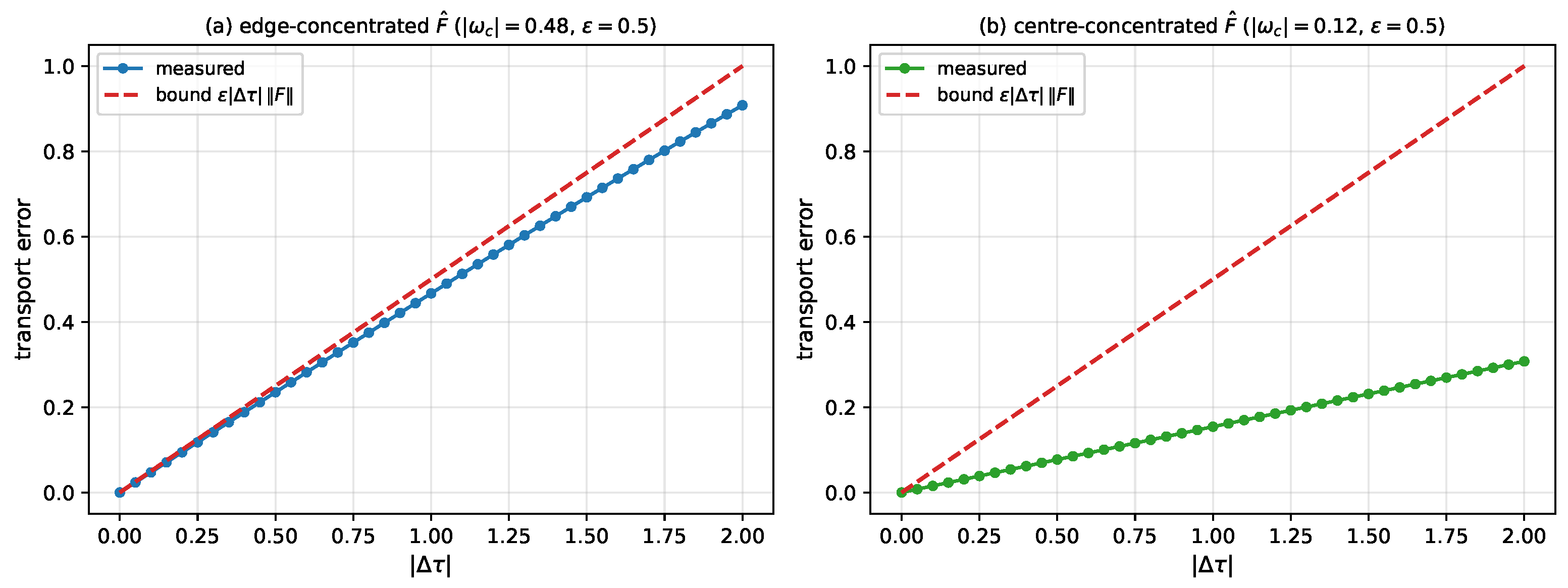
with width w = 0.015 and bandwidth parameter ε = 0.5 . For F A , we place the bumps near the edge of the spectral region, ω c = 0.48 , and for F B we place them near the center, ω c = 0.12 . Both are normalized to unit L 2 norm. We then measure L ( Δ τ , 0 ) F F for a range of Δ τ [ 0 , 2 ] by FFT-based translation on a grid of 4096 samples in τ [ 40 , 40 ] and compare with the theoretical bound ε | Δ τ | F from Theorem 7.
Figure 1 shows both cases. The measured error stays strictly below the theoretical bound in both panels, confirming Theorem 7. Panel (a) shows that the bound is asymptotically tight, in the precise sense established in Remark 1. At small Δ τ , the Taylor expansion | e i ω τ 0 1 | | ω | | τ 0 | gives a leading coefficient | ω c | rather than ε , so the ratio of measured error to bound approaches ω c / ε = 0.96 for the edge case and ω c / ε = 0.24 for the center case. The numerical values of this ratio agree with the prediction to two decimal places across the entire range of Δ τ . The small residual gap from unity in the edge case reflects the non-zero width w of the spectral bump (so | ω | < ε on most of the support) together with the sub-unit prefactor | sin ( ε Δ τ / 2 ) | / ( ε Δ τ / 2 ) at the sampled values of Δ τ , both of which vanish in the analytic limit of the remark.

7.2. Transport Across the Three Subbundles

We now construct three test functions, one in each spectral subspace. All are built on a two-dimensional grid discretizing G ˜ with N τ = 1024 , N θ = 128 , and τ [ 20 , 20 ] .
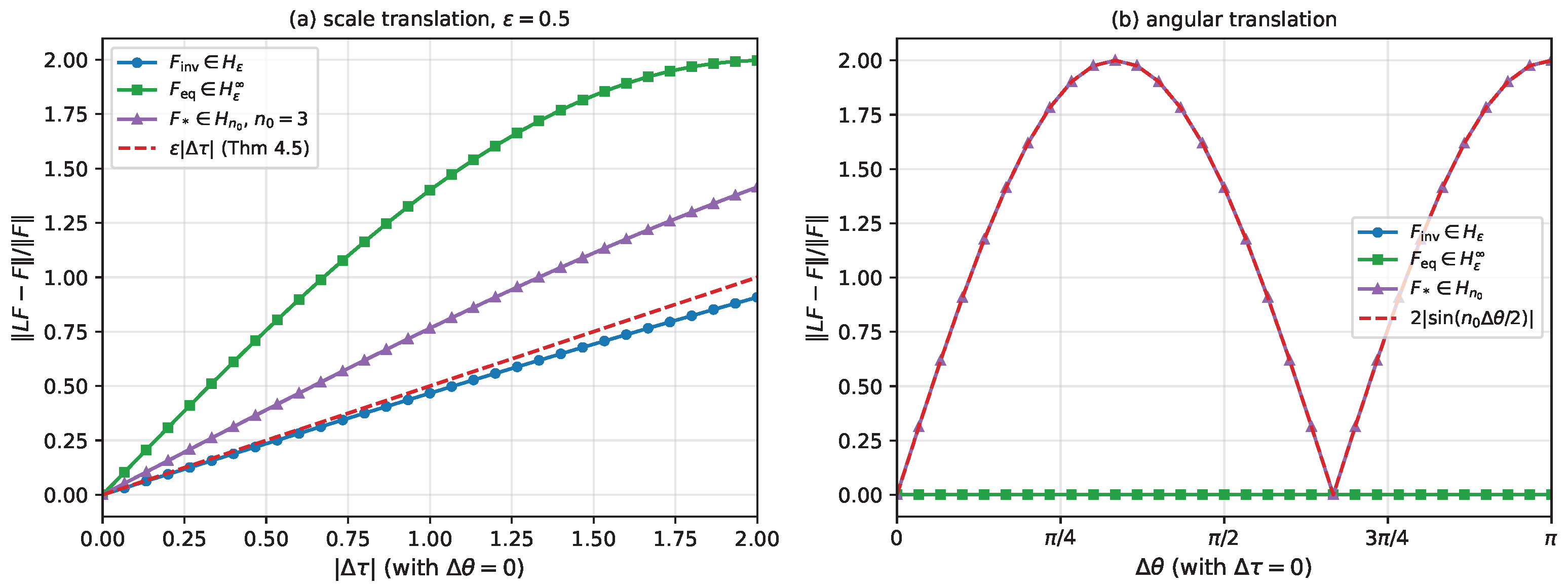
The invariant function F inv has Fourier support at ω c = 0.45 and n = 0 , so F inv H ε . The equivariant function F eq has support at ω c = 1.5 and n = 0 , so F eq H ε since ω c > ε . The coupled function F * has support at ω c = 0.8 and angular frequency n 0 = 3 , so F * H n 0 H * . All three are normalized to unit L 2 norm.
Figure 2a measures L ( Δ τ , 0 ) F F for each of the three functions over Δ τ [ 0 , 2 ] . The invariant curve stays below the bound ε | Δ τ | with the same asymptotic behavior as in Figure 1. The equivariant curve has a much larger slope, consistent with the bound L F F C eq | Δ τ | F with C eq ω c = 1.5 . The coupled curve lies between the two, with slope governed by its scale bandwidth ω c = 0.8 .
Figure 2b measures L ( 0 , Δ θ ) F F for each function over Δ θ [ 0 , π ] . The invariant and equivariant components are independent of θ , so their transport error is identically zero, which the numerical data confirms with machine precision. The coupled component lies in H n 0 , on which L ( 0 , Δ θ ) F = e i n 0 Δ θ F by the modulation identity, so
L ( 0 , Δ θ ) F * F * / F * = | e i n 0 Δ θ 1 | = 2 | sin ( n 0 Δ θ / 2 ) | .
The measured values match this prediction to six decimal places at every sampled Δ θ , including the zero at Δ θ = 2 π / n 0 and the maxima of 2 at Δ θ = π / n 0 and Δ θ = 3 π / n 0 .
Table 2 summarises the two regimes. The scale-translation row shows that the invariant bound is within 7 % of the theoretical ceiling, while the equivariant and coupled entries are well below their spectral-bandwidth bounds, which are only asymptotic. The angular-translation row shows exact agreement to the precision of the measurement.
The code used to produce Figure 1 and Figure 2 and Table 2 is written in Python 3 with NumPy and uses only FFT-based translation, with no third-party wavelet package. It is available from the authors on request.

8. Discussion

We have developed a parallel transport theory for spectral components of L 2 ( G ˜ ) along continuous parameter families driven by group trajectories. The construction rests on three pillars: the spectral decomposition via Pontryagin duality, the Hilbert subbundle formalism, and the explicit transport formulas with quantitative error bounds. We conclude with several directions for extension.
  • Non-abelian groups. When the group G ˜ is abelian, this is responsible for both the flatness of the connections and the path-independence of parallel transport. The full planar similarity group SIM ( 2 ) = R 2 ( R + × SO ( 2 ) ) , which includes spatial translations, is non-abelian. The semidirect product structure gives [ τ , x ] 0 , so the wedge product A A is nonzero and the connections acquire genuine curvature. Holonomy around closed loops becomes nontrivial, and the Berry-type phase analysis in Section 5.4 would produce genuinely geometric phases. The spectral theory on non-abelian groups replaces Pontryagin duality with representation theory, and the spectral decomposition becomes a direct integral rather than a direct sum. More concretely, for SIM ( 2 ) = R 2 ( R + × SO ( 2 ) ) , Mackey’s theory of induced representations identifies the unitary dual with the orbits of R + × SO ( 2 ) acting on R 2 ^ R 2 by dilation and rotation; the regular representation on L 2 ( SIM ( 2 ) ) accordingly decomposes as a direct integral over this orbit space, which consists of the origin and the principal orbit R 2 { 0 } , replacing the direct sum L 2 ( G ˜ ) = H ε H ε H * available in the abelian setting. Extending the present framework in this direction is a substantial undertaking but a natural next step.
  • Higher-dimensional parameter spaces. We have considered signal families parameterized by a one-dimensional interval I. When the parameter space is a manifold M of dimension d 2 , the curvature two-form Ω = d A + A A is generically nonzero even for abelian G ˜ , because d A acquires contributions from cross-partial derivatives of the trajectory components. Transport becomes path-dependent and holonomy measures integrated curvature over enclosed surfaces. This setting arises when the signal is parameterized by spatial position as well as time.
  • Non-parallelism rate as a diagnostic. The non-parallelism rate κ s ( t ) of Definition 5 is a pointwise scalar that vanishes exactly when the section is parallel at t. The decomposition of the covariant derivative into geometric and appearance sources (Theorem 9) further splits κ s into two parts, one controlled by the trajectory estimation error and the other by the intrinsic signal variation. This decomposition separates the two independent sources of drift at the infinitesimal level, which is a finer structural result than the integrated deviation estimates alone provide.
  • Comparison of the three subbundles. The quantitative comparison (Remark 3) shows that the invariant subbundle H ε has the smallest geometric coefficient ε , the equivariant subbundle has a larger coefficient C eq governed by the essential bandwidth, and the coupled subbundle has the additional angular coefficient | n 0 | . The three subbundles thus represent three distinct points on a trade-off between stability under parameter perturbation and sensitivity to parameter change. This trade-off is a structural consequence of the spectral trichotomy and does not require any choice of analyzing function to be visible.
  • Connections to wavelet and scale-space theory. The scale-rotation transform W Ψ is closely related to the continuous wavelet transform on R 2 with rotation [8,9] and to scale-space representations [15]. The present framework provides a geometric perspective on how wavelet coefficients evolve under parameter changes, complementing the algebraic and analytic perspectives in the existing literature. The regularity transfer (Theorem 15) gives conditions under which wavelet coefficients are smooth functions of the parameter, and the discrete transport bounds (Theorem 18) provide error estimates for discrete coefficient tracking.
  • Further directions. Several extensions remain open. A version of the theory on Stiefel or Grassmann manifolds would handle orthonormal frame or subspace dynamics. A stochastic version with noisy trajectories would connect to stochastic parallel transport on Hilbert bundles. A quantitative convergence theory for projection-based approximation of parallel transport, in the spirit of the finite-dimensional result of Absil et al. [16], would bridge the continuous theory and computable algorithms. Each of these extensions preserves the central idea of organizing spectral components into subbundles with connections induced by group action.

Author Contributions

Conceptualization, X.X. and T.W.; methodology, T.W.; software, S.Q., T.W. and J.W.; validation, C.S., T.W. and J.W.; formal analysis, T.W.; investigation, T.W. and J.W.; data curation, T.W., J.W. and C.S.; resources, X.X.; writing—original draft preparation, T.W.; writing—review and editing, X.X. and S.Q.; visualization, X.X. and T.W.; supervision, X.X., S.Q. and C.S.; project administration, X.X.; funding acquisition, X.X. and C.S. All authors have read and agreed to the published version of the manuscript.

Funding

This work was supported in part by the National Natural Science Foundation of China under Grant 62406337 and in part by the Postdoctoral Fellowship Program of CPSF under Grant GZC20233552.

Data Availability Statement

The data presented in this study are openly available in Github at https://github.com/wty-team/parallel-transport-similarity-group (accessed on 21 April 2026).

Conflicts of Interest

The authors declare no conflicts of interest.

References

  1. Kobayashi, S.; Nomizu, K. Foundations of Differential Geometry, Vol. I; Interscience Publishers: New York, NY, USA, 1963. [Google Scholar]
  2. Lang, S. Fundamentals of Differential Geometry; Graduate Texts in Mathematics; Springer: New York, NY, USA, 1999; Volume 191. [Google Scholar]
  3. Berry, M.V. Quantal phase factors accompanying adiabatic changes. Proc. R. Soc. Lond. A 1984, 392, 45–57. [Google Scholar] [CrossRef]
  4. Simon, B. Holonomy, the quantum adiabatic theorem, and Berry’s phase. Phys. Rev. Lett. 1983, 51, 2167–2170. [Google Scholar] [CrossRef]
  5. Folland, G.B. A Course in Abstract Harmonic Analysis, 2nd ed.; CRC Press: Boca Raton, FL, USA, 2016. [Google Scholar]
  6. Rudin, W. Fourier Analysis on Groups; Dover Publications: Mineola, NY, USA, 2017. [Google Scholar]
  7. Daubechies, I. Ten Lectures on Wavelets; CBMS-NSF Regional Conference Series in Applied Mathematics; SIAM: Philadelphia, PA, USA, 1992; Volume 61. [Google Scholar]
  8. Antoine, J.-P.; Murenzi, R.; Vandergheynst, P.; Ali, S.T. Two-Dimensional Wavelets and Their Relatives; Cambridge University Press: Cambridge, UK, 2004. [Google Scholar]
  9. Ali, S.T.; Antoine, J.-P.; Gazeau, J.-P. Coherent States, Wavelets, and Their Generalizations, 2nd ed.; Theoretical and Mathematical Physics; Springer: New York, NY, USA, 2014. [Google Scholar]
  10. Duits, R.; Duits, M.; van Almsick, M.A.; ter Haar Romeny, B. Invertible orientation scores as an application of generalized wavelet theory. Pattern Recognit. Image Anal. 2007, 17, 42–75. [Google Scholar] [CrossRef]
  11. Cohen, T.S.; Welling, M. Group equivariant convolutional networks. In Proceedings of the 33rd International Conference on Machine Learning (ICML 2016), New York, NY, USA, 19–24 June 2016; pp. 2990–2999. [Google Scholar]
  12. Weiler, M.; Cesa, G. General E(2)-equivariant steerable CNNs. In Advances in Neural Information Processing Systems; Curran Associates: Red Hook, NY, USA, 2019; Volume 32. [Google Scholar]
  13. Klingenberg, W.P.A. Riemannian Geometry, 2nd ed.; de Gruyter Studies in Mathematics; Walter de Gruyter: Berlin, Germany, 1995; Volume 1. [Google Scholar]
  14. Reed, M.; Simon, B. Methods of Modern Mathematical Physics, Vol. I: Functional Analysis, revised and enlarged ed.; Academic Press: San Diego, CA, USA, 1980. [Google Scholar]
  15. Lindeberg, T. Scale-Space Theory in Computer Vision; Springer Science+Business Media: New York, NY, USA, 2013. [Google Scholar]
  16. Absil, P.-A.; Mahony, R.; Sepulchre, R. Optimization Algorithms on Matrix Manifolds; Princeton University Press: Princeton, NJ, USA, 2008. [Google Scholar]
Figure 1. Verification of the invariant subbundle transport bound Π inv F F ε | Δ τ | F . Panel (a) uses an edge-concentrated F ^ with ω c = 0.48 , close to ε = 0.5 ; the measured error approaches the bound and the ratio stabilizes near 0.94 as Δ τ 0 . Panel (b) uses a centre-concentrated F ^ with ω c = 0.12 ; the bound still holds and the measured error grows linearly with a slope close to ω c 0.12 , well below the bound slope ε = 0.5 .
Mathematics 14 01701 g001
Figure 2. Transport behavior on the three subbundles. Panel (a) shows the relative transport error under pure scale translation ( Δ τ , 0 ) ; the invariant component matches the bound ε | Δ τ | (Theorem 7), while the equivariant and coupled components have larger coefficients determined by their essential bandwidths. Panel (b) shows the error under pure angular translation ( 0 , Δ θ ) ; both the invariant and equivariant components have zero error, reflecting their independence of θ , while the coupled component oscillates exactly as 2 | sin ( n 0 Δ θ / 2 ) | , in agreement with Theorem 6.
Mathematics 14 01701 g002
Table 1. Transport constants for standard analyzing functions. The column “Primary subspace” indicates the subspace that receives the dominant spectral energy. The column “Geometric coeff.” gives the leading coefficient in the geometric deviation bound (Corollary 4). (For the LoG kernel, the entry ε in the “Geometric coeff.” column is the user-chosen bandwidth parameter from Definition 1 rather than an intrinsic spectral property of the kernel; the choice ε 1 / σ recommended in Proposition 7 (c) controls the trade-off between approximate invariance (small ε ) and representational capacity (large ε ). The other two entries in this column are intrinsic spectral coefficients of the corresponding analyzing functions.)
Analyzing FunctionPrimary SubspaceGeometric Coeff.Phase Factor
LoG kernel H ε ε none
Gaussian derivative H ε C eq 1 / σ none
Circular harmonic n 0 H n 0 H * C τ + | n 0 | e i n 0 Δ θ
Table 2. Transport error on the three subbundles at selected displacements.
Section F inv F eq F
Δ τ = 1 , Δ θ = 0 (measured) 0.467 1.400 0.765
Δ τ = 1 , Δ θ = 0 (bound/theory) 0.500 ∼3.0∼1.6
Δ τ = 0 , Δ θ = π / 2 (measured)00 1.414214
Δ τ = 0 , Δ θ = π / 2 (theory)00 1.414214
Disclaimer/Publisher’s Note: The statements, opinions and data contained in all publications are solely those of the individual author(s) and contributor(s) and not of MDPI and/or the editor(s). MDPI and/or the editor(s) disclaim responsibility for any injury to people or property resulting from any ideas, methods, instructions or products referred to in the content.