1. Introduction
Avian influenza, also known as bird flu, is a highly contagious viral disease among avian species, which has resulted in significant economic losses in the poultry sector because of high mortality rates and culling of flocks [
1]. However, the economic significance of avian influenza is not the only public health concern; it is also zoonotic, capable of transmitting from birds to humans [
2]. The highly pathogenic H5N1 influenza A viruses continue to be endemic in bird populations, and human cases continue to increase [
3]. The biggest threat is the possibility of the virus mutating and becoming capable of efficient human-to-human transmission, which would increase the risk of a global pandemic [
4]. The biggest pandemic in recorded history occurred between 1918 and 1919, when there were 21 million reported deaths worldwide. It was one of the most deadly events in recorded history. After that, there were three other pandemics in the 20th century: the 1957 H2N2 pandemic, the 1968 H3N2 pandemic, and the 2009 influenza A (H1N1) virus (pH1N1) pandemic [
5]. From 1 January to 1 July 2025, Cambodia’s International Health Regulations (IHR) National Focal Point (NFP) notified the World Health Organization (WHO) of 11 laboratory-confirmed cases of avian influenza A(H5N1) virus human infection. Seven of the 11 cases occurred in June, a rare monthly surge [
6]. According to the WHO, from 2003 to 2025, a total of 948 laboratory-confirmed human cases of avian influenza A(H5N1) have been reported globally, of which 464 were fatal (case fatality rate of approximately 49%). The economic losses from avian influenza outbreaks between 2003 and 2020 were estimated at over
$20 billion USD. In 2024 alone, more than 50 million poultry birds were culled in Europe and North America due to H5N1 outbreaks, marking one of the largest avian influenza epidemics in history [
1,
7].
Recent data highlight the ongoing threat and emphasize the urgent need for effective tools to understand and predict the spread of avian influenza. In this regard, mathematical modeling provides a powerful framework to study disease dynamics and assess intervention strategies [
8]. Compartmental models, particularly the
and
frameworks, have been widely applied in epidemiology, as they capture essential processes such as infection, incubation, transmission, recovery, and disease-induced mortality [
9]. These models allow researchers to simulate outbreak scenarios, determine critical thresholds for disease persistence, and evaluate the potential impact of control measures [
10].
Mathematical modeling serves as an indispensable tool for understanding and controlling infectious disease outbreaks [
8,
11,
12,
13]. By translating biological processes into mathematical equations, these models enable researchers to predict disease trajectories, identify critical intervention points, and evaluate the potential impact of control strategies before implementation [
14]. Furthermore, mathematical models provide quantitative frameworks for estimating key epidemiological parameters, such as the basic reproduction number
, which determine whether an outbreak will persist or die out [
15]. This predictive capability is essential for public health authorities to allocate resources effectively, design optimal intervention policies, and prepare for potential pandemics.
The development of mathematical models for avian influenza has progressed significantly over time [
16]. Early efforts were based on classical epidemic models such as SIR and SEIR, introduced by Kermack and McKendrick in 1927 [
17]. With the emergence of H5N1 in 1997 and widespread outbreaks in the early 2000s, disease-specific models were developed to estimate transmission dynamics and test strategies like culling, vaccination, and movement restrictions [
18]. As human cases appeared, models expanded to include cross-species transmission and pandemic risk. Later, network and spatial models incorporated poultry trade, live bird markets, and wild bird migration to capture regional spread [
7]. Today, avian influenza models follow a One Health perspective, linking birds, humans, and the environment, and play a vital role in predicting outbreaks, guiding surveillance, and shaping effective control strategies [
19].
Recently, fractional-order delay differential epidemic models have gained significant attention due to their ability to capture memory effects and time delays inherent in disease transmission, with stability and bifurcation analysis revealing complex dynamical behaviors such as Hopf bifurcations and chaos [
20]. Additionally, neural network-based numerical approaches, particularly Physics-Informed Neural Networks (PINNs), have emerged as powerful tools for solving and validating complex epidemic models [
21,
22]. These advancements complement traditional ODE models and provide new avenues for understanding disease dynamics.
M. Derouich [
23] proposed an integrated two-population model that links human and bird populations through zoonotic transmission. In this framework, the human population is represented by an SIR-type structure, incorporating recruitment, natural mortality, recovery, and disease-induced death. The bird population, on the other hand, is modeled using two compartments: susceptible and infectious. The overall system is formulated as follows.
Human population
Bird population
2. Problem Formulation
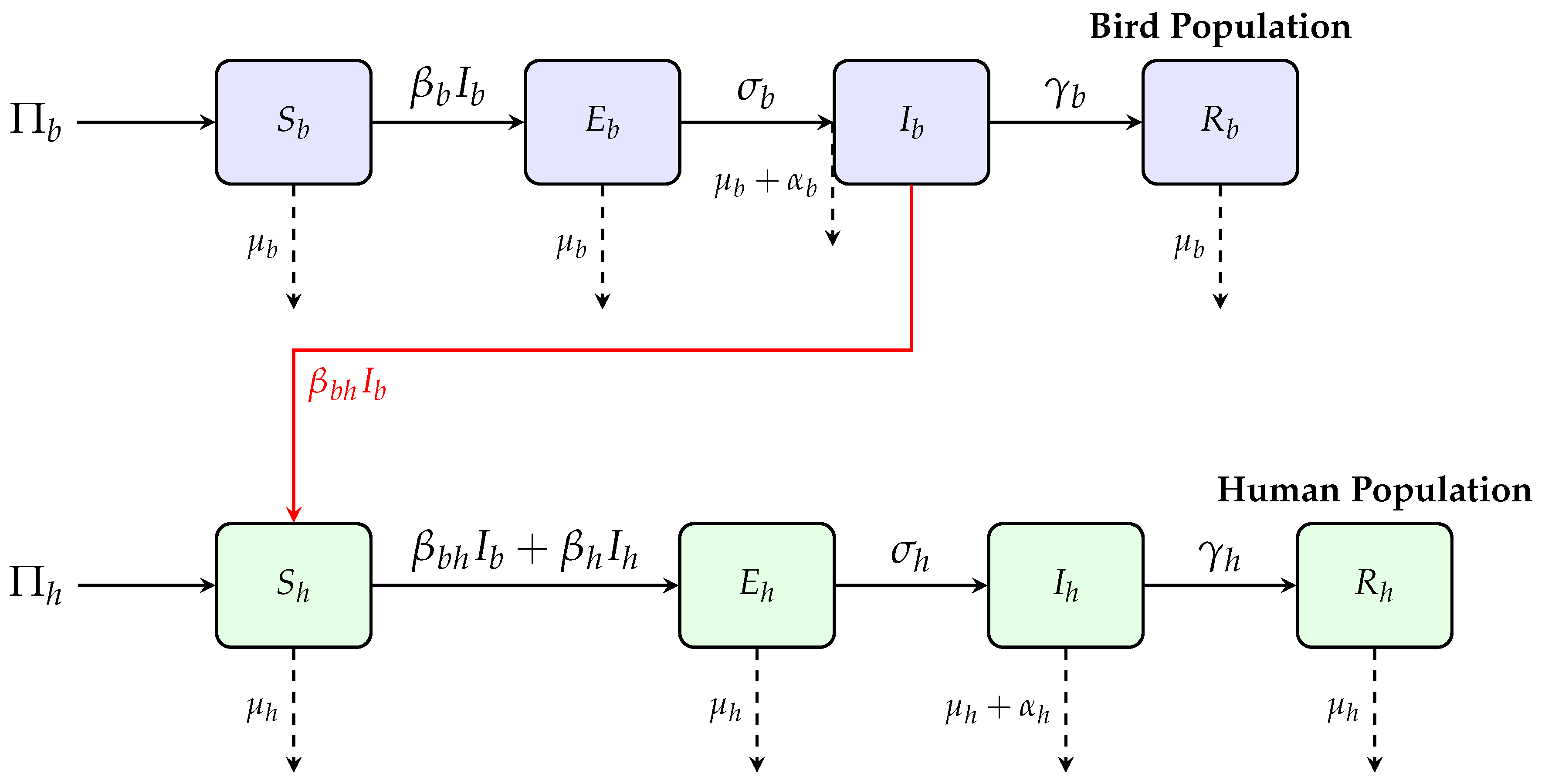
To describe the transmission dynamics of avian influenza between bird and human populations, we divide each population into four epidemiological compartments.
For the bird population, the susceptible class consists of birds that are free from infection but are at risk of infection through contact with infectious birds. The exposed class represents infected birds in the incubation period who are not yet infectious. The infectious class includes birds capable of transmitting the disease. The recovered class consists of birds that have recovered and acquired immunity.
For the human population, the susceptible class represents individuals who are not infected but may acquire the disease through contact with infectious birds or infectious humans. The exposed class consists of infected individuals in the incubation stage who are not yet infectious. The infectious class includes individuals capable of transmitting the infection. The recovered class represents individuals who have recovered and developed immunity.
The model is unidirectionally coupled from birds to humans, meaning that infectious birds transmit the virus to susceptible humans through zoonotic transmission, while humans do not transmit the infection back to birds. This assumption is consistent with the epidemiology of avian influenza, where birds act as reservoir hosts.
The proposed model is given by the following system of ordinary differential equations.
2.2. Human Population
The initial conditions are given by
2.3. Compartmental Flow Diagram and Flow Chart of the Model
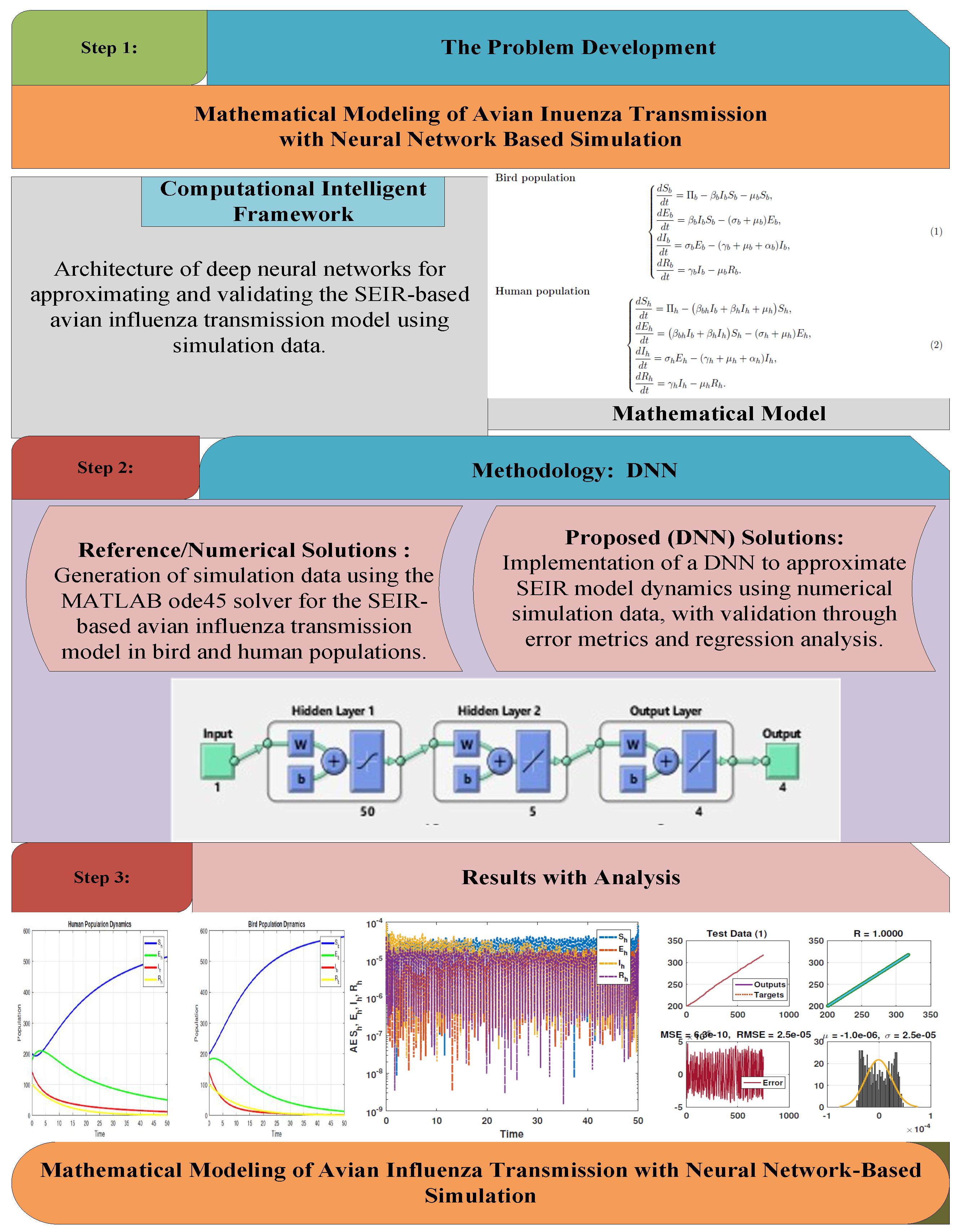
This section present the compartmental flow diagram showing in
Figure 1 while the flow chart diagram in
Figure 2 which has showing the entire methodology for the aforementioned model along with description of the used parameters in
Table 1.
2.4. Improvements over Previous Models
Compared to the SIR–SI framework proposed by Derouich and Boutayeb [
23], the present model introduces the following improvements:
Exposed compartments (, ): The inclusion of latent classes accounts for the incubation period observed in avian influenza, improving the realism of disease progression.
Recovered class for birds (): Unlike earlier models, recovered birds are explicitly considered, allowing analysis of immunity and recovery.
Human-to-human transmission (): This component captures limited but documented transmission among humans and enables assessment of potential outbreak scenarios.
Refined zoonotic transmission (): The bird-to-human transmission pathway is explicitly modeled within the SEIR structure.
Disease-induced mortality (, ): Mortality due to infection is incorporated for both populations.
2.5. Biological Justification of Model Components
The assumptions of the model are supported by epidemiological observations:
Bird-to-bird transmission (): Occurs through direct contact and contaminated environments.
Bird-to-human transmission (): Arises from exposure to infected birds or contaminated surroundings.
Human-to-human transmission (): Limited transmission has been observed in close-contact settings.
Incubation periods (, ): Reflect the delay between infection and infectiousness.
The model therefore provides a comprehensive framework for analyzing avian influenza transmission under a One Health perspective.
2.6. Methodological Workflow
Figure 2 presents a schematic overview of the methodology employed in this study. The workflow consists of six sequential steps: (i) model formulation of the coupled SEIR-SEIR system (Equations (
1) and (
2)); (ii) analytical analysis including positivity, boundedness, equilibrium points, and derivation of the basic reproduction numbers
and
using the next-generation matrix method; (iii) stability analysis establishing local asymptotic stability via the Routh–Hurwitz criterion and global asymptotic stability via composite Lyapunov functions; (iv) numerical simulations using MATLAB ode45 to validate analytical findings; (v) sensitivity analysis using normalized forward sensitivity indices to identify key intervention targets; and (vi) a neural network consistency check trained on ode45 solutions to confirm numerical accuracy. Finally, the results are interpreted to provide epidemiological insights and policy recommendations within the One Health framework.
3. Basic Properties of the Model
The topics of positivity, boundedness, reproductive number, stability analysis, sensitivity analysis, and numerical simulation are covered in this section. Before presenting the said properties of the model, we give some definitions which explore the idea of neural network (NN) and the need for its application to the said model along with a fractional operator.
Definition 1 (Neural Network Performance). In the concept of the neural network, the performance refers to the model’s goal achievements in the context of accuracy and by best approaches. For the performances, the accuracy, mean square error, absolute error, recalling, and precision are required for the concerned data. Furthermore, for improvement in performance, the training, networking design, and placement of the hyperparameter should be modified.
Definition 2 (Average Square Error). The measurement of efficiency is termed as the mean square error. It is used for the computation of the mean square deviation between the exact and estimated or approximate result which implies the correctness of network predictions.
Definition 3 (). For the rate of learning or the step size interval, we usually chose μ. A hyperparameter is used for the controlling biases and weight and age when network variation occurs in the learning rate of the training. The learning rate μ refers to the magnitude of step sizes in loss quantities in the optimization technique under gradient.
3.1. Positivity
Theorem 1. Let the initial conditions of the system be . Then the solutions of the system remain in the positive orthant for all .
Proof. To establish the non-negativity of the solutions, we apply the results for essentially non-negative systems as established by De Leenheer and Aeyels [
24]. A dynamical system
is essentially non-negative if, for every
i,
whenever
and
. This condition ensures that the positive orthant
is a forward invariant.
We evaluate the direction of the vector field on each bounding hyperplane:
Given that the right-hand side functions are locally Lipschitz continuous in and the vector field at the boundaries of the positive orthant points inward ( when ), the region is an invariant set. Therefore, all trajectories starting in remain non-negative for all . □
3.2. Boundedness and Positive Invariance
Theorem 2. The regionis positively invariant and bounded for the systems (1) and (2). Proof. Let
and
. Then
Since all state variables are non-negative, it follows that and ; hence, all components are bounded.
Moreover, on the boundary
and
, we have
and
, implying that
D is positively invariant. Hence,
D is bounded and invariant. The result follows from standard dynamical systems arguments [
25]. □
3.3. Basic Reproduction Number
Now we find the basic threshold number for our proposed problem (
1) and (
2). For this purpose, we use the next-generation method. We consider the infectious classes in the proposed model. Let
.
The Jacobian matrix of
at the DFE is
The Jacobian matrix of
at the DFE is
The inverse of
is given by
where
and
The next-generation matrix is
The basic reproduction number
is the spectral radius of
:
At the disease-free equilibrium,
and
. Thus, the basic reproduction numbers for the bird and human populations are given by
The quantities and represent the average number of secondary infections generated by a single infected individual in the bird and human populations, respectively. These threshold parameters determine whether the disease will die out or persist in the population.
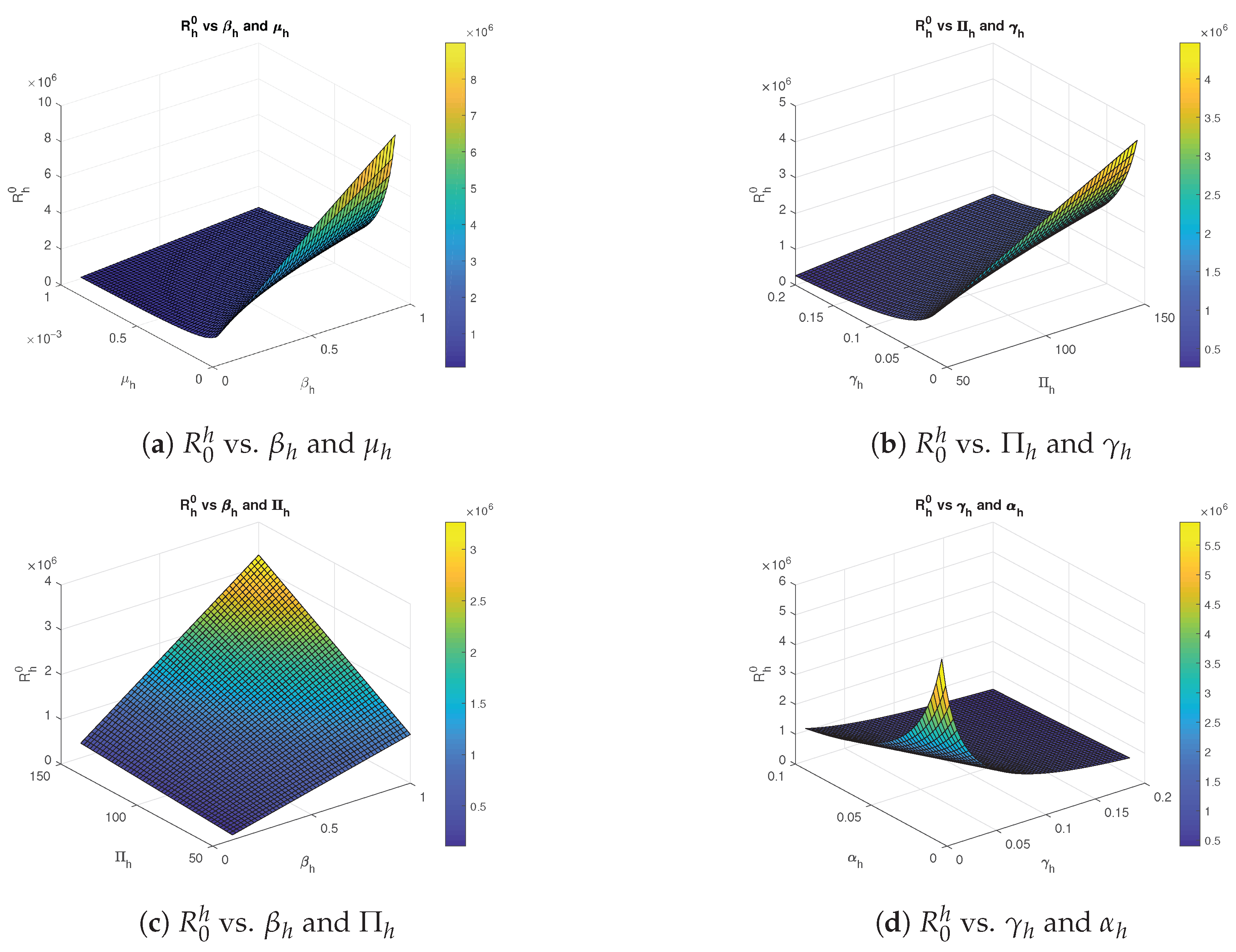
3.3.1. 3D Graphs of
The parameter domains in
Figure 3 are centered around the baseline values reported in
Table 2. Each plot varies two parameters over a biologically plausible range while holding all other parameters constant at their baseline values.
Discussion of vs. Parameters
The plots reveal the sensitivity of
to various parameters. As shown in
Figure 3a–d,
exhibits a direct and approximately linear relationship with parameters in the numerator, namely the contact rate (
) and the recruitment rate (
). Increasing either of these parameters leads to a proportional increase in
. In contrast,
is inversely proportional to the parameters in the denominator, such as the mortality rate (
), recovery rate (
), and disease-induced death rate (
).
Figure 3a,b, and especially
Figure 3d, illustrate that as these parameters decrease, the value of
increases sharply. The most dramatic effect is seen in
Figure 3d, where a simultaneous decrease in
and
causes a sudden and significant spike in
, indicating a high risk of sustained disease transmission when recovery and mortality rates are low.
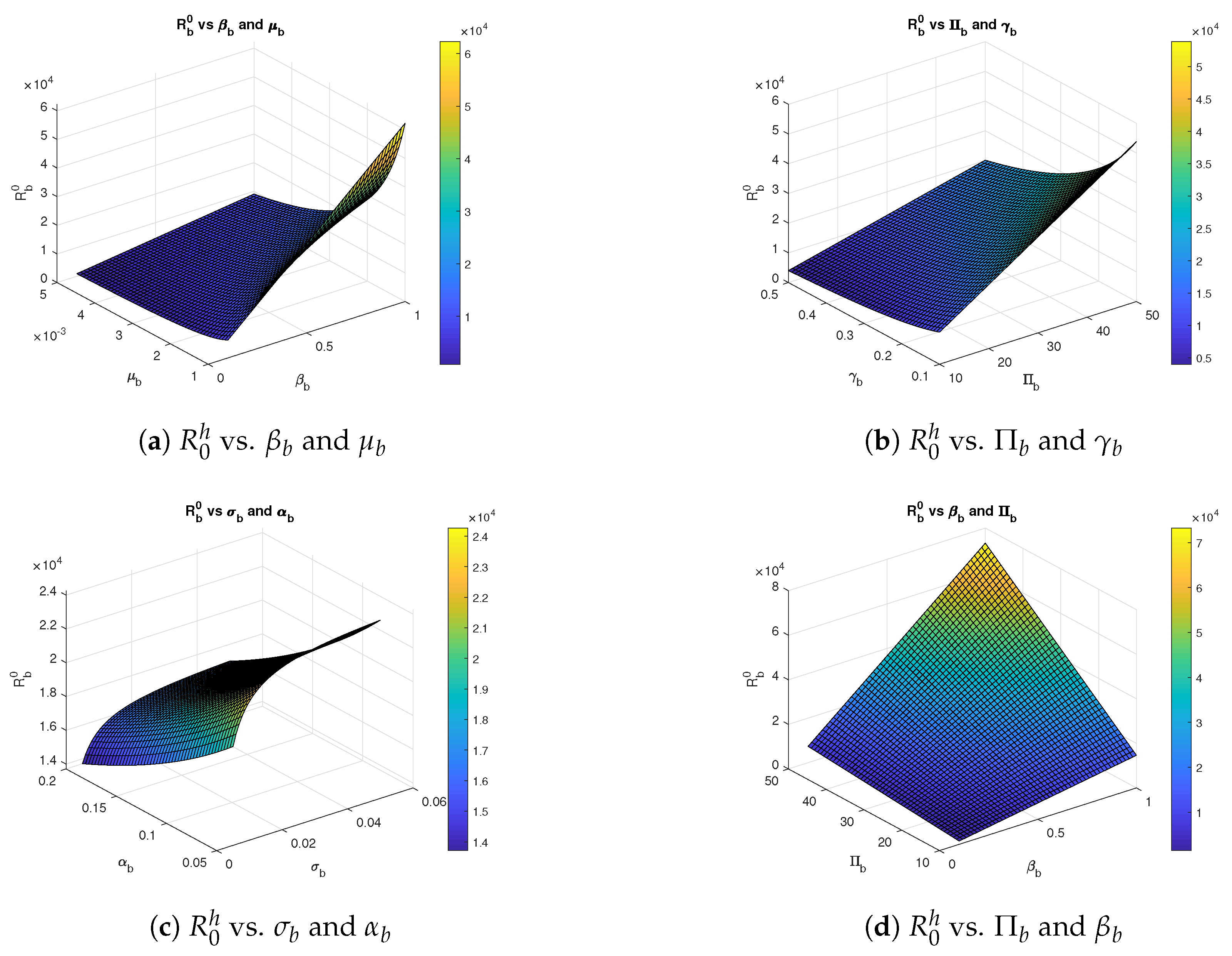
3.3.2. 3D Graphs of
All parameter ranges in
Figure 4 are chosen using baseline parameter values given in
Table 3,where two parameters are varied over a biologically realistic range while the others remain fixed to their baseline values.
Discussion of vs. Parameters
The plots collectively illustrate how the basic reproduction number, , for the bird population is influenced by its parameters. The value of is directly proportional to the contact rate (), the recruitment rate (), and the maturation rate (), as these are either in the numerator or contribute positively to the overall value. In contrast, is inversely proportional to parameters in the denominator, namely the natural mortality rate (), recovery rate (), and disease-induced death rate (). The plots confirm these relationships, showing sharp increases in as the inverse parameters approach zero. The most significant and linear increases are seen with the contact and recruitment rates, which directly drive the disease’s transmission potential.
3.4. Equilibrium Points
3.4.1. Disease-Free State
When a community is in a disease-free state (DFS), there is no disease infection. The symbol for it is
. The infectious classes are taken to be equal to zero in order to reach this state. We observe that the DFS is given by
, where
3.4.2. Disease-Endemic State
Let
represent the disease-endemic state, which indicates that the disease is present in the population. The endemic equilibrium point for the system is given by
Thus, if and only if . When , the only non-negative solution is the disease-free equilibrium.
The human infectious compartment
satisfies the quadratic equation
where
Solving for will yield two possible equilibrium points (or one if the discriminant is zero).
Biological feasibility summary: For the bird subsystem, if and only if ; when , the only non-negative solution is the disease-free equilibrium. The human infectious compartment satisfies a quadratic equation, which yields two possible equilibrium points (or one if the discriminant is zero). The endemic equilibrium exists and is biologically feasible (all components positive) if and only if and . The expressions and clearly show that as increases above 1, the susceptible bird population decreases while the infected bird population increases.
3.5. Stability Analysis
Local Stability of the Disease-Free Equilibrium
Applying the Routh–Hurwitz criterion, we first consider the local stability of equilibria by investigating eigenvalues of the Jacobian matrices of the given model at equilibria.
Theorem 3. The disease-free equilibrium (DFE) of systems (1) and (2) is locally asymptotically stable when and , but it is unstable when and . Proof. Jacobian matrix of systems (
1) and (
2) is as follows:
The matrix
is a block lower triangular matrix.
where
The eigenvalues of this
matrix are given by
For matrices A and C, the eigenvalues are and ;
The characteristic equation for the remaining matrices
A and
C with eigenvalue
is
Now, to determine the nature of the eigenvalues of the above square matrix, we use the Routh–Hurwitz criteria. For the bird subsystem (matrix
A), the characteristic polynomial is
For the human subsystem (matrix
C), the characteristic polynomial is
Thus, in both cases, , if and , when .
This demonstrates that when and , our SEIR system for the human and avian populations is locally asymptotically stable. □
3.6. Global Asymptotic Stability of the Disease-Free Equilibrium
It is important to emphasize that although the system admits multiple equilibria in general, these equilibria do not coexist under the same parameter regime. In particular, we show that the endemic equilibrium is not feasible when the basic reproduction numbers satisfy and .
Uniqueness of the DFE when
: We verify that no endemic equilibrium exists under this condition. From the bird subsystem, the endemic equilibrium satisfies
Thus, if , then . Since in the feasible region D, it follows that .
Substituting
into the human equilibrium Equation (
14), we obtain
, and the quadratic reduces to
where
and
b reduce to
whenever
. Hence,
is the only biologically feasible solution.
Therefore, no endemic equilibrium exists in D when and , and the disease-free equilibrium is the unique equilibrium in this region. This allows us to establish its global asymptotic stability in D.
Theorem 4. The disease-free equilibrium is globally asymptotically stable in the feasible region D whenever and .
Proof. We construct the Lyapunov function
where
is a constant to be determined.
Differentiating
V along the solutions of the system gives
Using the bounds
and
, we obtain
Substituting this value of
c, we obtain
Since and , it follows that for all solutions in D, and if and only if and .
From the system equations, this implies
and
. Hence, the largest invariant set contained in
is
On this set, the system reduces to
which corresponds to the disease-free equilibrium
.
Therefore, by LaSalle’s invariance principle, the disease-free equilibrium is globally asymptotically stable in D whenever and . □
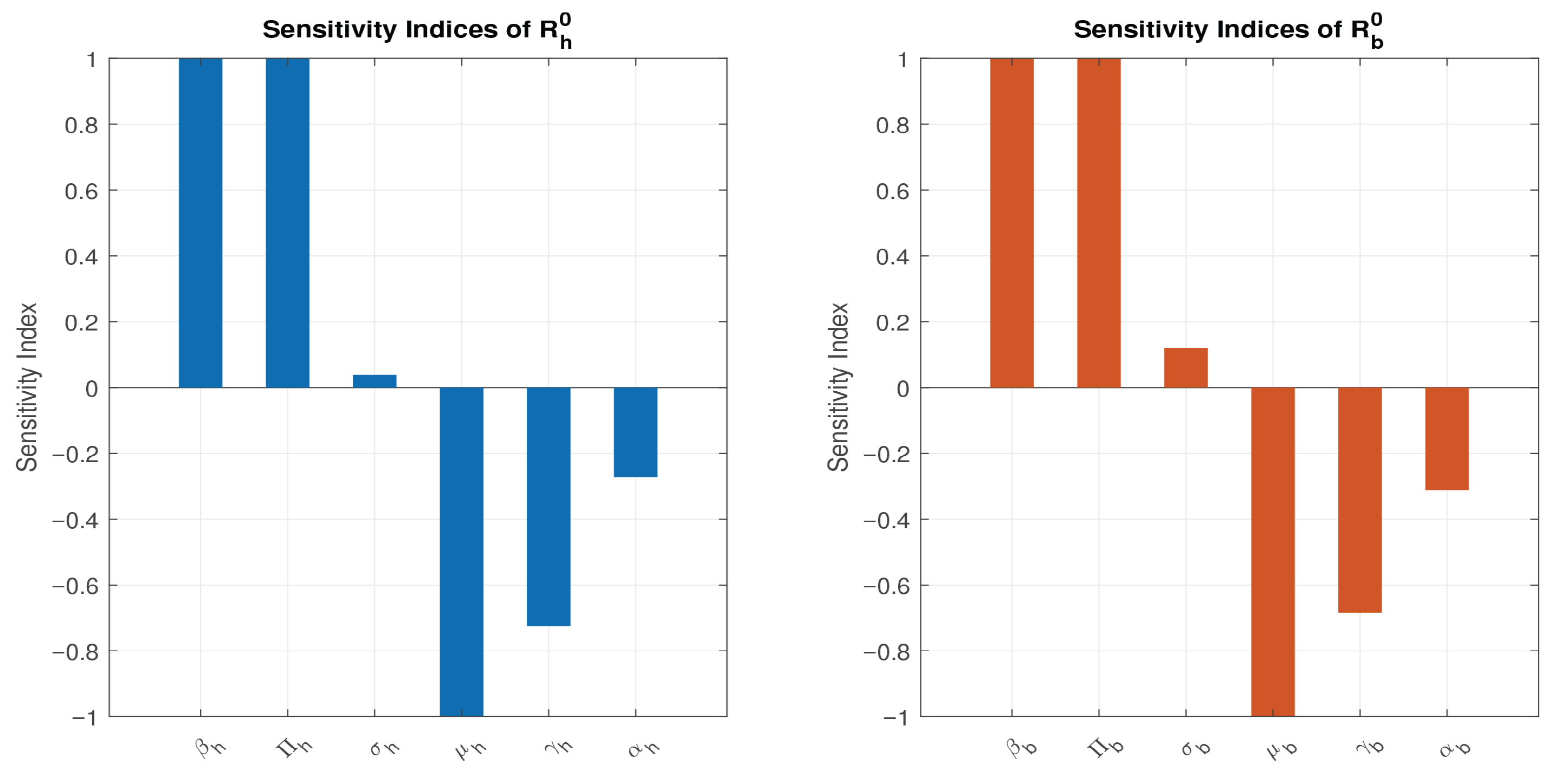
3.7. Sensitivity Analysis
To determine the relative importance of each parameter in driving disease transmission, we compute the normalized forward sensitivity index of
and
showing in
Figure 5 with respect to each parameter
p using the formula:
A positive index indicates that increasing the parameter increases
, while a negative index indicates the opposite effect. The magnitude of
quantifies the proportional change in
for a proportional change in
p.
- 1.
The same approach can be used to calculate the sensitivity of the basic reproduction number with respect to the other parameters along with sensitivity indices as mentioned in
Table 4.
3.8. Parameter Justification and Policy Implications
The parameter values listed in
Table 2 and
Table 3 were determined through a combination of a literature review and biological estimation. Parameters such as natural mortality (
) and recruitment (
) are based on standard demographic data, while progression and recovery rates (
) are estimated from observed incubation and infectious periods of highly pathogenic avian influenza (HPAI) strains.
Epidemiological Interpretation and Policy Implications
The sensitivity analysis identifies the most critical parameters for disease control. The human and bird recovery rates ( and ) exhibit strong negative sensitivity (SI = and ), indicating that a 10% increase in treatment efficiency or antiviral administration can reduce by approximately 7%. Conversely, transmission parameters () and recruitment rates () show a direct positive sensitivity (SI = ). This implies that a 10% reduction in contact rates—achieved through biosecurity, social distancing, or vaccination—will lead to a 10% reduction in the reproduction number.
The relatively low sensitivity for progression rates () suggests that interventions focusing on the latent period are less effective than those targeting active transmission and recovery. Therefore, an integrated strategy combining transmission reduction (hygiene, biosecurity) with enhanced clinical recovery under the One Health framework provides the most robust approach for controlling the avian influenza epidemic.
3.9. Numerical Simulation
The analytical results obtained from working on the model’s numerical simulation using the MATLAB ode45 solver are discussed in this section.
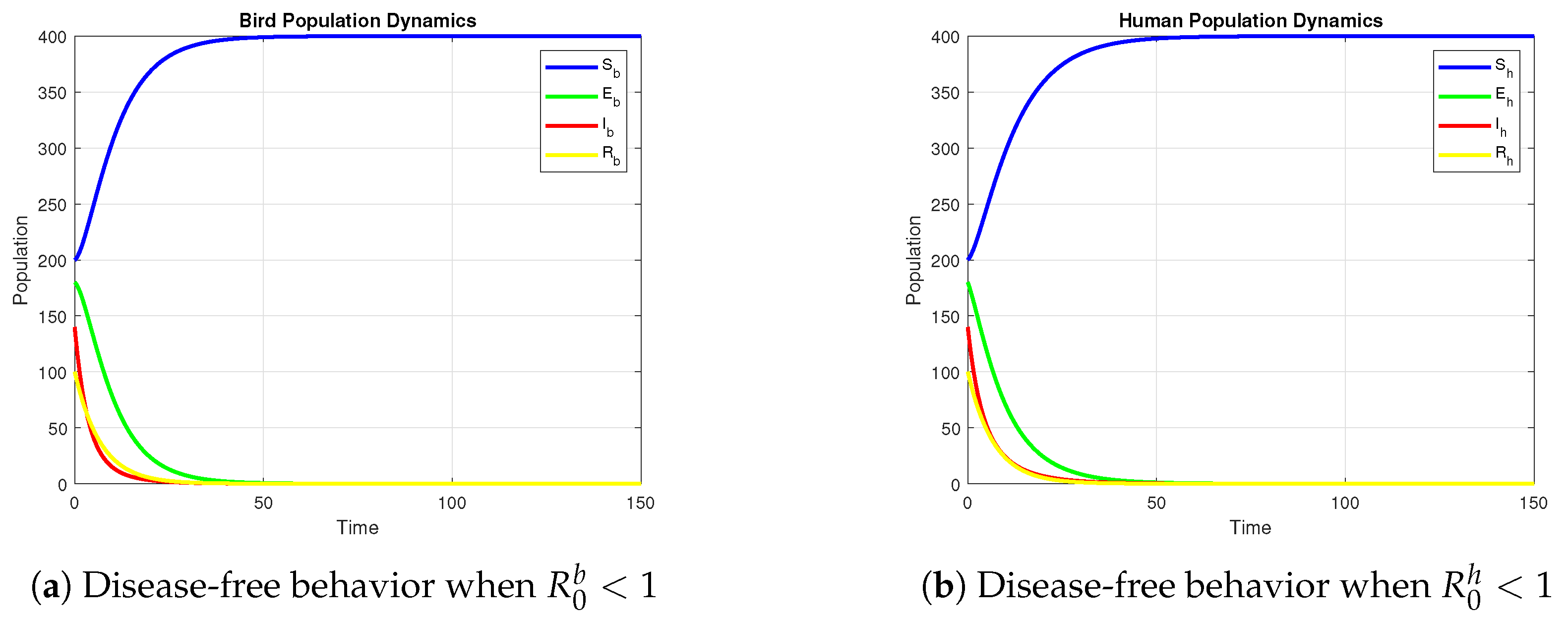
3.9.1. Disease-Free Behavior When Both
We obtain
by selecting the specific values of parameters
Similarly, by selecting
we obtain
.
Using the initial values in both cases, , , , and , the graphs below are produced. It indicates that the infection is approaching zero when and .
3.9.2. Endemic Behavior When Both
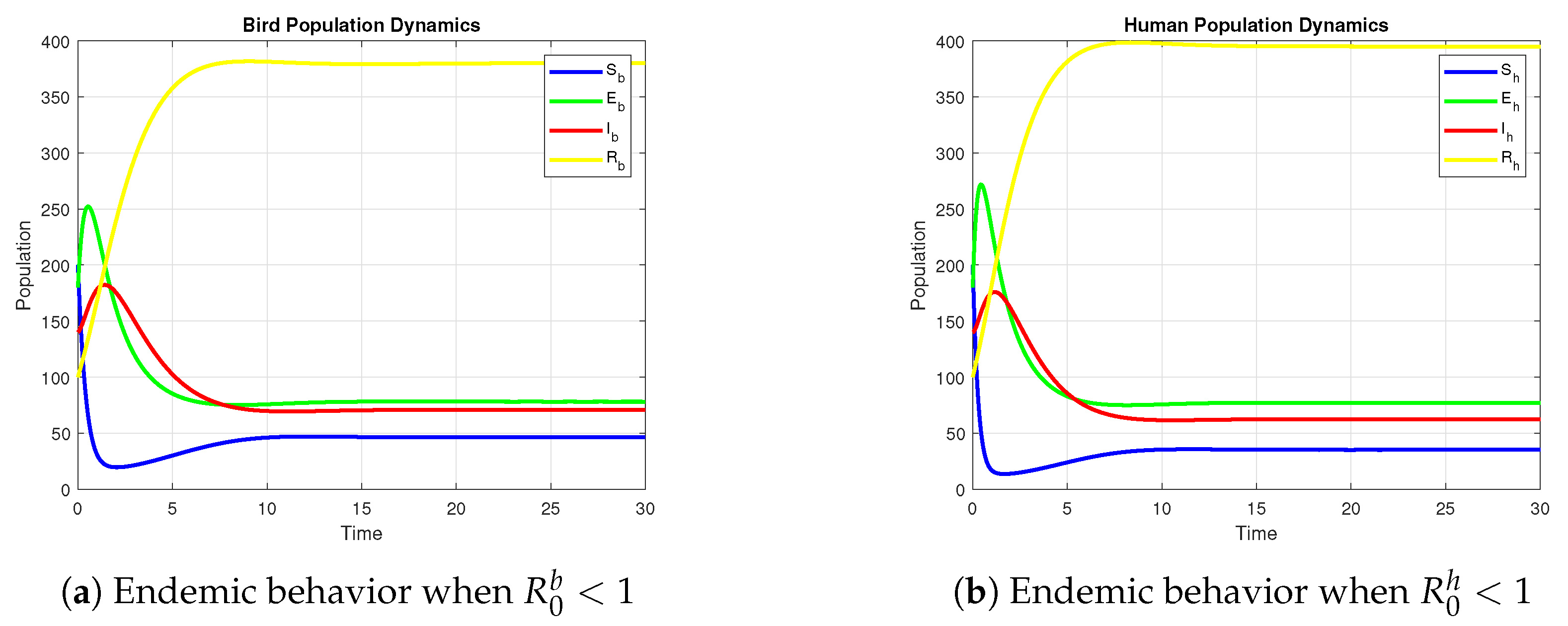
We obtain
by selecting the specific values of parameters
and
3.9.3. Effect of Different Parameters on Human Infected Individuals
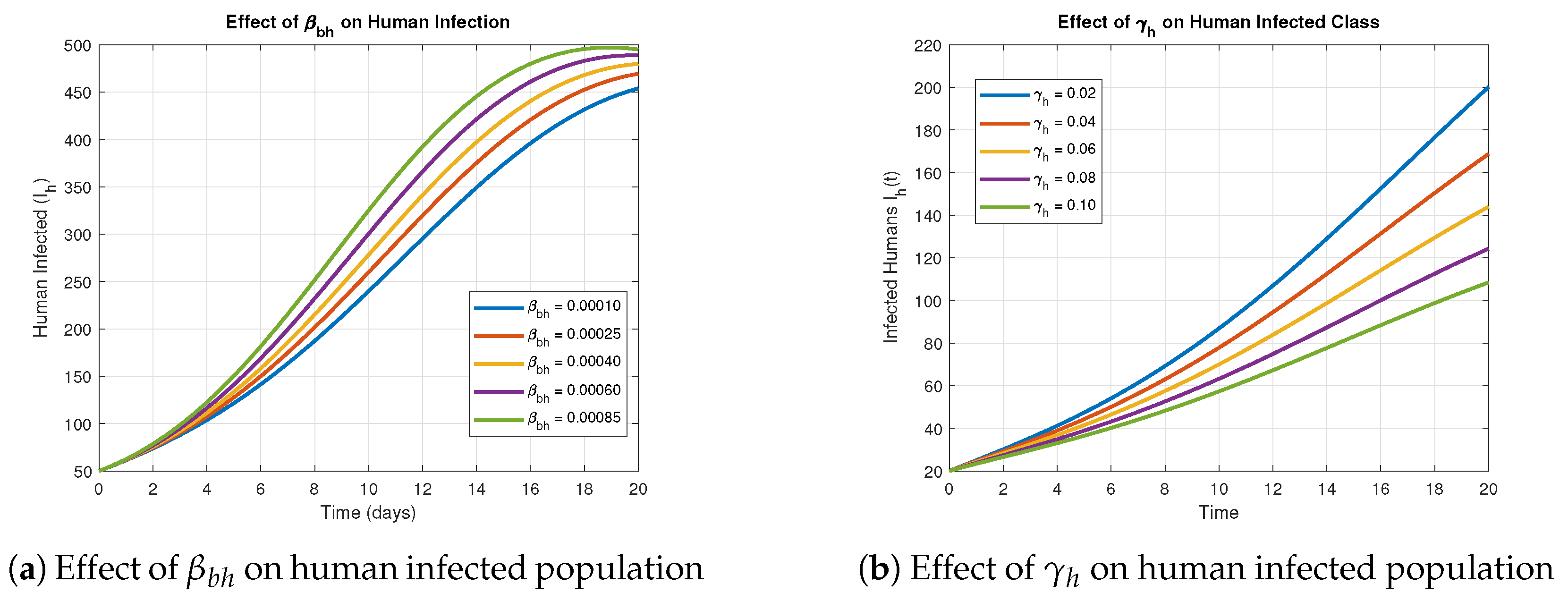
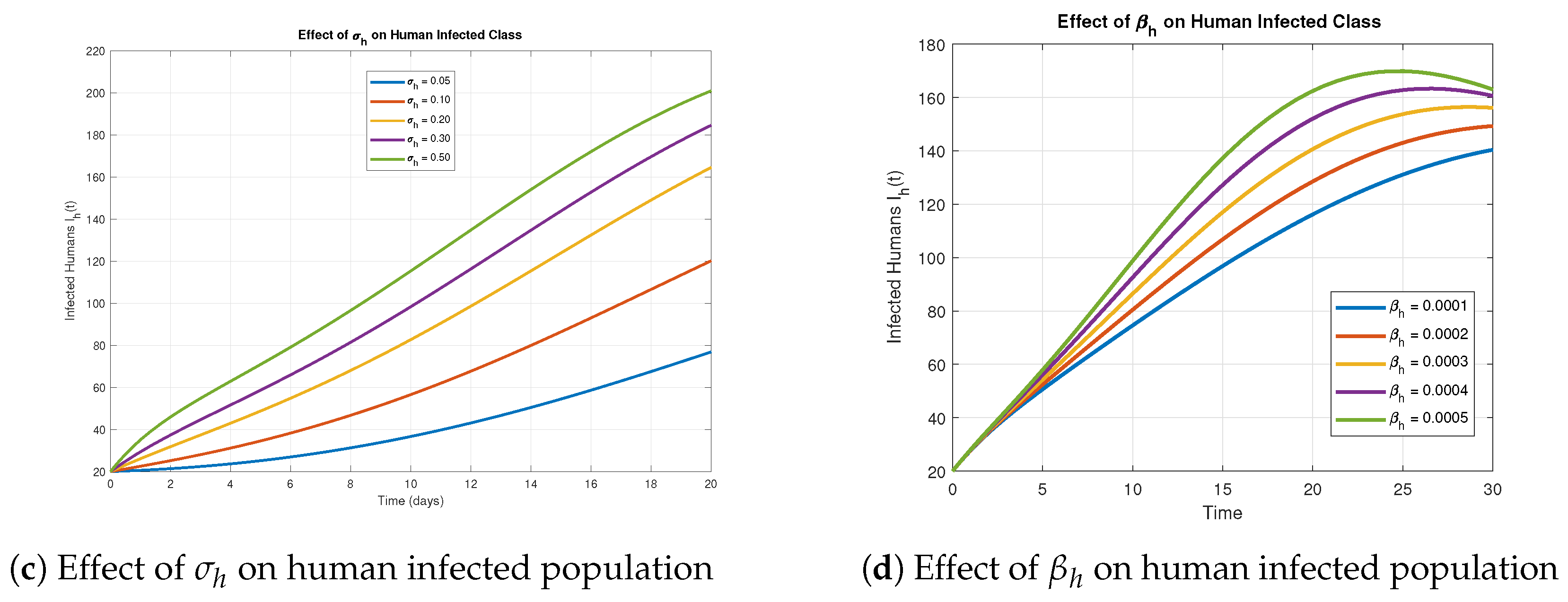
Figure
Figure 8 illustrates the influence of various epidemiological parameters on the human infected class
. Panel (a) shows that an increase in the bird-to-human transmission rate
leads to a rapid growth in human infections, with higher values of
producing a steeper rise in the infection curve. Panel (b) demonstrates the effect of the human recovery rate
, where higher recovery rates result in a noticeable decline in the infected class, indicating that faster recovery substantially reduces disease prevalence. Panel (c) presents the impact of the progression rate
from exposed to infected peoples, showing that larger values of
accelerate the transition into the infectious state, thereby increasing the number of human infections. Panel (d) highlights the role of the human-to-human transmission rate
, where increasing
amplifies the growth and peak level of infections, emphasizing its critical contribution to sustaining the outbreak. Collectively, the results reveal that transmission parameters (
) and the progression rate (
) drive infection growth, while the recovery rate (
) mitigates it, underscoring their importance in designing effective control strategies.
4. Neural Networking
The methodology of a neural network (NN) resembles an artificial network that operates through hidden layers, utilizing maximum and minimum operations along with multiplication and addition, based on matrix vector rules from linear algebra, probability, and data science. Various researchers have extensively explored neural network-based approaches through a variety of methodologies, examining and analyzing a broad spectrum of both linear and nonlinear mathematical models, such as [
30,
31,
32,
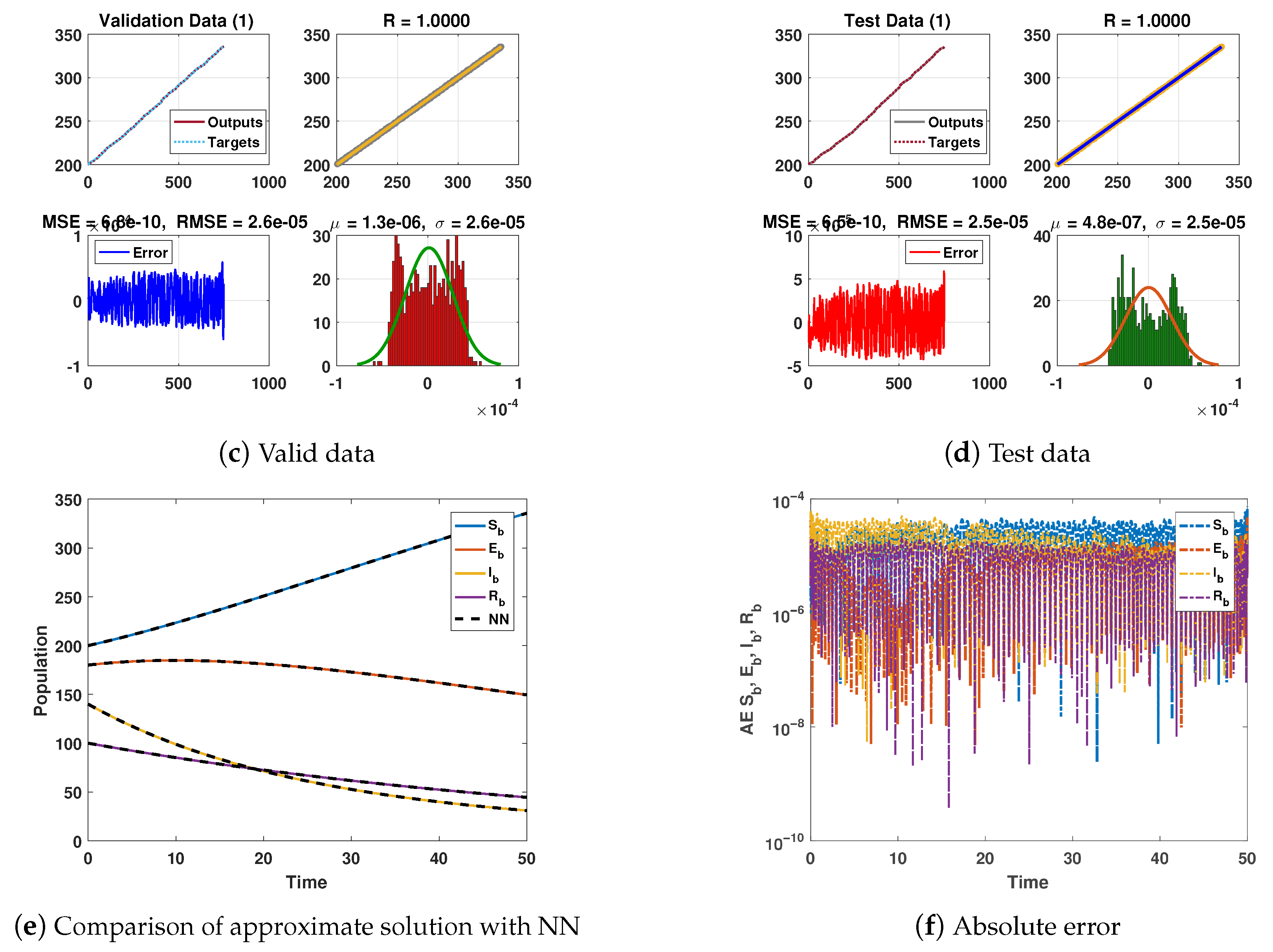
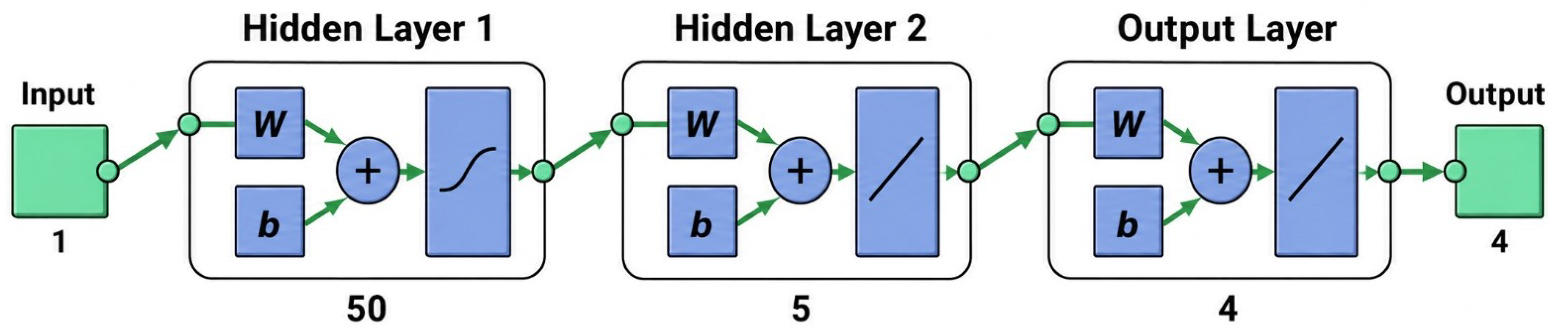
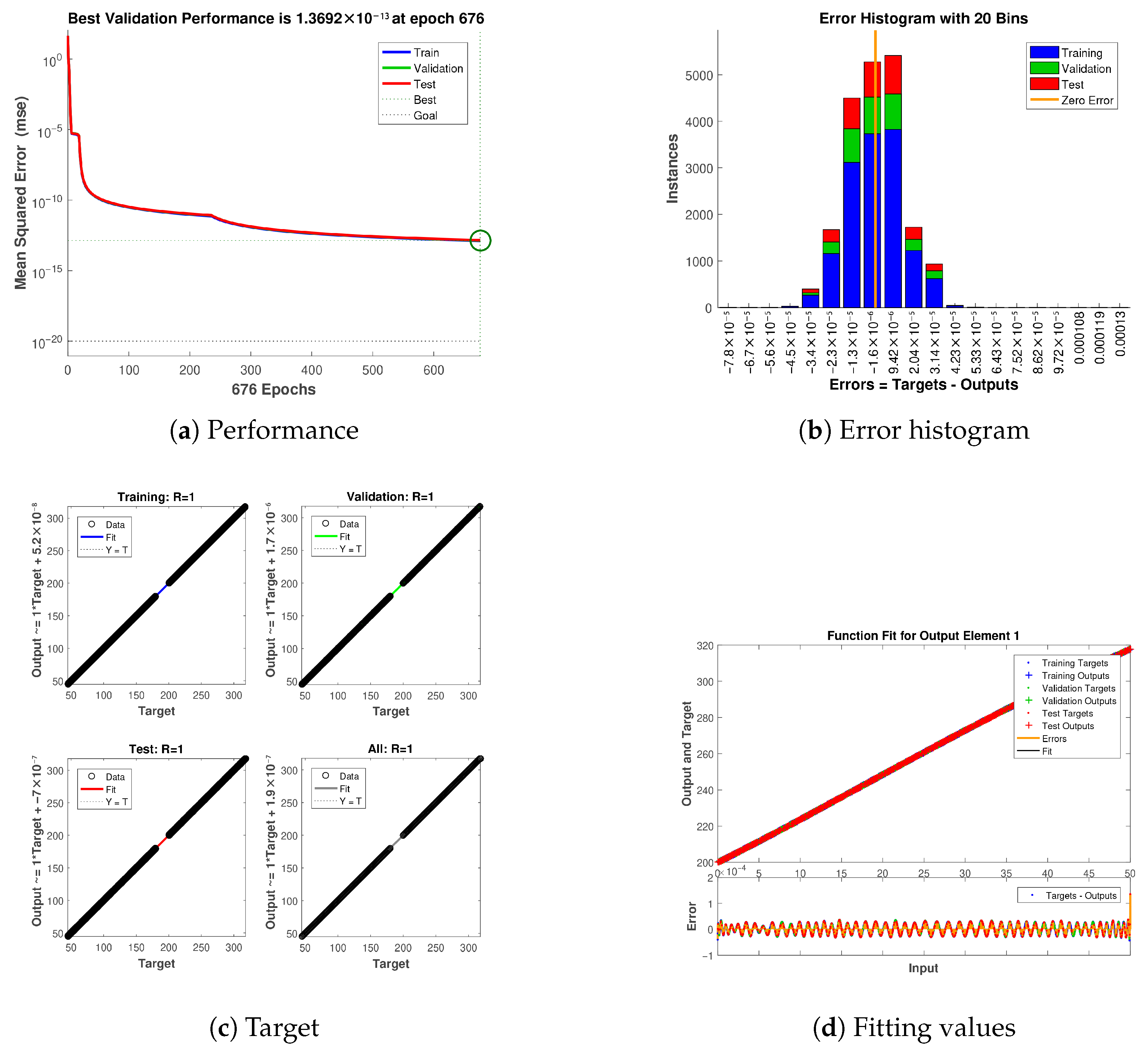
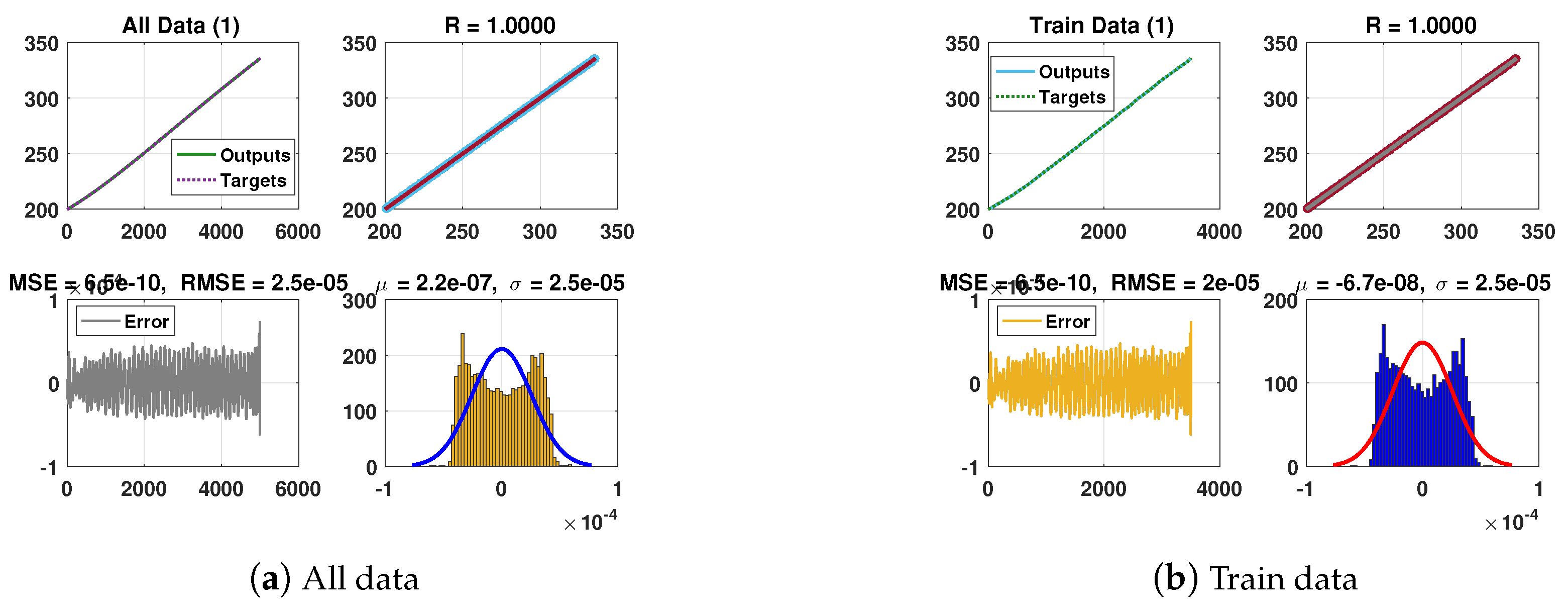
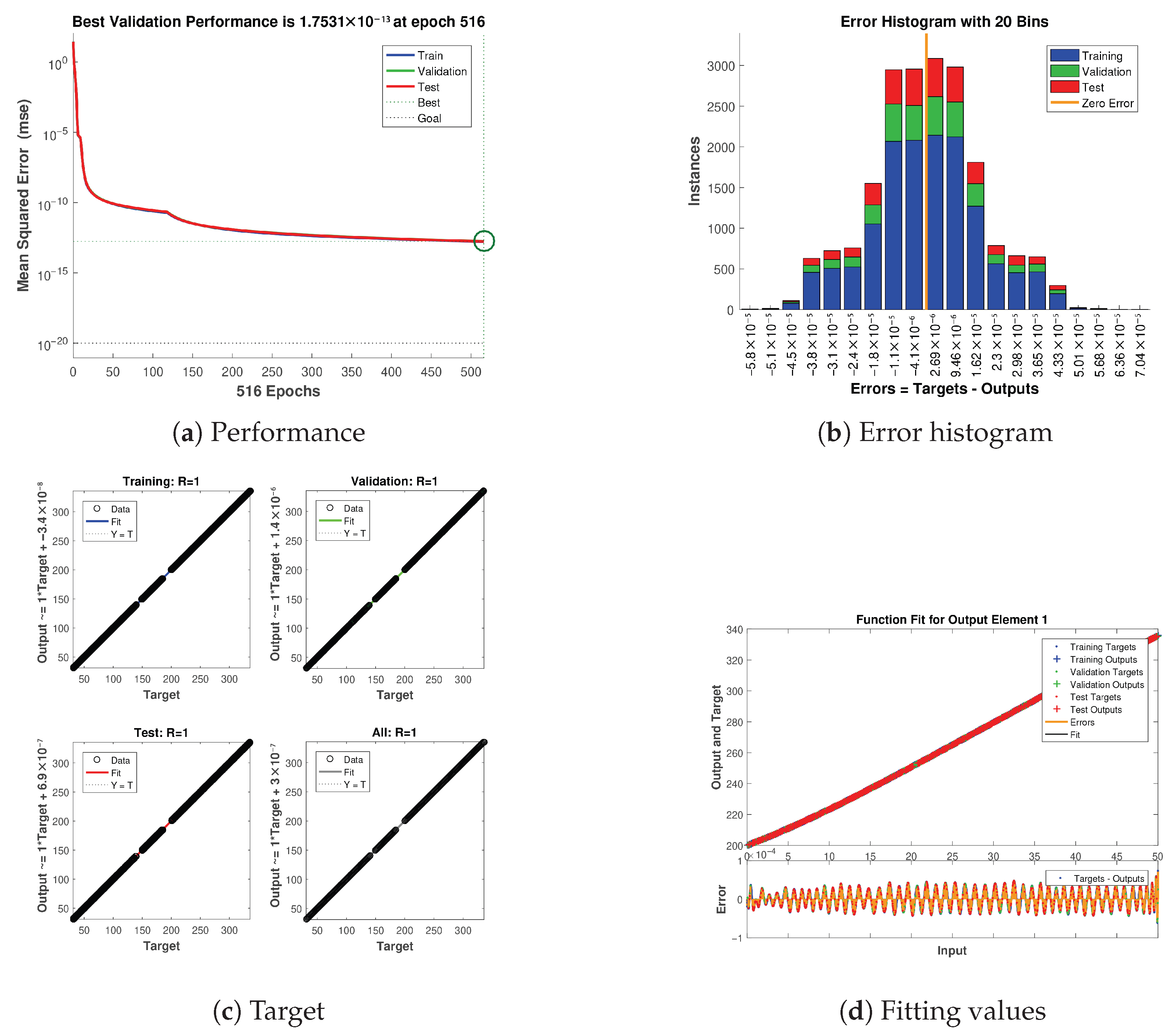
33]. The pre-saved model parameters are embedded into the NN code within the MATLAB package. This package tests all data for validation, training, performance evaluation, histogram analysis, fitting values, and error metrics such as root mean square error (RMSE), mean square error (MSE), and absolute error (AE). The code can search through data using built-in functions to extract all these properties, as illustrated in the figures below. The flowchart representing the NN process is shown in
Figure 9.
For biological justification, the neural network is linked to numerical simulations of local stability for both and , using saved data (Data 1 and Data 2) in MATLAB 2020 software as standard. Subsequently, these data are utilized in the neural network code of the MATLAB package, where the target and output built-in functions are pre-stored in the form of hidden layers for the five compartments, running up to 1000 epochs.
The performance and correlations of the data are then tested, and the saved data are employed to train, test, and validate all data sets. This process includes comparisons, regression analysis, absolute error, and mean square error relative to the already stored data. We further extend the discussion of the neural network section. The NN analysis—similar to artificial intelligence—integrates previously saved work related to the said model or its modified versions, applied here to verify the comparison or correlation with the saved numerical simulation expressed as a system of differential equations.
This analysis indicates that previous work on avian influenza infection is comparable with the present model. Moreover, the model yields small absolute and mean square errors, as the neural network curves overlap with the earlier simulation curves. The neural network is executed twice, applied to the saved simulation of the model for both conditions:
and
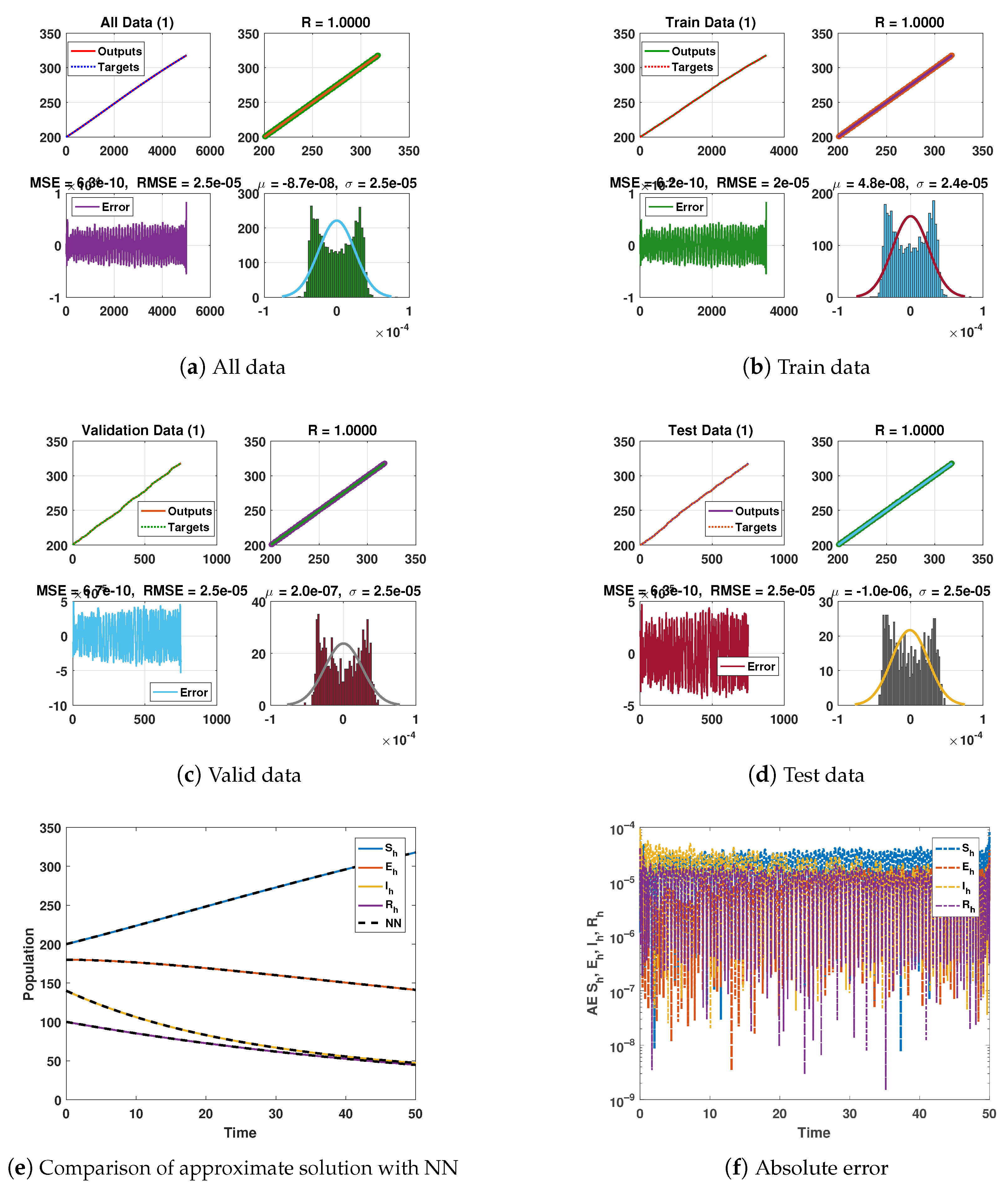
. This section is devoted to the neural networking of both the models representing the bird flu dynamics for human and bird populations which depends on the saved data of both the models. Neural networks have two or three hidden layers which process the saved data and return the output in the form of graphical dynamics having all, train, valid, and test data along with mean errors, performance, regression, and fitting values. The graphs are shown in
Figure 10 and
Figure 11.
Figure 10e is the comparison of the human model and neural network dynamics, while
Figure 10f is the absolute error.
The graphs are shown in
Figure 12 and
Figure 13.
Figure 12e is the comparison of the bird model and neural network dynamics, while
Figure 12f is the absolute error. In both cases, the NN curves lie on the curves of human and bird curves showing very small mean square errors, which demonstrates the correctness of the obtained scheme.
5. Model Limitations and Future Work
While the proposed model captures essential transmission dynamics of avian influenza, several limitations should be acknowledged. First, the model assumes homogeneous mixing of populations and does not account for spatial heterogeneity, such as differences between rural and urban areas or the role of live bird markets and wild bird migration routes. Second, demographic processes are modeled as constant rates, whereas birth and death rates may vary seasonally or in response to outbreaks. Third, the model does not incorporate behavioral dynamics, including vaccination hesitancy, risk perception, social distancing compliance, or public health interventions that change over time in response to disease prevalence. Fourth, the neural network validation is performed on simulated data generated from the same ODE system; future work should train neural networks on real epidemiological data once available.
Future research directions:
Extending the model to fractional-order delay differential equations to capture memory effects and time delays in disease transmission.
Incorporating optimal control theory to identify time-varying intervention strategies (e.g., culling, vaccination, treatment).
Adding behavioral feedback loops where human behavior changes in response to perceived risk.
Developing spatial or network models to capture heterogeneous transmission patterns.
Applying Physics-Informed Neural Networks (PINNs) to directly estimate parameters from real outbreak data.
6. Conclusions
In the current study, we proposed and analyzed an SEIR-type model to describe the avian influenza transmission dynamics between human and bird populations. The model takes into account bird-to-bird, bird-to-human, and human-to-human transmission routes, as well as natural and disease-induced mortality. We demonstrated the important theoretical properties of the system, including positivity, boundedness, and stability. The basic reproduction numbers were derived using the next-generation matrix method, where is defined as the spectral radius of evaluated at the disease-free equilibrium. The disease-free equilibrium is locally and globally asymptotically stable when the basic reproduction numbers for both populations satisfy and . Numerical simulations confirm this result, showing susceptible populations converging to their equilibrium values while infected populations decay to zero. When and , the system exhibits an endemic equilibrium, indicating that the disease persists in both populations. Sensitivity analysis reveals that transmission rates and recruitment rates are the most influential parameters in increasing the basic reproduction numbers (sensitivity index ), while recovery rates act as strong suppressors (sensitivity index approximately ). Numerical simulations further illustrate that increasing the recovery rate reduces human infections, whereas higher bird-to-human or human-to-human transmission rates amplify outbreaks. The neural network validation shows very small mean squared errors on the order of , confirming the accuracy of the numerical solutions. These results highlight the significance of minimizing bird-to-human transmission, maximizing treatment and recovery in humans, and implementing effective bird population surveillance. In totality, this research adds to the One Health framework by linking human and avian health dynamics, and it presents a theoretical foundation for the development of effective control and intervention measures against avian influenza. The key quantitative findings’ thresholds, sensitivity indices, and convergence behavior provide actionable insights for public health planning.




 ,
,