Article

Unconditionally Stable L1-2 FEMs for Nonlinear Schrödinger Equations with the Variable-Order Time-Fractional Derivative

School of Mathematics and Data Science, Jiangnan University, Wuxi 214122, China
*
Author to whom correspondence should be addressed.
Mathematics 2026, 14(10), 1656; https://doi.org/10.3390/math14101656
Submission received: 6 April 2026 / Revised: 29 April 2026 / Accepted: 12 May 2026 / Published: 13 May 2026
(This article belongs to the Section C1: Difference and Differential Equations)

Abstract

This paper studies a nonlinear Schrödinger equation with a variable-order time-fractional derivative. Because classical L1 and L1-2 schemes are not directly applicable to variable-order fractional operators, an improved L1-2 discretization with dynamically updated convolution weights is developed based on the Coimbra-type definition, in which the fractional order is evaluated at the current time. By combining the proposed temporal approximation with the Galerkin finite element method for spatial discretization and a linearized extrapolation technique for the nonlinear terms, a fully discrete numerical scheme is constructed. The unconditional stability of the scheme is rigorously proven, and optimal error estimates are established under a mild time step restriction. Numerical experiments are presented to confirm the theoretical results and to demonstrate the effectiveness of the method in capturing the influence of time-dependent memory effects on wave propagation. A key numerical observation is that stronger memory effects may suppress wave packet evolution, which is qualitatively reminiscent of a Zeno-like inhibition phenomenon.

1. Introduction

Over the past two decades, a Schrödinger equation posed with a fractional derivative has been extended by Laskin [1,2,3], playing a significant role in the development within the framework of fractional quantum mechanics. Laskin introduced the Schrödinger equation, involving a spatial fractional operator based on the Riesz fractional derivative, and subsequent studies extended this framework by introducing the Caputo fractional derivative to characterize the temporal derivative. Later, Naber [4] proposed a Schrödinger equation with a time-fractional order aimed at characterizing the time evolution of an unbound particle in quantum theory with non-Markovian dynamics. Studies have shown that such fractional models offer clear advantages in describing various phenomena that exhibit anomalous diffusion; see [5,6,7]. Over recent years, time-fractional nonlinear Schrödinger equations have received greater attention due to their ability to incorporate memory effects and nonlocal behavior that naturally arise in complex physical environments. Such formulations provide a more adequate description of systems whose evolution is influenced by heterogeneous media, long-range interactions, or anomalous transport mechanisms; see [8,9,10,11,12]. In line with the aforementioned studies on the physical background and theoretical development, extensive research has been devoted to constructing highly accurate numerical algorithms for computing solutions for the time-fractional Schrödinger problem and related nonlinear differential equations. Gao and colleagues [13] introduced a newly developed numerical scheme for fractional derivatives, known as the L1-2 approach, specifically designed to numerically evaluate the α -order Caputo derivative. They also conducted a detailed analysis of both quadratic and linear interpolation approaches within this framework. Later, P. Wang and C. Huang [14] developed a Crank–Nicolson-type numerical method that preserves the discrete energy structure for nonlinear Schrödinger equations involving Riesz space-fractional operators, ensuring both stability and high accuracy in the numerical solutions. Li, Wang, and Zhang [15] developed a scheme combining L1 time discretization with Galerkin finite elements under linearization for time-fractional nonlinear Schrödinger equations and proved its unconditional stability together with optimal-order error bounds. In a similar vein, Chen, Li, and Lü [16] independently developed comparable linearized fully discrete schemes, expanding the repertoire of effective numerical techniques for PDEs involving fractional derivatives. Liu, Wang, and Zhang [17] presented a finite difference discretization with second-order precision with linearization in the study of the nonlinear time-fractional Schrödinger model, established its unconditional optimal error estimate and confirmed the theoretical convergence rate through numerical experiments. Moreover, Seal and Natesan [18] studied a category of nonlinear diffusion equations with time-fractional derivatives that incorporate a broad memory kernel. They formulated a nonuniform L1 method and utilized a discrete Grönwall-type inequality in generalized form to rigorously formulate stability and derive optimal error estimates for solutions on meshes with graded refinement. Srinivasa et al. [19] represents a meaningful contribution to the numerical study of nonlinear fractional wave models. By combining the Bernoulli wavelet collocation technique with a functional integration matrix, they established an accurate and efficient method for the nonlinear fractional Klein–Gordon equation, together with a convergence analysis and comprehensive numerical validation. Chen et al. [20] investigated finite element methods for the time-fractional Ginzburg–Landau equation with a Caputo derivative and established unconditional optimal L 2 -norm error estimates, as well as superclose and global superconvergence results. They further adopted a nonuniform L1 scheme and a fast algorithm to handle the initial weak singularity and improve computational efficiency. El Yazidi and Zeng [21] proposed a splitting-based numerical method for nonlinear convection coefficient identification in elliptic equations, combining total variation regularization, radial-basis-function discretization, the alternating direction method of multipliers, and convergence analysis. Building on the approach of Jun Ma et al. [22], they introduce a completely discretized and linearized computational approach to the nonlinear Schrödinger equation in two spatial dimensions governed by time-fractional dynamics. The temporal Caputo derivative is computed approximately by the L1 formula, and a five-point difference stencil is employed in space. Wei et al. [23] developed a high-order fully discrete discontinuous Galerkin method for two-dimensional unsteady natural convection heat transfer equations with tempered fractional constitutive relationships. They also employed a graded temporal mesh to capture the weak initial singularity and proved the stability and convergence of the proposed scheme.
The Schrödinger equation that contains a time-fractional derivative, has been widely used to model systems with memory effects, capturing the nonlocal temporal correlations inherent to various quantum and wave phenomena. However, in the classical Schrödinger equation that involves a time-fractional derivative, the memory intensity is fixed and does not vary with time, which limits its capability to describe dynamically evolving environments. To overcome this limitation, variable-order time-fractional Schrödinger models have been introduced, in which the fractional order varies with time. This allows one to dynamically describe evolving memory effects and provides a flexible framework for modeling non-Markovian interactions between open quantum systems and their environments [24,25,26,27,28]. Sun et al. [29] conducted a comprehensive review of differential equations of variable fractional order, summarizing the principal definitions of variable-order operators arising from different physical backgrounds and examining several widely used numerical methods for their simulation. They further surveyed a broad range of fractional systems of variable-order and representative applications, demonstrating the capability of variable-order formulations in accurately describing complex time-dependent phenomena. Nevertheless, systems involving these operators are often too complex, particularly when seeking analytical solutions. Therefore, numerical techniques are generally more suitable and preferred in such cases. Some researchers have explored time-variable fractional partial differential equations. Bhrawy and Zaky [30] constructed a collocation method in terms of Jacobi–Gauss–Lobatto points with exponential accuracy to numerically address Schrödinger equations that involve variable-order fractional derivatives. Tayebi, Shekari, and Heydari [31] developed a meshless numerical method for two-dimensional variable-order time-fractional advection–diffusion equations by combining the moving least squares approximation with a finite difference scheme. Their method was shown to be accurate and robust on arbitrary domains and was further applied to a variable-order fractional model of air pollution. High-order finite difference approximations for diffusion equations with Riesz space-fractional derivatives of variable order were constructed by Wang et al. [32], introducing fractional centered and weighted-shifted approximations, and rigorously establishing the properties related to the stability and convergence of the resulting schemes. Wei and Yang [33] developed a numerical method for variable-order time-fractional diffusion equations based on a finite difference discretization in time and a local discontinuous Galerkin method in space, and they provided a rigorous theoretical analysis of its stability and convergence. Furthermore, Dehestani and colleagues [34] studied variable-order time-space fractional Schrödinger equations with Caputo–Riesz operators, employing the Pell discretization method to achieve accurate numerical solutions.
Previous studies have addressed the Schrödinger equation involving fractional derivatives in time by applying the L1 scheme, together with finite element methods; however, in these works, the memory effect linked to the fractional time-order operator is assumed to be constant and does not vary temporally. Hou et al. [35] clarified the physical meaning of memory effects in open quantum dynamics and defined non-Markovianity as the breakdown of the memoryless composition law for dynamical maps. Motivated by this, we introduce a variable-order time-fractional derivative to characterize temporally varying memory effects. Traditional L1 and L1-2 schemes are not directly applicable to time-variable fractional derivatives. In this work, we develop an improved L1-2 scheme to construct a discrete scheme for the variable-order time-fractional operator, enabling the implementation of dynamic weights that adapt to the varying fractional order. For spatial discretization, the finite element method is employed. A second-order extrapolation method is applied to handle the nonlinear term. We then introduce an extrapolated L1-2 finite element method (FEM) and provide a rigorous proof of its unconditional stability. The analysis of convergence for linearized computational approaches for the study of multi-dimensional nonlinear problems with fractional operators typically relies on the discrete version of the Grönwall inequality adapted to fractional derivatives, together with the bounded nature of the computed solution. Motivated by the analysis framework in [15,36], we verify that the proposed L1-2 discrete formula satisfies several assumptions and required employing a discrete generalized Grönwall inequality in the fractional sense established in [37]. This enables us to follow the strategy in [36] to derive the convergence and associated optimal error estimates. Together with the approach of splitting temporal and spatial errors and a detailed induction procedure, we are able to rigorously prove that the solution obtained numerically is uniformly bounded in the L -norm and obtain optimal error estimates. To validate the theoretical findings, we conduct numerical experiments.
Here, we examine the two-dimensional variable-order time-fractional Schrödinger equation as follows:
i 0 C D t q ( t ) u ( x , t ) + μ u ( x , t ) + η f ( | u ( x , t ) | 2 ) u ( x , t ) = 0 , x Ω , 0 < t T ,
given the initial condition
u ( x , 0 ) = u 0 ( x ) , x Ω ,
and the Dirichlet boundary condition
u ( x , t ) = 0 , x Ω , 0 < t T ,
where x = ( x , y ) , i = 1 . The function q ( t ) denotes a variable fractional order that is governed by the time t, which satisfies 0 < inf t [ 0 , T ] q ( t ) q ( t ) sup t [ 0 , T ] q ( t ) < 1 , and we further assume that q ( t ) C 2 ( [ 0 , T ] ) . The parameters μ , η are real constants, and the unknown function u ( x , t ) is a complex-valued wave function, f C 3 ( R ) .
In this paper, we adopt the following Coimbra-type variable-order Caputo fractional derivative introduced by [27] and adopted in later numerical studies, such as [38].
D t q ( t n ) 0 C u ( x , t ) = 1 Γ ( 1 q ( t ) ) 0 + t ( t σ ) q ( t ) u ( x , σ ) σ d σ , 0 < inf t [ 0 , T ] q ( t ) q ( t ) sup t [ 0 , T ] q ( t ) < 1 .
By incorporating a variable-order fractional derivative in the adopted Coimbra-type Caputo sense D t q ( t ) 0 C , the model generalizes the classical Schrödinger equation to describe quantum evolution with time-dependent memory effects. Unlike the standard first-order time derivative, the fractional operator introduces a history-dependent dissipation, where the fractional order q ( t ) controls the strength of the memory. Regions with a smaller q exhibit stronger memory, resulting in a slower or partially frozen quantum evolution, which can be interpreted as an effective memory-induced inhibition mechanism. Such behavior is closely related to the generalized quantum Zeno effect [39], in which frequent or continuous interactions effectively suppress the system’s dynamics.
The introduction of a time-dependent variable order allows the model to represent environments whose memory characteristics evolve over time, such as systems with time-varying external controls, dynamically evolving reservoirs, or changing system–environment interaction strengths. Meanwhile, the nonlinear term η f ( | u | 2 ) u captures effects like self-interaction, Kerr-type responses, or mean-field interactions, making the equation suitable for modeling phenomena in nonlinear quantum media, fractional optics, or open quantum systems with nonlocal temporal responses.
The paper is organized as follows in the subsequent sections. In Section 2, we introduce the nonlinear variable-order time-fractional Schrödinger equation and develop an improved L1-2 temporal discretization for the Coimbra-type variable-order Caputo derivative, together with its fundamental properties. The spatial discretization is carried out using the Galerkin finite element method, and a fully discrete linearized scheme is constructed. In Section 3, we prove the unconditional stability of the proposed fully discrete scheme. Section 4 is devoted to the boundedness analysis of the discrete solution, while Section 5 presents the error analysis and convergence rate estimation. Numerical experiments in Section 6 verify the theoretical results and illustrate the proposed method’s effectiveness, as well as the impact of different q ( t ) values on wave packet propagation. Finally, some main findings and conclusions are given in Section 7.

2. An Accurate Numerical Scheme and Main Results

In this section, we develop an improved L1-2 discretization tailored to the adopted Coimbra-type variable-order Caputo derivative. The convolution weights are dynamically updated. For the computational approximation of the spatial domain, we employ the finite element method. By combining the proposed temporal approximation with the spatial FEM, we finally obtain a fully discrete scheme for the variable-order time-fractional problem.

2.1. Temporal Approximation for the Variable-Order Derivative

For discretizing the time domain, we obtain a discrete representation of the Coimbra-type variable-order Caputo derivative using the improved L1-2 scheme. More precisely, linear interpolation is employed on the first subinterval, while quadratic interpolation is used on the remaining subintervals. This leads to a second-order approximation.
The interval [ 0 , T ] is partitioned into N uniform segments with time step τ = T / N . Let t n = n τ . Define u n = u ( x , t n ) as the exact solution at time t n , and let U n u ( x , t n ) denote the approximate solution obtained after temporal discretization, for 0 n N .
Define Ω τ = { t n | 0 n N } . Given a grid function w = { w n ( x , t n ) Ω × Ω τ } , the finite difference operators can be defined as
δ t w n 1 2 = w n w n 1 τ , δ t 2 w n = 1 τ δ t w n + 1 2 δ t w n 1 2
Throughout the paper, ( · , · ) denotes the standard complex L 2 ( Ω ) inner product, i.e., ( u , v ) = Ω u v ¯ d x .
Firstly, a discrete scheme can be constructed for the variable-order time-fractional derivative:
D t q ( t n ) 0 C u ( x , t n ) = 1 Γ ( 1 q ( t n ) ) 0 + t n ( t n σ ) q ( t n ) u ( x , σ ) σ d σ = 1 Γ ( 1 q ( t n ) ) k = 0 n 1 t k t k + 1 ( t n σ ) q ( t n ) u ( x , σ ) σ d σ ,
On each temporal subinterval [ t k 1 , t k ] ( 1 k n ), for a fixed spatial position x , we here present the linear interpolation of the expression u ( x , t ) , denoted as Π 1 , k u ( x , t ) by
Π 1 , k u ( x , t ) = u k 1 t k t τ + u k t t k 1 τ , t [ t k 1 , t k ] .
According to the linear interpolation theory, for any t [ t k 1 , t k ] , one can find a point ξ k ( t k 1 , t k ) obeying the following:
u ( x , t ) Π 1 , k u ( x , t ) = 2 u t 2 ( x , ξ k ) ( t t k 1 ) ( t t k ) 2 .
For k 2 , a quadratic interpolation polynomial Π 2 , k u ( x , t ) in time is constructed over the points ( t k 2 , u k 2 ) , ( t k 1 , u k 1 ) , and ( t k , u k ) , and is restricted to the interval [ t k 1 , t k ] . It is given by
Π 2 , k u ( x , t ) = u k 2 ( t t k 1 ) ( t t k ) 2 τ 2 + u k 1 ( t t k 2 ) ( t t k ) τ 2 + u k ( t t k 2 ) ( t t k 1 ) 2 τ 2 ,
where t [ t k 1 , t k ] .
Furthermore, the quadratic interpolation satisfies the identity
Π 2 , k u ( x , t ) = Π 1 , k u ( x , t ) + 1 2 δ t 2 u k 1 ( t t k 1 ) ( t t k ) ,
Π 2 , k u ( x , t ) t = δ t u k 1 2 t t k 3 2 τ + δ t u k 3 2 t k 1 2 t τ = δ t u k 1 2 + ( δ t 2 u k 1 ) ( t t k 1 2 ) ,
According to the interpolation error formula, for t [ t k 1 , t k ] , there exists ϑ k ( t k 2 , t k ) , 2 k n , such that
u ( x , t ) Π 2 , k u ( x , t ) = 3 u t 3 ( x , ϑ k ) ( t t k 2 ) ( t t k 1 ) ( t t k ) 6 ,
In Equation (5), the function u ( x , t ) is approximated on the first subinterval [ t 0 , t 1 ] using the interpolation operator Π 1 , 1 u ( x , t ) , while on the subsequent subintervals [ t k 1 , t k ] for k 2 , the approximation is carried out using Π 2 , k u ( x , t ) . We observe that
t k 1 t k σ t k 1 2 t k σ q ( t n ) d σ = τ 2 q ( t n ) 1 q ( t n ) b n k n , 2 k n ,
where
b l n = 1 2 q ( t n ) [ ( l + 1 ) 2 q ( t n ) l 2 q ( t n ) ] 1 2 [ ( l + 1 ) 1 q ( t n ) + l 1 q ( t n ) ] , l 0 ,
From Equations (6), (9) and (10), we can discretize the variable-order time-fractional derivative as
D t q ( t n ) 0 C u x , t n = 1 Γ ( 1 q ( t n ) ) k = 0 n 1 t k t k + 1 ( t n σ ) q ( t n ) u ( x , σ ) σ d σ 1 Γ 1 q ( t n ) [ t 0 t 1 ( t n σ ) q ( t n ) Π 1 , 1 u ( x , σ ) σ d σ + k = 2 n t k 1 t k ( t n σ ) q ( t n ) Π 2 , k u ( x , σ ) σ d σ ] = D t q ( t n ) u x , t n + τ 2 q ( t n ) Γ ( 2 q ( t n ) ) k = 2 n b n k n δ t 2 u k 1 .
where D t q ( t n ) u x , t n denotes the classical L 1 approximation operator, which is established based on a piecewise linear interpolation of u ( x , t ) over each subinterval [ t k 1 , t k ] for 1 k n , and is defined by
D t q ( t n ) u x , t n = τ 1 q ( t n ) Γ ( 2 q ( t n ) ) k = 1 n a n k n δ t u k 1 2 = τ q ( t n ) Γ ( 2 q ( t n ) ) u n k = 1 n 1 a n k 1 n a n k n u k a n 1 n u 0 ,
with
a j n = ( j + 1 ) 1 q ( t n ) j 1 q ( t n ) , 1 j n 1 .
We define
D t q ( t n ) u x , t n = D t q ( t n ) u x , t n + τ 2 q ( t n ) Γ ( 2 q ( t n ) ) k = 2 n b n k n δ t 2 u k 1 .
Thus, D t q ( t ) u ( x , t ) is an L 1 -2 approximation of the variable-order fractional derivative D t q ( t ) 0 C u x , t .
Furthermore, in view of Equation (15), the variable fractional numerical differentiation formula presented in (17) can be equivalently expressed as
D t q ( t n ) u ( x , t n ) = τ 1 q ( t n ) Γ ( 2 q ( t n ) ) k = 1 n a n k n δ t u k 1 2 + k = 2 n b n k n δ t u k 1 2 δ t u k 3 2 = τ 1 q ( t n ) Γ ( 2 q ( t n ) ) k = 1 n c n k n δ t u k 1 2 = τ q ( t n ) Γ ( 2 q ( t n ) ) c 0 n u n k = 1 n 1 c n k 1 n c n k n u k c n 1 n u 0 .
For n = 1 , we have c 0 n = a 0 n = 1 , and for n 2 ,
c k n = a 0 n + b 0 n , k = 0 , a k n + b k n b k 1 n , 1 k < n 1 , a k n b k 1 n , k = n 1 .
Lemma 1
([13]). For each fixed time level, t n , the coefficients c k n ( k = 0 , 1 , , n 1 ; n = 3 , 4 , , N ) satisfy
( 1 ) c k n > 0 , k 1 , ( 2 ) c 2 n c 3 n c n 1 n , ( 3 ) k = 0 n 1 c k n = n 1 q ( t n ) .

2.2. Finite Element Spatial Discretization and Fully Discrete Scheme

For discretizing the spatial grid, we adopt the Galerkin finite element method. Let T h be a quasi-uniform triangulation of Ω R 2 , and denote the mesh size by h = max T T h diam ( T ) . The finite element subspace V h H 0 1 ( Ω ) is taken as the space of continuous, polynomial functions on a piecewise domain of degree r 1 defined on T h .
For a sequence { w n } n = 0 N w , we define
w ^ n = 2 w n 1 w n 2 , n = 2 , 3 , , N .
Consequently, the fully discrete linearized L1-2 FEMs seeks U h n V h such that
( i D t q ( t n ) U h n , v ) μ ( U h n , v ) + η f ( | U ^ h n | 2 ) U h n , v = 0 , v V h .
for n = 2 , 3 , , N . Let s ( t n ) = τ q ( t n ) Γ ( 2 q ( t n ) ) ; according to (18), Equation (20) can be formulated as
i s ( t n ) ( c 0 n U h n k = 1 n 1 ( c n k 1 n c n k n ) U h k c n 1 n U h 0 , v ) μ ( U h n , v ) + η f ( | U ^ h n | 2 ) U h n , v = 0 .
We set the discrete initial value by interpolating the exact initial data onto the finite element space, U h 0 = P h u 0 , where P h denotes the interpolated function. We denote the first-step solution by U h 1 = U ˜ h m α , which is computed by iteratively solving the following equation:
i s ( t 1 ) c 0 1 ( U ˜ h m U h 0 , v ) μ ( U ˜ h m , v ) + η f ( | U ˜ h m 1 | 2 ) U ˜ h m , v = 0 .
for m = 1 , 2 , , m α . Here, m α = [ 2 inf t [ 0 , T ] q ( t ) ] . The choice of m α guarantees that the initial extrapolation error is compatible with the global temporal accuracy of the L1-2 scheme. This choice is motivated by the estimate derived later in Theorem 3.
Remark 1.
In the direct implementation, the fractional history term at time level t n requires a summation over all previous time levels, resulting in O ( n ) operations per spatial degree of freedom at step n. Hence, the total cost is O ( N 2 ) per spatial degree of freedom, or O ( M N 2 ) for the fully discrete system, with storage O ( M N ) , where M and N denote the numbers of spatial and temporal degrees of freedom, respectively. In the variable-order case, the coefficients depend on q ( t ) and need to be updated at each time level.
For the error estimates to hold, the exact solution is assumed to be sufficiently smooth, so that
u 0 H r + 1 + u L ( ( 0 , T ) ; H r + 1 ) + u t L 2 ( [ 0 , T ] ; H r + 1 ) + u t t L ( [ 0 , T ] ; H 2 ) K ,
remains bounded by a constant K unaltered by the time step n and the mesh parameters h and τ .
Theorem 1
(Lax–Milgram Theorem [40]). Let ( V , · V ) be a Hilbert space over the real numbers. Suppose that the bilinear form a ( · , · ) : V × V R satisfies
| a ( u , v ) | C u V v V , u , v V , a ( u , u ) α u V 2 , u V ,
for some constants C > 0 and α > 0 . Next, for any bounded linear functional, F V , a unique solution u V to the variational problem exists that satisfies the problem in variational form
a ( u , v ) = F ( v ) , v V .
Here and below, C denotes a generic positive constant which may vary from line to line, but is independent of the discretization parameters h and τ , and the time level, unless otherwise specified. A constant written as C denotes a positive constant depending only on the quantity (or quantities) indicated by the subscript. In particular, C Ω denotes a positive constant depending only on the domain Ω .

3. Stability of the Discrete Scheme

In this section, we will demonstrate that the difference scheme (21) and (22) is unconditionally stable in the discrete setting.
Theorem 2.
The difference scheme presented in Equations (21) and (22) exhibits unconditional stability.
Proof. 
To begin with, we choose the test function, v, in Equation (22) as v = U ˜ h m and take the imaginary part of the resulting expression; we have
Im ( i s ( t 1 ) c 0 1 ( U ˜ h m U h 0 , U ˜ h m ) ) = 0 ,
which is equivalent to
Re ( U ˜ h m U h 0 , U ˜ h m ) = 0 ,
which further implies
Re ( U ˜ h m , U ˜ h m ) Re ( U h 0 , U ˜ h m ) = 0 .
It follows from the Cauchy–Schwarz-type inequality that Re ( u , v ) 1 2 u 2 + v 2 . Thus, we obtain Re ( U h 0 , U ˜ h m ) 1 2 ( U h 0 2 + U ˜ h m 2 ) . Using inequality (26), we can get
U ˜ h m 2 1 2 ( U h 0 2 + U ˜ h m 2 ) ,
which directly leads to
U ˜ h m 2 U h 0 2 .
It then follows that U ˜ h 1 2 U h 0 2 . In the following, we establish the proof by means of mathematical induction. Suppose that U h p 2 U h 0 2 for all p n 1 holds. Taking p = n , we proceed to prove U h n 2 U h 0 2 .
Letting v = U h n in Equation (21) and extracting the imaginary part of the resulting equation, yields
Im ( i s ( t n ) ( c 0 n U h n k = 1 n 1 ( c n k 1 n c n k n ) U h k c n 1 n U h 0 , U h n ) ) = 0 ,
By simplifying, we obtain
Re ( c 0 n U h n k = 1 n 1 ( c n k 1 n c n k n ) U h k c n 1 n U h 0 , U h n ) = 0 .
which is equivalent to
c 0 n Re ( U h n , U h n ) k = 1 n 1 ( c n k 1 n c n k n ) Re ( U h k , U h n ) c n 1 n Re ( U h 0 , U h n ) = 0 .
Applying the inequality Re ( u , v ) 1 2 u 2 + v 2 to each term, we deduce
c 0 n U h n 2 1 2 k = 1 n 1 ( c n k 1 n c n k n ) U h k 2 + 1 2 ( c 0 n c n 1 n ) U h n 2 + 1 2 c n 1 n U h 0 2 + 1 2 c n 1 n U h n 2 ,
According to Lemma 1, the induction hypothesis implies
c 0 n U h n 2 1 2 k = 1 n 1 ( c n k 1 n c n k n ) U h 0 2 + 1 2 c 0 n U h n 2 + 1 2 c n 1 n U h 0 2 .
Expanding the summation and rearranging the terms, noting that k = 1 n 1 ( c n k 1 n c n k n ) + c n 1 n = c 0 n , which follows from a telescoping sum, we obtain
1 2 c 0 n U h n 2 1 2 c 0 n U h 0 2 .
Hence, we have U h n 2 U h 0 2 , so the approximate scheme (21) and (22) is unconditionally stable. □
Remark 2.
Because the proposed scheme (20) and (21) is linearized, the existence and uniqueness of the numerical solution U h n follow directly from Theorems 1 and 2.

4. Boundedness Analysis of the Discrete Solution U h n

We establish the boundedness of the discrete solution without imposing any restriction on the time step size in this section.
To facilitate the subsequent boundedness analysis and error estimates, we now define
K 1 : = max 1 n N u n L + max 1 n N u n H 2 + max 1 n N D t q ( t n ) u n H 2 + 1 .
where K 1 is a constant without regard to the time step size τ and the time level n.
We formulate the following time-discrete equations:
i D t q ( t n ) U n + μ U n + η f | U ^ n | 2 U n = 0 , n = 2 , 3 , , N .
The associated boundary is
U n ( x ) = 0 , x Ω , n = 0 , 1 , , N ,
and initial conditions are given by
U 0 ( x ) = u 0 ( x ) , x Ω .
We define U 1 = U ˜ m α , where U ˜ m α is obtained through the following iterative procedure:
i s ( t 1 ) c 0 1 ( U ˜ m U 0 ) + μ U ˜ m + η f ( | U ˜ m 1 | 2 ) U ˜ m = 0 , m = 1 , , m α ,
with the initialization
U ˜ 0 = U 0 .
Lemma 2
(Temporal Local Truncation Error [5]). Because the variable-order fractional satisfies 0 < inf t [ 0 , T ] q ( t ) q ( t ) sup t [ 0 , T ] q ( t ) < 1 , and the exact solution fulfills u C 2 ( [ 0 , T ] ; L 2 ( Ω ) ) , we can then find a constant C, not affected by τ, such that, for all n = 1 , , N ,
D t q ( t n ) 0 C u n D t q ( t n ) u n C τ 3 sup t [ 0 , T ] q ( t ) .
Note that, due to the variability of the fractional order, the local truncation error is measured in terms of q ( t ) , which determines the worst-case temporal accuracy.
Lemma 3
([15]). Let { ω n } n = 0 N be a series of functions established on Ω, and define
ω ^ n = 2 ω n 1 ω n 2 , n = 2 , 3 , , N .
Assume that ω 0 κ , that ω 1 κ , and that the following inequality holds:
Re D t ω n , ω n λ 1 ω ^ n L 2 2 + λ 2 ω n L 2 2 + κ 2 , 2 n N ,
where κ > 0 , and λ 1 and λ 2 are positive constants not influenced by the time step τ. For a sufficiently small τ 0 and C 0 , the following estimate holds:
ω n L 2 C 0 κ ,
for all 2 n N , provided that τ < τ 0 . Moreover, the constant C 0 relies solely on λ 1 and λ 2 .
The above lemma is a direct consequence of a generalized discrete Grönwall inequality; see [15]. It will be used in the subsequent boundedness and error analysis.
We denote U n the semi-discrete solution produced by applying the temporal discretization to the continuous problem at the time level t n . Now, we prove the boundedness of U n . We define
e n : = u n U n , n = 0 , 1 , 2 , , N , e ˜ m : = u ˜ m U ˜ m , m = 0 , 1 , 2 , , m α .
Then, Equation (1) can be written as
i D t q ( t n ) u n + μ u n + η f ( | u ^ n | 2 ) u n = P n ,
for n = 2 , 3 , , N , where
P n = i ( D t q ( t n ) 0 C u n D t q ( t n ) 0 C u n ) + η f ( | u ^ n | 2 ) u n f ( | u n | 2 ) u n .
When n = 1 , we denote u ˜ m : = u 1 , which satisfies the following equation:
i s ( t 1 ) c 0 1 ( u ˜ m u 0 ) + μ u ˜ m + η f ( | u ˜ m 1 | 2 ) u ˜ m = P ˜ m .
for m = 1 , 2 , , m α , in which u ˜ 0 = u 0 , and we have
P ˜ m = i s ( t 1 ) ( u ˜ m u 0 ) D t q ( t n ) 0 C u 1 + η ( f ( | u ˜ m 1 | 2 ) u ˜ m f ( | u ˜ m | 2 ) u ˜ m ) .
According to Lemma 2 and the Taylor expansion, it holds that
i D t q ( t 1 ) 0 C u ˜ m i D t q ( t 1 ) u 1 = O ( τ 3 sup t [ 0 , T ] q ( t ) ) .
When m = 1 , we have the case in which
| f ( | u ˜ 0 | 2 ) u ˜ 1 f ( | u 1 | 2 ) u 1 | = O ( τ ) ,
and when m = 2 , , m α , we have
| f ( | u ˜ m 1 | 2 ) u ˜ m f ( | u 1 | 2 ) u 1 | = O ( τ 2 ) .
Hence, there exists a constant, C K , regardless of τ , satisfying
P n H 2 C K τ 2 , n = 2 , 3 , , N τ P ˜ 1 H 2 + P ˜ m H 2 C K τ 2 , m = 2 , , m α , .
By subtracting (36) from (42), we obtain the corresponding error equation:
i D t q ( t n ) e n + μ e n + R 1 n = P n ,
for n = 2 , 3 , , N , here, we have
R 1 n = η ( f ( | u ^ n | 2 ) u n f ( | U ^ n | 2 ) U n ) .
When n = 1 , the following equation can be obtained by subtracting (39) from (44):
i s ( t 1 ) c 0 1 e ˜ m + μ e ˜ m + R ˜ 1 m = P ˜ m .
and we have
R ˜ 1 m = η ( f ( | u ˜ m 1 | 2 ) u ˜ m f ( | U ˜ m 1 | 2 ) U ˜ m ) ,
Theorem 3.
Let u be the solution of system (1)–(3) satisfying (35), and let { U ˜ m } m = 1 m α denote the solution of the temporal discretization scheme in the initial stage (39). A constant τ 1 > 0 exists, ensuring that, for all τ τ 1 , the following estimate holds:
e 1 H 2 τ 2 , U 1 L + D t q ( t 1 ) U 1 H 2 2 K 1 .
Proof. 
Using mathematical induction, we establish the subsequent estimate:
e ˜ m H 2 τ 1 + m α / 2 , m = 1 , 2 , , m α ,
For m = 0 , we obviously have e ˜ 0 = u ˜ 0 U ˜ 0 = 0 . When m = 1 , we take the L 2 ( Ω ) inner product of Equation (52) with e ˜ 1 ; it follows that
i s ( t 1 ) c 0 1 ( e ˜ 1 , e ˜ 1 ) + μ ( e ˜ 1 , e ˜ 1 ) + ( R ˜ 1 1 , e ˜ 1 ) = ( P ˜ 1 , e ˜ 1 ) ,
which can be written as
i s ( t 1 ) c 0 1 e ˜ 1 L 2 2 μ e ˜ 1 L 2 2 + η f ( | u 0 | 2 ) e ˜ 1 , e ˜ 1 = P ˜ 1 , e ˜ 1 .
Examining the imaginary component of the above equation and applying the Cauchy–Schwarz inequality, we obtain
e ˜ 1 L 2 2 c 0 1 s ( t 1 ) P ˜ 1 H 2 2 Γ ( 2 q ( t 1 ) ) C k τ 1 + q ( t 1 ) .
Considering the L 2 ( Ω ) inner product of Equation (52) with e ˜ 1 , it yields
i s ( t 1 ) c 0 1 ( e ˜ 1 , e ˜ 1 ) + μ ( e ˜ 1 , e ˜ 1 ) + R ˜ 1 1 , e ˜ 1 = P ˜ 1 , e ˜ 1 ,
which can be written as
i s ( t 1 ) c 0 1 e ˜ 1 L 2 2 + μ e ˜ 1 L 2 2 ( f ( | u 0 | 2 ) e ˜ 1 ) , e ˜ 1 = P ˜ 1 , e ˜ 1 .
Considering the imaginary component of the above equation and utilizing the Cauchy–Schwarz inequality, it can be seen that
e ˜ 1 L 2 1 c 0 1 s ( t 1 ) ( f ( | u 0 | 2 ) ) e ˜ 1 L 2 + 1 c 0 1 s ( t 1 ) P ˜ 1 L 2 C K 1 τ 1 + q ( t 1 ) ,
Now, examining the real component of Equation (60), we have
e ˜ 1 L 2 2 = Re ( f ( | u 0 | 2 ) e ˜ 1 ) , e ˜ 1 Re P ˜ 1 , e ˜ 1 = Re ( f ( | u 0 | 2 ) e ˜ 1 ) , e ˜ 1 + Re P ˜ 1 , e ˜ 1 = 1 c 0 1 s ( t 1 ) Re ( f ( | u 0 | 2 ) e ˜ 1 ) , i e ˜ 1 + i f ( | u 0 | 2 ) e ˜ 1 i P ˜ 1 + 1 c 0 1 s ( t 1 ) Re P ˜ 1 , i e ˜ 1 + i f ( | u 0 | 2 ) e ˜ 1 i P ˜ 1 1 2 e ˜ 1 L 2 2 + C K 1 τ 2 + 2 q ( t 1 ) ,
Combining (58), (61) and (62), we obtain that
e ˜ 1 H 2 ( C K 2 Γ ( 2 q ( t 1 ) ) 2 + C K 1 2 + 2 C K 1 ) 1 2 τ 1 + q ( t 1 ) τ 1 + q ( t 1 ) / 2
when τ τ 1 = C K 2 Γ ( 2 q ( t 1 ) ) 2 + C K 1 2 + 2 C K 1 1 / q ( t 1 ) . The above inequality further implies
U ˜ 1 L u ˜ 1 L + e ˜ 1 L u ˜ 1 L + C Ω e ˜ 1 H 2 u ˜ 1 L + C Ω τ 1 + q ( t 1 ) / 2 K 1 ,
when τ τ 2 = C Ω 2 2 + q ( t 1 ) . Consequently, (55) is valid for m = 1 .
We assume that (55) is valid for m k 1 ; when τ τ 3 = C Ω 1 , we have
U ˜ m L u ˜ m L + e ˜ m L u ˜ m L + C Ω e ˜ m H 2 u ˜ m L + C Ω τ 1 + m α / 2 u ˜ m L + 1 K 1 ,
Moreover, the following inequality can be obtained:
U ˜ m H 2 u ˜ m H 2 + e ˜ m H 2 u ˜ m H 2 + τ 1 + m α / 2 K 1 ,
Hence, we have
R ˜ 1 k L 2 = η ( f ( ζ 1 ) ( | u ˜ k 1 | 2 | U ˜ k 1 | 2 ) u ˜ k + η f ( | U ˜ k 1 | 2 ) e ˜ k L 2 = η f ( ζ 1 ) ( u ˜ k 1 e ˜ ¯ k 1 + e ˜ k 1 U ˜ ¯ k 1 ) u ˜ k + η f ( | U ˜ k 1 | 2 ) e ˜ k L 2 η | f ( ζ 1 ) | ( u ˜ k 1 L u ˜ k L + η U ˜ k 1 L u ˜ k L ) e ˜ k 1 L 2 + η f ( | U ˜ k 1 | 2 ) L e ˜ k L 2 C K 1 ( e ˜ k 1 L 2 + e ˜ k L 2 ) .
It follows that ζ 1 is an intermediate value between u ˜ k 1 L 2 and U ˜ k 1 L 2 arising from the mean value theorem.
Next, we will prove that (55) is valid for m = k . Let m = k in (52). Taking the L 2 ( Ω ) inner product of Equation (52) with e ˜ k , we can have the following equation:
i s ( t 1 ) c 0 1 ( e ˜ k , e ˜ k ) + μ ( e ˜ k , e ˜ k ) + ( R ˜ 1 k , e ˜ k ) = ( P ˜ k , e ˜ k ) ,
which can be written as
i s ( t 1 ) c 0 1 e ˜ k L 2 2 μ e ˜ k L 2 2 + η f ( | u 0 | 2 ) e ˜ k , e ˜ k = P ˜ k , e ˜ k .
Taking the imaginary part, we then have
c 0 1 s ( t 1 ) e ˜ k L 2 2 = Im R ˜ 1 k , e ˜ k + Im P ˜ k , e ˜ k ,
Combining with (67), when τ τ 4 = 1 4 Γ ( 2 q ( t 1 ) ) C K 1 1 q ( t 1 ) , it holds that
e ˜ k L 2 2 4 s ( t 1 ) C K 1 e ˜ k 1 L 2 2 + 4 s ( t 1 ) P ˜ k L 2 2 τ q ( t 1 ) C K 1 e ˜ k 1 + C K 1 C K τ 2 .
By taking the L 2 ( Ω ) inner product of Equation (52) with e ˜ k similarly and considering the imaginary and real parts, we can have
e ˜ k L 2 τ q ( t 1 ) C K 1 e ˜ k 1 L 2 + Γ ( 2 q ( t 1 ) ) C K τ 2 , e ˜ k L 2 τ q ( t 1 ) C K 1 e ˜ k 1 L 2 + Γ ( 2 q ( t 1 ) ) C K τ 2 .
Combining (71) and (72), we obtain
e ˜ k H 2 C K 1 1 2 ( τ q ( t 1 ) e ˜ k 1 H 2 + C K τ 2 ) C K 1 1 2 ( 1 + C K ) τ 1 + ( k + 1 ) q ( t 1 ) / 2 τ 1 + k q ( t 1 ) / 2 ,
when τ τ 5 = C K 1 1 + C K 2 1 / q ( t 1 ) . Because m α = [ 2 inf t [ 0 , T ] q ( t ) ] holds, we have
e 1 H 2 = e ˜ m α H 2 τ 2 .
By a simple algebraic argument, when τ τ 6 = min { C Ω 1 2 , Γ ( 2 q ( t 1 ) ) 1 2 q ( t 1 ) } , we can verify that
U 1 L u 1 L + C Ω e 1 H 2 u 1 L + C Ω τ 2 K 1 ,
D t q ( t 1 ) U 1 H 2 D t q ( t 1 ) u 1 H 2 + D t q ( t 1 ) e 1 H 2 D t q ( t 1 ) u 1 H 2 + τ 2 q ( t 1 ) Γ ( 2 q ( t 1 ) ) K 1 .
Therefore, we obtain
U 1 L + D t q ( t 1 ) U 1 H 2 2 K 1 .
By choosing τ 1 : = min 1 i 6 { τ i } , the intended outcome is obtained, which thereby proves Theorem 3. □
Theorem 4.
Let u be the solution of system (1)–(3) satisfying (35), and let { U n } n = 1 N denote the solution of the time-stepping semi-discrete scheme (36)–(39) . In this case, a constant τ 2 > 0 can be found such that, for all τ τ 2 , the following estimate holds:
e n H 2 τ , U n L + D t q ( t n ) U n H 2 2 K 1 .
Proof. 
We prove (78) using mathematical induction. By Theorem 3, the estimate (78) holds for the initial step n = 1 . As the induction hypothesis, we assume that (78) remains valid for all n k 1 . Thus, we obtain that, when τ τ 3 = C Ω 1 , we have
U n L u n L + e n L u n L + C Ω e n H 2 u n L + C Ω τ u n L + 1 K 1 ,
Moreover, we have
U n H 2 u n H 2 + e n H 2 u n H 2 + τ K 1 .
Combining (23) with (35), we conclude that K 1 is a constant greater than zero decoupled from the discretization parameters τ and h. The preceding inequality further yields that
R 1 k L 2 η f ( ζ 2 ) ( | u ^ k | 2 | U ^ k | 2 ) u k + f ( | U ^ k | 2 ) e k L 2 η | f ( ζ 2 ) | ( u ^ k e ¯ k + e ^ k U ^ ¯ k ) u k L 2 + η f ( | U ^ k | 2 ) e k L 2 C Ω | f ( ζ 2 ) | ( u ^ k L + U ^ k L ) u k L e ^ k L 2 + η f ( | U ^ k | 2 ) L e k L 2 C K 1 ( e k L 2 + e ^ k L 2 ) ,
in which ζ 2 is a constant between u ^ k 1 L 2 and U ^ k 1 L 2 .
We next verify that (78) is valid for n = k . Considering n = k in (50), we take the L 2 ( Ω ) inner product of (50) with e k , and taking the imaginary part, it follows that
Re D t q ( t k ) e k , e k = Im R 1 k , e k + Im P k , e k e k L 2 2 + 1 2 R 1 k L 2 2 + 1 2 P k L 2 2 1 + C K 1 2 2 e k L 2 2 + C K 1 2 2 e ^ k L 2 2 + C K 2 2 τ 4 .
According to Lemma 3, there exists a positive constant, τ 7 > 0 ; when τ τ 7 , we have
e k L 2 C 1 τ 2 ,
where C 1 is a constant whose value is determined by C K 1 and C K .
To obtain an estimate for e k H 1 , we form the L 2 ( Ω ) inner product of Equation (50) with D t q ( t k ) e k . Considering the real part of the derived equation, it follows that
Re ( e k , D t q ( t k ) e k ) = Re R 1 k , D t q ( t k ) e k Re P k , D t q ( t k ) e k .
Using a method similar to that in (81), we have
R 1 k L 2 2 C K 1 ( e k L 2 2 + e ^ k L 2 2 ) .
Combining (50), (81) and (83), the leading term on the right-hand side of (84) can be estimated as
Re R 1 k , D t q ( t k ) e k Re R 1 k , i e k + Re R 1 k , i P k 1 2 e k L 2 2 + 1 2 R 1 k L 2 2 + 1 2 R 1 k L 2 2 + 1 2 P k L 2 2 1 + C K 1 2 e k L 2 2 + C K 1 2 e ^ k L 2 2 + 9 C K 1 2 C 1 2 2 + C K 2 2 τ 4 .
Using (43), the second component on the right-hand portion of (84) can be represented as
P k , D t q ( t k ) e k = i D t q ( t k ) u k D t q ( t k ) 0 C u k , D t q ( t k ) e k + η f ( | u ^ k | 2 ) u k η f ( | u k | 2 ) u k , D t q ( t k ) e k .
Using Lemma 2, (83) and (49) and applying (50) once more, we have
D t q ( t k ) u k D t q ( t k ) 0 C u k , D t q ( t k ) e k D t q ( t k ) u k D t q ( t k ) 0 C u k , e k + D t q ( t k ) u k D t q ( t k ) 0 C u k , R 1 k + D t q ( t k ) u k D t q ( t k ) 0 C u k , P k = ( D t q ( t k ) u k D t q ( t k ) 0 C u k ) , e k + D t q ( t k ) u k D t q ( t k ) 0 C u k , R 1 k + D t q ( t k ) u k D t q ( t k ) 0 C u k , P k 1 2 e k L 2 2 + ( 1 2 + C Ω ) D t q ( t k ) u k D t q ( t k ) 0 C u k H 1 2 + 1 2 R 1 k L 2 2 + 1 2 P k L 2 2 1 2 e k L 2 2 + ( 1 2 + C Ω ) C K 2 + 9 C K 1 2 C 1 2 2 + C K 2 2 τ 4 ,
Analogously, we obtain
f ( | u ^ k | 2 ) u k f ( | u k | 2 ) u k , D t q ( t k ) e k 1 2 e k L 2 2 + C f τ 4 ,
where C f is a constant with a positive value that depends on u, f, C K , C K 1 , C 1 , and C Ω .
Inserting these estimates into (84) gives
Re ( e k , D t q ( t k ) e k ) 3 + C K 1 2 e k L 2 2 + C K 1 2 e ^ k L 2 2 + ( 1 2 + C Ω ) C K 2 + 9 C K 1 2 C 1 2 + C K 2 + C f τ 4 .
Based on Lemma 3, there exists a positive constant, τ 8 > 0 ; when τ τ 8 , we have
e k L 2 C 2 τ 2 ,
where C 2 is a constant whose value is determined by C 1 , C K , C K 1 , C f , and C Ω .
To estimate e k H 1 , we continuously take the L 2 ( Ω ) inner product of Equation (50) with D t q ( t k ) e k and then consider the real part of the resulting expression, which gives
Re ( e k , D t q ( t k ) e k ) = Re R 1 k , D t q ( t k ) e k + Re P k , D t q ( t k ) e k = Re R 1 k , D t q ( t k ) e k + Re P k , D t q ( t k ) e k .
Observe that
Re R 1 k , D t q ( t k ) e k Re R 1 k , i e k + Re R 1 k , i P k 1 2 e k L 2 2 + R 1 k L 2 2 + 1 2 P k L 2 2 ( 1 2 + C K 1 ) e k L 2 2 + C K 1 e ^ k L 2 2 + 1 2 C K 2 τ 4 ,
Therefore, we can obtain
Re ( e k , D t q ( t k ) e k ) ( 1 + C K 1 ) e k L 2 2 + C K 1 e ^ k L 2 2 + 9 C K 1 2 C 1 2 2 + 3 C K 2 2 τ 4 .
In accordance with Lemma 3, there exists a positive constant, τ 9 > 0 ; when τ τ 9 ,
e k L 2 C 3 τ 2 ,
where C 3 is a constant subject to C 1 , C K , and C K 1 .
It is obvious that, combining (83), (91) and (95), we can arrive at
e k H 2 ( C 1 2 + C 2 2 + C 3 2 ) 1 2 τ 2 τ ,
when τ τ 10 : = C 1 2 + C 2 2 + C 3 2 1 2 . Therefore, the induction is complete.
Moreover, we can also obtain
U n L u n L + C Ω e n H 2 u n L + C Ω τ K 1 , D t q ( t n ) U n H 2 D t q ( t n ) u n H 2 + D t q ( t n ) e n H 2 D t q ( t n ) u n H 2 + 2 τ 2 q ( t n ) Γ ( 3 q ( t n ) ) K 1
so we have
U n L + D t q ( t n ) U n H 2 2 K 1 .
for 1 n N , provided that τ 11 : = min { C Ω 1 , Γ ( 3 q ( t n ) ) 2 1 2 q ( t n ) } . The above inequality holds when τ τ 11 . By choosing τ 2 : = min 7 i 11 { τ i , τ 1 } , the desired result follows, which finishes the proof of Theorem 4. □
We note that the step-size restrictions in Theorems 3 and 4 are mainly technical assumptions used in the boundedness and error analysis, rather than practical stability constraints. In the numerical experiments, sufficiently small time steps are chosen, and these bounds are not evaluated explicitly. We employ the traditional finite element method for the spatial grid approximation. Following arguments similar to those in Lemma 3.5 and Theorem 3.6 of [15], one can establish the following L -boundedness of the solution obtained numerically. For brevity, the detailed proof is omitted.
Theorem 5.
Assume that { U ˜ m } m = 0 m α is the numerical solution generated by the semi-discrete scheme (39) and (40) and { U ˜ h m } m = 0 m α is the numerical solution of the fully discrete scheme (36). There exist constants τ 3 > 0 and h 1 > 0 such that, whenever τ τ 3 and h h 1 , one has
U 1 U h 1 h 7 4 , U h 1 K 2 .
Where K 2 is a positive constant that is unaffected by τ and h.
Theorem 6.
Let { U n } n = 1 N and { U h n } n = 1 N be the numerical solutions obtained from semi-discretization in time scheme (36)–(38) and the extrapolated L1-2 FEM scheme (21), correspondingly. There are constants greater than zero τ 4 and h 2 , such that, for sufficiently small τ and h, namely τ τ 4 and h h 2 , the following estimates hold:
U n U h n h 13 8 , U h n K 2 .
K 2 is a positive constant without regard to τ and h here.

5. Error Analysis and Convergence

This section is devoted to deriving the optimal convergence results for the completely discretized scheme, utilizing the established L -norm boundedness of the solution obtained numerically, { U n } n = 1 N .
By the standard finite element approximation theory [41], there exists a positive parameter, C Ω , determined solely by Ω , such that
v R h v L 2 ( Ω ) + h ( v R h v ) L 2 ( Ω ) C Ω h s v H s ( Ω ) , v H s ( Ω ) H 0 1 ( Ω ) ,
for 1 s r + 1 . Moreover, the following inverse inequality holds:
v h L ( Ω ) C Ω h d 2 v h L 2 ( Ω ) , v h V h .
Theorem 7.
Let u be the unique solution of the system (1)–(3) satisfying the regularity condition (23). Then, the fully discrete finite element scheme (20)–(22) admits a unique solution { U h n } n = 1 N , and one can find a constant C 0 > 0 , independent of τ and h, such that
u n U h n L 2 C 0 ( τ 2 + h r + 1 ) , n = 1 , 2 , , N .
Proof. 
Denote
η h n = R h u n U h n , n = 0 , 1 , , N .
where R h : H 0 1 ( Ω ) V h represents the orthogonal projection, satisfying
( ( u R h u ) , v ) = 0 , v V h .
According to (20) and (42), for v V h and n = 2 , 3 , , N , the error equation of η h n , can be derived
i D t q ( t n ) η h n , v μ η h n , v + R 3 n , v = i D t q ( t n ) ( u n R h u n ) , v + P n , v ,
where
R 3 n = η f ( | u ^ n | 2 ) u n η f ( | U ^ h n | 2 ) U h n .
Similarly, for m = 1 , 2 , , m α , we choose η ˜ h m = R h u ˜ m U ˜ h m . From (22) and (44), the error equation associated with η ˜ h m is given by
i s ( t 1 ) c 0 1 η ˜ h m , v μ ( η ˜ h m , v ) + η ( f ( | u ˜ m 1 | 2 ) u ˜ m f ( | U ˜ h m 1 | 2 ) U ˜ h m , v ) = i s ( t 1 ) c 0 1 ( R h u ˜ m u ˜ m ) , v + i s ( t 1 ) c 0 1 ( u 0 U h 0 ) , v + ( P ˜ m , v ) , v V h ,
By taking v = η ˜ h m in (106), we can readily establish Theorem 7 for n = 1 ; namely,
u 1 U h 1 L 2 C 5 ( τ 2 + h r + 1 ) .
When 2 n N , we take v = η h n in (104); taking the imaginary part, the following identity holds:
Re D t q ( t n ) η h n , η h n = Im R 3 n , η h n Re D t q ( t n ) ( u n R h u n ) , η h n + Im ( P n , η h n ) η h n L 2 2 + f ( ξ 3 ) ( | u ^ n | 2 | U ^ h n | 2 ) u n + f ( | U ^ h n | 2 ) ( u n U h n , η h n + C Ω 2 h 2 ( r + 1 ) D t q ( t n ) u n H r + 1 2 + 1 2 P n L 2 2 ( 1 + C K 2 2 ) η h n L 2 2 + C K 2 η ^ h n L 2 2 + C Ω 2 K 2 h 2 ( r + 1 ) + C K 2 2 τ 4 ,
where Theorem 6 and relations (49) and (99) have been applied. Moreover, according to Lemma 3, there exists a positive constant τ 12 . It holds that
η h n L 2 C 6 ( τ 2 + h r + 1 ) ,
for τ τ 12 . Consequently, for 2 n N , the above inequality implies that
u n U h n L 2 u n R h u n L 2 + η h n L 2 ( C Ω K + C 6 ) ( τ 2 + h r + 1 ) ,
Equation (101) is satisfied for time step τ τ 0 : = min { τ 2 , τ 4 , τ 12 } and mesh size h h 0 : = min { h 1 , h 2 } , provided that C 0 max { C 5 , C Ω K + C 6 } .
Then, we can show that the error estimate (101) remains valid even when τ 2 + h r r + 1 s 0 for some positive constant s 0 . Indeed, from (28) and (34), we have, for n = 1 , 2 , , N ,
u n U h n L 2 u 0 L 2 + U h 0 L 2 C Ω u 0 H 1 C 7 ( τ 2 + h r + 1 )
where C 7 C Ω u 0 H 1 s 0 . Therefore, by setting C 0 = max { C 5 , C Ω K + C 6 , C 7 } , Theorem 7 has been rigorously verified. □
Theorem 7 shows that the fully discrete scheme converges to the exact solution in the L 2 ( Ω ) norm with order O ( τ 2 + h r + 1 ) . In particular, for the P 1 finite element implementation used in this paper, i.e., r = 1 , the method is second-order accurate in both time and space.
Remark 3.
The assumption (23) indicates that the convergence analysis in this paper is carried out for sufficiently smooth solutions. In particular, the exact solution of Caputo-type fractional evolution problems may exhibit a weak initial singularity near t = 0 [20,42], which may cause the proposed scheme on uniform time meshes to fail to attain the second-order temporal convergence rate. To resolve the initial singularity, an effective technique is to employ a nonuniform temporal mesh, such as the graded mesh t k = T ( k / N ) γ , where the grading parameter γ 1 is chosen according to the strength of the singularity. The treatment of nonsmooth solutions on such nonuniform temporal meshes will be considered in future work.

6. Numerical Experiments

In this section, we present several computed solutions from Example 1 to Example 3, based on the proposed extrapolated L1-2 FEM scheme (20)–(22). The variable-order fractional derivative introduces a history-dependent memory effect, whose intensity is controlled by the fractional order q ( t ) : smaller values of q correspond to stronger memory and dissipation, leading to a slower or partially suppressed quantum evolution, while values closer to one recover a more classical dynamical behavior. The coefficient μ characterizes the strength of quantum dispersion. The nonlinear coefficient η determines the intensity of the self-interaction. In open quantum systems, time-dependent memory effects may be induced by time-dependent external fields, periodically driven reservoirs, or dynamically controlled system–environment interactions. Thus, the oscillatory choices q ( t ) = q 0 + 1 10 sin ( t ) can be viewed as simplified representative profiles for periodically varying memory intensity. The numerical computations are performed using MATLAB R2023b.
Example 1.
We consider the following two-dimensional variable-order time-fractional Schrödinger equation:
i 0 C D t q ( t ) u + μ u + η | u | 2 u = i t 2 q ( t ) 3 Γ ( 3 q ( t ) ) sin ( π x ) sin ( π y ) + 1 216 sin 2 ( π x ) sin 2 ( π y ) t 4 72 π 2 sin ( π x ) sin ( π y ) , ( x , y ) Ω , t [ 0 , T ] ,
In this example, we set the parameters μ = 1 and η = 1 . The analytical solution is given as
u ( x , t ) = 1 6 sin ( π x ) sin ( π y ) t 2 .
The initial condition is derived from the analytical solution
u ( x , 0 ) = 0 , x Ω .
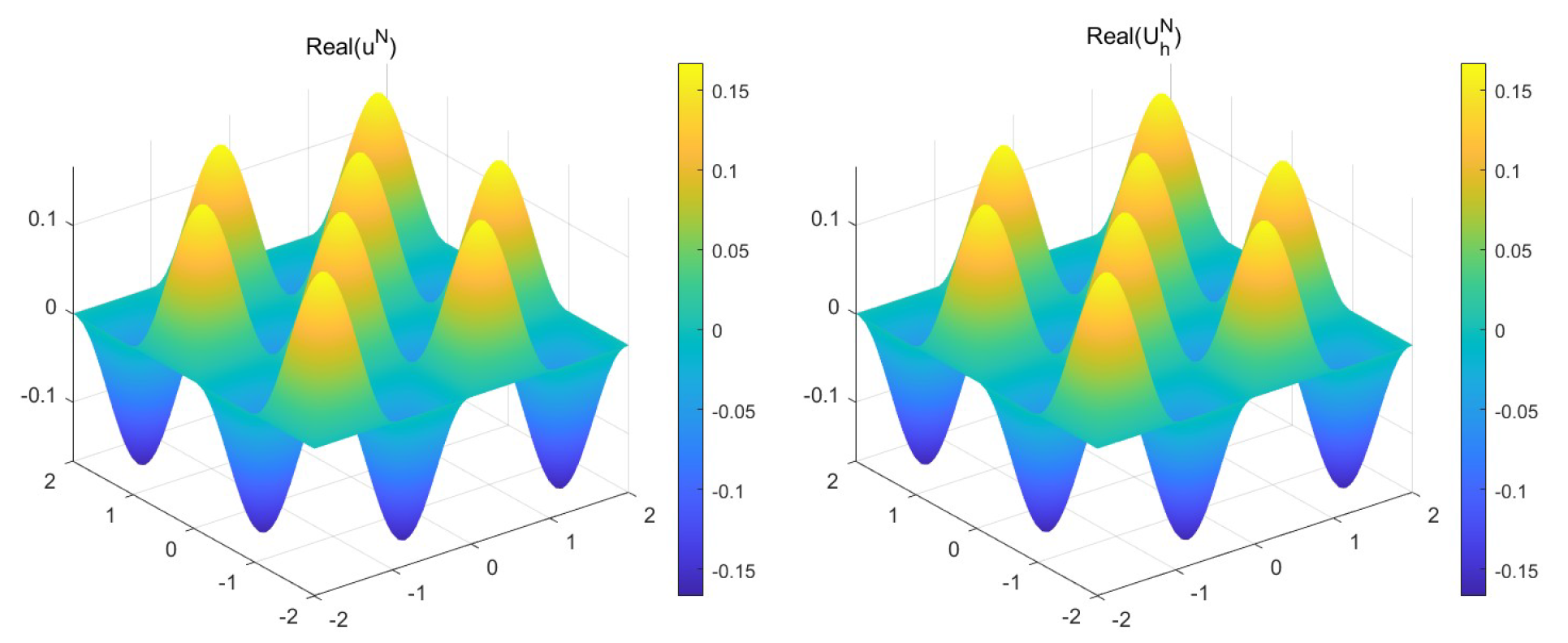
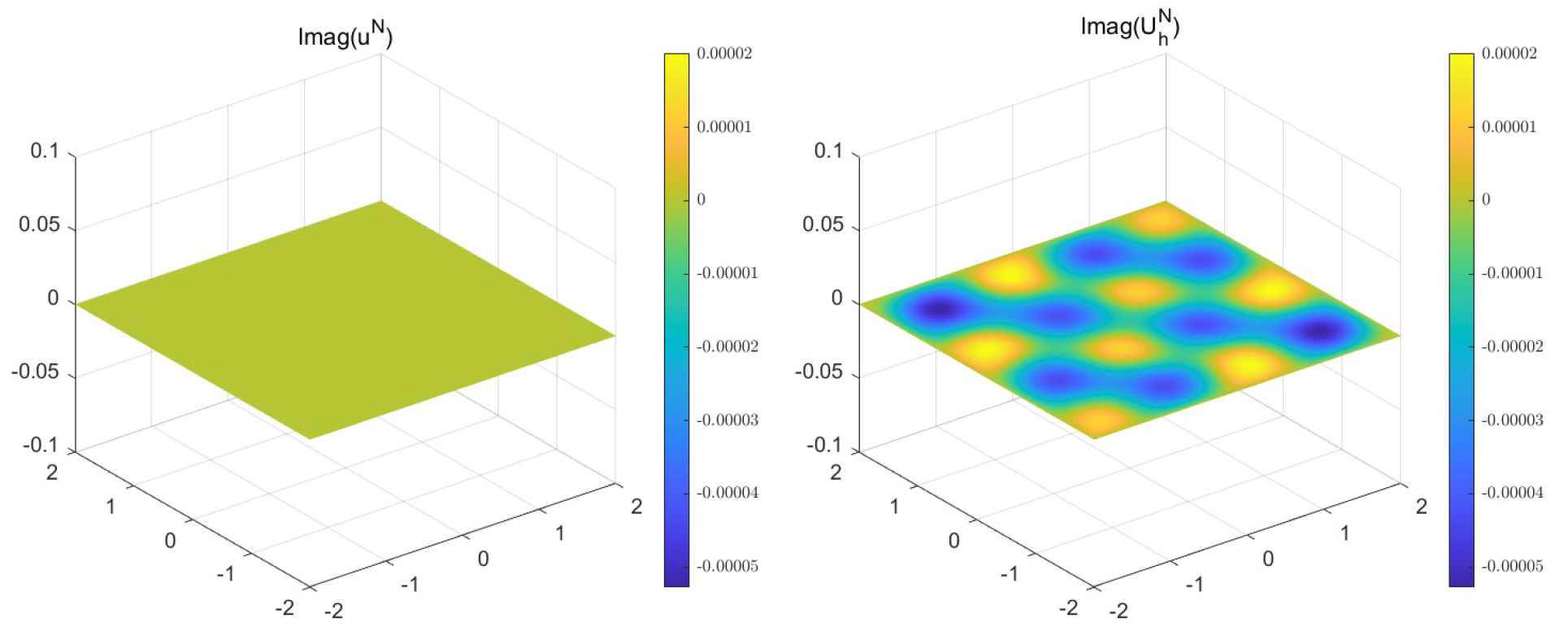
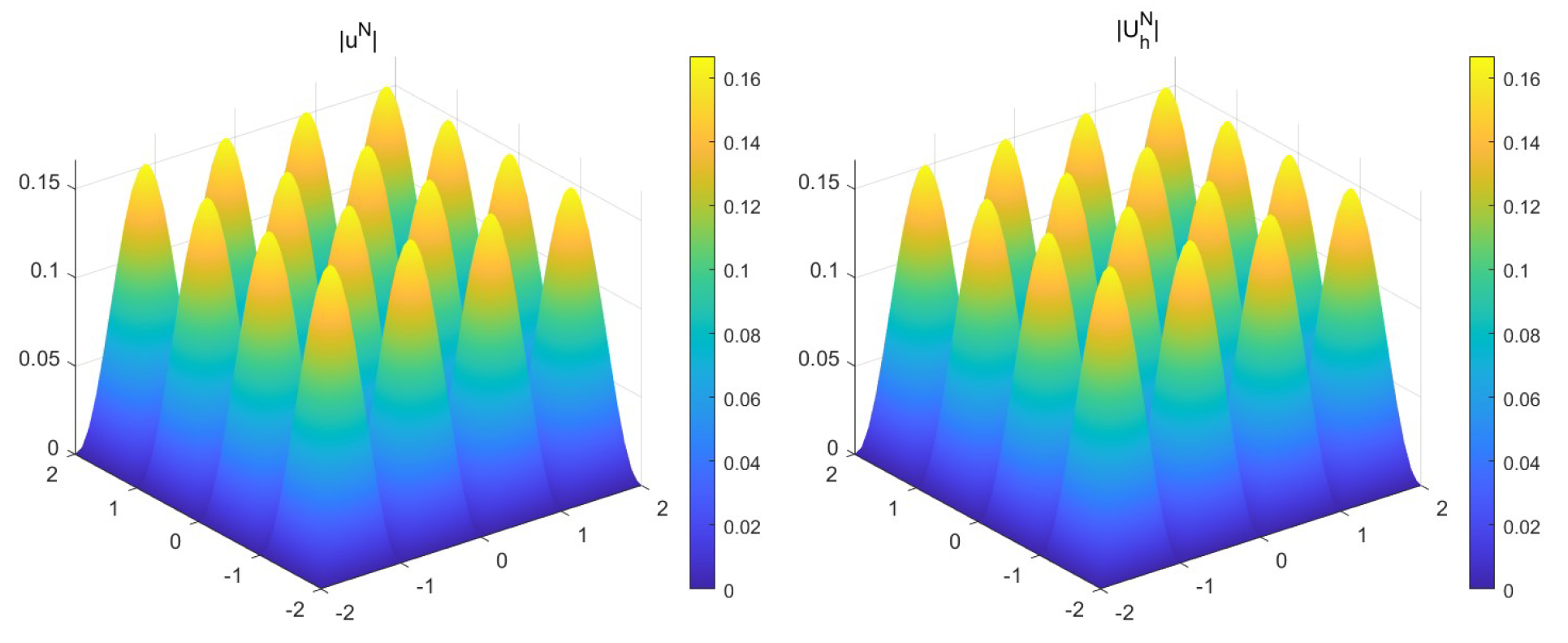
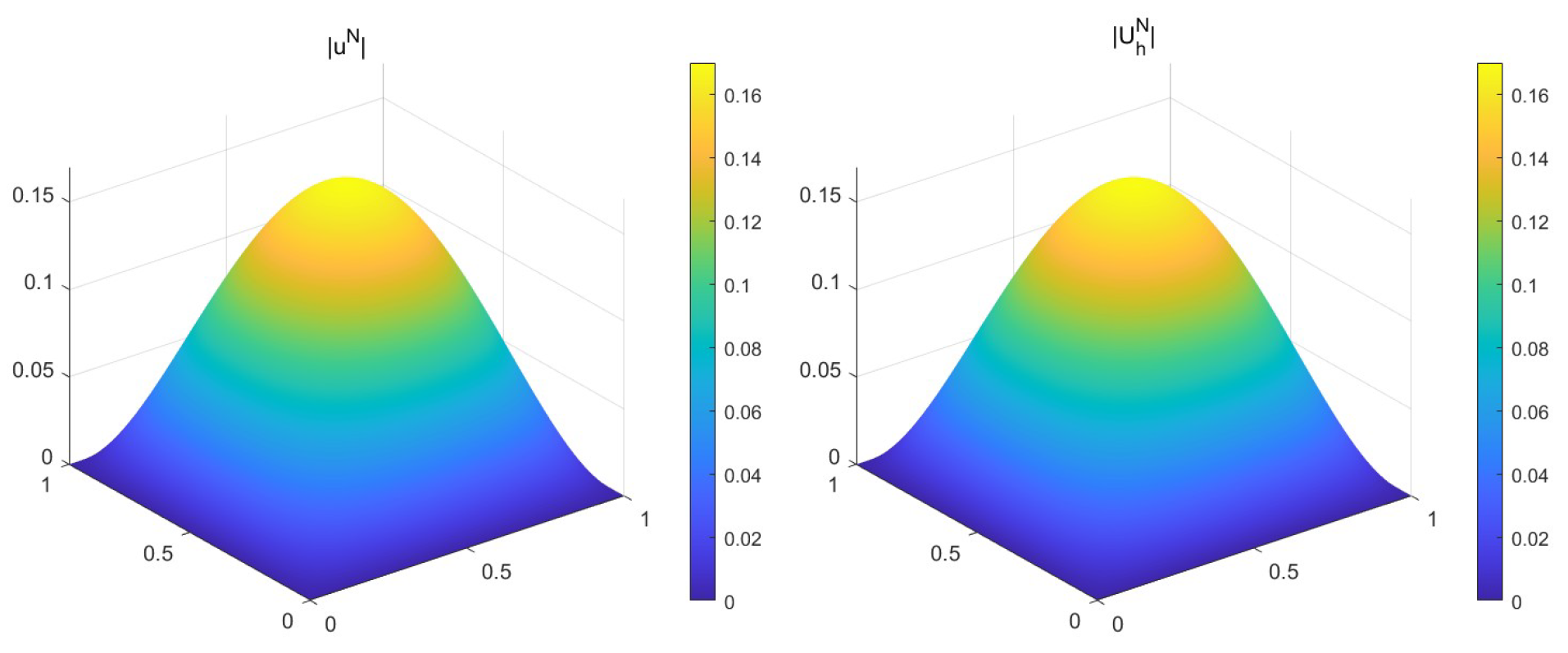
We focus on the spatial region x [ 2 , 2 ] 2 and the temporal interval t ( 0 , 1 ] , with homogeneous Dirichlet boundary conditions u ( x , t ) = 0 , x Ω , 0 < t 1 . With q ( t ) = 1 / 2 + 1 / 10 sin ( t ) , Figure 1, Figure 2 and Figure 3 illustrate the real and imaginary components, together with the modulus of the solutions obtained analytically and numerically at t = 1 , obtained with h = 1 / 80 and τ = 1 / 80 . It can be observed that the numerical solution agrees very well with the exact solution in all three aspects.
To assess the temporal and spatial accuracy of the proposed numerical scheme, we perform a series of numerical experiments for Example 1 at the final time t = 1 . The L 2 -errors and the corresponding convergence rates are reported in Table 1 and Table 2. For the situation where the coefficient q ( t ) remains constant, we further compare the efficiency of the proposed approach with the scheme presented in [43] on the domain in space x [ 0 , 1 ] 2 over the time interval t ( 0 , 1 ] .
Table 1 summarizes the spatial convergence behavior obtained by fixing the number of time steps at N = 2000 and continuously refining the spatial mesh resolution h. Table 2 examines the combined temporal and spatial convergence by reducing the time step size τ , while the spatial discretization size is chosen as h = 1 / N with different values of N.
From Table 1 and Table 2, it can be seen that the numerical errors decrease steadily as the spatial mesh size and time step are refined, which confirms the consistency of the proposed scheme. In Table 1, the observed convergence rates remain close to second order for the tested choices of q ( t ) , showing that the finite element discretization preserves the expected spatial accuracy. Table 2 further shows that, under the simultaneous refinement of the spatial and temporal discretizations, the proposed fully discrete scheme still exhibits stable and accurate convergence behavior. In particular, the spatial convergence remains close to the second order, while the temporal convergence behavior is improved compared with that reported in [43]. Therefore, Table 1 and Table 2 together provide quantitative evidence for the accuracy and effectiveness of the present method.
Remark 4.
It should be noted that the work in [43] considers only the constant-order time-fractional case. Therefore, the comparisons in Table 1 and Table 2 are carried out only for the constant-order case, where both methods are applicable. The results show that, in this benchmark setting, the proposed scheme maintains second-order spatial accuracy and yields smaller errors than the method in [43]. Moreover, Table 2 indicates that our method exhibits competitive and, in some cases, improved convergence behavior. We emphasize that this comparison is intended as a reference test for the constant-order special case, rather than a complete benchmark for variable-order problems.
Example 2.
The two-dimensional Schrödinger equation with time-fractional derivatives of variable order is examined below
i 0 C D t q ( t ) u + μ u + η | u | 2 u = g ( x , t ) , x = ( x , y ) Ω , t [ 0 , T ] ,
where
g ( x , t ) = 6 i ( 1 + i ) x ( 1 x ) y ( 1 y ) t 3 q ( t ) Γ ( 4 q ( t ) ) + 2 ( 1 + i ) t 3 x ( x 1 ) + y ( y 1 ) + ( 1 + i ) x ( 1 x ) y ( 1 y ) t 3 2 ( 1 + i ) x ( 1 x ) y ( 1 y ) t 3 .
In this example, we set the parameters μ = 1 and η = 1 . The analytical solution of equation is given as
u ( x , t ) = ( 1 + i ) x ( 1 x ) y ( 1 y ) t 3 .
the initial condition is derived from the analytical solution
u ( x , 0 ) = 0 , x Ω .
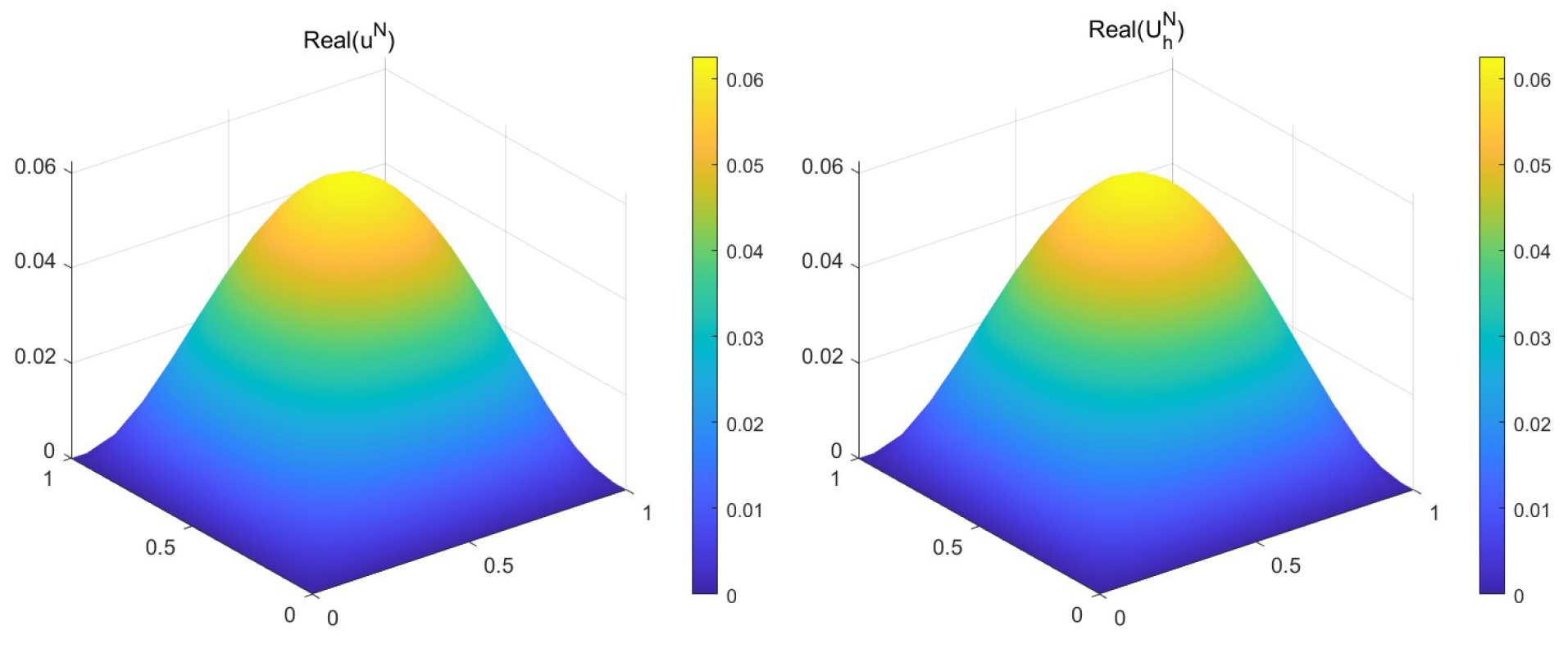
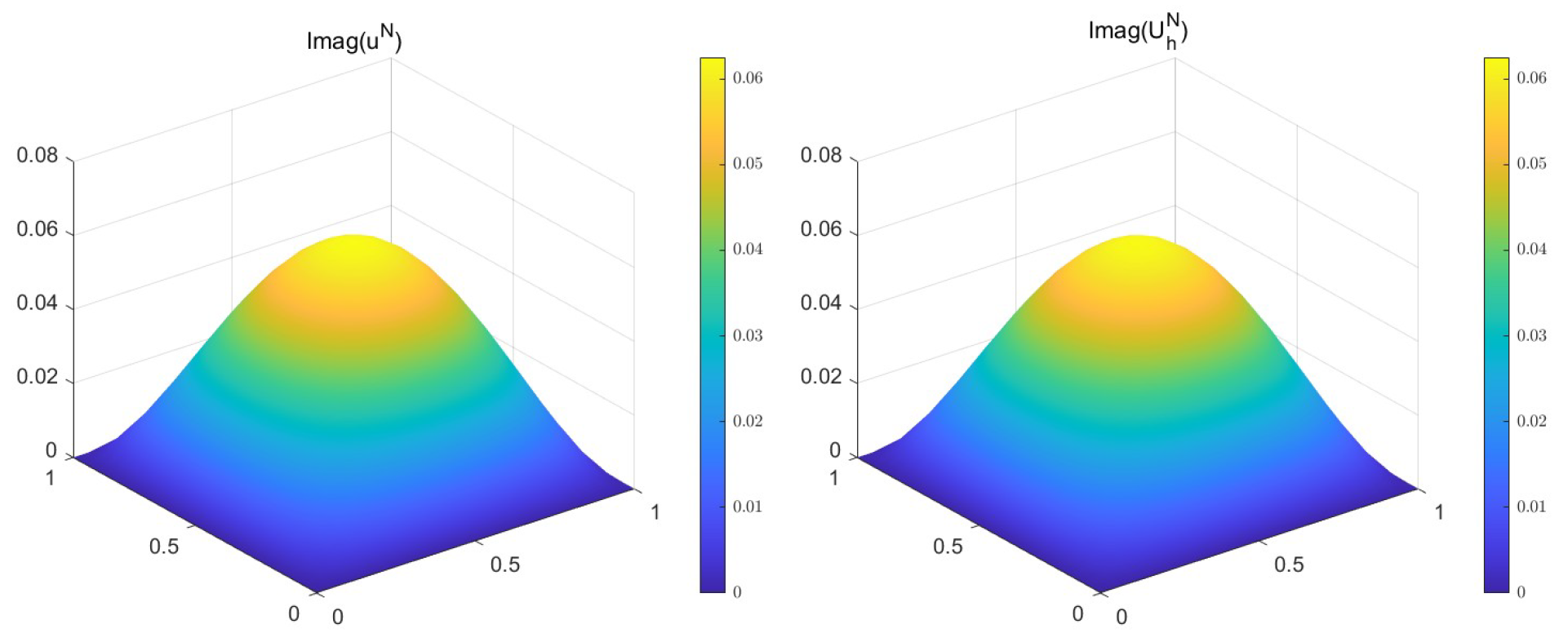
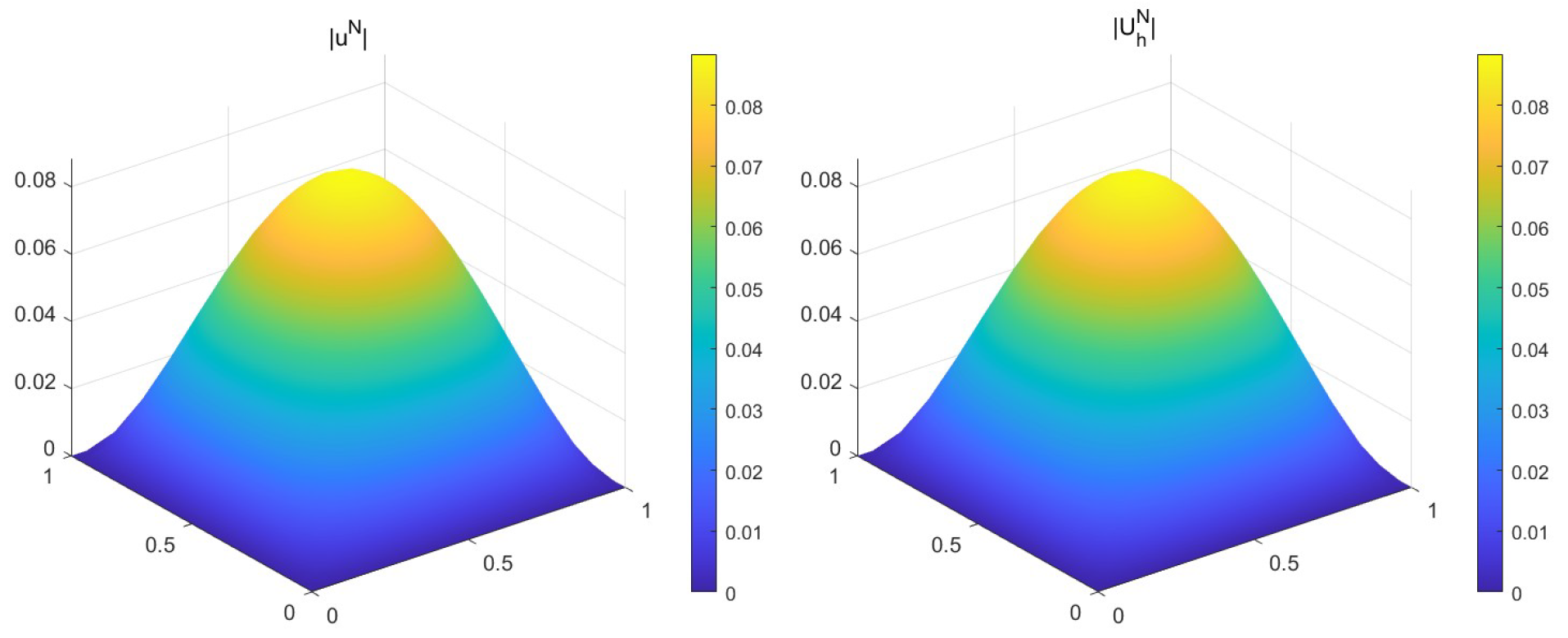
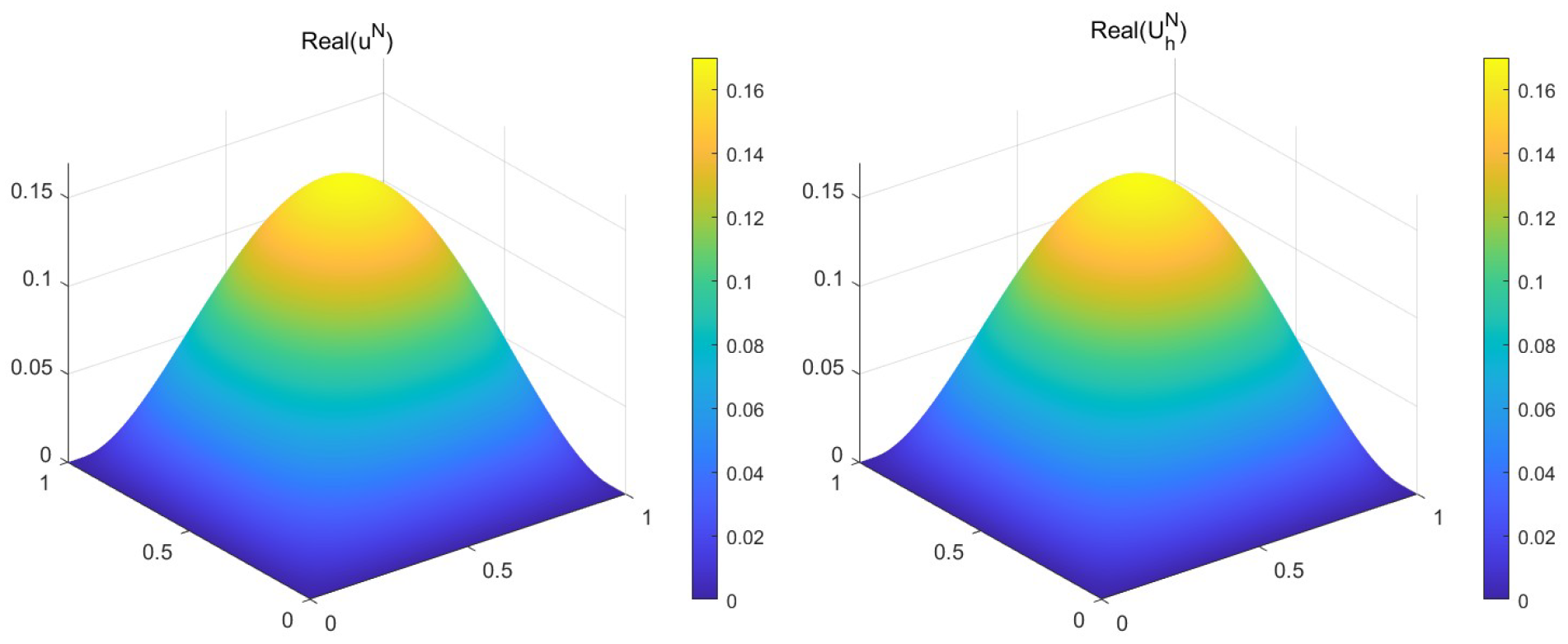
We analyze the spatial domain x [ 0 , 1 ] 2 and the time interval t ( 0 , 1 ] , subject to homogeneous Dirichlet constraints on the boundary u ( x , t ) = 0 , x Ω , 0 < t 1 . For q ( t ) = 1 / 2 + 1 / 10 sin ( t ) , Figure 4, Figure 5 and Figure 6 display the real part, imaginary part, and magnitude of the analytical and numerical solutions at t = 1 , computed using a spatial step size h = 1 / 80 and a temporal step τ = 1 / 80 . It can be observed that the numerical solution agrees very well with the exact solution in all three aspects.
To evaluate the temporal and spatial accuracy of the proposed finite difference scheme, we perform numerical experiments for Example 2 at t = 1 . Table 3 and Table 4 summarize the L 2 -errors and corresponding convergence rates. Table 3 highlights the spatial convergence by fixing the number of time steps at N = 2000 while progressively refining the spatial mesh size h. Table 4 demonstrates both temporal and spatial convergence by decreasing the time step τ with the spatial mesh size fixed at h = 1 / N for various values of N. It can be seen from Table 3 and Table 4 that the numerical errors decrease regularly under mesh refinement in space and time. The observed convergence rates are close to second order for all tested choices of q ( t ) , in both the spatial and temporal directions. This confirms that the proposed fully discrete scheme preserves second-order accuracy in space and time, which is consistent with the theoretical convergence results.
Example 3.
We examine a two-dimensional variable-order time-fractional Schrödinger equation of the form
i D t q ( t ) 0 C u + μ u + η ( | u | 2 + | u | 4 ) u = g ( x , t ) , x = ( x , y ) Ω , t [ 0 , T ] ,
For this example, we take μ = 1 and η = 2 . The corresponding analytical solution is given by
u ( x , t ) = exp ( t ) ( 1 x ) x ( 1 y ) y ,
from which the initial condition is naturally obtained as
u ( x , 0 ) = ( 1 x ) x ( 1 y ) y , x Ω .
Then, the source term g ( x , t ) is obtained by inserting the exact solution into the original equation.
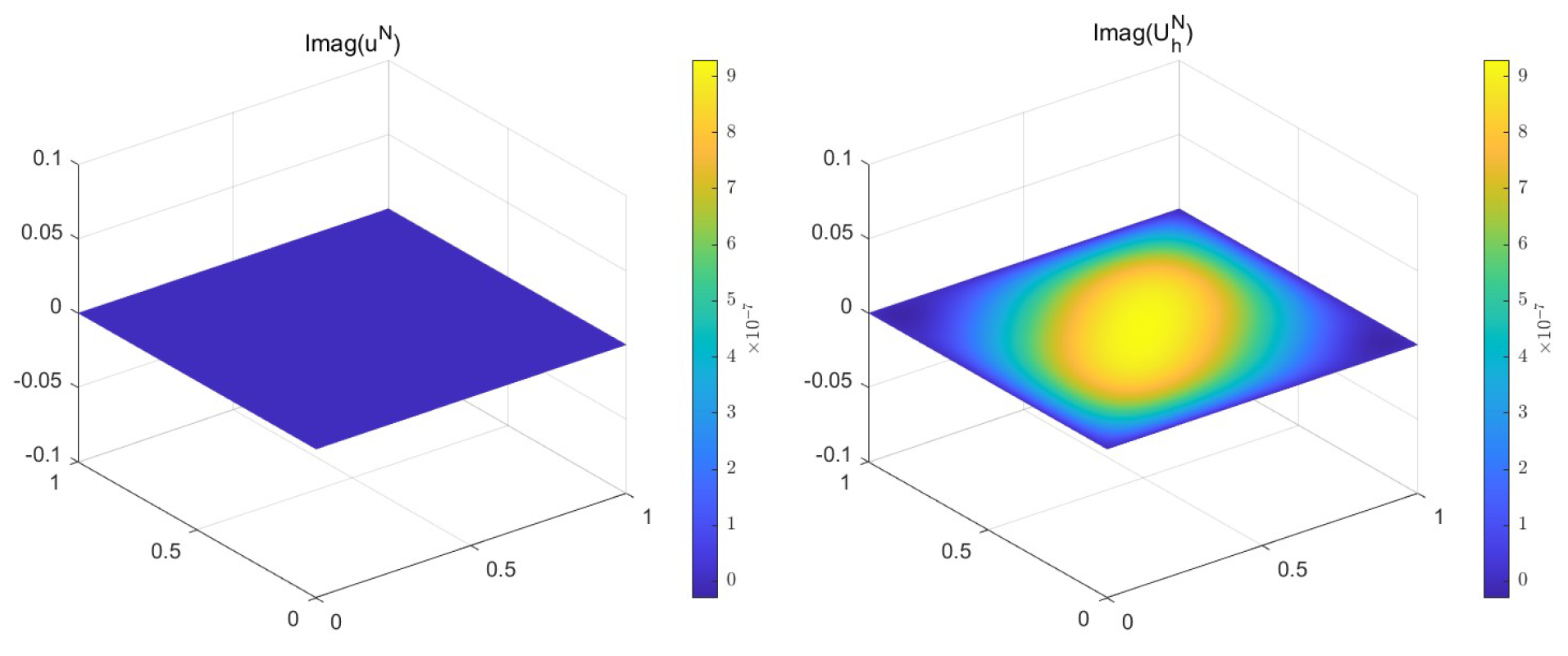
We consider the problem on the spatial region x [ 0 , 1 ] 2 over the time interval t [ 0 , 1 ] , supplemented under zero Dirichlet boundary conditions u ( x , t ) = 0 , x Ω , 0 < t 1 . For the variable order q ( t ) = 1 / 2 + 1 / 10 sin ( t ) , Figure 7, Figure 8 and Figure 9 illustrate the real part, imaginary part, and modulus of both the analytical and numerical solutions at t = 1 , computed with spatial mesh size h = 1 / 80 and time step τ = 1 / 80 . A close agreement between the numerical and exact solutions can be observed in all three aspects.
To examine the temporal and spatial accuracy of the proposed scheme, numerical simulations are conducted, for Example 3 at t = 1 . The L 2 errors and the corresponding convergence rates are reported in Table 5 and Table 6. Table 5 summarizes the spatial convergence behavior of the scheme. We fix the number of time steps at N = 2000 , and the spatial mesh size h is successively refined. Table 6 presents the combined temporal and spatial convergence results, obtained by decreasing the time step size τ while fixing the spatial mesh size at h = 1 / N for different values of N. It can be seen from Table 5 and Table 6 that the numerical errors decrease regularly as the spatial mesh size and time step are refined. The observed convergence rates remain close to second order in both time and space, which indicates that the proposed scheme has stable and accurate fully discrete convergence behavior.
Example 4.
We consider the following two-dimensional variable-order time-fractional Schrödinger equation:
i D t q ( t n ) 0 C u + μ u + η | u | 2 u = 0 , ( x , y ) Ω , t [ 0 , T ] ,
where we set the parameters μ = 1 and η = 1 .
In this example, the initial condition is taken as a Gaussian wave packet centered at ( x 0 , y 0 ) = ( 0.5 , 0.5 ) :
u ( x , 0 ) = exp ( x x 0 ) 2 + ( y y 0 ) 2 2 σ 2 · exp i ( k x x + k y y ) , x Ω ,
where the width of the wave packet is σ = 0.08 , and the wave numbers are set to k x = 25 and k y = 15 , which determine the initial oscillatory phase along the x and y directions, respectively.
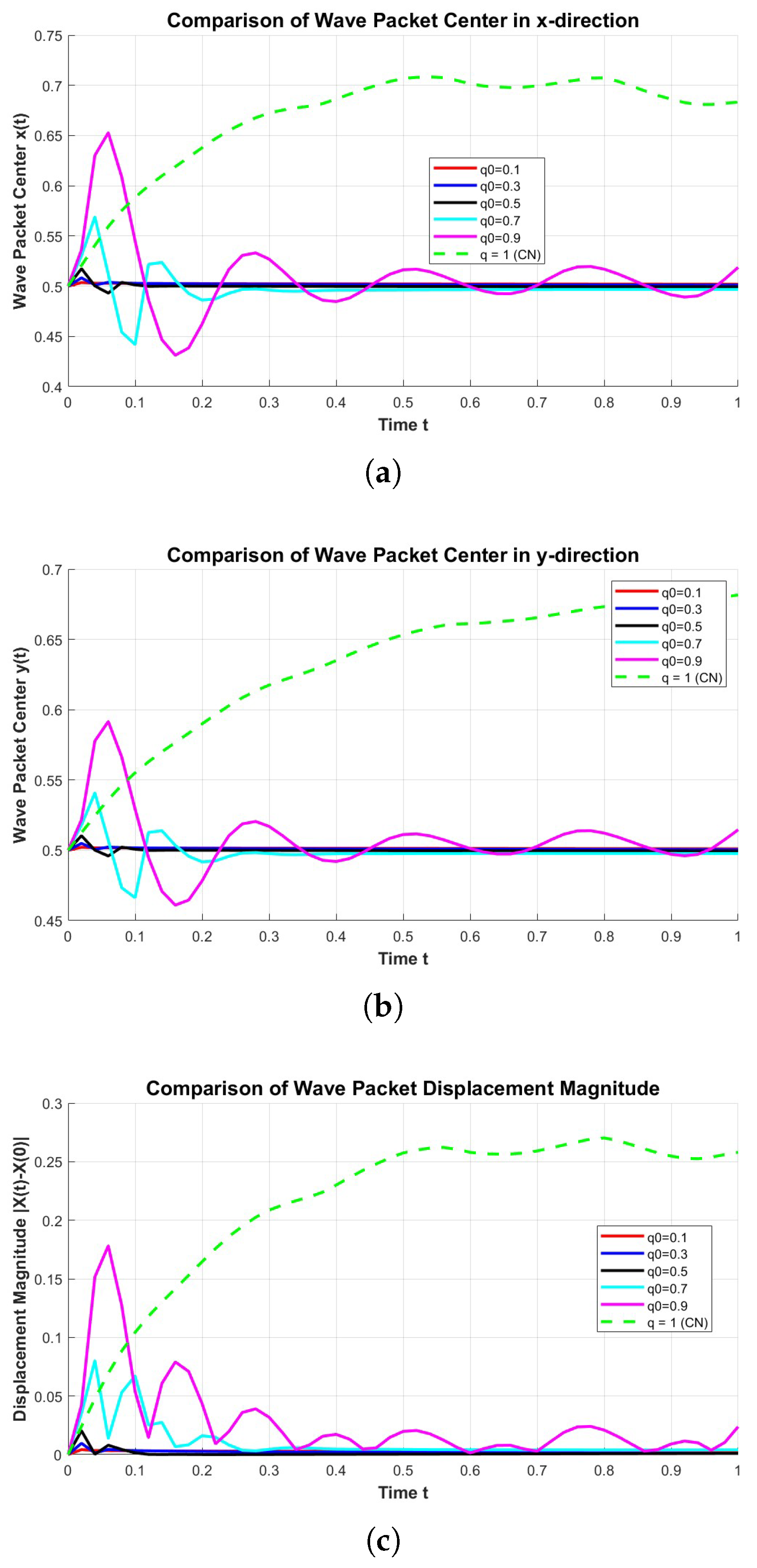
In this study, we numerically investigate the dynamics of a two-dimensional variable-order time-fractional nonlinear Schrödinger equation. The computational domain is Ω = [ 0 , 1 ] 2 , and the simulation is performed over the time interval t [ 0 , 1 ] with a uniform time step, τ = 1 / 50 , and spatial step h = 1 / 50 . We study the evolution of a Gaussian wave packet under different variable-order cases, q ( t ) = q 0 + 0.1 sin ( t ) , q 0 = 0.1 , 0.3 , 0.5 , 0.7 , 0.9 . For comparison, the classical Schrödinger equation with q = 1 is also solved using a semi-implicit Crank–Nicolson method. To analyze the wave packet evolution, we compute the center of mass coordinates x c ( t ) and y c ( t ) , as well as the total displacement magnitude X ( t ) X ( 0 ) over time. Figure 10a–c illustrate the evolution of the Gaussian wave packet under different variable-order parameters, q 0 , and the classical case, q = 1 . Figure 10a shows the wave packet center along the x direction, where smaller q 0 values lead to a slower evolution of x c ( t ) , indicating that the fractional-order effect suppresses propagation. Figure 10b presents the corresponding motion along the y direction, exhibiting similar trends. Figure 10c depicts the total displacement magnitude X ( t ) X ( 0 ) of the wave packet center, providing a quantitative measure of the generalized quantum Zeno effect: wave packets with a smaller q 0 exhibit reduced displacement, reflecting the inhibitory influence of variable-order dynamics on the wave packet evolution.
Remark 5.
This example provides an intuitive demonstration of how memory effects induced by variable-order fractional derivatives can suppress the evolution of a quantum wave packet. When the parameter q 0 is smaller, the nonlocal-in-time memory effect becomes more pronounced, so that the present state is more strongly influenced by its historical evolution. As a result, the displacement of the wave packet center is markedly reduced, as shown in Figure 10a–c. As q 0 approaches 1, the memory effect weakens, and the dynamics gradually recover the faster propagation behavior of the classical Schrödinger equation. This slowdown can be interpreted as a memory-induced analogue of a generalized quantum-Zeno-type suppression. In this interpretation, the persistent memory feedback plays a role analogous to continuous interaction with a structured environment, which hinders the free evolution of the quantum state. The present model and the results reveal a Zeno-like inhibition mechanism generated by nonlocal temporal memory in the variable-order fractional system.

7. Conclusions

In this paper, an L1-2 finite element method, combined with an extrapolation technique, is developed for the discrete solution of two-dimensional variable-order time-fractional Schrödinger equations with a variable-order time-fractional operator in the sense of Coimbra. An improved L1-2 scheme with dynamically adjusted weights is proposed with respect to the variable-order fractional derivative, which enhances the temporal accuracy. The finite element method is employed for spatial discretization, achieving second-order convergence in space. Compared with classical L1-type discretizations in work [38], the proposed dynamically weighted L1-2 FEM is expected to achieve higher temporal accuracy under sufficient regularity. This highlights its advantage for variable-order time-fractional Schrödinger equations.
From a theoretical viewpoint, the unconditional stability of the fully discretized method and the boundedness of the discrete solution are rigorously established. Furthermore, optimal error estimates and convergence results are derived. Numerical experiments are performed to validate the theoretical investigation. The comparisons between the exact solution and its numerical approximation demonstrate that the proposed method produces highly accurate approximations. The reported numerical errors and the observed convergence rate along temporal and spatial directions confirm the effectiveness and reliability of the introduced scheme. Finally, the last numerical example also carries physical significance. The comparisons from Figure 10a–c demonstrate how the variable-order fractional derivative influences the propagation of the wave packet and illustrate the slowing-down effect characteristic of the generalized quantum Zeno phenomenon. In future work, we will further investigate whether suitable fast algorithms can be incorporated to improve the efficiency of the proposed method for large-scale problems.

Author Contributions

Conceptualization, X.Z.; methodology, X.Z.; software, X.Z., M.Z. and C.L.; validation, X.Z.; writing—original draft, X.Z.; writing—review and editing, X.Z., M.Z. and C.L.; supervision, M.Z. and C.L.; funding acquisition, C.L. All authors have read and agreed to the published version of the manuscript.

Funding

This research received no external funding.

Data Availability Statement

The original contributions presented in this study are included in the article. Further inquiries can be directed to the corresponding author.

Conflicts of Interest

The authors declare no conflicts of interest.

References

  1. Laskin, N. Fractional quantum mechanics and Lévy path integrals. Phys. Lett. A 2000, 268, 298–305. [Google Scholar] [CrossRef]
  2. Laskin, N. Fractional Schrödinger equation. Phys. Rev. E 2002, 66, 056108. [Google Scholar] [CrossRef] [PubMed]
  3. Laskin, N. Fractals and quantum mechanics. Chaos 2000, 10, 780–787. [Google Scholar] [CrossRef] [PubMed]
  4. Naber, M. Time fractional Schrödinger equation. J. Math. Phys. 2004, 45, 3339–3352. [Google Scholar] [CrossRef]
  5. Van Mieghem, P. Origin of the fractional derivative and fractional non-Markovian continuous-time processes. Phys. Rev. Res. 2022, 4, 023242. [Google Scholar] [CrossRef]
  6. Cao, Y.; Su, S. Fractional gradient descent algorithms for systems with outliers: A matrix fractional derivative or a scalar fractional derivative. Chaos Solitons Fractals 2023, 172, 113881. [Google Scholar] [CrossRef]
  7. Bhangale, N.; Kachhia, K.B.; Gómez-Aguilar, J.F. Fractional viscoelastic models with Caputo generalized fractional derivative. Math. Methods Appl. Sci. 2021, 44, 5742–5758. [Google Scholar] [CrossRef]
  8. Iomin, A. Fractional-time Schrödinger equation: Fractional dynamics on a comb. Chaos Solitons Fractals 2011, 44, 348–352. [Google Scholar] [CrossRef]
  9. Ahmed, H.M.; El-Sheikh, M.M.A.; Arnous, A.H.; Rabie, W.B. Construction of the soliton solutions for the Manakov system by extended simplest equation method. Int. J. Appl. Comput. Math. 2021, 7, 239. [Google Scholar] [CrossRef]
  10. Liu, J.G.; Osman, M.S.; Wazwaz, A.M. A variety of nonautonomous complex wave solutions for the (2+1)-dimensional nonlinear Schrödinger equation with variable coefficients in nonlinear optical fibers. Optik 2019, 180, 917–923. [Google Scholar] [CrossRef]
  11. Tofighi, A. Probability structure of time fractional Schrödinger equation. Acta Phys. Pol. A 2009, 116, 114–118. [Google Scholar] [CrossRef]
  12. Wang, S.; Xu, M. Generalized fractional Schrödinger equation with space-time fractional derivatives. J. Math. Phys. 2007, 48, 043502. [Google Scholar] [CrossRef]
  13. Gao, G.; Sun, Z.; Zhang, H. A new fractional numerical differentiation formula to approximate the Caputo fractional derivative and its applications. J. Comput. Phys. 2014, 259, 33–50. [Google Scholar] [CrossRef]
  14. Wang, P.D.; Huang, C.M. An energy conservative difference scheme for the nonlinear fractional Schrödinger equations. J. Comput. Phys. 2015, 293, 238–251. [Google Scholar] [CrossRef]
  15. Li, D.; Wang, J.; Zhang, J. Unconditionally convergent L1-Galerkin FEMs for nonlinear time fractional Schrödinger equations. SIAM J. Sci. Comput. 2017, 39, A3067–A3088. [Google Scholar] [CrossRef]
  16. Chen, L.; Lü, S. Fourier spectral approximation for generalized time fractional Burgers equation. J. Appl. Math. Comput. 2022, 68, 3979–3997. [Google Scholar] [CrossRef]
  17. Liu, J.; Wang, T.; Zhang, T. A second-order finite difference scheme for the multi-dimensional nonlinear time-fractional Schrödinger equation. Numer. Algorithms 2023, 92, 1153–1182. [Google Scholar] [CrossRef]
  18. Seal, A.; Natesan, S. A numerical approach for nonlinear time-fractional diffusion equation with generalized memory kernel. Numer. Algorithms 2024, 97, 539–565. [Google Scholar] [CrossRef]
  19. Srinivasa, K.; Mulimani, M.; Adel, W. A numerical approach for solving nonlinear fractional Klein–Gordon equation with applications in quantum mechanics. J. Nonlinear Complex Data Sci. 2024, 25, 173–195. [Google Scholar] [CrossRef]
  20. Chen, F.; Li, M.; Zhao, Y.; Tang, Y. Convergence and superconvergence analysis of finite element methods for nonlinear Ginzburg–Landau equation with Caputo derivative. Comput. Appl. Math. 2023, 42, 271. [Google Scholar] [CrossRef]
  21. El Yazidi, Y.; Zeng, S. A splitting based method for the numerical identification of a nonlinear convection coefficient in elliptic equations. Math. Comput. Simul. 2025, 235, 205–218. [Google Scholar] [CrossRef]
  22. Ma, J.; Sun, T.; Chen, H. An efficient numerical scheme for two-dimensional nonlinear time fractional Schrödinger equation. Commun. Nonlinear Sci. Numer. Simul. 2025, 147, 108824. [Google Scholar] [CrossRef]
  23. Wei, L.; Feng, L.; Turner, I.; Mao, Z.; Liu, F. Numerical investigation of the 2D unsteady natural convection heat transfer equation with tempered fractional constitutive relationship. Commun. Nonlinear Sci. Numer. Simul. 2026, 161, 110071. [Google Scholar] [CrossRef]
  24. Ramirez, R.; Coimbra, C.F.M. On the variable order dynamics of the nonlinear wake caused by a sedimenting particle. Physica D 2011, 240, 1111–1118. [Google Scholar] [CrossRef]
  25. Sun, H.G.; Chen, W.; Wei, H.; Chen, Y.Q. A comparative study of constant-order and variable-order fractional models in characterizing memory property of systems. Eur. Phys. J. Spec. Top. 2011, 193, 185–192. [Google Scholar] [CrossRef]
  26. Shyu, J.J.; Pei, S.C.; Chan, C.H. An iterative method for the design of variable fractional-order FIR differintegrators. Signal Process. 2009, 89, 320–327. [Google Scholar] [CrossRef]
  27. Coimbra, C. Mechanics with variable-order differential operators. Ann. Phys. 2003, 12, 692–703. [Google Scholar] [CrossRef]
  28. Chechkin, A.V.; Gorenflo, R.; Sokolov, I.M. Fractional diffusion in inhomogeneous media. J. Phys. A Math. Gen. 2005, 38, 679–684. [Google Scholar] [CrossRef]
  29. Sun, H.G.; Zhang, Y.; Baleanu, D.; Chen, W.; Chen, Y.Q. A review on variable-order fractional differential equations: Mathematical foundations, physical models, and its applications. Fract. Calc. Appl. Anal. 2018, 22, 27–59. [Google Scholar] [CrossRef]
  30. Bhrawy, A.H.; Zaky, M.A. Highly accurate numerical schemes for multi-dimensional space variable-order fractional Schrödinger equations. Comput. Math. Appl. 2017, 73, 1100–1117. [Google Scholar] [CrossRef]
  31. Tayebi, A.; Shekari, Y.; Heydari, M.H. A meshless method for solving two-dimensional variable-order time fractional advection–diffusion equation. J. Comput. Phys. 2017, 340, 240–267. [Google Scholar] [CrossRef]
  32. Wang, J.; Liu, X.; Zhou, Y. A high-order accurate wavelet method for solving Schrödinger equations with general nonlinearity. Appl. Math. Mech. 2018, 39, 275–290. [Google Scholar] [CrossRef]
  33. Wei, L.; Yang, Y. Optimal order finite difference/local discontinuous Galerkin method for variable-order time-fractional diffusion equation. J. Comput. Appl. Math. 2021, 383, 113129. [Google Scholar] [CrossRef]
  34. Dehestani, H.; Ordokhani, Y.; Razzaghi, M. Execution of a novel discretization approach for solving variable-order Caputo–Riesz time-space fractional Schrödinger equations. J. Appl. Anal. Comput. 2024, 14, 235–262. [Google Scholar] [CrossRef]
  35. Hou, S.C.; Liang, S.L.; Yi, X.X. Non-Markovianity and memory effects in quantum open systems. Phys. Rev. A 2015, 91, 012109. [Google Scholar] [CrossRef]
  36. Wang, Y.; Wang, G.; Bu, L.; Mei, L. Two second-order and linear numerical schemes for the multi-dimensional nonlinear time-fractional Schrödinger equation. Numer. Algorithms 2021, 88, 419–451. [Google Scholar] [CrossRef]
  37. Liao, H.; McLean, W.; Zhang, J. A discrete Grönwall inequality with applications to numerical schemes for subdiffusion problems. SIAM J. Numer. Anal. 2019, 57, 218–237. [Google Scholar] [CrossRef]
  38. Shen, S.; Liu, F.; Chen, J.; Turner, I.; Anh, V. Numerical techniques for the variable order time fractional diffusion equation. Appl. Math. Comput. 2012, 218, 10861–10870. [Google Scholar] [CrossRef]
  39. Karlsson, A.; Francica, F.; Piilo, J.; Plastina, F. Quantum Zeno-type effect and non-Markovianity in a three-level system. Sci. Rep. 2016, 6, 39061. [Google Scholar] [CrossRef]
  40. Hellman, F.; Målqvist, A.; Mosquera, M. Well-posedness and finite element approximation of mixed dimensional partial differential equations. BIT Numer. Math. 2024, 64, 2. [Google Scholar] [CrossRef]
  41. Thomée, V. Galerkin Finite Element Methods for Parabolic Problems; Springer: Berlin/Heidelberg, Germany, 1997. [Google Scholar] [CrossRef]
  42. Stynes, M.; O’Riordan, E.; Gracia, J.L. Error analysis of a finite difference method on graded meshes for a time-fractional diffusion equation. SIAM J. Numer. Anal. 2017, 55, 1057–1079. [Google Scholar] [CrossRef]
  43. Hu, H.; Chen, Y.; Zhou, J. Two-grid finite element method on graded meshes for time-fractional nonlinear Schrödinger equation. Numer. Methods Partial Differ. Equ. 2024, 40, e23073. [Google Scholar] [CrossRef]
Figure 1. Comparison of the real parts of the exact and numerical solutions for Example 1 with q ( t ) = 1 / 2 + 1 / 10 sin ( t ) .
Mathematics 14 01656 g001
Figure 2. Comparison of the imaginary parts of the exact and numerical solutions for Example 1 with q ( t ) = 1 / 2 + 1 / 10 sin ( t ) .
Mathematics 14 01656 g002
Figure 3. Comparison of the modulus of the exact and numerical solutions for Example 1 with q ( t ) = 1 / 2 + 1 / 10 sin ( t ) .
Mathematics 14 01656 g003
Figure 4. Comparison of the real parts of the exact and numerical solutions for Example 2 with q ( t ) = 1 / 2 + 1 / 10 sin ( t ) .
Mathematics 14 01656 g004
Figure 5. Comparison of the imaginary parts of the exact and numerical solutions for Example 2 with q ( t ) = 1 / 2 + 1 / 10 sin ( t ) .
Mathematics 14 01656 g005
Figure 6. Comparison of the modulus of the exact and numerical solutions for Example 2 with q ( t ) = 1 / 2 + 1 / 10 sin ( t ) .
Mathematics 14 01656 g006
Figure 7. Comparison of the real parts of the exact and numerical solutions for Example 3 with q ( t ) = 1 / 2 + 1 / 10 sin ( t ) .
Mathematics 14 01656 g007
Figure 8. Comparison of the imaginary parts of the exact and numerical solutions for Example 3 with q ( t ) = 1 / 2 + 1 / 10 sin ( t ) .
Mathematics 14 01656 g008
Figure 9. Comparison of the modulus of the exact and numerical solutions for Example 3 with q ( t ) = 1 / 2 + 1 / 10 sin ( t ) .
Mathematics 14 01656 g009
Figure 10. Wave packet center dynamics and total displacement for different variable-order parameters q 0 and the classical case q = 1 . (a) Wave packet center along the x direction. Smaller q 0 enhances memory effects and suppresses the displacement along the x direction. (b) Wave packet center along the y direction. A smaller q 0 enhances memory effects and suppresses the displacement along the y direction. (c) The total displacement magnitude X ( t ) X ( 0 ) . A smaller q 0 enhances memory effects and suppresses the total displacement.
Mathematics 14 01656 g010
Table 1. L 2 -errors and spatial convergence rates at t = 1 for Example 1 under different q ( t ) , with N = 2000 .
h q = 1 2 + 1 10 sin ( t ) q = 7 10 + 1 10 sin ( t ) q = 0.6 q = 0.8
ErrorRate Error Rate Error Rate Error Rate
1 4 7.1896 × 10⁻³-7.1932 × 10⁻³-7.1896 × 10⁻³-7.1927 × 10⁻³-
1 8 1.8102 × 10−31.98981.8111 × 10−31.98971.8102 × 10−31.98981.8110 × 10−31.9897
1 16 4.5333 × 10−31.99754.5356 × 10−41.99754.5333 × 10−41.99754.5354 × 10−41.9975
1 32 1.1338 × 10−41.99941.1344 × 10−41.99941.1338 × 10−41.99941.1343 × 10−41.9994
Table 2. L 2 -errors and convergence rates at t = 1 for Example 1 under different q ( t ) values, with h = 1 N .
NMethod q = 1 2 + 1 10 sin ( t ) q = 7 10 + 1 10 sin ( t ) q = 0.6 q = 0.8
ErrorRateErrorRateErrorRateErrorRate
8Our scheme1.8104 × 10−3-1.8112 × 10⁻³-1.8105 × 10⁻³-1.8108 × 10⁻³-
Scheme in [43]----7.4193 × 10⁻³-8.4025 × 10⁻³-
16Our scheme4.5336 × 10−41.99764.5362 × 10−41.99744.5337 × 10−41.99764.5361 × 10−41.9971
Scheme in [43]----2.5852 × 10−31.523.3018 × 10−31.35
32Our scheme1.1338 × 10−41.99941.1345 × 10−41.99941.1339 × 10−41.99941.1345 × 10−41.9994
Scheme in [43]----9.4071 × 10−41.461.3678 × 10−31.27
64Our scheme2.8348 × 10−51.99992.8365 × 10−51.99992.8349 × 10−51.99992.8365 × 10−51.9999
Scheme in [43]----3.4839 × 10−41.435.8014 × 10−41.24
Table 3. L 2 -errors and spatial convergence rates at t = 1 for Example 2 under different q ( t ) , with N = 2000 .
h q = 1 2 + 1 10 sin ( t ) q = 7 10 + 1 10 sin ( t ) q = 0.6 q = 0.8
Error Rate Error Rate Error Rate Error Rate
1 4 3.1061 × 10⁻³-3.1245 × 10⁻³-3.1070 × 10⁻³-3.1253 × 10⁻³-
1 8 8.1115 × 10−41.93718.1584 × 10−41.93738.1138 × 10−41.93718.1606 × 10−41.9373
1 16 2.0483 × 10−41.98562.0601 × 10−41.98562.0488 × 10−41.98562.0606 × 10−41.9856
1 32 5.1331 × 10−51.99655.1627 × 10−51.99655.1346 × 10−51.99655.1640 × 10−51.9965
Table 4. L 2 -errors and convergence rates at t = 1 for Example 2 under different q ( t ) , with h = 1 N .
N q = 1 2 + 1 10 sin ( t ) q = 7 10 + 1 10 sin ( t ) q = 0.6 q = 0.8
Error Rate Error Rate Error Rate Error Rate
88.0934 × 10−48.1180 × 10−48.0958 × 10−48.1212 × 10−4
162.0448 × 10−41.98482.0510 × 110−41.98482.0454 × 10−41.98482.0518 × 10−41.9848
325.1264 × 10−51.99595.1426 × 10−51.99585.1279 × 10−51.99595.1445 × 10−51.9958
641.2828 × 10−51.99871.2870 × 10−51.99851.2831 × 10−51.99871.2875 × 10−51.9985
Table 5. L 2 -errors and spatial convergence rates at t = 1 for Example 3 under different q ( t ) , with N = 2000 .
h q = 1 2 + 1 10 sin ( t ) q = 7 10 + 1 10 sin ( t ) q = 0.6 q = 0.8
Error Rate Error Rate Error Rate Error Rate
1 4 5.9095 × 10−35.9126 × 10−35.9095 × 10−35.9121 × 10−3
1 8 1.5439 × 10−31.93651.5446 × 10−31.93651.5439 × 10−31.93651.5445 × 10−31.9365
1 16 3.8988 × 10−41.98553.9007 × 10−41.98553.8988 × 10−41.98553.9004 × 10−41.9855
1 32 9.7709 × 10−51.99659.7758 × 10−51.99659.7708 × 10−51.99659.7750 × 10−51.9965
Table 6. L 2 -errors and convergence rates at t = 1 for Example 3 under different q ( t ) , with h = 1 N .
N q = 1 2 + 1 10 sin ( t ) q = 7 10 + 1 10 sin ( t ) q = 0.6 q = 0.8
Error Rate Error Rate Error Rate Error Rate
81.5435 × 10−31.5435 × 10−31.5435 × 10−31.5430 × 10−3
163.8980 × 10−41.98543.8986 × 10−41.98523.8980 × 10−41.98543.8984 × 10−41.9847
329.7694 × 10−51.99649.7709 × 10−51.99649.7694 × 10−51.99649.7705 × 10−51.9964
642.4439 × 10−51.99912.4444 × 10−51.99902.4439 × 10−51.99912.4442 × 10−51.9990
Disclaimer/Publisher’s Note: The statements, opinions and data contained in all publications are solely those of the individual author(s) and contributor(s) and not of MDPI and/or the editor(s). MDPI and/or the editor(s) disclaim responsibility for any injury to people or property resulting from any ideas, methods, instructions or products referred to in the content.