


Abstract
In this study, we present a similarity and fuzzy arithmetic-based fuzzy inference method and show how effectively it can be used to forecast the number of passengers on a railway route. We introduce a novel fuzzy similarity measure that is derived from the so-called epsilon function, which may be viewed as an alternative to the exponential function. After demonstrating the most important properties of the new similarity measure, we construct a fuzzy inference method that is founded on arithmetic operations over triangular fuzzy numbers. This inference method utilizes the proposed similarity measure to derive weight values for the above-mentioned arithmetic operations. The motivation behind the proposed method is twofold. On the one hand, we aim to construct a method that is simple and easy to implement. On the other hand, we intend to ensure that this method meets the practical requirements for rail passenger forecasts. Using a real-life case study, we demonstrate how well our method can predict the expected number of passengers on a new railway route based on characteristics of this relation. With respect to the studied case, we may conclude that although the similarity and fuzzy arithmetic-based fuzzy inference system has only two adjustable parameters, it may be regarded as a viable alternative to Sugeno-type fuzzy inference systems with a much greater number of adjustable parameters tuned by various optimization techniques.
Keywords:
fuzzy arithmetic operations; fuzzy similarity; similarity and fuzzy arithmetic-based inference; predicting number of passengers; passenger demand forecasting; railway transportation planning MSC:
68U01
1. Introduction
Nowadays, when mobility plays a major role in the economy, in business and in private life, understanding the magnitude of the demand for a transport service has become an important factor for service providers. This is also the case for railway operators, for whom forecasting the expected number of passengers on a railway route that does not yet exist is of great importance. Accordingly, several methods have been developed to forecast rail passenger traffic. Some of them are mentioned here, although the list is not exhaustive.
There are some examples of fuzzy models used for short-term passenger demand prediction. A fuzzy model has been developed in a study to predict peak-time demand on the Beijing–Shanghai high-speed railway, which predicts peak cross sections during holiday seasons, helping rail dispatchers to minimize costs and the number of passengers who miss free capacity (see [1]). The application of this method has been validated in practice, showing that fuzzy forecasting has led to significant improvements compared to the previously used methods. There are also some examples of looking for passenger demand trends in a longer-term historical passenger flow database, and learning the characteristics of historical passenger flows can be used to predict future demands using regression techniques (see [2,3]). In other studies, models for air transport demand forecasting were developed by combining neural and fuzzy logic models, with a strong emphasis on the seasonality of transport demands (see [4,5]). A model based on fuzzy logic has also been developed in a study on the prioritization of transport investments, with the aim of prioritizing governmental investments that can have the greatest impact on the shift to public and sustainable transport modes (see [6]). There are also examples of research topics that deal with the human perception of public transport systems, with the aim of demonstrating the potential to increase public transportation ridership (see [7]). Many research articles deal with the implementation of artificial neural networks (ANNs) in transportation sciences and transportation forecasting. The findings and the results comparisons show that these applications have a better prediction ability than the standard methods; however, in most cases it is pointed out that there is more to come in the development and use of artificial neural networks for demand forecasting (see [8,9,10]). Recent studies on traffic forecasting suggest that combinations of existing travel demand forecasting methods can produce more accurate results than using different methods separately. Forecasting techniques ranging from regression models to artificial neural networks and support vector machines (SVMs) incorporating soft computing methods are discussed and compared in [11]. There are many examples where fuzzy forecasting models are combined with neural networks, combinations that can yield more accurate predictions, but the background to the functioning of neural networks might cause difficulties in some cases (see [12,13]). There are also examples of comparing different types of transport demand forecasting models and identifying factors that influence rail transport demand. Examples of such explanatory variables include average rail passenger travel distance, car ownership index, number of buses working in interurban routes per year, or a competition variable, expressed as the ratio of unit cost by bus to the unit cost by rail (see [14]). In some cases, Grey Relational Analysis is also adopted in transportation demand forecasting as well as other consumer demand models (see [15,16]). In other studies, the characteristics of total passenger demand, rail passenger demand and personal car demand are also discussed, with the possible modeling of the modal split (see [17,18]). Passenger demands can also be examined through capacity allocation and timetable planning models. There are examples for the development of timetable optimizations based on the characteristics of railway infrastructure and vehicles (see [19,20]).
The difficulties of standardizing different demand forecasting models is also highlighted, indicating the difficulties of choosing the right type of modeling methods that could be used in different phases of a transportation planning period. An article from recent years dealt with creating a standardized transport demand forecasting knowledge base from which the optimal forecasting method can be easily selected during each planning phase (see [21]).
In this study, we introduce a similarity and fuzzy arithmetic-based fuzzy inference method and demonstrate its effectiveness in predicting the expected number of future passengers on a railway connection. We present a new fuzzy similarity measure derived from the so-called epsilon function, which serves as an alternative to the exponential function (see [22,23]). After highlighting the key properties of this new similarity measure, we develop a fuzzy inference technique that employs arithmetic operations on triangular fuzzy numbers. This method uses the proposed similarity measure to determine weight values for the aforementioned operations. Our motivation for this approach is twofold: firstly, we aim to create a method that is straightforward and easy to apply; secondly, we aspire to ensure that this method fulfills the practical requirements for rail passenger forecasting. Through a real-world case study that uses data from the Hungarian State Railways (MÁV), we illustrate how effectively our method can estimate the average number of passengers for a new railway connection based on the specific characteristics of that connection. It is worth noting that while our similarity and fuzzy arithmetic-based inference system has only two adjustable parameters, it can serve as a practical alternative to Sugeno-type fuzzy inference systems, which typically have a much larger number of adjustable parameters optimized through various techniques such as the Adaptive Neuro Fuzzy Inference System (ANFIS) (see, e.g., [24,25]), genetic algorithm (GA) (see, e.g., [26,27,28]), particle swarm optimization (PSO) (see, e.g., [29]) and pattern-search (PS) method (see, e.g., [30]). Our model and the Sugeno-type fuzzy inference systems with the above-mentioned parameter optimization techniques were implemented in the MATLAB (R2024b) software package [31]. The respective MATLAB source files ‘SFAFIS_example.m’ and ‘FIS_similarity_and_fuzzy_arithmetic_class.m’, which are available at https://jonast.web.elte.hu/, include the example of our case study. With these two files, the results of our case study can be reproduced.
The remaining part of this paper is structured as follows. In Section 2, we provide an overview of the basic concepts we employ in our study. Here, we present the arithmetic operations that will be later utilized over triangular fuzzy numbers and describe a function that will be used to construct a similarity measure. In Section 3, we propose a new fuzzy similarity measure and demonstrate its main properties. A novel fuzzy inference method called the similarity and fuzzy arithmetic-based fuzzy inference method is then presented in Section 4. In Section 5, by the means of a real-life case study, we demonstrate how this new method can be used to predict the number of passengers on a railway route. Here, we also compare our method with some much more sophisticated fuzzy and neuro-fuzzy methods. Lastly, we make some concluding remarks and outline possible directions for future research.
2. Preliminaries
Here, we will provide a brief overview of the concepts and notations that we will make use of later on. We will use the common notation for the real line.
Definition 1
(cf. [32]). Let X be a non-empty set. We say that the function is the membership function of the fuzzy set A on the universe X. For any , is the membership value of x in the fuzzy set A.
Definition 2
(cf. [33]). Let X be a non-empty set and let be the membership function of the fuzzy set A on the universe X. For any , we say that the ordinary set
is the α-cut of the fuzzy set A.
2.1. Some Arithmetic Operations on Triangular Fuzzy Numbers
We will construct a fuzzy arithmetic-based inference method in which we will utilize triangular fuzzy numbers. We will use the following definition of triangular fuzzy numbers.
Definition 3
(cf. [34]). We say that a fuzzy set A on the real line is a triangular fuzzy number with the parameters , , if its membership function is given by
From now on, we will use the notation for a triangular fuzzy number with the real-valued parameters a, b and c, where . That is, means that A is a triangular fuzzy number with the parameters a, b and c, and so the membership function of A is the function given in Definition 3.
Remark 1.
It should be added that fuzzy numbers are a class of fuzzy sets (see, e.g., [34,35]). Namely, a fuzzy set A with the membership function is said to be a fuzzy number if
- (a)
- A is normal, i.e., there exists a , such that .
- (b)
- A is fuzzy convex, i.e., for any and ,
- (c)
- is upper semi-continuous on .
- (d)
- The support of A, i.e., the set , is bounded.
It can be verified that a fuzzy set with the membership function given in Equation (2) satisfies the criteria for a fuzzy number. This means that triangular fuzzy numbers are a class of fuzzy numbers.
It is well-known (see, e.g., [33,34]) that using the concept of -cut and interval arithmetic operations, the addition, subtraction, multiplication by scalar, multiplication and division operations over triangular fuzzy numbers can be defined so that any set of triangular fuzzy numbers is closed under these operations. Noting the definition of the -cut of a fuzzy set given in Definition 2, after direct calculation, we find that for any , the -cut of the triangular fuzzy number , , is the interval
where and . Notice that in Definition 2, ; however, for , the -cut of is the interval . Hence, for triangular fuzzy numbers, we interpret the -cut for any as the interval given by Equation (3).
Now, we will show that the weighted arithmetic mean of triangular fuzzy numbers is a triangular fuzzy number whose parameters are the weighted arithmetic means of the corresponding parameters of the triangular fuzzy numbers in question. We will utilize the following operations over intervals.
Definition 4.
For an interval and a scalar , , the operation is defined as
Definition 5.
For the intervals , , the operation is defined as
Using the scalar multiplication operation given in Definition 4 and the summation operator given in Definition 5, we can state the following theorem.
Theorem 1.
Let be triangular fuzzy numbers, where , , and for all . Furthermore, let such that . Then, for any ,
where denotes the α-cut of a triangular fuzzy number with the parameters , .
Proof.
Let . Based on Equation (3), the -cut of is the interval
where . Now, using Equation (7), and the scalar multiplication and addition operations over intervals given by Equation (4) and Equation (5), respectively, we find that
Next, noting Equation (7) again, we see that
Hence, with Equations (8) and (9), we obtain
□
We will make use of the following scalar multiplication and summation operations over triangular fuzzy numbers.
Definition 6.
For a triangular fuzzy number and a , , the scalar multiplication operation is defined as
Definition 7.
For the triangular fuzzy numbers , the summation operation is defined as
Exploiting Theorem 1 and using Definitions 6 and 7, we can state the following corollary.
Corollary 1.
Let be triangular fuzzy numbers, where , , and for all . Furthermore, let such that . Then, the following hold:
- (a)
- The weighted arithmetic mean of with respect to the weights , i.e., , is
- (b)
- For any , the α-cut of the weighted arithmetic mean , i.e., , is equal to the weighted arithmetic mean of the α-cuts with respect to the weights . That is,
Proof.
- (a).
- (b).
□
Note that the operators and are defined over intervals, while ⊙ and ⊕ are defined over triangular fuzzy numbers. Corollary 1 (b) tells us that any -cut interval of the weighted arithmetic mean of some triangular fuzzy numbers is none other than the weighted arithmetic mean of the -cut intervals of the respective triangular fuzzy numbers. We will utilize this property of triangular fuzzy numbers in our fuzzy arithmetic-based inference method.
2.2. The Epsilon Function
We will use the so-called epsilon function, which was introduced by Dombi et al. in [22], to construct a fuzzy similarity measure. The epsilon function is defined as follows.
Definition 8
(cf. [22]). Let , and , . We say that the function , which is given by
is an epsilon function with the parameters λ and Δ.
For more details on the epsilon function and its generalization, see [23]. With direct calculation, we find that
and
Since
and
from Equations (15)–(18) we see that and are identical to first order at . Moreover, we have the following result.
Theorem 2
(cf. [22]). For any ,
Based on Theorem 2 and the fact that and are identical to first order at , the epsilon function can be regarded as a good approximation of the exponential function. Exploiting this property of the epsilon function, we will use it to construct a similarity measure.
3. A Fuzzy Similarity Measure Derived from the Epsilon Function
It is well known that if is a normalized distance measure in the vector space and , then for any vectors ,
may be viewed as a measure of similarity between the vectors and . Noting Equation (19), we see that the similarity measure has the following elementary properties:
- (a)
- For any , if , then (maximal similarity).
- (b)
- For any , if , then (minimal similarity).
- (c)
- For any , implies (monotonocity).
Notice that if is large, i.e., , then . That is, if and , then .
It is well-known that for any and , the function is a good approximation of . Furthermore, , and and are identical to first order at .
Now, let and define as
i.e., is an epsilon function on with the parameters and . Hence, noting Definition 8, is given by
Taking into account the properties of the epsilon function, we readily find that for any , , and and are identical to first order at . Hence, we see that and have similar properties on . The following theorem states that for any and , is even a better approximation of than .
Theorem 3.
For any and , it holds that
Proof.
It is sufficient to show that
holds because noting that and raising both members of Equation (22) to , we get Equation (21).
First, we will prove the left hand side inequality in Equation (22). Since , we have , and as , we find that
from which, taking into account the fact that and ,
follows.
Now, we will prove the right hand side inequality in Equation (22). With the Maclaurin series of , we have
and since , we see that
from which
follows. As , we also have
and so based on Equations (23) and (24), we find that
holds for any , and the equality in Equation (25) holds only if . Now, define as
The first derivative of f is
and taking into account the inequality given in Equation (25), we see that for any ,
Since the equality in Equation (25) holds only if , we find that for any ,
which means that is a strictly increasing function on . As and is a strictly increasing function on , we see that for any , . Therefore, for any , we have
□
Remark 2.
We should add that an immediate practical consequence of Theorem 3 is that if , then on .
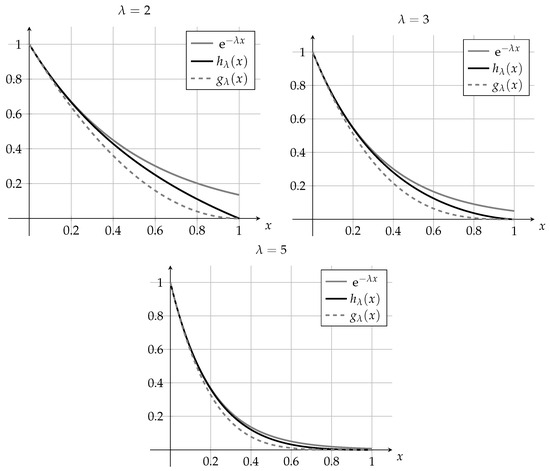
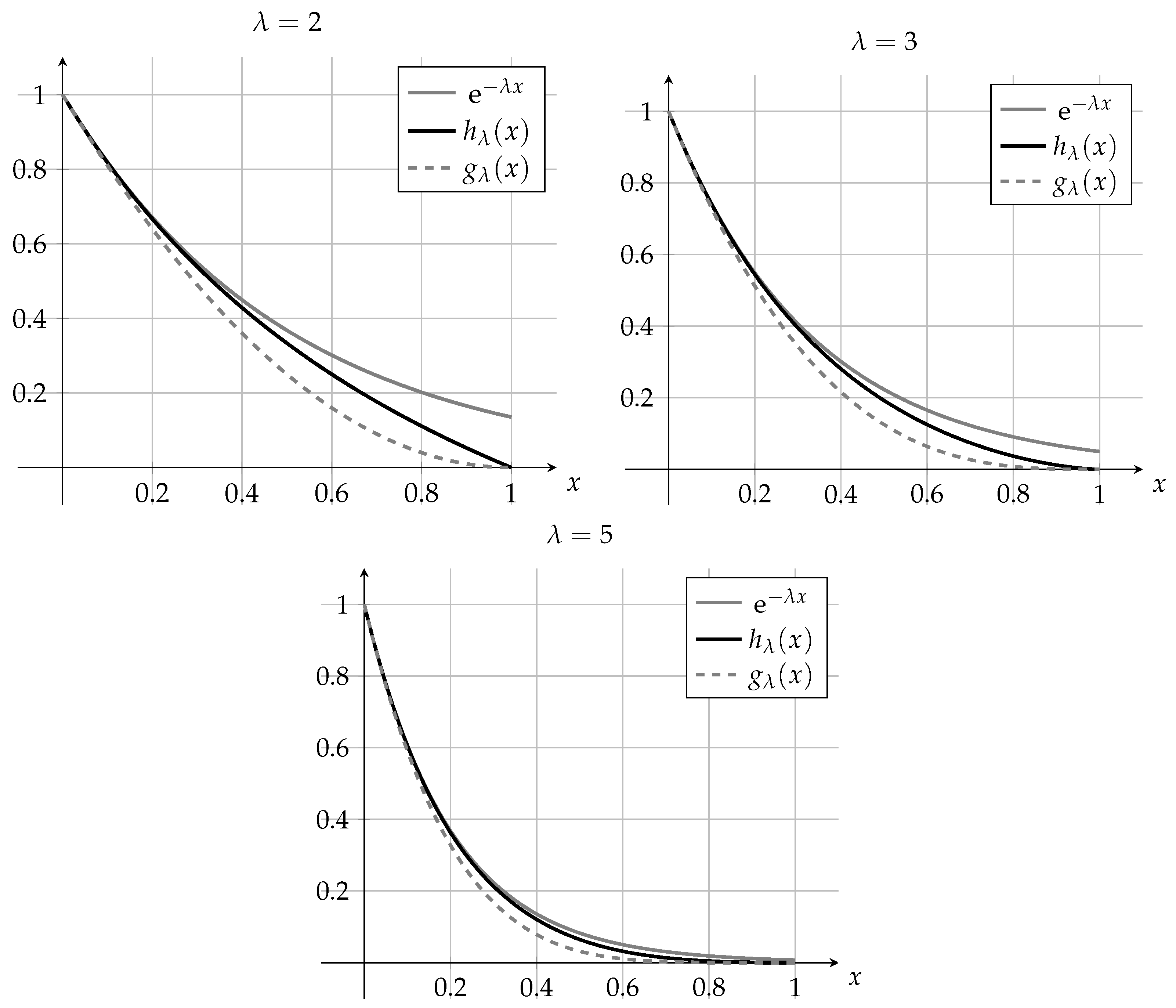
Figure 1 shows some example plots of and its approximation by and the epsilon function on .
Figure 1.
Example plots of and its approximation by and the epsilon function on .
Based on the above considerations, we define the epsilon-function-based normalized fuzzy similarity measure as follows.
Definition 9.
Let be a normalized distance measure in the vector space . We say that the function is an epsilon-function-based normalized fuzzy similarity measure with a parameter in the vector space , if for any , is given by
Notice that , where is the epsilon function on given by Equation (20). The following lemma summarizes the main properties of the epsilon-function-based normalized fuzzy similarity measure given in Definition 9.
Lemma 1.
Let be a normalized distance measure in the vector space and let be the corresponding epsilon-function-based normalized fuzzy similarity measure with a parameter given by Equation (26). has the following properties:
- (a)
- For any , if , then (maximal similarity).
- (b)
- For any , if , then (minimal similarity).
- (c)
- For any , implies (monotonocity).
- (d)
- If , then for any , , where is given by Equation (19).
- (e)
- If , then
Proof.
Properties (a), (b) and (c) readily follow from the definition of given in Definition 9, while property (b) is a consequence of Theorem 3. □
4. A Similarity and Fuzzy Arithmetic-Based Fuzzy Inference Method
In our model, we assume that the value of a dependent variable is a function of an n-dimensional normalized feature vector as follows:
where , , f is an unknown mapping from to and is a normally distributed random variable with mean of 0. Our goal is to build a fuzzy inference method to approximate function f.
4.1. Forming a Feature Vector–Linguistic Value of the Number of Passenger Pairs
We will construct a Similarity and Fuzzy Arithmetic-based Fuzzy Inference System (SFAFIS) to approximate the mapping f given in Equation (28). For this purpose, we will use a set of training data given by the ordered pairs
where , ,
, , and , . Here, the vector and the scalar represent the normalized feature vector (explanatory or input vector) and the corresponding output in the ith observation, respectively, in the sample given by Equation (29).
Let
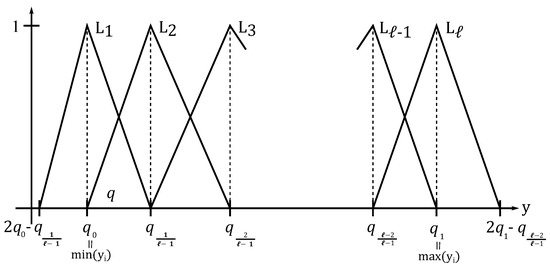
and suppose that . Now, let be the linguistic values like ‘very small’, ‘small’, ‘large’, ‘very large’, etc., of y where , . This means that are fuzzy sets on the interval . Furthermore, let denote the -quantile of the values, where .
In our approach, the kth linguistic level of y is a triangular fuzzy number with the parameters , . That is,
and the membership function of is given by
such that
if , then
if , then
if , then
Figure 2 shows an example of the plots of membership functions of the triangular fuzzy numbers (linguistic values) .
Figure 2.
Example plots of the triangular fuzzy numbers (linguistic values) .
Next, for all , we transform the training data pair into the pair
such that is the smallest index for which the membership value equals the maximum of the membership values
That is, is given as
In other words, is the smallest index for which, among the linguistic values , the linguistic value best represents the crisp value.
Remark 3.
Alternatively, instead of the -quantile, can be defined as
where . In this case, we apply a grid partitioning, i.e., with equidistant points, we divide the range into ℓ consecutive intervals with the same Lebesgue measure (i.e., same length).
4.2. The Inference Mechanism
Suppose that is an input feature vector for which we aim to predict the value of y. Furthermore, let be an epsilon-function-based normalized fuzzy similarity measure with a parameter given in Definition 9. That is, for any , characterizes how much vector is similar to the vector . Now, for all , let be given by
Notice that and , and the weight may be regarded as the relative measure of how well the input feature vector fits to the feature vector of the ith training data pair , where .
Since
for all , based on Corollary 1 (a), the weighted arithmetic mean of the triangular fuzzy numbers is the triangular fuzzy number , which is given by
where ⊙ and ⊕ are the scalar multiplication and summation operators over triangular fuzzy numbers given in Definition 6 and Definition 7, respectively. Here, we treat the triangular fuzzy number as the fuzzy output of our similarity and fuzzy arithmetic-based fuzzy inference method, where
With this approach, our method takes the linguistic value of (i.e., the triangular fuzzy number ) into account in the aggregate fuzzy output Y as much as the input feature vector fits to the ith feature vector . Hence, the defuzzified value of Y may be treated as a prediction of y for the feature vector . Using the center of gravity defuzzyfication method, the prediction of y is
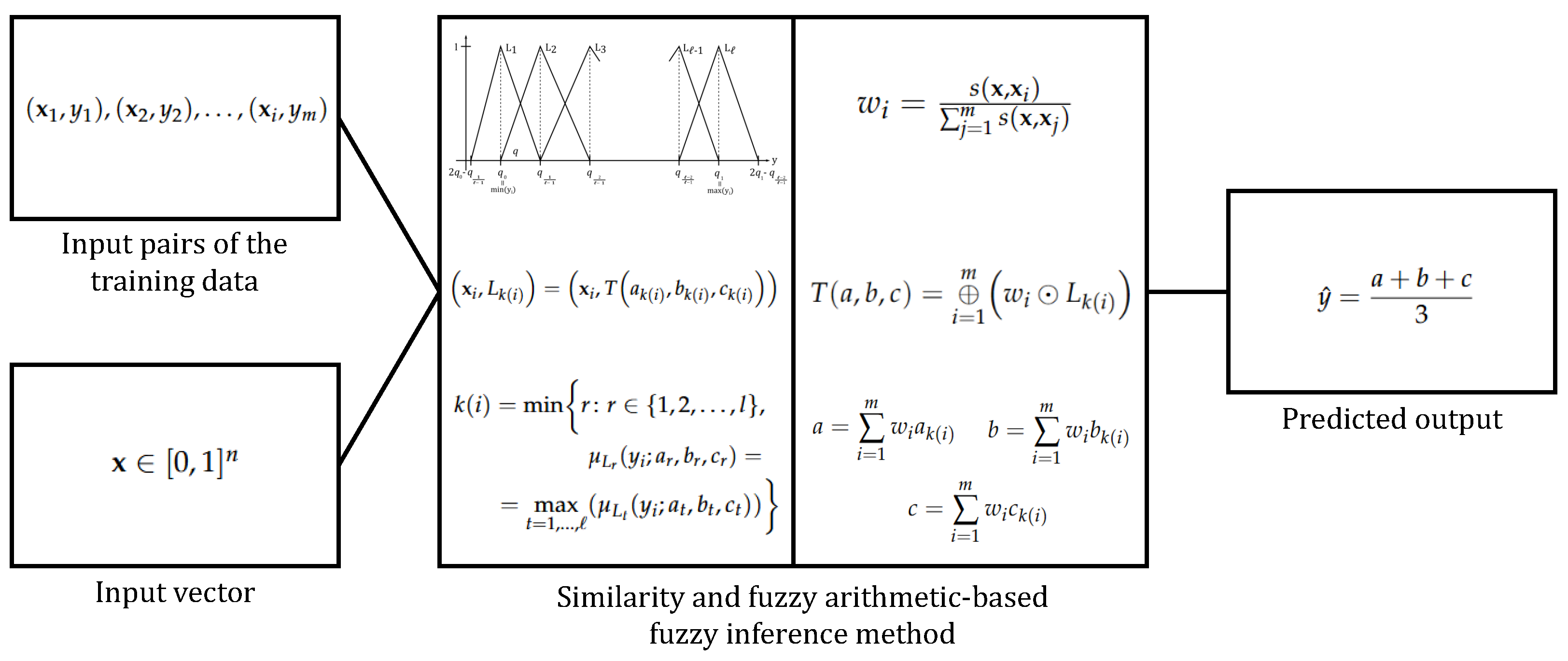
Figure 3 shows the schematic diagram of the similarity and fuzzy arithmetic-based fuzzy inference system (SFAFIS) that we have described so far.
Figure 3.
Schematic diagram of the similarity and fuzzy arithmetic-based fuzzy inference system (SFAFIS).
4.3. Tuning the Hyperparameters
The similarity and fuzzy arithmetic-based fuzzy inference system presented above may be treated as a two-parameter function that models the relationship between and , i.e.,
where is the ith training data pair, . Function has two parameters, a and an , , which may be viewed as the hyperparameters of our SFAFIS. Recall that is the parameter of the epsilon-function-based normalized fuzzy similarity measure and ℓ is the number of linguistic levels utilized in the SFAFIS. The optimal values of and ℓ, denoted by and , respectively, can be determined by solving the minimization problem
That is, and are parameter values for which
holds.
The quasi-optimal values of and ℓ can be found using various numerical methods such as particle swarm optimization or genetic algorithms. In a case study, which we will present in the next section, we are going to demonstrate that, since there are just two tunable parameters in our SFAFIS, even a simple grid search method is an effective way for finding the quasi-optimal values of these parameters.
We should emphasize that although our inference system has only two tunable parameters, in practice, this may serve as a viable alternative to much more sophisticated multi-parametric modeling methods.
5. Case Study
In this case study, we demonstrate how our similarity and fuzzy arithmetic-based model can be applied in practice. The aim of this study was to predict the number of passengers on railway relations using real-life data. For this purpose, historical passenger traffic data of the Hungarian State Railways (MÁV) were collected.
In order to utilize the SFAFIS method, we had to identify those characteristics of the examined relations that mostly affect the number of passengers on these relations. That is, we had to identify the components of an input vector . Based on the findings of previous research articles (see, e.g., [14,36,37,38,39,40,41,42,43]) and preliminary studies of Hungarian State Railways, the following characteristics of railway routes were taken in to account as explanatory variables:
- : Population of the the first city.
- : Population of the the second city.
- l: Distance between the cities (km).
- : Fastest possible travel time between the cities by railway (min).
- : Fastest possible travel time between the cities by bus (min).
- : Fastest possible travel time between the cities by car (min).
- : Number of average InterCity train departures between the cities.
- : Number of average bus departures between the cities.
- : Number of average train departures between the cities.
- : Unit cost of transport by rail (per passenger-km) (HUF).
- : Unit cost of transport by bus (per passenger-km) (HUF).
- : Unit cost of transport by car (per passenger-km) (HUF).
- : Car ownership index of the region.
- : Distance of the railway station from the city centers (km).
- : Distance of the bus station from the city centers (km).
Since the above fifteen input characteristics were taken into consideration, an input vector contained the normalized values of the above characteristics. The normalization of the inputs was performed using the well-known min–max normalization method on the data given in Appendix A.
For the sake of simplicity, we stipulated that the railway connections are examined independently, i.e., the number of passengers on different sections of the same route are not added up. Using the company’s sales database for the year 2022, we calculated the rounded value of the average monthly number of passengers for each examined connection. These are shown in column y in Appendix A. Here, we utilized data from 60 railway connections in Hungary. However, it turned out, that even with these real data, the data range is too large; therefore, more data would be required to accurately test the proposed model. Unfortunately, because of the size and usual passenger flows in Hungary, more real-world data could not be gathered; therefore, we selected the densest part of our database (i.e., connections with an average monthly passenger number between 800 and 3500) and generated more records based on the original data. First, we generated new records from the original ones such that each new record was derived as a weighted average of two original records with a randomly selected average ratio. Next, using the same approach, we generated records using the previously generated ones. In Appendix A, we summarize our database, which includes both original and generated data and has 81 records in total. The original records are marked by letters from A to Z, while generated data are marked by a combination of letters corresponding to the records that they were generated from. For example, record AB was generated from records A and B and record ABBC was generated from the records AB and BC.
We evaluated the performance of the SFAFIS method and compared it with some well-known methods using randomly selected training and test data sets from the sample S given in Appendix A. We performed the method evaluations repeatedly so that, in every iteration, the training data set and the test data set were randomly selected from the sample S as
such that and , where
- and are the number of training and test data pairs, respectively;
- and are the n-dimensional normalized feature vectors of the th and th railway connections in the training and test data sets, respectively (i.e., );
- and are the average number of passengers of the th and th railway relations in the training and test data sets, respectively;
- and are the estimated (computed) values of and , respectively;
- and .
To characterize the goodness of the investigated methods, the following Mean Absolute Percentage Error (MAPE) and Root Mean Square Error (RMSE) metrics were taken into account:
Here, and are the MAPE metrics for the training and test data sets, respectively, while is the MAPE value that takes into account both the training and test data sets. Similarly, and are the RMSE metrics for the training and test data sets, respectively, while is the RMSE value that takes into consideration both the training and test data sets.
Notice that using the Equations (33), (34), (36) and (37), the and given in Equation (35) and Equation (38), respectively, can also be calculated as
In every iteration, the number of randomly selected training data points was , while the remaining data points were utilized as test data.
For every randomly selected training data set, the proposed SFAFIS method was applied with , and parameter values. For each value of the parameter, the quasi-optimal value of the number of linguistic variables, i.e., , was determined by minimizing the quantity as described in Section 4.3, such that was searched for in the set . That is, for a given value of , is the value of parameter ℓ for which
where is the th data pair in the training data set and is the output of the SFAFIS method for input vector .
With the genfis method of the MATLAB (R2024b) software package [31], in every iteration, utilizing the training data, a Sugeno-type fuzzy inference system (FIS) was generated using the subtractive clustering (SC) algorithm. This Sugeno-type FIS had 15 inputs () with 8 Gaussian membership functions for each input, i.e., the number of parameters on the input side was . The number of rules in the rule base, i.e., the number of clusters formed, was eight, and so the output side of the FIS consisted of eight linear functions of the inputs. That is, each of these linear functions had 16 parameters (number of dimensions in the input vectors plus one for the constant term in the linear function). Hence, the total number of tunable parameters in such a Sugeno-type FIS was . These parameters were tuned (optimized) using the following techniques, along with a -fold cross validation:
- Adaptive Neuro Fuzzy Inference System (ANFIS) (see, e.g., [24,25]);
- Genetic Algorithm (GA) (see, e.g., [26,27,28]);
- Particle Swarm Optimization (PSO) (see, e.g., [29]);
- Pattern-search (PS) method (see, e.g., [30]).
The parameter tuning (optimization) of the Sugeno-type FIS was performed using the tunefis method of the MATLAB (R2024b) software package. The modeling goodness of the SFAFIS method and that of the Sugeno-type FIS tuned by the above-listed methods were expressed in terms of MAPE and RMSE metrics. These goodness results are shown in Table 1, Table 2, Table 3 and Table 4. The MATLAB source codes that were used to generate the results in these tables are available at https://jonast.web.elte.hu/. The ‘SFAFIS_example.m’ file contains the example of our case study, and the ‘FIS_similarity_and_fuzzy_arithmetic_class.m’ file is the class file in which the method itself is implemented. Using these two files, the results of our case study can be reproduced. We should note that in the MATLAB implementation of SFAFIS, instead of the similarity measure given in Equation (26), the following modified variant was employed:
i.e., .
Table 1.
Modeling results of SFAFIS and the Sugeno-type FIS tuned using ANFIS.
Table 2.
Modeling results of SFAFIS and the Sugeno-type FIS tuned using genetic algorithm (GA).
Table 3.
Modeling results of SFAFIS and the Sugeno-type FIS tuned using particle swarm optimization (PSO).
Table 4.
Modeling results of SFAFIS and the Sugeno-type FIS tuned using pattern-search (PS) optimization.
Using the goodness results shown in Table 1, Table 2, Table 3 and Table 4, Mann–Whitney median tests were conducted to compare the modeling performance of the SFAFIS method with that of the Sugeno-type FIS tuned using the ANFIS, GA, PSO and PS methods. From the three SFAFIS metric values (for and 90 parameter values) corresponding to each iteration in Table 1, Table 2, Table 3 and Table 4, the best one always was taken into account in the hypothesis tests. The results of the Mann–Whitney median tests are shown in Table 5. In this table, the notation stands for the median of the corresponding metric for method M.
Based on the results of the Mann–Whitney median tests shown in Table 5, with respect to the studied case, the following conclusions can be drawn:
- On the training data, the Sugeno-type fuzzy inference systems tuned by the ANFIS, GA, PSO and PS methods perform significantly better than the proposed SFAFIS method both in terms of MAPE and RMSE (see the Mann–Whitney test results for and in Table 5).
- On the test data, the proposed SFAFIS method performs significantly better than the Sugeno-type fuzzy inference systems tuned by the ANFIS, GA, PSO and PS methods both in terms of MAPE and RMSE (see the Mann–Whitney test results for and in Table 5).
- Taking into account the training and test data together, the proposed SFAFIS method performs significantly better than the Sugeno-type fuzzy inference systems tuned by the ANFIS, GA, PSO and PS methods both in terms of MAPE and RMSE (see the Mann–Whitney test results for and in Table 5).
Noting the modeling results shown in Table 1, Table 2, Table 3 and Table 4, in most of the cases, the metric for the SFAFIS method is less than 5. This means that using the above-considered characteristics of a new railway connection, the SFAFIS method can predict the average number of passengers on this connection with an absolute relative error of less than 5%. This accuracy exceeds the practical expectations.
Table 6 shows the average training and inference times of the investigated methods examined on the same computer under the same conditions. In this table, the average inference time represents the mean value of the time needed to predict both the training and test output data for the iterations shown in Table 1, Table 2, Table 3 and Table 4. In every iteration, from the three SFAFIS methods (for and 90 parameter values), the one with the best value was taken into account in computing the average inference time of the SFAFIS method.
Table 6.
Training and inference times vs. method.
Based on the average training and inference times shown in Table 6, we see that, for the data utilized in our case study, the average training time for the SFAFIS method was similar to that of the ANFIS method, and the average training times of these two methods (2.288 and 3.695 s) were considerably shorter than the average training times of the other three methods. At the same time, the average inference time for the SFAFIS method turned out to be longer than that of the other investigated methods. Here, we should emphasize that since we aim to predict the number of passengers on railway connections and do not need to do this real-time, neither the training time nor the inference time of the method used is critical.
Possibilities for Applying the SFAFIS Method to Other Railway Systems
As mentioned before, in our case study, fifteen characteristics of railway connections were taken into consideration, and so the input vector contained the normalized values of these characteristics. Here, we should note that these characteristics were identified based on previous research articles (see, e.g., [14,36,37,38,39,40,41,42,43]) and preliminary studies of Hungarian State Railways (MÁV). This means that we identified those characteristics of the examined railway connections that mostly affected the number of passengers on these connections. Hence, these characteristics are specific to the Hungarian railway system in the sense that these inputs are the most explanatory in the given system. At the same time, it is worth noting that the SFAFIS method presented in Section 4 can be applied in the same way to any another railway system, even if the input characteristics in that system are different. That is, once the input features of railway routes, and hence the explanatory variables, in a railway system are identified, and the historical number of passengers associated with each input vector is given, the SFAFIS method can be applied in the same way as described. The number of passengers can be determined from ticket sales data.
6. Conclusions and Plans for Future Research
In this study, we developed a new fuzzy inference method that utilizes a novel similarity measure and fuzzy arithmetic operations to model the relation between inputs and outputs. Using known input–output pairs, for a given input vector, we determine its similarity to all the known input vectors, and from these similarities, we derive weights. Using these weights, the output of our system is computed as the defuzzified value of the weighted average of triangular fuzzy numbers that represent the linguistic values of the outputs. Based on the results of a real-life case study, which we presented in Section 5, we may conclude that although the proposed method has only two adjustable parameters, its forecasting capability is comparable with that of Sugeno-type fuzzy inference systems, which have a much larger number of adjustable parameters.
In Section 3, we introduced the epsilon-function-based normalized fuzzy similarity measure and demonstrated its main properties. Later, we showed how this similarity measure can be used in the presented SFAFIS method. However, we did not study how the SFAFIS method would perform using other similarity measures. Since comparing the proposed similarity measure with other similarity measures is an interesting topic, we plan to study this in our future research.
We proposed the use of a simple grid search method to find the quasi-optimal values of the and ℓ parameters of an SFAFIS system. However, as part of our future research, we plan to investigate how more effective optimization methods can be utilized for this purpose. In the proposed inference system, we perform arithmetic operations over triangular fuzzy numbers. We would also like to examine how our method can be adapted to other types of fuzzy numbers.
In the presented case study, we utilized passenger traffic data from the Hungarian State Railways (MÁV). This naturally raises the question of how the SFAFIS method can be applied to other transportation systems, such as high-speed rail networks, urban metro systems or air routes. We would therefore like to further explore this question in our future research.
In the wider field of transportation planning, in our future research, we would also like to investigate how the choice of transport mode can be modeled using fuzzy methods. Moreover, we are also motivated to answer the question of how and by what evaluation methods limited transport capacities can be allocated on a socioeconomic basis.
Author Contributions
Conceptualization, M.F. and T.J.; methodology, M.F. and T.J.; software, M.F. and T.J.; validation, M.F. and T.J.; formal analysis, M.F. and T.J.; data curation, M.F. and T.J.; writing—original draft preparation, M.F. and T.J.; writing—review and editing, M.F. and T.J.; visualization, M.F. and T.J.; supervision, T.J. All authors have read and agreed to the published version of the manuscript.
Funding
This research received no external funding.
Data Availability Statement
The original contributions presented in this study are included in the article. Further inquiries can be directed to the corresponding author.
Conflicts of Interest
The authors declare no conflicts of interest.
Appendix A. The Data Set Used in the Case Study
| City 1 | City 2 | ||||||||||||||||
| A | B | 55,910 | 54,428 | 86 | 99 | 180 | 100 | 8 | 9 | 24 | 2520 | 2520 | 4356 | 0.4602 | 4.5 | 1.3 | 824 |
| A | C | 55,910 | 78,190 | 98 | 103 | 230 | 100 | 8 | 17 | 10 | 2700 | 2790 | 4140 | 0.4496 | 4.6 | 1.6 | 1759 |
| D | E | 55,164 | 66,061 | 87 | 68 | 185 | 90 | 16 | 19 | 6 | 1860 | 2610 | 3996 | 0.4241 | 2.9 | 2 | 1772 |
| F | G | 199,858 | 3530 | 67 | 52 | 116 | 80 | 8 | 10 | 2 | 1980 | 1680 | 3060 | 0.3888 | 2.5 | 1.5 | 2459 |
| H | I | 8389 | 116,282 | 45 | 39 | 110 | 60 | 9 | 18 | 1 | 1230 | 1395 | 1944 | 0.4055 | 2.9 | 1.7 | 2040 |
| J | K | 18,039 | 23,742 | 64 | 73 | 117 | 65 | 8 | 10 | 13 | 1490 | 1490 | 3096 | 0.5117 | 1.7 | 1.8 | 885 |
| L | M | 23,116 | 158,797 | 91 | 76 | 153 | 80 | 17 | 19 | 10 | 1860 | 2180 | 4104 | 0.4075 | 3.5 | 1.1 | 2758 |
| N | O | 7190 | 147,533 | 48 | 37 | 130 | 60 | 9 | 23 | 18 | 1770 | 1800 | 2772 | 0.3987 | 2.5 | 1.1 | 1390 |
| P | O | 15,504 | 147,533 | 36 | 28 | 65 | 50 | 9 | 23 | 32 | 1490 | 930 | 1548 | 0.3987 | 3.9 | 1.2 | 3149 |
| Q | R | 60,334 | 65,830 | 137 | 95 | 250 | 110 | 7 | 8 | 12 | 3630 | 3905 | 5796 | 0.4422 | 1.6 | 1.3 | 1521 |
| S | T | 1,658,342 | 24,371 | 145 | 165 | 200 | 143 | 1 | 11 | 8 | 3249 | 3410 | 7596 | 0.4044 | 2.7 | 0.5 | 2634 |
| S | U | 1,658,342 | 29,889 | 130 | 122 | 115 | 90 | 1 | 10 | 25 | 3480 | 2830 | 5616 | 0.4458 | 1 | 1 | 3325 |
| F | V | 199,858 | 127,599 | 299 | 269 | 680 | 218 | 19 | 0 | 3 | 6240 | 9190 | 13,608 | 0.4314 | 1.9 | 2 | 1208 |
| F | M | 199,858 | 158,797 | 181 | 192 | 308 | 190 | 0 | 18 | 8 | 4398 | 3950 | 8100 | 0.3894 | 2.7 | 1.8 | 1725 |
| F | W | 199,858 | 49,182 | 102 | 160 | 150 | 85 | 0 | 8 | 9 | 2200 | 2520 | 4752 | 0.411 | 2.7 | 1.7 | 839 |
| V | A | 127,599 | 55,910 | 68 | 117 | 105 | 80 | 0 | 8 | 10 | 1490 | 1490 | 2916 | 0.45 | 4.1 | 1.8 | 1970 |
| V | E | 127,599 | 66,061 | 200 | 185 | 403 | 140 | 20 | 0 | 2 | 4380 | 5820 | 8244 | 0.4326 | 2.3 | 1.5 | 1194 |
| X | E | 108,120 | 66,061 | 47 | 49 | 80 | 65 | 17 | 14 | 8 | 1120 | 1300 | 2124 | 0.4406 | 2.4 | 1.4 | 3327 |
| O | W | 147,533 | 49,182 | 38 | 75 | 95 | 65 | 8 | 11 | 20 | 1490 | 1300 | 2988 | 0.3995 | 3.7 | 1.4 | 1466 |
| O | V | 147,533 | 127,599 | 239 | 242 | 665 | 190 | 17 | 0 | 1 | 4698 | 7690 | 11,880 | 0.4199 | 2.9 | 1.7 | 838 |
| O | T | 147,533 | 24,371 | 21 | 27 | 35 | 30 | 0 | 13 | 87 | 550 | 550 | 1008 | 0.3783 | 4.8 | 1.2 | 1904 |
| O | Y | 147,533 | 31,022 | 39 | 65 | 90 | 60 | 0 | 13 | 23 | 1120 | 1120 | 2160 | 0.3503 | 3.3 | 1.6 | 1042 |
| I | E | 116,282 | 66,061 | 145 | 109 | 290 | 150 | 18 | 18 | 4 | 2399 | 4720 | 6552 | 0.4182 | 3.2 | 1.8 | 1731 |
| Z | V | 139,330 | 127,599 | 186 | 226 | 270 | 190 | 8 | 2 | 5 | 5160 | 4200 | 8784 | 0.4328 | 2 | 1.8 | 1160 |
| Z | C | 139,330 | 78,190 | 179 | 261 | 300 | 210 | 0 | 9 | 5 | 4620 | 4200 | 8640 | 0.4325 | 2.5 | 1.6 | 1308 |
| A1 | C | 95,045 | 78,190 | 136 | 145 | 225 | 120 | 8 | 8 | 6 | 3330 | 3880 | 5832 | 0.4627 | 2.8 | 1.2 | 959 |
| A1 | A | 95,045 | 55,910 | 40 | 42 | 55 | 40 | 16 | 21 | 33 | 840 | 840 | 1692 | 0.4506 | 4.8 | 1.2 | 3092 |
| C | B | 78,190 | 54,428 | 47 | 55 | 75 | 55 | 0 | 21 | 18 | 1330 | 1120 | 2016 | 0.4723 | 2.5 | 1.3 | 2013 |
| AA | BC | 55,910 | 70,567 | 94 | 102 | 214 | 100 | 8 | 14 | 14 | 2642 | 2703 | 4209 | 0.453 | 4.6 | 1.5 | 1459 |
| AD | CE | 55,551 | 72,345 | 93 | 86 | 208 | 95 | 12 | 18 | 8 | 2295 | 2703 | 4071 | 0.4373 | 3.8 | 1.8 | 1765 |
| DF | EG | 102,007 | 45,817 | 81 | 63 | 163 | 87 | 13 | 16 | 5 | 1899 | 2309 | 3693 | 0.4127 | 2.8 | 1.8 | 1994 |
| FH | GI | 140,296 | 38,605 | 60 | 48 | 114 | 74 | 8 | 12 | 2 | 1747 | 1591 | 2713 | 0.394 | 2.6 | 1.6 | 2329 |
| HJ | IK | 11,953 | 82,106 | 52 | 52 | 113 | 62 | 9 | 15 | 5 | 1326 | 1430 | 2369 | 0.4447 | 2.5 | 1.7 | 1613 |
| JL | KM | 20,636 | 92,825 | 78 | 75 | 135 | 73 | 13 | 15 | 11 | 1679 | 1843 | 3612 | 0.4584 | 2.6 | 1.4 | 1843 |
| LN | MO | 17,430 | 154,775 | 76 | 62 | 145 | 73 | 14 | 20 | 13 | 1828 | 2044 | 3628 | 0.4044 | 3.1 | 1.1 | 2269 |
| NP | OO | 9038 | 147,533 | 45 | 35 | 116 | 58 | 9 | 23 | 21 | 1708 | 1607 | 2500 | 0.3987 | 2.8 | 1.1 | 1781 |
| PQ | OR | 48,257 | 87,840 | 110 | 77 | 200 | 94 | 8 | 12 | 17 | 3054 | 3104 | 4652 | 0.4305 | 2.2 | 1.3 | 1960 |
| QS | RT | 1220139 | 35,740 | 143 | 146 | 214 | 134 | 3 | 10 | 9 | 3353 | 3546 | 7102 | 0.4148 | 2.4 | 0.7 | 2329 |
| SS | TU | 1,658,342 | 28,825 | 133 | 130 | 131 | 100 | 1 | 10 | 22 | 3435 | 2942 | 5998 | 0.4378 | 1.3 | 0.9 | 3192 |
| SF | UV | 1,223,448 | 59,024 | 180 | 166 | 283 | 128 | 6 | 7 | 18 | 4303 | 4726 | 7999 | 0.4415 | 1.3 | 1.3 | 2694 |
| FF | VM | 199,858 | 156,814 | 188 | 197 | 332 | 192 | 1 | 17 | 8 | 4515 | 4283 | 8450 | 0.392 | 2.6 | 1.8 | 1692 |
| FF | MW | 199,858 | 143,995 | 170 | 188 | 287 | 176 | 0 | 17 | 8 | 4101 | 3757 | 7648 | 0.3923 | 2.7 | 1.8 | 1605 |
| FV | WA | 160,745 | 52,824 | 84 | 137 | 126 | 82 | 0 | 8 | 10 | 1816 | 1962 | 3758 | 0.4321 | 3.5 | 1.8 | 1451 |
| VV | AE | 127,599 | 61,929 | 146 | 157 | 282 | 116 | 12 | 3 | 5 | 3204 | 4058 | 6075 | 0.4397 | 3 | 1.6 | 1510 |
| VX | EE | 109,263 | 66,061 | 56 | 57 | 99 | 69 | 17 | 13 | 8 | 1311 | 1565 | 2483 | 0.4401 | 2.4 | 1.4 | 3202 |
| XO | EW | 124,506 | 59,044 | 43 | 60 | 86 | 65 | 13 | 13 | 13 | 1274 | 1300 | 2483 | 0.4235 | 2.9 | 1.4 | 2553 |
| OO | WV | 147,533 | 122,287 | 225 | 231 | 626 | 182 | 16 | 1 | 2 | 4481 | 7257 | 11,278 | 0.4185 | 3 | 1.7 | 881 |
| OO | VT | 147,533 | 115,007 | 212 | 216 | 588 | 170 | 15 | 2 | 11 | 4192 | 6819 | 10,554 | 0.4148 | 3.1 | 1.6 | 968 |
| OO | TY | 147,533 | 30,240 | 37 | 61 | 84 | 56 | 0 | 13 | 31 | 1053 | 1053 | 2024 | 0.3536 | 3.5 | 1.6 | 1143 |
| OI | YE | 143,063 | 36,034 | 54 | 71 | 119 | 73 | 3 | 14 | 20 | 1303 | 1635 | 2788 | 0.36 | 3.3 | 1.6 | 1141 |
| IZ | EV | 117,752 | 69,987 | 148 | 116 | 289 | 153 | 17 | 17 | 4 | 2575 | 4687 | 6694 | 0.4192 | 3.1 | 1.8 | 1695 |
| ZZ | VC | 139,330 | 84,583 | 180 | 256 | 296 | 207 | 1 | 8 | 5 | 4690 | 4200 | 8659 | 0.4325 | 2.4 | 1.6 | 1289 |
| ZA1 | CC | 101,635 | 78,190 | 142 | 162 | 236 | 133 | 7 | 8 | 6 | 3522 | 3928 | 6250 | 0.4582 | 2.8 | 1.3 | 1011 |
| A1A1 | CA | 95,045 | 76,443 | 128 | 137 | 212 | 114 | 9 | 9 | 8 | 3135 | 3642 | 5507 | 0.4617 | 3 | 1.2 | 1126 |
| A1C | AB | 80,528 | 54,634 | 46 | 53 | 72 | 53 | 2 | 21 | 20 | 1262 | 1081 | 1971 | 0.4693 | 2.8 | 1.3 | 2163 |
| AAAD | BCCE | 55,731 | 71,453 | 93 | 94 | 211 | 98 | 10 | 16 | 11 | 2469 | 2703 | 4140 | 0.4452 | 4.2 | 1.6 | 1611 |
| ADDF | CEEG | 91,601 | 51,759 | 83 | 68 | 173 | 89 | 13 | 17 | 5 | 1988 | 2397 | 3778 | 0.4182 | 3 | 1.8 | 1943 |
| DFFH | EGGI | 121,914 | 42,068 | 70 | 55 | 137 | 80 | 11 | 14 | 3 | 1820 | 1936 | 3183 | 0.403 | 2.7 | 1.7 | 2168 |
| FHHJ | GIIK | 49,984 | 69,215 | 54 | 50 | 113 | 65 | 9 | 14 | 4 | 1451 | 1478 | 2471 | 0.4297 | 2.5 | 1.7 | 1825 |
| HJJL | IKKM | 17,763 | 89,278 | 69 | 67 | 128 | 69 | 11 | 15 | 9 | 1562 | 1706 | 3201 | 0.4539 | 2.6 | 1.5 | 1767 |
| JLLN | KMMO | 17,959 | 144,544 | 76 | 64 | 143 | 73 | 14 | 19 | 13 | 1803 | 2011 | 3626 | 0.4133 | 3.1 | 1.2 | 2199 |
| LNNP | MOOO | 14,177 | 151,968 | 64 | 52 | 133 | 67 | 12 | 21 | 16 | 1781 | 1875 | 3191 | 0.4022 | 3 | 1.1 | 2080 |
| NPPQ | OOOR | 45,314 | 92,319 | 105 | 74 | 194 | 91 | 8 | 13 | 18 | 2953 | 2991 | 4490 | 0.4281 | 2.3 | 1.3 | 1946 |
| PQQS | ORRT | 499,570 | 67,775 | 123 | 103 | 205 | 109 | 6 | 11 | 14 | 3169 | 3274 | 5595 | 0.4244 | 2.3 | 1.1 | 2102 |
| QSSS | RTTU | 1,240,160 | 35,424 | 142 | 145 | 210 | 132 | 3 | 10 | 10 | 3357 | 3518 | 7052 | 0.4158 | 2.3 | 0.7 | 2368 |
| SSSF | TUUV | 1,402,059 | 46,622 | 161 | 151 | 221 | 117 | 4 | 8 | 20 | 3947 | 3993 | 7177 | 0.44 | 1.3 | 1.1 | 2898 |
| SFFF | UVVM | 301,763 | 147,078 | 188 | 194 | 327 | 185 | 2 | 16 | 9 | 4494 | 4327 | 8405 | 0.397 | 2.5 | 1.8 | 1792 |
| FFFF | VMMW | 199,858 | 150,020 | 179 | 192 | 308 | 183 | 1 | 17 | 8 | 4296 | 4004 | 8025 | 0.3922 | 2.7 | 1.8 | 1646 |
| FFFV | MWWA | 165,584 | 64,105 | 94 | 143 | 146 | 94 | 0 | 9 | 9 | 2098 | 2185 | 4239 | 0.4272 | 3.4 | 1.8 | 1470 |
| FVVV | WAAE | 142,111 | 57,943 | 119 | 148 | 213 | 101 | 7 | 5 | 7 | 2596 | 3140 | 5061 | 0.4364 | 3.2 | 1.7 | 1484 |
| VVVX | AEEE | 111,291 | 65,604 | 66 | 68 | 119 | 75 | 17 | 12 | 7 | 1521 | 1841 | 2880 | 0.44 | 2.5 | 1.4 | 3015 |
| VXXO | EEEW | 123,063 | 59,708 | 44 | 60 | 87 | 65 | 14 | 13 | 12 | 1277 | 1325 | 2483 | 0.4251 | 2.9 | 1.4 | 2615 |
| XOOO | EWWV | 138,378 | 97,142 | 153 | 163 | 412 | 135 | 15 | 6 | 7 | 3206 | 4889 | 7781 | 0.4205 | 2.9 | 1.6 | 1546 |
| OOOO | WVVT | 147,533 | 118,693 | 219 | 223 | 608 | 176 | 16 | 1 | 7 | 4338 | 7041 | 10,920 | 0.4167 | 3 | 1.7 | 924 |
| OOOO | VTTY | 147,533 | 58,030 | 94 | 111 | 249 | 94 | 5 | 9 | 24 | 2082 | 2943 | 4821 | 0.3737 | 3.4 | 1.6 | 1086 |
| OOOI | TYYE | 143,360 | 35,648 | 53 | 71 | 116 | 72 | 2 | 14 | 21 | 1286 | 1596 | 2737 | 0.3596 | 3.3 | 1.6 | 1141 |
| OIIZ | YEEV | 132,995 | 49,539 | 91 | 89 | 186 | 105 | 8 | 15 | 14 | 1809 | 2849 | 4342 | 0.3836 | 3.2 | 1.7 | 1361 |
| IZZZ | EVVC | 138,306 | 83,891 | 178 | 250 | 296 | 205 | 2 | 9 | 5 | 4590 | 4223 | 8565 | 0.4319 | 2.5 | 1.6 | 1308 |
| ZZZA1 | VCCC | 131,028 | 83,175 | 172 | 236 | 283 | 191 | 2 | 8 | 5 | 4433 | 4140 | 8128 | 0.4382 | 2.5 | 1.5 | 1228 |
| ZA1A1A1 | CCCA | 100,432 | 77,871 | 140 | 158 | 232 | 130 | 7 | 8 | 6 | 3451 | 3875 | 6114 | 0.4588 | 2.8 | 1.2 | 1032 |
| A1A1A1C | CAAB | 89,200 | 67,661 | 95 | 103 | 156 | 89 | 6 | 14 | 13 | 2381 | 2611 | 4083 | 0.4648 | 2.9 | 1.2 | 1544 |
References
- Dou, F.; Wang, L.; Jia, L. A train dispatching model based on fuzzy passenger demand forecasting during holidays. J. Ind. Eng. Manag. 2013, 6, 320–335. [Google Scholar] [CrossRef] [Scilit]
- Fowkes, A.S.; Nash, C.A.; Whiteing, A.E. Understanding trends in inter-city rail traffic in Great Britain. Transp. Plan. Technol. 1985, 10, 65–80. [Google Scholar] [CrossRef] [Scilit]
- Butkevičius, J.; Mazūra, M.; Ivankovas, V.; Mazūra, S. Analysis and forecast of the dynamics of passenger transportation by public land transport. Transport 2004, 19, 3–8. [Google Scholar] [CrossRef] [Scilit]
- Xiao, Y.; Liu, J.J.; Hu, Y.; Wang, Y.; Lai, K.K.; Wang, S. A neuro-fuzzy combination model based on singular spectrum analysis for air transport demand forecasting. J. Air Transp. Manag. 2014, 39, 1–11. [Google Scholar]
- Srisaeng, P.; Baxter, G.; Wild, G. An adaptive neuro-fuzzy inference system for forecasting Australia’s domestic low cost carrier passenger demand. Aviation 2015, 19, 150–163. [Google Scholar] [CrossRef] [Scilit]
- Pamucar, D.; Deveci, M.; Canıtez, F.; Božanić, D. A fuzzy Full Consistency Method-Dombi-Bonferroni model for prioritizing transportation demand management measures. Appl. Soft Comput. 2020, 87, 105952. [Google Scholar] [CrossRef] [Scilit]
- Dorsey, B. Mass transit trends and the role of unlimited access in transportation demand management. J. Transp. Geogr. 2005, 13, 235–246. [Google Scholar] [CrossRef] [Scilit]
- Sharif Azadeh, S.; Marcotte, P.; Savard, G. Railway demand forecasting in revenue management using neural networks. Int. J. Revenue Manag. 2013, 7, 18–36. [Google Scholar] [CrossRef] [Scilit]
- Milosavljević, N.; Milenkovic, M.; Bojovic, N.; Svadlenka, L.; Avramovic, Z. A hybrid model for forecasting the volume of passenger flows on Serbian railways. Oper. Res. 2015, 16, 271–285. [Google Scholar] [CrossRef] [Scilit]
- Zhang, J.; Guo, W. Research on Railway Passenger Flow Prediction Method Based on GA Improved BP Neural Network. J. Comput. Commun. 2019, 7, 283–292. [Google Scholar] [CrossRef]
- Ghalehkhondabi, I.; Ardjmand, E.; Young, W.A.; Weckman, G.R. A review of demand forecasting models and methodological developments within tourism and passenger transportation industry. J. Tour. Futur. 2019, 5, 75–93. [Google Scholar] [CrossRef] [Scilit]
- Noersasongko, E.; Julfia, F.; Syukur, A.; Purwanto, P.; Pramunendar, R.; Supriyanto, C. A Tourism Arrival Forecasting using Genetic Algorithm based Neural Network. Indian J. Sci. Technol. 2016, 9, 1–5. [Google Scholar] [CrossRef] [Scilit]
- Huarng, K.H.; Yu, T.; Moutinho, L.; Wang, Y.C. Forecasting tourism demand by fuzzy time series models. Int. J. Cult. 2012, 6, 377–388. [Google Scholar] [CrossRef] [Scilit]
- Profillidis, V.; Botzoris, G. A Comparative Analysis of Performances of Econometric, Fuzzy and Time-series Models for the Forecast of Transport Demand. In Proceedings of the 2007 IEEE International Fuzzy Systems Conference, London, UK, 23–26 July 2007; pp. 1–6. [Google Scholar] [CrossRef] [Scilit]
- Rong, W.; Liu, D.; He, X. Prediction of High Speed Railway Passenger Demand Volume Based on Grey Relational Analysis. In Proceedings of the ICTE 2015, Hong Kong, China, 2–4 July 2015; pp. 173–179. [Google Scholar] [CrossRef] [Scilit]
- Tsekeris, T.; Tsekeris, C. Demand Forecasting in Transport: Overview and Modeling Advances. Econ. Res.-Ekon. Istraživanja 2011, 24, 82–94. [Google Scholar] [CrossRef] [Scilit]
- Profillidis, V.A.; Botzoris, G.N. Econometric models for the forecast of passenger demand in Greece. J. Stat. Manag. Syst. 2006, 9, 37–54. [Google Scholar] [CrossRef] [Scilit]
- Nijkamp, P.; Reggiani, A.; Tritapepe, T. Modelling Inter-Urban Transport Flows in Italy: A Comparison between Neural Network Analysis and Logit Analysis. Transp. Res. Part C 1996, 4, 323–338. [Google Scholar]
- Yang, L.; Li, K.; Gao, Z. Train Timetable Problem on a Single-Line Railway With Fuzzy Passenger Demand. IEEE Trans. Fuzzy Syst. 2009, 17, 617–629. [Google Scholar] [CrossRef] [Scilit]
- Ghoseiri, K.; Szidarovszky, F.; Asgharpour, M.J. A multi-objective train scheduling model and solution. Transp. Res. Part B Methodol. 2004, 38, 927–952. [Google Scholar] [CrossRef] [Scilit]
- Banerjee, N.; Morton, A.; Akartunalı, K. Passenger demand forecasting in scheduled transportation. Eur. J. Oper. Res. 2020, 286, 797–810. [Google Scholar]
- Dombi, J.; Jónás, T.; Tóth, Z.E. The epsilon probability distribution and its application in reliability theory. Acta Polytech. Hung. 2018, 15, 197–216. [Google Scholar] [CrossRef] [Scilit]
- Jónás, T. The Generalized Epsilon Function: An Alternative to the Exponential Function. Acta Cybern. 2022, 25, 703–716. [Google Scholar] [CrossRef] [Scilit]
- Jang, J.S. ANFIS: Adaptive-network-based fuzzy inference system. IEEE Trans. Syst. Man Cybern. 1993, 23, 665–685. [Google Scholar] [CrossRef] [Scilit]
- Abraham, A. Adaptation of Fuzzy Inference System Using Neural Learning. In Fuzzy Systems Engineering: Theory and Practice; Nedjah, N., Macedo Mourelle, L.d., Eds.; Springer: Berlin/Heidelberg, Germany, 2005; pp. 53–83. [Google Scholar] [CrossRef] [Scilit]
- Banzhaf, W.; Nordin, P.; Keller, R.E.; Francone, F.D. Genetic Programming: An Introduction: On the Automatic Evolution of Computer Programs and Its Applications; Morgan Kaufmann Publishers Inc.: San Francisco, CA, USA, 1998. [Google Scholar]
- Vose, M.D. The Simple Genetic Algorithm: Foundations and Theory; MIT Press: Cambridge, CA, USA, 1999. [Google Scholar]
- Alhijawi, B.; Awajan, A. Genetic algorithms: Theory, genetic operators, solutions, and applications. Evol. Intell. 2024, 17, 1245–1256. [Google Scholar] [CrossRef] [Scilit]
- Bonyadi, M.R.; Michalewicz, Z. Particle Swarm Optimization for Single Objective Continuous Space Problems: A Review. Evol. Comput. 2017, 25, 1–54. [Google Scholar] [CrossRef] [Scilit]
- Dolan, E.D.; Lewis, R.M.; Torczon, V. On the Local Convergence of Pattern Search. SIAM J. Optim. 2003, 14, 567–583. [Google Scholar] [CrossRef] [Scilit]
- The MathWorks Inc. Fuzzy Logic Toolbox Version: 24.2 (R2024a). Available online: https://www.mathworks.com (accessed on 1 November 2024).
- Zadeh, L. Fuzzy sets. Inf. Control 1965, 8, 338–353. [Google Scholar] [CrossRef] [Scilit]
- Dubois, D.; Prade, H. Fuzzy Sets and Systems: Theory and Applications; Academic Press: Cambridge, MA, USA, 1980. [Google Scholar]
- Cheng, C.B. Group opinion aggregationbased on a grading process: A method for constructing triangular fuzzy numbers. Comput. Math. Appl. 2004, 48, 1619–1632. [Google Scholar] [CrossRef] [Scilit]
- Bede, B. Fuzzy Numbers. In Mathematics of Fuzzy Sets and Fuzzy Logic; Springer: Berlin/Heidelberg, Germany, 2013; pp. 51–64. [Google Scholar] [CrossRef] [Scilit]
- Nag, A.; Sarkar, S. Integrating choice freedom, economic health, and transportation infrastructure to forecast tourism demand: A case study of Bishnupur and its alignment with sustainable development goals. Transp. Policy 2024, 147, 198–214. [Google Scholar] [CrossRef] [Scilit]
- Kuby, M.; Barranda, A.; Upchurch, C. Factors influencing light-rail station boardings in the United States. Transp. Res. Part A Policy Pract. 2004, 38, 223–247. [Google Scholar] [CrossRef] [Scilit]
- Chiou, Y.C.; Jou, R.C.; Yang, C.H. Factors affecting public transportation usage rate: Geographically weighted regression. Transp. Res. Part A Policy Pract. 2015, 78, 161–177. [Google Scholar] [CrossRef] [Scilit]
- Iseki, H.; Liu, C.; Knaap, G. The determinants of travel demand between rail stations: A direct transit demand model using multilevel analysis for the Washington D.C. Metrorail system. Transp. Res. Part A Policy Pract. 2018, 116, 635–649. [Google Scholar] [CrossRef] [Scilit]
- Liu, X.; Wu, J.; Huang, J.; Zhang, J.; Chen, B.Y.; Chen, A. Spatial-interaction network analysis of built environmental influence on daily public transport demand. J. Transp. Geogr. 2021, 92, 102991. [Google Scholar] [CrossRef] [Scilit]
- Ma, J.; Liu, H.; Chen, L. Demand-Responsive Transportation Vehicle Routing Optimization Based on Two-Stage Method. Comput. Mater. Contin. 2024, 81, 443–469. [Google Scholar] [CrossRef] [Scilit]
- Toro-González, D.; Cantillo, V.; Cantillo-García, V. Factors influencing demand for public transport in Colombia. Res. Transp. Bus. Manag. 2020, 36, 100514. [Google Scholar] [CrossRef] [Scilit]
- Konečný, V.; Brídziková, M.; Marienka, P. Research of bus transport demand and its factors using multicriteria regression analysis. Transp. Res. Procedia 2021, 55, 180–187. [Google Scholar] [CrossRef] [Scilit]

Disclaimer/Publisher’s Note: The statements, opinions and data contained in all publications are solely those of the individual author(s) and contributor(s) and not of MDPI and/or the editor(s). MDPI and/or the editor(s) disclaim responsibility for any injury to people or property resulting from any ideas, methods, instructions or products referred to in the content. |
© 2025 by the authors. Licensee MDPI, Basel, Switzerland. This article is an open access article distributed under the terms and conditions of the Creative Commons Attribution (CC BY) license (https://creativecommons.org/licenses/by/4.0/).