


Abstract
As a form of long-term asset allocation, pension fund investment necessitates accurate estimation of both asset returns and associated risks over extended time horizons. However, long-term asset returns are significantly influenced by macroeconomic factors, whereas variance-based risk measures cannot account for the directional nature of deviations from expected returns. To address these issues, we propose a novel CVaR-based Black–Litterman model incorporating macroeconomic cycle views (CVaR-BL-MCV) for optimal asset allocation of pension funds. This approach integrates macroeconomic cycle dynamics to quantify their impact on asset returns and utilizes Conditional Value-at-Risk (CVaR) as a coherent measure of downside risk. We employ a Markov-switching model to identify and forecast the phases of economic and monetary cycles. By analyzing the economic cycle with PMI and CPI, economic conditions are categorized into three distinct phases: stable, transitional, and overheating. Similarly, by analyzing the monetary cycle with M2 and SHIBOR, monetary conditions are classified into expansionary and contractionary phases. Based on historical asset return data across these cycles, view matrices are constructed for each cycle state. CVaR is used as the risk measure, and the posterior distribution of the Black–Litterman (BL) model is derived via generalized least squares (GLS), thereby extending the traditional BL framework to a CVaR-based approach. The experimental results demonstrate that the proposed CVaR-BL-MCV model outperforms the benchmark models. When the risk aversion coefficient is 1, 1.5, and 3, the Sharpe ratio of pension asset allocation using the CVaR-BL-MCV model is 21.7%, 18.4%, and 20.5% higher than that of the benchmark models, respectively. Moreover, the BL model incorporating CVaR improves the Sharpe ratio of pension asset allocation by an average of 19.7%, while the BL model with MCV achieves an average improvement of 14.4%.
MSC:
91B82
1. Introduction
Pension insurance funds constitute the cornerstone of the social pension security system, providing the primary economic support for workers to maintain a basic standard of living upon reaching the statutory retirement age or upon retiring due to loss of working capacity caused by old age. Pension funds are characterized by their exceptionally long investment horizons and substantial asset scale. Their participation in financial markets and strategic asset allocation can significantly contribute to the stability and development of financial markets, capital markets, and the real economy [1,2,3]. As the core of pension investment management, asset allocation is also the primary factor determining long-term pension returns and risks. The investment strategy of China’s pension insurance fund primarily adheres to the principles of safety, stability, and long-term sustainability.
The “Merrill Lynch Investment Clock” is the most famous model in global asset allocation, first introduced by Merrill Lynch Securities in 2004. By linking the entire asset rotation to the economic cycle, a practical investment cycle tool has been proposed [4]. Based on the “Merrill Lynch Investment Clock” model, asset returns are influenced by the macroeconomic environment. Given the long investment horizon associated with pension asset allocation, the macroeconomic environment exerts a greater influence on fluctuations in long-term asset returns. Therefore, in the process of pension asset allocation, it is necessary to consider macroeconomic factors to improve its effectiveness.
In the asset allocation process, investors seek to mitigate risks and enhance returns through strategic diversification. However, imprecise risk estimation may result in substantial financial losses. Consequently, a precise understanding and comprehensive assessment of the risks associated with major asset classes is essential for informed decision-making and long-term portfolio stability. In the traditional mean-variance asset allocation framework, the risk of an asset portfolio is quantified using standard deviation and covariance. Although this method is widely employed in the financial sector, variance exhibits certain limitations, including its inability to capture the direction of deviations. Therefore, a new risk measurement approach, known as Conditional Value at Risk (CVaR), has increasingly become the preferred standard in the financial industry [5,6]. Although the Black–Litterman (BL) model advances over the mean-variance model, it inherits the latter’s limitations in risk measurement, thereby retaining those same deficiencies. Therefore, it is essential to extend and promote the application of the BL model under the CVaR risk framework to enhance its effectiveness.
Based on above analyses, long-term asset returns are significantly influenced by macroeconomic factors, whereas variance-based risk measures cannot account for the directional nature of deviations from expected returns. To address these issues, we propose a novel CVaR-based Black–Litterman model incorporating macroeconomic cycle views (CVaR-BL-MCV) for optimal asset allocation of pension funds, which integrates macroeconomic cycle dynamics to quantify their impact on asset returns and utilizes Conditional Value-at-Risk (CVaR) as a coherent measure of downside risk. The main innovations of this paper are as follows:
- (1)
- We construct the view matrix of the BL model based on macroeconomic cycles.
- (2)
- We employ CVaR as a coherent measure of downside risk to extend the traditional BL model.
- (3)
- By integrating macroeconomic environment views and CVaR risk measurement, we develop the CVaR-BL-MCV pension asset allocation model.
- (4)
- The validity of the CVaR-BL-MCV pension asset allocation model is verified through actual data.
2. Related Literature
The pioneering research on asset allocation originated with Markowitz’s portfolio selection theory, which introduced a two-dimensional analytical framework incorporating both returns and risk, thereby establishing the mean-variance model [7,8]. By introducing a risk-free asset, Tobin used the mean-variance model to determine the tangency portfolio on the efficient frontier and the capital market line [9]. Based on the research of Markowitz and Tobin, scholars such as Sharp, Lintner, and Mossin developed the capital asset pricing model (CAPM) [10,11,12]. In 1992, Litterman integrated the mean-variance optimization framework with the CAPM, incorporated investors’ subjective views into the portfolio construction process, and subsequently developed the Black–Litterman (BL) model [13,14]. The model employs Bayesian analysis to approximate the implicit risk premium of assets based on the equilibrium market portfolio, incorporates investor views, and subsequently applies an inverse optimization approach to derive optimal asset allocation weights.
The BL model has been widely used in asset allocation practice. Scholars have studied the BL model from multiple perspectives. Bevan and Winkelmann investigated the parameter calibration issue in the BL model [15]. The uncertainty of the mean return is much smaller than that of the return itself. They believed that the scalar value should be calibrated based on the investor’s confidence level. Through empirical analysis, they concluded that the scalar value should be between 0.025 and 0.05. There has long been considerable controversy surrounding the acquisition of scalar value and the formulation of subjective viewpoints [16,17]. Krishnan and Mains incorporated macroeconomic factors into the BL model and generalized the quadratic utility function [18]. Martellini and Ziemann investigated extending the BL model to hedge fund asset allocation, addressing the unique characteristics and complexities inherent to such investment strategies [19,20]. Jia and Gao extended the BL model by incorporating an inverse optimization approach that accounts for variance considerations [21]. By solving a semidefinite programming problem (SDP), they derive updated estimates of the expected returns and covariance matrix, which are subsequently integrated into the mean-CVaR portfolio optimization framework. On this basis, Silva et al. [22] and Pang and Karan conducted further research [23]. In 2020, Chen and Lim developed a generalized BL model that accounts for uncertainties in market equilibrium returns and deviations in investors’ views, and proposed a calibration method based on historical views and return data [24]. Braga continues to delve into the Bayesian strategic asset allocation method based on the Black–Litterman model, introducing the mixing of information sets and the practical application of the Black–Litterman model [25]. Empirical evidence demonstrated that, across various market conditions, the generalized BL model outperforms the traditional BL model and effectively captures monthly discrepancies between CAPM-predicted returns and actual observed returns.
Pension investment management plays a pivotal role in ensuring the sustainable development of China’s pension security system, with asset allocation serving as its core component and primary focus. Modern investment theory has established a robust theoretical foundation for pension asset allocation, significantly advancing the field of research and yielding a substantial body of meaningful scholarly contributions. Dutta et al. used a simple mean-variance model to analyze return level of pension asset portfolios and the risk aversion [26]. According to Domna, capital markets in developing countries often lack sufficient depth and breadth, which weakens their capacity to withstand external shocks and makes them susceptible to various influencing factors, leading to sharp fluctuations [27]. Parra et al. investigated the optimal asset allocation for pensions using a fuzzy multi-objective programming approach, incorporating key objectives and constraints such as return rate, risk level, and liquidity requirements [28]. Booth and Yakoubov analyzed and incorporated multiple assets into the mean-variance model for pension investment [29]. Lin et al. proposed two methods for dynamically adjusting the contribution rate and rate of return of hybrid pensions: semi-transparent and transparent, and compared the pension strategies under the two different scenarios [30]. In recent years, numerous domestic and international scholars have employed the BL model to investigate issues related to pension fund investments. By examining performance over time to evaluate strategic effectiveness, the study underscored the critical role of optimization and risk management in institutional portfolio decision-making. Sun et al. proposed a novel BL model incorporating time-varying covariance (TVC-BL) [31]. The TVC-BL model was employed as a dynamic risk-estimation framework to optimize pension asset allocation, thereby yielding more adaptive and robust asset allocation strategies.
Since the 1990s, as risk measurement techniques have advanced, asset allocation models have been increasingly expanded and refined. By employing the VaR approach, Blake et al. examined the investment strategies of corporate pension plans and demonstrated that, with respect to long-term investment performance, static strategies featuring a higher equity allocation tend to outperform alternative dynamic strategies [32]. Haberman and Vigna employed the VaR approach to assess asset portfolio risk and derived the optimal pension asset allocation expression through dynamic programming [33]. Kocuk and Cornuéjols integrated market-based and analytical approaches to construct an efficient BL portfolio [34]. They assumed that asset returns were random variables distributed according to a mixture of normal distributions and proposed a method for constructing an asset portfolio that minimizes CVaR via convex programming within this probabilistic framework. The selection of risk measurement methodologies and objective functions significantly influences the asset allocation outcomes of pension funds. For instance, Liu et al. systematically investigated whether enterprise annuity plans should prioritize long-term or short-term investment horizons by developing a multi-stage portfolio selection model [35]. Assessing the financial risks is an essential component of portfolio management. Andrew and Geert solve the dynamic portfolio choice problem of a U.S. investor faced with a time-varying investment opportunity set modeled using a regime-switching process which may be characterized by correlations and volatilities that increase in bad times [36]. Guidolin and Timmermann investigate the international asset allocation effects of time-variations in higher order moments of stock returns such as skewness and kurtosis [37]. Zaevski and Nedeltchev compare two traditional measures, namely Value-at-Risk and the expected shortfall, with another relatively novel one established on the expectile probability term [38]. This model takes the accumulated wealth and CVaR of investments as the objective functions, and constrains the investment ratio of equity assets. The model incorporates cumulative wealth and the CVaR of investment as objective functions, while imposing constraints on the proportion of equity assets invested. Chen et al. proposed the mean-variance model and CVaR constraint as an asset allocation method [39]. Considering China’s specific socioeconomic context, this model is applied to pension fund asset allocation. Experts have studied the problem of risk measurement and asset allocation problem [40,41,42]. However, there are not many studies on extending the BL model to the mean CVaR framework. It is worth researching how to effectively extend and analyze the BL model under CVaR risk measurement.
Numerous empirical studies have demonstrated that capital markets exhibit time-varying characteristics and cyclical behavior over different phases of economic fluctuations. For example, Whitelaw proposed a co-movement relationship between the conditional volatility and mean of stock returns, demonstrating that these two characteristics are inherently tied to the macroeconomic cycle [43]. Bolten studied the fluctuation patterns of returns on assets such as bonds and stocks across different economic cycles [44]. Ang and Bekaert analyzed the relationship between monetary policy and the financial cycle [45]. Jensen and Mercer indicated that the monetary cycle has a more substantial impact on the variance-covariance structure across multiple asset classes than the business cycle [46]. Moreover, the turning point indicator of the monetary cycle offers practical advantages over the NBER’s official business cycle turning point indicator. As China gradually transitions into an aging society, the importance of residents’ pension issues has become increasingly prominent. Numerous scholars have examined pension asset allocation from diverse perspectives and using various methodologies.
Based on the aforementioned literature analysis, asset allocation is grounded in a robust theoretical foundation in finance. It primarily relies on modern portfolio theory as its classical framework and has been extensively researched with significant advancements in both theoretical development and methodological innovation. In the field of pension asset allocation, research emphasizing investment practices has produced significant findings. However, few studies have extended or applied the BL model under CVaR risk measurement, especially by incorporating macroeconomic factors and integrating considerations of the economic cycle and monetary policy into a unified framework. These areas remain underexplored and require further investigation.
3. Model
3.1. BL Model
The BL model employs an inverse optimization approach to derive the equilibrium asset return vector.
Assume that the investor’s utility function is:
where represents the utility function; denotes the equilibrium return vector of each asset; represents the covariance matrix of the excess returns of each asset; is the weight vector of each asset in the portfolio; denotes the risk aversion coefficient.
Given that the utility function is strictly concave, to maximize the utility function, let the first derivative of the in Equation (1) be equal to , then we have matrix equation:
The equilibrium return is:
where is the weight vector of the equilibrium return asset portfolio.
The BL model integrates investors’ views into asset allocation by adjusting equilibrium returns, thereby providing a more personalized and robust framework for portfolio construction. Its basic structure is as follows: Assume the return vector follows a normal distribution with mean and covariance matrix :
When the mean follows a normal distribution with mean and covariance matrix :
where denotes the proportion of the covariance matrix of the balanced returns relative to the actual covariance matrix.
It is worth noting that our derivation assumes multivariate normality, whereas empirical asset returns frequently exhibit leptokurtosis. We adopt this Gaussian approximation primarily to preserve computational tractability and to obtain an analytical closed-form solution. This approach ensures consistency with the standard Black–Litterman framework, which relies on Gaussian views and priors. While this assumption may underestimate extreme tail risks compared to non-parametric methods, it offers significant advantages in terms of theoretical clarity and optimization efficiency.
The investor’s perspective can be represented by a linear equation with a specified confidence level, where the confidence level is expressed via the covariance matrix . Specifically, the BL model assumes that expected returns are normally distributed according to the following distribution:
where represents the investor’s view matrix; denotes the view return vector; is the covariance matrix of view errors.
By incorporating investor views into the prior distribution of asset returns, the following BL equation can be derived using the Bayesian approach:
where represents the newly synthesized returns; denotes the covariance matrix of assets.
3.2. Derivation of the BL Model Based on Generalized Least Squares
In this section, the BL model is obtained by generalized least squares.
Consider the generalized least squares problem , where , . Consequently, , and the norm of error is minimized, where .
In order to obtain the BL estimate of the mean vector , Equations (5) and (6) are written in the following form:
where ; .
From the above content and Equation (9), the posterior estimate of the expected return can be obtained as:
The derivation of the BL model based on generalized least squares is further explained below.
The optimal solution to the mean-variance problem (1) can be written as . In inverse optimization problems, given a solution , we can adjust parameters to make the optimal solution. Assuming , is a given value, and , the solution to the inverse optimization problem satisfies the following linear equation:
Similarly, the investors’ view can be expressed as the following linear equation:
Therefore, the BL model needs to identify a solution that satisfies both Equations (12) and (13), which is the values of and when . Specifically, the following norm minimization problem is solved:
where .
3.3. CVaR-BL Model
Conditional Value-at-Risk (CVaR) is a core indicator used in the field of financial risk management to quantify “extreme tail risk”. Its essence is: at a predetermined credit level, the average return of an asset or investment portfolio is lower than the “Value at Risk (VaR)” condition.
To align portfolio risk measurement more closely with real-world investment conditions and investors’ intuitive perception of risk, the mean-CVaR portfolio optimization model is derived by incorporating CVaR as the risk measure within the framework of the traditional mean-variance model.
Based on the previous section, the problem of finding CVaR can be transformed into the following optimization problem:
If samples of the return rate vector can be obtained, where , , the auxiliary function can be approximated as:
Let , Equation (15) can be written as:
The mean-CVaR model can be written as the following optimization problem:
Assume that the asset return vector follows a multivariate normal distribution with mean and covariance matrix , the optimal portfolio can be determined by solving the following mean-CVaR model.
The mean-CVaR model can be rewritten into the form of a utility function as follows:
Under the assumption of normal distribution, CVaR can be calculated as follows:
where is the probability density function of the normal distribution; is the cumulative distribution function of the normal distribution.
The mean-CVaR model under the normal distribution assumption is as follows:
By introducing Lagrange multipliers and for constraints and , respectively, the Lagrange function is obtained as follows:
Furthermore, the first-order necessary and sufficient conditions for the problem are obtained as follows:
The following is an inverse optimization problem. Suppose is the weight vector of the equilibrium return asset portfolio, and satisfies the following properties: , indicating that the market value of each asset is not zero; , indicating that the sum of the weight ratios of all types of assets is 1. According to the first-order necessary and sufficient condition , if , then . Since is the Lagrange multiplier for the constraint , if , then .
Furthermore, the market equilibrium equation can be obtained:
Therefore, the equilibrium payoff is as follows:
where denotes the vector of excess implied equilibrium returns; represents the covariance matrix of asset excess returns; signifies the weight vector of the equilibrium return portfolio; indicates the risk aversion coefficient.
By incorporating the linear equation representing investor views into the proposed model and solving the following linear regression problem, we can obtain the posterior estimate of expected returns from the BL model:
where ; .
From the above, the posterior estimate of the expected return can be obtained:
After obtaining the posterior estimate of expected returns, the final asset allocation decision can be determined through the mean-CVaR framework.
Based on the above conclusions, it can be observed that the formula for calculating the posterior estimation of expected returns is identical in both the CVaR-based BL model and the traditional BL model. The primary distinction between the two models lies in the inverse optimization process used to derive market equilibrium returns and in the subsequent computation of the final asset allocation.
3.4. Macroeconomic Cycle Views
The Markov Switching (MS) model was proposed by Hamilton in 1989 [47]. This model captures the distinct properties and characteristics of economic behavior across various time periods, states, and underlying mechanisms.
The conditional probability that the current state takes a specific value given that the previous state took a particular value is known as the transition probability, denoted by . It quantifies the likelihood of an economic process transitioning from one state to another state . Assume that the economic series has states, then:
Let be an economic sequence variable. Suppose that follows an -order autoregressive model. When there is a state transition, the expected value of varies across states. Then the autoregressive model becomes:
where is an unobservable state variable; represents the expectation of process .
Equation (33) represents the Markov Switching Autoregressive Model (MS-AR, p).
In 1994, Kim [48] inferred the probability based on all the information from time 1 to time and called it the “smoothed probability”, denoted as , where represents all available information.
Smooth refers to estimating the state at time based on all the information up to time . The derivation is carried out in reverse. According to Bayes’ theorem and the total probability equation:
If can be obtained, the smooth probability can be calculated.
According to Equation (34), is the transition probability, is the filtering probability, and is the smooth probability of the previous moment. The only unknown is the denominator , and this probability can be obtained through the following equation:
In the practical application of the MS-AR model, smooth probabilities are typically used to infer and analyze the state and nature of the economic series.
Macroeconomic fluctuations typically exhibit cyclical patterns of expansion and contraction, driven by a combination of interrelated factors rather than a single cause. The Markov Switching Vector Autoregressive Model (MS-VAR, ) can be obtained by expanding the univariate MS-AR model.
The general form of an -order MS-VAR model with states is:
For each state of the economic or monetary cycle, asset return differences are statistically analyzed using historical data from the corresponding period to construct a view matrix. The methodology is detailed as follows.
The economic cycle status is used as an example for explanation. Under the historical data of the statistical cycle status , the difference in asset returns is represented as follows: denotes the difference between stock and bond returns, denotes the difference between stock and money market returns, and denotes the difference between bond and money market returns.
Based on the difference in returns, the investor view matrix is constructed as follows:
where
represents the investor’s view matrix;
represents the investor’s view-return vector.
When the confidence level of a view is 100%, the variance of the view is:
When the confidence level of a view decreases, the variance of that view increases correspondingly. This study employs the smooth probability of the state as the confidence level of the view. For instance, if the economic cycle state of the next period is , and the smooth probability of the economic cycle state is , then the variance of this economic cycle view is . Since pension asset allocation is a long-term strategy, we need to forecast the state of economic cycles over multiple future periods. In this case, we utilize the average smooth probability across multiple cycles, with the variance of the corresponding economic cycle view being .
The variance of the view can be expressed as:
3.5. The Proposed CVaR-BL-MCV Model
The CVaR-BL-MCV pension asset allocation model comprises the following steps:
Step 1. Mean-variance modeling: The VARMA-GARCH model is constructed based on historical data.
Considering the three major asset classes of stocks, bonds, and currencies, let be the column vector of asset returns. The mean and variance of are modeled by the VARMA model and the GARCH model:
The VARMA-GARCH model is applied to generate forecasts of asset returns, which are subsequently used in further analytical steps.
Step 2. Long-term covariance calculation: The long-term covariance matrix is obtained by accumulating the short-term covariance matrix.
The covariance matrix of each future period is assumed to be constant. Using the covariance matrix forecasted for the next period from the VARMA-GARCH model, the cumulative covariance matrix over the subsequent periods can be calculated:
where denotes the cumulative covariance matrix over the subsequent periods; denotes the covariance matrix for the next single period.
Step 3. Equilibrium profit calculation: Based on the mean-CVaR model for inverse optimization, the market equilibrium return is obtained.
Assume that the investor’s utility function is:
Through the inverse optimization method, the equilibrium rate of return is calculated by reverse deduction based on the current equilibrium asset portfolio weights:
where denotes the equilibrium return of the asset; represents the cumulative covariance matrix over the future periods; signifies the weight vector of the portfolio with equilibrium returns; indicates the risk aversion coefficient; is the probability density function of the normal distribution; is the cumulative distribution function of the normal distribution.
Step 4. Macroeconomic cycle view (MCV) construction: The investor view is constructed based on economic and monetary cycles.
Economic and monetary cycles are identified and classified using corresponding indicators, and variations in asset returns across their different phases are examined using statistical analysis. Based on the predicted values of the economic and monetary cycles, an investor view matrix is constructed.
The investor view matrix based on the state of the economic cycle is as follows:
where represents the investor view matrix based on economic cycles; denotes the view return vector based on economic cycles; signifies the covariance matrix of view errors based on economic cycles.
The investor view matrix based on the state of the monetary cycle is as follows:
where represents the investor view matrix based on economic cycles; denotes the view return vector based on economic cycles; signifies the covariance matrix of view errors based on economic cycles.
The final investor view matrix is constructed as follows:
where represents the investor’s view matrix; denotes the investor’s view-return vector; signifies the covariance matrix of view errors.
Step 5. Posterior estimate calculation: The BL model generates updated estimates of expected returns and covariance matrices by incorporating market equilibrium returns and investors’ views.
By incorporating investors’ perspectives into the prior distribution of asset returns, the new return and covariance matrix can be obtained through the Bayesian method:
where denotes the new return; represents the covariance matrix of assets; indicates the ratio of the equilibrium return covariance matrix to the actual covariance matrix.
Step 6. Asset allocation decisions: Asset allocation decisions are formulated in accordance with the mean-CVaR model.
After incorporating the newly obtained return rate of and the covariance matrix into the following mean-CVaR model, the asset portfolio decision can be obtained:
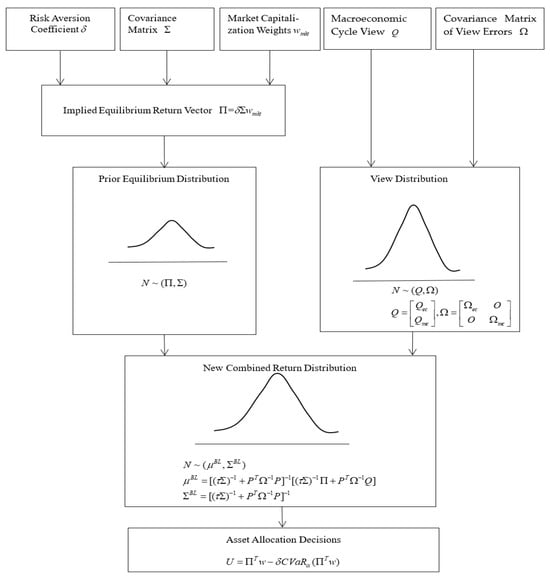
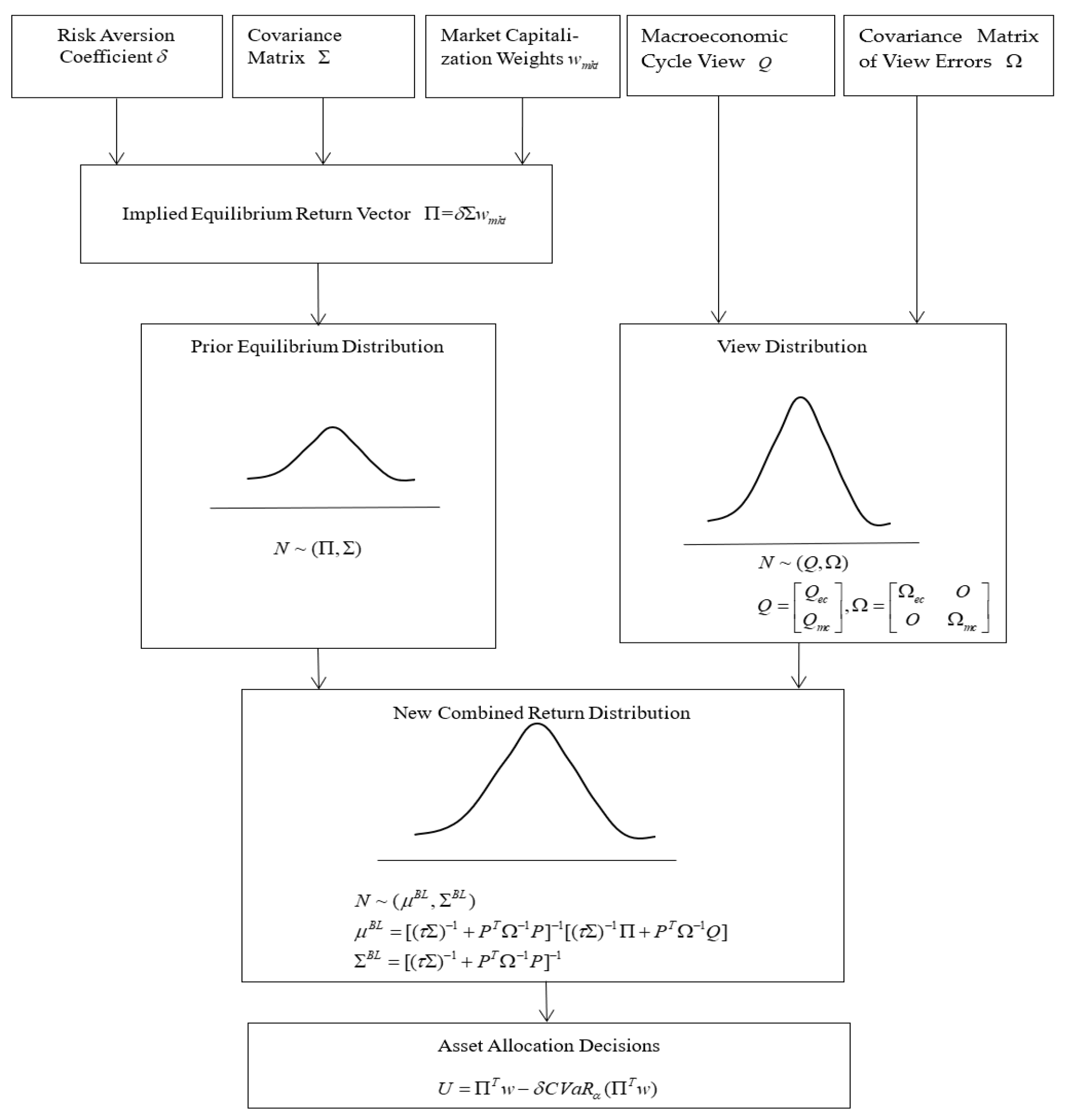
Figure 1 is a flow chart.
Figure 1.
Flow Chart.
4. Experimental Analysis
4.1. Data Selection and Description
This study selected three major asset classes: stocks, bonds, and monetary assets for the pension investment portfolio. The underlying indexes for the three asset classes were the CSI All Share Index, the CSI Aggregate Bond Index, and the CSI Money Market Fund Index, respectively. Those index data were acquired from the Choice Financial Terminal and covered monthly data from the sample interval of February 2005 to February 2021.
Since the selected raw data were monthly closing prices for stocks, bonds, and monetary assets, preprocessing was required. The rate of return was calculated based on the price data of each asset. The rate of return for each class of asset is calculated as follows:
where represents the monthly rate of return, represents closing price of the index on the last trading day of month .
Based on the time-series data for the returns of the three asset classes, descriptive and time-series analyses were performed on their historical rate-of-return data. The statistical analysis results are presented in Table 1.
Table 1.
The descriptive statistical results of historical returns data of three types of assets.
The descriptive statistics of historical asset returns indicated that the three asset classes exhibited different characteristics. Judging from the mean and median values, the positive mean and median for these three assets indicated they could provide positive returns. The rate of return of stock assets showed a significantly higher mean and the widest variance compared to those of bonds and monetary assets, manifested in far higher historical returns and the highest historical losses. The rate of return of bonds showed a moderate variance, indicating relatively small risks. The rate of return of monetary assets was the lowest, and their variance was very small, indicating very low risks, making them almost risk-free assets. In terms of skewness and kurtosis, all three assets exhibited leptokurtic distributions, with their rate-of-return series showing skewness and excessively high kurtosis.
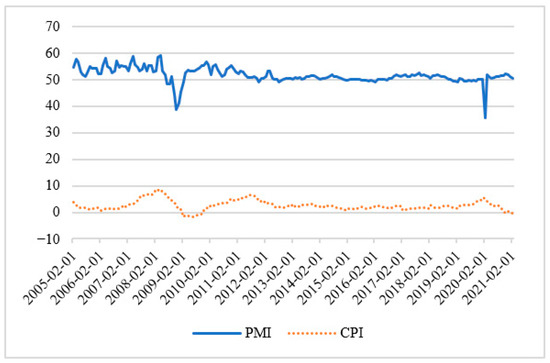
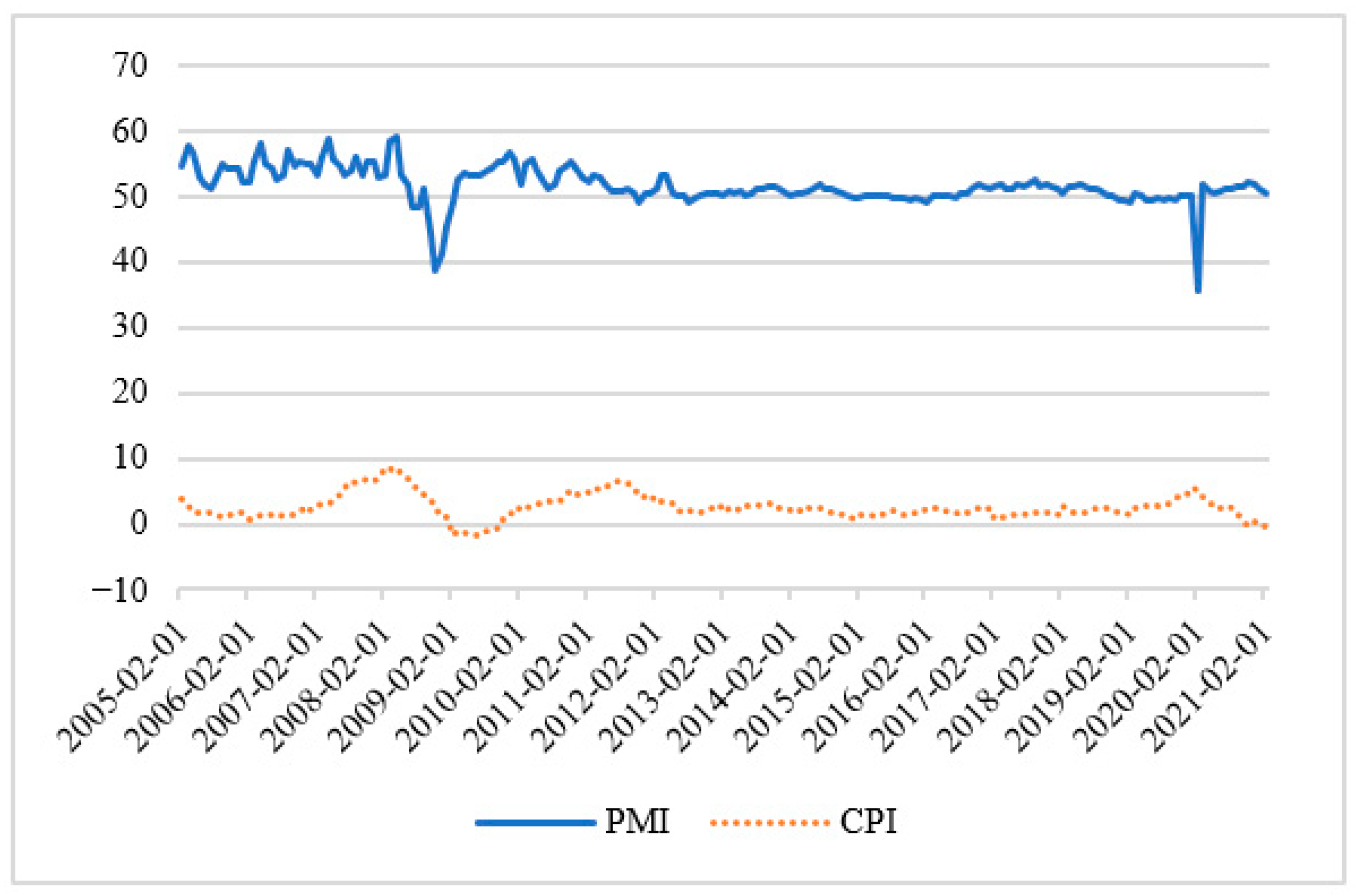
The manufacturing purchasing managers’ index (PMI) and consumer price index (CPI) were selected as indices for economic cycle classification. Those index data were acquired from the Choice Financial Terminal, which were monthly data from the sample interval of Feb. 2005 to Feb. 2021. The specific data for the two indexes are shown in Figure 2.
Figure 2.
Variations in economic indicators PMI and CPI.
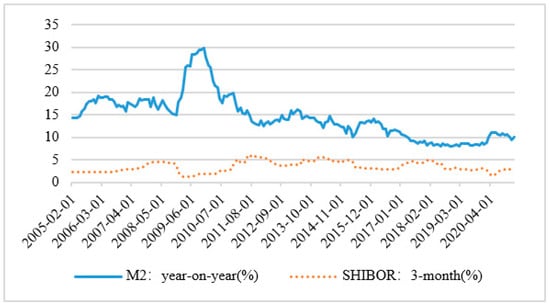
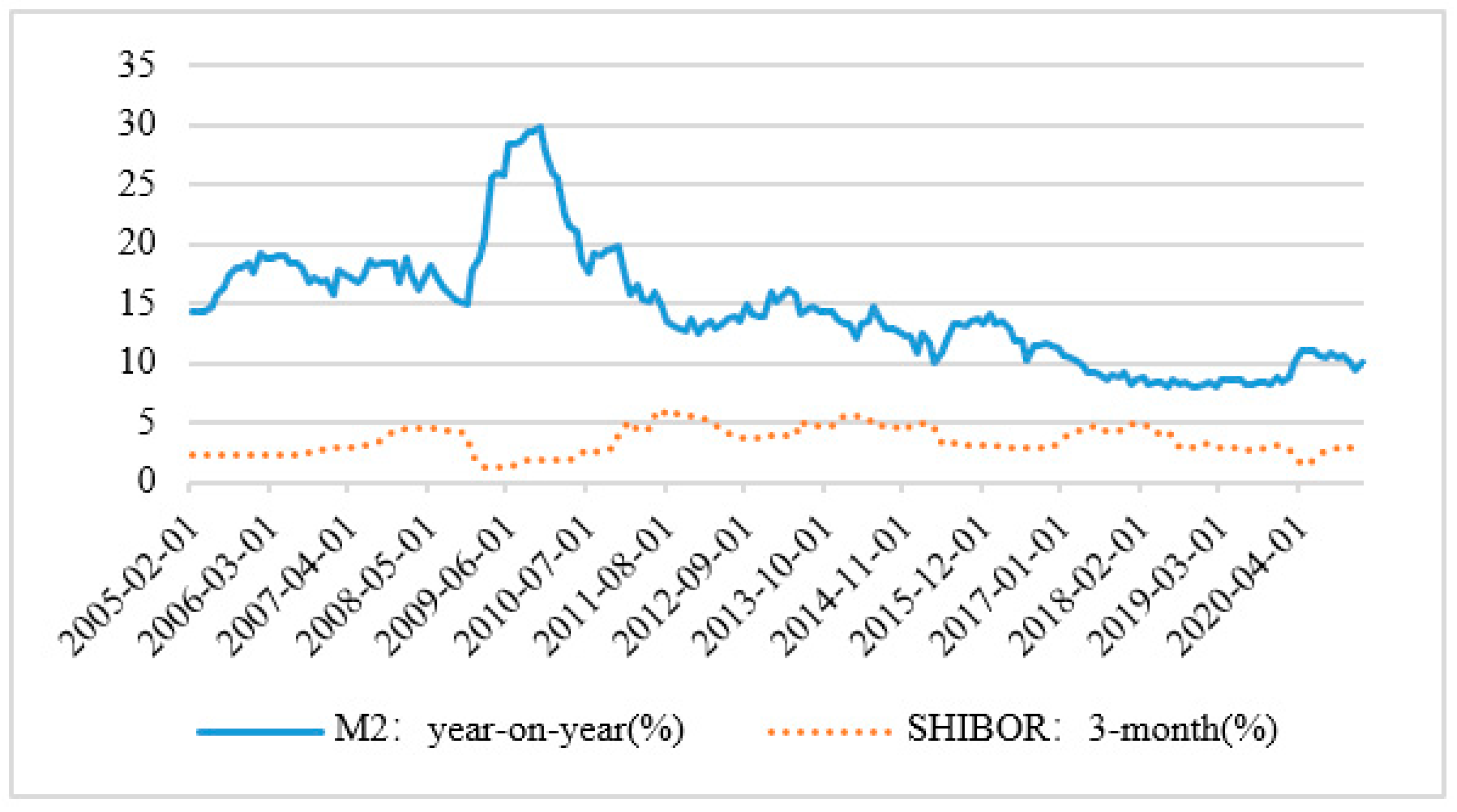
M2 year-on-year (YoY) and SHIBOR (3 months) were selected as indices for monetary cycle classification. Those index data were acquired from the Choice Financial Terminal, which were monthly data from the sample interval of February 2005 to February 2021. The specific data for the two indexes are presented in Figure 3.
Figure 3.
Changes in monetary indicators M2 (year-on-year) and Shibor.
4.2. Economic Cycle Classification and Analysis
Since the Markov regime-switching model requires data stationarity, the ADF test was performed to evaluate the stationarity of PMI and CPI. The test results are shown in Table 2.
Table 2.
Stability test results of PMI and CPI.
According to Table 2, both PMI and CPI passed the stationarity test. Therefore, the raw data for the two indexes were used directly for economic cycle classification.
Since Markov Switching model is prone to over-parameterization, BIC is used to identify the number of regimes. By testing the number of regimes from 2 to 5 with BIC, three economic cycle states were identified in this study. The smooth probability of each state was derived based on the Markov regime-switching model. The specific results are shown in Figure 4. The state with the maximum smooth probability for each month was considered the economic cycle state for that month. The economic cycle state for each month is shown in Table 3.
Figure 4.
Smooth probability diagram of different economic cycle states.
Table 3.
Division of the economic cycle states.
Among the 193 months considered, 130 were in economic cycle state 1, 40 in state 2, and 23 in state 3.
The economic performance in each state was further determined through statistical analysis of PMI and CPI in that state. The specific results are included in Table 4.
Table 4.
Statistical analysis results of PMI and CPI at different economic cycle states.
State 1: Economic stability phase
In the economic stability phase, economic growth is relatively stable (mean PMI at 51.272), and inflation is low (mean CPI at 2.533%). This is the most common state of China’s economy, especially in recent years (since July 2012).
State 2: Economic transition phase
The economic transition phase is between the stable and overheating phases. The economy in this state grows faster than in the stable phase and slower than in the overheating phase (mean PMI reaching 52.043), and inflation is higher than in the stable phase and lower than in the overheating phase (mean CPI reaching 3.638%).
State 3: Economic overheating phase
The economic overheating phase is characterized by rapid economic growth (mean PMI reaching 52.957) and very high inflation (mean CPI reaching 6.463%).
Further, the probability transition matrix for the three economic cycle states was calculated, as shown in Table 5.
Table 5.
Probability transition matrix of the three economic cycle states.
The state transition matrix indicates that each economic cycle state is relatively stable, and the probabilities for the three states to sustain themselves are 0.966, 0.851, and 0.908, respectively. Thus, each economic cycle state will maintain the current state in the next cycle.
The transition probability between different states showed the following patterns:
- (1)
- The transition probability from state 1 to state 3 is 0, and the transition probability from state 3 to state 1 is also 0. Thus, state 1 cannot transition to state 3, and state 3 cannot transition to state 1.
- (2)
- The transition probability from state 1 to state 2 is 0.100, and the transition probability from state 3 to state 2 is 0.049. Thus, state 1 and state 3 can only transition to state 2.
- (3)
- The transition probability from state 2 to state 1 is 0.034, and the transition probability from state 2 to state 3 is 0.092. Thus, state 2 can transition to either state 1 or state 2.
Since states 1, 2, and 3 are the stable, transitional, and overheating phases, the above state transition patterns indicate that the economic cycle will not directly transition from the stable phase to the overheating phase, nor will it directly transition from the overheating phase to the stable phase. The transition between the stable and overheating phases must be bridged by a transitional phase.
Based on the economic cycle classification, the returns on stocks, bonds, and monetary assets at different economic cycle states were statistically analyzed. The results are detailed in Table 6.
Table 6.
Statistical analysis results of stocks, bonds, and monetary assets at different economic cycle states.
According to Table 6, the returns on the three assets across different economic cycle states show large differences, especially for stocks and bonds.
In the stable phase of the economic cycle, state 1, the stock returns are high (1.804% on average) and the bond returns are relatively low (0.340% on average), i.e., stocks yield significantly higher returns than bonds, roughly matching their respective risks. Under state 1, the returns on stocks and bonds are essentially balanced. Therefore, the recommended asset allocation under economic cycle state 1 is to maintain a balanced allocation between stocks and bonds.
In the transitional phase (economic cycle state 2), stock returns (1.359% on average) are lower than in economic cycle state 1, while bond returns (0.544% on average) are higher than in economic cycle state 1. Therefore, the allocation to bonds should be increased under economic cycle state 2, while the allocation to stocks should be reduced appropriately.
In the overheating phase of the economic cycle state 3, stocks perform very poorly, with average returns of −1.828%, while bond returns decline, averaging 0.260%. However, monetary assets perform the best, and their mean rate of return (0.291%) exceeds that of bonds. Therefore, the allocation to stocks should be avoided or reduced as much as possible under economic cycle state 3, and the allocation to monetary assets should be increased.
4.3. Monetary Cycle Classification and Analysis
Since the Markov regime-switching model requires data stationarity, the ADF test was also performed to evaluate the stationarity of M2 YoY and SHIBOR. The test results are presented in Table 7.
Table 7.
M2 year on year and Shibor stability test results.
According to Table 7, the stationarity of M2 YoY is not significant, whereas the stationarity of SHIBOR is significant. Further, the stationarity of the M2 YoY first-order difference was tested, which showed the significant stationarity of the M2 YoY first-order difference. Thus, monetary cycle classification was performed based on the M2 YoY first-order difference and the raw SHIBOR data.
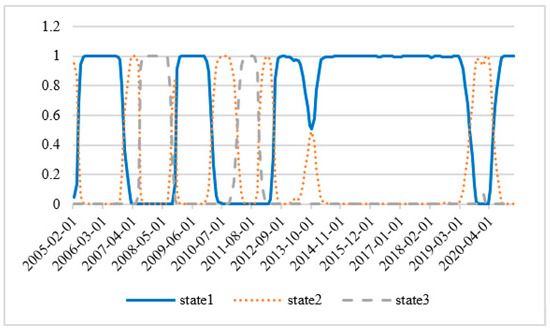
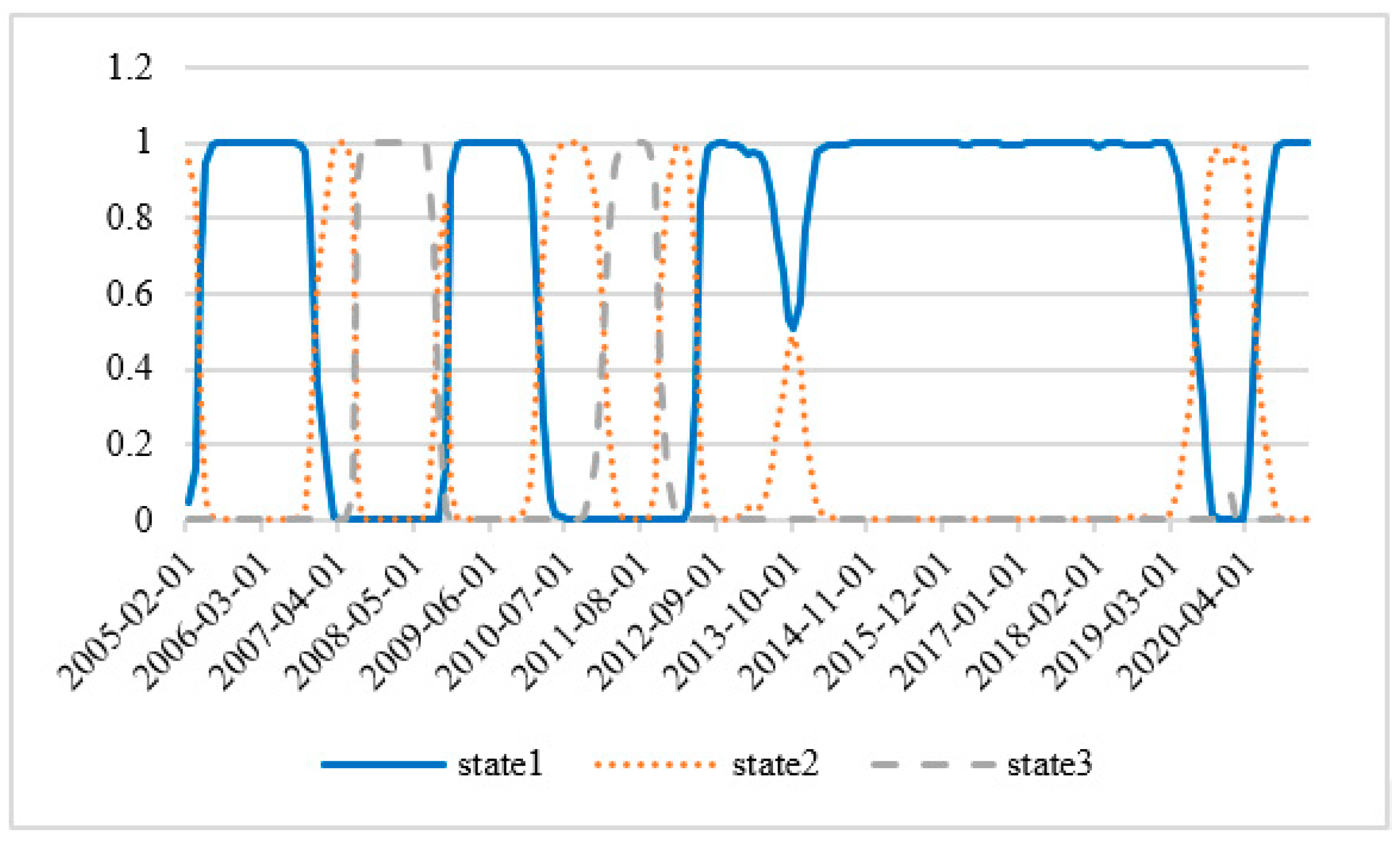
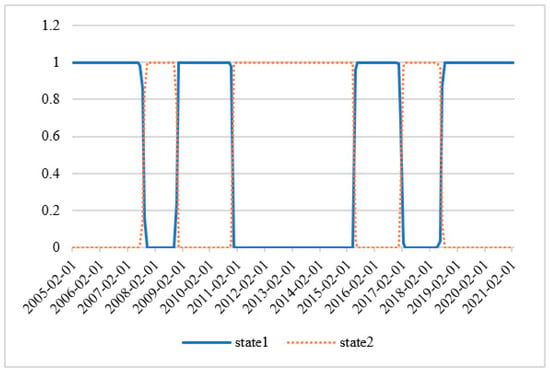
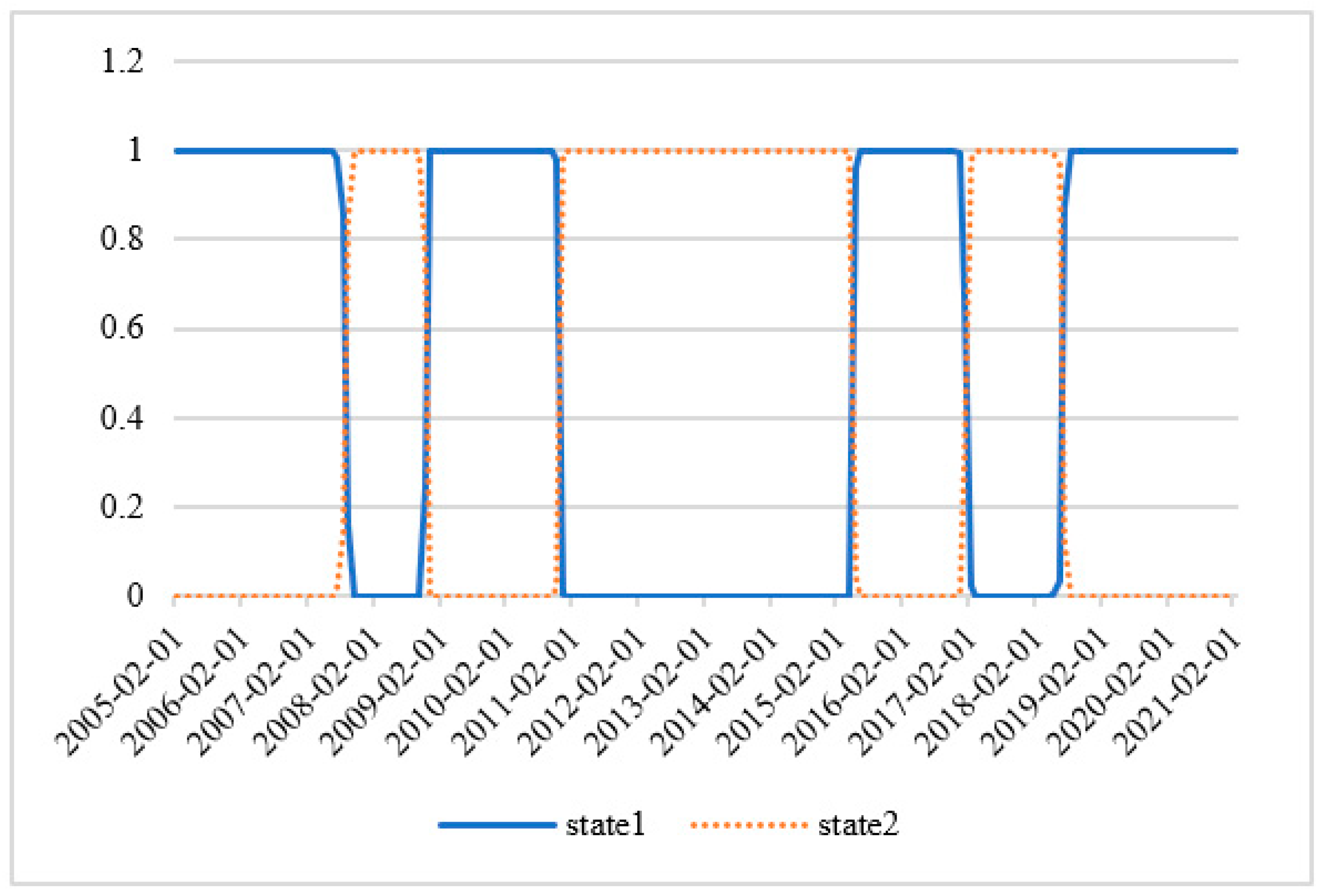
By testing the number of regimes from 2 to 5 with BIC, two monetary cycle states were identified in this study. The smooth probability of each monetary cycle state was derived based on the Markov regime-switching model. The specific results are presented in Figure 5. The state with the maximum smooth probability for each month was considered the monetary cycle state for that month. The monetary cycle state for each month is presented in Table 8.
Figure 5.
Smooth probability diagram of different monetary cycle states.
Table 8.
Classification of monetary cycle states.
Among the 193 months examined, 108 months were in monetary cycle state 1, while 85 were in monetary cycle state 2.
The economic performance in each monetary cycle state was further determined through statistical analysis of the M2 YoY and SHIBOR in that state. The specific results are shown in Table 9.
Table 9.
Statistical analysis results of M2 year-on-year and Shibor at different monetary states.
State 1: Monetary easing phase
The monetary easing phase is characterized by relatively faster M2 YoY growth (15.281% on average) and a lower SHIBOR (2.533% on average).
State 2: Monetary tightening phase
The monetary tightening phase is characterized by slower M2 YoY growth (13.452% on average) and a higher SHIBOR (4.587% on average).
Further, the probability transition matrix for the two monetary cycle states was calculated, as shown in Table 10.
Table 10.
Probability transition matrix of two monetary cycle states.
The state transition matrix indicates that each monetary cycle state is relatively stable, and the probabilities for the two states to sustain themselves are 0.975 and 0.960, respectively. Thus, each monetary cycle state will maintain the current state in the next cycle. The transition probability from state 1 to state 2 is 0.040, and the transition probability from state 2 to state 1 is 0.025.
Further, the characteristics of returns on various assets under each monetary cycle state were analyzed to identify the variation patterns and trends.
Based on the monetary cycle classification, returns on stocks, bonds, and other financial assets across different monetary cycle states were statistically analyzed. The results are detailed in Table 11.
Table 11.
Statistical analysis results of stocks, bonds, and monetary assets at different monetary states.
According to Table 11, the returns on the three asset classes across different monetary cycle states exhibit large differences.
In the monetary easing phase of monetary cycle state 1, stock returns are relatively high (2.654% on average), while bond returns are relatively low (0.320% on average). The significantly higher returns on stocks than bonds are basically consistent with their respective risks. Therefore, the allocation to stocks is advised to be increased under monetary cycle state 1, while the allocation to bonds and monetary assets should be decreased.
In the monetary tightening phase at monetary cycle state 2, stocks perform very poorly (negative returns of −0.467% on average), the returns on bonds increase (0.439% on average), while monetary assets perform well (with positive returns of 0.327% on average). Therefore, the allocation to stocks should be avoided or reduced as much as possible in state 2 of the monetary cycle, and the allocation to bonds and monetary assets should be increased.
4.4. Validity Analysis of the CVaR-BL-MCV Pension Asset Allocation Model
To ensure the safety of pension funds, China’s policy on pension investment and operation is relatively cautious. Currently, the restrictions on pension investments are as follows:
- No more than 30% of assets may be invested in stocks;
- No more than 135% of assets may be invested in bonds;
- The investments in monetary assets should account for 5% at least.
Based on the above conditions, the following constraints were added when solving the final mean and variance models.
Based on the performance of stocks, bonds, and monetary assets across different economic and monetary cycles, the subjective judgment of investors in those cycles is constructed. For each state, three investor views were constructed: the difference between stock and bond returns, the difference between stock and monetary asset returns, and the difference between bond and monetary asset returns. Table 12 shows investor views across different economic cycle states, and Table 13 shows investor views across different monetary cycle states.
Table 12.
Investor views in different economic states.
Table 13.
Investor views under different monetary states.
In this section, the proposed CVaR-BL-MCV model is applied to asset allocation to further analyze its validity.
The performance of the proposed CVaR-BL-MCV asset allocation model was compared with the traditional BL model, the CVaR-BL model with CVaR risk measurement (Section 3.2), and the BL-MCV model with macroeconomic factors (Section 3.3). Based on pairwise comparisons of the asset allocation performance, the models’ effectiveness in pension asset allocation was evaluated.
The annualized rate of return, annualized volatility, and Sharpe ratio were adopted for the comparative analysis.
Pension asset allocation was based on different risk aversion coefficients, and the annualized rate of return of the final portfolio decision was derived. The annualized volatility and Sharpe ratio are shown in Table 14.
Table 14.
The annualized rate of return and annualized volatility of the proposed model and the comparative models.
Table 14 shows that CVaR-BL model and BL-MCV model both perform better than the traditional BL model. Specifically, we take the case with risk aversion coefficient = 1 as an example. The annualized rate of return of the CVaR-BL model is basically the same as that of the BL model, its annualized volatility is lower (4.19% vs. 5.05%), and the Sharpe ratio of the CVaR-BL model is significantly higher than that of the traditional BL model (0.83 vs. 0.69). The annualized rate of return of the BL-MCV model is slightly higher than that of the BL model (4.92% vs. 4.77%), its annualized volatility is lower (4.52% vs. 5.05%), and the Sharpe ratio of the BL-MCV model is significantly higher than that of the traditional BL model (0.80 vs. 0.69). Thus, incorporating the CVaR risk measure and macroeconomic factors reduces the risk while maintaining the returns.
Table 14 demonstrates that the proposed CVaR-BL-MCV model outperforms the benchmark models. Specifically, we take the case with risk aversion coefficient = 1 as an example. The annualized rate of return of the CVaR-BL-MCV pension asset allocation model is significantly higher than that of the BL model (4.89% vs. 4.77%), its annualized volatility is significantly lower (4.26% vs. 5.05%), and the Sharpe ratio of the CVaR-BL-MCV model is significantly higher than that of the traditional BL model (0.84 vs. 0.69). The annualized rate of return of the CVaR-BL-MCV pension asset allocation model is slightly higher than that of the CVaR-BL model (4.89% vs. 4.77%), its annualized volatility is slightly higher (4.26% vs. 4.19%), and the Sharpe ratio of the CVaR-BL-MCV pension asset allocation model is slightly higher than the CVaR-BL model (0.84 vs. 0.83). The annualized rate of return of the CVaR-BL-MCV model is slightly lower than that of the BL-MCV model (4.89% vs. 4.92%), its annualized volatility is slightly lower (4.26% vs. 4.52%), and the Sharpe ratio of the CVaR-BL-MCV pension asset allocation model is slightly higher than the BL-MCV model (0.84 vs. 0.80).
When the risk aversion coefficient is 1, 1.5, and 3, the Sharpe ratio of pension asset allocation using the CVaR-BL-MCV model is 21.7%, 18.4%, and 20.5% higher than that of the benchmark models, respectively. Moreover, the BL model incorporating CVaR improves the Sharpe ratio of pension asset allocation by an average of 19.7%, while the BL model with MCV achieves an average improvement of 14.4%. Therefore, introducing macroeconomic factors and the CVaR risk measure into the BL pension asset allocation model improves the return on asset allocation compared to the baseline BL model. Since the Sharpe ratio quantifies the excess return per unit of total risk of an investment portfolio, a higher Sharpe ratio of the CVaR-BL-MCV model relative to benchmark models directly indicates that it can generate more risk-adjusted returns for pension asset allocation, thus demonstrating the model’s superiority in balancing return and risk.
To further validate the robustness of the proposed CVaR-BL-MCV model, the sub-sample check is performed. Table 15 shows the Sharpe ratio of the proposed model and the comparative models with different sub-samples. According to the results of Table 15, we found that the proposed CVaR-BL-MCV model outperformed the benchmark models consistently.
Table 15.
The Sharpe ratio of the proposed model and the comparative models with different sub-samples.
5. Conclusions
Pension is the most important component of the social pension insurance system. Optimizing the investment and operation of pension funds and improving long-term investment returns is not only a fundamental requirement for effectively addressing the payment gap crisis caused by population aging and achieving long-term financial balance of pension funds, but also an important guarantee for ensuring the preservation and appreciation of pension funds, providing moderate elderly care security for the elderly population, and maintaining social harmony.
Traditional asset allocation models based on the mean and variance of returns measure the risk of an asset portfolio using variance, which has disadvantages such as its inability to describe the direction of deviation. The Merrill Lynch Investment Clock model identifies the macroeconomic environment as a key factor affecting asset returns, and understanding the primary underlying drivers of the rate of return is key to optimizing the performance of long-term asset allocation. This study employs the macroeconomic cycle concept to quantify the impact of the macroeconomic environment on the rate of return and uses the CVaR risk measure to assess risk. A novel CVaR-BL-MCV model is proposed for optimal pension asset allocation.
The validity of CVaR-BL-MCV for pension asset allocation is verified based on actual data. Experimental results demonstrate that the proposed CVaR-BL-MCV model outperforms the benchmark models. When the risk aversion coefficient is 1, 1.5, and 3, the Sharpe ratio of pension asset allocation using the CVaR-BL-MCV model is 21.7%, 18.4%, and 20.5% higher than that of the benchmark models, respectively. Moreover, the BL model incorporating CVaR improves the Sharpe ratio of pension asset allocation by an average of 19.7%, while the BL model with MCV achieves an average improvement of 14.4%. Therefore, introducing macroeconomic factors and the CVaR risk measure into the BL pension asset allocation model improves the return on asset allocation compared to the baseline BL model.
Despite the fruitful findings, this study only considered three major classes of assets, i.e., stocks, bonds, and monetary assets, for pension asset allocation. Future research may consider more major asset classes for a more complete analysis. In addition, there are still several limitations. It is important to acknowledge that our current regime identification relies on a parsimonious set of monetary and real-sector indicators. While effective for the analyzed period, this specification does not explicitly capture other potential drivers of asset returns. Specifically, fiscal policy shocks (such as changes in government expenditure), external sector dynamics (crucial for open economies), and broader credit conditions (such as corporate bond spreads) are not directly modeled. Future research should aim to integrate these omitted channels to build a more holistic view of the macro-financial environment. A promising avenue would be the use of factor-augmented Markov-switching models, which would allow for the inclusion of a high-dimensional dataset—covering fiscal, external, and credit variables—while maintaining model tractability. Furthermore, Future implementations should consider a richer set of macroeconomic inputs, including fiscal and external sector indicators, to enhance the robustness of cycle identification. Furthermore, the framework could be profitably extended to multi-pillar pension systems or small open economy settings, where integrating global assets and liability-driven constraints would offer deeper insights for policy and practice.
Author Contributions
Conceptualization, Y.S. and Y.W.; methodology, Y.W.; software, Y.W.; validation, Y.S. and Y.W.; formal analysis, Y.W.; investigation, Y.W.; resources, Y.W.; data curation, Y.S.; writing—original draft preparation, Y.W.; writing—review and editing, Y.W.; visualization, Y.W.; supervision, Y.W.; project administration, Y.W. All authors have read and agreed to the published version of the manuscript.
Funding
This research was funded by [Natural Science Foundation of Inner Mongolia Autonomous Region], grant number [2024LHMS07007]. Ordos Institute of Technology High-level Talent Research Startup Fund Project.
Data Availability Statement
The raw data supporting the conclusions of this article will be made available by the authors on request.
Conflicts of Interest
The authors declare no conflicts of interest.
References
- Bacinello, A.R. Special Issue “Quantitative Risk Assessment in Life, Health and Pension Insurance”. Risks 2022, 10, 72. [Google Scholar] [CrossRef] [Scilit]
- Andonov, A.; Bauer, R.M.M.J.; Cremers, K.J.M. Pension Fund Asset Allocation and Liability Discount Rates. Rev. Financ. Stud. 2017, 30, 2555–2595. [Google Scholar] [CrossRef] [Scilit]
- Zhantaeva, A.A.; Bekbossinova, A.S.; Abdullaeva, B.A.; Bekbossinov, A.S. Using the multidimensional analysis method in the management of financial assets of pension funds. Farabi J. Soc. Sci. 2025, 11, 29–36. [Google Scholar] [CrossRef] [Scilit]
- Greetham, T.; Hartnett, H. The Investment Clock Special Report# 1: Making Money from Macro; Merrill Lynch: Singapore, 2004. [Google Scholar]
- Bredin, D.; Hyde, S. FOREX Risk: Measurement and Evaluation Using Value-at-Risk. J. Bus. Financ. Account. 2004, 31, 1389–1417. [Google Scholar] [CrossRef] [Scilit]
- Rockafellar, R.T.; Uryasev, S. Conditional value-at-risk for general loss distributions. J. Bank. Financ. 2002, 26, 1443–1471. [Google Scholar] [CrossRef] [Scilit]
- Markowitz, H. Portfolio Selection. J. Financ. 1952, 7, 77–91. [Google Scholar] [CrossRef] [Scilit]
- Markowitz, H.M. Portfolio Selection Efficient Diversification of Investments; Yale University Press: New Haven, CT, USA, 1959. [Google Scholar]
- Tobin, J. Liquidity Preference as Behavior Towards Risk1. Rev. Econ. Stud. 1958, 25, 65–86. [Google Scholar] [CrossRef] [Scilit]
- Sharpe, W.F. Capital Asset Prices: A Theory of Market Equilibrium Under Conditions of Risk. J. Financ. 1964, 19, 425–442. [Google Scholar] [CrossRef] [Scilit]
- Lintner, J. The Valuation of Risk Assets and the Selection of Risky Investments in Stock Portfolios and Capital Budgets. Rev. Econ. Stat. 1965, 47, 13–37. [Google Scholar] [CrossRef] [Scilit]
- Mossin, J. Equilibrium in a Capital Asset Market. Econometrica 1966, 34, 768–783. [Google Scholar] [CrossRef] [Scilit]
- Black, F.; Litterman, R. Global Portfolio Optimization. Financ. Anal. J. 1992, 48, 28–43. [Google Scholar] [CrossRef] [Scilit]
- Black, F.; Litterman, R. Asset allocation: Combining investor views with market equilibrium. Goldman Sachs Fixed Income Res. 1991, 115, 7–18. [Google Scholar] [CrossRef] [Scilit]
- Bevan, A.; Winkelmann, K. Using the Black-Litterman Global Asset Allocation Model: Three Years of Practical Experience; Goldman, Sachs & Co.: New York, NY, USA, 1998; pp. 5–92. [Google Scholar]
- Satchell, S.; Scowcroft, A. A demystification of the Black–Litterman model: Managing quantitative and traditional portfolio construction. J. Asset Manag. 2000, 1, 39–53. [Google Scholar] [CrossRef] [Scilit]
- Idzorek, T. 2—A step-by-step guide to the Black-Litterman model: Incorporating user-specified confidence levels. In Forecasting Expected Returns in the Financial Markets; Satchell, S., Ed.; Academic Press: Oxford, UK, 2007; pp. 7–38. [Google Scholar]
- Krishnan, H.; Mains, N. The two-factor Black-Litterman model. Risk 2005, 18, 69–73. [Google Scholar]
- He, G.; Litterman, R. The intuition behind Black-Litterman model portfolios. SSRN 2002, 334304. [Google Scholar] [CrossRef] [Scilit]
- Martellini, L.; Ziemann, V. Extending Black-Litterman analysis beyond the mean-variance framework. J. Portf. Manag. 2007, 33, 33. [Google Scholar] [CrossRef] [Scilit]
- Jia, X.; Gao, J. Extensions of black-litterman portfolio optimization model with downside risk measure. In Proceedings of the 2016 Chinese Control and Decision Conference (CCDC), Yinchuan, China, 28–30 May 2016; pp. 1114–1119. [Google Scholar] [CrossRef] [Scilit]
- Silva, T.; Pinheiro, P.R.; Poggi, M. A more human-like portfolio optimization approach. Eur. J. Oper. Res. 2017, 256, 252–260. [Google Scholar] [CrossRef] [Scilit]
- Pang, T.; Karan, C. A closed-form solution of the Black–Litterman model with conditional value at risk. Oper. Res. Lett. 2018, 46, 103–108. [Google Scholar] [CrossRef] [Scilit]
- Chen, S.D.; Lim, A.E.B. A Generalized Black–Litterman Model. Oper. Res. 2020, 68, 381–410. [Google Scholar] [CrossRef] [Scilit]
- Braga, M.D. Strategic Asset Allocation with Mean-Variance Optimization. Contributions to Finance and Accounting; Springer: Cham, Switzerland, 2024; pp. 117–202. [Google Scholar]
- Dutta, J.; Kapur, S.; Orszag, J.M. A portfolio approach to the optimal funding of pensions. Econ. Lett. 2000, 69, 201–206. [Google Scholar] [CrossRef] [Scilit]
- Dong, Y.; Lv, W.; Wei, S.; Gong, Y. Optimal Investment of DC Pension Plan under Incentive Schemes and Loss Aversion. Math. Probl. Eng. 2020, 2020, 5145848. [Google Scholar] [CrossRef] [Scilit]
- Arenas Parra, M.; Bilbao Terol, A.; Rodríguez Uría, M.V. A fuzzy goal programming approach to portfolio selection. Eur. J. Oper. Res. 2001, 133, 287–297. [Google Scholar] [CrossRef] [Scilit]
- Booth, P.; Yakoubov, Y. Investment Policy for Defined-Contribution Pension Scheme Members Close to Retirement: An Analysis of the” Lifestyle” Concept. N. Am. Actuar. J. 2000, 4, 1–19. [Google Scholar] [CrossRef] [Scilit]
- He, L.; Liang, Z.; Wang, S. Dynamic optimal adjustment policies of hybrid pension plans. Insur. Math. Econ. 2022, 106, 46–68. [Google Scholar] [CrossRef] [Scilit]
- Sun, Y.; Wu, Y.; De, G. A Novel Black-Litterman Model with Time-Varying Covariance for Optimal Asset Allocation of Pension Funds. Mathematics 2023, 11, 1476. [Google Scholar] [CrossRef] [Scilit]
- Blake, D.; Cairns, A.J.G.; Dowd, K. Pensionmetrics: Stochastic pension plan design and value-at-risk during the accumulation phase. Insur. Math. Econ. 2001, 29, 187–215. [Google Scholar] [CrossRef] [Scilit]
- Haberman, S.; Vigna, E. Optimal investment strategies and risk measures in defined contribution pension schemes. Insur. Math. Econ. 2002, 31, 35–69. [Google Scholar] [CrossRef] [Scilit]
- Kocuk, B.; Cornuéjols, G. Incorporating Black-Litterman views in portfolio construction when stock returns are a mixture of normals. Omega 2020, 91, 102008. [Google Scholar] [CrossRef] [Scilit]
- Liu, W.; Xu, F.; Jing, K.; Hua, Z. Should the Occupational Pension Plans’ Investment be Long-Term or Short-Term? Evidence from China. Comput. Econ. 2025, 65, 3391–3418. [Google Scholar] [CrossRef] [Scilit]
- Andrew, A.; Geert, B. International Asset Allocation With Regime Shifts. Rev. Financ. Stud. 2002, 4, 1137–1187. [Google Scholar] [CrossRef] [Scilit]
- Guidolin, M.; Timmermann, A. International Asset Allocation Under Regime Switching, Skew and Kurtosis Preferences. Rev. Financ. Stud. 2008, 21, 889–935. [Google Scholar] [CrossRef] [Scilit]
- Zaevski, T.S.; Nedeltchev, D.C. From BASEL III to BASEL IV and beyond: Expected shortfall and expectile risk measures. Int. Rev. Financ. Anal. 2023, 87, 102645. [Google Scholar]
- Chen, Y.; Sun, X.; Li, J. Pension Fund Asset Allocation: A Mean-Variance Model with CVaR Constraints. Procedia Comput. Sci. 2017, 108, 1302–1307. [Google Scholar] [CrossRef] [Scilit]
- James, C. On Exactitude in Financial Regulation: Value-at-Risk, Expected Shortfall, and Expectiles. Risks 2018, 6, 61. [Google Scholar]
- Kyalo, I.N.; Omari, C.O.; Ngunyi, A. Optimization of Financial Asset Portfolio Using GARCH-EVT-Copula-CVaR Model. J. Math. Financ. 2025, 15. [Google Scholar] [CrossRef]
- Lisboa, A.C.; Pereira, F.A.C.; Dos Santos, F.F.G.; Da Silva, L.C.A.P.; Pereira, A.I.; Mendonça, M.D.O.; Silva, G.R.L.; Gomes, L.C.S.; Vieira, D.A.G. Risk Measure Analysis. IEEE Access 2024, 12, 137105–137111. [Google Scholar] [CrossRef] [Scilit]
- Whitelaw, R.F. Time Variations and Covariations in the Expectation and Volatility of Stock Market Returns. J. Financ. 1994, 49, 515–541. [Google Scholar] [CrossRef]
- Fridson, M.S. Stock Market Cycles: A Practical Explanation (a review). Financ. Anal. J. 2001, 57, 60. [Google Scholar] [CrossRef] [Scilit]
- Ang, A.; Bekaert, G. How Regimes Affect Asset Allocation. Financ. Anal. J. 2004, 60, 86–99. [Google Scholar] [CrossRef] [Scilit]
- Jensen, G.R.; Mercer, J.M. New Evidence on Optimal Asset Allocation. Financ. Rev. 2003, 38, 435–454. [Google Scholar] [CrossRef] [Scilit]
- Hamilton, J.D. A New Approach to the Economic Analysis of Nonstationary Time Series and the Business Cycle. Econometrica 1989, 57, 357–384. [Google Scholar] [CrossRef] [Scilit]
- Kim, C.J. Dynamic linear models with Markov-switching. J. Econom. 1994, 60, 1–22. [Google Scholar] [CrossRef] [Scilit]

Disclaimer/Publisher’s Note: The statements, opinions and data contained in all publications are solely those of the individual author(s) and contributor(s) and not of MDPI and/or the editor(s). MDPI and/or the editor(s) disclaim responsibility for any injury to people or property resulting from any ideas, methods, instructions or products referred to in the content. |
© 2025 by the authors. Licensee MDPI, Basel, Switzerland. This article is an open access article distributed under the terms and conditions of the Creative Commons Attribution (CC BY) license (https://creativecommons.org/licenses/by/4.0/).