1. Introduction
Modern society depends on electronic devices and how information is stored or exchanged securely. The field of cryptography defines protocols and systems to prevent confusion and diffusion of data when they are intercepted or stolen by a third party who is not authorized to access the information. Mathematical objects such as Vectorial Boolean functions (substitution boxes or S-boxes) and supersingular elliptic curves are essential components in most cryptographic procedures. S-boxes are commonly used in symmetric cryptography, while supersingular elliptic curves are used in asymmetric cryptography and post-quantum cryptography. These primitives can be constructed using algebra, can be generated using random algorithms, can be searched using metaheuristics, or can be defined by mixing the aforementioned methods.
In this sense, it is worth mentioning that Charles, Goren, and Lauter [
1] proposed in 2006 to use supersingular isogeny graphs to construct hash functions. The Ramanujan graph families created by Lubotzky-Phillips-Sarnak and Pizer, respectively, are the two particular families of optimum expander graphs that the authors examine for proven collision resistant hash function implementations. Collision resistance results from the difficulty of calculating isogenies between supersingular elliptic curves when the hash function is built from one of Pizer’s Ramanujan graphs, which are the set of supersingular elliptic curves over
. Jao, De Feo, and Plût [
2] designed in 2011 a Diffie–Hellman key agreement scheme (SIDH) and a public key cryptosystem from a given supersingular graph. This scheme’s main technical idea is that the authors transmit the images of torsion bases under the isogeny despite the noncommutativity of the endomorphism ring, allowing the two parties to arrive at a common shared key despite the noncommutativity of the endomorphism ring. This work is motivated by the recent development of a subexponential-time quantum algorithm for constructing isogenies between ordinary elliptic curves, while the fastest known quantum attack remains exponential in the supersingular case, as the endomorphism ring is noncommutative. The authors provide a precise formulation of the relevant computational assumption and discuss its validity. Furthermore, in the call for new standards of quantum resistance proposed by NIST [
3], an isogeny-based key exchange protocol like a SIDH named SIKE was presented [
4]. The study [
5] examines the relationships between elliptic curve selection and elliptic-curve cryptography security. In addition to discrete-logarithm calculations, attacks that take use of common implementation flaws are also taken into consideration. One of the fundamental problems in cryptography is the discrete logarithm issue [
6] for elliptic curves. The most well-known methods for solving it all have exponential running times, indicating that the issue is often quite difficult. Nonetheless, the MOV attack is a sub-exponential solution technique for supersingular elliptic curves. The MOV approach uses the Weil pairing to convert a discrete logarithm of an elliptic curve to a logarithm over a finite field. With Index Calculus, the discrete logarithm issue in a finite field may be addressed effectively. The analysis of the MOV assault and the creation of instances to illustrate its effectiveness are the main topics of this thesis. For a more recent application, the oriented supersingular isogeny Diffie–Hellman protocol was proposed in [
7]. In the case of S-boxes, examples of their use can be found in classical block cipher design like DES [
8] or AES [
9] and a more recent design for lightweight block ciphers like PRESENT [
10].
In the last years, the search for S-boxes raises a new and interesting way to obtain good cryptographic primitives by using evolutionary computation [
11,
12,
13]. This recent approach contrasts with the classic algebraic construction approach. Sometimes, both approaches have been merged [
14,
15] to carry on the best of each methodology. All those optimizations are performed in a solution space with exponential size, where an exhaustive search cannot be applied. For example, the size of the space is considered large starting from the 4x4 S-box permutation space, a total of 16!
solutions. Also, these primitives are mainly used in symmetric cryptosystems and under the design perspective. The properties to optimize are generally defined and/or deduced against attacks. However, in asymmetric cryptosystems, it seems like the absence of properties to optimize does not motivate the application of metaheuristics, which should be an open research issue in our opinion. In the particular case of elliptic curve cryptosystems, the research community prioritizes the use of random generation [
16] and the verification of algebraic conditions [
17,
18]. Only the connection between elliptic curves and S-boxes has been flourishing for image encryption methods. Arshad et al. [
19] established an isogeny that transfers the base curve’s components to the second curve. The base curve’s generators were the locations to which the maximal order subgroup of the elliptic curve points may be generated. In order to build the initial S-boxes, a group action was performed to the base curve’s makers. Initial S-boxes were created from the second curve using the generating points’ images, which were established by isogeny. The approach was computationally efficient because both curves shared the same prime field and only required a few generator points and matching pictures. The suggested approach [
20] was based on the elliptic curve and Catalan number, which together form a special algorithm for an effective S-box design. Chaotic maps are gradually being used in generating S-boxes because of their complications and susceptibility to initial states. An efficient method for constructing S-boxes based on a class of elliptic curves over galois fields was proposed by Ali et al. [
21]. Through careful analysis, the authors show how resilient their method is to various cryptographic challenges, emphasizing its usefulness in real-world scenarios. A comprehensive study is required to evaluate the freshly created S-box’s resistance to popular attack techniques, such as algebraic, differential, and linear assaults. Defenses against a variety of threats are greatly enhanced by an S-box with a high non-linearity value. Unfortunately, the computationally expensive aspect of building S-boxes limits the attainable encryption throughput. This highlights the need to develop new S-box generators with the highest strength and lowest processing demands in order to offer the greatest security. The authors [
22] provided an effective method that makes use of the Mobius transformation of the Galois field and the composition of Frobenius automorphism. Two very nonlinear permutations that may generate millions of S-boxes with extremely high cryptographic strength were thus produced. By making clear the conditions for producing unique S-boxes and guaranteeing that the generated S-boxes had a uniform probability distribution, the dynamic behavior of the suggested generator was examined.
The principal limitation of the current state of the art in curve generation is not to use metaheuristics. As was mentioned before, in asymmetric cryptosystems for elliptic curves, properties are defined as a conditions that can be met. In contrast, if a property can be defined as an objective function, it will define curves where, for example, the supersingular condition is “covered” to a certain degree, and it will allow the discovery of new search regions where a real supersingular curve should exist.
The above issues motivate us to carry out this research due to the following points:
As far as we know, just one study presented in 2009 [
23], attempted to use an evolutionary algorithm over elliptic curves. Despite the heuristic search being single-solution-based, the authors discuss main evolution concepts such as solution encoding and operators (crossover, mutation, selection), but no optimization was performed, no objective function was defined, and the verification of conditions remains.
On the other hand, supersingular elliptic curves are nowadays a cryptographic primitive relevant to post-quantum protocols. The oriented supersingular isogeny Diffie–Hellman protocol is one of the latest proposed [
7]. In this case, the supersingular curve acts as a starting point. It would be interesting if this curve is not always the same.
This work aims to provide a different way to obtain an elliptic curve that holds the supersingular condition. We also are not addressing a generic algebraic approach to study supersingular elliptic curves such as those presented in [
24,
25]. Although we will focus on small primes, compared to the actual primes for post-quantum protocols, we think our study can open a new line of research that could help to discover new properties on the curves.
The novelty in this work is to start using heuristic methods in the search for supersingular elliptic curves. That will prepare the way to apply, in the future, all the methodology already gathered in the search of good cryptographic primitives, like:
The study of the fitness landscape [
26].
The study of relationships between different properties of the cryptographic primitive [
27].
The study of fast property optimization hybrid methods [
28].
In this paper, we show how difficult it is to find supersingular elliptic curves using naive random search, and then we introduce a new improvement to this type of search, which is the main result of this work: we define for the first time a property that can be seen as an objective function in the search for supersingularity and we study the behavior of the local search using the objective function. We apply genetic algorithms with the same objective function. In each case, we report the supersingular elliptic curves. Finally, we show two applications of the use of those curves, one for generating cycles in the isogeny graph and a second bigger application for generating S-boxes for image encryption.
The structure of the paper is as follows:
Section 2 shows the preliminaries for supersingular elliptic curves and
Section 3 shows the preliminaries for heuristic search. The main results will be found in
Section 4, while the applications will be found in
Section 5 and
Section 6. At the end will be
Section 9 for conclusions.
3. Preliminaries for Heuristic Search
In this section, we present some basic concepts that help to understand the heuristic part of the work.
3.1. Heuristic Search
A heuristic search is a search that attempts to optimize some function in a solution space where the result of a global solution is not ensured. The goal is to at least obtain a local solution.
This kind of optimization is almost inspired by natural or physical processes. One of the major representatives is evolutionary computation, which includes genetic algorithms.
3.2. Random Search
Iterative random search is a primary search method in a solution space. It is very fast because it does not set any restrictions on the search process. In this approach, a limited number of solutions are randomly generated. The objective function is evaluated for all the solutions, and the best is the result of the search. Basic statistics can help to understand the distribution of the objective function values and give a primary sense of how difficult the search problem will be.
3.3. Local Search
Local search is a metaheuristic method. In the general scheme [
36], the method starts from a random initial solution
, and it creates a set of neighborhood solutions
and it moves from one solution to another, while the objective function decreases (or increases in case of maximization). See Algorithm 1. No input is needed, and the output is an improved solution. The neighborhood construction depends on each problem. In this work, we use a new objective function to measure the supersingularity in elliptic curves.
| Algorithm 1: General scheme of local search |
Ensure: // Local optimum- 1:
- 2:
search ← true - 3:
while search do - 4:
search ← false - 5:
for do - 6:
if then - 7:
- 8:
search ← true - 9:
end if - 10:
end for - 11:
end while - 12:
return
|
3.4. Genetic Algorithm
The genetic algorithm is a metaheuristic that works with a population (set of solutions) instead of a single solution. Each solution is represented by an encoding. In particular, we use a binary integer genotype to represent a solution.
The evolution process consists of evolving the population from one generation to another. The main steps of this heuristic, at every evolution, are (see [
37]):
Selection;
Recombination;
Mutation;
Replacement.
After several evolutions, it is expected that the solutions in the ultimate population have better characteristics than those in the initial population.
3.5. The Comparison of Heuristic Experiments and Their Results
The comparison of heuristic experiments depends on many parameters. The method schemata and executions differ from one heuristic to another. For example, one random execution does not give a good result by itself; however, running random iterations on a supercomputer could give better results than running a genetic algorithm on a personal computer.
A more actual way to compare heuristic methods is to explain how the exploration and exploitation concepts are applied. From [
38], we cite “Exploration refers to the ability of a search algorithm to discover a diverse assortment of solutions spread within different regions of the search space. On the other hand, exploitation emphasizes the idea of intensifying the search process over-promising regions of the solution space to find better solutions or improve the existing ones”. We use a necessary condition to reduce the exploration in random iterations. We define different kinds of neighborhoods in local search and we vary the population size in genetic algorithms to obtain insights into both concepts: exploration and exploitation.
Also, for each heuristic experiment, there exists a particular way to measure the execution cost. In the case of random iterations, the execution cost is represented by the number of iterations, where an iteration implies the evaluation of the objective function only once. In the case of local search, the execution cost is represented by the number of attempts to improve the solution quality, where a single attempt needs to evaluate the objective function twice: for the actual solution and the neighbor solution. Finally, in the case of genetic algorithms, the execution cost is represented by the number of evolutions, where an evolution from the actual generation to the next will imply evaluating the objective function for each solution in the parent and child populations.
Then, our comparison and discussion of heuristic experiments and their results will be focused on:
The ability to reach a supersingular elliptic curve.
The application of exploration and exploitation concepts.
The number of evaluations of the objective function.
In this work, we used the same personal computer to execute all the methods. The evaluation criteria that we defined are the number of iterations, number of attempts, or number of evolutions, and they do not depend on any particular computational infrastructure, as we mentioned before, it is more related to the exploration and exploitation concepts. We also emphasize that the main goal of this research is to find supersingular elliptic curves in the higher degree reached about the objective function.
4. Results and Discussion
In this section, we present the results and discussion.
4.1. Space Dimension
We analyze the space dimension of
about 16!.
Table 1 shows that starting in prime
p = 5,000,077, the solution space has a size greater than 16! So, in the rest of the work, we will focus on some primes between 5,000,077 and 100,000,081.
4.2. Random Search
We applied iterative random search over the space, checking the supersingular criteria. We executed our code in a SageMath script, we used the constructor to build the curve, and we checked the criteria with the method. The election of this constructor, instead of the polynomial one, was because we performed a performance comparison and the j-invariant constructor is faster. Also, it helps to keep n and m as integers.
Table 2 shows that iterative naive random search is incapable of giving supersingular elliptic curves, even in primes lower than 5,000,077. For the primes with 6 digits, we started at 50,000 iterations and grew up to 250,000, which gave us the sense that changing the number of iterations does not have too much influence on near primes. Then, we decided to go directly to
p = 5,000,077. In this particular case, we increased the number of iterations up to 30,000,000, and still no supersingular curve was found.
Random Search Improvement
Our improvement in random search is the use of the necessary conditions. We ensure that the j-invariant passed to the constructor came from a square, instead of directly constructing an elliptic curve and then evaluating the method.
In
Table 3, it can be seen that we found an elliptic curve in the 5,000,077
2 space in less than 30,000,000 iterations. However, no curve was found for
p 60,000,013.
4.3. Objective Function for Supersingular Criteria
We define a new property for an elliptic curve. The NonMultiplicity Distance (NMD) of an elliptic curve
E over
is calculated by:
where
t is the trace of Frobenius.
The objective function will have a value between 0 and . When , then t is a multiple of p, which implies that the elliptic curve is supersingular. So, finding supersingular elliptic curves in the search space could be performed by minimizing an objective function .
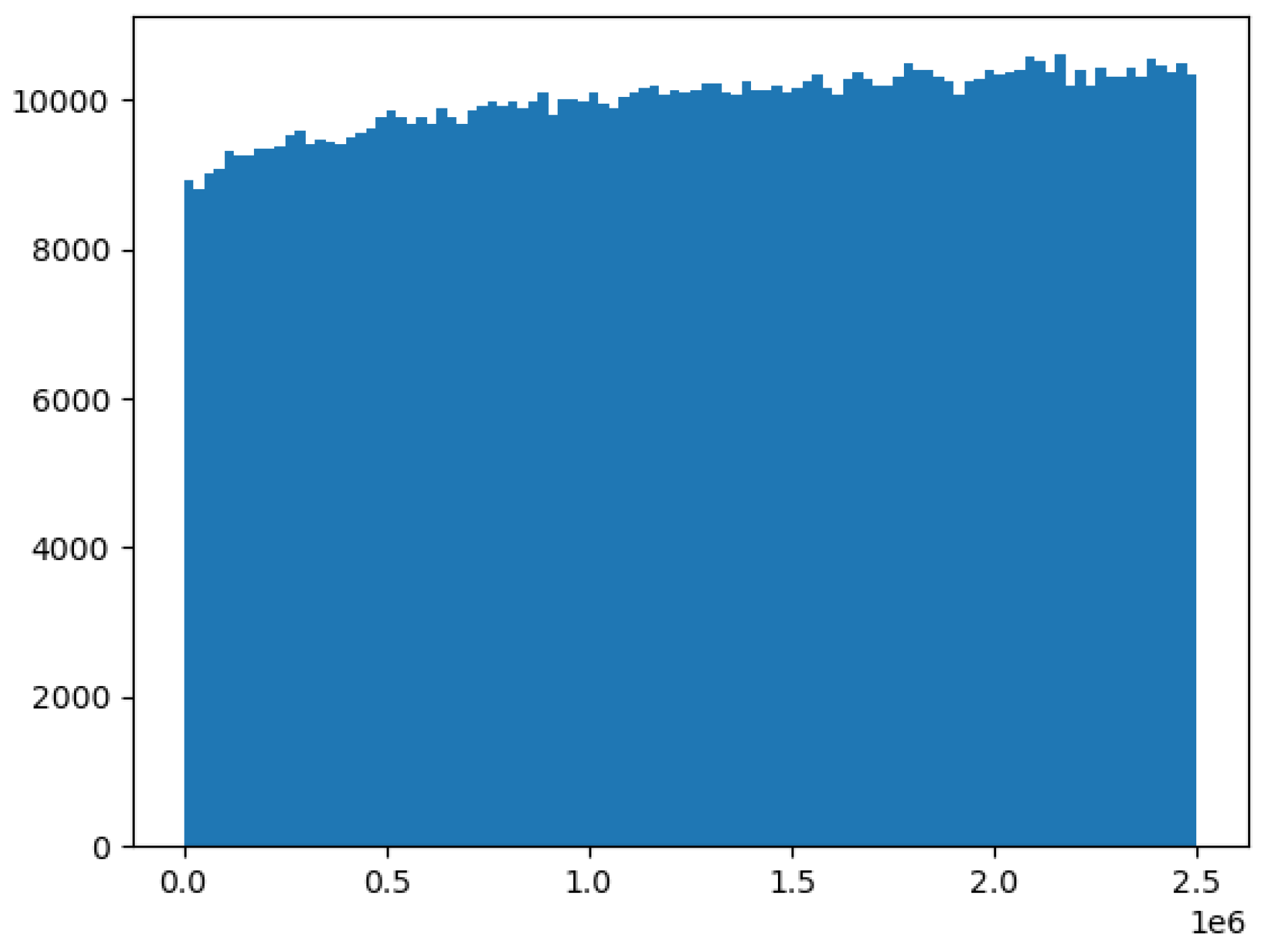
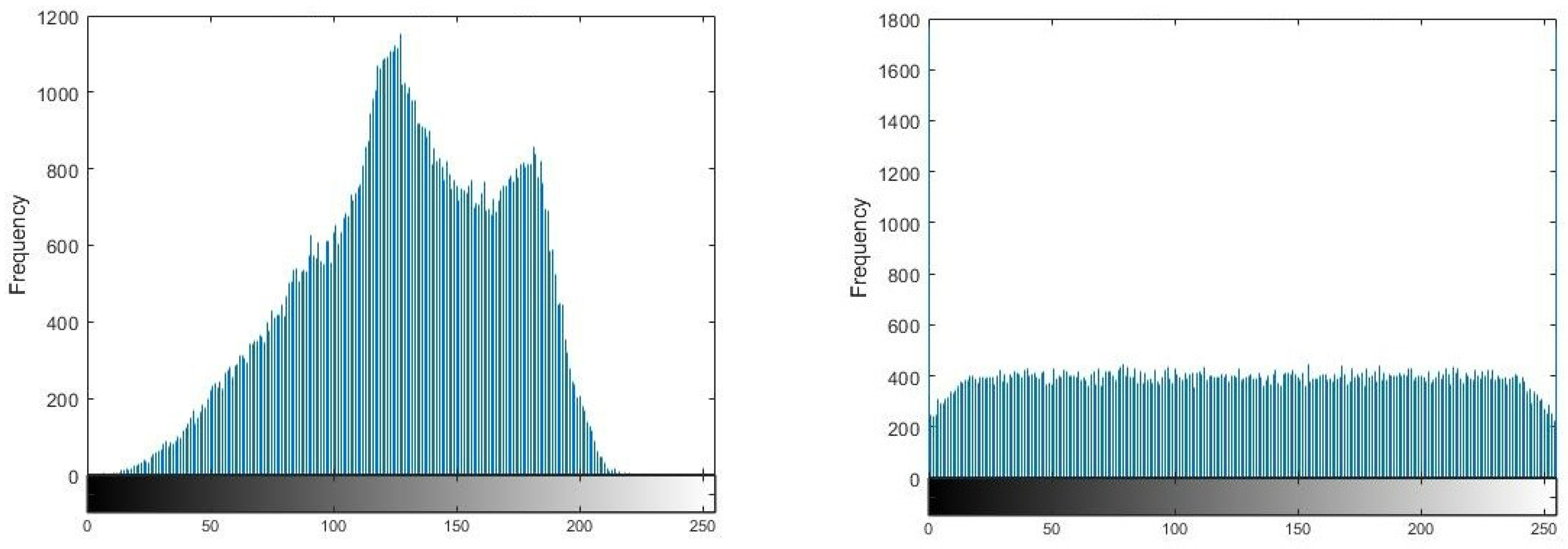
We ran 1,000,000 iterations of random search with
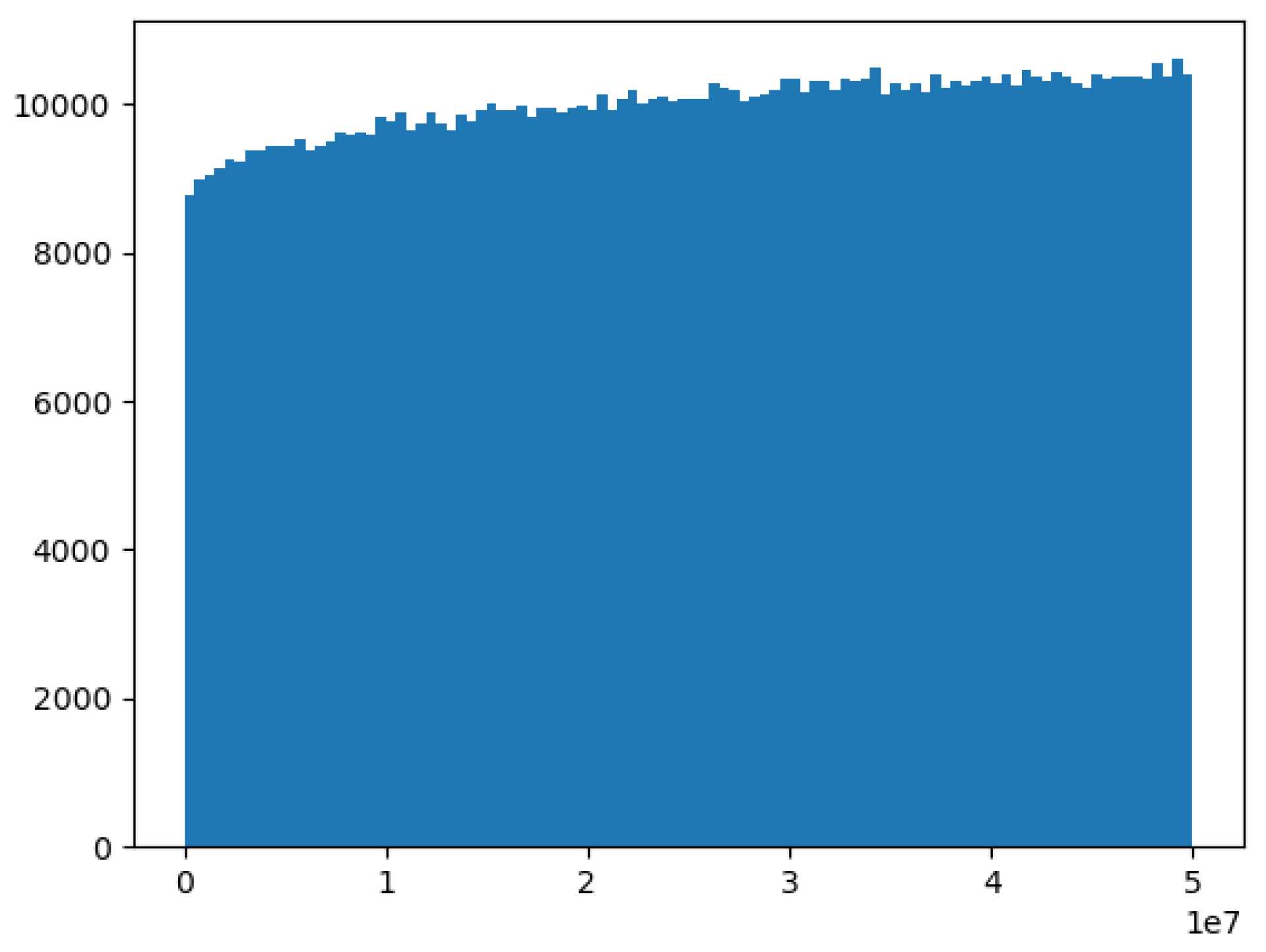
p = 5,000,077, and we measured the value of the objective function. The minimum value was 3 and the maximum value was 2,500,037, so there is a big range of objective function values when the random search is used; also, the minimum value is very near to 0. We also ran 1,000,000 iterations with
p = 100,000,081; the minimum value was 61 and the maximum value was 50,000,020. In
Figure 1 and
Figure 2, the respective two histograms with 100 bins show an almost uniform distribution of the objective function value, with a little degradation for small ones. This approximation of the uniform distribution indicates that searching for good solutions randomly is as good as searching for bad solutions.
4.4. Local Search
Our local search algorithm starts in a random curve and at each attempt, it checks if a neighbor improves the value of that actual ; in that case, we update the curve.
All the curves are represented in the same way as in a random search, by the j-invariant in the form ∗ m. The neighbor in improvement attempt k will be deduced from the actual curve using .
We applied one run of the local search algorithm to the space of prime 400,009, with 2,000,000 attempts at improvement. We did not find any supersingular elliptic curves. This was a first sight that the method did not perform well. If we compare with iterative random search necessary condition, the prime, 400,009 is below the bound that we set for a minimal space size (p = 5,000,077). Moreover, the number of objective function evaluations in the local search was 4,000,000 = 2,000,000, near the number of iterations in the random search, 5,380,000.
Later, we modified the local search to include the necessary conditions. In this case, all the curves are represented by the j-invariant in the form of where . The neighbor in iteration k will be deduced from the actual curve using a new .
Table 4 shows that even with the necessary condition, one run of the local search algorithm was not able to find a curve for prime 5,000,077. So, we can apply a similar analysis as the last one, compared with the iterative random search - necessary condition -.
However, using the local search with the necessary conditions is better than the iterative naive random search for p = 5,000,077. Different from iterative random search, increasing the number of attempts in local search does not produce the same effect because the search could be stuck around a local optimum. In this case, it is better to perform several runs. For example, 30 runs will be equivalent to 120,000,000 = 4,000,000 objective function evaluations.
After applying 34 runs in a new experiment of the local search—necessary condition—, we found five supersingular elliptic curves. The minimum value of the objective function was 0, the maximum value was 6 and the average was 2.2. One of the elliptic curves found was
3,402,052
1,513,899
2,671,589
3,715,944). Moreover,
Table 5 shows the comparison of the mentioned results with the results of other two experiments that follow the same structure but different ways of calculating neighborhood, in which five supersingular elliptic curves were also found and with an average of the objective function 2.4 and 2.7 respectively.
Still, we think that even in this case of rounds of experiments, the results were not better than the ones on iterative random search with the necessary conditions. The neighborhoods that we defined are simple, intuitive, and integer-related. The neighborhood change did not produce too much value in exploitation or exploration. In the case of exploration, the same number of supersingular elliptic curves were found, while in the case of exploitation, the average of the objective function does not differ too much. We conclude that just keeping the + operator is sufficient to apply the local search method.
4.5. Genetic Algorithm
We performed the genetic algorithm in the same way that we applied local search. The only difference here was the measure of the percent of solutions where , taking into account that all belong to a population under an evolutionary process.
First, we ran a simple genetic algorithm with integer encoding, three-tournament selection, and 51 candidates. We selected a low population size, low number of tournaments, and low mutation rate to keep a simple setting and not have too much computational effort in the personal computer. See
Table 6. This algorithm performs better than the iterative naive random method. With a few numbers of evolutions, for
p = 300,073 and
p = 400,009, 100 percent of the solutions have a very low objective function value.
Later, we ran the genetic algorithm using the necessary conditions. We kept the same number of evolutions for all the primes. See
Table 7. Making a comparison against the iterative random search under the necessary condition, we can see that for
p = 60,000,013, several 30,000,000 random iterations (function evaluations) cannot produce any supersingular elliptic curves; however, the genetic algorithm in
500,000
8,500,051 function evaluations produces
of elliptic curves with
and a success rate was also reached for
60,000,013. That made us think it will be possible to find the supersingular ones if we increase the exploitation or increase the function evaluations.
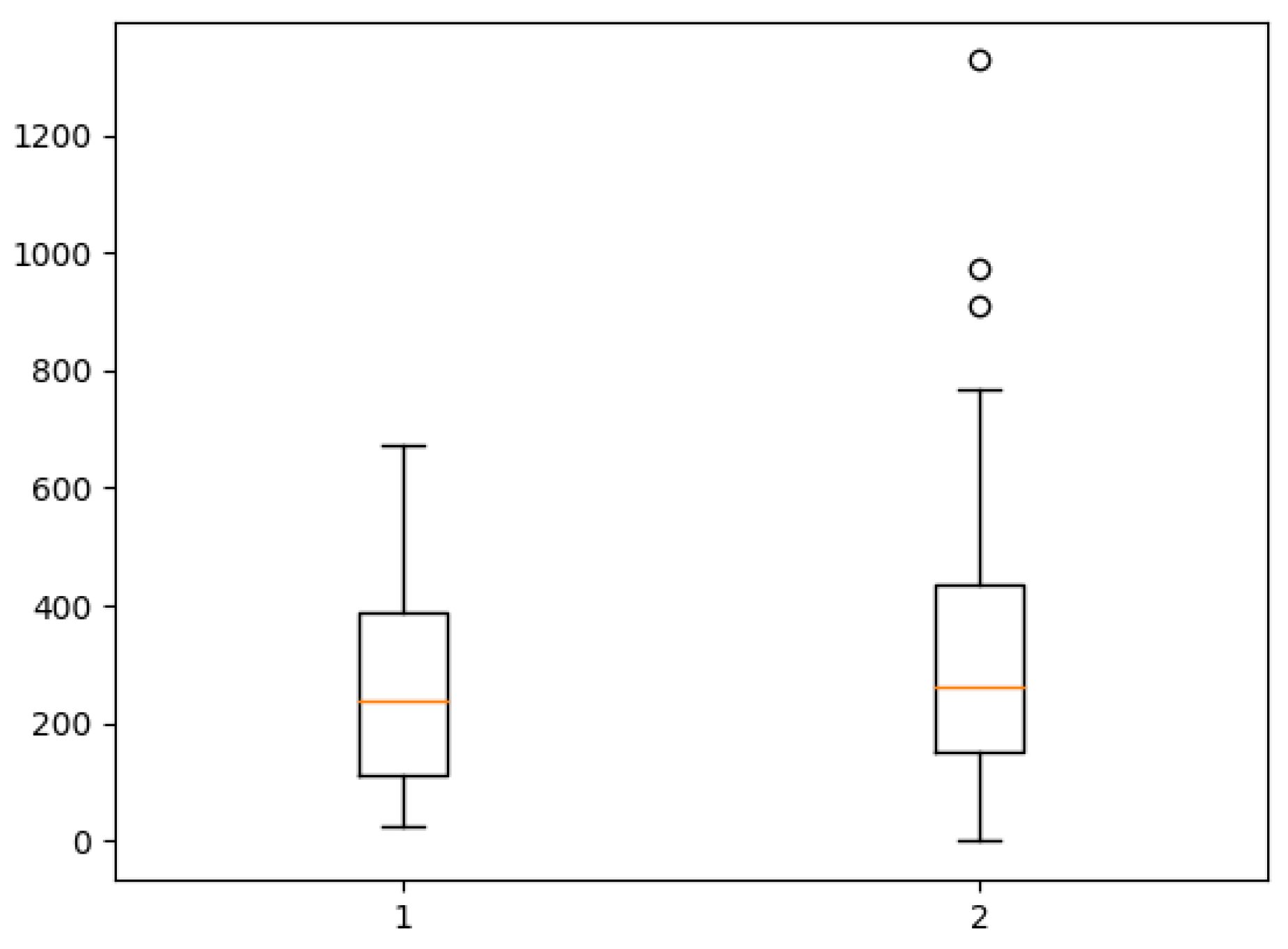
Then, we reduced the population size from 51 to 48, decreasing the initial exploration (to increase the tournament exploitation), and for the case
p = 100,000,081, we found the elliptic curve defined by
over a finite field in w of size
. Still, we did not reach exploitation. As can be seen in
Figure 3, where 1 represents the experiment with a population size of 51 and 2 represents the experiment with a population size of 48, there was more exploration than exploitation for the second experiment. The objective function values were very near to 0 in both cases if we remark that the value of
p is high.
Again, in comparison with the iterative random search, the genetic algorithm found a supersingular elliptic curve with only 8,500,051 function evaluations, whereas 30,000,000 random iterations did not.
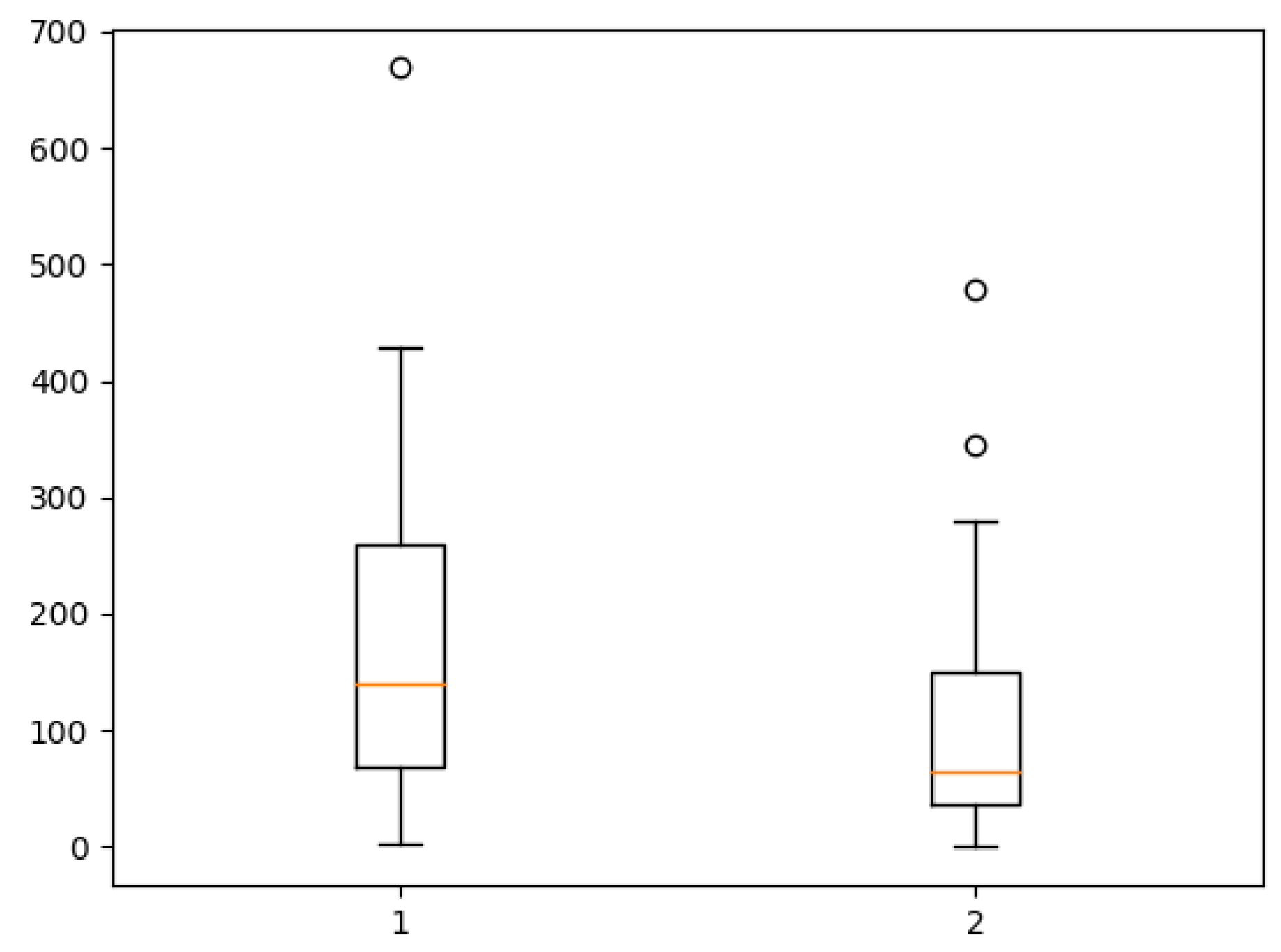
Moreover, we repeated the experiment with population size 48 and
p = 60,000,013, but now with 750,000 evolutions. We found the elliptic curve defined by
over a finite field in w of size 60,000,013
2. In
Figure 4, the second boxplot represents the results for the population with 48 candidates, and it shows the success of the exploitation in comparison with boxplot 1, and 12% of the objective function values were under 10.