


Abstract
In this article, we present the concept of orthogonal -almost Istrtescu contraction of types and and prove some fixed point theorems on orthogonal b-metric spaces. We also provide an illustrative example to support our theorems. As an application, we establish the existence and uniqueness of the solution of the fractional differential equation and the solution of the integral equation using Elzaki transform.
Keywords:
fixed point; orthogonal b-metric space; orthogonal α-almost Istrătescu contractions; Elzaki transform convolution MSC:
47H10; 54H25
1. Introduction
Around a century ago, the first fixed-point result was introduced. Banach [1] initially abstracted the successive approximation method for resolving differential equations, and he later defined it as a concept of contraction mapping. This Banach principle was not only succinctly stated, but it was also demonstrated by showing how to obtain the desired fixed point. The fixed point theory is extremely applicable to many qualitative sciences and is also particularly fascinating to researchers because of the simplicity with which equations in many research areas can be converted into fixed point problems. Banach’s fixed point result has been improved, expanded, and generalized by numerous authors in numerous ways [2,3,4,5,6]. Istrtescu [7,8] provided one of the most significant ideas of convex contraction and proved some fixed point results. Another interesting extension of the fixed point theory called “almost contraction map” was introduced by Berinde [9]. In contrast, the concept of metric was developed in a number of ways, and these contraction principles have been extended to these new contexts. The idea of the b-metric was initiated by Bakhtin [10] in 1989. Czerwik [11] gave an axiom that was weaker than the triangular inequality and formally defined a b-metric space with a view of generalizing “the Banach contraction mapping theorem”. Furthermore, Hussain et al. [12] improved the b-metric due to the modified triangle condition without a continuous function. Latif et al. [13] established some new results on the existence of fixed points for generalized multi-valued contractive mappings with respect to the -distance in metric space. In 2022, Haghi and Bakhshi [14] proved some coupled fixed point results by using a without mixed monotone property. Yao et al. [15] presented a Tseng-type self-adaptive algorithm for solving a variational inequality and a fixed point problem involving pseudo-monotone and pseudo-contractive operators in Hilbert spaces.
Recently, the idea of orthogonality was introduced by Gordji et al. [16] and proved fixed point theorems in the setting of orthogonal complete metric spaces. In 2022, Aiman et al. [17] introduced the concept of an orthogonal L contraction map and proved some fixed point theorems. Furthermore, many researchers improved and generalized the concept of orthogonal metric spaces (see [18,19,20,21,22,23,24]). By motivating all the above the literature work, here we present the new notion of orthogonal -almost Istrtescu contraction of type and and prove some fixed point theorems in the setting of orthogonal complete b-metric spaces. As an application, we apply our main result to the Reiman–Liouville fractional differential equation and the solution of the second kind Volterra integral equation using Elzaki transform to strengthen and validate our main results.
2. Preliminaries
The concept of an “almost contraction map” was introduced by Berinde [9], as follows:
Definition 1.
[9] Let be a metric space. A mapping is called an almost contraction if there exist a constant and some s.t
Bakhtin [10] introduced the notion of -metric space as below:
Definition 2.
[10] Let be a nonempty set and . Suppose that the map satisfies the following axioms:
- (i)
- iff ;
- (ii)
- ;
- (iii)
- .
Then, is called b-metric and is said to be a b-metric space.
In 2017, Miculescu et al. [25] explained the Cauchy criterion in the context of b-metric spaces.
Lemma 1.
[25] Every sequence of elements from a b-metric space of constant having property that there s.t
for every is Cauchy.
Popescu [26] demonstrated the concept of an -orbital admissible as below:
Definition 3.
[26] Let be a map and be a function. Then, χ is said to be α-orbital admissible if
Now, we recall some concepts of orthogonality, which will be needed in the sequel.
Definition 4.
[16] Let be a non-void set and be a binary relation. If ⊥ fulfilled the following axiom:
then is called an orthogonal set.
Gordji et al. [16] presented the definition of an orthogonal sequence in 2017 as follows:
Definition 5.
[16] Let be a orthogonal set. A sequence is called an orthogonal sequence if
Now, we initiated the new concepts of orthogonal b-metric space, convergent and Cauchy sequence as follows:
Definition 6.
A triplet is called an orthogonal b-metric space if is an orthogonal set and is a b-metric space and .
Definition 7.
Let be an orthogonal b-metric space and a map
- 1.
- is an orthogonal sequence in that converges at a point ι if
- 2.
- are two orthogonal sequences in that are said to be an orthogonal Cauchy sequence if
Gordji et al. [27] introduced the concept of orthogonal continuous as below:
Definition 8.
[27] Let be a orthogonal b-metric space. Then, is said to be orthogonal continuous at if, for each orthogonal sequence in with . We have . Additionally, χ is said to be orthogonal continuous on if χ is orthogonal continuous in each .
Definition 9.
Let be an orthogonal b-metric space. Then, is said to be orthogonal continuous at if, for each orthogonal sequence in with . We have . Additionally, is said to be orthogonal continuous on if is orthogonal continuous in each .
The concept of orthogonal complete in metric spaces is defined by Gordji et al. [16] as follows.
Definition 10.
[16] Let be an orthogonal metric space. Then, is said to be orthogonal-complete if every orthogonal Cauchy sequence is convergent.
Definition 11.
[16] Let be an orthogonal set. A function is called orthogonal-preserving if whenever .
Ramezani [28] introduced the notion of orthogonal -admissible as follows:
Definition 12.
[28] Let be a map and be a function. Then, χ is said to be orthogonal-α-admissible if with
Inspired by the -almost Istrtescu contraction of types defined by Karapinar et al. [29], we implement a new orthogonally -almost Istrtescu contraction type mapping and present some fixed point results in an orthogonal CbMS (complete b-metric space) for this contraction map.
3. Main Results
First, we introduce the concept of an orthogonally -almost Istrtescu contraction of type .
Definition 13.
Let be an orthogonal CbMS and be a function. A map is called an orthogonally α-almost Istrtescu contraction of type if there exist , s.t for any with
where
and
Definition 14.
Definition 15.
Let be an orthogonal CbMS and be a function. A map is called an orthogonally α-almost Istrtescu contraction of type if there exist , s.t for any with
where
and
Theorem 1.
Let be an orthogonal CbMS, be an orthogonally α-almost Istrtescu contraction of type and , s.t the following conditions hold:
- (i)
- χ is orthogonal preserving;
- (ii)
- for any , with , where
- (iii)
- χ is orthogonal continuous;
- (iv)
- is orthogonal continuous with and , for any
If χ is orthogonal and there exists s.t and , then χ has a unique fixed point.
Proof.
By the definition of orthogonality, we find that or . Let
for all . If for some , then is a fixed point of χ and so the proof is completed. Thus, we assume that for all .
So, we have . Since χ is orthogonal-preserving, we obtain
which implies that is an orthogonal sequence. Since χ is an orthogonally α-almost Istrtescu contraction of type , we have , and continuing this process, we obtain
Replacing ϱ by and ι by in (2), we have
If , then we have
this is a contradiction. Thus, and the inequality (10) becomes
For , taking Equation (9) into account,
Since for the case , we get
which is a contradiction. Thus, and
By proceeding in this way,
, because
Instead, considering the orthogonal sequence defined as
where , from Equation (13), we have
for . Therefore, from Lemma 1, we obtain from an orthogonal Cauchy sequence on orthogonal CbMS. Therefore, the orthogonal sequence is convergent. Then, s.t
When the map χ is orthogonal continuous, it follows that
and thus, we decide , that is κ forms a fixed point of χ.
Keeping the continuity of , we obtain
Since each orthogonal sequence in has a unique limit, we obtain , that is, κ forms a fixed point of . In order to illustrate that κ also forms a fixed point of χ, we apply the method of reductio ad absurdum. We diminish the consequence and presume that . Therefore, from Equation (2), we obtain
Hence, .
To prove the uniqueness of the fixed point, let be another fixed point of χ. Then, we have . Given our choice of κ in the first part of the proof, we obtain
Since χ is orthogonal-preserving, we obtain
On the other hand, χ is an orthogonal α-almost Istrtescu contraction. Then, we obtain
which is a contradiction. Therefore, χ has a unique fixed point. □
Example 1.
Let and the function with , for all . be the Euclidean metric. Define if where or . Define a map by
We can see that χ is discontinuous at , but is orthogonal continuous and is orthogonal preserving on , since
Let the map with be given by
It is clear that χ is an orthogonally α-almost Istrtescu contraction of type . In fact, based on the definition of the function α, the only case we find interesting is ; we obtain for
We can conclude that for any , all the conditions of Theorem 1 are satisfied, and .
Corollary 1.
Suppose that a self-map χ, on orthogonal CbMS fulfills
for all . If either χ or is orthogonal continuous. Then, χ has a unique fixed point.
Proof.
It is sufficient to set and put in Theorem 1. □
Theorem 2.
Let be an orthogonal CbMS and be an orthogonally α-almost Istrtescu contraction of type with , s.t the following conditions hold:
- (i)
- χ is orthogonal preserving;
- (ii)
- for any , with , where
- (iii)
- χ is orthogonal continuous;
- (iv)
- is orthogonal continuous with and for any
If χ is orthogonal and s.t and , then it has a unique fixed point in χ.
Proof.
Let and we assume the orthogonal sequence follows from Theorem 1. Then, for each , we obtain
and
If we suppose that , by Equation (16), we obtain
this is a contradiction. If , then
which turns into
Denoting by , respectively, and continuing in the process, we have
Therefore,
and
From Lemma 1, the orthogonal sequence is an orthogonal Cauchy sequence in orthogonal CbMS, so there exists κ s.t
If we consider that (i) holds, we obtain .
Instead, if we use hypotheses (ii), we have and . We apply the method of reductio ad absurdum and suppose that , so by Equation (6), we have
which is a contradiction. Therefore, .
Now, we prove the unique fixed point, let be another fixed point of χ. Then, we have . Given our choice of κ in the proof of the first part, we obtain
Since χ is orthogonal-preserving, we obtain
On the other hand, χ is an orthogonal α-almost Istrtescu contraction. Then, we obtain
This is a contradiction, so that then χ has a unique fixed point. □
Example 2.
Let be an orthogonalCbMS, where and the mapping is defined as , for every .
Consider the binary relation ⊥ on by if where or .
Let be an orthogonal continuous map, defined by
Then,
In addition, let the map ,
Of course, χ is orthogonal and .
If , then we obtain and
Thus, we can find s.t
Otherwise, we obtain .
Clearly, χ is orthogonal continuous. Consequently, from Theorem 2, the map χ has a fixed point.
4. Applications
4.1. Fractional Differential Equations
For a function , the Riemann–Liouville fractional derivative of order is given by
is the Euler gamma function, given that the right-hand side is defined point-wise on [0, 1], where is the integer component of . Consider the fractional differential equation as follows:
where is a continuous function and represents the Caputo fractional derivative of order and is defined by
where . Let be the set of all the continuous functions defined on with . Consider to be defined by
and for all . Then, is a complete bipolar controlled metric space.
Theorem 3.
Assume the nonlinear fractional differential equation (20). Suppose that the following conditions are satisfied:
- 1.
- , and s.t
- 2.
Then, the Equation (20) has a unique solution in .
Proof.
The given fractional differential equation (20) is equivalent to the succeeding integral equation with the orthogonal set ,
Take the orthogonal function with ,
Define the covariant mapping and is orthogonal preserving. For each with as defined by
It is easy to note that if is a fixed point then is a solution of the problem (20).
Let with . Now,
Taking the supremum on both sides, we obtain
Hence, all the hypotheses of Theorem 1 are verified, and consequently, the fractional differential Equation (20) has a unique solution. □
Example 3.
The linear fractional differential equation is as follows:
where represents the Caputo fractional derivative of order σ with the initial condition: .
The exact solution of Equation (21) with :
Clearly, is an orthogonal continuous function on [0, 1]. In virtue of Equation (20), we can write Equation (21) in the homotopy form;
the solution of Equation (21) is:
Applying and the inverse operation of , on both sides of Equation (24) and fractional integral operation of order , we have
Table 1 displays the numerical and exact results using the matrix approach method with and .
Table 1.
The numerical and exact solution using the matrix approach method.
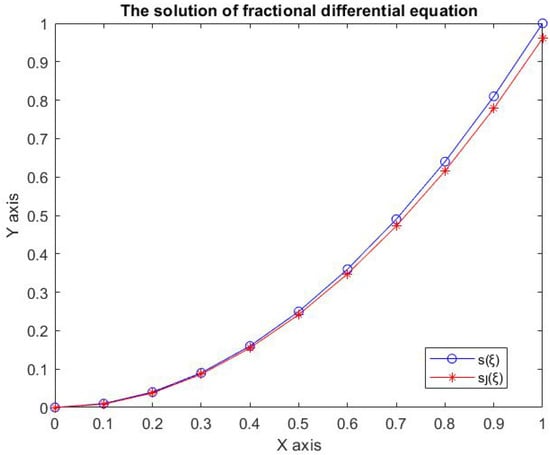
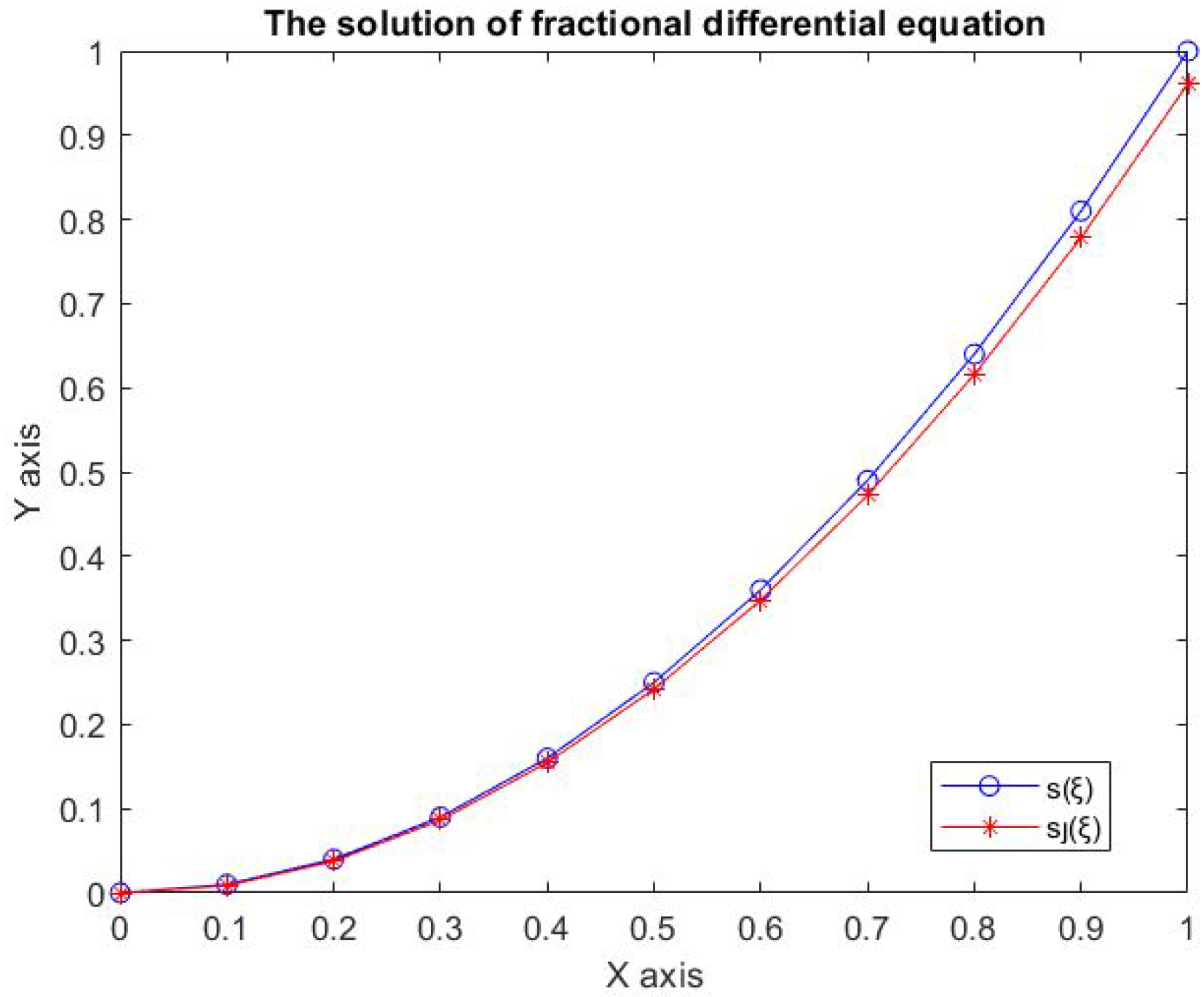
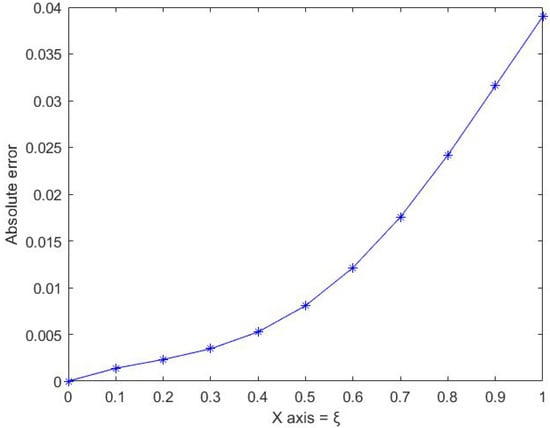
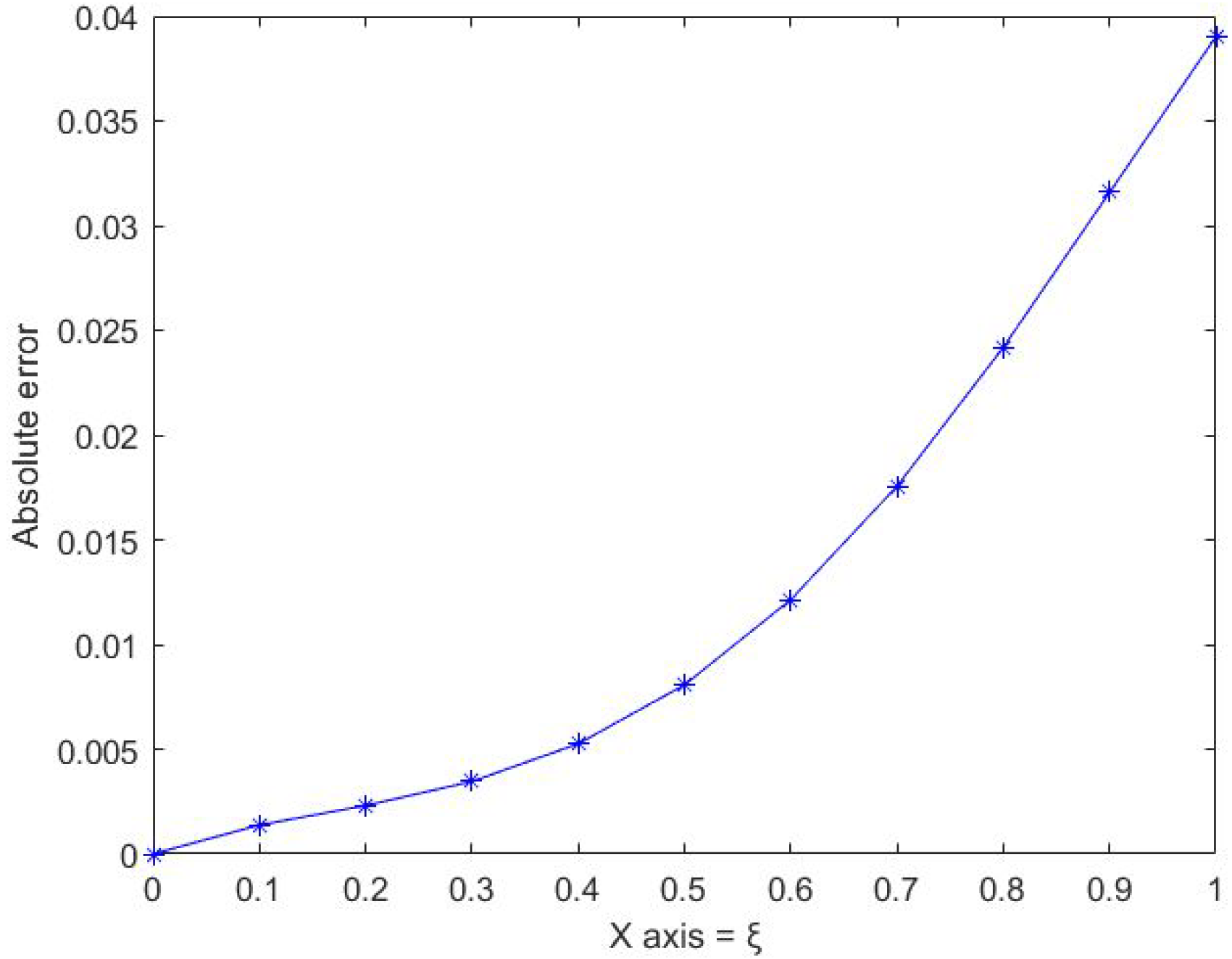
Figure 1 compares both the numerical and exact solutions for the fractional differential Equation (21). Moreover, Figure 2 shows the absolute error between the numerical and exact solutions.
Figure 1.
The convergence between an approximate and exact solution with an interval difference of 0.1 for Example 3.
Figure 2.
The absolute error with an interval difference of 0.1 for Example 3.
The exact and absolute solution is an equal value of 0 in this case. Therefore, the unique solution to this problem is 0. Hence the unique fixed point at 0.
4.2. Application of Elzaki Transformation
We prove the convolution of the Elzaki transform by a different method with Elzaki.
for is the Elzaki transform of . In general, we can find the solution by using the Elzaki transform as follows:
Theorem 4.
Let us consider the Volterra integral equation of the second kind as follows:
It can be expressed as
where is the kernel and .
Proof.
Let and . If is given, define the orthogonal relation ⊥ on by
let us take both sides on the Elzaki transform; we have
for is the transfer function. If we take the inverse Elzaki transform, we obtain
for ★ is the standard notation of convolution.
Let us take the Elzaki transform on Equation (27). Then we obtain
for and for is orthogonal continuous. Organizing the equality, we obtain
for the kernel. Therefore, we obtain
□
Example 4.
Let us consider the Volterra integral equation
Solution.Writing
for , we obtain
for . From the table of the Elzaki transform Table A1 in Appendix A, we obtain
Arranging the inequality, we obtain
Taking the inverse Elzaki transform, we obtain
for h is a hyperbolic function.
It is a well-known fact that the first order ODE
with the condition is rewritten to
where is orthogonal continuous and contains the point . Similarly, an initial value problem
with the condition is rewritten to the Volterra integral equation of the second kind
where Additionally, the above is orthogonal continuous on and the kernel K is orthogonal continuous on the triangular region R in the -plane given by . Then we know that (29) has a unique solution ι on .
Example 5.
Solve the Volterra integral equation
Solution.The given equation can be written by
for . Let us write and apply the convolution theorem. Then, we obtain
We obtain
As we scan a table of Elzaki transformations Table A1, we obtain
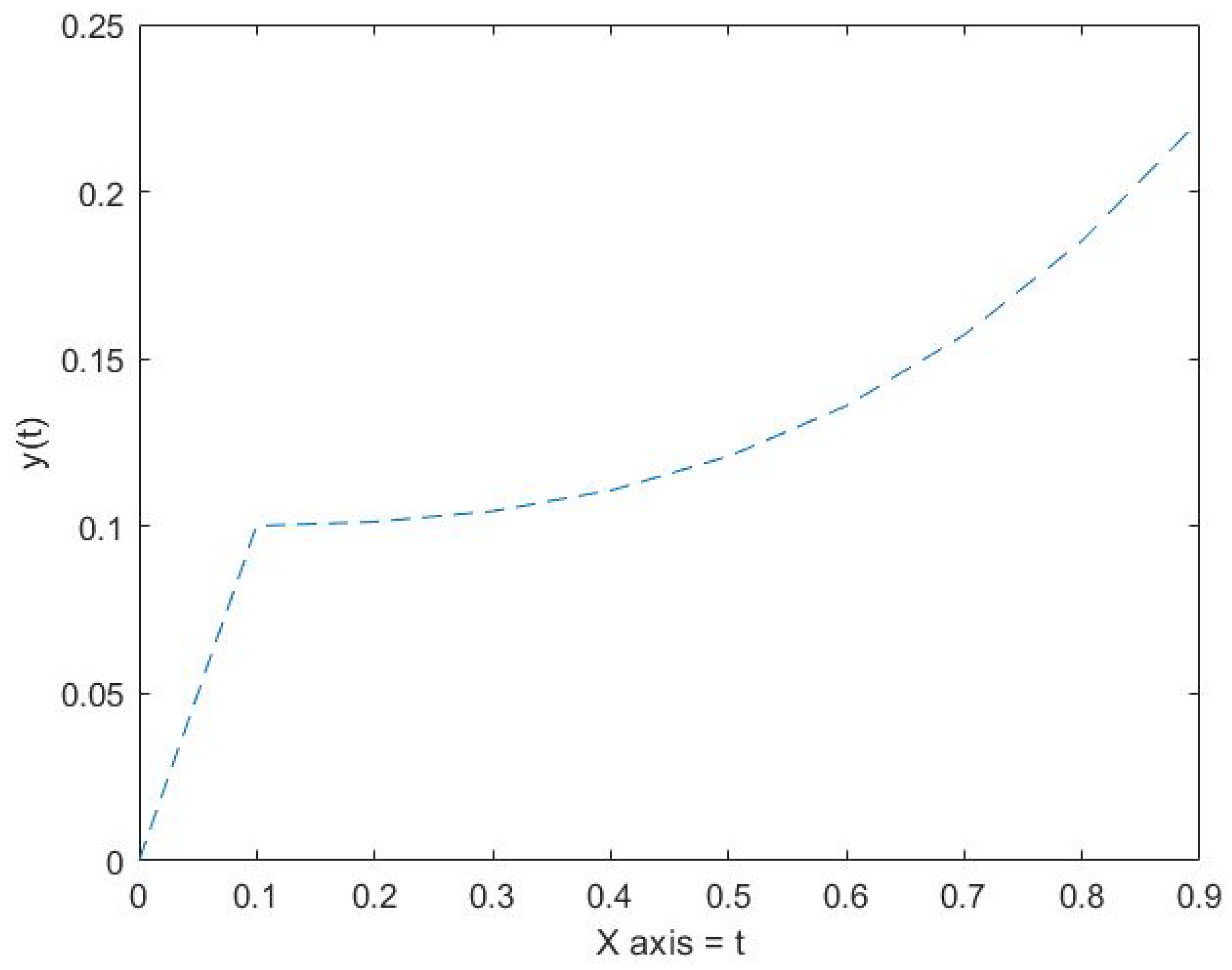
It is clear that is orthogonal continuous on . Its shown in Figure 3 as follow:
Figure 3.
Graph of with an interval difference of 0.1 for Example 5.
5. Conclusions
In this paper, we proved some fixed point theorems for an orthogonal Istrtescu type contraction of maps in an orthogonal CbMS. Furthermore, we presented examples that elaborated on the usability of our results. Meanwhile, we provided applications to the existence of a solution for a fractional differential equation and second kind Volterra integral equation through an Elzaki transform by using our main results.
Author Contributions
Writing—original draft, A.J.G., G.M., O.E., A.A. and N.M. All authors have read and agreed to the published version of the manuscript.
Funding
This research received no external funding.
Data Availability Statement
Not applicable.
Acknowledgments
The authors A. ALoqaily and N. Mlaiki would like to thank Prince Sultan University for paying the publication fees for this work through TAS LAB.
Conflicts of Interest
The authors declare no conflict of interest.
Appendix A
Table A1.
Elzaki transform of some functions.
References
- Banach, S. Sur les operations dans les ensembles abstraits et leurs applications aux equations integrales. Fundam. Math. 1992, 3, 133–181. [Google Scholar] [CrossRef] [Scilit]
- Shatanawi, W. On w-compatible mappings and common coupled coincidence point in cone metric spaces. Appl. Math. Lett. 2012, 25, 925–931. [Google Scholar] [CrossRef] [Scilit]
- Shatanawi, W.; Rajic, R.V.; Radenovic, S.; Al-Rawashhdeh, A. Mizoguchi-Takahashi-type theorems in tvs-cone metric spaces. Fixed Point Theory Appl. 2012, 11, 106. [Google Scholar] [CrossRef] [Scilit]
- Al-Rawashdeh, A.; Hassen, A.; Abdelbasset, F.; Sehmim, S.; Shatanawi, W. On common fixed points for α-F-contractions and applications. J. Nonlinear Sci. Appl. 2016, 9, 3445–3458. [Google Scholar] [CrossRef] [Scilit]
- Shatanawi, W.; Mustafa, Z.; Tahat, N. Some coincidence point theorems for nonlinear contraction in ordered metric spaces. Fixed Point Theory Appl. 2011, 2011, 68. [Google Scholar] [CrossRef] [Scilit]
- Shatanawi, W. Some fixed point results for a generalized Ψ-weak contraction mappings in orbitally metric spaces. Chaos Solitons Fractals 2012, 45, 520–526. [Google Scholar] [CrossRef] [Scilit]
- Istrătescu, V. Some fixed point theorems for convex contraction mappings and mappings with convex diminishing diameters (I). Ann. Mat. Pura Appl. 1982, 130, 89–104. [Google Scholar]
- Istrătescu, V. Some fixed point theorems for convex contraction mappings and mappings with convex diminishing diameters (II). Ann. Mat. Pura Appl. 1983, 134, 327–362. [Google Scholar]
- Berinde, V. Approximating fixed points of weak contractions using the Picard iteration. Nonlinear Anal. Forum 2004, 9, 43–53. [Google Scholar]
- Bakhtin, I.A. The contraction mapping principle in quasimetric spaces. J. Funct. Anal. 1989, 30, 26–37. [Google Scholar]
- Czerwik, S. Nonlinear set-valued contraction mappings in b-metric spaces. Atti Del Semin. Mat. Fis. Dell’Universita Modena 1998, 46, 263–276. [Google Scholar]
- Hussain, N.; Doric, D.; Kadelburg, Z.; Radenovi´c, S. Suzuki-type fixed point results in metric type spaces. J. Inequalities Appl. 2014, 2014, 229. [Google Scholar] [CrossRef] [Scilit]
- Latif, A.; Al Subaie, R.F.; Alansari, M.O. Fixed points of generalized multi-valued contractive mappings in metric type spaces. J. Nonlinear Var. Anal. 2022, 6, 123–138. [Google Scholar]
- Haghi, R.H.; Bakhshi, N. Some coupled fixed point results without mixed monotone property. J. Adv. Math. Stud. 2022, 15, 456–463. [Google Scholar]
- Yao, Y.; Shahzad, N.; Yao, J.C. Convergence of Tseng-type self-adaptive al-gorithms for variational inequalities and fixed point problems. Carpathian J. Math. 2021, 37, 541–550. [Google Scholar] [CrossRef] [Scilit]
- Gordji, M.E.; Habibi, H. Fixed point theory in generalized orthogonal metric space. J. Linear Topol. Algebra 2017, 6, 251–260. [Google Scholar]
- Aiman, M.; Arul Joseph, G.; Absar, U.H.; Senthil Kumar, P.; Gunaseelan, M.; Imran, A.B. Solving an Integral Equation via Orthogonal Brianciari Metric Spaces. J. Funct. Spaces 2022, 2022, 7251823. [Google Scholar]
- Gnanaprakasam, A.J.; Mani, G.; Lee, J.R.; Park, C. Solving a nonlinear integral equation via orthogonal metric space. AIMS Math. 2022, 7, 1198–1210. [Google Scholar] [CrossRef] [Scilit]
- Mani, G.; Gnanaprakasam, A.J.; Kausar, N.; Munir, M. Orthogonal F-Contraction mapping on O-Complete Metric Space with Applications. Int. J. Fuzzy Log. Intell. Syst. 2021, 21, 243–250. [Google Scholar] [CrossRef] [Scilit]
- Arul Joseph, G.; Gunaseelan, M.; Vahid, P.; Hassen, A. Solving a Nonlinear Fredholm Integral Equation via an Orthogonal Metric. Adv. Math. Phys. 2021, 2021, 8. [Google Scholar]
- Prakasam, S.K.; Gnanaprakasam, A.J.; Kausar, N.; Mani, G.; Munir, M. Solution of Integral Equation via Orthogonally Modified F-Contraction Mappings on O-Complete Metric-Like Space. Int. J. Fuzzy Log. Intell. Syst. 2022, 22, 287–295. [Google Scholar] [CrossRef] [Scilit]
- Senthil Kumar, P.; Arul Joseph, G.; Ege, O.; Gunaseelan, M.; Haque, S.; Mlaiki, N. Fixed point for an 𝕆g𝔗-c in 𝕆-complete b-metric-like spaces. AIMS Math. 2022, 8, 1022–1039. [Google Scholar]
- Gnanaprakasam, A.J.; Nallaselli, G.; Haq, A.U.; Mani, G.; Baloch, I.A.; Nonlaopon, K. Common Fixed-Points Technique for the Existence of a Solution to Fractional Integro-Differential Equations via Orthogonal Branciari Metric Spaces. Symmetry 2022, 14, 1859. [Google Scholar] [CrossRef] [Scilit]
- Mani, G.; Prakasam, S.K.; Gnanaprakasam, A.J.; Ramaswamy, R.; Abdelnaby, O.A.A.; Khan, K.H.; Radenović, S. Common Fixed Point Theorems on Orthogonal Branciari Metric Spaces with an Application. Symmetry 2022, 14, 2420. [Google Scholar] [CrossRef] [Scilit]
- Miculescu, R.; Mihail, A. New fixed point theorems for set-valued contractions in b-metric spaces. J. Fixed Point Theory Appl. 2017, 19, 2153–2163. [Google Scholar] [CrossRef] [Scilit]
- Popescu, O. Some new fixed point theorems for a α Geraghty-contraction type maps in metric spaces. Fixed Point Theory Appl. 2014, 2014, 190. [Google Scholar] [CrossRef] [Scilit]
- Gordji, M.E.; Ramezani, M.; De La Sen, M.; Cho, Y.J. On orthogonal sets and Banach fixed point theorem. Fixed Point Theory 2017, 18, 569–578. [Google Scholar] [CrossRef] [Scilit]
- Ramezani, M. Orthogonal metric space and convex contractions. Int. J. Nonlinear Anal. Appl. 2015, 6, 127–132. [Google Scholar]
- Karapinar, E.; Fulga, A.; Petrusel, A. On Istrtescu Type contraction in b-Metric Space. Mathematics 2020, 8, 388. [Google Scholar] [CrossRef] [Scilit]


Disclaimer/Publisher’s Note: The statements, opinions and data contained in all publications are solely those of the individual author(s) and contributor(s) and not of MDPI and/or the editor(s). MDPI and/or the editor(s) disclaim responsibility for any injury to people or property resulting from any ideas, methods, instructions or products referred to in the content. |
© 2023 by the authors. Licensee MDPI, Basel, Switzerland. This article is an open access article distributed under the terms and conditions of the Creative Commons Attribution (CC BY) license (https://creativecommons.org/licenses/by/4.0/).