1. Introduction
The rise of science and technology has made it simpler for people to communicate with each other, but it has also made it easier for rumors to spread. Our modern world is heavily influenced by rumors propagated on the Internet, via social media and by word of mouth. Public opinion and financial markets are only a few examples that come to mind. Other examples include causing economic harm, harming people’s reputations, and causing undue panic during a disease outbreak. As a result, understanding how rumors spread is essential if we are to minimize the harm that rumors may do.
Due to the striking similarities between the propagation of rumors and the propagation of diseases, epidemiological models have been utilized extensively in this line of research. Despite the fact that sickness and rumor propagation share similar traits, it is not possible to create a cohesive framework or equivalent model for either of these processes. In 1965, Daley and Kendall [
1] proposed a model for the manner in which people disseminate rumors. They assumed that people moved between groups based on a given mathematical probability distribution and separated the population into three groups: those who were uninformed, those who propagated the information, and those who stifled it. Following it, Maki and Murray [
2] applied a mathematical model to the rumors which led to the development of the DK model. Then, numerous models for propagating rumors were proposed and studied [
3,
4,
5,
6,
7,
8,
9,
10]. Zhao et al. [
11] modified a flowchart of the rumor-spreading process with the SIR (susceptible, infected, and recovered) model, and the impacts that variations of different parameters have on the rumor-spreading process were analyzed. Komi [
12] investigated an SEIR (susceptible, exposed, infected, and recovered) rumor-spreading model that considers the forgetting mechanism and the population’s education rate. Zhou et al. [
13] studied rumor propagation in complex networks analytically and numerically by using the SIR model.
It is noted that the primary flaws of these existing models reside in their rules for rumor dissemination. When an uninformed person approaches a rumor spreader, the susceptible person may believe the rumor and become a rumor spreader directly. This assumption disregards the potential that susceptible individuals may undergo a dormant phase before becoming spreaders. This idea is based on the fact that, when confronted with confusing and contradictory messages, many individuals’ have their judgment clouded, and certain ignoramuses have difficulties determining the veracity of information right after hearing the rumor. Nevertheless, the models which are mentioned in the previous paragraph were highly original and tremendously valuable for modeling and analyzing the propagation of rumors. Therefore, time delay is a typical occurrence in the actual world. In the process of rumor propagation, if users are unable to receive rumors in a timely manner after their release, or if, after acquiring rumors, they are unable to disseminate them in a timely manner for different reasons, etc., this will result in a delay in the transmission of information [
14,
15]. In addition, there are many other things that can affect how rumors spread. Gu [
16] added the forgetting and remembering mechanisms to the way rumors spread. Numerical simulations showed that the forgetting mechanism would change how news spreads and could even stop rumors from going around. Afassinou [
12] incorporated a forgetting mechanism and education rate into the SEIR rumor-spreading model, with the belief that there was a correlation between education and the ultimate dissemination of rumors. Cheng et al. [
17] developed an improved rumor-spreading model taking into account the delay of an interactive system; and control strategies such as deleting rumor posts and educating the public about popular science were considered. Jiang and Yan [
6] proposed an immune-structure SIR model to explore the control method of rumor spreading. Huo et al. [
18] studied the optimal control of a delayed rumor-spreading model with consideration of psychological factors. Zhu and Wang [
5] proposed a rumor-propagation model with a silence-forcing function in online social networks, and they investigated the Hopf bifurcation and optimal control of the model. These studies [
19,
20,
21,
22,
23] show us that when rumors spread, there are some real-world factors that affect communication, such as government rules, propagation delays, and so on. These factors need to be taken into account in the study.
Based on these discussions, we consider the following model:
where
,
, and
denote the susceptible individuals ( referred to as “susceptible” in this paper), the rumor spreaders, and the removal individuals (referred to as “removal” in this paper), respectively.
r,
K,
,
,
,
, and
are all positive constants.
Model (
1) is based on the following assumptions:
- (A1)
The susceptible group’s growth follows the logistic model of population increase , where r denotes the population growth rate per time unit and K represents the environmental population capacity.
- (A2)
The rumor spreads between those who are unaware of it and those who propagate it, and the propagation is carried out using the functional response below:
where
and
are positive constants. Due to congestion or adequate preventive actions adopted by susceptible and spreader persons to limit the spread of rumor, the number of effective connections between susceptible and spreaders might saturate at high propagation levels, making this a critical consideration.
- (A3)
However, the transmission requires some time for individuals to pass from hearing the rumor to the spreader state, and we assume that a susceptible individual first goes through a latent period .
- (A4)
When a spreader touches another spreader or a removal individual, only the first spreader turns into a removal individual at a rate , which is called the stifling rate. This is different from the epidemiological model.
The initial condition for the above system is
where
,
,
, and
.
C denotes the Banach space
of continuous functions mapping the interval
into
. The nonnegative cone of
C is defined as
.
The organization of this paper is as follows. In
Section 2, the non-negative and boundedness of the proposed system are studied. In
Section 3, the existence of the equilibria of the model is discussed. In
Section 4, local stability and Hopf bifurcation of rumor-free equilibrium and rumor-endemic equilibrium are studied. In
Section 5, the global asymptotic stability of the equilibria is investigated. In
Section 6, we introduce two control variables in the rumor-spreading model with time delay, and find the optimal solution by the optimization techniques. Finally, in
Section 7, numerical simulations are given to verify the theoretical results.
4. Local Stability and Hopf Bifurcation
In this section, we consider the local stability and bifurcation of system (
1).
The Jacobian matrix of system (
1) at
is as follows:
Clearly, we have the following results.
Theorem 4. The rumor free equilibrium is locally asymptotically stable if the condition (
6)
holds and it is unstable if the condition (
6)
does not hold. In the following, we discuss the stability of the rumor-endemic equilibrium
. The Jacobian matrix of system (
1) at
is as follows.
where
Then, the characteristic equation is
where
When
, we have the following result.
Theorem 5. Assume thathold; then, the rumor-spreading equilibrium is locally asymptotically stable for . Proof. When
, the characteristic equation becomes
A direct calculation shows that
where
. Clearly, If the conditions (
14) and (
15) hold, then
and
. Moreover,
Under the conditions (
14) and (
15),
Therefore, according to Routh–Hurwitz criterion, we obtain that if the conditions hold, then the rumor-spreading equilibrium is locally asymptotically stable for
. □
Now, we discuss the effect of
. Assume that Equation (
13) has a pair of purely imaginary roots
. Then,
satisfies the following equation:
It is easily obtained that
Then, we have
where
Let
. Then, (
19) is transformed into
Thus, we have
Obviously,
Denote
. Then, the roots of
are
We give the following conditions:
Lemma 2. Assume that the conditions (
6), (
7),
and (
14)
hold. Furthermore, if (
22)
or (
23)
, then Equation (
20)
has none positive root; if (
24)
or (
25)
holds, then Equation (
20)
has one positive root; if (
26)
holds, then Equation (
20)
has two positive roots. Proof. First, we claim that
under the condition (
14). In fact, if the condition (
14) holds, we have
Case 1: (
).
, so
is a monotonously increasing function for
. Combining with
, we obtain that Equation (
20) has no any positive root.
Case 2: (
).
, so there exists a
, which satisfies
when
,
when
.
, so
for
; i.e., Equation (
20) has no positive root.
Case 3: (
).
is a monotonouosly increasing function for
with
. Combining with
and
, we have that Equation (
20) has one unique positive root.
Case 4: (
. Obviously, in this case we can find a
satisfying
when
, and
when
. Moreover,
and
imply that there exists a
satisfying
;
and
imply that there exists
satisfying
. Therefore, Equation (
20) has two positive roots in this case. □
Without loss of generality, we assume that Equation (
20) has two positive roots, denoted by
and
, respectively. Accordingly, Equation (
19) has two positive roots,
,
.
From Equation (
18), we have
It is worth noting that the sequence
grows monotonically and
Thus, we define
Lemma 3. Let us suppose that is a root of Equation (
13)
that equals and . Assume also that . The transversality condition is then satisfied. That is,holds, and the sign of is consistent with that of . Proof. Denote
and
by
and
respectively. Rewrite Equation (
13) as
and change (
19) into
By (
20) and (
21), we get
Differentiating both sides of Equation (
35) with respect to
yields
If
is not simple, then
must satisfy
That is,
From Equation (
33), we find
Making use of (
34) and (
35), we deduce that
Since
is real, i.e., Im(
,
. As a result, the assumption that
is contradicted.
Equation (
33) can be solved by first differentiating each side with regard to
, giving
This means that
It follows from (
36) that
Therefore, the sign of
depends on the sign of
. □
Summarizing the above discussions, we have the following results:
Theorem 6. If the conditions (
6)–(
15)
and one of the conditions (
24)–(
26)
holds, and , then we have the following results. (i) When , the rumor-endemic equilibrium of system (1) is locally asymptotically stable; (ii) When , the rumor-endemic equilibrium of system (1) is unstable, and in system (1) occurs the Hopf bifurcation at . 6. Optimal Control
The propagation of rumors has caused widespread panic and unrest, resulting in massive incidents and social devastation. For example, during a nuclear leakage event in Japan, thousands of Chinese crazily bought iodized salt which was mistaken for preventing nuclear radiation, resulting in social panics and the shortage of table salt. Controlling rumors is therefore vitally important. This section focuses on implementing effective control strategies to reduce the spreading scale while keeping control costs low. To this end, we introduce two time-varying control variables, and , which represent the cost control of reducing the probability of rumor transmission and the strength of avoiding/deleting posts of spreaders through sensitization and punishment, respectively.
Therefore, the optimal control model is as follows.
with the initial conditions
To begin, we suggest the following symbolic norms for establishing an optimal control issue. Assign a constant
to the final time a control strategy is implemented and define control sets
U:
The objective of optimum control is to minimize not only the expense of control, but also the negative impacts of rumors, in order to maximize societal benefit. Reduce the amount of infected media on the one hand; on the other hand, educate the uninformed as much as possible and transform them into removal individuals, incapable of believing or spreading rumors. The objective of our model is to minimize the cost functional given by
where
and
are the weight parameters that balance the susceptible and the spreaders, and
and
represent the weight parameters which are associated with the control
and
.
In the following, we focus on finding out a pair of optimal controls to minimize the objective functional.
We first define the Lagrangian function as follows:
and the augmented Hamiltonian function
H involving the inequality constraints Hamiltonian for the control problem by
Lemma 4. There exists an optimal pair which minimizes the objective functional .
Theorem 9. Let be optimal state solution associated with the optimal control variables and . Then, there must exist adjoint variables , , and , satisfyingwhere and , and with boundary conditions . Moreover, the optimal control is given by Proof. We define a Hamiltonian function as the following:
Let
be the optimal state variables of the system (
45) associated with the optimal control variables
and
. According to Pontryagin’s maximum principle, by calculating the partial derivative of the Hamiltonian function for each state, there exist adjoint variables
,
and
that satisfy the following equations:
Then, by using the optimality conditions, we find
Thus, we have
Therefore, combining with the properties of the control set (
47), we obtain Equation (
52) and (
53). □
The optimal control pair and the state are found by solving the following optiamlity, which consists of the state system (
45), the adjoint system (
9), boundary conditions (
46), and the characterization of the optimal control pair
(
52) and (
53):
with the transversality conditions
.
7. Numerical Simulation
In this section, we present numerical simulations using the fourth-order Runge–Kutta methods in Matlab, to demonstrate the viability of our conclusions.
7.1. The Effect of the Parameter
In the system (
1), we take the parameters that are summarized in
Table 1. In order to investigate the effect of parameter
on the spreaders, we selected different values of
. We first selected
,
,
, and
, respectively. A direct calculation shows that the parameters satisfy the conditions of Theorem 4. Thus, the rumor-free equilibrium
is global asymptotically stable.
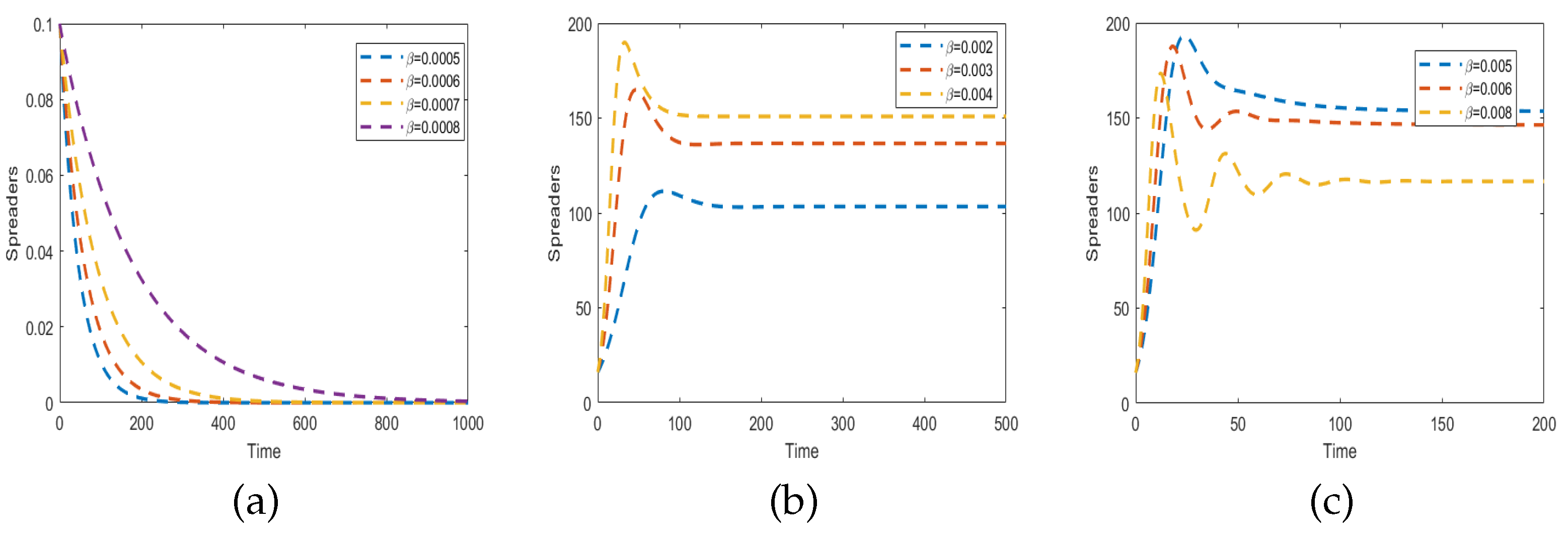
Figure 1a shows that rumors will eventually disappear. In addition, we also obtained that the stable time increases significantly as
goes up. Then, we selected
,
, and
, respectively. By calculations, we obtained that system (
1) has a unique rumor-endemic equilibrium which is globally asymptotically stable. It can be seen from
Figure 1b that the larger the
, the larger the peak value of the spreaders. However, with a further increase in
, due to the nonlinear functional response, it is shown that the peak value of the spreaders decreases (see
Figure 1c), which is different with a linear functional response.
7.2. The Effect of the Delay
Now, we explore the effect of delay on the numbers of spreaders. Let the parameters be same as in
Section 7.1. First, we let the parameter
. From the above discussions, we know that the rumor-free equilibrium
is globally asymptotically stable. We consider that the delay
takes different values
,
, and
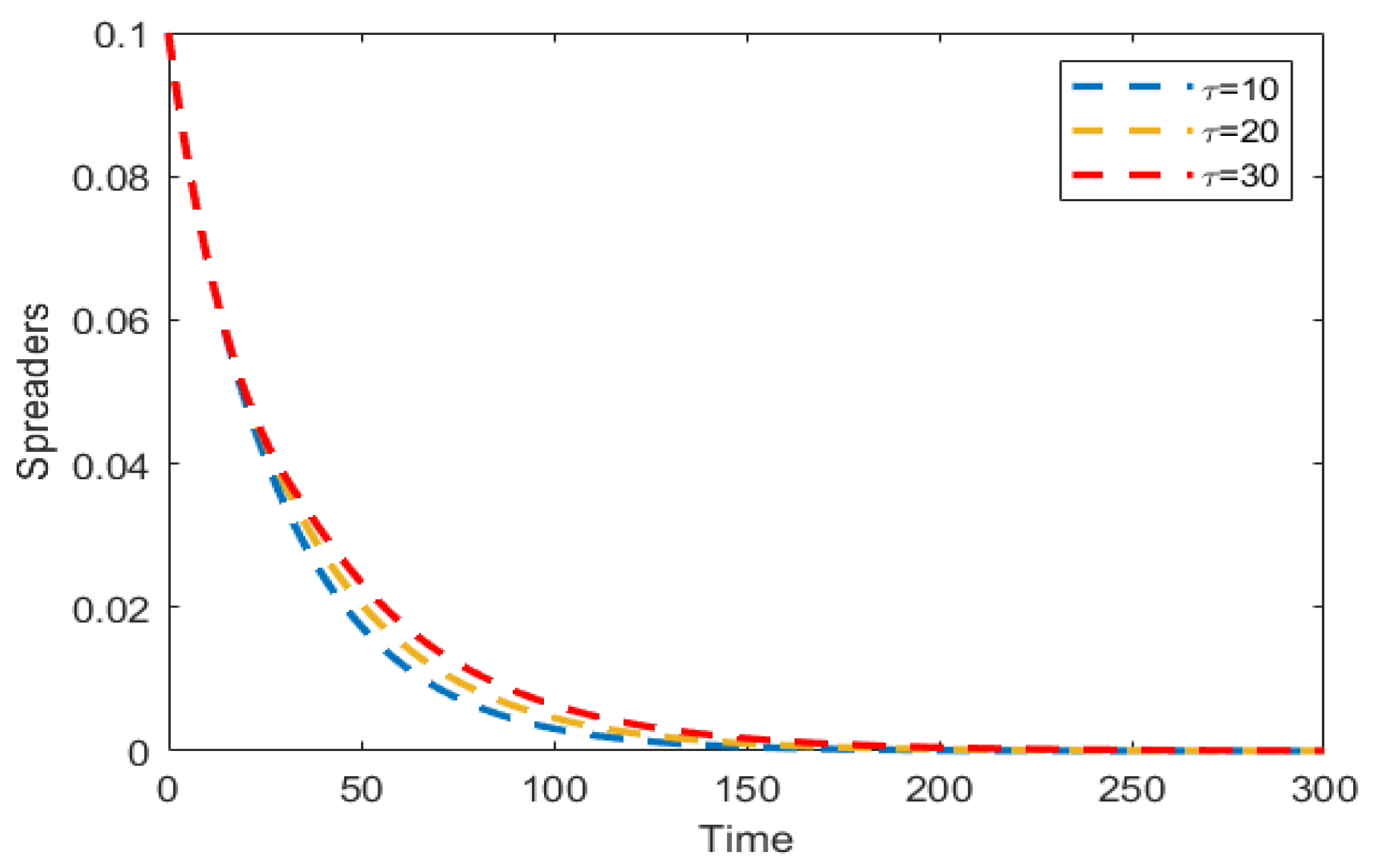
, respectively. From
Figure 2, we observe that as the delay
increases, the stable time increases.
Then, we fix the parameter
and change the parameter
to
. Through a direct calculation, we obtain that system (
1) has a unique rumor-endemic equilibrium
. According to Theorem 6, we obtain that the critical value
, which means that the rumor-endemic equilibrium
is locally asymptotically stable when
, and unstable when
. We selected
,
, and
.
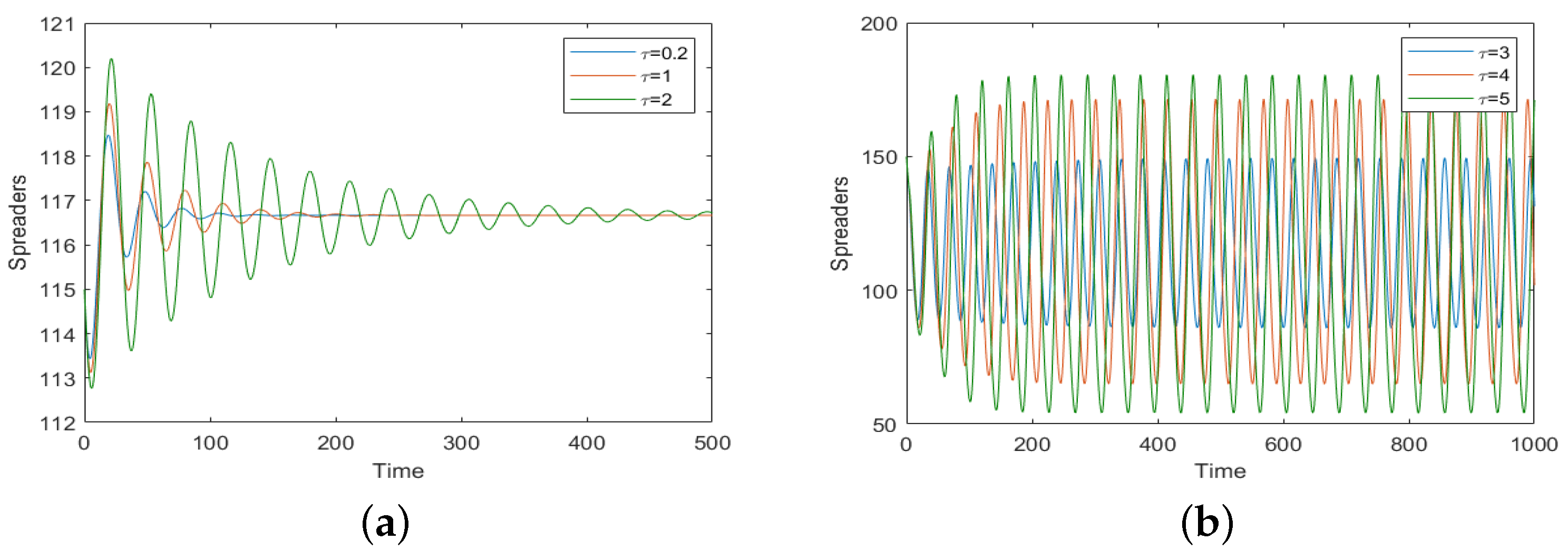
Figure 3a shows that when the time delay
increases, it will take more time for the number of spreaders to reach the positive constant. Finally, if the delay
is large enough, the spreaders will lose their stability (see
Figure 3b), where
,
, and
. This shows that with the increase in time delay, the amplitude increases.
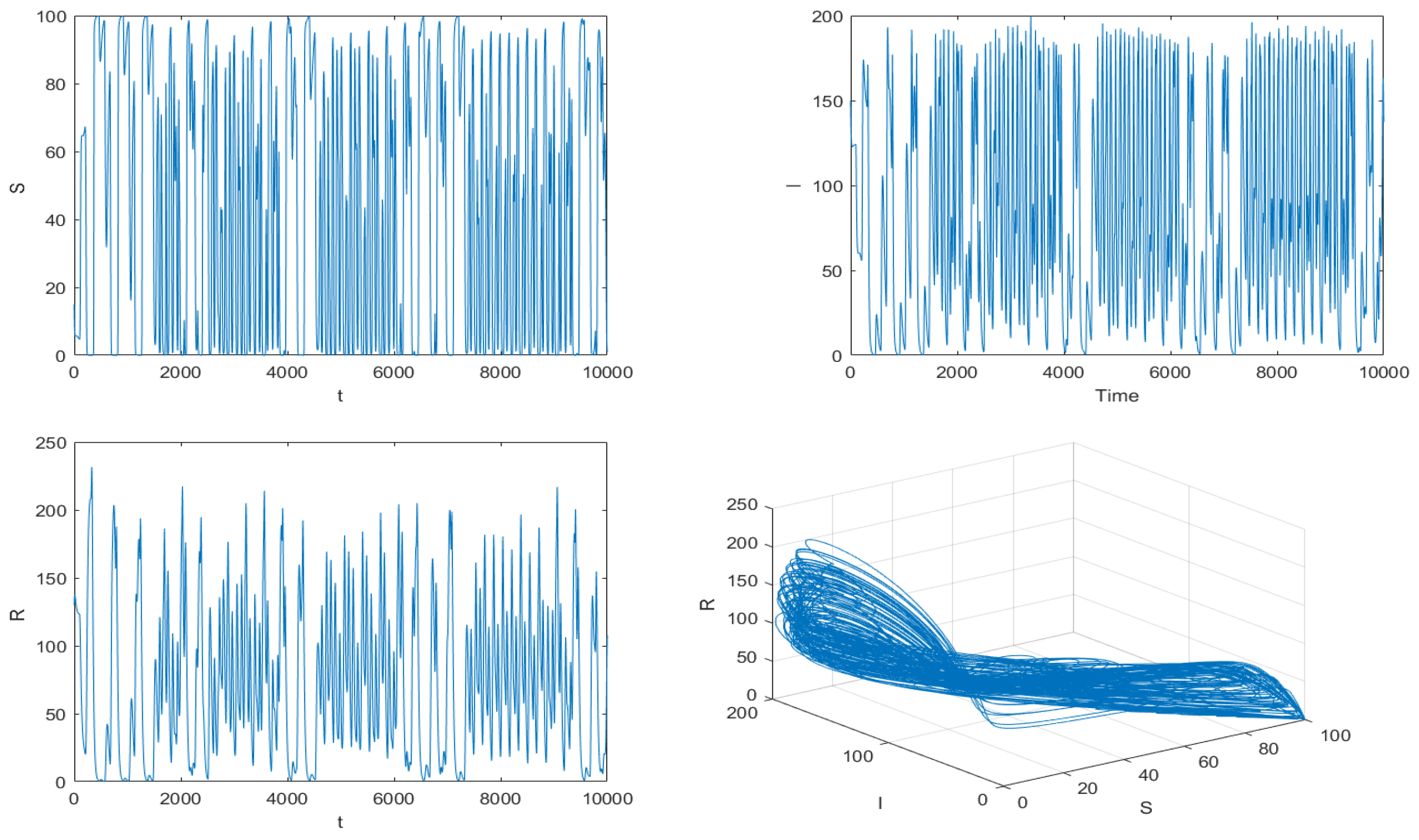
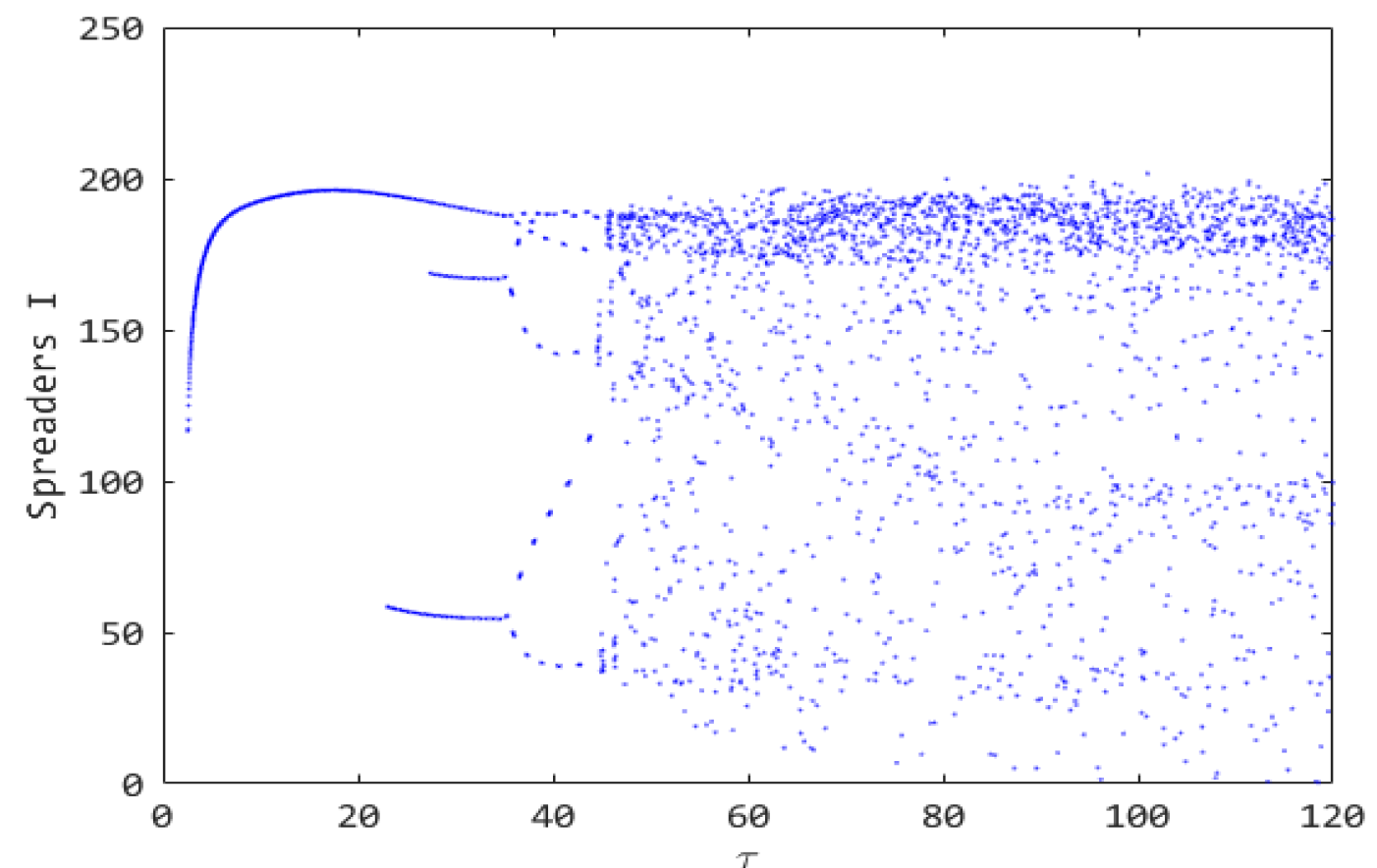
However, with increasing time delay, we can see that the system has a chaotic solution (see
Figure 4). Let
vary in
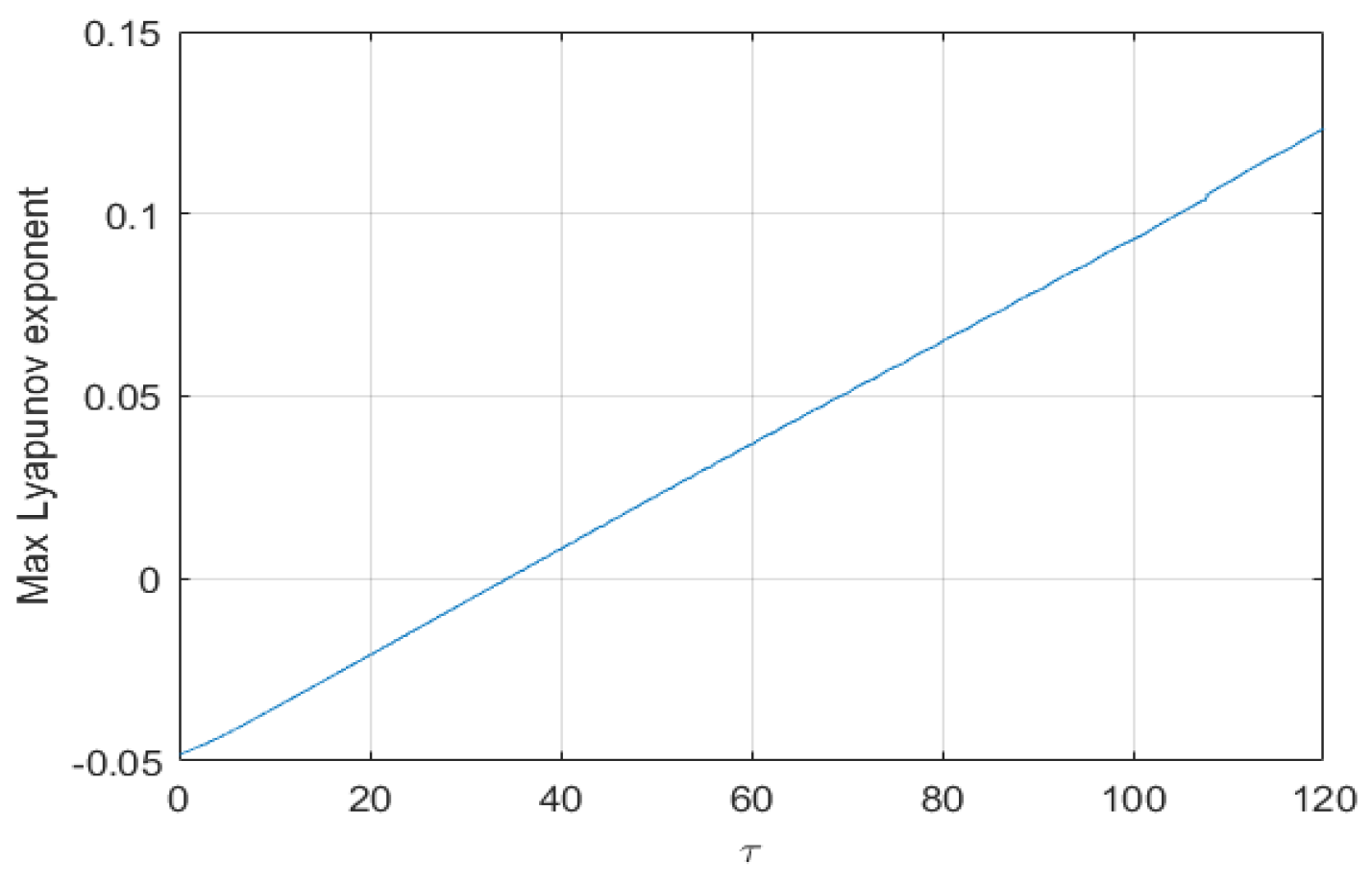
. We computed the largest Lyapunov exponent and drew the bifurcation map of system (
1).
Figure 5 shows that the changing process of the system from the period-doubling bifurcation into chaos.
Figure 6 shows that the largest Lyapunov exponent is greater than zero when
is greater than some threshold value, which is in accordance with the bifurcation map. In reality, the emergence of chaos makes rumors more difficult to control.
Remark 2. In this part, we report our use of the classical Runge–Kutta method to simulate Hopf bifurcation and chaos, which can reflect the inherent characteristic of the system.
7.3. Numerical Simulation for Optimal Control
In this section, we present some numerical simulations to illustrate the effects of optimal control. The parameters of system (
45) were chosen to be those in
Table 2.
In the simulation, we studied and compared numerical findings in the following three different ways for controlling the propagation of rumors. The impacts of various delays in control variables are also discussed.
7.4. Only Reducing the Probability of Rumor Transmission ()
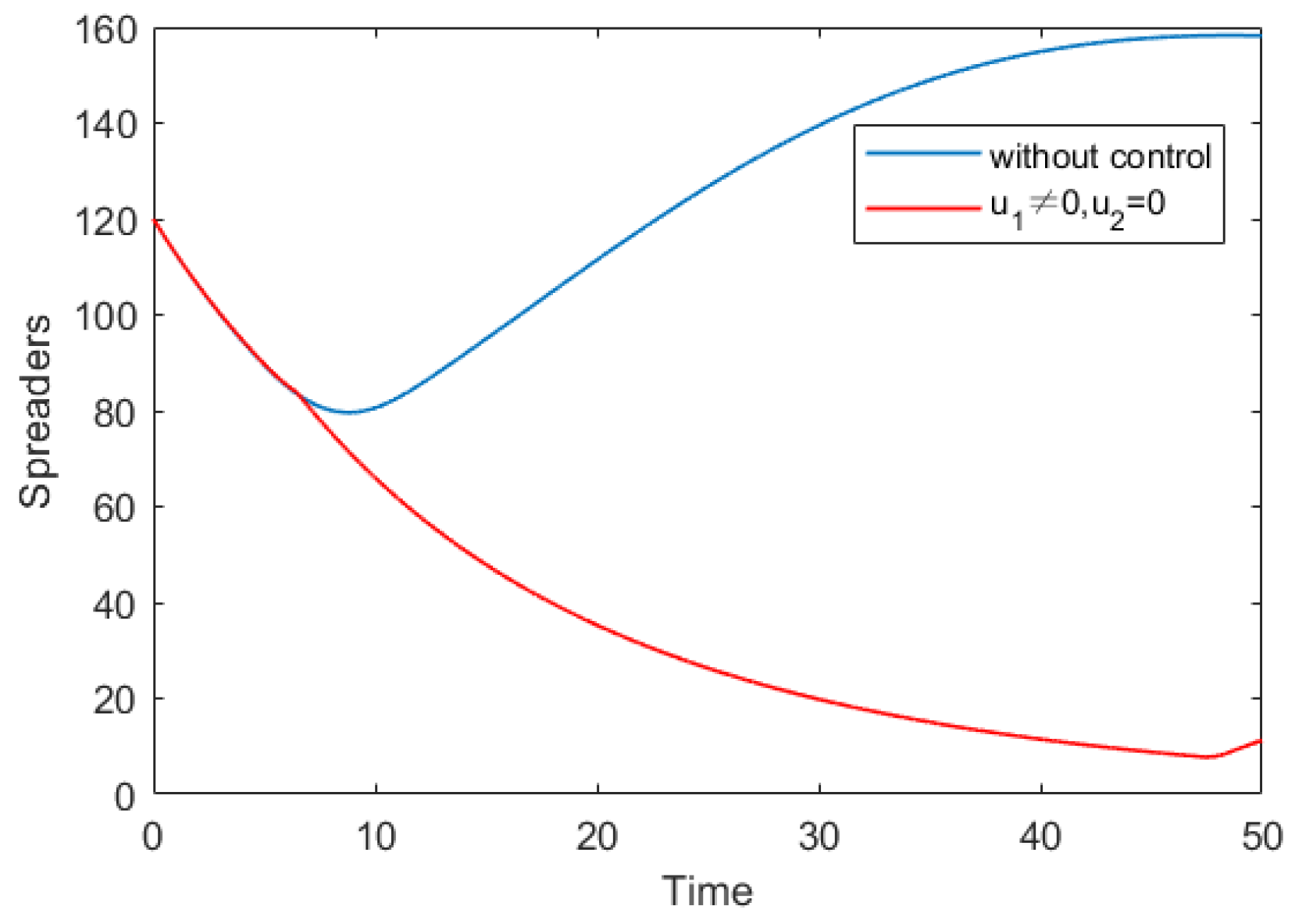
We assume that the government controls rumors only through the promotion of scientific knowledge. The objective function J is optimized using only the control variable , and the control variable is set to zero.
Figure 7 shows that, in the presence of a control
, the number of spreaders decreases fast compared to “without control,” under the effect of scientific knowledge.
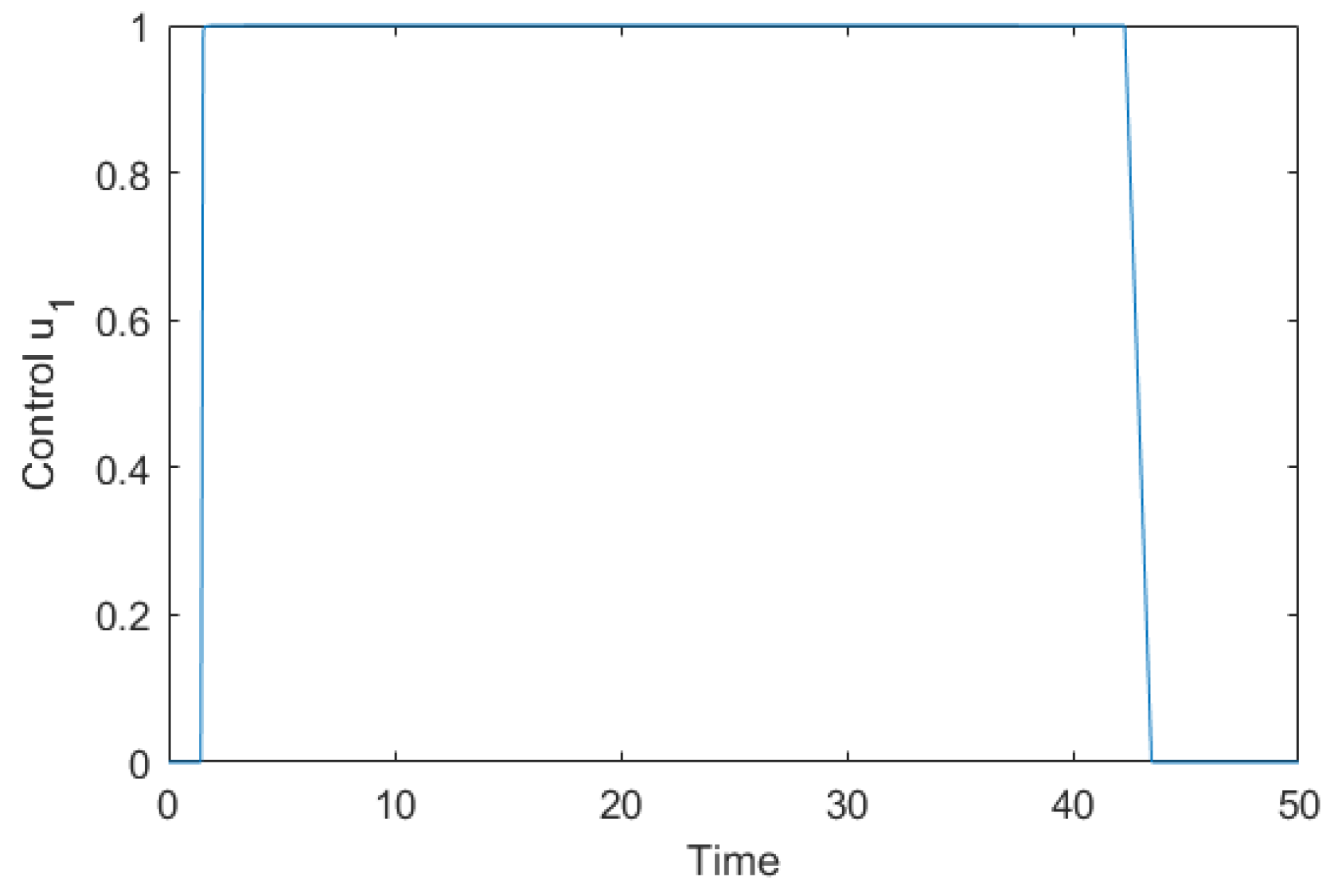
Figure 8 shows the optimal control
. the curve initially rises quickly to the maximal due to the high spreader level, but then quickly declines due to the rumor’s persistent and steady eradication.
We introduce two time-varying control variables and , which represent the cost of reducing the probability of rumor transmission and the strength of deleting posts with spreaders through the sensitization and punishment, respectively.
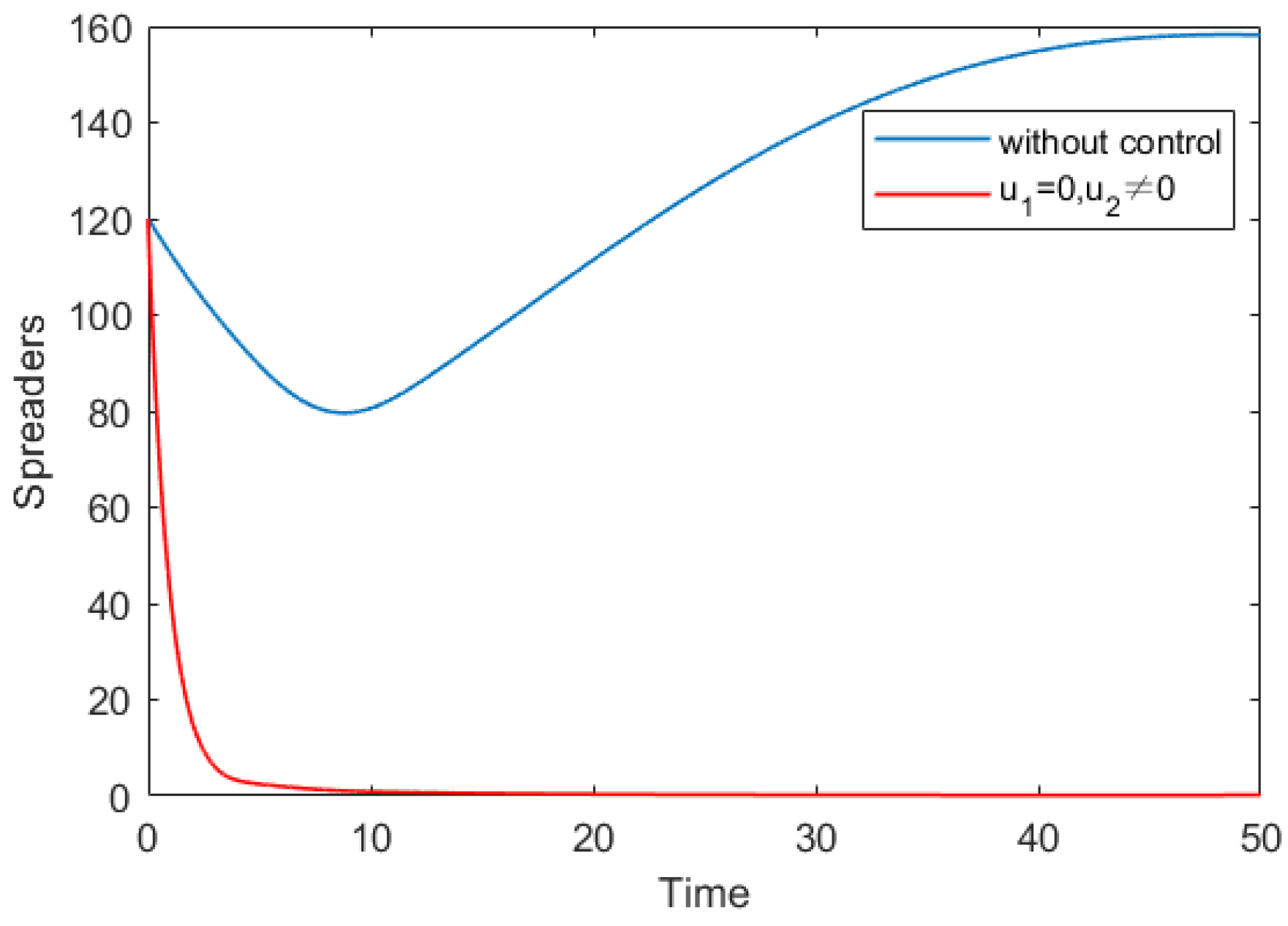
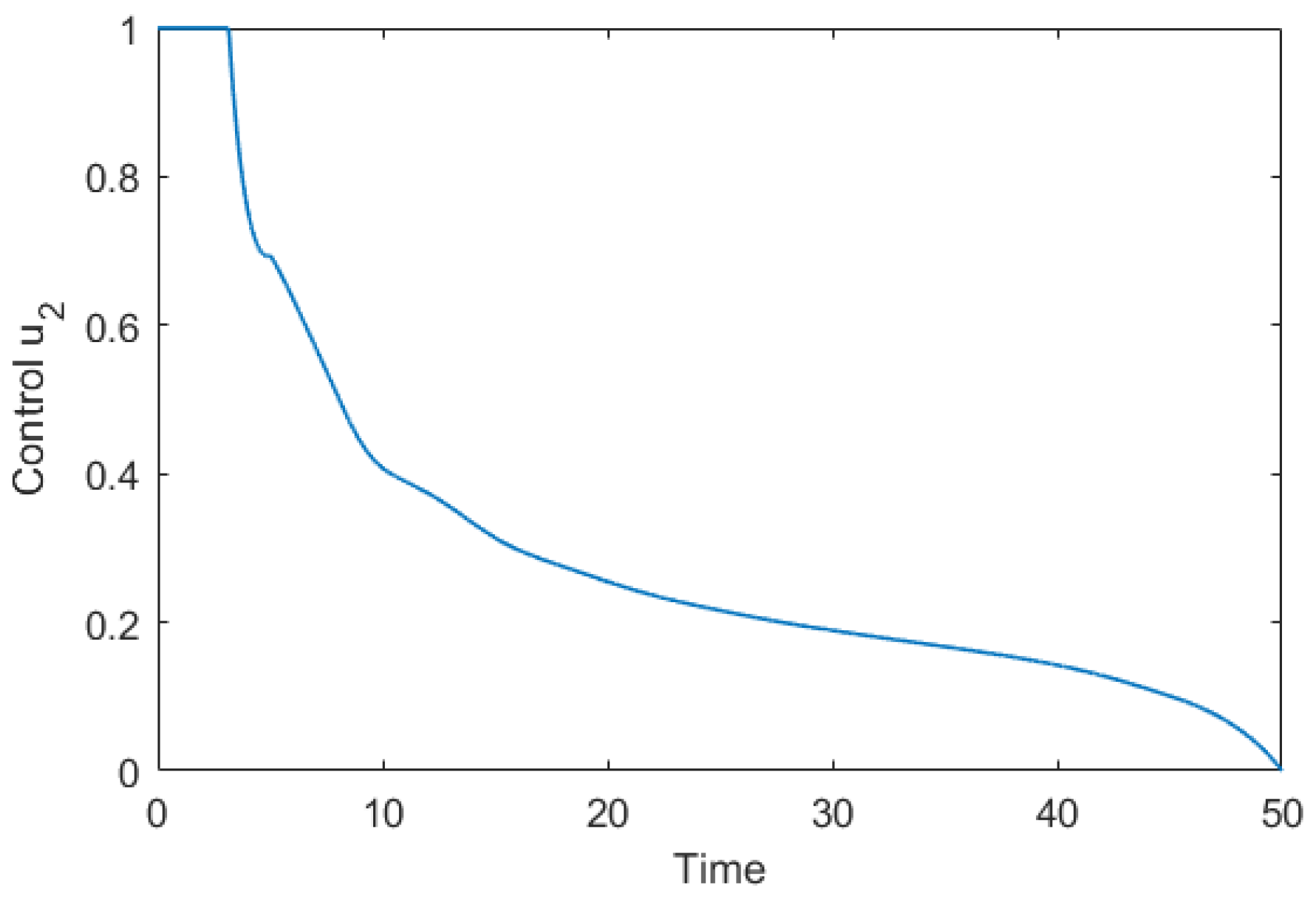
7.5. Only Deleting Posts with Spreaders ()
We suppose that the government only deletes posts with spreaders through the sensitization and punishment, which means that the control variable is set to zero, and only the control variable is used to optimize the objective function J.
Figure 9 shows that, in the presence of
, the number of spreaders quickly decreases to zero compared to “without control.”
Figure 10 shows the optimal control of
. The curve is highest at the beginning because punishment is critical in the event of a high uninformed level. It then gradually decreases because of the constant and steady eradication of the rumor.
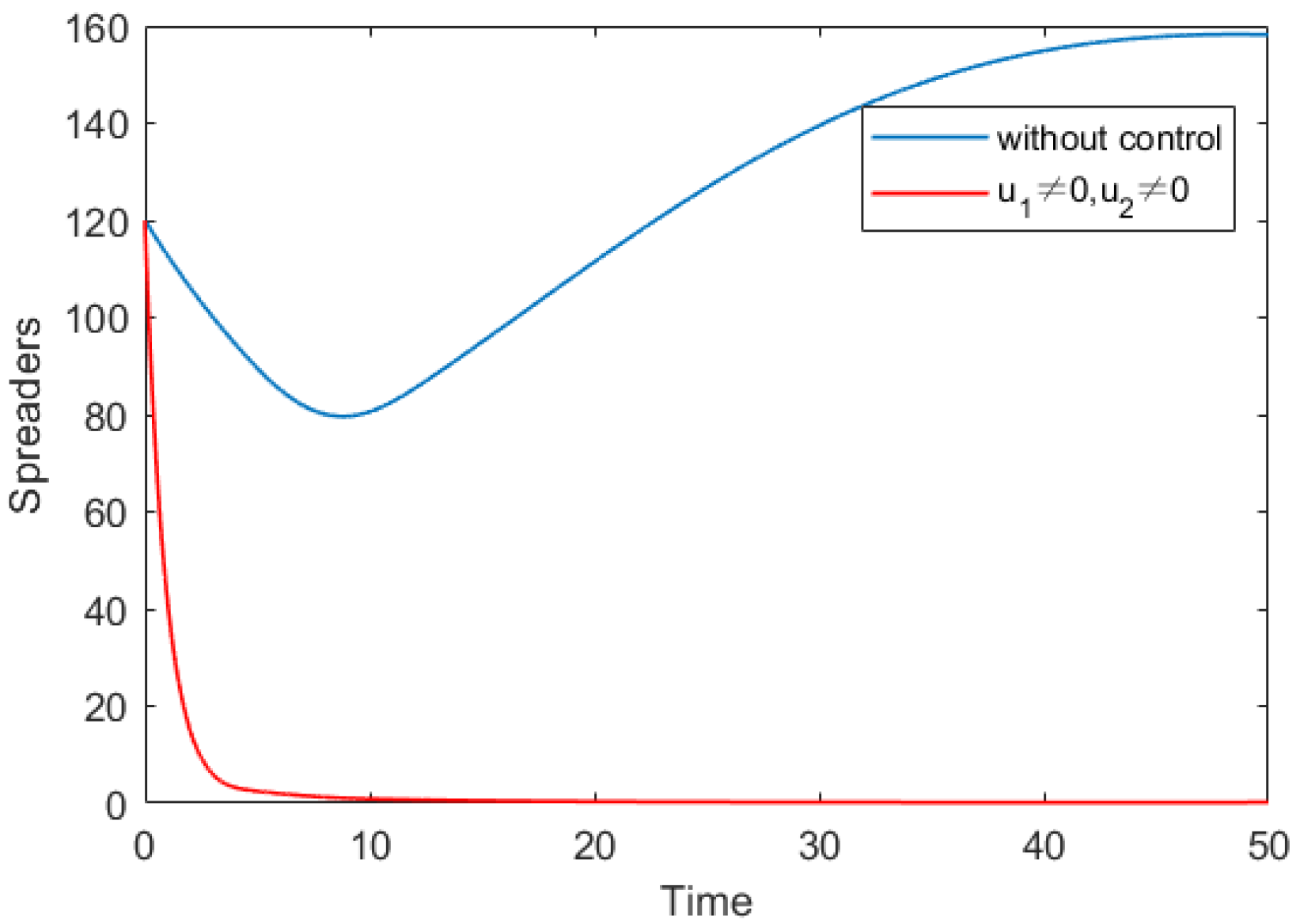
7.6. Combining the Two Strategies
In
Figure 11, when comparing the controlled case
and
with the uncontrolled case
, we can detect a noticeable decline in the number of spreaders. Thus, the comparison demonstrates that combining two control measures is successful in suppressing rumors; not only can the number of spreaders be decreased significantly, but the costs of two control strategies may also be significantly lowered.
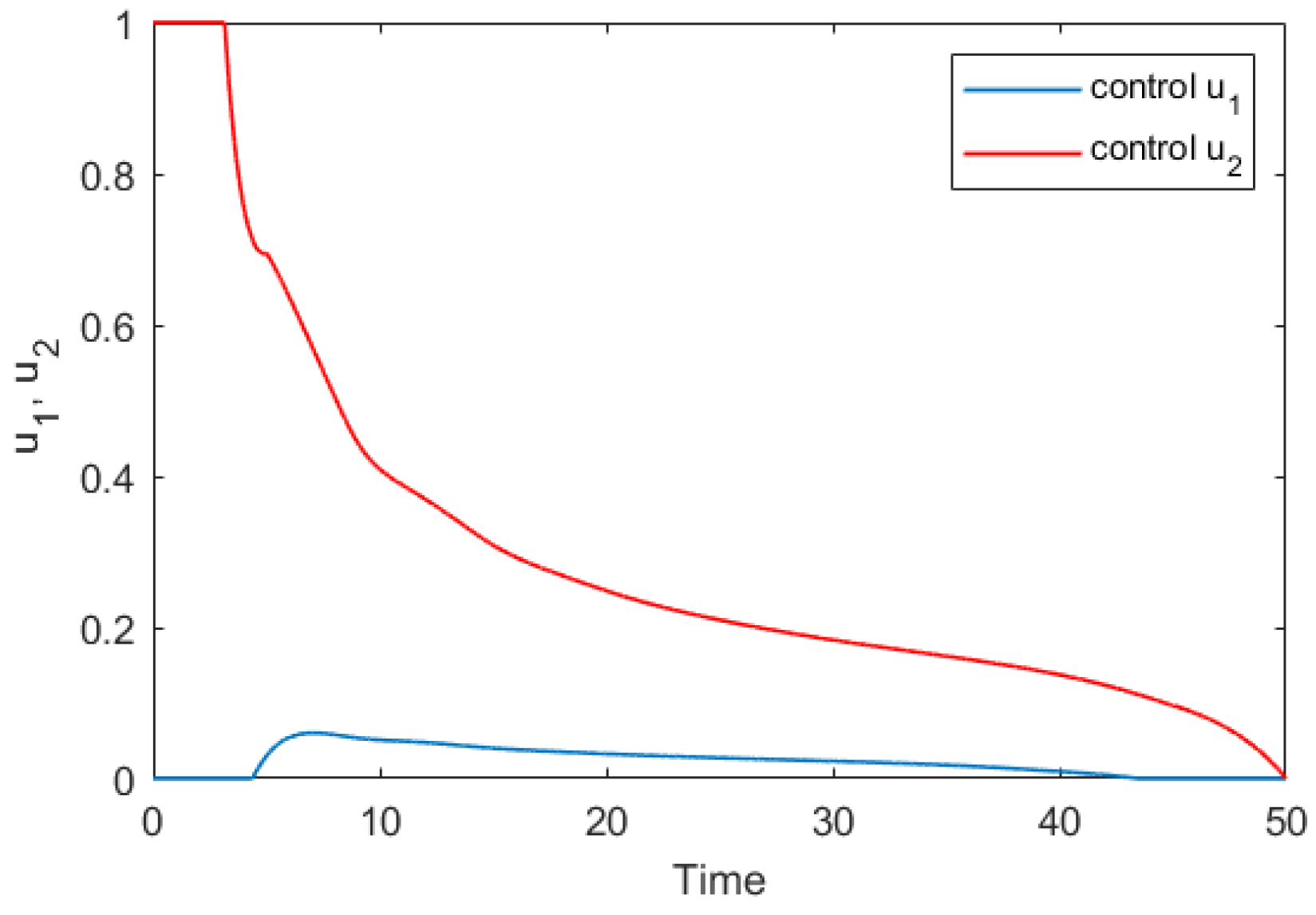
Figure 12 represents the optimal
and
.
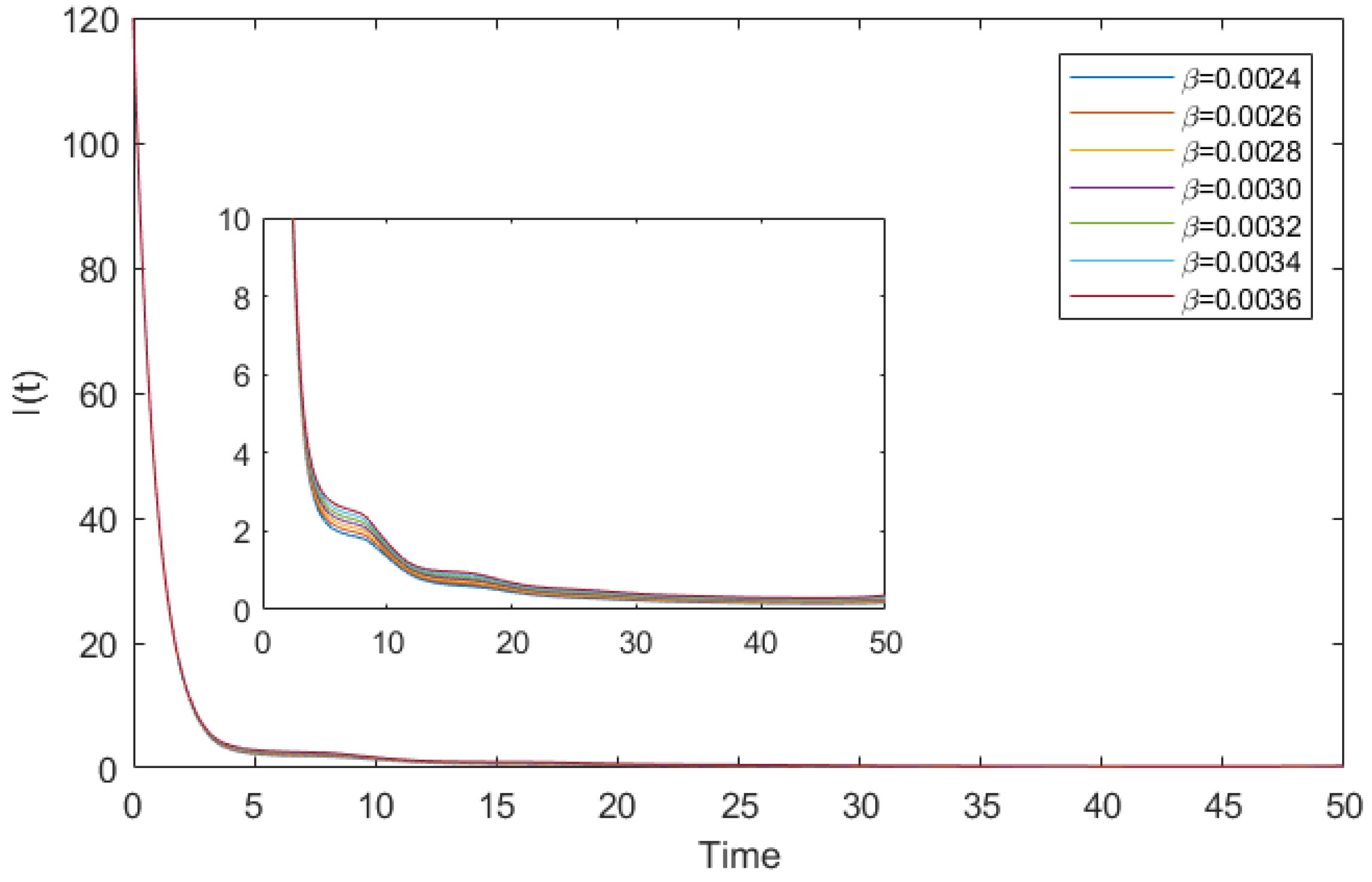
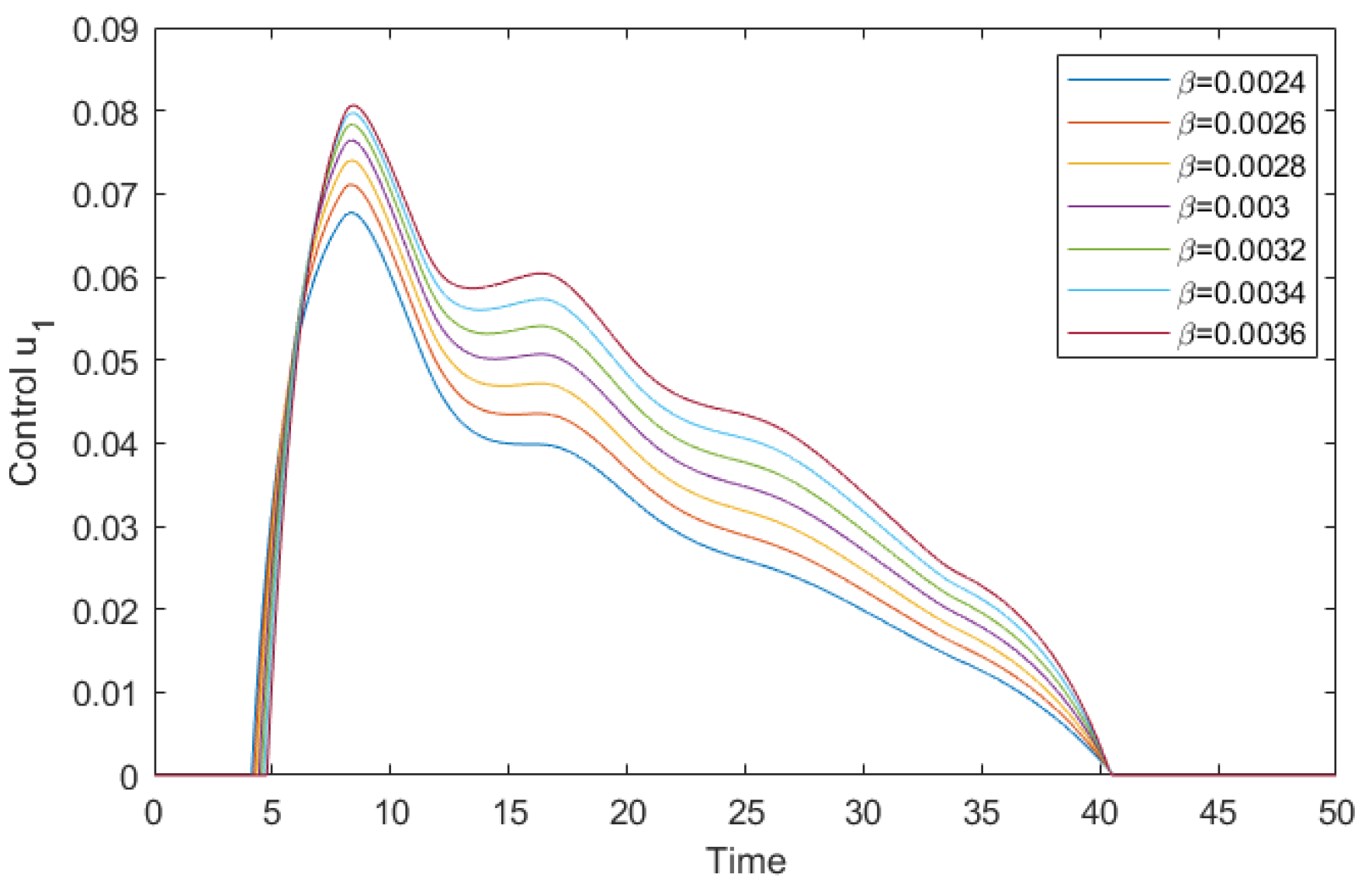
To verify the effectiveness of the control strategy, we chose the parameter
as
,
,
,
,
,
, or
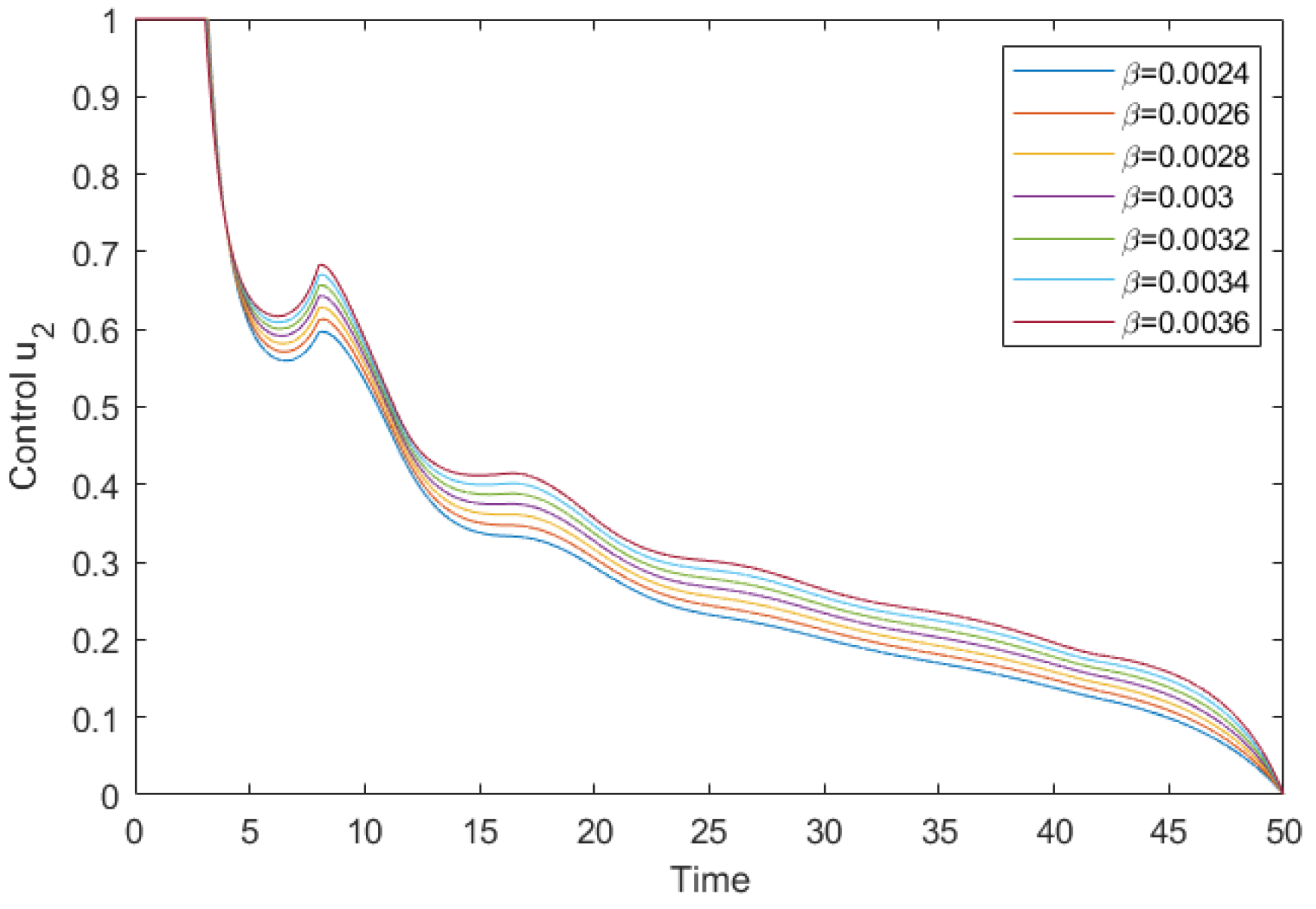
. The control effects are shown in
Figure 13, and the changes in the control
and
are shown in
Figure 14 and
Figure 15. The results show that as the parameter
changes, so does the corresponding controller, and the system control still achieves very good results.
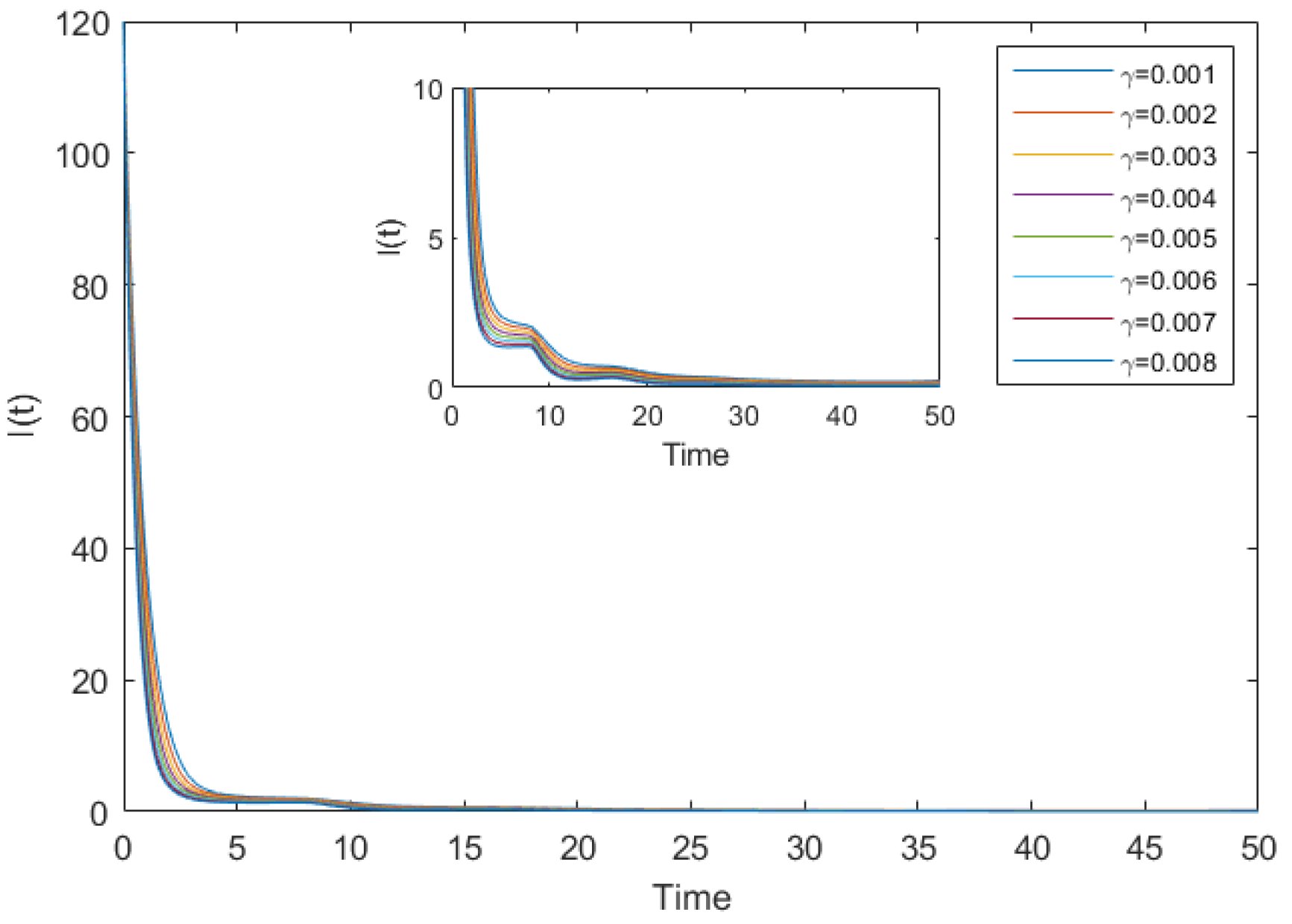
Similarly, we set the parameter
,
,
,
,
,
,
, or
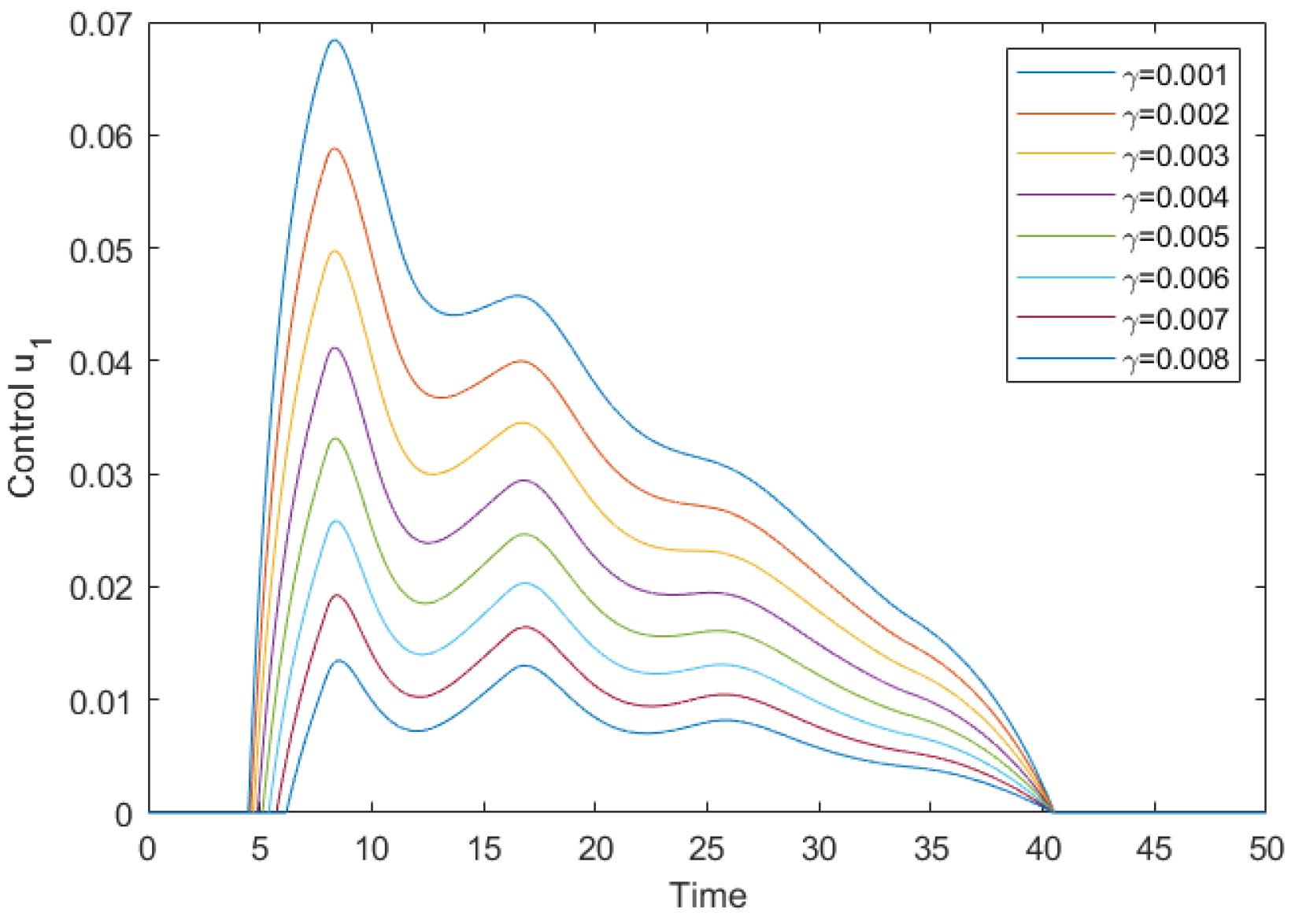
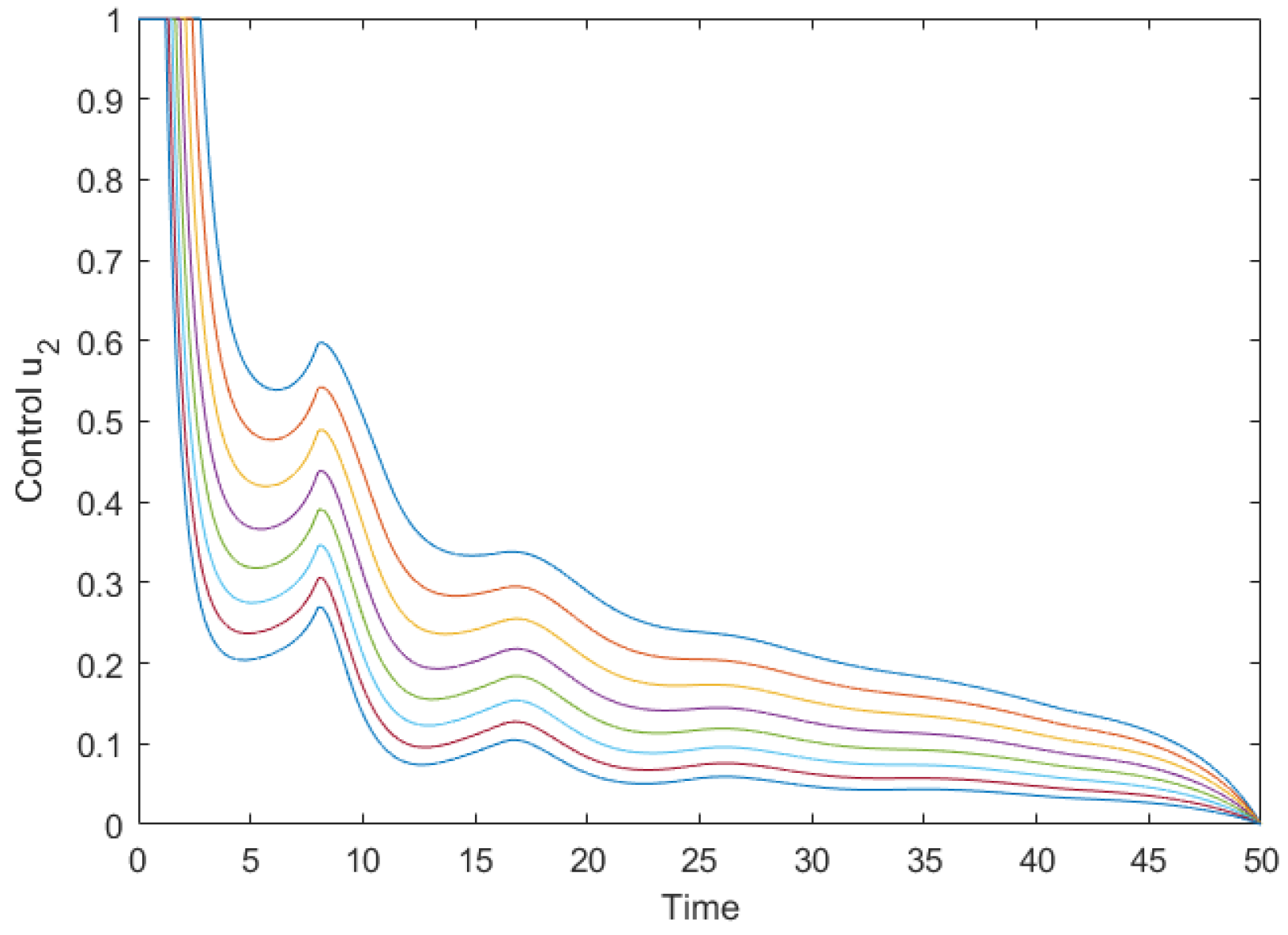
. The control effects are shown in
Figure 16, and the changes in the control
and
are shown in
Figure 17 and
Figure 18. The results show that as the parameter
changes, so does the corresponding controller, and the system control still achieves very good results.
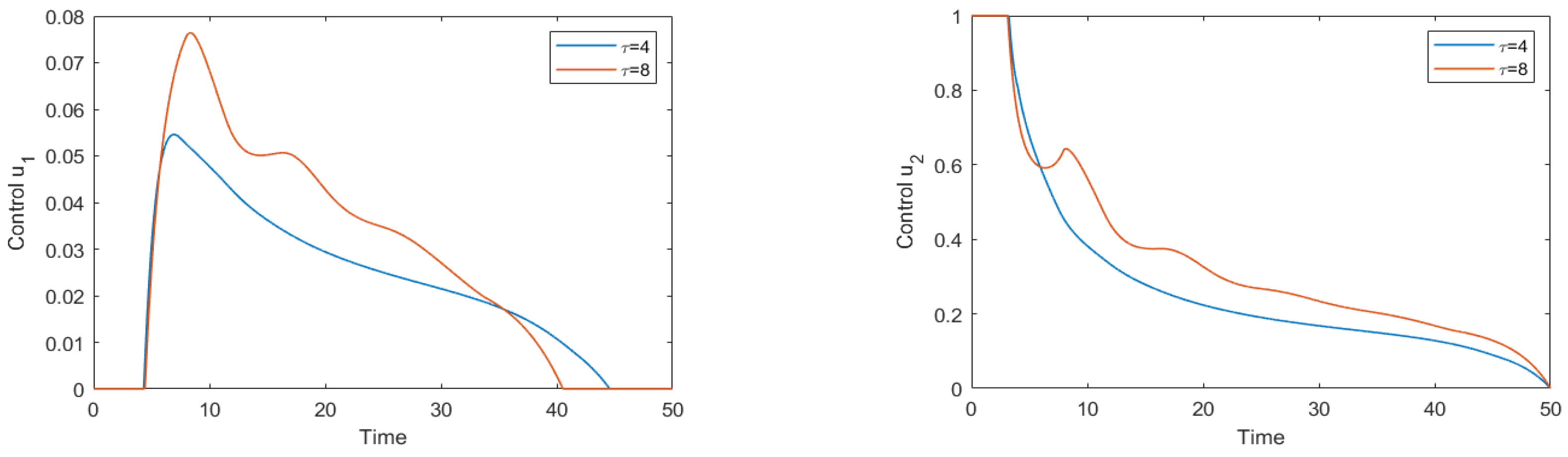
7.7. The Impact of Delay on Control Variables
In order to investigate the effect of delay
, let the parameters be same as above, and fix the other parameters. Then, the control variables
and
for two different values of time delays,
and
, are represented in
Figure 19.
The figure shows that
and
are bigger when the delay is bigger. There are many people who get vaccinated when the delay is long. We also treat many people who spread it. Thus, with a longer time delay, the cost of controlling things will keep going up.
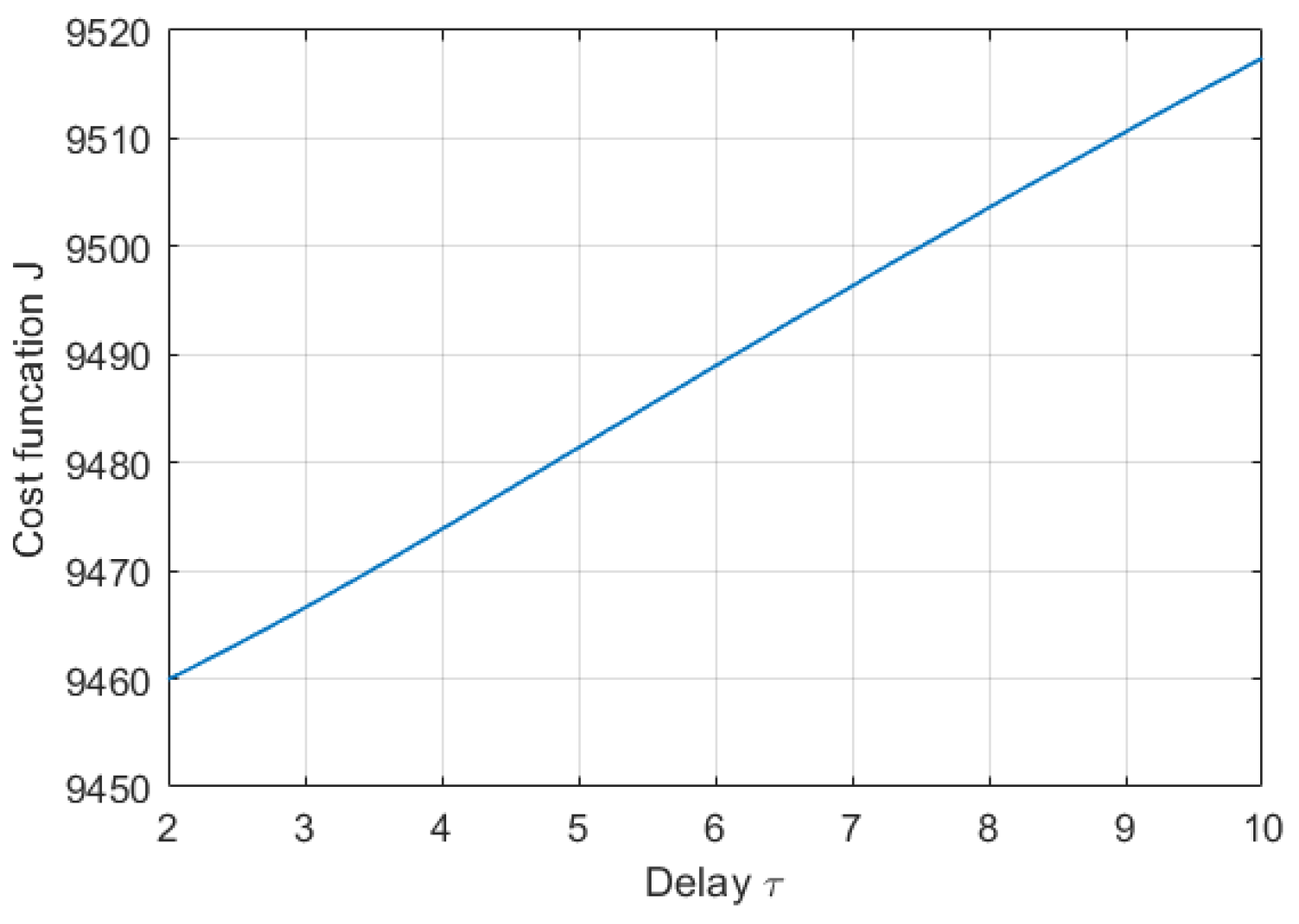
Figure 20 shows that the cost of controlling something increases if someone is not paying attention to the rumor for a long time before trying to get rid of it. This is because the person is not paying attention. A spreader who thinks about spreading the rumor for more time becomes more and more important when he or she does.
8. Discussions and Conclusions
In this work, we considered a rumor-spreading model with delay. We proved the existence, non-negativeness, and boundedness of the solution of the model. We established the conditions for the existence of the rumor-endemic equilibrium. The local stability and the Hopf bifurcation induced by the delay were analyzed. By constructing Lyapunov functions, we studied the global stability of the rumor-free equilibrium and rumor-endemic equilibrium. Numerical simulations showed that the delay is a sensitive factor for the system. It can lead to not only Hopf bifurcation but also chaos.
To reduce the number of the spreaders, we introduced two control strategies to the delayed model to study the optimal control of the system. One is that by removing posts from the infected website, we can eliminate rumor-related content and decrease the proportion of infected media. The other is that by teaching popular science to people who do not know much about it, revealing the real information, and making it easier for people who do not know much about something to tell the difference, the spreaders will immediately become removal individuals.
No matter which technique the government picks, they are all beneficial in minimizing the spread of misinformation. However, when combined, not only can the number of spreaders be decreased to a greater level, but so can the cost of two control measures. In response to rumors, it is realistically significant. On the one hand, the government should initially push scientific information to the people via telephone, television, and the Internet, and then prevent the turning of ignoramuses into disseminators. Alternatively, given the prevalence of rumors, officials should release some official information to steer public opinion and quell popular outrage, so facilitating the transition from rumor spreader to removal individuals. The findings also demonstrated that the government should not ignore the impact of time delay while dealing with the rumors, as missing the window of opportunity to dispel bad public perception would come at a great cost. Consequently, the government’s response needs to be lightning fast so that it may seize the initiative and gain the backing of network public opinion.
These findings contribute to the establishment of rumor-control policies. The work has crucial implications for efficiently anticipating and limiting rumor transmission.