1. Introduction
Play has long been recognized as a central context for children’s learning and development in early childhood (
Courtois et al., 2024). Within this context, play provides an important setting for the emergence of early mathematical understanding, as children engage with quantitative, spatial, and relational aspects of their environment. At the same time, although early mathematical learning has received increasing scholarly attention, the everyday contexts in which such learning unfolds remain insufficiently theorized. Through playful interactions with objects, people and their surrounding environment, young children and toddlers explore ideas, experiment with possibilities and gradually construct understandings about the world around them. For example, infants can distinguish and respond differently to variations in visual configurations, suggesting an early sensitivity to quantitative and spatial relations (
Demetriou et al., 2024). Such observations raise important questions about how parents’ everyday interactions may contribute to the initial construction of mathematical meanings. Simple activities such as sharing toys equally or counting pieces of fruit during daily routines illustrate how mathematical ideas can emerge in meaningful ways within family life (
Barkai et al., 2025).
In this context, the role of parental mediation becomes particularly relevant for understanding how learning opportunities are shaped beyond formal educational settings. This highlights the importance of considering parents not only as supporters of learning but as active mediators who shape the conditions under which mathematical meaning-making takes place. Parental mediation in play-based learning should therefore not be equated with reproducing classroom-like instructional practices in the home. Rather, it involves guiding attention, encouraging reflection and co-constructing meaning through shared participation in playful activities. Understanding how these processes unfold requires examining the interaction between children’s exploration, parental practices, and broader educational influences (
Fung & Chung, 2024).
Within educational research, play has been widely associated with cognitive development, social interaction and the development of language and reasoning skills (
Parker et al., 2022). In recent years, however, concerns have been raised about the decreasing presence of play in early childhood educational settings, as increasing academic expectations have shifted attention toward more structured learning practices both at school and at home (
Gayon, 2025;
Samara & Clements, 2009). This shift invites renewed consideration of how and where early learning opportunities are conceptualized and supported.
Mathematical competencies developed during early childhood have been identified as strong predictors of later school achievement and broader cognitive outcomes (
Vogt et al., 2018). Consequently, scholars and educators increasingly emphasize the importance of providing meaningful opportunities for young children to engage with mathematical ideas. Play-based learning has been widely proposed as an effective pedagogical approach for supporting such engagement (
Li, 2024). Importantly, early mathematical learning extends beyond the recognition of arithmetic symbols to include experiences related to many other mathematical concepts. These experiences often emerge as children actively construct knowledge through interaction with materials, peers and adults rather than simply receiving information through direct instruction (
Perry & Dockett, 2011).
Early mathematical learning does not occur exclusively within formal educational settings. Young children spend a substantial portion of their time within family environments, where everyday interactions with parents and other family members provide opportunities for exploration, communication and shared activities. Adults, however, may not always recognize the mathematical potential of everyday play situations. They may benefit from guidance that helps them notice how activities such as board games, organizing objects, storytelling, or exploring natural surroundings can support young children’s problem solving and mathematical thinking. Research has shown that parental involvement can influence children’s academic achievement, motivation, and attitudes toward learning (
Panaoura & Nitsiou, 2023). Despite the recognized importance of parental involvement in early learning, many parents report uncertainty about how they can effectively support their children’s development, particularly in relation to mathematics. Studies examining parents’ beliefs suggest that mathematics is frequently associated with formal school-based practices rather than with informal experiences embedded in play (
Petrou & Panaoura, 2022). As a result, opportunities for mathematical exploration within everyday activities may remain underused.
Although a growing body of research has examined early mathematical learning, parental involvement, and play-based approaches, these strands have often been developed within distinct theoretical traditions. As a result, there is a lack of integrative frameworks that explain how these dimensions interact within everyday family contexts. The present study addresses this conceptual gap by proposing a model that brings together these perspectives in order to better understand how early mathematical learning emerges through socially mediated play experiences.
In many educational systems and policy contexts, particularly in early childhood education frameworks across Europe and internationally, early mathematical learning continues to be associated primarily with the acquisition of symbolic knowledge and school-like practices, both within educational settings and in family environments. This tendency may limit recognition of how mathematical understanding first emerges through participation in socially mediated activities embedded in everyday life (
OECD, 2025). The present study adopts an integrative conceptual approach in order to propose a model of play-based mathematical learning through parental mediation. Rather than conducting a systematic or scoping review, the literature was selected based on its relevance to the key conceptual dimensions of the proposed framework, including play-based learning, parental mediation, family practices, and ecological perspectives. These dimensions were derived through the synthesis of recurring themes identified across these strands of literature. Drawing on cultural–historical perspectives on play, guided play approaches, research on family learning environments and ecological perspectives on home–school collaboration, the study illustrates how early mathematical learning may emerge through the interaction of playful activity and adult mediation within everyday contexts. By proposing this conceptual model, the paper contributes to ongoing discussions about how play-based experiences across home and educational environments support children’s early mathematical development (
Junge et al., 2021). Existing research has provided important insights into each of these areas; however, these contributions often remain theoretically fragmented. For example, studies on parental involvement tend to focus on beliefs and practices, while play-based learning research emphasizes pedagogical processes, and early mathematics research often addresses cognitive outcomes. This study addresses this conceptual gap by offering an integrative framework that brings these perspectives together. The originality of the proposed model lies not in introducing new isolated constructs, but in integrating existing theoretical perspectives into a unified framework that conceptualizes early mathematical learning as an emergent process shaped through the interaction of play, parental mediation, and everyday participation across contexts.
2. Theoretical Framework
2.1. Play and Early Mathematical Learning
Research consistently shows that mathematical competencies developed during early childhood are strong predictors of later academic success and school achievement (
Demetriou et al., 2022). Skills such as number recognition, counting, ordinality and understanding quantities form a foundational basis for later mathematical learning and broader educational outcomes (
Vogt et al., 2018). In early childhood settings, play-based pedagogy enables children to engage actively with mathematical concepts through exploration, manipulation of objects and participation in meaningful activities (
Perry & Dockett, 2011). While these findings are situated within early childhood educational settings, similar processes can also be observed in everyday family routines, where children engage in activities that involve comparison, classification, and counting. As
Lazzara et al. (
2025) underline, in these contexts, children do not simply receive mathematical knowledge but actively construct understanding through interaction with materials, peers and adults. Routine family practices, such as hanging clothes together and counting clothespins, can therefore become occasions for noticing quantity and comparison. Although play and everyday family routines are not identical, both can provide meaningful contexts for children’s engagement with mathematical ideas.
Playful situations often bring mathematical relations into children’s immediate attention. For example, activities such as building with blocks, sorting objects, sharing materials, or engaging in pretend play naturally involve mathematical ideas including counting, measurement, grouping, comparison, early numeracy, patterning, spatial reasoning, and mathematical language. These informal mathematical encounters enable children to develop early mathematical thinking in ways that are closely connected to their everyday experiences (
Perry & Dockett, 2011). Yet such opportunities do not automatically lead to learning; they require adults who are able to recognize and extend them through intentional interaction.
Through these interactions, children gradually appropriate mathematical language and concepts as tools for thinking and communication.
Lundvin and Palmer (
2025) present a Swedish study examining how children aged 2–3 years experience mathematical concepts through representations in play-based teaching. Their findings indicate that children were more often afforded opportunities to hear mathematical concepts than to express them verbally themselves. Their findings suggest that while play-based teaching creates opportunities for encountering mathematical concepts, it may not always support children’s active expression of these ideas.
Studies comparing play-based mathematical activities with traditional training programmes have found that play-based approaches lead to significant learning gains, particularly for children with higher initial competencies (
DePascale & Ramani, 2025). Such approaches are often perceived by educators as better suited to addressing the diverse needs and abilities present in early childhood classrooms (
Vogt et al., 2018). During collaborative play activities, children frequently justify their ideas, explain strategies, and negotiate solutions with peers. These interactions enable the use of gestures, objects, and language to express mathematical ideas, demonstrating how reasoning and argumentation can emerge naturally within playful contexts (
Nergard, 2023). By engaging children in active participation rather than passive reception of information, play-based approaches encourage deeper conceptual understanding and foster positive attitudes toward mathematics (
Louw & Claassens, 2025).
2.2. Cultural-Historical Perspectives on Play
Cultural–historical theory offers a powerful lens for understanding why play occupies a central role in early development.
Vygotsky (
1967) viewed play not simply as a spontaneous activity of childhood but as a leading factor in development, emphasizing that through play children operate beyond their everyday level of functioning and demonstrate emerging developmental capacities. Play provides a context in which children are able to “jump above the level of their normal behaviour” (
Bodrova & Leong, 2015, p. 371), revealing developmental tendencies that may not yet be fully established in other activities.
This perspective is particularly relevant when considering how mathematical meanings are co-constructed in everyday interactions. Through participation in shared practices, children gradually internalize cultural meanings. In this process, basic psychological processes are reorganized into higher mental functions such as intentional thinking, voluntary attention and conceptual reasoning (
Han & Li, 2025). These functions initially appear in social interaction and only later become internal psychological processes, reflecting the broader Vygotskian principle that development occurs first on the social plane and subsequently on the individual plane (
Bodrova & Leong, 2015).
A central characteristic of play in the cultural–historical tradition is the creation of an imaginary situation. Such imaginary situations reorganize how children relate to objects, actions and social roles. Vygotsky argued that play emerges when children construct imagined scenarios governed by implicit or explicit rules that organize their actions within the play context (
Colliver & Veraksa, 2019). Even simple play activities involve the construction of an “as-if” reality in which objects and actions acquire symbolic meanings. For example, children playing “cops and robbers” create a shared imaginary scenario structured by rules that define the roles and behaviours of participants (
Colliver & Veraksa, 2019). The presence of such imaginary situations allows children to experiment with meanings, roles and social relationships, thereby extending their cognitive and social capacities. At the same time, in playful contexts, these interactions support the creation and negotiation of symbolic meanings embedded in social relationships and supporting processes of self-regulation (
Hao & Fleer, 2016). Play therefore creates a developmental arena in which emerging competencies can be explored, negotiated and gradually stabilized through interaction (
Utami & Yus, 2025). These perspectives also provide a foundation for understanding how such processes extend beyond educational settings and become embedded in everyday family practices.
2.3. Guided Play and Adult Mediation
Guided play has emerged as a significant pedagogical approach for understanding how adult support can enrich children’s playful learning experiences (
Cade, 2023). It is commonly conceptualized as a “middle ground” between free play and direct instruction, combining the motivational qualities of child-directed activity with purposeful adult scaffolding (
Skene et al., 2022). In this approach, children retain agency over their play while adults subtly guide interactions toward meaningful learning opportunities.
Within the broader framework of play-based learning, guided play is typically characterized by three core elements: (a) adults establish a broad learning intention when organizing the playful context, (b) children exercise choice and initiative in their actions, and (c) adults provide flexible forms of support, such as posing open-ended questions, modelling strategies, offering hints, or redirecting attention in response to children’s interests (
Skene et al., 2022).
From a sociocultural perspective, the effectiveness of guided play can be understood through the role of adult participation in extending learning beyond what children could achieve independently. Timely support during play can help children engage with challenges, sustain attention, and reflect on their activity, thereby broadening learning possibilities (
Dier, 2025). In this sense, guided play can function as a developmental context in which exploration is supported through responsive scaffolding.
Adult involvement may include organizing play environments, introducing narrative elements, participating in role play, and co-constructing imaginary situations that expand children’s experiences (
Hakkarainen & Bredikyte, 2019). Such findings challenge long-standing assumptions that adults should remain passive observers of children’s play (
Blinkoff et al., 2023). Research on joint play interactions further indicates that adults who actively engage in shared play tend to demonstrate higher levels of empathy, reciprocal communication, and positive relational engagement with children (
Fuertes et al., 2024). These interactional qualities contribute to supportive relational climates that foster exploration and learning while strengthening the social dimensions of play.
2.4. Family Practices and Funds of Knowledge
Building on the cultural–historical perspective on play outlined in the previous section, this section extends the discussion to everyday family practices as key contexts in which these processes unfold. Such practices are particularly significant when examining how mathematical meanings emerge within family life (
Schousboe & Winther-Lindqvist, 2013). Through engagement in shared routines, children gradually appropriate cultural meanings that organize their actions and interpretations. Over time, these socially structured interactions become internal psychological resources (
Bodrova & Leong, 2015).
Within family environments, playful interactions often function as a primary medium for engaging with culturally organized ways of thinking.
Mamlok and Kredl (
2026) argue that recognizing the sociocultural dimensions of children’s play provides insight into how they internalize, reproduce and negotiate social norms, as well as how they develop understandings of themselves and others. In these interactions, symbolic signs and meanings are not predetermined but emerge dynamically through shared activity and dialogue (
Hao & Fleer, 2016). Such processes illustrate how learning is embedded in everyday practices rather than confined to formal educational settings.
Family play practices therefore offer a particularly valuable context for examining how learning is culturally situated and socially negotiated (
Van Voorhis et al., 2013). Attention to everyday contexts highlights the cultural variability of play. Play activities are shaped by the historical and social conditions in which children grow up rather than representing universal developmental forms (
Schousboe & Winther-Lindqvist, 2013). When children participate in playful activities with parents, these interactions often involve the co-construction of symbolic signs that mediate conceptual development. For example, during collective imaginary play at home, parents and children may collaboratively generate meanings that guide new interpretations of everyday experiences (
Hao & Fleer, 2016). These interactions may involve specific mathematical domains, such as early numeracy, patterning, spatial reasoning, and the use of mathematical language, which emerge through participation in everyday activities. Family practices thus represent a foundational layer within children’s learning ecologies, providing opportunities to encounter culturally organized ways of thinking and acting that contribute to cognitive and social development.
2.5. Ecological Perspective on Home-School Collaboration
From an ecological perspective, drawing on Bronfenbrenner’s ecological systems theory, children’s learning is understood as emerging through interactions across multiple interconnected systems, including the family, school, and broader social context. This dimension reflects an ecological perspective on learning, in which development is shaped through interactions across interconnected systems. Ecological perspectives, grounded in Bronfenbrenner’s ecological systems theory (
Bronfenbrenner, 1979), reposition children’s learning as emerging within interconnected systems of relationships that extend beyond individual educational settings. Development unfolds through interactions across multiple contexts, including the family, school and broader community (
Keung & Cheung, 2023). These environments do not function in isolation but form interrelated systems that collectively shape children’s learning opportunities and developmental trajectories (
Siraj-Blatchford, 2025). Research across diverse contexts consistently indicates that children’s learning is strengthened when parents and educators engage in coordinated and complementary roles (
Hepburn et al., 2025). The notion of home–school partnership emphasizes reciprocal interaction between parents and educators and highlights the importance of developing shared understandings of their roles in children’s education. Contemporary perspectives increasingly frame parents not simply as supporters of school initiatives but as active partners whose knowledge, experiences, and perspectives contribute meaningfully to children’s learning processes.
Research on family involvement further indicates that children’s learning outcomes are positively associated with parental engagement in learning activities both at home and within educational settings (
Kantova, 2024). Such findings suggest that learning opportunities are distributed across contexts rather than confined to classroom environments. Studies involving children aged three to eight consistently show that family involvement contributes to improvements in literacy, mathematics, and social–emotional development (
Van Voorhis et al., 2013). Collaborative relationships between educators and families help create learning environments that extend beyond institutional boundaries, reinforcing developmental experiences and supporting important learning transitions (
Dardanou & Brito, 2024).
Despite its recognized importance, home–school collaboration remains unevenly realized across contexts. Within this perspective, home–school collaboration can be understood as a key relational system linking different levels of children’s developmental environments. Differences in expectations, communication barriers, limited resources and time constraints may hinder the development of sustained partnerships between families and educators (
Ngadni & Shuang, 2024). Addressing such challenges requires systemic support structures that enable both teachers and parents to participate meaningfully in collaborative practices. From an ecological standpoint, these relational networks function as infrastructures that shape children’s participation in learning (
Keogh & McGillicuddy, 2026). Such networks can provide both academic and relational resources that strengthen children’s learning opportunities across multiple environments.
3. Toward a Model of Play-Based Mathematical Learning Through Parental Mediation
The perspectives discussed in the previous sections converge in highlighting the socially mediated nature of early mathematical learning, while emphasizing different aspects of this process. Cultural–historical theory foregrounds the role of socially organized activity in development, guided play research emphasizes the role of adult mediation within playful contexts, and research on family practices and ecological systems highlights the importance of everyday environments and relational contexts. Together, these perspectives provide a complementary framework for understanding how early mathematical learning emerges across interconnected settings. At the same time, studies on family practices and family learning environments show that many early learning opportunities emerge through everyday interactions between children and their parents. Together, these perspectives indicate that early mathematical learning develops across multiple contexts that include family environments and routine activities rather than arising solely from formal instruction. In this sense, parents play a significant role in shaping the learning opportunities available to young children, particularly during the early years when most experiences occur outside institutional settings.
Empirical work conducted across different early childhood contexts has identified recurring patterns in how parents engage with children’s mathematical learning during everyday activities. Prior studies point to several interrelated dimensions of parental involvement, including parents’ beliefs about mathematics learning, their self-efficacy regarding their role in supporting children’s development, and their engagement in playful activities that may foster mathematical thinking. In the present study, these patterns are not treated as separate empirical findings but as analytical lenses that inform the development of the proposed conceptual model.
3.1. Parental Beliefs and Self-Efficacy Regarding Early Mathematical Learning
Within the present study, parental mediation is conceptualized as a multi-level construct encompassing (a) parents’ beliefs and self-efficacy regarding children’s learning, (b) their interactional practices during play-based activities, and (c) the broader conditions that shape learning opportunities within the home environment.
Parents’ beliefs about mathematics and their perceived role in their children’s education shape the learning experiences children encounter in everyday environments. Research on early mathematical development suggests that although many parents recognize the importance of supporting their children’s learning, they often feel uncertain about how to do so effectively (
Clements et al., 2023). Studies examining parents’ conceptions of early mathematics indicate that mathematical learning is frequently associated with formal school activities and numerical skills such as counting or symbol recognition, rather than with broader experiences embedded in everyday play (
Panaoura & Nitsiou, 2023). Consequently, the mathematical potential of routine play interactions may remain insufficiently recognized. Within the proposed model, this tension between valuing mathematics and feeling uncertain about how to support it constitutes a key dimension of parental mediation.
At the same time, parents often express a need for guidance in order to engage confidently in play-based learning interactions. Research examining parents’ and nursery teachers’ perspectives on play-based activities shows that while both groups acknowledge the value of everyday play for supporting mathematical development, parents report limited knowledge about how to design or extend activities that connect play with emerging mathematical ideas (
Petrou & Panaoura, 2022). Similar patterns have been identified in international research examining parental involvement in early learning contexts (e.g.,
Van Voorhis et al., 2013;
Kantova, 2024). These findings highlight the importance of parental self-efficacy in shaping the quality of learning interactions. When parents perceive themselves as capable of supporting learning, they are more likely to participate in shared activities that encourage exploration, reflection, and meaning-making within everyday contexts. These studies are not treated as a systematic empirical review but are used as indicative contributions that inform the conceptual integration underlying the proposed model, rather than as part of a systematic or exhaustive review process.
3.2. Parental Mediation in Play-Based Mathematical Activities
Beyond parents’ beliefs, their active participation in children’s everyday activities plays a crucial role in shaping early learning experiences. Play-based interactions between parents and children create opportunities for mathematical exploration that are closely connected to daily routines and shared experiences.
Research on the implementation of play-based activities by parents indicates that when guidance is provided on how mathematical ideas can be integrated into everyday interactions, parents are able to create richer learning opportunities. For example, non-formal training programmes have shown that activities such as storytelling, outdoor exploration, cooking, or the use of household materials can become contexts for mathematical exploration when parents intentionally draw attention to relationships involving quantity, comparison, patterning or spatial reasoning (
Panaoura & Nitsiou, 2023). These findings illustrate how mathematical thinking may develop through informal experiences that occur naturally within family environments.
Within the proposed conceptual model, parental mediation is understood as the process through which playful exploration becomes connected to emerging mathematical meaning. This mediation does not rely on direct instruction but involves shared attention, questioning and collaborative problem solving. Through such interactions, parents support children in interpreting their experiences and in progressively linking everyday actions with emerging mathematical ideas.
3.3. Parental Involvement and Children’s Learning Behaviours
Beyond the planning of playful activities, parental involvement can also influence children’s learning behaviours and dispositions toward mathematics. Studies examining the relationships between parental beliefs, students’ self-regulation and mathematical problem solving suggest that supportive parental involvement can contribute to the development of perseverance in cognitively demanding situations (
Panaoura, 2017). When parents encourage children to reflect on their strategies, persist in the face of difficulty and consider alternative approaches, children are more likely to develop adaptive learning behaviours that support mathematical reasoning.
Within the proposed conceptual model, this dimension is reflected in children’s emerging learning behaviours, including persistence, strategic flexibility and willingness to engage with uncertainty, basic characteristics of mathematical learning. Parental mediation during everyday play interactions therefore extends beyond the organization of activities and contributes to shaping children’s motivational orientations and responses to challenge. These experiences often take place within informal contexts, in contrast to more structured and formal mathematical activities typically associated with school-based learning. These dimensions provide the analytical basis for the development of the conceptual model presented in the following section.
4. A Conceptual Model of Play-Based Mathematical Learning Through Parental Mediation
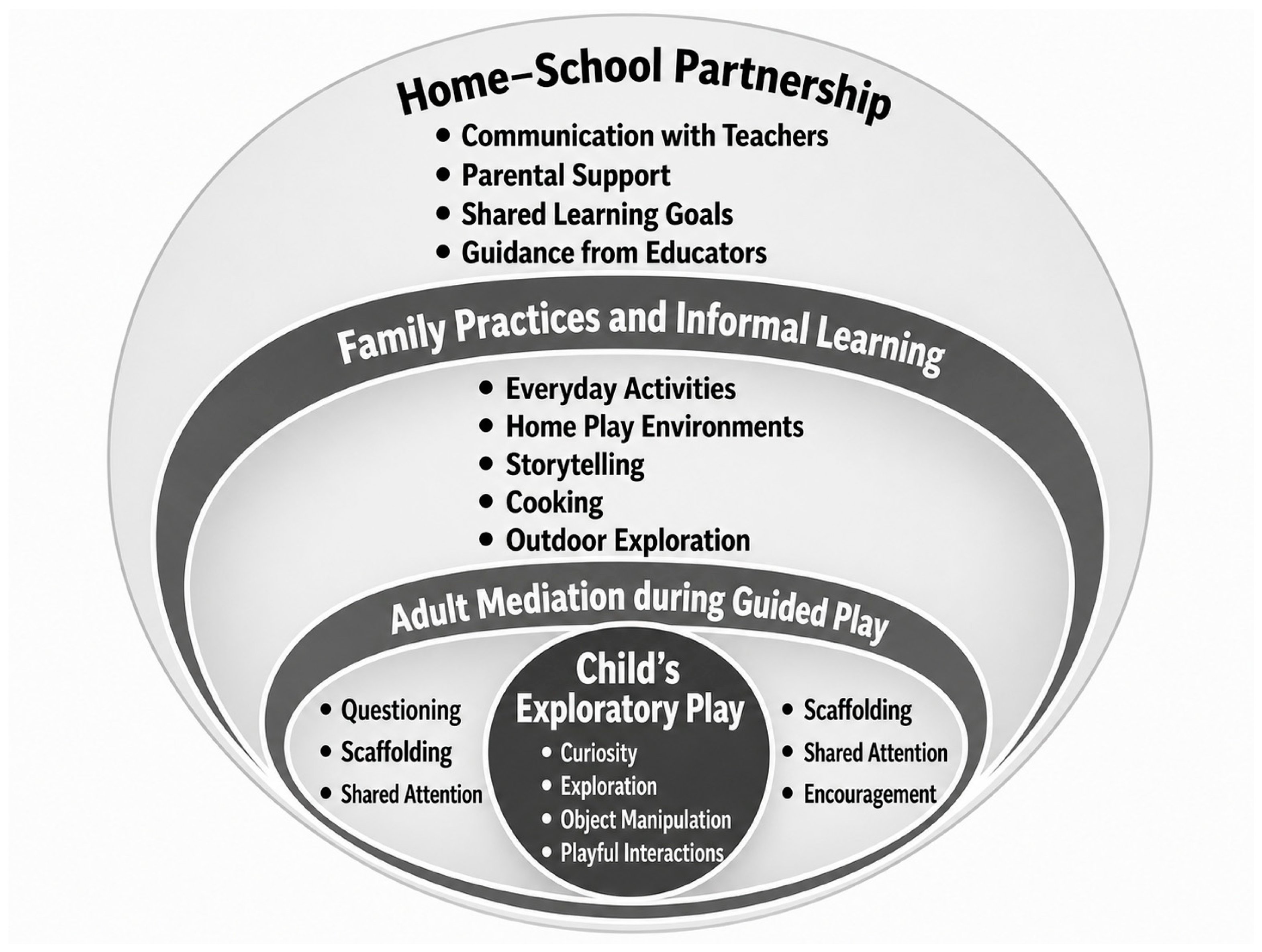
Building on the analytical dimensions outlined in the previous section, this section presents the proposed conceptual model and articulates the relationships among its components. The four dimensions of the model are derived through the conceptual integration of these perspectives, reflecting recurring themes identified across the literature rather than categories generated through formal methodological procedures. The model integrates cultural–historical perspectives on play, guided play approaches, research on family learning environments and ecological perspectives on home–school collaboration. Early mathematical learning is conceptualized as the outcome of dynamic interactions among four interconnected dimensions: (1) children’s playful exploration, (2) adult mediation during play, (3) family practices within the home environment, and (4) broader systems of collaboration between families and educational institutions. These dimensions operate simultaneously and influence one another, forming a learning ecosystem that supports the development of early mathematical thinking.
Unlike existing constructs such as the home learning environment or home numeracy environment, which primarily focus on the availability of activities or resources, the proposed model emphasizes the relational and process-oriented nature of learning. It foregrounds how mathematical understanding emerges through dynamic interactions between children’s playful activity, adult mediation, and everyday practices across home and educational contexts. In this way, the model extends these approaches by focusing not only on the availability of learning opportunities, but on the processes through which mathematical meaning is co-constructed in interaction across contexts.
Within the proposed model, children’s playful exploration functions as the generative mechanism through which early mathematical meanings begin to take form. Activities such as sorting objects, sharing materials, building structures, recognizing patterns and exploring spatial relationships enable children to experience quantitative and relational aspects of their environment. In such contexts, children do not simply reproduce knowledge introduced by adults; rather, they actively construct meanings through experimentation, negotiation and interaction. Consequently, playful exploration represents the starting point from which mathematical learning experiences may emerge.
Adult mediation is conceptualized as the process through which spontaneous exploration becomes connected to shared meaning-making. Within the model, parental mediation is conceptualized not only as a form of support but as an epistemically productive process through which children engage in the construction and negotiation of mathematical meaning. Guided play approaches demonstrate how adults can extend children’s engagement by directing attention toward relevant features of an activity while maintaining children’s autonomy. Through questioning, modelling, or encouraging reflection, adults support children in connecting their experiences with emerging conceptual understandings. Within the model, adult mediation functions as a relational bridge between playful activity and the progressive organization of mathematical understanding. Within the model, these dimensions are analytically distinguished, enabling a clearer understanding of how beliefs, practices, and contextual conditions interact in shaping children’s learning experiences.
The third dimension concerns the role of everyday family practices in shaping the conditions under which learning experiences become available. Family routines and shared activities provide socio-cultural contexts that structure how children encounter mathematical ideas in daily life. Participation in such practices enables children to engage with concepts embedded in real-life situations, while parents’ beliefs and perceived competence influence the extent to which opportunities for exploration are intentionally supported. In this sense, family practices form a foundational component of the home learning environment that contributes to early mathematical development.
At a broader level, the model situates these interactions within an ecological system connecting families and educational institutions. Development is understood as occurring across interconnected contexts that include family, school and community environments. Within early childhood education, collaboration between parents and educators can contribute to continuity between learning experiences at home and in educational settings by aligning expectations, communication practices and forms of support. The relationships among these dimensions are conceptualized as dynamic and reciprocal rather than hierarchical or strictly causal. Variations in socioeconomic conditions influence how these processes unfold across contexts. In this sense, children’s playful exploration provides the starting point for learning experiences, while adult mediation shapes how these experiences are interpreted and extended. Family practices create the conditions under which such interactions occur, and home–school collaboration supports continuity and coherence across contexts. Children’s playful exploration, parental mediation, and family practices interact in contextually situated ways, while home–school collaboration functions as a relational system that supports continuity across learning environments.
Figure 1 visualizes the proposed model by illustrating the dynamic and interconnected nature of these dimensions. The representation is not intended to imply hierarchical or linear relations, but rather to reflect a system of interacting processes that operate across contexts. Rather than locating mathematical learning within isolated instructional moments, the model reframes it as a socially and culturally mediated developmental process unfolding through participation in everyday play experiences.
The conceptual model foregrounds early mathematical learning as a process emerging through the dynamic interplay of playful activity, adult mediation, everyday participation and relational support across home and school contexts. Together, these dimensions form a learning ecosystem that supports the development of early mathematical thinking. Building on the proposed model, several theoretical propositions can be articulated in order to explain how play-based mathematical learning may emerge through the interaction between children, parents, and educational environments:
Children’s early mathematical learning begins to take form through playful engagement with their physical and social environment. Within the model, play functions as the generative space in which children encounter patterns, relations and quantities prior to their formalization as mathematical concepts. Through interaction with objects, people and situations, young children engage in exploratory actions that support the emergence of mathematical meanings.
Adult mediation during guided play enables children to move beyond spontaneous exploration toward shared interpretation of mathematical meaning. Through questioning, scaffolding, shared attention and encouragement, adults support children in focusing on relevant aspects of activity and in connecting their experiences with emerging conceptual understandings. Guided play interactions therefore create conditions that facilitate deeper mathematical sense-making. In this sense, parental mediation both shapes and is shaped by children’s activity and the broader family context.
Everyday family practices constitute culturally meaningful contexts in which mathematical ideas become embedded in lived experience. Participation in shared routines and activities allows children to encounter quantitative, spatial, and relational structures as part of meaningful social interaction within the home environment.
Home–school collaboration shapes the continuity and coherence of children’s learning ecologies by aligning expectations, practices, and forms of support across contexts. Within the model, such collaboration expands opportunities for play-based mathematical engagement and reinforces the relational conditions that sustain participation in learning across everyday and educational settings.
In this way, the model moves beyond a descriptive synthesis by offering a structured representation of how these dimensions interact within a broader learning ecology.
5. Discussion and Implications
The conceptual model proposed in this study contributes to ongoing theoretical discussions concerning the organization of early mathematical learning across children’s everyday experiences (
Perry & Dockett, 2011;
Vogt et al., 2018). In this sense, the model extends existing frameworks by shifting the focus from static descriptions of learning environments to the processes through which meaning is constructed and negotiated in interaction. Rather than positioning play primarily as a motivational context or pedagogical strategy, the model conceptualizes playful activity as a developmental mechanism through which mathematical meanings are socially negotiated, explored, and gradually stabilized. In this way, it extends sociocultural interpretations of learning by foregrounding the epistemic role of parental mediation in shaping children’s encounters with mathematical relations within nonformal environments. This perspective challenges approaches that locate early mathematical development mainly within structured instructional settings and instead highlights the distributed and relational character of learning processes unfolding across home and educational contexts (
Bodrova & Leong, 2015). In this way, the proposed model extends existing theoretical frameworks by offering a process-oriented perspective on how early mathematical learning emerges through interaction.
Guided play approaches, research on family learning environments and ecological perspectives of home–school collaboration, the model reframes early mathematical learning as an emergent process shaped through participation in meaningful play experiences. From a sociocultural perspective, mathematical thinking emerges through children’s participation in meaningful cultural activities. In this sense, mathematical understanding is not treated as the acquisition of abstract knowledge but as a process that develops through the use of cultural tools and forms of communication within social interaction (
Van Oers, 2024). Children’s interactions with parents and other adults during everyday activities create opportunities to encounter mathematical ideas in authentic contexts embedded in daily life (
Panaoura & Nitsiou, 2023;
Petrou & Panaoura, 2022). Within this framework, parental mediation becomes central to how children interpret experiences, focus attention, and construct emerging conceptual understandings.
This study contributes by conceptualizing parental mediation not as support but as an epistemic process that organizes children’s encounters with mathematical meaning across everyday contexts. Acknowledging the educational significance of such interactions expands prevailing understandings of where early mathematical learning takes place and how it develops. The model also emphasizes the importance of relational continuity between home and educational environments (
Dardanou & Brito, 2024). When parents and educators align expectations, practices, and forms of support, children are more likely to experience coherent learning trajectories that sustain engagement with mathematical ideas. From an ecological perspective, collaboration between families and educational institutions contributes to the development of learning ecologies in which play-based mathematical experiences become meaningful and sustainable across contexts.
These insights carry several implications for early childhood education. Educational initiatives may benefit from recognizing families as active contributors to children’s mathematical development and from supporting parents in identifying everyday opportunities for playful mathematical exploration. Professional learning for educators can include strategies for engaging families in nonformal learning processes and for fostering communication practices that strengthen home–school connections. More broadly, policies and community initiatives that support collaboration between families and educational settings may expand the range of learning experiences available to young children. These perspectives are also consistent with early childhood education frameworks and mathematics standards, which emphasize domains such as early numeracy, spatial reasoning, and patterning as foundational components of children’s development.
At the same time, the proposed model should be interpreted within contextual boundaries. Play-based mathematical learning does not replace structured instructional experiences, nor do all families have equal access to resources that support participation in such activities. Variations in socioeconomic conditions, cultural expectations, parental confidence, and educational support influence how play-based interactions are organized and experienced. Parental mediation itself may take diverse forms, ranging from intentional guidance to spontaneous participation in shared routines. Recognizing this variability positions the model as a framework for understanding relational learning processes rather than as a prescriptive account of optimal practice. However, the applicability of the proposed model should be understood in relation to the specific contexts in which families live and interact. Variations in socioeconomic conditions, parental educational backgrounds, time availability, and cultural beliefs about play and mathematics may significantly influence how play-based learning opportunities are organized and experienced within the home environment. In this sense, parental mediation should not be understood as uniformly available across contexts, but as a contextually shaped process influenced by families’ resources, experiences, and cultural orientations toward learning.
Future research may empirically examine how the relational dynamics outlined in the model unfold across diverse cultural, socioeconomic, and educational contexts. Longitudinal studies could explore how early experiences of socially mediated play influence later mathematical engagement, identity formation, and learning trajectories. Further investigation into parental beliefs, practices and forms of support may also contribute to refining the model and informing educational practices that strengthen early mathematical learning.
In conclusion, this study offers a conceptual contribution to understanding how early mathematical learning emerges through socially mediated play experiences extending beyond formal educational settings. The proposed model does not emerge from primary empirical data, but from the conceptual integration of existing theoretical and empirical contributions. By foregrounding parental mediation and everyday family practices as integral components of children’s learning ecologies, the proposed model expands interpretations that prioritize classroom instruction and measurable outcomes. It encourages educational research to consider how opportunities for mathematical meaning-making are organized across children’s lived experiences and how collaborative relationships between families and educational institutions shape the development of early mathematical understanding.