1. Introduction
Choosing a professional music career is an early and high-stake decision, particularly salient in the context of secondary-level specialist music education. Hungarian specialist music secondary schools (zeneművészeti szakgimnáziumok) combine general education and intensive professional training. In this setting, career orientation is not merely an academic choice but an identity-forming commitment (
Creech & Hallam, 2011). During this developmental period, orientation towards a professional career can be understood as an integration of professional identity, self-regulation, and future-directedness.
In the Hungarian context, a professional music career may encompass several distinct pathways: solo or orchestral performance, chamber music, music teaching at various levels, or increasingly, a portfolio career combining performance, teaching, and other music-related activities (
Bennett & Bridgstock, 2015). Hungary has a historically strong and institutionally embedded music education system. The music school program is optional and takes place in addition to the compulsory primary school classes. This music education serves a dual purpose: On the one hand, it develops a love of music in students participating in music education, creates positive musical experiences, educates a generation of music-loving audiences, and develops a concert-going lifestyle. On the other hand, it guides exceptionally talented students into a musical career. Relying on the dense network of music schools, it gives special social and cultural weight to these career opportunities, thus making the vocational secondary school a key institutional venue for the formation of professional identity.
For this study, three related but analytically distinct constructs are distinguished. Career motivation refers to the attitudinal orientation towards pursuing music as a professional occupation, encompassing the reasons and drivers underlying that aspiration. Career choice denotes the behavioural intention to enter a specific professional field—in this case, music—and is operationalised here as students’ stated plans to continue in music after secondary school. Career commitment refers to the longer-term, identity-level investment in a musical career path, reflecting a stable sense of professional purpose that sustains effort and persistence over time. These distinctions are consistent with the motivational framework adopted in the present study (
Deci & Ryan, 2000;
Bennett & Hennekam, 2018) and inform the interpretation of findings throughout.
Research describes music career choice as a complex process—not simply a professional decision, but an identity-shaping trajectory that may fundamentally determine students’ life paths (
McPherson & Davidson, 2006). Motivational structures, social–environmental factors, and psychological resources jointly shape long-term commitment (
Bennett, 2008;
Bennett & Hennekam, 2018;
McPherson & Davidson, 2006;
Deci & Ryan, 2000;
McPherson & O’Neill, 2010). The social environment plays a key role in shaping students’ relationship with and commitment to a music career. In particular, parental support and the support of the primary instrument teacher are highly influential (
Creech & Hallam, 2011;
McPherson & Davidson, 2006). The international literature also highlights that these factors operate differently across dimensions of career motivation, and vary by students’ developmental stages (
Creech, 2012;
McPherson & Zimmerman, 2011).
In recent years, increasing attention has been paid to the role of mental health and psychological well-being in the study of arts education and artistic careers (
Arbinaga, 2023;
Tu & Fu, 2024). Well-being, self-regulation, and resilience may be understood not merely as outcome variables of musical achievement but as internal resources that contribute to long-term commitment and career persistence (
Ryan & Deci, 2000;
Tu & Fu, 2024). This connection is particularly relevant in music education, where high performance demands, intense individual instruction, and early professionalisation create conditions associated with elevated emotional burden and psychological risk (
Ascenso et al., 2016). Students at specialist music secondary schools are thus not only developing musical skills but also navigating significant psychological and identity-related challenges. This makes mental health a pertinent dimension of career motivation research. Nevertheless, relatively few empirical studies examine motivational, socialisation-related, and mental health factors in music career choice jointly. This gap is particularly evident in the context of secondary-level specialist music education.
This study aims to empirically test a model in which social support (parental and teacher-related) and mental health resources contribute to career commitment through the dimensions of career motivation. The focus is on Hungarian specialist music secondary schools.
The study adopts an integrated explanatory approach in which social support is treated as a contextual factor, psychological resources as internal capacities, and motivational dimensions as proximal predictors of career commitment.
Hungarian Specialist Music Secondary Schools
This study examines secondary-level music career choice within the context of Hungarian specialist music secondary schools. According to the international classification of education, this institution type corresponds to ISCED Level 3 (upper secondary education) (
UNESCO, 2012). A distinguishing feature of these schools is their parallel curricular structure, in which general academic education and intensive, professionally oriented music training are integrated within a single institution.
The historical and pedagogical background of this institution type is closely tied to Hungary’s multi-tiered, sequential system of institutional music education. Within this system, specialist music secondary schools operate as key institutions for preparing students for professional music careers. The curriculum includes a high number of individual instrument lessons, music theory, and chamber music training alongside general academic subjects. As a result, students’ daily school life is shaped by an intensive, artistically focused learning environment.
The career development of students at specialist music secondary schools is shaped by complex motivational and social–cognitive factors that are closely intertwined with the specific characteristics of the institutional structure (
Héjja, 2022). Specifically, Héjja’s findings suggest that the parallel structure of general academic and intensive music training creates particular pressures and expectations around career commitment. Accordingly, career orientation is not merely a future plan but is embedded in the daily experience of schooling. The density of individual instrumental instruction fosters close teacher–student relationships. These relationships further shape how students conceive of themselves as future musicians. Accordingly, the study of music career choice motivation in this educational context is both particularly warranted and relevant.
In the present study, self-determination theory provides the motivational framework, while positive psychological constructs are conceptualised as internal resources that support the satisfaction of basic psychological needs and sustain career commitment.
In particular, little empirical evidence is available on how these factors interact within a single explanatory model in secondary-level, pre-professional music education. This is especially relevant, as career decisions are made at an early and formative stage.
2. Theoretical Background
2.1. Motivational Dimensions of Music Career Choice
The motivational background of music learning and career choice is multidimensional. According to self-determination theory (
Deci & Ryan, 2000;
Ryan & Deci, 2000), intrinsic motivation plays a central role in sustained commitment. It reflects the fulfilment of needs for autonomy, competence, and relatedness. In musical contexts, intrinsic motives (enjoyment, self-expression, internal interest) showed the strongest association with long-term career persistence compared to extrinsic expectations or rewards (
McPherson & O’Neill, 2010;
X. Wang et al., 2024).
Extrinsic and career motivation, however, should not be regarded as exclusively negative factors. Performance orientation and future professional aspirations become particularly prominent for students preparing for a professional career. Motivation also depends significantly on self-regulation and goal-oriented behaviour (
McPherson & Zimmerman, 2011). According to
McPherson and Zimmerman (
2011), well-developed self-regulatory skills contribute to persistence and professional development, and indirectly to career retention. This is further corroborated by
Caffull’s (
2024) four sequential studies. These studies indicate that self-determined motivation, musical identity, and a sense of autonomy and competence jointly shape students’ goal orientation. Mastery (growth-oriented) goals are primarily associated with intrinsic motivation, more deliberate practice strategies, and longer-term commitment. In contrast, normative performance goals are more closely linked to extrinsic motives. The distinction between mastery and performance goals draws on
Dweck’s (
2006) theory of implicit beliefs about ability. According to which, students with a growth mindset, who view their musical abilities as developable through effort, are more likely to pursue mastery goals and sustain motivation in the face of difficulty. The long-term career-shaping role of intrinsic motivation and musical identity is also supported by
X. Wang et al.’s (
2024) study of Chinese higher music education graduates. The study found that internal interest, self-realisation, and professional identity are stronger predictors of career choice than external expectations or labour market considerations. In this context, musical identity may be understood as the degree to which an individual perceives being a musician as central to their self-concept. It encompasses not only performance competence but also a sense of belonging to the musical world and a vision of a musical future (
Evans & McPherson, 2015).
Evans and McPherson’s (
2015) longitudinal study demonstrated that students who developed a strong, long-term musical identity early in their training showed significantly higher achievement and sustained engagement over time. This highlights the motivational benefits of identity-congruent goal orientation. Furthermore, flow experiences during music learning may further strengthen self-efficacy and sustain motivation, particularly among students with more substantial prior experience (
Su et al., 2024).
For artistic careers, career choice may be conceptualised as an ongoing process of commitment shaped jointly by individual, social, and psychological factors (
Bennett, 2008;
Bennett & Hennekam, 2018). This process-oriented view is reinforced by
Bennett and Bridgstock’s (
2015) longitudinal study. The study found that young artists’ career expectations are frequently idealised and do not accurately reflect the portfolio-like structure of the actual profession. A portfolio career in music typically involves combining multiple income streams and professional roles, such as performing, teaching, composing, and arts administration, rather than pursuing a single, linear career path. Bennett and Bridgstock’s findings suggest that students who enter music training with unrealistic expectations of a purely performance-based career may face significant adjustment challenges upon graduation. This suggests the potential relevance of career awareness and flexible professional identity development during secondary-level training.
The motivational structure of music students is multidimensional, encompassing self-expression, performance orientation, and career-related goals (
McPherson & O’Neill, 2010). Intrinsic motivation is primarily associated with the joy of musical activity, self-expression, and personal meaning. In contrast, extrinsic elements, such as professional recognition or financial considerations, are more closely linked to career motivation. Performance motivation becomes prominent particularly in competitive and evaluative situations, especially for students progressing towards a professional career.
2.2. Social Support as a Contextual Resource
Musical development and career orientation are socially embedded processes. Parental and teacher support plays a significant role not only in initiating early music learning but also in maintaining long-term commitment (
McPherson & Davidson, 2006;
Creech, 2012). From a sociocultural perspective, musical development is shaped not only by individual capacities but by the cultural practices, relationships, and institutional contexts within which learning takes place (
Rogoff, 2003).
Barrett (
2011) and
de Bruin (
2021) similarly emphasise that music learning is a fundamentally social and participatory process. In this process, identity, motivation, and skill develop through guided participation in musical communities. This perspective suggests that career orientation in music cannot be understood in isolation from the relational and cultural environment of the learner.
Recent work by
de Bruin (
2026) further nuances this perspective by showing that young musicians often construct multiple and sometimes overlapping professional identities, particularly as performers, teachers, or performer-teachers. In his qualitative study of early-career instrumental music teachers, de Bruin argues that professional identity formation is shaped through “possible selves,” whereby musicians imagine and negotiate future trajectories in relation to their prior experiences, role models, institutional expectations, and professional opportunities. The findings suggest that musical careers are rarely perceived in singular terms; rather, participants continuously balanced artistic aspirations with pedagogical identities, often viewing teaching and performing as mutually reinforcing rather than separate domains. This highlights that career orientation in music is not merely an individual preference or aptitude, but a socially mediated process through which learners develop a sense of who they can become within the musical world.
Parental support—particularly emotional encouragement and active involvement—is of paramount importance during early adolescence (
Upitis et al., 2017). However, parental involvement is not always beneficial, as controlling or pressure-driven support can undermine autonomy and intrinsic motivation, leading to disengagement or burnout (
Creech, 2009;
McPherson & Davidson, 2006). The quality of the teacher–student relationship, along with an empathetic and autonomy-supportive pedagogical approach, facilitates the development of intrinsic motivation and a sense of competence (
Creech, 2009;
Creech & Hallam, 2011). Drawing on
Vygotsky’s (
1978) concept of the zone of proximal development,
de Bruin (
2021) highlights that the one-to-one instrumental lesson functions as a scaffolded learning space in which the teacher’s expert guidance supports the student’s progressive internalisation of musical and professional competencies. The quality of this dialogic relationship, characterised by responsiveness, mutual respect, and adaptive challenge, is thus a key mediating factor between institutional context and individual motivation.
Systems-oriented approaches suggest that interactions among students, parents, and teachers influence motivational and career outcomes both directly and indirectly. Drawing on dynamic systems theory (
Fogel, 1993), these interactions may be understood as mutually constitutive rather than linear. The student’s motivational state influences teacher and parental behaviour, which in turn shapes the student’s developing identity and commitment. This relational complexity means that no single actor or factor determines career orientation in isolation.
The contextual and motivational background of career choice has been assessed using a context–process–outcome model (
Guan et al., 2022). The findings indicate that the school music environment and the role of music teachers are significantly associated with music career choice.
Career choice is influenced equally by emotional, social, and practical factors (
Váradi et al., 2024). For students, the personal value and enjoyment of music and the experience of development are crucial, while teacher support and family background significantly shape the decision. According to their results, the strength of personal goals determines long-term commitment to a music career.
Földi et al. (
2024) confirmed that parental, teacher, and peer support contribute to the maintenance of intrinsic motivation. They also identified that performance orientation and self-expression emerge as significant motivational dimensions. Their findings indicate that parental support is of primary importance in early adolescence. In middle and late adolescence, teacher and peer influences become dominant, with the maintenance of intrinsic motivation remaining crucial for long-term commitment.
2.3. Mental Health as a Psychological Resource
In recent years, the role of mental health and psychological well-being have become increasingly prominent in the study of artistic careers (
Ascenso et al., 2016). Well-being, self-regulation, and resilience may be understood as internal resources that support persistence, goal orientation, and the stabilisation of professional identity.
Based on positive psychological models (e.g., PERMA;
Seligman, 2011), it may be hypothesised that a higher level of well-being is not merely a consequence but may also be a predictor of professional commitment. This is particularly relevant for students on the threshold of professionalisation. In line with this,
Jiang and Zhu (
2024) found that psychological resilience mediates the relationship between professional identity and academic burnout among pre-service music teachers. They further identified that peer relationships further moderate this process. These findings suggest that resilience functions as a key protective resource in music education contexts, linking professional identity to sustained engagement and reduced risk of disengagement.
More recent research also highlights that internal motivation and a supportive social environment jointly shape commitment to a music career and decisions regarding further study. These findings emphasise the complex interplay between motivation, social support, and mental well-being (
Caffull, 2024;
Váradi et al., 2024;
Kiss et al., 2025). Moreover, these factors are particularly important for musicians and music students, as the profession is associated with elevated emotional burden, performance pressure, and uncertainty (
Keyes, 2002;
Seligman, 2011;
Ascenso et al., 2016).
Tu and Fu (
2024) found that musical engagement and musical empathy contribute to subjective well-being both directly and indirectly, mediated by self-esteem and prosocial tendencies. These associations suggest that musical activities are not merely performance-oriented learning processes but also identity-shaping experiences that mobilise psychological resources. Further evidence for the link between psychological resources and career orientation comes from
Q. Wang and Yang (
2024). They found that self-efficacy acts as a moderator between music performance anxiety and career expectations. Students with higher self-efficacy maintained stable career commitment even under performance pressure, highlighting the protective function of this psychological resource in the pre-professional context.
The present study examines the career motivation of students enrolled in specialist music secondary schools within an integrated model. It investigates the patterns and relative weights by which (1) the dimensions of motivation, (2) perceived forms of parental and teacher support, and (3) resource-oriented components of mental health contribute to career motivation in the specialist music secondary school context. The study contributes to understanding adolescent, pre-professional career development by identifying the factors that most strongly explain the variance in career motivation within this context.
Taken together, these findings support the assumption that psychological resources function as stabilising factors in career commitment, particularly under conditions of high performance demand.
3. Research Questions
The following research questions guided the present study:
RQ1: What associations are observed between social support (parental support and primary instrument teacher attitude) and the dimensions of music career motivation among students enrolled in specialist music secondary schools?
RQ2: What is the relationship between musical career motivation and the dimensions of the mental health scale?
RQ3: To what extent do the components of mental health, parental support and teacher support explain music career motivation?
4. Method
4.1. Participants and Procedure
Data were collected between October and November 2024 using an online survey. Participants were recruited through institutional mailing lists using convenience sampling. Before completing the questionnaire, participants were informed in writing about the purpose of the study. Completion was entirely voluntary and anonymous. The study followed the ethical principles outlined in the Declaration of Helsinki.
The survey was part of a broader, nationwide research project conducted by the Hungarian Music Council focusing on music education and media use. In the present study, only the sections related to career motivation and mental well-being were analysed.
A total of 154 valid responses were obtained from students enrolled in secondary-level specialist music education. Currently, classical music specialist secondary education is available in 19 locations in Hungary (
Váradi et al., 2023). The study sample represents approximately 11% of all students enrolled in specialist music secondary schools in Hungary.
In terms of gender distribution, the sample showed an over-representation of female students (
n = 105, 68.1%), while male students constituted less than 30% of the sample (
n = 44). A further 3.2% of respondents
(n = 5) did not provide a response to this question. Regarding year group distribution, the majority of respondents were in Years 9 and 10 (
Table 1).
4.2. Measures
The questionnaire used in the study consisted of several sections. The first block contained sociodemographic questions, including parents’ educational attainment, the family’s financial background, and the type of settlement of permanent residence.
The second block addressed music career choice. It contained a scale exploring the motives underlying career choice. Music career motivation was measured using 37 items rated on a four-point Likert scale. The underlying factor structure was examined using exploratory factor analysis. Although the Kaiser–Meyer–Olkin (KMO) index was high (0.82), several items could not be clearly assigned to factors, resulting in 10 subscales and a fragmented variable structure. Items were removed if they showed low factor loadings (<0.40), cross-loadings, or conceptual inconsistency with the emerging factor structure. After removing non-fitting items, the KMO index increased slightly to 0.85, and the remaining items were clearly organised into six factors: (1) performance orientation (e.g., ‘Because of the recognition I receive for my musical performance’); (2) self-expression (e.g., ‘I can be myself while playing music’); (3) intrinsic motivation (e.g., ‘Playing music brings me joy’); (4) extrinsic motivation (e.g., ‘My parents wanted me to’); (5) emotion regulation (e.g., ‘Playing music helps me manage stress’); and (6) career motivation (e.g., ‘A well-paying job’). All item factor loadings exceeded 0.4, and the explained variance was 58.79%. The reliability indicators of the music career motivation subscales are presented in
Table 2.
The lowest reliability was found for the emotion regulation subscale (0.67), which may be due to the fact that it consists of only three statements. However, according to
Gliner et al. (
2017), a Cronbach’s alpha value above 0.6 is appropriate for psychological scales.
It should be noted that the emotion regulation subscale is conceptualised as part of the motivational construct, whereas mental health (measured by the MET instrument) represents broader psychological resources. Thus, these constructs are treated as related but analytically distinct in the present study.
The third section of the questionnaire measured current studies and factors influencing music career choice. Parents’ role in the continuation of artistic activity was examined using nine items rated on a four-point Likert scale. Similarly, the primary instrument teacher’s role was assessed using items rated on the same scale. In both cases, the factor structure was explored using exploratory factor analysis. The KMO index for the parental role scale was 0.80, and the items were clearly organised into two subscales. The explained variance of the items was 52.70%. The first subscale was labelled emotional support (5 items, e.g., ‘They encouraged and supported me in continuing my artistic studies’), with a reliability coefficient of 0.79. The second factor was labelled physical presence (e.g., ‘They attended my performances’), comprising four items with a reliability of 0.63. The overall Cronbach’s α for the parental role scale was 0.76.
Eleven items addressed the primary instrument teacher, of which one item (‘strict’) did not fit into the two emerging factors. Excluding this item, the KMO index for the exploratory factor analysis was 0.88, with an explained variance of 63.81%. The resulting subscales were labelled human qualities (e.g., ‘They are a role model for you as a person’) and professional qualities (e.g., ‘They are professionally excellent and able to convey their knowledge’). Both subscales had a reliability of 0.83.
The final section included the Mental Health Test (MET), developed by
Vargha et al. (
2020). The instrument’s five subscales were designed to measure five pillars of mental health: well-being, savoring, creative–executive efficacy, self-regulation, and resilience. A confirmatory factor analysis was conducted to verify the subscale structure, yielding a KMO index of 0.78. During the factor analysis, one item loaded onto the well-being scale. That item (‘I can put myself in a good mood by imagining what a forthcoming happy time will be like’) was originally part of the savoring factor. This did not alter the reliability of the well-being factor (Cronbach’s α = 0.87), while the reliability of the savoring factor improved slightly after its removal, from 0.66 to 0.67. The creative–executive factor had a Cronbach’s α of 0.74, self-regulation of 0.68, and resilience of 0.69. The overall reliability of the full scale was 0.78. The reliabilities of the subscales—with the exception of well-being—are generally lower than those reported by Vargha et al. However, the authors examined the reliability of the MET scale on an adult sample, while we used it on students aged 14–18.
5. Results
The questionnaire included items asking students about factors that may have motivated or influenced their choice of a music career.
5.1. Continuation of Studies After the Specialist Secondary School
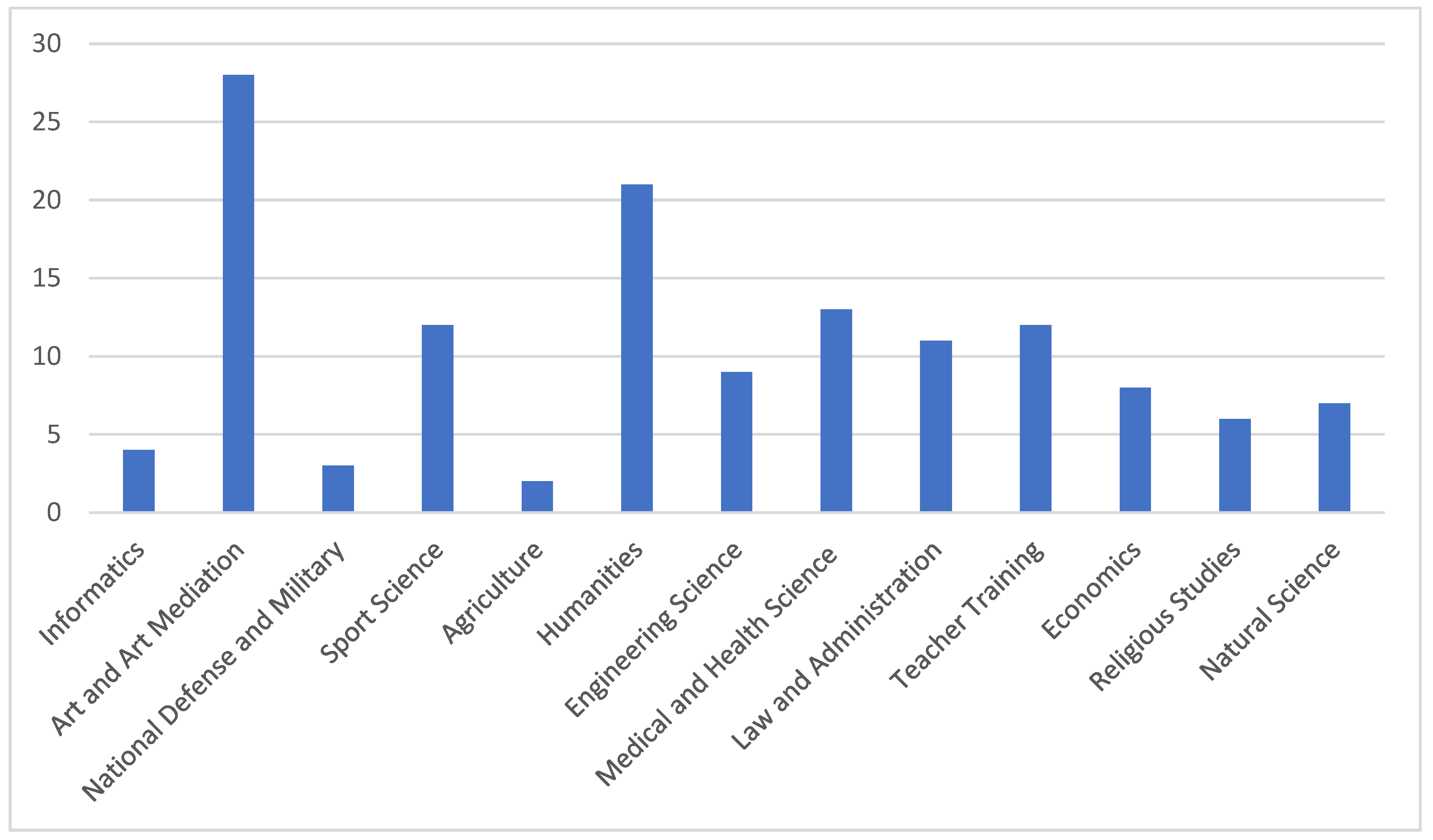
A total of 87% of respondents intended to continue their studies in music after completing a specialist secondary school. Only 10% were uncertain about their intentions, while 2% did not plan to continue in music, and 1% had no plans to pursue further study at all. Respondents were also asked which other fields they would consider if not pursuing a music career. Multiple selections were permitted. The distribution of fields selected by students not choosing music, or those wishing to pursue music while also engaging in another area, is presented in
Figure 1.
As shown in
Figure 1, the largest number of students chose Arts and Arts Mediation, followed by Humanities. The lowest numbers chose Agriculture, National Defence and Military, and Information Technology. These findings are unsurprising, given that music is more closely aligned with the Humanities. Among the five students who stated they did not wish to continue in music, the most common reason was interest in another field; four students each cited low pay, the difficulty of the professional world, and four cited high levels of stress. Three students did not consider themselves talented enough. Additional individual responses included: ‘
I have wanted to be a doctor since childhood and it is my dream to fulfil this’ or “
Because I’m going to get tendonitis”.
In the next step, factors determining music career choice were examined. First, the study analysed the relationship between career choice and parental support. A significant association was found between the two variables (χ2 = 10.67, p = 0.01). Students intending to continue in music reported significantly higher levels of parental support (88%) compared to those who were still undecided (9%).
Respondents were asked how useful they considered the specialist secondary school for supporting their further studies. Four response options were provided: not at all, rather not, rather yes, and fully. Students planning to continue in music considered the specialist music secondary school significantly more useful than those who did not plan to pursue music training (χ2 = 48.10, p < 0.01). The groups choosing other fields or not planning any further study were small. Similarly, few students indicated that the school was not useful at all (n = 5) or rather not useful (n = 7), which limits the generalisability of this finding.
The study assessed whether years of music study are associated with differences in career motivation and its subscales. Analysis of variance (F = 3.55, p = 0.03) indicated that only performance motivation differed according to the number of years of music study. Post hoc analysis showed that performance motivation was significantly stronger among students with 7 years of music study (M = 0.42) compared to those with fewer than seven (M = −0.15) or more than seven years (M = −0.06). No significant difference was found between the latter two groups.
5.2. Associations Between Career Motivation, Social Support, and Mental Health
To address RQ1, we examined the associations between career motivation, social support, and mental health variables.
Given the well-established role of parents and primary instrument teachers in career choice (
Creech, 2012;
Creech & Hallam, 2011), we examined the associations between the subscales of career motivation and those of parental support and teacher attitude (
Table 3).
Social support—particularly teacher human qualities and parental physical presence—showed weak but significant associations with intrinsic motivation, consistent with self-determination theory’s assertion that a relatedness-supportive and autonomy-supportive environment facilitates the development of internal motivation. The self-expression and extrinsic motivation subscales also showed weakly significant associations with parental physical presence, but not with the overall parental support scale. The intrinsic motivation subscale showed no association with parental support or its physical presence subscale, but showed weakly significant associations with all other examined subscales.
We then examined the relationship between career motivation and mental health (MET scale). The results are presented in
Table 4.
As shown in
Table 4, the total career motivation scale showed a moderately strong and significant association with the overall MET scale. Among the subscales, career motivation showed weakly significant associations with creative–executive efficacy, self-regulation, and savoring. Examining the career motivation subscales, only extrinsic and career motivation showed no association with the total mental health scale. Intrinsic motivation showed weakly significant associations with the total MET scale as well as with well-being and creative–executive efficacy.
5.3. Regression Analysis
To address RQ3, regression analysis was conducted to examine the relative contribution of mental health, parental support, and teacher support to career motivation.
As a final step, we examined the effect of the previously investigated background factors on career motivation using a regression model (
Table 5). The results indicate that among the included independent variables, only the mental health scale had a significant effect on career motivation (14%). Neither parental support nor teacher attitude demonstrated a substantial effect in the model, despite the associations found between subscales and career motivation in the correlation analyses. According to the regression analysis, mental health shows the strongest association with career motivation among the variables included in the model, indicating that within-person resources—biological, psychological, and social well-being (
Vargha et al., 2020)—are more strongly associated with music career motivation at secondary school level than parental support or teacher behaviour.
The model explains a relatively modest proportion of the variance in career motivation, indicating that additional factors not included in the model may also play a role.
When examining only the effects of parental support and teacher attitude subscales on career motivation, parental physical presence was significant at 5%, and teacher human qualities were significant at 2.7% in predicting music career choice. When the Mental Health Test subscales were added to the model, the previously significant independent variables lost their effect, and only two MET subscales—creative–executive efficacy (7%) and self-regulation (3%)—remained significant predictors of career motivation.
6. Discussion
This study examined factors influencing music career choices among students of Hungarian music secondary schools. The findings are broadly consistent with self-determination theory and positive psychological frameworks. These frameworks emphasise the central role of intrinsic motivation and internal psychological resources in sustaining long-term professional commitment (
Deci & Ryan, 2000;
Ryan & Deci, 2000;
Seligman, 2011).
RQ1: Our results show that students who want to choose a music career report stronger parental support than those who have not yet decided. At the same time, parental emotional support is positively associated with commitment to a music career. In addition, the primary school instrument teacher may primarily influence students’ intrinsic motivation in choosing a music career (
Bonneville-Roussy & Evans, 2025), regardless of the teacher’s specific attitude. The observed pattern of associations between social support and intrinsic motivation is consistent with SDT, which emphasises the role of relatedness and autonomy support in fostering internal motivation (
Ryan & Deci, 2000;
Su et al., 2024). Teacher human qualities and parental physical presence both showed significant associations with intrinsic motivation. These findings suggest that the relational and emotional dimensions of support are more relevant to internal career commitment than the professional or instrumental aspects of support. This is in line with
Creech and Hallam’s (
2011) findings on the importance of interpersonal dynamics in music-learning contexts. However, social support was not a significant predictor in the regression model when mental health-related variables were included. One possible interpretation is that psychological resources may account for a greater proportion of variance in career motivation within this specific sample. However, this assumption cannot be directly tested in the present cross-sectional design.
The positive association between savoring and self-expression motivation represents an interesting pattern that may warrant further investigation. Savoring, as the capacity to attend to and appreciate positive experiences, may be particularly relevant in artistic contexts. Students who are more attuned to the pleasurable aspects of musical experience may be more strongly motivated by self-expressive goals, which in turn may be related to sustained engagement with music as a career (RQ2).
The regression analysis demonstrated that mental health resources, particularly creative–executive efficacy and self-regulation, showed the strongest associations with career motivation among the variables included in the model, although the overall explained variance was modest. This result is consistent with the findings of
Mahdavi et al. (
2023), which found a significant relationship between mental health and achievement motivation. These findings extend prior research by indicating that psychological resources are more strongly associated with career motivation than social support variables when examined simultaneously (RQ3).
7. Conclusions
The institutional characteristics of specialist music secondary schools include intensive professional focus, high volumes of individual instruction, and professional orientation. These features create an environment in which the formation of professional identity may be accelerated. In this context, career motivation can be understood not as a single decision but as an identity integration process. The results suggest that, at this developmental stage, psychological self-regulation and a sense of competence are associated with a more stable orientation towards a music career.
Based on the findings, music career motivation can be described as a multidimensional construct in which both social support and psychological resources are involved; however, the resource-oriented components of mental health showed stronger associations with career motivation within the present model. Consciously experiencing positive experiences, self-regulation, and creative effectiveness—as factors of mental health—seem to be significant in maintaining career motivation. By contrast, social support variables were primarily associated with intrinsic motivational dimensions and were not significant predictors in the regression model. Overall, the findings indicate that psychological resources are more strongly associated with career motivation than external support variables in this sample.
These findings are broadly consistent with theoretical approaches that regard internal psychological resources as key mechanisms of professional commitment, while also indicating that further longitudinal research is needed to clarify the direction of these relationships.
The study contributes to the empirical examination of an integrated, multi-factor model of music career development and highlights the resource-oriented role of mental health among students on the threshold of professionalisation.
The findings may have practical implications for music education, particularly in relation to supporting students’ psychological resources, such as self-regulation and perceived competence. At the same time, these implications should be interpreted with caution given the cross-sectional design and the specificity of the sample.
8. Limitations
Several limitations of the present study should be acknowledged. First, the use of convenience sampling restricts the generalisability of the findings. Although the study captured a meaningful proportion of students enrolled in Hungarian specialist music secondary schools, the sample is not fully representative. Therefore, caution is needed when extending the conclusions to other educational contexts or countries. Future research should employ probability-based sampling strategies across multiple institutions to enhance external validity. The specificity of the sample limits generalisability; future research could complement survey findings with qualitative methods, such as focus groups, to provide deeper insight into students’ experiences.
Second, the cross-sectional design of the study precludes causal inference. It remains unclear whether higher levels of mental well-being strengthen career motivation, or whether career commitment enhances psychological well-being. Longitudinal designs would be necessary to disentangle the directionality of these relationships and to track the development of motivational orientations over time.
Third, all measures relied exclusively on self-report questionnaires, introducing the potential for common method bias and social desirability effects. Participants’ responses regarding career motivation and mental well-being may not fully capture their actual psychological states or behavioural tendencies. Future studies would benefit from complementing self-report instruments with qualitative methods or observational data.
Finally, the cultural specificity of the sample limits cross-cultural generalisation. The study was conducted within the Hungarian specialist music education context, which has distinctive institutional characteristics and pedagogical traditions. Moreover, the Mental Health Test (MET;
Vargha et al., 2020) was developed and validated within a Hungarian population. Its psychometric properties have not been systematically examined in other cultural or linguistic settings. Cross-cultural validation of both the constructs and the instruments used is therefore recommended for future research.
Author Contributions
Conceptualization, G.J. and J.V.; methodology, G.J.; formal analysis, G.J.; investigation, G.J., J.V., M.P.; resources, J.V.; data curation, G.J., J.V., M.P.; writing—original draft preparation, G.J., J.V., M.P.; writing—review and editing, G.J., J.V.; visualization, G.J., J.V., M.P.; supervision, J.V.; project administration, J.V.; funding acquisition, J.V. All authors have read and agreed to the published version of the manuscript.
Funding
Supported by University of Debrecen Program for Scientific Publication. Supported by the Hungarian Academy of Arts Research Institute of Art Theory and Methodology.
Institutional Review Board Statement
The study was conducted in accordance with the Declaration of Helsinki and approved by the Institutional Review Board of the Institute of Education, University of Debrecen (protocol code 3/2024-NI, approved on 3 September 2024).
Informed Consent Statement
Informed consent was obtained from all subjects involved in the study.
Data Availability Statement
Data are unavailable due to privacy or ethical restrictions.
Conflicts of Interest
The authors declare no conflicts of interest. The authors alone are responsible for the content and writing of the paper.
References
- Arbinaga, F. (2023). Resilient behaviors in music students: Relationship with perfectionism and self-efficacy. Behavioral Sciences, 13(9), 722. [Google Scholar] [CrossRef] [PubMed]
- Ascenso, S., Williamon, A., & Perkins, R. (2016). Understanding the wellbeing of professional musicians through the lens of positive psychology. Psychology of Music, 44(1), 1–17. [Google Scholar] [CrossRef]
- Barrett, M. S. (2011). Towards a cultural psychology of music education. In M. S. Barrett (Ed.), A cultural psychology of music education (pp. 1–15). Oxford University Press. [Google Scholar]
- Bennett, D. (2008). Understanding the classical music profession: The past, the present and strategies for the future. Ashgate. [Google Scholar]
- Bennett, D., & Bridgstock, R. (2015). The urgent need for career preview: Student expectations and graduate realities in music and dance. International Journal of Music Education, 33(3), 263–277. [Google Scholar] [CrossRef]
- Bennett, D., & Hennekam, S. (2018). Self-authorship and creative industries workers’ career decision-making. Human Relations, 71(1), 1–24. [Google Scholar] [CrossRef]
- Bonneville-Roussy, A., & Evans, P. (2025). The support of autonomy, motivation, and music practice in university music students: A self-determination theory perspective. Psychology of Music, 53(6), 909–928. [Google Scholar] [CrossRef]
- Caffull, S. L. (2024). Reasons to practise: Understanding the motivation of adolescent instrumental learners through the lens of achievement goal theory [Doctoral dissertation, University of York]. [Google Scholar]
- Creech, A. (2009). Teacher–pupil–parent triads: A typology of interpersonal interaction in the context of learning a musical instrument. Musicae Scientiae, 13(2), 387–413. [Google Scholar] [CrossRef]
- Creech, A. (2012). Interpersonal behaviour in one-to-one instrumental lessons: An observational analysis. British Journal of Music Education, 29(3), 387–407. [Google Scholar] [CrossRef]
- Creech, A., & Hallam, S. (2011). Learning a musical instrument: The influence of interpersonal interaction on outcomes for school-aged pupils. Psychology of Music, 39(1), 102–122. [Google Scholar] [CrossRef]
- de Bruin, L. R. (2021). Instrumental music educators in a COVID landscape: A reassertion of relationality and connection in teaching practice. Frontiers in Psychology, 11, 624666. [Google Scholar] [CrossRef]
- de Bruin, L. R. (2026). Identity formation and possible selves of early career instrumental music teachers: A qualitative study. Psychology of Music, 54(3), 379–395. [Google Scholar] [CrossRef]
- Deci, E. L., & Ryan, R. M. (2000). The ‘what’ and ‘why’ of goal pursuits: Human needs and the self-determination of behavior. Psychological Inquiry, 11(4), 227–268. [Google Scholar] [CrossRef]
- Dweck, C. S. (2006). Mindset: The new psychology of success. Random House. [Google Scholar]
- Evans, P., & McPherson, G. E. (2015). Identity and practice: The motivational benefits of a long-term musical identity. Psychology of Music, 43(3), 407–422. [Google Scholar] [CrossRef]
- Fogel, A. (1993). Developing through relationships: Origins of communication, self, and culture. University of Chicago Press. [Google Scholar]
- Földi, F., Szabó, N., Oo, T. Z., Csizmadia, G., & Józsa, K. (2024). Motivation in learning musical instruments: The role of parents, teachers, and friends. Music & Science, 7. [Google Scholar] [CrossRef]
- Gliner, J. G., Morgan, G. A., & Leech, N. L. (2017). Research methods in applied settings: An integrated approach to design and analysis (3rd ed.). Routledge/Taylor & Francis Group. [Google Scholar]
- Guan, R., Zhang, M., & Yang, X. (2022). Relationship between school music context and music career choice among Chinese adolescents: A framework based on a context–process–outcomes model. Psychology Research and Behavior Management, 15, 3473–3484. [Google Scholar] [CrossRef] [PubMed]
- Héjja, B. E. (2022). Career development characteristics of music arts vocational high school students through the lens of the social-cognitive career model [Ph.D. dissertation, Debreceni Egyetem]. [Google Scholar]
- Jiang, X., & Zhu, J. J. (2024). The effect of pre-service music teachers’ professional identity on academic burnout: The mediating role of psychological resilience and the moderating role of peer relationships. Current Psychology, 43, 20132–20143. [Google Scholar] [CrossRef]
- Keyes, C. L. M. (2002). The mental health continuum: From languishing to flourishing in life. Journal of Health and Social Behavior, 43(2), 207–222. [Google Scholar] [CrossRef]
- Kiss, B., Oo, T. Z., Biró, F., & Józsa, K. (2025). Students’ motivation for classroom music: A systematic literature review. Education Sciences, 15(7), 862. [Google Scholar] [CrossRef]
- Mahdavi, P., Valibeygi, A., Moradi, M., & Sadeghi, S. (2023). Relationship between achievement motivation, mental health and academic success in university students. Community Health Equity Research & Policy, 43(3), 311–317. [Google Scholar] [CrossRef]
- McPherson, G. E., & Davidson, J. W. (2006). Playing an instrument. In G. E. McPherson (Ed.), The child as musician: A handbook of musical development (pp. 331–351). Oxford University Press. [Google Scholar]
- McPherson, G. E., & O’Neill, S. A. (2010). Students’ motivation to study music as compared to other school subjects: A comparison of eight countries. Research Studies in Music Education, 32(2), 101–137. [Google Scholar] [CrossRef]
- McPherson, G. E., & Zimmerman, B. J. (2011). Self-regulation of musical learning: A social cognitive perspective on developing performance skills. In R. Colwell, & P. Webster (Eds.), MENC handbook of research on music learning (pp. 130–175). Oxford University Press. [Google Scholar]
- Rogoff, B. (2003). The cultural nature of human development. Oxford University Press. [Google Scholar]
- Ryan, R. M., & Deci, E. L. (2000). Self-determination theory and the facilitation of intrinsic motivation, social development, and well-being. American Psychologist, 55(1), 68–78. [Google Scholar] [CrossRef]
- Seligman, M. E. P. (2011). Flourish: A visionary new understanding of happiness and well-being. Free Press. [Google Scholar]
- Su, P., Kong, J., Zhou, L., & Li, E. (2024). The interplay of flow, self-efficacy, learning motivation, and learning outcomes in music education: A comprehensive analysis of multidimensional interactions. Acta Psychologica, 250, 104515. [Google Scholar] [CrossRef]
- Tu, J., & Fu, H. (2024). The path to happiness for music students: Music empathy and music engagement as potential sources of subjective well-being. Humanities and Social Sciences Communications, 11, 1037. [Google Scholar] [CrossRef]
- UNESCO. (2012). International standard classification of education: ISCED 2011. UNESCO Institute for Statistics. [Google Scholar]
- Upitis, R., Abrami, P. C., Varela, W., King, M., & Brook, J. (2017). Student experiences with studio instruction. Music Education Research, 19(4), 410–437. [Google Scholar] [CrossRef]
- Vargha, A., Zábó, V., Török, R., & Oláh, A. (2020). Measuring well-being and mental health: The mental health test. Mentálhigiéné és Pszichoszomatika, 21(3), 281–322. [Google Scholar] [CrossRef]
- Váradi, J., & Héjja, B. E. (2023). Characteristics of secondary-level music education, insights into the data of music specialist secondary schools. Parlando, 4, 1–17. [Google Scholar]
- Váradi, J., Kerekes, R., Pótfi, M., & Radócz, J. M. (2024). Determining factors in the career choice of music high school students. International Journal of Educational Research Open, 6, 100321. [Google Scholar] [CrossRef]
- Vygotsky, L. S. (1978). Mind in society: The development of higher psychological processes. Harvard University Press. [Google Scholar]
- Wang, Q., & Yang, R. (2024). The influence of music performance anxiety on career expectations of early musical career students: Self-efficacy as a moderator. Frontiers in Psychology, 15, 1411944. [Google Scholar] [CrossRef] [PubMed]
- Wang, X., Poon, C. H., & Cheong, K. W. (2024). Intrinsic factors influencing career choice of music graduates in Fujian, China. Education Sciences, 14, 256. [Google Scholar] [CrossRef]
| Disclaimer/Publisher’s Note: The statements, opinions and data contained in all publications are solely those of the individual author(s) and contributor(s) and not of MDPI and/or the editor(s). MDPI and/or the editor(s) disclaim responsibility for any injury to people or property resulting from any ideas, methods, instructions or products referred to in the content. |