Beyond Teacher Shortages: Structural Turnover and Workforce Instability in New Mexico Schools

Abstract
1. Introduction
- What is the relationship between district-level educator staffing levels and teacher vacancies in New Mexico public school districts?
- How can teacher turnover across New Mexico districts be described and interpreted using available state-level data?
- Are there measurable differences in teacher satisfaction across groups defined by years of experience and grade level?
- Which teaching and working condition indicators are associated with teacher turnover?
- Which workplace conditions appear most actionable at the state and district levels for improving teacher retention?
2. Materials and Methods
2.1. Research Context
2.2. Purpose of the Study
2.3. Data Sources
- (a)
- Staffing lists (turnover inputs). NMPED provided the district rosters of certified teaching staff for 2014–2019 via public record requests. State-level teacher headcounts for 2020–2023 were obtained through additional records requested to contextualize trends only.
- (b)
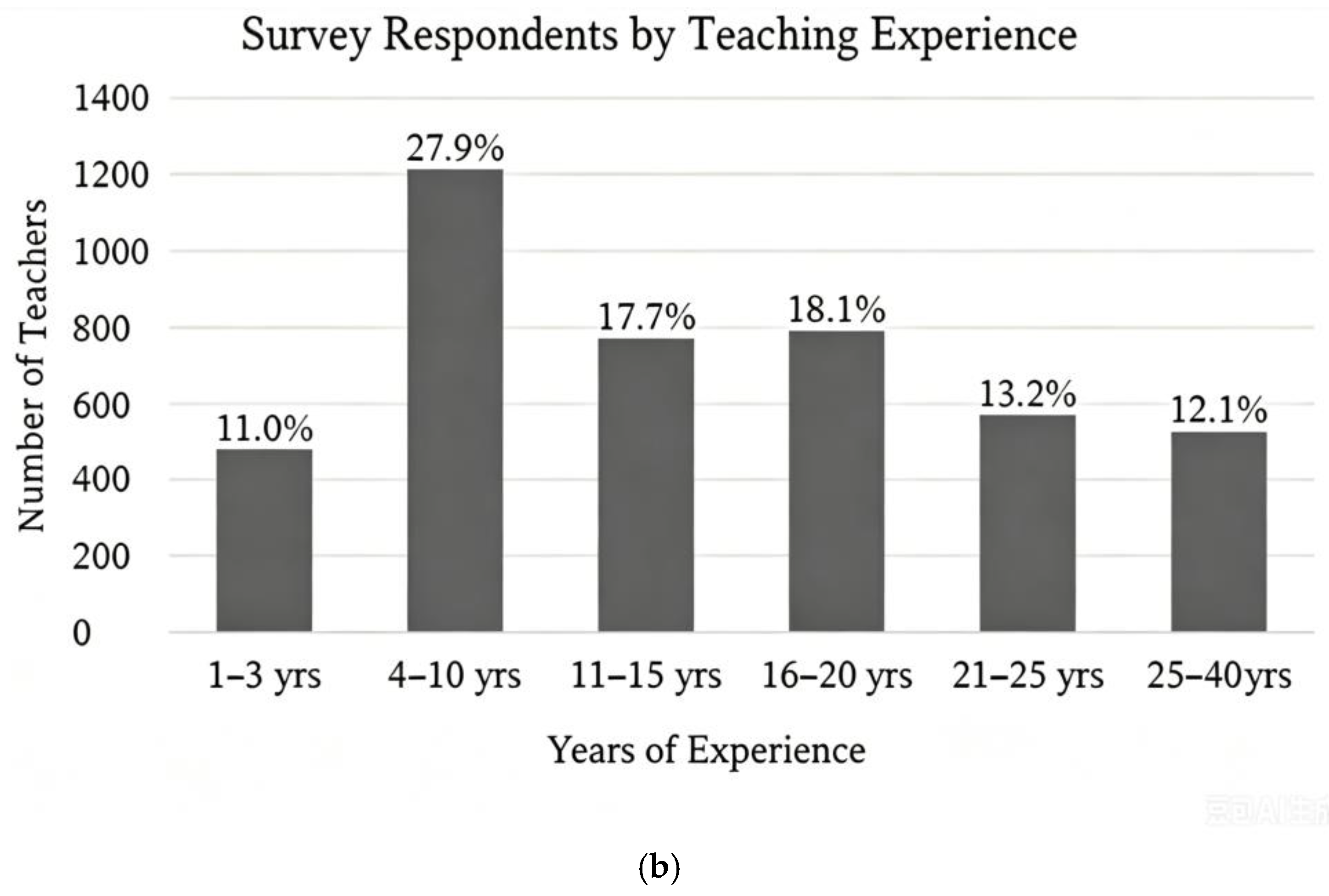
- Teacher Working Conditions Survey (TWCS). A 34-item working condition survey was administered electronically through a Survey Monkey link to certified educators statewide in spring 2020 (initial March outreach; May reminder). Each item used a 0–100 satisfaction scale, with higher values indicating greater satisfaction. Of 22,073 certified teachers in 2019, 4481 responded (~20%), spanning 85/89 districts, 341 of which were charter school teachers and were excluded from this analysis to maintain a focused examination of state-operated district systems. Charter school data are retained in the full dataset and may support future analyses.
2.4. Analytic Window
2.5. Turnover Definitions and Formulas
2.5.1. Operational Definitions
2.5.2. Turnover Formulas
- Annual turnover (year t):“Exits” include teachers who leave the district (to another district or out of the profession). Denominator is the year-t certified teacher headcount.Annual Turnovert = #{teachers present in t but absent in t + 1}
#{certified teachers in t} - Long-term turnover (t → t + k):Long-Term Turnovert->t+k = #{baseline teachers in t no longer present by t + k}
#{baseline certified teachers in t}
2.6. Time Window and District-Size Effects
2.7. Record Linkage, Cleaning, and Inclusion Rules
2.8. Survey Measures
2.9. Sampling and Contact Procedures (Survey)
2.10. Statistical Analysis
2.11. Software
2.12. Ethics
3. Results
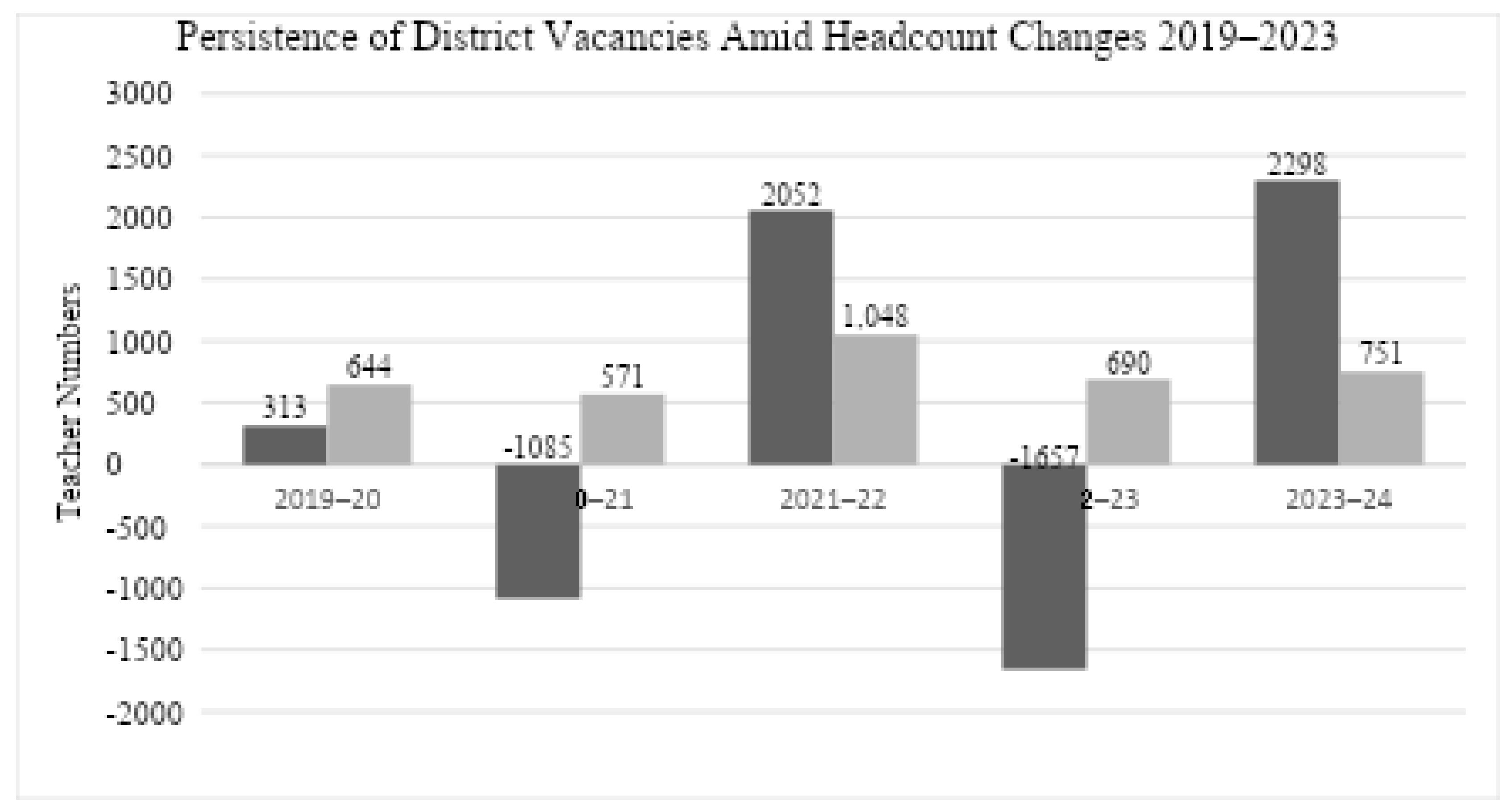
3.1. Teacher Numbers and Vacancies, 2018–2023
3.2. New Mexico Statewide Teacher Turnover
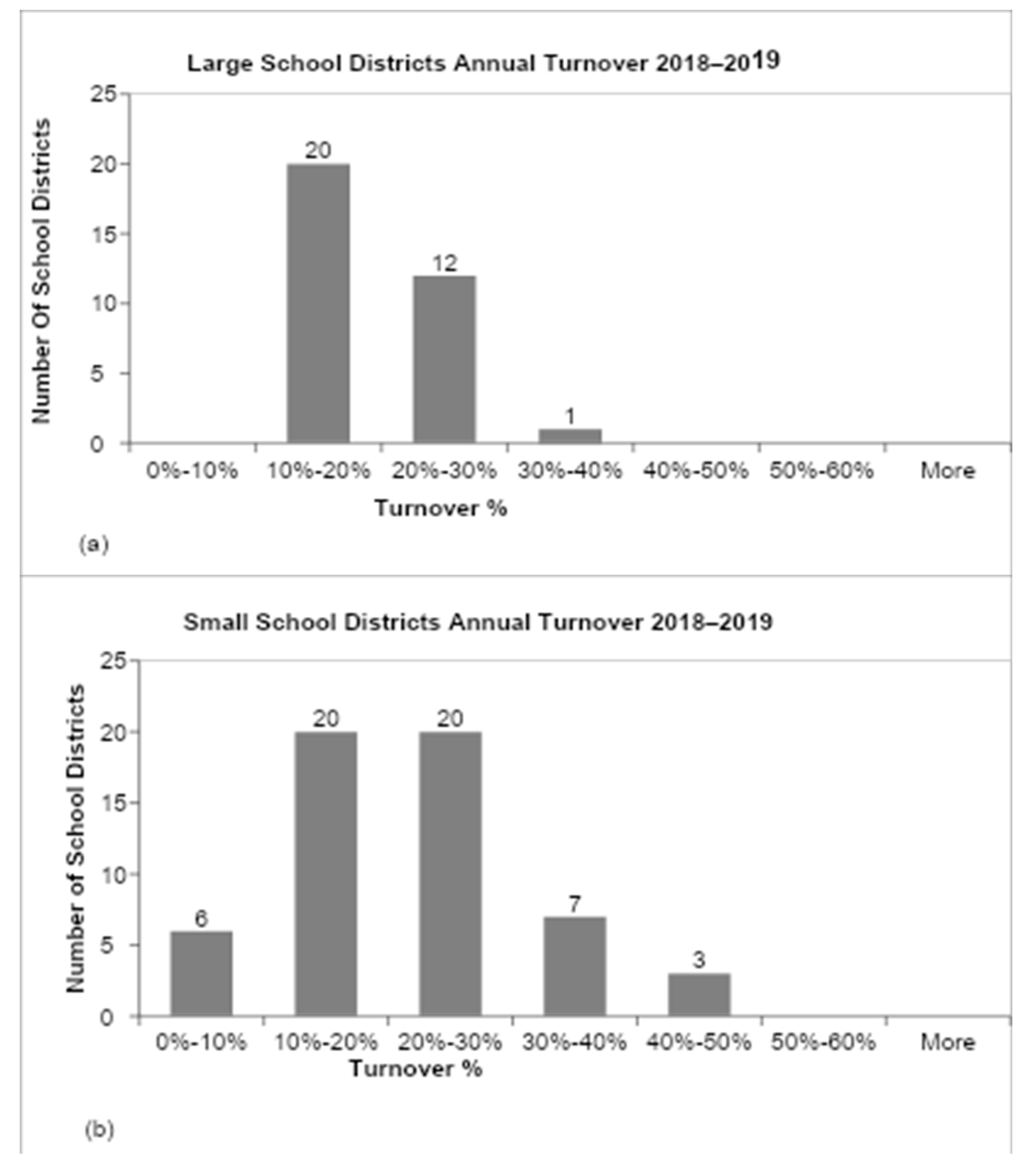
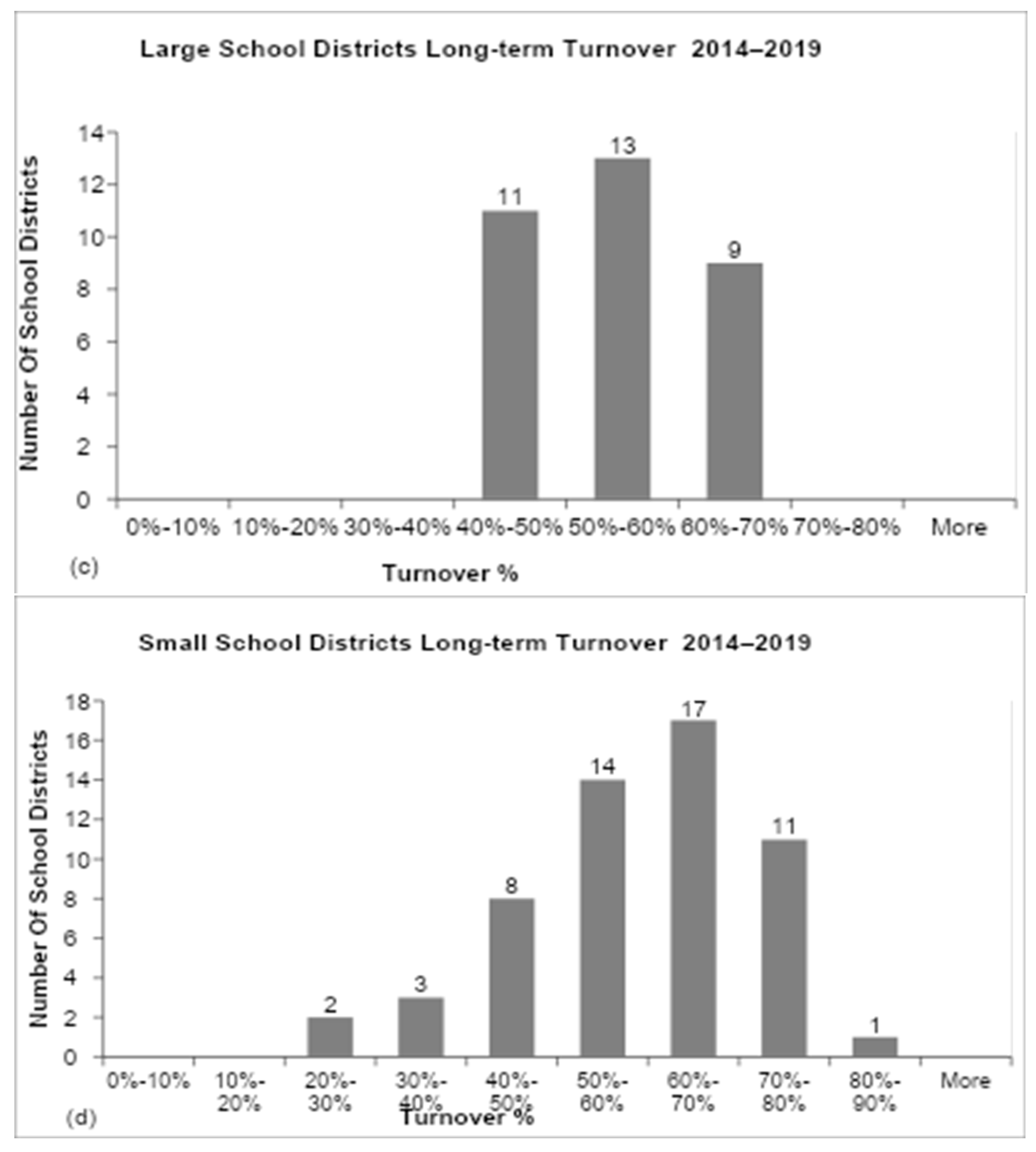
3.3. District Size and Teacher Turnover (Annual and Long-Term)
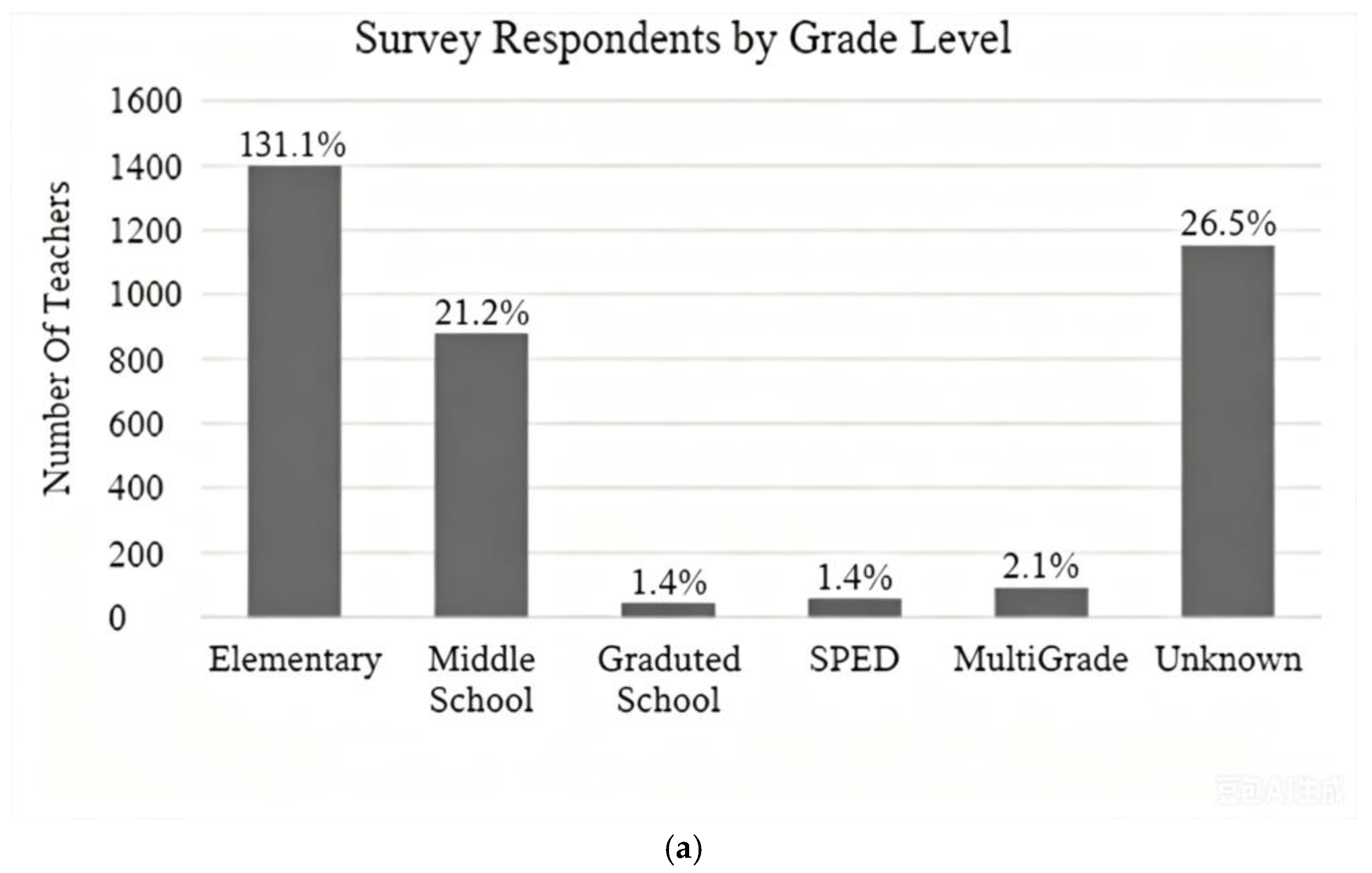
3.4. Survey Descriptives
3.5. Grade-Level and Teacher Experience Differences in Working Conditions (ANOVA and t-Tests)
3.6. Satisfaction Scores: High- vs. Low-Long-Term-Turnover Districts (t-Tests)
3.7. Predictors of Annual and Long-Term Turnover (Multiple Regression)
4. Discussion
4.1. Teacher Headcounts and Vacancies
4.2. Teacher Turnover as a Structural Feature of New Mexico’s Education System
4.3. Working Conditions, Job Satisfaction, and Predictors of Teacher Turnover
4.4. Structural Implications for Educational Sufficiency: Teacher Turnover, Legal Mandates, and Policy Action in New Mexico
4.5. Limitations
5. Future Research
6. Conclusions
Supplementary Materials
Author Contributions
Funding
Institutional Review Board Statement
Informed Consent Statement
Data Availability Statement
Conflicts of Interest
Abbreviations
| TWCS | Teacher Working Conditions Survey |
| NM | New Mexico |
| NMPED | New Mexico Public Education Department |
| SOARS | The Southwest Outreach Academic Research |
| SD | Standard Deviation |
References
- Anne Quiroz, P. (2004). Who controls teachers’ work?: Power and accountability in America’s schools. Contemporary Sociology: A Journal of Reviews, 33(3), 363–364. [Google Scholar] [CrossRef]
- Boyd, D., Grossman, P., Ing, M., Lankford, H., Loeb, S., & Wyckoff, J. (2011). The influence of school administrators on teacher retention decisions. American Educational Research Journal, 48, 303–333. [Google Scholar] [CrossRef]
- Carver-Thomas, D., & Darling-Hammond, L. (2017). Teacher turnover: Why it matters and what we can do about it (brief). Learning Policy Institute. [Google Scholar] [CrossRef]
- Darling-Hammond, L. (1984). Beyond the commission reports: The coming crisis in teaching. RAND Corporation. [Google Scholar]
- Darling-Hammond, L. (2002). Access to quality teaching: An analysis of inequality in California’s public schools. Santa Clara Law Review, 43, 1045. [Google Scholar]
- Diamantopoulos, A., Sarstedt, M., Fuchs, C., Wilczynski, P., & Kaiser, S. (2012). Guidelines for choosing between multi-item and single-item scales for construct measurement: A predictive validity perspective. Journal of the Academy of Marketing Science, 40, 434–449. [Google Scholar] [CrossRef]
- Dolbier, C. L., Webster, J. A., McCalister, K. T., Mallon, M. W., & Steinhardt, M. A. (2005). Reliability and validity of a single-item measure of job satisfaction. American Journal of Health Promotion, 19, 194–198. [Google Scholar] [CrossRef]
- Evans, D. K., & Yuan, F. (2022). How big are effect sizes in international education studies? Educational Evaluation and Policy Analysis, 44(3), 532–540. [Google Scholar] [CrossRef]
- Geiger, T., & Pivovarova, M. (2018). The effects of working conditions on teacher retention. Teachers and Teaching, 24, 604–625. [Google Scholar] [CrossRef]
- Grafiti LLC. (2023, July 7). Systat 12.0 statistical software. Available online: https://grafiti.com/systat/ (accessed on 13 March 2026).
- Grissom, J. A., & Bartanen, B. (2019). Strategic retention: Principal effectiveness and teacher turnover in multiple-measure teacher evaluation systems. American Educational Research Journal, 56, 514–555. [Google Scholar] [CrossRef]
- Guin, K. (2004). Chronic teacher turnover in urban elementary schools. Education Policy Analysis Archives, 12, 42. [Google Scholar] [CrossRef]
- Haggstrom, G. W., Darling-Hammond, L., & Grissmer, D. W. (1988). Assessing teacher supply and demand. RAND Corporation. [Google Scholar]
- Ingersoll, R. M. (2001). Teacher turnover and teacher shortages: An organizational analysis. American Educational Research Journal, 38(3), 499–534. [Google Scholar] [CrossRef]
- Ingersoll, R. M. (2002). The teacher shortage: A case of wrong diagnosis and wrong prescription. NASSP Bulletin, 86(631), 16–31. [Google Scholar] [CrossRef]
- Ingersoll, R. M. (2003). Out-of-field teaching and the limits of teacher policy. American Psychological Association. [Google Scholar] [CrossRef]
- Ingersoll, R. M., & Strong, M. (2011). The impact of induction and mentoring programs for beginning teachers: A critical review. Review of Educational Research, 81, 201–233. [Google Scholar] [CrossRef]
- Ingersoll, R. M., & Tran, H. (2023). Teacher shortages and turnover in rural schools in the US: An organizational analysis. Educational Administration Quarterly, 59(2), 396–431. [Google Scholar] [CrossRef]
- Johnson, S. M., Kraft, M. A., & Papay, J. P. (2012). How context matters in high-need schools: The effects of teachers’ working conditions on their professional satisfaction and their students’ achievement. Teachers College Record, 114, 1–39. [Google Scholar] [CrossRef]
- Koerber, N., Marquez-Mendez, M., Mensah, A., Fasching-Varner, K., & Schrader, P. G. (2023). Sustaining teacher needs: A systematic narrative review exploring teacher retention, attrition, and motivation. Literature Reviews in Education and Human Services, 2(2), 1–20. Available online: https://www.etamu.edu/wp-content/uploads/2023/08/Sustaining-Teacher-Needs.pdf (accessed on 23 April 2026).
- Kraft, M. A. (2020). Interpreting effect sizes of education interventions. Educational Researcher, 49(4), 241–253. [Google Scholar] [CrossRef]
- Kraft, M. A., Marinell, W. H., & Yee, D. S.-W. (2016). School organizational contexts, teacher turnover, and student achievement: Evidence from panel data. American Educational Research Journal, 53, 1411–1449. [Google Scholar] [CrossRef]
- Lankford, H., Loeb, S., & Wyckoff, J. (2002). Teacher sorting and the plight of urban schools: A descriptive analysis. Educational Evaluation and Policy Analysis, 24, 37–62. [Google Scholar] [CrossRef]
- Learning Policy Institute. (n.d.-a). A coming crisis in teaching? Teacher supply, demand, and shortages in the U.S. Available online: https://learningpolicyinstitute.org/product/coming-crisis-teaching (accessed on 6 March 2026).
- Learning Policy Institute. (n.d.-b). Does teaching experience increase teacher effectiveness? A review of the research. Available online: https://learningpolicyinstitute.org/product/does-teaching-experience-increase-teacher-effectiveness-review-research (accessed on 21 February 2026).
- Learning Policy Institute. (n.d.-c). Improving education the New Mexico way: An evidence-based approach. Available online: https://learningpolicyinstitute.org/product/new-mexico-improving-education-report (accessed on 6 March 2026).
- Learning Policy Institute. (n.d.-d). Teacher turnover: Why it matters and what we can do about it. Available online: https://learningpolicyinstitute.org/product/teacher-turnover-report (accessed on 21 February 2026).
- Legislative Education Study Committee & New Mexico Legislative Finance Committee. (2022). Educator workforce and the teacher pipeline. Available online: https://www.nmlegis.gov/handouts/ALESC%20072722%20Item%205%20.1%20-%20Educator%20Workforce%20and%20the%20Teacher%20Pipeline.pdf (accessed on 8 March 2026).
- Legislative Education Study Committee & New Mexico Legislative Finance Committee. (2024). Supporting teachers to improve student outcomes [Joint hearing brief]. New Mexico Legislature. Available online: https://www.nmlegis.gov/Handouts/ALFC%20061124%20Item%2017%20Teacher%20supports.pdf (accessed on 13 March 2026).
- Liu, E., & Johnson, S. M. (2006). New teachers’ experiences of hiring: Late, rushed, and information-poor. Educational Administration Quarterly, 42, 324–360. [Google Scholar] [CrossRef]
- Monk, D. H. (2007). Recruiting and retaining high-quality teachers in rural areas. Future of Children, 17, 155–174. [Google Scholar] [CrossRef] [PubMed]
- New Mexico Higher Education Department. (n.d.). Teacher loan repayment program. Available online: https://hed.nm.gov/financial-aid/loan-repayment-programs/teacher (accessed on 13 March 2026).
- New Mexico Legislative Finance Committee. (2022). Summary of house bill 2: The 2022 general appropriation act. Available online: https://www.nmlegis.gov/Entity/LFC/Documents/Summary%20of%20House%20Bill%202%20The%202022%20GAA.pdf (accessed on 23 April 2026).
- New Mexico Legislative Finance Committee. (2023, September 28). Status of educator workforce and “below-the-line” funding [Hearing brief]. New Mexico Legislature. Available online: https://www.nmlegis.gov/Handouts/ALFC%20092723%20Item%208%20Hearing%20Brief%20-%20Status%20of%20Educator%20Workforce%20and%20Below-the-Line%20Funding.pdf (accessed on 13 March 2026).
- New Mexico Legislative Finance Committee. (2024). Innovative public school staffing. Available online: https://www.nmlegis.gov/Entity/LFC/Documents/ALFC%20082024%20Item%204%20Innovative%20Staffing%20Bullets.pdf (accessed on 13 March 2026).
- New Mexico Legislature. (2022). Senate Bill 1 (SB0001): Increasing salary for licensed teachers. Available online: https://www.nmlegis.gov/Sessions/22%20Regular/bills/senate/SB0001.pdf (accessed on 13 March 2026).
- New Mexico Poverty Law. (n.d.). Educational Fund. Yazzie/Martinez v. State of New Mexico decision. Available online: https://nmpovertylaw.org/wp-content/uploads/2018/09/Graphic-Yazzie-Martinez-Decision.pdf (accessed on 20 March 2026).
- New Mexico Public Education Department. (2015). New Mexico educator equity plan. New Mexico Public Education Department. [Google Scholar]
- New Mexico Public Education Department. (2018). Educator Accountability and Reporting System (EARS) annual report: 2017–2018. New Mexico Public Education Department. [Google Scholar]
- New Mexico Public Education Department. (2020). Educator Accountability and Reporting System (EARS) report. Available online: https://web.ped.nm.gov/wp-content/uploads/2025/01/EARS-report-March-2020.pdf (accessed on 13 March 2026).
- New Mexico Public Education Department. (2025). Martinez-Yazzie action plan. Available online: https://web.ped.nm.gov/wp-content/uploads/2025/11/NM-Martinez-Yazzie-Action-Plan_11.3.25.pdf (accessed on 20 March 2026).
- New Mexico State University SOAR Center. (n.d.). New Mexico educator vacancy reports. Available online: https://alliance.nmsu.edu/soar-center/publications.html (accessed on 8 March 2026).
- Nguyen, T. D., Pham, L. D., Crouch, M., & Springer, M. G. (2020). The correlates of teacher turnover: An updated and expanded meta-analysis of the literature. Educational Research Review, 31, 100355. [Google Scholar] [CrossRef]
- Oakes, J., Espinoza, D., Darling-Hammond, L., Gonzales, C., De Paoli, J., & Kini, T. (n.d.). An evidence-based approach. Available online: https://files.eric.ed.gov/fulltext/ED610898.pdf (accessed on 6 March 2026).
- Office of the Governor of New Mexico. (2022). Gov. Lujan Grisham statement on 34% decrease in New Mexico teacher vacancy rate. Available online: https://www.governor.state.nm.us/2022/10/11/gov-lujan-grisham-statement-on-34-decrease-in-new-mexico-teacher-vacancy-rate/ (accessed on 13 March 2026).
- Papay, J. P., & Kraft, M. A. (2016). The productivity costs of inefficient hiring practices: Evidence from late teacher hiring. Journal of Policy Analysis and Management, 35(4), 791–817. [Google Scholar] [CrossRef] [PubMed]
- Ronfeldt, M., Loeb, S., & Wyckoff, J. (2013). How teacher turnover harms student achievement. American Educational Research Journal, 50, 4–36. [Google Scholar] [CrossRef]
- Simon, N., & Johnson, S. M. (2015). Teacher turnover in high-poverty schools: What we know and can do. Teachers College Record, 117, 1–36. [Google Scholar] [CrossRef]
- U.S. Department of Education Institute of Education Sciences. (2025). Most U.S. public elementary and secondary schools faced hiring challenges for the start of the 2024–25 academic year. Available online: https://ies.ed.gov/learn/press-release/most-u-s-public-elementary-and-secondary-schools-faced-hiring-challenges-start-2024-25-academic-year (accessed on 19 March 2026).
- U.S. Department of Education, Office of Elementary and Secondary Education. (2024). New Mexico 2023 consolidated performance review report. U.S. Department of Education, Office of Elementary and Secondary Education.
- Watlington, E., Shockley, R., Guglielmino, P., & Felsher, R. (2010). The high cost of leaving: An analysis of the cost of teacher turnover. Journal of Education Finance, 36(1), 22–37. [Google Scholar] [CrossRef]
- Yazzie/Martinez vs. State of New Mexico. (2019). Available online: https://race.unm.edu/assets/documents/yazzie-martinez-english.pdf (accessed on 13 March 2026).





| Starting School Year | 2019 | 2020 | 2021 | 2022 | 2023 |
|---|---|---|---|---|---|
| Number of Vacancies | 644 | 571 | 1048 | 690 | 751 |
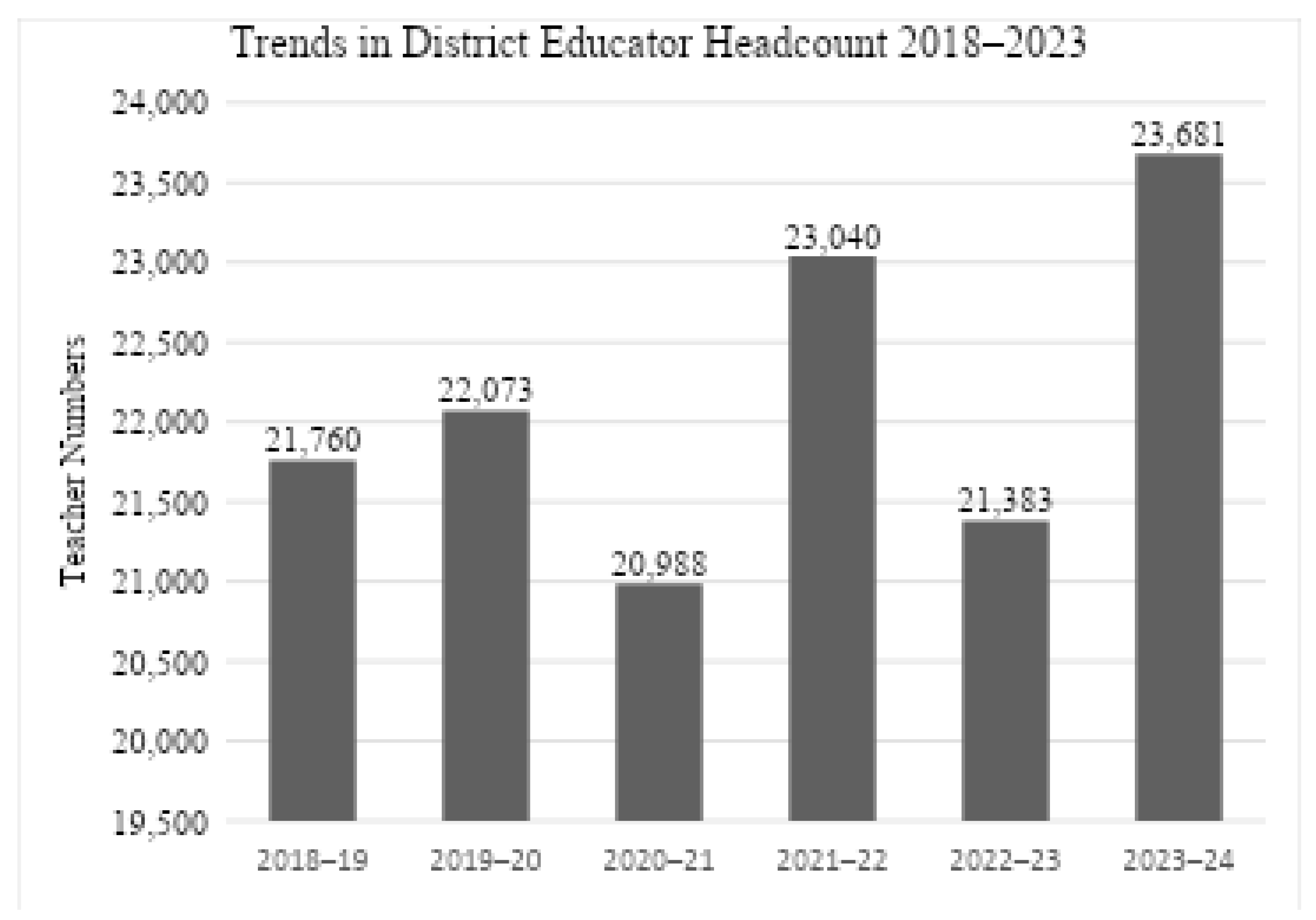
| Number of Teachers in District | 22,073 | 20,988 | 23,040 | 21,383 | 23,681 |
| Net Gains and Losses in NM Educators | 313 | −1085 | 2052 | −1657 | 2298 |
| Percentage of Vacancies | 2.92% | 2.72% | 4.55% | 3.23% | 3.17% |
| Working Condition | Elementary-Middle | Elementary-High | Middle-High |
|---|---|---|---|
| Salary and Compensation | M > E ** | H > E *** | N.S |
| Parent Support | E > M *** | E > H *** | H > M * |
| Teacher Workload | M > E *** | H > E *** | H > M ** |
| Administrative Turnover | N.S | H > E *** | N.S |
| Student Behavior | E > M *** | H > E *** | H > M *** |
| Administration’s Role in Student Discipline | N.S | H > E *** | H > M * |
| Class Size | N.S | N.S | H > M ** |
| Administrative Support | N.S | H > E *** | H > M * |
| Planning, Preparation, and Collaboration Time | M > E *** | H > E *** | H > M *** |
| Teacher Decision-Making Power | N.S | H > E *** | N.S |
| Working Condition | Mean, SD Low Turnover% | Mean, SD High Turnover% | Significance |
|---|---|---|---|
| Salary and Compensation | 63.5 (SD = 26.4) | 64.3 (SD = 26.2) | N.S |
| Parent Support | 55.1 (SD = 25.7) | 53.9 (SD = 27.0) | N.S |
| Teacher Workload | 55.5 (SD = 29.1) | 55.4 (SD = 29.1) | N.S |
| Induction and Mentoring Programs | 54.9 (SD = 30.8) | 54.0 (SD = 31.2) | N.S |
| Administrative Turnover | 64.0 (SD = 30.9) | 57.6 (SD = 32.6) | *** |
| Student Behavior | 56.2 (SD = 26.6) | 57.3 (SD = 27.8) | N.S |
| Administration’s Role in Student Discipline | 59.2 (SD = 30.1) | 57.3 (SD = 31.5) | N.S |
| Class Size | 62.3 (SD = 30.4) | 68.6 (SD = 29.5) | *** |
| Administrative Support | 69.4 (SD = 29.6) | 66.5 (SD = 31.0) | ** |
| Planning, Preparation, and Collaboration Time | 62.8 (SD = 29.4) | 60.3 (SD = 30.0) | * |
| Teacher Decision-Making Power | 56.0 (SD = 30.0) | 54.4 (SD = 30.2) | N.S |
| Working Conditions | p-Value Annual Turnover | p-Value Long-Term Turnover |
|---|---|---|
| Salary and Compensation | *** | *** |
| Parent Support | N.S | N.S |
| Teacher Workload | N.S | N.S |
| Induction and Mentoring Programs | N.S | N.S |
| Administrative Turnover | *** | *** |
| Student Behavior | *** | *** |
| Administration’s Role in Student Discipline | * | N.S |
| Class Size | *** | *** |
| Administrative Support | N.S | N.S |
| Planning, Preparation, and Collaboration Time | N.S | ** |
| Teacher Decision-Making Power | N.S | N.S |
Disclaimer/Publisher’s Note: The statements, opinions and data contained in all publications are solely those of the individual author(s) and contributor(s) and not of MDPI and/or the editor(s). MDPI and/or the editor(s) disclaim responsibility for any injury to people or property resulting from any ideas, methods, instructions or products referred to in the content. |
© 2026 by the authors. Licensee MDPI, Basel, Switzerland. This article is an open access article distributed under the terms and conditions of the Creative Commons Attribution (CC BY) license.
Share and Cite
Zito, E.; Samuels, M.; Khandelwal, M. Beyond Teacher Shortages: Structural Turnover and Workforce Instability in New Mexico Schools. Educ. Sci. 2026, 16, 773. https://doi.org/10.3390/educsci16050773
Zito E, Samuels M, Khandelwal M. Beyond Teacher Shortages: Structural Turnover and Workforce Instability in New Mexico Schools. Education Sciences. 2026; 16(5):773. https://doi.org/10.3390/educsci16050773
Chicago/Turabian StyleZito, Erica, Mark Samuels, and Megha Khandelwal. 2026. "Beyond Teacher Shortages: Structural Turnover and Workforce Instability in New Mexico Schools" Education Sciences 16, no. 5: 773. https://doi.org/10.3390/educsci16050773
APA StyleZito, E., Samuels, M., & Khandelwal, M. (2026). Beyond Teacher Shortages: Structural Turnover and Workforce Instability in New Mexico Schools. Education Sciences, 16(5), 773. https://doi.org/10.3390/educsci16050773