1. From Content to Context: Designing Games for Ethics Education
In 2026, the artificial intelligence company Anthropic reportedly rejected demands by the United States Department of Defense to use its software as a part of developing mass surveillance and fully autonomous weapons systems, claiming that to do so would undermine the democratic values held by the company (
Hays, 2026). Whether true or not, the presented situation poses a very real, deeply complex ethical decision-making situation, with far-reaching real-world outcomes and extremely diverse stakeholders. Though most students who are currently in university will unlikely face such singularly impactful decisions in their lives, the increasingly globally networked reach of science and technology has raised the importance of teaching ethics, especially in ways that help with decision-making under realistic conditions.
While formal classes in ethics ideally compel a person to act more ethically and morally in the world, how and whether coursework is sufficient for such a change to take place remains a point of contention across a variety of disciplines (
Bucciarelli, 2008;
Hess & Fore, 2018;
Hummel et al., 2018;
Medeiros et al., 2017;
Moreira et al., 2021;
Waples et al., 2009). This is due in part to the challenging nature of teaching ethical decision making—such education includes but cannot rely solely on subject matter knowledge or ethics theory to compel ethical action. Ethics education, rather, must also consider the diverse and possibly incongruent value systems that are present in any decision-making context, as well as the limitations of the setting under which such decision-making occurs (
London, 2001,
2021). For example, while an AI developer may be well-acquainted with ethical issues arising from the use and development of AI technology, their day-to-day decision-making may depend in significant ways on the social and institutional contexts, such as the background knowledge of funders, administrators, and users, the time needed to communicate decision-related information, and the wider cultural framing of their research. Each factor in turn may introduce its own array of ethical complexities that are layered on the more abstract disciplinary ethics. Hence, in supporting professionals or individuals learning to act ethically, classes and curricula cannot be designed solely in terms of subject-matter content or the abstract application of ethics theories, but should account for the ways that people—experts and non-experts both—must negotiate with and enact the values, ethics, and morals established in professional and disciplinary settings and communities (
Hafferty & Franks, 1994).
Simulations generally and games more specifically have been suggested as one possible way to improve ethics education, as they present players with interesting and rich systems through which students can explore ethical concepts and practice making ethical decisions (
Belman & Flanagan, 2010;
Nardo & Gaydos, 2021;
Sicart, 2011,
2013). In general, the designs of systems-based educational (i.e., games and simulation) content have tended to focus on using games as novel and effective vehicles for content delivery, often through simulating reality and allowing players to practice applying frameworks of good professional practice(
Galeote et al., 2021;
Hassan & Hamari, 2020;
Zvereva et al., 2023). For example, games might simulate professional decision-making environments in clinical medical settings, providing clear and appropriate consequences linked to player actions in order to learn about similarities between games’ rules and educationally valued content (i.e., medical ethics as in The Brewsters) (
Rozmus et al., 2015). Such “content-based” approaches embed to-be-learned content within their designs and leverage students’ understanding of the game system as a means for understanding a real-world system. In such games, content is not limited to professional practice or ethical theories, but may also include values (
Flanagan & Nissenbaum, 2007), decision-making skills, and emotion (
Schrier, 2015,
2017).
Outside of ethics education, and as an alternative to content transmission as the primary means for learning, educational games have also been widely considered in terms of the way that they support players’ participation in ideological worlds, fostering rich experiences through which individuals can explore and construct new ways of “being” and “doing” (
Squire, 2006). From such a “context-based” approach, ethics games’ educational affordances may be viewed less in terms of how well they reliably model reality and more in terms of the activities they support for students’ communication and connection (
Schrier, 2021).
Schrier (
2021), for example, notes the way that games oftentimes inherently involve rich opportunities for communication amongst players and result in tightly knit communities, arguing that games can be useful for “strengthening friendships and communities, as well as exchanging ideas, learning, and overcoming real-world problems—all necessary components of civics and ethics” (p. 90). Schrier also notes, however, that the games’ designs matter significantly, as some games can cause harm through, for example, toxic communities or misrepresentations. This identity-oriented, context-based approach differs from content-based approaches in that context-based games are designed as environments that compel and support out-of-game activities that can be educationally valuable, especially for ethics learning.
While the design of content-based games is relatively straightforward, they are also limited in scope. By considering ethics education as a matter of developing students’ understanding, content-based approaches assume ethically “correct” responses can be known a priori, embedded in designs, and communicated to players to remember or understand (
Nardo & Gaydos, 2021). If the complexities of ethical decision-making described above are to be met, context-based approaches must also be developed. Such designs are less straightforward, however, as designers must determine how modeling certain aspects of the target system results in indirect learning outcomes, mediated by subjective player experience; learning is not directly designed, but rather is designed
for (
Wenger, 2009). While other learning designs such as preparation for future learning (
Bransford & Schwartz, 1999) and productive failure (
Kapur, 2015) have explored indirect but educationally valuable experiences, relatively less is known about how such design principles apply to game-based, ethics learning contexts where content-focused, conceptual understanding is not the educational goal.
In this paper, we describe an ongoing design-based research (DBR) project in terms of two design cases, detailing the emerging design principles, preliminary findings, relevant theories of game-based learning, and accompanying pedagogy that together, comprise a developing framework that has already been used to support the development of multiple educational ethics games (
Gaydos et al., 2025;
Gaydos & Nardo, 2022b;
So & Kim, 2024). As a DBR project, the artifacts created based on this framework—and the framework itself—have undergone iterations of development and real-world testing, the aim of which is to develop and convey sufficient practical knowledge for other designers to understand and adapt the game-based activities that we have developed, adopt the approach for their own educational contexts, and to advance related research, including the development and testing of practicable learning theories (
DBRC, 2003;
Easterday et al., 2015). Following
Hoadley (
2002) and
Sandoval (
2014), we convey this work through a design narrative, specifying conjectures about expected learning outcomes and findings so as to inform the systematic development and testing of comparable implementations.
2. Design Case 1: Developing the Computer Game Write or Wrong
Between 2019 and 2022, two of the article’s authors designed and worked with a team to develop a web-based computer game to be integrated into a newly instantiated research ethics module at the postgraduate level at a large research university in Central Europe. The module consisted of a general research ethics component, which was mandatory for all new doctoral students across the institution—from philosophy to mechanical engineering—and a taught component delivered within the separate institutes to cover topics specific to each of the disciplines. The computer game was designed to be played by all students prior to attending class, meaning that content-wise, the game had to cater to a wide array of subjects. The curriculum for the course within which the game was to be used had not yet been designed, and so a fine-grained list of content with clearly defined learning goals was not available. As to-be-learned ethics content was unavailable, what it meant to ‘learn research ethics’ could be defined by the game’s designers. Facing the need to create a game suitable for all disciplines, the designers chose to focus on ethical dilemmas and complexities surrounding academic collaboration and publishing. Inspired by the moral dilemmas faced by the player in the commercial entertainment game
Papers Please (
Pope, 2013) and through a preliminary understanding of the relationship between games and ethics based on the work of
Sicart (
2013) and
Schrier (
2015), the designers chose to simulate aspects of professional academic life that would present players with ethical dilemmas.
The decision to design for simulation rather than for content delivery was shaped both by the initial design conditions (i.e., the lack of available content and the diversity of the audience) as well as a preliminary conjecture regarding what it meant to design games for ethical learning. Generally, educational game design relies on clearly defined and quantifiable learning outcomes, for example, to deliver consistent in-game feedback to player action (
Barab et al., 2010). As we have come to understand them, the sort of ethical problems that researchers might face as they work at the intersection of their local academic culture, their own background, and the requirements of their disciplines, are ‘wicked’ (
Nardo & Gaydos, 2021). Wicked problems are such that they do not offer clear solutions, corrective feedback to establish the value of a solution attempt, or the opportunity for repeated solution attempts. While there are clear-cut, rule-based dimensions to many ethical problems that would offer unambiguous direction for individual action and choices (and, thus, allow for a consistent in-game evaluation of player actions against an ideal), more often than not, ethical dilemmas are highly contextualized, complex and often a matter of social deliberation. In short, it is not always clear what ‘the right thing to do’ is, making a game design that is centered around feedback-to-action unsuited.
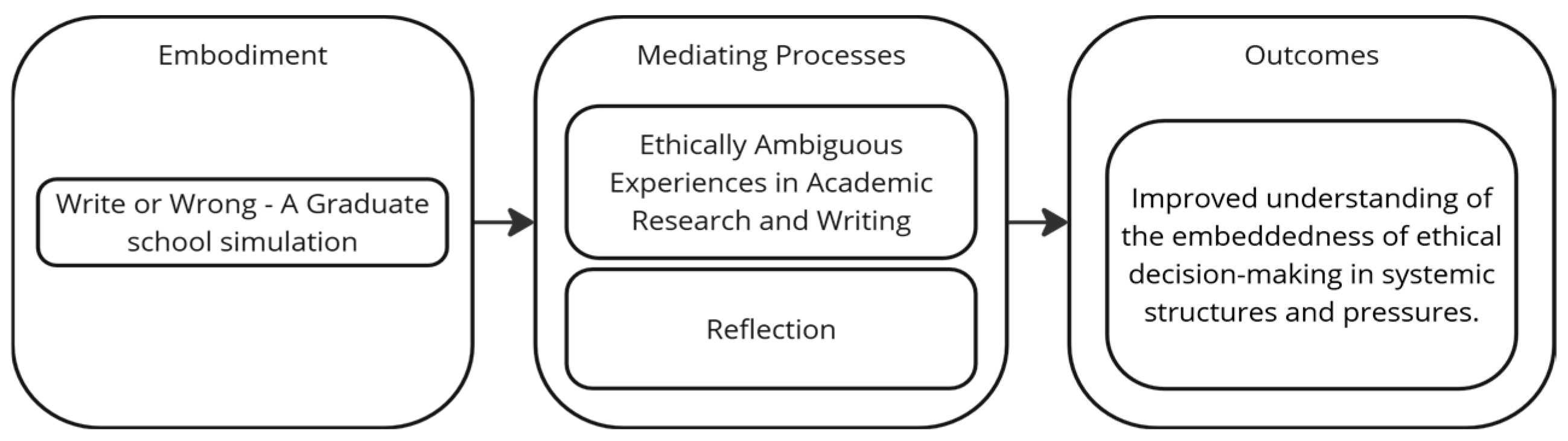
Informed by the content-agnostic context for which the game was intended, and the nature of ethical problems as ‘wicked’, instead of offering a definition of desired ‘individual ethical conduct’, the designers attempted to create a game that simulated how systemic factors shape individual conduct and helps to contextualize specific disciplinary issues. Rather than being centered around the questions of (a) what specific ethical knowledge players should acquire during gameplay, or (b) what sort of predefined individual conduct the game should inspire, the aim of the game was for players to experience some of the systemic influences on ethical decision-making inherent to working within a research lab, and academia writ large. For example, how do hierarchies—between PhD students, postdocs, senior researchers and professors—inform negotiations surrounding authorship on research papers in ways that might stand at odds with the written rules about authorship contributions that exist in most institutions? The initial aim of the game was to enhance players’ understanding of the embeddedness of ethical decision-making in systemic structures and pressures.
In the game that was designed, Write or Wrong, the player enters a fictional research lab as a new doctoral student. They are tasked with completing their dissertation within three years, while also needing to build a competitive research profile through research collaborations and publications. As they negotiate these tasks, players encounter various ethical dilemmas surrounding fair authorship distributions on publications, working with data of unknown origin or trustworthiness, and plagiarism. Rather than being labeled as ethical dilemmas or clearly being identifiable as such by being accompanied by a fixed set of options for action (in the sense of choosing action a, b, or c), ethical dilemmas are integrated into gameplay, and players respond to them using their usual choices for action. The gameplay lasts approximately 1 h.
The core game experience the designers aimed for is one of ambiguity. Within the context of the research lab that they entered, the player is not given overarching, well-defined goals (e.g., graduate with a certain number of publications). This ambiguity was intended to push players to constantly try to figure out and define for themselves what those goals are. This includes the role that ethical considerations play in the player’s overall decision-making and getting to know their colleagues’ moral compass through interacting with them. On the one hand, the experience of ambiguity aligns with the above-described ‘wicked’ nature of ethical problems, which are inherently ambiguous. By being ill-defined, in particular when it comes to their resolution, the ethical problems encountered in the game, the designers attempted to simulate ethical problems in the game in a similar manner as to how they would arise in real-world contexts and, thus, offer students an engagement with those problems that is faithful to the domain of ethics. On the other hand, many aspects of the work of an early career researcher are ambiguous, making the simulation a relevant field for exploration of questions such as: How many publications are ‘enough’? How are quantity, quality and ethics connected when it comes to research? What are the students’ own values when it comes to the weighting of these parameters?
In
Write or Wrong, in short, players enter a simulated graduate program with little guidance, where they encounter and must navigate ambiguity on different levels. This ambiguity was not seen as a hurdle to the attainment of meaningful learning of ethics, or something to be overcome on the level of game design. Rather, it was embraced as a catalyst for learning (
Nardo & Gaydos, 2021). Learning, from this perspective, was understood not as the acquisition of specific knowledge or the adoption of specific behaviors, but as an exploration of the complex set of interconnected factors at the intersection of system, individual and discipline that constitute real-life ethical decision-making (
Figure 1).
To test this conjecture, we carried out a pilot study with six PhD students, recruited from a large technical university in central Europe. Participants were asked to play through the game and verbalize their thinking as they played. Transcripts were reviewed by two researchers and coded descriptively, looking for cases where participants’ externalization of thinking could inform (1) how players reasoned about particular decisions and how they justified acting in one way or another and (2) how they made sense of the game more broadly. When discrepancies arose, coders talked about the code to find agreement. Codes were grouped into themes and the themes were summarized (
Saldaña, 2009).
Think-aloud themes that emerged were affect (i.e., how the game made them feel), real-world research structures (i.e., how feedback is typically provided in research), and agentful action (e.g., what players typically do in their research). Players drew connections to their own fields of research—for example, by referring to the importance of journal vs. conference papers in their respective discipline—and research practices in their own lab—for example by referring to their relationship with their supervisor. Notably, all participants articulated feeling the pressure to perform academically in the game, relating the game experience to their own as doctoral students and readily described their personal reactions to in-game events, such as how they would respond to intrusive emails from colleagues.
These think-alouds suggested that the game could successfully mimic the experienced pressures of academic writing as an early career researcher navigating its many ambiguities as students consistently and spontaneously made references to their own experience of being a doctoral student while playing, both confirming and negating the game’s portrayal of what it is like to be a doctoral student (e.g., accuracies and inaccuracies). The game also served as a potentially useful tool to encourage students to reflect on how they view the research practices in their own groups (
Gaydos & Nardo, 2022b).
As the game would eventually need to be used with students who had no prior research experience, we conducted a second pilot study with undergraduates. Thirty undergraduate students at a small liberal arts university in Japan who were participating in a course about learning and technology were asked to play the game as a part of their homework. Students were in their second to fourth year of school and had no prior experience carrying out research. Prior to and after game play, students were asked: “What might a researcher consider as important for ethics when writing research papers? List as many as you can think of. For each, provide a brief description of why and how it is important.” Of the 30 students who played the game, 12 returned consent forms allowing us to use their responses as data. Responses were coded descriptively by two researchers independently, discussed, and then grouped thematically.
Across their pre- and post-responses, four themes emerged: good writing (e.g., appropriate citations, quality), planning (e.g., anticipating deadlines), being mentally and physically healthy (e.g., fatigue may promote unethical practices), and social elements (e.g., academic discourses, communicating). These participants’ experiences highlighted more visible aspects of the game elements in their interpretations of ethics and research. For example, as players write papers in-game, their mental health deteriorates (in-game, this is instantiated with incoherent whispering that gets louder) unless they also take time to rest. A qualitative comparison of the pre- and post-game themes suggested that the game was successful in expanding students’ awareness of the sort of ethical complexities that accompany academic writing and publishing as mental and physical health was only mentioned by students after game play (
Gaydos & Nardo, 2022b).
Finally, because we were also interested in comparing the game experience with traditional ethics learning approaches, we recruited two groups of students to either complete an e-learning course on research ethics or to play Write or Wrong. Fifteen undergraduate students were recruited from a small private university in Western Japan. As participants signed up to participate, they were assigned randomly to groups of 4 in one of the conditions—either to play Write or Wrong or to work on a research ethics course developed by the Japanese Society for the Promotion of Science (JSPS). After completing either the game or the JSPS course, participants were asked to discuss and answer three questions as a group: What do different ‘authorities’ of graduate students and researchers (e.g., bosses, laws, job requirements, etc.) expect? What makes research authorship ‘fairness’ difficult to achieve? What ‘responsibilities’ do researchers have to consider in order to make ethical decisions? The entire study lasted around 90 min.
Group-written responses were descriptively coded by two researchers separately. Researchers reviewed one another’s descriptive codes, resolving differences via consensus, and grouped codes thematically (
Saldaña, 2009). Two themes were identified: (1) “Individual oriented” that were focused on the influence of qualities of the individual in driving decision-making, and (2) “Setting oriented” responses, oriented toward the influence of the setting on decisions (e.g., expectations from bosses). All participant responses in the game condition were “setting-oriented,” noting the social pressures signaled by the high-output research lab context presented in the game (e.g., pressure from their advisor to publish, the need to maintain a work/life balance). Responses in the JSPS condition were almost entirely individually oriented, raising issues such as compliance with rules (e.g., avoiding gift authorship, appropriate data handling) or research ideals (e.g., honesty). These responses suggested that through game play, students came to see societal and structural features that contributed to ethical decisions in research. These responses stood in contrast to the students’ orientation toward individual responsibility, which arose from the traditional ethics course (
Gaydos et al., 2025).
These three pilot studies of Write or Wrong were not intended to be generalizable, given their small sample size and lack of statistical rigor. Rather than testing hypotheses or theories of learning at this early stage in development, the aim was to examine whether the game was providing the intended meaningful experience—ambiguous but contextually rich ethical dilemmas akin to those found in research and writing contexts that supported players reflecting on what constituted an ethical dilemma for themselves, and (2) that could help orient players toward the social and structural factors that constitute these dilemmas.
At this stage, developing more rigorous and generalizable support for the games’ effectiveness was complicated by two things. First, we had theorized from the outset of the game’s development that for players to fully realize the intended experience of exploring ethical issues associated with academic writing and publishing (elements embedded within the game), an accompanying, post-game educational experience was necessary. Hence, when evaluating the game and its usefulness as an educational tool, rather than measuring the effects of the game on its own—e.g., what did an individual learn from playing the game?—an opportunity was needed to conduct post-game group discussion (1) in an authentic setting (e.g., attached to a research ethics class) that (2) provided enough students to achieve statistical power. Second, for a variety of logistical reasons (funding ending, the original course changing its curriculum, etc.), maintaining and testing Write or Wrong became increasingly infeasible to continue and scale. The theory developed from this model was therefore subsequently used as the basis for developing a series of non-digital games.
3. Design Case 2: From Plan#27 to Up for Debate
In 2022, a non-digital ethics education game was developed for use in an undergraduate course on sustainability at a large research university in Southeast Asia. The course was required for all undergraduates, regardless of major, and was required to be taken in the first or second year of study. The course was taught by a team of instructors, including a course coordinator and an instructor with whom we worked more closely. The instructor and coordinator explained that the game needed to meet particular content and logistical requirements in order for it to be used in the course. Specifically, (1) the game would be used in the last class of a 13-week-long course focused on the UN’s sustainable development goals (SDGs); (2) the game could be based on any content covered throughout the semester or external resources related to three primary sustainability ideas—the role of the government, economic development, and societal impact; and (3) the game would be non-digital and used for approximately 240 students (40 groups of 6), and the game needed to take approximately thirty minutes to complete so that other content could be covered by the instructor. Game development was led by a research scientist (one of this paper’s authors), three undergraduate students who assisted with playtesting, and one artist. To develop the game, the team worked independently from the course instructors, developing and play-testing prototypes based on content from relevant literature, the course syllabus, email exchanges and meetings. After two to three weeks of development, the designers would show a prototype to the course instructors for feedback. Total development time took approximately two months.
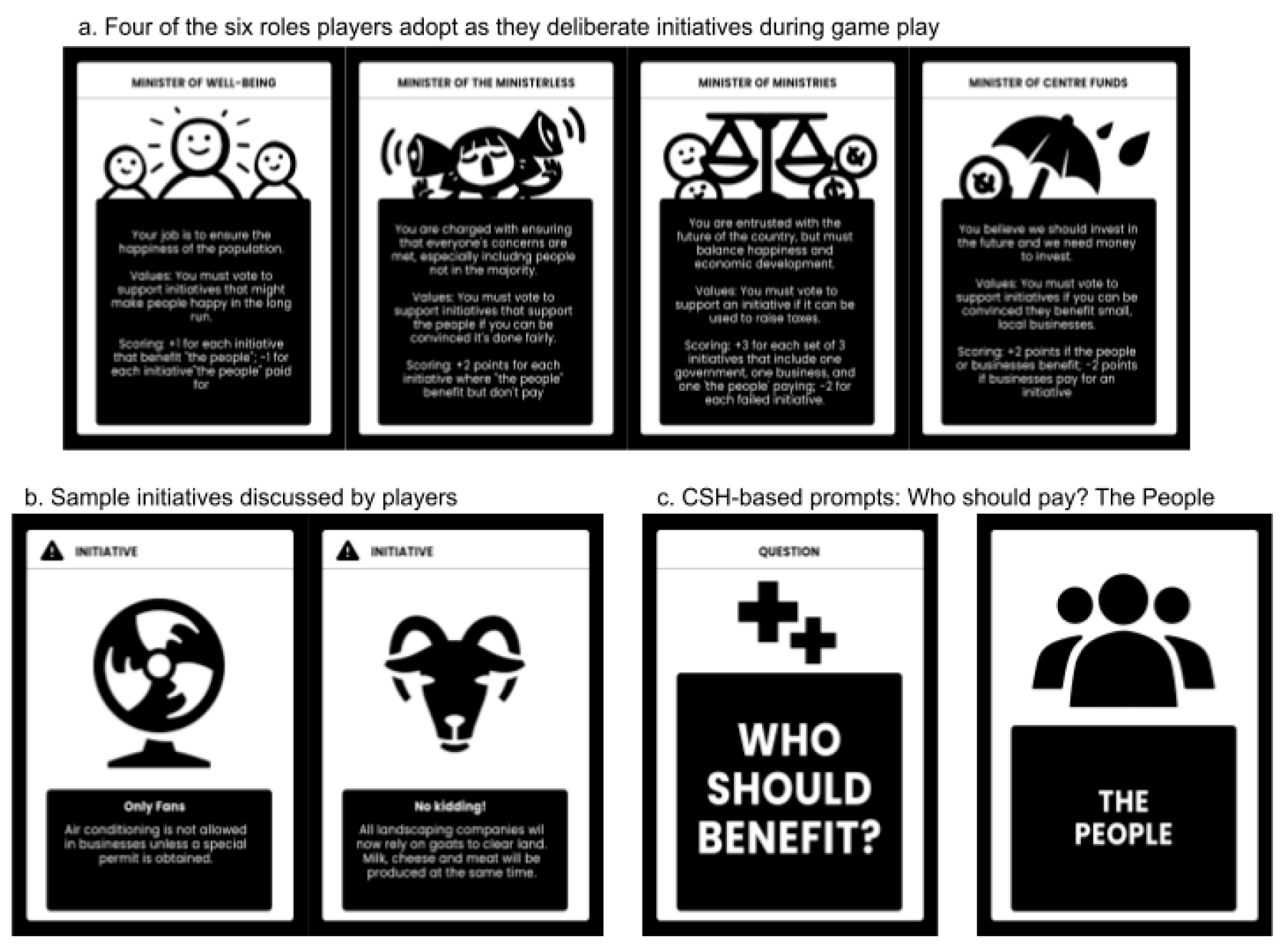
The first playable iteration of the game was named Plan#27, a table-top card game designed to be played by four to six players. In the game, players are randomly given fictional government roles, such as the Minister of Ministries or the Minister of Well-being and told that as government officials of an island nation facing a climate change catastrophe, they must prove their ability to govern by reviewing and enacting a set of sustainability policy initiatives. To enact a policy initiative, players needed to debate about and agree on (1) who benefits and (2) who should pay for each initiative before calling a vote, with a majority vote required to pass any initiative. Each minister had their own scoring goals to incentivize passing or not passing particular initiatives (
Figure 2). If players were not able to agree on four initiatives by the end of 30 min, all players would lose.
One key challenge with Write or Wrong had been its reliance on out-of-game deliberation that we had assumed would take place in a classroom after students played the game and would be co-developed with the ethics course instructors. Given the design constraints of the sustainability course, namely that the game needed to be played within 30 min and playable within a large 200-student class, designing for discussion facilitation after play seemed unfeasible.
The game was therefore designed around two core questions: Who benefits? Who should pay? These questions were drawn from critical systems heuristics (CSH) and were included in the game to prompt ethical discussions across the expectedly diverse student groups. Critical systems heuristics is a formal and practical approach to integrating ethics and systems thinking (
Ulrich, 2005;
Ulrich & Reynolds, 2020). CSH emphasizes the way that the boundaries of systems are socially constructed based on the values or ethics of the stakeholders. This view encourages a critique of the boundaries that are set up to demarcate any system (what counts as “within” the system and what has been excluded from it), through a series of twelve questions that allow lay individuals (i.e., not content experts or professionals) to engage in critical, rational argumentation pertaining to any policies that they might care about in their communities. These questions are asked in two modes: “What ought to be…?” And “What is…?” and are grouped into four topics: motivation (e.g., Whose interests are being served? Ought to be served?), sources of control (e.g., Who is the decision maker? Who ought to be?), sources of knowledge (e.g., What expertise is brought in? Ought to be?), and sources of legitimation (e.g., Who bears witness to the interests of those affected but not involved? Who ought to be?).
As a set of critical questions, CSH was designed to support non-experts in examining policies that may impact their lives and communities—not as an educational activity. In this case, as it was used as the basis for the game’s central player action, we deviated significantly from what “proper” CSH might typically include, adding fictional elements such as an imagined city-state, playful, fictional policies, and made-up ministerial roles. Further, because the game needed to be playable in about thirty minutes in order to fit into the classroom schedule, only two of the CSH questions were used. Rather than using CSH to help non-experts critically analyze policies affecting their own community, it was used as the basis to support students’ discussion practices wherein they examined boundary conditions as members of a quasi-fictional community (based on reality).
This first playable version was tested with two groups of six undergraduate students recruited through word of mouth. During two sessions, participants read the rules and played the game with minimal input from the researchers. These play tests lasted approximately one hour, during which students learned to play the game by reading instructions as a group without researcher support, played the game, and then provided verbal feedback through semi-structured group interviews. Gameplay and feedback were audio- and video-recorded and transcribed. Select portions of the transcript were broken into meaningful utterances for analysis. The section analyzed was not representative of the overall discussion but was a sample of what the researchers saw as the most educationally productive type of discussion that students had during game play. That is, this was the type of discussion that students had when the game was working as intended, representing the type of discussion we sought to support and replicate in further development of the game.
To characterize this discussion, we used Alexander’s (
Alexander, 2020) eight elements of learning talk, which are: Transactional, Expository, Interrogatory, Exploratory, Imaginative, Expressive, Evaluative, and Deliberative. According to Alexander, for learning to truly take place, students need to do more than answer questions posed by their teachers. They should be able to “ask questions of their own, to explain and expand their ideas and explore the ideas of others” (p. 142), learning to consider and respect others’ perspectives, and responding appropriately. Alexander proposes that these eight elements of learning talk can be used to categorize the various types of discourse that occur during the learning process, based on the speaker’s intention. Transcript utterances were coded separately by two researchers, allowing for multiple codes per utterance. Researchers then met and discussed which codes applied to each utterance until a consensus was reached.
Student feedback from these sessions highlighted issues with the game, namely difficulty in quickly understanding game rules. Play testers reported that the instructions of the game were confusing, especially with regard to in-game roles, scoring, and how to appropriately answer the CSH questions. Additionally, there were concerns that the game might take too long to play, especially as students spent substantial time figuring out the game’s rules. Nevertheless, using Alexander’s elements of learning talk, we found that approximately 1/3 of the selected speeches included engaging in deliberative or evaluative talk pertaining to the ethical subject matter—the type of dialog participants wanted to support. See
Appendix A for the definition of each learning element talk used, an example utterance from the data, and the percent of utterances that had each code applied out of the total number of utterances coded.
Following this feedback, the game was renamed Up for Debate to more clearly suggest what the game would be about. The roles were removed entirely, and the scoring system was changed so that players would no longer focus on quickly passing four initiatives and instead would focus on the content of the debate. To address concerns about understanding game instructions, a five-minute how-to-play video was created to be shown at the start of the play session.
Regarding rule changes, Up for Debate was redesigned to somewhat resemble popular party games that included a voting element (e.g., Apples to Apples). Players took turns being the lead player who, each round, revealed the top card of a policy initiative deck and randomly selected one of two CSH-based questions, “Who is most positively affected?” and “Who is most negatively affected?” They assigned point values of 1, 2, or 3 points to each of the three stakeholder groups: the environment, the economy, or society. All other players then chose one of the stakeholder groups to argue on behalf of, answering the CSH question. For example, the lead player might reveal a policy initiative that required bio-digesters to be integrated into local government housing in order to convert food waste into electricity. Other players would take turns proposing arguments that the government, society, or businesses would be most negatively affected by the policy. At the end of the round, the lead player would decide whose argument was the most compelling and that player would be awarded the point value that had been assigned at the start of the round (1, 2 or 3 points). The game was tested once more for usability before being deployed in class.
As described earlier, the game was played on the last day of a once-per-week class in a 13-week course on sustainability. Within the three-hour block of class time, approximately 60 min were allocated to game play, including 15 min of instruction and setup, 30 min of play, and 15 min of debriefing. Based on pilot data, we expected that students would engage in at least some ethical content deliberation during gameplay; however, we could not observe and capture all deliberations directly. As a proxy for evaluating student discussions, we asked students to complete a discussion engagement survey (
McAvoy et al., 2022) after game play. Discussion, to McAvoy et al., is a “collective inquiry that requires an inclusive classroom climate as well as individual contributions that deepen learning and promote the engagement of others”(
McAvoy et al., 2022, p. 1761). Relatively good discussion engagement, we theorized, would suggest that the game and its ethical deliberations were doing a better job at encouraging students to connect personally with the in-game content and associated values, at least as compared to their typical class activities.
This survey was modified from its original format, wherein participants reflected shortly after a class on how engaging the discussion was, rather than considering two classes comparatively (40). In the version of the survey we used, we reworded the questions to compare students’ feelings about engagement in the game class relative to their typical class discussion (for this course). A sign test was used to determine whether students’ (
n = 181) responses indicated greater engagement relative to their typical class. It was significant for all items (
p < 0.000). These findings suggested that students viewed the game-facilitated discussion, including their feelings of confidence in contributing, the inclusive climate created, and their discussion skills applied, as equivalent to or more engaging than their typical classroom experience. Consult
Appendix B for the modified questions, descriptive statistics, and histograms (sparklines) of survey responses.
Up for Debate served as a card-game instantiation of the previously developed model for game-based ethics learning that helped to move the proof-of-concept forward by allowing for faster and cheaper iterations of development, enabling rapid deployment to an authentic classroom setting at scale, and testing related theory (e.g., that such games could create relatively engaging discussions). The new format also introduced new problems, however. For example, by nature of its physical form, it differed significantly from Write or Wrong in that it could no longer provide rich computational resources to simulate a complex, social, ethical experience. Rather, the ethical dilemmas needed to emerge from a combination of game-player interaction. Instead of trying to develop in students an appreciation for and understanding of the societal and structural influences of ethical decision-making, the non-digital format allowed for immediate, face-to-face deliberation. While we still had not yet directly tested student learning outcomes, by designing a card game that could be easily embedded in a class, we were able to begin collecting data at scale and in an authentic setting.
Through extensive pilot testing, we had gained insight into how our designs mediated players’ ethical discussions. Assessing learning outcomes remained challenging, however, due in part to our increasing clarity regarding what constituted ethics learning in this context. That is, as described earlier, our approach departs from viewing ethics education as a process of content learning or conceptual understanding, and instead considers it to be a situated activity that requires individuals to demarcate the bounds of ethical action and to deliberate and reflect on its meaning and nature. Designing games to teach ethics, then, does not mean configuring games for content delivery or designing into them pre-defined understandings. Rather, creating games as contexts for indirect and personally meaningful learning means that such games should (1) simulate ethical dilemmas, allowing for ambiguity and accounting for wickedness while (2) providing structured, within or post-game opportunities for students to deliberate about meaning and ethics. This approach complicates the issue of assessment, as typical approaches to student learning that rely on student understanding could not be applied. (
Figure 3). To address this issue, theoretical clarity was needed with regard to how each design component contributed to learning, as discussed below.
4. Design for Ambiguity and Wicked Problems
While recent reviews of the effectiveness of game-based learning have broadly supported games’ potential to improve learning outcomes (
Clark et al., 2016), learning in these studies is oftentimes focused on how well students acquire new conceptual understanding or develop new, academically valued behaviors. For example, games have been used to teach concepts related to physiology (
Carrazoni et al., 2023), programming (
Ocaña et al., 2023), or to improve students’ sustainability practices (
Di Paolo & Pizziol, 2023). Games have also been used in training and professional development settings to introduce students to otherwise difficult to encounter content, such as in cases where situations might pose safety concerns (
Mason & Loader, 2019), for situations that are rarely encountered but important to understand (
Lateef, 2010), or for situations that require other people to role-play because the authentic situation is not available (
Dalgarno et al., 2016). In both traditional classroom and professional development contexts, this “learning” is defined a priori by curricula with educational outcomes measured in terms of how well students develop these new, predetermined ways of understanding, behaving, or seeing the world. That is, learning is expected to occur through players’ engagement with the game-based activity, where learning outcomes are mapped onto aspects of the game’s design, through the game’s mechanics or in-game representations, for example.
Ethics education curricula, particularly in post-secondary school and professional contexts, cannot be easily taught using this approach as it is complicated by the relationship between subject-matter or disciplinary knowledge and ethical and moral reasoning. For example, in the context of medical ethics, students and professionals might need to balance considerations such as the risks and benefits of a particular treatment, costs involved and the wants and needs of the patient and their family (
Delany et al., 2025), which will differ depending on the case and context. Relevant coursework might thus include a combination of explicit material to be learned, such as medical codes of conduct, theories of ethics (e.g., deontology), and facilitation processes that can help individuals arrive at ethical decisions with patients (
Eckles et al., 2005). Related curricula may be organized to include a mix of pedagogical approaches that combine traditional lectures, digital simulations, and classroom discussions (
Souza & Vaswani, 2020). Regardless, because coursework cannot anticipate and encapsulate the values and beliefs of individuals, ethics learning cannot be reduced to content understanding. Rather, processes involved in unearthing, understanding, and deliberating about stakeholder views are essential to preparing students adequately to deal with ethical dilemmas as they arise. In some professional education, such as in medical training, particular processes of case deliberation are often used, structured and organized by a trained facilitator (moral case deliberation) (
Tan et al., 2018).
While such process-oriented approaches may be suitable for professional settings, in everyday contexts, structures such as case deliberation based on disciplinary knowledge can be problematic (for an in-depth philosophical discussion of the limitations of a knowledge- and theory-based ethics education, see
Gaydos & Nardo, forthcoming). For example, even in a typical university classroom setting, students may come from different majors, different cultural backgrounds, have different background knowledge and language ability, and hold different expectations with regard to future academic and professional practices. In covering interdisciplinary topics such as sustainability ethics, there is no single profession or professional standard that can be predefined as having the greatest authority, as sustainability issues, like many real-world issues, are not confined to a single profession or discipline and require the input of stakeholders whose values may be incommensurate with one another.
This lack of a professional aim for curriculum design is an important consideration because some of the most fruitful work on game-based learning has included the availability and reliability of professional knowledge as a key assumption. For example, professional epistemic games are games designed to convey to players the disciplinary knowledge and ways of seeing the world that are associated with a particular profession (
Markauskaite & Goodyear, 2017). As Markauskaite and others have described (
Markauskaite et al., 2014;
Markauskaite & Goodyear, 2017), epistemic games can be differentiated into those that are formal, in which disciplinary epistemologies are conveyed to the player and those that are functional, pertaining to the epistemic knowledge used to make sense of the world, especially in professional contexts. In formal epistemic games, the knowledge and epistemologies adopted by players are new, and the knowledge is associated with a particular discipline. In functional epistemic games, players are concerned with determining how disciplinary knowledge is situated and applied to their professional actions. While such games have shown promise as educational tools, in an ethics context where multiple disciplines and professional epistemologies intersect and ethics learning is not limited to ethical theories or codes of conduct, games—and the associated learning approach—must be modified.
To address these challenges, instead of designing games to teach professional codes of conduct or the application of ethical theories, we design our games to simulate ethical decision-making experiences without assuming clear and singular solutions. That is, our designs purposefully simulate decision-making situations that are related to the target learning area (e.g., sustainability) while also being complex, ambiguously bounded, and without a clear resolution (i.e., wicked problems) (
Nardo & Gaydos, 2021). By eschewing a content-based approach and problems that are straightforward or those that have ethically “correct” answers, such a design is not intended to “teach” players directly through play. Rather, it is intended to create experiences that must be reflected on and discussed in order for players to understand one another, allowing the meaning of words, decisions, and values that are used within the game to be negotiated and co-constructed by players outside the game. As the game we have created was not designed to tell players what the correct or most ethical choices are (players must decide for themselves), this approach requires elaborating on a second design element, normative ethical dialog.
5. Designing for Normative Ethical Dialog
In the framework proposed here, we have shifted away from professional epistemologies and/or professional ethics content as a primary learning goal in order to create games that are more appropriate for educational contexts that require a non- or trans-disciplinary approach. That is, our aim was to create games for contexts where we could not be sure what future professions students would be associated with, but that they would be expected to be discipline-adjacent stakeholders (e.g., familiar with and affected by business-sustainability issues, but not necessarily business people themselves). Our learning goals therefore focused on helping students consolidate prior knowledge (including disciplinary and lay) with their own morals, beliefs, and ethics. In such a situation, the game is intended to provide players with relevant experiences that can be used as the basis for ethical discussions by creating a shared context wherein they can negotiate meaning. Considering ethics learning in terms of negotiated meaning requires shifting the pedagogical role of the game away from a tool that delivers content toward one that mediates rich, ethical dialog amongst players.
Learning that occurs in this context can be characterized as moving away from the dialectic approach to more of a dialogic approach (
Gaydos & Nardo, 2022a). In a dialectic approach to learning, effective cultural sign and tool use is the primary learning goal (e.g., learning “math”). Dialog may be present in a dialectic approach but is considered the method through which dialectic learning occurs (
Wegerif, 2011). That is, the aim of the dialog is for the student to acquire, and for the teacher to transmit, a shared understanding of the socially constructed meaning of tools (
Daniels, 2014). Contrastingly, in a dialogic approach to learning, the role of the tool and sign is to provide support and expand dialogs between people with different viewpoints and understandings. Unlike dialectic learning, tool use and representations may take on multiple provisional meanings as one attempts to understand what the other is saying. In dialogic learning, an individual learns to see things from two perspectives at once and learning is dependent on establishing and maintaining a dialogic relationship between the learner and the ‘other’ (
Wegerif, 2007,
2011).
The differentiation between dialogic and dialectic learning is not to imply a binary, but a matter of emphasis (
Ravenscroft, 2007;
Ravenscroft et al., 2007). As dialectic tools, games can motivate and engage individuals in understanding content or, when appropriately aligned, can lead directly to knowledge that is advantageous for acting in both systems (learning the game = learning math). In a dialectic game approach, game play should lead to learning some pre-defined culturally appropriate sign/tool use. As dialogic tools, games can create opportunities for conversation and understanding between players and others involved, whether those individuals are immediately present as co-players or are temporally removed but acting through the game’s rules (i.e., designers). Learning in dialogically oriented games does not emphasize mastering content that is relevant to an out-of-game system (e.g., learning professional ethics practices). Instead, in a dialogic educational game, the aim is for players to better understand the other’s perspective (e.g., what other players or fictional characters value and why).
A dialogic approach is particularly appropriate for ethics as it creates the opportunity for individual reflection and development based on the different interpretations held and voiced by interacting individuals. This relationship between voices involves creating a ‘space’ between the self and other within which both “mutually construct and reconstruct each other” as they seek understanding (ibid.). The result of this kind of dialog is, essentially, not the reduction in difference towards a particular aim (e.g., seeing the world as a particular profession), but the construction of new meaning that is not already present between the dialog participants (
Daniels, 2014). This process of dialog interpretation may involve listening, trying to proceed in conversation, and addressing one’s own prejudices as we comprehend what the other says and contribute our own voice to the conversation (
Vilhauer, 2010). Using dialogic learning as a basis for educational games is not new (
Arnseth et al., 2018;
Ravenscroft et al., 2007), but it has not been applied specifically to an ethics education context, leaving little guidance regarding how exactly such games can be designed and used or related learning assessed. In the context of our framework, for the design of educational ethics games that are not primarily content-driven, nor primarily aimed at a certain conception of ‘improved conduct’, a dialogic approach aids in foregrounding the individual’s deliberative activity as the core of their ethical conduct.
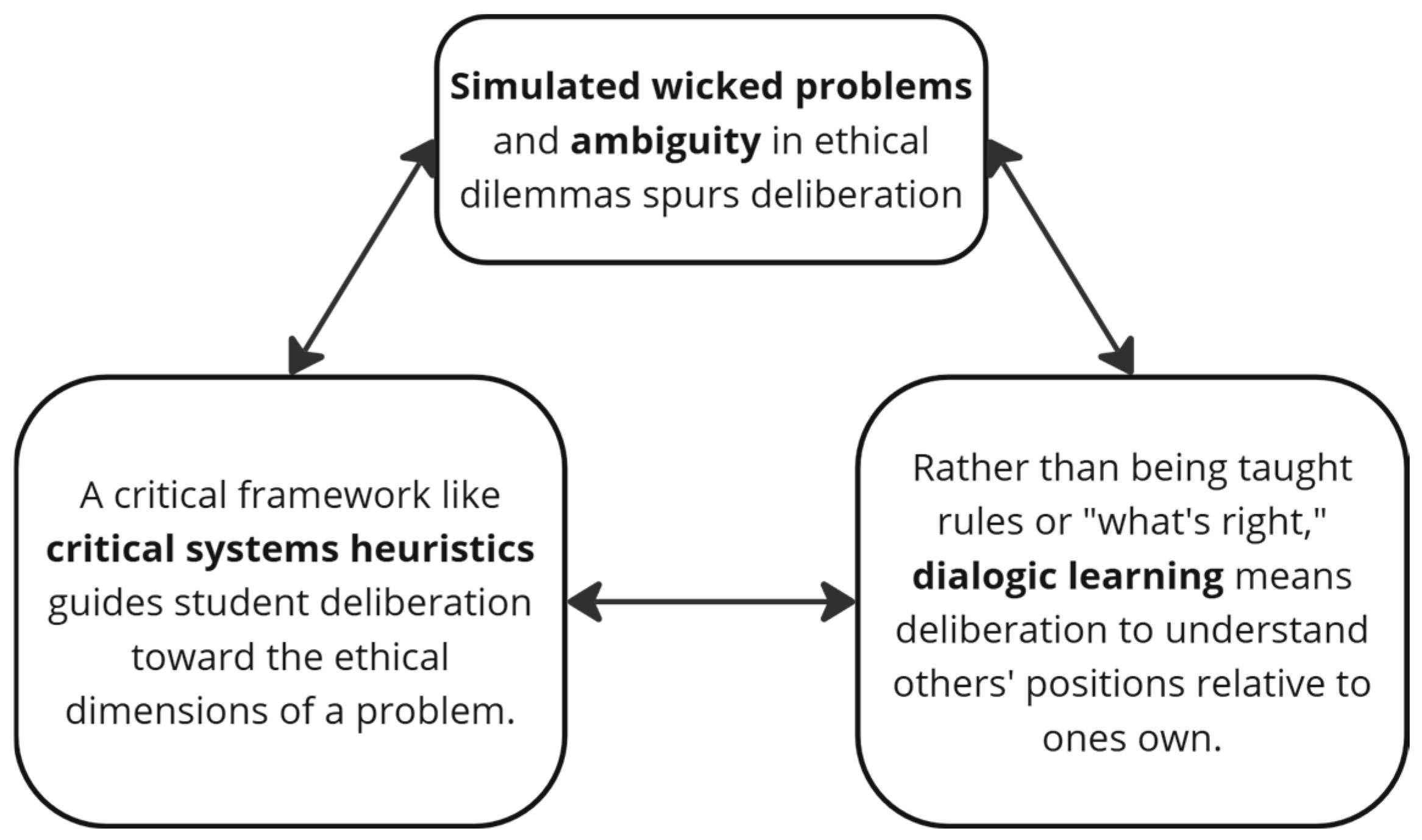
To summarize, we propose a game-based learning framework that (1) uses games to simulate wicked problems and present players with ethically ambiguous situations, (2) uses a critical framework such as critical systems heuristics to orient the players toward the ethical dimensions of the problem, and (3) assumes students are learning dialogically rather than dialectically (
Figure 4).
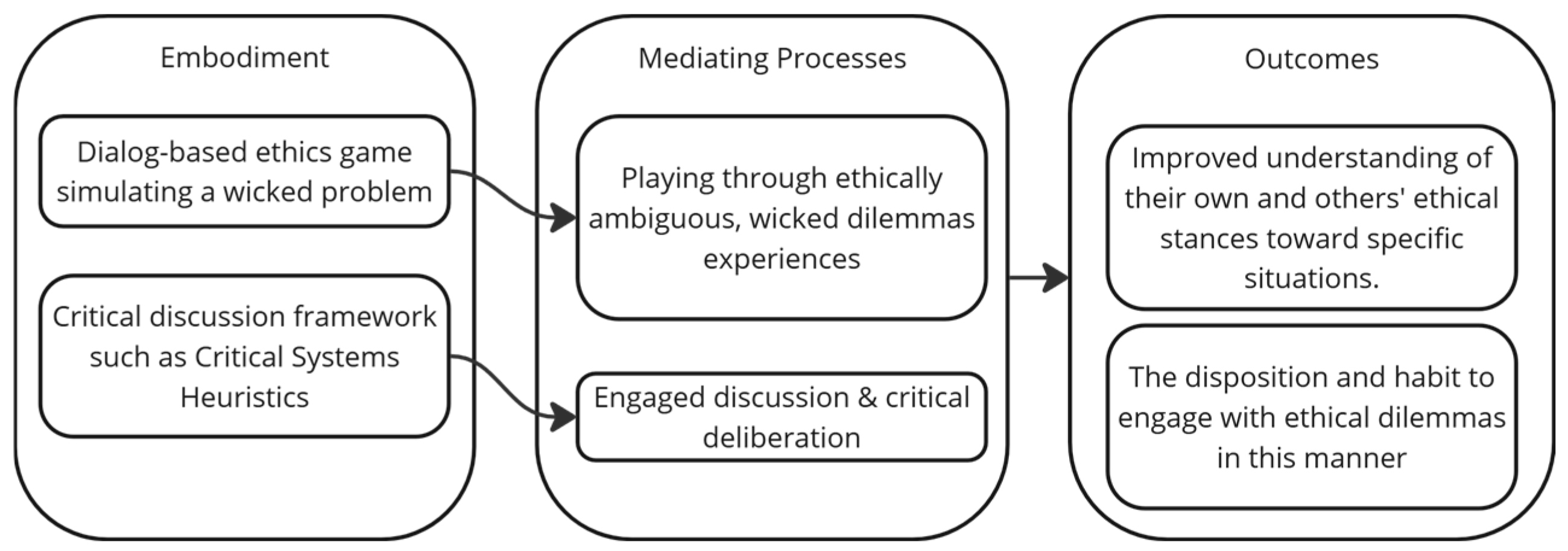
The framework can better specify what it means to learn ethics through deliberative play, where we expect students to (1) develop, clarify, and consolidate the meanings of their personal values relative to others and in the provided content-laden context, and (2) to ideally develop a disposition toward or habit of continual engagement with these sorts of ethical dilemmas in future settings (
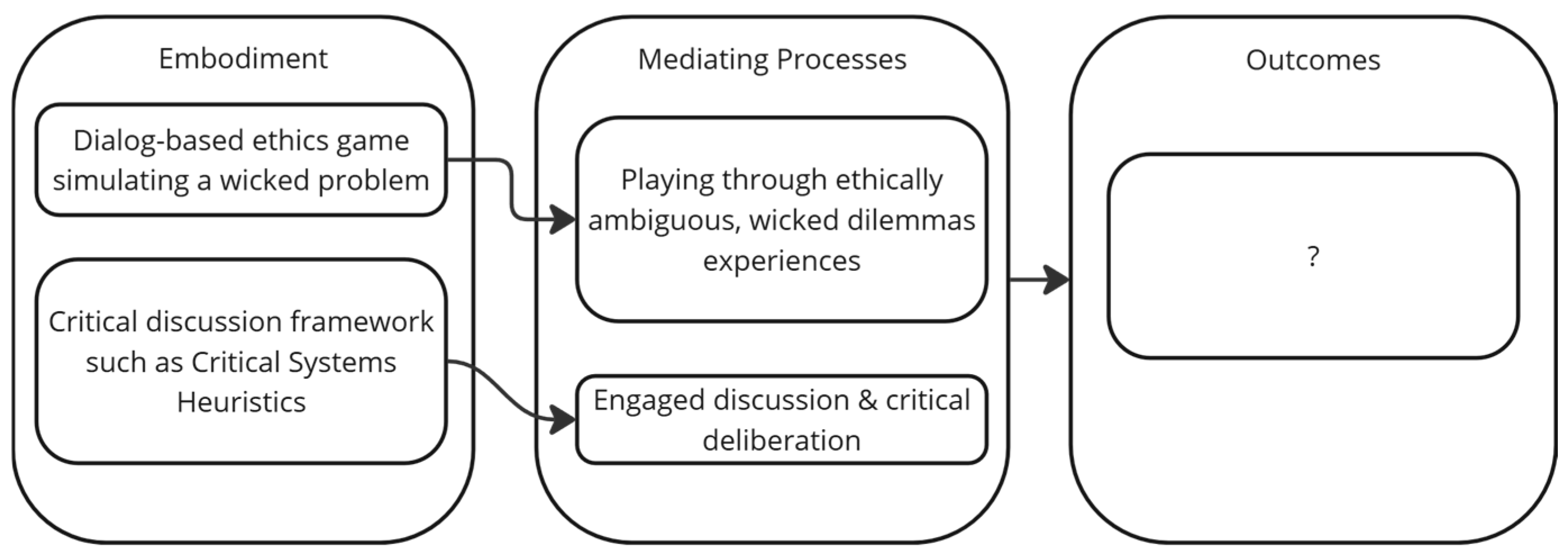
Figure 5).
6. Discussion, Future Directions, and Challenges
Designing games for learning is becoming increasingly commonplace, but many of these designs adopt a content-first or professional orientation that may not be suitable for ethics education intended to support a more general audience, interdisciplinary contexts, or wicked problems. By designing games as contexts for learning, introducing players to wicked problems, supporting structured critical dialog, and considering learning as a predominantly dialogic process, we provide an alternative way to configure educational games that do not deliver content and teach students to understand some well-defined static body of knowledge. Instead, we suggest a framework wherein students explore, clarify and consolidate previously learned knowledge with their own and societal values—a more dynamic approach suited to the uncertainty inherent to many ethical dilemmas.
Our aim in presenting this framework is to begin documenting what we believe are sufficient design elements for effective use, outlining the beginnings of a genre and framework that requires further refinement and testing. Systematically documenting these design elements is timely and needed for three reasons. First, these design elements are generalizable, can be applied to the creation of ethics education games across other domains, and should be systematically evaluated and refined. For example,
Ali et al. (
2023) have created a card game for AI ethics education, suggesting that critical ethical conversations are important. Independent of this work,
So and Kim (
2024) have reportedly used the framework presented here as a starting point for developing a game for AI ethics education, and have found that students similarly engaged in rich deliberation. In our own work, we have begun developing and testing games for AI ethics and sustainability policy ethics, the results of which are forthcoming.
Second, the design presented here considers ethics learning as emerging from dialog within a community, providing a more democratic approach to ethics learning in the classroom and presenting a much-needed pedagogical tool. Given the rapidly rising need to engage students in reasoned discussions about ethically difficult and politically charged topics (
Stoddard & Hess, 2024), dialog games like those presented here align with epistemologies that may help focus less on students memorizing content and more on helping students engage with open-ended problems while including diverse stakeholders in developing solutions. The supportive results from our study of
Up for Debate show that students reported improved discussion engagement relative to their typical class, and such discussion engagement is assumed to be an important starting point for deeper deliberation and ethics learning. We acknowledge, however, that substantially more work is needed for this genre to be widespread and effective, especially in moving and studying how students learn beyond engaged discussions.
Third, similarities between the designs presented here and other approaches support their potential and warrant further study as the work has not yet coalesced into coordinated development. In addition to the work by So and Kim above, consider
Sadowski et al. (
2013) who describe a game-theoretic pedagogy for sustainability ethics in which players are presented with wicked sustainability problems and follow Kolb’s learning cycle to frame their educational activity (concrete experiences, reflective observations, abstract conceptualization, and active experimentation). While their work broadly supports embedding wicked problems in games for ethics education, our approach further specifies how designs can be replicated and used, what constitutes ethics learning, and how outcomes might begin to be assessed in real-world classrooms.
That is, the framework presented here is buoyed both by the success and the general similarities between these approaches, as well as by the differences—our work aims to provide generalizable elements for games that could introduce students to the challenges inherent to real-world wicked problems and at the same time theorize and test the role of dialog and normative cases in ethics learning. Establishing clearer design elements and outcomes is necessary for games research to move toward designs and outcomes that can be replicated—necessary elements for rigorous research. While data collected thus far suggest that games designed with these elements in mind can support classroom discussions characterized by deliberation, evaluation, and increased engagement, we anticipate that developing this work for impact requires solutions that are generalizable, especially including theories and practices that advance how to assess students’ ethical development and how to best support ethical reflection and discussion. We agree with
Levinson and Fay (
2019) who argue that new ways to teach ethics are urgently needed, and see games as a potentially useful tool for these ends.