1. Introduction
As the race for international students continues to rise globally, higher education institutions and governments worldwide are increasingly competing to attract top talent through strategic recruitment initiatives and scholarship programs. This intensifying competition reflects the recognition that international students contribute significantly to institutional diversity, research capacity, economic vitality, and cross-cultural exchange (
Füzesi & Tistyán, 2013;
Berács et al., 2014,
2017;
Mawer, 2017;
Campbell & Neff, 2020;
B. Alpek et al., 2022;
Császár et al., 2023;
B. L. Alpek et al., 2025).
The global landscape of international student mobility has become a strategic priority for many nations, with government-funded scholarships serving as powerful instruments not only for educational access but also for advancing soft power objectives and fostering diplomatic relations (
Aras & Mohammed, 2019). Countries across Europe, Asia, North America, and beyond have developed comprehensive scholarship schemes designed to reduce financial barriers while enhancing the attractiveness of their higher education systems. These programs, ranging from Turkey’s Türkiye Bursları to Kazakhstan’s Bolashak initiative and Japan’s MEXT scholarship, reflect a dual commitment to supporting individual academic pursuits while simultaneously building human capital and international partnerships (
Tamaoka et al., 2002;
Perna & Jumakulov, 2015;
Aras & Mohammed, 2019). Understanding how these scholarship programs influence students’ destination choice, motivation, sense of belonging, integration, and satisfaction with their academic studies has become increasingly important. Such insights are essential for policymakers and higher education institutions seeking to optimize international recruitment strategies, enhance student support mechanisms, and ensure positive academic and social outcomes for scholarship recipients.
1.1. Defining International Students
To assess the role of scholarship programmes in shaping international students’ integration and sense of belonging, it is essential to begin by clarifying who is encompassed by the term
international student. While international students can be understood in various ways, a shared definition has emerged among leading organizations. Specifically, UNESCO, OECD, and EUROSTAT now define internationally mobile students as “… individuals who have physically crossed an international border between two countries with the objective to participate in educational activities in the country of destination, where the country of destination of a given student is different from their country of origin” (
Migration Data, 2024). In this study, the term
international student is used in line with this definition. Driven by globalization, international student mobility has witnessed a dramatic surge, fostering intercultural exchange and enriching both the sending and host institutions (
OECD, 2019). On a global scale, the number of students enrolled from abroad has skyrocketed, growing from 4.1 million in 2012 to more than 6.4 million in 2021 (
Migration Data, 2024).
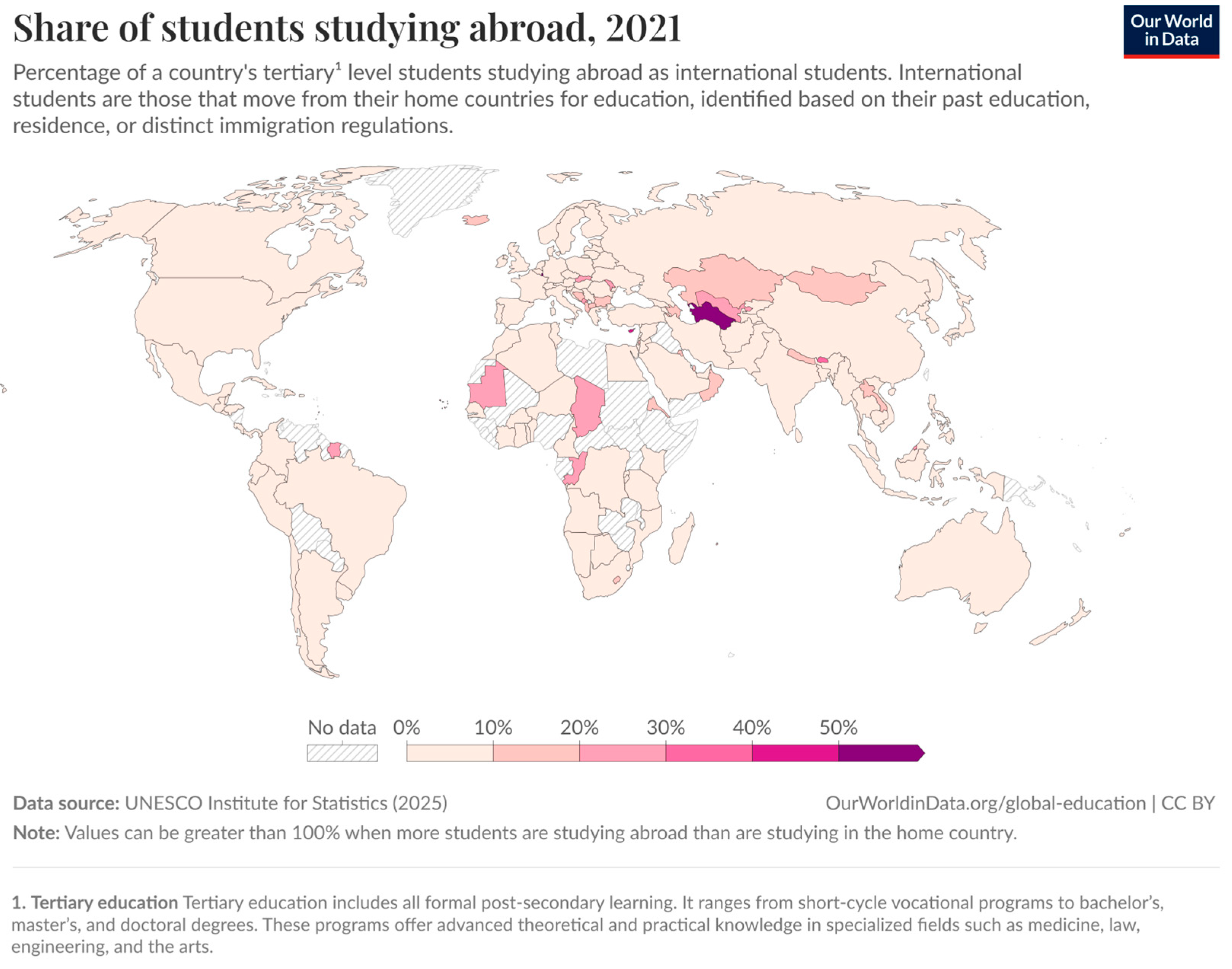
According to UNESCO data (2021), visualized by Our World in Data (
Figure 1), the global landscape of student mobility is undergoing a notable shift. The map presents the
share of students studying abroad, illustrating increasing outbound mobility from several regions. High proportions of tertiary-level students from Sub-Saharan Africa and South Asia, often exceeding 10–15%, pursue higher education outside their home countries, reflecting limited domestic capacity, demand for specialized programmes, and perceptions of higher educational quality abroad. In contrast, countries such as the United States, Australia, and the United Kingdom exhibit comparatively low outbound mobility rates, largely due to strong domestic higher education systems that attract international students rather than encouraging outward movement (
UNESCO, 2021).
1.2. The Big Four: Shifts in International Student Enrolment
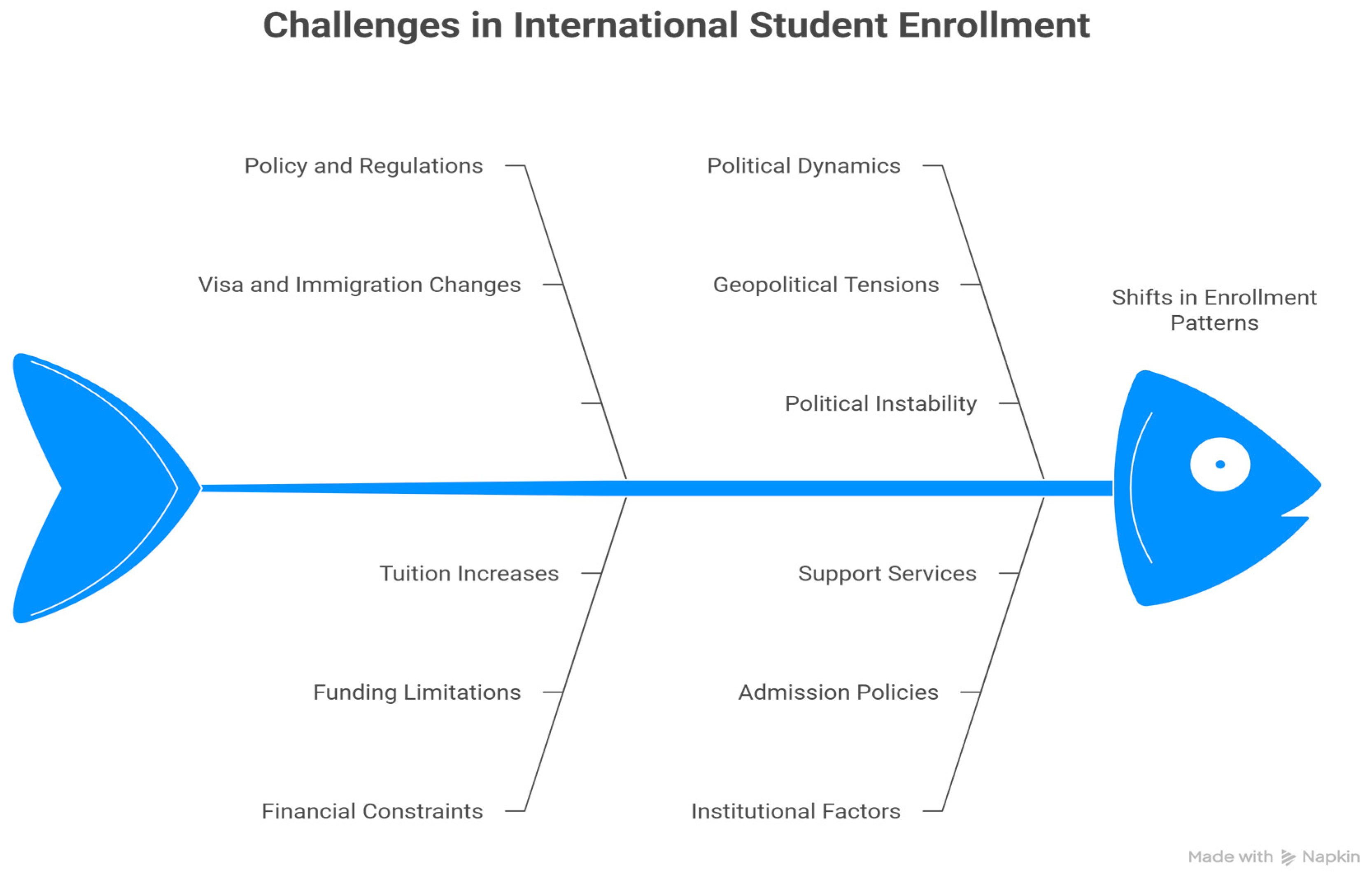
The Big Four destinations for international students, Australia, Canada, the United Kingdom, and the United States, are currently experiencing shifts in enrolment patterns amid emerging policy and financial pressures. While these countries continue to pursue strategies aimed at attracting international students, recent developments in visa and immigration regulations, financial and funding constraints, political and geopolitical dynamics, and broader institutional and regulatory pressures have simultaneously introduced new barriers to application and entry. These interrelated factors are categorized and summarized in the fishbone diagram presented in
Figure 2, illustrating the paradox between policy intentions and actual accessibility for prospective international students. Essentially, these countries want the benefits, but are making it harder for students to apply.
Scholten (
2024) characterizes this situation as paradoxical: on the one hand, international students are seen as beneficial, bringing economic growth and enriching campuses. On the other hand, these countries have recently enacted policies limiting international student enrolment. While these nations acknowledge the well-documented advantages of international students, including economic growth and campus diversity, recent government policies have aimed at restricting their numbers.
Scholten (
2024) also claims that the reduction in international student enrolment in the UK, Australia, and Canada can be attributed to a combination of stricter immigration policies, economic constraints, geopolitical considerations, and even the impact of the COVID-19 pandemic. As summarized in
Table 1 below, international students constitute between 22% and 30% of total enrolments in Australia, Canada, and the United Kingdom. Despite this substantial reliance, all three countries have recently implemented policy or financial measures associated with marked reductions in international student inflows. Canada is cutting back on study permits by 35%. The UK is restricting who can bring family members. Australia is making visas more expensive and harder to get, and plans to limit the total number of international students in the future. Deposits from international students to UK universities have dropped by 43%. Australian student visa approvals have fallen by almost 30%. These measures reflect broader strategies and concerns within each country, impacting the ability of international students to access higher education in these traditionally high-enrolment destinations, as a result of which, fewer students are applying to study in these countries (
Scholten, 2024).
While these policy shifts are reshaping traditional high-enrolment destinations, the United States is experiencing similar challenges. According to a recent article,
Greenfield (
2025) reports that interest in studying in the U.S. among international graduate students has dropped by 42% since January 2025, coinciding with the Republican takeover of Congress and Donald Trump’s inauguration. This sharp decline reverses the recent growth in international enrolment, which had increased by 6.6% from 2023 to 2024, and threatens both the economic contributions of international students and the U.S.’s ability to attract global talent. Key factors driving this decline include rising visa rejections, executive orders targeting diversity programs, restrictive gender policies, and funding cuts to university research. Major institutions such as MIT, UPenn, and Stanford have announced hiring freezes and reduced graduate admissions, while funding freezes by the National Institutes of Health and caps on indirect research costs are placing significant strain on research programs. Postdoctoral researchers and early-career scholars are particularly affected by these financial constraints. At the same time, American students are pursuing study opportunities abroad at historically high rates. Experts warn that the U.S. risks losing its status as a top destination for higher education, as students increasingly look to more stable alternatives in Europe and Asia. The combination of funding cuts, political uncertainty, and restrictive policies is sending a message of insularity, which threatens the U.S.’s reputation as a global leader in higher education and research (
Greenfield, 2025). These policy changes across multiple countries indicate a broader shift in global student mobility. As a consequence, while the Big Four continue to host a significant proportion of international students, these emerging pressures highlight the increasing relevance of alternative destinations, particularly across Europe and other regions outside the traditional high-enrolment countries.
1.3. Beyond the Big Four: Less-Traditional Study Destinations
A report by the
British Council and Studyportals (
2024) highlights that as of June 2024, Europe hosts 43% of on-campus English-taught programmes outside the traditional Big Four destinations (Australia, Canada, the UK, and the US). Countries such as Germany, Ireland and the Netherlands lead in offering these programmes, making them increasingly attractive to international students. As traditional high-enrolment destinations implement stricter regulations, emerging study destinations offering more accessible and affordable education are becoming increasingly attractive to international students. Additionally, advancements in online education and hybrid learning models provide further alternatives, enabling students to pursue internationally recognized degrees without relocating. These developments indicate a significant transformation in international student mobility, with long-term implications for higher education worldwide.
While countries such as Germany, Ireland, and The Netherlands have emerged as prominent alternatives to the Big Four, Hungary is becoming increasingly relevant within this evolving landscape. With its relatively affordable tuition, comprehensive scholarship schemes (e.g., Stipendium Hungaricum and the Diaspora Scholarship), multilingual programme offerings in English and German, and central European location with rich historical and cultural heritage, Hungary provides an accessible yet distinctive environment for international students. These features position Hungary as a particularly appealing example of a non-traditional study destination undergoing rapid internationalisation.
1.4. Beyond the Big Four: Non-Traditional Study Destinations
While Hungary, as one of the non-traditional study destinations, has not historically been regarded as a major hub for international study, its higher education sector has undergone a notable transformation, marked by a steady influx of students from diverse cultural and linguistic backgrounds.
Árendás (
2026) characterizes Hungary as both an “onbeat” and “offbeat” study destination. It is perceived as “onbeat” by many international students as an accessible entry point to Europe, offering a relatively safe and peaceful environment. At the same time, it is viewed as “offbeat” due to occasionally challenging local attitudes toward immigration and religious diversity. Nonetheless, Hungary has witnessed significant expansion in its international student population, with enrollments more than tripling from 11,783 in 2001 to 38,422 in 2019 (
Kasza et al., 2021;
Császár et al., 2021). This expansion can be attributed to the confluence of European integration initiatives, particularly the Bologna Process, and deliberate national policy interventions, notably the Stipendium Hungaricum and the Hungarian Diaspora Scholarship programmes, which were strategically implemented to enhance the country’s international academic profile (
Tong, 2021;
Császár et al., 2023;
Árendás, 2026). Hungary’s approach reflects a broader global trend in which government funding decisions play a decisive role in shaping international student flows, though the design and implementation of such systems remain a significant challenge for both developing and developed countries alike (
Van Antwerpen & Van Schalkwyk, 2024). As a centrally coordinated, state-led internationalisation strategy, this model has yielded measurable outcomes: by 2020, international students constituted 13.48% of Hungary’s tertiary education enrollment, considerably surpassing the OECD average of 10.38%. (
OECD, 2020).
1.5. Government-Funded Scholarship Programmes to Attract International Students
Government-funded scholarships have existed across multiple continents since the late 19th century, with the establishment of the Rhodes Scholarship programme representing an early and influential model (
Pietsch, 2011). These scholarships are designed not only to facilitate international student mobility but also to advance broader national objectives related to diplomacy, workforce development, and soft power. Prominent European programmes include Germany’s DAAD, the UK’s Chevening and Commonwealth Scholarships, France’s Eiffel Excellence Scholarship, and Sweden’s Swedish Institute Scholarships for Global Professionals (SISGP). In Asia, prominent examples include Turkey’s Türkiye Bursları (
Aras & Mohammed, 2019), Japan’s MEXT (Ministry of Education, Culture, Sports, Science and Technology) Scholarship (
Tamaoka et al., 2002), China’s Government Scholarship Program (
Qi et al., 2022), and South Korea’s Global Korea Scholarship (
Paik, 2015). North American initiatives include the United States’ Fulbright Program, as well as Canada’s Vanier Canada Graduate Scholarship and Emerging Leaders in the Americas Program (ELAP).
Hungary has become an increasingly popular destination for international students, largely due to government-funded initiatives such as the Stipendium Hungaricum scholarship programme. This scholarship, launched in 2013, has significantly contributed to the rapid growth of inbound international student mobility, shaping the higher education landscape and student satisfaction in the country (
StipendiumHungaricum, 2013;
Berács et al., 2017). It seeks to attract high-achieving international students who can cultivate personal and professional connections in Hungary while pursuing a top-notch education (
Tong, 2021;
Szabó et al., 2024;
Árendás, 2026). Since its establishment in 2013, more than 17 thousand students from more than 100 countries have graduated successfully in one of the 30 participating higher education institutions in Hungary, and the number of applicants continues to grow. For the 2025/26 academic year, the number of applicants has increased by 20% compared to the previous year (
StipendiumHungaricum, 2013). The programme provides full financial support to outstanding international students from non-EU countries for their studies at Hungarian universities. It covers tuition fees, accommodation, living expenses, health insurance, and travel costs. Another initiative by the Hungarian government, initiated in 2020, is the Hungarian Diaspora Scholarship Programme, which specifically targets individuals of Hungarian descent residing beyond the European Union who seek to pursue tertiary education in Hungary, while cultivating personal, professional, and cultural connections to their ancestral homeland (
Diasporascholarship, 2020). The programme is structured to facilitate the professional development of recipients through high-quality Hungarian tertiary education, concurrently enhancing their proficiency in the Hungarian language and culture as well as reinforcing their ethnic identity. Upon completion of their studies, scholarship recipients repatriate to their countries of origin equipped with competitive competencies and knowledge that enable them to contribute to their communities, sustain Hungarian cultural values, and consolidate ties between the diaspora and Hungary (
Tarrósy et al., 2024;
Enim & Rónay, 2025). It also offers significant financial support to cover tuition fees, accommodation, and living expenses. Consequently, these scholarship initiatives, in conjunction with broader European integration processes, have collectively positioned Hungary as a prominent destination for international students within the European higher education landscape.
1.6. The International Student Experience in Hungary: Academic, Social, and Institutional Influences
Research on international student satisfaction in Hungary points to a complex interplay of academic, administrative, social, and contextual factors that shape students’ overall experiences.
Kéri (
2021) offers a comprehensive analysis of the determinants of international student satisfaction and loyalty, demonstrating that academic quality, particularly faculty competence, curriculum relevance, and instructional effectiveness, constitutes a central pillar of student satisfaction. Beyond academic considerations, the study underscores the importance of non-university-related factors influencing international students’ loyalty, including living conditions, opportunities for leisure activities, and the broader international environment. Furthermore, institutional assistance with both academic and everyday challenges, alongside administrative and mentoring support and transparent access to information, is highlighted as a key contributor to satisfaction. Nevertheless,
Kéri (
2021) identifies persistent shortcomings in social integration opportunities and student services, indicating areas in which institutional support remains insufficient.
These findings are echoed in
Tong’s (
2021) case study of the Stipendium Hungaricum scholarship programme, which examines both its achievements and structural limitations. While the programme has significantly enhanced Hungary’s visibility in the global higher education landscape and facilitated international academic mobility,
Tong (
2021) notes ongoing challenges related to social inclusion, studying in Hungarian, the adequacy of campus support services, and the clarity of administrative communication. Although the programme serves important diplomatic and internationalisation objectives, sustained student satisfaction depends on transparent evaluation mechanisms, continuous improvements in service provision, education quality and integration mechanisms. Focusing more specifically on scholarship recipients,
Kasza and Hangyal (
2018) explore students’ expectations and attitudes, revealing high levels of initial motivation upon arrival in Hungary. However, their findings point to more nuanced experiences concerning the quality of student accommodation, campus life, the satisfaction with mentoring and counselling services and institutional support for future career prospects. Discrepancies between students’ expectations and institutional realities emerge as a key factor influencing satisfaction and adjustment. From a broader perspective,
Császár et al. (
2023) examine the economic implications of international student mobility to Hungary, emphasising that student satisfaction is also shaped by wider economic and geopolitical contexts. While positive educational experiences enhance Hungary’s competitiveness as a study destination, satisfaction is shown to be inherently multidimensional, encompassing academic, social, and practical dimensions. The studies by
Szilvási-Bódis (
2023) and
Xueyan (
2020) further illuminate students’ motivations for choosing Hungary, identifying scholarship availability, affordability, and perceived academic quality as primary drivers. At the same time, the studies underscore persistent challenges related to social integration and limited extracurricular opportunities, which negatively affect students’ overall experiences and sense of belonging. Extending beyond diagnostic analysis,
Xueyan (
2020) advances a framework of pre-departure interventions and preparatory training programs specifically designed to facilitate Chinese international students’ acculturation to both the Hungarian educational system and the broader sociocultural environment.
Enim and Rónay (
2025) foreground the role of community participation and inclusive practices in fostering international students’ sense of belonging, arguing that meaningful social integration beyond the classroom is essential for enhancing satisfaction and long-term engagement. The study by
Yerken et al. (
2022) examined sociocultural adaptation among international students from post-Soviet countries in Hungary and found that greater adaptation difficulties were associated with higher stress and depressive symptoms and lower life satisfaction, whereas resilient coping was linked to fewer academic and cultural adjustment problems, highlighting the importance of mental health support services.
Taken together, these studies offer a comprehensive understanding of the factors influencing international student satisfaction in Hungary. While financial incentives, particularly through programmes such as Stipendium Hungaricum, play a crucial role in attracting a diverse international student population, sustained satisfaction is contingent upon several interrelated conditions. These include high-quality academic instruction and curriculum relevance (
Kéri, 2021;
Tong, 2021), effective administrative, mentoring and mental health support structures (
Kasza & Hangyal, 2018;
Kéri, 2021;
Tong, 2021;
Yerken et al., 2022), opportunities for social inclusion and community participation (
Enim & Rónay, 2025) adequate accommodation and living conditions and clear and transparent communication regarding scholarship provisions and institutional services (
Kasza & Hangyal, 2018;
Tong, 2021).
1.7. Research Gaps
Although prior research has examined international student satisfaction and mobility to Hungary, existing studies remain fragmented in their treatment of government-funded scholarship schemes, particularly the Stipendium Hungaricum programme. Current literature tends to focus either on students’ initial motivations or on isolated aspects of academic or social experience, without systematically examining how funding status intersects with academic satisfaction, social integration, and destination recommendation behaviour. Moreover, scholarship holders and self-funded international students are rarely compared within a single analytical framework, leaving important differences in expectations, experiences, and outcomes underexplored. In addition, while Hungary is increasingly positioned as a non-traditional study destination, there is limited empirical evidence on how international students themselves evaluate this positioning, especially in relation to institutional support structures and integration opportunities. As a result, policy-oriented questions such as whether government-funded scholarships translate into sustained satisfaction, meaningful integration, a sense of belonging, and positive word-of-mouth promotion remain insufficiently addressed. Addressing these gaps is essential for advancing our understanding of the impact of government-funded scholarships on international students in Hungary, and for informing both national-level internationalisation policies and institutional practices aimed at supporting an increasingly diverse international student population.
Beyond addressing empirical gaps in the Hungarian context, this study contributes to the wider literature on international student integration and belonging by examining how large-scale, government-funded scholarship schemes operate within a non-traditional European study destination. Hungary represents a distinctive case where rapid internationalisation has been driven by national policy initiatives rather than long-established global prestige or colonial/linguistic ties. By comparatively analysing scholarship holders and self-funded students, the study offers novel insights into how funding status shapes satisfaction, integration, sense of belonging, and recommendation behaviour. While the findings are grounded in the Hungarian context, they generate transferable implications for other emerging study destinations seeking to expand international enrolment through state-supported scholarship programmes and targeted internationalisation strategies.
1.8. Aim of the Study
As part of a broader research, this exploratory study examines international students’ experiences and motivations in Hungary, with a particular focus on how government-funded and self-funded students navigate academic and social integration and how these experiences shape their willingness to recommend Hungary as a study destination. In this study, academic and social integration are conceptualised as central components of international students’ sense of belonging within host institutions. Accordingly, the study addresses the following research questions:
RQ1: What are the primary motivations driving international students to pursue their studies in Hungary as a non-traditional study abroad destination?
RQ2: To what extent do international students perceive themselves as integrated into the academic and social environments of Hungarian universities?
RQ3: What recommendations do international students propose for enhancing their integration into the academic and social environments of Hungarian universities?
RQ4: To what extent do scholarship recipients differ from self-funded international students in terms of academic and social integration?
RQ5: Are scholarship recipients more inclined than self-funded international students to recommend Hungary as a study destination to prospective students?
1.9. Theoretical Framework
This study is theoretically grounded in Kahu’s Framework of Student Engagement (
Kahu, 2013;
Kahu & Nelson, 2018), which conceptualises student satisfaction as an outcome of dynamic interactions between institutional structures, psychosocial influences, and students’ lived educational experiences. Rather than viewing satisfaction as a static attitudinal outcome, this framework emphasises engagement and integration as processes shaped by both contextual conditions and individual meaning-making. Within this framework, international students’ experiences are situated at the educational interface, where institutional factors, such as scholarship provision, administrative systems, teaching practices, mentoring and support services interact with students’ personal motivations, expectations, identities, and sense of belonging. Funding status, whether government-sponsored or self-funded, is understood as a key structural condition that influences access to resources, perceptions of institutional support, and opportunities for academic and social engagement. Therefore, the authors believe that this framework is suitable to scrutinize international student experiences in non-traditional study destinations, such as Hungary, as it allows for the integration of social engagement, including peer interaction, campus involvement, and community participation. Importantly, the framework also foregrounds the role of affective and relational dimensions, such as students’ sense of inclusion and belonging, which have been repeatedly identified as critical yet underdeveloped aspects of international student experiences in Hungary. By adopting Kahu’s framework, the present study conceptualises international student satisfaction not merely as an evaluation of academic provision, but as an emergent outcome of students’ engagement within academic, social, and institutional contexts. In our understanding, this approach also enables a nuanced comparison of scholarship recipients and self-funded students, while capturing students’ own recommendations for improving integration and support within Hungarian higher education institutions.
Building on
Kahu’s (
2013) framework, it is important to delineate the specific dimensions of student experience examined in this study, in order to clarify how structural supports, psychosocial processes, and the educational interface interact in shaping international students’ engagement and overall outcomes. In this study, we distinguish between three interrelated but conceptually distinct dimensions of international student experience. Social integration refers to the students’ interactions, connections, and participation within peer networks and the broader host society. Academic integration captures engagement with the formal educational environment, including faculty interactions, learning activities, and the curriculum. Sense of belonging reflects students’ subjective perception of inclusion and acceptance within both social and academic contexts, encompassing emotional and psychological attachment to the university and host community. These distinctions align with
Kahu’s (
2013) student engagement framework, in which structural influences, psychosocial processes, and the educational interface interact to shape engagement outcomes. Scholarship support, institutional resources, and personal agency can affect social and academic integration differently, while sense of belonging represents a broader, integrative outcome of these interactions. Clarifying these concepts allows for more precise interpretation of our findings regarding the interplay between institutional and societal integration, and students’ overall study experiences.
3. Results
3.1. Socio-Demographic Background
Supplementary S1 provides a comprehensive overview of respondents’ socio-demographic and academic characteristics, including host universities, fields and levels of study, academic year, and sources of financial support. Female students constituted a majority of the sample (60.7%). The largest age group was 20–24 years, representing 55.5% of respondents. Participants came from a geographically diverse background, representing 58 countries. Norwegian students formed the largest national group (17.5%), followed by respondents from India, Nigeria, Iran, and Pakistan. Smaller proportions of participants originated from countries such as Brazil, China, Colombia, and Egypt. Linguistically, Norwegian was the most frequently reported mother tongue (15.7%), followed by Arabic (11.7%), English (8.3%), Russian (5.2%), and Persian (4.8%). The remaining respondents reported a wide range of first languages, including Albanian, Japanese, Mongolian, and Urdu, reflecting substantial linguistic diversity within the sample. Regarding foreign language proficiency, English was overwhelmingly dominant, with 89.7% of participants reporting fluency. Other commonly reported foreign languages included Russian (9.4%), French (6.7%), Hindi (6.3%), and German (5.4%). In terms of funding, the majority of respondents (57.1%) reported not receiving any grants or scholarships. Among those receiving financial support, 35.1% were beneficiaries of the Stipendium Hungaricum programme, 1.3% received the Diaspora Scholarship, and 6.5% reported other forms of financial assistance.
3.2. RQ1: Motivation to Study in Hungary
To complement the quantitative findings, qualitative responses were systematically analysed and organised into key themes and subthemes, with representative quotations illustrating each theme. Tables summarising the themes, subthemes, and the proportion of respondents contributing to each, providing a clear overview of the prevalence of qualitative insights can be found in
Supplementary S2.
Respondents reported multiple, often overlapping motivations for choosing Hungary as a study destination. Financial considerations emerged as a central factor: 37.0% of participants identified receiving a scholarship as a key motivation, while 35.7% cited Hungary’s cost-effectiveness as influencing their decision. Academic considerations were also prominent, with 26.1% of respondents indicating the perceived prestige of Hungarian universities as an important factor. Social and experiential influences further shaped students’ decisions. Nearly one-third of respondents (31.3%) reported that recommendations from friends or relatives who had previously studied in Hungary played a role in their choice. In addition, 19.1% indicated that Hungary was the only country where they gained university admission, while 12.6% referred to positive prior travel experiences as motivating their decision.
Qualitative responses provided deeper insight into these motivations, highlighting a combination of academic, social, and lifestyle-related factors. Several students emphasised the vibrancy of their host cities and Hungary’s central European location:
“I really like how vibrant is this where I decided to live and study for the next 2 years. From architecture to museums, parties and food there is always something to do at the heart of Europe”.
“Pécs is a really lovely city, nice nature, restaurants, and nice weather. Easy to travel with train to close countries as well.”
Others underscored the perceived quality of teaching and the supportive academic environment:
“Have met a lot of positive and knowledgeable people and teachers. The quality of the education is very good.”
“I am glad I decided to study here, love the academic community at my university, my professors and lecturers, they are super supportive and understanding.”
Cost-related considerations were also recurrent in the qualitative data, reinforcing the importance of affordability:
“Hungary is a cheap place to stay and study.”
“The positive thing about this country is that it’s cheap for us from other places.”
Overall, these findings indicate that international students’ motivations for studying in Hungary are shaped by an interplay of financial incentives, academic expectations, social recommendations, and broader lifestyle considerations, positioning Hungary as an accessible and appealing non-traditional study destination. Qualitative responses reinforced these motivations, highlighting the interplay of financial, academic, and social/experiential factors, with scholarships and cost-effectiveness most frequently mentioned.
3.3. RQ2: Sense of Belonging: International Students’ Integration into Hungarian Universities and the Social Environment
Using a 5-point Likert scale (1 = not at all, 5 = extremely), respondents indicated mixed perceptions regarding their integration into Hungarian universities, reflecting considerable variability in students’ sense of belonging (
Supplementary S3).
While 34.1% of participants reported low levels of integration (12.1% not integrated at all, 22.0% only a little integrated), the largest proportion (38.8%) adopted a neutral position, suggesting ambivalence or uncertainty regarding their integration. By contrast, just over one quarter of respondents (27.1%) reported positive integration experiences, with 22.4% feeling integrated and only 4.7% feeling extremely integrated.
Qualitative responses further illuminated these patterns by highlighting a clear distinction between academic inclusion and social belonging. Several students described a strong sense of inclusion within international or academic communities, often linked to supportive teaching practices and perceived instructional quality:
“We have a big international community, so I don’t feel like an outsider.”
“Had some very good teachers who care about their students.”
“Many of the teachers are very clever and explained us the materials very well.”
However, social integration, particularly with Hungarian peers and the wider host community, emerged as more problematic. Participants frequently reported difficulties forming friendships with local students and experiences of social distance or exclusion:
“Making friends is very complicated.”
“Very hard to make connections with natives. Currently I don’t have any Hungarian friend whom I can call and count on if I need help”
In a smaller but notable number of cases, students also reported experiences of perceived discrimination or lack of inclusivity:
“Sometimes people are rude because you are foreign.”
“People are not inclusive.”
All in all, these findings suggest that while many international students experience academic support and inclusion within university settings, their broader sense of belonging remains fragile and uneven, shaped by limited social integration with local students and the surrounding community. The qualitative findings also illustrate a clear distinction between academic inclusion and broader social belonging, with academic support generally positive but social integration with the local community more limited.
3.4. RQ3: Suggestions for the Enhancement of the Integration of International Students into Hungarian Universities
Participants identified several strategies they perceived as important for improving the integration of international students into Hungarian universities, as illustrated in (
Supplementary S3). The most frequently endorsed measure was the organisation of additional social and community-building events, supported by 61.2% of respondents. More than half of the participants (55.2%) also highlighted the need for improved information provision, indicating that clearer and more accessible communication could facilitate students’ adjustment to institutional and social environments. Language support emerged as another key area for enhancement, with 53% of respondents emphasising the importance of expanded language resources to support both academic engagement and everyday social interaction. Academic support mechanisms were prioritised by 43.1% of participants, underscoring ongoing challenges related to coursework, assessment, and academic expectations. Mentorship programmes were considered important by 41.4% of respondents, while 32.3% identified participation in sports clubs as a potential avenue for fostering peer connections and informal social integration.
Qualitative responses reinforced these findings and further illustrated students’ perspectives on integration. Several participants emphasised the value of structured opportunities that bring Hungarian and international students together:
“I think the education system should have more events or provide opportunities where both Hungarian and international students can interact and learn from each other.”
Language learning was also frequently framed as a key facilitator of integration beyond the university context:
“Try to learn Hungarian before you come here. You can survive easily with English, but if you speak Hungarian, local people will praise it.”
Notably, some students also reflected critically on the role of international students themselves in the integration process, highlighting personal responsibility alongside institutional support:
“I think international students should make more of an effort to integrate themselves into the Hungarian culture or when learning the language, as it was our decision to come to a foreign country and we shouldn’t have such big demands.”
Taken together, these findings suggest that effective integration is perceived as a shared responsibility, requiring both institutional initiatives and active engagement from international students themselves. Students’ qualitative suggestions reflect structured needs for social, informational, language, academic, and mentoring support, highlighting priorities for enhancing integration.
3.5. RQ4: Differences in Academic and Social Integration Between Scholarship and Self-Funded Students
Levene’s tests indicated that the assumption of homogeneity of variances was met for all comparisons; therefore, results from the equal-variances-assumed models are reported. Independent-samples
t-tests (
Supplementary S4) indicated no statistically significant difference between scholarship recipients and self-funded students in terms of
overall perceived integration within the university community (
p = 0.127). This suggests that, at a general institutional level, students across funding groups experience comparable degrees of integration into university life. However, a statistically significant difference was observed for
perceived inclusion within the Hungarian community, with scholarship recipients reporting higher levels of inclusion than self-funded students (
p = 0.032). This indicates that differences in social integration are dimension-specific, becoming evident when integration is conceptualized beyond the university setting and in relation to the broader host society, as corroborated by the qualitative findings of the open-ended section above.
Nonparametric Mann–Whitney
U tests supported these findings (
Supplementary S3), revealing no significant difference for overall integration (
p = 0.129) while confirming a significant difference for perceived inclusion within the Hungarian community (
p = 0.033). These converging results suggest that scholarship status is associated with variations in host-society integration rather than uniform differences in social integration.
A multiple linear regression model (
Supplementary S5) examined whether scholarship status remained associated with social integration after controlling for gender, age group, level of study, region of origin, and length of stay in Hungary. The model was statistically significant, F (6,225) = 6.44,
p < 0.001, explaining 14.7% of the variance in social integration (R
2 = 0.147). After adjustment for all covariates, scholarship recipients reported significantly higher levels of social integration than self-funded students (B = 0.37, 95% CI [0.11, 0.63],
p = 0.005). Students from non-European countries (B = 0.53,
p = 0.002) and those who had spent longer studying in Hungary (B = 0.13,
p = 0.001) also reported significantly higher levels of social integration. Age showed a borderline association (
p = 0.050), while gender and level of study were not significant predictors.
3.6. RQ5: Recommending Hungary as a Study Destination: Differences Between Scholarship Recipients and Self-Funded Students
Respondents’ willingness to recommend Hungary as a study destination was mixed. A majority of students (52.2%) indicated that they would recommend Hungary, whereas 19.0% reported that they would not. A substantial portion of respondents (28.8%) remained neutral, neither endorsing nor discouraging prospective students from choosing Hungary. Qualitative responses illustrated the diversity of perspectives and the nuanced reasoning behind students’ recommendations. Some participants expressed strong endorsement:
“Hungary is the best place to study.”
“I think Budapest can be a good destination for international students who are aiming to follow a whole curriculum …”
Others conveyed more caution or ambivalence:
“I am not happy here. I miss my friends and family, so I cannot really recommend to study here, to be honest.”
“Choose any other country. Or choose Budapest if you absolutely want to study here.”
Extending the analysis to students’ overall evaluations of their study experience, RQ5 examined whether scholarship recipients differed from self-funded students in their willingness to recommend Hungary as a study destination. The results indicated a statistically significant difference between the two groups, with scholarship recipients reporting substantially higher recommendation scores than self-funded students (
p < 0.001). This finding was corroborated by a Mann–Whitney
U test (
p < 0.001), demonstrating robustness across analytic approaches (
Supplementary S3).
A binary logistic regression model (
Supplementary S6) examined whether scholarship status predicted the likelihood of recommending Hungary after controlling for the same covariates. The model was statistically significant, χ
2 (16) = 45.44,
p < 0.001, explaining 24.2% of the variance in recommendation (Nagelkerke R
2 = 0.242). After adjustment, scholarship status remained a significant predictor: students receiving scholarships were nearly twice as likely to recommend Hungary as a study destination, compared to their self-funded peers (OR = 1.95, 95% CI [1.00, 3.78],
p = 0.049). Region of origin also emerged as a strong predictor, with students from European countries significantly less likely to recommend Hungary than those from non-European countries (OR = 0.25,
p = 0.001). No significant effects were observed for gender, age group, level of study, or length of stay.
Overall, the findings indicate that although a majority of international students would recommend Hungary as a study destination, students’ experiences are heterogeneous and shaped by a complex interplay of academic, social, and cultural factors. Results from RQ4 and RQ5 demonstrate that scholarship status is systematically associated with students’ broader social experiences and evaluative judgments, even where institutional-level integration appears comparable across groups. In particular, scholarship recipients are significantly more likely than self-funded students to recommend Hungary as a study destination, a pattern that remains consistent across both parametric and nonparametric analyses, suggesting a robust association between scholarship support and more favourable evaluations of the Hungarian study experience.
4. Discussion
This exploratory study examined international students’ experiences in Hungary with respect to motivation, academic and social integration, and willingness to recommend the country as a study destination, with particular attention to differences between government-funded and self-funded students. The findings provide insight into international student experiences within a non-traditional study abroad context, highlighting both the strengths of the Hungarian higher education system and its persistent challenges. Government-funded scholarship programmes play a pivotal role in shaping international higher education mobility, simultaneously supporting individual academic trajectories and advancing national strategic and economic interests (
Berács et al., 2014,
2017;
Mawer, 2017;
Császár et al., 2023,
B. Alpek et al., 2022;
B. L. Alpek et al., 2025). The present findings reinforce previous evidence that, beyond reducing financial constraints, such programmes are associated with differences in student satisfaction, academic engagement, and cross-cultural experiences. Viewed through Kahu’s framework of student engagement (2013), scholarship support can be conceptualised as a structural influence that shapes students’ capacity to engage at the educational interface. This structural influence may, in turn, have downstream implications for both individual experiences and broader evaluative judgments of the study destination. Moreover, scholarship schemes operate at the intersection of educational and diplomatic objectives, enhancing regional influence while fostering students’ academic integration and overall study abroad experience (
Berács et al., 2014,
2017;
Aras & Mohammed, 2019;
Császár et al., 2023).
In line with previous research (
Paik, 2015;
Qi et al., 2022), financial considerations emerged as a central factor shaping students’ choice of Hungary as a study destination. Government-funded scholarship programmes, including Stipendium Hungaricum and the Diaspora Scholarship, appear to be particularly influential in this regard, as they substantially lower structural barriers to participation by covering tuition fees and providing health insurance and living stipends. Within Kahu’s framework, these findings highlight how financial support operates as a structural influence that shapes students’ capacity to engage, rather than engagement itself, reinforcing the indirect but foundational role of funding in international student experiences. For many participants, especially those from low- and middle-income countries, this level of financial security reduced economic stress and increased the perceived feasibility of studying abroad. This finding is consistent with earlier studies demonstrating that financial security is a key driver of student satisfaction and academic engagement (
Qi et al., 2022). Similar to
Qi et al.’s (
2022) findings, students in the present study reported that scholarship support enabled them to focus more fully on their academic work, contributing to more positive overall study experiences. Beyond direct financial support, Hungary’s relative affordability compared with other European destinations further strengthens its position as an attractive non-traditional study destination, reinforcing evidence that cost considerations function as a major pull factor in international student mobility decisions. Peer recommendations also emerged as a meaningful motivational influence, with nearly one-third of respondents citing advice from friends or relatives in their decision-making process. This pattern suggests that positive scholarship-supported experiences may generate cumulative reputational effects, whereby satisfied students contribute informally to the international visibility and perceived attractiveness of the host country. Such dynamics align with scholarship programmes’ broader role in shaping destination image and sustaining international enrolment beyond formal recruitment mechanisms. Beyond financial factors, cultural and contextual aspects contributed meaningfully to students’ motivation. Participants highlighted Hungary’s central European location, ease of travel, historical heritage, and vibrant cultural life as appealing features. Cultural festivals, urban social life, and lifestyle-related factors, such as climate and general quality of life, were particularly valued by younger students, reinforcing the importance of non-academic factors in destination choice. These findings support the view that international student recruitment is not solely an educational policy issue but a broader societal and governmental concern. Creating an affordable, welcoming, and culturally rich environment, and effectively communicating these attributes, appears crucial for sustaining Hungary’s international appeal. Academic reputation also emerged as a motivating factor for approximately one quarter of participants. Students associated Hungarian universities with high-quality education and supportive teaching staff. This finding is substantiated by recent global rankings demonstrating Hungarian universities’ academic excellence. For instance, in the 2024 Academic Ranking of World Universities (
ARWU, 2024), Eötvös Lóránd University achieved four first-place positions in mathematics, physics, psychology, and education science, while the inclusion of professors from both Semmelweis University and the University of Pécs Medical School in Clarivate Analytics’ 2024 and 2025 Highly Cited Researchers list.
Clarivate (
2025) confirms Hungary’s global leadership in the health sciences. These achievements underscore Hungarian universities’ growing influence on the international stage and serve as significant motivating factors for prospective students. While institutional prestige alone was not the primary driver, perceived academic quality clearly complemented financial and cultural motivations, consistent with previous research on international student choice behaviour (
Mazzarol & Soutar, 2002;
Wilkins et al., 2012).
Despite generally positive academic perceptions, social integration and a sense of belonging remain a significant challenge. Cultural differences and social isolation were identified as notable difficulties by roughly one-third of respondents. These findings are consistent with extensive literature showing that meaningful interaction with host-country students and participation in social activities are critical to international students’ sense of belonging and intercultural development (
Kashima & Loh, 2006;
Leask, 2009;
Gu et al., 2010;
Gareis, 2012;
Glass et al., 2014). At the same time, structural barriers, such as limited shared classes, language differences, and perceived social distance often hinder such interactions (
Lee & Rice, 2007;
Przyłęcki, 2018). In the present study, only a small proportion of students reported feeling fully integrated, while the largest group expressed neutral feelings toward their integration. This pattern suggests ambivalence rather than outright dissatisfaction, pointing to unrealised potential within the host environment to foster deeper engagement and belonging.
Consistent with earlier studies, participants emphasised the importance of comprehensive institutional support systems beyond financial aid (
Paik, 2015;
Campbell & Neff, 2020). Students most frequently recommended the organisation of additional social events, improved information flow, and stronger language support. They also expressed a desire for increased academic assistance and mentoring opportunities, particularly to manage academic pressure and navigate institutional expectations. These recommendations mirror international evidence indicating that orientation programmes, mentoring schemes, and culturally sensitive counselling services substantially enhance international students’ academic success and well-being (
Sawir et al., 2008;
Smith & Khawaja, 2011). The present findings align with emerging national evidence from Hungarian higher education emphasising the central role of learning environments in shaping international students’ satisfaction and engagement. While supportive teaching practices and positive institutional climates have been shown to enhance student satisfaction in Hungarian medical and dental education (
Dávidovics et al., 2024), multilingual and multicultural classroom settings further contribute to students’ academic engagement and language development by fostering participation and peer interaction (
Németh et al., 2024). Together, these studies suggest that academic spaces can serve as key sites of integration in non-traditional study destinations, although their impact is contingent upon the availability of complementary institutional and social support mechanisms. These institutional supports function as enablers of engagement, influencing how students interact academically and socially with their learning environment, and ultimately shaping their overall satisfaction and willingness to recommend the host institution and country.
The differences in academic and social integration between scholarship recipients and self-funded international students indicate that they are dimension-specific rather than uniform, with statistically significant differences emerging in perceived inclusion within the host society but not in overall university-level integration. This divergence suggests that societal and institutional integration may operate as partially independent dimensions of international students’ experiences. While scholarship schemes may facilitate contact with the host society through structured community engagement, administrative support, and broader social exposure, these mechanisms do not automatically translate into deeper academic or institutional belonging. In our findings, scholarship recipients appear to develop a stronger sense of everyday social inclusion, yet this does not extend to perceptions of integration within the university’s academic and social structures. Conceptually, this distinction reinforces the need to differentiate between external (societal) and internal (institutional) integration when interpreting engagement in non-traditional study destinations. This pattern is both theoretically meaningful and empirically robust, as it was confirmed across parametric and nonparametric analyses, lending support to the internal validity of the observed associations. From a theoretical perspective, these results align closely with Kahu’s framework (2013) of student engagement, which conceptualises student experiences as the product of interactions between structural influences, psychosocial processes, and the educational interface. Within this framework, scholarship status functions as a structural condition that shapes students’ access to resources, institutional support, and social opportunities, rather than directly determining engagement outcomes. The absence of significant differences in university-level integration suggests that institutional environments may provide broadly similar academic and administrative experiences across funding groups. This pattern may indicate that institutional belonging depends less on financial or administrative support and more on interactional and pedagogical factors, such as peer collaboration, inclusive classroom communication, and opportunities for meaningful academic participation. Structural financial support can reduce external barriers to engagement, yet it does not necessarily alter the everyday relational dynamics through which students construct a sense of belonging within the university. In contrast, the observed differences in host-society inclusion point to variations in students’ engagement beyond the institutional boundary, where structural supports associated with scholarships may play a more salient role. Existing literature supports the interpretation that financial security and structured support mechanisms are particularly influential in facilitating broader social and cultural engagement. Studies have shown that scholarship recipients often benefit from additional orientation activities, mentoring opportunities, and organised social programmes that extend beyond the classroom and foster interaction with the host community (
Campbell & Neff, 2020;
Kéri, 2021;
Qi et al., 2022). These structured opportunities may reduce psychosocial barriers such as uncertainty, financial stress, and social withdrawal, thereby enabling students to engage more confidently with the host society. Conversely, self-funded students may face greater economic and time-related constraints that limit participation in social and cultural activities, even when academic integration within the university is comparable (
Mogaji et al., 2021). Importantly, the present findings do not suggest that scholarship support causes stronger host-society integration. Rather, they indicate a systematic association between scholarship status and students’ perceived inclusion within the broader social environment. This interpretation is consistent with international research demonstrating that social integration is shaped by a complex interplay of institutional structures, individual agency, and contextual factors, including language proficiency, cultural distance, and opportunities for meaningful contact with host nationals (
Gu et al., 2010;
Gareis, 2012;
Glass et al., 2014). The fact that differences emerged specifically at the level of host-society inclusion reinforces the conceptual distinction between institutional integration and societal integration, a distinction that is often blurred in international student research but is critical for understanding engagement in non-traditional study destinations. These patterns were further examined through multivariate analyses to account for sample heterogeneity. The multivariate analyses provided important insights into the role of sample heterogeneity in shaping the findings. Scholarship status remained positively associated with social integration even after accounting for demographic and study-related characteristics, suggesting that financial support may facilitate stronger engagement with the host academic and social environment. At the same time, region of origin emerged as a consistent predictor across outcomes. Students from non-European countries reported higher levels of social integration and were more likely to recommend Hungary as a study destination. This finding highlights the importance of considering the diverse backgrounds and expectations of international students when interpreting the results.
The robustness of these findings across analytic methods strengthens their construct validity, suggesting that the observed patterns are not artefacts of measurement choice or distributional assumptions and underscore the importance of conceptualising international student integration as a multi-layered process that extends beyond the university setting. These findings suggest that scholarship programmes primarily shape engagement conditions outside the immediate academic interface, whereas institutional integration appears to be more strongly determined by micro-level educational practices and peer interactions. This interpretation moves beyond a resource-based explanation and highlights the central role of relational and pedagogical environments in fostering institutional belonging. This may require not only equitable institutional practices but also targeted initiatives that support students’ participation in the social and cultural life of the host society, particularly for those without access to structured scholarship support.
Interpreted explicitly through Kahu’s framework of student engagement, the observed differences between scholarship recipients and self-funded students can be understood as operating through several interconnected mechanisms. First, scholarship status functions as a structural enabler by providing stable financial resources, which reduces economic stress and allows students to allocate greater cognitive and emotional capacity to academic and social engagement. Second, scholarship programmes often grant privileged access to institutional resources, such as orientation activities, mentoring schemes, and dedicated administrative support, thereby strengthening students’ interaction with the educational interface. Third, these structured supports may indirectly foster social opportunities by facilitating participation in organised events and peer networks, which are central to developing a sense of belonging. Finally, reduced financial pressure may also enhance students’ psychosocial well-being, increasing their willingness to participate in campus life and engage with the host society. These mechanisms illustrate how scholarship status does not directly determine engagement outcomes but shapes the conditions under which academic, social, and affective engagement can emerge, thereby influencing students’ sense of inclusion and overall evaluation of the study destination.
Despite the challenges identified in relation to social integration and belonging, a majority of international students would still recommend Hungary as a study destination, similar to the findings of
Kasza and Hangyal (
2018). This overall positive orientation suggests that students’ evaluative judgments are shaped by a balancing of multiple experience domains, in which academic quality, affordability, and cultural opportunities may offset perceived difficulties related to integration. At the same time, the presence of a sizeable minority of students who would not recommend Hungary, together with a substantial proportion of neutral responses, points to heterogeneity in students’ experiences and evaluations. Recommendation behaviour does not reflect a single aspect of the study experience. Rather, it represents an integrated assessment shaped by students’ academic engagement, social interactions, and sense of belonging within both institutional and societal contexts. The findings suggest that even when students encounter challenges in social integration, positive engagement in other domains may sustain favourable overall evaluations. The statistically significant difference observed between scholarship recipients and self-funded students further reinforces this interpretation. Scholarship recipients’ greater willingness to recommend Hungary is consistent with previous research showing that financial security and structured support mechanisms are associated with more positive overall study abroad evaluations (
Mawer, 2017;
Campbell & Neff, 2020;
Qi et al., 2022). Importantly, this association remained robust across parametric and nonparametric analyses, supporting the internal and construct validity of the findings. However, as with other results in the present study, these differences should not be interpreted causally. Rather, scholarship status appears to shape the conditions under which engagement occurs, influencing how students interpret and evaluate their experiences over time. Existing literature on international student satisfaction and destination loyalty further supports the relevance of recommendation behaviour as a meaningful outcome variable. Willingness to recommend has been widely used as an indicator of overall satisfaction and perceived value, capturing students’ holistic judgments of their study experience rather than isolated dimensions (
Mazzarol & Soutar, 2002;
Kéri, 2021). The heterogeneous pattern observed in the present study aligns with evidence from other non-traditional study destinations, where strong academic and financial appeal may coexist with challenges related to integration, language barriers, or social inclusion (
Wilkins et al., 2012;
Xueyan, 2020). Taken together, these findings underscore the dual nature of Hungary’s position as an emerging study destination. While many international students evaluate their experience positively, and would recommend Hungary to prospective peers, a non-negligible proportion remain ambivalent or critical. This suggests that enhancing students’ willingness to recommend Hungary may depend less on isolated improvements and more on strengthening engagement across multiple domains, particularly those related to social inclusion and meaningful interaction beyond the classroom. Coordinated institutional and policy-level strategies that address these areas may therefore play a key role in further improving international students’ overall evaluations and reinforcing Hungary’s competitiveness in the global higher education landscape. Grounded in the present empirical findings, the observed divergence between higher societal inclusion and comparable university-level integration suggests that support measures should target these domains through distinct but complementary strategies. Financial support alone, while foundational, proves insufficient for ensuring positive student experiences. The findings underscore the necessity of holistic support systems combining financial assistance with comprehensive academic, linguistic, and social support services. Hungarian institutions may benefit from considering the adoption of integrated approaches similar to South Korea’s model (
Paik, 2015), which combines scholarships with extensive support services. The low percentage of fully integrated students and high demand for social events indicate urgent need for targeted integration initiatives. Importantly, this need is not merely a general policy consideration but directly reflects the empirical pattern identified in this study, where students reported relatively stronger inclusion in Hungarian society but more ambivalent integration within the university context. These should include, but not be limited to, regular social events facilitating interaction between international and domestic students, structured mentoring programs pairing international students with local peers, enhanced orientation programs addressing cultural adaptation and language support programs extending beyond basic proficiency. The substantial demand for improved information flow suggests current communication systems inadequately serve international students’ needs. Findings suggest that more centralized and accessible information platforms may support international students’ navigation of academic procedures, social opportunities, and practical living matters
This study provides novel insights into the experiences of incoming international students in a non-traditional European destination. By examining differences between scholarship recipients and self-funded students, we show that financial support is associated not only with academic engagement but also with perceived inclusion in the host society, highlighting the symbolic dimension of student mobility. These findings clarify how structural support and institutional practices interact with broader social and cultural engagement, offering a nuanced understanding that extends beyond Hungary to other emerging study destinations. Importantly, the results address the research questions by demonstrating that (1) scholarship status influences both academic and social integration outcomes, (2) perceived societal inclusion may differ from university-level integration, and (3) willingness to recommend Hungary reflects a holistic evaluation shaped by multiple factors. These insights may inform future research and policy design in comparable contexts, emphasizing that fostering international student engagement requires attention to both material and symbolic aspects of mobility.
Attracting and retaining international students requires coordination beyond the education sector. As students value cultural richness, geographic accessibility, and welcoming environments, governmental strategies promoting cultural assets, affordability, and societal openness could potentially enhance Hungary’s attractiveness as a study destination.
Overall, the study contributes to a more nuanced conceptualisation of international student integration by demonstrating that societal inclusion and institutional belonging may follow different developmental trajectories. Recognising these as analytically distinct yet interrelated constructs can help explain why structural scholarship support enhances perceived inclusion in the host society without necessarily producing parallel gains in university-level integration.
4.1. Limitations
As an exploratory study, several limitations should be acknowledged. First, the use of snowball sampling and the uneven representation of institutions limit the generalisability of the findings beyond the study sample. Given the modest overall sample size, the study does not allow for detailed country-level analyses, and therefore potential differences between specific national groups should be interpreted with caution.
Second, the reliance on cross-sectional data constrains the ability to capture changes in students’ experiences over time and precludes causal inference. In addition, administering the questionnaire in English may also have limited the depth or nuance of responses from non-native speakers, particularly in open-ended questions, potentially underrepresenting certain perspectives on social integration and engagement. Respondents’ self-reported perceptions further necessitate cautious interpretation, as subjective experiences may be shaped by unmeasured factors such as prior international experience, individual expectations, or varying levels of cultural familiarity. Additionally, potential selection bias should be acknowledged. The initial contacts may have influenced who received the questionnaire, possibly over representing certain student networks or institutional groups.
4.2. Implications for Future Research
Future research should adopt longitudinal approaches tracking integration trajectories throughout students’ academic journeys, comparing experiences across different study stages. Comparative studies examining differences between scholarship recipients and self-funded students in greater depth would illuminate how funding status influences integration processes and outcomes. Additionally, qualitative investigations could provide deeper insights into the mechanisms through which specific interventions enhance integration. Comparative studies across multiple non-traditional study destinations would contextualize Hungary’s position in the global education market and identify best practices for integration programming. Further studies could also explore the longer-term outcomes of international study in Hungary, including employability, post-study retention, and transnational career pathways. Future research might also examine how changes in European mobility frameworks, including shifts in programme participation at the national level, shape the broader landscape within which non-traditional study destinations like Hungary attract and retain international students.