


Abstract
Teachers’ readiness in bilingual early childhood education is increasingly recognized as a multidimensional construct shaped by both professional and language-related factors. However, existing research has typically examined these factors separately, with limited evidence on how they combine across teacher groups, particularly in minority-language contexts. This study examined teachers’ readiness to deliver state-language instruction to dual language learners (DLLs) in Hungarian-medium kindergartens in Slovakia. A total of 313 kindergarten teachers participated in the study. Data were collected through a survey assessing multiple dimensions of readiness. Principal component analysis and confirmatory factor analysis supported a six-factor model comprising professional preparation, teacher competencies, challenge management, instructional aids use, professional needs, and Slovak language use outside kindergarten. Latent profile analysis identified three readiness profiles (low, moderate, and high), reflecting differences in overall preparedness. Background characteristics, particularly age, teaching experience, and language-related factors, were significantly associated with higher readiness. Teachers who used Slovak more frequently in everyday contexts showed higher readiness. Mediation analysis indicated that language proficiency and preferred language use did not mediate the relationship between teaching experience and teachers’ readiness, but functioned as independent predictors. These findings highlight the joint importance of professional and language-related factors in shaping teachers’ readiness and offer implications for teacher education and policy in bilingual early childhood settings.
1. Introduction
Kindergarten teachers are essential in shaping the cognitive, social, and emotional development of dual language learners (DLLs). In the international literature, the term dual language learners is commonly used to refer to children who are acquiring two languages simultaneously or who are learning a second language while continuing to develop their first language. Although the term is often associated with immigrant contexts (Zepeda et al., 2011), it is not limited to such settings. In the present study, it is used to describe Hungarian-speaking children in Slovakia, who belong to an autochthonous linguistic minority with access to mother-tongue education (Vančo, 2019). In this context, the term DLL is applied to capture children’s ongoing development of Hungarian alongside the acquisition of Slovak as the state language.
Research highlights that early childhood education should address multiple developmental domains, including motor skills, interest and engagement, executive function, and self-regulation (Meng et al., 2025). To meet these demands, teachers require a range of competencies. Teachers’ readiness is, therefore, conceptualized as a multidimensional construct, focusing on professional preparation (Agbaria, 2020), instructional competencies (Savina et al., 2025), the management of challenges, access to resources or tools, professional needs (Karasova & Nehyba, 2025), and language proficiency (Shammari & Olaimat, 2019).
Prior research suggests that continuous professional development is necessary for teachers to stay updated with new teaching methods and technologies (Evagorou, 2024), non-academic skills, such as socio-emotional development, routines, and communication skills (Stillerova et al., 2021), and management of challenges, such as limited resources, institutional constraints, etc. (Kong, 2025). Studies (Ramírez et al., 2019; Velmurugan et al., 2025) indicate that the amount of training teachers receive significantly impacts dual language children’s outcomes in academic settings. The availability of organizational resources, teaching aids use, and professional competencies are important for teachers and positively impact their well-being and their ability to provide quality education (Leung et al., 2025). In addition, teachers’ background characteristics, such as age and teaching experience, are associated with differences in instructional practices and preparedness (Deng et al., 2021; Meng et al., 2025).
These issues are particularly relevant in Hungarian-medium kindergartens in Slovakia, where teachers are required to deliver Slovak language instruction despite often reporting limited preparedness (Szőköl et al., 2024). This context highlights the need to better understand teachers’ readiness as an integrated construct that combines professional and language-related domains. However, existing studies have largely examined these dimensions separately, with limited attention to how they co-occur within teachers or form distinct readiness patterns. Therefore, this study aims to explore teachers’ perceived readiness to deliver state-language instruction to DLLs in Hungarian-medium kindergartens in Slovakia.
2. Literature Review
2.1. Teachers’ Readiness and Influencing Factors
Teachers’ readiness for kindergarten generally refers to the preparedness of educators to effectively perform their teaching roles, including a range of competencies, professional preparation, and strategies for managing challenges in diverse classroom environments (Agbaria, 2020; Karasova & Nehyba, 2025; Savina et al., 2025). Teachers’ readiness to teach DLLs in kindergarten is influenced by various factors. However, the study presents the most common skills described by various researchers, comprising (a) professional capital (professional preparation, professional needs, and teacher competencies) (Yumarnamto, 2019), (b) enactment capacity (challenge management and using instructional aids effectively) (Sobri et al., 2025), and (c) linguistic positioning (teachers’ language use) (Ustinova, 2021). This integrated conceptualization is particularly relevant in Hungarian-medium kindergartens in Slovakia, where teachers simultaneously address early childhood developmental goals and state-language learning demands.
Professional Preparation: Effective professional preparation programs are crucial for equipping kindergarten teachers with the necessary skills for early childhood education. A study (Robinson, 2017) indicates that programs guided by the National Association for the Education of Young Children (NAEYC) standards emphasize the integration of technology and developmentally appropriate practices. In DLL contexts, such preparation is particularly important, as teachers must be able to support second-language development alongside general learning. Recent research shows that several factors influence the competencies and professional readiness of kindergarten teachers. For example, teachers with a strong sense of professional mission and prosocial motivation tend to provide better emotional support to their students, which is critical in early childhood education and in working with DLLs (Y. Lin et al., 2025). Moreover, higher levels of formal education correlate positively with the frequency of professional development activities among kindergarten teachers (Visković & Višnjić Jevtić, 2018). Teachers with degrees in early childhood education tend to provide higher-quality learning environments and social-emotional practices (Son et al., 2013).
Teachers’ Competencies: Teachers’ competencies play a crucial role in their readiness to teach in DLL settings. Several key areas of competency influence their readiness, including pedagogical skills, emotional intelligence, knowledge of child development, and ongoing professional development (Dunekacke et al., 2024; Lam et al., 2016; Velmurugan et al., 2025). Teachers need strategies such as integrating social-emotional learning into the curriculum and modeling empathy for engaging children and enhancing their learning experiences (Agbaria, 2020; Savina et al., 2025). Another competency is teachers’ understanding of child developmental theories, which significantly impact their instructional strategies. Knowledge of how children develop cognitively and emotionally allows teachers to adapt their approaches to meet the diverse needs of children (Díaz et al., 2025). Continuous improvement in teacher preparation programs is recommended to enhance technology readiness (Alghamdi et al., 2022). Moreover, teachers’ age, professional rank, and monthly income influence their prioritization of various aspects of teachers’ readiness (Meng et al., 2025). For example, older teachers and those with higher income levels place greater importance on practical efforts and classroom practices. In contrast, younger teachers tend to value academic skills more than older teachers, which might influence their readiness to adopt bilingual education methods that emphasize cognitive development (H.-L. Lin et al., 2003).
Challenge Management: Managing challenges in the classroom is a critical aspect of the teachers’ readiness. Ongoing professional development, including in-service training and coaching, is vital for improving classroom practices and supporting at-risk children (Son et al., 2013). Effective classroom management strategies include proactive approaches that focus on establishing clear rules and engaging students positively. However, many novice teachers tend to rely on reactive strategies, which may provide short-term solutions but do not address underlying behavioral issues (Karasova & Nehyba, 2025). As influencing factors, some studies (Dewi & Fajri, 2023; Rrustemi & Kurteshi, 2023) indicate that teachers’ experiences, including their educational background and previous teaching experiences, shape their professional identity and readiness to adapt to new challenges.
Instructional Aids Use: Instructional aids and resources play a vital role in enhancing teaching effectiveness. In classrooms with DLLs, such tools can support diverse learning styles and help teachers implement developmentally appropriate practices. However, the integration of these aids requires ongoing professional development to ensure teachers are equipped to use them effectively (Kokkalia et al., 2019). Furthermore, instructional tools and resources are also important for supporting teachers’ readiness. A well-resourced classroom can enhance teachers’ ability to implement effective teaching strategies and engage students meaningfully. For instance, teachers who have access to quality materials and support are better equipped to foster children’s social-emotional and cognitive development, including in DLL contexts (Williams et al., 2019; Stormont et al., 2025). However, teachers need to be trained not only in the use of these resources but also in how to adapt them to meet the specific needs of their students, particularly in inclusive settings (Yogaranee, 2025). In the current educational context, technology is also an important instructional resource for teacher readiness. However, teachers’ ability to integrate technology into their classrooms is influenced by their technical skills, school infrastructure, and classroom size. Small class sizes and larger school enrollments are associated with higher readiness scores in academic and social-emotional development, indicating that the classroom environment significantly impacts teachers’ readiness (Fan et al., 2024).
Professional Needs: Teachers express the need for ongoing professional development to stay updated with new teaching methods and technologies (Machmud et al., 2025; Son et al., 2013). Institutional support and policies that promote professional development and address curriculum design issues are crucial for effective teaching practices. As teachers utilize instructional aids, they often identify gaps in their professional development. Continuous training is necessary to keep educators updated on best practices and new technologies that can enhance their teaching (Jolivette & Steed, 2010). Higher levels of formal education correlate positively with the frequency of professional development activities among kindergarten teachers (Visković & Višnjić Jevtić, 2018). Teachers with degrees in early childhood education tend to provide higher-quality learning environments and social-emotional practices (Son et al., 2013).
Moreover, in DLL contexts, understanding the cultural and linguistic diversity of students is essential, especially for those working with dual language learners, as it informs their instructional strategies and classroom management practices (Zepeda et al., 2011). Teachers’ nationality is also important in considering their readiness to teach DLLs. Teachers who share the same cultural background as their students can bridge cultural and linguistic gaps more effectively, enhancing their readiness for bilingual education (Adair et al., 2012). Immigrant teachers often feel empowered by their bicultural and bilingual knowledge, although they may face dilemmas between their pedagogical training and cultural knowledge (Adair et al., 2012).
Preferred Language Use: Teachers’ communication skills, including their ability to engage with families and communities, are crucial for supporting children’s learning and development. Moreover, teachers need to practice language skills at home or in social settings to enhance language teaching experiences (Shammari & Olaimat, 2019). Teachers’ language practices, both inside and outside the classroom, need to be aligned with the goal of supporting bilingualism. Teachers who use both languages flexibly and contextually are better prepared to meet the needs of bilingual children (Johnson et al., 2019). Regarding preferred language use, the geographic region and school context can influence teachers’ expectations and readiness. For instance, teachers’ perceptions of readiness and their emphasis on social versus academic skills can vary by region (H.-L. Lin et al., 2003). In bilingual settings, the home and social language environment plays a particularly important role in children’s language development. In Hungarian-medium kindergartens, where Slovak is taught as the state language, the dominant language used at home and in social interactions can either support or hinder the acquisition of Slovak (G. T. Nagy, 2020; Vančo, 2017). In this context, teachers’ readiness to deliver state-language instruction can also be enhanced by training in interactive and communicative teaching methods (Mastellotto & Zanin, 2022).
2.2. Language Factors Mediating the Impact of Teachers’ Teaching Experience
The mediating role of teachers’ language proficiency and preferred language use in their readiness to teach bilingual classrooms, particularly in kindergartens, is a multifaceted issue influenced by various factors, including teaching experience and age. Teachers with higher language proficiency tend to feel more confident and capable in managing bilingual classrooms, which directly impacts their readiness to teach (Collins et al., 2023). Language proficiency can serve as a mediator in this relationship. Teachers with higher language proficiency are likely to feel more confident in their teaching abilities, which can enhance their readiness to teach. This is supported by findings that show a moderate relationship between language proficiency and self-efficacy in teaching (Faez et al., 2021). Thus, experienced teachers with strong language skills may be better equipped to implement effective teaching strategies.
Similarly, teachers’ preferred language use in home and social contexts may influence children’s language and social skills. For instance, teachers’ use of children’s home language (Spanish) in various verbal exchanges positively influenced DLLs’ social outcomes and interactive peer play behaviors (Limlingan et al., 2022). In this sense, language use has also been proposed as a potential pathway associated with teachers’ background characteristics, such as teaching experience, to their instructional readiness. However, empirical evidence regarding these mediating variables remains inconsistent. While some studies suggest that teaching experience is positively related to language proficiency and instructional effectiveness (Ramírez et al., 2019; Shammari & Olaimat, 2019), other findings indicate that these relationships may not be linear or uniformly positive. For example, an increase in experience does not necessarily show continued development of language skills, and in some cases, limited language use outside professional settings may constrain proficiency growth (Mejak & Medved, 2019; Petek, 2024; Wu et al., 2023). Therefore, it can be seen that prior research suggests that language proficiency and language use are important factors associated with teachers’ readiness. However, their role as mediating factors between teaching experience and readiness remains theoretically possible, but empirically uncertain. Therefore, further investigation is needed to clarify whether language-related variables function as mediators or operate as independent predictors within the broader model of teachers’ readiness.
2.3. Minority-Language Context
Minority-language education refers to educational provision conducted in the language of a national or ethnic minority that does not hold state-language status (Bayat et al., 2022). The Hungarian minority represents the largest national minority in Slovakia, accounting for approximately 7.75% of the population (around 422,000 individuals) (Statistical Office of the Slovak Republic, 2023). Hungarian-medium kindergartens form a well-established institutional network, providing early childhood education in the mother tongue while introducing Slovak as a second language (Ministerstvo školstva, výskumu, vývoja a mládeže Slovenskej republiky [MŠVVaM SR], 2025). Minority-language education in Slovakia is supported by legal provisions that guarantee the right to education in minority languages alongside the acquisition of the state language.
The present study is situated in the context of Hungarian-medium education in Slovakia, which represents a DLL context. The Hungarian-medium education system in Slovakia operates within a complex sociolinguistic and political framework, shaped by the minority status of the Hungarian community and the legal requirements for state language education (Kopp & Kiss, 2026). Slovak language instruction is compulsory starting from first graders in Hungarian-medium schools (Kozmács, 2019). However, challenges arise due to the lack of preparedness in implementing effective state language education programs, which impacts the quality of the Slovak language acquisition among Hungarian-speaking students (Vančo, 2019). In this context, cultural and linguistic identity also plays a crucial role in the experiences of students in Hungarian-medium schools. Research indicates that students often navigate complex identity dynamics, balancing their Hungarian heritage with their Slovak environment. This duality can influence their academic performance and aspirations (Oros Bugár & Vančo, 2025). Civil organizations support Hungarian minority teachers through professional development, advocacy, and community-building activities. However, their effectiveness depends on resources, organizational stability, and political support (Kopp & Kiss, 2026).
Moreover, teachers in Hungarian-medium schools often lack adequate preparation for teaching Slovak as a second language. This is compounded by insufficient theoretical frameworks and methodological support for teaching reading and writing in Slovak (Vančo, 2019). Several studies (Kozmács & Vančo, 2016; Szőköl et al., 2024) also highlighted limitations in the current educational framework in supporting both effective state-language acquisition and positive minority identity development. To improve teacher readiness, there is a need for targeted training programs focusing on DLL education, inclusive teaching practices, and the integration of minority-specific linguistic and cultural contexts (E. K. Nagy, 2025). Consequently, this context places specific demands on teachers, requiring them to balance minority language maintenance with state-language instruction. This dual requirement highlights the need for a better understanding of teachers’ readiness within minority-language educational settings.
2.4. Research Gaps
In Slovakia, teaching the Slovak language is mandatory from the first grade in primary schools, including those with Hungarian as the medium of instruction (Kozmács, 2019). This highlights the need for teachers to be well-prepared to deliver state-language instruction to DLLs from the beginning of formal education. However, the current state curriculum for Slovak language instruction does not adequately address the needs of bilingual pupils or those from minority environments (G. T. Nagy, 2020). This mismatch creates additional challenges for both learners and teachers, highlighting the importance of teachers’ readiness in bilingual educational contexts.
Previous research has identified multiple dimensions of teachers’ readiness, including professional preparation, teacher competencies, challenge management, instructional aids use, professional needs, and language-related factors (Dunekacke et al., 2024; Lam et al., 2016; Machmud et al., 2025; Son et al., 2013; Velmurugan et al., 2025). These dimensions are particularly relevant in DLL contexts, where teachers must address pedagogical, linguistic, and socio-cultural demands (Johnson et al., 2019; Zepeda et al., 2011). However, prior studies have largely examined these factors separately, rather than as an integrated, multidimensional construct. Furthermore, although teachers’ age and teaching experience have been associated with readiness (Deng et al., 2021; Meng et al., 2025), the underlying constructs remain unclear. Language proficiency and preferred language use have been proposed as potential mediators (Collins et al., 2023; Faez et al., 2021), but empirical evidence is limited and inconsistent, particularly in early childhood and minority-language contexts (Mejak & Medved, 2019; Petek, 2024; Ramírez et al., 2019; Shammari & Olaimat, 2019; Wu et al., 2023). Addressing these gaps is essential for better understanding how to support teachers in delivering effective state-language instruction in Hungarian-medium kindergartens in Slovakia.
2.5. Research Aim and Questions
Based on the gaps identified above, this study aims to examine teachers’ readiness to deliver state-language instruction to dual language learners (DLLs) in Hungarian-medium kindergartens in Slovakia as a multidimensional construct. Specifically, the study first tests whether teachers’ readiness is empirically represented by a six-dimensional measurement model comprising professional preparation, teacher competencies, challenge management, instructional aids use, professional needs, and Slovak language use outside kindergarten. It then investigates whether distinct readiness profiles can be identified, whether these profiles differ across background and language-related characteristics, which factors predict membership in higher readiness profiles, and whether language proficiency and preferred language use mediate the relationship between teaching experience and teachers’ readiness.
Accordingly, the following research questions guide the study:
RQ1: Is teachers’ readiness to deliver state-language instruction empirically represented by a six-dimensional measurement model comprising professional preparation, teacher competencies, challenge management, instructional aids use, professional needs, and Slovak language use outside kindergarten?
RQ2: What readiness profiles can be identified among teachers?
RQ3: Do the identified readiness profiles differ significantly across readiness dimensions and background characteristics?
RQ4: Which factors predict teachers’ membership in higher readiness profiles relative to lower readiness profiles?
RQ5: Do teachers’ language proficiency and preferred language use mediate the relationship between teaching experience and teachers’ readiness?
3. Materials and Methods
3.1. Participants
The study included 313 preschool teachers (female = 312) working in Hungarian-medium kindergarten classes in Slovakia. Data collection took place in spring 2025. Participants were recruited using a non-probability convenience sampling approach, with voluntary participation from kindergarten teachers working in Hungarian-medium institutions in Slovakia. The questionnaire was completed electronically on site in Hungarian-medium kindergartens/classes, with a trained fieldworker present to support administration. Participation was anonymous, and completion time was approximately 20 min. Participants’ characteristics are described in Table 1.
3.2. Instruments
- (a)
- Background Questionnaire
Background variables were assessed with a structured background questionnaire covering (a) demographics (gender, age, highest educational attainment), (b) linguistic biography (mother tongue, nationality, language of primary education studies), (c) regional and institutional context, (d) professional profile (years of teaching experience, current position, qualifications related to teaching Slovak), and (e) language use preferences (preferred language use at home and social settings). Moreover, self-reported Slovak language proficiency was measured on four skills (reading, writing, listening, and speaking), using a seven-point scale (0 = lowest, 6 = highest).
- (b)
- Teachers’ Readiness Questionnaire
Teachers’ readiness was assessed by 49 Likert-type items organized into six dimensions, rated on a 4-point scale (1 = strongly disagree, 2 = disagree, 3 = agree, 4 = strongly agree). The original 49-item questionnaire is provided in Appendix A; after the PCA, 39 items were retained for the main analyses; these items are marked with an asterisk (*) in the Appendix A. These assessed dimensions are as follows.
- Professional preparation (9 items)(e.g., During my studies, I received adequate preparation in the use of teaching materials such as textbooks and workbooks.)
- Teacher competencies (9 items),(e.g., I can organize and manage Slovak-language activities effectively.)
- Challenge management (7 items),(e.g., Children can be motivated to participate in Slovak-language activities.)
- Instructional aids use (6 items),(e.g., I continuously expand my collection of Slovak literary texts and songs.)
- Professional needs (6 items), and(e.g., There is a need for an up-to-date methodological guide.)
- Use of the Slovak language outside kindergarten (12 items).(e.g., I also speak Slovak with my friends and family.)
Table 1.
Background characteristics of participants.
3.3. Analysis
Data were analyzed using IBM SPSS Statistics version 23 and Stata version 19. First, descriptive statistics were computed to summarize participants’ characteristics and key variables. As an initial exploratory step, principal component analysis (PCA) was conducted in SPSS to examine the dimensional structure of teachers’ readiness. Confirmatory factor analysis (CFA) and structural equation modeling (SEM) were performed in Stata 19 to validate the measurement model and test the relationships among variables. Latent profile analysis was used to identify distinct profiles of teachers’ readiness based on the six dimensions. Model fit indices and information criteria (e.g., Akaike Information Criterion—AIC, Bayesian Information Criterion—BIC) were used to determine the optimal number of profiles. Differences across profiles were examined using chi-square tests and other appropriate statistical tests. Finally, mediation analysis was conducted within the SEM framework to examine the potential indirect effects of language proficiency and preferred language use on the relationship between teaching experience and teachers’ readiness. Statistical significance was set at p < 0.05. Model fit was evaluated using multiple indices, including the Comparative Fit Index (CFI) and Tucker–Lewis Index (TLI), with values ≥0.90 indicating acceptable fit (≥0.95 good), and the Root Mean Square Error of Approximation (RMSEA), and Standardized Root Mean Square Residual (SRMR), with values ≤0.08 indicating acceptable fit (≤0.06 good) (Kline, 2015).
To address RQ1, principal component analysis was first conducted to examine the dimensional structure of the instrument, followed by confirmatory factor analysis to test whether the retained six-factor measurement model showed acceptable fit to the data. The model was considered supported if the factor solution was theoretically interpretable, factor loadings were substantial and statistically significant, and the global fit indices met conventional thresholds.
4. Results
4.1. Principal Component Analysis (PCA)
Principal component analysis (PCA) with Varimax rotation was conducted to examine the dimensional structure of the teachers’ readiness assessment. The Kaiser–Meyer–Olkin (KMO) measure indicated excellent sampling adequacy (KMO = 0.92), exceeding the recommended threshold of 0.60. Bartlett’s test of sphericity was statistically significant (χ2(741) = 7735.36, p < 0.001), confirming that correlations among items were sufficiently large to proceed with factor analysis. The number of factors was determined using multiple criteria, including eigenvalues greater than one, scree plot inspection, and theoretical interpretability of the factor solution. These criteria supported a six-factor structure. Although alternative factor solutions were initially considered, the six-factor solution provided the most conceptually coherent and interpretable structure. The six-factor solution accounted for 63.11% of the total variance after rotation (using the Kaiser criterion, eigenvalues greater than 1). The first component represented professional preparation (PP), comprising nine items with strong loadings ranging from 0.70 to 0.87. The second component represented teacher competencies (TC), with factor loadings ranging from 0.55 to 0.73. The third component represented challenge management (CM), with loadings ranging from 0.54 to 0.85. The fourth component represented instructional aids use (IAU), with loadings ranging from 0.65 to 0.74. The fifth component represented professional needs (PN), with loadings ranging from 0.73 to 0.85. The sixth component represented Slovak language use outside kindergarten (SLU), with loadings ranging from 0.51 to 0.83. Communalities after extraction ranged from 0.39 to 0.81, indicating that most items shared a moderate to high proportion of variance with the extracted components. Only a small number of items demonstrated relatively lower communalities, yet they were retained due to their conceptual relevance and acceptable factor loadings within their components. However, ten items from the original 49-item questionnaire were removed due to low factor loadings (<0.40) or substantial cross-loadings on multiple factors. Consequently, the final instrument comprised 39 retained items, and all subsequent analyses were conducted using this 39-item version of the instrument (Table 2).
Table 2.
Factor loadings and communalities of teachers’ readiness assessment.
4.2. Confirmatory Factor Analysis (CFA)
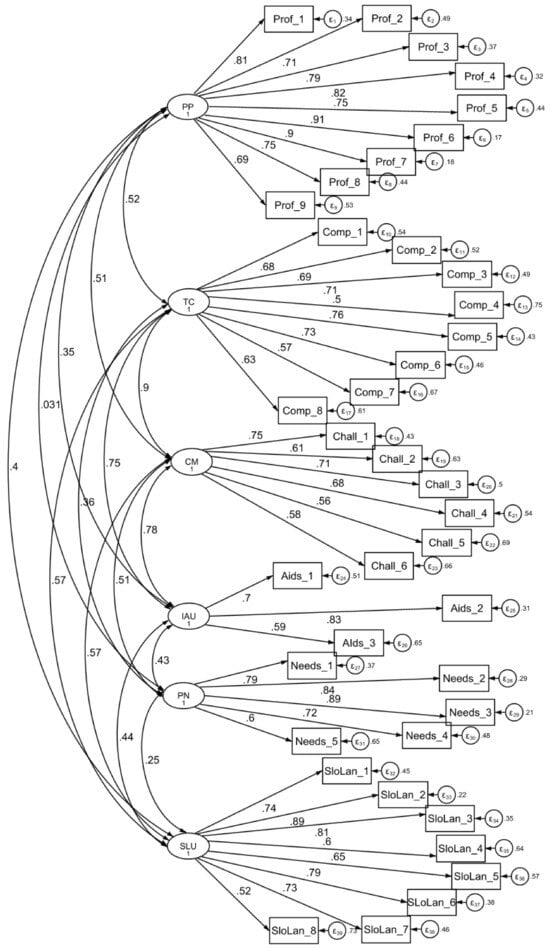
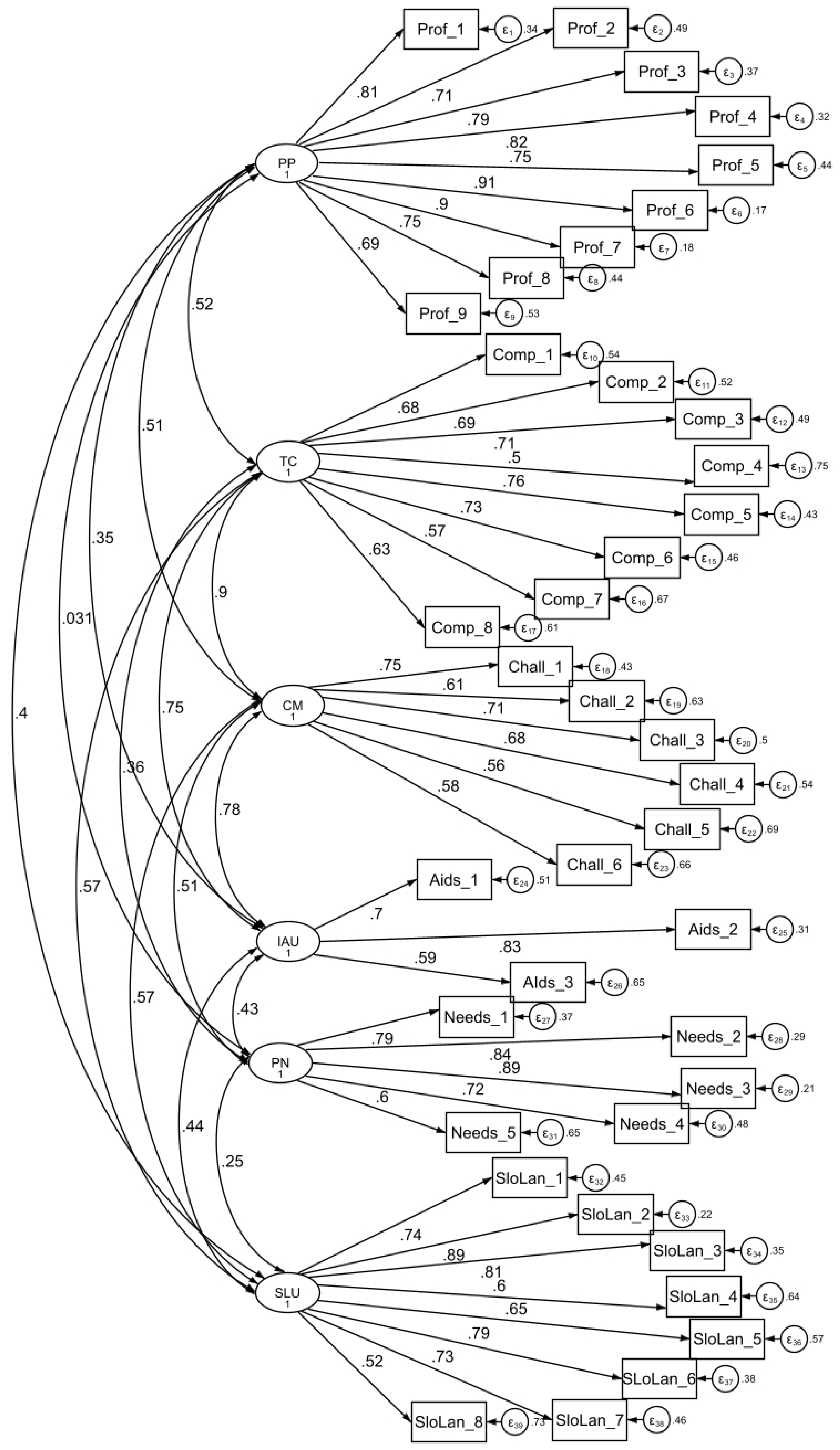
The measurement model consisting of six latent constructs, such as PP, TC, CM, IAU, PN, and SLU, was also evaluated using confirmatory factor analysis. The model (Figure 1) demonstrated an acceptable to good fit to the data (χ2(687) = 1657.29, p < 0.001, RMSEA = 0.067, 90% CI [0.063, 0.071], CFI = 0.911, TLI = 0.902, SRMR = 0.069), indicating that the hypothesized factor structure adequately represented the observed data. All factor loadings were statistically significant (p < 0.001) and ranged from moderate to very high across constructs. Specifically, items measuring PP showed strong loadings ranging from 0.69 to 0.91, indicating a well-defined construct. Similarly, TC demonstrated substantial loadings between 0.57 and 0.76, supporting the internal consistency of the factor. For CM, factor loadings ranged from 0.56 to 0.75, suggesting that the items adequately measured teachers’ instructional challenges. The construct IAU exhibited moderately strong loadings (0.59–0.83), reflecting consistent measurement of instructional support resources. Likewise, PN showed strong loadings ranging from 0.60 to 0.89, indicating that the items reliably represent the measurement of instructional needs. Finally, the SLU factor showed loadings ranging from 0.52 to 0.89, indicating acceptable to strong associations between the observed indicators and the latent construct.
Figure 1.
The CFA model for measuring teachers’ readiness.
4.3. Descriptive Statistics
Descriptive statistics indicate moderate to relatively high levels of teachers’ readiness across the six dimensions. The highest mean score was observed for professional needs (M = 3.56, SD = 0.49), suggesting a strong professional need for continued professional development. Teacher competencies, challenge management, and use of instructional aids also showed relatively high mean values, indicating that teachers generally perceive themselves as capable of managing instructional tasks and using teaching resources effectively. In contrast, professional preparation (M = 2.58, SD = 0.74) and Slovak language use outside kindergarten (M = 2.59, SD = 0.74) obtained comparatively lower mean scores. These findings suggest that teachers report lower levels of prior preparation and less frequent use of Slovak beyond the school environment (Table 3).
Table 3.
Descriptive statistics of the sample.
4.4. Latent Profile Analysis
4.4.1. Model Selection
Latent profile analysis was conducted in Stata 19 using generalized structural equation modeling (GSEM) to identify distinct readiness profiles among participants based on six readiness indicators: professional preparation (PP), teacher competencies (TC), challenge management (CM), instructional aids use (IAU), professional needs (PN), and Slovak language use outside kindergarten (SLU). Models specifying two, three, and four latent profiles were estimated. Model selection relied on multiple criteria, including log-likelihood values, information criteria (AIC and BIC), entropy, likelihood ratio tests (LMR), class size adequacy, and interpretability of the resulting profiles (Table 4). Model fit improved as the number of profiles increased, as reflected in decreasing AIC and BIC values from models of 2-profile, 3-profile, and 4-profile.
Table 4.
Comparison of latent profile models.
The 3-profile model demonstrated a substantial improvement in fit compared with the 2-profile model, supported by significant likelihood ratio tests (LMR = 159.85, p < 0.001). In addition, entropy increased slightly from 0.85 to 0.86, indicating improved classification accuracy and clearer profile separation. The 4-profile solution further reduced AIC and BIC values, and both likelihood ratio tests remained statistically significant (LMR = 59.34, p = 0.007), suggesting that adding a fourth profile improved model fit statistically. However, entropy decreased to 0.81, indicating reduced classification precision. Furthermore, inspection of class proportions revealed that the 4-profile solution introduced a very small subgroup comprising approximately 6% of participants. Examination of profile means showed that this additional class primarily subdivided an already existing low-readiness group rather than introducing a substantively distinct readiness pattern. Considering statistical improvement together with classification precision, profile stability, and conceptual interpretability, the 3-profile solution was retained as the most parsimonious and interpretable representation of readiness differences in the sample. The retained profiles can be marginally interpreted as representing low, moderate, and high readiness groups, which were used in subsequent analyses.
4.4.2. Three-Profile Model
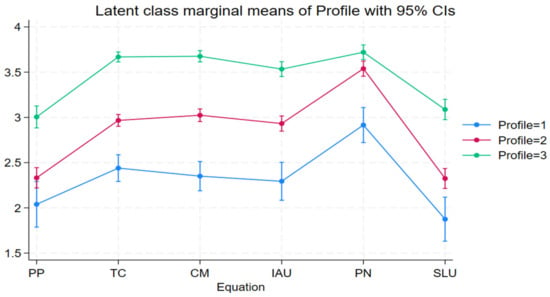
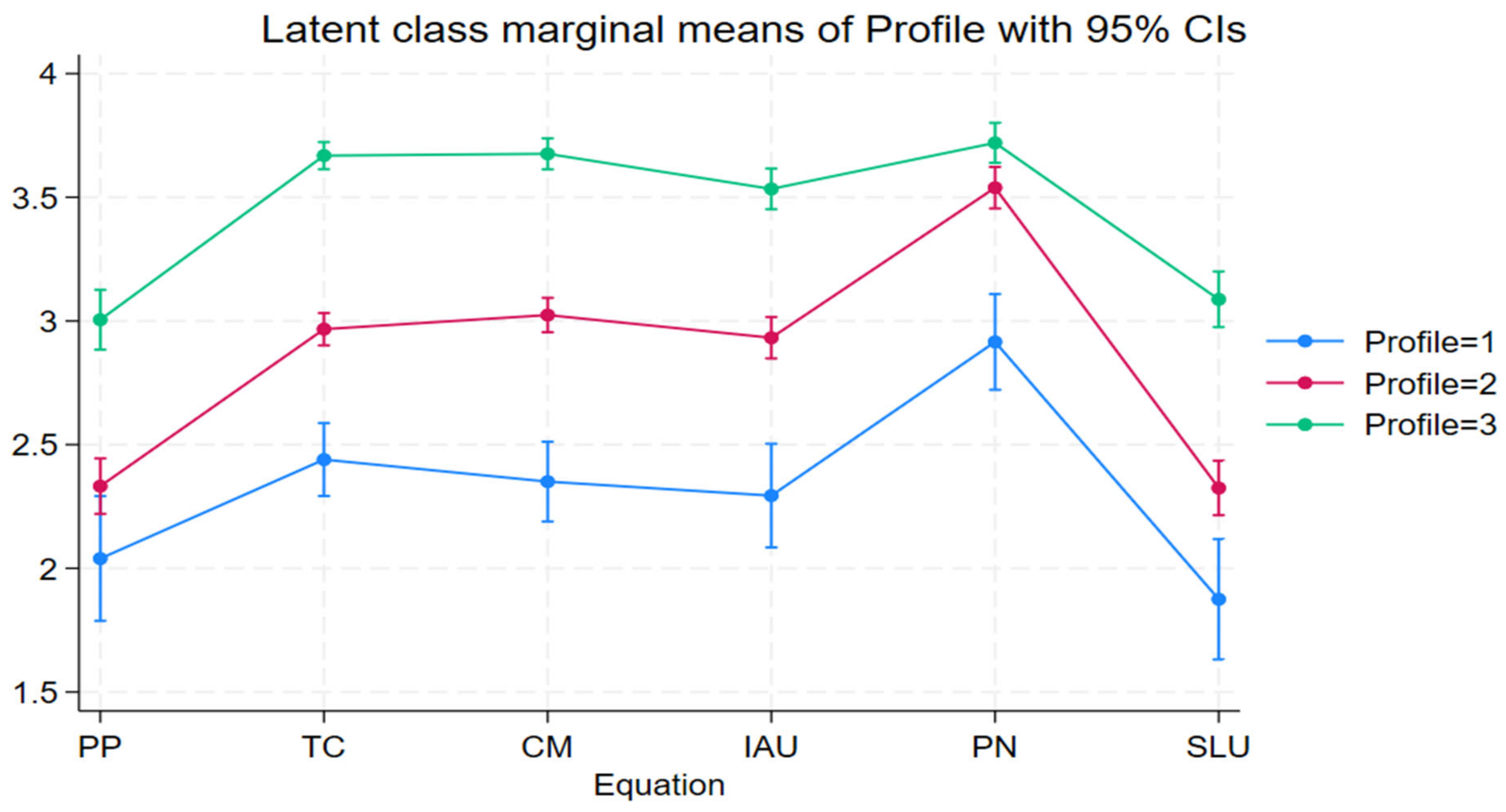
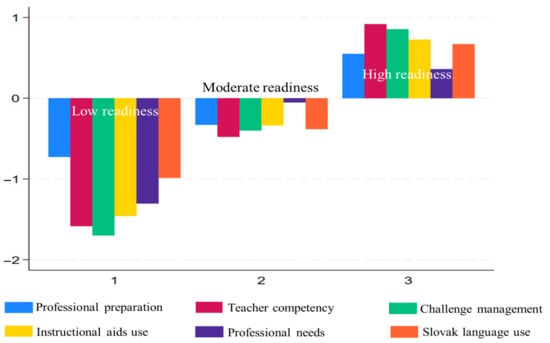
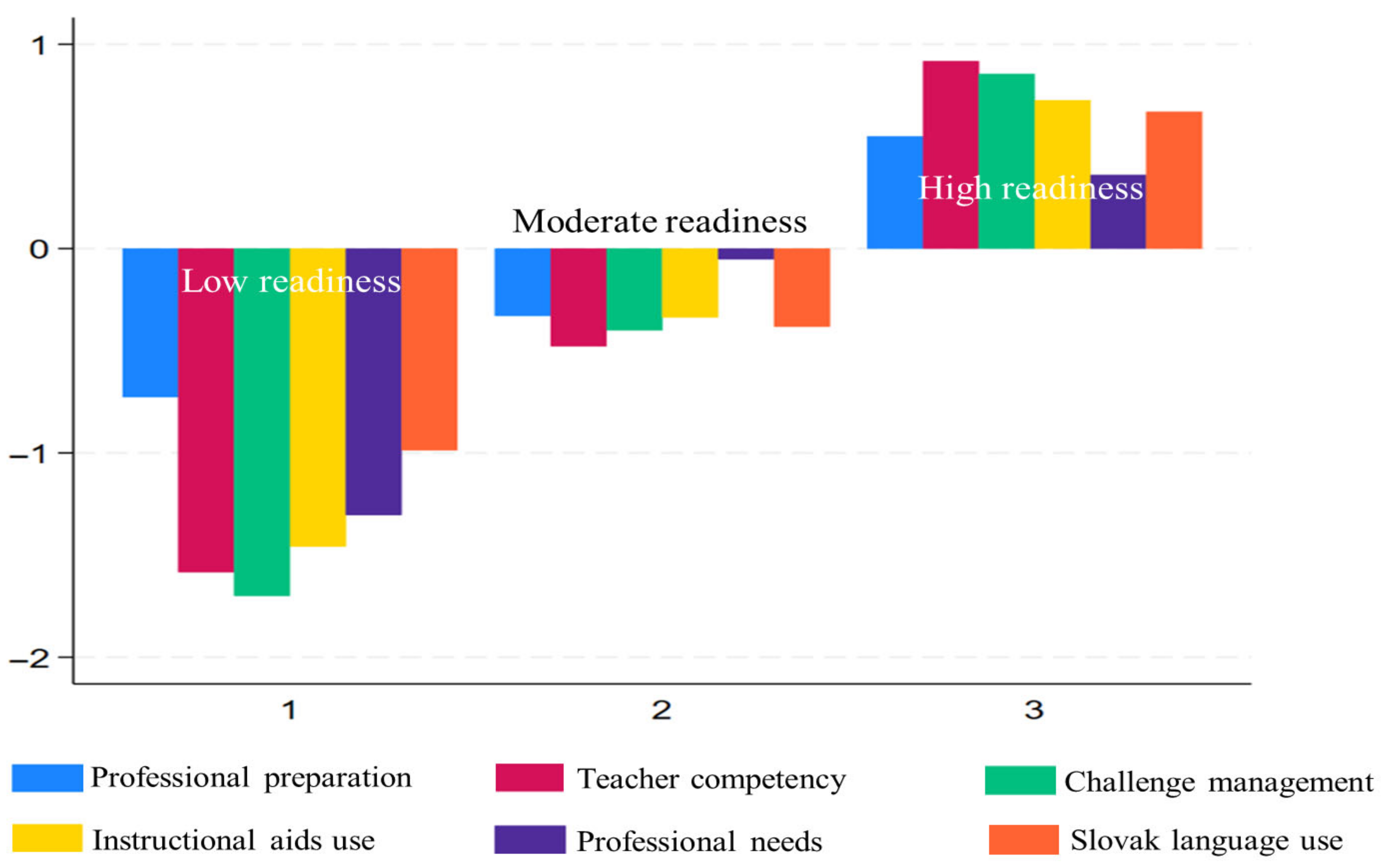
The retained 3-profile model revealed quantitatively distinct groups of teachers across the six readiness dimensions, which can be interpreted as low, moderate, and high readiness profiles (Figure 2). Differences among profiles were consistent across all indicators, suggesting that readiness varies mainly in overall level rather than in specific strengths or weaknesses.
Figure 2.
A model showing three distinct profiles of teachers’ readiness. Note. PP (professional preparation), TC (teacher competencies), CM (challenge management), IAU (instructional aids use), PN (professional needs), and SLU (Slovak language use outside kindergarten).
Profile 1 (Low readiness) comprised around 10% of the sample and demonstrated the lowest mean scores across dimensions of teachers’ readiness, particularly in professional preparation, instructional aids use, and Slovak language use outside kindergarten. This profile indicates limited preparedness and weaker engagement with language practice and instructional resources.
Profile 2 (Moderate readiness), comprising nearly half of the participants, demonstrated moderate readiness across dimensions. Teachers in this group generally managed instructional demands adequately but still showed room for improvement, especially in professional preparation and Slovak language use outside kindergarten.
Profile 3 (High readiness), including 41% of teachers, exhibited consistently high scores across all readiness dimensions. It reflects strong professional preparation, instructional competencies, effective challenge management, and active engagement with the Slovak language use outside of kindergarten. The profiles appear to reflect a readiness continuum in which improvements occur simultaneously across dimensions rather than in isolated areas.
As presented in Table 5, statistically significant differences were observed among the three readiness profiles across all six readiness domains. One-way results showed large between-profile differences in professional preparation, teacher competencies, challenge management, instructional aids use, professional needs, and Slovak language use outside kindergarten (all p < 0.001). LSD (least significant difference) post hoc comparisons consistently indicated a graded pattern in which Profile 1 demonstrated significantly lower scores than Profile 2, while Profile 3 showed significantly higher readiness levels than both other groups (P1 < P2 < P3). These findings confirm that the three profiles represent clearly differentiated levels of teacher readiness, supporting the interpretation of readiness as a continuum rather than a set of isolated competence patterns. Figure 3 also shows clear differences across the three latent profiles. The low readiness group displays negative standardized scores across all dimensions. The moderate group shows values close to the mean. The highest readiness group demonstrates consistently positive scores across all dimensions, indicating strong readiness in all aspects.
Table 5.
ANOVA analysis for the comparison of teachers’ readiness profiles.
Figure 3.
Standardized means of teachers’ readiness by latent profiles.
4.5. Factors Associated with Different Profiles of Teacher Readiness
Table 6 shows that several background characteristics differed across the three teacher readiness profiles, while some variables showed no differences. Gender was not related to readiness levels (χ2 = 1.39, df = 2, p = 0.489). In contrast, age was significantly associated with readiness (χ2 = 52.09, df = 20, p < 0.001), with higher readiness more common among teachers in later career stages. Language background was also important. Mother tongue differed across profiles, χ2 = 9.94, df = 2, p < 0.01, with Slovak native speakers more often appearing in higher readiness groups. Similarly, preferred language used at home and in social settings showed strong associations with readiness, indicating that teachers who use Slovak or both languages more frequently tend to have higher readiness levels.
Table 6.
Two-way table with measures of association [N (%)].
Educational background also mattered. The language of primary education was significantly related to readiness (χ2 = 27.73, df = 4, p < 0.001), with Slovak-medium schooling more common among teachers with higher readiness. Teaching experience further distinguished the profiles, χ2 = 31.57, df = 16, p < 0.05, as more experienced teachers were more often found in the moderate and high readiness groups. Perceived qualification for teaching Slovak in kindergarten was strongly associated with readiness, χ2 = 35.83, df = 14, p < 0.01, with better perceived preparation associated with higher readiness. School size was not associated with readiness profile membership. However, teachers’ educational level was significantly associated with readiness profile membership (χ2 = 17.56, df = 8, p < 0.05), suggesting that teachers with higher academic qualifications, particularly those holding university/master’s degrees or a PhD, were more likely to belong to the moderate and high-readiness profiles.
4.6. Influencing Factors of Teacher Readiness
Multinomial logistic regression analysis was conducted to examine which background and professional factors predict membership in higher readiness profiles compared with the low-readiness group (Profile 1). Profile 1 served as the reference category, and predictors were examined for membership in Profile 2 (moderate readiness) and Profile 3 (high readiness) (Table 7). Age was not included in the multinomial regression model because of its strong overlap with teaching experience and to reduce potential multicollinearity among predictors.
Table 7.
Multinomial logistic regression analysis of profiles.
First, results indicate that teaching experience showed a differentiated pattern: it did not significantly predict membership in the moderate readiness group, but it significantly increased the likelihood of belonging to the high readiness group, Profile 3 (β = 0.33, p < 0.01). This suggests that more professional experience contributes particularly to reaching the highest readiness level. In contrast, nationality, education level, and school location did not significantly predict profile membership.
Second, language-use variables displayed stronger associations with readiness. Preferred language used in social settings significantly predicted membership in both higher readiness profiles, with stronger effects observed for the high-readiness group (β = 1.53, p < 0.001) than for the moderate profile (β = 0.87, p < 0.01). Teachers who more frequently use Slovak in social contexts are therefore substantially more likely to demonstrate higher readiness. Preferred language used at home, however, was only significant for Profile 3 (β = 0.98, p < 0.05), suggesting that intensive exposure in private contexts contributes particularly to reaching the highest readiness level. In addition, the most consistent and strongest predictors across models were Slovak language proficiency skills. Higher proficiency in reading, listening, writing, and speaking Slovak significantly increased the likelihood of belonging to both moderate and high readiness profiles, with effects systematically larger for Profile 3.
4.7. Mediation Analysis of Teachers’ Readiness
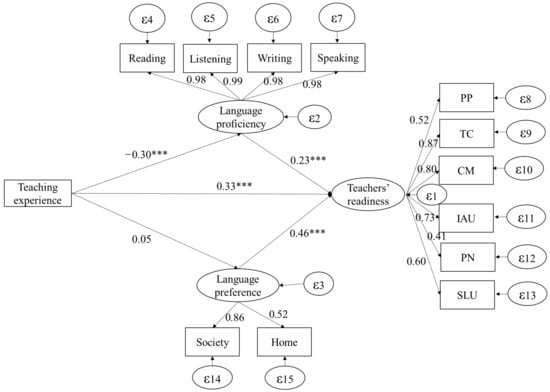
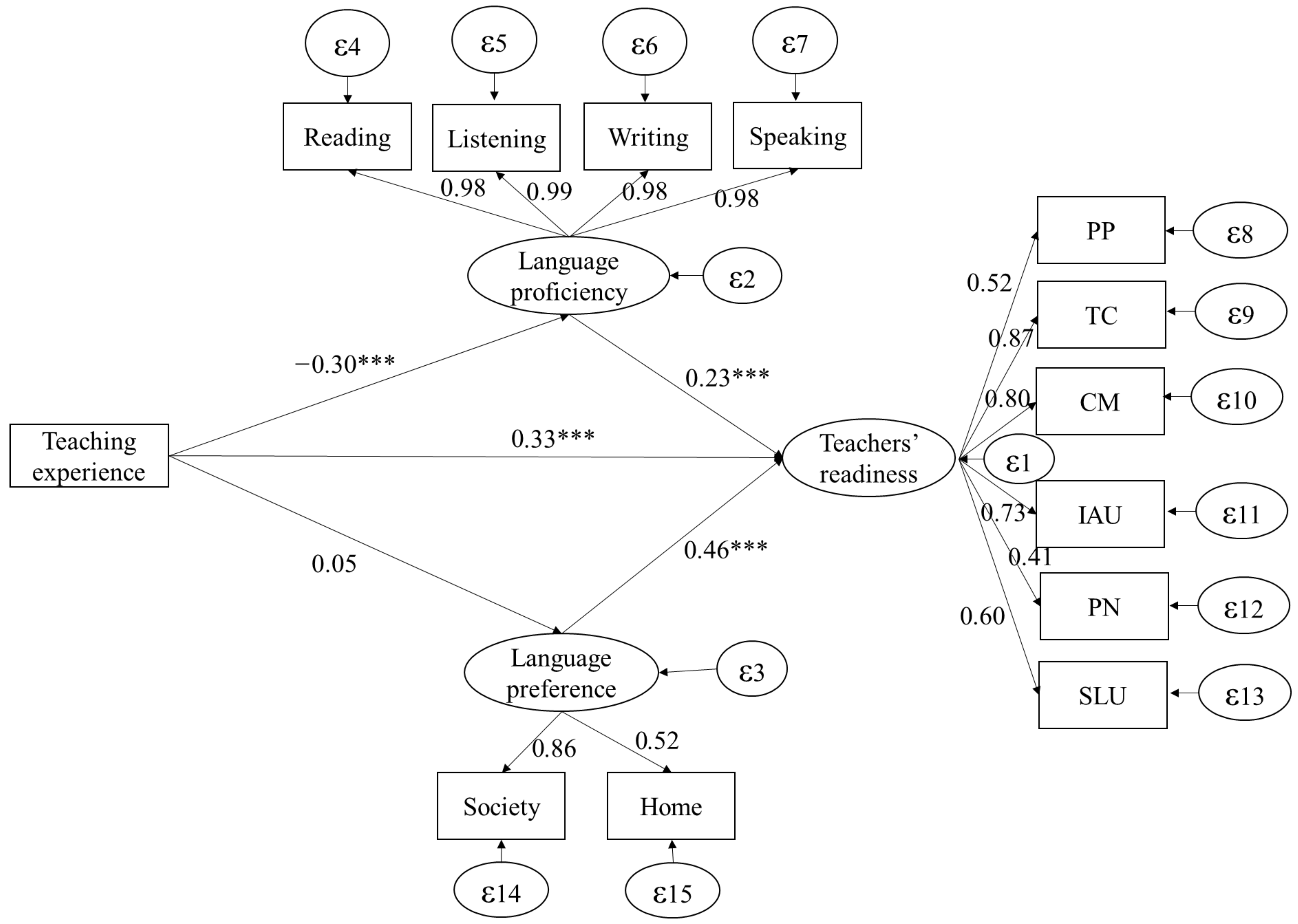
Building on the above regression results, a mediation analysis was conducted to examine whether language proficiency and preferred language use explain the relationship between teaching experience and teachers’ readiness. The mediation model (Figure 4) demonstrated an acceptable overall fit to the data (χ2(61) = 281.44, p < 0.001). The incremental fit indices indicated good model fit (CFI = 0.942, TLI = 0.926), and the residual-based indices were within acceptable limits (SRMR = 0.073; RMSEA = 0.077). These indices indicate that the model provides an adequate representation of the observed data.
Figure 4.
The mediation model in teachers’ readiness. Note. *** (p < 0.001), PP (professional preparation), TC (teacher competencies), CM (challenge management), IAU (instructional aids use), PN (professional needs), and SLU (Slovak language use outside kindergarten).
The results in Table 8 showed that teaching experience significantly and negatively predicted language proficiency (β = −0.30, p < 0.001), while it did not significantly predict preferred language use (p > 0.05). At the same time, both language proficiency (β = 0.23, p < 0.001), and preferred language use (home and social settings) (β = 0.46, p < 0.001) exerted strong positive effects on teachers’ readiness, with preferred language use emerging as the strongest predictor. Teaching experience also had a significant direct effect on readiness (β = 0.33, p < 0.001). However, the indirect effect of teaching experience on readiness was small and not statistically significant (β = −0.04, p > 0.05). While a negative indirect pathway was observed via language proficiency (β = −0.07, p > 0.05), a smaller positive pathway via preferred language use was also found (β = 0.02, p > 0.05). Accordingly, these findings suggest that language proficiency and language use do not function as mediating mechanisms but rather operate as independent predictors of teachers’ readiness. The effects of teaching experience on readiness are therefore primarily direct, rather than indirectly transmitted through language-related variables.
Table 8.
Standardized direct, indirect, and total effects in the structural model.
5. Discussion
The study examined teachers’ readiness to deliver state-language instruction to DLLs in Hungarian-medium kindergartens in Slovakia using a multidimensional and person-centered approach. The findings provide support for the conceptualization of teachers’ readiness as a complex and multifaceted construct.
Regarding RQ1, the findings supported the conceptualization of teachers’ readiness as a six-dimensional construct. Both the initial PCA and the subsequent CFA indicated that the proposed measurement model provided a theoretically interpretable and empirically acceptable representation of the data. This finding supports the conceptualization of teachers’ readiness as a multidimensional construct comprising several interrelated domains that function together in practice. It is also consistent with prior research highlighting the multidimensional nature of teacher readiness in early childhood and DLL contexts (Dunekacke et al., 2024; Lam et al., 2016; Zepeda et al., 2011). These results suggest that teacher training should address multiple domains simultaneously.
With respect to RQ2, the latent profile analysis revealed three distinct readiness profiles (low, moderate, and high), suggesting that teachers differ mainly in overall readiness level rather than in specific patterns of strengths and weaknesses. Teachers tended to show consistently low, moderate, or high scores across all readiness domains, indicating that readiness varies primarily in overall level rather than in isolated patterns of strengths and weaknesses. This implies that support efforts should focus on overall professional development rather than on a single domain. This finding aligns with previous research indicating variability in teacher preparedness based on experience and contextual factors (Deng et al., 2021) and is consistent with a holistic view of teacher development.
Concerning RQ3, the profile comparison showed that several background factors were related to teachers’ readiness. Age and teaching experience were strongly associated with higher readiness. Teachers in later career stages were more often in the moderate and high readiness groups. This is consistent with previous studies showing that greater experience is associated with stronger teaching skills and classroom management (Deng et al., 2021; Ramírez et al., 2019). Language factors were also important. Teachers who used Slovak more often at home and in social settings had higher readiness. Those with Slovak as their mother tongue were also more likely to be in higher readiness groups. Although the association between Slovak use and teachers’ readiness may appear intuitive, the present findings are important. These findings suggest that readiness may be associated not only with formal training, but also with teachers’ everyday language engagement outside the school context. This finding is consistent with research highlighting the role of language use in bilingual teaching (Collins et al., 2023; Johnson et al., 2019). Educational background also mattered. Teachers with Slovak-medium schooling and higher qualifications showed higher readiness. In contrast, gender was not related to readiness. These results suggest that readiness is mainly shaped by experience, language use, and educational background, rather than by demographic factors.
In relation to RQ4, background characteristics showed differentiated effects on readiness profiles. Teaching experience was a significant predictor, particularly for higher readiness levels. This finding is consistent with earlier studies suggesting that more experienced teachers tend to report stronger instructional skills and classroom management (Deng et al., 2021; Ramírez et al., 2019). However, the results also showed that teaching experience was more strongly associated with high readiness than moderate readiness, indicating that experience may be particularly important for achieving advanced levels of preparedness. Language-related variables, especially Slovak language proficiency and preferred language use in social contexts, emerged as the strongest predictors of readiness. This supports previous findings emphasizing the importance of language competence and usage for effective teaching in bilingual settings (Collins et al., 2023; Johnson et al., 2019).
Finally, regarding RQ5, the mediation analysis did not support the hypothesized indirect effects. Although teaching experience significantly predicted language proficiency, and both language proficiency and preferred language use strongly predicted teachers’ readiness, the indirect effects were not statistically significant. These results indicate that language-related variables do not mediate the relationship between teaching experience and teachers’ readiness in this model, but rather function as independent predictors. This suggests that readiness is shaped by multiple parallel influences rather than by a single indirect pathway. This finding also aligns with studies suggesting that the relationship between experience, language skills, and teaching effectiveness is not always linear or mediated (Mejak & Medved, 2019; Wu et al., 2023). One possible interpretation is that pedagogical readiness may be associated with multiple parallel influences, including experience, training, and contextual exposure, rather than with a single indirect mechanism.
The study makes several contributions to research and practice. A key contribution of this study is the distinction between modifiable and non-modifiable factors influencing teachers’ readiness. While age and teaching experience were significant predictors, these cannot be directly targeted through intervention. In contrast, language proficiency and language use are modifiable and therefore provide more actionable pathways for improving readiness. The results indicate that teachers who use Slovak more frequently and report higher proficiency are more likely to belong to higher readiness profiles. These findings suggest that interventions may be more effective if they focus on increasing meaningful opportunities for language use rather than relying solely on formal training. However, such efforts may face barriers, including limited exposure to Slovak in the DLL context and professional development programs that prioritize pedagogy over practical language use. To address this, training should emphasize practice-based language development, create structured opportunities for active language use, and integrate use into everyday professional routines. Continuous support is also needed to ensure sustained development. These findings suggest that general support for less experienced teachers is insufficient unless it specifically targets language-related competencies. More broadly, the study contributes to the literature by providing a multidimensional, person-centered framework of teachers’ readiness and identifying distinct readiness profiles. Thus, it clarifies which factors are actionable for intervention, highlighting language proficiency and use as key targets for policy and practice in DLL contexts.
There are also several limitations in this study. First, the data were cross-sectional, which limits causal interpretation of the relationships. Second, all measures were self-reported, which may introduce bias and overestimation of teachers’ readiness. An additional conceptual limitation concerns the professional needs dimension. Although it formed a coherent factor in the present analyses, it may reflect perceived support needs as much as readiness itself, and should therefore be interpreted as a related but partially distinct component of teachers’ readiness. Third, the study was conducted in Hungarian-medium kindergartens in Slovakia, so the findings may not be generalizable to other educational or linguistic contexts. Fourth, although key background variables were included, other factors, such as classroom practices and training quality, were not examined. Finally, the mediation results should be interpreted with caution, as indirect effects may require longitudinal or experimental designs to be more accurately tested.
6. Conclusions
The findings of this study confirmed that teachers’ readiness is a multidimensional construct consisting of six key components. The results also revealed three distinct readiness profiles, reflecting different levels of overall preparedness. Background characteristics, particularly age, teaching experience, and language-related factors, were significantly associated with higher readiness levels. In contrast, the mediation analysis showed that language proficiency and preferred language use did not mediate the relationship between teaching experience and teachers’ readiness, but instead functioned as independent predictors. Teachers’ readiness appears to be more strongly associated with active language use than with formal qualifications in the present sample. Although the identified predictors are broadly consistent with prior literature, the study contributes by showing how these factors operate together within a multidimensional and person-centered framework. It also demonstrates that the expected indirect effects were not supported, thereby clarifying the role of language-related variables in teachers’ readiness. From a practical perspective, the findings highlight language proficiency and language use as especially relevant targets for teacher support and professional development.
Author Contributions
Conceptualization, D.B. and K.J.; methodology, D.B., K.J. and T.Z.O.; formal analysis, K.J. and T.Z.O.; investigation, D.B. and A.N.; resources, D.B. and A.N.; data curation, D.B. and A.N.; writing—original draft preparation, D.B., K.J. and T.Z.O.; writing—review and editing, K.J. and T.Z.O.; supervision, K.J.; project administration, D.B. and A.N.; funding acquisition, D.B. and A.N. All authors have read and agreed to the published version of the manuscript.
Funding
This research was funded by the Recovery and Resilience Plan of the Slovak Republic, funded by the European Union NextGenerationEu within the project Slovak as a Second Language in Pre-Graduate Teacher Training. Abbreviation of the project SLOV2LIN; grant number 06R02-20-V01-00001.
Institutional Review Board Statement
The study was conducted in accordance with the Declaration of Helsinki and approved by the Institutional Review Board of the Institute of Education, Hungarian University of Agriculture and Life Sciences (protocol code: 8/2024; date of approval: 20 June 2024).
Informed Consent Statement
Informed consent was obtained from all subjects involved in the study.
Data Availability Statement
Data are unavailable due to privacy or ethical restrictions.
Conflicts of Interest
The authors declare no conflicts of interest. The authors alone are responsible for the content and writing of the paper.
Appendix A
Teachers’ Readiness Questionnaire (Original Version)
The questionnaire is anonymous and takes approximately 20 min to complete. The data will be used solely for research purposes. Please respond to all items and indicate, for each statement, the response option that best represents your view.
Response scale: 1 = Strongly disagree, 2 = Disagree, 3 = Agree, 4 = Strongly agree
Professional Preparation
- 1.
- * During my kindergarten teacher training, I received adequate methodological preparation for implementing Slovak-language activities.
- 2.
- * The instructors who taught the Slovak language and literature were inspiring to me.
- 3.
- * During my studies, I received adequate preparation in the use of teaching materials such as textbooks and workbooks.
- 4.
- * During my studies, I was introduced to a sufficient range of Slovak children’s literature for use in kindergarten.
- 5.
- * During my studies, I was introduced to a sufficient range of Slovak songs and musical materials for use in kindergarten.
- 6.
- * During my studies, I received thorough preparation for planning Slovak-language activities.
- 7.
- * During my studies, I received thorough preparation for implementing Slovak-language activities in practice.
- 8.
- * The teaching practicum provided sufficient opportunities to gain experience in implementing Slovak-language activities in kindergarten.
- 9.
- * The courses I took during my studies contributed to the development of my Slovak language proficiency.
Teacher Competencies
- 10.
- * I consider my Slovak language proficiency sufficient for implementing kindergarten activities in Slovak.
- 11.
- * I am familiar with the curriculum requirements and can plan my work accordingly.
- 12.
- * I can align the goals of Slovak-language activities with the State Educational Programme for Preschool Education.
- 13.
- I support children’s early Slovak language acquisition through separate Slovak-language activities.
- 14.
- * I support children’s early Slovak language acquisition during everyday kindergarten activities.
- 15.
- * I can organize and manage Slovak-language activities effectively.
- 16.
- * I have adequate subject-specific methodological knowledge to implement Slovak-language activities.
- 17.
- * After completing my studies, I further prepared myself for implementing Slovak-language activities through self-directed professional development.
- 18.
- * I regularly keep up to date with current methods and findings related to early Slovak language education.
Managing Instructional Challenges
- 19.
- * As a practising kindergarten teacher, I feel prepared to implement high-quality Slovak-language activities.
- 20.
- * Parents/legal guardians have a positive attitude towards children’s early Slovak language acquisition in kindergarten.
- 21.
- * I can effectively plan and implement Slovak-language activities in a single-age group of children.
- 22.
- * I can effectively plan and implement Slovak-language activities in a mixed-age group of children.
- 23.
- Familiarity with methodological guidelines is essential for implementing high-quality Slovak-language activities.
- 24.
- * Integrating Slovak-language activities into the daily routine is important for high-quality implementation.
- 25.
- * Children can be motivated to participate in Slovak-language activities.
Use of Instructional Aids
- 26.
- * I have access to a variety of teaching aids for implementing Slovak-language activities.
- 27.
- * I continuously expand my set of materials and tools for supporting Slovak language acquisition in a playful way.
- 28.
- * During Slovak-language activities, I regularly use ICT tools such as an interactive whiteboard.
- 29.
- When preparing Slovak-language activities, I use the methodological guide developed for Hungarian-medium kindergartens.
- 30.
- When preparing Slovak-language activities, I use the Slovak-language text collection compiled for Hungarian-medium kindergartens.
- 31.
- I continuously expand my collection of Slovak literary texts and songs.
Professional Needs
- 32.
- * Preservice teacher education should place greater emphasis on the methodology of early Slovak language acquisition in kindergarten.
- 33.
- * There should be in-service professional training on early Slovak language acquisition in kindergarten.
- 34.
- * In-service professional training should provide opportunities to learn playful and innovative methods for introducing children to Slovak.
- 35.
- * There is a need for a collection of literary texts and songs using simple vocabulary and language structures.
- 36.
- * There is a need for an up-to-date methodological guide.
- 37.
- The institution should provide the teaching aids, textbooks, workbooks, and other materials needed for implementing Slovak-language activities.
Slovak Language Use Outside Kindergarten
- 38.
- * I also speak Slovak with my friends and family members.
- 39.
- * I frequently use Slovak when communicating outside the home.
- 40.
- * I have friends who communicate with me exclusively in Slovak.
- 41.
- * I often use Slovak in everyday life.
- 42.
- When speaking, I often switch between Slovak and Hungarian depending on the situation.
- 43.
- * In my free time, I enjoy using Slovak in activities such as hobbies, social media, or watching television.
- 44.
- * I have positive experiences with using Slovak in everyday life.
- 45.
- * I consider knowledge of Slovak essential for integration into Slovak society.
- 46.
- * Knowledge of Slovak is important for finding a job in Slovakia.
- 47.
- I believe I will need Slovak in my future career in Slovakia.
- 48.
- I plan to improve my Slovak language proficiency in the future.
- 49.
- I feel motivated to improve my Slovak language proficiency.
Note. Items retained in the final 39-item measurement model are marked with an asterisk.
References
- Adair, J. K., Tobin, J., & Arzubiaga, A. E. (2012). The dilemma of cultural responsiveness and professionalization: Listening closer to immigrant teachers who teach children of recent immigrants. Teachers College Record, 114(12), 1–37. [Google Scholar] [CrossRef] [Scilit]
- Agbaria, Q. (2020). Classroom management skills among kindergarten teachers as related to emotional intelligence and self-efficacy. International Journal of Instruction, 14(1), 1019–1034. [Google Scholar] [CrossRef] [Scilit]
- Alghamdi, J., Mostafa, F., & Abubshait, A. (2022). Exploring technology readiness and practices of kindergarten student-teachers in Saudi Arabia: A mixed-methods study. Education and Information Technologies, 27(6), 7851–7868. [Google Scholar] [CrossRef] [Scilit]
- Bayat, Z., Kircher, R., & Van de Velde, H. (2022). Minority language rights to education in international, regional, and domestic regulations and practices: The case of Frisian in the Netherlands. Current Issues in Language Planning, 23(5), 520–537. [Google Scholar] [CrossRef] [Scilit]
- Collins, B. A., Sánchez, M., & España, C. (2023). Sustaining and developing teachers’ dynamic bilingualism in a redesigned bilingual teacher preparation program. International Journal of Bilingual Education and Bilingualism, 26(2), 97–113. [Google Scholar] [CrossRef] [Scilit]
- Deng, Q., Kiramba, L. K., & Viesca, K. M. (2021). Factors associated with novice general education teachers’ preparedness to work with multilingual learners: A multilevel study. Journal of Teacher Education, 72(4), 489–503. [Google Scholar] [CrossRef] [Scilit]
- Dewi, S. S., & Fajri, M. S. A. (2023). Investigating pre-service EFL teachers’ initial motivations and identity formation: Evidence from an Indonesian University. SAGE Open, 13(4), 21582440231209123. [Google Scholar] [CrossRef] [Scilit]
- Díaz, A. B., Tomas, C., Liz, M., & Vásquez-Echeverría, A. (2025). School readiness: A qualitative analysis of early childhood education and first-grade teachers’ beliefs in Uruguay. Early Years, 46, 53–69. [Google Scholar] [CrossRef] [Scilit]
- Dunekacke, S., Wullschleger, A., Grob, U., Heinze, A., Lindmeier, A., Vogt, F., Geeler, S. K., Leuchter, M., Meier-Wyder, A., Seemann, S., & Opitz, E. M. (2024). Teaching quality in kindergarten: Professional development and quality of adaptive learning support enhances mathematical competency. ZDM—Mathematics Education, 56(5), 923–935. [Google Scholar] [CrossRef] [Scilit]
- Evagorou, M. (2024). Engaging kindergarten pre-service teachers in the design and implementation of STEM lessons. Frontiers in Education, 9, 1277835. [Google Scholar] [CrossRef] [Scilit]
- Faez, F., Karas, M., & Uchihara, T. (2021). Connecting language proficiency to teaching ability: A meta-analysis. Language Teaching Research, 25(5), 754–777. [Google Scholar] [CrossRef] [Scilit]
- Fan, X., D’Amico, L. K., Kilburn, J., Jones, A., Richard, C., Garrett, S., & Leverage, L. (2024). Kindergarten readiness: Associations with a summer transition program and teacher/school level factors. Educational Research and Evaluation, 29(7–8), 495–517. [Google Scholar] [CrossRef] [Scilit]
- Johnson, S. I., García, O., & Seltzer, K. (2019). Biliteracy and translanguaging in dual-language bilingual education. In D. E. DeMatthews, & E. Izquierdo (Eds.), Dual language education: Teaching and leading in two languages (pp. 119–132). Springer International Publishing. [Google Scholar] [CrossRef] [Scilit]
- Jolivette, K., & Steed, E. A. (2010). Classroom management strategies for young children with challenging behavior within early childhood settings. NHSA Dialog, 13(3), 198–213. [Google Scholar] [CrossRef] [Scilit]
- Karasova, J., & Nehyba, J. (2025). Novice teachers’ classroom behaviour management: Situations, responses and impact on student behaviour. British Educational Research Journal, 51(5), 2116–2141. [Google Scholar] [CrossRef] [Scilit]
- Kline, R. B. (2015). Principles and practice of structural equation modeling (4th ed.). Guilford Press. [Google Scholar]
- Kokkalia, G., Drigas, A., Economou, A., & Roussos, P. (2019). School readiness from kindergarten to primary school. International Journal of Emerging Technologies in Learning, 14(11), 4–18. [Google Scholar] [CrossRef] [Scilit]
- Kong, S.-H. (2025). Confidence in music teaching: The impact of instrumental training, teaching experience, and pedagogical skills on early childhood educators. International Journal of Early Childhood, 58, 123–140. [Google Scholar] [CrossRef] [Scilit]
- Kopp, E., & Kiss, B. (2026). Az oktatás rejtett aktorai: Civil szervezetek a határon túli magyar oktatásban [Hidden actors in education: Civil society organizations in Hungarian education abroad]. Civil Szemle, 23(1), 63–86. [Google Scholar] [CrossRef] [Scilit]
- Kozmács, I. (2019). Az államnyelv oktatása a szlovákiai magyar tannyelvű általános iskolákban [State language education in Hungarian medium primary schools in Slovakia]. Magyar Nyelvőr, 143(2), 184–195. [Google Scholar]
- Kozmács, I., & Vančo, I. (2016). The Hungarian language in Slovakia: The use of the dominant standard in education in Slovakian Hungarian schools and the effects on education and training. In Pluricentric languages and non-dominant varieties worldwide: Part I: Pluricentric languages across continents: Features and usage (pp. 335–355). Peter Lang Verlag. [Google Scholar] [CrossRef] [Scilit]
- Lam, C. W. H., Yuen, M., & Hsieh, W.-Y. (2016). Early childhood teachers coping with change: The roles of emotional intelligence, emotional labour and career adaptability. In Career Development: Theories, Practices and Challenges (pp. 135–147). Nova Science Publishers. [Google Scholar]
- Leung, T. Y., Lam, C. B., & Chung, K. K. H. (2025). Organizational, interpersonal, and intrapersonal resources are uniquely associated with physical, psychological, and occupational well-being among Chinese kindergarten teachers. Journal of Early Childhood Research, 23(4), 431–445. [Google Scholar] [CrossRef] [Scilit]
- Limlingan, M. C., McWayne, C., & Hassairi, N. (2022). Habla Conmigo: Teachers’ Spanish talk and Latine dual language learners’ school readiness skills. Early Education and Development, 33(4), 655–674. [Google Scholar] [CrossRef] [Scilit]
- Lin, H.-L., Lawrence, F. R., & Gorrell, J. (2003). Kindergarten teachers’ views of children’s readiness for school. Early Childhood Research Quarterly, 18(2), 225–237. [Google Scholar] [CrossRef] [Scilit]
- Lin, Y., Fu, P., Ju, Y., Hong, X., & Huang, F. (2025). Understanding the relationship between kindergarten teachers’ love for education and emotional support competence: A latent profile and network analysis. Current Psychology, 44(10), 9552–9567. [Google Scholar] [CrossRef] [Scilit]
- Machmud, H., Abidin, A., & Alim, N. (2025). Bridging knowledge and practice: Evidence from pre-service early childhood teachers’ PCK implementation in their teaching practicum. Journal of Early Childhood Teacher Education, 1–23. [Google Scholar] [CrossRef] [Scilit]
- Mastellotto, L., & Zanin, R. (2022). Multilingual teacher training in South Tyrol: Strategies for effective linguistic input with young learners. Innovation in Language Learning and Teaching, 16(4–5), 324–336. [Google Scholar] [CrossRef] [Scilit]
- Mejak, M., & Medved, V. U. (2019). The role of the educator in the development of the child’s communicative competence. Didactica Slovenica—Pedagoska Obzorja, 34(2), 3–19. [Google Scholar]
- Meng, C., Cohrssen, C., & Lau, C. (2025). School readiness priorities and school transition practices: Kindergarten teachers’ and primary school teachers’ perceptions. Education 3–13, 1–16. [Google Scholar] [CrossRef] [Scilit]
- Ministerstvo školstva, výskumu, vývoja a mládeže Slovenskej republiky [MŠVVaM SR]. (2025). Statistical yearbook of education in the Slovak Republic 2025. Ministry of Education, Research, Development, and Youth of the Slovak Republic. [Google Scholar]
- Nagy, E. K. (2025). The education of Roma students: Integrated education and teacher preparedness in Hungarian-language schools. Education Sciences, 15(4), 454. [Google Scholar] [CrossRef] [Scilit]
- Nagy, G. T. (2020). The application of functional cognitive linguistic pedagogy under the conditions of linguistic minorities. Jazykovedný Časopis, 71(3), 373–392. [Google Scholar] [CrossRef] [Scilit]
- Oros Bugár, A., & Vančo, I. (2025). Education–Language–Identity: Analysing patterns of identification among minority Hungarian high school students in Slovakia. Hungarian Studies, 38(1), 11–27. [Google Scholar] [CrossRef] [Scilit]
- Petek, T. (2024). Future kindergarten educators’ views regarding the role of language as one of the core kindergarten curriculum areas. European Journal of Educational Research, 13(2), 835–849. [Google Scholar] [CrossRef] [Scilit]
- Ramírez, R., López, L. M., & Ferron, J. (2019). Teacher characteristics that play a role in the language, literacy and math development of dual language learners. Early Childhood Education Journal, 47(1), 85–96. [Google Scholar] [CrossRef] [Scilit]
- Robinson, H. M. (2017). Emergent digital literacy and mobile technology: Preparing technologically literate preservice teachers through a multisensory approach. In Information and technology literacy: Concepts, methodologies, tools, and applications (Vols. 3–4, pp. 1167–1183). IGI Global Scientific Publishing. [Google Scholar] [CrossRef] [Scilit]
- Rrustemi, J., & Kurteshi, V. (2023). Pedagogical practice as a foundation course for the development of professional skills. International Journal of Instruction, 16(2), 1135–1150. [Google Scholar] [CrossRef] [Scilit]
- Savina, E., Fulton, C., & Beaton, C. (2025). Teacher emotional competence: A conceptual model. Educational Psychology Review, 37(2), 40. [Google Scholar] [CrossRef] [Scilit]
- Shammari, K. A., & Olaimat, H. (2019). The degree to which kindergarten teachers in the state of Kuwait practice language skills. An-Najah University Journal for Research—B (Humanities), 33(5), 877–906. [Google Scholar] [CrossRef] [Scilit]
- Sobri, M., Al Arif, T. Z. Z., Sanusi, A., & Mustofa, A. M. Z. (2025). Factors influencing work readiness in computer-assisted foreign language testing. International Journal of Learning, Teaching and Educational Research, 24(11), 540–560. [Google Scholar] [CrossRef] [Scilit]
- Son, S.-H. C., Kwon, K.-A., Jeon, H.-J., & Hong, S.-Y. (2013). Head start classrooms and children’s school readiness benefit from teachers’ qualifications and ongoing training. Child and Youth Care Forum, 42(6), 525–553. [Google Scholar] [CrossRef] [Scilit]
- Statistical Office of the Slovak Republic. (2023). Population by nationality in the Slovak Republic (2021 Census results). Statistical Office of the Slovak Republic. [Google Scholar]
- Stillerova, L., Troxler, J. R., Curby, T. W., & Roth, A. (2021). Teachers’ perceptions of children’s Kindergarten readiness in Slovakia. International Journal of School and Educational Psychology, 9(2), 148–157. [Google Scholar] [CrossRef] [Scilit]
- Stormont, M., Frey, A. J., Reinke, W. M., Herman, K. C., & Chen, X. (2025). Characteristics of children with poor readiness for kindergarten: An exploratory study. Journal of Behavioral Education, 1–24. [Google Scholar] [CrossRef] [Scilit]
- Szőköl, I., Dobay, B., & Bendíková, E. (2024). Priority strategic areas for further development. In International conference on interactive collaborative learning (pp. 398–409). Springer Nature. [Google Scholar] [CrossRef] [Scilit]
- Ustinova, T. V. (2021). Plurilingualism and the second language teacher education. Philological Class, 26(1), 273–280. [Google Scholar] [CrossRef] [Scilit]
- Vančo, I. (2017). A szlovák nyelv tanítása szlovákiai magyar tanítási nyelvű iskolákban—Általános helyzetkép [The teaching of the Slovak language in schools with Hungarian as the language of instruction in Slovakia: General overview]. Magyar Nyelvőr, 141(3), 272–291. [Google Scholar]
- Vančo, I. (2019). A szlovák nyelvi készségek kialakítása a szlovákiai magyar tanítási nyelvű iskolák alsó tagozatán [Developing Slovak language competencies at the first stage of Hungarian-language primary schools in Slovakia]. Magyar Nyelvőr, 143(2), 138–150. [Google Scholar]
- Velmurugan, R., Jothi, K., Sudarvel, J., & Thirumalaisamy, R. (2025). Strategies for fostering emotional intelligence in the classroom. In Pedagogical Approaches to Bridging Emotional and Cognitive Learning (pp. 43–70). IGI Global Scientific Publishing. [Google Scholar] [CrossRef] [Scilit]
- Visković, I., & Višnjić Jevtić, A. (2018). Professional development of kindergarten teachers in Croatia–a personal choice or an obligation. Early Years, 38(3), 286–297. [Google Scholar] [CrossRef] [Scilit]
- Williams, P. G., Lerner, M. A., Sells, J., Alderman, S. L., Hashikawa, A., Mendelsohn, A., McFadden, T., Navsaria, D., Peacock, G., Scholer, S., Takagishi, J., Vanderbilt, D., De Pinto, C. L., Elect, C., Attisha, E., Beers, N., Gibson, E., Gorski, P., Kjolhede, C., … Weiss-Harrison, A. (2019). School readiness. Pediatrics, 144(2), e20191766. [Google Scholar] [CrossRef] [Scilit]
- Wu, Q., Wang, G., & Li, C. (2023). Relationship between quality of professional capacity building for kindergarten teachers and children’s language development: The mediating role of kindergarten language education activities quality. Frontiers in Psychology, 14, 1219330. [Google Scholar] [CrossRef] [Scilit]
- Yogaranee, S. (2025). How do pre-service teachers perceive their teacher education courses? The impact on inclusive classroom management self-efficacy. Journal of Education and Training Studies, 13(1), 1–24. [Google Scholar] [CrossRef] [Scilit]
- Yumarnamto, M. (2019). The career path of an Indonesian EFL teacher: A professional capital perspective. RELC Journal, 50(1), 136–148. [Google Scholar] [CrossRef] [Scilit]
- Zepeda, M., Castro, D. C., & Cronin, S. (2011). Preparing early childhood teachers to work with young dual language learners. Child Development Perspectives, 5(1), 10–14. [Google Scholar] [CrossRef] [Scilit] [PubMed]

Disclaimer/Publisher’s Note: The statements, opinions and data contained in all publications are solely those of the individual author(s) and contributor(s) and not of MDPI and/or the editor(s). MDPI and/or the editor(s) disclaim responsibility for any injury to people or property resulting from any ideas, methods, instructions or products referred to in the content. |
© 2026 by the authors. Licensee MDPI, Basel, Switzerland. This article is an open access article distributed under the terms and conditions of the Creative Commons Attribution (CC BY) license.